Cambridge IGCSE English - Second Language (oral endorsement) 0510 — 2017 Oct/Nov Paper 1 · Variant 2
0510/12/O/N/17 · 70 marks · ≈79 min
The question paper and its mark scheme, free to read here and free to download. This is Cambridge’s own paper, exactly as it was sat.
Question paper16 pages





Mark scheme11 pages
Answers below. Sit the paper first if you are practising.
Paper as text
Question paper, page 1
* 8 7 3 1 8 6 6 9 4 9 * This document consists of 13 printed pages and 3 blank pages. DC (LK/AR) 157447/5 R © UCLES 2017 [Turn over ENGLISH AS A SECOND LANGUAGE 0510/12 Paper 1 Reading and Writing (Core) October/November 2017 1 hour 30 minutes Candidates answer on the Question Paper. No Additional Materials are required. READ THESE INSTRUCTIONS FIRST Write your Centre number, candidate number and name on all the work you hand in. Write in dark blue or black pen. Do not use staples, paper clips, glue or correction fluid. DO NOT WRITE IN ANY BARCODES. Answer all questions. Dictionaries are not allowed. At the end of the examination, fasten all your work securely together. The number of marks is given in brackets [ ] at the end of each question or part question. Cambridge International Examinations Cambridge International General Certificate of Secondary Education
Question paper, page 2
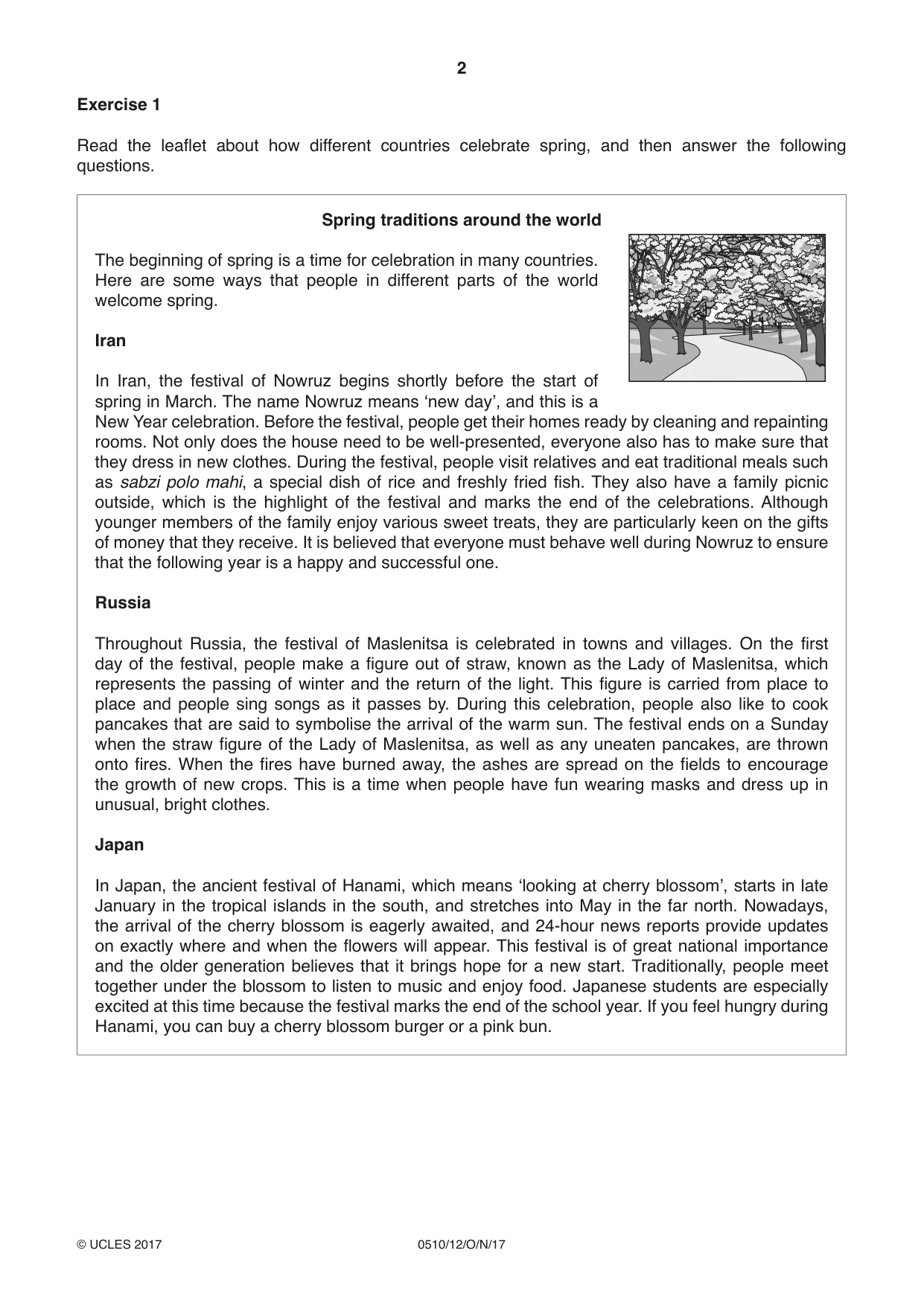
2 0510/12/O/N/17 © UCLES 2017 Exercise 1 Read the leaflet about how different countries celebrate spring, and then answer the following questions. Spring traditions around the world The beginning of spring is a time for celebration in many countries. Here are some ways that people in different parts of the world welcome spring. Iran In Iran, the festival of Nowruz begins shortly before the start of spring in March. The name Nowruz means ‘new day’, and this is a New Year celebration. Before the festival, people get their homes ready by cleaning and repainting rooms. Not only does the house need to be well-presented, everyone also has to make sure that they dress in new clothes. During the festival, people visit relatives and eat traditional meals such as sabzi polo mahi, a special dish of rice and freshly fried fish. They also have a family picnic outside, which is the highlight of the festival and marks the end of the celebrations. Although younger members of the family enjoy various sweet treats, they are particularly keen on the gifts of money that they receive. It is believed that everyone must behave well during Nowruz to ensure that the following year is a happy and successful one. Russia Throughout Russia, the festival of Maslenitsa is celebrated in towns and villages. On the first day of the festival, people make a figure out of straw, known as the Lady of Maslenitsa, which represents the passing of winter and the return of the light. This figure is carried from place to place and people sing songs as it passes by. During this celebration, people also like to cook pancakes that are said to symbolise the arrival of the warm sun. The festival ends on a Sunday when the straw figure of the Lady of Maslenitsa, as well as any uneaten pancakes, are thrown onto fires. When the fires have burned away, the ashes are spread on the fields to encourage the growth of new crops. This is a time when people have fun wearing masks and dress up in unusual, bright clothes. Japan In Japan, the ancient festival of Hanami, which means ‘looking at cherry blossom’, starts in late January in the tropical islands in the south, and stretches into May in the far north. Nowadays, the arrival of the cherry blossom is eagerly awaited, and 24-hour news reports provide updates on exactly where and when the flowers will appear. This festival is of great national importance and the older generation believes that it brings hope for a new start. Traditionally, people meet together under the blossom to listen to music and enjoy food. Japanese students are especially excited at this time because the festival marks the end of the school year. If you feel hungry during Hanami, you can buy a cherry blossom burger or a pink bun.
Question paper, page 3
3 0510/12/O/N/17 © UCLES 2017 [Turn over (a) How do people in Iran prepare their houses for Nowruz? …[1] (b) What do children like most about Nowruz? …[1] (c) What do the pancakes eaten during Maslenitsa represent? …[1] (d) Where in Japan can you see cherry blossom first? …[1] (e) How do people in Japan find out when the cherry blossom will appear? …[1] (f) What is the significance of the Hanami festival to the younger and older generations? Give two details. Younger generation: … Older generation: …[2] [Total: 7]
Question paper, page 4
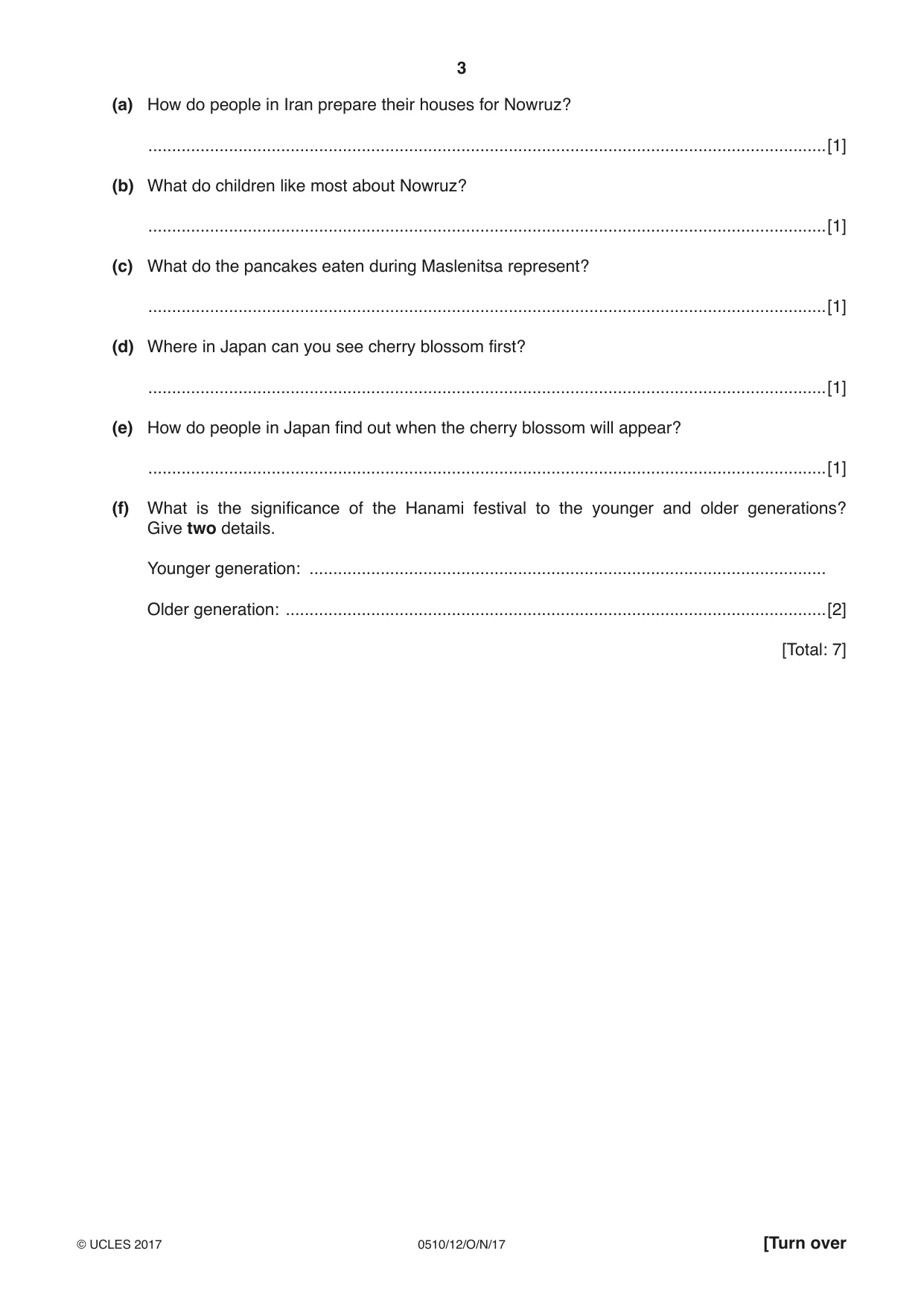
4 0510/12/O/N/17 © UCLES 2017 Exercise 2 Read the article about plastic toys which have been found on beaches in the UK, and then answer the following questions. LOST AND FOUND Cornwall is an area in the south-west of the UK, and it is famous for its beautiful beaches. Many people travel to Cornwall to enjoy a day at the seaside, but for people like Sarah Carter, there is so much more to the coast than just surf and sand. Sarah is a beachcomber, which means she spends every spare moment walking along her local beaches with her eyes down, hoping to find an item for her collection. Unlike most beachcombers, however, Sarah is not interested in the shells or fossils found on the beaches. For the last ten years, she has been looking for plastic objects which are usually found in a child’s toy box. Sarah explores the beaches looking for pieces of the plastic toy Playgo. Many things found on a beach tell a story, and the lost Playgo pieces are no exception. Twenty years ago, the Singapore Rose was on its way to Canada when the container ship hit an extremely rough wave and turned on its side. The captain of the ship, Dirk Bartrum, feared that the ship would sink, but instead, 57 of the ship’s huge containers fell overboard into the sea. One of these containers was filled with nearly 6 million pieces of Playgo. Not long afterwards, some of these pieces started to appear on beaches in Cornwall. Tourists quickly joined the hunt for the brightly coloured toys. However, it was local schoolchildren who initially discovered them, including life jackets, divers and pirates. The fact that many of the objects had a sea theme was what initially caught Sarah’s attention. As time has passed, and more of the pieces wash onto the beaches, it is the rare octopuses, rather than the fishing nets and scuba equipment, that Playgo collectors search for. Many people might think that the pieces are more likely to appear on the beaches after a high tide. However, after a bad storm is when they wash up in greater quantities. In recent years, collecting these Playgo toys has become very competitive, and because the pieces continue to appear, Sarah has set up a website which allows other collectors to add details of the type of Playgo they have found. Lost Playgo pieces found in Cornwall Life jackets 26 600 Diver flippers 418 000 Octopuses 4200 Scuba equipment 97 500 Ship sails 26 600 Dragons 33 941 The Playgo pieces are attracting the interest not only of beachcombers, but also of scientists. Steve Newton is a marine scientist who has been following the Playgo story from the beginning. He cannot explain why the pieces of Playgo were only found on beaches in the UK until recently. Although most pieces are still found in Cornwall, Sarah has started to receive reports of discoveries in Ireland, the Netherlands, and as far away as Australia. Steve points out that Sarah’s website is a valuable resource for recording the location of Playgo discoveries: “If these pieces do all come from the same lost container, these reports are teaching us a great deal about ocean currents.” Not everyone is fascinated by the discoveries, however. Plastic takes centuries to degrade, which is why the Playgo pieces still look nearly as good as new. The fact that plastic in the ocean is a threat to marine wildlife is also a great worry to beach lovers and environmentalists alike. Sarah is very sensitive to this important environmental issue, and is pleased that her website is helping to raise awareness about it. Recently, a local group organised a 30-minute beach-cleaning session, in which 41 volunteers collected 96 sacks full of rubbish. The contents were sorted afterwards, and 53 out of a total of 8763 pieces of plastic were found to be pieces of Playgo.
Question paper, page 5
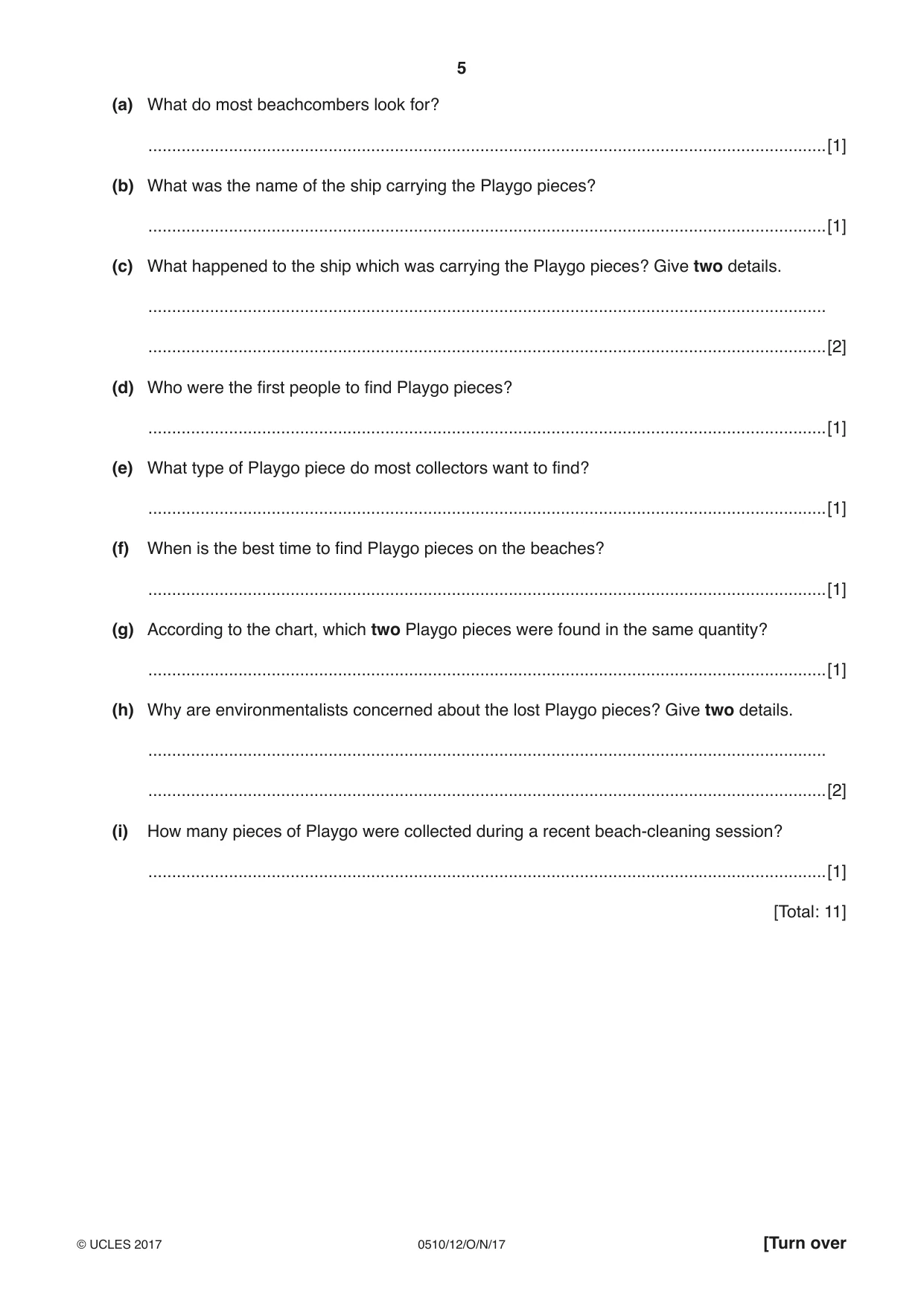
5 0510/12/O/N/17 © UCLES 2017 [Turn over (a) What do most beachcombers look for? …[1] (b) What was the name of the ship carrying the Playgo pieces? …[1] (c) What happened to the ship which was carrying the Playgo pieces? Give two details. … …[2] (d) Who were the first people to find Playgo pieces? …[1] (e) What type of Playgo piece do most collectors want to find? …[1] (f) When is the best time to find Playgo pieces on the beaches? …[1] (g) According to the chart, which two Playgo pieces were found in the same quantity? …[1] (h) Why are environmentalists concerned about the lost Playgo pieces? Give two details. … …[2] (i) How many pieces of Playgo were collected during a recent beach-cleaning session? …[1] [Total: 11]
Question paper, page 6
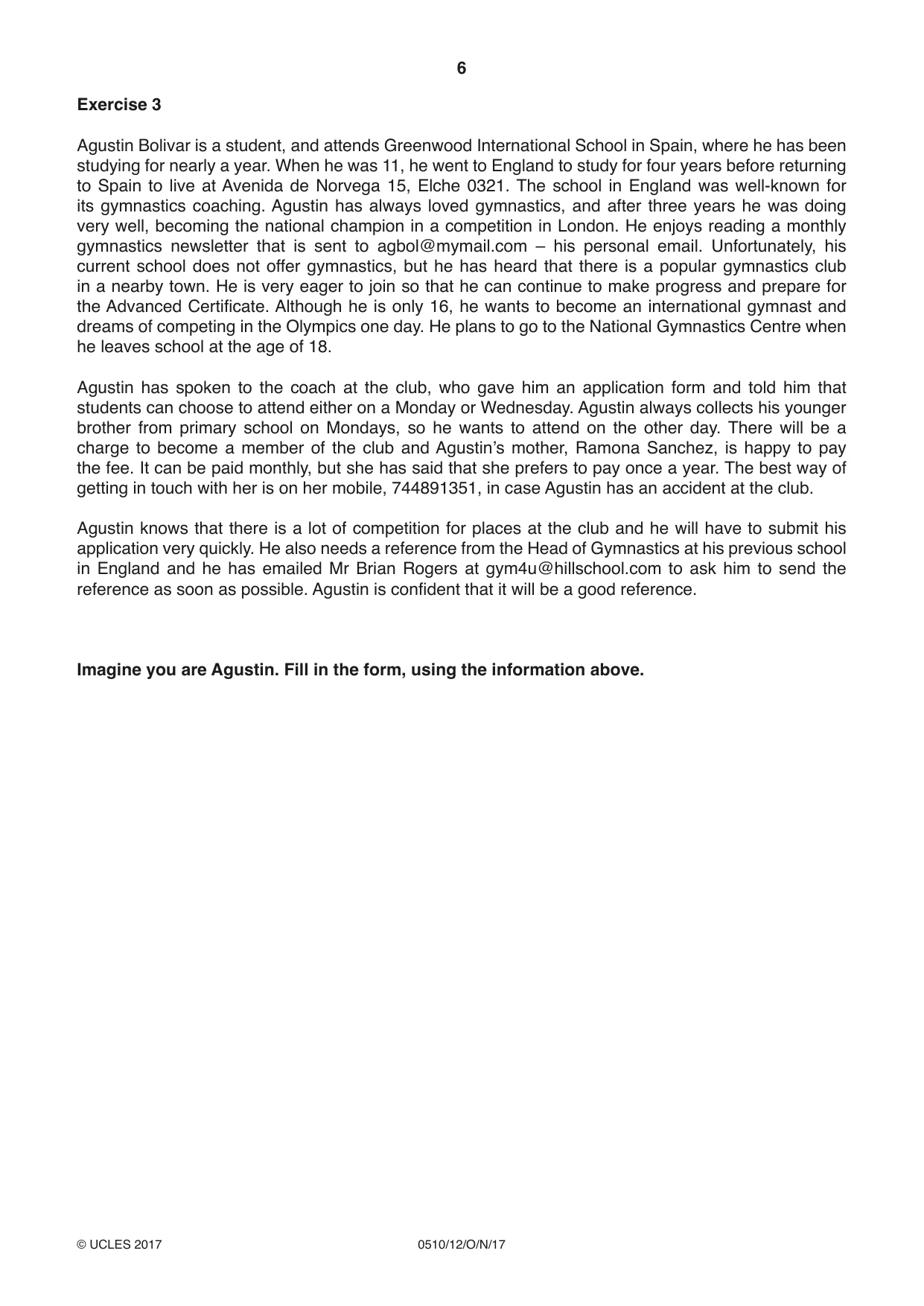
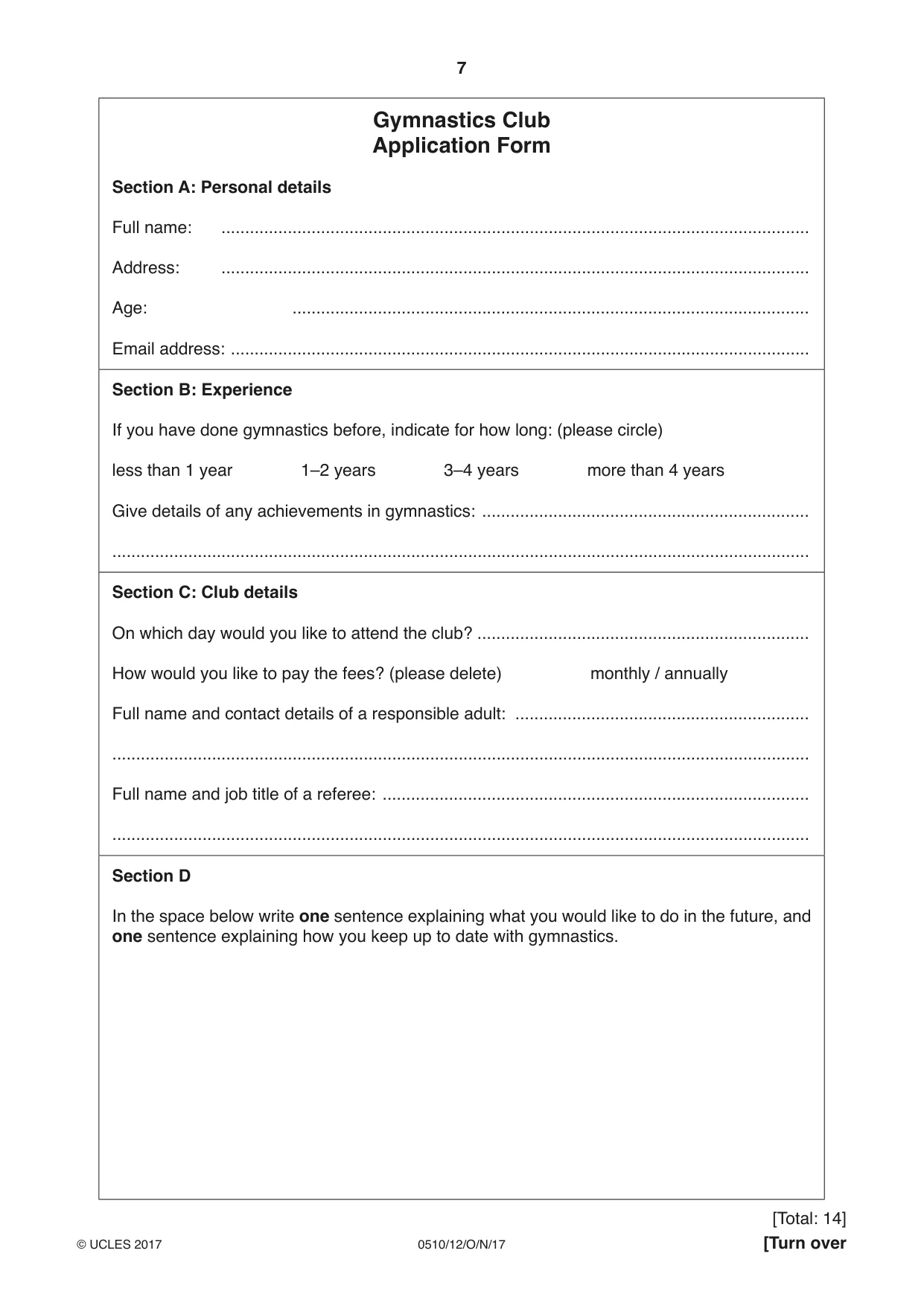
6 0510/12/O/N/17 © UCLES 2017 Exercise 3 Agustin Bolivar is a student, and attends Greenwood International School in Spain, where he has been studying for nearly a year. When he was 11, he went to England to study for four years before returning to Spain to live at Avenida de Norvega 15, Elche 0321. The school in England was well-known for its gymnastics coaching. Agustin has always loved gymnastics, and after three years he was doing very well, becoming the national champion in a competition in London. He enjoys reading a monthly gymnastics newsletter that is sent to agbol@mymail.com – his personal email. Unfortunately, his current school does not offer gymnastics, but he has heard that there is a popular gymnastics club in a nearby town. He is very eager to join so that he can continue to make progress and prepare for the Advanced Certificate. Although he is only 16, he wants to become an international gymnast and dreams of competing in the Olympics one day. He plans to go to the National Gymnastics Centre when he leaves school at the age of 18. Agustin has spoken to the coach at the club, who gave him an application form and told him that students can choose to attend either on a Monday or Wednesday. Agustin always collects his younger brother from primary school on Mondays, so he wants to attend on the other day. There will be a charge to become a member of the club and Agustin’s mother, Ramona Sanchez, is happy to pay the fee. It can be paid monthly, but she has said that she prefers to pay once a year. The best way of getting in touch with her is on her mobile, 744891351, in case Agustin has an accident at the club. Agustin knows that there is a lot of competition for places at the club and he will have to submit his application very quickly. He also needs a reference from the Head of Gymnastics at his previous school in England and he has emailed Mr Brian Rogers at gym4u@hillschool.com to ask him to send the reference as soon as possible. Agustin is confident that it will be a good reference. Imagine you are Agustin. Fill in the form, using the information above.
Question paper, page 7
7 0510/12/O/N/17 © UCLES 2017 [Turn over Gymnastics Club Application Form Section A: Personal details Full name: … Address: … Age: … Email address: … Section B: Experience If you have done gymnastics before, indicate for how long: (please circle) less than 1 year 1–2 years 3–4 years more than 4 years Give details of any achievements in gymnastics: … … Section C: Club details On which day would you like to attend the club? … How would you like to pay the fees? (please delete) monthly / annually Full name and contact details of a responsible adult: … … Full name and job title of a referee: … … Section D In the space below write one sentence explaining what you would like to do in the future, and one sentence explaining how you keep up to date with gymnastics. [Total: 14]
Question paper, page 8
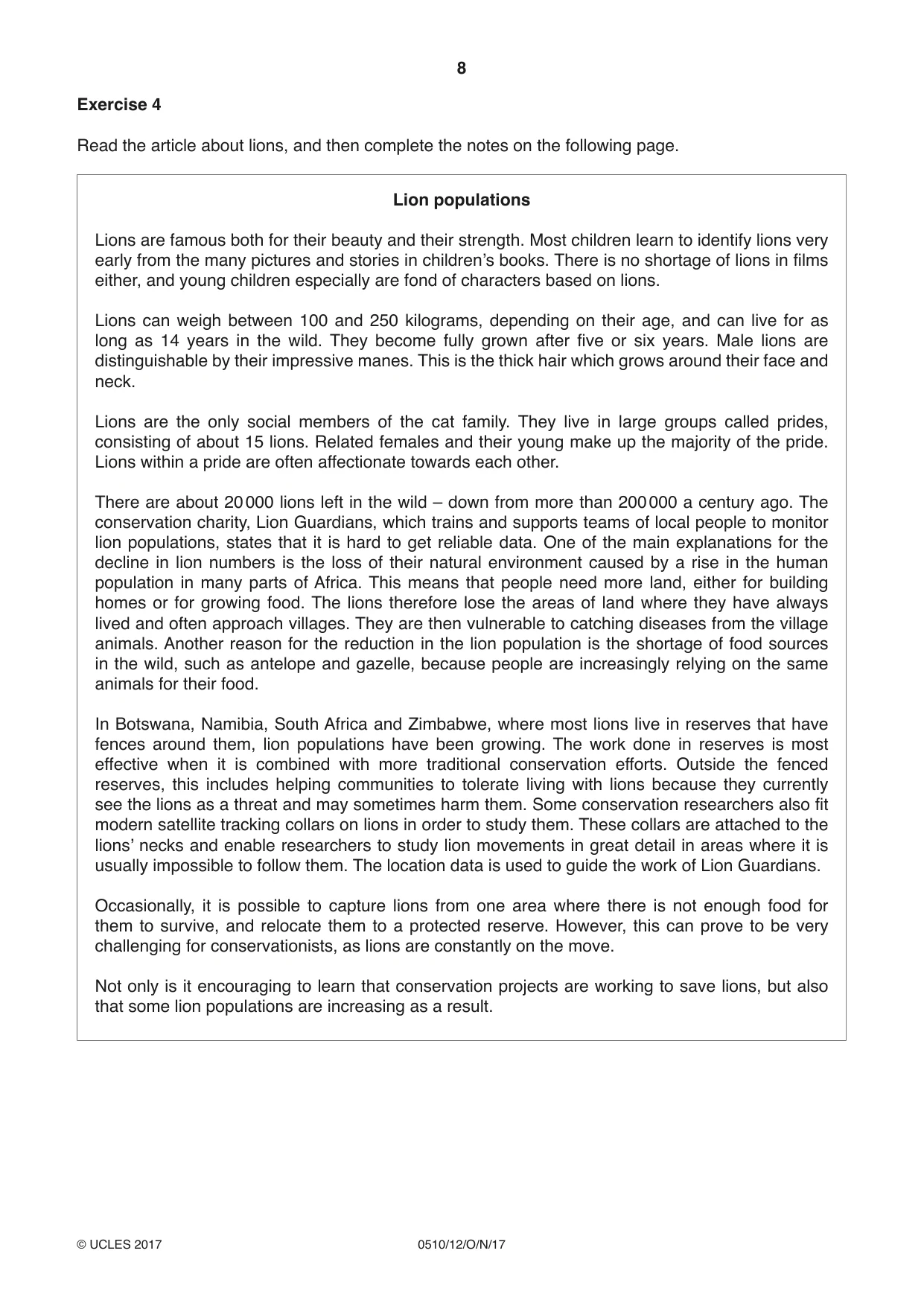
8 0510/12/O/N/17 © UCLES 2017 Exercise 4 Read the article about lions, and then complete the notes on the following page. Lion populations Lions are famous both for their beauty and their strength. Most children learn to identify lions very early from the many pictures and stories in children’s books. There is no shortage of lions in films either, and young children especially are fond of characters based on lions. Lions can weigh between 100 and 250 kilograms, depending on their age, and can live for as long as 14 years in the wild. They become fully grown after five or six years. Male lions are distinguishable by their impressive manes. This is the thick hair which grows around their face and neck. Lions are the only social members of the cat family. They live in large groups called prides, consisting of about 15 lions. Related females and their young make up the majority of the pride. Lions within a pride are often affectionate towards each other. There are about 20 000 lions left in the wild – down from more than 200 000 a century ago. The conservation charity, Lion Guardians, which trains and supports teams of local people to monitor lion populations, states that it is hard to get reliable data. One of the main explanations for the decline in lion numbers is the loss of their natural environment caused by a rise in the human population in many parts of Africa. This means that people need more land, either for building homes or for growing food. The lions therefore lose the areas of land where they have always lived and often approach villages. They are then vulnerable to catching diseases from the village animals. Another reason for the reduction in the lion population is the shortage of food sources in the wild, such as antelope and gazelle, because people are increasingly relying on the same animals for their food. In Botswana, Namibia, South Africa and Zimbabwe, where most lions live in reserves that have fences around them, lion populations have been growing. The work done in reserves is most effective when it is combined with more traditional conservation efforts. Outside the fenced reserves, this includes helping communities to tolerate living with lions because they currently see the lions as a threat and may sometimes harm them. Some conservation researchers also fit modern satellite tracking collars on lions in order to study them. These collars are attached to the lions’ necks and enable researchers to study lion movements in great detail in areas where it is usually impossible to follow them. The location data is used to guide the work of Lion Guardians. Occasionally, it is possible to capture lions from one area where there is not enough food for them to survive, and relocate them to a protected reserve. However, this can prove to be very challenging for conservationists, as lions are constantly on the move. Not only is it encouraging to learn that conservation projects are working to save lions, but also that some lion populations are increasing as a result.
Question paper, page 9
9 0510/12/O/N/17 © UCLES 2017 [Turn over You have been asked to give a talk to your science class about lions. Prepare some notes to use as the basis for your talk. Make short notes under each heading. Behaviour of lions • … • … Threats to the survival of lions • … • … Work being done by conservationists • … • … • … [Total: 7] Exercise 5 Imagine that you have given your talk to your class. Now your teacher has asked you to follow up these notes with a short written report. Look at your notes in Exercise 4. Using the ideas in your notes, write a summary about lions. Your summary should be about 70 words long (and no more than 80 words long). You should use your own words as far as possible. … … … … … … … … [Total: 5]
Question paper, page 10
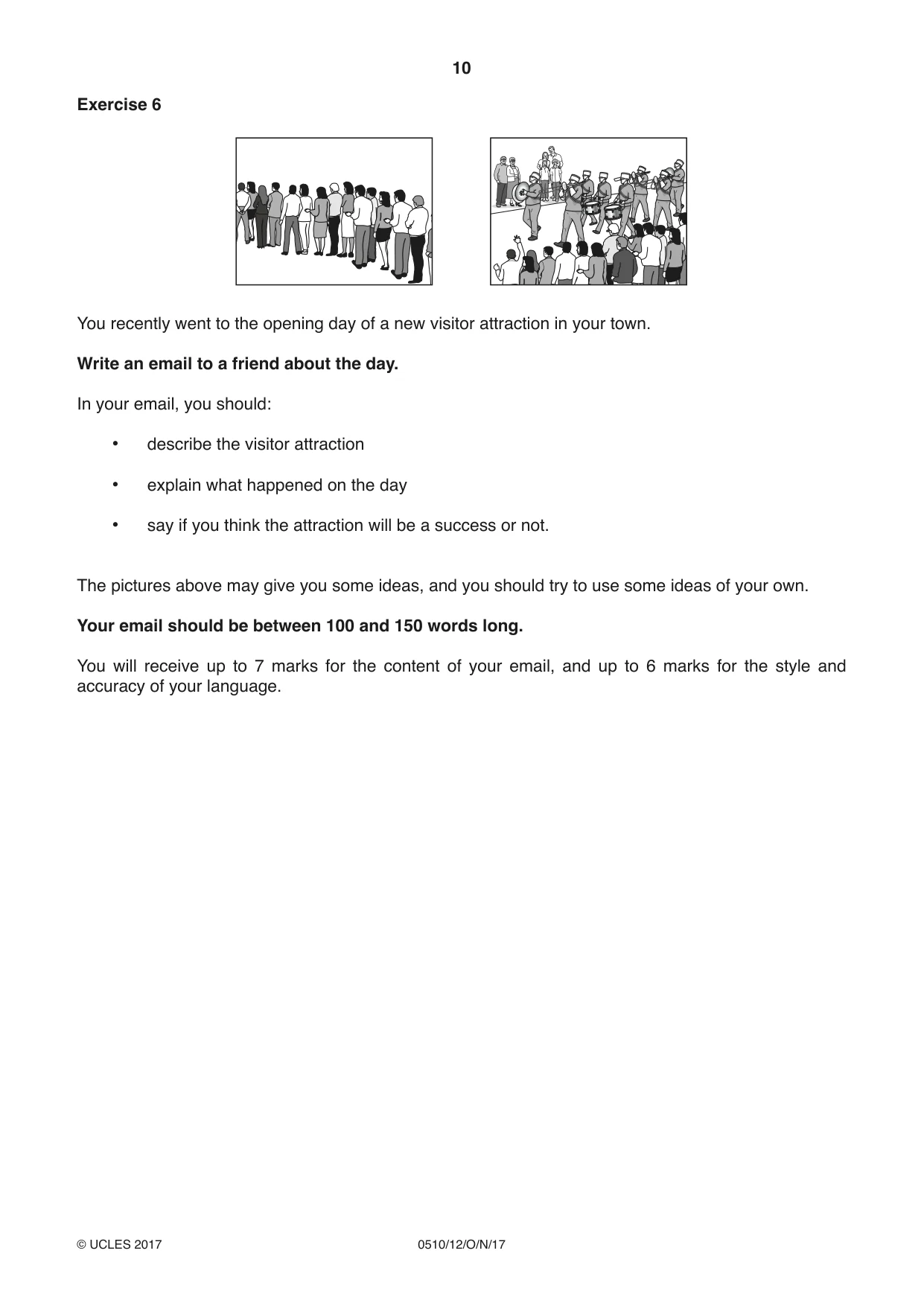
10 0510/12/O/N/17 © UCLES 2017 Exercise 6 You recently went to the opening day of a new visitor attraction in your town. Write an email to a friend about the day. In your email, you should: • describe the visitor attraction • explain what happened on the day • say if you think the attraction will be a success or not. The pictures above may give you some ideas, and you should try to use some ideas of your own. Your email should be between 100 and 150 words long. You will receive up to 7 marks for the content of your email, and up to 6 marks for the style and accuracy of your language.
Question paper, page 11
11 0510/12/O/N/17 © UCLES 2017 [Turn over … … … … … … … … … … … … … … … … … … … … … … … … … … … [Total: 13]
Question paper, page 12
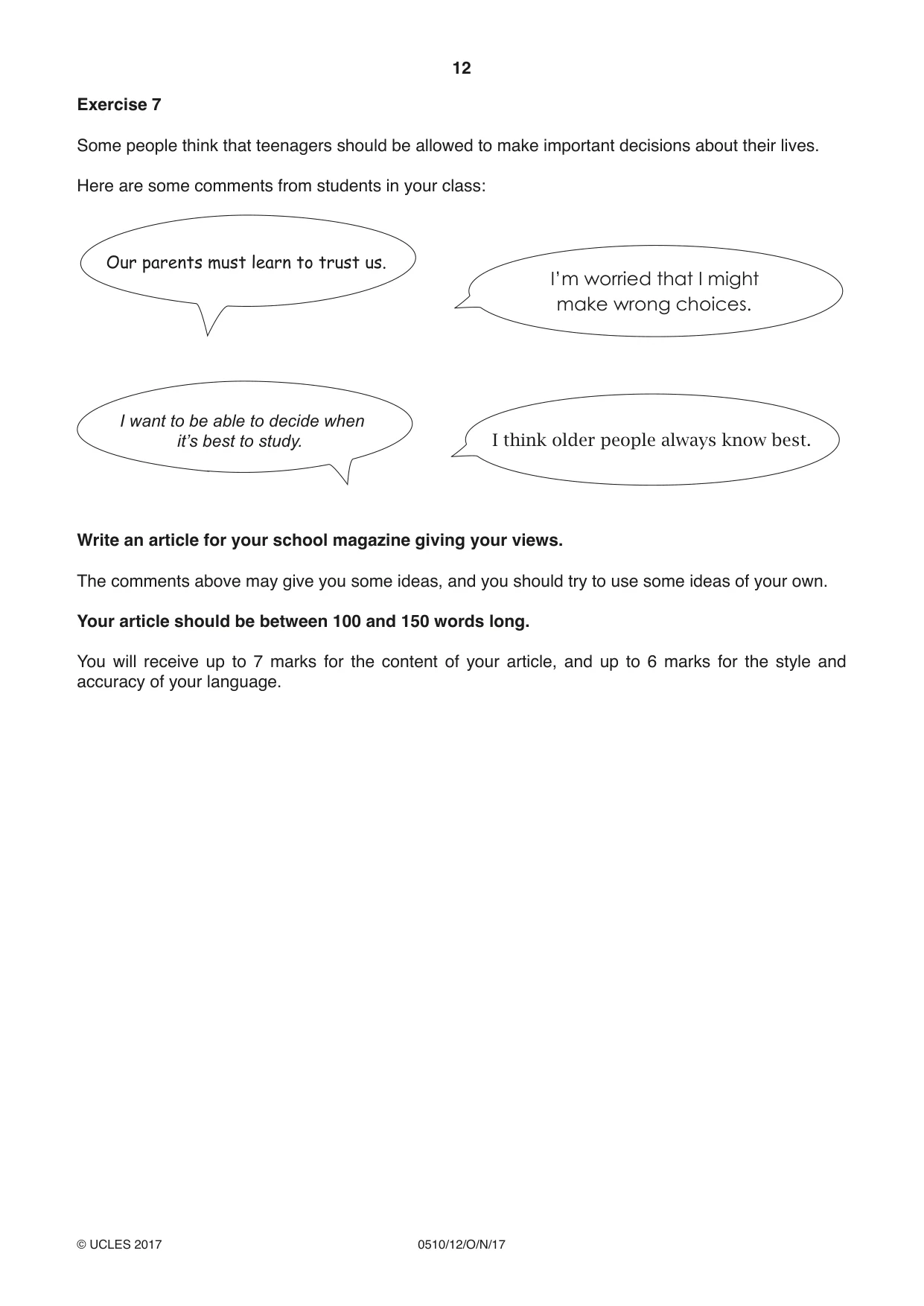
12 0510/12/O/N/17 © UCLES 2017 Exercise 7 Some people think that teenagers should be allowed to make important decisions about their lives. Here are some comments from students in your class: Our parents must learn to trust us. I’m worried that I might make wrong choices. I want to be able to decide when it’s best to study. I think older people always know best. Write an article for your school magazine giving your views. The comments above may give you some ideas, and you should try to use some ideas of your own. Your article should be between 100 and 150 words long. You will receive up to 7 marks for the content of your article, and up to 6 marks for the style and accuracy of your language.
Question paper, page 13
13 0510/12/O/N/17 © UCLES 2017 … … … … … … … … … … … … … … … … … … … … … … … … … … … [Total: 13]
Question paper, page 14
14 0510/12/O/N/17 © UCLES 2017 BLANK PAGE
Question paper, page 15
15 0510/12/O/N/17 © UCLES 2017 BLANK PAGE
Question paper, page 16
16 0510/12/O/N/17 © UCLES 2017 Permission to reproduce items where third-party owned material protected by copyright is included has been sought and cleared where possible. Every reasonable effort has been made by the publisher (UCLES) to trace copyright holders, but if any items requiring clearance have unwittingly been included, the publisher will be pleased to make amends at the earliest possible opportunity. To avoid the issue of disclosure of answer-related information to candidates, all copyright acknowledgements are reproduced online in the Cambridge International Examinations Copyright Acknowledgements Booklet. This is produced for each series of examinations and is freely available to download at www.cie.org.uk after the live examination series. Cambridge International Examinations is part of the Cambridge Assessment Group. Cambridge Assessment is the brand name of University of Cambridge Local Examinations Syndicate (UCLES), which is itself a department of the University of Cambridge. BLANK PAGE
Mark scheme, page 1
® IGCSE is a registered trademark. This document consists of 11 printed pages. © UCLES 2017 [Turn over Cambridge Assessment International Education Cambridge International General Certificate of Secondary Education ENGLISH AS A SECOND LANGUAGE 0510/12 Paper 1 Reading and Writing (Core) October/November 2017 MARK SCHEME Maximum Mark: 70 Published This mark scheme is published as an aid to teachers and candidates, to indicate the requirements of the examination. It shows the basis on which Examiners were instructed to award marks. It does not indicate the details of the discussions that took place at an Examiners’ meeting before marking began, which would have considered the acceptability of alternative answers. Mark schemes should be read in conjunction with the question paper and the Principal Examiner Report for Teachers. Cambridge International will not enter into discussions about these mark schemes. Cambridge International is publishing the mark schemes for the October/November 2017 series for most Cambridge IGCSE®, Cambridge International A and AS Level components and some Cambridge O Level components.
Mark scheme, page 2
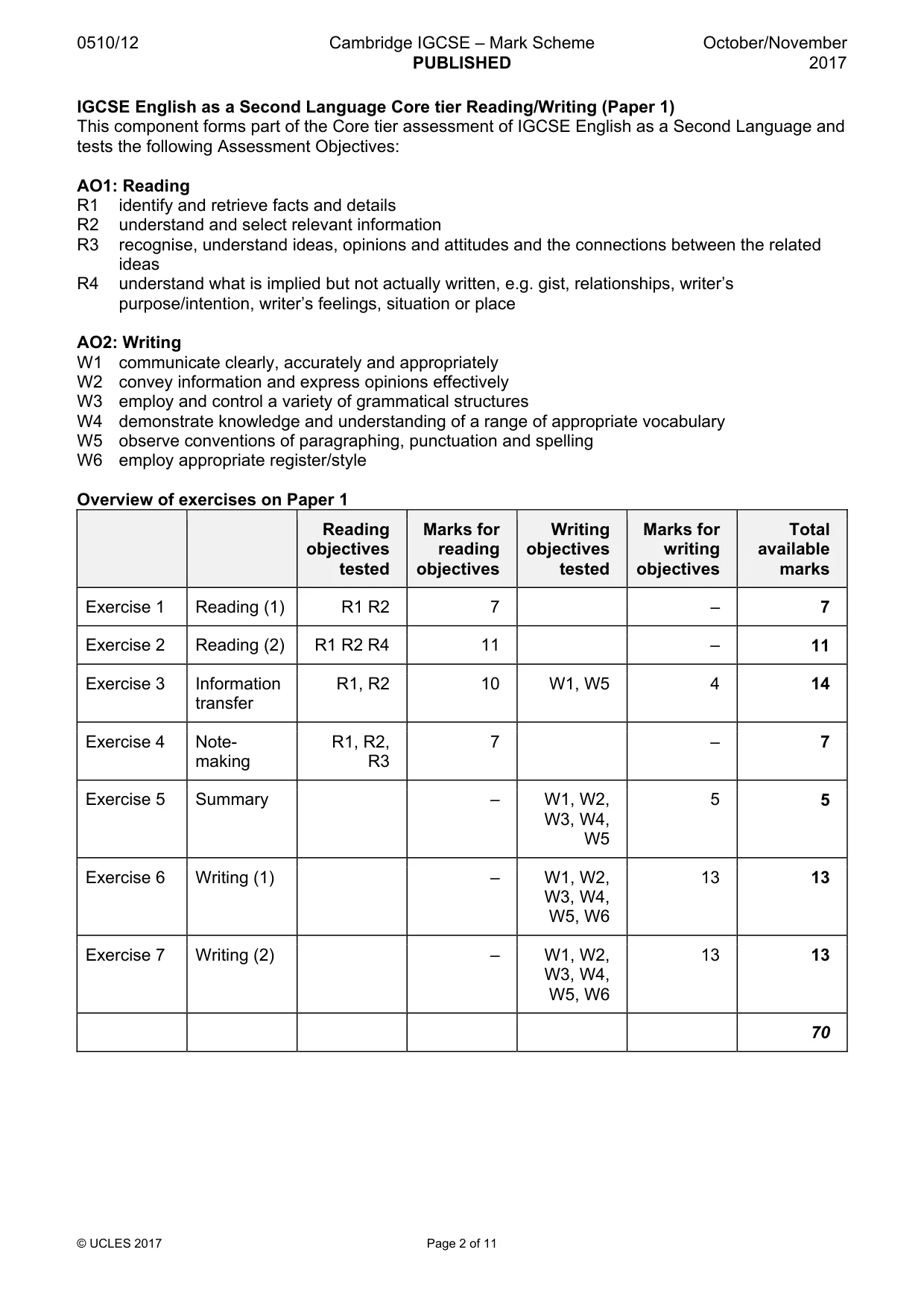
0510/12 Cambridge IGCSE – Mark Scheme PUBLISHED October/November 2017 © UCLES 2017 Page 2 of 11 IGCSE English as a Second Language Core tier Reading/Writing (Paper 1) This component forms part of the Core tier assessment of IGCSE English as a Second Language and tests the following Assessment Objectives: AO1: Reading R1 identify and retrieve facts and details R2 understand and select relevant information R3 recognise, understand ideas, opinions and attitudes and the connections between the related ideas R4 understand what is implied but not actually written, e.g. gist, relationships, writer’s purpose/intention, writer’s feelings, situation or place AO2: Writing W1 communicate clearly, accurately and appropriately W2 convey information and express opinions effectively W3 employ and control a variety of grammatical structures W4 demonstrate knowledge and understanding of a range of appropriate vocabulary W5 observe conventions of paragraphing, punctuation and spelling W6 employ appropriate register/style Overview of exercises on Paper 1 Reading objectives tested Marks for reading objectives Writing objectives tested Marks for writing objectives Total available marks Exercise 1 Reading (1) R1 R2 7 – 7 Exercise 2 Reading (2) R1 R2 R4 11 – 11 Exercise 3 Information transfer R1, R2 10 W1, W5 4 14 Exercise 4 Note- making R1, R2, R3 7 – 7 Exercise 5 Summary – W1, W2, W3, W4, W5 5 5 Exercise 6 Writing (1) – W1, W2, W3, W4, W5, W6 13 13 Exercise 7 Writing (2) – W1, W2, W3, W4, W5, W6 13 13 70
Mark scheme, page 3
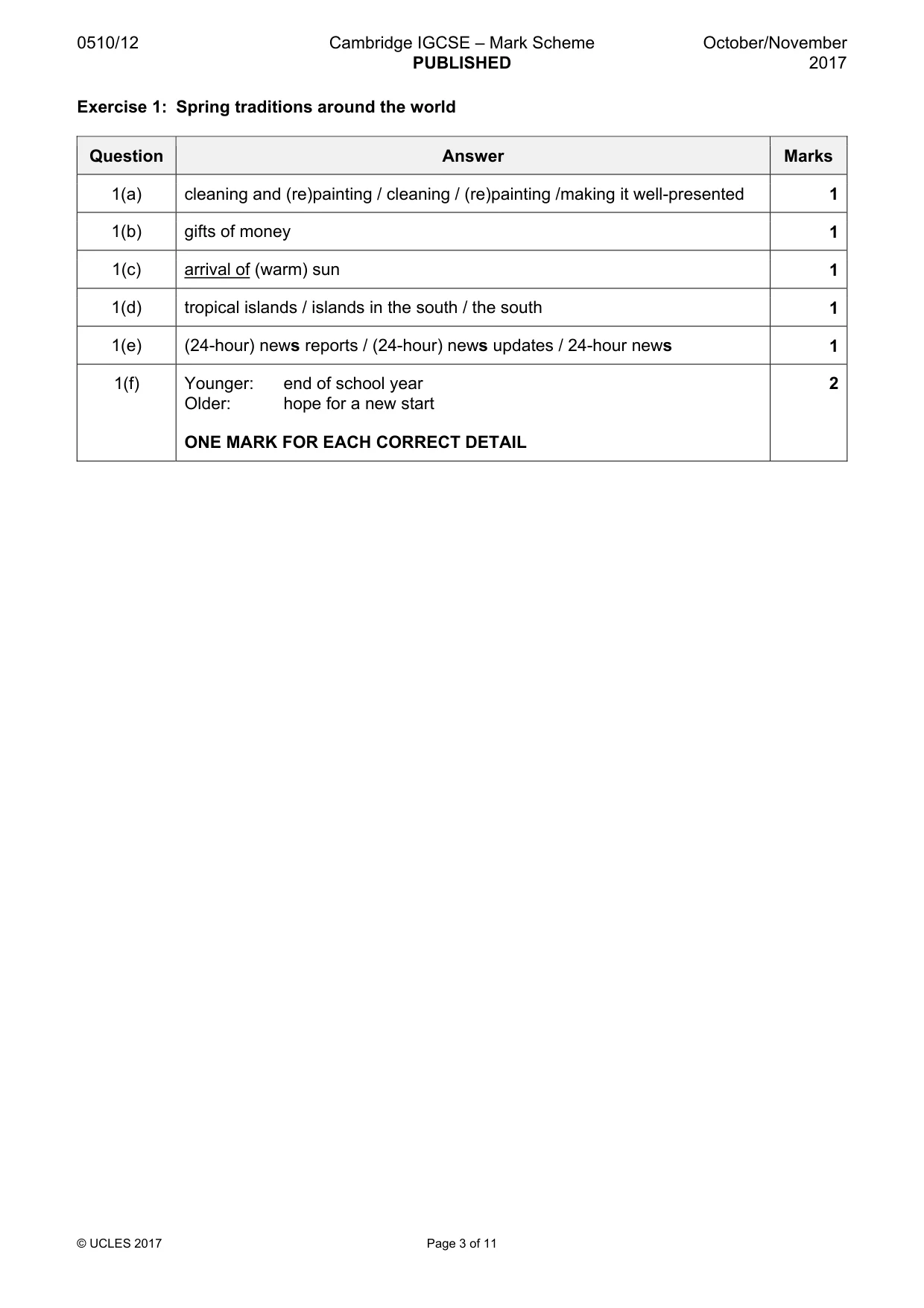
0510/12 Cambridge IGCSE – Mark Scheme PUBLISHED October/November 2017 © UCLES 2017 Page 3 of 11 Exercise 1: Spring traditions around the world Question Answer Marks 1(a) cleaning and (re)painting / cleaning / (re)painting /making it well-presented 1 1(b) gifts of money 1 1(c) arrival of (warm) sun 1 1(d) tropical islands / islands in the south / the south 1 1(e) (24-hour) news reports / (24-hour) news updates / 24-hour news 1 1(f) Younger: end of school year Older: hope for a new start ONE MARK FOR EACH CORRECT DETAIL 2
Mark scheme, page 4
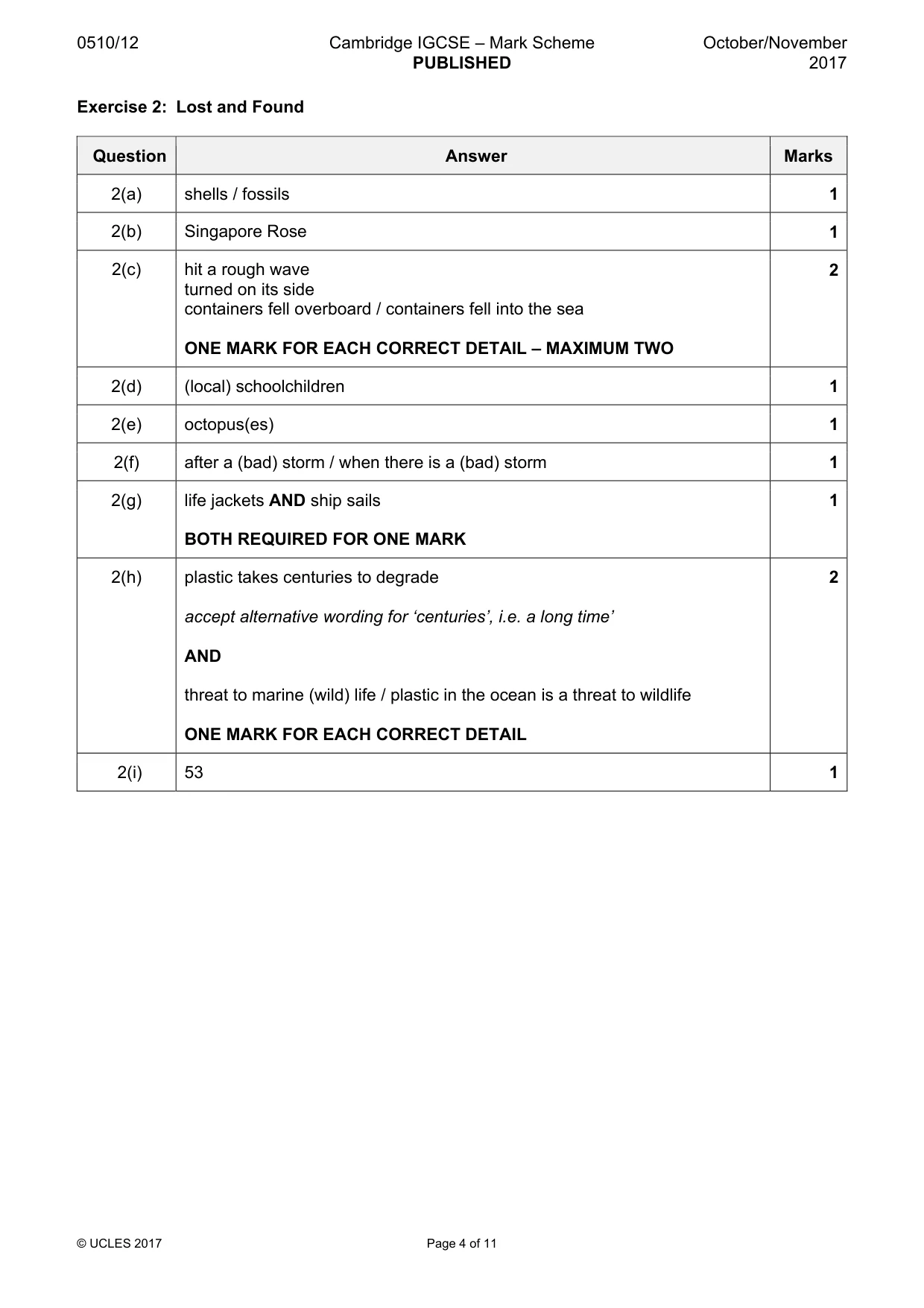
0510/12 Cambridge IGCSE – Mark Scheme PUBLISHED October/November 2017 © UCLES 2017 Page 4 of 11 Exercise 2: Lost and Found Question Answer Marks 2(a) shells / fossils 1 2(b) Singapore Rose 1 2(c) hit a rough wave turned on its side containers fell overboard / containers fell into the sea ONE MARK FOR EACH CORRECT DETAIL – MAXIMUM TWO 2 2(d) (local) schoolchildren 1 2(e) octopus(es) 1 2(f) after a (bad) storm / when there is a (bad) storm 1 2(g) life jackets AND ship sails BOTH REQUIRED FOR ONE MARK 1 2(h) plastic takes centuries to degrade accept alternative wording for ‘centuries’, i.e. a long time’ AND threat to marine (wild) life / plastic in the ocean is a threat to wildlife ONE MARK FOR EACH CORRECT DETAIL 2 2(i) 53 1
Mark scheme, page 5
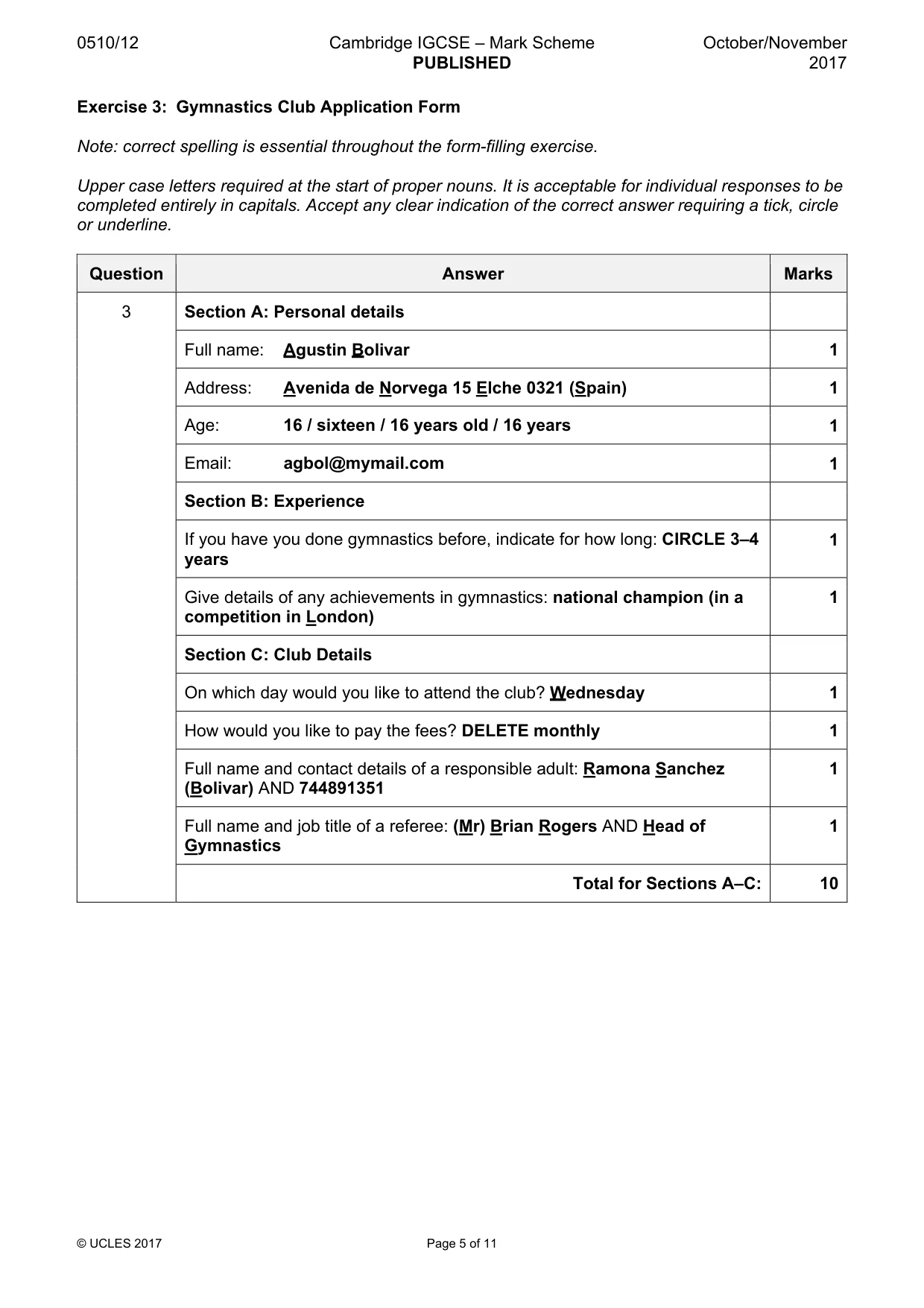
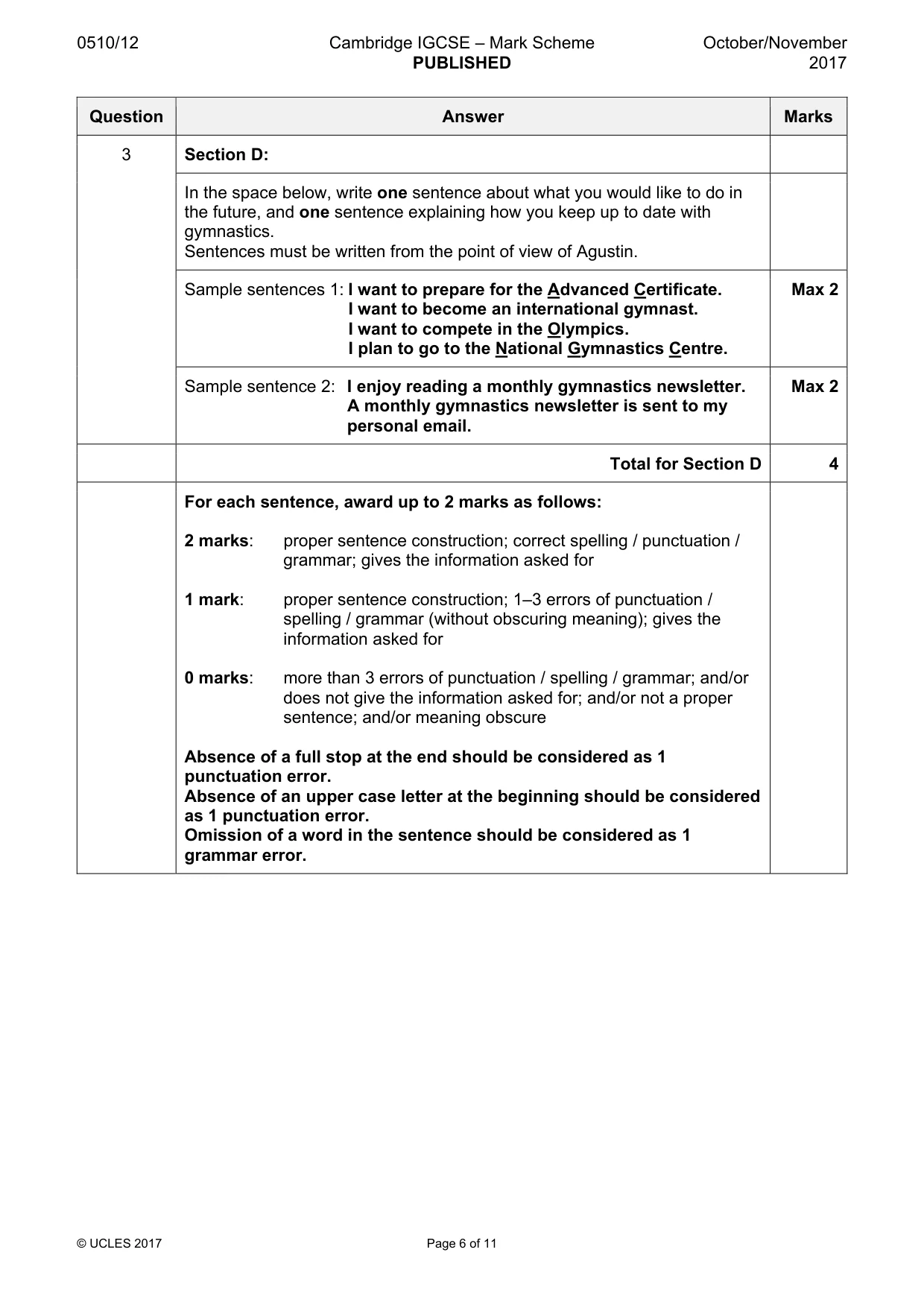
0510/12 Cambridge IGCSE – Mark Scheme PUBLISHED October/November 2017 © UCLES 2017 Page 5 of 11 Exercise 3: Gymnastics Club Application Form Note: correct spelling is essential throughout the form-filling exercise. Upper case letters required at the start of proper nouns. It is acceptable for individual responses to be completed entirely in capitals. Accept any clear indication of the correct answer requiring a tick, circle or underline. Question Answer Marks 3 Section A: Personal details Full name: Agustin Bolivar 1 Address: Avenida de Norvega 15 Elche 0321 (Spain) 1 Age: 16 / sixteen / 16 years old / 16 years 1 Email: agbol@mymail.com 1 Section B: Experience If you have you done gymnastics before, indicate for how long: CIRCLE 3–4 years 1 Give details of any achievements in gymnastics: national champion (in a competition in London) 1 Section C: Club Details On which day would you like to attend the club? Wednesday 1 How would you like to pay the fees? DELETE monthly 1 Full name and contact details of a responsible adult: Ramona Sanchez (Bolivar) AND 744891351 1 Full name and job title of a referee: (Mr) Brian Rogers AND Head of Gymnastics 1 Total for Sections A–C: 10
Mark scheme, page 6
0510/12 Cambridge IGCSE – Mark Scheme PUBLISHED October/November 2017 © UCLES 2017 Page 6 of 11 Question Answer Marks 3 Section D: In the space below, write one sentence about what you would like to do in the future, and one sentence explaining how you keep up to date with gymnastics. Sentences must be written from the point of view of Agustin. Sample sentences 1: I want to prepare for the Advanced Certificate. I want to become an international gymnast. I want to compete in the Olympics. I plan to go to the National Gymnastics Centre. Max 2 Sample sentence 2: I enjoy reading a monthly gymnastics newsletter. A monthly gymnastics newsletter is sent to my personal email. Max 2 Total for Section D 4 For each sentence, award up to 2 marks as follows: 2 marks: proper sentence construction; correct spelling / punctuation / grammar; gives the information asked for 1 mark: proper sentence construction; 1–3 errors of punctuation / spelling / grammar (without obscuring meaning); gives the information asked for 0 marks: more than 3 errors of punctuation / spelling / grammar; and/or does not give the information asked for; and/or not a proper sentence; and/or meaning obscure Absence of a full stop at the end should be considered as 1 punctuation error. Absence of an upper case letter at the beginning should be considered as 1 punctuation error. Omission of a word in the sentence should be considered as 1 grammar error.
Mark scheme, page 7
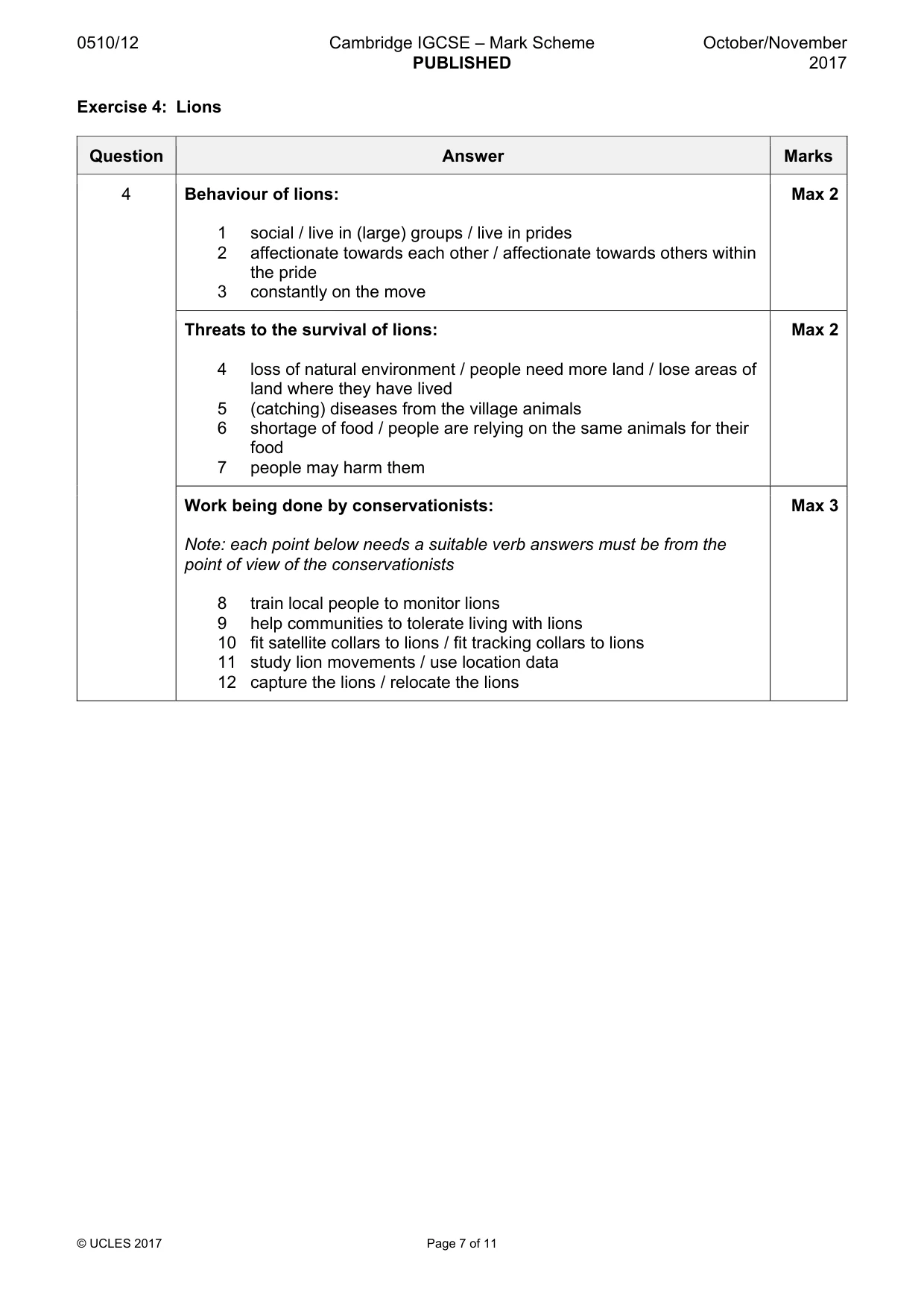
0510/12 Cambridge IGCSE – Mark Scheme PUBLISHED October/November 2017 © UCLES 2017 Page 7 of 11 Exercise 4: Lions Question Answer Marks 4 Behaviour of lions: 1 social / live in (large) groups / live in prides 2 affectionate towards each other / affectionate towards others within the pride 3 constantly on the move Max 2 Threats to the survival of lions: 4 loss of natural environment / people need more land / lose areas of land where they have lived 5 (catching) diseases from the village animals 6 shortage of food / people are relying on the same animals for their food 7 people may harm them Max 2 Work being done by conservationists: Note: each point below needs a suitable verb answers must be from the point of view of the conservationists 8 train local people to monitor lions 9 help communities to tolerate living with lions 10 fit satellite collars to lions / fit tracking collars to lions 11 study lion movements / use location data 12 capture the lions / relocate the lions Max 3
Mark scheme, page 8
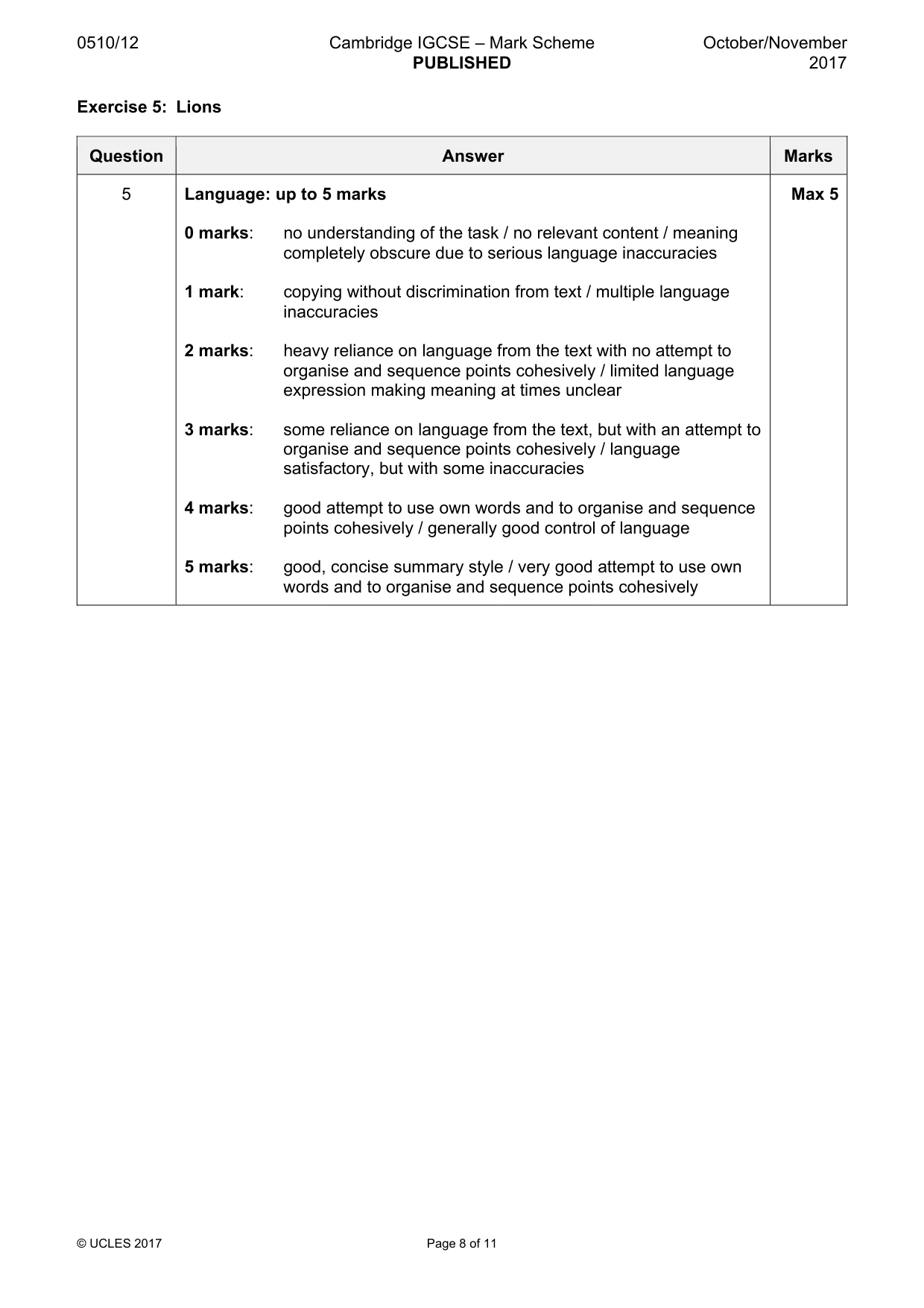
0510/12 Cambridge IGCSE – Mark Scheme PUBLISHED October/November 2017 © UCLES 2017 Page 8 of 11 Exercise 5: Lions Question Answer Marks 5 Language: up to 5 marks 0 marks: no understanding of the task / no relevant content / meaning completely obscure due to serious language inaccuracies 1 mark: copying without discrimination from text / multiple language inaccuracies 2 marks: heavy reliance on language from the text with no attempt to organise and sequence points cohesively / limited language expression making meaning at times unclear 3 marks: some reliance on language from the text, but with an attempt to organise and sequence points cohesively / language satisfactory, but with some inaccuracies 4 marks: good attempt to use own words and to organise and sequence points cohesively / generally good control of language 5 marks: good, concise summary style / very good attempt to use own words and to organise and sequence points cohesively Max 5
Mark scheme, page 9
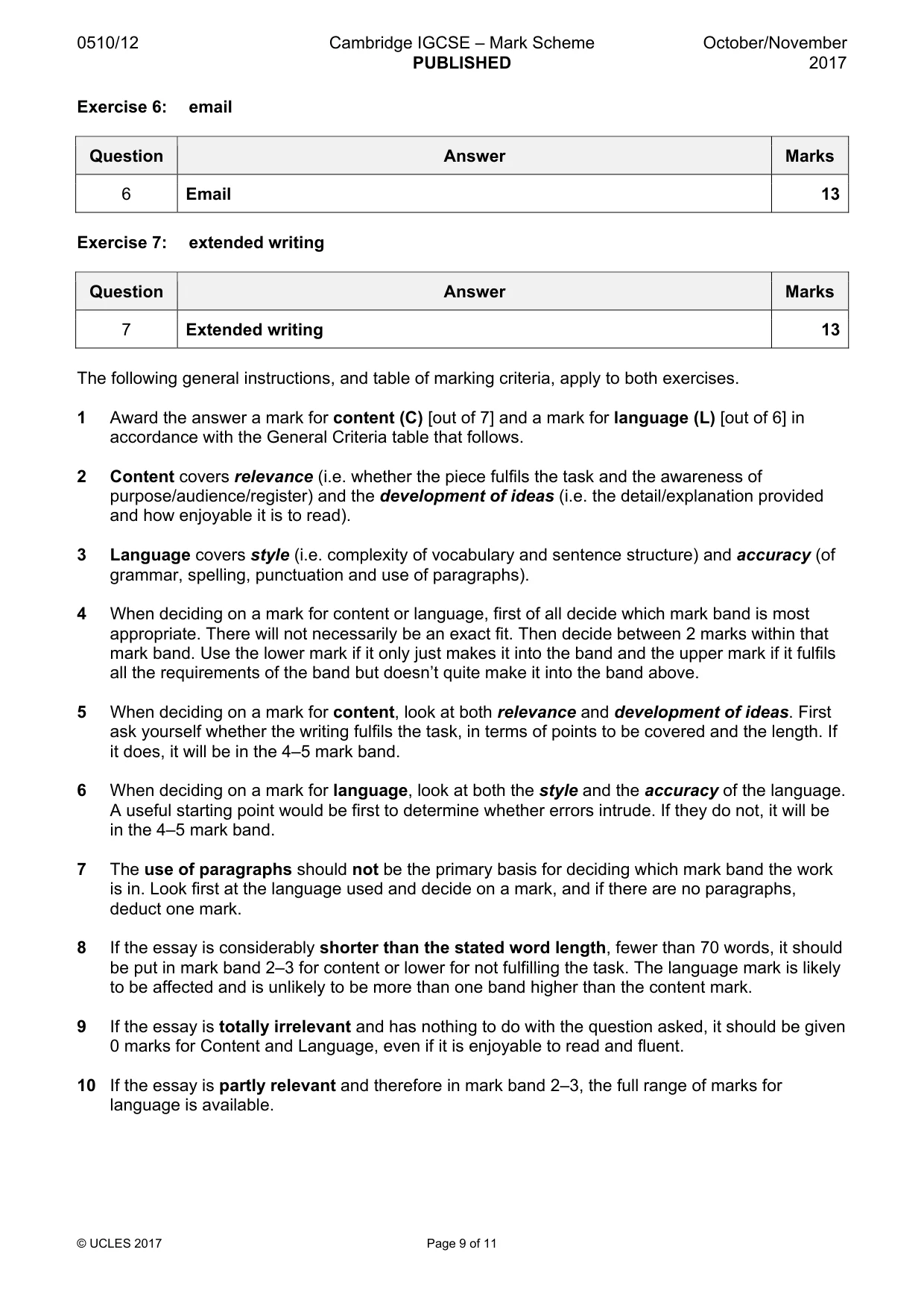
0510/12 Cambridge IGCSE – Mark Scheme PUBLISHED October/November 2017 © UCLES 2017 Page 9 of 11 Exercise 6: email Question Answer Marks 6 Email 13 Exercise 7: extended writing Question Answer Marks 7 Extended writing 13 The following general instructions, and table of marking criteria, apply to both exercises. 1 Award the answer a mark for content (C) [out of 7] and a mark for language (L) [out of 6] in accordance with the General Criteria table that follows. 2 Content covers relevance (i.e. whether the piece fulfils the task and the awareness of purpose/audience/register) and the development of ideas (i.e. the detail/explanation provided and how enjoyable it is to read). 3 Language covers style (i.e. complexity of vocabulary and sentence structure) and accuracy (of grammar, spelling, punctuation and use of paragraphs). 4 When deciding on a mark for content or language, first of all decide which mark band is most appropriate. There will not necessarily be an exact fit. Then decide between 2 marks within that mark band. Use the lower mark if it only just makes it into the band and the upper mark if it fulfils all the requirements of the band but doesn’t quite make it into the band above. 5 When deciding on a mark for content, look at both relevance and development of ideas. First ask yourself whether the writing fulfils the task, in terms of points to be covered and the length. If it does, it will be in the 4–5 mark band. 6 When deciding on a mark for language, look at both the style and the accuracy of the language. A useful starting point would be first to determine whether errors intrude. If they do not, it will be in the 4–5 mark band. 7 The use of paragraphs should not be the primary basis for deciding which mark band the work is in. Look first at the language used and decide on a mark, and if there are no paragraphs, deduct one mark. 8 If the essay is considerably shorter than the stated word length, fewer than 70 words, it should be put in mark band 2–3 for content or lower for not fulfilling the task. The language mark is likely to be affected and is unlikely to be more than one band higher than the content mark. 9 If the essay is totally irrelevant and has nothing to do with the question asked, it should be given 0 marks for Content and Language, even if it is enjoyable to read and fluent. 10 If the essay is partly relevant and therefore in mark band 2–3, the full range of marks for language is available.
Mark scheme, page 10
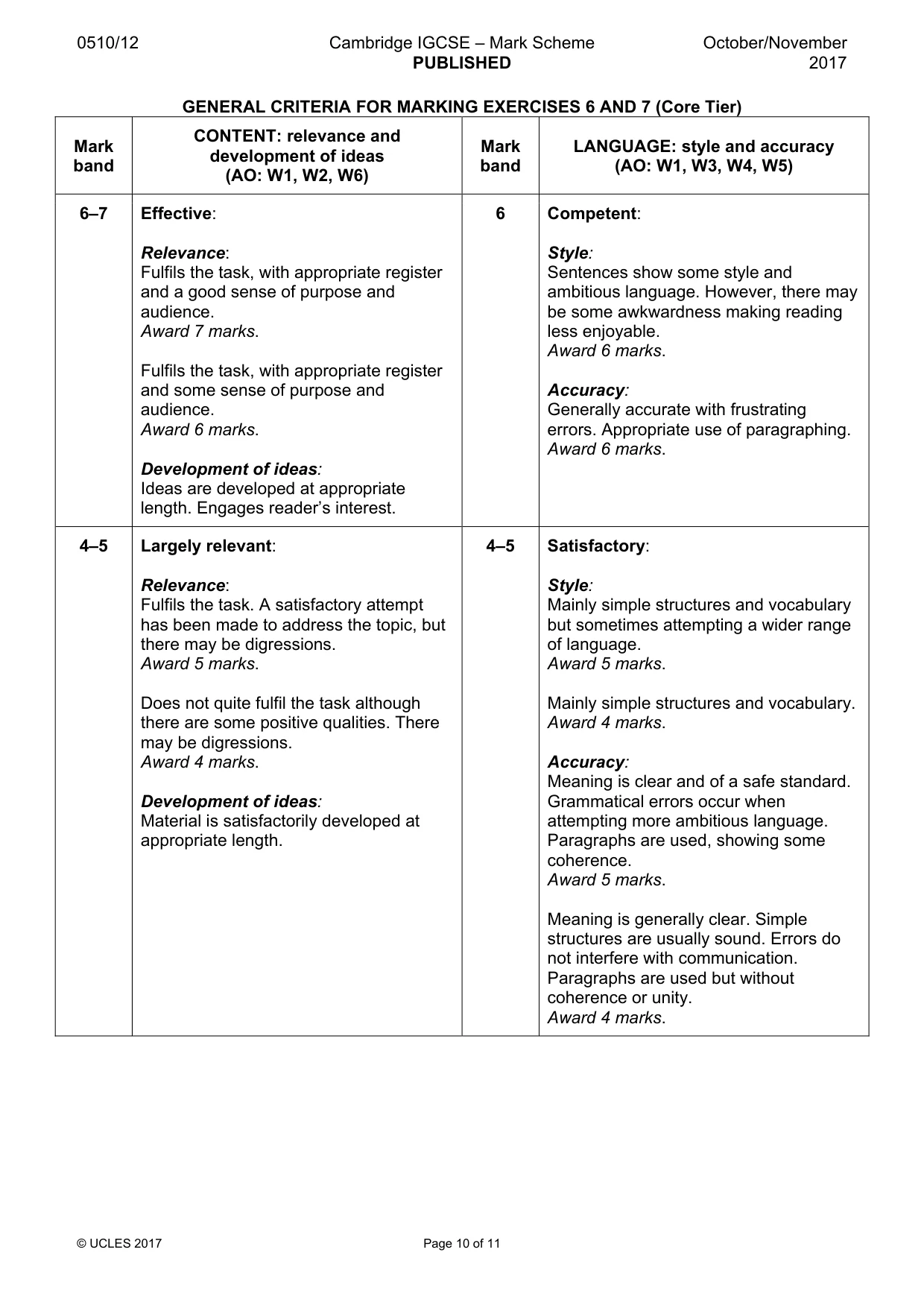
0510/12 Cambridge IGCSE – Mark Scheme PUBLISHED October/November 2017 © UCLES 2017 Page 10 of 11 GENERAL CRITERIA FOR MARKING EXERCISES 6 AND 7 (Core Tier) Mark band CONTENT: relevance and development of ideas (AO: W1, W2, W6) Mark band LANGUAGE: style and accuracy (AO: W1, W3, W4, W5) 6–7 Effective: Relevance: Fulfils the task, with appropriate register and a good sense of purpose and audience. Award 7 marks. Fulfils the task, with appropriate register and some sense of purpose and audience. Award 6 marks. Development of ideas: Ideas are developed at appropriate length. Engages reader’s interest. 6 Competent: Style: Sentences show some style and ambitious language. However, there may be some awkwardness making reading less enjoyable. Award 6 marks. Accuracy: Generally accurate with frustrating errors. Appropriate use of paragraphing. Award 6 marks. 4–5 Largely relevant: Relevance: Fulfils the task. A satisfactory attempt has been made to address the topic, but there may be digressions. Award 5 marks. Does not quite fulfil the task although there are some positive qualities. There may be digressions. Award 4 marks. Development of ideas: Material is satisfactorily developed at appropriate length. 4–5 Satisfactory: Style: Mainly simple structures and vocabulary but sometimes attempting a wider range of language. Award 5 marks. Mainly simple structures and vocabulary. Award 4 marks. Accuracy: Meaning is clear and of a safe standard. Grammatical errors occur when attempting more ambitious language. Paragraphs are used, showing some coherence. Award 5 marks. Meaning is generally clear. Simple structures are usually sound. Errors do not interfere with communication. Paragraphs are used but without coherence or unity. Award 4 marks.
Mark scheme, page 11
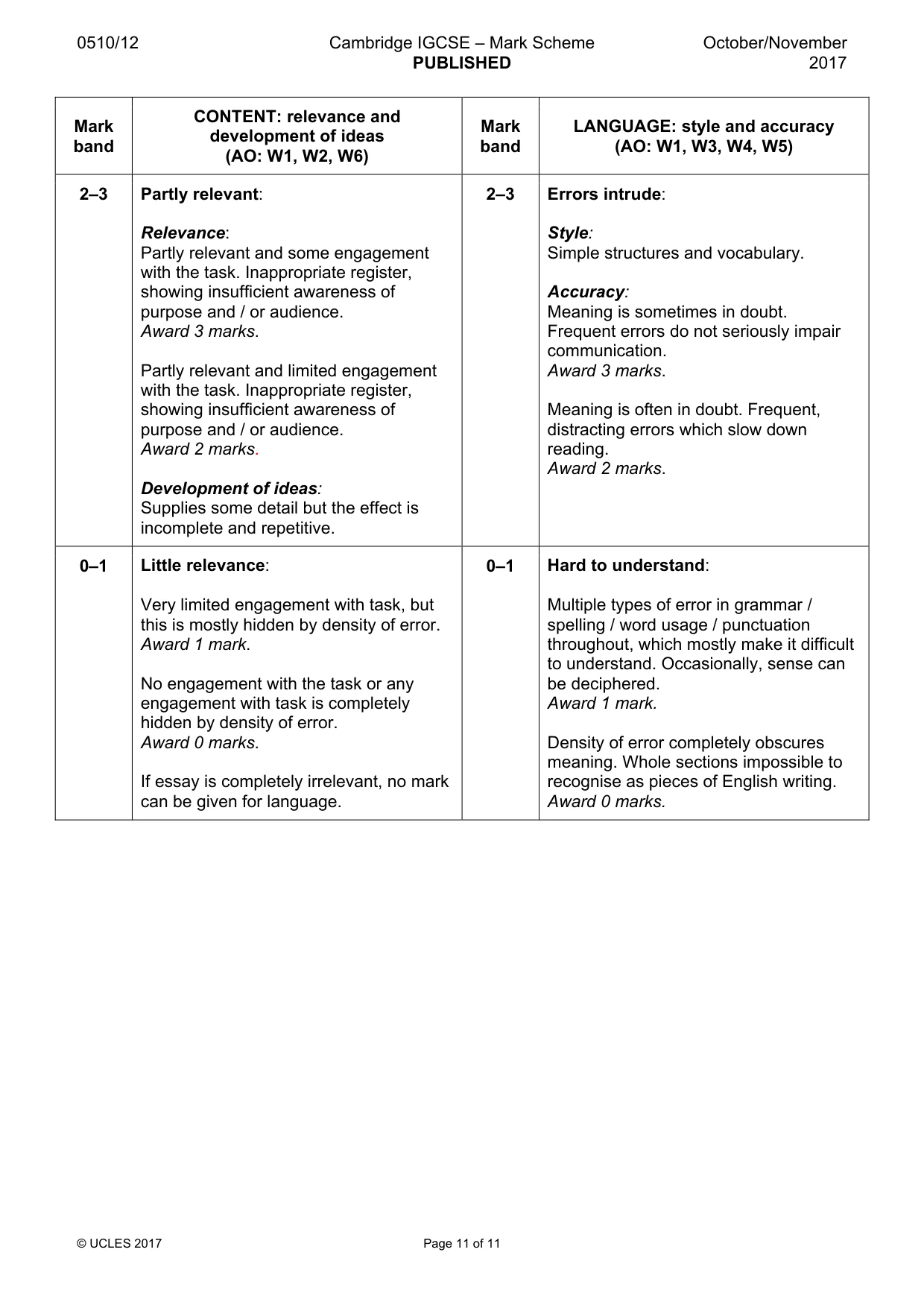
0510/12 Cambridge IGCSE – Mark Scheme PUBLISHED October/November 2017 © UCLES 2017 Page 11 of 11 Mark band CONTENT: relevance and development of ideas (AO: W1, W2, W6) Mark band LANGUAGE: style and accuracy (AO: W1, W3, W4, W5) 2–3 Partly relevant: Relevance: Partly relevant and some engagement with the task. Inappropriate register, showing insufficient awareness of purpose and / or audience. Award 3 marks. Partly relevant and limited engagement with the task. Inappropriate register, showing insufficient awareness of purpose and / or audience. Award 2 marks. Development of ideas: Supplies some detail but the effect is incomplete and repetitive. 2–3 Errors intrude: Style: Simple structures and vocabulary. Accuracy: Meaning is sometimes in doubt. Frequent errors do not seriously impair communication. Award 3 marks. Meaning is often in doubt. Frequent, distracting errors which slow down reading. Award 2 marks. 0–1 Little relevance: Very limited engagement with task, but this is mostly hidden by density of error. Award 1 mark. No engagement with the task or any engagement with task is completely hidden by density of error. Award 0 marks. If essay is completely irrelevant, no mark can be given for language. 0–1 Hard to understand: Multiple types of error in grammar / spelling / word usage / punctuation throughout, which mostly make it difficult to understand. Occasionally, sense can be deciphered. Award 1 mark. Density of error completely obscures meaning. Whole sections impossible to recognise as pieces of English writing. Award 0 marks.
What you needed in this session
Cambridge’s own grade thresholds for 2017 Oct/Nov, Paper 1 · Variant 2. A higher threshold means an easier paper — the bar moves with how the cohort did.