Cambridge IGCSE English - Second Language (oral endorsement) 0510 — 2017 May/June Paper 1 · Variant 3
0510/13/M/J/17 · 70 marks · ≈79 min
The question paper and its mark scheme, free to read here and free to download. This is Cambridge’s own paper, exactly as it was sat.
Question paper16 pages





Mark scheme9 pages
Answers below. Sit the paper first if you are practising.
Paper as text
Question paper, page 1
This document consists of 13 printed pages and 3 blank pages. DC (ST/FC) 127344/4 © UCLES 2017 [Turn over Cambridge International Examinations Cambridge International General Certificate of Secondary Education * 8 2 3 3 5 1 1 7 8 7 * ENGLISH AS A SECOND LANGUAGE 0510/13 Paper 1 Reading and Writing (Core) May/June 2017 1 hour 30 minutes Candidates answer on the Question Paper. No Additional Materials are required. READ THESE INSTRUCTIONS FIRST Write your Centre number, candidate number and name on all the work you hand in. Write in dark blue or black pen. Do not use staples, paper clips, glue or correction fluid. DO NOT WRITE IN ANY BARCODES. Answer all questions. Dictionaries are not allowed. At the end of the examination, fasten all your work securely together. The number of marks is given in brackets [ ] at the end of each question or part question.
Question paper, page 2
2 0510/13/M/J/17 © UCLES 2017 Exercise 1 Read the information about a company called Real-Life, which produces short books about the life stories of their customers, and then answer the following questions. Real-Life The company background Several years ago, Steve O’Brien was researching his family history. He realised that the internet makes it relatively easy to find facts about births, marriages and deaths, but the really interesting information about what people did in their lives is often missing. So, Steve decided to offer a service to help ordinary people make a record of their lives. After coming up with the idea for Real-Life, Steve decided he would move from the UK to Ireland, where he grew up, because he wanted to test the service by setting it up on a smaller scale. He brought together a small team of editors and a larger group of professional writers. Now, three years later, Real-Life is growing and moving into larger markets. What we do At Real-Life, we provide you with a carefully selected professional writer who will produce a beautiful ‘life-book’, complete with your memories and stories, your personal photos and an eye- catching cover. We can also produce a ‘life-book’ as a gift for someone close to you, whose life you think should be recorded. The majority of our orders are for birthdays and wedding anniversaries, but some customers also request books for other occasions such as graduation and retirement. How it works First, you tell us something about yourself, and we choose a writer who will explain the process to you. To help you bring back your memories, you complete a special questionnaire. Answering the questions enables you to select the stories you want to focus on. Next, you have a long conversation with your writer. This can be by phone or video call, in a café or at work, but generally people prefer to talk face to face at home. Your writer wants to hear the details of your memories, and you will remember more if you feel comfortable. Your writer will then start work on the first draft using the details you have given. You might be contacted by email or phone during this time. An artist provides several versions of a cover design, and you select your favourite one. The artist will include one or two of the photos that you chose when the writer first talked to you. The first draft usually takes 3 – 4 weeks to complete. Our editors review it, then send it to you to approve. At this stage, customers often ask the writer to add more stories. The writer then finalises the text, and after further editing and proofreading, we print and deliver it to you. People sometimes ask what distinguishes Real-Life from other companies which offer ‘life-books’ for special occasions. We believe it is all about the individual attention given to customers. Why not get in touch and see what you think?
Question paper, page 3
3 0510/13/M/J/17 © UCLES 2017 [Turn over (a) What was Steve O’Brien doing when he had the idea of starting Real-Life? …[1] (b) Where did Steve O’Brien start the company? …[1] (c) Which events do Real-Life customers mainly want books for? Give two details. … …[1] (d) What is the purpose of the questionnaire? Give two details. … …[2] (e) Where do Real-Life writers usually interview customers? …[1] (f) What do many customers request when they see the first draft? …[1] [Total: 7]
Question paper, page 4
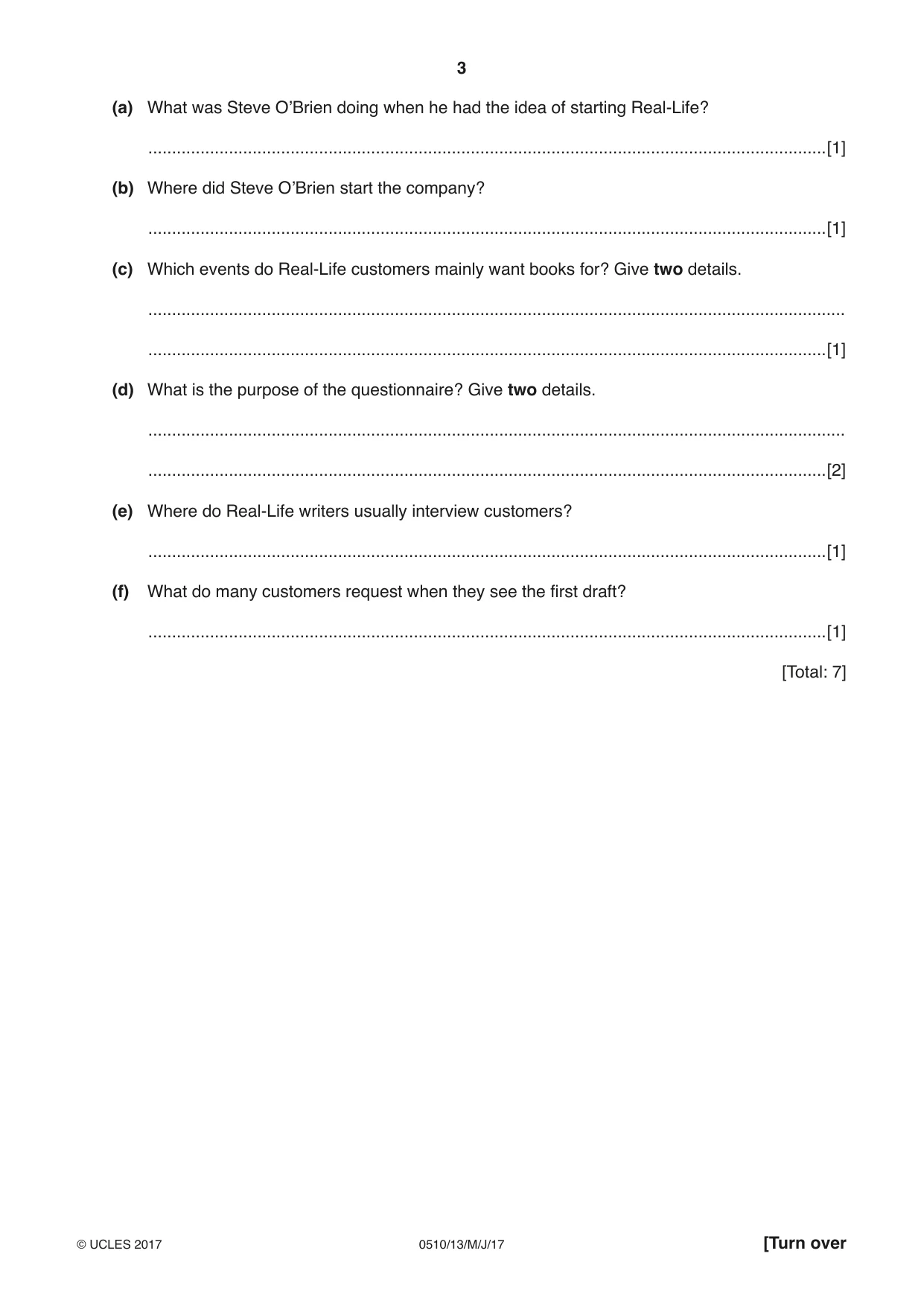
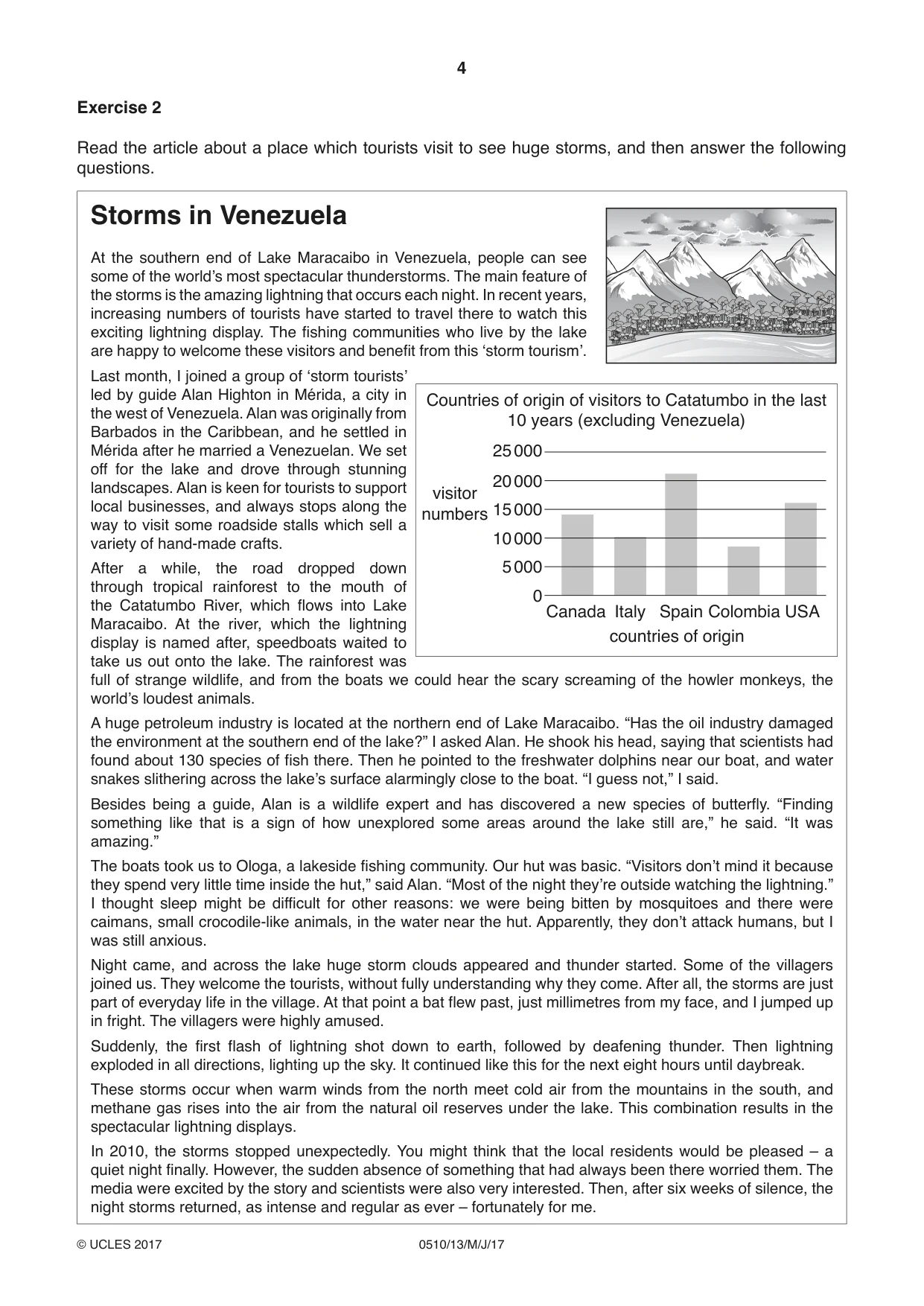
4 0510/13/M/J/17 © UCLES 2017 Exercise 2 Read the article about a place which tourists visit to see huge storms, and then answer the following questions. Storms in Venezuela At the southern end of Lake Maracaibo in Venezuela, people can see some of the world’s most spectacular thunderstorms. The main feature of the storms is the amazing lightning that occurs each night. In recent years, increasing numbers of tourists have started to travel there to watch this exciting lightning display. The fishing communities who live by the lake are happy to welcome these visitors and benefit from this ‘storm tourism’. Last month, I joined a group of ‘storm tourists’ led by guide Alan Highton in Mérida, a city in the west of Venezuela. Alan was originally from Barbados in the Caribbean, and he settled in Mérida after he married a Venezuelan. We set off for the lake and drove through stunning landscapes. Alan is keen for tourists to support local businesses, and always stops along the way to visit some roadside stalls which sell a variety of hand-made crafts. After a while, the road dropped down through tropical rainforest to the mouth of the Catatumbo River, which flows into Lake Maracaibo. At the river, which the lightning display is named after, speedboats waited to take us out onto the lake. The rainforest was full of strange wildlife, and from the boats we could hear the scary screaming of the howler monkeys, the world’s loudest animals. A huge petroleum industry is located at the northern end of Lake Maracaibo. “Has the oil industry damaged the environment at the southern end of the lake?” I asked Alan. He shook his head, saying that scientists had found about 130 species of fish there. Then he pointed to the freshwater dolphins near our boat, and water snakes slithering across the lake’s surface alarmingly close to the boat. “I guess not,” I said. Besides being a guide, Alan is a wildlife expert and has discovered a new species of butterfly. “Finding something like that is a sign of how unexplored some areas around the lake still are,” he said. “It was amazing.” The boats took us to Ologa, a lakeside fishing community. Our hut was basic. “Visitors don’t mind it because they spend very little time inside the hut,” said Alan. “Most of the night they’re outside watching the lightning.” I thought sleep might be difficult for other reasons: we were being bitten by mosquitoes and there were caimans, small crocodile-like animals, in the water near the hut. Apparently, they don’t attack humans, but I was still anxious. Night came, and across the lake huge storm clouds appeared and thunder started. Some of the villagers joined us. They welcome the tourists, without fully understanding why they come. After all, the storms are just part of everyday life in the village. At that point a bat flew past, just millimetres from my face, and I jumped up in fright. The villagers were highly amused. Suddenly, the first flash of lightning shot down to earth, followed by deafening thunder. Then lightning exploded in all directions, lighting up the sky. It continued like this for the next eight hours until daybreak. These storms occur when warm winds from the north meet cold air from the mountains in the south, and methane gas rises into the air from the natural oil reserves under the lake. This combination results in the spectacular lightning displays. In 2010, the storms stopped unexpectedly. You might think that the local residents would be pleased – a quiet night finally. However, the sudden absence of something that had always been there worried them. The media were excited by the story and scientists were also very interested. Then, after six weeks of silence, the night storms returned, as intense and regular as ever – fortunately for me. 0 Canada Italy Spain countries of origin Colombia USA 5 000 10 000 15 000 visitor numbers 20 000 25 000 Countries of origin of visitors to Catatumbo in the last 10 years (excluding Venezuela)
Question paper, page 5
5 0510/13/M/J/17 © UCLES 2017 [Turn over (a) Why did the guide go to live in Venezuela? …[1] (b) Why does the guide encourage visitors to buy things at roadside stalls? …[1] (c) According to the chart, which country has provided the most visitors to Catatumbo in the last ten years? …[1] (d) Where does the lightning display get its name from? …[1] (e) According to the guide, what does the amount of wildlife in the southern part of Lake Maracaibo show? …[1] (f) What does the guide think his discovery of a species of butterfly indicates? …[1] (g) Why are tourists satisfied with their simple accommodation in Ologa? …[1] (h) Why are local people in Ologa surprised that visitors go to see the lightning? …[1] (i) Which conditions cause the Catatumbo lightning? Give two details. … …[2] (j) How did local people feel when the lightning disappeared for some time in 2010? …[1] [Total: 11]
Question paper, page 6
6 0510/13/M/J/17 © UCLES 2017 Exercise 3 Rashida Hassan has always enjoyed physical activities such as running and cycling, and she used to love sports at school. In the last couple of years, however, things have changed. She doesn’t make much effort in her sports lessons because she doesn’t get on very well with her new teacher. Rashida has recently celebrated her fifteenth birthday and has decided that she would like to be super-fit and strong, like a professional athlete. Rashida, who lives with her parents Ali and Fariah Hassan at 3 Naylor House, Edgbaston, Birmingham, announced that she wanted to take up a sport or other physical activity outside school, but she wasn’t sure which to choose. Yesterday, Rashida’s mother, Fariah, showed her an advertisement for a gymnastics course at Parkside Gymnastics Club. Rashida had attended a few gymnastics lessons with her friend when she was nine or ten. She is still able to do the handstands and backflips that she learned then, but had stopped going to the lessons because she fell off a piece of equipment. Although there had been a soft mat to fall onto, she had landed badly and hurt herself. Now that she’s older, she feels ready to try again. Rashida went online and looked at the gymnastics club website. There is a course for beginners on Thursdays, and another for advanced gymnasts on Mondays and Wednesdays. Rashida didn’t feel that her experience was enough for her to join the intermediate classes on Tuesdays and Fridays, so she chose the first one. What she wants to do more than anything is to get her confidence back and improve her fitness. If she manages that, it will be fantastic. Rashida also knows that doing gymnastic exercises to music would be great fun. After talking to her parents, she decided to apply to join the course so she downloaded an application form. Her mother suggested that she should give her father’s name as the person to contact in an emergency and to provide his mobile number, 07580398603, rather than his work number, 0121553972. Rashida knows what to write in the rest of the form. Imagine you are Rashida. Fill in the form, using the information above.
Question paper, page 7
7 0510/13/M/J/17 © UCLES 2017 [Turn over PARKSIDE GYMNASTICS CLUB Application form Section A: Personal details Full name: … MALE / FEMALE (please delete) Age: … Address: … Name of emergency contact: … Relationship to you: … Emergency contact number: … Section B: Course details Which course are you interested in? (please tick) Beginner Intermediate Advanced Details of any gymnastics skills: … How did you first hear about the club? (please circle) website advertisement friend Section C In the space below, write one sentence explaining why you think you would enjoy the gymnastics course, and one sentence saying what you hope to achieve. [Total: 14]
Question paper, page 8
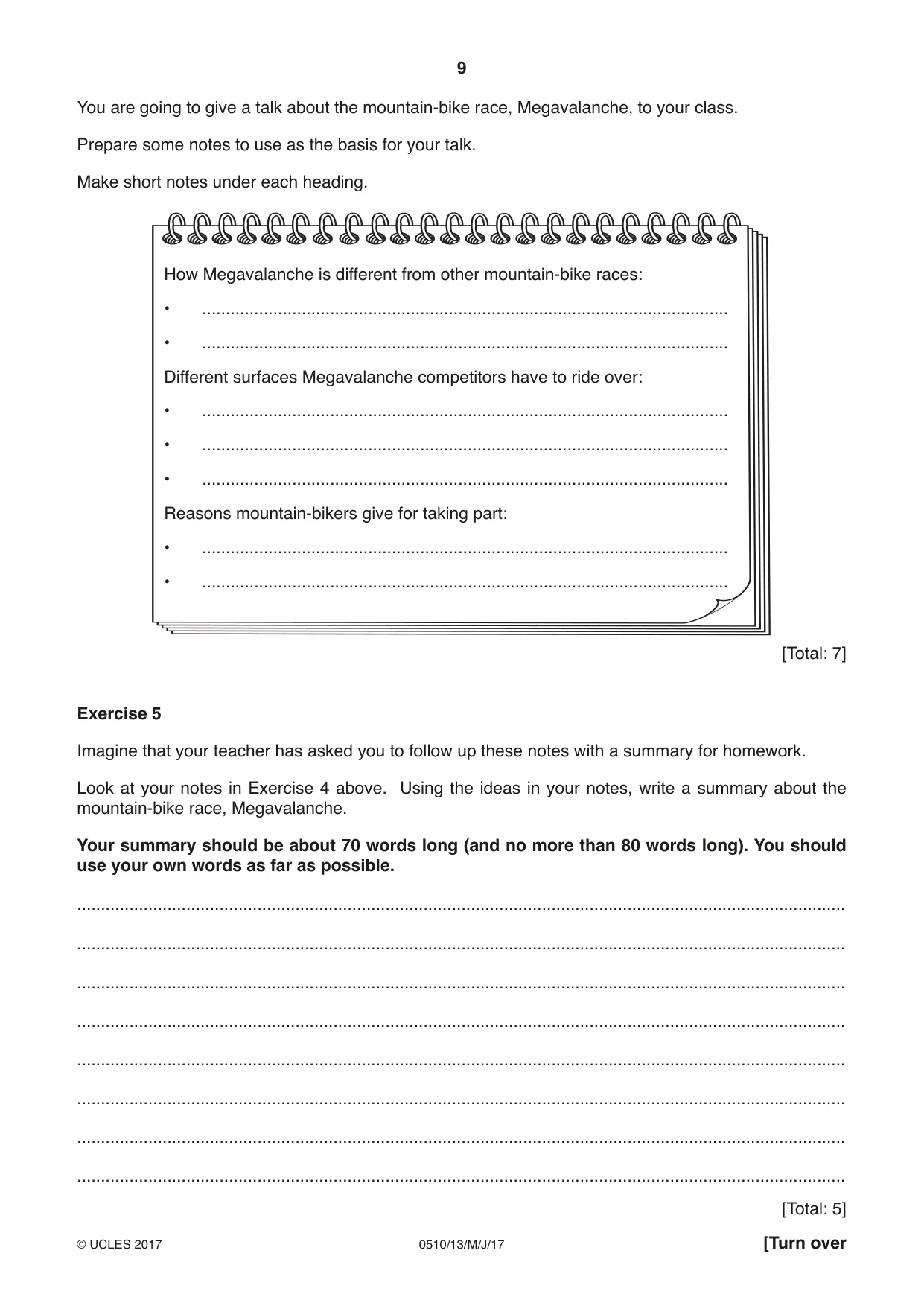
8 0510/13/M/J/17 © UCLES 2017 Exercise 4 Read the article about a mountain-bike race in France called Megavalanche, and then complete the notes on the following page. Megavalanche – the craziest mountain-bike race in the world? With helicopters circling overhead and a DJ playing loud electronic dance music, the noise level at Megavalanche is higher than at any other mountain-bike race in the world. We’re in the French Alps – at 3320 metres, to be precise – and we’re on the Sarenne glacier, a huge ice sheet covering a section of Pic Blanc mountain. When Megavalanche was first held in 1995, around 400 mountain-bikers took part. By 2015, there were over 2000 competitors from 30 different countries. It’s a three-day event consisting of practice, qualifying rounds and a final 30-kilometre race. There are other dramatic mountain-bike races around the world, but none of them start on a glacier. They usually involve a series of stages in which riders are timed and the winner has the fastest time over all the stages combined. Megavalanche is not about racing against the clock, however – it’s about getting to the finish line before anyone else. It’s also the longest mountain-bike race in the world. On the third day, the 300 mountain-bikers who have qualified set off for the final race down the mountainside. For the first five minutes, they slide down ice, often on their backs, holding on tight to their bikes. The next section of track is easier to ride on as it is covered in fresh snow, but then comes an area of loose rocks. The impact on the body is extreme, but if, at this point, they are desperate for the soft sand tracks found on some mountain-biking trails, then they are out of luck. As they speed on downwards, there are steep drops on both sides. Further down, they get to stony paths in the forest, where the sunlight shining brightly through the trees makes it difficult to see properly. Fortunately, the heavy mud which is found in many cross-country bike races is absent from Megavalanche, but the grassy paths through the fields on the lower slopes of the mountain are far from straightforward. For the experienced mountain-biker, the whole route will take under an hour, and it’s a major test of stamina, strength and nerve. Surprisingly, injuries are not usually serious. “Most accidents happen in training,” said one of the organisers, Cathy Labouyrie. “We get the occasional broken arm. Although many riders fall off their bikes on the glacier, they generally don’t hurt themselves too badly.” So, the race is safer than it might seem. The event is open to anyone, amateurs as well as professionals, but only the most skilled riders make the final. “The organisers say anyone can enter. I’m not so sure about that,” said Josh Naylor, a regular competitor. “You need a level of skill which you only get from many hours of practice. There’s certainly a sense of danger about it and that’s something we’re all attracted to.” “It’s a chance to compete against the best mountain-bikers in the world,” said Florence Toulon. “And the whole atmosphere is really exciting too. Spectators say the scenery is glorious,” she adds. “But we don’t notice it. We’re too busy pedalling, trying not to fall off, avoiding other riders, picking ourselves up off the ground, and checking the bike’s still OK!”
Question paper, page 9
9 0510/13/M/J/17 © UCLES 2017 [Turn over You are going to give a talk about the mountain-bike race, Megavalanche, to your class. Prepare some notes to use as the basis for your talk. Make short notes under each heading. How Megavalanche is different from other mountain-bike races: • … • … Different surfaces Megavalanche competitors have to ride over: • … • … • … Reasons mountain-bikers give for taking part: • … • … [Total: 7] Exercise 5 Imagine that your teacher has asked you to follow up these notes with a summary for homework. Look at your notes in Exercise 4 above. Using the ideas in your notes, write a summary about the mountain-bike race, Megavalanche. Your summary should be about 70 words long (and no more than 80 words long). You should use your own words as far as possible. … … … … … … … … [Total: 5]
Question paper, page 10
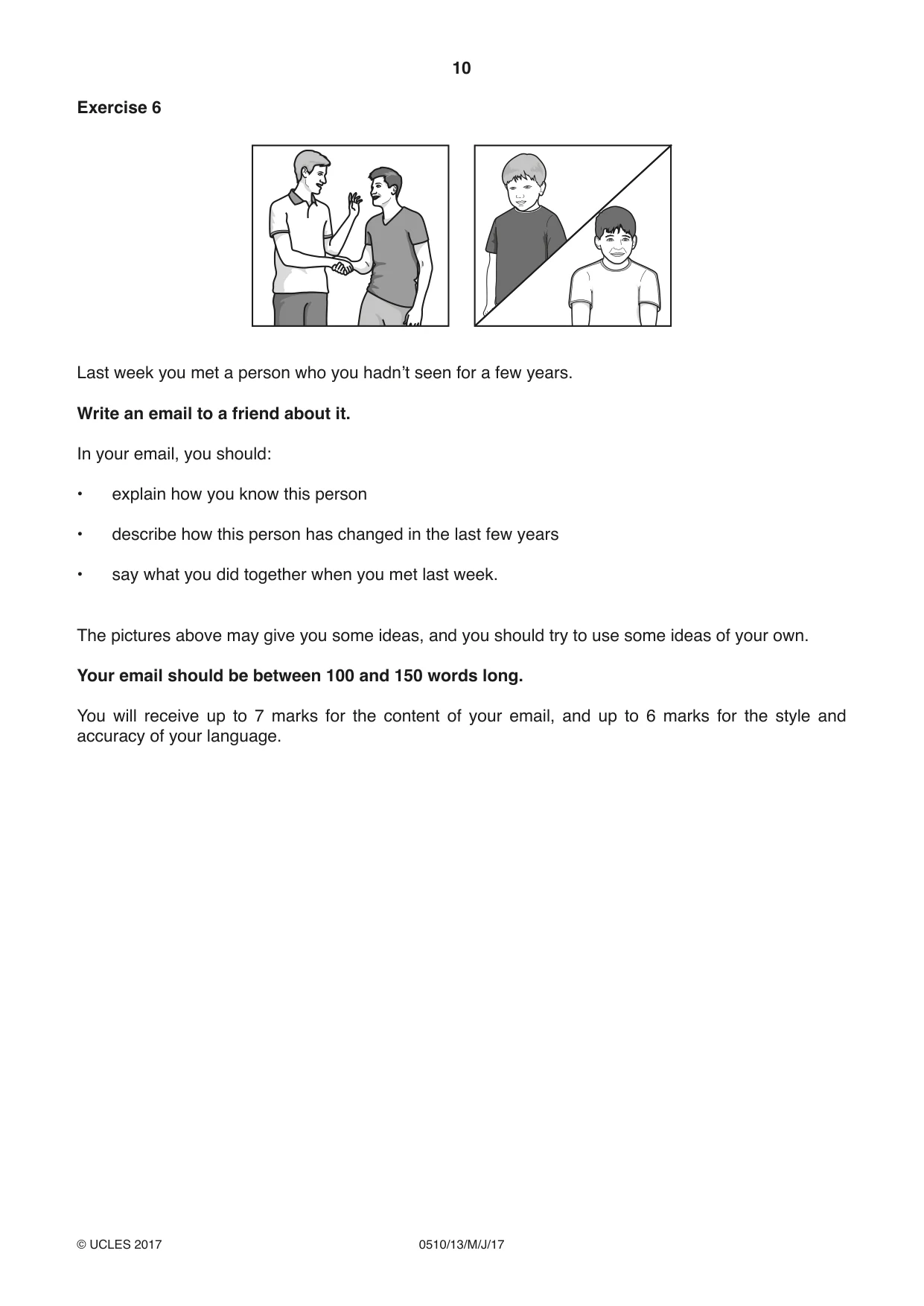
10 0510/13/M/J/17 © UCLES 2017 Exercise 6 Last week you met a person who you hadn’t seen for a few years. Write an email to a friend about it. In your email, you should: • explain how you know this person • describe how this person has changed in the last few years • say what you did together when you met last week. The pictures above may give you some ideas, and you should try to use some ideas of your own. Your email should be between 100 and 150 words long. You will receive up to 7 marks for the content of your email, and up to 6 marks for the style and accuracy of your language.
Question paper, page 11
11 0510/13/M/J/17 © UCLES 2017 [Turn over … … … … … … … … … … … … … … … … … … … … … … … … … … … [Total: 13]
Question paper, page 12
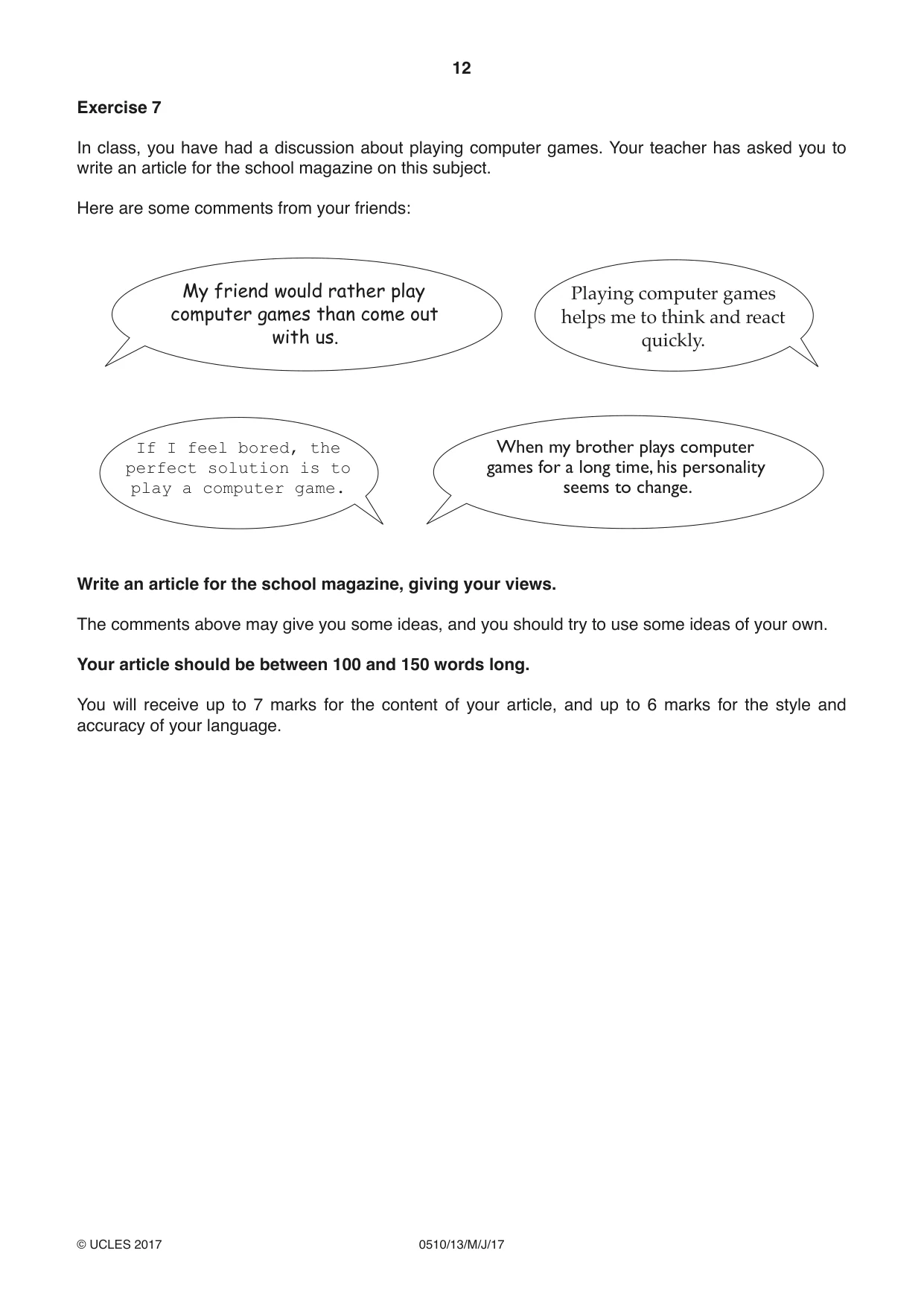
12 0510/13/M/J/17 © UCLES 2017 Exercise 7 In class, you have had a discussion about playing computer games. Your teacher has asked you to write an article for the school magazine on this subject. Here are some comments from your friends: My friend would rather play computer games than come out with us. Playing computer games helps me to think and react quickly. When my brother plays computer games for a long time, his personality seems to change. If I feel bored, the perfect solution is to play a computer game. Write an article for the school magazine, giving your views. The comments above may give you some ideas, and you should try to use some ideas of your own. Your article should be between 100 and 150 words long. You will receive up to 7 marks for the content of your article, and up to 6 marks for the style and accuracy of your language.
Question paper, page 13
13 0510/13/M/J/17 © UCLES 2017 … … … … … … … … … … … … … … … … … … … … … … … … … … … [Total: 13]
Question paper, page 14
14 0510/13/M/J/17 © UCLES 2017 BLANK PAGE
Question paper, page 15
15 0510/13/M/J/17 © UCLES 2017 BLANK PAGE
Question paper, page 16
16 0510/13/M/J/17 © UCLES 2017 Permission to reproduce items where third-party owned material protected by copyright is included has been sought and cleared where possible. Every reasonable effort has been made by the publisher (UCLES) to trace copyright holders, but if any items requiring clearance have unwittingly been included, the publisher will be pleased to make amends at the earliest possible opportunity. To avoid the issue of disclosure of answer-related information to candidates, all copyright acknowledgements are reproduced online in the Cambridge International Examinations Copyright Acknowledgements Booklet. This is produced for each series of examinations and is freely available to download at www.cie.org.uk after the live examination series. Cambridge International Examinations is part of the Cambridge Assessment Group. Cambridge Assessment is the brand name of University of Cambridge Local Examinations Syndicate (UCLES), which is itself a department of the University of Cambridge. BLANK PAGE
Mark scheme, page 1
® IGCSE is a registered trademark. This document consists of 9 printed pages. © UCLES 2017 [Turn over Cambridge International Examinations Cambridge International General Certificate of Secondary Education ENGLISH AS A SECOND LANGUAGE 0510/13 Paper 1 Reading and Writing (Core) May/June 2017 MARK SCHEME Maximum Mark:70 Published This mark scheme is published as an aid to teachers and candidates, to indicate the requirements of the examination. It shows the basis on which Examiners were instructed to award marks. It does not indicate the details of the discussions that took place at an Examiners’ meeting before marking began, which would have considered the acceptability of alternative answers. Mark schemes should be read in conjunction with the question paper and the Principal Examiner Report for Teachers. Cambridge will not enter into discussions about these mark schemes. Cambridge is publishing the mark schemes for the May/June 2017 series for most Cambridge IGCSE®, Cambridge International A and AS Level and Cambridge Pre-U components, and some Cambridge O Level components.
Mark scheme, page 2
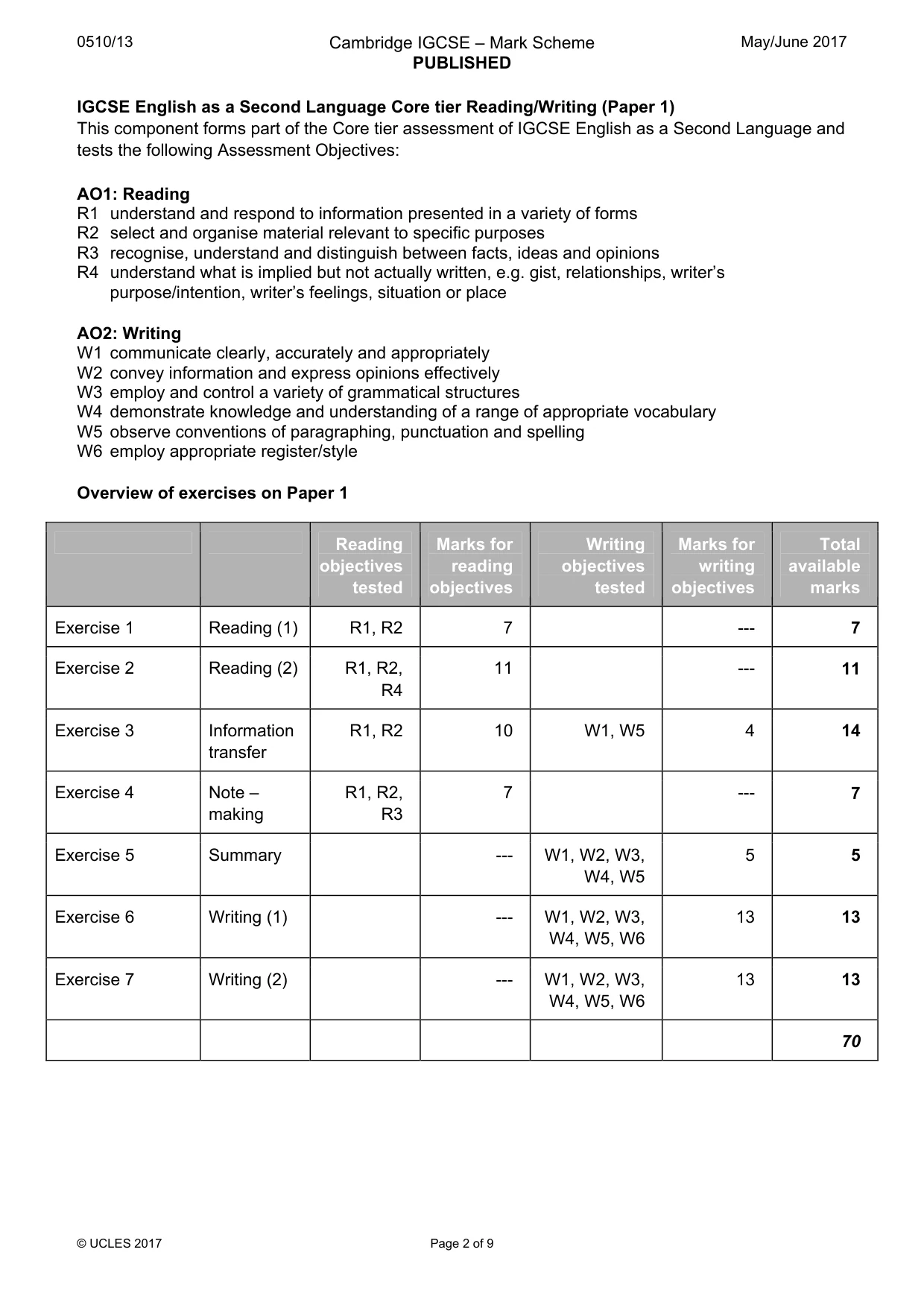
0510/13 Cambridge IGCSE – Mark Scheme PUBLISHED May/June 2017 © UCLES 2017 Page 2 of 9 IGCSE English as a Second Language Core tier Reading/Writing (Paper 1) This component forms part of the Core tier assessment of IGCSE English as a Second Language and tests the following Assessment Objectives: AO1: Reading R1 understand and respond to information presented in a variety of forms R2 select and organise material relevant to specific purposes R3 recognise, understand and distinguish between facts, ideas and opinions R4 understand what is implied but not actually written, e.g. gist, relationships, writer’s purpose/intention, writer’s feelings, situation or place AO2: Writing W1 communicate clearly, accurately and appropriately W2 convey information and express opinions effectively W3 employ and control a variety of grammatical structures W4 demonstrate knowledge and understanding of a range of appropriate vocabulary W5 observe conventions of paragraphing, punctuation and spelling W6 employ appropriate register/style Overview of exercises on Paper 1 Reading objectives tested Marks for reading objectives Writing objectives tested Marks for writing objectives Total available marks Exercise 1 Reading (1) R1, R2 7 --- 7 Exercise 2 Reading (2) R1, R2, R4 11 --- 11 Exercise 3 Information transfer R1, R2 10 W1, W5 4 14 Exercise 4 Note – making R1, R2, R3 7 --- 7 Exercise 5 Summary --- W1, W2, W3, W4, W5 5 5 Exercise 6 Writing (1) --- W1, W2, W3, W4, W5, W6 13 13 Exercise 7 Writing (2) --- W1, W2, W3, W4, W5, W6 13 13 70
Mark scheme, page 3
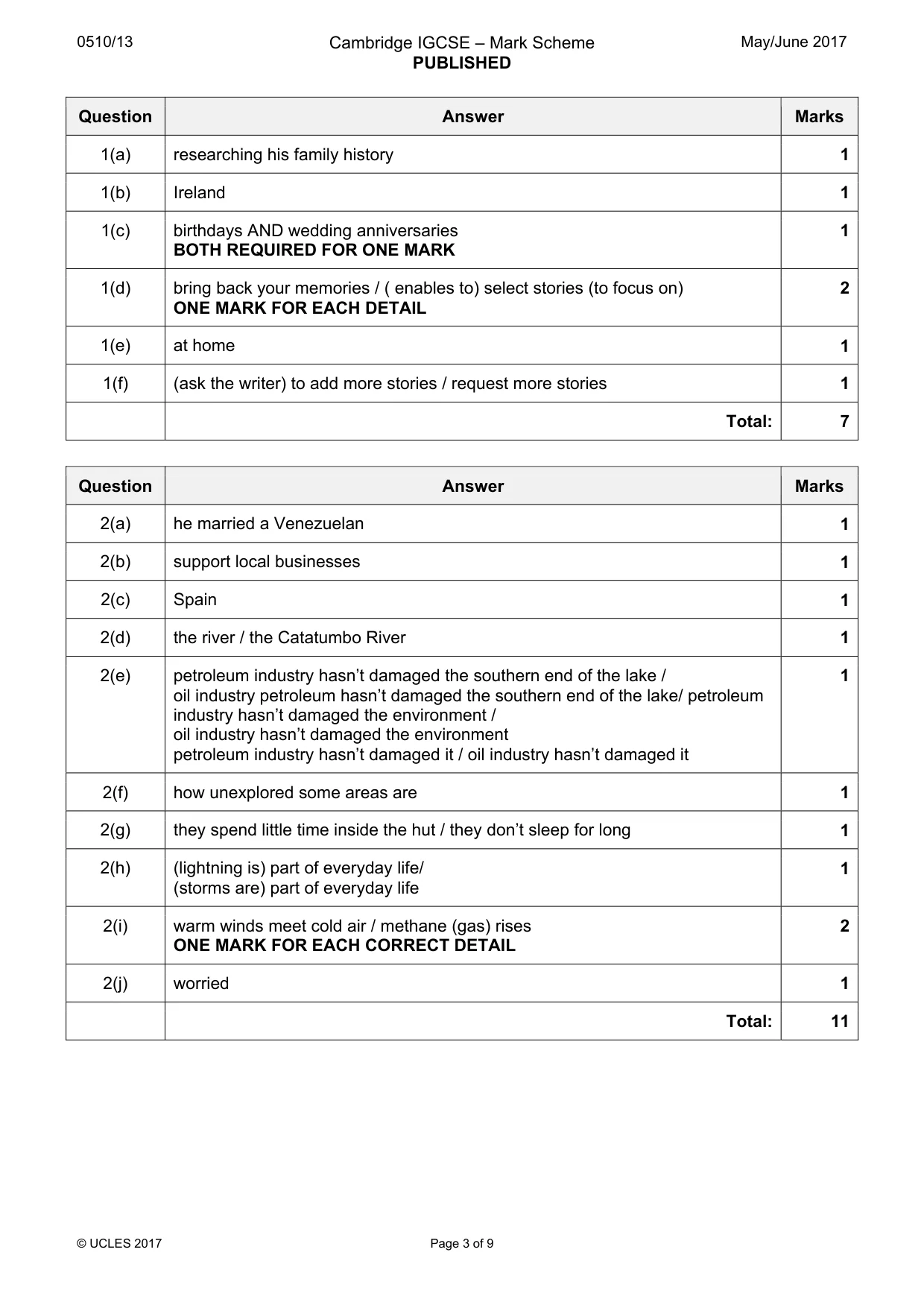
0510/13 Cambridge IGCSE – Mark Scheme PUBLISHED May/June 2017 © UCLES 2017 Page 3 of 9 Question Answer Marks 1(a) researching his family history 1 1(b) Ireland 1 1(c) birthdays AND wedding anniversaries BOTH REQUIRED FOR ONE MARK 1 1(d) bring back your memories / ( enables to) select stories (to focus on) ONE MARK FOR EACH DETAIL 2 1(e) at home 1 1(f) (ask the writer) to add more stories / request more stories 1 Total: 7 Question Answer Marks 2(a) he married a Venezuelan 1 2(b) support local businesses 1 2(c) Spain 1 2(d) the river / the Catatumbo River 1 2(e) petroleum industry hasn’t damaged the southern end of the lake / oil industry petroleum hasn’t damaged the southern end of the lake/ petroleum industry hasn’t damaged the environment / oil industry hasn’t damaged the environment petroleum industry hasn’t damaged it / oil industry hasn’t damaged it 1 2(f) how unexplored some areas are 1 2(g) they spend little time inside the hut / they don’t sleep for long 1 2(h) (lightning is) part of everyday life/ (storms are) part of everyday life 1 2(i) warm winds meet cold air / methane (gas) rises ONE MARK FOR EACH CORRECT DETAIL 2 2(j) worried 1 Total: 11
Mark scheme, page 4
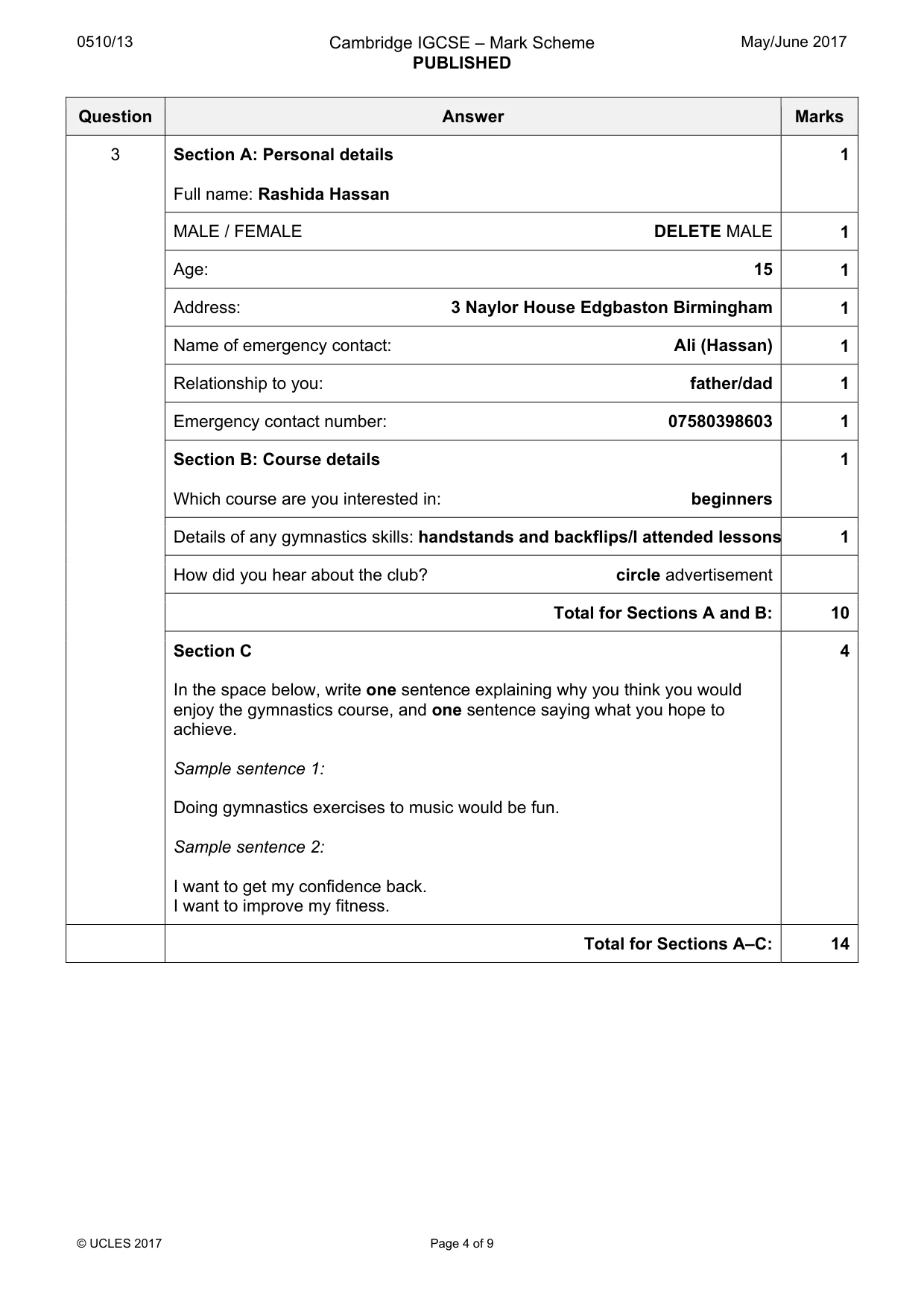
0510/13 Cambridge IGCSE – Mark Scheme PUBLISHED May/June 2017 © UCLES 2017 Page 4 of 9 Question Answer Marks 3 Section A: Personal details Full name: Rashida Hassan 1 MALE / FEMALE DELETE MALE 1 Age: 15 1 Address: 3 Naylor House Edgbaston Birmingham 1 Name of emergency contact: Ali (Hassan) 1 Relationship to you: father/dad 1 Emergency contact number: 07580398603 1 Section B: Course details Which course are you interested in: beginners 1 Details of any gymnastics skills: handstands and backflips/I attended lessons 1 How did you hear about the club? circle advertisement Total for Sections A and B: 10 Section C In the space below, write one sentence explaining why you think you would enjoy the gymnastics course, and one sentence saying what you hope to achieve. Sample sentence 1: Doing gymnastics exercises to music would be fun. Sample sentence 2: I want to get my confidence back. I want to improve my fitness. 4 Total for Sections A–C: 14
Mark scheme, page 5
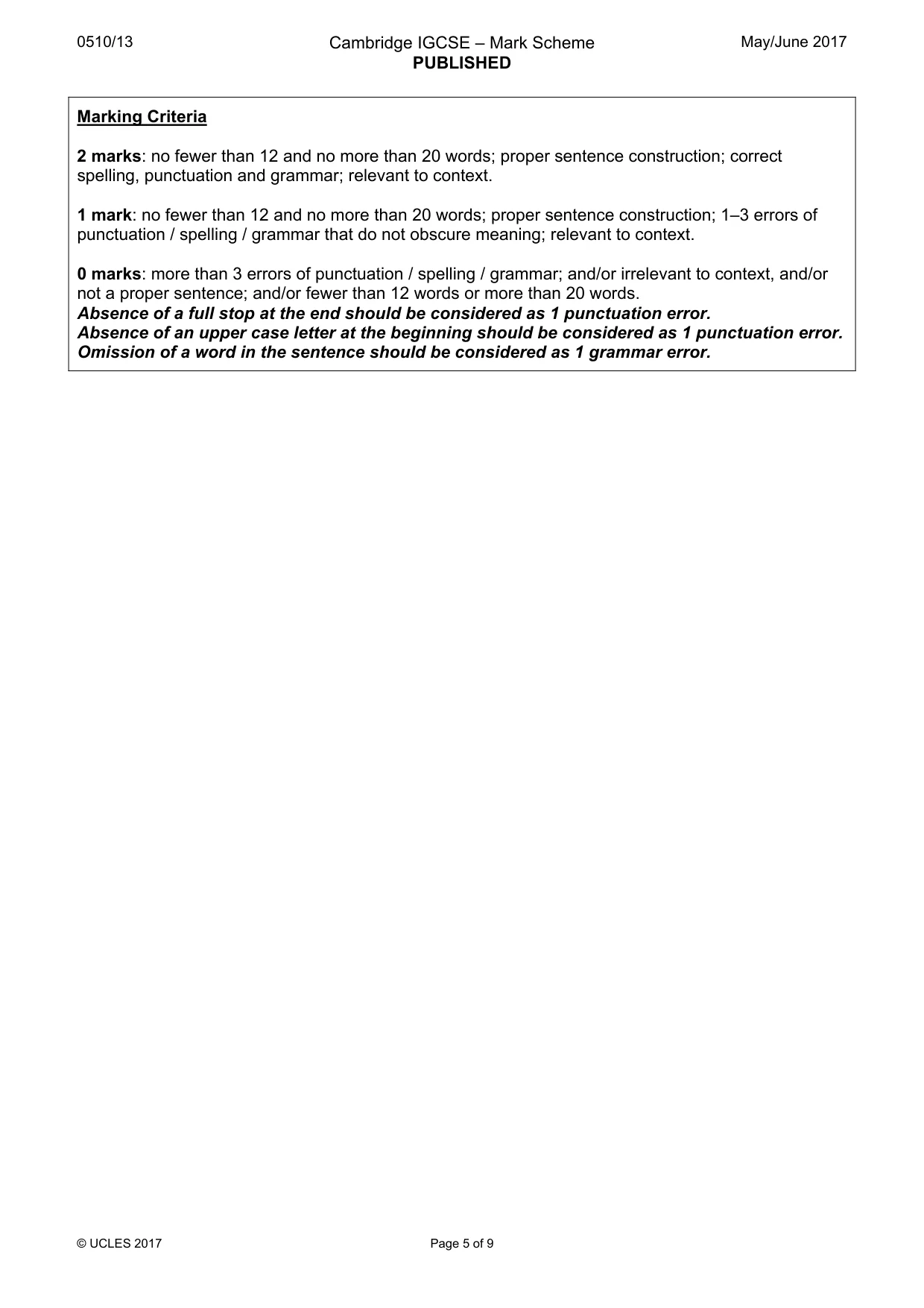
0510/13 Cambridge IGCSE – Mark Scheme PUBLISHED May/June 2017 © UCLES 2017 Page 5 of 9 Marking Criteria 2 marks: no fewer than 12 and no more than 20 words; proper sentence construction; correct spelling, punctuation and grammar; relevant to context. 1 mark: no fewer than 12 and no more than 20 words; proper sentence construction; 1–3 errors of punctuation / spelling / grammar that do not obscure meaning; relevant to context. 0 marks: more than 3 errors of punctuation / spelling / grammar; and/or irrelevant to context, and/or not a proper sentence; and/or fewer than 12 words or more than 20 words. Absence of a full stop at the end should be considered as 1 punctuation error. Absence of an upper case letter at the beginning should be considered as 1 punctuation error. Omission of a word in the sentence should be considered as 1 grammar error.
Mark scheme, page 6
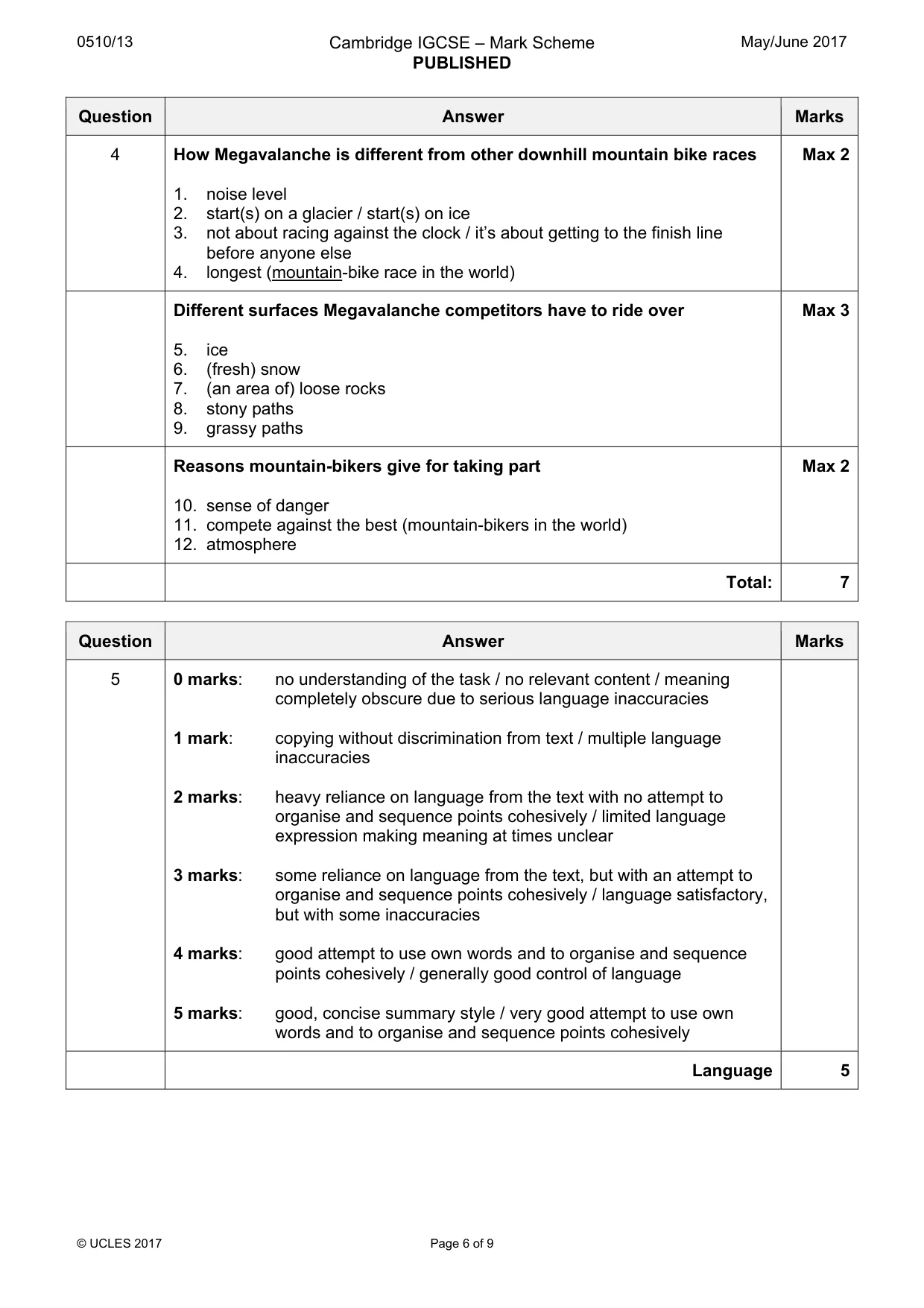
0510/13 Cambridge IGCSE – Mark Scheme PUBLISHED May/June 2017 © UCLES 2017 Page 6 of 9 Question Answer Marks 4 How Megavalanche is different from other downhill mountain bike races 1. noise level 2. start(s) on a glacier / start(s) on ice 3. not about racing against the clock / it’s about getting to the finish line before anyone else 4. longest (mountain-bike race in the world) Max 2 Different surfaces Megavalanche competitors have to ride over 5. ice 6. (fresh) snow 7. (an area of) loose rocks 8. stony paths 9. grassy paths Max 3 Reasons mountain-bikers give for taking part 10. sense of danger 11. compete against the best (mountain-bikers in the world) 12. atmosphere Max 2 Total: 7 Question Answer Marks 5 0 marks: no understanding of the task / no relevant content / meaning completely obscure due to serious language inaccuracies 1 mark: copying without discrimination from text / multiple language inaccuracies 2 marks: heavy reliance on language from the text with no attempt to organise and sequence points cohesively / limited language expression making meaning at times unclear 3 marks: some reliance on language from the text, but with an attempt to organise and sequence points cohesively / language satisfactory, but with some inaccuracies 4 marks: good attempt to use own words and to organise and sequence points cohesively / generally good control of language 5 marks: good, concise summary style / very good attempt to use own words and to organise and sequence points cohesively Language 5
Mark scheme, page 7
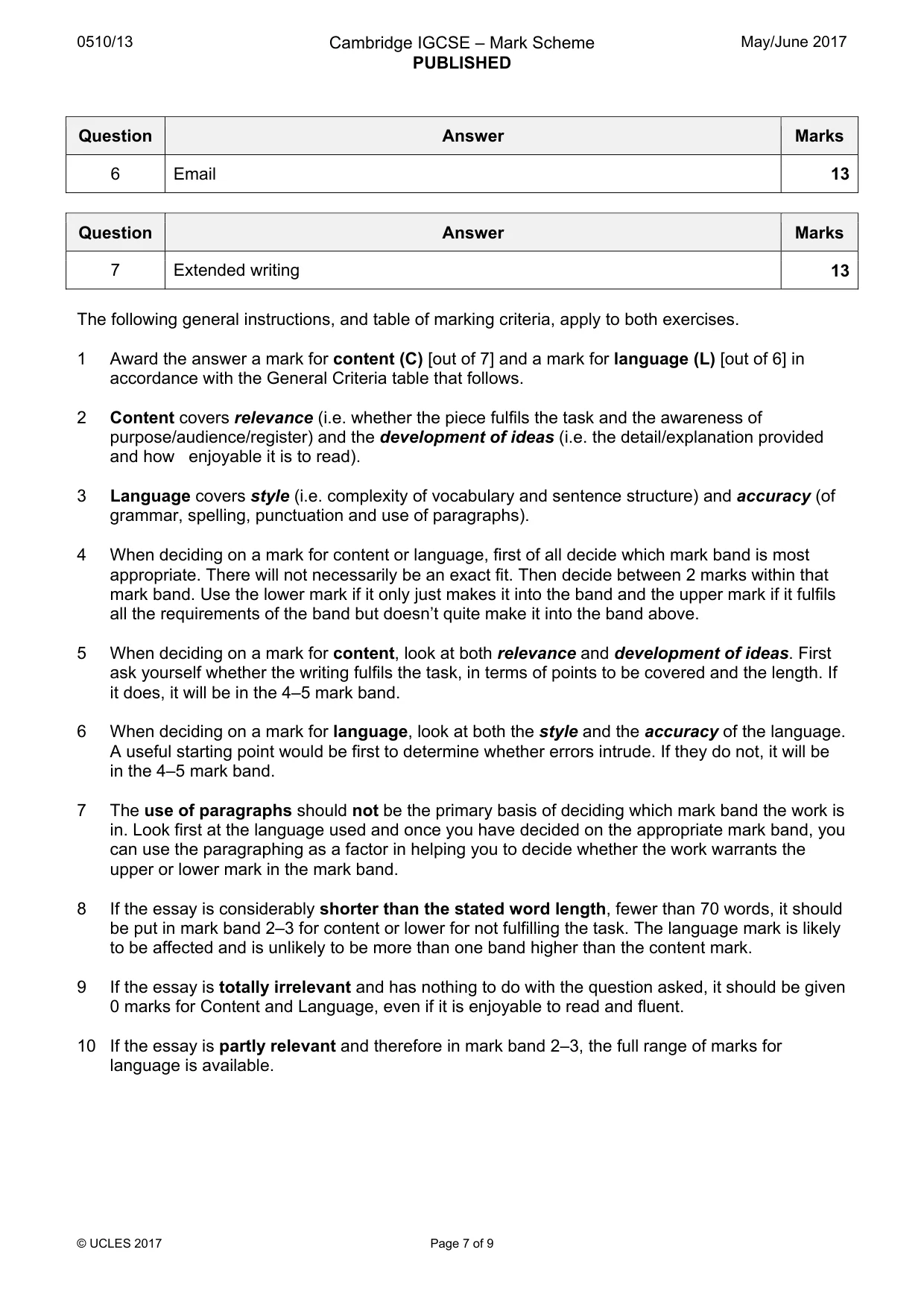
0510/13 Cambridge IGCSE – Mark Scheme PUBLISHED May/June 2017 © UCLES 2017 Page 7 of 9 Question Answer Marks 6 Email 13 Question Answer Marks 7 Extended writing 13 The following general instructions, and table of marking criteria, apply to both exercises. 1 Award the answer a mark for content (C) [out of 7] and a mark for language (L) [out of 6] in accordance with the General Criteria table that follows. 2 Content covers relevance (i.e. whether the piece fulfils the task and the awareness of purpose/audience/register) and the development of ideas (i.e. the detail/explanation provided and how enjoyable it is to read). 3 Language covers style (i.e. complexity of vocabulary and sentence structure) and accuracy (of grammar, spelling, punctuation and use of paragraphs). 4 When deciding on a mark for content or language, first of all decide which mark band is most appropriate. There will not necessarily be an exact fit. Then decide between 2 marks within that mark band. Use the lower mark if it only just makes it into the band and the upper mark if it fulfils all the requirements of the band but doesn’t quite make it into the band above. 5 When deciding on a mark for content, look at both relevance and development of ideas. First ask yourself whether the writing fulfils the task, in terms of points to be covered and the length. If it does, it will be in the 4–5 mark band. 6 When deciding on a mark for language, look at both the style and the accuracy of the language. A useful starting point would be first to determine whether errors intrude. If they do not, it will be in the 4–5 mark band. 7 The use of paragraphs should not be the primary basis of deciding which mark band the work is in. Look first at the language used and once you have decided on the appropriate mark band, you can use the paragraphing as a factor in helping you to decide whether the work warrants the upper or lower mark in the mark band. 8 If the essay is considerably shorter than the stated word length, fewer than 70 words, it should be put in mark band 2–3 for content or lower for not fulfilling the task. The language mark is likely to be affected and is unlikely to be more than one band higher than the content mark. 9 If the essay is totally irrelevant and has nothing to do with the question asked, it should be given 0 marks for Content and Language, even if it is enjoyable to read and fluent. 10 If the essay is partly relevant and therefore in mark band 2–3, the full range of marks for language is available.
Mark scheme, page 8
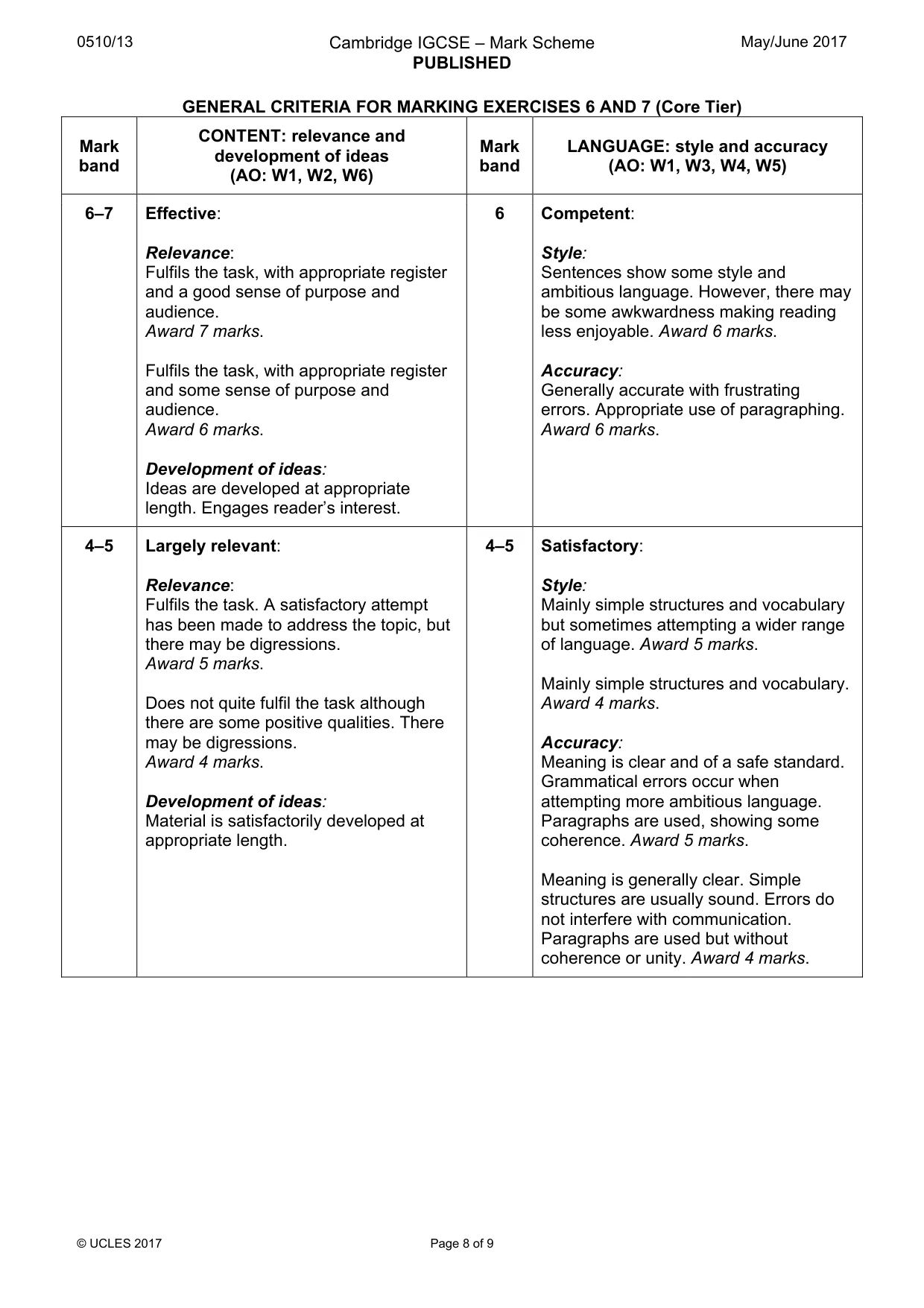
0510/13 Cambridge IGCSE – Mark Scheme PUBLISHED May/June 2017 © UCLES 2017 Page 8 of 9 GENERAL CRITERIA FOR MARKING EXERCISES 6 AND 7 (Core Tier) Mark band CONTENT: relevance and development of ideas (AO: W1, W2, W6) Mark band LANGUAGE: style and accuracy (AO: W1, W3, W4, W5) 6–7 Effective: Relevance: Fulfils the task, with appropriate register and a good sense of purpose and audience. Award 7 marks. Fulfils the task, with appropriate register and some sense of purpose and audience. Award 6 marks. Development of ideas: Ideas are developed at appropriate length. Engages reader’s interest. 6 Competent: Style: Sentences show some style and ambitious language. However, there may be some awkwardness making reading less enjoyable. Award 6 marks. Accuracy: Generally accurate with frustrating errors. Appropriate use of paragraphing. Award 6 marks. 4–5 Largely relevant: Relevance: Fulfils the task. A satisfactory attempt has been made to address the topic, but there may be digressions. Award 5 marks. Does not quite fulfil the task although there are some positive qualities. There may be digressions. Award 4 marks. Development of ideas: Material is satisfactorily developed at appropriate length. 4–5 Satisfactory: Style: Mainly simple structures and vocabulary but sometimes attempting a wider range of language. Award 5 marks. Mainly simple structures and vocabulary. Award 4 marks. Accuracy: Meaning is clear and of a safe standard. Grammatical errors occur when attempting more ambitious language. Paragraphs are used, showing some coherence. Award 5 marks. Meaning is generally clear. Simple structures are usually sound. Errors do not interfere with communication. Paragraphs are used but without coherence or unity. Award 4 marks.
Mark scheme, page 9
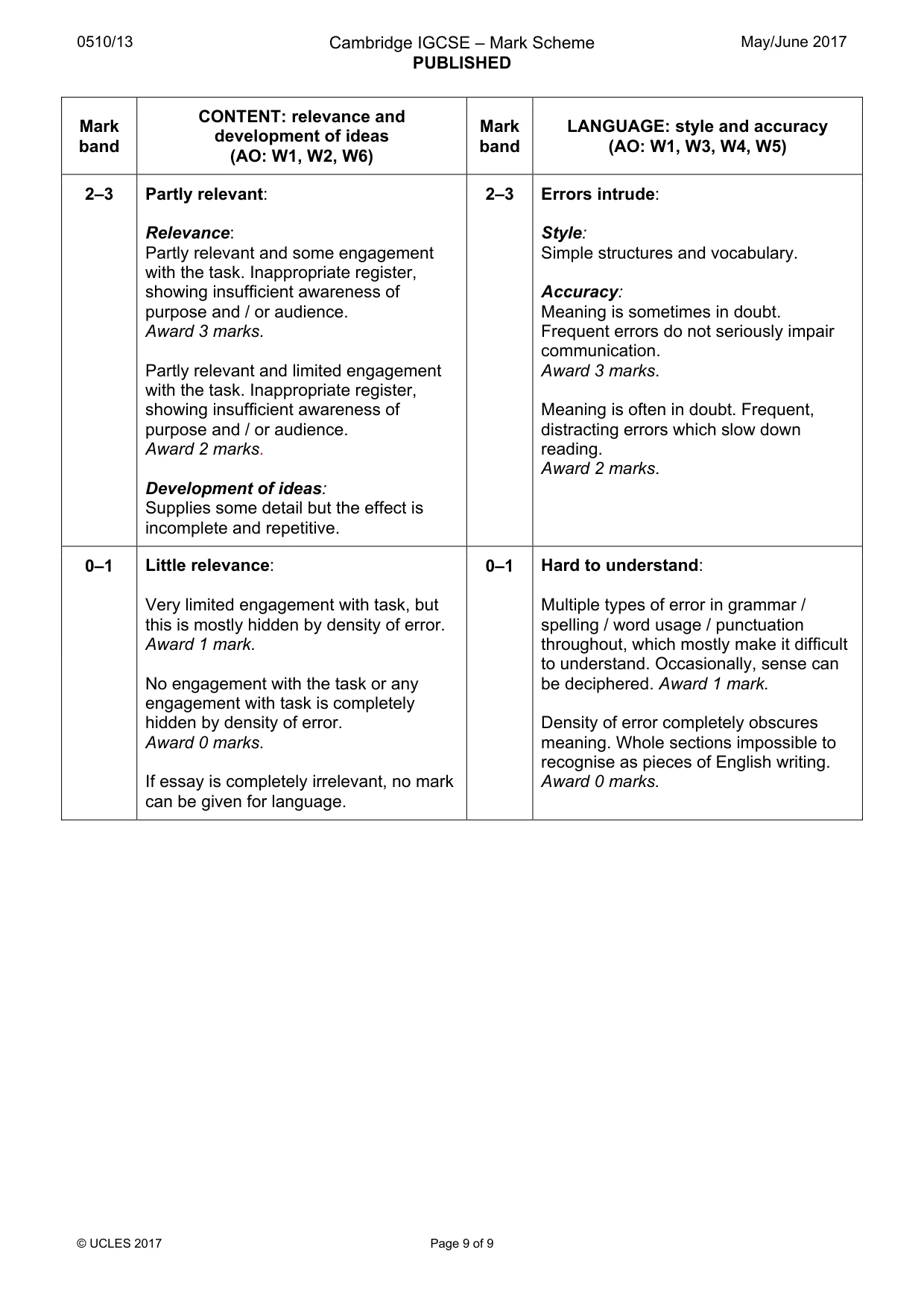
0510/13 Cambridge IGCSE – Mark Scheme PUBLISHED May/June 2017 © UCLES 2017 Page 9 of 9 Mark band CONTENT: relevance and development of ideas (AO: W1, W2, W6) Mark band LANGUAGE: style and accuracy (AO: W1, W3, W4, W5) 2–3 Partly relevant: Relevance: Partly relevant and some engagement with the task. Inappropriate register, showing insufficient awareness of purpose and / or audience. Award 3 marks. Partly relevant and limited engagement with the task. Inappropriate register, showing insufficient awareness of purpose and / or audience. Award 2 marks. Development of ideas: Supplies some detail but the effect is incomplete and repetitive. 2–3 Errors intrude: Style: Simple structures and vocabulary. Accuracy: Meaning is sometimes in doubt. Frequent errors do not seriously impair communication. Award 3 marks. Meaning is often in doubt. Frequent, distracting errors which slow down reading. Award 2 marks. 0–1 Little relevance: Very limited engagement with task, but this is mostly hidden by density of error. Award 1 mark. No engagement with the task or any engagement with task is completely hidden by density of error. Award 0 marks. If essay is completely irrelevant, no mark can be given for language. 0–1 Hard to understand: Multiple types of error in grammar / spelling / word usage / punctuation throughout, which mostly make it difficult to understand. Occasionally, sense can be deciphered. Award 1 mark. Density of error completely obscures meaning. Whole sections impossible to recognise as pieces of English writing. Award 0 marks.
What you needed in this session
Cambridge’s own grade thresholds for 2017 May/June, Paper 1 · Variant 3. A higher threshold means an easier paper — the bar moves with how the cohort did.