Cambridge IGCSE English - Second Language (oral endorsement) 0510 — 2017 May/June Paper 1 · Variant 2
0510/12/M/J/17 · 70 marks · ≈79 min
The question paper and its mark scheme, free to read here and free to download. This is Cambridge’s own paper, exactly as it was sat.
Question paper16 pages



Mark scheme11 pages
Answers below. Sit the paper first if you are practising.
Paper as text
Question paper, page 1
This document consists of 13 printed pages and 3 blank pages. DC (NH/SG) 128152/4 © UCLES 2017 [Turn over * 8 6 7 0 9 0 4 5 9 4 * ENGLISH AS A SECOND LANGUAGE 0510/12 Paper 1 Reading and Writing (Core) May/June 2017 1 hour 30 minutes Candidates answer on the Question Paper. No Additional Materials are required. READ THESE INSTRUCTIONS FIRST Write your Centre number, candidate number and name on all the work you hand in. Write in dark blue or black pen. Do not use staples, paper clips, glue or correction fluid. DO NOT WRITE IN ANY BARCODES. Answer all questions. Dictionaries are not allowed. At the end of the examination, fasten all your work securely together. The number of marks is given in brackets [ ] at the end of each question or part question. Cambridge International Examinations Cambridge International General Certificate of Secondary Education
Question paper, page 2
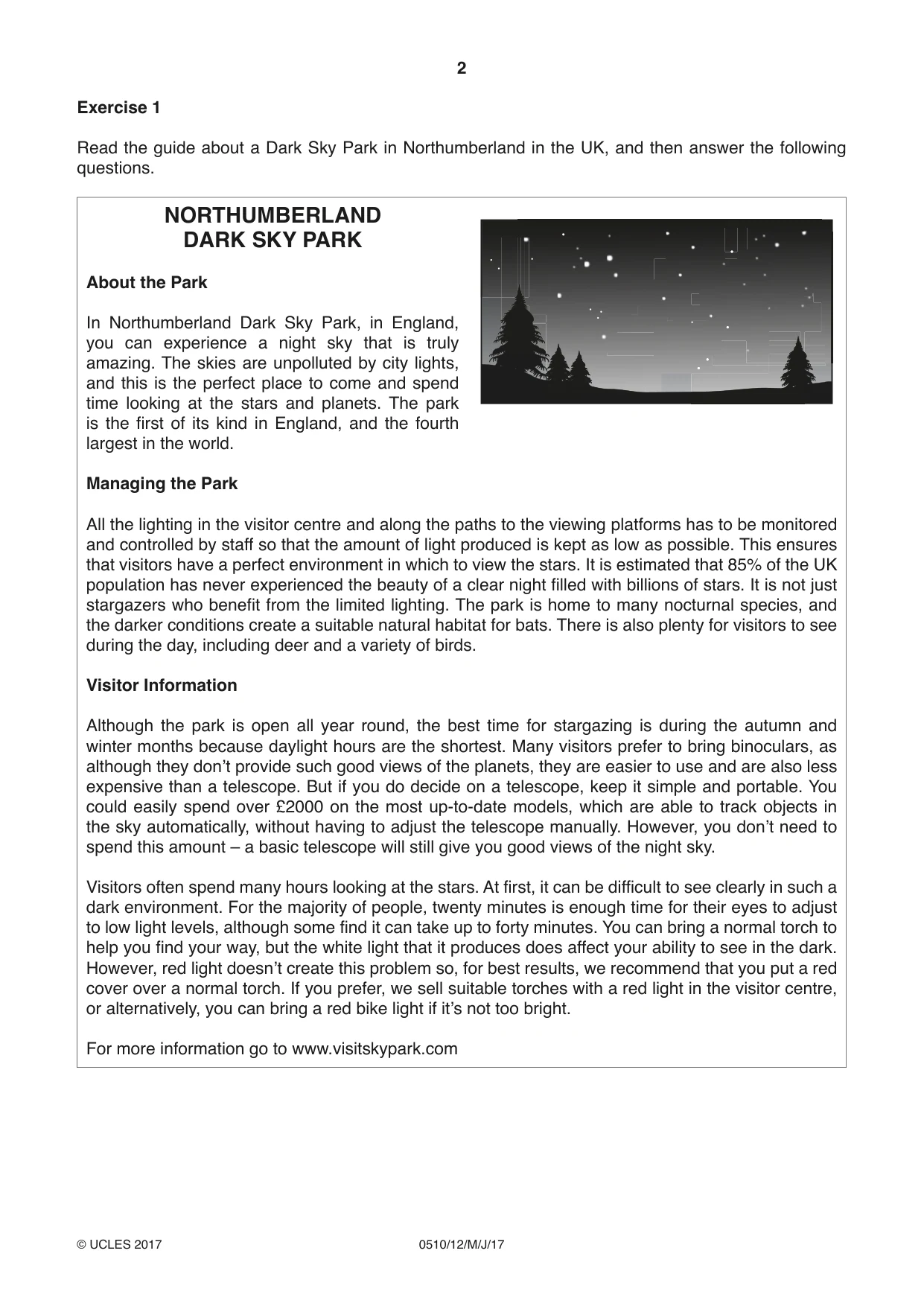
2 0510/12/M/J/17 © UCLES 2017 Exercise 1 Read the guide about a Dark Sky Park in Northumberland in the UK, and then answer the following questions. NORTHUMBERLAND DARK SKY PARK About the Park In Northumberland Dark Sky Park, in England, you can experience a night sky that is truly amazing. The skies are unpolluted by city lights, and this is the perfect place to come and spend time looking at the stars and planets. The park is the first of its kind in England, and the fourth largest in the world. Managing the Park All the lighting in the visitor centre and along the paths to the viewing platforms has to be monitored and controlled by staff so that the amount of light produced is kept as low as possible. This ensures that visitors have a perfect environment in which to view the stars. It is estimated that 85% of the UK population has never experienced the beauty of a clear night filled with billions of stars. It is not just stargazers who benefit from the limited lighting. The park is home to many nocturnal species, and the darker conditions create a suitable natural habitat for bats. There is also plenty for visitors to see during the day, including deer and a variety of birds. Visitor Information Although the park is open all year round, the best time for stargazing is during the autumn and winter months because daylight hours are the shortest. Many visitors prefer to bring binoculars, as although they don’t provide such good views of the planets, they are easier to use and are also less expensive than a telescope. But if you do decide on a telescope, keep it simple and portable. You could easily spend over £2000 on the most up-to-date models, which are able to track objects in the sky automatically, without having to adjust the telescope manually. However, you don’t need to spend this amount – a basic telescope will still give you good views of the night sky. Visitors often spend many hours looking at the stars. At first, it can be difficult to see clearly in such a dark environment. For the majority of people, twenty minutes is enough time for their eyes to adjust to low light levels, although some find it can take up to forty minutes. You can bring a normal torch to help you find your way, but the white light that it produces does affect your ability to see in the dark. However, red light doesn’t create this problem so, for best results, we recommend that you put a red cover over a normal torch. If you prefer, we sell suitable torches with a red light in the visitor centre, or alternatively, you can bring a red bike light if it’s not too bright. For more information go to www.visitskypark.com
Question paper, page 3
3 0510/12/M/J/17 © UCLES 2017 [Turn over (a) Why is this area of Northumberland an ideal place to see stars? …[1] (b) What do employees do to improve the experience of visitors? …[1] (c) Why is it better to visit the park during certain times of the year? …[1] (d) What is one advantage of using binoculars rather than a telescope? …[1] (e) How long does it take most people to get used to seeing in the dark? …[1] (f) What can you do instead of buying a special torch? Give two details. … …[2] [Total: 7]
Question paper, page 4
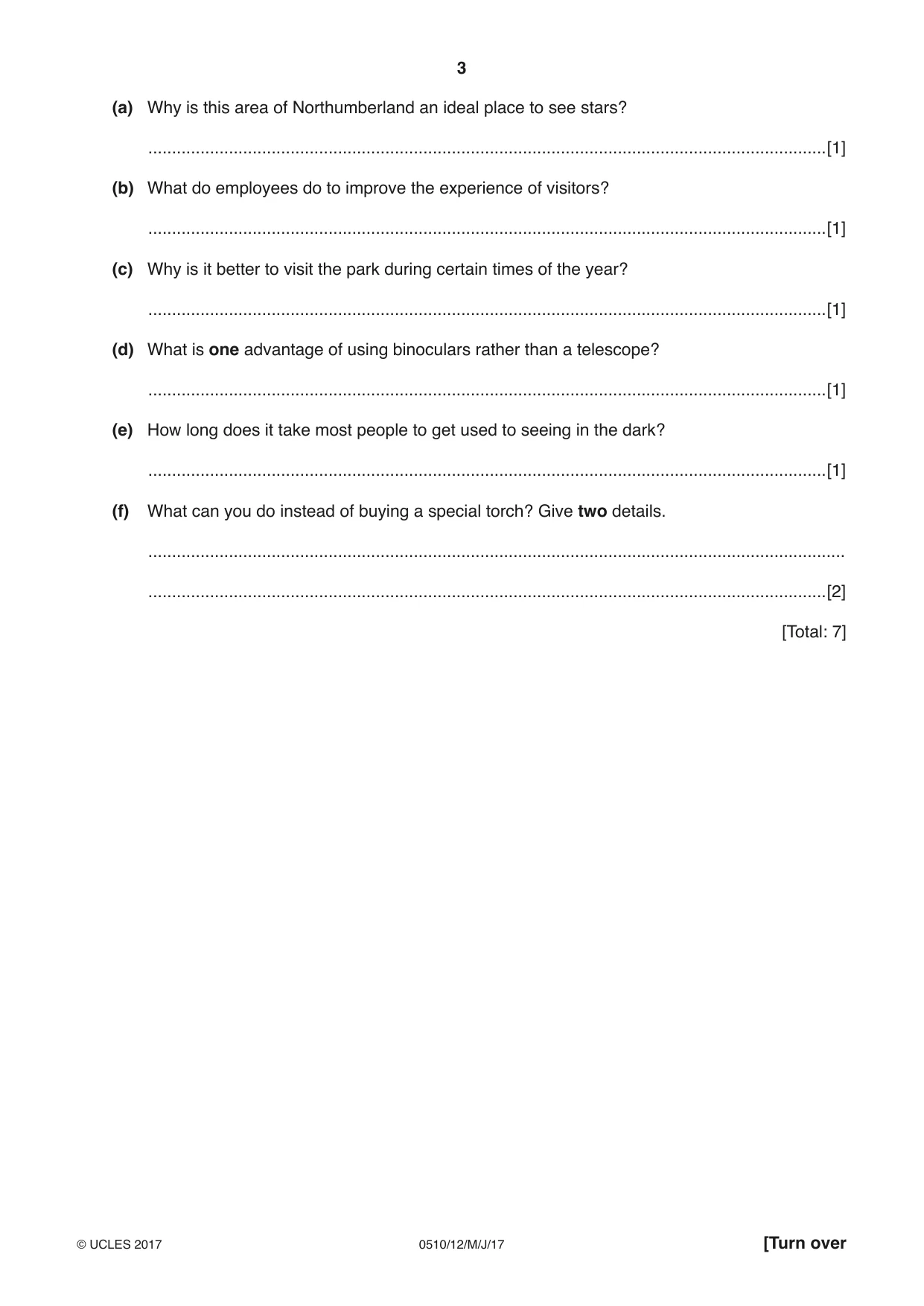
4 0510/12/M/J/17 © UCLES 2017 Exercise 2 Read the article about sleep, and then answer the following questions. A good night’s sleep Most of us spend a third of our lives sleeping, although some people say they need as little as four hours sleep a night. There are various factors which affect sleep – just ask nurses or factory employees who sometimes work night shifts how difficult they find it to change their sleep routines. We know that sleep is essential for brain growth, and also for maintaining memory skills. Although it has been said that the function of sleep is to give the body a chance to rest and recover, this is not entirely true. In reality, the amount of energy gained by sleeping is tiny – about the same as the energy we get from eating a piece of toast. One way to understand the role of sleep is to look at what happens if you have too little. Some research has shown that sleep-deprived adults are less productive at work. If you have ever stayed up all night, you may have noticed some negative after-effects the next day, such as finding it hard to remember simple things at school. After just one night without sleep, you may struggle to concentrate in class. Many people find their sleep is disturbed as a result of not having enough relaxing ‘wind-down’ time before going to bed. It is recommended that people should not look at screens for an hour before sleep. If we don’t switch off our devices, our brains can’t switch off either. It has also been suggested that long-term sleep loss may increase the risk of obesity. Your body produces important chemicals while you sleep, which are vital for controlling how hungry you feel the next day. If your body doesn’t produce sufficient levels of these chemicals, over time this may mean you put on weight. According to Professor Joanna Kelly of the National Sleep Centre, the time spent sleeping each day declines during our lives. Newborn babies have 16 hours’ sleep daily, which decreases to 12 hours by the time young children reach the age of two. This gradual decrease in sleep continues through childhood, with teenagers typically needing about 9 hours to function at their best. Although the research findings indicate this is the ideal situation, from her experience as the mother of teenage daughters, Joanna knows all too well that this does not always happen. Adults need about 8 hours’ sleep, although as we get older, the quality of our sleep can suffer because we wake up frequently during the night. Just like humans, age also affects the sleep of animals. Another consideration is their position in the food chain – lower down the food chain, animals like deer must remain alert to possible predators, while those animals near the top tend to get more sleep, because they have little to fear. Captivity can also have a role – animals often sleep more in zoos, as they are safe from predators. There are no definite rules about the ideal amount of sleep humans require. Professor Kelly sums up by saying: “The amount we need is the level that allows us to stay alert. My work with families suggests that some might benefit from changing their lifestyles.” Our lives today are busy, and although regular sporting activities after work or college are great at providing exercise, this can also mean that we eat large meals late in the evening. This can cause digestion problems, which affect sleep, so a light snack is often preferable if you want a good night’s sleep. 30 25 20 15 10 5 0 brown bat squirrel python cat tiger Average daily animal sleep time animal average daily sleep time (in hours)
Question paper, page 5
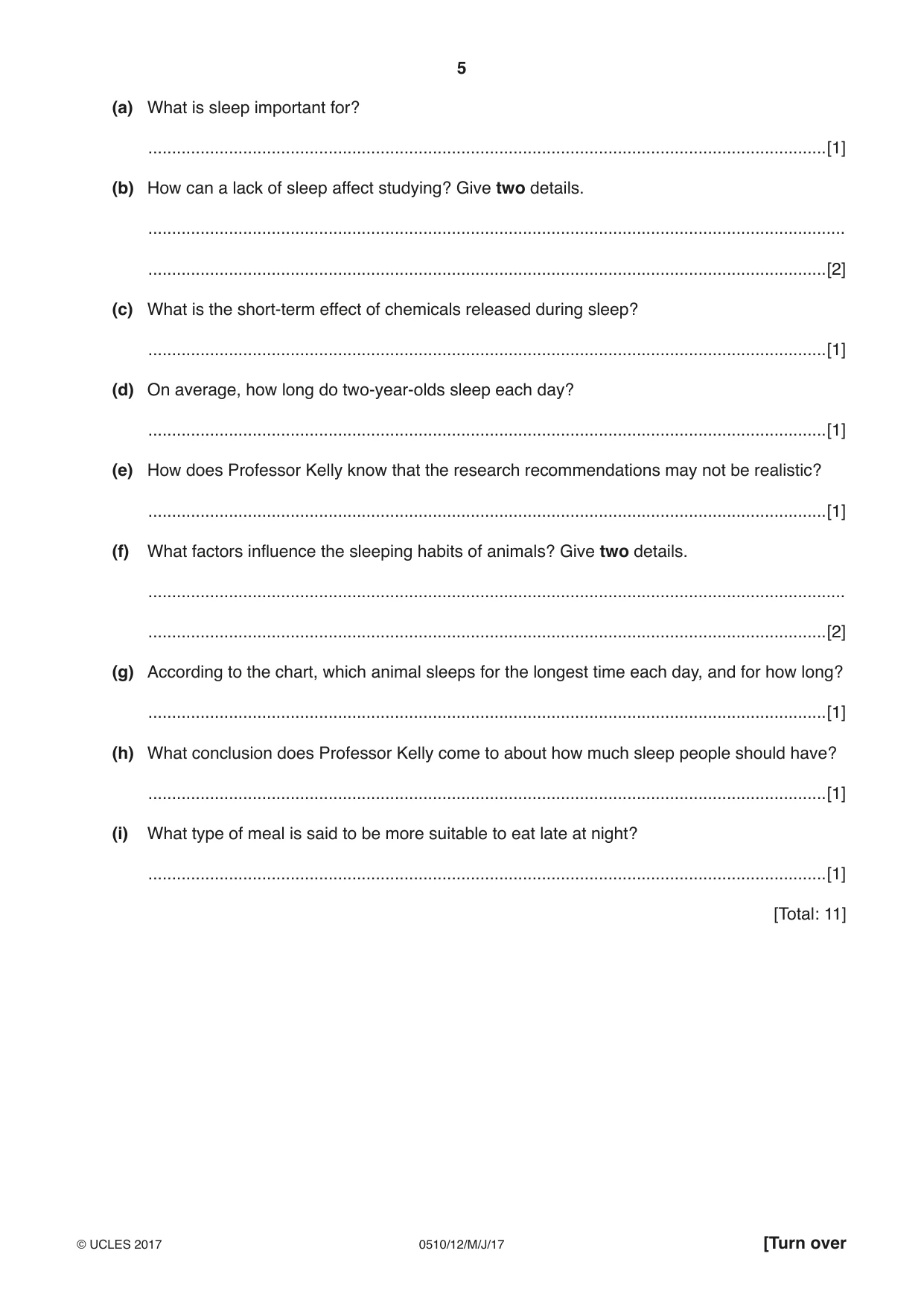
5 0510/12/M/J/17 © UCLES 2017 [Turn over (a) What is sleep important for? …[1] (b) How can a lack of sleep affect studying? Give two details. … …[2] (c) What is the short-term effect of chemicals released during sleep? …[1] (d) On average, how long do two-year-olds sleep each day? …[1] (e) How does Professor Kelly know that the research recommendations may not be realistic? …[1] (f) What factors influence the sleeping habits of animals? Give two details. … …[2] (g) According to the chart, which animal sleeps for the longest time each day, and for how long? …[1] (h) What conclusion does Professor Kelly come to about how much sleep people should have? …[1] (i) What type of meal is said to be more suitable to eat late at night? …[1] [Total: 11]
Question paper, page 6
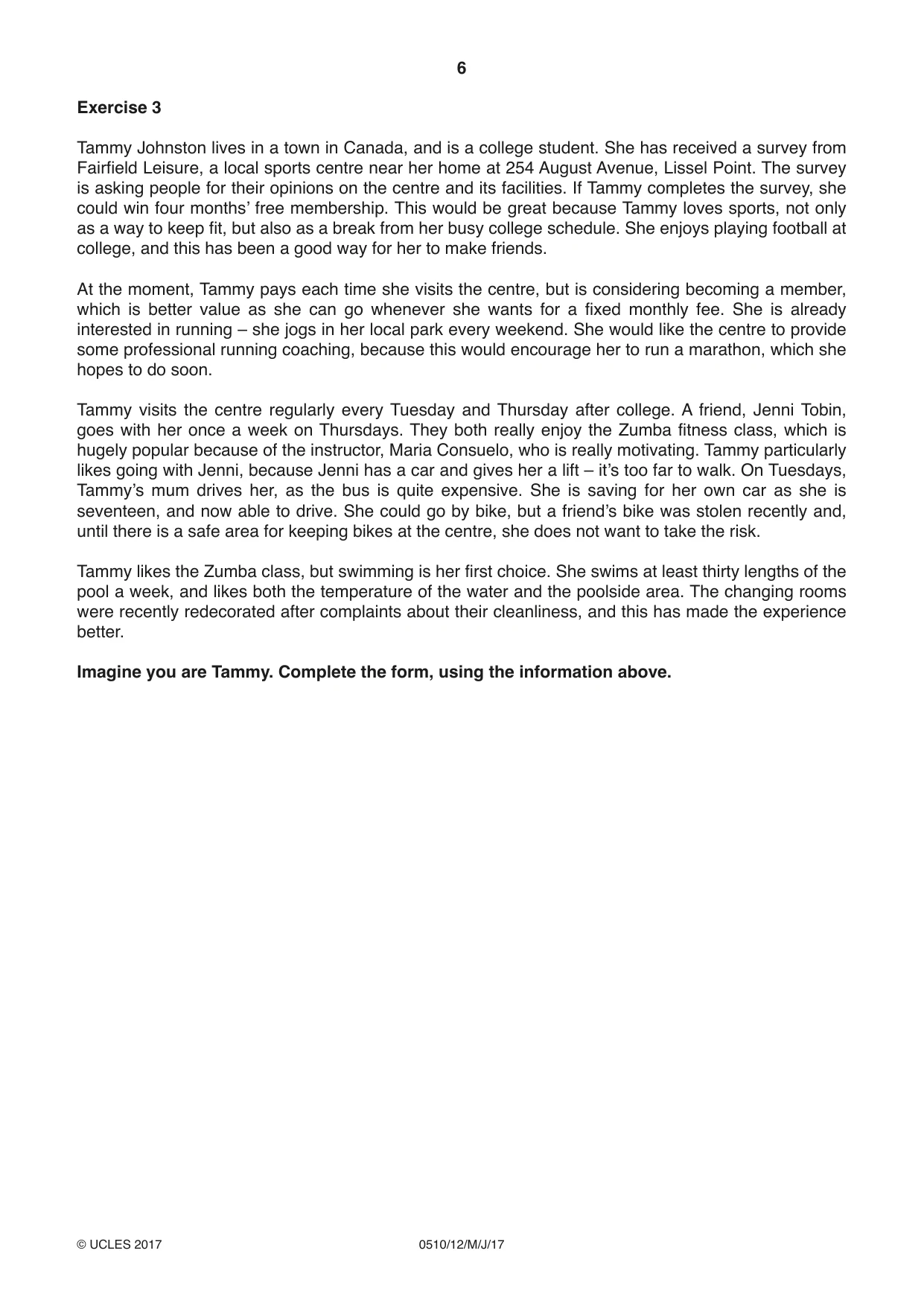
6 0510/12/M/J/17 © UCLES 2017 Exercise 3 Tammy Johnston lives in a town in Canada, and is a college student. She has received a survey from Fairfield Leisure, a local sports centre near her home at 254 August Avenue, Lissel Point. The survey is asking people for their opinions on the centre and its facilities. If Tammy completes the survey, she could win four months’ free membership. This would be great because Tammy loves sports, not only as a way to keep fit, but also as a break from her busy college schedule. She enjoys playing football at college, and this has been a good way for her to make friends. At the moment, Tammy pays each time she visits the centre, but is considering becoming a member, which is better value as she can go whenever she wants for a fixed monthly fee. She is already interested in running – she jogs in her local park every weekend. She would like the centre to provide some professional running coaching, because this would encourage her to run a marathon, which she hopes to do soon. Tammy visits the centre regularly every Tuesday and Thursday after college. A friend, Jenni Tobin, goes with her once a week on Thursdays. They both really enjoy the Zumba fitness class, which is hugely popular because of the instructor, Maria Consuelo, who is really motivating. Tammy particularly likes going with Jenni, because Jenni has a car and gives her a lift – it’s too far to walk. On Tuesdays, Tammy’s mum drives her, as the bus is quite expensive. She is saving for her own car as she is seventeen, and now able to drive. She could go by bike, but a friend’s bike was stolen recently and, until there is a safe area for keeping bikes at the centre, she does not want to take the risk. Tammy likes the Zumba class, but swimming is her first choice. She swims at least thirty lengths of the pool a week, and likes both the temperature of the water and the poolside area. The changing rooms were recently redecorated after complaints about their cleanliness, and this has made the experience better. Imagine you are Tammy. Complete the form, using the information above.
Question paper, page 7
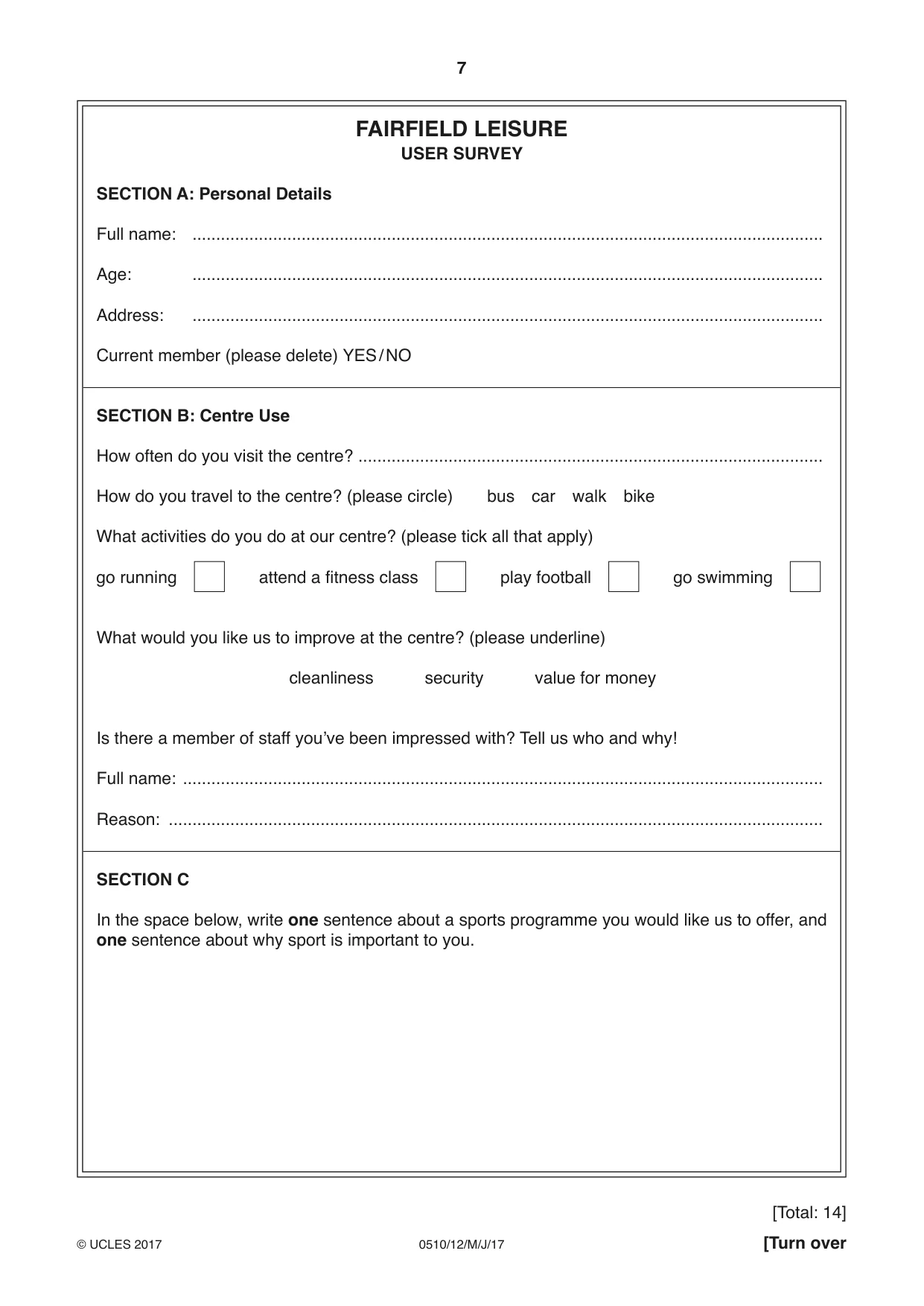
7 0510/12/M/J/17 © UCLES 2017 [Turn over FAIRFIELD LEISURE USER SURVEY SECTION A: Personal Details Full name: … Age: … Address: … Current member (please delete) YES / NO SECTION B: Centre Use How often do you visit the centre? … How do you travel to the centre? (please circle) bus car walk bike What activities do you do at our centre? (please tick all that apply) go running attend a fitness class play football go swimming What would you like us to improve at the centre? (please underline) cleanliness security value for money Is there a member of staff you’ve been impressed with? Tell us who and why! Full name: … Reason: … SECTION C In the space below, write one sentence about a sports programme you would like us to offer, and one sentence about why sport is important to you. [Total: 14]
Question paper, page 8
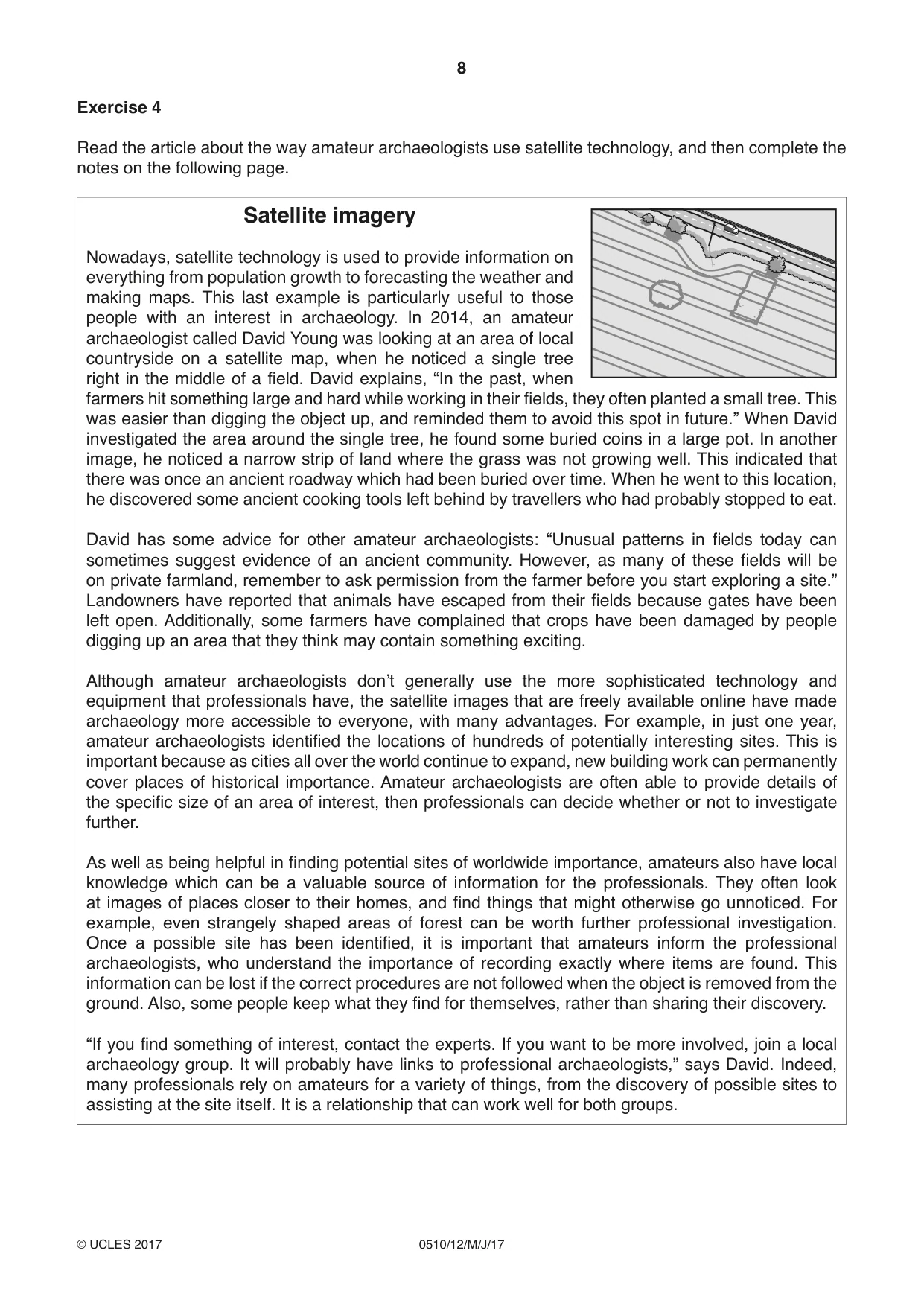
8 0510/12/M/J/17 © UCLES 2017 Exercise 4 Read the article about the way amateur archaeologists use satellite technology, and then complete the notes on the following page. Satellite imagery Nowadays, satellite technology is used to provide information on everything from population growth to forecasting the weather and making maps. This last example is particularly useful to those people with an interest in archaeology. In 2014, an amateur archaeologist called David Young was looking at an area of local countryside on a satellite map, when he noticed a single tree right in the middle of a field. David explains, “In the past, when farmers hit something large and hard while working in their fields, they often planted a small tree. This was easier than digging the object up, and reminded them to avoid this spot in future.” When David investigated the area around the single tree, he found some buried coins in a large pot. In another image, he noticed a narrow strip of land where the grass was not growing well. This indicated that there was once an ancient roadway which had been buried over time. When he went to this location, he discovered some ancient cooking tools left behind by travellers who had probably stopped to eat. David has some advice for other amateur archaeologists: “Unusual patterns in fields today can sometimes suggest evidence of an ancient community. However, as many of these fields will be on private farmland, remember to ask permission from the farmer before you start exploring a site.” Landowners have reported that animals have escaped from their fields because gates have been left open. Additionally, some farmers have complained that crops have been damaged by people digging up an area that they think may contain something exciting. Although amateur archaeologists don’t generally use the more sophisticated technology and equipment that professionals have, the satellite images that are freely available online have made archaeology more accessible to everyone, with many advantages. For example, in just one year, amateur archaeologists identified the locations of hundreds of potentially interesting sites. This is important because as cities all over the world continue to expand, new building work can permanently cover places of historical importance. Amateur archaeologists are often able to provide details of the specific size of an area of interest, then professionals can decide whether or not to investigate further. As well as being helpful in finding potential sites of worldwide importance, amateurs also have local knowledge which can be a valuable source of information for the professionals. They often look at images of places closer to their homes, and find things that might otherwise go unnoticed. For example, even strangely shaped areas of forest can be worth further professional investigation. Once a possible site has been identified, it is important that amateurs inform the professional archaeologists, who understand the importance of recording exactly where items are found. This information can be lost if the correct procedures are not followed when the object is removed from the ground. Also, some people keep what they find for themselves, rather than sharing their discovery. “If you find something of interest, contact the experts. If you want to be more involved, join a local archaeology group. It will probably have links to professional archaeologists,” says David. Indeed, many professionals rely on amateurs for a variety of things, from the discovery of possible sites to assisting at the site itself. It is a relationship that can work well for both groups.
Question paper, page 9
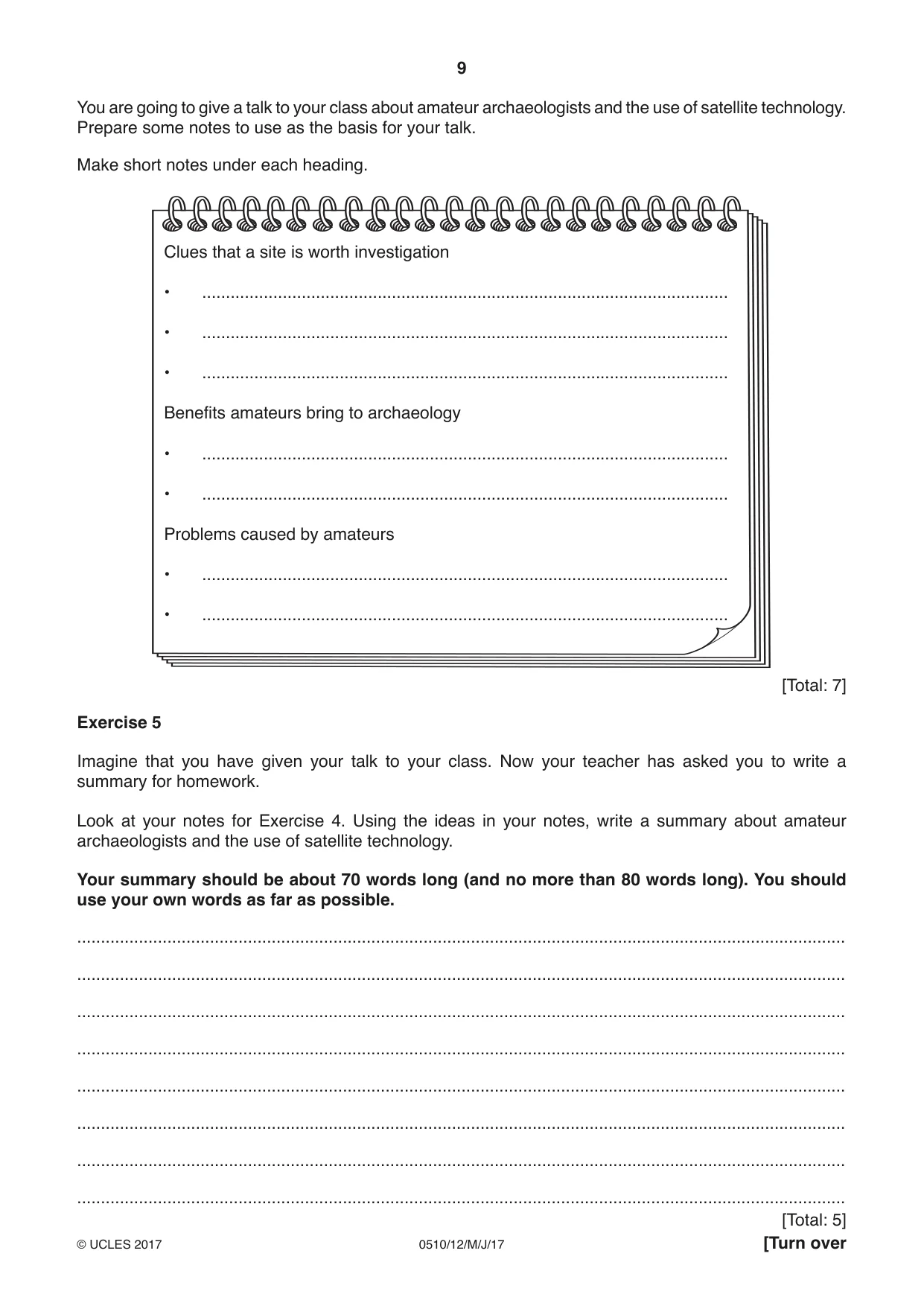
9 0510/12/M/J/17 © UCLES 2017 [Turn over You are going to give a talk to your class about amateur archaeologists and the use of satellite technology. Prepare some notes to use as the basis for your talk. Make short notes under each heading. Clues that a site is worth investigation • … • … • … Benefits amateurs bring to archaeology • … • … Problems caused by amateurs • … • … [Total: 7] Exercise 5 Imagine that you have given your talk to your class. Now your teacher has asked you to write a summary for homework. Look at your notes for Exercise 4. Using the ideas in your notes, write a summary about amateur archaeologists and the use of satellite technology. Your summary should be about 70 words long (and no more than 80 words long). You should use your own words as far as possible. … … … … … … … … [Total: 5]
Question paper, page 10
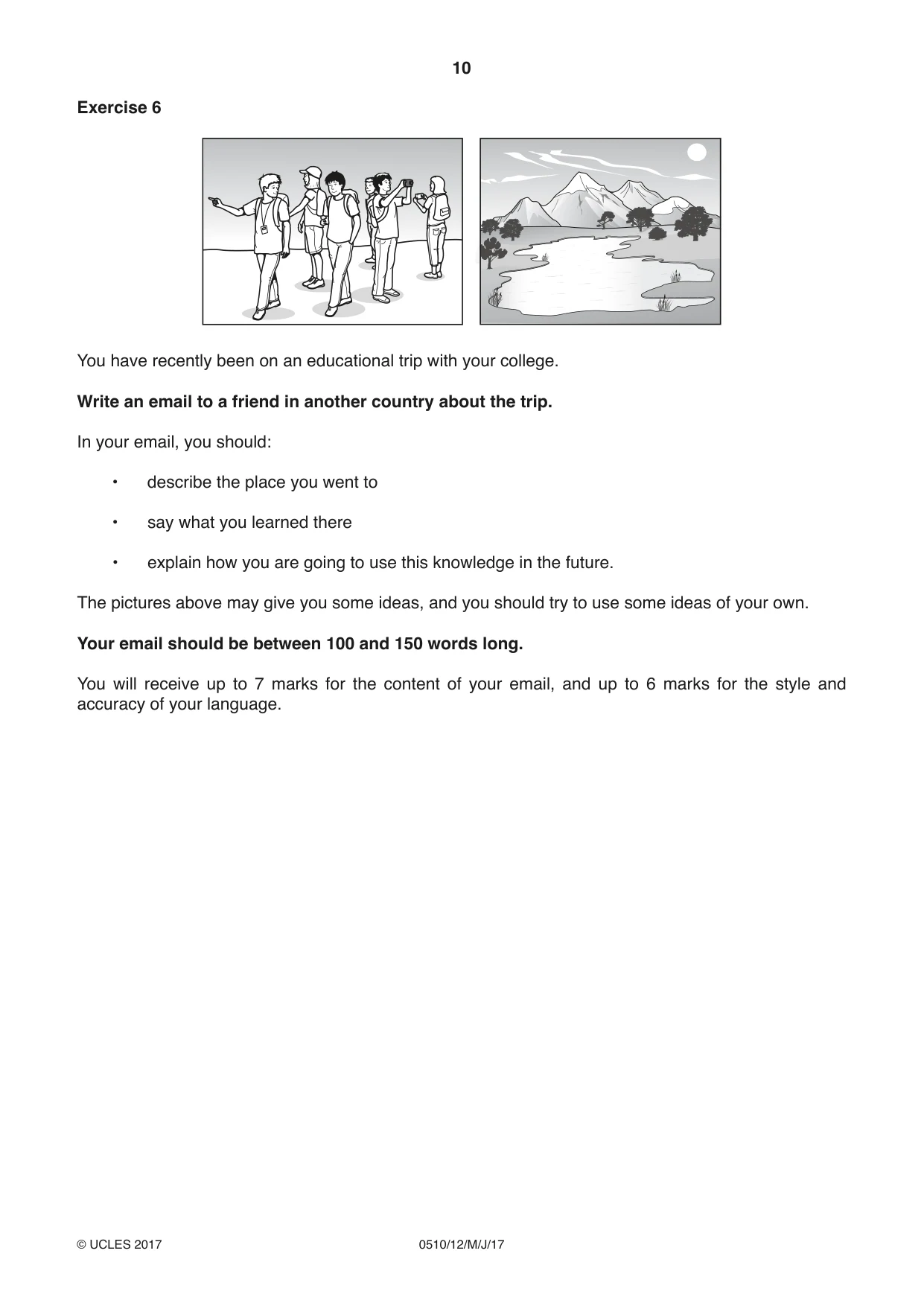
10 0510/12/M/J/17 © UCLES 2017 Exercise 6 You have recently been on an educational trip with your college. Write an email to a friend in another country about the trip. In your email, you should: • describe the place you went to • say what you learned there • explain how you are going to use this knowledge in the future. The pictures above may give you some ideas, and you should try to use some ideas of your own. Your email should be between 100 and 150 words long. You will receive up to 7 marks for the content of your email, and up to 6 marks for the style and accuracy of your language.
Question paper, page 11
11 0510/12/M/J/17 © UCLES 2017 [Turn over … … … … … … … … … … … … … … … … … … … … … … … … … … … [Total: 13]
Question paper, page 12
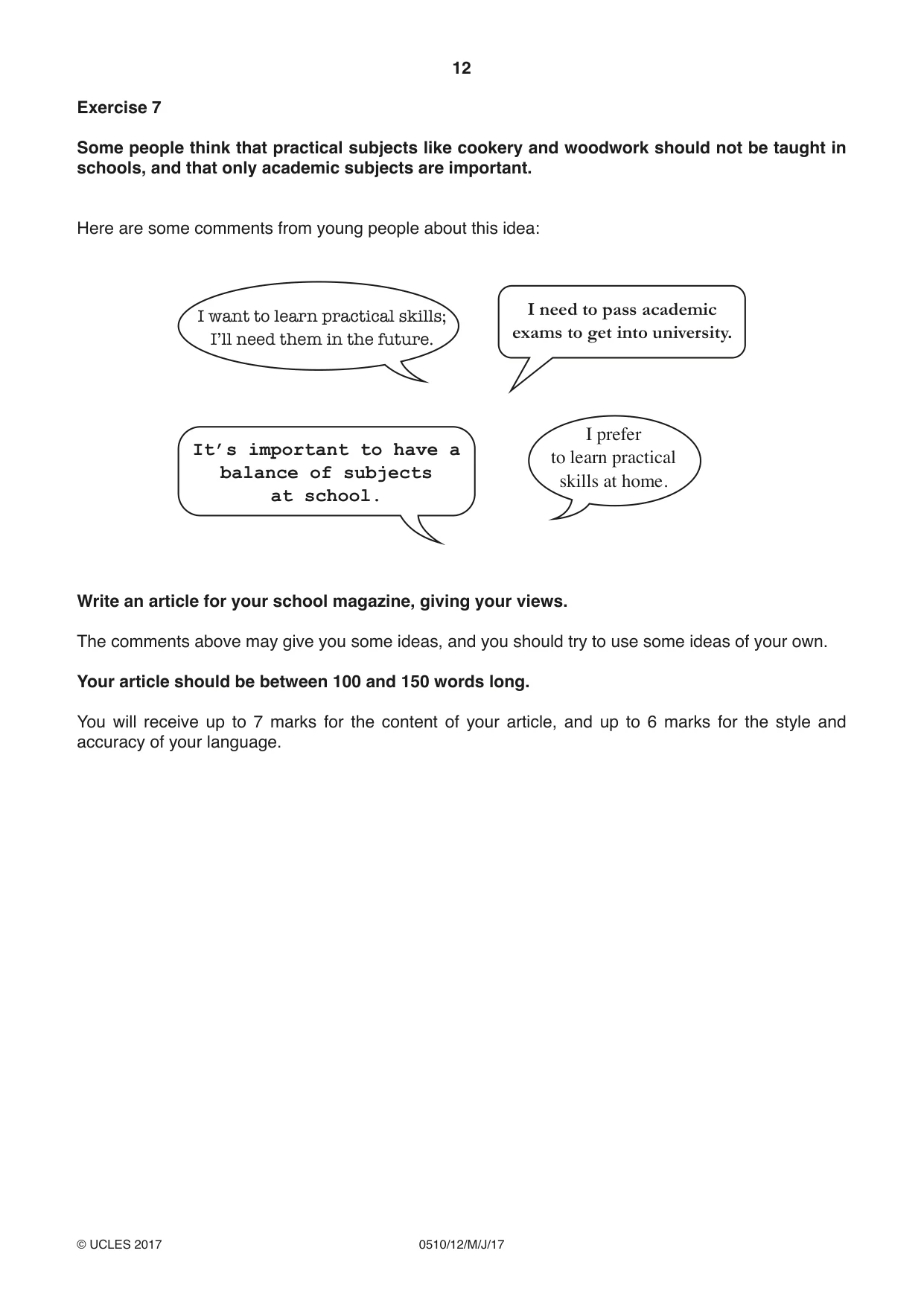
12 0510/12/M/J/17 © UCLES 2017 Exercise 7 Some people think that practical subjects like cookery and woodwork should not be taught in schools, and that only academic subjects are important. Here are some comments from young people about this idea: I want to learn practical skills; I’ll need them in the future. I need to pass academic exams to get into university. It’s important to have a balance of subjects at school. I prefer to learn practical skills at home. Write an article for your school magazine, giving your views. The comments above may give you some ideas, and you should try to use some ideas of your own. Your article should be between 100 and 150 words long. You will receive up to 7 marks for the content of your article, and up to 6 marks for the style and accuracy of your language.
Question paper, page 13
13 0510/12/M/J/17 © UCLES 2017 … … … … … … … … … … … … … … … … … … … … … … … … … … … [Total: 13]
Question paper, page 14
14 0510/12/M/J/17 © UCLES 2017 BLANK PAGE
Question paper, page 15
15 0510/12/M/J/17 © UCLES 2017 BLANK PAGE
Question paper, page 16
16 0510/12/M/J/17 © UCLES 2017 Permission to reproduce items where third-party owned material protected by copyright is included has been sought and cleared where possible. Every reasonable effort has been made by the publisher (UCLES) to trace copyright holders, but if any items requiring clearance have unwittingly been included, the publisher will be pleased to make amends at the earliest possible opportunity. To avoid the issue of disclosure of answer-related information to candidates, all copyright acknowledgements are reproduced online in the Cambridge International Examinations Copyright Acknowledgements Booklet. This is produced for each series of examinations and is freely available to download at www.cie.org.uk after the live examination series. Cambridge International Examinations is part of the Cambridge Assessment Group. Cambridge Assessment is the brand name of University of Cambridge Local Examinations Syndicate (UCLES), which is itself a department of the University of Cambridge. BLANK PAGE
Mark scheme, page 1
® IGCSE is a registered trademark. This document consists of 11 printed pages. © UCLES 2017 [Turn over Cambridge International Examinations Cambridge International General Certificate of Secondary Education ENGLISH AS SECOND LANGUAGE 0510/12 Paper 1 Reading and Writing (Core) May/June 2017 MARK SCHEME Maximum Mark: 70 Published This mark scheme is published as an aid to teachers and candidates, to indicate the requirements of the examination. It shows the basis on which Examiners were instructed to award marks. It does not indicate the details of the discussions that took place at an Examiners’ meeting before marking began, which would have considered the acceptability of alternative answers. Mark schemes should be read in conjunction with the question paper and the Principal Examiner Report for Teachers. Cambridge will not enter into discussions about these mark schemes. Cambridge is publishing the mark schemes for the May/June 2017 series for most Cambridge IGCSE®, Cambridge International A and AS Level and Cambridge Pre-U components, and some Cambridge O Level components.
Mark scheme, page 2
0510/12 Cambridge IGCSE – Mark Scheme PUBLISHED May/June 2017 © UCLES 2017 Page 2 of 11 IGCSE English as a Second Language Core tier Reading/Writing (Paper 1) This component forms part of the Core tier assessment of IGCSE English as a Second Language and tests the following Assessment Objectives: AO1: Reading R1 identify and retrieve facts and details R2 understand and select relevant information R3 recognise, understand ideas, opinions and attitudes and the connections between the related ideas R4 understand what is implied but not actually written, e.g. gist, relationships, writer’s purpose/intention, writer’s feelings, situation or place AO2: Writing W1 communicate clearly, accurately and appropriately W2 convey information and express opinions effectively W3 employ and control a variety of grammatical structures W4 demonstrate knowledge and understanding of a range of appropriate vocabulary W5 observe conventions of paragraphing, punctuation and spelling W6 employ appropriate register/style Overview of exercises on Paper 1 Reading objectives tested Marks for reading objectives Writing objectives tested Marks for writing objectives Total available marks Exercise 1 Reading (1) R1 R2 7 – 7 Exercise 2 Reading (2) R1 R2 R4 11 – 11 Exercise 3 Information transfer R1, R2 10 W1, W5 4 14 Exercise 4 Note- making R1, R2, R3 7 – 7 Exercise 5 Summary – W1, W2, W3, W4, W5 5 5 Exercise 6 Writing (1) – W1, W2, W3, W4, W5, W6 13 13 Exercise 7 Writing (2) – W1, W2, W3, W4, W5, W6 13 13 70
Mark scheme, page 3
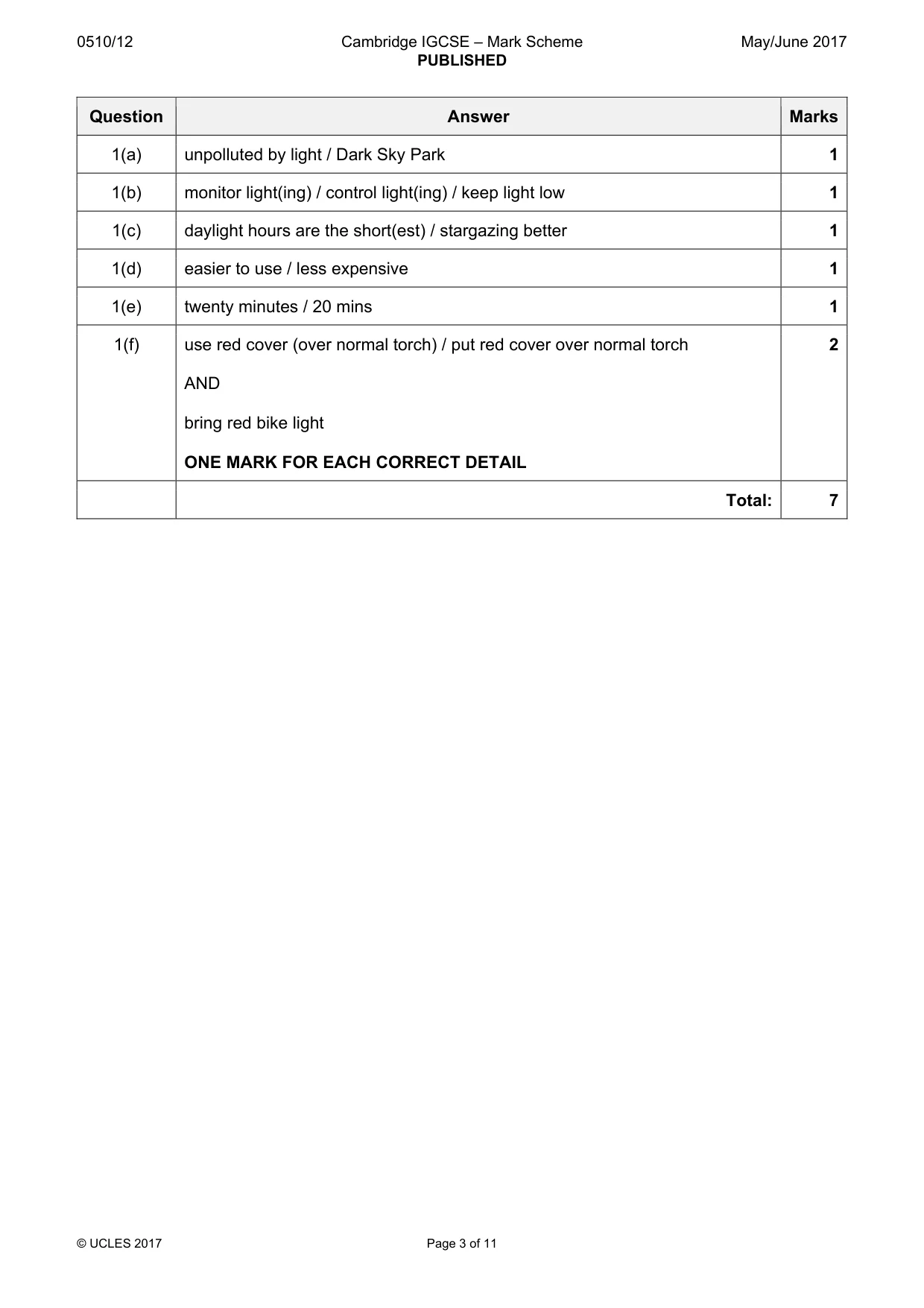
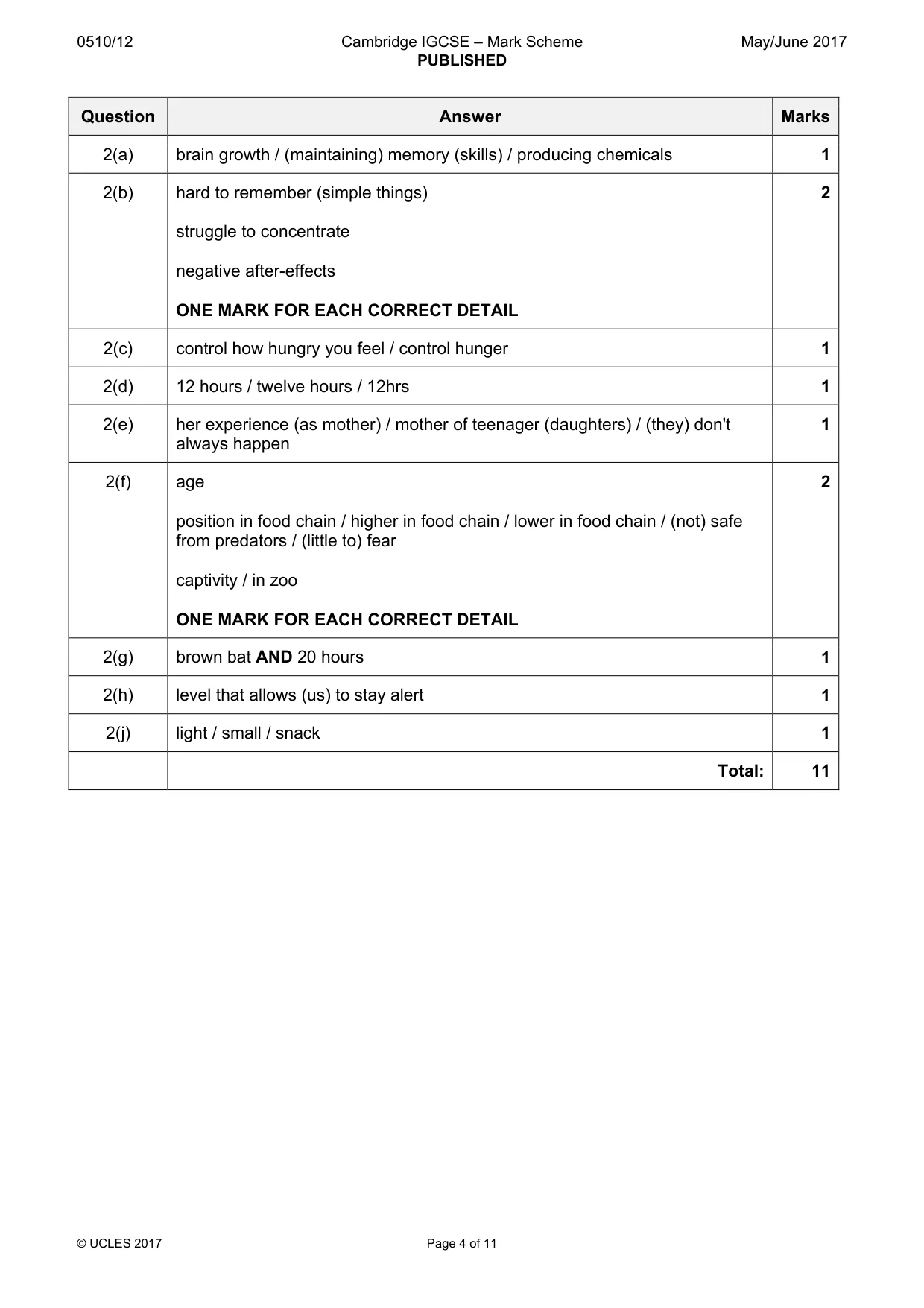
0510/12 Cambridge IGCSE – Mark Scheme PUBLISHED May/June 2017 © UCLES 2017 Page 3 of 11 Question Answer Marks 1(a) unpolluted by light / Dark Sky Park 1 1(b) monitor light(ing) / control light(ing) / keep light low 1 1(c) daylight hours are the short(est) / stargazing better 1 1(d) easier to use / less expensive 1 1(e) twenty minutes / 20 mins 1 1(f) use red cover (over normal torch) / put red cover over normal torch AND bring red bike light ONE MARK FOR EACH CORRECT DETAIL 2 Total: 7
Mark scheme, page 4
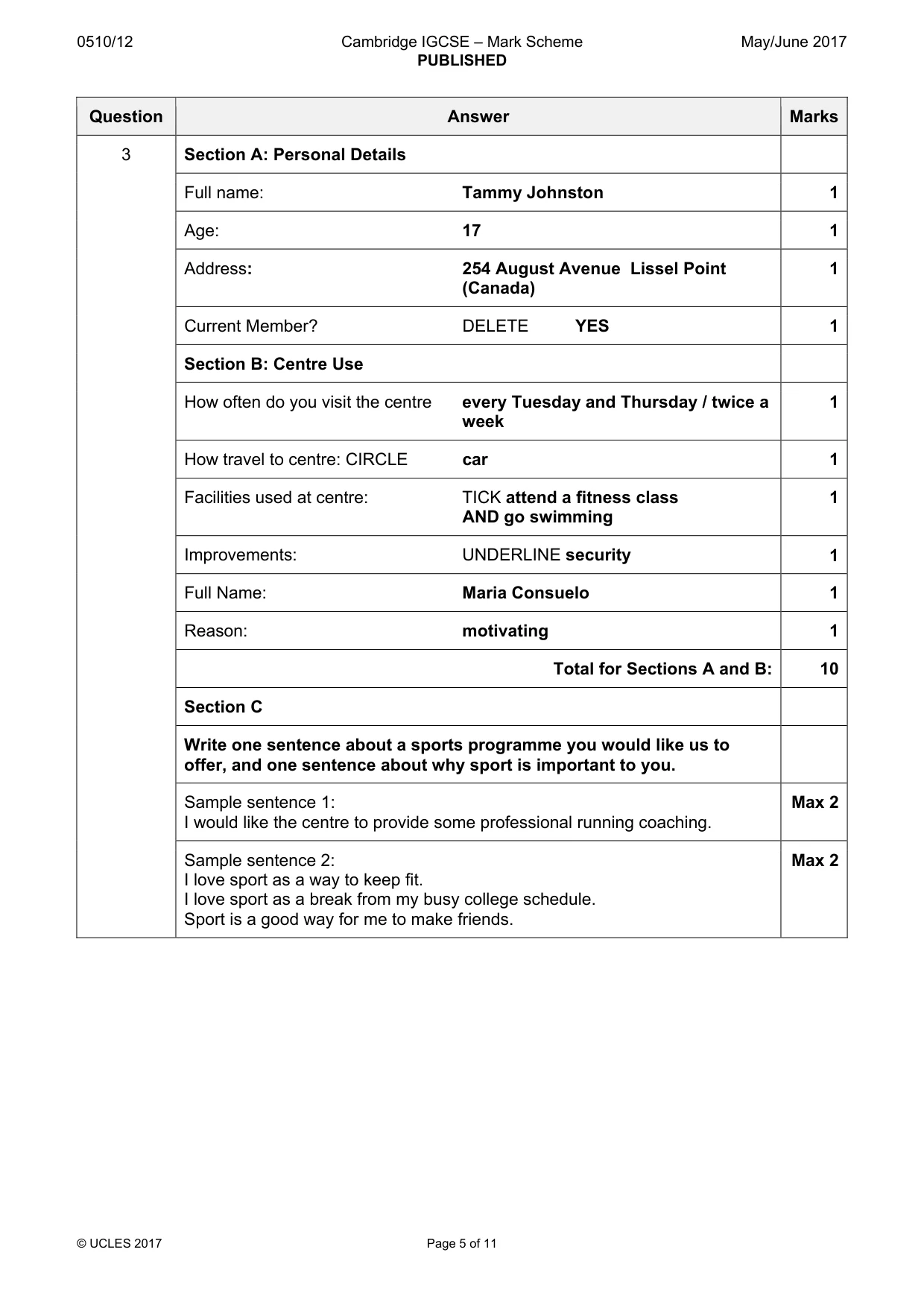
0510/12 Cambridge IGCSE – Mark Scheme PUBLISHED May/June 2017 © UCLES 2017 Page 4 of 11 Question Answer Marks 2(a) brain growth / (maintaining) memory (skills) / producing chemicals 1 2(b) hard to remember (simple things) struggle to concentrate negative after-effects ONE MARK FOR EACH CORRECT DETAIL 2 2(c) control how hungry you feel / control hunger 1 2(d) 12 hours / twelve hours / 12hrs 1 2(e) her experience (as mother) / mother of teenager (daughters) / (they) don't always happen 1 2(f) age position in food chain / higher in food chain / lower in food chain / (not) safe from predators / (little to) fear captivity / in zoo ONE MARK FOR EACH CORRECT DETAIL 2 2(g) brown bat AND 20 hours 1 2(h) level that allows (us) to stay alert 1 2(j) light / small / snack 1 Total: 11
Mark scheme, page 5
0510/12 Cambridge IGCSE – Mark Scheme PUBLISHED May/June 2017 © UCLES 2017 Page 5 of 11 Question Answer Marks 3 Section A: Personal Details Full name: Tammy Johnston 1 Age: 17 1 Address: 254 August Avenue Lissel Point (Canada) 1 Current Member? DELETE YES 1 Section B: Centre Use How often do you visit the centre every Tuesday and Thursday / twice a week 1 How travel to centre: CIRCLE car 1 Facilities used at centre: TICK attend a fitness class AND go swimming 1 Improvements: UNDERLINE security 1 Full Name: Maria Consuelo 1 Reason: motivating 1 Total for Sections A and B: 10 Section C Write one sentence about a sports programme you would like us to offer, and one sentence about why sport is important to you. Sample sentence 1: I would like the centre to provide some professional running coaching. Max 2 Sample sentence 2: I love sport as a way to keep fit. I love sport as a break from my busy college schedule. Sport is a good way for me to make friends. Max 2
Mark scheme, page 6
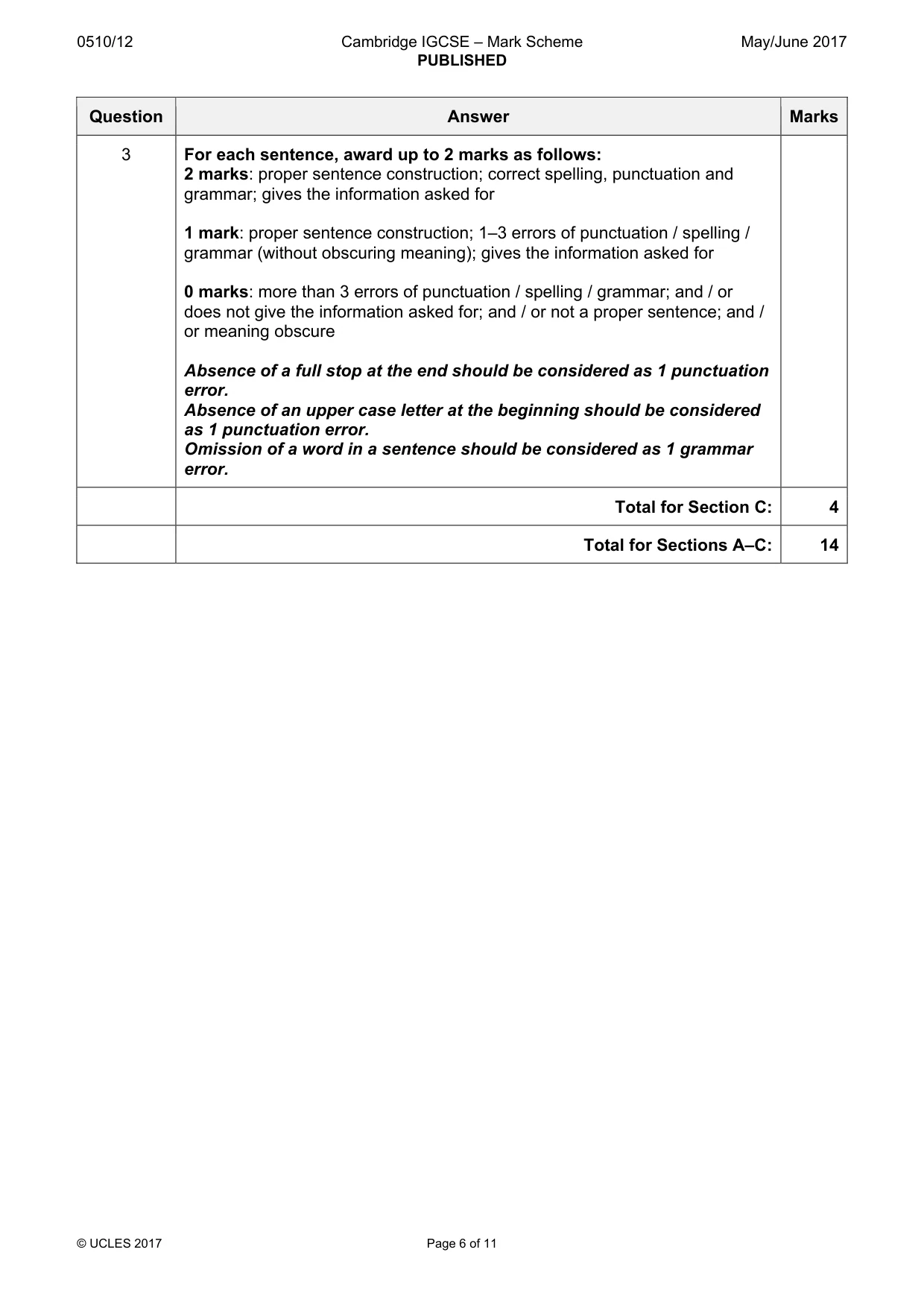
0510/12 Cambridge IGCSE – Mark Scheme PUBLISHED May/June 2017 © UCLES 2017 Page 6 of 11 Question Answer Marks 3 For each sentence, award up to 2 marks as follows: 2 marks: proper sentence construction; correct spelling, punctuation and grammar; gives the information asked for 1 mark: proper sentence construction; 1–3 errors of punctuation / spelling / grammar (without obscuring meaning); gives the information asked for 0 marks: more than 3 errors of punctuation / spelling / grammar; and / or does not give the information asked for; and / or not a proper sentence; and / or meaning obscure Absence of a full stop at the end should be considered as 1 punctuation error. Absence of an upper case letter at the beginning should be considered as 1 punctuation error. Omission of a word in a sentence should be considered as 1 grammar error. Total for Section C: 4 Total for Sections A–C: 14
Mark scheme, page 7
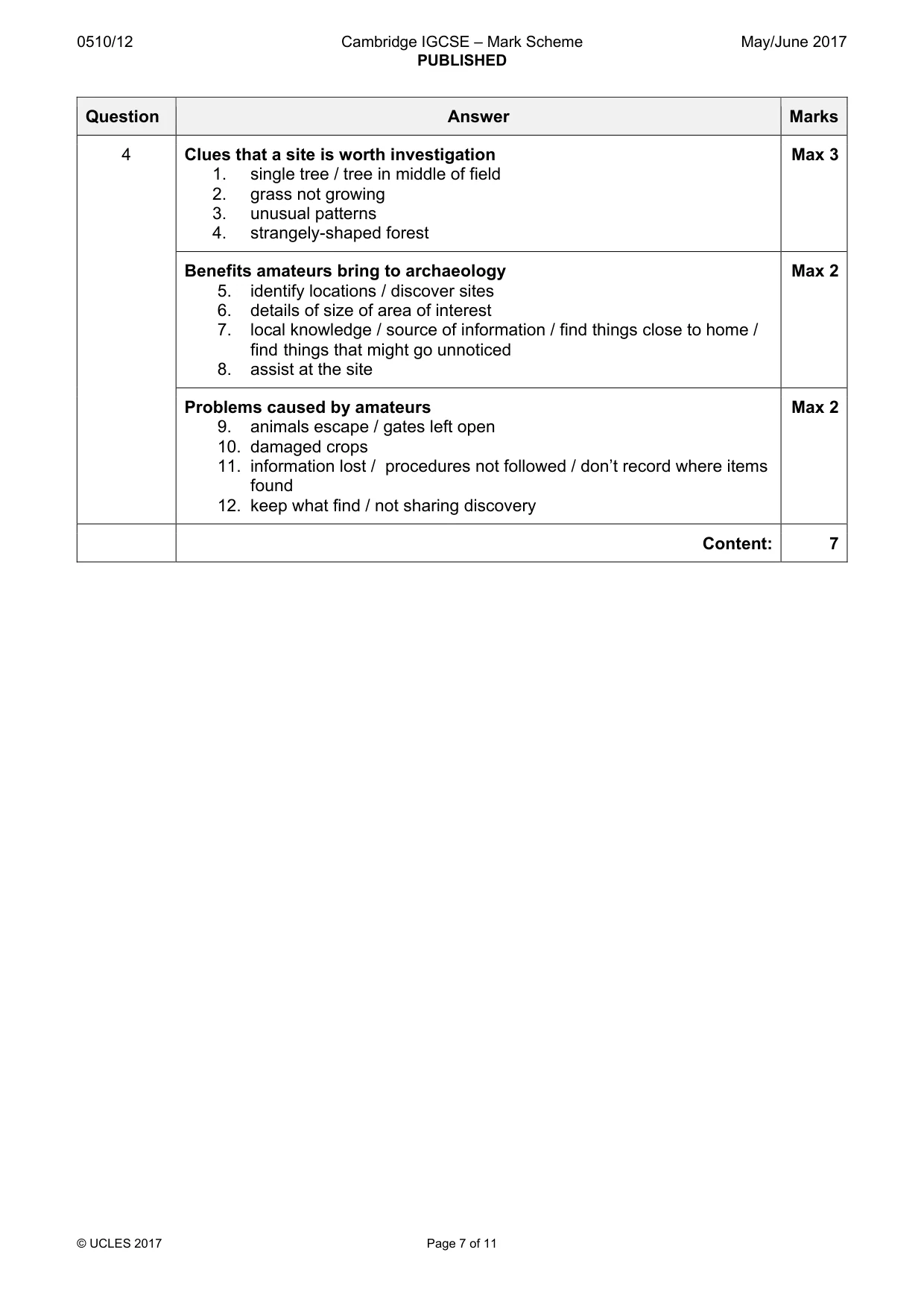
0510/12 Cambridge IGCSE – Mark Scheme PUBLISHED May/June 2017 © UCLES 2017 Page 7 of 11 Question Answer Marks 4 Clues that a site is worth investigation 1. single tree / tree in middle of field 2. grass not growing 3. unusual patterns 4. strangely-shaped forest Max 3 Benefits amateurs bring to archaeology 5. identify locations / discover sites 6. details of size of area of interest 7. local knowledge / source of information / find things close to home / find things that might go unnoticed 8. assist at the site Max 2 Problems caused by amateurs 9. animals escape / gates left open 10. damaged crops 11. information lost / procedures not followed / don’t record where items found 12. keep what find / not sharing discovery Max 2 Content: 7
Mark scheme, page 8
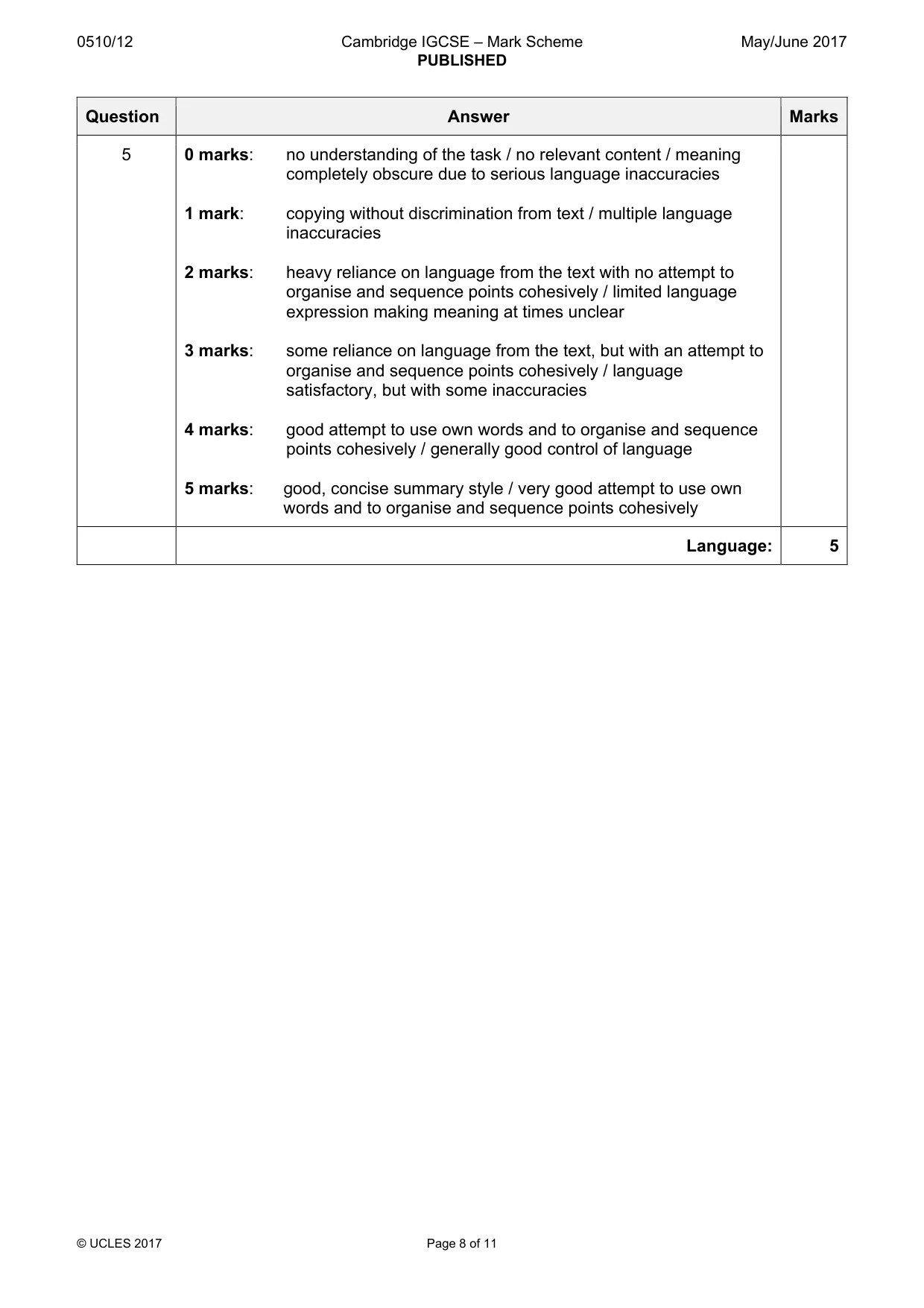
0510/12 Cambridge IGCSE – Mark Scheme PUBLISHED May/June 2017 © UCLES 2017 Page 8 of 11 Question Answer Marks 5 0 marks: no understanding of the task / no relevant content / meaning completely obscure due to serious language inaccuracies 1 mark: copying without discrimination from text / multiple language inaccuracies 2 marks: heavy reliance on language from the text with no attempt to organise and sequence points cohesively / limited language expression making meaning at times unclear 3 marks: some reliance on language from the text, but with an attempt to organise and sequence points cohesively / language satisfactory, but with some inaccuracies 4 marks: good attempt to use own words and to organise and sequence points cohesively / generally good control of language 5 marks: good, concise summary style / very good attempt to use own words and to organise and sequence points cohesively Language: 5
Mark scheme, page 9
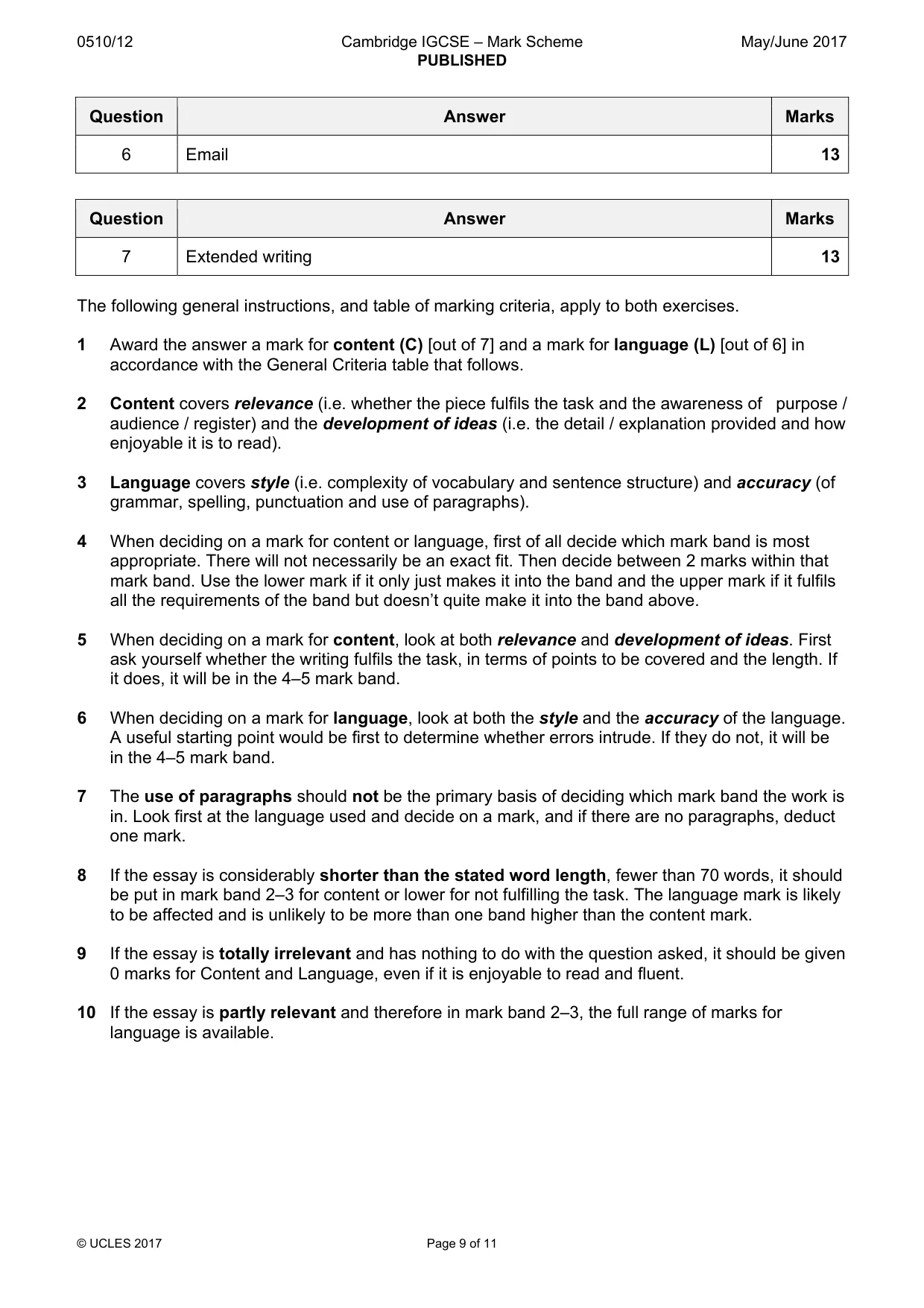
0510/12 Cambridge IGCSE – Mark Scheme PUBLISHED May/June 2017 © UCLES 2017 Page 9 of 11 Question Answer Marks 6 Email 13 Question Answer Marks 7 Extended writing 13 The following general instructions, and table of marking criteria, apply to both exercises. 1 Award the answer a mark for content (C) [out of 7] and a mark for language (L) [out of 6] in accordance with the General Criteria table that follows. 2 Content covers relevance (i.e. whether the piece fulfils the task and the awareness of purpose / audience / register) and the development of ideas (i.e. the detail / explanation provided and how enjoyable it is to read). 3 Language covers style (i.e. complexity of vocabulary and sentence structure) and accuracy (of grammar, spelling, punctuation and use of paragraphs). 4 When deciding on a mark for content or language, first of all decide which mark band is most appropriate. There will not necessarily be an exact fit. Then decide between 2 marks within that mark band. Use the lower mark if it only just makes it into the band and the upper mark if it fulfils all the requirements of the band but doesn’t quite make it into the band above. 5 When deciding on a mark for content, look at both relevance and development of ideas. First ask yourself whether the writing fulfils the task, in terms of points to be covered and the length. If it does, it will be in the 4–5 mark band. 6 When deciding on a mark for language, look at both the style and the accuracy of the language. A useful starting point would be first to determine whether errors intrude. If they do not, it will be in the 4–5 mark band. 7 The use of paragraphs should not be the primary basis of deciding which mark band the work is in. Look first at the language used and decide on a mark, and if there are no paragraphs, deduct one mark. 8 If the essay is considerably shorter than the stated word length, fewer than 70 words, it should be put in mark band 2–3 for content or lower for not fulfilling the task. The language mark is likely to be affected and is unlikely to be more than one band higher than the content mark. 9 If the essay is totally irrelevant and has nothing to do with the question asked, it should be given 0 marks for Content and Language, even if it is enjoyable to read and fluent. 10 If the essay is partly relevant and therefore in mark band 2–3, the full range of marks for language is available.
Mark scheme, page 10
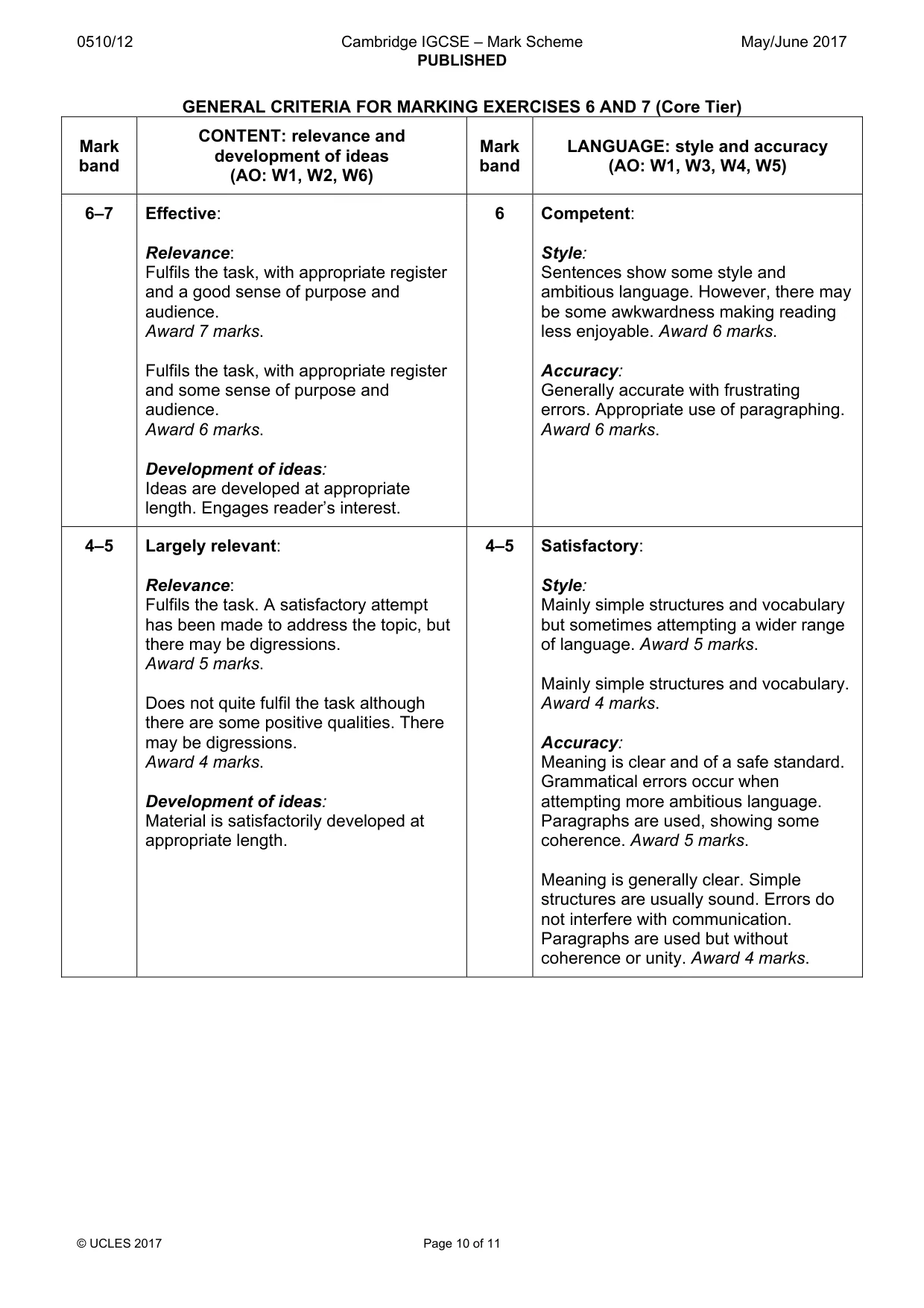
0510/12 Cambridge IGCSE – Mark Scheme PUBLISHED May/June 2017 © UCLES 2017 Page 10 of 11 GENERAL CRITERIA FOR MARKING EXERCISES 6 AND 7 (Core Tier) Mark band CONTENT: relevance and development of ideas (AO: W1, W2, W6) Mark band LANGUAGE: style and accuracy (AO: W1, W3, W4, W5) 6–7 Effective: Relevance: Fulfils the task, with appropriate register and a good sense of purpose and audience. Award 7 marks. Fulfils the task, with appropriate register and some sense of purpose and audience. Award 6 marks. Development of ideas: Ideas are developed at appropriate length. Engages reader’s interest. 6 Competent: Style: Sentences show some style and ambitious language. However, there may be some awkwardness making reading less enjoyable. Award 6 marks. Accuracy: Generally accurate with frustrating errors. Appropriate use of paragraphing. Award 6 marks. 4–5 Largely relevant: Relevance: Fulfils the task. A satisfactory attempt has been made to address the topic, but there may be digressions. Award 5 marks. Does not quite fulfil the task although there are some positive qualities. There may be digressions. Award 4 marks. Development of ideas: Material is satisfactorily developed at appropriate length. 4–5 Satisfactory: Style: Mainly simple structures and vocabulary but sometimes attempting a wider range of language. Award 5 marks. Mainly simple structures and vocabulary. Award 4 marks. Accuracy: Meaning is clear and of a safe standard. Grammatical errors occur when attempting more ambitious language. Paragraphs are used, showing some coherence. Award 5 marks. Meaning is generally clear. Simple structures are usually sound. Errors do not interfere with communication. Paragraphs are used but without coherence or unity. Award 4 marks.
Mark scheme, page 11
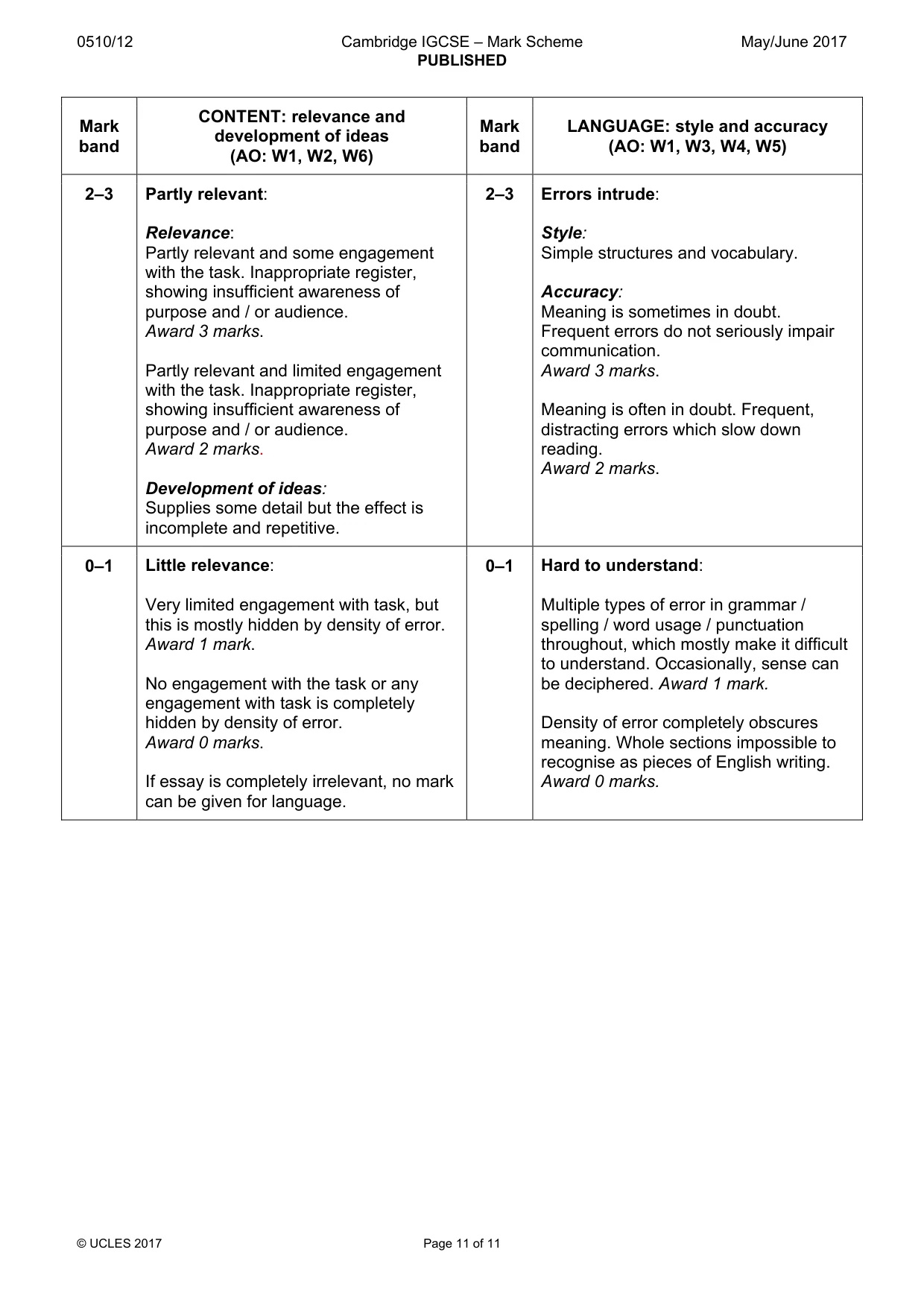
0510/12 Cambridge IGCSE – Mark Scheme PUBLISHED May/June 2017 © UCLES 2017 Page 11 of 11 Mark band CONTENT: relevance and development of ideas (AO: W1, W2, W6) Mark band LANGUAGE: style and accuracy (AO: W1, W3, W4, W5) 2–3 Partly relevant: Relevance: Partly relevant and some engagement with the task. Inappropriate register, showing insufficient awareness of purpose and / or audience. Award 3 marks. Partly relevant and limited engagement with the task. Inappropriate register, showing insufficient awareness of purpose and / or audience. Award 2 marks. Development of ideas: Supplies some detail but the effect is incomplete and repetitive. 2–3 Errors intrude: Style: Simple structures and vocabulary. Accuracy: Meaning is sometimes in doubt. Frequent errors do not seriously impair communication. Award 3 marks. Meaning is often in doubt. Frequent, distracting errors which slow down reading. Award 2 marks. 0–1 Little relevance: Very limited engagement with task, but this is mostly hidden by density of error. Award 1 mark. No engagement with the task or any engagement with task is completely hidden by density of error. Award 0 marks. If essay is completely irrelevant, no mark can be given for language. 0–1 Hard to understand: Multiple types of error in grammar / spelling / word usage / punctuation throughout, which mostly make it difficult to understand. Occasionally, sense can be deciphered. Award 1 mark. Density of error completely obscures meaning. Whole sections impossible to recognise as pieces of English writing. Award 0 marks.
What you needed in this session
Cambridge’s own grade thresholds for 2017 May/June, Paper 1 · Variant 2. A higher threshold means an easier paper — the bar moves with how the cohort did.