Cambridge IGCSE English - Second Language (oral endorsement) 0510 — 2016 May/June Paper 1 · Variant 3
0510/13/M/J/16 · 70 marks · ≈79 min
The question paper and its mark scheme, free to read here and free to download. This is Cambridge’s own paper, exactly as it was sat.
Question paper16 pages


Mark scheme11 pages
Answers below. Sit the paper first if you are practising.
Paper as text
Question paper, page 1
This document consists of 13 printed pages and 3 blank pages. DC (NH/SG) 112052/4 © UCLES 2016 [Turn over * 3 9 3 7 8 2 0 9 4 9 * ENGLISH AS A SECOND LANGUAGE 0510/13 Paper 1 Reading and Writing (Core) May/June 2016 1 hour 30 minutes Candidates answer on the Question Paper. No Additional Materials are required. READ THESE INSTRUCTIONS FIRST Write your Centre number, candidate number and name on all the work you hand in. Write in dark blue or black pen. Do not use staples, paper clips, glue or correction fluid. DO NOT WRITE IN ANY BARCODES. Answer all questions. Dictionaries are not allowed. At the end of the examination, fasten all your work securely together. The number of marks is given in brackets [ ] at the end of each question or part question. Cambridge International Examinations Cambridge International General Certificate of Secondary Education
Question paper, page 2
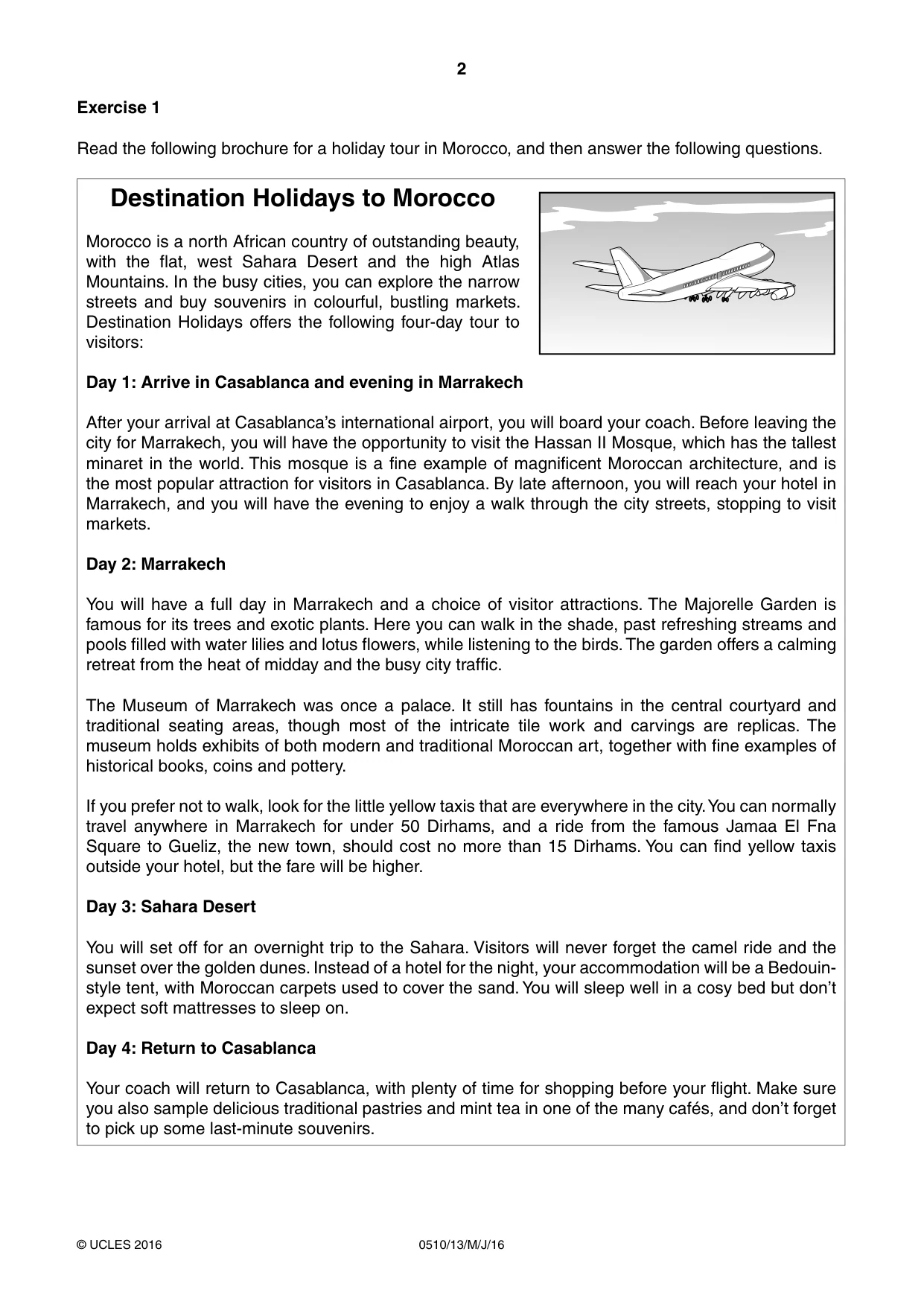
2 0510/13/M/J/16 © UCLES 2016 Exercise 1 Read the following brochure for a holiday tour in Morocco, and then answer the following questions. Destination Holidays to Morocco Morocco is a north African country of outstanding beauty, with the flat, west Sahara Desert and the high Atlas Mountains. In the busy cities, you can explore the narrow streets and buy souvenirs in colourful, bustling markets. Destination Holidays offers the following four-day tour to visitors: Day 1: Arrive in Casablanca and evening in Marrakech After your arrival at Casablanca’s international airport, you will board your coach. Before leaving the city for Marrakech, you will have the opportunity to visit the Hassan II Mosque, which has the tallest minaret in the world. This mosque is a fine example of magnificent Moroccan architecture, and is the most popular attraction for visitors in Casablanca. By late afternoon, you will reach your hotel in Marrakech, and you will have the evening to enjoy a walk through the city streets, stopping to visit markets. Day 2: Marrakech You will have a full day in Marrakech and a choice of visitor attractions. The Majorelle Garden is famous for its trees and exotic plants. Here you can walk in the shade, past refreshing streams and pools filled with water lilies and lotus flowers, while listening to the birds. The garden offers a calming retreat from the heat of midday and the busy city traffic. The Museum of Marrakech was once a palace. It still has fountains in the central courtyard and traditional seating areas, though most of the intricate tile work and carvings are replicas. The museum holds exhibits of both modern and traditional Moroccan art, together with fine examples of historical books, coins and pottery. If you prefer not to walk, look for the little yellow taxis that are everywhere in the city. You can normally travel anywhere in Marrakech for under 50 Dirhams, and a ride from the famous Jamaa El Fna Square to Gueliz, the new town, should cost no more than 15 Dirhams. You can find yellow taxis outside your hotel, but the fare will be higher. Day 3: Sahara Desert You will set off for an overnight trip to the Sahara. Visitors will never forget the camel ride and the sunset over the golden dunes. Instead of a hotel for the night, your accommodation will be a Bedouin- style tent, with Moroccan carpets used to cover the sand. You will sleep well in a cosy bed but don’t expect soft mattresses to sleep on. Day 4: Return to Casablanca Your coach will return to Casablanca, with plenty of time for shopping before your flight. Make sure you also sample delicious traditional pastries and mint tea in one of the many cafés, and don’t forget to pick up some last-minute souvenirs.
Question paper, page 3
3 0510/13/M/J/16 © UCLES 2016 [Turn over (a) What would a tourist find attractive about the Moroccan landscape? …[1] (b) What could you visit on the first day in Casablanca? …[1] (c) Where would you sleep on your first night of the tour? …[1] (d) How can visitors avoid the hot sun in the Majorelle Garden? …[1] (e) What remains of the original palace in Marrakech? …[1] (f) What will visitors always remember about the Sahara Desert? Give two details. … …[1] (g) When shopping in Casablanca, what should you try in a café? Give two details. … …[1] [Total: 7]
Question paper, page 4
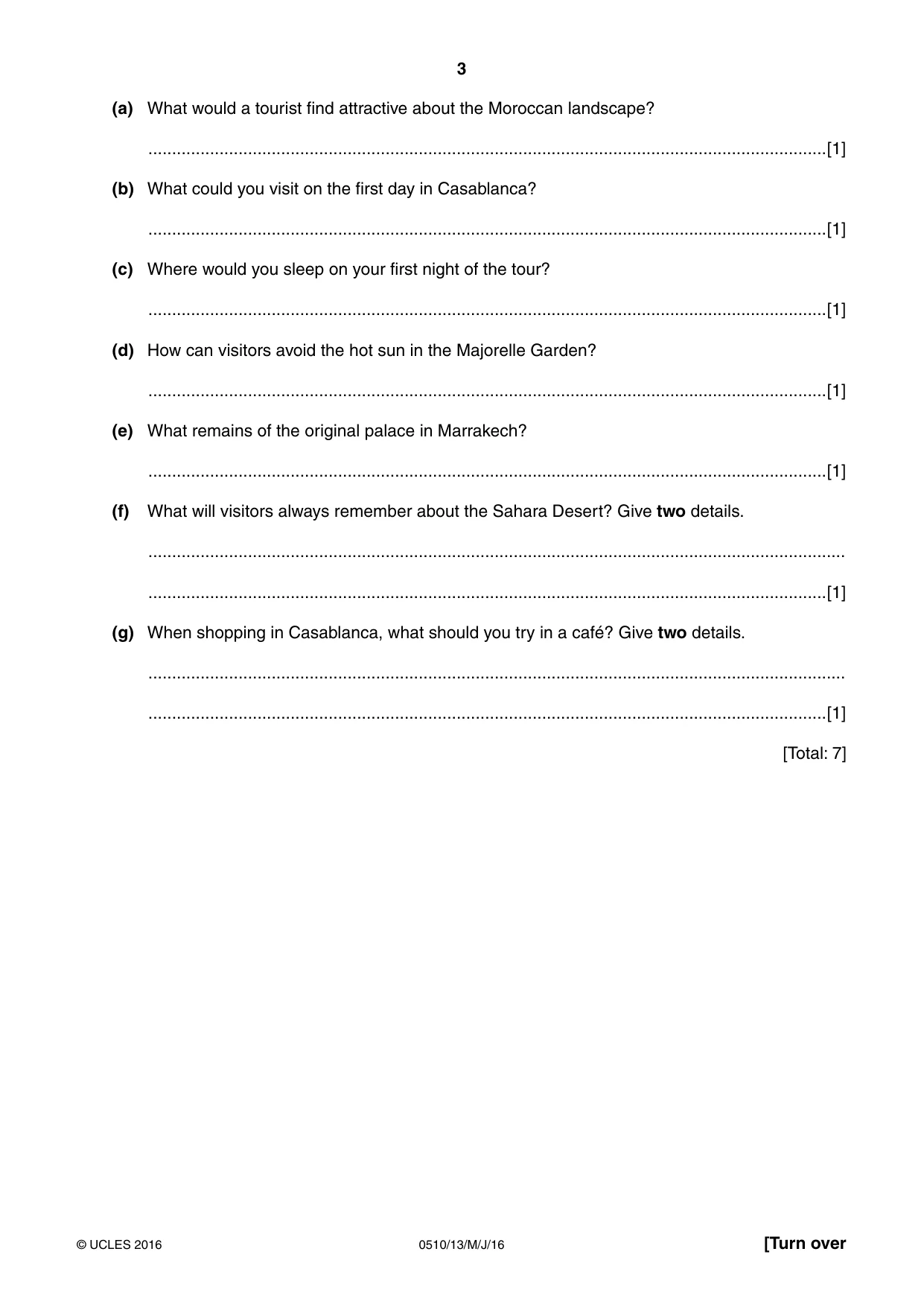
4 0510/13/M/J/16 © UCLES 2016 Exercise 2 Read the following article about sitting, and then answer the following questions. Too much sitting is bad for you! Most of us are guilty of excess sitting. We sit at school, at our computers and in front of the TV, moving only to change from one seat to another. Some studies suggest that people who sit all day reduce their life expectancy by around two years compared to those who are more active. Medical researchers have found evidence that sitting for long periods increases the risk of obesity and diabetes. According to Dr Amir Khan, an expert in teenage development, “Today’s teenagers are particularly at risk because of the hours they spend using digital technology.” It is clear that constant sitting at home, at school and in the workplace is harmful to health. In the nineteenth century, many office workers stood at their desks and moved around a lot more. However, this changed in the twentieth century when the number of employees in a typical office grew and it was much easier to supervise people when they were sitting down. Today, companies with modern offices face a huge challenge to reduce the amount of time people spend sitting, and schools are becoming aware of a similar need to change. A school in Minnesota decided to experiment with a new ‘standing classroom’ design. They removed the standard desks and replaced them with high tables. These new tables are at chest level and have a swinging footrest. As well as the expected health advantages, teachers have noticed other improvements. The students appear to be more attentive, more alert and able to concentrate better. At the beginning of the experiment, there were no chairs, but the school has now added some high chairs because not all of the students wanted to stand all day. Students are happy with their new environment and especially enjoy the background music, which has been added to improve their learning. Results show that their time is now divided fairly equally between when they stand, when they walk around the classroom and when they sit, with each of the three activities accounting for about one third of their time. Other schools are now calculating the costs and benefits of using standing desks. Many are keen to improve their students’ results, and they carefully consider all their performance and attendance data before making a final decision. Parents also need to be consulted as they may have doubts about the effect of these changes on their children. Some schools even organise after-school events where parents, students and teachers can experience a lesson in the new- style standing classroom. It is essential that everyone understands the value of these changes as they are expensive to introduce. A classroom with traditional desks and chairs costs less than half that of a ‘standing classroom’. Dr Khan is unsure how much teenagers can change. He believes that, at that age, they have firmly established habits and they don’t want to do things differently. They might be reluctant to stand for lessons and they should be allowed to choose whether to stand or sit. He adds that a mix of standing desks and traditional seating ensures that all students can work in the way that suits them. Standing 40% Walking 28% Sitting 32% Improved time spent being active or seated at school
Question paper, page 5
5 0510/13/M/J/16 © UCLES 2016 [Turn over (a) What do studies show that people must do to live two years longer? …[1] (b) What two health problems can be caused by too much sitting? … …[2] (c) When was it normal for office workers to stand at their desks? …[1] (d) Why did employers prefer their workers to sit? …[1] (e) How were the new desks in a school in Minnesota different from their old ones? …[1] (f) In what two ways did standing help improve the behaviour of students? … …[2] (g) What changes were made to the original classroom design? …[1] (h) According to the chart, how much of their time did students spend seated in their new classroom? …[1] (i) How can parents find out about the new style of classroom? …[1] [Total: 11]
Question paper, page 6
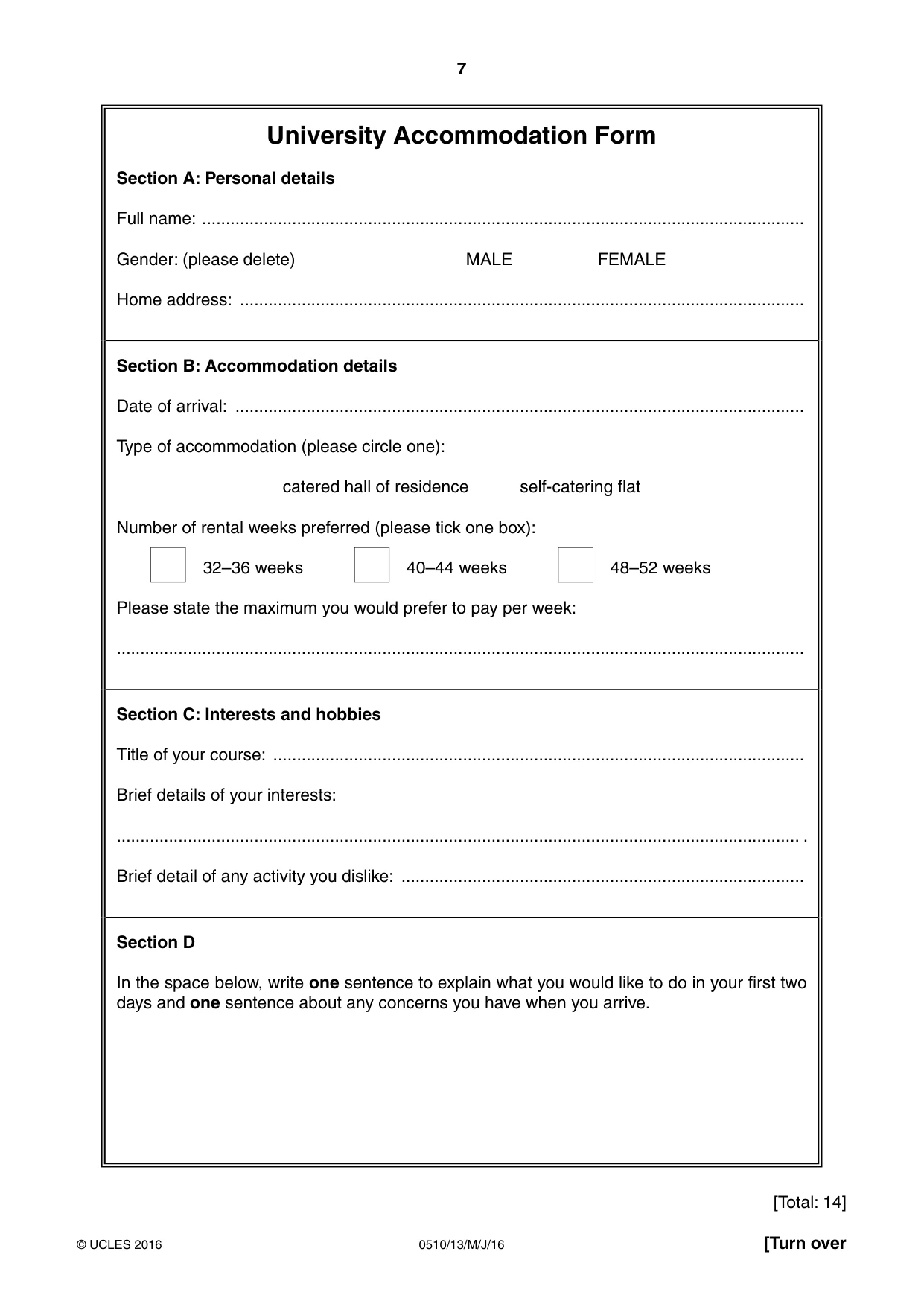
6 0510/13/M/J/16 © UCLES 2016 Exercise 3 Deshi Huang is going to study at an English university for three years. Deshi has never been to the United Kingdom. He lives at Flat 24 Green View Court in Central and Western District, Hong Kong. As an international student, Deshi can apply for student accommodation at the university, and he has been sent a form from the accommodation office which he needs to complete. He will arrive in the UK on 20 September and travel by train to the university, arriving in the afternoon. He wants to stay in the UK for the Christmas and Easter holidays, so he must choose a room that has at least a 40-week rental contract. However, he would prefer not to pay for more than 45 weeks, as he will fly home to Hong Kong for seven weeks during the summer holidays. Deshi would like to stay in a hall of residence, where he has his own room and all his meals are provided in the large student dining room. He could then meet lots of other students, while eating his breakfast, lunch and dinner. However, this would be very expensive, costing £218 per week. His family can only afford to pay up to £150 per week because his sister is also at university. Deshi’s mother thinks he should learn to cook his own meals and should choose self-catered accommodation. He agrees to apply for a cheaper room in a self-catering group of student flats, where he will share a kitchen and dining area with other students. The university tries to group students according to their interests and the subject they are going to study. The title of Deshi’s degree course which starts on 4 October is a BSc (Hons) Mathematics. He has always been good at sport and is a member of his school football team. The only thing he really dislikes is clothes shopping as he thinks this is a waste of time. Deshi is excited that he will study abroad but he would like some help when he arrives. In the first day or two, he would like an organised tour of the town so that he knows where to buy food. His only other concern is that it will be difficult to meet students and to start to make friends. Imagine you are Deshi. Fill in the accommodation form, using the information above.
Question paper, page 7
7 0510/13/M/J/16 © UCLES 2016 [Turn over University Accommodation Form Section A: Personal details Full name: … Gender: (please delete) MALE FEMALE Home address: … Section B: Accommodation details Date of arrival: … Type of accommodation (please circle one): catered hall of residence self-catering flat Number of rental weeks preferred (please tick one box): 32–36 weeks 40–44 weeks 48–52 weeks Please state the maximum you would prefer to pay per week: … Section C: Interests and hobbies Title of your course: … Brief details of your interests: … . Brief detail of any activity you dislike: … Section D In the space below, write one sentence to explain what you would like to do in your first two days and one sentence about any concerns you have when you arrive. [Total: 14]
Question paper, page 8
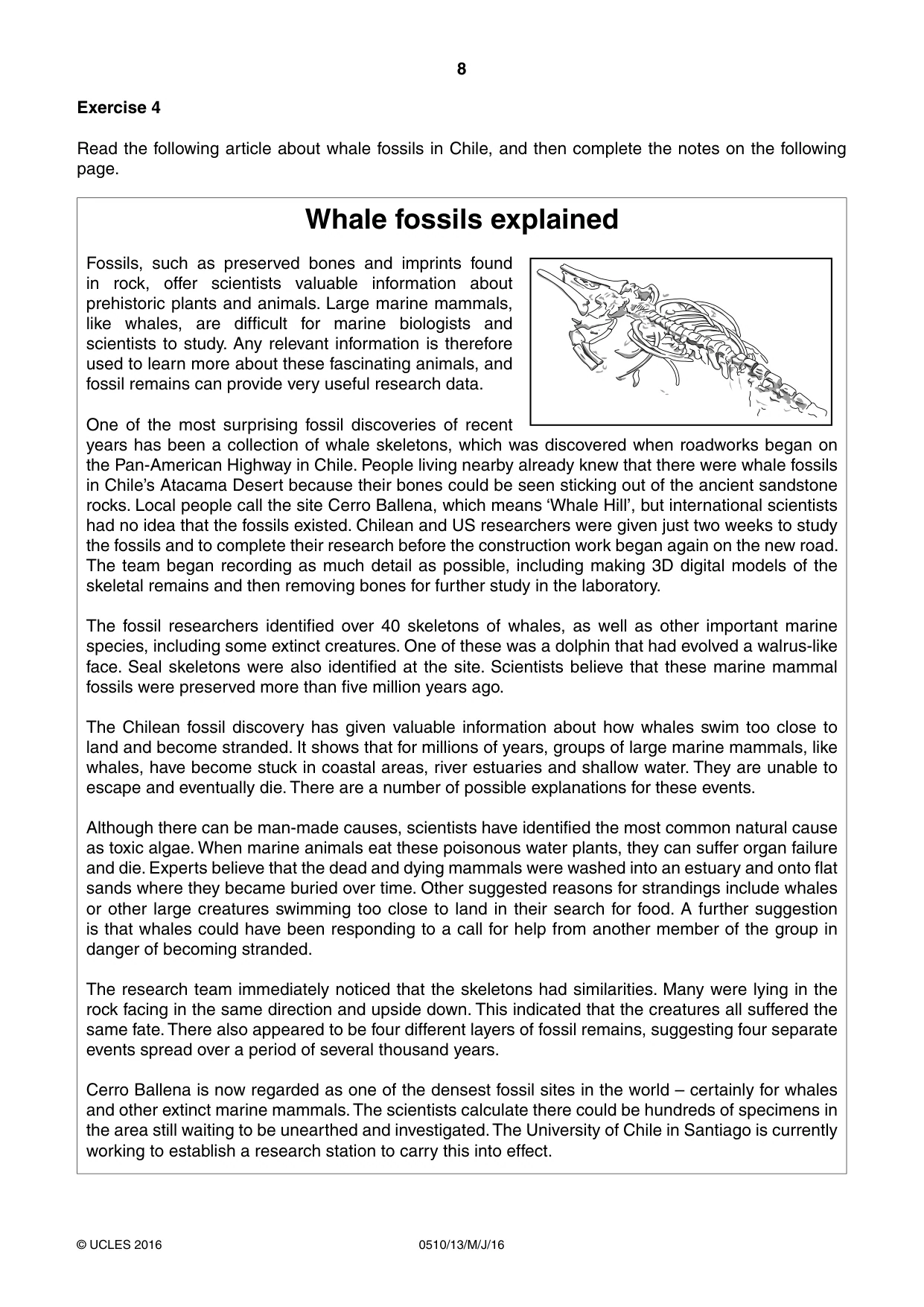
8 0510/13/M/J/16 © UCLES 2016 Exercise 4 Read the following article about whale fossils in Chile, and then complete the notes on the following page. Whale fossils explained Fossils, such as preserved bones and imprints found in rock, offer scientists valuable information about prehistoric plants and animals. Large marine mammals, like whales, are difficult for marine biologists and scientists to study. Any relevant information is therefore used to learn more about these fascinating animals, and fossil remains can provide very useful research data. One of the most surprising fossil discoveries of recent years has been a collection of whale skeletons, which was discovered when roadworks began on the Pan-American Highway in Chile. People living nearby already knew that there were whale fossils in Chile’s Atacama Desert because their bones could be seen sticking out of the ancient sandstone rocks. Local people call the site Cerro Ballena, which means ‘Whale Hill’, but international scientists had no idea that the fossils existed. Chilean and US researchers were given just two weeks to study the fossils and to complete their research before the construction work began again on the new road. The team began recording as much detail as possible, including making 3D digital models of the skeletal remains and then removing bones for further study in the laboratory. The fossil researchers identified over 40 skeletons of whales, as well as other important marine species, including some extinct creatures. One of these was a dolphin that had evolved a walrus-like face. Seal skeletons were also identified at the site. Scientists believe that these marine mammal fossils were preserved more than five million years ago. The Chilean fossil discovery has given valuable information about how whales swim too close to land and become stranded. It shows that for millions of years, groups of large marine mammals, like whales, have become stuck in coastal areas, river estuaries and shallow water. They are unable to escape and eventually die. There are a number of possible explanations for these events. Although there can be man-made causes, scientists have identified the most common natural cause as toxic algae. When marine animals eat these poisonous water plants, they can suffer organ failure and die. Experts believe that the dead and dying mammals were washed into an estuary and onto flat sands where they became buried over time. Other suggested reasons for strandings include whales or other large creatures swimming too close to land in their search for food. A further suggestion is that whales could have been responding to a call for help from another member of the group in danger of becoming stranded. The research team immediately noticed that the skeletons had similarities. Many were lying in the rock facing in the same direction and upside down. This indicated that the creatures all suffered the same fate. There also appeared to be four different layers of fossil remains, suggesting four separate events spread over a period of several thousand years. Cerro Ballena is now regarded as one of the densest fossil sites in the world – certainly for whales and other extinct marine mammals. The scientists calculate there could be hundreds of specimens in the area still waiting to be unearthed and investigated. The University of Chile in Santiago is currently working to establish a research station to carry this into effect.
Question paper, page 9
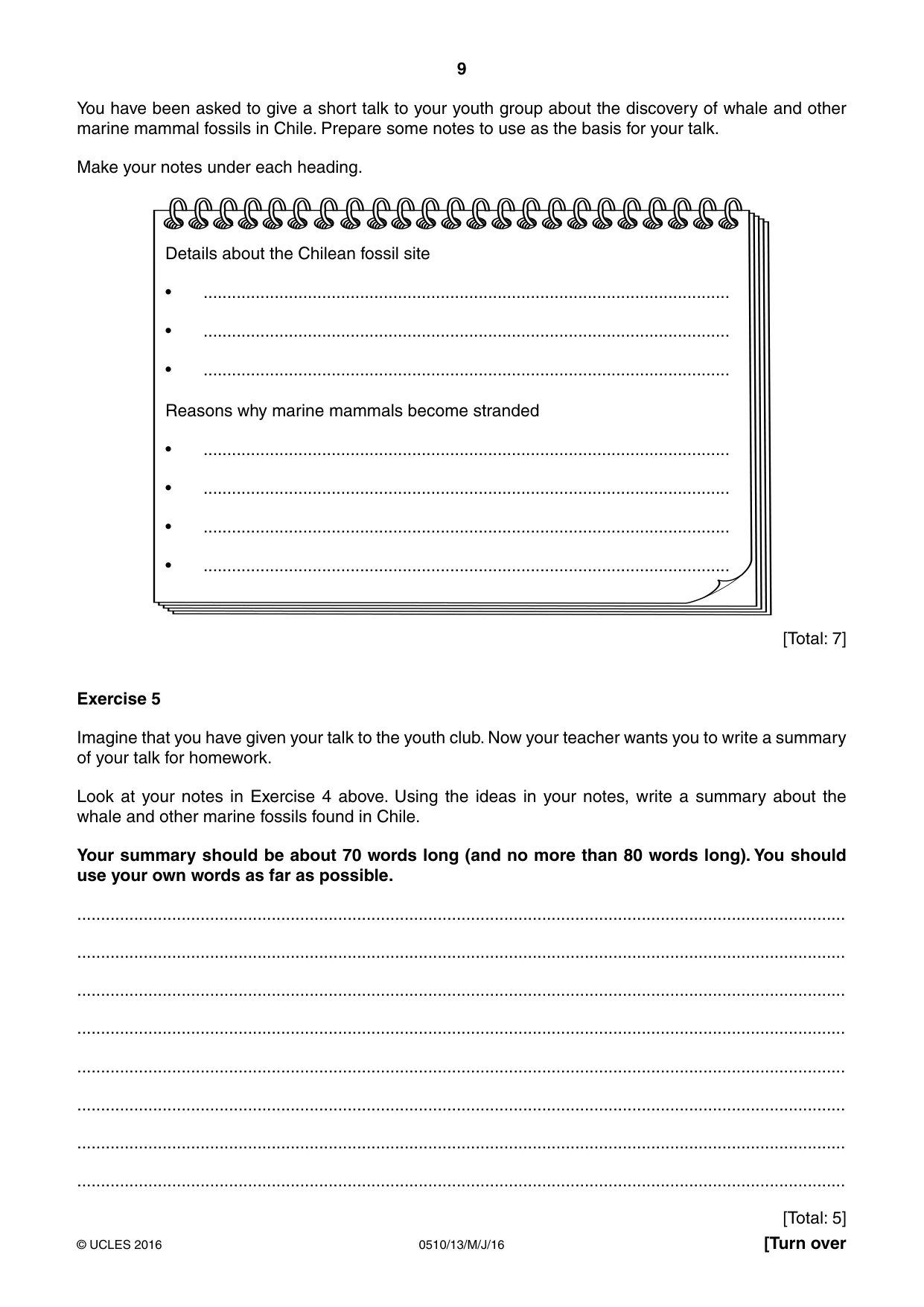
9 0510/13/M/J/16 © UCLES 2016 [Turn over You have been asked to give a short talk to your youth group about the discovery of whale and other marine mammal fossils in Chile. Prepare some notes to use as the basis for your talk. Make your notes under each heading. Details about the Chilean fossil site • … • … • … Reasons why marine mammals become stranded • … • … • … • … [Total: 7] Exercise 5 Imagine that you have given your talk to the youth club. Now your teacher wants you to write a summary of your talk for homework. Look at your notes in Exercise 4 above. Using the ideas in your notes, write a summary about the whale and other marine fossils found in Chile. Your summary should be about 70 words long (and no more than 80 words long). You should use your own words as far as possible. … … … … … … … … [Total: 5]
Question paper, page 10
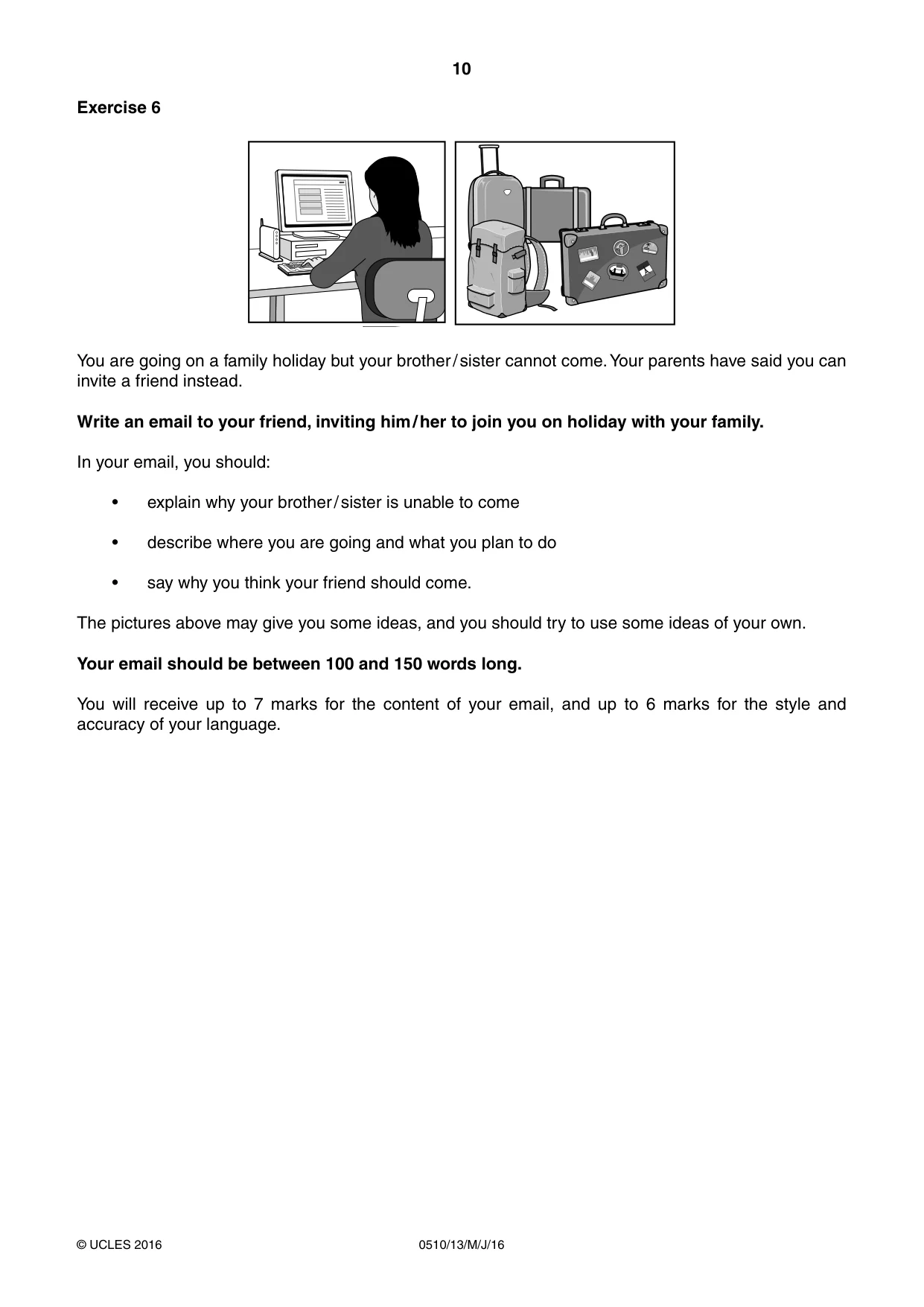
10 0510/13/M/J/16 © UCLES 2016 Exercise 6 You are going on a family holiday but your brother / sister cannot come. Your parents have said you can invite a friend instead. Write an email to your friend, inviting him / her to join you on holiday with your family. In your email, you should: • explain why your brother / sister is unable to come • describe where you are going and what you plan to do • say why you think your friend should come. The pictures above may give you some ideas, and you should try to use some ideas of your own. Your email should be between 100 and 150 words long. You will receive up to 7 marks for the content of your email, and up to 6 marks for the style and accuracy of your language.
Question paper, page 11
11 0510/13/M/J/16 © UCLES 2016 [Turn over … … … … … … … … … … … … … … … … … … … … … … … … … … [Total: 13]
Question paper, page 12
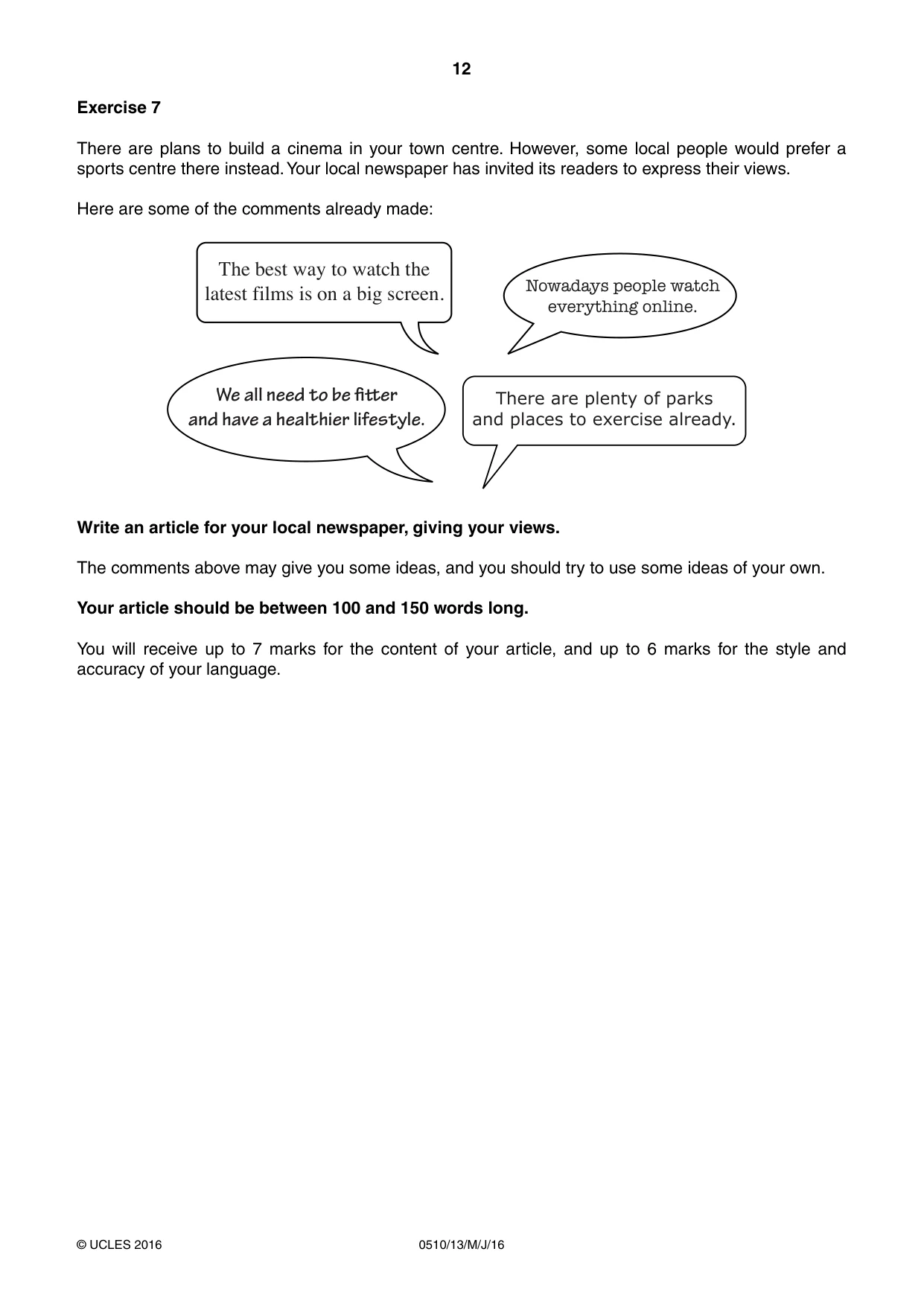
12 0510/13/M/J/16 © UCLES 2016 Exercise 7 There are plans to build a cinema in your town centre. However, some local people would prefer a sports centre there instead. Your local newspaper has invited its readers to express their views. Here are some of the comments already made: The best way to watch the latest films is on a big screen. Nowadays people watch everything online. We all need to be fitter and have a healthier lifestyle. There are plenty of parks and places to exercise already. Write an article for your local newspaper, giving your views. The comments above may give you some ideas, and you should try to use some ideas of your own. Your article should be between 100 and 150 words long. You will receive up to 7 marks for the content of your article, and up to 6 marks for the style and accuracy of your language.
Question paper, page 13
13 0510/13/M/J/16 © UCLES 2016 … … … … … … … … … … … … … … … … … … … … … … … … … … [Total: 13]
Question paper, page 14
14 0510/13/M/J/16 © UCLES 2016 BLANK PAGE
Question paper, page 15
15 0510/13/M/J/16 © UCLES 2016 BLANK PAGE
Question paper, page 16
16 0510/13/M/J/16 © UCLES 2016 Permission to reproduce items where third-party owned material protected by copyright is included has been sought and cleared where possible. Every reasonable effort has been made by the publisher (UCLES) to trace copyright holders, but if any items requiring clearance have unwittingly been included, the publisher will be pleased to make amends at the earliest possible opportunity. To avoid the issue of disclosure of answer-related information to candidates, all copyright acknowledgements are reproduced online in the Cambridge International Examinations Copyright Acknowledgements Booklet. This is produced for each series of examinations and is freely available to download at www.cie.org.uk after the live examination series. Cambridge International Examinations is part of the Cambridge Assessment Group. Cambridge Assessment is the brand name of University of Cambridge Local Examinations Syndicate (UCLES), which is itself a department of the University of Cambridge. BLANK PAGE
Mark scheme, page 1
® IGCSE is the registered trademark of Cambridge International Examinations. This document consists of 11 printed pages. © UCLES 2016 [Turn over Cambridge International Examinations Cambridge International General Certificate of Secondary Education ENGLISH AS A SECOND LANGUAGE 0510/13 Paper 1 Reading and Writing – Core May/June 2016 MARK SCHEME Maximum Mark: 70 Published This mark scheme is published as an aid to teachers and candidates, to indicate the requirements of the examination. It shows the basis on which Examiners were instructed to award marks. It does not indicate the details of the discussions that took place at an Examiners’ meeting before marking began, which would have considered the acceptability of alternative answers. Mark schemes should be read in conjunction with the question paper and the Principal Examiner Report for Teachers. Cambridge will not enter into discussions about these mark schemes. Cambridge is publishing the mark schemes for the May/June 2016 series for most Cambridge IGCSE®, Cambridge International A and AS Level components and some Cambridge O Level components.
Mark scheme, page 2
Page 2 Mark Scheme Syllabus Paper Cambridge IGCSE – May/June 2016 0510 13 © Cambridge International Examinations 2016 IGCSE English as a Second Language Core tier Reading/Writing (Paper 1) This component forms part of the Core tier assessment of IGCSE English as a Second Language and tests the following Assessment Objectives: AO1: Reading R1 identify and retrieve facts and details R2 understand and select relevant information R3 recognise, understand ideas, opinions and attitudes and the connections between the related ideas R4 understand what is implied but not actually written, e.g. gist, relationships, writer’s purpose/intention, writer’s feelings, situation or place AO2: Writing W1 communicate clearly, accurately and appropriately W2 convey information and express opinions effectively W3 employ and control a variety of grammatical structures W4 demonstrate knowledge and understanding of a range of appropriate vocabulary W5 observe conventions of paragraphing, punctuation and spelling W6 employ appropriate register/style Overview of exercises on Paper 1 Reading objectives tested Marks for reading objectives Writing objectives tested Marks for writing objectives Total available marks Exercise 1 Reading (1) R1 R2 7 – 7 Exercise 2 Reading (2) R1, R2, R4 11 – 11 Exercise 3 Information transfer R1, R2 10 W1, W5 4 14 Exercise 4 Note- making R1, R2, R3 7 – 7 Exercise 5 Summary – W1, W2, W3, W4, W5 5 5 Exercise 6 Writing (1) – W1, W2, W3, W4, W5, W6 13 13 Exercise 7 Writing (2) – W1, W2, W3, W4, W5, W6 13 13 70
Mark scheme, page 3
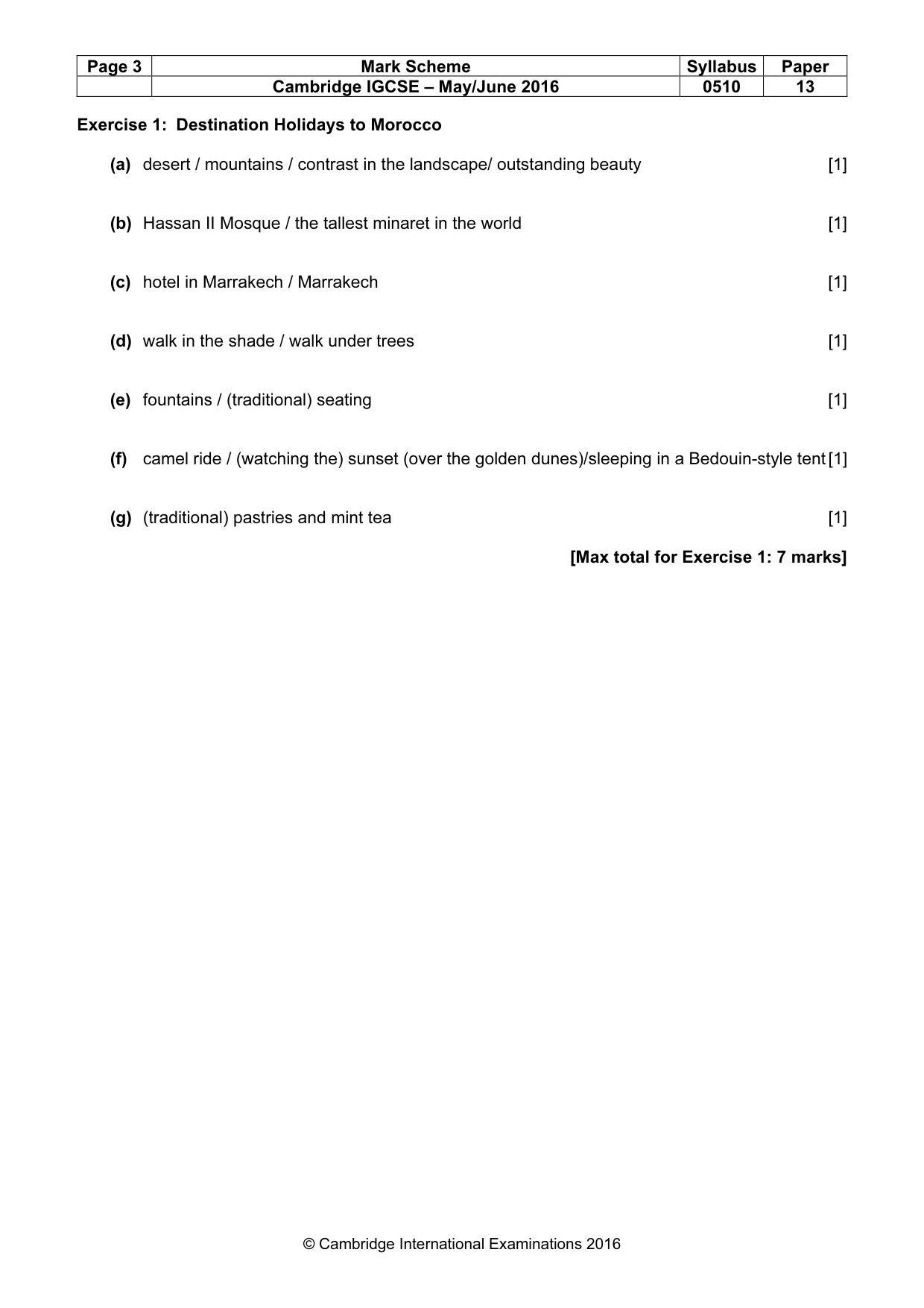
Page 3 Mark Scheme Syllabus Paper Cambridge IGCSE – May/June 2016 0510 13 © Cambridge International Examinations 2016 Exercise 1: Destination Holidays to Morocco (a) desert / mountains / contrast in the landscape/ outstanding beauty [1] (b) Hassan II Mosque / the tallest minaret in the world [1] (c) hotel in Marrakech / Marrakech [1] (d) walk in the shade / walk under trees [1] (e) fountains / (traditional) seating [1] (f) camel ride / (watching the) sunset (over the golden dunes)/sleeping in a Bedouin-style tent [1] (g) (traditional) pastries and mint tea [1] [Max total for Exercise 1: 7 marks]
Mark scheme, page 4
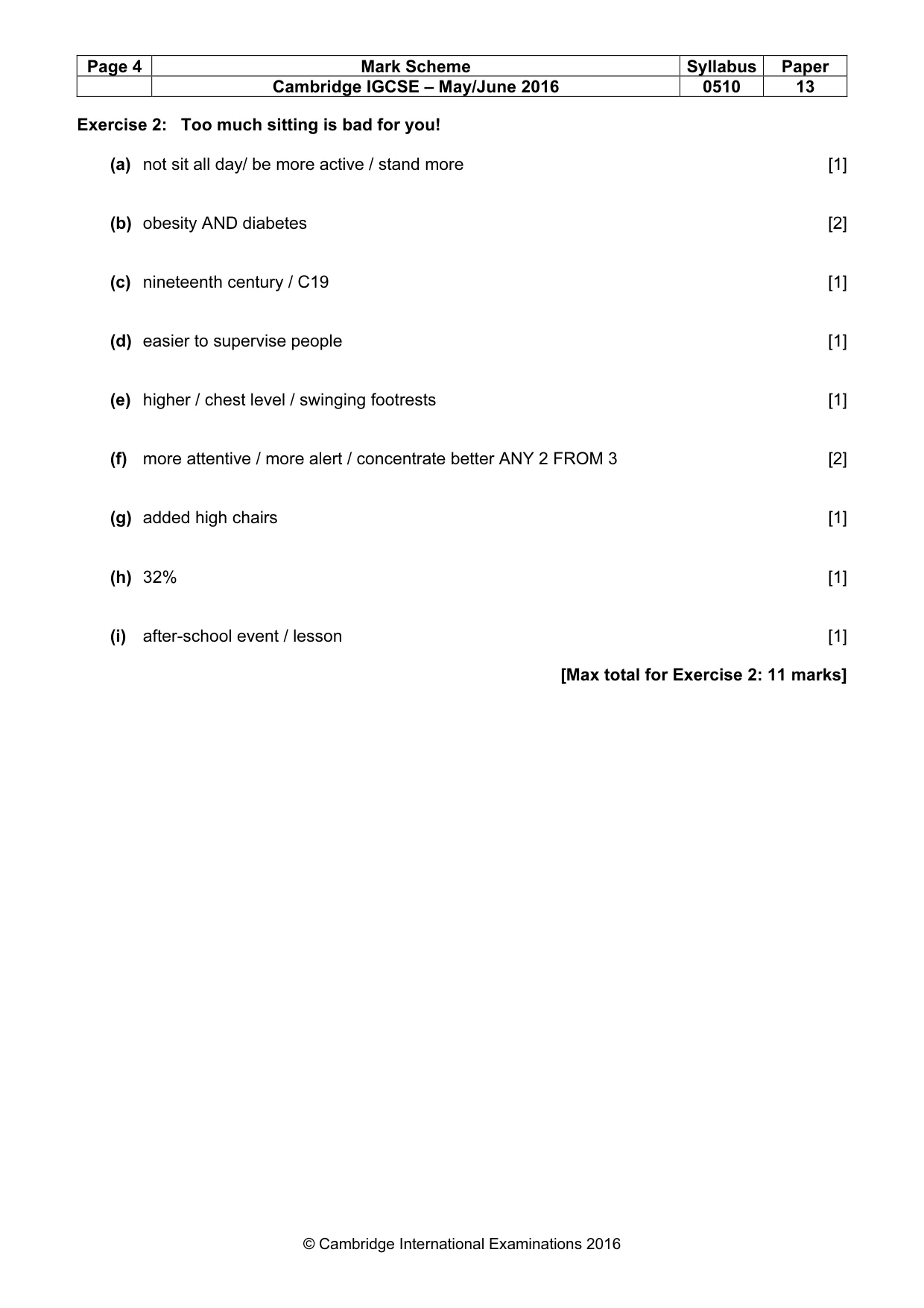
Page 4 Mark Scheme Syllabus Paper Cambridge IGCSE – May/June 2016 0510 13 © Cambridge International Examinations 2016 Exercise 2: Too much sitting is bad for you! (a) not sit all day/ be more active / stand more [1] (b) obesity AND diabetes [2] (c) nineteenth century / C19 [1] (d) easier to supervise people [1] (e) higher / chest level / swinging footrests [1] (f) more attentive / more alert / concentrate better ANY 2 FROM 3 [2] (g) added high chairs [1] (h) 32% [1] (i) after-school event / lesson [1] [Max total for Exercise 2: 11 marks]
Mark scheme, page 5
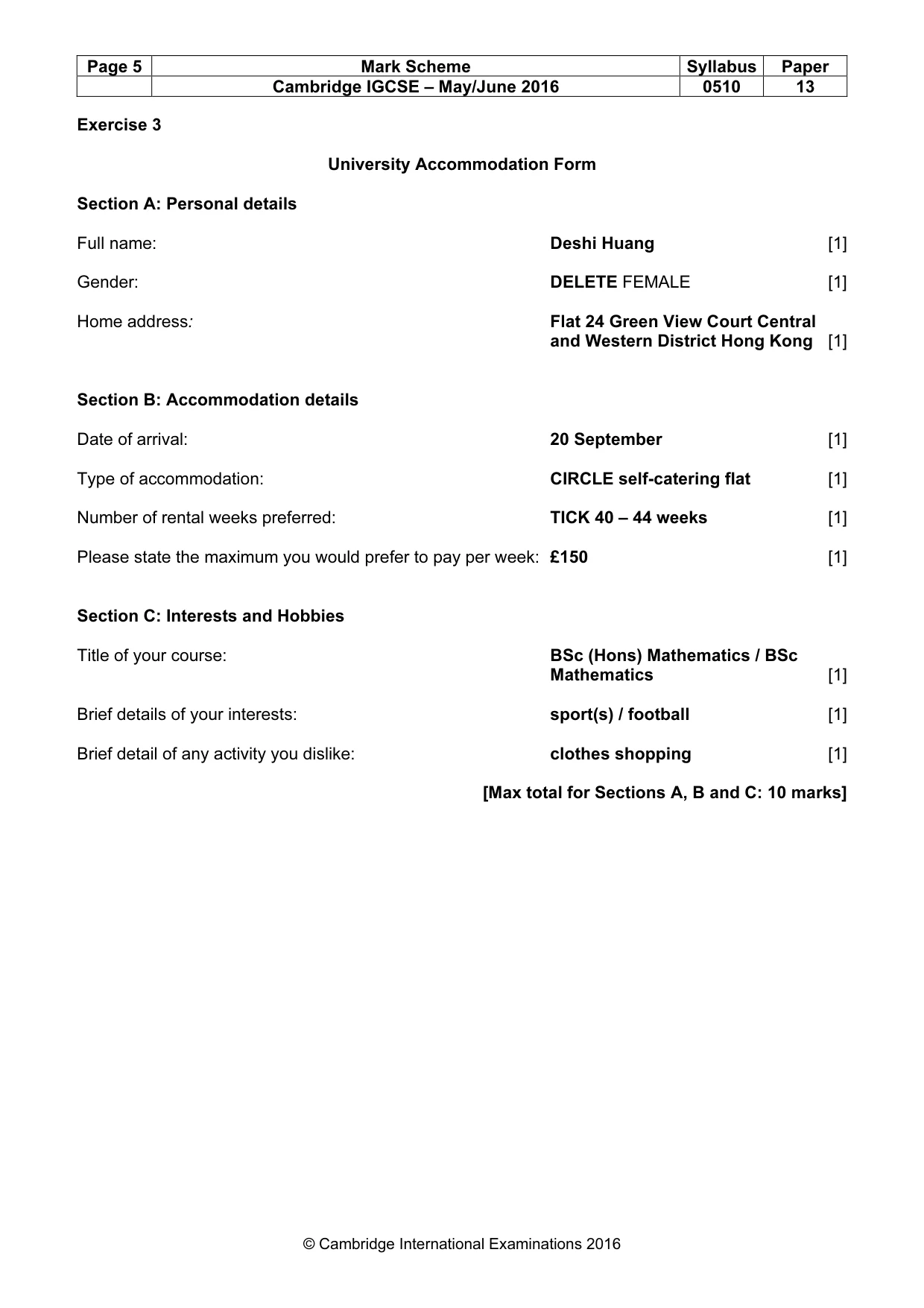
Page 5 Mark Scheme Syllabus Paper Cambridge IGCSE – May/June 2016 0510 13 © Cambridge International Examinations 2016 Exercise 3 University Accommodation Form Section A: Personal details Full name: Deshi Huang [1] Gender: DELETE FEMALE [1] Home address: Flat 24 Green View Court Central and Western District Hong Kong [1] Section B: Accommodation details Date of arrival: 20 September [1] Type of accommodation: CIRCLE self-catering flat [1] Number of rental weeks preferred: TICK 40 – 44 weeks [1] Please state the maximum you would prefer to pay per week: £150 [1] Section C: Interests and Hobbies Title of your course: BSc (Hons) Mathematics / BSc Mathematics [1] Brief details of your interests: sport(s) / football [1] Brief detail of any activity you dislike: clothes shopping [1] [Max total for Sections A, B and C: 10 marks]
Mark scheme, page 6
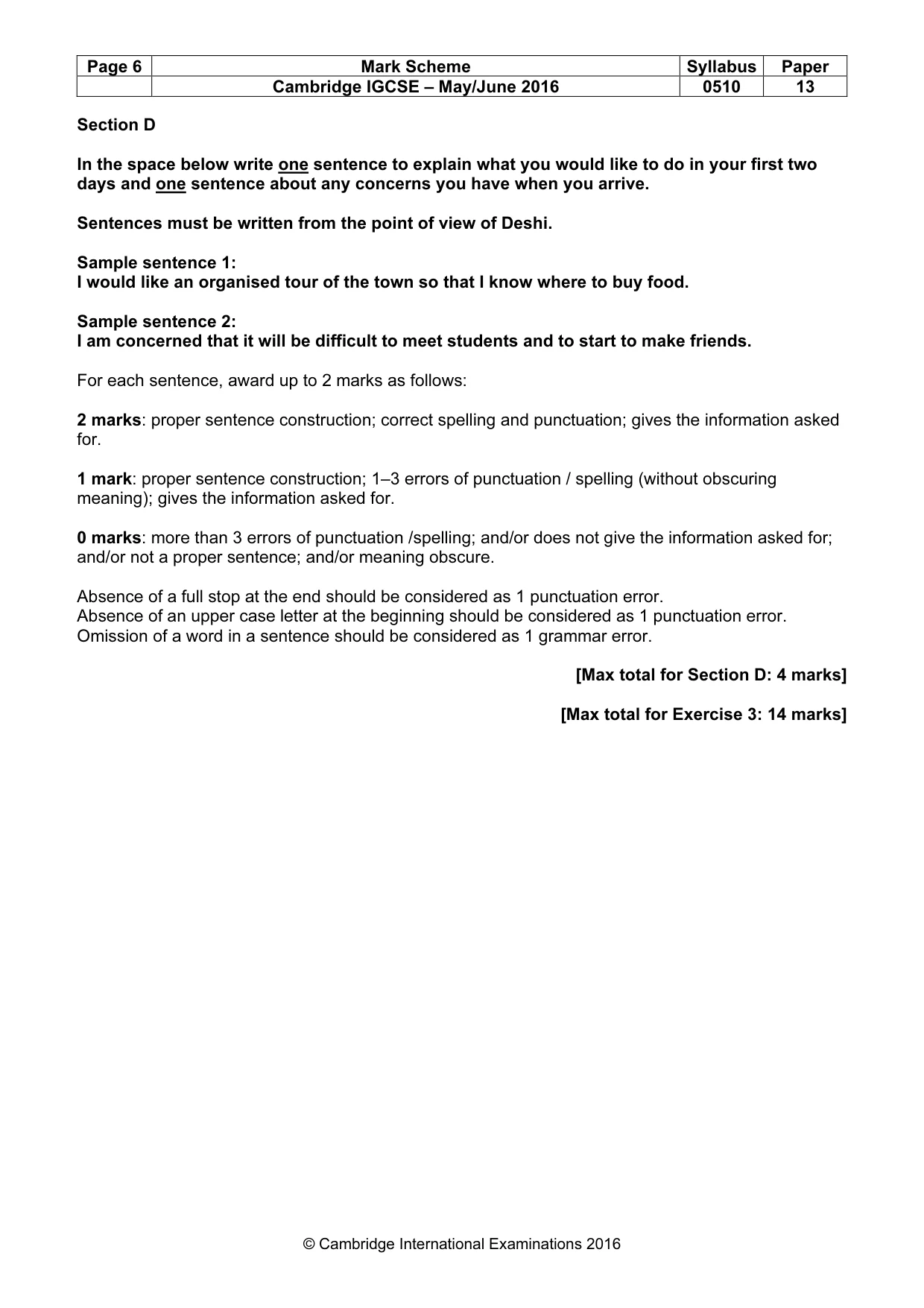
Page 6 Mark Scheme Syllabus Paper Cambridge IGCSE – May/June 2016 0510 13 © Cambridge International Examinations 2016 Section D In the space below write one sentence to explain what you would like to do in your first two days and one sentence about any concerns you have when you arrive. Sentences must be written from the point of view of Deshi. Sample sentence 1: I would like an organised tour of the town so that I know where to buy food. Sample sentence 2: I am concerned that it will be difficult to meet students and to start to make friends. For each sentence, award up to 2 marks as follows: 2 marks: proper sentence construction; correct spelling and punctuation; gives the information asked for. 1 mark: proper sentence construction; 1–3 errors of punctuation / spelling (without obscuring meaning); gives the information asked for. 0 marks: more than 3 errors of punctuation /spelling; and/or does not give the information asked for; and/or not a proper sentence; and/or meaning obscure. Absence of a full stop at the end should be considered as 1 punctuation error. Absence of an upper case letter at the beginning should be considered as 1 punctuation error. Omission of a word in a sentence should be considered as 1 grammar error. [Max total for Section D: 4 marks] [Max total for Exercise 3: 14 marks]
Mark scheme, page 7
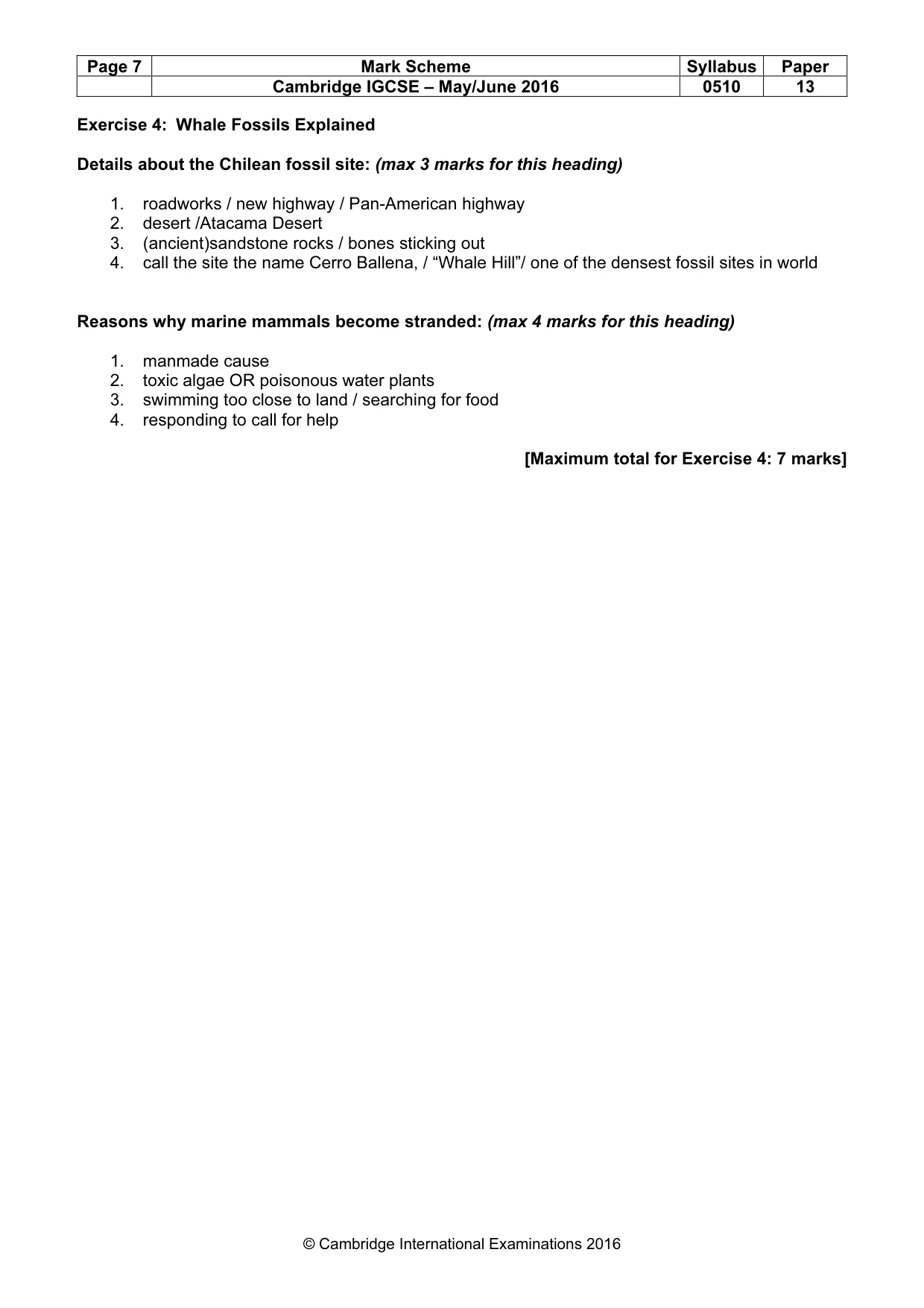
Page 7 Mark Scheme Syllabus Paper Cambridge IGCSE – May/June 2016 0510 13 © Cambridge International Examinations 2016 Exercise 4: Whale Fossils Explained Details about the Chilean fossil site: (max 3 marks for this heading) 1. roadworks / new highway / Pan-American highway 2. desert /Atacama Desert 3. (ancient)sandstone rocks / bones sticking out 4. call the site the name Cerro Ballena, / “Whale Hill”/ one of the densest fossil sites in world Reasons why marine mammals become stranded: (max 4 marks for this heading) 1. manmade cause 2. toxic algae OR poisonous water plants 3. swimming too close to land / searching for food 4. responding to call for help [Maximum total for Exercise 4: 7 marks]
Mark scheme, page 8
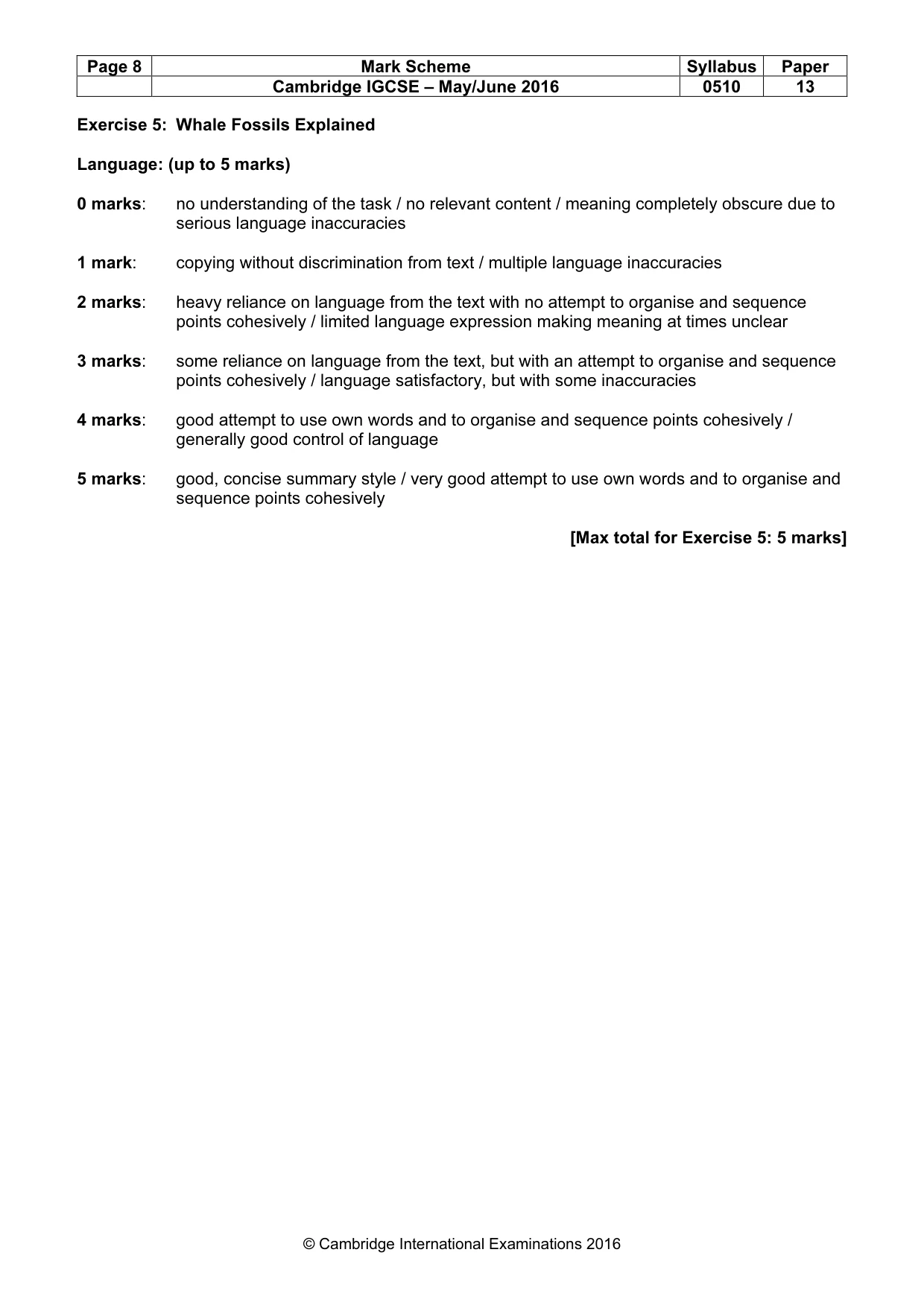
Page 8 Mark Scheme Syllabus Paper Cambridge IGCSE – May/June 2016 0510 13 © Cambridge International Examinations 2016 Exercise 5: Whale Fossils Explained Language: (up to 5 marks) 0 marks: no understanding of the task / no relevant content / meaning completely obscure due to serious language inaccuracies 1 mark: copying without discrimination from text / multiple language inaccuracies 2 marks: heavy reliance on language from the text with no attempt to organise and sequence points cohesively / limited language expression making meaning at times unclear 3 marks: some reliance on language from the text, but with an attempt to organise and sequence points cohesively / language satisfactory, but with some inaccuracies 4 marks: good attempt to use own words and to organise and sequence points cohesively / generally good control of language 5 marks: good, concise summary style / very good attempt to use own words and to organise and sequence points cohesively [Max total for Exercise 5: 5 marks]
Mark scheme, page 9
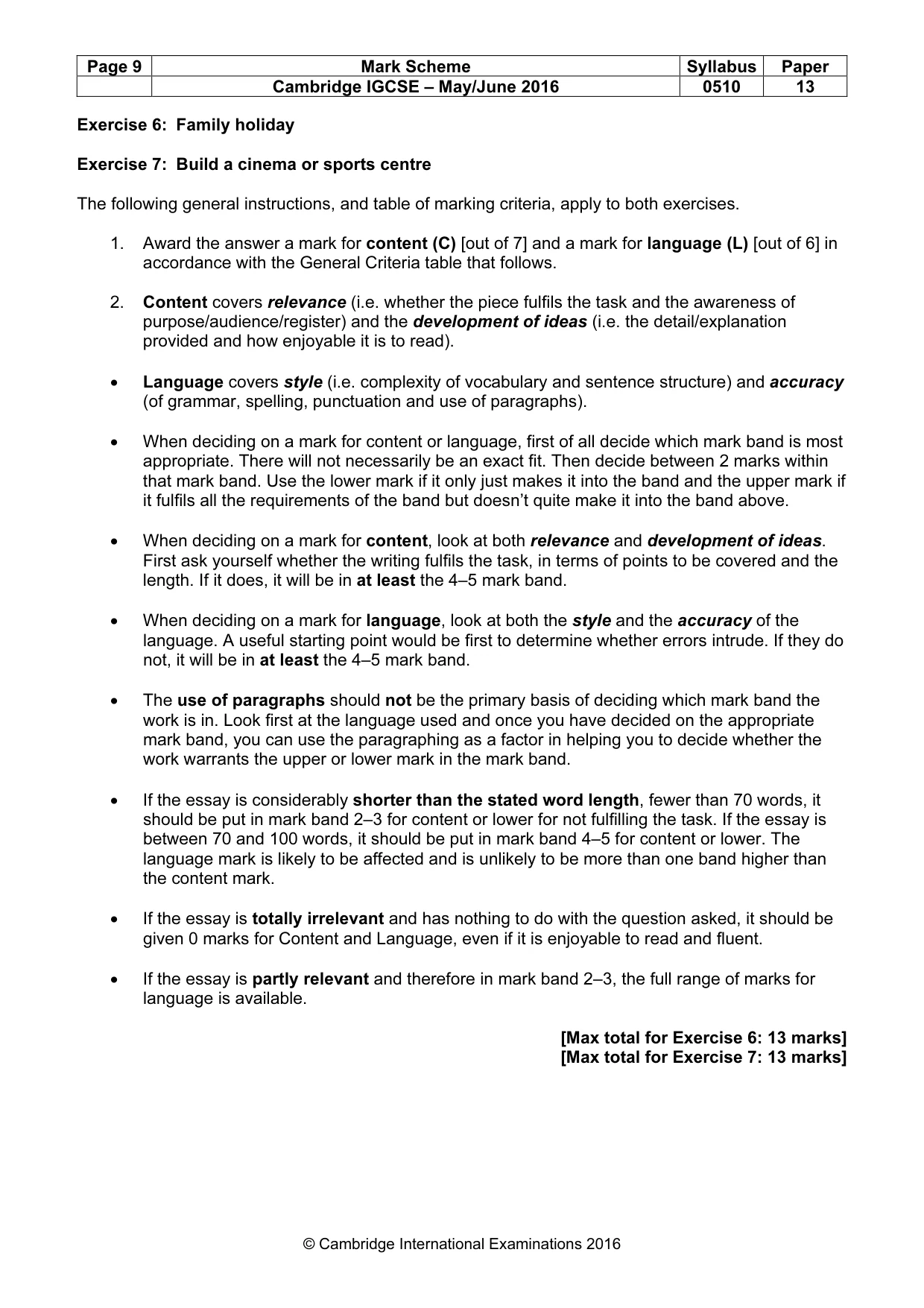
Page 9 Mark Scheme Syllabus Paper Cambridge IGCSE – May/June 2016 0510 13 © Cambridge International Examinations 2016 Exercise 6: Family holiday Exercise 7: Build a cinema or sports centre The following general instructions, and table of marking criteria, apply to both exercises. 1. Award the answer a mark for content (C) [out of 7] and a mark for language (L) [out of 6] in accordance with the General Criteria table that follows. 2. Content covers relevance (i.e. whether the piece fulfils the task and the awareness of purpose/audience/register) and the development of ideas (i.e. the detail/explanation provided and how enjoyable it is to read). • Language covers style (i.e. complexity of vocabulary and sentence structure) and accuracy (of grammar, spelling, punctuation and use of paragraphs). • When deciding on a mark for content or language, first of all decide which mark band is most appropriate. There will not necessarily be an exact fit. Then decide between 2 marks within that mark band. Use the lower mark if it only just makes it into the band and the upper mark if it fulfils all the requirements of the band but doesn’t quite make it into the band above. • When deciding on a mark for content, look at both relevance and development of ideas. First ask yourself whether the writing fulfils the task, in terms of points to be covered and the length. If it does, it will be in at least the 4–5 mark band. • When deciding on a mark for language, look at both the style and the accuracy of the language. A useful starting point would be first to determine whether errors intrude. If they do not, it will be in at least the 4–5 mark band. • The use of paragraphs should not be the primary basis of deciding which mark band the work is in. Look first at the language used and once you have decided on the appropriate mark band, you can use the paragraphing as a factor in helping you to decide whether the work warrants the upper or lower mark in the mark band. • If the essay is considerably shorter than the stated word length, fewer than 70 words, it should be put in mark band 2–3 for content or lower for not fulfilling the task. If the essay is between 70 and 100 words, it should be put in mark band 4–5 for content or lower. The language mark is likely to be affected and is unlikely to be more than one band higher than the content mark. • If the essay is totally irrelevant and has nothing to do with the question asked, it should be given 0 marks for Content and Language, even if it is enjoyable to read and fluent. • If the essay is partly relevant and therefore in mark band 2–3, the full range of marks for language is available. [Max total for Exercise 6: 13 marks] [Max total for Exercise 7: 13 marks]
Mark scheme, page 10
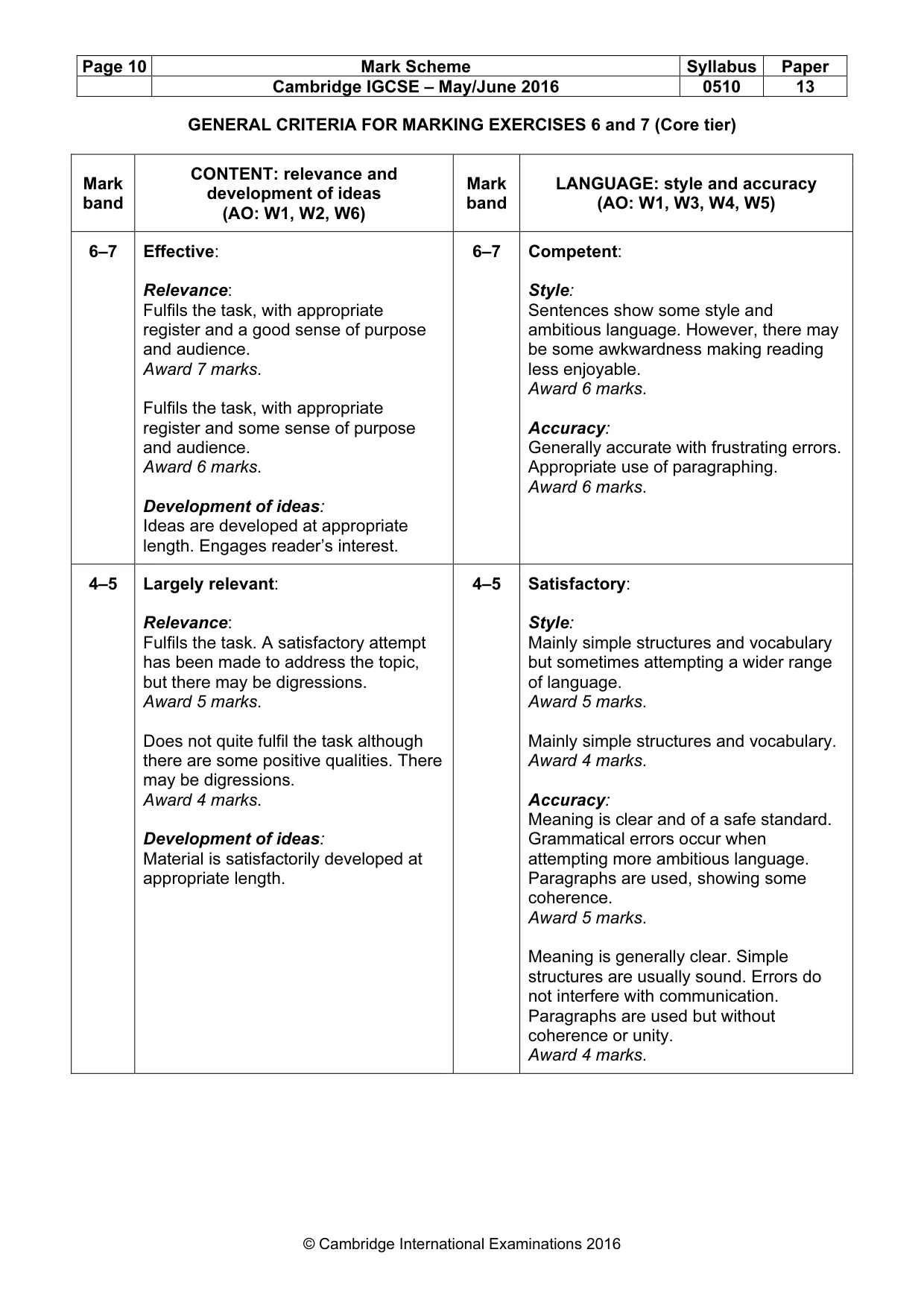
Page 10 Mark Scheme Syllabus Paper Cambridge IGCSE – May/June 2016 0510 13 © Cambridge International Examinations 2016 GENERAL CRITERIA FOR MARKING EXERCISES 6 and 7 (Core tier) Mark band CONTENT: relevance and development of ideas (AO: W1, W2, W6) Mark band LANGUAGE: style and accuracy (AO: W1, W3, W4, W5) 6–7 Effective: Relevance: Fulfils the task, with appropriate register and a good sense of purpose and audience. Award 7 marks. Fulfils the task, with appropriate register and some sense of purpose and audience. Award 6 marks. Development of ideas: Ideas are developed at appropriate length. Engages reader’s interest. 6–7 Competent: Style: Sentences show some style and ambitious language. However, there may be some awkwardness making reading less enjoyable. Award 6 marks. Accuracy: Generally accurate with frustrating errors. Appropriate use of paragraphing. Award 6 marks. 4–5 Largely relevant: Relevance: Fulfils the task. A satisfactory attempt has been made to address the topic, but there may be digressions. Award 5 marks. Does not quite fulfil the task although there are some positive qualities. There may be digressions. Award 4 marks. Development of ideas: Material is satisfactorily developed at appropriate length. 4–5 Satisfactory: Style: Mainly simple structures and vocabulary but sometimes attempting a wider range of language. Award 5 marks. Mainly simple structures and vocabulary. Award 4 marks. Accuracy: Meaning is clear and of a safe standard. Grammatical errors occur when attempting more ambitious language. Paragraphs are used, showing some coherence. Award 5 marks. Meaning is generally clear. Simple structures are usually sound. Errors do not interfere with communication. Paragraphs are used but without coherence or unity. Award 4 marks.
Mark scheme, page 11
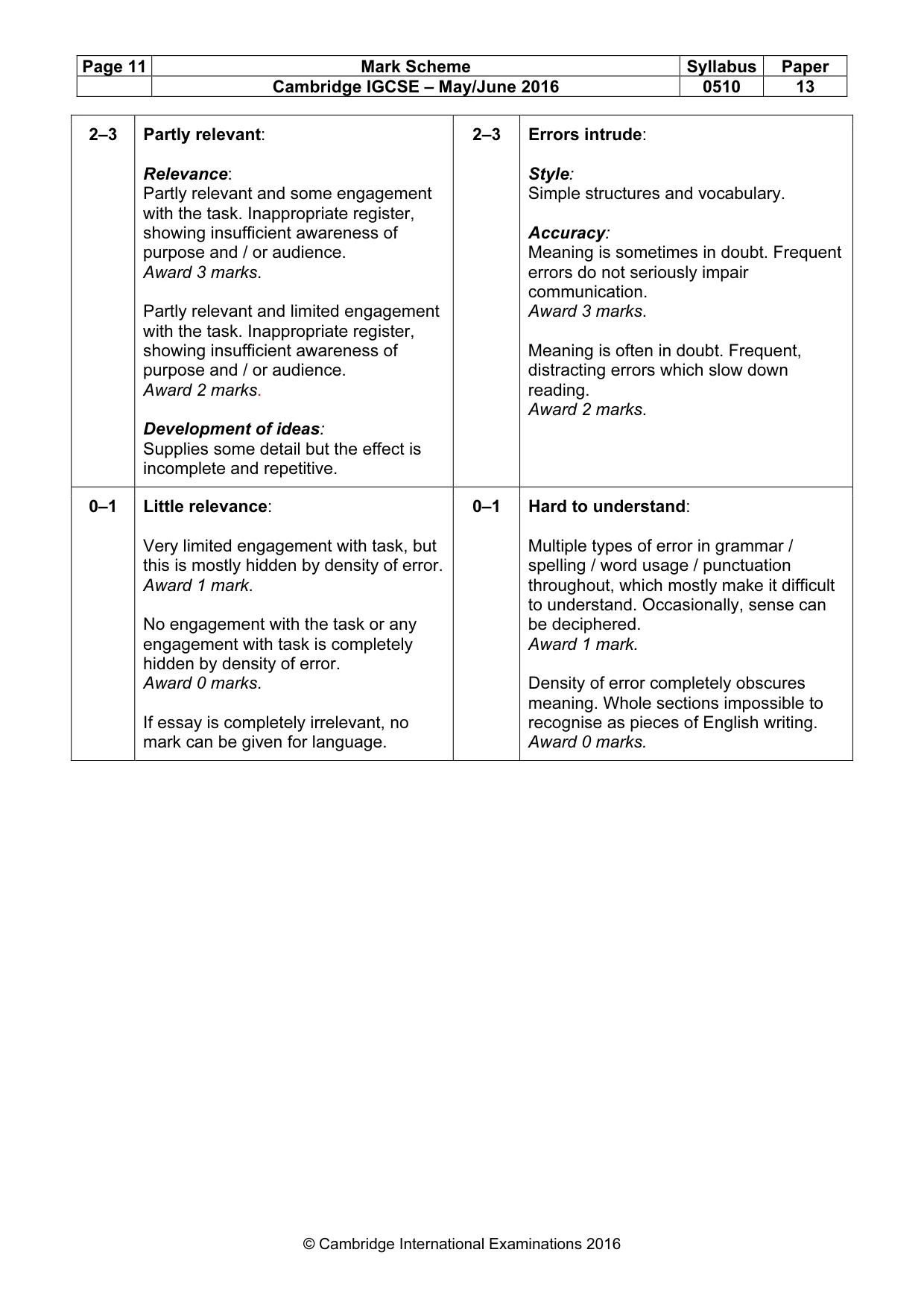
Page 11 Mark Scheme Syllabus Paper Cambridge IGCSE – May/June 2016 0510 13 © Cambridge International Examinations 2016 2–3 Partly relevant: Relevance: Partly relevant and some engagement with the task. Inappropriate register, showing insufficient awareness of purpose and / or audience. Award 3 marks. Partly relevant and limited engagement with the task. Inappropriate register, showing insufficient awareness of purpose and / or audience. Award 2 marks. Development of ideas: Supplies some detail but the effect is incomplete and repetitive. 2–3 Errors intrude: Style: Simple structures and vocabulary. Accuracy: Meaning is sometimes in doubt. Frequent errors do not seriously impair communication. Award 3 marks. Meaning is often in doubt. Frequent, distracting errors which slow down reading. Award 2 marks. 0–1 Little relevance: Very limited engagement with task, but this is mostly hidden by density of error. Award 1 mark. No engagement with the task or any engagement with task is completely hidden by density of error. Award 0 marks. If essay is completely irrelevant, no mark can be given for language. 0–1 Hard to understand: Multiple types of error in grammar / spelling / word usage / punctuation throughout, which mostly make it difficult to understand. Occasionally, sense can be deciphered. Award 1 mark. Density of error completely obscures meaning. Whole sections impossible to recognise as pieces of English writing. Award 0 marks.
What you needed in this session
Cambridge’s own grade thresholds for 2016 May/June, Paper 1 · Variant 3. A higher threshold means an easier paper — the bar moves with how the cohort did.