Cambridge IGCSE English - Second Language (oral endorsement) 0510 — 2016 May/June Paper 1 · Variant 2
0510/12/M/J/16 · 70 marks · ≈79 min
The question paper and its mark scheme, free to read here and free to download. This is Cambridge’s own paper, exactly as it was sat.
Question paper16 pages



Mark scheme11 pages
Answers below. Sit the paper first if you are practising.
Paper as text
Question paper, page 1
This document consists of 13 printed pages and 3 blank pages. DC (RW/FD) 112058/3 © UCLES 2016 [Turn over Cambridge International Examinations Cambridge International General Certificate of Secondary Education * 2 4 0 7 9 2 5 3 3 0 * ENGLISH AS A SECOND LANGUAGE 0510/12 Paper 1 Reading and Writing (Core) May/June 2016 1 hour 30 minutes Candidates answer on the Question Paper. No Additional Materials are required. READ THESE INSTRUCTIONS FIRST Write your Centre number, candidate number and name on all the work you hand in. Write in dark blue or black pen. Do not use staples, paper clips, glue or correction fluid. DO NOT WRITE IN ANY BARCODES. Answer all questions. Dictionaries are not allowed. At the end of the examination, fasten all your work securely together. The number of marks is given in brackets [ ] at the end of each question or part question.
Question paper, page 2
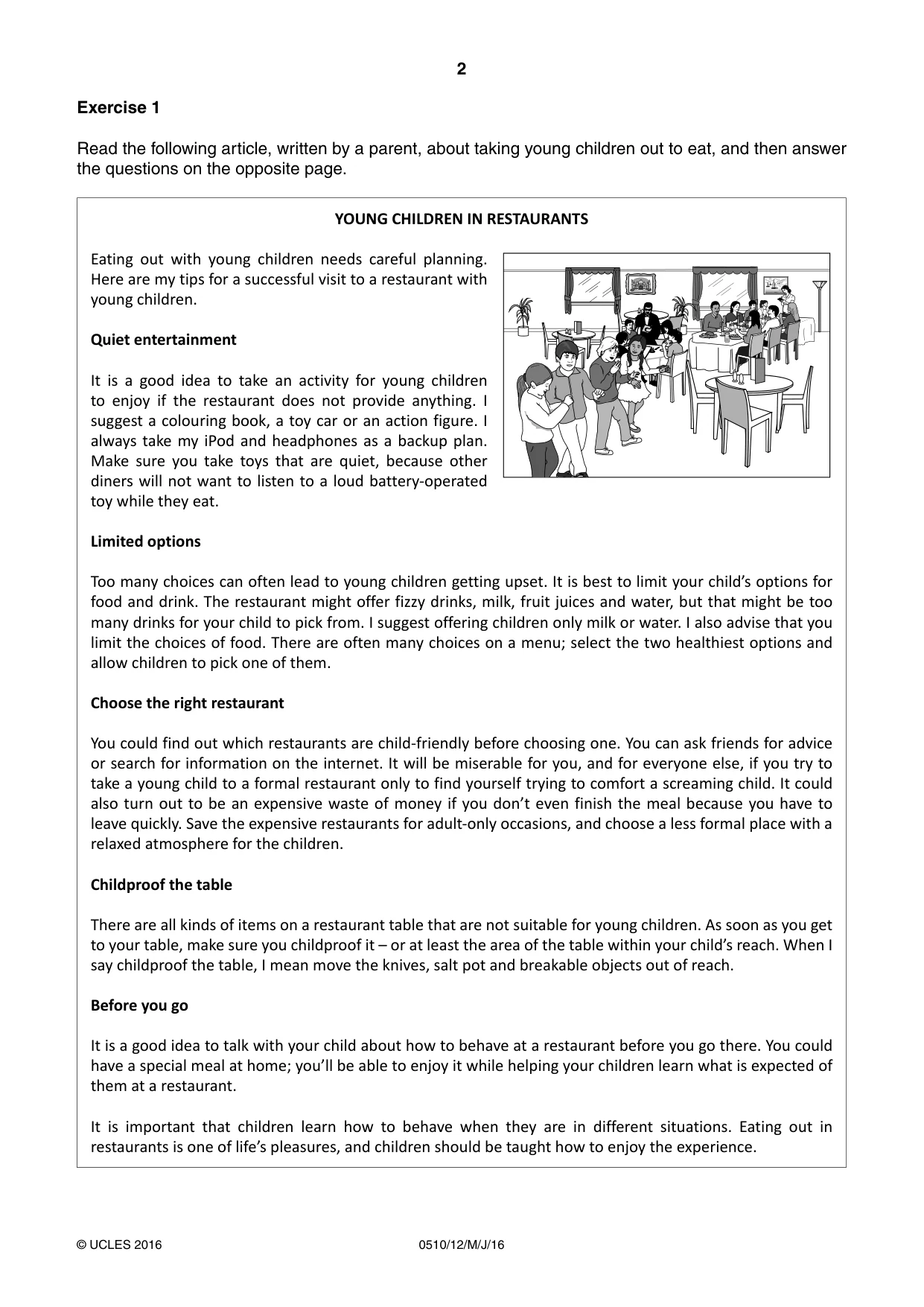
2 0510/12/M/J/16 © UCLES 2016 Exercise 1 Read the following article, written by a parent, about taking young children out to eat, and then answer the questions on the opposite page. YOUNG CHILDREN IN RESTAURANTS Eating out with young children needs careful planning. Here are my tips for a successful visit to a restaurant with young children. Quiet entertainment It is a good idea to take an activity for young children to enjoy if the restaurant does not provide anything. I suggest a colouring book, a toy car or an action figure. I always take my iPod and headphones as a backup plan. Make sure you take toys that are quiet, because other diners will not want to listen to a loud battery-operated toy while they eat. Limited options Too many choices can often lead to young children getting upset. It is best to limit your child’s options for food and drink. The restaurant might offer fizzy drinks, milk, fruit juices and water, but that might be too many drinks for your child to pick from. I suggest offering children only milk or water. I also advise that you limit the choices of food. There are often many choices on a menu; select the two healthiest options and allow children to pick one of them. Choose the right restaurant You could find out which restaurants are child-friendly before choosing one. You can ask friends for advice or search for information on the internet. It will be miserable for you, and for everyone else, if you try to take a young child to a formal restaurant only to find yourself trying to comfort a screaming child. It could also turn out to be an expensive waste of money if you don’t even finish the meal because you have to leave quickly. Save the expensive restaurants for adult-only occasions, and choose a less formal place with a relaxed atmosphere for the children. Childproof the table There are all kinds of items on a restaurant table that are not suitable for young children. As soon as you get to your table, make sure you childproof it – or at least the area of the table within your child’s reach. When I say childproof the table, I mean move the knives, salt pot and breakable objects out of reach. Before you go It is a good idea to talk with your child about how to behave at a restaurant before you go there. You could have a special meal at home; you’ll be able to enjoy it while helping your children learn what is expected of them at a restaurant. It is important that children learn how to behave when they are in different situations. Eating out in restaurants is one of life’s pleasures, and children should be taught how to enjoy the experience.
Question paper, page 3
3 0510/12/M/J/16 © UCLES 2016 [Turn over (a) What is the most important thing about any toy that you take to a restaurant? …[1] (b) How might young children feel if there are too many options? …[1] (c) Which food choices should parents make for their children? …[1] (d) How can you find out whether a restaurant is suitable for children? Give two details. … …[1] (e) What is the first thing that parents are advised to do when they sit down at a table in a restaurant? …[1] (f) How can you prepare your children for a trip to a restaurant? Give two details. … …[2] [Total: 7]
Question paper, page 4
4 0510/12/M/J/16 © UCLES 2016 Exercise 2 Read the following article about choosing which country hosts the Olympic Games, and then answer the questions on the opposite page. Hosting the Olympic Games On 2 October 2009, citizens of Rio de Janeiro celebrated winning their bid to host the Summer Olympic Games in 2016. Rio de Janeiro will be showing the world what it can do; certainly Tokyo will be watching as it prepares itself for the 2020 Olympic Games. Content removed due to copyright restrictions.
Question paper, page 5
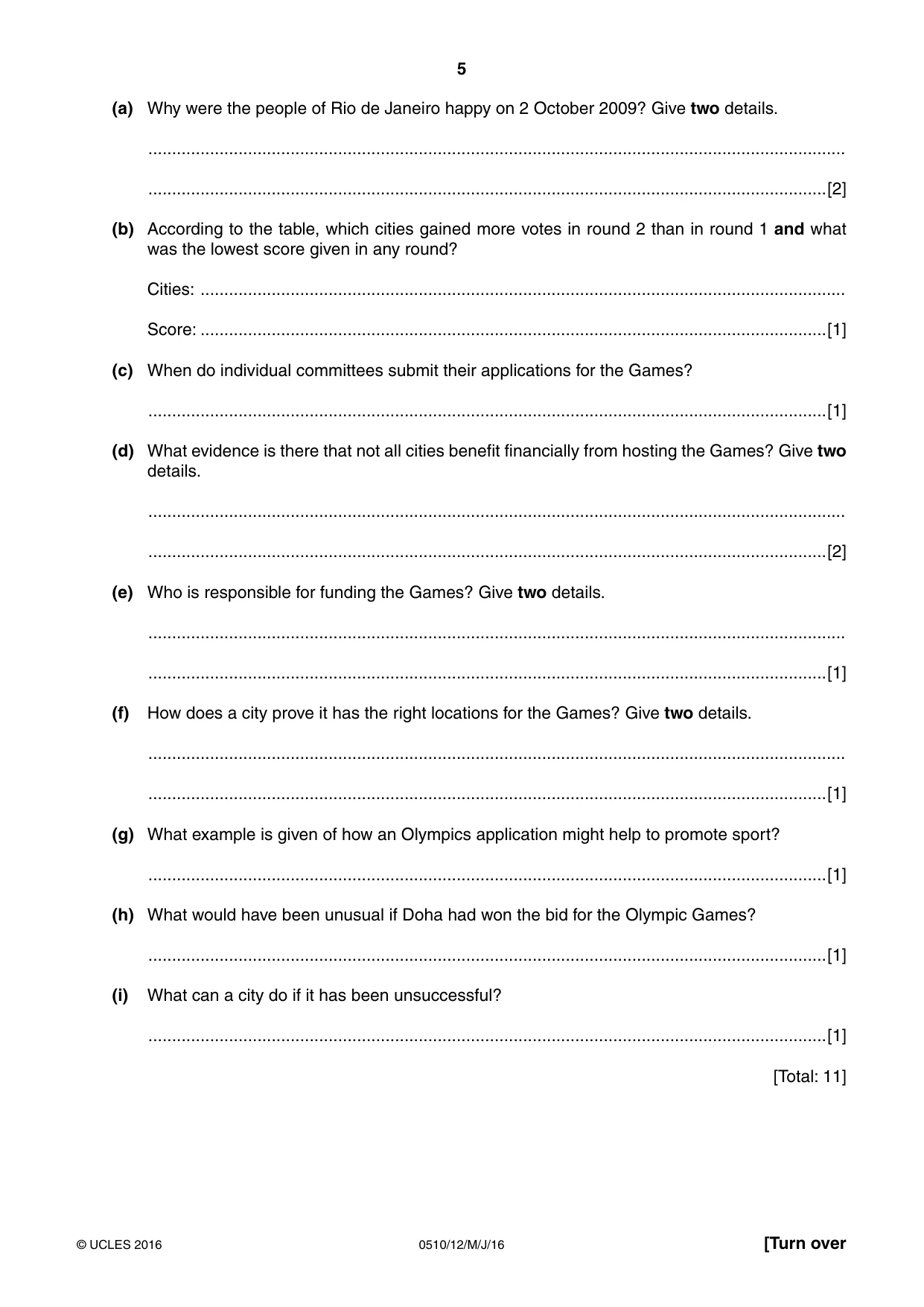
5 0510/12/M/J/16 © UCLES 2016 [Turn over (a) Why were the people of Rio de Janeiro happy on 2 October 2009? Give two details. … …[2] (b) According to the table, which cities gained more votes in round 2 than in round 1 and what was the lowest score given in any round? Cities: … Score: …[1] (c) When do individual committees submit their applications for the Games? …[1] (d) What evidence is there that not all cities benefit financially from hosting the Games? Give two details. … …[2] (e) Who is responsible for funding the Games? Give two details. … …[1] (f) How does a city prove it has the right locations for the Games? Give two details. … …[1] (g) What example is given of how an Olympics application might help to promote sport? …[1] (h) What would have been unusual if Doha had won the bid for the Olympic Games? …[1] (i) What can a city do if it has been unsuccessful? …[1] [Total: 11]
Question paper, page 6
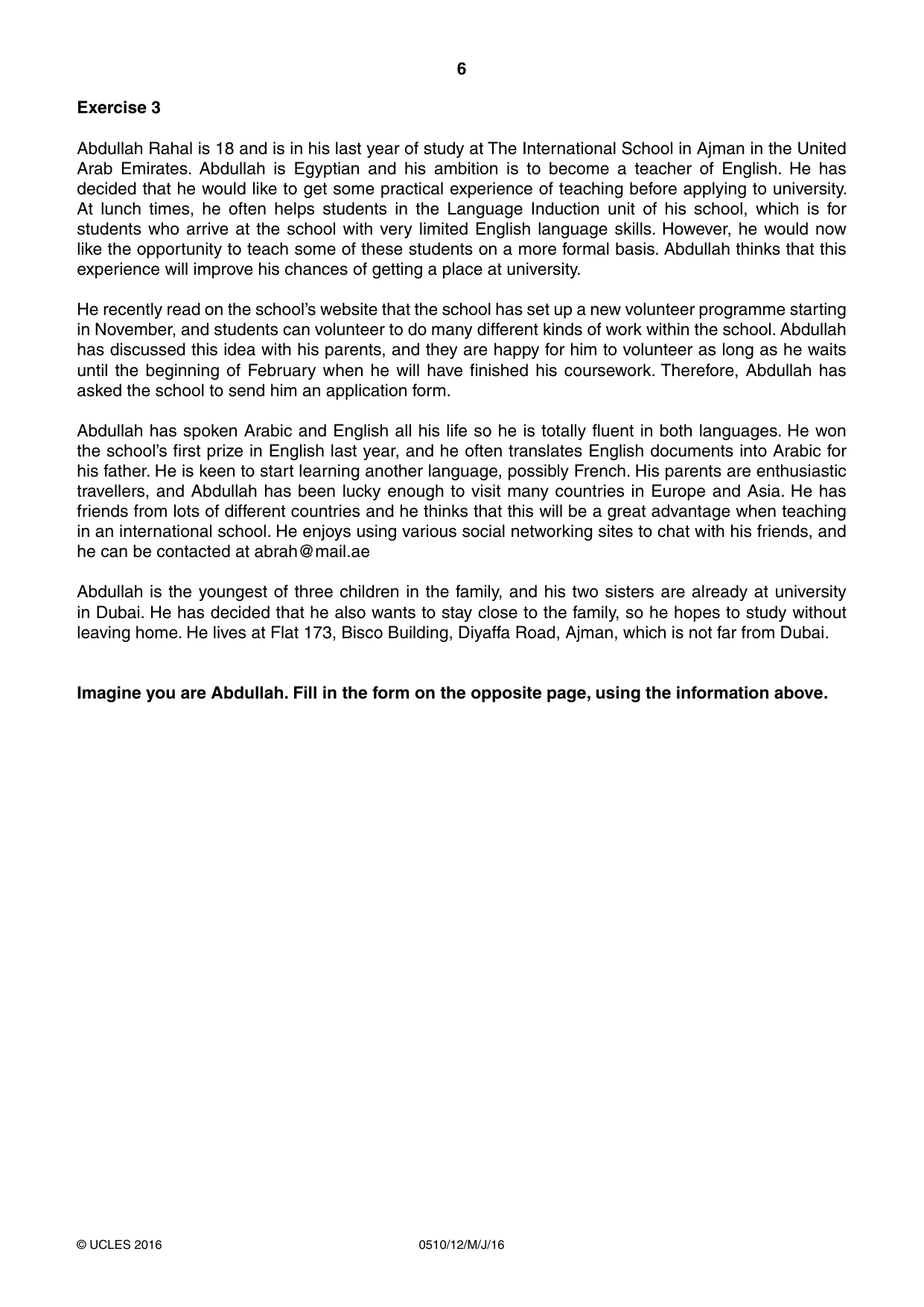
6 0510/12/M/J/16 © UCLES 2016 Exercise 3 Abdullah Rahal is 18 and is in his last year of study at The International School in Ajman in the United Arab Emirates. Abdullah is Egyptian and his ambition is to become a teacher of English. He has decided that he would like to get some practical experience of teaching before applying to university. At lunch times, he often helps students in the Language Induction unit of his school, which is for students who arrive at the school with very limited English language skills. However, he would now like the opportunity to teach some of these students on a more formal basis. Abdullah thinks that this experience will improve his chances of getting a place at university. He recently read on the school’s website that the school has set up a new volunteer programme starting in November, and students can volunteer to do many different kinds of work within the school. Abdullah has discussed this idea with his parents, and they are happy for him to volunteer as long as he waits until the beginning of February when he will have finished his coursework. Therefore, Abdullah has asked the school to send him an application form. Abdullah has spoken Arabic and English all his life so he is totally fluent in both languages. He won the school’s first prize in English last year, and he often translates English documents into Arabic for his father. He is keen to start learning another language, possibly French. His parents are enthusiastic travellers, and Abdullah has been lucky enough to visit many countries in Europe and Asia. He has friends from lots of different countries and he thinks that this will be a great advantage when teaching in an international school. He enjoys using various social networking sites to chat with his friends, and he can be contacted at abrah@mail.ae Abdullah is the youngest of three children in the family, and his two sisters are already at university in Dubai. He has decided that he also wants to stay close to the family, so he hopes to study without leaving home. He lives at Flat 173, Bisco Building, Diyaffa Road, Ajman, which is not far from Dubai. Imagine you are Abdullah. Fill in the form on the opposite page, using the information above.
Question paper, page 7
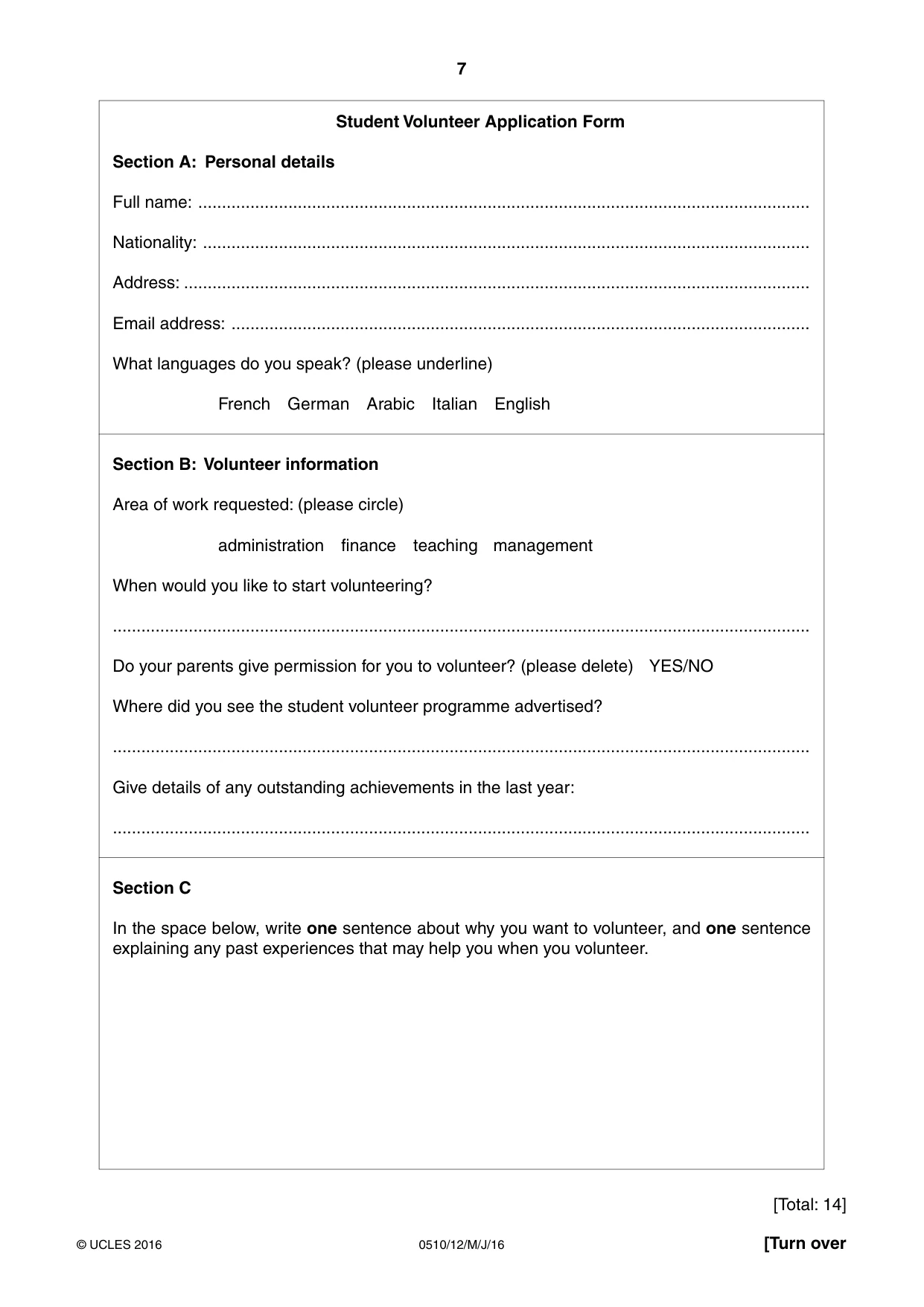
7 0510/12/M/J/16 © UCLES 2016 [Turn over Student Volunteer Application Form Section A: Personal details Full name: … Nationality: … Address: … Email address: … What languages do you speak? (please underline) French German Arabic Italian English Section B: Volunteer information Area of work requested: (please circle) administration finance teaching management When would you like to start volunteering? … Do your parents give permission for you to volunteer? (please delete) YES/NO Where did you see the student volunteer programme advertised? … Give details of any outstanding achievements in the last year: … Section C In the space below, write one sentence about why you want to volunteer, and one sentence explaining any past experiences that may help you when you volunteer. [Total: 14]
Question paper, page 8
8 0510/12/M/J/16 © UCLES 2016 Exercise 4 Read the following article about special-effects artists, and then complete the notes on the opposite page. Special-effects artists In films, nothing is impossible. Who knows, one day, one of your creations might end up on the big screen! Content removed due to copyright restrictions.
Question paper, page 9
9 0510/12/M/J/16 © UCLES 2016 [Turn over You have been asked to give a talk to your class about special-effects artists. Prepare some notes to use as the basis for your talk. Make your notes under each heading. Different types of artists and the main task of each: • CG special-effects artists – create characters and sets • … • … • … • … What you can do if you want to become a special-effects artist: • … • … • … [Total: 7] Exercise 5 Imagine that you have given your talk to your class. Now your teacher has asked you to follow this up with a short written report. Look at your notes in Exercise 4 above. Using the ideas in your notes, write a summary about special-effects artists. Your summary should be about 70 words long (and no more than 80 words long). You should use your own words as far as possible. … … … … … … … … [Total: 5]
Question paper, page 10
10 0510/12/M/J/16 © UCLES 2016 Exercise 6 You recently spent an enjoyable weekend at a friend’s house. Write an email to your friend, to say thank you for your stay. In your email, you should: • thank your friend and say how you felt when you got home • describe what you enjoyed most about your stay • invite your friend to stay with you, and suggest some activities you might do together. The pictures above may give you some ideas, and you should try to use some ideas of your own. Your email should be between 100 and 150 words long. You will receive up to 7 marks for the content of your email, and up to 6 marks for the style and accuracy of your language.
Question paper, page 11
11 0510/12/M/J/16 © UCLES 2016 [Turn over … … … … … … … … … … … … … … … … … … … … … … … … … [Total: 13]
Question paper, page 12
12 0510/12/M/J/16 © UCLES 2016 Exercise 7 Some people enjoy living in apartments but others prefer to live in houses. Here are some comments on the subject: I prefer to have all of the up-to-date conveniences of a modern apartment. Older family members feel more comfortable in a traditional house. I think a traditional house is better for family life. It is safer to live in an apartment. Write an article for your school magazine, giving your views. The comments above may give you some ideas, and you should try to use some ideas of your own. Your article should be between 100 and 150 words long. You will receive up to 7 marks for the content of your article, and up to 6 marks for the style and accuracy of your language.
Question paper, page 13
13 0510/12/M/J/16 © UCLES 2016 … … … … … … … … … … … … … … … … … … … … … … … … … [Total: 13]
Question paper, page 14
14 0510/12/M/J/16 © UCLES 2016 BLANK PAGE
Question paper, page 15
15 0510/12/M/J/16 © UCLES 2016 BLANK PAGE
Question paper, page 16
16 0510/12/M/J/16 © UCLES 2016 Permission to reproduce items where third-party owned material protected by copyright is included has been sought and cleared where possible. Every reasonable effort has been made by the publisher (UCLES) to trace copyright holders, but if any items requiring clearance have unwittingly been included, the publisher will be pleased to make amends at the earliest possible opportunity. To avoid the issue of disclosure of answer-related information to candidates, all copyright acknowledgements are reproduced online in the Cambridge International Examinations Copyright Acknowledgements Booklet. This is produced for each series of examinations and is freely available to download at www.cie.org.uk after the live examination series. Cambridge International Examinations is part of the Cambridge Assessment Group. Cambridge Assessment is the brand name of University of Cambridge Local Examinations Syndicate (UCLES), which is itself a department of the University of Cambridge. BLANK PAGE
Mark scheme, page 1
® IGCSE is the registered trademark of Cambridge International Examinations. This document consists of 11 printed pages. © UCLES 2016 [Turn over Cambridge International Examinations Cambridge International General Certificate of Secondary Education ENGLISH AS A SECOND LANGUAGE 0510/12 Paper 1 Reading and Writing – Core May/June 2016 MARK SCHEME Maximum Mark: 70 Published This mark scheme is published as an aid to teachers and candidates, to indicate the requirements of the examination. It shows the basis on which Examiners were instructed to award marks. It does not indicate the details of the discussions that took place at an Examiners’ meeting before marking began, which would have considered the acceptability of alternative answers. Mark schemes should be read in conjunction with the question paper and the Principal Examiner Report for Teachers. Cambridge will not enter into discussions about these mark schemes. Cambridge is publishing the mark schemes for the May/June 2016 series for most Cambridge IGCSE®, Cambridge International A and AS Level components and some Cambridge O Level components.
Mark scheme, page 2
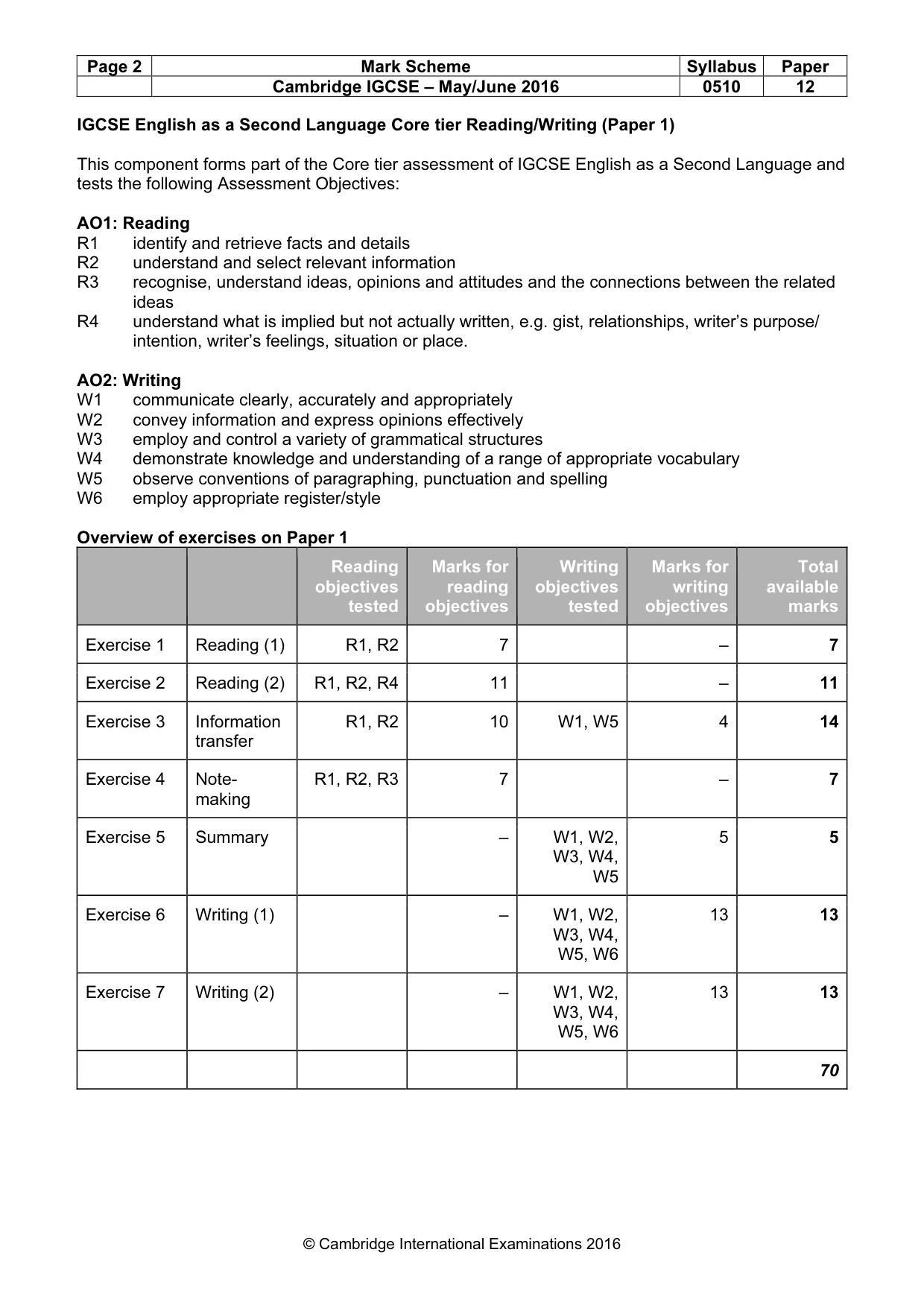
Page 2 Mark Scheme Syllabus Paper Cambridge IGCSE – May/June 2016 0510 12 © Cambridge International Examinations 2016 IGCSE English as a Second Language Core tier Reading/Writing (Paper 1) This component forms part of the Core tier assessment of IGCSE English as a Second Language and tests the following Assessment Objectives: AO1: Reading R1 identify and retrieve facts and details R2 understand and select relevant information R3 recognise, understand ideas, opinions and attitudes and the connections between the related ideas R4 understand what is implied but not actually written, e.g. gist, relationships, writer’s purpose/ intention, writer’s feelings, situation or place. AO2: Writing W1 communicate clearly, accurately and appropriately W2 convey information and express opinions effectively W3 employ and control a variety of grammatical structures W4 demonstrate knowledge and understanding of a range of appropriate vocabulary W5 observe conventions of paragraphing, punctuation and spelling W6 employ appropriate register/style Overview of exercises on Paper 1 Reading objectives tested Marks for reading objectives Writing objectives tested Marks for writing objectives Total available marks Exercise 1 Reading (1) R1, R2 7 – 7 Exercise 2 Reading (2) R1, R2, R4 11 – 11 Exercise 3 Information transfer R1, R2 10 W1, W5 4 14 Exercise 4 Note- making R1, R2, R3 7 – 7 Exercise 5 Summary – W1, W2, W3, W4, W5 5 5 Exercise 6 Writing (1) – W1, W2, W3, W4, W5, W6 13 13 Exercise 7 Writing (2) – W1, W2, W3, W4, W5, W6 13 13 70
Mark scheme, page 3
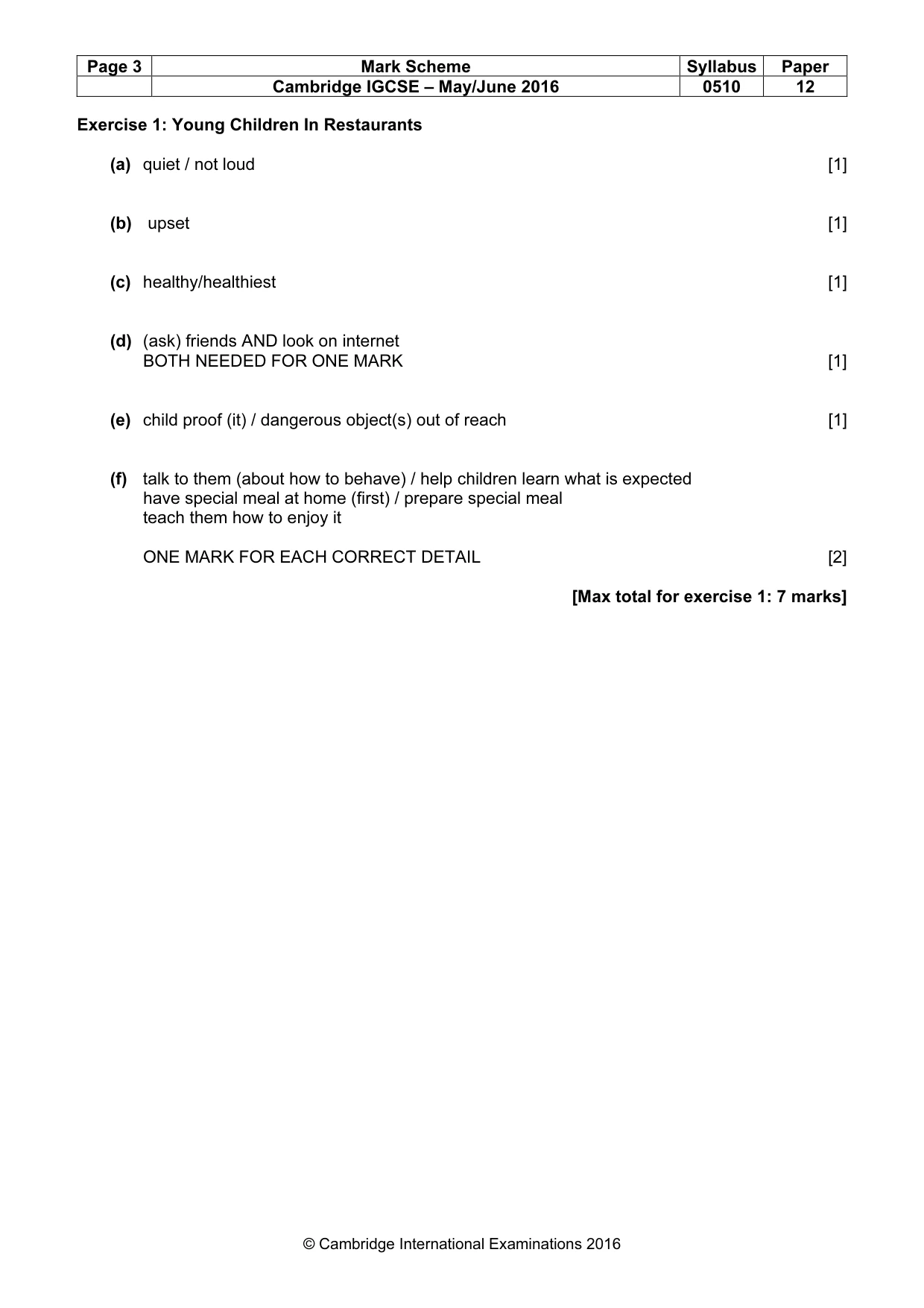
Page 3 Mark Scheme Syllabus Paper Cambridge IGCSE – May/June 2016 0510 12 © Cambridge International Examinations 2016 Exercise 1: Young Children In Restaurants (a) quiet / not loud [1] (b) upset [1] (c) healthy/healthiest [1] (d) (ask) friends AND look on internet BOTH NEEDED FOR ONE MARK [1] (e) child proof (it) / dangerous object(s) out of reach [1] (f) talk to them (about how to behave) / help children learn what is expected have special meal at home (first) / prepare special meal teach them how to enjoy it ONE MARK FOR EACH CORRECT DETAIL [2] [Max total for exercise 1: 7 marks]
Mark scheme, page 4
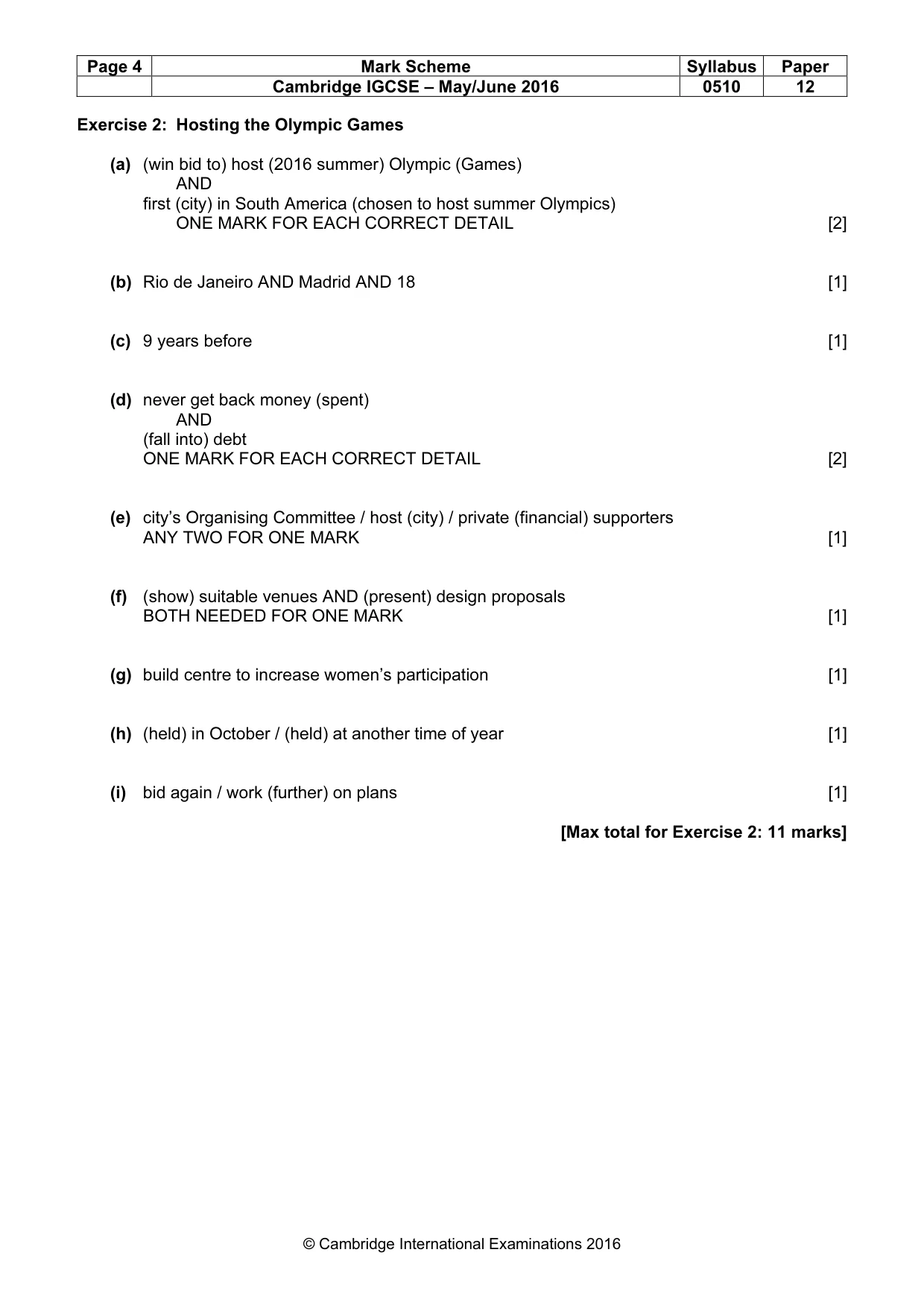
Page 4 Mark Scheme Syllabus Paper Cambridge IGCSE – May/June 2016 0510 12 © Cambridge International Examinations 2016 Exercise 2: Hosting the Olympic Games (a) (win bid to) host (2016 summer) Olympic (Games) AND first (city) in South America (chosen to host summer Olympics) ONE MARK FOR EACH CORRECT DETAIL [2] (b) Rio de Janeiro AND Madrid AND 18 [1] (c) 9 years before [1] (d) never get back money (spent) AND (fall into) debt ONE MARK FOR EACH CORRECT DETAIL [2] (e) city’s Organising Committee / host (city) / private (financial) supporters ANY TWO FOR ONE MARK [1] (f) (show) suitable venues AND (present) design proposals BOTH NEEDED FOR ONE MARK [1] (g) build centre to increase women’s participation [1] (h) (held) in October / (held) at another time of year [1] (i) bid again / work (further) on plans [1] [Max total for Exercise 2: 11 marks]
Mark scheme, page 5
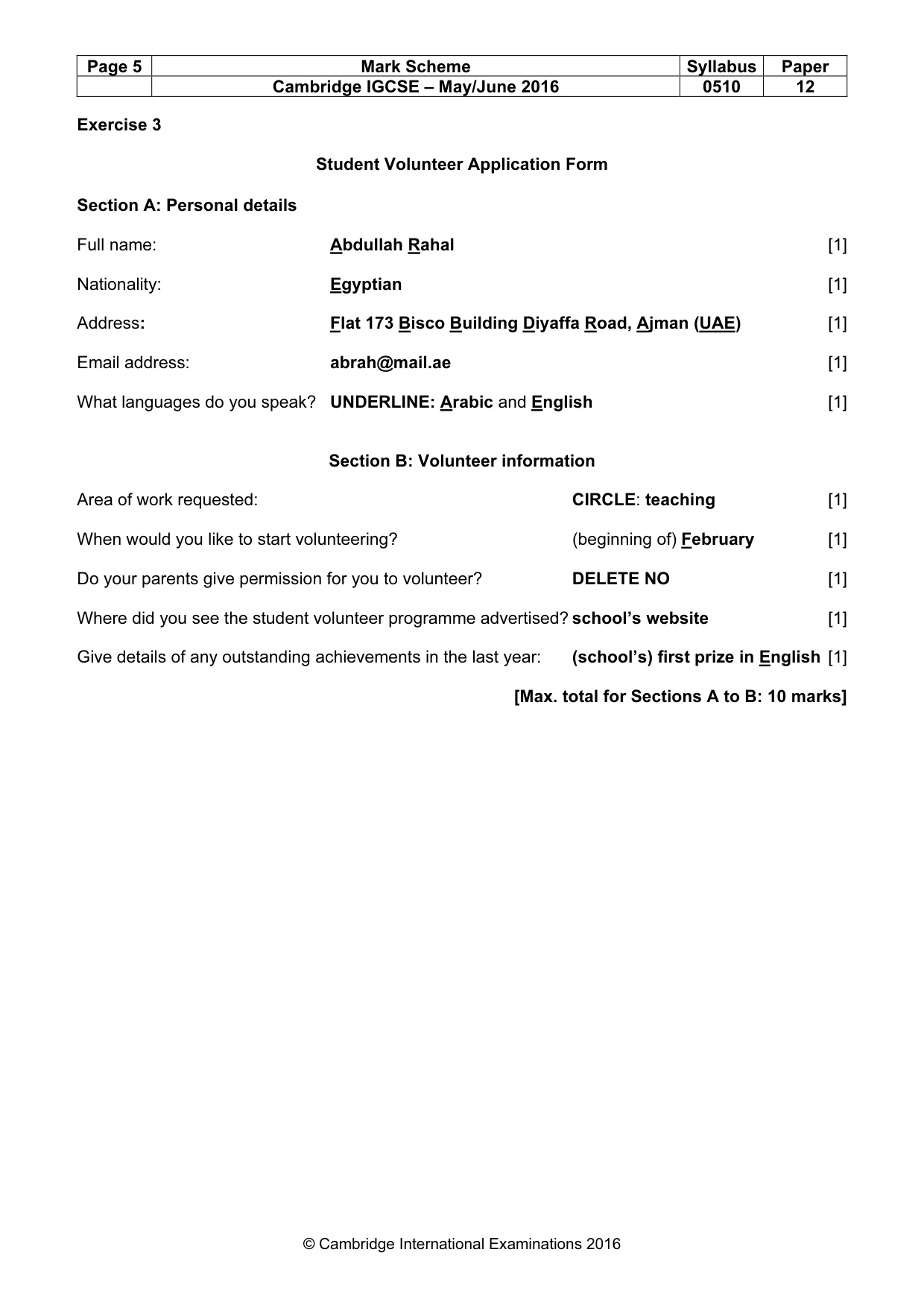
Page 5 Mark Scheme Syllabus Paper Cambridge IGCSE – May/June 2016 0510 12 © Cambridge International Examinations 2016 Exercise 3 Student Volunteer Application Form Section A: Personal details Full name: Abdullah Rahal [1] Nationality: Egyptian [1] Address: Flat 173 Bisco Building Diyaffa Road, Ajman (UAE) [1] Email address: abrah@mail.ae [1] What languages do you speak? UNDERLINE: Arabic and English [1] Section B: Volunteer information Area of work requested: CIRCLE: teaching [1] When would you like to start volunteering? (beginning of) February [1] Do your parents give permission for you to volunteer? DELETE NO [1] Where did you see the student volunteer programme advertised? school’s website [1] Give details of any outstanding achievements in the last year: (school’s) first prize in English [1] [Max. total for Sections A to B: 10 marks]
Mark scheme, page 6
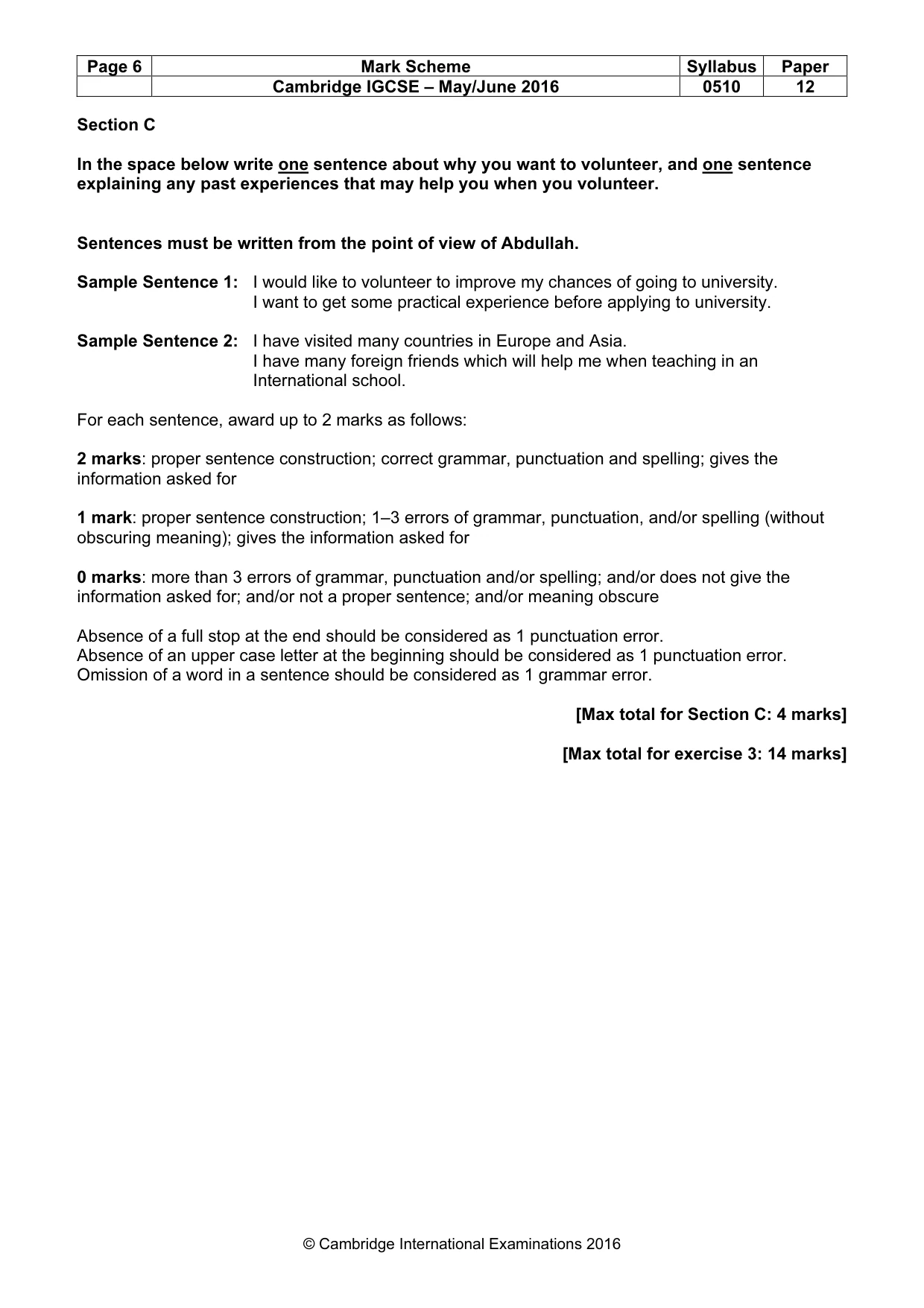
Page 6 Mark Scheme Syllabus Paper Cambridge IGCSE – May/June 2016 0510 12 © Cambridge International Examinations 2016 Section C In the space below write one sentence about why you want to volunteer, and one sentence explaining any past experiences that may help you when you volunteer. Sentences must be written from the point of view of Abdullah. Sample Sentence 1: I would like to volunteer to improve my chances of going to university. I want to get some practical experience before applying to university. Sample Sentence 2: I have visited many countries in Europe and Asia. I have many foreign friends which will help me when teaching in an International school. For each sentence, award up to 2 marks as follows: 2 marks: proper sentence construction; correct grammar, punctuation and spelling; gives the information asked for 1 mark: proper sentence construction; 1–3 errors of grammar, punctuation, and/or spelling (without obscuring meaning); gives the information asked for 0 marks: more than 3 errors of grammar, punctuation and/or spelling; and/or does not give the information asked for; and/or not a proper sentence; and/or meaning obscure Absence of a full stop at the end should be considered as 1 punctuation error. Absence of an upper case letter at the beginning should be considered as 1 punctuation error. Omission of a word in a sentence should be considered as 1 grammar error. [Max total for Section C: 4 marks] [Max total for exercise 3: 14 marks]
Mark scheme, page 7
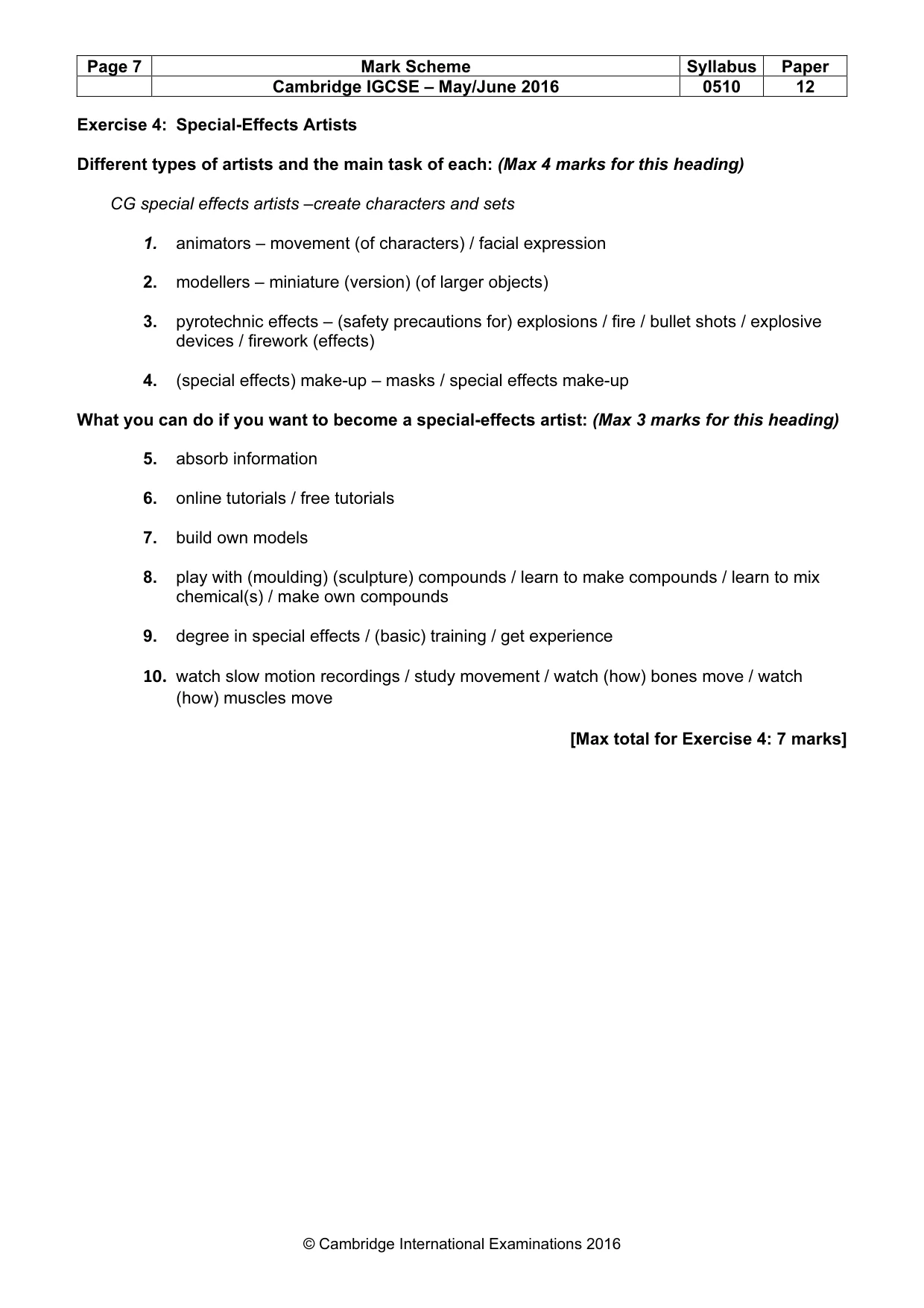
Page 7 Mark Scheme Syllabus Paper Cambridge IGCSE – May/June 2016 0510 12 © Cambridge International Examinations 2016 Exercise 4: Special-Effects Artists Different types of artists and the main task of each: (Max 4 marks for this heading) CG special effects artists –create characters and sets 1. animators – movement (of characters) / facial expression 2. modellers – miniature (version) (of larger objects) 3. pyrotechnic effects – (safety precautions for) explosions / fire / bullet shots / explosive devices / firework (effects) 4. (special effects) make-up – masks / special effects make-up What you can do if you want to become a special-effects artist: (Max 3 marks for this heading) 5. absorb information 6. online tutorials / free tutorials 7. build own models 8. play with (moulding) (sculpture) compounds / learn to make compounds / learn to mix chemical(s) / make own compounds 9. degree in special effects / (basic) training / get experience 10. watch slow motion recordings / study movement / watch (how) bones move / watch (how) muscles move [Max total for Exercise 4: 7 marks]
Mark scheme, page 8
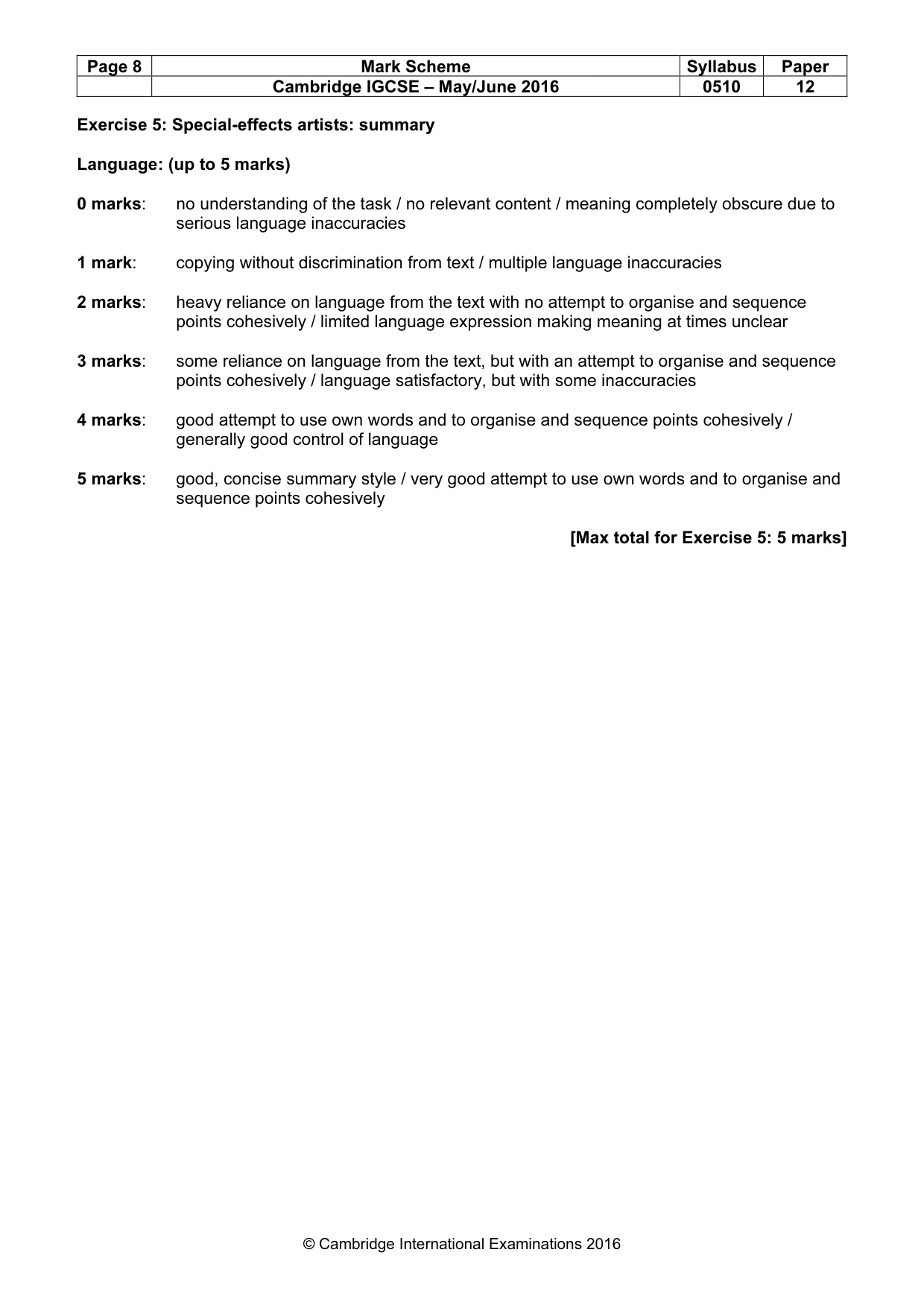
Page 8 Mark Scheme Syllabus Paper Cambridge IGCSE – May/June 2016 0510 12 © Cambridge International Examinations 2016 Exercise 5: Special-effects artists: summary Language: (up to 5 marks) 0 marks: no understanding of the task / no relevant content / meaning completely obscure due to serious language inaccuracies 1 mark: copying without discrimination from text / multiple language inaccuracies 2 marks: heavy reliance on language from the text with no attempt to organise and sequence points cohesively / limited language expression making meaning at times unclear 3 marks: some reliance on language from the text, but with an attempt to organise and sequence points cohesively / language satisfactory, but with some inaccuracies 4 marks: good attempt to use own words and to organise and sequence points cohesively / generally good control of language 5 marks: good, concise summary style / very good attempt to use own words and to organise and sequence points cohesively [Max total for Exercise 5: 5 marks]
Mark scheme, page 9
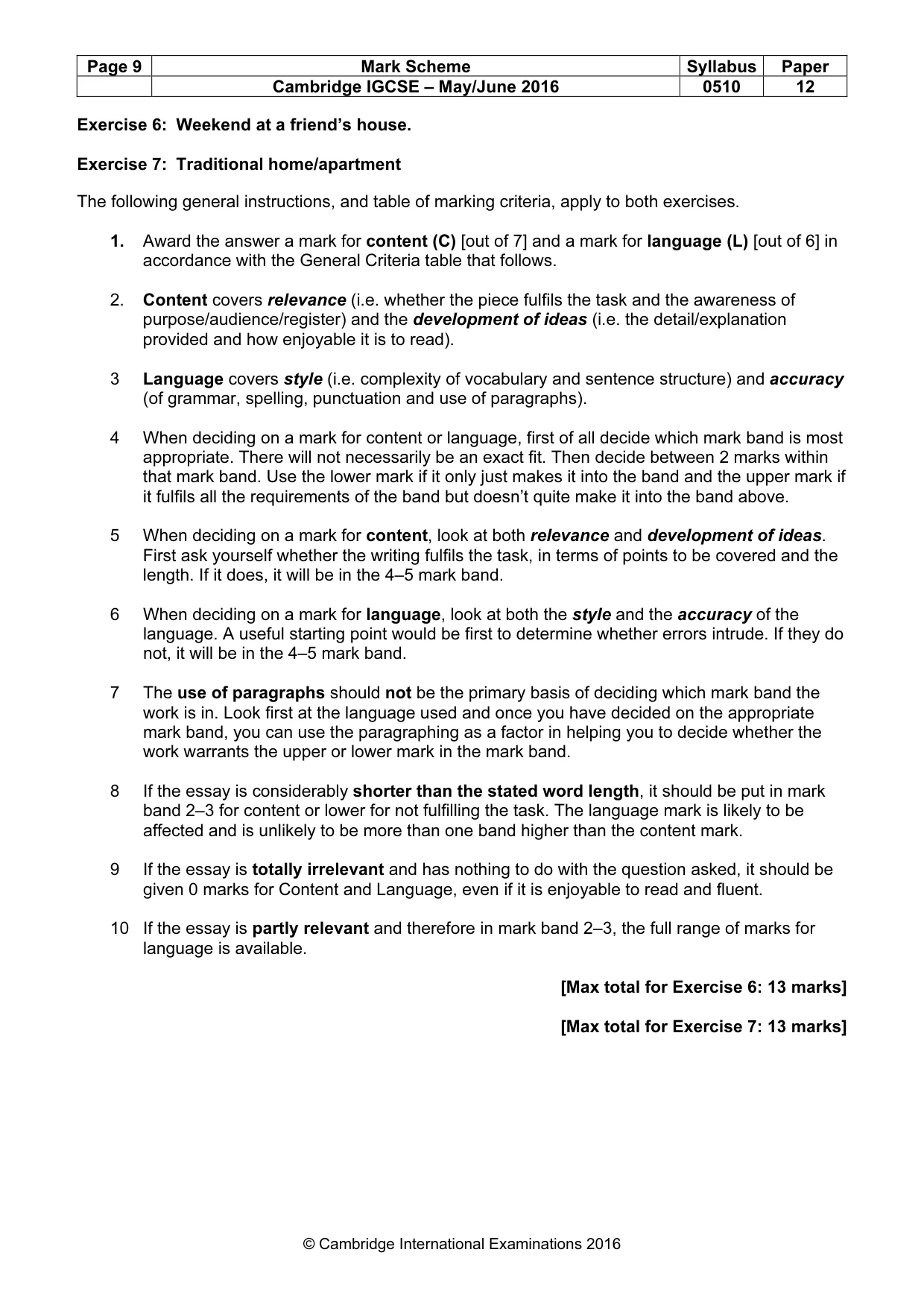
Page 9 Mark Scheme Syllabus Paper Cambridge IGCSE – May/June 2016 0510 12 © Cambridge International Examinations 2016 Exercise 6: Weekend at a friend’s house. Exercise 7: Traditional home/apartment The following general instructions, and table of marking criteria, apply to both exercises. 1. Award the answer a mark for content (C) [out of 7] and a mark for language (L) [out of 6] in accordance with the General Criteria table that follows. 2. Content covers relevance (i.e. whether the piece fulfils the task and the awareness of purpose/audience/register) and the development of ideas (i.e. the detail/explanation provided and how enjoyable it is to read). 3 Language covers style (i.e. complexity of vocabulary and sentence structure) and accuracy (of grammar, spelling, punctuation and use of paragraphs). 4 When deciding on a mark for content or language, first of all decide which mark band is most appropriate. There will not necessarily be an exact fit. Then decide between 2 marks within that mark band. Use the lower mark if it only just makes it into the band and the upper mark if it fulfils all the requirements of the band but doesn’t quite make it into the band above. 5 When deciding on a mark for content, look at both relevance and development of ideas. First ask yourself whether the writing fulfils the task, in terms of points to be covered and the length. If it does, it will be in the 4–5 mark band. 6 When deciding on a mark for language, look at both the style and the accuracy of the language. A useful starting point would be first to determine whether errors intrude. If they do not, it will be in the 4–5 mark band. 7 The use of paragraphs should not be the primary basis of deciding which mark band the work is in. Look first at the language used and once you have decided on the appropriate mark band, you can use the paragraphing as a factor in helping you to decide whether the work warrants the upper or lower mark in the mark band. 8 If the essay is considerably shorter than the stated word length, it should be put in mark band 2–3 for content or lower for not fulfilling the task. The language mark is likely to be affected and is unlikely to be more than one band higher than the content mark. 9 If the essay is totally irrelevant and has nothing to do with the question asked, it should be given 0 marks for Content and Language, even if it is enjoyable to read and fluent. 10 If the essay is partly relevant and therefore in mark band 2–3, the full range of marks for language is available. [Max total for Exercise 6: 13 marks] [Max total for Exercise 7: 13 marks]
Mark scheme, page 10
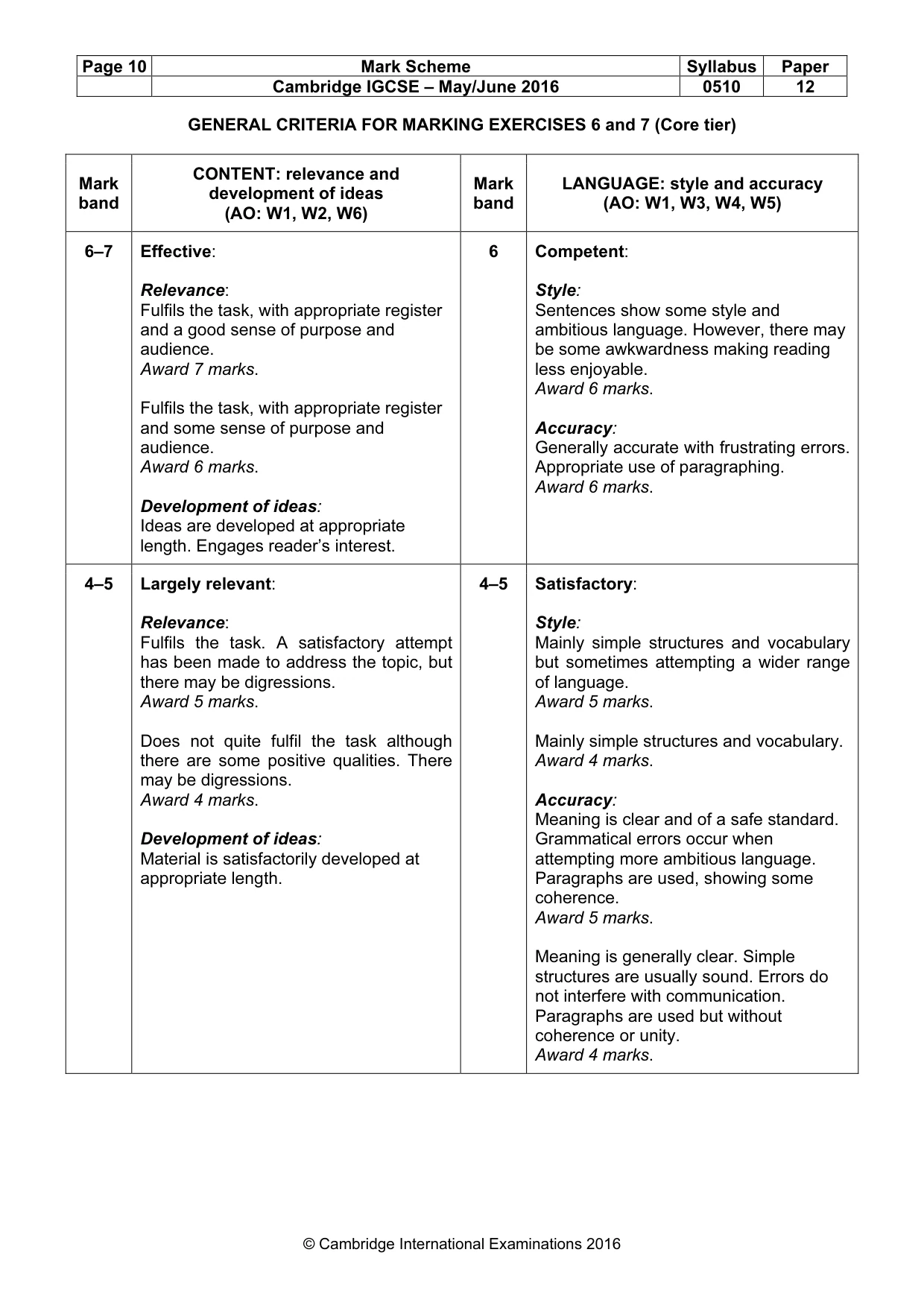
Page 10 Mark Scheme Syllabus Paper Cambridge IGCSE – May/June 2016 0510 12 © Cambridge International Examinations 2016 GENERAL CRITERIA FOR MARKING EXERCISES 6 and 7 (Core tier) Mark band CONTENT: relevance and development of ideas (AO: W1, W2, W6) Mark band LANGUAGE: style and accuracy (AO: W1, W3, W4, W5) 6–7 Effective: Relevance: Fulfils the task, with appropriate register and a good sense of purpose and audience. Award 7 marks. Fulfils the task, with appropriate register and some sense of purpose and audience. Award 6 marks. Development of ideas: Ideas are developed at appropriate length. Engages reader’s interest. 6 Competent: Style: Sentences show some style and ambitious language. However, there may be some awkwardness making reading less enjoyable. Award 6 marks. Accuracy: Generally accurate with frustrating errors. Appropriate use of paragraphing. Award 6 marks. 4–5 Largely relevant: Relevance: Fulfils the task. A satisfactory attempt has been made to address the topic, but there may be digressions. Award 5 marks. Does not quite fulfil the task although there are some positive qualities. There may be digressions. Award 4 marks. Development of ideas: Material is satisfactorily developed at appropriate length. 4–5 Satisfactory: Style: Mainly simple structures and vocabulary but sometimes attempting a wider range of language. Award 5 marks. Mainly simple structures and vocabulary. Award 4 marks. Accuracy: Meaning is clear and of a safe standard. Grammatical errors occur when attempting more ambitious language. Paragraphs are used, showing some coherence. Award 5 marks. Meaning is generally clear. Simple structures are usually sound. Errors do not interfere with communication. Paragraphs are used but without coherence or unity. Award 4 marks.
Mark scheme, page 11
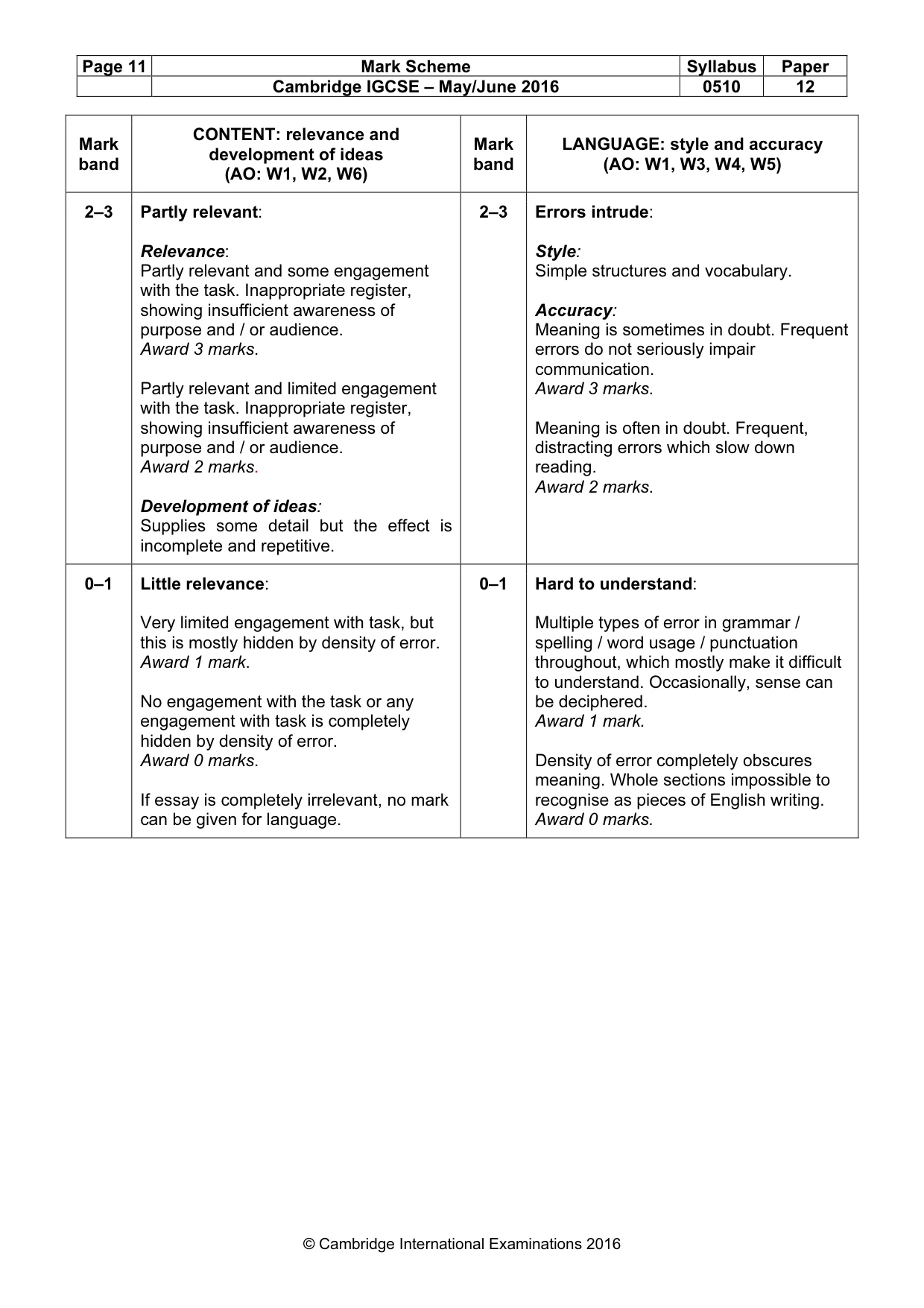
Page 11 Mark Scheme Syllabus Paper Cambridge IGCSE – May/June 2016 0510 12 © Cambridge International Examinations 2016 Mark band CONTENT: relevance and development of ideas (AO: W1, W2, W6) Mark band LANGUAGE: style and accuracy (AO: W1, W3, W4, W5) 2–3 Partly relevant: Relevance: Partly relevant and some engagement with the task. Inappropriate register, showing insufficient awareness of purpose and / or audience. Award 3 marks. Partly relevant and limited engagement with the task. Inappropriate register, showing insufficient awareness of purpose and / or audience. Award 2 marks. Development of ideas: Supplies some detail but the effect is incomplete and repetitive. 2–3 Errors intrude: Style: Simple structures and vocabulary. Accuracy: Meaning is sometimes in doubt. Frequent errors do not seriously impair communication. Award 3 marks. Meaning is often in doubt. Frequent, distracting errors which slow down reading. Award 2 marks. 0–1 Little relevance: Very limited engagement with task, but this is mostly hidden by density of error. Award 1 mark. No engagement with the task or any engagement with task is completely hidden by density of error. Award 0 marks. If essay is completely irrelevant, no mark can be given for language. 0–1 Hard to understand: Multiple types of error in grammar / spelling / word usage / punctuation throughout, which mostly make it difficult to understand. Occasionally, sense can be deciphered. Award 1 mark. Density of error completely obscures meaning. Whole sections impossible to recognise as pieces of English writing. Award 0 marks.
What you needed in this session
Cambridge’s own grade thresholds for 2016 May/June, Paper 1 · Variant 2. A higher threshold means an easier paper — the bar moves with how the cohort did.