Cambridge IGCSE English - Second Language (oral endorsement) 0510 — 2015 Oct/Nov Paper 4 · Variant 3
0510/43/O/N/15 · 40 marks · ≈45 min
The question paper and its mark scheme, free to read here and free to download. This is Cambridge’s own paper, exactly as it was sat.
Question paper12 pages




Mark scheme13 pages
Answers below. Sit the paper first if you are practising.
Paper as text
Question paper, page 1
This document consists of 9 printed pages and 3 blank pages. DC (ST) 100729/3 © UCLES 2015 [Turn over Cambridge International Examinations Cambridge International General Certificate of Secondary Education * 6 5 3 8 6 2 6 7 6 9 * ENGLISH AS A SECOND LANGUAGE 0510/43 Paper 4 Listening (Extended) October/November 2015 Approx. 45 minutes Candidates answer on the Question Paper. Additional Materials: As listed in Instructions to Supervisors. READ THESE INSTRUCTIONS FIRST Write your Centre number, candidate number and name on all the work you hand in. Write in dark blue or black pen. Do not use staples, paper clips, glue or correction fluid. DO NOT WRITE IN ANY BARCODES. Answer all questions. Dictionaries are not permitted. The number of marks is given in brackets [ ] at the end of each question or part question.
Question paper, page 2
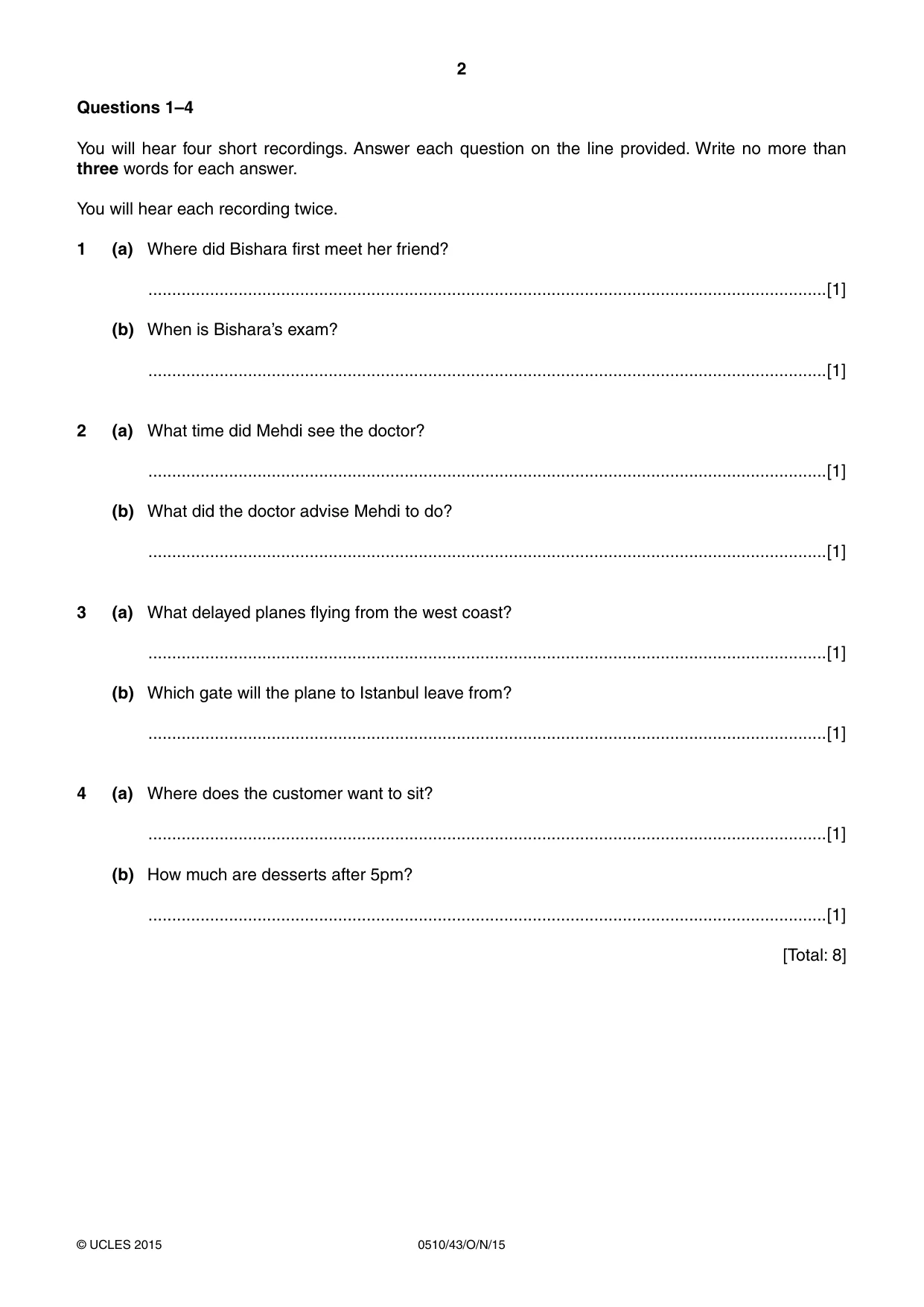
2 0510/43/O/N/15 © UCLES 2015 Questions 1–4 You will hear four short recordings. Answer each question on the line provided. Write no more than three words for each answer. You will hear each recording twice. 1 (a) Where did Bishara first meet her friend? …[1] (b) When is Bishara’s exam? …[1] 2 (a) What time did Mehdi see the doctor? …[1] (b) What did the doctor advise Mehdi to do? …[1] 3 (a) What delayed planes flying from the west coast? …[1] (b) Which gate will the plane to Istanbul leave from? …[1] 4 (a) Where does the customer want to sit? …[1] (b) How much are desserts after 5pm? …[1] [Total: 8]
Question paper, page 3
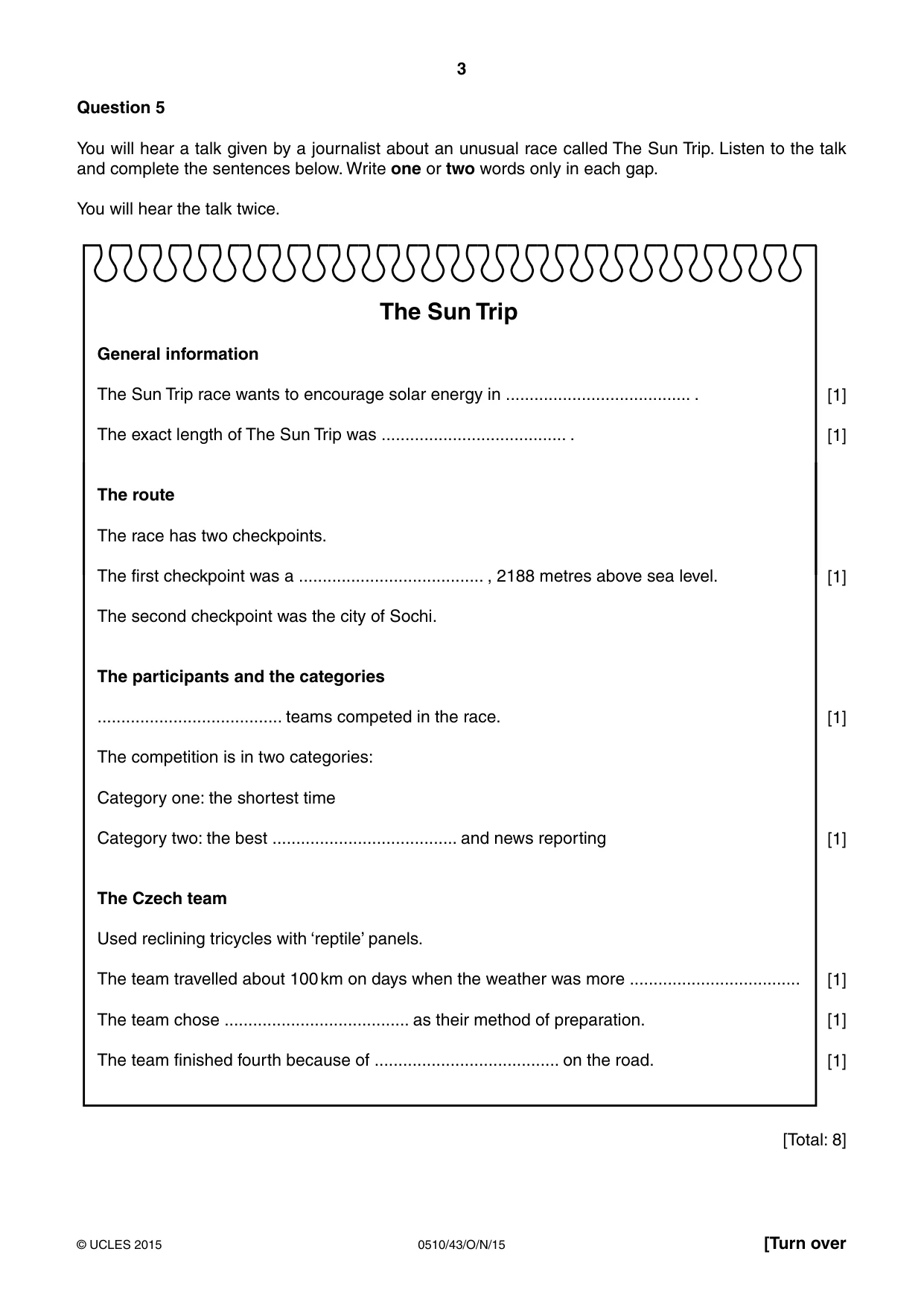
3 0510/43/O/N/15 © UCLES 2015 [Turn over Question 5 You will hear a talk given by a journalist about an unusual race called The Sun Trip. Listen to the talk and complete the sentences below. Write one or two words only in each gap. You will hear the talk twice. The Sun Trip General information The Sun Trip race wants to encourage solar energy in … . The exact length of The Sun Trip was … . The route The race has two checkpoints. The first checkpoint was a … , 2188 metres above sea level. The second checkpoint was the city of Sochi. The participants and the categories … teams competed in the race. The competition is in two categories: Category one: the shortest time Category two: the best … and news reporting The Czech team Used reclining tricycles with ‘reptile’ panels. The team travelled about 100 km on days when the weather was more … The team chose … as their method of preparation. The team finished fourth because of … on the road. [Total: 8] [1] [1] [1] [1] [1] [1] [1] [1]
Question paper, page 4
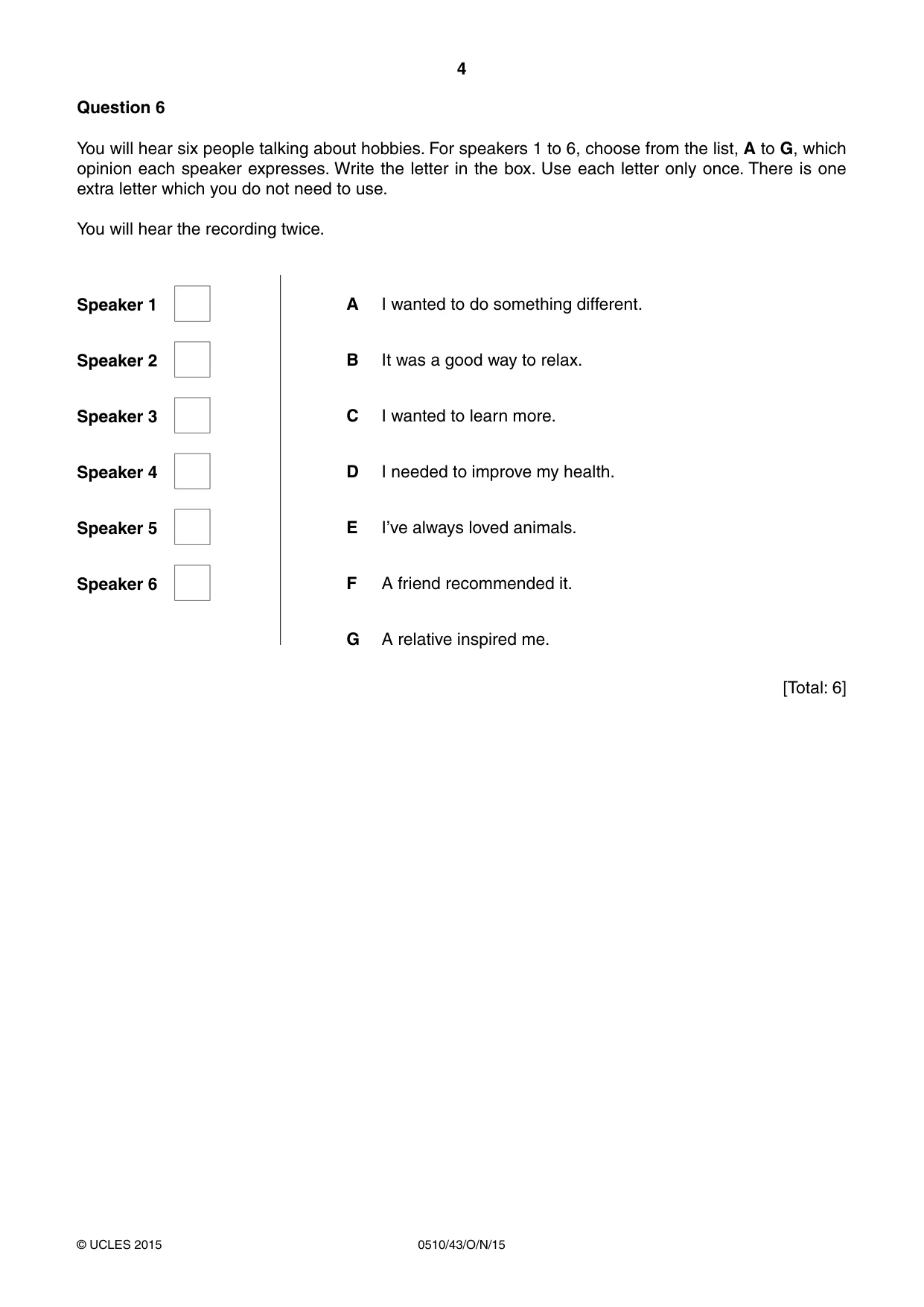
4 0510/43/O/N/15 © UCLES 2015 Question 6 You will hear six people talking about hobbies. For speakers 1 to 6, choose from the list, A to G, which opinion each speaker expresses. Write the letter in the box. Use each letter only once. There is one extra letter which you do not need to use. You will hear the recording twice. Speaker 1 Speaker 2 Speaker 3 Speaker 4 Speaker 5 Speaker 6 A I wanted to do something different . B It was a good way to relax. C I wanted to learn more. D I needed to improve my health. E I’ve always loved animals. F A friend recommended it. G A relative inspired me. [Total: 6]
Question paper, page 5
5 0510/43/O/N/15 © UCLES 2015 [Turn over Please turn over for Question 7.
Question paper, page 6
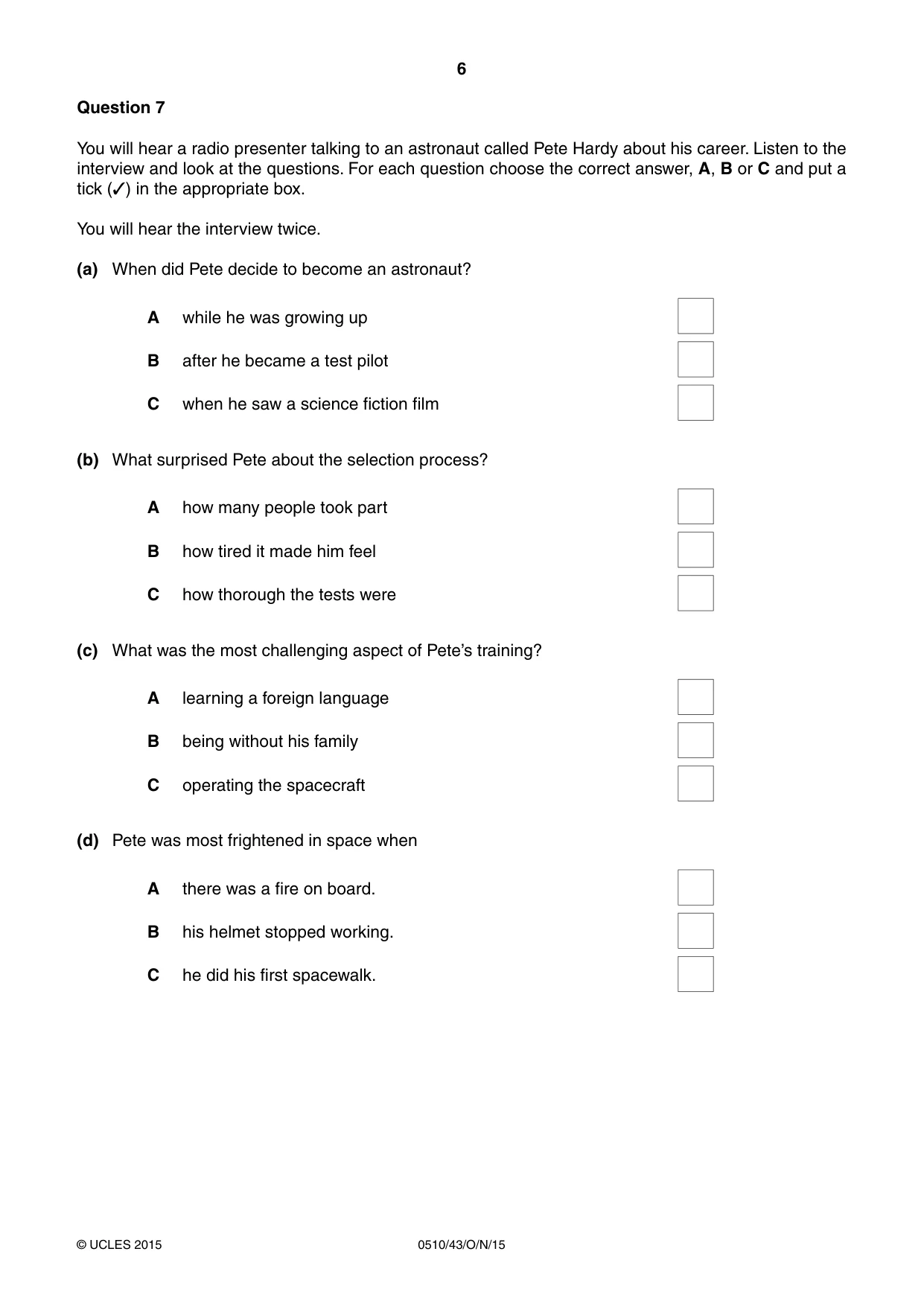
6 0510/43/O/N/15 © UCLES 2015 Question 7 You will hear a radio presenter talking to an astronaut called Pete Hardy about his career. Listen to the interview and look at the questions. For each question choose the correct answer, A, B or C and put a tick (✓) in the appropriate box. You will hear the interview twice. (a) When did Pete decide to become an astronaut? A while he was growing up B after he became a test pilot C when he saw a science fiction film (b) What surprised Pete about the selection process? A how many people took part B how tired it made him feel C how thorough the tests were (c) What was the most challenging aspect of Pete’s training? A learning a foreign language B being without his family C operating the spacecraft (d) Pete was most frightened in space when A there was a fire on board. B his helmet stopped working. C he did his first spacewalk.
Question paper, page 7
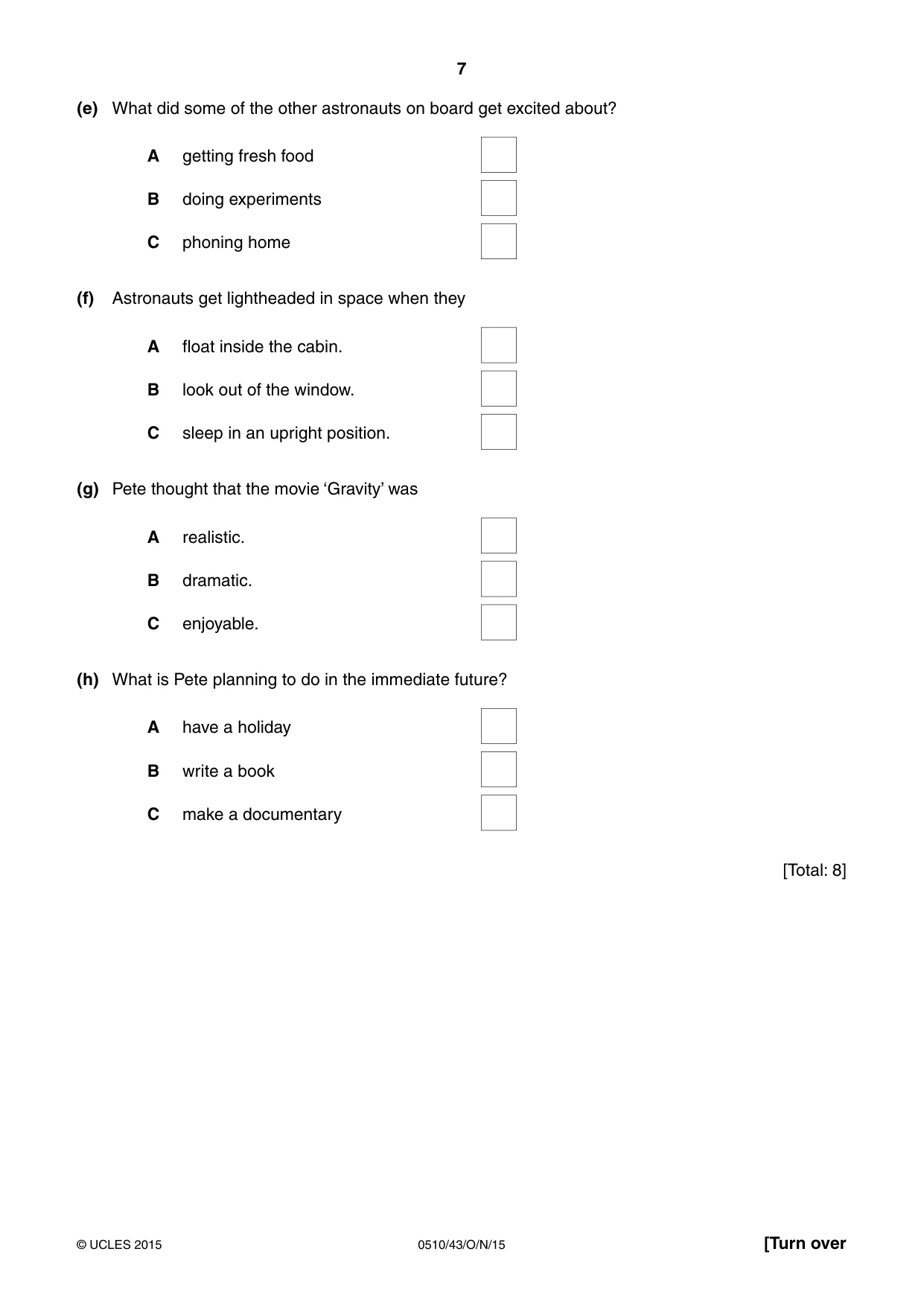
7 0510/43/O/N/15 © UCLES 2015 [Turn over (e) What did some of the other astronauts on board get excited about? A getting fresh food B doing experiments C phoning home (f) Astronauts get lightheaded in space when they A float inside the cabin. B look out of the window. C sleep in an upright position. (g) Pete thought that the movie ‘Gravity’ was A realistic. B dramatic. C enjoyable. (h) What is Pete planning to do in the immediate future? A have a holiday B write a book C make a documentary [Total: 8]
Question paper, page 8
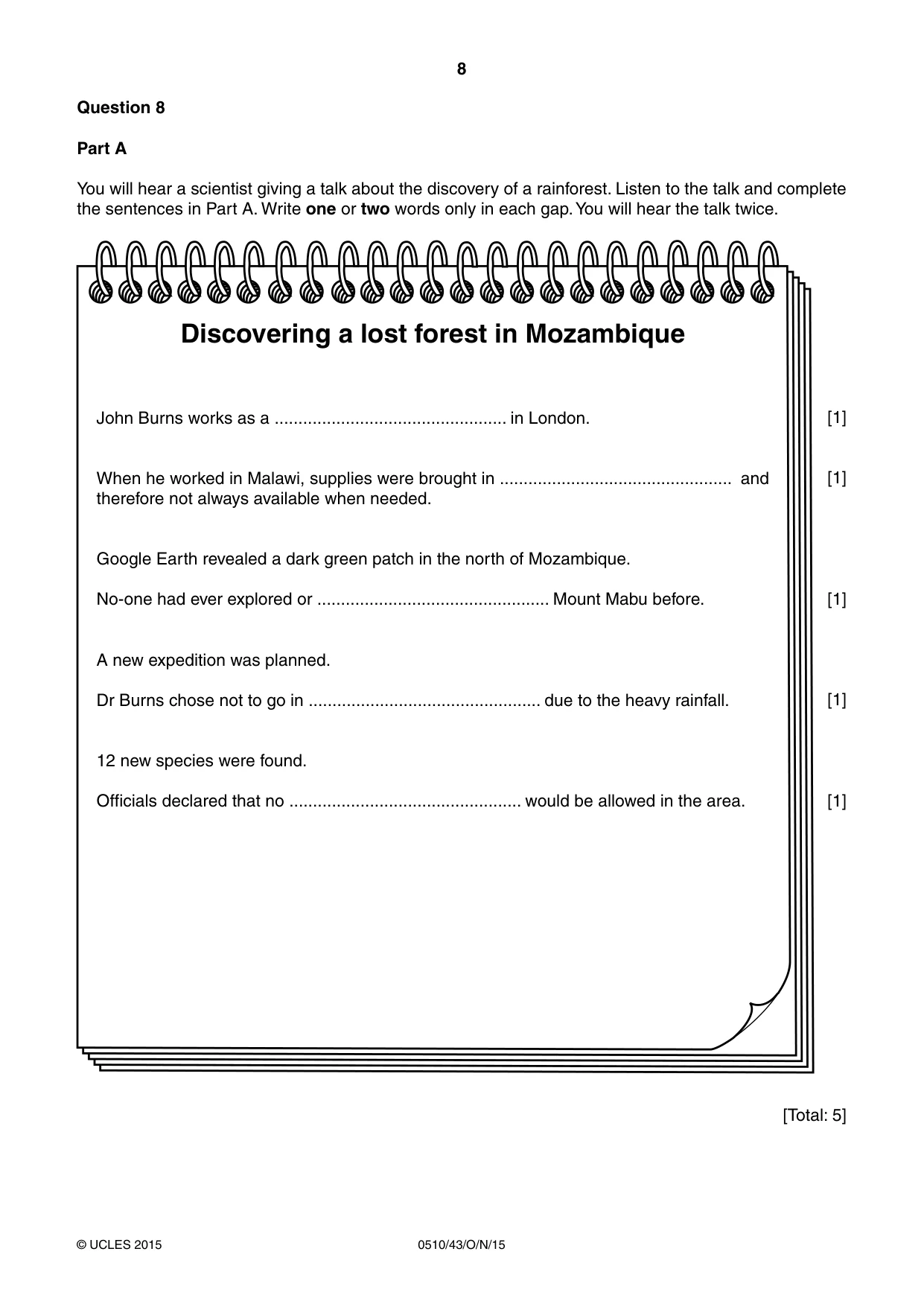
8 0510/43/O/N/15 © UCLES 2015 Question 8 Part A You will hear a scientist giving a talk about the discovery of a rainforest. Listen to the talk and complete the sentences in Part A. Write one or two words only in each gap. You will hear the talk twice. Discovering a lost forest in Mozambique John Burns works as a … in London. When he worked in Malawi, supplies were brought in … and therefore not always available when needed. Google Earth revealed a dark green patch in the north of Mozambique. No-one had ever explored or … Mount Mabu before. A new expedition was planned. Dr Burns chose not to go in … due to the heavy rainfall. 12 new species were found. Officials declared that no … would be allowed in the area. [1] [1] [1] [1] [1] [Total: 5]
Question paper, page 9
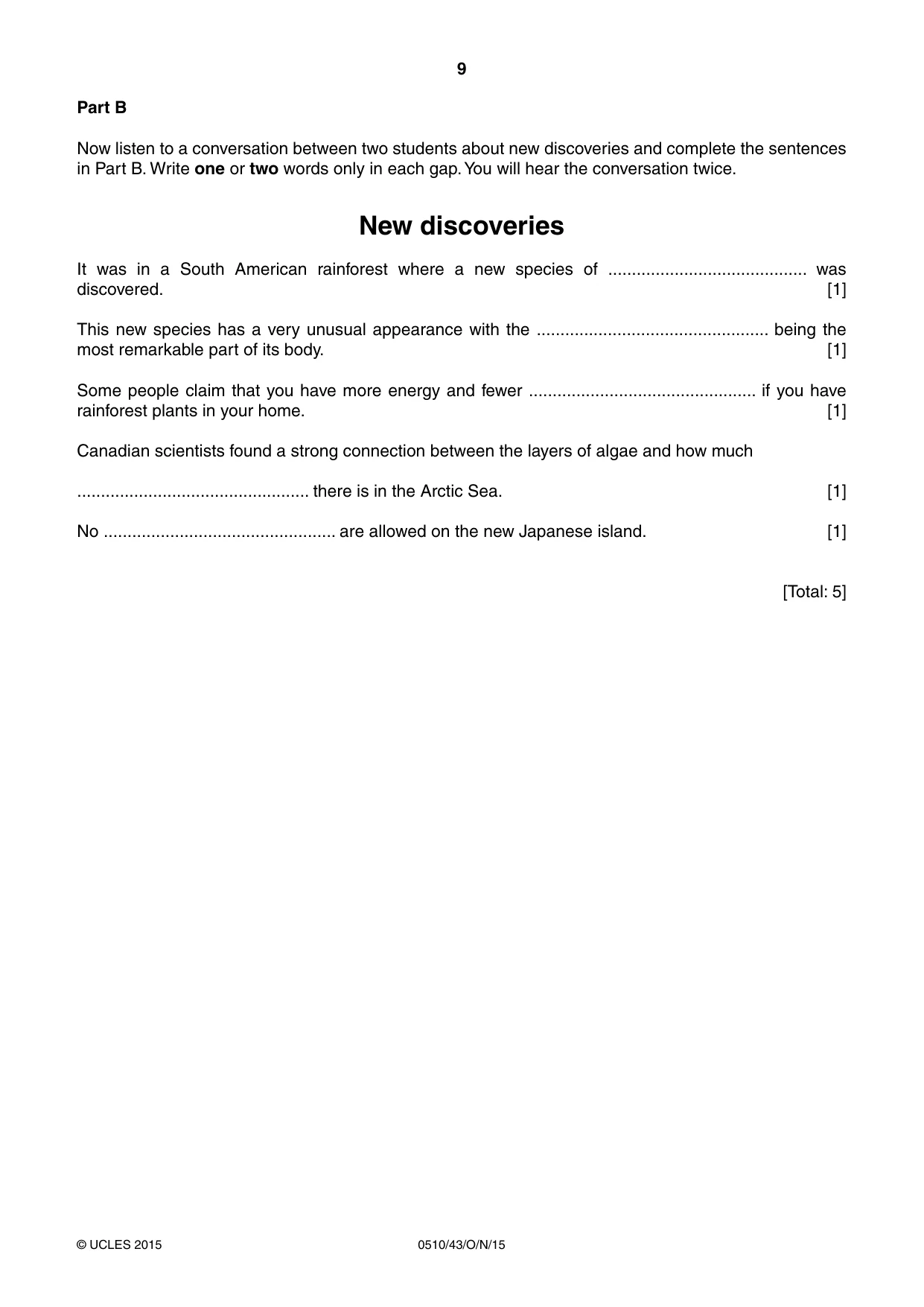
9 0510/43/O/N/15 © UCLES 2015 Part B Now listen to a conversation between two students about new discoveries and complete the sentences in Part B. Write one or two words only in each gap. You will hear the conversation twice. New discoveries It was in a South American rainforest where a new species of … was discovered. [1] This new species has a very unusual appearance with the … being the most remarkable part of its body. [1] Some people claim that you have more energy and fewer … if you have rainforest plants in your home. [1] Canadian scientists found a strong connection between the layers of algae and how much … there is in the Arctic Sea. [1] No … are allowed on the new Japanese island. [1] [Total: 5]
Question paper, page 10
10 0510/43/O/N/15 © UCLES 2015 BLANK PAGE
Question paper, page 11
11 0510/43/O/N/15 © UCLES 2015 BLANK PAGE
Question paper, page 12
12 0510/43/O/N/15 © UCLES 2015 Permission to reproduce items where third-party owned material protected by copyright is included has been sought and cleared where possible. Every reasonable effort has been made by the publisher (UCLES) to trace copyright holders, but if any items requiring clearance have unwittingly been included, the publisher will be pleased to make amends at the earliest possible opportunity. To avoid the issue of disclosure of answer-related information to candidates, all copyright acknowledgements are reproduced online in the Cambridge International Examinations Copyright Acknowledgements Booklet. This is produced for each series of examinations and is freely available to download at www.cie.org.uk after the live examination series. Cambridge International Examinations is part of the Cambridge Assessment Group. Cambridge Assessment is the brand name of University of Cambridge Local Examinations Syndicate (UCLES), which is itself a department of the University of Cambridge. BLANK PAGE
Mark scheme, page 1
® IGCSE is the registered trademark of Cambridge International Examinations. CAMBRIDGE INTERNATIONAL EXAMINATIONS Cambridge International General Certificate of Secondary Education MARK SCHEME for the October/November 2015 series 0510 ENGLISH AS A SECOND LANGUAGE 0510/43 Paper 4 (Listening – Extended), maximum raw mark 40 This mark scheme is published as an aid to teachers and candidates, to indicate the requirements of the examination. It shows the basis on which Examiners were instructed to award marks. It does not indicate the details of the discussions that took place at an Examiners’ meeting before marking began, which would have considered the acceptability of alternative answers. Mark schemes should be read in conjunction with the question paper and the Principal Examiner Report for Teachers. Cambridge will not enter into discussions about these mark schemes. Cambridge is publishing the mark schemes for the October/November 2015 series for most Cambridge IGCSE®, Cambridge International A and AS Level components and some Cambridge O Level components.
Mark scheme, page 2
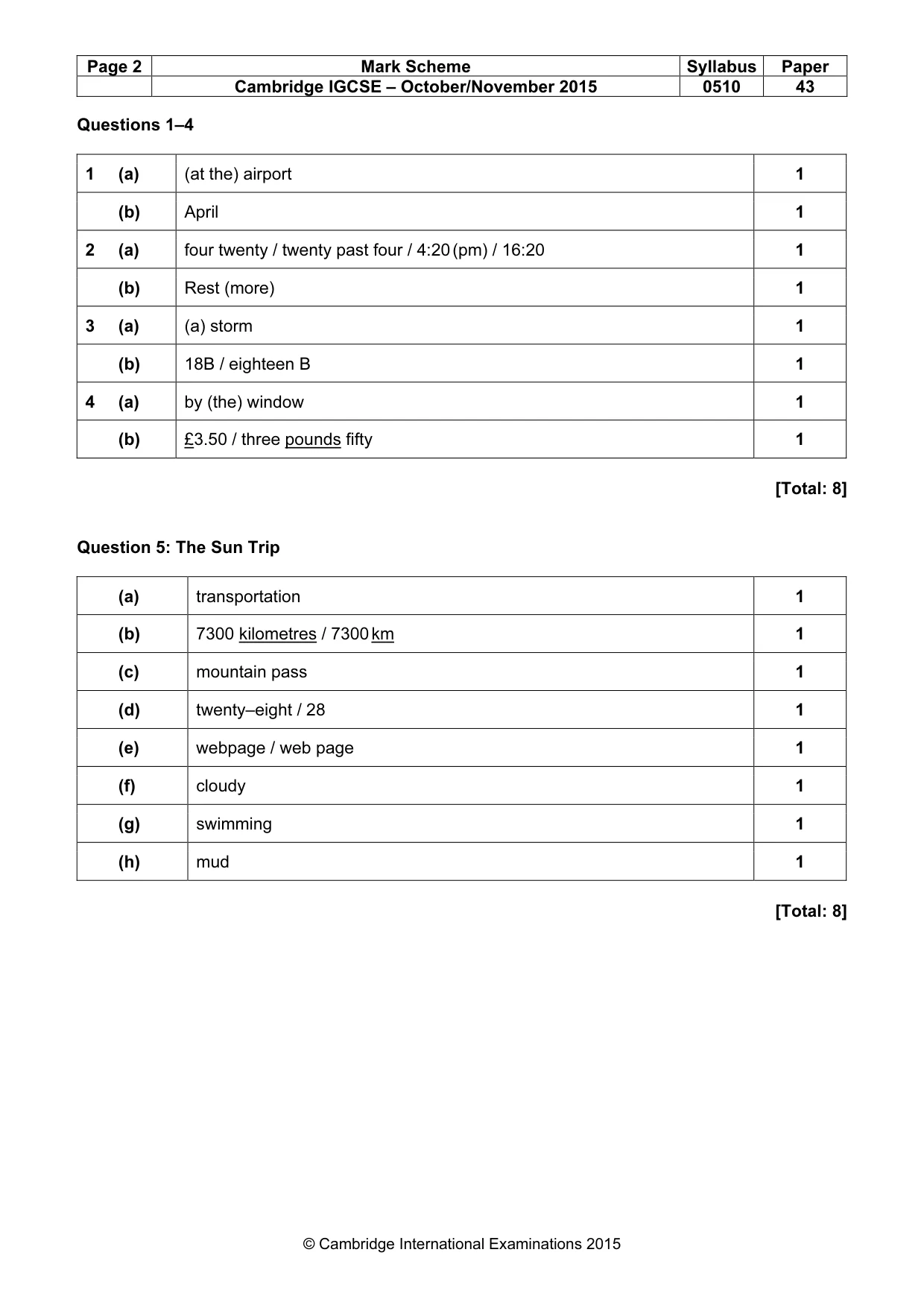
Page 2 Mark Scheme Syllabus Paper Cambridge IGCSE – October/November 2015 0510 43 © Cambridge International Examinations 2015 Questions 1–4 1 (a) (at the) airport 1 (b) April 1 2 (a) four twenty / twenty past four / 4:20 (pm) / 16:20 1 (b) Rest (more) 1 3 (a) (a) storm 1 (b) 18B / eighteen B 1 4 (a) by (the) window 1 (b) £3.50 / three pounds fifty 1 [Total: 8] Question 5: The Sun Trip (a) transportation 1 (b) 7300 kilometres / 7300 km 1 (c) mountain pass 1 (d) twenty–eight / 28 1 (e) webpage / web page 1 (f) cloudy 1 (g) swimming 1 (h) mud 1 [Total: 8]
Mark scheme, page 3
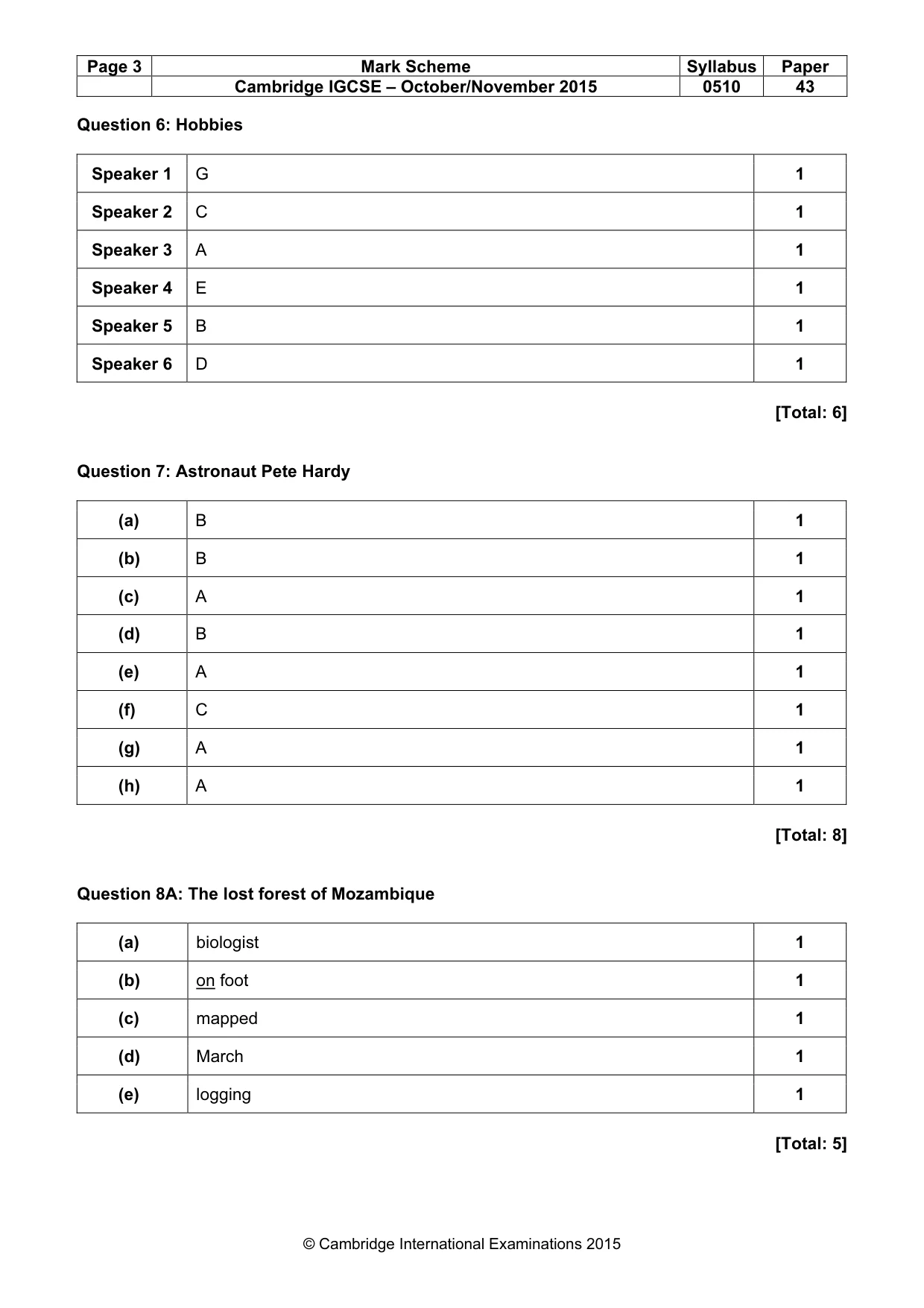
Page 3 Mark Scheme Syllabus Paper Cambridge IGCSE – October/November 2015 0510 43 © Cambridge International Examinations 2015 Question 6: Hobbies Speaker 1 G 1 Speaker 2 C 1 Speaker 3 A 1 Speaker 4 E 1 Speaker 5 B 1 Speaker 6 D 1 [Total: 6] Question 7: Astronaut Pete Hardy (a) B 1 (b) B 1 (c) A 1 (d) B 1 (e) A 1 (f) C 1 (g) A 1 (h) A 1 [Total: 8] Question 8A: The lost forest of Mozambique (a) biologist 1 (b) on foot 1 (c) mapped 1 (d) March 1 (e) logging 1 [Total: 5]
Mark scheme, page 4
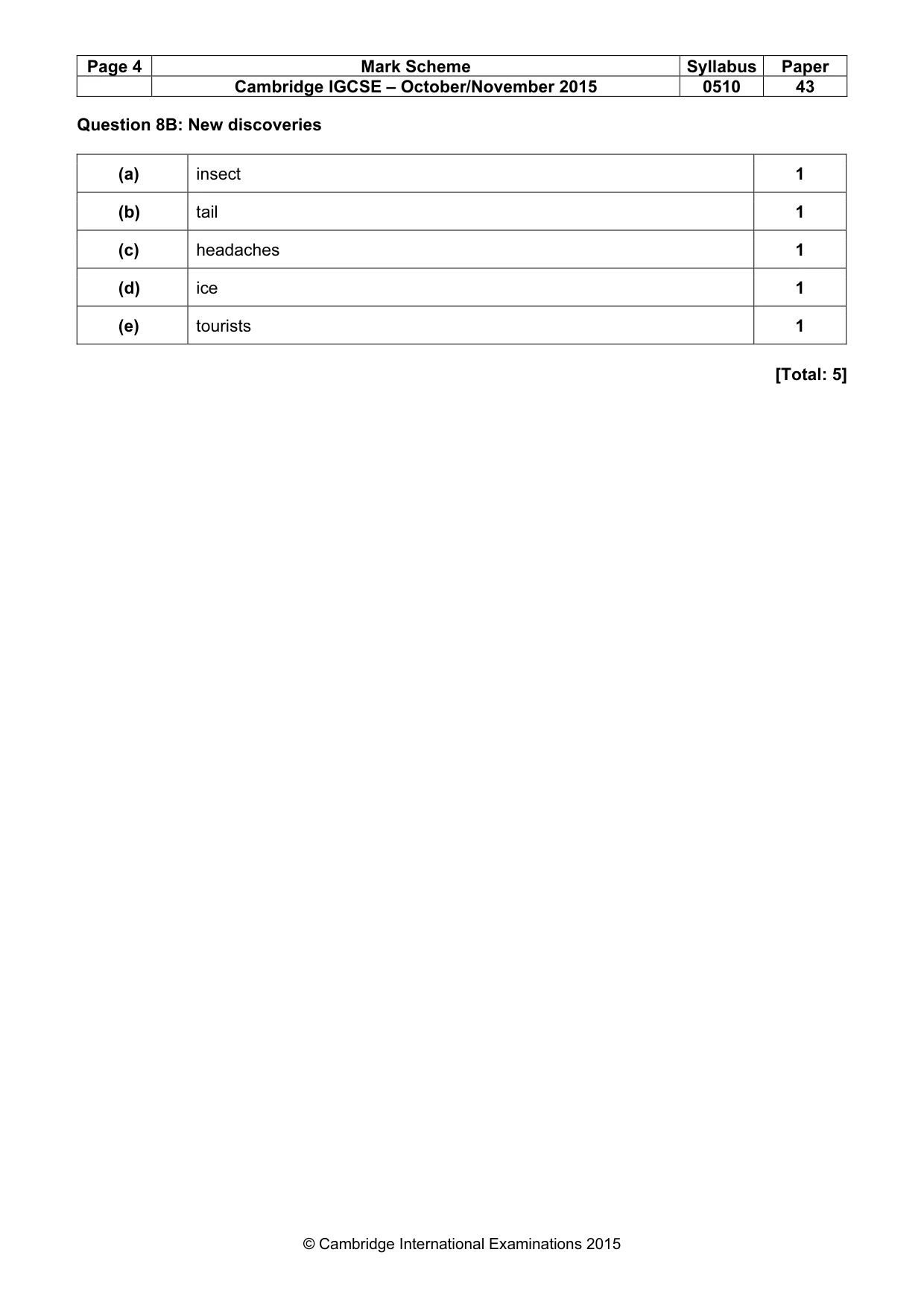
Page 4 Mark Scheme Syllabus Paper Cambridge IGCSE – October/November 2015 0510 43 © Cambridge International Examinations 2015 Question 8B: New discoveries (a) insect 1 (b) tail 1 (c) headaches 1 (d) ice 1 (e) tourists 1 [Total: 5]
Mark scheme, page 5
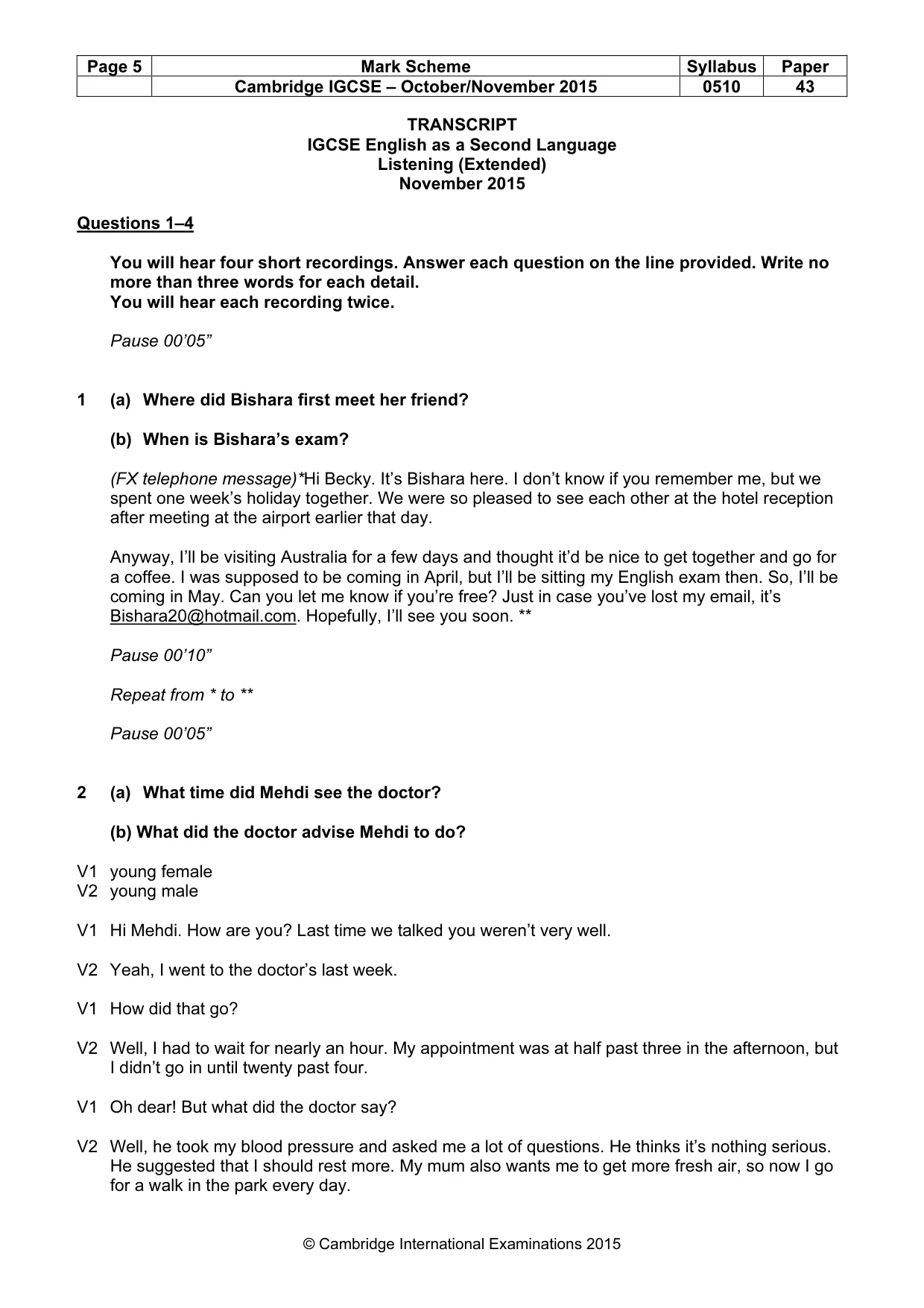
Page 5 Mark Scheme Syllabus Paper Cambridge IGCSE – October/November 2015 0510 43 © Cambridge International Examinations 2015 TRANSCRIPT IGCSE English as a Second Language Listening (Extended) November 2015 Questions 1–4 You will hear four short recordings. Answer each question on the line provided. Write no more than three words for each detail. You will hear each recording twice. Pause 00’05” 1 (a) Where did Bishara first meet her friend? (b) When is Bishara’s exam? (FX telephone message)*Hi Becky. It’s Bishara here. I don’t know if you remember me, but we spent one week’s holiday together. We were so pleased to see each other at the hotel reception after meeting at the airport earlier that day. Anyway, I’ll be visiting Australia for a few days and thought it’d be nice to get together and go for a coffee. I was supposed to be coming in April, but I’ll be sitting my English exam then. So, I’ll be coming in May. Can you let me know if you’re free? Just in case you’ve lost my email, it’s Bishara20@hotmail.com. Hopefully, I’ll see you soon. ** Pause 00’10” Repeat from * to ** Pause 00’05” 2 (a) What time did Mehdi see the doctor? (b) What did the doctor advise Mehdi to do? V1 young female V2 young male V1 Hi Mehdi. How are you? Last time we talked you weren’t very well. V2 Yeah, I went to the doctor’s last week. V1 How did that go? V2 Well, I had to wait for nearly an hour. My appointment was at half past three in the afternoon, but I didn’t go in until twenty past four. V1 Oh dear! But what did the doctor say? V2 Well, he took my blood pressure and asked me a lot of questions. He thinks it’s nothing serious. He suggested that I should rest more. My mum also wants me to get more fresh air, so now I go for a walk in the park every day.
Mark scheme, page 6
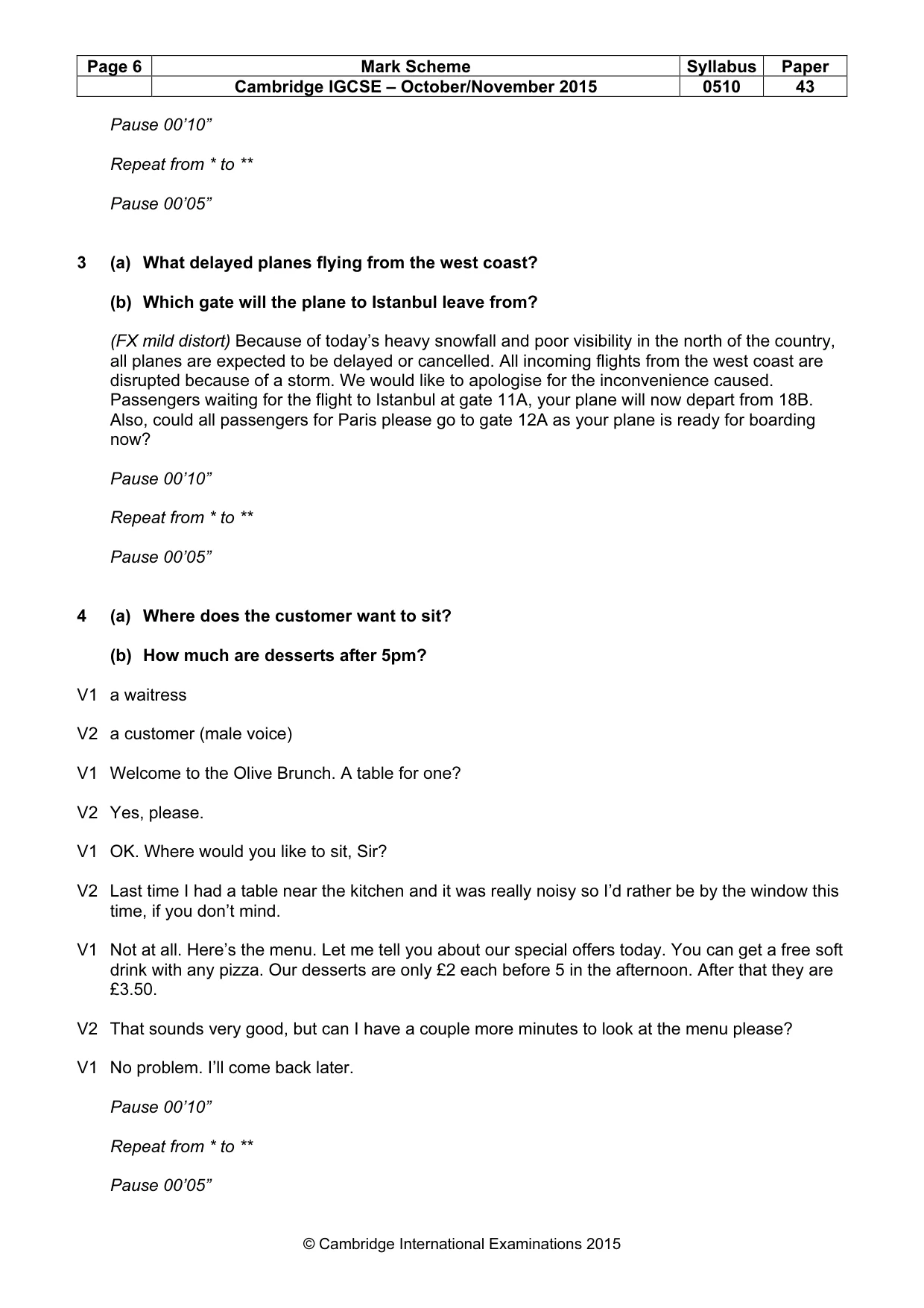
Page 6 Mark Scheme Syllabus Paper Cambridge IGCSE – October/November 2015 0510 43 © Cambridge International Examinations 2015 Pause 00’10” Repeat from * to ** Pause 00’05” 3 (a) What delayed planes flying from the west coast? (b) Which gate will the plane to Istanbul leave from? (FX mild distort) Because of today’s heavy snowfall and poor visibility in the north of the country, all planes are expected to be delayed or cancelled. All incoming flights from the west coast are disrupted because of a storm. We would like to apologise for the inconvenience caused. Passengers waiting for the flight to Istanbul at gate 11A, your plane will now depart from 18B. Also, could all passengers for Paris please go to gate 12A as your plane is ready for boarding now? Pause 00’10” Repeat from * to ** Pause 00’05” 4 (a) Where does the customer want to sit? (b) How much are desserts after 5pm? V1 a waitress V2 a customer (male voice) V1 Welcome to the Olive Brunch. A table for one? V2 Yes, please. V1 OK. Where would you like to sit, Sir? V2 Last time I had a table near the kitchen and it was really noisy so I’d rather be by the window this time, if you don’t mind. V1 Not at all. Here’s the menu. Let me tell you about our special offers today. You can get a free soft drink with any pizza. Our desserts are only £2 each before 5 in the afternoon. After that they are £3.50. V2 That sounds very good, but can I have a couple more minutes to look at the menu please? V1 No problem. I’ll come back later. Pause 00’10” Repeat from * to ** Pause 00’05”
Mark scheme, page 7
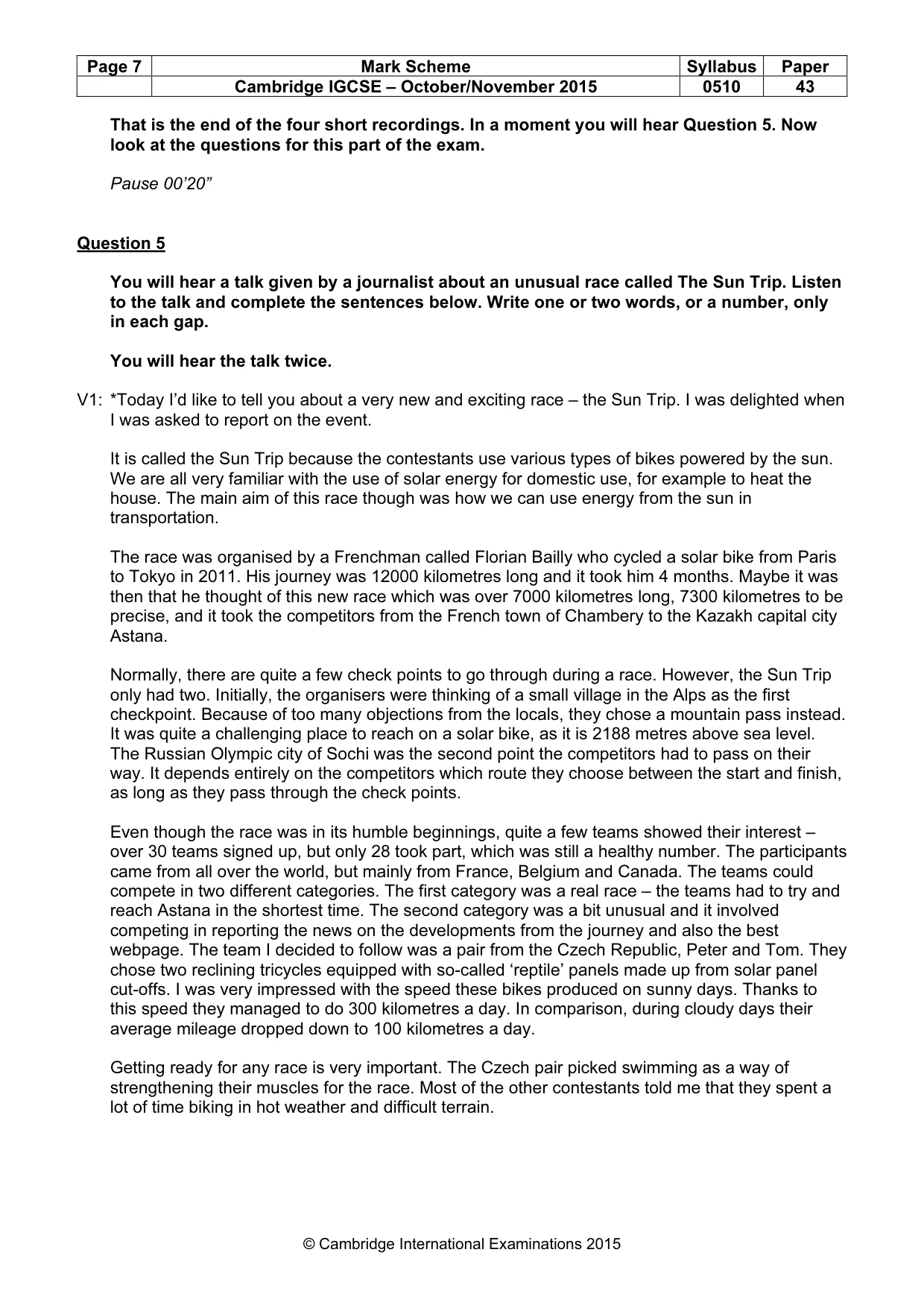
Page 7 Mark Scheme Syllabus Paper Cambridge IGCSE – October/November 2015 0510 43 © Cambridge International Examinations 2015 That is the end of the four short recordings. In a moment you will hear Question 5. Now look at the questions for this part of the exam. Pause 00’20” Question 5 You will hear a talk given by a journalist about an unusual race called The Sun Trip. Listen to the talk and complete the sentences below. Write one or two words, or a number, only in each gap. You will hear the talk twice. V1: *Today I’d like to tell you about a very new and exciting race – the Sun Trip. I was delighted when I was asked to report on the event. It is called the Sun Trip because the contestants use various types of bikes powered by the sun. We are all very familiar with the use of solar energy for domestic use, for example to heat the house. The main aim of this race though was how we can use energy from the sun in transportation. The race was organised by a Frenchman called Florian Bailly who cycled a solar bike from Paris to Tokyo in 2011. His journey was 12000 kilometres long and it took him 4 months. Maybe it was then that he thought of this new race which was over 7000 kilometres long, 7300 kilometres to be precise, and it took the competitors from the French town of Chambery to the Kazakh capital city Astana. Normally, there are quite a few check points to go through during a race. However, the Sun Trip only had two. Initially, the organisers were thinking of a small village in the Alps as the first checkpoint. Because of too many objections from the locals, they chose a mountain pass instead. It was quite a challenging place to reach on a solar bike, as it is 2188 metres above sea level. The Russian Olympic city of Sochi was the second point the competitors had to pass on their way. It depends entirely on the competitors which route they choose between the start and finish, as long as they pass through the check points. Even though the race was in its humble beginnings, quite a few teams showed their interest – over 30 teams signed up, but only 28 took part, which was still a healthy number. The participants came from all over the world, but mainly from France, Belgium and Canada. The teams could compete in two different categories. The first category was a real race – the teams had to try and reach Astana in the shortest time. The second category was a bit unusual and it involved competing in reporting the news on the developments from the journey and also the best webpage. The team I decided to follow was a pair from the Czech Republic, Peter and Tom. They chose two reclining tricycles equipped with so-called ‘reptile’ panels made up from solar panel cut-offs. I was very impressed with the speed these bikes produced on sunny days. Thanks to this speed they managed to do 300 kilometres a day. In comparison, during cloudy days their average mileage dropped down to 100 kilometres a day. Getting ready for any race is very important. The Czech pair picked swimming as a way of strengthening their muscles for the race. Most of the other contestants told me that they spent a lot of time biking in hot weather and difficult terrain.
Mark scheme, page 8
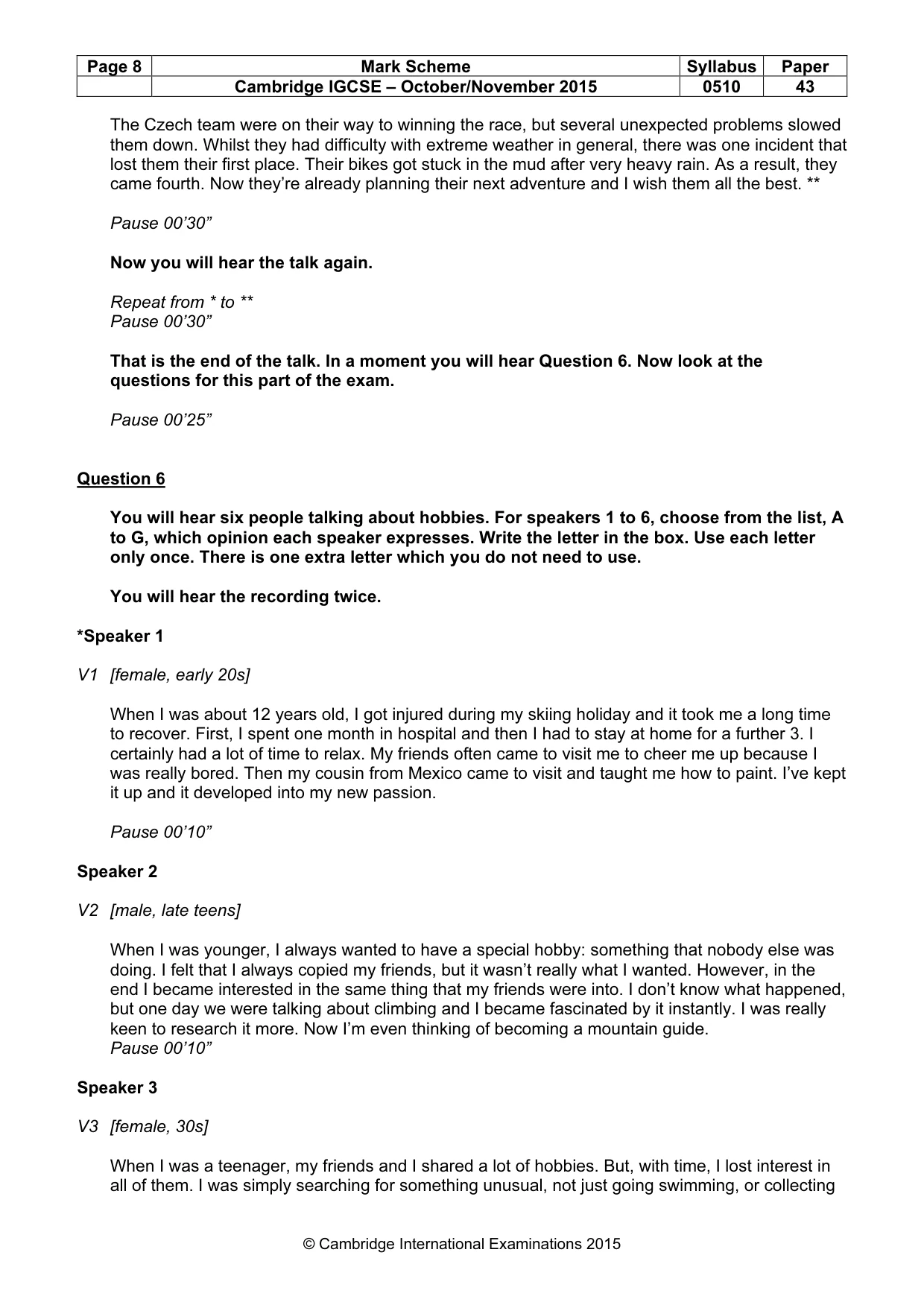
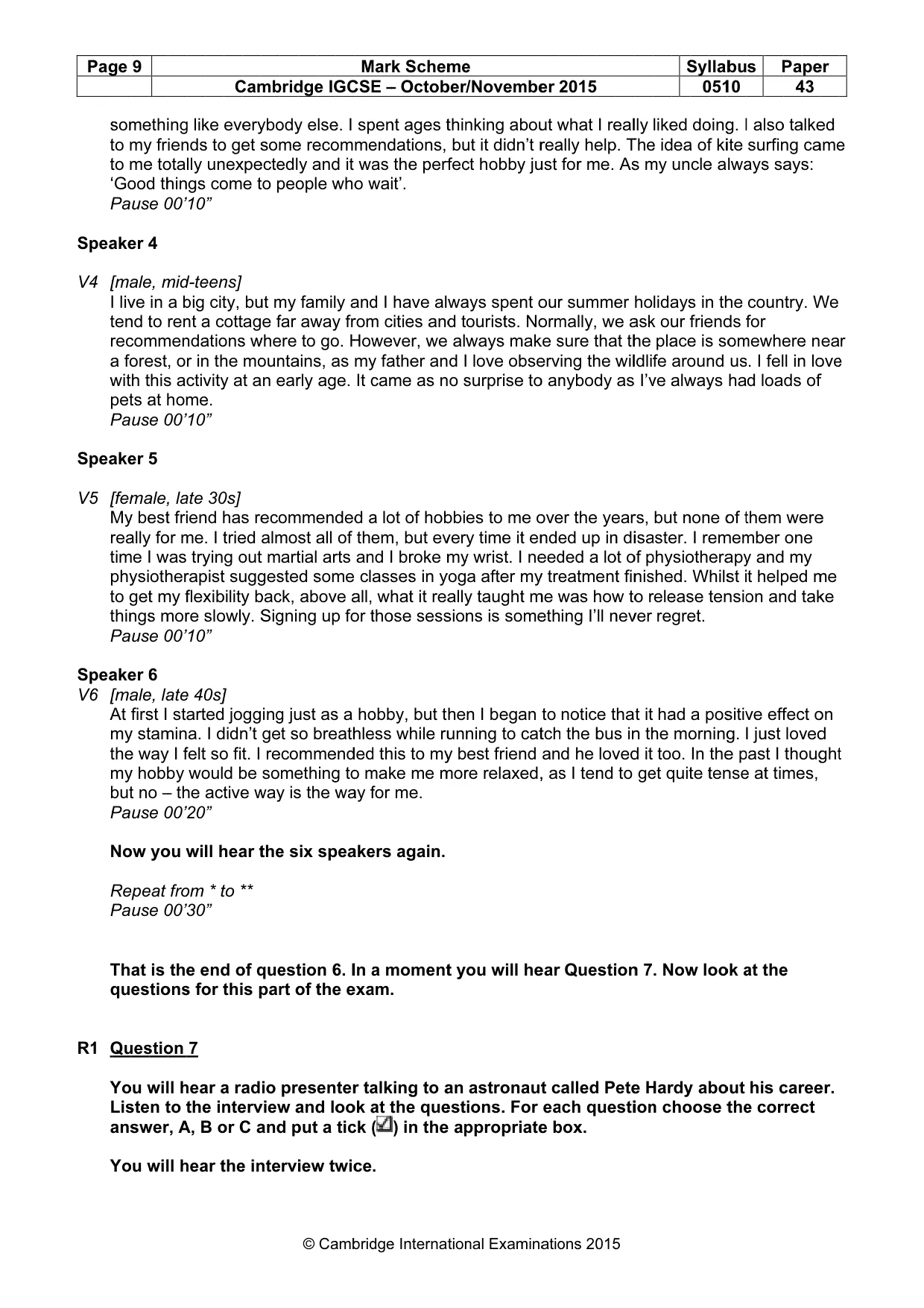
Page 8 Mark Scheme Syllabus Paper Cambridge IGCSE – October/November 2015 0510 43 © Cambridge International Examinations 2015 The Czech team were on their way to winning the race, but several unexpected problems slowed them down. Whilst they had difficulty with extreme weather in general, there was one incident that lost them their first place. Their bikes got stuck in the mud after very heavy rain. As a result, they came fourth. Now they’re already planning their next adventure and I wish them all the best. ** Pause 00’30” Now you will hear the talk again. Repeat from * to ** Pause 00’30” That is the end of the talk. In a moment you will hear Question 6. Now look at the questions for this part of the exam. Pause 00’25” Question 6 You will hear six people talking about hobbies. For speakers 1 to 6, choose from the list, A to G, which opinion each speaker expresses. Write the letter in the box. Use each letter only once. There is one extra letter which you do not need to use. You will hear the recording twice. *Speaker 1 V1 [female, early 20s] When I was about 12 years old, I got injured during my skiing holiday and it took me a long time to recover. First, I spent one month in hospital and then I had to stay at home for a further 3. I certainly had a lot of time to relax. My friends often came to visit me to cheer me up because I was really bored. Then my cousin from Mexico came to visit and taught me how to paint. I’ve kept it up and it developed into my new passion. Pause 00’10” Speaker 2 V2 [male, late teens] When I was younger, I always wanted to have a special hobby: something that nobody else was doing. I felt that I always copied my friends, but it wasn’t really what I wanted. However, in the end I became interested in the same thing that my friends were into. I don’t know what happened, but one day we were talking about climbing and I became fascinated by it instantly. I was really keen to research it more. Now I’m even thinking of becoming a mountain guide. Pause 00’10” Speaker 3 V3 [female, 30s] When I was a teenager, my friends and I shared a lot of hobbies. But, with time, I lost interest in all of them. I was simply searching for something unusual, not just going swimming, or collecting
Mark scheme, page 9
P Sp V4 Sp V5 Sp V6 R1 Pag s t t ‘ P pea 4 [ I t r a w p P pea 5 [ M r t p t t P pea 6 [ A m t m b P N R P T q 1 Q Y L a Y ge som to m to m ‘Go Pa ake [ma I liv ten rec a fo wit pet Pa ake [fem My rea tim phy to g thin Pa ake [ma At my the my but Pa No Re Pa Th qu Qu Yo Lis ans Yo 9 me my me ood us er 4 ale ve nd t com ore th t ts a us er 5 ma y be ally me I ysi get ngs us er 6 ale firs y st e w y ho t no us ow epe us at es ues ou w ste sw ou w ethi y fr e to d th e 0 4 e, m in to mm est this at h e 0 5 ale, est y fo I w oth t m s m e 0 6 e, la st I tam way obb o – e 0 yo eat e 0 is tio stio wil n t wer wil ing ien ota hin 00’ mid a b ren men , o s a hom 00’ , la t fri or m was her my f mor 00’ ate st min y I f by – th 00’ ou w fro 00’ the ons on ll h to t r, A ll h g lik nds lly ngs ’10 d-te big nt a nda r in ctiv me ’10 ate ien me try rap flex re s ’10 e 40 art a. felt wo he ’20 wil om ’30 e e s fo 7 hea the A, B hea ke s to un co ” een cit a c atio n th vity e. ” 30 nd h . I t yin pist xib slo ” 0s] ted I d t so oul act ” ll h * t ” end or t ar a e in B o ar t C eve o ge nex om ns] ty, ott ons he y a 0s] has trie g o t su bility owly ] jo didn o fit d b tive hea to * d o thi a ra nte or C the Cam ery et s xpe e t bu tag s w mo t a s re ed out ugg y b y. S gg n’t t. I be e w ar t ** of q s p ad erv C a e in mb ybo som ecte to p ut m e f whe oun an e eco alm t m ges bac Sig ing ge re so way the que par io view and nte brid ody me edl peo my far ere nta ear om mos art ste ck, gni g ju et s eco me y is e s est rt o pre w a d p ervi dge © y e e re y a opl fam aw to ains rly mme st a tial d s ab ng ust o b mm eth s th ix tio of t es and put iew e IG Ca lse eco and e w mil way go s, a ag end all ar som bov up as bre me ing he w sp n 6 the en d lo t a w tw GC amb e. I om d it who y a y fr o. H as e. ded of rts me ve a p fo s a eath end g to wa pea 6. I e e ter oo tic wic M CSE brid sp me wa o w and rom How my It c d a the an cla all, or t ho hle ded o m ay f ake In a exa r ta ok a ck ( ce Mar E – dge pen end as wai d I m c we y fa cam a lo em nd I ass wh tho obb ess d th mak for ers a m am. alk at t ( . k S – O e In nt a dat the it’. ha citie eve athe me ot o m, b I br ses hat ose by, wh his ke me ag mo . king the ) in Sch Oct nter age tion e p ave es a r, w er e as of h but rok s in t it e se bu hile to me e. gai me g t e q n t hem ob rnat es t ns, perf alw and we an s n hob ev ke m n y rea ess ut t e ru my e m in. ent o a que he me ber/ tion thin bu fec wa d t alw d I o s bbi very my yog ally sion he unn y b mor t y an est e ap e /No nal nki ut it ct h ays ou wa lo sur es y ti y w a a y ta ns n I nin est re r ou as ion ppr ove Ex ng t d hob s sp rist ays ve rpri to ime wris afte aug is be ng t t fr rela u w stro ns. rop em xam ab idn bby pen ts. s m ob ise me e it t. I er m ght so ega to c rien axe will ona . Fo pri mbe mina bou n’t r y ju nt o No mak bse e to e o t en ne my t m me an cat nd ed, he aut or ate er 2 atio ut w rea ust our orm ke s erv o an ove nde eed y tre me w eth to tch an , as ear t c ea e b 20 ons wh ally for r su mal sur ing nyb er t ed ded eat wa ing no h th d h s I r Q call ach box 15 s 20 at y he r m um lly, re t g th bod the up d a tme as h g I’ otic he b he ten ue ed h q x. 015 I re elp me. mme we tha he w dy ye p in a lo ent how ll n e t bus lov nd sti d P ue 5 eal p. T As er e a at th wil as ear n di ot o t fin w to nev ha s in ved to ion ete esti lly The s m ho ask he ldlif I’v rs, isa of p nis o r ver t it n th d it ge n 7 e H ion like e id my lida k ou pla fe ve a bu aste phy she rele re ha he to et q . N Har n c S ed dea un ays ur f ace aro alw t n er. ysio ed. eas gre ad mo o. quit Now rdy ho Syl 0 do a of cle s in frie e is oun way non I re oth W se t et. a p orn In te t w lo y ab oos llab 051 oing f ki e a n th end s so nd ys ne o em era hils ten pos ning the ten oo bo se t bu 10 g. I ite lwa he ds f om us ha of t mem apy st i nsio sitiv g. e p nse ok a out the s I al su ays co for mew s. I d l the mb y a it h on ve I ju pas e at at t his e c P lso rfin s sa un r whe fel oa em er nd help an eff ust t I t tim the s c cor Pa 4 o ta ng ays try ere l in ds we on m ped nd t fec lov tho me e car rrec pe 43 alke ca s: y. W e n n lo of ere e my d m tak ct o ved oug es, ree ct er ed ame We ea ove f e me ke on d ght er. e r e t
Mark scheme, page 10
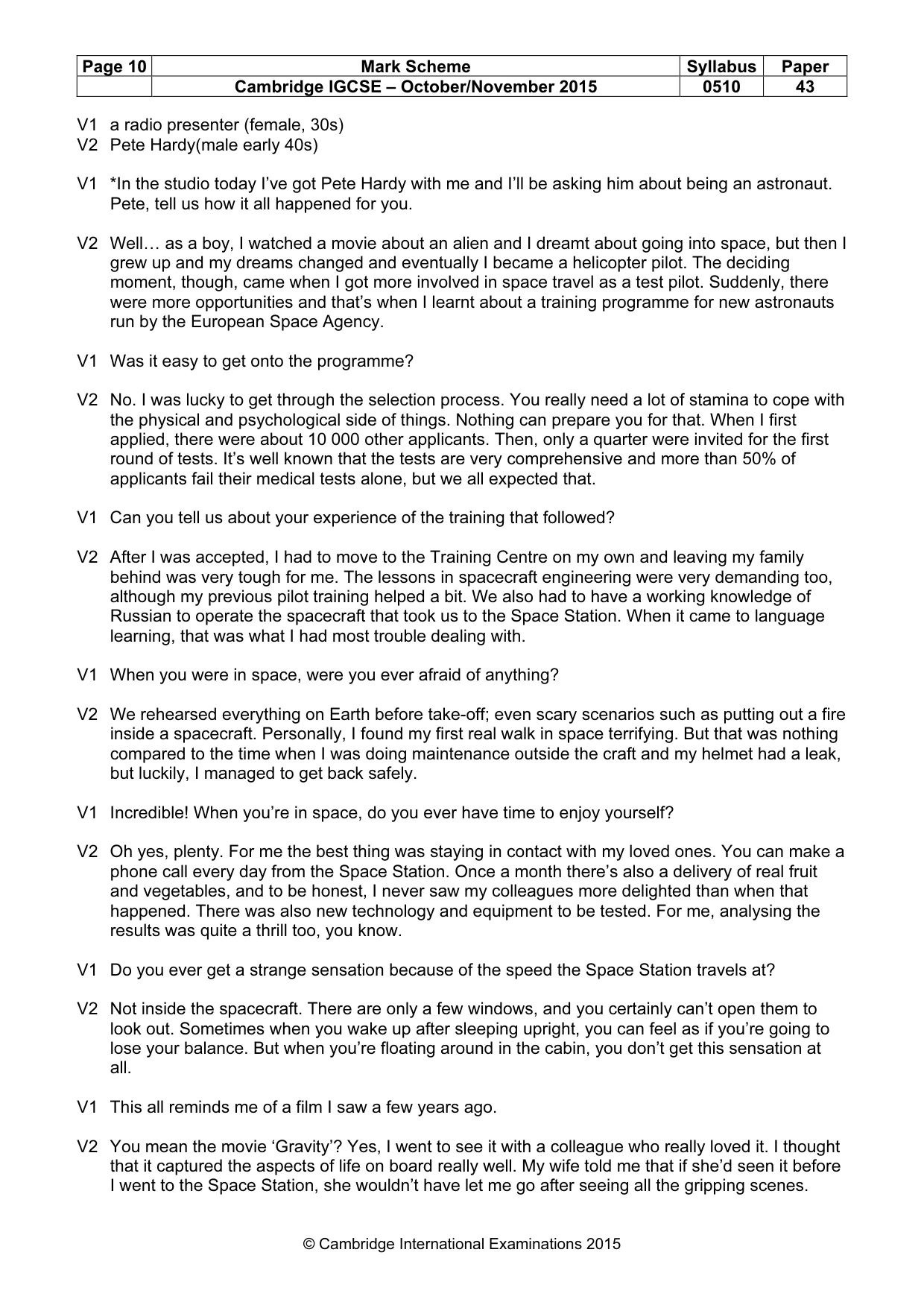
Page 10 Mark Scheme Syllabus Paper Cambridge IGCSE – October/November 2015 0510 43 © Cambridge International Examinations 2015 V1 a radio presenter (female, 30s) V2 Pete Hardy(male early 40s) V1 *In the studio today I’ve got Pete Hardy with me and I’ll be asking him about being an astronaut. Pete, tell us how it all happened for you. V2 Well… as a boy, I watched a movie about an alien and I dreamt about going into space, but then I grew up and my dreams changed and eventually I became a helicopter pilot. The deciding moment, though, came when I got more involved in space travel as a test pilot. Suddenly, there were more opportunities and that’s when I learnt about a training programme for new astronauts run by the European Space Agency. V1 Was it easy to get onto the programme? V2 No. I was lucky to get through the selection process. You really need a lot of stamina to cope with the physical and psychological side of things. Nothing can prepare you for that. When I first applied, there were about 10 000 other applicants. Then, only a quarter were invited for the first round of tests. It’s well known that the tests are very comprehensive and more than 50% of applicants fail their medical tests alone, but we all expected that. V1 Can you tell us about your experience of the training that followed? V2 After I was accepted, I had to move to the Training Centre on my own and leaving my family behind was very tough for me. The lessons in spacecraft engineering were very demanding too, although my previous pilot training helped a bit. We also had to have a working knowledge of Russian to operate the spacecraft that took us to the Space Station. When it came to language learning, that was what I had most trouble dealing with. V1 When you were in space, were you ever afraid of anything? V2 We rehearsed everything on Earth before take-off; even scary scenarios such as putting out a fire inside a spacecraft. Personally, I found my first real walk in space terrifying. But that was nothing compared to the time when I was doing maintenance outside the craft and my helmet had a leak, but luckily, I managed to get back safely. V1 Incredible! When you’re in space, do you ever have time to enjoy yourself? V2 Oh yes, plenty. For me the best thing was staying in contact with my loved ones. You can make a phone call every day from the Space Station. Once a month there’s also a delivery of real fruit and vegetables, and to be honest, I never saw my colleagues more delighted than when that happened. There was also new technology and equipment to be tested. For me, analysing the results was quite a thrill too, you know. V1 Do you ever get a strange sensation because of the speed the Space Station travels at? V2 Not inside the spacecraft. There are only a few windows, and you certainly can’t open them to look out. Sometimes when you wake up after sleeping upright, you can feel as if you’re going to lose your balance. But when you’re floating around in the cabin, you don’t get this sensation at all. V1 This all reminds me of a film I saw a few years ago. V2 You mean the movie ‘Gravity’? Yes, I went to see it with a colleague who really loved it. I thought that it captured the aspects of life on board really well. My wife told me that if she’d seen it before I went to the Space Station, she wouldn’t have let me go after seeing all the gripping scenes.
Mark scheme, page 11
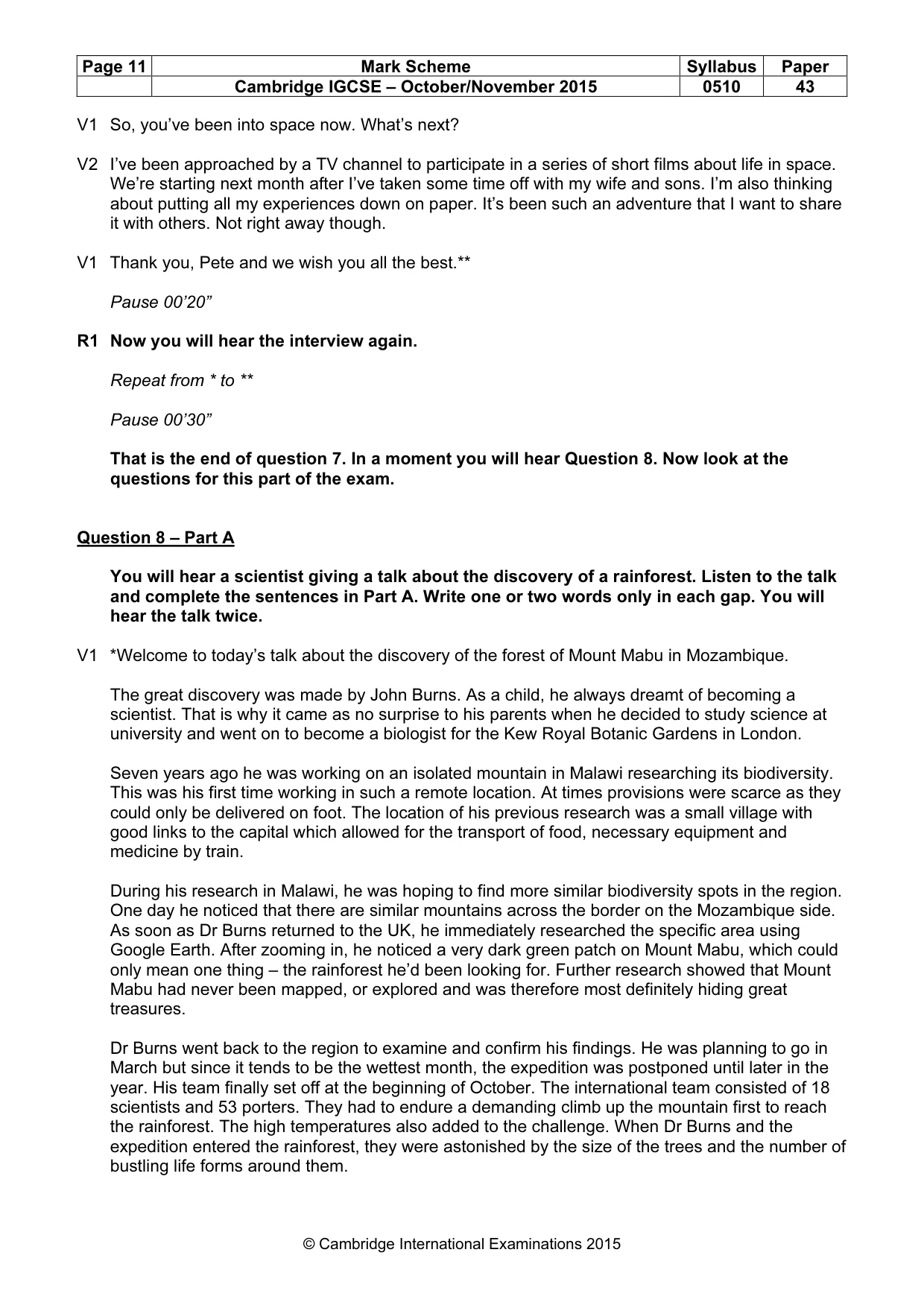
Page 11 Mark Scheme Syllabus Paper Cambridge IGCSE – October/November 2015 0510 43 © Cambridge International Examinations 2015 V1 So, you’ve been into space now. What’s next? V2 I’ve been approached by a TV channel to participate in a series of short films about life in space. We’re starting next month after I’ve taken some time off with my wife and sons. I’m also thinking about putting all my experiences down on paper. It’s been such an adventure that I want to share it with others. Not right away though. V1 Thank you, Pete and we wish you all the best.** Pause 00’20” R1 Now you will hear the interview again. Repeat from * to ** Pause 00’30” That is the end of question 7. In a moment you will hear Question 8. Now look at the questions for this part of the exam. Question 8 – Part A You will hear a scientist giving a talk about the discovery of a rainforest. Listen to the talk and complete the sentences in Part A. Write one or two words only in each gap. You will hear the talk twice. V1 *Welcome to today’s talk about the discovery of the forest of Mount Mabu in Mozambique. The great discovery was made by John Burns. As a child, he always dreamt of becoming a scientist. That is why it came as no surprise to his parents when he decided to study science at university and went on to become a biologist for the Kew Royal Botanic Gardens in London. Seven years ago he was working on an isolated mountain in Malawi researching its biodiversity. This was his first time working in such a remote location. At times provisions were scarce as they could only be delivered on foot. The location of his previous research was a small village with good links to the capital which allowed for the transport of food, necessary equipment and medicine by train. During his research in Malawi, he was hoping to find more similar biodiversity spots in the region. One day he noticed that there are similar mountains across the border on the Mozambique side. As soon as Dr Burns returned to the UK, he immediately researched the specific area using Google Earth. After zooming in, he noticed a very dark green patch on Mount Mabu, which could only mean one thing – the rainforest he’d been looking for. Further research showed that Mount Mabu had never been mapped, or explored and was therefore most definitely hiding great treasures. Dr Burns went back to the region to examine and confirm his findings. He was planning to go in March but since it tends to be the wettest month, the expedition was postponed until later in the year. His team finally set off at the beginning of October. The international team consisted of 18 scientists and 53 porters. They had to endure a demanding climb up the mountain first to reach the rainforest. The high temperatures also added to the challenge. When Dr Burns and the expedition entered the rainforest, they were astonished by the size of the trees and the number of bustling life forms around them.
Mark scheme, page 12
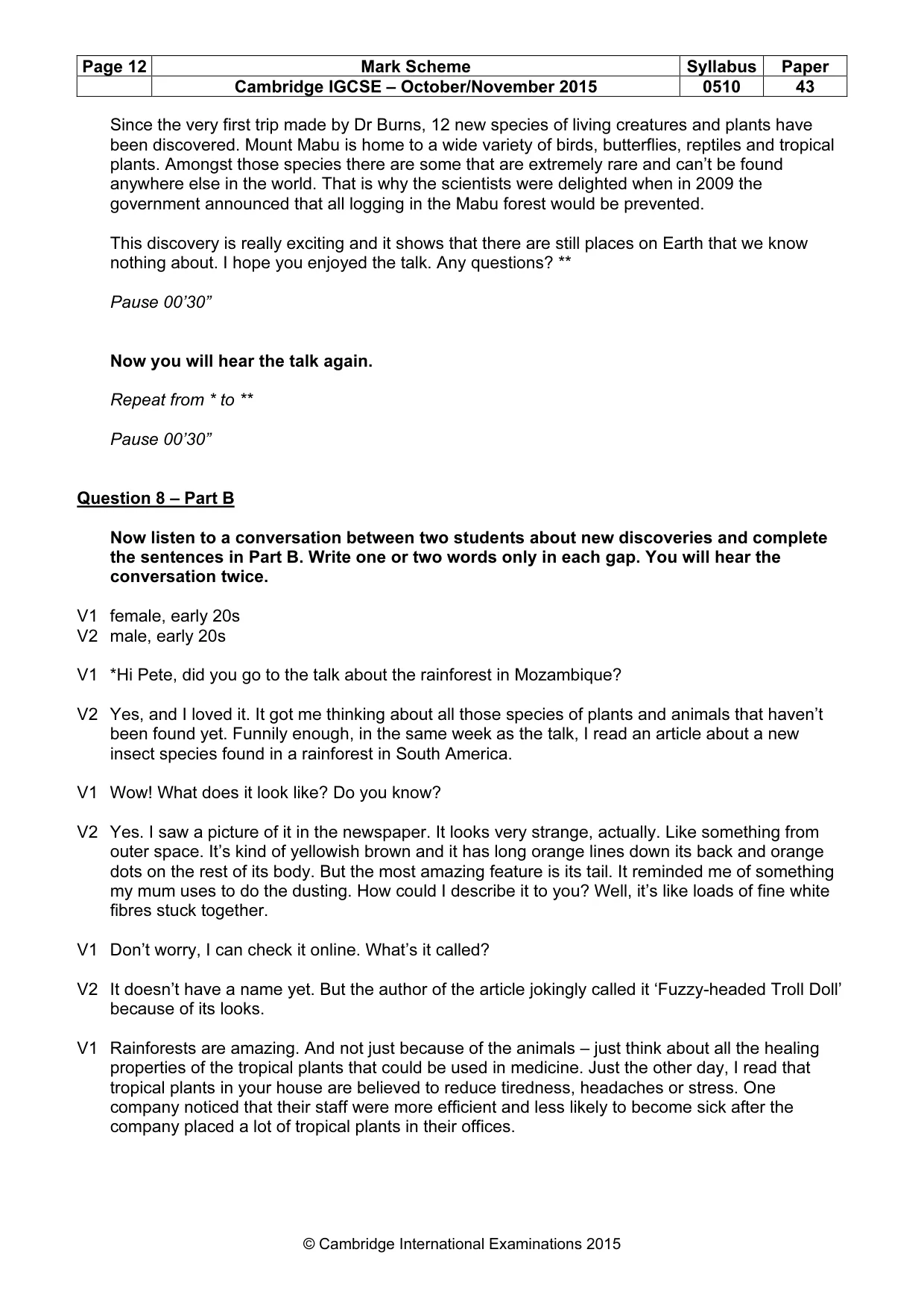
Page 12 Mark Scheme Syllabus Paper Cambridge IGCSE – October/November 2015 0510 43 © Cambridge International Examinations 2015 Since the very first trip made by Dr Burns, 12 new species of living creatures and plants have been discovered. Mount Mabu is home to a wide variety of birds, butterflies, reptiles and tropical plants. Amongst those species there are some that are extremely rare and can’t be found anywhere else in the world. That is why the scientists were delighted when in 2009 the government announced that all logging in the Mabu forest would be prevented. This discovery is really exciting and it shows that there are still places on Earth that we know nothing about. I hope you enjoyed the talk. Any questions? ** Pause 00’30” Now you will hear the talk again. Repeat from * to ** Pause 00’30” Question 8 – Part B Now listen to a conversation between two students about new discoveries and complete the sentences in Part B. Write one or two words only in each gap. You will hear the conversation twice. V1 female, early 20s V2 male, early 20s V1 *Hi Pete, did you go to the talk about the rainforest in Mozambique? V2 Yes, and I loved it. It got me thinking about all those species of plants and animals that haven’t been found yet. Funnily enough, in the same week as the talk, I read an article about a new insect species found in a rainforest in South America. V1 Wow! What does it look like? Do you know? V2 Yes. I saw a picture of it in the newspaper. It looks very strange, actually. Like something from outer space. It’s kind of yellowish brown and it has long orange lines down its back and orange dots on the rest of its body. But the most amazing feature is its tail. It reminded me of something my mum uses to do the dusting. How could I describe it to you? Well, it’s like loads of fine white fibres stuck together. V1 Don’t worry, I can check it online. What’s it called? V2 It doesn’t have a name yet. But the author of the article jokingly called it ‘Fuzzy-headed Troll Doll’ because of its looks. V1 Rainforests are amazing. And not just because of the animals – just think about all the healing properties of the tropical plants that could be used in medicine. Just the other day, I read that tropical plants in your house are believed to reduce tiredness, headaches or stress. One company noticed that their staff were more efficient and less likely to become sick after the company placed a lot of tropical plants in their offices.
Mark scheme, page 13
Page 13 Mark Scheme Syllabus Paper Cambridge IGCSE – October/November 2015 0510 43 © Cambridge International Examinations 2015 V2 Speaking of plants, this may interest you too. Scientists from Canada have discovered that if they analyse the layers of pink algae found on the arctic seafloor, they can get some interesting information. V1 What sort of information? V2 The changes in the plant show a direct link to a decrease in the amount of ice in the Arctic Sea. From this they can tell what climate changes have been happening over the centuries. It’s like a detailed history lesson in climate change. V1 Well, I have one interesting discovery for you as well. There is a new island close to Japan. V2 How come? V1 The island just emerged from the sea as a result of a volcanic eruption. It’s 220 metres long and it was spotted by Japan’s coastguards. The local authorities aren’t letting any tourists see it though because they think it might be too dangerous. V2 A new island! I haven’t heard something like this before. V1 Apparently, it’s happened before, but some of these islands disappear just as fast as they appear. V2 I’d better look into that. It sounds really fascinating. ** Pause 00’30” Now you will hear the conversation again. Repeat from * to ** Pause 00’30” That is the end of Question 8, and of the exam. In a moment your teacher will collect your papers. Please check that you have written your name, centre number and candidate number on the front of your question paper. Remember, you must not talk until all the papers have been collected. Teacher, please collect all the papers.
What you needed in this session
Cambridge’s own grade thresholds for 2015 Oct/Nov, Paper 4 · Variant 3. A higher threshold means an easier paper — the bar moves with how the cohort did.