Cambridge IGCSE English - Second Language (oral endorsement) 0510 — 2015 Oct/Nov Paper 3 · Variant 2
0510/32/O/N/15 · 30 marks · ≈34 min
The question paper and its mark scheme, free to read here and free to download. This is Cambridge’s own paper, exactly as it was sat.
Question paper8 pages


Mark scheme12 pages
Answers below. Sit the paper first if you are practising.
Paper as text
Question paper, page 1
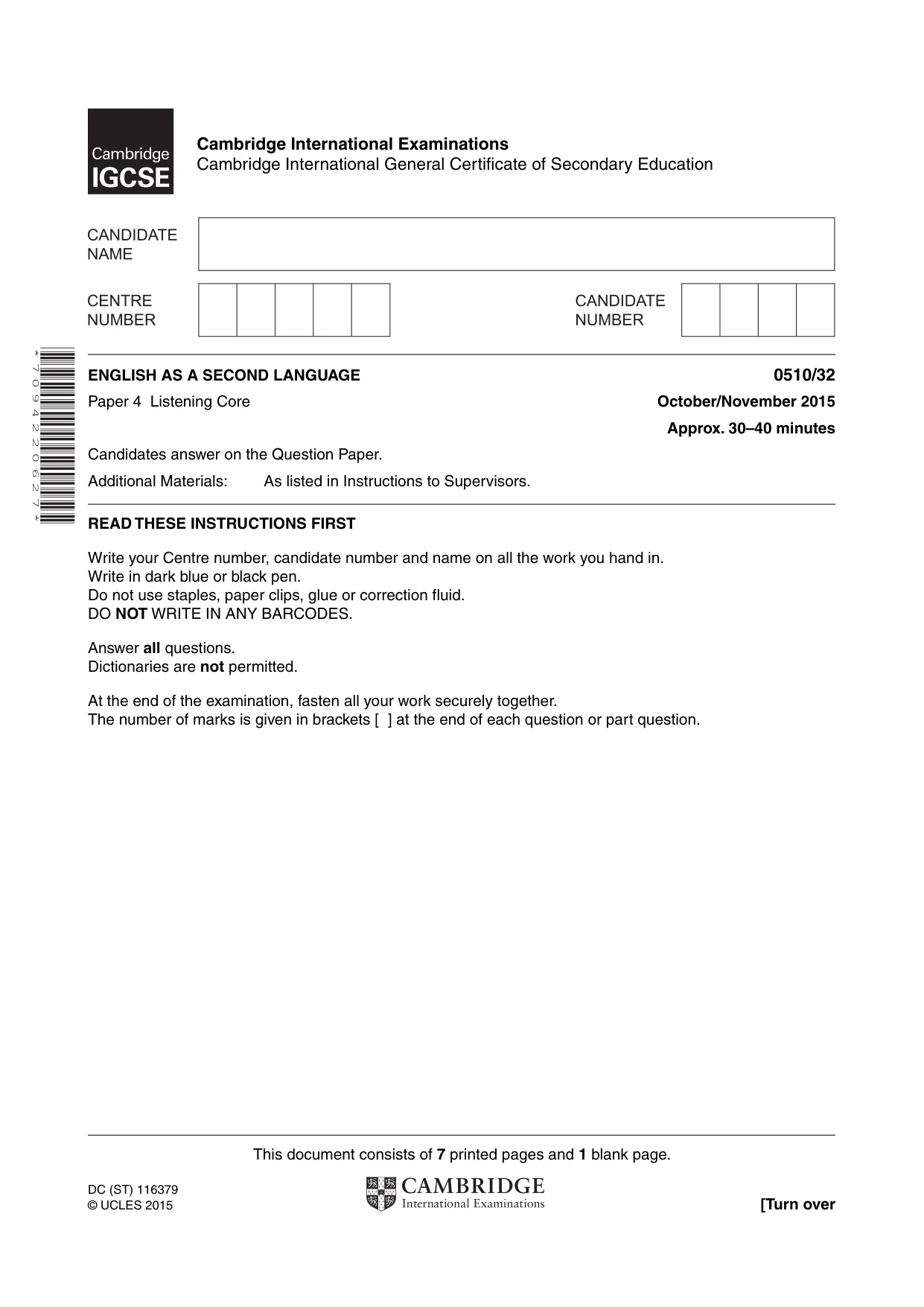
This document consists of 7 printed pages and 1 blank page. DC (ST) 116379 © UCLES 2015 [Turn over * 7 0 9 4 2 2 0 6 2 7 * ENGLISH AS A SECOND LANGUAGE 0510/32 Paper 4 Listening Core October/November 2015 Approx. 30–40 minutes Candidates answer on the Question Paper. Additional Materials: As listed in Instructions to Supervisors. READ THESE INSTRUCTIONS FIRST Write your Centre number, candidate number and name on all the work you hand in. Write in dark blue or black pen. Do not use staples, paper clips, glue or correction fluid. DO NOT WRITE IN ANY BARCODES. Answer all questions. Dictionaries are not permitted. At the end of the examination, fasten all your work securely together. The number of marks is given in brackets [ ] at the end of each question or part question. Cambridge International Examinations Cambridge International General Certificate of Secondary Education
Question paper, page 2
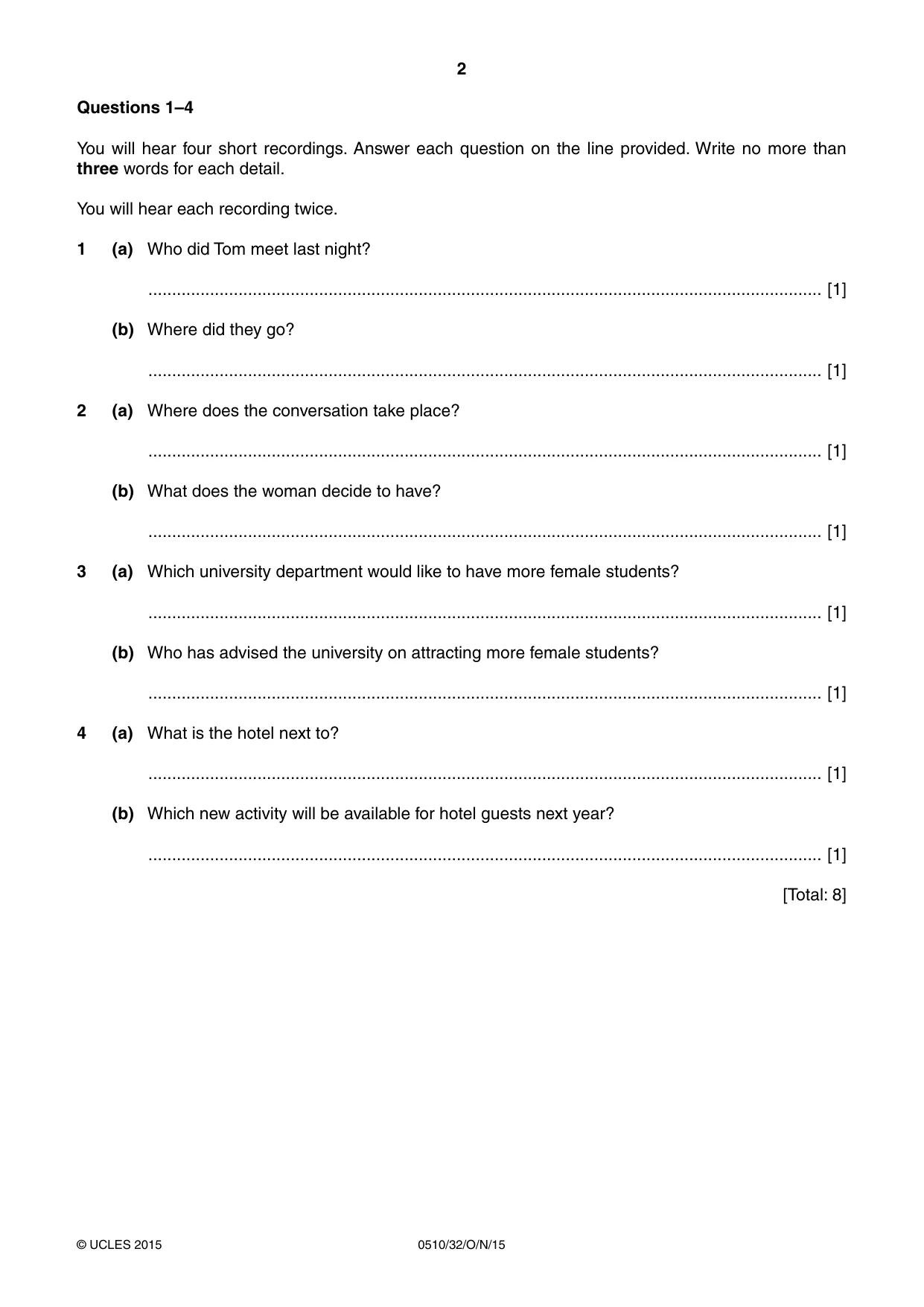
2 0510/32/O/N/15 © UCLES 2015 Questions 1–4 You will hear four short recordings. Answer each question on the line provided. Write no more than three words for each detail. You will hear each recording twice. 1 (a) Who did Tom meet last night? … [1] (b) Where did they go? … [1] 2 (a) Where does the conversation take place? … [1] (b) What does the woman decide to have? … [1] 3 (a) Which university department would like to have more female students? … [1] (b) Who has advised the university on attracting more female students? … [1] 4 (a) What is the hotel next to? … [1] (b) Which new activity will be available for hotel guests next year? … [1] [Total: 8]
Question paper, page 3
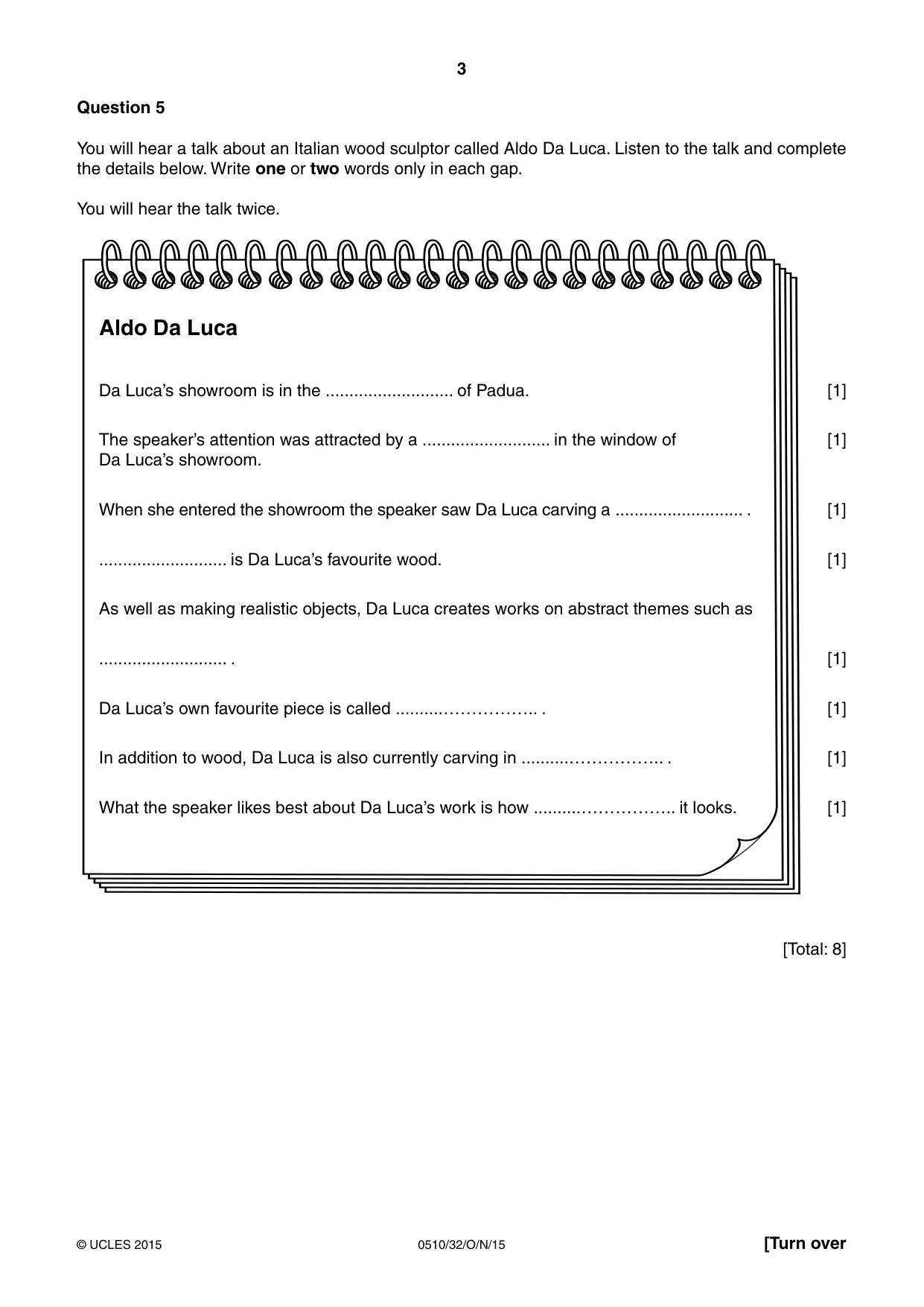
3 0510/32/O/N/15 © UCLES 2015 [Turn over Question 5 You will hear a talk about an Italian wood sculptor called Aldo Da Luca. Listen to the talk and complete the details below. Write one or two words only in each gap. You will hear the talk twice. Aldo Da Luca Da Luca’s showroom is in the … of Padua. [1] The speaker’s attention was attracted by a … in the window of [1] Da Luca’s showroom. When she entered the showroom the speaker saw Da Luca carving a … . [1] … is Da Luca’s favourite wood. [1] As well as making realistic objects, Da Luca creates works on abstract themes such as … . [1] Da Luca’s own favourite piece is called ……………….. . [1] In addition to wood, Da Luca is also currently carving in ……………….. . [1] What the speaker likes best about Da Luca’s work is how ……………….. it looks. [1] [Total: 8]
Question paper, page 4
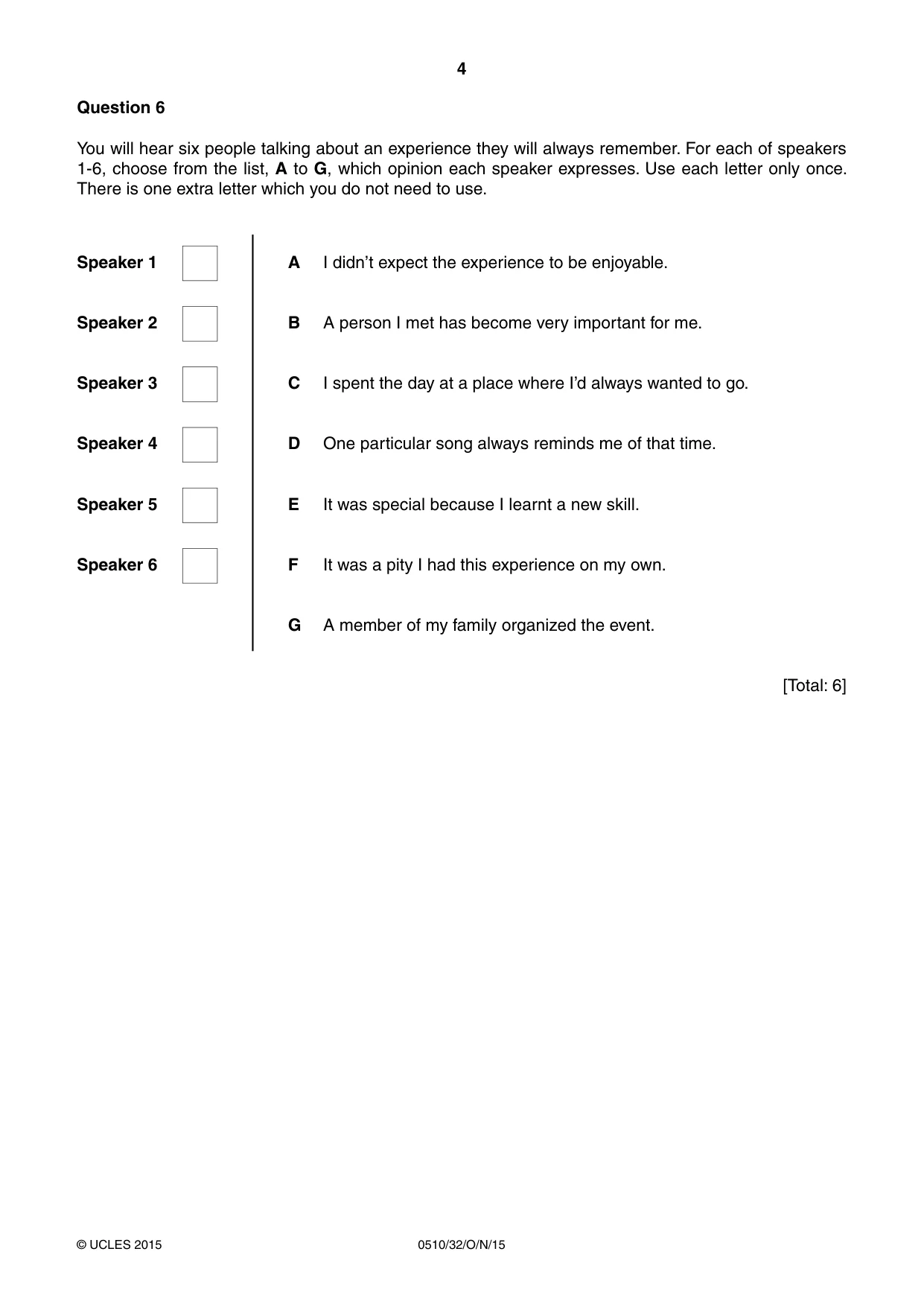
4 0510/32/O/N/15 © UCLES 2015 Question 6 You will hear six people talking about an experience they will always remember. For each of speakers 1-6, choose from the list, A to G, which opinion each speaker expresses. Use each letter only once. There is one extra letter which you do not need to use. Speaker 1 Speaker 2 Speaker 3 Speaker 4 Speaker 5 Speaker 6 A I didn’t expect the experience to be enjoyable. B A person I met has become very important for me. C I spent the day at a place where I’d always wanted to go. D One particular song always reminds me of that time. E It was special because I learnt a new skill. F It was a pity I had this experience on my own. G A member of my family organized the event. [Total: 6]
Question paper, page 5
5 0510/32/O/N/15 © UCLES 2015 [Turn over Please turn over for Question 7.
Question paper, page 6
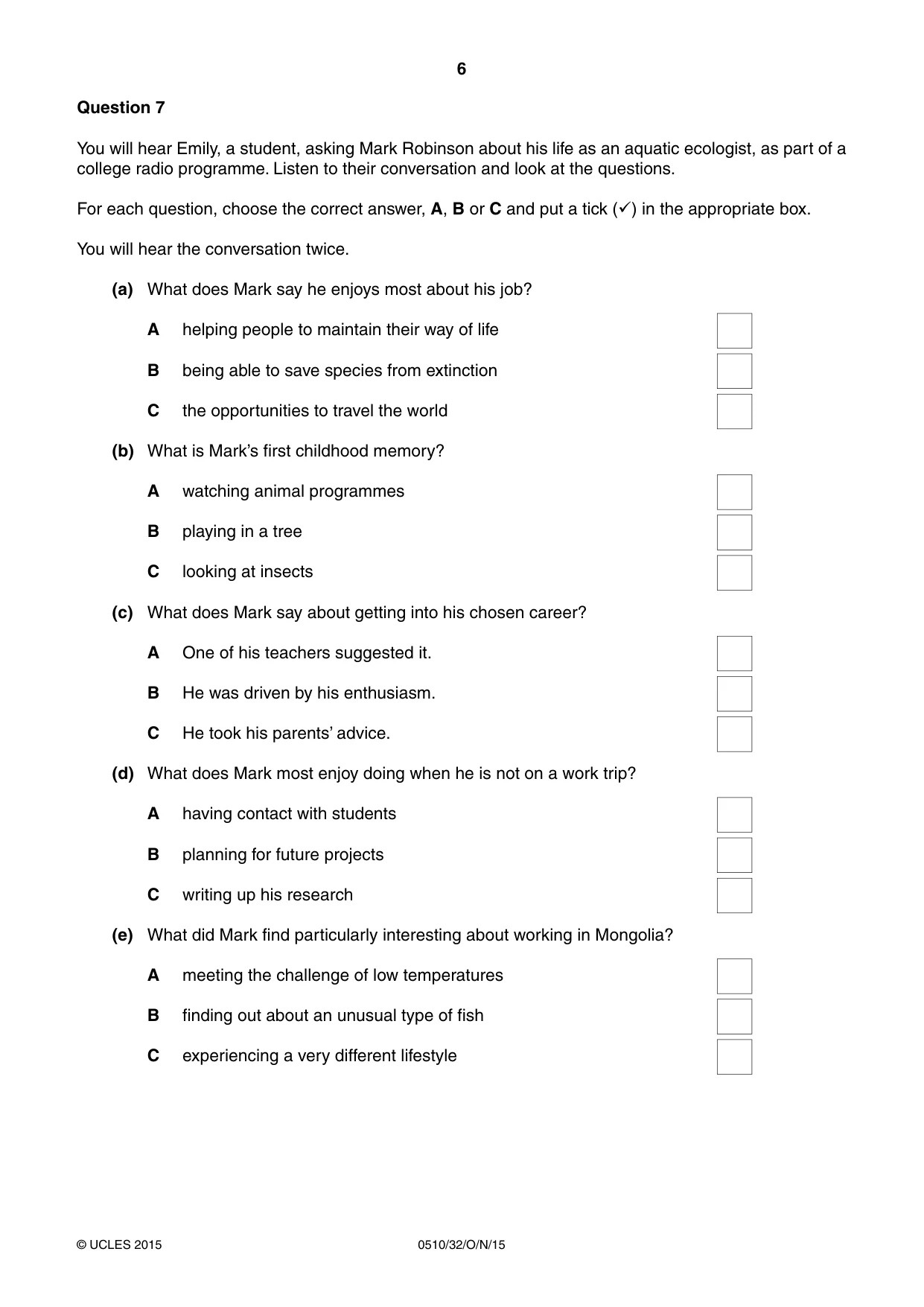
6 0510/32/O/N/15 © UCLES 2015 Question 7 You will hear Emily, a student, asking Mark Robinson about his life as an aquatic ecologist, as part of a college radio programme. Listen to their conversation and look at the questions. For each question, choose the correct answer, A, B or C and put a tick () in the appropriate box. You will hear the conversation twice. (a) What does Mark say he enjoys most about his job? A helping people to maintain their way of life B being able to save species from extinction C the opportunities to travel the world (b) What is Mark’s first childhood memory? A watching animal programmes B playing in a tree C looking at insects (c) What does Mark say about getting into his chosen career? A One of his teachers suggested it. B He was driven by his enthusiasm. C He took his parents’ advice. (d) What does Mark most enjoy doing when he is not on a work trip? A having contact with students B planning for future projects C writing up his research (e) What did Mark find particularly interesting about working in Mongolia? A meeting the challenge of low temperatures B finding out about an unusual type of fish C experiencing a very different lifestyle
Question paper, page 7
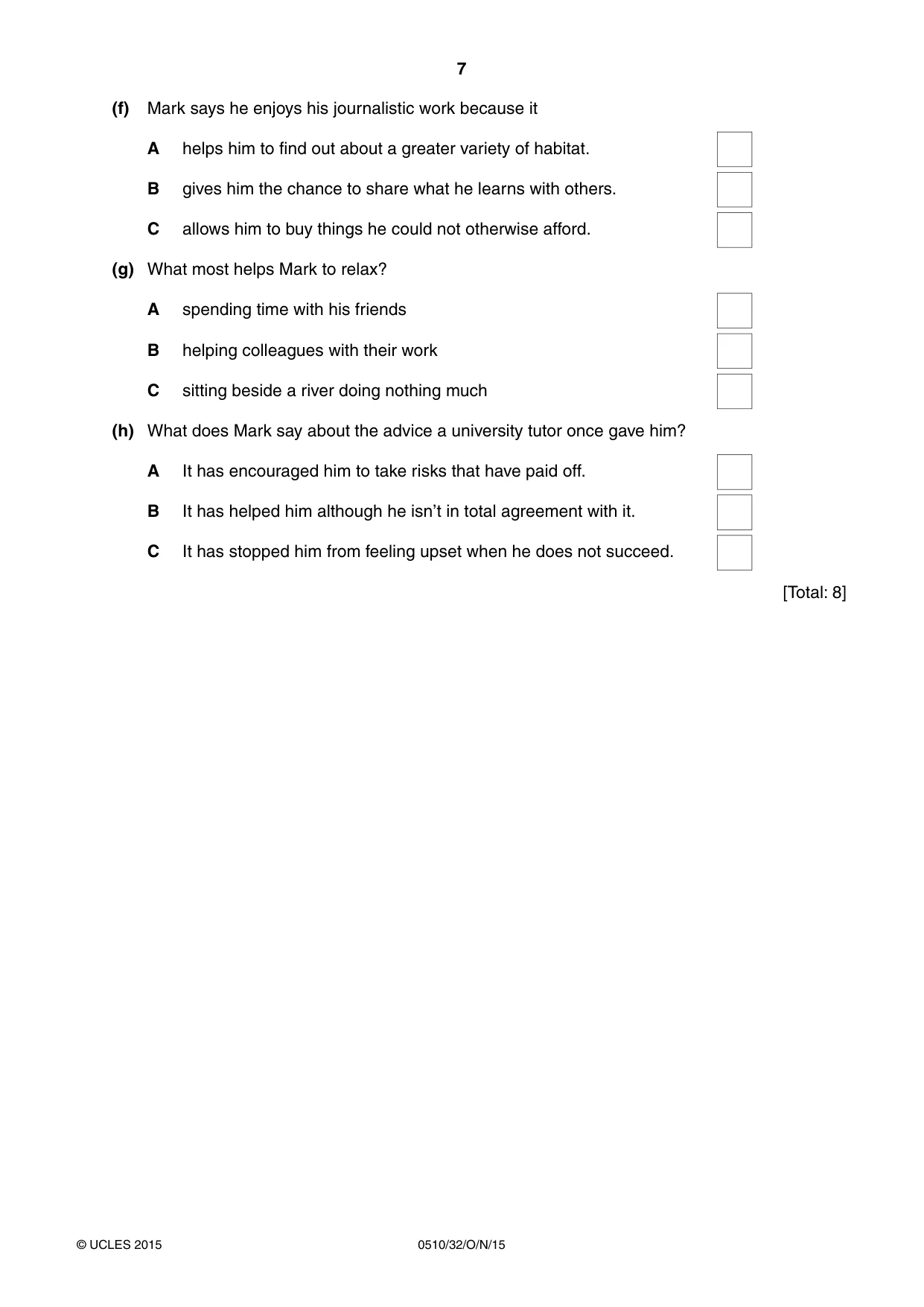
7 0510/32/O/N/15 © UCLES 2015 (f) Mark says he enjoys his journalistic work because it A helps him to find out about a greater variety of habitat. B gives him the chance to share what he learns with others. C allows him to buy things he could not otherwise afford. (g) What most helps Mark to relax? A spending time with his friends B helping colleagues with their work C sitting beside a river doing nothing much (h) What does Mark say about the advice a university tutor once gave him? A It has encouraged him to take risks that have paid off. B It has helped him although he isn’t in total agreement with it. C It has stopped him from feeling upset when he does not succeed. [Total: 8]
Question paper, page 8
8 0510/32/O/N/15 © UCLES 2015 Permission to reproduce items where third-party owned material protected by copyright is included has been sought and cleared where possible. Every reasonable effort has been made by the publisher (UCLES) to trace copyright holders, but if any items requiring clearance have unwittingly been included, the publisher will be pleased to make amends at the earliest possible opportunity. To avoid the issue of disclosure of answer-related information to candidates, all copyright acknowledgements are reproduced online in the Cambridge International Examinations Copyright Acknowledgements Booklet. This is produced for each series of examinations and is freely available to download at www.cie.org.uk after the live examination series. Cambridge International Examinations is part of the Cambridge Assessment Group. Cambridge Assessment is the brand name of University of Cambridge Local Examinations Syndicate (UCLES), which is itself a department of the University of Cambridge. BLANK PAGE
Mark scheme, page 1
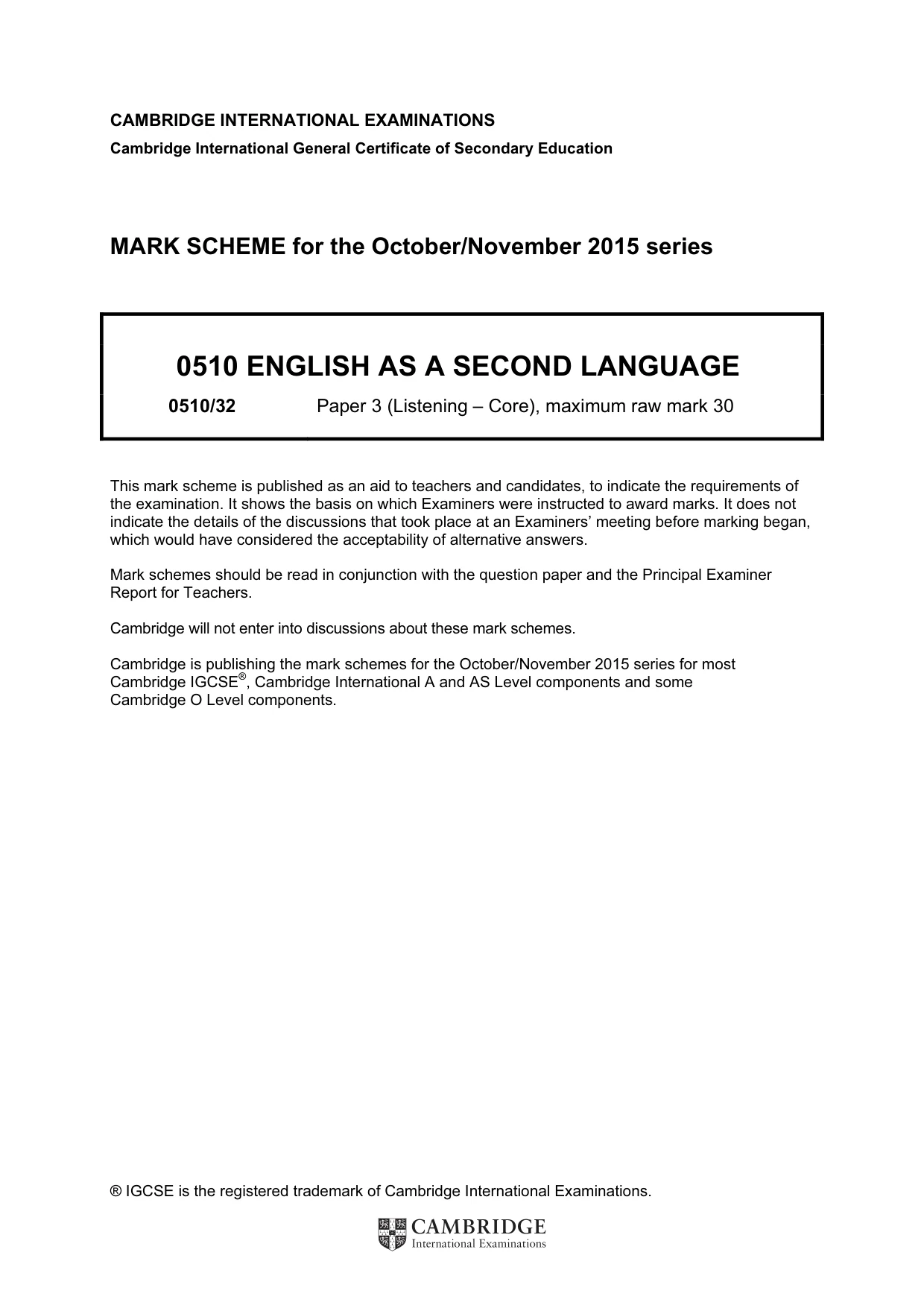
® IGCSE is the registered trademark of Cambridge International Examinations. CAMBRIDGE INTERNATIONAL EXAMINATIONS Cambridge International General Certificate of Secondary Education MARK SCHEME for the October/November 2015 series 0510 ENGLISH AS A SECOND LANGUAGE 0510/32 Paper 3 (Listening – Core), maximum raw mark 30 This mark scheme is published as an aid to teachers and candidates, to indicate the requirements of the examination. It shows the basis on which Examiners were instructed to award marks. It does not indicate the details of the discussions that took place at an Examiners’ meeting before marking began, which would have considered the acceptability of alternative answers. Mark schemes should be read in conjunction with the question paper and the Principal Examiner Report for Teachers. Cambridge will not enter into discussions about these mark schemes. Cambridge is publishing the mark schemes for the October/November 2015 series for most Cambridge IGCSE®, Cambridge International A and AS Level components and some Cambridge O Level components.
Mark scheme, page 2
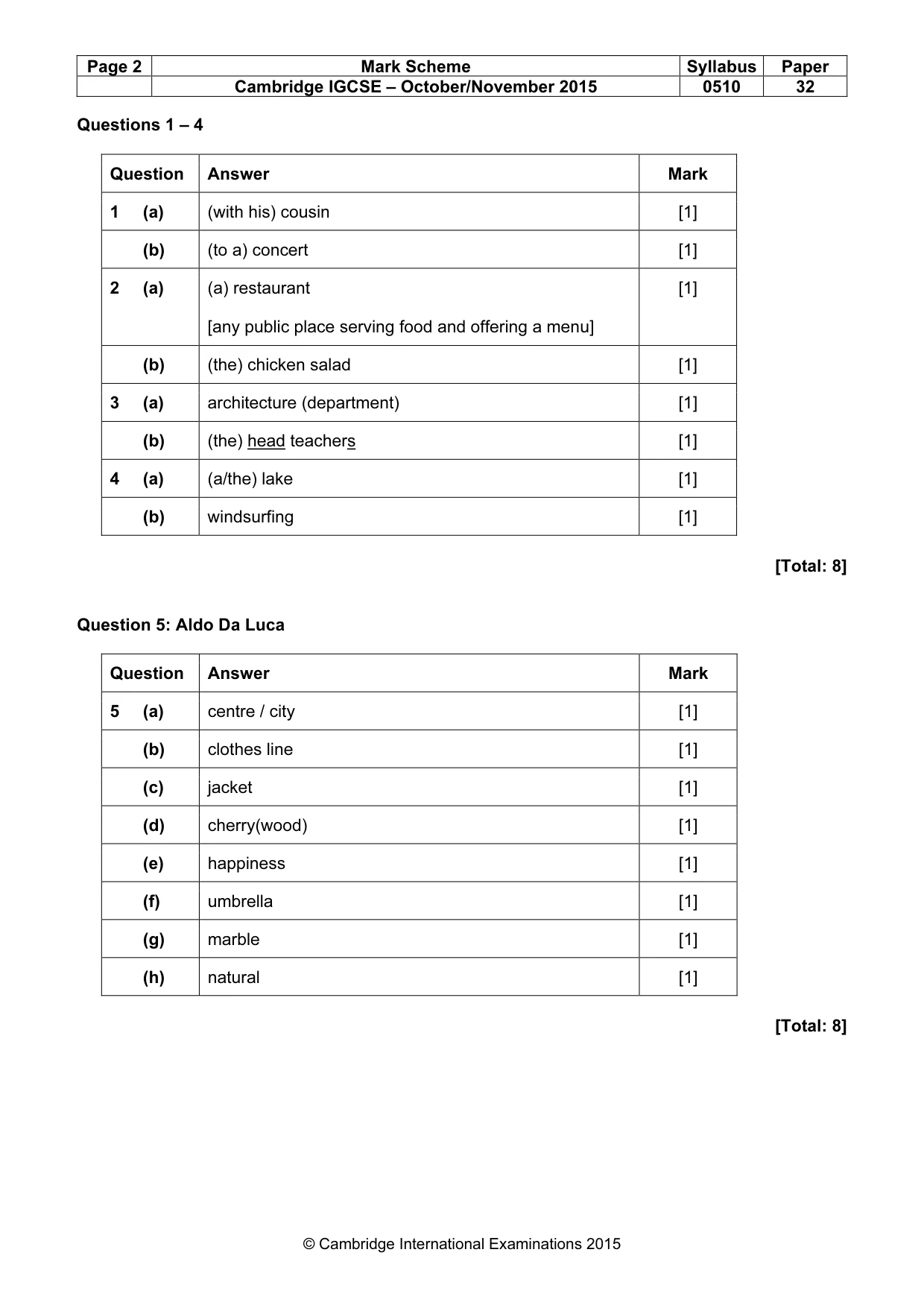
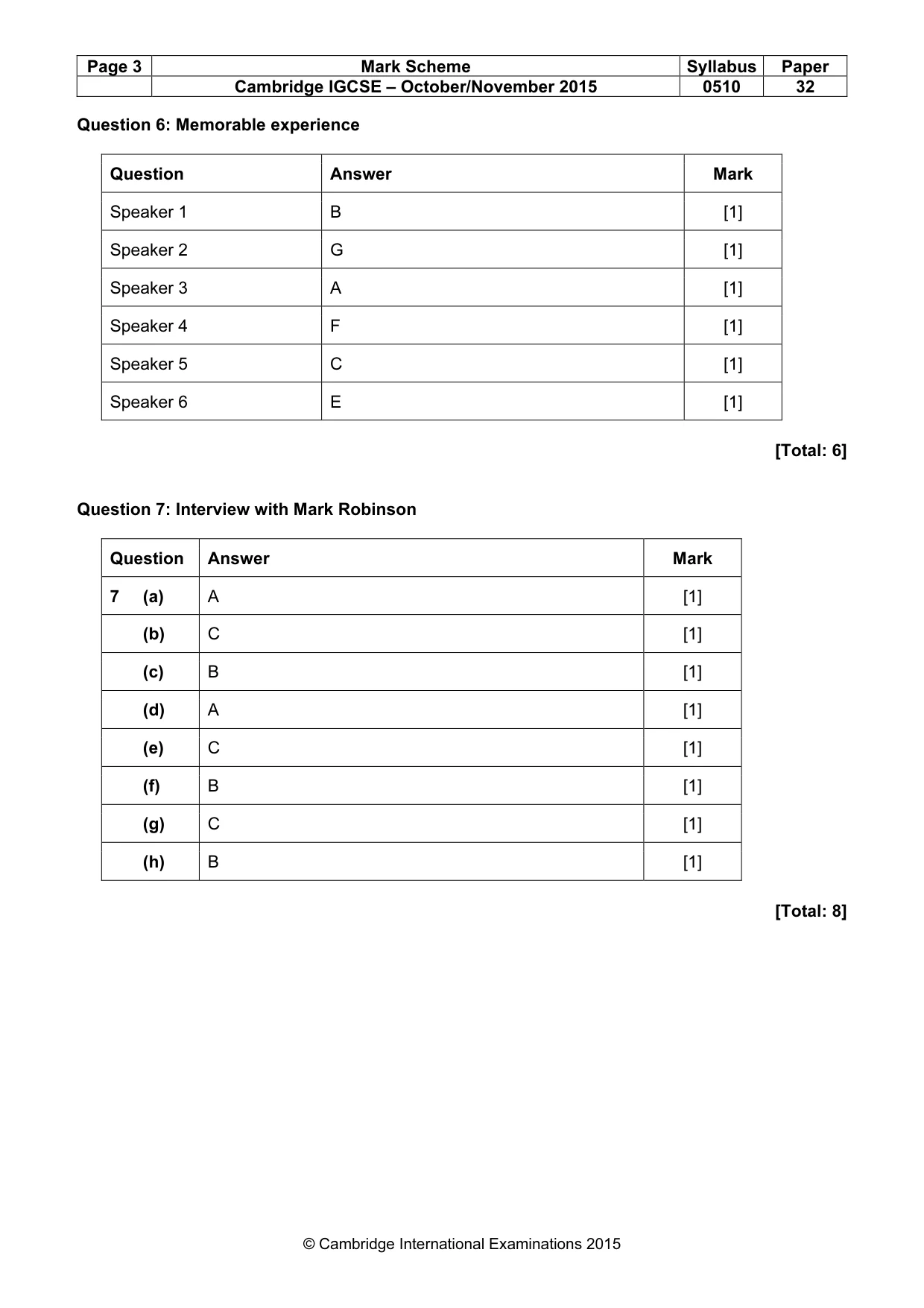
Page 2 Mark Scheme Syllabus Paper Cambridge IGCSE – October/November 2015 0510 32 © Cambridge International Examinations 2015 Questions 1 – 4 Question Answer Mark 1 (a) (with his) cousin [1] (b) (to a) concert [1] 2 (a) (a) restaurant [any public place serving food and offering a menu] [1] (b) (the) chicken salad [1] 3 (a) architecture (department) [1] (b) (the) head teachers [1] 4 (a) (a/the) lake [1] (b) windsurfing [1] [Total: 8] Question 5: Aldo Da Luca Question Answer Mark 5 (a) centre / city [1] (b) clothes line [1] (c) jacket [1] (d) cherry(wood) [1] (e) happiness [1] (f) umbrella [1] (g) marble [1] (h) natural [1] [Total: 8]
Mark scheme, page 3
Page 3 Mark Scheme Syllabus Paper Cambridge IGCSE – October/November 2015 0510 32 © Cambridge International Examinations 2015 Question 6: Memorable experience Question Answer Mark Speaker 1 B [1] Speaker 2 G [1] Speaker 3 A [1] Speaker 4 F [1] Speaker 5 C [1] Speaker 6 E [1] [Total: 6] Question 7: Interview with Mark Robinson Question Answer Mark 7 (a) A [1] (b) C [1] (c) B [1] (d) A [1] (e) C [1] (f) B [1] (g) C [1] (h) B [1] [Total: 8]
Mark scheme, page 4
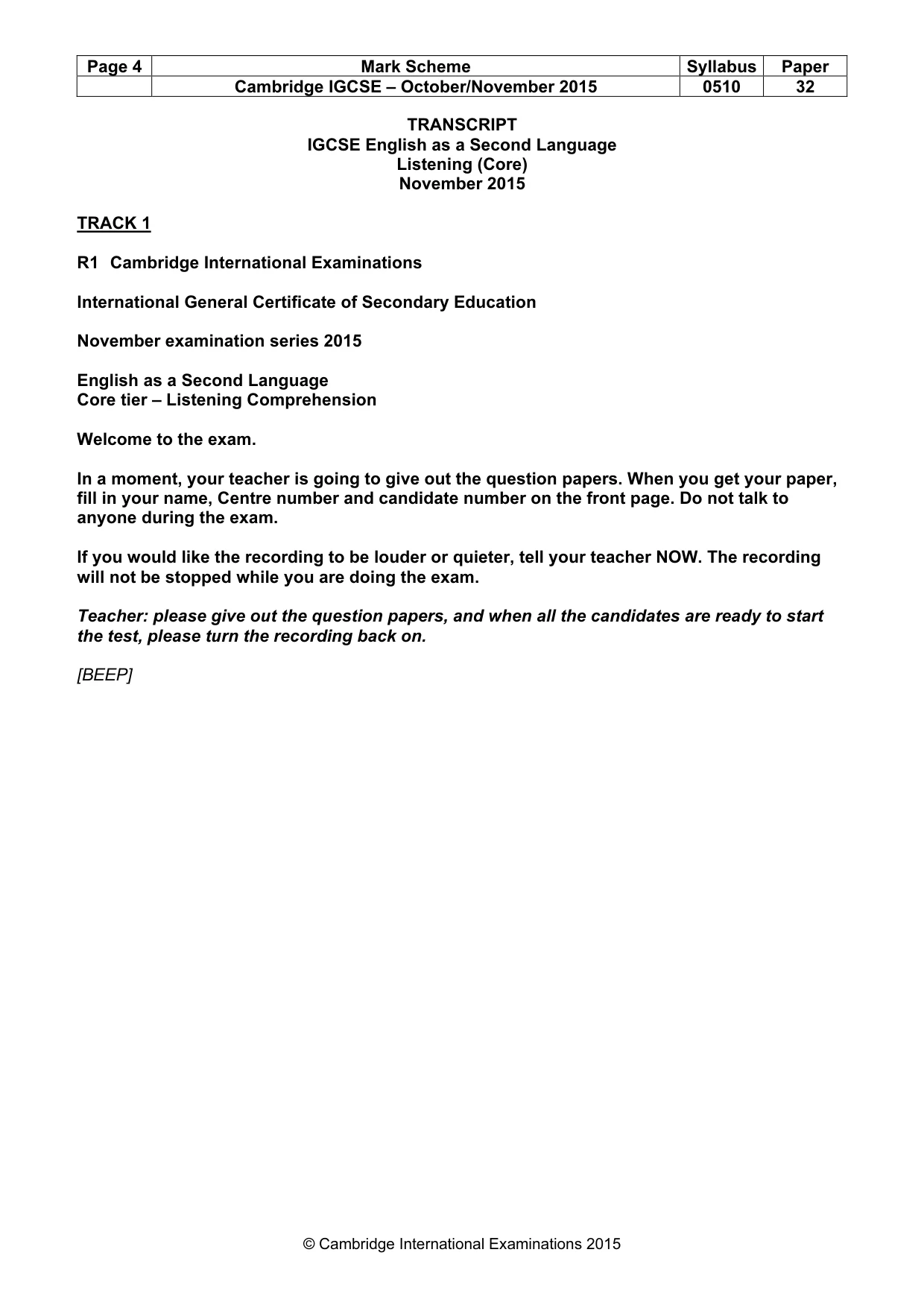
Page 4 Mark Scheme Syllabus Paper Cambridge IGCSE – October/November 2015 0510 32 © Cambridge International Examinations 2015 TRANSCRIPT IGCSE English as a Second Language Listening (Core) November 2015 TRACK 1 R1 Cambridge International Examinations International General Certificate of Secondary Education November examination series 2015 English as a Second Language Core tier – Listening Comprehension Welcome to the exam. In a moment, your teacher is going to give out the question papers. When you get your paper, fill in your name, Centre number and candidate number on the front page. Do not talk to anyone during the exam. If you would like the recording to be louder or quieter, tell your teacher NOW. The recording will not be stopped while you are doing the exam. Teacher: please give out the question papers, and when all the candidates are ready to start the test, please turn the recording back on. [BEEP]
Mark scheme, page 5
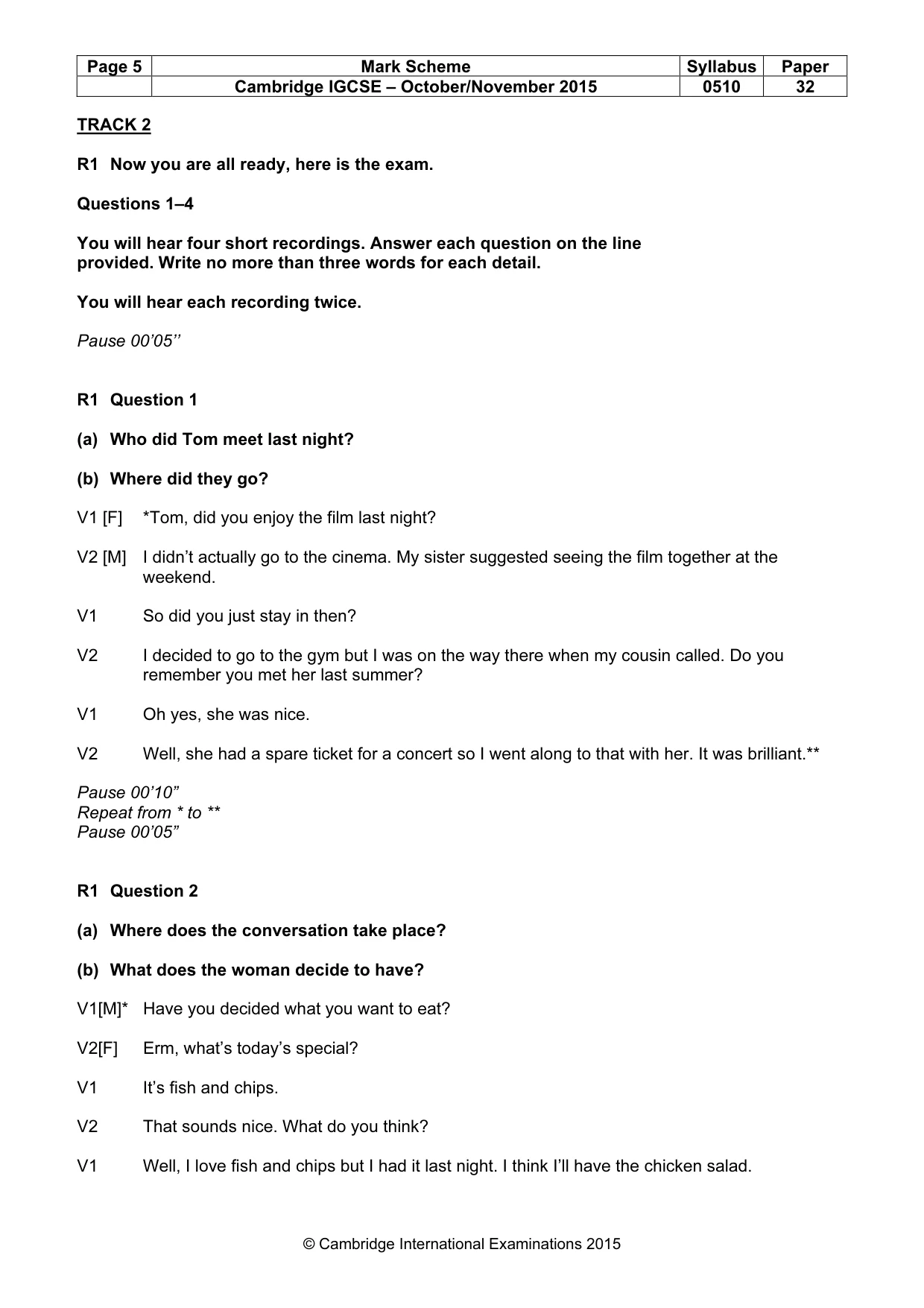
Page 5 Mark Scheme Syllabus Paper Cambridge IGCSE – October/November 2015 0510 32 © Cambridge International Examinations 2015 TRACK 2 R1 Now you are all ready, here is the exam. Questions 1–4 You will hear four short recordings. Answer each question on the line provided. Write no more than three words for each detail. You will hear each recording twice. Pause 00’05’’ R1 Question 1 (a) Who did Tom meet last night? (b) Where did they go? V1 [F] *Tom, did you enjoy the film last night? V2 [M] I didn’t actually go to the cinema. My sister suggested seeing the film together at the weekend. V1 So did you just stay in then? V2 I decided to go to the gym but I was on the way there when my cousin called. Do you remember you met her last summer? V1 Oh yes, she was nice. V2 Well, she had a spare ticket for a concert so I went along to that with her. It was brilliant.** Pause 00’10” Repeat from * to ** Pause 00’05” R1 Question 2 (a) Where does the conversation take place? (b) What does the woman decide to have? V1[M]* Have you decided what you want to eat? V2[F] Erm, what’s today’s special? V1 It’s fish and chips. V2 That sounds nice. What do you think? V1 Well, I love fish and chips but I had it last night. I think I’ll have the chicken salad.
Mark scheme, page 6
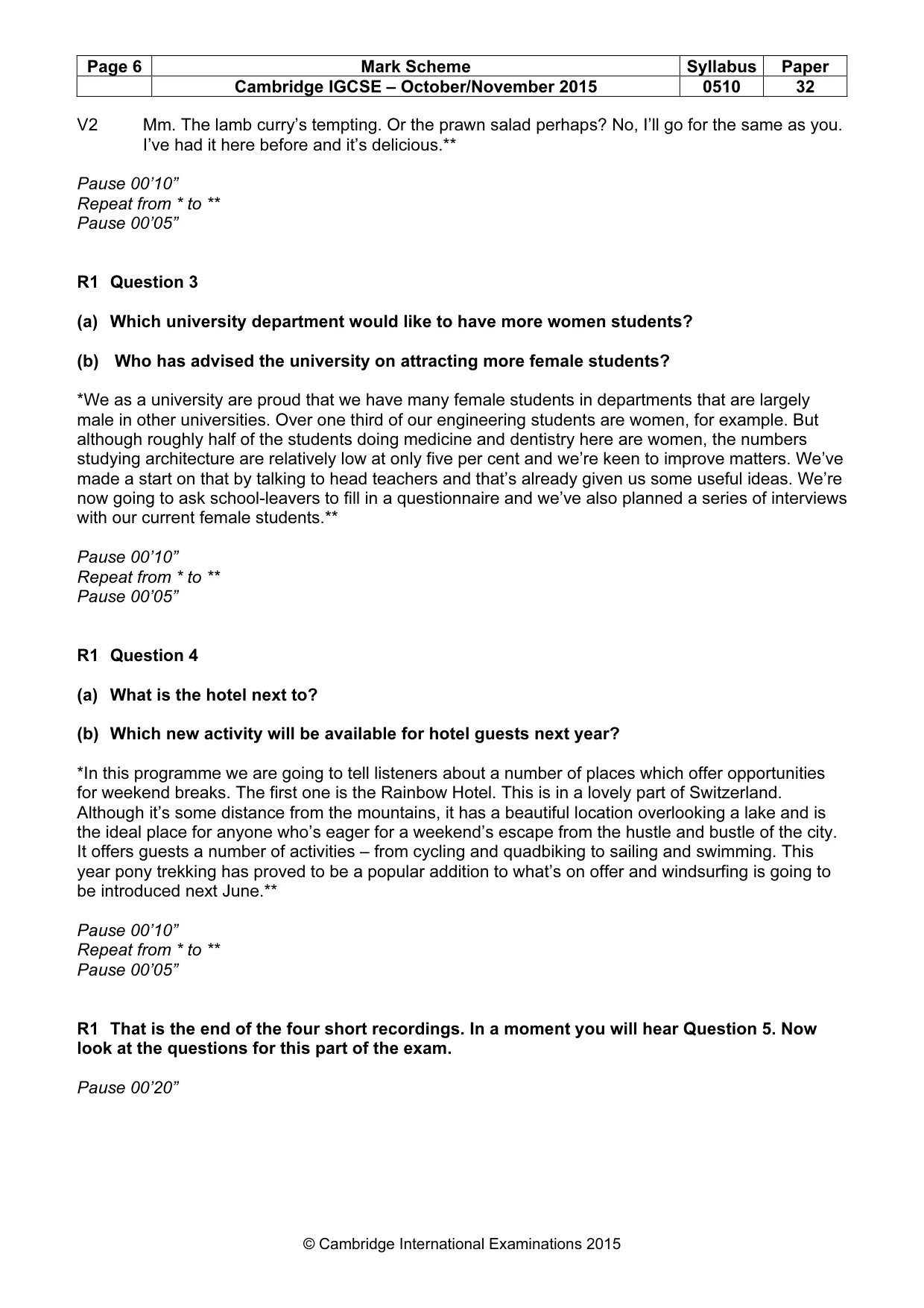
Page 6 Mark Scheme Syllabus Paper Cambridge IGCSE – October/November 2015 0510 32 © Cambridge International Examinations 2015 V2 Mm. The lamb curry’s tempting. Or the prawn salad perhaps? No, I’ll go for the same as you. I’ve had it here before and it’s delicious.** Pause 00’10” Repeat from * to ** Pause 00’05” R1 Question 3 (a) Which university department would like to have more women students? (b) Who has advised the university on attracting more female students? *We as a university are proud that we have many female students in departments that are largely male in other universities. Over one third of our engineering students are women, for example. But although roughly half of the students doing medicine and dentistry here are women, the numbers studying architecture are relatively low at only five per cent and we’re keen to improve matters. We’ve made a start on that by talking to head teachers and that’s already given us some useful ideas. We’re now going to ask school-leavers to fill in a questionnaire and we’ve also planned a series of interviews with our current female students.** Pause 00’10” Repeat from * to ** Pause 00’05” R1 Question 4 (a) What is the hotel next to? (b) Which new activity will be available for hotel guests next year? *In this programme we are going to tell listeners about a number of places which offer opportunities for weekend breaks. The first one is the Rainbow Hotel. This is in a lovely part of Switzerland. Although it’s some distance from the mountains, it has a beautiful location overlooking a lake and is the ideal place for anyone who’s eager for a weekend’s escape from the hustle and bustle of the city. It offers guests a number of activities – from cycling and quadbiking to sailing and swimming. This year pony trekking has proved to be a popular addition to what’s on offer and windsurfing is going to be introduced next June.** Pause 00’10” Repeat from * to ** Pause 00’05” R1 That is the end of the four short recordings. In a moment you will hear Question 5. Now look at the questions for this part of the exam. Pause 00’20”
Mark scheme, page 7
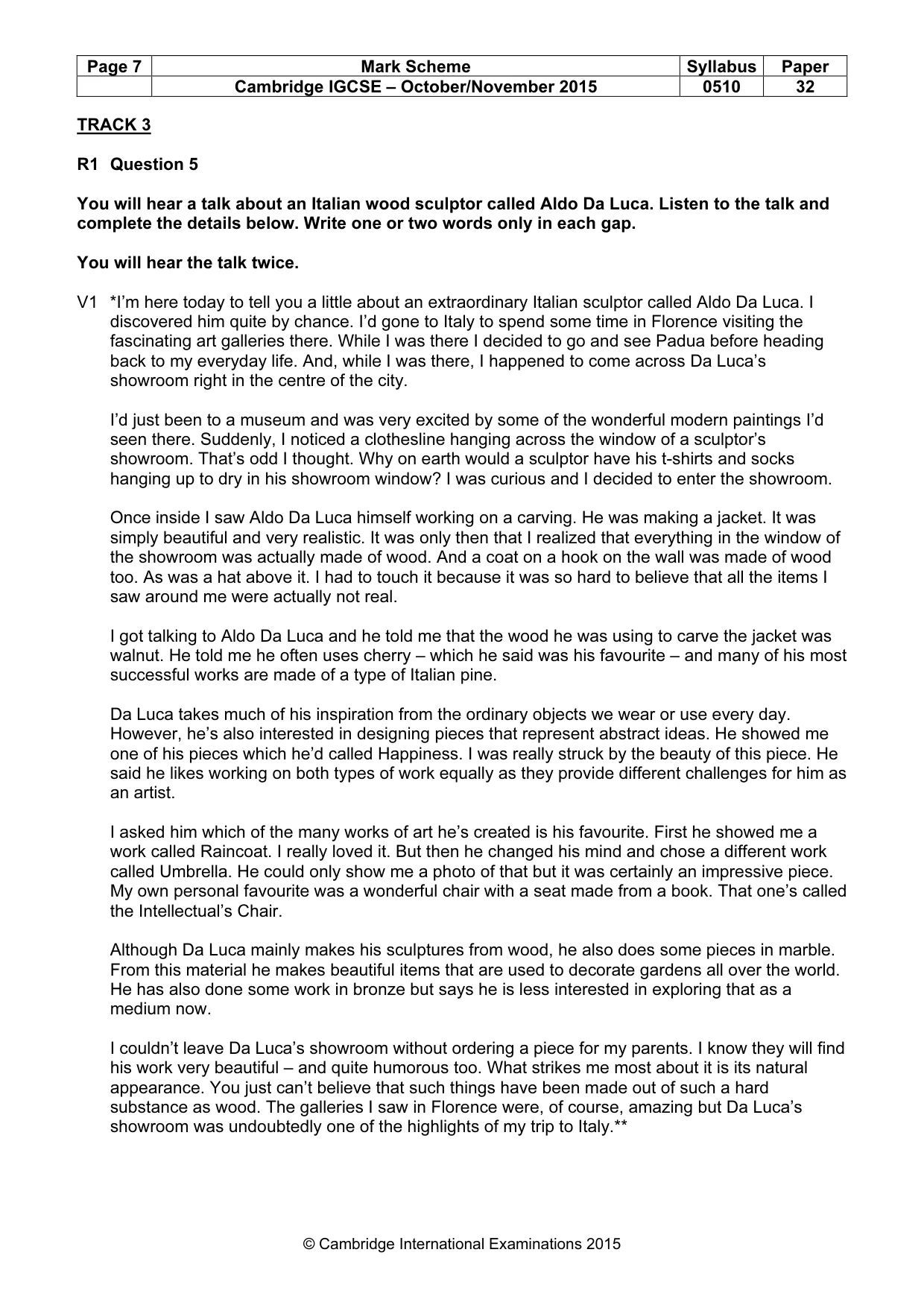
Page 7 Mark Scheme Syllabus Paper Cambridge IGCSE – October/November 2015 0510 32 © Cambridge International Examinations 2015 TRACK 3 R1 Question 5 You will hear a talk about an Italian wood sculptor called Aldo Da Luca. Listen to the talk and complete the details below. Write one or two words only in each gap. You will hear the talk twice. V1 *I’m here today to tell you a little about an extraordinary Italian sculptor called Aldo Da Luca. I discovered him quite by chance. I’d gone to Italy to spend some time in Florence visiting the fascinating art galleries there. While I was there I decided to go and see Padua before heading back to my everyday life. And, while I was there, I happened to come across Da Luca’s showroom right in the centre of the city. I’d just been to a museum and was very excited by some of the wonderful modern paintings I’d seen there. Suddenly, I noticed a clothesline hanging across the window of a sculptor’s showroom. That’s odd I thought. Why on earth would a sculptor have his t-shirts and socks hanging up to dry in his showroom window? I was curious and I decided to enter the showroom. Once inside I saw Aldo Da Luca himself working on a carving. He was making a jacket. It was simply beautiful and very realistic. It was only then that I realized that everything in the window of the showroom was actually made of wood. And a coat on a hook on the wall was made of wood too. As was a hat above it. I had to touch it because it was so hard to believe that all the items I saw around me were actually not real. I got talking to Aldo Da Luca and he told me that the wood he was using to carve the jacket was walnut. He told me he often uses cherry – which he said was his favourite – and many of his most successful works are made of a type of Italian pine. Da Luca takes much of his inspiration from the ordinary objects we wear or use every day. However, he’s also interested in designing pieces that represent abstract ideas. He showed me one of his pieces which he’d called Happiness. I was really struck by the beauty of this piece. He said he likes working on both types of work equally as they provide different challenges for him as an artist. I asked him which of the many works of art he’s created is his favourite. First he showed me a work called Raincoat. I really loved it. But then he changed his mind and chose a different work called Umbrella. He could only show me a photo of that but it was certainly an impressive piece. My own personal favourite was a wonderful chair with a seat made from a book. That one’s called the Intellectual’s Chair. Although Da Luca mainly makes his sculptures from wood, he also does some pieces in marble. From this material he makes beautiful items that are used to decorate gardens all over the world. He has also done some work in bronze but says he is less interested in exploring that as a medium now. I couldn’t leave Da Luca’s showroom without ordering a piece for my parents. I know they will find his work very beautiful – and quite humorous too. What strikes me most about it is its natural appearance. You just can’t believe that such things have been made out of such a hard substance as wood. The galleries I saw in Florence were, of course, amazing but Da Luca’s showroom was undoubtedly one of the highlights of my trip to Italy.**
Mark scheme, page 8
Page 8 Mark Scheme Syllabus Paper Cambridge IGCSE – October/November 2015 0510 32 © Cambridge International Examinations 2015 Pause 00’30” R1 Now you will hear the talk again. Repeat from * to ** Pause 00’30”
Mark scheme, page 9
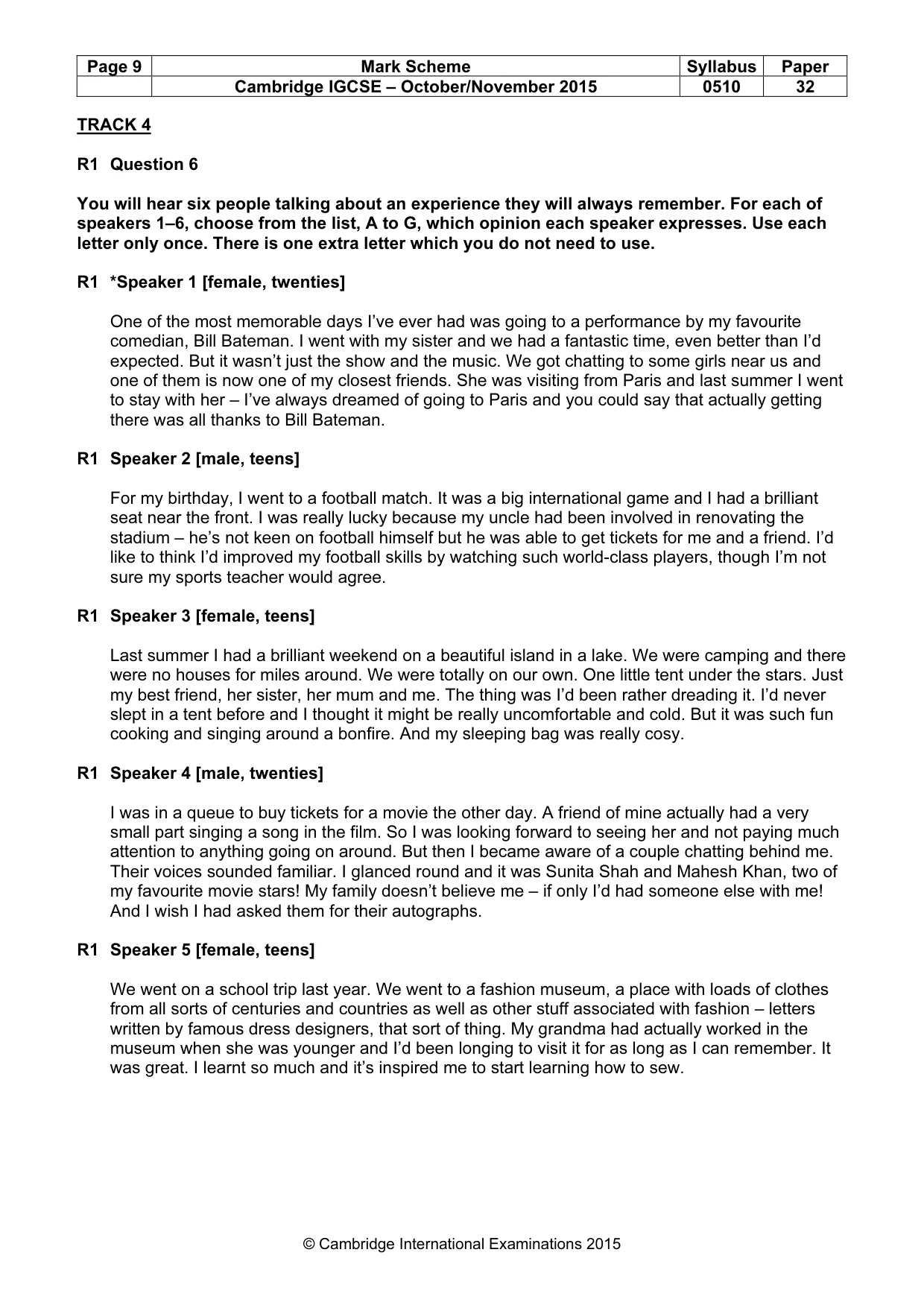
Page 9 Mark Scheme Syllabus Paper Cambridge IGCSE – October/November 2015 0510 32 © Cambridge International Examinations 2015 TRACK 4 R1 Question 6 You will hear six people talking about an experience they will always remember. For each of speakers 1–6, choose from the list, A to G, which opinion each speaker expresses. Use each letter only once. There is one extra letter which you do not need to use. R1 *Speaker 1 [female, twenties] One of the most memorable days I’ve ever had was going to a performance by my favourite comedian, Bill Bateman. I went with my sister and we had a fantastic time, even better than I’d expected. But it wasn’t just the show and the music. We got chatting to some girls near us and one of them is now one of my closest friends. She was visiting from Paris and last summer I went to stay with her – I’ve always dreamed of going to Paris and you could say that actually getting there was all thanks to Bill Bateman. R1 Speaker 2 [male, teens] For my birthday, I went to a football match. It was a big international game and I had a brilliant seat near the front. I was really lucky because my uncle had been involved in renovating the stadium – he’s not keen on football himself but he was able to get tickets for me and a friend. I’d like to think I’d improved my football skills by watching such world-class players, though I’m not sure my sports teacher would agree. R1 Speaker 3 [female, teens] Last summer I had a brilliant weekend on a beautiful island in a lake. We were camping and there were no houses for miles around. We were totally on our own. One little tent under the stars. Just my best friend, her sister, her mum and me. The thing was I’d been rather dreading it. I’d never slept in a tent before and I thought it might be really uncomfortable and cold. But it was such fun cooking and singing around a bonfire. And my sleeping bag was really cosy. R1 Speaker 4 [male, twenties] I was in a queue to buy tickets for a movie the other day. A friend of mine actually had a very small part singing a song in the film. So I was looking forward to seeing her and not paying much attention to anything going on around. But then I became aware of a couple chatting behind me. Their voices sounded familiar. I glanced round and it was Sunita Shah and Mahesh Khan, two of my favourite movie stars! My family doesn’t believe me – if only I’d had someone else with me! And I wish I had asked them for their autographs. R1 Speaker 5 [female, teens] We went on a school trip last year. We went to a fashion museum, a place with loads of clothes from all sorts of centuries and countries as well as other stuff associated with fashion – letters written by famous dress designers, that sort of thing. My grandma had actually worked in the museum when she was younger and I’d been longing to visit it for as long as I can remember. It was great. I learnt so much and it’s inspired me to start learning how to sew.
Mark scheme, page 10
Page 10 Mark Scheme Syllabus Paper Cambridge IGCSE – October/November 2015 0510 32 © Cambridge International Examinations 2015 R1 Speaker 6 [male, teens] I’ll never forget the first time I went canoeing with a friend and his dad when I was quite young. I’d never been before and I wasn’t sure what to expect. But I found I was actually pretty good at it and I often go on my own now. So I guess that day was important because it’s had quite an impact on my life. I wouldn’t enter canoeing competitions or anything like that and I often don’t go very far but that doesn’t really matter.** Pause 00’20” R1 Now you will hear the six speakers again. Repeat from * to ** Pause 00’30” R1 That is the end of Question 6. In a moment you will hear Question 7. Now look at the questions for this part of the exam. Pause 00’25”
Mark scheme, page 11
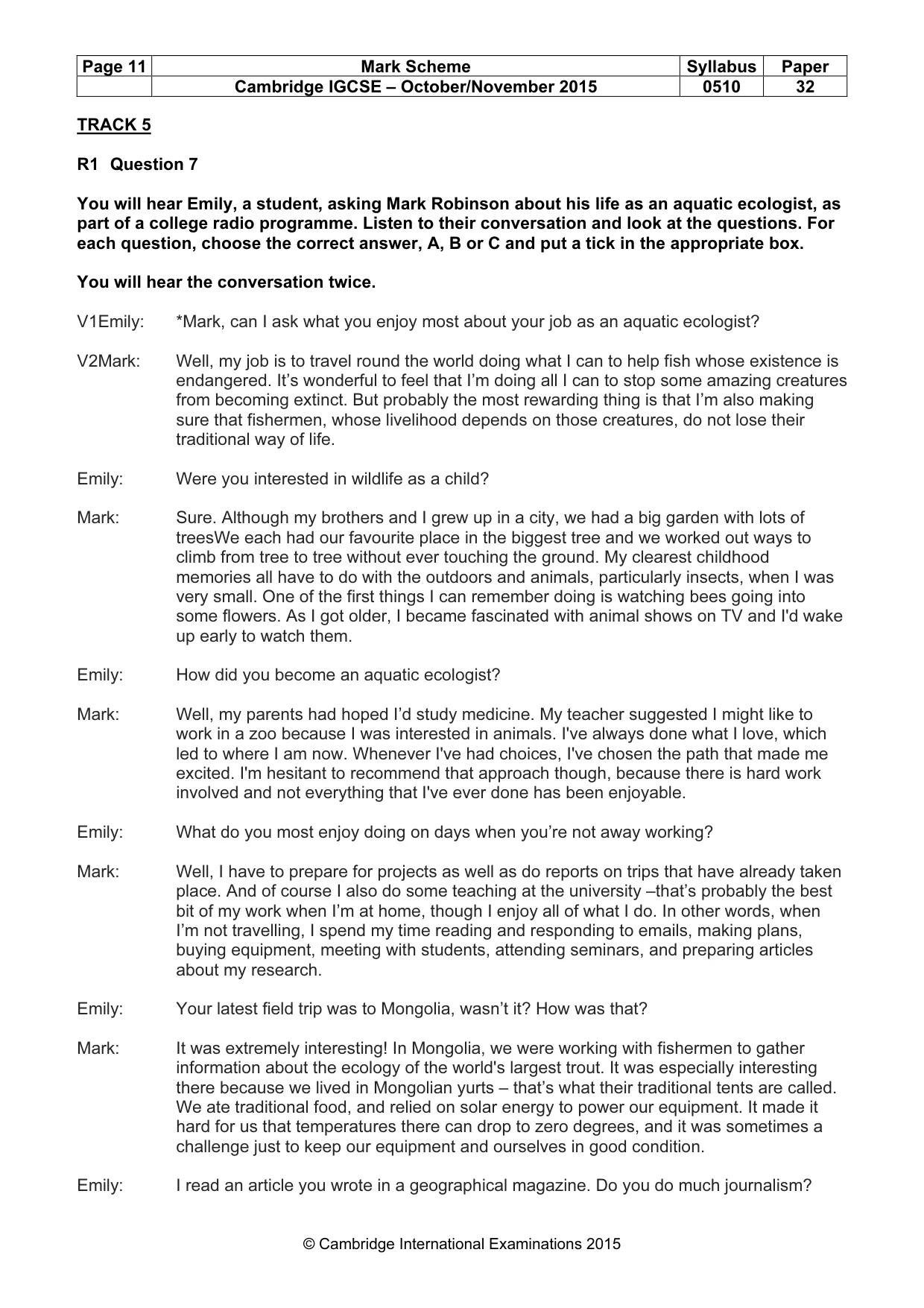
Page 11 Mark Scheme Syllabus Paper Cambridge IGCSE – October/November 2015 0510 32 © Cambridge International Examinations 2015 TRACK 5 R1 Question 7 You will hear Emily, a student, asking Mark Robinson about his life as an aquatic ecologist, as part of a college radio programme. Listen to their conversation and look at the questions. For each question, choose the correct answer, A, B or C and put a tick in the appropriate box. You will hear the conversation twice. V1Emily: *Mark, can I ask what you enjoy most about your job as an aquatic ecologist? V2Mark: Well, my job is to travel round the world doing what I can to help fish whose existence is endangered. It’s wonderful to feel that I’m doing all I can to stop some amazing creatures from becoming extinct. But probably the most rewarding thing is that I’m also making sure that fishermen, whose livelihood depends on those creatures, do not lose their traditional way of life. Emily: Were you interested in wildlife as a child? Mark: Sure. Although my brothers and I grew up in a city, we had a big garden with lots of treesWe each had our favourite place in the biggest tree and we worked out ways to climb from tree to tree without ever touching the ground. My clearest childhood memories all have to do with the outdoors and animals, particularly insects, when I was very small. One of the first things I can remember doing is watching bees going into some flowers. As I got older, I became fascinated with animal shows on TV and I'd wake up early to watch them. Emily: How did you become an aquatic ecologist? Mark: Well, my parents had hoped I’d study medicine. My teacher suggested I might like to work in a zoo because I was interested in animals. I've always done what I love, which led to where I am now. Whenever I've had choices, I've chosen the path that made me excited. I'm hesitant to recommend that approach though, because there is hard work involved and not everything that I've ever done has been enjoyable. Emily: What do you most enjoy doing on days when you’re not away working? Mark: Well, I have to prepare for projects as well as do reports on trips that have already taken place. And of course I also do some teaching at the university –that’s probably the best bit of my work when I’m at home, though I enjoy all of what I do. In other words, when I’m not travelling, I spend my time reading and responding to emails, making plans, buying equipment, meeting with students, attending seminars, and preparing articles about my research. Emily: Your latest field trip was to Mongolia, wasn’t it? How was that? Mark: It was extremely interesting! In Mongolia, we were working with fishermen to gather information about the ecology of the world's largest trout. It was especially interesting there because we lived in Mongolian yurts – that’s what their traditional tents are called. We ate traditional food, and relied on solar energy to power our equipment. It made it hard for us that temperatures there can drop to zero degrees, and it was sometimes a challenge just to keep our equipment and ourselves in good condition. Emily: I read an article you wrote in a geographical magazine. Do you do much journalism?
Mark scheme, page 12
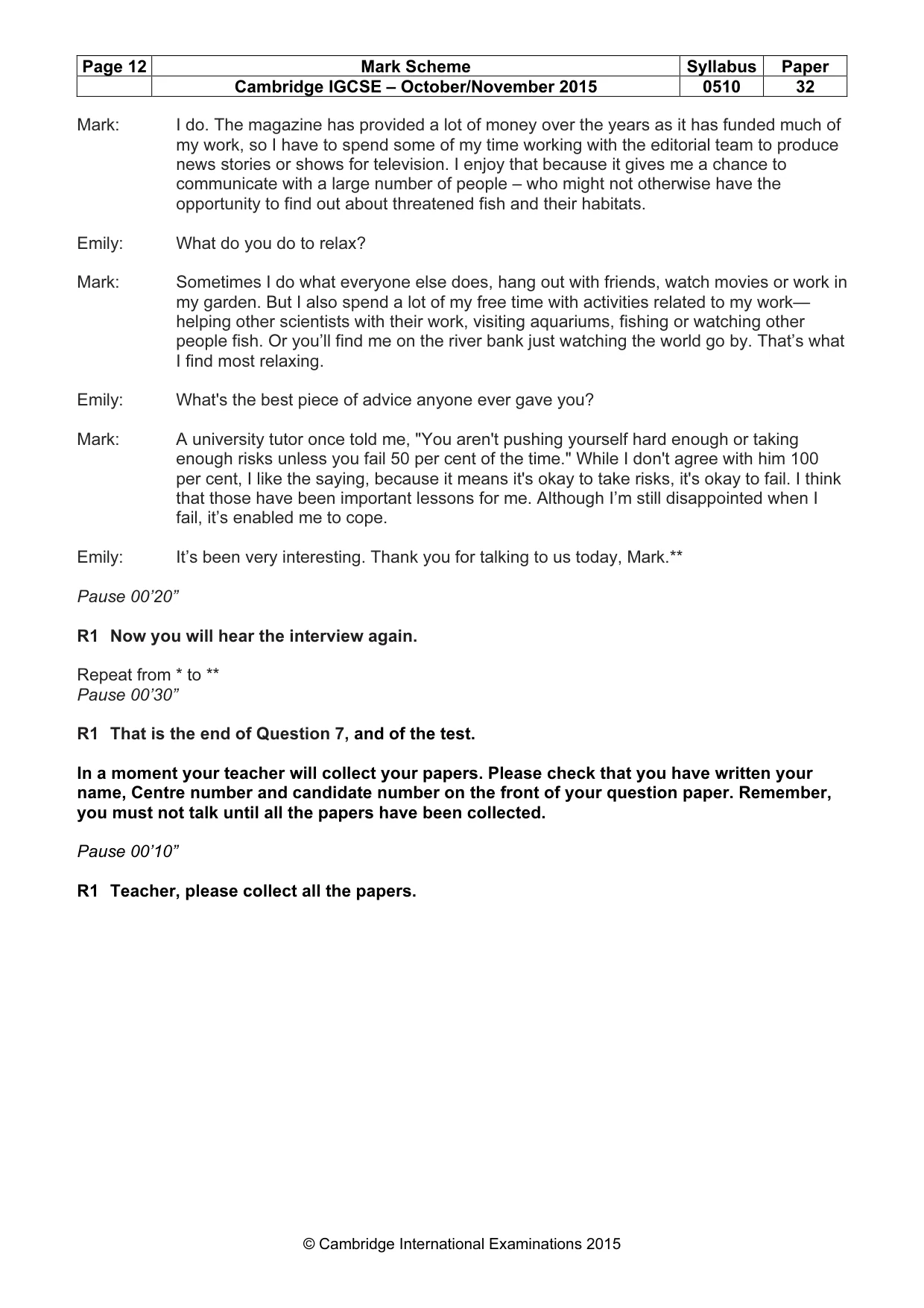
Page 12 Mark Scheme Syllabus Paper Cambridge IGCSE – October/November 2015 0510 32 © Cambridge International Examinations 2015 Mark: I do. The magazine has provided a lot of money over the years as it has funded much of my work, so I have to spend some of my time working with the editorial team to produce news stories or shows for television. I enjoy that because it gives me a chance to communicate with a large number of people – who might not otherwise have the opportunity to find out about threatened fish and their habitats. Emily: What do you do to relax? Mark: Sometimes I do what everyone else does, hang out with friends, watch movies or work in my garden. But I also spend a lot of my free time with activities related to my work— helping other scientists with their work, visiting aquariums, fishing or watching other people fish. Or you’ll find me on the river bank just watching the world go by. That’s what I find most relaxing. Emily: What's the best piece of advice anyone ever gave you? Mark: A university tutor once told me, "You aren't pushing yourself hard enough or taking enough risks unless you fail 50 per cent of the time." While I don't agree with him 100 per cent, I like the saying, because it means it's okay to take risks, it's okay to fail. I think that those have been important lessons for me. Although I’m still disappointed when I fail, it’s enabled me to cope. Emily: It’s been very interesting. Thank you for talking to us today, Mark.** Pause 00’20” R1 Now you will hear the interview again. Repeat from * to ** Pause 00’30” R1 That is the end of Question 7, and of the test. In a moment your teacher will collect your papers. Please check that you have written your name, Centre number and candidate number on the front of your question paper. Remember, you must not talk until all the papers have been collected. Pause 00’10” R1 Teacher, please collect all the papers.
What you needed in this session
Cambridge’s own grade thresholds for 2015 Oct/Nov, Paper 3 · Variant 2. A higher threshold means an easier paper — the bar moves with how the cohort did.