Cambridge IGCSE English - Second Language (oral endorsement) 0510 — 2015 Oct/Nov Paper 3 · Variant 1
0510/31/O/N/15 · 30 marks · ≈34 min
The question paper and its mark scheme, free to read here and free to download. This is Cambridge’s own paper, exactly as it was sat.
Question paper8 pages


Mark scheme13 pages
Answers below. Sit the paper first if you are practising.
Paper as text
Question paper, page 1
This document consists of 7 printed pages and 1 blank page. DC (LK) 113592/1 © UCLES 2015 [Turn over Cambridge International Examinations Cambridge International General Certificate of Secondary Education * 6 4 5 8 3 4 3 1 1 0 * ENGLISH AS A SECOND LANGUAGE 0510/31 Paper 3 Listening (Core) October/November 2015 Approx. 30–40 minutes Candidates answer on the Question Paper. Additional Materials: As listed in Instructions to Supervisors. READ THESE INSTRUCTIONS FIRST Write your Centre number, candidate number and name on all the work you hand in. Write in dark blue or black pen. Do not use staples, paper clips, glue or correction fluid. DO NOT WRITE IN ANY BARCODES. Answer all questions. Dictionaries are not permitted. At the end of the examination, fasten all your work securely together. The number of marks is given in brackets [ ] at the end of each question or part question.
Question paper, page 2
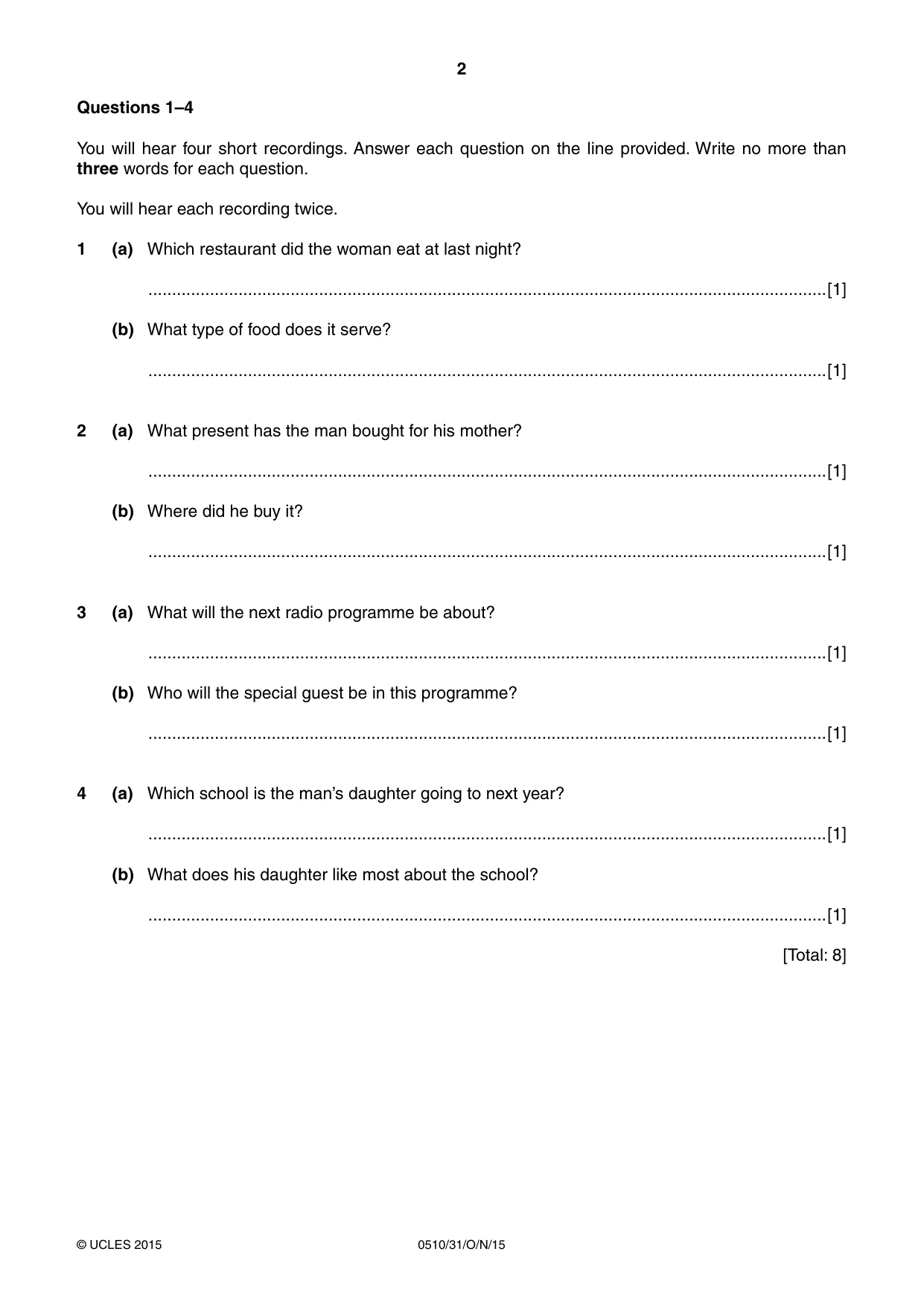
2 0510/31/O/N/15 © UCLES 2015 Questions 1–4 You will hear four short recordings. Answer each question on the line provided. Write no more than three words for each question. You will hear each recording twice. 1 (a) Which restaurant did the woman eat at last night? …[1] (b) What type of food does it serve? …[1] 2 (a) What present has the man bought for his mother? …[1] (b) Where did he buy it? …[1] 3 (a) What will the next radio programme be about? …[1] (b) Who will the special guest be in this programme? …[1] 4 (a) Which school is the man’s daughter going to next year? …[1] (b) What does his daughter like most about the school? …[1] [Total: 8]
Question paper, page 3
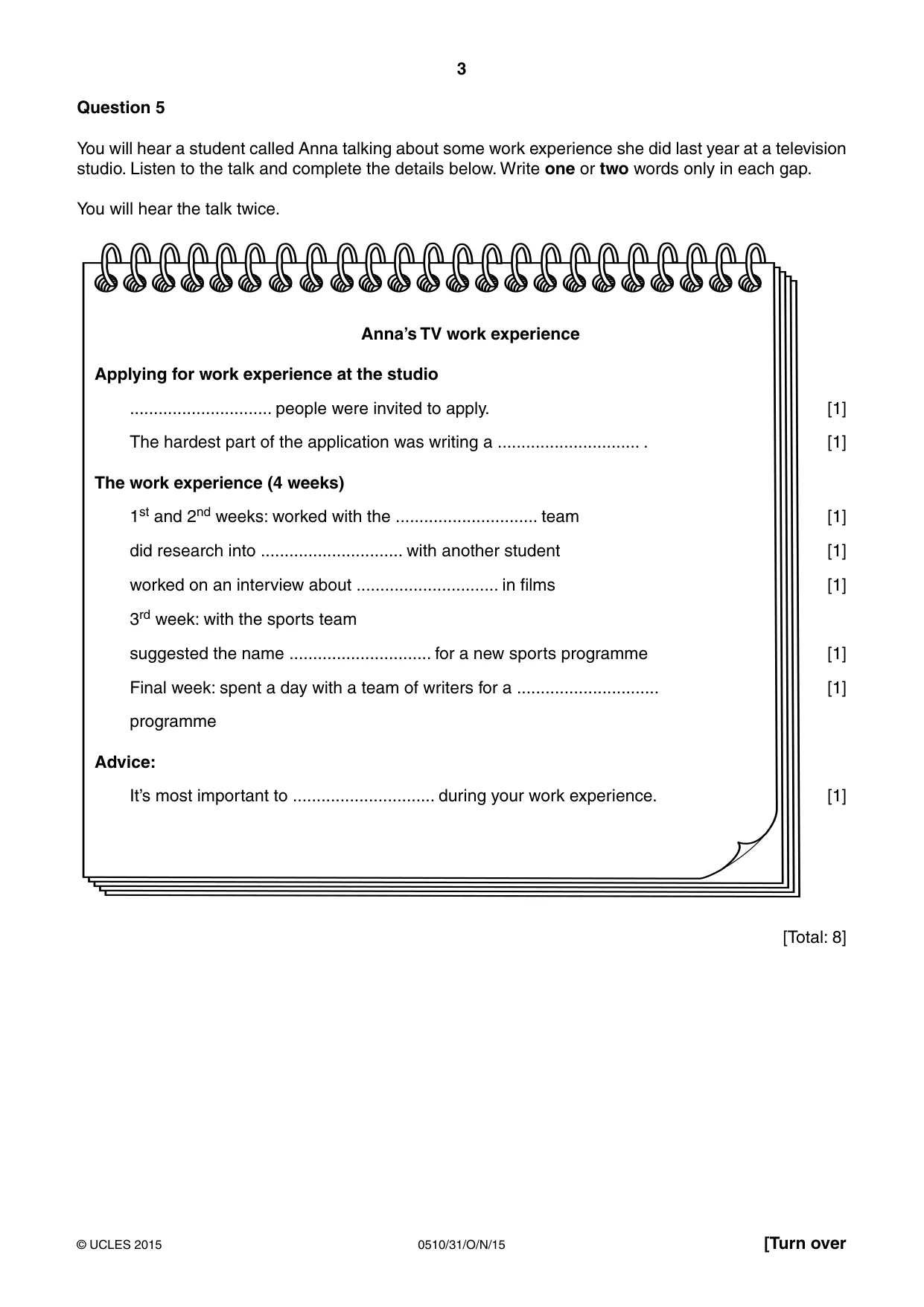
3 0510/31/O/N/15 © UCLES 2015 [Turn over Question 5 You will hear a student called Anna talking about some work experience she did last year at a television studio. Listen to the talk and complete the details below. Write one or two words only in each gap. You will hear the talk twice. Anna’s TV work experience Applying for work experience at the studio … people were invited to apply. [1] The hardest part of the application was writing a … . [1] The work experience (4 weeks) 1st and 2nd weeks: worked with the … team [1] did research into … with another student [1] worked on an interview about … in films [1] 3rd week: with the sports team suggested the name … for a new sports programme [1] Final week: spent a day with a team of writers for a … [1] programme Advice: It’s most important to … during your work experience. [1] [Total: 8]
Question paper, page 4
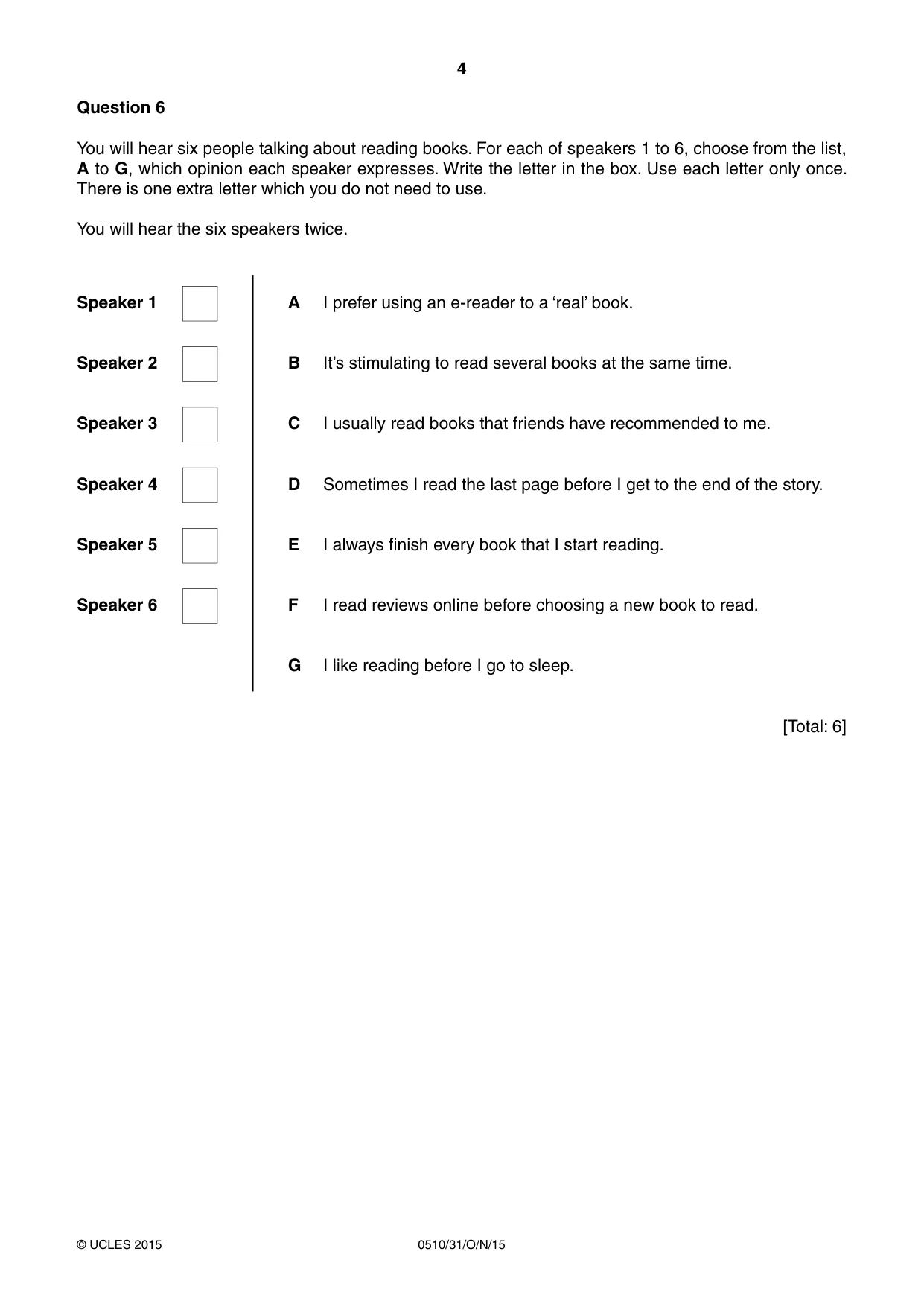
4 0510/31/O/N/15 © UCLES 2015 Question 6 You will hear six people talking about reading books. For each of speakers 1 to 6, choose from the list, A to G, which opinion each speaker expresses. Write the letter in the box. Use each letter only once. There is one extra letter which you do not need to use. You will hear the six speakers twice. Speaker 1 Speaker 2 Speaker 3 Speaker 4 Speaker 5 Speaker 6 A I prefer using an e-reader to a ‘real’ book. B It’s stimulating to read several books at the same time. C I usually read books that friends have recommended to me. D Sometimes I read the last page before I get to the end of the story. E I always finish every book that I start reading. F I read reviews online before choosing a new book to read. G I like reading before I go to sleep. [Total: 6]
Question paper, page 5
5 0510/31/O/N/15 © UCLES 2015 [Turn over Please turn over for Question 7.
Question paper, page 6
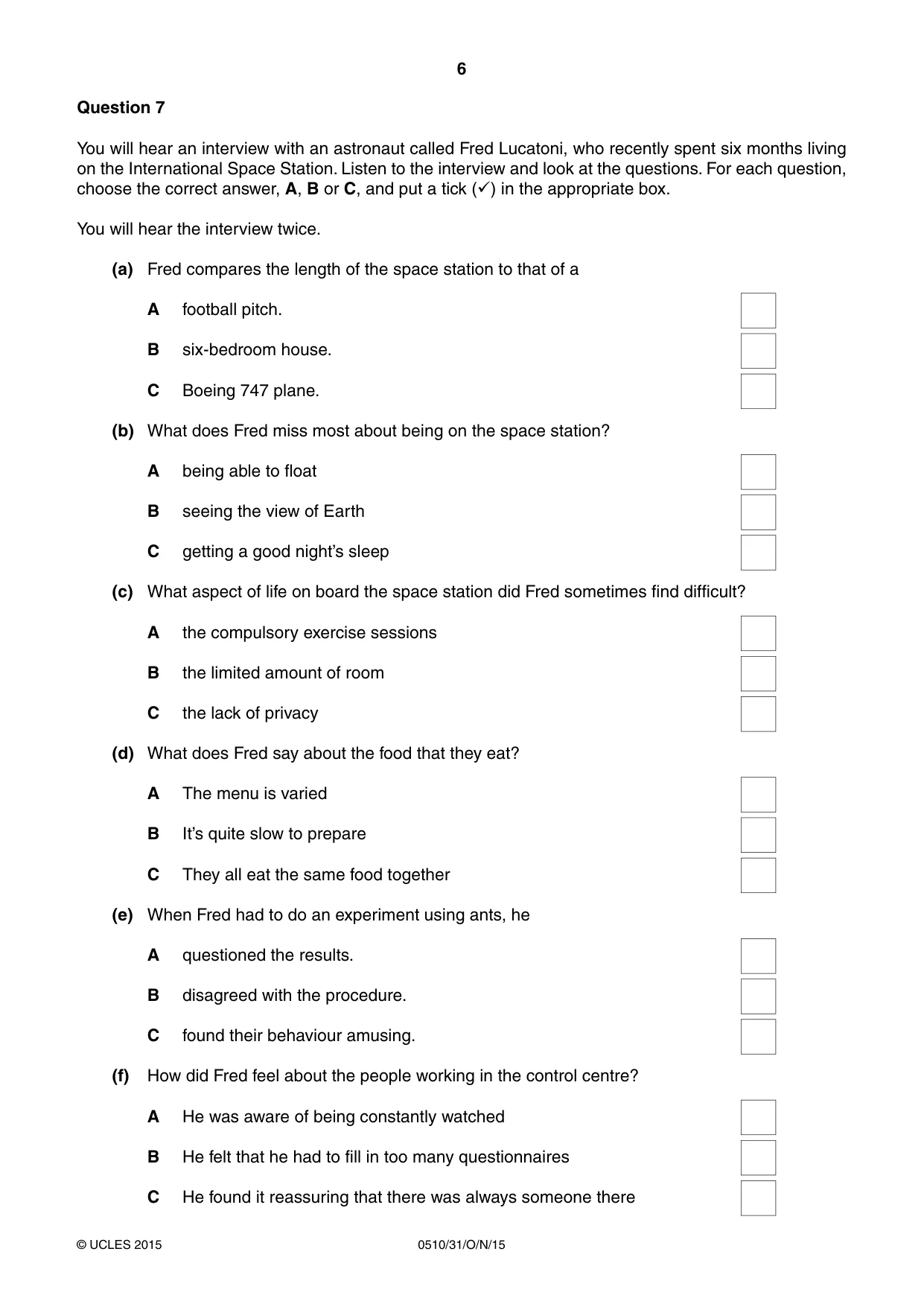
6 0510/31/O/N/15 © UCLES 2015 Question 7 You will hear an interview with an astronaut called Fred Lucatoni, who recently spent six months living on the International Space Station. Listen to the interview and look at the questions. For each question, choose the correct answer, A, B or C, and put a tick () in the appropriate box. You will hear the interview twice. (a) Fred compares the length of the space station to that of a A football pitch. B six-bedroom house. C Boeing 747 plane. (b) What does Fred miss most about being on the space station? A being able to float B seeing the view of Earth C getting a good night’s sleep (c) What aspect of life on board the space station did Fred sometimes find difficult? A the compulsory exercise sessions B the limited amount of room C the lack of privacy (d) What does Fred say about the food that they eat? A The menu is varied B It’s quite slow to prepare C They all eat the same food together (e) When Fred had to do an experiment using ants, he A questioned the results. B disagreed with the procedure. C found their behaviour amusing. (f) How did Fred feel about the people working in the control centre? A He was aware of being constantly watched B He felt that he had to fill in too many questionnaires C He found it reassuring that there was always someone there
Question paper, page 7
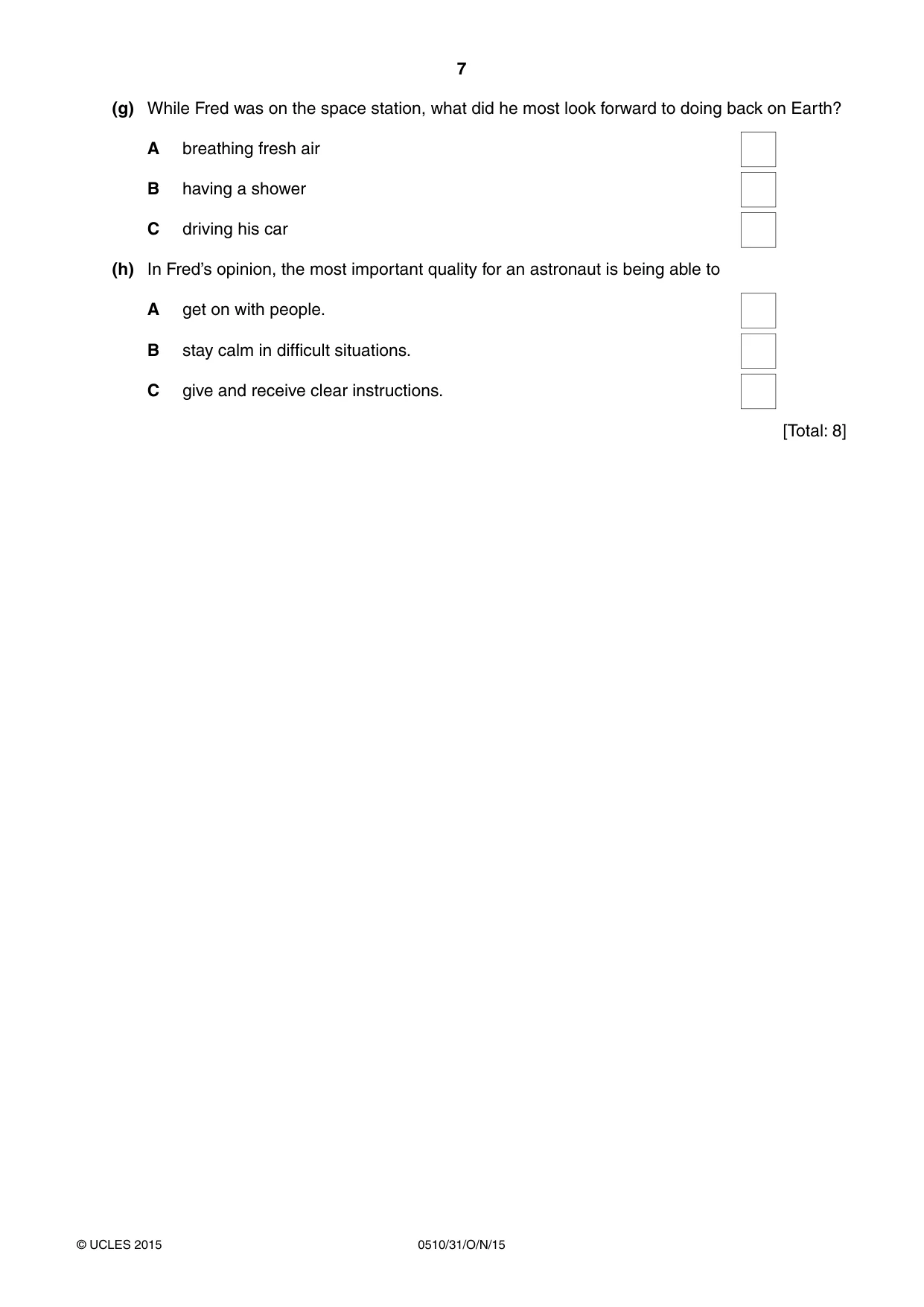
7 0510/31/O/N/15 © UCLES 2015 (g) While Fred was on the space station, what did he most look forward to doing back on Earth? A breathing fresh air B having a shower C driving his car (h) In Fred’s opinion, the most important quality for an astronaut is being able to A get on with people. B stay calm in difficult situations. C give and receive clear instructions. [Total: 8]
Question paper, page 8
8 0510/31/O/N/15 © UCLES 2015 Permission to reproduce items where third-party owned material protected by copyright is included has been sought and cleared where possible. Every reasonable effort has been made by the publisher (UCLES) to trace copyright holders, but if any items requiring clearance have unwittingly been included, the publisher will be pleased to make amends at the earliest possible opportunity. To avoid the issue of disclosure of answer-related information to candidates, all copyright acknowledgements are reproduced online in the Cambridge International Examinations Copyright Acknowledgements Booklet. This is produced for each series of examinations and is freely available to download at www.cie.org.uk after the live examination series. Cambridge International Examinations is part of the Cambridge Assessment Group. Cambridge Assessment is the brand name of University of Cambridge Local Examinations Syndicate (UCLES), which is itself a department of the University of Cambridge. BLANK PAGE
Mark scheme, page 1
® IGCSE is the registered trademark of Cambridge International Examinations. CAMBRIDGE INTERNATIONAL EXAMINATIONS Cambridge International General Certificate of Secondary Education MARK SCHEME for the October/November 2015 series 0510 ENGLISH AS A SECOND LANGUAGE 0510/31 Paper 3 (Listening – Core), maximum raw mark 30 This mark scheme is published as an aid to teachers and candidates, to indicate the requirements of the examination. It shows the basis on which Examiners were instructed to award marks. It does not indicate the details of the discussions that took place at an Examiners’ meeting before marking began, which would have considered the acceptability of alternative answers. Mark schemes should be read in conjunction with the question paper and the Principal Examiner Report for Teachers. Cambridge will not enter into discussions about these mark schemes. Cambridge is publishing the mark schemes for the October/November 2015 series for most Cambridge IGCSE®, Cambridge International A and AS Level components and some Cambridge O Level components.
Mark scheme, page 2
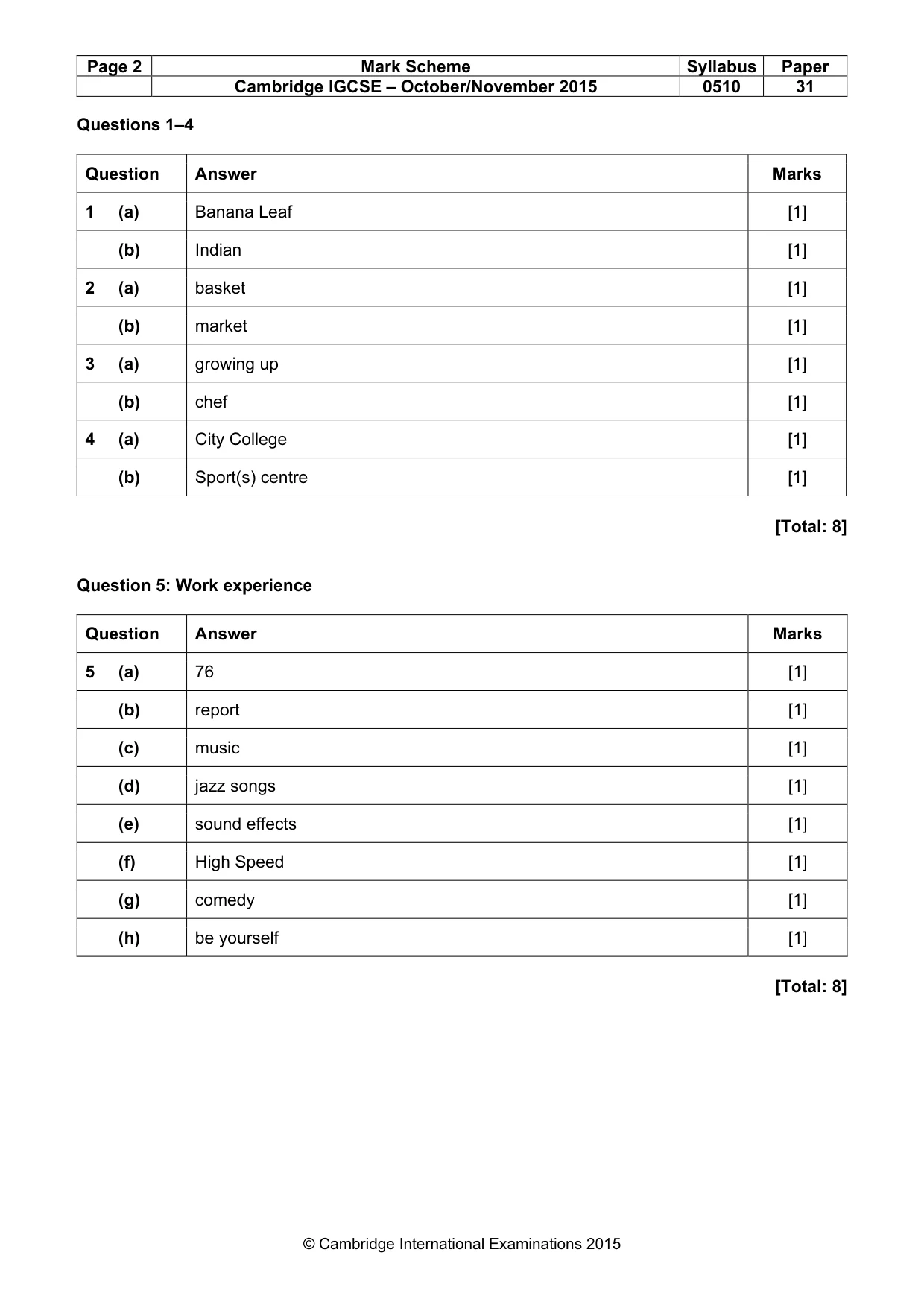
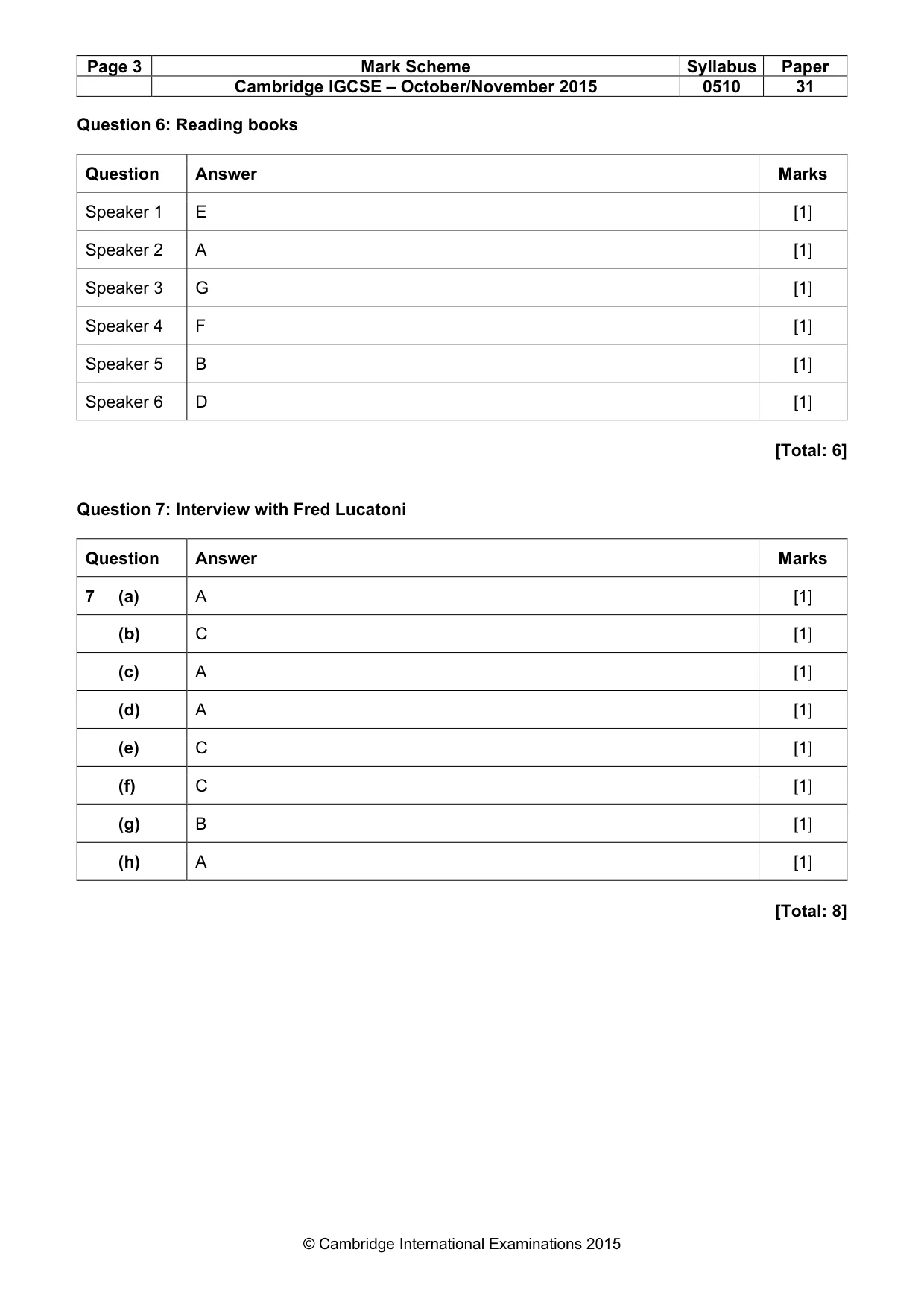
Page 2 Mark Scheme Syllabus Paper Cambridge IGCSE – October/November 2015 0510 31 © Cambridge International Examinations 2015 Questions 1–4 Question Answer Marks 1 (a) Banana Leaf [1] (b) Indian [1] 2 (a) basket [1] (b) market [1] 3 (a) growing up [1] (b) chef [1] 4 (a) City College [1] (b) Sport(s) centre [1] [Total: 8] Question 5: Work experience Question Answer Marks 5 (a) 76 [1] (b) report [1] (c) music [1] (d) jazz songs [1] (e) sound effects [1] (f) High Speed [1] (g) comedy [1] (h) be yourself [1] [Total: 8]
Mark scheme, page 3
Page 3 Mark Scheme Syllabus Paper Cambridge IGCSE – October/November 2015 0510 31 © Cambridge International Examinations 2015 Question 6: Reading books Question Answer Marks Speaker 1 E [1] Speaker 2 A [1] Speaker 3 G [1] Speaker 4 F [1] Speaker 5 B [1] Speaker 6 D [1] [Total: 6] Question 7: Interview with Fred Lucatoni Question Answer Marks 7 (a) A [1] (b) C [1] (c) A [1] (d) A [1] (e) C [1] (f) C [1] (g) B [1] (h) A [1] [Total: 8]
Mark scheme, page 4
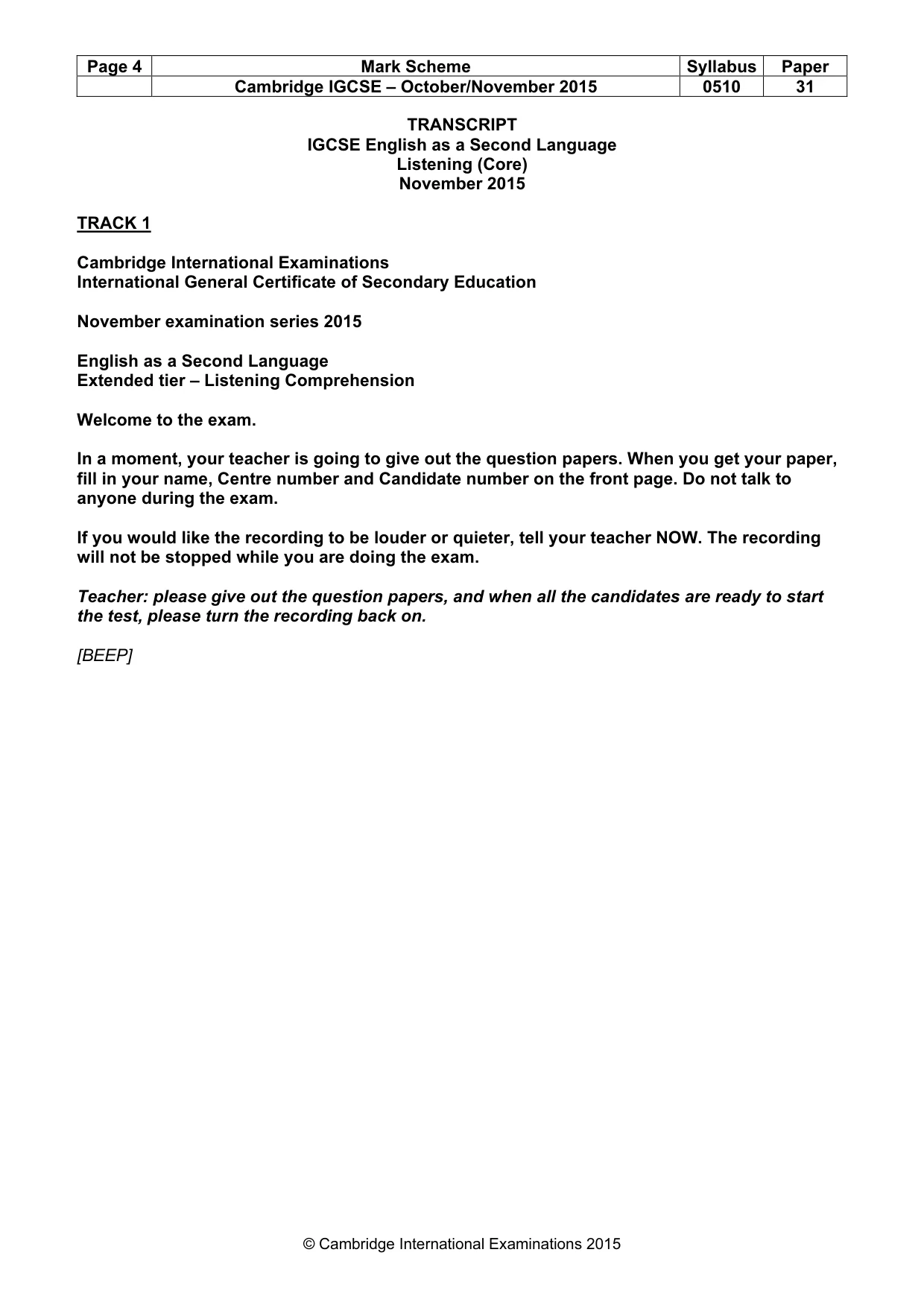
Page 4 Mark Scheme Syllabus Paper Cambridge IGCSE – October/November 2015 0510 31 © Cambridge International Examinations 2015 TRANSCRIPT IGCSE English as a Second Language Listening (Core) November 2015 TRACK 1 Cambridge International Examinations International General Certificate of Secondary Education November examination series 2015 English as a Second Language Extended tier – Listening Comprehension Welcome to the exam. In a moment, your teacher is going to give out the question papers. When you get your paper, fill in your name, Centre number and Candidate number on the front page. Do not talk to anyone during the exam. If you would like the recording to be louder or quieter, tell your teacher NOW. The recording will not be stopped while you are doing the exam. Teacher: please give out the question papers, and when all the candidates are ready to start the test, please turn the recording back on. [BEEP]
Mark scheme, page 5
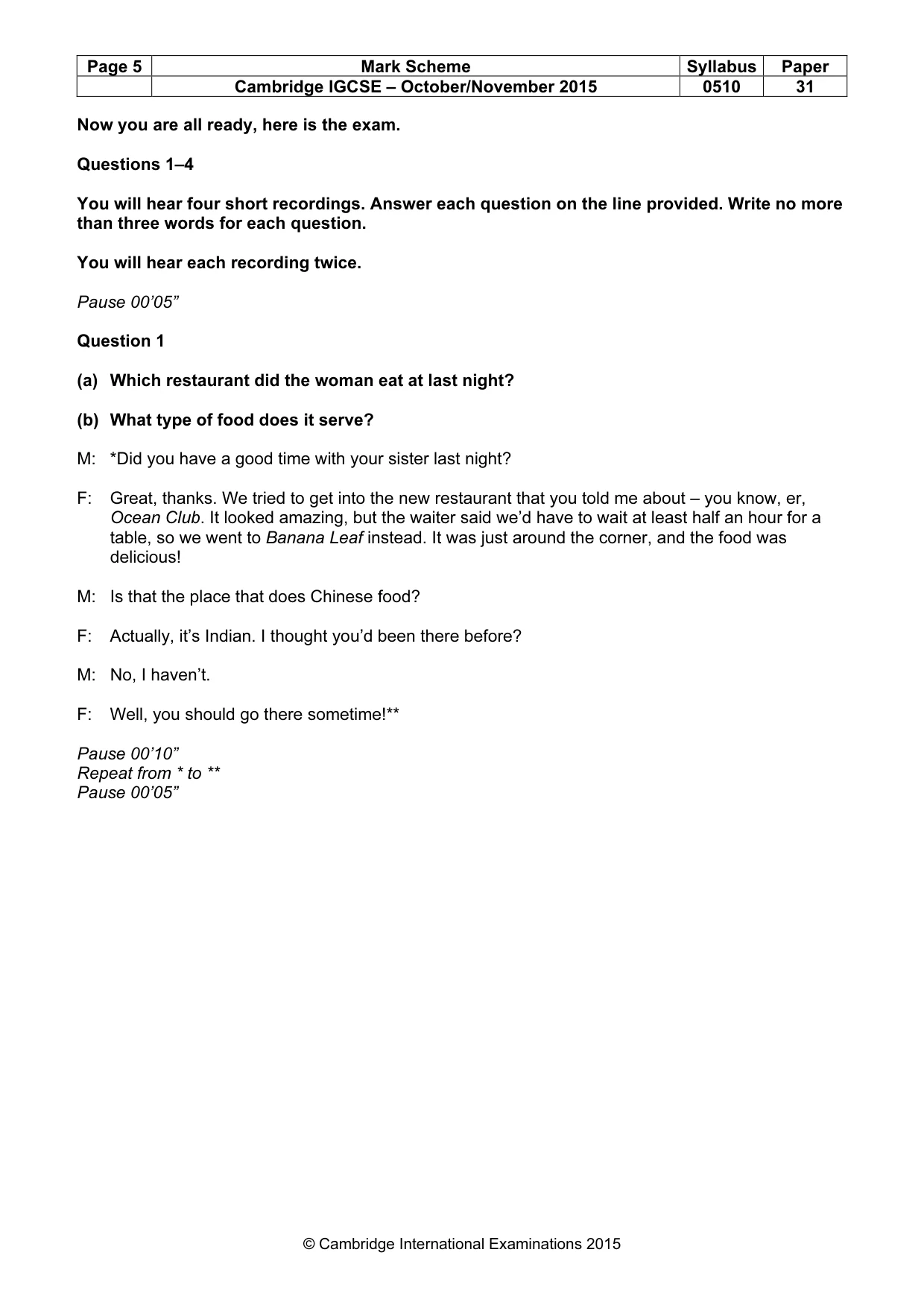
Page 5 Mark Scheme Syllabus Paper Cambridge IGCSE – October/November 2015 0510 31 © Cambridge International Examinations 2015 Now you are all ready, here is the exam. Questions 1–4 You will hear four short recordings. Answer each question on the line provided. Write no more than three words for each question. You will hear each recording twice. Pause 00’05” Question 1 (a) Which restaurant did the woman eat at last night? (b) What type of food does it serve? M: *Did you have a good time with your sister last night? F: Great, thanks. We tried to get into the new restaurant that you told me about – you know, er, Ocean Club. It looked amazing, but the waiter said we’d have to wait at least half an hour for a table, so we went to Banana Leaf instead. It was just around the corner, and the food was delicious! M: Is that the place that does Chinese food? F: Actually, it’s Indian. I thought you’d been there before? M: No, I haven’t. F: Well, you should go there sometime!** Pause 00’10” Repeat from * to ** Pause 00’05”
Mark scheme, page 6
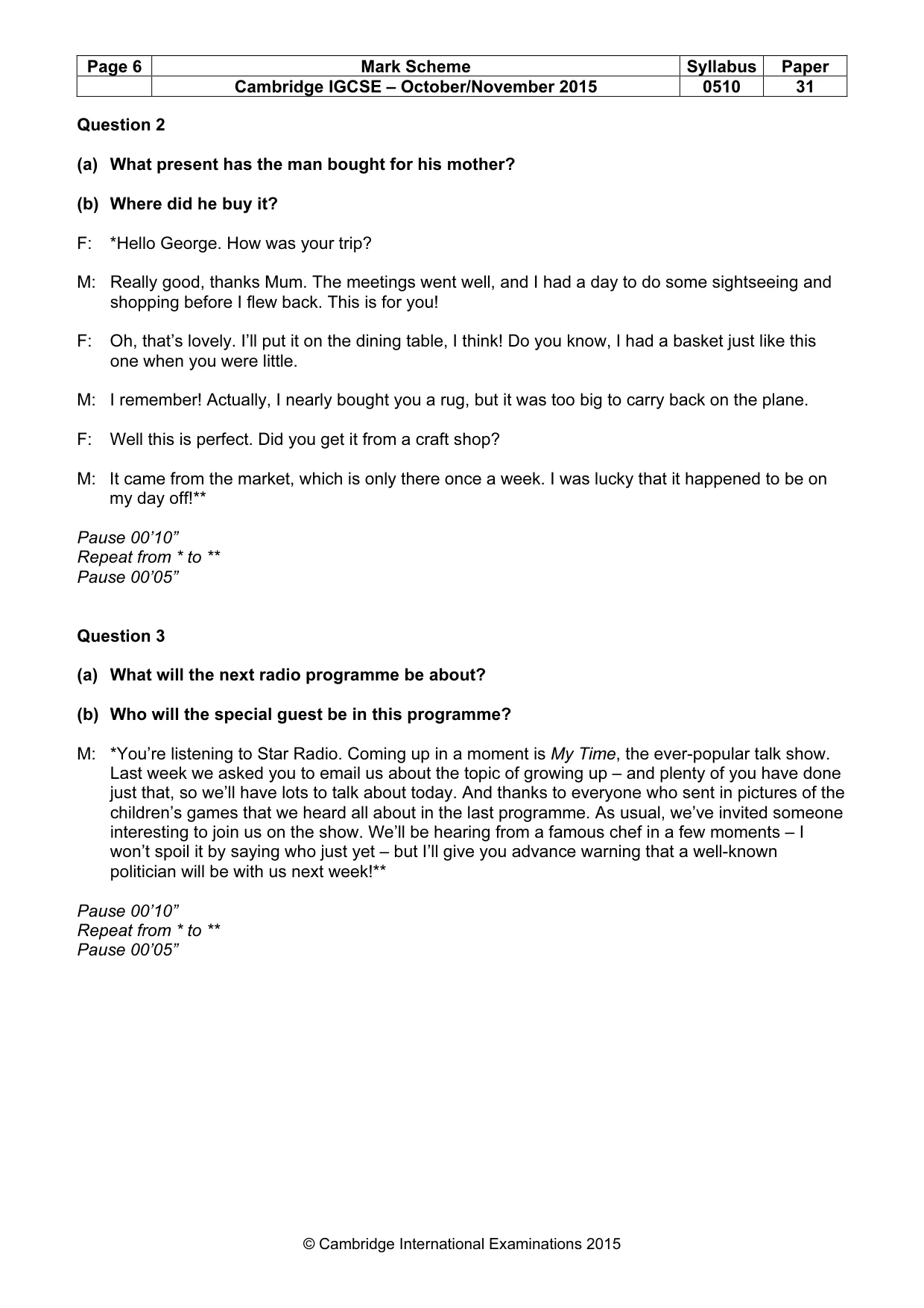
Page 6 Mark Scheme Syllabus Paper Cambridge IGCSE – October/November 2015 0510 31 © Cambridge International Examinations 2015 Question 2 (a) What present has the man bought for his mother? (b) Where did he buy it? F: *Hello George. How was your trip? M: Really good, thanks Mum. The meetings went well, and I had a day to do some sightseeing and shopping before I flew back. This is for you! F: Oh, that’s lovely. I’ll put it on the dining table, I think! Do you know, I had a basket just like this one when you were little. M: I remember! Actually, I nearly bought you a rug, but it was too big to carry back on the plane. F: Well this is perfect. Did you get it from a craft shop? M: It came from the market, which is only there once a week. I was lucky that it happened to be on my day off!** Pause 00’10” Repeat from * to ** Pause 00’05” Question 3 (a) What will the next radio programme be about? (b) Who will the special guest be in this programme? M: *You’re listening to Star Radio. Coming up in a moment is My Time, the ever-popular talk show. Last week we asked you to email us about the topic of growing up – and plenty of you have done just that, so we’ll have lots to talk about today. And thanks to everyone who sent in pictures of the children’s games that we heard all about in the last programme. As usual, we’ve invited someone interesting to join us on the show. We’ll be hearing from a famous chef in a few moments – I won’t spoil it by saying who just yet – but I’ll give you advance warning that a well-known politician will be with us next week!** Pause 00’10” Repeat from * to ** Pause 00’05”
Mark scheme, page 7
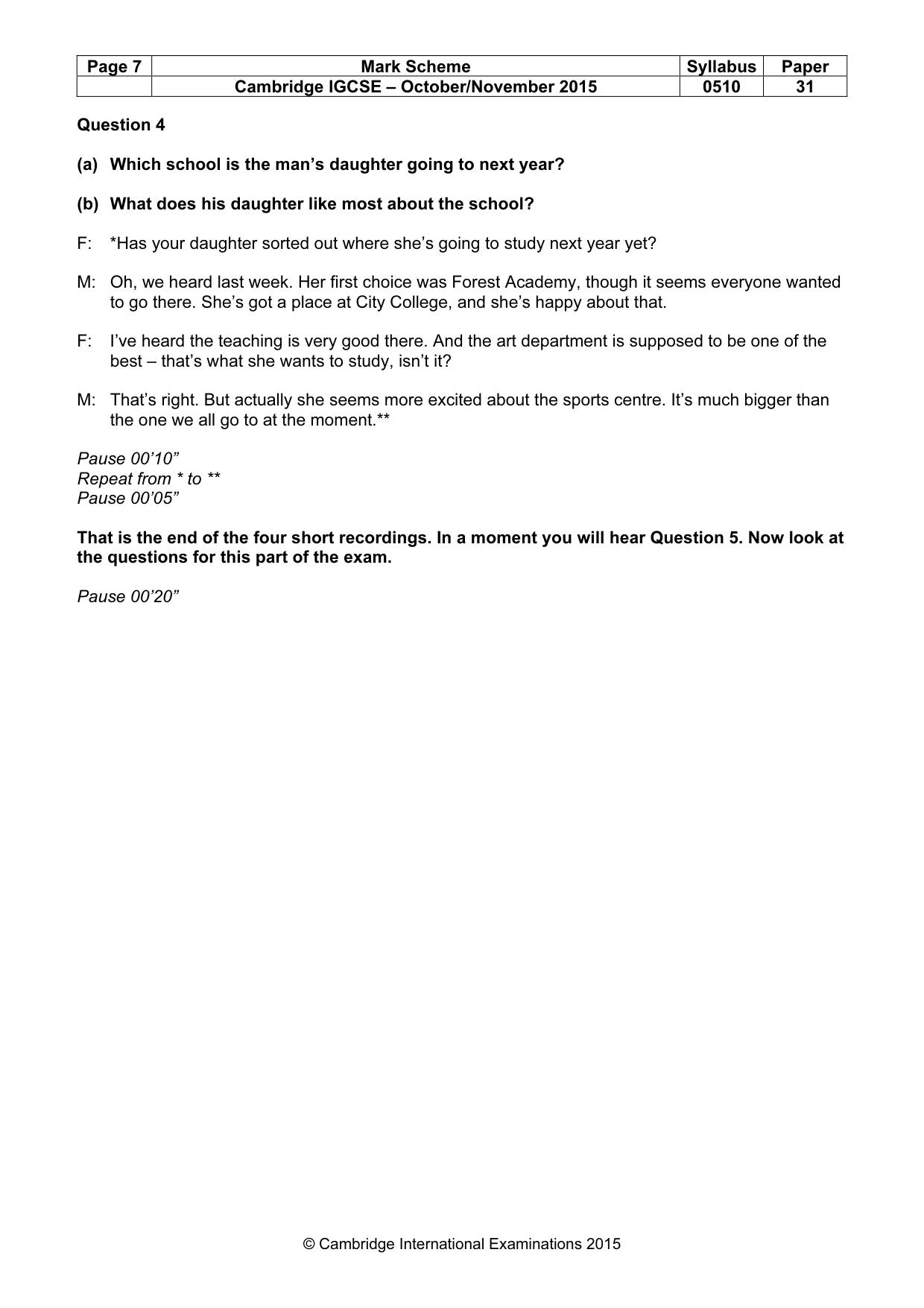
Page 7 Mark Scheme Syllabus Paper Cambridge IGCSE – October/November 2015 0510 31 © Cambridge International Examinations 2015 Question 4 (a) Which school is the man’s daughter going to next year? (b) What does his daughter like most about the school? F: *Has your daughter sorted out where she’s going to study next year yet? M: Oh, we heard last week. Her first choice was Forest Academy, though it seems everyone wanted to go there. She’s got a place at City College, and she’s happy about that. F: I’ve heard the teaching is very good there. And the art department is supposed to be one of the best – that’s what she wants to study, isn’t it? M: That’s right. But actually she seems more excited about the sports centre. It’s much bigger than the one we all go to at the moment.** Pause 00’10” Repeat from * to ** Pause 00’05” That is the end of the four short recordings. In a moment you will hear Question 5. Now look at the questions for this part of the exam. Pause 00’20”
Mark scheme, page 8
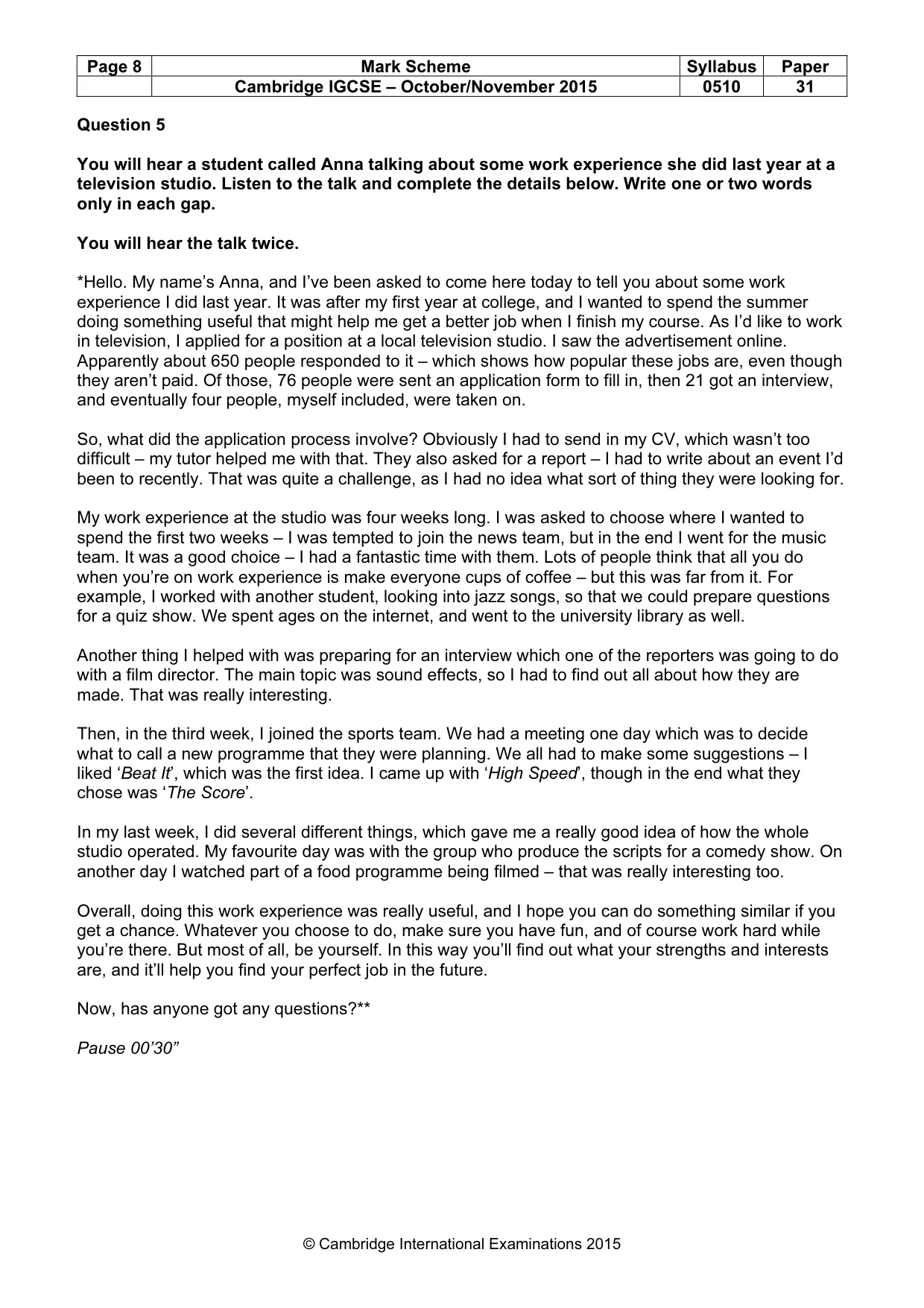
Page 8 Mark Scheme Syllabus Paper Cambridge IGCSE – October/November 2015 0510 31 © Cambridge International Examinations 2015 Question 5 You will hear a student called Anna talking about some work experience she did last year at a television studio. Listen to the talk and complete the details below. Write one or two words only in each gap. You will hear the talk twice. *Hello. My name’s Anna, and I’ve been asked to come here today to tell you about some work experience I did last year. It was after my first year at college, and I wanted to spend the summer doing something useful that might help me get a better job when I finish my course. As I’d like to work in television, I applied for a position at a local television studio. I saw the advertisement online. Apparently about 650 people responded to it – which shows how popular these jobs are, even though they aren’t paid. Of those, 76 people were sent an application form to fill in, then 21 got an interview, and eventually four people, myself included, were taken on. So, what did the application process involve? Obviously I had to send in my CV, which wasn’t too difficult – my tutor helped me with that. They also asked for a report – I had to write about an event I’d been to recently. That was quite a challenge, as I had no idea what sort of thing they were looking for. My work experience at the studio was four weeks long. I was asked to choose where I wanted to spend the first two weeks – I was tempted to join the news team, but in the end I went for the music team. It was a good choice – I had a fantastic time with them. Lots of people think that all you do when you’re on work experience is make everyone cups of coffee – but this was far from it. For example, I worked with another student, looking into jazz songs, so that we could prepare questions for a quiz show. We spent ages on the internet, and went to the university library as well. Another thing I helped with was preparing for an interview which one of the reporters was going to do with a film director. The main topic was sound effects, so I had to find out all about how they are made. That was really interesting. Then, in the third week, I joined the sports team. We had a meeting one day which was to decide what to call a new programme that they were planning. We all had to make some suggestions – I liked ‘Beat It’, which was the first idea. I came up with ‘High Speed’, though in the end what they chose was ‘The Score’. In my last week, I did several different things, which gave me a really good idea of how the whole studio operated. My favourite day was with the group who produce the scripts for a comedy show. On another day I watched part of a food programme being filmed – that was really interesting too. Overall, doing this work experience was really useful, and I hope you can do something similar if you get a chance. Whatever you choose to do, make sure you have fun, and of course work hard while you’re there. But most of all, be yourself. In this way you’ll find out what your strengths and interests are, and it’ll help you find your perfect job in the future. Now, has anyone got any questions?** Pause 00’30”
Mark scheme, page 9
Page 9 Mark Scheme Syllabus Paper Cambridge IGCSE – October/November 2015 0510 31 © Cambridge International Examinations 2015 Now you will hear the talk again. Repeat from * to ** Pause 00’30” That is the end of the talk. In a moment you will hear Question 6. Now look at the questions for this part of the exam. Pause 00’25”
Mark scheme, page 10
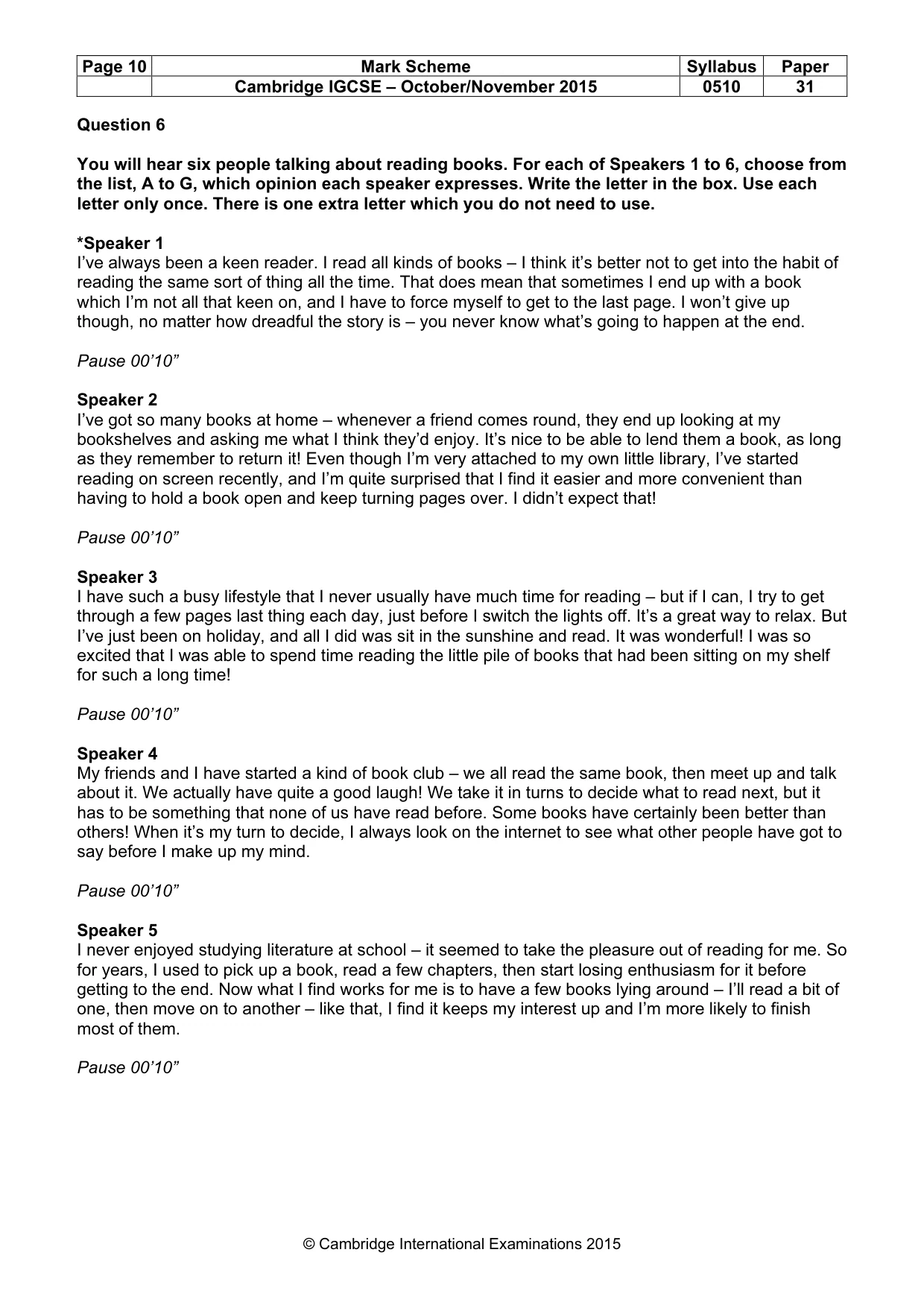
Page 10 Mark Scheme Syllabus Paper Cambridge IGCSE – October/November 2015 0510 31 © Cambridge International Examinations 2015 Question 6 You will hear six people talking about reading books. For each of Speakers 1 to 6, choose from the list, A to G, which opinion each speaker expresses. Write the letter in the box. Use each letter only once. There is one extra letter which you do not need to use. *Speaker 1 I’ve always been a keen reader. I read all kinds of books – I think it’s better not to get into the habit of reading the same sort of thing all the time. That does mean that sometimes I end up with a book which I’m not all that keen on, and I have to force myself to get to the last page. I won’t give up though, no matter how dreadful the story is – you never know what’s going to happen at the end. Pause 00’10” Speaker 2 I’ve got so many books at home – whenever a friend comes round, they end up looking at my bookshelves and asking me what I think they’d enjoy. It’s nice to be able to lend them a book, as long as they remember to return it! Even though I’m very attached to my own little library, I’ve started reading on screen recently, and I’m quite surprised that I find it easier and more convenient than having to hold a book open and keep turning pages over. I didn’t expect that! Pause 00’10” Speaker 3 I have such a busy lifestyle that I never usually have much time for reading – but if I can, I try to get through a few pages last thing each day, just before I switch the lights off. It’s a great way to relax. But I’ve just been on holiday, and all I did was sit in the sunshine and read. It was wonderful! I was so excited that I was able to spend time reading the little pile of books that had been sitting on my shelf for such a long time! Pause 00’10” Speaker 4 My friends and I have started a kind of book club – we all read the same book, then meet up and talk about it. We actually have quite a good laugh! We take it in turns to decide what to read next, but it has to be something that none of us have read before. Some books have certainly been better than others! When it’s my turn to decide, I always look on the internet to see what other people have got to say before I make up my mind. Pause 00’10” Speaker 5 I never enjoyed studying literature at school – it seemed to take the pleasure out of reading for me. So for years, I used to pick up a book, read a few chapters, then start losing enthusiasm for it before getting to the end. Now what I find works for me is to have a few books lying around – I’ll read a bit of one, then move on to another – like that, I find it keeps my interest up and I’m more likely to finish most of them. Pause 00’10”
Mark scheme, page 11
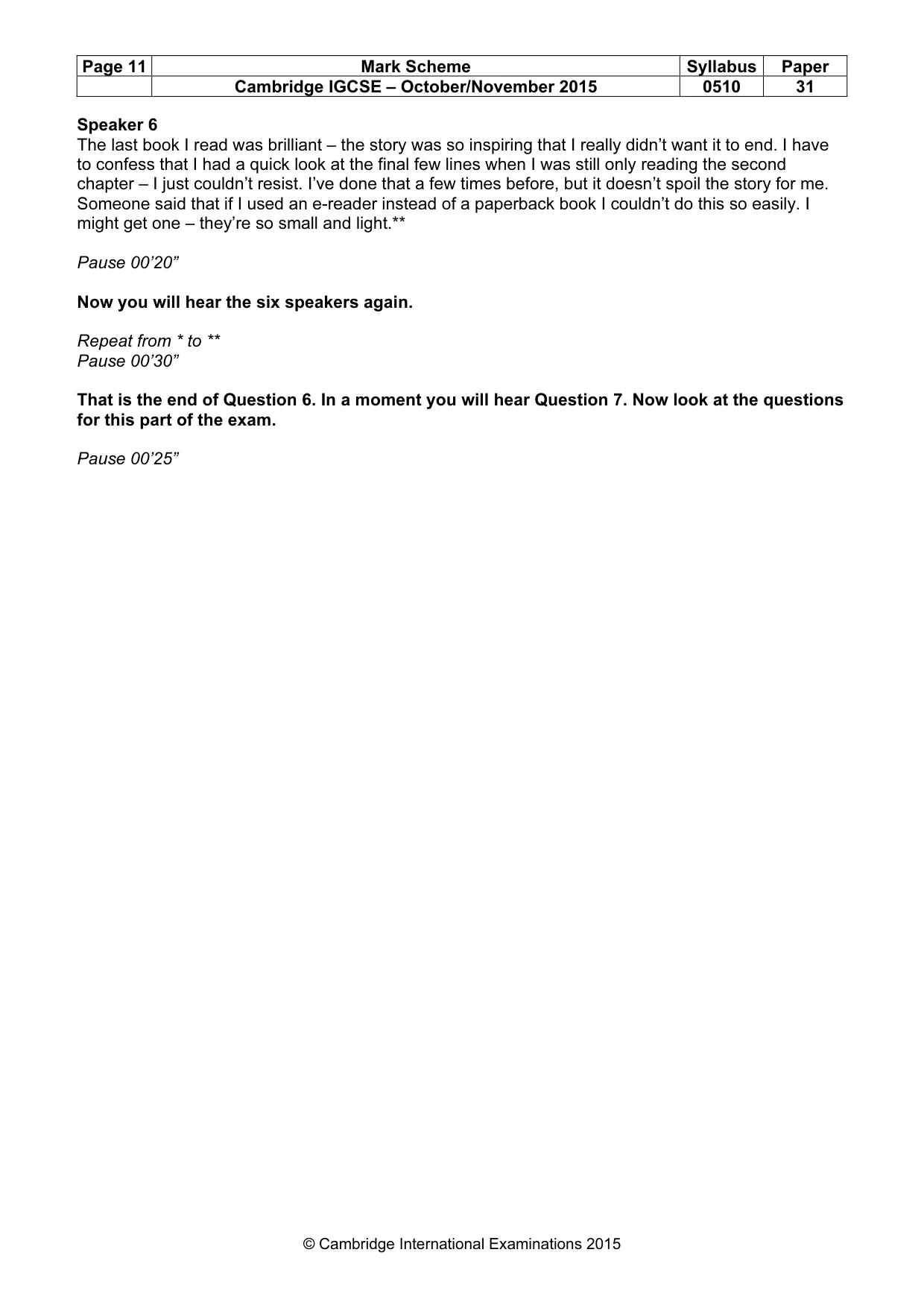
Page 11 Mark Scheme Syllabus Paper Cambridge IGCSE – October/November 2015 0510 31 © Cambridge International Examinations 2015 Speaker 6 The last book I read was brilliant – the story was so inspiring that I really didn’t want it to end. I have to confess that I had a quick look at the final few lines when I was still only reading the second chapter – I just couldn’t resist. I’ve done that a few times before, but it doesn’t spoil the story for me. Someone said that if I used an e-reader instead of a paperback book I couldn’t do this so easily. I might get one – they’re so small and light.** Pause 00’20” Now you will hear the six speakers again. Repeat from * to ** Pause 00’30” That is the end of Question 6. In a moment you will hear Question 7. Now look at the questions for this part of the exam. Pause 00’25”
Mark scheme, page 12
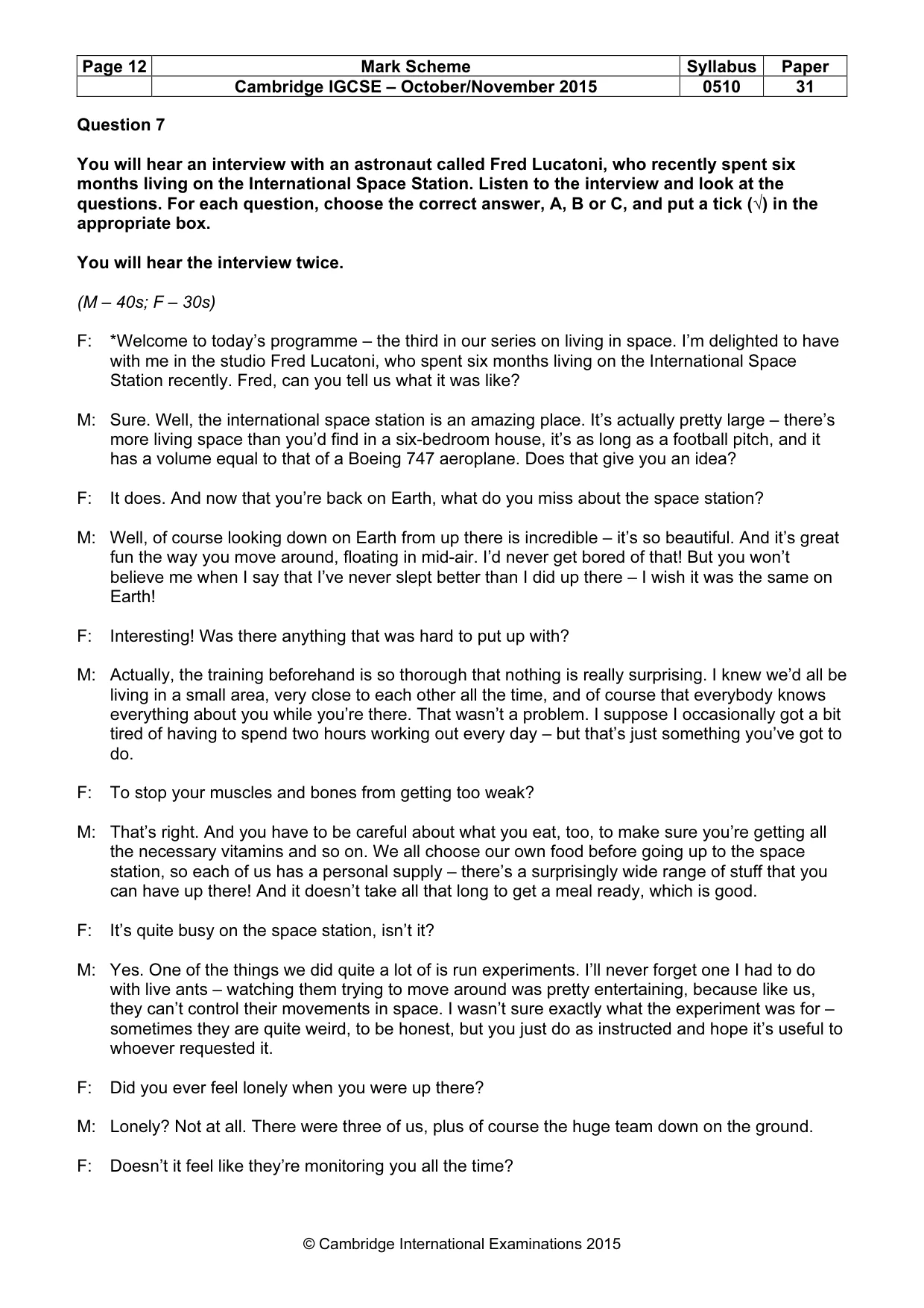
Page 12 Mark Scheme Syllabus Paper Cambridge IGCSE – October/November 2015 0510 31 © Cambridge International Examinations 2015 Question 7 You will hear an interview with an astronaut called Fred Lucatoni, who recently spent six months living on the International Space Station. Listen to the interview and look at the questions. For each question, choose the correct answer, A, B or C, and put a tick (√) in the appropriate box. You will hear the interview twice. (M – 40s; F – 30s) F: *Welcome to today’s programme – the third in our series on living in space. I’m delighted to have with me in the studio Fred Lucatoni, who spent six months living on the International Space Station recently. Fred, can you tell us what it was like? M: Sure. Well, the international space station is an amazing place. It’s actually pretty large – there’s more living space than you’d find in a six-bedroom house, it’s as long as a football pitch, and it has a volume equal to that of a Boeing 747 aeroplane. Does that give you an idea? F: It does. And now that you’re back on Earth, what do you miss about the space station? M: Well, of course looking down on Earth from up there is incredible – it’s so beautiful. And it’s great fun the way you move around, floating in mid-air. I’d never get bored of that! But you won’t believe me when I say that I’ve never slept better than I did up there – I wish it was the same on Earth! F: Interesting! Was there anything that was hard to put up with? M: Actually, the training beforehand is so thorough that nothing is really surprising. I knew we’d all be living in a small area, very close to each other all the time, and of course that everybody knows everything about you while you’re there. That wasn’t a problem. I suppose I occasionally got a bit tired of having to spend two hours working out every day – but that’s just something you’ve got to do. F: To stop your muscles and bones from getting too weak? M: That’s right. And you have to be careful about what you eat, too, to make sure you’re getting all the necessary vitamins and so on. We all choose our own food before going up to the space station, so each of us has a personal supply – there’s a surprisingly wide range of stuff that you can have up there! And it doesn’t take all that long to get a meal ready, which is good. F: It’s quite busy on the space station, isn’t it? M: Yes. One of the things we did quite a lot of is run experiments. I’ll never forget one I had to do with live ants – watching them trying to move around was pretty entertaining, because like us, they can’t control their movements in space. I wasn’t sure exactly what the experiment was for – sometimes they are quite weird, to be honest, but you just do as instructed and hope it’s useful to whoever requested it. F: Did you ever feel lonely when you were up there? M: Lonely? Not at all. There were three of us, plus of course the huge team down on the ground. F: Doesn’t it feel like they’re monitoring you all the time?
Mark scheme, page 13
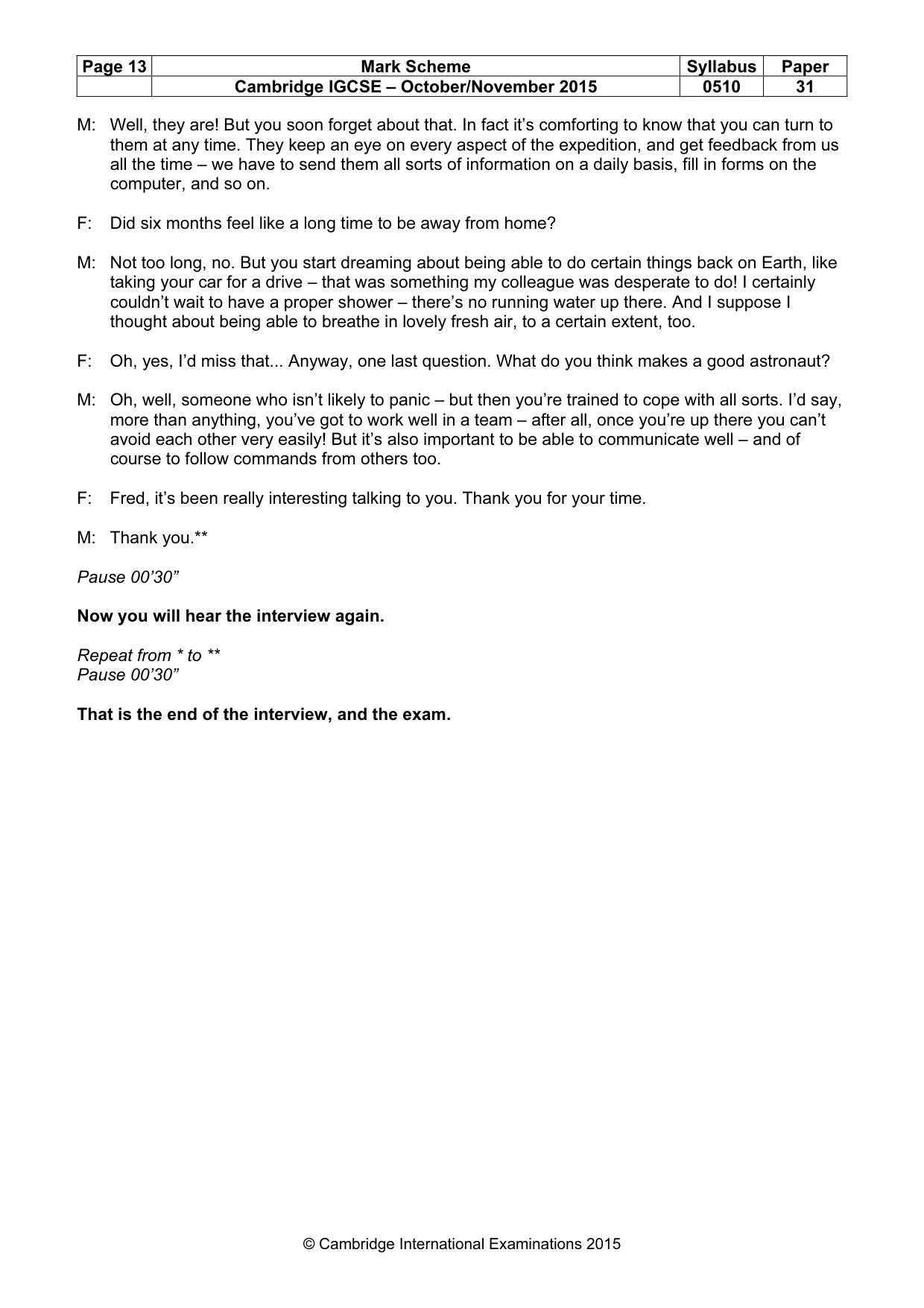
Page 13 Mark Scheme Syllabus Paper Cambridge IGCSE – October/November 2015 0510 31 © Cambridge International Examinations 2015 M: Well, they are! But you soon forget about that. In fact it’s comforting to know that you can turn to them at any time. They keep an eye on every aspect of the expedition, and get feedback from us all the time – we have to send them all sorts of information on a daily basis, fill in forms on the computer, and so on. F: Did six months feel like a long time to be away from home? M: Not too long, no. But you start dreaming about being able to do certain things back on Earth, like taking your car for a drive – that was something my colleague was desperate to do! I certainly couldn’t wait to have a proper shower – there’s no running water up there. And I suppose I thought about being able to breathe in lovely fresh air, to a certain extent, too. F: Oh, yes, I’d miss that... Anyway, one last question. What do you think makes a good astronaut? M: Oh, well, someone who isn’t likely to panic – but then you’re trained to cope with all sorts. I’d say, more than anything, you’ve got to work well in a team – after all, once you’re up there you can’t avoid each other very easily! But it’s also important to be able to communicate well – and of course to follow commands from others too. F: Fred, it’s been really interesting talking to you. Thank you for your time. M: Thank you.** Pause 00’30” Now you will hear the interview again. Repeat from * to ** Pause 00’30” That is the end of the interview, and the exam.
What you needed in this session
Cambridge’s own grade thresholds for 2015 Oct/Nov, Paper 3 · Variant 1. A higher threshold means an easier paper — the bar moves with how the cohort did.