Cambridge IGCSE English - Second Language (oral endorsement) 0510 — 2014 Oct/Nov Paper 3 · Variant 2
0510/32/O/N/14 · 30 marks · ≈34 min
The question paper and its mark scheme, free to read here and free to download. This is Cambridge’s own paper, exactly as it was sat.
Question paper8 pages

Mark scheme16 pages
Answers below. Sit the paper first if you are practising.
Paper as text
Question paper, page 1
This document consists of 7 printed pages and 1 blank page. DC (NF/SW) 94739/1 © UCLES 2014 [Turn over Cambridge International Examinations Cambridge International General Certificate of Secondary Education * 2 5 3 5 1 1 7 7 4 1 * ENGLISH AS A SECOND LANGUAGE 0510/32 Paper 3 Listening (Core) October/November 2014 Approx. 30–40 minutes Candidates answer on the Question Paper. Additional Materials: As listed in Instructions to Supervisors. READ THESE INSTRUCTIONS FIRST Write your Centre number, candidate number and name on all the work you hand in. Write in dark blue or black pen. Do not use staples, paper clips, glue or correction fluid. DO NOT WRITE IN ANY BARCODES. Answer all questions. Dictionaries are not permitted. At the end of the examination, fasten all your work securely together. The number of marks is given in brackets [ ] at the end of each question or part question.
Question paper, page 2
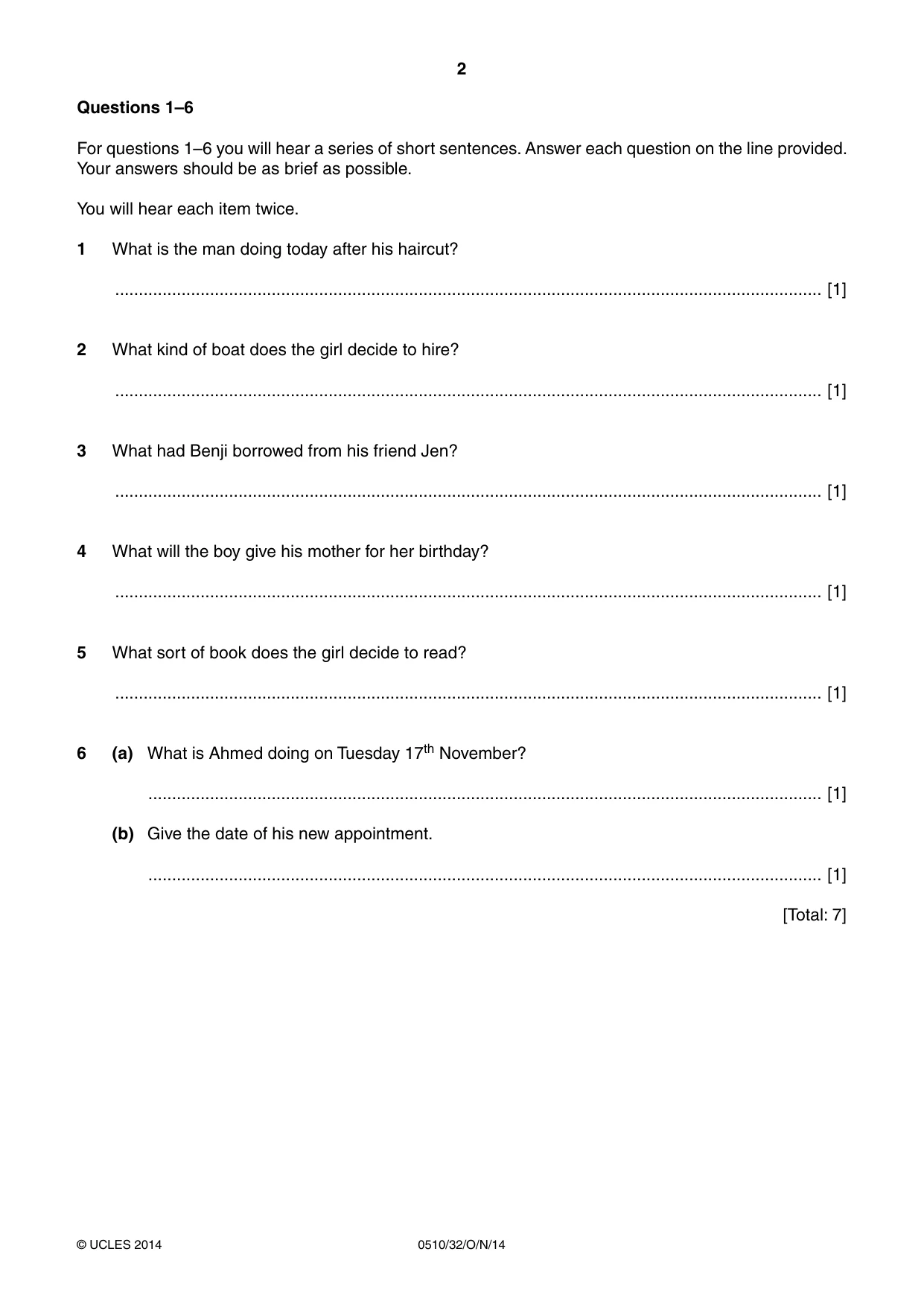
2 0510/32/O/N/14 © UCLES 2014 Questions 1–6 For questions 1–6 you will hear a series of short sentences. Answer each question on the line provided. Your answers should be as brief as possible. You will hear each item twice. 1 What is the man doing today after his haircut? … [1] 2 What kind of boat does the girl decide to hire? … [1] 3 What had Benji borrowed from his friend Jen? … [1] 4 What will the boy give his mother for her birthday? … [1] 5 What sort of book does the girl decide to read? … [1] 6 (a) What is Ahmed doing on Tuesday 17th November? … [1] (b) Give the date of his new appointment. … [1] [Total: 7]
Question paper, page 3
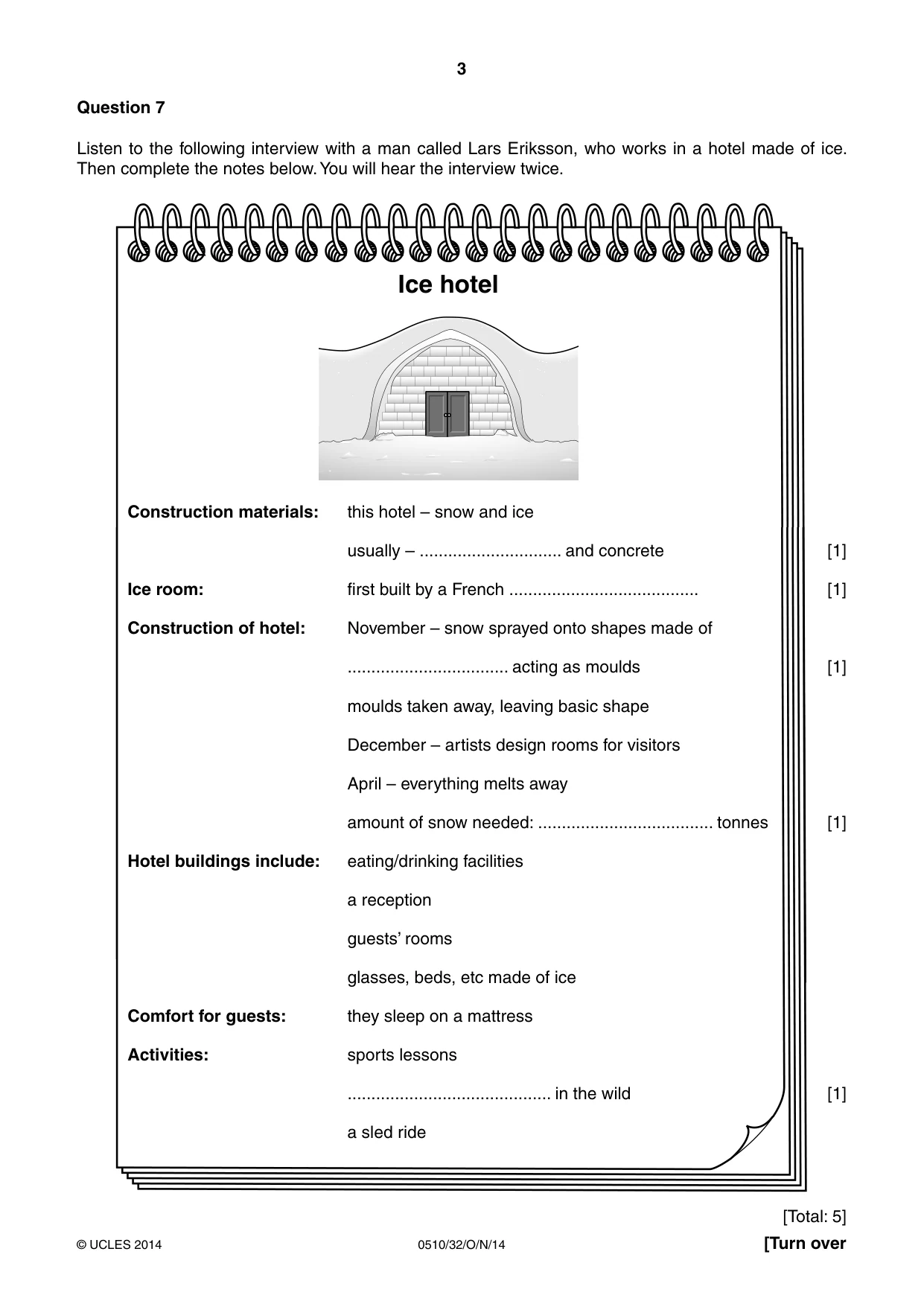
3 0510/32/O/N/14 © UCLES 2014 [Turn over Question 7 Listen to the following interview with a man called Lars Eriksson, who works in a hotel made of ice. Then complete the notes below. You will hear the interview twice. Ice hotel Construction materials: this hotel – snow and ice usually – … and concrete [1] Ice room: first built by a French … [1] Construction of hotel: November – snow sprayed onto shapes made of … acting as moulds [1] moulds taken away, leaving basic shape December – artists design rooms for visitors April – everything melts away amount of snow needed: … tonnes [1] Hotel buildings include: eating/drinking facilities a reception guests’ rooms glasses, beds, etc made of ice Comfort for guests: they sleep on a mattress Activities: sports lessons … in the wild [1] a sled ride [Total: 5]
Question paper, page 4
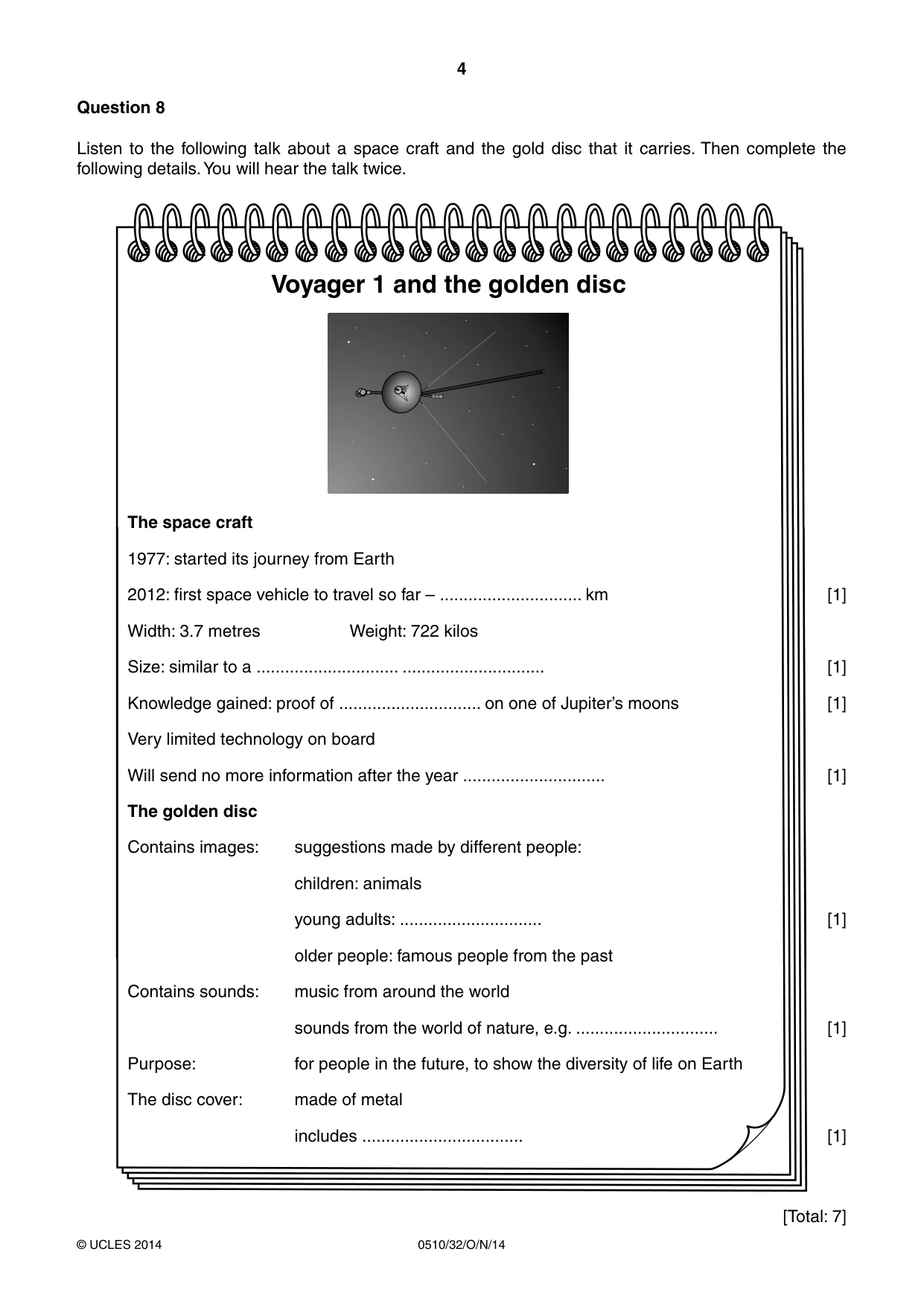
4 0510/32/O/N/14 © UCLES 2014 Question 8 Listen to the following talk about a space craft and the gold disc that it carries. Then complete the following details. You will hear the talk twice. Voyager 1 and the golden disc The space craft 1977: started its journey from Earth 2012: first space vehicle to travel so far – … km [1] Width: 3.7 metres Weight: 722 kilos Size: similar to a … … [1] Knowledge gained: proof of … on one of Jupiter’s moons [1] Very limited technology on board Will send no more information after the year … [1] The golden disc Contains images: suggestions made by different people: children: animals young adults: … [1] older people: famous people from the past Contains sounds: music from around the world sounds from the world of nature, e.g. … [1] Purpose: for people in the future, to show the diversity of life on Earth The disc cover: made of metal includes … [1] [Total: 7]
Question paper, page 5
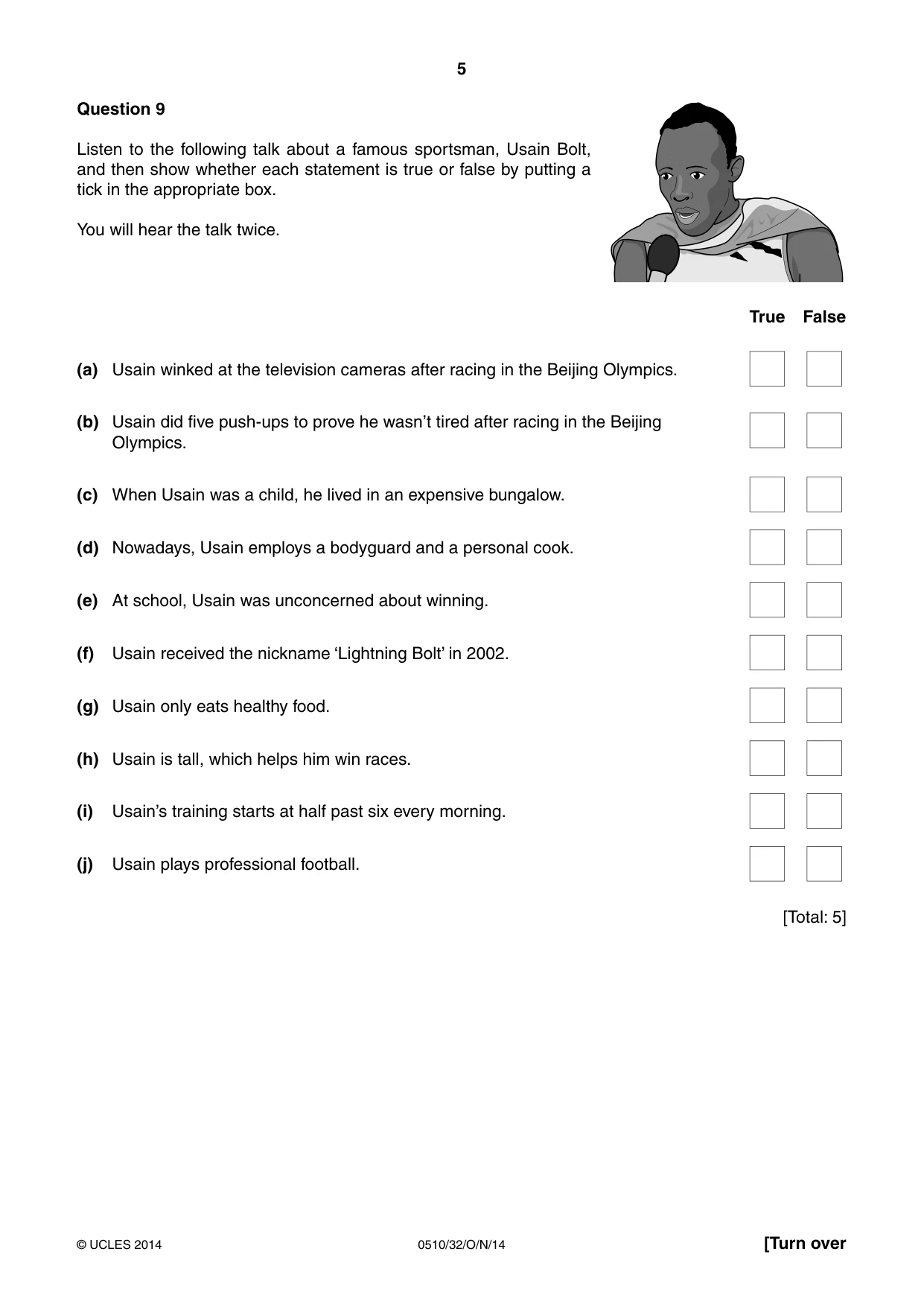
5 0510/32/O/N/14 © UCLES 2014 [Turn over Question 9 Listen to the following talk about a famous sportsman, Usain Bolt, and then show whether each statement is true or false by putting a tick in the appropriate box. You will hear the talk twice. True False (a) Usain winked at the television cameras after racing in the Beijing Olympics. (b) Usain did five push-ups to prove he wasn’t tired after racing in the Beijing Olympics. (c) When Usain was a child, he lived in an expensive bungalow. (d) Nowadays, Usain employs a bodyguard and a personal cook. (e) At school, Usain was unconcerned about winning. (f) Usain received the nickname ‘Lightning Bolt’ in 2002. (g) Usain only eats healthy food. (h) Usain is tall, which helps him win races. (i) Usain’s training starts at half past six every morning. (j) Usain plays professional football. [Total: 5]
Question paper, page 6
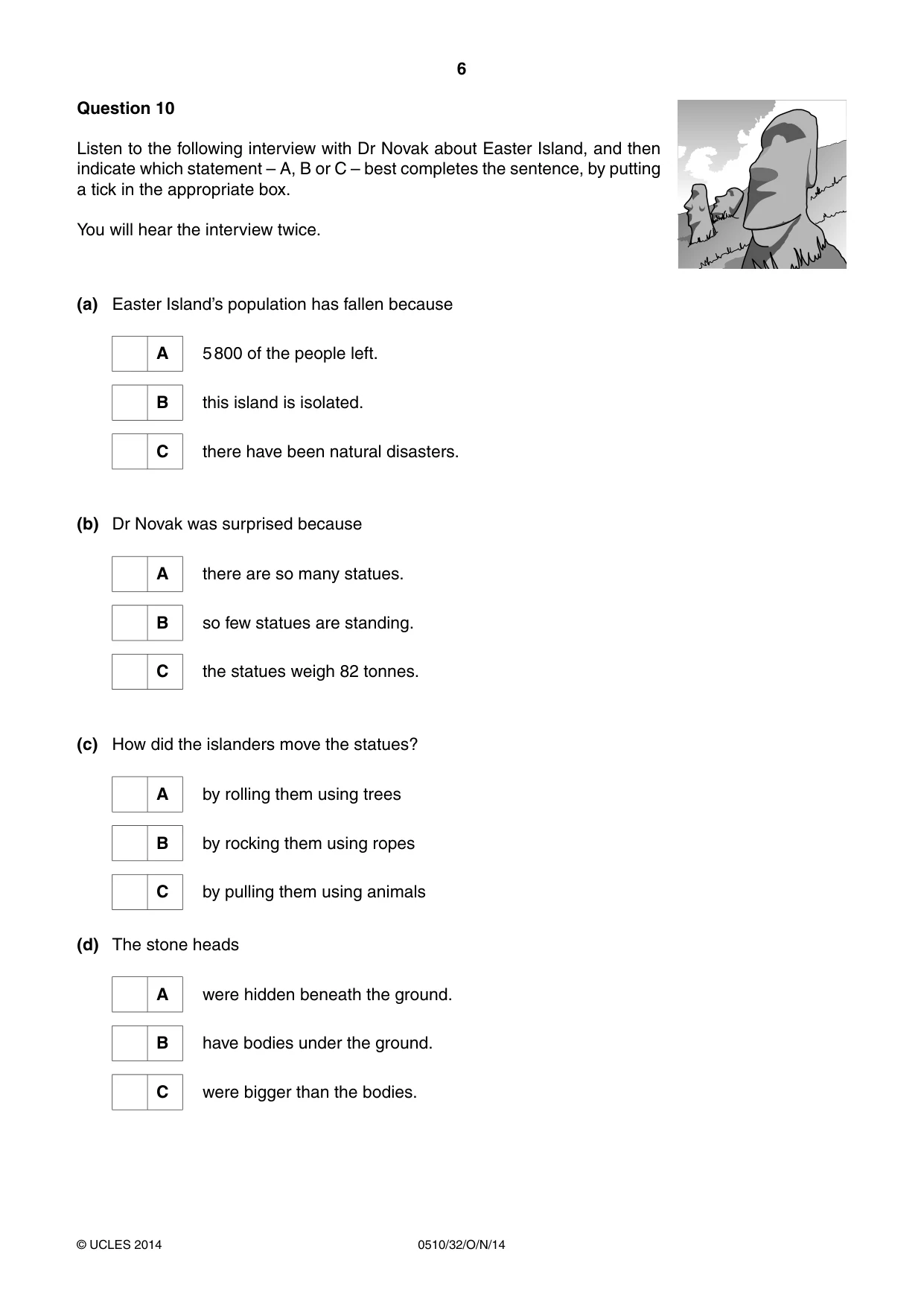
6 0510/32/O/N/14 © UCLES 2014 Question 10 Listen to the following interview with Dr Novak about Easter Island, and then indicate which statement – A, B or C – best completes the sentence, by putting a tick in the appropriate box. You will hear the interview twice. (a) Easter Island’s population has fallen because A 5 800 of the people left. B this island is isolated. C there have been natural disasters. (b) Dr Novak was surprised because A there are so many statues. B so few statues are standing. C the statues weigh 82 tonnes. (c) How did the islanders move the statues? A by rolling them using trees B by rocking them using ropes C by pulling them using animals (d) The stone heads A were hidden beneath the ground. B have bodies under the ground. C were bigger than the bodies.
Question paper, page 7
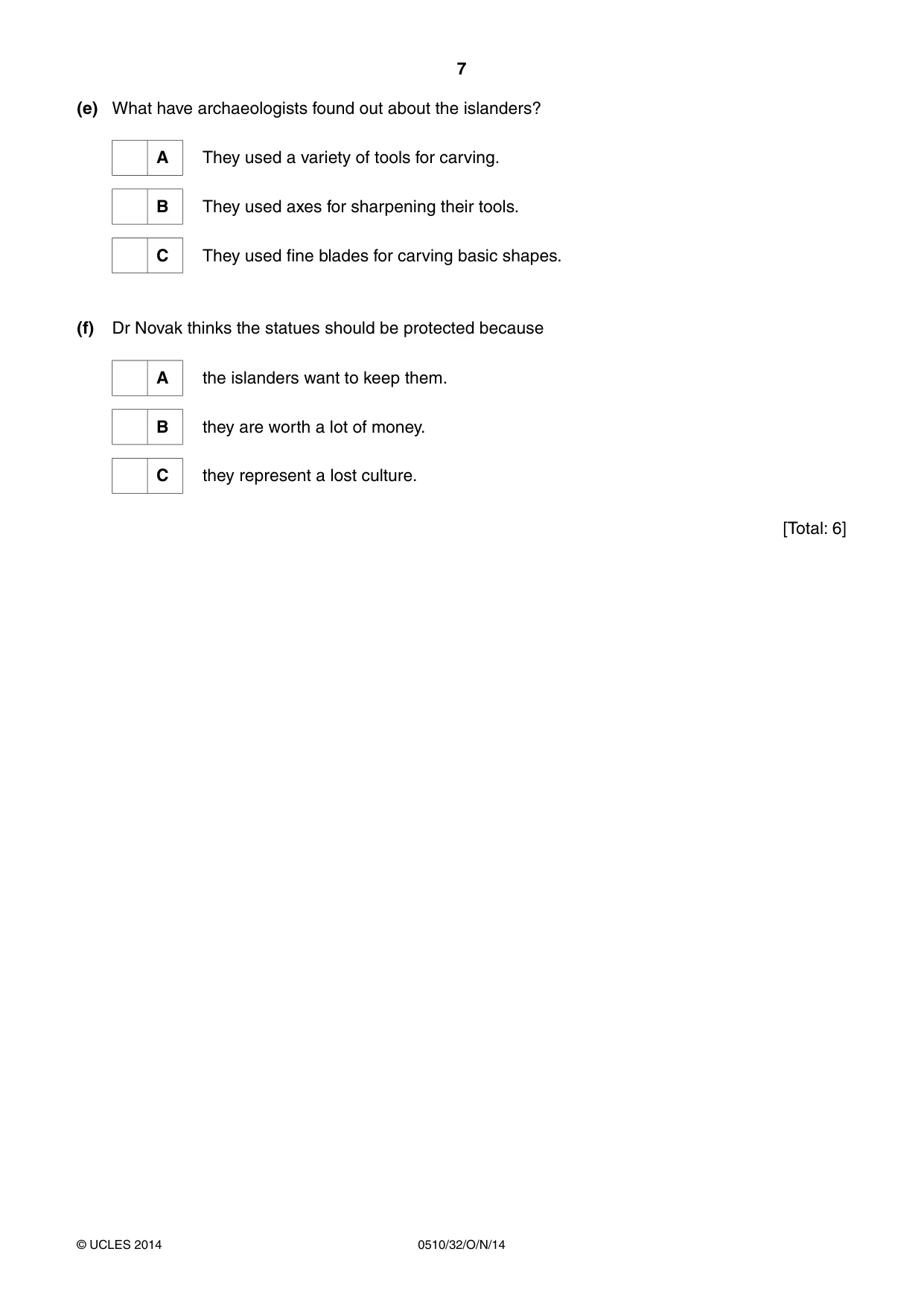
7 0510/32/O/N/14 © UCLES 2014 (e) What have archaeologists found out about the islanders? A They used a variety of tools for carving. B They used axes for sharpening their tools. C They used fine blades for carving basic shapes. (f) Dr Novak thinks the statues should be protected because A the islanders want to keep them. B they are worth a lot of money. C they represent a lost culture. [Total: 6]
Question paper, page 8
8 0510/32/O/N/14 © UCLES 2014 Permission to reproduce items where third-party owned material protected by copyright is included has been sought and cleared where possible. Every reasonable effort has been made by the publisher (UCLES) to trace copyright holders, but if any items requiring clearance have unwittingly been included, the publisher will be pleased to make amends at the earliest possible opportunity. Cambridge International Examinations is part of the Cambridge Assessment Group. Cambridge Assessment is the brand name of University of Cambridge Local Examinations Syndicate (UCLES), which is itself a department of the University of Cambridge. BLANK PAGE
Mark scheme, page 1
® IGCSE is the registered trademark of Cambridge International Examinations. CAMBRIDGE INTERNATIONAL EXAMINATIONS Cambridge International General Certificate of Secondary Education MARK SCHEME for the October/November 2014 series 0510 ENGLISH AS A SECOND LANGUAGE 0510/32 Paper 3 (Listening – Core), maximum raw mark 30 This mark scheme is published as an aid to teachers and candidates, to indicate the requirements of the examination. It shows the basis on which Examiners were instructed to award marks. It does not indicate the details of the discussions that took place at an Examiners’ meeting before marking began, which would have considered the acceptability of alternative answers. Mark schemes should be read in conjunction with the question paper and the Principal Examiner Report for Teachers. Cambridge will not enter into discussions about these mark schemes. Cambridge is publishing the mark schemes for the October/November 2014 series for most Cambridge IGCSE®, Cambridge International A and AS Level components and some Cambridge O Level components.
Mark scheme, page 2
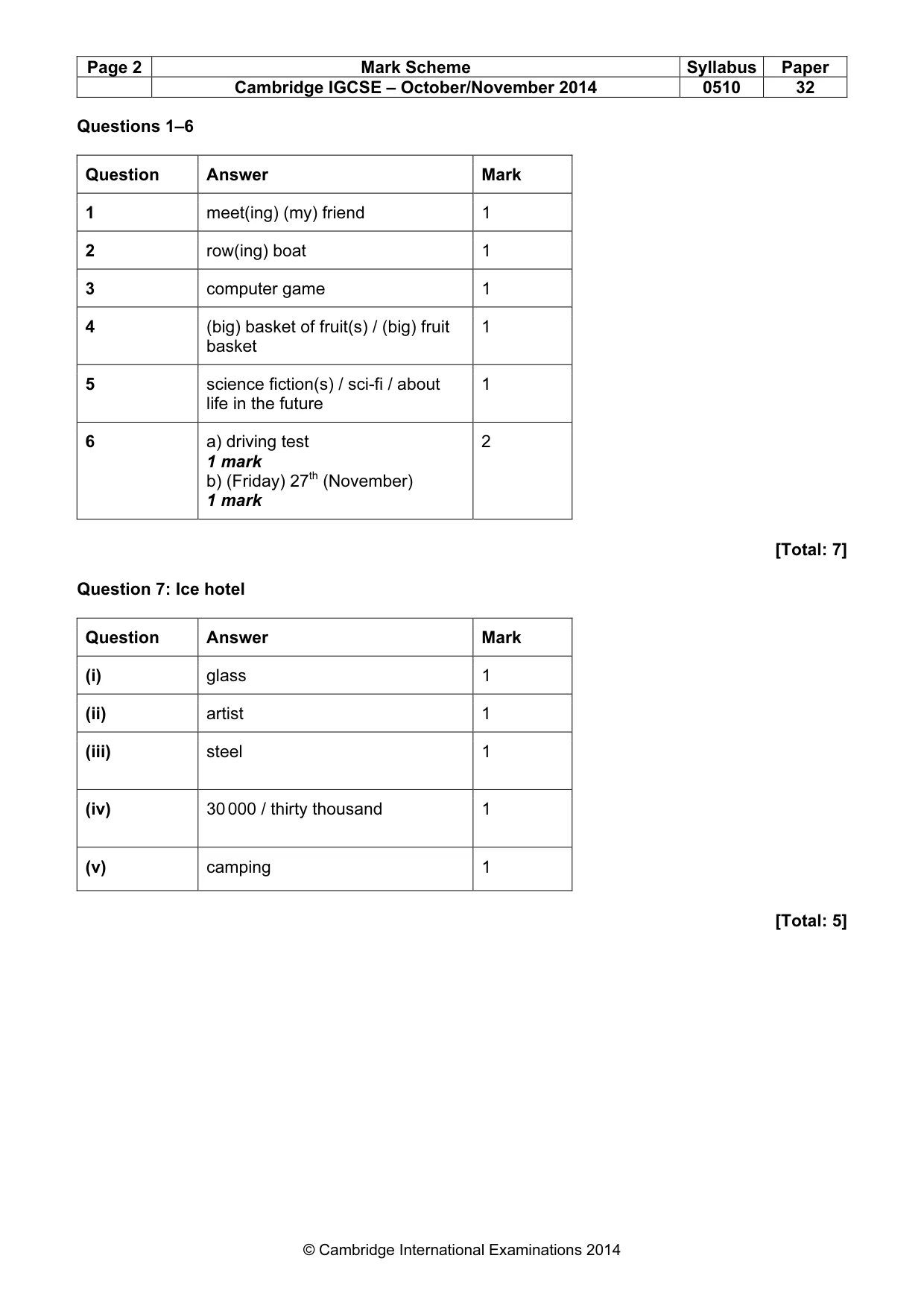
Page 2 Mark Scheme Syllabus Paper Cambridge IGCSE – October/November 2014 0510 32 © Cambridge International Examinations 2014 Questions 1–6 Question Answer Mark 1 meet(ing) (my) friend 1 2 row(ing) boat 1 3 computer game 1 4 (big) basket of fruit(s) / (big) fruit basket 1 5 science fiction(s) / sci-fi / about life in the future 1 6 a) driving test 1 mark b) (Friday) 27th (November) 1 mark 2 [Total: 7] Question 7: Ice hotel Question Answer Mark (i) glass 1 (ii) artist 1 (iii) steel 1 (iv) 30 000 / thirty thousand 1 (v) camping 1 [Total: 5]
Mark scheme, page 3
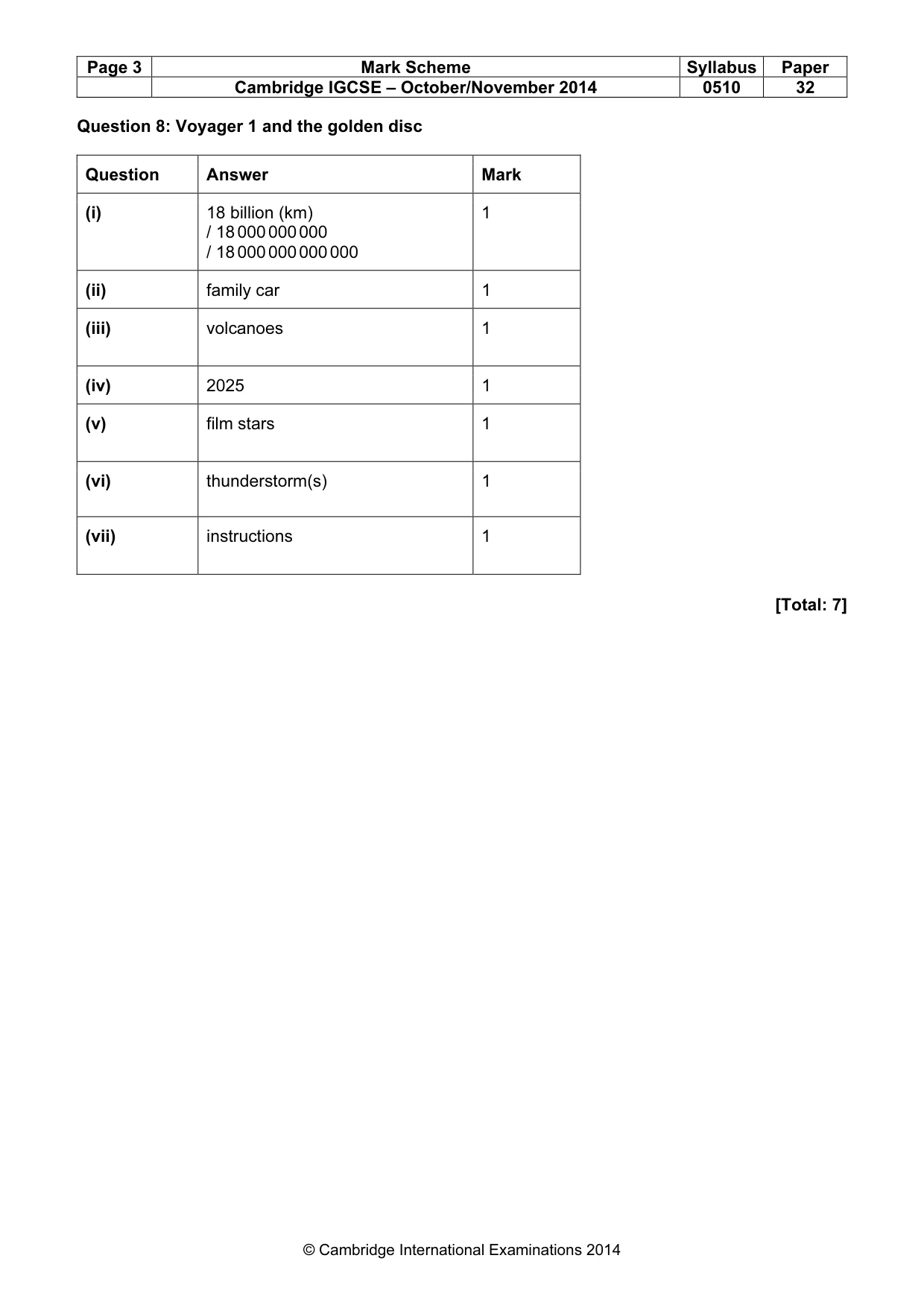
Page 3 Mark Scheme Syllabus Paper Cambridge IGCSE – October/November 2014 0510 32 © Cambridge International Examinations 2014 Question 8: Voyager 1 and the golden disc Question Answer Mark (i) 18 billion (km) / 18 000 000 000 / 18 000 000 000 000 1 (ii) family car 1 (iii) volcanoes 1 (iv) 2025 1 (v) film stars 1 (vi) thunderstorm(s) 1 (vii) instructions 1 [Total: 7]
Mark scheme, page 4
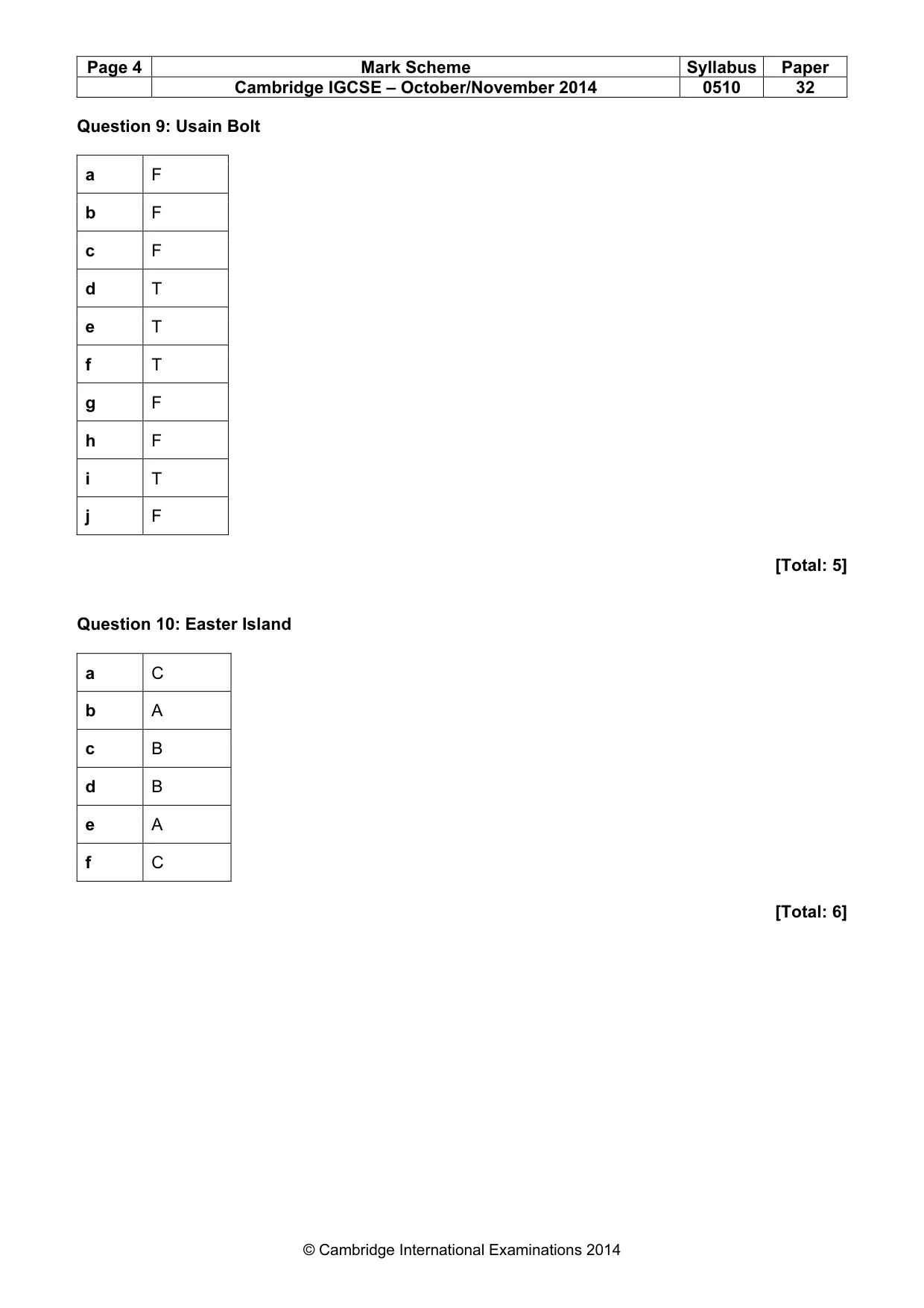
Page 4 Mark Scheme Syllabus Paper Cambridge IGCSE – October/November 2014 0510 32 © Cambridge International Examinations 2014 Question 9: Usain Bolt a F b F c F d T e T f T g F h F i T j F [Total: 5] Question 10: Easter Island a C b A c B d B e A f C [Total: 6]
Mark scheme, page 5
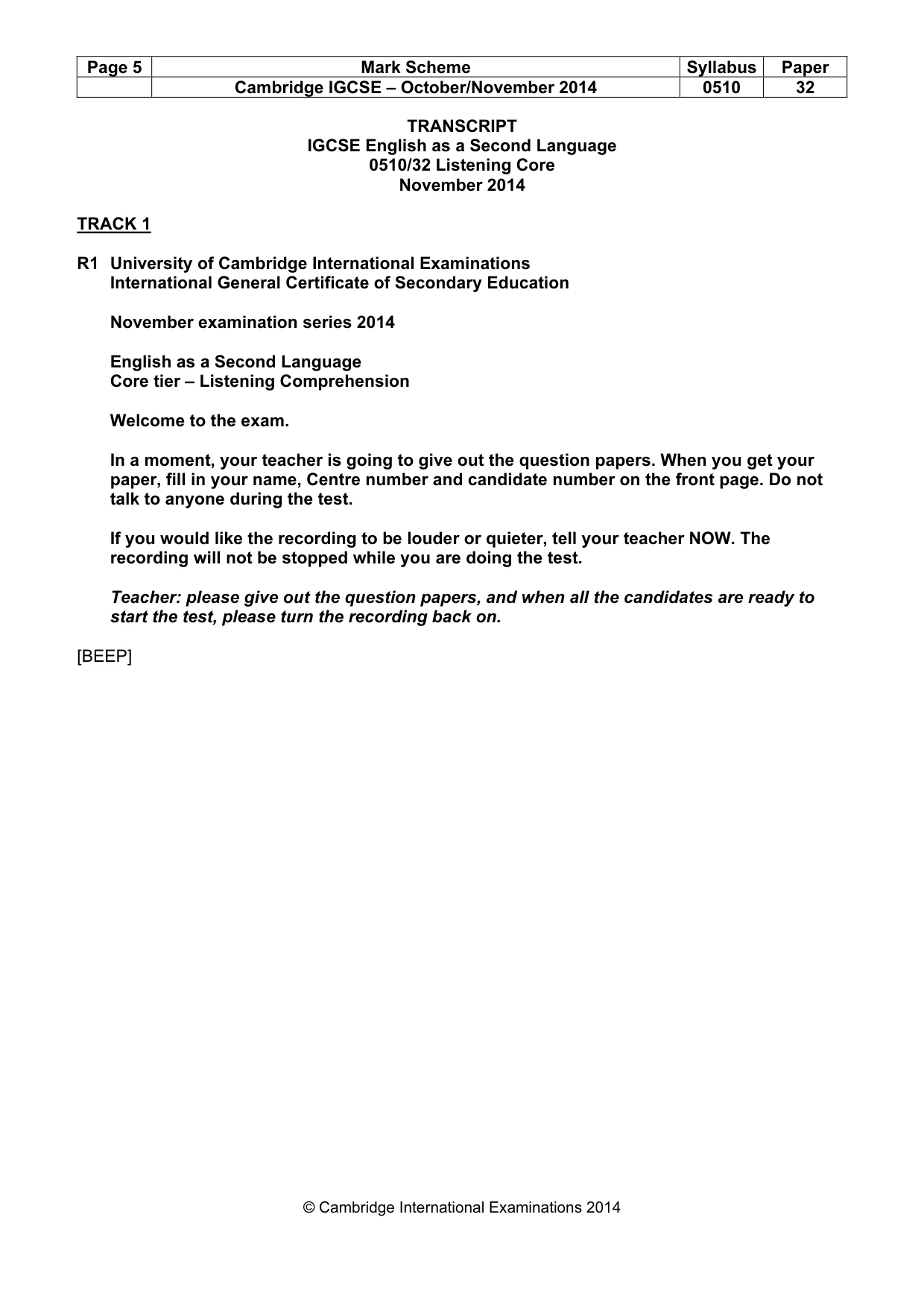
Page 5 Mark Scheme Syllabus Paper Cambridge IGCSE – October/November 2014 0510 32 © Cambridge International Examinations 2014 TRANSCRIPT IGCSE English as a Second Language 0510/32 Listening Core November 2014 TRACK 1 R1 University of Cambridge International Examinations International General Certificate of Secondary Education November examination series 2014 English as a Second Language Core tier – Listening Comprehension Welcome to the exam. In a moment, your teacher is going to give out the question papers. When you get your paper, fill in your name, Centre number and candidate number on the front page. Do not talk to anyone during the test. If you would like the recording to be louder or quieter, tell your teacher NOW. The recording will not be stopped while you are doing the test. Teacher: please give out the question papers, and when all the candidates are ready to start the test, please turn the recording back on. [BEEP]
Mark scheme, page 6
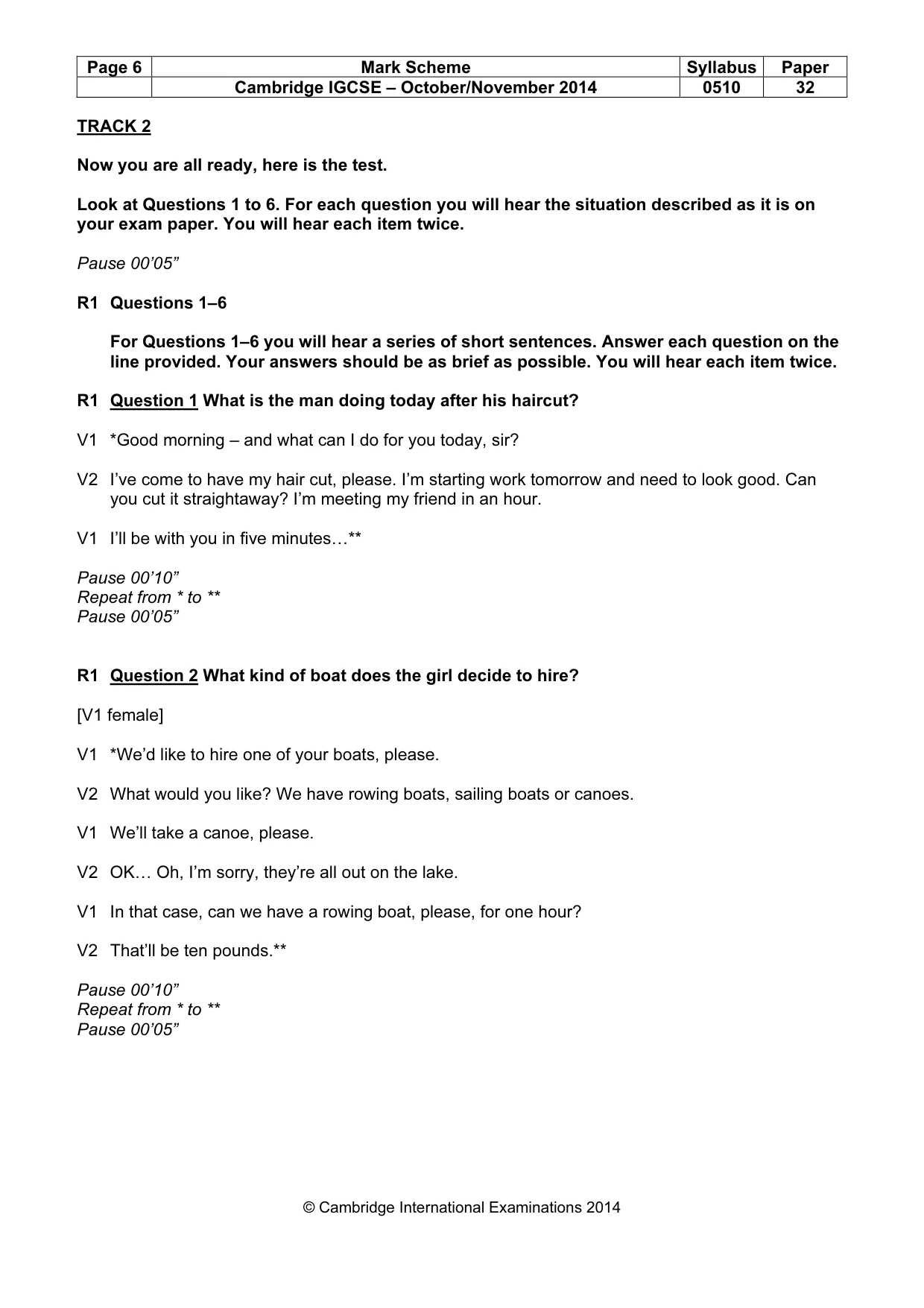
Page 6 Mark Scheme Syllabus Paper Cambridge IGCSE – October/November 2014 0510 32 © Cambridge International Examinations 2014 TRACK 2 Now you are all ready, here is the test. Look at Questions 1 to 6. For each question you will hear the situation described as it is on your exam paper. You will hear each item twice. Pause 00’05” R1 Questions 1–6 For Questions 1–6 you will hear a series of short sentences. Answer each question on the line provided. Your answers should be as brief as possible. You will hear each item twice. R1 Question 1 What is the man doing today after his haircut? V1 *Good morning – and what can I do for you today, sir? V2 I’ve come to have my hair cut, please. I’m starting work tomorrow and need to look good. Can you cut it straightaway? I’m meeting my friend in an hour. V1 I’ll be with you in five minutes…** Pause 00’10” Repeat from * to ** Pause 00’05” R1 Question 2 What kind of boat does the girl decide to hire? [V1 female] V1 *We’d like to hire one of your boats, please. V2 What would you like? We have rowing boats, sailing boats or canoes. V1 We’ll take a canoe, please. V2 OK… Oh, I’m sorry, they’re all out on the lake. V1 In that case, can we have a rowing boat, please, for one hour? V2 That’ll be ten pounds.** Pause 00’10” Repeat from * to ** Pause 00’05”
Mark scheme, page 7
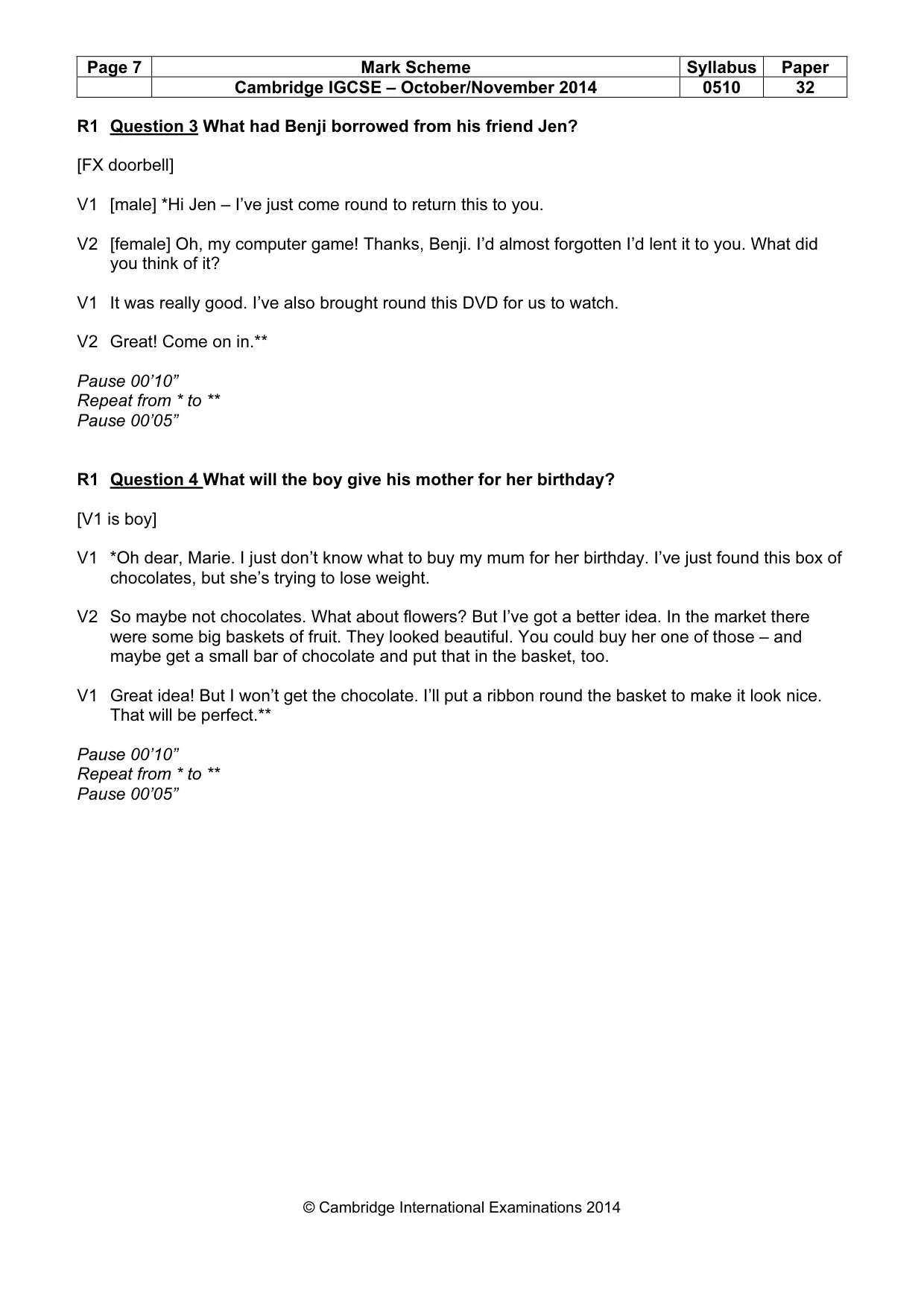
Page 7 Mark Scheme Syllabus Paper Cambridge IGCSE – October/November 2014 0510 32 © Cambridge International Examinations 2014 R1 Question 3 What had Benji borrowed from his friend Jen? [FX doorbell] V1 [male] *Hi Jen – I’ve just come round to return this to you. V2 [female] Oh, my computer game! Thanks, Benji. I’d almost forgotten I’d lent it to you. What did you think of it? V1 It was really good. I’ve also brought round this DVD for us to watch. V2 Great! Come on in.** Pause 00’10” Repeat from * to ** Pause 00’05” R1 Question 4 What will the boy give his mother for her birthday? [V1 is boy] V1 *Oh dear, Marie. I just don’t know what to buy my mum for her birthday. I’ve just found this box of chocolates, but she’s trying to lose weight. V2 So maybe not chocolates. What about flowers? But I’ve got a better idea. In the market there were some big baskets of fruit. They looked beautiful. You could buy her one of those – and maybe get a small bar of chocolate and put that in the basket, too. V1 Great idea! But I won’t get the chocolate. I’ll put a ribbon round the basket to make it look nice. That will be perfect.** Pause 00’10” Repeat from * to ** Pause 00’05”
Mark scheme, page 8
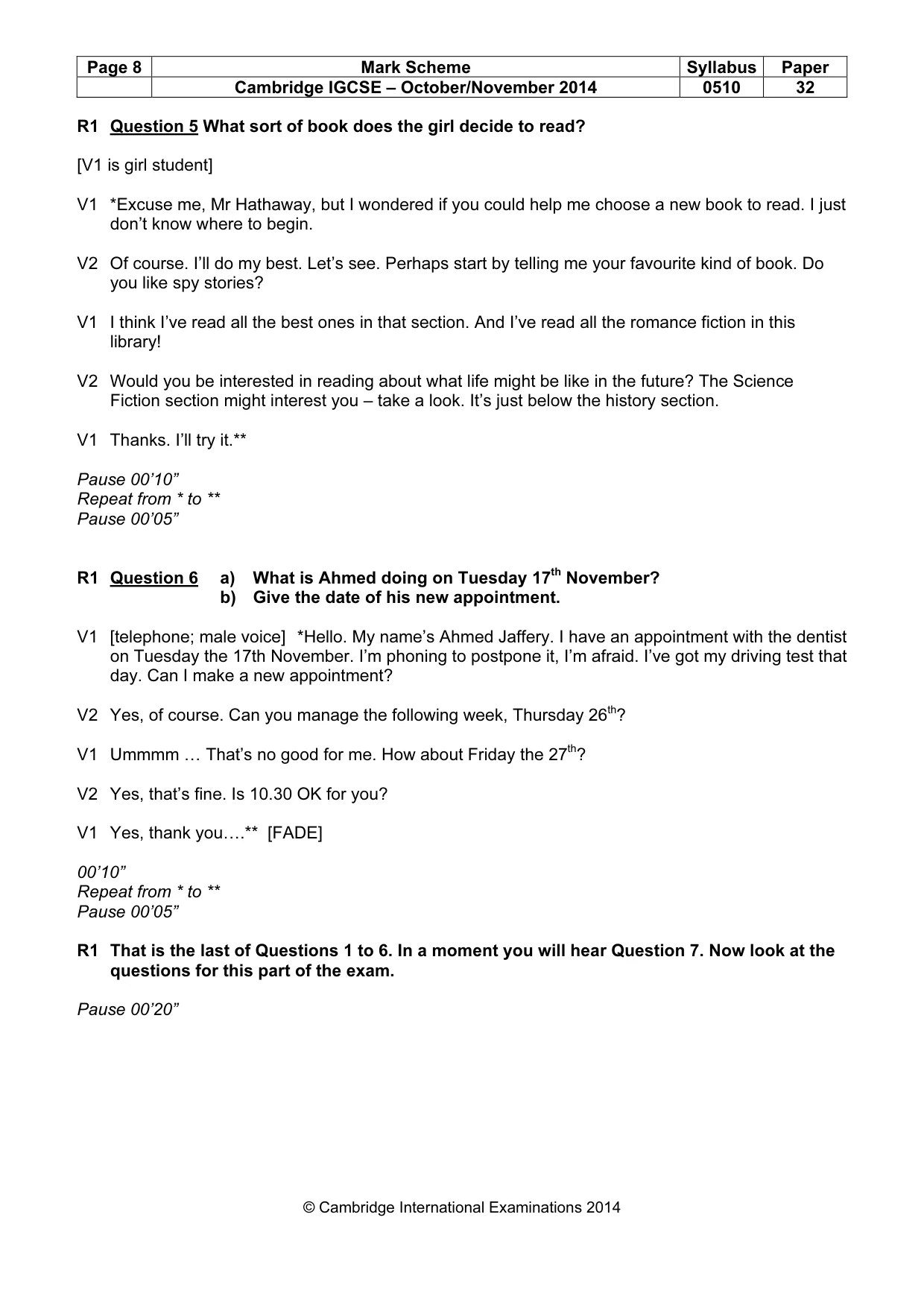
Page 8 Mark Scheme Syllabus Paper Cambridge IGCSE – October/November 2014 0510 32 © Cambridge International Examinations 2014 R1 Question 5 What sort of book does the girl decide to read? [V1 is girl student] V1 *Excuse me, Mr Hathaway, but I wondered if you could help me choose a new book to read. I just don’t know where to begin. V2 Of course. I’ll do my best. Let’s see. Perhaps start by telling me your favourite kind of book. Do you like spy stories? V1 I think I’ve read all the best ones in that section. And I’ve read all the romance fiction in this library! V2 Would you be interested in reading about what life might be like in the future? The Science Fiction section might interest you – take a look. It’s just below the history section. V1 Thanks. I’ll try it.** Pause 00’10” Repeat from * to ** Pause 00’05” R1 Question 6 a) What is Ahmed doing on Tuesday 17th November? b) Give the date of his new appointment. V1 [telephone; male voice] *Hello. My name’s Ahmed Jaffery. I have an appointment with the dentist on Tuesday the 17th November. I’m phoning to postpone it, I’m afraid. I’ve got my driving test that day. Can I make a new appointment? V2 Yes, of course. Can you manage the following week, Thursday 26th? V1 Ummmm … That’s no good for me. How about Friday the 27th? V2 Yes, that’s fine. Is 10.30 OK for you? V1 Yes, thank you….** [FADE] 00’10” Repeat from * to ** Pause 00’05” R1 That is the last of Questions 1 to 6. In a moment you will hear Question 7. Now look at the questions for this part of the exam. Pause 00’20”
Mark scheme, page 9
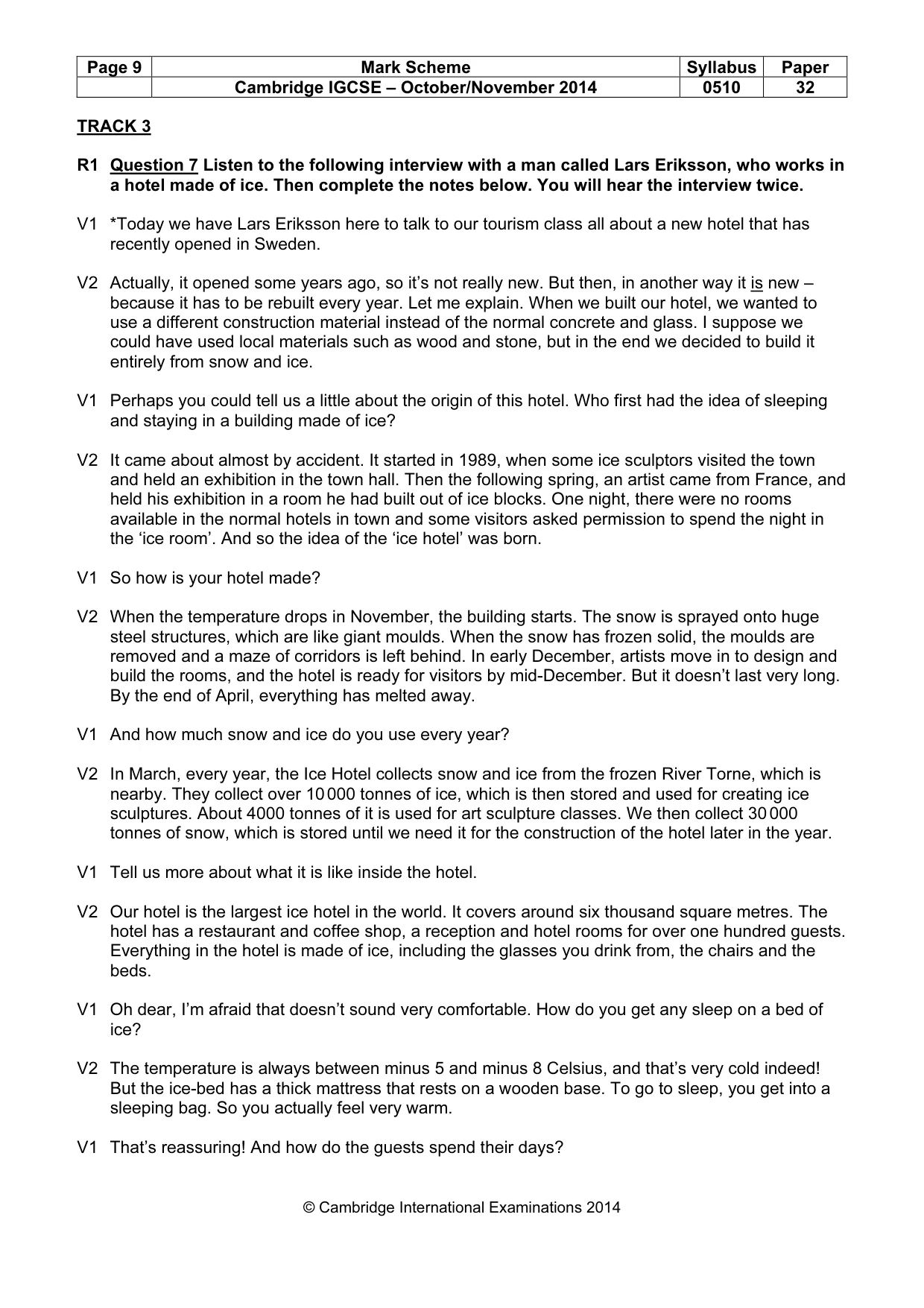
Page 9 Mark Scheme Syllabus Paper Cambridge IGCSE – October/November 2014 0510 32 © Cambridge International Examinations 2014 TRACK 3 R1 Question 7 Listen to the following interview with a man called Lars Eriksson, who works in a hotel made of ice. Then complete the notes below. You will hear the interview twice. V1 *Today we have Lars Eriksson here to talk to our tourism class all about a new hotel that has recently opened in Sweden. V2 Actually, it opened some years ago, so it’s not really new. But then, in another way it is new – because it has to be rebuilt every year. Let me explain. When we built our hotel, we wanted to use a different construction material instead of the normal concrete and glass. I suppose we could have used local materials such as wood and stone, but in the end we decided to build it entirely from snow and ice. V1 Perhaps you could tell us a little about the origin of this hotel. Who first had the idea of sleeping and staying in a building made of ice? V2 It came about almost by accident. It started in 1989, when some ice sculptors visited the town and held an exhibition in the town hall. Then the following spring, an artist came from France, and held his exhibition in a room he had built out of ice blocks. One night, there were no rooms available in the normal hotels in town and some visitors asked permission to spend the night in the ‘ice room’. And so the idea of the ‘ice hotel’ was born. V1 So how is your hotel made? V2 When the temperature drops in November, the building starts. The snow is sprayed onto huge steel structures, which are like giant moulds. When the snow has frozen solid, the moulds are removed and a maze of corridors is left behind. In early December, artists move in to design and build the rooms, and the hotel is ready for visitors by mid-December. But it doesn’t last very long. By the end of April, everything has melted away. V1 And how much snow and ice do you use every year? V2 In March, every year, the Ice Hotel collects snow and ice from the frozen River Torne, which is nearby. They collect over 10 000 tonnes of ice, which is then stored and used for creating ice sculptures. About 4000 tonnes of it is used for art sculpture classes. We then collect 30 000 tonnes of snow, which is stored until we need it for the construction of the hotel later in the year. V1 Tell us more about what it is like inside the hotel. V2 Our hotel is the largest ice hotel in the world. It covers around six thousand square metres. The hotel has a restaurant and coffee shop, a reception and hotel rooms for over one hundred guests. Everything in the hotel is made of ice, including the glasses you drink from, the chairs and the beds. V1 Oh dear, I’m afraid that doesn’t sound very comfortable. How do you get any sleep on a bed of ice? V2 The temperature is always between minus 5 and minus 8 Celsius, and that’s very cold indeed! But the ice-bed has a thick mattress that rests on a wooden base. To go to sleep, you get into a sleeping bag. So you actually feel very warm. V1 That’s reassuring! And how do the guests spend their days?
Mark scheme, page 10
Page 10 Mark Scheme Syllabus Paper Cambridge IGCSE – October/November 2014 0510 32 © Cambridge International Examinations 2014 V2 In the morning, the staff wake you up with a cup of hot fruit juice. Then there are all sorts of interesting activities. You might choose skiing or skating lessons, camping in the frozen wilderness, or a ride on a sled pulled by a team of trained dogs. V1 It sounds great!** Pause 00’30” R1 Now you will hear the interview again. Repeat from * to ** Pause 0’30” R1 That is the end of Question 7. In a moment you will hear Question 8. Now look at the questions for this part of the exam. Pause 00’25”
Mark scheme, page 11
Page 11 Mark Scheme Syllabus Paper Cambridge IGCSE – October/November 2014 0510 32 © Cambridge International Examinations 2014 TRACK 4 R1 Question 8 Listen to the following talk about a space craft and the gold disc that it carries. Then complete the following details. You will hear the talk twice. *Today, I’m going to tell you about a space craft that was launched into space many years ago – in 1977. Its name? Voyager 1, and this space craft, amazingly, is still flying strong. In 2012, Voyager 1 was the first spacecraft ever to reach outer space. In fact, it’s now 18 billion kilometres away from Earth. Voyager 2, a similar spacecraft, is 14.8 billion kilometres away. Voyager 1 is actually a very small craft. It’s about 3.7 metres across, and weighs 722 kilos. That’s not much bigger than a family car, and not much heavier than a washing machine! Of course the rocket that launched it was quite enormous in comparison. The project has cost a lot of money but how can you put a price on the fascinating photographs sent back from Jupiter, showing that there are volcanoes on one of its moons? And the detailed images of Saturn’s rings have amazed the world. So, how advanced is the technology on this tiny space craft? Well, very poor by today’s standards. In fact, the average smart phone in 2014 has thousands of times more memory than Voyager 1. Yet most of the instruments on board the vessel still work, and they continue to send signals back to Earth. The scientific team in charge of it believes it still has enough power to operate all its instruments until the year 2020, when they will start shutting down one by one, until the spacecraft finally goes silent in 2025. But besides all the scientific equipment, Voyager 1 carries on board a really interesting item – a large disc made out of solid gold. So what did they put on this disc? The scientists interviewed members of the public and asked what images they would like to include. Younger pupils at school suggested pets and wild animals; teenagers favoured film stars; adults preferred historical figures. There are audio recordings, too. There are examples of music from a range of different cultures. The disc contains greetings in 56 different languages. There are other, natural sounds – such as thunderstorms, and there are some personal messages from world leaders, too. The scientists made the final decisions. They selected pictures and sounds in order to represent the diversity of life forms on our planet. In addition, they included many images of scientific interest, such as diagrams of the solar system and its planets. They hope that the disc will give any intelligent life forms in the future, an idea of what we were like in the twentieth century. You may be asking yourself how a being from outer space will be able to play such a disc. Well, the instructions are engraved on its metal cover. Let’s hope they can read English and have the right kind of equipment to play these discs! Meanwhile, it seems Voyager 1 is destined to wander the Milky Way for ever…** Pause 00’30” R1 Now you will hear the talk again. Repeat from * to ** Pause 0’30”
Mark scheme, page 12
Page 12 Mark Scheme Syllabus Paper Cambridge IGCSE – October/November 2014 0510 32 © Cambridge International Examinations 2014 R1 That is the end of Question 8. In a moment you will hear Question 9. Now look at the questions for this part of the exam. Pause 00’35”
Mark scheme, page 13
Page 13 Mark Scheme Syllabus Paper Cambridge IGCSE – October/November 2014 0510 32 © Cambridge International Examinations 2014 TRACK 5 R1 Question 9 Listen to the following talk about a famous sportsman, Usain Bolt, and then show whether each statement is true or false by putting a tick in the appropriate box. You will hear the talk twice. V1 [male speaker] *Usain Bolt is a unique sportsman probably the fastest human being that has ever lived. But what makes him so different is his attitude, as well as his obvious talent. Not only does he regularly break world records, but he does so with humour and makes it look easy. At the Beijing Olympics, he won his race with his shoelaces untied; another time, he winked playfully at the TV cameras whilst warming up. In the 2012 Olympic Games, when he’d crossed the finishing line, he did five push-ups, one for each of his Olympic gold medals. He didn’t seem tired at all, and wanted everyone to know it. So what was life like for him as a child? His family was not wealthy, he went to an ordinary school in a small town in north west Jamaica. Usain lived with his parents, brother and sister, in a modest bungalow. Nowadays, he still lives with his brother, but in an exclusive apartment in the capital, along with a bodyguard and a chef. As a child he was hyperactive, easily bored, and was even known to run off to the nearby town to play arcade games there. But he showed his talent early on, and was a natural sprinter, doing best at shorter, faster races. He won many competitions at school, then at national level in Jamaica. But he was not always successful, due to a lack of determination. Then came the turning point. At the age of fifteen, he won the 200 metres at the 2002 World Junior Championships. Immediately afterwards, he was given the nickname of Lightning Bolt. This altered his whole attitude and it struck him that he had the ability to be something very special. He felt the burning need to win. He went on to win lots of gold medals, for example at the 2012 Olympic Games in London and in Moscow in 2013. What makes him such a good athlete? Is it down to luck, or having the right build of body? He admits that he has natural ability. He doesn’t seem to have to take much care with his diet. Many athletes ensure they eat exactly the right combination of proteins and carbohydrates, and will restrict their diet to lean meat and pasta during training periods. Usain, on the other hand, enjoys fried potatoes and chicken nuggets. He certainly seems to do well on this combination. But he explains that in order to win major races, he has to train hard. Firstly, he is tall which makes him heavier than many of his rivals and slower out of the starting blocks. He also has one leg slightly shorter than the other. So every morning he starts exercising at 6.30, practising his starts and his reaction times, working on different techniques. His level of success demands determination and hard work. He is also a talented cricketer and footballer. In fact, he has recently said that if offered the chance, he would like to play football for Manchester United. With his determination and talent, who knows? This might be a possibility when he decides to retire from athletics. With Usain Bolt, anything is possible.** Pause 00’30” R1 Now you will hear the talk again. Repeat from * to ** Pause 0’30”
Mark scheme, page 14
Page 14 Mark Scheme Syllabus Paper Cambridge IGCSE – October/November 2014 0510 32 © Cambridge International Examinations 2014 R1 That is the end of Question 9. In a moment you will hear Question 10. Now look at the questions for this part of the exam. Pause 00’35”
Mark scheme, page 15
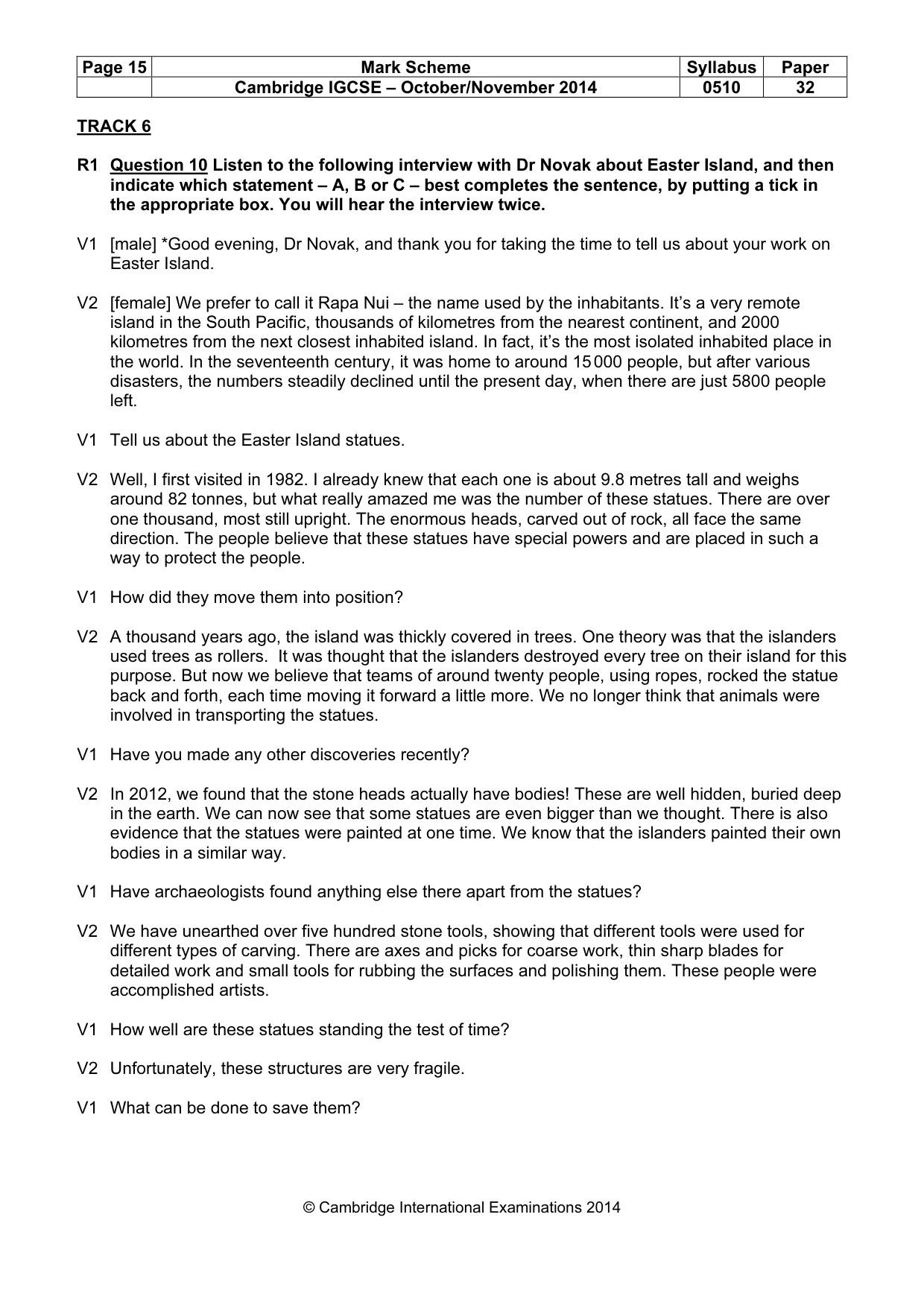
Page 15 Mark Scheme Syllabus Paper Cambridge IGCSE – October/November 2014 0510 32 © Cambridge International Examinations 2014 TRACK 6 R1 Question 10 Listen to the following interview with Dr Novak about Easter Island, and then indicate which statement – A, B or C – best completes the sentence, by putting a tick in the appropriate box. You will hear the interview twice. V1 [male] *Good evening, Dr Novak, and thank you for taking the time to tell us about your work on Easter Island. V2 [female] We prefer to call it Rapa Nui – the name used by the inhabitants. It’s a very remote island in the South Pacific, thousands of kilometres from the nearest continent, and 2000 kilometres from the next closest inhabited island. In fact, it’s the most isolated inhabited place in the world. In the seventeenth century, it was home to around 15 000 people, but after various disasters, the numbers steadily declined until the present day, when there are just 5800 people left. V1 Tell us about the Easter Island statues. V2 Well, I first visited in 1982. I already knew that each one is about 9.8 metres tall and weighs around 82 tonnes, but what really amazed me was the number of these statues. There are over one thousand, most still upright. The enormous heads, carved out of rock, all face the same direction. The people believe that these statues have special powers and are placed in such a way to protect the people. V1 How did they move them into position? V2 A thousand years ago, the island was thickly covered in trees. One theory was that the islanders used trees as rollers. It was thought that the islanders destroyed every tree on their island for this purpose. But now we believe that teams of around twenty people, using ropes, rocked the statue back and forth, each time moving it forward a little more. We no longer think that animals were involved in transporting the statues. V1 Have you made any other discoveries recently? V2 In 2012, we found that the stone heads actually have bodies! These are well hidden, buried deep in the earth. We can now see that some statues are even bigger than we thought. There is also evidence that the statues were painted at one time. We know that the islanders painted their own bodies in a similar way. V1 Have archaeologists found anything else there apart from the statues? V2 We have unearthed over five hundred stone tools, showing that different tools were used for different types of carving. There are axes and picks for coarse work, thin sharp blades for detailed work and small tools for rubbing the surfaces and polishing them. These people were accomplished artists. V1 How well are these statues standing the test of time? V2 Unfortunately, these structures are very fragile. V1 What can be done to save them?
Mark scheme, page 16
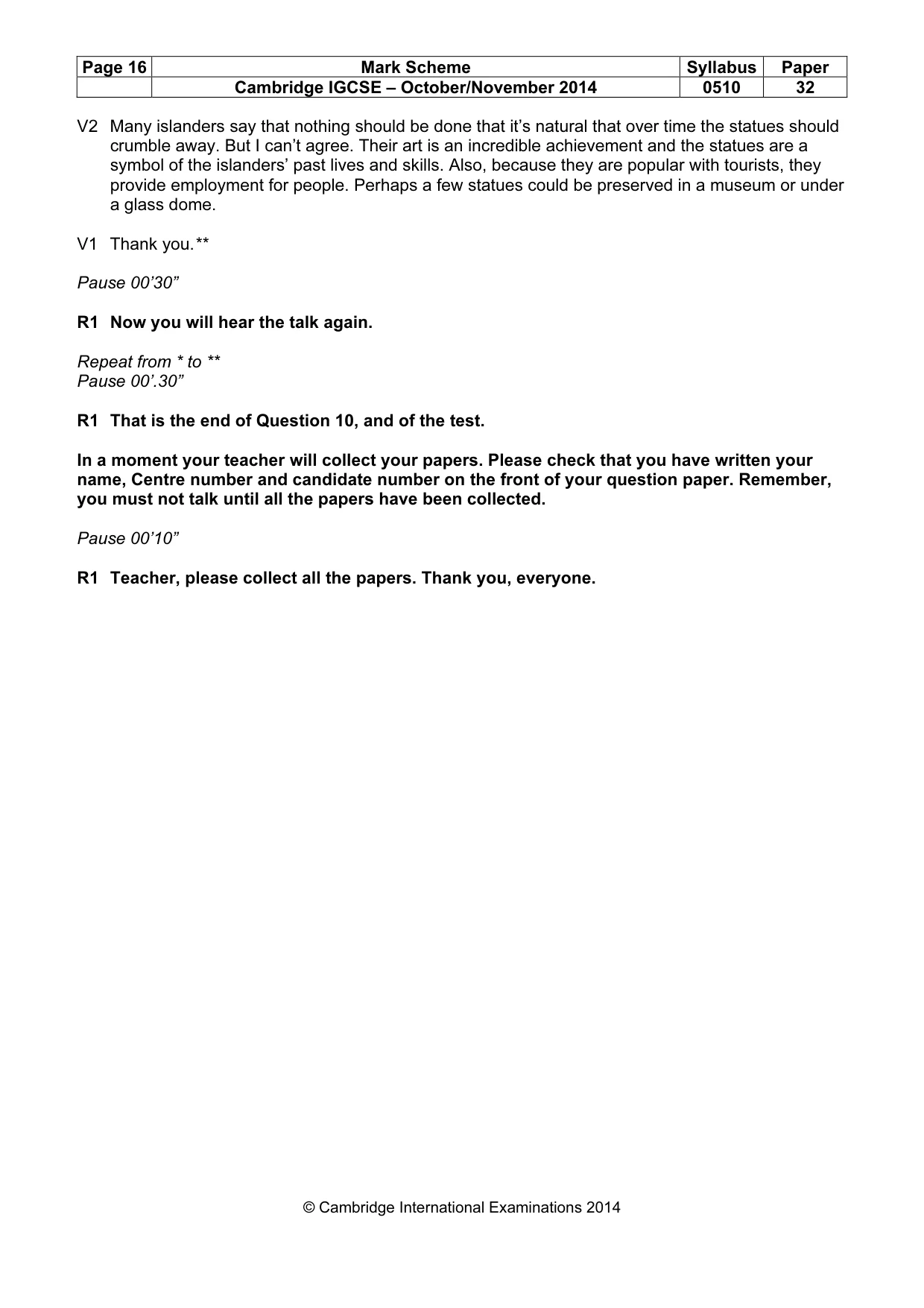
Page 16 Mark Scheme Syllabus Paper Cambridge IGCSE – October/November 2014 0510 32 © Cambridge International Examinations 2014 V2 Many islanders say that nothing should be done that it’s natural that over time the statues should crumble away. But I can’t agree. Their art is an incredible achievement and the statues are a symbol of the islanders’ past lives and skills. Also, because they are popular with tourists, they provide employment for people. Perhaps a few statues could be preserved in a museum or under a glass dome. V1 Thank you.** Pause 00’30” R1 Now you will hear the talk again. Repeat from * to ** Pause 00’.30” R1 That is the end of Question 10, and of the test. In a moment your teacher will collect your papers. Please check that you have written your name, Centre number and candidate number on the front of your question paper. Remember, you must not talk until all the papers have been collected. Pause 00’10” R1 Teacher, please collect all the papers. Thank you, everyone.
What you needed in this session
Cambridge’s own grade thresholds for 2014 Oct/Nov, Paper 3 · Variant 2. A higher threshold means an easier paper — the bar moves with how the cohort did.