Cambridge IGCSE English - Second Language (oral endorsement) 0510 — 2014 Oct/Nov Paper 3 · Variant 3
0510/33/O/N/14 · 30 marks · ≈34 min
The question paper and its mark scheme, free to read here and free to download. This is Cambridge’s own paper, exactly as it was sat.
Question paper8 pages

Mark scheme17 pages
Answers below. Sit the paper first if you are practising.
Paper as text
Question paper, page 1
This document consists of 7 printed pages and 1 blank page. DC (LK) 98005/2 © UCLES 2014 [Turn over * 3 3 8 1 8 9 8 1 2 7 * ENGLISH AS A SECOND LANGUAGE 0510/33 Paper 3 Listening (Core) October/November 2014 Approx. 30 – 40 minutes Candidates answer on the Question Paper. Additional Materials: As listed in Instructions to Supervisors. READ THESE INSTRUCTIONS FIRST Write your Centre number, candidate number and name on all the work you hand in. Write in dark blue or black pen. Do not use staples, paper clips, glue or correction fluid. DO NOT WRITE IN ANY BARCODES. Answer all questions. Dictionaries are not permitted. The number of marks is given in brackets [ ] at the end of each question or part question. Cambridge International Examinations Cambridge International General Certificate of Secondary Education
Question paper, page 2
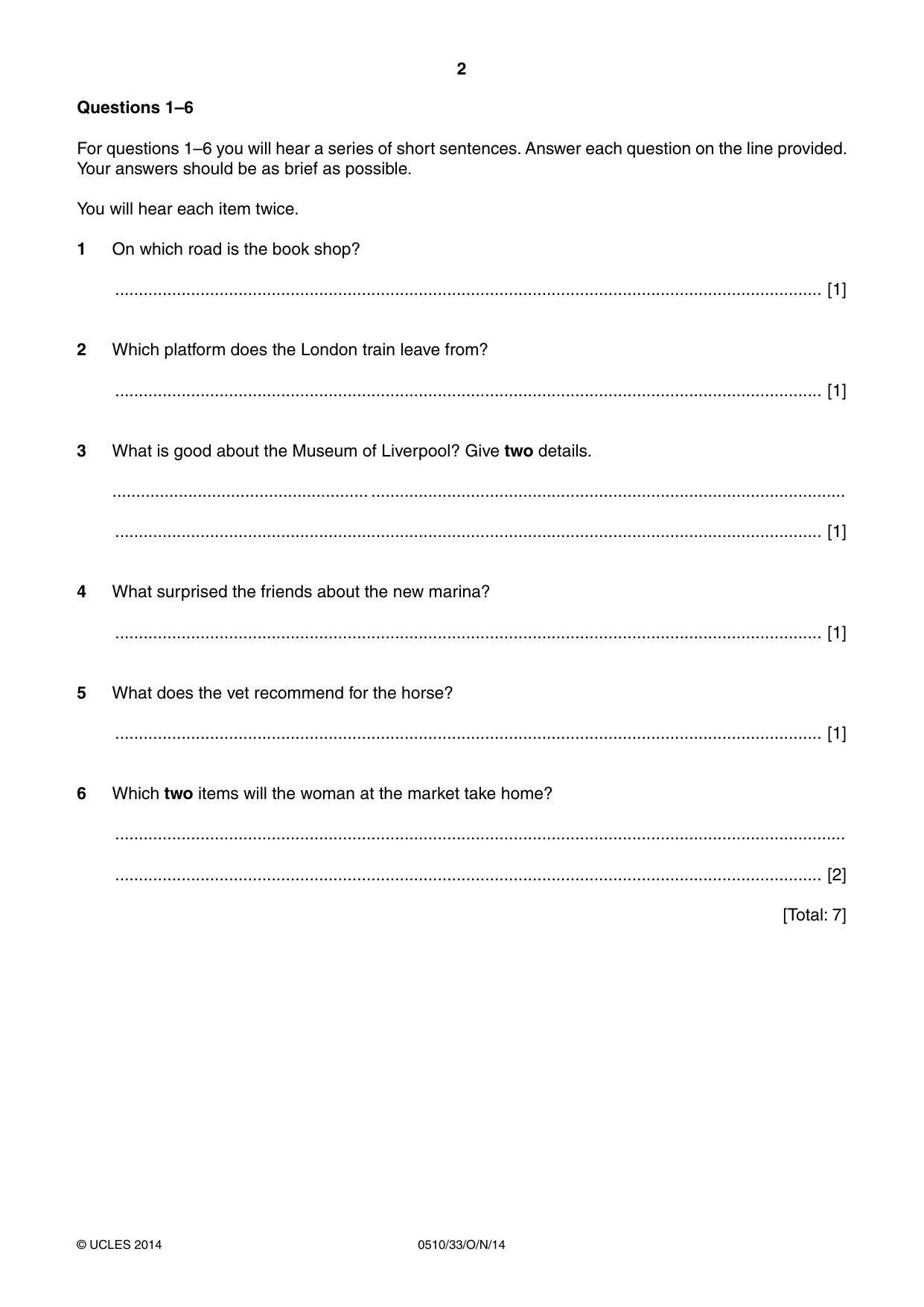
2 0510/33/O/N/14 © UCLES 2014 Questions 1–6 For questions 1–6 you will hear a series of short sentences. Answer each question on the line provided. Your answers should be as brief as possible. You will hear each item twice. 1 On which road is the book shop? … [1] 2 Which platform does the London train leave from? … [1] 3 What is good about the Museum of Liverpool? Give two details. … … … [1] 4 What surprised the friends about the new marina? … [1] 5 What does the vet recommend for the horse? … [1] 6 Which two items will the woman at the market take home? … … [2] [Total: 7]
Question paper, page 3
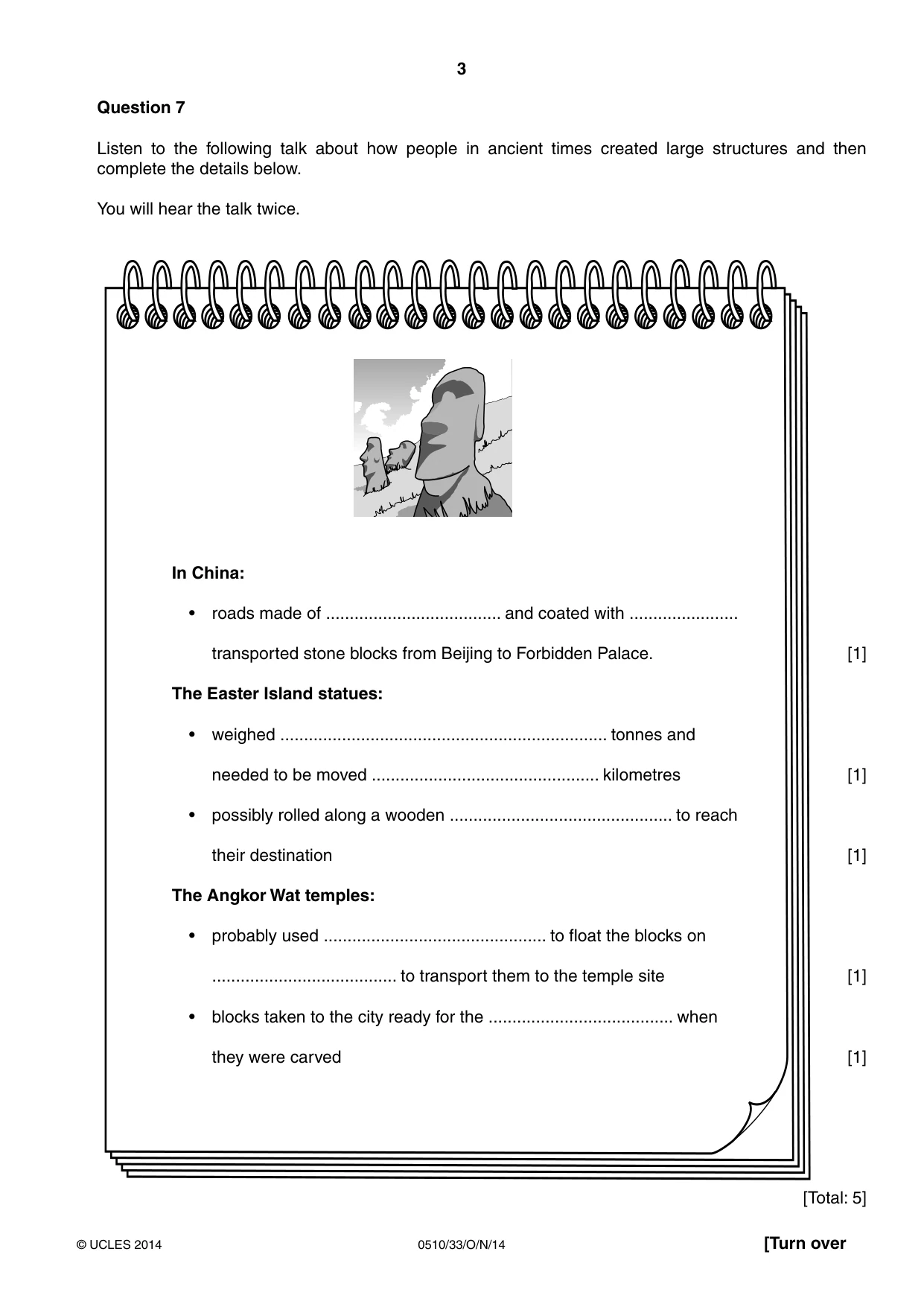
3 0510/33/O/N/14 © UCLES 2014 [Turn over Question 7 Listen to the following talk about how people in ancient times created large structures and then complete the details below. You will hear the talk twice. In China: • roads made of … and coated with … transported stone blocks from Beijing to Forbidden Palace. [1] The Easter Island statues: • weighed … tonnes and needed to be moved … kilometres [1] • possibly rolled along a wooden … to reach their destination [1] The Angkor Wat temples: • probably used … to float the blocks on … to transport them to the temple site [1] • blocks taken to the city ready for the … when they were carved [1] [Total: 5]
Question paper, page 4
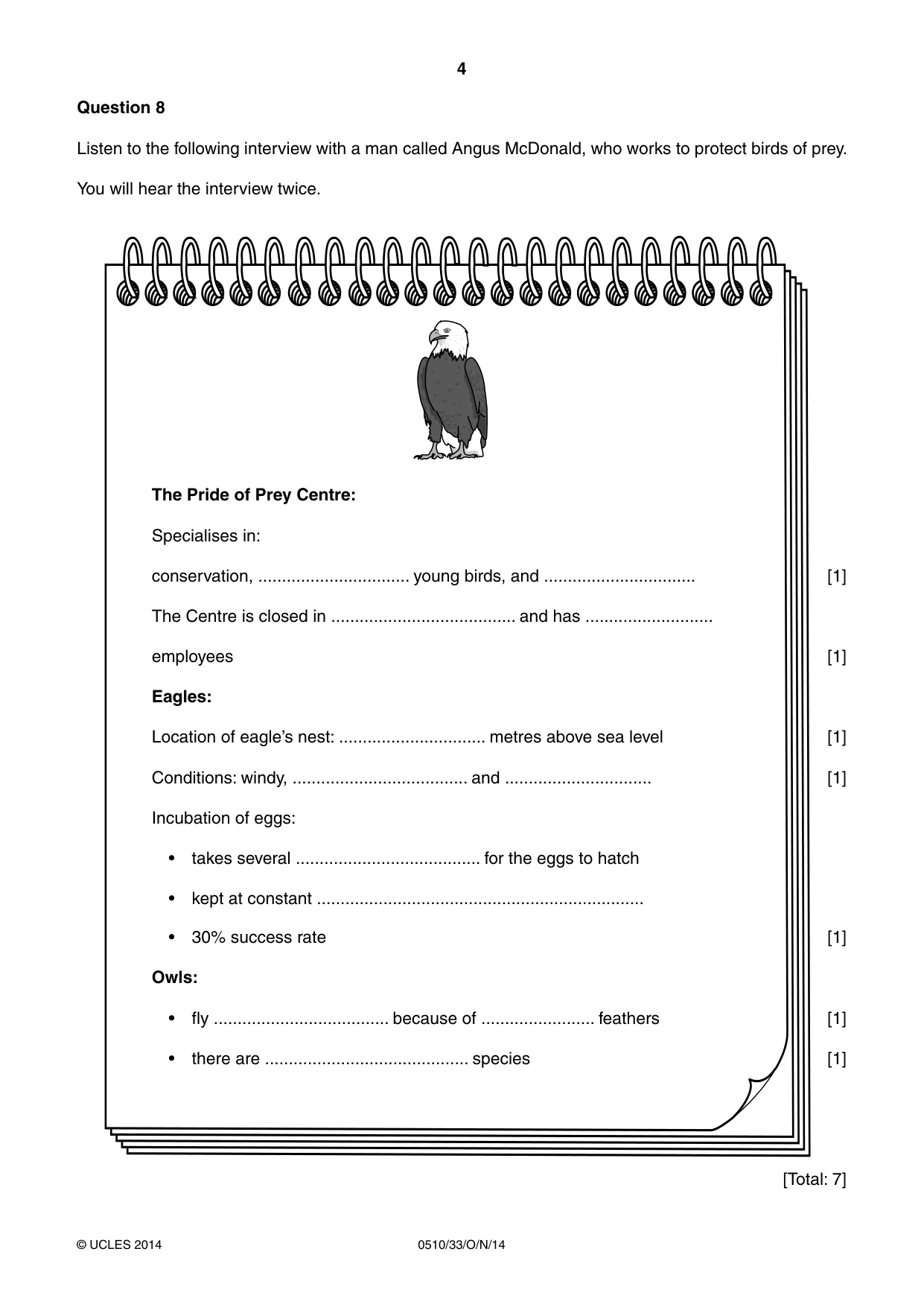
4 0510/33/O/N/14 © UCLES 2014 Question 8 Listen to the following interview with a man called Angus McDonald, who works to protect birds of prey. You will hear the interview twice. The Pride of Prey Centre: Specialises in: conservation, … young birds, and … [1] The Centre is closed in … and has … employees [1] Eagles: Location of eagle’s nest: … metres above sea level [1] Conditions: windy, … and … [1] Incubation of eggs: • takes several … for the eggs to hatch • kept at constant … • 30% success rate [1] Owls: • fly … because of … feathers [1] • there are … species [1] [Total: 7]
Question paper, page 5
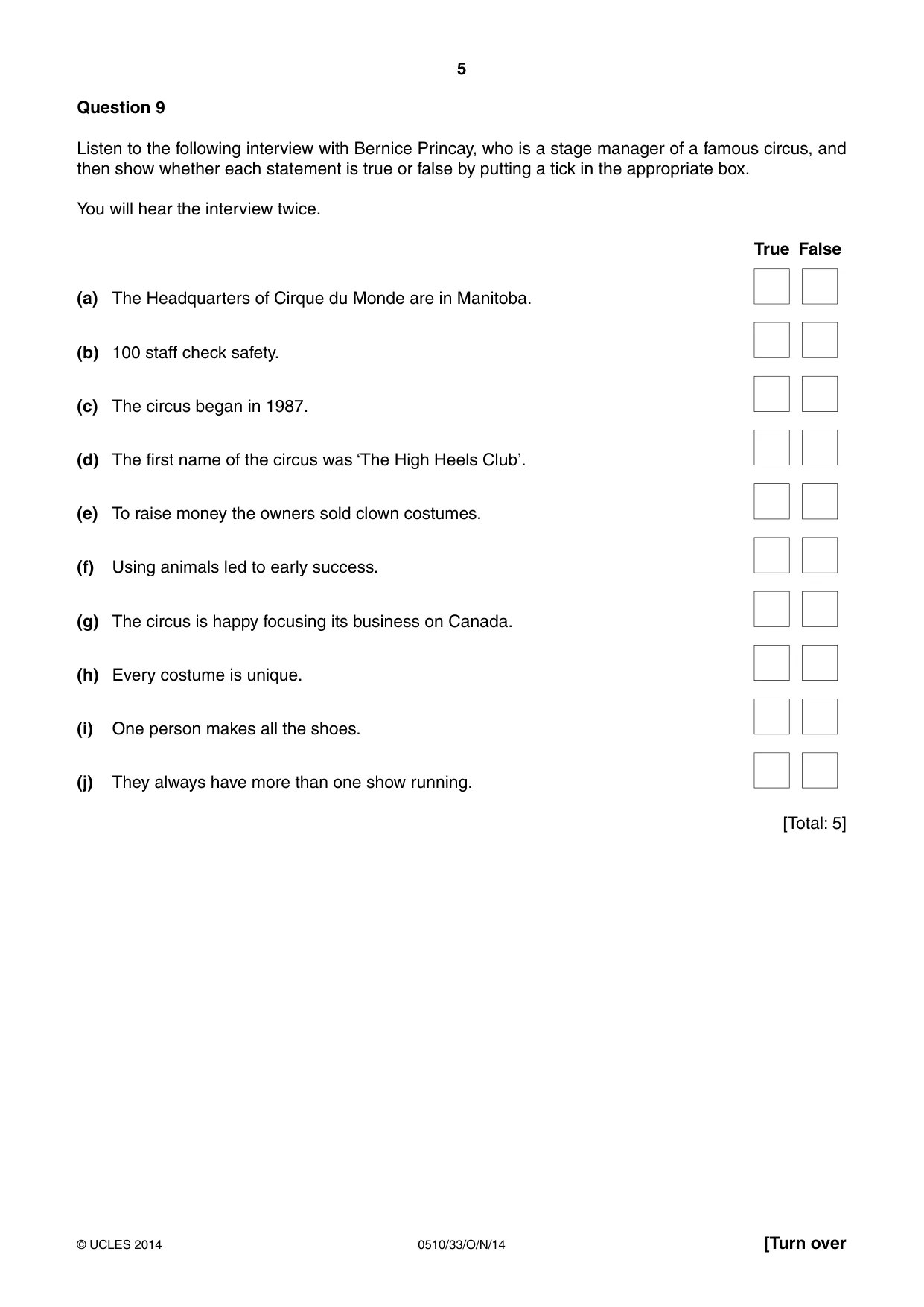
5 0510/33/O/N/14 © UCLES 2014 [Turn over Question 9 Listen to the following interview with Bernice Princay, who is a stage manager of a famous circus, and then show whether each statement is true or false by putting a tick in the appropriate box. You will hear the interview twice. True False (a) The Headquarters of Cirque du Monde are in Manitoba. (b) 100 staff check safety. (c) The circus began in 1987. (d) The first name of the circus was ‘The High Heels Club’. (e) To raise money the owners sold clown costumes. (f) Using animals led to early success. (g) The circus is happy focusing its business on Canada. (h) Every costume is unique. (i) One person makes all the shoes. (j) They always have more than one show running. [Total: 5]
Question paper, page 6
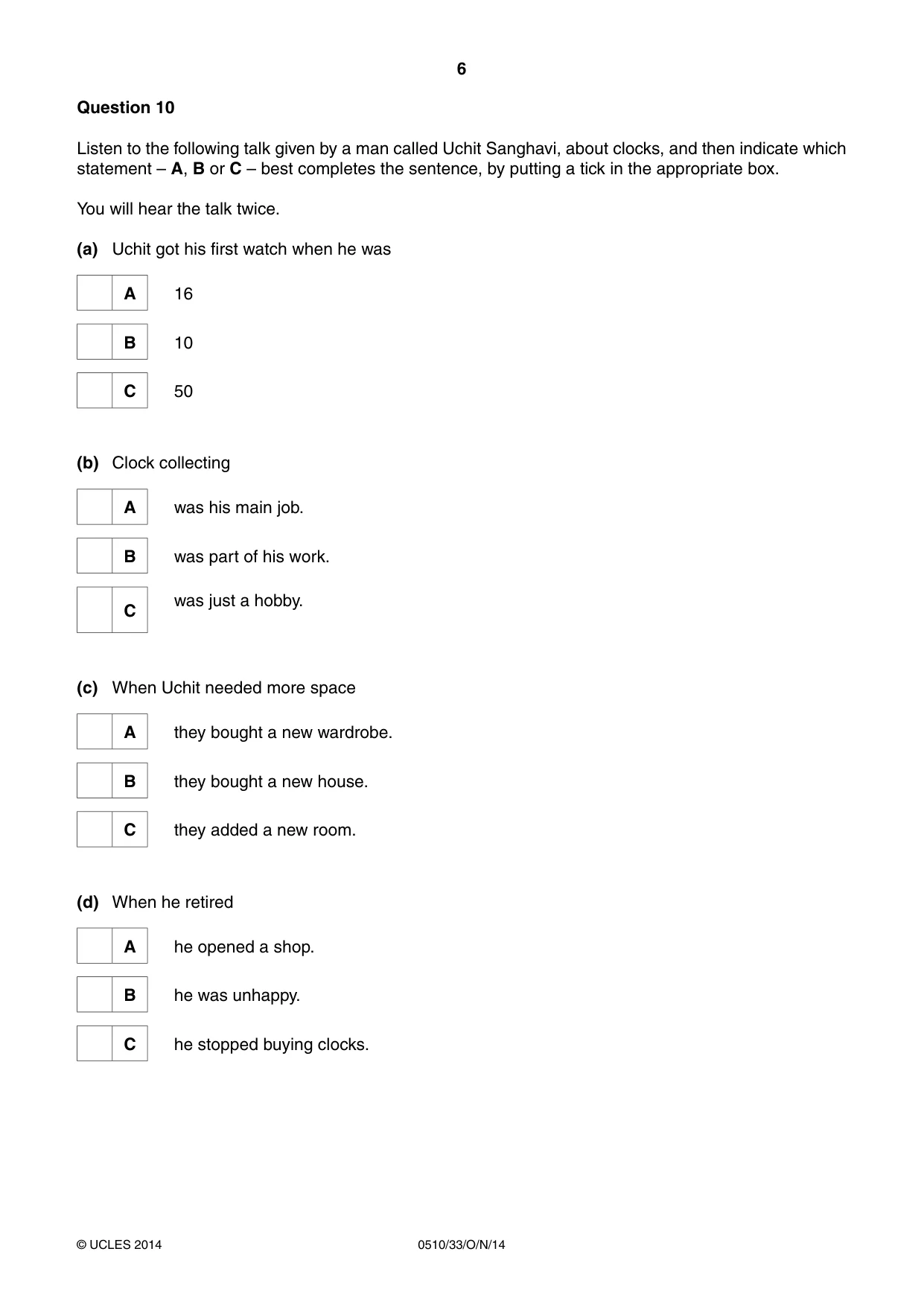
6 0510/33/O/N/14 © UCLES 2014 Question 10 Listen to the following talk given by a man called Uchit Sanghavi, about clocks, and then indicate which statement – A, B or C – best completes the sentence, by putting a tick in the appropriate box. You will hear the talk twice. (a) Uchit got his first watch when he was A 16 B 10 C 50 (b) Clock collecting A was his main job. B was part of his work. C was just a hobby. (c) When Uchit needed more space A they bought a new wardrobe. B they bought a new house. C they added a new room. (d) When he retired A he opened a shop. B he was unhappy. C he stopped buying clocks.
Question paper, page 7
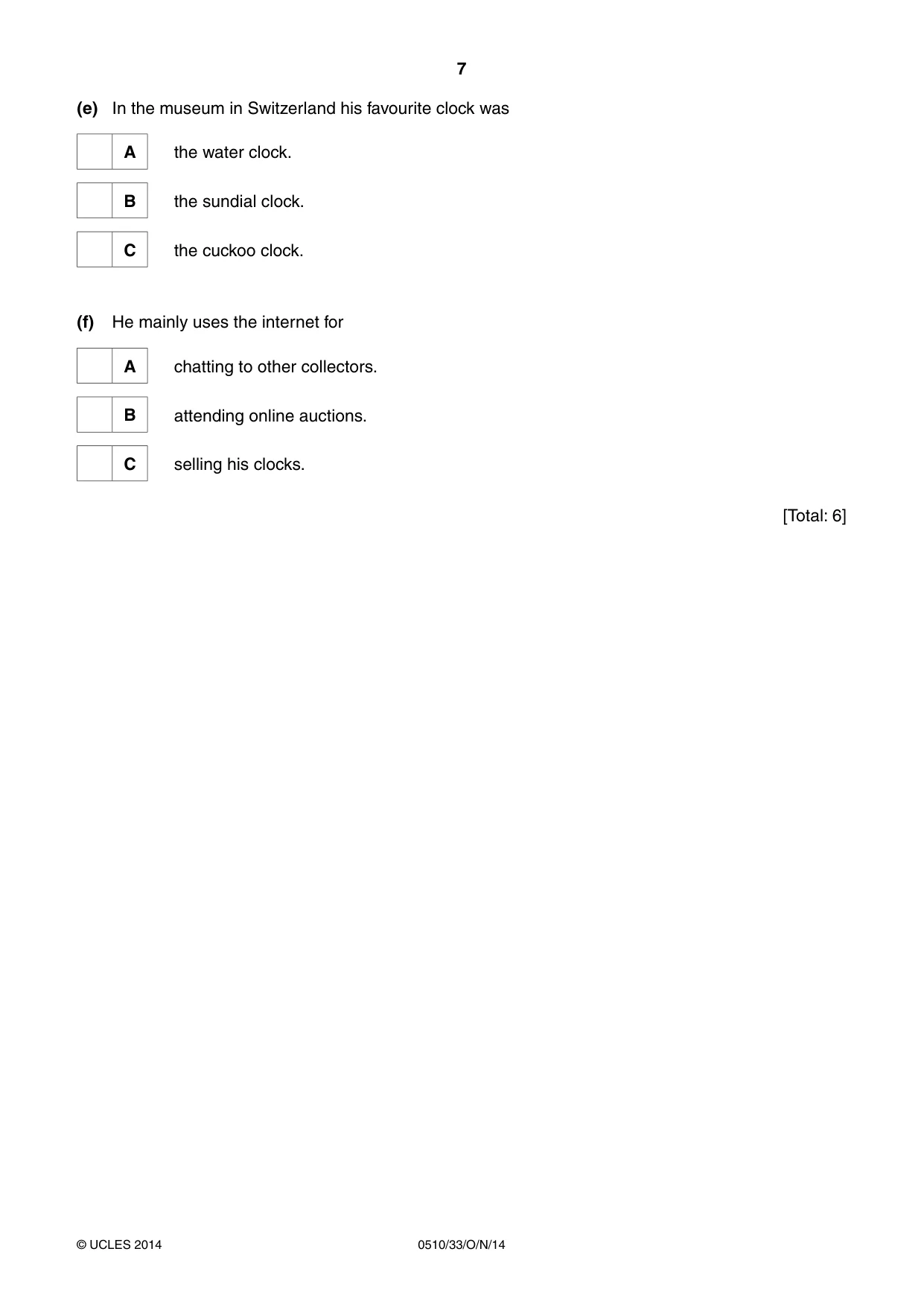
7 0510/33/O/N/14 © UCLES 2014 (e) In the museum in Switzerland his favourite clock was A the water clock. B the sundial clock. C the cuckoo clock. (f) He mainly uses the internet for A chatting to other collectors. B attending online auctions. C selling his clocks. [Total: 6]
Question paper, page 8
8 0510/33/O/N/14 © UCLES 2014 Permission to reproduce items where third-party owned material protected by copyright is included has been sought and cleared where possible. Every reasonable effort has been made by the publisher (UCLES) to trace copyright holders, but if any items requiring clearance have unwittingly been included, the publisher will be pleased to make amends at the earliest possible opportunity. Cambridge International Examinations is part of the Cambridge Assessment Group. Cambridge Assessment is the brand name of University of Cambridge Local Examinations Syndicate (UCLES), which is itself a department of the University of Cambridge. BLANK PAGE
Mark scheme, page 1
® IGCSE is the registered trademark of Cambridge International Examinations. CAMBRIDGE INTERNATIONAL EXAMINATIONS Cambridge International General Certificate of Secondary Education MARK SCHEME for the October/November 2014 series 0510 ENGLISH AS A SECOND LANGUAGE 0510/33 Paper 3 (Listening – Core), maximum raw mark 30 This mark scheme is published as an aid to teachers and candidates, to indicate the requirements of the examination. It shows the basis on which Examiners were instructed to award marks. It does not indicate the details of the discussions that took place at an Examiners’ meeting before marking began, which would have considered the acceptability of alternative answers. Mark schemes should be read in conjunction with the question paper and the Principal Examiner Report for Teachers. Cambridge will not enter into discussions about these mark schemes. Cambridge is publishing the mark schemes for the October/November 2014 series for most Cambridge IGCSE®, Cambridge International A and AS Level components and some Cambridge O Level components.
Mark scheme, page 2
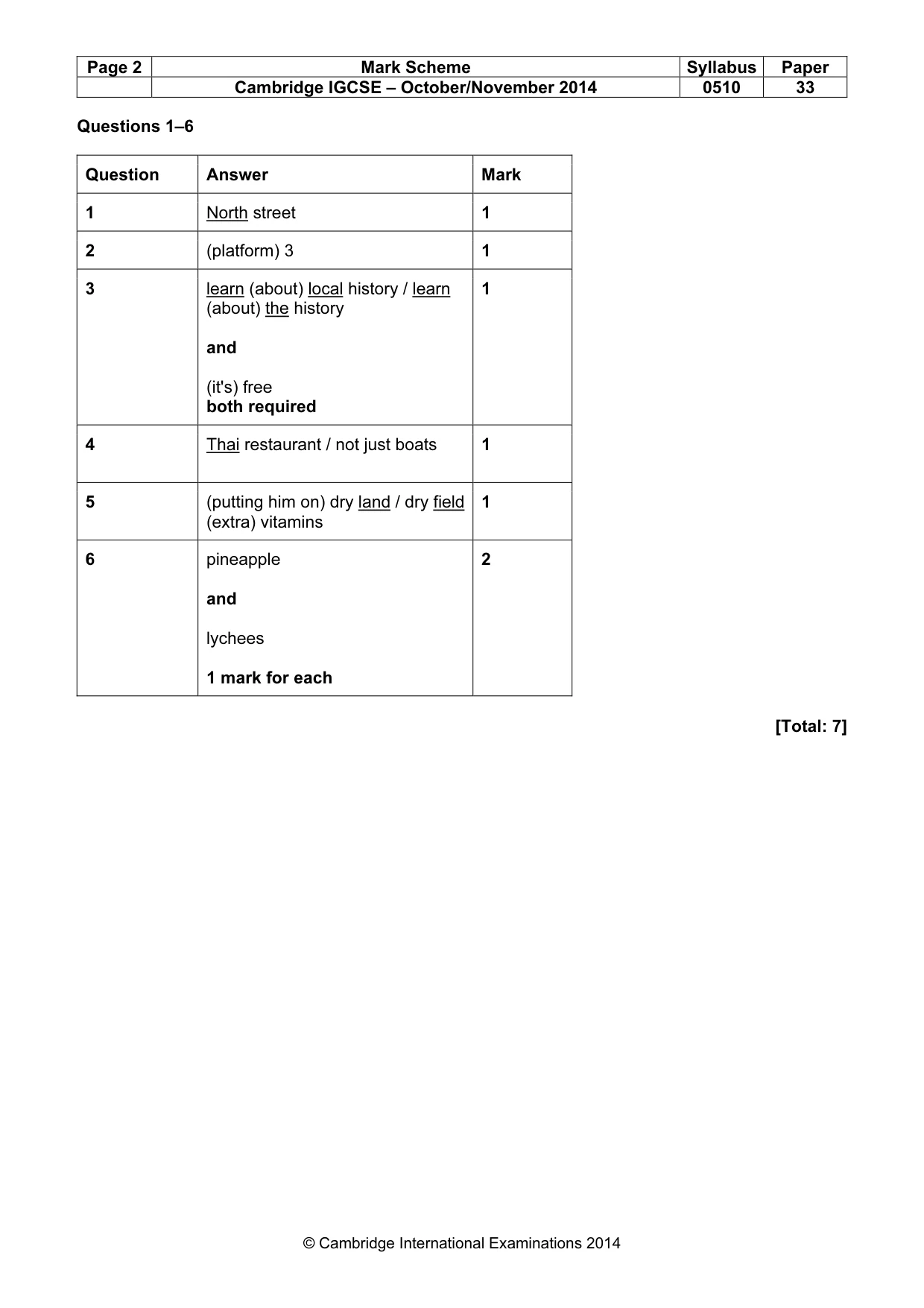
Page 2 Mark Scheme Syllabus Paper Cambridge IGCSE – October/November 2014 0510 33 © Cambridge International Examinations 2014 Questions 1–6 Question Answer Mark 1 North street 1 2 (platform) 3 1 3 learn (about) local history / learn (about) the history and (it's) free both required 1 4 Thai restaurant / not just boats 1 5 (putting him on) dry land / dry field (extra) vitamins 1 6 pineapple and lychees 1 mark for each 2 [Total: 7]
Mark scheme, page 3
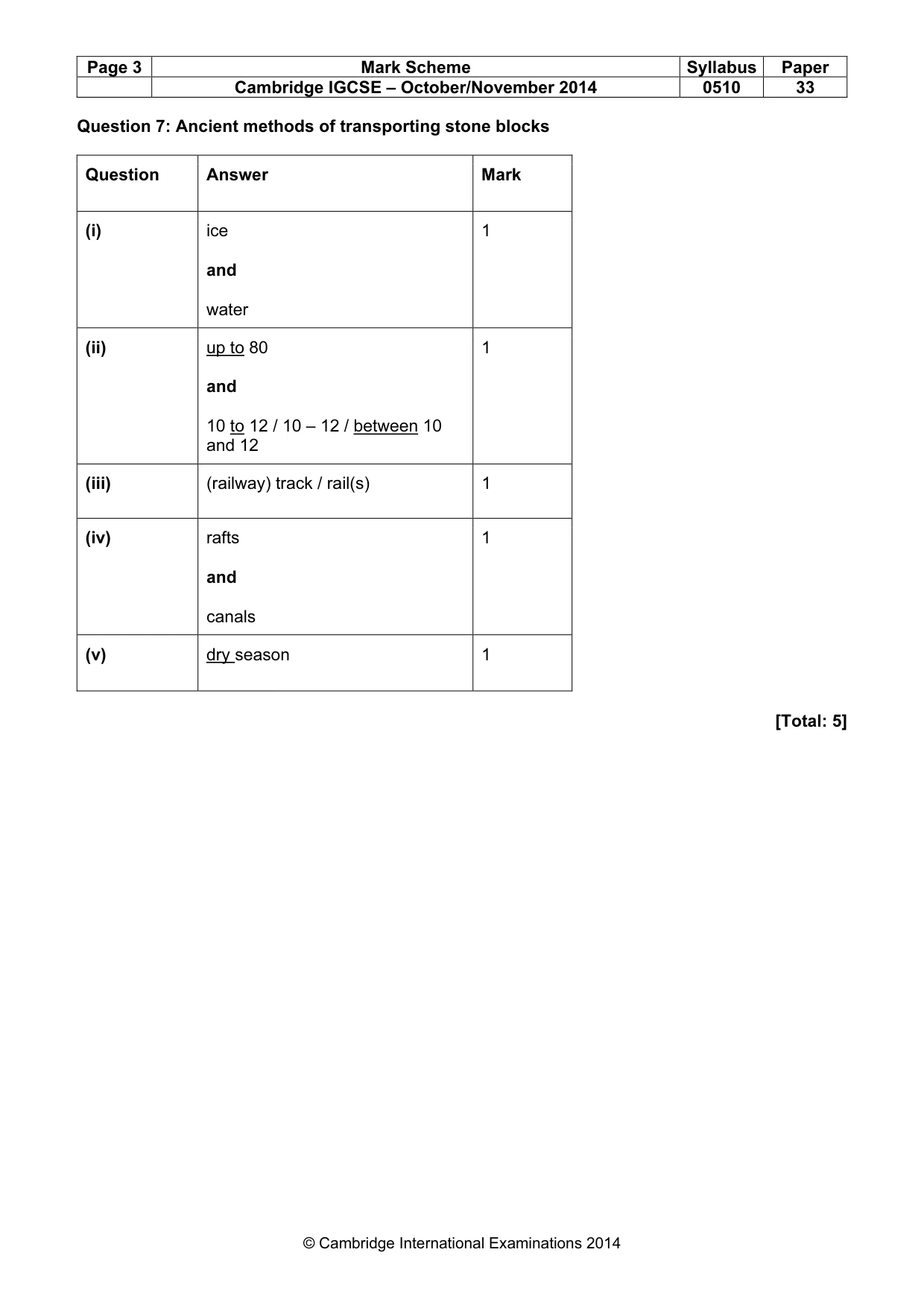
Page 3 Mark Scheme Syllabus Paper Cambridge IGCSE – October/November 2014 0510 33 © Cambridge International Examinations 2014 Question 7: Ancient methods of transporting stone blocks Question Answer Mark (i) ice and water 1 (ii) up to 80 and 10 to 12 / 10 – 12 / between 10 and 12 1 (iii) (railway) track / rail(s) 1 (iv) rafts and canals 1 (v) dry season 1 [Total: 5]
Mark scheme, page 4
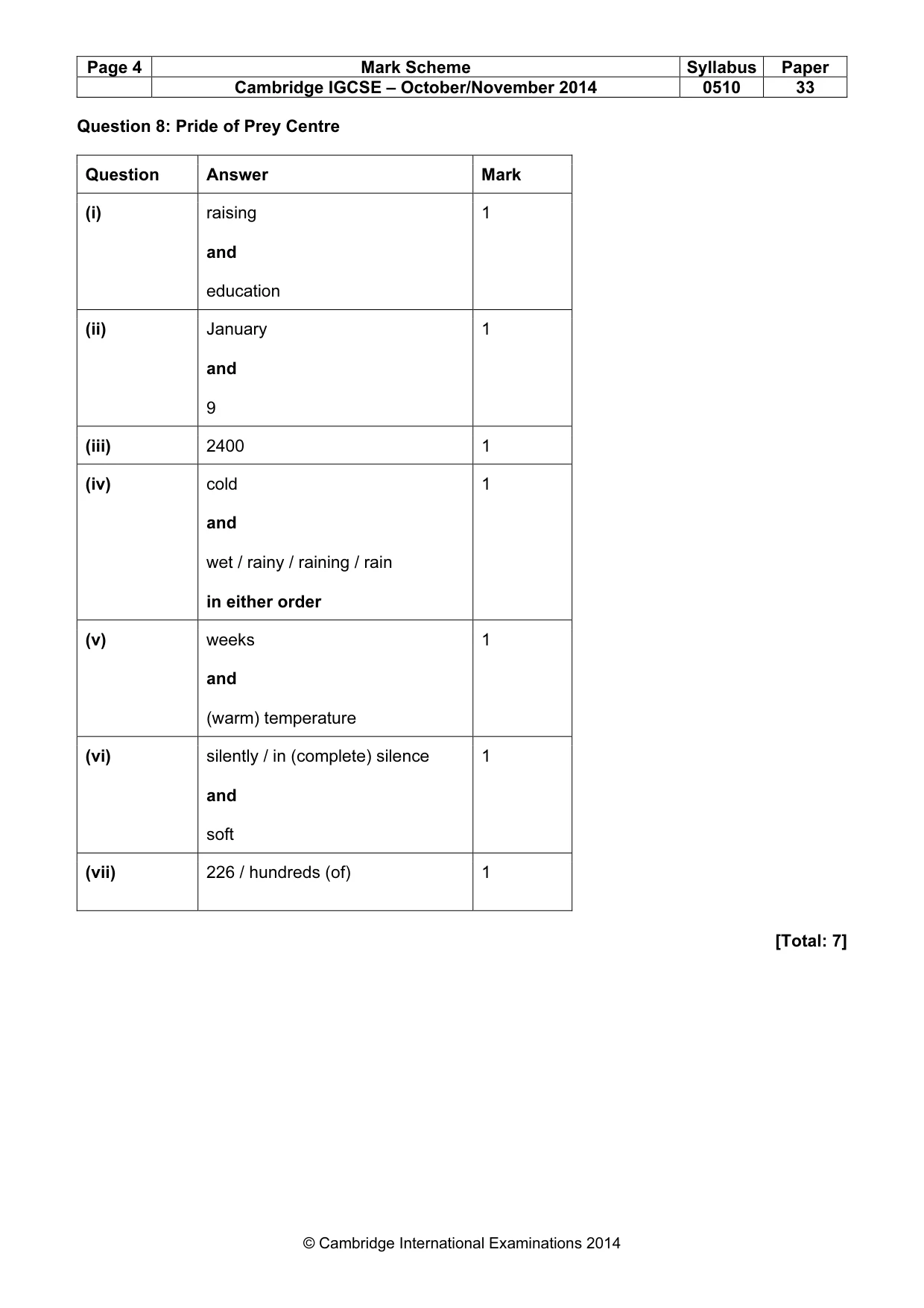
Page 4 Mark Scheme Syllabus Paper Cambridge IGCSE – October/November 2014 0510 33 © Cambridge International Examinations 2014 Question 8: Pride of Prey Centre Question Answer Mark (i) raising and education 1 (ii) January and 9 1 (iii) 2400 1 (iv) cold and wet / rainy / raining / rain in either order 1 (v) weeks and (warm) temperature 1 (vi) silently / in (complete) silence and soft 1 (vii) 226 / hundreds (of) 1 [Total: 7]
Mark scheme, page 5
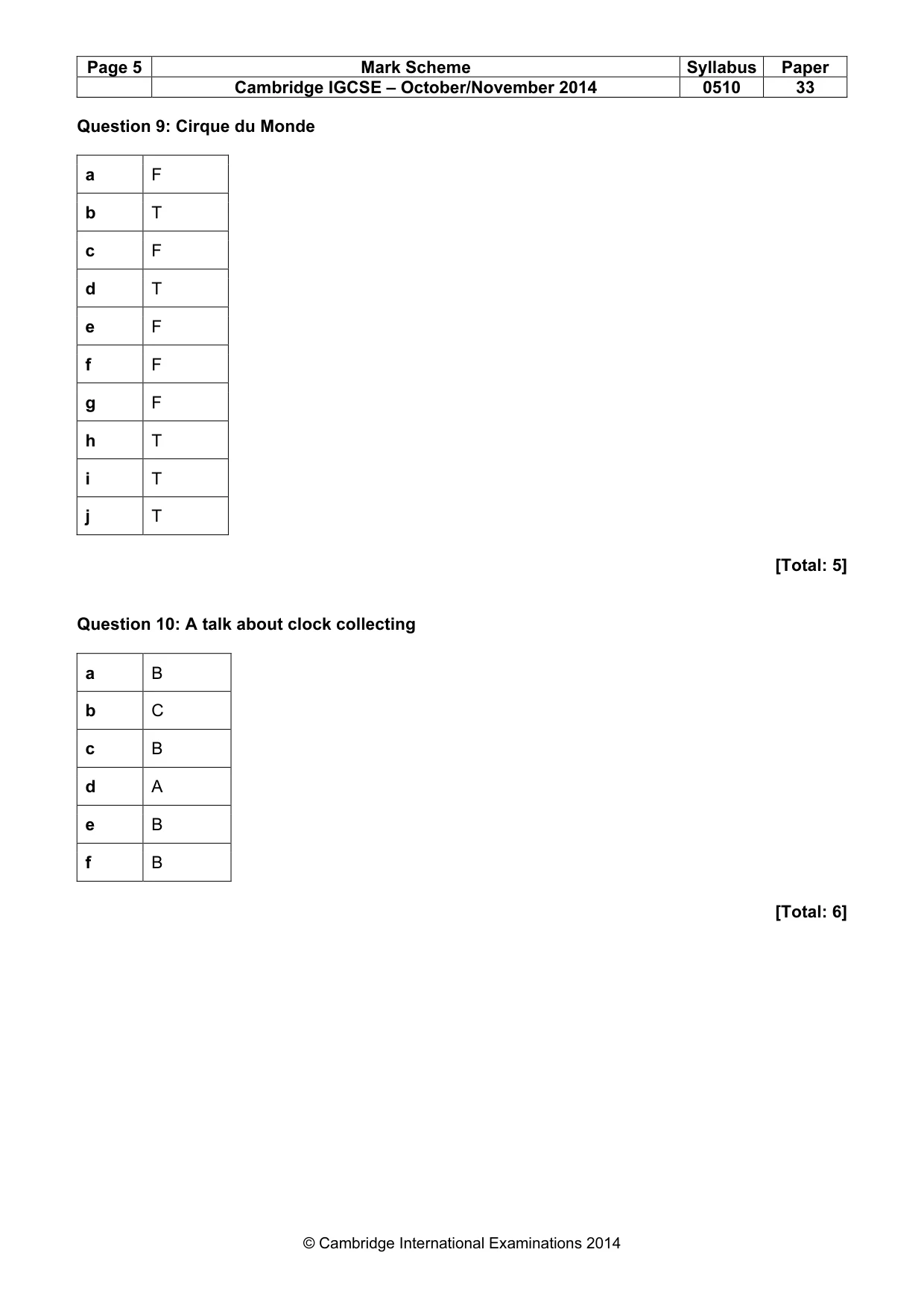
Page 5 Mark Scheme Syllabus Paper Cambridge IGCSE – October/November 2014 0510 33 © Cambridge International Examinations 2014 Question 9: Cirque du Monde a F b T c F d T e F f F g F h T i T j T [Total: 5] Question 10: A talk about clock collecting a B b C c B d A e B f B [Total: 6]
Mark scheme, page 6
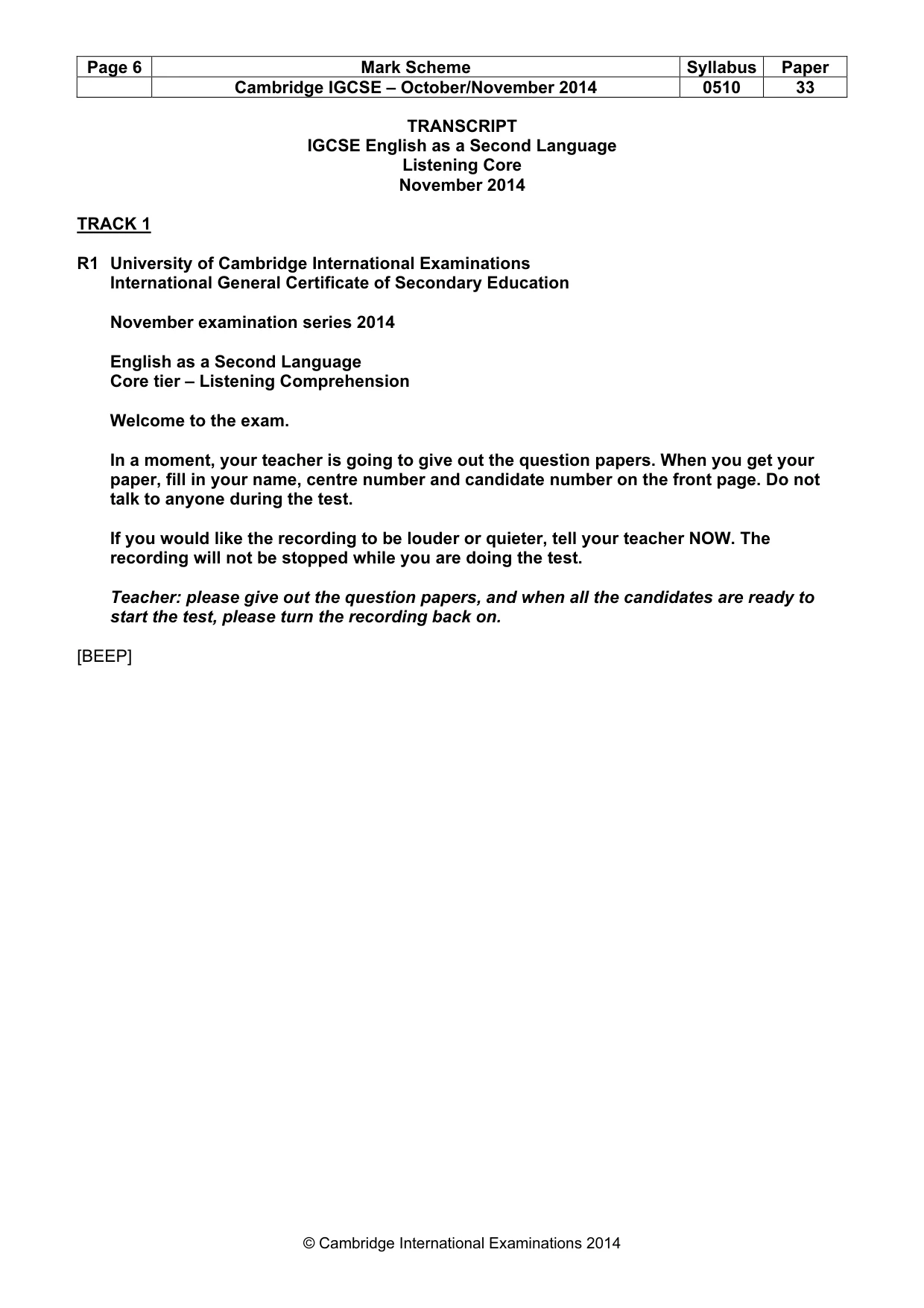
Page 6 Mark Scheme Syllabus Paper Cambridge IGCSE – October/November 2014 0510 33 © Cambridge International Examinations 2014 TRANSCRIPT IGCSE English as a Second Language Listening Core November 2014 TRACK 1 R1 University of Cambridge International Examinations International General Certificate of Secondary Education November examination series 2014 English as a Second Language Core tier – Listening Comprehension Welcome to the exam. In a moment, your teacher is going to give out the question papers. When you get your paper, fill in your name, centre number and candidate number on the front page. Do not talk to anyone during the test. If you would like the recording to be louder or quieter, tell your teacher NOW. The recording will not be stopped while you are doing the test. Teacher: please give out the question papers, and when all the candidates are ready to start the test, please turn the recording back on. [BEEP]
Mark scheme, page 7
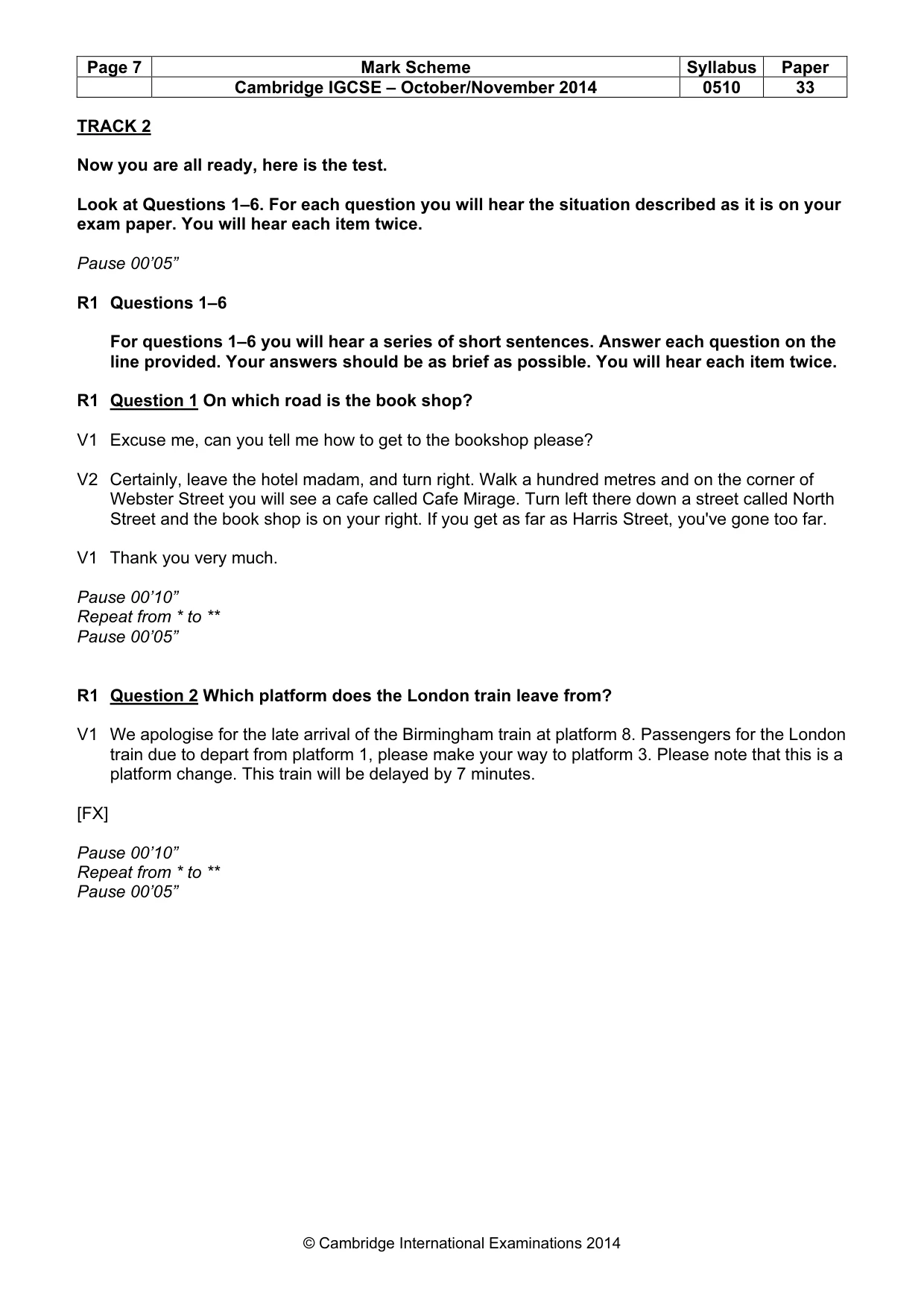
Page 7 Mark Scheme Syllabus Paper Cambridge IGCSE – October/November 2014 0510 33 © Cambridge International Examinations 2014 TRACK 2 Now you are all ready, here is the test. Look at Questions 1–6. For each question you will hear the situation described as it is on your exam paper. You will hear each item twice. Pause 00’05” R1 Questions 1–6 For questions 1–6 you will hear a series of short sentences. Answer each question on the line provided. Your answers should be as brief as possible. You will hear each item twice. R1 Question 1 On which road is the book shop? V1 Excuse me, can you tell me how to get to the bookshop please? V2 Certainly, leave the hotel madam, and turn right. Walk a hundred metres and on the corner of Webster Street you will see a cafe called Cafe Mirage. Turn left there down a street called North Street and the book shop is on your right. If you get as far as Harris Street, you've gone too far. V1 Thank you very much. Pause 00’10” Repeat from * to ** Pause 00’05” R1 Question 2 Which platform does the London train leave from? V1 We apologise for the late arrival of the Birmingham train at platform 8. Passengers for the London train due to depart from platform 1, please make your way to platform 3. Please note that this is a platform change. This train will be delayed by 7 minutes. [FX] Pause 00’10” Repeat from * to ** Pause 00’05”
Mark scheme, page 8
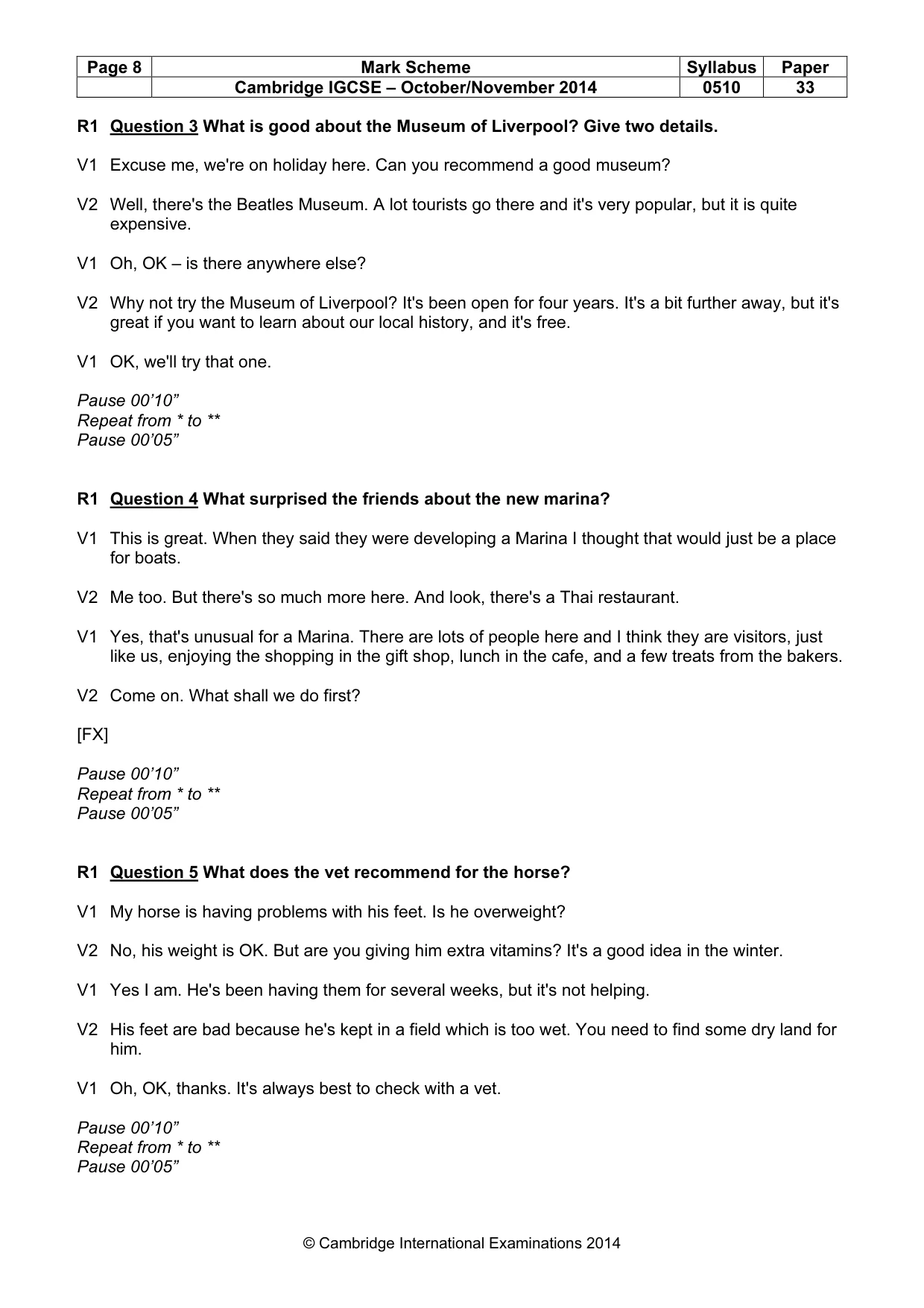
Page 8 Mark Scheme Syllabus Paper Cambridge IGCSE – October/November 2014 0510 33 © Cambridge International Examinations 2014 R1 Question 3 What is good about the Museum of Liverpool? Give two details. V1 Excuse me, we're on holiday here. Can you recommend a good museum? V2 Well, there's the Beatles Museum. A lot tourists go there and it's very popular, but it is quite expensive. V1 Oh, OK – is there anywhere else? V2 Why not try the Museum of Liverpool? It's been open for four years. It's a bit further away, but it's great if you want to learn about our local history, and it's free. V1 OK, we'll try that one. Pause 00’10” Repeat from * to ** Pause 00’05” R1 Question 4 What surprised the friends about the new marina? V1 This is great. When they said they were developing a Marina I thought that would just be a place for boats. V2 Me too. But there's so much more here. And look, there's a Thai restaurant. V1 Yes, that's unusual for a Marina. There are lots of people here and I think they are visitors, just like us, enjoying the shopping in the gift shop, lunch in the cafe, and a few treats from the bakers. V2 Come on. What shall we do first? [FX] Pause 00’10” Repeat from * to ** Pause 00’05” R1 Question 5 What does the vet recommend for the horse? V1 My horse is having problems with his feet. Is he overweight? V2 No, his weight is OK. But are you giving him extra vitamins? It's a good idea in the winter. V1 Yes I am. He's been having them for several weeks, but it's not helping. V2 His feet are bad because he's kept in a field which is too wet. You need to find some dry land for him. V1 Oh, OK, thanks. It's always best to check with a vet. Pause 00’10” Repeat from * to ** Pause 00’05”
Mark scheme, page 9
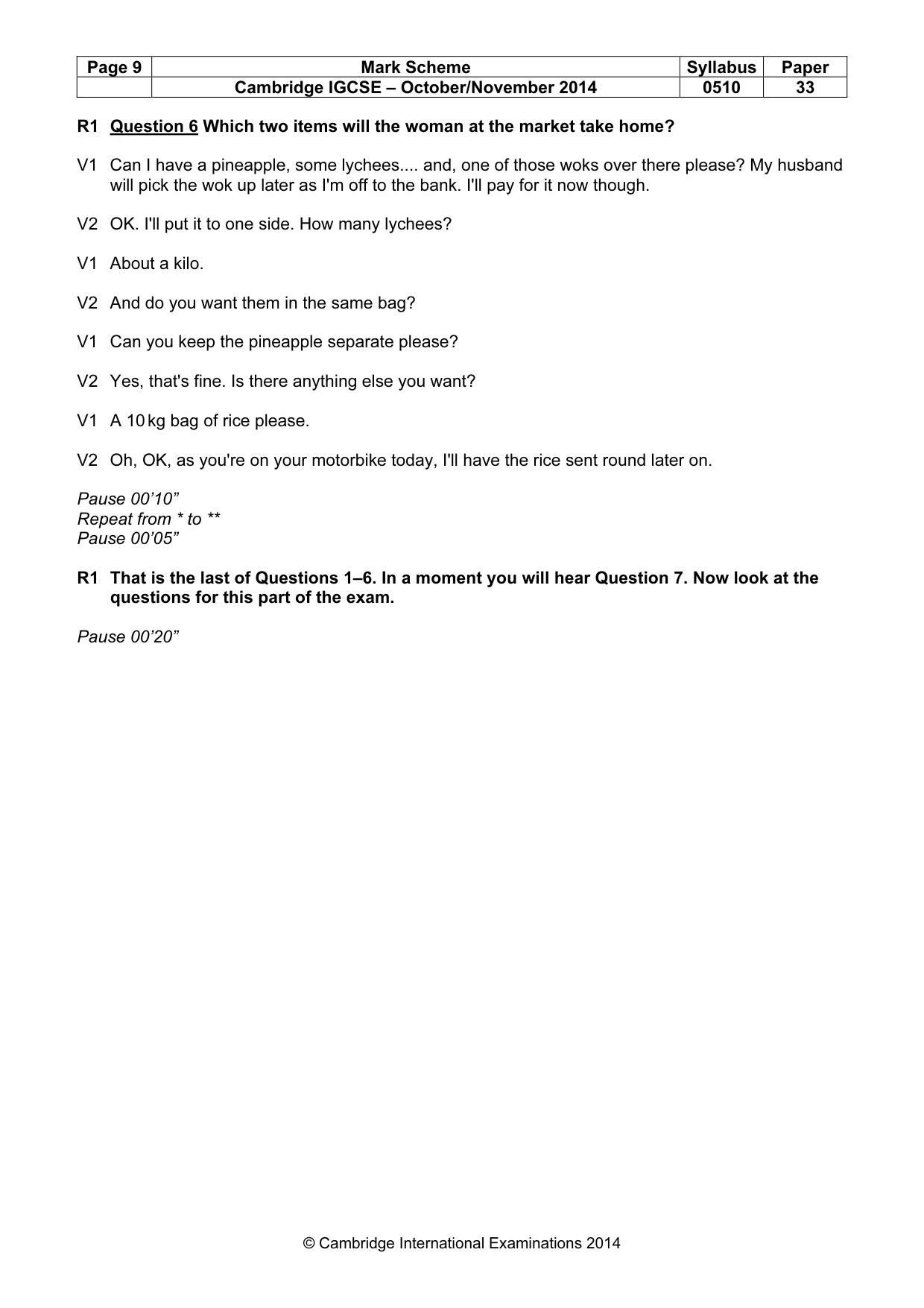
Page 9 Mark Scheme Syllabus Paper Cambridge IGCSE – October/November 2014 0510 33 © Cambridge International Examinations 2014 R1 Question 6 Which two items will the woman at the market take home? V1 Can I have a pineapple, some lychees… and, one of those woks over there please? My husband will pick the wok up later as I'm off to the bank. I'll pay for it now though. V2 OK. I'll put it to one side. How many lychees? V1 About a kilo. V2 And do you want them in the same bag? V1 Can you keep the pineapple separate please? V2 Yes, that's fine. Is there anything else you want? V1 A 10 kg bag of rice please. V2 Oh, OK, as you're on your motorbike today, I'll have the rice sent round later on. Pause 00’10” Repeat from * to ** Pause 00’05” R1 That is the last of Questions 1–6. In a moment you will hear Question 7. Now look at the questions for this part of the exam. Pause 00’20”
Mark scheme, page 10
Page 10 Mark Scheme Syllabus Paper Cambridge IGCSE – October/November 2014 0510 33 © Cambridge International Examinations 2014 TRACK 3 R1 Question 7 Listen to the following talk about how people in ancient times created large structures and then complete the details below. You will hear the talk twice. [Suggested context – radio talk, in a series of talks given by members of the public, so could be introduced as such] V1 The temple of Angkor Wat, the Egyptian pyramids, Stonehenge, and the famous statues on Easter Island were all built without modern technology. So how did people build the temples and statues that we so admire? In some cases, all they needed was rope, very little manpower, and some very clever carving. Other construction projects required making the best of the seasons, using thousands of people, and using animals to transport materials to the construction sites. In 15th and 16th century China, ice roads were used to slide stone blocks to Beijing in order to build palaces in the Forbidden City. These roads were splashed with water to lubricate them. With hardly any friction, it was much easier to move these huge stones. Working with nature is a common theme in the techniques used by ancient people to build their monuments and temples. Here are two more of the ways in which workers in ancient times moved the huge stone pieces needed for their big engineering projects. For many generations people have wondered how the stone statues of Easter Island were moved from the quarries to the coast. People used to think it was a miracle. Now, it seems clear that gravity and physics were involved. For some time, experts have argued about how the islanders managed to move statues carved from volcanic rock and weighing up to 80 tonnes. The quarries were between 10 and 12 kilometres from the statues' final resting place. One theory is that Easter Island residents used a kind of railway track to transport their statues. This consisted of two wooden rails attached by fixed crosspieces that were laid down on the ground. The workers then pushed each statue along the track to the display area. Another theory, however, suggests the statues were actually walked to their destination. An unfinished statue could have been rocked from side to side as it tipped forward. It's similar to how one might move a refrigerator across the floor. We have seen this movement demonstrated with a five tonne replica statue and it works! Using this method, it would have taken the islanders only a few weeks to move their statues to their resting place. Once there, final carvings were done to finish the job. In the construction of the temple of Angkor Wat, stone blocks were used. The quarries that provided those blocks were about 50 to 70 kilometres away in a sandstone plateau. Of the blocks used in the temples, about 90% percent were between 200 and 300 kilograms, and initially, experts thought that workers in ancient times used roads to transport the stones to the city. However, recently researchers have identified canals linking Angkor to the quarries. It was much more likely therefore that the builders of Angkor Wat used rafts to float the blocks to the city during the rainy season when the winds would blow favourably. In the dry season, the workers carved the blocks into the amazing structures we see today. Pause 00’30” R1 Now you will hear the interview again.
Mark scheme, page 11
Page 11 Mark Scheme Syllabus Paper Cambridge IGCSE – October/November 2014 0510 33 © Cambridge International Examinations 2014 Repeat from * to ** Pause 0’30” R1 That is the end of Question 7. In a moment you will hear Question 8. Now look at the questions for this part of the exam. Pause 00’25”
Mark scheme, page 12
Page 12 Mark Scheme Syllabus Paper Cambridge IGCSE – October/November 2014 0510 33 © Cambridge International Examinations 2014 TRACK 4 R1 Question 8 Listen to the following interview with a man called Angus McDonald who works to protect birds of prey. You will hear the interview twice. V1 Hello, I'm here today with Angus McDonald at the Pride of Prey bird centre in Scotland. Angus, can you tell me about some of the work that happens here please. V2 OK. Here at Pride of Prey, we specialise in three areas: education, conservation, and raising young birds. I'll show you where we keep the young birds later on, but as we're here in the information centre, you can see the education work we do. There's a wall display over there which was put together by a primary school, after one of our officers gave a talk there. V1 What else do you do? V2 Well, we also work internationally. I was in France a few months ago supervising a group of volunteers to help set up an Owl sanctuary. I was there for 3 weeks – it was great. V1 How many people work at this centre, Angus? Is the centre open all year round? V2 There are 9 of us. Four of us are qualified climbers for the trickier assignments. The Centre is open 11 months of the year, but we close for January to do some cleaning work and to get ready for the spring, when we are busiest. V1 Tell us about some of the birds you have rescued, Angus. V2 We know the whereabouts of all of the eagles in the area. A few days ago we found a female eagle, dead at the side of a road, and we knew that she had some chicks nearby. V1 Ah! V2 We went and found the nest on a mountain side about 2400 metres above sea level. There were three chicks in there. It's a very rare species so we needed to remove them quickly before they died of the very cold conditions. It was difficult to rescue the shivering and hungry chicks in the wind and rain. V1 Do you ever hatch eggs at the centre? V2 Yes, we put them in an incubator, where they are kept at a constant warm temperature, and in a few weeks they might hatch, and then we have baby eagles, or eaglets, which is the proper name. V1 Do all the eggs hatch? V2 No. We have quite a low success rate actually – only about 30%, which is quite disappointing. V1 Um. What's your favourite bird of prey? V2 I love working with owls. V1 Why are they your favourite? V2 Their feathers are beautiful and the fact that they are soft enables them to they fly in complete silence. And they can turn their heads 360 degrees.
Mark scheme, page 13
Page 13 Mark Scheme Syllabus Paper Cambridge IGCSE – October/November 2014 0510 33 © Cambridge International Examinations 2014 V1 How many different types of owl are there, Angus? I think I know three. V2 There are hundreds. Owls can be found in almost every country in the world. There are 226 different species in 170 different countries. V1 To finish today, Angus, what's the most enjoyable part of your job? V2 Well, I like the visits abroad and I love working outside, but releasing young birds into the wild is what I get the greatest satisfaction from. Pause 00’30” R1 Now you will hear the interview again. Repeat from * to ** Pause 00’30” R1 That is the end of Question 8. In a moment you will hear Question 9. Now look at the questions for this part of the exam. Pause 00’35”
Mark scheme, page 14
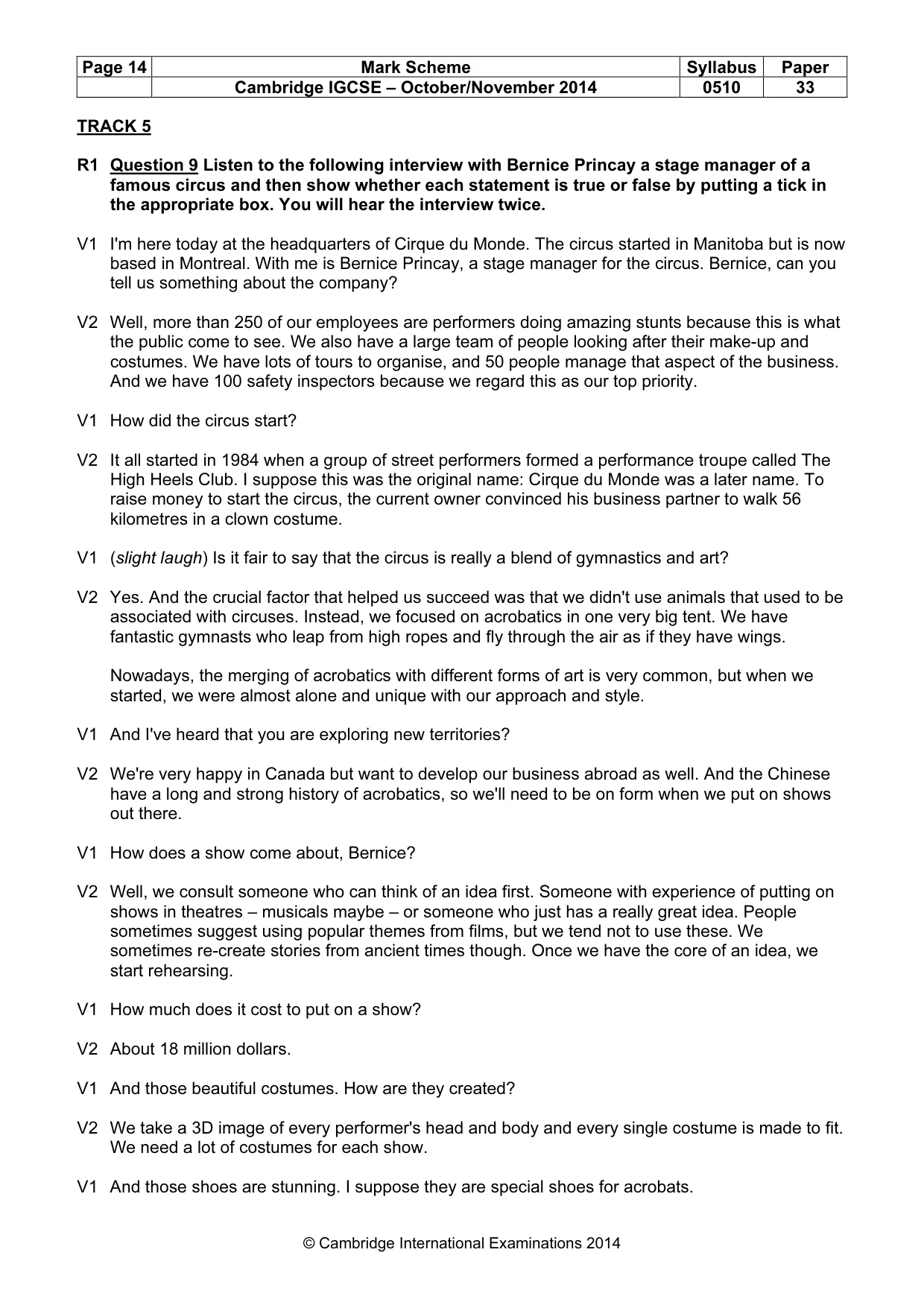
Page 14 Mark Scheme Syllabus Paper Cambridge IGCSE – October/November 2014 0510 33 © Cambridge International Examinations 2014 TRACK 5 R1 Question 9 Listen to the following interview with Bernice Princay a stage manager of a famous circus and then show whether each statement is true or false by putting a tick in the appropriate box. You will hear the interview twice. V1 I'm here today at the headquarters of Cirque du Monde. The circus started in Manitoba but is now based in Montreal. With me is Bernice Princay, a stage manager for the circus. Bernice, can you tell us something about the company? V2 Well, more than 250 of our employees are performers doing amazing stunts because this is what the public come to see. We also have a large team of people looking after their make-up and costumes. We have lots of tours to organise, and 50 people manage that aspect of the business. And we have 100 safety inspectors because we regard this as our top priority. V1 How did the circus start? V2 It all started in 1984 when a group of street performers formed a performance troupe called The High Heels Club. I suppose this was the original name: Cirque du Monde was a later name. To raise money to start the circus, the current owner convinced his business partner to walk 56 kilometres in a clown costume. V1 (slight laugh) Is it fair to say that the circus is really a blend of gymnastics and art? V2 Yes. And the crucial factor that helped us succeed was that we didn't use animals that used to be associated with circuses. Instead, we focused on acrobatics in one very big tent. We have fantastic gymnasts who leap from high ropes and fly through the air as if they have wings. Nowadays, the merging of acrobatics with different forms of art is very common, but when we started, we were almost alone and unique with our approach and style. V1 And I've heard that you are exploring new territories? V2 We're very happy in Canada but want to develop our business abroad as well. And the Chinese have a long and strong history of acrobatics, so we'll need to be on form when we put on shows out there. V1 How does a show come about, Bernice? V2 Well, we consult someone who can think of an idea first. Someone with experience of putting on shows in theatres – musicals maybe – or someone who just has a really great idea. People sometimes suggest using popular themes from films, but we tend not to use these. We sometimes re-create stories from ancient times though. Once we have the core of an idea, we start rehearsing. V1 How much does it cost to put on a show? V2 About 18 million dollars. V1 And those beautiful costumes. How are they created? V2 We take a 3D image of every performer's head and body and every single costume is made to fit. We need a lot of costumes for each show. V1 And those shoes are stunning. I suppose they are special shoes for acrobats.
Mark scheme, page 15
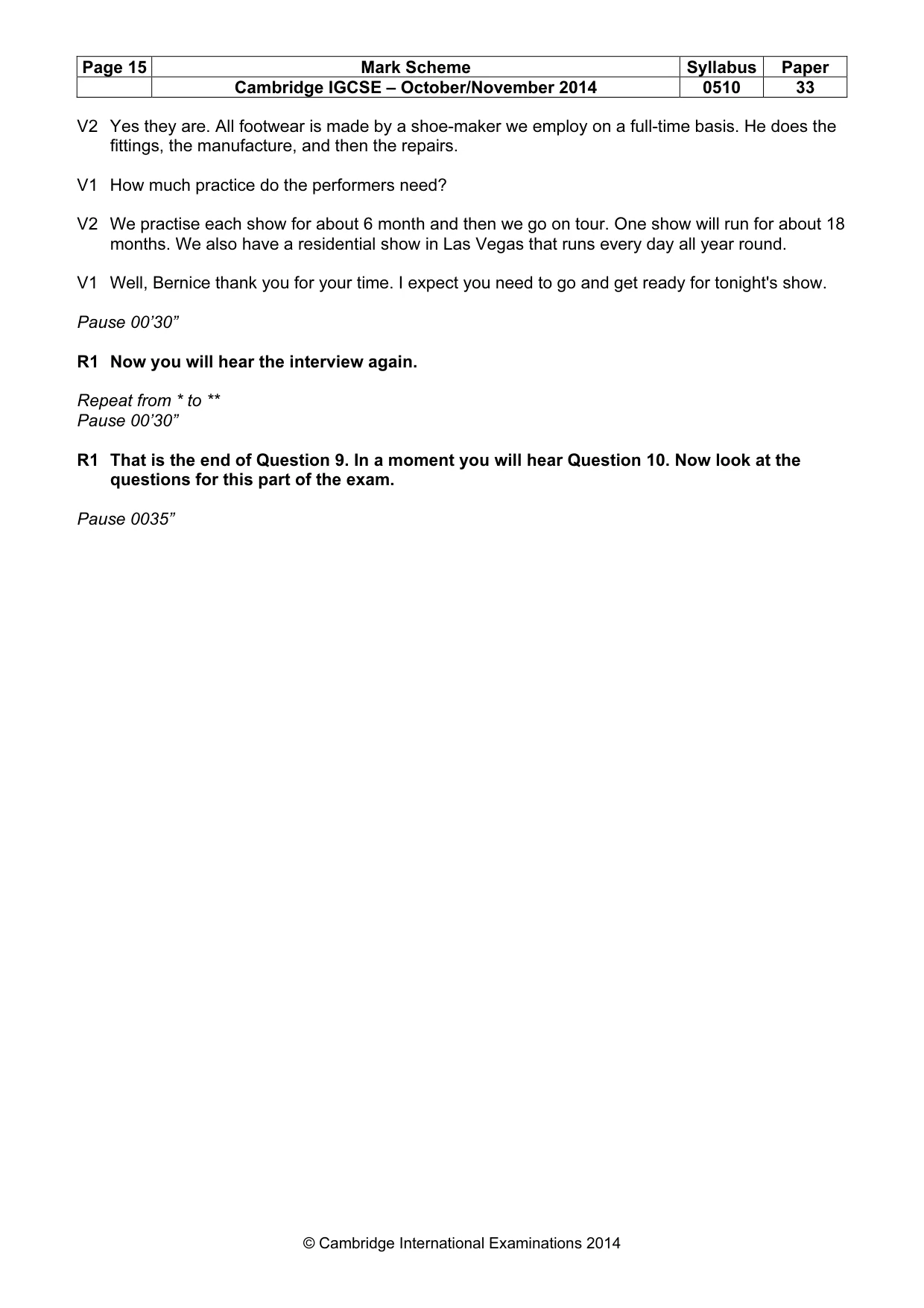
Page 15 Mark Scheme Syllabus Paper Cambridge IGCSE – October/November 2014 0510 33 © Cambridge International Examinations 2014 V2 Yes they are. All footwear is made by a shoe-maker we employ on a full-time basis. He does the fittings, the manufacture, and then the repairs. V1 How much practice do the performers need? V2 We practise each show for about 6 month and then we go on tour. One show will run for about 18 months. We also have a residential show in Las Vegas that runs every day all year round. V1 Well, Bernice thank you for your time. I expect you need to go and get ready for tonight's show. Pause 00’30” R1 Now you will hear the interview again. Repeat from * to ** Pause 00’30” R1 That is the end of Question 9. In a moment you will hear Question 10. Now look at the questions for this part of the exam. Pause 0035”
Mark scheme, page 16
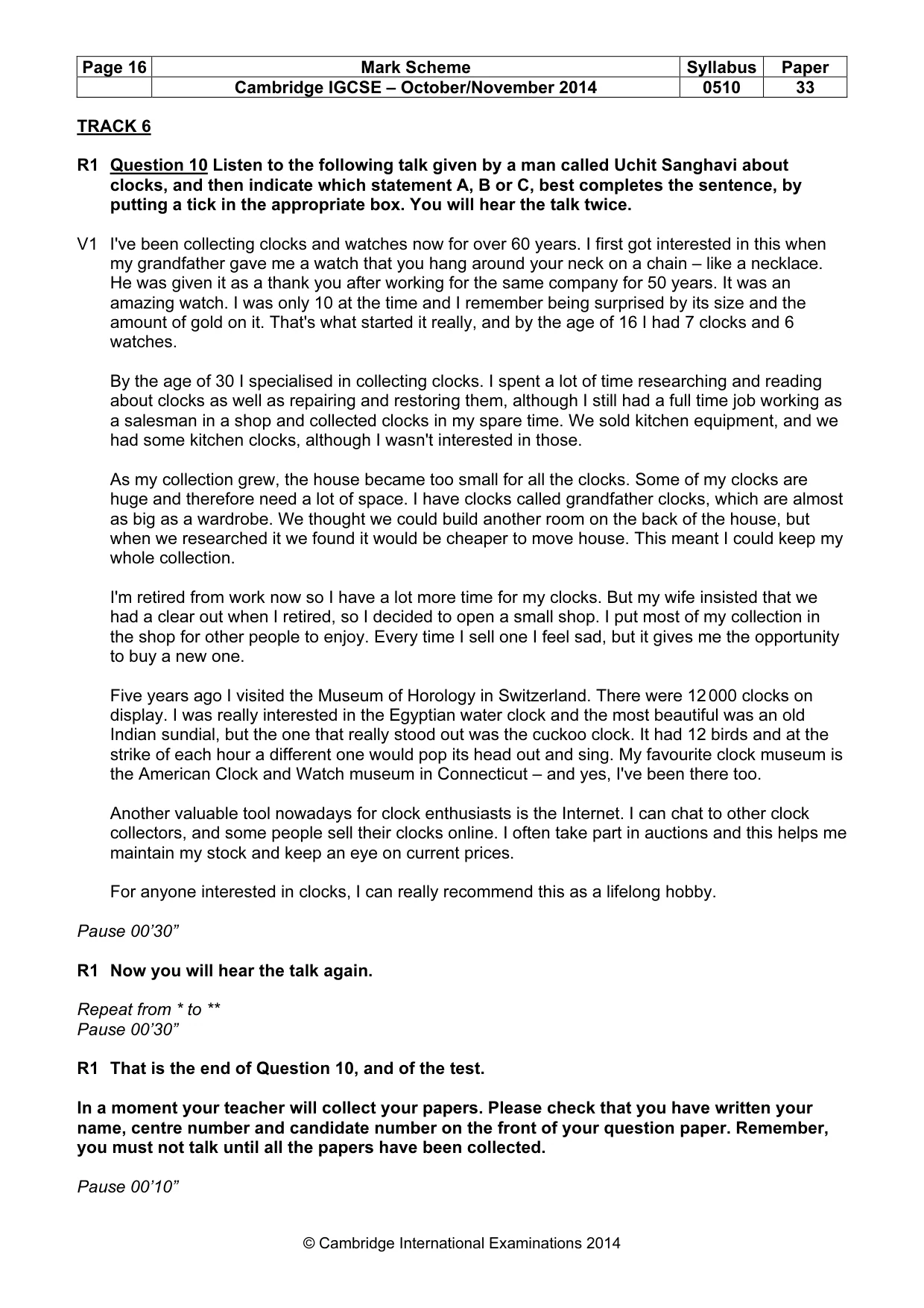
Page 16 Mark Scheme Syllabus Paper Cambridge IGCSE – October/November 2014 0510 33 © Cambridge International Examinations 2014 TRACK 6 R1 Question 10 Listen to the following talk given by a man called Uchit Sanghavi about clocks, and then indicate which statement A, B or C, best completes the sentence, by putting a tick in the appropriate box. You will hear the talk twice. V1 I've been collecting clocks and watches now for over 60 years. I first got interested in this when my grandfather gave me a watch that you hang around your neck on a chain – like a necklace. He was given it as a thank you after working for the same company for 50 years. It was an amazing watch. I was only 10 at the time and I remember being surprised by its size and the amount of gold on it. That's what started it really, and by the age of 16 I had 7 clocks and 6 watches. By the age of 30 I specialised in collecting clocks. I spent a lot of time researching and reading about clocks as well as repairing and restoring them, although I still had a full time job working as a salesman in a shop and collected clocks in my spare time. We sold kitchen equipment, and we had some kitchen clocks, although I wasn't interested in those. As my collection grew, the house became too small for all the clocks. Some of my clocks are huge and therefore need a lot of space. I have clocks called grandfather clocks, which are almost as big as a wardrobe. We thought we could build another room on the back of the house, but when we researched it we found it would be cheaper to move house. This meant I could keep my whole collection. I'm retired from work now so I have a lot more time for my clocks. But my wife insisted that we had a clear out when I retired, so I decided to open a small shop. I put most of my collection in the shop for other people to enjoy. Every time I sell one I feel sad, but it gives me the opportunity to buy a new one. Five years ago I visited the Museum of Horology in Switzerland. There were 12 000 clocks on display. I was really interested in the Egyptian water clock and the most beautiful was an old Indian sundial, but the one that really stood out was the cuckoo clock. It had 12 birds and at the strike of each hour a different one would pop its head out and sing. My favourite clock museum is the American Clock and Watch museum in Connecticut – and yes, I've been there too. Another valuable tool nowadays for clock enthusiasts is the Internet. I can chat to other clock collectors, and some people sell their clocks online. I often take part in auctions and this helps me maintain my stock and keep an eye on current prices. For anyone interested in clocks, I can really recommend this as a lifelong hobby. Pause 00’30” R1 Now you will hear the talk again. Repeat from * to ** Pause 00’30” R1 That is the end of Question 10, and of the test. In a moment your teacher will collect your papers. Please check that you have written your name, centre number and candidate number on the front of your question paper. Remember, you must not talk until all the papers have been collected. Pause 00’10”
Mark scheme, page 17
Page 17 Mark Scheme Syllabus Paper Cambridge IGCSE – October/November 2014 0510 33 © Cambridge International Examinations 2014 R1 Teacher, please collect all the papers. Thank you, everyone.
What you needed in this session
Cambridge’s own grade thresholds for 2014 Oct/Nov, Paper 3 · Variant 3. A higher threshold means an easier paper — the bar moves with how the cohort did.