Cambridge IGCSE English - Second Language (oral endorsement) 0510 — 2013 Oct/Nov Paper 2 · Variant 3
0510/23/O/N/13
The question paper and its mark scheme, free to read here and free to download. This is Cambridge’s own paper, exactly as it was sat.
Question paper16 pages




Mark scheme12 pages
Answers below. Sit the paper first if you are practising.
Paper as text
Question paper, page 1
This document consists of 15 printed pages and 1 blank page. DC (SJF/CGW) 83397 © UCLES 2013 [Turn over * 9 6 8 4 8 2 4 5 2 2 * ENGLISH AS A SECOND LANGUAGE 0510/23 Paper 2 Reading and Writing (Extended) October/November 2013 2 hours Candidates answer on the Question Paper. No Additional Materials are required. READ THESE INSTRUCTIONS FIRST Write your Centre number, candidate number and name on all the work you hand in. Write in dark blue or black pen. Do not use staples, paper clips, highlighters, glue or correction fluid. DO NOT WRITE IN ANY BARCODES. Answer all questions. Dictionaries are not allowed. At the end of the examination, fasten all your work securely together. The number of marks is given in brackets [ ] at the end of each question or part question. UNIVERSITY OF CAMBRIDGE INTERNATIONAL EXAMINATIONS International General Certificate of Secondary Education
Question paper, page 2
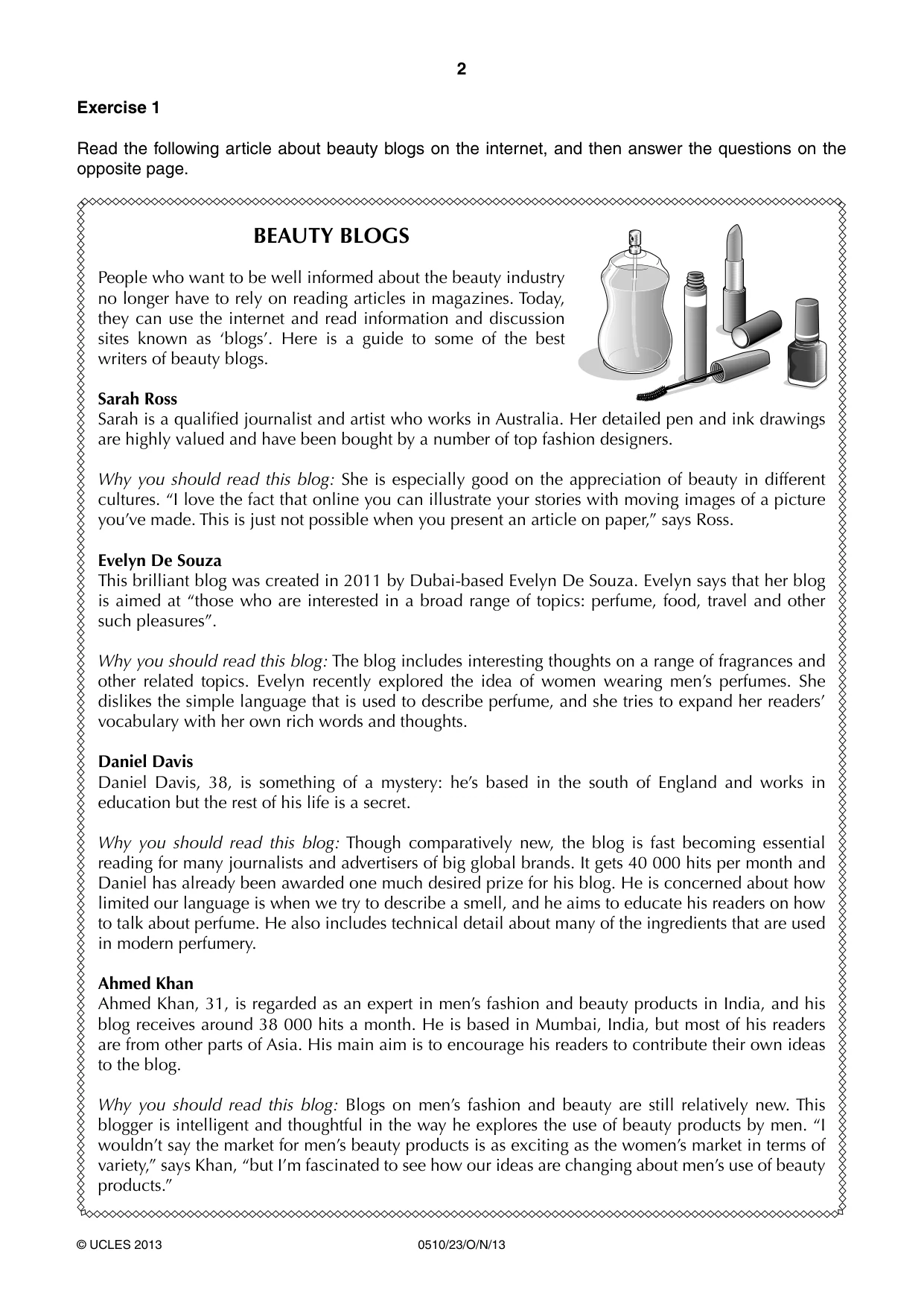
2 0510/23/O/N/13 © UCLES 2013 Exercise 1 Read the following article about beauty blogs on the internet, and then answer the questions on the opposite page. BEAUTY BLOGS People who want to be well informed about the beauty industry no longer have to rely on reading articles in magazines. Today, they can use the internet and read information and discussion sites known as ‘blogs’. Here is a guide to some of the best writers of beauty blogs. Sarah Ross Sarah is a qualified journalist and artist who works in Australia. Her detailed pen and ink drawings are highly valued and have been bought by a number of top fashion designers. Why you should read this blog: She is especially good on the appreciation of beauty in different cultures. “I love the fact that online you can illustrate your stories with moving images of a picture you’ve made. This is just not possible when you present an article on paper,” says Ross. Evelyn De Souza This brilliant blog was created in 2011 by Dubai-based Evelyn De Souza. Evelyn says that her blog is aimed at “those who are interested in a broad range of topics: perfume, food, travel and other such pleasures”. Why you should read this blog: The blog includes interesting thoughts on a range of fragrances and other related topics. Evelyn recently explored the idea of women wearing men’s perfumes. She dislikes the simple language that is used to describe perfume, and she tries to expand her readers’ vocabulary with her own rich words and thoughts. Daniel Davis Daniel Davis, 38, is something of a mystery: he’s based in the south of England and works in education but the rest of his life is a secret. Why you should read this blog: Though comparatively new, the blog is fast becoming essential reading for many journalists and advertisers of big global brands. It gets 40 000 hits per month and Daniel has already been awarded one much desired prize for his blog. He is concerned about how limited our language is when we try to describe a smell, and he aims to educate his readers on how to talk about perfume. He also includes technical detail about many of the ingredients that are used in modern perfumery. Ahmed Khan Ahmed Khan, 31, is regarded as an expert in men’s fashion and beauty products in India, and his blog receives around 38 000 hits a month. He is based in Mumbai, India, but most of his readers are from other parts of Asia. His main aim is to encourage his readers to contribute their own ideas to the blog. Why you should read this blog: Blogs on men’s fashion and beauty are still relatively new. This blogger is intelligent and thoughtful in the way he explores the use of beauty products by men. “I wouldn’t say the market for men’s beauty products is as exciting as the women’s market in terms of variety,” says Khan, “but I’m fascinated to see how our ideas are changing about men’s use of beauty products.”
Question paper, page 3
3 0510/23/O/N/13 © UCLES 2013 [Turn over (a) Apart from in magazines, where can people who are interested in the beauty industry find information nowadays? …[1] (b) How do we know that drawings by Sarah Ross are good? …[1] (c) What does Sarah Ross particularly like about presenting information on the internet? …[1] (d) Why might people with a variety of interests read Evelyn’s blog? …[1] (e) What is the subject of one of Evelyn’s latest blog entries? …[1] (f) Which two groups of people find it particularly useful to read Daniel Davis’s blog? … …[1] (g) How do we know that Daniel’s blog is successful? Give two details. … …[1] (h) How does Ahmed hope his readers will respond to his blog? …[1] (i) What does Ahmed find especially interesting? …[1] [Total: 9]
Question paper, page 4
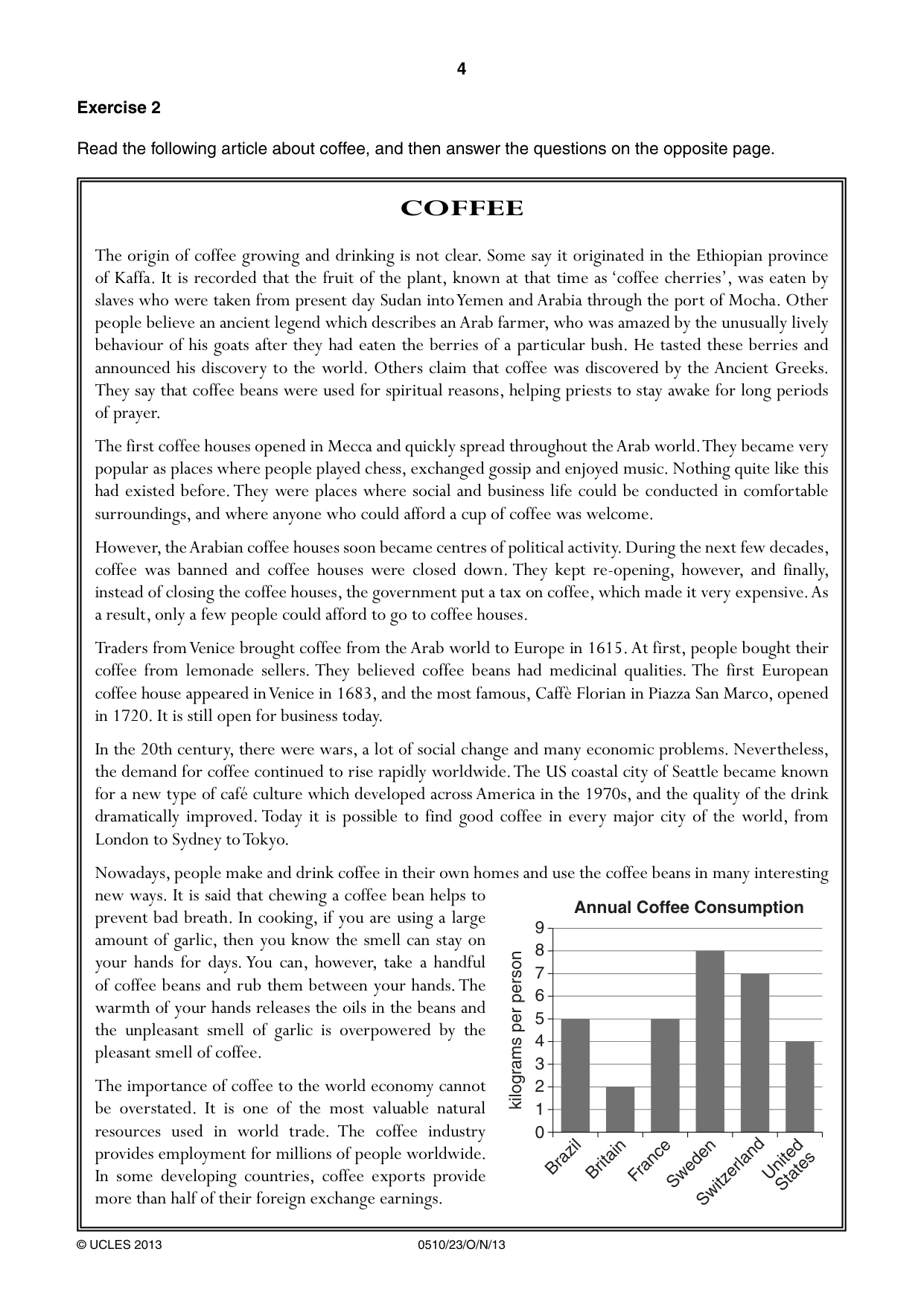
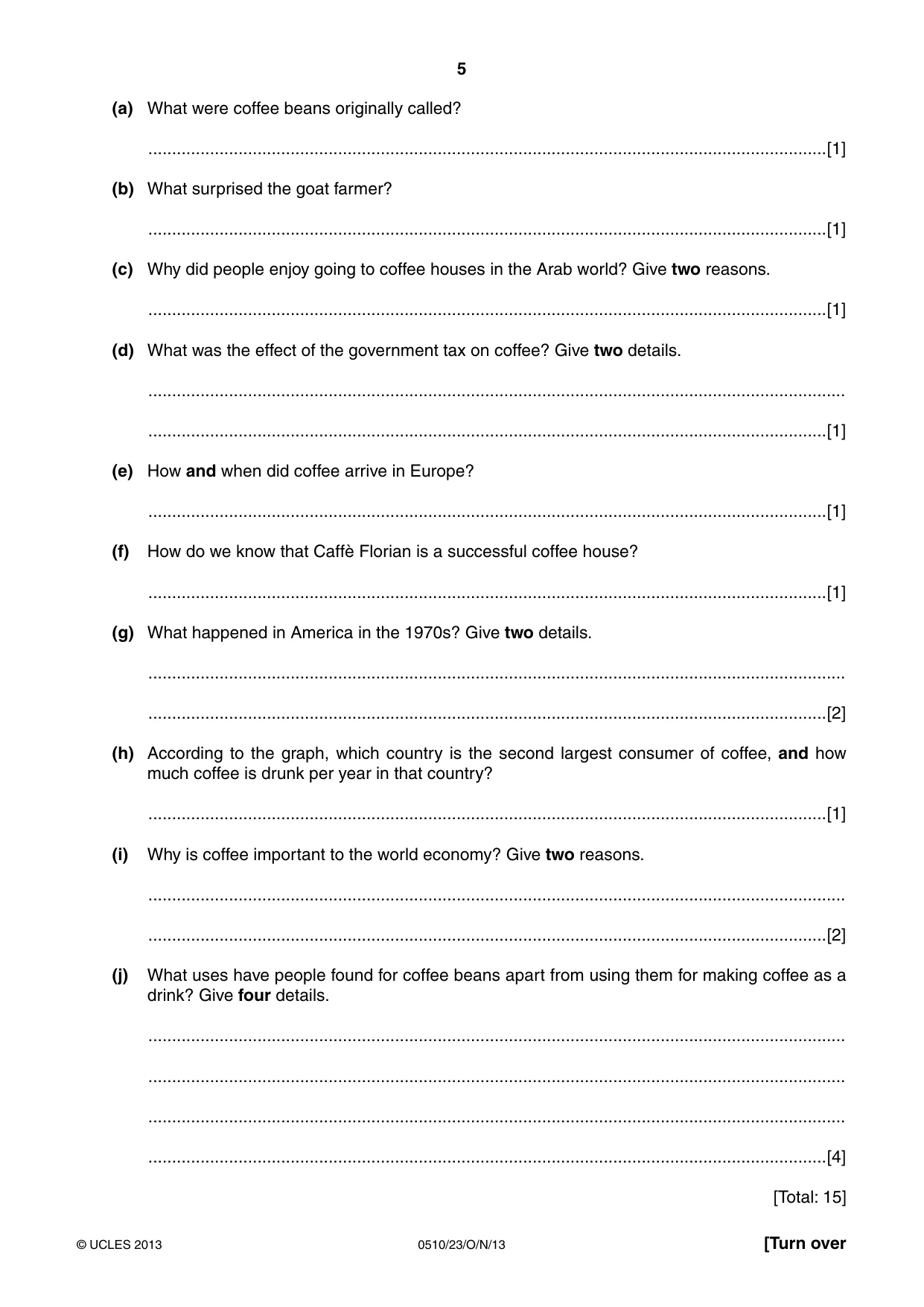
4 0510/23/O/N/13 © UCLES 2013 Exercise 2 Read the following article about coffee, and then answer the questions on the opposite page. COFFEE The origin of coffee growing and drinking is not clear. Some say it originated in the Ethiopian province of Kaffa. It is recorded that the fruit of the plant, known at that time as ‘coffee cherries’, was eaten by slaves who were taken from present day Sudan into Yemen and Arabia through the port of Mocha. Other people believe an ancient legend which describes an Arab farmer, who was amazed by the unusually lively behaviour of his goats after they had eaten the berries of a particular bush. He tasted these berries and announced his discovery to the world. Others claim that coffee was discovered by the Ancient Greeks. They say that coffee beans were used for spiritual reasons, helping priests to stay awake for long periods of prayer. The first coffee houses opened in Mecca and quickly spread throughout the Arab world. They became very popular as places where people played chess, exchanged gossip and enjoyed music. Nothing quite like this had existed before. They were places where social and business life could be conducted in comfortable surroundings, and where anyone who could afford a cup of coffee was welcome. However, the Arabian coffee houses soon became centres of political activity. During the next few decades, coffee was banned and coffee houses were closed down. They kept re-opening, however, and finally, instead of closing the coffee houses, the government put a tax on coffee, which made it very expensive. As a result, only a few people could afford to go to coffee houses. Traders from Venice brought coffee from the Arab world to Europe in 1615. At first, people bought their coffee from lemonade sellers. They believed coffee beans had medicinal qualities. The first European coffee house appeared in Venice in 1683, and the most famous, Caffè Florian in Piazza San Marco, opened in 1720. It is still open for business today. In the 20th century, there were wars, a lot of social change and many economic problems. Nevertheless, the demand for coffee continued to rise rapidly worldwide. The US coastal city of Seattle became known for a new type of café culture which developed across America in the 1970s, and the quality of the drink dramatically improved. Today it is possible to find good coffee in every major city of the world, from London to Sydney to Tokyo. Nowadays, people make and drink coffee in their own homes and use the coffee beans in many interesting new ways. It is said that chewing a coffee bean helps to prevent bad breath. In cooking, if you are using a large amount of garlic, then you know the smell can stay on your hands for days. You can, however, take a handful of coffee beans and rub them between your hands. The warmth of your hands releases the oils in the beans and the unpleasant smell of garlic is overpowered by the pleasant smell of coffee. The importance of coffee to the world economy cannot be overstated. It is one of the most valuable natural resources used in world trade. The coffee industry provides employment for millions of people worldwide. In some developing countries, coffee exports provide more than half of their foreign exchange earnings. 9 8 7 6 5 kilograms per person 4 1 0 3 Brazil Britain France Sweden Annual Coffee Consumption Switzerland United States 2
Question paper, page 5
5 0510/23/O/N/13 © UCLES 2013 [Turn over (a) What were coffee beans originally called? …[1] (b) What surprised the goat farmer? …[1] (c) Why did people enjoy going to coffee houses in the Arab world? Give two reasons. …[1] (d) What was the effect of the government tax on coffee? Give two details. … …[1] (e) How and when did coffee arrive in Europe? …[1] (f) How do we know that Caffè Florian is a successful coffee house? …[1] (g) What happened in America in the 1970s? Give two details. … …[2] (h) According to the graph, which country is the second largest consumer of coffee, and how much coffee is drunk per year in that country? …[1] (i) Why is coffee important to the world economy? Give two reasons. … …[2] (j) What uses have people found for coffee beans apart from using them for making coffee as a drink? Give four details. … … … …[4] [Total: 15]
Question paper, page 6
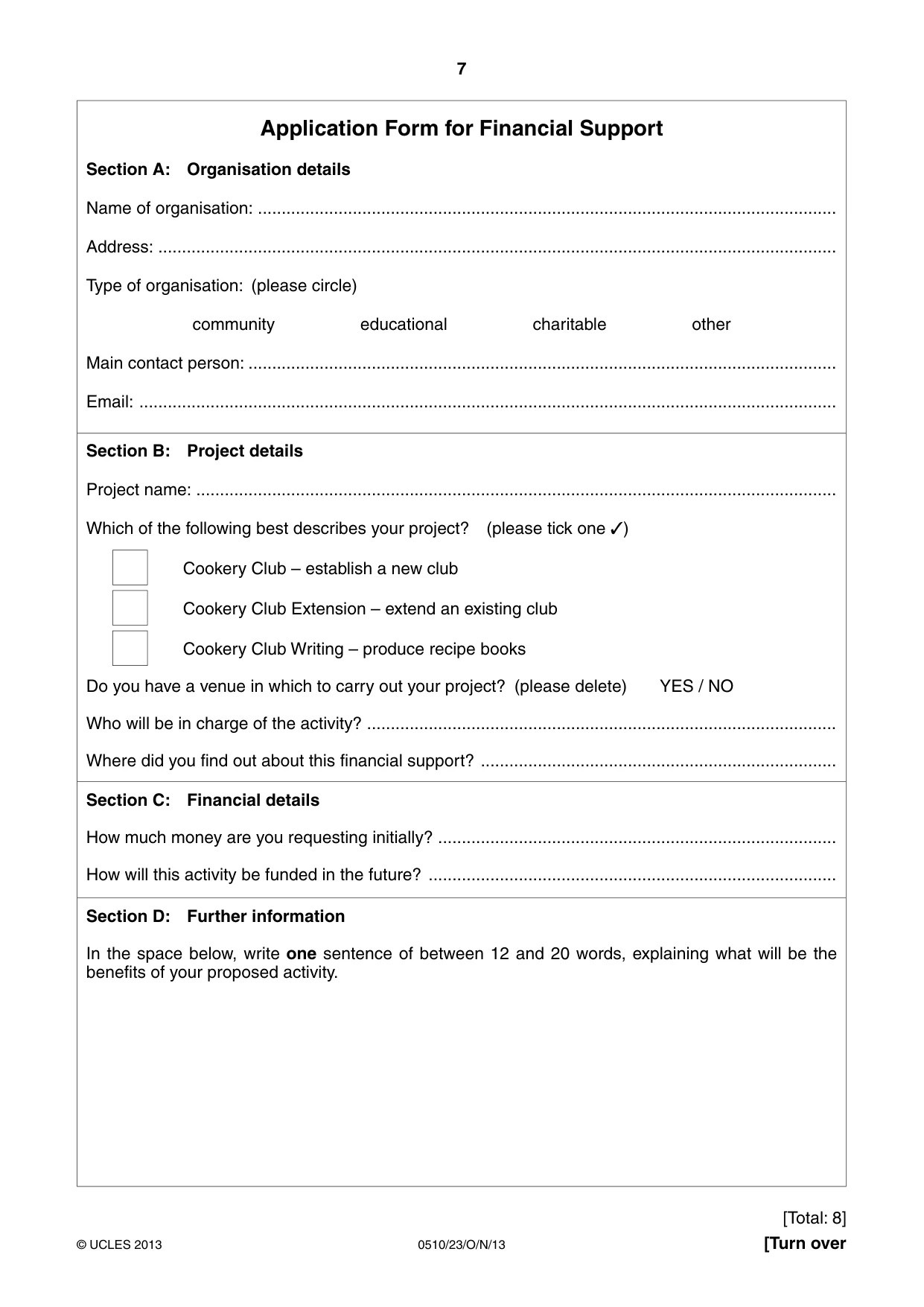
6 0510/23/O/N/13 © UCLES 2013 Exercise 3 Bagwis Reye’s family moved to Dubai recently and he now attends the boys-only Meadow International School, PO Box 267, Dubai, United Arab Emirates. It is a private school, owned by a very wealthy businessman who has a great interest in education. There are boys attending the school who come from 50 different countries and Bagwis finds this fascinating. There are a number of after-school activities, such as sports and drama clubs but Bagwis was disappointed to find that there was no cookery club. He had been an enthusiastic member of the cookery club at his previous school. There are now a number of international celebrity chefs, and lots of boys are very keen to learn the skills that these famous people have. As a member of the newly formed School Council, Bagwis put forward the idea of starting a cookery club. He argued that this school was ideally placed to have a cookery club as it could focus on world cuisine. He suggested that parents could volunteer to demonstrate how to make their national dishes at the school. This would be a great opportunity to learn more about the students’ home countries. It would also encourage parents to become more closely involved with the school. The idea was accepted by the School Council, and it was decided that the name of the project would be ‘Global Village Cookery Club’. Members of the School Council presented the plan and a request for the necessary funding to the owner of the school. He said he was happy for the students to use the school canteen facilities and was prepared to arrange for Mr Das, Head of Food Technology, to be responsible for the sessions. However, he made it clear that the club members could not use the canteen equipment, and that they would have to purchase the equipment they required, as well as buy the ingredients for each session. If the project proved to be successful, he promised to provide the funding after the first year. A club with about 10 members needs a lot of equipment such as bowls, pans, and cutlery. The ingredients would also cost a lot of money over a school year. The group of pupils worked with their maths teacher and calculated that they would need at least 6000 dirhams for the club to have a good chance of being successful. Fortunately, Bagwis had seen an article in a local newspaper about a multi-national restaurant group that was offering financial support to any cookery clubs for young people. Bagwis suggested that the School Council should apply, because he thought they had a good idea and therefore a chance of getting funding. He asked for the application form to be emailed to the school at their address, meadowsch@emirates.net.ae. Everyone had high hopes that they would be given the money. Imagine you are Bagwis. Fill in the form on the opposite page, using the information above.
Question paper, page 7
7 0510/23/O/N/13 © UCLES 2013 [Turn over Application Form for Financial Support Section A: Organisation details Name of organisation: … Address: … Type of organisation: (please circle) community educational charitable other Main contact person: … Email: … Section B: Project details Project name: … Which of the following best describes your project? (please tick one ✓) Cookery Club – establish a new club Cookery Club Extension – extend an existing club Cookery Club Writing – produce recipe books Do you have a venue in which to carry out your project? (please delete) YES / NO Who will be in charge of the activity? … Where did you find out about this financial support? … Section C: Financial details How much money are you requesting initially? … How will this activity be funded in the future? … Section D: Further information In the space below, write one sentence of between 12 and 20 words, explaining what will be the benefits of your proposed activity. [Total: 8]
Question paper, page 8
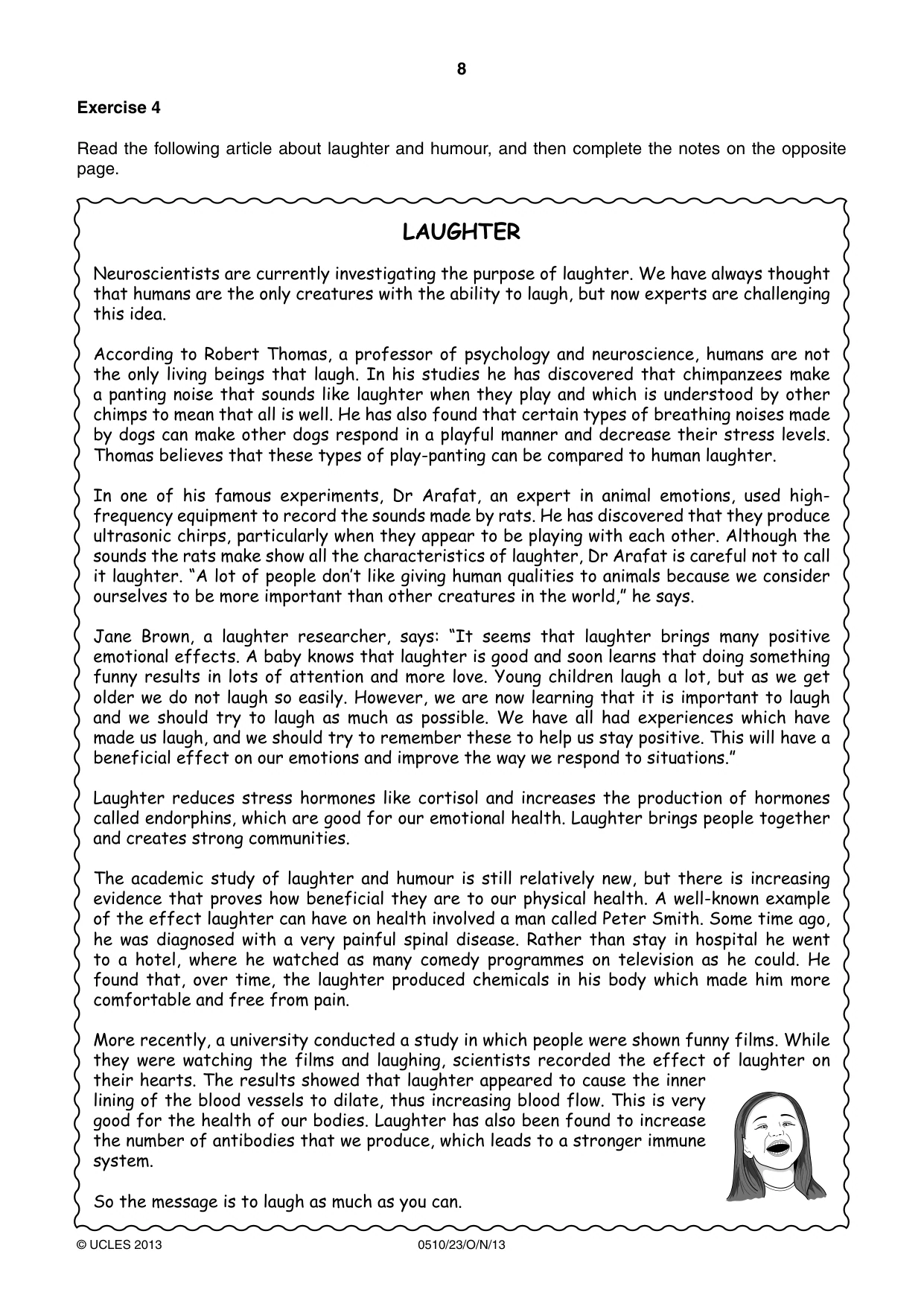
8 0510/23/O/N/13 © UCLES 2013 Exercise 4 Read the following article about laughter and humour, and then complete the notes on the opposite page. LAUGHTER Neuroscientists are currently investigating the purpose of laughter. We have always thought that humans are the only creatures with the ability to laugh, but now experts are challenging this idea. According to Robert Thomas, a professor of psychology and neuroscience, humans are not the only living beings that laugh. In his studies he has discovered that chimpanzees make a panting noise that sounds like laughter when they play and which is understood by other chimps to mean that all is well. He has also found that certain types of breathing noises made by dogs can make other dogs respond in a playful manner and decrease their stress levels. Thomas believes that these types of play-panting can be compared to human laughter. In one of his famous experiments, Dr Arafat, an expert in animal emotions, used high- frequency equipment to record the sounds made by rats. He has discovered that they produce ultrasonic chirps, particularly when they appear to be playing with each other. Although the sounds the rats make show all the characteristics of laughter, Dr Arafat is careful not to call it laughter. “A lot of people don‛t like giving human qualities to animals because we consider ourselves to be more important than other creatures in the world,” he says. Jane Brown, a laughter researcher, says: “It seems that laughter brings many positive emotional effects. A baby knows that laughter is good and soon learns that doing something funny results in lots of attention and more love. Young children laugh a lot, but as we get older we do not laugh so easily. However, we are now learning that it is important to laugh and we should try to laugh as much as possible. We have all had experiences which have made us laugh, and we should try to remember these to help us stay positive. This will have a beneficial effect on our emotions and improve the way we respond to situations.” Laughter reduces stress hormones like cortisol and increases the production of hormones called endorphins, which are good for our emotional health. Laughter brings people together and creates strong communities. The academic study of laughter and humour is still relatively new, but there is increasing evidence that proves how beneficial they are to our physical health. A well-known example of the effect laughter can have on health involved a man called Peter Smith. Some time ago, he was diagnosed with a very painful spinal disease. Rather than stay in hospital he went to a hotel, where he watched as many comedy programmes on television as he could. He found that, over time, the laughter produced chemicals in his body which made him more comfortable and free from pain. More recently, a university conducted a study in which people were shown funny films. While they were watching the films and laughing, scientists recorded the effect of laughter on their hearts. The results showed that laughter appeared to cause the inner lining of the blood vessels to dilate, thus increasing blood flow. This is very good for the health of our bodies. Laughter has also been found to increase the number of antibodies that we produce, which leads to a stronger immune system. So the message is to laugh as much as you can.
Question paper, page 9
9 0510/23/O/N/13 © UCLES 2013 [Turn over You have been asked to give a talk to your school science club about laughter. Prepare some notes to use as the basis of your talk. Make your notes under each heading. Possible evidence that animals laugh • … • … • … Emotional benefits of laughter • … • … • … • … Physical benefits of laughter • … • … [Total: 9]
Question paper, page 10
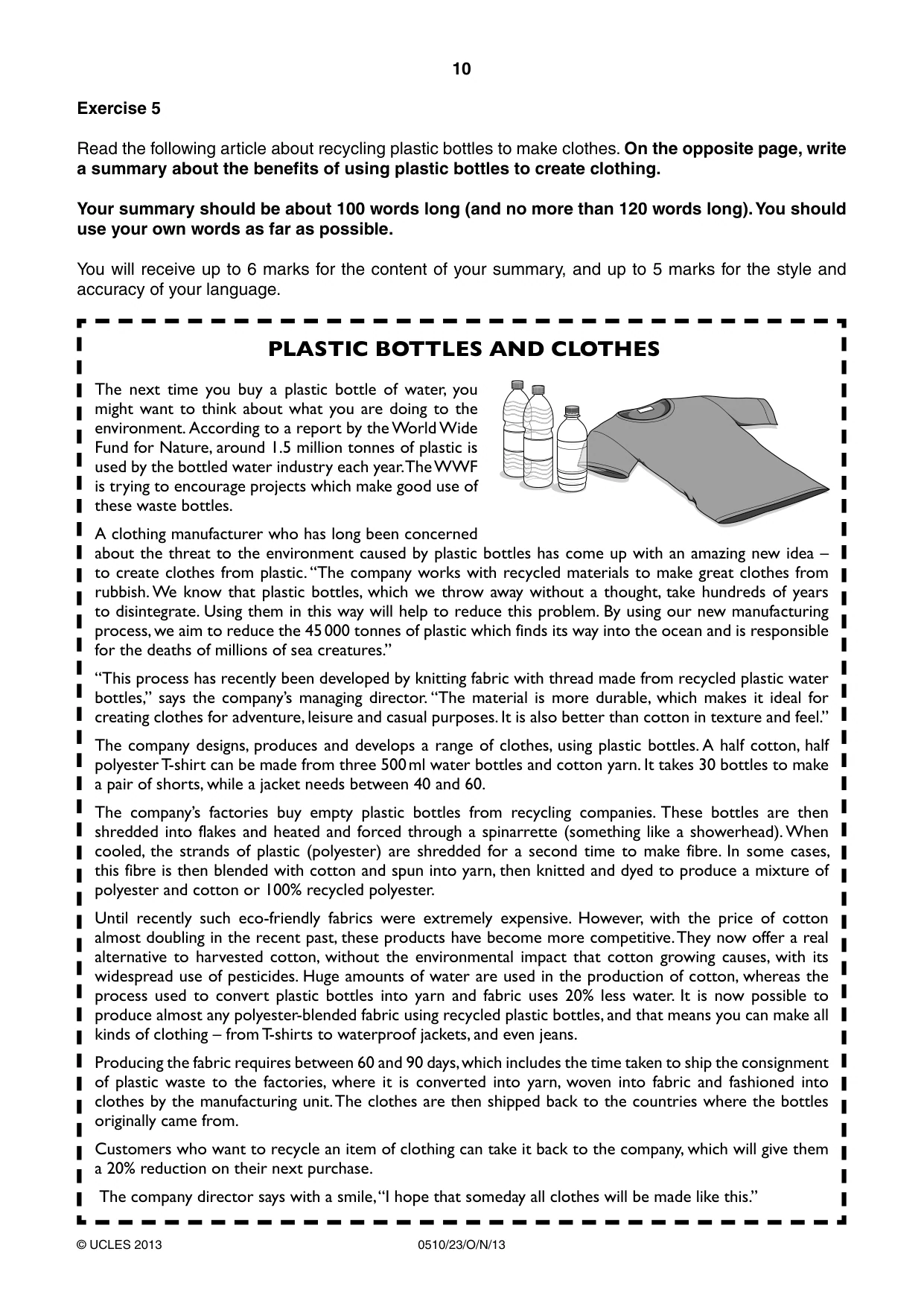
10 0510/23/O/N/13 © UCLES 2013 Exercise 5 Read the following article about recycling plastic bottles to make clothes. On the opposite page, write a summary about the benefits of using plastic bottles to create clothing. Your summary should be about 100 words long (and no more than 120 words long). You should use your own words as far as possible. You will receive up to 6 marks for the content of your summary, and up to 5 marks for the style and accuracy of your language. PLASTIC BOTTLES AND CLOTHES The next time you buy a plastic bottle of water, you might want to think about what you are doing to the environment. According to a report by the World Wide Fund for Nature, around 1.5 million tonnes of plastic is used by the bottled water industry each year. The WWF is trying to encourage projects which make good use of these waste bottles. A clothing manufacturer who has long been concerned about the threat to the environment caused by plastic bottles has come up with an amazing new idea – to create clothes from plastic. “The company works with recycled materials to make great clothes from rubbish. We know that plastic bottles, which we throw away without a thought, take hundreds of years to disintegrate. Using them in this way will help to reduce this problem. By using our new manufacturing process, we aim to reduce the 45 000 tonnes of plastic which finds its way into the ocean and is responsible for the deaths of millions of sea creatures.” “This process has recently been developed by knitting fabric with thread made from recycled plastic water bottles,” says the company’s managing director. “The material is more durable, which makes it ideal for creating clothes for adventure, leisure and casual purposes. It is also better than cotton in texture and feel.” The company designs, produces and develops a range of clothes, using plastic bottles. A half cotton, half polyester T-shirt can be made from three 500 ml water bottles and cotton yarn. It takes 30 bottles to make a pair of shorts, while a jacket needs between 40 and 60. The company’s factories buy empty plastic bottles from recycling companies. These bottles are then shredded into flakes and heated and forced through a spinarrette (something like a showerhead). When cooled, the strands of plastic (polyester) are shredded for a second time to make fibre. In some cases, this fibre is then blended with cotton and spun into yarn, then knitted and dyed to produce a mixture of polyester and cotton or 100% recycled polyester. Until recently such eco-friendly fabrics were extremely expensive. However, with the price of cotton almost doubling in the recent past, these products have become more competitive. They now offer a real alternative to harvested cotton, without the environmental impact that cotton growing causes, with its widespread use of pesticides. Huge amounts of water are used in the production of cotton, whereas the process used to convert plastic bottles into yarn and fabric uses 20% less water. It is now possible to produce almost any polyester-blended fabric using recycled plastic bottles, and that means you can make all kinds of clothing – from T-shirts to waterproof jackets, and even jeans. Producing the fabric requires between 60 and 90 days, which includes the time taken to ship the consignment of plastic waste to the factories, where it is converted into yarn, woven into fabric and fashioned into clothes by the manufacturing unit. The clothes are then shipped back to the countries where the bottles originally came from. Customers who want to recycle an item of clothing can take it back to the company, which will give them a 20% reduction on their next purchase. The company director says with a smile, “I hope that someday all clothes will be made like this.’’
Question paper, page 11
11 0510/23/O/N/13 © UCLES 2013 [Turn over … … … … … … … … … … … … … … … … … … … … [Total: 11]
Question paper, page 12
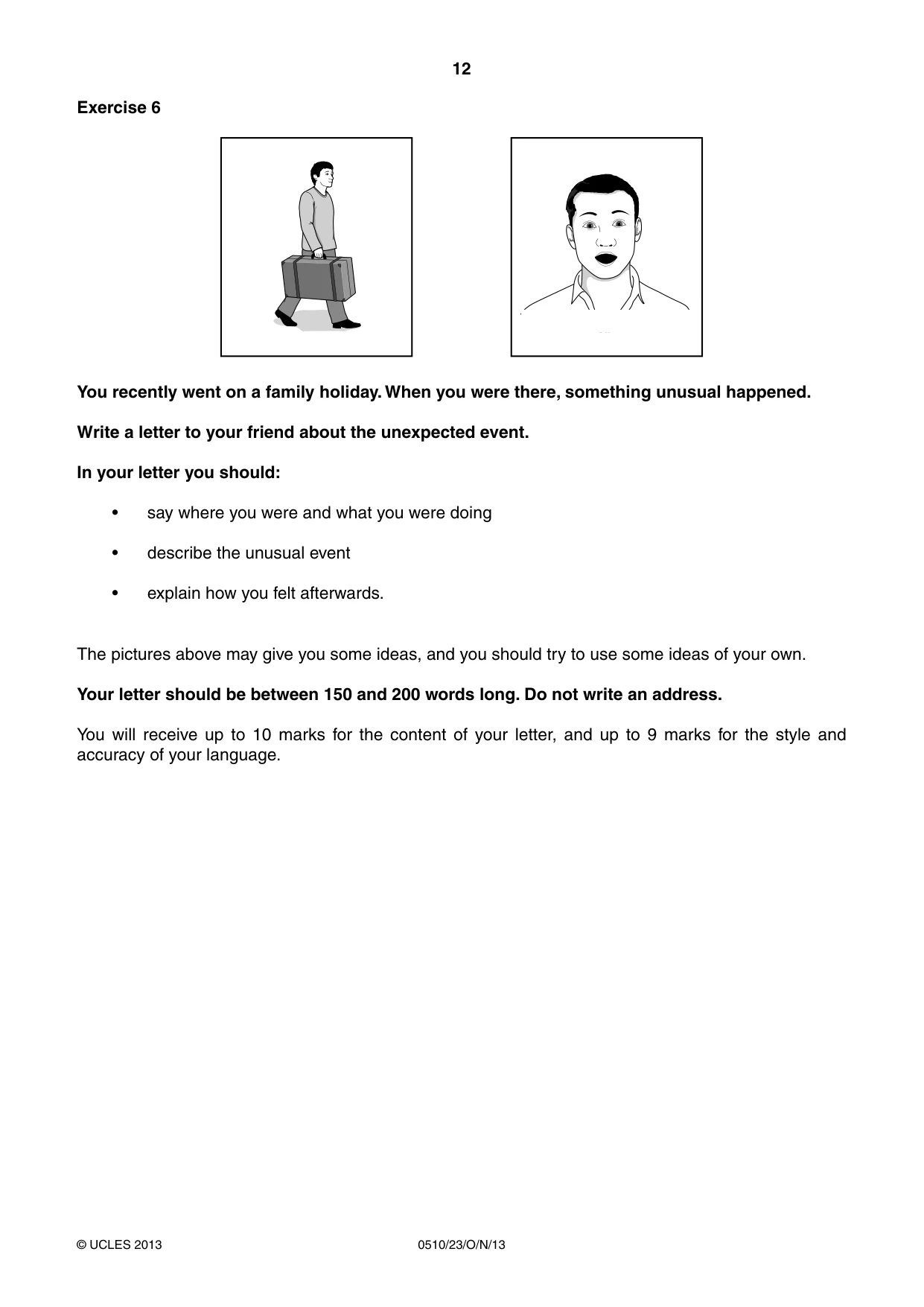
12 0510/23/O/N/13 © UCLES 2013 Exercise 6 You recently went on a family holiday. When you were there, something unusual happened. Write a letter to your friend about the unexpected event. In your letter you should: • say where you were and what you were doing • describe the unusual event • explain how you felt afterwards. The pictures above may give you some ideas, and you should try to use some ideas of your own. Your letter should be between 150 and 200 words long. Do not write an address. You will receive up to 10 marks for the content of your letter, and up to 9 marks for the style and accuracy of your language.
Question paper, page 13
13 0510/23/O/N/13 © UCLES 2013 [Turn over … … … … … … … … … … … … … … … … … … … … … … … … … [Total: 19]
Question paper, page 14
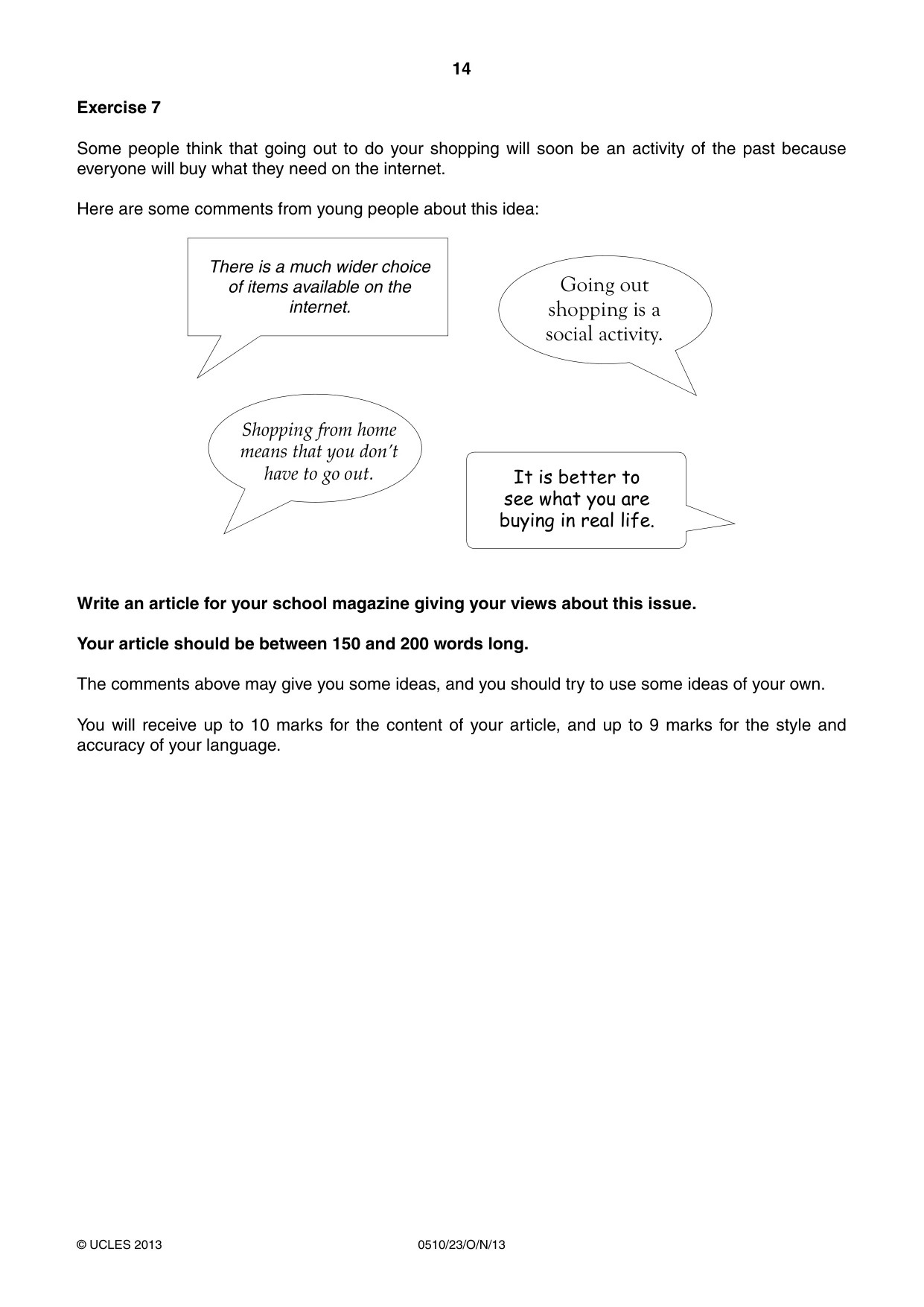
14 0510/23/O/N/13 © UCLES 2013 Exercise 7 Some people think that going out to do your shopping will soon be an activity of the past because everyone will buy what they need on the internet. Here are some comments from young people about this idea: There is a much wider choice of items available on the internet. Going out shopping is a social activity. Shopping from home means that you don’t have to go out. It is better to see what you are buying in real life. Write an article for your school magazine giving your views about this issue. Your article should be between 150 and 200 words long. The comments above may give you some ideas, and you should try to use some ideas of your own. You will receive up to 10 marks for the content of your article, and up to 9 marks for the style and accuracy of your language.
Question paper, page 15
15 0510/23/O/N/13 © UCLES 2013 … … … … … … … … … … … … … … … … … … … … … … … … … [Total: 19]
Question paper, page 16
16 0510/23/O/N/13 © UCLES 2013 Permission to reproduce items where third-party owned material protected by copyright is included has been sought and cleared where possible. Every reasonable effort has been made by the publisher (UCLES) to trace copyright holders, but if any items requiring clearance have unwittingly been included, the publisher will be pleased to make amends at the earliest possible opportunity. University of Cambridge International Examinations is part of the Cambridge Assessment Group. Cambridge Assessment is the brand name of University of Cambridge Local Examinations Syndicate (UCLES), which is itself a department of the University of Cambridge. BLANK PAGE
Mark scheme, page 1
CAMBRIDGE INTERNATIONAL EXAMINATIONS International General Certificate of Secondary Education MARK SCHEME for the October/November 2013 series 0510 ENGLISH AS A SECOND LANGAUGE (ORAL ENDORSEMENT) 0510/23 Paper 2 (Reading and Writing – Extended), maximum raw mark 90 This mark scheme is published as an aid to teachers and candidates, to indicate the requirements of the examination. It shows the basis on which Examiners were instructed to award marks. It does not indicate the details of the discussions that took place at an Examiners’ meeting before marking began, which would have considered the acceptability of alternative answers. Mark schemes should be read in conjunction with the question paper and the Principal Examiner Report for Teachers. Cambridge will not enter into discussions about these mark schemes. Cambridge is publishing the mark schemes for the October/November 2013 series for most IGCSE, GCE Advanced Level and Advanced Subsidiary Level components and some Ordinary Level components.
Mark scheme, page 2
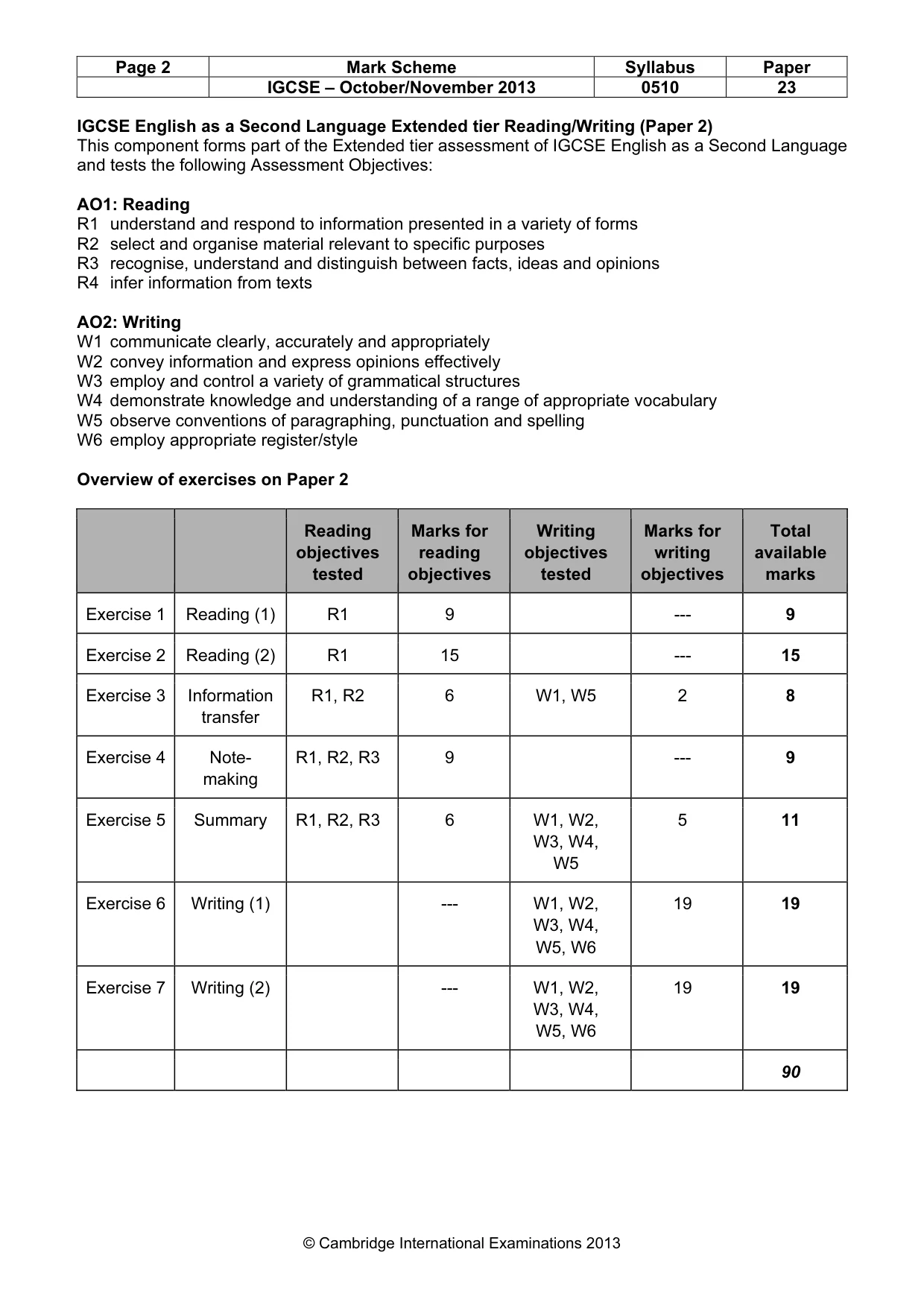
Page 2 Mark Scheme Syllabus Paper IGCSE – October/November 2013 0510 23 © Cambridge International Examinations 2013 IGCSE English as a Second Language Extended tier Reading/Writing (Paper 2) This component forms part of the Extended tier assessment of IGCSE English as a Second Language and tests the following Assessment Objectives: AO1: Reading R1 understand and respond to information presented in a variety of forms R2 select and organise material relevant to specific purposes R3 recognise, understand and distinguish between facts, ideas and opinions R4 infer information from texts AO2: Writing W1 communicate clearly, accurately and appropriately W2 convey information and express opinions effectively W3 employ and control a variety of grammatical structures W4 demonstrate knowledge and understanding of a range of appropriate vocabulary W5 observe conventions of paragraphing, punctuation and spelling W6 employ appropriate register/style Overview of exercises on Paper 2 Reading objectives tested Marks for reading objectives Writing objectives tested Marks for writing objectives Total available marks Exercise 1 Reading (1) R1 9 --- 9 Exercise 2 Reading (2) R1 15 --- 15 Exercise 3 Information transfer R1, R2 6 W1, W5 2 8 Exercise 4 Note- making R1, R2, R3 9 --- 9 Exercise 5 Summary R1, R2, R3 6 W1, W2, W3, W4, W5 5 11 Exercise 6 Writing (1) --- W1, W2, W3, W4, W5, W6 19 19 Exercise 7 Writing (2) --- W1, W2, W3, W4, W5, W6 19 19 90
Mark scheme, page 3
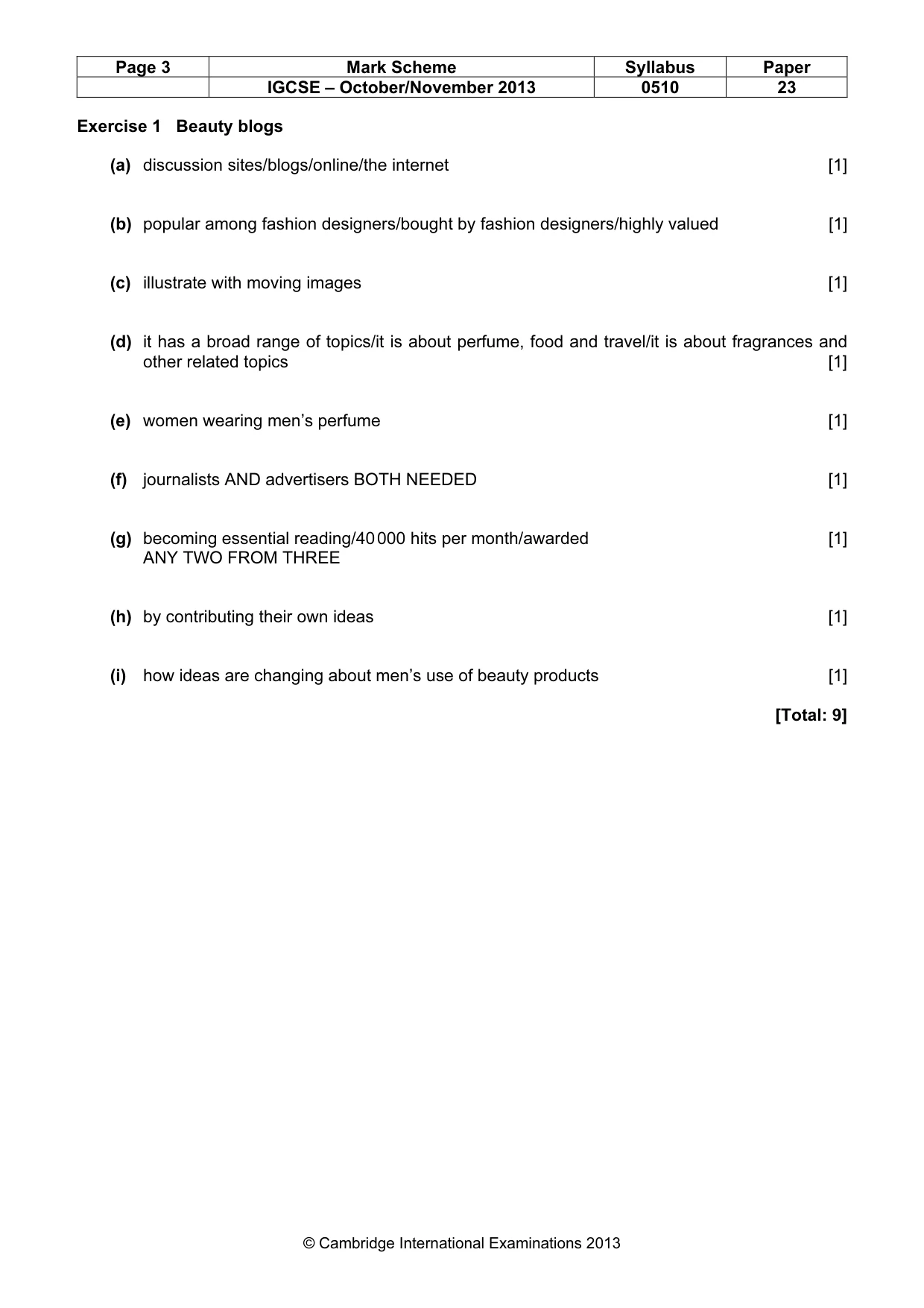
Page 3 Mark Scheme Syllabus Paper IGCSE – October/November 2013 0510 23 © Cambridge International Examinations 2013 Exercise 1 Beauty blogs (a) discussion sites/blogs/online/the internet [1] (b) popular among fashion designers/bought by fashion designers/highly valued [1] (c) illustrate with moving images [1] (d) it has a broad range of topics/it is about perfume, food and travel/it is about fragrances and other related topics [1] (e) women wearing men’s perfume [1] (f) journalists AND advertisers BOTH NEEDED [1] (g) becoming essential reading/40 000 hits per month/awarded [1] ANY TWO FROM THREE (h) by contributing their own ideas [1] (i) how ideas are changing about men’s use of beauty products [1] [Total: 9]
Mark scheme, page 4
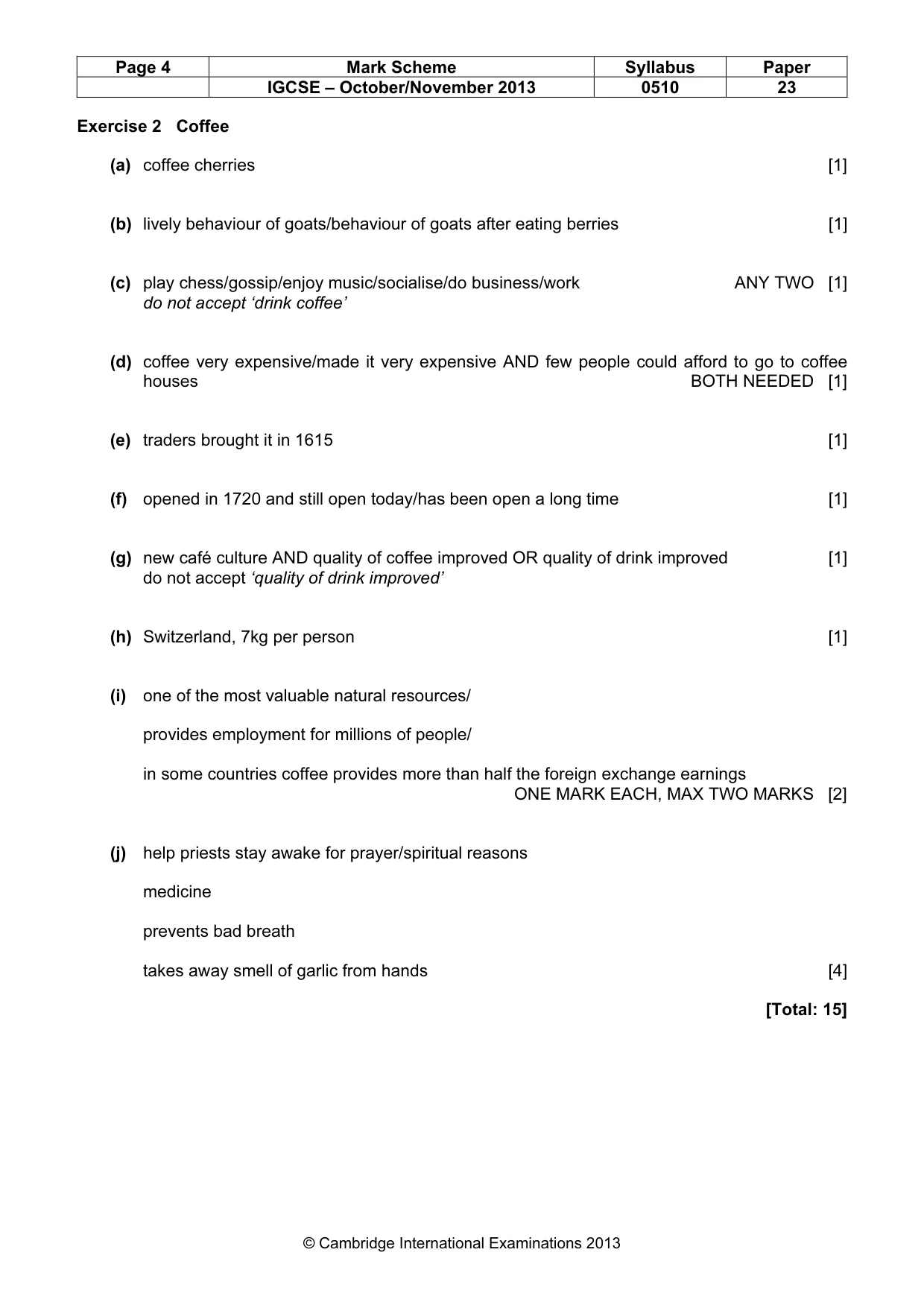
Page 4 Mark Scheme Syllabus Paper IGCSE – October/November 2013 0510 23 © Cambridge International Examinations 2013 Exercise 2 Coffee (a) coffee cherries [1] (b) lively behaviour of goats/behaviour of goats after eating berries [1] (c) play chess/gossip/enjoy music/socialise/do business/work ANY TWO [1] do not accept ‘drink coffee’ (d) coffee very expensive/made it very expensive AND few people could afford to go to coffee houses BOTH NEEDED [1] (e) traders brought it in 1615 [1] (f) opened in 1720 and still open today/has been open a long time [1] (g) new café culture AND quality of coffee improved OR quality of drink improved [1] do not accept ‘quality of drink improved’ (h) Switzerland, 7kg per person [1] (i) one of the most valuable natural resources/ provides employment for millions of people/ in some countries coffee provides more than half the foreign exchange earnings ONE MARK EACH, MAX TWO MARKS [2] (j) help priests stay awake for prayer/spiritual reasons medicine prevents bad breath takes away smell of garlic from hands [4] [Total: 15]
Mark scheme, page 5
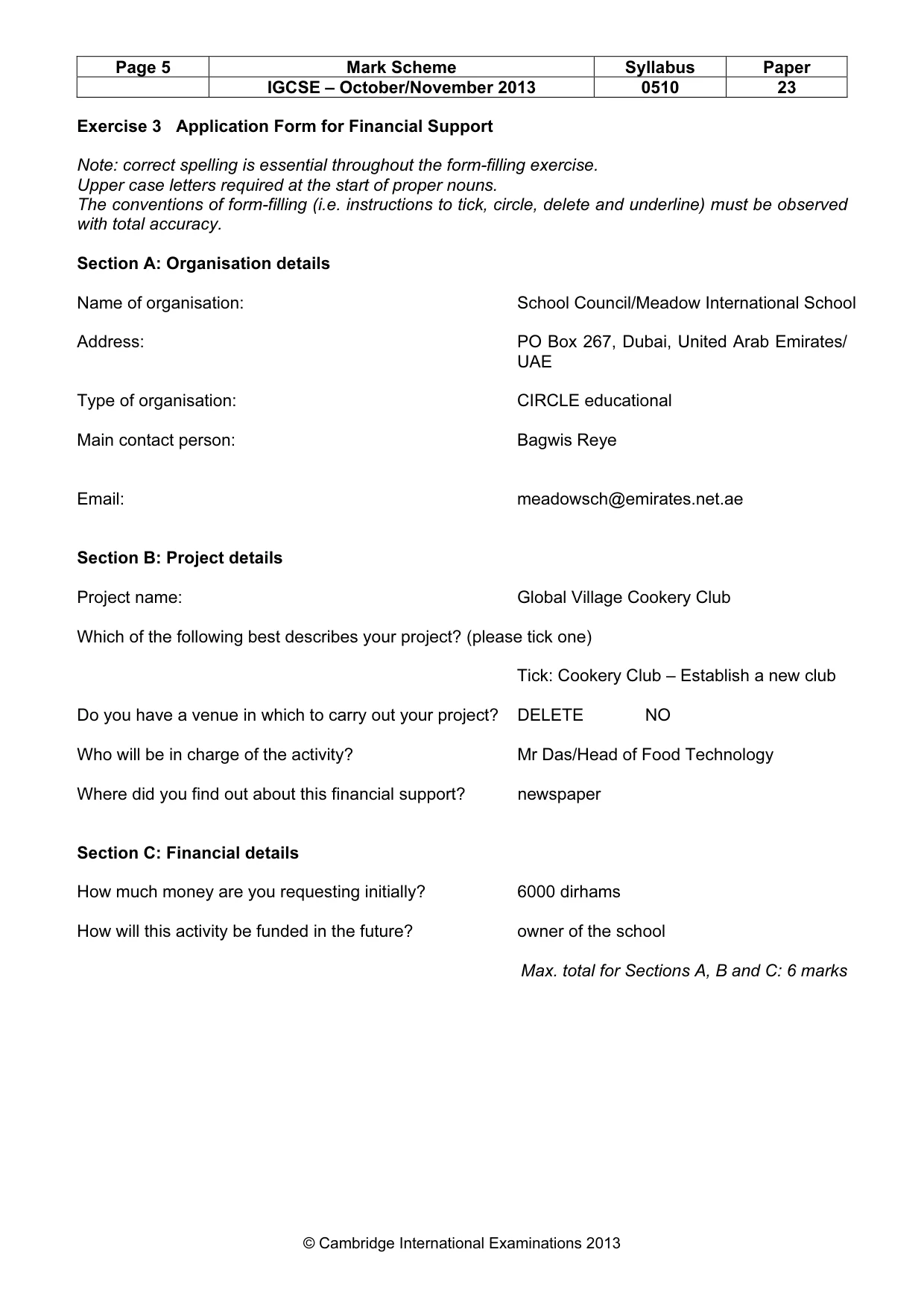
Page 5 Mark Scheme Syllabus Paper IGCSE – October/November 2013 0510 23 © Cambridge International Examinations 2013 Exercise 3 Application Form for Financial Support Note: correct spelling is essential throughout the form-filling exercise. Upper case letters required at the start of proper nouns. The conventions of form-filling (i.e. instructions to tick, circle, delete and underline) must be observed with total accuracy. Section A: Organisation details Name of organisation: School Council/Meadow International School Address: PO Box 267, Dubai, United Arab Emirates/ UAE Type of organisation: CIRCLE educational Main contact person: Bagwis Reye Email: meadowsch@emirates.net.ae Section B: Project details Project name: Global Village Cookery Club Which of the following best describes your project? (please tick one) Tick: Cookery Club – Establish a new club Do you have a venue in which to carry out your project? DELETE NO Who will be in charge of the activity? Mr Das/Head of Food Technology Where did you find out about this financial support? newspaper Section C: Financial details How much money are you requesting initially? 6000 dirhams How will this activity be funded in the future? owner of the school Max. total for Sections A, B and C: 6 marks
Mark scheme, page 6
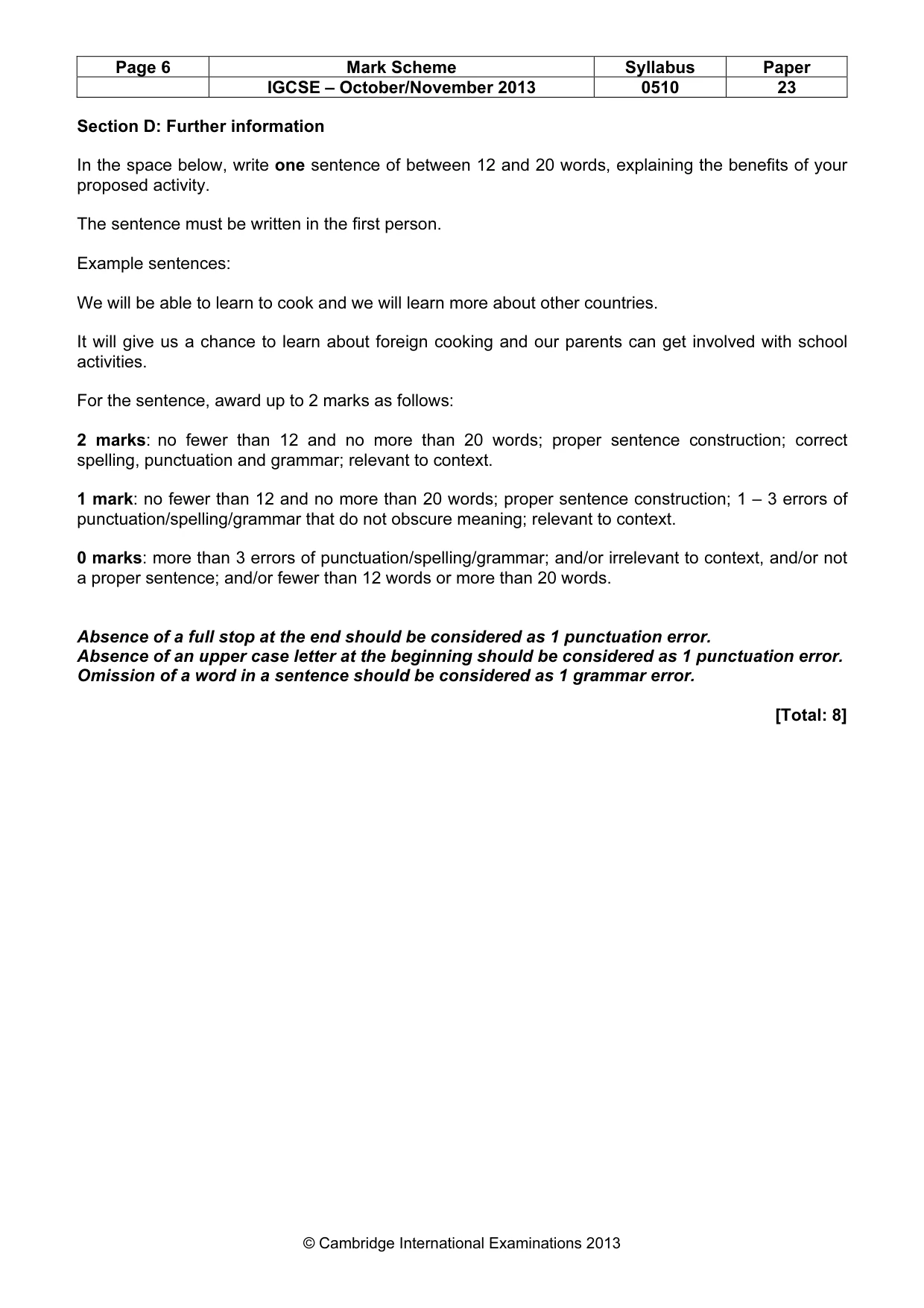
Page 6 Mark Scheme Syllabus Paper IGCSE – October/November 2013 0510 23 © Cambridge International Examinations 2013 Section D: Further information In the space below, write one sentence of between 12 and 20 words, explaining the benefits of your proposed activity. The sentence must be written in the first person. Example sentences: We will be able to learn to cook and we will learn more about other countries. It will give us a chance to learn about foreign cooking and our parents can get involved with school activities. For the sentence, award up to 2 marks as follows: 2 marks: no fewer than 12 and no more than 20 words; proper sentence construction; correct spelling, punctuation and grammar; relevant to context. 1 mark: no fewer than 12 and no more than 20 words; proper sentence construction; 1 – 3 errors of punctuation/spelling/grammar that do not obscure meaning; relevant to context. 0 marks: more than 3 errors of punctuation/spelling/grammar; and/or irrelevant to context, and/or not a proper sentence; and/or fewer than 12 words or more than 20 words. Absence of a full stop at the end should be considered as 1 punctuation error. Absence of an upper case letter at the beginning should be considered as 1 punctuation error. Omission of a word in a sentence should be considered as 1 grammar error. [Total: 8]
Mark scheme, page 7
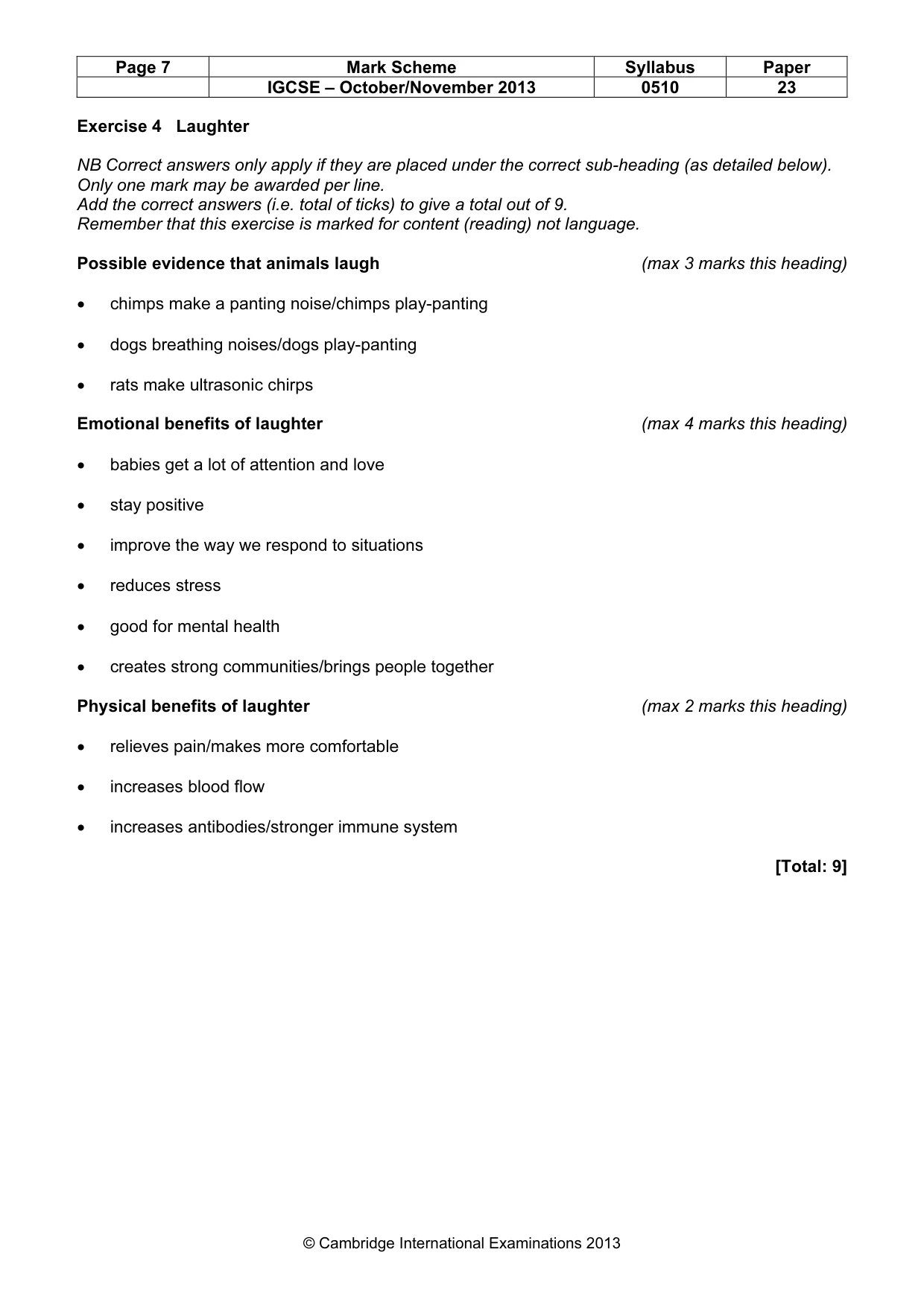
Page 7 Mark Scheme Syllabus Paper IGCSE – October/November 2013 0510 23 © Cambridge International Examinations 2013 Exercise 4 Laughter NB Correct answers only apply if they are placed under the correct sub-heading (as detailed below). Only one mark may be awarded per line. Add the correct answers (i.e. total of ticks) to give a total out of 9. Remember that this exercise is marked for content (reading) not language. Possible evidence that animals laugh (max 3 marks this heading) • chimps make a panting noise/chimps play-panting • dogs breathing noises/dogs play-panting • rats make ultrasonic chirps Emotional benefits of laughter (max 4 marks this heading) • babies get a lot of attention and love • stay positive • improve the way we respond to situations • reduces stress • good for mental health • creates strong communities/brings people together Physical benefits of laughter (max 2 marks this heading) • relieves pain/makes more comfortable • increases blood flow • increases antibodies/stronger immune system [Total: 9]
Mark scheme, page 8
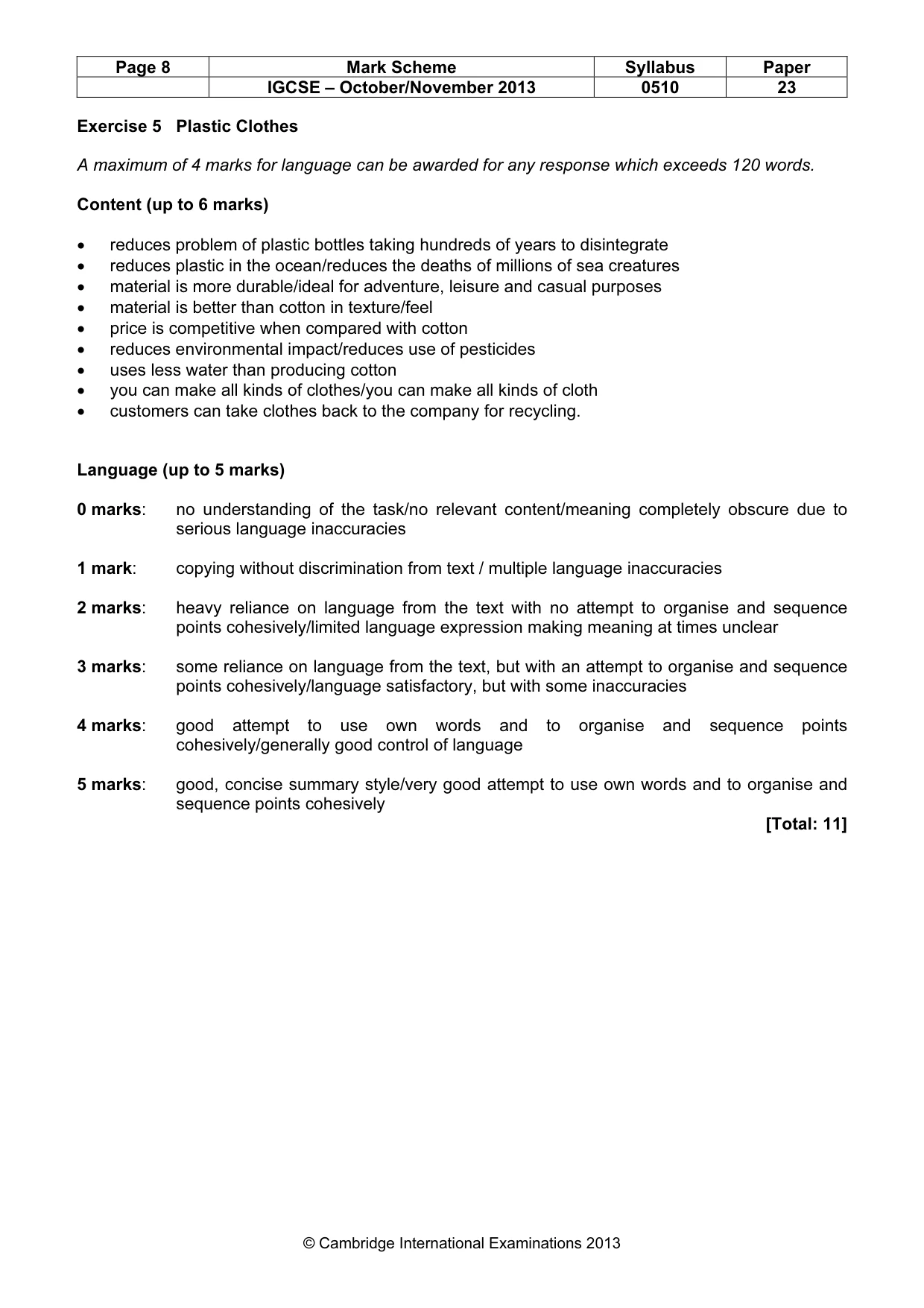
Page 8 Mark Scheme Syllabus Paper IGCSE – October/November 2013 0510 23 © Cambridge International Examinations 2013 Exercise 5 Plastic Clothes A maximum of 4 marks for language can be awarded for any response which exceeds 120 words. Content (up to 6 marks) • reduces problem of plastic bottles taking hundreds of years to disintegrate • reduces plastic in the ocean/reduces the deaths of millions of sea creatures • material is more durable/ideal for adventure, leisure and casual purposes • material is better than cotton in texture/feel • price is competitive when compared with cotton • reduces environmental impact/reduces use of pesticides • uses less water than producing cotton • you can make all kinds of clothes/you can make all kinds of cloth • customers can take clothes back to the company for recycling. Language (up to 5 marks) 0 marks: no understanding of the task/no relevant content/meaning completely obscure due to serious language inaccuracies 1 mark: copying without discrimination from text / multiple language inaccuracies 2 marks: heavy reliance on language from the text with no attempt to organise and sequence points cohesively/limited language expression making meaning at times unclear 3 marks: some reliance on language from the text, but with an attempt to organise and sequence points cohesively/language satisfactory, but with some inaccuracies 4 marks: good attempt to use own words and to organise and sequence points cohesively/generally good control of language 5 marks: good, concise summary style/very good attempt to use own words and to organise and sequence points cohesively [Total: 11]
Mark scheme, page 9
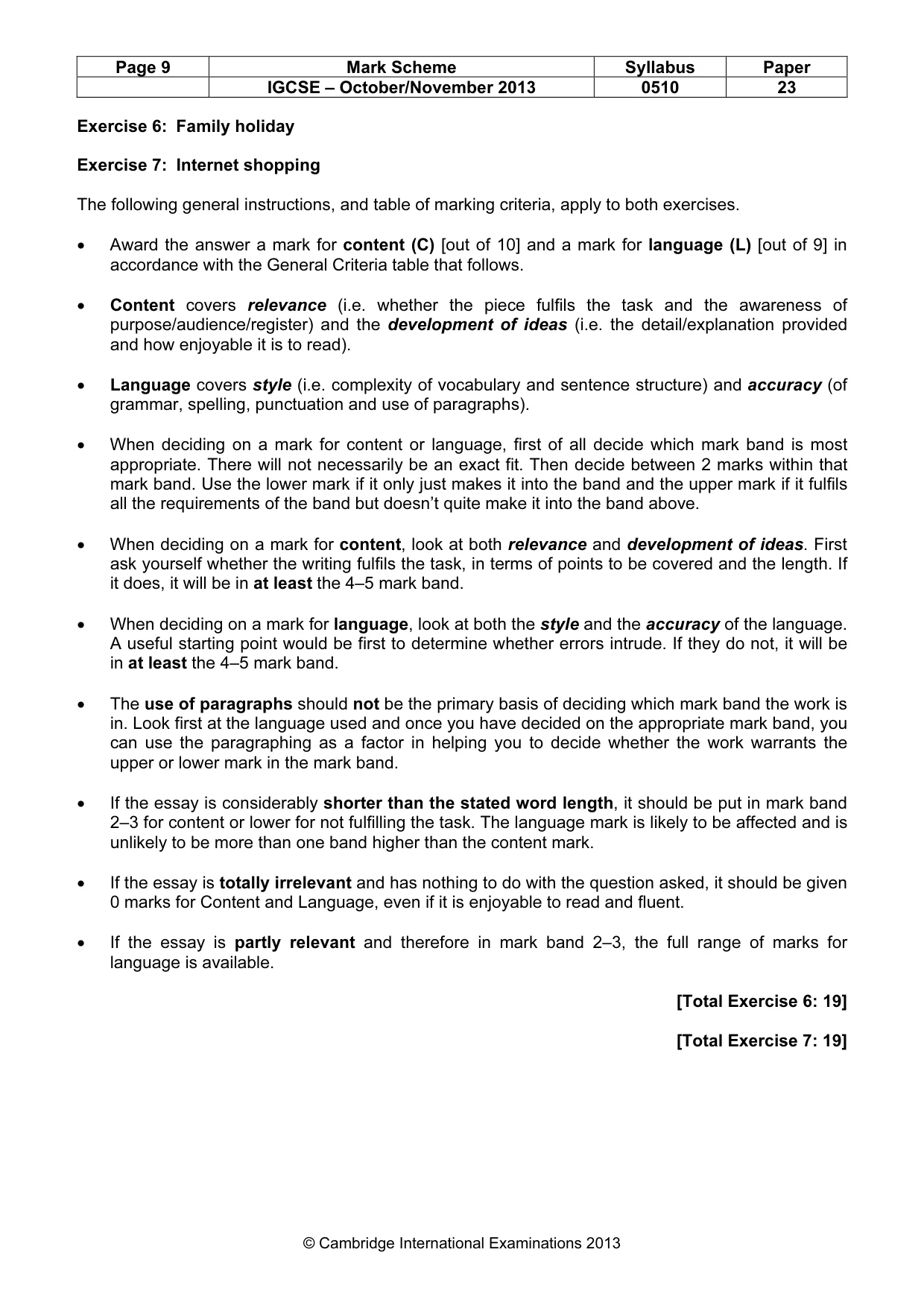
Page 9 Mark Scheme Syllabus Paper IGCSE – October/November 2013 0510 23 © Cambridge International Examinations 2013 Exercise 6: Family holiday Exercise 7: Internet shopping The following general instructions, and table of marking criteria, apply to both exercises. • Award the answer a mark for content (C) [out of 10] and a mark for language (L) [out of 9] in accordance with the General Criteria table that follows. • Content covers relevance (i.e. whether the piece fulfils the task and the awareness of purpose/audience/register) and the development of ideas (i.e. the detail/explanation provided and how enjoyable it is to read). • Language covers style (i.e. complexity of vocabulary and sentence structure) and accuracy (of grammar, spelling, punctuation and use of paragraphs). • When deciding on a mark for content or language, first of all decide which mark band is most appropriate. There will not necessarily be an exact fit. Then decide between 2 marks within that mark band. Use the lower mark if it only just makes it into the band and the upper mark if it fulfils all the requirements of the band but doesn’t quite make it into the band above. • When deciding on a mark for content, look at both relevance and development of ideas. First ask yourself whether the writing fulfils the task, in terms of points to be covered and the length. If it does, it will be in at least the 4–5 mark band. • When deciding on a mark for language, look at both the style and the accuracy of the language. A useful starting point would be first to determine whether errors intrude. If they do not, it will be in at least the 4–5 mark band. • The use of paragraphs should not be the primary basis of deciding which mark band the work is in. Look first at the language used and once you have decided on the appropriate mark band, you can use the paragraphing as a factor in helping you to decide whether the work warrants the upper or lower mark in the mark band. • If the essay is considerably shorter than the stated word length, it should be put in mark band 2–3 for content or lower for not fulfilling the task. The language mark is likely to be affected and is unlikely to be more than one band higher than the content mark. • If the essay is totally irrelevant and has nothing to do with the question asked, it should be given 0 marks for Content and Language, even if it is enjoyable to read and fluent. • If the essay is partly relevant and therefore in mark band 2–3, the full range of marks for language is available. [Total Exercise 6: 19] [Total Exercise 7: 19]
Mark scheme, page 10
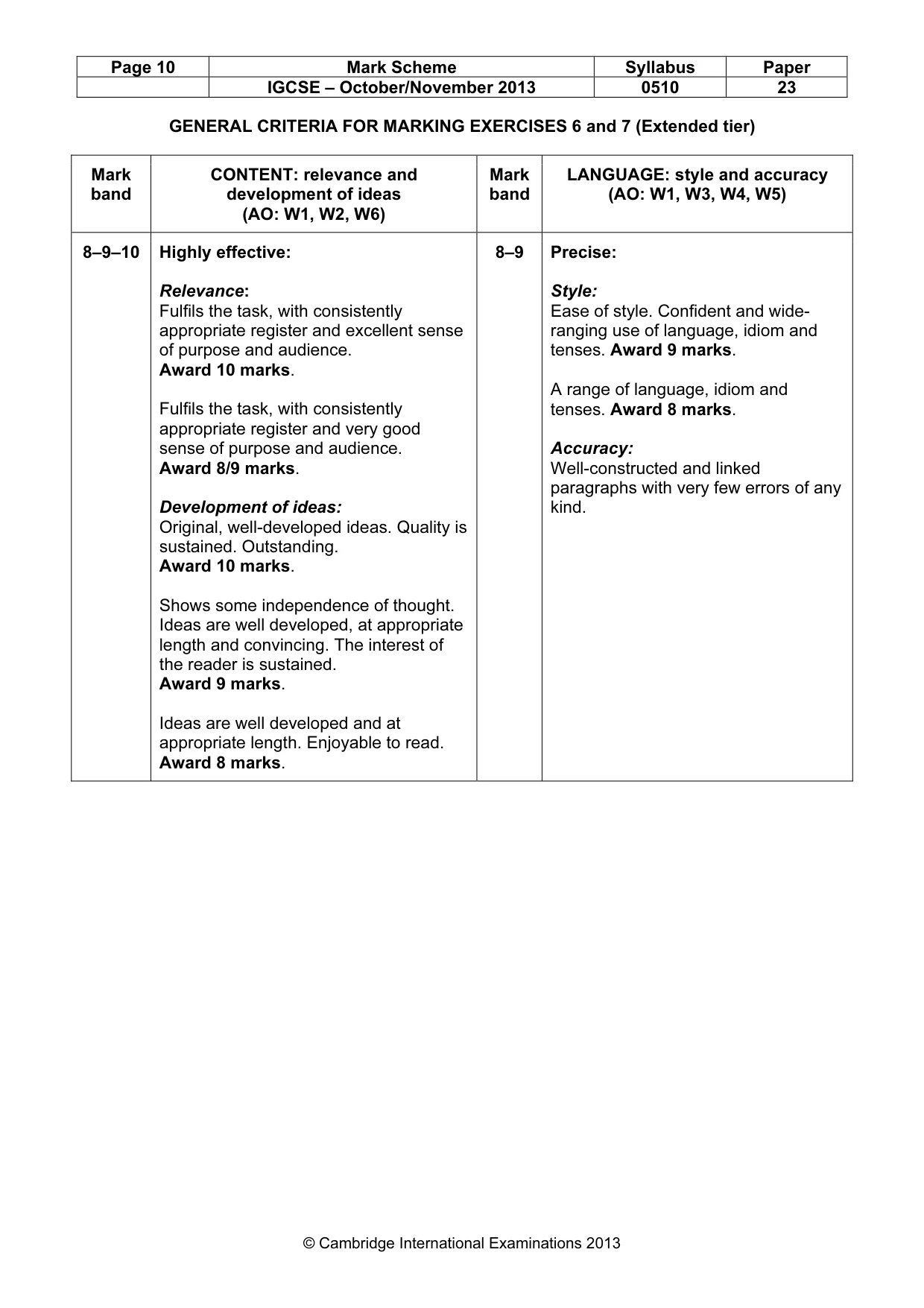
Page 10 Mark Scheme Syllabus Paper IGCSE – October/November 2013 0510 23 © Cambridge International Examinations 2013 GENERAL CRITERIA FOR MARKING EXERCISES 6 and 7 (Extended tier) Mark band CONTENT: relevance and development of ideas (AO: W1, W2, W6) Mark band LANGUAGE: style and accuracy (AO: W1, W3, W4, W5) 8–9–10 Highly effective: Relevance: Fulfils the task, with consistently appropriate register and excellent sense of purpose and audience. Award 10 marks. Fulfils the task, with consistently appropriate register and very good sense of purpose and audience. Award 8/9 marks. Development of ideas: Original, well-developed ideas. Quality is sustained. Outstanding. Award 10 marks. Shows some independence of thought. Ideas are well developed, at appropriate length and convincing. The interest of the reader is sustained. Award 9 marks. Ideas are well developed and at appropriate length. Enjoyable to read. Award 8 marks. 8–9 Precise: Style: Ease of style. Confident and wide- ranging use of language, idiom and tenses. Award 9 marks. A range of language, idiom and tenses. Award 8 marks. Accuracy: Well-constructed and linked paragraphs with very few errors of any kind.
Mark scheme, page 11
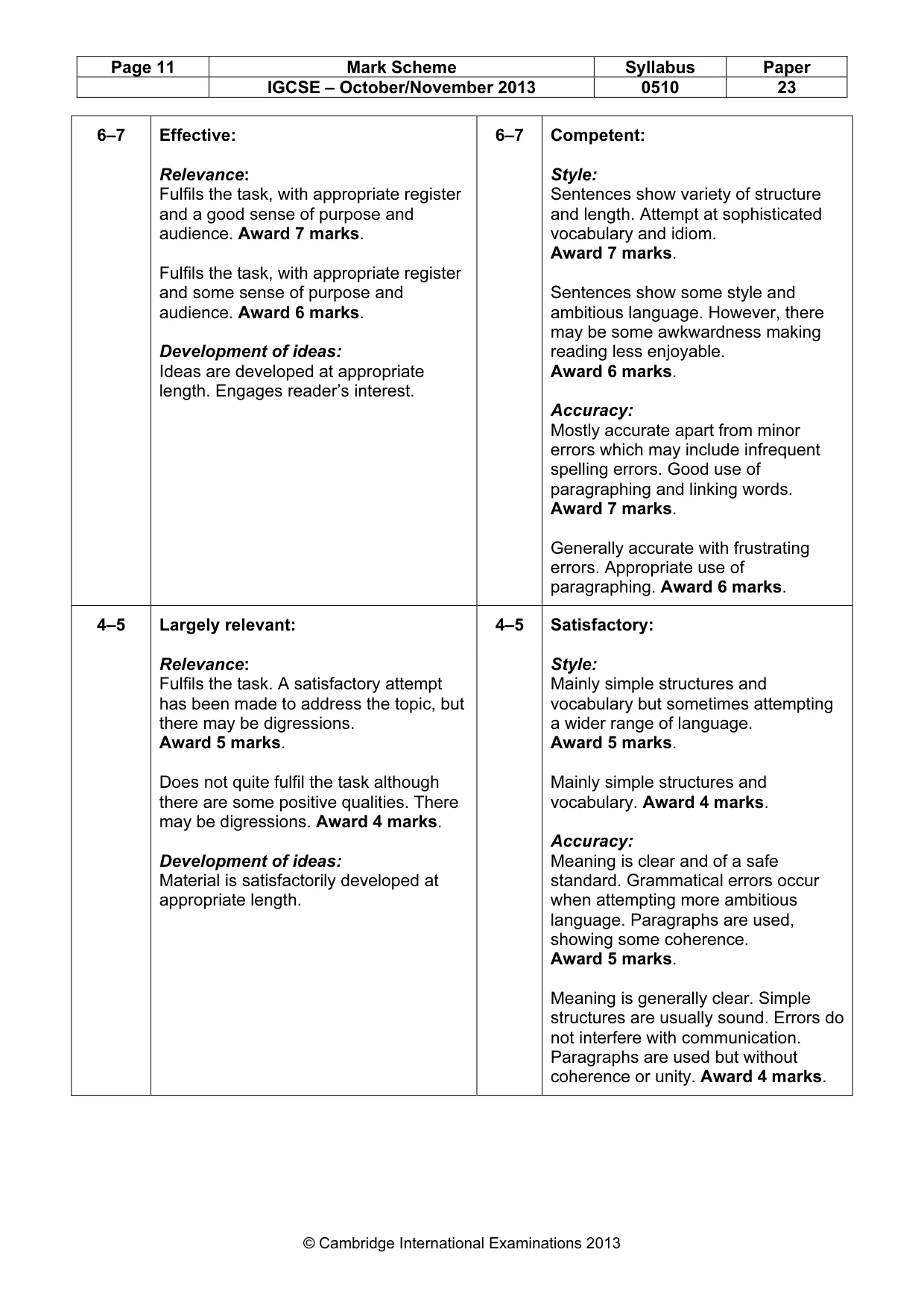
Page 11 Mark Scheme Syllabus Paper IGCSE – October/November 2013 0510 23 © Cambridge International Examinations 2013 6–7 Effective: Relevance: Fulfils the task, with appropriate register and a good sense of purpose and audience. Award 7 marks. Fulfils the task, with appropriate register and some sense of purpose and audience. Award 6 marks. Development of ideas: Ideas are developed at appropriate length. Engages reader’s interest. 6–7 Competent: Style: Sentences show variety of structure and length. Attempt at sophisticated vocabulary and idiom. Award 7 marks. Sentences show some style and ambitious language. However, there may be some awkwardness making reading less enjoyable. Award 6 marks. Accuracy: Mostly accurate apart from minor errors which may include infrequent spelling errors. Good use of paragraphing and linking words. Award 7 marks. Generally accurate with frustrating errors. Appropriate use of paragraphing. Award 6 marks. 4–5 Largely relevant: Relevance: Fulfils the task. A satisfactory attempt has been made to address the topic, but there may be digressions. Award 5 marks. Does not quite fulfil the task although there are some positive qualities. There may be digressions. Award 4 marks. Development of ideas: Material is satisfactorily developed at appropriate length. 4–5 Satisfactory: Style: Mainly simple structures and vocabulary but sometimes attempting a wider range of language. Award 5 marks. Mainly simple structures and vocabulary. Award 4 marks. Accuracy: Meaning is clear and of a safe standard. Grammatical errors occur when attempting more ambitious language. Paragraphs are used, showing some coherence. Award 5 marks. Meaning is generally clear. Simple structures are usually sound. Errors do not interfere with communication. Paragraphs are used but without coherence or unity. Award 4 marks.
Mark scheme, page 12
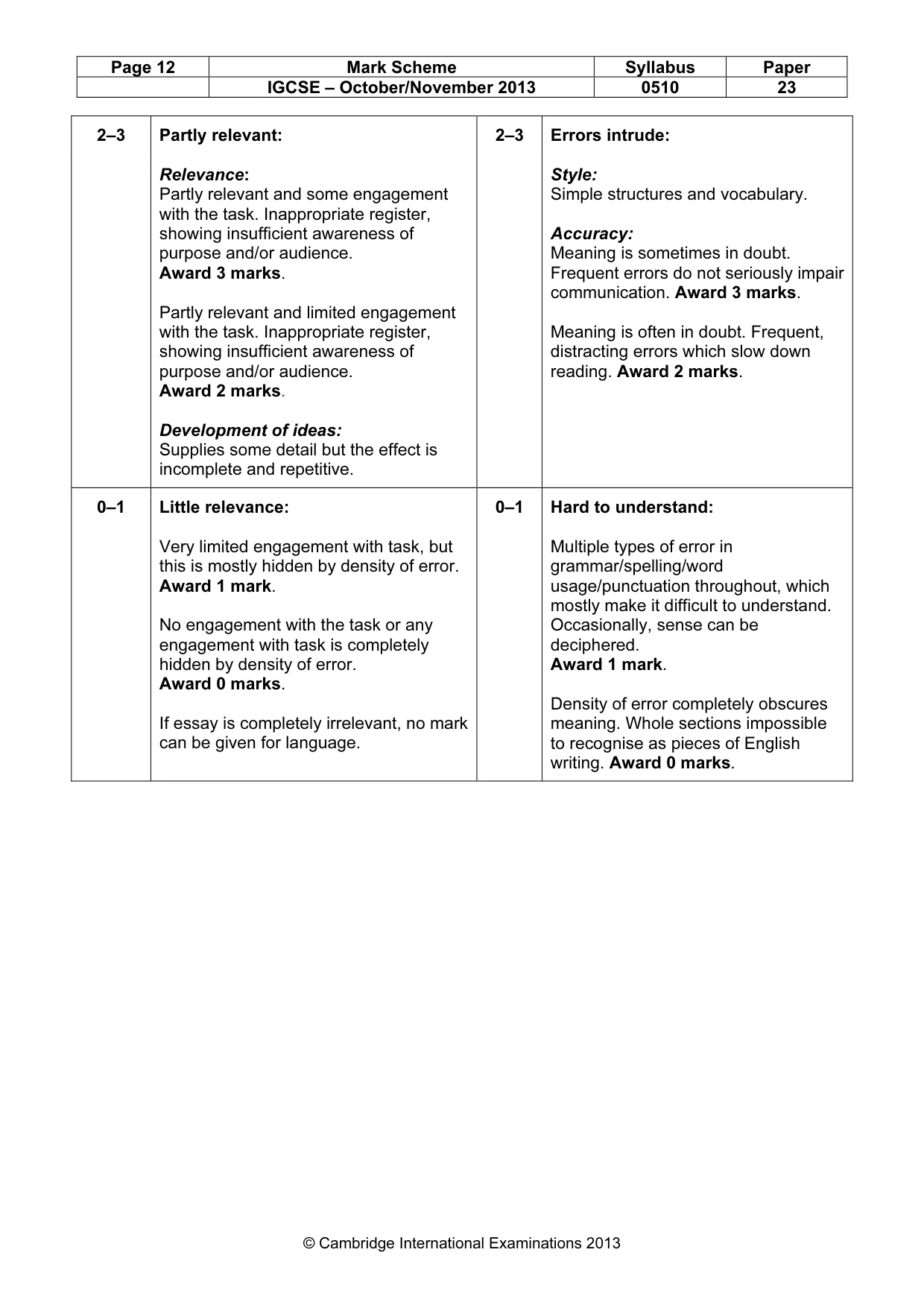
Page 12 Mark Scheme Syllabus Paper IGCSE – October/November 2013 0510 23 © Cambridge International Examinations 2013 2–3 Partly relevant: Relevance: Partly relevant and some engagement with the task. Inappropriate register, showing insufficient awareness of purpose and/or audience. Award 3 marks. Partly relevant and limited engagement with the task. Inappropriate register, showing insufficient awareness of purpose and/or audience. Award 2 marks. Development of ideas: Supplies some detail but the effect is incomplete and repetitive. 2–3 Errors intrude: Style: Simple structures and vocabulary. Accuracy: Meaning is sometimes in doubt. Frequent errors do not seriously impair communication. Award 3 marks. Meaning is often in doubt. Frequent, distracting errors which slow down reading. Award 2 marks. 0–1 Little relevance: Very limited engagement with task, but this is mostly hidden by density of error. Award 1 mark. No engagement with the task or any engagement with task is completely hidden by density of error. Award 0 marks. If essay is completely irrelevant, no mark can be given for language. 0–1 Hard to understand: Multiple types of error in grammar/spelling/word usage/punctuation throughout, which mostly make it difficult to understand. Occasionally, sense can be deciphered. Award 1 mark. Density of error completely obscures meaning. Whole sections impossible to recognise as pieces of English writing. Award 0 marks.