Cambridge IGCSE English - Second Language (oral endorsement) 0510 — 2010 Oct/Nov Paper 1 · Variant 3
0510/13/O/N/10 · 56 marks · ≈63 min
The question paper and its mark scheme, free to read here and free to download. This is Cambridge’s own paper, exactly as it was sat.
Question paper16 pages


Mark scheme8 pages
Answers below. Sit the paper first if you are practising.
Paper as text
Question paper, page 1
This document consists of 13 printed pages and 3 blank pages. IB10 11_0510_13/4RP © UCLES 2010 [Turn over *8536297697* For Examiner's Use Exercise 1 Exercise 2 Exercise 3 Exercise 4 Exercise 5 Exercise 6 Exercise 7 Total UNIVERSITY OF CAMBRIDGE INTERNATIONAL EXAMINATIONS International General Certificate of Secondary Education ENGLISH AS A SECOND LANGUAGE 0510/13 Paper 1 Reading and Writing (Core) October/November 2010 1 hour 30 minutes Candidates answer on the Question Paper. No Additional Materials are required. READ THESE INSTRUCTIONS FIRST Write your Centre number, candidate number and name on all the work you hand in. Write in dark blue or black pen. Do not use staples, paper clips, highlighters, glue or correction fluid. DO NOT WRITE IN ANY BARCODES. Answer all questions. Dictionaries are not allowed. At the end of the examination, fasten all your work securely together. The number of marks is given in brackets [ ] at the end of each question or part question.
Question paper, page 2
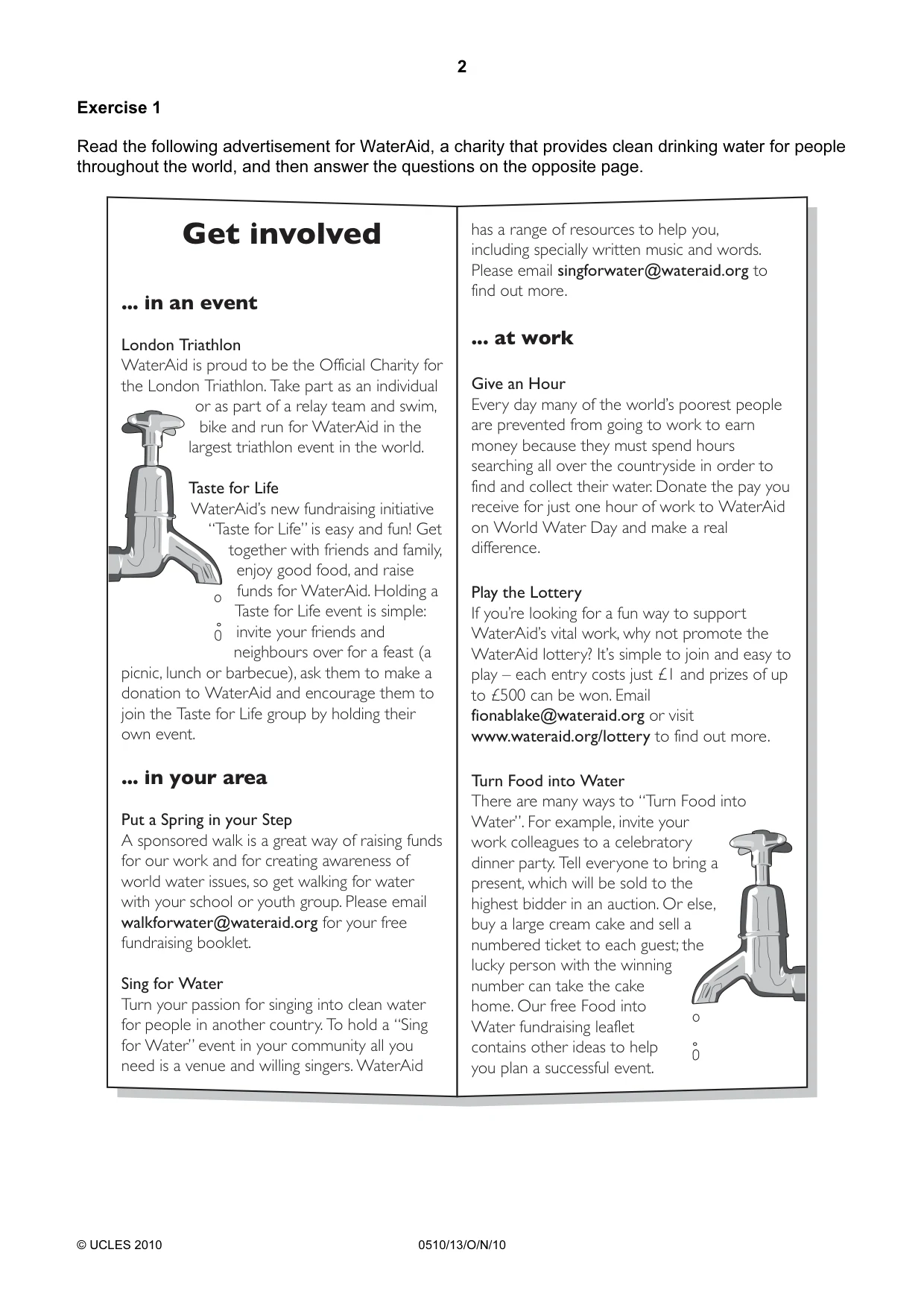
2 © UCLES 2010 0510/13/O/N/10 Exercise 1 Read the following advertisement for WaterAid, a charity that provides clean drinking water for people throughout the world, and then answer the questions on the opposite page. Get involved ... in an event London Triathlon WaterAid is proud to be the Official Charity for the London Triathlon. Take part as an individual or as part of a relay team and swim, bike and run for WaterAid in the largest triathlon event in the world. Taste for Life WaterAid’s new fundraising initiative “Taste for Life” is easy and fun! Get together with friends and family, enjoy good food, and raise funds for WaterAid. Holding a Taste for Life event is simple: invite your friends and neighbours over for a feast (a picnic, lunch or barbecue), ask them to make a donation to WaterAid and encourage them to join the Taste for Life group by holding their own event. ... in your area Put a Spring in your Step A sponsored walk is a great way of raising funds for our work and for creating awareness of world water issues, so get walking for water with your school or youth group. Please email walkforwater@wateraid.org for your free fundraising booklet. Sing for Water Turn your passion for singing into clean water for people in another country. To hold a “Sing for Water” event in your community all you need is a venue and willing singers. WaterAid has a range of resources to help you, including specially written music and words. Please email singforwater@wateraid.org to find out more. ... at work Give an Hour Every day many of the world’s poorest people are prevented from going to work to earn money because they must spend hours searching all over the countryside in order to find and collect their water. Donate the pay you receive for just one hour of work to WaterAid on World Water Day and make a real difference. Play the Lottery If you’re looking for a fun way to support WaterAid’s vital work, why not promote the WaterAid lottery? It’s simple to join and easy to play – each entry costs just £1 and prizes of up to £500 can be won. Email fionablake@wateraid.org or visit www.wateraid.org/lottery to find out more. Turn Food into Water There are many ways to “Turn Food into Water”. For example, invite your work colleagues to a celebratory dinner party. Tell everyone to bring a present, which will be sold to the highest bidder in an auction. Or else, buy a large cream cake and sell a numbered ticket to each guest; the lucky person with the winning number can take the cake home. Our free Food into Water fundraising leaflet contains other ideas to help you plan a successful event.
Question paper, page 3
3 © UCLES 2010 0510/13/O/N/10 [Turn over For Examiner's Use (a) Which three activities must Triathlon competitors do? [1] (b) How can your friends and neighbours become members of the Taste for Life group? [1] (c) How much does a WaterAid fundraising booklet cost? [1] (d) What can WaterAid give you to help run a Sing for Water event? [1] (e) Why are many of the world's poorest people unable to go to work? [1] (f) For what purpose are readers advised to contact Fiona Blake? [1] [Total: 6]
Question paper, page 4
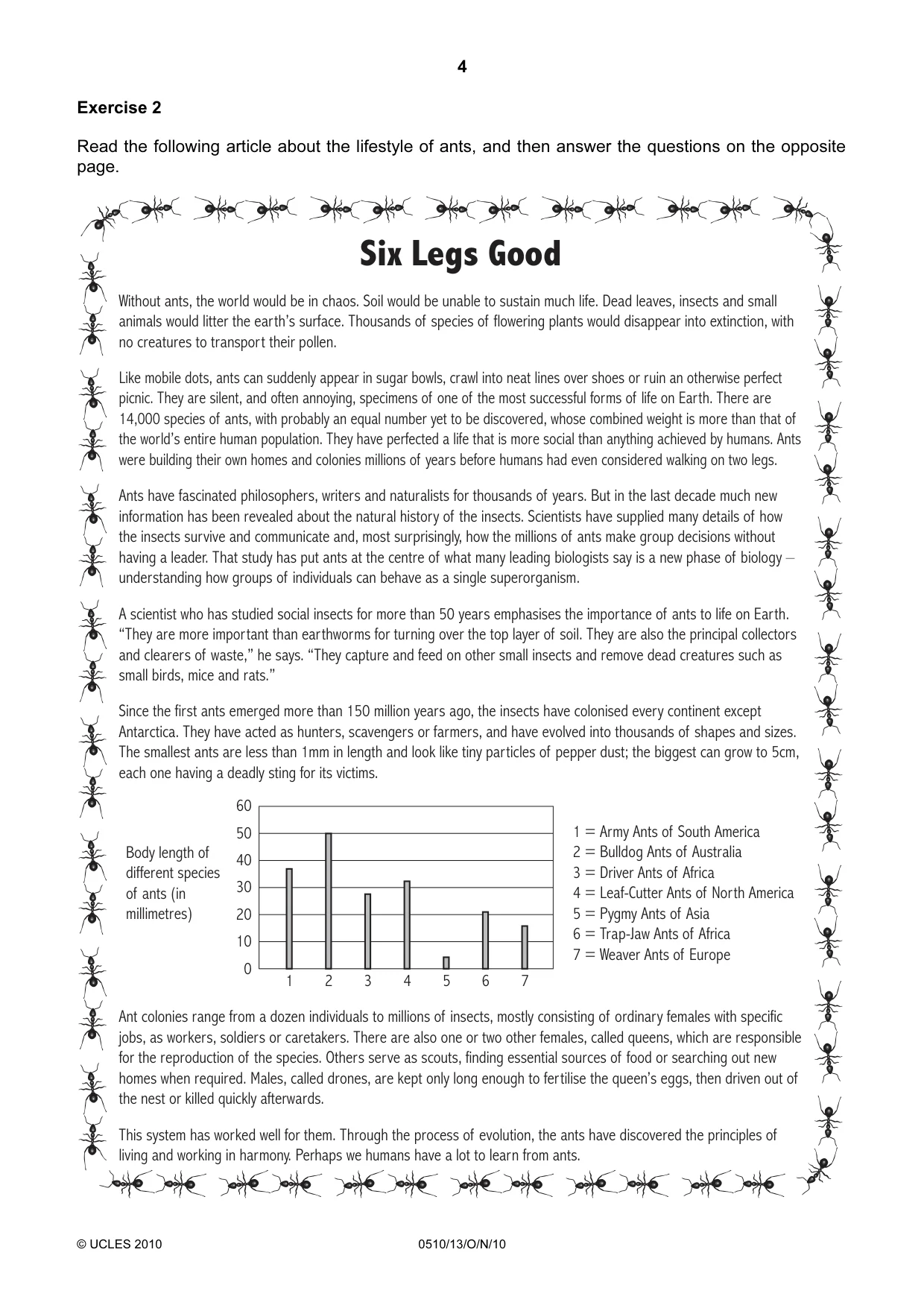
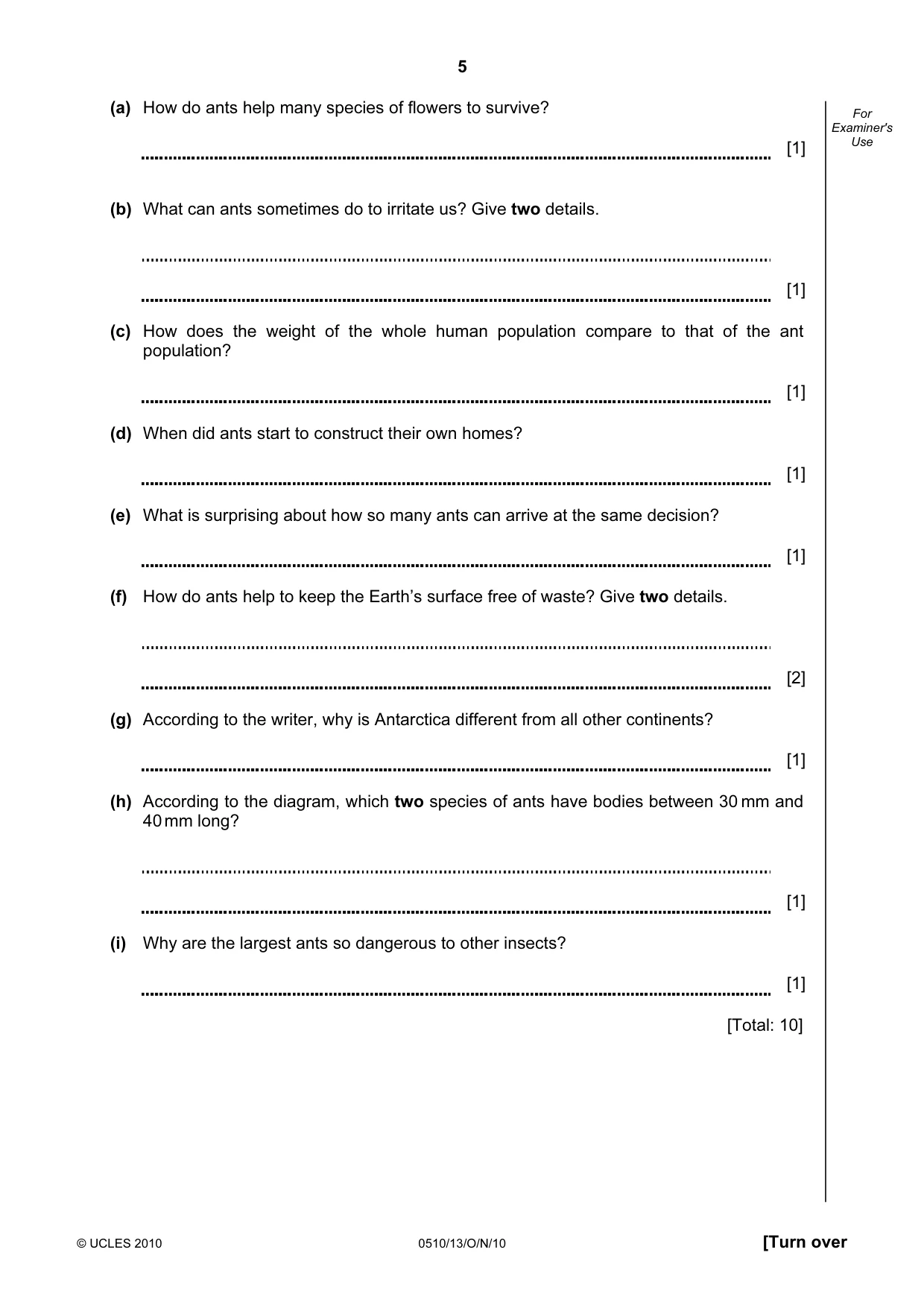
4 © UCLES 2010 0510/13/O/N/10 Exercise 2 Read the following article about the lifestyle of ants, and then answer the questions on the opposite page. Six Legs Good Without ants, the world would be in chaos. Soil would be unable to sustain much life. Dead leaves, insects and small animals would litter the earth’s surface. Thousands of species of flowering plants would disappear into extinction, with no creatures to transport their pollen. Like mobile dots, ants can suddenly appear in sugar bowls, crawl into neat lines over shoes or ruin an otherwise perfect picnic. They are silent, and often annoying, specimens of one of the most successful forms of life on Earth. There are 14,000 species of ants, with probably an equal number yet to be discovered, whose combined weight is more than that of the world’s entire human population. They have perfected a life that is more social than anything achieved by humans. Ants were building their own homes and colonies millions of years before humans had even considered walking on two legs. Ants have fascinated philosophers, writers and naturalists for thousands of years. But in the last decade much new information has been revealed about the natural history of the insects. Scientists have supplied many details of how the insects survive and communicate and, most surprisingly, how the millions of ants make group decisions without having a leader. That study has put ants at the centre of what many leading biologists say is a new phase of biology – understanding how groups of individuals can behave as a single superorganism. A scientist who has studied social insects for more than 50 years emphasises the importance of ants to life on Earth. “They are more important than earthworms for turning over the top layer of soil. They are also the principal collectors and clearers of waste,” he says. “They capture and feed on other small insects and remove dead creatures such as small birds, mice and rats.” Since the first ants emerged more than 150 million years ago, the insects have colonised every continent except Antarctica. They have acted as hunters, scavengers or farmers, and have evolved into thousands of shapes and sizes. The smallest ants are less than 1mm in length and look like tiny particles of pepper dust; the biggest can grow to 5cm, each one having a deadly sting for its victims. Ant colonies range from a dozen individuals to millions of insects, mostly consisting of ordinary females with specific jobs, as workers, soldiers or caretakers. There are also one or two other females, called queens, which are responsible for the reproduction of the species. Others serve as scouts, finding essential sources of food or searching out new homes when required. Males, called drones, are kept only long enough to fertilise the queen’s eggs, then driven out of the nest or killed quickly afterwards. This system has worked well for them. Through the process of evolution, the ants have discovered the principles of living and working in harmony. Perhaps we humans have a lot to learn from ants. 60 50 40 30 20 10 0 Body length of different species of ants (in millimetres) 1 7 6 5 4 3 2 1 = Army Ants of South America 2 = Bulldog Ants of Australia 3 = Driver Ants of Africa 4 = Leaf-Cutter Ants of North America 5 = Pygmy Ants of Asia 6 = Trap-Jaw Ants of Africa 7 = Weaver Ants of Europe
Question paper, page 5
5 © UCLES 2010 0510/13/O/N/10 [Turn over For Examiner's Use (a) How do ants help many species of flowers to survive? [1] (b) What can ants sometimes do to irritate us? Give two details. [1] (c) How does the weight of the whole human population compare to that of the ant population? [1] (d) When did ants start to construct their own homes? [1] (e) What is surprising about how so many ants can arrive at the same decision? [1] (f) How do ants help to keep the Earth’s surface free of waste? Give two details. [2] (g) According to the writer, why is Antarctica different from all other continents? [1] (h) According to the diagram, which two species of ants have bodies between 30 mm and 40 mm long? [1] (i) Why are the largest ants so dangerous to other insects? [1] [Total: 10]
Question paper, page 6
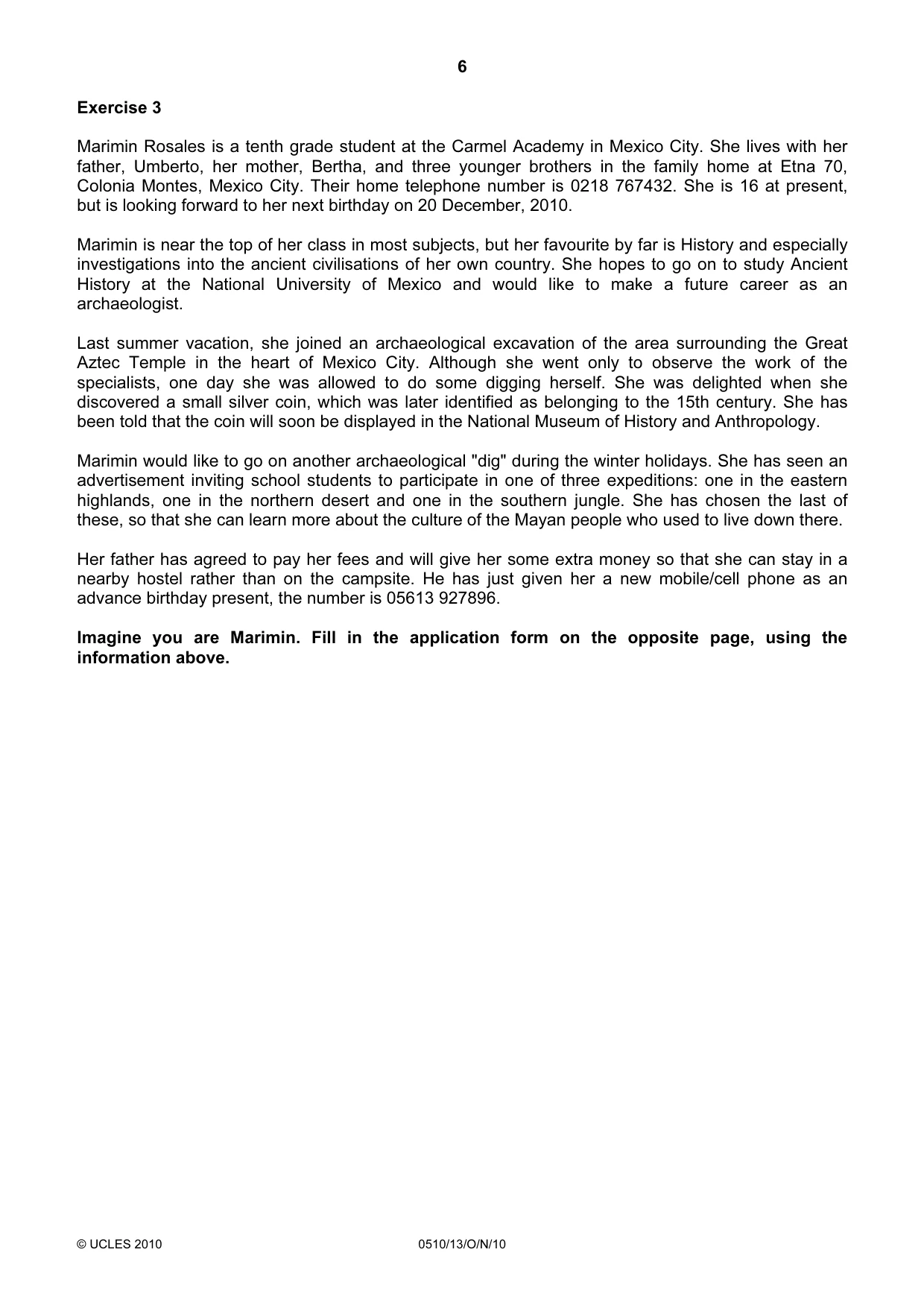
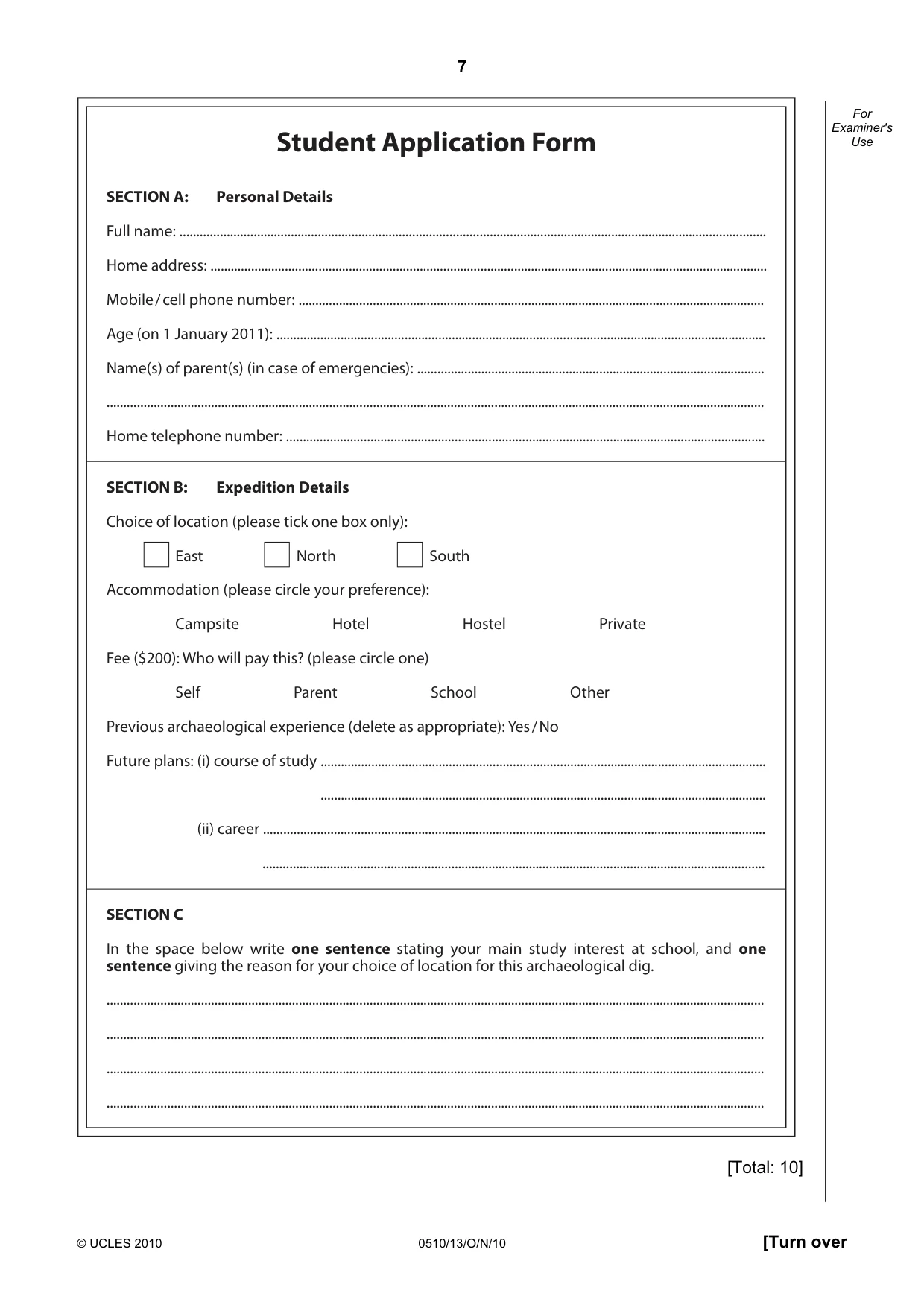
6 © UCLES 2010 0510/13/O/N/10 Exercise 3 Marimin Rosales is a tenth grade student at the Carmel Academy in Mexico City. She lives with her father, Umberto, her mother, Bertha, and three younger brothers in the family home at Etna 70, Colonia Montes, Mexico City. Their home telephone number is 0218 767432. She is 16 at present, but is looking forward to her next birthday on 20 December, 2010. Marimin is near the top of her class in most subjects, but her favourite by far is History and especially investigations into the ancient civilisations of her own country. She hopes to go on to study Ancient History at the National University of Mexico and would like to make a future career as an archaeologist. Last summer vacation, she joined an archaeological excavation of the area surrounding the Great Aztec Temple in the heart of Mexico City. Although she went only to observe the work of the specialists, one day she was allowed to do some digging herself. She was delighted when she discovered a small silver coin, which was later identified as belonging to the 15th century. She has been told that the coin will soon be displayed in the National Museum of History and Anthropology. Marimin would like to go on another archaeological "dig" during the winter holidays. She has seen an advertisement inviting school students to participate in one of three expeditions: one in the eastern highlands, one in the northern desert and one in the southern jungle. She has chosen the last of these, so that she can learn more about the culture of the Mayan people who used to live down there. Her father has agreed to pay her fees and will give her some extra money so that she can stay in a nearby hostel rather than on the campsite. He has just given her a new mobile/cell phone as an advance birthday present, the number is 05613 927896. Imagine you are Marimin. Fill in the application form on the opposite page, using the information above.
Question paper, page 7
7 © UCLES 2010 0510/13/O/N/10 [Turn over For Examiner's Use Student Application Form SECTION A: Personal Details Full name: … Home address: … Mobile / cell phone number: … Age (on 1 January 2011): … Name(s) of parent(s) (in case of emergencies): … … Home telephone number: … SECTION B: Expedition Details Choice of location (please tick one box only): East North South Accommodation (please circle your preference): Campsite Hotel Hostel Private Fee ($200): Who will pay this? (please circle one) Self Parent School Other Previous archaeological experience (delete as appropriate): Yes / No Future plans: (i) course of study … … (ii) career … … SECTION C In the space below write one sentence stating your main study interest at school, and one sentence giving the reason for your choice of location for this archaeological dig. … … … … [Total: 10]
Question paper, page 8
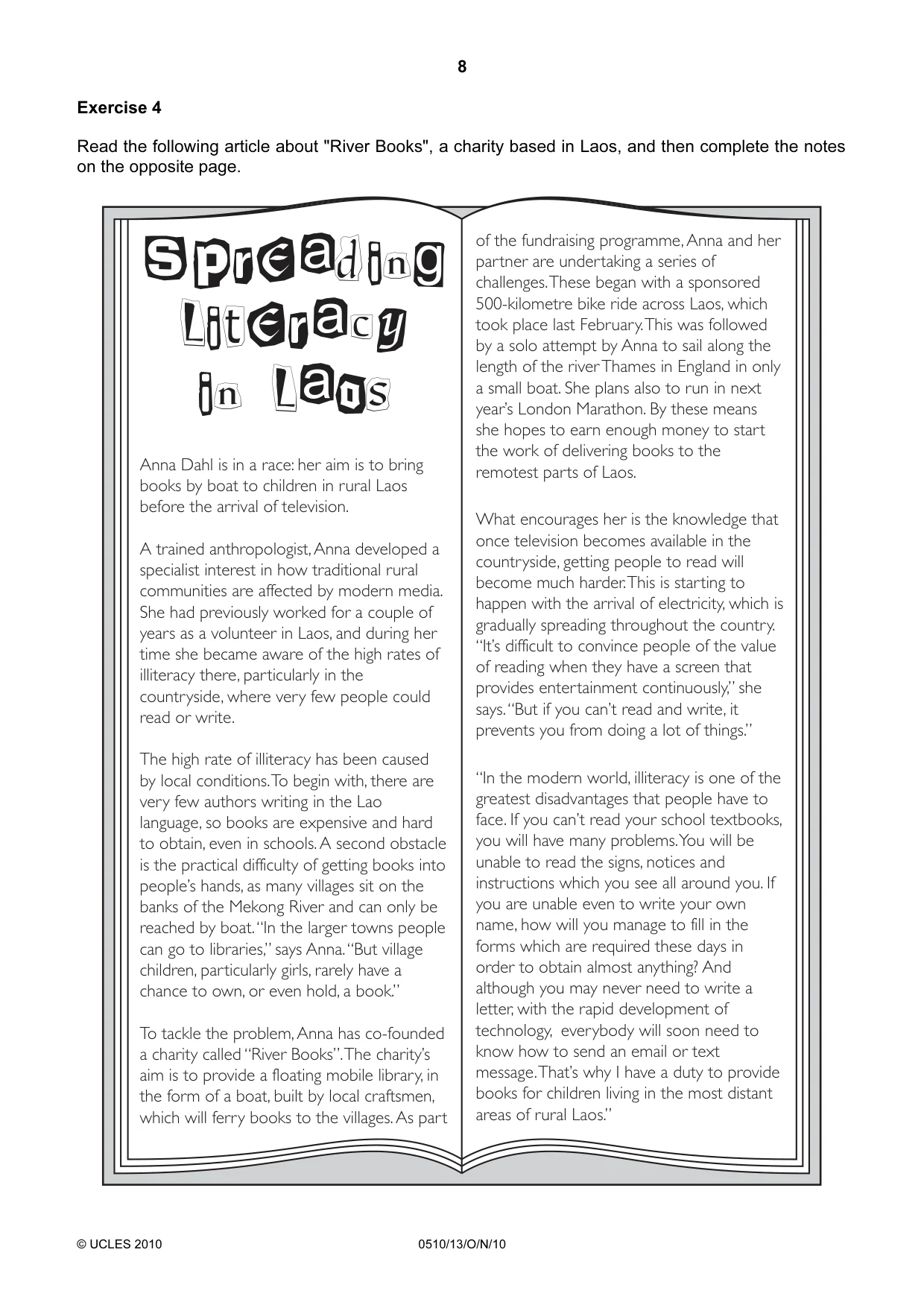
8 © UCLES 2010 0510/13/O/N/10 Exercise 4 Read the following article about "River Books", a charity based in Laos, and then complete the notes on the opposite page. Spreading Literacy in Laos Anna Dahl is in a race: her aim is to bring books by boat to children in rural Laos before the arrival of television. A trained anthropologist, Anna developed a specialist interest in how traditional rural communities are affected by modern media. She had previously worked for a couple of years as a volunteer in Laos, and during her time she became aware of the high rates of illiteracy there, particularly in the countryside, where very few people could read or write. The high rate of illiteracy has been caused by local conditions. To begin with, there are very few authors writing in the Lao language, so books are expensive and hard to obtain, even in schools. A second obstacle is the practical difficulty of getting books into people’s hands, as many villages sit on the banks of the Mekong River and can only be reached by boat. “In the larger towns people can go to libraries,” says Anna. “But village children, particularly girls, rarely have a chance to own, or even hold, a book.” To tackle the problem, Anna has co-founded a charity called “River Books”. The charity’s aim is to provide a floating mobile library, in the form of a boat, built by local craftsmen, which will ferry books to the villages. As part of the fundraising programme, Anna and her partner are undertaking a series of challenges. These began with a sponsored 500-kilometre bike ride across Laos, which took place last February. This was followed by a solo attempt by Anna to sail along the length of the river Thames in England in only a small boat. She plans also to run in next year’s London Marathon. By these means she hopes to earn enough money to start the work of delivering books to the remotest parts of Laos. What encourages her is the knowledge that once television becomes available in the countryside, getting people to read will become much harder. This is starting to happen with the arrival of electricity, which is gradually spreading throughout the country. “It’s difficult to convince people of the value of reading when they have a screen that provides entertainment continuously,” she says. “But if you can’t read and write, it prevents you from doing a lot of things.” “In the modern world, illiteracy is one of the greatest disadvantages that people have to face. If you can’t read your school textbooks, you will have many problems. You will be unable to read the signs, notices and instructions which you see all around you. If you are unable even to write your own name, how will you manage to fill in the forms which are required these days in order to obtain almost anything? And although you may never need to write a letter, with the rapid development of technology, everybody will soon need to know how to send an email or text message. That’s why I have a duty to provide books for children living in the most distant areas of rural Laos.”
Question paper, page 9
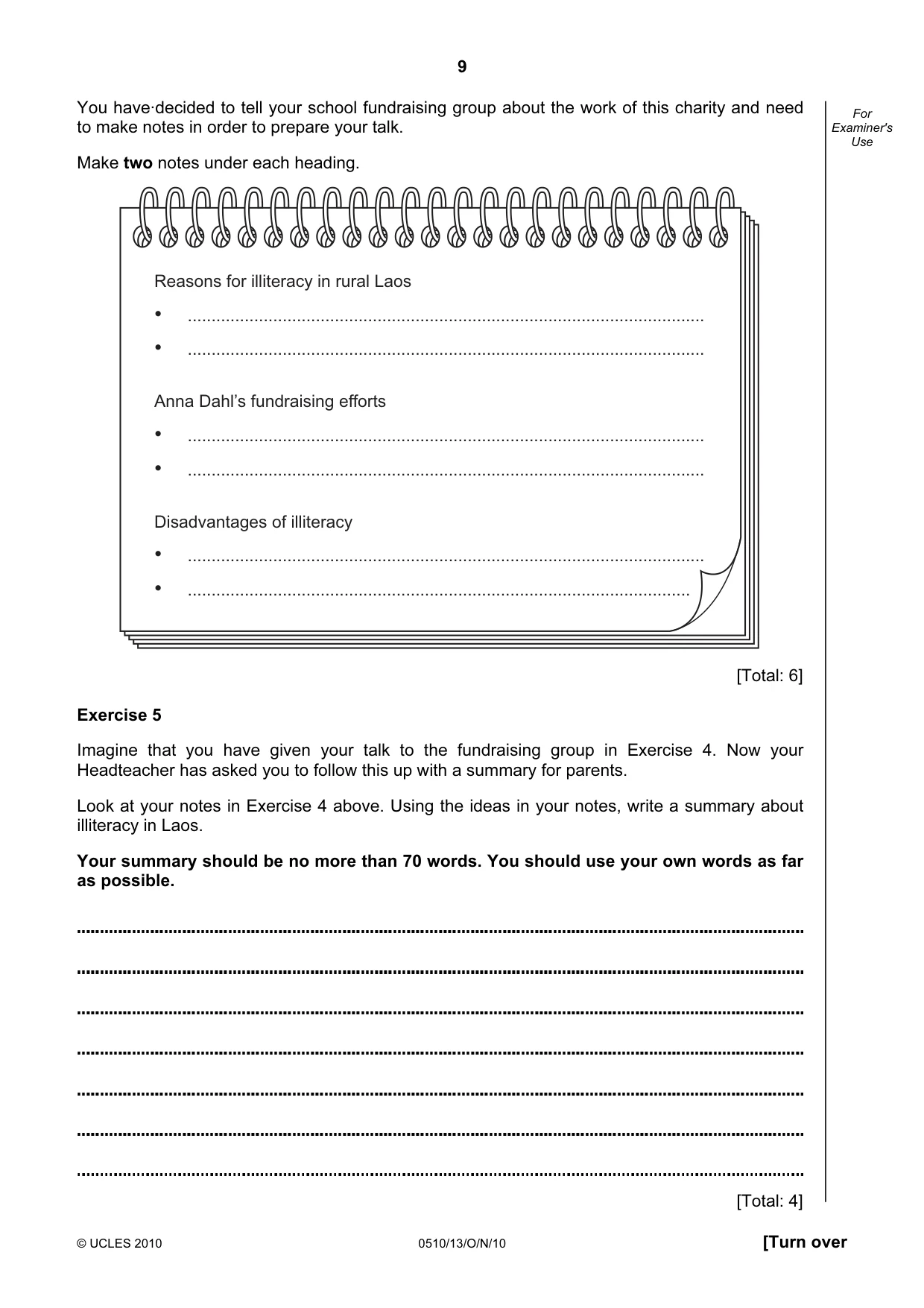
9 © UCLES 2010 0510/13/O/N/10 [Turn over For Examiner's Use You have·decided to tell your school fundraising group about the work of this charity and need to make notes in order to prepare your talk. Make two notes under each heading. Reasons for illiteracy in rural Laos • … • … Anna Dahl’s fundraising efforts • … • … Disadvantages of illiteracy • … • … [Total: 6] Exercise 5 Imagine that you have given your talk to the fundraising group in Exercise 4. Now your Headteacher has asked you to follow this up with a summary for parents. Look at your notes in Exercise 4 above. Using the ideas in your notes, write a summary about illiteracy in Laos. Your summary should be no more than 70 words. You should use your own words as far as possible. [Total: 4]
Question paper, page 10
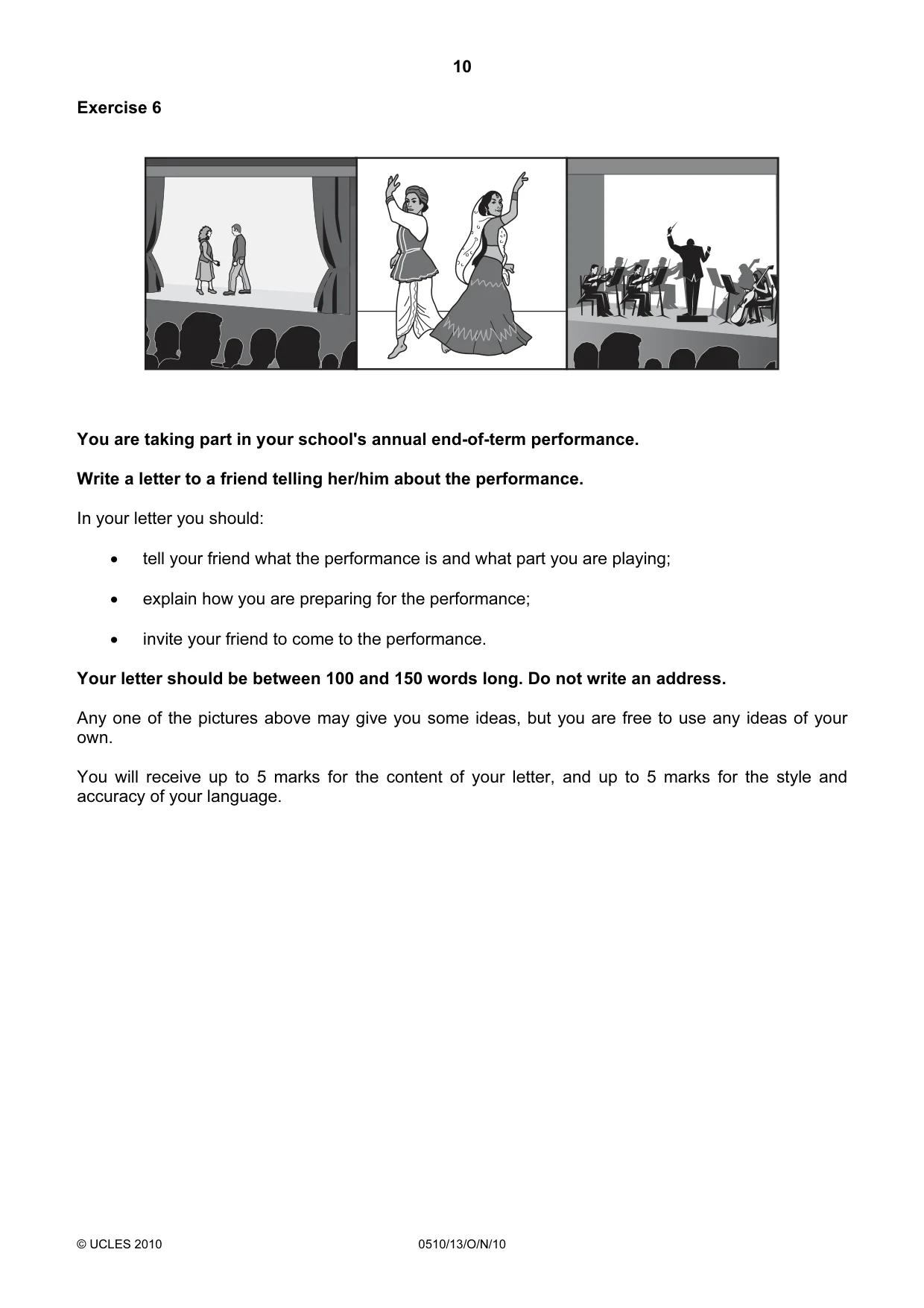
10 © UCLES 2010 0510/13/O/N/10 Exercise 6 You are taking part in your school's annual end-of-term performance. Write a letter to a friend telling her/him about the performance. In your letter you should: • tell your friend what the performance is and what part you are playing; • explain how you are preparing for the performance; • invite your friend to come to the performance. Your letter should be between 100 and 150 words long. Do not write an address. Any one of the pictures above may give you some ideas, but you are free to use any ideas of your own. You will receive up to 5 marks for the content of your letter, and up to 5 marks for the style and accuracy of your language.
Question paper, page 11
11 © UCLES 2010 0510/13/O/N/10 [Turn over For Examiner's Use [Total: 10]
Question paper, page 12
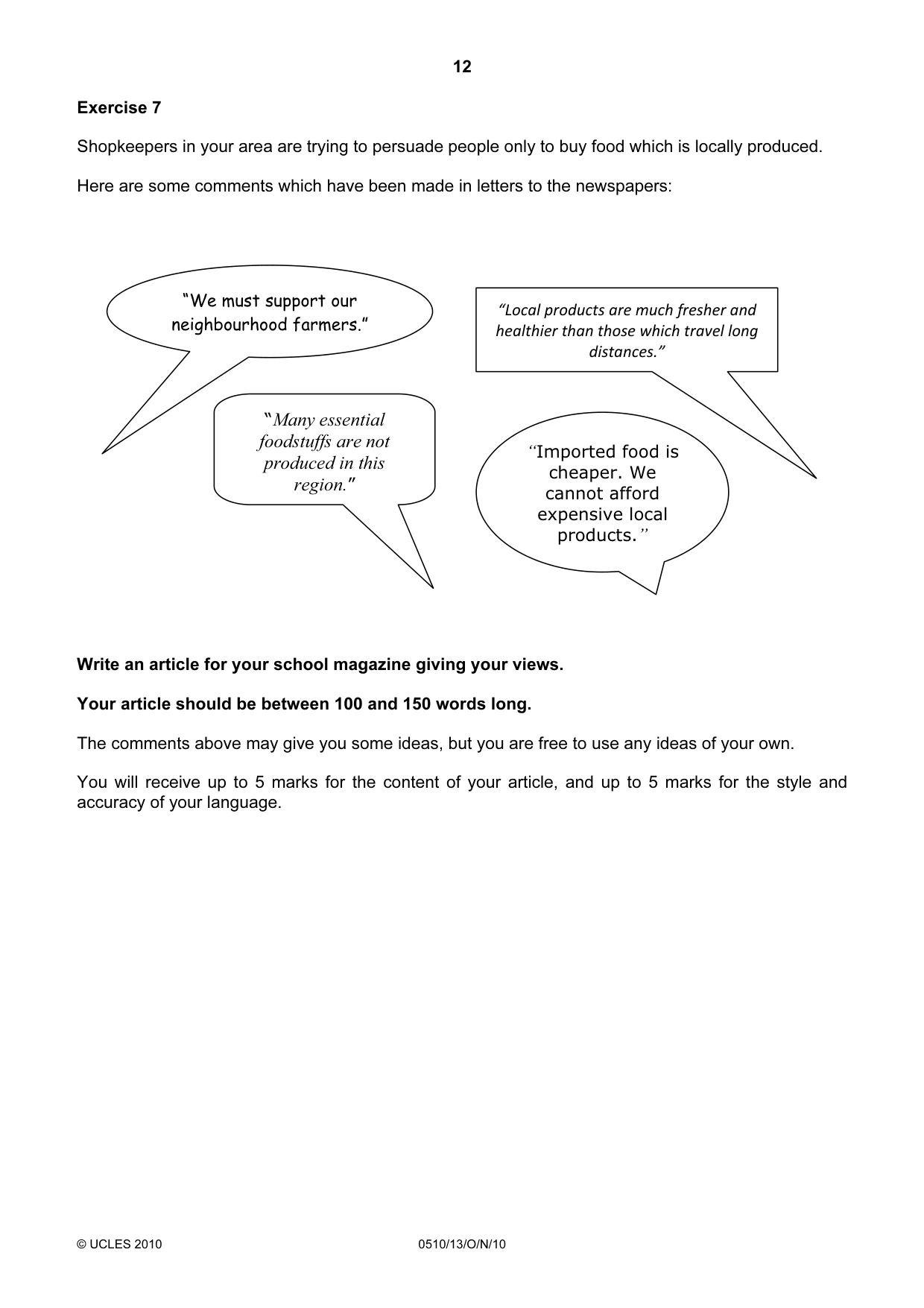
12 © UCLES 2010 0510/13/O/N/10 Exercise 7 Shopkeepers in your area are trying to persuade people only to buy food which is locally produced. Here are some comments which have been made in letters to the newspapers: Write an article for your school magazine giving your views. Your article should be between 100 and 150 words long. The comments above may give you some ideas, but you are free to use any ideas of your own. You will receive up to 5 marks for the content of your article, and up to 5 marks for the style and accuracy of your language. “We must support our neighbourhood farmers.” “Local products are much fresher and healthier than those which travel long distances.” “Imported food is cheaper. We cannot afford expensive local products.” “Many essential foodstuffs are not produced in this region.”
Question paper, page 13
13 © UCLES 2010 0510/13/O/N/10 For Examiner's Use [Total: 10]
Question paper, page 14
14 © UCLES 2010 0510/13/O/N/10 BLANK PAGE
Question paper, page 15
15 © UCLES 2010 0510/13/O/N/10 BLANK PAGE
Question paper, page 16
16 Permission to reproduce items where third-party owned material protected by copyright is included has been sought and cleared where possible. Every reasonable effort has been made by the publisher (UCLES) to trace copyright holders, but if any items requiring clearance have unwittingly been included, the publisher will be pleased to make amends at the earliest possible opportunity. University of Cambridge International Examinations is part of the Cambridge Assessment Group. Cambridge Assessment is the brand name of University of Cambridge Local Examinations Syndicate (UCLES), which is itself a department of the University of Cambridge. © UCLES 2010 0510/13/O/N/10 BLANK PAGE
Mark scheme, page 1
UNIVERSITY OF CAMBRIDGE INTERNATIONAL EXAMINATIONS International General Certificate of Secondary Education MARK SCHEME for the October/November 2010 question paper for the guidance of teachers 0510 ENGLISH AS A SECOND LANGUAGE 0510/13 Paper 1 (Reading and Writing – Core), maximum raw mark 56 This mark scheme is published as an aid to teachers and candidates, to indicate the requirements of the examination. It shows the basis on which Examiners were instructed to award marks. It does not indicate the details of the discussions that took place at an Examiners’ meeting before marking began, which would have considered the acceptability of alternative answers. Mark schemes must be read in conjunction with the question papers and the report on the examination. • CIE will not enter into discussions or correspondence in connection with these mark schemes. CIE is publishing the mark schemes for the October/November 2010 question papers for most IGCSE, GCE Advanced Level and Advanced Subsidiary Level syllabuses and some Ordinary Level syllabuses.
Mark scheme, page 2
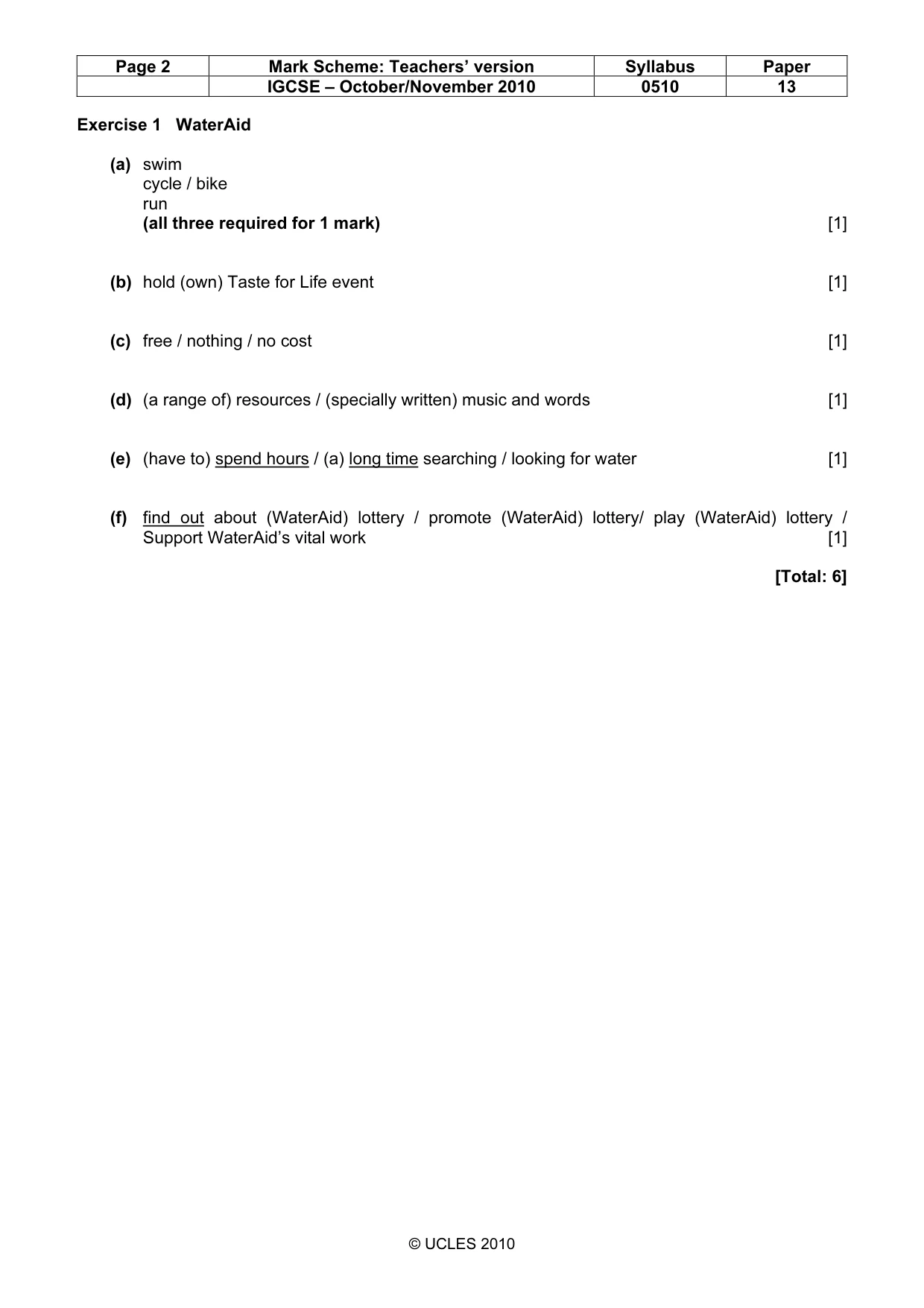
Page 2 Mark Scheme: Teachers’ version Syllabus Paper IGCSE – October/November 2010 0510 13 © UCLES 2010 Exercise 1 WaterAid (a) swim cycle / bike run (all three required for 1 mark) [1] (b) hold (own) Taste for Life event [1] (c) free / nothing / no cost [1] (d) (a range of) resources / (specially written) music and words [1] (e) (have to) spend hours / (a) long time searching / looking for water [1] (f) find out about (WaterAid) lottery / promote (WaterAid) lottery/ play (WaterAid) lottery / Support WaterAid’s vital work [1] [Total: 6]
Mark scheme, page 3
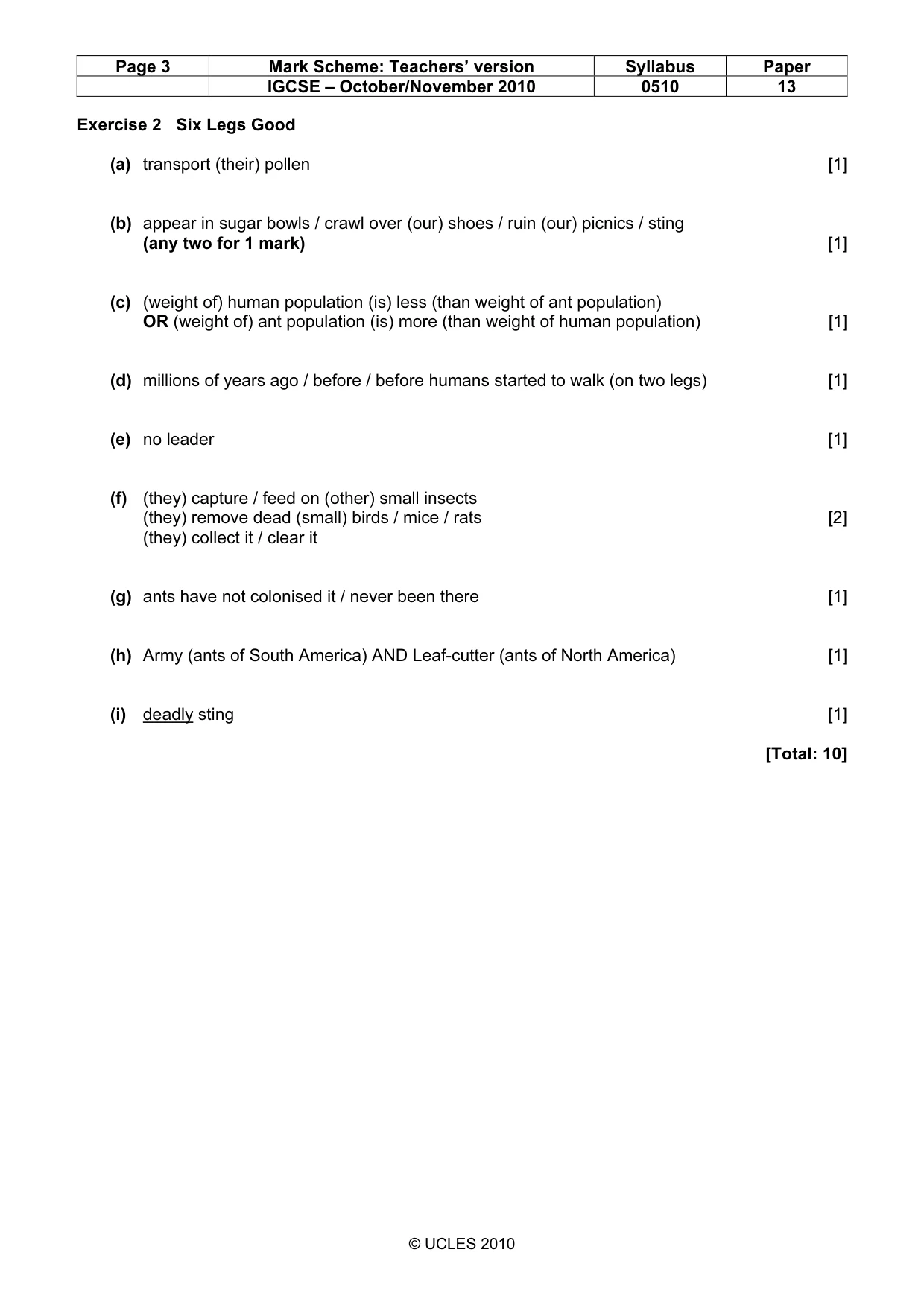
Page 3 Mark Scheme: Teachers’ version Syllabus Paper IGCSE – October/November 2010 0510 13 © UCLES 2010 Exercise 2 Six Legs Good (a) transport (their) pollen [1] (b) appear in sugar bowls / crawl over (our) shoes / ruin (our) picnics / sting (any two for 1 mark) [1] (c) (weight of) human population (is) less (than weight of ant population) OR (weight of) ant population (is) more (than weight of human population) [1] (d) millions of years ago / before / before humans started to walk (on two legs) [1] (e) no leader [1] (f) (they) capture / feed on (other) small insects (they) remove dead (small) birds / mice / rats [2] (they) collect it / clear it (g) ants have not colonised it / never been there [1] (h) Army (ants of South America) AND Leaf-cutter (ants of North America) [1] (i) deadly sting [1] [Total: 10]
Mark scheme, page 4
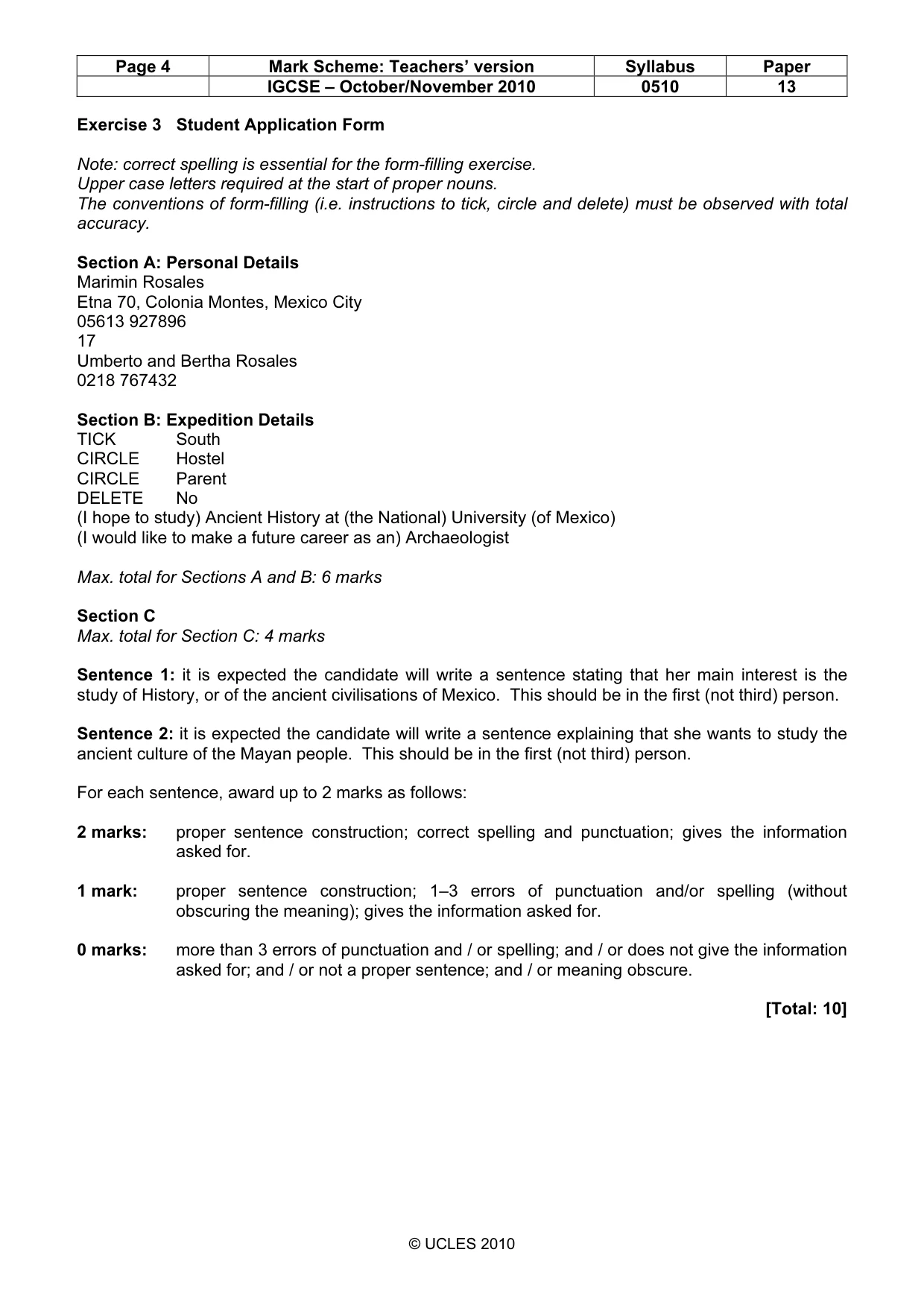
Page 4 Mark Scheme: Teachers’ version Syllabus Paper IGCSE – October/November 2010 0510 13 © UCLES 2010 Exercise 3 Student Application Form Note: correct spelling is essential for the form-filling exercise. Upper case letters required at the start of proper nouns. The conventions of form-filling (i.e. instructions to tick, circle and delete) must be observed with total accuracy. Section A: Personal Details Marimin Rosales Etna 70, Colonia Montes, Mexico City 05613 927896 17 Umberto and Bertha Rosales 0218 767432 Section B: Expedition Details TICK South CIRCLE Hostel CIRCLE Parent DELETE No (I hope to study) Ancient History at (the National) University (of Mexico) (I would like to make a future career as an) Archaeologist Max. total for Sections A and B: 6 marks Section C Max. total for Section C: 4 marks Sentence 1: it is expected the candidate will write a sentence stating that her main interest is the study of History, or of the ancient civilisations of Mexico. This should be in the first (not third) person. Sentence 2: it is expected the candidate will write a sentence explaining that she wants to study the ancient culture of the Mayan people. This should be in the first (not third) person. For each sentence, award up to 2 marks as follows: 2 marks: proper sentence construction; correct spelling and punctuation; gives the information asked for. 1 mark: proper sentence construction; 1–3 errors of punctuation and/or spelling (without obscuring the meaning); gives the information asked for. 0 marks: more than 3 errors of punctuation and / or spelling; and / or does not give the information asked for; and / or not a proper sentence; and / or meaning obscure. [Total: 10]
Mark scheme, page 5
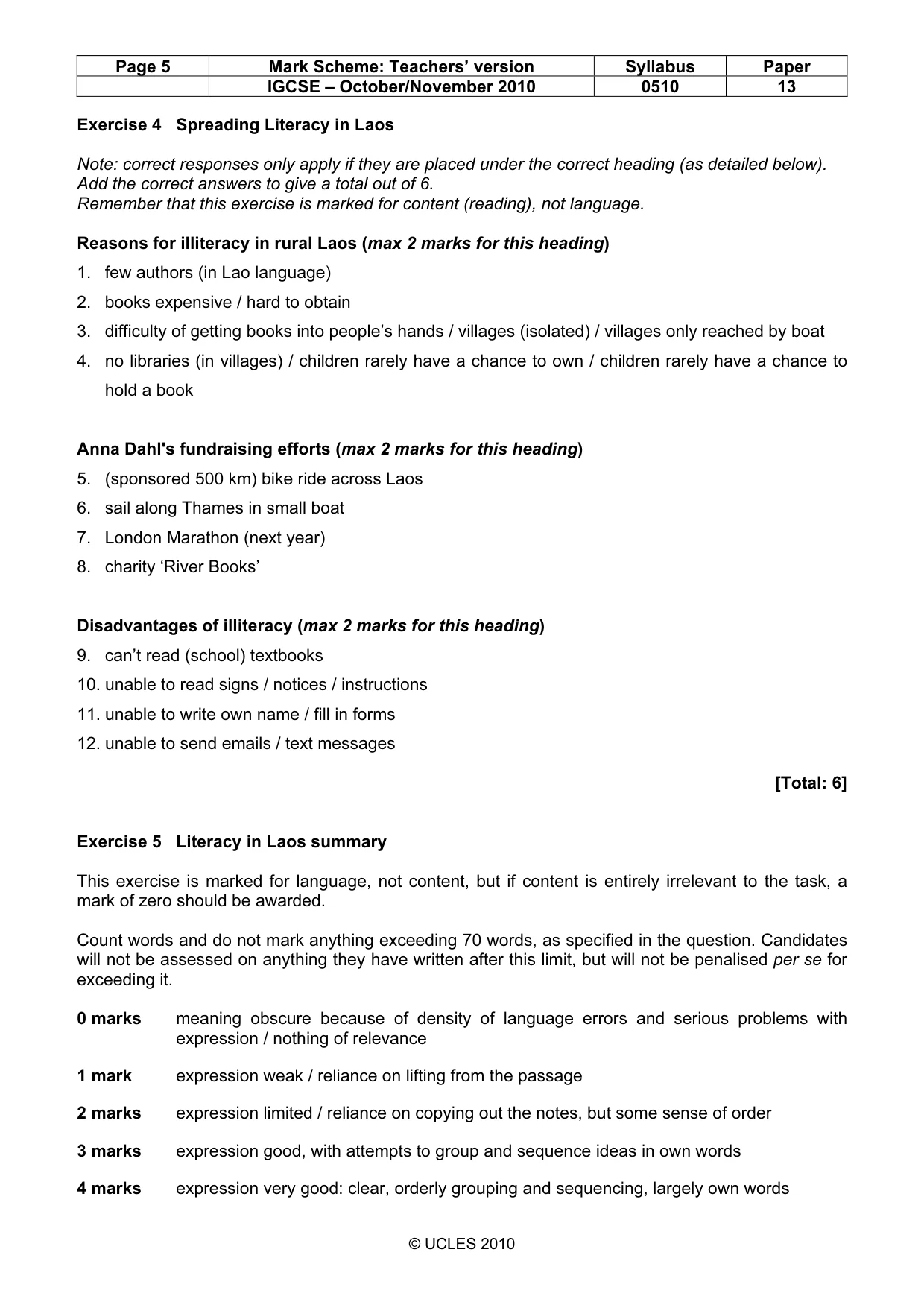
Page 5 Mark Scheme: Teachers’ version Syllabus Paper IGCSE – October/November 2010 0510 13 © UCLES 2010 Exercise 4 Spreading Literacy in Laos Note: correct responses only apply if they are placed under the correct heading (as detailed below). Add the correct answers to give a total out of 6. Remember that this exercise is marked for content (reading), not language. Reasons for illiteracy in rural Laos (max 2 marks for this heading) 1. few authors (in Lao language) 2. books expensive / hard to obtain 3. difficulty of getting books into people’s hands / villages (isolated) / villages only reached by boat 4. no libraries (in villages) / children rarely have a chance to own / children rarely have a chance to hold a book Anna Dahl's fundraising efforts (max 2 marks for this heading) 5. (sponsored 500 km) bike ride across Laos 6. sail along Thames in small boat 7. London Marathon (next year) 8. charity ‘River Books’ Disadvantages of illiteracy (max 2 marks for this heading) 9. can’t read (school) textbooks 10. unable to read signs / notices / instructions 11. unable to write own name / fill in forms 12. unable to send emails / text messages [Total: 6] Exercise 5 Literacy in Laos summary This exercise is marked for language, not content, but if content is entirely irrelevant to the task, a mark of zero should be awarded. Count words and do not mark anything exceeding 70 words, as specified in the question. Candidates will not be assessed on anything they have written after this limit, but will not be penalised per se for exceeding it. 0 marks meaning obscure because of density of language errors and serious problems with expression / nothing of relevance 1 mark expression weak / reliance on lifting from the passage 2 marks expression limited / reliance on copying out the notes, but some sense of order 3 marks expression good, with attempts to group and sequence ideas in own words 4 marks expression very good: clear, orderly grouping and sequencing, largely own words
Mark scheme, page 6
Page 6 Mark Scheme: Teachers’ version Syllabus Paper IGCSE – October/November 2010 0510 13 © UCLES 2010 [Total: 4]
Mark scheme, page 7
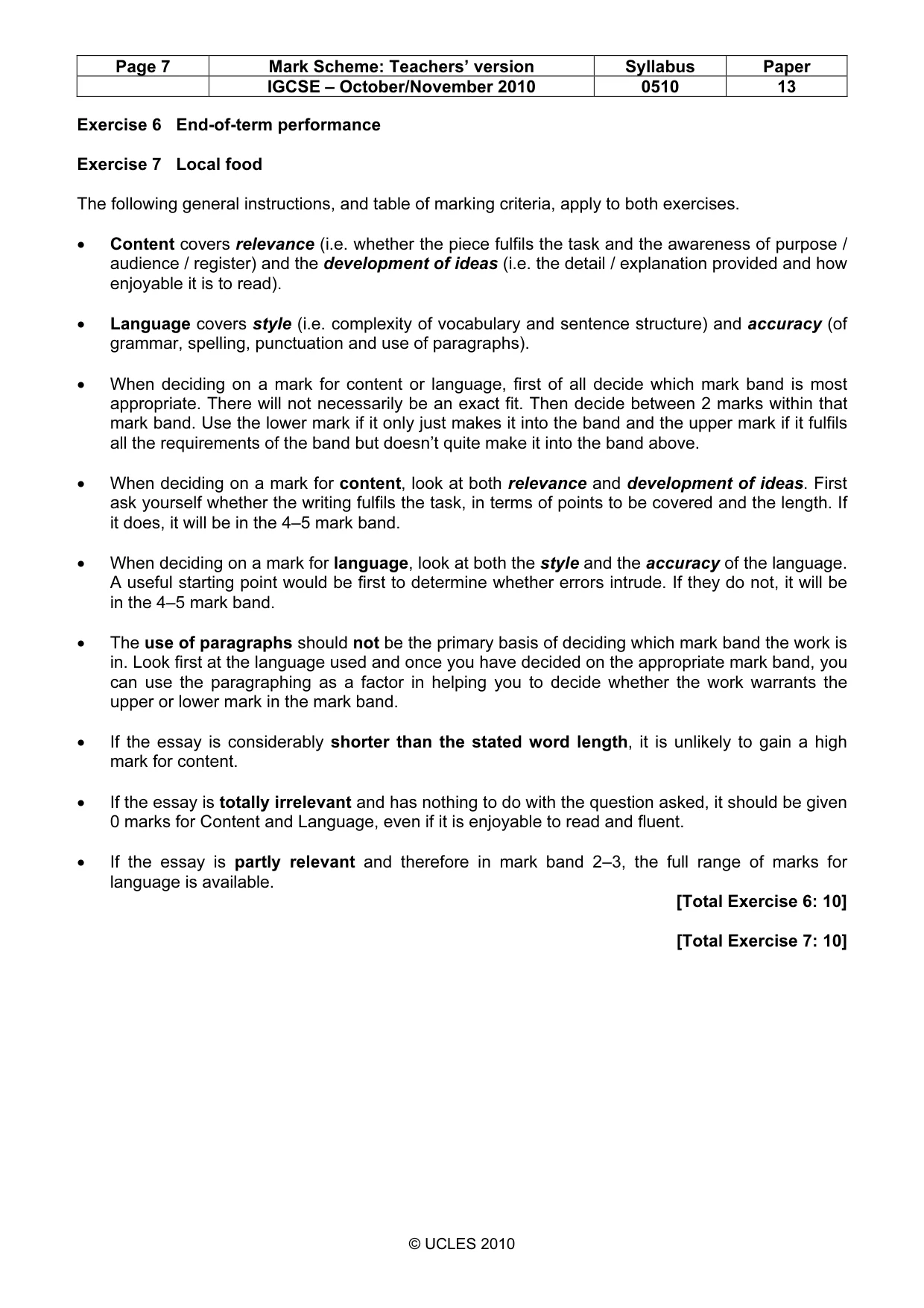
Page 7 Mark Scheme: Teachers’ version Syllabus Paper IGCSE – October/November 2010 0510 13 © UCLES 2010 Exercise 6 End-of-term performance Exercise 7 Local food The following general instructions, and table of marking criteria, apply to both exercises. • Content covers relevance (i.e. whether the piece fulfils the task and the awareness of purpose / audience / register) and the development of ideas (i.e. the detail / explanation provided and how enjoyable it is to read). • Language covers style (i.e. complexity of vocabulary and sentence structure) and accuracy (of grammar, spelling, punctuation and use of paragraphs). • When deciding on a mark for content or language, first of all decide which mark band is most appropriate. There will not necessarily be an exact fit. Then decide between 2 marks within that mark band. Use the lower mark if it only just makes it into the band and the upper mark if it fulfils all the requirements of the band but doesn’t quite make it into the band above. • When deciding on a mark for content, look at both relevance and development of ideas. First ask yourself whether the writing fulfils the task, in terms of points to be covered and the length. If it does, it will be in the 4–5 mark band. • When deciding on a mark for language, look at both the style and the accuracy of the language. A useful starting point would be first to determine whether errors intrude. If they do not, it will be in the 4–5 mark band. • The use of paragraphs should not be the primary basis of deciding which mark band the work is in. Look first at the language used and once you have decided on the appropriate mark band, you can use the paragraphing as a factor in helping you to decide whether the work warrants the upper or lower mark in the mark band. • If the essay is considerably shorter than the stated word length, it is unlikely to gain a high mark for content. • If the essay is totally irrelevant and has nothing to do with the question asked, it should be given 0 marks for Content and Language, even if it is enjoyable to read and fluent. • If the essay is partly relevant and therefore in mark band 2–3, the full range of marks for language is available. [Total Exercise 6: 10] [Total Exercise 7: 10]
Mark scheme, page 8
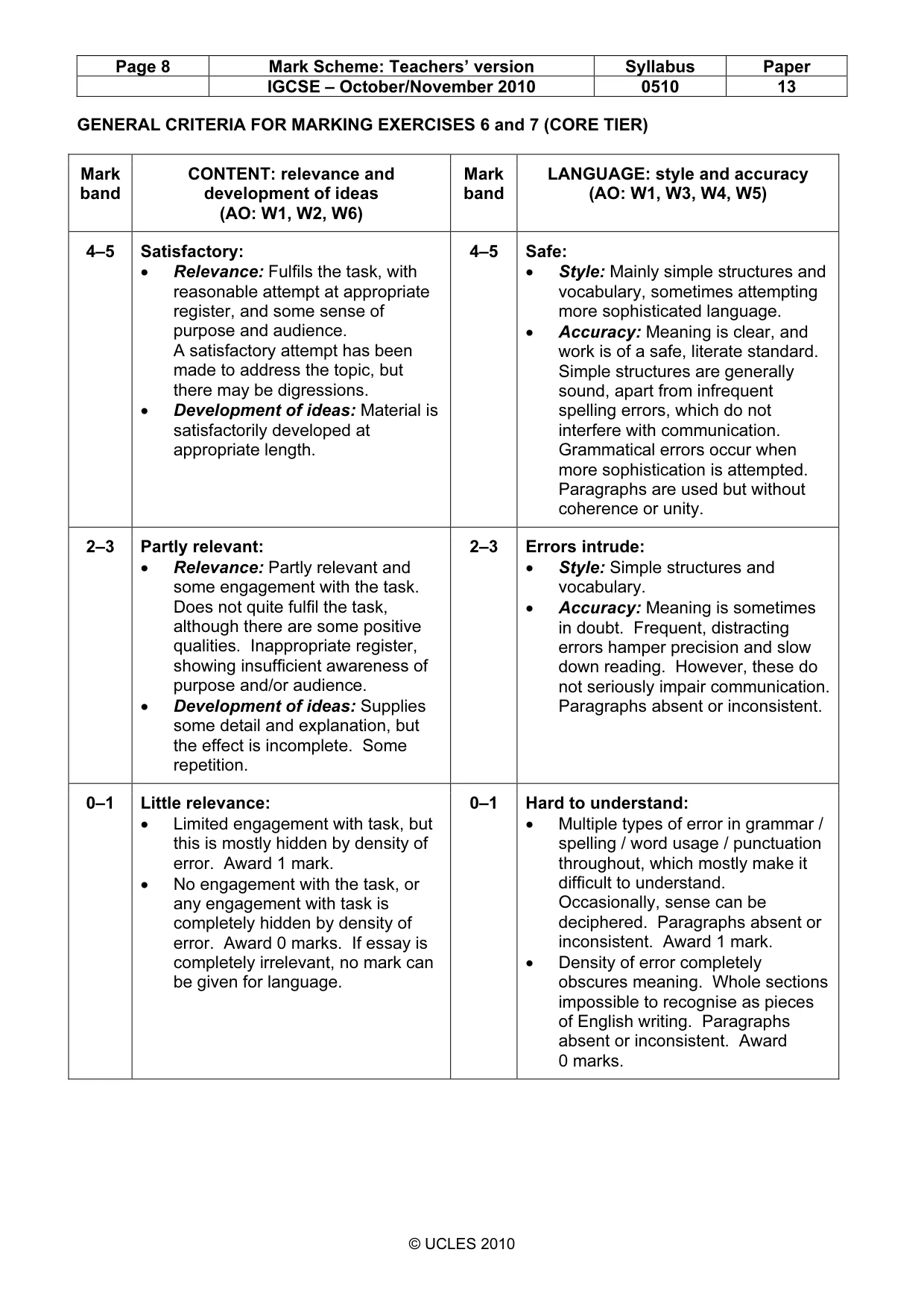
Page 8 Mark Scheme: Teachers’ version Syllabus Paper IGCSE – October/November 2010 0510 13 © UCLES 2010 GENERAL CRITERIA FOR MARKING EXERCISES 6 and 7 (CORE TIER) Mark band CONTENT: relevance and development of ideas (AO: W1, W2, W6) Mark band LANGUAGE: style and accuracy (AO: W1, W3, W4, W5) 4–5 Satisfactory: • Relevance: Fulfils the task, with reasonable attempt at appropriate register, and some sense of purpose and audience. A satisfactory attempt has been made to address the topic, but there may be digressions. • Development of ideas: Material is satisfactorily developed at appropriate length. 4–5 Safe: • Style: Mainly simple structures and vocabulary, sometimes attempting more sophisticated language. • Accuracy: Meaning is clear, and work is of a safe, literate standard. Simple structures are generally sound, apart from infrequent spelling errors, which do not interfere with communication. Grammatical errors occur when more sophistication is attempted. Paragraphs are used but without coherence or unity. 2–3 Partly relevant: • Relevance: Partly relevant and some engagement with the task. Does not quite fulfil the task, although there are some positive qualities. Inappropriate register, showing insufficient awareness of purpose and/or audience. • Development of ideas: Supplies some detail and explanation, but the effect is incomplete. Some repetition. 2–3 Errors intrude: • Style: Simple structures and vocabulary. • Accuracy: Meaning is sometimes in doubt. Frequent, distracting errors hamper precision and slow down reading. However, these do not seriously impair communication. Paragraphs absent or inconsistent. 0–1 Little relevance: • Limited engagement with task, but this is mostly hidden by density of error. Award 1 mark. • No engagement with the task, or any engagement with task is completely hidden by density of error. Award 0 marks. If essay is completely irrelevant, no mark can be given for language. 0–1 Hard to understand: • Multiple types of error in grammar / spelling / word usage / punctuation throughout, which mostly make it difficult to understand. Occasionally, sense can be deciphered. Paragraphs absent or inconsistent. Award 1 mark. • Density of error completely obscures meaning. Whole sections impossible to recognise as pieces of English writing. Paragraphs absent or inconsistent. Award 0 marks.
What you needed in this session
Cambridge’s own grade thresholds for 2010 Oct/Nov, Paper 1 · Variant 3. A higher threshold means an easier paper — the bar moves with how the cohort did.