Cambridge IGCSE English - Second Language (oral endorsement) 0510 — 2010 Oct/Nov Paper 1 · Variant 2
0510/12/O/N/10 · 56 marks · ≈63 min
The question paper and its mark scheme, free to read here and free to download. This is Cambridge’s own paper, exactly as it was sat.
Question paper16 pages


Mark scheme7 pages
Answers below. Sit the paper first if you are practising.
Paper as text
Question paper, page 1
This document consists of 13 printed pages and 3 blank pages. IB10 11_0510_12/3RP © UCLES 2010 [Turn over *1720019529* For Examiner's Use Exercise 1 Exercise 2 Exercise 3 Exercise 4 Exercise 5 Exercise 6 Exercise 7 Total UNIVERSITY OF CAMBRIDGE INTERNATIONAL EXAMINATIONS International General Certificate of Secondary Education ENGLISH AS A SECOND LANGUAGE 0510/12 Paper 1 Reading and Writing (Core) October/November 2010 1 hour 30 minutes Candidates answer on the Question Paper. No Additional Materials are required. READ THESE INSTRUCTIONS FIRST Write your Centre number, candidate number and name on all the work you hand in. Write in dark blue or black pen. Do not use staples, paper clips, highlighters, glue or correction fluid. DO NOT WRITE IN ANY BARCODES. Answer all questions. Dictionaries are not allowed. At the end of the examination, fasten all your work securely together. The number of marks is given in brackets [ ] at the end of each question or part question.
Question paper, page 2
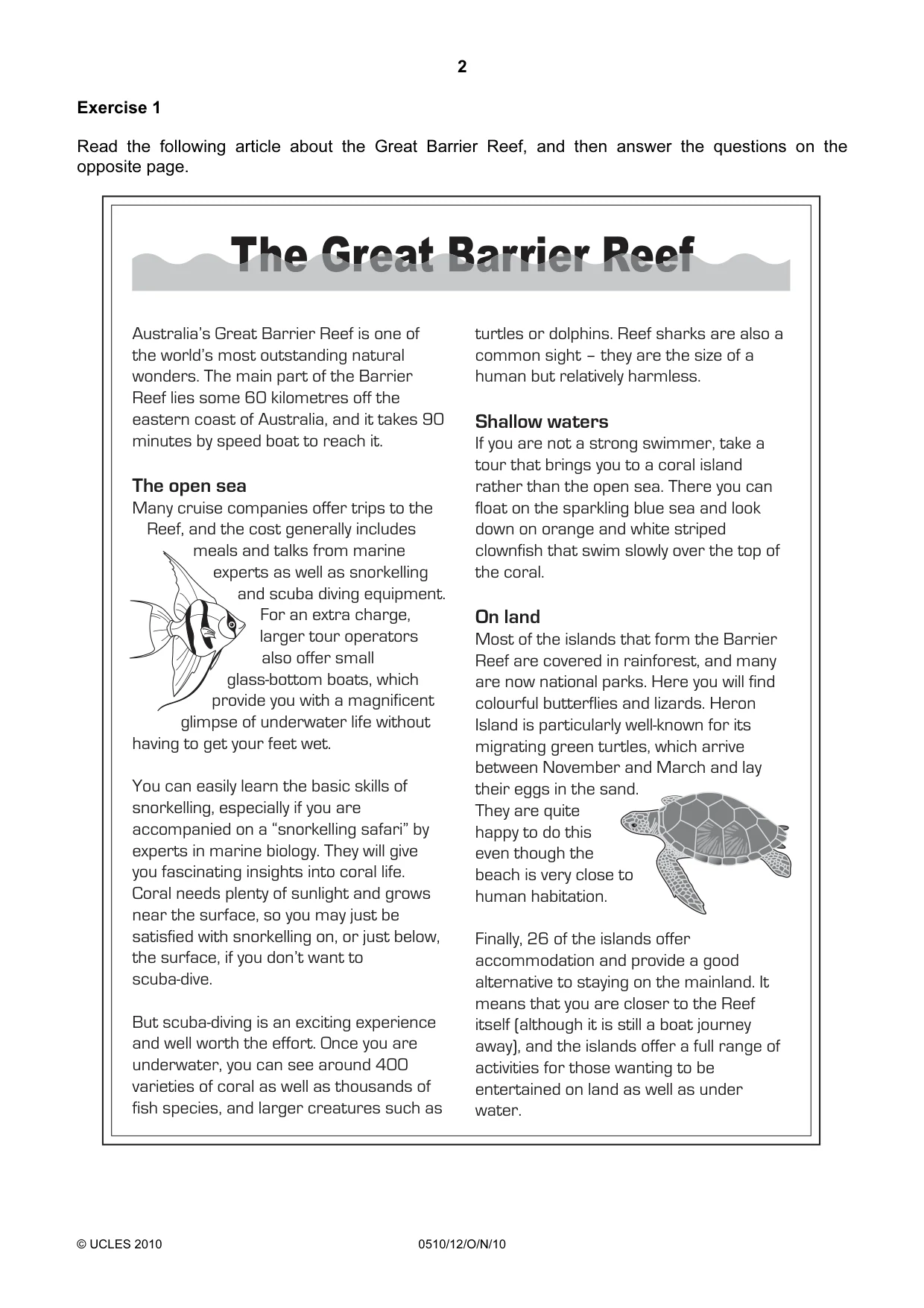
2 © UCLES 2010 0510/12/O/N/10 Exercise 1 Read the following article about the Great Barrier Reef, and then answer the questions on the opposite page. Australia’s Great Barrier Reef is one of the world’s most outstanding natural wonders. The main part of the Barrier Reef lies some 60 kilometres off the eastern coast of Australia, and it takes 90 minutes by speed boat to reach it. The open sea Many cruise companies offer trips to the Reef, and the cost generally includes meals and talks from marine experts as well as snorkelling and scuba diving equipment. For an extra charge, larger tour operators also offer small glass-bottom boats, which provide you with a magnificent glimpse of underwater life without having to get your feet wet. You can easily learn the basic skills of snorkelling, especially if you are accompanied on a “snorkelling safari” by experts in marine biology. They will give you fascinating insights into coral life. Coral needs plenty of sunlight and grows near the surface, so you may just be satisfied with snorkelling on, or just below, the surface, if you don’t want to scuba-dive. But scuba-diving is an exciting experience and well worth the effort. Once you are underwater, you can see around 400 varieties of coral as well as thousands of fish species, and larger creatures such as turtles or dolphins. Reef sharks are also a common sight – they are the size of a human but relatively harmless. Shallow waters If you are not a strong swimmer, take a tour that brings you to a coral island rather than the open sea. There you can float on the sparkling blue sea and look down on orange and white striped clownfish that swim slowly over the top of the coral. On land Most of the islands that form the Barrier Reef are covered in rainforest, and many are now national parks. Here you will find colourful butterflies and lizards. Heron Island is particularly well-known for its migrating green turtles, which arrive between November and March and lay their eggs in the sand. They are quite happy to do this even though the beach is very close to human habitation. Finally, 26 of the islands offer accommodation and provide a good alternative to staying on the mainland. It means that you are closer to the Reef itself (although it is still a boat journey away), and the islands offer a full range of activities for those wanting to be entertained on land as well as under water.
Question paper, page 3
3 © UCLES 2010 0510/12/O/N/10 [Turn over For Examiner's Use (a) Where exactly is the Great Barrier Reef? [1] (b) Apart from equipment for water sports, what is included in the price of a trip to the Reef? Give two details. [1] (c) How can you watch underwater life and still remain dry? [1] (d) What is essential for the growth of coral? [1] (e) Why might people prefer to visit a coral island rather than the open sea? [1] (f) What is an advantage of staying on one of the islands? [1] [Total: 6]
Question paper, page 4
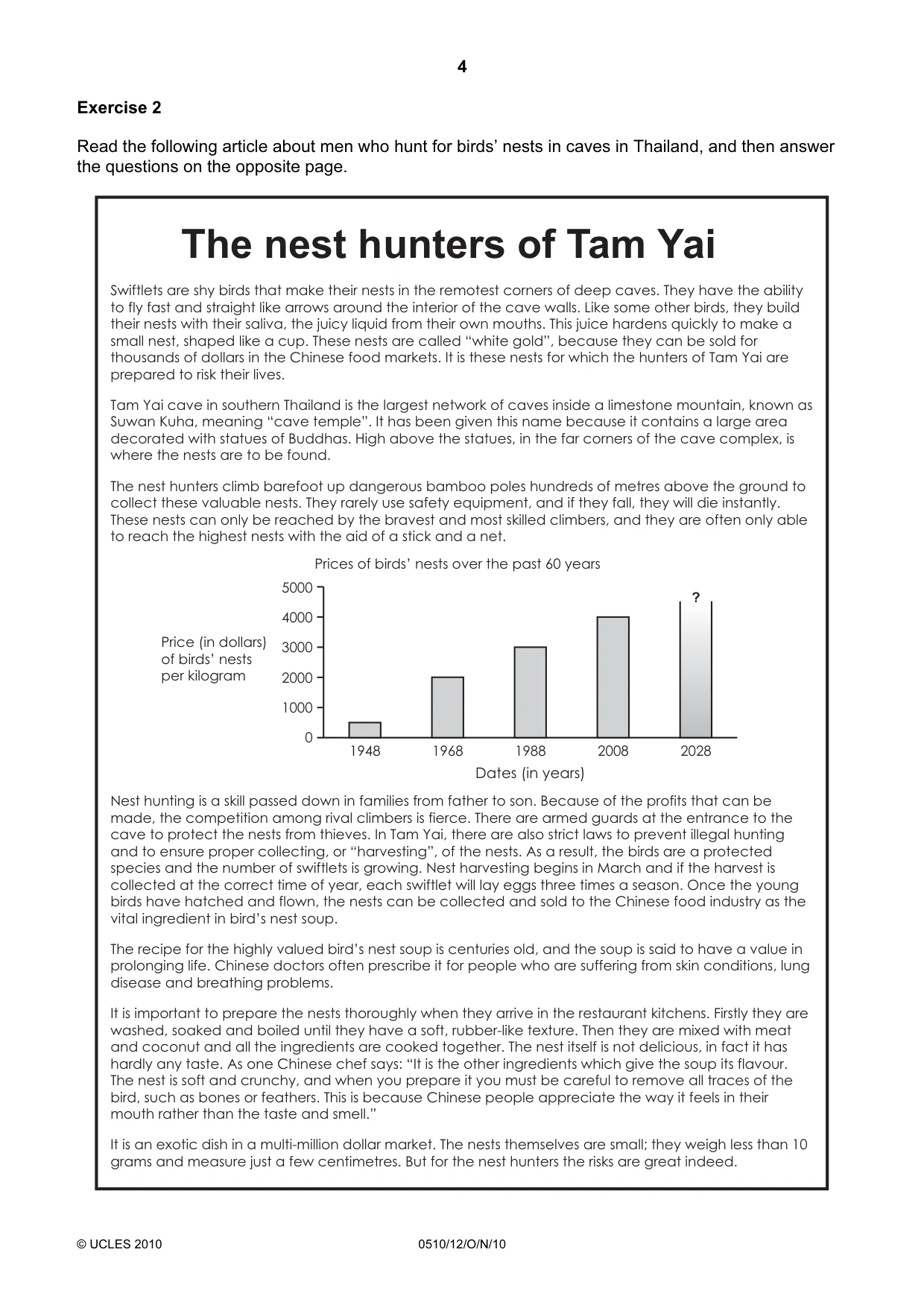
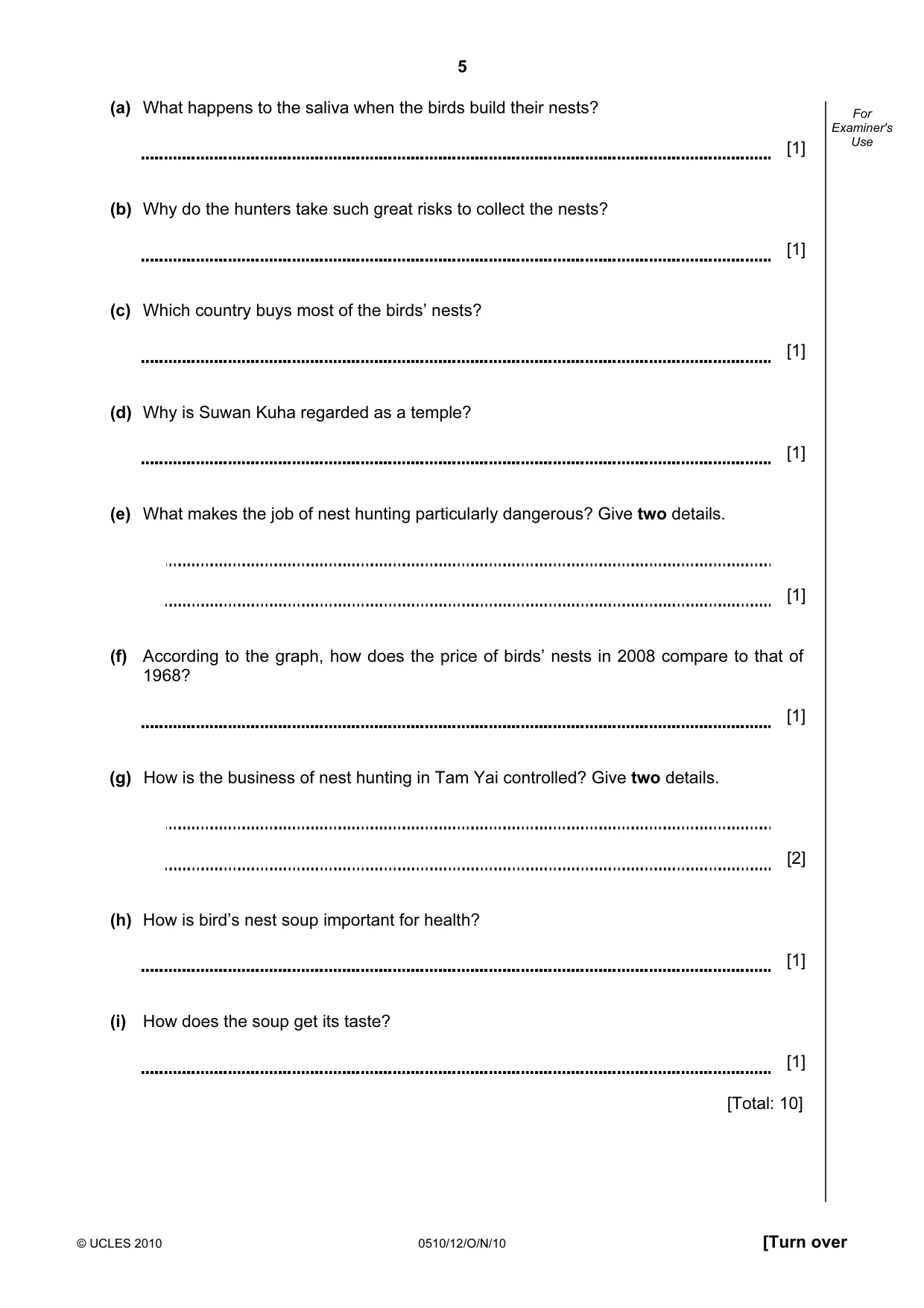
4 © UCLES 2010 0510/12/O/N/10 Exercise 2 Read the following article about men who hunt for birds’ nests in caves in Thailand, and then answer the questions on the opposite page. Swiftlets are shy birds that make their nests in the remotest corners of deep caves. They have the ability to fly fast and straight like arrows around the interior of the cave walls. Like some other birds, they build their nests with their saliva, the juicy liquid from their own mouths. This juice hardens quickly to make a small nest, shaped like a cup. These nests are called “white gold”, because they can be sold for thousands of dollars in the Chinese food markets. It is these nests for which the hunters of Tam Yai are prepared to risk their lives. Tam Yai cave in southern Thailand is the largest network of caves inside a limestone mountain, known as Suwan Kuha, meaning “cave temple”. It has been given this name because it contains a large area decorated with statues of Buddhas. High above the statues, in the far corners of the cave complex, is where the nests are to be found. The nest hunters climb barefoot up dangerous bamboo poles hundreds of metres above the ground to collect these valuable nests. They rarely use safety equipment, and if they fall, they will die instantly. These nests can only be reached by the bravest and most skilled climbers, and they are often only able to reach the highest nests with the aid of a stick and a net. Nest hunting is a skill passed down in families from father to son. Because of the profits that can be made, the competition among rival climbers is fierce. There are armed guards at the entrance to the cave to protect the nests from thieves. In Tam Yai, there are also strict laws to prevent illegal hunting and to ensure proper collecting, or “harvesting”, of the nests. As a result, the birds are a protected species and the number of swiftlets is growing. Nest harvesting begins in March and if the harvest is collected at the correct time of year, each swiftlet will lay eggs three times a season. Once the young birds have hatched and flown, the nests can be collected and sold to the Chinese food industry as the vital ingredient in bird’s nest soup. The recipe for the highly valued bird’s nest soup is centuries old, and the soup is said to have a value in prolonging life. Chinese doctors often prescribe it for people who are suffering from skin conditions, lung disease and breathing problems. It is important to prepare the nests thoroughly when they arrive in the restaurant kitchens. Firstly they are washed, soaked and boiled until they have a soft, rubber-like texture. Then they are mixed with meat and coconut and all the ingredients are cooked together. The nest itself is not delicious, in fact it has hardly any taste. As one Chinese chef says: “It is the other ingredients which give the soup its flavour. The nest is soft and crunchy, and when you prepare it you must be careful to remove all traces of the bird, such as bones or feathers. This is because Chinese people appreciate the way it feels in their mouth rather than the taste and smell.” It is an exotic dish in a multi-million dollar market. The nests themselves are small; they weigh less than 10 grams and measure just a few centimetres. But for the nest hunters the risks are great indeed. The nest hunters of Tam Yai 1948 1968 1988 Dates (in years) Prices of birds’ nests over the past 60 years Price (in dollars) of birds’ nests per kilogram 2008 2028 5000 4000 3000 2000 1000 0 ?
Question paper, page 5
5 © UCLES 2010 0510/12/O/N/10 [Turn over For Examiner's Use (a) What happens to the saliva when the birds build their nests? [1] (b) Why do the hunters take such great risks to collect the nests? [1] (c) Which country buys most of the birds’ nests? [1] (d) Why is Suwan Kuha regarded as a temple? [1] (e) What makes the job of nest hunting particularly dangerous? Give two details. [1] (f) According to the graph, how does the price of birds’ nests in 2008 compare to that of 1968? [1] (g) How is the business of nest hunting in Tam Yai controlled? Give two details. [2] (h) How is bird’s nest soup important for health? [1] (i) How does the soup get its taste? [1] [Total: 10]
Question paper, page 6
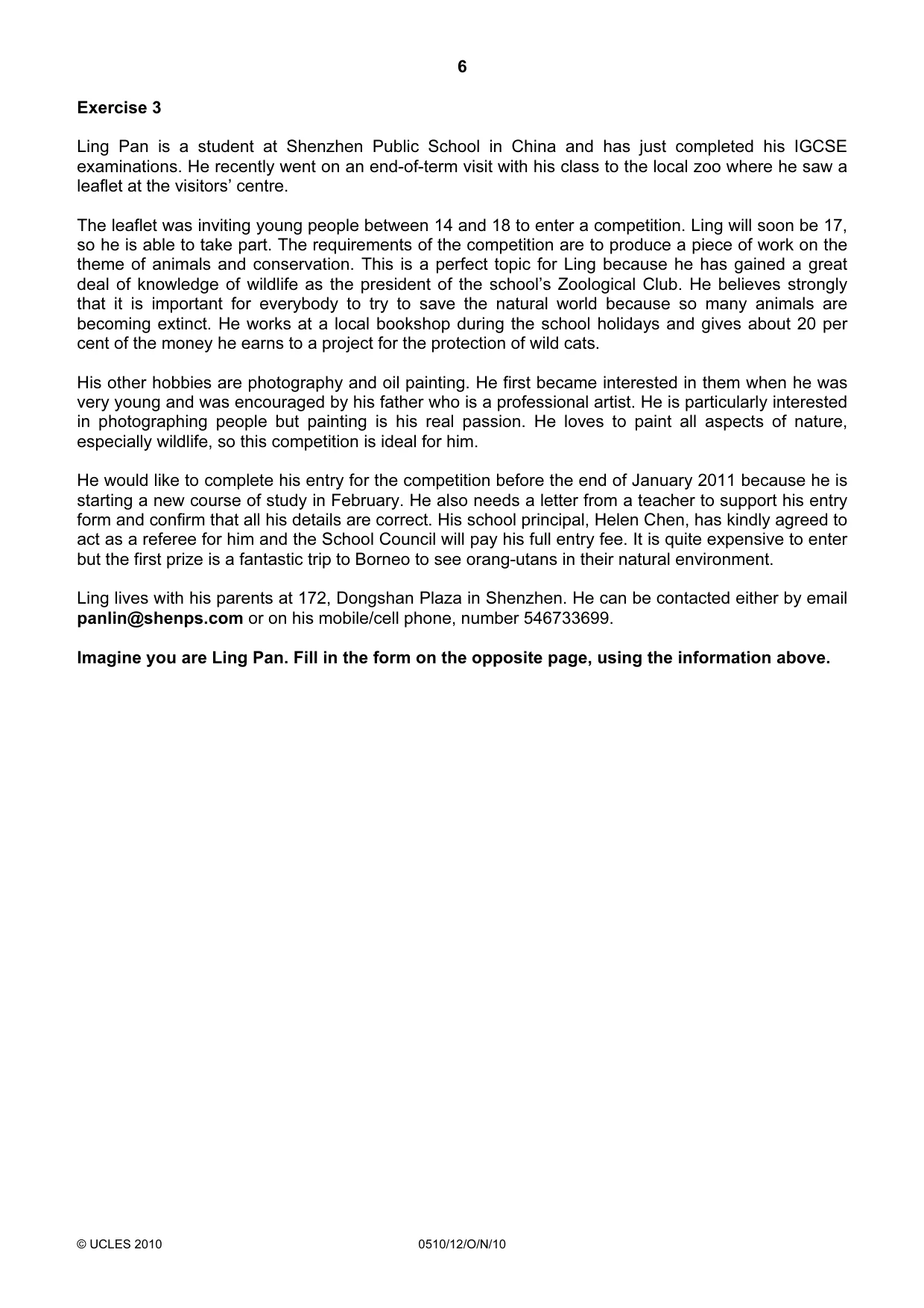
6 © UCLES 2010 0510/12/O/N/10 Exercise 3 Ling Pan is a student at Shenzhen Public School in China and has just completed his IGCSE examinations. He recently went on an end-of-term visit with his class to the local zoo where he saw a leaflet at the visitors’ centre. The leaflet was inviting young people between 14 and 18 to enter a competition. Ling will soon be 17, so he is able to take part. The requirements of the competition are to produce a piece of work on the theme of animals and conservation. This is a perfect topic for Ling because he has gained a great deal of knowledge of wildlife as the president of the school’s Zoological Club. He believes strongly that it is important for everybody to try to save the natural world because so many animals are becoming extinct. He works at a local bookshop during the school holidays and gives about 20 per cent of the money he earns to a project for the protection of wild cats. His other hobbies are photography and oil painting. He first became interested in them when he was very young and was encouraged by his father who is a professional artist. He is particularly interested in photographing people but painting is his real passion. He loves to paint all aspects of nature, especially wildlife, so this competition is ideal for him. He would like to complete his entry for the competition before the end of January 2011 because he is starting a new course of study in February. He also needs a letter from a teacher to support his entry form and confirm that all his details are correct. His school principal, Helen Chen, has kindly agreed to act as a referee for him and the School Council will pay his full entry fee. It is quite expensive to enter but the first prize is a fantastic trip to Borneo to see orang-utans in their natural environment. Ling lives with his parents at 172, Dongshan Plaza in Shenzhen. He can be contacted either by email panlin@shenps.com or on his mobile/cell phone, number 546733699. Imagine you are Ling Pan. Fill in the form on the opposite page, using the information above.
Question paper, page 7
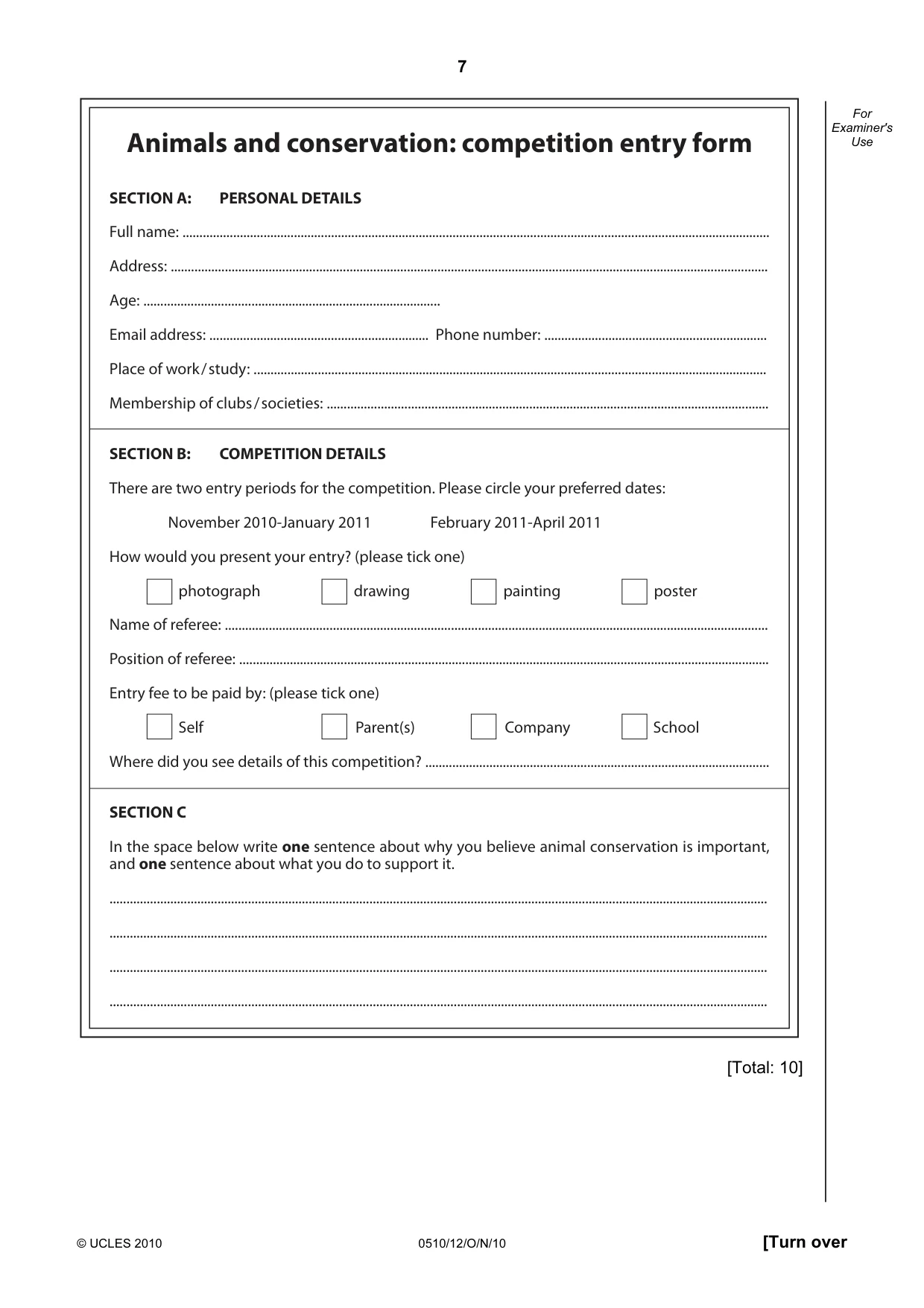
7 © UCLES 2010 0510/12/O/N/10 [Turn over For Examiner's Use Animals and conservation: competition entry form SECTION A: PERSONAL DETAILS Full name: … Address: … Age: … Email address: … Phone number: … Place of work / study: … Membership of clubs / societies: … SECTION B: COMPETITION DETAILS There are two entry periods for the competition. Please circle your preferred dates: November 2010-January 2011 February 2011-April 2011 How would you present your entry? (please tick one) photograph drawing painting poster Name of referee: … Position of referee: … Entry fee to be paid by: (please tick one) Self Parent(s) Company School Where did you see details of this competition? … SECTION C In the space below write one sentence about why you believe animal conservation is important, and one sentence about what you do to support it. … … … … [Total: 10]
Question paper, page 8
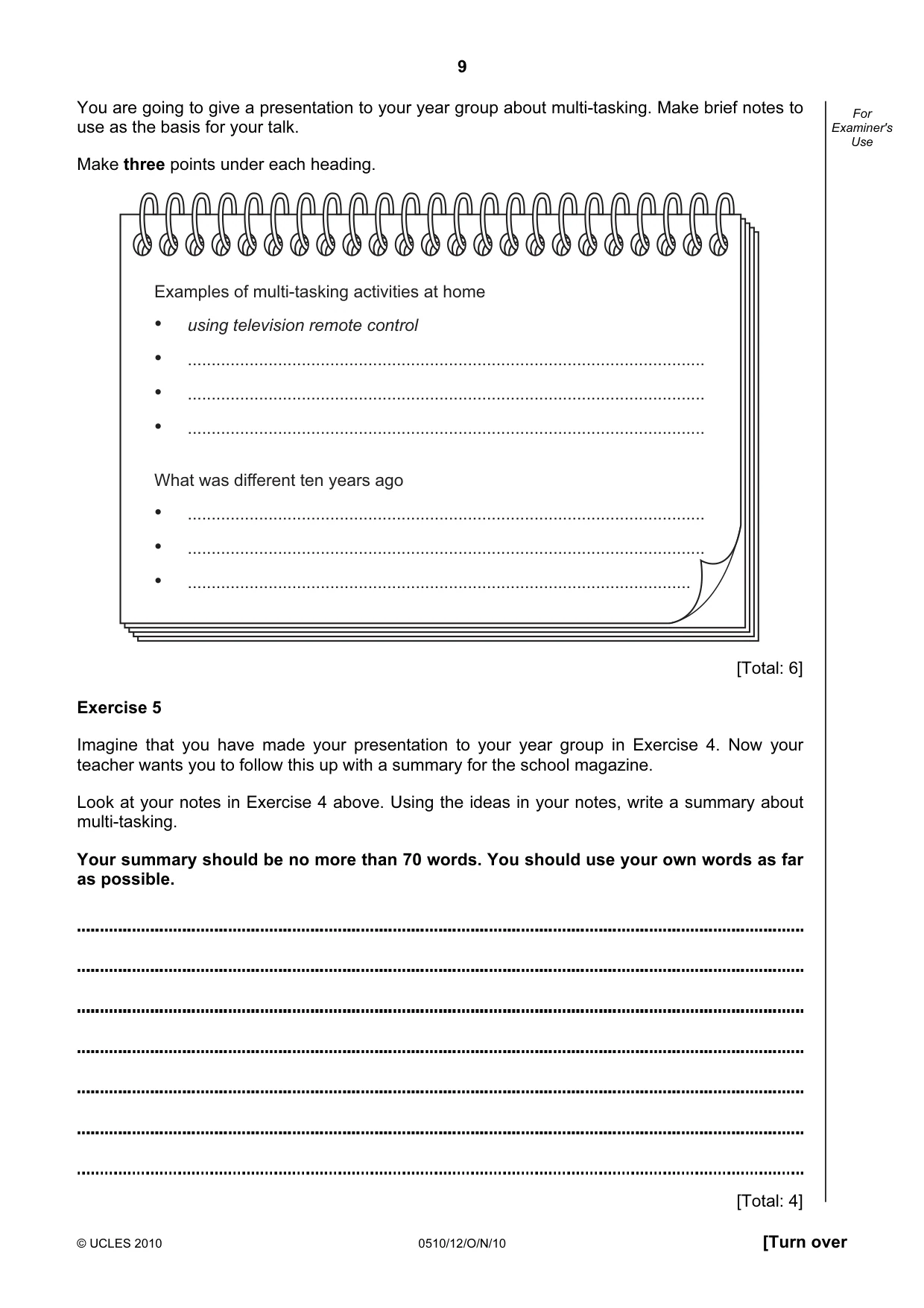
8 © UCLES 2010 0510/12/O/N/10 Exercise 4 Read the article below about multi-tasking, the skill of doing many different tasks at the same time, and then complete the notes on the opposite page. You may think that 24 hours in a day is not enough for everything that you want to do... and many people would agree with you. Fortunately, researchers have found that there are many time-saving machines and gadgets in the home and at work nowadays. A decade ago, it would have taken 31 hours to do all the tasks that now take only 24 hours to complete. For many people the rush starts at breakfast time, when they read text messages on a mobile / cell phone while making toast. It continues in the car where the driver makes a phone call with a hands-free set while listening with one ear to the radio and checking the satellite navigation system. This doesn’t stop when we get to work. There is a blizzard of emails, phone calls and meetings often happening simultaneously throughout the day. However, researchers have found that the busiest period of multi-tasking is still to come, at home in the evening. “People will be operating the television remote control while surfing on the computer, texting their friends on their mobile phone and having a conversation with their family,” says Calvin Bilten, one of the authors of a report on multi-tasking. “They may be far more mentally engaged at home than at work.” According to the report, television remains the main focus of attention in the evening, but an increasing number of people use computers to update their social network sites or download and listen to music. Even eating takes second place to internet activities in many homes. Bilten’s team of researchers calculated that the tasks carried out in a typical day ten years ago would have taken 31 hours, with the old-fashioned email systems and mobile phones in use at that time. He adds, “On one hand, it’s good because you get more done. On the other hand, life was much simpler a decade ago. There was more talking face-to-face and more time spent over dinner or just doing nothing. Now there is the feeling that you have to be using one gadget or more all the time.” However, the limits of present-day technology may mean that multi-tasking is nearing its peak for this generation. This is good news for many researchers and advisers on human behaviour. Zac Miller, a psychology professor, says that the thought of a 31-hour day is extremely depressing. He states, “Observations of the brain made during multi-tasking show that completing several tasks together takes longer than if they were done one at a time. Forty per cent of people cannot remember the previous task they were doing, so they become confused. This can be fatal on the roads.” Moreover, there are signs of a revolt against multi-tasking. Many students and workers are feeling too much pressure and are deleting thousands of unread emails and no longer using social network sites.
Question paper, page 9
9 © UCLES 2010 0510/12/O/N/10 [Turn over For Examiner's Use You are going to give a presentation to your year group about multi-tasking. Make brief notes to use as the basis for your talk. Make three points under each heading. Examples of multi-tasking activities at home • using television remote control • … • … • … What was different ten years ago • … • … • … [Total: 6] Exercise 5 Imagine that you have made your presentation to your year group in Exercise 4. Now your teacher wants you to follow this up with a summary for the school magazine. Look at your notes in Exercise 4 above. Using the ideas in your notes, write a summary about multi-tasking. Your summary should be no more than 70 words. You should use your own words as far as possible. [Total: 4]
Question paper, page 10
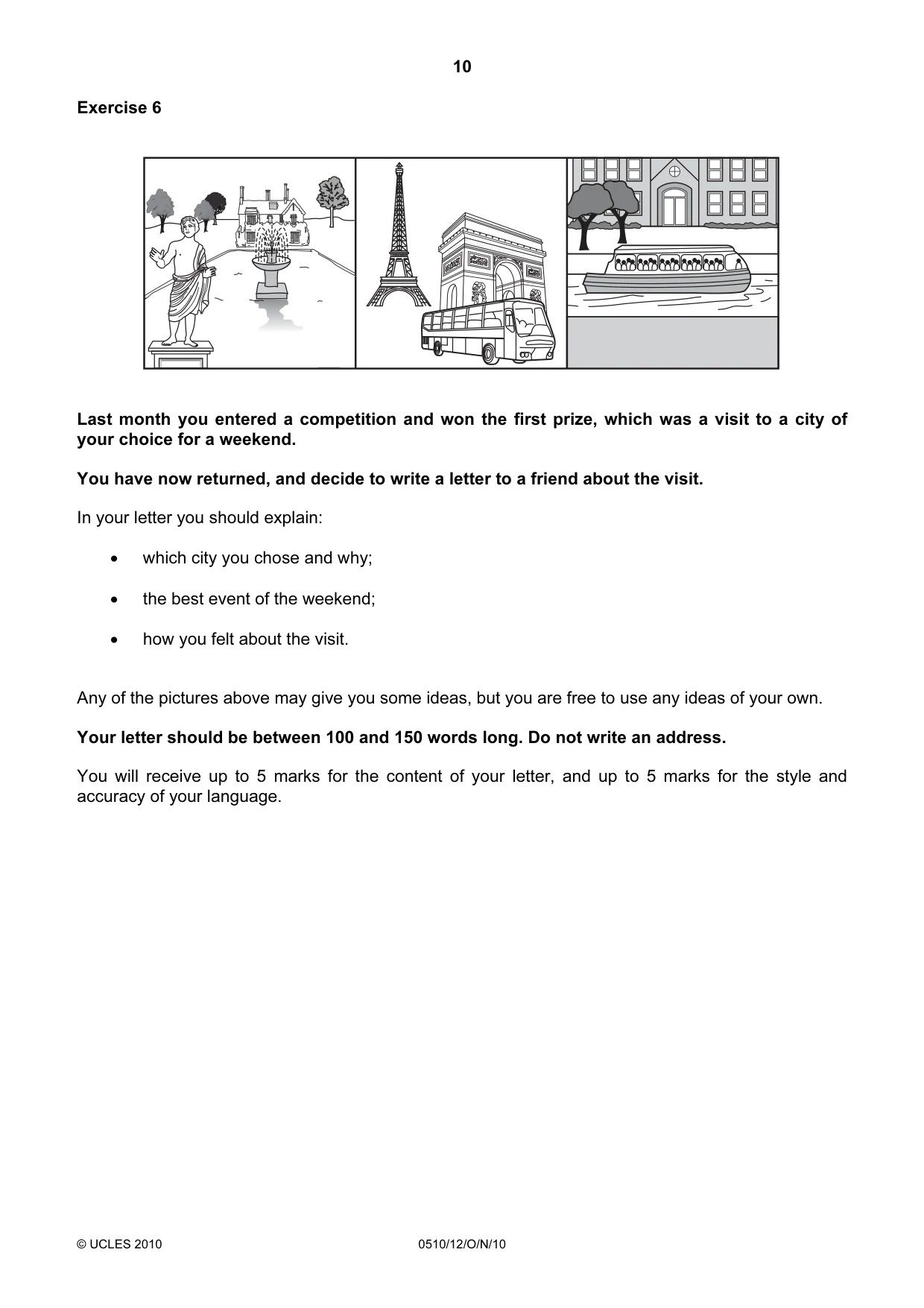
10 © UCLES 2010 0510/12/O/N/10 Exercise 6 Last month you entered a competition and won the first prize, which was a visit to a city of your choice for a weekend. You have now returned, and decide to write a letter to a friend about the visit. In your letter you should explain: • which city you chose and why; • the best event of the weekend; • how you felt about the visit. Any of the pictures above may give you some ideas, but you are free to use any ideas of your own. Your letter should be between 100 and 150 words long. Do not write an address. You will receive up to 5 marks for the content of your letter, and up to 5 marks for the style and accuracy of your language.
Question paper, page 11
11 © UCLES 2010 0510/12/O/N/10 [Turn over For Examiner's Use [Total: 10]
Question paper, page 12
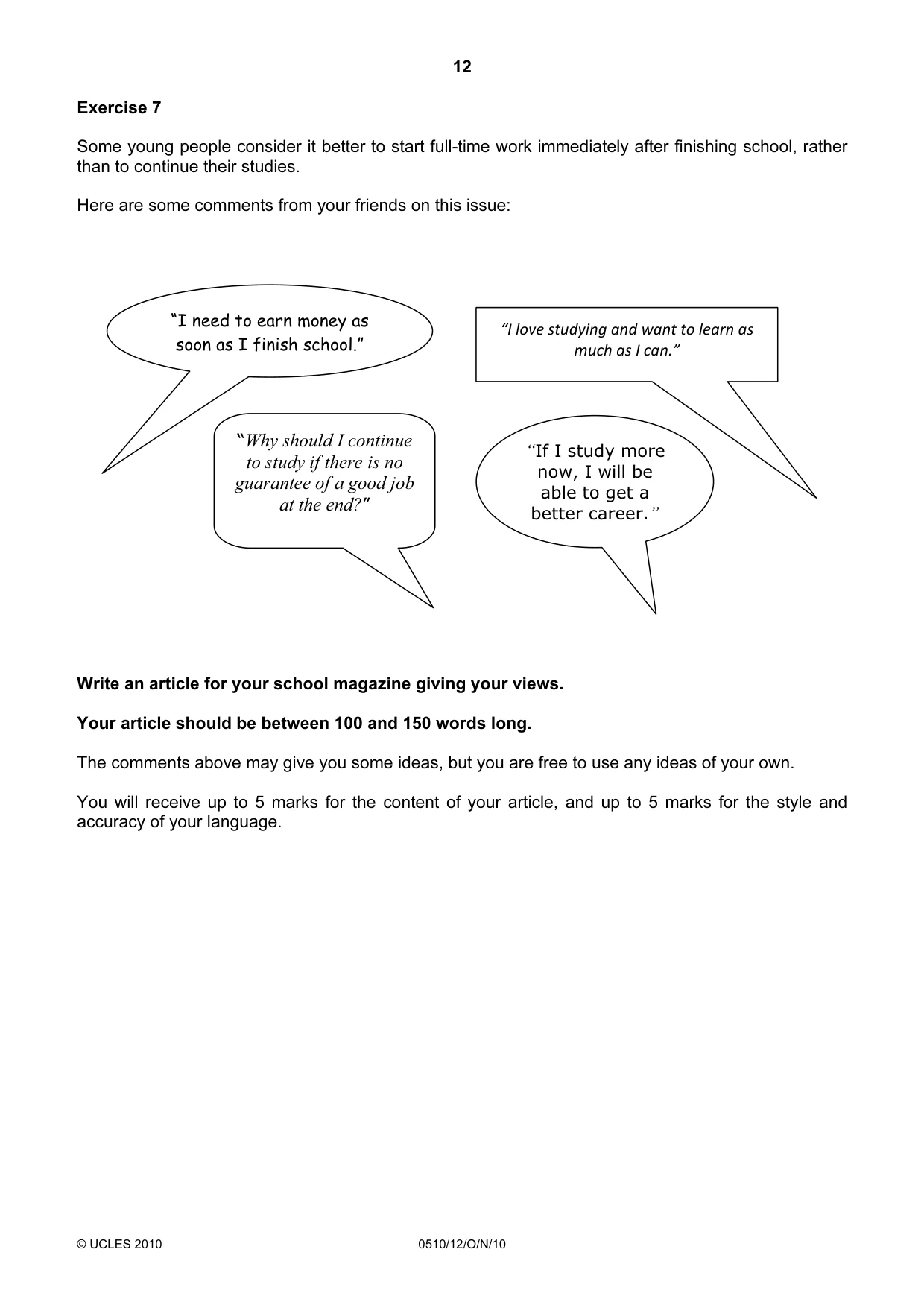
12 © UCLES 2010 0510/12/O/N/10 Exercise 7 Some young people consider it better to start full-time work immediately after finishing school, rather than to continue their studies. Here are some comments from your friends on this issue: Write an article for your school magazine giving your views. Your article should be between 100 and 150 words long. The comments above may give you some ideas, but you are free to use any ideas of your own. You will receive up to 5 marks for the content of your article, and up to 5 marks for the style and accuracy of your language. “I need to earn money as soon as I finish school.” “I love studying and want to learn as much as I can.” “If I study more now, I will be able to get a better career.” “Why should I continue to study if there is no guarantee of a good job at the end?”
Question paper, page 13
13 © UCLES 2010 0510/12/O/N/10 For Examiner's Use [Total: 10]
Question paper, page 14
14 © UCLES 2010 0510/12/O/N/10 BLANK PAGE
Question paper, page 15
15 © UCLES 2010 0510/12/O/N/10 BLANK PAGE
Question paper, page 16
16 Permission to reproduce items where third-party owned material protected by copyright is included has been sought and cleared where possible. Every reasonable effort has been made by the publisher (UCLES) to trace copyright holders, but if any items requiring clearance have unwittingly been included, the publisher will be pleased to make amends at the earliest possible opportunity. University of Cambridge International Examinations is part of the Cambridge Assessment Group. Cambridge Assessment is the brand name of University of Cambridge Local Examinations Syndicate (UCLES), which is itself a department of the University of Cambridge. © UCLES 2010 0510/12/O/N/10 BLANK PAGE
Mark scheme, page 1
UNIVERSITY OF CAMBRIDGE INTERNATIONAL EXAMINATIONS International General Certificate of Secondary Education MARK SCHEME for the October/November 2010 question paper for the guidance of teachers 0510 ENGLISH AS A SECOND LANGUAGE 0510/12 Paper 1 (Reading and Writing – Core), maximum raw mark 56 This mark scheme is published as an aid to teachers and candidates, to indicate the requirements of the examination. It shows the basis on which Examiners were instructed to award marks. It does not indicate the details of the discussions that took place at an Examiners’ meeting before marking began, which would have considered the acceptability of alternative answers. Mark schemes must be read in conjunction with the question papers and the report on the examination. • CIE will not enter into discussions or correspondence in connection with these mark schemes. CIE is publishing the mark schemes for the October/November 2010 question papers for most IGCSE, GCE Advanced Level and Advanced Subsidiary Level syllabuses and some Ordinary Level syllabuses.
Mark scheme, page 2
Page 2 Mark Scheme: Teachers’ version Syllabus Paper IGCSE – October/November 2010 0510 12 © UCLES 2010 Exercise 1 The Great Barrier Reef (a) 60 kilometres off eastern coast of Australia [1] do not accept ‘cost’ for ‘coast’ (b) meals AND talks from marine experts (both points needed for 1 mark) [1] tolerate any mention of snorkelling or scuba diving equipment if both required points are present (c) glass bottom boat(s) [1] (d) (plenty of) sunlight [1] tolerate mention of ‘grows near the surface’ if required point is present (e) not a strong swimmer / the water is shallow / float on (sparkling blue) sea / look down on (orange and white striped) clownfish (any one for 1 mark) [1] (f) close(r) to the reef (offer) full range of activities / full range of entertainment [1] do not credit ‘accommodation’ as an answer but tolerate as additional unnecessary information [Total: 6]
Mark scheme, page 3
Page 3 Mark Scheme: Teachers’ version Syllabus Paper IGCSE – October/November 2010 0510 12 © UCLES 2010 Exercise 2 The nest hunters of Tam Yai (a) it hardens (quickly) [1] (b) can be sold for thousands of dollars / because of their value / are sold for lots of money [1] (c) China do not accept ‘Chinese’ [1] (d) (it contains a large area with) statues of Buddha(s) [1] do not accept ‘status’ or ‘statutes’ for ‘statues’ (e) hundreds of metres above the ground / dangerous bamboo poles / they rarely use safety equipment / if they fall they will die (instantly) (Any two from four for 1 mark) [1] (f) twice as much (doubled) / half as much in 1968 / more expensive (higher) / increased [1] Example: ‘the price in 1968 was 2000, in 2008 4000 which is twice as much’ = 1 mark (g) armed guards at the entrance (strict) laws to prevent illegal hunting (strict) laws to ensure proper collecting OR laws to ensure collecting at correct time of year (Any two from three, 1 mark each detail) [2] the idea of ‘laws’ must be mentioned at least once, for example, ‘laws to prevent illegal hunting and to ensure proper collecting’ = 2 marks (h) (has a value in) prolonging life / prescribed for people suffering from skin conditions OR lung disease OR breathing problems accept general terms e.g. ‘illness’, ‘diseases’ [1] (i) the other ingredients / meat and coconut [1] [Total: 10]
Mark scheme, page 4
Page 4 Mark Scheme: Teachers’ version Syllabus Paper IGCSE – October/November 2010 0510 12 © UCLES 2010 Exercise 3 Animals and conservation: competition entry form Note: correct spelling is essential for the form-filling exercise. Upper case letters required at the start of proper nouns. The conventions of form-filling (i.e. instructions to tick, circle, delete) must be observed with total accuracy. Section A: Personal Details Ling Pan 172 Dongshan Plaza, Shenzhen, (China) 16 panlin@shenps.com 546733699 Shenzhen Public School / local bookshop (President of school) Zoological Club Section B: Competition Details CIRCLE November 2010 – January 2011 TICK painting Helen Chen Principal (Shenzhen Public School) TICK School (Local) zoo (visitors’ centre) Max. total for Sections A and B: 6 marks Section C Max. total for Section C: 4 marks Note: the sentences must be written from the point of view of Ling Pan. Sentence 1: it is expected the candidate will write a sentence about the fact that many animals are becoming extinct. Sentence 2: it is expected the candidate will write a sentence about donating money to a project for the protection of wild cats. For each sentence, award up to 2 marks as follows: 2 marks: proper sentence construction; correct spelling, punctuation and grammar; gives the information asked for 1 mark: proper sentence construction; 1–3 errors of punctuation / spelling / grammar (without obscuring meaning); gives the information asked for 0 marks: more than 3 errors of punctuation / spelling / grammar; and / or does not give the information asked for; and / or not a proper sentence; and / or meaning obscure Absence of a full stop at the end should be considered as 1 punctuation error. Absence of an upper case letter at the beginning should be considered as 1 punctuation error. [Total: 10]
Mark scheme, page 5
Page 5 Mark Scheme: Teachers’ version Syllabus Paper IGCSE – October/November 2010 0510 12 © UCLES 2010 Exercise 4 Multi-tasking Note: correct responses only apply if they are placed under the correct heading (as detailed below). Add the correct answers to give a total out of 6. Remember that this exercise is marked for content (reading), not language. Examples of multi-tasking activities at home (max 3 marks this heading) 1 texting (friends) / reading text messages 2 making toast 3 surfing on computer / internet activities (not ‘computers’ on its own) 4 conversations with family 5 updating social network sites 6 downloading (and listening to) music What was different ten years ago (max 3 marks this heading) 7 took 31 hours to do what we now do in 24 8 (old fashioned) email (systems) 9 (old fashioned) mobile phones 10 life was (much) simpler (idea of ‘life’ must be there – not ‘it was simpler’) 11 more talking face to face 12 more time spent over dinner / more time spent doing nothing Exercise 5 Multi-tasking summary This exercise is marked for language, not content, but if content is entirely irrelevant to the task, a mark of zero should be awarded. Count words and do not mark anything exceeding 70 words, as specified in the question. Candidates will not be assessed on anything they have written after this limit, but will not be penalised per se for exceeding it. 0 marks meaning obscure because of density of language errors and serious problems with expression / nothing of relevance 1 mark expression weak / reliance on lifting from the passage 2 marks expression limited / reliance on copying out the notes, but some sense of order 3 marks expression good, with attempts to group and sequence ideas in own words 4 marks expression very good: clear, orderly grouping and sequencing, largely own words [Total: 4]
Mark scheme, page 6
Page 6 Mark Scheme: Teachers’ version Syllabus Paper IGCSE – October/November 2010 0510 12 © UCLES 2010 Exercise 6 Visit to city Tolerate any interpretation of a ‘city’ but time span should be comparable to the length of a weekend. If the candidate clearly writes about a longer period then for content it would be ‘partly relevant’ and ‘some engagement with the task.’ Exercise 7 Full-time work For a ‘satisfactory attempt to address the topic’ (band 4 / 5) candidates need to engage with the idea of full-time work. The following general instructions, and table of marking criteria, apply to both exercises. • Content covers relevance (i.e. whether the piece fulfils the task and the awareness of purpose / audience / register) and the development of ideas (i.e. the detail / explanation provided and how enjoyable it is to read). • Language covers style (i.e. complexity of vocabulary and sentence structure) and accuracy (of grammar, spelling, punctuation and use of paragraphs). • When deciding on a mark for content or language, first of all decide which mark band is most appropriate. There will not necessarily be an exact fit. Then decide between 2 marks within that mark band. Use the lower mark if it only just makes it into the band and the upper mark if it fulfils all the requirements of the band but doesn’t quite make it into the band above. • When deciding on a mark for content, look at both relevance and development of ideas. First ask yourself whether the writing fulfils the task, in terms of points to be covered and the length. If it does, it will be in the 4–5 mark band. • When deciding on a mark for language, look at both the style and the accuracy of the language. A useful starting point would be first to determine whether errors intrude. If they do not, it will be in the 4–5 mark band. • The use of paragraphs should not be the primary basis of deciding which mark band the work is in. Look first at the language used and once you have decided on the appropriate mark band, you can use the paragraphing as a factor in helping you to decide whether the work warrants the upper or lower mark in the mark band. • If the essay is considerably shorter than the stated word length, it is unlikely to gain a high mark for content. • If the essay is totally irrelevant and has nothing to do with the question asked, it should be given 0 marks for Content and Language, even if it is enjoyable to read and fluent. • If the essay is partly relevant and therefore in mark band 2–3, the full range of marks for language is available. [Total Exercise 6: 10] [Total Exercise 7: 10]
Mark scheme, page 7
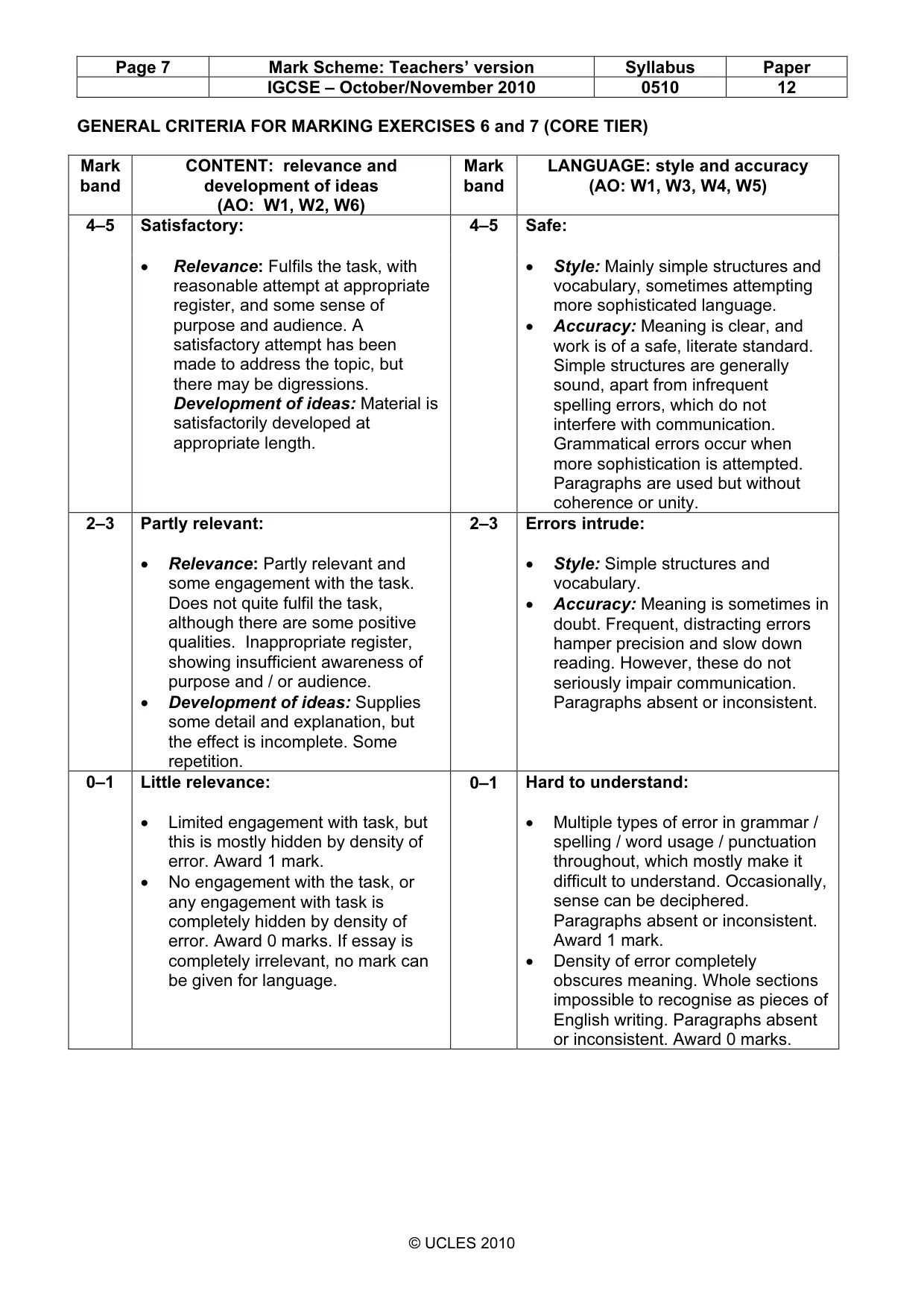
Page 7 Mark Scheme: Teachers’ version Syllabus Paper IGCSE – October/November 2010 0510 12 © UCLES 2010 GENERAL CRITERIA FOR MARKING EXERCISES 6 and 7 (CORE TIER) Mark band CONTENT: relevance and development of ideas (AO: W1, W2, W6) Mark band LANGUAGE: style and accuracy (AO: W1, W3, W4, W5) 4–5 4–5 Satisfactory: • Relevance: Fulfils the task, with reasonable attempt at appropriate register, and some sense of purpose and audience. A satisfactory attempt has been made to address the topic, but there may be digressions. Development of ideas: Material is satisfactorily developed at appropriate length. Safe: • Style: Mainly simple structures and vocabulary, sometimes attempting more sophisticated language. • Accuracy: Meaning is clear, and work is of a safe, literate standard. Simple structures are generally sound, apart from infrequent spelling errors, which do not interfere with communication. Grammatical errors occur when more sophistication is attempted. Paragraphs are used but without coherence or unity. 2–3 2–3 Partly relevant: • Relevance: Partly relevant and some engagement with the task. Does not quite fulfil the task, although there are some positive qualities. Inappropriate register, showing insufficient awareness of purpose and / or audience. • Development of ideas: Supplies some detail and explanation, but the effect is incomplete. Some repetition. Errors intrude: • Style: Simple structures and vocabulary. • Accuracy: Meaning is sometimes in doubt. Frequent, distracting errors hamper precision and slow down reading. However, these do not seriously impair communication. Paragraphs absent or inconsistent. 0–1 0–1 Little relevance: • Limited engagement with task, but this is mostly hidden by density of error. Award 1 mark. • No engagement with the task, or any engagement with task is completely hidden by density of error. Award 0 marks. If essay is completely irrelevant, no mark can be given for language. Hard to understand: • Multiple types of error in grammar / spelling / word usage / punctuation throughout, which mostly make it difficult to understand. Occasionally, sense can be deciphered. Paragraphs absent or inconsistent. Award 1 mark. • Density of error completely obscures meaning. Whole sections impossible to recognise as pieces of English writing. Paragraphs absent or inconsistent. Award 0 marks.
What you needed in this session
Cambridge’s own grade thresholds for 2010 Oct/Nov, Paper 1 · Variant 2. A higher threshold means an easier paper — the bar moves with how the cohort did.