Cambridge IGCSE English - Second Language (oral endorsement) 0510 — 2010 May/June Paper 2 · Variant 3
0510/23/M/J/10 · 84 marks · ≈95 min
The question paper and its mark scheme, free to read here and free to download. This is Cambridge’s own paper, exactly as it was sat.
Question paper16 pages




Mark scheme9 pages
Answers below. Sit the paper first if you are practising.
Paper as text
Question paper, page 1
This document consists of 15 printed pages and 1 blank page. IB10 06_0510_23/FP © UCLES 2010 [Turn over *3696625780* For Examiner's Use Exercise 1 Exercise 2 Exercise 3 Exercise 4 Exercise 5 Exercise 6 Exercise 7 Total UNIVERSITY OF CAMBRIDGE INTERNATIONAL EXAMINATIONS International General Certificate of Secondary Education ENGLISH AS A SECOND LANGUAGE 0510/23 Paper 2 Reading and Writing (Extended) May/June 2010 2 hours Candidates answer on the Question Paper. No Additional Materials are required. READ THESE INSTRUCTIONS FIRST Write your Centre number, candidate number and name on all the work you hand in. Write in dark blue or black pen. Do not use staples, paper clips, highlighters, glue or correction fluid. DO NOT WRITE IN ANY BARCODES. Answer all questions. Dictionaries are not allowed. At the end of the examination, fasten all your work securely together. The number of marks is given in brackets [ ] at the end of each question or part question. www.XtremePapers.com
Question paper, page 2
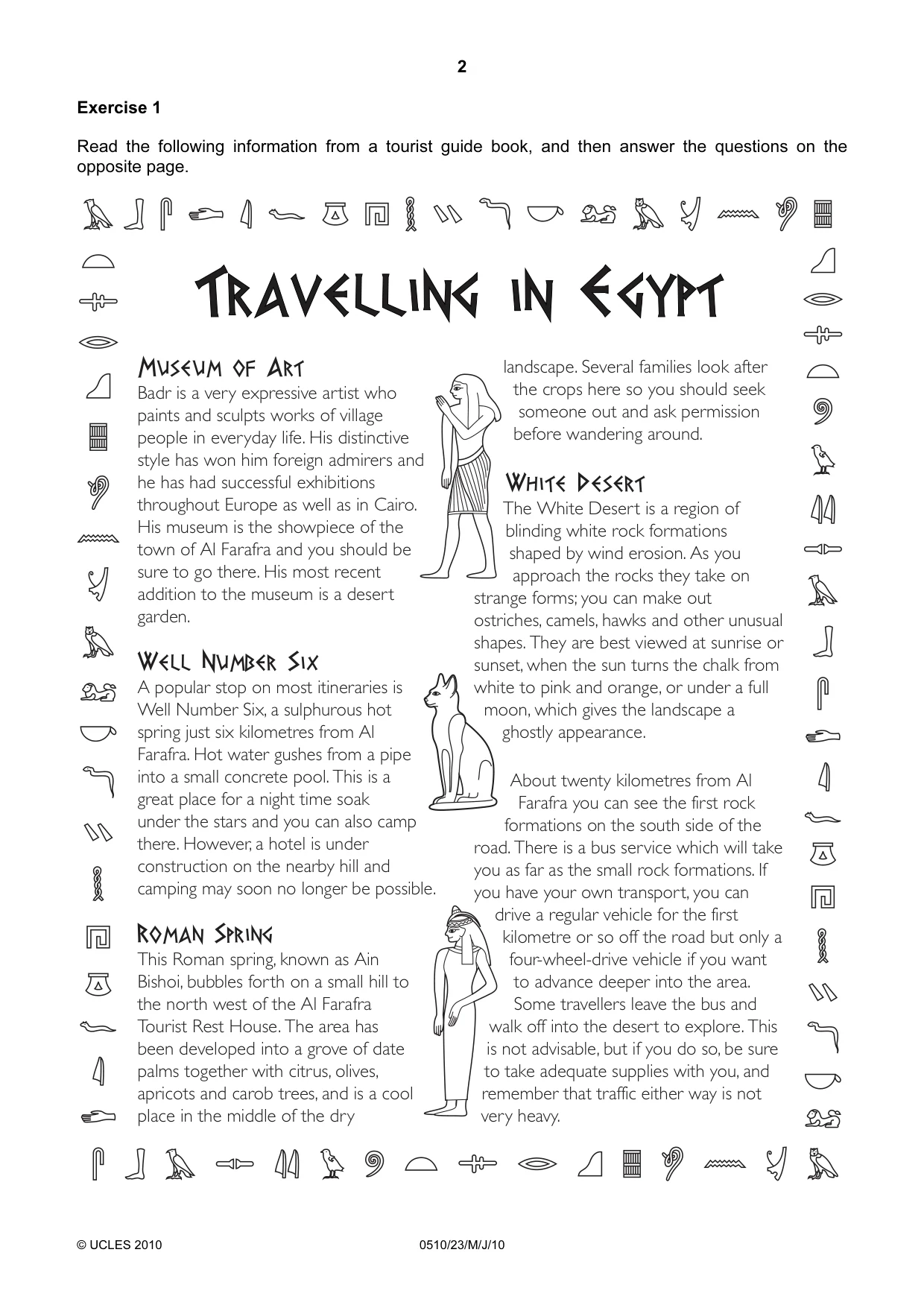
2 © UCLES 2010 0510/23/M/J/10 Exercise 1 Read the following information from a tourist guide book, and then answer the questions on the opposite page. Travelling in Egypt Travelling in Egypt Museum of Art Badr is a very expressive artist who paints and sculpts works of village people in everyday life. His distinctive style has won him foreign admirers and he has had successful exhibitions throughout Europe as well as in Cairo. His museum is the showpiece of the town of Al Farafra and you should be sure to go there. His most recent addition to the museum is a desert garden. Well Number Six A popular stop on most itineraries is Well Number Six, a sulphurous hot spring just six kilometres from Al Farafra. Hot water gushes from a pipe into a small concrete pool. This is a great place for a night time soak under the stars and you can also camp there. However, a hotel is under construction on the nearby hill and camping may soon no longer be possible. Roman Spring This Roman spring, known as Ain Bishoi, bubbles forth on a small hill to the north west of the Al Farafra Tourist Rest House. The area has been developed into a grove of date palms together with citrus, olives, apricots and carob trees, and is a cool place in the middle of the dry landscape. Several families look after the crops here so you should seek someone out and ask permission before wandering around. White Desert The White Desert is a region of blinding white rock formations shaped by wind erosion. As you approach the rocks they take on strange forms; you can make out ostriches, camels, hawks and other unusual shapes. They are best viewed at sunrise or sunset, when the sun turns the chalk from white to pink and orange, or under a full moon, which gives the landscape a ghostly appearance. About twenty kilometres from Al Farafra you can see the first rock formations on the south side of the road. There is a bus service which will take you as far as the small rock formations. If you have your own transport, you can drive a regular vehicle for the first kilometre or so off the road but only a four-wheel-drive vehicle if you want to advance deeper into the area. Some travellers leave the bus and walk off into the desert to explore. This is not advisable, but if you do so, be sure to take adequate supplies with you, and remember that traffic either way is not very heavy.
Question paper, page 3
3 © UCLES 2010 0510/23/M/J/10 [Turn over For Examiner's Use (a) What is worth visiting in the town of Al Farafra? [1] (b) What can you do at Well Number Six? Give two details. [1] (c) Why might it not be possible for travellers to camp near the hot spring in the future? [1] (d) What can be found north west of the Al Farafra Tourist Rest House? [1] (e) Why should you get permission before walking amongst the trees at Ain Bishoi? [1] (f) What is the ideal time to look at the rock formations of the White Desert? Give two details. [1] (g) What is unusual about the rock formations in the White Desert? Give two details. [1] (h) What vehicle should you travel in if you want to go deep into the White Desert? [1] [Total: 8]
Question paper, page 4
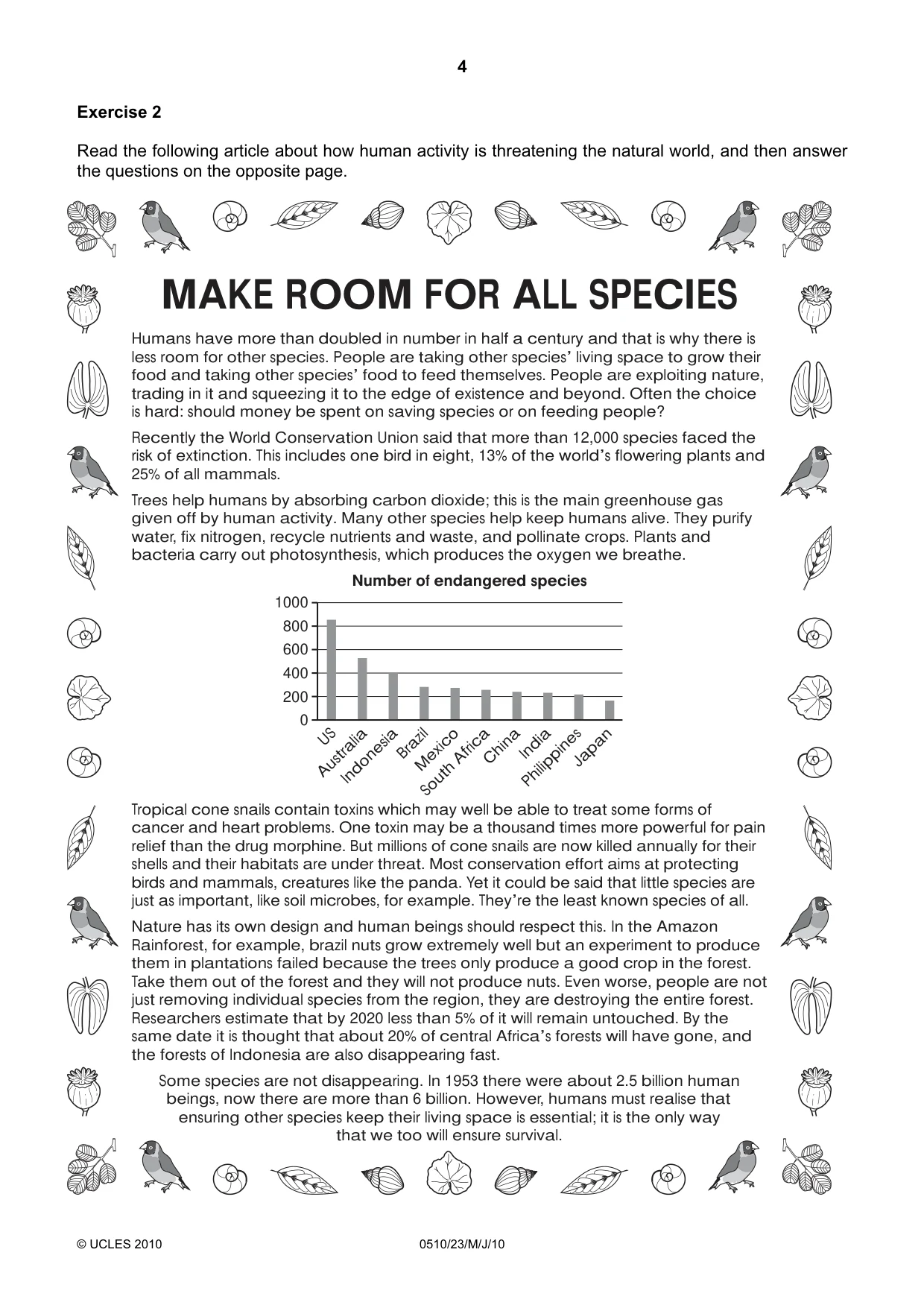
4 © UCLES 2010 0510/23/M/J/10 Exercise 2 Read the following article about how human activity is threatening the natural world, and then answer the questions on the opposite page. Humans have more than doubled in number in half a century and that is why there is less room for other species. People are taking other species’ living space to grow their food and taking other species’ food to feed themselves. People are exploiting nature, trading in it and squeezing it to the edge of existence and beyond. Often the choice is hard: should money be spent on saving species or on feeding people? Recently the World Conservation Union said that more than 12,000 species faced the risk of extinction. This includes one bird in eight, 13% of the world’s flowering plants and 25% of all mammals. Trees help humans by absorbing carbon dioxide; this is the main greenhouse gas given off by human activity. Many other species help keep humans alive. They purify water, fix nitrogen, recycle nutrients and waste, and pollinate crops. Plants and bacteria carry out photosynthesis, which produces the oxygen we breathe. Tropical cone snails contain toxins which may well be able to treat some forms of cancer and heart problems. One toxin may be a thousand times more powerful for pain relief than the drug morphine. But millions of cone snails are now killed annually for their shells and their habitats are under threat. Most conservation effort aims at protecting birds and mammals, creatures like the panda. Yet it could be said that little species are just as important, like soil microbes, for example. They’re the least known species of all. Nature has its own design and human beings should respect this. In the Amazon Rainforest, for example, brazil nuts grow extremely well but an experiment to produce them in plantations failed because the trees only produce a good crop in the forest. Take them out of the forest and they will not produce nuts. Even worse, people are not just removing individual species from the region, they are destroying the entire forest. Researchers estimate that by 2020 less than 5% of it will remain untouched. By the same date it is thought that about 20% of central Africa’s forests will have gone, and the forests of Indonesia are also disappearing fast. Some species are not disappearing. In 1953 there were about 2.5 billion human beings, now there are more than 6 billion. However, humans must realise that ensuring other species keep their living space is essential; it is the only way that we too will ensure survival. MAKE ROOM FOR ALL SPECIES US Australia Indonesia Brazil Mexico South Africa China India Philippines Japan 1000 800 600 400 200 0 Number of endangered species
Question paper, page 5
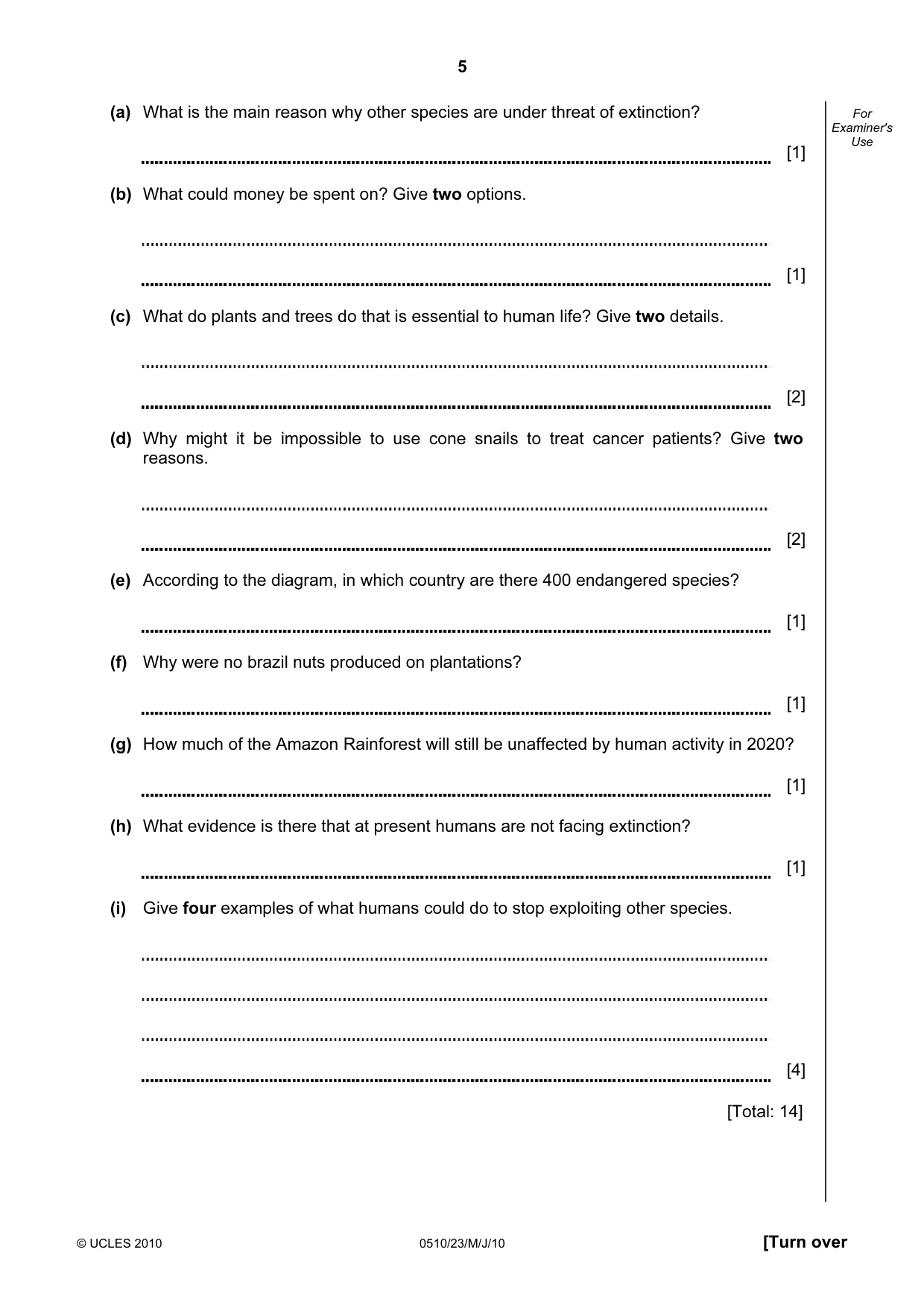
5 © UCLES 2010 0510/23/M/J/10 [Turn over For Examiner's Use (a) What is the main reason why other species are under threat of extinction? [1] (b) What could money be spent on? Give two options. [1] (c) What do plants and trees do that is essential to human life? Give two details. [2] (d) Why might it be impossible to use cone snails to treat cancer patients? Give two reasons. [2] (e) According to the diagram, in which country are there 400 endangered species? [1] (f) Why were no brazil nuts produced on plantations? [1] (g) How much of the Amazon Rainforest will still be unaffected by human activity in 2020? [1] (h) What evidence is there that at present humans are not facing extinction? [1] (i) Give four examples of what humans could do to stop exploiting other species. [Total: 14] [4]
Question paper, page 6
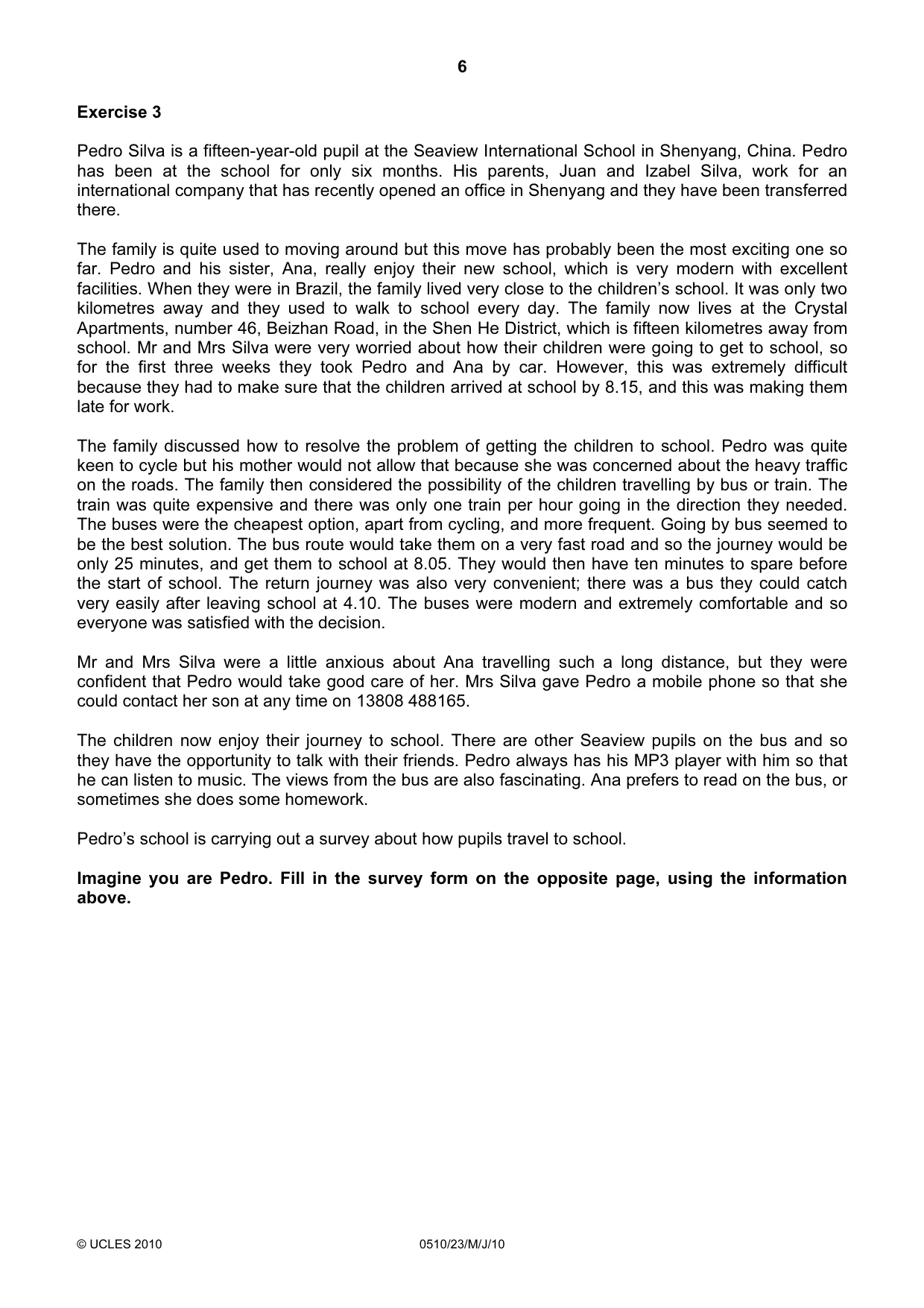
6 © UCLES 2010 0510/23/M/J/10 Exercise 3 Pedro Silva is a fifteen-year-old pupil at the Seaview International School in Shenyang, China. Pedro has been at the school for only six months. His parents, Juan and Izabel Silva, work for an international company that has recently opened an office in Shenyang and they have been transferred there. The family is quite used to moving around but this move has probably been the most exciting one so far. Pedro and his sister, Ana, really enjoy their new school, which is very modern with excellent facilities. When they were in Brazil, the family lived very close to the children’s school. It was only two kilometres away and they used to walk to school every day. The family now lives at the Crystal Apartments, number 46, Beizhan Road, in the Shen He District, which is fifteen kilometres away from school. Mr and Mrs Silva were very worried about how their children were going to get to school, so for the first three weeks they took Pedro and Ana by car. However, this was extremely difficult because they had to make sure that the children arrived at school by 8.15, and this was making them late for work. The family discussed how to resolve the problem of getting the children to school. Pedro was quite keen to cycle but his mother would not allow that because she was concerned about the heavy traffic on the roads. The family then considered the possibility of the children travelling by bus or train. The train was quite expensive and there was only one train per hour going in the direction they needed. The buses were the cheapest option, apart from cycling, and more frequent. Going by bus seemed to be the best solution. The bus route would take them on a very fast road and so the journey would be only 25 minutes, and get them to school at 8.05. They would then have ten minutes to spare before the start of school. The return journey was also very convenient; there was a bus they could catch very easily after leaving school at 4.10. The buses were modern and extremely comfortable and so everyone was satisfied with the decision. Mr and Mrs Silva were a little anxious about Ana travelling such a long distance, but they were confident that Pedro would take good care of her. Mrs Silva gave Pedro a mobile phone so that she could contact her son at any time on 13808 488165. The children now enjoy their journey to school. There are other Seaview pupils on the bus and so they have the opportunity to talk with their friends. Pedro always has his MP3 player with him so that he can listen to music. The views from the bus are also fascinating. Ana prefers to read on the bus, or sometimes she does some homework. Pedro’s school is carrying out a survey about how pupils travel to school. Imagine you are Pedro. Fill in the survey form on the opposite page, using the information above.
Question paper, page 7
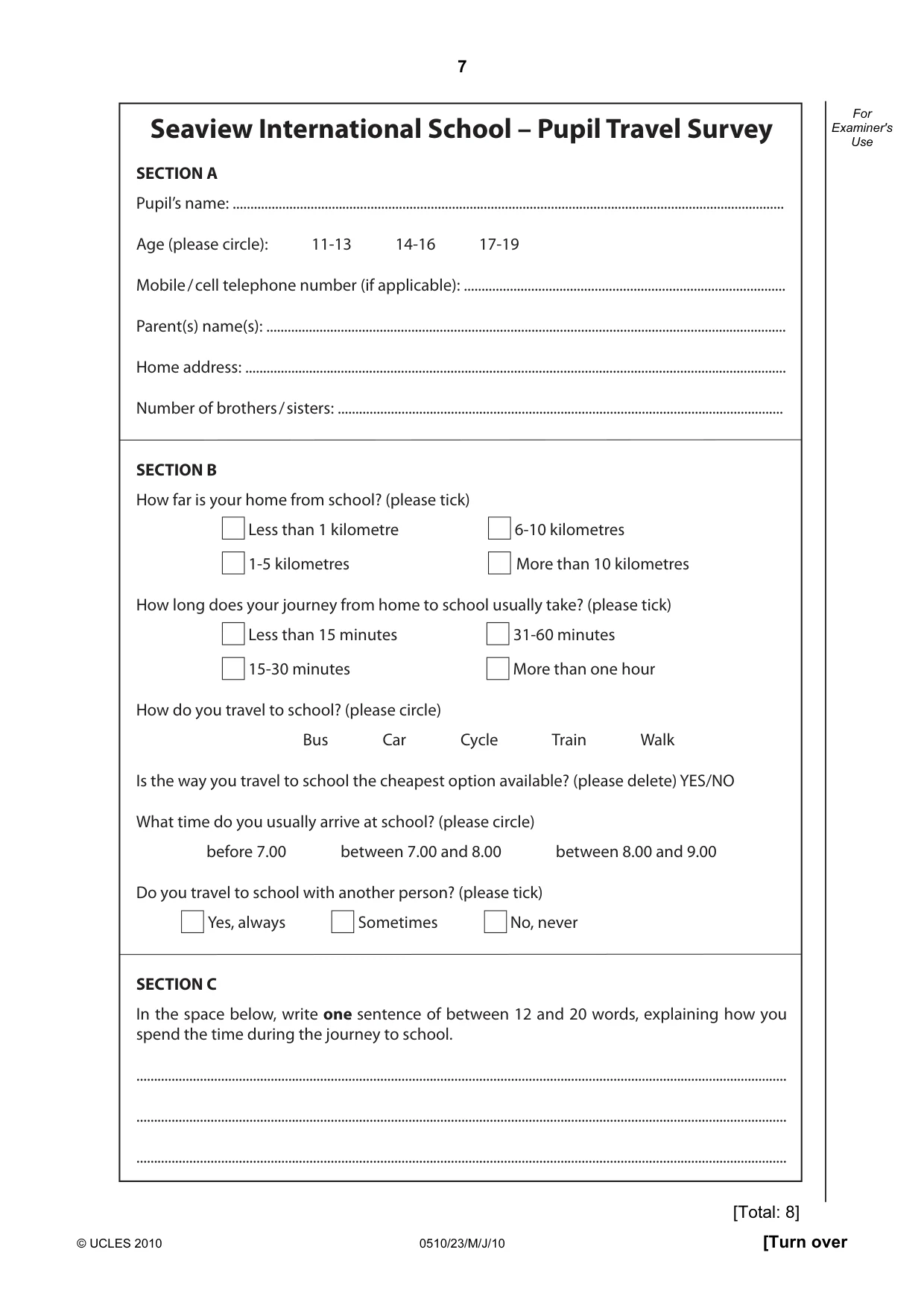
7 © UCLES 2010 0510/23/M/J/10 [Turn over For Examiner's Use Seaview International School – Pupil Travel Survey SECTION A Pupil’s name: … Age (please circle): 11-13 14-16 17-19 Mobile / cell telephone number (if applicable): … Parent(s) name(s): … Home address: … Number of brothers / sisters: … SECTION B How far is your home from school? (please tick) Less than 1 kilometre 6-10 kilometres 1-5 kilometres More than 10 kilometres How long does your journey from home to school usually take? (please tick) Less than 15 minutes 31-60 minutes 15-30 minutes More than one hour How do you travel to school? (please circle) Bus Car Cycle Train Walk Is the way you travel to school the cheapest option available? (please delete) YES/NO What time do you usually arrive at school? (please circle) before 7.00 between 7.00 and 8.00 between 8.00 and 9.00 Do you travel to school with another person? (please tick) Yes, always Sometimes No, never SECTION C In the space below, write one sentence of between 12 and 20 words, explaining how you spend the time during the journey to school. … … … [Total: 8]
Question paper, page 8
8 © UCLES 2010 0510/23/M/J/10 Exercise 4 Read the following speech to parents about children and music, and then complete the notes on the opposite page. Whether it’s dancing around the living room on a rainy day or singing along to the radio, school-age children love listening to, and participating in, music. There are many good reasons why you should encourage this enthusiasm. Research has shown that children who are actively involved in music (who play it or sing it regularly) benefit in many ways. They appear to do better in reading and are more likely to do better in maths and science because music helps build reasoning skills and cognitive development. One study demonstrated that students who were given keyboard training while also using maths software scored higher on maths and fractions tests than students who used the software alone. There is even evidence that children who are involved in music are more likely to go to college. But don’t let the research cloud perhaps the best reason to encourage a love of music. It’s just plain fun. There are few things that children (and many adults) enjoy more than singing, dancing, and listening to music. Listening to a wide variety of music improves a child’s ability to analyse and comprehend it. The early years of primary education are the perfect time to expose your child to everything from classical music to pop. Most very young children are open to experiencing a wide range of musical styles; at eight years old children start to prefer popular music. Studies have also shown that children aged nine and above prefer music with a faster tempo – so get ready to rock and roll if your child is approaching that age. Fill your child’s life with as much music as you can. If you are able to you could put a small stereo with a collection of CDs in your child’s room. Giving your child a musical alarm clock or clock radio can help your child wake up musically. It is always fun to introduce your child to songs from your own childhood or music you particularly love. Cook to music, clean to music, and occasionally take time just to sit and listen as an activity. You may be wondering if your music-loving child is ready for lessons. Most children are ready for formal music instruction between ages 5 and 7. The piano is a logical place to start. Children who learn keyboard skills also learn the fundamental musical concepts needed for other instruments or even for vocal music. String instruments are another good place to begin. Brass or wind instruments, on the other hand, can be more physically challenging and may not be appropriate until they are older. If you dreaded piano lessons when you were growing up, then your child might just feel the same. Likewise, if you force musical training, your child probably won’t embrace it. But if your child expresses an interest in learning to play an instrument and seems consistently and genuinely enthusiastic, consider signing him or her up. Music is part of us all. In fact, researchers now think it may come before language in human development. Whether your child becomes a concert pianist or simply enjoys singing in the shower, when you encourage the love of music, you are giving a gift that will last a lifetime.
Question paper, page 9
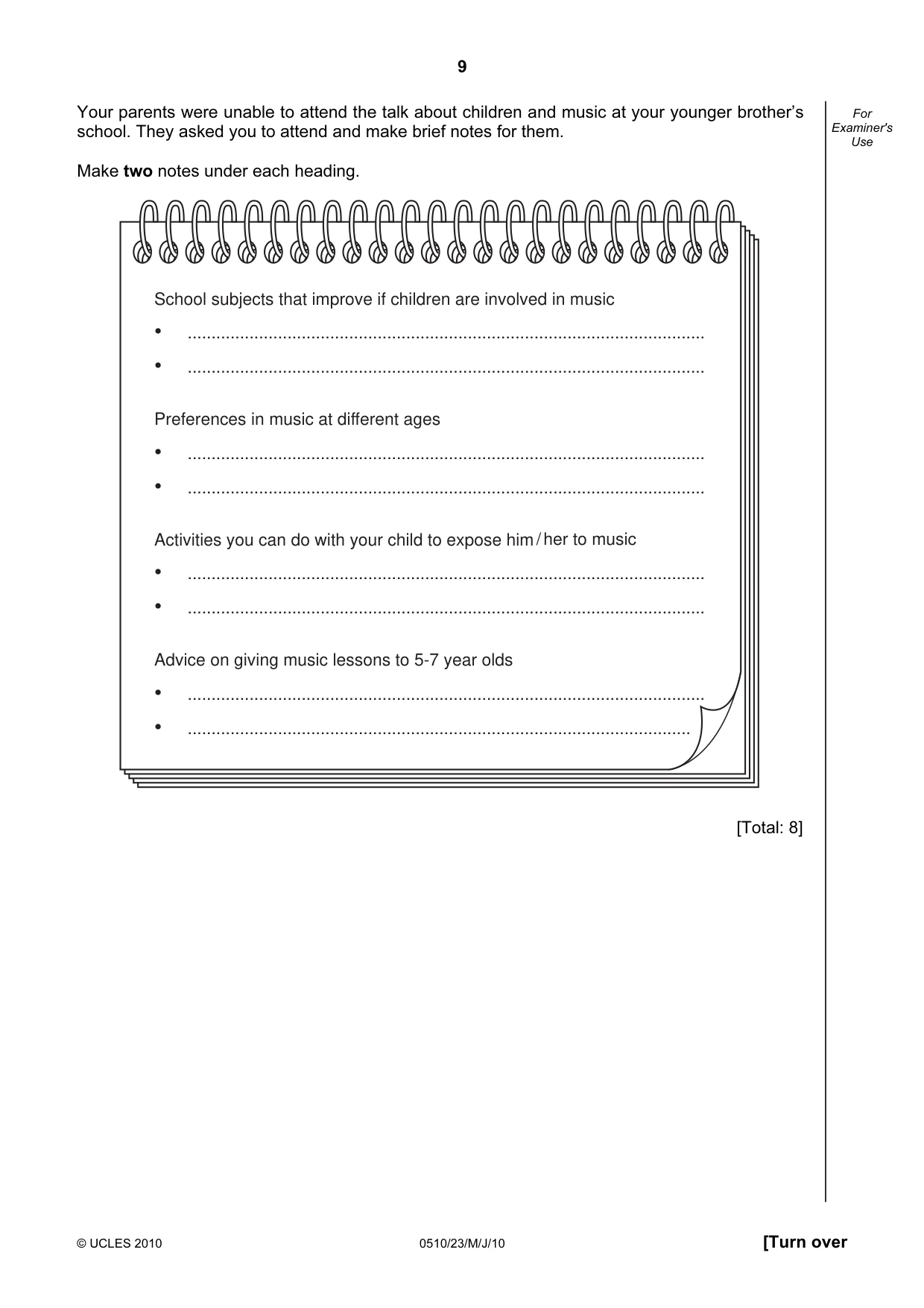
9 © UCLES 2010 0510/23/M/J/10 [Turn over For Examiner's Use Your parents were unable to attend the talk about children and music at your younger brother’s school. They asked you to attend and make brief notes for them. Make two notes under each heading. School subjects that improve if children are involved in music • … • … Preferences in music at different ages • … • … Activities you can do with your child to expose him / her to music • … • … Advice on giving music lessons to 5-7 year olds • … • … [Total: 8]
Question paper, page 10
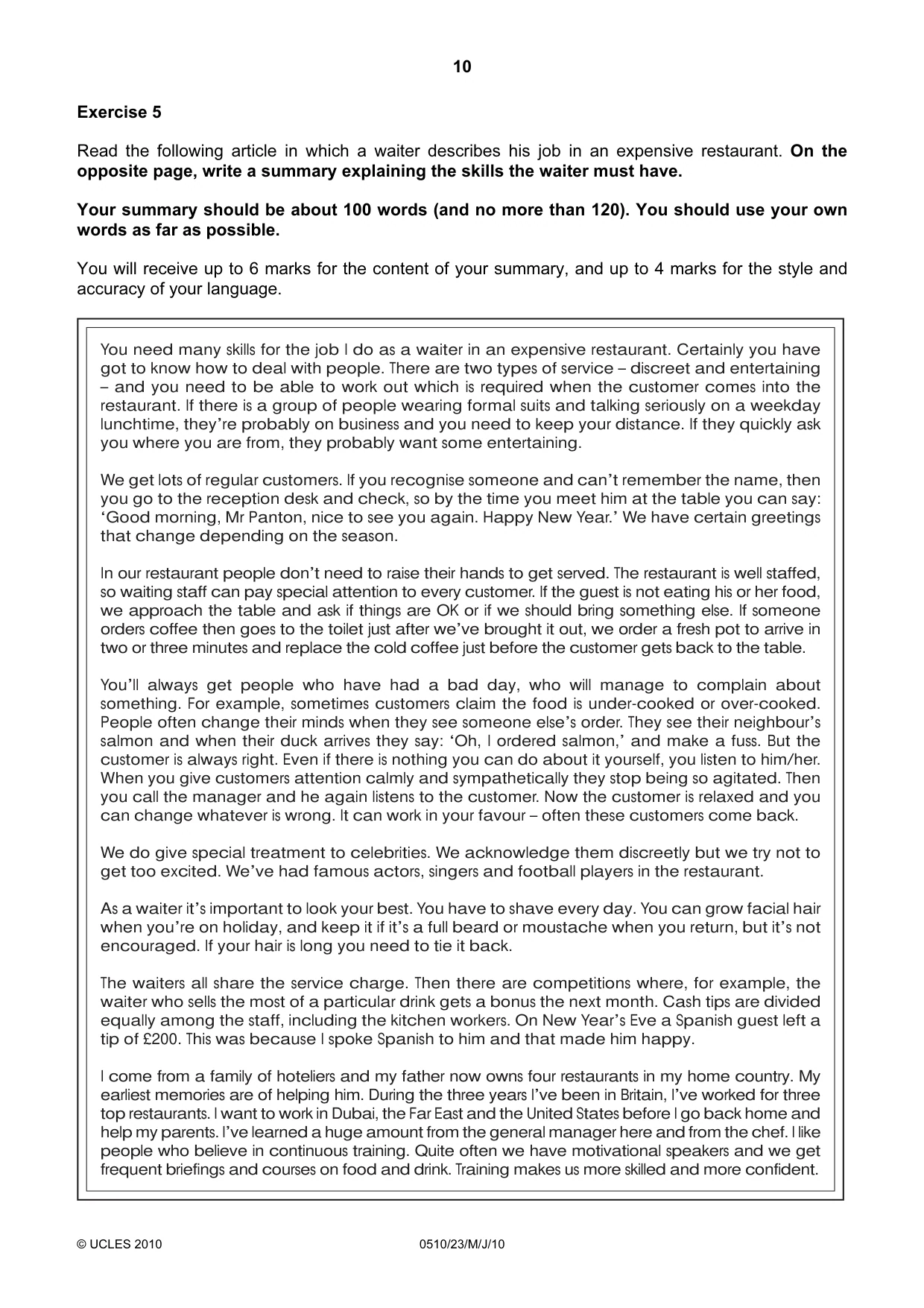
10 © UCLES 2010 0510/23/M/J/10 Exercise 5 Read the following article in which a waiter describes his job in an expensive restaurant. On the opposite page, write a summary explaining the skills the waiter must have. Your summary should be about 100 words (and no more than 120). You should use your own words as far as possible. You will receive up to 6 marks for the content of your summary, and up to 4 marks for the style and accuracy of your language. You need many skills for the job I do as a waiter in an expensive restaurant. Certainly you have got to know how to deal with people. There are two types of service – discreet and entertaining – and you need to be able to work out which is required when the customer comes into the restaurant. If there is a group of people wearing formal suits and talking seriously on a weekday lunchtime, they’re probably on business and you need to keep your distance. If they quickly ask you where you are from, they probably want some entertaining. We get lots of regular customers. If you recognise someone and can’t remember the name, then you go to the reception desk and check, so by the time you meet him at the table you can say: ‘Good morning, Mr Panton, nice to see you again. Happy New Year.’ We have certain greetings that change depending on the season. In our restaurant people don’t need to raise their hands to get served. The restaurant is well staffed, so waiting staff can pay special attention to every customer. If the guest is not eating his or her food, we approach the table and ask if things are OK or if we should bring something else. If someone orders coffee then goes to the toilet just after we’ve brought it out, we order a fresh pot to arrive in two or three minutes and replace the cold coffee just before the customer gets back to the table. You’ll always get people who have had a bad day, who will manage to complain about something. For example, sometimes customers claim the food is under-cooked or over-cooked. People often change their minds when they see someone else’s order. They see their neighbour’s salmon and when their duck arrives they say: ‘Oh, I ordered salmon,’ and make a fuss. But the customer is always right. Even if there is nothing you can do about it yourself, you listen to him/her. When you give customers attention calmly and sympathetically they stop being so agitated. Then you call the manager and he again listens to the customer. Now the customer is relaxed and you can change whatever is wrong. It can work in your favour – often these customers come back. We do give special treatment to celebrities. We acknowledge them discreetly but we try not to get too excited. We’ve had famous actors, singers and football players in the restaurant. As a waiter it’s important to look your best. You have to shave every day. You can grow facial hair when you’re on holiday, and keep it if it’s a full beard or moustache when you return, but it’s not encouraged. If your hair is long you need to tie it back. The waiters all share the service charge. Then there are competitions where, for example, the waiter who sells the most of a particular drink gets a bonus the next month. Cash tips are divided equally among the staff, including the kitchen workers. On New Year’s Eve a Spanish guest left a tip of £200. This was because I spoke Spanish to him and that made him happy. I come from a family of hoteliers and my father now owns four restaurants in my home country. My earliest memories are of helping him. During the three years I’ve been in Britain, I’ve worked for three top restaurants. I want to work in Dubai, the Far East and the United States before I go back home and help my parents. I’ve learned a huge amount from the general manager here and from the chef. I like people who believe in continuous training. Quite often we have motivational speakers and we get frequent briefings and courses on food and drink. Training makes us more skilled and more confident.
Question paper, page 11
11 © UCLES 2010 0510/23/M/J/10 [Turn over For Examiner's Use [Total: 10]
Question paper, page 12
12 © UCLES 2010 0510/23/M/J/10 Exercise 6 You have just had your birthday and a relative who lives in another country has sent you some money as a present. Write a letter thanking your relative for the present. In your letter you should: • thank your relative and describe how happy you were to receive the money; • tell your relative how you plan to spend the money; • give your relative some news about yourself. Your letter should be between 150 and 200 words long. Do not write an address. You will receive up to 9 marks for the content of your letter, and up to 9 marks for the style and accuracy of your language.
Question paper, page 13
13 © UCLES 2010 0510/23/M/J/10 [Turn over For Examiner's Use [Total: 18]
Question paper, page 14
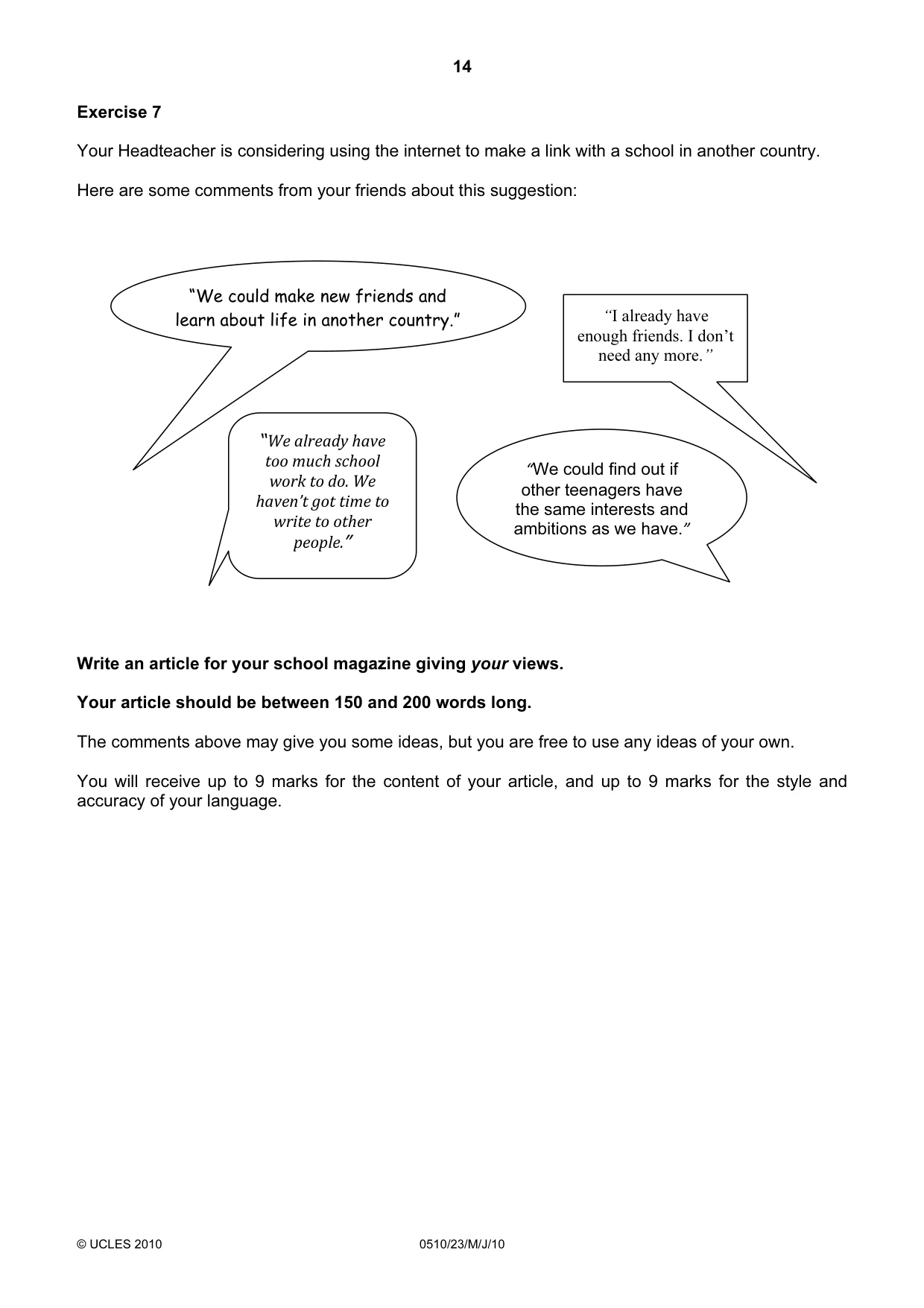
14 © UCLES 2010 0510/23/M/J/10 Exercise 7 Your Headteacher is considering using the internet to make a link with a school in another country. Here are some comments from your friends about this suggestion: Write an article for your school magazine giving your views. Your article should be between 150 and 200 words long. The comments above may give you some ideas, but you are free to use any ideas of your own. You will receive up to 9 marks for the content of your article, and up to 9 marks for the style and accuracy of your language. “We could make new friends and learn about life in another country.” “I already have enough friends. I don’t need any more.” “We could find out if other teenagers have the same interests and ambitions as we have.” “We already have too much school work to do. We haven’t got time to write to other people.”
Question paper, page 15
15 © UCLES 2010 0510/23/M/J/10 For Examiner's Use [Total: 18]
Question paper, page 16
16 Permission to reproduce items where third-party owned material protected by copyright is included has been sought and cleared where possible. Every reasonable effort has been made by the publisher (UCLES) to trace copyright holders, but if any items requiring clearance have unwittingly been included, the publisher will be pleased to make amends at the earliest possible opportunity. University of Cambridge International Examinations is part of the Cambridge Assessment Group. Cambridge Assessment is the brand name of University of Cambridge Local Examinations Syndicate (UCLES), which is itself a department of the University of Cambridge. © UCLES 2010 0510/23/M/J/10 BLANK PAGE
Mark scheme, page 1
UNIVERSITY OF CAMBRIDGE INTERNATIONAL EXAMINATIONS International General Certificate of Secondary Education MARK SCHEME for the May/June 2010 question paper for the guidance of teachers 0510 ENGLISH AS A SECOND LANGUAGE 0510/23 Paper 23 (Reading and Writing – Extended), maximum raw mark 84 This mark scheme is published as an aid to teachers and candidates, to indicate the requirements of the examination. It shows the basis on which Examiners were instructed to award marks. It does not indicate the details of the discussions that took place at an Examiners’ meeting before marking began, which would have considered the acceptability of alternative answers. Mark schemes must be read in conjunction with the question papers and the report on the examination. • CIE will not enter into discussions or correspondence in connection with these mark schemes. CIE is publishing the mark schemes for the May/June 2010 question papers for most IGCSE, GCE Advanced Level and Advanced Subsidiary Level syllabuses and some Ordinary Level syllabuses. www.XtremePapers.com
Mark scheme, page 2
Page 2 Mark Scheme: Teachers’ version Syllabus Paper IGCSE – May/June 2010 0510 23 © UCLES 2010 Exercise 1: Travelling in Egypt (a) (Badr’s) Museum (of Art)/desert garden [1] (b) soak (under the stars)/camp BOTH FOR ONE MARK [1] (c) a hotel is under construction [1] (d) a (Roman) spring/Ain Bishoi/grove of date palms [1] (e) families look after crops/trees [1] (f) sunrise/sunset/under a full moon TWO POINTS NEEDED [1] (g) strange shapes (like animals)/shaped by wind/the sun turns the chalk from white to pink/orange TWO POINTS NEEDED [1] (h) four-wheel-drive (vehicle) [1] [Total: 8] Exercise 2: Make Room for all Species (a) People are taking other species’ living space/taking other species’ food/humans have more than doubled in number [1] (b) saving species or feeding people BOTH FOR ONE MARK [1] (c) produce oxygen/photosynthesise (1) absorb carbon dioxide (1) [2] (d) snail is being killed (for shell) (1) snails’ habitat under threat (1) [2] (e) Indonesia [1] (f) trees only produce a good crop in the forest [1] (g) less than 5% [1]
Mark scheme, page 3
Page 3 Mark Scheme: Teachers’ version Syllabus Paper IGCSE – May/June 2010 0510 23 © UCLES 2010 (h) population growing/in 1953 2.5 billion humans, now 6 billion [1] (i) preserve their living space stop taking their food stop trading in them conserve/protect small/endangered species stop destroying forests respect nature [4] [Total: 14] Exercise 3: Pedro Silva Note: accurate spelling is essential for the form-filling exercise. Capital letters for proper nouns; i.e. names and places. SECTION A Pupil’s name: Pedro Silva [1] Age: Circle 14–16 [1] Mobile/cell phone number: 13808 488165 [1] Parent(s) name(s): Juan and Izabel Silva [1] Home address: Crystal Apartments, (number) 46 Beizhan Road, Shen He District (China) [1] Number of brothers/sisters: one (sister) [1] SECTION B How far is your home from school? TICK more than 10 kilometres [1] How long does your journey take? TICK 15–30 minutes [1] How do you travel to school? CIRCLE bus [1] Is the way you travel to school the cheapest option? DELETE YES [1] What time do you usually arrive at school? CIRCLE between 8.00 and 9.00 [1] Do you travel to school with another person? TICK Yes, always [1] One mark for each two correct responses – to give a total out of 6.
Mark scheme, page 4
Page 4 Mark Scheme: Teachers’ version Syllabus Paper IGCSE – May/June 2010 0510 23 © UCLES 2010 SECTION C The sentence must be written in the first person and in the present tense. In the sentence it is expected that the candidates will write a sentence that will contain the information that Pedro either listens to music on his MP3 player, talks with friends and/or looks at the view. Example sentence: I always have my MP3 (player) with me so that I can listen to music. ANY REFERENCE TO READING OR HOMEWORK ZERO For the sentence, award up to 2 marks as follows: 2 marks: no fewer than 12 and no more than 20 words; proper sentence construction; correct spelling, punctuation and grammar; relevant to context. 1 mark: no fewer that 12 and no more than 20 words; proper sentence construction; 1–3 errors of punctuation AND/OR spelling AND/OR grammar that do not obscure meaning; relevant to context. 0 marks: more than 3 errors of punctuation AND/OR spelling AND/OR grammar; AND/OR irrelevant to context; AND/OR not a proper sentence; AND/OR fewer than 12 or more than 20 words. [Total: 8]
Mark scheme, page 5
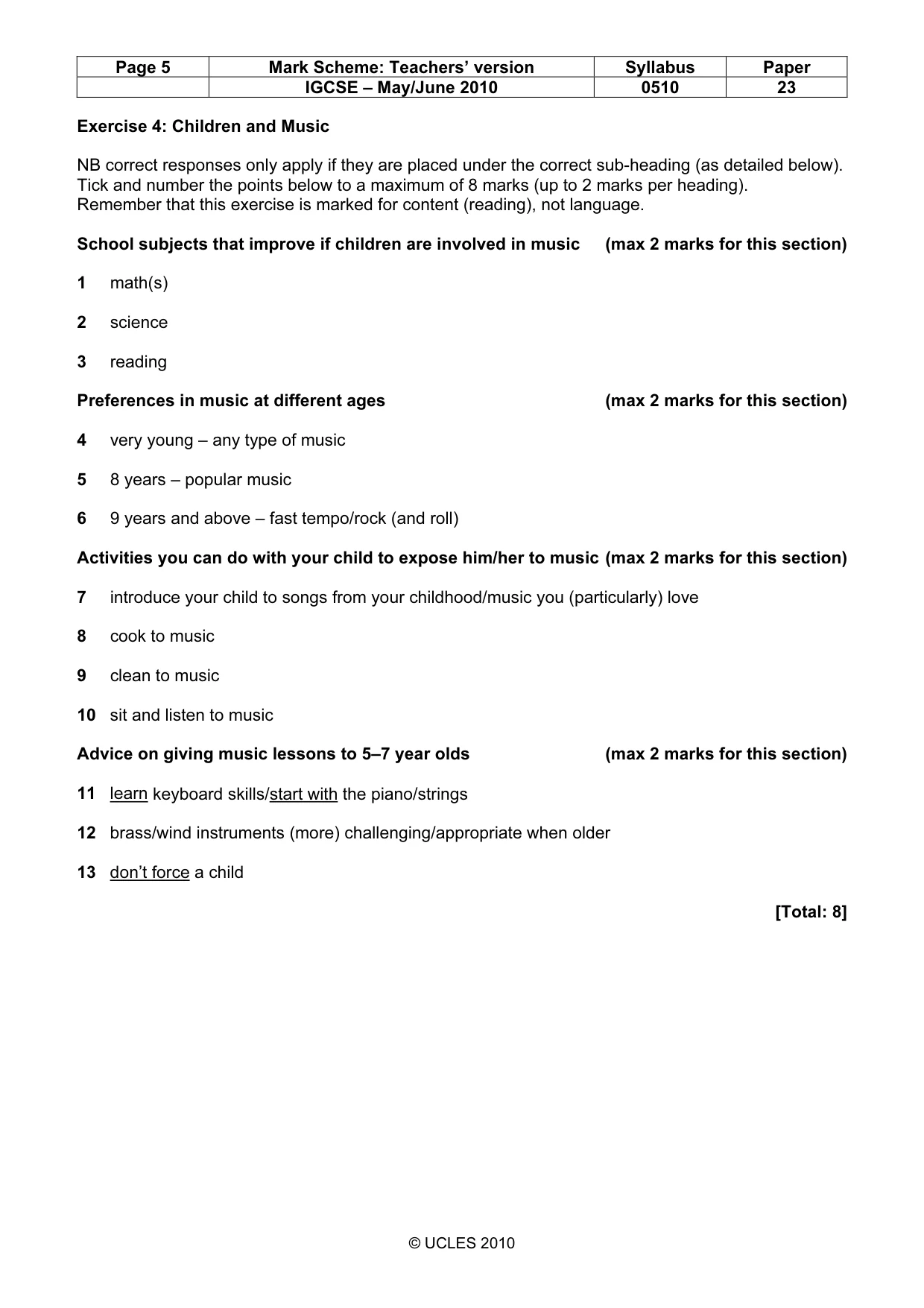
Page 5 Mark Scheme: Teachers’ version Syllabus Paper IGCSE – May/June 2010 0510 23 © UCLES 2010 Exercise 4: Children and Music NB correct responses only apply if they are placed under the correct sub-heading (as detailed below). Tick and number the points below to a maximum of 8 marks (up to 2 marks per heading). Remember that this exercise is marked for content (reading), not language. School subjects that improve if children are involved in music (max 2 marks for this section) 1 math(s) 2 science 3 reading Preferences in music at different ages (max 2 marks for this section) 4 very young – any type of music 5 8 years – popular music 6 9 years and above – fast tempo/rock (and roll) Activities you can do with your child to expose him/her to music (max 2 marks for this section) 7 introduce your child to songs from your childhood/music you (particularly) love 8 cook to music 9 clean to music 10 sit and listen to music Advice on giving music lessons to 5–7 year olds (max 2 marks for this section) 11 learn keyboard skills/start with the piano/strings 12 brass/wind instruments (more) challenging/appropriate when older 13 don’t force a child [Total: 8]
Mark scheme, page 6
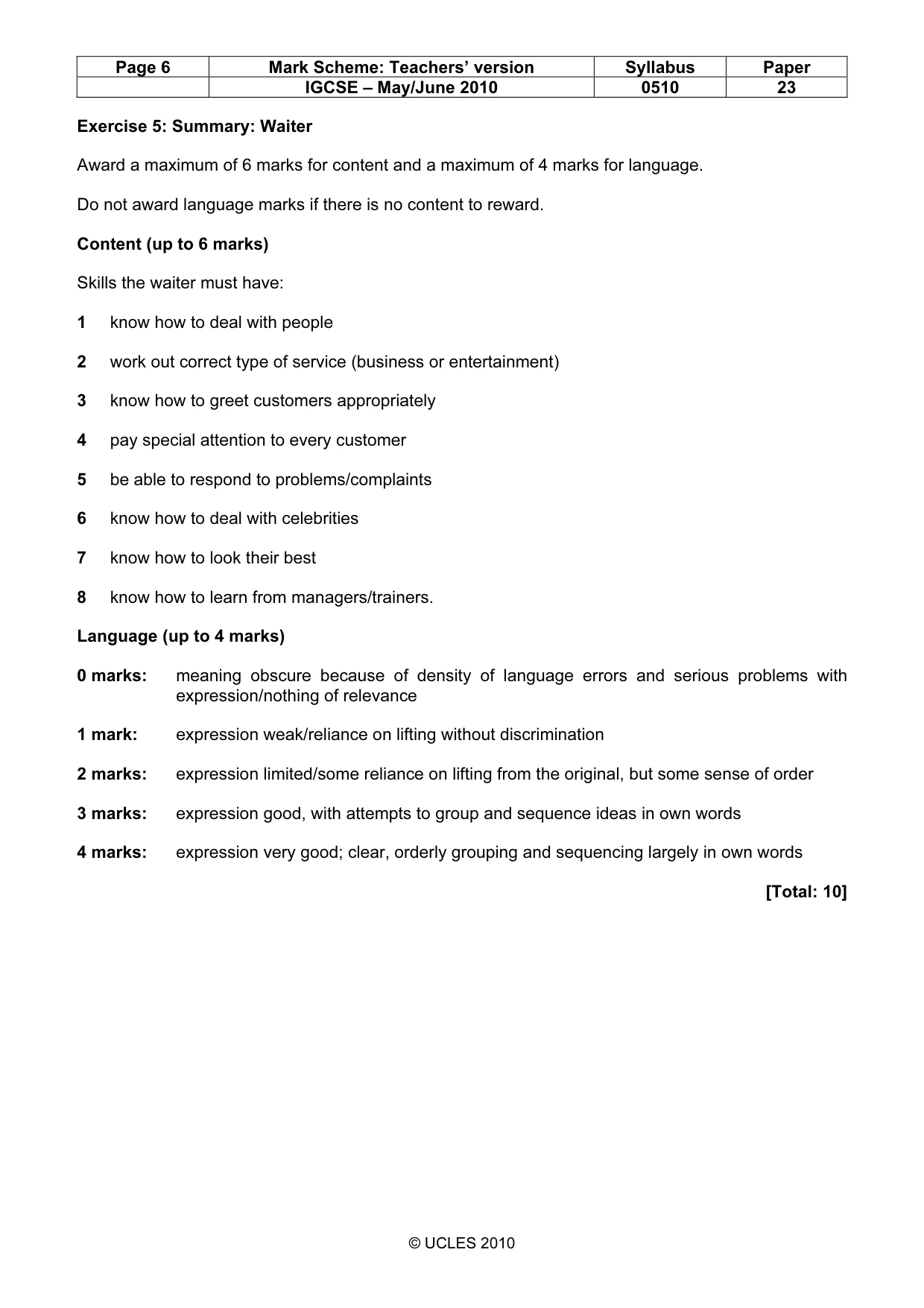
Page 6 Mark Scheme: Teachers’ version Syllabus Paper IGCSE – May/June 2010 0510 23 © UCLES 2010 Exercise 5: Summary: Waiter Award a maximum of 6 marks for content and a maximum of 4 marks for language. Do not award language marks if there is no content to reward. Content (up to 6 marks) Skills the waiter must have: 1 know how to deal with people 2 work out correct type of service (business or entertainment) 3 know how to greet customers appropriately 4 pay special attention to every customer 5 be able to respond to problems/complaints 6 know how to deal with celebrities 7 know how to look their best 8 know how to learn from managers/trainers. Language (up to 4 marks) 0 marks: meaning obscure because of density of language errors and serious problems with expression/nothing of relevance 1 mark: expression weak/reliance on lifting without discrimination 2 marks: expression limited/some reliance on lifting from the original, but some sense of order 3 marks: expression good, with attempts to group and sequence ideas in own words 4 marks: expression very good; clear, orderly grouping and sequencing largely in own words [Total: 10]
Mark scheme, page 7
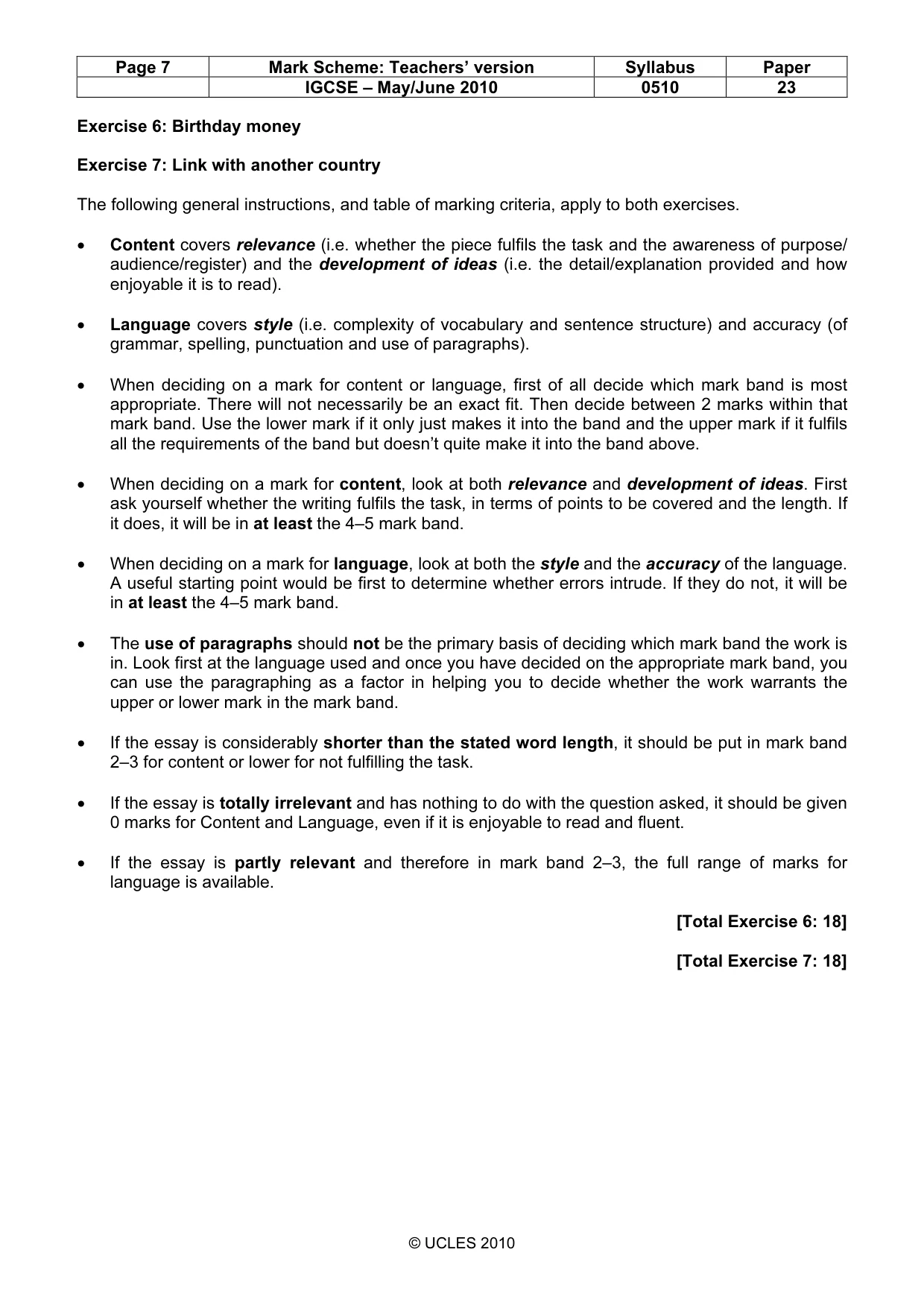
Page 7 Mark Scheme: Teachers’ version Syllabus Paper IGCSE – May/June 2010 0510 23 © UCLES 2010 Exercise 6: Birthday money Exercise 7: Link with another country The following general instructions, and table of marking criteria, apply to both exercises. • Content covers relevance (i.e. whether the piece fulfils the task and the awareness of purpose/ audience/register) and the development of ideas (i.e. the detail/explanation provided and how enjoyable it is to read). • Language covers style (i.e. complexity of vocabulary and sentence structure) and accuracy (of grammar, spelling, punctuation and use of paragraphs). • When deciding on a mark for content or language, first of all decide which mark band is most appropriate. There will not necessarily be an exact fit. Then decide between 2 marks within that mark band. Use the lower mark if it only just makes it into the band and the upper mark if it fulfils all the requirements of the band but doesn’t quite make it into the band above. • When deciding on a mark for content, look at both relevance and development of ideas. First ask yourself whether the writing fulfils the task, in terms of points to be covered and the length. If it does, it will be in at least the 4–5 mark band. • When deciding on a mark for language, look at both the style and the accuracy of the language. A useful starting point would be first to determine whether errors intrude. If they do not, it will be in at least the 4–5 mark band. • The use of paragraphs should not be the primary basis of deciding which mark band the work is in. Look first at the language used and once you have decided on the appropriate mark band, you can use the paragraphing as a factor in helping you to decide whether the work warrants the upper or lower mark in the mark band. • If the essay is considerably shorter than the stated word length, it should be put in mark band 2–3 for content or lower for not fulfilling the task. • If the essay is totally irrelevant and has nothing to do with the question asked, it should be given 0 marks for Content and Language, even if it is enjoyable to read and fluent. • If the essay is partly relevant and therefore in mark band 2–3, the full range of marks for language is available. [Total Exercise 6: 18] [Total Exercise 7: 18]
Mark scheme, page 8
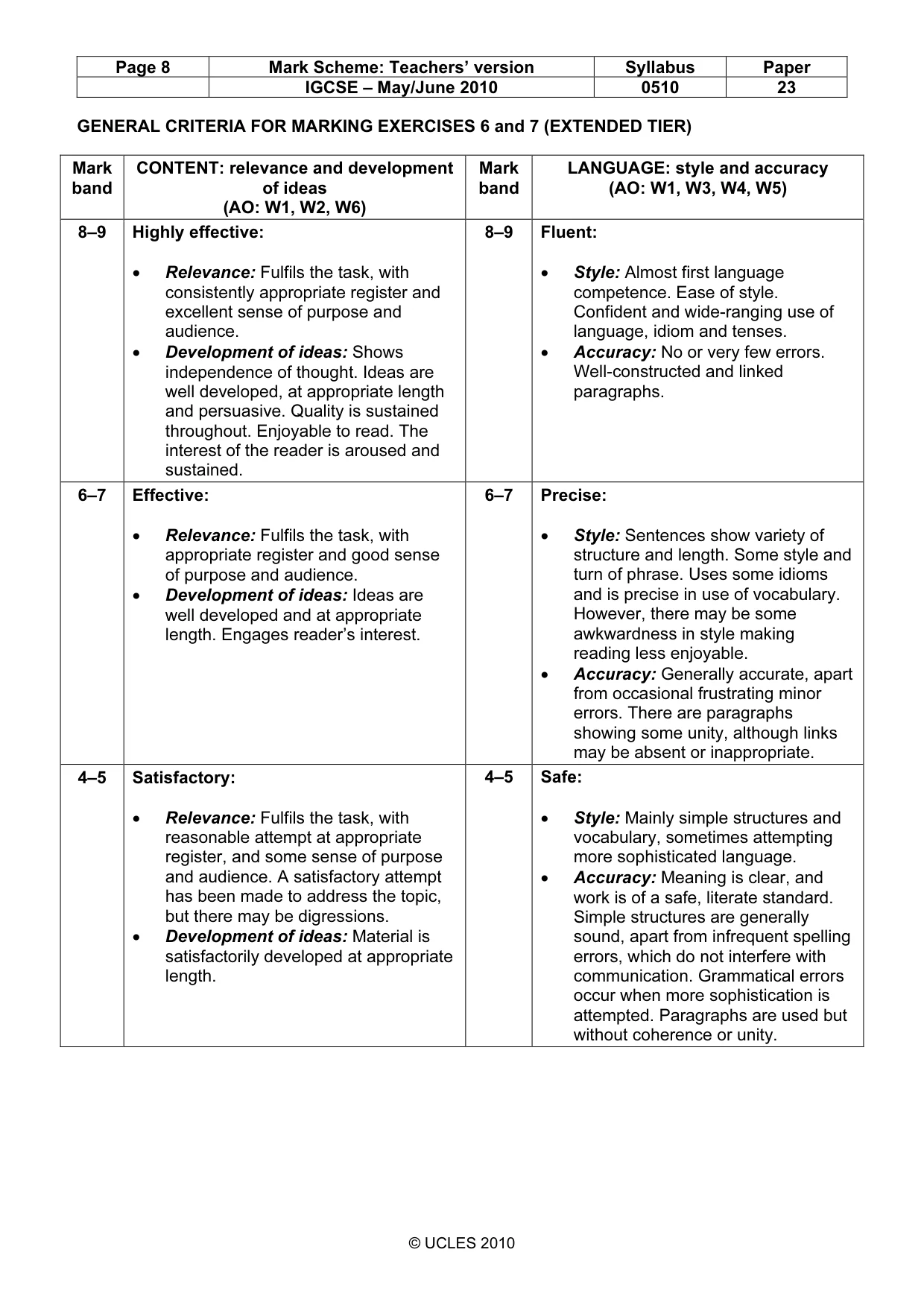
Page 8 Mark Scheme: Teachers’ version Syllabus Paper IGCSE – May/June 2010 0510 23 © UCLES 2010 GENERAL CRITERIA FOR MARKING EXERCISES 6 and 7 (EXTENDED TIER) Mark band CONTENT: relevance and development of ideas (AO: W1, W2, W6) Mark band LANGUAGE: style and accuracy (AO: W1, W3, W4, W5) 8–9 Highly effective: • Relevance: Fulfils the task, with consistently appropriate register and excellent sense of purpose and audience. • Development of ideas: Shows independence of thought. Ideas are well developed, at appropriate length and persuasive. Quality is sustained throughout. Enjoyable to read. The interest of the reader is aroused and sustained. 8–9 Fluent: • Style: Almost first language competence. Ease of style. Confident and wide-ranging use of language, idiom and tenses. • Accuracy: No or very few errors. Well-constructed and linked paragraphs. 6–7 Effective: • Relevance: Fulfils the task, with appropriate register and good sense of purpose and audience. • Development of ideas: Ideas are well developed and at appropriate length. Engages reader’s interest. 6–7 Precise: • Style: Sentences show variety of structure and length. Some style and turn of phrase. Uses some idioms and is precise in use of vocabulary. However, there may be some awkwardness in style making reading less enjoyable. • Accuracy: Generally accurate, apart from occasional frustrating minor errors. There are paragraphs showing some unity, although links may be absent or inappropriate. 4–5 Satisfactory: • Relevance: Fulfils the task, with reasonable attempt at appropriate register, and some sense of purpose and audience. A satisfactory attempt has been made to address the topic, but there may be digressions. • Development of ideas: Material is satisfactorily developed at appropriate length. 4–5 Safe: • Style: Mainly simple structures and vocabulary, sometimes attempting more sophisticated language. • Accuracy: Meaning is clear, and work is of a safe, literate standard. Simple structures are generally sound, apart from infrequent spelling errors, which do not interfere with communication. Grammatical errors occur when more sophistication is attempted. Paragraphs are used but without coherence or unity.
Mark scheme, page 9
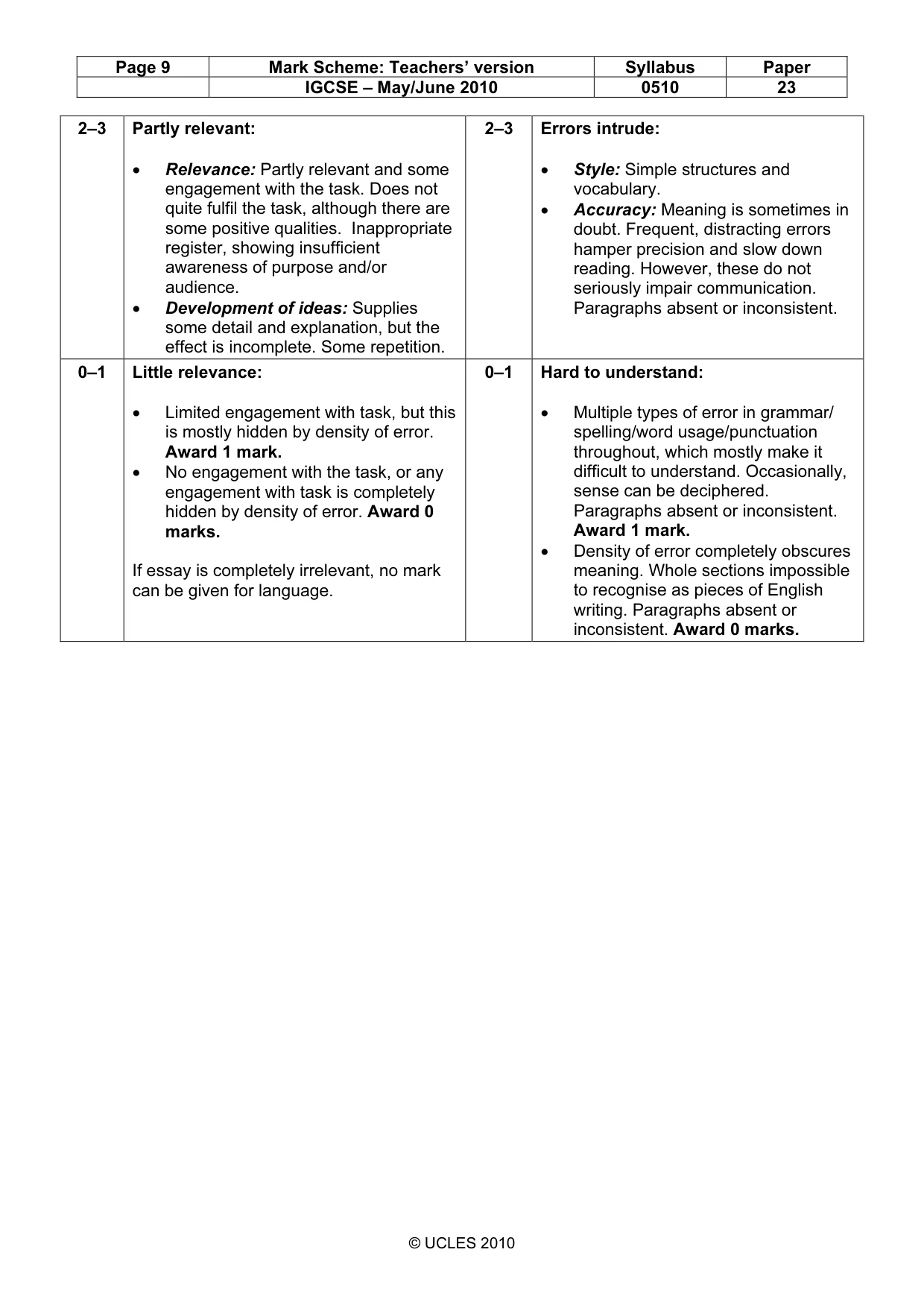
Page 9 Mark Scheme: Teachers’ version Syllabus Paper IGCSE – May/June 2010 0510 23 © UCLES 2010 2–3 Partly relevant: • Relevance: Partly relevant and some engagement with the task. Does not quite fulfil the task, although there are some positive qualities. Inappropriate register, showing insufficient awareness of purpose and/or audience. • Development of ideas: Supplies some detail and explanation, but the effect is incomplete. Some repetition. 2–3 Errors intrude: • Style: Simple structures and vocabulary. • Accuracy: Meaning is sometimes in doubt. Frequent, distracting errors hamper precision and slow down reading. However, these do not seriously impair communication. Paragraphs absent or inconsistent. 0–1 Little relevance: • Limited engagement with task, but this is mostly hidden by density of error. Award 1 mark. • No engagement with the task, or any engagement with task is completely hidden by density of error. Award 0 marks. If essay is completely irrelevant, no mark can be given for language. 0–1 Hard to understand: • Multiple types of error in grammar/ spelling/word usage/punctuation throughout, which mostly make it difficult to understand. Occasionally, sense can be deciphered. Paragraphs absent or inconsistent. Award 1 mark. • Density of error completely obscures meaning. Whole sections impossible to recognise as pieces of English writing. Paragraphs absent or inconsistent. Award 0 marks.
What you needed in this session
Cambridge’s own grade thresholds for 2010 May/June, Paper 2 · Variant 3. A higher threshold means an easier paper — the bar moves with how the cohort did.