Cambridge IGCSE English - Second Language (count-in oral) 0511 — 2025 Oct/Nov Paper 2 · Variant 2
0511/22/O/N/25 · 40 marks · ≈45 min
The question paper and its mark scheme, free to read here and free to download. This is Cambridge’s own paper, exactly as it was sat.
Question paper16 pages

Mark scheme3 pages
Answers below. Sit the paper first if you are practising.
Paper as text
Question paper, page 1
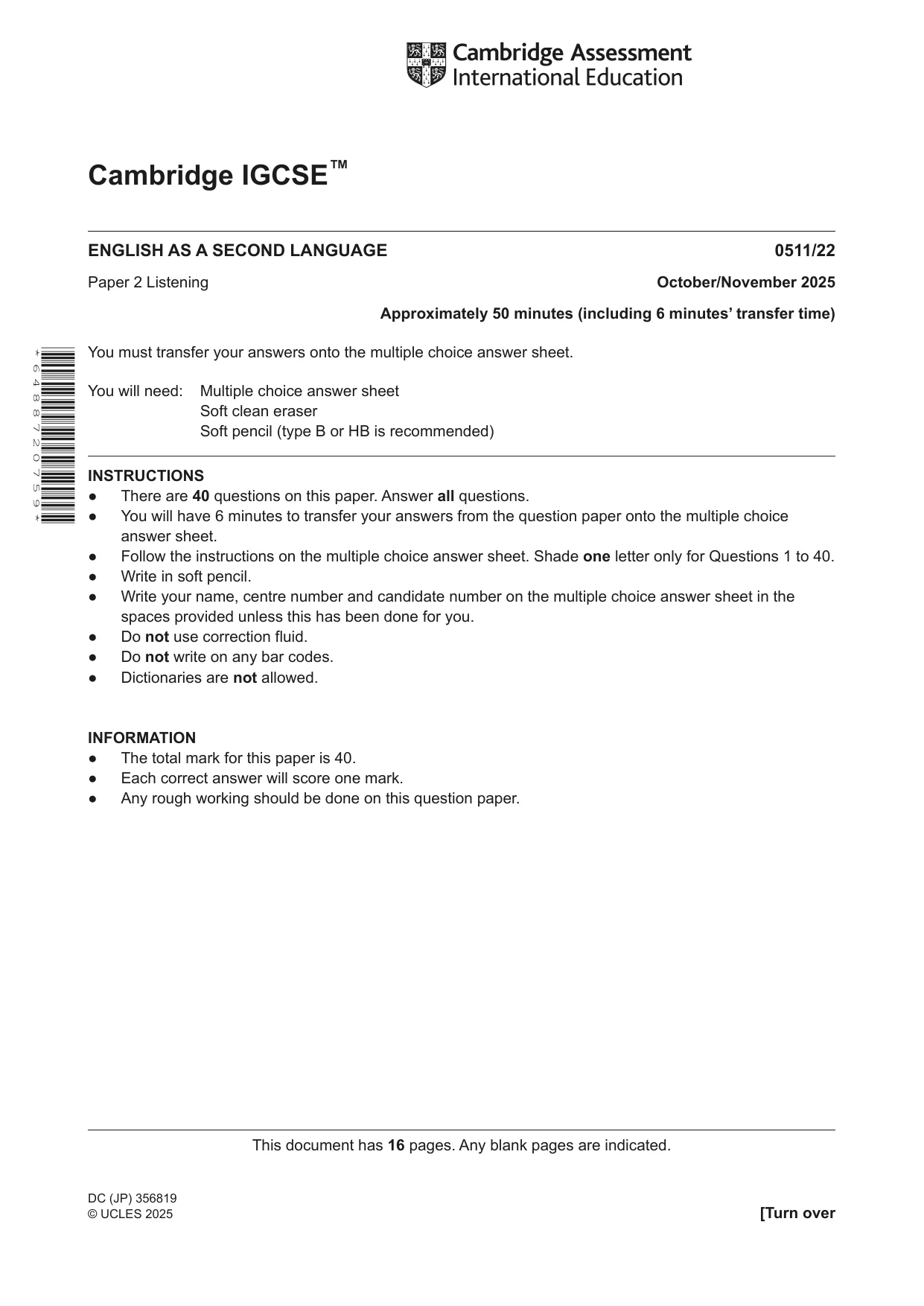
This document has 16 pages. Any blank pages are indicated. [Turn over Cambridge IGCSE™ * 6 4 8 8 7 2 0 7 5 9 * DC (JP) 356819 © UCLES 2025 ENGLISH AS A SECOND LANGUAGE 0511/22 Paper 2 Listening October/November 2025 Approximately 50 minutes (including 6 minutes’ transfer time) You must transfer your answers onto the multiple choice answer sheet. You will need: Multiple choice answer sheet Soft clean eraser Soft pencil (type B or HB is recommended) INSTRUCTIONS ● There are 40 questions on this paper. Answer all questions. ● You will have 6 minutes to transfer your answers from the question paper onto the multiple choice answer sheet. ● Follow the instructions on the multiple choice answer sheet. Shade one letter only for Questions 1 to 40. ● Write in soft pencil. ● Write your name, centre number and candidate number on the multiple choice answer sheet in the spaces provided unless this has been done for you. ● Do not use correction fluid. ● Do not write on any bar codes. ● Dictionaries are not allowed. INFORMATION ● The total mark for this paper is 40. ● Each correct answer will score one mark. ● Any rough working should be done on this question paper.
Question paper, page 2
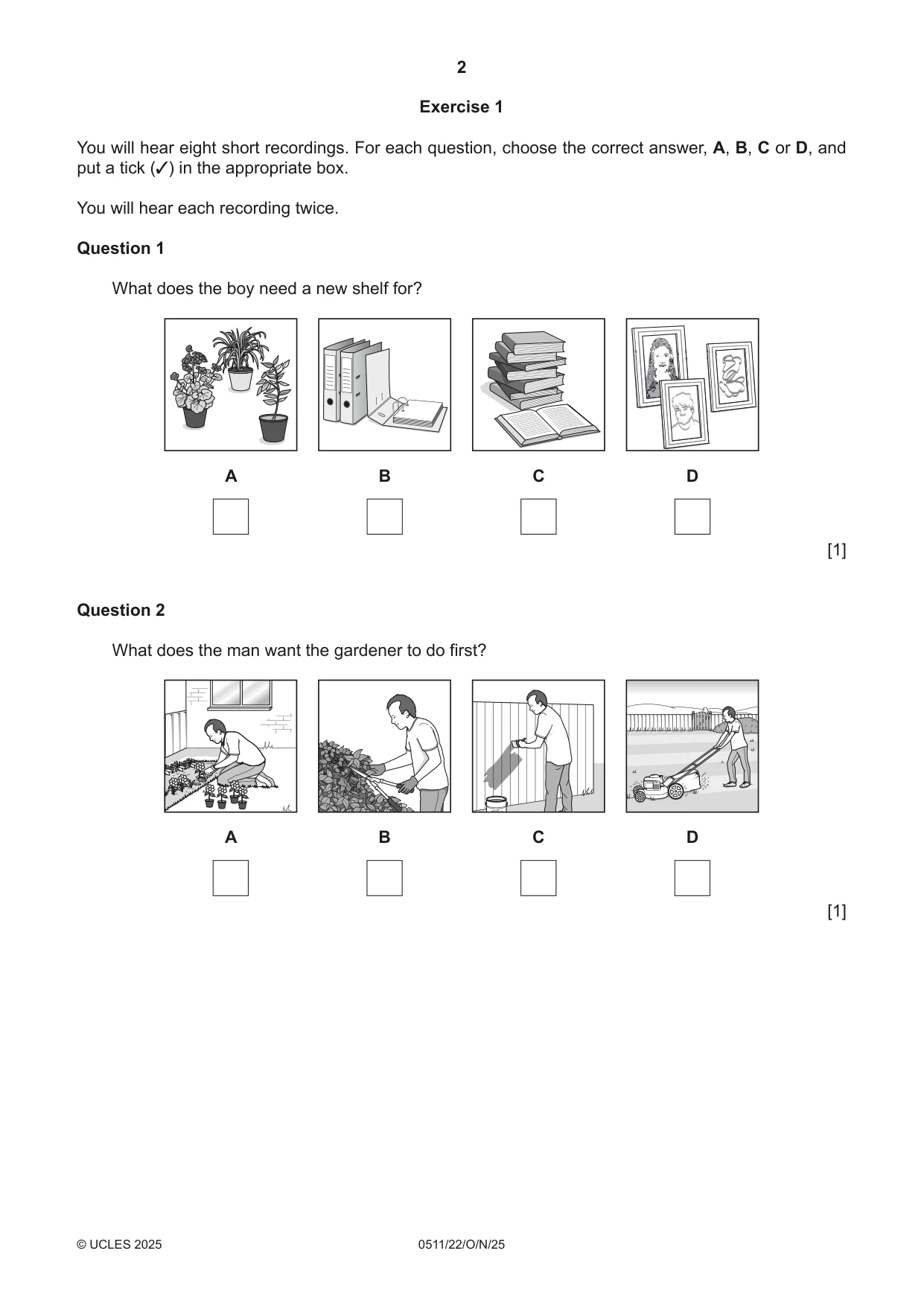
2 0511/22/ O/N/25 © UCLES 2025 Exercise 1 You will hear eight short recordings. For each question, choose the correct answer, A, B, C or D, and put a tick (✓) in the appropriate box. You will hear each recording twice. Question 1 What does the boy need a new shelf for? A B C D [1] Question 2 What does the man want the gardener to do first? A B C D [1]
Question paper, page 3
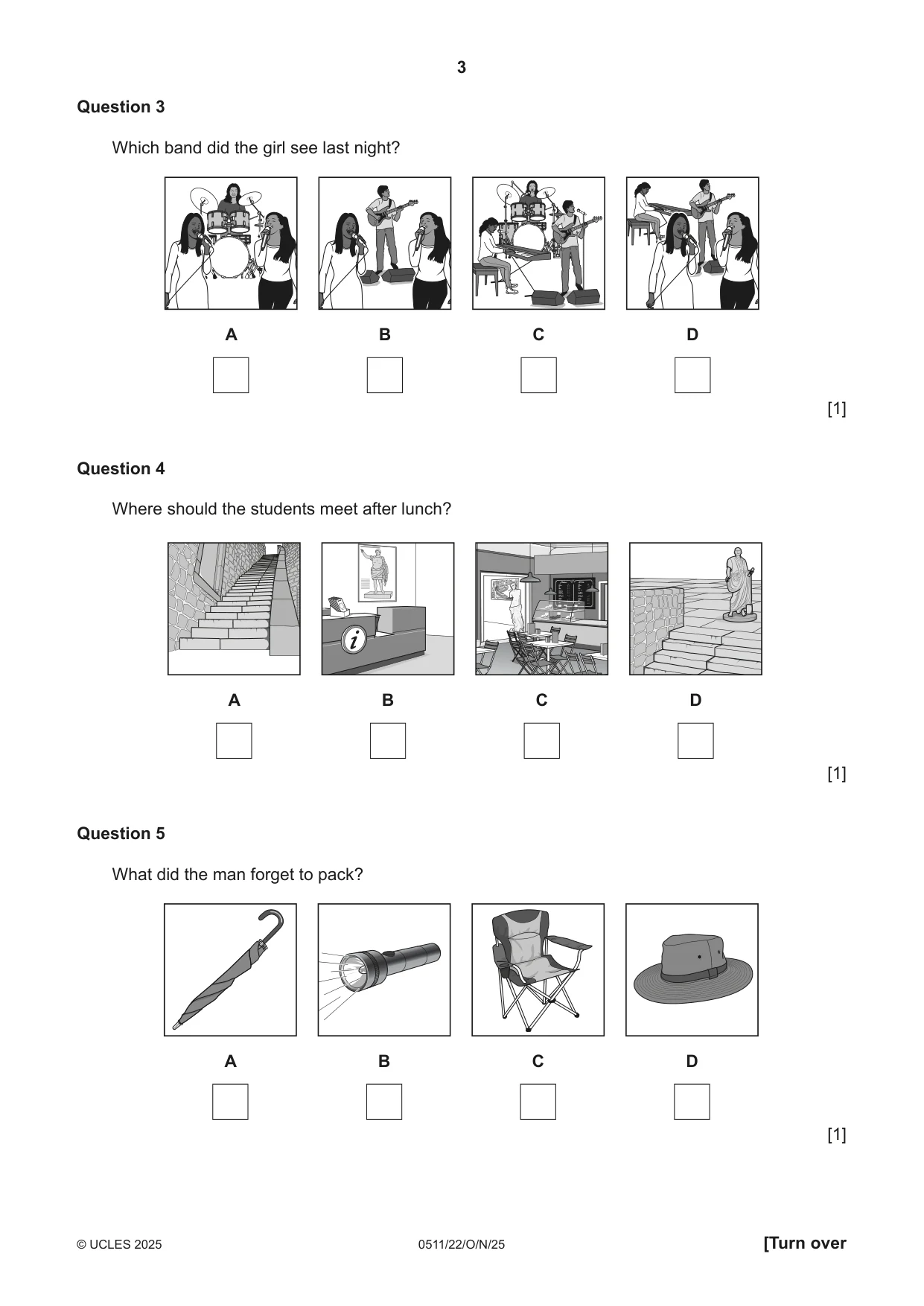
3 0511/22/ O/N/25 © UCLES 2025 [Turn over Question 3 Which band did the girl see last night? A B C D [1] Question 4 Where should the students meet after lunch? A B C D [1] Question 5 What did the man forget to pack? A B C D [1]
Question paper, page 4
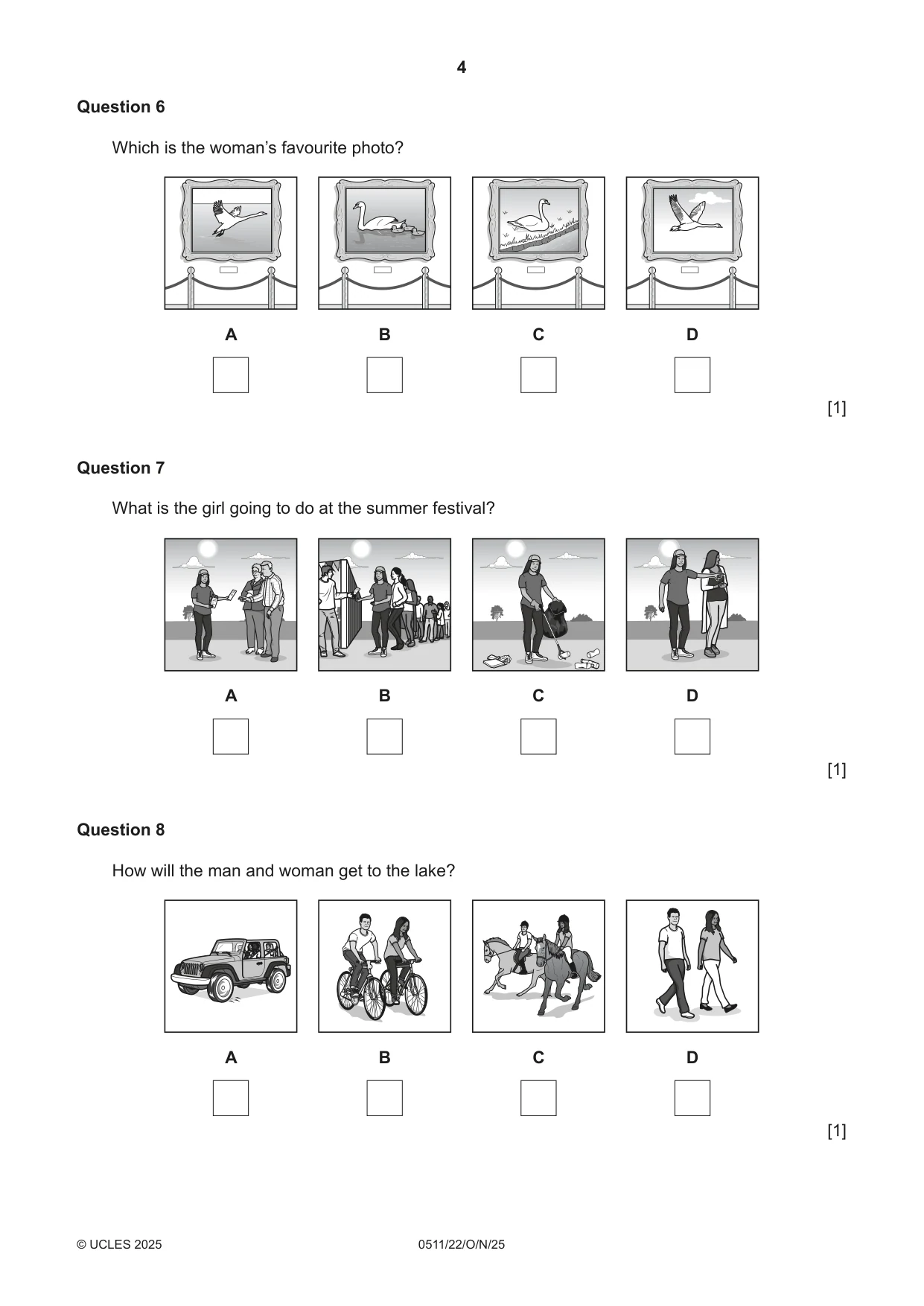
4 0511/22/ O/N/25 © UCLES 2025 Question 6 Which is the woman’s favourite photo? A B C D [1] Question 7 What is the girl going to do at the summer festival? A B C D [1] Question 8 How will the man and woman get to the lake? A B C D [1]
Question paper, page 5
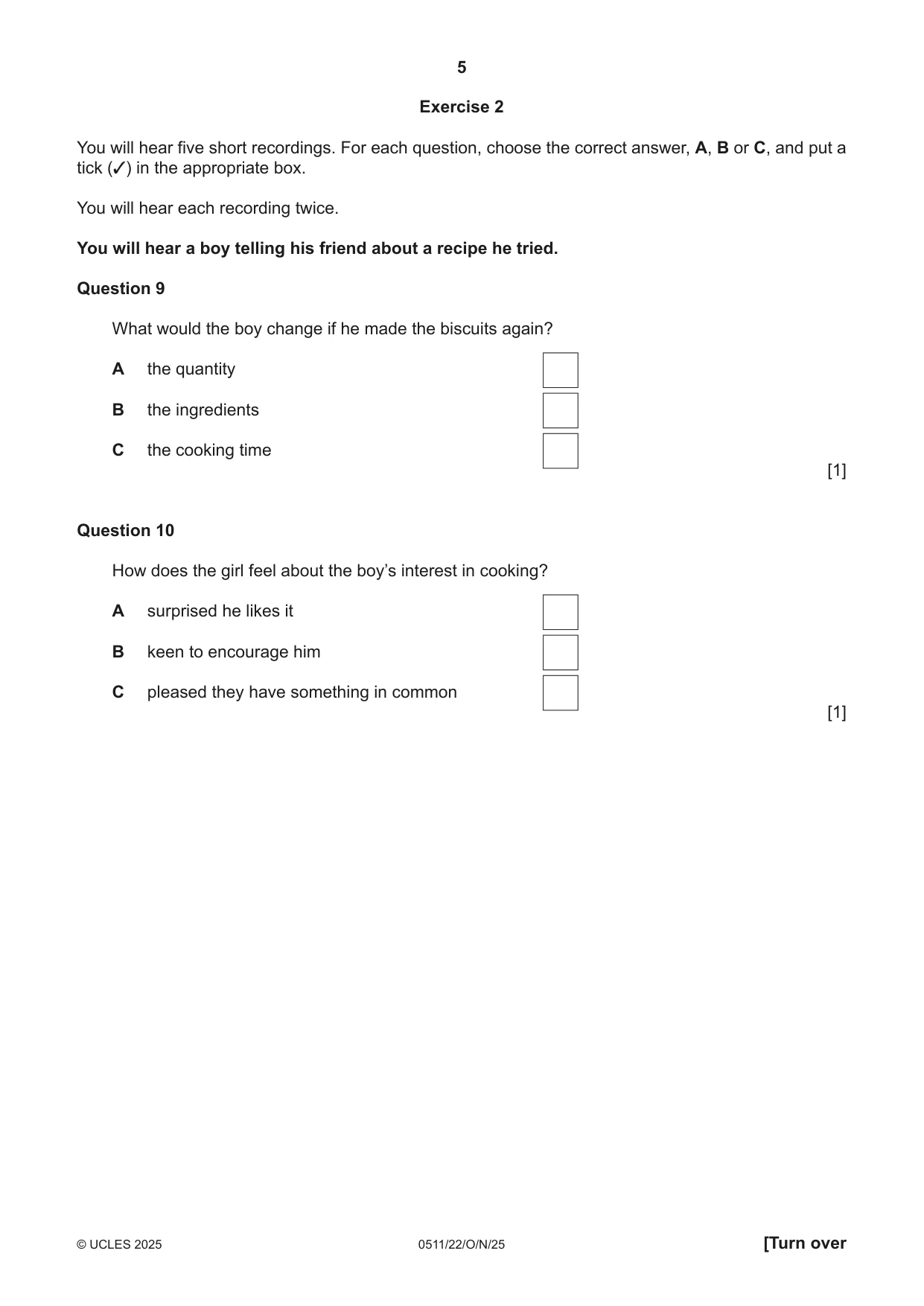
5 0511/22/O/N/25 © UCLES 2025 [Turn over Exercise 2 You will hear five short recordings. For each question, choose the correct answer, A, B or C, and put a tick (✓) in the appropriate box. You will hear each recording twice. You will hear a boy telling his friend about a recipe he tried. Question 9 What would the boy change if he made the biscuits again? A the quantity B the ingredients C the cooking time [1] Question 10 How does the girl feel about the boy’s interest in cooking? A surprised he likes it B keen to encourage him C pleased they have something in common [1]
Question paper, page 6
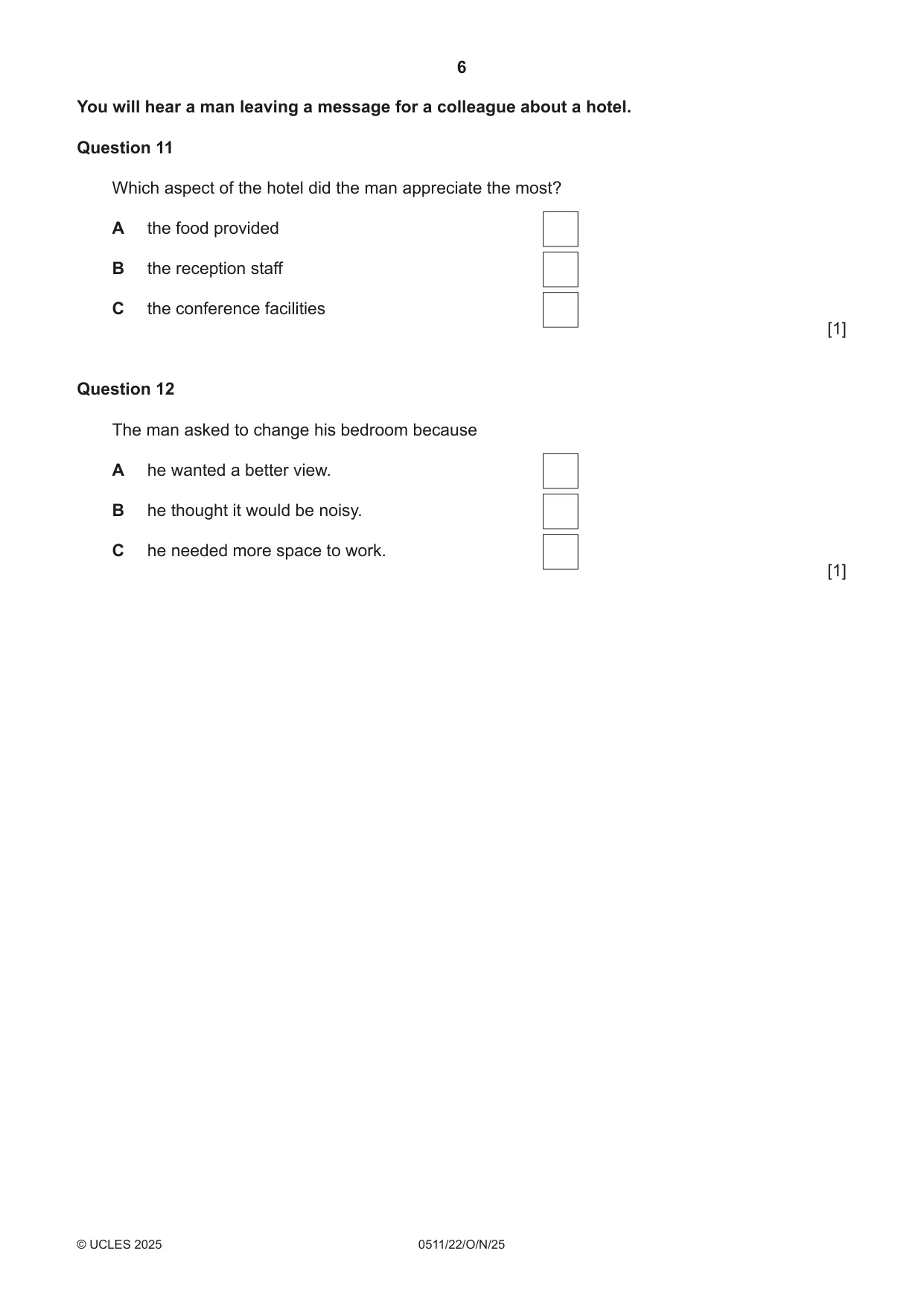
6 0511/22/O/N/25 © UCLES 2025 You will hear a man leaving a message for a colleague about a hotel. Question 11 Which aspect of the hotel did the man appreciate the most? A the food provided B the reception staff C the conference facilities [1] Question 12 The man asked to change his bedroom because A he wanted a better view. B he thought it would be noisy. C he needed more space to work. [1]
Question paper, page 7
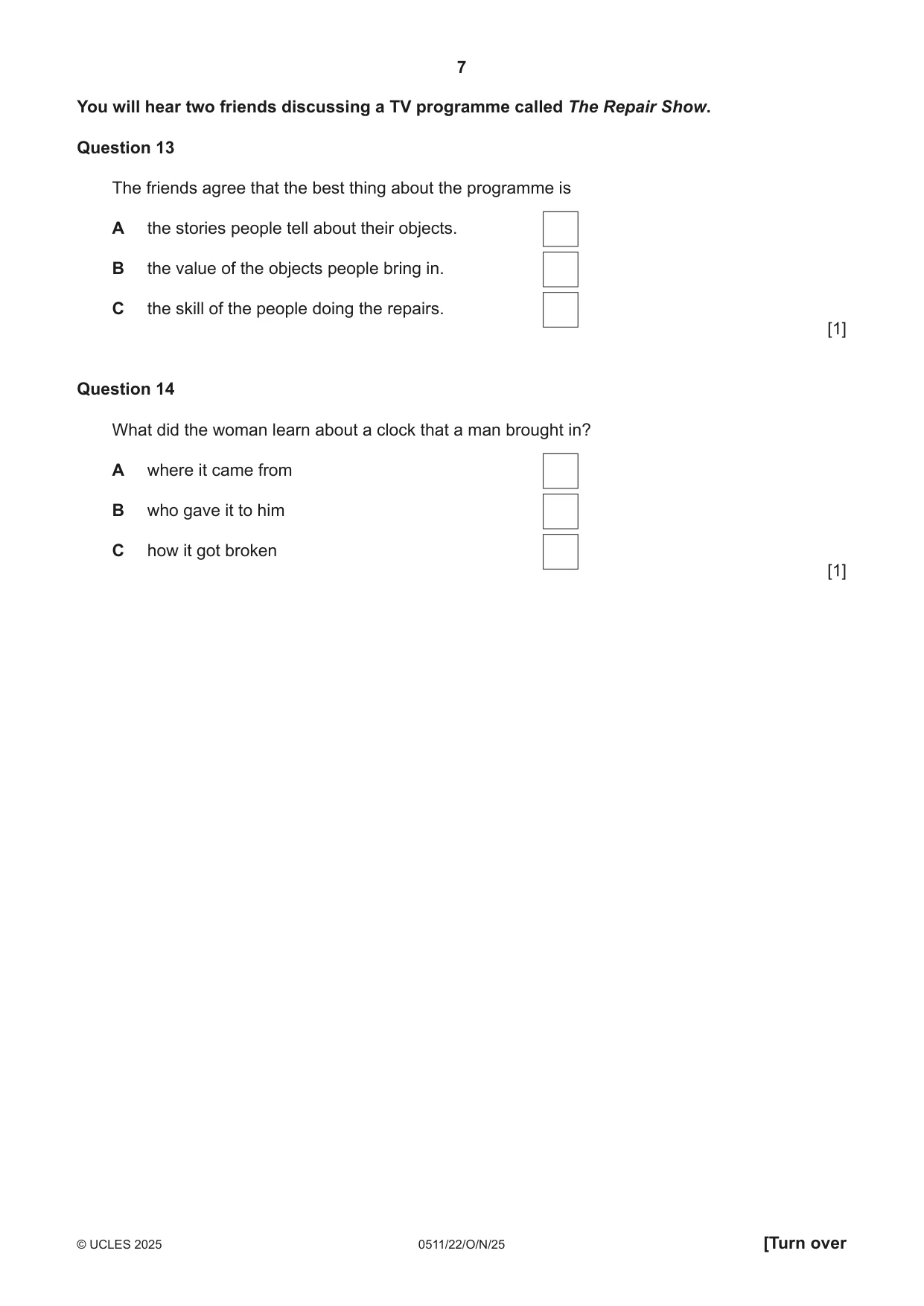
7 0511/22/O/N/25 © UCLES 2025 [Turn over You will hear two friends discussing a TV programme called The Repair Show. Question 13 The friends agree that the best thing about the programme is A the stories people tell about their objects. B the value of the objects people bring in. C the skill of the people doing the repairs. [1] Question 14 What did the woman learn about a clock that a man brought in? A where it came from B who gave it to him C how it got broken [1]
Question paper, page 8
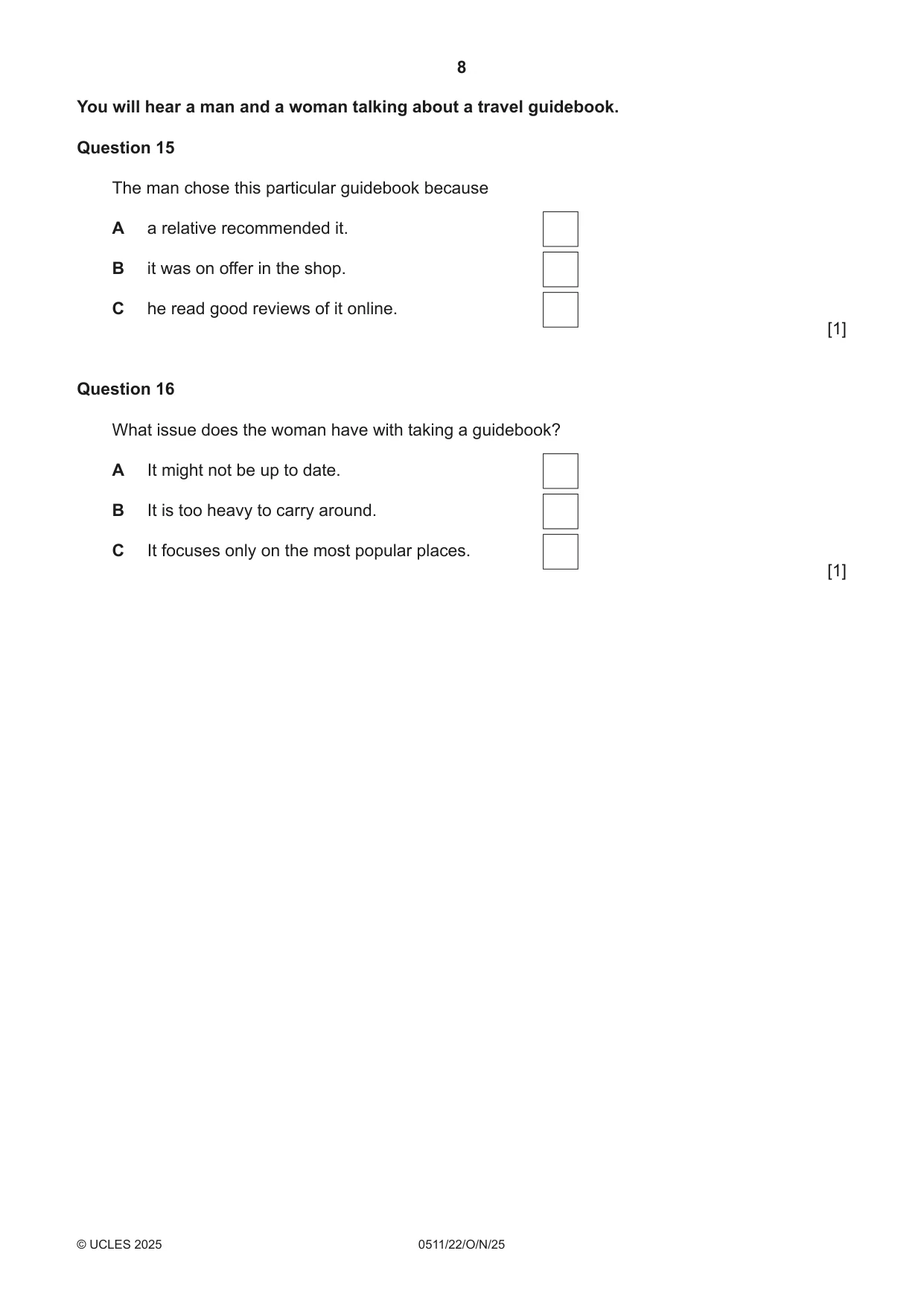
8 0511/22/O/N/25 © UCLES 2025 You will hear a man and a woman talking about a travel guidebook. Question 15 The man chose this particular guidebook because A a relative recommended it. B it was on offer in the shop. C he read good reviews of it online. [1] Question 16 What issue does the woman have with taking a guidebook? A It might not be up to date. B It is too heavy to carry around. C It focuses only on the most popular places. [1]
Question paper, page 9
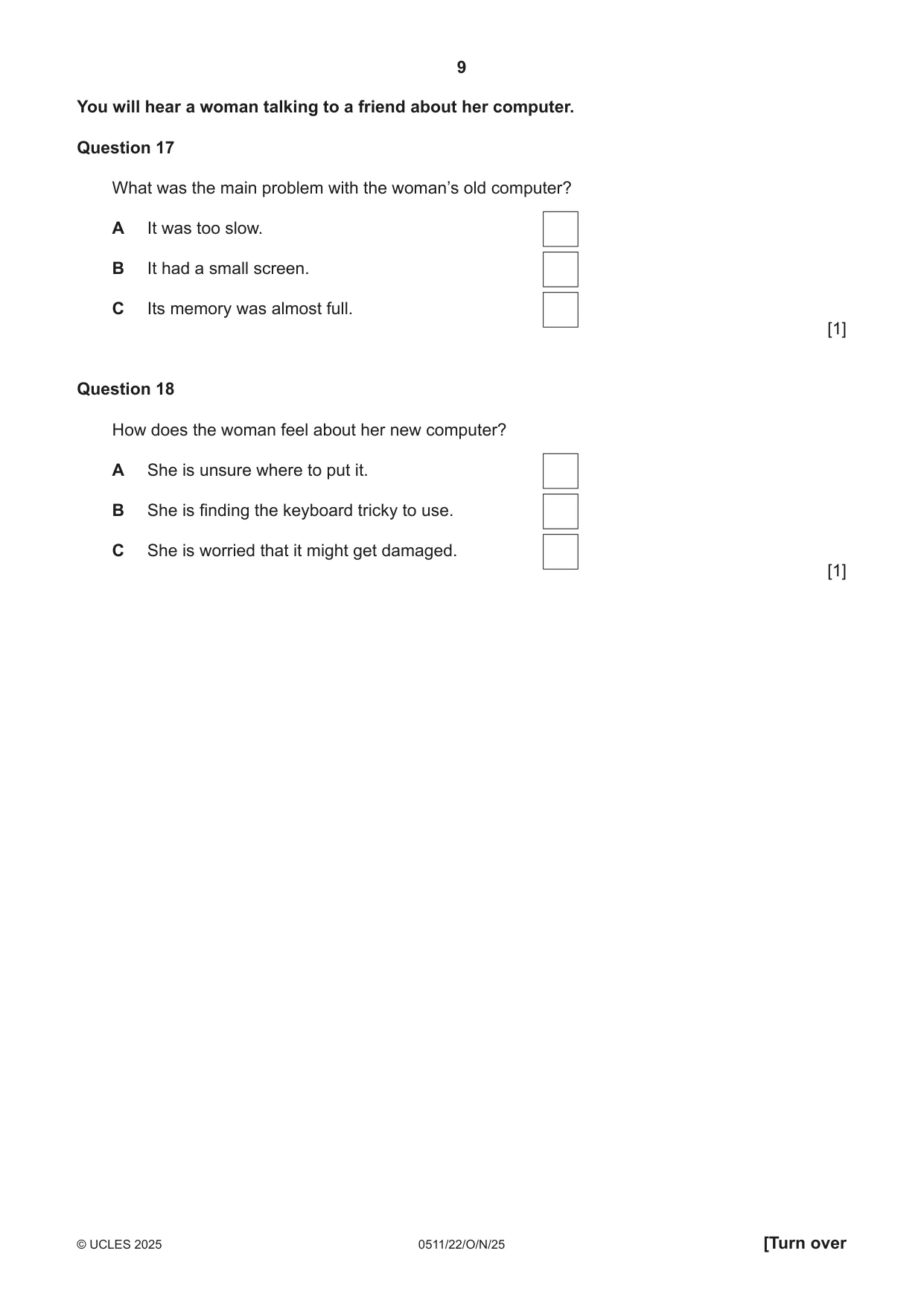
9 0511/22/O/N/25 © UCLES 2025 [Turn over You will hear a woman talking to a friend about her computer. Question 17 What was the main problem with the woman’s old computer? A It was too slow. B It had a small screen. C Its memory was almost full. [1] Question 18 How does the woman feel about her new computer? A She is unsure where to put it. B She is finding the keyboard tricky to use. C She is worried that it might get damaged. [1]
Question paper, page 10
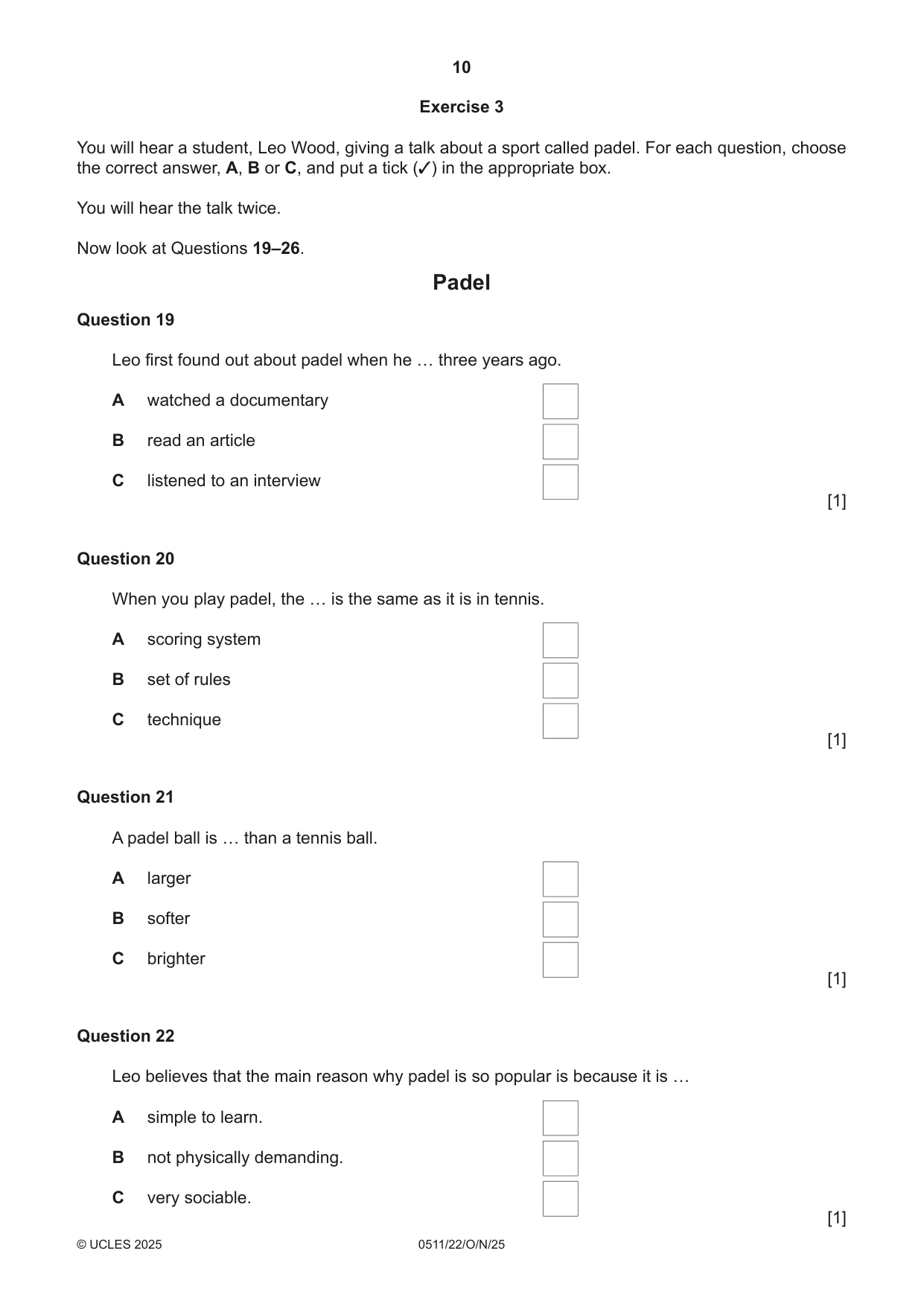
10 0511/22/O/N/25 © UCLES 2025 Exercise 3 You will hear a student, Leo Wood, giving a talk about a sport called padel. For each question, choose the correct answer, A, B or C, and put a tick (✓) in the appropriate box. You will hear the talk twice. Now look at Questions 19–26. Padel Question 19 Leo first found out about padel when he … three years ago. A watched a documentary B read an article C listened to an interview [1] Question 20 When you play padel, the … is the same as it is in tennis. A scoring system B set of rules C technique [1] Question 21 A padel ball is … than a tennis ball. A larger B softer C brighter [1] Question 22 Leo believes that the main reason why padel is so popular is because it is … A simple to learn. B not physically demanding. C very sociable. [1]
Question paper, page 11
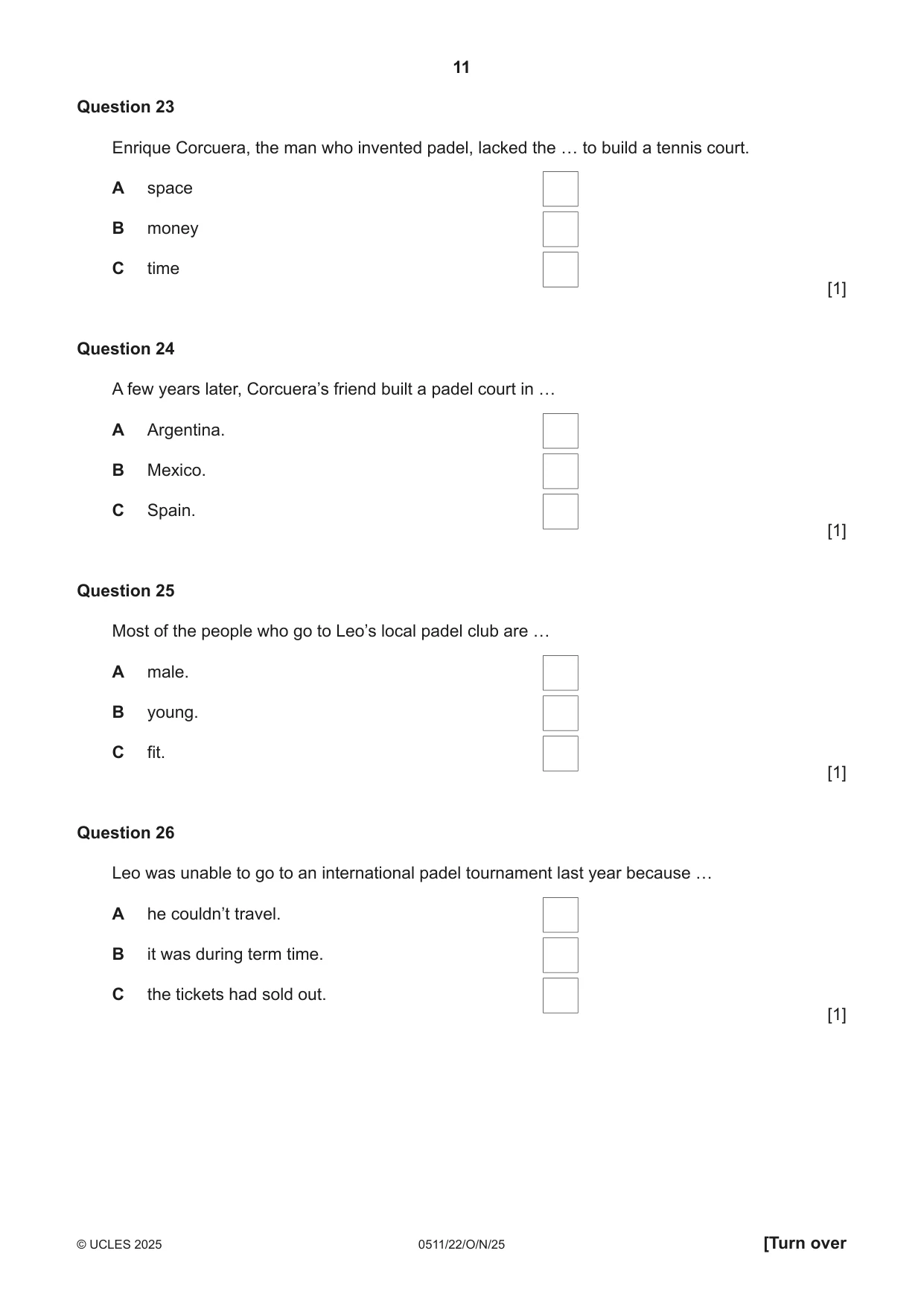
11 0511/22/O/N/25 © UCLES 2025 [Turn over Question 23 Enrique Corcuera, the man who invented padel, lacked the … to build a tennis court. A space B money C time [1] Question 24 A few years later, Corcuera’s friend built a padel court in … A Argentina. B Mexico. C Spain. [1] Question 25 Most of the people who go to Leo’s local padel club are … A male. B young. C fit. [1] Question 26 Leo was unable to go to an international padel tournament last year because … A he couldn’t travel. B it was during term time. C the tickets had sold out. [1]
Question paper, page 12
12 0511/22/O/N/25 © UCLES 2025 BLANK PAGE
Question paper, page 13
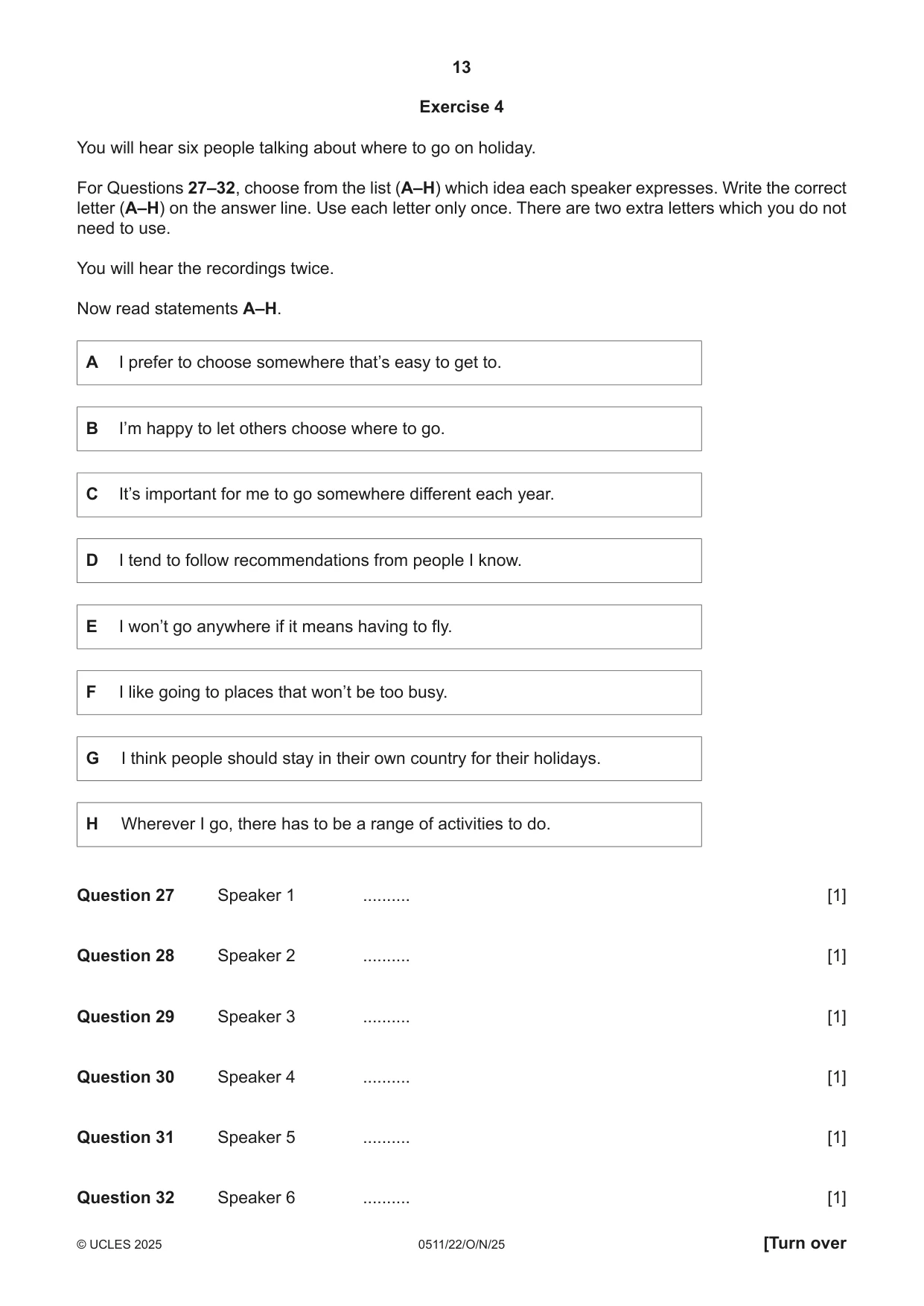
13 0511/22/O/N/25 © UCLES 2025 [Turn over Exercise 4 You will hear six people talking about where to go on holiday. For Questions 27–32, choose from the list (A–H) which idea each speaker expresses. Write the correct letter (A–H) on the answer line. Use each letter only once. There are two extra letters which you do not need to use. You will hear the recordings twice. Now read statements A–H. A I prefer to choose somewhere that’s easy to get to. B I’m happy to let others choose where to go. C It’s important for me to go somewhere different each year. D I tend to follow recommendations from people I know. E I won’t go anywhere if it means having to fly. F I like going to places that won’t be too busy. G I think people should stay in their own country for their holidays. H Wherever I go, there has to be a range of activities to do. Question 27 Speaker 1 … [1] Question 28 Speaker 2 … [1] Question 29 Speaker 3 … [1] Question 30 Speaker 4 … [1] Question 31 Speaker 5 … [1] Question 32 Speaker 6 … [1]
Question paper, page 14
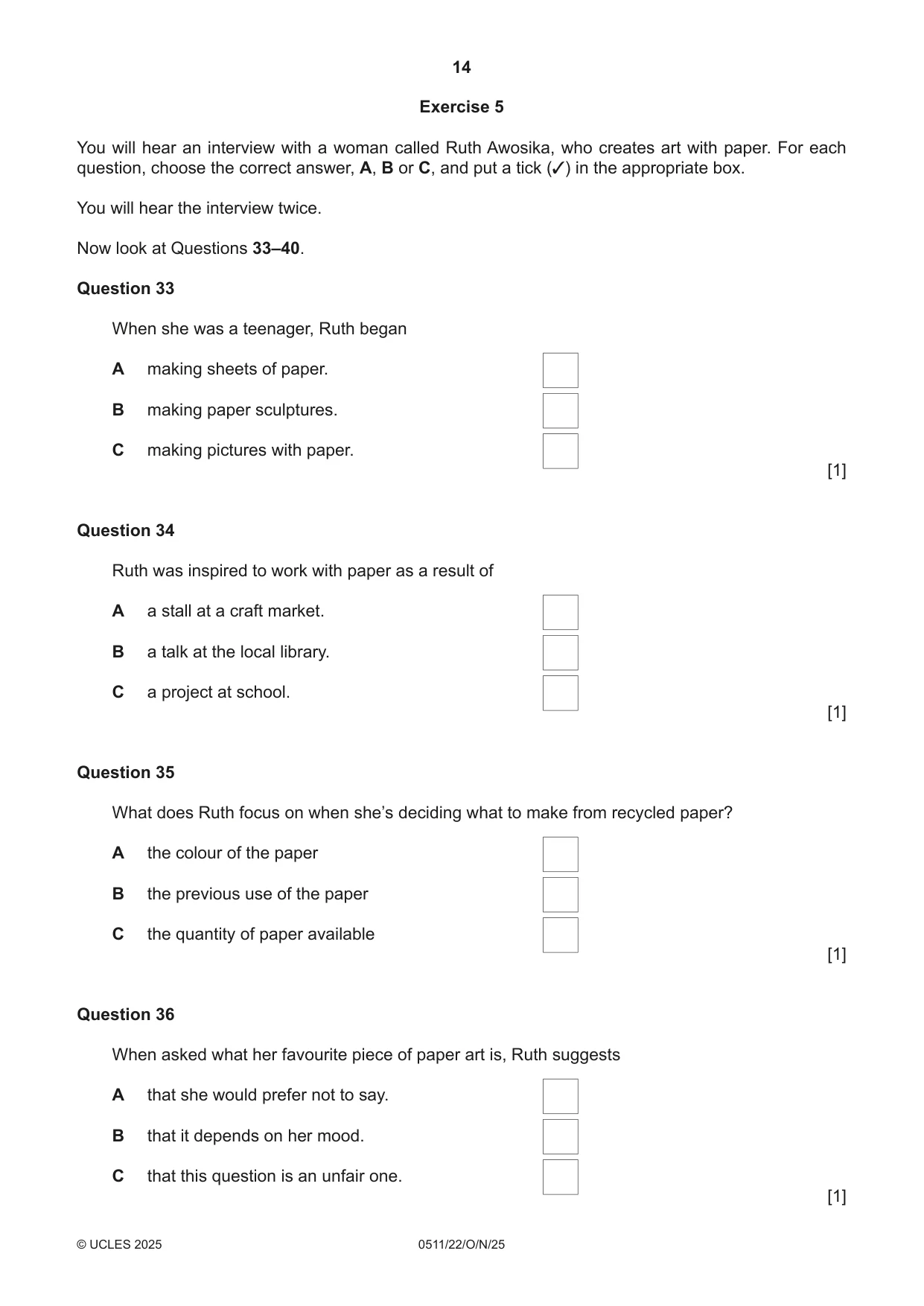
14 0511/22/O/N/25 © UCLES 2025 Exercise 5 You will hear an interview with a woman called Ruth Awosika, who creates art with paper. For each question, choose the correct answer, A, B or C, and put a tick (✓) in the appropriate box. You will hear the interview twice. Now look at Questions 33–40. Question 33 When she was a teenager, Ruth began A making sheets of paper. B making paper sculptures. C making pictures with paper. [1] Question 34 Ruth was inspired to work with paper as a result of A a stall at a craft market. B a talk at the local library. C a project at school. [1] Question 35 What does Ruth focus on when she’s deciding what to make from recycled paper? A the colour of the paper B the previous use of the paper C the quantity of paper available [1] Question 36 When asked what her favourite piece of paper art is, Ruth suggests A that she would prefer not to say. B that it depends on her mood. C that this question is an unfair one. [1]
Question paper, page 15
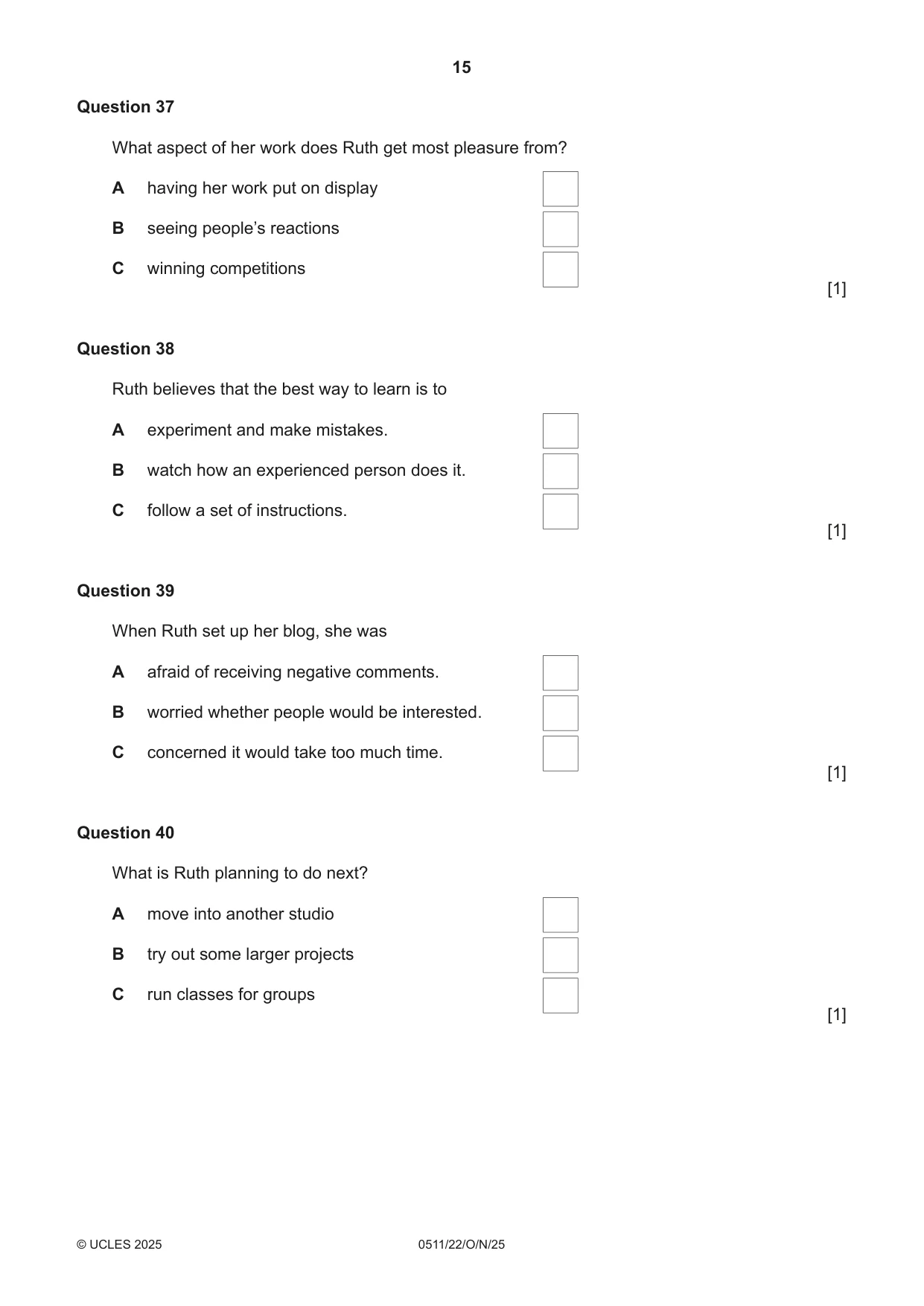
15 0511/22/O/N/25 © UCLES 2025 Question 37 What aspect of her work does Ruth get most pleasure from? A having her work put on display B seeing people’s reactions C winning competitions [1] Question 38 Ruth believes that the best way to learn is to A experiment and make mistakes. B watch how an experienced person does it. C follow a set of instructions. [1] Question 39 When Ruth set up her blog, she was A afraid of receiving negative comments. B worried whether people would be interested. C concerned it would take too much time. [1] Question 40 What is Ruth planning to do next? A move into another studio B try out some larger projects C run classes for groups [1]
Question paper, page 16
16 0511/22/O/N/25 © UCLES 2025 Permission to reproduce items where third-party owned material protected by copyright is included has been sought and cleared where possible. Every reasonable effort has been made by the publisher (UCLES) to trace copyright holders, but if any items requiring clearance have unwittingly been included, the publisher will be pleased to make amends at the earliest possible opportunity. To avoid the issue of disclosure of answer-related information to candidates, all copyright acknowledgements are reproduced online in the Cambridge Assessment International Education Copyright Acknowledgements Booklet. This is produced for each series of examinations and is freely available to download at www.cambridgeinternational.org after the live examination series. Cambridge Assessment International Education is part of Cambridge Assessment. Cambridge Assessment is the brand name of the University of Cambridge Local Examinations Syndicate (UCLES), which is a department of the University of Cambridge. BLANK PAGE
Mark scheme, page 1
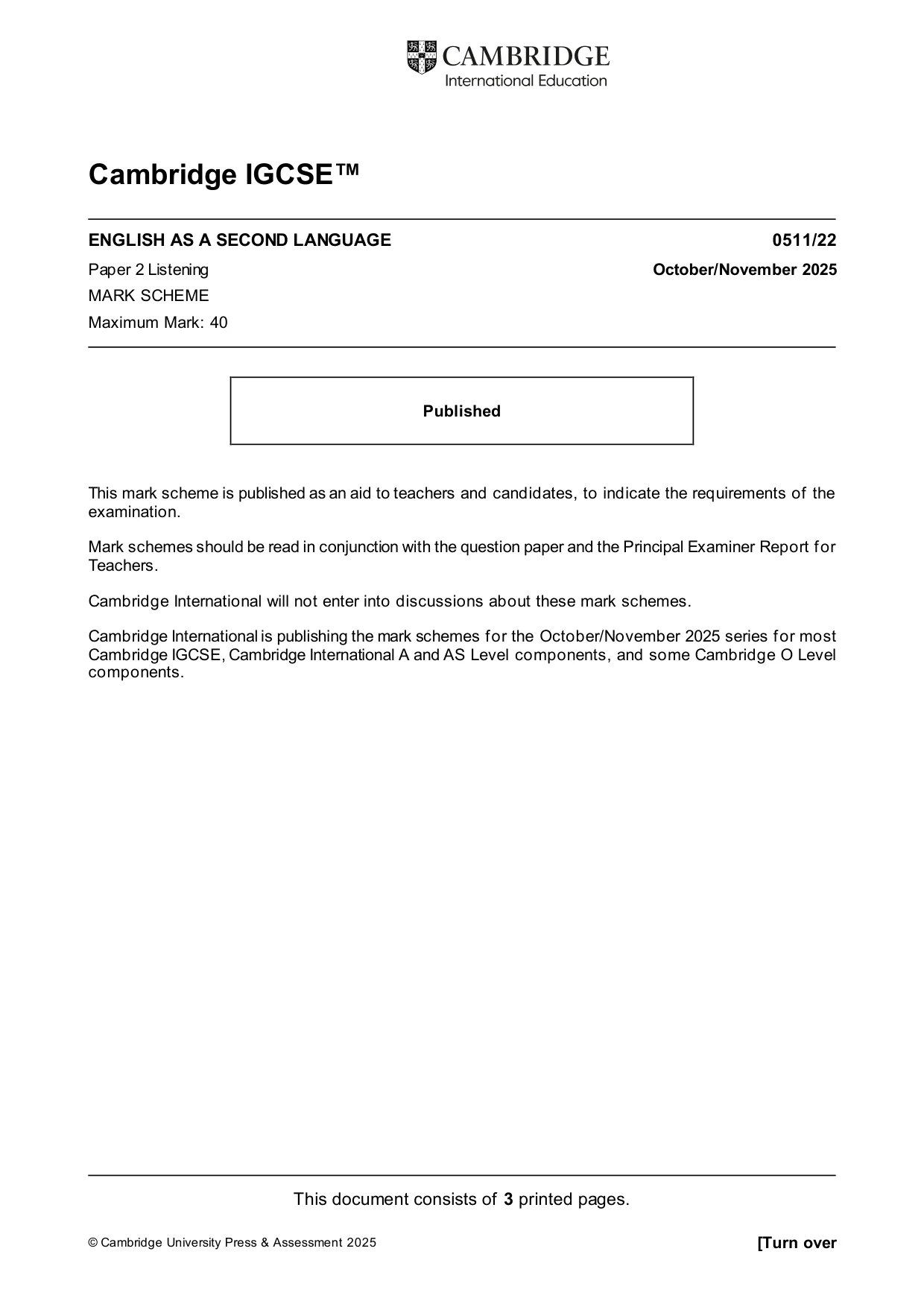
This document consists of 3 printed pages. © Cambridge University Press & Assessment 2025 [Turn over Cambridge IGCSE™ ENGLISH AS A SECOND LANGUAGE 0511/22 Paper 2 Listening October/November 2025 MARK SCHEME Maximum Mark: 40 Published This mark scheme is published as an aid to teachers and candidates, to indicate the requirements of the examination. Mark schemes should be read in conjunction with the question paper and the Principal Examiner Report for Teachers. Cambridge International will not enter into discussions about these mark schemes. Cambridge International is publishing the mark schemes for the October/November 2025 series for most Cambridge IGCSE, Cambridge International A and AS Level components, and some Cambridge O Level components.
Mark scheme, page 2
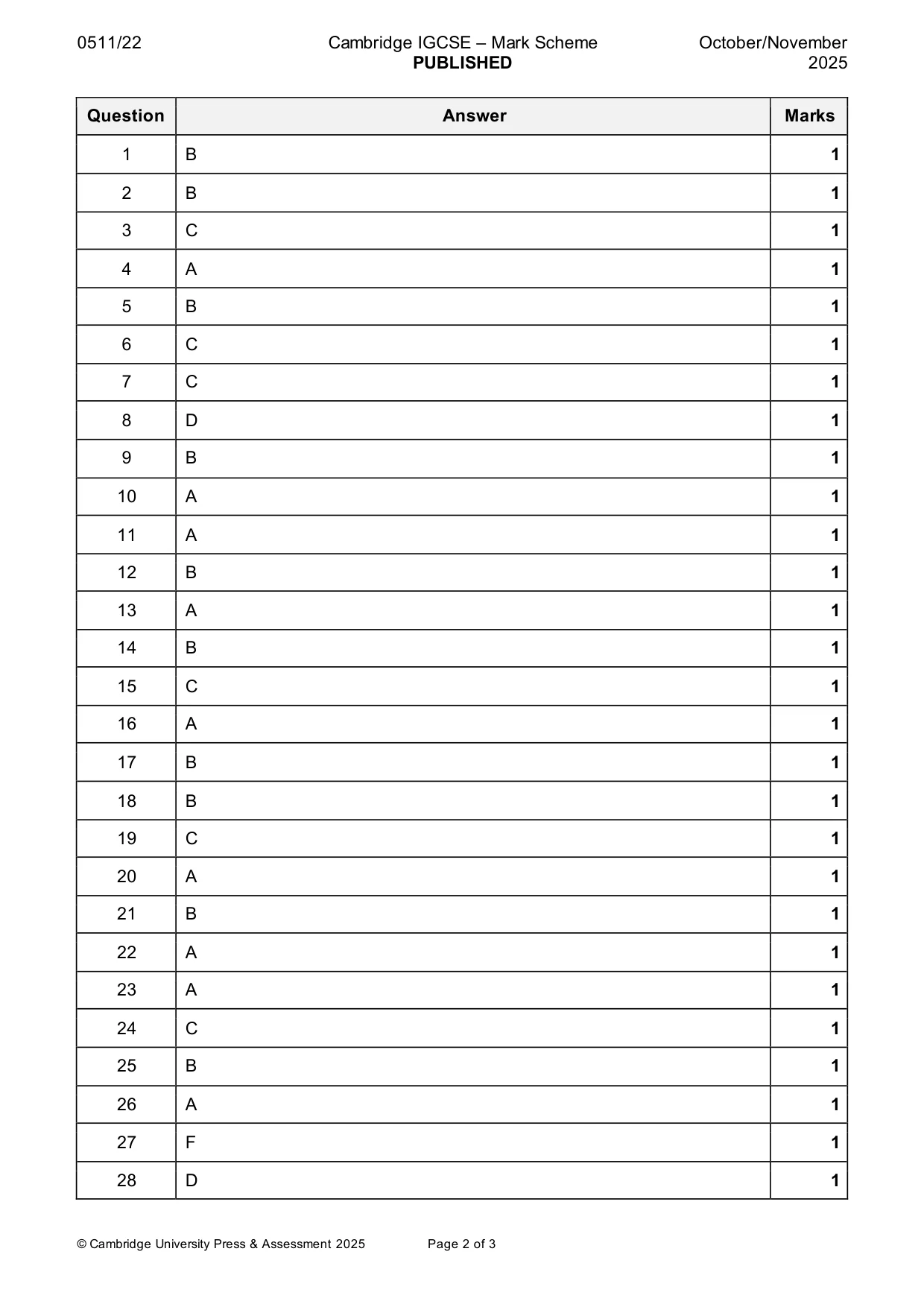
0511/22 Cambridge IGCSE – Mark Scheme PUBLISHED October/November 2025 © Cambridge University Press & Assessment 2025 Page 2 of 3 Question Answer Marks 1 B 1 2 B 1 3 C 1 4 A 1 5 B 1 6 C 1 7 C 1 8 D 1 9 B 1 10 A 1 11 A 1 12 B 1 13 A 1 14 B 1 15 C 1 16 A 1 17 B 1 18 B 1 19 C 1 20 A 1 21 B 1 22 A 1 23 A 1 24 C 1 25 B 1 26 A 1 27 F 1 28 D 1
Mark scheme, page 3
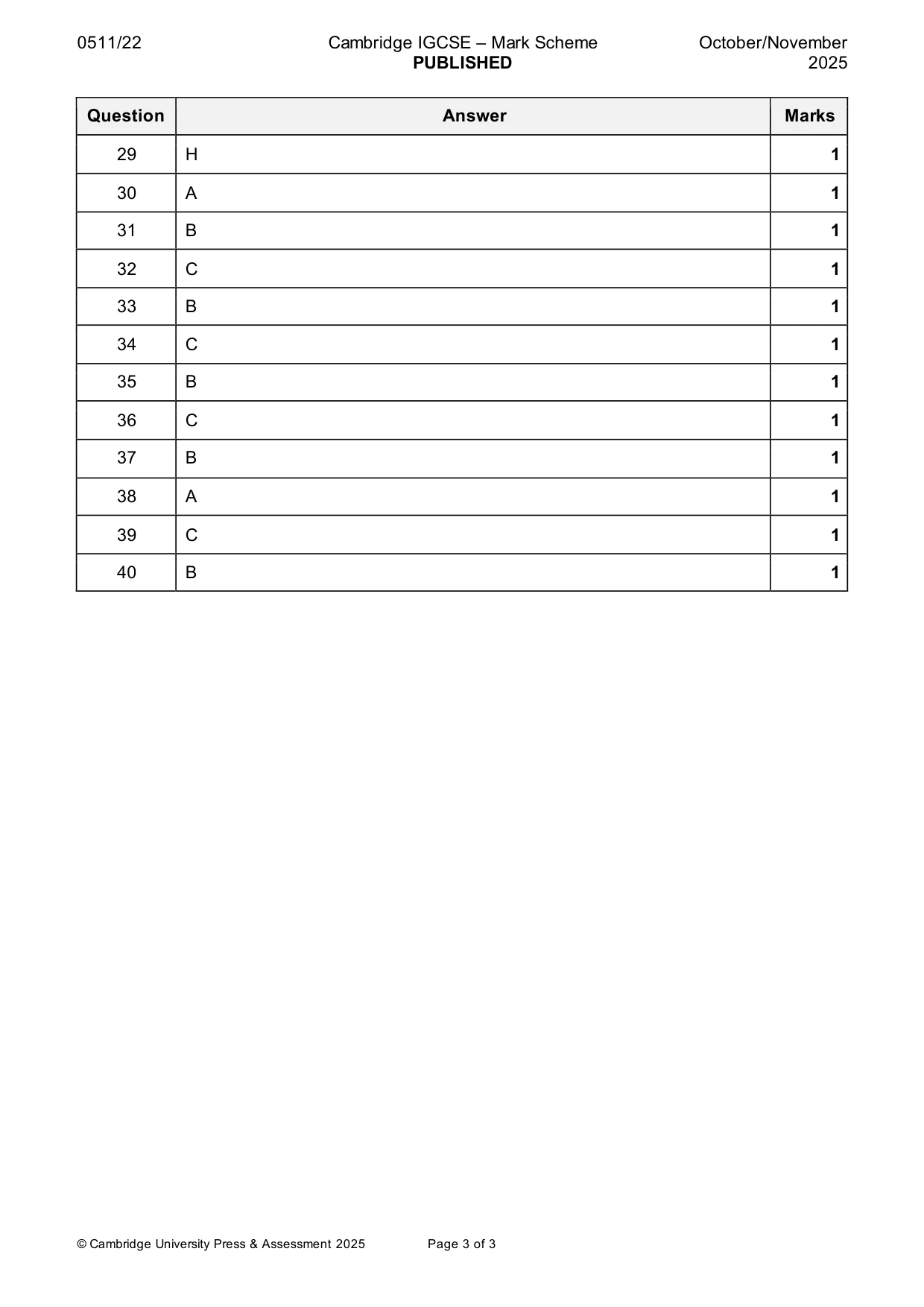
0511/22 Cambridge IGCSE – Mark Scheme PUBLISHED October/November 2025 © Cambridge University Press & Assessment 2025 Page 3 of 3 Question Answer Marks 29 H 1 30 A 1 31 B 1 32 C 1 33 B 1 34 C 1 35 B 1 36 C 1 37 B 1 38 A 1 39 C 1 40 B 1
What you needed in this session
Cambridge’s own grade thresholds for 2025 Oct/Nov, Paper 2 · Variant 2. A higher threshold means an easier paper — the bar moves with how the cohort did.