Cambridge IGCSE English - Second Language (count-in oral) 0511 — 2025 Oct/Nov Paper 2 · Variant 1
0511/21/O/N/25 · 40 marks · ≈45 min
The question paper and its mark scheme, free to read here and free to download. This is Cambridge’s own paper, exactly as it was sat.
Question paper16 pages


Mark scheme3 pages
Answers below. Sit the paper first if you are practising.
Paper as text
Question paper, page 1
This document has 16 pages. Any blank pages are indicated. [Turn over Cambridge IGCSE™ DC (CJ) 356262 © UCLES 2025 * 6 5 6 3 0 6 0 8 7 8 * ENGLISH AS A SECOND LANGUAGE 0511/21 Paper 2 Listening October/November 2025 Approximately 50 minutes (including 6 minutes’ transfer time) You must transfer your answers onto the multiple choice answer sheet. You will need: Multiple choice answer sheet Soft clean eraser Soft pencil (type B or HB is recommended) INSTRUCTIONS ● There are 40 questions on this paper. Answer all questions. ● You will have 6 minutes to transfer your answers from the question paper onto the multiple choice answer sheet. ● Follow the instructions on the multiple choice answer sheet. Shade one letter only for Questions 1 to 40. ● Write in soft pencil. ● Write your name, centre number and candidate number on the multiple choice answer sheet in the spaces provided unless this has been done for you. ● Do not use correction fluid. ● Do not write on any bar codes. ● Dictionaries are not allowed. INFORMATION ● The total mark for this paper is 40. ● Each correct answer will score one mark. ● Any rough working should be done on this question paper.
Question paper, page 2
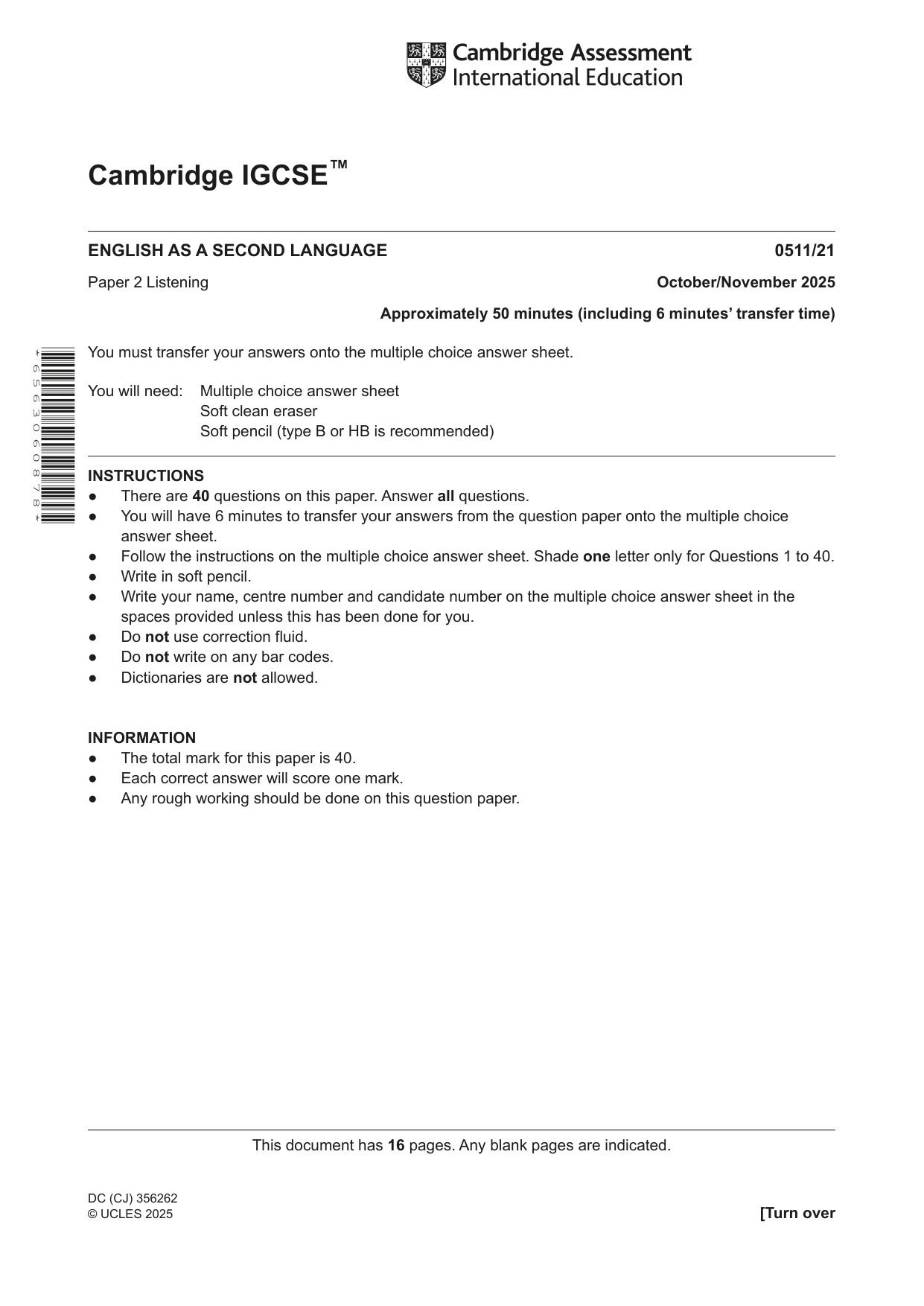
2 0511/21/ O/N/25 © UCLES 2025 Exercise 1 You will hear eight short recordings. For each question, choose the correct answer, A, B, C or D, and put a tick (3) in the appropriate box. You will hear each recording twice. Question 1 Where did the girl’s dad park their car? A B C D [1] Question 2 What does the boy suggest doing with his friend today? A B C D [1]
Question paper, page 3
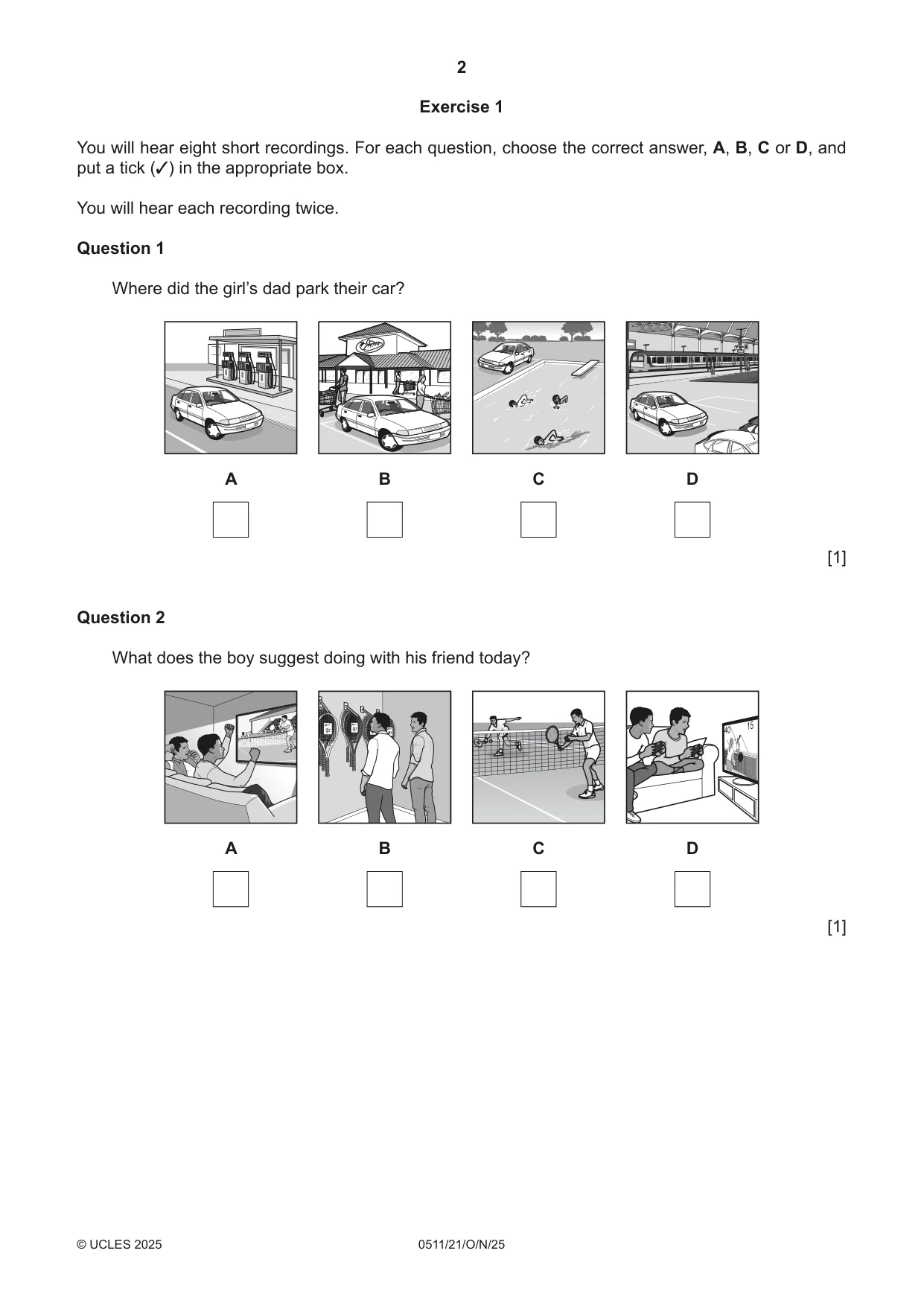
3 0511/21/ O/N/25 © UCLES 2025 [Turn over Question 3 How is the boy going to help his mum? A B C D [1] Question 4 Who has the girl just been to visit? A B C D [1] Question 5 Which book is ready for the boy to collect today? A B C D [1]
Question paper, page 4
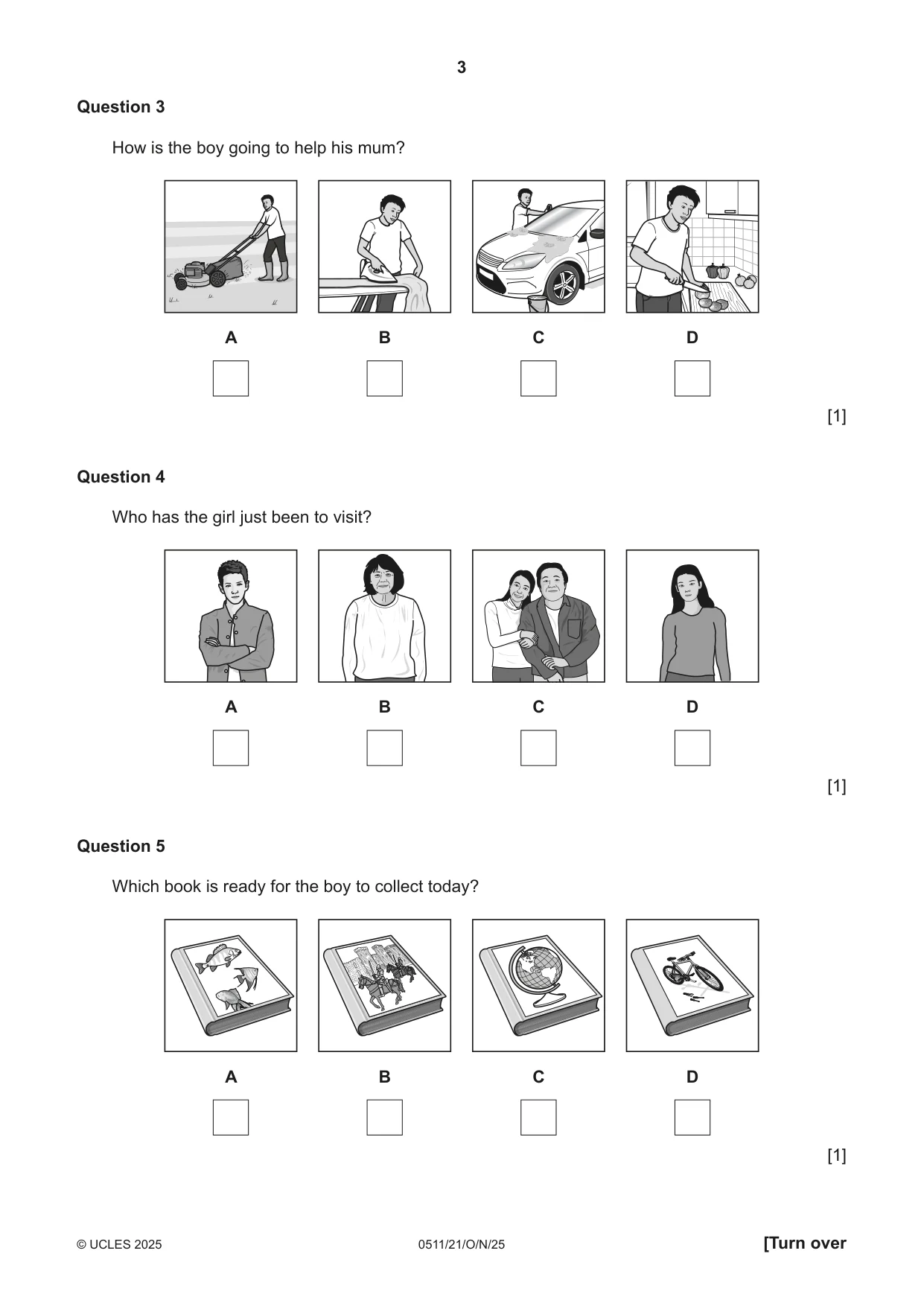
4 0511/21/ O/N/25 © UCLES 2025 Question 6 Where does the girl hope to go on holiday with her family? A B C D [1] Question 7 What does the boy miss about his previous home? A B C D [1] Question 8 Which work experience would the girl like to try? A B C D [1]
Question paper, page 5
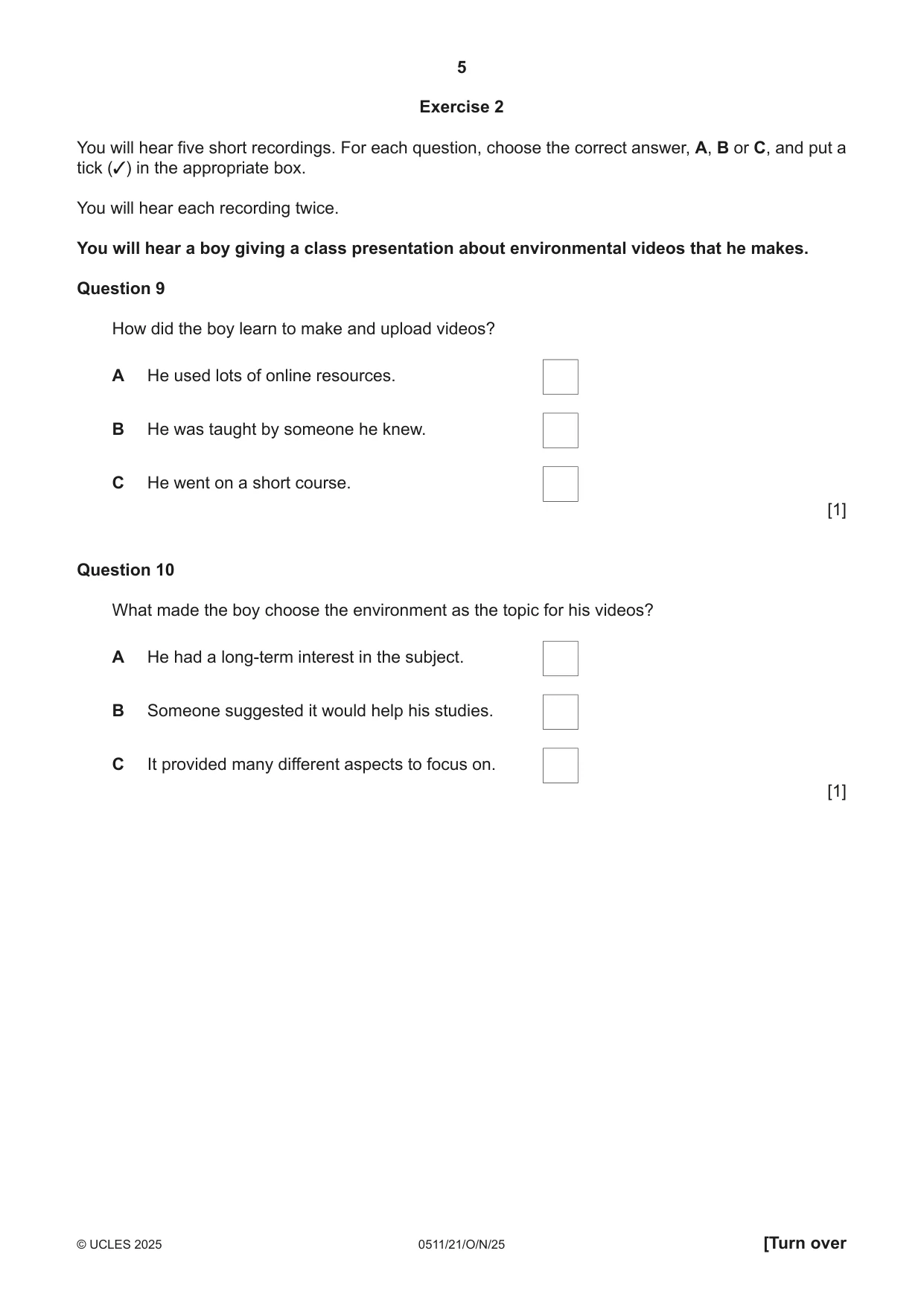
5 0511/21/O/N/25 © UCLES 2025 [Turn over Exercise 2 You will hear five short recordings. For each question, choose the correct answer, A, B or C, and put a tick (3) in the appropriate box. You will hear each recording twice. You will hear a boy giving a class presentation about environmental videos that he makes. Question 9 How did the boy learn to make and upload videos? A He used lots of online resources. B He was taught by someone he knew. C He went on a short course. [1] Question 10 What made the boy choose the environment as the topic for his videos? A He had a long-term interest in the subject. B Someone suggested it would help his studies. C It provided many different aspects to focus on. [1]
Question paper, page 6
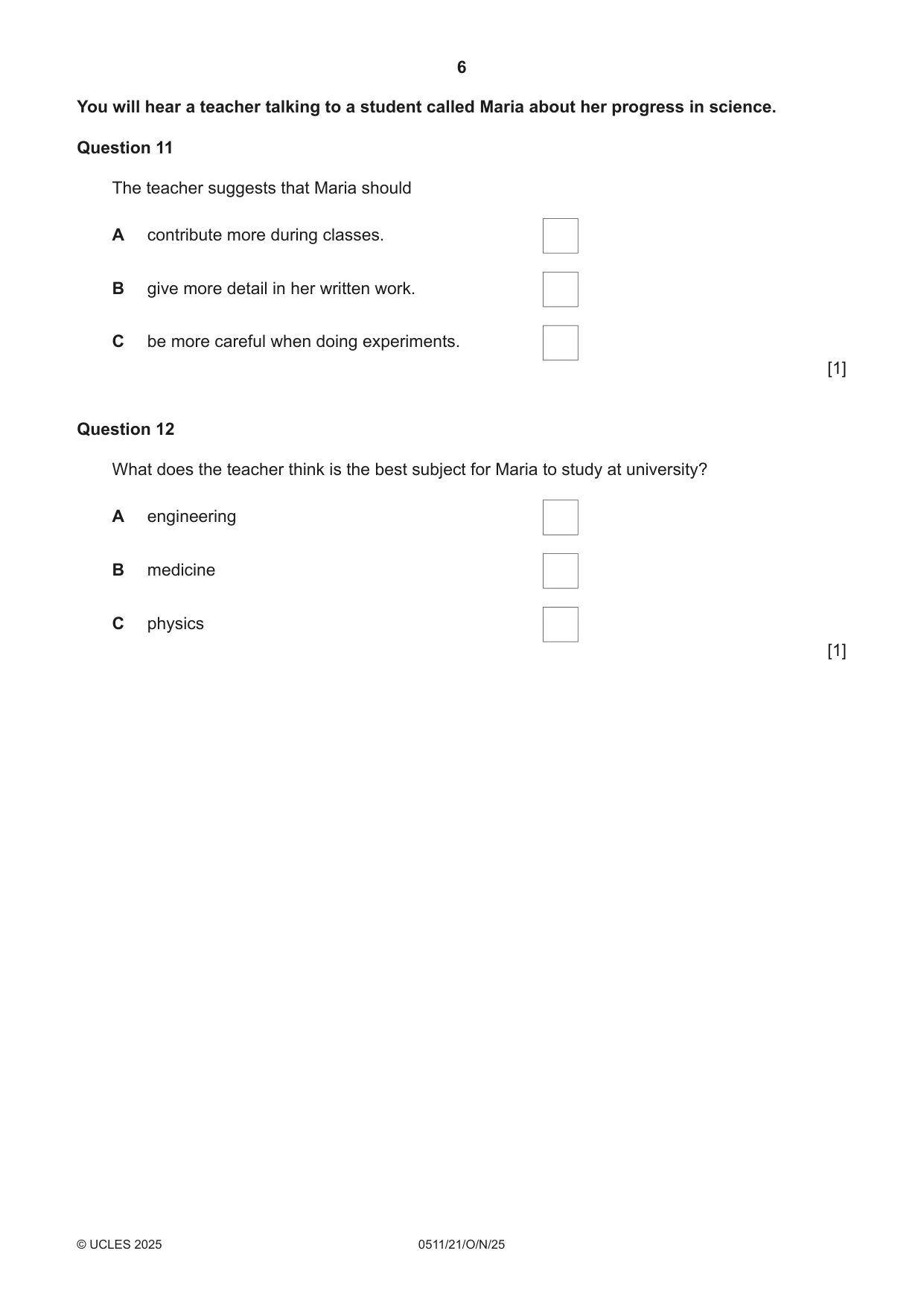
6 0511/21/O/N/25 © UCLES 2025 You will hear a teacher talking to a student called Maria about her progress in science. Question 11 The teacher suggests that Maria should A contribute more during classes. B give more detail in her written work. C be more careful when doing experiments. [1] Question 12 What does the teacher think is the best subject for Maria to study at university? A engineering B medicine C physics [1]
Question paper, page 7
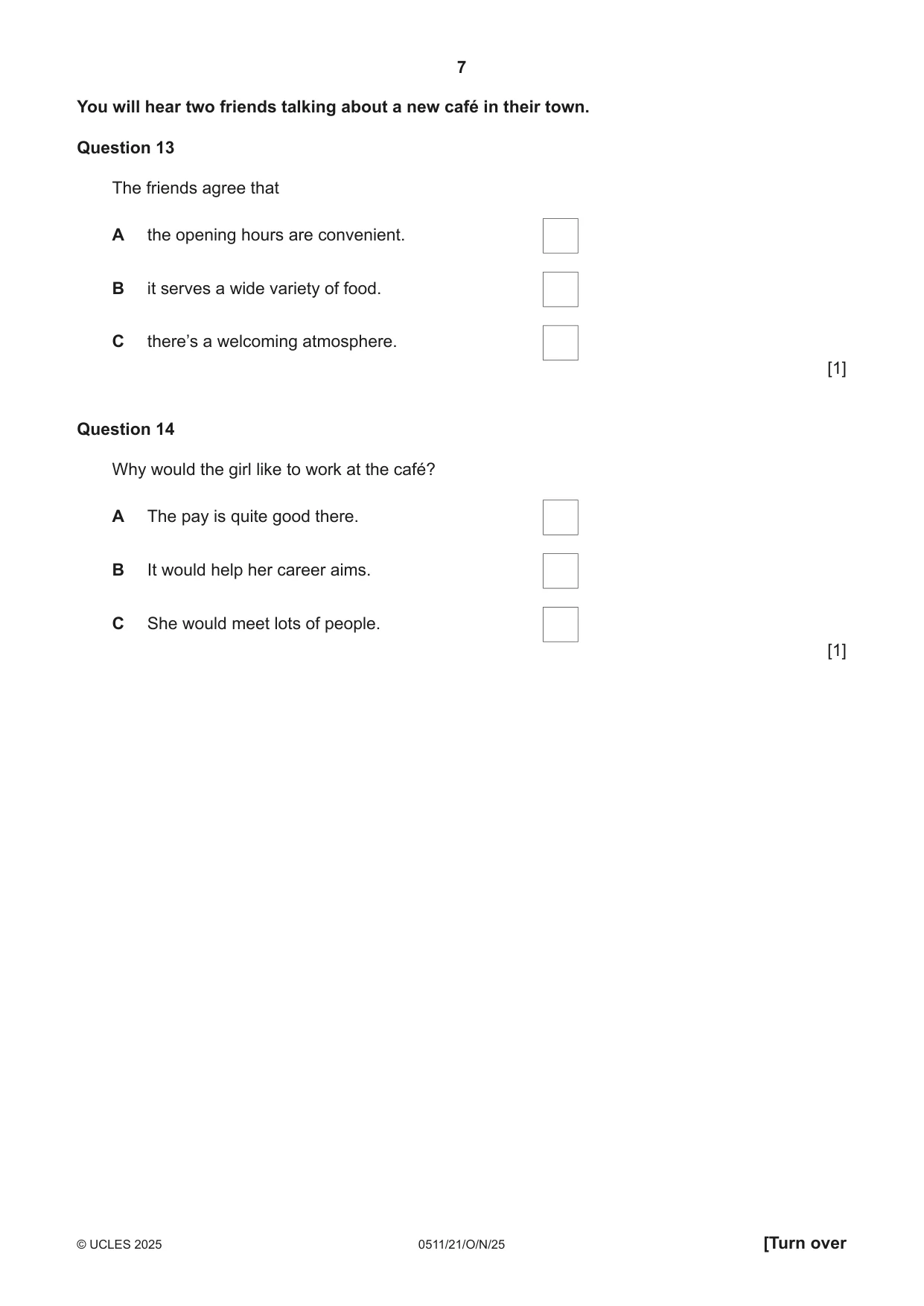
7 0511/21/O/N/25 © UCLES 2025 [Turn over You will hear two friends talking about a new café in their town. Question 13 The friends agree that A the opening hours are convenient. B it serves a wide variety of food. C there’s a welcoming atmosphere. [1] Question 14 Why would the girl like to work at the café? A The pay is quite good there. B It would help her career aims. C She would meet lots of people. [1]
Question paper, page 8
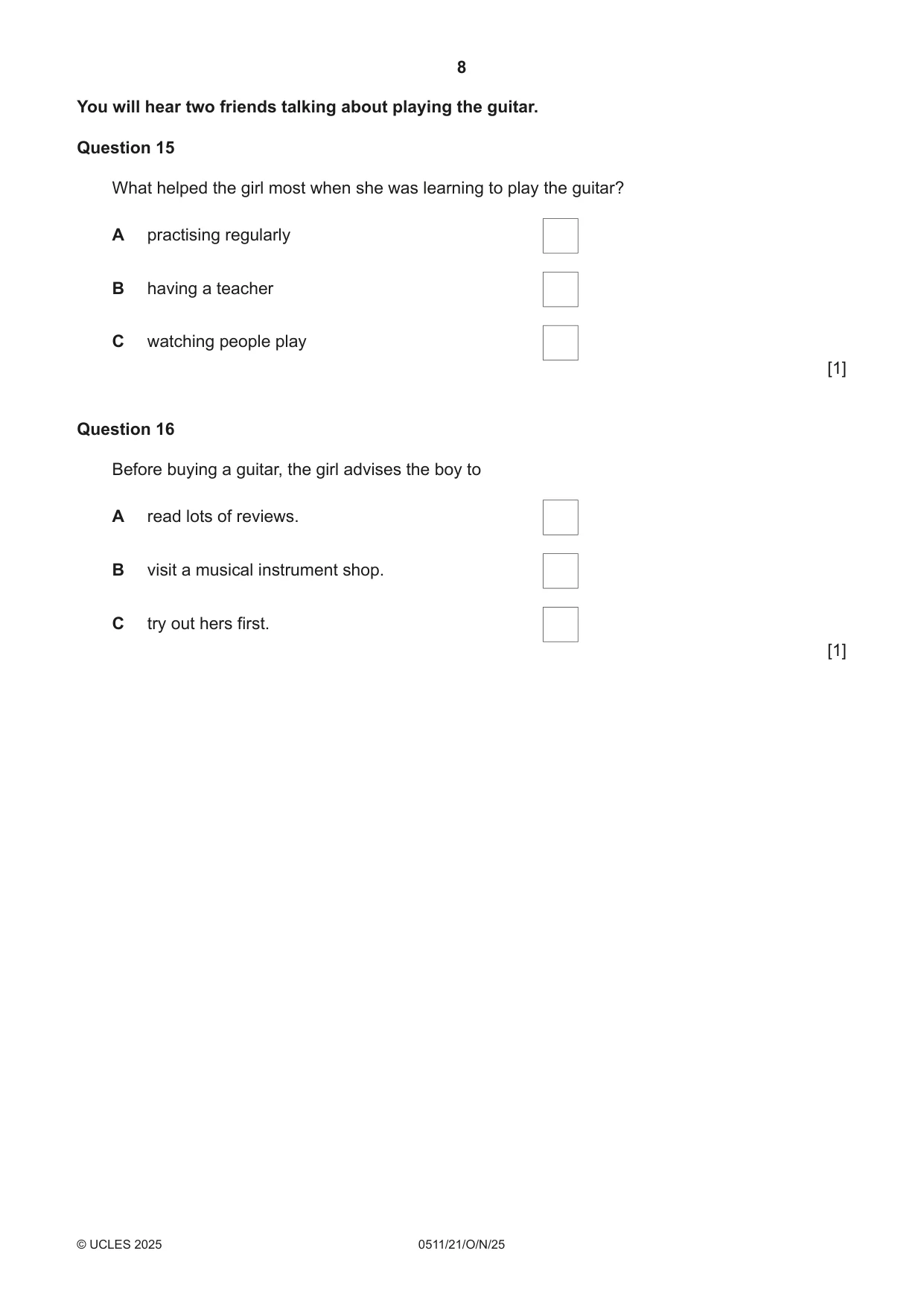
8 0511/21/O/N/25 © UCLES 2025 You will hear two friends talking about playing the guitar. Question 15 What helped the girl most when she was learning to play the guitar? A practising regularly B having a teacher C watching people play [1] Question 16 Before buying a guitar, the girl advises the boy to A read lots of reviews. B visit a musical instrument shop. C try out hers first. [1]
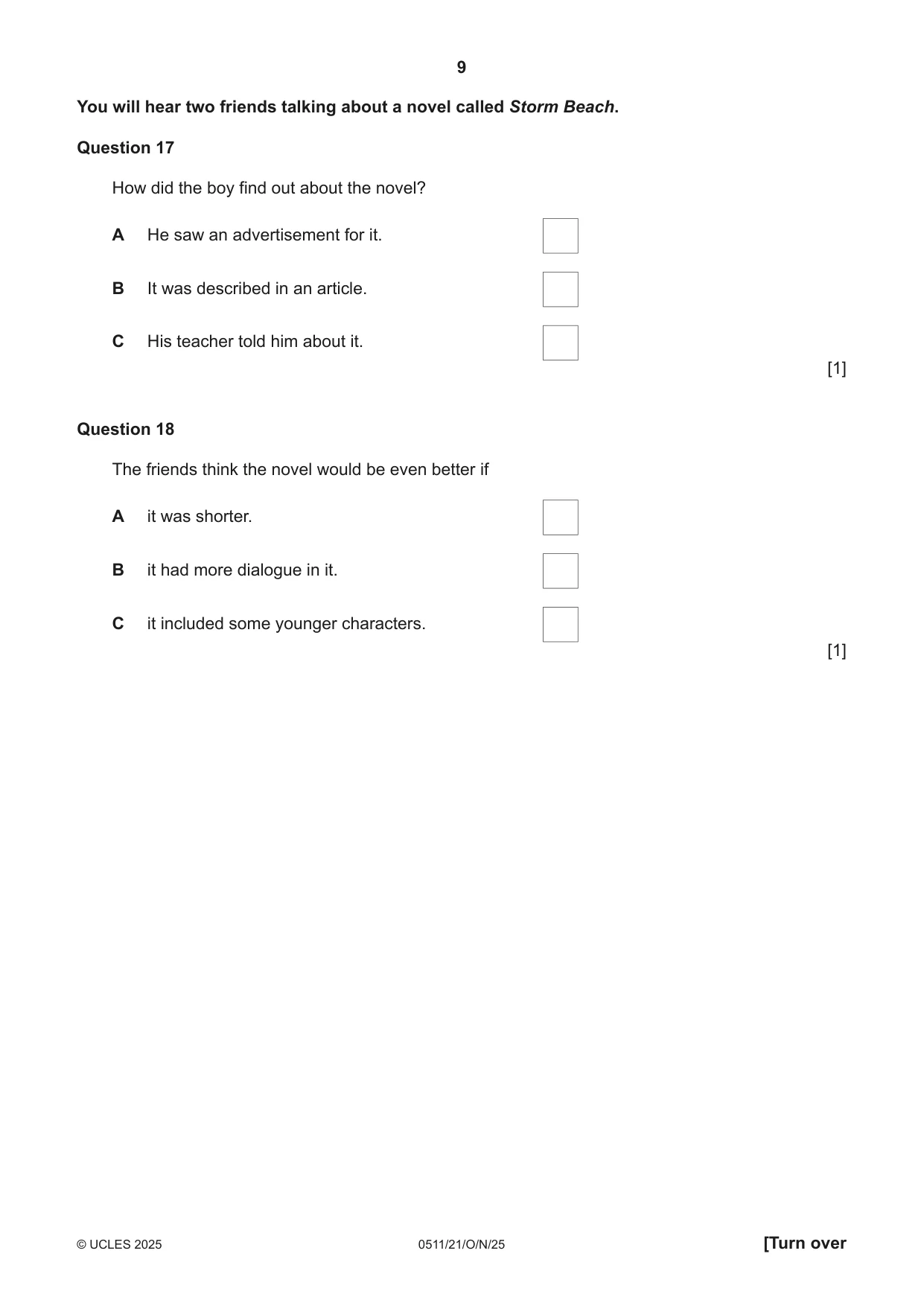
Question paper, page 9
9 0511/21/O/N/25 © UCLES 2025 [Turn over You will hear two friends talking about a novel called Storm Beach. Question 17 How did the boy find out about the novel? A He saw an advertisement for it. B It was described in an article. C His teacher told him about it. [1] Question 18 The friends think the novel would be even better if A it was shorter. B it had more dialogue in it. C it included some younger characters. [1]
Question paper, page 10
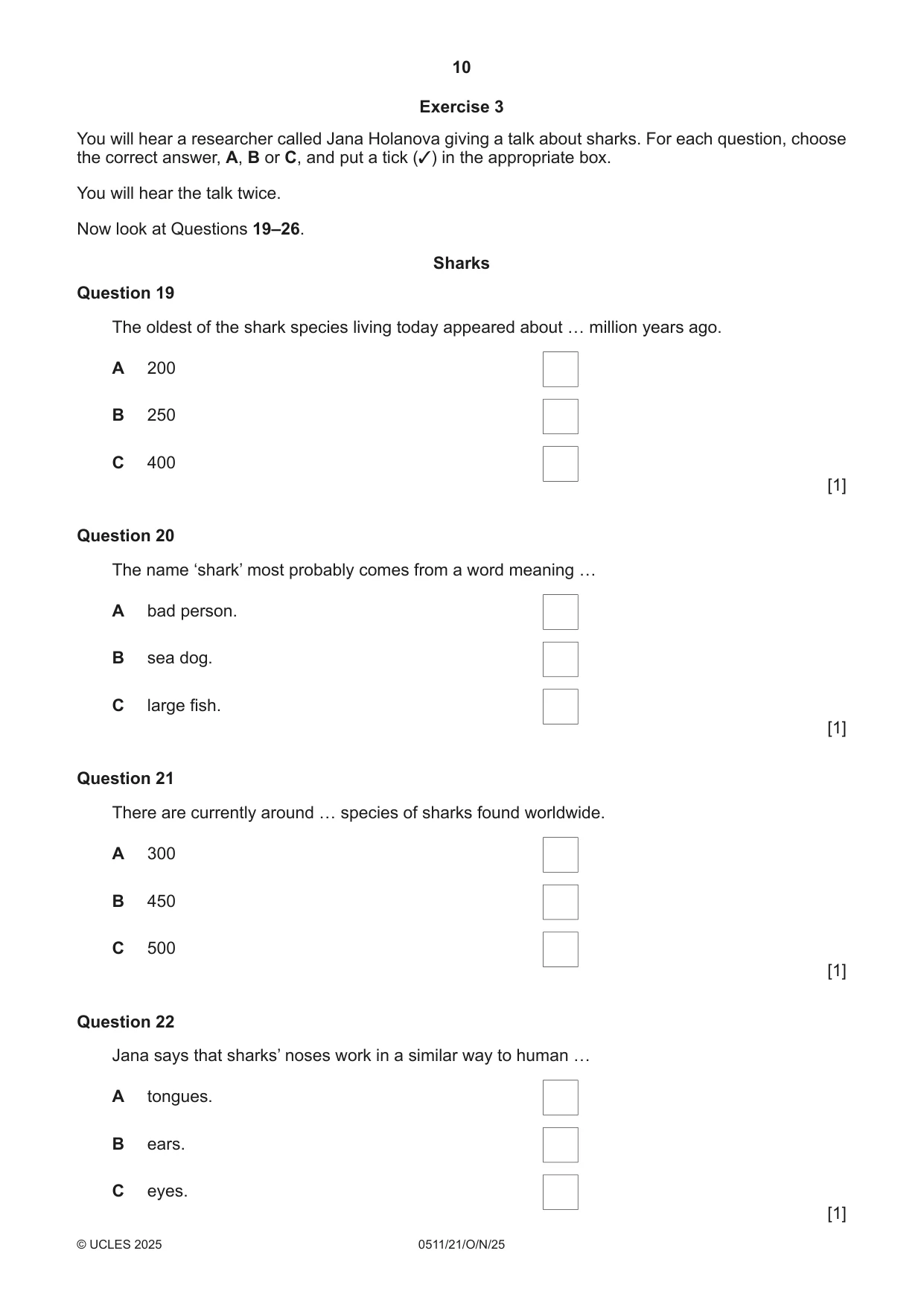
10 0511/21/O/N/25 © UCLES 2025 Exercise 3 You will hear a researcher called Jana Holanova giving a talk about sharks. For each question, choose the correct answer, A, B or C, and put a tick (3) in the appropriate box. You will hear the talk twice. Now look at Questions 19–26. Sharks Question 19 The oldest of the shark species living today appeared about … million years ago. A 200 B 250 C 400 [1] Question 20 The name ‘shark’ most probably comes from a word meaning … A bad person. B sea dog. C large fish. [1] Question 21 There are currently around … species of sharks found worldwide. A 300 B 450 C 500 [1] Question 22 Jana says that sharks’ noses work in a similar way to human … A tongues. B ears. C eyes. [1]
Question paper, page 11
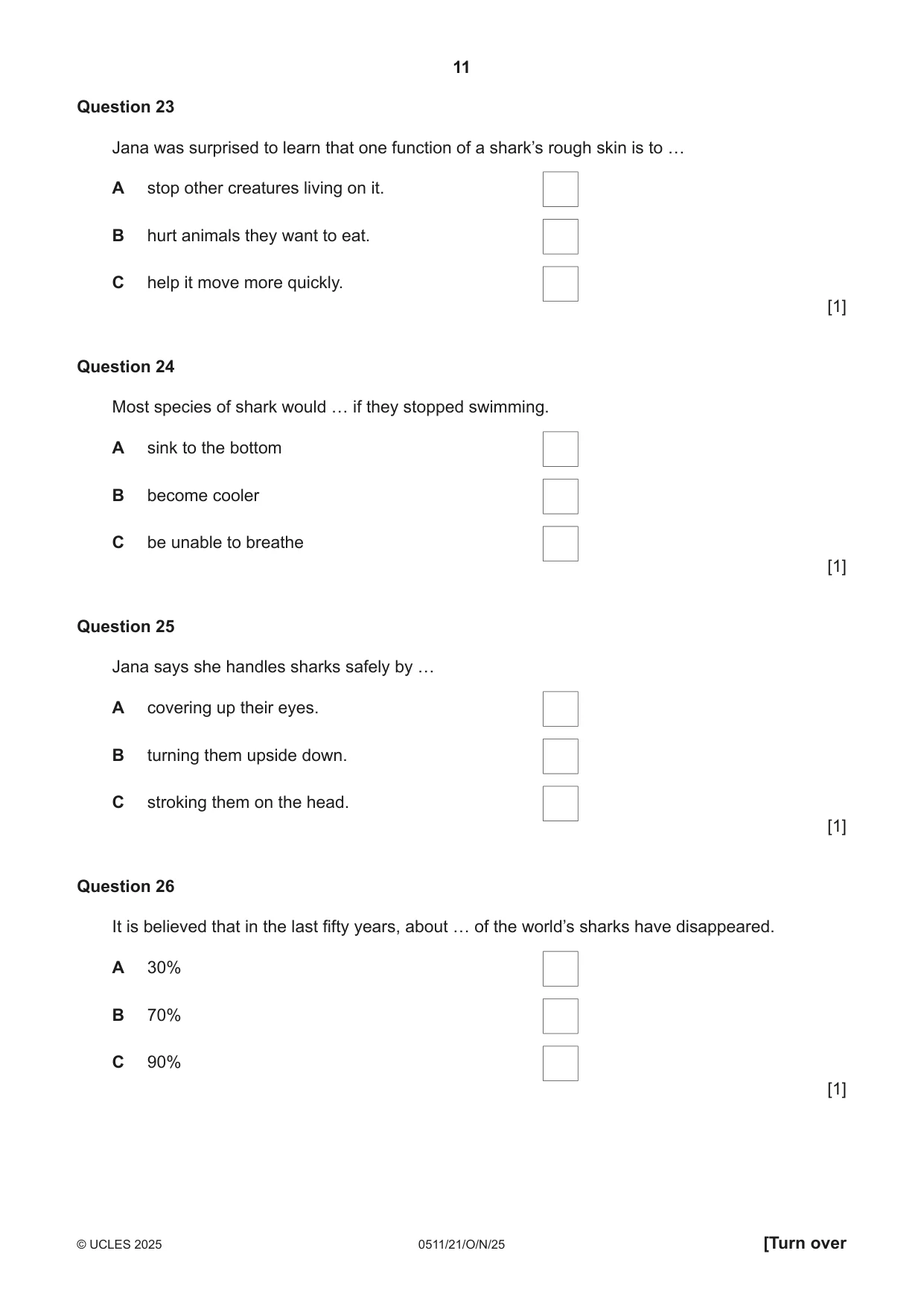
11 0511/21/O/N/25 © UCLES 2025 [Turn over Question 23 Jana was surprised to learn that one function of a shark’s rough skin is to … A stop other creatures living on it. B hurt animals they want to eat. C help it move more quickly. [1] Question 24 Most species of shark would … if they stopped swimming. A sink to the bottom B become cooler C be unable to breathe [1] Question 25 Jana says she handles sharks safely by … A covering up their eyes. B turning them upside down. C stroking them on the head. [1] Question 26 It is believed that in the last fifty years, about … of the world’s sharks have disappeared. A 30% B 70% C 90% [1]
Question paper, page 12
12 0511/21/O/N/25 © UCLES 2025 BLANK PAGE
Question paper, page 13
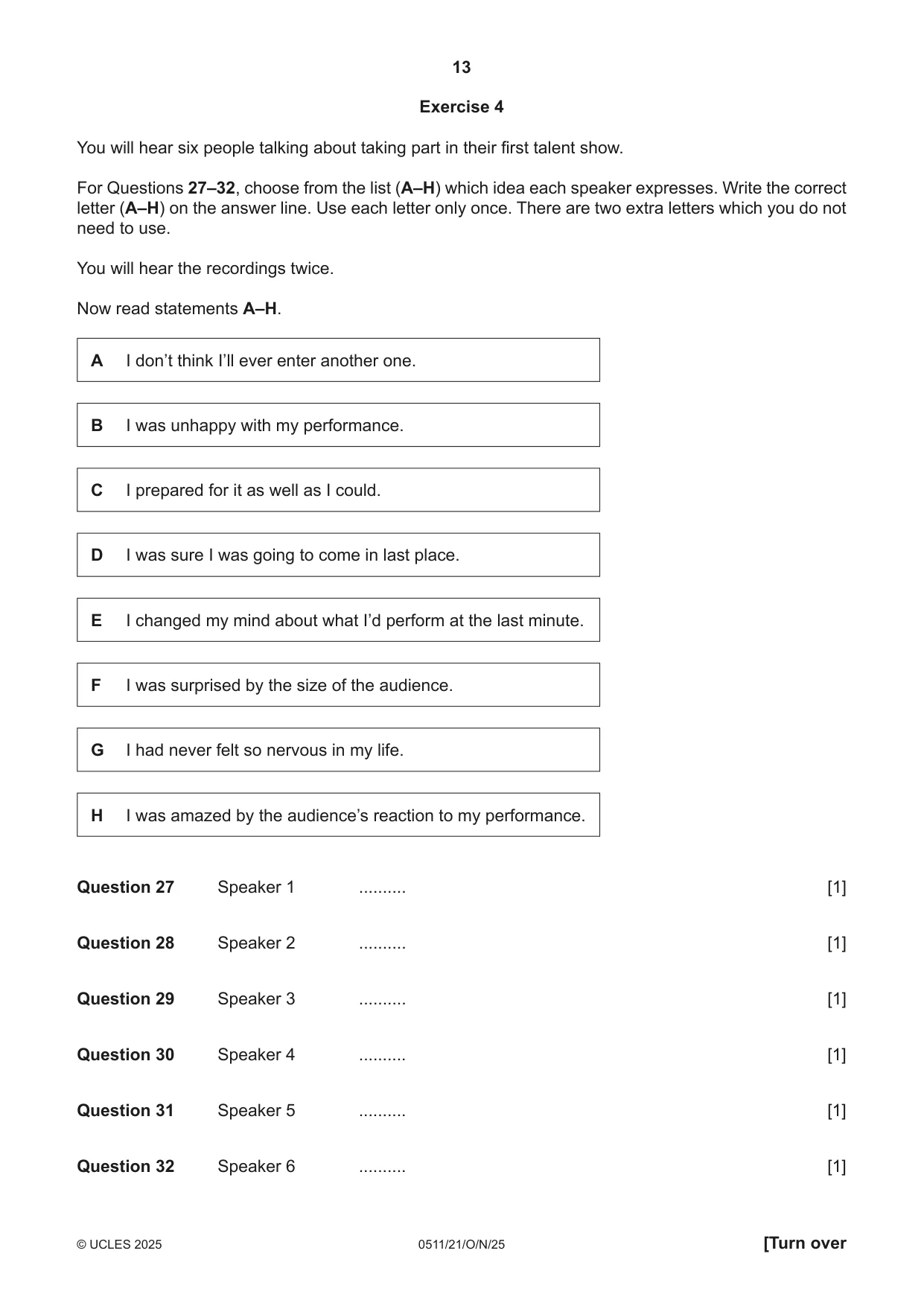
13 0511/21/O/N/25 © UCLES 2025 [Turn over Exercise 4 You will hear six people talking about taking part in their first talent show. For Questions 27–32, choose from the list (A–H) which idea each speaker expresses. Write the correct letter (A–H) on the answer line. Use each letter only once. There are two extra letters which you do not need to use. You will hear the recordings twice. Now read statements A–H. A I don’t think I’ll ever enter another one. B I was unhappy with my performance. C I prepared for it as well as I could. D I was sure I was going to come in last place. E I changed my mind about what I’d perform at the last minute. F I was surprised by the size of the audience. G I had never felt so nervous in my life. H I was amazed by the audience’s reaction to my performance. Question 27 Speaker 1 … [1] Question 28 Speaker 2 … [1] Question 29 Speaker 3 … [1] Question 30 Speaker 4 … [1] Question 31 Speaker 5 … [1] Question 32 Speaker 6 … [1]
Question paper, page 14
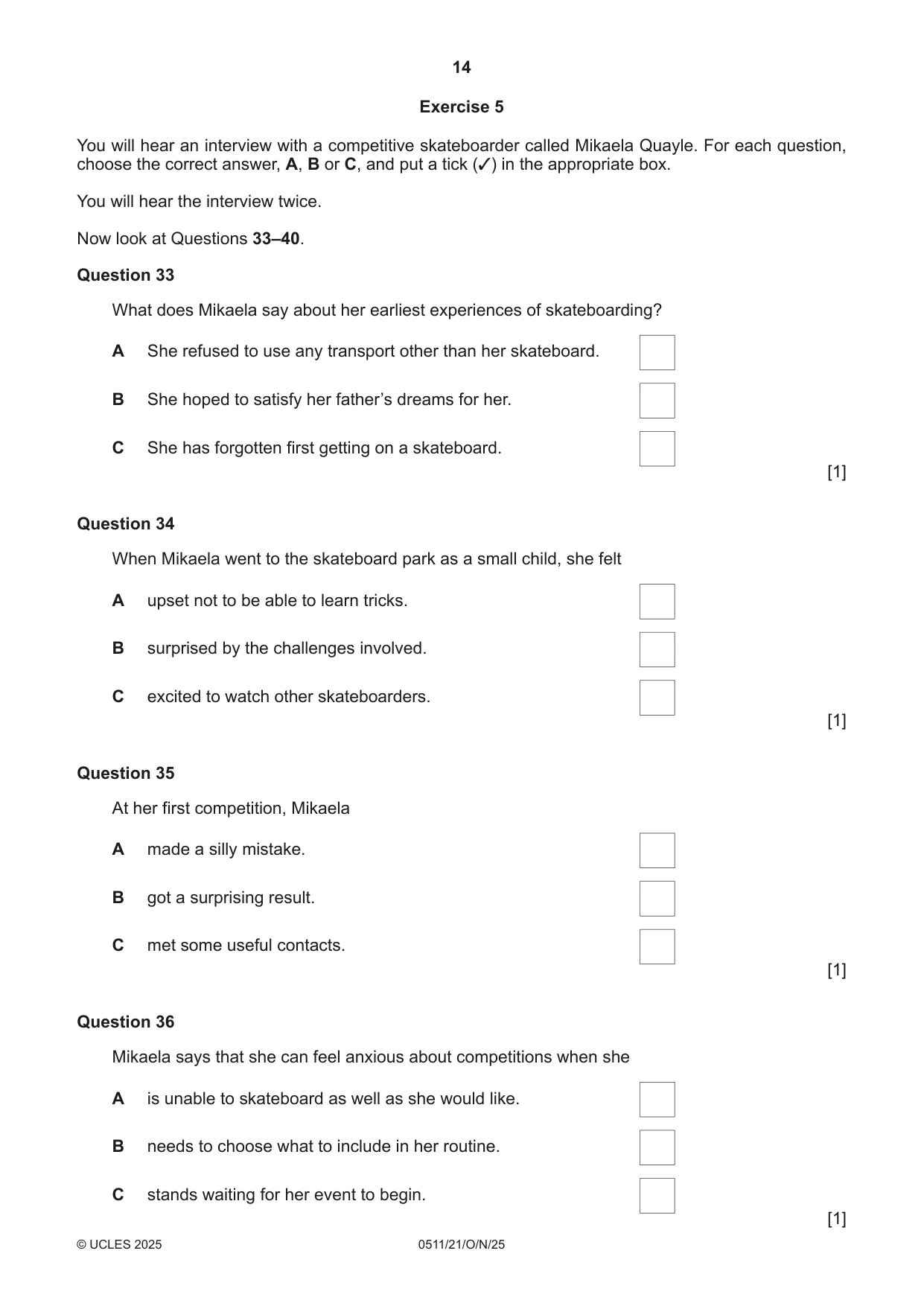
14 0511/21/O/N/25 © UCLES 2025 Exercise 5 You will hear an interview with a competitive skateboarder called Mikaela Quayle. For each question, choose the correct answer, A, B or C, and put a tick (3) in the appropriate box. You will hear the interview twice. Now look at Questions 33–40. Question 33 What does Mikaela say about her earliest experiences of skateboarding? A She refused to use any transport other than her skateboard. B She hoped to satisfy her father’s dreams for her. C She has forgotten first getting on a skateboard. [1] Question 34 When Mikaela went to the skateboard park as a small child, she felt A upset not to be able to learn tricks. B surprised by the challenges involved. C excited to watch other skateboarders. [1] Question 35 At her first competition, Mikaela A made a silly mistake. B got a surprising result. C met some useful contacts. [1] Question 36 Mikaela says that she can feel anxious about competitions when she A is unable to skateboard as well as she would like. B needs to choose what to include in her routine. C stands waiting for her event to begin. [1]
Question paper, page 15
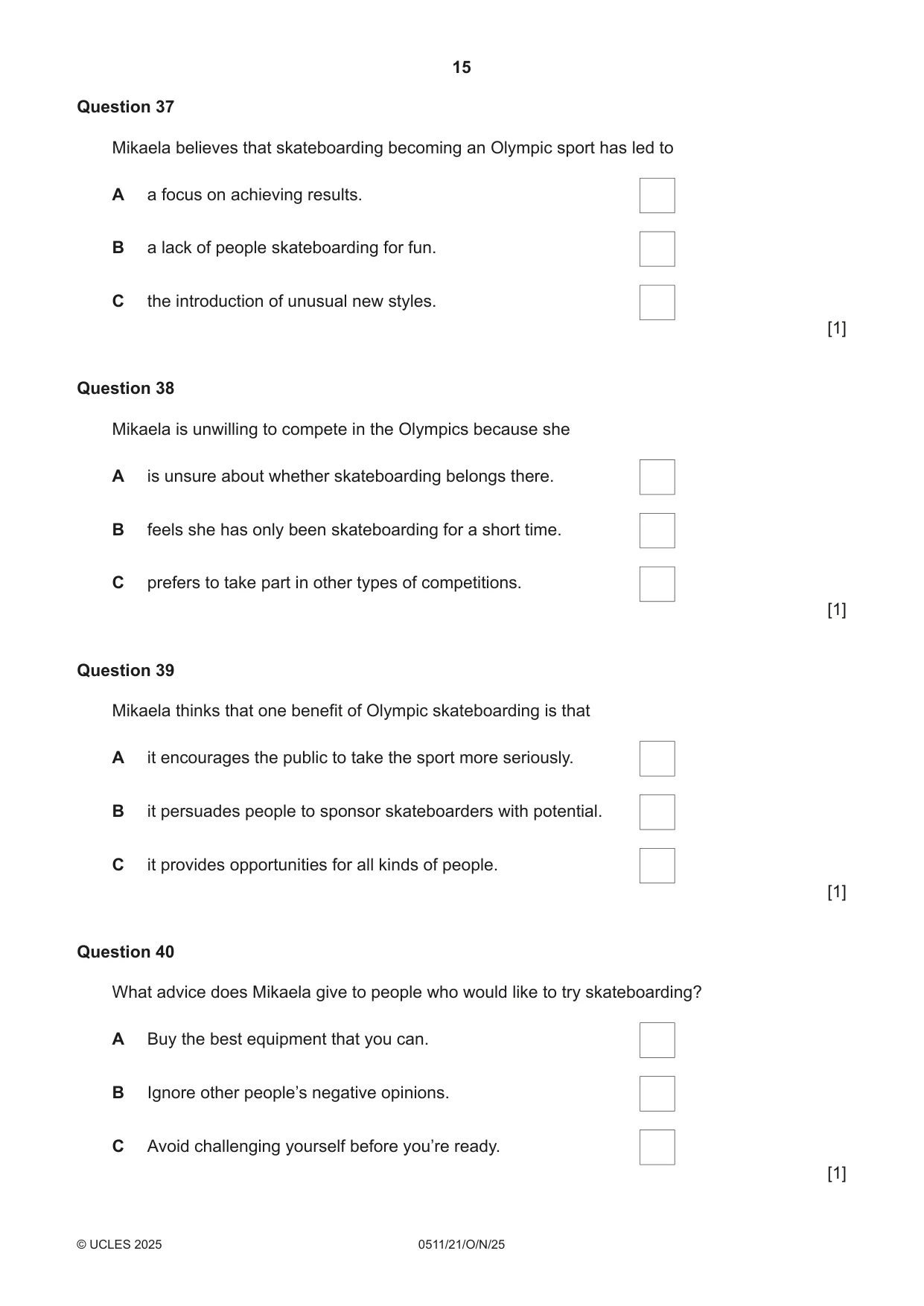
15 0511/21/O/N/25 © UCLES 2025 Question 37 Mikaela believes that skateboarding becoming an Olympic sport has led to A a focus on achieving results. B a lack of people skateboarding for fun. C the introduction of unusual new styles. [1] Question 38 Mikaela is unwilling to compete in the Olympics because she A is unsure about whether skateboarding belongs there. B feels she has only been skateboarding for a short time. C prefers to take part in other types of competitions. [1] Question 39 Mikaela thinks that one benefit of Olympic skateboarding is that A it encourages the public to take the sport more seriously. B it persuades people to sponsor skateboarders with potential. C it provides opportunities for all kinds of people. [1] Question 40 What advice does Mikaela give to people who would like to try skateboarding? A Buy the best equipment that you can. B Ignore other people’s negative opinions. C Avoid challenging yourself before you’re ready. [1]
Question paper, page 16
16 0511/21/O/N/25 © UCLES 2025 Permission to reproduce items where third-party owned material protected by copyright is included has been sought and cleared where possible. Every reasonable effort has been made by the publisher (UCLES) to trace copyright holders, but if any items requiring clearance have unwittingly been included, the publisher will be pleased to make amends at the earliest possible opportunity. To avoid the issue of disclosure of answer-related information to candidates, all copyright acknowledgements are reproduced online in the Cambridge Assessment International Education Copyright Acknowledgements Booklet. This is produced for each series of examinations and is freely available to download at www.cambridgeinternational.org after the live examination series. Cambridge Assessment International Education is part of Cambridge Assessment. Cambridge Assessment is the brand name of the University of Cambridge Local Examinations Syndicate (UCLES), which is a department of the University of Cambridge. BLANK PAGE
Mark scheme, page 1
This document consists of 3 printed pages. © Cambridge University Press & Assessment 2025 [Turn over Cambridge IGCSE™ ENGLISH AS A SECOND LANGUAGE 0511/21 Paper 2 Listening October/November 2025 MARK SCHEME Maximum Mark: 40 Published This mark scheme is published as an aid to teachers and candidates, to indicate the requirements of the examination. Mark schemes should be read in conjunction with the question paper and the Principal Examiner Report for Teachers. Cambridge International will not enter into discussions about these mark schemes. Cambridge International is publishing the mark schemes for the October/November 2025 series for most Cambridge IGCSE, Cambridge International A and AS Level components, and some Cambridge O Level components.
Mark scheme, page 2
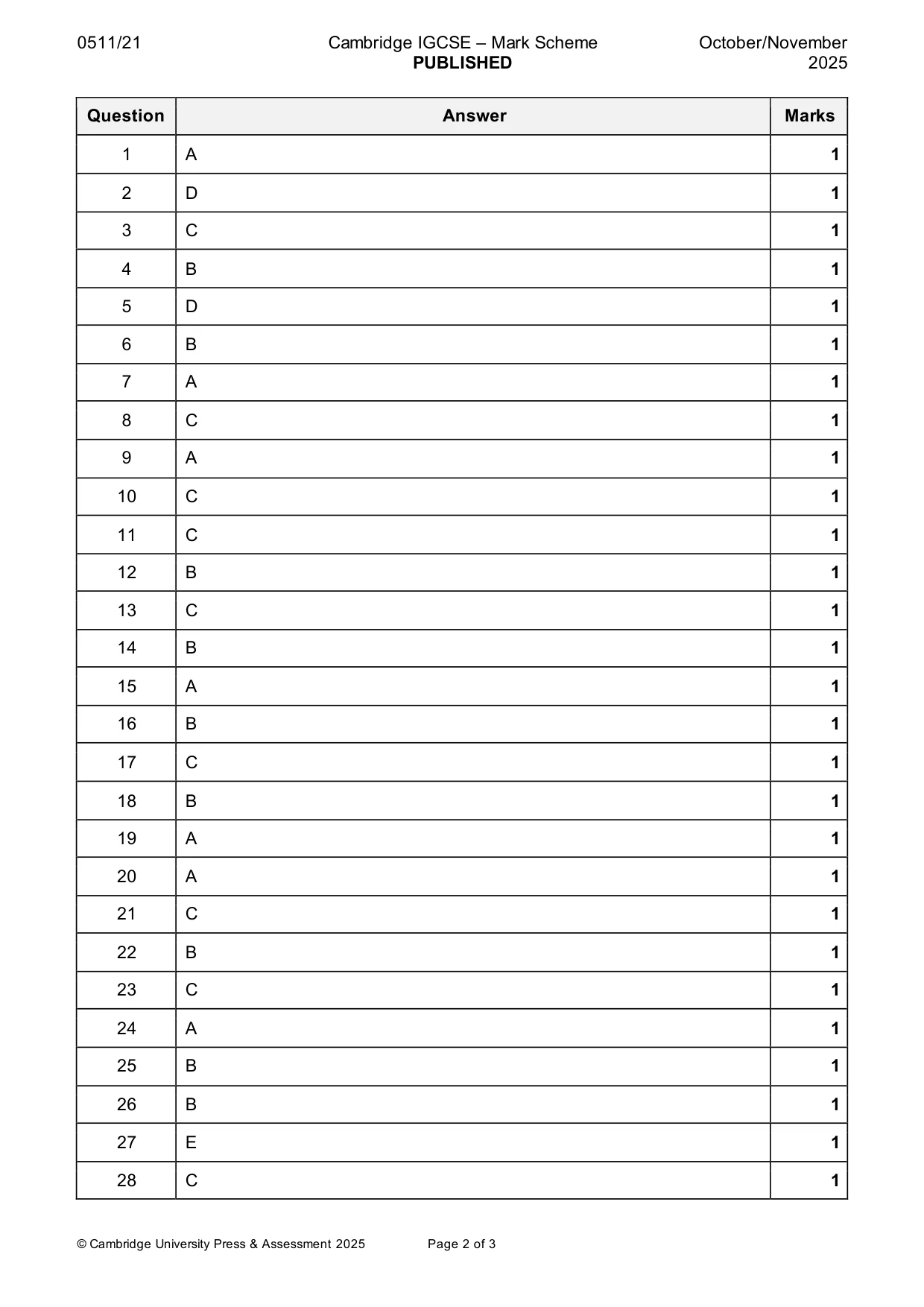
0511/21 Cambridge IGCSE – Mark Scheme PUBLISHED October/November 2025 © Cambridge University Press & Assessment 2025 Page 2 of 3 Question Answer Marks 1 A 1 2 D 1 3 C 1 4 B 1 5 D 1 6 B 1 7 A 1 8 C 1 9 A 1 10 C 1 11 C 1 12 B 1 13 C 1 14 B 1 15 A 1 16 B 1 17 C 1 18 B 1 19 A 1 20 A 1 21 C 1 22 B 1 23 C 1 24 A 1 25 B 1 26 B 1 27 E 1 28 C 1
Mark scheme, page 3
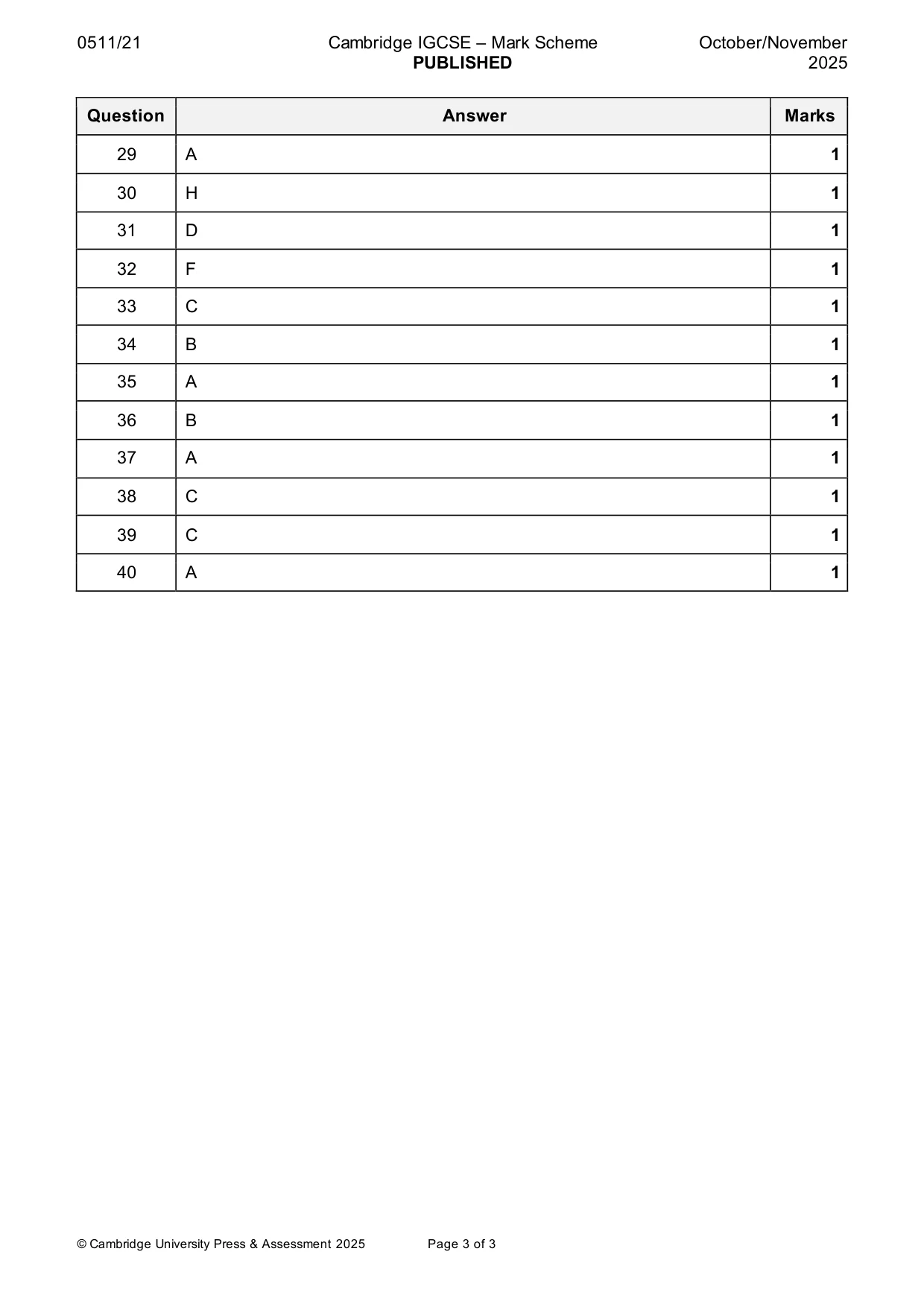
0511/21 Cambridge IGCSE – Mark Scheme PUBLISHED October/November 2025 © Cambridge University Press & Assessment 2025 Page 3 of 3 Question Answer Marks 29 A 1 30 H 1 31 D 1 32 F 1 33 C 1 34 B 1 35 A 1 36 B 1 37 A 1 38 C 1 39 C 1 40 A 1
What you needed in this session
Cambridge’s own grade thresholds for 2025 Oct/Nov, Paper 2 · Variant 1. A higher threshold means an easier paper — the bar moves with how the cohort did.