Cambridge IGCSE English - Second Language (count-in oral) 0511 — 2023 Oct/Nov Paper 2 · Variant 2
0511/22/O/N/23 · 80 marks · ≈90 min
The question paper and its mark scheme, free to read here and free to download. This is Cambridge’s own paper, exactly as it was sat.
Question paper16 pages






Mark scheme11 pages
Answers below. Sit the paper first if you are practising.
Paper as text
Question paper, page 1
This document has 16 pages. Any blank pages are indicated. [Turn over Cambridge IGCSE™ * 4 9 1 1 4 1 4 5 1 5 * DC (SK/CGW) 332996 © UCLES 2023 ENGLISH AS A SECOND LANGUAGE 0511/22 Paper 2 Reading and Writing (Extended) October/November 2023 2 hours You must answer on the question paper. No additional materials are needed. INSTRUCTIONS ● Answer all questions. ● Use a black or dark blue pen. ● Write your name, centre number and candidate number in the boxes at the top of the page. ● Write your answer to each question in the space provided. ● Do not use an erasable pen or correction fluid. ● Do not write on any bar codes. ● Dictionaries are not allowed. INFORMATION ● The total mark for this paper is 80. ● The number of marks for each question or part question is shown in brackets [ ].
Question paper, page 2
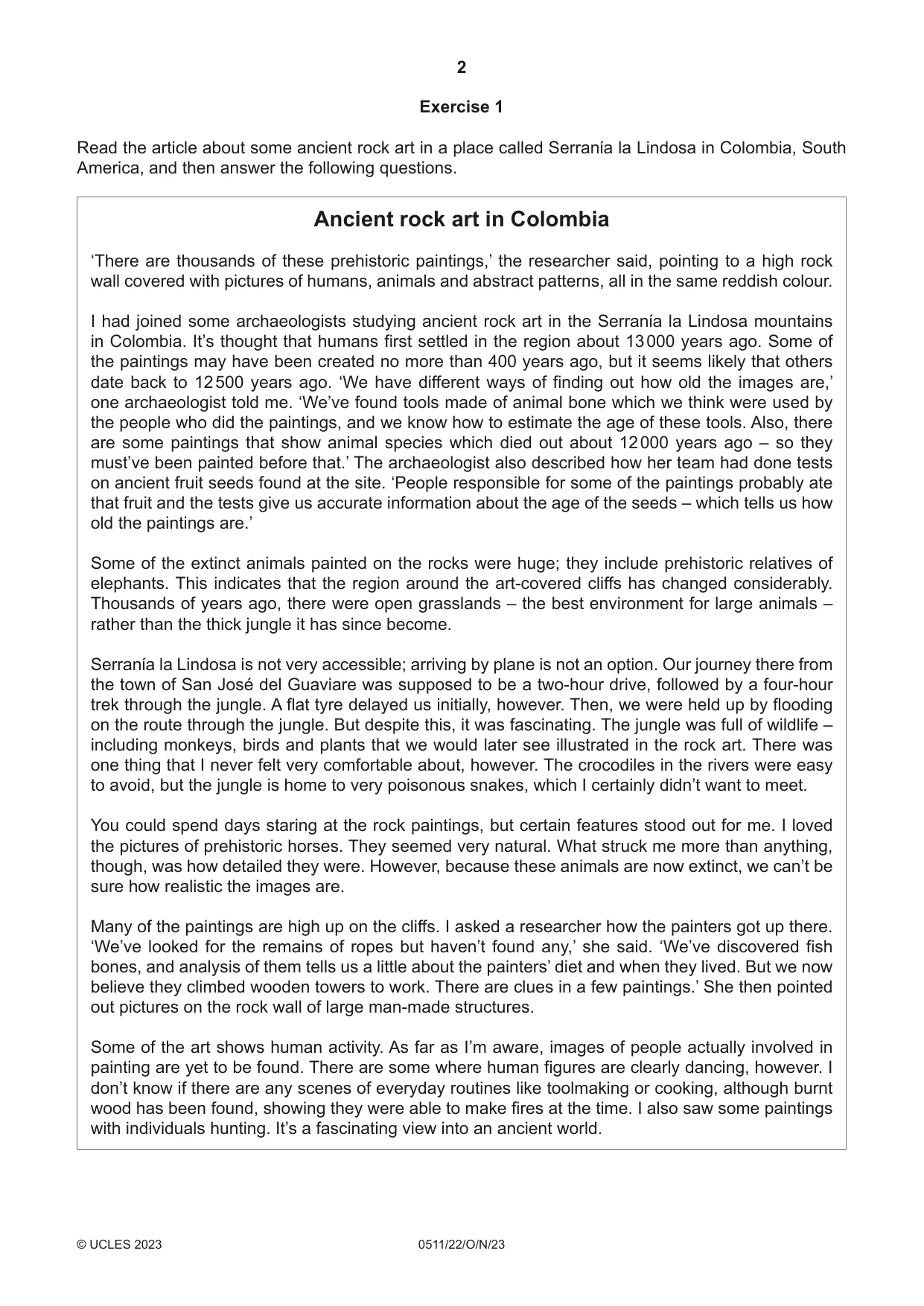
2 0511/22/O/N/23 © UCLES 2023 Exercise 1 Read the article about some ancient rock art in a place called Serranίa la Lindosa in Colombia, South America, and then answer the following questions. Ancient rock art in Colombia ‘There are thousands of these prehistoric paintings,’ the researcher said, pointing to a high rock wall covered with pictures of humans, animals and abstract patterns, all in the same reddish colour. I had joined some archaeologists studying ancient rock art in the Serranίa la Lindosa mountains in Colombia. It’s thought that humans first settled in the region about 13 000 years ago. Some of the paintings may have been created no more than 400 years ago, but it seems likely that others date back to 12 500 years ago. ‘We have different ways of finding out how old the images are,’ one archaeologist told me. ‘We’ve found tools made of animal bone which we think were used by the people who did the paintings, and we know how to estimate the age of these tools. Also, there are some paintings that show animal species which died out about 12 000 years ago – so they must’ve been painted before that.’ The archaeologist also described how her team had done tests on ancient fruit seeds found at the site. ‘People responsible for some of the paintings probably ate that fruit and the tests give us accurate information about the age of the seeds – which tells us how old the paintings are.’ Some of the extinct animals painted on the rocks were huge; they include prehistoric relatives of elephants. This indicates that the region around the art-covered cliffs has changed considerably. Thousands of years ago, there were open grasslands – the best environment for large animals – rather than the thick jungle it has since become. Serranίa la Lindosa is not very accessible; arriving by plane is not an option. Our journey there from the town of San José del Guaviare was supposed to be a two-hour drive, followed by a four-hour trek through the jungle. A flat tyre delayed us initially, however. Then, we were held up by flooding on the route through the jungle. But despite this, it was fascinating. The jungle was full of wildlife – including monkeys, birds and plants that we would later see illustrated in the rock art. There was one thing that I never felt very comfortable about, however. The crocodiles in the rivers were easy to avoid, but the jungle is home to very poisonous snakes, which I certainly didn’t want to meet. You could spend days staring at the rock paintings, but certain features stood out for me. I loved the pictures of prehistoric horses. They seemed very natural. What struck me more than anything, though, was how detailed they were. However, because these animals are now extinct, we can’t be sure how realistic the images are. Many of the paintings are high up on the cliffs. I asked a researcher how the painters got up there. ‘We’ve looked for the remains of ropes but haven’t found any,’ she said. ‘We’ve discovered fish bones, and analysis of them tells us a little about the painters’ diet and when they lived. But we now believe they climbed wooden towers to work. There are clues in a few paintings.’ She then pointed out pictures on the rock wall of large man-made structures. Some of the art shows human activity. As far as I’m aware, images of people actually involved in painting are yet to be found. There are some where human figures are clearly dancing, however. I don’t know if there are any scenes of everyday routines like toolmaking or cooking, although burnt wood has been found, showing they were able to make fires at the time. I also saw some paintings with individuals hunting. It’s a fascinating view into an ancient world.
Question paper, page 3
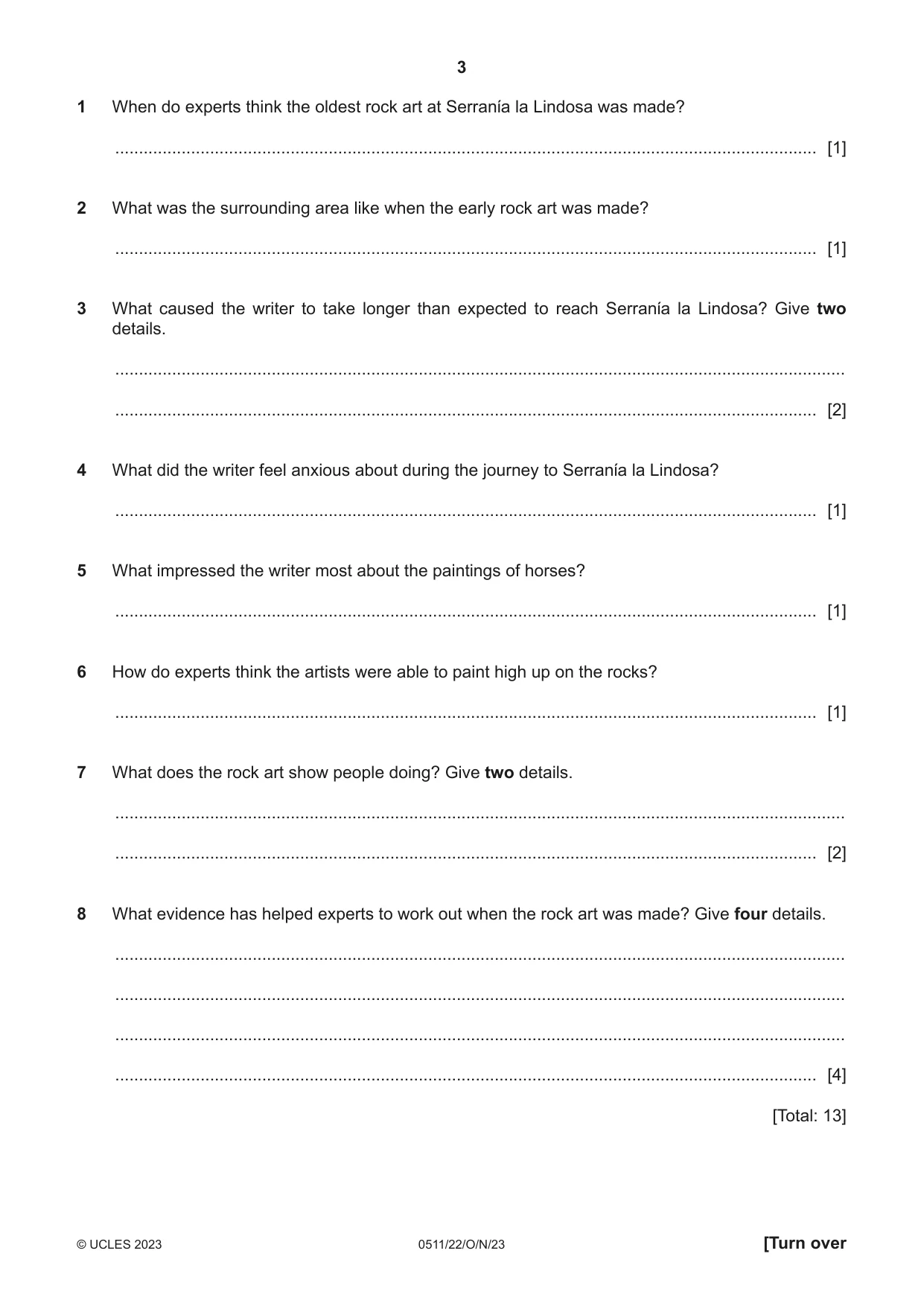
3 0511/22/O/N/23 © UCLES 2023 [Turn over 1 When do experts think the oldest rock art at Serranίa la Lindosa was made? … [1] 2 What was the surrounding area like when the early rock art was made? … [1] 3 What caused the writer to take longer than expected to reach Serranίa la Lindosa? Give two details. … … [2] 4 What did the writer feel anxious about during the journey to Serranίa la Lindosa? … [1] 5 What impressed the writer most about the paintings of horses? … [1] 6 How do experts think the artists were able to paint high up on the rocks? … [1] 7 What does the rock art show people doing? Give two details. … … [2] 8 What evidence has helped experts to work out when the rock art was made? Give four details. … … … … [4] [Total: 13]
Question paper, page 4
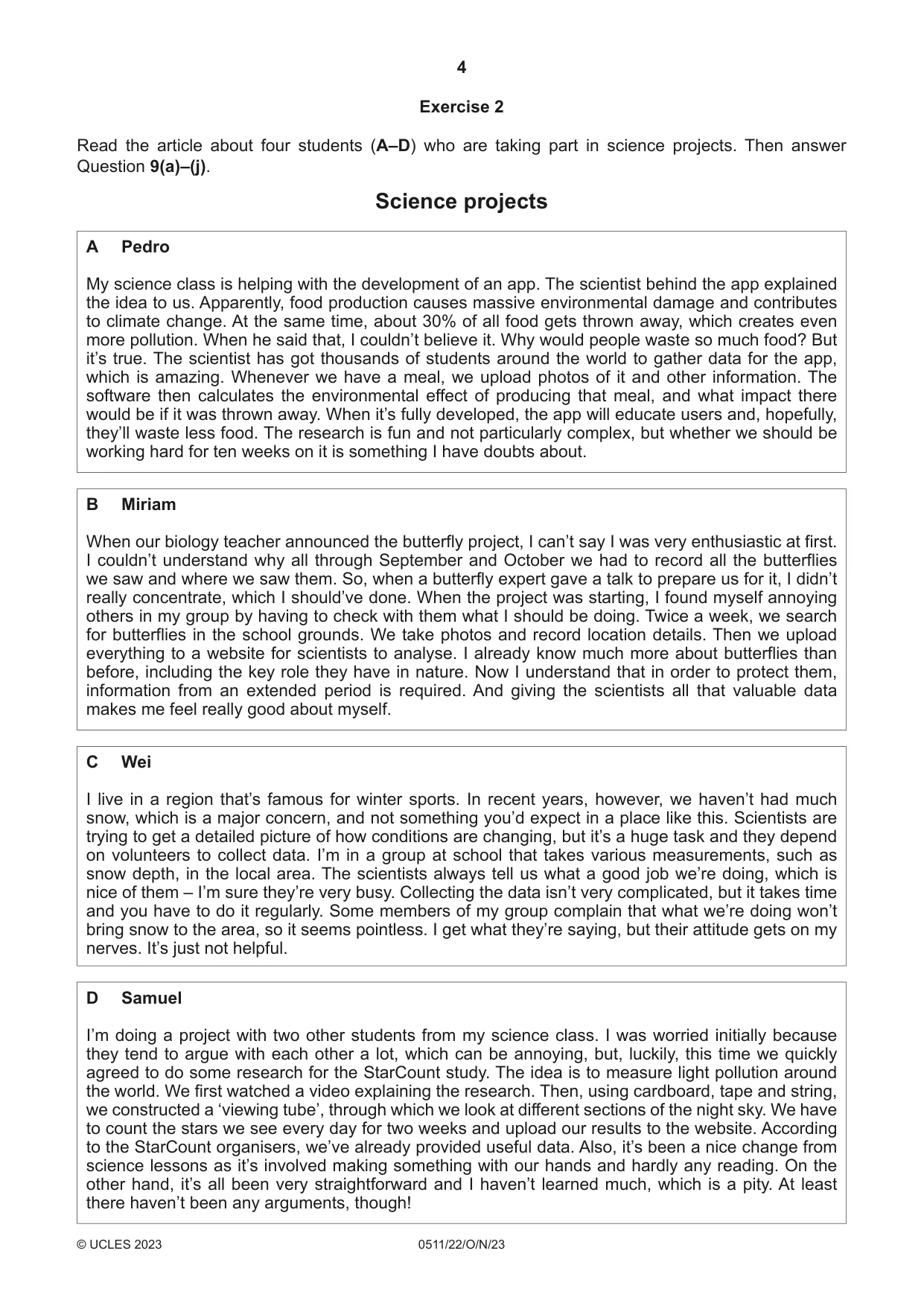
4 0511/22/O/N/23 © UCLES 2023 Exercise 2 Read the article about four students (A–D) who are taking part in science projects. Then answer Question 9(a)–(j). Science projects A Pedro My science class is helping with the development of an app. The scientist behind the app explained the idea to us. Apparently, food production causes massive environmental damage and contributes to climate change. At the same time, about 30% of all food gets thrown away, which creates even more pollution. When he said that, I couldn’t believe it. Why would people waste so much food? But it’s true. The scientist has got thousands of students around the world to gather data for the app, which is amazing. Whenever we have a meal, we upload photos of it and other information. The software then calculates the environmental effect of producing that meal, and what impact there would be if it was thrown away. When it’s fully developed, the app will educate users and, hopefully, they’ll waste less food. The research is fun and not particularly complex, but whether we should be working hard for ten weeks on it is something I have doubts about. B Miriam When our biology teacher announced the butterfly project, I can’t say I was very enthusiastic at first. I couldn’t understand why all through September and October we had to record all the butterflies we saw and where we saw them. So, when a butterfly expert gave a talk to prepare us for it, I didn’t really concentrate, which I should’ve done. When the project was starting, I found myself annoying others in my group by having to check with them what I should be doing. Twice a week, we search for butterflies in the school grounds. We take photos and record location details. Then we upload everything to a website for scientists to analyse. I already know much more about butterflies than before, including the key role they have in nature. Now I understand that in order to protect them, information from an extended period is required. And giving the scientists all that valuable data makes me feel really good about myself. C Wei I live in a region that’s famous for winter sports. In recent years, however, we haven’t had much snow, which is a major concern, and not something you’d expect in a place like this. Scientists are trying to get a detailed picture of how conditions are changing, but it’s a huge task and they depend on volunteers to collect data. I’m in a group at school that takes various measurements, such as snow depth, in the local area. The scientists always tell us what a good job we’re doing, which is nice of them – I’m sure they’re very busy. Collecting the data isn’t very complicated, but it takes time and you have to do it regularly. Some members of my group complain that what we’re doing won’t bring snow to the area, so it seems pointless. I get what they’re saying, but their attitude gets on my nerves. It’s just not helpful. D Samuel I’m doing a project with two other students from my science class. I was worried initially because they tend to argue with each other a lot, which can be annoying, but, luckily, this time we quickly agreed to do some research for the StarCount study. The idea is to measure light pollution around the world. We first watched a video explaining the research. Then, using cardboard, tape and string, we constructed a ‘viewing tube’, through which we look at different sections of the night sky. We have to count the stars we see every day for two weeks and upload our results to the website. According to the StarCount organisers, we’ve already provided useful data. Also, it’s been a nice change from science lessons as it’s involved making something with our hands and hardly any reading. On the other hand, it’s all been very straightforward and I haven’t learned much, which is a pity. At least there haven’t been any arguments, though!
Question paper, page 5
5 0511/22/O/N/23 © UCLES 2023 [Turn over 9 For each question write the correct letter A, B, C or D on the line. Which person … (a) mentions becoming irritated with people during the project? ……… [1] (b) is impressed by the size of the project? ……… [1] (c) thinks that the project isn’t challenging enough? ……… [1] (d) regrets paying too little attention during some of the training? ……… [1] (e) suggests that the project requires too much commitment? ……… [1] (f) is proud of contributing to some important research? ……… [1] (g) likes the practical nature of the project? ……… [1] (h) appreciates feedback they receive? ……… [1] (i) admits to changing their opinion about the aims of the project? ……… [1] (j) says that they learned something that surprised them? ……… [1] [Total: 10]
Question paper, page 6
6 0511/22/O/N/23 © UCLES 2023 Exercise 3 Read the article about birds called parakeets, which are native to Africa and India but have become common in London, and then complete the notes. The parakeets of London I’d arranged to meet bird expert Adam Shaw in Hyde Park in central London. When I got there, two green-coloured birds were greedily taking seeds from his hands while some excited children watched on. ‘It’s hardly surprising that the population of parakeets in London is growing,’ Shaw said. ‘After all, 50% of the city consists of green spaces, which is really good for them. And there’s plenty of food available, which encourages them to stay here.’ London’s parakeet population has grown significantly in the last 20 years to well over 30 000. They are the only type of parrot living wild in the UK and their exotic appearance makes them stand out from other birds. They are the kind of bird you would only expect to see in a zoo in the UK. In fact, according to one theory, some originally escaped from a zoo and then went on to establish themselves around the city. Nowadays, large numbers of parakeets are very visible in London and, while many Londoners like their bright colours, some point out that they compete with other birds for food. ‘One factor that partly explains why there are so many parakeets is that London has lots of trees,’ Shaw continued. ‘That’s where they like to live. Having said that, there are reports that they scare away other smaller birds which also depend on these trees. I haven’t seen any evidence of this being a serious problem, although some people are concerned about this and want to get rid of them. In fact, there are strict laws that protect wildlife – and these regulations are partly why the birds are doing well here.’ I think of Africa and India, where these parakeets originally come from, as places with hot climates, and very different from the UK. So, the idea that the parakeet population in London is expanding puzzled me. Aren’t the long, cold winters a problem for them? ‘The climate here suits them, actually,’ Shaw told me. ‘They come from northern India near the Himalayas, where temperatures can be very low. You can also find groups of them in other northern European cities, and the idea that the first ones here flew over from France has even been suggested.’ Shaw then told me that in India and in other countries with parakeet populations, not everyone welcomes them. ‘They’re hungry birds and can cause considerable damage to crops,’ Shaw explained. ‘UK farmers are afraid this might happen here, though the birds have so far kept to London and other cities. Also, like many birds, they carry disease, which scientists have expressed concern about.’ Most people in London, however, love seeing these beautiful creatures. With so much wildlife under threat, it’s encouraging to see one species doing well. And there are lots of interesting parakeet stories. One is that in 1968, the rock star Jimi Hendrix released a pair of parakeets from a cage, and that’s how the local population began. No-one knows whether this really happened or not, though. Another story goes back to 1951, when some birds were brought to London to appear in a film, and then established themselves. While we can’t prove that these stories are true, they reflect the interest many Londoners take in their city’s parakeets.
Question paper, page 7
7 0511/22/O/N/23 © UCLES 2023 [Turn over You are going to give a talk about the parakeets of London to your class at school. Prepare some notes to use as the basis for your talk. Make short notes under each heading. 10 Reasons for the increasing number of parakeets in London: • example: 50% of the city consists of green spaces … • … • … • … [3] 11 Possible explanations for how parakeets first came to be in London: • … • … • … [3] 12 Worries some people have about the parakeets: • … • … • … [3] [Total: 9]
Question paper, page 8
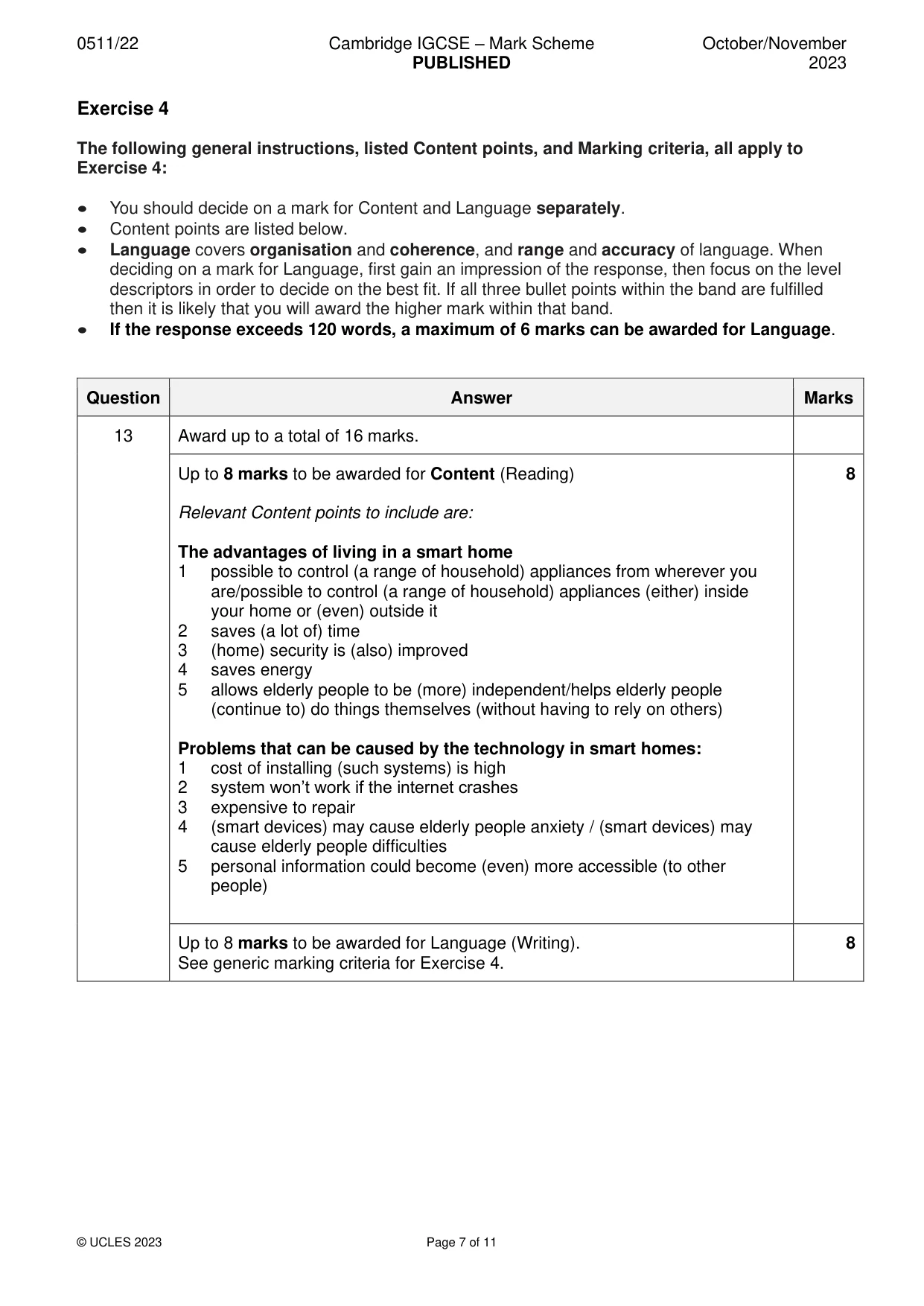
8 0511/22/O/N/23 © UCLES 2023 Exercise 4 13 Read the article about ‘smart homes’, where many electrical devices are connected to the internet and can be controlled from smartphones. Write a summary about the advantages of living in a smart home AND the problems that can be caused by the technology in smart homes. Your summary should be about 100 words long (and no more than 120 words long). You should use your own words as far as possible. You will receive up to 8 marks for the content of your summary, and up to 8 marks for the style and accuracy of your language. Smart homes If you own a television, you will probably have a remote control that allows you to turn the television on and off, change channels and adjust the volume from across the room. You may also have a remote control for your central heating or your air-conditioning system. Remote controls like these have been a common sight in many people’s homes for a long time, but, in recent years, many more ‘smart devices’ have been developed. Now, with a smartphone and internet connection, it is possible to control a range of household appliances from wherever you are, either inside your home or even outside it. On the other hand, the cost of installing such systems is high, which is why they are still not a feature in every household. Imagine you have walked to a station, 15 minutes from your home, and you are about to get on a train. It suddenly occurs to you that you didn’t get around to closing the kitchen window. Rather than walk all the way back and miss your train, you can save a lot of time by using an app on your phone to check, and close it for you. So your home security is also improved. With digital set-ups of this kind, your system won’t work if the internet crashes. We all know how frustrating this can be. Also, advanced electronic devices are expensive to repair. But let’s assume that everything is working; studies have shown that one of the top benefits of introducing smart systems into the home is that you save energy. Smart devices can help us to avoid making mistakes like accidentally leaving our lights on for long periods of time, for example. So, will most people’s homes in the future be smart homes? That certainly seems likely: many newly built houses and apartments are fully equipped with smart technology, and many homeowners are gradually converting their older properties into smart homes. Will different groups in the population be affected in different ways by the introduction of smart systems? Research has shown that having access to the type of technology used in smart homes allows elderly people, for example, to be more independent. While younger people might have less of a problem keeping on top of the housework or the gardening, these types of jobs can become more challenging as people get older. Smart devices can help them to continue to do these things themselves without having to rely on others. However, elderly people sometimes have difficulties dealing with change and learning how to operate smart devices may cause them anxiety. This is something that engineers and designers need to bear in mind. Of course, one unfortunate consequence of all this new technology is that, with so many devices and appliances becoming linked to wider networks, personal information could become even more accessible to other people. This is an issue that we will have to deal with.
Question paper, page 9
9 0511/22/O/N/23 © UCLES 2023 [Turn over … … … … … … … … … … … … … … … … … … … … … … … … … … … [Total: 16]
Question paper, page 10
10 0511/22/O/N/23 © UCLES 2023 Exercise 5 14 Recently, you and some other students from your school took part in a quiz. Write an email to a friend about the quiz. In your email, you should: • explain why you took part in the quiz • describe how you prepared for the quiz • say how you felt about taking part in the quiz. The pictures above may give you some ideas, and you can also use some ideas of your own. Your email should be between 150 and 200 words long. You will receive up to 8 marks for the content of your email, and up to 8 marks for the language used.
Question paper, page 11
11 0511/22/O/N/23 © UCLES 2023 [Turn over … … … … … … … … … … … … … … … … … … … … … … … … … … … [Total: 16]
Question paper, page 12
12 0511/22/O/N/23 © UCLES 2023 Exercise 6 15 You recently watched a television drama series which a lot of young people are talking about. You have decided to write a review of the series for your school magazine. Here are two comments made by young people about the television drama series: The storyline was confusing. The ideas were very relevant to our own lives. Write a review for your school magazine. The comments above may give you some ideas, and you can also use some ideas of your own. Your review should be between 150 and 200 words long. You will receive up to 8 marks for the content of your review, and up to 8 marks for the language used.
Question paper, page 13
13 0511/22/O/N/23 © UCLES 2023 … … … … … … … … … … … … … … … … … … … … … … … … … … … [Total: 16]
Question paper, page 14
14 0511/22/O/N/23 © UCLES 2023 BLANK PAGE
Question paper, page 15
15 0511/22/O/N/23 © UCLES 2023 BLANK PAGE
Question paper, page 16
16 0511/22/O/N/23 © UCLES 2023 Permission to reproduce items where third-party owned material protected by copyright is included has been sought and cleared where possible. Every reasonable effort has been made by the publisher (UCLES) to trace copyright holders, but if any items requiring clearance have unwittingly been included, the publisher will be pleased to make amends at the earliest possible opportunity. To avoid the issue of disclosure of answer-related information to candidates, all copyright acknowledgements are reproduced online in the Cambridge Assessment International Education Copyright Acknowledgements Booklet. This is produced for each series of examinations and is freely available to download at www.cambridgeinternational.org after the live examination series. Cambridge Assessment International Education is part of Cambridge Assessment. Cambridge Assessment is the brand name of the University of Cambridge Local Examinations Syndicate (UCLES), which is a department of the University of Cambridge. BLANK PAGE
Mark scheme, page 1
This document consists of 11 printed pages. © UCLES 2023 [Turn over Cambridge IGCSE™ ENGLISH AS A SECOND LANGUAGE 0511/22 Paper 2 Reading and Writing (Extended) October/November 2023 MARK SCHEME Maximum Mark: 80 Published This mark scheme is published as an aid to teachers and candidates, to indicate the requirements of the examination. It shows the basis on which Examiners were instructed to award marks. It does not indicate the details of the discussions that took place at an Examiners’ meeting before marking began, which would have considered the acceptability of alternative answers. Mark schemes should be read in conjunction with the question paper and the Principal Examiner Report for Teachers. Cambridge International will not enter into discussions about these mark schemes. Cambridge International is publishing the mark schemes for the October/November 2023 series for most Cambridge IGCSE, Cambridge International A and AS Level components, and some Cambridge O Level components.
Mark scheme, page 2
0511/22 Cambridge IGCSE – Mark Scheme PUBLISHED October/November 2023 © UCLES 2023 Page 2 of 11 Generic Marking Principles These general marking principles must be applied by all examiners when marking candidate answers. They should be applied alongside the specific content of the mark scheme or generic level descriptors for a question. Each question paper and mark scheme will also comply with these marking principles. GENERIC MARKING PRINCIPLE 1: Marks must be awarded in line with: • the specific content of the mark scheme or the generic level descriptors for the question • the specific skills defined in the mark scheme or in the generic level descriptors for the question • the standard of response required by a candidate as exemplified by the standardisation scripts. GENERIC MARKING PRINCIPLE 2: Marks awarded are always whole marks (not half marks, or other fractions). GENERIC MARKING PRINCIPLE 3: Marks must be awarded positively: • marks are awarded for correct/valid answers, as defined in the mark scheme. However, credit is given for valid answers which go beyond the scope of the syllabus and mark scheme, referring to your Team Leader as appropriate • marks are awarded when candidates clearly demonstrate what they know and can do • marks are not deducted for errors • marks are not deducted for omissions • answers should only be judged on the quality of spelling, punctuation and grammar when these features are specifically assessed by the question as indicated by the mark scheme. The meaning, however, should be unambiguous. GENERIC MARKING PRINCIPLE 4: Rules must be applied consistently, e.g. in situations where candidates have not followed instructions or in the application of generic level descriptors. GENERIC MARKING PRINCIPLE 5: Marks should be awarded using the full range of marks defined in the mark scheme for the question (however; the use of the full mark range may be limited according to the quality of the candidate responses seen). GENERIC MARKING PRINCIPLE 6: Marks awarded are based solely on the requirements as defined in the mark scheme. Marks should not be awarded with grade thresholds or grade descriptors in mind.
Mark scheme, page 3
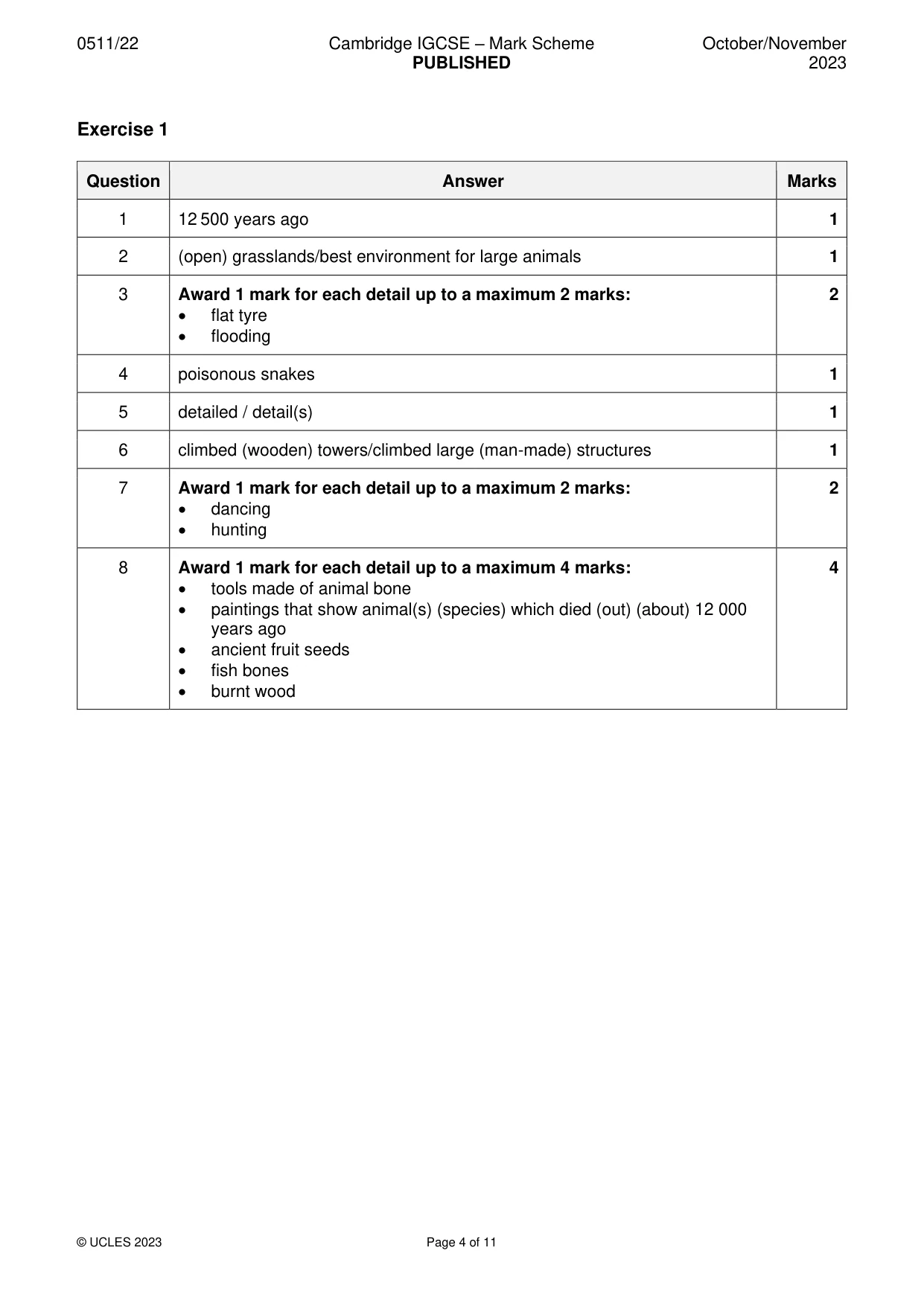
0511/22 Cambridge IGCSE – Mark Scheme PUBLISHED October/November 2023 © UCLES 2023 Page 3 of 11 This component forms part of the Extended tier assessment of Cambridge IGCSE English as a Second Language and tests the following Assessment Objectives: AO1: Reading R1 identify and select relevant information R2 understand ideas, opinions and attitudes R3 show understanding of the connections between ideas, opinions and attitudes R4 understand what is implied but not directly stated, e.g. gist, writer’s purpose, intentions and feelings AO2: Writing W1 communicate information/ideas/opinions clearly, accurately and effectively W2 organise ideas into coherent paragraphs using a range of appropriate linking devices W3 use a range of grammatical structures accurately and effectively W4 show control of punctuation and spelling W5 use appropriate register and style/format for the given purpose and audience
Mark scheme, page 4
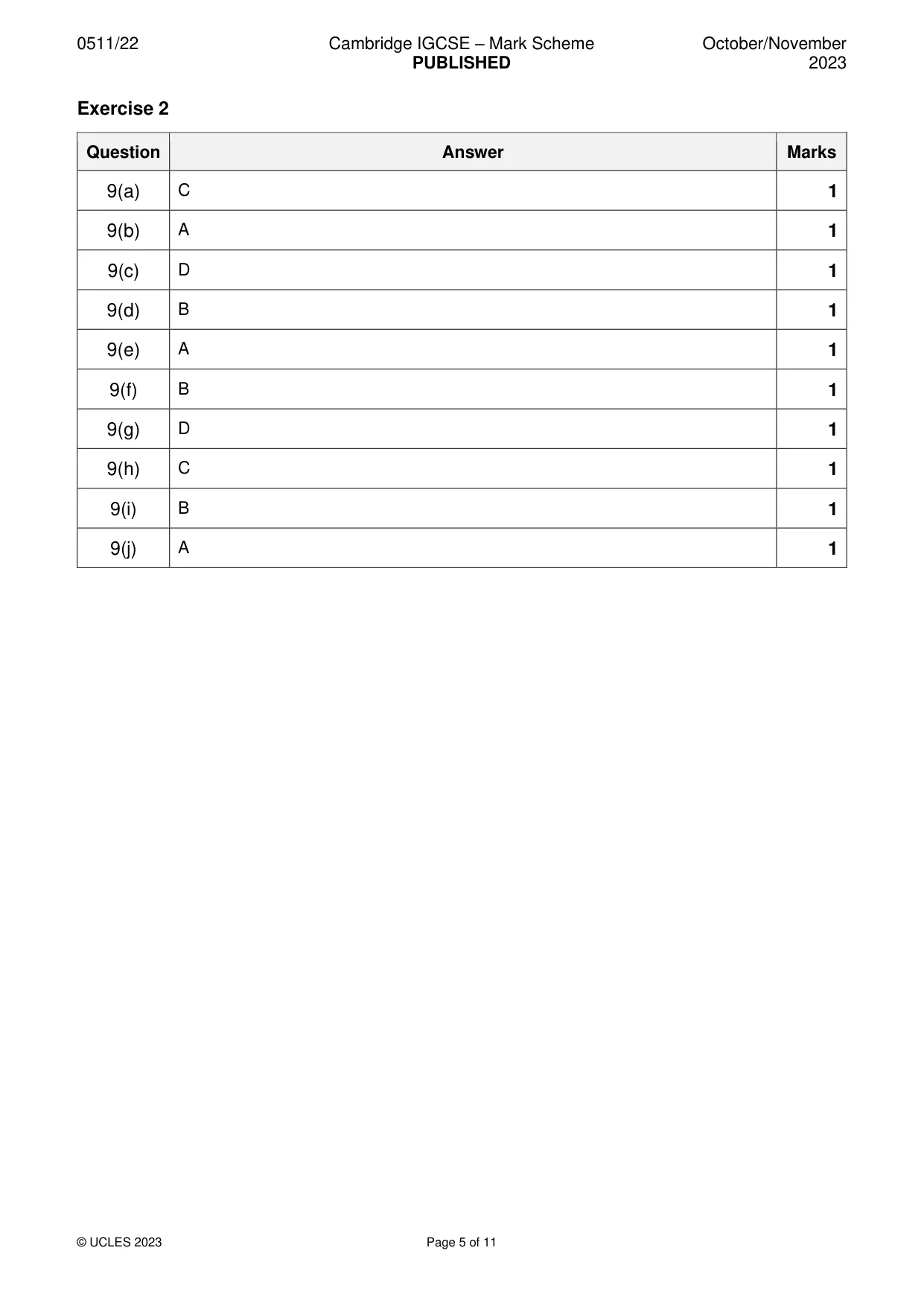
0511/22 Cambridge IGCSE – Mark Scheme PUBLISHED October/November 2023 © UCLES 2023 Page 4 of 11 Exercise 1 Question Answer Marks 1 12 500 years ago 1 2 (open) grasslands/best environment for large animals 1 3 Award 1 mark for each detail up to a maximum 2 marks: • flat tyre • flooding 2 4 poisonous snakes 1 5 detailed / detail(s) 1 6 climbed (wooden) towers/climbed large (man-made) structures 1 7 Award 1 mark for each detail up to a maximum 2 marks: • dancing • hunting 2 8 Award 1 mark for each detail up to a maximum 4 marks: • tools made of animal bone • paintings that show animal(s) (species) which died (out) (about) 12 000 years ago • ancient fruit seeds • fish bones • burnt wood 4
Mark scheme, page 5
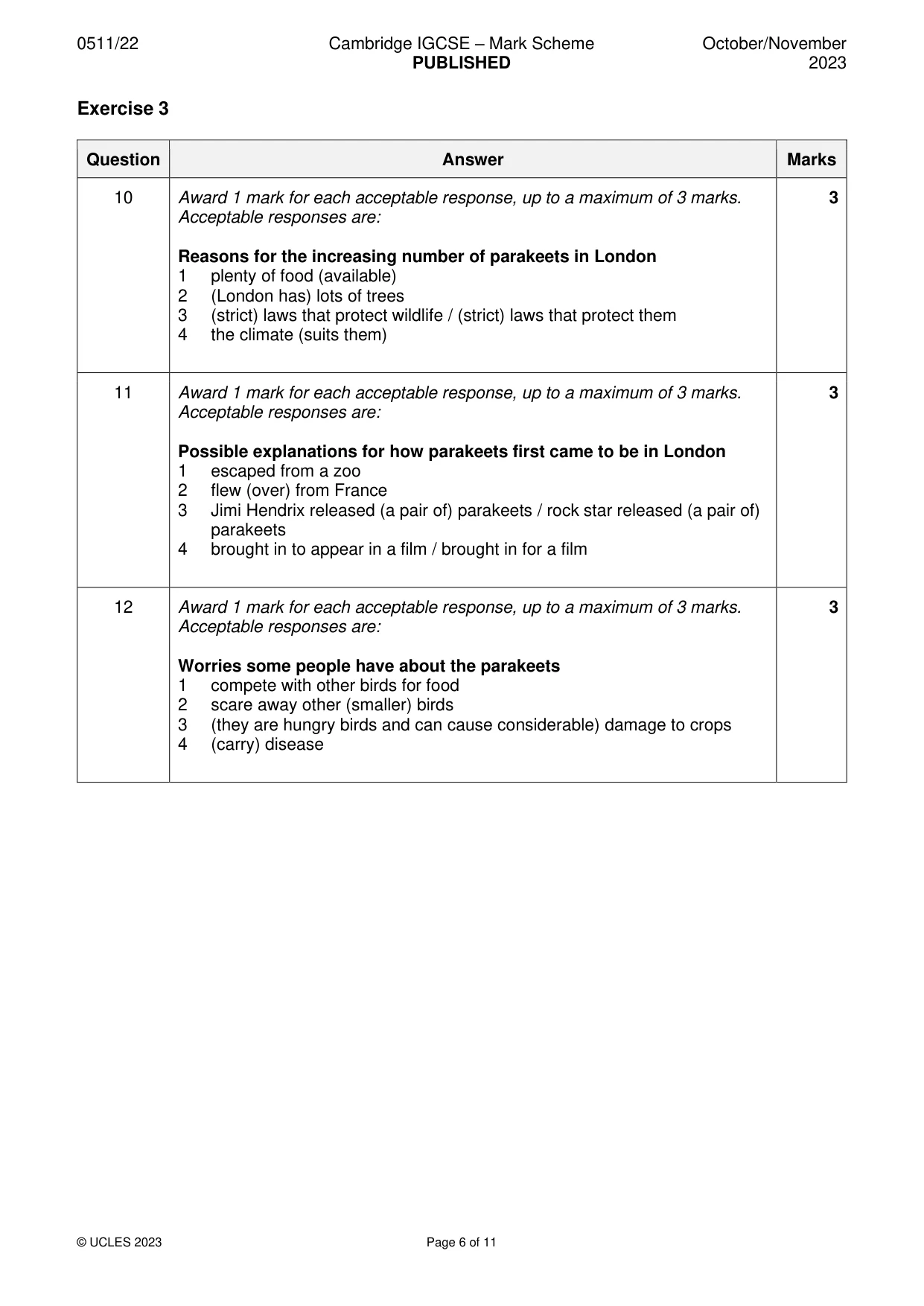
0511/22 Cambridge IGCSE – Mark Scheme PUBLISHED October/November 2023 © UCLES 2023 Page 5 of 11 Exercise 2 Question Answer Marks 9(a) C 1 9(b) A 1 9(c) D 1 9(d) B 1 9(e) A 1 9(f) B 1 9(g) D 1 9(h) C 1 9(i) B 1 9(j) A 1
Mark scheme, page 6
0511/22 Cambridge IGCSE – Mark Scheme PUBLISHED October/November 2023 © UCLES 2023 Page 6 of 11 Exercise 3 Question Answer Marks 10 Award 1 mark for each acceptable response, up to a maximum of 3 marks. Acceptable responses are: Reasons for the increasing number of parakeets in London 1 plenty of food (available) 2 (London has) lots of trees 3 (strict) laws that protect wildlife / (strict) laws that protect them 4 the climate (suits them) 3 11 Award 1 mark for each acceptable response, up to a maximum of 3 marks. Acceptable responses are: Possible explanations for how parakeets first came to be in London 1 escaped from a zoo 2 flew (over) from France 3 Jimi Hendrix released (a pair of) parakeets / rock star released (a pair of) parakeets 4 brought in to appear in a film / brought in for a film 3 12 Award 1 mark for each acceptable response, up to a maximum of 3 marks. Acceptable responses are: Worries some people have about the parakeets 1 compete with other birds for food 2 scare away other (smaller) birds 3 (they are hungry birds and can cause considerable) damage to crops 4 (carry) disease 3
Mark scheme, page 7
0511/22 Cambridge IGCSE – Mark Scheme PUBLISHED October/November 2023 © UCLES 2023 Page 7 of 11 Exercise 4 The following general instructions, listed Content points, and Marking criteria, all apply to Exercise 4: • You should decide on a mark for Content and Language separately. • Content points are listed below. • Language covers organisation and coherence, and range and accuracy of language. When deciding on a mark for Language, first gain an impression of the response, then focus on the level descriptors in order to decide on the best fit. If all three bullet points within the band are fulfilled then it is likely that you will award the higher mark within that band. • If the response exceeds 120 words, a maximum of 6 marks can be awarded for Language. Question Answer Marks 13 Award up to a total of 16 marks. Up to 8 marks to be awarded for Content (Reading) Relevant Content points to include are: The advantages of living in a smart home 1 possible to control (a range of household) appliances from wherever you are/possible to control (a range of household) appliances (either) inside your home or (even) outside it 2 saves (a lot of) time 3 (home) security is (also) improved 4 saves energy 5 allows elderly people to be (more) independent/helps elderly people (continue to) do things themselves (without having to rely on others) Problems that can be caused by the technology in smart homes: 1 cost of installing (such systems) is high 2 system won’t work if the internet crashes 3 expensive to repair 4 (smart devices) may cause elderly people anxiety / (smart devices) may cause elderly people difficulties 5 personal information could become (even) more accessible (to other people) 8 Up to 8 marks to be awarded for Language (Writing). See generic marking criteria for Exercise 4. 8
Mark scheme, page 8
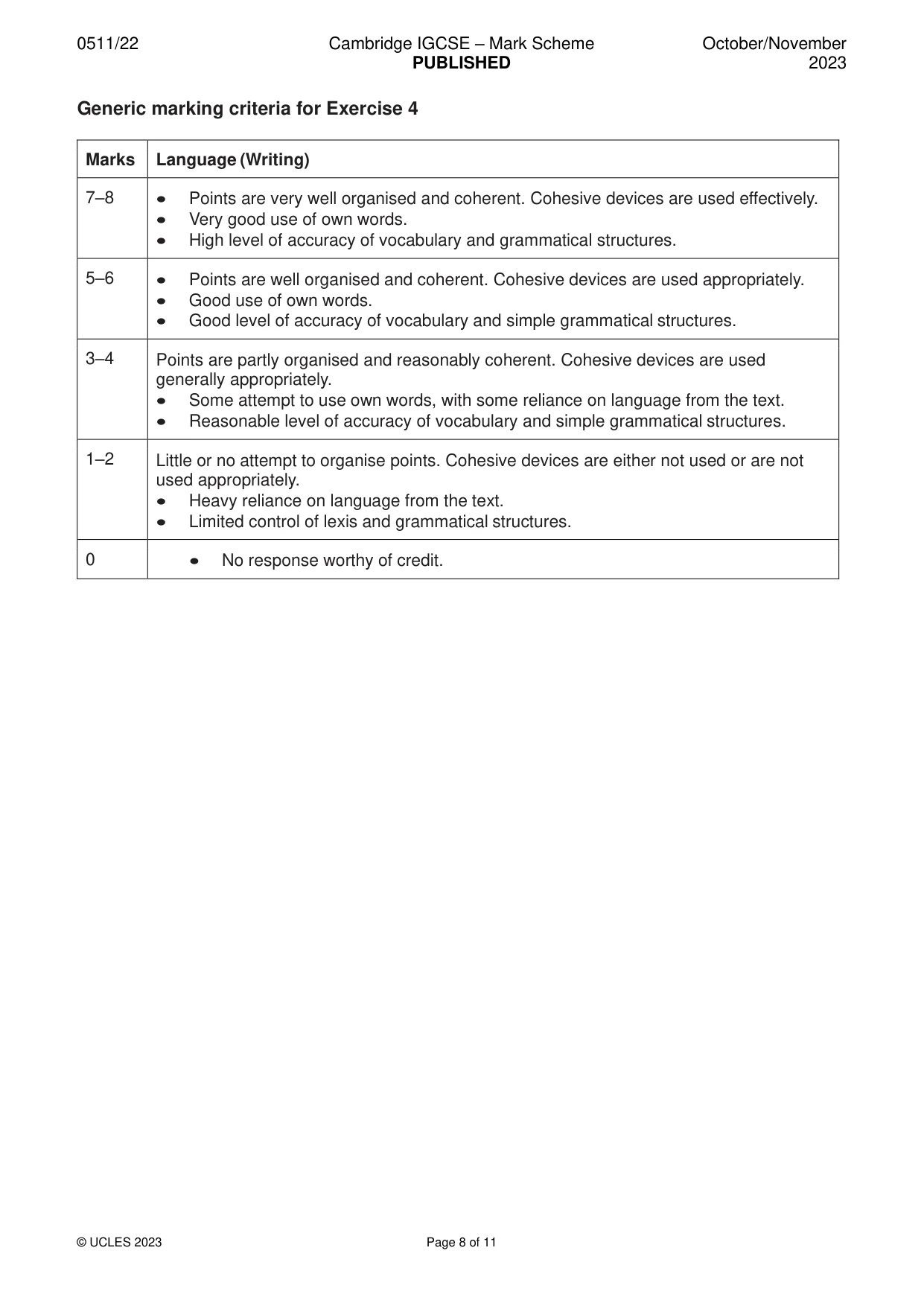
0511/22 Cambridge IGCSE – Mark Scheme PUBLISHED October/November 2023 © UCLES 2023 Page 8 of 11 Generic marking criteria for Exercise 4 Marks Language (Writing) 7–8 • Points are very well organised and coherent. Cohesive devices are used effectively. • Very good use of own words. • High level of accuracy of vocabulary and grammatical structures. 5–6 • Points are well organised and coherent. Cohesive devices are used appropriately. • Good use of own words. • Good level of accuracy of vocabulary and simple grammatical structures. 3–4 Points are partly organised and reasonably coherent. Cohesive devices are used generally appropriately. • Some attempt to use own words, with some reliance on language from the text. • Reasonable level of accuracy of vocabulary and simple grammatical structures. 1–2 Little or no attempt to organise points. Cohesive devices are either not used or are not used appropriately. • Heavy reliance on language from the text. • Limited control of lexis and grammatical structures. 0 • No response worthy of credit.
Mark scheme, page 9
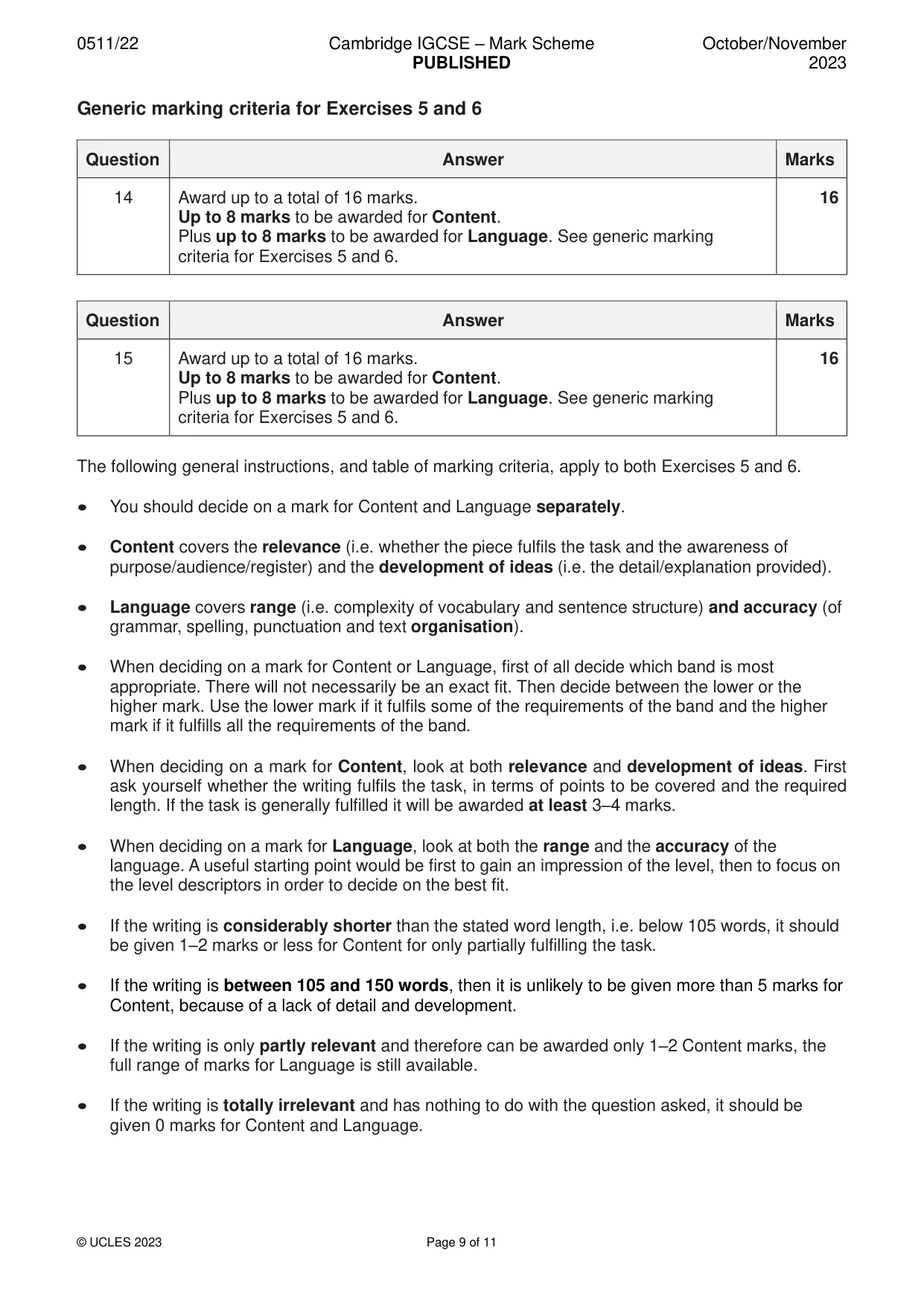
0511/22 Cambridge IGCSE – Mark Scheme PUBLISHED October/November 2023 © UCLES 2023 Page 9 of 11 Generic marking criteria for Exercises 5 and 6 Question Answer Marks 14 Award up to a total of 16 marks. Up to 8 marks to be awarded for Content. Plus up to 8 marks to be awarded for Language. See generic marking criteria for Exercises 5 and 6. 16 Question Answer Marks 15 Award up to a total of 16 marks. Up to 8 marks to be awarded for Content. Plus up to 8 marks to be awarded for Language. See generic marking criteria for Exercises 5 and 6. 16 The following general instructions, and table of marking criteria, apply to both Exercises 5 and 6. • You should decide on a mark for Content and Language separately. • Content covers the relevance (i.e. whether the piece fulfils the task and the awareness of purpose/audience/register) and the development of ideas (i.e. the detail/explanation provided). • Language covers range (i.e. complexity of vocabulary and sentence structure) and accuracy (of grammar, spelling, punctuation and text organisation). • When deciding on a mark for Content or Language, first of all decide which band is most appropriate. There will not necessarily be an exact fit. Then decide between the lower or the higher mark. Use the lower mark if it fulfils some of the requirements of the band and the higher mark if it fulfills all the requirements of the band. • When deciding on a mark for Content, look at both relevance and development of ideas. First ask yourself whether the writing fulfils the task, in terms of points to be covered and the required length. If the task is generally fulfilled it will be awarded at least 3–4 marks. • When deciding on a mark for Language, look at both the range and the accuracy of the language. A useful starting point would be first to gain an impression of the level, then to focus on the level descriptors in order to decide on the best fit. • If the writing is considerably shorter than the stated word length, i.e. below 105 words, it should be given 1–2 marks or less for Content for only partially fulfilling the task. • If the writing is between 105 and 150 words, then it is unlikely to be given more than 5 marks for Content, because of a lack of detail and development. • If the writing is only partly relevant and therefore can be awarded only 1–2 Content marks, the full range of marks for Language is still available. • If the writing is totally irrelevant and has nothing to do with the question asked, it should be given 0 marks for Content and Language.
Mark scheme, page 10
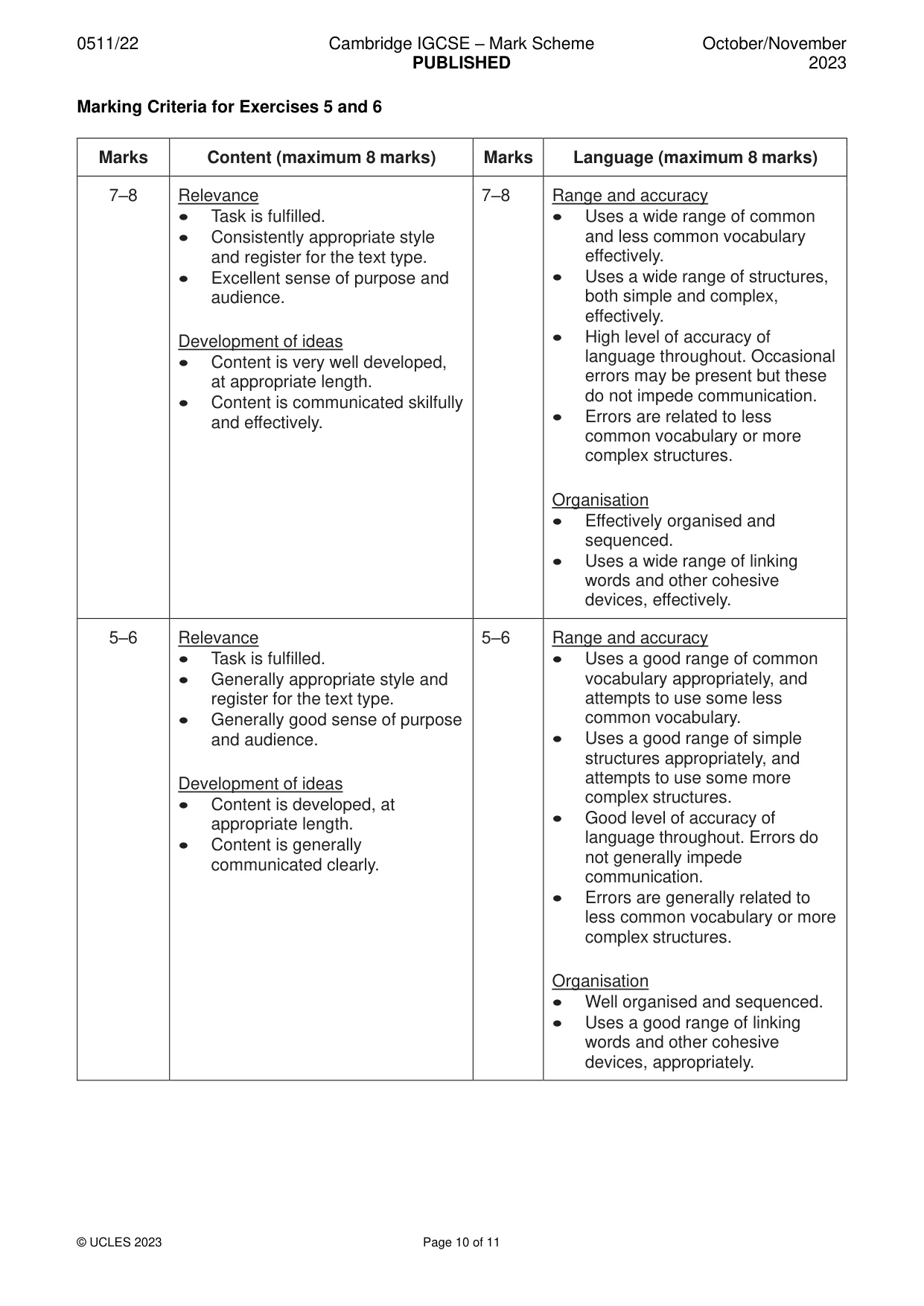
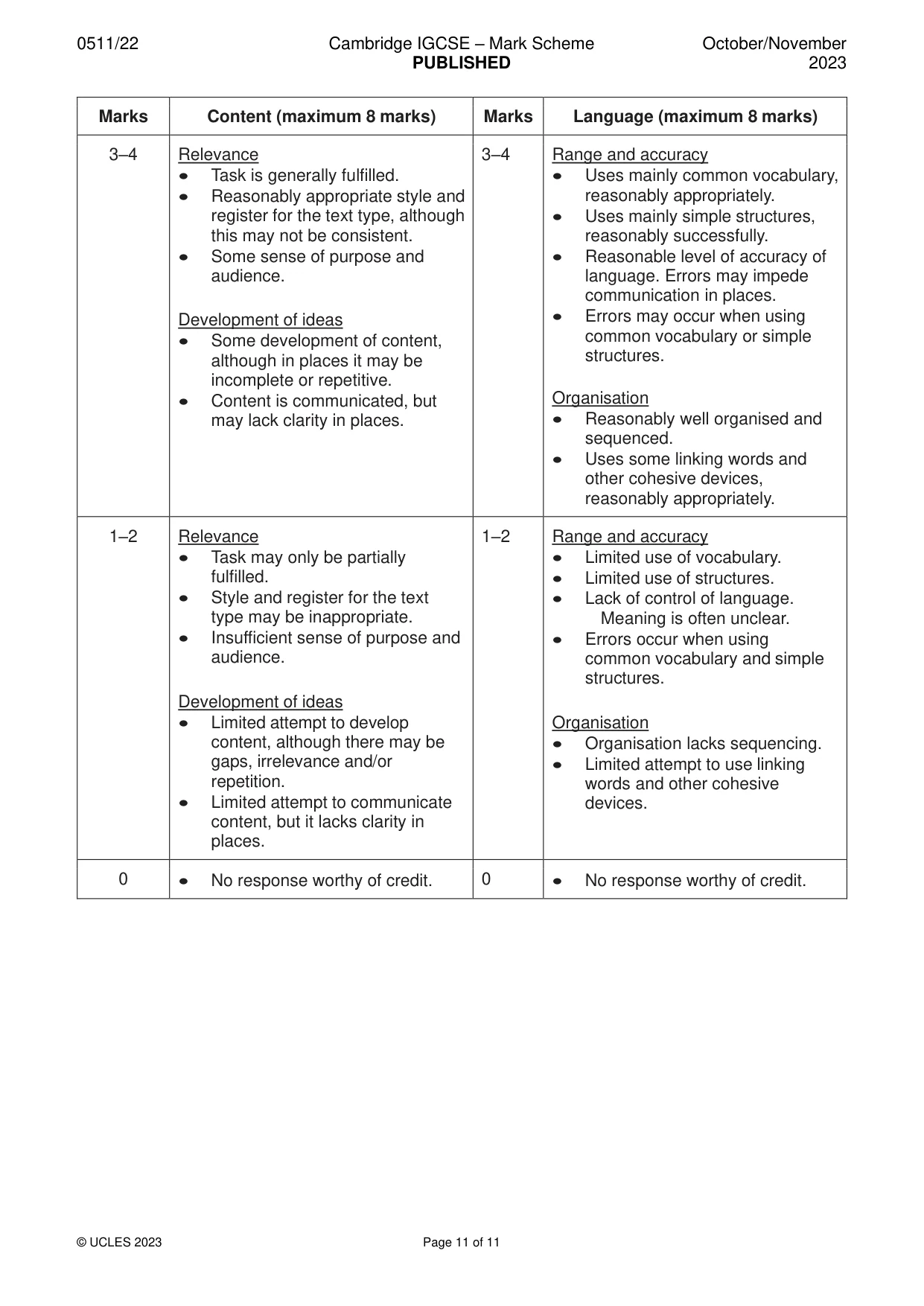
0511/22 Cambridge IGCSE – Mark Scheme PUBLISHED October/November 2023 © UCLES 2023 Page 10 of 11 Marking Criteria for Exercises 5 and 6 Marks Content (maximum 8 marks) Marks Language (maximum 8 marks) 7–8 Relevance • Task is fulfilled. • Consistently appropriate style and register for the text type. • Excellent sense of purpose and audience. Development of ideas • Content is very well developed, at appropriate length. • Content is communicated skilfully and effectively. 7–8 Range and accuracy • Uses a wide range of common and less common vocabulary effectively. • Uses a wide range of structures, both simple and complex, effectively. • High level of accuracy of language throughout. Occasional errors may be present but these do not impede communication. • Errors are related to less common vocabulary or more complex structures. Organisation • Effectively organised and sequenced. • Uses a wide range of linking words and other cohesive devices, effectively. 5–6 Relevance • Task is fulfilled. • Generally appropriate style and register for the text type. • Generally good sense of purpose and audience. Development of ideas • Content is developed, at appropriate length. • Content is generally communicated clearly. 5–6 Range and accuracy • Uses a good range of common vocabulary appropriately, and attempts to use some less common vocabulary. • Uses a good range of simple structures appropriately, and attempts to use some more complex structures. • Good level of accuracy of language throughout. Errors do not generally impede communication. • Errors are generally related to less common vocabulary or more complex structures. Organisation • Well organised and sequenced. • Uses a good range of linking words and other cohesive devices, appropriately.
Mark scheme, page 11
0511/22 Cambridge IGCSE – Mark Scheme PUBLISHED October/November 2023 © UCLES 2023 Page 11 of 11 Marks Content (maximum 8 marks) Marks Language (maximum 8 marks) 3–4 Relevance • Task is generally fulfilled. • Reasonably appropriate style and register for the text type, although this may not be consistent. • Some sense of purpose and audience. Development of ideas • Some development of content, although in places it may be incomplete or repetitive. • Content is communicated, but may lack clarity in places. 3–4 Range and accuracy • Uses mainly common vocabulary, reasonably appropriately. • Uses mainly simple structures, reasonably successfully. • Reasonable level of accuracy of language. Errors may impede communication in places. • Errors may occur when using common vocabulary or simple structures. Organisation • Reasonably well organised and sequenced. • Uses some linking words and other cohesive devices, reasonably appropriately. 1–2 Relevance • Task may only be partially fulfilled. • Style and register for the text type may be inappropriate. • Insufficient sense of purpose and audience. Development of ideas • Limited attempt to develop content, although there may be gaps, irrelevance and/or repetition. • Limited attempt to communicate content, but it lacks clarity in places. 1–2 Range and accuracy • Limited use of vocabulary. • Limited use of structures. • Lack of control of language. Meaning is often unclear. • Errors occur when using common vocabulary and simple structures. Organisation • Organisation lacks sequencing. • Limited attempt to use linking words and other cohesive devices. 0 • No response worthy of credit. 0 • No response worthy of credit.
What you needed in this session
Cambridge’s own grade thresholds for 2023 Oct/Nov, Paper 2 · Variant 2. A higher threshold means an easier paper — the bar moves with how the cohort did.