Cambridge IGCSE English - Second Language (count-in oral) 0511 — 2024 May/June Paper 2 · Variant 1
0511/21/M/J/24 · 40 marks · ≈45 min
The question paper and its mark scheme, free to read here and free to download. This is Cambridge’s own paper, exactly as it was sat.
Question paper16 pages


Mark scheme3 pages
Answers below. Sit the paper first if you are practising.
Paper as text
Question paper, page 1
This document has 16 pages. Any blank pages are indicated. [Turn over Cambridge IGCSE™ ENGLISH AS A SECOND LANGUAGE 0511/21 Paper 2 Listening May/June 2024 Approximately 50 minutes (including 6 minutes’ transfer time) You must transfer your answers onto the multiple choice answer sheet. You will need: Multiple choice answer sheet Soft clean eraser Soft pencil (type B or HB is recommended) INSTRUCTIONS ● There are 40 questions on this paper. Answer all questions. ● You will have 6 minutes to transfer your answers from the question paper onto the multiple choice answer sheet. ● Follow the instructions on the multiple choice answer sheet. Shade one letter only for Questions 1 to 40. ● Write in soft pencil. ● Write your name, centre number and candidate number on the multiple choice answer sheet in the spaces provided unless this has been done for you. ● Do not use correction fluid. ● Do not write on any bar codes. ● Dictionaries are not allowed. INFORMATION ● The total mark for this paper is 40. ● Each correct answer will score one mark. ● Any rough working should be done on this question paper. * 5 5 2 1 2 3 3 2 4 8 * DC (PQ) 341246/1 © UCLES 2024
Question paper, page 2
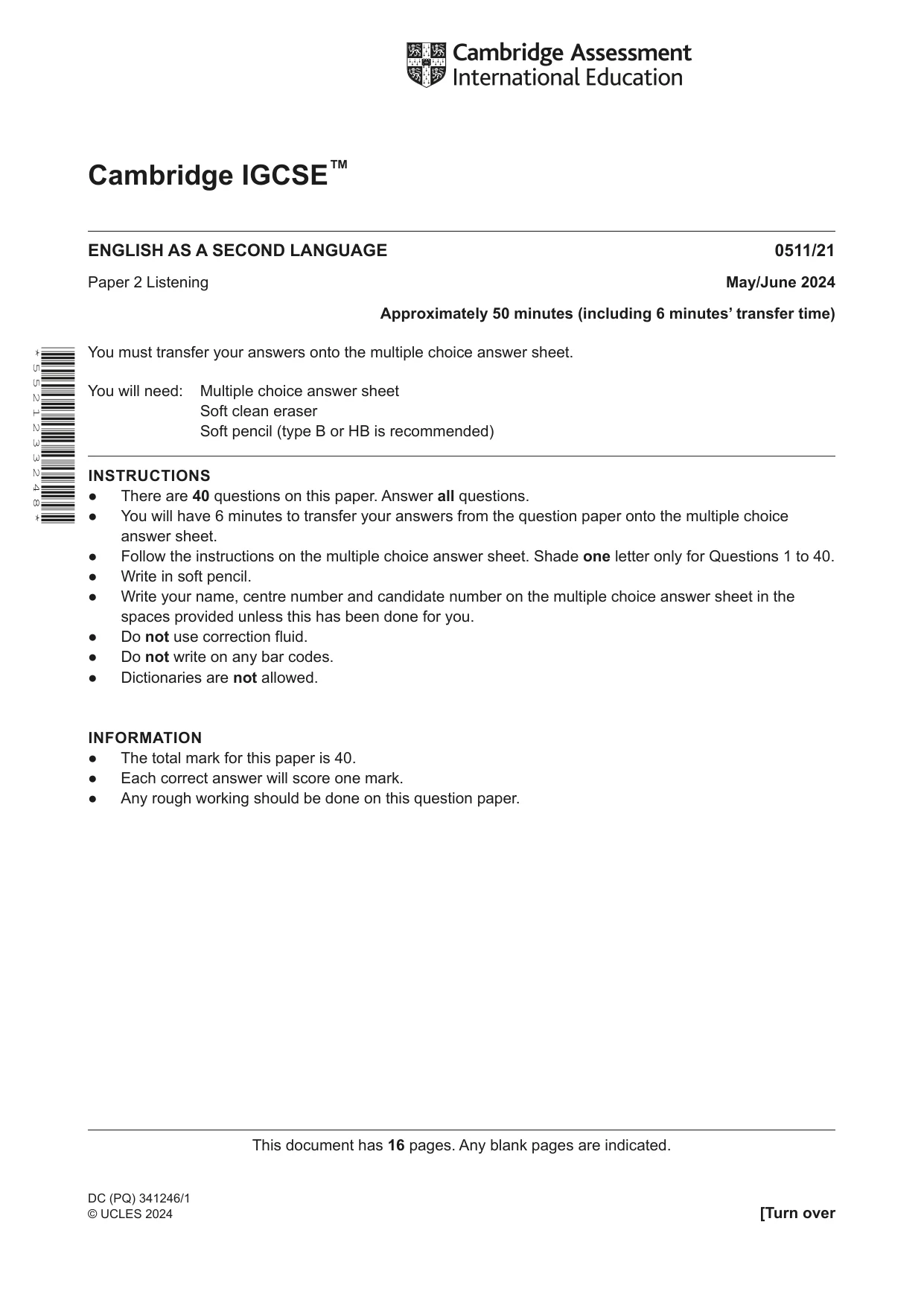
2 0511/21/ M/J/24 © UCLES 2024 Exercise 1 You will hear eight short recordings. For each question, choose the correct answer, A, B, C or D, and put a tick (3) in the appropriate box. You will hear each recording twice. Question 1 What do the teenagers decide to buy for their mother? A B C D [1] Question 2 What is the new advert for? A B C D [1]
Question paper, page 3
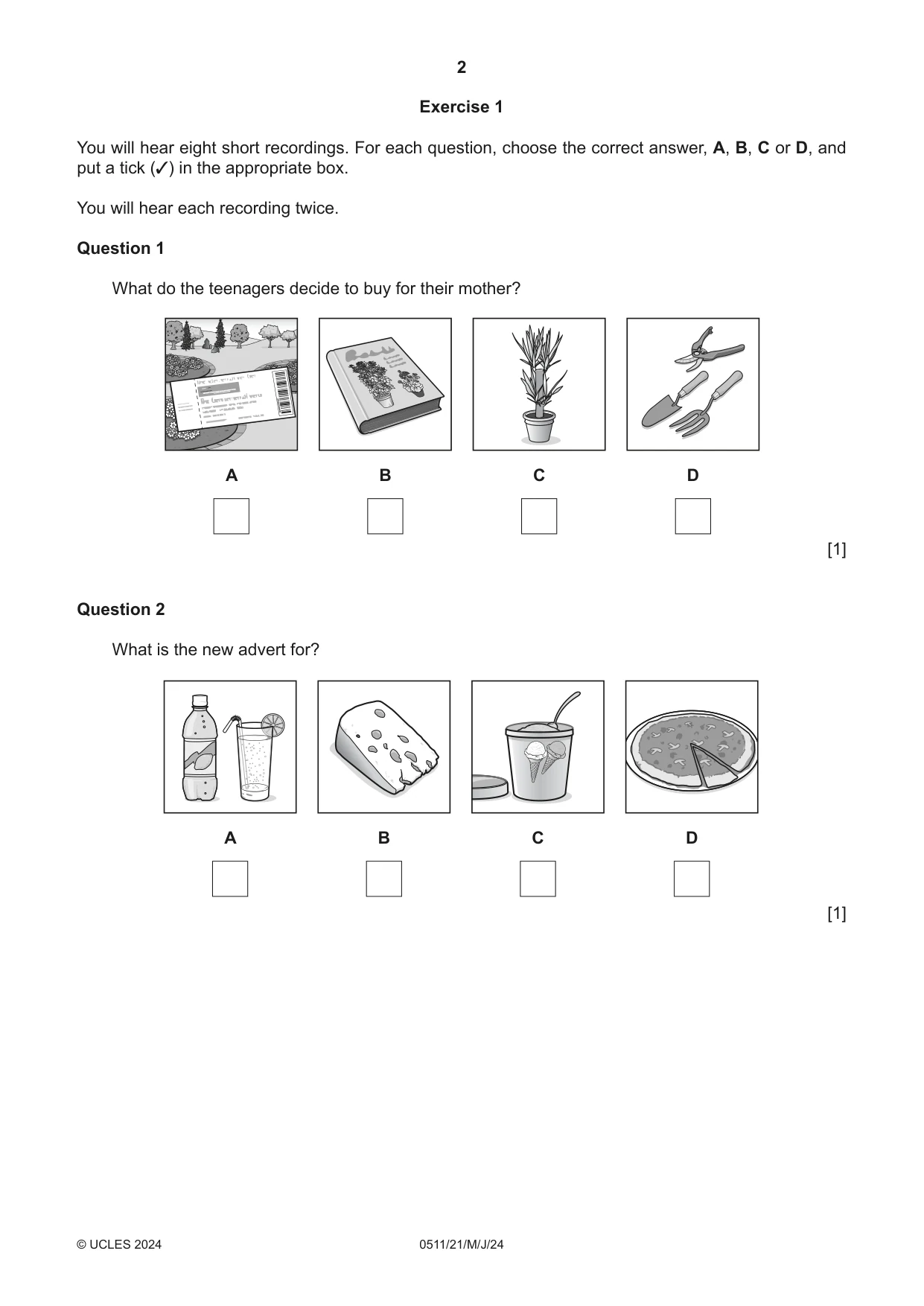
3 0511/21/ M/J/24 © UCLES 2024 [Turn over Question 3 What will the weather be like tomorrow afternoon? A B C D [1] Question 4 What event is the boy inviting the girl to? A B C D [1] Question 5 Which TV programme do the friends decide to watch? 350 A B C D [1]
Question paper, page 4
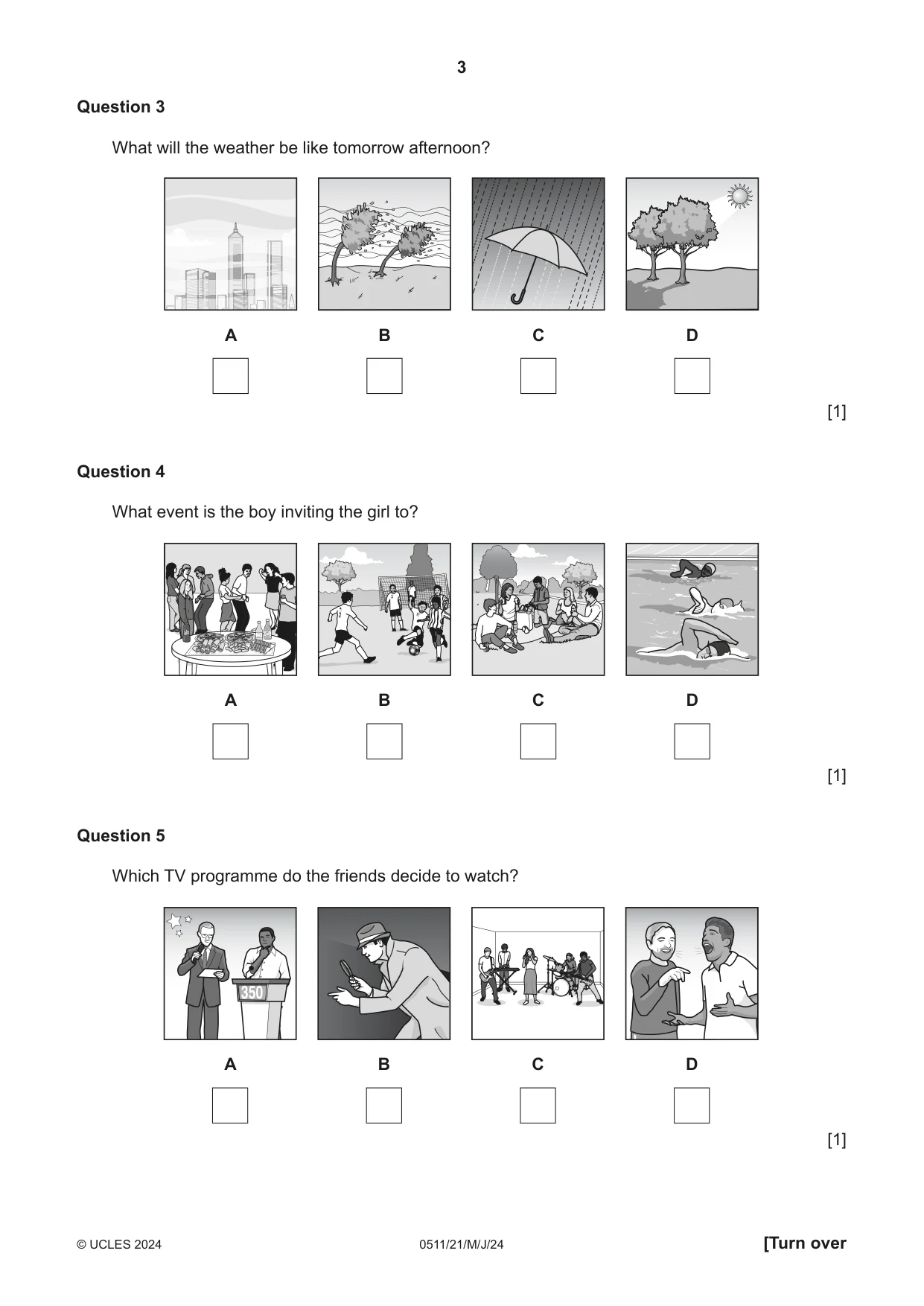
4 0511/21/ M/J/24 © UCLES 2024 Question 6 What will the girl use to make her picture? A B C D [1] Question 7 What has the boy recently bought for his bicycle? A B C D [1] Question 8 Where is the girl’s brother now? A B C D [1]
Question paper, page 5
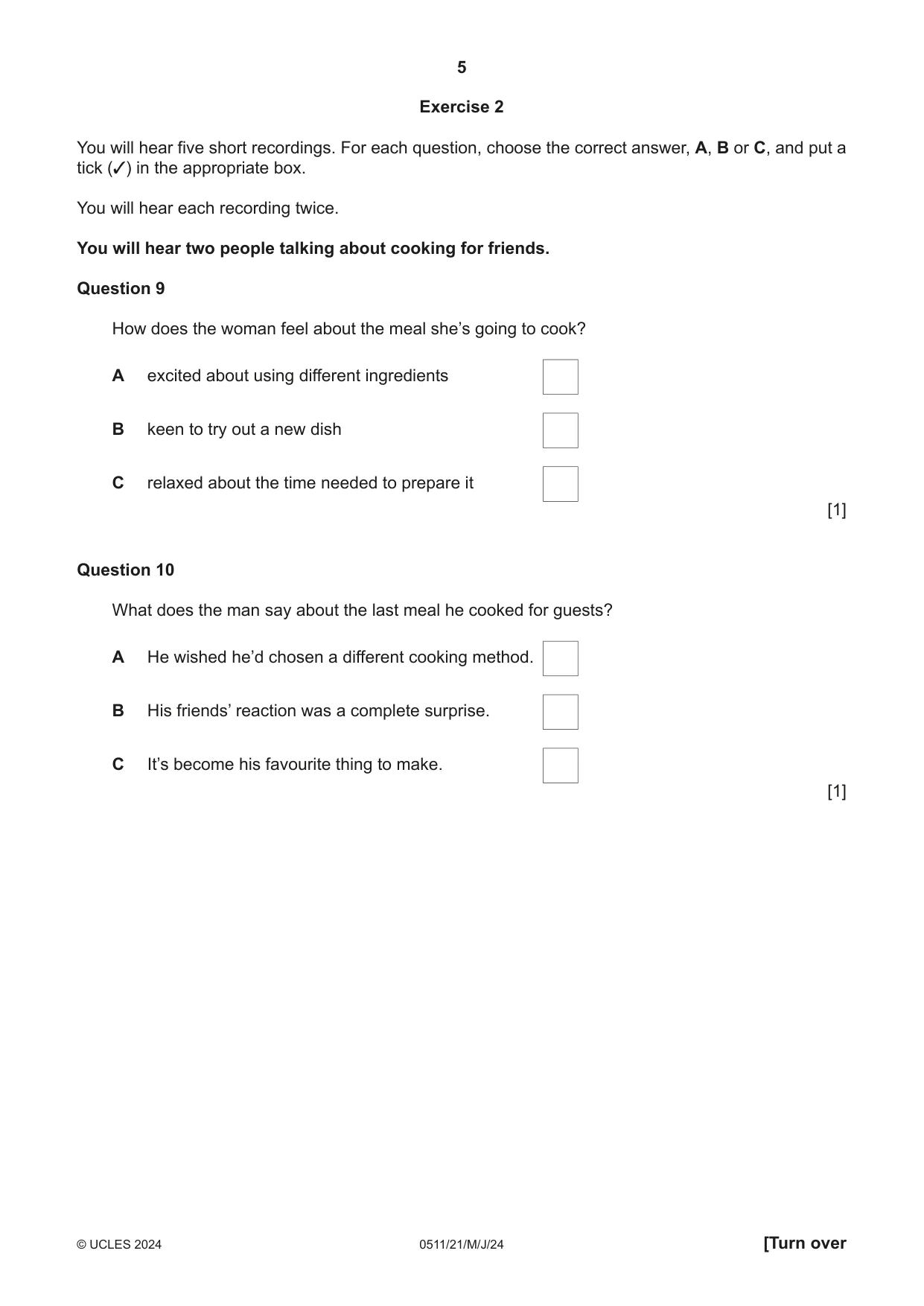
5 0511/21/M/J/24 © UCLES 2024 [Turn over Exercise 2 You will hear five short recordings. For each question, choose the correct answer, A, B or C, and put a tick (3) in the appropriate box. You will hear each recording twice. You will hear two people talking about cooking for friends. Question 9 How does the woman feel about the meal she’s going to cook? A excited about using different ingredients B keen to try out a new dish C relaxed about the time needed to prepare it [1] Question 10 What does the man say about the last meal he cooked for guests? A He wished he’d chosen a different cooking method. B His friends’ reaction was a complete surprise. C It’s become his favourite thing to make. [1]
Question paper, page 6
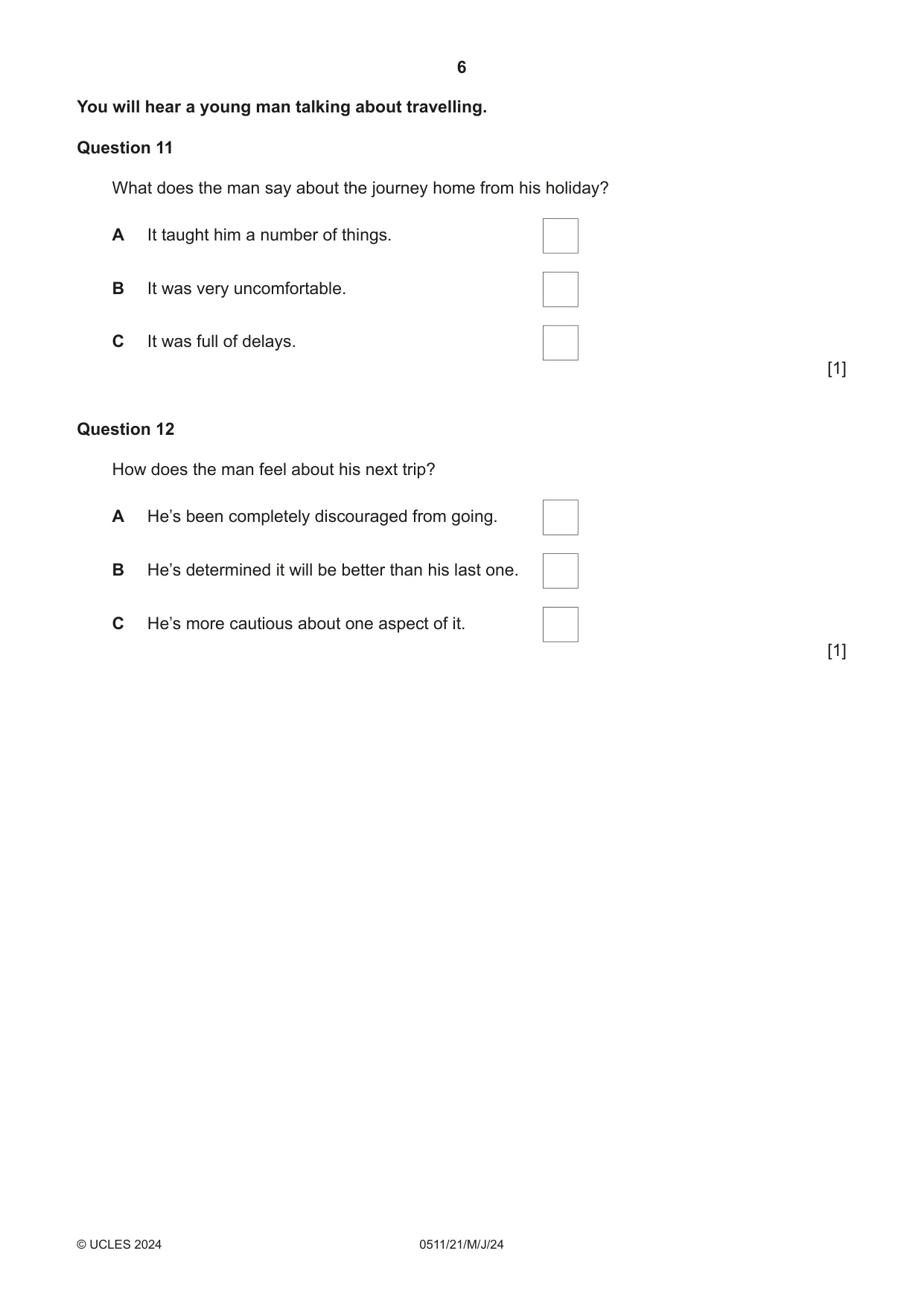
6 0511/21/M/J/24 © UCLES 2024 You will hear a young man talking about travelling. Question 11 What does the man say about the journey home from his holiday? A It taught him a number of things. B It was very uncomfortable. C It was full of delays. [1] Question 12 How does the man feel about his next trip? A He’s been completely discouraged from going. B He’s determined it will be better than his last one. C He’s more cautious about one aspect of it. [1]
Question paper, page 7
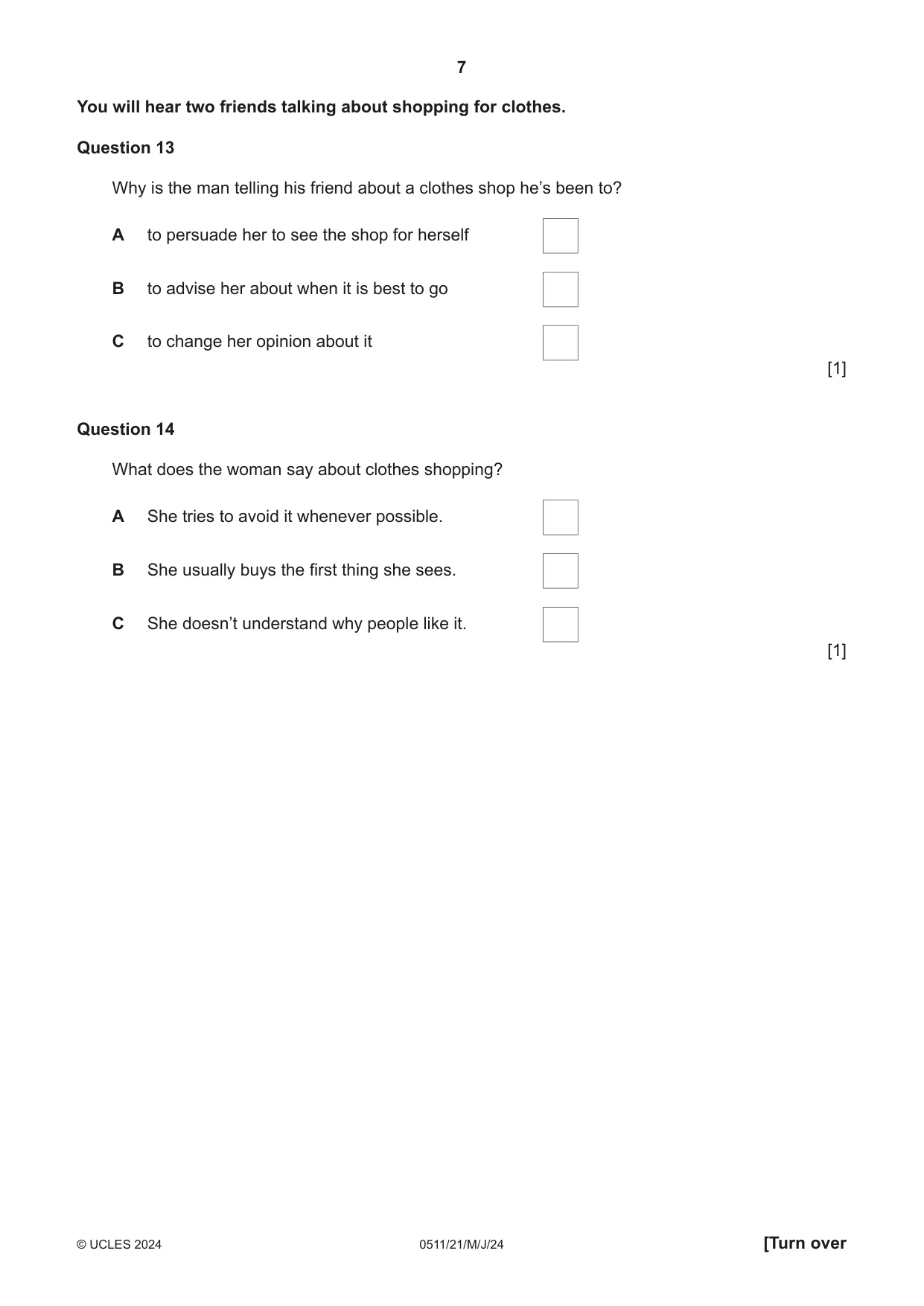
7 0511/21/M/J/24 © UCLES 2024 [Turn over You will hear two friends talking about shopping for clothes. Question 13 Why is the man telling his friend about a clothes shop he’s been to? A to persuade her to see the shop for herself B to advise her about when it is best to go C to change her opinion about it [1] Question 14 What does the woman say about clothes shopping? A She tries to avoid it whenever possible. B She usually buys the first thing she sees. C She doesn’t understand why people like it. [1]
Question paper, page 8
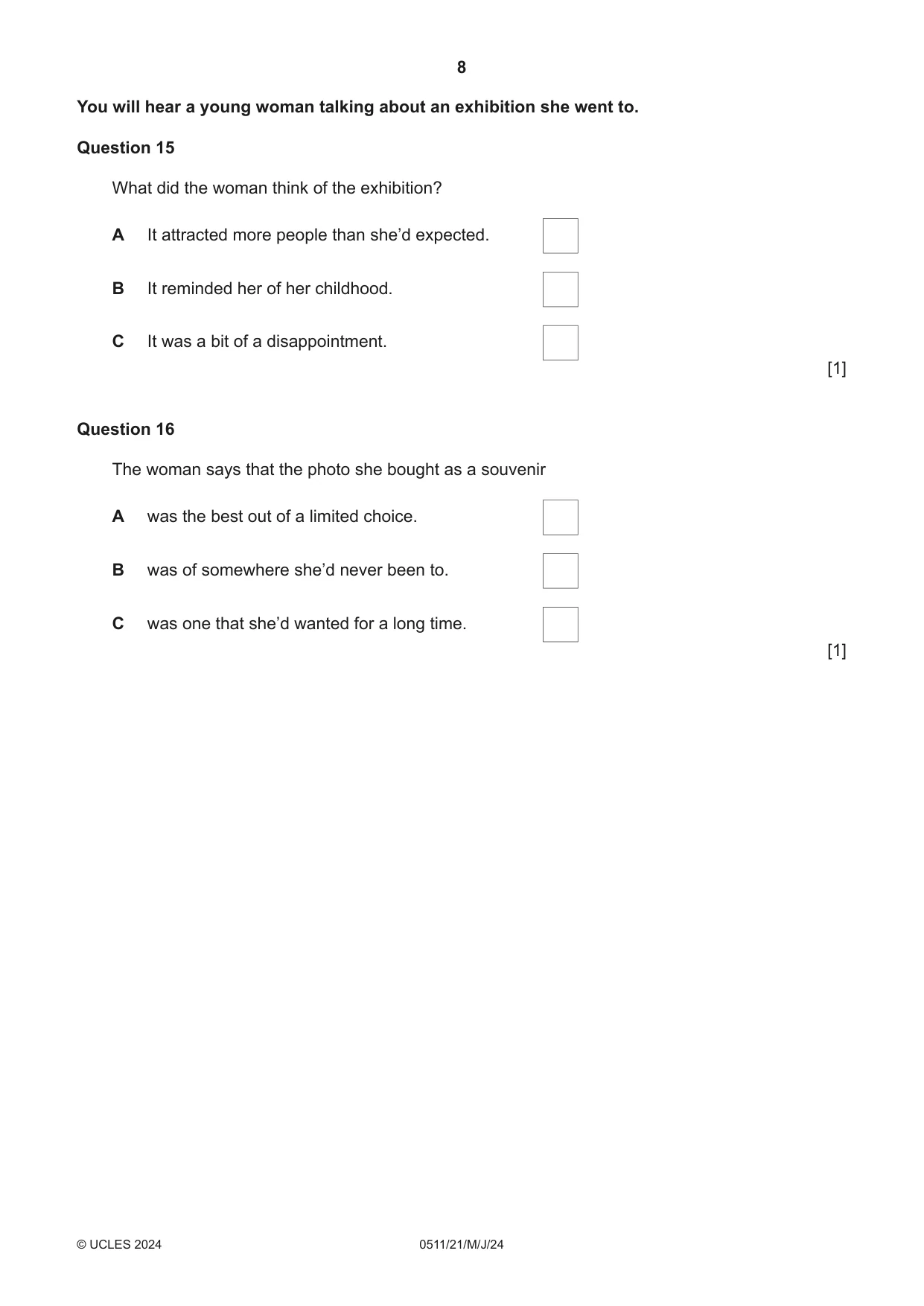
8 0511/21/M/J/24 © UCLES 2024 You will hear a young woman talking about an exhibition she went to. Question 15 What did the woman think of the exhibition? A It attracted more people than she’d expected. B It reminded her of her childhood. C It was a bit of a disappointment. [1] Question 16 The woman says that the photo she bought as a souvenir A was the best out of a limited choice. B was of somewhere she’d never been to. C was one that she’d wanted for a long time. [1]
Question paper, page 9
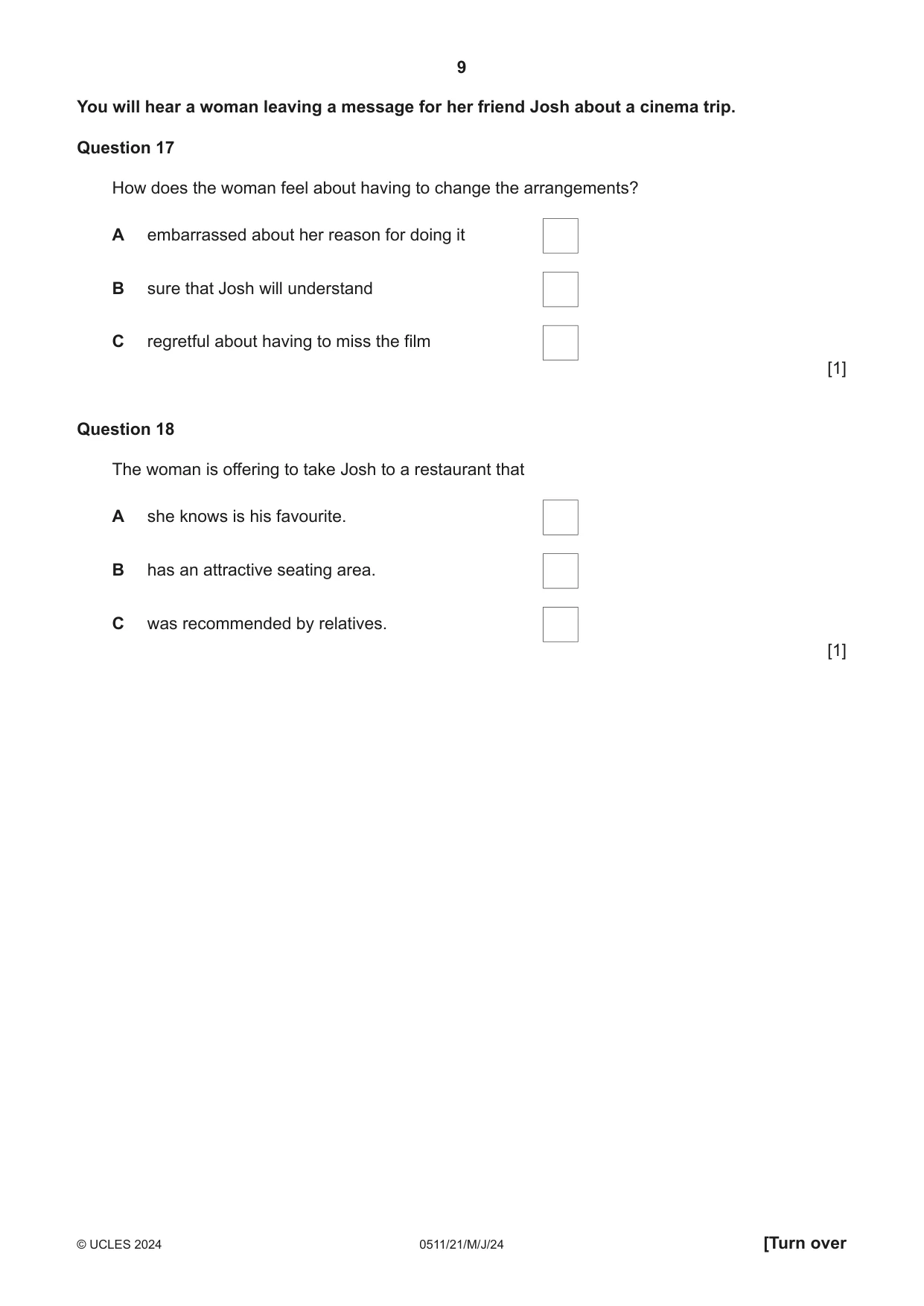
9 0511/21/M/J/24 © UCLES 2024 [Turn over You will hear a woman leaving a message for her friend Josh about a cinema trip. Question 17 How does the woman feel about having to change the arrangements? A embarrassed about her reason for doing it B sure that Josh will understand C regretful about having to miss the film [1] Question 18 The woman is offering to take Josh to a restaurant that A she knows is his favourite. B has an attractive seating area. C was recommended by relatives. [1]
Question paper, page 10
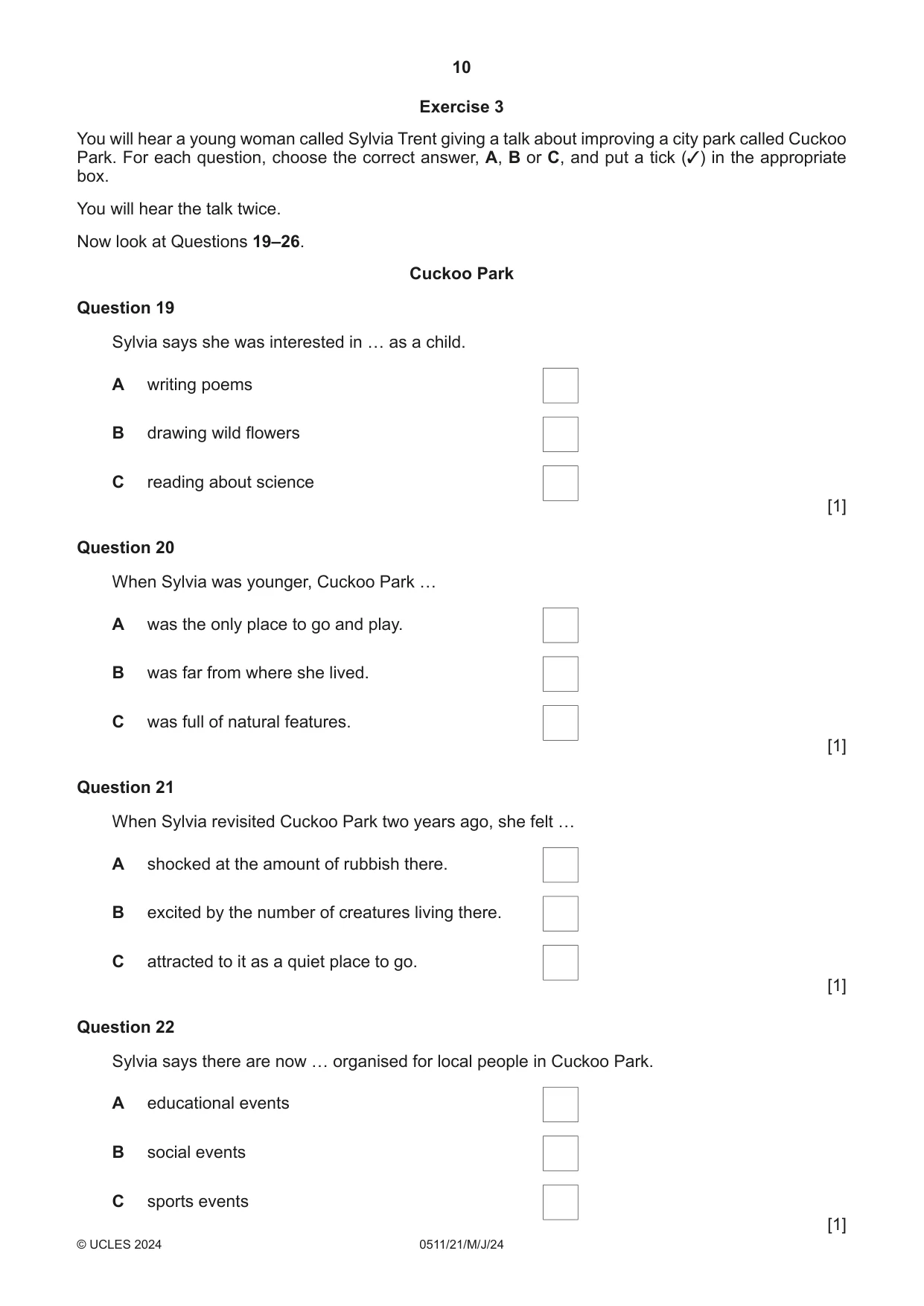
10 0511/21/M/J/24 © UCLES 2024 Exercise 3 You will hear a young woman called Sylvia Trent giving a talk about improving a city park called Cuckoo Park. For each question, choose the correct answer, A, B or C, and put a tick (3) in the appropriate box. You will hear the talk twice. Now look at Questions 19–26. Cuckoo Park Question 19 Sylvia says she was interested in … as a child. A writing poems B drawing wild flowers C reading about science [1] Question 20 When Sylvia was younger, Cuckoo Park … A was the only place to go and play. B was far from where she lived. C was full of natural features. [1] Question 21 When Sylvia revisited Cuckoo Park two years ago, she felt … A shocked at the amount of rubbish there. B excited by the number of creatures living there. C attracted to it as a quiet place to go. [1] Question 22 Sylvia says there are now … organised for local people in Cuckoo Park. A educational events B social events C sports events [1]
Question paper, page 11
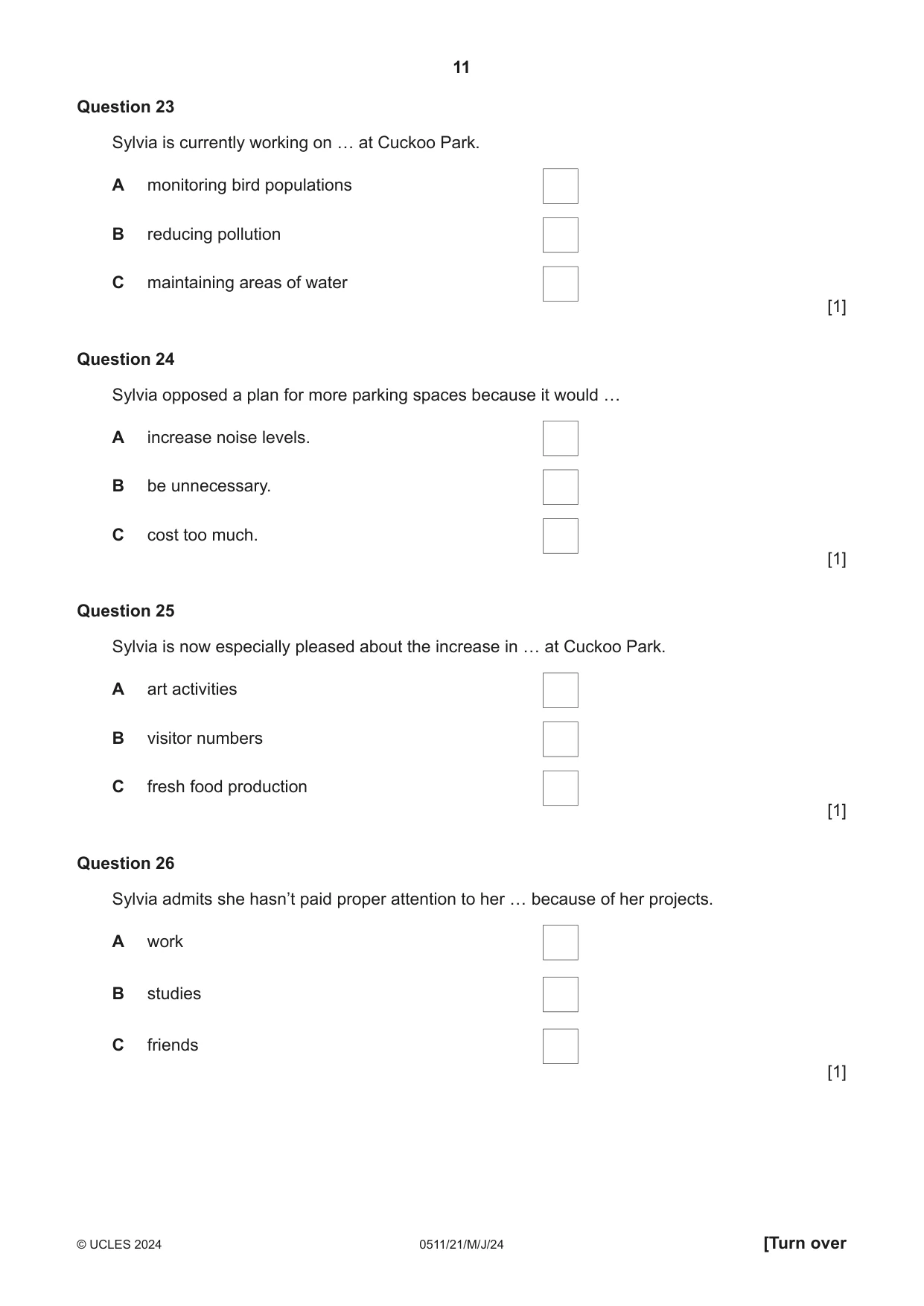
11 0511/21/M/J/24 © UCLES 2024 [Turn over Question 23 Sylvia is currently working on … at Cuckoo Park. A monitoring bird populations B reducing pollution C maintaining areas of water [1] Question 24 Sylvia opposed a plan for more parking spaces because it would … A increase noise levels. B be unnecessary. C cost too much. [1] Question 25 Sylvia is now especially pleased about the increase in … at Cuckoo Park. A art activities B visitor numbers C fresh food production [1] Question 26 Sylvia admits she hasn’t paid proper attention to her … because of her projects. A work B studies C friends [1]
Question paper, page 12
12 0511/21/M/J/24 © UCLES 2024 BLANK PAGE
Question paper, page 13
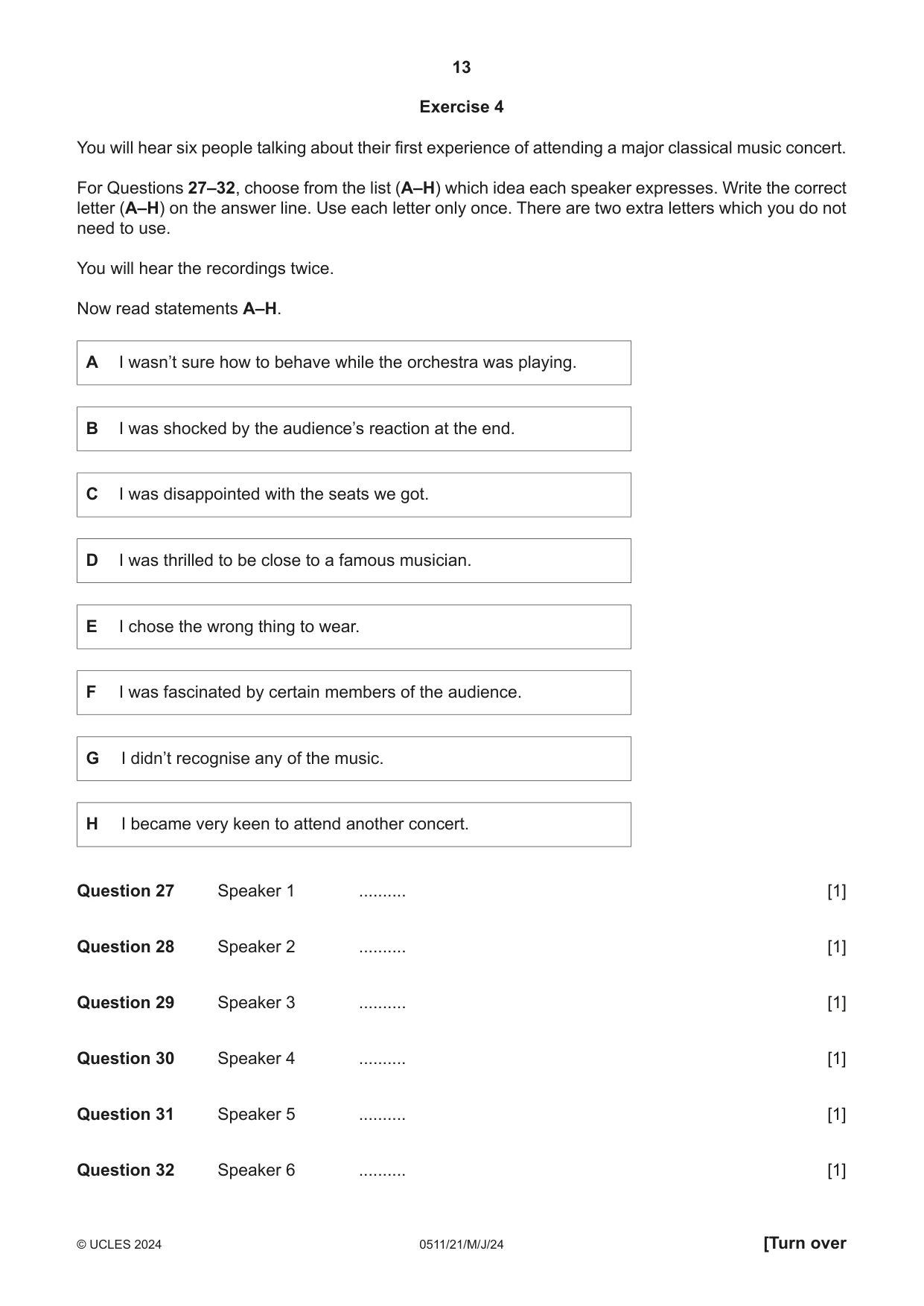
13 0511/21/M/J/24 © UCLES 2024 [Turn over Exercise 4 You will hear six people talking about their first experience of attending a major classical music concert. For Questions 27–32, choose from the list (A–H) which idea each speaker expresses. Write the correct letter (A–H) on the answer line. Use each letter only once. There are two extra letters which you do not need to use. You will hear the recordings twice. Now read statements A–H. A I wasn’t sure how to behave while the orchestra was playing. B I was shocked by the audience’s reaction at the end. C I was disappointed with the seats we got. D I was thrilled to be close to a famous musician. E I chose the wrong thing to wear. F I was fascinated by certain members of the audience. G I didn’t recognise any of the music. H I became very keen to attend another concert. Question 27 Speaker 1 … [1] Question 28 Speaker 2 … [1] Question 29 Speaker 3 … [1] Question 30 Speaker 4 … [1] Question 31 Speaker 5 … [1] Question 32 Speaker 6 … [1]
Question paper, page 14
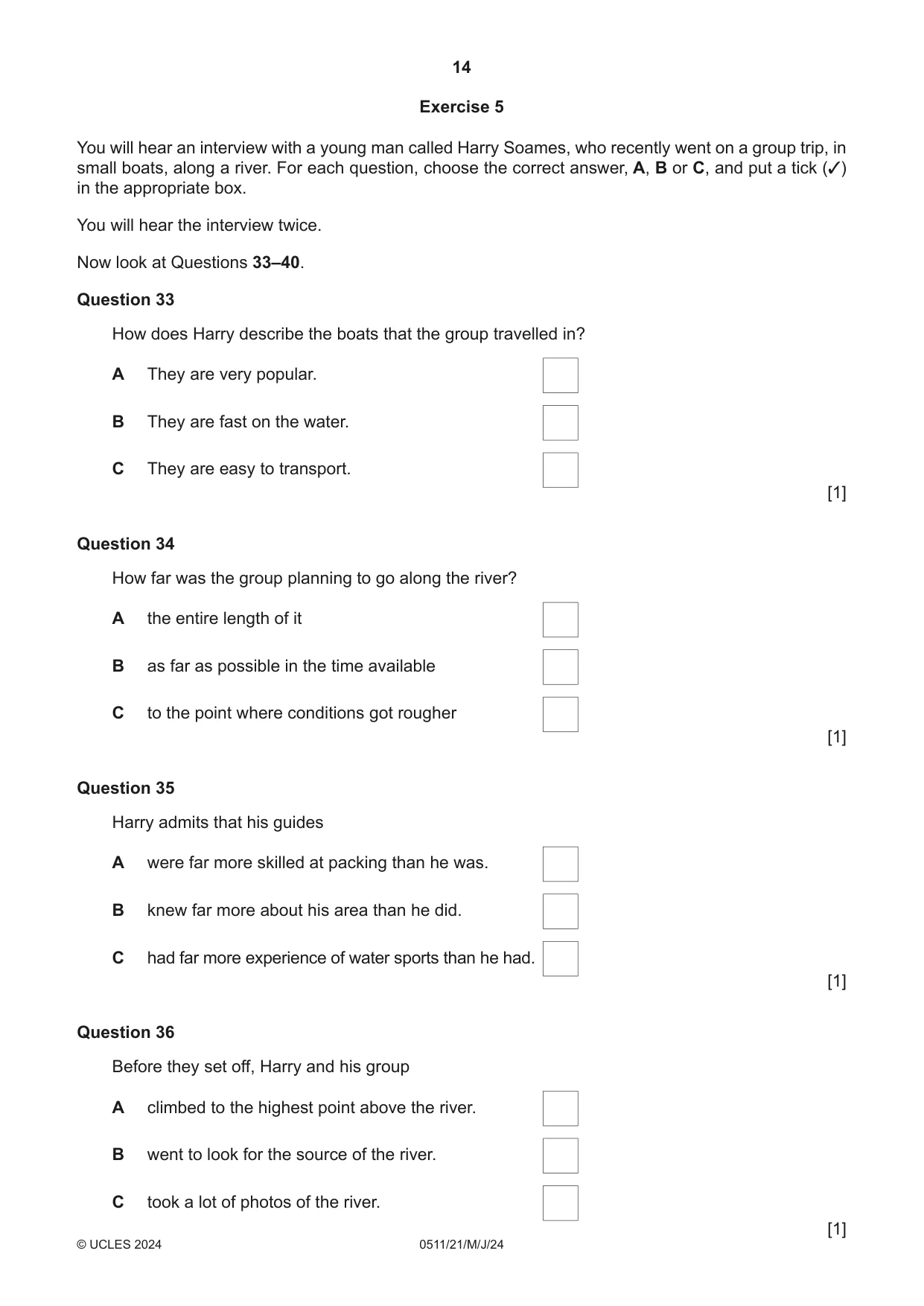
14 0511/21/M/J/24 © UCLES 2024 Exercise 5 You will hear an interview with a young man called Harry Soames, who recently went on a group trip, in small boats, along a river. For each question, choose the correct answer, A, B or C, and put a tick (3) in the appropriate box. You will hear the interview twice. Now look at Questions 33–40. Question 33 How does Harry describe the boats that the group travelled in? A They are very popular. B They are fast on the water. C They are easy to transport. [1] Question 34 How far was the group planning to go along the river? A the entire length of it B as far as possible in the time available C to the point where conditions got rougher [1] Question 35 Harry admits that his guides A were far more skilled at packing than he was. B knew far more about his area than he did. C had far more experience of water sports than he had. [1] Question 36 Before they set off, Harry and his group A climbed to the highest point above the river. B went to look for the source of the river. C took a lot of photos of the river. [1]
Question paper, page 15
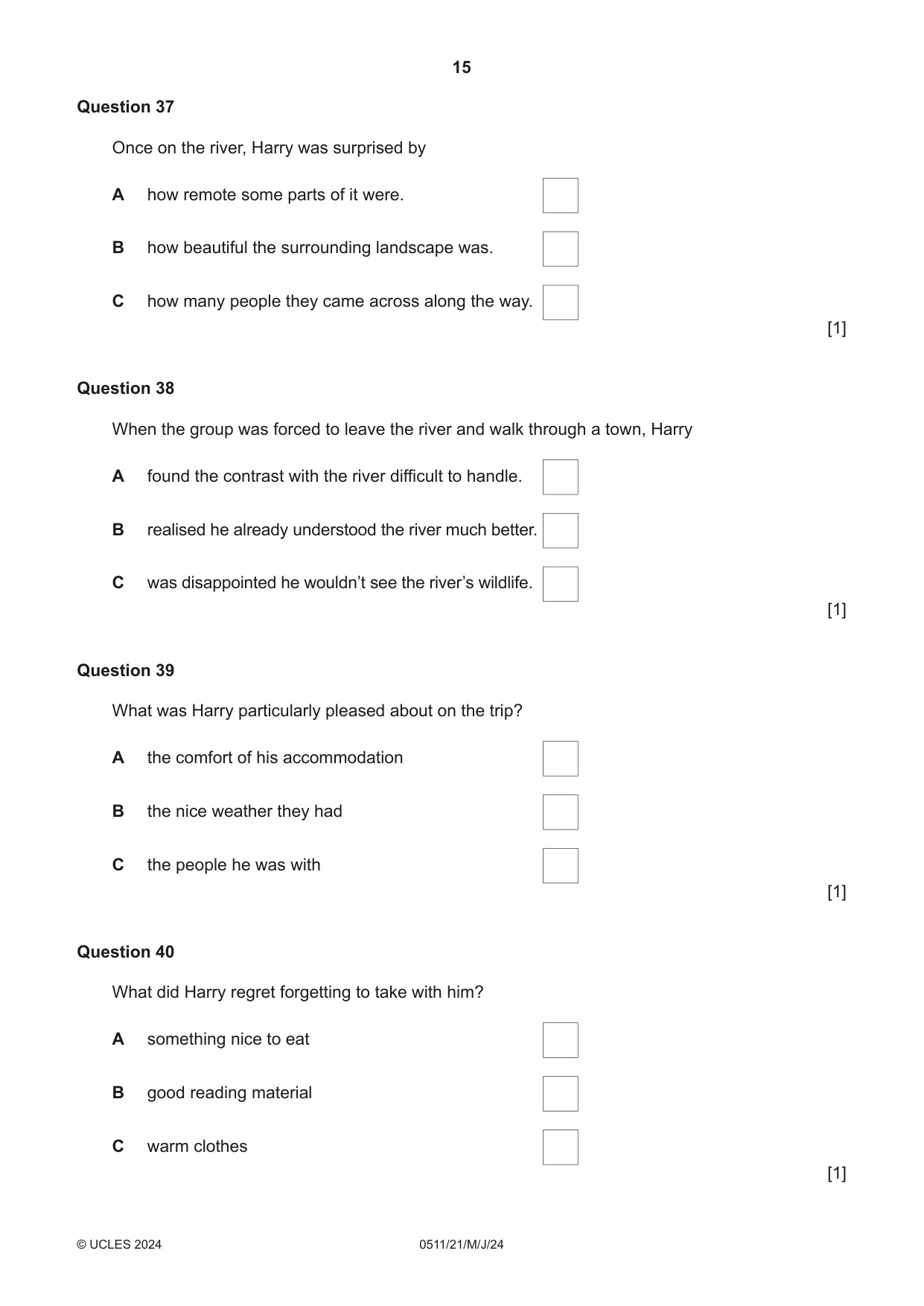
15 0511/21/M/J/24 © UCLES 2024 Question 37 Once on the river, Harry was surprised by A how remote some parts of it were. B how beautiful the surrounding landscape was. C how many people they came across along the way. [1] Question 38 When the group was forced to leave the river and walk through a town, Harry A found the contrast with the river difficult to handle. B realised he already understood the river much better. C was disappointed he wouldn’t see the river’s wildlife. [1] Question 39 What was Harry particularly pleased about on the trip? A the comfort of his accommodation B the nice weather they had C the people he was with [1] Question 40 What did Harry regret forgetting to take with him? A something nice to eat B good reading material C warm clothes [1]
Question paper, page 16
16 0511/21/M/J/24 © UCLES 2024 Permission to reproduce items where third-party owned material protected by copyright is included has been sought and cleared where possible. Every reasonable effort has been made by the publisher (UCLES) to trace copyright holders, but if any items requiring clearance have unwittingly been included, the publisher will be pleased to make amends at the earliest possible opportunity. To avoid the issue of disclosure of answer-related information to candidates, all copyright acknowledgements are reproduced online in the Cambridge Assessment International Education Copyright Acknowledgements Booklet. This is produced for each series of examinations and is freely available to download at www.cambridgeinternational.org after the live examination series. Cambridge Assessment International Education is part of Cambridge Assessment. Cambridge Assessment is the brand name of the University of Cambridge Local Examinations Syndicate (UCLES), which is a department of the University of Cambridge. BLANK PAGE
Mark scheme, page 1
This document consists of 3 printed pages. © Cambridge University Press & Assessment 2024 [Turn over Cambridge IGCSE™ ENGLISH AS A SECOND LANGUAGE 0511/21 Paper 2 Listening May/June 2024 MARK SCHEME Maximum Mark: 40 Published This mark scheme is published as an aid to teachers and candidates, to indicate the requirements of the examination. Mark schemes should be read in conjunction with the question paper and the Principal Examiner Report for Teachers. Cambridge International will not enter into discussions about these mark schemes. Cambridge International is publishing the mark schemes for the May/June 2024 series for most Cambridge IGCSE, Cambridge International A and AS Level and Cambridge Pre-U components, and some Cambridge O Level components.
Mark scheme, page 2
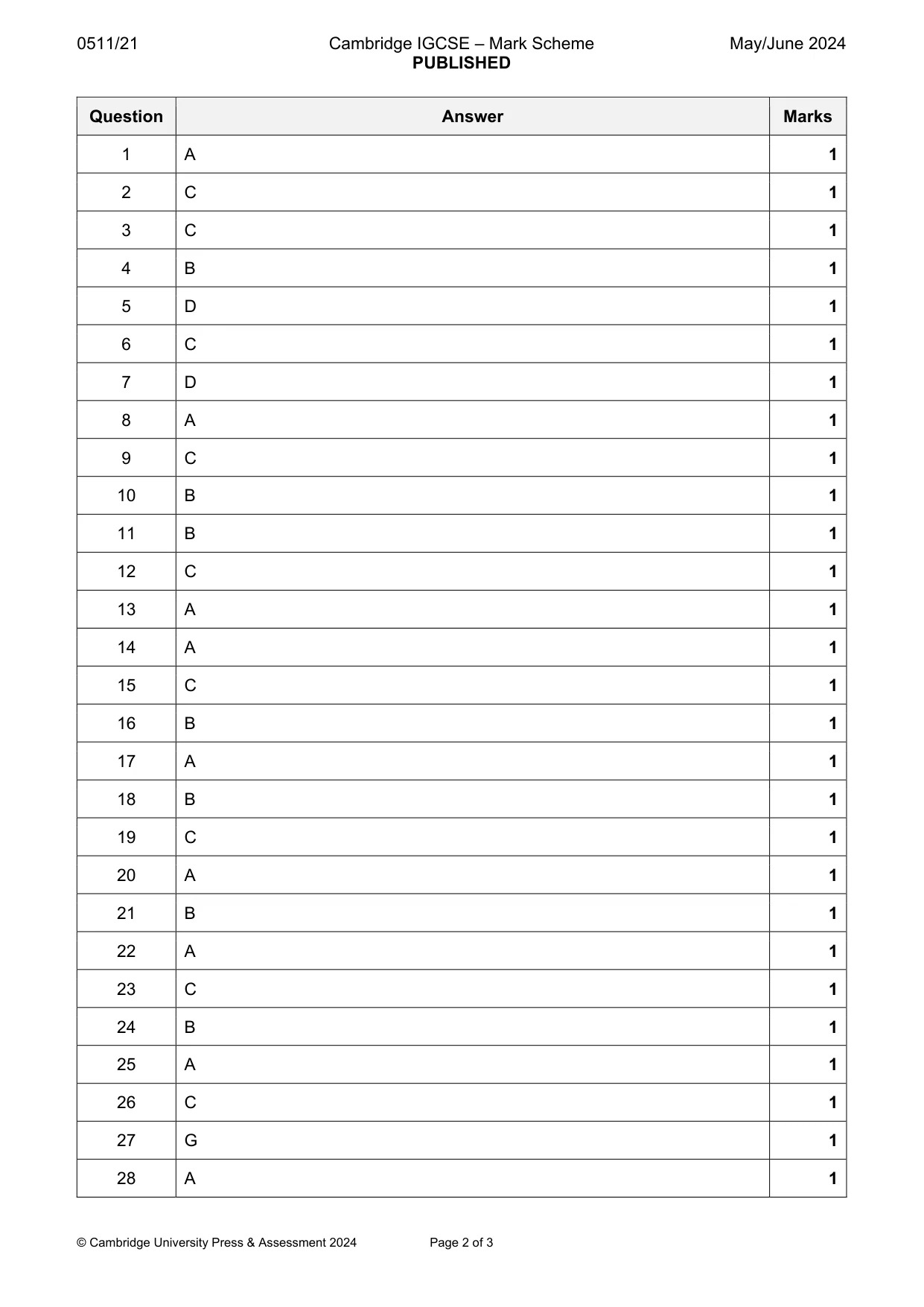
0511/21 Cambridge IGCSE – Mark Scheme PUBLISHED May/June 2024 © Cambridge University Press & Assessment 2024 Page 2 of 3 Question Answer Marks 1 A 1 2 C 1 3 C 1 4 B 1 5 D 1 6 C 1 7 D 1 8 A 1 9 C 1 10 B 1 11 B 1 12 C 1 13 A 1 14 A 1 15 C 1 16 B 1 17 A 1 18 B 1 19 C 1 20 A 1 21 B 1 22 A 1 23 C 1 24 B 1 25 A 1 26 C 1 27 G 1 28 A 1
Mark scheme, page 3
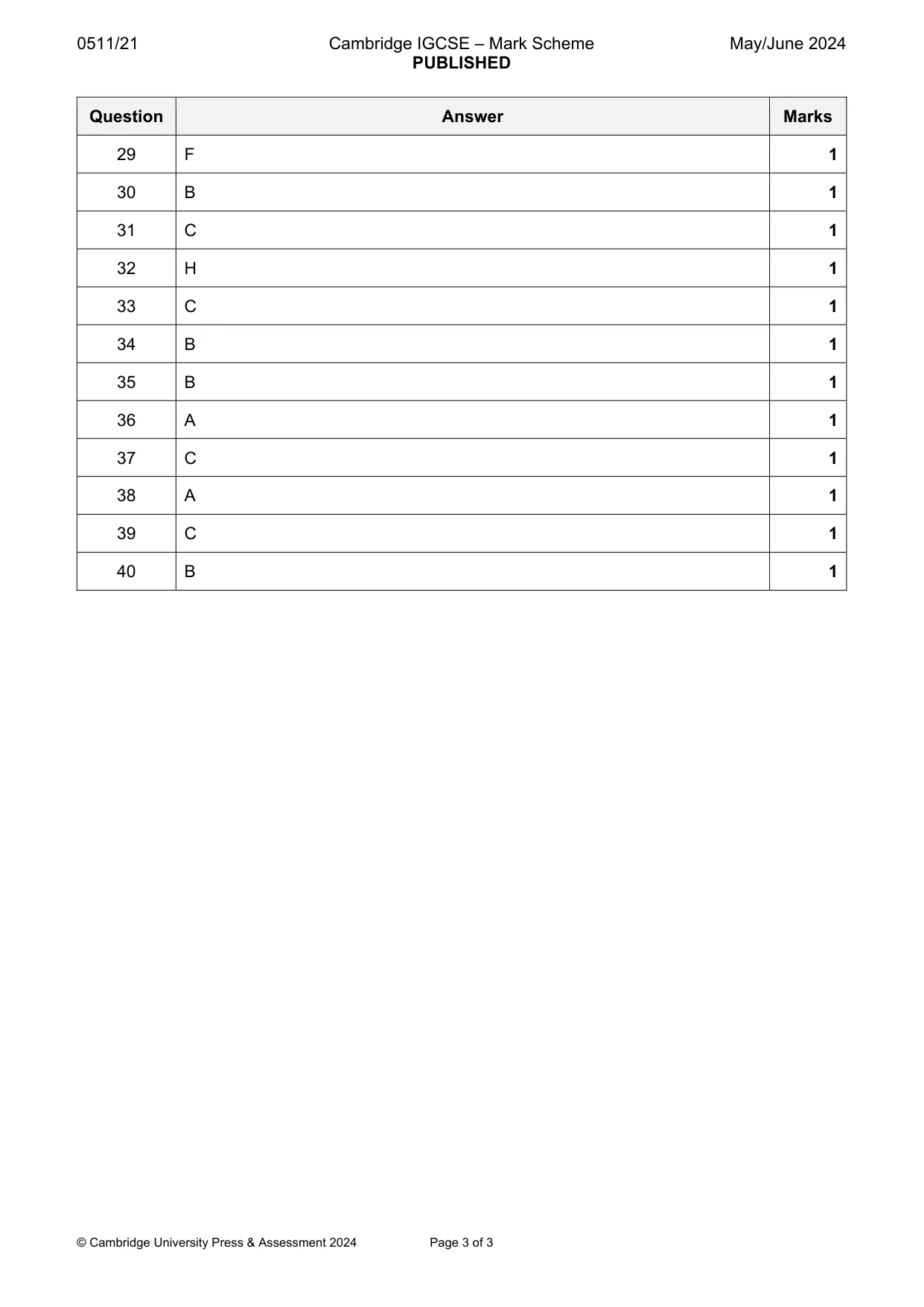
0511/21 Cambridge IGCSE – Mark Scheme PUBLISHED May/June 2024 © Cambridge University Press & Assessment 2024 Page 3 of 3 Question Answer Marks 29 F 1 30 B 1 31 C 1 32 H 1 33 C 1 34 B 1 35 B 1 36 A 1 37 C 1 38 A 1 39 C 1 40 B 1
What you needed in this session
Cambridge’s own grade thresholds for 2024 May/June, Paper 2 · Variant 1. A higher threshold means an easier paper — the bar moves with how the cohort did.