Cambridge IGCSE English - Second Language (count-in oral) 0511 — 2024 May/June Paper 2 · Variant 3
0511/23/M/J/24 · 40 marks · ≈45 min
The question paper and its mark scheme, free to read here and free to download. This is Cambridge’s own paper, exactly as it was sat.
Question paper16 pages


Mark scheme3 pages
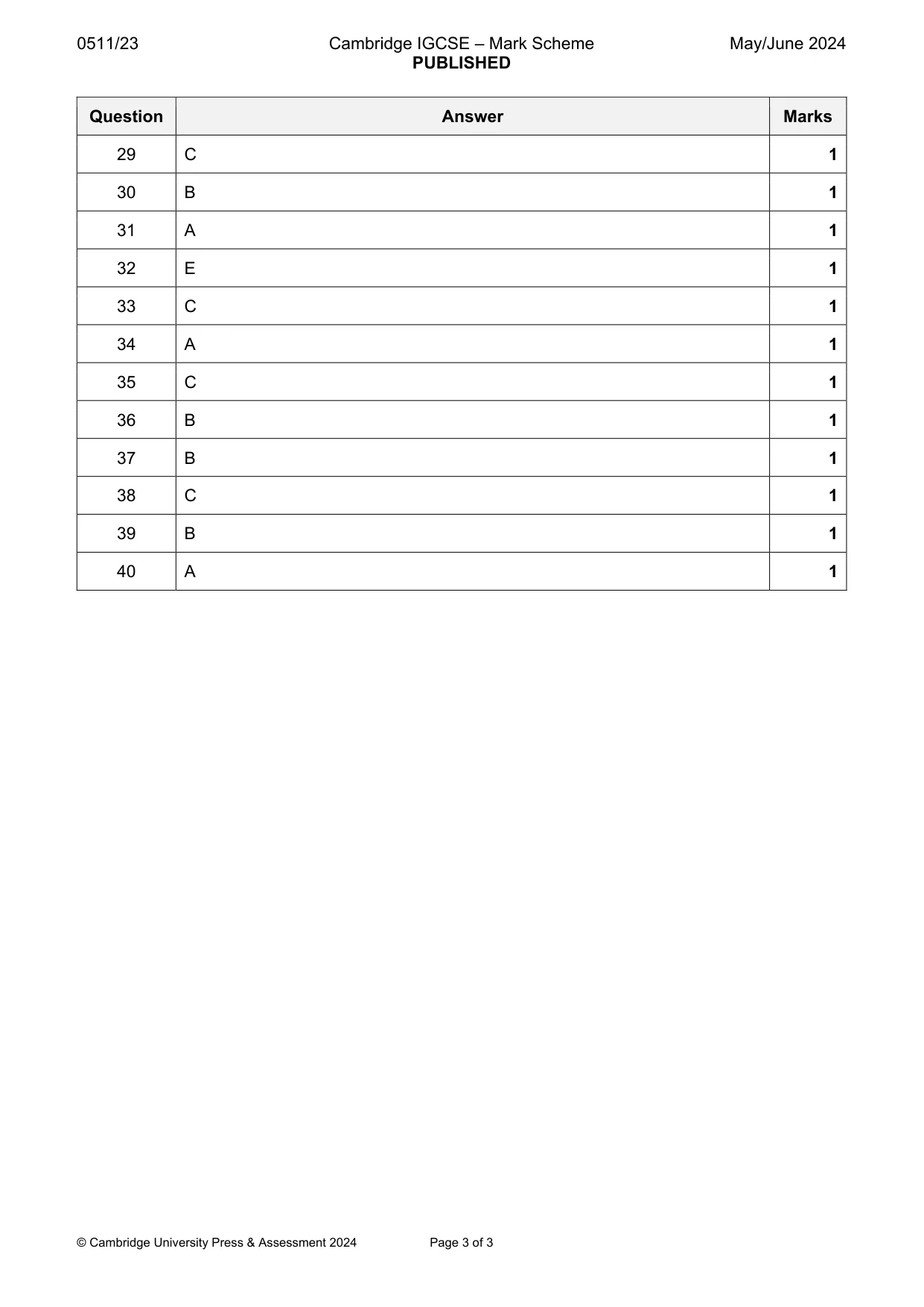
Answers below. Sit the paper first if you are practising.
Paper as text
Question paper, page 1
This document has 16 pages. Any blank pages are indicated. [Turn over Cambridge IGCSE™ ENGLISH AS A SECOND LANGUAGE 0511/23 Paper 2 Listening May/June 2024 Approximately 50 minutes (including 6 minutes’ transfer time) You must transfer your answers onto the multiple choice answer sheet. You will need: Multiple choice answer sheet Soft clean eraser Soft pencil (type B or HB is recommended) INSTRUCTIONS ● There are 40 questions on this paper. Answer all questions. ● You will have 6 minutes to transfer your answers from the question paper onto the multiple choice answer sheet. ● Follow the instructions on the multiple choice answer sheet. Shade one letter only for Questions 1 to 40. ● Write in soft pencil. ● Write your name, centre number and candidate number on the multiple choice answer sheet in the spaces provided unless this has been done for you. ● Do not use correction fluid. ● Do not write on any bar codes. ● Dictionaries are not allowed. INFORMATION ● The total mark for this paper is 40. ● Each correct answer will score one mark. ● Any rough working should be done on this question paper. * 3 1 6 2 1 3 9 2 0 9 * DC (PQ) 341243 © UCLES 2024
Question paper, page 2
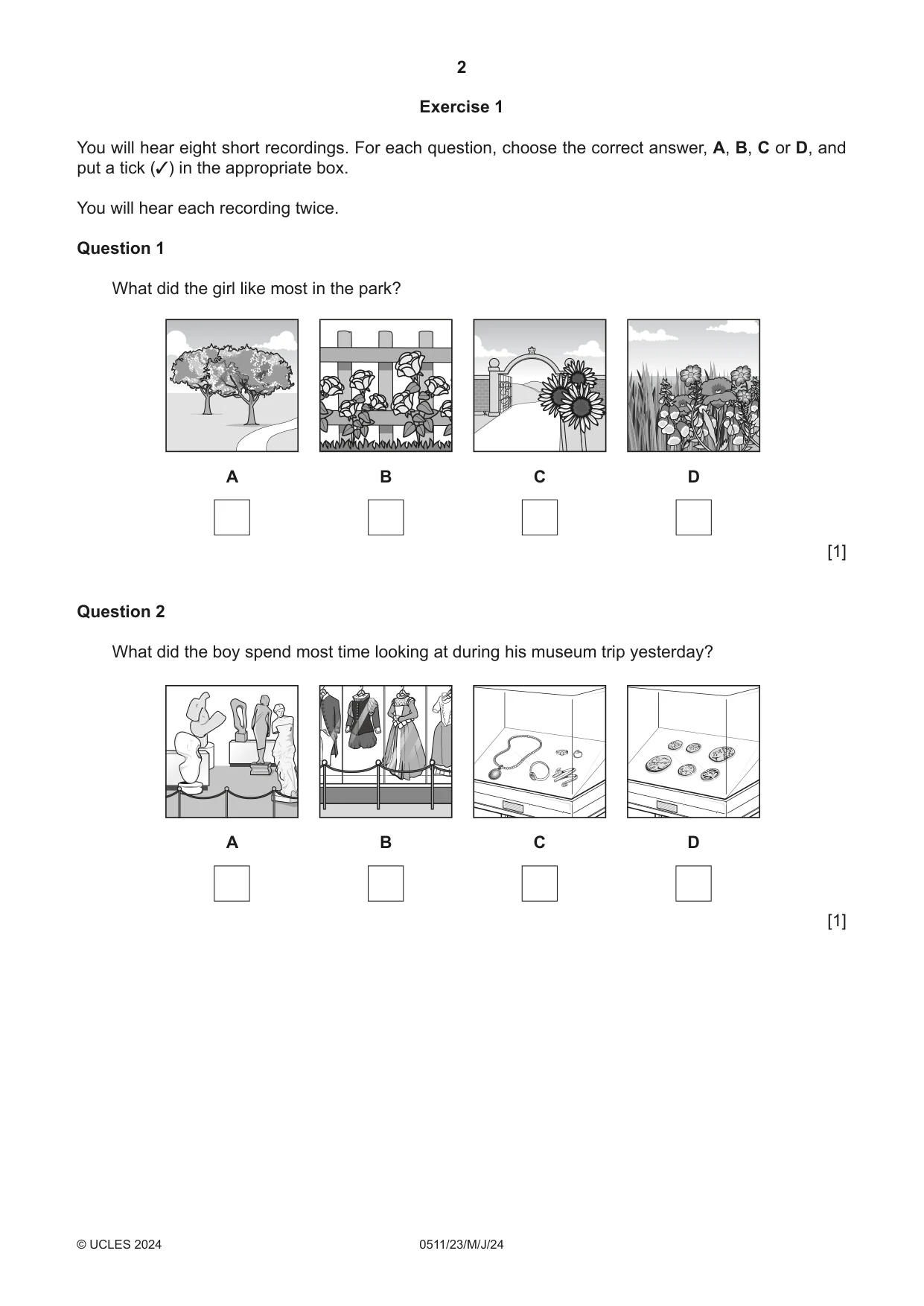
2 0511/23/ M/J/24 © UCLES 2024 Exercise 1 You will hear eight short recordings. For each question, choose the correct answer, A, B, C or D, and put a tick (3) in the appropriate box. You will hear each recording twice. Question 1 What did the girl like most in the park? A B C D [1] Question 2 What did the boy spend most time looking at during his museum trip yesterday? A B C D [1]
Question paper, page 3
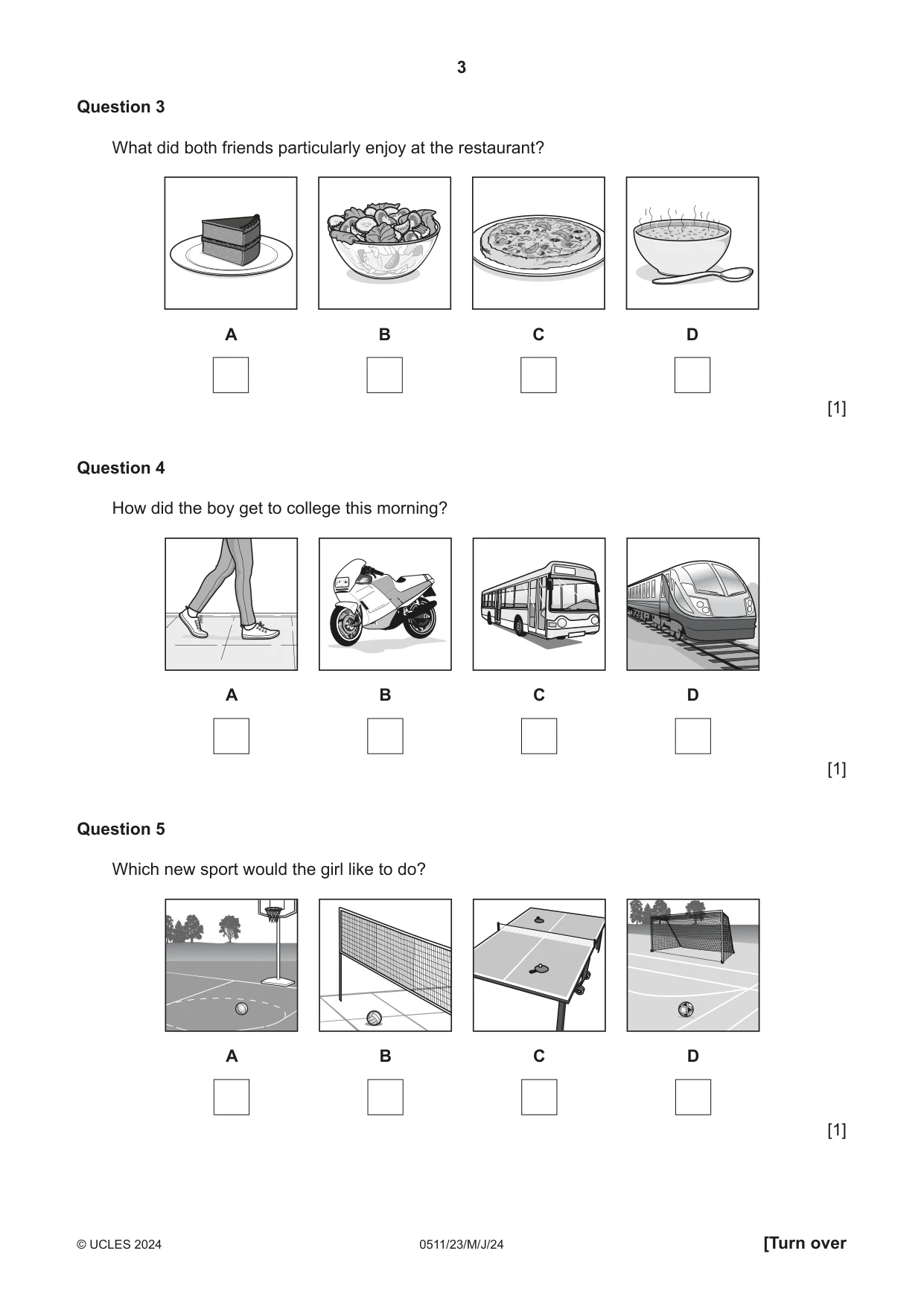
3 0511/23/ M/J/24 © UCLES 2024 [Turn over Question 3 What did both friends particularly enjoy at the restaurant? A B C D [1] Question 4 How did the boy get to college this morning? A B C D [1] Question 5 Which new sport would the girl like to do? A B C D [1]
Question paper, page 4
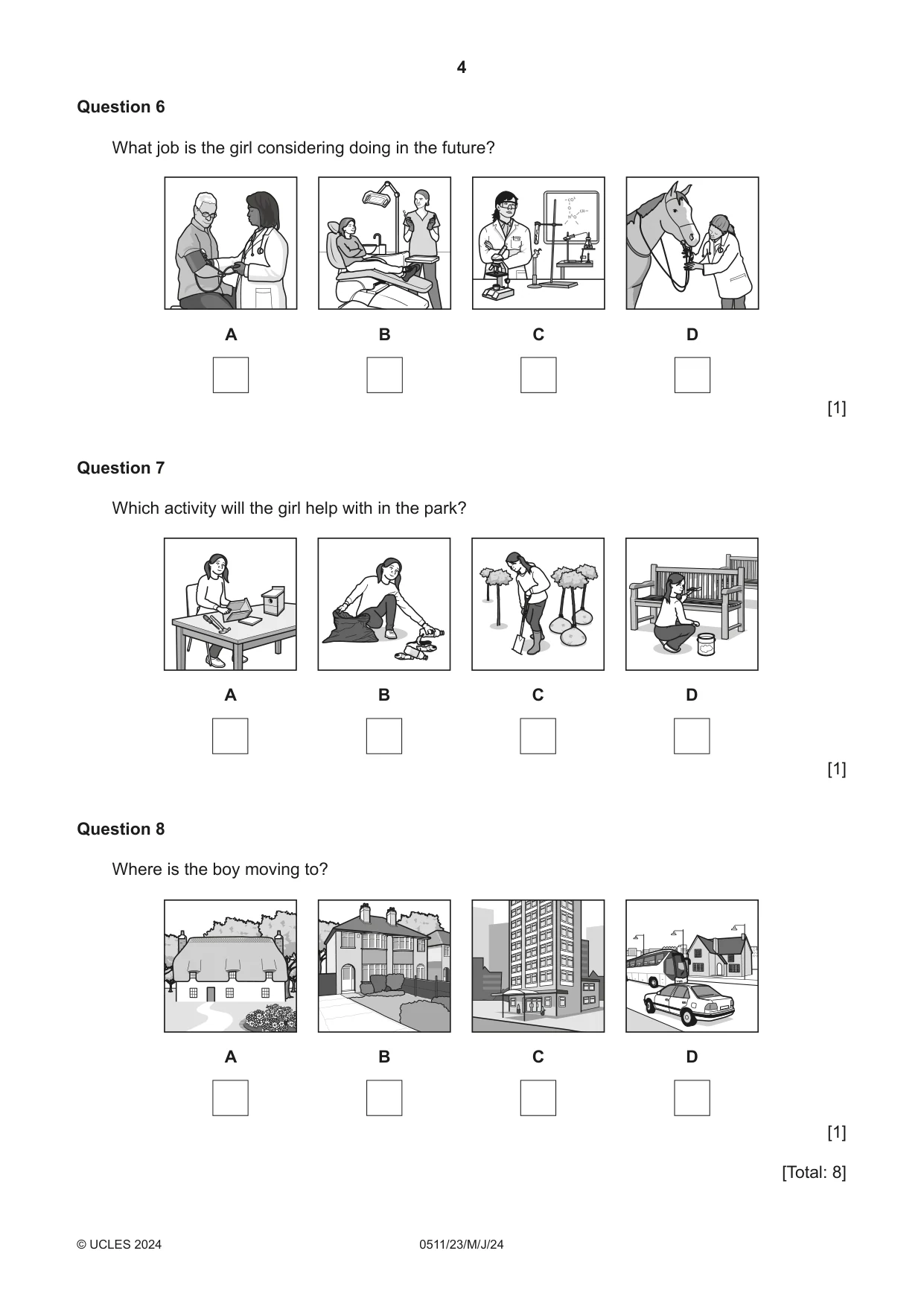
4 0511/23/M/J/24 © UCLES 2024 Question 6 What job is the girl considering doing in the future? A B C D [1] Question 7 Which activity will the girl help with in the park? A B C D [1] Question 8 Where is the boy moving to? A B C D [1] [Total: 8]
Question paper, page 5
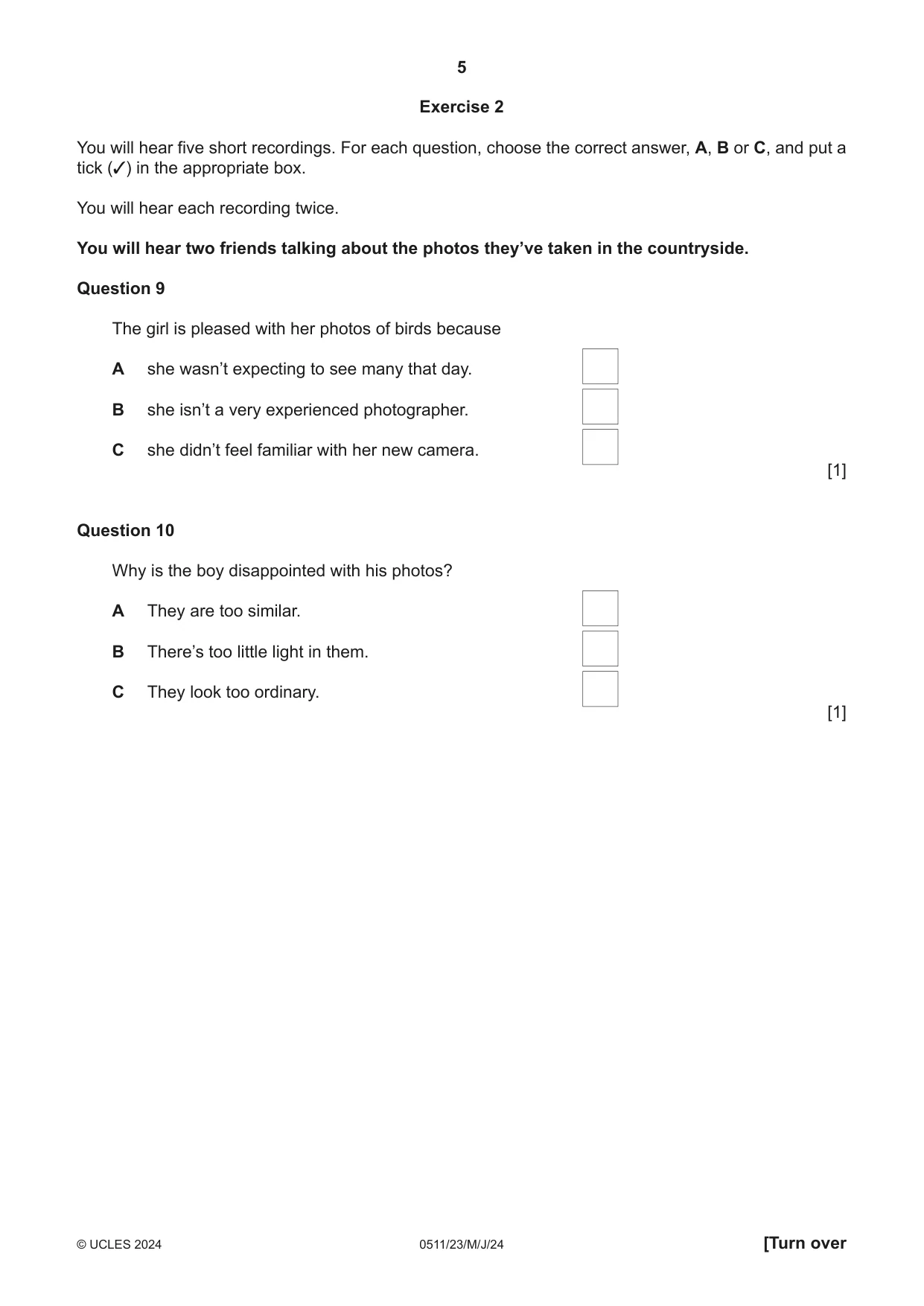
5 0511/23/M/J/24 © UCLES 2024 [Turn over Exercise 2 You will hear five short recordings. For each question, choose the correct answer, A, B or C, and put a tick (3) in the appropriate box. You will hear each recording twice. You will hear two friends talking about the photos they’ve taken in the countryside. Question 9 The girl is pleased with her photos of birds because A she wasn’t expecting to see many that day. B she isn’t a very experienced photographer. C she didn’t feel familiar with her new camera. [1] Question 10 Why is the boy disappointed with his photos? A They are too similar. B There’s too little light in them. C They look too ordinary. [1]
Question paper, page 6
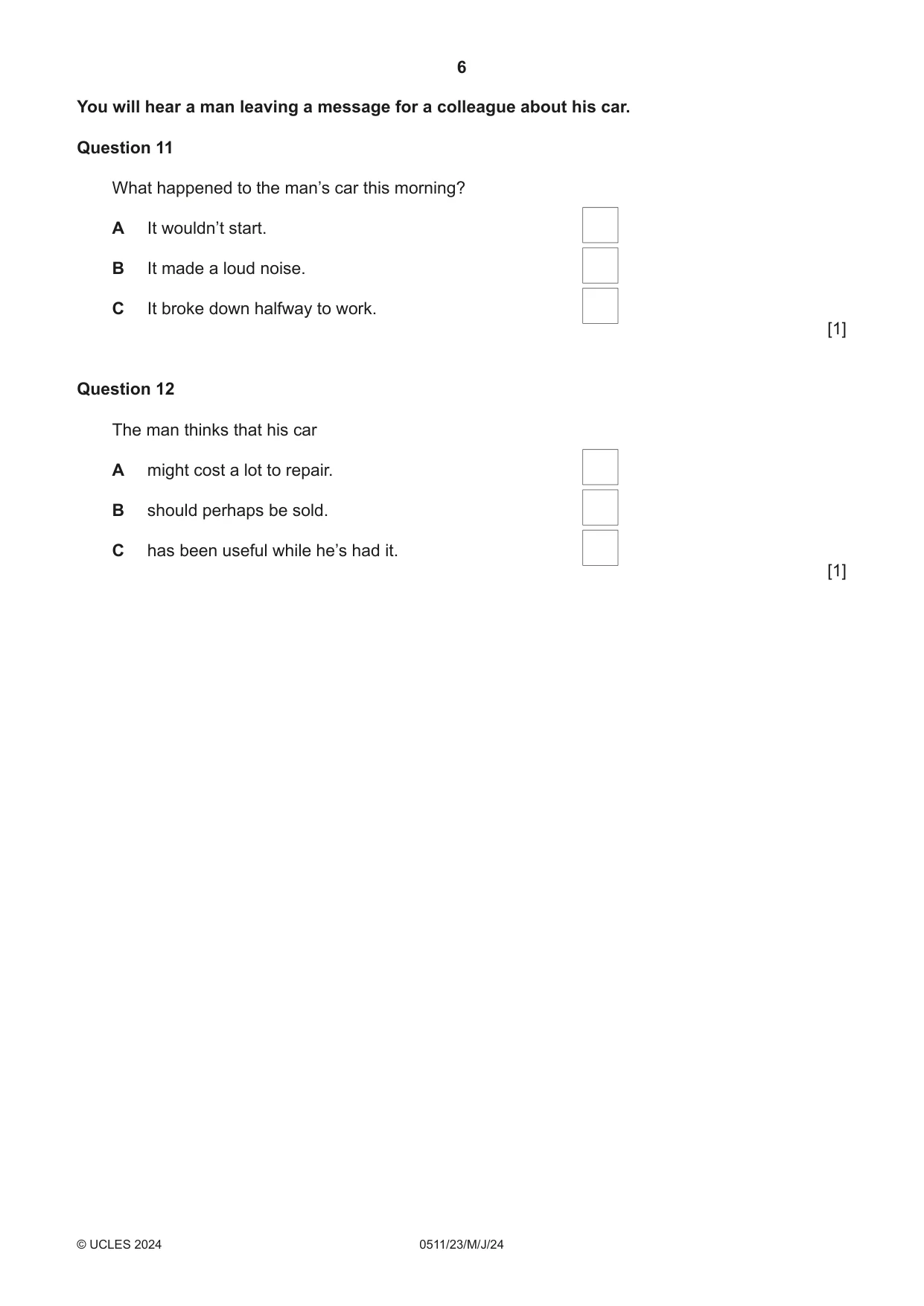
6 0511/23/M/J/24 © UCLES 2024 You will hear a man leaving a message for a colleague about his car. Question 11 What happened to the man’s car this morning? A It wouldn’t start. B It made a loud noise. C It broke down halfway to work. [1] Question 12 The man thinks that his car A might cost a lot to repair. B should perhaps be sold. C has been useful while he’s had it. [1]
Question paper, page 7
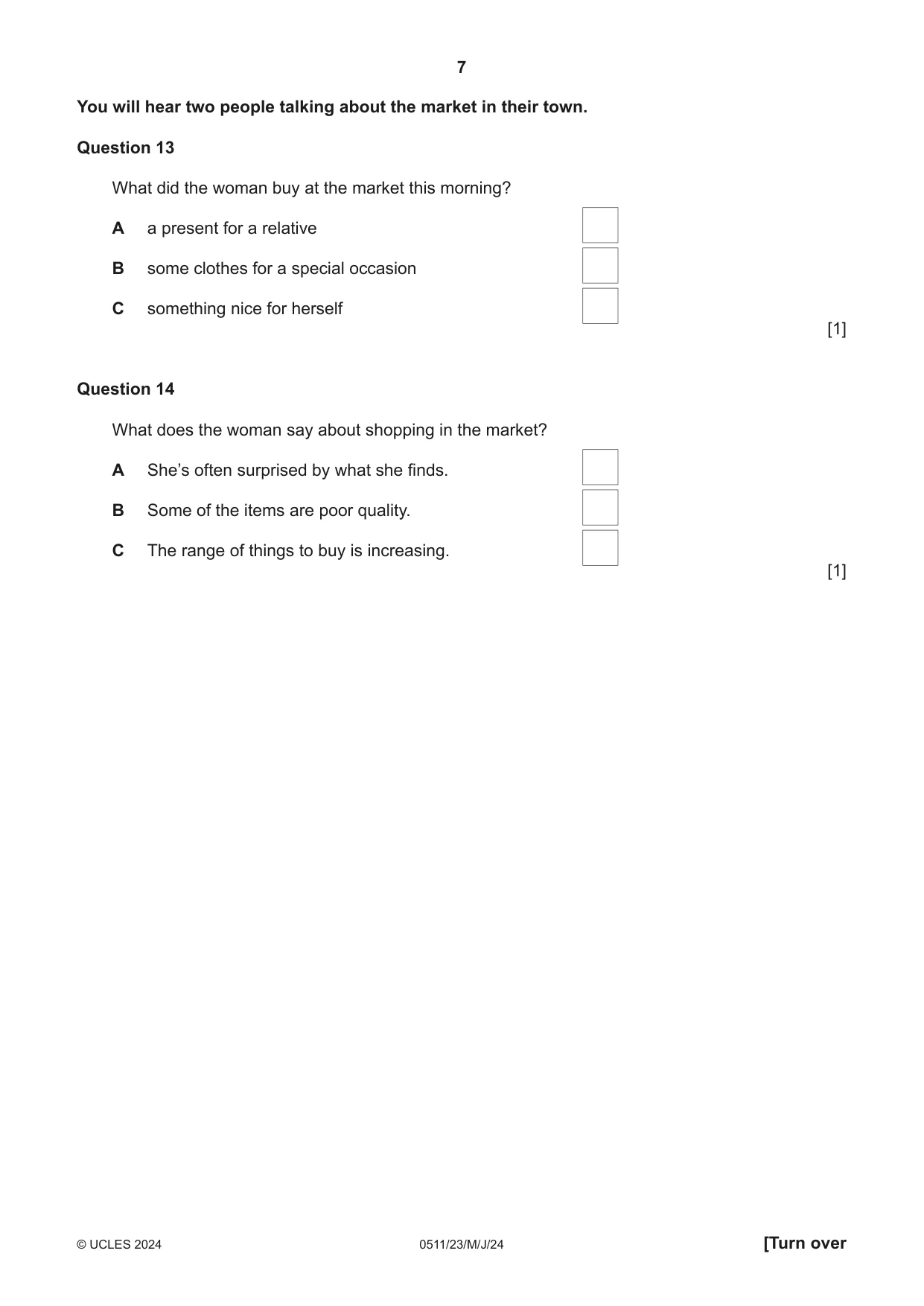
7 0511/23/M/J/24 © UCLES 2024 [Turn over You will hear two people talking about the market in their town. Question 13 What did the woman buy at the market this morning? A a present for a relative B some clothes for a special occasion C something nice for herself [1] Question 14 What does the woman say about shopping in the market? A She’s often surprised by what she finds. B Some of the items are poor quality. C The range of things to buy is increasing. [1]
Question paper, page 8
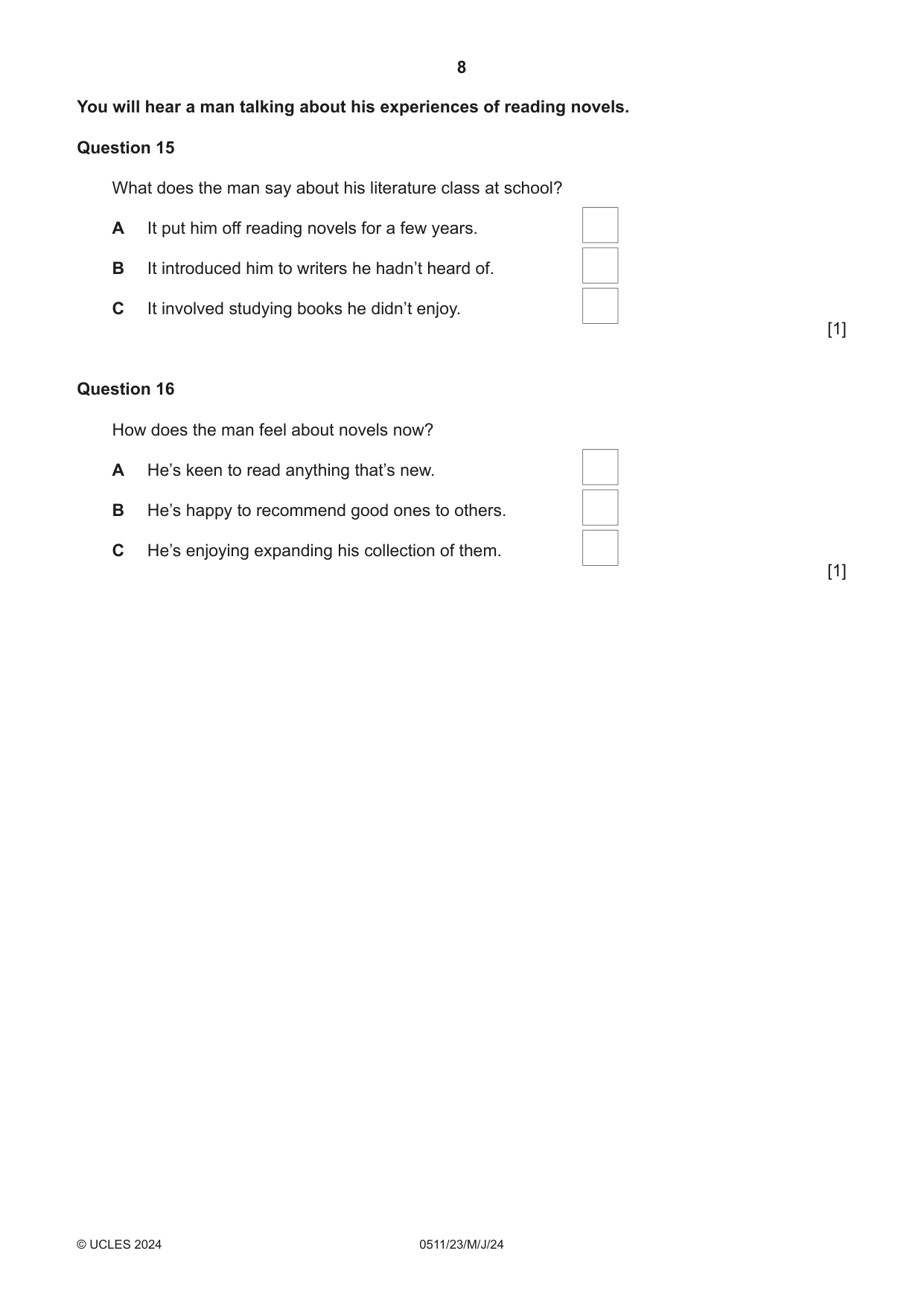
8 0511/23/M/J/24 © UCLES 2024 You will hear a man talking about his experiences of reading novels. Question 15 What does the man say about his literature class at school? A It put him off reading novels for a few years. B It introduced him to writers he hadn’t heard of. C It involved studying books he didn’t enjoy. [1] Question 16 How does the man feel about novels now? A He’s keen to read anything that’s new. B He’s happy to recommend good ones to others. C He’s enjoying expanding his collection of them. [1]
Question paper, page 9
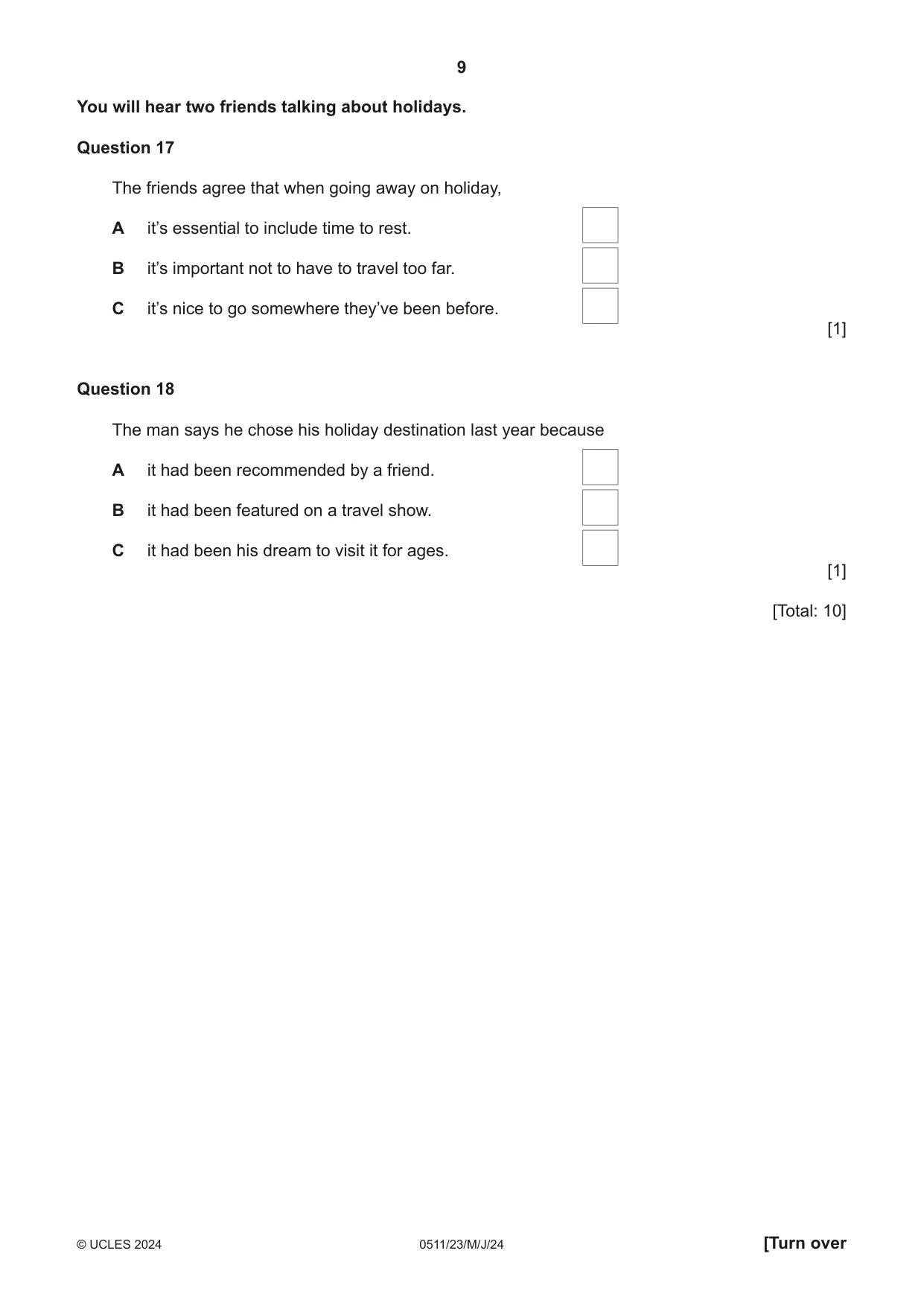
9 0511/23/M/J/24 © UCLES 2024 [Turn over You will hear two friends talking about holidays. Question 17 The friends agree that when going away on holiday, A it’s essential to include time to rest. B it’s important not to have to travel too far. C it’s nice to go somewhere they’ve been before. [1] Question 18 The man says he chose his holiday destination last year because A it had been recommended by a friend. B it had been featured on a travel show. C it had been his dream to visit it for ages. [1] [Total: 10]
Question paper, page 10
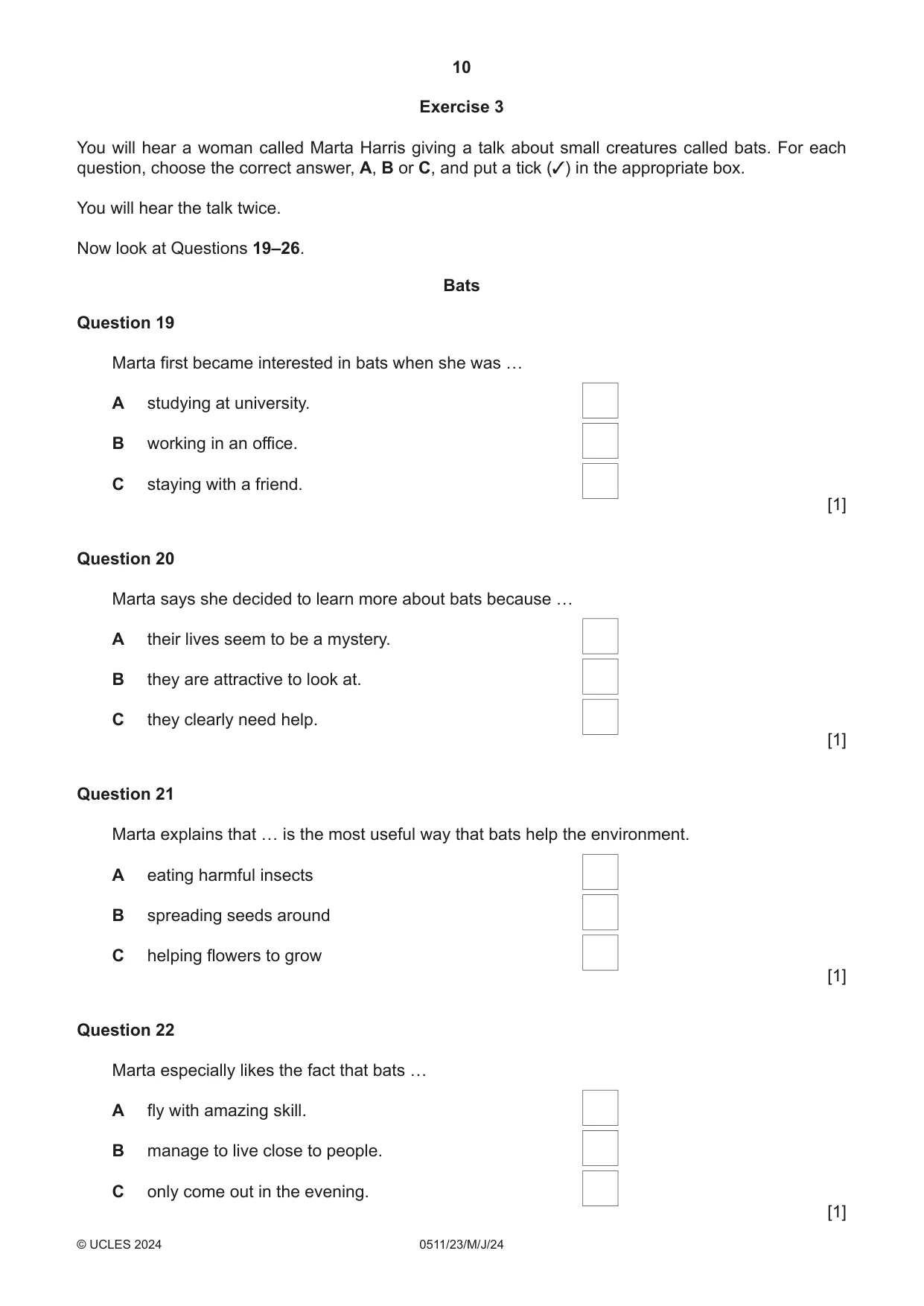
10 0511/23/M/J/24 © UCLES 2024 Exercise 3 You will hear a woman called Marta Harris giving a talk about small creatures called bats. For each question, choose the correct answer, A, B or C, and put a tick (3) in the appropriate box. You will hear the talk twice. Now look at Questions 19–26. Bats Question 19 Marta first became interested in bats when she was … A studying at university. B working in an office. C staying with a friend. [1] Question 20 Marta says she decided to learn more about bats because … A their lives seem to be a mystery. B they are attractive to look at. C they clearly need help. [1] Question 21 Marta explains that … is the most useful way that bats help the environment. A eating harmful insects B spreading seeds around C helping flowers to grow [1] Question 22 Marta especially likes the fact that bats … A fly with amazing skill. B manage to live close to people. C only come out in the evening. [1]
Question paper, page 11
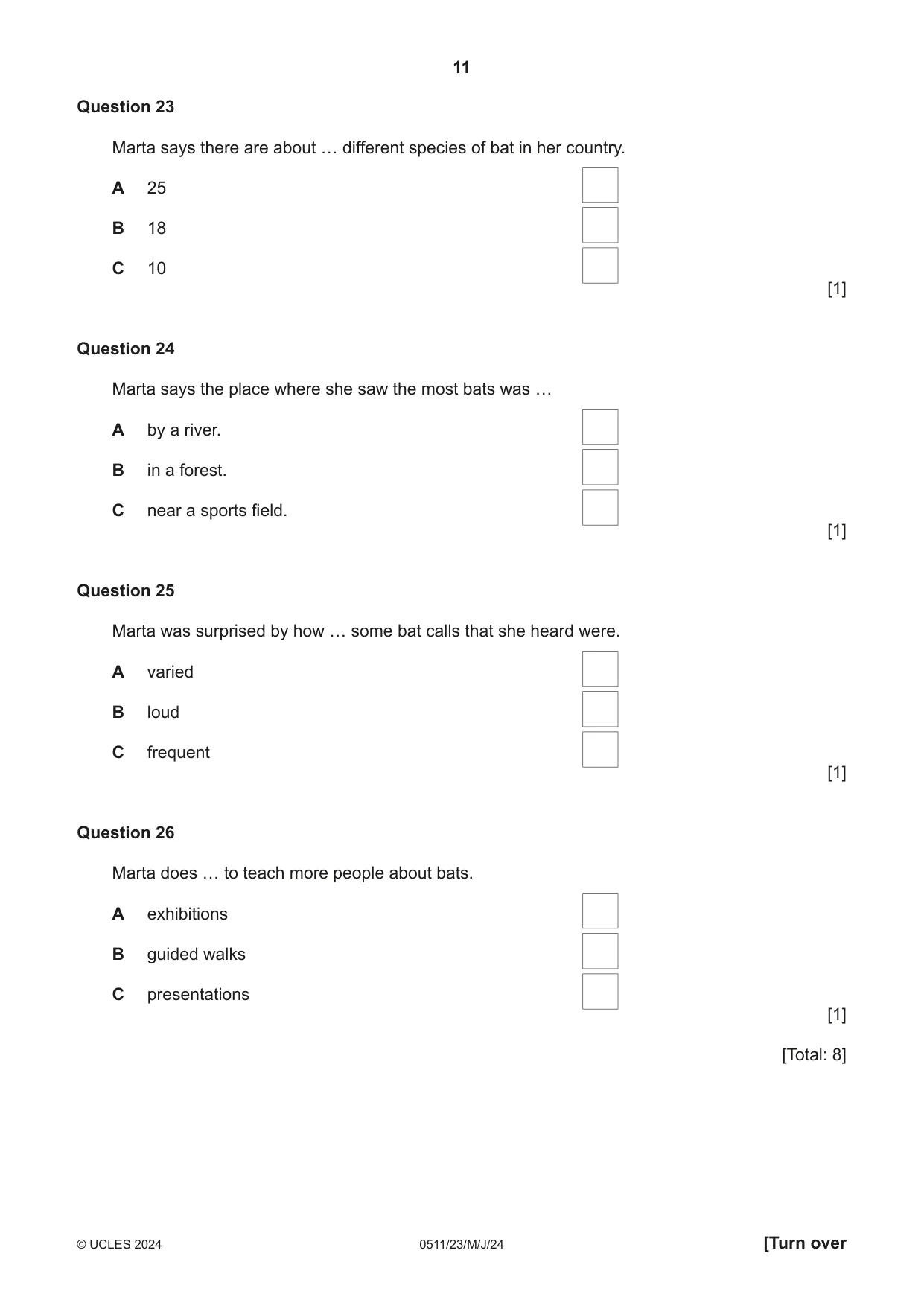
11 0511/23/M/J/24 © UCLES 2024 [Turn over Question 23 Marta says there are about … different species of bat in her country. A 25 B 18 C 10 [1] Question 24 Marta says the place where she saw the most bats was … A by a river. B in a forest. C near a sports field. [1] Question 25 Marta was surprised by how … some bat calls that she heard were. A varied B loud C frequent [1] Question 26 Marta does … to teach more people about bats. A exhibitions B guided walks C presentations [1] [Total: 8]
Question paper, page 12
12 0511/23/M/J/24 © UCLES 2024 BLANK PAGE
Question paper, page 13
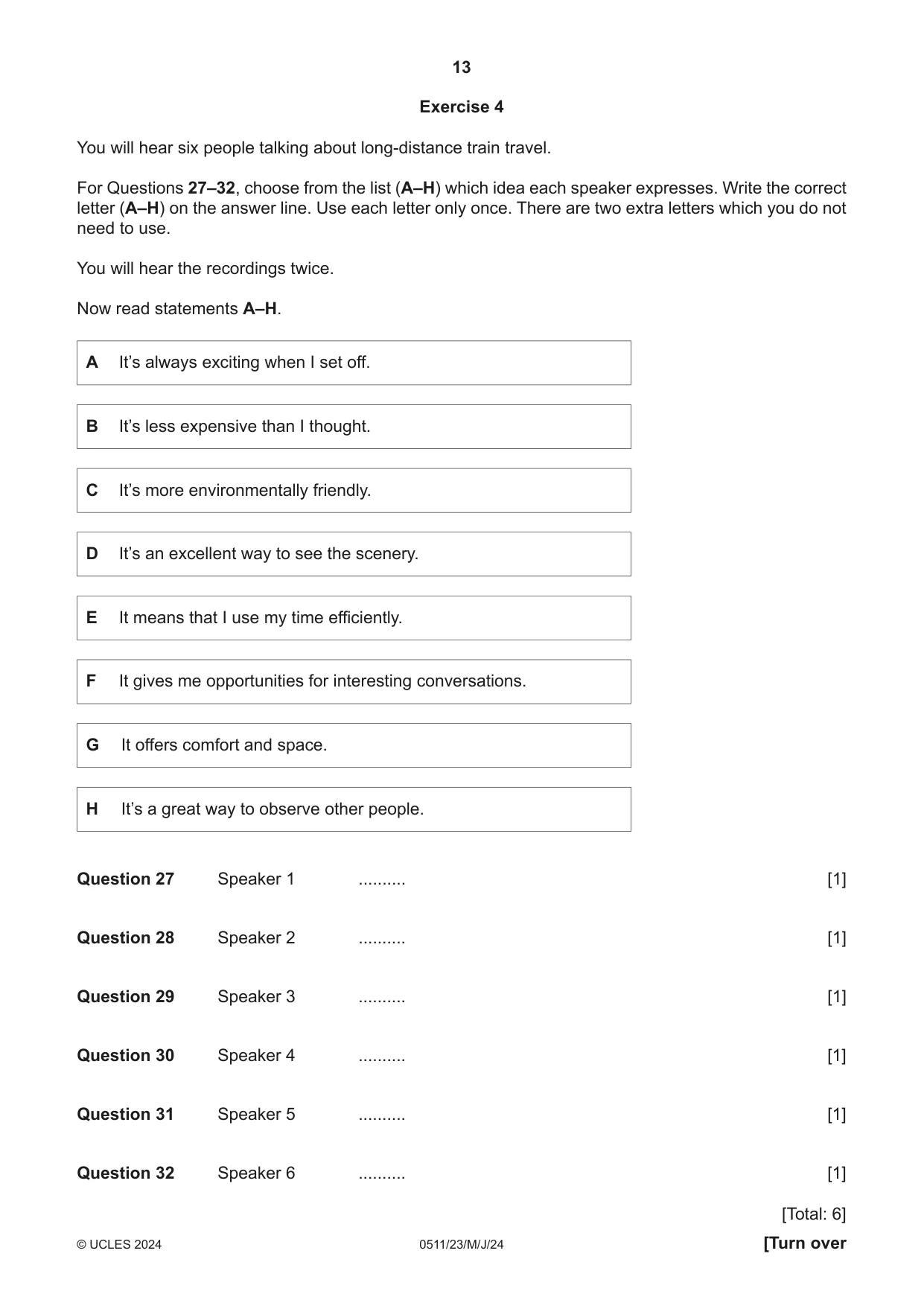
13 0511/23/M/J/24 © UCLES 2024 [Turn over Exercise 4 You will hear six people talking about long-distance train travel. For Questions 27–32, choose from the list (A–H) which idea each speaker expresses. Write the correct letter (A–H) on the answer line. Use each letter only once. There are two extra letters which you do not need to use. You will hear the recordings twice. Now read statements A–H. A It’s always exciting when I set off. B It’s less expensive than I thought. C It’s more environmentally friendly. D It’s an excellent way to see the scenery. E It means that I use my time efficiently. F It gives me opportunities for interesting conversations. G It offers comfort and space. H It’s a great way to observe other people. Question 27 Speaker 1 … [1] Question 28 Speaker 2 … [1] Question 29 Speaker 3 … [1] Question 30 Speaker 4 … [1] Question 31 Speaker 5 … [1] Question 32 Speaker 6 … [1] [Total: 6]
Question paper, page 14
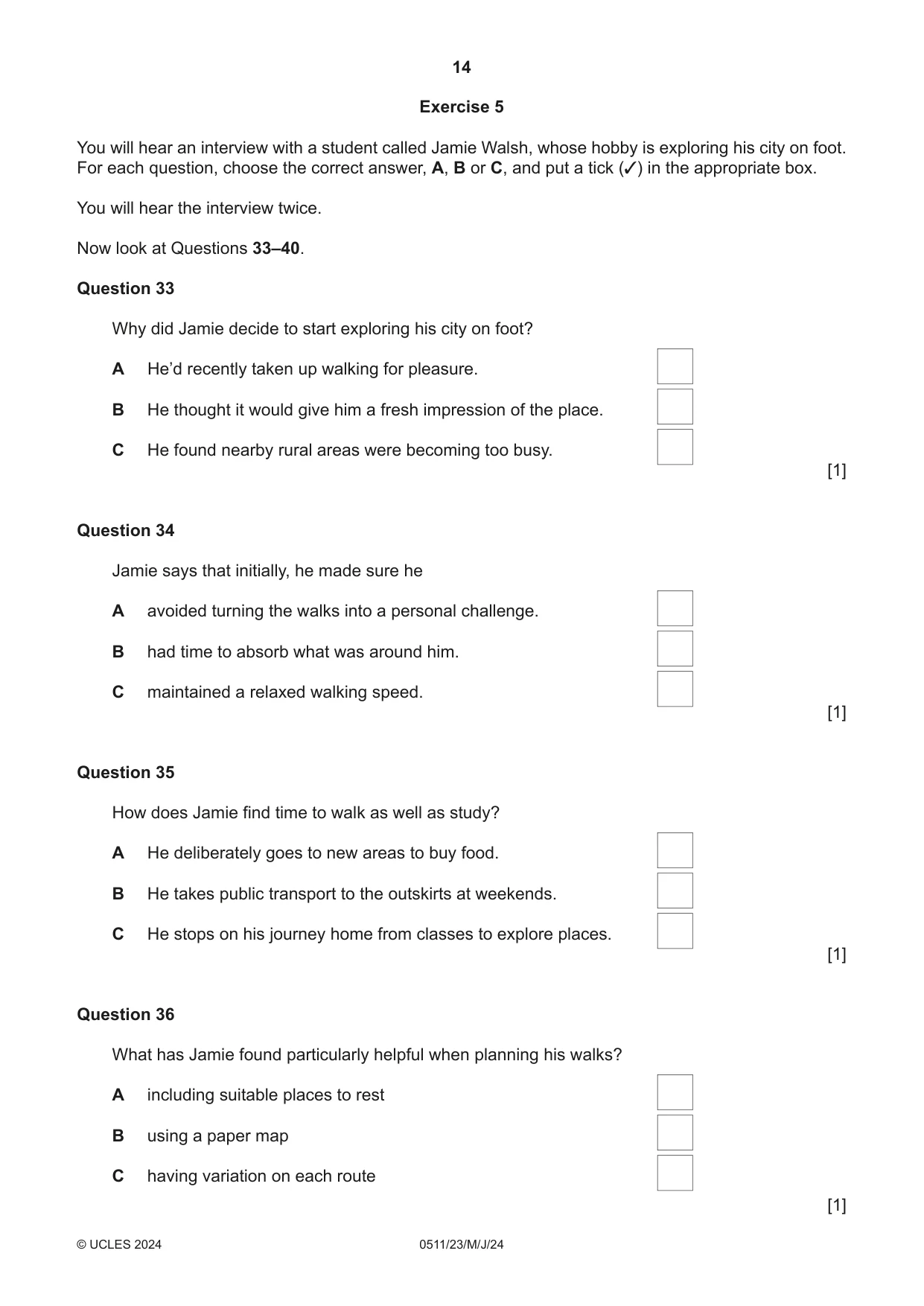
14 0511/23/M/J/24 © UCLES 2024 Exercise 5 You will hear an interview with a student called Jamie Walsh, whose hobby is exploring his city on foot. For each question, choose the correct answer, A, B or C, and put a tick (3) in the appropriate box. You will hear the interview twice. Now look at Questions 33–40. Question 33 Why did Jamie decide to start exploring his city on foot? A He’d recently taken up walking for pleasure. B He thought it would give him a fresh impression of the place. C He found nearby rural areas were becoming too busy. [1] Question 34 Jamie says that initially, he made sure he A avoided turning the walks into a personal challenge. B had time to absorb what was around him. C maintained a relaxed walking speed. [1] Question 35 How does Jamie find time to walk as well as study? A He deliberately goes to new areas to buy food. B He takes public transport to the outskirts at weekends. C He stops on his journey home from classes to explore places. [1] Question 36 What has Jamie found particularly helpful when planning his walks? A including suitable places to rest B using a paper map C having variation on each route [1]
Question paper, page 15
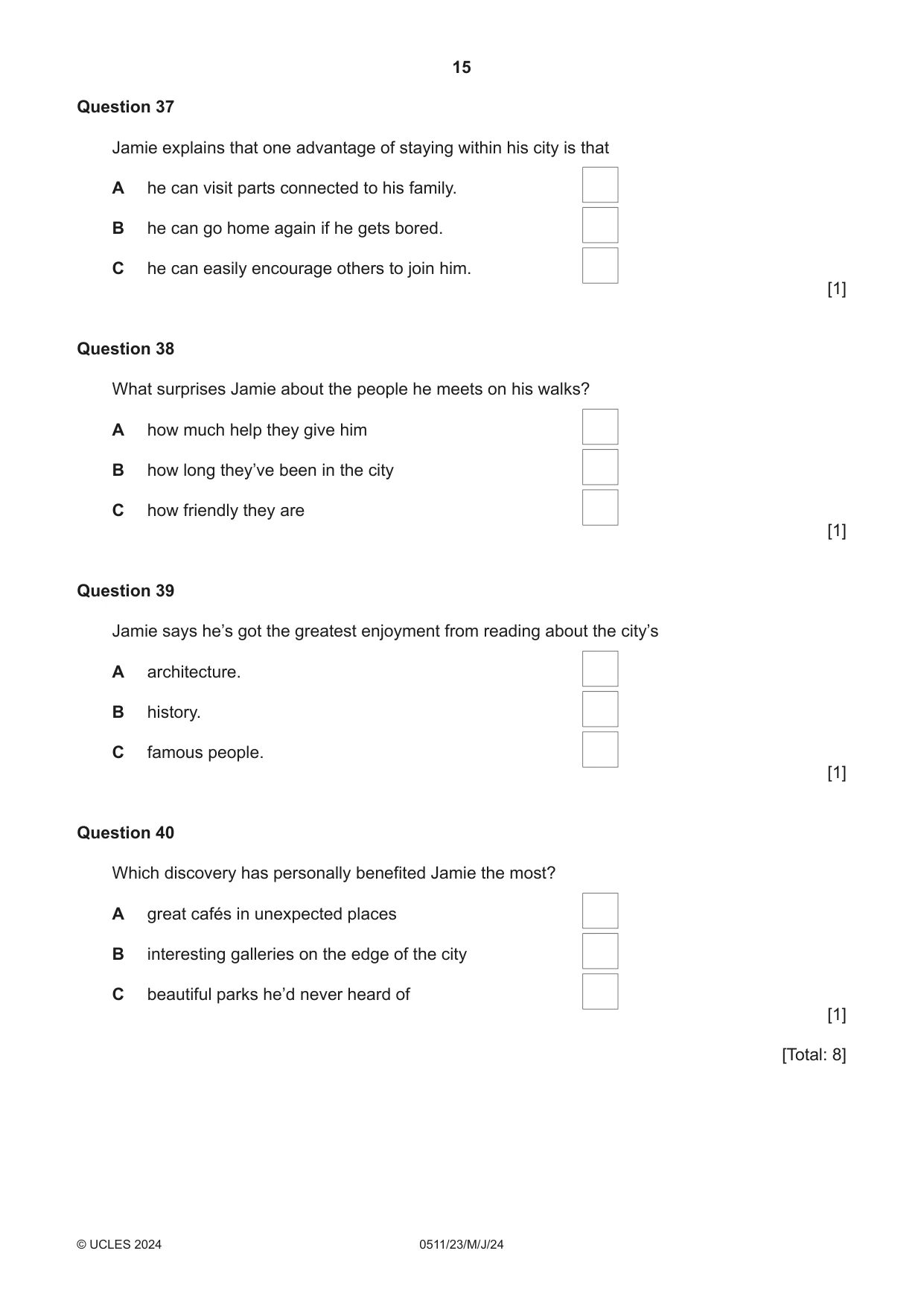
15 0511/23/M/J/24 © UCLES 2024 Question 37 Jamie explains that one advantage of staying within his city is that A he can visit parts connected to his family. B he can go home again if he gets bored. C he can easily encourage others to join him. [1] Question 38 What surprises Jamie about the people he meets on his walks? A how much help they give him B how long they’ve been in the city C how friendly they are [1] Question 39 Jamie says he’s got the greatest enjoyment from reading about the city’s A architecture. B history. C famous people. [1] Question 40 Which discovery has personally benefited Jamie the most? A great cafés in unexpected places B interesting galleries on the edge of the city C beautiful parks he’d never heard of [1] [Total: 8]
Question paper, page 16
16 0511/23/M/J/24 © UCLES 2024 Permission to reproduce items where third-party owned material protected by copyright is included has been sought and cleared where possible. Every reasonable effort has been made by the publisher (UCLES) to trace copyright holders, but if any items requiring clearance have unwittingly been included, the publisher will be pleased to make amends at the earliest possible opportunity. To avoid the issue of disclosure of answer-related information to candidates, all copyright acknowledgements are reproduced online in the Cambridge Assessment International Education Copyright Acknowledgements Booklet. This is produced for each series of examinations and is freely available to download at www.cambridgeinternational.org after the live examination series. Cambridge Assessment International Education is part of Cambridge Assessment. Cambridge Assessment is the brand name of the University of Cambridge Local Examinations Syndicate (UCLES), which is a department of the University of Cambridge. BLANK PAGE
Mark scheme, page 1
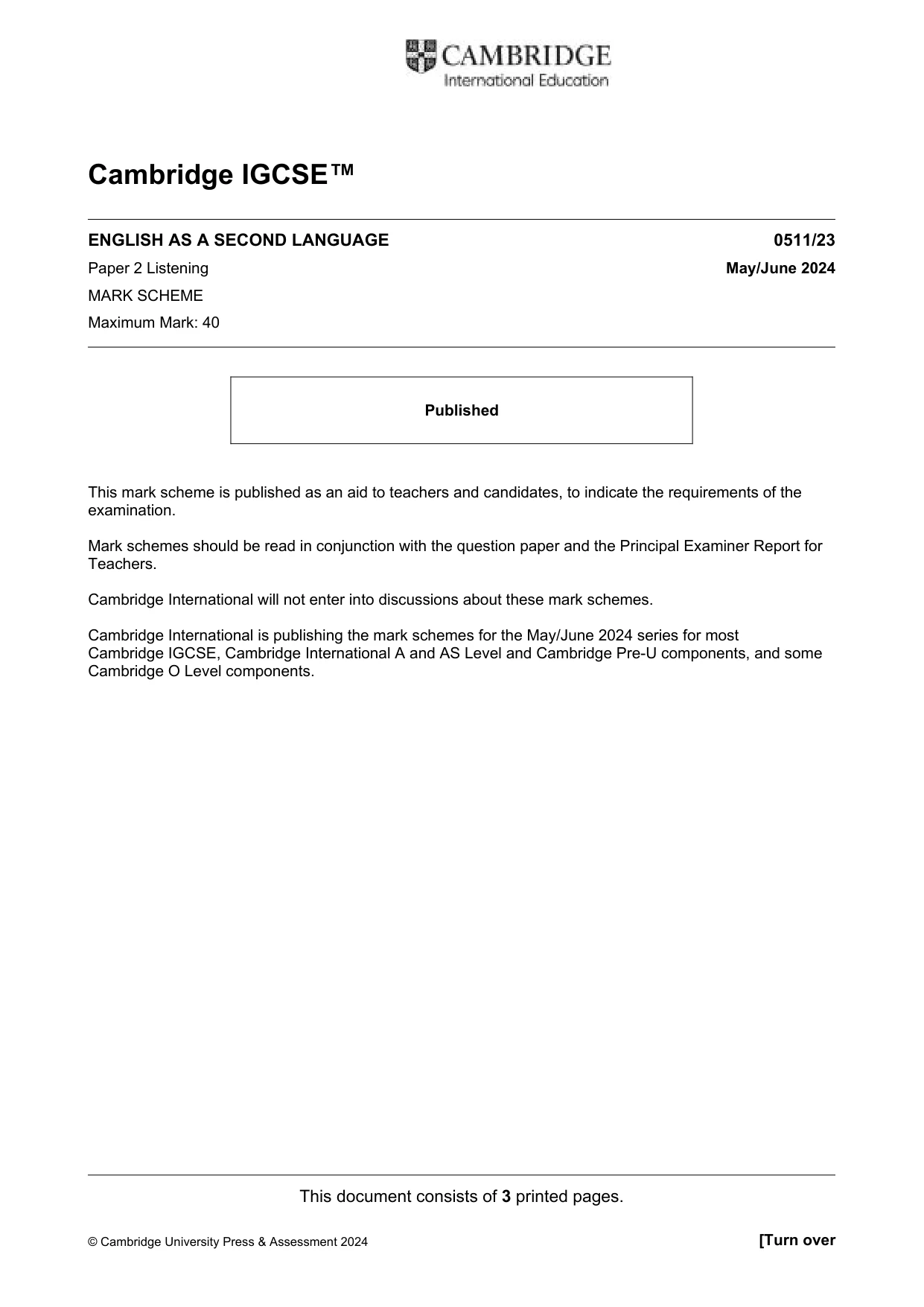
This document consists of 3 printed pages. © Cambridge University Press & Assessment 2024 [Turn over Cambridge IGCSE™ ENGLISH AS A SECOND LANGUAGE 0511/23 Paper 2 Listening May/June 2024 MARK SCHEME Maximum Mark: 40 Published This mark scheme is published as an aid to teachers and candidates, to indicate the requirements of the examination. Mark schemes should be read in conjunction with the question paper and the Principal Examiner Report for Teachers. Cambridge International will not enter into discussions about these mark schemes. Cambridge International is publishing the mark schemes for the May/June 2024 series for most Cambridge IGCSE, Cambridge International A and AS Level and Cambridge Pre-U components, and some Cambridge O Level components.
Mark scheme, page 2
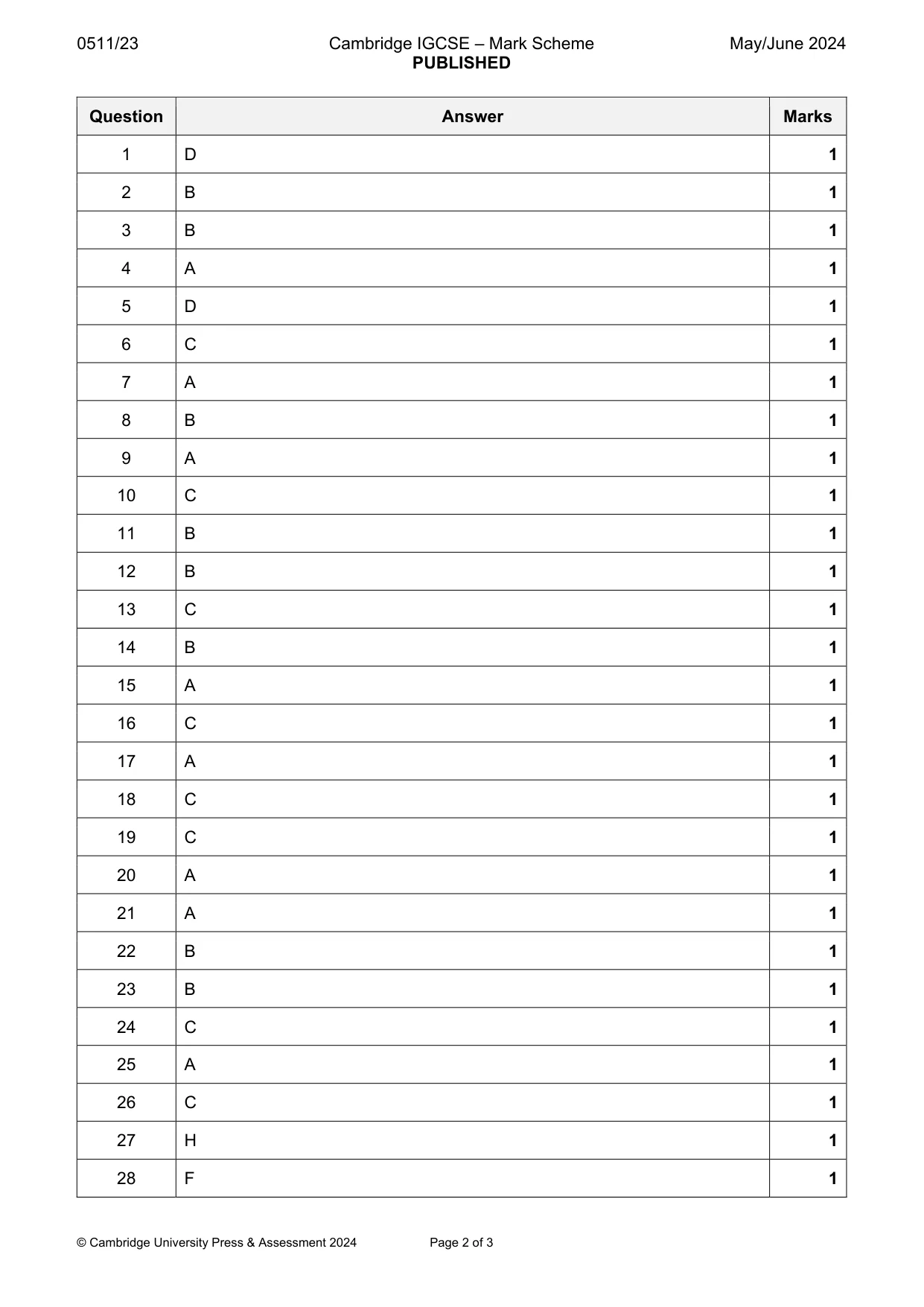
0511/23 Cambridge IGCSE – Mark Scheme PUBLISHED May/June 2024 © Cambridge University Press & Assessment 2024 Page 2 of 3 Question Answer Marks 1 D 1 2 B 1 3 B 1 4 A 1 5 D 1 6 C 1 7 A 1 8 B 1 9 A 1 10 C 1 11 B 1 12 B 1 13 C 1 14 B 1 15 A 1 16 C 1 17 A 1 18 C 1 19 C 1 20 A 1 21 A 1 22 B 1 23 B 1 24 C 1 25 A 1 26 C 1 27 H 1 28 F 1
Mark scheme, page 3
0511/23 Cambridge IGCSE – Mark Scheme PUBLISHED May/June 2024 © Cambridge University Press & Assessment 2024 Page 3 of 3 Question Answer Marks 29 C 1 30 B 1 31 A 1 32 E 1 33 C 1 34 A 1 35 C 1 36 B 1 37 B 1 38 C 1 39 B 1 40 A 1
What you needed in this session
Cambridge’s own grade thresholds for 2024 May/June, Paper 2 · Variant 3. A higher threshold means an easier paper — the bar moves with how the cohort did.