Cambridge IGCSE English - Second Language (count-in oral) 0511 — 2022 May/June Paper 2 · Variant 3
0511/23/M/J/22 · 80 marks · ≈90 min
The question paper and its mark scheme, free to read here and free to download. This is Cambridge’s own paper, exactly as it was sat.
Question paper16 pages






Mark scheme11 pages
Answers below. Sit the paper first if you are practising.
Paper as text
Question paper, page 1
This document has 16 pages. Any blank pages are indicated. [Turn over Cambridge IGCSE™ DC (EF) 312076 © UCLES 2022 ENGLISH AS A SECOND LANGUAGE 0511/23 Paper 2 Reading and Writing (Extended) May/June 2022 2 hours You must answer on the question paper. No additional materials are needed. INSTRUCTIONS ● Answer all questions. ● Use a black or dark blue pen. ● Write your name, centre number and candidate number in the boxes at the top of the page. ● Write your answer to each question in the space provided. ● Do not use an erasable pen or correction fluid. ● Do not write on any bar codes. ● Dictionaries are not allowed. INFORMATION ● The total mark for this paper is 80. ● The number of marks for each question or part question is shown in brackets [ ]. * 1 8 1 3 4 3 0 6 3 4 *
Question paper, page 2
2 0511/23/M/J/22 © UCLES 2022 Exercise 1 Read the article, and then answer the following questions. My Seychelles volunteering experience By Alexi Smith The Republic of Seychelles is a group of 115 islands in the Indian Ocean. It’s a popular destination for tourists. While many travel to the islands for water sports and exotic food, the majority are attracted by the stunning scenery. Recently, the number of tourists has risen significantly, bringing many economic benefits. Despite these, however, tourism has also led to increased development which is threatening the islands’ wildlife. Given that Seychelles’ marine environment is so attractive to tourists, protecting the ocean surrounding the islands is a priority. One project recently announced by the government is to establish marine protected areas covering 16% of these waters. Fregate Island is the furthest east of Seychelles, and in its northern part there is an eco-resort with luxury cabins. Here, income from tourism helps fund conservation programmes such as reducing harmful non-native plants and protecting rare species. Through intensive efforts, the island is now free from rats, for example. This has enabled the delicate ecosystem, including beetles and tortoises, to be successful. When I heard about a position as a conservation volunteer, I applied, and was accepted. Activities on Fregate Island varied, but primarily involved observing and recording the island’s marine and land wildlife. Helping guests gain a deeper understanding of the island’s conservation approaches was also a key role for all volunteers. I helped with projects like collecting data on marine life. Coral, for example, supports 25% of all other marine life and so is vitally important, but it takes hundreds of years to grow. We were testing the success of growing coral more quickly on special man-made underwater structures. Much of the area’s coral is at risk, partly due to increased sea temperatures, which have an impact on other marine species too. This artificial method of growing coral could be helpful in replacing such a vital underwater resource. There was also land work. The sandy beaches of Fregate Island provide nesting habitats for two rare turtle species. Whereas in most parts of the world turtles lay eggs at night when it’s safer, this is one of the few locations where it happens in daylight, I was delighted to discover. During the nesting season, turtles arrive on the 7 beaches on the island, allowing us to easily witness the event. When I was there, we spotted over 240 turtles. We attached small labels, or tags, to 23 of them, containing various details about the turtles, which would be useful to know if they were seen again. Turtle season is a busy time for volunteers as turtles bury their eggs in the sand, and in some locations, their nests are being washed away. Because of this, we had to move some of them to safety. The majority of turtles get eaten by other animals before reaching adulthood, so protecting every nest is important for conserving these fascinating creatures. One of the islands’ most well-known conservation successes is a bird called the Seychelles magpie robin. In 1970 only 16 remained, all on Fregate Island. Since then, conservation efforts have saved the species. Some magpie robins were transferred to other Seychelles islands and new breeding populations were established. Their habitats were protected and recent research counted 170 birds. On Fregate Island, we positioned nest boxes in various locations and checked them regularly for eggs or chicks. Females typically lay a single egg, which they sit on for up to 22 days, until the chick emerges. At 14 days, a tag is attached to its leg for identification later. Despite the bird population suffering a mystery disease a few years ago, the project is an example of successful conservation management.
Question paper, page 3
3 0511/23/M/J/22 © UCLES 2022 [Turn over 1 Why does the writer say most people go to Seychelles? … [1] 2 What are Seychelles’ authorities planning to create? … [1] 3 Which area of Fregate Island has accommodation for tourists? … [1] 4 What are no longer found on Fregate Island? … [1] 5 Who did the writer teach about wildlife during her stay on the island? … [1] 6 When do the turtles in the area lay their eggs? … [1] 7 In how many places might you see turtles laying eggs on Fregate Island? … [1] 8 What did the writer install to help protect the magpie robins? … [1] 9 How old are the magpie robins when the research process begins? … [1] 10 What are the dangers facing animals in Seychelles? Give four details. … … … … [4] [Total: 13]
Question paper, page 4
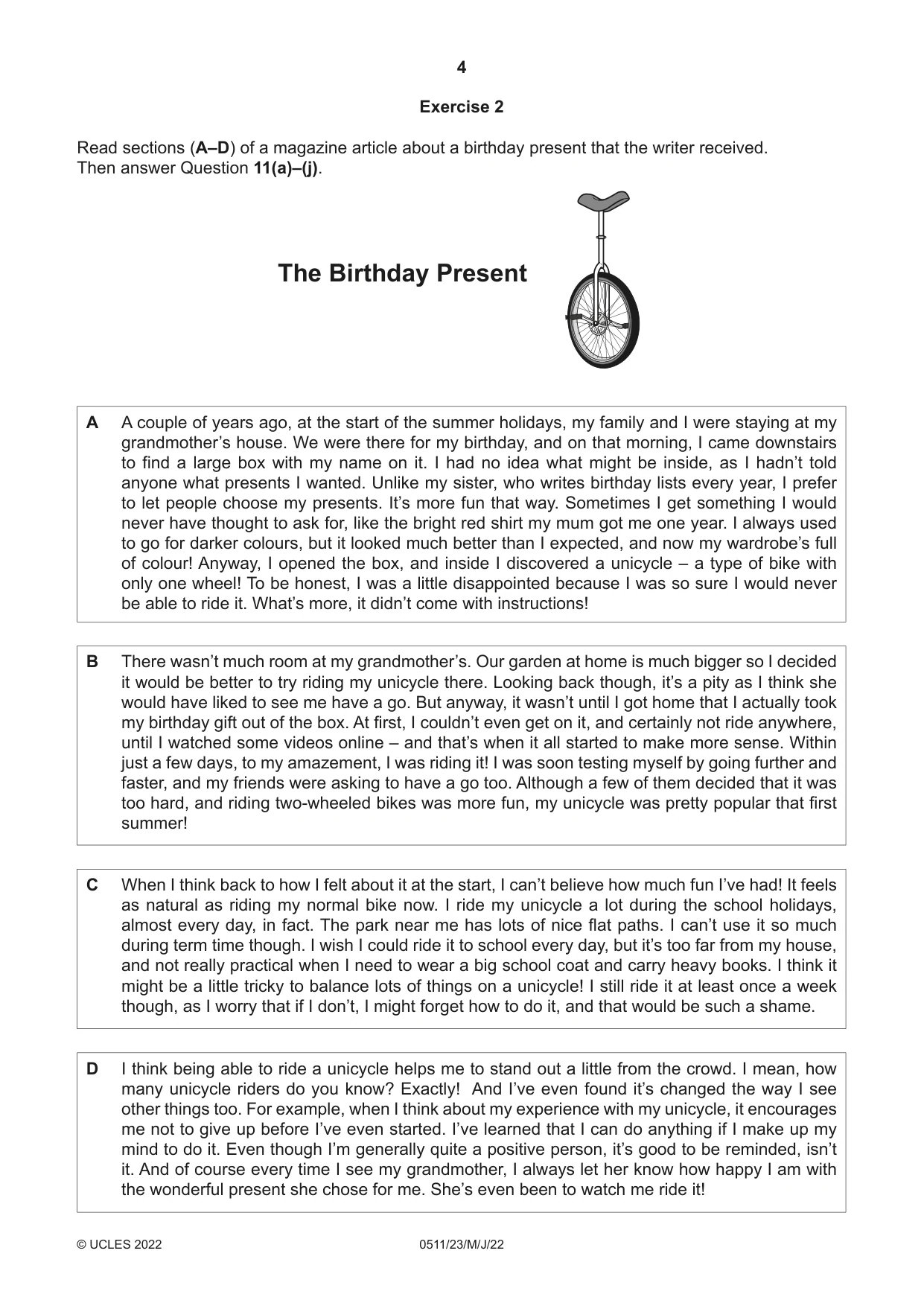
4 0511/23/M/J/22 © UCLES 2022 Exercise 2 Read sections (A–D) of a magazine article about a birthday present that the writer received. Then answer Question 11(a)–(j). The Birthday Present A A couple of years ago, at the start of the summer holidays, my family and I were staying at my grandmother’s house. We were there for my birthday, and on that morning, I came downstairs to find a large box with my name on it. I had no idea what might be inside, as I hadn’t told anyone what presents I wanted. Unlike my sister, who writes birthday lists every year, I prefer to let people choose my presents. It’s more fun that way. Sometimes I get something I would never have thought to ask for, like the bright red shirt my mum got me one year. I always used to go for darker colours, but it looked much better than I expected, and now my wardrobe’s full of colour! Anyway, I opened the box, and inside I discovered a unicycle – a type of bike with only one wheel! To be honest, I was a little disappointed because I was so sure I would never be able to ride it. What’s more, it didn’t come with instructions! B There wasn’t much room at my grandmother’s. Our garden at home is much bigger so I decided it would be better to try riding my unicycle there. Looking back though, it’s a pity as I think she would have liked to see me have a go. But anyway, it wasn’t until I got home that I actually took my birthday gift out of the box. At first, I couldn’t even get on it, and certainly not ride anywhere, until I watched some videos online – and that’s when it all started to make more sense. Within just a few days, to my amazement, I was riding it! I was soon testing myself by going further and faster, and my friends were asking to have a go too. Although a few of them decided that it was too hard, and riding two-wheeled bikes was more fun, my unicycle was pretty popular that first summer! C When I think back to how I felt about it at the start, I can’t believe how much fun I’ve had! It feels as natural as riding my normal bike now. I ride my unicycle a lot during the school holidays, almost every day, in fact. The park near me has lots of nice flat paths. I can’t use it so much during term time though. I wish I could ride it to school every day, but it’s too far from my house, and not really practical when I need to wear a big school coat and carry heavy books. I think it might be a little tricky to balance lots of things on a unicycle! I still ride it at least once a week though, as I worry that if I don’t, I might forget how to do it, and that would be such a shame. D I think being able to ride a unicycle helps me to stand out a little from the crowd. I mean, how many unicycle riders do you know? Exactly! And I’ve even found it’s changed the way I see other things too. For example, when I think about my experience with my unicycle, it encourages me not to give up before I’ve even started. I’ve learned that I can do anything if I make up my mind to do it. Even though I’m generally quite a positive person, it’s good to be reminded, isn’t it. And of course every time I see my grandmother, I always let her know how happy I am with the wonderful present she chose for me. She’s even been to watch me ride it!
Question paper, page 5
5 0511/23/M/J/22 © UCLES 2022 [Turn over 11 For each question, write the correct letter A, B, C or D on the line. Which section … (a) mentions a benefit of dealing with something challenging? ……… [1] (b) mentions what help was available to the writer? ……… [1] (c) suggests that the writer believed that trying an activity would be unsuccessful? ……… [1] (d) compares the writer’s ability to do two different activities? ……… [1] (e) explains how receiving a gift changed the way the writer dresses? ……… [1] (f) contains a regret about a past decision? ……… [1] (g) suggests that a skill is not very common? ……… [1] (h) mentions a difference between two people? ……… [1] (i) explains the reason for a regular activity? ……… [1] (j) includes the idea that learning a skill was easier than expected? ……… [1] [Total: 10]
Question paper, page 6
6 0511/23/M/J/22 © UCLES 2022 Exercise 3 Read the article about plant blindness, which is the lack of awareness of the plants around us, and then complete the notes. Plant blindness If you ask someone to describe what they see in a picture of a lion hiding in grass, it is highly likely that the lion is the first thing they’ll mention, and that the grass might not be seen or noticed in the same way. Most people see the lion as the key element in the picture and the grass as far less important. This is an example of what some scientists call ‘plant blindness’ – the lack of awareness of the plants around us. Plant blindness is a serious issue, particularly when you consider how important plants are to us and to the environment. Something that contributes to plant blindness is that people who live in cities are often separated from nature. A consequence of this is that when young people think about going to university, studying plant science may be less attractive. And this really matters. The study of plants is vital because without research, we can’t develop better crops. Earlier education also plays an important role in attitudes towards plant life. It has been shown that due to plant blindness, many young children don’t realise that plants are living things and in fact this has to be taught. And when they are older, studies show that students are more likely to learn about animals than plants in biology lessons at school. While we are all aware of the need to save endangered animals, and are taught about how important this is, it can mean that endangered plants often get less attention. When we realise that the number of plants at risk around the world is actually far higher than the number of endangered animals, we can understand the seriousness of the problem. The reality is that people find it easier to build relationships with animals, particularly when they display human-like characteristics. There are other factors leading to plant blindness. It is said that our eyes take in 10 million pieces of data per second. One of the ways in which our brains have developed to cope with so much information is to pay less attention to things that don’t appear to move, like plants. For example, our attention is more likely to be drawn to a bee flying around than it is to the flower it lands on. Our brains also find it easier to identify objects that have different colours. So when we look at a rainforest, which appears to be completely green, we tend not to see individual plants. This is a serious problem as rainforests are exactly the sorts of places where we should be looking to find plant species that we might be able to use for different medicines. We will miss the chance to develop new treatments if we don’t learn to appreciate the incredible range of plants there are in the natural world.
Question paper, page 7
7 0511/23/M/J/22 © UCLES 2022 [Turn over You are going to give a talk about plant blindness to your class at school. Prepare some notes to use as the basis for your talk. Make short notes under each heading. 12 Reasons for plant blindness: • … • … • … • … [4] 13 Effects of plant blindness: • … • … • … • … • … [5] [Total: 9]
Question paper, page 8
8 0511/23/M/J/22 © UCLES 2022 Exercise 4 14 Read the article about podcasts, which are digital audio programmes that people can download and listen to. Write a summary about the advantages of listening to podcasts AND tips for making your own podcast. Your summary should be about 100 words long (and no more than 120 words long). You should use your own words as far as possible. You will receive up to 8 marks for the content of your summary, and up to 8 marks for the style and accuracy of your language. Podcasts Podcasts are digital programmes that are downloaded by millions of people every day. Making podcasts, previously known as ‘audioblogging’, first came about in the 1980s. It wasn’t until the mid-2000s, however, that it became a more popular, mainstream activity as broadband speeds increased and various devices became more affordable. Many people are getting involved with podcasts now – either by listening to them or even making podcasts of their own. Not everyone is a fan of podcasts though. In the same way that reading a lot of text, or watching an online video doesn’t appeal to everyone, there are those who find it hard to focus on a form of media that’s just audio based. But for those who don’t feel this way, there’s a good chance that somewhere out there is a podcast on their own topic of interest, no matter how specialised. In fact, from a presenter’s point of view, an unusual topic makes it easier to attract an audience for a podcast than, say, a radio programme. And of course, radio programmes are often only broadcast in one country, whereas podcasts can generally be accessed from all around the world. It’s also true that for many of us, listening to someone talking can be more engaging than reading about a subject on our own. Uploading audio content to the internet might sound simple, but for presenters, creating regular podcasts is not as easy as you would think. A lot of time and effort goes into making them. For this reason, you will generally find that podcasts deal with a topic in far more detail than a one-off radio programme ever could. Podcasts can, in theory, last for as long as the presenter wants, but most podcasts are generally recorded in time slots of half an hour, or an hour. If you want to run a series of podcasts, however, it is sensible to keep to a similar length for each recording. And the great thing for listeners, of course, is that podcasts can be enjoyed at any time, in any place, once they have been downloaded. Well-known radio broadcasters and presenters of popular podcasts share certain skills. If you’re wondering what it takes to be a successful presenter, then listening to a wide range of podcasts can be a useful way to hear different styles from different presenters – after all, most podcasts are free. The range of podcast topics is extensive, with everything from sports interviews, fashion and music to scientific discussions and even political debate. Regardless of the subject, what all good presenters have in common is that they talk directly to the listeners as if they were in the same room. And if you are a presenter, you are bound to get a great deal of satisfaction as you watch the list of people who regularly listen or subscribe to your podcast growing week by week. It’s great to know that all your efforts are paying off!
Question paper, page 9
9 0511/23/M/J/22 © UCLES 2022 [Turn over … … … … … … … … … … … … … … … … … … … … … … … … … … … [Total: 16]
Question paper, page 10
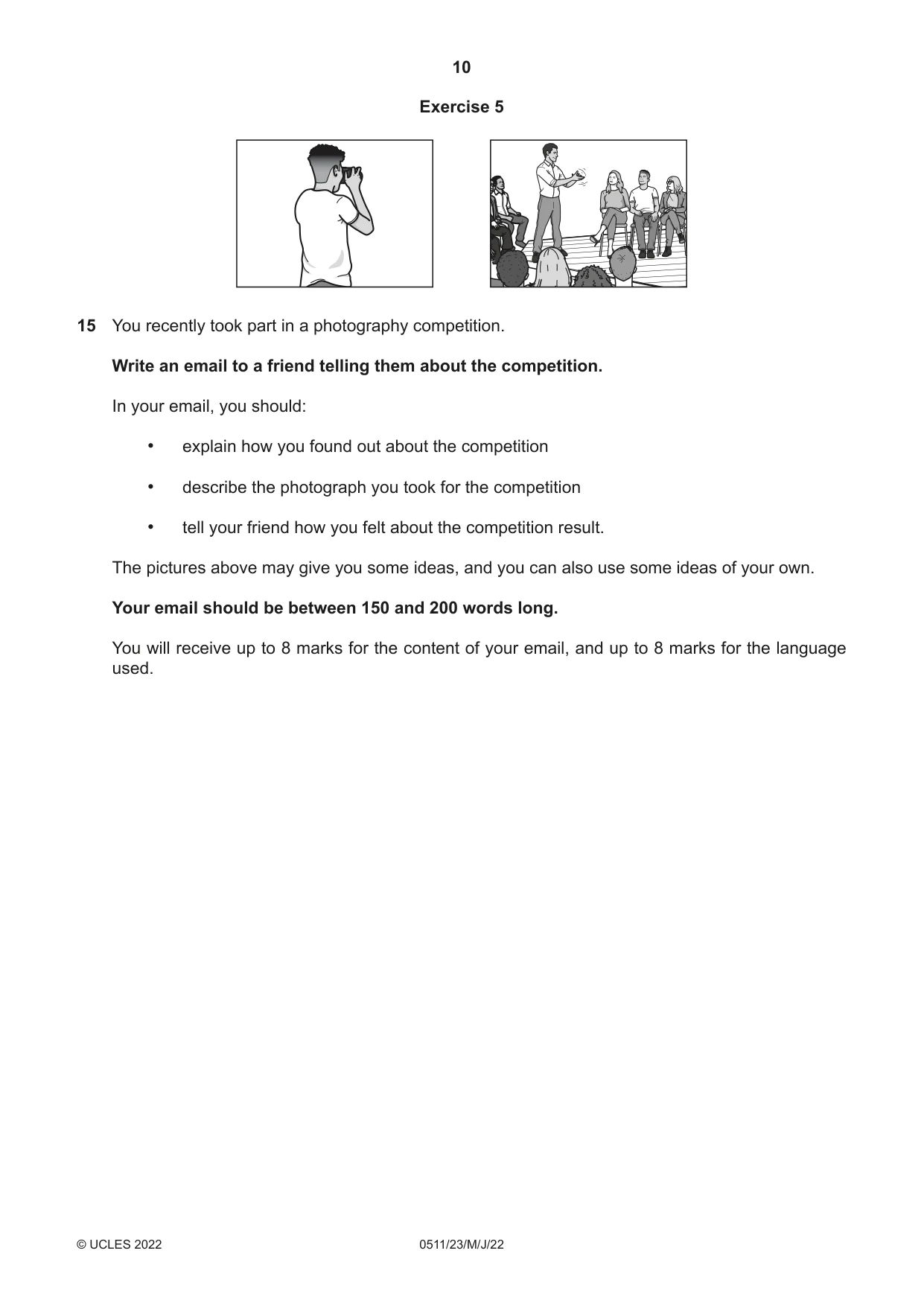
10 0511/23/ M / J /22 © UCLES 2022 Exercise 5 15 You recently took part in a photography competition. Write an email to a friend telling them about the competition. In your email, you should: • explain how you found out about the competition • describe the photograph you took for the competition • tell your friend how you felt about the competition result. The pictures above may give you some ideas, and you can also use some ideas of your own. Your email should be between 150 and 200 words long. You will receive up to 8 marks for the content of your email, and up to 8 marks for the language used.
Question paper, page 11
11 0511/23/M/J/22 © UCLES 2022 [Turn over … … … … … … … … … … … … … … … … … … … … … … … … … … … [Total: 16]
Question paper, page 12
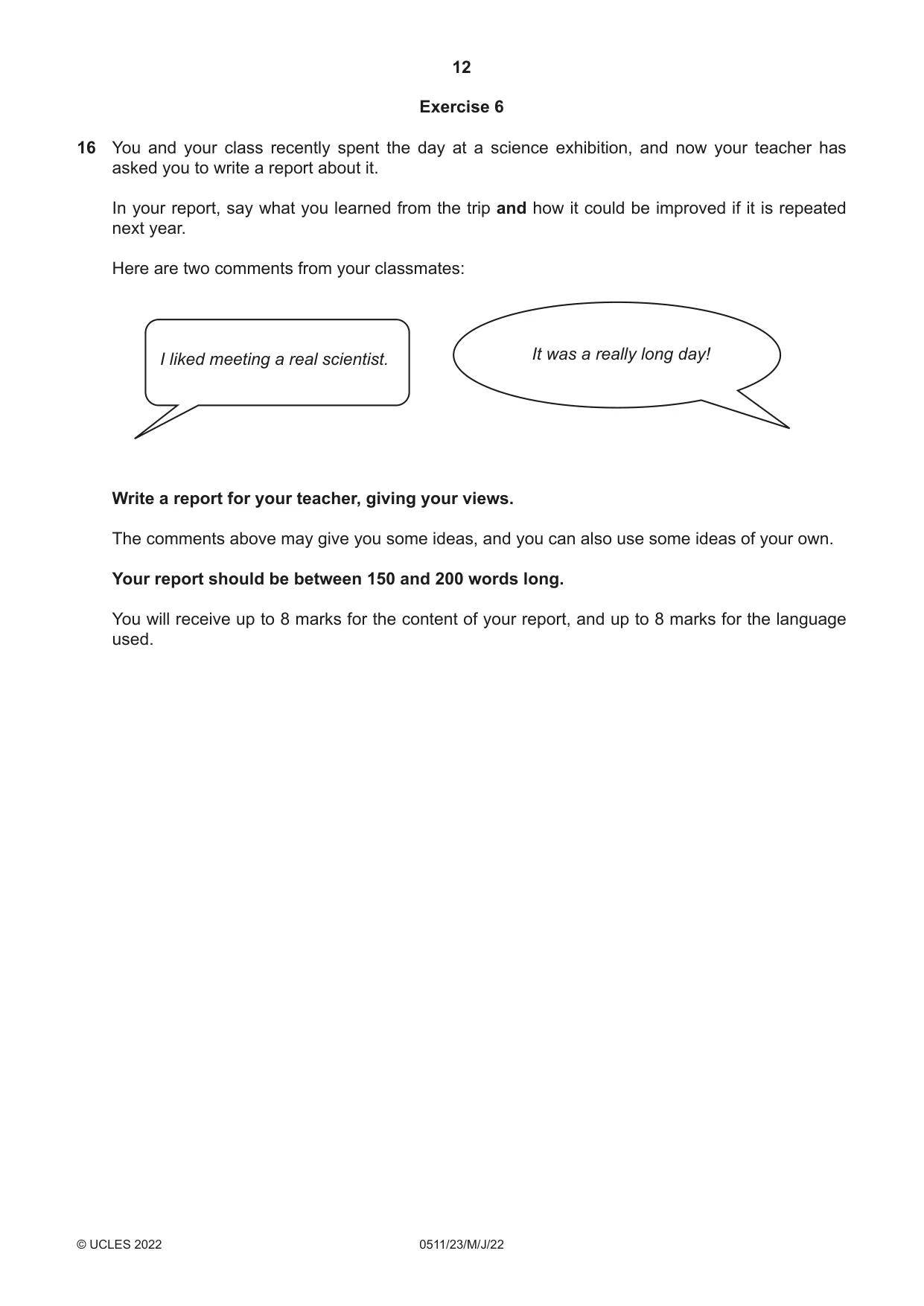
12 0511/23/M/J/22 © UCLES 2022 Exercise 6 16 You and your class recently spent the day at a science exhibition, and now your teacher has asked you to write a report about it. In your report, say what you learned from the trip and how it could be improved if it is repeated next year. Here are two comments from your classmates: It was a really long day! I liked meeting a real scientist. Write a report for your teacher, giving your views. The comments above may give you some ideas, and you can also use some ideas of your own. Your report should be between 150 and 200 words long. You will receive up to 8 marks for the content of your report, and up to 8 marks for the language used.
Question paper, page 13
13 0511/23/M/J/22 © UCLES 2022 … … … … … … … … … … … … … … … … … … … … … … … … … … … [Total: 16]
Question paper, page 14
14 0511/23/M/J/22 © UCLES 2022 BLANK PAGE
Question paper, page 15
15 0511/23/M/J/22 © UCLES 2022 BLANK PAGE
Question paper, page 16
16 0511/23/M/J/22 © UCLES 2022 Permission to reproduce items where third-party owned material protected by copyright is included has been sought and cleared where possible. Every reasonable effort has been made by the publisher (UCLES) to trace copyright holders, but if any items requiring clearance have unwittingly been included, the publisher will be pleased to make amends at the earliest possible opportunity. To avoid the issue of disclosure of answer-related information to candidates, all copyright acknowledgements are reproduced online in the Cambridge Assessment International Education Copyright Acknowledgements Booklet. This is produced for each series of examinations and is freely available to download at www.cambridgeinternational.org after the live examination series. Cambridge Assessment International Education is part of Cambridge Assessment. Cambridge Assessment is the brand name of the University of Cambridge Local Examinations Syndicate (UCLES), which is a department of the University of Cambridge. BLANK PAGE
Mark scheme, page 1
This document consists of 11 printed pages. © UCLES 2022 [Turn over Cambridge IGCSE™ ENGLISH AS A SECOND LANGUAGE 0511/23 Paper 2 Reading and Writing (Extended) May/June 2022 MARK SCHEME Maximum Mark: 80 Published This mark scheme is published as an aid to teachers and candidates, to indicate the requirements of the examination. It shows the basis on which Examiners were instructed to award marks. It does not indicate the details of the discussions that took place at an Examiners’ meeting before marking began, which would have considered the acceptability of alternative answers. Mark schemes should be read in conjunction with the question paper and the Principal Examiner Report for Teachers. Cambridge International will not enter into discussions about these mark schemes. Cambridge International is publishing the mark schemes for the May/June 2022 series for most Cambridge IGCSE, Cambridge International A and AS Level and Cambridge Pre-U components, and some Cambridge O Level components.
Mark scheme, page 2
0511/23 Cambridge IGCSE – Mark Scheme PUBLISHED May/June 2022 © UCLES 2022 Page 2 of 11 Generic Marking Principles These general marking principles must be applied by all examiners when marking candidate answers. They should be applied alongside the specific content of the mark scheme or generic level descriptors for a question. Each question paper and mark scheme will also comply with these marking principles. GENERIC MARKING PRINCIPLE 1: Marks must be awarded in line with: the specific content of the mark scheme or the generic level descriptors for the question the specific skills defined in the mark scheme or in the generic level descriptors for the question the standard of response required by a candidate as exemplified by the standardisation scripts. GENERIC MARKING PRINCIPLE 2: Marks awarded are always whole marks (not half marks, or other fractions). GENERIC MARKING PRINCIPLE 3: Marks must be awarded positively: marks are awarded for correct/valid answers, as defined in the mark scheme. However, credit is given for valid answers which go beyond the scope of the syllabus and mark scheme, referring to your Team Leader as appropriate marks are awarded when candidates clearly demonstrate what they know and can do marks are not deducted for errors marks are not deducted for omissions answers should only be judged on the quality of spelling, punctuation and grammar when these features are specifically assessed by the question as indicated by the mark scheme. The meaning, however, should be unambiguous. GENERIC MARKING PRINCIPLE 4: Rules must be applied consistently, e.g. in situations where candidates have not followed instructions or in the application of generic level descriptors. GENERIC MARKING PRINCIPLE 5: Marks should be awarded using the full range of marks defined in the mark scheme for the question (however; the use of the full mark range may be limited according to the quality of the candidate responses seen). GENERIC MARKING PRINCIPLE 6: Marks awarded are based solely on the requirements as defined in the mark scheme. Marks should not be awarded with grade thresholds or grade descriptors in mind.
Mark scheme, page 3
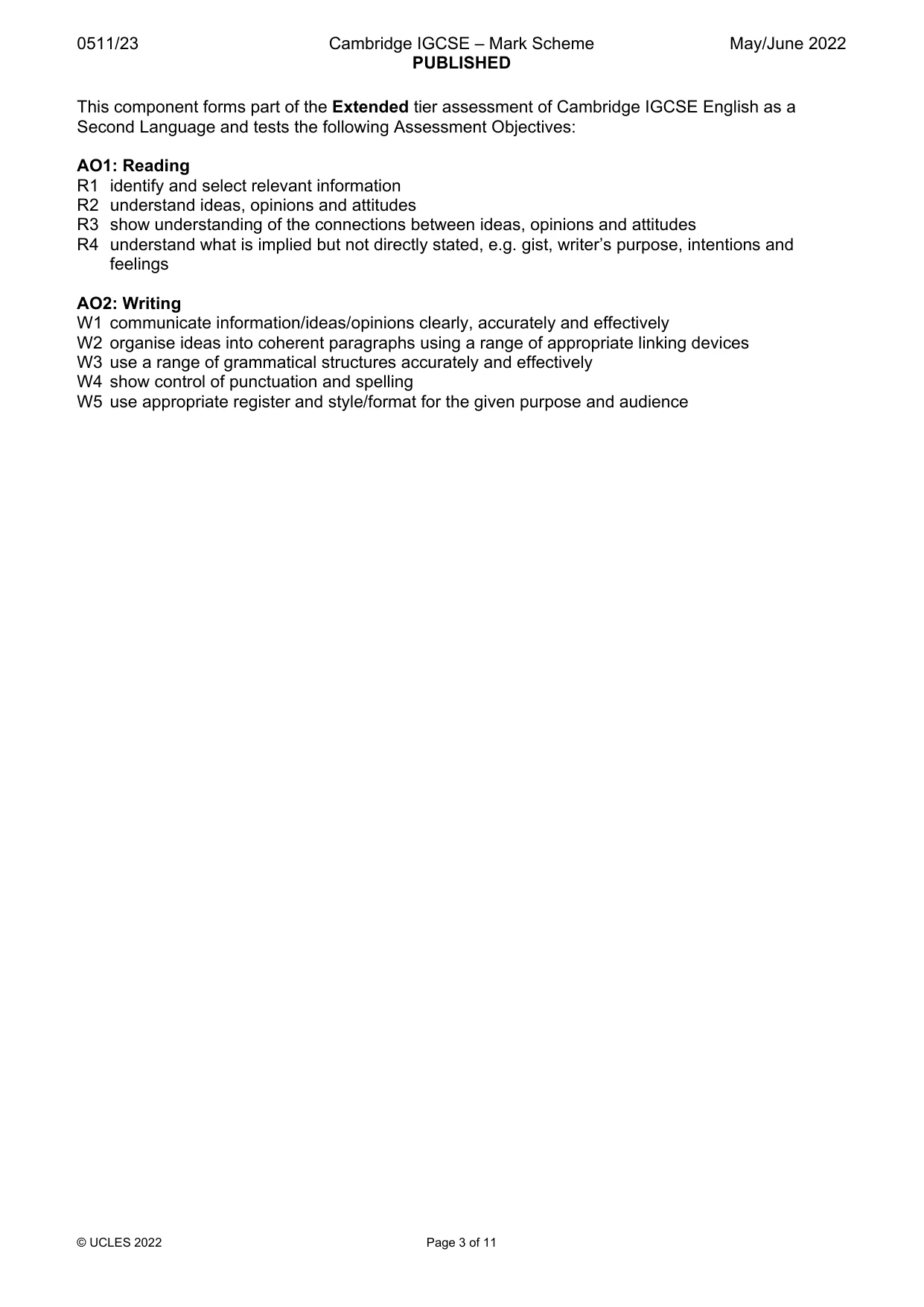
0511/23 Cambridge IGCSE – Mark Scheme PUBLISHED May/June 2022 © UCLES 2022 Page 3 of 11 This component forms part of the Extended tier assessment of Cambridge IGCSE English as a Second Language and tests the following Assessment Objectives: AO1: Reading R1 identify and select relevant information R2 understand ideas, opinions and attitudes R3 show understanding of the connections between ideas, opinions and attitudes R4 understand what is implied but not directly stated, e.g. gist, writer’s purpose, intentions and feelings AO2: Writing W1 communicate information/ideas/opinions clearly, accurately and effectively W2 organise ideas into coherent paragraphs using a range of appropriate linking devices W3 use a range of grammatical structures accurately and effectively W4 show control of punctuation and spelling W5 use appropriate register and style/format for the given purpose and audience
Mark scheme, page 4
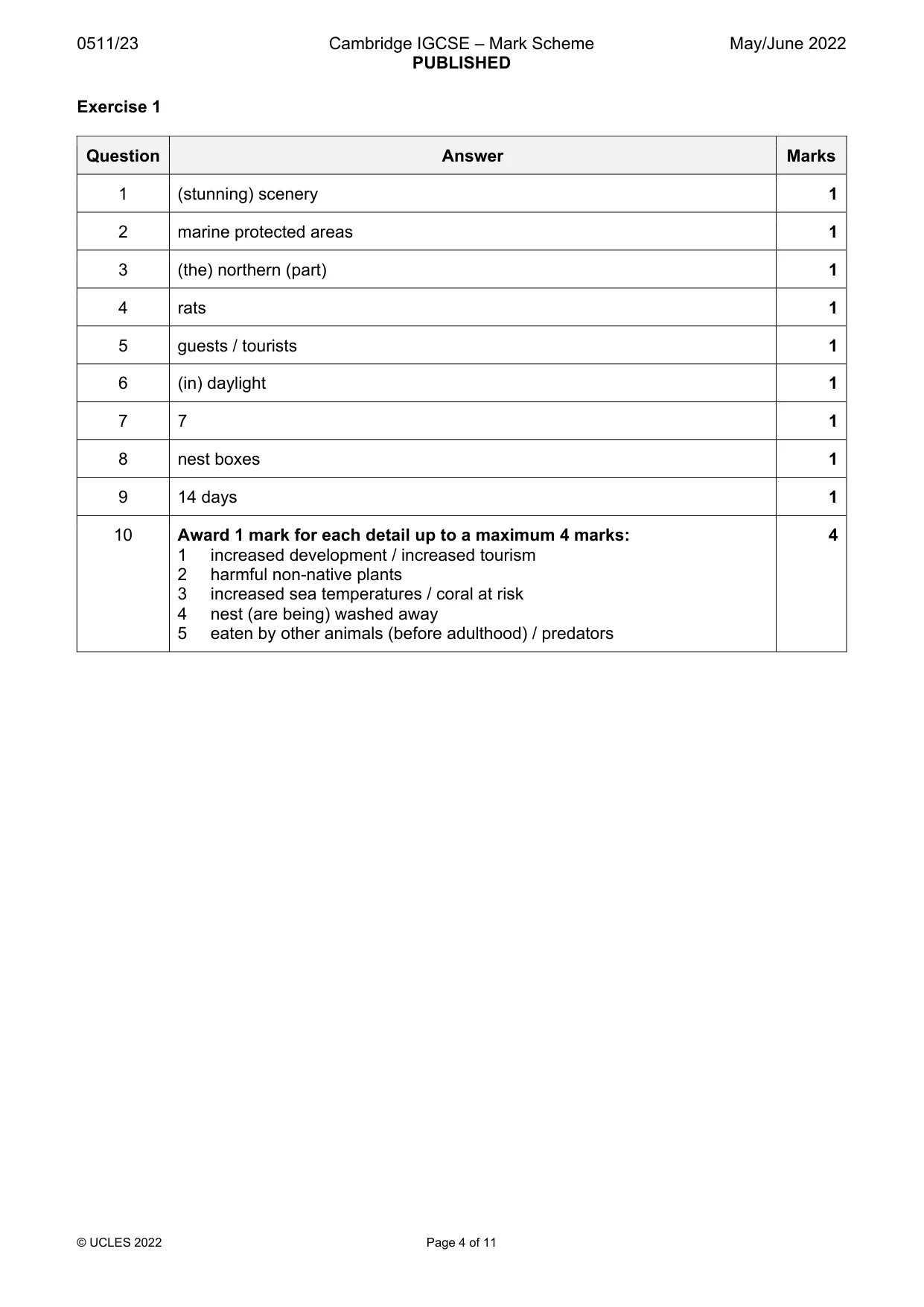
0511/23 Cambridge IGCSE – Mark Scheme PUBLISHED May/June 2022 © UCLES 2022 Page 4 of 11 Exercise 1 Question Answer Marks 1 (stunning) scenery 1 2 marine protected areas 1 3 (the) northern (part) 1 4 rats 1 5 guests / tourists 1 6 (in) daylight 1 7 7 1 8 nest boxes 1 9 14 days 1 10 Award 1 mark for each detail up to a maximum 4 marks: 1 increased development / increased tourism 2 harmful non-native plants 3 increased sea temperatures / coral at risk 4 nest (are being) washed away 5 eaten by other animals (before adulthood) / predators 4
Mark scheme, page 5
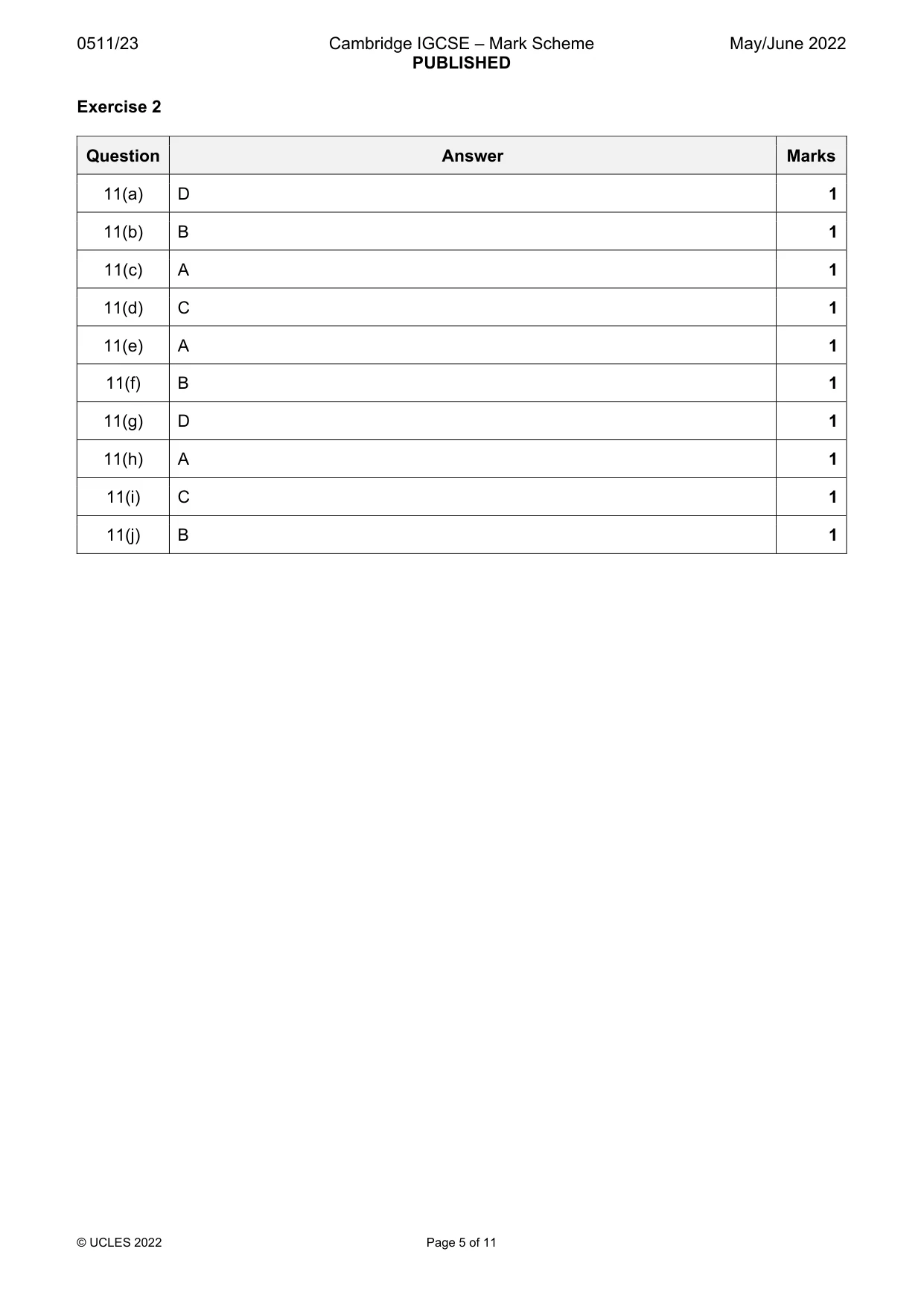
0511/23 Cambridge IGCSE – Mark Scheme PUBLISHED May/June 2022 © UCLES 2022 Page 5 of 11 Exercise 2 Question Answer Marks 11(a) D 1 11(b) B 1 11(c) A 1 11(d) C 1 11(e) A 1 11(f) B 1 11(g) D 1 11(h) A 1 11(i) C 1 11(j) B 1
Mark scheme, page 6
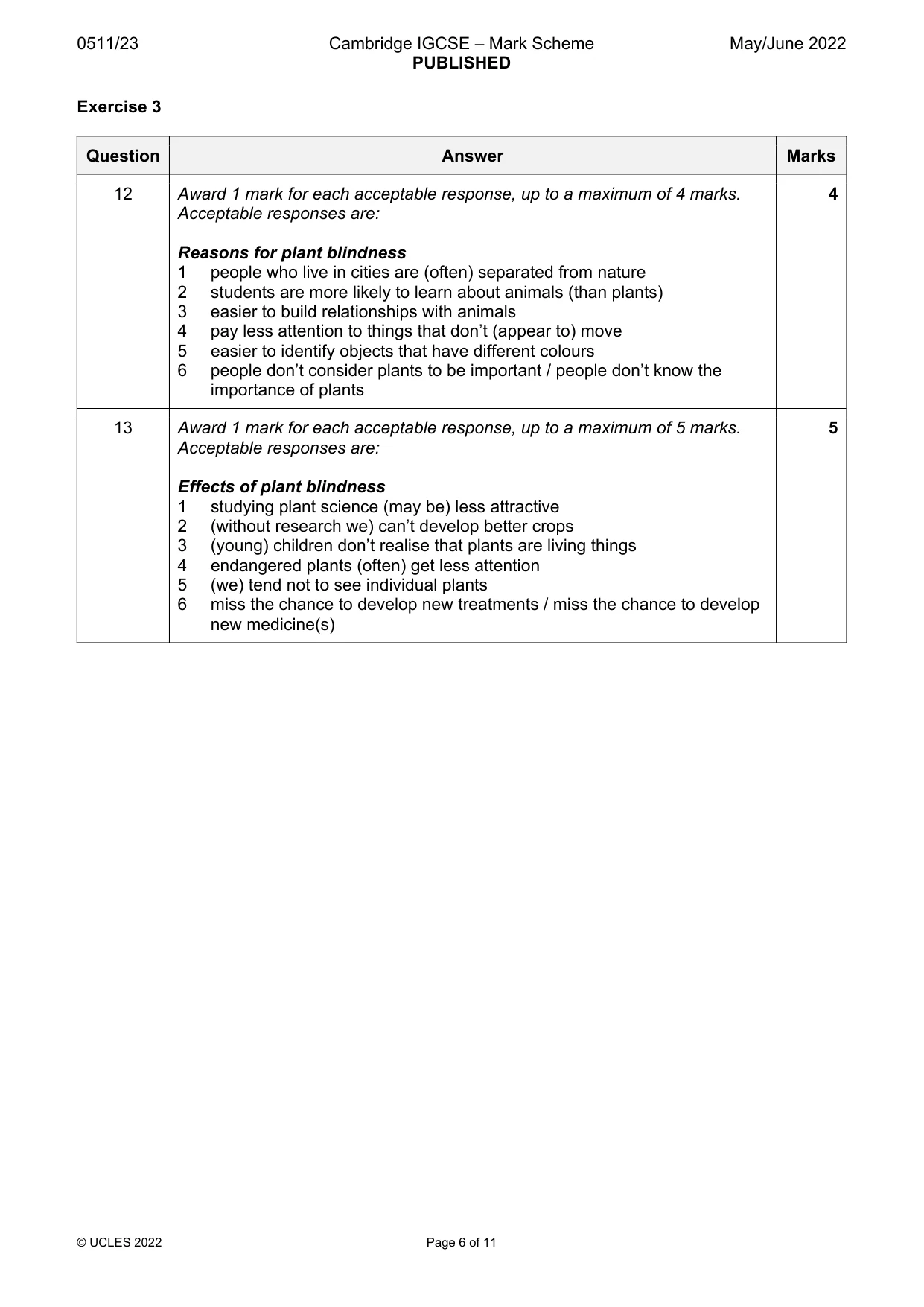
0511/23 Cambridge IGCSE – Mark Scheme PUBLISHED May/June 2022 © UCLES 2022 Page 6 of 11 Exercise 3 Question Answer Marks 12 Award 1 mark for each acceptable response, up to a maximum of 4 marks. Acceptable responses are: Reasons for plant blindness 1 people who live in cities are (often) separated from nature 2 students are more likely to learn about animals (than plants) 3 easier to build relationships with animals 4 pay less attention to things that don’t (appear to) move 5 easier to identify objects that have different colours 6 people don’t consider plants to be important / people don’t know the importance of plants 4 13 Award 1 mark for each acceptable response, up to a maximum of 5 marks. Acceptable responses are: Effects of plant blindness 1 studying plant science (may be) less attractive 2 (without research we) can’t develop better crops 3 (young) children don’t realise that plants are living things 4 endangered plants (often) get less attention 5 (we) tend not to see individual plants 6 miss the chance to develop new treatments / miss the chance to develop new medicine(s) 5
Mark scheme, page 7
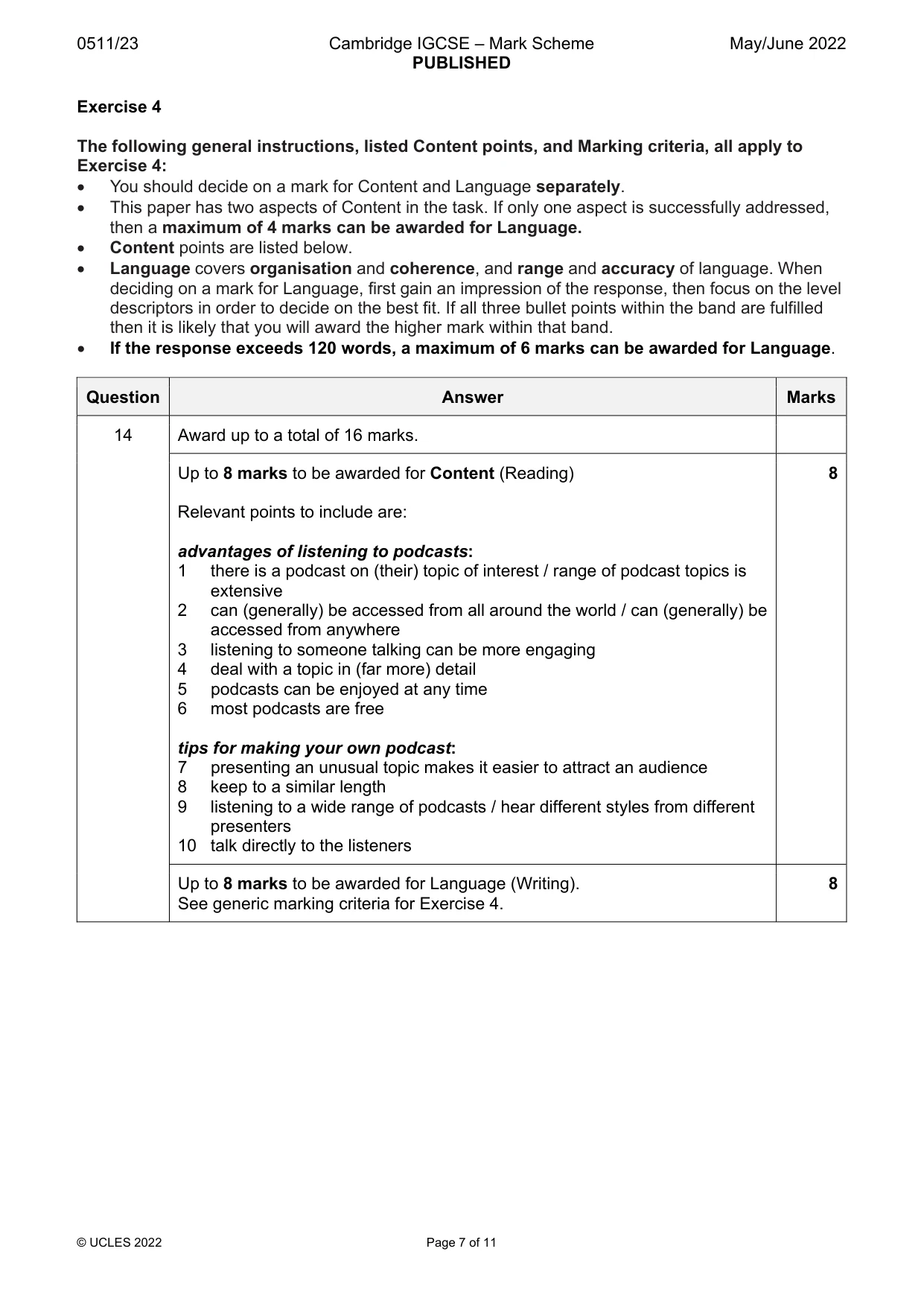
0511/23 Cambridge IGCSE – Mark Scheme PUBLISHED May/June 2022 © UCLES 2022 Page 7 of 11 Exercise 4 The following general instructions, listed Content points, and Marking criteria, all apply to Exercise 4: You should decide on a mark for Content and Language separately. This paper has two aspects of Content in the task. If only one aspect is successfully addressed, then a maximum of 4 marks can be awarded for Language. Content points are listed below. Language covers organisation and coherence, and range and accuracy of language. When deciding on a mark for Language, first gain an impression of the response, then focus on the level descriptors in order to decide on the best fit. If all three bullet points within the band are fulfilled then it is likely that you will award the higher mark within that band. If the response exceeds 120 words, a maximum of 6 marks can be awarded for Language. Question Answer Marks 14 Award up to a total of 16 marks. Up to 8 marks to be awarded for Content (Reading) Relevant points to include are: advantages of listening to podcasts: 1 there is a podcast on (their) topic of interest / range of podcast topics is extensive 2 can (generally) be accessed from all around the world / can (generally) be accessed from anywhere 3 listening to someone talking can be more engaging 4 deal with a topic in (far more) detail 5 podcasts can be enjoyed at any time 6 most podcasts are free tips for making your own podcast: 7 presenting an unusual topic makes it easier to attract an audience 8 keep to a similar length 9 listening to a wide range of podcasts / hear different styles from different presenters 10 talk directly to the listeners 8 Up to 8 marks to be awarded for Language (Writing). See generic marking criteria for Exercise 4. 8
Mark scheme, page 8
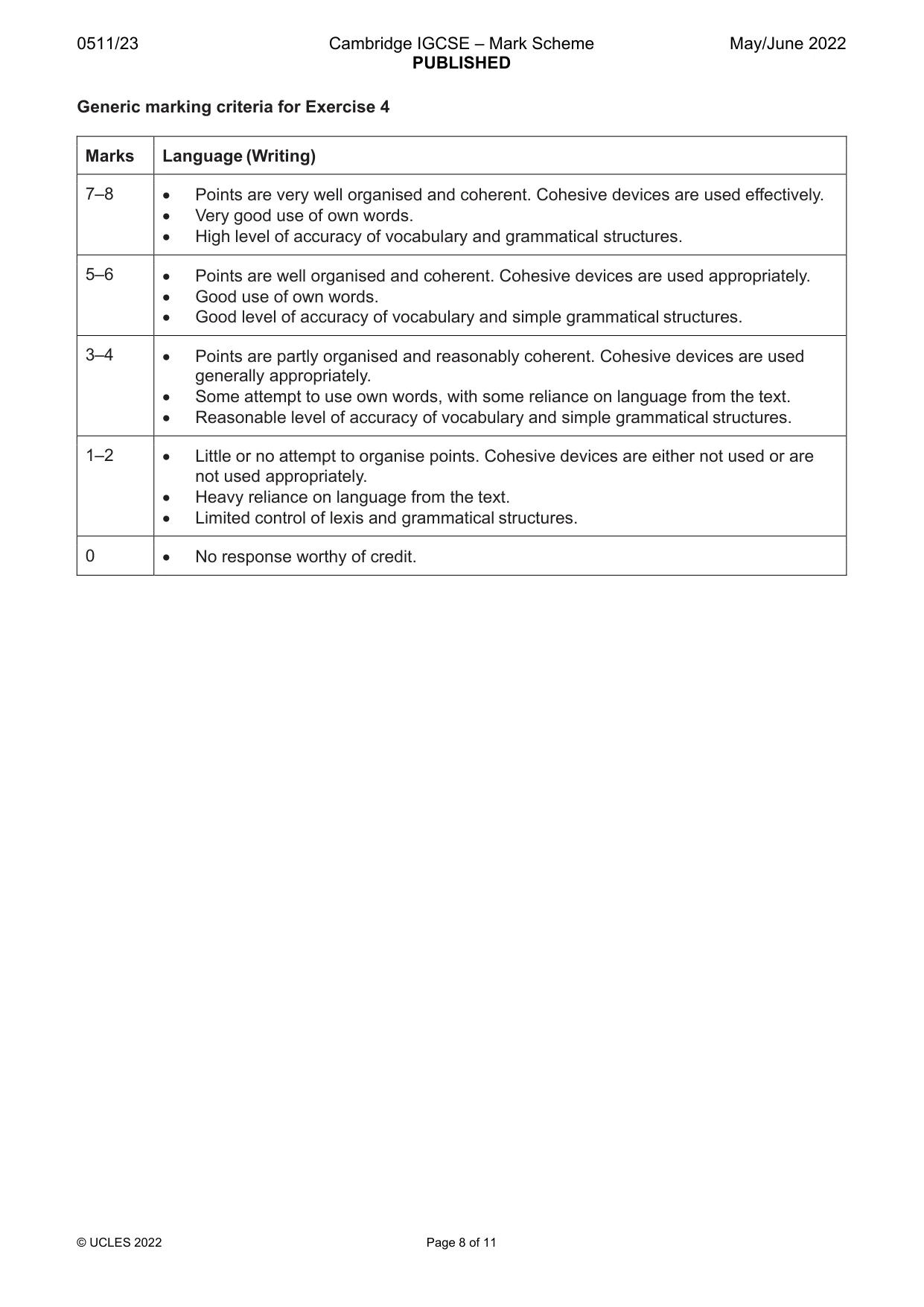
0511/23 Cambridge IGCSE – Mark Scheme PUBLISHED May/June 2022 © UCLES 2022 Page 8 of 11 Generic marking criteria for Exercise 4 Marks Language (Writing) 7–8 Points are very well organised and coherent. Cohesive devices are used effectively. Very good use of own words. High level of accuracy of vocabulary and grammatical structures. 5–6 Points are well organised and coherent. Cohesive devices are used appropriately. Good use of own words. Good level of accuracy of vocabulary and simple grammatical structures. 3–4 Points are partly organised and reasonably coherent. Cohesive devices are used generally appropriately. Some attempt to use own words, with some reliance on language from the text. Reasonable level of accuracy of vocabulary and simple grammatical structures. 1–2 Little or no attempt to organise points. Cohesive devices are either not used or are not used appropriately. Heavy reliance on language from the text. Limited control of lexis and grammatical structures. 0 No response worthy of credit.
Mark scheme, page 9
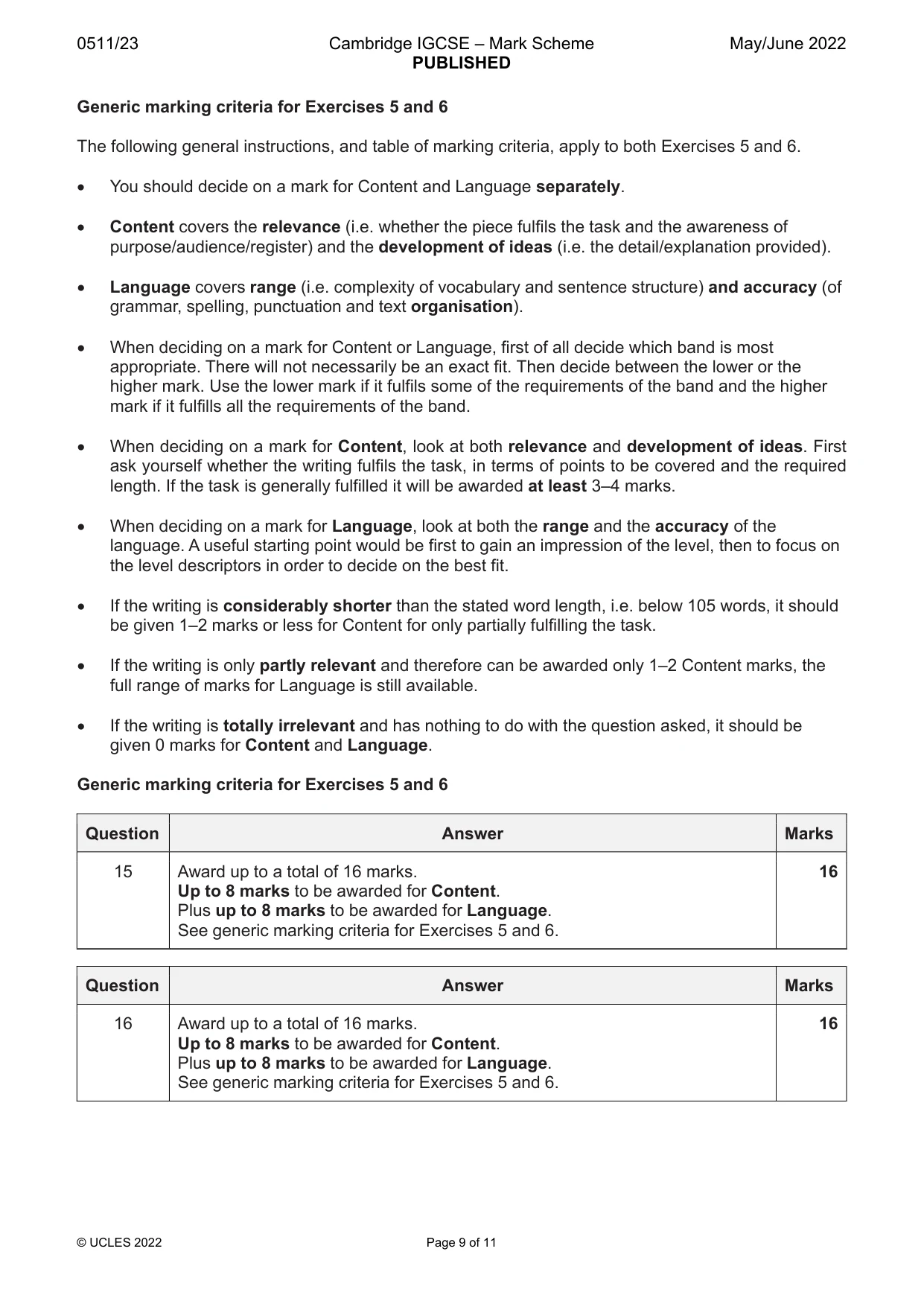
0511/23 Cambridge IGCSE – Mark Scheme PUBLISHED May/June 2022 © UCLES 2022 Page 9 of 11 Generic marking criteria for Exercises 5 and 6 The following general instructions, and table of marking criteria, apply to both Exercises 5 and 6. You should decide on a mark for Content and Language separately. Content covers the relevance (i.e. whether the piece fulfils the task and the awareness of purpose/audience/register) and the development of ideas (i.e. the detail/explanation provided). Language covers range (i.e. complexity of vocabulary and sentence structure) and accuracy (of grammar, spelling, punctuation and text organisation). When deciding on a mark for Content or Language, first of all decide which band is most appropriate. There will not necessarily be an exact fit. Then decide between the lower or the higher mark. Use the lower mark if it fulfils some of the requirements of the band and the higher mark if it fulfills all the requirements of the band. When deciding on a mark for Content, look at both relevance and development of ideas. First ask yourself whether the writing fulfils the task, in terms of points to be covered and the required length. If the task is generally fulfilled it will be awarded at least 3–4 marks. When deciding on a mark for Language, look at both the range and the accuracy of the language. A useful starting point would be first to gain an impression of the level, then to focus on the level descriptors in order to decide on the best fit. If the writing is considerably shorter than the stated word length, i.e. below 105 words, it should be given 1–2 marks or less for Content for only partially fulfilling the task. If the writing is only partly relevant and therefore can be awarded only 1–2 Content marks, the full range of marks for Language is still available. If the writing is totally irrelevant and has nothing to do with the question asked, it should be given 0 marks for Content and Language. Generic marking criteria for Exercises 5 and 6 Question Answer Marks 15 Award up to a total of 16 marks. Up to 8 marks to be awarded for Content. Plus up to 8 marks to be awarded for Language. See generic marking criteria for Exercises 5 and 6. 16 Question Answer Marks 16 Award up to a total of 16 marks. Up to 8 marks to be awarded for Content. Plus up to 8 marks to be awarded for Language. See generic marking criteria for Exercises 5 and 6. 16
Mark scheme, page 10
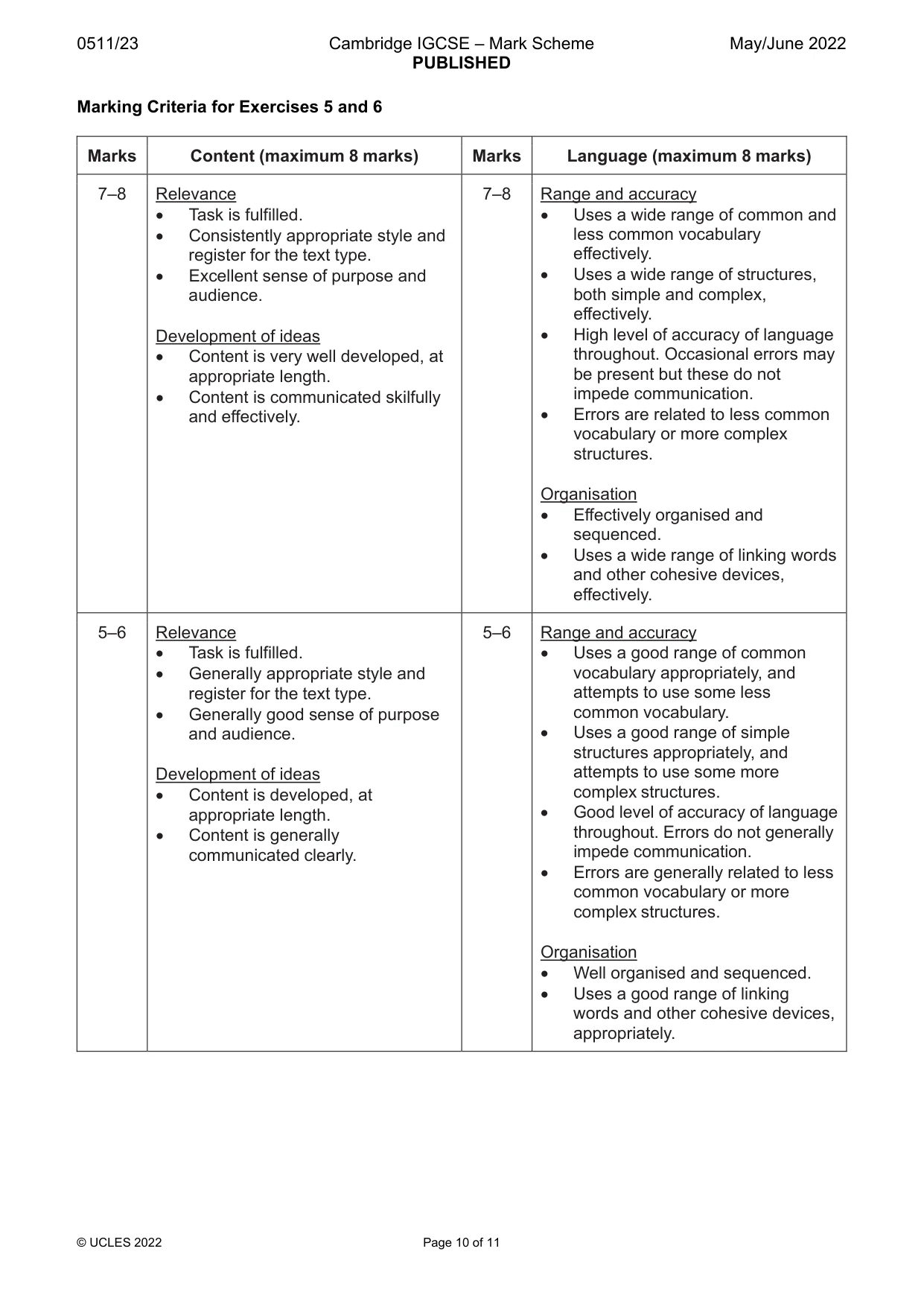
0511/23 Cambridge IGCSE – Mark Scheme PUBLISHED May/June 2022 © UCLES 2022 Page 10 of 11 Marking Criteria for Exercises 5 and 6 Marks Content (maximum 8 marks) Marks Language (maximum 8 marks) 7–8 Relevance Task is fulfilled. Consistently appropriate style and register for the text type. Excellent sense of purpose and audience. Development of ideas Content is very well developed, at appropriate length. Content is communicated skilfully and effectively. 7–8 Range and accuracy Uses a wide range of common and less common vocabulary effectively. Uses a wide range of structures, both simple and complex, effectively. High level of accuracy of language throughout. Occasional errors may be present but these do not impede communication. Errors are related to less common vocabulary or more complex structures. Organisation Effectively organised and sequenced. Uses a wide range of linking words and other cohesive devices, effectively. 5–6 Relevance Task is fulfilled. Generally appropriate style and register for the text type. Generally good sense of purpose and audience. Development of ideas Content is developed, at appropriate length. Content is generally communicated clearly. 5–6 Range and accuracy Uses a good range of common vocabulary appropriately, and attempts to use some less common vocabulary. Uses a good range of simple structures appropriately, and attempts to use some more complex structures. Good level of accuracy of language throughout. Errors do not generally impede communication. Errors are generally related to less common vocabulary or more complex structures. Organisation Well organised and sequenced. Uses a good range of linking words and other cohesive devices, appropriately.
Mark scheme, page 11
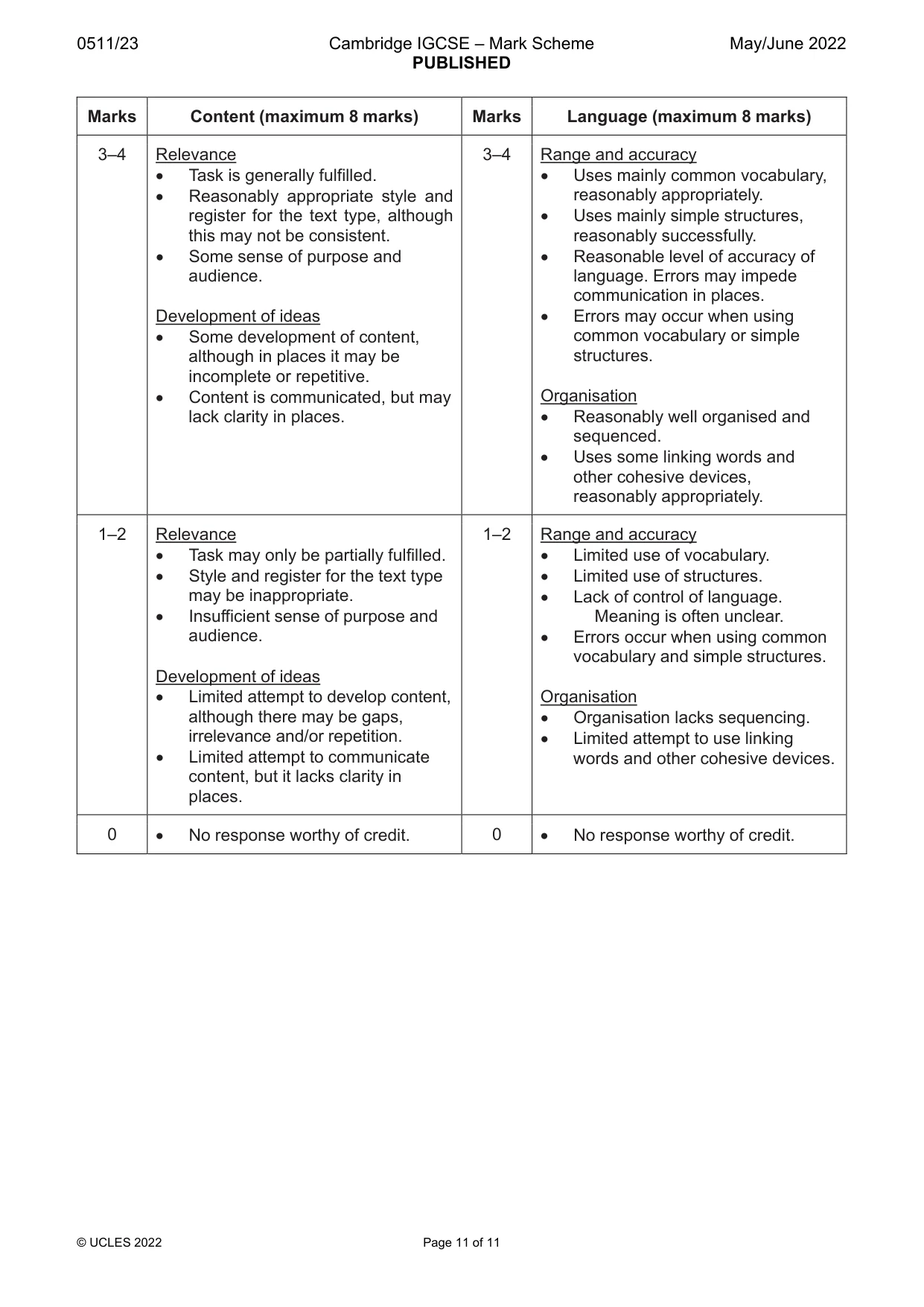
0511/23 Cambridge IGCSE – Mark Scheme PUBLISHED May/June 2022 © UCLES 2022 Page 11 of 11 Marks Content (maximum 8 marks) Marks Language (maximum 8 marks) 3–4 Relevance Task is generally fulfilled. Reasonably appropriate style and register for the text type, although this may not be consistent. Some sense of purpose and audience. Development of ideas Some development of content, although in places it may be incomplete or repetitive. Content is communicated, but may lack clarity in places. 3–4 Range and accuracy Uses mainly common vocabulary, reasonably appropriately. Uses mainly simple structures, reasonably successfully. Reasonable level of accuracy of language. Errors may impede communication in places. Errors may occur when using common vocabulary or simple structures. Organisation Reasonably well organised and sequenced. Uses some linking words and other cohesive devices, reasonably appropriately. 1–2 Relevance Task may only be partially fulfilled. Style and register for the text type may be inappropriate. Insufficient sense of purpose and audience. Development of ideas Limited attempt to develop content, although there may be gaps, irrelevance and/or repetition. Limited attempt to communicate content, but it lacks clarity in places. 1–2 Range and accuracy Limited use of vocabulary. Limited use of structures. Lack of control of language. Meaning is often unclear. Errors occur when using common vocabulary and simple structures. Organisation Organisation lacks sequencing. Limited attempt to use linking words and other cohesive devices. 0 No response worthy of credit. 0 No response worthy of credit.
What you needed in this session
Cambridge’s own grade thresholds for 2022 May/June, Paper 2 · Variant 3. A higher threshold means an easier paper — the bar moves with how the cohort did.