Cambridge IGCSE English - Second Language (count-in oral) 0511 — 2021 Oct/Nov Paper 4 · Variant 3
0511/43/O/N/21 · 40 marks · ≈45 min
The question paper and its mark scheme, free to read here and free to download. This is Cambridge’s own paper, exactly as it was sat.
Question paper12 pages




Mark scheme5 pages
Answers below. Sit the paper first if you are practising.
Paper as text
Question paper, page 1
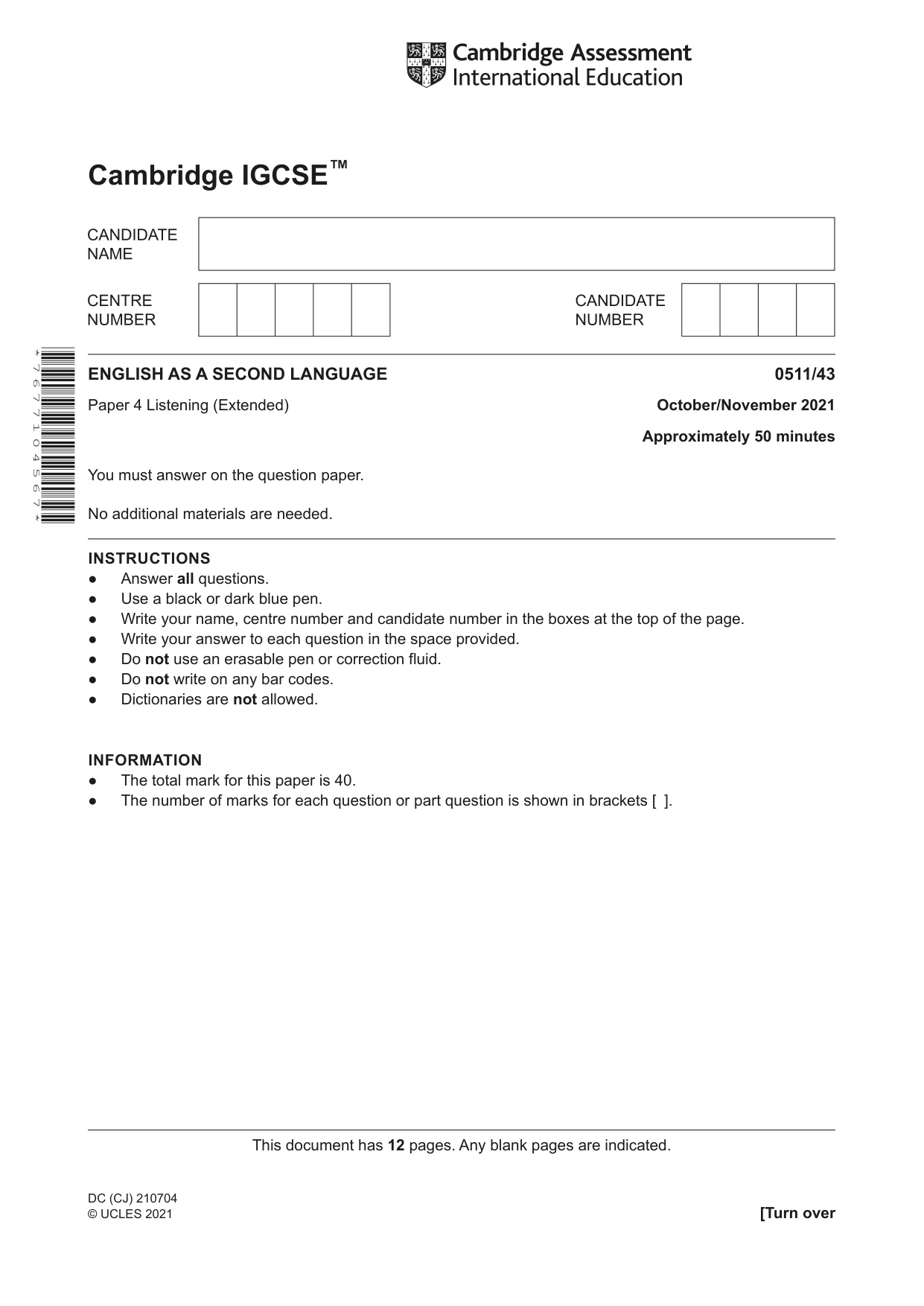
This document has 12 pages. Any blank pages are indicated. Cambridge IGCSE™ * 7 6 7 7 1 0 4 5 6 7 * ENGLISH AS A SECOND LANGUAGE 0511/43 Paper 4 Listening (Extended) October/November 2021 Approximately 50 minutes You must answer on the question paper. No additional materials are needed. INSTRUCTIONS ● Answer all questions. ● Use a black or dark blue pen. ● Write your name, centre number and candidate number in the boxes at the top of the page. ● Write your answer to each question in the space provided. ● Do not use an erasable pen or correction fluid. ● Do not write on any bar codes. ● Dictionaries are not allowed. INFORMATION ● The total mark for this paper is 40. ● The number of marks for each question or part question is shown in brackets [ ]. DC (CJ) 210704 © UCLES 2021 [Turn over
Question paper, page 2
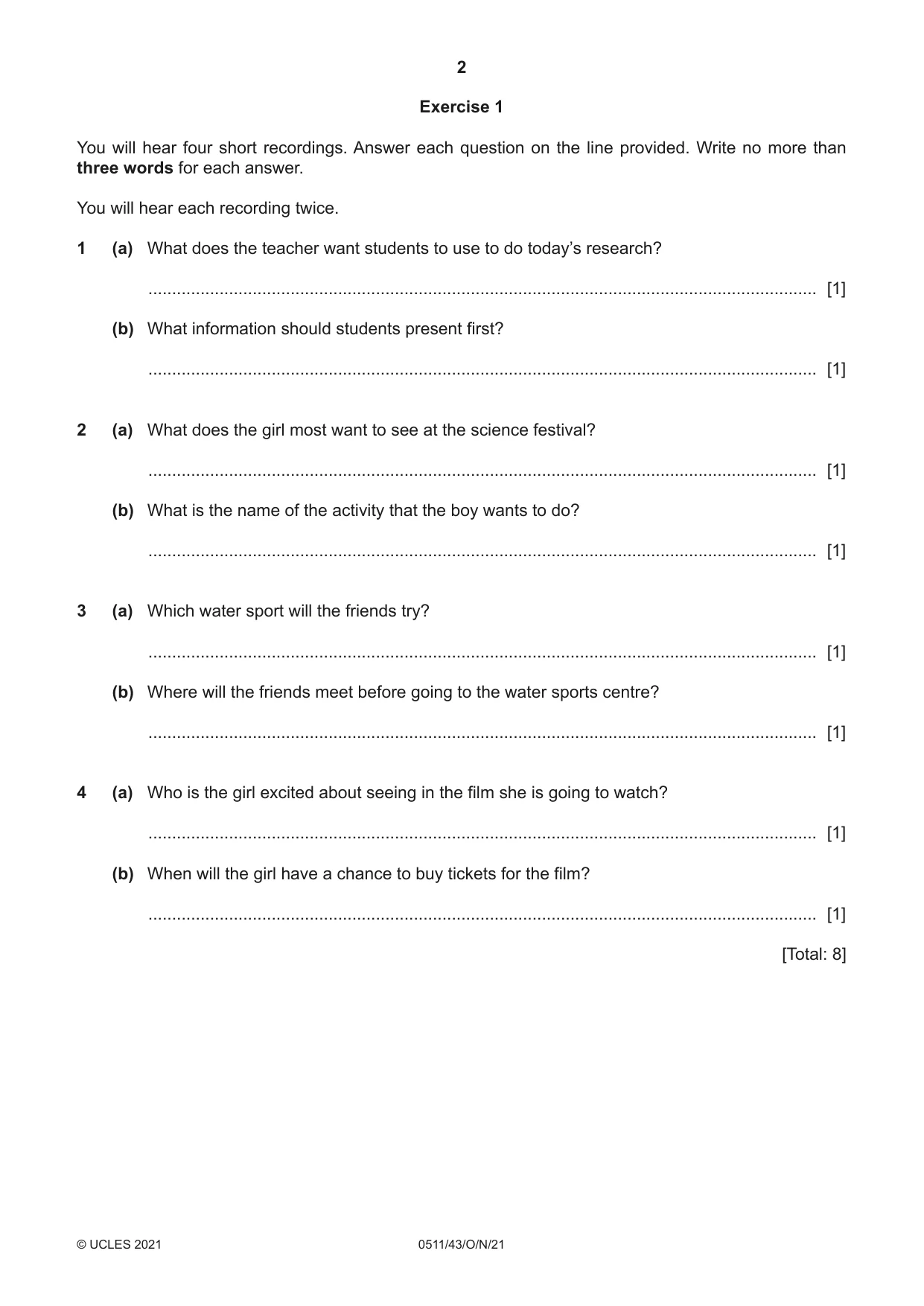
2 0511/43/O/N/21 © UCLES 2021 Exercise 1 You will hear four short recordings. Answer each question on the line provided. Write no more than three words for each answer. You will hear each recording twice. 1 (a) What does the teacher want students to use to do today’s research? … [1] (b) What information should students present first? … [1] 2 (a) What does the girl most want to see at the science festival? … [1] (b) What is the name of the activity that the boy wants to do? … [1] 3 (a) Which water sport will the friends try? … [1] (b) Where will the friends meet before going to the water sports centre? … [1] 4 (a) Who is the girl excited about seeing in the film she is going to watch? … [1] (b) When will the girl have a chance to buy tickets for the film? … [1] [Total: 8]
Question paper, page 3
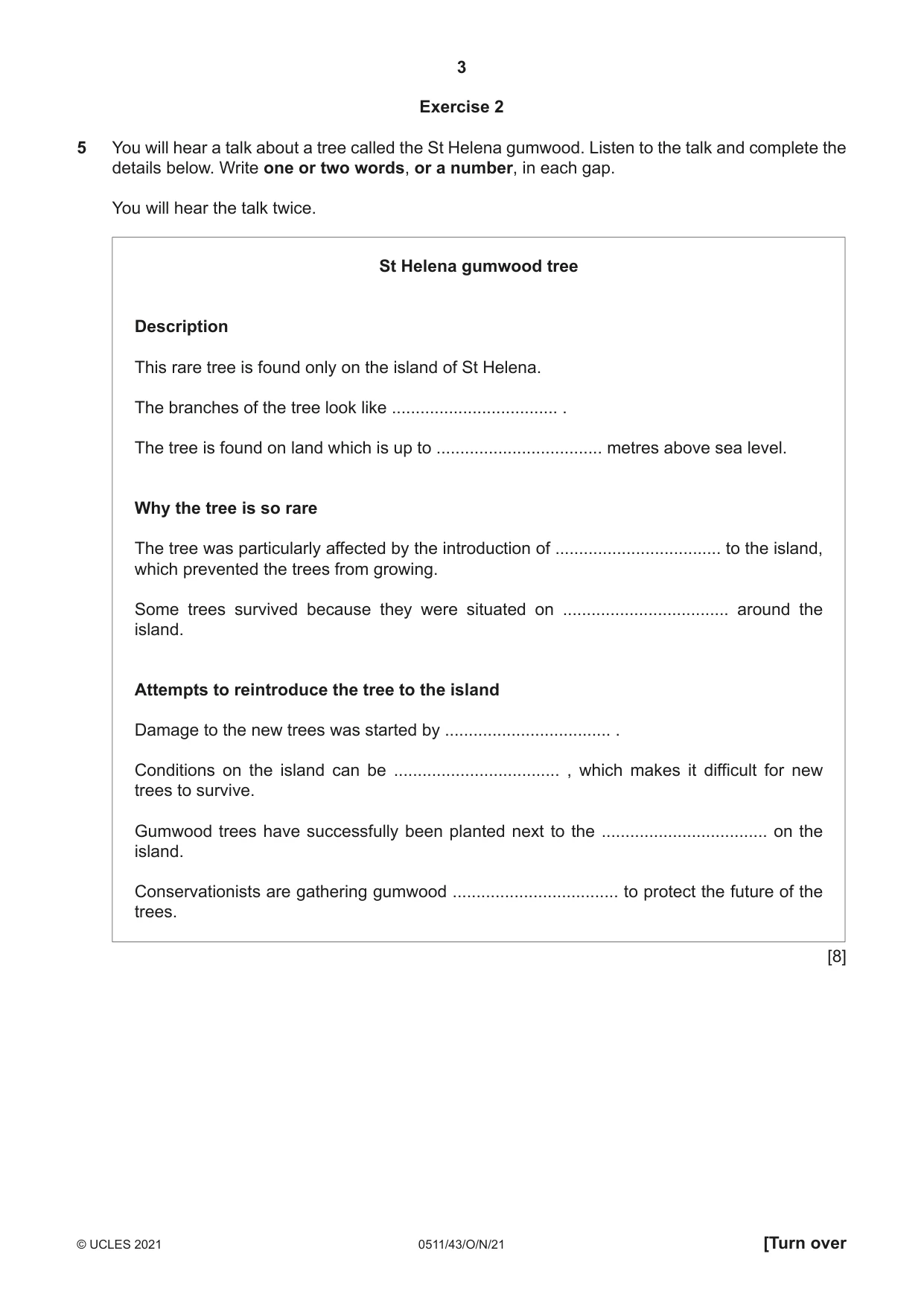
3 0511/43/O/N/21 © UCLES 2021 [Turn over Exercise 2 5 You will hear a talk about a tree called the St Helena gumwood. Listen to the talk and complete the details below. Write one or two words, or a number, in each gap. You will hear the talk twice. St Helena gumwood tree Description This rare tree is found only on the island of St Helena. The branches of the tree look like … . The tree is found on land which is up to … metres above sea level. Why the tree is so rare The tree was particularly affected by the introduction of … to the island, which prevented the trees from growing. Some trees survived because they were situated on … around the island. Attempts to reintroduce the tree to the island Damage to the new trees was started by … . Conditions on the island can be … , which makes it difficult for new trees to survive. Gumwood trees have successfully been planted next to the … on the island. Conservationists are gathering gumwood … to protect the future of the trees. [8]
Question paper, page 4
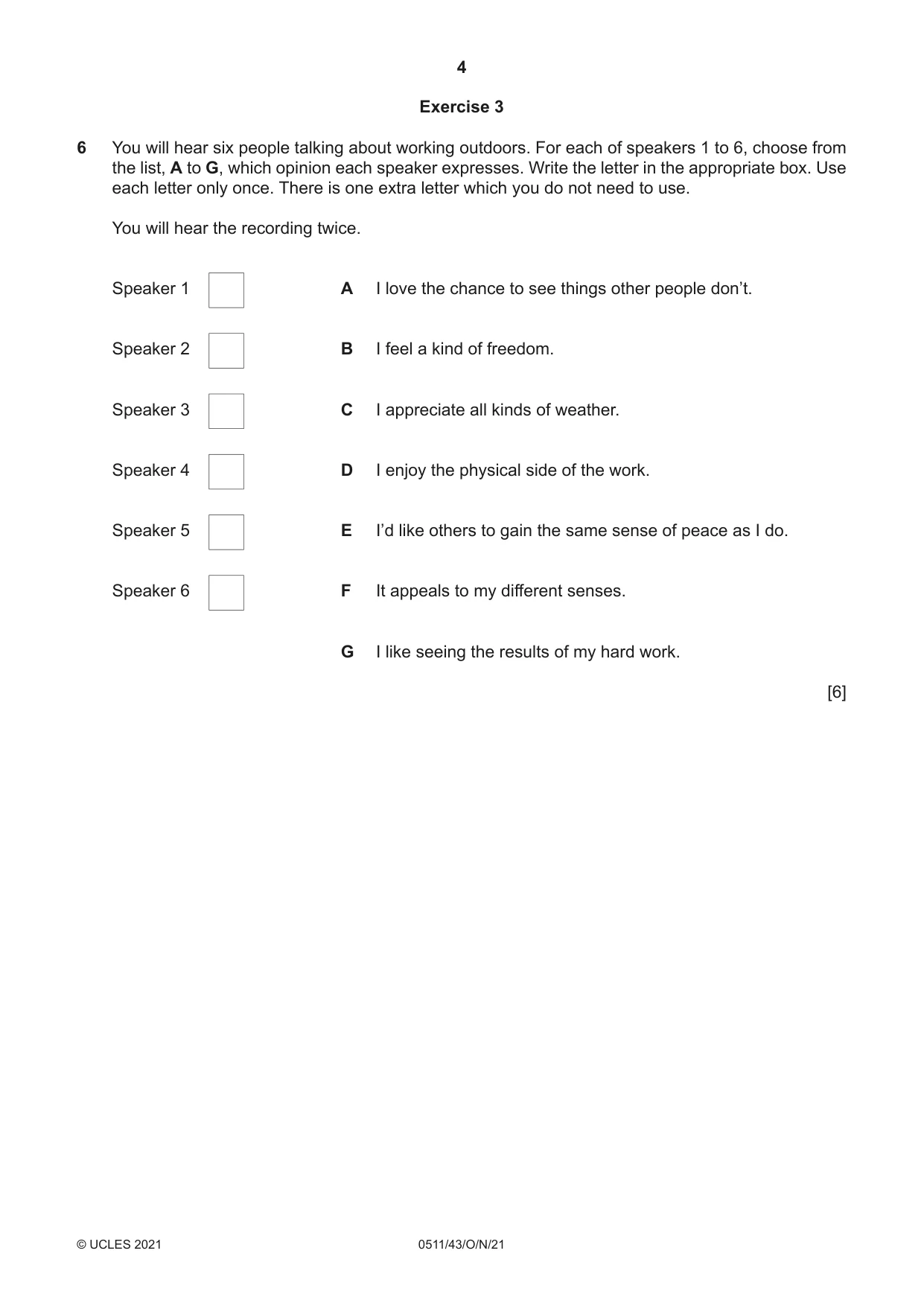
4 0511/43/O/N/21 © UCLES 2021 Exercise 3 6 You will hear six people talking about working outdoors. For each of speakers 1 to 6, choose from the list, A to G, which opinion each speaker expresses. Write the letter in the appropriate box. Use each letter only once. There is one extra letter which you do not need to use. You will hear the recording twice. Speaker 1 A I love the chance to see things other people don’t. Speaker 2 B I feel a kind of freedom. Speaker 3 C I appreciate all kinds of weather. Speaker 4 D I enjoy the physical side of the work. Speaker 5 E I’d like others to gain the same sense of peace as I do. Speaker 6 F It appeals to my different senses. G I like seeing the results of my hard work. [6]
Question paper, page 5
5 0511/43/O/N/21 © UCLES 2021 [Turn over Please turn over for Exercise 4.
Question paper, page 6
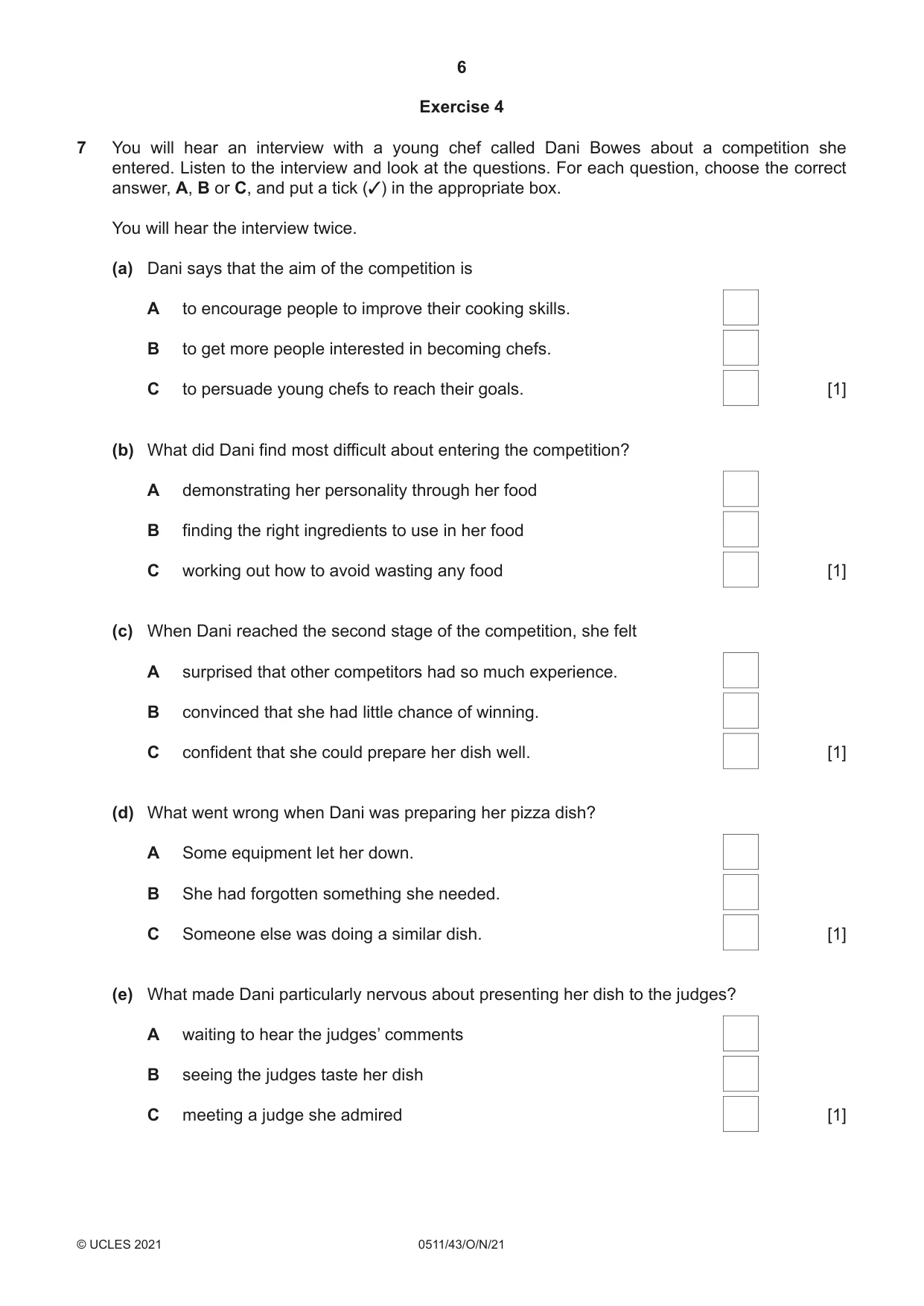
6 0511/43/O/N/21 © UCLES 2021 Exercise 4 7 You will hear an interview with a young chef called Dani Bowes about a competition she entered. Listen to the interview and look at the questions. For each question, choose the correct answer, A, B or C, and put a tick (3) in the appropriate box. You will hear the interview twice. (a) Dani says that the aim of the competition is A to encourage people to improve their cooking skills. B to get more people interested in becoming chefs. C to persuade young chefs to reach their goals. [1] (b) What did Dani find most difficult about entering the competition? A demonstrating her personality through her food B finding the right ingredients to use in her food C working out how to avoid wasting any food [1] (c) When Dani reached the second stage of the competition, she felt A surprised that other competitors had so much experience. B convinced that she had little chance of winning. C confident that she could prepare her dish well. [1] (d) What went wrong when Dani was preparing her pizza dish? A Some equipment let her down. B She had forgotten something she needed. C Someone else was doing a similar dish. [1] (e) What made Dani particularly nervous about presenting her dish to the judges? A waiting to hear the judges’ comments B seeing the judges taste her dish C meeting a judge she admired [1]
Question paper, page 7
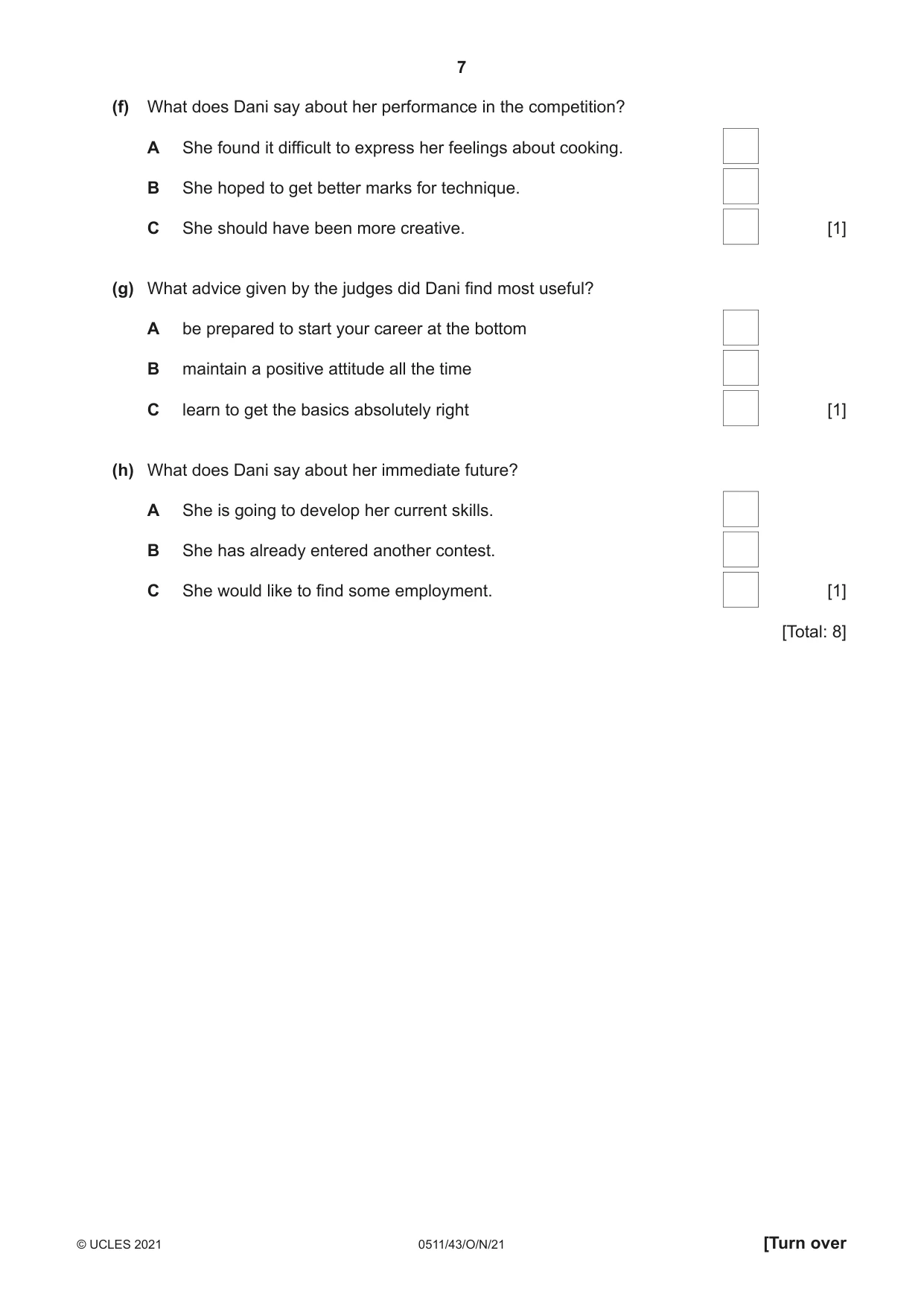
7 0511/43/O/N/21 © UCLES 2021 [Turn over (f) What does Dani say about her performance in the competition? A She found it difficult to express her feelings about cooking. B She hoped to get better marks for technique. C She should have been more creative. [1] (g) What advice given by the judges did Dani find most useful? A be prepared to start your career at the bottom B maintain a positive attitude all the time C learn to get the basics absolutely right [1] (h) What does Dani say about her immediate future? A She is going to develop her current skills. B She has already entered another contest. C She would like to find some employment. [1] [Total: 8]
Question paper, page 8
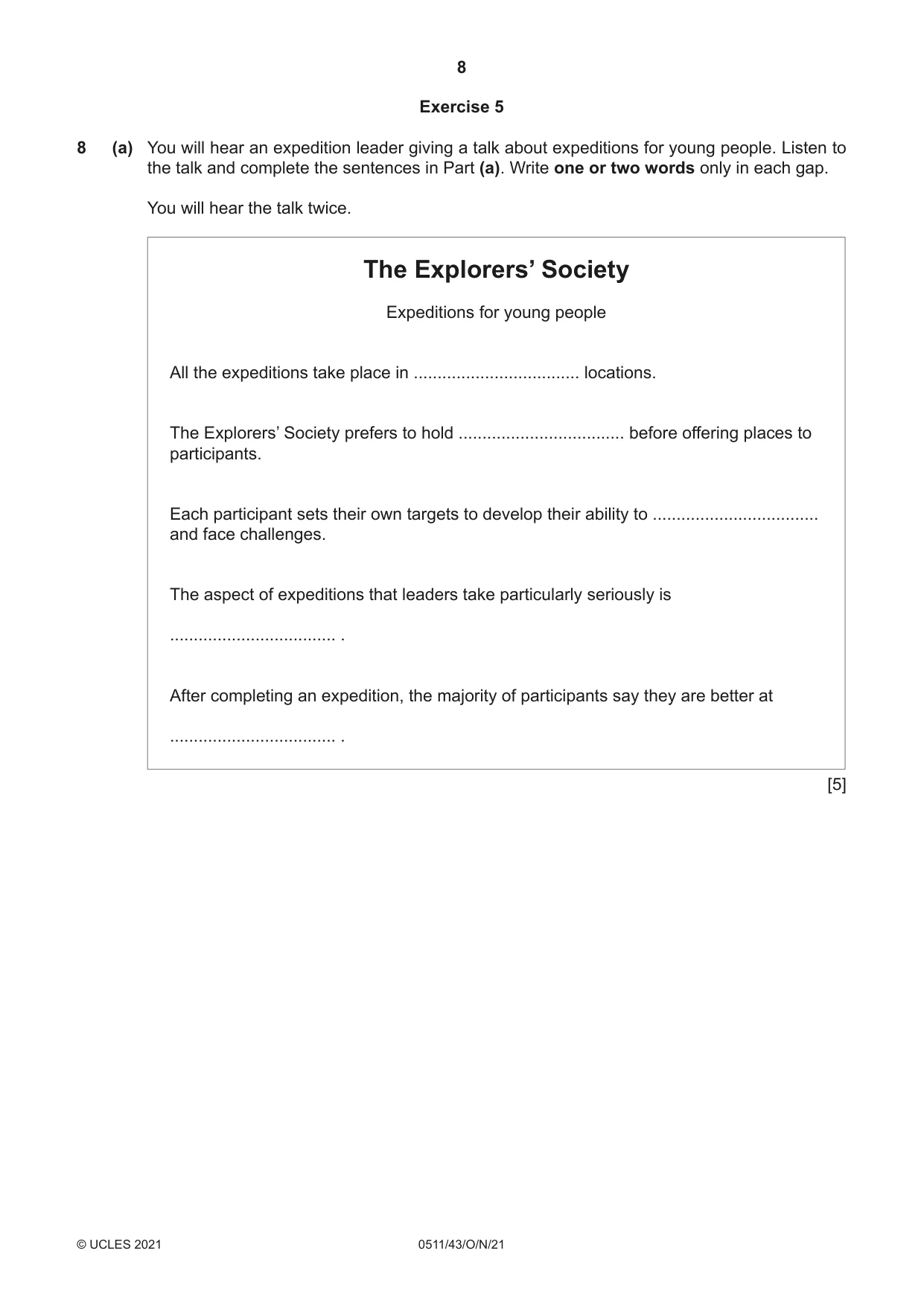
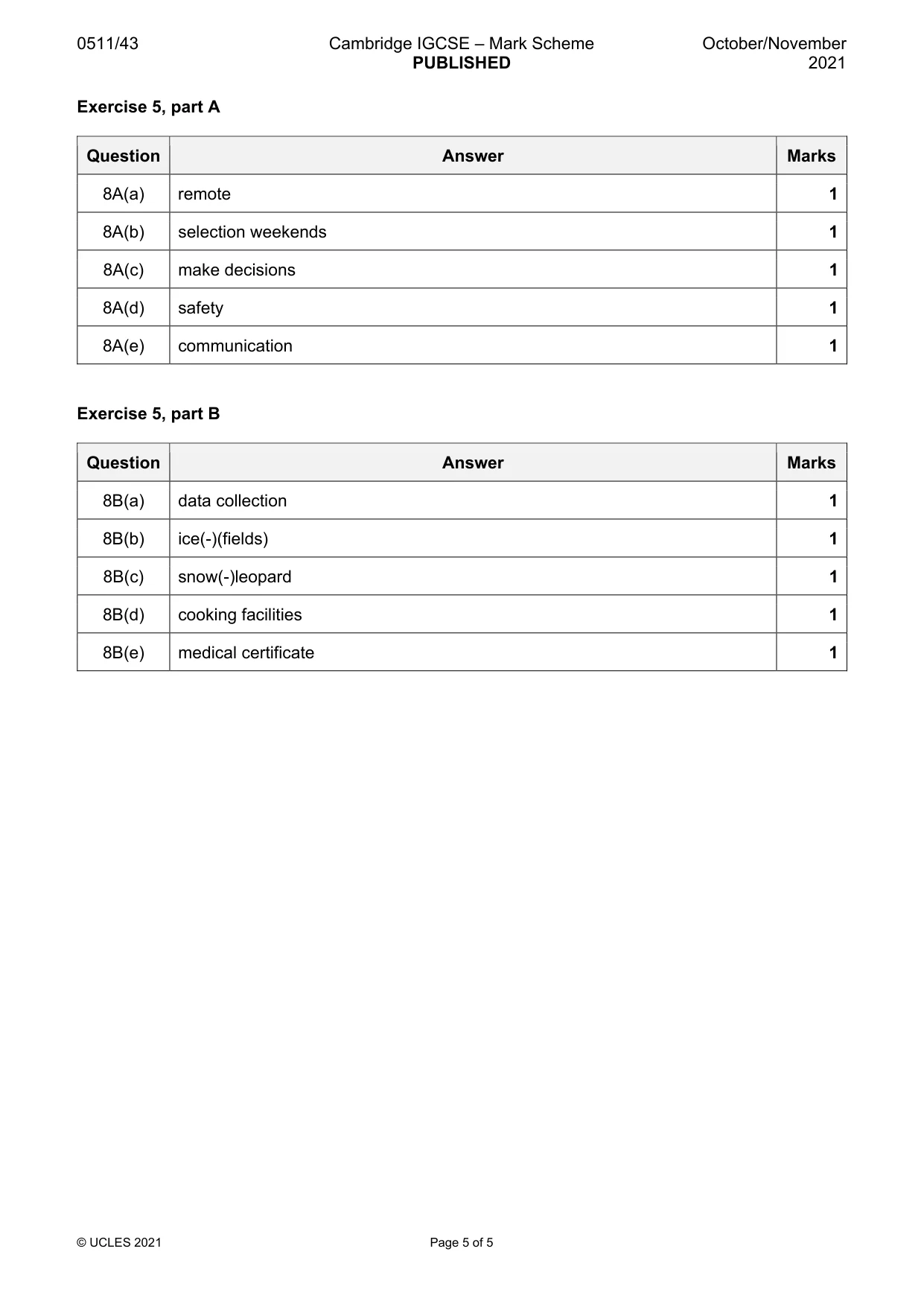
8 0511/43/O/N/21 © UCLES 2021 Exercise 5 8 (a) You will hear an expedition leader giving a talk about expeditions for young people. Listen to the talk and complete the sentences in Part (a). Write one or two words only in each gap. You will hear the talk twice. The Explorers’ Society Expeditions for young people All the expeditions take place in … locations. The Explorers’ Society prefers to hold … before offering places to participants. Each participant sets their own targets to develop their ability to … and face challenges. The aspect of expeditions that leaders take particularly seriously is … . After completing an expedition, the majority of participants say they are better at … . [5]
Question paper, page 9
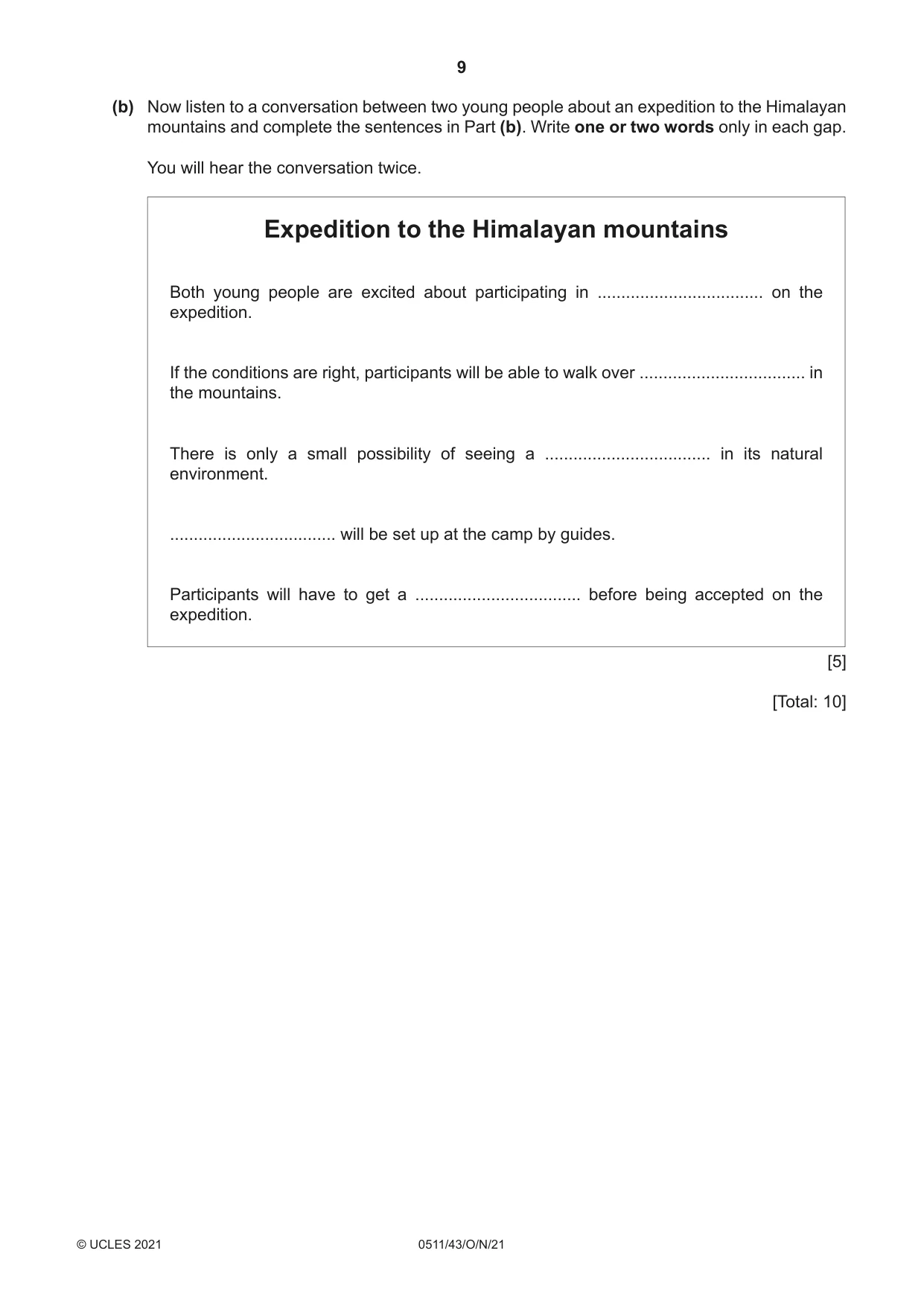
9 0511/43/O/N/21 © UCLES 2021 (b) Now listen to a conversation between two young people about an expedition to the Himalayan mountains and complete the sentences in Part (b). Write one or two words only in each gap. You will hear the conversation twice. Expedition to the Himalayan mountains Both young people are excited about participating in … on the expedition. If the conditions are right, participants will be able to walk over … in the mountains. There is only a small possibility of seeing a … in its natural environment. … will be set up at the camp by guides. Participants will have to get a … before being accepted on the expedition. [5] [Total: 10]
Question paper, page 10
10 0511/43/O/N/21 © UCLES 2021 BLANK PAGE
Question paper, page 11
11 0511/43/O/N/21 © UCLES 2021 BLANK PAGE
Question paper, page 12
12 0511/43/O/N/21 © UCLES 2021 Permission to reproduce items where third-party owned material protected by copyright is included has been sought and cleared where possible. Every reasonable effort has been made by the publisher (UCLES) to trace copyright holders, but if any items requiring clearance have unwittingly been included, the publisher will be pleased to make amends at the earliest possible opportunity. To avoid the issue of disclosure of answer-related information to candidates, all copyright acknowledgements are reproduced online in the Cambridge Assessment International Education Copyright Acknowledgements Booklet. This is produced for each series of examinations and is freely available to download at www.cambridgeinternational.org after the live examination series. Cambridge Assessment International Education is part of the Cambridge Assessment Group. Cambridge Assessment is the brand name of the University of Cambridge Local Examinations Syndicate (UCLES), which itself is a department of the University of Cambridge. BLANK PAGE
Mark scheme, page 1
This document consists of 5 printed pages. © UCLES 2021 [Turn over Cambridge IGCSE™ ENGLISH AS A SECOND LANGUAGE 0511/43 Paper 4 Listening (Extended) October/November 2021 MARK SCHEME Maximum Mark: 40 Published This mark scheme is published as an aid to teachers and candidates, to indicate the requirements of the examination. It shows the basis on which Examiners were instructed to award marks. It does not indicate the details of the discussions that took place at an Examiners’ meeting before marking began, which would have considered the acceptability of alternative answers. Mark schemes should be read in conjunction with the question paper and the Principal Examiner Report for Teachers. Cambridge International will not enter into discussions about these mark schemes. Cambridge International is publishing the mark schemes for the October/November 2021 series for most Cambridge IGCSE™, Cambridge International A and AS Level components and some Cambridge O Level components.
Mark scheme, page 2
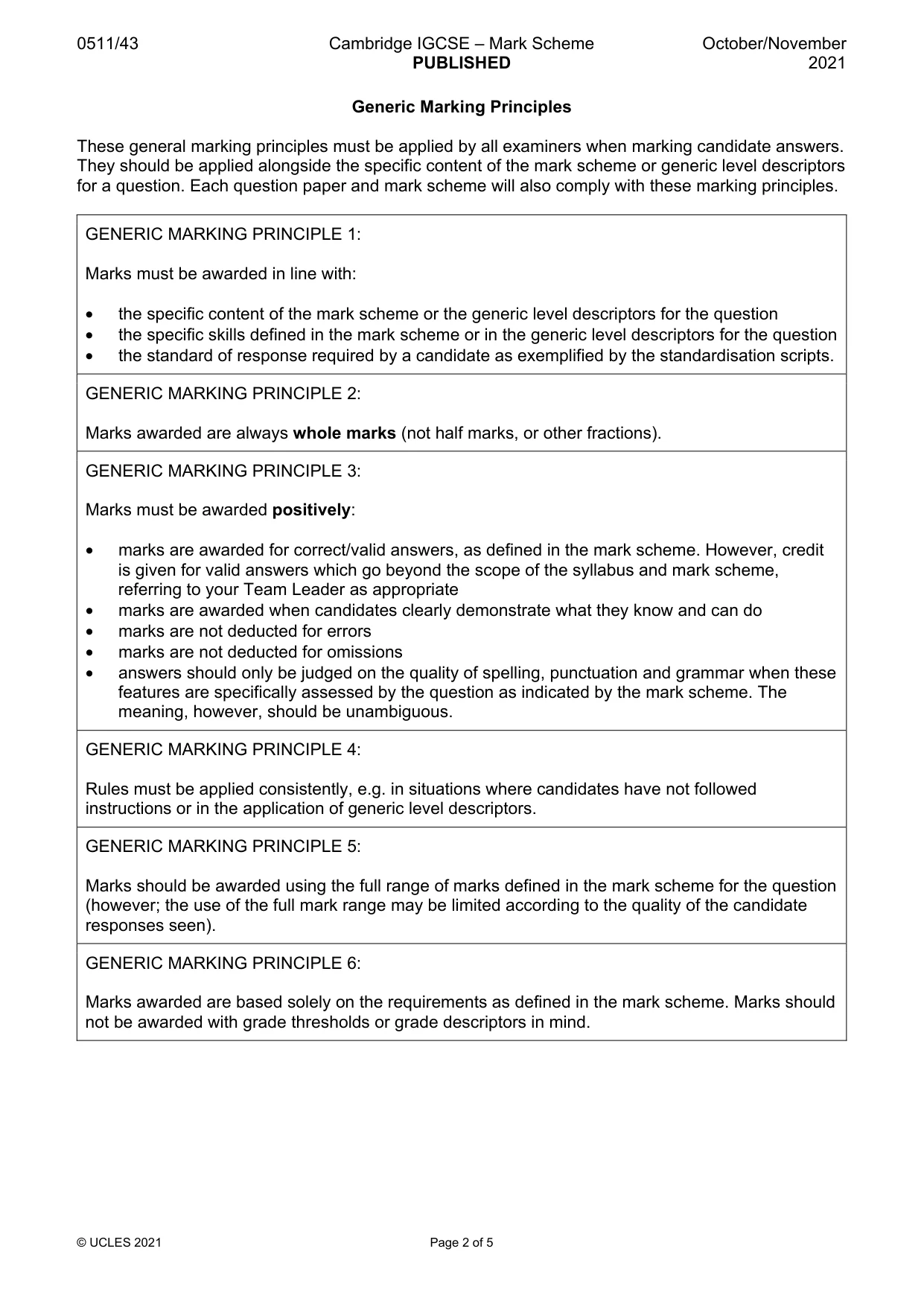
0511/43 Cambridge IGCSE – Mark Scheme PUBLISHED October/November 2021 © UCLES 2021 Page 2 of 5 Generic Marking Principles These general marking principles must be applied by all examiners when marking candidate answers. They should be applied alongside the specific content of the mark scheme or generic level descriptors for a question. Each question paper and mark scheme will also comply with these marking principles. GENERIC MARKING PRINCIPLE 1: Marks must be awarded in line with: • the specific content of the mark scheme or the generic level descriptors for the question • the specific skills defined in the mark scheme or in the generic level descriptors for the question • the standard of response required by a candidate as exemplified by the standardisation scripts. GENERIC MARKING PRINCIPLE 2: Marks awarded are always whole marks (not half marks, or other fractions). GENERIC MARKING PRINCIPLE 3: Marks must be awarded positively: • marks are awarded for correct/valid answers, as defined in the mark scheme. However, credit is given for valid answers which go beyond the scope of the syllabus and mark scheme, referring to your Team Leader as appropriate • marks are awarded when candidates clearly demonstrate what they know and can do • marks are not deducted for errors • marks are not deducted for omissions • answers should only be judged on the quality of spelling, punctuation and grammar when these features are specifically assessed by the question as indicated by the mark scheme. The meaning, however, should be unambiguous. GENERIC MARKING PRINCIPLE 4: Rules must be applied consistently, e.g. in situations where candidates have not followed instructions or in the application of generic level descriptors. GENERIC MARKING PRINCIPLE 5: Marks should be awarded using the full range of marks defined in the mark scheme for the question (however; the use of the full mark range may be limited according to the quality of the candidate responses seen). GENERIC MARKING PRINCIPLE 6: Marks awarded are based solely on the requirements as defined in the mark scheme. Marks should not be awarded with grade thresholds or grade descriptors in mind.
Mark scheme, page 3
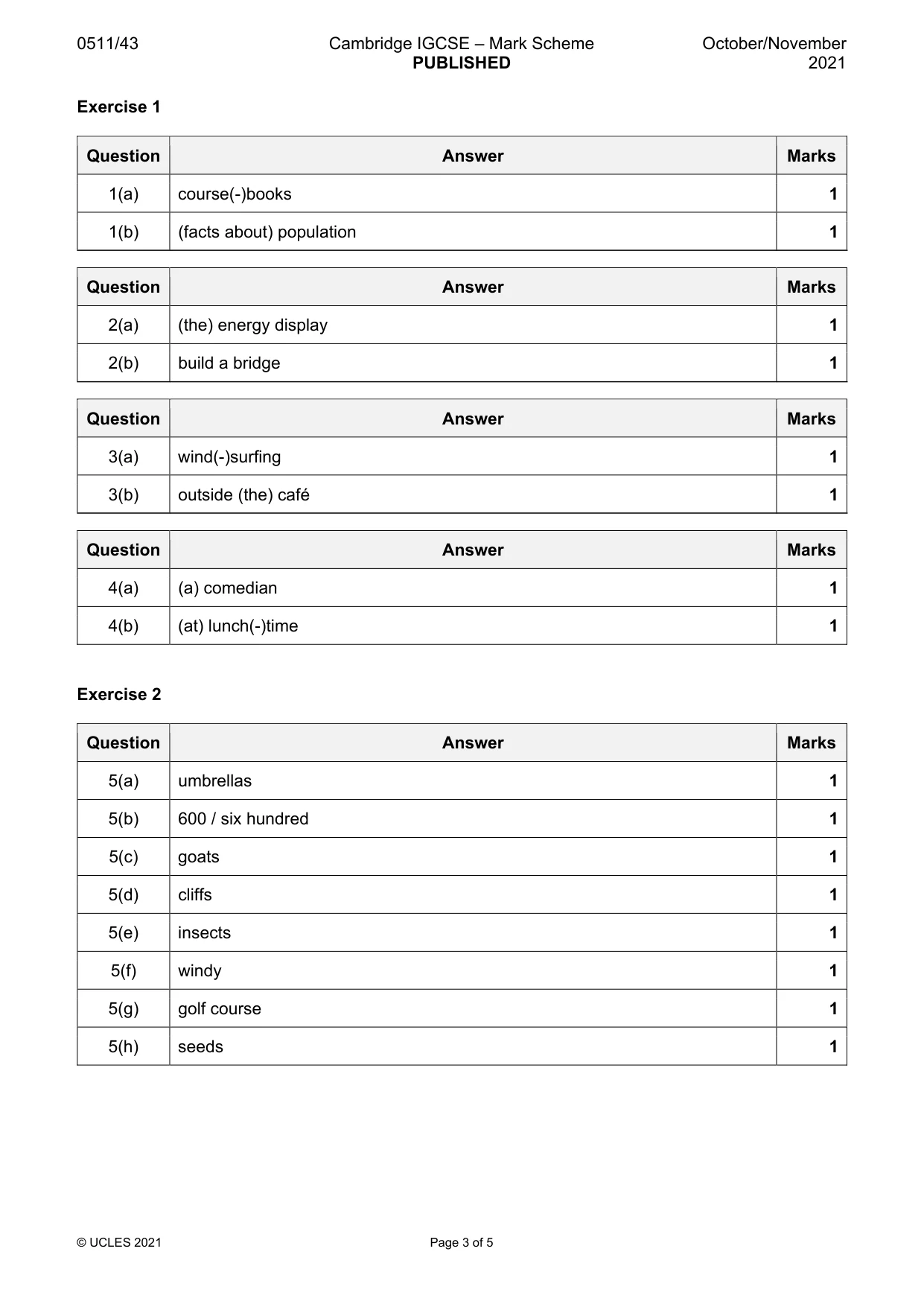
0511/43 Cambridge IGCSE – Mark Scheme PUBLISHED October/November 2021 © UCLES 2021 Page 3 of 5 Exercise 1 Question Answer Marks 1(a) course(-)books 1 1(b) (facts about) population 1 Question Answer Marks 2(a) (the) energy display 1 2(b) build a bridge 1 Question Answer Marks 3(a) wind(-)surfing 1 3(b) outside (the) café 1 Question Answer Marks 4(a) (a) comedian 1 4(b) (at) lunch(-)time 1 Exercise 2 Question Answer Marks 5(a) umbrellas 1 5(b) 600 / six hundred 1 5(c) goats 1 5(d) cliffs 1 5(e) insects 1 5(f) windy 1 5(g) golf course 1 5(h) seeds 1
Mark scheme, page 4
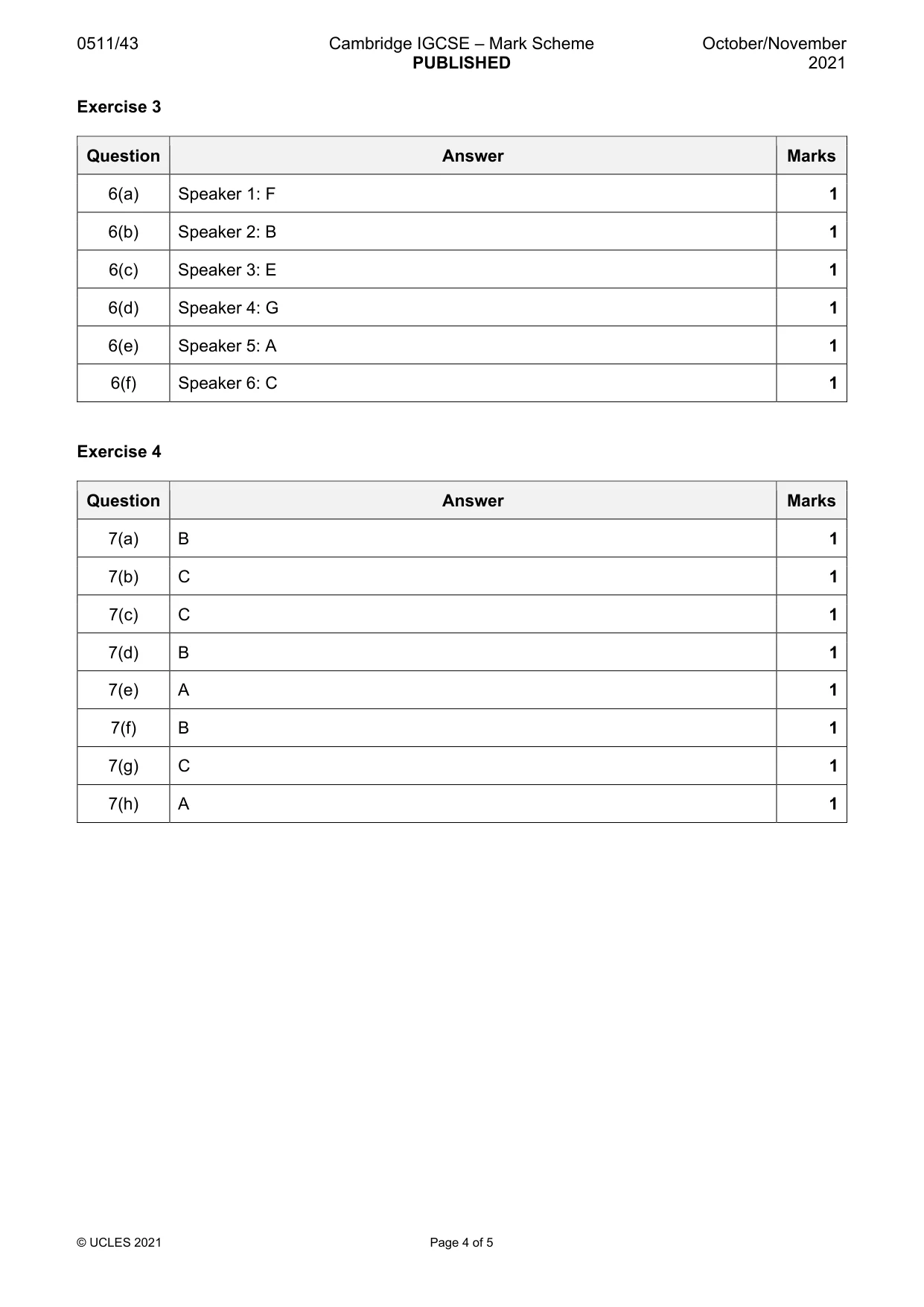
0511/43 Cambridge IGCSE – Mark Scheme PUBLISHED October/November 2021 © UCLES 2021 Page 4 of 5 Exercise 3 Question Answer Marks 6(a) Speaker 1: F 1 6(b) Speaker 2: B 1 6(c) Speaker 3: E 1 6(d) Speaker 4: G 1 6(e) Speaker 5: A 1 6(f) Speaker 6: C 1 Exercise 4 Question Answer Marks 7(a) B 1 7(b) C 1 7(c) C 1 7(d) B 1 7(e) A 1 7(f) B 1 7(g) C 1 7(h) A 1
Mark scheme, page 5
0511/43 Cambridge IGCSE – Mark Scheme PUBLISHED October/November 2021 © UCLES 2021 Page 5 of 5 Exercise 5, part A Question Answer Marks 8A(a) remote 1 8A(b) selection weekends 1 8A(c) make decisions 1 8A(d) safety 1 8A(e) communication 1 Exercise 5, part B Question Answer Marks 8B(a) data collection 1 8B(b) ice(-)(fields) 1 8B(c) snow(-)leopard 1 8B(d) cooking facilities 1 8B(e) medical certificate 1
What you needed in this session
Cambridge’s own grade thresholds for 2021 Oct/Nov, Paper 4 · Variant 3. A higher threshold means an easier paper — the bar moves with how the cohort did.