Cambridge IGCSE English - Second Language (count-in oral) 0511 — 2017 Oct/Nov Paper 4 · Variant 3
0511/43/O/N/17 · 40 marks · ≈45 min
The question paper and its mark scheme, free to read here and free to download. This is Cambridge’s own paper, exactly as it was sat.
Question paper12 pages


Mark scheme4 pages
Answers below. Sit the paper first if you are practising.
Paper as text
Question paper, page 1
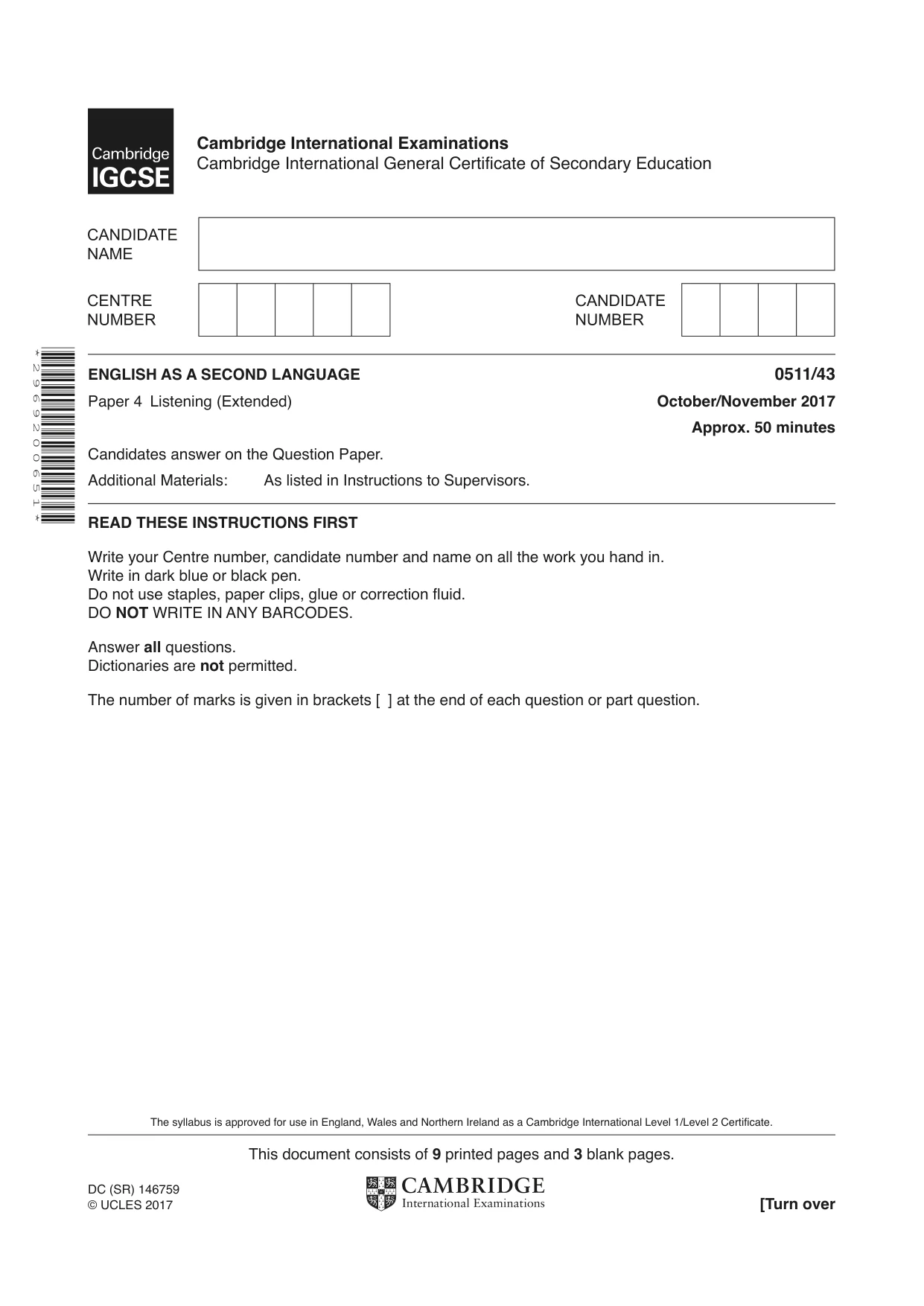
* 2 9 6 9 2 0 0 6 5 1 * This document consists of 9 printed pages and 3 blank pages. DC (SR) 146759 © UCLES 2017 [Turn over Cambridge International Examinations Cambridge International General Certificate of Secondary Education ENGLISH AS A SECOND LANGUAGE 0511/43 Paper 4 Listening (Extended) October/November 2017 Approx. 50 minutes Candidates answer on the Question Paper. Additional Materials: As listed in Instructions to Supervisors. READ THESE INSTRUCTIONS FIRST Write your Centre number, candidate number and name on all the work you hand in. Write in dark blue or black pen. Do not use staples, paper clips, glue or correction fluid. DO NOT WRITE IN ANY BARCODES. Answer all questions. Dictionaries are not permitted. The number of marks is given in brackets [ ] at the end of each question or part question. The syllabus is approved for use in England, Wales and Northern Ireland as a Cambridge International Level 1/Level 2 Certificate.
Question paper, page 2
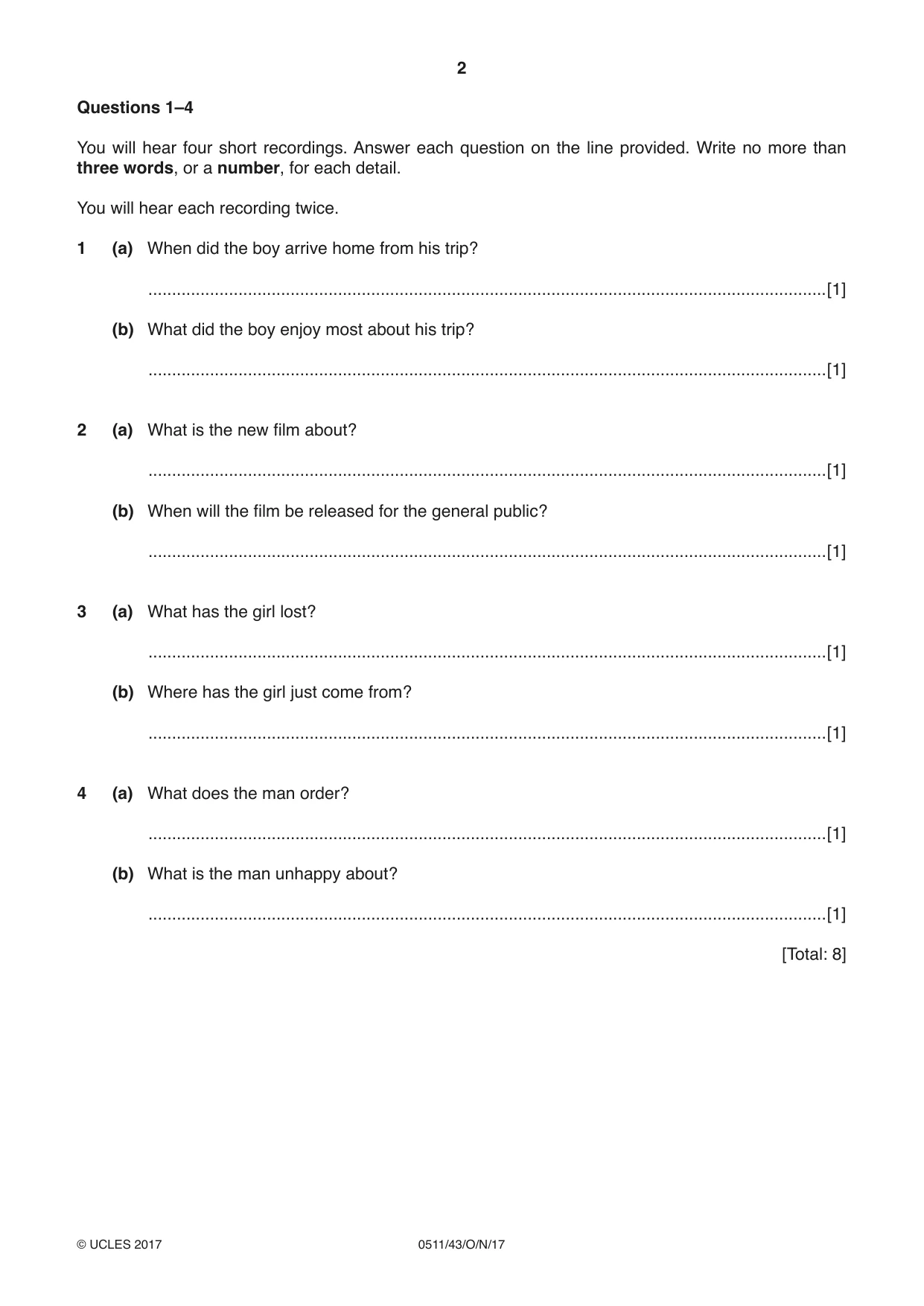
2 0511/43/O/N/17 © UCLES 2017 Questions 1–4 You will hear four short recordings. Answer each question on the line provided. Write no more than three words, or a number, for each detail. You will hear each recording twice. 1 (a) When did the boy arrive home from his trip? …[1] (b) What did the boy enjoy most about his trip? …[1] 2 (a) What is the new film about? …[1] (b) When will the film be released for the general public? …[1] 3 (a) What has the girl lost? …[1] (b) Where has the girl just come from? …[1] 4 (a) What does the man order? …[1] (b) What is the man unhappy about? …[1] [Total: 8]
Question paper, page 3
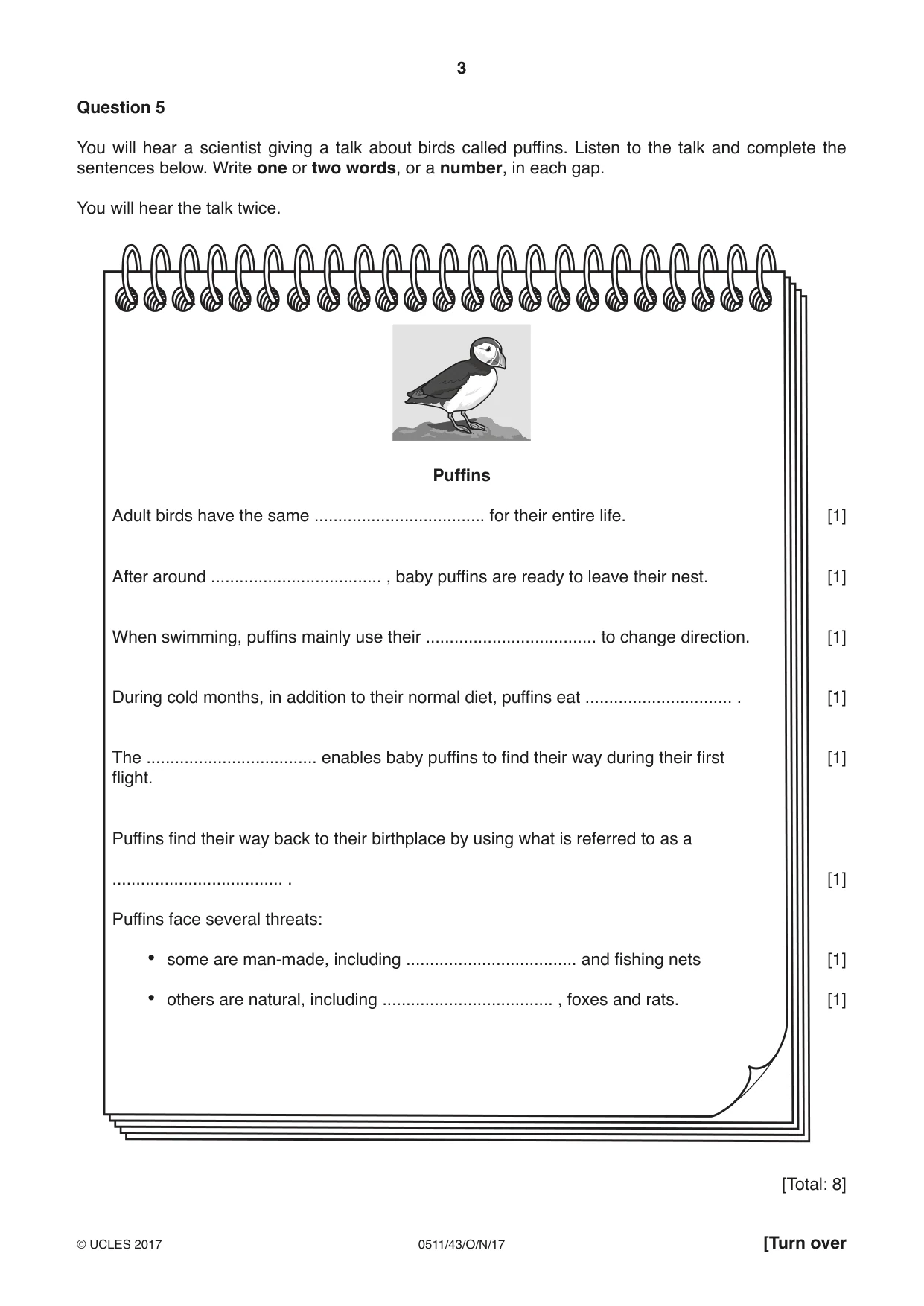
3 0511/43/O/N/17 © UCLES 2017 [Turn over Question 5 You will hear a scientist giving a talk about birds called puffins. Listen to the talk and complete the sentences below. Write one or two words, or a number, in each gap. You will hear the talk twice. Puffins Adult birds have the same … for their entire life. [1] After around … , baby puffins are ready to leave their nest. [1] When swimming, puffins mainly use their … to change direction. [1] During cold months, in addition to their normal diet, puffins eat … . [1] The … enables baby puffins to find their way during their first [1] flight. Puffins find their way back to their birthplace by using what is referred to as a … . [1] Puffins face several threats: • some are man-made, including … and fishing nets [1] • others are natural, including … , foxes and rats. [1] [Total: 8]
Question paper, page 4
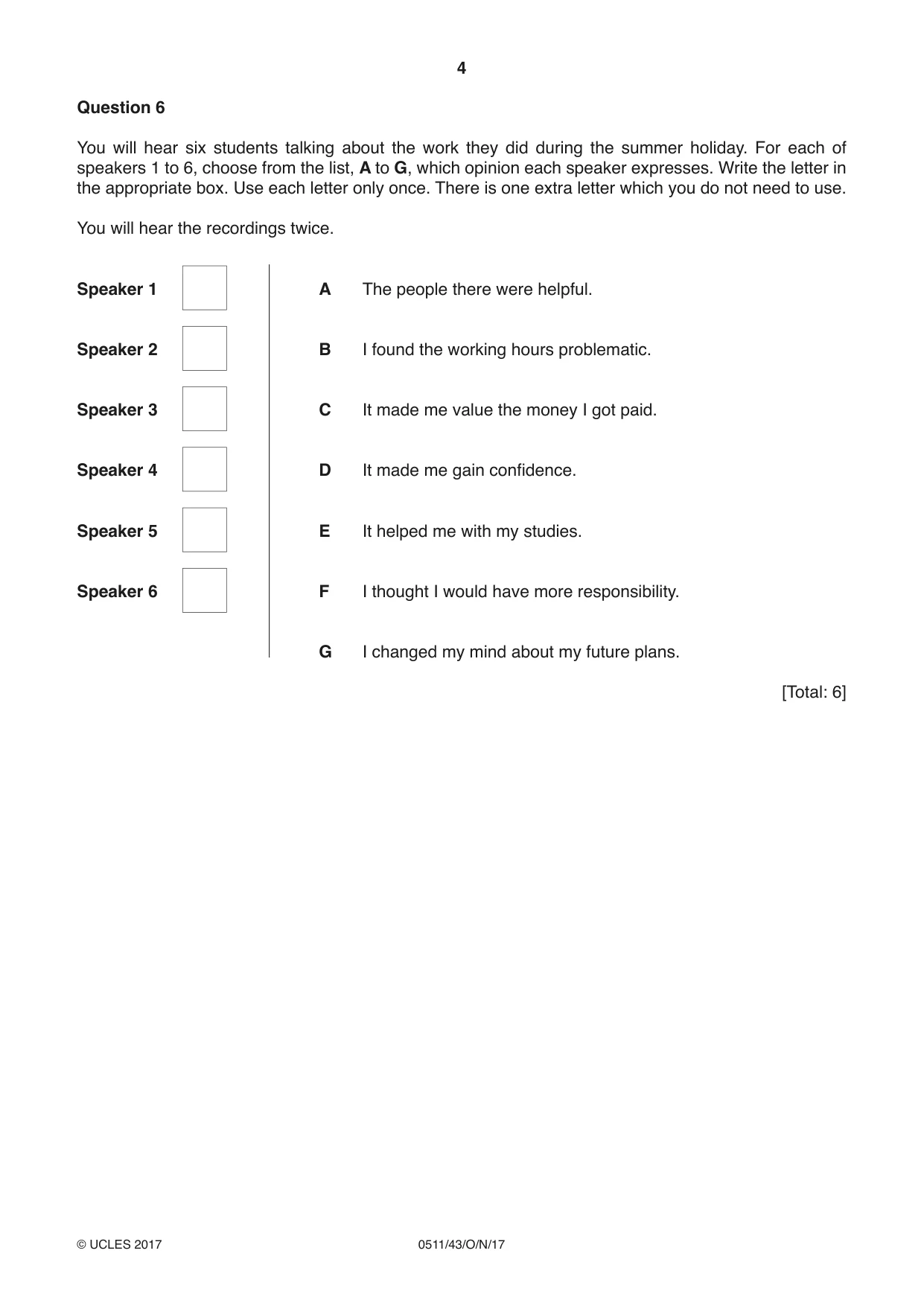
4 0511/43/O/N/17 © UCLES 2017 Question 6 You will hear six students talking about the work they did during the summer holiday. For each of speakers 1 to 6, choose from the list, A to G, which opinion each speaker expresses. Write the letter in the appropriate box. Use each letter only once. There is one extra letter which you do not need to use. You will hear the recordings twice. Speaker 1 A The people there were helpful. Speaker 2 B I found the working hours problematic. Speaker 3 C It made me value the money I got paid. Speaker 4 D It made me gain confidence. Speaker 5 E It helped me with my studies. Speaker 6 F I thought I would have more responsibility. G I changed my mind about my future plans. [Total: 6]
Question paper, page 5
5 0511/43/O/N/17 © UCLES 2017 [Turn over Please turn over for Question 7.
Question paper, page 6
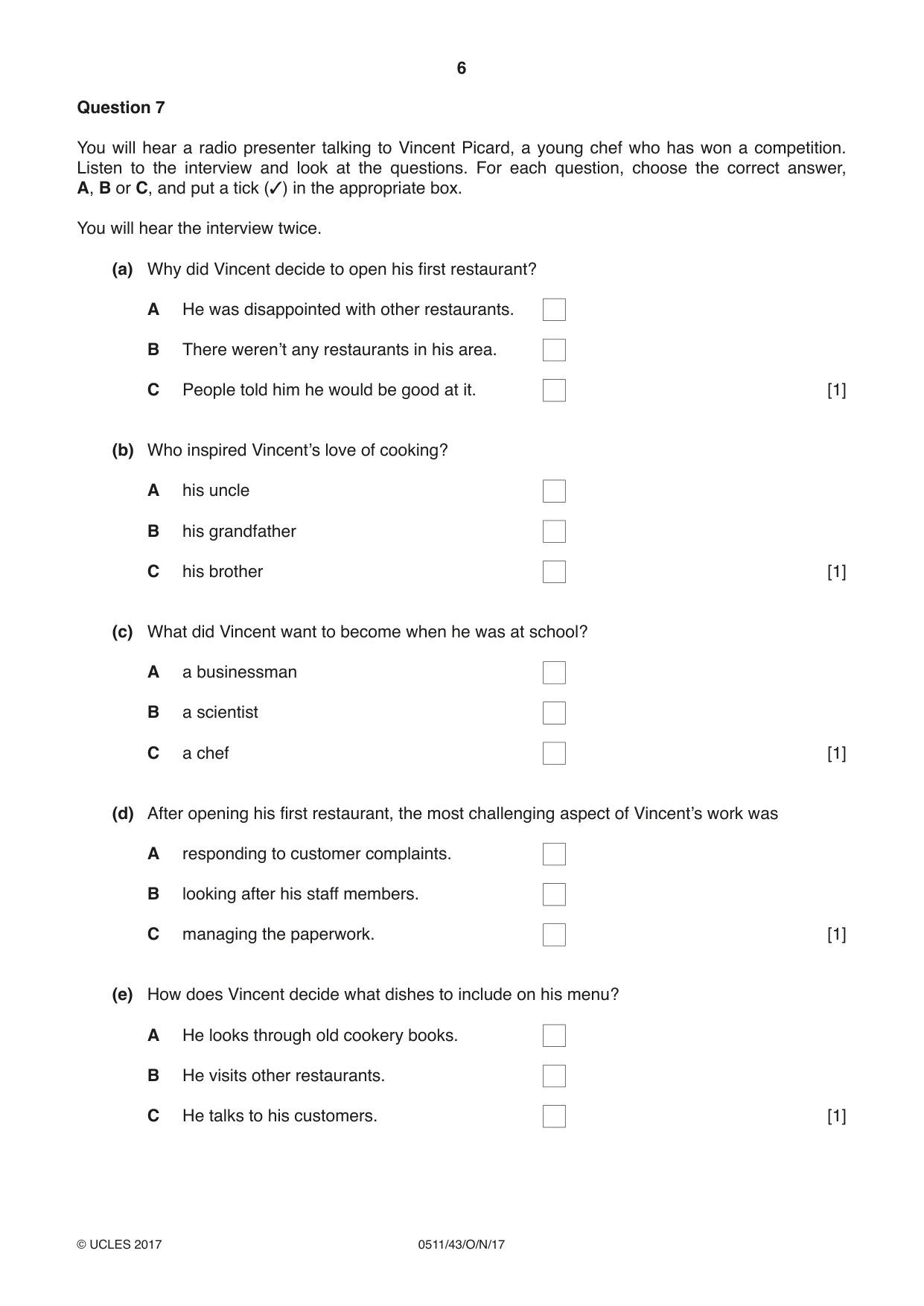
6 0511/43/O/N/17 © UCLES 2017 Question 7 You will hear a radio presenter talking to Vincent Picard, a young chef who has won a competition. Listen to the interview and look at the questions. For each question, choose the correct answer, A, B or C, and put a tick (3) in the appropriate box. You will hear the interview twice. (a) Why did Vincent decide to open his first restaurant? A He was disappointed with other restaurants. B There weren’t any restaurants in his area. C People told him he would be good at it. [1] (b) Who inspired Vincent’s love of cooking? A his uncle B his grandfather C his brother [1] (c) What did Vincent want to become when he was at school? A a businessman B a scientist C a chef [1] (d) After opening his first restaurant, the most challenging aspect of Vincent’s work was A responding to customer complaints. B looking after his staff members. C managing the paperwork. [1] (e) How does Vincent decide what dishes to include on his menu? A He looks through old cookery books. B He visits other restaurants. C He talks to his customers. [1]
Question paper, page 7
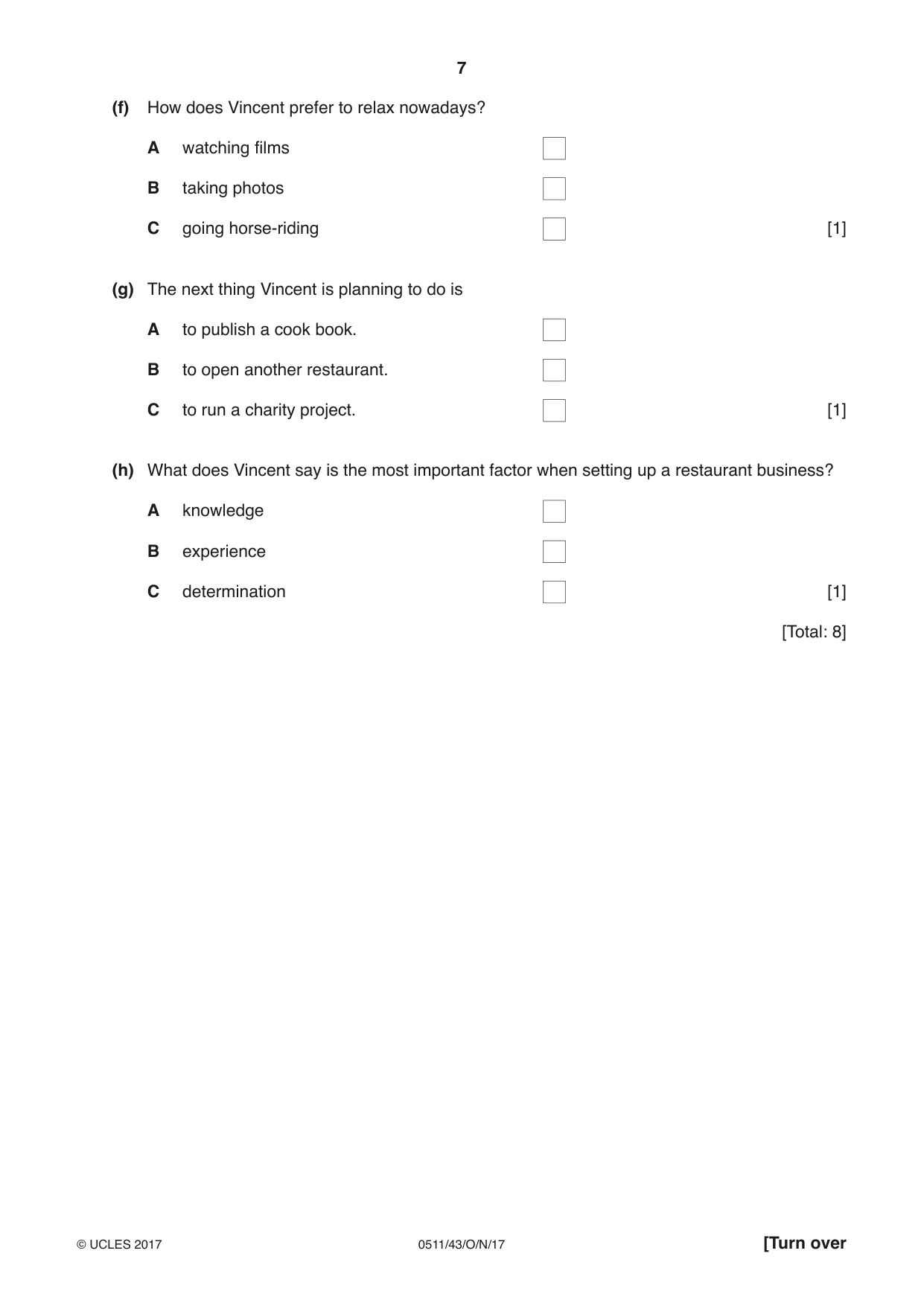
7 0511/43/O/N/17 © UCLES 2017 [Turn over (f) How does Vincent prefer to relax nowadays? A watching films B taking photos C going horse-riding [1] (g) The next thing Vincent is planning to do is A to publish a cook book. B to open another restaurant. C to run a charity project. [1] (h) What does Vincent say is the most important factor when setting up a restaurant business? A knowledge B experience C determination [1] [Total: 8]
Question paper, page 8
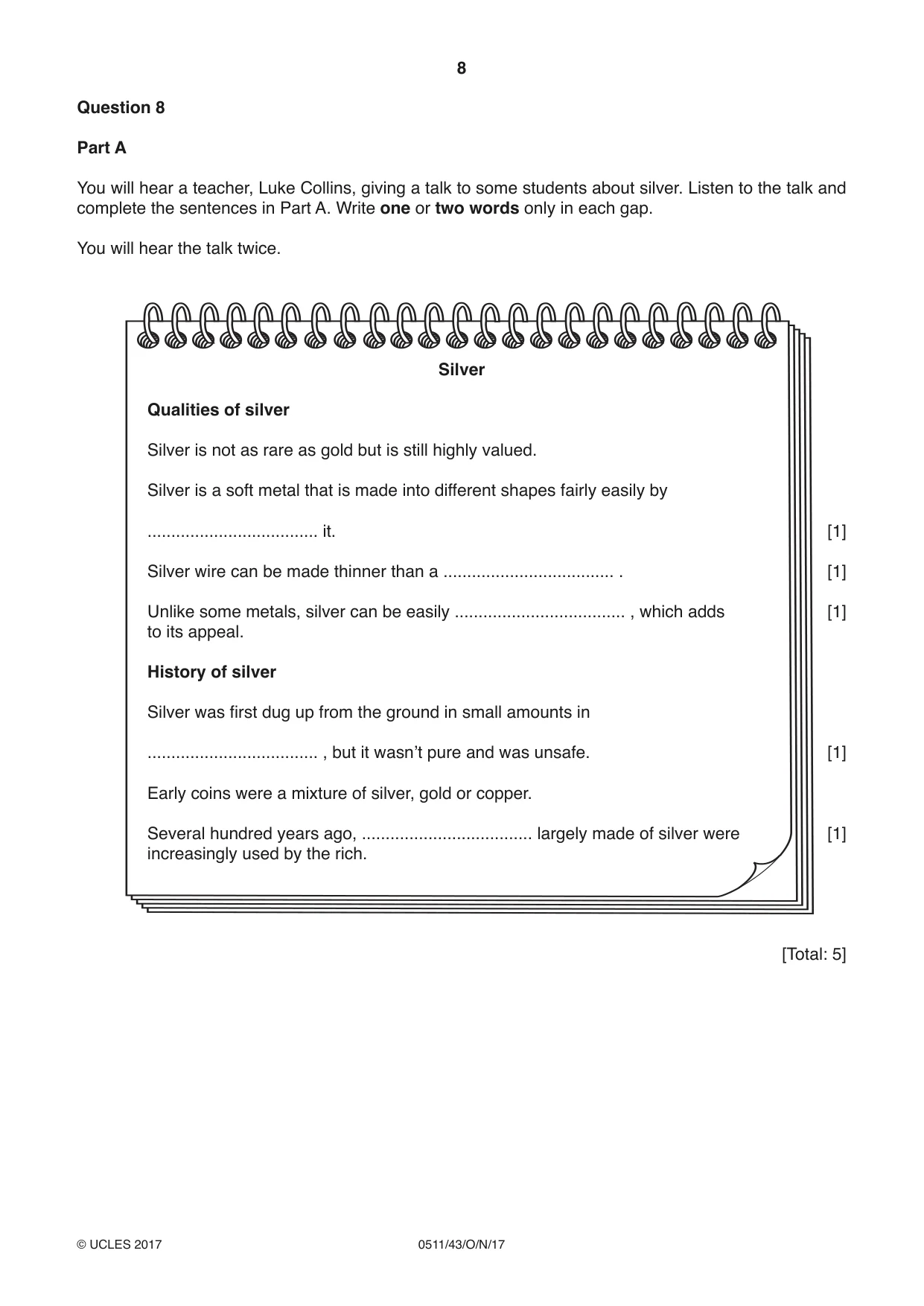
8 0511/43/O/N/17 © UCLES 2017 Question 8 Part A You will hear a teacher, Luke Collins, giving a talk to some students about silver. Listen to the talk and complete the sentences in Part A. Write one or two words only in each gap. You will hear the talk twice. Silver Qualities of silver Silver is not as rare as gold but is still highly valued. Silver is a soft metal that is made into different shapes fairly easily by … it. [1] Silver wire can be made thinner than a … . [1] Unlike some metals, silver can be easily … , which adds [1] to its appeal. History of silver Silver was first dug up from the ground in small amounts in … , but it wasn’t pure and was unsafe. [1] Early coins were a mixture of silver, gold or copper. Several hundred years ago, … largely made of silver were [1] increasingly used by the rich. [Total: 5]
Question paper, page 9
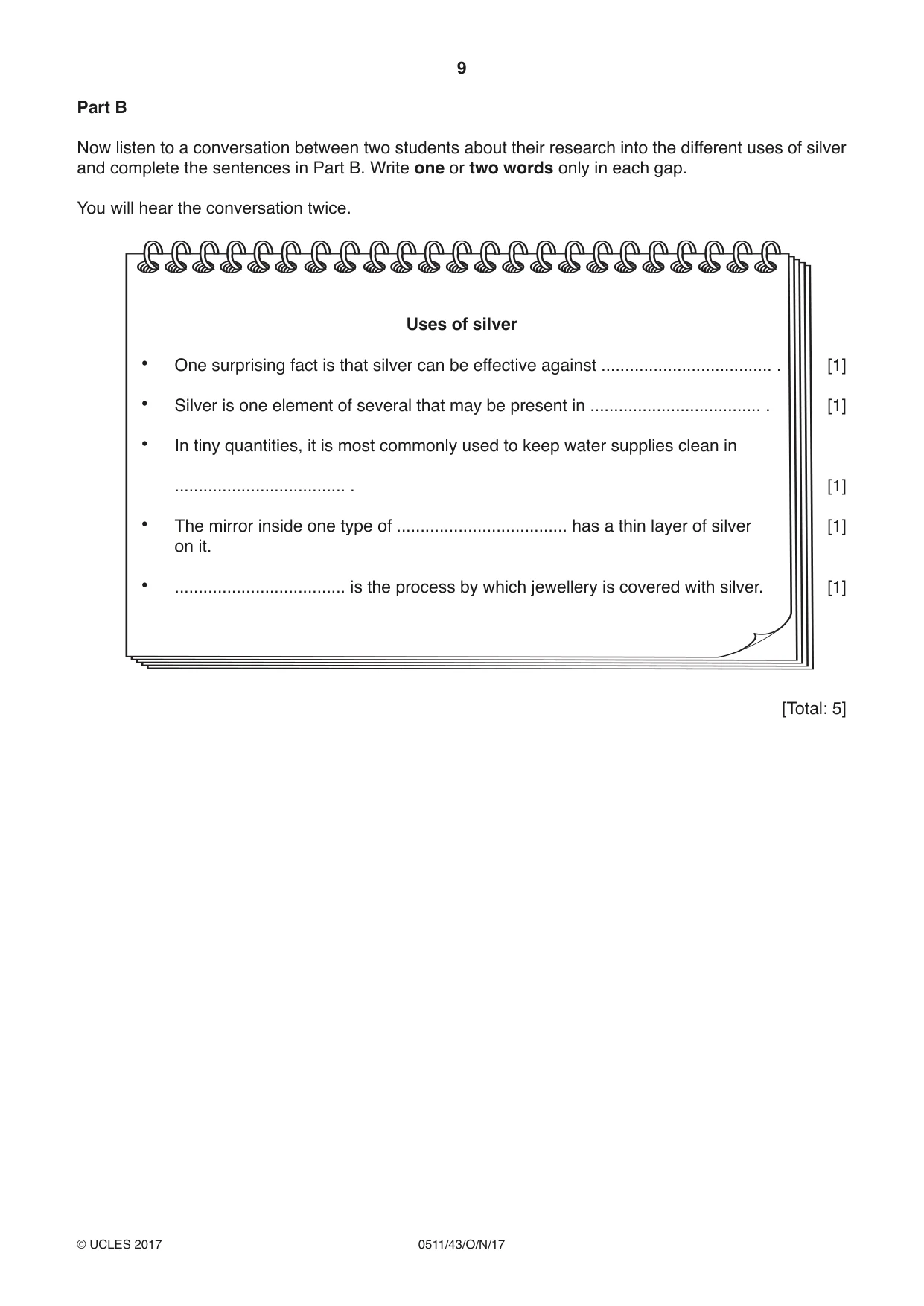
9 0511/43/O/N/17 © UCLES 2017 Part B Now listen to a conversation between two students about their research into the different uses of silver and complete the sentences in Part B. Write one or two words only in each gap. You will hear the conversation twice. Uses of silver • One surprising fact is that silver can be effective against … . [1] • Silver is one element of several that may be present in … . [1] • In tiny quantities, it is most commonly used to keep water supplies clean in … . [1] • The mirror inside one type of … has a thin layer of silver [1] on it. • … is the process by which jewellery is covered with silver. [1] [Total: 5]
Question paper, page 10
10 0511/43/O/N/17 © UCLES 2017 BLANK PAGE
Question paper, page 11
11 0511/43/O/N/17 © UCLES 2017 BLANK PAGE
Question paper, page 12
12 0511/43/O/N/17 © UCLES 2017 Permission to reproduce items where third-party owned material protected by copyright is included has been sought and cleared where possible. Every reasonable effort has been made by the publisher (UCLES) to trace copyright holders, but if any items requiring clearance have unwittingly been included, the publisher will be pleased to make amends at the earliest possible opportunity. To avoid the issue of disclosure of answer-related information to candidates, all copyright acknowledgements are reproduced online in the Cambridge International Examinations Copyright Acknowledgements Booklet. This is produced for each series of examinations and is freely available to download at www.cie.org.uk after the live examination series. Cambridge International Examinations is part of the Cambridge Assessment Group. Cambridge Assessment is the brand name of University of Cambridge Local Examinations Syndicate (UCLES), which is itself a department of the University of Cambridge. BLANK PAGE
Mark scheme, page 1
® IGCSE is a registered trademark. This syllabus is approved for use in England, Wales and Northern Ireland as a Cambridge International Level 1/Level 2 Certificate. This document consists of 4 printed pages. © UCLES 2017 [Turn over Cambridge Assessment International Education Cambridge International General Certificate of Secondary Education ENGLISH AS A SECOND LANGUAGE 0511/43 Paper 4 Listening (Extended) October/November 2017 MARK SCHEME Maximum Mark: 40 Published This mark scheme is published as an aid to teachers and candidates, to indicate the requirements of the examination. It shows the basis on which Examiners were instructed to award marks. It does not indicate the details of the discussions that took place at an Examiners’ meeting before marking began, which would have considered the acceptability of alternative answers. Mark schemes should be read in conjunction with the question paper and the Principal Examiner Report for Teachers. Cambridge International will not enter into discussions about these mark schemes. Cambridge International is publishing the mark schemes for the October/November 2017 series for most Cambridge IGCSE®, Cambridge International A and AS Level components and some Cambridge O Level components.
Mark scheme, page 2
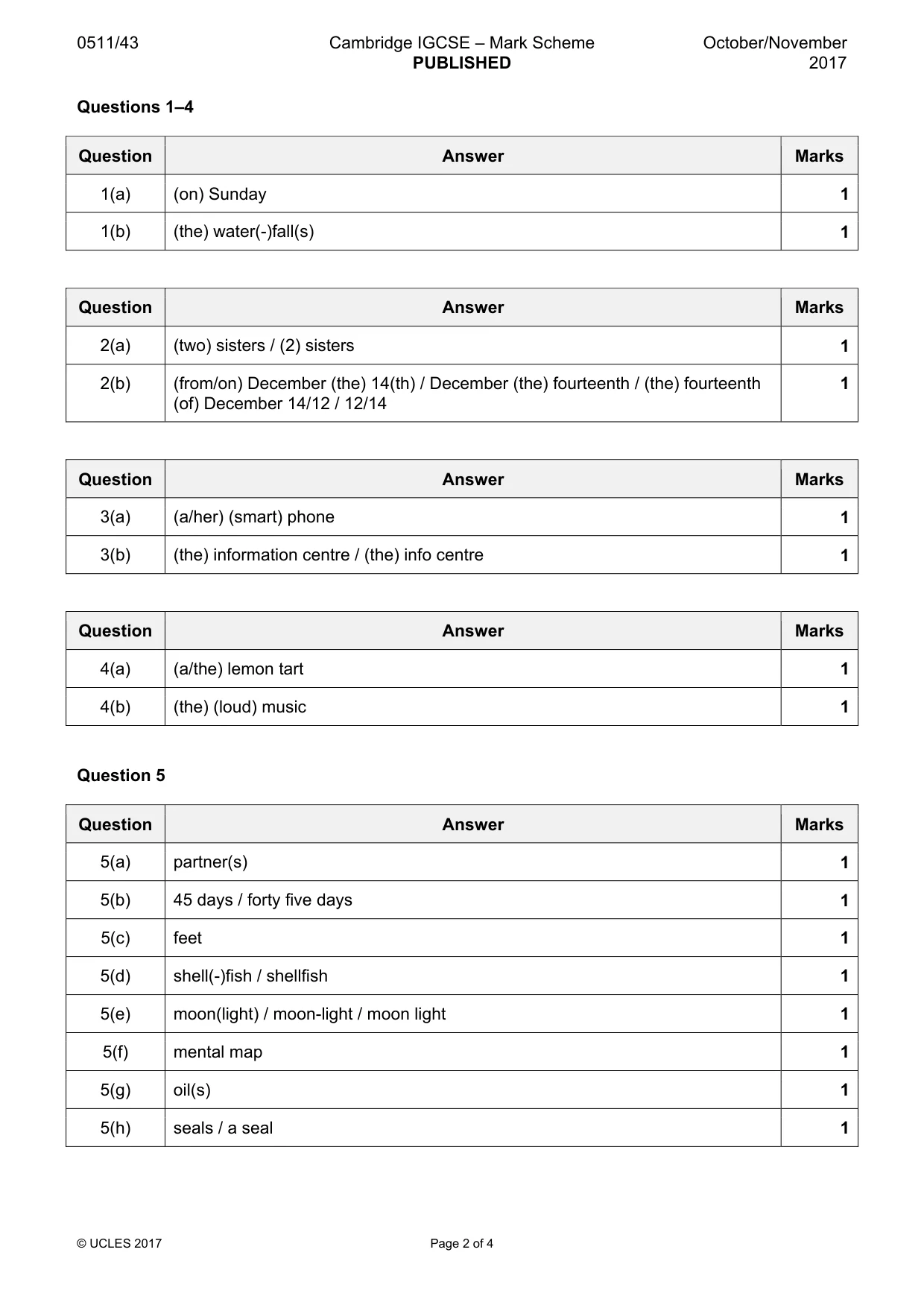
0511/43 Cambridge IGCSE – Mark Scheme PUBLISHED October/November 2017 © UCLES 2017 Page 2 of 4 Questions 1–4 Question Answer Marks 1(a) (on) Sunday 1 1(b) (the) water(-)fall(s) 1 Question Answer Marks 2(a) (two) sisters / (2) sisters 1 2(b) (from/on) December (the) 14(th) / December (the) fourteenth / (the) fourteenth (of) December 14/12 / 12/14 1 Question Answer Marks 3(a) (a/her) (smart) phone 1 3(b) (the) information centre / (the) info centre 1 Question Answer Marks 4(a) (a/the) lemon tart 1 4(b) (the) (loud) music 1 Question 5 Question Answer Marks 5(a) partner(s) 1 5(b) 45 days / forty five days 1 5(c) feet 1 5(d) shell(-)fish / shellfish 1 5(e) moon(light) / moon-light / moon light 1 5(f) mental map 1 5(g) oil(s) 1 5(h) seals / a seal 1
Mark scheme, page 3
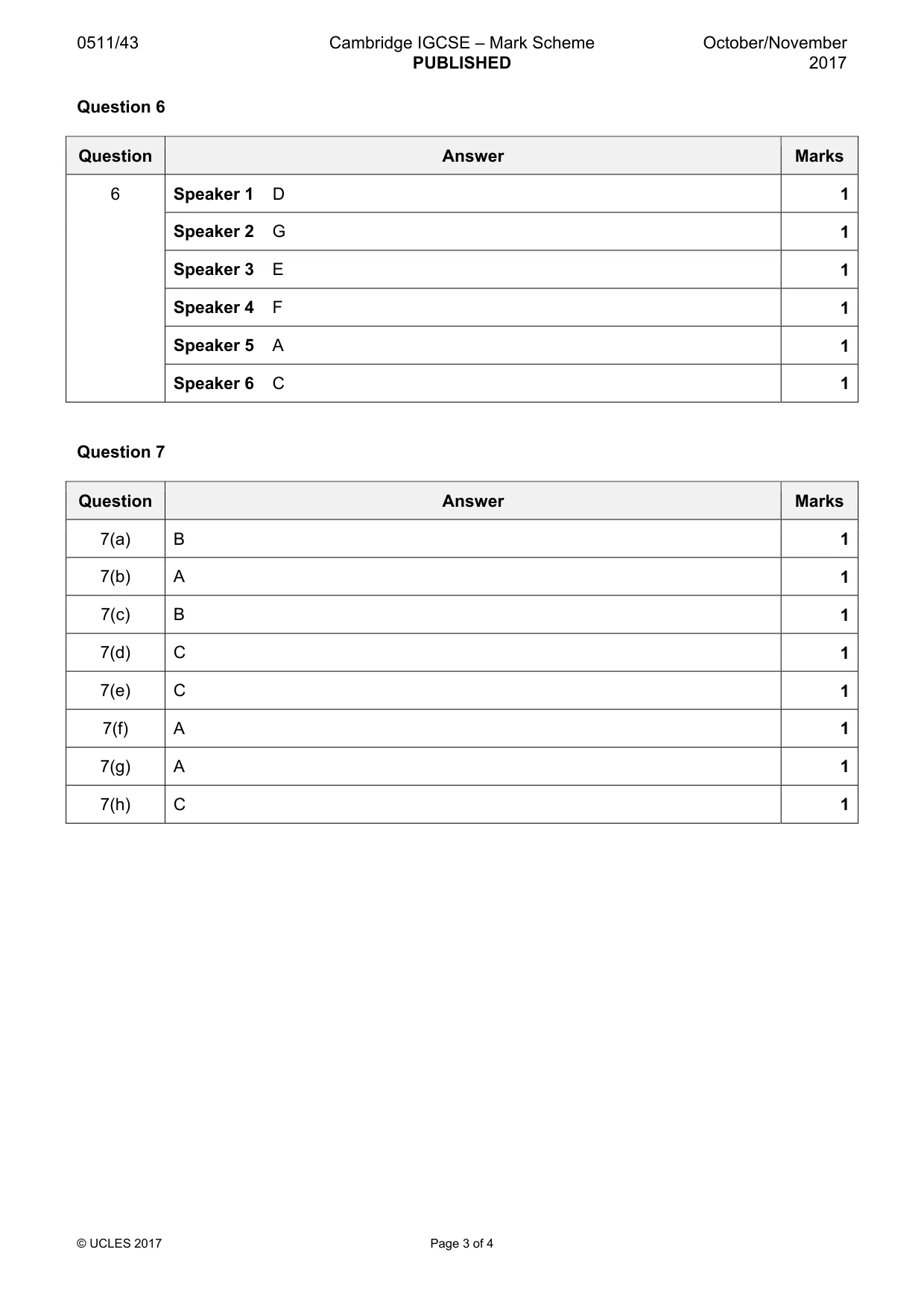
0511/43 Cambridge IGCSE – Mark Scheme PUBLISHED October/November 2017 © UCLES 2017 Page 3 of 4 Question 6 Question Answer Marks 6 Speaker 1 D 1 Speaker 2 G 1 Speaker 3 E 1 Speaker 4 F 1 Speaker 5 A 1 Speaker 6 C 1 Question 7 Question Answer Marks 7(a) B 1 7(b) A 1 7(c) B 1 7(d) C 1 7(e) C 1 7(f) A 1 7(g) A 1 7(h) C 1
Mark scheme, page 4
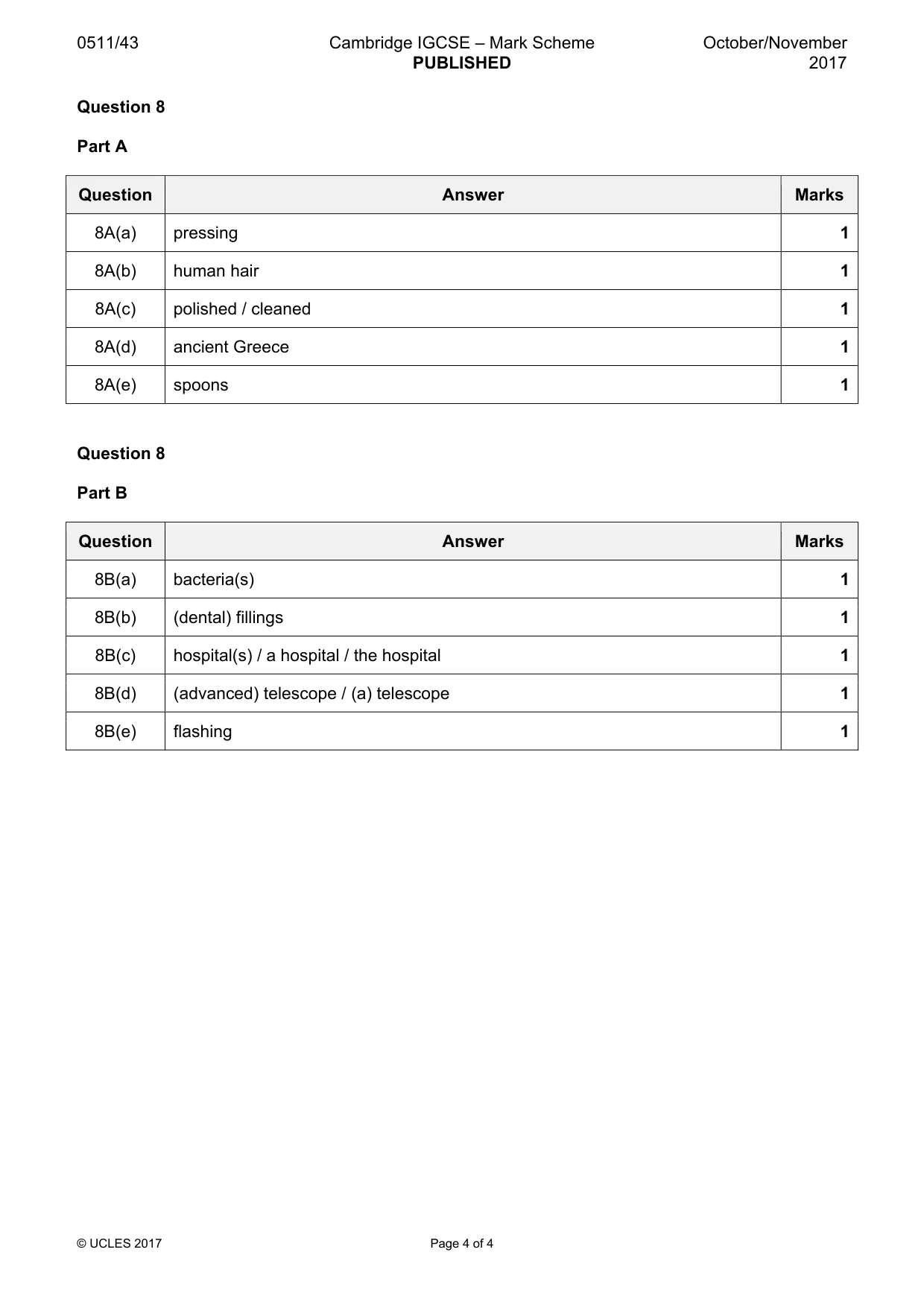
0511/43 Cambridge IGCSE – Mark Scheme PUBLISHED October/November 2017 © UCLES 2017 Page 4 of 4 Question 8 Part A Question Answer Marks 8A(a) pressing 1 8A(b) human hair 1 8A(c) polished / cleaned 1 8A(d) ancient Greece 1 8A(e) spoons 1 Question 8 Part B Question Answer Marks 8B(a) bacteria(s) 1 8B(b) (dental) fillings 1 8B(c) hospital(s) / a hospital / the hospital 1 8B(d) (advanced) telescope / (a) telescope 1 8B(e) flashing 1
What you needed in this session
Cambridge’s own grade thresholds for 2017 Oct/Nov, Paper 4 · Variant 3. A higher threshold means an easier paper — the bar moves with how the cohort did.