Cambridge IGCSE English - Literature (UK) 0476 — 2012 Oct/Nov Paper 2 · Variant 1
0476/21/O/N/12 · 25 marks · ≈28 min
The question paper and its mark scheme, free to read here and free to download. This is Cambridge’s own paper, exactly as it was sat.
Question paper5 pages
Mark scheme3 pages
Answers below. Sit the paper first if you are practising.
Paper as text
Question paper, page 1
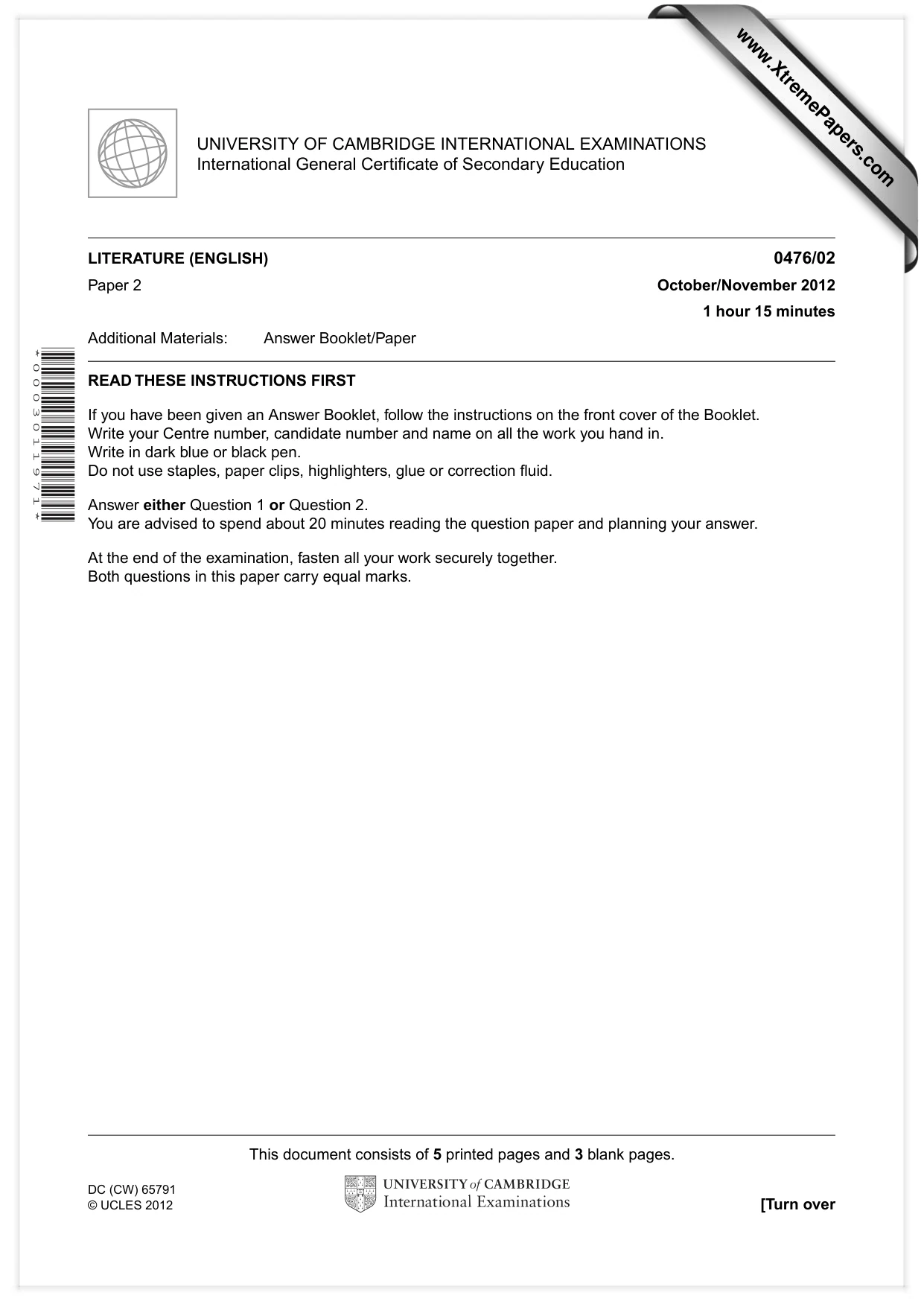
This document consists of 5 printed pages and 3 blank pages. DC (CW) 65791 © UCLES 2012 [Turn over UNIVERSITY OF CAMBRIDGE INTERNATIONAL EXAMINATIONS International General Certificate of Secondary Education * 0 0 0 3 0 1 1 9 7 1 * LITERATURE (ENGLISH) 0476/02 Paper 2 October/November 2012 1 hour 15 minutes Additional Materials: Answer Booklet/Paper READ THESE INSTRUCTIONS FIRST If you have been given an Answer Booklet, follow the instructions on the front cover of the Booklet. Write your Centre number, candidate number and name on all the work you hand in. Write in dark blue or black pen. Do not use staples, paper clips, highlighters, glue or correction fluid. Answer either Question 1 or Question 2. You are advised to spend about 20 minutes reading the question paper and planning your answer. At the end of the examination, fasten all your work securely together. Both questions in this paper carry equal marks. www.XtremePapers.com
Question paper, page 2
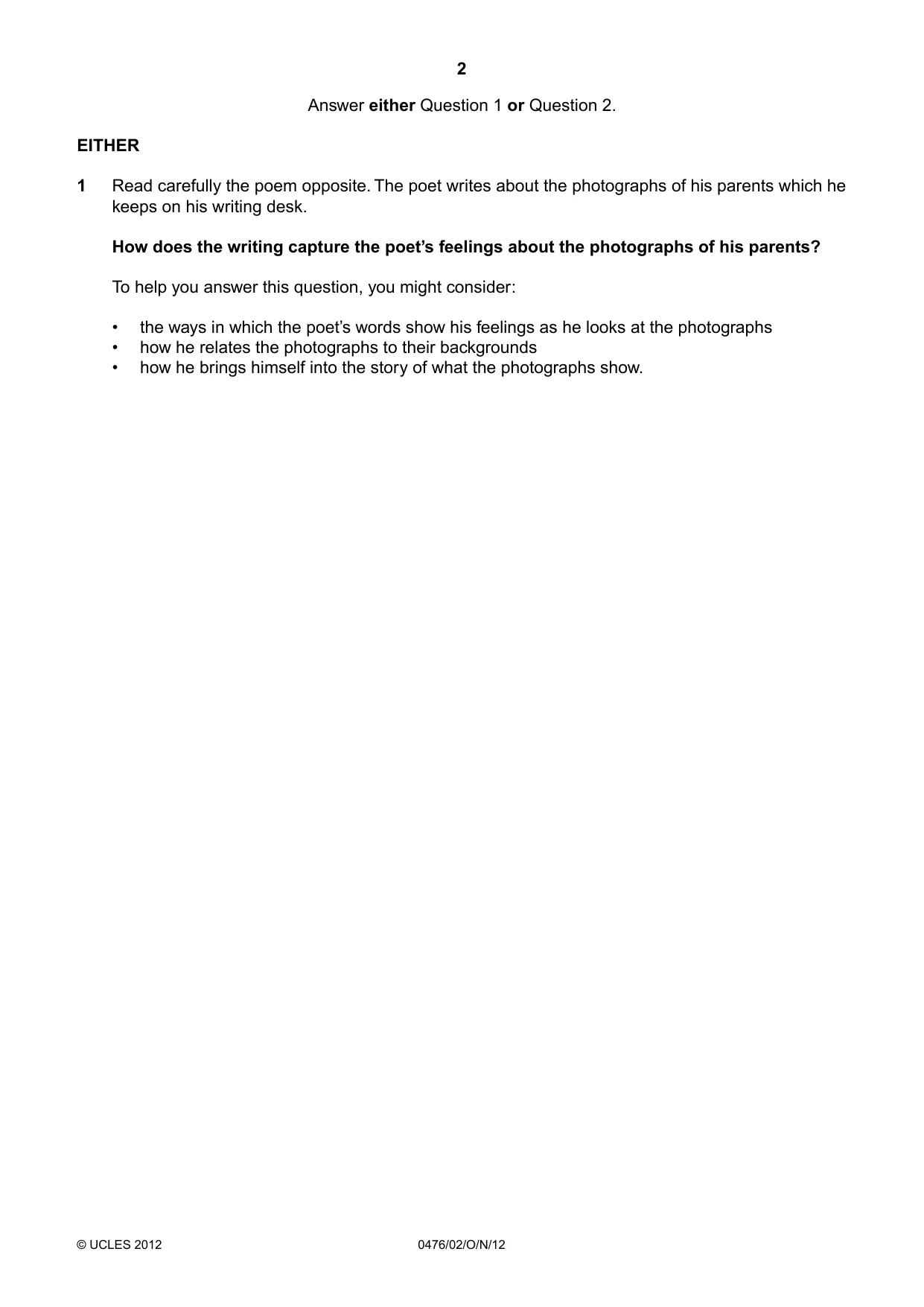
2 0476/02/O/N/12 © UCLES 2012 Answer either Question 1 or Question 2. EITHER 1 Read carefully the poem opposite. The poet writes about the photographs of his parents which he keeps on his writing desk. How does the writing capture the poet’s feelings about the photographs of his parents? To help you answer this question, you might consider: • the ways in which the poet’s words show his feelings as he looks at the photographs • how he relates the photographs to their backgrounds • how he brings himself into the story of what the photographs show.
Question paper, page 3
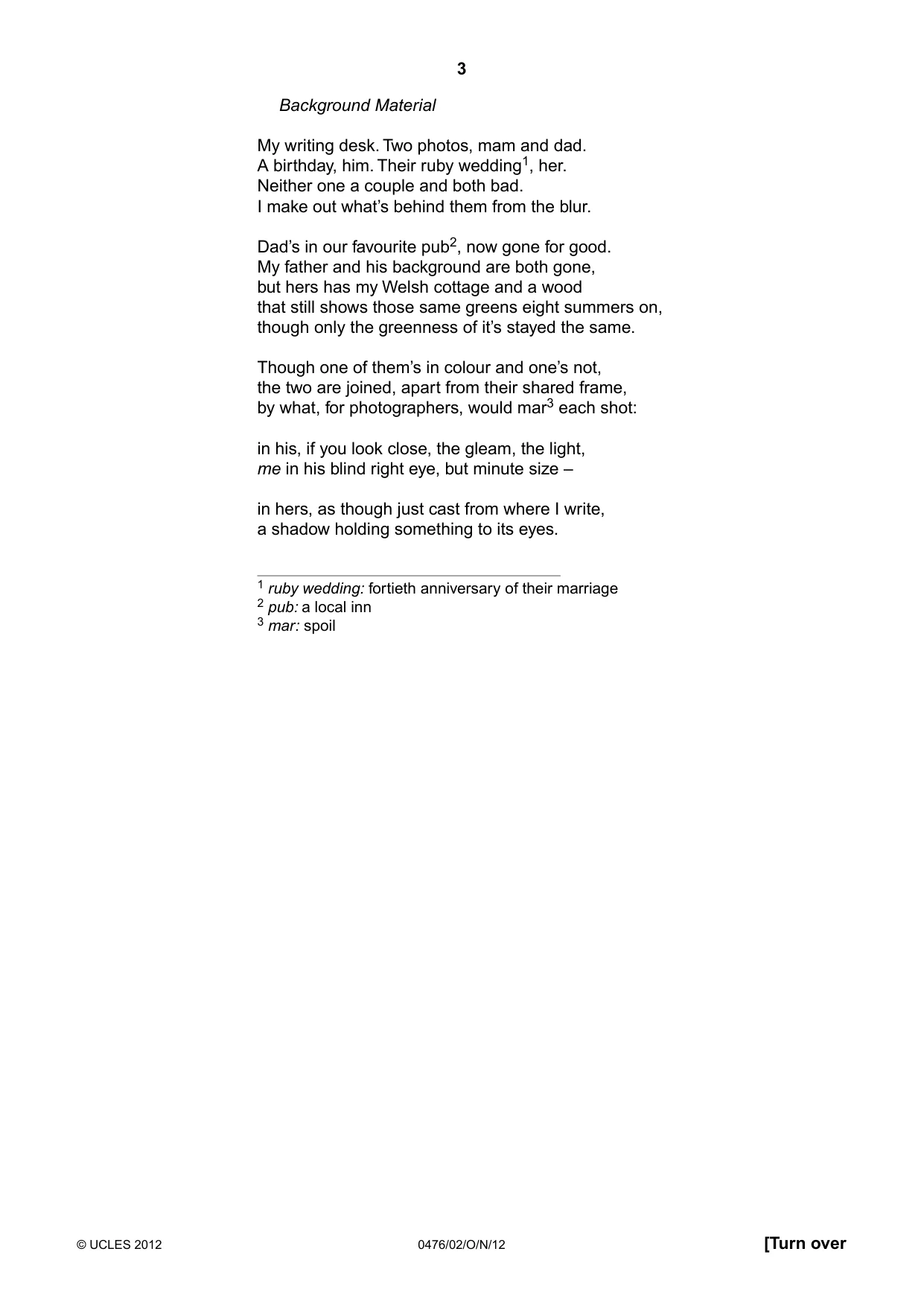
3 0476/02/O/N/12 © UCLES 2012 [Turn over Background Material My writing desk. Two photos, mam and dad. A birthday, him. Their ruby wedding1, her. Neither one a couple and both bad. I make out what’s behind them from the blur. Dad’s in our favourite pub2, now gone for good. My father and his background are both gone, but hers has my Welsh cottage and a wood that still shows those same greens eight summers on, though only the greenness of it’s stayed the same. Though one of them’s in colour and one’s not, the two are joined, apart from their shared frame, by what, for photographers, would mar3 each shot: in his, if you look close, the gleam, the light, me in his blind right eye, but minute size – in hers, as though just cast from where I write, a shadow holding something to its eyes. 1 ruby wedding: fortieth anniversary of their marriage 2 pub: a local inn 3 mar: spoil
Question paper, page 4
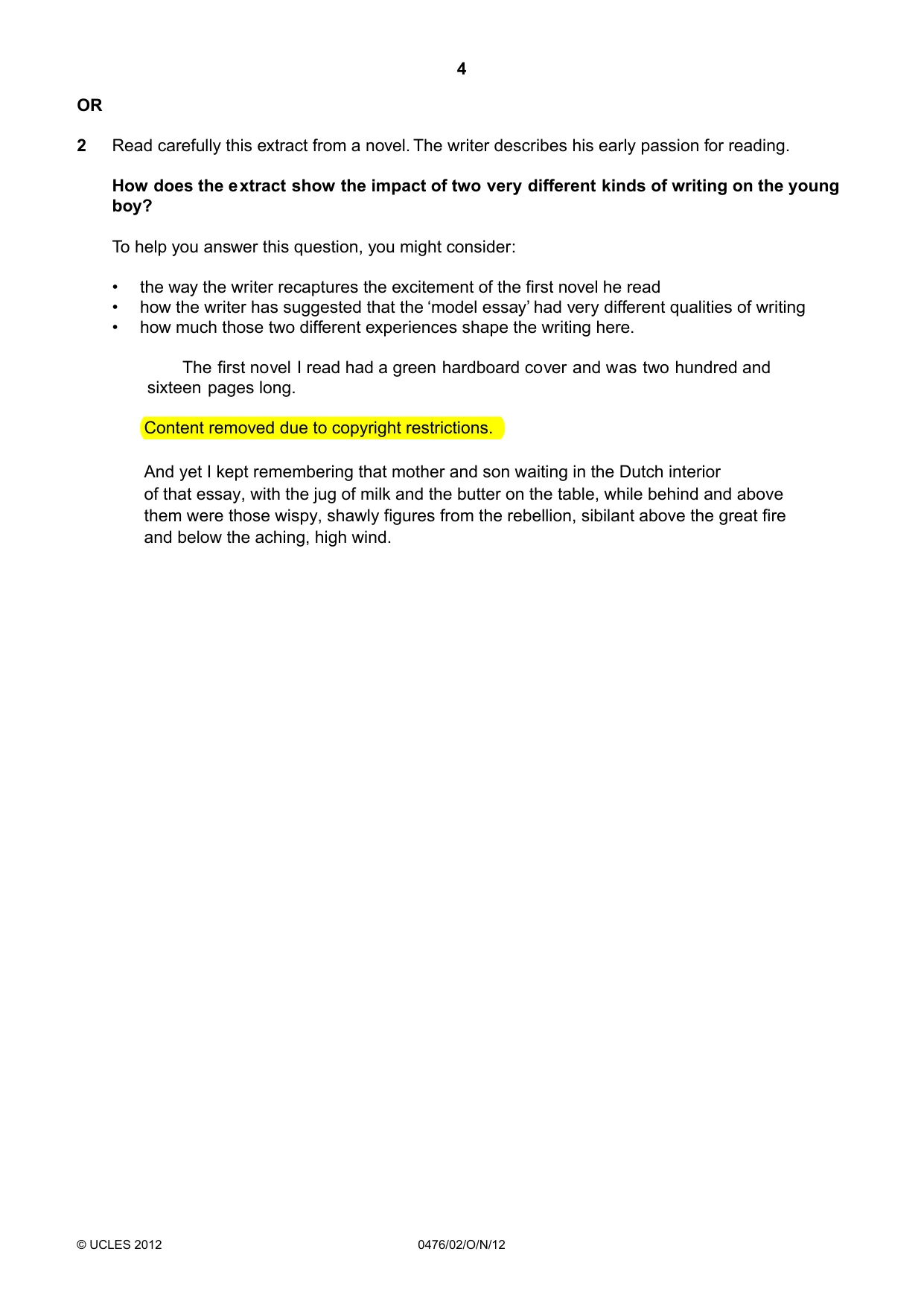
4 0476/02/O/N/12 © UCLES 2012 OR 2 Read carefully this extract from a novel. The writer describes his early passion for reading. How does the extract show the impact of two very different kinds of writing on the young boy? To help you answer this question, you might consider: • the way the writer recaptures the excitement of the first novel he read • how the writer has suggested that the ‘model essay’ had very different qualities of writing • how much those two different experiences shape the writing here. The first novel I read had a green hardboard cover and was two hundred and sixteen pages long. Content removed due to copyright restrictions. And yet I kept remembering that mother and son waiting in the Dutch interior of that essay, with the jug of milk and the butter on the table, while behind and above them were those wispy, shawly figures from the rebellion, sibilant above the great fire and below the aching, high wind.
Question paper, page 5
8 0476/02/O/N/12 © UCLES 2012 BLANK PAGE Copyright Acknowledgements: Question 1 © Tony Harrison; Background Material from Permanently Bard; Bloodaxe Books Ltd; 1995. Question 2 © Seamus Deane; Reading In The Dark; Jonathan Cape Ltd; 1996. Permission to reproduce items where third-party owned material protected b y copyright is included has been sought and cleared where possible. Every reasonable effort has been made b y the publisher (UCLES) to trace copyright holders, but if any items requiring clearance have unwittingly been included, the publisher will be pleased to make amends at the earliest possible opportunity. University of Cambridge International Examinations is par t of the Cambr idge Assessment Group. Cambridge Assessment is the br and name of Univ ersity of Cambridge Local Examinations Syndicate (UCLES), which is itself a department of the University of Cambridge.
Mark scheme, page 1
CAMBRIDGE INTERNATIONAL EXAMINATIONS International General Certificate of Secondary Education MARK SCHEME for the October/November 2012 series 0476 LITERATURE (ENGLISH) 0476/02 Paper 2, maximum raw mark 25 This mark scheme is published as an aid to teachers and candidates, to indicate the requirements of the examination. It shows the basis on which Examiners were instructed to award marks. It does not indicate the details of the discussions that took place at an Examiners’ meeting before marking began, which would have considered the acceptability of alternative answers. Mark schemes should be read in conjunction with the question paper and the Principal Examiner Report for Teachers. Cambridge will not enter into discussions about these mark schemes. Cambridge is publishing the mark schemes for the October/November 2012 series for most IGCSE, GCE Advanced Level and Advanced Subsidiary Level components and some Ordinary Level components. www.XtremePapers.com
Mark scheme, page 2
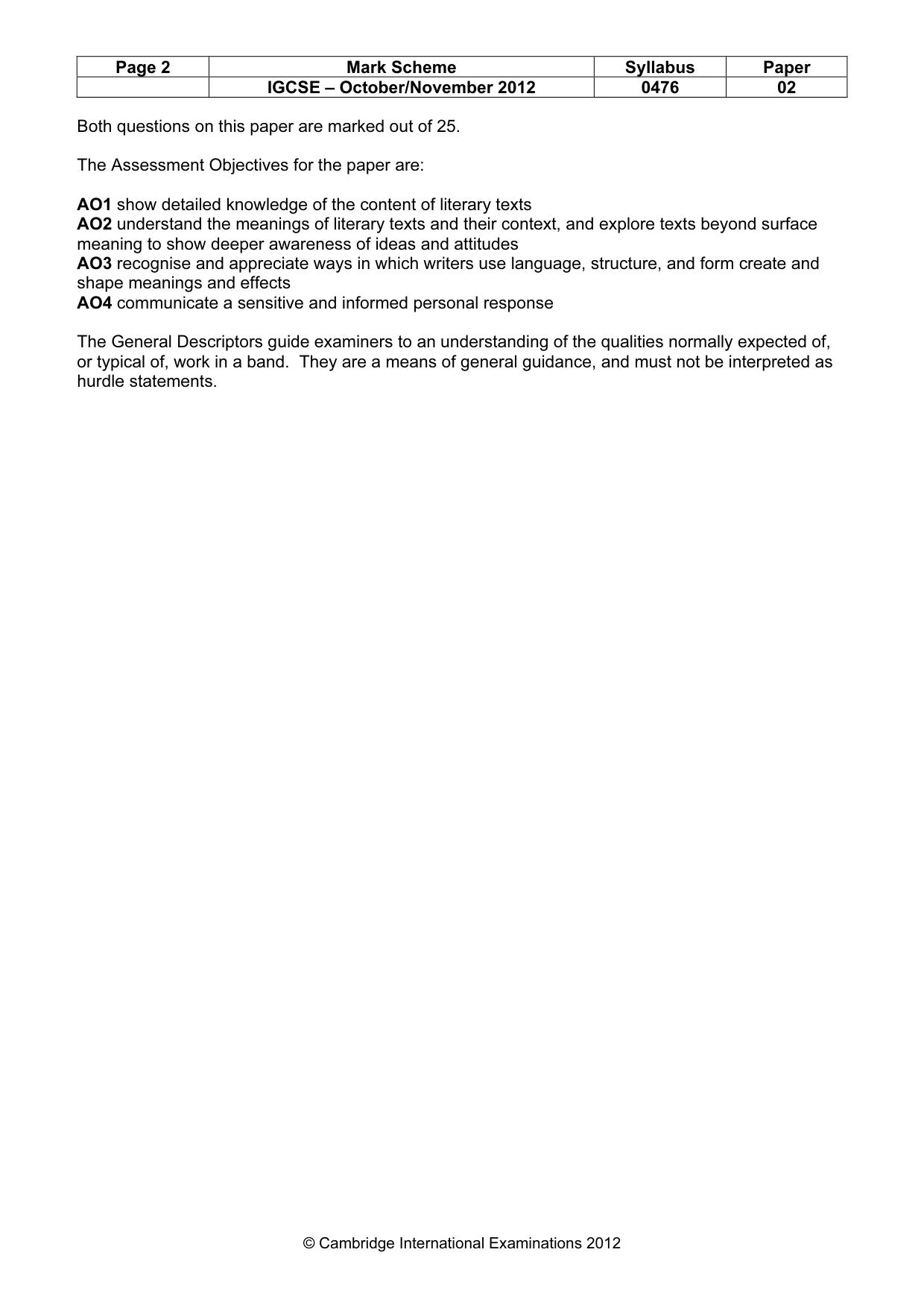
Page 2 Mark Scheme Syllabus Paper IGCSE – October/November 2012 0476 02 © Cambridge International Examinations 2012 Both questions on this paper are marked out of 25. The Assessment Objectives for the paper are: AO1 show detailed knowledge of the content of literary texts AO2 understand the meanings of literary texts and their context, and explore texts beyond surface meaning to show deeper awareness of ideas and attitudes AO3 recognise and appreciate ways in which writers use language, structure, and form create and shape meanings and effects AO4 communicate a sensitive and informed personal response The General Descriptors guide examiners to an understanding of the qualities normally expected of, or typical of, work in a band. They are a means of general guidance, and must not be interpreted as hurdle statements.
Mark scheme, page 3
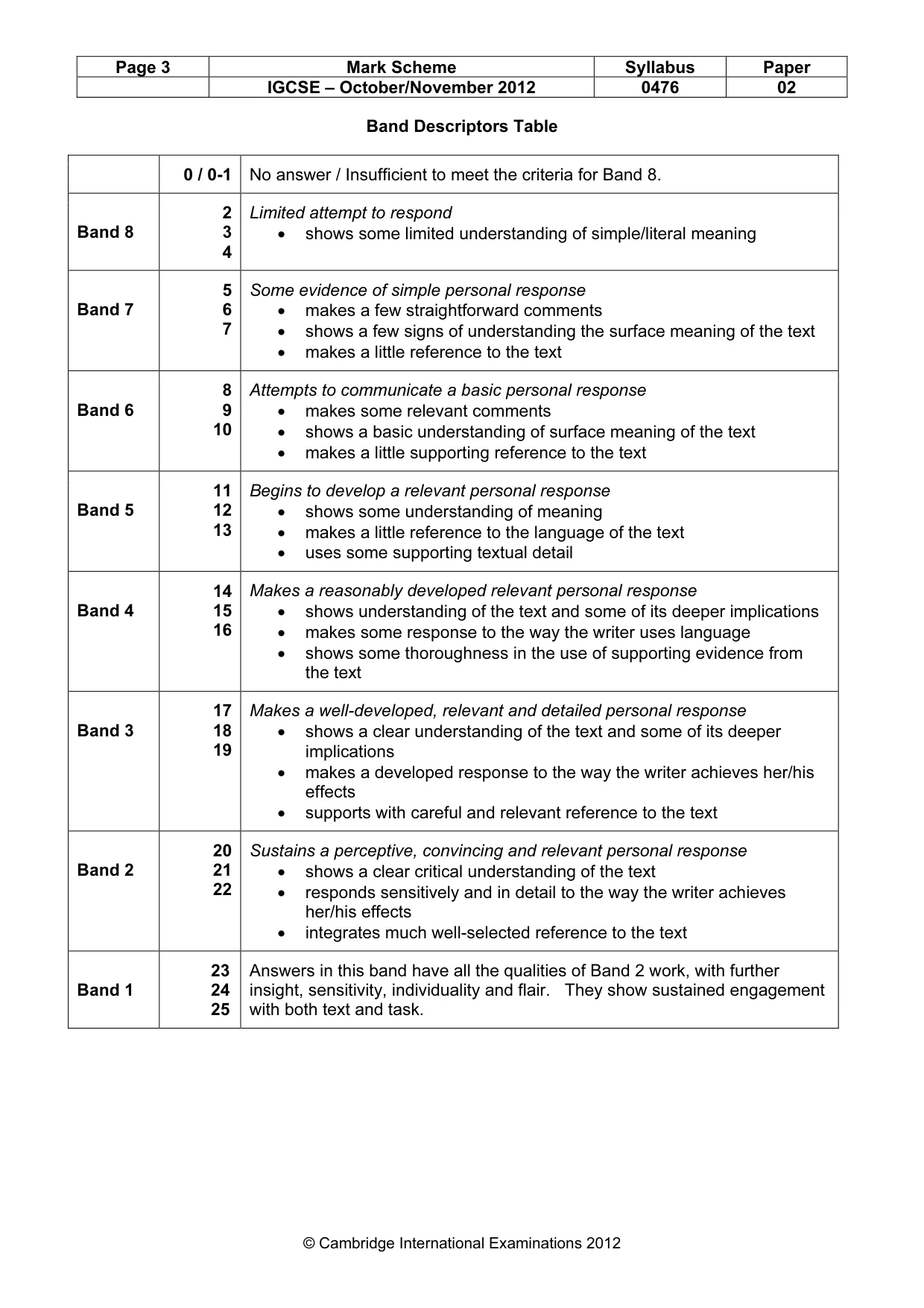
Page 3 Mark Scheme Syllabus Paper IGCSE – October/November 2012 0476 02 © Cambridge International Examinations 2012 Band Descriptors Table 0 / 0-1 No answer / Insufficient to meet the criteria for Band 8. Band 8 2 3 4 Limited attempt to respond • shows some limited understanding of simple/literal meaning Band 7 5 6 7 Some evidence of simple personal response • makes a few straightforward comments • shows a few signs of understanding the surface meaning of the text • makes a little reference to the text Band 6 8 9 10 Attempts to communicate a basic personal response • makes some relevant comments • shows a basic understanding of surface meaning of the text • makes a little supporting reference to the text Band 5 11 12 13 Begins to develop a relevant personal response • shows some understanding of meaning • makes a little reference to the language of the text • uses some supporting textual detail Band 4 14 15 16 Makes a reasonably developed relevant personal response • shows understanding of the text and some of its deeper implications • makes some response to the way the writer uses language • shows some thoroughness in the use of supporting evidence from the text Band 3 17 18 19 Makes a well-developed, relevant and detailed personal response • shows a clear understanding of the text and some of its deeper implications • makes a developed response to the way the writer achieves her/his effects • supports with careful and relevant reference to the text Band 2 20 21 22 Sustains a perceptive, convincing and relevant personal response • shows a clear critical understanding of the text • responds sensitively and in detail to the way the writer achieves her/his effects • integrates much well-selected reference to the text Band 1 23 24 25 Answers in this band have all the qualities of Band 2 work, with further insight, sensitivity, individuality and flair. They show sustained engagement with both text and task.
What you needed in this session
Cambridge’s own grade thresholds for 2012 Oct/Nov, Paper 2 · Variant 1. A higher threshold means an easier paper — the bar moves with how the cohort did.