Cambridge IGCSE English - Literature (UK) 0476 — 2012 May/June Paper 2 · Variant 1
0476/21/M/J/12 · 25 marks · ≈28 min
The question paper and its mark scheme, free to read here and free to download. This is Cambridge’s own paper, exactly as it was sat.
Question paper8 pages


Mark scheme3 pages
Answers below. Sit the paper first if you are practising.
Paper as text
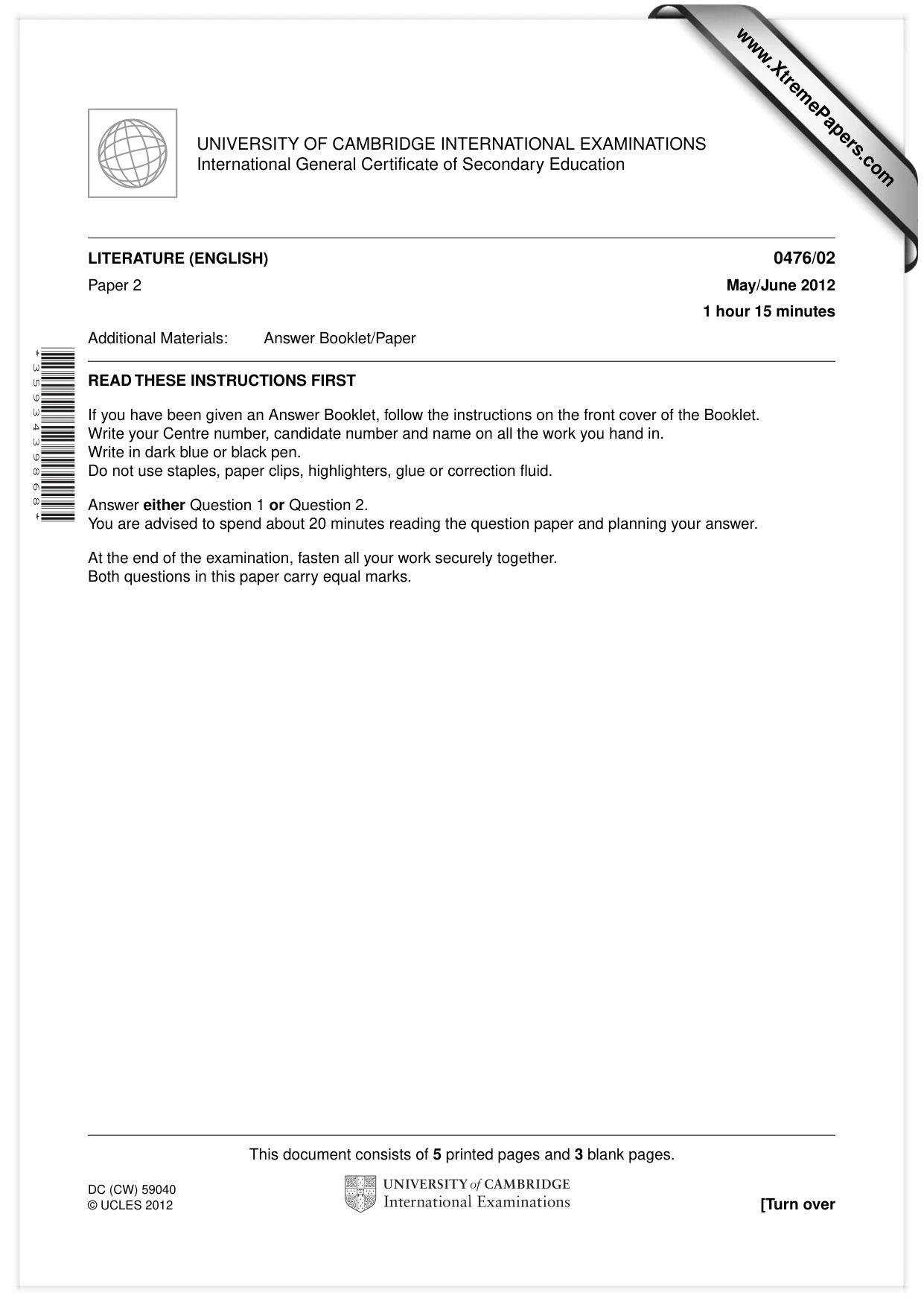
Question paper, page 1
This document consists of 5 printed pages and 3 blank pages. DC (CW) 59040 © UCLES 2012 [Turn over UNIVERSITY OF CAMBRIDGE INTERNATIONAL EXAMINATIONS International General Certificate of Secondary Education * 3 5 9 3 4 3 9 8 6 8 * LITERATURE (ENGLISH) 0476/02 Paper 2 May/June 2012 1 hour 15 minutes Additional Materials: Answer Booklet/Paper READ THESE INSTRUCTIONS FIRST If you have been given an Answer Booklet, follow the instructions on the front cover of the Booklet. Write your Centre number, candidate number and name on all the work you hand in. Write in dark blue or black pen. Do not use staples, paper clips, highlighters, glue or correction fluid. Answer either Question 1 or Question 2. You are advised to spend about 20 minutes reading the question paper and planning your answer. At the end of the examination, fasten all your work securely together. Both questions in this paper carry equal marks. www.XtremePapers.com
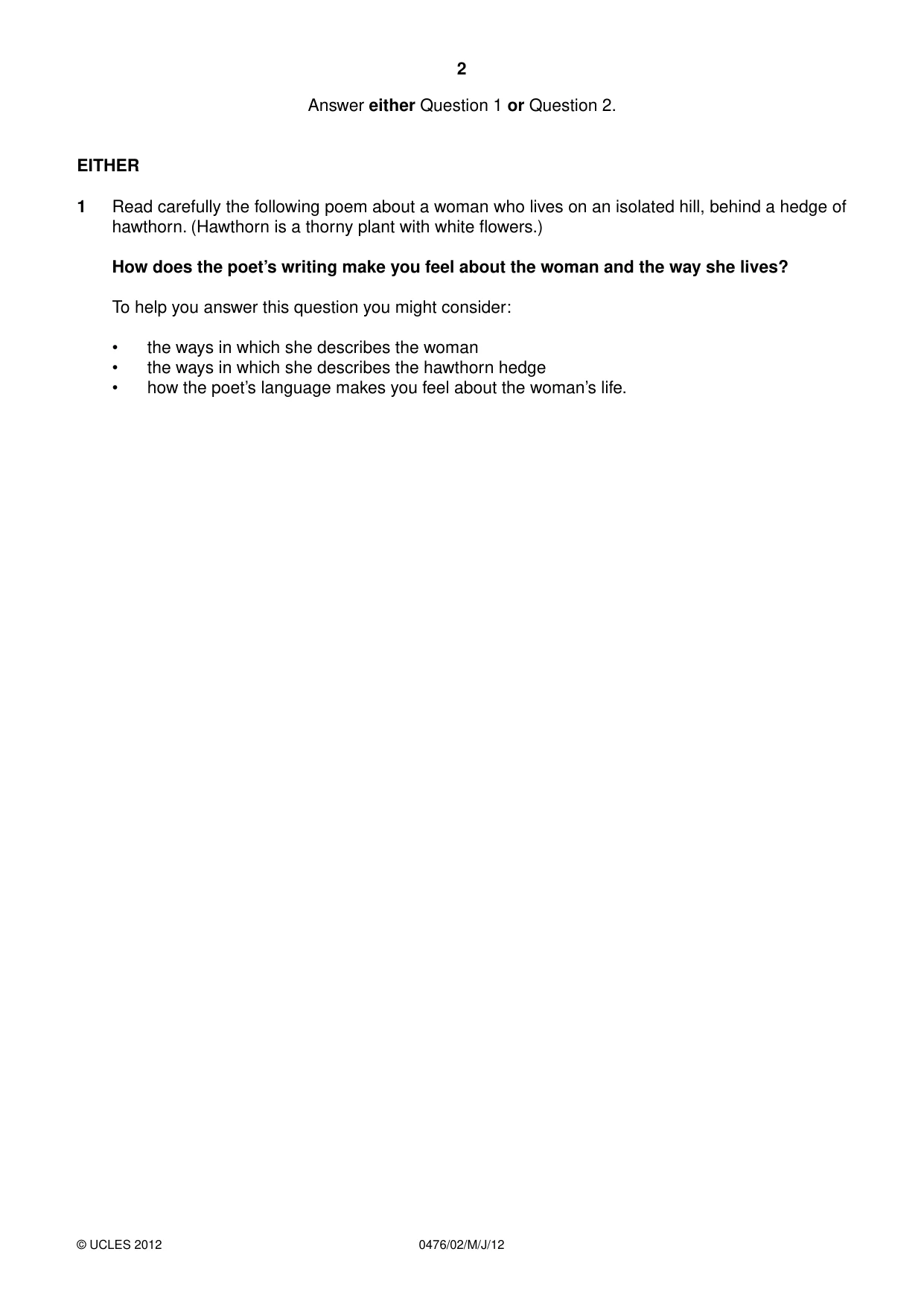
Question paper, page 2
2 0476/02/M/J/12 © UCLES 2012 Answer either Question 1 or Question 2. EITHER 1 Read carefully the following poem about a woman who lives on an isolated hill, behind a hedge of hawthorn. (Hawthorn is a thorny plant with white flowers.) How does the poet’s writing make you feel about the woman and the way she lives? To help you answer this question you might consider: • the ways in which she describes the woman • the ways in which she describes the hawthorn hedge • how the poet’s language makes you feel about the woman’s life.
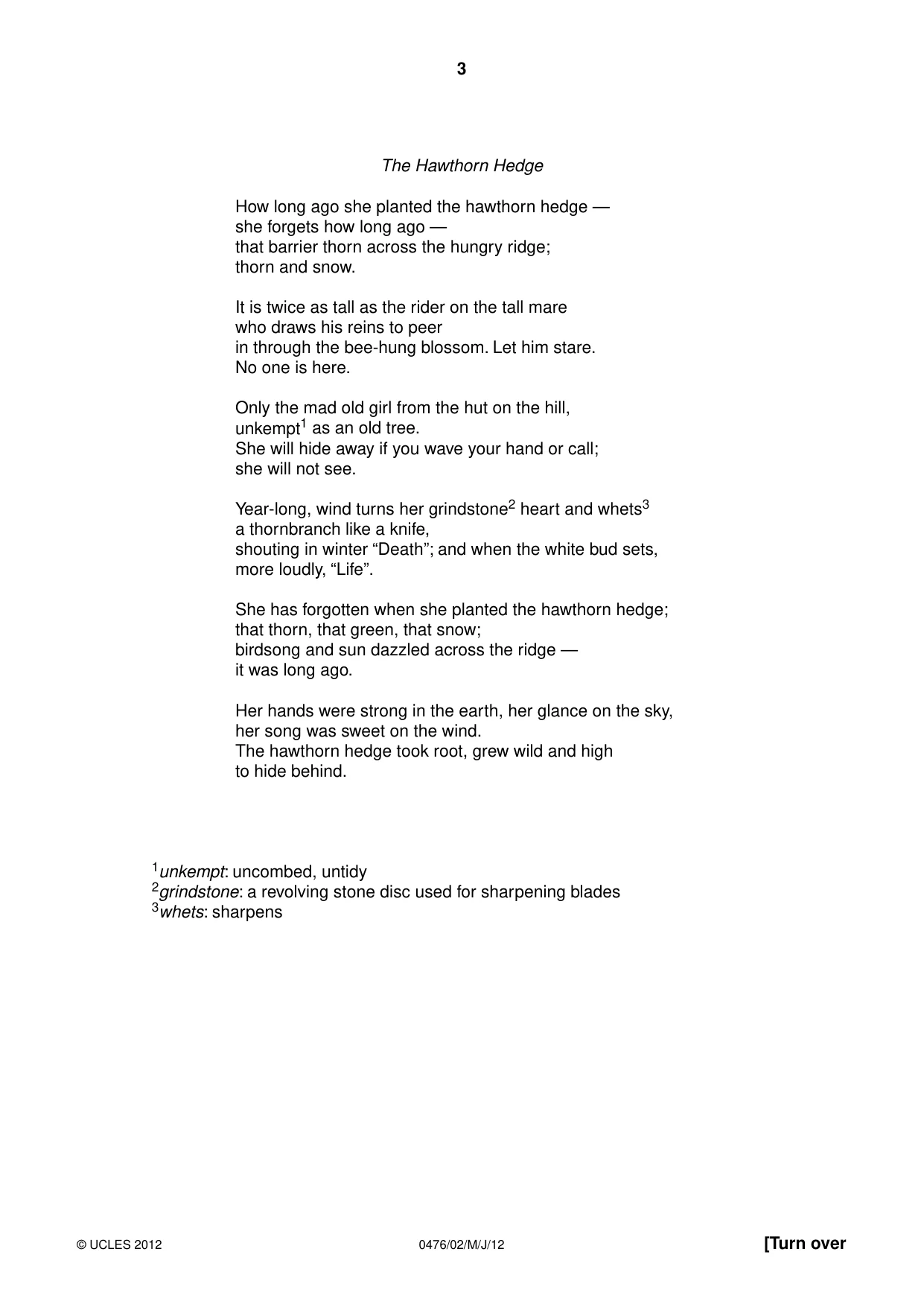
Question paper, page 3
3 0476/02/M/J/12 © UCLES 2012 [Turn over The Hawthorn Hedge How long ago she planted the hawthorn hedge — she forgets how long ago — that barrier thorn across the hungry ridge; thorn and snow. It is twice as tall as the rider on the tall mare who draws his reins to peer in through the bee-hung blossom. Let him stare. No one is here. Only the mad old girl from the hut on the hill, unkempt1 as an old tree. She will hide away if you wave your hand or call; she will not see. Year-long, wind turns her grindstone2 heart and whets3 a thornbranch like a knife, shouting in winter “Death”; and when the white bud sets, more loudly, “Life”. She has forgotten when she planted the hawthorn hedge; that thorn, that green, that snow; birdsong and sun dazzled across the ridge — it was long ago. Her hands were strong in the earth, her glance on the sky, her song was sweet on the wind. The hawthorn hedge took root, grew wild and high to hide behind. 1unkempt: uncombed, untidy 2grindstone: a revolving stone disc used for sharpening blades 3whets: sharpens
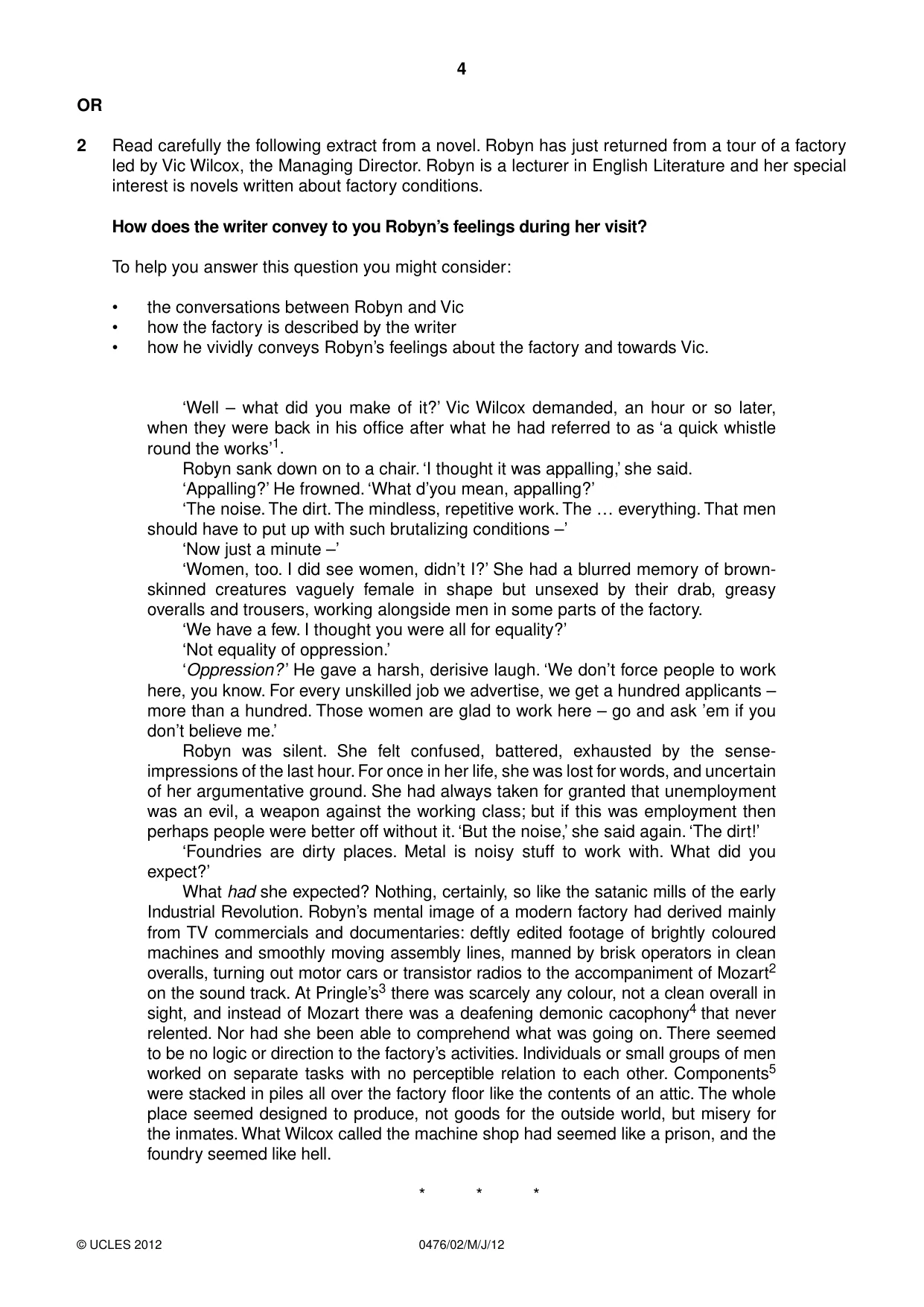
Question paper, page 4
4 0476/02/M/J/12 © UCLES 2012 OR 2 Read carefully the following extract from a novel. Robyn has just returned from a tour of a factory led by Vic Wilcox, the Managing Director. Robyn is a lecturer in English Literature and her special interest is novels written about factory conditions. How does the writer convey to you Robyn’s feelings during her visit? To help you answer this question you might consider: • the conversations between Robyn and Vic • how the factory is described by the writer • how he vividly conveys Robyn’s feelings about the factory and towards Vic. ‘Well – what did you make of it?’ Vic Wilcox demanded, an hour or so later, when they were back in his office after what he had referred to as ‘a quick whistle round the works’1. Robyn sank down on to a chair. ‘I thought it was appalling,’ she said. ‘Appalling?’ He frowned. ‘What d’you mean, appalling?’ ‘The noise. The dirt. The mindless, repetitive work. The … everything. That men should have to put up with such brutalizing conditions –’ ‘Now just a minute –’ ‘Women, too. I did see women, didn’t I?’ She had a blurred memory of brown- skinned creatures vaguely female in shape but unsexed by their drab, greasy overalls and trousers, working alongside men in some parts of the factory. ‘We have a few. I thought you were all for equality?’ ‘Not equality of oppression.’ ‘Oppression? ’ He gave a harsh, derisive laugh. ‘We don’t force people to work here, you know. For every unskilled job we advertise, we get a hundred applicants – more than a hundred. Those women are glad to work here – go and ask ’em if you don’t believe me.’ Robyn was silent. She felt confused, battered, exhausted by the sense- impressions of the last hour. For once in her life, she was lost for words, and uncertain of her argumentative ground. She had always taken for granted that unemployment was an evil, a weapon against the working class; but if this was employment then perhaps people were better off without it. ‘But the noise,’ she said again. ‘The dirt!’ ‘Foundries are dirty places. Metal is noisy stuff to work with. What did you expect?’ What had she expected? Nothing, certainly, so like the satanic mills of the early Industrial Revolution. Robyn’s mental image of a modern factory had derived mainly from TV commercials and documentaries: deftly edited footage of brightly coloured machines and smoothly moving assembly lines, manned by brisk operators in clean overalls, turning out motor cars or transistor radios to the accompaniment of Mozart2 on the sound track. At Pringle’s3 there was scarcely any colour, not a clean overall in sight, and instead of Mozart there was a deafening demonic cacophony4 that never relented. Nor had she been able to comprehend what was going on. There seemed to be no logic or direction to the factory’s activities. Individuals or small groups of men worked on separate tasks with no perceptible relation to each other. Components5 were stacked in piles all over the factory floor like the contents of an attic. The whole place seemed designed to produce, not goods for the outside world, but misery for the inmates. What Wilcox called the machine shop had seemed like a prison, and the foundry seemed like hell. * * *
Question paper, page 5
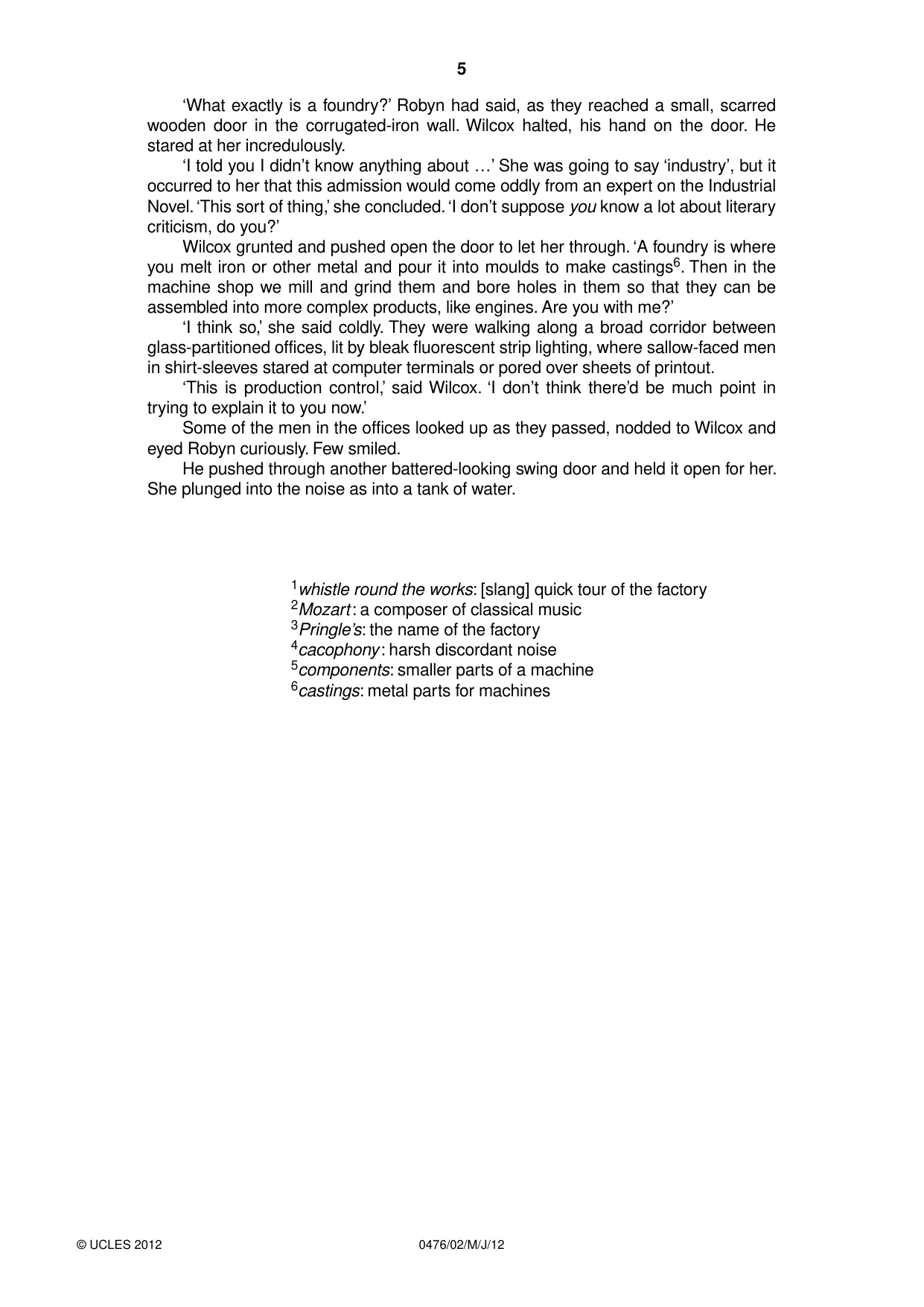
5 0476/02/M/J/12 © UCLES 2012 ‘What exactly is a foundry?’ Robyn had said, as they reached a small, scarred wooden door in the corrugated-iron wall. Wilcox halted, his hand on the door. He stared at her incredulously. ‘I told you I didn’t know anything about …’ She was going to say ‘industry’, but it occurred to her that this admission would come oddly from an expert on the Industrial Novel. ‘This sort of thing,’ she concluded. ‘I don’t suppose you know a lot about literary criticism, do you?’ Wilcox grunted and pushed open the door to let her through. ‘A foundry is where you melt iron or other metal and pour it into moulds to make castings6. Then in the machine shop we mill and grind them and bore holes in them so that they can be assembled into more complex products, like engines. Are you with me?’ ‘I think so,’ she said coldly. They were walking along a broad corridor between glass-partitioned offices, lit by bleak fluorescent strip lighting, where sallow-faced men in shirt-sleeves stared at computer terminals or pored over sheets of printout. ‘This is production control,’ said Wilcox. ‘I don’t think there’d be much point in trying to explain it to you now.’ Some of the men in the offices looked up as they passed, nodded to Wilcox and eyed Robyn curiously. Few smiled. He pushed through another battered-looking swing door and held it open for her. She plunged into the noise as into a tank of water. 1whistle round the works: [slang] quick tour of the factory 2Mozart : a composer of classical music 3Pringle’s: the name of the factory 4cacophony : harsh discordant noise 5components: smaller parts of a machine 6castings: metal parts for machines
Question paper, page 6
6 0476/02/M/J/12 © UCLES 2012 BLANK PAGE
Question paper, page 7
7 0476/02/M/J/12 © UCLES 2012 BLANK PAGE
Question paper, page 8
8 0476/02/M/J/12 © UCLES 2012 BLANK PAGE Copyright Acknowledgements: Question 1 © Judith Wright; The Hawthorn Hedge from Judith Wright: Collected Poems ; Angus and Robertson; 1971. Question 2 © David Lodge; Nice Work ; Penguin Books; 1989. Permission to reproduce items where third-party owned material protected by copyright is included has been sought and cleared where possible. Every reasonable effort has been made by the publisher (UCLES) to trace copyright holders, but if any items requiring clearance have unwittingly been included, the publisher will be pleased to make amends at the earliest possible opportunity. University of Cambridge International Examinations is part of the Cambridge Assessment Group. Cambridge Assessment is the brand name of University of Cambridge Local Examinations Syndicate (UCLES), which is itself a department of the University of Cambridge.
Mark scheme, page 1
UNIVERSITY OF CAMBRIDGE INTERNATIONAL EXAMINATIONS International General Certificate of Secondary Education MARK SCHEME for the May/June 2012 question paper for the guidance of teachers 0476 LITERATURE (ENGLISH) 0476/02 Paper 2 (Unseen), maximum raw mark 25 This mark scheme is published as an aid to teachers and candidates, to indicate the requirements of the examination. It shows the basis on which Examiners were instructed to award marks. It does not indicate the details of the discussions that took place at an Examiners’ meeting before marking began, which would have considered the acceptability of alternative answers. Mark schemes must be read in conjunction with the question papers and the report on the examination. • Cambridge will not enter into discussions or correspondence in connection with these mark schemes. Cambridge is publishing the mark schemes for the May/June 2012 question papers for most IGCSE, GCE Advanced Level and Advanced Subsidiary Level syllabuses and some Ordinary Level syllabuses. www.XtremePapers.com
Mark scheme, page 2
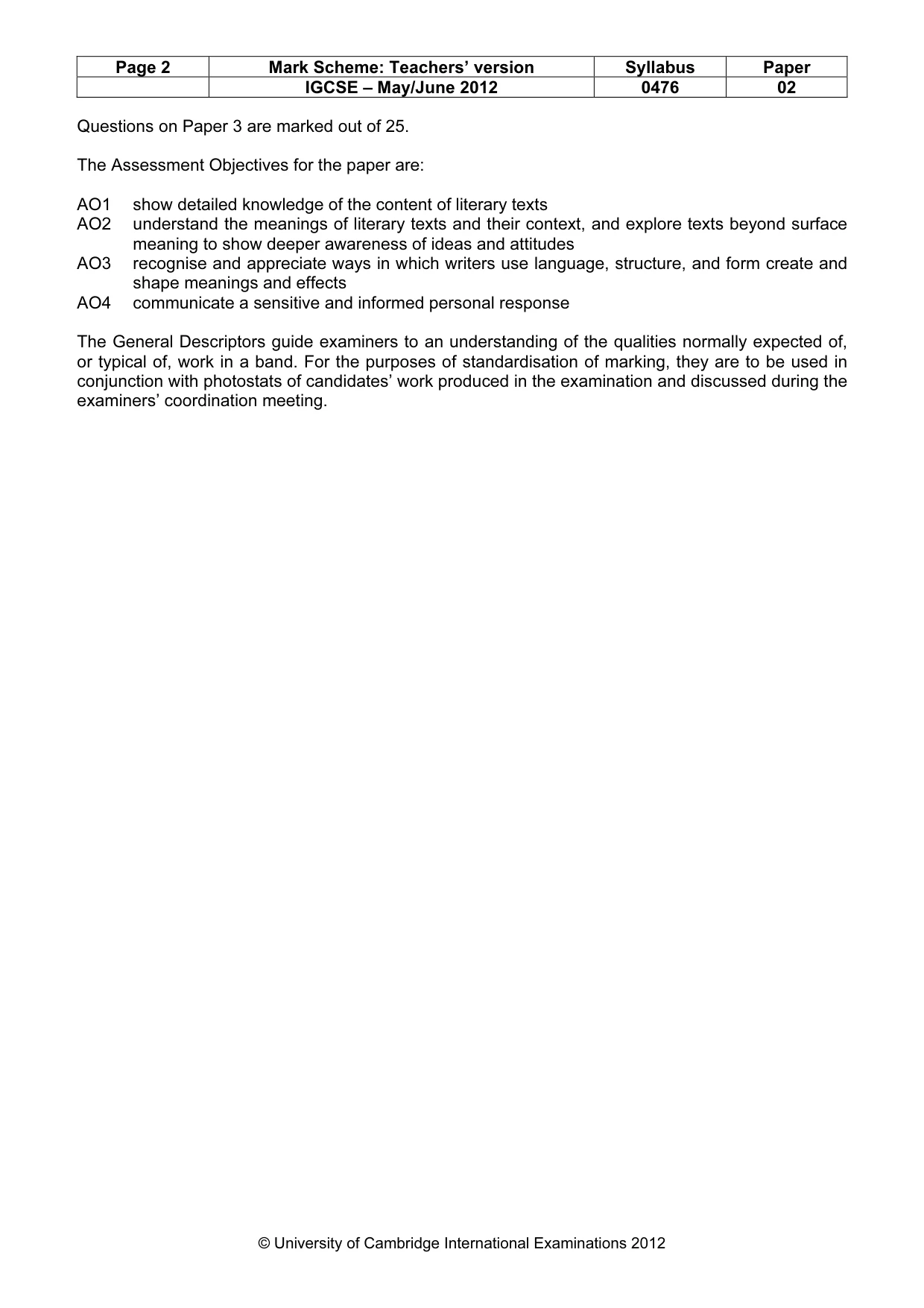
Page 2 Mark Scheme: Teachers’ version Syllabus Paper IGCSE – May/June 2012 0476 02 © University of Cambridge International Examinations 2012 Questions on Paper 3 are marked out of 25. The Assessment Objectives for the paper are: AO1 show detailed knowledge of the content of literary texts AO2 understand the meanings of literary texts and their context, and explore texts beyond surface meaning to show deeper awareness of ideas and attitudes AO3 recognise and appreciate ways in which writers use language, structure, and form create and shape meanings and effects AO4 communicate a sensitive and informed personal response The General Descriptors guide examiners to an understanding of the qualities normally expected of, or typical of, work in a band. For the purposes of standardisation of marking, they are to be used in conjunction with photostats of candidates’ work produced in the examination and discussed during the examiners’ coordination meeting.
Mark scheme, page 3
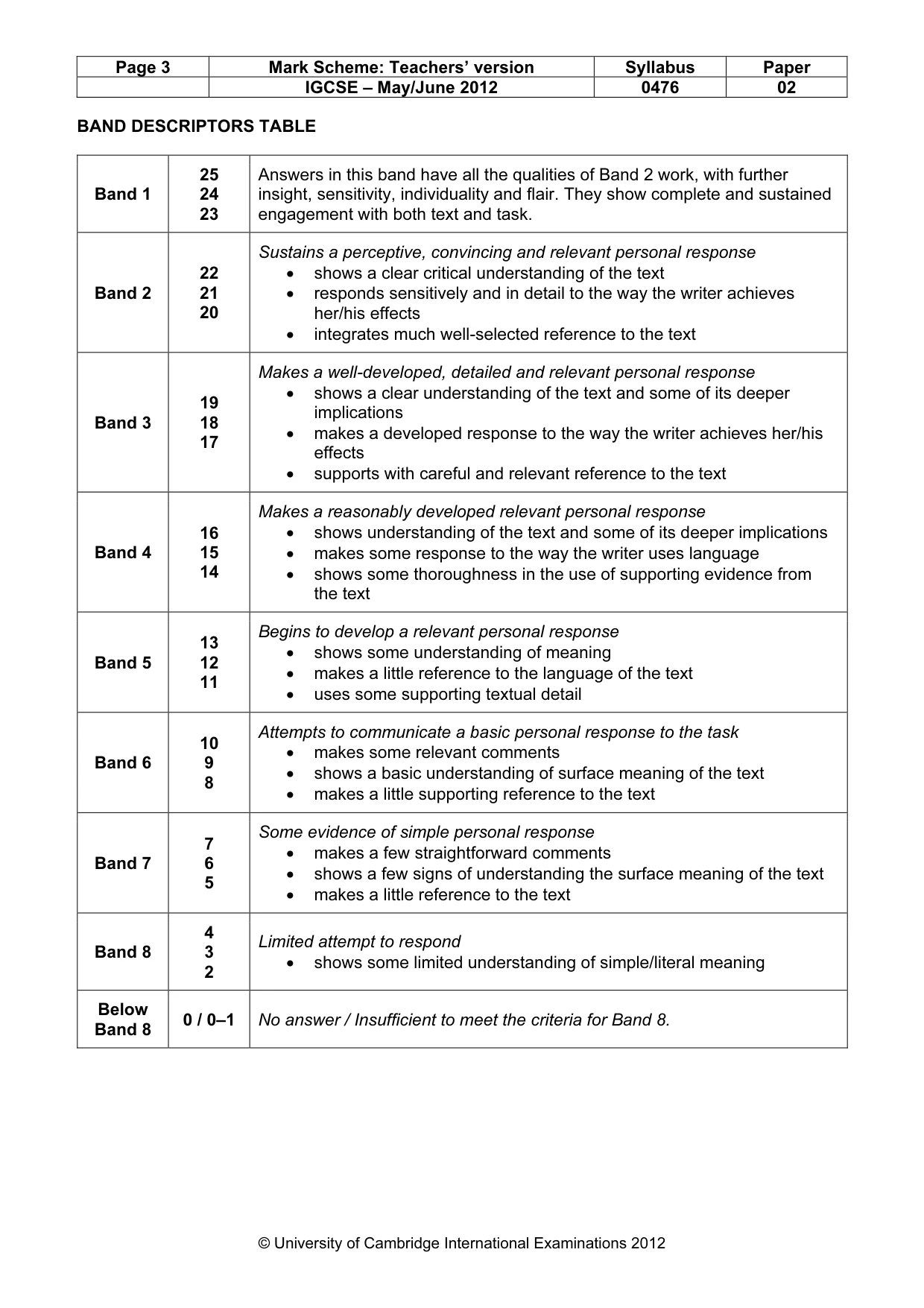
Page 3 Mark Scheme: Teachers’ version Syllabus Paper IGCSE – May/June 2012 0476 02 © University of Cambridge International Examinations 2012 BAND DESCRIPTORS TABLE Band 1 25 24 23 Answers in this band have all the qualities of Band 2 work, with further insight, sensitivity, individuality and flair. They show complete and sustained engagement with both text and task. Band 2 22 21 20 Sustains a perceptive, convincing and relevant personal response • shows a clear critical understanding of the text • responds sensitively and in detail to the way the writer achieves her/his effects • integrates much well-selected reference to the text Band 3 19 18 17 Makes a well-developed, detailed and relevant personal response • shows a clear understanding of the text and some of its deeper implications • makes a developed response to the way the writer achieves her/his effects • supports with careful and relevant reference to the text Band 4 16 15 14 Makes a reasonably developed relevant personal response • shows understanding of the text and some of its deeper implications • makes some response to the way the writer uses language • shows some thoroughness in the use of supporting evidence from the text Band 5 13 12 11 Begins to develop a relevant personal response • shows some understanding of meaning • makes a little reference to the language of the text • uses some supporting textual detail Band 6 10 9 8 Attempts to communicate a basic personal response to the task • makes some relevant comments • shows a basic understanding of surface meaning of the text • makes a little supporting reference to the text Band 7 7 6 5 Some evidence of simple personal response • makes a few straightforward comments • shows a few signs of understanding the surface meaning of the text • makes a little reference to the text Band 8 4 3 2 Limited attempt to respond • shows some limited understanding of simple/literal meaning Below Band 8 0 / 0–1 No answer / Insufficient to meet the criteria for Band 8.
What you needed in this session
Cambridge’s own grade thresholds for 2012 May/June, Paper 2 · Variant 1. A higher threshold means an easier paper — the bar moves with how the cohort did.