Cambridge IGCSE English - Literature (UK) 0476 — 2011 May/June Paper 2 · Variant 1
0476/21/M/J/11
The question paper and its mark scheme, free to read here and free to download. This is Cambridge’s own paper, exactly as it was sat.
Question paper8 pages



Mark scheme3 pages
Answers below. Sit the paper first if you are practising.
Paper as text
Question paper, page 1
This document consists of 5 printed pages and 3 blank pages. DC (SM) 43676 © UCLES 2011 [Turn over UNIVERSITY OF CAMBRIDGE INTERNATIONAL EXAMINATIONS International General Certificate of Secondary Education * 7 5 1 1 1 6 2 6 4 0 * LITERATURE (ENGLISH) 0476/02 Paper 2 May/June 2011 1 hour 15 minutes Additional Materials: Answer Booklet/Paper READ THESE INSTRUCTIONS FIRST If you have been given an Answer Booklet, follow the instructions on the front cover of the Booklet. Write your Centre number, candidate number and name on all the work you hand in. Write in dark blue or black pen. Do not use staples, paper clips, highlighters, glue or correction fluid. Answer either Question 1 or Question 2. You are advised to spend about 20 minutes reading the question paper and planning your answer. At the end of the examination, fasten all your work securely together. Both questions in this paper carry equal marks. www.XtremePapers.com
Question paper, page 2
2 0476/02/M/J/11 © UCLES 2011 Answer either Question 1 or Question 2. EITHER 1 Read carefully the poem opposite about children playing in the streets during the school holidays. How do the words of the poem express the poet’s feelings about the children she observes at play? To help you answer, you might consider: • how their play is described • the portrayal of their parents • the impact the ending of the poem makes on you.
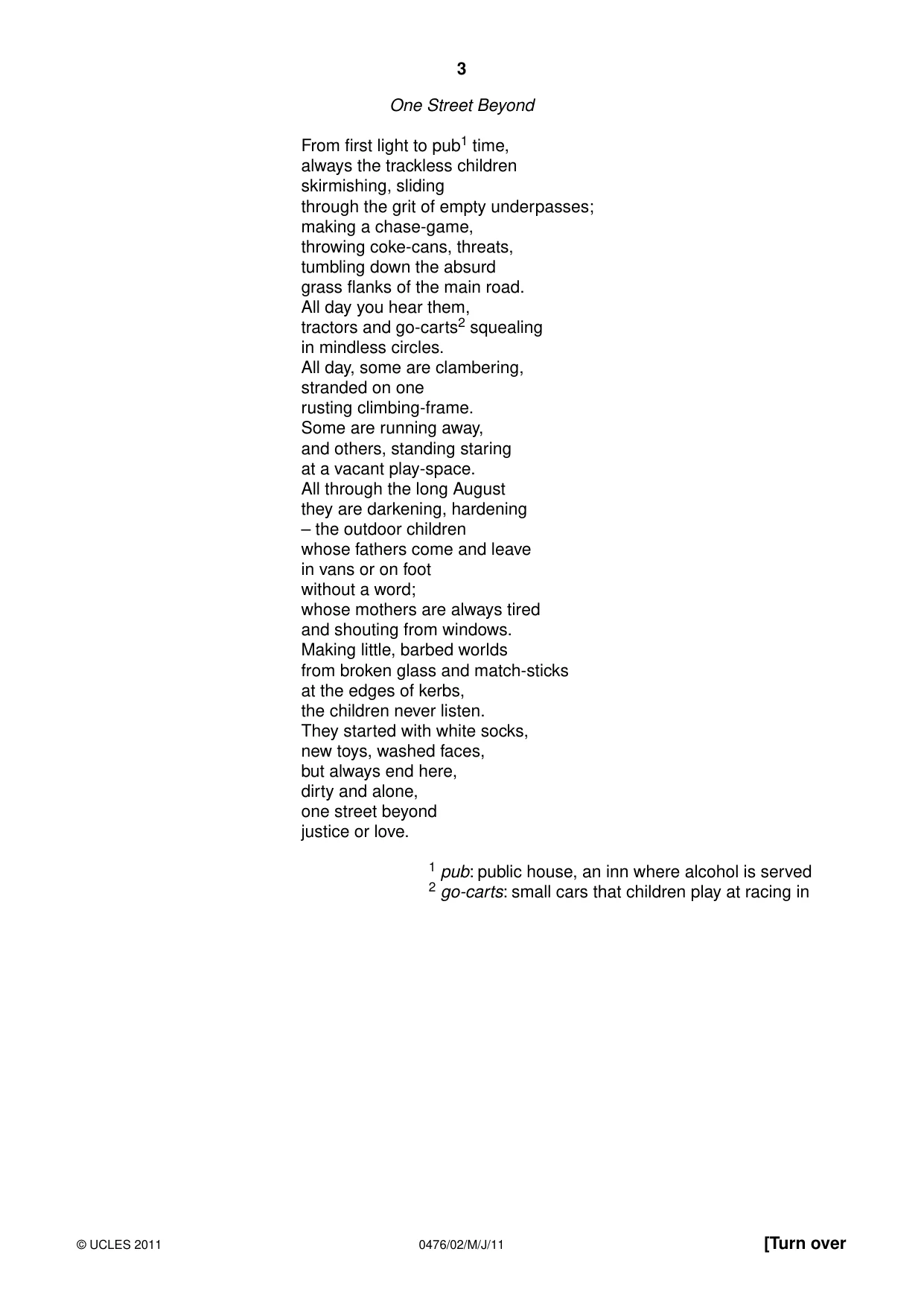
Question paper, page 3
3 0476/02/M/J/11 © UCLES 2011 [Turn over One Street Beyond From first light to pub1 time, always the trackless children skirmishing, sliding through the grit of empty underpasses; making a chase-game, throwing coke-cans, threats, tumbling down the absurd grass flanks of the main road. All day you hear them, tractors and go-carts2 squealing in mindless circles. All day, some are clambering, stranded on one rusting climbing-frame. Some are running away, and others, standing staring at a vacant play-space. All through the long August they are darkening, hardening – the outdoor children whose fathers come and leave in vans or on foot without a word; whose mothers are always tired and shouting from windows. Making little, barbed worlds from broken glass and match-sticks at the edges of kerbs, the children never listen. They started with white socks, new toys, washed faces, but always end here, dirty and alone, one street beyond justice or love. 1 pub: public house, an inn where alcohol is served 2 go-carts: small cars that children play at racing in
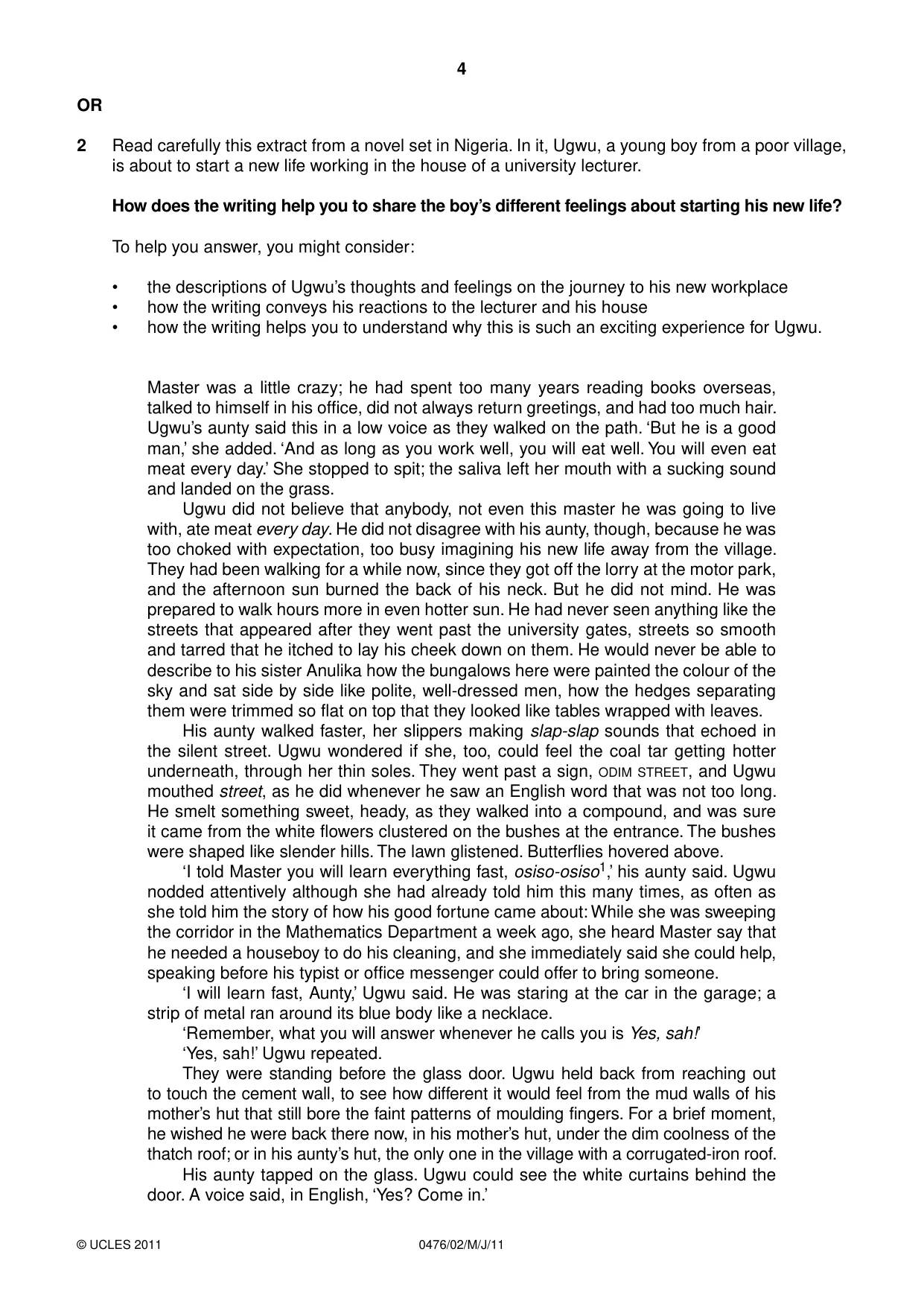
Question paper, page 4
4 0476/02/M/J/11 © UCLES 2011 OR 2 Read carefully this extract from a novel set in Nigeria. In it, Ugwu, a young boy from a poor village, is about to start a new life working in the house of a university lecturer. How does the writing help you to share the boy’s different feelings about starting his new life? To help you answer, you might consider: • the descriptions of Ugwu’s thoughts and feelings on the journey to his new workplace • how the writing conveys his reactions to the lecturer and his house • how the writing helps you to understand why this is such an exciting experience for Ugwu. Master was a little crazy; he had spent too many years reading books overseas, talked to himself in his office, did not always return greetings, and had too much hair. Ugwu’s aunty said this in a low voice as they walked on the path. ‘But he is a good man,’ she added. ‘And as long as you work well, you will eat well. You will even eat meat every day.’ She stopped to spit; the saliva left her mouth with a sucking sound and landed on the grass. Ugwu did not believe that anybody, not even this master he was going to live with, ate meat every day. He did not disagree with his aunty, though, because he was too choked with expectation, too busy imagining his new life away from the village. They had been walking for a while now, since they got off the lorry at the motor park, and the afternoon sun burned the back of his neck. But he did not mind. He was prepared to walk hours more in even hotter sun. He had never seen anything like the streets that appeared after they went past the university gates, streets so smooth and tarred that he itched to lay his cheek down on them. He would never be able to describe to his sister Anulika how the bungalows here were painted the colour of the sky and sat side by side like polite, well-dressed men, how the hedges separating them were trimmed so flat on top that they looked like tables wrapped with leaves. His aunty walked faster, her slippers making slap-slap sounds that echoed in the silent street. Ugwu wondered if she, too, could feel the coal tar getting hotter underneath, through her thin soles. They went past a sign, ODIM STREET, and Ugwu mouthed street, as he did whenever he saw an English word that was not too long. He smelt something sweet, heady, as they walked into a compound, and was sure it came from the white flowers clustered on the bushes at the entrance. The bushes were shaped like slender hills. The lawn glistened. Butterflies hovered above. ‘I told Master you will learn everything fast, osiso-osiso1,’ his aunty said. Ugwu nodded attentively although she had already told him this many times, as often as she told him the story of how his good fortune came about: While she was sweeping the corridor in the Mathematics Department a week ago, she heard Master say that he needed a houseboy to do his cleaning, and she immediately said she could help, speaking before his typist or office messenger could offer to bring someone. ‘I will learn fast, Aunty,’ Ugwu said. He was staring at the car in the garage; a strip of metal ran around its blue body like a necklace. ‘Remember, what you will answer whenever he calls you is Yes, sah!’ ‘Yes, sah!’ Ugwu repeated. They were standing before the glass door. Ugwu held back from reaching out to touch the cement wall, to see how different it would feel from the mud walls of his mother’s hut that still bore the faint patterns of moulding fingers. For a brief moment, he wished he were back there now, in his mother’s hut, under the dim coolness of the thatch roof; or in his aunty’s hut, the only one in the village with a corrugated-iron roof. His aunty tapped on the glass. Ugwu could see the white curtains behind the door. A voice said, in English, ‘Yes? Come in.’
Question paper, page 5
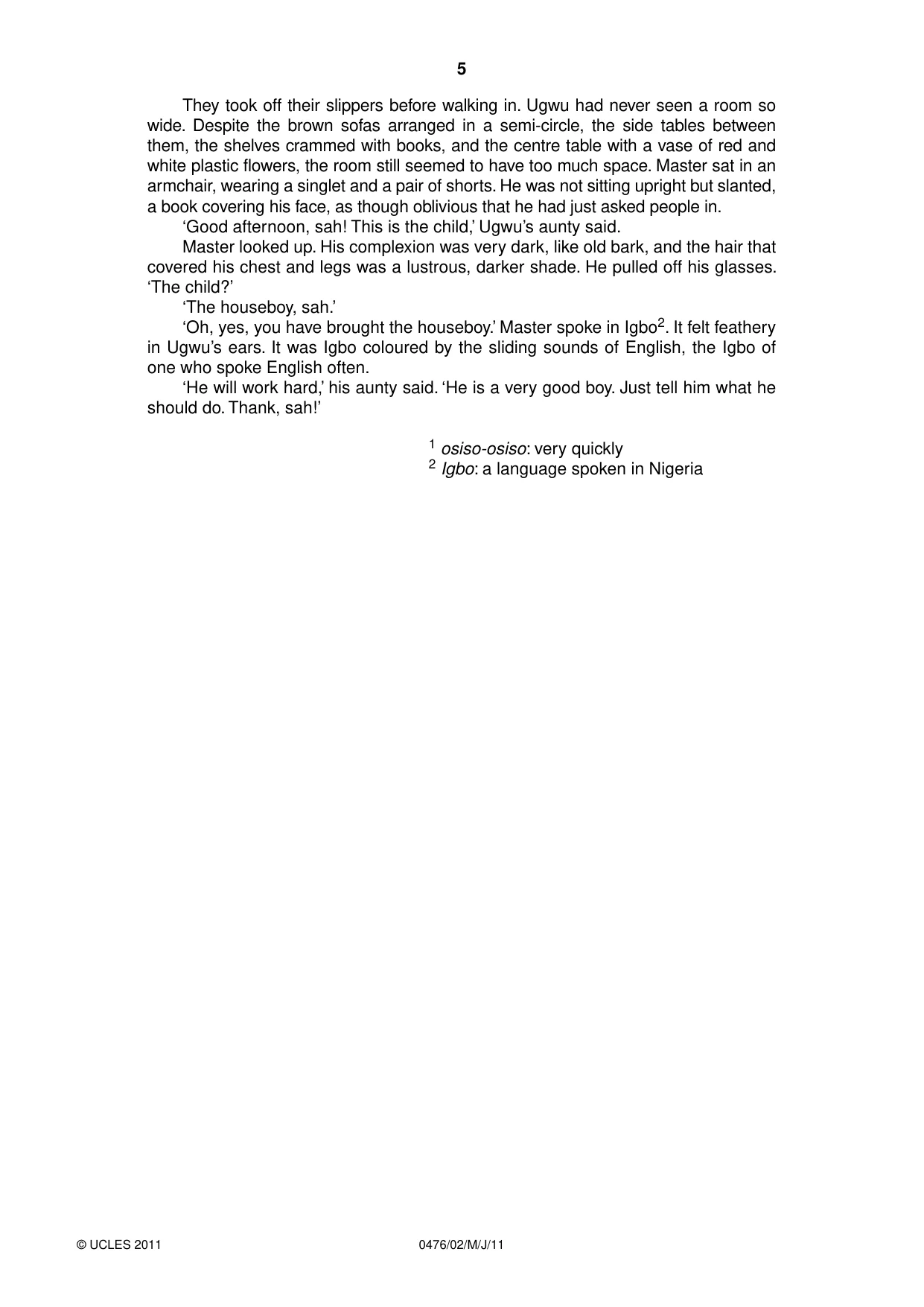
5 0476/02/M/J/11 © UCLES 2011 They took off their slippers before walking in. Ugwu had never seen a room so wide. Despite the brown sofas arranged in a semi-circle, the side tables between them, the shelves crammed with books, and the centre table with a vase of red and white plastic flowers, the room still seemed to have too much space. Master sat in an armchair, wearing a singlet and a pair of shorts. He was not sitting upright but slanted, a book covering his face, as though oblivious that he had just asked people in. ‘Good afternoon, sah! This is the child,’ Ugwu’s aunty said. Master looked up. His complexion was very dark, like old bark, and the hair that covered his chest and legs was a lustrous, darker shade. He pulled off his glasses. ‘The child?’ ‘The houseboy, sah.’ ‘Oh, yes, you have brought the houseboy.’ Master spoke in Igbo2. It felt feathery in Ugwu’s ears. It was Igbo coloured by the sliding sounds of English, the Igbo of one who spoke English often. ‘He will work hard,’ his aunty said. ‘He is a very good boy. Just tell him what he should do. Thank, sah!’ 1 osiso-osiso: very quickly 2 Igbo: a language spoken in Nigeria
Question paper, page 6
6 0476/02/M/J/11 © UCLES 2011 BLANK PAGE
Question paper, page 7
7 0476/02/M/J/11 © UCLES 2011 BLANK PAGE
Question paper, page 8
8 0476/02/M/J/11 © UCLES 2011 BLANK PAGE Copyright Acknowledgments: Question 1 © Carol Rumens; ‘One Street Beyond’, in Six Women Poets; Oxford University Press; 1992. Question 2 © Chimamanda Ngozi Adichie; Half of a Yellow Sun; Harper Perennial; 2007. Permission to reproduce items where third-party owned material protected by copyright is included has been sought and cleared where possible. Every reasonable effort has been made by the publisher (UCLES) to trace copyright holders, but if any items requiring clearance have unwittingly been included, the publisher will be pleased to make amends at the earliest possible opportunity. University of Cambridge International Examinations is part of the Cambridge Assessment Group. Cambridge Assessment is the brand name of University of Cambridge Local Examinations Syndicate (UCLES), which is itself a department of the University of Cambridge.
Mark scheme, page 1
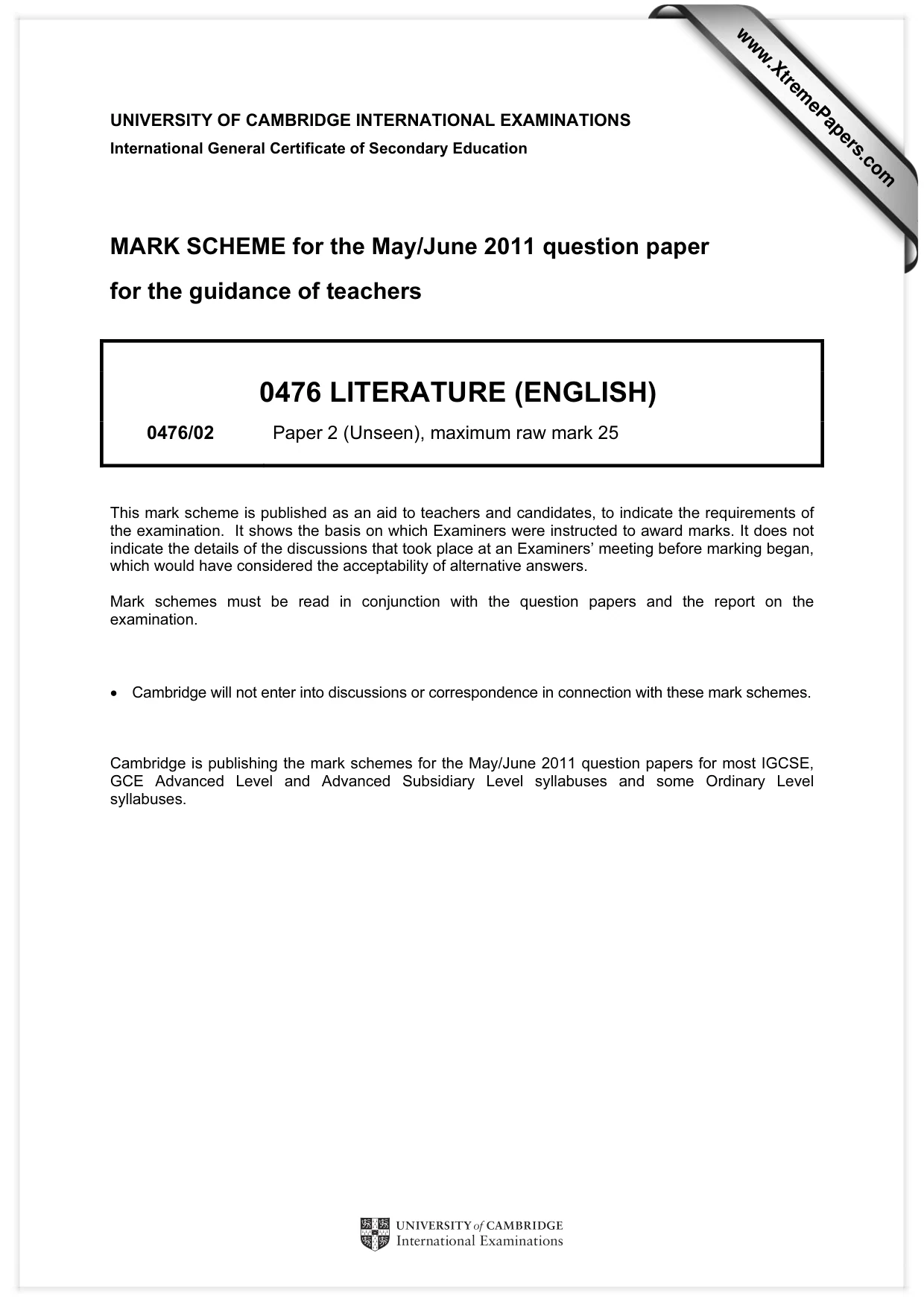
UNIVERSITY OF CAMBRIDGE INTERNATIONAL EXAMINATIONS International General Certificate of Secondary Education MARK SCHEME for the May/June 2011 question paper for the guidance of teachers 0476 LITERATURE (ENGLISH) 0476/02 Paper 2 (Unseen), maximum raw mark 25 This mark scheme is published as an aid to teachers and candidates, to indicate the requirements of the examination. It shows the basis on which Examiners were instructed to award marks. It does not indicate the details of the discussions that took place at an Examiners’ meeting before marking began, which would have considered the acceptability of alternative answers. Mark schemes must be read in conjunction with the question papers and the report on the examination. • Cambridge will not enter into discussions or correspondence in connection with these mark schemes. Cambridge is publishing the mark schemes for the May/June 2011 question papers for most IGCSE, GCE Advanced Level and Advanced Subsidiary Level syllabuses and some Ordinary Level syllabuses. www.XtremePapers.com
Mark scheme, page 2
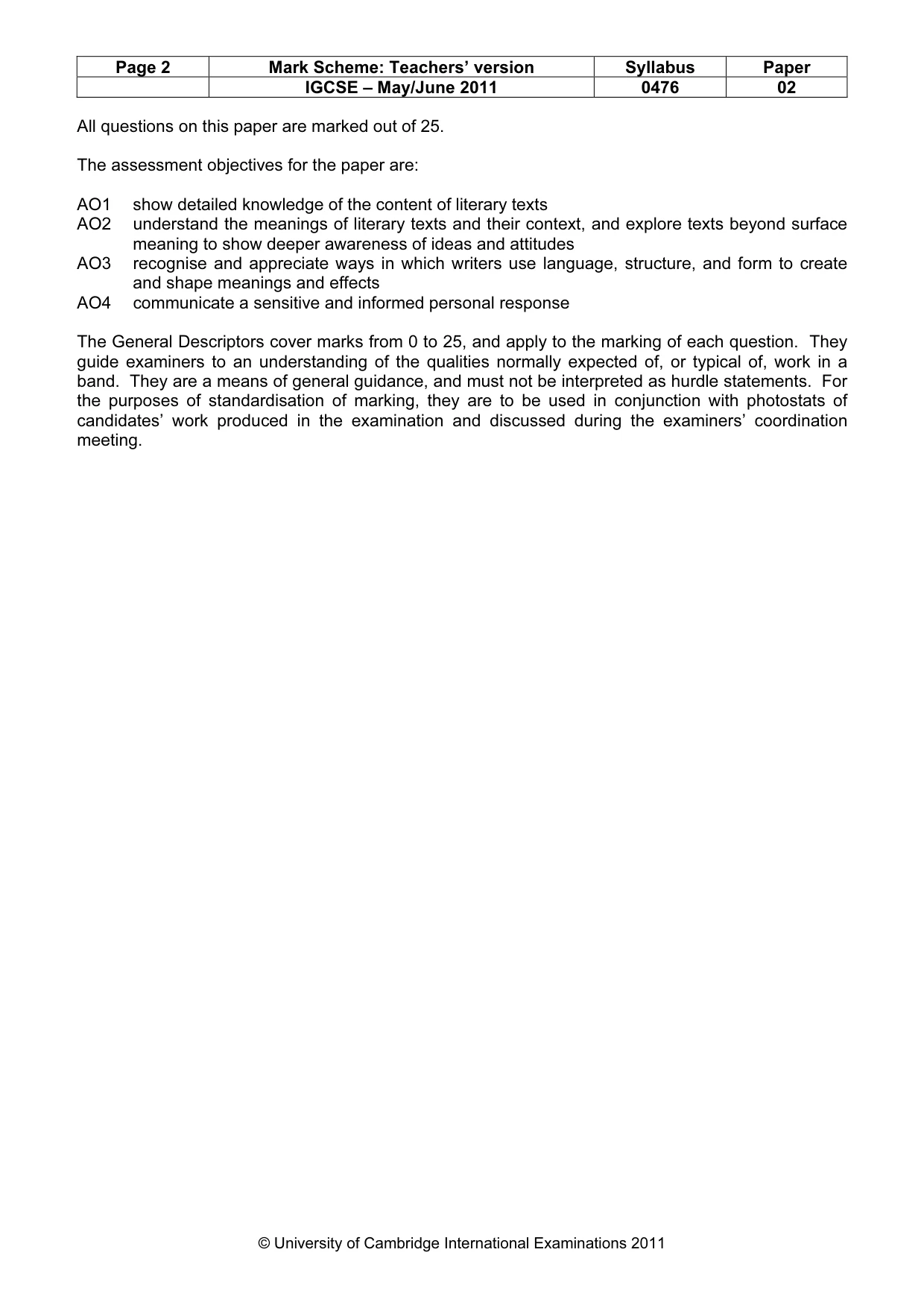
Page 2 Mark Scheme: Teachers’ version Syllabus Paper IGCSE – May/June 2011 0476 02 © University of Cambridge International Examinations 2011 All questions on this paper are marked out of 25. The assessment objectives for the paper are: AO1 show detailed knowledge of the content of literary texts AO2 understand the meanings of literary texts and their context, and explore texts beyond surface meaning to show deeper awareness of ideas and attitudes AO3 recognise and appreciate ways in which writers use language, structure, and form to create and shape meanings and effects AO4 communicate a sensitive and informed personal response The General Descriptors cover marks from 0 to 25, and apply to the marking of each question. They guide examiners to an understanding of the qualities normally expected of, or typical of, work in a band. They are a means of general guidance, and must not be interpreted as hurdle statements. For the purposes of standardisation of marking, they are to be used in conjunction with photostats of candidates’ work produced in the examination and discussed during the examiners’ coordination meeting.
Mark scheme, page 3
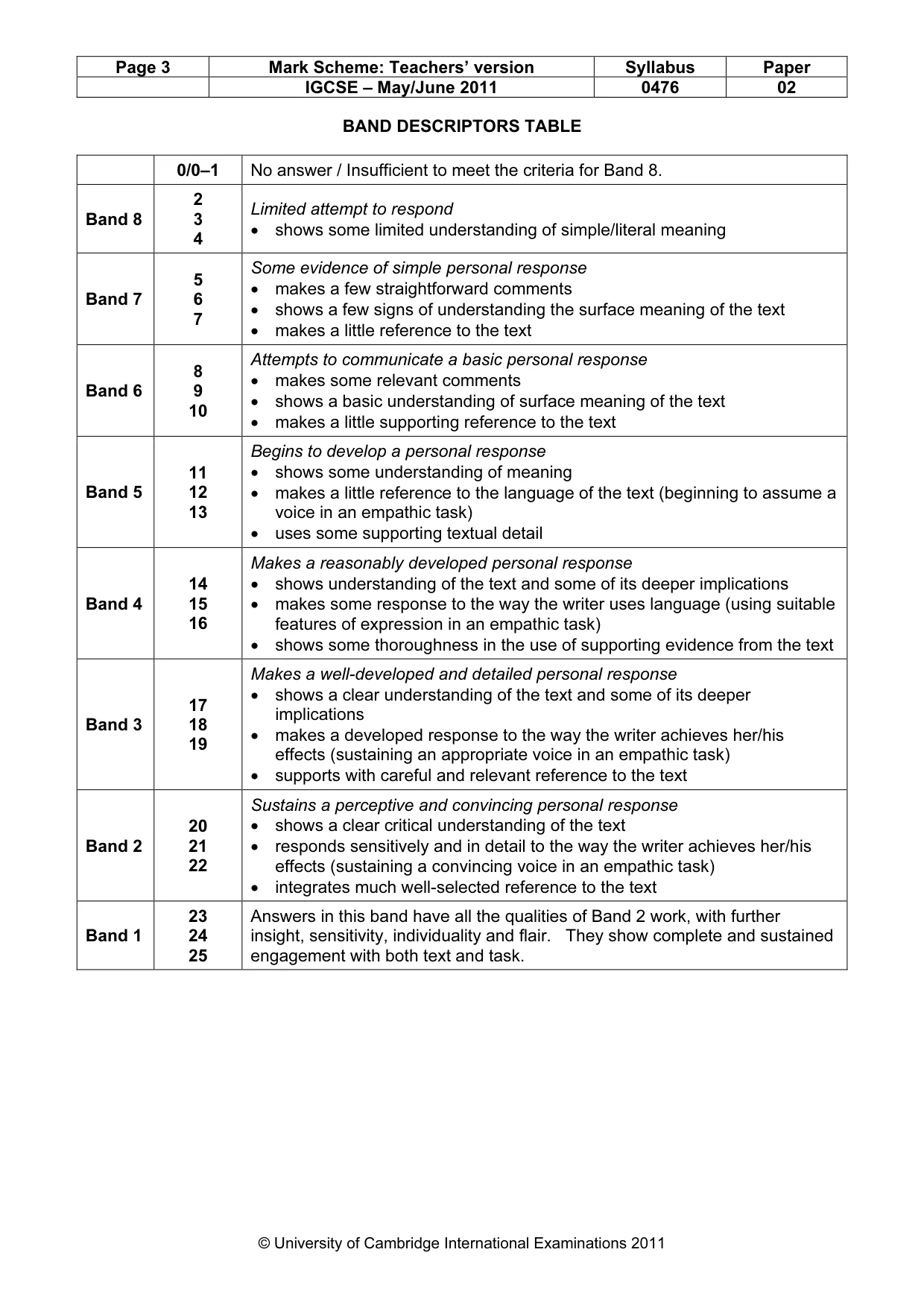
Page 3 Mark Scheme: Teachers’ version Syllabus Paper IGCSE – May/June 2011 0476 02 © University of Cambridge International Examinations 2011 BAND DESCRIPTORS TABLE 0/0–1 No answer / Insufficient to meet the criteria for Band 8. Band 8 2 3 4 Limited attempt to respond • shows some limited understanding of simple/literal meaning Band 7 5 6 7 Some evidence of simple personal response • makes a few straightforward comments • shows a few signs of understanding the surface meaning of the text • makes a little reference to the text Band 6 8 9 10 Attempts to communicate a basic personal response • makes some relevant comments • shows a basic understanding of surface meaning of the text • makes a little supporting reference to the text Band 5 11 12 13 Begins to develop a personal response • shows some understanding of meaning • makes a little reference to the language of the text (beginning to assume a voice in an empathic task) • uses some supporting textual detail Band 4 14 15 16 Makes a reasonably developed personal response • shows understanding of the text and some of its deeper implications • makes some response to the way the writer uses language (using suitable features of expression in an empathic task) • shows some thoroughness in the use of supporting evidence from the text Band 3 17 18 19 Makes a well-developed and detailed personal response • shows a clear understanding of the text and some of its deeper implications • makes a developed response to the way the writer achieves her/his effects (sustaining an appropriate voice in an empathic task) • supports with careful and relevant reference to the text Band 2 20 21 22 Sustains a perceptive and convincing personal response • shows a clear critical understanding of the text • responds sensitively and in detail to the way the writer achieves her/his effects (sustaining a convincing voice in an empathic task) • integrates much well-selected reference to the text Band 1 23 24 25 Answers in this band have all the qualities of Band 2 work, with further insight, sensitivity, individuality and flair. They show complete and sustained engagement with both text and task.