Cambridge IGCSE English - Literature in English 0475 — 2022 Oct/Nov Paper 3 · Variant 3
0475/33/O/N/22 · 25 marks · ≈28 min
The question paper and its mark scheme, free to read here and free to download. This is Cambridge’s own paper, exactly as it was sat.
Question paper12 pages

Mark scheme5 pages
Answers below. Sit the paper first if you are practising.
Paper as text
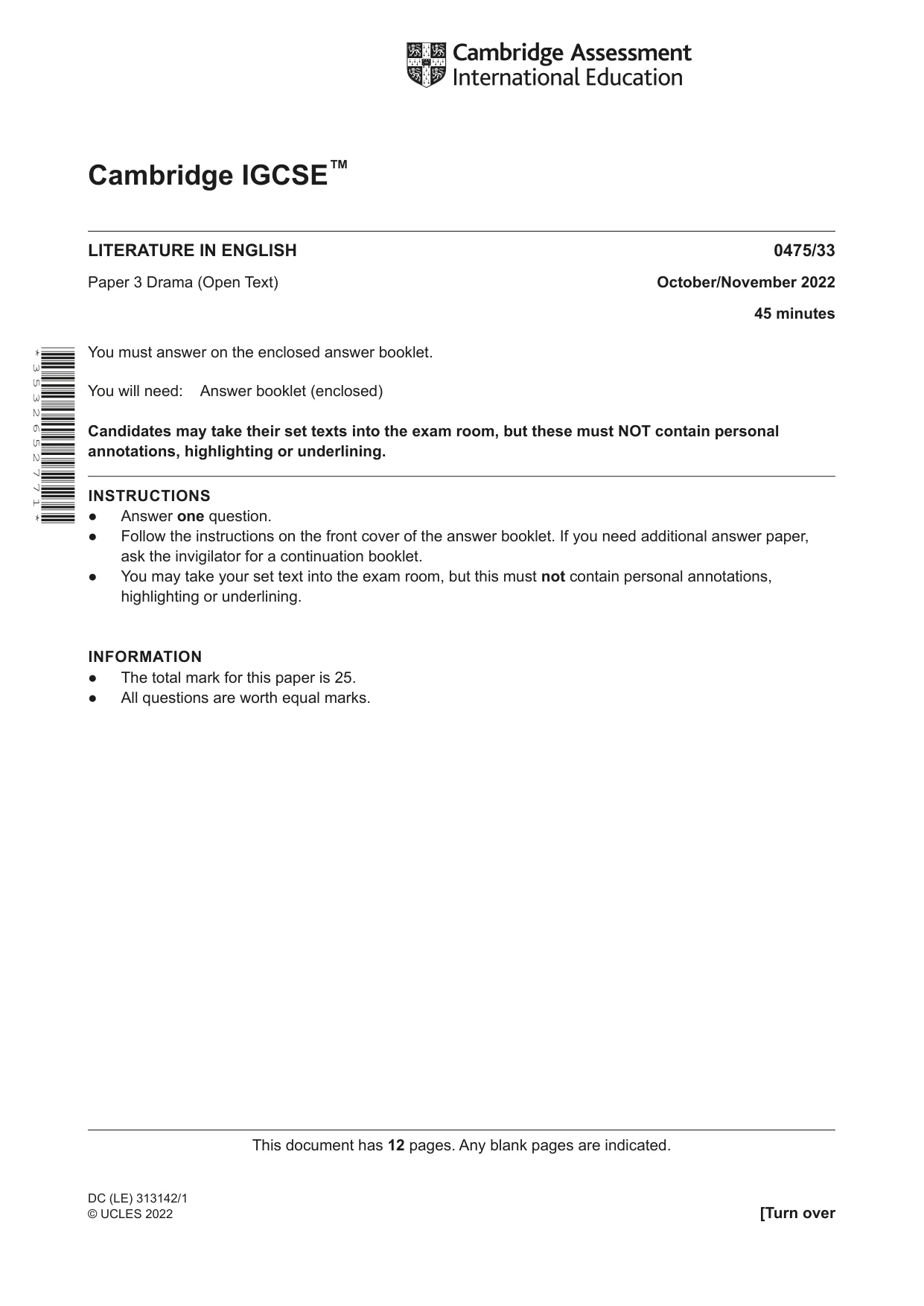
Question paper, page 1
This document has 12 pages. Any blank pages are indicated. Cambridge IGCSE™ * 3 5 3 2 6 5 2 7 7 1 * LITERATURE IN ENGLISH 0475/33 Paper 3 Drama (Open Text) October/November 2022 45 minutes You must answer on the enclosed answer booklet. You will need: Answer booklet (enclosed) Candidates may take their set texts into the exam room, but these must NOT contain personal annotations, highlighting or underlining. INSTRUCTIONS ● Answer one question. ● Follow the instructions on the front cover of the answer booklet. If you need additional answer paper, ask the invigilator for a continuation booklet. ● You may take your set text into the exam room, but this must not contain personal annotations, highlighting or underlining. INFORMATION ● The total mark for this paper is 25. ● All questions are worth equal marks. DC (LE) 313142/1 © UCLES 2022 [Turn over
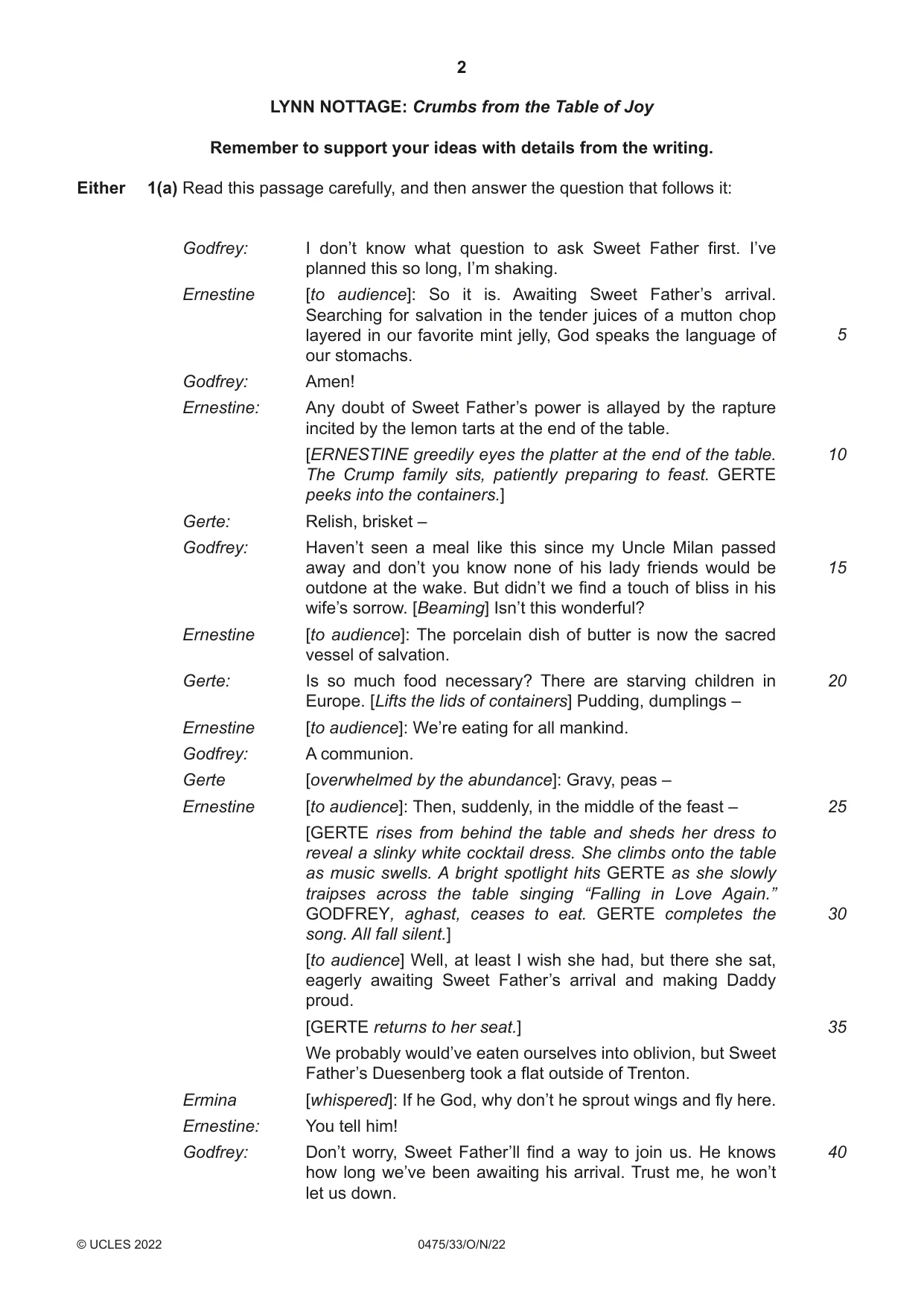
Question paper, page 2
2 0475/33/O/N/22 © UCLES 2022 LYNN NOTTAGE: Crumbs from the Table of Joy Remember to support your ideas with details from the writing. Either 1(a) Read this passage carefully, and then answer the question that follows it: Godfrey: I don’t know what question to ask Sweet Father first. I’ve planned this so long, I’m shaking. Ernestine [to audience]: So it is. Awaiting Sweet Father’s arrival. Searching for salvation in the tender juices of a mutton chop layered in our favorite mint jelly, God speaks the language of our stomachs. Godfrey: Amen! Ernestine: Any doubt of Sweet Father’s power is allayed by the rapture incited by the lemon tarts at the end of the table. [ERNESTINE greedily eyes the platter at the end of the table. The Crump family sits, patiently preparing to feast. GERTE peeks into the containers.] Gerte: Relish, brisket – Godfrey: Haven’t seen a meal like this since my Uncle Milan passed away and don’t you know none of his lady friends would be outdone at the wake. But didn’t we find a touch of bliss in his wife’s sorrow. [Beaming] Isn’t this wonderful? Ernestine [to audience]: The porcelain dish of butter is now the sacred vessel of salvation. Gerte: Is so much food necessary? There are starving children in Europe. [Lifts the lids of containers] Pudding, dumplings – Ernestine [to audience]: We’re eating for all mankind. Godfrey: A communion. Gerte [overwhelmed by the abundance]: Gravy, peas – Ernestine [to audience]: Then, suddenly, in the middle of the feast – [GERTE rises from behind the table and sheds her dress to reveal a slinky white cocktail dress. She climbs onto the table as music swells. A bright spotlight hits GERTE as she slowly traipses across the table singing “Falling in Love Again.” GODFREY, aghast, ceases to eat. GERTE completes the song. All fall silent.] [to audience] Well, at least I wish she had, but there she sat, eagerly awaiting Sweet Father’s arrival and making Daddy proud. [GERTE returns to her seat.] We probably would’ve eaten ourselves into oblivion, but Sweet Father’s Duesenberg took a flat outside of Trenton. Ermina [whispered]: If he God, why don’t he sprout wings and fly here. Ernestine: You tell him! Godfrey: Don’t worry, Sweet Father’ll find a way to join us. He knows how long we’ve been awaiting his arrival. Trust me, he won’t let us down. 5 10 15 20 25 30 35 40
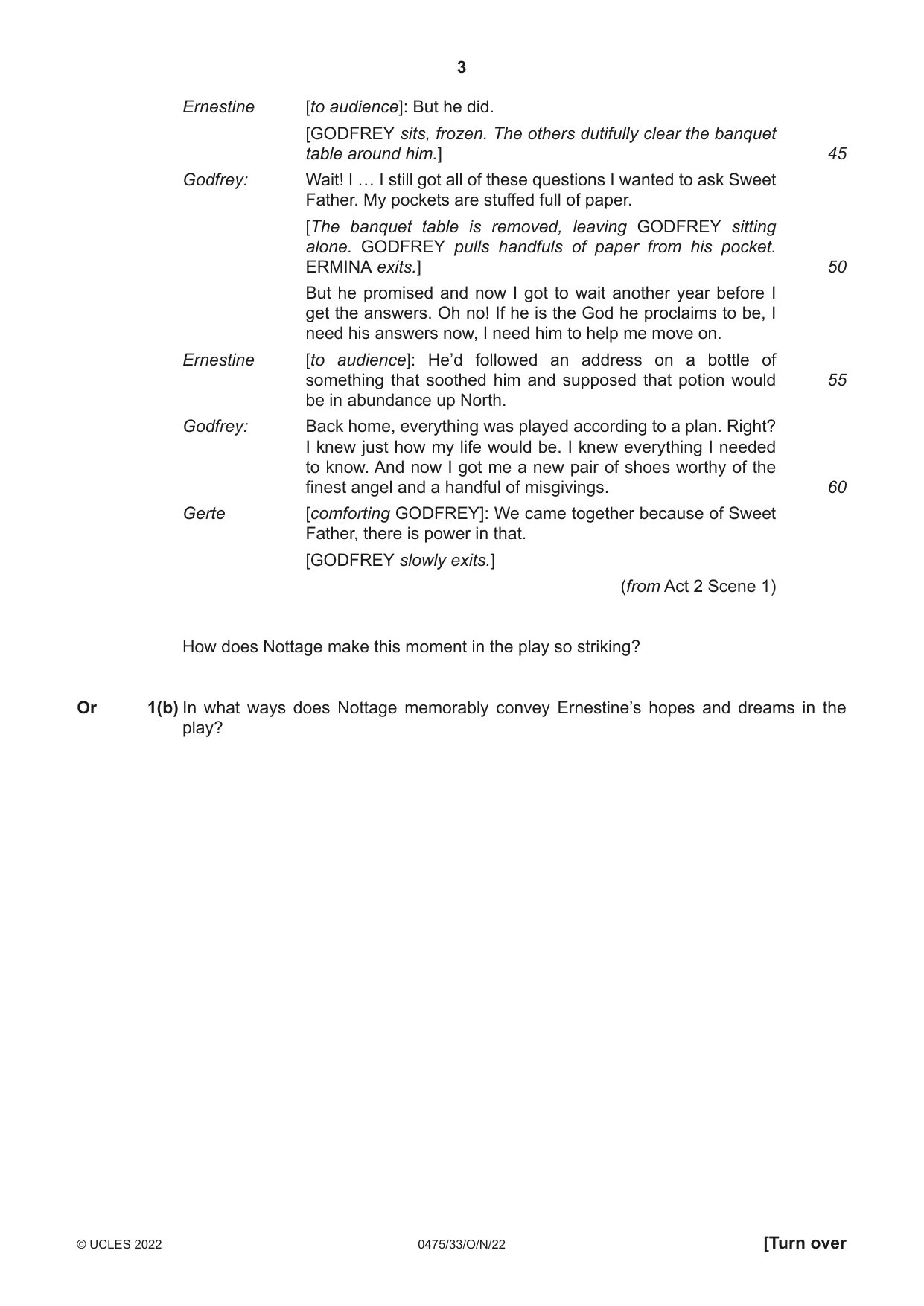
Question paper, page 3
3 0475/33/O/N/22 © UCLES 2022 [Turn over Ernestine [to audience]: But he did. [GODFREY sits, frozen. The others dutifully clear the banquet table around him.] Godfrey: Wait! I … I still got all of these questions I wanted to ask Sweet Father. My pockets are stuffed full of paper. [The banquet table is removed, leaving GODFREY sitting alone. GODFREY pulls handfuls of paper from his pocket. ERMINA exits.] But he promised and now I got to wait another year before I get the answers. Oh no! If he is the God he proclaims to be, I need his answers now, I need him to help me move on. Ernestine [to audience]: He’d followed an address on a bottle of something that soothed him and supposed that potion would be in abundance up North. Godfrey: Back home, everything was played according to a plan. Right? I knew just how my life would be. I knew everything I needed to know. And now I got me a new pair of shoes worthy of the finest angel and a handful of misgivings. Gerte [comforting GODFREY]: We came together because of Sweet Father, there is power in that. [GODFREY slowly exits.] (from Act 2 Scene 1) How does Nottage make this moment in the play so striking? Or 1(b) In what ways does Nottage memorably convey Ernestine’s hopes and dreams in the play? 45 50 55 60
Question paper, page 4
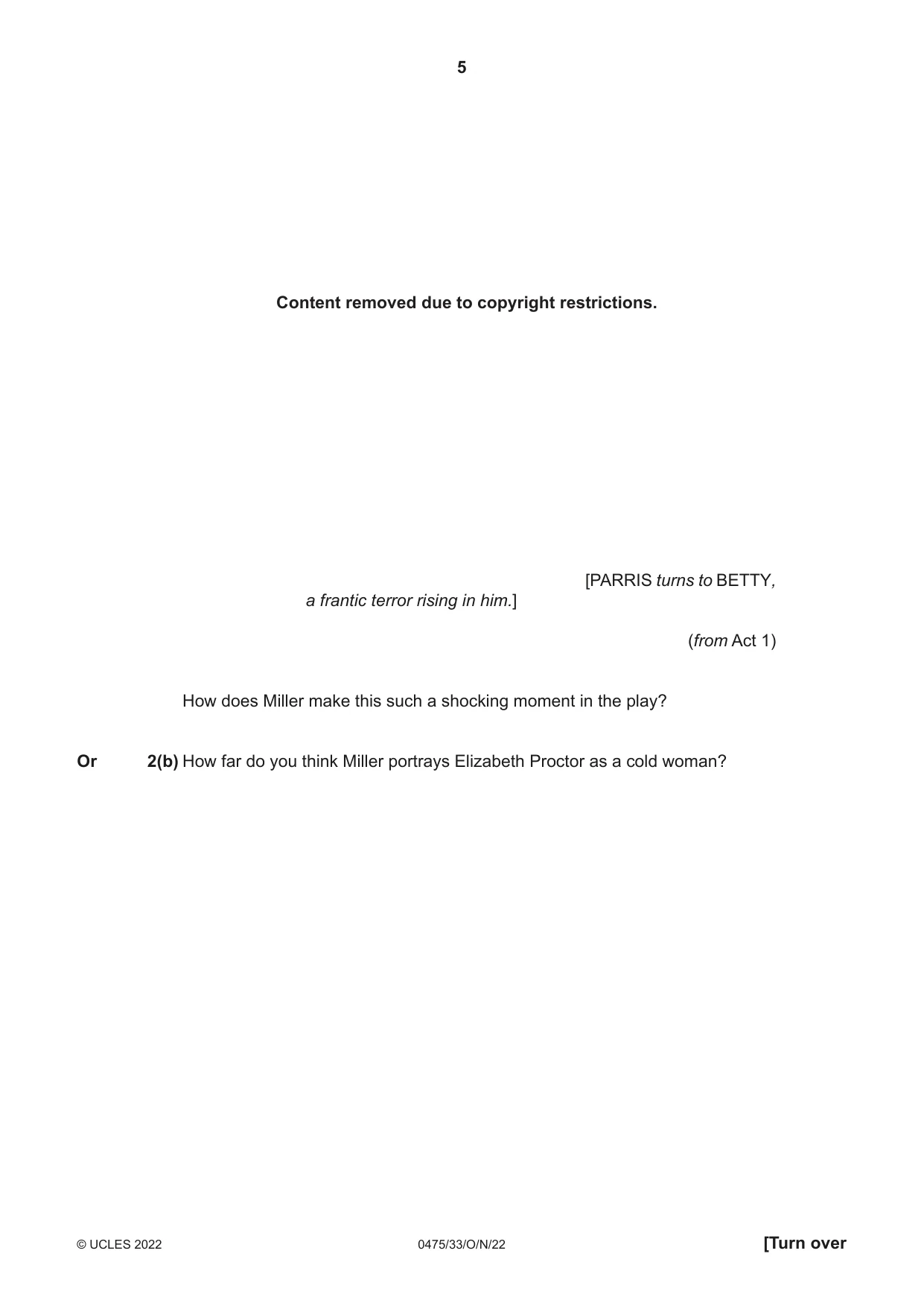
4 0475/33/O/N/22 © UCLES 2022 ARTHUR MILLER: The Crucible Remember to support your ideas with details from the writing. Either 2(a) Read this passage carefully, and then answer the question that follows it: Mrs Putnam [glancing at BETTY]: How high did she fly, how high? Content removed due to copyright restrictions.
Question paper, page 5
5 0475/33/O/N/22 © UCLES 2022 [Turn over [PARRIS turns to BETTY, a frantic terror rising in him.] (from Act 1) How does Miller make this such a shocking moment in the play? Or 2(b) How far do you think Miller portrays Elizabeth Proctor as a cold woman? Content removed due to copyright restrictions.
Question paper, page 6
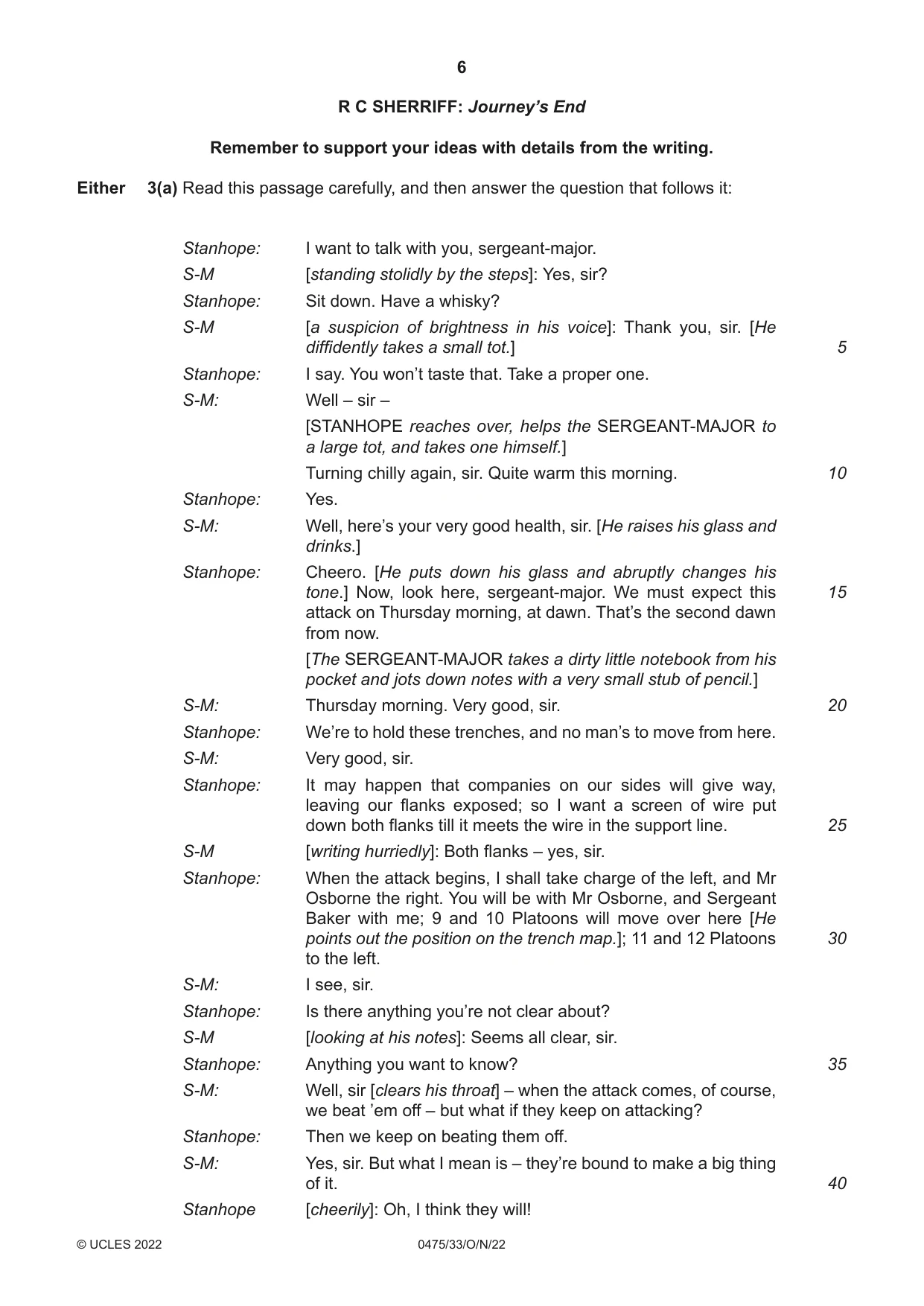
6 0475/33/O/N/22 © UCLES 2022 R C SHERRIFF: Journey’s End Remember to support your ideas with details from the writing. Either 3(a) Read this passage carefully, and then answer the question that follows it: Stanhope: I want to talk with you, sergeant-major. S-M [standing stolidly by the steps]: Yes, sir? Stanhope: Sit down. Have a whisky? S-M [a suspicion of brightness in his voice]: Thank you, sir. [He diffidently takes a small tot.] Stanhope: I say. You won’t taste that. Take a proper one. S-M: Well – sir – [STANHOPE reaches over, helps the SERGEANT-MAJOR to a large tot, and takes one himself.] Turning chilly again, sir. Quite warm this morning. Stanhope: Yes. S-M: Well, here’s your very good health, sir. [He raises his glass and drinks.] Stanhope: Cheero. [He puts down his glass and abruptly changes his tone.] Now, look here, sergeant-major. We must expect this attack on Thursday morning, at dawn. That’s the second dawn from now. [The SERGEANT-MAJOR takes a dirty little notebook from his pocket and jots down notes with a very small stub of pencil.] S-M: Thursday morning. Very good, sir. Stanhope: We’re to hold these trenches, and no man’s to move from here. S-M: Very good, sir. Stanhope: It may happen that companies on our sides will give way, leaving our flanks exposed; so I want a screen of wire put down both flanks till it meets the wire in the support line. S-M [writing hurriedly]: Both flanks – yes, sir. Stanhope: When the attack begins, I shall take charge of the left, and Mr Osborne the right. You will be with Mr Osborne, and Sergeant Baker with me; 9 and 10 Platoons will move over here [He points out the position on the trench map.]; 11 and 12 Platoons to the left. S-M: I see, sir. Stanhope: Is there anything you’re not clear about? S-M [looking at his notes]: Seems all clear, sir. Stanhope: Anything you want to know? S-M: Well, sir [clears his throat] – when the attack comes, of course, we beat ’em off – but what if they keep on attacking? Stanhope: Then we keep on beating them off. S-M: Yes, sir. But what I mean is – they’re bound to make a big thing of it. Stanhope [cheerily]: Oh, I think they will! 5 10 15 20 25 30 35 40
Question paper, page 7
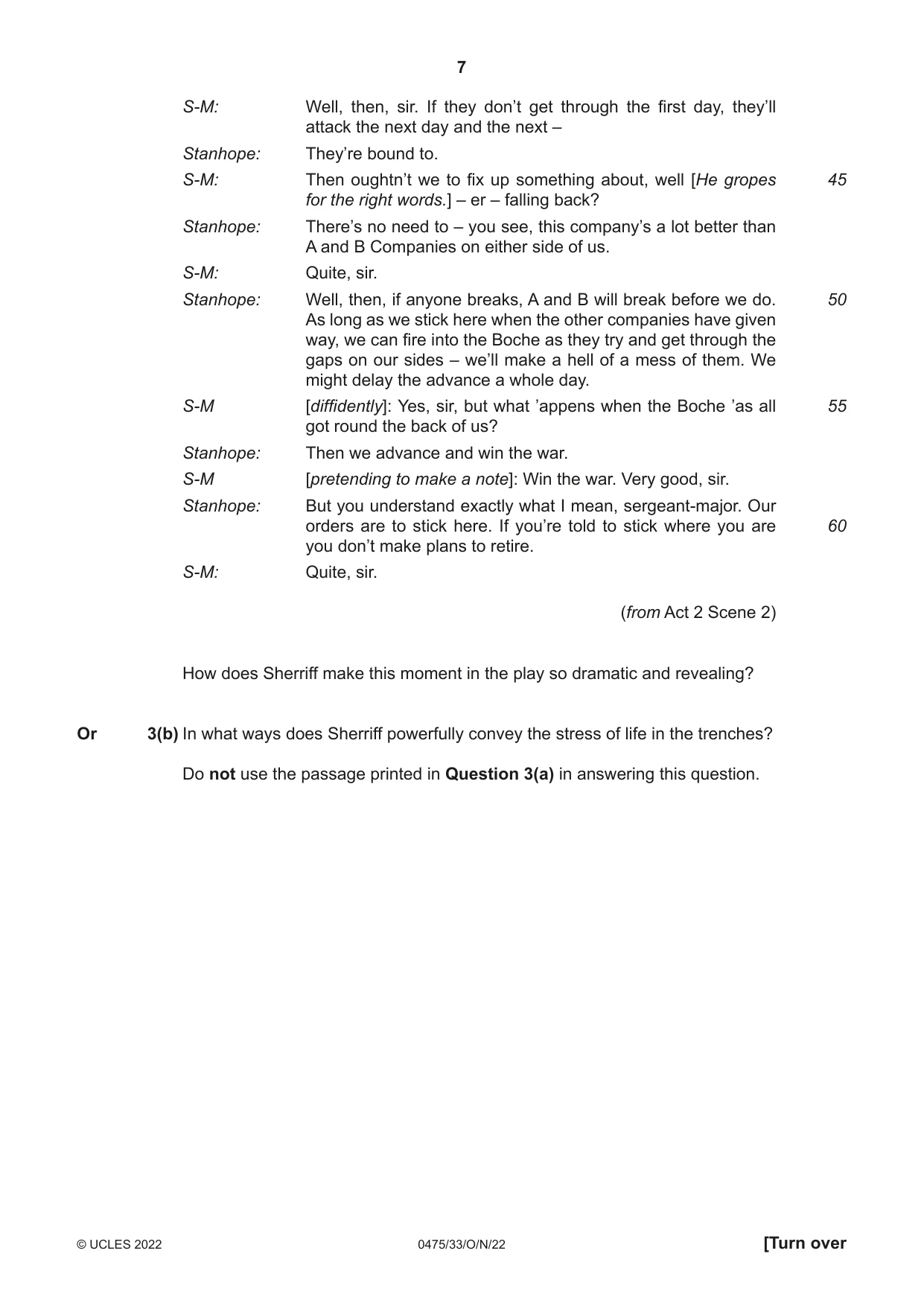
7 0475/33/O/N/22 © UCLES 2022 [Turn over S-M: Well, then, sir. If they don’t get through the first day, they’ll attack the next day and the next – Stanhope: They’re bound to. S-M: Then oughtn’t we to fix up something about, well [He gropes for the right words.] – er – falling back? Stanhope: There’s no need to – you see, this company’s a lot better than A and B Companies on either side of us. S-M: Quite, sir. Stanhope: Well, then, if anyone breaks, A and B will break before we do. As long as we stick here when the other companies have given way, we can fire into the Boche as they try and get through the gaps on our sides – we’ll make a hell of a mess of them. We might delay the advance a whole day. S-M [diffidently]: Yes, sir, but what ’appens when the Boche ’as all got round the back of us? Stanhope: Then we advance and win the war. S-M [pretending to make a note]: Win the war. Very good, sir. Stanhope: But you understand exactly what I mean, sergeant-major. Our orders are to stick here. If you’re told to stick where you are you don’t make plans to retire. S-M: Quite, sir. (from Act 2 Scene 2) How does Sherriff make this moment in the play so dramatic and revealing? Or 3(b) In what ways does Sherriff powerfully convey the stress of life in the trenches? Do not use the passage printed in Question 3(a) in answering this question. 45 50 55 60
Question paper, page 8
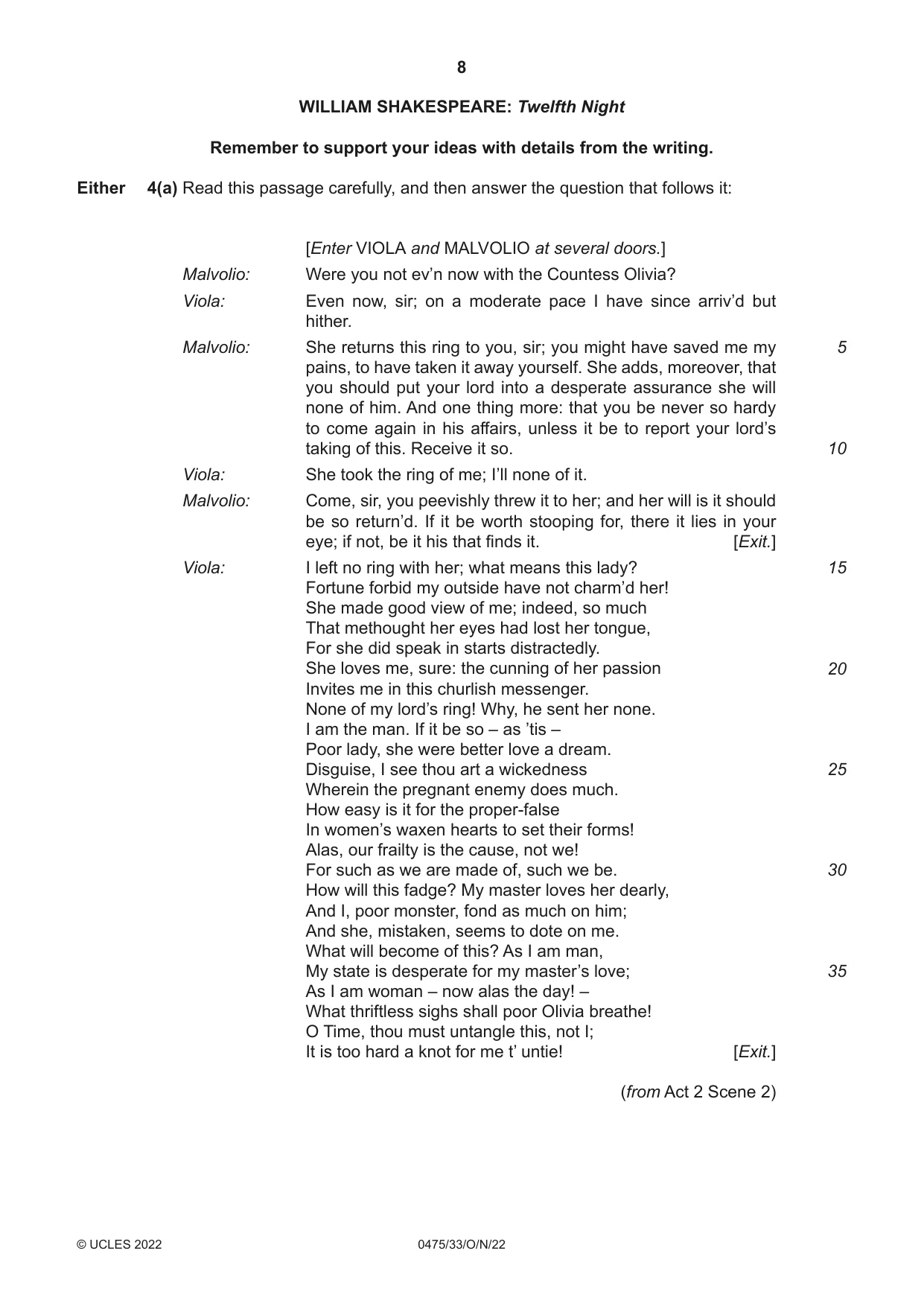
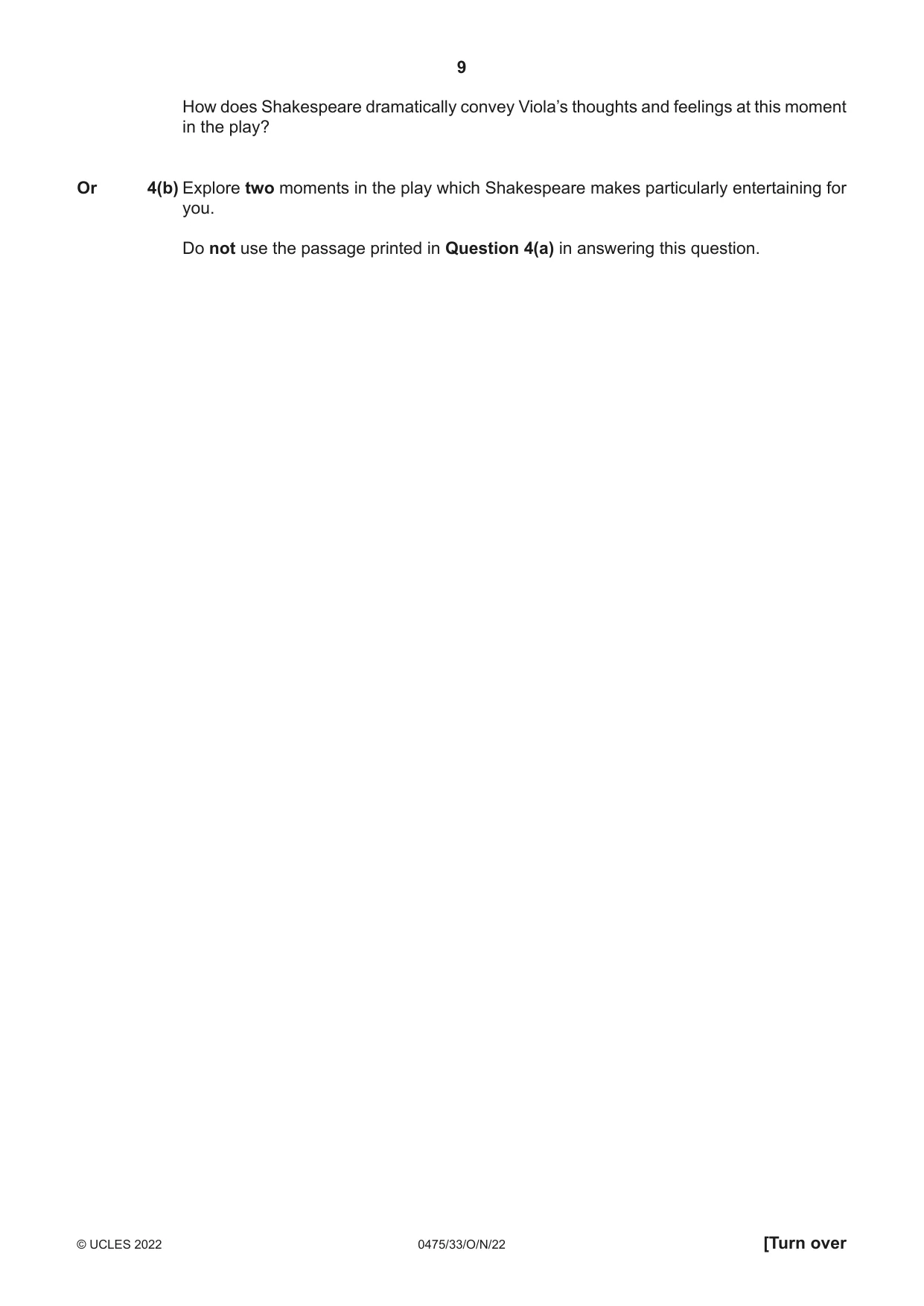
8 0475/33/O/N/22 © UCLES 2022 WILLIAM SHAKESPEARE: Twelfth Night Remember to support your ideas with details from the writing. Either 4(a) Read this passage carefully, and then answer the question that follows it: [Enter VIOLA and MALVOLIO at several doors.] Malvolio: Were you not ev’n now with the Countess Olivia? Viola: Even now, sir; on a moderate pace I have since arriv’d but hither. Malvolio: She returns this ring to you, sir; you might have saved me my pains, to have taken it away yourself. She adds, moreover, that you should put your lord into a desperate assurance she will none of him. And one thing more: that you be never so hardy to come again in his affairs, unless it be to report your lord’s taking of this. Receive it so. Viola: She took the ring of me; I’ll none of it. Malvolio: Come, sir, you peevishly threw it to her; and her will is it should be so return’d. If it be worth stooping for, there it lies in your eye; if not, be it his that finds it. [Exit.] Viola: I left no ring with her; what means this lady? Fortune forbid my outside have not charm’d her! She made good view of me; indeed, so much That methought her eyes had lost her tongue, For she did speak in starts distractedly. She loves me, sure: the cunning of her passion Invites me in this churlish messenger. None of my lord’s ring! Why, he sent her none. I am the man. If it be so – as ’tis – Poor lady, she were better love a dream. Disguise, I see thou art a wickedness Wherein the pregnant enemy does much. How easy is it for the proper-false In women’s waxen hearts to set their forms! Alas, our frailty is the cause, not we! For such as we are made of, such we be. How will this fadge? My master loves her dearly, And I, poor monster, fond as much on him; And she, mistaken, seems to dote on me. What will become of this? As I am man, My state is desperate for my master’s love; As I am woman – now alas the day! – What thriftless sighs shall poor Olivia breathe! O Time, thou must untangle this, not I; It is too hard a knot for me t’ untie! [Exit.] (from Act 2 Scene 2) 5 10 15 20 25 30 35
Question paper, page 9
9 0475/33/O/N/22 © UCLES 2022 [Turn over How does Shakespeare dramatically convey Viola’s thoughts and feelings at this moment in the play? Or 4(b) Explore two moments in the play which Shakespeare makes particularly entertaining for you. Do not use the passage printed in Question 4(a) in answering this question.
Question paper, page 10
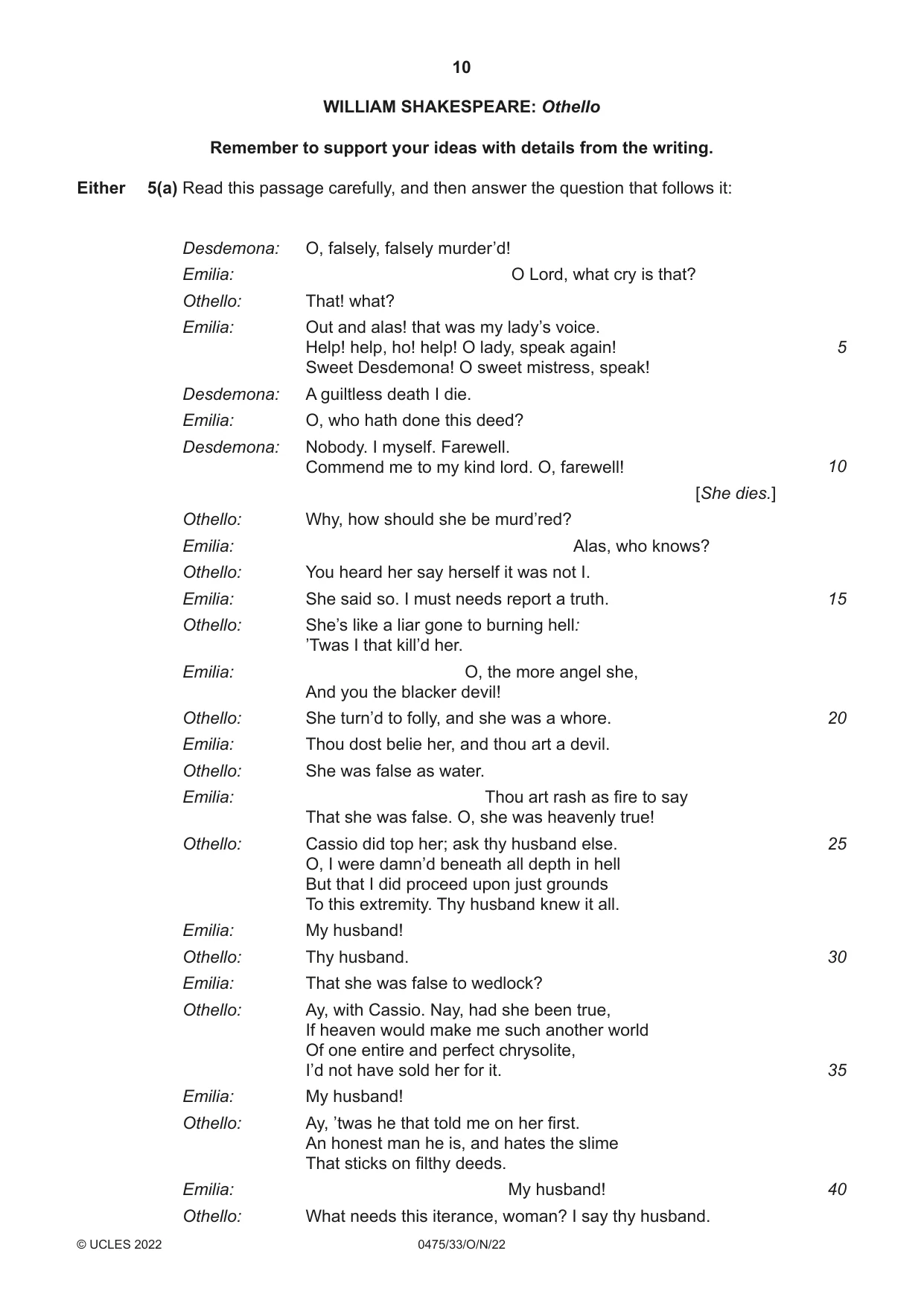
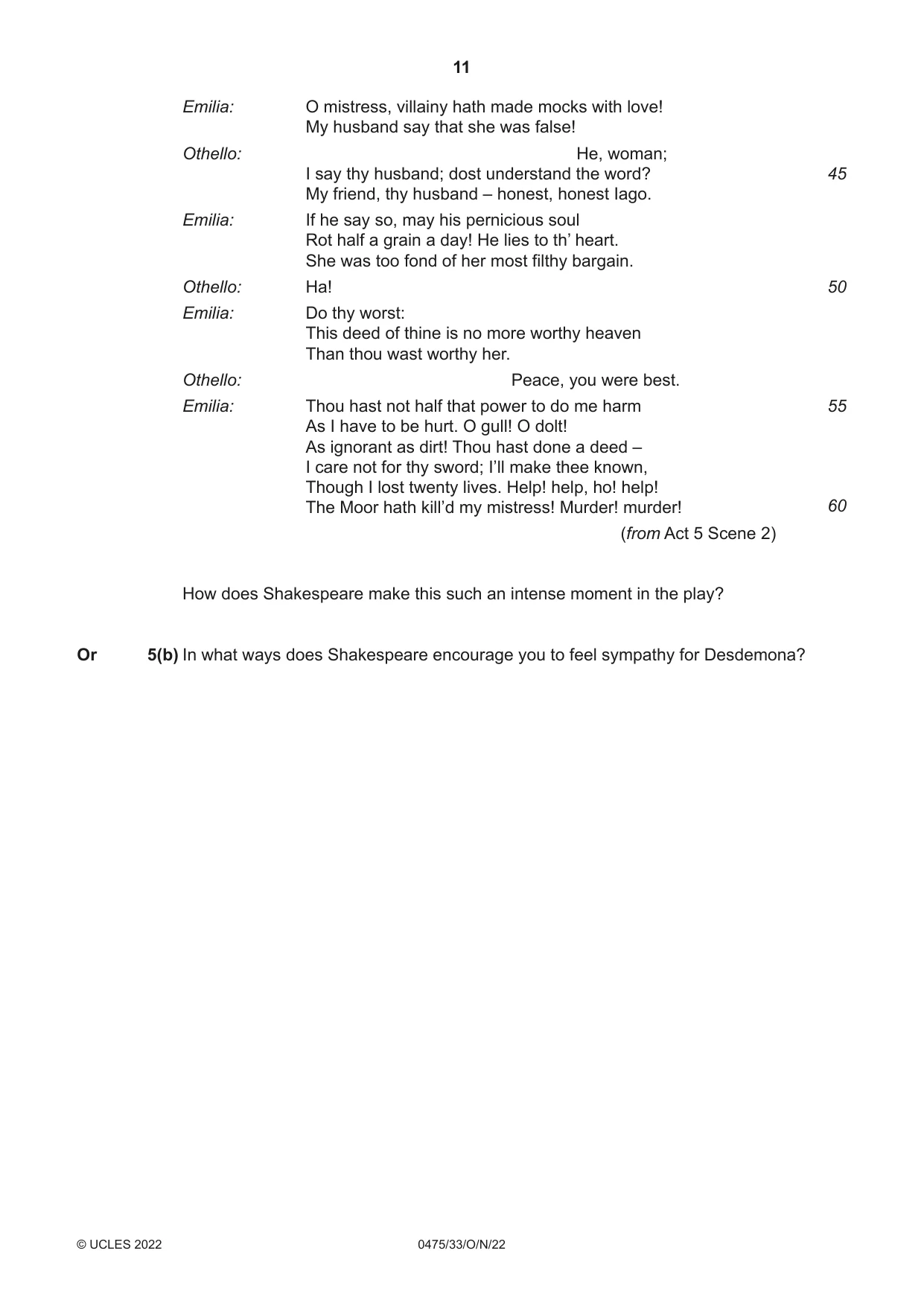
10 0475/33/O/N/22 © UCLES 2022 WILLIAM SHAKESPEARE: Othello Remember to support your ideas with details from the writing. Either 5(a) Read this passage carefully, and then answer the question that follows it: Desdemona: O, falsely, falsely murder’d! Emilia: O Lord, what cry is that? Othello: That! what? Emilia: Out and alas! that was my lady’s voice. Help! help, ho! help! O lady, speak again! Sweet Desdemona! O sweet mistress, speak! Desdemona: A guiltless death I die. Emilia: O, who hath done this deed? Desdemona: Nobody. I myself. Farewell. Commend me to my kind lord. O, farewell! [She dies.] Othello: Why, how should she be murd’red? Emilia: Alas, who knows? Othello: You heard her say herself it was not I. Emilia: She said so. I must needs report a truth. Othello: She’s like a liar gone to burning hell: ’Twas I that kill’d her. Emilia: O, the more angel she, And you the blacker devil! Othello: She turn’d to folly, and she was a whore. Emilia: Thou dost belie her, and thou art a devil. Othello: She was false as water. Emilia: Thou art rash as fire to say That she was false. O, she was heavenly true! Othello: Cassio did top her; ask thy husband else. O, I were damn’d beneath all depth in hell But that I did proceed upon just grounds To this extremity. Thy husband knew it all. Emilia: My husband! Othello: Thy husband. Emilia: That she was false to wedlock? Othello: Ay, with Cassio. Nay, had she been true, If heaven would make me such another world Of one entire and perfect chrysolite, I’d not have sold her for it. Emilia: My husband! Othello: Ay, ’twas he that told me on her first. An honest man he is, and hates the slime That sticks on filthy deeds. Emilia: My husband! Othello: What needs this iterance, woman? I say thy husband. 5 10 15 20 25 30 35 40
Question paper, page 11
11 0475/33/O/N/22 © UCLES 2022 Emilia: O mistress, villainy hath made mocks with love! My husband say that she was false! Othello: He, woman; I say thy husband; dost understand the word? My friend, thy husband – honest, honest Iago. Emilia: If he say so, may his pernicious soul Rot half a grain a day! He lies to th’ heart. She was too fond of her most filthy bargain. Othello: Ha! Emilia: Do thy worst: This deed of thine is no more worthy heaven Than thou wast worthy her. Othello: Peace, you were best. Emilia: Thou hast not half that power to do me harm As I have to be hurt. O gull! O dolt! As ignorant as dirt! Thou hast done a deed – I care not for thy sword; I’ll make thee known, Though I lost twenty lives. Help! help, ho! help! The Moor hath kill’d my mistress! Murder! murder! (from Act 5 Scene 2) How does Shakespeare make this such an intense moment in the play? Or 5(b) In what ways does Shakespeare encourage you to feel sympathy for Desdemona? 45 50 55 60
Question paper, page 12
12 0475/33/O/N/22 © UCLES 2022 Permission to reproduce items where third-party owned material protected by copyright is included has been sought and cleared where possible. Every reasonable effort has been made by the publisher (UCLES) to trace copyright holders, but if any items requiring clearance have unwittingly been included, the publisher will be pleased to make amends at the earliest possible opportunity. To avoid the issue of disclosure of answer-related information to candidates, all copyright acknowledgements are reproduced online in the Cambridge Assessment International Education Copyright Acknowledgements Booklet. This is produced for each series of examinations and is freely available to download at www.cambridgeinternational.org after the live examination series. Cambridge Assessment International Education is part of Cambridge Assessment. Cambridge Assessment is the brand name of the University of Cambridge Local Examinations Syndicate (UCLES), which is a department of the University of Cambridge. BLANK PAGE
Mark scheme, page 1
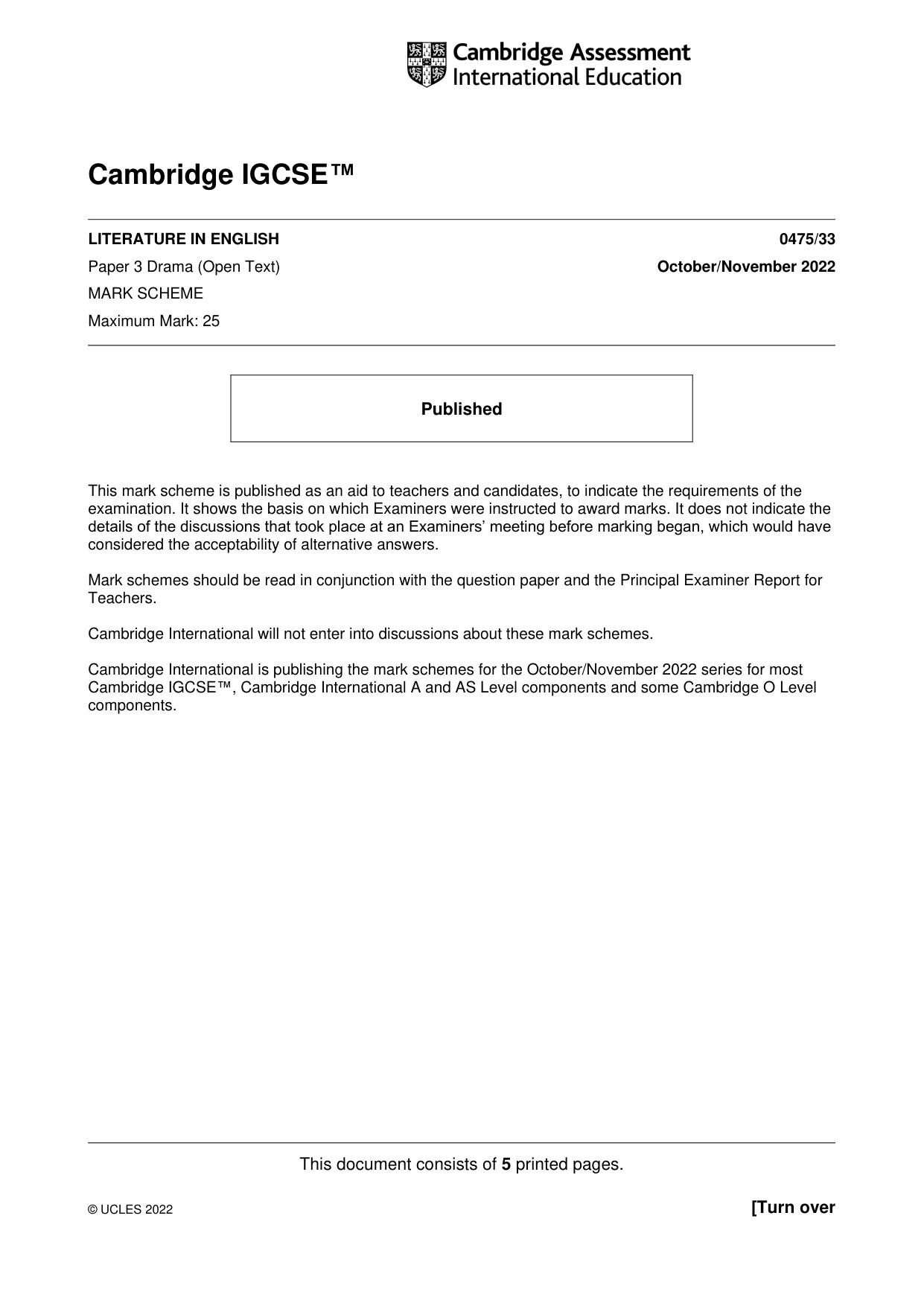
This document consists of 5 printed pages. © UCLES 2022 [Turn over Cambridge IGCSE™ LITERATURE IN ENGLISH 0475/33 Paper 3 Drama (Open Text) October/November 2022 MARK SCHEME Maximum Mark: 25 Published This mark scheme is published as an aid to teachers and candidates, to indicate the requirements of the examination. It shows the basis on which Examiners were instructed to award marks. It does not indicate the details of the discussions that took place at an Examiners’ meeting before marking began, which would have considered the acceptability of alternative answers. Mark schemes should be read in conjunction with the question paper and the Principal Examiner Report for Teachers. Cambridge International will not enter into discussions about these mark schemes. Cambridge International is publishing the mark schemes for the October/November 2022 series for most Cambridge IGCSE™, Cambridge International A and AS Level components and some Cambridge O Level components.
Mark scheme, page 2
0475/33 Cambridge IGCSE – Mark Scheme PUBLISHED October/November 2022 © UCLES 2022 Page 2 of 5 Generic Marking Principles These general marking principles must be applied by all examiners when marking candidate answers. They should be applied alongside the specific content of the mark scheme or generic level descriptors for a question. Each question paper and mark scheme will also comply with these marking principles. GENERIC MARKING PRINCIPLE 1: Marks must be awarded in line with: • the specific content of the mark scheme or the generic level descriptors for the question • the specific skills defined in the mark scheme or in the generic level descriptors for the question • the standard of response required by a candidate as exemplified by the standardisation scripts. GENERIC MARKING PRINCIPLE 2: Marks awarded are always whole marks (not half marks, or other fractions). GENERIC MARKING PRINCIPLE 3: Marks must be awarded positively: • marks are awarded for correct/valid answers, as defined in the mark scheme. However, credit is given for valid answers which go beyond the scope of the syllabus and mark scheme, referring to your Team Leader as appropriate • marks are awarded when candidates clearly demonstrate what they know and can do • marks are not deducted for errors • marks are not deducted for omissions • answers should only be judged on the quality of spelling, punctuation and grammar when these features are specifically assessed by the question as indicated by the mark scheme. The meaning, however, should be unambiguous. GENERIC MARKING PRINCIPLE 4: Rules must be applied consistently, e.g. in situations where candidates have not followed instructions or in the application of generic level descriptors. GENERIC MARKING PRINCIPLE 5: Marks should be awarded using the full range of marks defined in the mark scheme for the question (however; the use of the full mark range may be limited according to the quality of the candidate responses seen). GENERIC MARKING PRINCIPLE 6: Marks awarded are based solely on the requirements as defined in the mark scheme. Marks should not be awarded with grade thresholds or grade descriptors in mind.
Mark scheme, page 3
0475/33 Cambridge IGCSE – Mark Scheme PUBLISHED October/November 2022 © UCLES 2022 Page 3 of 5 English & Media subject specific general marking principles (To be read in conjunction with the Generic Marking Principles (and requiring further guidance on how to place marks within levels)) Components using level descriptors: • We use level descriptors as a guide to broad understanding of the qualities normally expected of, or typical of, work in a level. • Level descriptors are a means of general guidance, and should not be interpreted as hurdle statements. • Where indicative content notes are supplied for a question, these are not a prescription of required content, and must not be treated as such. Alternative correct points and unexpected answers in candidates’ scripts must be given marks that fairly reflect the knowledge and skills demonstrated. • While we may have legitimate expectations as to the ground most answers may occupy, we must at all times be prepared to meet candidates on their chosen ground, provided it is relevant ground (e.g. clearly related to and derived from a relevant passage/text and meeting the mark scheme requirements for the question). Components using point-based marking: Point marking is often used to reward knowledge, understanding and application of skills. We give credit where the candidate’s answer shows relevant knowledge, understanding and application of skills in answering the question. We do not give credit where the answer shows confusion. From this it follows that we: a DO credit answers which are worded differently from the mark scheme if they clearly convey the same meaning (unless the mark scheme requires a specific term). b DO credit alternative answers/examples which are not written in the mark scheme if they are correct. c DO credit answers where candidates give more than one correct answer in one prompt/numbered/scaffolded space where extended writing is required rather than list-type answers. For example, questions that require n reasons (e.g. State two reasons…). d DO NOT credit answers simply for using a ‘key term’ unless that is all that is required. (Check for evidence it is understood and not used wrongly.). e DO NOT credit answers which are obviously self-contradicting or trying to cover all possibilities. f DO NOT give further credit for what is effectively repetition of a correct point already credited unless the language itself is being tested. This applies equally to ‘mirror statements’ (i.e. polluted/not polluted). g DO NOT require spellings to be correct, unless this is part of the test. However spellings of syllabus terms must allow for clear and unambiguous separation from other syllabus terms with which they may be confused (e.g. Corrasion/Corrosion).
Mark scheme, page 4
0475/33 Cambridge IGCSE – Mark Scheme PUBLISHED October/November 2022 © UCLES 2022 Page 4 of 5 Introduction For general administrative guidance, see Notes for Examiners Handbook. All questions are marked out of 25. Assessment Objectives The Assessment Objectives are evenly weighted across each question. The assessment objectives for the paper are: • AO1 show detailed knowledge of the content of literary texts, supported by reference to the text • AO2 understand the meanings of literary texts and their context, and explore texts beyond surface meaning to show deeper awareness of ideas and attitudes • AO3 recognise and appreciate ways in which writers use language, structure, and form to create and shape meanings and effects • AO4 communicate a sensitive and informed personal response The Band Descriptors cover marks from 0 to 25, and apply to the marking of each question. They guide examiners to an understanding of the qualities normally expected of, or typical of, work in a band. They are a means of general guidance, and must not be interpreted as hurdle statements. For the purposes of standardisation of marking, they are to be used in conjunction with the Practice and Standardisation scripts discussed during the coordination meeting and with Team Leaders, as well as the question-specific notes. The supplementary notes for each question are related to the assessment objectives above. Because of the nature of the subject, they are for general guidance; they are not designed as prescriptions of required content and must not be treated as such. The syllabus aims at encouraging candidates to make some personal response to their reading. Whilst there are legitimate expectations of the content of most answers, examiners may see responses that include ideas not covered in the supplementary guidance. For these cases, examiners should credit valid responses fairly and not penalise candidates for including valid points outside the mark scheme.
Mark scheme, page 5
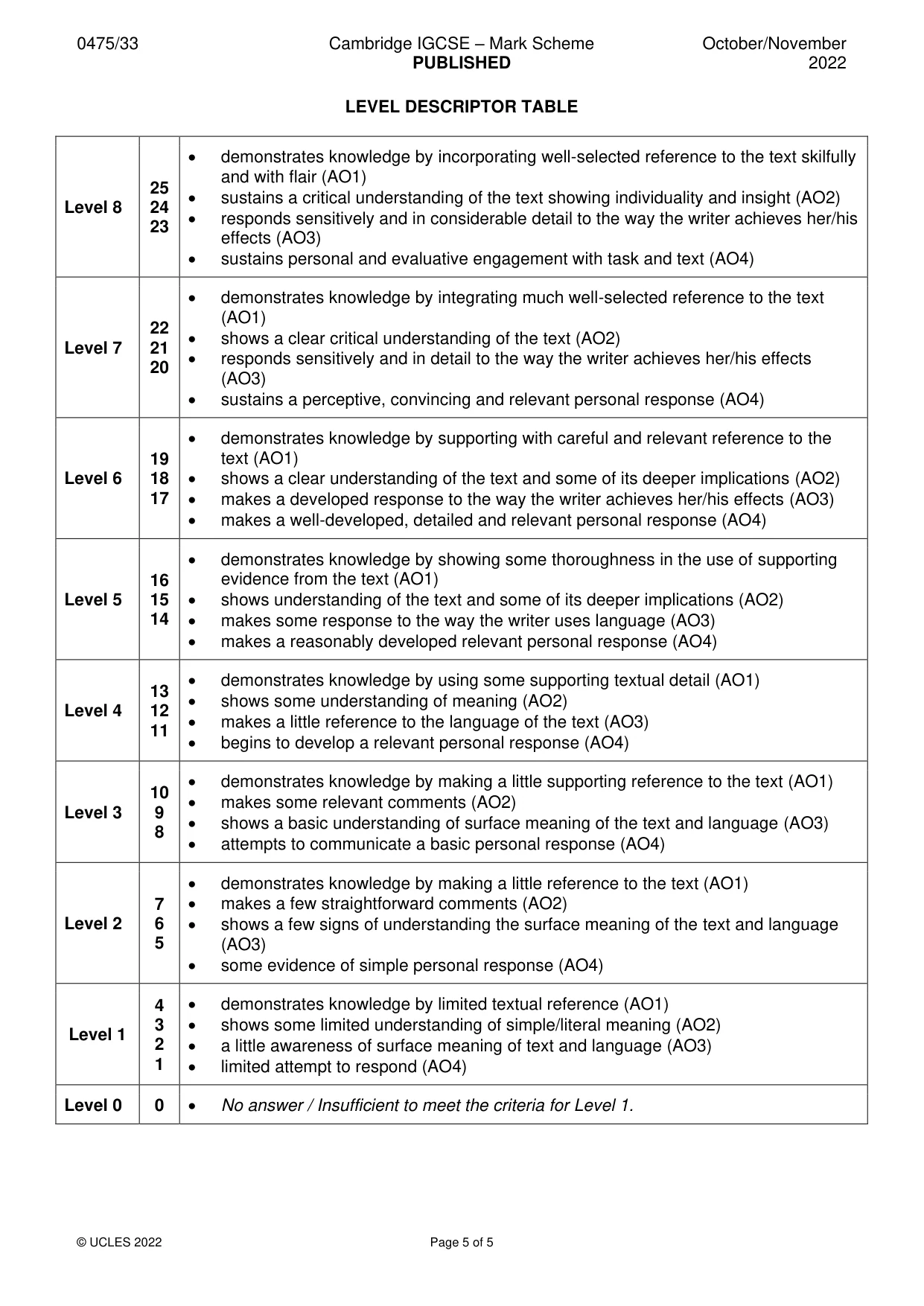
0475/33 Cambridge IGCSE – Mark Scheme PUBLISHED October/November 2022 © UCLES 2022 Page 5 of 5 LEVEL DESCRIPTOR TABLE Level 8 25 24 23 • demonstrates knowledge by incorporating well-selected reference to the text skilfully and with flair (AO1) • sustains a critical understanding of the text showing individuality and insight (AO2) • responds sensitively and in considerable detail to the way the writer achieves her/his effects (AO3) • sustains personal and evaluative engagement with task and text (AO4) Level 7 22 21 20 • demonstrates knowledge by integrating much well-selected reference to the text (AO1) • shows a clear critical understanding of the text (AO2) • responds sensitively and in detail to the way the writer achieves her/his effects (AO3) • sustains a perceptive, convincing and relevant personal response (AO4) Level 6 19 18 17 • demonstrates knowledge by supporting with careful and relevant reference to the text (AO1) • shows a clear understanding of the text and some of its deeper implications (AO2) • makes a developed response to the way the writer achieves her/his effects (AO3) • makes a well-developed, detailed and relevant personal response (AO4) Level 5 16 15 14 • demonstrates knowledge by showing some thoroughness in the use of supporting evidence from the text (AO1) • shows understanding of the text and some of its deeper implications (AO2) • makes some response to the way the writer uses language (AO3) • makes a reasonably developed relevant personal response (AO4) Level 4 13 12 11 • demonstrates knowledge by using some supporting textual detail (AO1) • shows some understanding of meaning (AO2) • makes a little reference to the language of the text (AO3) • begins to develop a relevant personal response (AO4) Level 3 10 9 8 • demonstrates knowledge by making a little supporting reference to the text (AO1) • makes some relevant comments (AO2) • shows a basic understanding of surface meaning of the text and language (AO3) • attempts to communicate a basic personal response (AO4) Level 2 7 6 5 • demonstrates knowledge by making a little reference to the text (AO1) • makes a few straightforward comments (AO2) • shows a few signs of understanding the surface meaning of the text and language (AO3) • some evidence of simple personal response (AO4) Level 1 4 3 2 1 • demonstrates knowledge by limited textual reference (AO1) • shows some limited understanding of simple/literal meaning (AO2) • a little awareness of surface meaning of text and language (AO3) • limited attempt to respond (AO4) Level 0 0 • No answer / Insufficient to meet the criteria for Level 1.
What you needed in this session
Cambridge’s own grade thresholds for 2022 Oct/Nov, Paper 3 · Variant 3. A higher threshold means an easier paper — the bar moves with how the cohort did.