Cambridge IGCSE English - Literature in English 0475 — 2022 May/June Paper 3 · Variant 2
0475/32/M/J/22 · 25 marks · ≈28 min
The question paper and its mark scheme, free to read here and free to download. This is Cambridge’s own paper, exactly as it was sat.
Question paper12 pages
Mark scheme5 pages
Answers below. Sit the paper first if you are practising.
Paper as text
Question paper, page 1
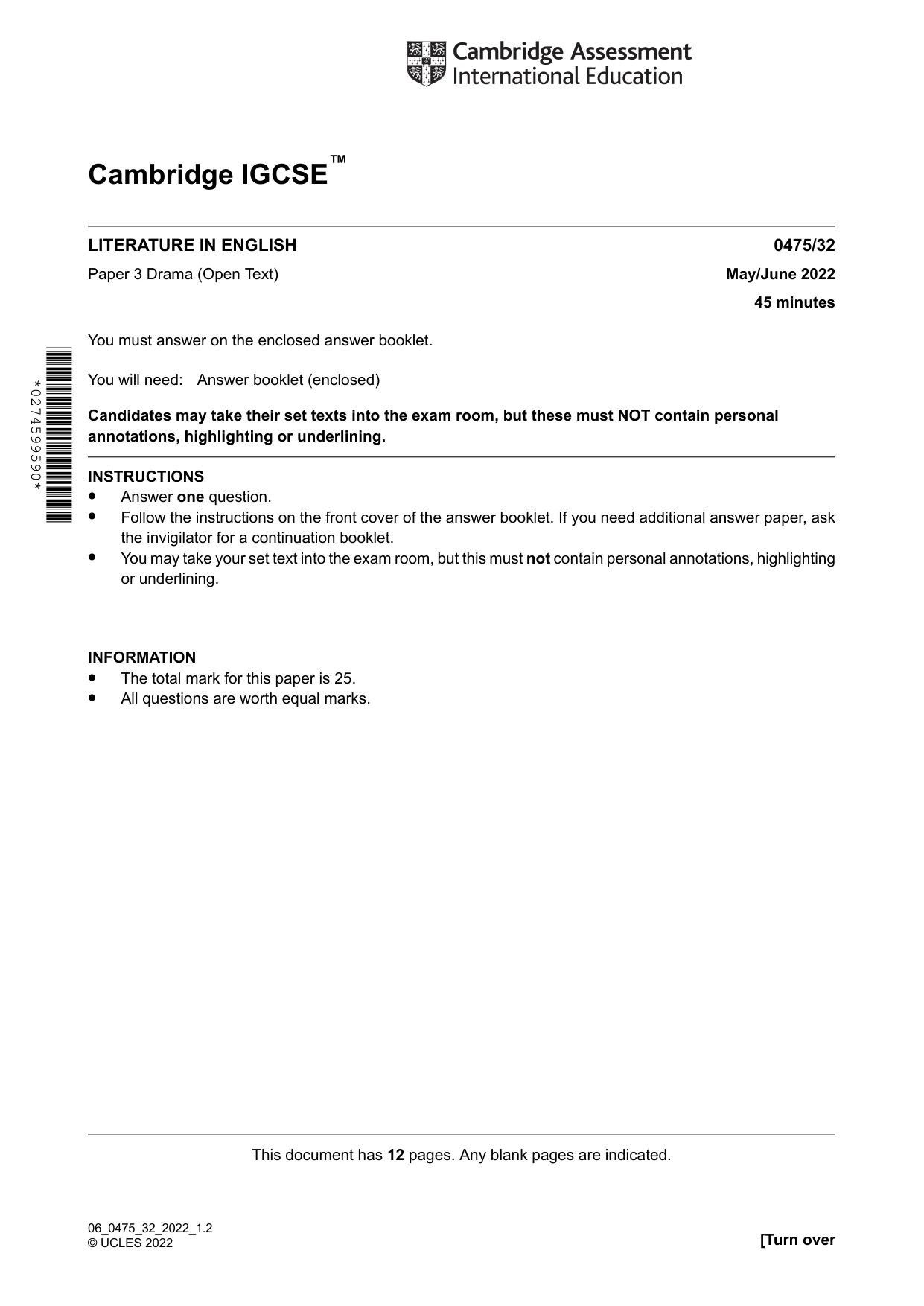
Cambridge IGCSE™ 0475/32 LITERATURE IN ENGLISH May/June 2022 Paper 3 Drama (Open Text) 45 minutes You must answer on the enclosed answer booklet. You will need: Answer booklet (enclosed) Candidates may take their set texts into the exam room, but these must NOT contain personal annotations, highlighting or underlining. INSTRUCTIONS • Answer one question. • Follow the instructions on the front cover of the answer booklet. If you need additional answer paper, ask the invigilator for a continuation booklet. • You may take your set text into the exam room, but this must not contain personal annotations, highlighting or underlining. INFORMATION • The total mark for this paper is 25. • All questions are worth equal marks. This document has 12 pages. Any blank pages are indicated. [Turn over 06_0475_32_2022_1.2 © UCLES 2022 *0274599590*
Question paper, page 2
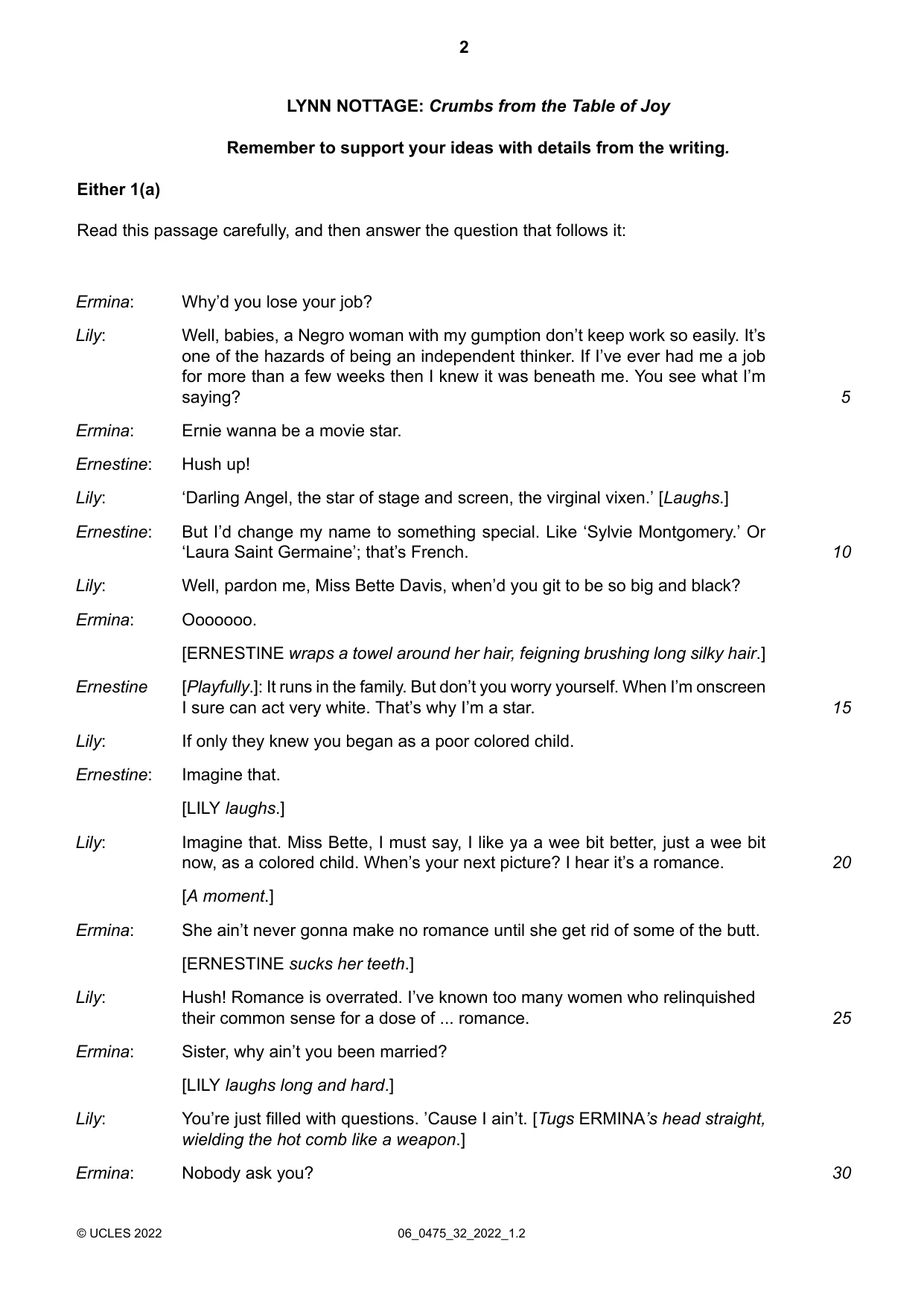
30 25 20 15 10 5 LYNN NOTTAGE: Crumbs from the Table of Joy Remember to support your ideas with details from the writing. Either 1(a) Read this passage carefully, and then answer the question that follows it: Why’d you lose your job? Ermina: Well, babies, a Negro woman with my gumption don’t keep work so easily. It’s one of the hazards of being an independent thinker. If I’ve ever had me a job for more than a few weeks then I knew it was beneath me. You see what I’m saying? Lily: Ernie wanna be a movie star. Ermina: Hush up! Ernestine: ‘Darling Angel, the star of stage and screen, the virginal vixen.’ [Laughs.] Lily: But I’d change my name to something special. Like ‘Sylvie Montgomery.’ Or ‘Laura Saint Germaine’; that’s French. Ernestine: Well, pardon me, Miss Bette Davis, when’d you git to be so big and black? Lily: Ooooooo. Ermina: [ERNESTINE wraps a towel around her hair, feigning brushing long silky hair.] [Playfully.]: It runs in the family. But don’t you worry yourself. When I’m onscreen I sure can act very white. That’s why I’m a star. Ernestine If only they knew you began as a poor colored child. Lily: Imagine that. Ernestine: [LILY laughs.] Imagine that. Miss Bette, I must say, I like ya a wee bit better, just a wee bit now, as a colored child. When’s your next picture? I hear it’s a romance. Lily: [A moment.] She ain’t never gonna make no romance until she get rid of some of the butt. Ermina: [ERNESTINE sucks her teeth.] Hush! Romance is overrated. I’ve known too many women who relinquished their common sense for a dose of ... romance. Lily: Sister, why ain’t you been married? Ermina: [LILY laughs long and hard.] You’re just filled with questions. ’Cause I ain’t. [Tugs ERMINA’s head straight, wielding the hot comb like a weapon.] Lily: Nobody ask you? Ermina: 06_0475_32_2022_1.2 © UCLES 2022 2
Question paper, page 3
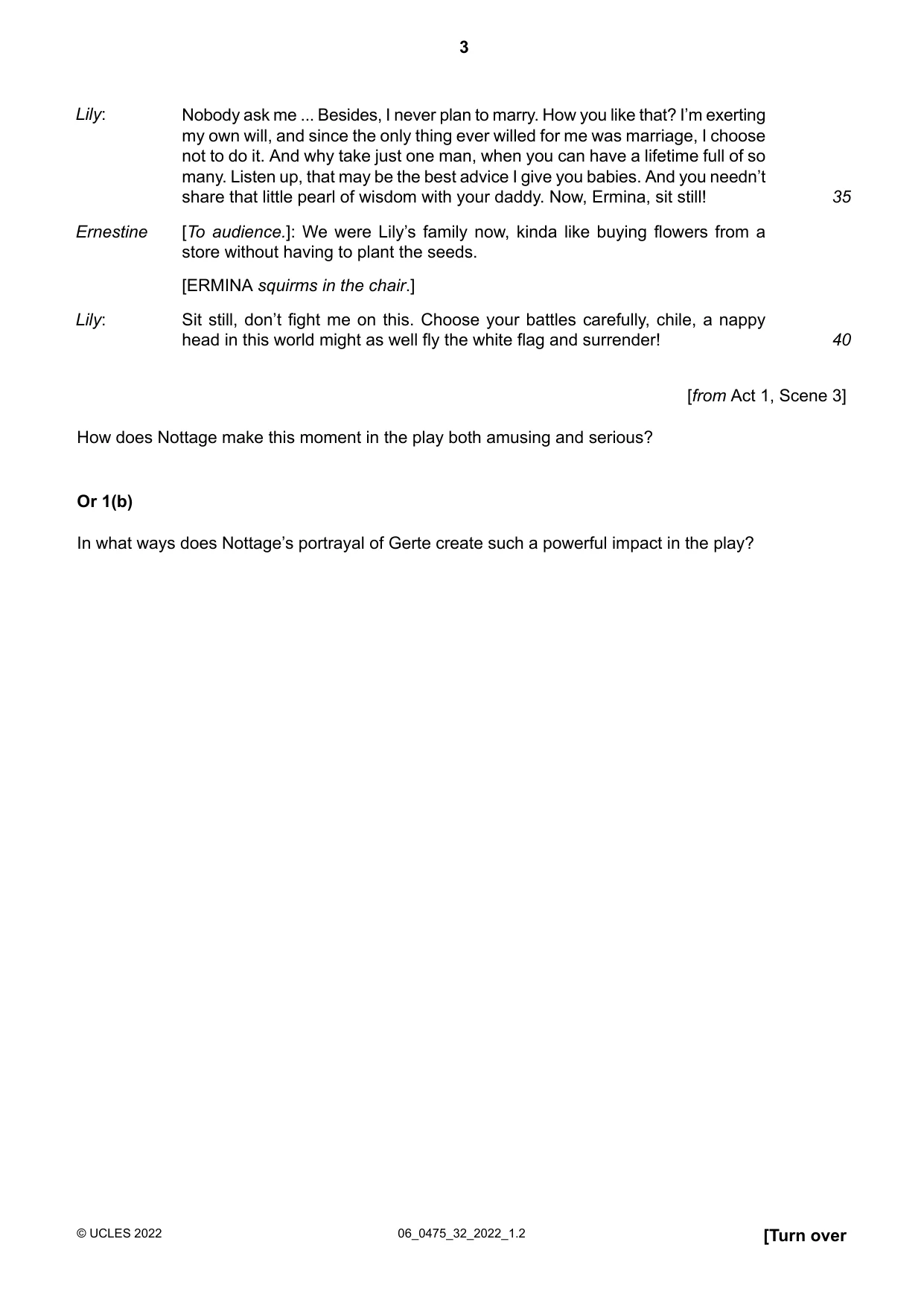
40 35 Nobody ask me ... Besides, I never plan to marry. How you like that? I’m exerting my own will, and since the only thing ever willed for me was marriage, I choose not to do it. And why take just one man, when you can have a lifetime full of so many. Listen up, that may be the best advice I give you babies. And you needn’t share that little pearl of wisdom with your daddy. Now, Ermina, sit still! Lily: [To audience.]: We were Lily’s family now, kinda like buying flowers from a store without having to plant the seeds. Ernestine [ERMINA squirms in the chair.] Sit still, don’t fight me on this. Choose your battles carefully, chile, a nappy head in this world might as well fly the white flag and surrender! Lily: [from Act 1, Scene 3] How does Nottage make this moment in the play both amusing and serious? Or 1(b) In what ways does Nottage’s portrayal of Gerte create such a powerful impact in the play? [Turn over 06_0475_32_2022_1.2 © UCLES 2022 3
Question paper, page 4
ARTHUR MILLER: The Crucible Remember to support your ideas with details from the writing. Either 2(a) Read this passage carefully, and then answer the question that follows it: She makes me drink blood! Abigail: 06_0475_32_2022_1.2 © UCLES 2022 4 Content removed due to copyright restrictions.
Question paper, page 5
Someone you know. [from Act 1] How does Miller make this such a powerful and significant moment in the play? Or 2(b) How does Miller make the relationship between Abigail Williams and John Proctor so disturbing? [Turn over 06_0475_32_2022_1.2 © UCLES 2022 5 Content removed due to copyright restrictions.
Question paper, page 6
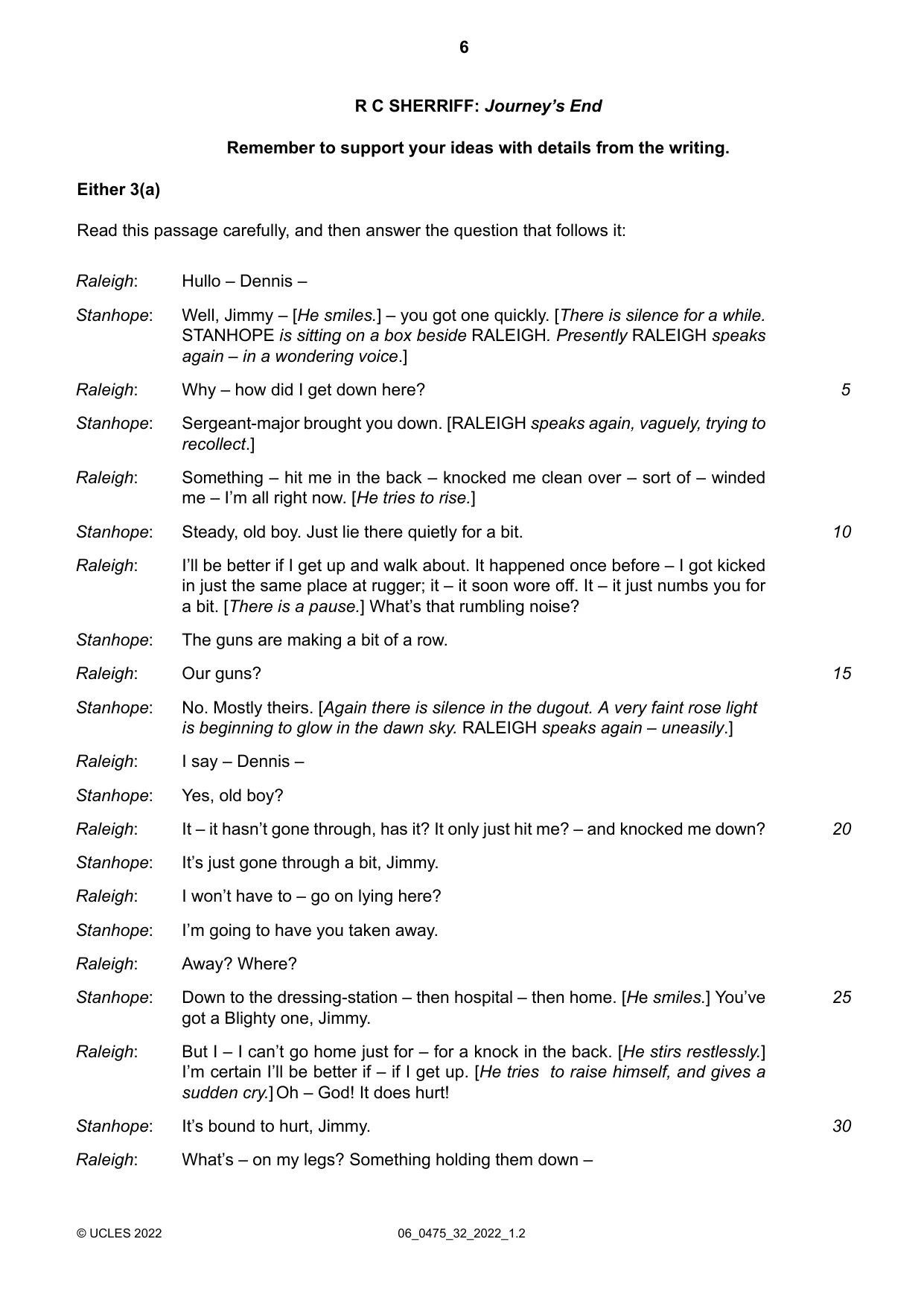
30 25 20 15 10 5 R C SHERRIFF: Journey’s End Remember to support your ideas with details from the writing. Either 3(a) Read this passage carefully, and then answer the question that follows it: Hullo – Dennis – Raleigh: Well, Jimmy – [He smiles.] – you got one quickly. [There is silence for a while. STANHOPE is sitting on a box beside RALEIGH. Presently RALEIGH speaks again – in a wondering voice.] Stanhope: Why – how did I get down here? Raleigh: Sergeant-major brought you down. [RALEIGH speaks again, vaguely, trying to recollect.] Stanhope: Something – hit me in the back – knocked me clean over – sort of – winded me – I’m all right now. [He tries to rise.] Raleigh: Steady, old boy. Just lie there quietly for a bit. Stanhope: I’ll be better if I get up and walk about. It happened once before – I got kicked in just the same place at rugger; it – it soon wore off. It – it just numbs you for a bit. [There is a pause.] What’s that rumbling noise? Raleigh: The guns are making a bit of a row. Stanhope: Our guns? Raleigh: No. Mostly theirs. [Again there is silence in the dugout. A very faint rose light is beginning to glow in the dawn sky. RALEIGH speaks again – uneasily.] Stanhope: I say – Dennis – Raleigh: Yes, old boy? Stanhope: It – it hasn’t gone through, has it? It only just hit me? – and knocked me down? Raleigh: It’s just gone through a bit, Jimmy. Stanhope: I won’t have to – go on lying here? Raleigh: I’m going to have you taken away. Stanhope: Away? Where? Raleigh: Down to the dressing-station – then hospital – then home. [He smiles.] You’ve got a Blighty one, Jimmy. Stanhope: But I – I can’t go home just for – for a knock in the back. [He stirs restlessly.] I’m certain I’ll be better if – if I get up. [He tries to raise himself, and gives a sudden cry.]Oh – God! It does hurt! Raleigh: It’s bound to hurt, Jimmy. Stanhope: What’s – on my legs? Something holding them down – Raleigh: 06_0475_32_2022_1.2 © UCLES 2022 6
Question paper, page 7
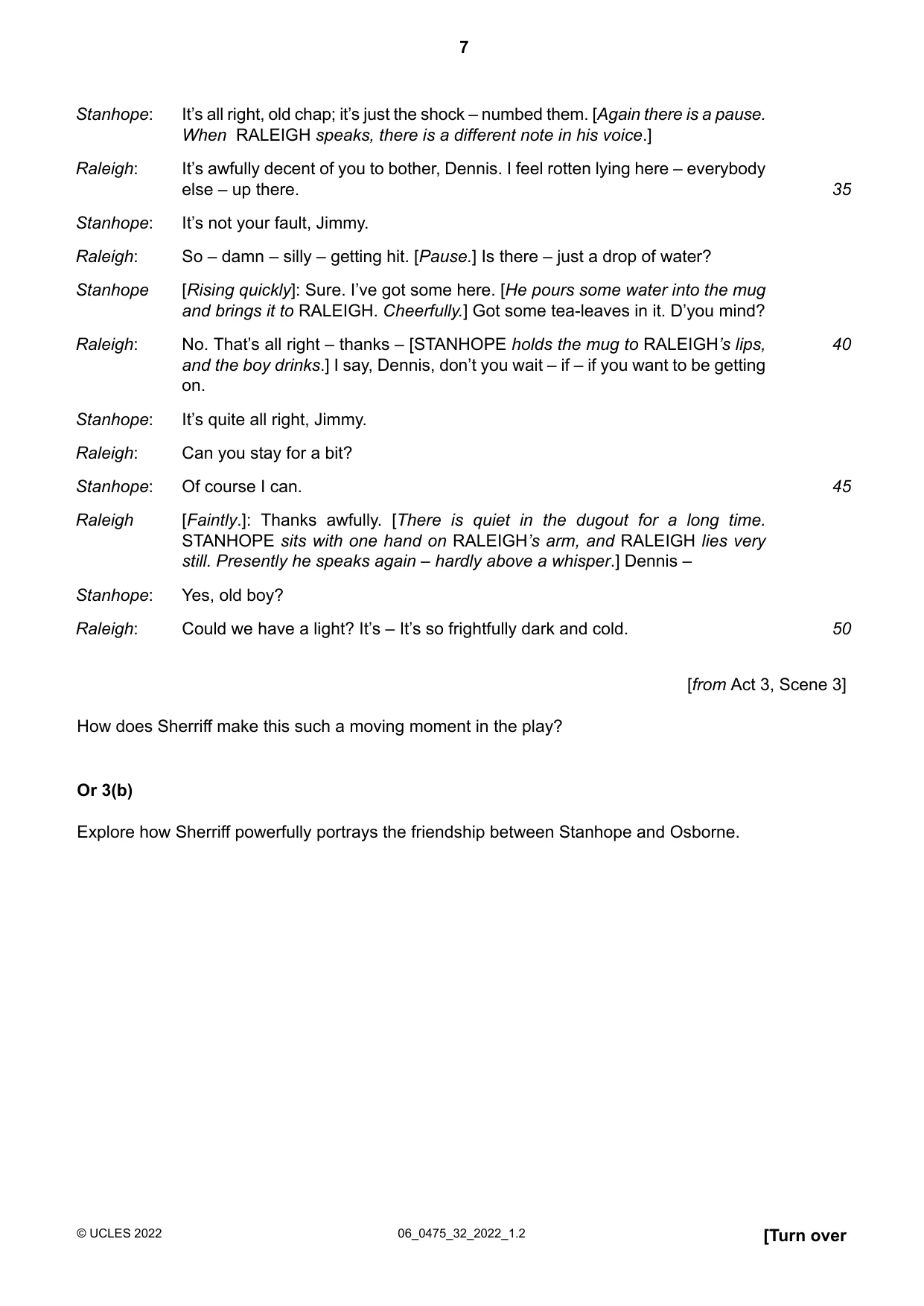
50 45 40 35 It’s all right, old chap; it’s just the shock – numbed them. [Again there is a pause. When RALEIGH speaks, there is a different note in his voice.] Stanhope: It’s awfully decent of you to bother, Dennis. I feel rotten lying here – everybody else – up there. Raleigh: It’s not your fault, Jimmy. Stanhope: So – damn – silly – getting hit. [Pause.] Is there – just a drop of water? Raleigh: [Rising quickly]: Sure. I’ve got some here. [He pours some water into the mug and brings it to RALEIGH. Cheerfully.] Got some tea-leaves in it. D’you mind? Stanhope No. That’s all right – thanks – [STANHOPE holds the mug to RALEIGH’s lips, and the boy drinks.] I say, Dennis, don’t you wait – if – if you want to be getting on. Raleigh: It’s quite all right, Jimmy. Stanhope: Can you stay for a bit? Raleigh: Of course I can. Stanhope: [Faintly.]: Thanks awfully. [There is quiet in the dugout for a long time. STANHOPE sits with one hand on RALEIGH’s arm, and RALEIGH lies very still. Presently he speaks again – hardly above a whisper.] Dennis – Raleigh Yes, old boy? Stanhope: Could we have a light? It’s – It’s so frightfully dark and cold. Raleigh: [from Act 3, Scene 3] How does Sherriff make this such a moving moment in the play? Or 3(b) Explore how Sherriff powerfully portrays the friendship between Stanhope and Osborne. [Turn over 06_0475_32_2022_1.2 © UCLES 2022 7
Question paper, page 8
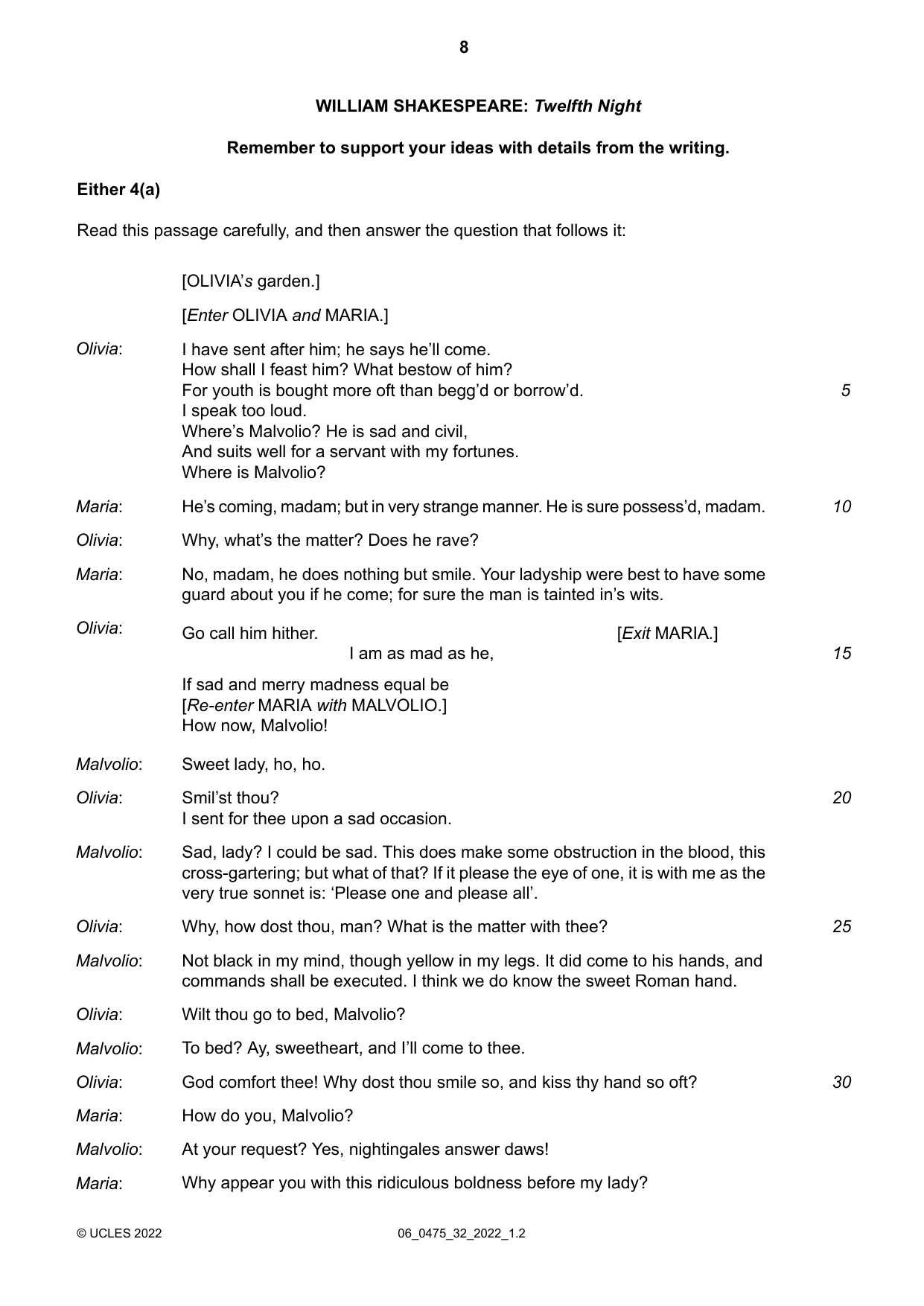
30 25 20 15 10 5 WILLIAM SHAKESPEARE: Twelfth Night Remember to support your ideas with details from the writing. Either 4(a) Read this passage carefully, and then answer the question that follows it: [OLIVIA’s garden.] [Enter OLIVIA and MARIA.] I have sent after him; he says he’ll come. How shall I feast him? What bestow of him? For youth is bought more oft than begg’d or borrow’d. I speak too loud. Where’s Malvolio? He is sad and civil, And suits well for a servant with my fortunes. Where is Malvolio? Olivia: He’s coming, madam; but in very strange manner. He is sure possess’d, madam. Maria: Why, what’s the matter? Does he rave? Olivia: No, madam, he does nothing but smile. Your ladyship were best to have some guard about you if he come; for sure the man is tainted in’s wits. Maria: Go call him hither. [Exit MARIA.] I am as mad as he, If sad and merry madness equal be [Re-enter MARIA with MALVOLIO.] How now, Malvolio! Olivia: Sweet lady, ho, ho. Malvolio: Smil’st thou? I sent for thee upon a sad occasion. Olivia: Sad, lady? I could be sad. This does make some obstruction in the blood, this cross-gartering; but what of that? If it please the eye of one, it is with me as the very true sonnet is: ‘Please one and please all’. Malvolio: Why, how dost thou, man? What is the matter with thee? Olivia: Not black in my mind, though yellow in my legs. It did come to his hands, and commands shall be executed. I think we do know the sweet Roman hand. Malvolio: Wilt thou go to bed, Malvolio? Olivia: To bed? Ay, sweetheart, and I’ll come to thee. Malvolio: God comfort thee! Why dost thou smile so, and kiss thy hand so oft? Olivia: How do you, Malvolio? Maria: At your request? Yes, nightingales answer daws! Malvolio: Why appear you with this ridiculous boldness before my lady? Μaria: 06_0475_32_2022_1.2 © UCLES 2022 8
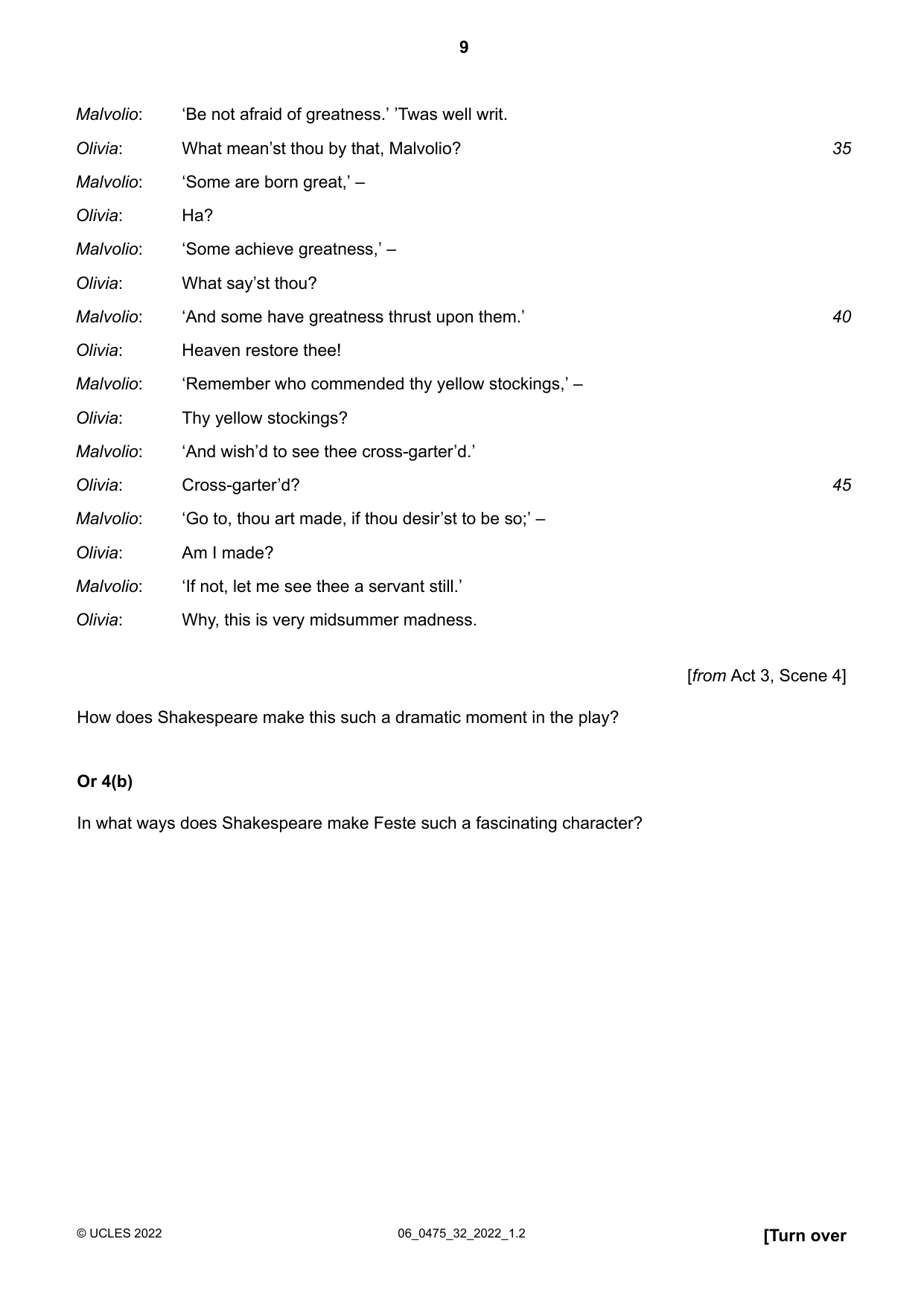
Question paper, page 9
45 40 35 ‘Be not afraid of greatness.’ ’Twas well writ. Malvolio: What mean’st thou by that, Malvolio? Olivia: ‘Some are born great,’ – Malvolio: Ha? Olivia: ‘Some achieve greatness,’ – Malvolio: What say’st thou? Olivia: ‘And some have greatness thrust upon them.’ Malvolio: Heaven restore thee! Olivia: ‘Remember who commended thy yellow stockings,’ – Malvolio: Thy yellow stockings? Olivia: ‘And wish’d to see thee cross-garter’d.’ Malvolio: Cross-garter’d? Olivia: ‘Go to, thou art made, if thou desir’st to be so;’ – Malvolio: Am I made? Olivia: ‘If not, let me see thee a servant still.’ Malvolio: Why, this is very midsummer madness. Olivia: [from Act 3, Scene 4] How does Shakespeare make this such a dramatic moment in the play? Or 4(b) In what ways does Shakespeare make Feste such a fascinating character? [Turn over 06_0475_32_2022_1.2 © UCLES 2022 9
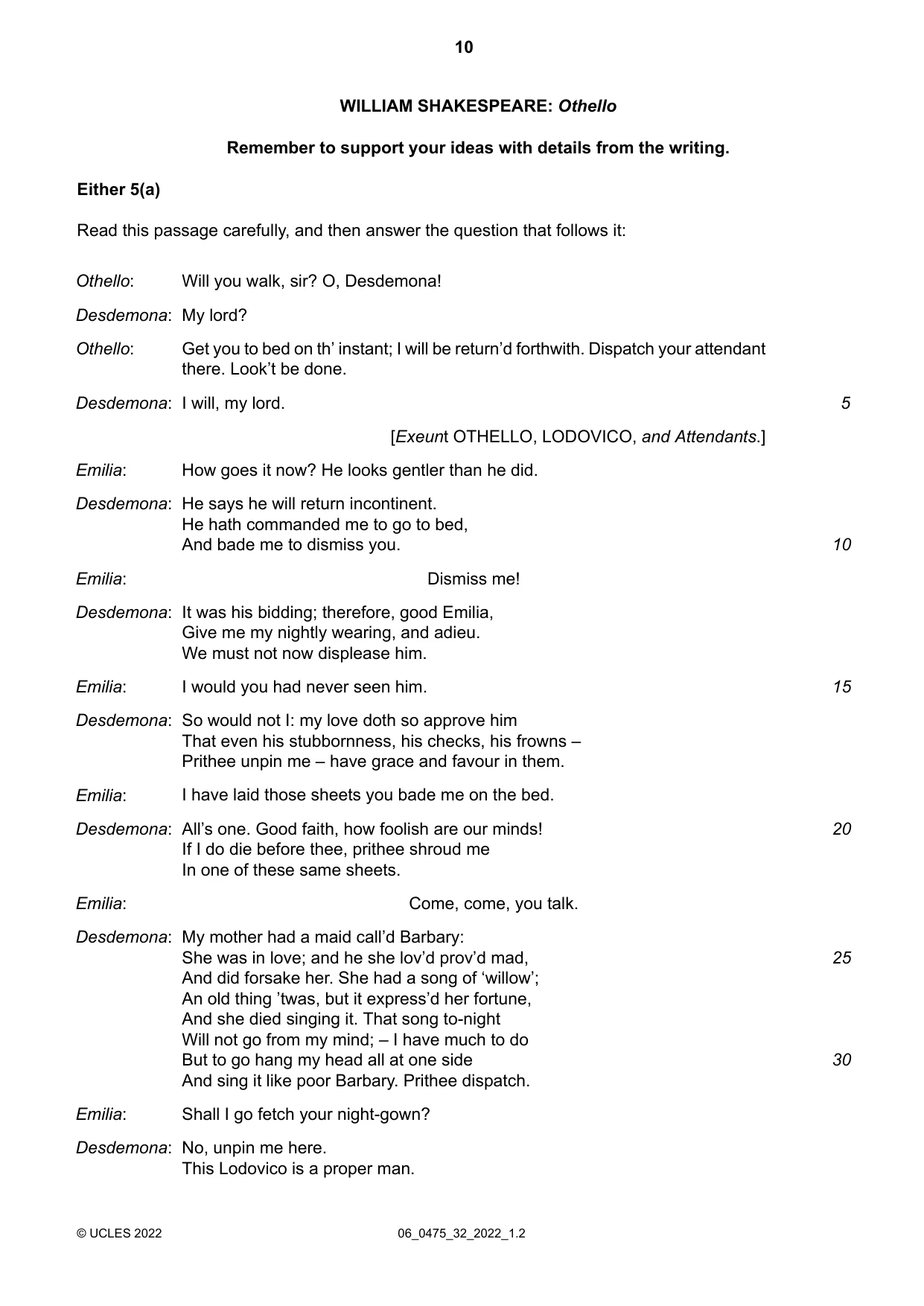
Question paper, page 10
30 25 20 15 10 5 WILLIAM SHAKESPEARE: Othello Remember to support your ideas with details from the writing. Either 5(a) Read this passage carefully, and then answer the question that follows it: Will you walk, sir? O, Desdemona! Othello: My lord? Desdemona: Get you to bed on th’ instant; I will be return’d forthwith. Dispatch your attendant there. Look’t be done. Othello: I will, my lord. Desdemona: [Exeunt OTHELLO, LODOVICO, and Attendants.] How goes it now? He looks gentler than he did. Emilia: He says he will return incontinent. He hath commanded me to go to bed, And bade me to dismiss you. Desdemona: Dismiss me! Emilia: It was his bidding; therefore, good Emilia, Give me my nightly wearing, and adieu. We must not now displease him. Desdemona: I would you had never seen him. Emilia: So would not I: my love doth so approve him That even his stubbornness, his checks, his frowns – Prithee unpin me – have grace and favour in them. Desdemona: I have laid those sheets you bade me on the bed. Emilia: All’s one. Good faith, how foolish are our minds! If I do die before thee, prithee shroud me In one of these same sheets. Desdemona: Come, come, you talk. Emilia: My mother had a maid call’d Barbary: She was in love; and he she lov’d prov’d mad, And did forsake her. She had a song of ‘willow’; An old thing ’twas, but it express’d her fortune, And she died singing it. That song to-night Will not go from my mind; – I have much to do But to go hang my head all at one side And sing it like poor Barbary. Prithee dispatch. Desdemona: Shall I go fetch your night-gown? Emilia: No, unpin me here. This Lodovico is a proper man. Desdemona: 06_0475_32_2022_1.2 © UCLES 2022 10
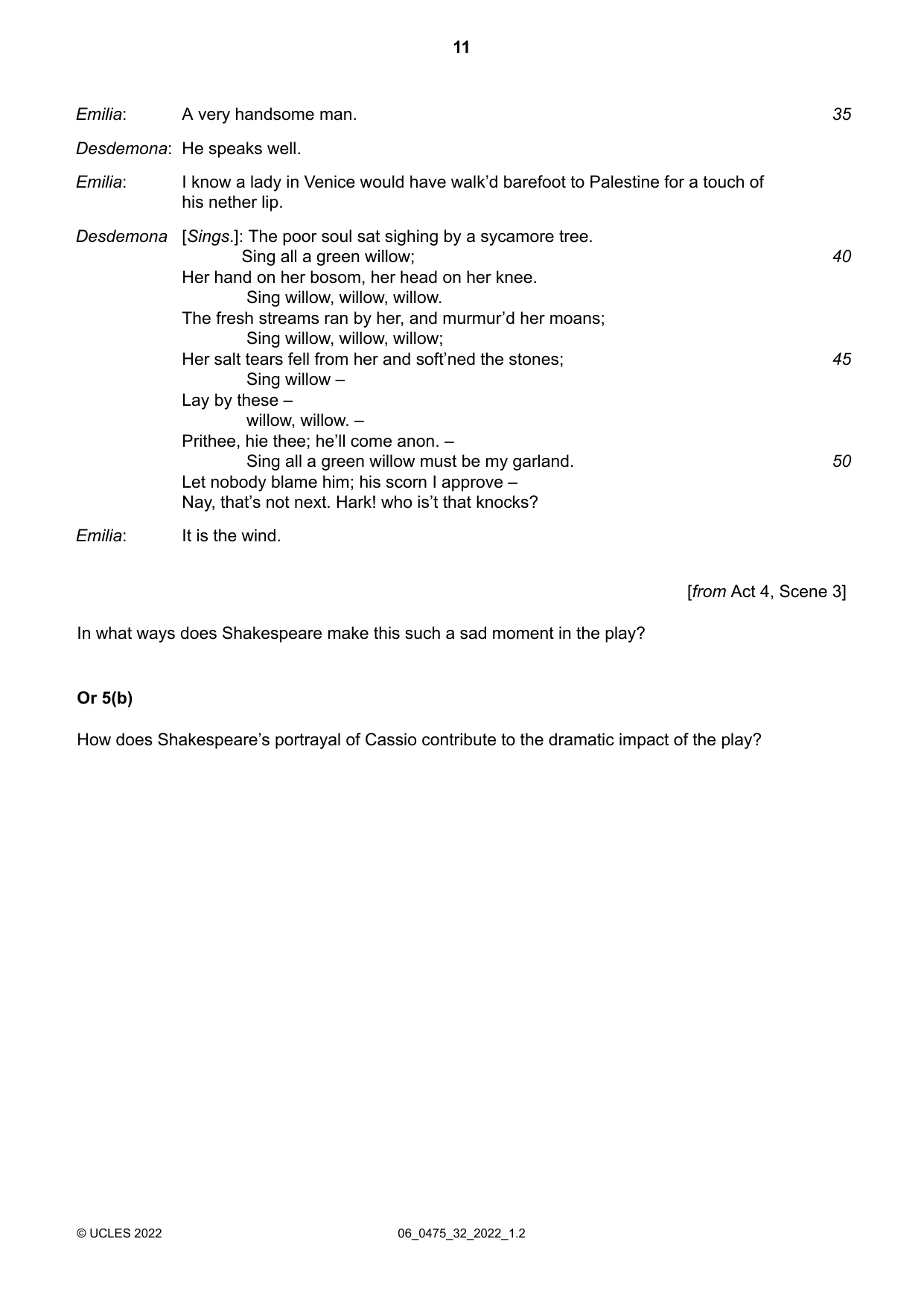
Question paper, page 11
50 45 40 35 A very handsome man. Emilia: He speaks well. Desdemona: I know a lady in Venice would have walk’d barefoot to Palestine for a touch of his nether lip. Emilia: [Sings.]: The poor soul sat sighing by a sycamore tree. Sing all a green willow; Her hand on her bosom, her head on her knee. Sing willow, willow, willow. The fresh streams ran by her, and murmur’d her moans; Sing willow, willow, willow; Her salt tears fell from her and soft’ned the stones; Sing willow – Lay by these – willow, willow. – Prithee, hie thee; he’ll come anon. – Sing all a green willow must be my garland. Let nobody blame him; his scorn I approve – Nay, that’s not next. Hark! who is’t that knocks? Desdemona It is the wind. Emilia: [from Act 4, Scene 3] In what ways does Shakespeare make this such a sad moment in the play? Or 5(b) How does Shakespeare’s portrayal of Cassio contribute to the dramatic impact of the play? 06_0475_32_2022_1.2 © UCLES 2022 11
Question paper, page 12
BLANK PAGE Permission to reproduce items where third-party owned material protected by copyright is included has been sought and cleared where possible. Every reasonable effort has been made by the publisher (UCLES) to trace copyright holders, but if any items requiring clearance have unwittingly been included, the publisher will be pleased to make amends at the earliest possible opportunity. To avoid the issue of disclosure of answer-related information to candidates, all copyright acknowledgements are reproduced online in the Cambridge Assessment International Education Copyright Acknowledgements Booklet. This is produced for each series of examinations and is freely available to download at www.cambridgeinternational.org after the live examination series. Cambridge Assessment International Education is part of Cambridge Assessment. Cambridge Assessment is the brand name of the University of Cambridge Local Examinations Syndicate (UCLES), which is a department of the University of Cambridge. 06_0475_32_2022_1.2 © UCLES 2022 12
Mark scheme, page 1
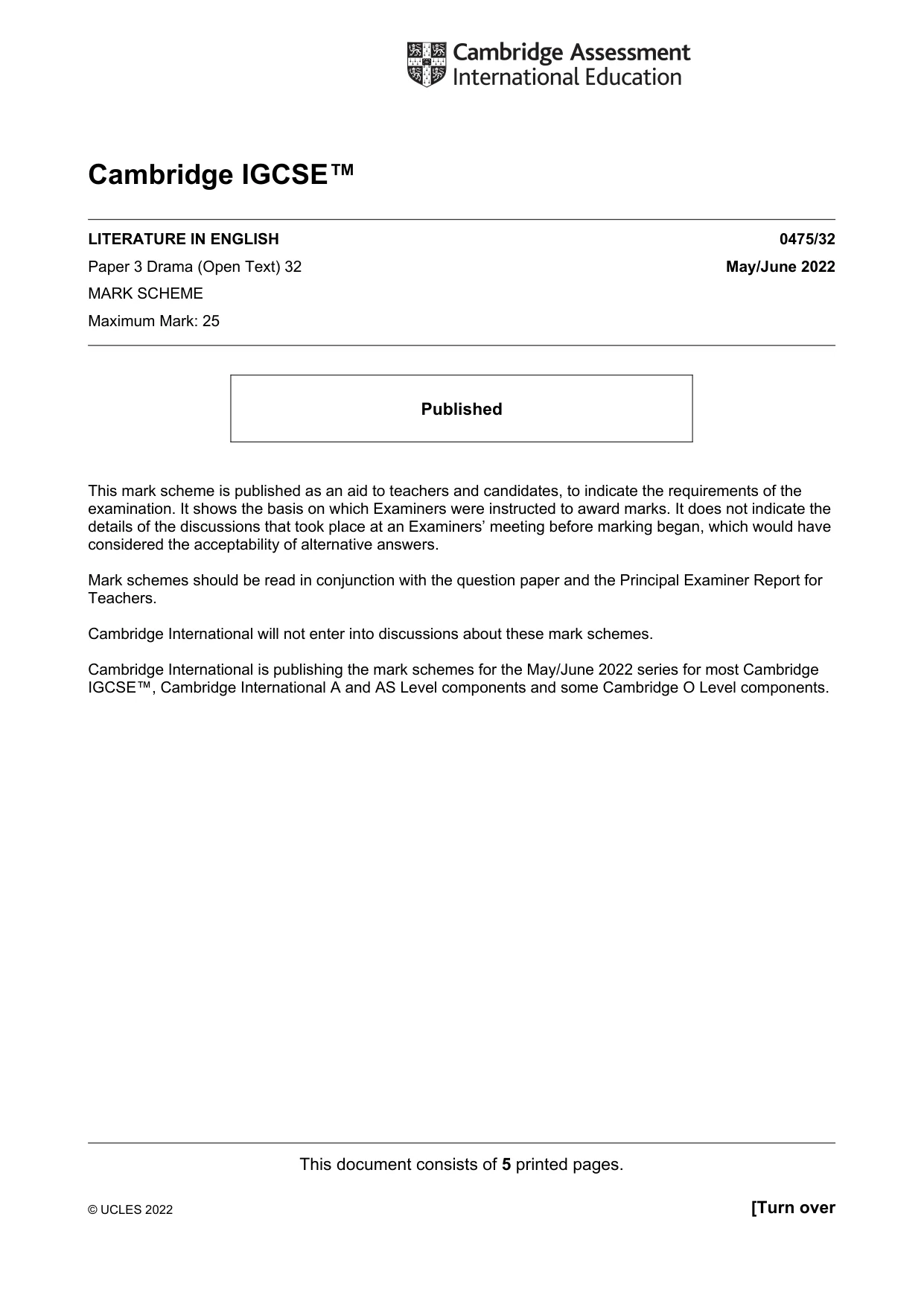
This document consists of 5 printed pages. © UCLES 2022 [Turn over Cambridge IGCSE™ LITERATURE IN ENGLISH 0475/32 Paper 3 Drama (Open Text) 32 May/June 2022 MARK SCHEME Maximum Mark: 25 Published This mark scheme is published as an aid to teachers and candidates, to indicate the requirements of the examination. It shows the basis on which Examiners were instructed to award marks. It does not indicate the details of the discussions that took place at an Examiners’ meeting before marking began, which would have considered the acceptability of alternative answers. Mark schemes should be read in conjunction with the question paper and the Principal Examiner Report for Teachers. Cambridge International will not enter into discussions about these mark schemes. Cambridge International is publishing the mark schemes for the May/June 2022 series for most Cambridge IGCSE™, Cambridge International A and AS Level components and some Cambridge O Level components.
Mark scheme, page 2
0475/32 Cambridge IGCSE – Mark Scheme PUBLISHED May/June 2022 © UCLES 2022 Page 2 of 5 Generic Marking Principles These general marking principles must be applied by all examiners when marking candidate answers. They should be applied alongside the specific content of the mark scheme or generic level descriptors for a question. Each question paper and mark scheme will also comply with these marking principles. GENERIC MARKING PRINCIPLE 1: Marks must be awarded in line with: the specific content of the mark scheme or the generic level descriptors for the question the specific skills defined in the mark scheme or in the generic level descriptors for the question the standard of response required by a candidate as exemplified by the standardisation scripts. GENERIC MARKING PRINCIPLE 2: Marks awarded are always whole marks (not half marks, or other fractions). GENERIC MARKING PRINCIPLE 3: Marks must be awarded positively: marks are awarded for correct/valid answers, as defined in the mark scheme. However, credit is given for valid answers which go beyond the scope of the syllabus and mark scheme, referring to your Team Leader as appropriate marks are awarded when candidates clearly demonstrate what they know and can do marks are not deducted for errors marks are not deducted for omissions answers should only be judged on the quality of spelling, punctuation and grammar when these features are specifically assessed by the question as indicated by the mark scheme. The meaning, however, should be unambiguous. GENERIC MARKING PRINCIPLE 4: Rules must be applied consistently, e.g. in situations where candidates have not followed instructions or in the application of generic level descriptors. GENERIC MARKING PRINCIPLE 5: Marks should be awarded using the full range of marks defined in the mark scheme for the question (however; the use of the full mark range may be limited according to the quality of the candidate responses seen). GENERIC MARKING PRINCIPLE 6: Marks awarded are based solely on the requirements as defined in the mark scheme. Marks should not be awarded with grade thresholds or grade descriptors in mind.
Mark scheme, page 3
0475/32 Cambridge IGCSE – Mark Scheme PUBLISHED May/June 2022 © UCLES 2022 Page 3 of 5 English & Media subject specific general marking principles (To be read in conjunction with the Generic Marking Principles (and requiring further guidance on how to place marks within levels)) Components using level descriptors: We use level descriptors as a guide to broad understanding of the qualities normally expected of, or typical of, work in a level. Level descriptors are a means of general guidance, and should not be interpreted as hurdle statements. Where indicative content notes are supplied for a question, these are not a prescription of required content, and must not be treated as such. Alternative correct points and unexpected answers in candidates’ scripts must be given marks that fairly reflect the knowledge and skills demonstrated. While we may have legitimate expectations as to the ground most answers may occupy, we must at all times be prepared to meet candidates on their chosen ground, provided it is relevant ground (e.g. clearly related to and derived from a relevant passage/text and meeting the mark scheme requirements for the question). Components using point-based marking: Point marking is often used to reward knowledge, understanding and application of skills. We give credit where the candidate’s answer shows relevant knowledge, understanding and application of skills in answering the question. We do not give credit where the answer shows confusion. From this it follows that we: a DO credit answers which are worded differently from the mark scheme if they clearly convey the same meaning (unless the mark scheme requires a specific term). b DO credit alternative answers/examples which are not written in the mark scheme if they are correct. c DO credit answers where candidates give more than one correct answer in one prompt/numbered/scaffolded space where extended writing is required rather than list-type answers. For example, questions that require n reasons (e.g. State two reasons…). d DO NOT credit answers simply for using a ‘key term’ unless that is all that is required. (Check for evidence it is understood and not used wrongly.). e DO NOT credit answers which are obviously self-contradicting or trying to cover all possibilities. f DO NOT give further credit for what is effectively repetition of a correct point already credited unless the language itself is being tested. This applies equally to ‘mirror statements’ (i.e. polluted/not polluted). g DO NOT require spellings to be correct, unless this is part of the test. However spellings of syllabus terms must allow for clear and unambiguous separation from other syllabus terms with which they may be confused (e.g. Corrasion/Corrosion).
Mark scheme, page 4
0475/32 Cambridge IGCSE – Mark Scheme PUBLISHED May/June 2022 © UCLES 2022 Page 4 of 5 All questions are marked out of 25. The assessment objectives for the paper are: AO1: show detailed knowledge of the content of literary texts, supported by reference to the text AO2: understand the meanings of literary texts and their contexts, and explore texts beyond surface meanings to show deeper awareness of ideas and attitudes AO3: recognise and appreciate ways in which writers use language, structure and form to create and shape meanings and effects AO4: communicate a sensitive and informed personal response to literary texts. The Level Descriptors cover marks from 0 to 25, and apply to the marking of each question. They guide examiners to an understanding of the qualities normally expected of, or typical of, work in a level. They are a means of general guidance. For the purposes of standardisation of marking, they are to be used in conjunction with examples of candidates’ work and discussed during the examiners’ coordination meeting.
Mark scheme, page 5
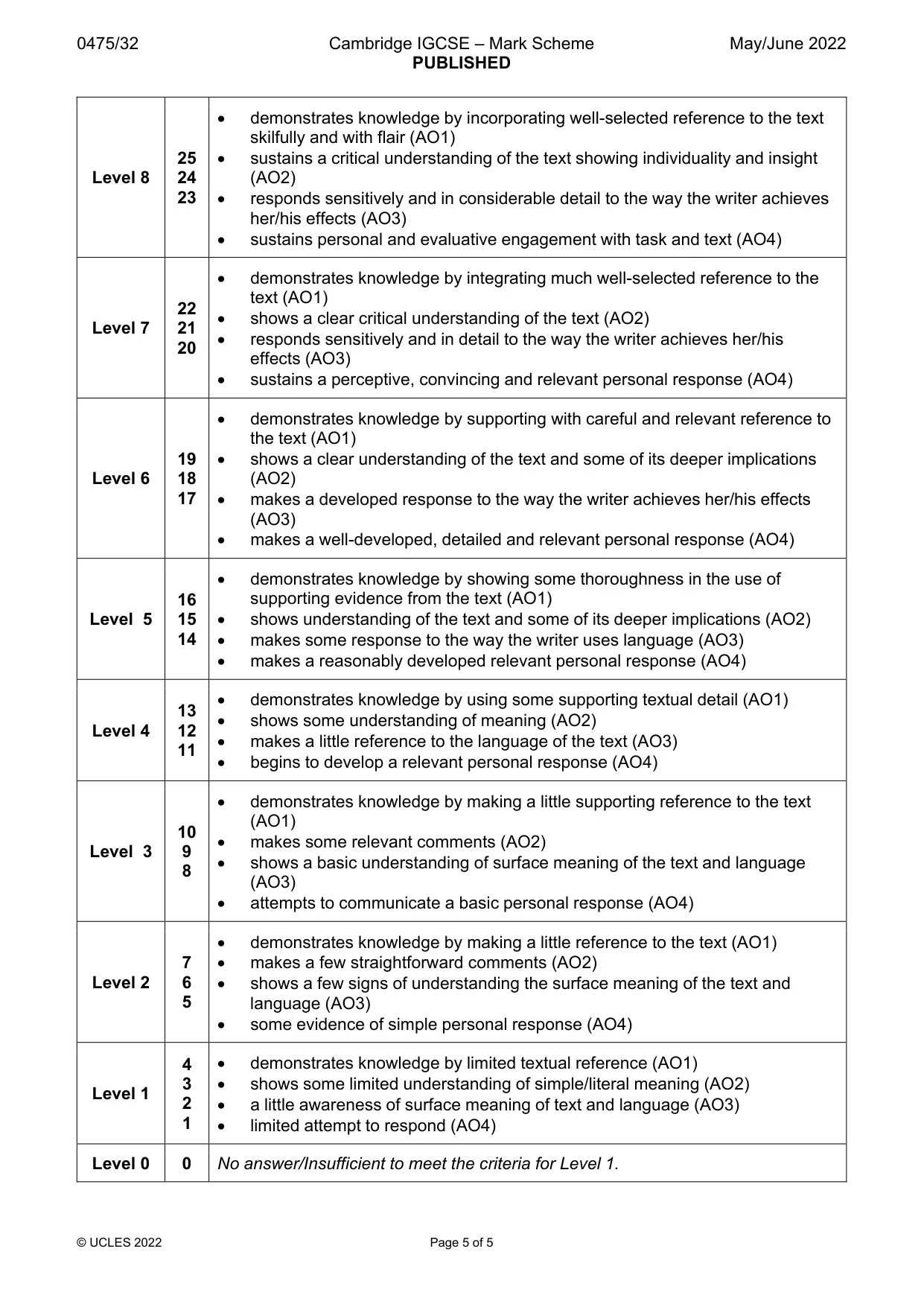
0475/32 Cambridge IGCSE – Mark Scheme PUBLISHED May/June 2022 © UCLES 2022 Page 5 of 5 Level 8 25 24 23 demonstrates knowledge by incorporating well-selected reference to the text skilfully and with flair (AO1) sustains a critical understanding of the text showing individuality and insight (AO2) responds sensitively and in considerable detail to the way the writer achieves her/his effects (AO3) sustains personal and evaluative engagement with task and text (AO4) Level 7 22 21 20 demonstrates knowledge by integrating much well-selected reference to the text (AO1) shows a clear critical understanding of the text (AO2) responds sensitively and in detail to the way the writer achieves her/his effects (AO3) sustains a perceptive, convincing and relevant personal response (AO4) Level 6 19 18 17 demonstrates knowledge by supporting with careful and relevant reference to the text (AO1) shows a clear understanding of the text and some of its deeper implications (AO2) makes a developed response to the way the writer achieves her/his effects (AO3) makes a well-developed, detailed and relevant personal response (AO4) Level 5 16 15 14 demonstrates knowledge by showing some thoroughness in the use of supporting evidence from the text (AO1) shows understanding of the text and some of its deeper implications (AO2) makes some response to the way the writer uses language (AO3) makes a reasonably developed relevant personal response (AO4) Level 4 13 12 11 demonstrates knowledge by using some supporting textual detail (AO1) shows some understanding of meaning (AO2) makes a little reference to the language of the text (AO3) begins to develop a relevant personal response (AO4) Level 3 10 9 8 demonstrates knowledge by making a little supporting reference to the text (AO1) makes some relevant comments (AO2) shows a basic understanding of surface meaning of the text and language (AO3) attempts to communicate a basic personal response (AO4) Level 2 7 6 5 demonstrates knowledge by making a little reference to the text (AO1) makes a few straightforward comments (AO2) shows a few signs of understanding the surface meaning of the text and language (AO3) some evidence of simple personal response (AO4) Level 1 4 3 2 1 demonstrates knowledge by limited textual reference (AO1) shows some limited understanding of simple/literal meaning (AO2) a little awareness of surface meaning of text and language (AO3) limited attempt to respond (AO4) Level 0 0 No answer/Insufficient to meet the criteria for Level 1.
What you needed in this session
Cambridge’s own grade thresholds for 2022 May/June, Paper 3 · Variant 2. A higher threshold means an easier paper — the bar moves with how the cohort did.