Cambridge IGCSE English - Literature in English 0475 — 2021 Oct/Nov Paper 3 · Variant 3
0475/33/O/N/21 · 25 marks · ≈28 min
The question paper and its mark scheme, free to read here and free to download. This is Cambridge’s own paper, exactly as it was sat.
Question paper12 pages

Mark scheme5 pages
Answers below. Sit the paper first if you are practising.
Paper as text
Question paper, page 1
This document has 12 pages. Any blank pages are indicated. * 7 5 1 4 6 8 2 5 3 9 * Cambridge IGCSE™ LITERATURE IN ENGLISH 0475/33 Paper 3 Drama (Open Text) October/November 2021 45 minutes You must answer on the enclosed answer booklet. You will need: Answer booklet (enclosed) Candidates may take their set texts into the exam room, but these must NOT contain personal annotations, highlighting or underlining. INSTRUCTIONS ● Answer one question. ● Follow the instructions on the front cover of the answer booklet. If you need additional answer paper, ask the invigilator for a continuation booklet. ● You may take your set text into the exam room, but this must not contain personal annotations, highlighting or underlining. INFORMATION ● The total mark for this paper is 25. ● All questions are worth equal marks. DC (SLM) 218691/1 © UCLES 2021 [Turn over
Question paper, page 2
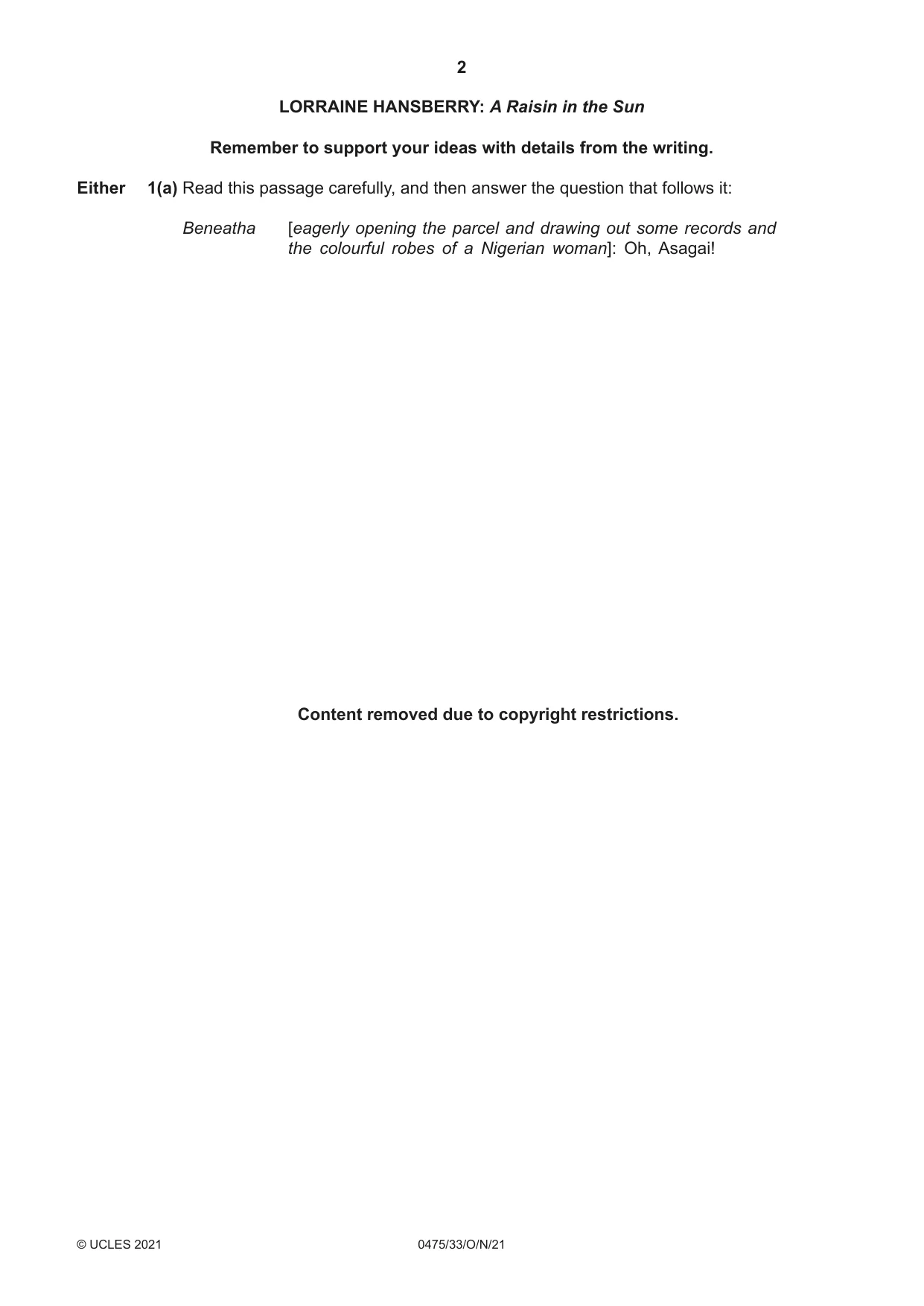
2 0475/33/O/N/21 © UCLES 2021 LORRAINE HANSBERRY: A Raisin in the Sun Remember to support your ideas with details from the writing. Either 1(a) Read this passage carefully, and then answer the question that follows it: Beneatha [eagerly opening the parcel and drawing out some records and the colourful robes of a Nigerian woman]: Oh, Asagai! Content removed due to copyright restrictions.
Question paper, page 3
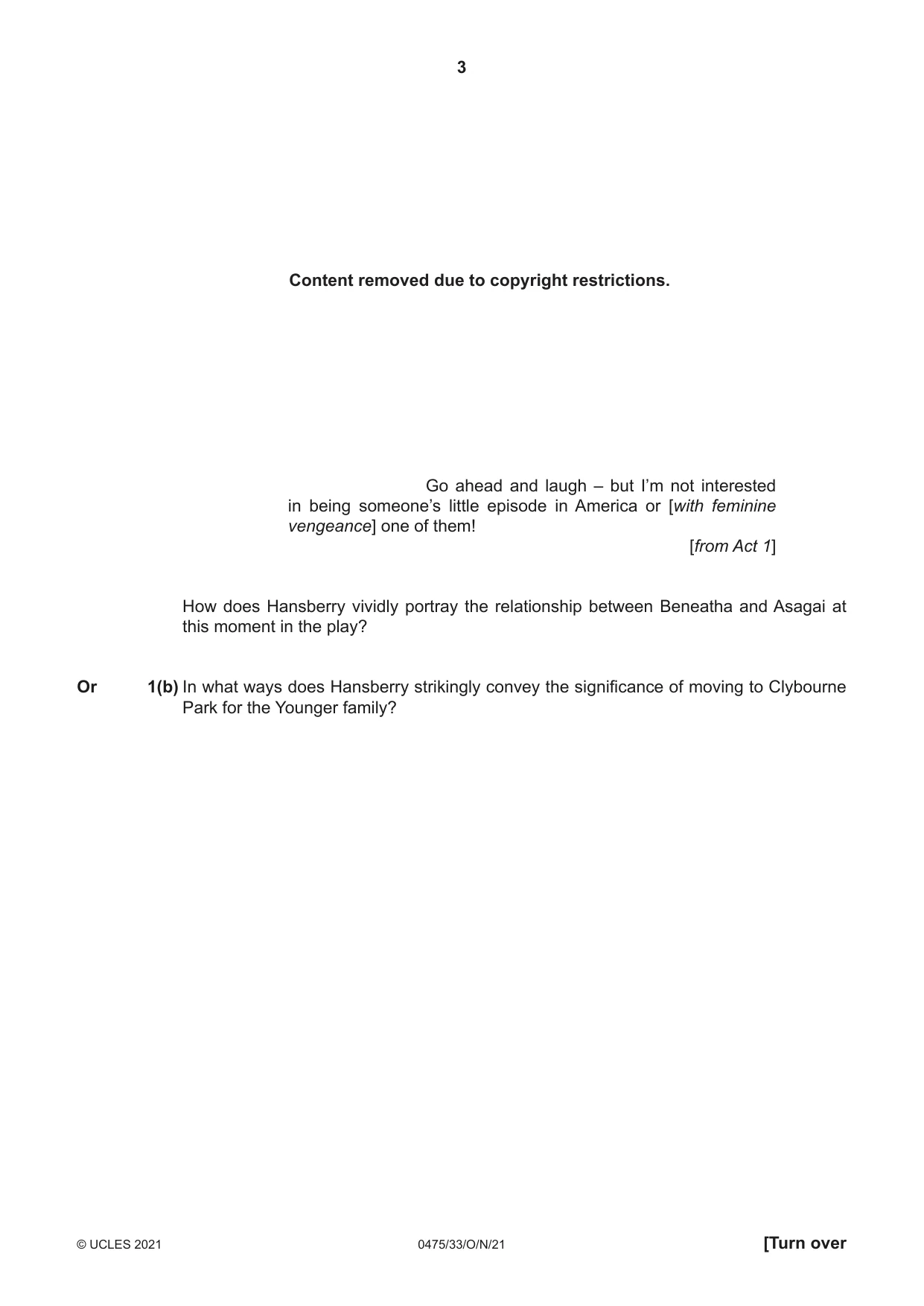
3 0475/33/O/N/21 © UCLES 2021 [Turn over Go ahead and laugh – but I’m not interested in being someone’s little episode in America or [with feminine vengeance] one of them! [from Act 1] How does Hansberry vividly portray the relationship between Beneatha and Asagai at this moment in the play? Or 1(b) In what ways does Hansberry strikingly convey the significance of moving to Clybourne Park for the Younger family? Content removed due to copyright restrictions.
Question paper, page 4
4 0475/33/O/N/21 © UCLES 2021 ARTHUR MILLER: The Crucible Remember to support your ideas with details from the writing. Either 2(a) Read this passage carefully, and then answer the question that follows it: [A cell in Salem jail, that fall. Content removed due to copyright restrictions.
Question paper, page 5
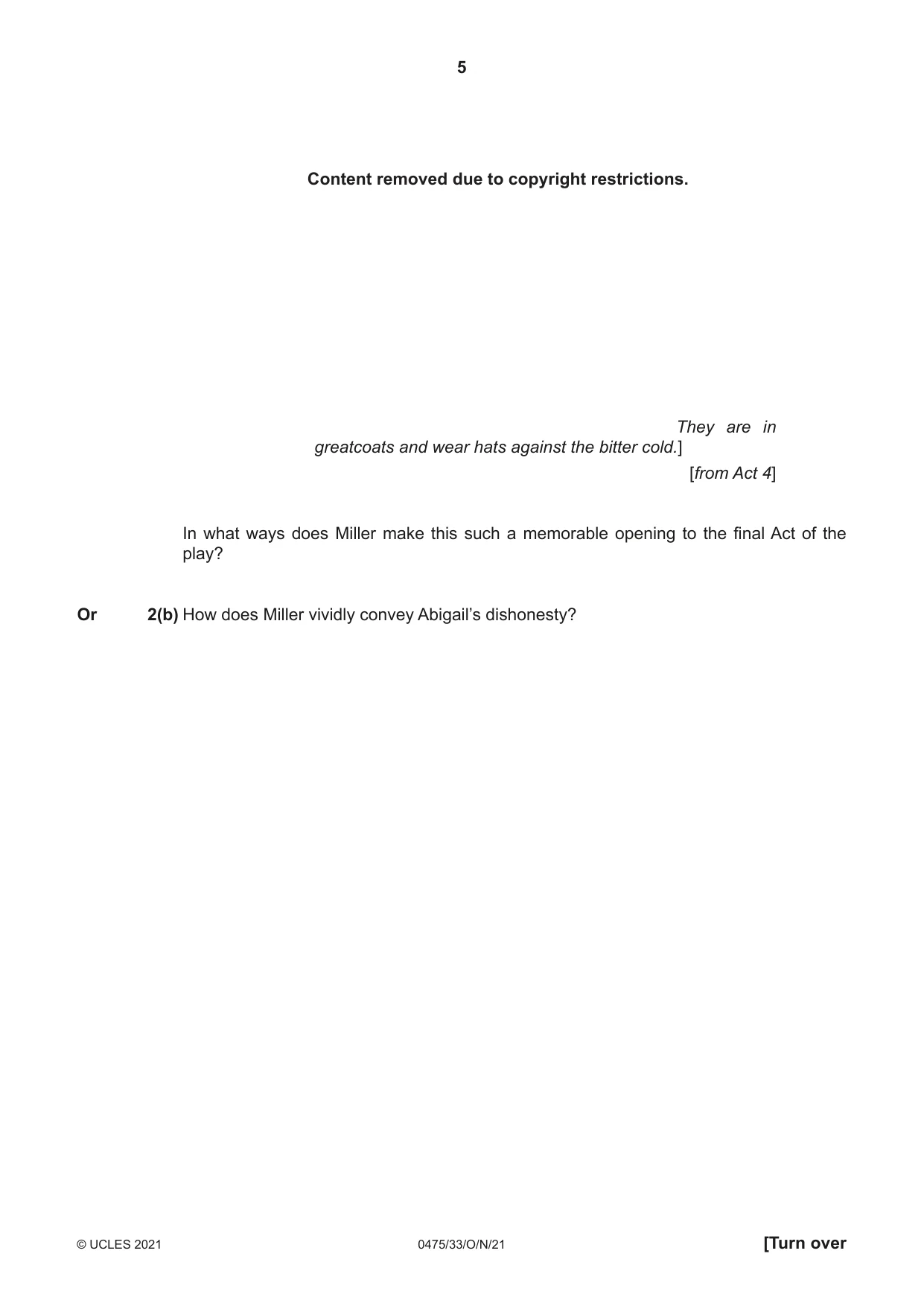
5 0475/33/O/N/21 © UCLES 2021 [Turn over They are in greatcoats and wear hats against the bitter cold.] [from Act 4] In what ways does Miller make this such a memorable opening to the final Act of the play? Or 2(b) How does Miller vividly convey Abigail’s dishonesty? Content removed due to copyright restrictions.
Question paper, page 6
6 0475/33/O/N/21 © UCLES 2021 R C SHERRIFF: Journey’s End Remember to support your ideas with details from the writing. Either 3(a) Read this passage carefully, and then answer the question that follows it: [RALEIGH comes groping down the steps and stands in the candlelight. Content removed due to copyright restrictions.
Question paper, page 7
7 0475/33/O/N/21 © UCLES 2021 [Turn over Thanks. [from Act 1] How does Sherriff make this such a revealing introduction to Raleigh? Or 3(b) Explore the ways in which Sherriff makes Osborne’s death so upsetting. Do not use the passage printed in Question 3(a) in answering this question. Content removed due to copyright restrictions.
Question paper, page 8
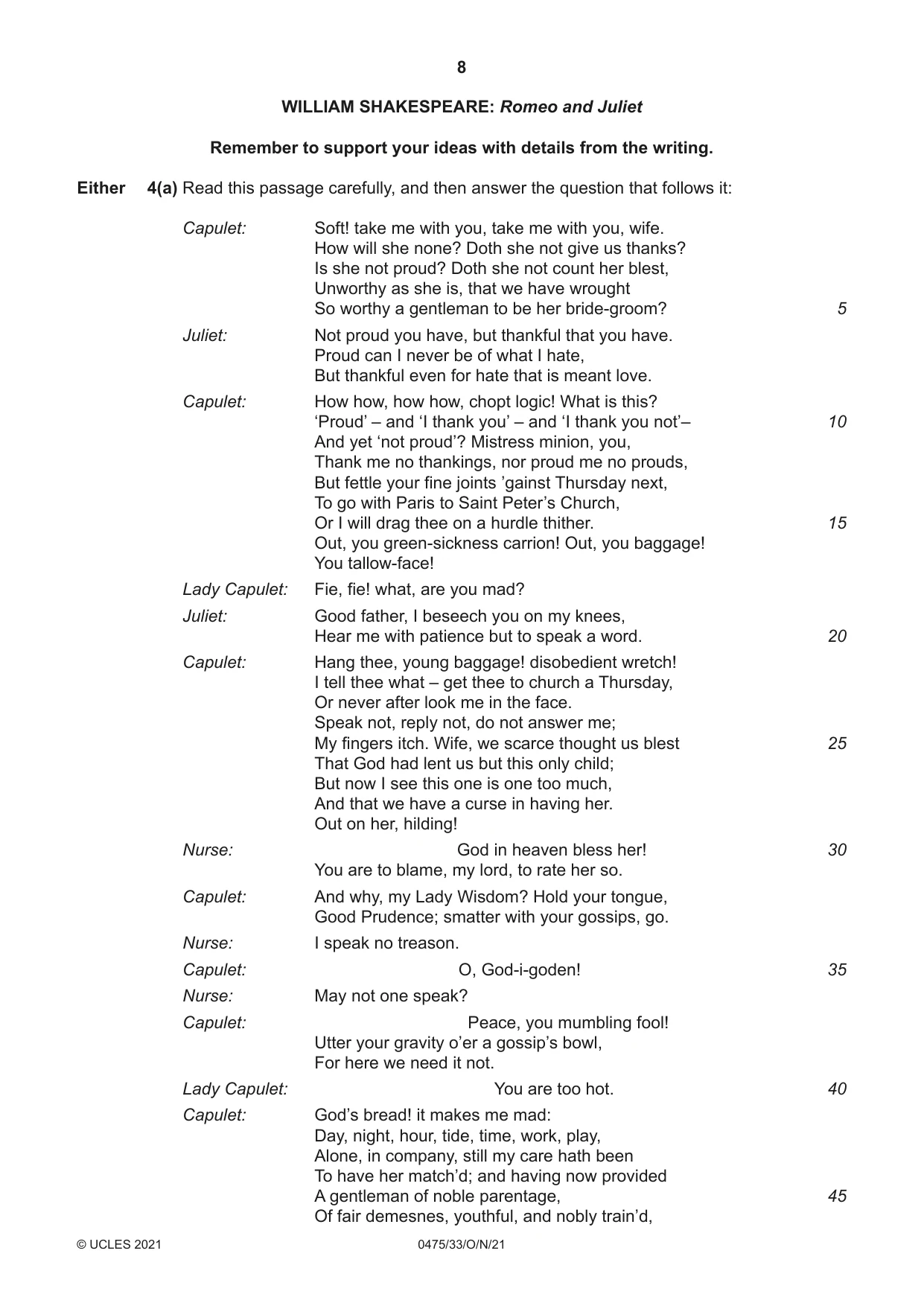
8 0475/33/O/N/21 © UCLES 2021 WILLIAM SHAKESPEARE: Romeo and Juliet Remember to support your ideas with details from the writing. Either 4(a) Read this passage carefully, and then answer the question that follows it: Capulet: Soft! take me with you, take me with you, wife. How will she none? Doth she not give us thanks? Is she not proud? Doth she not count her blest, Unworthy as she is, that we have wrought So worthy a gentleman to be her bride-groom? Juliet: Not proud you have, but thankful that you have. Proud can I never be of what I hate, But thankful even for hate that is meant love. Capulet: How how, how how, chopt logic! What is this? ‘Proud’ – and ‘I thank you’ – and ‘I thank you not’– And yet ‘not proud’? Mistress minion, you, Thank me no thankings, nor proud me no prouds, But fettle your fine joints ’gainst Thursday next, To go with Paris to Saint Peter’s Church, Or I will drag thee on a hurdle thither. Out, you green-sickness carrion! Out, you baggage! You tallow-face! Lady Capulet: Fie, fie! what, are you mad? Juliet: Good father, I beseech you on my knees, Hear me with patience but to speak a word. Capulet: Hang thee, young baggage! disobedient wretch! I tell thee what – get thee to church a Thursday, Or never after look me in the face. Speak not, reply not, do not answer me; My fingers itch. Wife, we scarce thought us blest That God had lent us but this only child; But now I see this one is one too much, And that we have a curse in having her. Out on her, hilding! Nurse: God in heaven bless her! You are to blame, my lord, to rate her so. Capulet: And why, my Lady Wisdom? Hold your tongue, Good Prudence; smatter with your gossips, go. Nurse: I speak no treason. Capulet: O, God-i-goden! Nurse: May not one speak? Capulet: Peace, you mumbling fool! Utter your gravity o’er a gossip’s bowl, For here we need it not. Lady Capulet: You are too hot. Capulet: God’s bread! it makes me mad: Day, night, hour, tide, time, work, play, Alone, in company, still my care hath been To have her match’d; and having now provided A gentleman of noble parentage, Of fair demesnes, youthful, and nobly train’d, 5 10 15 20 25 30 35 40 45
Question paper, page 9
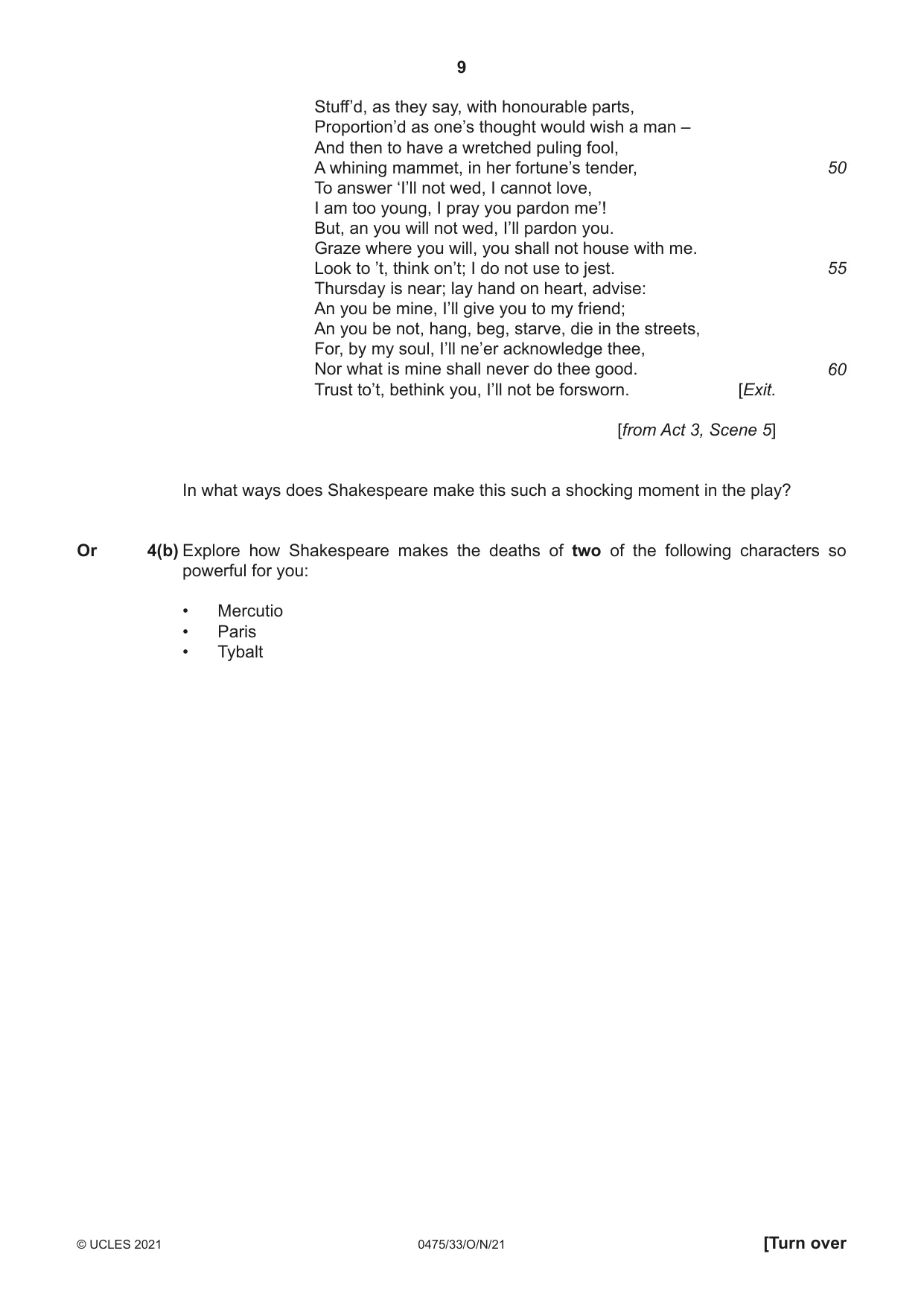
9 0475/33/O/N/21 © UCLES 2021 [Turn over Stuff’d, as they say, with honourable parts, Proportion’d as one’s thought would wish a man – And then to have a wretched puling fool, A whining mammet, in her fortune’s tender, To answer ‘I’ll not wed, I cannot love, I am too young, I pray you pardon me’! But, an you will not wed, I’ll pardon you. Graze where you will, you shall not house with me. Look to ’t, think on’t; I do not use to jest. Thursday is near; lay hand on heart, advise: An you be mine, I’ll give you to my friend; An you be not, hang, beg, starve, die in the streets, For, by my soul, I’ll ne’er acknowledge thee, Nor what is mine shall never do thee good. Trust to’t, bethink you, I’ll not be forsworn. [Exit. [from Act 3, Scene 5] In what ways does Shakespeare make this such a shocking moment in the play? Or 4(b) Explore how Shakespeare makes the deaths of two of the following characters so powerful for you: • Mercutio • Paris • Tybalt 50 55 60
Question paper, page 10
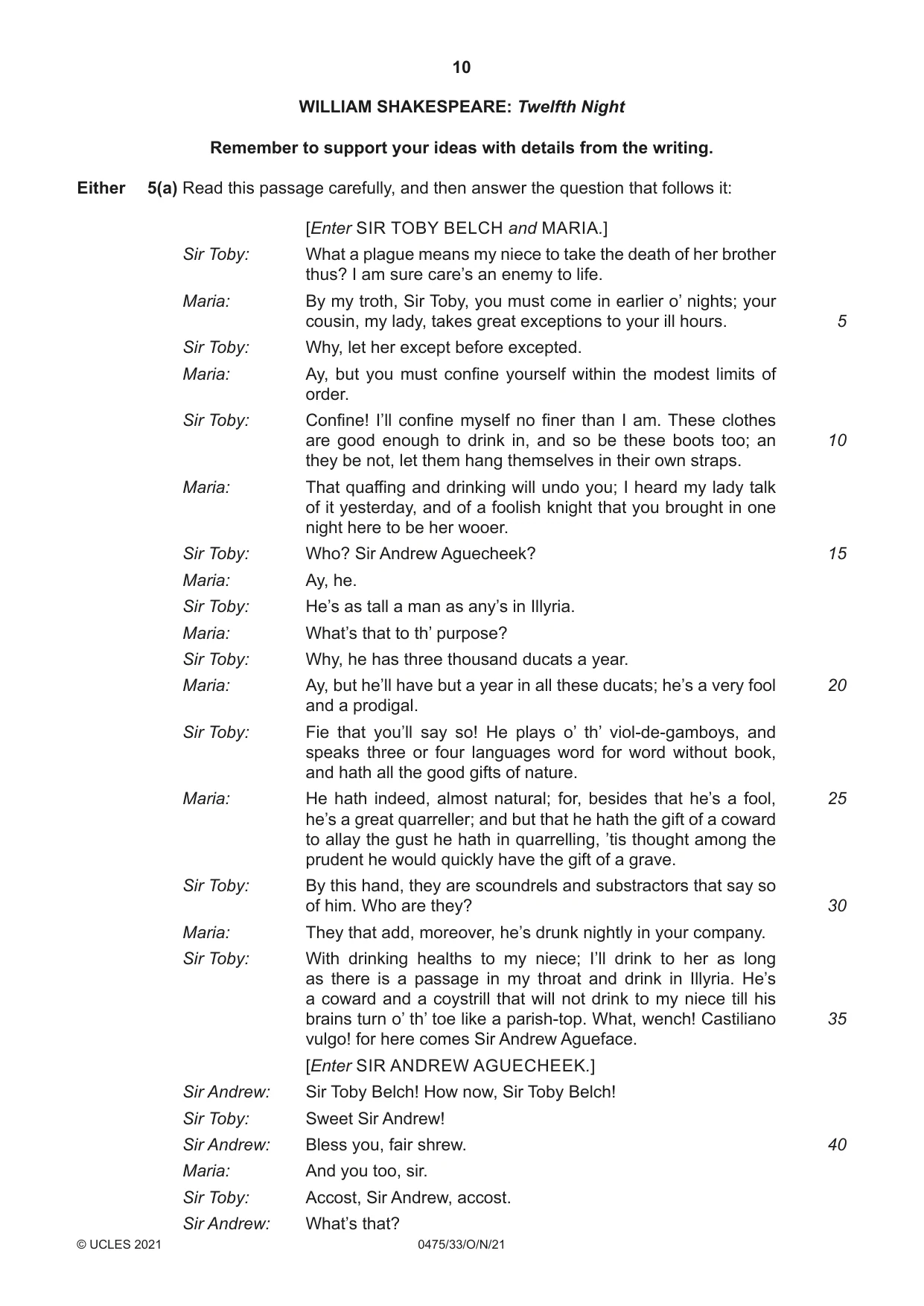
10 0475/33/O/N/21 © UCLES 2021 WILLIAM SHAKESPEARE: Twelfth Night Remember to support your ideas with details from the writing. Either 5(a) Read this passage carefully, and then answer the question that follows it: [Enter SIR TOBY BELCH and MARIA.] Sir Toby: What a plague means my niece to take the death of her brother thus? I am sure care’s an enemy to life. Maria: By my troth, Sir Toby, you must come in earlier o’ nights; your cousin, my lady, takes great exceptions to your ill hours. Sir Toby: Why, let her except before excepted. Maria: Ay, but you must confine yourself within the modest limits of order. Sir Toby: Confine! I’ll confine myself no finer than I am. These clothes are good enough to drink in, and so be these boots too; an they be not, let them hang themselves in their own straps. Maria: That quaffing and drinking will undo you; I heard my lady talk of it yesterday, and of a foolish knight that you brought in one night here to be her wooer. Sir Toby: Who? Sir Andrew Aguecheek? Maria: Ay, he. Sir Toby: He’s as tall a man as any’s in Illyria. Maria: What’s that to th’ purpose? Sir Toby: Why, he has three thousand ducats a year. Maria: Ay, but he’ll have but a year in all these ducats; he’s a very fool and a prodigal. Sir Toby: Fie that you’ll say so! He plays o’ th’ viol-de-gamboys, and speaks three or four languages word for word without book, and hath all the good gifts of nature. Maria: He hath indeed, almost natural; for, besides that he’s a fool, he’s a great quarreller; and but that he hath the gift of a coward to allay the gust he hath in quarrelling, ’tis thought among the prudent he would quickly have the gift of a grave. Sir Toby: By this hand, they are scoundrels and substractors that say so of him. Who are they? Maria: They that add, moreover, he’s drunk nightly in your company. Sir Toby: With drinking healths to my niece; I’ll drink to her as long as there is a passage in my throat and drink in Illyria. He’s a coward and a coystrill that will not drink to my niece till his brains turn o’ th’ toe like a parish-top. What, wench! Castiliano vulgo! for here comes Sir Andrew Agueface. [Enter SIR ANDREW AGUECHEEK.] Sir Andrew: Sir Toby Belch! How now, Sir Toby Belch! Sir Toby: Sweet Sir Andrew! Sir Andrew: Bless you, fair shrew. Maria: And you too, sir. Sir Toby: Accost, Sir Andrew, accost. Sir Andrew: What’s that? 5 10 15 20 25 30 35 40
Question paper, page 11
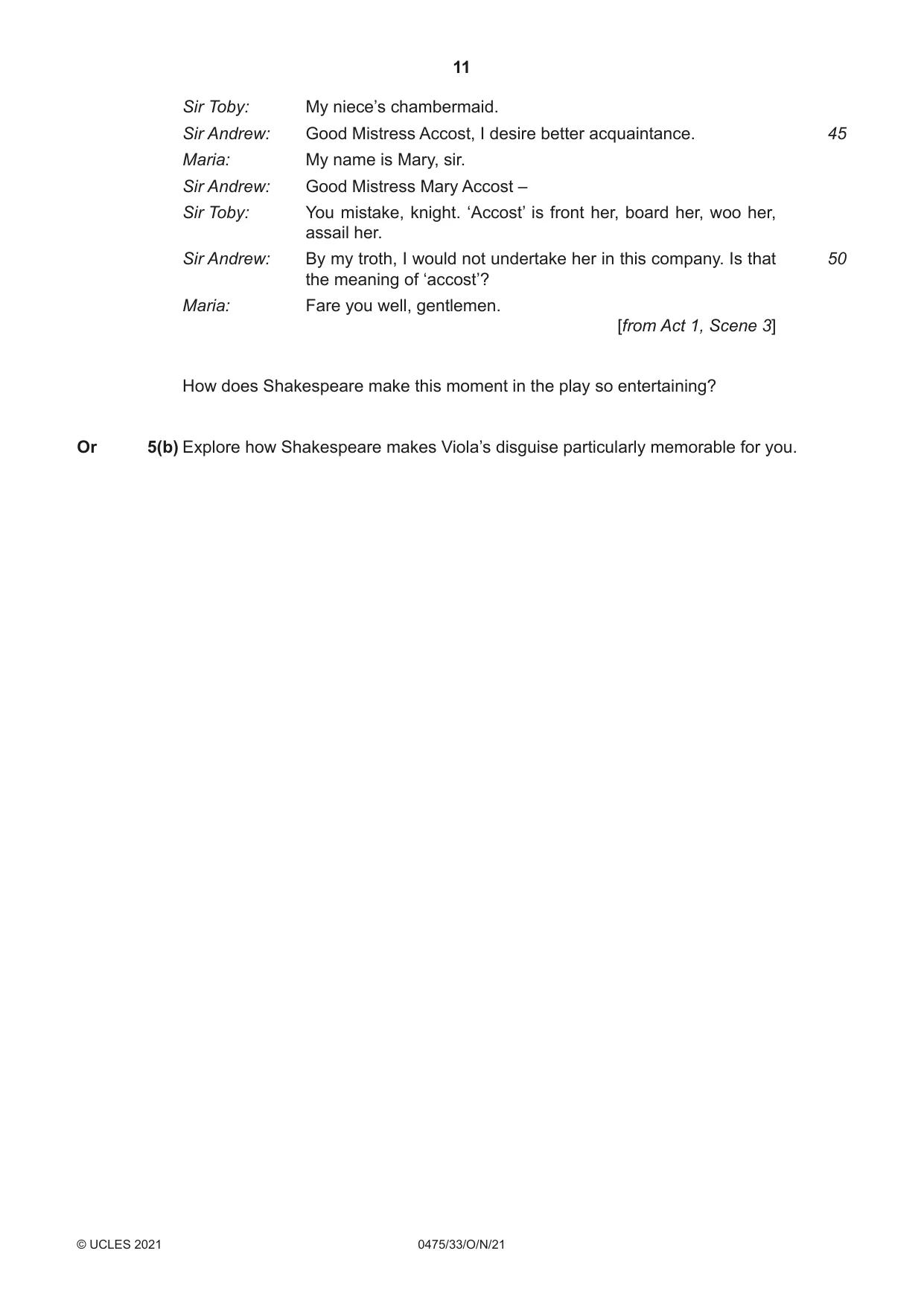
11 0475/33/O/N/21 © UCLES 2021 Sir Toby: My niece’s chambermaid. Sir Andrew: Good Mistress Accost, I desire better acquaintance. Maria: My name is Mary, sir. Sir Andrew: Good Mistress Mary Accost – Sir Toby: You mistake, knight. ‘Accost’ is front her, board her, woo her, assail her. Sir Andrew: By my troth, I would not undertake her in this company. Is that the meaning of ‘accost’? Maria: Fare you well, gentlemen. [from Act 1, Scene 3] How does Shakespeare make this moment in the play so entertaining? Or 5(b) Explore how Shakespeare makes Viola’s disguise particularly memorable for you. 45 50
Question paper, page 12
12 0475/33/O/N/21 © UCLES 2021 Permission to reproduce items where third-party owned material protected by copyright is included has been sought and cleared where possible. Every reasonable effort has been made by the publisher (UCLES) to trace copyright holders, but if any items requiring clearance have unwittingly been included, the publisher will be pleased to make amends at the earliest possible opportunity. To avoid the issue of disclosure of answer-related information to candidates, all copyright acknowledgements are reproduced online in the Cambridge Assessment International Education Copyright Acknowledgements Booklet. This is produced for each series of examinations and is freely available to download at www.cambridgeinternational.org after the live examination series. Cambridge Assessment International Education is part of the Cambridge Assessment Group. Cambridge Assessment is the brand name of the University of Cambridge Local Examinations Syndicate (UCLES), which itself is a department of the University of Cambridge. BLANK PAGE
Mark scheme, page 1
This document consists of 5 printed pages. © UCLES 2021 [Turn over Cambridge IGCSE™ LITERATURE IN ENGLISH 0475/33 Paper 3 Drama (Open Text) 33 October/November 2021 MARK SCHEME Maximum Mark: 50 Published This mark scheme is published as an aid to teachers and candidates, to indicate the requirements of the examination. It shows the basis on which Examiners were instructed to award marks. It does not indicate the details of the discussions that took place at an Examiners’ meeting before marking began, which would have considered the acceptability of alternative answers. Mark schemes should be read in conjunction with the question paper and the Principal Examiner Report for Teachers. Cambridge International will not enter into discussions about these mark schemes. Cambridge International is publishing the mark schemes for the October/November 2021 series for most Cambridge IGCSE™, Cambridge International A and AS Level components and some Cambridge O Level components.
Mark scheme, page 2
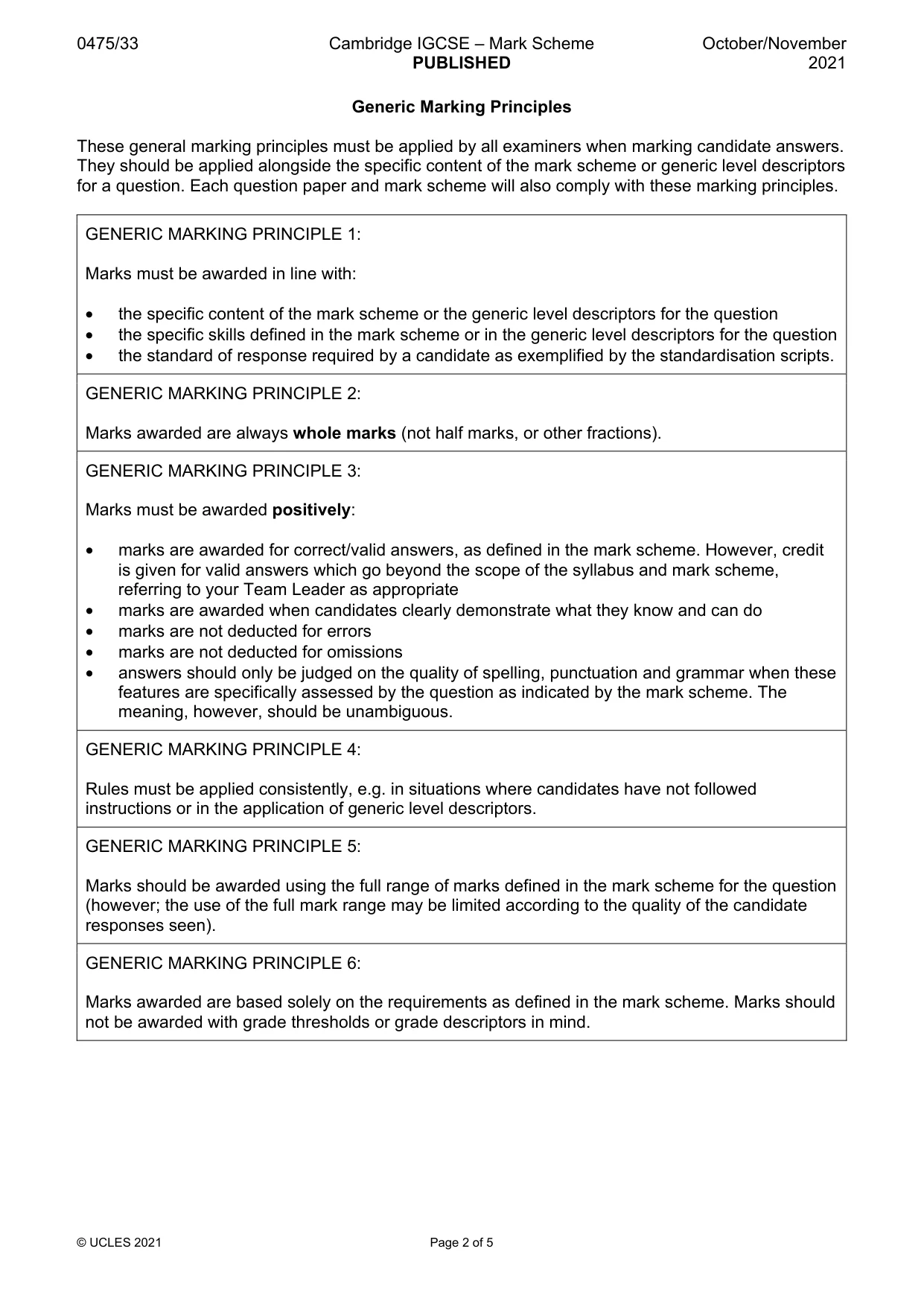
0475/33 Cambridge IGCSE – Mark Scheme PUBLISHED October/November 2021 © UCLES 2021 Page 2 of 5 Generic Marking Principles These general marking principles must be applied by all examiners when marking candidate answers. They should be applied alongside the specific content of the mark scheme or generic level descriptors for a question. Each question paper and mark scheme will also comply with these marking principles. GENERIC MARKING PRINCIPLE 1: Marks must be awarded in line with: • the specific content of the mark scheme or the generic level descriptors for the question • the specific skills defined in the mark scheme or in the generic level descriptors for the question • the standard of response required by a candidate as exemplified by the standardisation scripts. GENERIC MARKING PRINCIPLE 2: Marks awarded are always whole marks (not half marks, or other fractions). GENERIC MARKING PRINCIPLE 3: Marks must be awarded positively: • marks are awarded for correct/valid answers, as defined in the mark scheme. However, credit is given for valid answers which go beyond the scope of the syllabus and mark scheme, referring to your Team Leader as appropriate • marks are awarded when candidates clearly demonstrate what they know and can do • marks are not deducted for errors • marks are not deducted for omissions • answers should only be judged on the quality of spelling, punctuation and grammar when these features are specifically assessed by the question as indicated by the mark scheme. The meaning, however, should be unambiguous. GENERIC MARKING PRINCIPLE 4: Rules must be applied consistently, e.g. in situations where candidates have not followed instructions or in the application of generic level descriptors. GENERIC MARKING PRINCIPLE 5: Marks should be awarded using the full range of marks defined in the mark scheme for the question (however; the use of the full mark range may be limited according to the quality of the candidate responses seen). GENERIC MARKING PRINCIPLE 6: Marks awarded are based solely on the requirements as defined in the mark scheme. Marks should not be awarded with grade thresholds or grade descriptors in mind.
Mark scheme, page 3
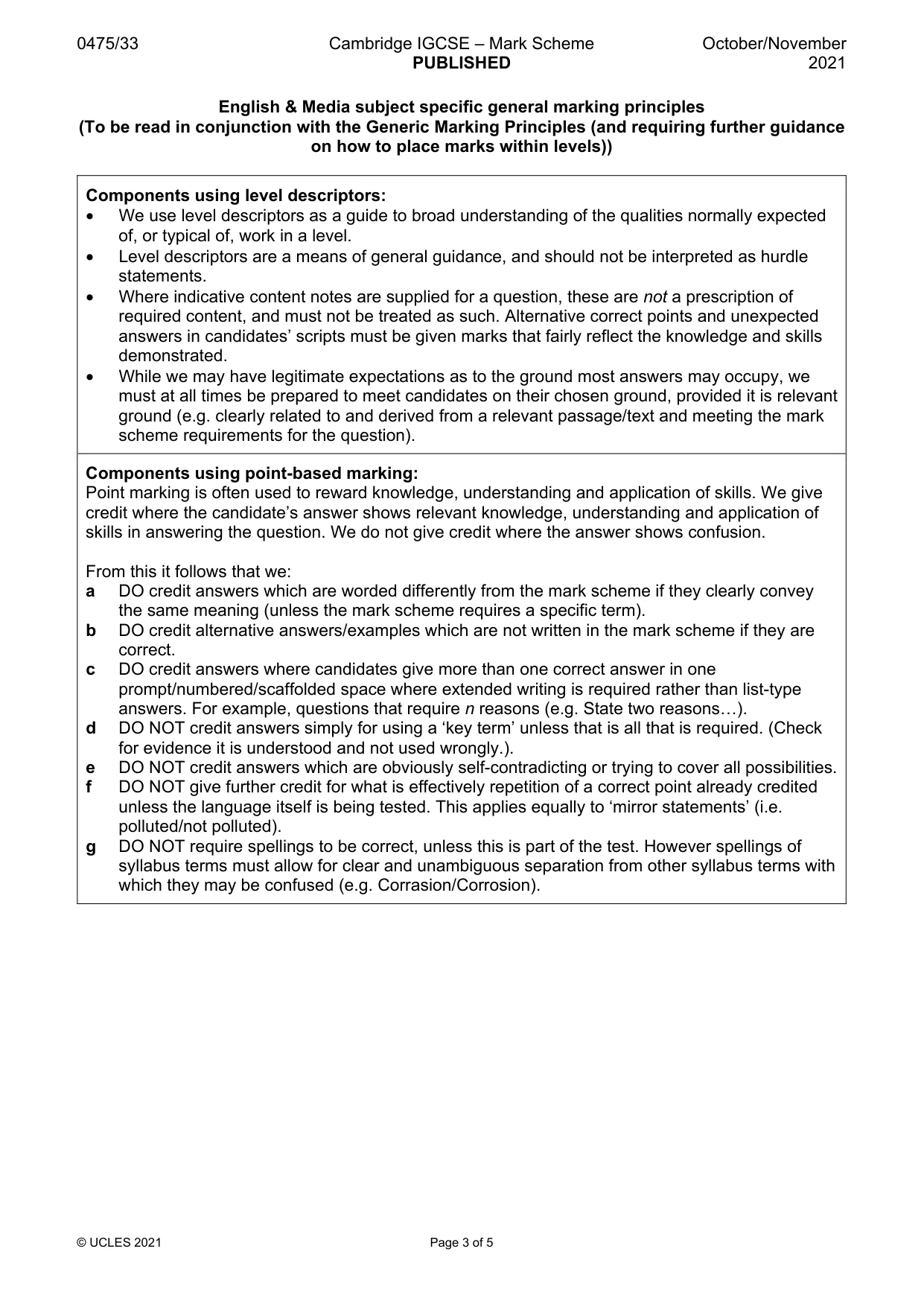
0475/33 Cambridge IGCSE – Mark Scheme PUBLISHED October/November 2021 © UCLES 2021 Page 3 of 5 English & Media subject specific general marking principles (To be read in conjunction with the Generic Marking Principles (and requiring further guidance on how to place marks within levels)) Components using level descriptors: • We use level descriptors as a guide to broad understanding of the qualities normally expected of, or typical of, work in a level. • Level descriptors are a means of general guidance, and should not be interpreted as hurdle statements. • Where indicative content notes are supplied for a question, these are not a prescription of required content, and must not be treated as such. Alternative correct points and unexpected answers in candidates’ scripts must be given marks that fairly reflect the knowledge and skills demonstrated. • While we may have legitimate expectations as to the ground most answers may occupy, we must at all times be prepared to meet candidates on their chosen ground, provided it is relevant ground (e.g. clearly related to and derived from a relevant passage/text and meeting the mark scheme requirements for the question). Components using point-based marking: Point marking is often used to reward knowledge, understanding and application of skills. We give credit where the candidate’s answer shows relevant knowledge, understanding and application of skills in answering the question. We do not give credit where the answer shows confusion. From this it follows that we: a DO credit answers which are worded differently from the mark scheme if they clearly convey the same meaning (unless the mark scheme requires a specific term). b DO credit alternative answers/examples which are not written in the mark scheme if they are correct. c DO credit answers where candidates give more than one correct answer in one prompt/numbered/scaffolded space where extended writing is required rather than list-type answers. For example, questions that require n reasons (e.g. State two reasons…). d DO NOT credit answers simply for using a ‘key term’ unless that is all that is required. (Check for evidence it is understood and not used wrongly.). e DO NOT credit answers which are obviously self-contradicting or trying to cover all possibilities. f DO NOT give further credit for what is effectively repetition of a correct point already credited unless the language itself is being tested. This applies equally to ‘mirror statements’ (i.e. polluted/not polluted). g DO NOT require spellings to be correct, unless this is part of the test. However spellings of syllabus terms must allow for clear and unambiguous separation from other syllabus terms with which they may be confused (e.g. Corrasion/Corrosion).
Mark scheme, page 4
0475/33 Cambridge IGCSE – Mark Scheme PUBLISHED October/November 2021 © UCLES 2021 Page 4 of 5 Introduction For general administrative guidance, see Notes for Examiners Handbook. All questions are marked out of 25. Assessment Objectives The Assessment Objectives are evenly weighted across each question. The assessment objectives for the paper are: • AO1 show detailed knowledge of the content of literary texts, supported by reference to the text • AO2 understand the meanings of literary texts and their context, and explore texts beyond surface meaning to show deeper awareness of ideas and attitudes • AO3 recognise and appreciate ways in which writers use language, structure, and form to create and shape meanings and effects • AO4 communicate a sensitive and informed personal response The Band Descriptors cover marks from 0 to 25, and apply to the marking of each question. They guide examiners to an understanding of the qualities normally expected of, or typical of, work in a band. They are a means of general guidance, and must not be interpreted as hurdle statements. For the purposes of standardisation of marking, they are to be used in conjunction with the Practice and Standardisation scripts discussed during the coordination meeting and with Team Leaders, as well as the question-specific notes. The supplementary notes for each question are related to the assessment objectives above. Because of the nature of the subject, they are for general guidance; they are not designed as prescriptions of required content and must not be treated as such. The syllabus aims at encouraging candidates to make some personal response to their reading. Whilst there are legitimate expectations of the content of most answers, examiners may see responses that include ideas not covered in the supplementary guidance. For these cases, examiners should credit valid responses fairly and not penalise candidates for including valid points outside the mark scheme.
Mark scheme, page 5
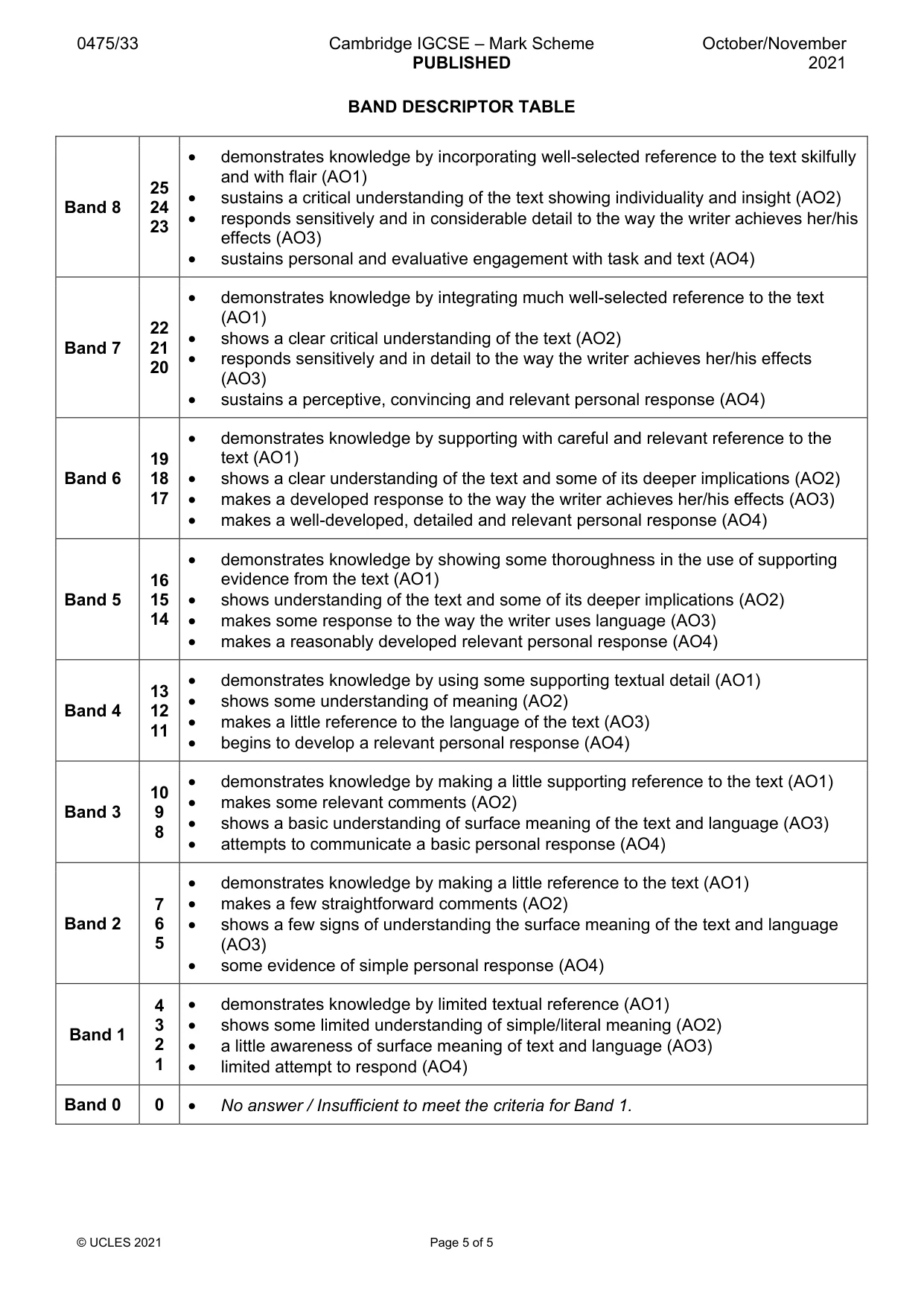
0475/33 Cambridge IGCSE – Mark Scheme PUBLISHED October/November 2021 © UCLES 2021 Page 5 of 5 BAND DESCRIPTOR TABLE Band 8 25 24 23 • demonstrates knowledge by incorporating well-selected reference to the text skilfully and with flair (AO1) • sustains a critical understanding of the text showing individuality and insight (AO2) • responds sensitively and in considerable detail to the way the writer achieves her/his effects (AO3) • sustains personal and evaluative engagement with task and text (AO4) Band 7 22 21 20 • demonstrates knowledge by integrating much well-selected reference to the text (AO1) • shows a clear critical understanding of the text (AO2) • responds sensitively and in detail to the way the writer achieves her/his effects (AO3) • sustains a perceptive, convincing and relevant personal response (AO4) Band 6 19 18 17 • demonstrates knowledge by supporting with careful and relevant reference to the text (AO1) • shows a clear understanding of the text and some of its deeper implications (AO2) • makes a developed response to the way the writer achieves her/his effects (AO3) • makes a well-developed, detailed and relevant personal response (AO4) Band 5 16 15 14 • demonstrates knowledge by showing some thoroughness in the use of supporting evidence from the text (AO1) • shows understanding of the text and some of its deeper implications (AO2) • makes some response to the way the writer uses language (AO3) • makes a reasonably developed relevant personal response (AO4) Band 4 13 12 11 • demonstrates knowledge by using some supporting textual detail (AO1) • shows some understanding of meaning (AO2) • makes a little reference to the language of the text (AO3) • begins to develop a relevant personal response (AO4) Band 3 10 9 8 • demonstrates knowledge by making a little supporting reference to the text (AO1) • makes some relevant comments (AO2) • shows a basic understanding of surface meaning of the text and language (AO3) • attempts to communicate a basic personal response (AO4) Band 2 7 6 5 • demonstrates knowledge by making a little reference to the text (AO1) • makes a few straightforward comments (AO2) • shows a few signs of understanding the surface meaning of the text and language (AO3) • some evidence of simple personal response (AO4) Band 1 4 3 2 1 • demonstrates knowledge by limited textual reference (AO1) • shows some limited understanding of simple/literal meaning (AO2) • a little awareness of surface meaning of text and language (AO3) • limited attempt to respond (AO4) Band 0 0 • No answer / Insufficient to meet the criteria for Band 1.
What you needed in this session
Cambridge’s own grade thresholds for 2021 Oct/Nov, Paper 3 · Variant 3. A higher threshold means an easier paper — the bar moves with how the cohort did.