Cambridge IGCSE English - Literature in English 0475 — 2021 May/June Paper 3 · Variant 1
0475/31/M/J/21 · 25 marks · ≈28 min
The question paper and its mark scheme, free to read here and free to download. This is Cambridge’s own paper, exactly as it was sat.
Question paper12 pages
Mark scheme5 pages
Answers below. Sit the paper first if you are practising.
Paper as text
Question paper, page 1
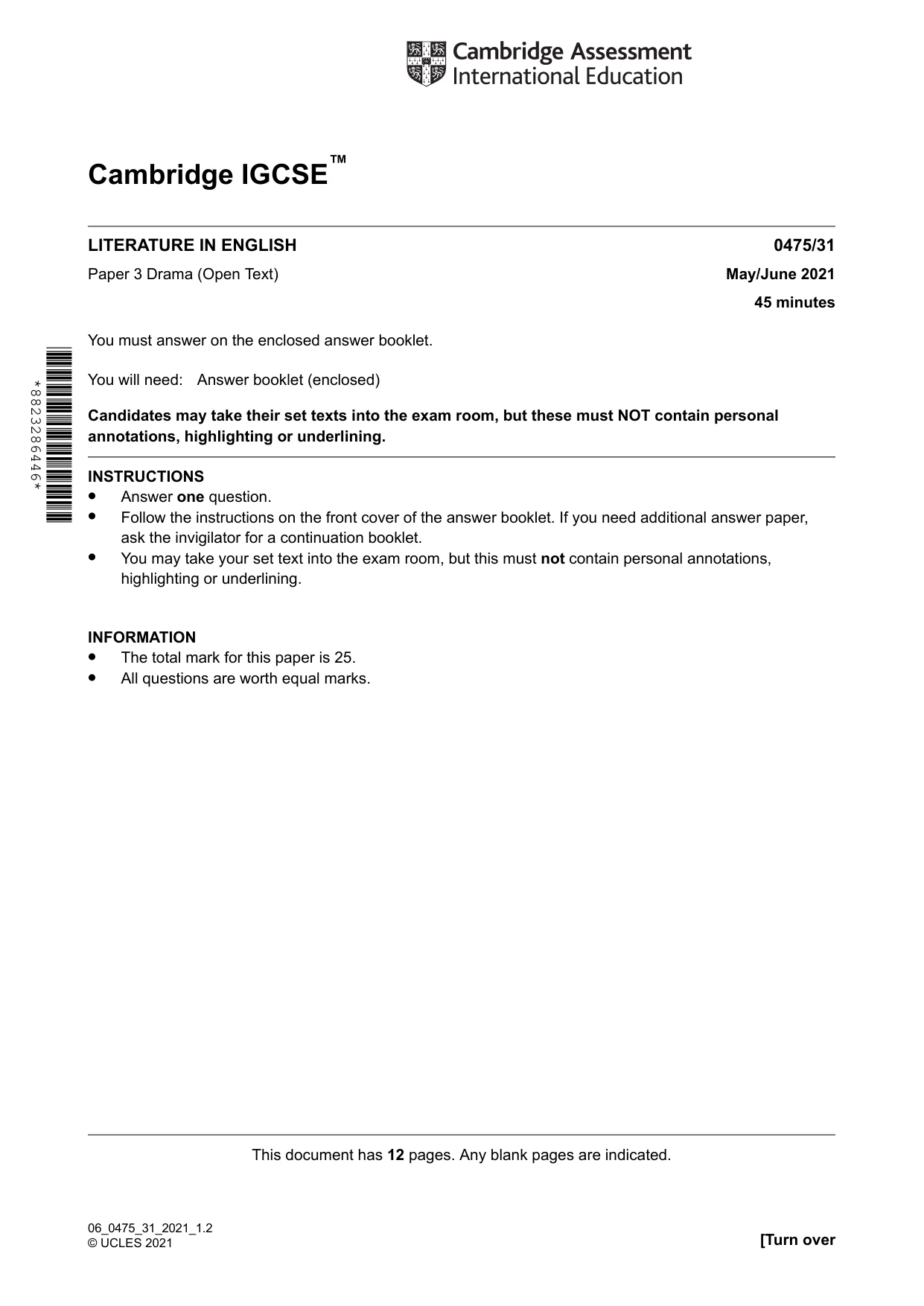
Cambridge IGCSE™ 0475/31 LITERATURE IN ENGLISH May/June 2021 Paper 3 Drama (Open Text) 45 minutes You must answer on the enclosed answer booklet. You will need: Answer booklet (enclosed) Candidates may take their set texts into the exam room, but these must NOT contain personal annotations, highlighting or underlining. INSTRUCTIONS • Answer one question. • Follow the instructions on the front cover of the answer booklet. If you need additional answer paper, ask the invigilator for a continuation booklet. • You may take your set text into the exam room, but this must not contain personal annotations, highlighting or underlining. INFORMATION • The total mark for this paper is 25. • All questions are worth equal marks. This document has 12 pages. Any blank pages are indicated. [Turn over 06_0475_31_2021_1.2 © UCLES 2021 *8823286446*
Question paper, page 2
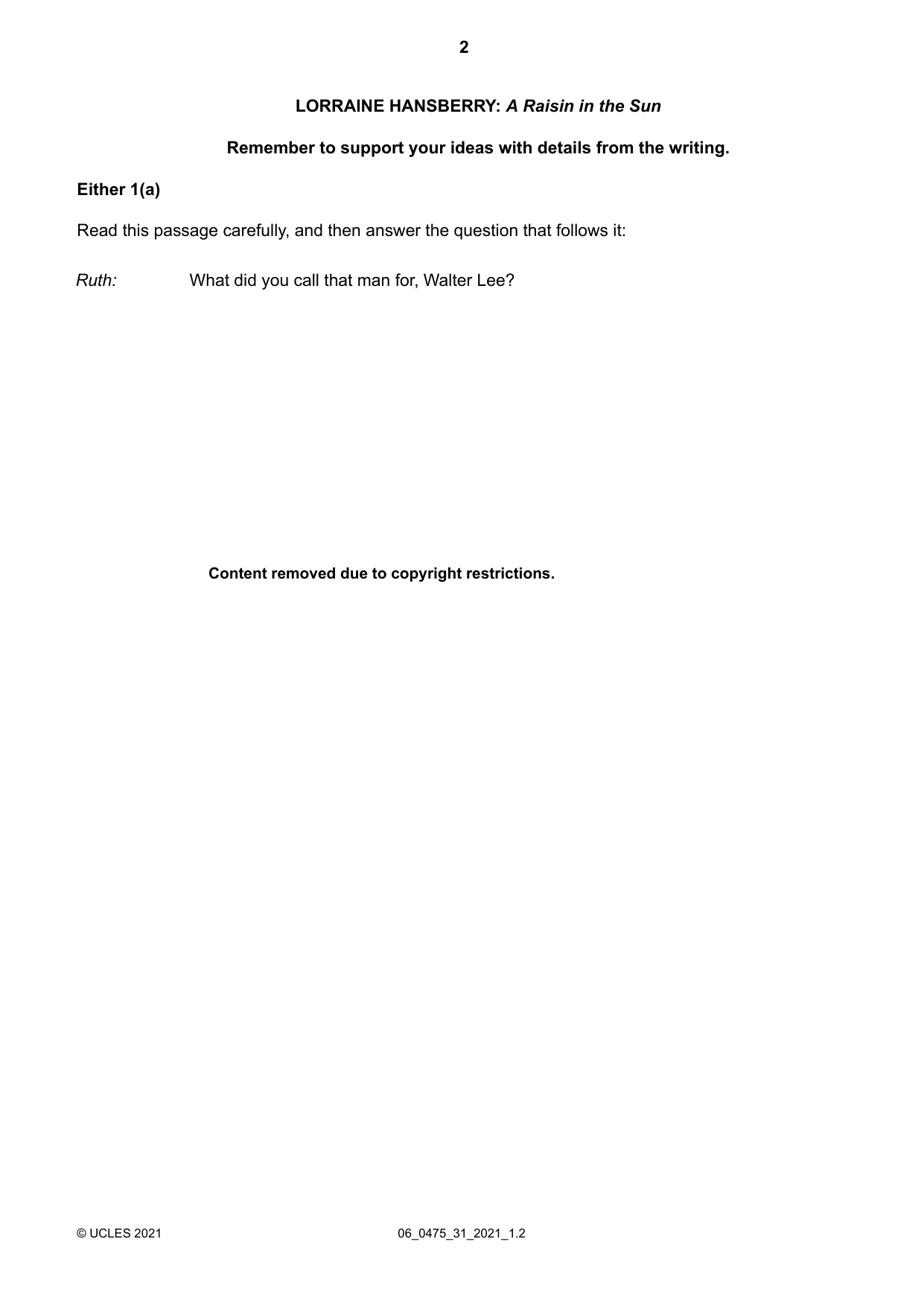
LORRAINE HANSBERRY: A Raisin in the Sun Remember to support your ideas with details from the writing. Either 1(a) Read this passage carefully, and then answer the question that follows it: What did you call that man for, Walter Lee? Ruth: 06_0475_31_2021_1.2 © UCLES 2021 2 Content removed due to copyright restrictions.
Question paper, page 3
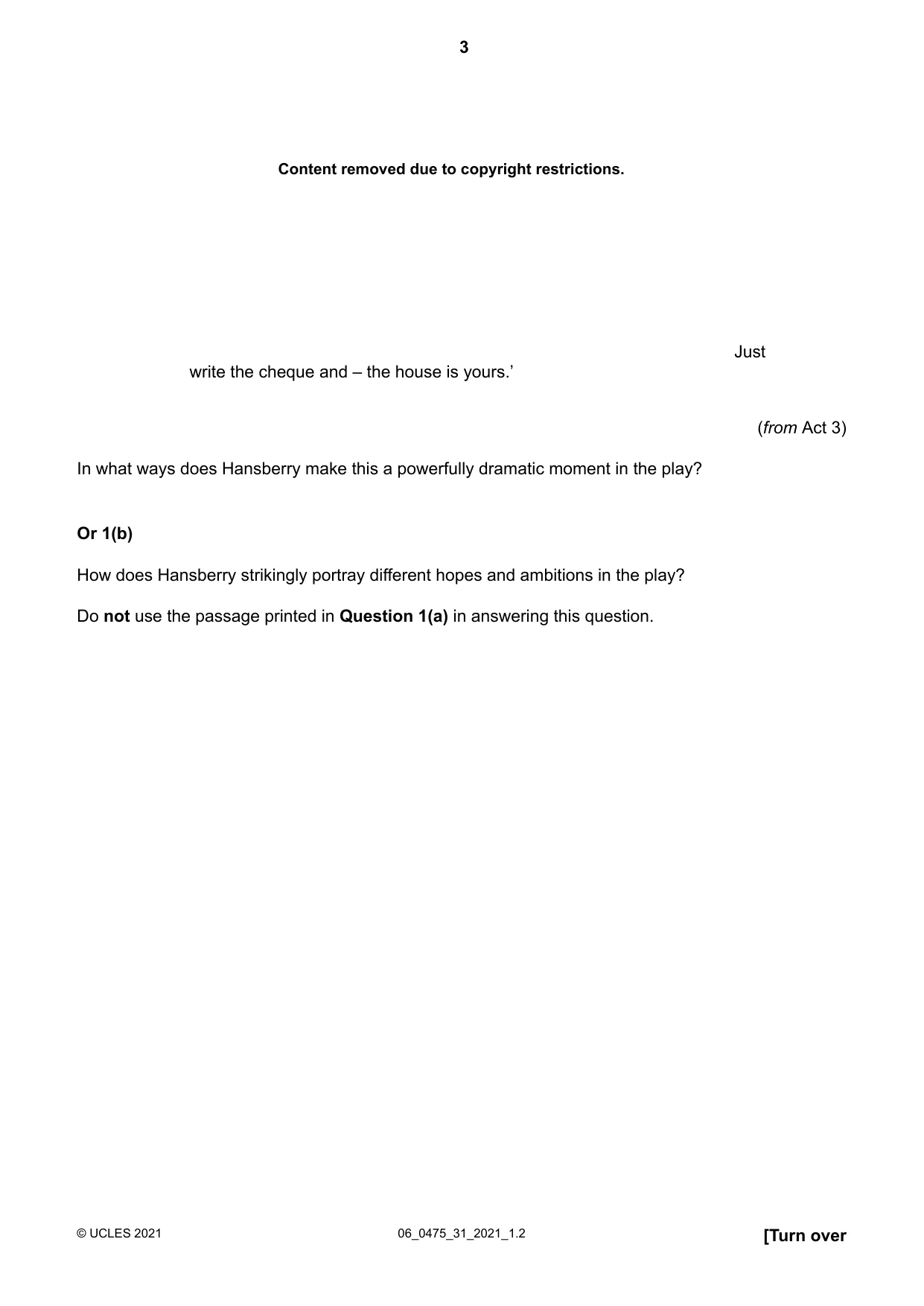
Just write the cheque and – the house is yours.’ (from Act 3) In what ways does Hansberry make this a powerfully dramatic moment in the play? Or 1(b) How does Hansberry strikingly portray different hopes and ambitions in the play? Do not use the passage printed in Question 1(a) in answering this question. [Turn over 06_0475_31_2021_1.2 © UCLES 2021 3 Content removed due to copyright restrictions.
Question paper, page 4
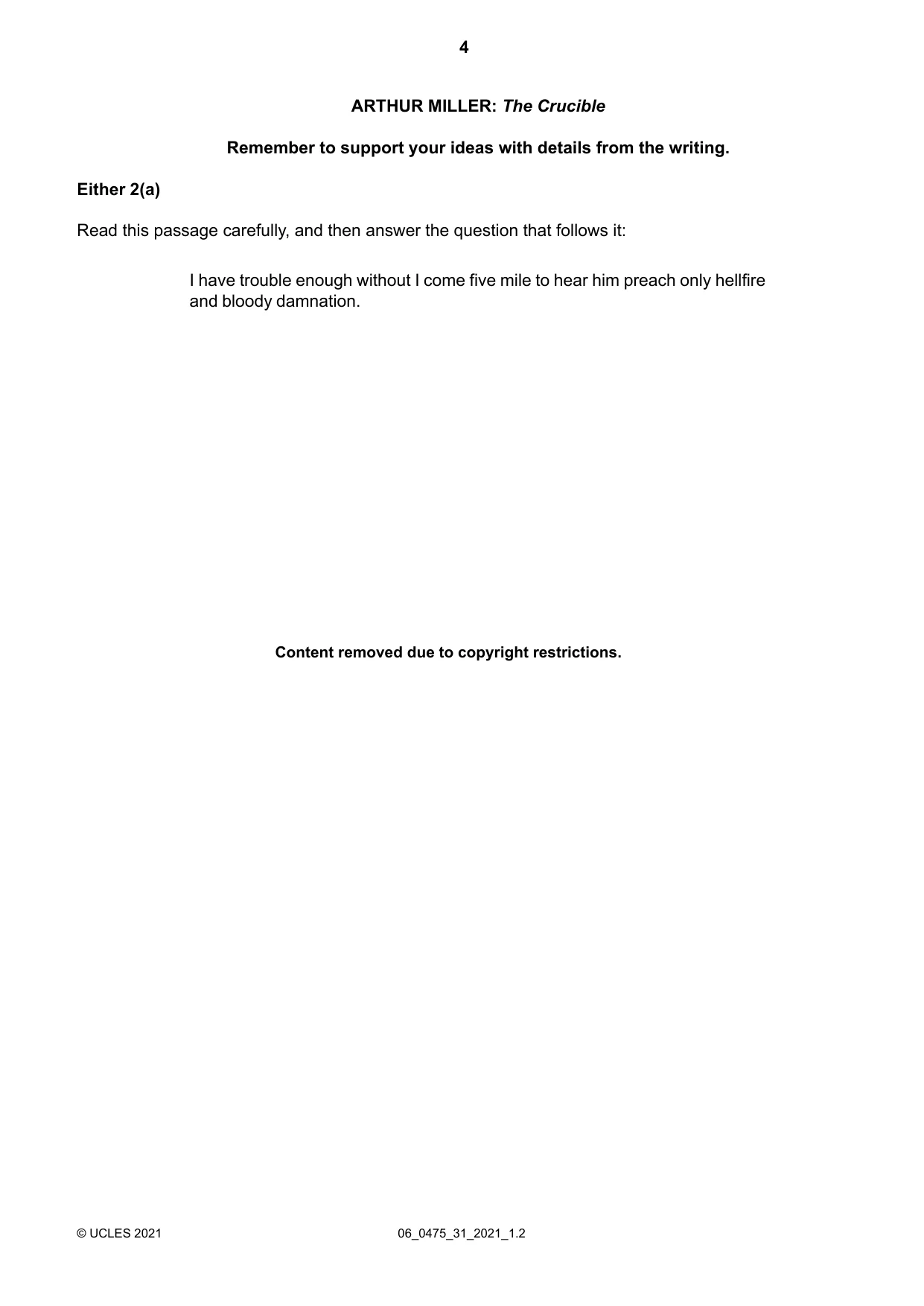
ARTHUR MILLER: The Crucible Remember to support your ideas with details from the writing. Either 2(a) Read this passage carefully, and then answer the question that follows it: I have trouble enough without I come five mile to hear him preach only hellfire and bloody damnation. 06_0475_31_2021_1.2 © UCLES 2021 4 Content removed due to copyright restrictions.
Question paper, page 5
I am not blind; there is a faction and a party. (from Act 1) How does Miller vividly portray Reverend Parris at this early moment in the play? Or 2(b) How does Miller’s writing make you feel about the way Danforth controls the witch trials? [Turn over 06_0475_31_2021_1.2 © UCLES 2021 5 Content removed due to copyright restrictions.
Question paper, page 6
R C SHERRIFF: Journey’s End Remember to support your ideas with details from the writing. Either 3(a) Read this passage carefully, and then answer the question that follows it: [stifling a hiccup]: Just a cup o’ tea – then I’ll go and relieve young Raleigh. Trotter 06_0475_31_2021_1.2 © UCLES 2021 6 Content removed due to copyright restrictions.
Question paper, page 7
Get out of my sight! Stanhope: (from Act 3 Scene 2) How does Sherriff make this such a tense moment in the play? Or 3(b) Explore two moments in the play where Sherriff's writing makes you feel particularly sad. Do not use the passage printed in Question 3 (a) in answering this question. [Turn over 06_0475_31_2021_1.2 © UCLES 2021 7 Content removed due to copyright restrictions.
Question paper, page 8
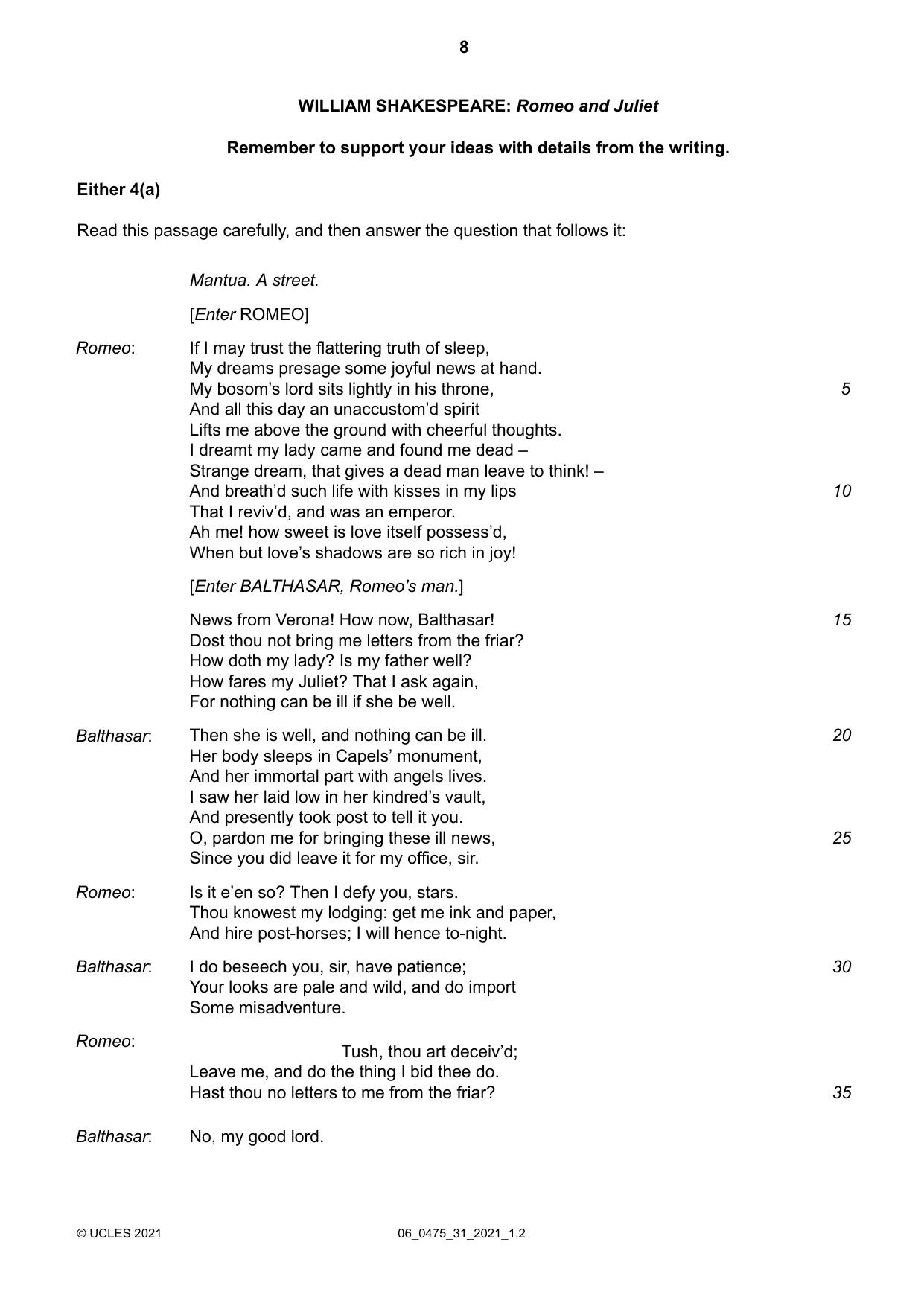
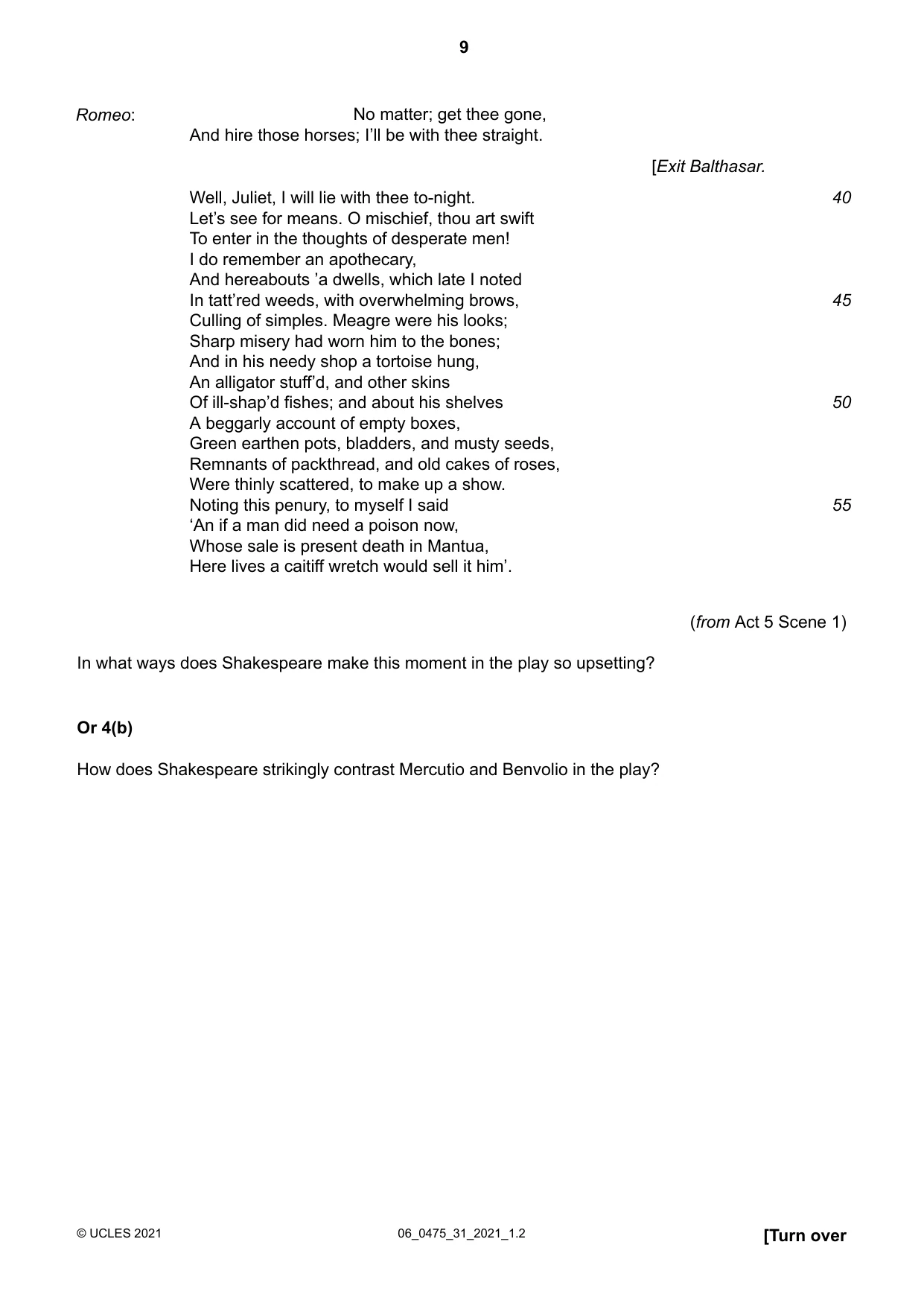
35 30 25 20 15 10 5 WILLIAM SHAKESPEARE: Romeo and Juliet Remember to support your ideas with details from the writing. Either 4(a) Read this passage carefully, and then answer the question that follows it: Mantua. A street. [Enter ROMEO] If I may trust the flattering truth of sleep, My dreams presage some joyful news at hand. My bosom’s lord sits lightly in his throne, And all this day an unaccustom’d spirit Lifts me above the ground with cheerful thoughts. I dreamt my lady came and found me dead – Strange dream, that gives a dead man leave to think! – And breath’d such life with kisses in my lips That I reviv’d, and was an emperor. Ah me! how sweet is love itself possess’d, When but love’s shadows are so rich in joy! Romeo: [Enter BALTHASAR, Romeo’s man.] News from Verona! How now, Balthasar! Dost thou not bring me letters from the friar? How doth my lady? Is my father well? How fares my Juliet? That I ask again, For nothing can be ill if she be well. Then she is well, and nothing can be ill. Her body sleeps in Capels’ monument, And her immortal part with angels lives. I saw her laid low in her kindred’s vault, And presently took post to tell it you. O, pardon me for bringing these ill news, Since you did leave it for my office, sir. Balthasar: Is it e’en so? Then I defy you, stars. Thou knowest my lodging: get me ink and paper, And hire post-horses; I will hence to-night. Romeo: I do beseech you, sir, have patience; Your looks are pale and wild, and do import Some misadventure. Balthasar: Tush, thou art deceiv’d; Leave me, and do the thing I bid thee do. Hast thou no letters to me from the friar? Romeo: No, my good lord. Balthasar: 06_0475_31_2021_1.2 © UCLES 2021 8
Question paper, page 9
55 50 45 40 No matter; get thee gone, And hire those horses; I’ll be with thee straight. [Exit Balthasar. Well, Juliet, I will lie with thee to-night. Let’s see for means. O mischief, thou art swift To enter in the thoughts of desperate men! I do remember an apothecary, And hereabouts ’a dwells, which late I noted In tatt’red weeds, with overwhelming brows, Culling of simples. Meagre were his looks; Sharp misery had worn him to the bones; And in his needy shop a tortoise hung, An alligator stuff’d, and other skins Of ill-shap’d fishes; and about his shelves A beggarly account of empty boxes, Green earthen pots, bladders, and musty seeds, Remnants of packthread, and old cakes of roses, Were thinly scattered, to make up a show. Noting this penury, to myself I said ‘An if a man did need a poison now, Whose sale is present death in Mantua, Here lives a caitiff wretch would sell it him’. Romeo: (from Act 5 Scene 1) In what ways does Shakespeare make this moment in the play so upsetting? Or 4(b) How does Shakespeare strikingly contrast Mercutio and Benvolio in the play? [Turn over 06_0475_31_2021_1.2 © UCLES 2021 9
Question paper, page 10
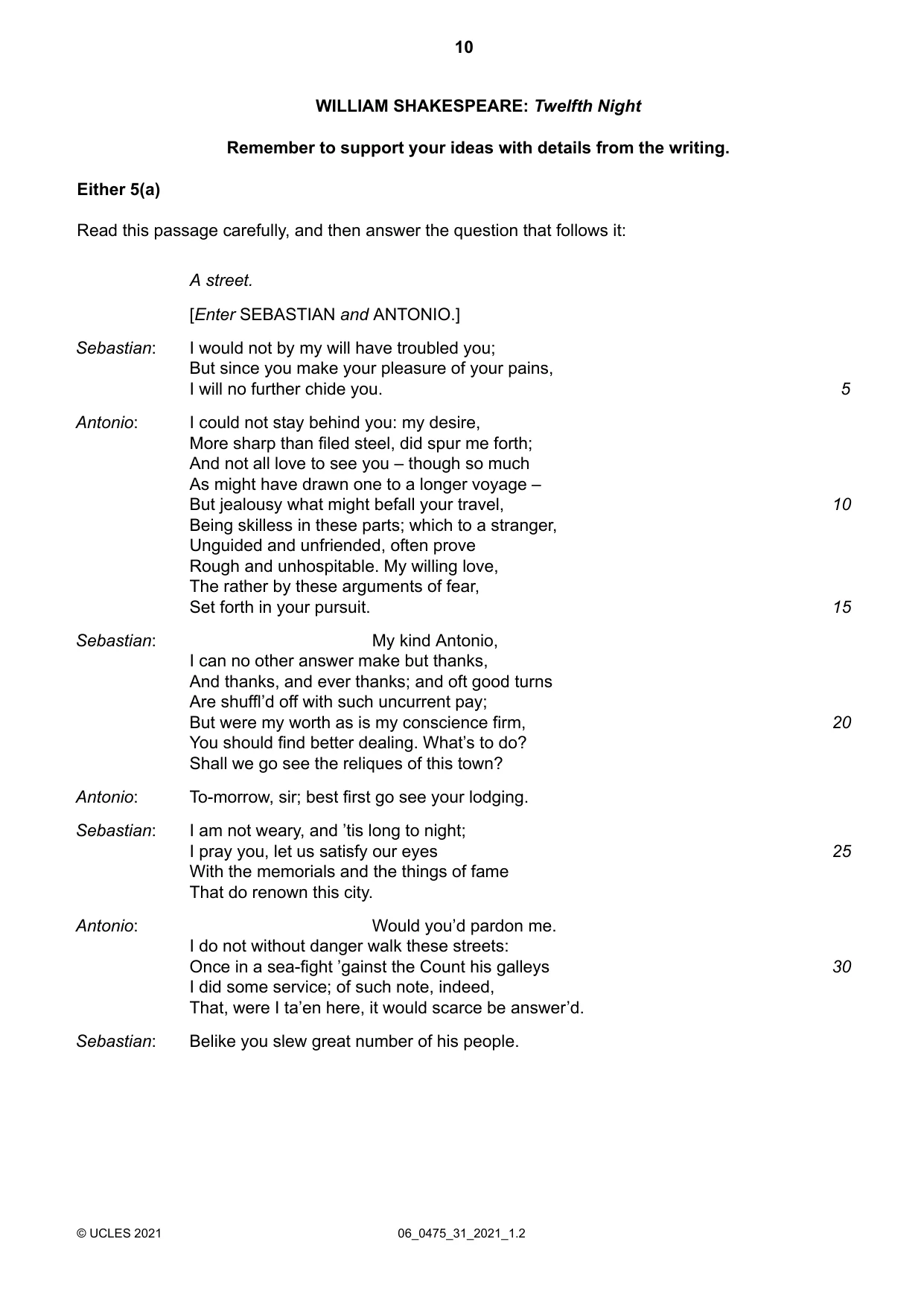
30 25 20 15 10 5 WILLIAM SHAKESPEARE: Twelfth Night Remember to support your ideas with details from the writing. Either 5(a) Read this passage carefully, and then answer the question that follows it: A street. [Enter SEBASTIAN and ANTONIO.] I would not by my will have troubled you; But since you make your pleasure of your pains, I will no further chide you. Sebastian: I could not stay behind you: my desire, More sharp than filed steel, did spur me forth; And not all love to see you – though so much As might have drawn one to a longer voyage – But jealousy what might befall your travel, Being skilless in these parts; which to a stranger, Unguided and unfriended, often prove Rough and unhospitable. My willing love, The rather by these arguments of fear, Set forth in your pursuit. Antonio: My kind Antonio, I can no other answer make but thanks, And thanks, and ever thanks; and oft good turns Are shuffl’d off with such uncurrent pay; But were my worth as is my conscience firm, You should find better dealing. What’s to do? Shall we go see the reliques of this town? Sebastian: To-morrow, sir; best first go see your lodging. Antonio: I am not weary, and ’tis long to night; I pray you, let us satisfy our eyes With the memorials and the things of fame That do renown this city. Sebastian: Would you’d pardon me. I do not without danger walk these streets: Once in a sea-fight ’gainst the Count his galleys I did some service; of such note, indeed, That, were I ta’en here, it would scarce be answer’d. Antonio: Belike you slew great number of his people. Sebastian: 06_0475_31_2021_1.2 © UCLES 2021 10
Question paper, page 11
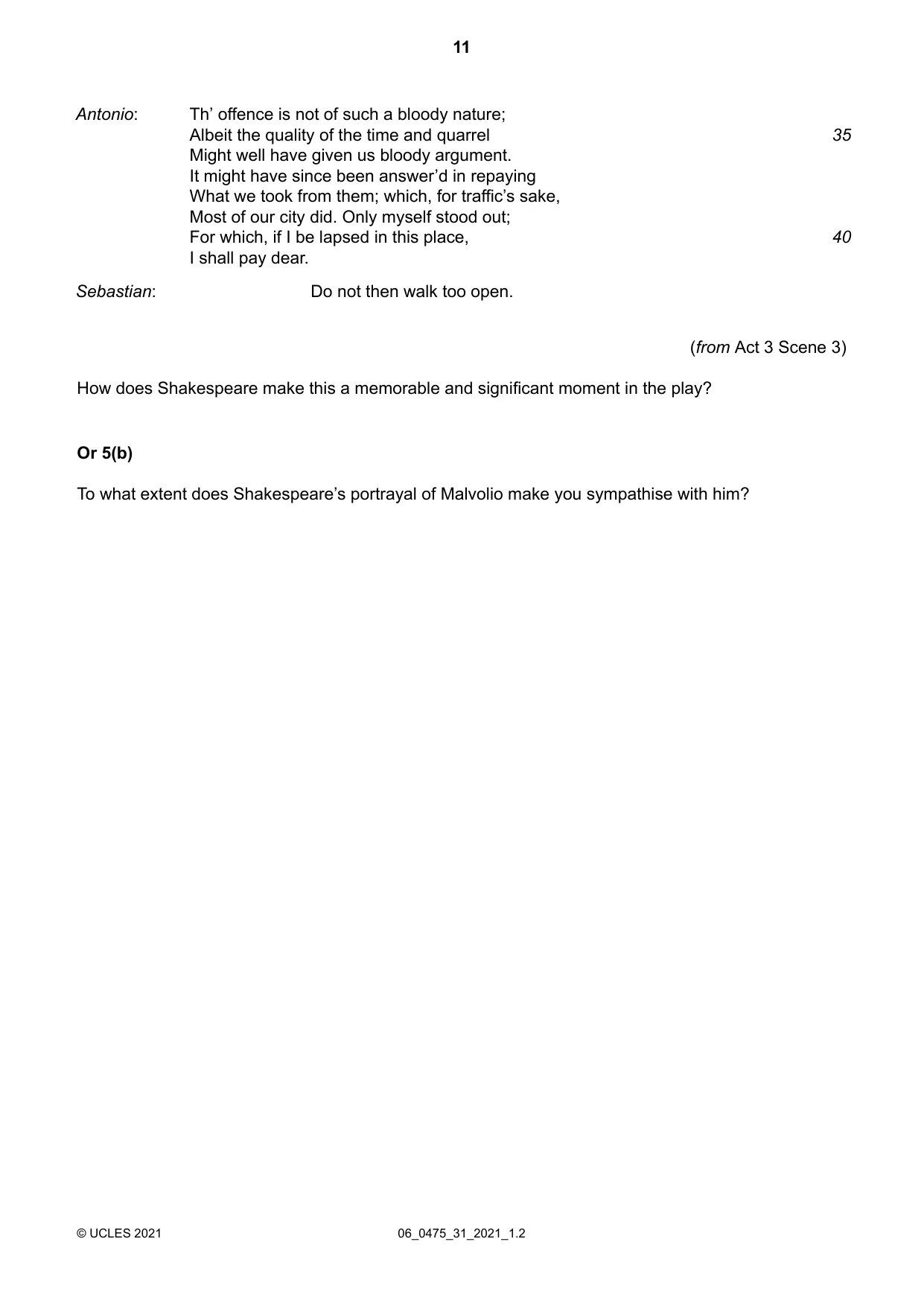
40 35 Th’ offence is not of such a bloody nature; Albeit the quality of the time and quarrel Might well have given us bloody argument. It might have since been answer’d in repaying What we took from them; which, for traffic’s sake, Most of our city did. Only myself stood out; For which, if I be lapsed in this place, I shall pay dear. Antonio: Do not then walk too open. Sebastian: (from Act 3 Scene 3) How does Shakespeare make this a memorable and significant moment in the play? Or 5(b) To what extent does Shakespeare’s portrayal of Malvolio make you sympathise with him? 06_0475_31_2021_1.2 © UCLES 2021 11
Question paper, page 12
BLANK PAGE Permission to reproduce items where third-party owned material protected by copyright is included has been sought and cleared where possible. Every reasonable effort has been made by the publisher (UCLES) to trace copyright holders, but if any items requiring clearance have unwittingly been included, the publisher will be pleased to make amends at the earliest possible opportunity. To avoid the issue of disclosure of answer-related information to candidates, all copyright acknowledgements are reproduced online in the Cambridge Assessment International Education Copyright Acknowledgements Booklet. This is produced for each series of examinations and is freely available to download at www.cambridgeinternational.org after the live examination series. Cambridge Assessment International Education is part of the Cambridge Assessment Group. Cambridge Assessment is the brand name of the University of Cambridge Local Examinations Syndicate (UCLES), which itself is a department of the University of Cambridge. 06_0475_31_2021_1.2 © UCLES 2021 12
Mark scheme, page 1
This document consists of 5 printed pages. © UCLES 2021 [Turn over Cambridge IGCSE™ LITERATURE IN ENGLISH 0475/31 Paper 3 Drama (Open Text) 31 May/June 2021 MARK SCHEME Maximum Mark: 50 Published This mark scheme is published as an aid to teachers and candidates, to indicate the requirements of the examination. It shows the basis on which Examiners were instructed to award marks. It does not indicate the details of the discussions that took place at an Examiners’ meeting before marking began, which would have considered the acceptability of alternative answers. Mark schemes should be read in conjunction with the question paper and the Principal Examiner Report for Teachers. Cambridge International will not enter into discussions about these mark schemes. Cambridge International is publishing the mark schemes for the May/June 2021 series for most Cambridge IGCSE™, Cambridge International A and AS Level components and some Cambridge O Level components.
Mark scheme, page 2
0475/31 Cambridge IGCSE – Mark Scheme PUBLISHED May/June 2021 © UCLES 2021 Page 2 of 5 Generic Marking Principles These general marking principles must be applied by all examiners when marking candidate answers. They should be applied alongside the specific content of the mark scheme or generic level descriptors for a question. Each question paper and mark scheme will also comply with these marking principles. GENERIC MARKING PRINCIPLE 1: Marks must be awarded in line with: • the specific content of the mark scheme or the generic level descriptors for the question • the specific skills defined in the mark scheme or in the generic level descriptors for the question • the standard of response required by a candidate as exemplified by the standardisation scripts. GENERIC MARKING PRINCIPLE 2: Marks awarded are always whole marks (not half marks, or other fractions). GENERIC MARKING PRINCIPLE 3: Marks must be awarded positively: • marks are awarded for correct/valid answers, as defined in the mark scheme. However, credit is given for valid answers which go beyond the scope of the syllabus and mark scheme, referring to your Team Leader as appropriate • marks are awarded when candidates clearly demonstrate what they know and can do • marks are not deducted for errors • marks are not deducted for omissions • answers should only be judged on the quality of spelling, punctuation and grammar when these features are specifically assessed by the question as indicated by the mark scheme. The meaning, however, should be unambiguous. GENERIC MARKING PRINCIPLE 4: Rules must be applied consistently, e.g. in situations where candidates have not followed instructions or in the application of generic level descriptors. GENERIC MARKING PRINCIPLE 5: Marks should be awarded using the full range of marks defined in the mark scheme for the question (however; the use of the full mark range may be limited according to the quality of the candidate responses seen). GENERIC MARKING PRINCIPLE 6: Marks awarded are based solely on the requirements as defined in the mark scheme. Marks should not be awarded with grade thresholds or grade descriptors in mind.
Mark scheme, page 3
0475/31 Cambridge IGCSE – Mark Scheme PUBLISHED May/June 2021 © UCLES 2021 Page 3 of 5 English & Media subject specific general marking principles (To be read in conjunction with the Generic Marking Principles (and requiring further guidance on how to place marks within levels)) Components using level descriptors: • We use level descriptors as a guide to broad understanding of the qualities normally expected of, or typical of, work in a level. • Level descriptors are a means of general guidance, and should not be interpreted as hurdle statements. • Where indicative content notes are supplied for a question, these are not a prescription of required content, and must not be treated as such. Alternative correct points and unexpected answers in candidates’ scripts must be given marks that fairly reflect the knowledge and skills demonstrated. • While we may have legitimate expectations as to the ground most answers may occupy, we must at all times be prepared to meet candidates on their chosen ground, provided it is relevant ground (e.g. clearly related to and derived from a relevant passage/text and meeting the mark scheme requirements for the question). Components using point-based marking: Point marking is often used to reward knowledge, understanding and application of skills. We give credit where the candidate’s answer shows relevant knowledge, understanding and application of skills in answering the question. We do not give credit where the answer shows confusion. From this it follows that we: a DO credit answers which are worded differently from the mark scheme if they clearly convey the same meaning (unless the mark scheme requires a specific term). b DO credit alternative answers/examples which are not written in the mark scheme if they are correct. c DO credit answers where candidates give more than one correct answer in one prompt/numbered/scaffolded space where extended writing is required rather than list-type answers. For example, questions that require n reasons (e.g. State two reasons…. d DO NOT credit answers simply for using a ‘key term’ unless that is all that is required. (Check for evidence it is understood and not used wrongly.). e DO NOT credit answers which are obviously self-contradicting or trying to cover all possibilities. f DO NOT give further credit for what is effectively repetition of a correct point already credited unless the language itself is being tested. This applies equally to ‘mirror statements’ (i.e. polluted/not polluted). g DO NOT require spellings to be correct, unless this is part of the test. However spellings of syllabus terms must allow for clear and unambiguous separation from other syllabus terms with which they may be confused (e.g. Corrasion/Corrosion).
Mark scheme, page 4
0475/31 Cambridge IGCSE – Mark Scheme PUBLISHED May/June 2021 © UCLES 2021 Page 4 of 5 All questions are marked out of 25. The assessment objectives for the paper are: AO1: show detailed knowledge of the content of literary texts, supported by reference to the text AO2: understand the meanings of literary texts and their contexts, and explore texts beyond surface meanings to show deeper awareness of ideas and attitudes AO3: recognise and appreciate ways in which writers use language, structure and form to create and shape meanings and effects AO4: communicate a sensitive and informed personal response to literary texts. The Level Descriptors cover marks from 0 to 25, and apply to the marking of each question. They guide examiners to an understanding of the qualities normally expected of, or typical of, work in a level. They are a means of general guidance. For the purposes of standardisation of marking, they are to be used in conjunction with examples of candidates’ work and discussed during the examiners’ coordination meeting.
Mark scheme, page 5
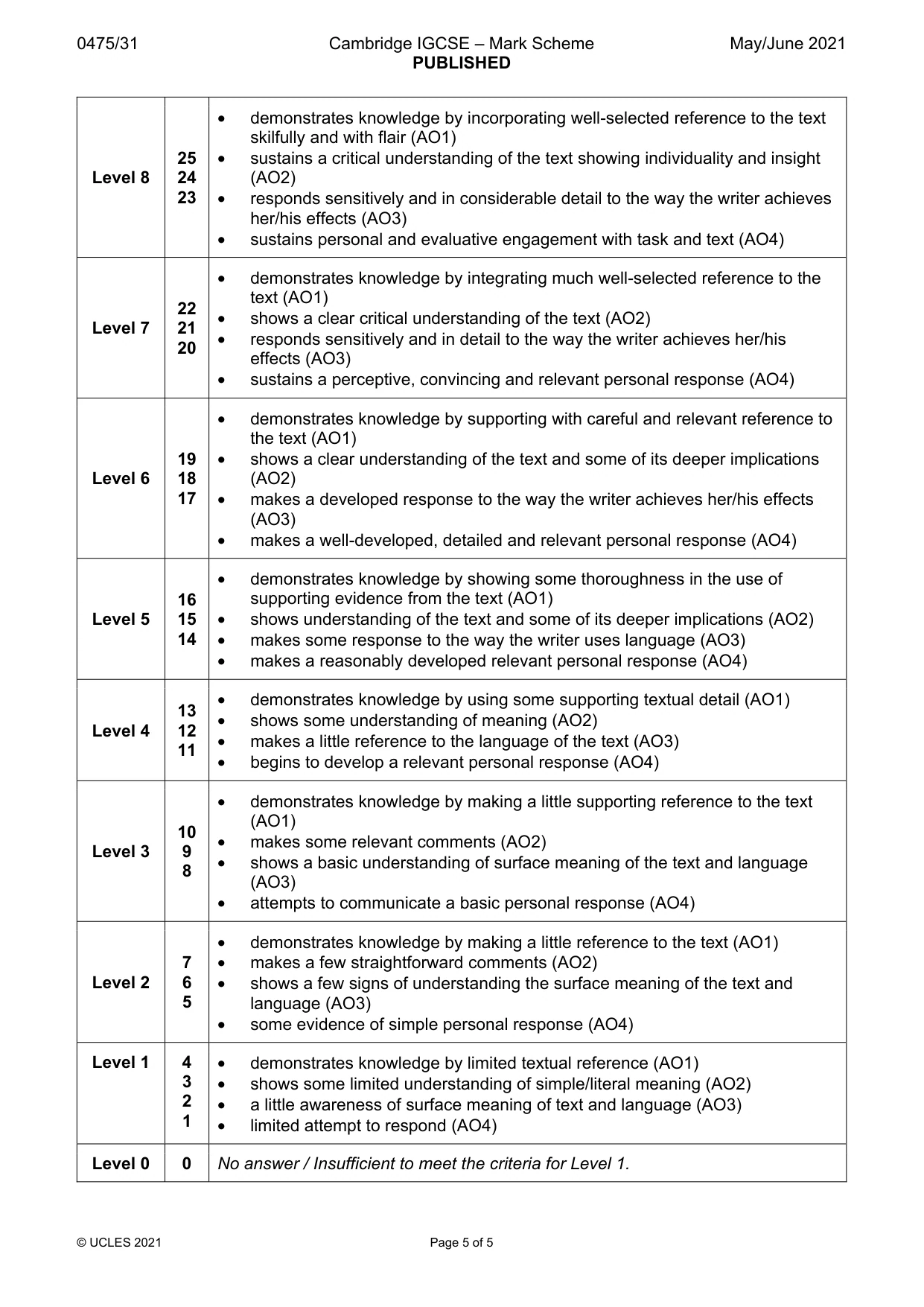
0475/31 Cambridge IGCSE – Mark Scheme PUBLISHED May/June 2021 © UCLES 2021 Page 5 of 5 Level 8 25 24 23 • demonstrates knowledge by incorporating well-selected reference to the text skilfully and with flair (AO1) • sustains a critical understanding of the text showing individuality and insight (AO2) • responds sensitively and in considerable detail to the way the writer achieves her/his effects (AO3) • sustains personal and evaluative engagement with task and text (AO4) Level 7 22 21 20 • demonstrates knowledge by integrating much well-selected reference to the text (AO1) • shows a clear critical understanding of the text (AO2) • responds sensitively and in detail to the way the writer achieves her/his effects (AO3) • sustains a perceptive, convincing and relevant personal response (AO4) Level 6 19 18 17 • demonstrates knowledge by supporting with careful and relevant reference to the text (AO1) • shows a clear understanding of the text and some of its deeper implications (AO2) • makes a developed response to the way the writer achieves her/his effects (AO3) • makes a well-developed, detailed and relevant personal response (AO4) Level 5 16 15 14 • demonstrates knowledge by showing some thoroughness in the use of supporting evidence from the text (AO1) • shows understanding of the text and some of its deeper implications (AO2) • makes some response to the way the writer uses language (AO3) • makes a reasonably developed relevant personal response (AO4) Level 4 13 12 11 • demonstrates knowledge by using some supporting textual detail (AO1) • shows some understanding of meaning (AO2) • makes a little reference to the language of the text (AO3) • begins to develop a relevant personal response (AO4) Level 3 10 9 8 • demonstrates knowledge by making a little supporting reference to the text (AO1) • makes some relevant comments (AO2) • shows a basic understanding of surface meaning of the text and language (AO3) • attempts to communicate a basic personal response (AO4) Level 2 7 6 5 • demonstrates knowledge by making a little reference to the text (AO1) • makes a few straightforward comments (AO2) • shows a few signs of understanding the surface meaning of the text and language (AO3) • some evidence of simple personal response (AO4) Level 1 4 3 2 1 • demonstrates knowledge by limited textual reference (AO1) • shows some limited understanding of simple/literal meaning (AO2) • a little awareness of surface meaning of text and language (AO3) • limited attempt to respond (AO4) Level 0 0 No answer / Insufficient to meet the criteria for Level 1.
What you needed in this session
Cambridge’s own grade thresholds for 2021 May/June, Paper 3 · Variant 1. A higher threshold means an easier paper — the bar moves with how the cohort did.