Cambridge IGCSE English - Literature in English 0475 — 2020 Oct/Nov Paper 4 · Variant 3
0475/43/O/N/20 · 25 marks · ≈28 min
The question paper and its mark scheme, free to read here and free to download. This is Cambridge’s own paper, exactly as it was sat.
Question paper8 pages


Mark scheme7 pages
Answers below. Sit the paper first if you are practising.
Paper as text
Question paper, page 1
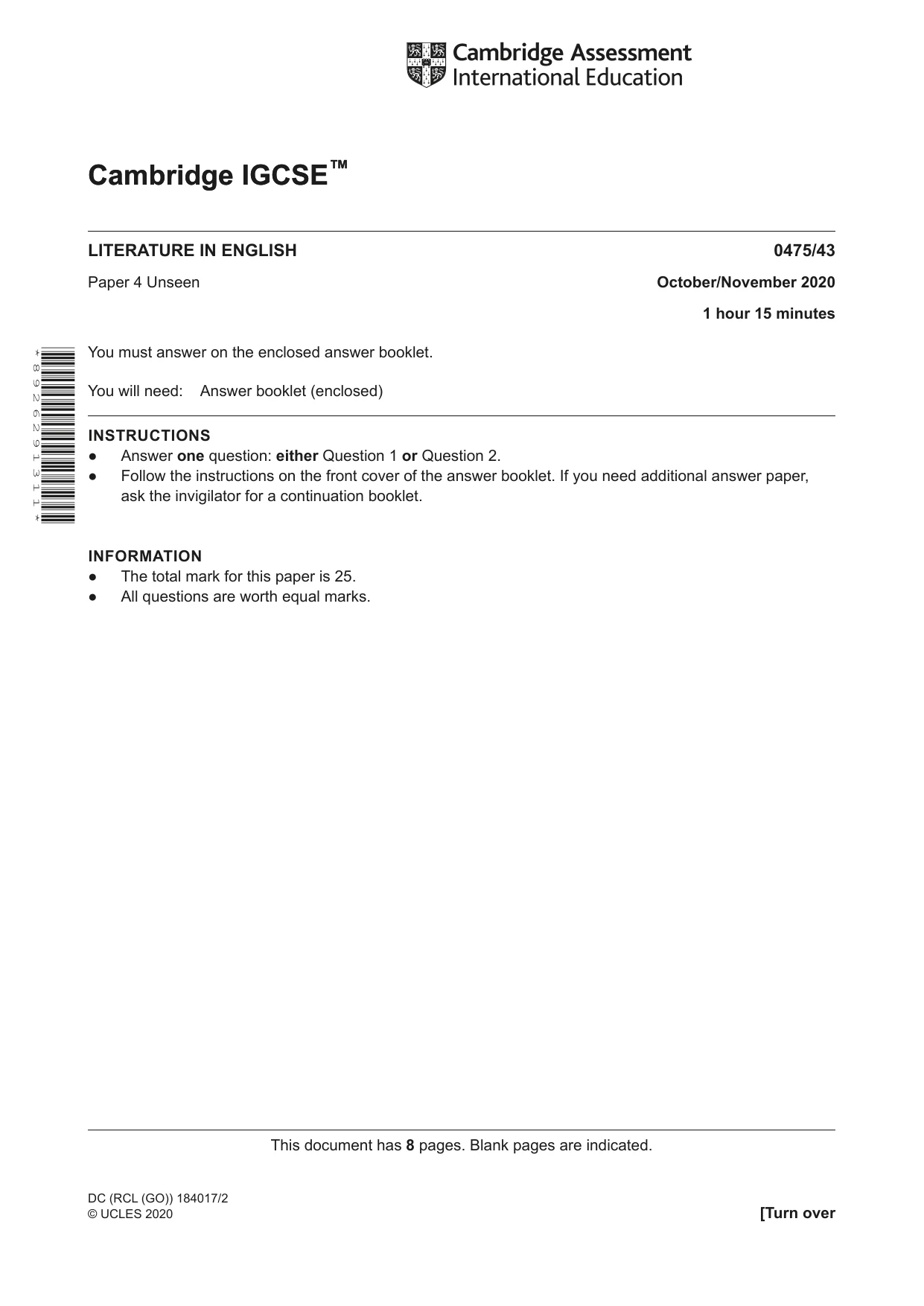
Cambridge IGCSE™ This document has 8 pages. Blank pages are indicated. * 8 9 2 6 2 9 1 3 1 1 * LITERATURE IN ENGLISH 0475/43 Paper 4 Unseen October/November 2020 1 hour 15 minutes You must answer on the enclosed answer booklet. You will need: Answer booklet (enclosed) INSTRUCTIONS ● Answer one question: either Question 1 or Question 2. ● Follow the instructions on the front cover of the answer booklet. If you need additional answer paper, ask the invigilator for a continuation booklet. INFORMATION ● The total mark for this paper is 25. ● All questions are worth equal marks. DC (RCL (GO)) 184017/2 © UCLES 2020 [Turn over Cambridge IGCSE™
Question paper, page 2
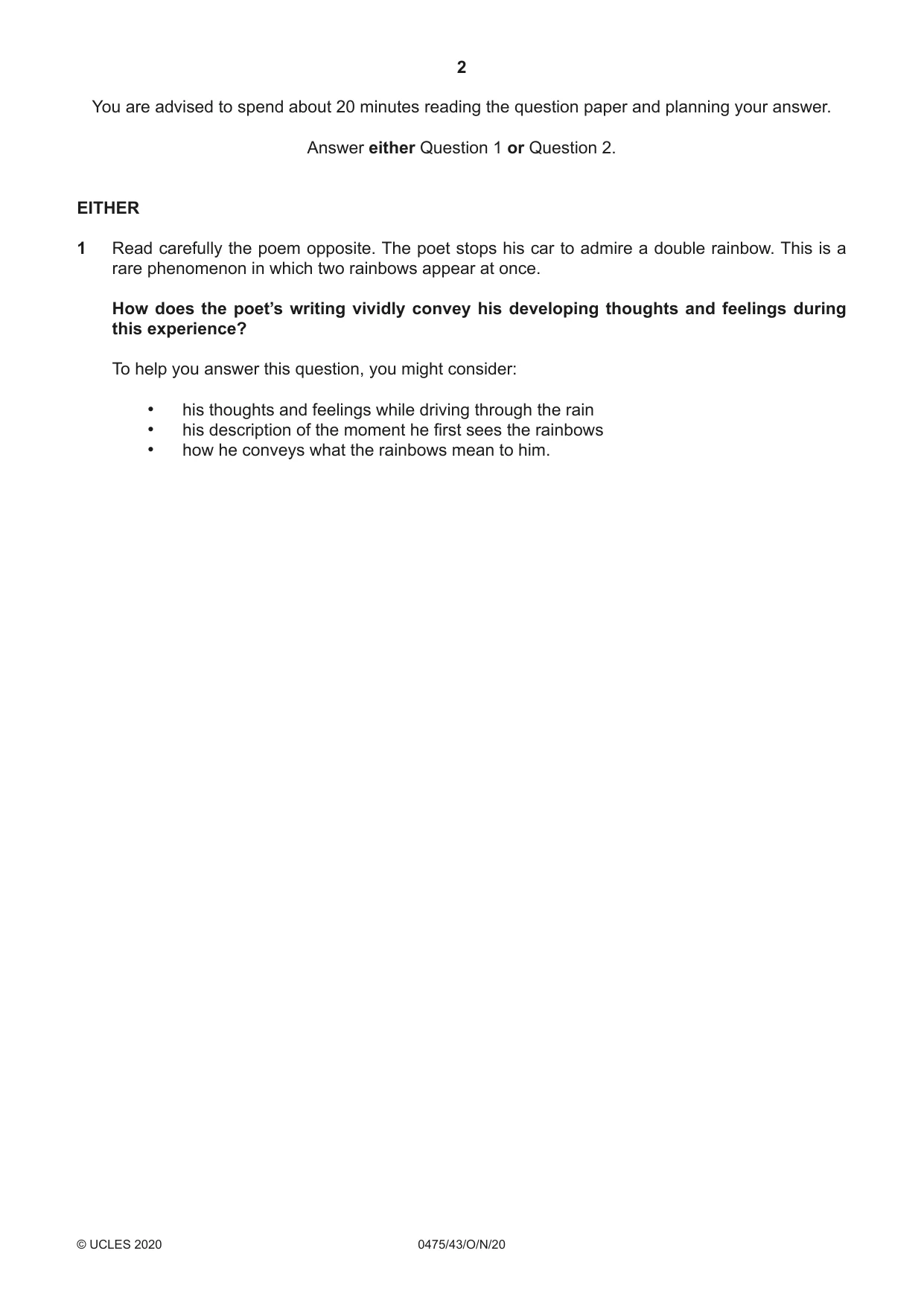
2 0475/43/O/N/20 © UCLES 2020 You are advised to spend about 20 minutes reading the question paper and planning your answer. Answer either Question 1 or Question 2. EITHER 1 Read carefully the poem opposite. The poet stops his car to admire a double rainbow. This is a rare phenomenon in which two rainbows appear at once. How does the poet’s writing vividly convey his developing thoughts and feelings during this experience? To help you answer this question, you might consider: • his thoughts and feelings while driving through the rain • his description of the moment he first sees the rainbows • how he conveys what the rainbows mean to him.
Question paper, page 3
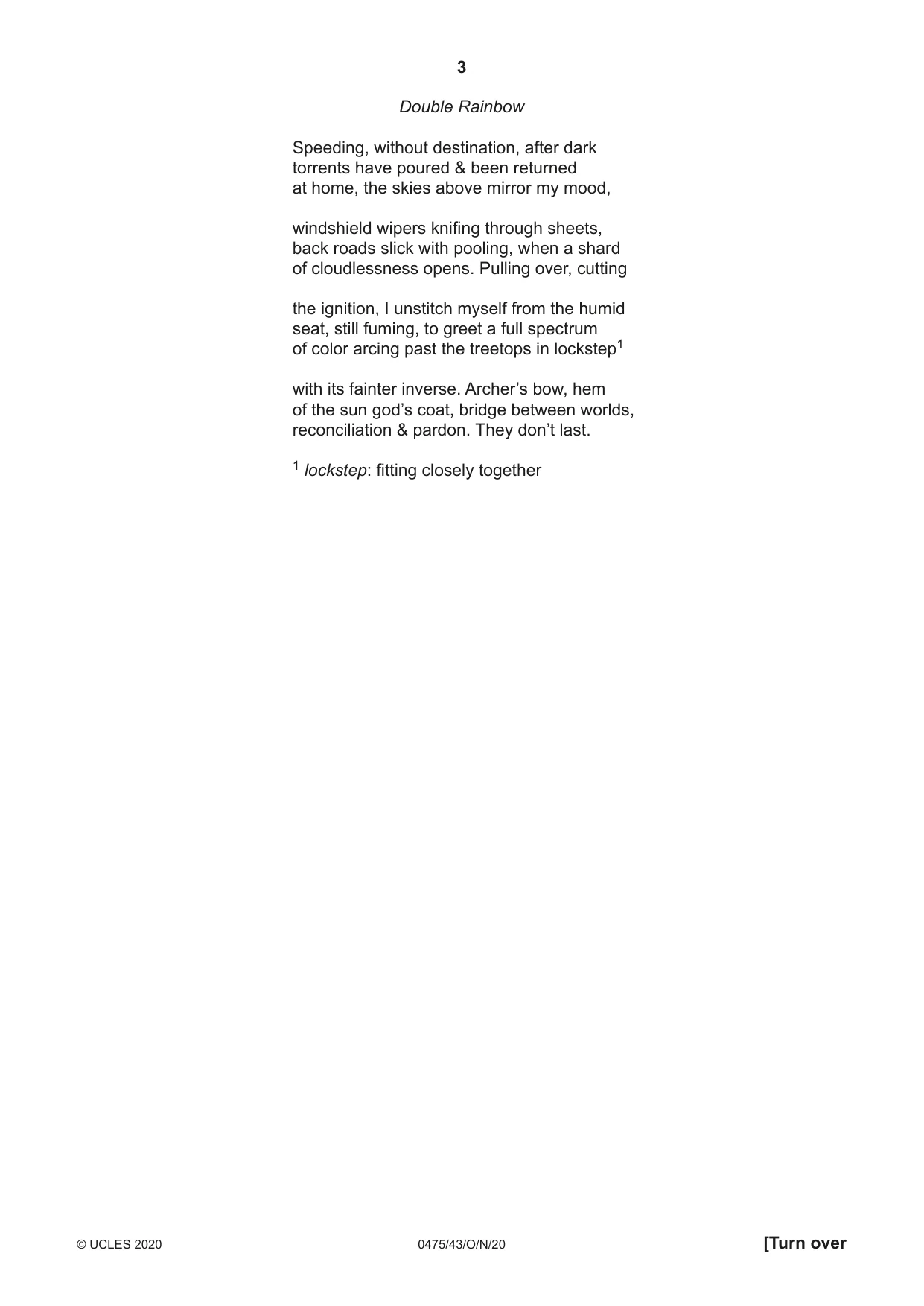
3 0475/43/O/N/20 © UCLES 2020 [Turn over Double Rainbow Speeding, without destination, after dark torrents have poured & been returned at home, the skies above mirror my mood, windshield wipers knifing through sheets, back roads slick with pooling, when a shard of cloudlessness opens. Pulling over, cutting the ignition, I unstitch myself from the humid seat, still fuming, to greet a full spectrum of color arcing past the treetops in lockstep1 with its fainter inverse. Archer’s bow, hem of the sun god’s coat, bridge between worlds, reconciliation & pardon. They don’t last. 1 lockstep: fitting closely together
Question paper, page 4
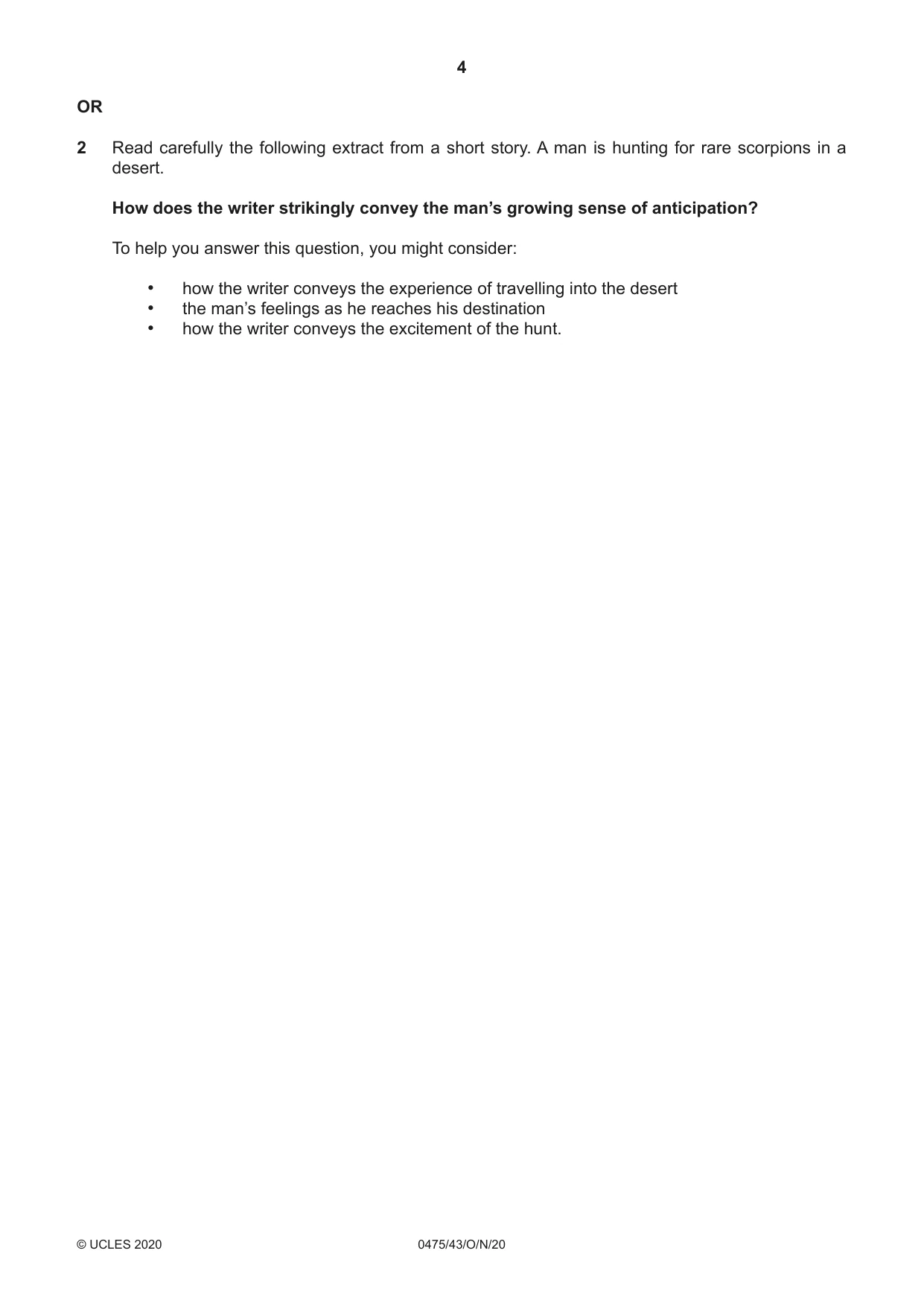
4 0475/43/O/N/20 © UCLES 2020 OR 2 Read carefully the following extract from a short story. A man is hunting for rare scorpions in a desert. How does the writer strikingly convey the man’s growing sense of anticipation? To help you answer this question, you might consider: • how the writer conveys the experience of travelling into the desert • the man’s feelings as he reaches his destination • how the writer conveys the excitement of the hunt.
Question paper, page 5
5 0475/43/O/N/20 © UCLES 2020 Back in the shop, I bought six oranges, a small watermelon, and a slab of well- wrapped English chocolate. Then I returned to the Lagonda.1 Now at last I was away. A few minutes later, I had crossed the sliding bridge that went over the Suez Canal just above Lake Timsah, and ahead of me lay the flat blazing desert and the little tarmac road stretching out before me like a black ribbon all the way to the horizon. I settled the Lagonda to the usual steady sixty-five miles an hour, and I opened the windows wide. The air that came in was like the breath of an oven. The time was almost noon, and the sun was throwing its heat directly on to the roof of the car. My thermometer inside registered 103°. I was now driving through some of the finest scorpion country in the world, and I was eager to stop and make a search before I reached the halfway filling-station at B’ir Rawd Salim. I had so far met not a single vehicle or seen a living creature since leaving Ismailia an hour before. This pleased me. Sinai was authentic desert. I pulled up on the side of the road and switched off the engine. I was thirsty, so I ate an orange. Then I put my white topee2 on my head, and eased myself slowly out of the car, out of my comfortable hermit-crab shell, and into the sunlight. For a full minute I stood motionless in the middle of the road, blinking at the brilliance of the surroundings. There was a blazing sun, a vast hot sky, and beneath it all on every side a great pale sea of yellow sand that was not quite of this world. There were mountains now in the distance on the south side of the road, bare, pale-brown, tanagra-coloured3 mountains faintly glazed with blue and purple, that rose up suddenly out of the desert and faded away in a haze of heat against the sky. The stillness was overpowering. There was no sound at all, no voice of a bird or insect anywhere, and it gave me a queer godlike feeling to be standing there alone in the middle of such a splendid, hot, inhuman landscape – as though I were on another planet altogether, on Jupiter or Mars, or in some place more distant and desolate still, where never would the grass grow or the clouds turn red. I went to the boot of the car and took out my killing-box, my net, and my trowel. Then I stepped off the road into the soft burning sand. I walked slowly for about a hundred yards into the desert, my eyes searching the ground. I was not looking for scorpions but the lairs of scorpions. The scorpion is a cryptozoic4 and nocturnal creature that hides all through the day either under a stone or in a burrow, according to its type. Only after the sun has gone down does it come out to hunt for food. The one I wanted, opisthophthalmus, was a burrower, so I wasted no time turning over stones. I searched only for burrows. After ten or fifteen minutes, I had found none; but already the heat was getting to be too much for me, and I decided reluctantly to return to the car. I walked back very slowly, still watching the ground, and I had reached the road and was in the act of stepping on to it when all at once, in the sand, not more than twelve inches from the edge of the tarmac, I caught sight of a scorpion’s burrow. I put the killing-box and the net on the ground beside me. Then, with my little trowel, I began very cautiously to scrape away the sand all around the hole. This was an operation that never failed to excite me. It was like a treasure hunt – a treasure hunt with just the right amount of danger accompanying it to stir the blood. I could feel my heart beating away in my chest as I probed deeper and deeper into the sand. And suddenly … there she was! 1 Lagonda: type of car 2 topee: sunhat 3 tanagra-coloured: colour of terracotta or clay 4 cryptozoic: living under rocks or leaves on the ground
Question paper, page 6
6 0475/43/O/N/20 © UCLES 2020 BLANK PAGE
Question paper, page 7
7 0475/43/O/N/20 © UCLES 2020 BLANK PAGE
Question paper, page 8
8 0475/43/O/N/20 © UCLES 2020 Permission to reproduce items where third-party owned material protected by copyright is included has been sought and cleared where possible. Every reasonable effort has been made by the publisher (UCLES) to trace copyright holders, but if any items requiring clearance have unwittingly been included, the publisher will be pleased to make amends at the earliest possible opportunity. To avoid the issue of disclosure of answer-related information to candidates, all copyright acknowledgements are reproduced online in the Cambridge Assessment International Education Copyright Acknowledgements Booklet. This is produced for each series of examinations and is freely available to download at www.cambridgeinternational.org after the live examination series. Cambridge Assessment International Education is part of the Cambridge Assessment Group. Cambridge Assessment is the brand name of the University of Cambridge Local Examinations Syndicate (UCLES), which itself is a department of the University of Cambridge. BLANK PAGE
Mark scheme, page 1
This document consists of 7 printed pages. © UCLES 2020 [Turn over Cambridge IGCSE™ LITERATURE IN ENGLISH 0475/43 Paper 4 Unseen 43 October/November 2020 MARK SCHEME Maximum Mark: 25 Published This mark scheme is published as an aid to teachers and candidates, to indicate the requirements of the examination. It shows the basis on which Examiners were instructed to award marks. It does not indicate the details of the discussions that took place at an Examiners’ meeting before marking began, which would have considered the acceptability of alternative answers. Mark schemes should be read in conjunction with the question paper and the Principal Examiner Report for Teachers. Cambridge International will not enter into discussions about these mark schemes. Cambridge International is publishing the mark schemes for the October/November 2020 series for most Cambridge IGCSE™, Cambridge International A and AS Level and Cambridge Pre-U components, and some Cambridge O Level components.
Mark scheme, page 2
0475/43 Cambridge IGCSE – Mark Scheme PUBLISHED October/November 2020 © UCLES 2020 Page 2 of 7 Generic Marking Principles These general marking principles must be applied by all examiners when marking candidate answers. They should be applied alongside the specific content of the mark scheme or generic level descriptors for a question. Each question paper and mark scheme will also comply with these marking principles. GENERIC MARKING PRINCIPLE 1: Marks must be awarded in line with: • the specific content of the mark scheme or the generic level descriptors for the question • the specific skills defined in the mark scheme or in the generic level descriptors for the question • the standard of response required by a candidate as exemplified by the standardisation scripts. GENERIC MARKING PRINCIPLE 2: Marks awarded are always whole marks (not half marks, or other fractions). GENERIC MARKING PRINCIPLE 3: Marks must be awarded positively: • marks are awarded for correct/valid answers, as defined in the mark scheme. However, credit is given for valid answers which go beyond the scope of the syllabus and mark scheme, referring to your Team Leader as appropriate • marks are awarded when candidates clearly demonstrate what they know and can do • marks are not deducted for errors • marks are not deducted for omissions • answers should only be judged on the quality of spelling, punctuation and grammar when these features are specifically assessed by the question as indicated by the mark scheme. The meaning, however, should be unambiguous. GENERIC MARKING PRINCIPLE 4: Rules must be applied consistently, e.g. in situations where candidates have not followed instructions or in the application of generic level descriptors. GENERIC MARKING PRINCIPLE 5: Marks should be awarded using the full range of marks defined in the mark scheme for the question (however; the use of the full mark range may be limited according to the quality of the candidate responses seen). GENERIC MARKING PRINCIPLE 6: Marks awarded are based solely on the requirements as defined in the mark scheme. Marks should not be awarded with grade thresholds or grade descriptors in mind.
Mark scheme, page 3
0475/43 Cambridge IGCSE – Mark Scheme PUBLISHED October/November 2020 © UCLES 2020 Page 3 of 7 For general administrative guidance, see Notes for Examiners Handbook. All questions are marked out of 25. Assessment Objectives The Assessment Objectives are evenly weighted across each question. The assessment objectives for the paper are: AO1 show detailed knowledge of the content of literary texts, supported by reference to the text AO2 understand the meanings of literary texts and their context, and explore texts beyond surface meaning to show deeper awareness of ideas and attitudes AO3 recognise and appreciate ways in which writers use language, structure, and form to create and shape meanings and effects AO4 communicate a sensitive and informed personal response The Band Descriptors cover marks from 0 to 25 and apply to the marking of each question. They guide examiners to an understanding of the qualities normally expected of, or typical of, work in a band. They are a means of general guidance and must not be interpreted as hurdle statements. For the purposes of standardisation of marking, they are to be used in conjunction with the Practice and Standardisation scripts discussed during the coordination meeting and with Team Leaders, as well as the question-specific notes. The supplementary notes for each question are related to the assessment objectives above. Because of the nature of the subject, they are for general guidance; they are not designed as prescriptions of required content and must not be treated as such. The syllabus aims at encouraging candidates to make some personal response to their reading. While there are legitimate expectations of the content of most answers, examiners may see responses that include ideas not covered in the supplementary guidance. For these cases, examiners should credit valid responses fairly and not penalise candidates for including valid points outside the mark scheme. Do not refer to indicative content notes on scripts.
Mark scheme, page 4
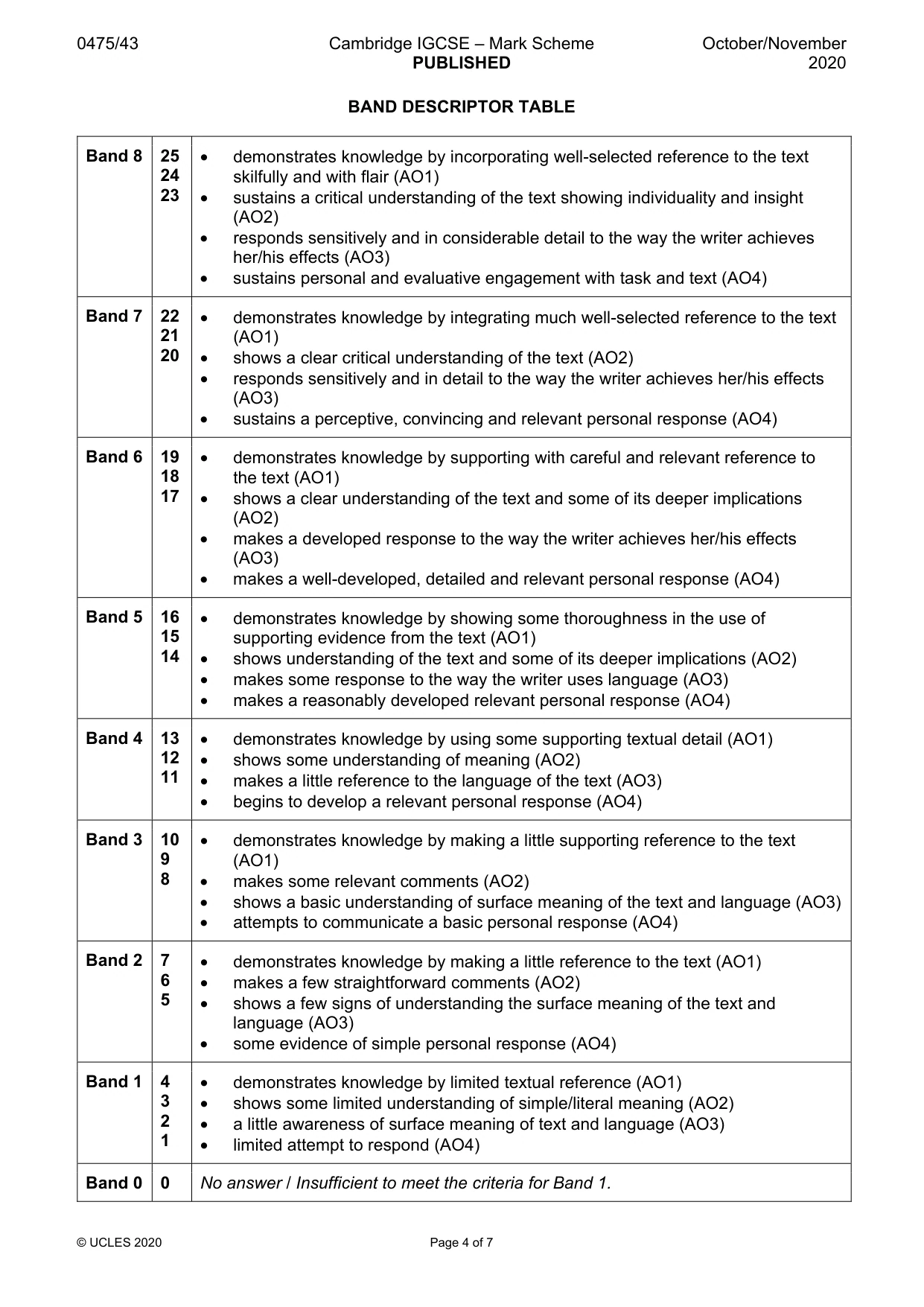
0475/43 Cambridge IGCSE – Mark Scheme PUBLISHED October/November 2020 © UCLES 2020 Page 4 of 7 BAND DESCRIPTOR TABLE Band 8 25 24 23 • demonstrates knowledge by incorporating well-selected reference to the text skilfully and with flair (AO1) • sustains a critical understanding of the text showing individuality and insight (AO2) • responds sensitively and in considerable detail to the way the writer achieves her/his effects (AO3) • sustains personal and evaluative engagement with task and text (AO4) Band 7 22 21 20 • demonstrates knowledge by integrating much well-selected reference to the text (AO1) • shows a clear critical understanding of the text (AO2) • responds sensitively and in detail to the way the writer achieves her/his effects (AO3) • sustains a perceptive, convincing and relevant personal response (AO4) Band 6 19 18 17 • demonstrates knowledge by supporting with careful and relevant reference to the text (AO1) • shows a clear understanding of the text and some of its deeper implications (AO2) • makes a developed response to the way the writer achieves her/his effects (AO3) • makes a well-developed, detailed and relevant personal response (AO4) Band 5 16 15 14 • demonstrates knowledge by showing some thoroughness in the use of supporting evidence from the text (AO1) • shows understanding of the text and some of its deeper implications (AO2) • makes some response to the way the writer uses language (AO3) • makes a reasonably developed relevant personal response (AO4) Band 4 13 12 11 • demonstrates knowledge by using some supporting textual detail (AO1) • shows some understanding of meaning (AO2) • makes a little reference to the language of the text (AO3) • begins to develop a relevant personal response (AO4) Band 3 10 9 8 • demonstrates knowledge by making a little supporting reference to the text (AO1) • makes some relevant comments (AO2) • shows a basic understanding of surface meaning of the text and language (AO3) • attempts to communicate a basic personal response (AO4) Band 2 7 6 5 • demonstrates knowledge by making a little reference to the text (AO1) • makes a few straightforward comments (AO2) • shows a few signs of understanding the surface meaning of the text and language (AO3) • some evidence of simple personal response (AO4) Band 1 4 3 2 1 • demonstrates knowledge by limited textual reference (AO1) • shows some limited understanding of simple/literal meaning (AO2) • a little awareness of surface meaning of text and language (AO3) • limited attempt to respond (AO4) Band 0 0 No answer / Insufficient to meet the criteria for Band 1.
Mark scheme, page 5
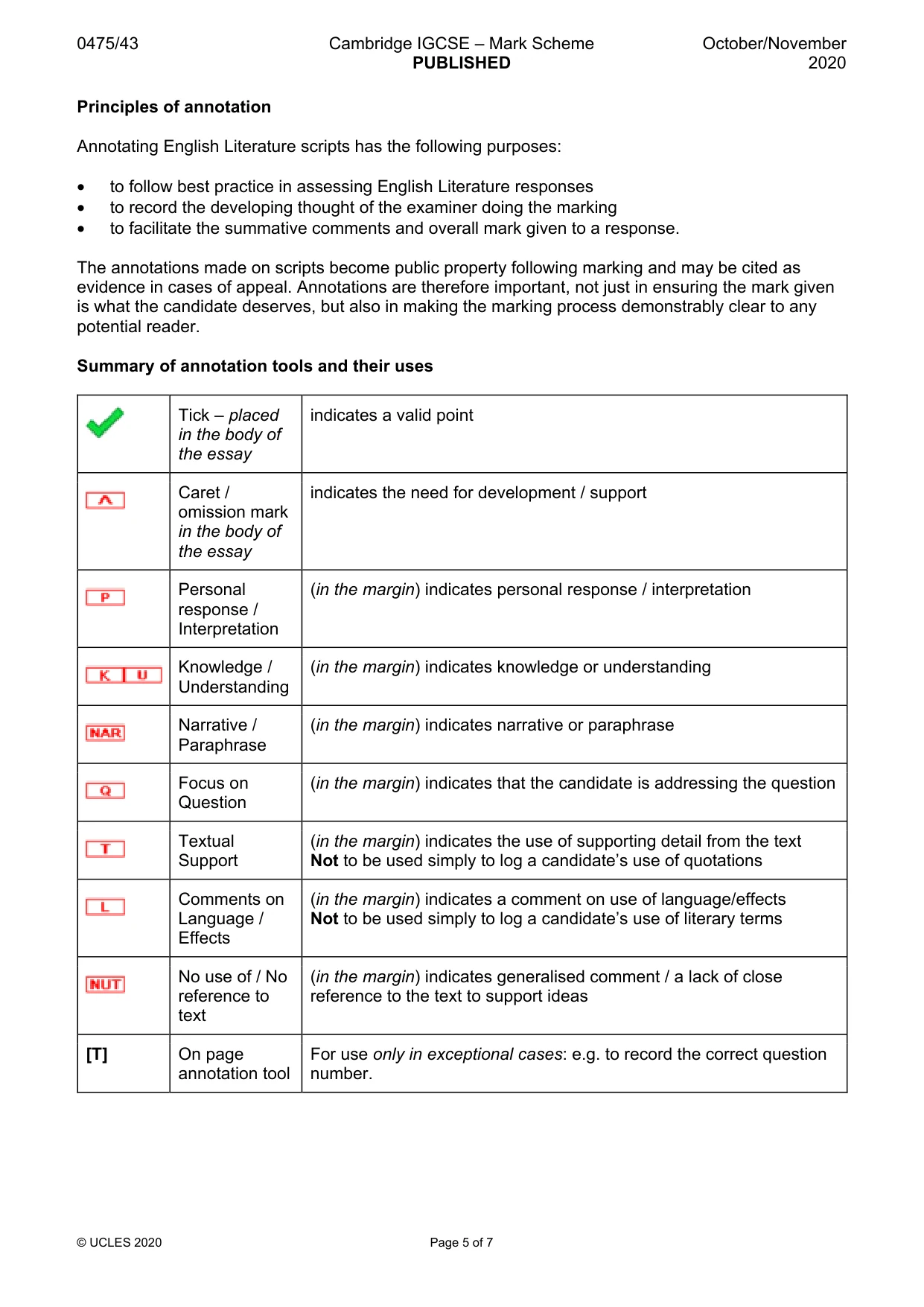
0475/43 Cambridge IGCSE – Mark Scheme PUBLISHED October/November 2020 © UCLES 2020 Page 5 of 7 Principles of annotation Annotating English Literature scripts has the following purposes: • to follow best practice in assessing English Literature responses • to record the developing thought of the examiner doing the marking • to facilitate the summative comments and overall mark given to a response. The annotations made on scripts become public property following marking and may be cited as evidence in cases of appeal. Annotations are therefore important, not just in ensuring the mark given is what the candidate deserves, but also in making the marking process demonstrably clear to any potential reader. Summary of annotation tools and their uses Tick – placed in the body of the essay indicates a valid point Caret / omission mark in the body of the essay indicates the need for development / support Personal response / Interpretation (in the margin) indicates personal response / interpretation Knowledge / Understanding (in the margin) indicates knowledge or understanding Narrative / Paraphrase (in the margin) indicates narrative or paraphrase Focus on Question (in the margin) indicates that the candidate is addressing the question Textual Support (in the margin) indicates the use of supporting detail from the text Not to be used simply to log a candidate’s use of quotations Comments on Language / Effects (in the margin) indicates a comment on use of language/effects Not to be used simply to log a candidate’s use of literary terms No use of / No reference to text (in the margin) indicates generalised comment / a lack of close reference to the text to support ideas [T] On page annotation tool For use only in exceptional cases: e.g. to record the correct question number.
Mark scheme, page 6
0475/43 Cambridge IGCSE – Mark Scheme PUBLISHED October/November 2020 © UCLES 2020 Page 6 of 7 How to annotate the scripts Use the SEEN annotation on all blank pages. In annotating the script, use the annotation tools and follow the model of the practice scripts which your Team Leaders have prepared for you. At the end of an essay, make a summative comment in the comment box for that question. Your comments should be positive and draw upon the wording of the band descriptors. The link between your annotations and summative comment should be clear to another marker or reader. Do not focus on what the candidate has not written but on what s/he has written. Do not refer to the indicative content notes. Comments These may be factual comments e.g. ‘Mercutio not Romeo’; ‘not a simile’ or comments on key features of the answer related to the mark scheme e.g. needs textual support, well developed/needs further development, clear/unclear, insufficient reference to text, needs to elaborate, link unclear, not answering Q. Be careful to distinguish between an unusual opinion (Hamlet loves Laertes) and a factual error (Hamlet is Laertes’ brother). Write a brief summative comment in the Comment box based on the band descriptors and proof-read what you have written: e.g. Well-developed personal response, showing a clear understanding of the extract, supported by relevant references. Draw upon at least two strands of the band descriptors to justify the mark awarded. Do not let your comments become excessively brief. Do not use abbreviations. What NOT to write on scripts when using the [T] tool Do not use more than one question mark: e.g.??? Do not use exclamation marks at all. Do not use capital letters to ‘shout’: e.g. NO. Do not use any emotive word or phrase – this includes: poor, weak, bad, good, wrong, get on with it, so what? hardly! what?, this is not the point, muddled, shallow, superficial. Do not indicate spelling and grammatical errors. Do not comment on handwriting or untidiness. Do not invent or use your own abbreviations or comments. Marking is monitored rigorously by your Team Leader. Failure to follow the marking procedure as set out in these instructions and as discussed at the standardisation meeting will result in feedback drawing your attention to the standard procedure. You will be expected to remedy deficiencies in scripts already marked.
Mark scheme, page 7
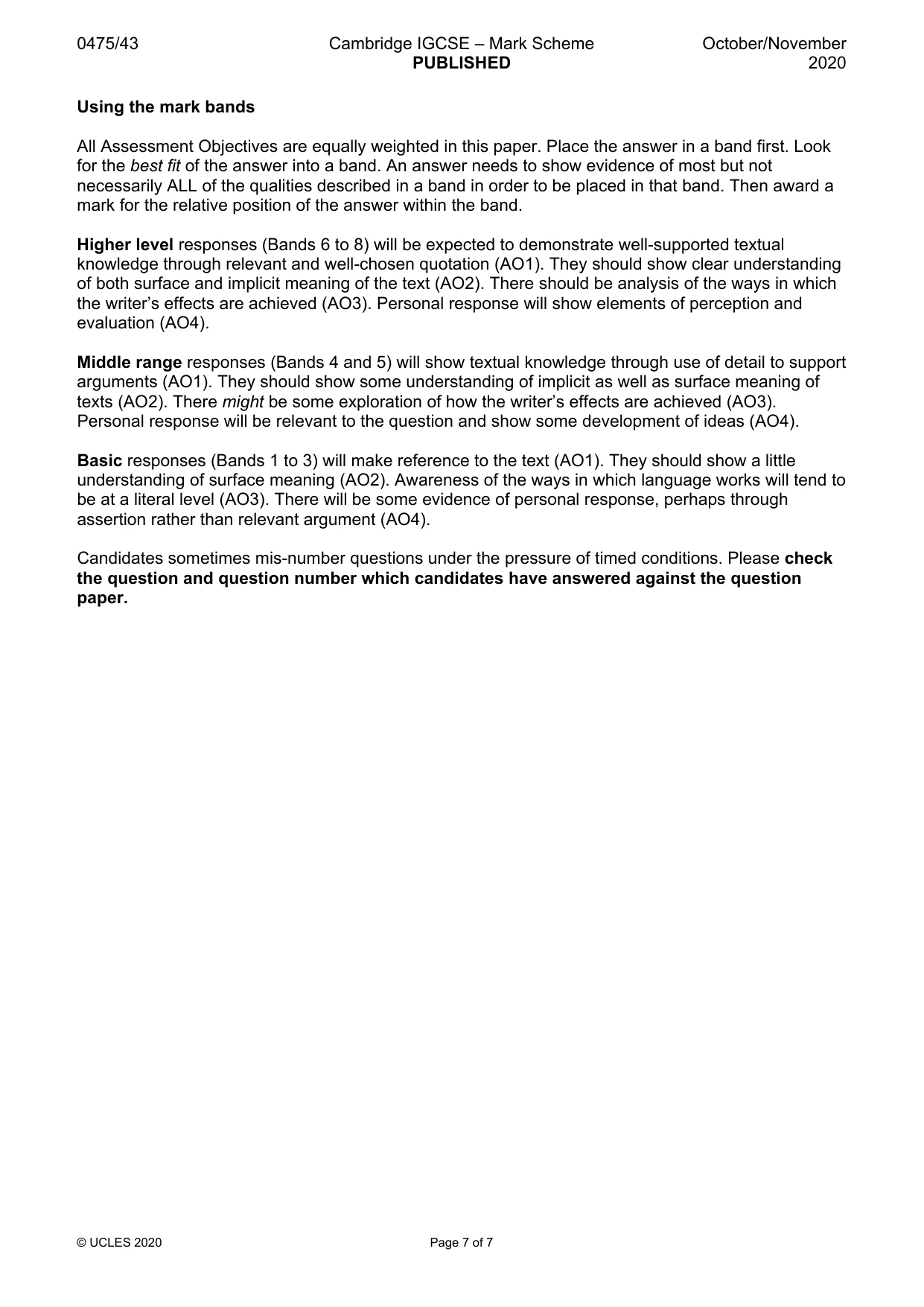
0475/43 Cambridge IGCSE – Mark Scheme PUBLISHED October/November 2020 © UCLES 2020 Page 7 of 7 Using the mark bands All Assessment Objectives are equally weighted in this paper. Place the answer in a band first. Look for the best fit of the answer into a band. An answer needs to show evidence of most but not necessarily ALL of the qualities described in a band in order to be placed in that band. Then award a mark for the relative position of the answer within the band. Higher level responses (Bands 6 to 8) will be expected to demonstrate well-supported textual knowledge through relevant and well-chosen quotation (AO1). They should show clear understanding of both surface and implicit meaning of the text (AO2). There should be analysis of the ways in which the writer’s effects are achieved (AO3). Personal response will show elements of perception and evaluation (AO4). Middle range responses (Bands 4 and 5) will show textual knowledge through use of detail to support arguments (AO1). They should show some understanding of implicit as well as surface meaning of texts (AO2). There might be some exploration of how the writer’s effects are achieved (AO3). Personal response will be relevant to the question and show some development of ideas (AO4). Basic responses (Bands 1 to 3) will make reference to the text (AO1). They should show a little understanding of surface meaning (AO2). Awareness of the ways in which language works will tend to be at a literal level (AO3). There will be some evidence of personal response, perhaps through assertion rather than relevant argument (AO4). Candidates sometimes mis-number questions under the pressure of timed conditions. Please check the question and question number which candidates have answered against the question paper.
What you needed in this session
Cambridge’s own grade thresholds for 2020 Oct/Nov, Paper 4 · Variant 3. A higher threshold means an easier paper — the bar moves with how the cohort did.