Cambridge IGCSE English - Literature in English 0475 — 2020 May/June Paper 3 · Variant 3
0475/33/M/J/20
The question paper and its mark scheme, free to read here and free to download. This is Cambridge’s own paper, exactly as it was sat.
Question paper12 pages
Mark scheme4 pages
Answers below. Sit the paper first if you are practising.
Paper as text
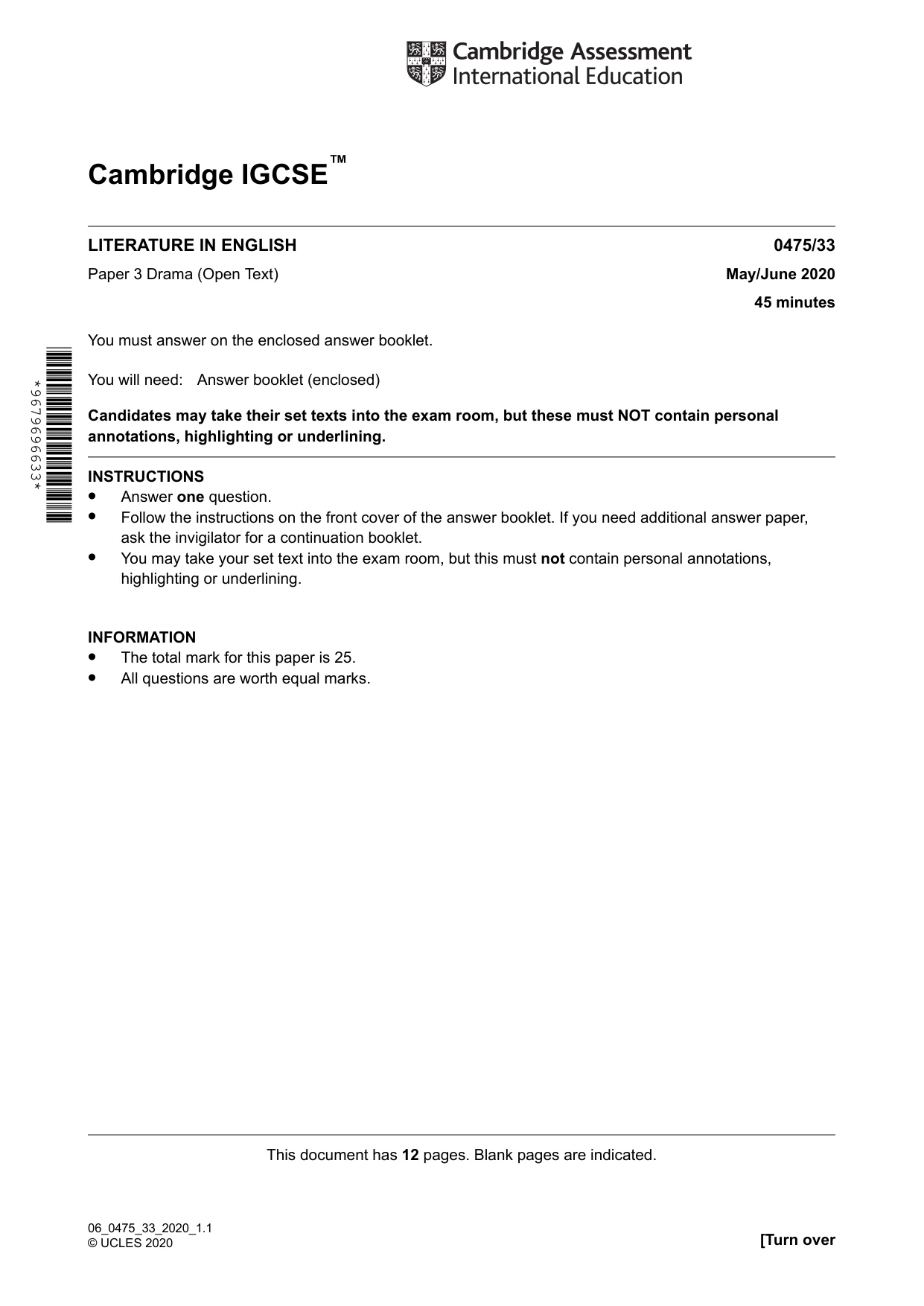
Question paper, page 1
Cambridge IGCSE™ 0475/33 LITERATURE IN ENGLISH May/June 2020 Paper 3 Drama (Open Text) 45 minutes You must answer on the enclosed answer booklet. You will need: Answer booklet (enclosed) Candidates may take their set texts into the exam room, but these must NOT contain personal annotations, highlighting or underlining. INSTRUCTIONS • Answer one question. • Follow the instructions on the front cover of the answer booklet. If you need additional answer paper, ask the invigilator for a continuation booklet. • You may take your set text into the exam room, but this must not contain personal annotations, highlighting or underlining. INFORMATION • The total mark for this paper is 25. • All questions are worth equal marks. This document has 12 pages. Blank pages are indicated. [Turn over 06_0475_33_2020_1.1 © UCLES 2020 *9679696633*
Question paper, page 2
LORRAINE HANSBERRY: A Raisin in the Sun Remember to support your ideas with details from the text. Either 1(a) Read this passage, and then answer the question that follows it: [laughing noticing what her mother is doing]: Beneatha 06_0475_33_2020_1.1 © UCLES 2020 2 Content removed due to copyright restrictions.
Question paper, page 3
I always wanted me one just like it! [from Act 2, Scene 3] How does Hansberry make this moment in the play both entertaining and moving for you? Or 1(b) Explore the ways in which Hansberry makes Mama’s dead husband Walter contribute to the dramatic impact of the play. [Turn over 06_0475_33_2020_1.1 © UCLES 2020 3 Content removed due to copyright restrictions.
Question paper, page 4
ARTHUR MILLER: The Crucible Remember to support your ideas with details from the text. Either 2(a) Read this passage, and then answer the question that follows it: [A sound – the sibilance of dragging feet on stone. 06_0475_33_2020_1.1 © UCLES 2020 4 Content removed due to copyright restrictions.
Question paper, page 5
It were a fearsome man, Giles Corey. [from Act 4] In what ways does Miller make this moment in the play so moving? Or 2(b) How does Miller’s portrayal of Reverend Hale contribute to the dramatic impact of the play? [Turn over 06_0475_33_2020_1.1 © UCLES 2020 5 Content removed due to copyright restrictions.
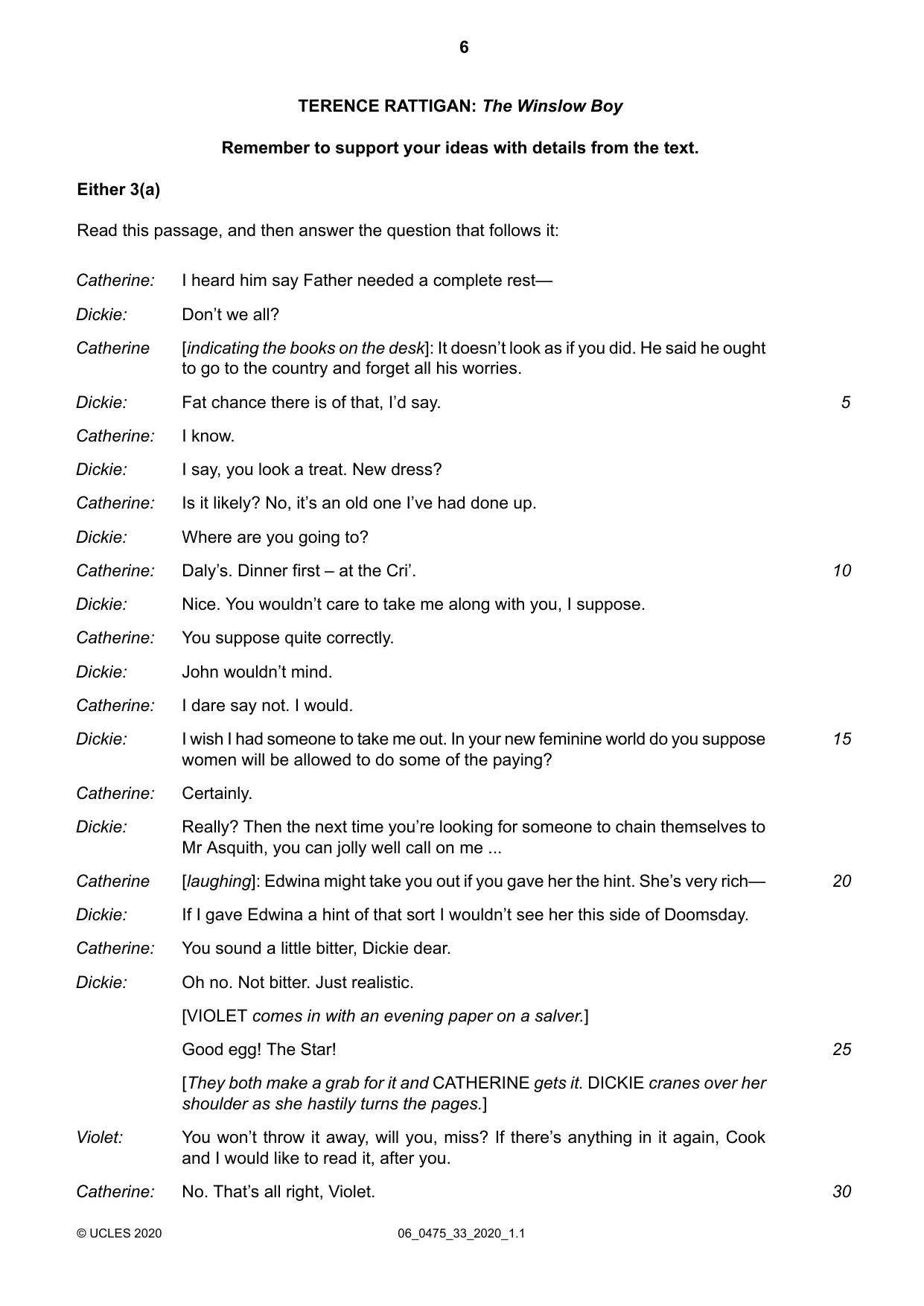
Question paper, page 6
30 25 20 15 10 5 TERENCE RATTIGAN: The Winslow Boy Remember to support your ideas with details from the text. Either 3(a) Read this passage, and then answer the question that follows it: I heard him say Father needed a complete rest— Catherine: Don’t we all? Dickie: [indicating the books on the desk]: It doesn’t look as if you did. He said he ought to go to the country and forget all his worries. Catherine Fat chance there is of that, I’d say. Dickie: I know. Catherine: I say, you look a treat. New dress? Dickie: Is it likely? No, it’s an old one I’ve had done up. Catherine: Where are you going to? Dickie: Daly’s. Dinner first – at the Cri’. Catherine: Nice. You wouldn’t care to take me along with you, I suppose. Dickie: You suppose quite correctly. Catherine: John wouldn’t mind. Dickie: I dare say not. I would. Catherine: I wish I had someone to take me out. In your new feminine world do you suppose women will be allowed to do some of the paying? Dickie: Certainly. Catherine: Really? Then the next time you’re looking for someone to chain themselves to Mr Asquith, you can jolly well call on me ... Dickie: [laughing]: Edwina might take you out if you gave her the hint. She’s very rich— Catherine If I gave Edwina a hint of that sort I wouldn’t see her this side of Doomsday. Dickie: You sound a little bitter, Dickie dear. Catherine: Oh no. Not bitter. Just realistic. Dickie: [VIOLET comes in with an evening paper on a salver.] Good egg! The Star! [They both make a grab for it and CATHERINE gets it. DICKIE cranes over her shoulder as she hastily turns the pages.] You won’t throw it away, will you, miss? If there’s anything in it again, Cook and I would like to read it, after you. Violet: No. That’s all right, Violet. Catherine: 06_0475_33_2020_1.1 © UCLES 2020 6
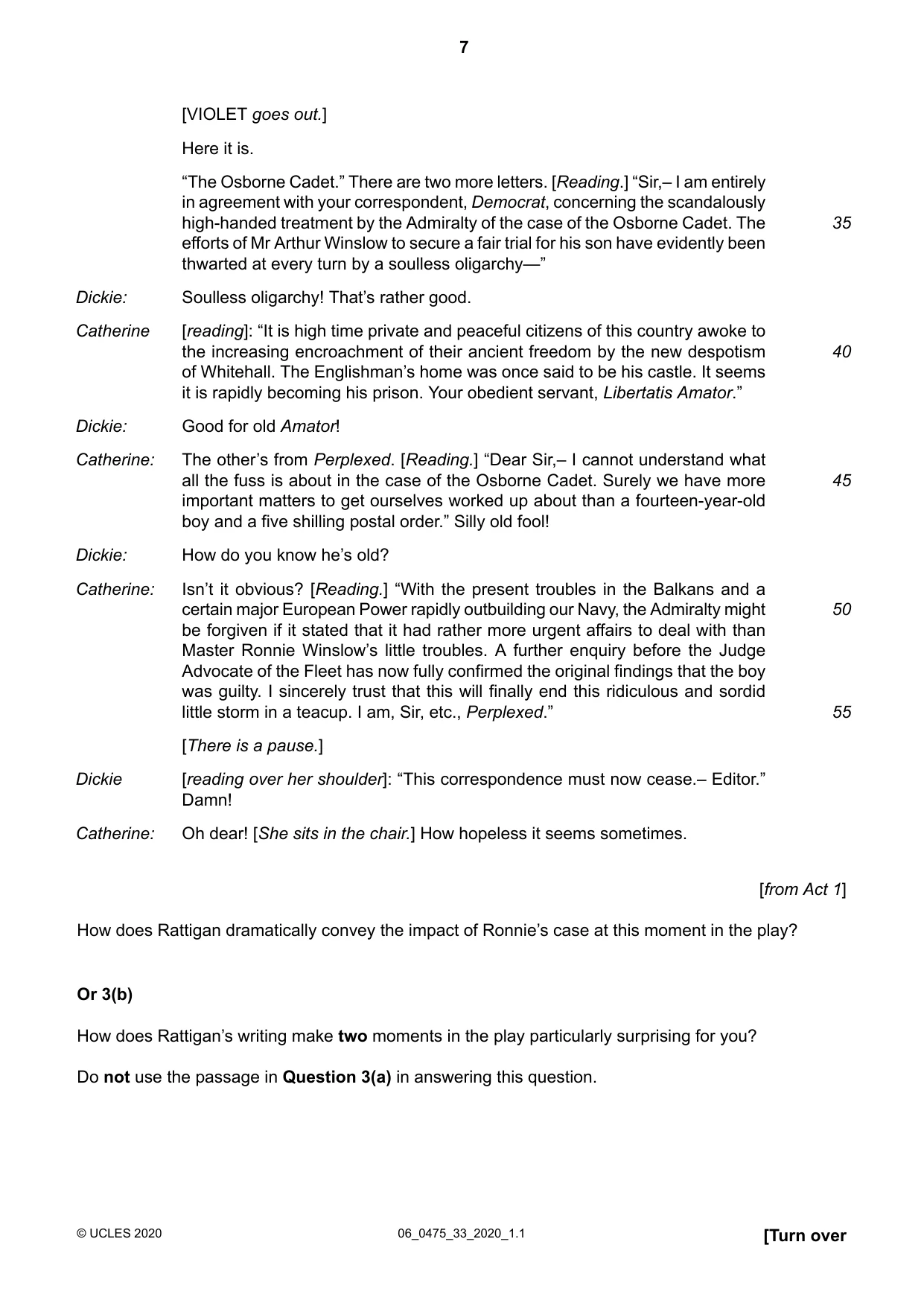
Question paper, page 7
55 50 45 40 35 [VIOLET goes out.] Here it is. “The Osborne Cadet.” There are two more letters. [Reading.] “Sir,– I am entirely in agreement with your correspondent, Democrat, concerning the scandalously high-handed treatment by the Admiralty of the case of the Osborne Cadet. The efforts of Mr Arthur Winslow to secure a fair trial for his son have evidently been thwarted at every turn by a soulless oligarchy—” Soulless oligarchy! That’s rather good. Dickie: [reading]: “It is high time private and peaceful citizens of this country awoke to the increasing encroachment of their ancient freedom by the new despotism of Whitehall. The Englishman’s home was once said to be his castle. It seems it is rapidly becoming his prison. Your obedient servant, Libertatis Amator.” Catherine Good for old Amator! Dickie: The other’s from Perplexed. [Reading.] “Dear Sir,– I cannot understand what all the fuss is about in the case of the Osborne Cadet. Surely we have more important matters to get ourselves worked up about than a fourteen-year-old boy and a five shilling postal order.” Silly old fool! Catherine: How do you know he’s old? Dickie: Isn’t it obvious? [Reading.] “With the present troubles in the Balkans and a certain major European Power rapidly outbuilding our Navy, the Admiralty might be forgiven if it stated that it had rather more urgent affairs to deal with than Master Ronnie Winslow’s little troubles. A further enquiry before the Judge Advocate of the Fleet has now fully confirmed the original findings that the boy was guilty. I sincerely trust that this will finally end this ridiculous and sordid little storm in a teacup. I am, Sir, etc., Perplexed.” Catherine: [There is a pause.] [reading over her shoulder]: “This correspondence must now cease.– Editor.” Damn! Dickie Oh dear! [She sits in the chair.] How hopeless it seems sometimes. Catherine: [from Act 1] How does Rattigan dramatically convey the impact of Ronnie’s case at this moment in the play? Or 3(b) How does Rattigan’s writing make two moments in the play particularly surprising for you? Do not use the passage in Question 3(a) in answering this question. [Turn over 06_0475_33_2020_1.1 © UCLES 2020 7
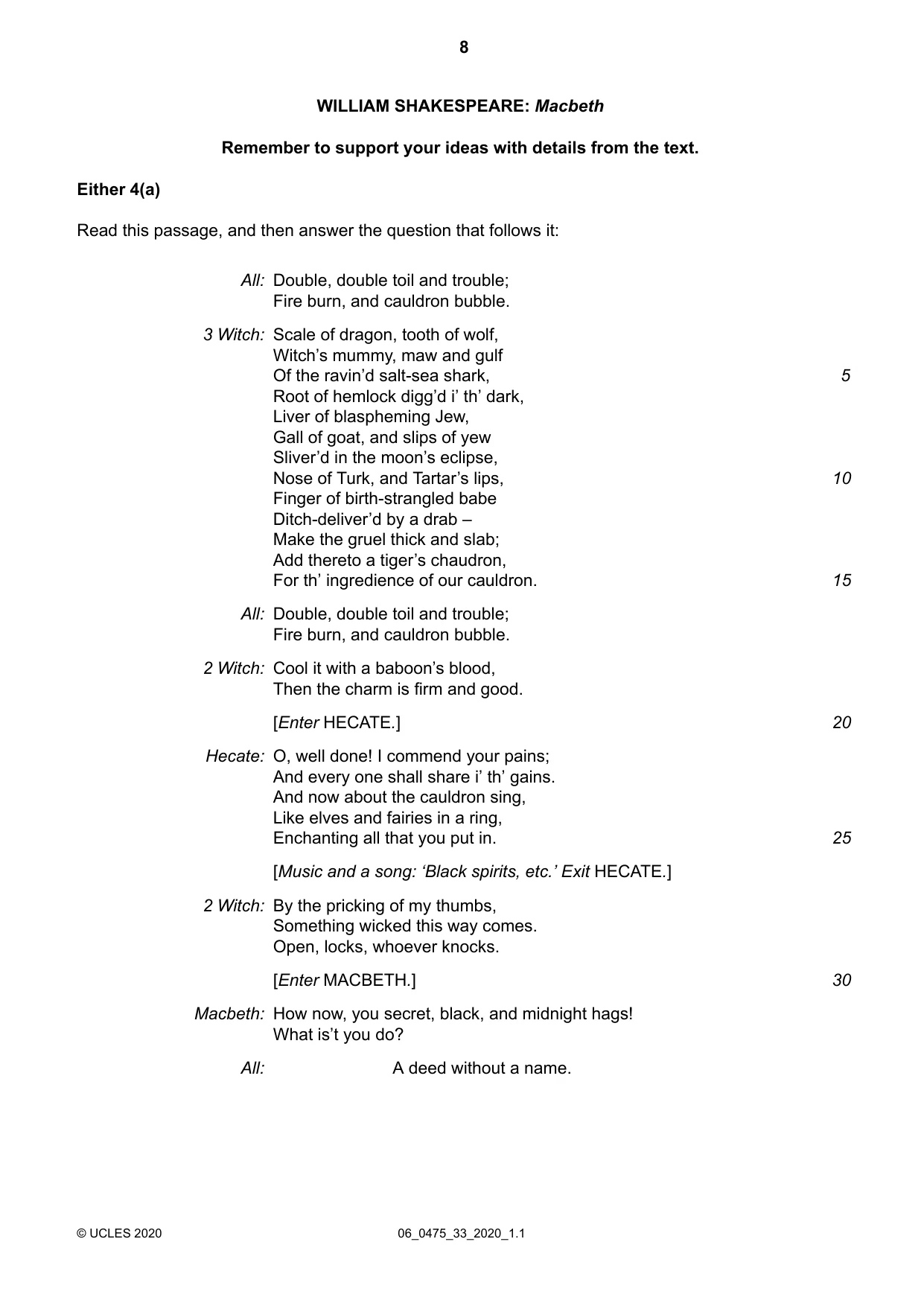
Question paper, page 8
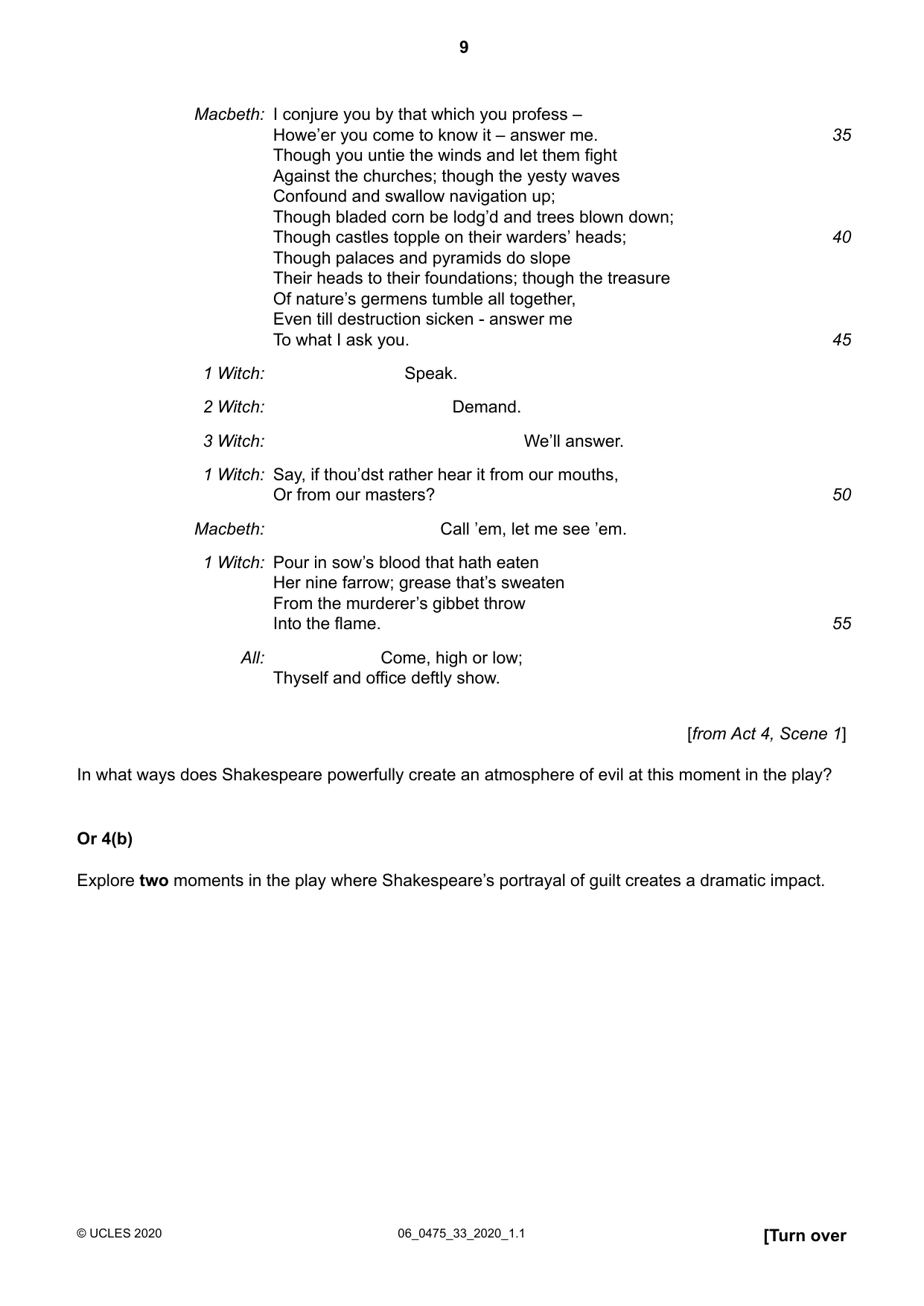
30 25 20 15 10 5 WILLIAM SHAKESPEARE: Macbeth Remember to support your ideas with details from the text. Either 4(a) Read this passage, and then answer the question that follows it: Double, double toil and trouble; Fire burn, and cauldron bubble. All: Scale of dragon, tooth of wolf, Witch’s mummy, maw and gulf Of the ravin’d salt-sea shark, Root of hemlock digg’d i’ th’ dark, Liver of blaspheming Jew, Gall of goat, and slips of yew Sliver’d in the moon’s eclipse, Nose of Turk, and Tartar’s lips, Finger of birth-strangled babe Ditch-deliver’d by a drab – Make the gruel thick and slab; Add thereto a tiger’s chaudron, For th’ ingredience of our cauldron. 3 Witch: Double, double toil and trouble; Fire burn, and cauldron bubble. All: Cool it with a baboon’s blood, Then the charm is firm and good. 2 Witch: [Enter HECATE.] O, well done! I commend your pains; And every one shall share i’ th’ gains. And now about the cauldron sing, Like elves and fairies in a ring, Enchanting all that you put in. Hecate: [Music and a song: ‘Black spirits, etc.’ Exit HECATE.] By the pricking of my thumbs, Something wicked this way comes. Open, locks, whoever knocks. 2 Witch: [Enter MACBETH.] How now, you secret, black, and midnight hags! What is’t you do? Macbeth: A deed without a name. All: 06_0475_33_2020_1.1 © UCLES 2020 8
Question paper, page 9
55 50 45 40 35 I conjure you by that which you profess – Howe’er you come to know it – answer me. Though you untie the winds and let them fight Against the churches; though the yesty waves Confound and swallow navigation up; Though bladed corn be lodg’d and trees blown down; Though castles topple on their warders’ heads; Though palaces and pyramids do slope Their heads to their foundations; though the treasure Of nature’s germens tumble all together, Even till destruction sicken - answer me To what I ask you. Macbeth: Speak. 1 Witch: Demand. 2 Witch: We’ll answer. 3 Witch: Say, if thou’dst rather hear it from our mouths, Or from our masters? 1 Witch: Call ’em, let me see ’em. Macbeth: Pour in sow’s blood that hath eaten Her nine farrow; grease that’s sweaten From the murderer’s gibbet throw Into the flame. 1 Witch: Come, high or low; Thyself and office deftly show. All: [from Act 4, Scene 1] In what ways does Shakespeare powerfully create an atmosphere of evil at this moment in the play? Or 4(b) Explore two moments in the play where Shakespeare’s portrayal of guilt creates a dramatic impact. [Turn over 06_0475_33_2020_1.1 © UCLES 2020 9
Question paper, page 10
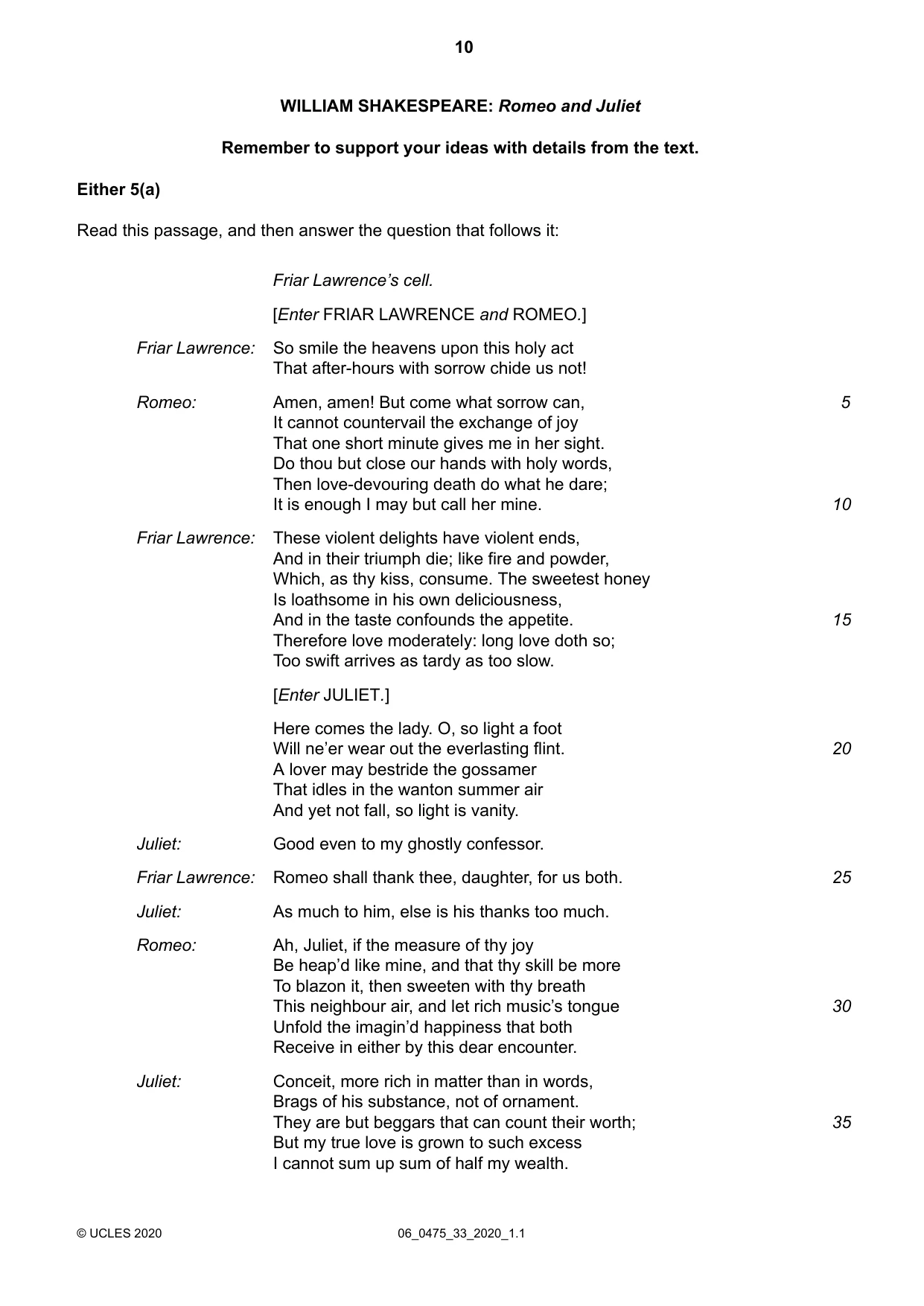
35 30 25 20 15 10 5 WILLIAM SHAKESPEARE: Romeo and Juliet Remember to support your ideas with details from the text. Either 5(a) Read this passage, and then answer the question that follows it: Friar Lawrence’s cell. [Enter FRIAR LAWRENCE and ROMEO.] So smile the heavens upon this holy act That after-hours with sorrow chide us not! Friar Lawrence: Amen, amen! But come what sorrow can, It cannot countervail the exchange of joy That one short minute gives me in her sight. Do thou but close our hands with holy words, Then love-devouring death do what he dare; It is enough I may but call her mine. Romeo: These violent delights have violent ends, And in their triumph die; like fire and powder, Which, as thy kiss, consume. The sweetest honey Is loathsome in his own deliciousness, And in the taste confounds the appetite. Therefore love moderately: long love doth so; Too swift arrives as tardy as too slow. Friar Lawrence: [Enter JULIET.] Here comes the lady. O, so light a foot Will ne’er wear out the everlasting flint. A lover may bestride the gossamer That idles in the wanton summer air And yet not fall, so light is vanity. Good even to my ghostly confessor. Juliet: Romeo shall thank thee, daughter, for us both. Friar Lawrence: As much to him, else is his thanks too much. Juliet: Ah, Juliet, if the measure of thy joy Be heap’d like mine, and that thy skill be more To blazon it, then sweeten with thy breath This neighbour air, and let rich music’s tongue Unfold the imagin’d happiness that both Receive in either by this dear encounter. Romeo: Conceit, more rich in matter than in words, Brags of his substance, not of ornament. They are but beggars that can count their worth; But my true love is grown to such excess I cannot sum up sum of half my wealth. Juliet: 06_0475_33_2020_1.1 © UCLES 2020 10
Question paper, page 11
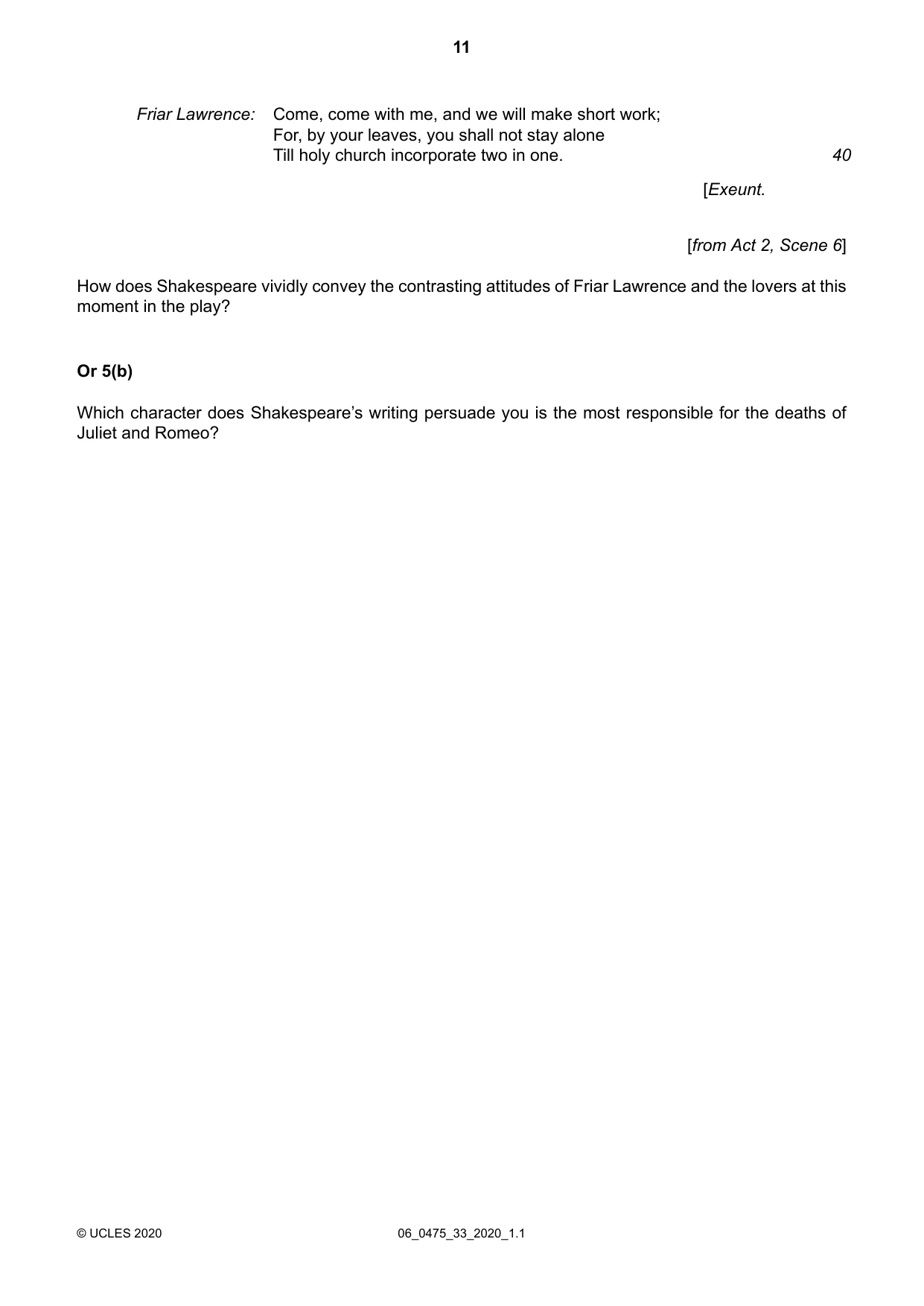
40 Come, come with me, and we will make short work; For, by your leaves, you shall not stay alone Till holy church incorporate two in one. Friar Lawrence: [Exeunt. [from Act 2, Scene 6] How does Shakespeare vividly convey the contrasting attitudes of Friar Lawrence and the lovers at this moment in the play? Or 5(b) Which character does Shakespeare’s writing persuade you is the most responsible for the deaths of Juliet and Romeo? 06_0475_33_2020_1.1 © UCLES 2020 11
Question paper, page 12
BLANK PAGE Permission to reproduce items where third-party owned material protected by copyright is included has been sought and cleared where possible. Every reasonable effort has been made by the publisher (UCLES) to trace copyright holders, but if any items requiring clearance have unwittingly been included, the publisher will be pleased to make amends at the earliest possible opportunity. To avoid the issue of disclosure of answer-related information to candidates, all copyright acknowledgements are reproduced online in the Cambridge Assessment International Education Copyright Acknowledgements Booklet. This is produced for each series of examinations and is freely available to download at www.cambridgeinternational.org after the live examination series. Cambridge Assessment International Education is part of the Cambridge Assessment Group. Cambridge Assessment is the brand name of the University of Cambridge Local Examinations Syndicate (UCLES), which itself is a department of the University of Cambridge. 06_0475_33_2020_1.1 © UCLES 2020 12
Mark scheme, page 1
This document consists of 4 printed pages. © UCLES 2020 [Turn over Cambridge IGCSE™ LITERATURE IN ENGLISH 0475/33 Paper 3 Drama (Open Text) 33 May/June 2020 MARK SCHEME Maximum Mark: 25 Published Students did not sit exam papers in the June 2020 series due to the Covid-19 global pandemic. This mark scheme is published to support teachers and students and should be read together with the question paper. It shows the requirements of the exam. The answer column of the mark scheme shows the proposed basis on which Examiners would award marks for this exam. Where appropriate, this column also provides the most likely acceptable alternative responses expected from students. Examiners usually review the mark scheme after they have seen student responses and update the mark scheme if appropriate. In the June series, Examiners were unable to consider the acceptability of alternative responses, as there were no student responses to consider. Mark schemes should usually be read together with the Principal Examiner Report for Teachers. However, because students did not sit exam papers, there is no Principal Examiner Report for Teachers for the June 2020 series. Cambridge International will not enter into discussions about these mark schemes. Cambridge International is publishing the mark schemes for the June 2020 series for most Cambridge IGCSE™ and Cambridge International A & AS Level components, and some Cambridge O Level components.
Mark scheme, page 2
0475/33 Cambridge IGCSE – Mark Scheme PUBLISHED May/June 2020 © UCLES 2020 Page 2 of 4 Generic Marking Principles These general marking principles must be applied by all examiners when marking candidate answers. They should be applied alongside the specific content of the mark scheme or generic level descriptors for a question. Each question paper and mark scheme will also comply with these marking principles. GENERIC MARKING PRINCIPLE 1: Marks must be awarded in line with: • the specific content of the mark scheme or the generic level descriptors for the question • the specific skills defined in the mark scheme or in the generic level descriptors for the question • the standard of response required by a candidate as exemplified by the standardisation scripts. GENERIC MARKING PRINCIPLE 2: Marks awarded are always whole marks (not half marks, or other fractions). GENERIC MARKING PRINCIPLE 3: Marks must be awarded positively: • marks are awarded for correct/valid answers, as defined in the mark scheme. However, credit is given for valid answers which go beyond the scope of the syllabus and mark scheme, referring to your Team Leader as appropriate • marks are awarded when candidates clearly demonstrate what they know and can do • marks are not deducted for errors • marks are not deducted for omissions • answers should only be judged on the quality of spelling, punctuation and grammar when these features are specifically assessed by the question as indicated by the mark scheme. The meaning, however, should be unambiguous. GENERIC MARKING PRINCIPLE 4: Rules must be applied consistently e.g. in situations where candidates have not followed instructions or in the application of generic level descriptors. GENERIC MARKING PRINCIPLE 5: Marks should be awarded using the full range of marks defined in the mark scheme for the question (however; the use of the full mark range may be limited according to the quality of the candidate responses seen). GENERIC MARKING PRINCIPLE 6: Marks awarded are based solely on the requirements as defined in the mark scheme. Marks should not be awarded with grade thresholds or grade descriptors in mind.
Mark scheme, page 3
0475/33 Cambridge IGCSE – Mark Scheme PUBLISHED May/June 2020 © UCLES 2020 Page 3 of 4 Assessment Objectives The Assessment Objectives are evenly weighted across each question. The assessment objectives for the paper are: AO1 show detailed knowledge of the content of literary texts, supported by reference to the text AO2 understand the meanings of literary texts and their context, and explore texts beyond surface meaning to show deeper awareness of ideas and attitudes AO3 recognise and appreciate ways in which writers use language, structure, and form to create and shape meanings and effects AO4 communicate a sensitive and informed personal response The Band Descriptors cover marks from 0 to 25, and apply to the marking of each question. They guide examiners to an understanding of the qualities normally expected of, or typical of, work in a band. They are a means of general guidance.
Mark scheme, page 4
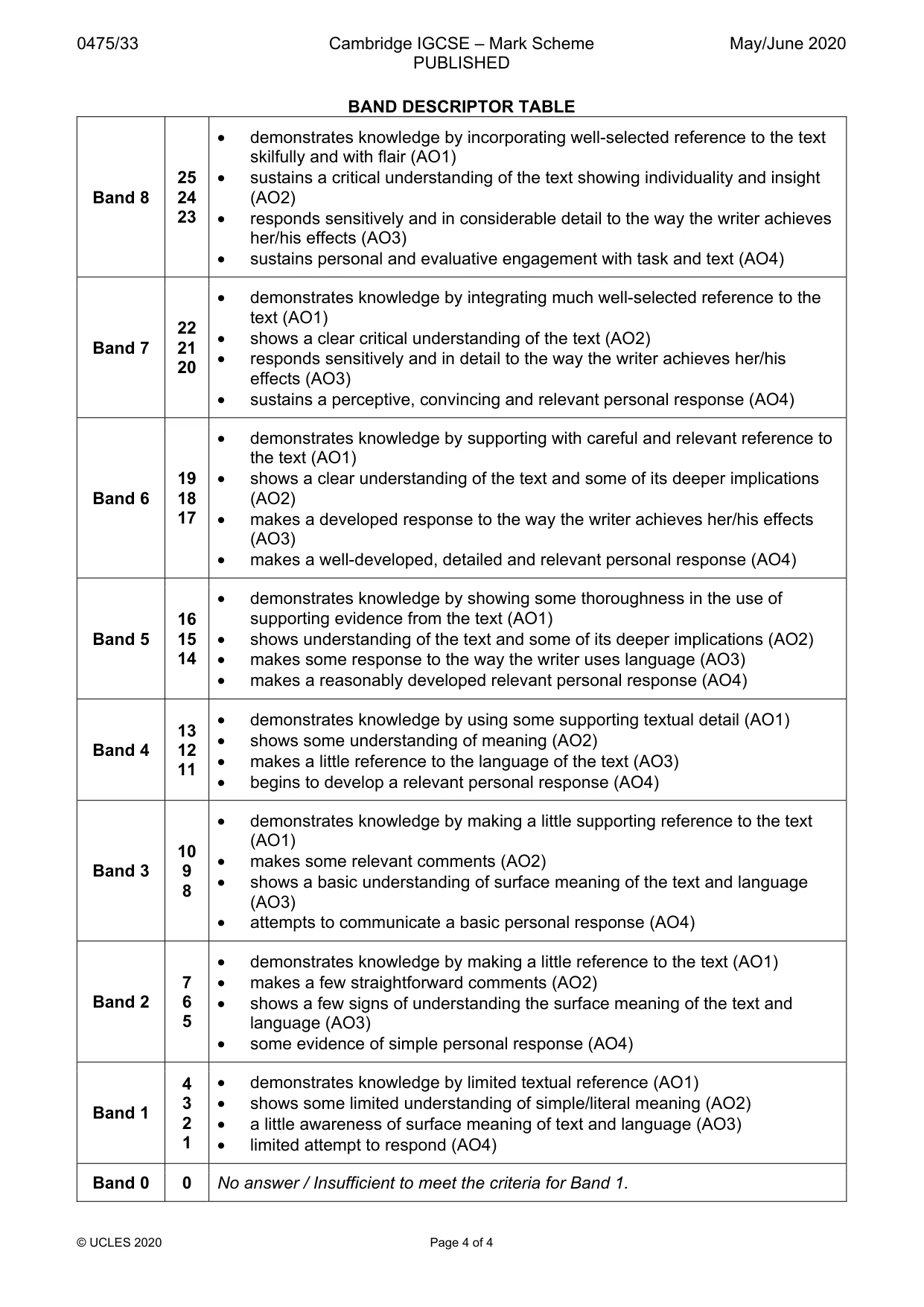
0475/33 Cambridge IGCSE – Mark Scheme PUBLISHED May/June 2020 © UCLES 2020 Page 4 of 4 BAND DESCRIPTOR TABLE Band 8 25 24 23 • demonstrates knowledge by incorporating well-selected reference to the text skilfully and with flair (AO1) • sustains a critical understanding of the text showing individuality and insight (AO2) • responds sensitively and in considerable detail to the way the writer achieves her/his effects (AO3) • sustains personal and evaluative engagement with task and text (AO4) Band 7 22 21 20 • demonstrates knowledge by integrating much well-selected reference to the text (AO1) • shows a clear critical understanding of the text (AO2) • responds sensitively and in detail to the way the writer achieves her/his effects (AO3) • sustains a perceptive, convincing and relevant personal response (AO4) Band 6 19 18 17 • demonstrates knowledge by supporting with careful and relevant reference to the text (AO1) • shows a clear understanding of the text and some of its deeper implications (AO2) • makes a developed response to the way the writer achieves her/his effects (AO3) • makes a well-developed, detailed and relevant personal response (AO4) Band 5 16 15 14 • demonstrates knowledge by showing some thoroughness in the use of supporting evidence from the text (AO1) • shows understanding of the text and some of its deeper implications (AO2) • makes some response to the way the writer uses language (AO3) • makes a reasonably developed relevant personal response (AO4) Band 4 13 12 11 • demonstrates knowledge by using some supporting textual detail (AO1) • shows some understanding of meaning (AO2) • makes a little reference to the language of the text (AO3) • begins to develop a relevant personal response (AO4) Band 3 10 9 8 • demonstrates knowledge by making a little supporting reference to the text (AO1) • makes some relevant comments (AO2) • shows a basic understanding of surface meaning of the text and language (AO3) • attempts to communicate a basic personal response (AO4) Band 2 7 6 5 • demonstrates knowledge by making a little reference to the text (AO1) • makes a few straightforward comments (AO2) • shows a few signs of understanding the surface meaning of the text and language (AO3) • some evidence of simple personal response (AO4) Band 1 4 3 2 1 • demonstrates knowledge by limited textual reference (AO1) • shows some limited understanding of simple/literal meaning (AO2) • a little awareness of surface meaning of text and language (AO3) • limited attempt to respond (AO4) Band 0 0 No answer / Insufficient to meet the criteria for Band 1.