Cambridge IGCSE English - Literature 0486 — 2019 Feb/March Paper 1 · Variant 2
0486/12/F/M/19 · 50 marks · ≈56 min
The question paper and its mark scheme, free to read here and free to download. This is Cambridge’s own paper, exactly as it was sat.
Question paper28 pages






Mark scheme4 pages
Answers below. Sit the paper first if you are practising.
Paper as text
Question paper, page 1
This document consists of 24 printed pages, 4 blank pages and 1 Insert. DC (RCL (GO)) 165359/2 © UCLES 2019 [Turn over Cambridge Assessment International Education Cambridge International General Certificate of Secondary Education * 3 1 9 3 6 2 7 1 2 4 * LITERATURE (ENGLISH) 0486/12 Paper 1 Poetry and Prose February/March 2019 1 hour 30 minutes No Additional Materials are required. READ THESE INSTRUCTIONS FIRST An answer booklet is provided inside this question paper. You should follow the instructions on the front cover of the answer booklet. If you need additional answer paper ask the invigilator for a continuation booklet. Answer two questions: one question from Section A and one question from Section B. All questions in this paper carry equal marks.
Question paper, page 3
3 0486/12/F/M/19 © UCLES 2019 [Turn over CONTENTS Section A: Poetry text question numbers page[s] Songs of Ourselves Volume 1: from Part 5 1, 2 pages 4–5 Songs of Ourselves Volume 2: from Part 2 3, 4 pages 6–7 Gillian Clarke: from Collected Poems 5, 6 pages 8–9 Section B: Prose text question numbers page[s] Jane Austen: Mansfield Park 7, 8 pages 10–11 Willa Cather: My Ántonia 9, 10 pages 12–13 Anita Desai: In Custody 11, 12 pages 14–15 Charles Dickens: Hard Times 13, 14 pages 16–17 Kate Grenville: The Secret River 15, 16 pages 18–19 John Knowles: A Separate Peace 17, 18 pages 20–21 Alan Paton: Cry, the Beloved Country 19, 20 pages 22–23 from Stories of Ourselves 21, 22 pages 24–25
Question paper, page 4
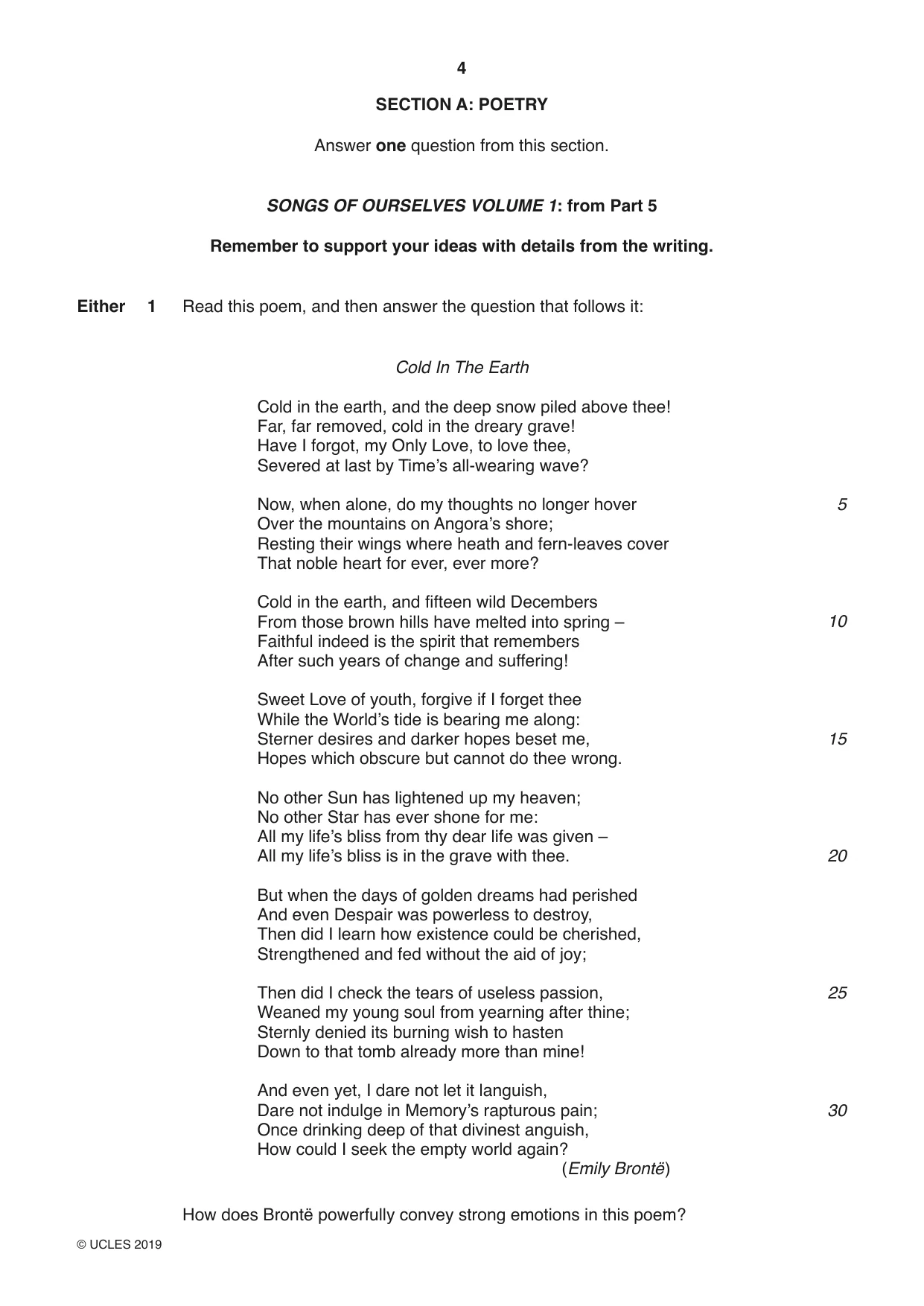
4 © UCLES 2019 SECTION A: POETRY Answer one question from this section. SONGS OF OURSELVES VOLUME 1: from Part 5 Remember to support your ideas with details from the writing. Either 1 Read this poem, and then answer the question that follows it: Cold In The Earth Cold in the earth, and the deep snow piled above thee! Far, far removed, cold in the dreary grave! Have I forgot, my Only Love, to love thee, Severed at last by Time’s all-wearing wave? Now, when alone, do my thoughts no longer hover Over the mountains on Angora’s shore; Resting their wings where heath and fern-leaves cover That noble heart for ever, ever more? Cold in the earth, and fifteen wild Decembers From those brown hills have melted into spring – Faithful indeed is the spirit that remembers After such years of change and suffering! Sweet Love of youth, forgive if I forget thee While the World’s tide is bearing me along: Sterner desires and darker hopes beset me, Hopes which obscure but cannot do thee wrong. No other Sun has lightened up my heaven; No other Star has ever shone for me: All my life’s bliss from thy dear life was given – All my life’s bliss is in the grave with thee. But when the days of golden dreams had perished And even Despair was powerless to destroy, Then did I learn how existence could be cherished, Strengthened and fed without the aid of joy; Then did I check the tears of useless passion, Weaned my young soul from yearning after thine; Sternly denied its burning wish to hasten Down to that tomb already more than mine! And even yet, I dare not let it languish, Dare not indulge in Memory’s rapturous pain; Once drinking deep of that divinest anguish, How could I seek the empty world again? (Emily Brontë) How does Brontë powerfully convey strong emotions in this poem? 5 10 15 20 25 30
Question paper, page 5
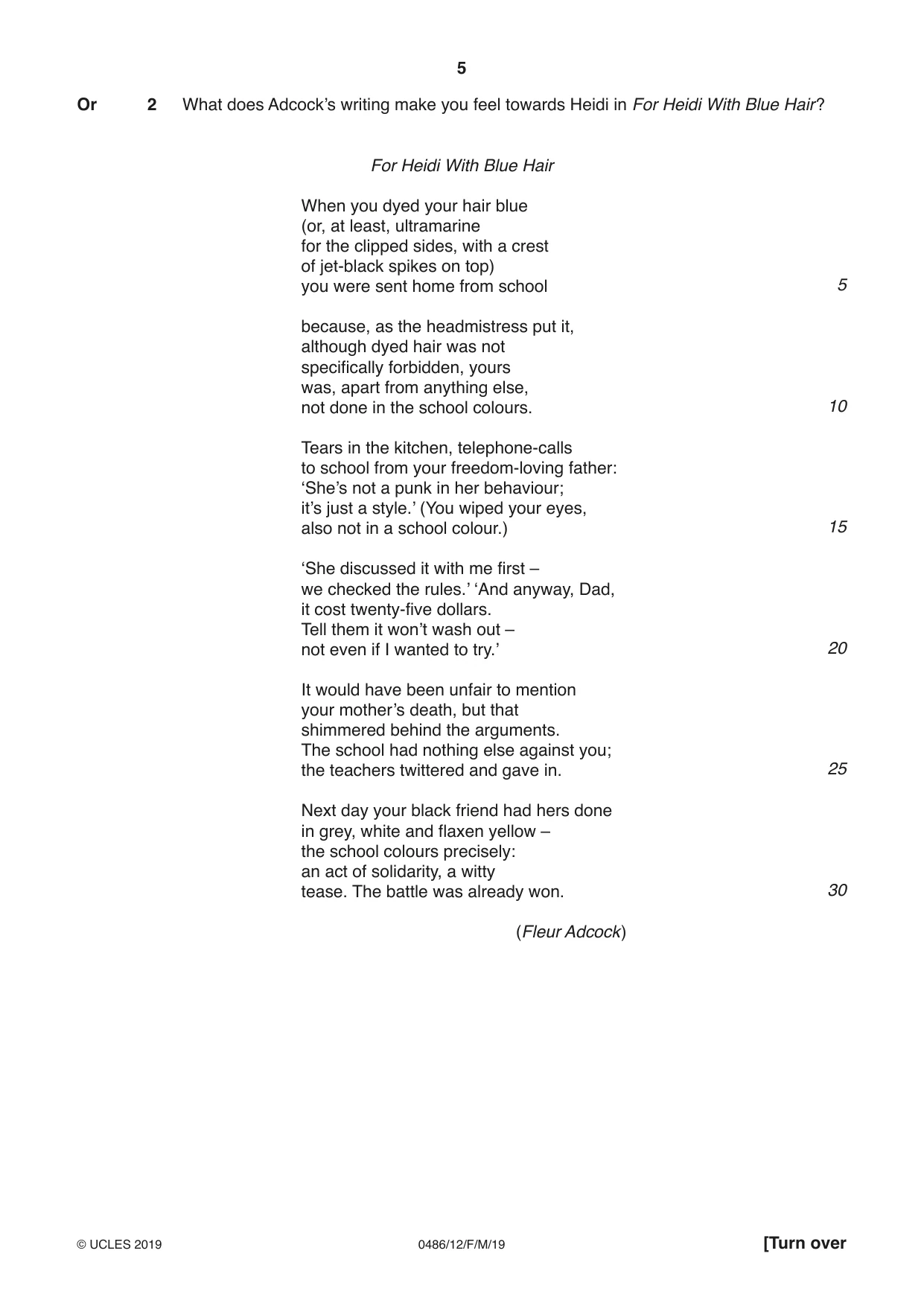
5 0486/12/F/M/19 © UCLES 2019 [Turn over Or 2 What does Adcock’s writing make you feel towards Heidi in For Heidi With Blue Hair? For Heidi With Blue Hair When you dyed your hair blue (or, at least, ultramarine for the clipped sides, with a crest of jet-black spikes on top) you were sent home from school because, as the headmistress put it, although dyed hair was not specifically forbidden, yours was, apart from anything else, not done in the school colours. Tears in the kitchen, telephone-calls to school from your freedom-loving father: ‘She’s not a punk in her behaviour; it’s just a style.’ (You wiped your eyes, also not in a school colour.) ‘She discussed it with me first – we checked the rules.’ ‘And anyway, Dad, it cost twenty-five dollars. Tell them it won’t wash out – not even if I wanted to try.’ It would have been unfair to mention your mother’s death, but that shimmered behind the arguments. The school had nothing else against you; the teachers twittered and gave in. Next day your black friend had hers done in grey, white and flaxen yellow – the school colours precisely: an act of solidarity, a witty tease. The battle was already won. (Fleur Adcock) 5 10 15 20 25 30
Question paper, page 6
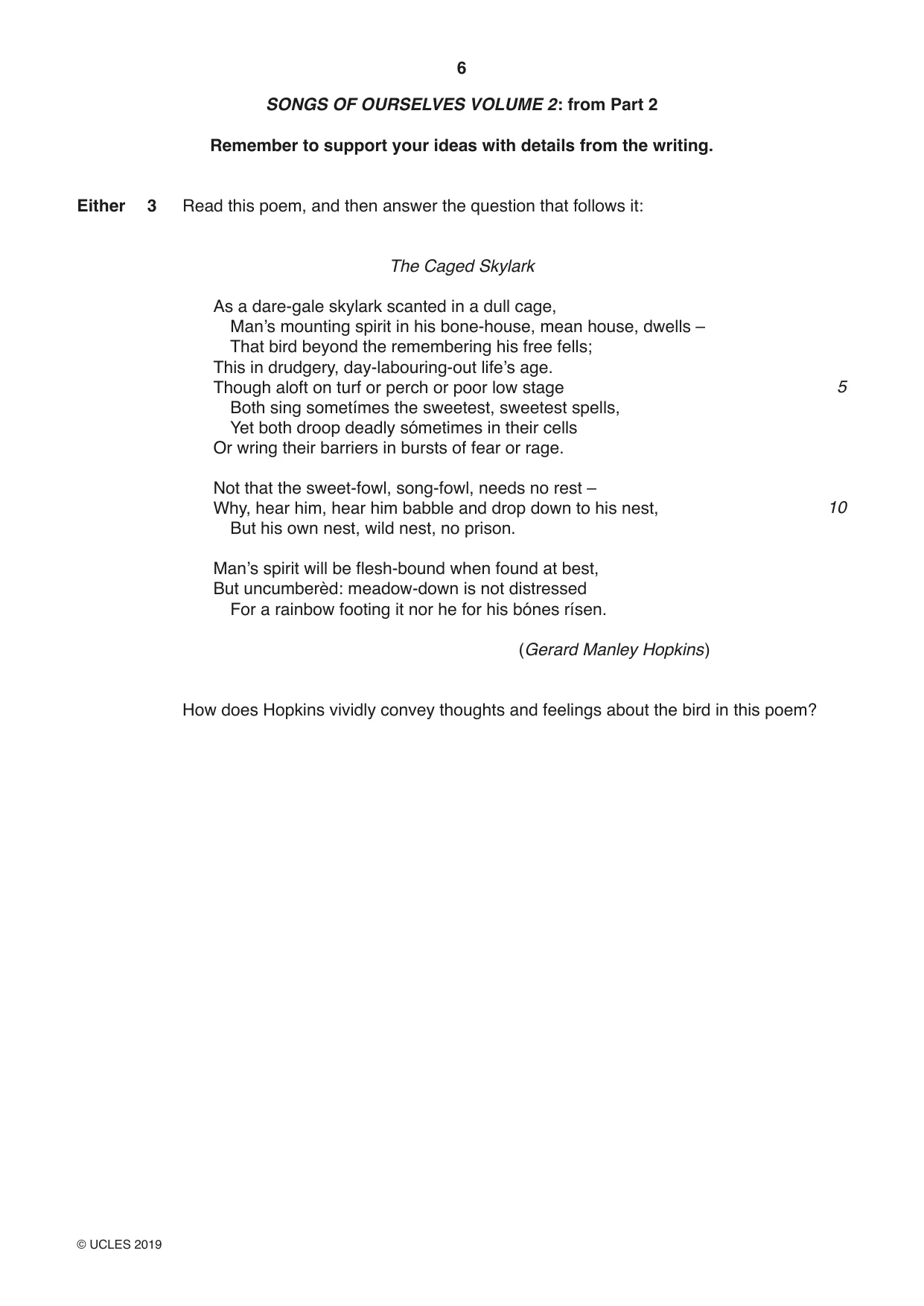
6 © UCLES 2019 SONGS OF OURSELVES VOLUME 2: from Part 2 Remember to support your ideas with details from the writing. Either 3 Read this poem, and then answer the question that follows it: The Caged Skylark As a dare-gale skylark scanted in a dull cage, Man’s mounting spirit in his bone-house, mean house, dwells – That bird beyond the remembering his free fells; This in drudgery, day-labouring-out life’s age. Though aloft on turf or perch or poor low stage Both sing sometímes the sweetest, sweetest spells, Yet both droop deadly sómetimes in their cells Or wring their barriers in bursts of fear or rage. Not that the sweet-fowl, song-fowl, needs no rest – Why, hear him, hear him babble and drop down to his nest, But his own nest, wild nest, no prison. Man’s spirit will be flesh-bound when found at best, But uncumberèd: meadow-down is not distressed For a rainbow footing it nor he for his bónes rísen. (Gerard Manley Hopkins) How does Hopkins vividly convey thoughts and feelings about the bird in this poem? 5 10
Question paper, page 7
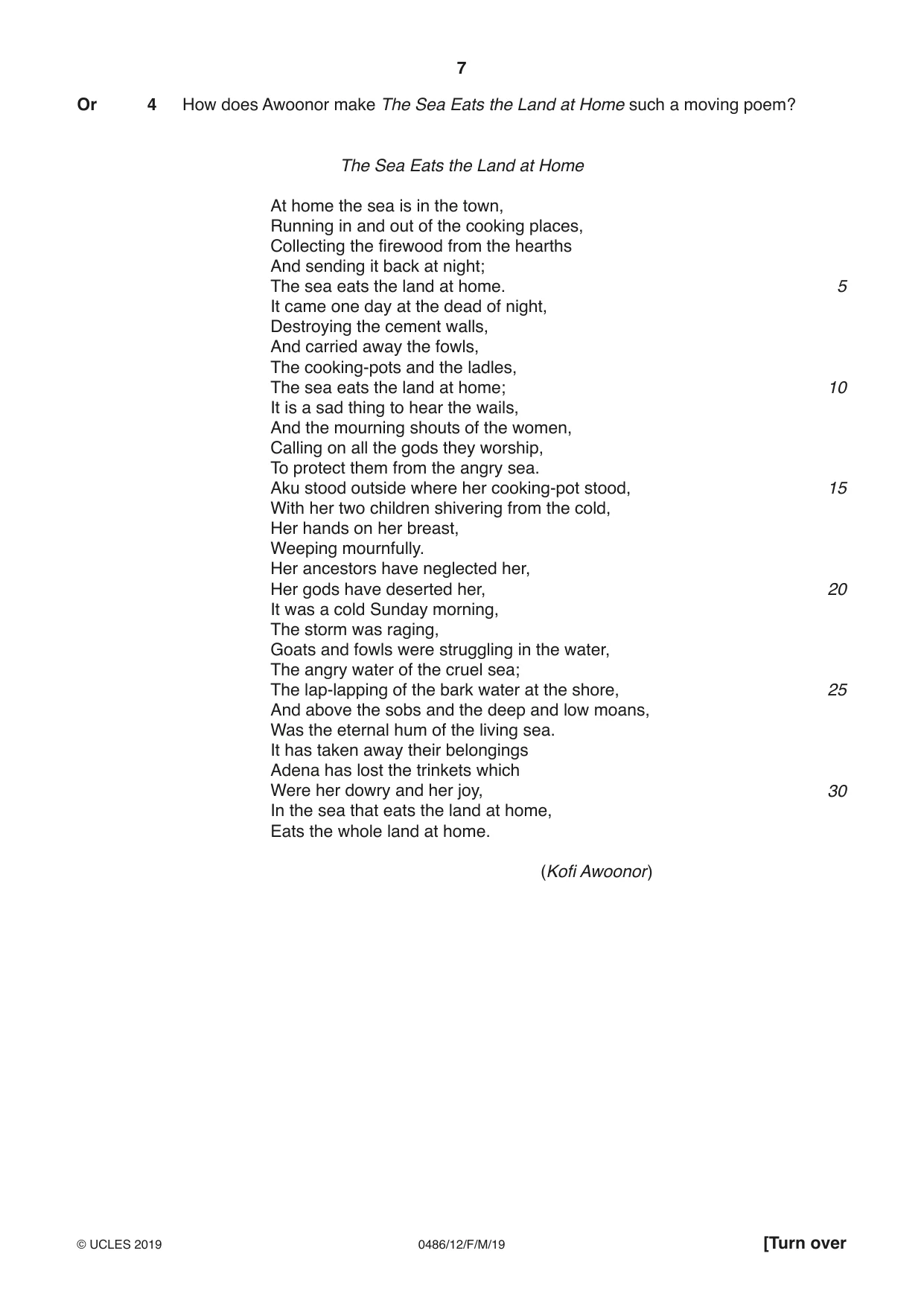
7 0486/12/F/M/19 © UCLES 2019 [Turn over Or 4 How does Awoonor make The Sea Eats the Land at Home such a moving poem? The Sea Eats the Land at Home At home the sea is in the town, Running in and out of the cooking places, Collecting the firewood from the hearths And sending it back at night; The sea eats the land at home. It came one day at the dead of night, Destroying the cement walls, And carried away the fowls, The cooking-pots and the ladles, The sea eats the land at home; It is a sad thing to hear the wails, And the mourning shouts of the women, Calling on all the gods they worship, To protect them from the angry sea. Aku stood outside where her cooking-pot stood, With her two children shivering from the cold, Her hands on her breast, Weeping mournfully. Her ancestors have neglected her, Her gods have deserted her, It was a cold Sunday morning, The storm was raging, Goats and fowls were struggling in the water, The angry water of the cruel sea; The lap-lapping of the bark water at the shore, And above the sobs and the deep and low moans, Was the eternal hum of the living sea. It has taken away their belongings Adena has lost the trinkets which Were her dowry and her joy, In the sea that eats the land at home, Eats the whole land at home. (Kofi Awoonor) 5 10 15 20 25 30
Question paper, page 8
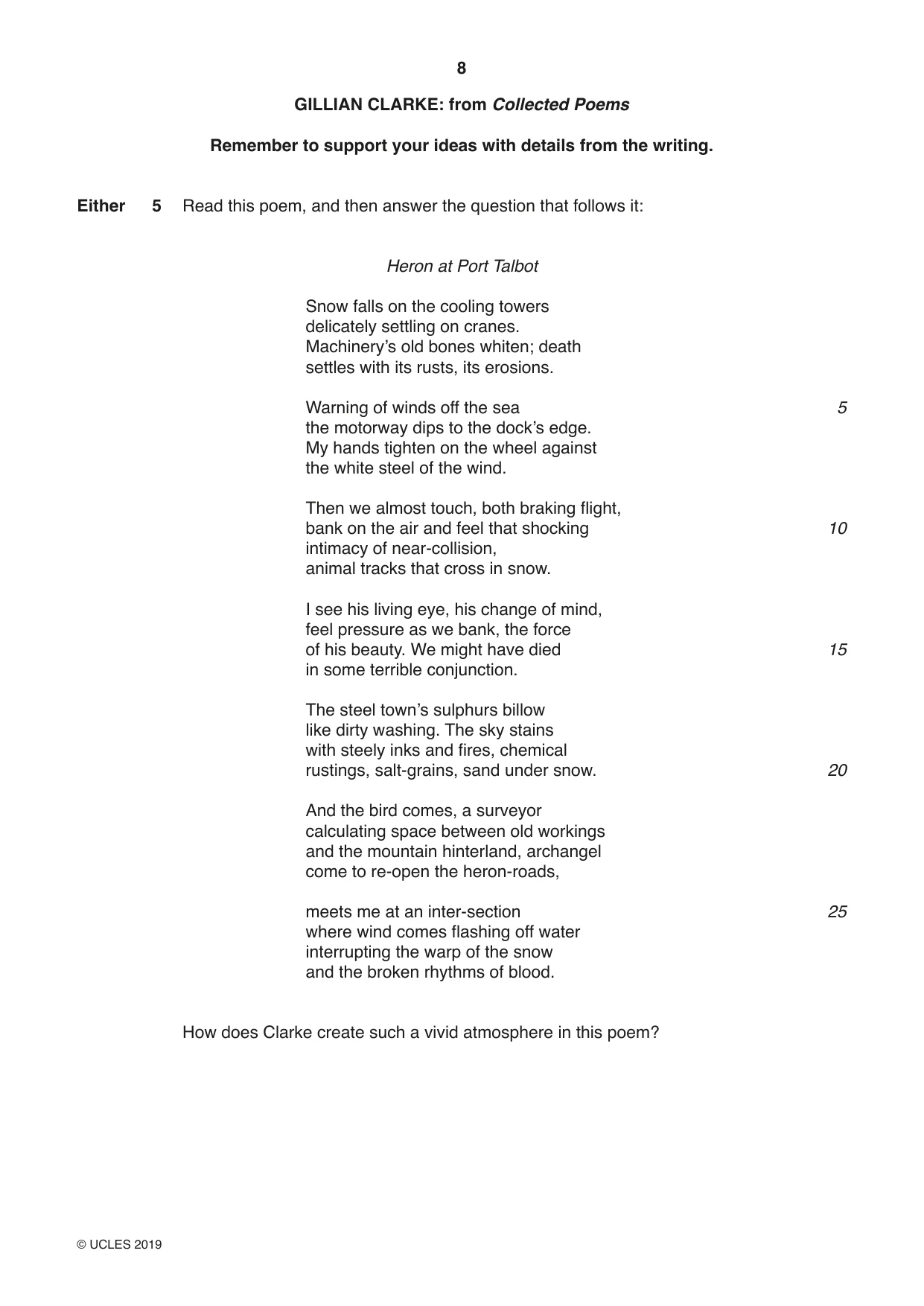
8 © UCLES 2019 GILLIAN CLARKE: from Collected Poems Remember to support your ideas with details from the writing. Either 5 Read this poem, and then answer the question that follows it: Heron at Port Talbot Snow falls on the cooling towers delicately settling on cranes. Machinery’s old bones whiten; death settles with its rusts, its erosions. Warning of winds off the sea the motorway dips to the dock’s edge. My hands tighten on the wheel against the white steel of the wind. Then we almost touch, both braking flight, bank on the air and feel that shocking intimacy of near-collision, animal tracks that cross in snow. I see his living eye, his change of mind, feel pressure as we bank, the force of his beauty. We might have died in some terrible conjunction. The steel town’s sulphurs billow like dirty washing. The sky stains with steely inks and fires, chemical rustings, salt-grains, sand under snow. And the bird comes, a surveyor calculating space between old workings and the mountain hinterland, archangel come to re-open the heron-roads, meets me at an inter-section where wind comes flashing off water interrupting the warp of the snow and the broken rhythms of blood. How does Clarke create such a vivid atmosphere in this poem? 5 10 15 20 25
Question paper, page 9
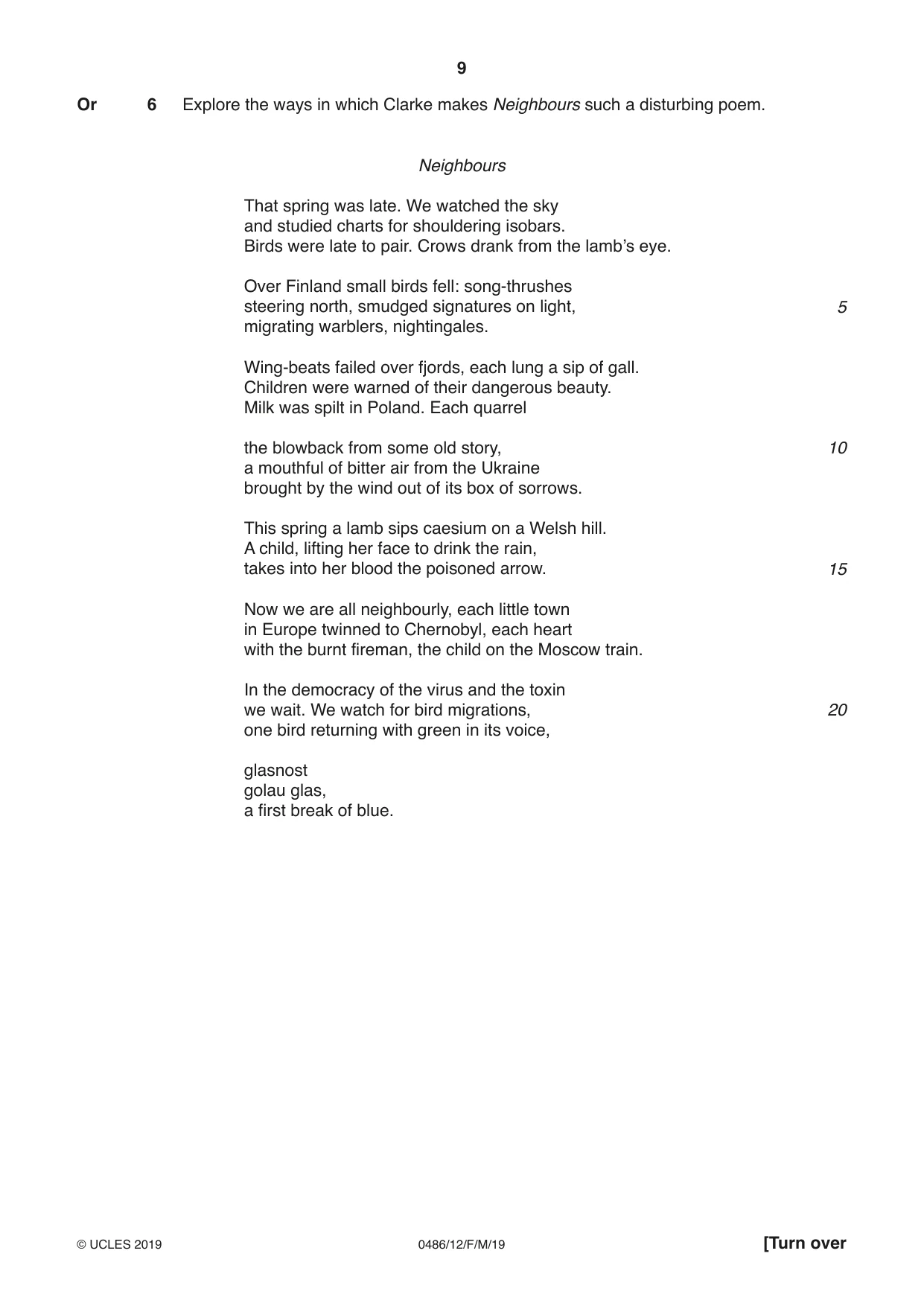
9 0486/12/F/M/19 © UCLES 2019 [Turn over Or 6 Explore the ways in which Clarke makes Neighbours such a disturbing poem. Neighbours That spring was late. We watched the sky and studied charts for shouldering isobars. Birds were late to pair. Crows drank from the lamb’s eye. Over Finland small birds fell: song-thrushes steering north, smudged signatures on light, migrating warblers, nightingales. Wing-beats failed over fjords, each lung a sip of gall. Children were warned of their dangerous beauty. Milk was spilt in Poland. Each quarrel the blowback from some old story, a mouthful of bitter air from the Ukraine brought by the wind out of its box of sorrows. This spring a lamb sips caesium on a Welsh hill. A child, lifting her face to drink the rain, takes into her blood the poisoned arrow. Now we are all neighbourly, each little town in Europe twinned to Chernobyl, each heart with the burnt fireman, the child on the Moscow train. In the democracy of the virus and the toxin we wait. We watch for bird migrations, one bird returning with green in its voice, glasnost golau glas, a first break of blue. 5 10 15 20
Question paper, page 10
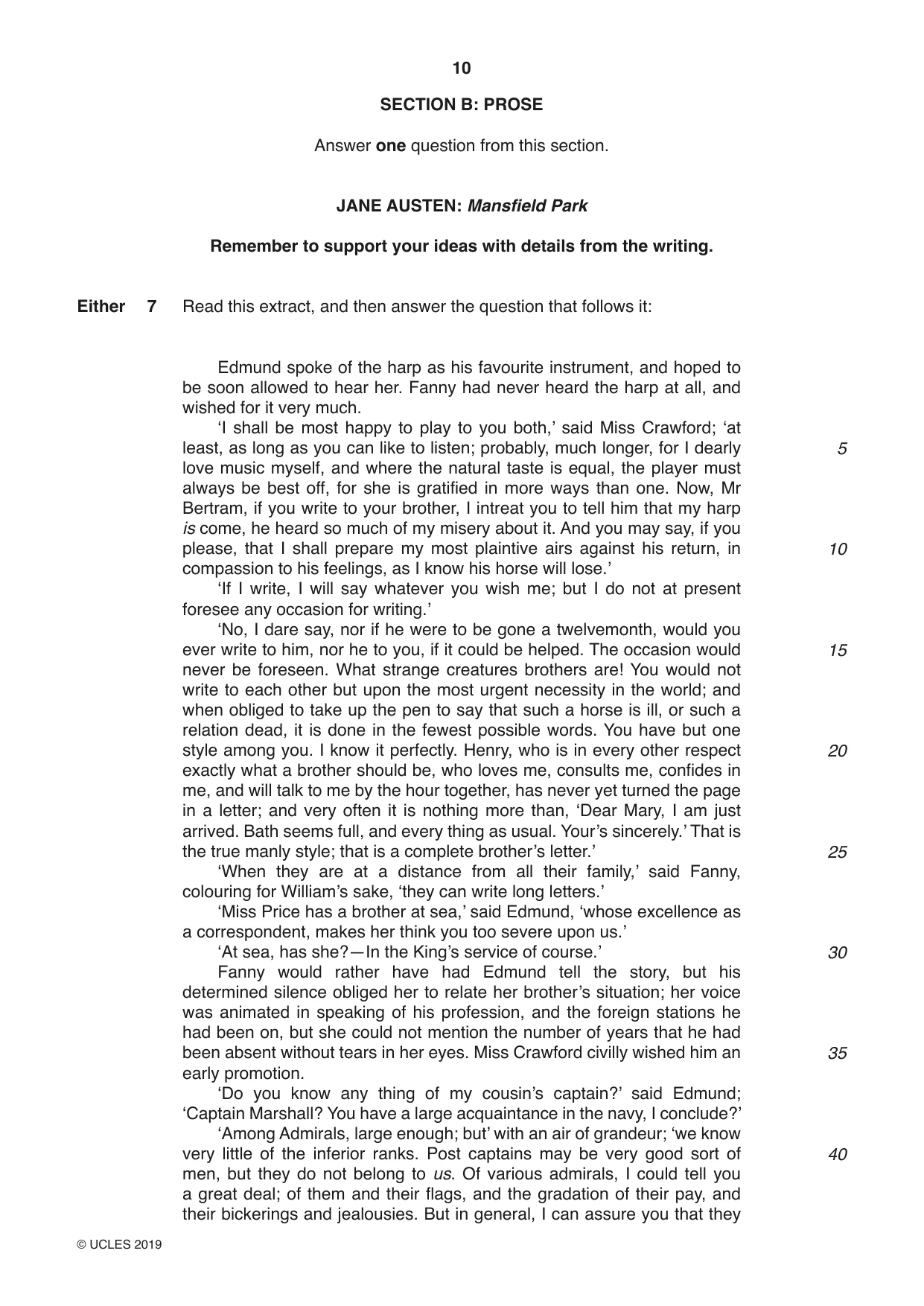
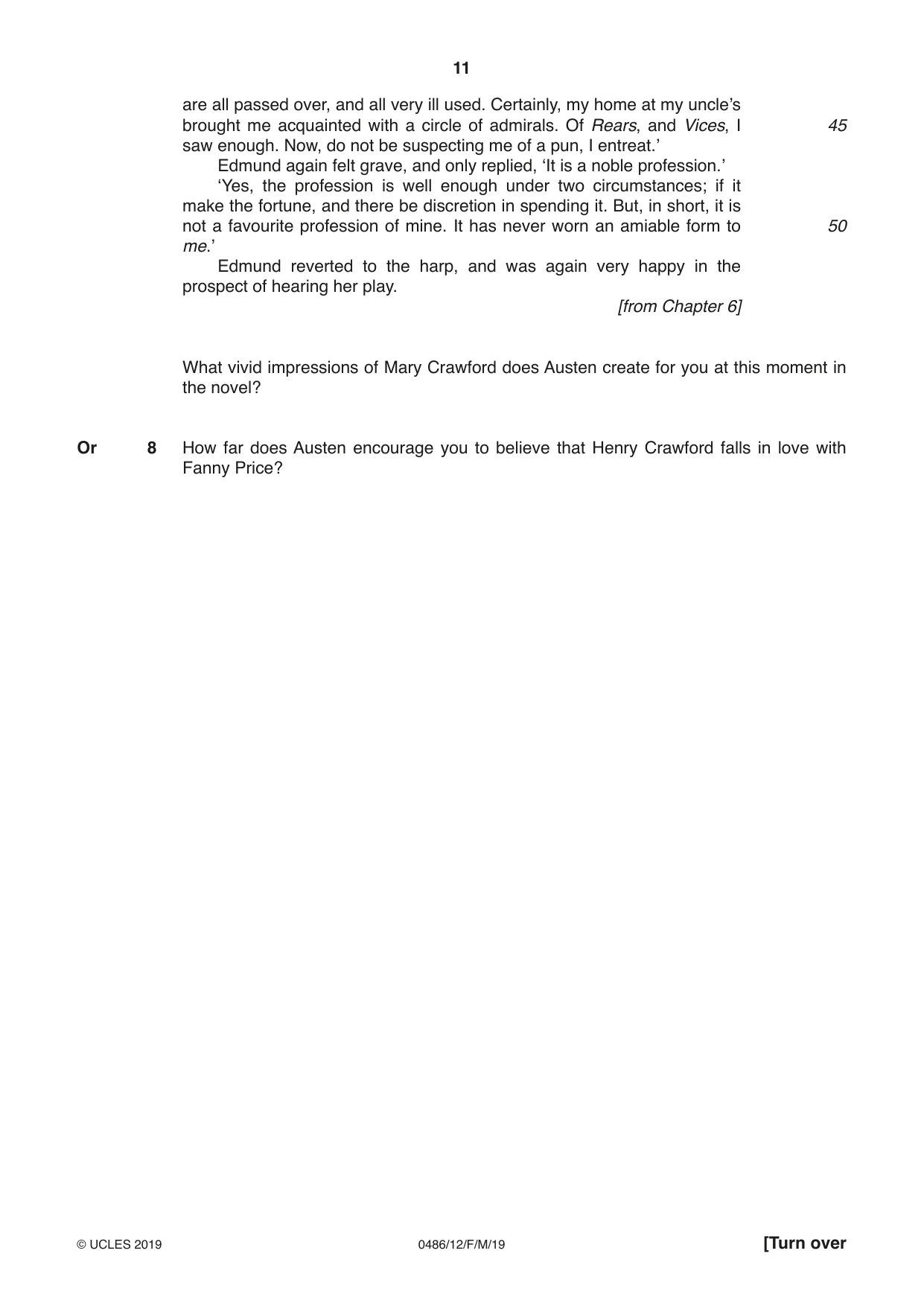
10 © UCLES 2019 SECTION B: PROSE Answer one question from this section. JANE AUSTEN: Mansfield Park Remember to support your ideas with details from the writing. Either 7 Read this extract, and then answer the question that follows it: Edmund spoke of the harp as his favourite instrument, and hoped to be soon allowed to hear her. Fanny had never heard the harp at all, and wished for it very much. ‘I shall be most happy to play to you both,’ said Miss Crawford; ‘at least, as long as you can like to listen; probably, much longer, for I dearly love music myself, and where the natural taste is equal, the player must always be best off, for she is gratified in more ways than one. Now, Mr Bertram, if you write to your brother, I intreat you to tell him that my harp is come, he heard so much of my misery about it. And you may say, if you please, that I shall prepare my most plaintive airs against his return, in compassion to his feelings, as I know his horse will lose.’ ‘If I write, I will say whatever you wish me; but I do not at present foresee any occasion for writing.’ ‘No, I dare say, nor if he were to be gone a twelvemonth, would you ever write to him, nor he to you, if it could be helped. The occasion would never be foreseen. What strange creatures brothers are! You would not write to each other but upon the most urgent necessity in the world; and when obliged to take up the pen to say that such a horse is ill, or such a relation dead, it is done in the fewest possible words. You have but one style among you. I know it perfectly. Henry, who is in every other respect exactly what a brother should be, who loves me, consults me, confides in me, and will talk to me by the hour together, has never yet turned the page in a letter; and very often it is nothing more than, ‘Dear Mary, I am just arrived. Bath seems full, and every thing as usual. Your’s sincerely.’ That is the true manly style; that is a complete brother’s letter.’ ‘When they are at a distance from all their family,’ said Fanny, colouring for William’s sake, ‘they can write long letters.’ ‘Miss Price has a brother at sea,’ said Edmund, ‘whose excellence as a correspondent, makes her think you too severe upon us.’ ‘At sea, has she?—In the King’s service of course.’ Fanny would rather have had Edmund tell the story, but his determined silence obliged her to relate her brother’s situation; her voice was animated in speaking of his profession, and the foreign stations he had been on, but she could not mention the number of years that he had been absent without tears in her eyes. Miss Crawford civilly wished him an early promotion. ‘Do you know any thing of my cousin’s captain?’ said Edmund; ‘Captain Marshall? You have a large acquaintance in the navy, I conclude?’ ‘Among Admirals, large enough; but’ with an air of grandeur; ‘we know very little of the inferior ranks. Post captains may be very good sort of men, but they do not belong to us. Of various admirals, I could tell you a great deal; of them and their flags, and the gradation of their pay, and their bickerings and jealousies. But in general, I can assure you that they 5 10 15 20 25 30 35 40
Question paper, page 11
11 0486/12/F/M/19 © UCLES 2019 [Turn over are all passed over, and all very ill used. Certainly, my home at my uncle’s brought me acquainted with a circle of admirals. Of Rears, and Vices, I saw enough. Now, do not be suspecting me of a pun, I entreat.’ Edmund again felt grave, and only replied, ‘It is a noble profession.’ ‘Yes, the profession is well enough under two circumstances; if it make the fortune, and there be discretion in spending it. But, in short, it is not a favourite profession of mine. It has never worn an amiable form to me.’ Edmund reverted to the harp, and was again very happy in the prospect of hearing her play. [from Chapter 6] What vivid impressions of Mary Crawford does Austen create for you at this moment in the novel? Or 8 How far does Austen encourage you to believe that Henry Crawford falls in love with Fanny Price? 45 50
Question paper, page 12
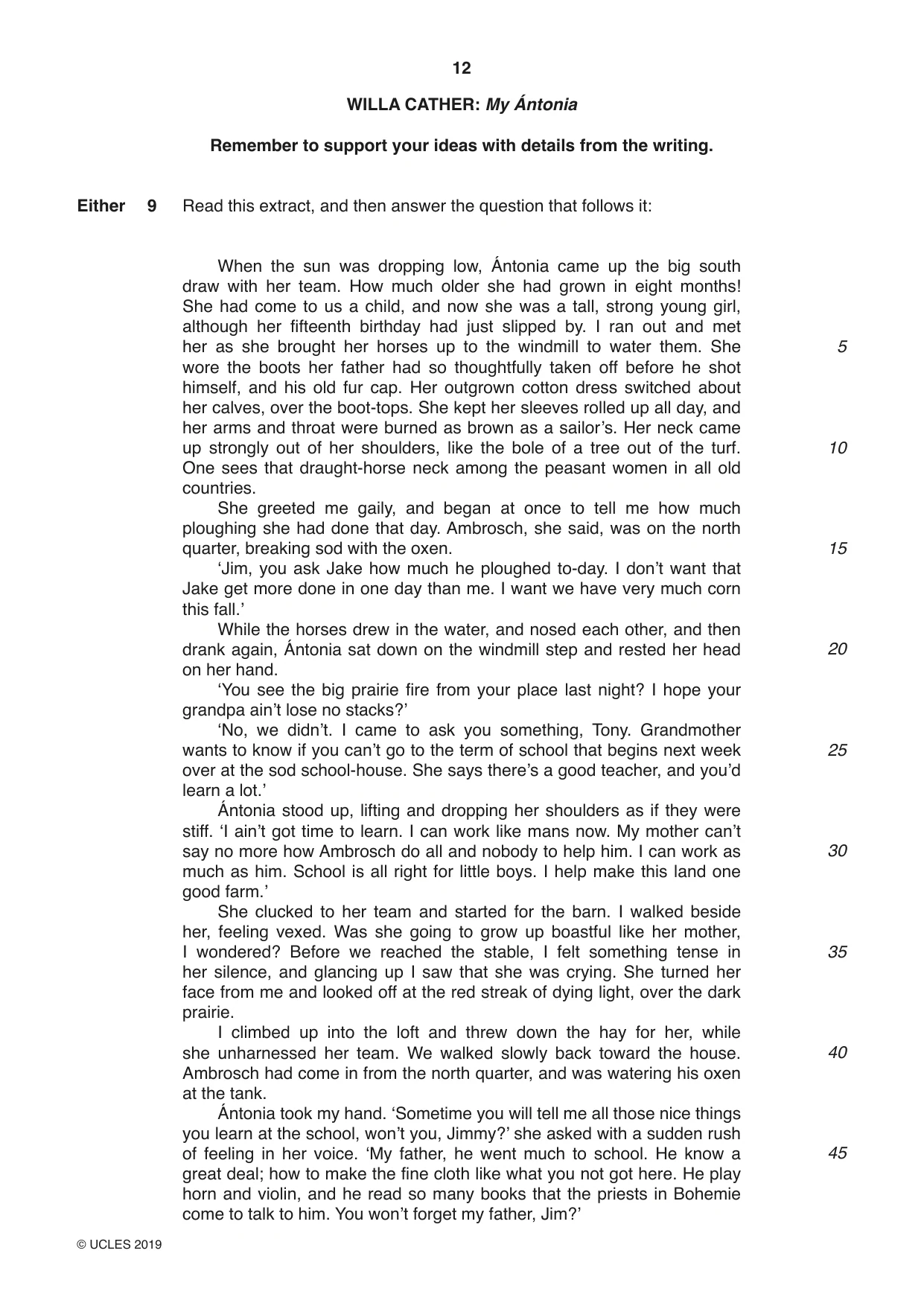
12 © UCLES 2019 WILLA CATHER: My Ántonia Remember to support your ideas with details from the writing. Either 9 Read this extract, and then answer the question that follows it: When the sun was dropping low, Ántonia came up the big south draw with her team. How much older she had grown in eight months! She had come to us a child, and now she was a tall, strong young girl, although her fifteenth birthday had just slipped by. I ran out and met her as she brought her horses up to the windmill to water them. She wore the boots her father had so thoughtfully taken off before he shot himself, and his old fur cap. Her outgrown cotton dress switched about her calves, over the boot-tops. She kept her sleeves rolled up all day, and her arms and throat were burned as brown as a sailor’s. Her neck came up strongly out of her shoulders, like the bole of a tree out of the turf. One sees that draught-horse neck among the peasant women in all old countries. She greeted me gaily, and began at once to tell me how much ploughing she had done that day. Ambrosch, she said, was on the north quarter, breaking sod with the oxen. ‘Jim, you ask Jake how much he ploughed to-day. I don’t want that Jake get more done in one day than me. I want we have very much corn this fall.’ While the horses drew in the water, and nosed each other, and then drank again, Ántonia sat down on the windmill step and rested her head on her hand. ‘You see the big prairie fire from your place last night? I hope your grandpa ain’t lose no stacks?’ ‘No, we didn’t. I came to ask you something, Tony. Grandmother wants to know if you can’t go to the term of school that begins next week over at the sod school-house. She says there’s a good teacher, and you’d learn a lot.’ Ántonia stood up, lifting and dropping her shoulders as if they were stiff. ‘I ain’t got time to learn. I can work like mans now. My mother can’t say no more how Ambrosch do all and nobody to help him. I can work as much as him. School is all right for little boys. I help make this land one good farm.’ She clucked to her team and started for the barn. I walked beside her, feeling vexed. Was she going to grow up boastful like her mother, I wondered? Before we reached the stable, I felt something tense in her silence, and glancing up I saw that she was crying. She turned her face from me and looked off at the red streak of dying light, over the dark prairie. I climbed up into the loft and threw down the hay for her, while she unharnessed her team. We walked slowly back toward the house. Ambrosch had come in from the north quarter, and was watering his oxen at the tank. Ántonia took my hand. ‘Sometime you will tell me all those nice things you learn at the school, won’t you, Jimmy?’ she asked with a sudden rush of feeling in her voice. ‘My father, he went much to school. He know a great deal; how to make the fine cloth like what you not got here. He play horn and violin, and he read so many books that the priests in Bohemie come to talk to him. You won’t forget my father, Jim?’ 5 10 15 20 25 30 35 40 45
Question paper, page 13
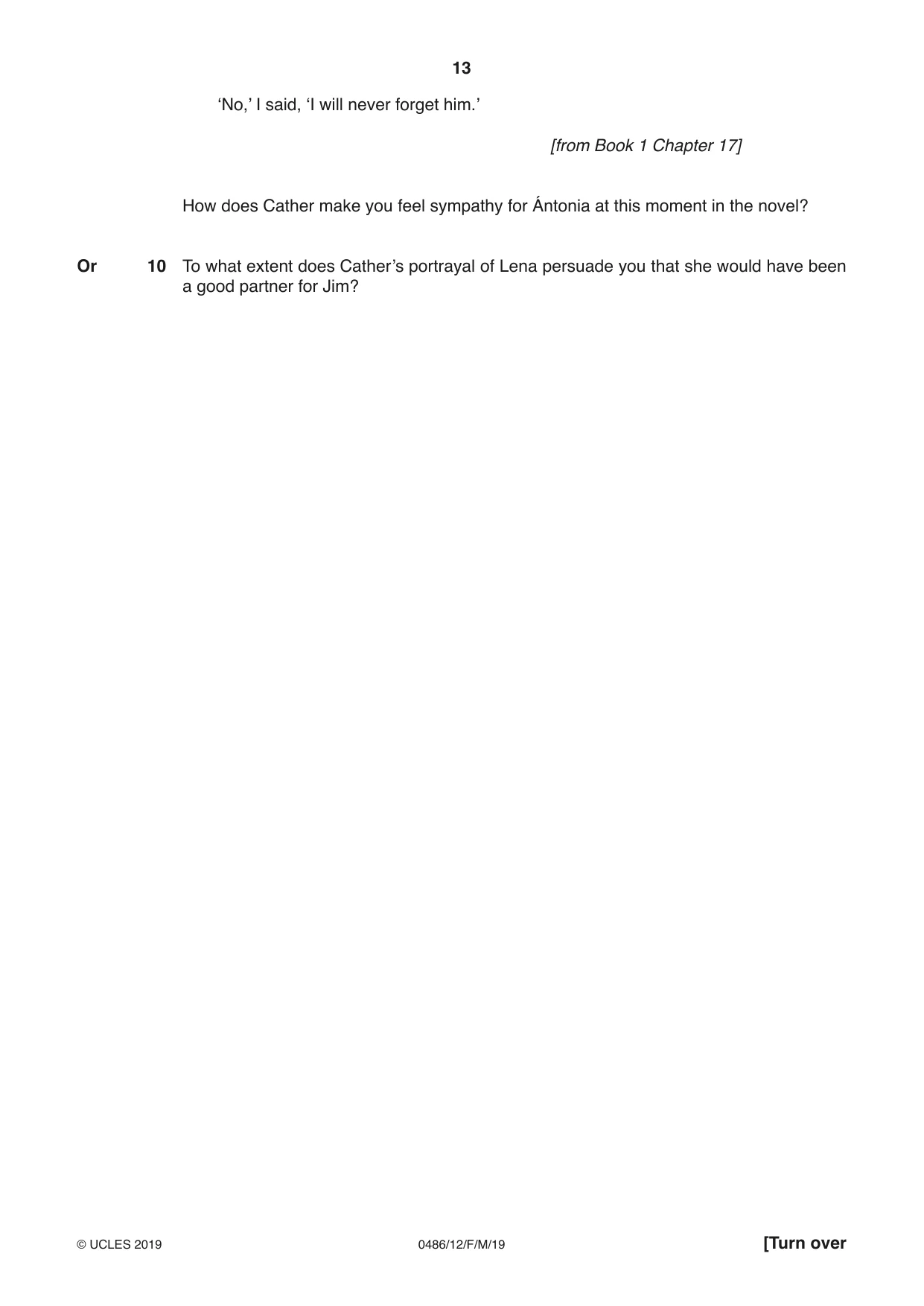
13 0486/12/F/M/19 © UCLES 2019 [Turn over ‘No,’ I said, ‘I will never forget him.’ [from Book 1 Chapter 17] How does Cather make you feel sympathy for Ántonia at this moment in the novel? Or 10 To what extent does Cather’s portrayal of Lena persuade you that she would have been a good partner for Jim?
Question paper, page 14
14 © UCLES 2019 ANITA DESAI: In Custody Remember to support your ideas with details from the writing. Either 11 Read this extract, and then answer the question that follows it: ‘Do you teach there?’ Close. 0486/12/F/M/19 Content removed due to copyright restrictions.
Question paper, page 15
15 0486/12/F/M/19 © UCLES 2019 [Turn over Fate has traced on my tablet, with blood …’ [from Chapter 3] How does Desai make this moment in the novel both entertaining and moving? Or 12 How does Desai make two female characters particularly memorable for you? Content removed due to copyright restrictions.
Question paper, page 16
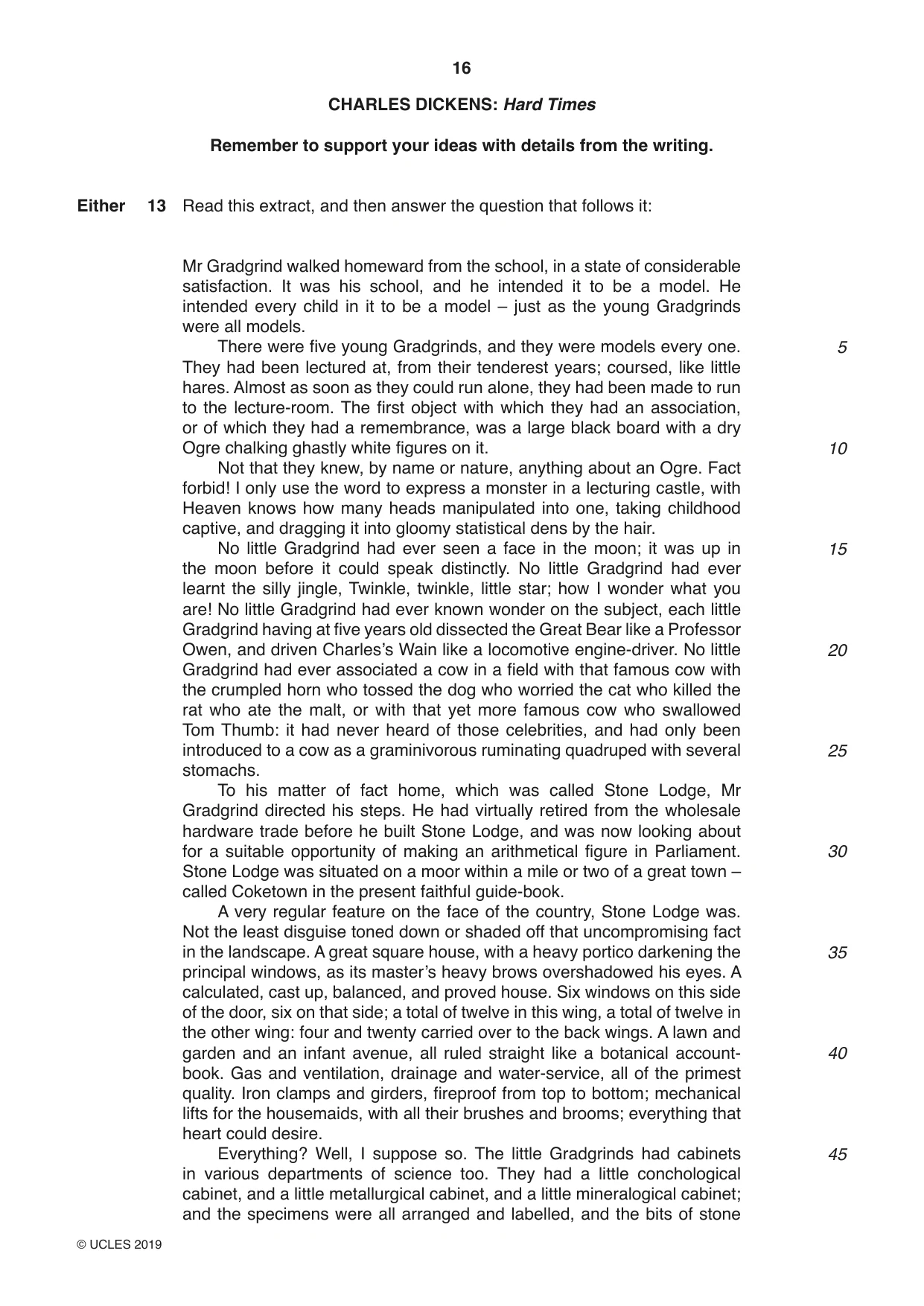
16 © UCLES 2019 CHARLES DICKENS: Hard Times Remember to support your ideas with details from the writing. Either 13 Read this extract, and then answer the question that follows it: Mr Gradgrind walked homeward from the school, in a state of considerable satisfaction. It was his school, and he intended it to be a model. He intended every child in it to be a model – just as the young Gradgrinds were all models. There were five young Gradgrinds, and they were models every one. They had been lectured at, from their tenderest years; coursed, like little hares. Almost as soon as they could run alone, they had been made to run to the lecture-room. The first object with which they had an association, or of which they had a remembrance, was a large black board with a dry Ogre chalking ghastly white figures on it. Not that they knew, by name or nature, anything about an Ogre. Fact forbid! I only use the word to express a monster in a lecturing castle, with Heaven knows how many heads manipulated into one, taking childhood captive, and dragging it into gloomy statistical dens by the hair. No little Gradgrind had ever seen a face in the moon; it was up in the moon before it could speak distinctly. No little Gradgrind had ever learnt the silly jingle, Twinkle, twinkle, little star; how I wonder what you are! No little Gradgrind had ever known wonder on the subject, each little Gradgrind having at five years old dissected the Great Bear like a Professor Owen, and driven Charles’s Wain like a locomotive engine-driver. No little Gradgrind had ever associated a cow in a field with that famous cow with the crumpled horn who tossed the dog who worried the cat who killed the rat who ate the malt, or with that yet more famous cow who swallowed Tom Thumb: it had never heard of those celebrities, and had only been introduced to a cow as a graminivorous ruminating quadruped with several stomachs. To his matter of fact home, which was called Stone Lodge, Mr Gradgrind directed his steps. He had virtually retired from the wholesale hardware trade before he built Stone Lodge, and was now looking about for a suitable opportunity of making an arithmetical figure in Parliament. Stone Lodge was situated on a moor within a mile or two of a great town – called Coketown in the present faithful guide-book. A very regular feature on the face of the country, Stone Lodge was. Not the least disguise toned down or shaded off that uncompromising fact in the landscape. A great square house, with a heavy portico darkening the principal windows, as its master’s heavy brows overshadowed his eyes. A calculated, cast up, balanced, and proved house. Six windows on this side of the door, six on that side; a total of twelve in this wing, a total of twelve in the other wing: four and twenty carried over to the back wings. A lawn and garden and an infant avenue, all ruled straight like a botanical account- book. Gas and ventilation, drainage and water-service, all of the primest quality. Iron clamps and girders, fireproof from top to bottom; mechanical lifts for the housemaids, with all their brushes and brooms; everything that heart could desire. Everything? Well, I suppose so. The little Gradgrinds had cabinets in various departments of science too. They had a little conchological cabinet, and a little metallurgical cabinet, and a little mineralogical cabinet; and the specimens were all arranged and labelled, and the bits of stone 5 10 15 20 25 30 35 40 45
Question paper, page 17
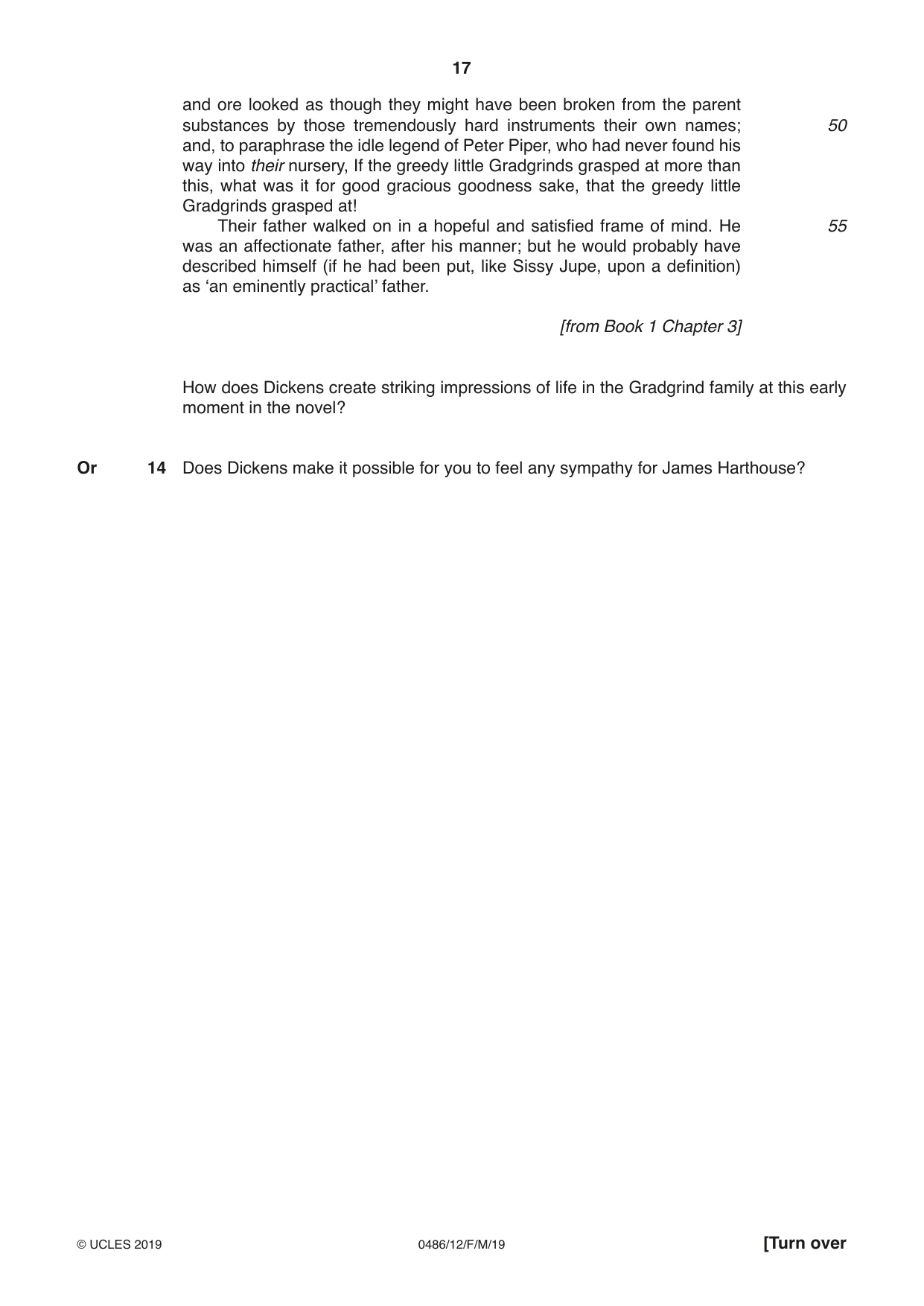
17 0486/12/F/M/19 © UCLES 2019 [Turn over and ore looked as though they might have been broken from the parent substances by those tremendously hard instruments their own names; and, to paraphrase the idle legend of Peter Piper, who had never found his way into their nursery, If the greedy little Gradgrinds grasped at more than this, what was it for good gracious goodness sake, that the greedy little Gradgrinds grasped at! Their father walked on in a hopeful and satisfied frame of mind. He was an affectionate father, after his manner; but he would probably have described himself (if he had been put, like Sissy Jupe, upon a definition) as ‘an eminently practical’ father. [from Book 1 Chapter 3] How does Dickens create striking impressions of life in the Gradgrind family at this early moment in the novel? Or 14 Does Dickens make it possible for you to feel any sympathy for James Harthouse? 50 55
Question paper, page 18
18 © UCLES 2019 KATE GRENVILLE: The Secret River Remember to support your ideas with details from the writing. Either 15 Read this extract, and then answer the question that follows it: Smasher was not a man to take a lesson from a black. Want a free feed do you, he shouted. When you get a spear in your guts. [from Part 4] How does Grenville make this moment in the novel so disturbing? Content removed due to copyright restrictions.
Question paper, page 19
19 0486/12/F/M/19 © UCLES 2019 [Turn over Or 16 In what ways does Grenville suggest that Thornhill changes his attitude towards the Aboriginal people in the course of the novel? Do not use the extract printed for Question 15 in answering this question.
Question paper, page 20
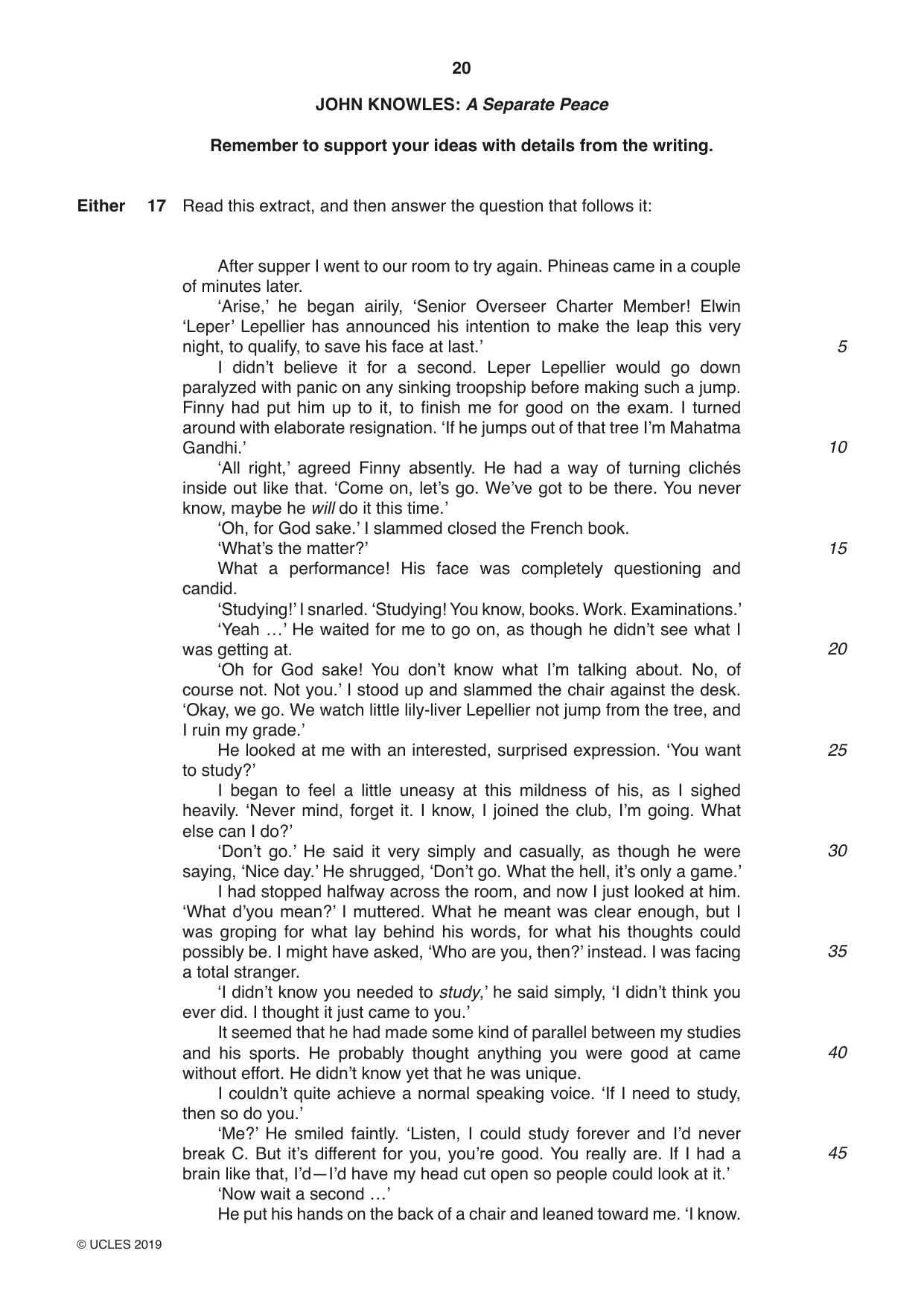
20 © UCLES 2019 JOHN KNOWLES: A Separate Peace Remember to support your ideas with details from the writing. Either 17 Read this extract, and then answer the question that follows it: After supper I went to our room to try again. Phineas came in a couple of minutes later. ‘Arise,’ he began airily, ‘Senior Overseer Charter Member! Elwin ‘Leper’ Lepellier has announced his intention to make the leap this very night, to qualify, to save his face at last.’ I didn’t believe it for a second. Leper Lepellier would go down paralyzed with panic on any sinking troopship before making such a jump. Finny had put him up to it, to finish me for good on the exam. I turned around with elaborate resignation. ‘If he jumps out of that tree I’m Mahatma Gandhi.’ ‘All right,’ agreed Finny absently. He had a way of turning clichés inside out like that. ‘Come on, let’s go. We’ve got to be there. You never know, maybe he will do it this time.’ ‘Oh, for God sake.’ I slammed closed the French book. ‘What’s the matter?’ What a performance! His face was completely questioning and candid. ‘Studying!’ I snarled. ‘Studying! You know, books. Work. Examinations.’ ‘Yeah …’ He waited for me to go on, as though he didn’t see what I was getting at. ‘Oh for God sake! You don’t know what I’m talking about. No, of course not. Not you.’ I stood up and slammed the chair against the desk. ‘Okay, we go. We watch little lily-liver Lepellier not jump from the tree, and I ruin my grade.’ He looked at me with an interested, surprised expression. ‘You want to study?’ I began to feel a little uneasy at this mildness of his, as I sighed heavily. ‘Never mind, forget it. I know, I joined the club, I’m going. What else can I do?’ ‘Don’t go.’ He said it very simply and casually, as though he were saying, ‘Nice day.’ He shrugged, ‘Don’t go. What the hell, it’s only a game.’ I had stopped halfway across the room, and now I just looked at him. ‘What d’you mean?’ I muttered. What he meant was clear enough, but I was groping for what lay behind his words, for what his thoughts could possibly be. I might have asked, ‘Who are you, then?’ instead. I was facing a total stranger. ‘I didn’t know you needed to study,’ he said simply, ‘I didn’t think you ever did. I thought it just came to you.’ It seemed that he had made some kind of parallel between my studies and his sports. He probably thought anything you were good at came without effort. He didn’t know yet that he was unique. I couldn’t quite achieve a normal speaking voice. ‘If I need to study, then so do you.’ ‘Me?’ He smiled faintly. ‘Listen, I could study forever and I’d never break C. But it’s different for you, you’re good. You really are. If I had a brain like that, I’d—I’d have my head cut open so people could look at it.’ ‘Now wait a second …’ He put his hands on the back of a chair and leaned toward me. ‘I know. 5 10 15 20 25 30 35 40 45
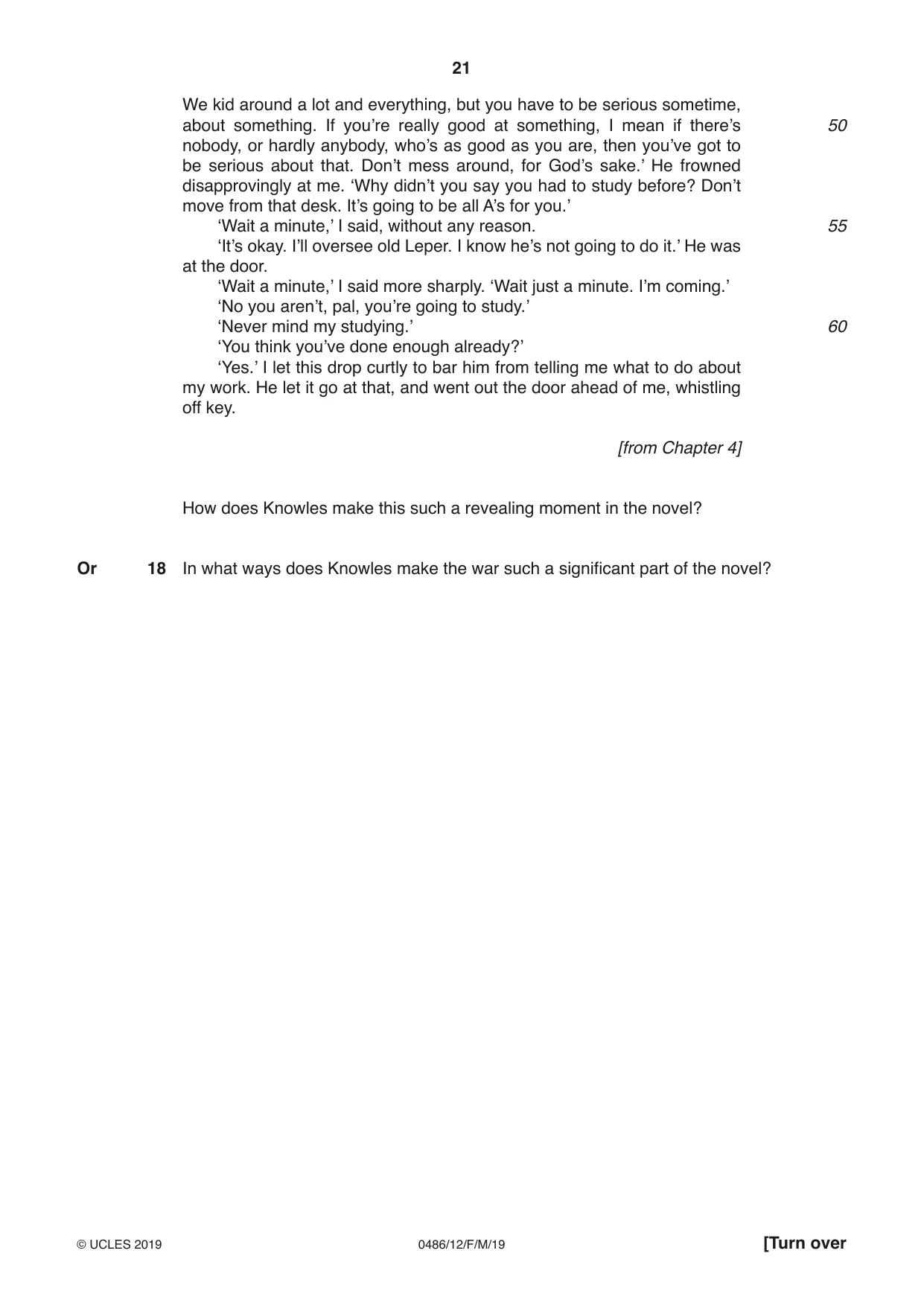
Question paper, page 21
21 0486/12/F/M/19 © UCLES 2019 [Turn over We kid around a lot and everything, but you have to be serious sometime, about something. If you’re really good at something, I mean if there’s nobody, or hardly anybody, who’s as good as you are, then you’ve got to be serious about that. Don’t mess around, for God’s sake.’ He frowned disapprovingly at me. ‘Why didn’t you say you had to study before? Don’t move from that desk. It’s going to be all A’s for you.’ ‘Wait a minute,’ I said, without any reason. ‘It’s okay. I’ll oversee old Leper. I know he’s not going to do it.’ He was at the door. ‘Wait a minute,’ I said more sharply. ‘Wait just a minute. I’m coming.’ ‘No you aren’t, pal, you’re going to study.’ ‘Never mind my studying.’ ‘You think you’ve done enough already?’ ‘Yes.’ I let this drop curtly to bar him from telling me what to do about my work. He let it go at that, and went out the door ahead of me, whistling off key. [from Chapter 4] How does Knowles make this such a revealing moment in the novel? Or 18 In what ways does Knowles make the war such a significant part of the novel? 50 55 60
Question paper, page 22
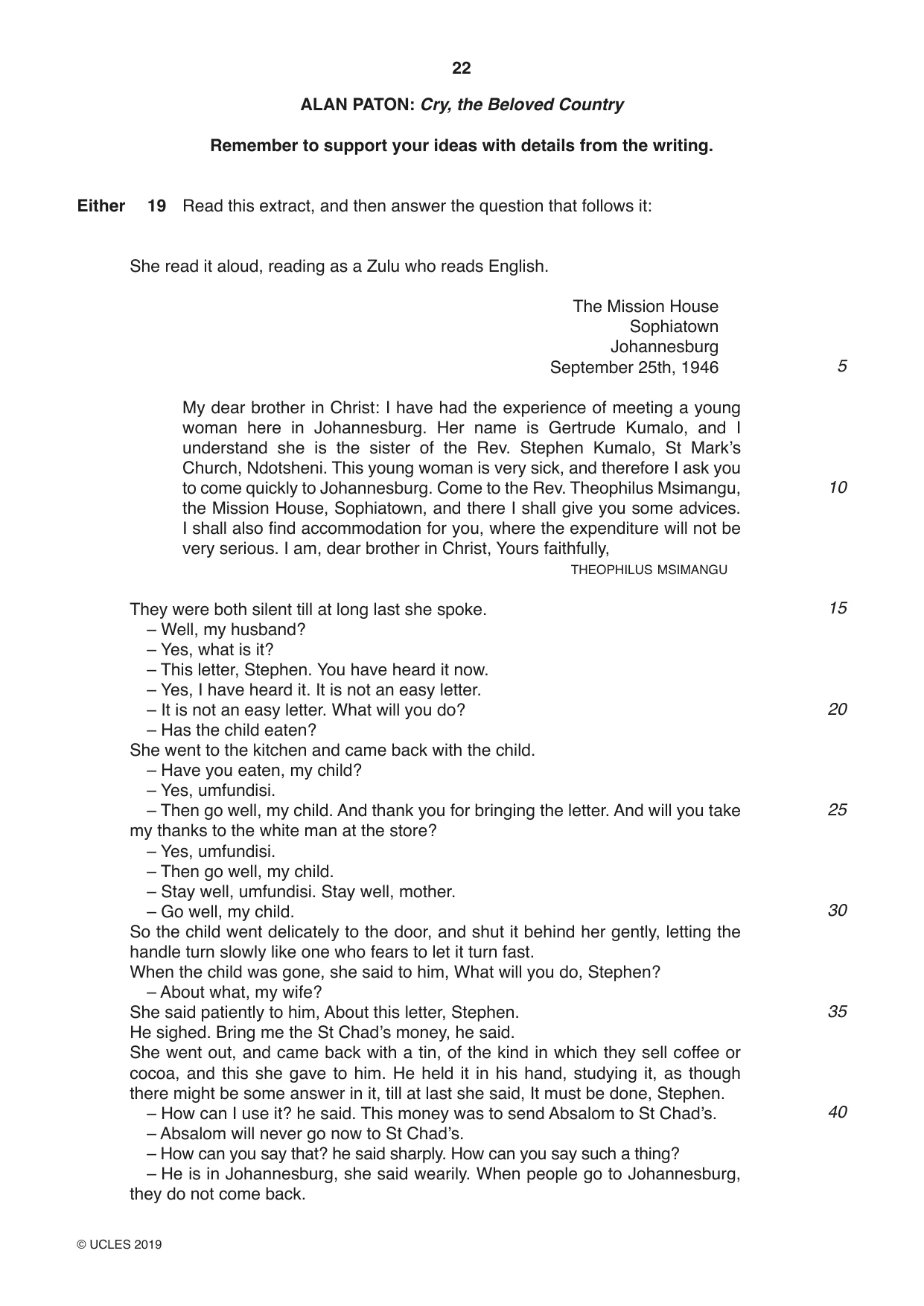
22 © UCLES 2019 ALAN PATON: Cry, the Beloved Country Remember to support your ideas with details from the writing. Either 19 Read this extract, and then answer the question that follows it: She read it aloud, reading as a Zulu who reads English. The Mission House Sophiatown Johannesburg September 25th, 1946 My dear brother in Christ: I have had the experience of meeting a young woman here in Johannesburg. Her name is Gertrude Kumalo, and I understand she is the sister of the Rev. Stephen Kumalo, St Mark’s Church, Ndotsheni. This young woman is very sick, and therefore I ask you to come quickly to Johannesburg. Come to the Rev. Theophilus Msimangu, the Mission House, Sophiatown, and there I shall give you some advices. I shall also find accommodation for you, where the expenditure will not be very serious. I am, dear brother in Christ, Yours faithfully, theophilus msimangu They were both silent till at long last she spoke. – Well, my husband? – Yes, what is it? – This letter, Stephen. You have heard it now. – Yes, I have heard it. It is not an easy letter. – It is not an easy letter. What will you do? – Has the child eaten? She went to the kitchen and came back with the child. – Have you eaten, my child? – Yes, umfundisi. – Then go well, my child. And thank you for bringing the letter. And will you take my thanks to the white man at the store? – Yes, umfundisi. – Then go well, my child. – Stay well, umfundisi. Stay well, mother. – Go well, my child. So the child went delicately to the door, and shut it behind her gently, letting the handle turn slowly like one who fears to let it turn fast. When the child was gone, she said to him, What will you do, Stephen? – About what, my wife? She said patiently to him, About this letter, Stephen. He sighed. Bring me the St Chad’s money, he said. She went out, and came back with a tin, of the kind in which they sell coffee or cocoa, and this she gave to him. He held it in his hand, studying it, as though there might be some answer in it, till at last she said, It must be done, Stephen. – How can I use it? he said. This money was to send Absalom to St Chad’s. – Absalom will never go now to St Chad’s. – How can you say that? he said sharply. How can you say such a thing? – He is in Johannesburg, she said wearily. When people go to Johannesburg, they do not come back. 5 10 15 20 25 30 35 40
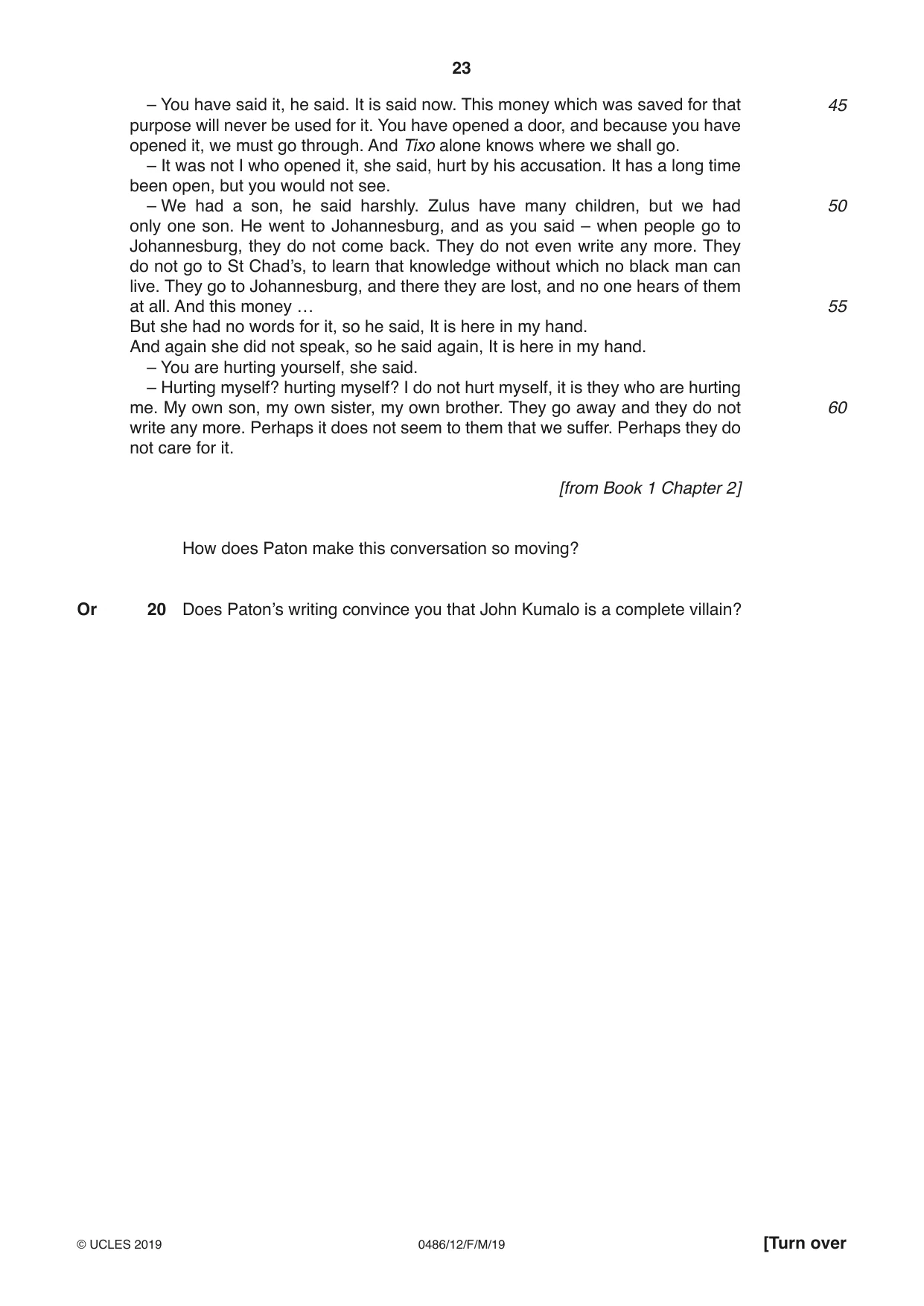
Question paper, page 23
23 0486/12/F/M/19 © UCLES 2019 [Turn over – You have said it, he said. It is said now. This money which was saved for that purpose will never be used for it. You have opened a door, and because you have opened it, we must go through. And Tixo alone knows where we shall go. – It was not I who opened it, she said, hurt by his accusation. It has a long time been open, but you would not see. – We had a son, he said harshly. Zulus have many children, but we had only one son. He went to Johannesburg, and as you said – when people go to Johannesburg, they do not come back. They do not even write any more. They do not go to St Chad’s, to learn that knowledge without which no black man can live. They go to Johannesburg, and there they are lost, and no one hears of them at all. And this money … But she had no words for it, so he said, It is here in my hand. And again she did not speak, so he said again, It is here in my hand. – You are hurting yourself, she said. – Hurting myself? hurting myself? I do not hurt myself, it is they who are hurting me. My own son, my own sister, my own brother. They go away and they do not write any more. Perhaps it does not seem to them that we suffer. Perhaps they do not care for it. [from Book 1 Chapter 2] How does Paton make this conversation so moving? Or 20 Does Paton’s writing convince you that John Kumalo is a complete villain? 45 50 55 60
Question paper, page 24
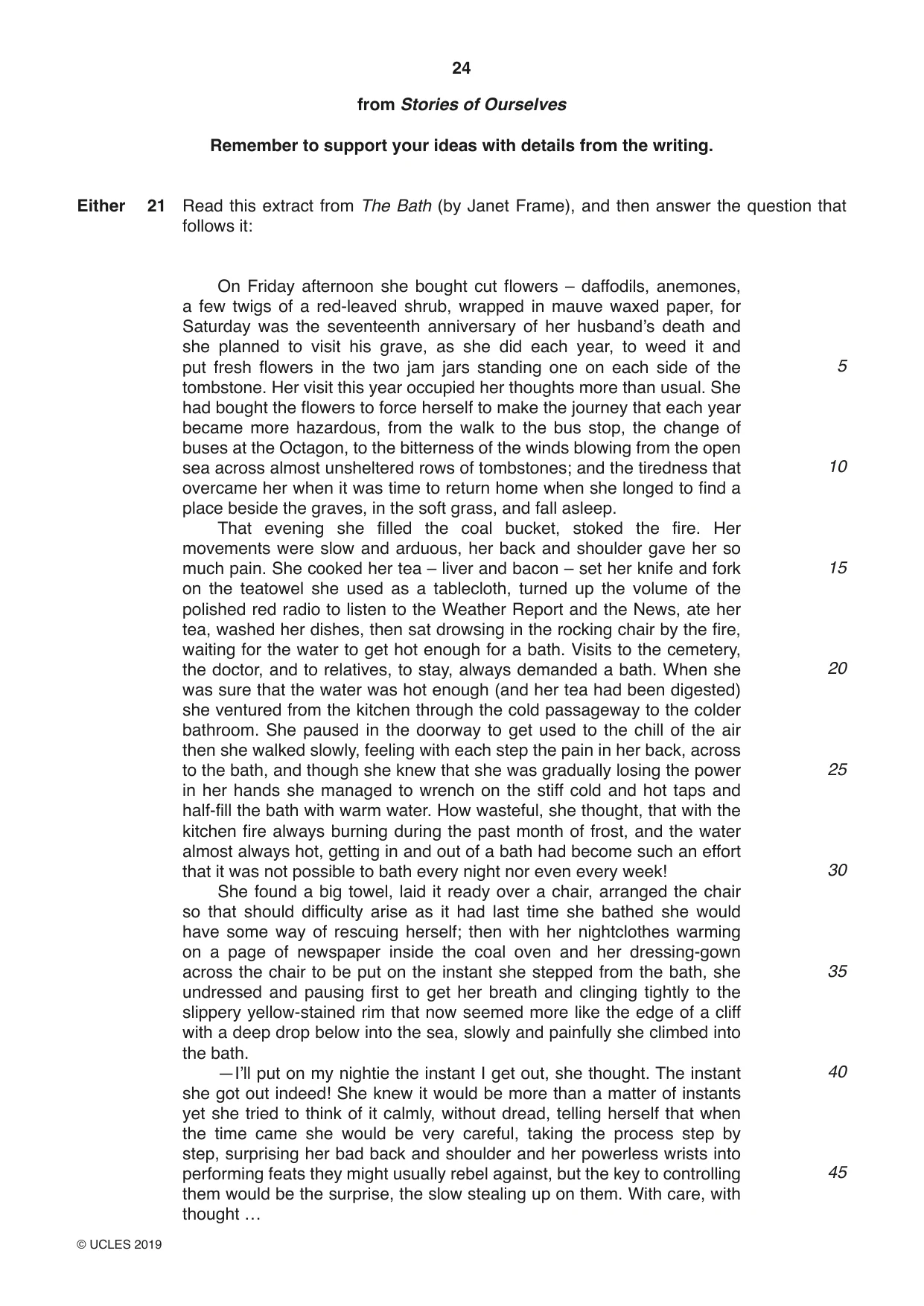
24 © UCLES 2019 from Stories of Ourselves Remember to support your ideas with details from the writing. Either 21 Read this extract from The Bath (by Janet Frame), and then answer the question that follows it: On Friday afternoon she bought cut flowers – daffodils, anemones, a few twigs of a red-leaved shrub, wrapped in mauve waxed paper, for Saturday was the seventeenth anniversary of her husband’s death and she planned to visit his grave, as she did each year, to weed it and put fresh flowers in the two jam jars standing one on each side of the tombstone. Her visit this year occupied her thoughts more than usual. She had bought the flowers to force herself to make the journey that each year became more hazardous, from the walk to the bus stop, the change of buses at the Octagon, to the bitterness of the winds blowing from the open sea across almost unsheltered rows of tombstones; and the tiredness that overcame her when it was time to return home when she longed to find a place beside the graves, in the soft grass, and fall asleep. That evening she filled the coal bucket, stoked the fire. Her movements were slow and arduous, her back and shoulder gave her so much pain. She cooked her tea – liver and bacon – set her knife and fork on the teatowel she used as a tablecloth, turned up the volume of the polished red radio to listen to the Weather Report and the News, ate her tea, washed her dishes, then sat drowsing in the rocking chair by the fire, waiting for the water to get hot enough for a bath. Visits to the cemetery, the doctor, and to relatives, to stay, always demanded a bath. When she was sure that the water was hot enough (and her tea had been digested) she ventured from the kitchen through the cold passageway to the colder bathroom. She paused in the doorway to get used to the chill of the air then she walked slowly, feeling with each step the pain in her back, across to the bath, and though she knew that she was gradually losing the power in her hands she managed to wrench on the stiff cold and hot taps and half-fill the bath with warm water. How wasteful, she thought, that with the kitchen fire always burning during the past month of frost, and the water almost always hot, getting in and out of a bath had become such an effort that it was not possible to bath every night nor even every week! She found a big towel, laid it ready over a chair, arranged the chair so that should difficulty arise as it had last time she bathed she would have some way of rescuing herself; then with her nightclothes warming on a page of newspaper inside the coal oven and her dressing-gown across the chair to be put on the instant she stepped from the bath, she undressed and pausing first to get her breath and clinging tightly to the slippery yellow-stained rim that now seemed more like the edge of a cliff with a deep drop below into the sea, slowly and painfully she climbed into the bath. —I’ll put on my nightie the instant I get out, she thought. The instant she got out indeed! She knew it would be more than a matter of instants yet she tried to think of it calmly, without dread, telling herself that when the time came she would be very careful, taking the process step by step, surprising her bad back and shoulder and her powerless wrists into performing feats they might usually rebel against, but the key to controlling them would be the surprise, the slow stealing up on them. With care, with thought … 5 10 15 20 25 30 35 40 45
Question paper, page 25
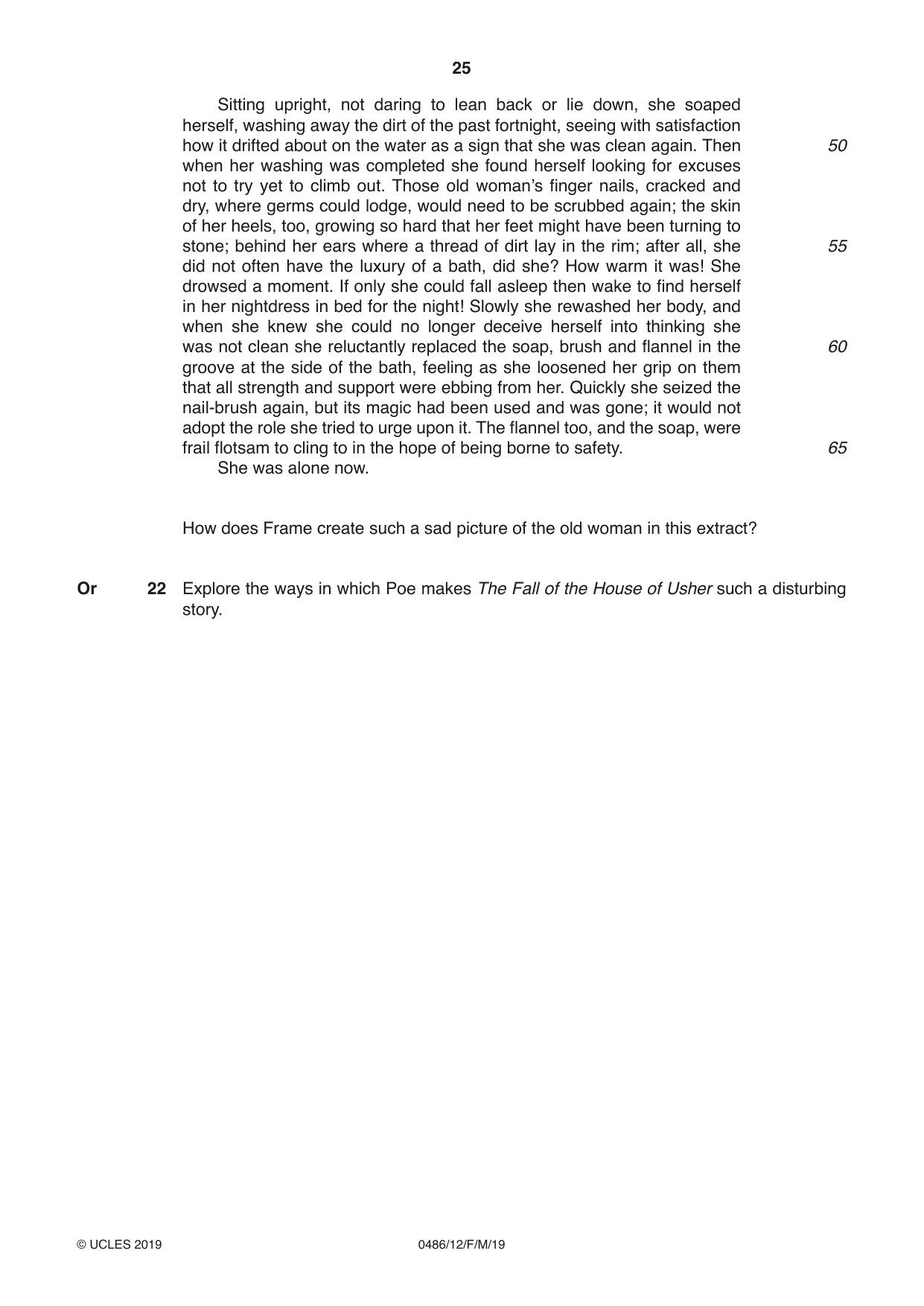
25 0486/12/F/M/19 © UCLES 2019 Sitting upright, not daring to lean back or lie down, she soaped herself, washing away the dirt of the past fortnight, seeing with satisfaction how it drifted about on the water as a sign that she was clean again. Then when her washing was completed she found herself looking for excuses not to try yet to climb out. Those old woman’s finger nails, cracked and dry, where germs could lodge, would need to be scrubbed again; the skin of her heels, too, growing so hard that her feet might have been turning to stone; behind her ears where a thread of dirt lay in the rim; after all, she did not often have the luxury of a bath, did she? How warm it was! She drowsed a moment. If only she could fall asleep then wake to find herself in her nightdress in bed for the night! Slowly she rewashed her body, and when she knew she could no longer deceive herself into thinking she was not clean she reluctantly replaced the soap, brush and flannel in the groove at the side of the bath, feeling as she loosened her grip on them that all strength and support were ebbing from her. Quickly she seized the nail-brush again, but its magic had been used and was gone; it would not adopt the role she tried to urge upon it. The flannel too, and the soap, were frail flotsam to cling to in the hope of being borne to safety. She was alone now. How does Frame create such a sad picture of the old woman in this extract? Or 22 Explore the ways in which Poe makes The Fall of the House of Usher such a disturbing story. 50 55 60 65
Question paper, page 27
27 0486/12/F/M/19 © UCLES 2019 BLANK PAGE
Question paper, page 28
28 © UCLES 2019 Permission to reproduce items where third-party owned material protected by copyright is included has been sought and cleared where possible. Every reasonable effort has been made by the publisher (UCLES) to trace copyright holders, but if any items requiring clearance have unwittingly been included, the publisher will be pleased to make amends at the earliest possible opportunity. To avoid the issue of disclosure of answer-related information to candidates, all copyright acknowledgements are reproduced online in the Cambridge Assessment International Education Copyright Acknowledgements Booklet. This is produced for each series of examinations and is freely available to download at www.cambridgeinternational.org after the live examination series. Cambridge Assessment International Education is part of the Cambridge Assessment Group. Cambridge Assessment is the brand name of the University of Cambridge Local Examinations Syndicate (UCLES), which itself is a department of the University of Cambridge. BLANK PAGE
Mark scheme, page 1
This document consists of 4 printed pages. © UCLES 2019 [Turn over Cambridge Assessment International Education Cambridge International General Certificate of Secondary Education LITERATURE (ENGLISH) 0486/12 Paper 1 Poetry and Prose March 2019 MARK SCHEME Maximum Mark: 50 Published This mark scheme is published as an aid to teachers and candidates, to indicate the requirements of the examination. It shows the basis on which Examiners were instructed to award marks. It does not indicate the details of the discussions that took place at an Examiners’ meeting before marking began, which would have considered the acceptability of alternative answers. Mark schemes should be read in conjunction with the question paper and the Principal Examiner Report for Teachers. Cambridge International will not enter into discussions about these mark schemes. Cambridge International is publishing the mark schemes for the March 2019 series for most Cambridge IGCSE™, Cambridge International A and AS Level components and some Cambridge O Level components.
Mark scheme, page 2
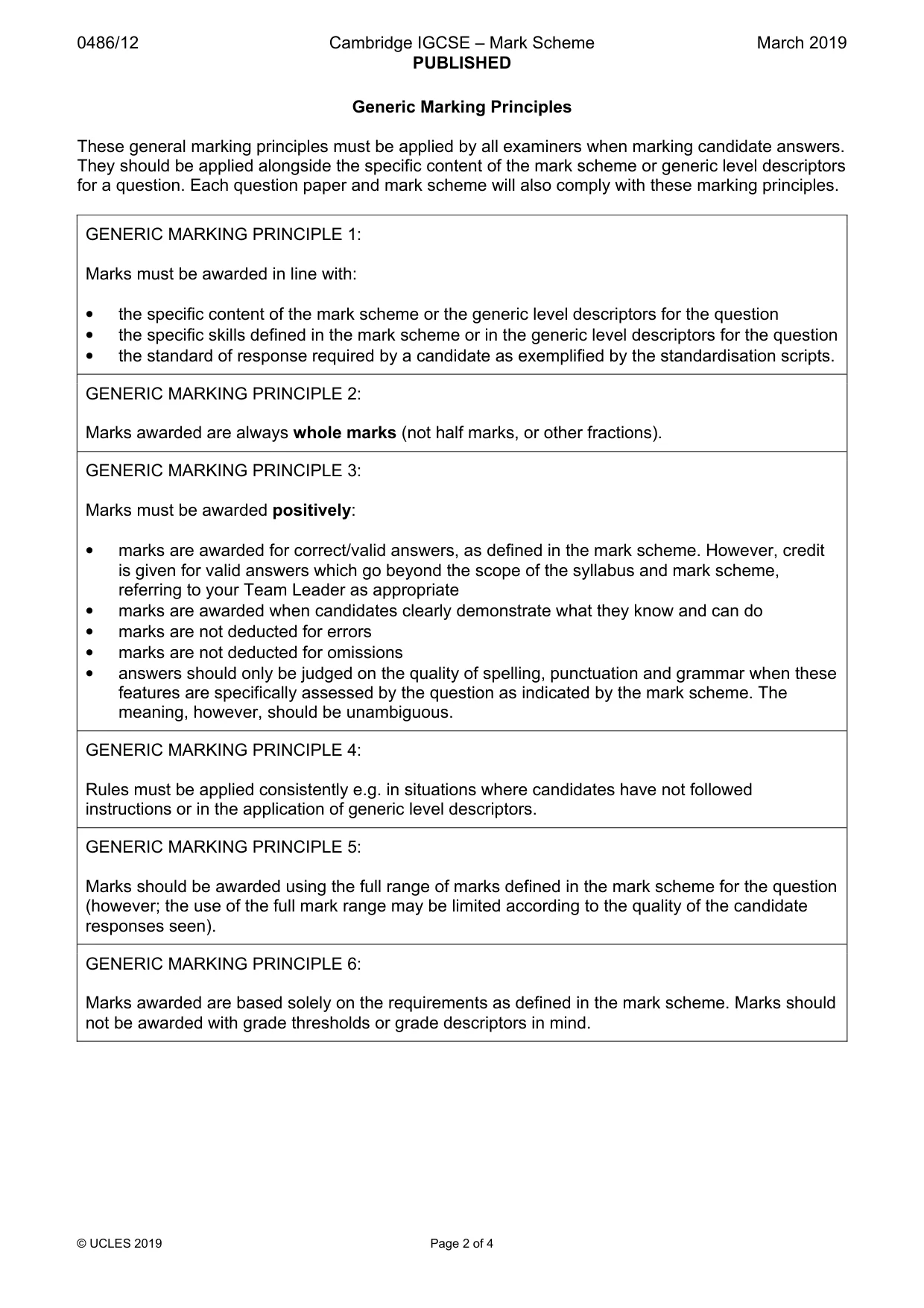
0486/12 Cambridge IGCSE – Mark Scheme PUBLISHED March 2019 © UCLES 2019 Page 2 of 4 Generic Marking Principles These general marking principles must be applied by all examiners when marking candidate answers. They should be applied alongside the specific content of the mark scheme or generic level descriptors for a question. Each question paper and mark scheme will also comply with these marking principles. GENERIC MARKING PRINCIPLE 1: Marks must be awarded in line with: • the specific content of the mark scheme or the generic level descriptors for the question • the specific skills defined in the mark scheme or in the generic level descriptors for the question • the standard of response required by a candidate as exemplified by the standardisation scripts. GENERIC MARKING PRINCIPLE 2: Marks awarded are always whole marks (not half marks, or other fractions). GENERIC MARKING PRINCIPLE 3: Marks must be awarded positively: • marks are awarded for correct/valid answers, as defined in the mark scheme. However, credit is given for valid answers which go beyond the scope of the syllabus and mark scheme, referring to your Team Leader as appropriate • marks are awarded when candidates clearly demonstrate what they know and can do • marks are not deducted for errors • marks are not deducted for omissions • answers should only be judged on the quality of spelling, punctuation and grammar when these features are specifically assessed by the question as indicated by the mark scheme. The meaning, however, should be unambiguous. GENERIC MARKING PRINCIPLE 4: Rules must be applied consistently e.g. in situations where candidates have not followed instructions or in the application of generic level descriptors. GENERIC MARKING PRINCIPLE 5: Marks should be awarded using the full range of marks defined in the mark scheme for the question (however; the use of the full mark range may be limited according to the quality of the candidate responses seen). GENERIC MARKING PRINCIPLE 6: Marks awarded are based solely on the requirements as defined in the mark scheme. Marks should not be awarded with grade thresholds or grade descriptors in mind.
Mark scheme, page 3
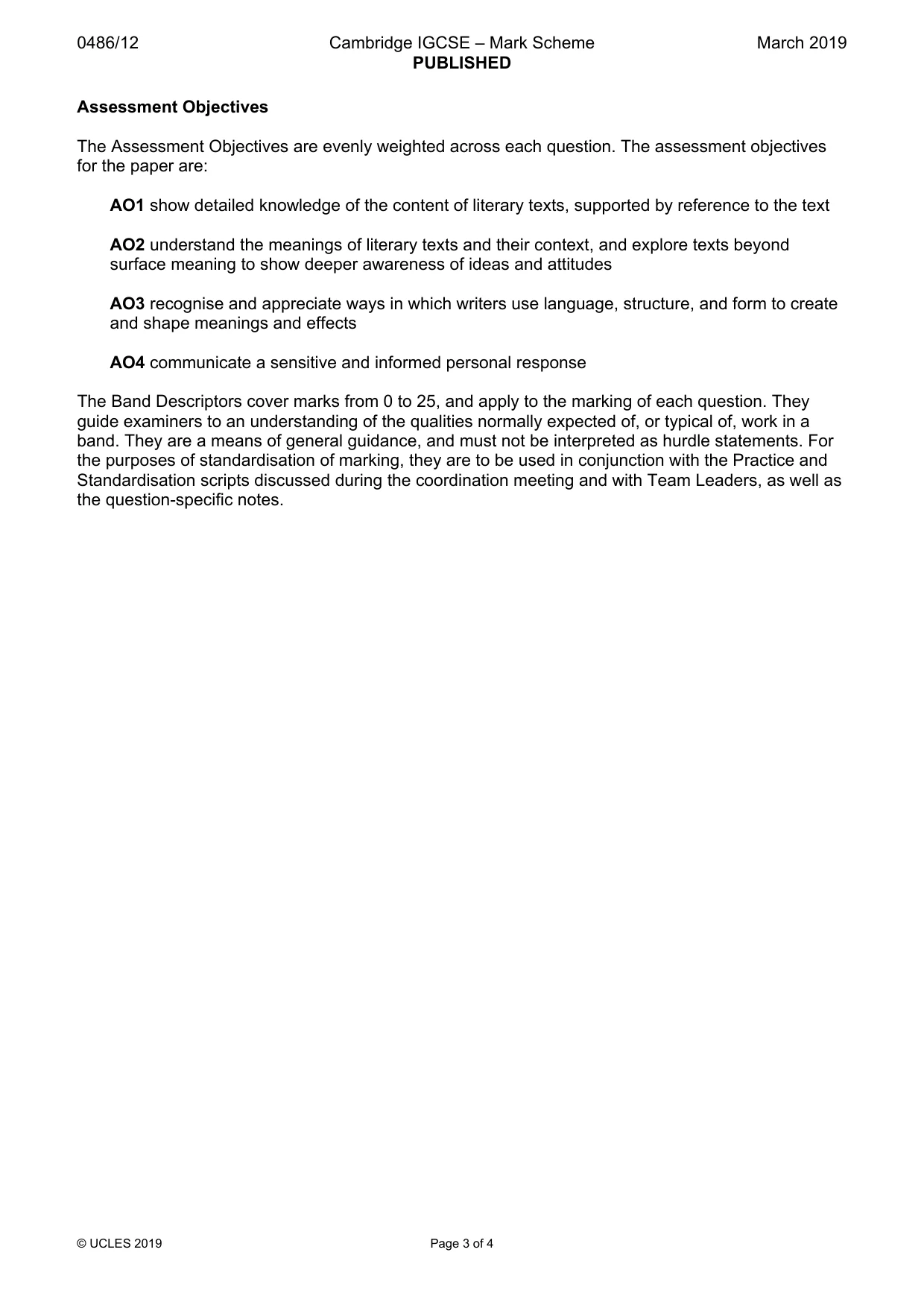
0486/12 Cambridge IGCSE – Mark Scheme PUBLISHED March 2019 © UCLES 2019 Page 3 of 4 Assessment Objectives The Assessment Objectives are evenly weighted across each question. The assessment objectives for the paper are: AO1 show detailed knowledge of the content of literary texts, supported by reference to the text AO2 understand the meanings of literary texts and their context, and explore texts beyond surface meaning to show deeper awareness of ideas and attitudes AO3 recognise and appreciate ways in which writers use language, structure, and form to create and shape meanings and effects AO4 communicate a sensitive and informed personal response The Band Descriptors cover marks from 0 to 25, and apply to the marking of each question. They guide examiners to an understanding of the qualities normally expected of, or typical of, work in a band. They are a means of general guidance, and must not be interpreted as hurdle statements. For the purposes of standardisation of marking, they are to be used in conjunction with the Practice and Standardisation scripts discussed during the coordination meeting and with Team Leaders, as well as the question-specific notes.
Mark scheme, page 4
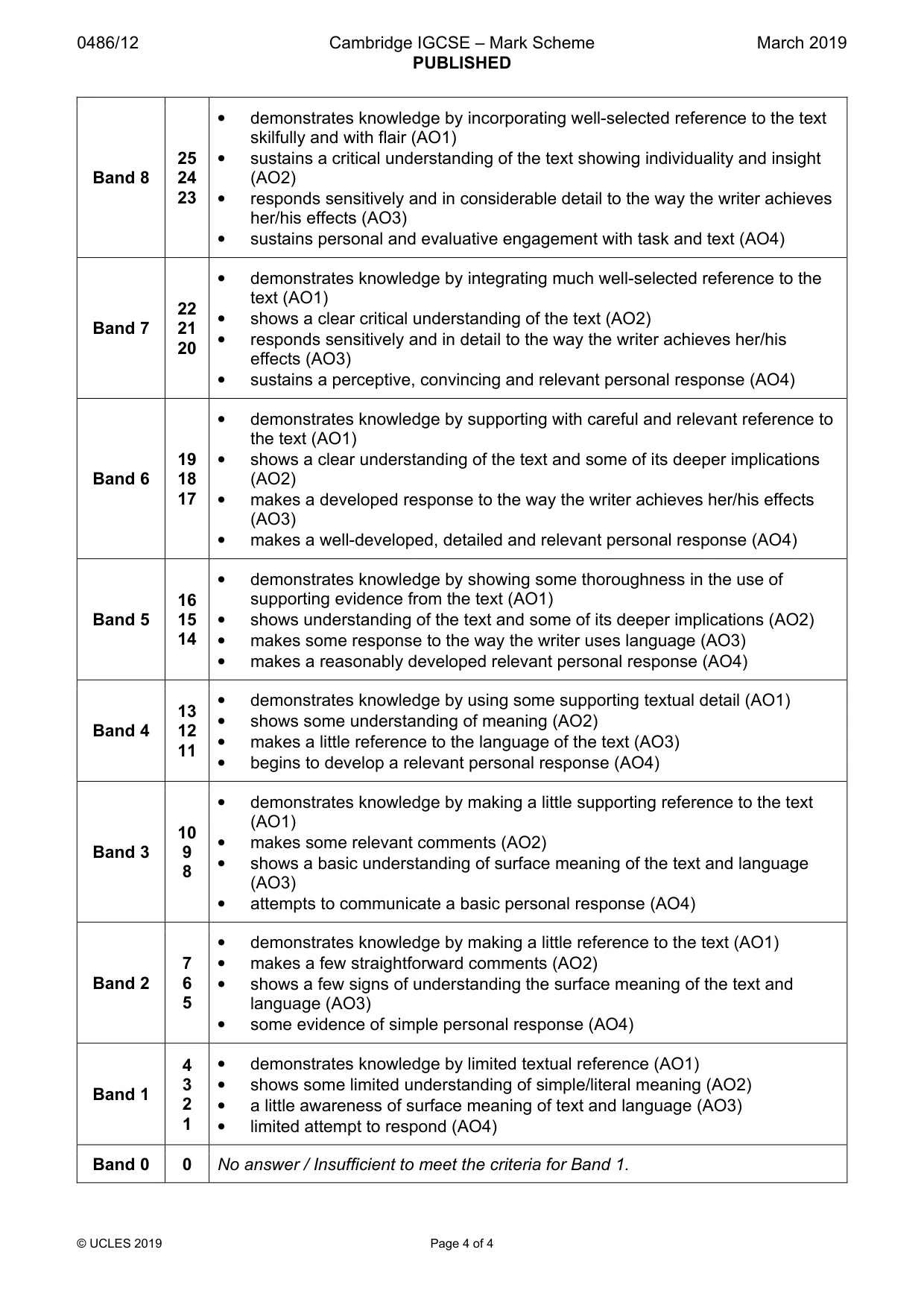
0486/12 Cambridge IGCSE – Mark Scheme PUBLISHED March 2019 © UCLES 2019 Page 4 of 4 Band 8 25 24 23 • demonstrates knowledge by incorporating well-selected reference to the text skilfully and with flair (AO1) • sustains a critical understanding of the text showing individuality and insight (AO2) • responds sensitively and in considerable detail to the way the writer achieves her/his effects (AO3) • sustains personal and evaluative engagement with task and text (AO4) Band 7 22 21 20 • demonstrates knowledge by integrating much well-selected reference to the text (AO1) • shows a clear critical understanding of the text (AO2) • responds sensitively and in detail to the way the writer achieves her/his effects (AO3) • sustains a perceptive, convincing and relevant personal response (AO4) Band 6 19 18 17 • demonstrates knowledge by supporting with careful and relevant reference to the text (AO1) • shows a clear understanding of the text and some of its deeper implications (AO2) • makes a developed response to the way the writer achieves her/his effects (AO3) • makes a well-developed, detailed and relevant personal response (AO4) Band 5 16 15 14 • demonstrates knowledge by showing some thoroughness in the use of supporting evidence from the text (AO1) • shows understanding of the text and some of its deeper implications (AO2) • makes some response to the way the writer uses language (AO3) • makes a reasonably developed relevant personal response (AO4) Band 4 13 12 11 • demonstrates knowledge by using some supporting textual detail (AO1) • shows some understanding of meaning (AO2) • makes a little reference to the language of the text (AO3) • begins to develop a relevant personal response (AO4) Band 3 10 9 8 • demonstrates knowledge by making a little supporting reference to the text (AO1) • makes some relevant comments (AO2) • shows a basic understanding of surface meaning of the text and language (AO3) • attempts to communicate a basic personal response (AO4) Band 2 7 6 5 • demonstrates knowledge by making a little reference to the text (AO1) • makes a few straightforward comments (AO2) • shows a few signs of understanding the surface meaning of the text and language (AO3) • some evidence of simple personal response (AO4) Band 1 4 3 2 1 • demonstrates knowledge by limited textual reference (AO1) • shows some limited understanding of simple/literal meaning (AO2) • a little awareness of surface meaning of text and language (AO3) • limited attempt to respond (AO4) Band 0 0 No answer / Insufficient to meet the criteria for Band 1.
What you needed in this session
Cambridge’s own grade thresholds for 2019 Feb/March, Paper 1 · Variant 2. A higher threshold means an easier paper — the bar moves with how the cohort did.