Cambridge IGCSE English - Literature 0486 — 2012 May/June Paper 1 · Variant 2
0486/12/M/J/12 · 75 marks · ≈84 min
The question paper and its mark scheme, free to read here and free to download. This is Cambridge’s own paper, exactly as it was sat.
Question paper25 pages



Mark scheme3 pages
Answers below. Sit the paper first if you are practising.
Paper as text
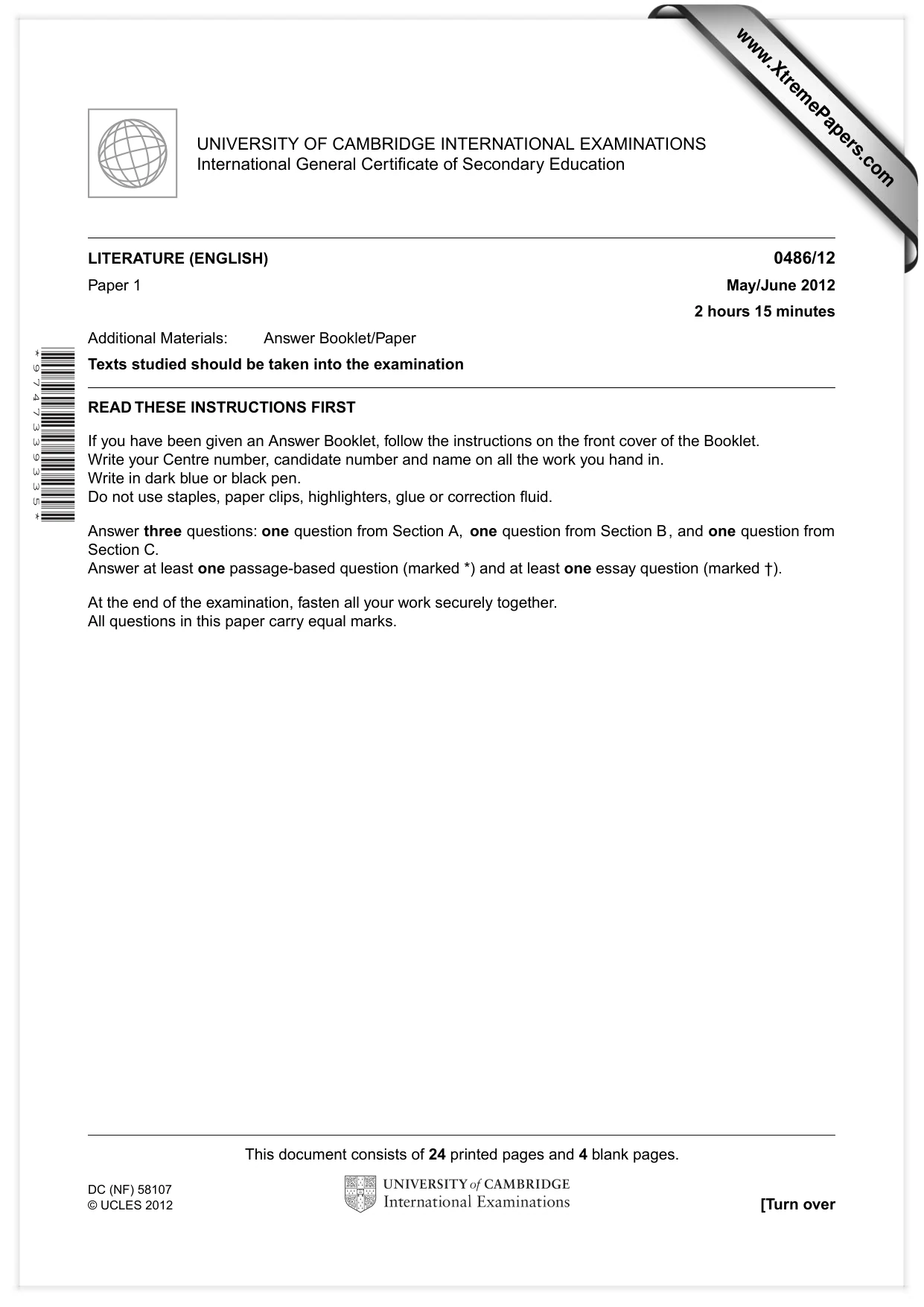
Question paper, page 1
This document consists of 24 printed pages and 4 blank pages. DC (NF) 58107 © UCLES 2012 [Turn over UNIVERSITY OF CAMBRIDGE INTERNATIONAL EXAMINATIONS International General Certificate of Secondary Education * 9 7 4 7 3 3 9 3 3 5 * LITERATURE (ENGLISH) 0486/12 Paper 1 May/June 2012 2 hours 15 minutes Additional Materials: Answer Booklet/Paper Texts studied should be taken into the examination READ THESE INSTRUCTIONS FIRST If you have been given an Answer Booklet, follow the instructions on the front cover of the Booklet. Write your Centre number, candidate number and name on all the work you hand in. Write in dark blue or black pen. Do not use staples, paper clips, highlighters, glue or correction fluid. Answer three questions: one question from Section A, one question from Section B, and one question from Section C. Answer at least one passage-based question (marked *) and at least one essay question (marked †). At the end of the examination, fasten all your work securely together. All questions in this paper carry equal marks. www.XtremePapers.com
Question paper, page 2
2 0486/12/M/J/12 © UCLES 2012 BLANK PAGE
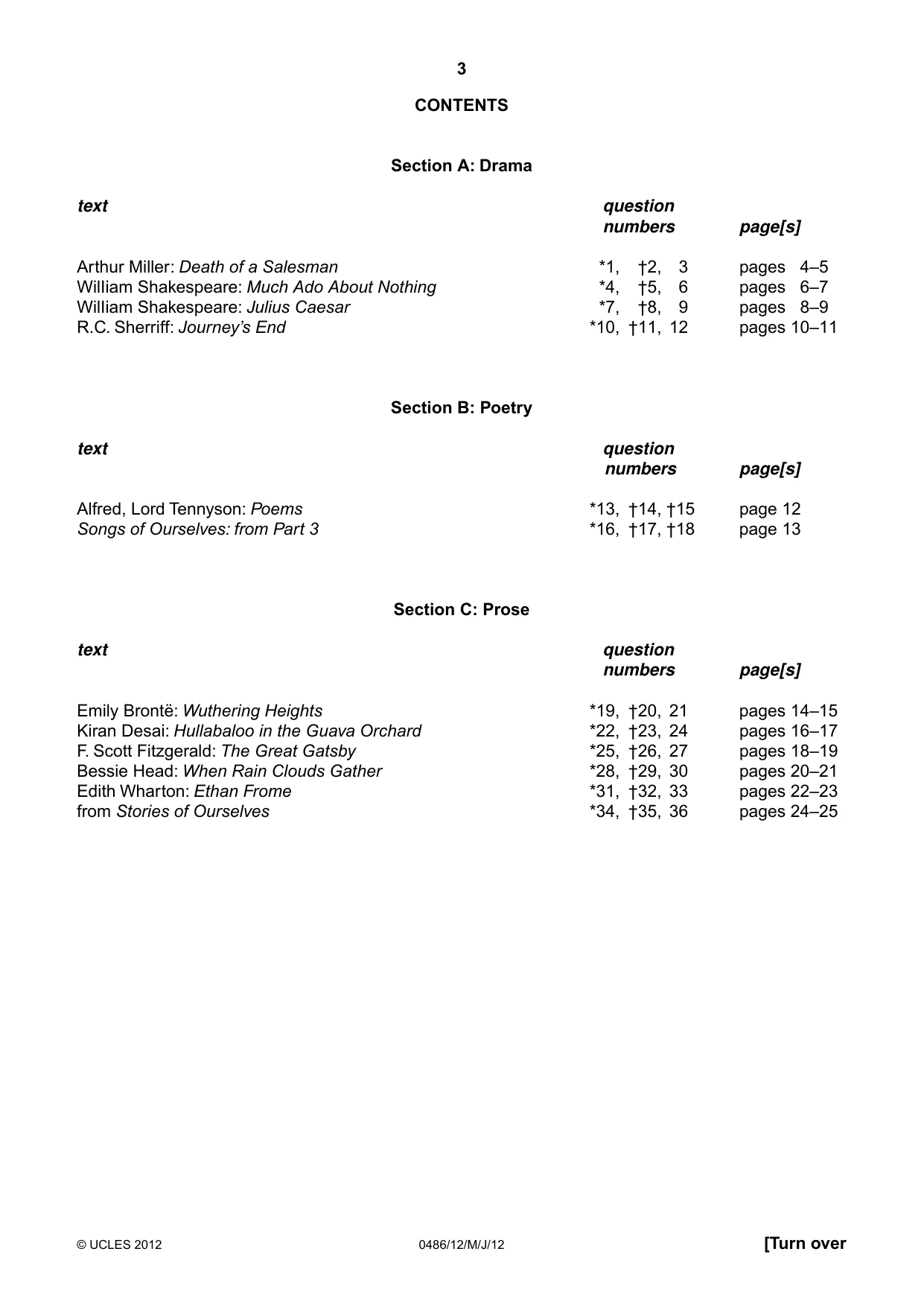
Question paper, page 3
3 0486/12/M/J/12 © UCLES 2012 [Turn over CONTENTS Section A: Drama text question numbers page[s] Arthur Miller: Death of a Salesman *1, †2, 3 pages 4–5 WilIiam Shakespeare: Much Ado About Nothing *4, †5, 6 pages 6–7 WilIiam Shakespeare: Julius Caesar *7, †8, 9 pages 8–9 R.C. Sherriff: Journey’s End *10, †11, 12 pages 10–11 Section B: Poetry text question numbers page[s] Alfred, Lord Tennyson: Poems *13, †14, †15 page 12 Songs of Ourselves: from Part 3 *16, †17, †18 page 13 Section C: Prose text question numbers page[s] Emily Brontë: Wuthering Heights *19, †20, 21 pages 14–15 Kiran Desai: Hullabaloo in the Guava Orchard *22, †23, 24 pages 16–17 F. Scott Fitzgerald: The Great Gatsby *25, †26, 27 pages 18–19 Bessie Head: When Rain Clouds Gather *28, †29, 30 pages 20–21 Edith Wharton: Ethan Frome *31, †32, 33 pages 22–23 from Stories of Ourselves *34, †35, 36 pages 24–25
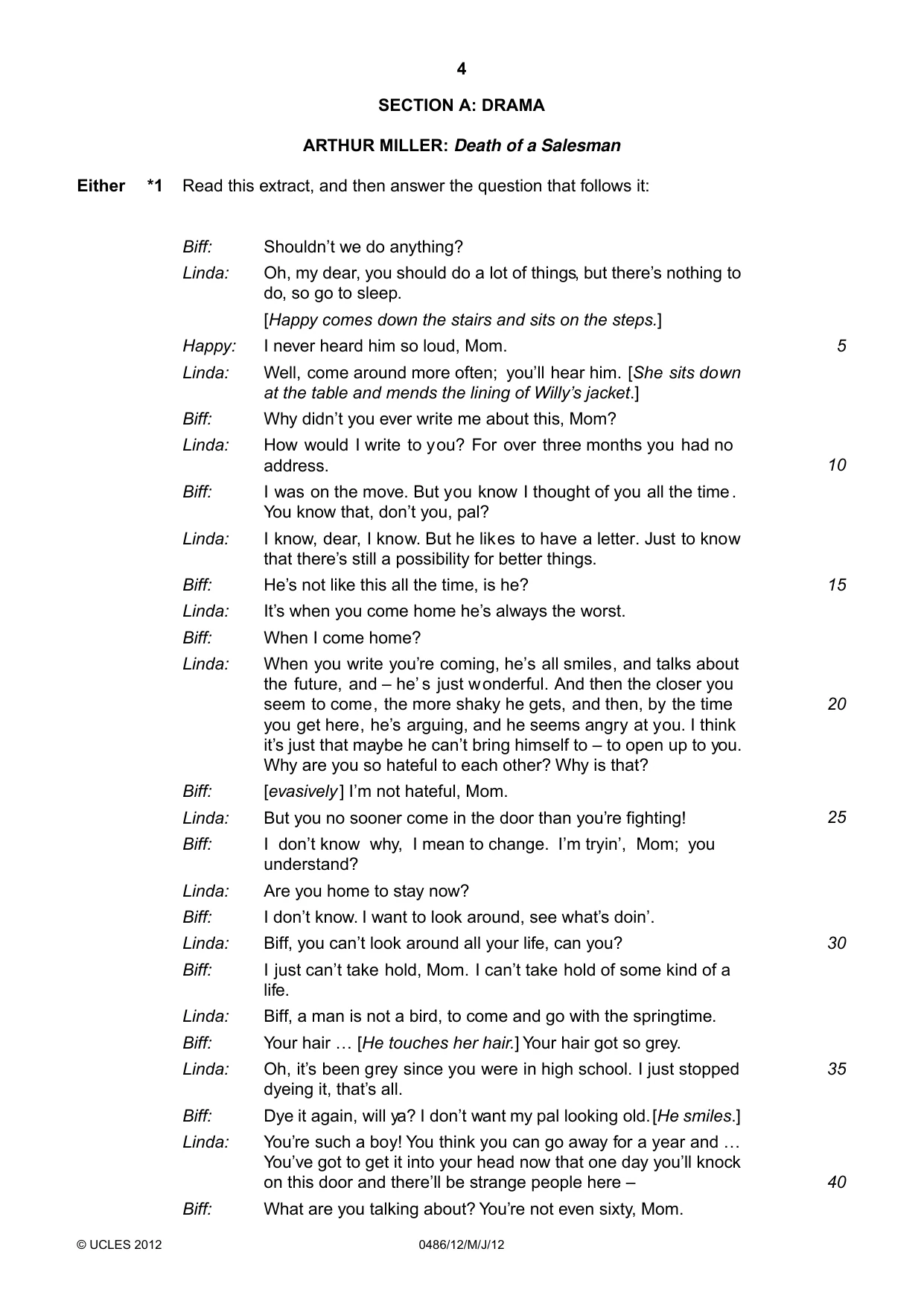
Question paper, page 4
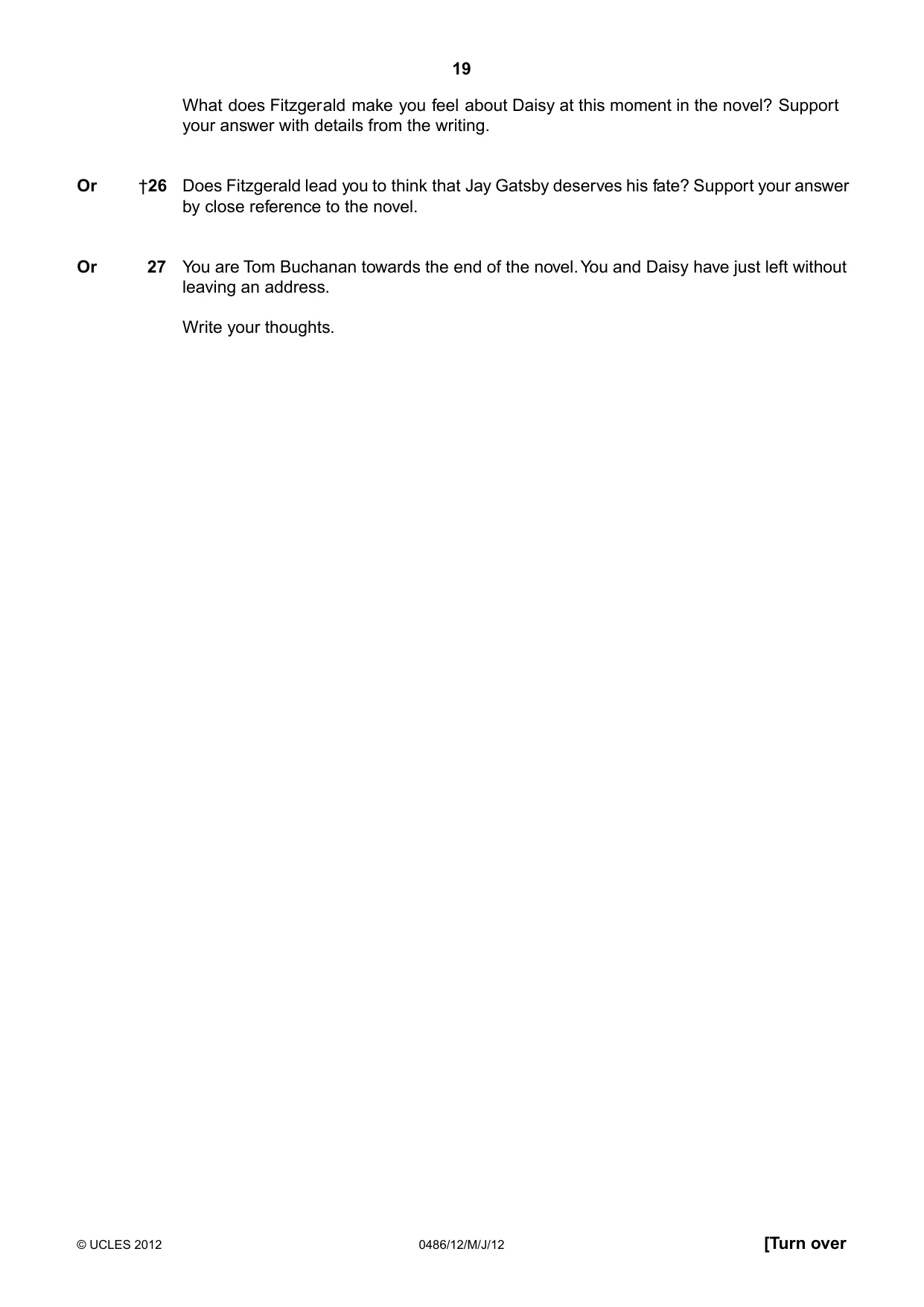
4 0486/12/M/J/12 © UCLES 2012 5 10 15 20 25 30 35 40 SECTION A: DRAMA ARTHUR MILLER: Death of a Salesman Either *1 Read this extract, and then answer the question that follows it: Biff: Shouldn’t we do anything? Linda: Oh, my dear, you should do a lot of things, but there’s nothing to do, so go to sleep. [Happy comes down the stairs and sits on the steps.] Happy: I never heard him so loud, Mom. Linda: Well, come around more often; you’ll hear him. [She sits down at the table and mends the lining of Willy’s jacket.] Biff: Why didn’t you ever write me about this, Mom? Linda: How would I write to you? For over three months you had no address. Biff: I was on the move. But you know I thought of you all the time. You know that, don’t you, pal? Linda: I know, dear, I know. But he likes to have a letter. Just to know that there’s still a possibility for better things. Biff: He’s not like this all the time, is he? Linda: It’s when you come home he’s always the worst. Biff: When I come home? Linda: When you write you’re coming, he’s all smiles, and talks about the future, and – he’ s just wonderful. And then the closer you seem to come, the more shaky he gets, and then, by the time you get here, he’s arguing, and he seems angry at you. I think it’s just that maybe he can’t bring himself to – to open up to you. Why are you so hateful to each other? Why is that? Biff: [evasively ] I’m not hateful, Mom. Linda: But you no sooner come in the door than you’re fighting! Biff: I don’t know why, I mean to change. I’m tryin’, Mom; you understand? Linda: Are you home to stay now? Biff: I don’t know. I want to look around, see what’s doin’. Linda: Biff, you can’t look around all your life, can you? Biff: I just can’t take hold, Mom. I can’t take hold of some kind of a life. Linda: Biff, a man is not a bird, to come and go with the springtime. Biff: Your hair … [He touches her hair.] Your hair got so grey. Linda: Oh, it’s been grey since you were in high school. I just stopped dyeing it, that’s all. Biff: Dye it again, will ya? I don’t want my pal looking old. [He smiles.] Linda: You’re such a boy! You think you can go away for a year and … You’ve got to get it into your head now that one day you’ll knock on this door and there’ll be strange people here – Biff: What are you talking about? You’re not even sixty, Mom.
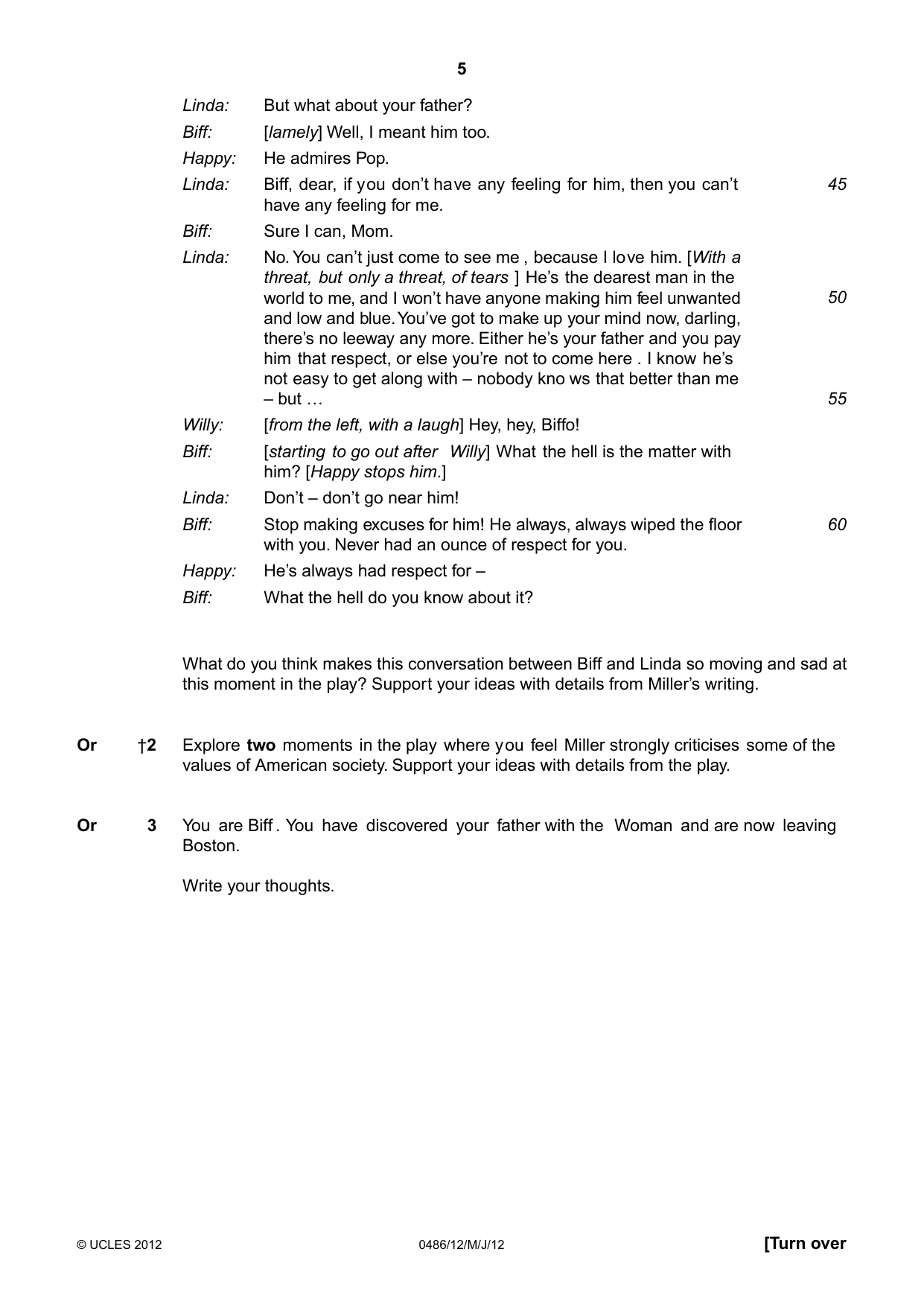
Question paper, page 5
5 0486/12/M/J/12 © UCLES 2012 [Turn over 45 50 55 60 Linda: But what about your father? Biff: [lamely] Well, I meant him too. Happy: He admires Pop. Linda: Biff, dear, if you don’t have any feeling for him, then you can’t have any feeling for me. Biff: Sure I can, Mom. Linda: No. You can’t just come to see me , because I love him. [With a threat, but only a threat, of tears ] He’s the dearest man in the world to me, and I won’t have anyone making him feel unwanted and low and blue. You’ve got to make up your mind now, darling, there’s no leeway any more. Either he’s your father and you pay him that respect, or else you’re not to come here . I know he’s not easy to get along with – nobody kno ws that better than me – but … Willy: [from the left, with a laugh] Hey, hey, Biffo! Biff: [starting to go out after Willy] What the hell is the matter with him? [Happy stops him.] Linda: Don’t – don’t go near him! Biff: Stop making excuses for him! He always, always wiped the floor with you. Never had an ounce of respect for you. Happy: He’s always had respect for – Biff: What the hell do you know about it? What do you think makes this conversation between Biff and Linda so moving and sad at this moment in the play? Support your ideas with details from Miller’s writing. Or †2 Explore two moments in the play where you feel Miller strongly criticises some of the values of American society. Support your ideas with details from the play. Or 3 You are Biff . You have discovered your father with the Woman and are now leaving Boston. Write your thoughts.
Question paper, page 6
6 0486/12/M/J/12 © UCLES 2012 5 10 15 20 25 30 35 40 WILLIAM SHAKESPEARE: Much Ado About Nothing Either *4 Read this extract, and then answer the question that follows it: Dogberry: Is our whole dissembly appear’d? Verges: O, a stool and a cushion for the sexton! Sexton: Which be the malefactors? Dogberry: Marry, that am I and my partner. Verges: Nay, that’s certain; we have the exhibition to examine. Sexton: But which are the offenders that are to be examin’d? Let them come before Master Constable. Dogberry: Yea, marry, let them come before me. What is your name, friend? Borachio: Borachio. Dogberry: Pray write down Borachio. Yours, sirrah? Conrade: I am a gentleman, sir, and my name is Conrade. Dogberry: Write down Master Gentleman Conrade. Masters, do you serve God? Conrade, Borachio: Yea, sir, we hope. Dogberry: Write down that they hope the y serve God; and write God first; for God defend but God should go before such villains! Masters, it is proved already that you are little better than false knaves, and it will go near to be thought so shortly. How answer you for yourselves? Conrade: Marry, sir, we say we are none. Dogberry: A marvellous witty fellow, I assure you; but I will go about with him. Come you hither, sirrah; a word in your ear: sir, I say to you it is thought you are false knaves. Borachio: Sir, I say to you we are none. Dogberry: Well, stand aside. Fore God, they are both in a tale. Have you writ down that they are none? Sexton: Master Constable, you go not the way to examine; you must call forth the watch that are their accusers. Dogberry: Yea, marry, that’s the eftest way. Let the watch come f orth. Masters, I charge you in the Prince’s name, accuse these men. 1 Watch: This man said, sir, that Don John, the Prince’s brother, was a villain. Dogberry: Write down Prince John a villain. Why, this is flat perjury, to call a prince’s brother villain. Borachio: Master Constable – Dogberry: Pray thee, fellow, peace; I do not like thy look, I promise thee. Sexton: What heard you him say else? 2 Watch: Marry, that he had received a thousand ducats of Don John for accusing the Lady Hero wrongfully. Dogberry: Flat burglary as ever was committed. Verges: Yea, by mass, that it is. Sexton: What else, fellow?
Question paper, page 7
7 0486/12/M/J/12 © UCLES 2012 [Turn over 45 50 55 1 Watch: And that Count Claudio did mean, upon his words, to disgrace Hero before the whole assembly, and not marry her. Dogberry: O villain! thou wilt be condemn’d into everlasting redemption for this. Sexton: What else? 2 Watch: This is all. Sexton: And this is more, masters, than you can deny. Prince John is this morning secretly stol’n away; Hero was in this manner accus’d, in this very manner refus’d and upon the grief of this suddenly died. Master Constable, let these men be bound and brought to Leonato’s; I will go before and show him their examination. How does Shakespeare make this moment in the play so amusing and so serious at the same time? Or †5 In your view, how does Shakespeare make Don John such an intriguing character? Support your answer by close reference to the play. Or 6 You are Beatrice. You have just called Benedick in to dinner. Write your thoughts.
Question paper, page 8
8 0486/12/M/J/12 © UCLES 2012 5 10 15 20 25 30 35 40 45 WILLIAM SHAKESPEARE: Julius Caesar Either *7 Read this extract, and then answer the question that follows it: Brutus: Mark Antony, here, take you Caesar’s body. You shall not in your funeral speech blame us, But speak all good you can devise of Caesar; And say you do’t by our permission; Else shall you not have any hand at all About his funeral. And you shall speak In the same pulpit whereto I am going, After my speech is ended. Antony: Be it so; I do desire no more. Brutus: Prepare the body then, and follow us. [Exeunt all but Antony. Antony: O, pardon me, thou bleeding piece of earth, That I am meek and gentle with these butchers! Thou art the ruins of the noblest man That ever lived in the tide of times. Woe to the hand that shed this costly blood! Over thy wounds now do I prophesy – Which like dumb mouths do ope their ruby lips To beg the voice and utterance of my tongue – A curse shall light upon the limbs of men; Domestic fury and fierce civil strife Shall cumber all the parts of Italy; Blood and destruction shall be so in use, And dreadful objects so familiar, That mothers shall but smile when they behold Their infants quartered with the hands of war, All pity chok’d with custom of fell deeds; And Caesar’s spirit, ranging for revenge, With Até by his side come hot from hell, Shall in these confines with a monarch’s voice Cry ‘Havoc!’ and let slip the dogs of war, That this foul deed shall smell above the earth With carrion men, groaning for burial. [Enter Octavius’ Servant. You serve Octavius Caesar, do you not? Servant: I do, Mark Antony. Antony: Caesar did write for him to come to Rome. Servant: He did receive his letters, and is coming, And bid me say to you by word of mouth – O Caesar! [Seeing the body. Antony: Thy heart is big, get thee apart and weep. Passion, I see, is catching; for mine eyes, Seeing those beads of sorrow stand in thine, Began to water. Is thy master coming? Servant: He lies to-night within seven leagues of Rome. Antony: Post back with speed, and tell him what hath chanc’d. Here is a mourning Rome, a dangerous Rome,
Question paper, page 9
9 0486/12/M/J/12 © UCLES 2012 [Turn over 50 55 No Rome of safety for Octavius yet; Hie hence and tell him so. Yet stay awhile; Thou shalt not back till I have borne this corse To the market-place. There shall I try, In my oration, how the people take The cruel issue of these bloody men; According to the which thou shalt discourse To young Octavius of the state of things. Lend me your hand. [Exeunt with Caesar’s body. Explore how Shakespeare makes this moment in the play so powerfully emotional. Or †8 In what ways does Shakespeare make you sympathise with Brutus? Support your answer with details from the play. Or 9 You are Caesar on your way to the Senate House on the Ides of March. Write your thoughts.
Question paper, page 10
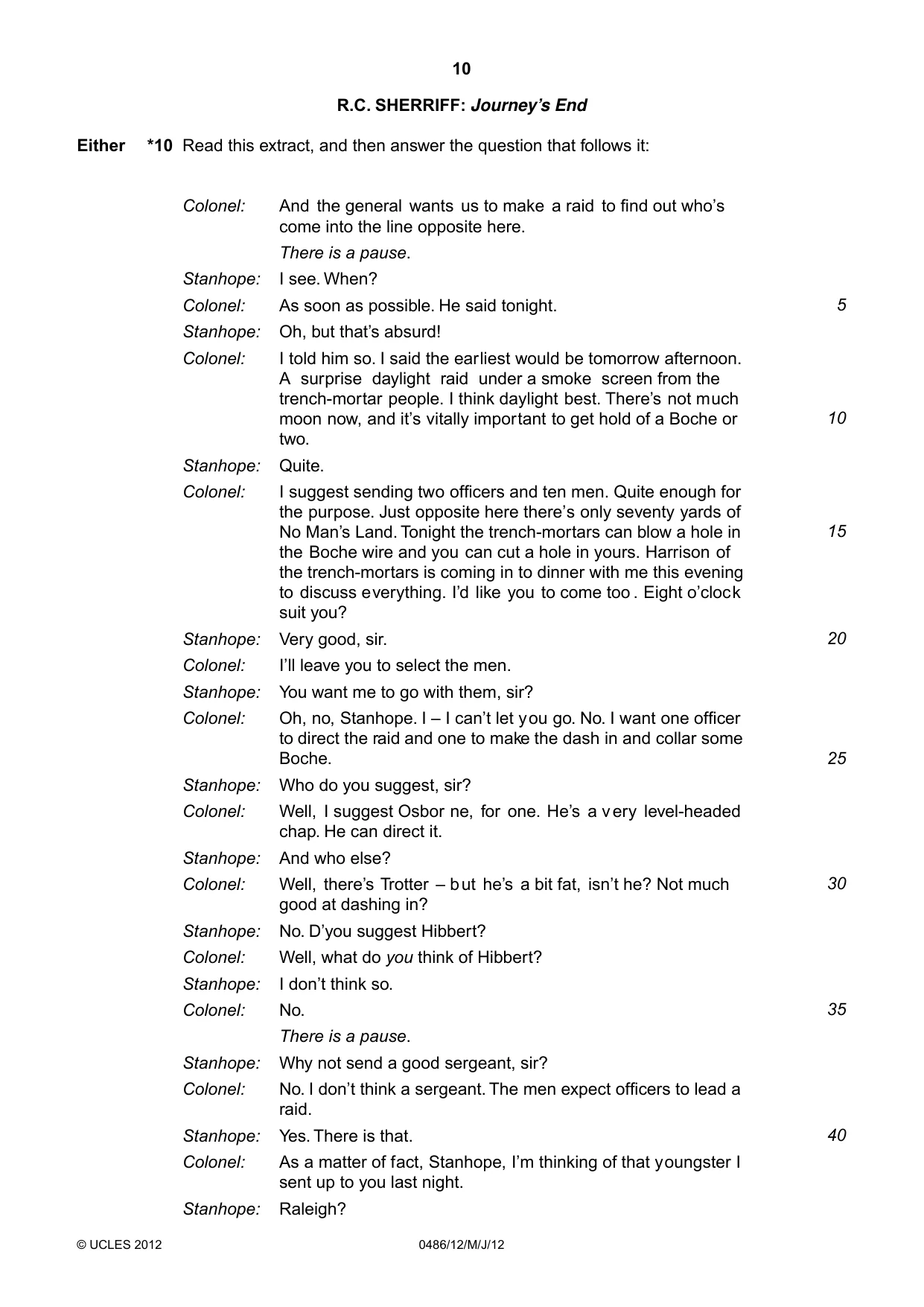
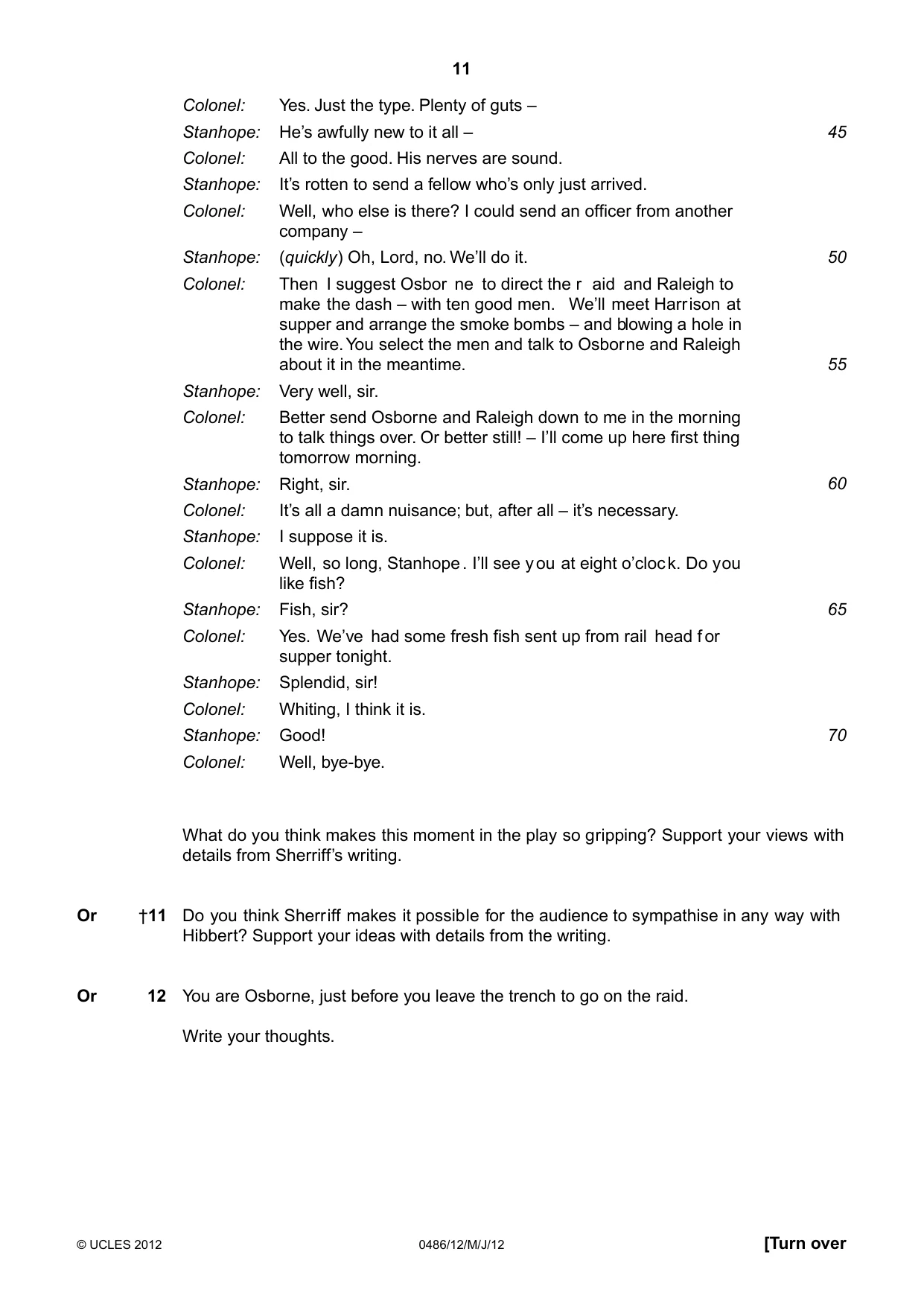
10 0486/12/M/J/12 © UCLES 2012 5 10 15 20 25 30 35 40 R.C. SHERRIFF: Journey’s End Either *10 Read this extract, and then answer the question that follows it: Colonel: And the general wants us to make a raid to find out who’s come into the line opposite here. There is a pause. Stanhope: I see. When? Colonel: As soon as possible. He said tonight. Stanhope: Oh, but that’s absurd! Colonel: I told him so. I said the earliest would be tomorrow afternoon. A surprise daylight raid under a smoke screen from the trench-mortar people. I think daylight best. There’s not much moon now, and it’s vitally important to get hold of a Boche or two. Stanhope: Quite. Colonel: I suggest sending two officers and ten men. Quite enough for the purpose. Just opposite here there’s only seventy yards of No Man’s Land. Tonight the trench-mortars can blow a hole in the Boche wire and you can cut a hole in yours. Harrison of the trench-mortars is coming in to dinner with me this evening to discuss everything. I’d like you to come too . Eight o’clock suit you? Stanhope: Very good, sir. Colonel: I’ll leave you to select the men. Stanhope: You want me to go with them, sir? Colonel: Oh, no, Stanhope. I – I can’t let you go. No. I want one officer to direct the raid and one to make the dash in and collar some Boche. Stanhope: Who do you suggest, sir? Colonel: Well, I suggest Osbor ne, for one. He’s a very level-headed chap. He can direct it. Stanhope: And who else? Colonel: Well, there’s Trotter – but he’s a bit fat, isn’t he? Not much good at dashing in? Stanhope: No. D’you suggest Hibbert? Colonel: Well, what do you think of Hibbert? Stanhope: I don’t think so. Colonel: No. There is a pause. Stanhope: Why not send a good sergeant, sir? Colonel: No. I don’t think a sergeant. The men expect officers to lead a raid. Stanhope: Yes. There is that. Colonel: As a matter of fact, Stanhope, I’m thinking of that youngster I sent up to you last night. Stanhope: Raleigh?
Question paper, page 11
11 0486/12/M/J/12 © UCLES 2012 [Turn over 45 50 55 60 65 70 Colonel: Yes. Just the type. Plenty of guts – Stanhope: He’s awfully new to it all – Colonel: All to the good. His nerves are sound. Stanhope: It’s rotten to send a fellow who’s only just arrived. Colonel: Well, who else is there? I could send an officer from another company – Stanhope: (quickly ) Oh, Lord, no. We’ll do it. Colonel: Then I suggest Osbor ne to direct the r aid and Raleigh to make the dash – with ten good men. We’ll meet Harrison at supper and arrange the smoke bombs – and blowing a hole in the wire. You select the men and talk to Osborne and Raleigh about it in the meantime. Stanhope: Very well, sir. Colonel: Better send Osborne and Raleigh down to me in the morning to talk things over. Or better still! – I’ll come up here first thing tomorrow morning. Stanhope: Right, sir. Colonel: It’s all a damn nuisance; but, after all – it’s necessary. Stanhope: I suppose it is. Colonel: Well, so long, Stanhope. I’ll see you at eight o’clock. Do you like fish? Stanhope: Fish, sir? Colonel: Yes. We’ve had some fresh fish sent up from rail head for supper tonight. Stanhope: Splendid, sir! Colonel: Whiting, I think it is. Stanhope: Good! Colonel: Well, bye-bye. What do you think makes this moment in the play so gripping? Support your views with details from Sherriff’s writing. Or †11 Do you think Sherriff makes it possible for the audience to sympathise in any way with Hibbert? Support your ideas with details from the writing. Or 12 You are Osborne, just before you leave the trench to go on the raid. Write your thoughts.
Question paper, page 12
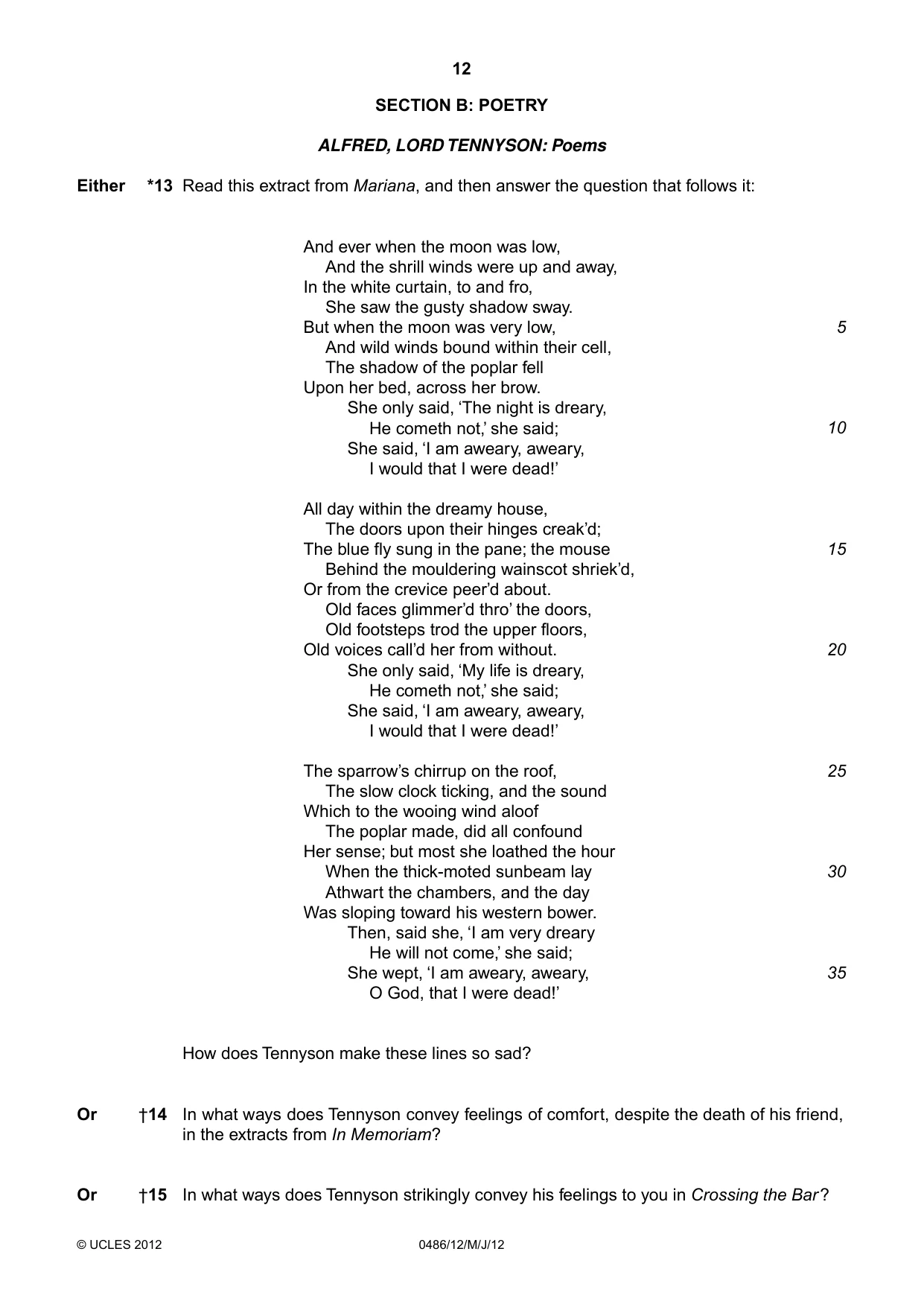
12 0486/12/M/J/12 © UCLES 2012 5 10 15 20 25 30 35 SECTION B: POETRY ALFRED, LORD TENNYSON: Poems Either *13 Read this extract from Mariana, and then answer the question that follows it: And ever when the moon was low, And the shrill winds were up and away, In the white curtain, to and fro, She saw the gusty shadow sway. But when the moon was very low, And wild winds bound within their cell, The shadow of the poplar fell Upon her bed, across her brow. She only said, ‘The night is dreary, He cometh not,’ she said; She said, ‘I am aweary, aweary, I would that I were dead!’ All day within the dreamy house, The doors upon their hinges creak’d; The blue fly sung in the pane; the mouse Behind the mouldering wainscot shriek’d, Or from the crevice peer’d about. Old faces glimmer’d thro’ the doors, Old footsteps trod the upper floors, Old voices call’d her from without. She only said, ‘My life is dreary, He cometh not,’ she said; She said, ‘I am aweary, aweary, I would that I were dead!’ The sparrow’s chirrup on the roof, The slow clock ticking, and the sound Which to the wooing wind aloof The poplar made, did all confound Her sense; but most she loathed the hour When the thick-moted sunbeam lay Athwart the chambers, and the day Was sloping toward his western bower. Then, said she, ‘I am very dreary He will not come,’ she said; She wept, ‘I am aweary, aweary, O God, that I were dead!’ How does Tennyson make these lines so sad? Or †14 In what ways does Tennyson convey feelings of comfort, despite the death of his friend, in the extracts from In Memoriam? Or †15 In what ways does Tennyson strikingly convey his feelings to you in Crossing the Bar ?
Question paper, page 13
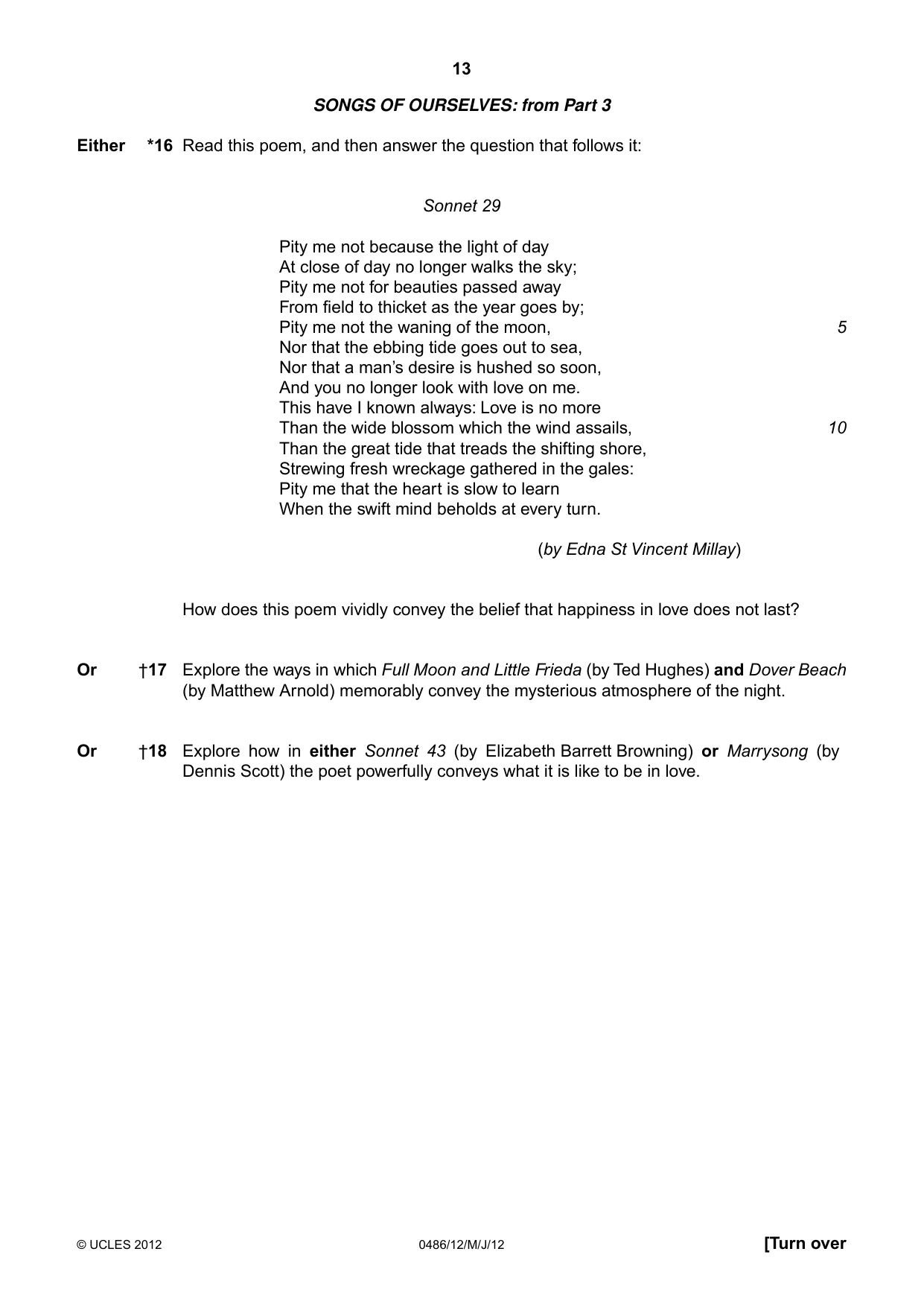
13 0486/12/M/J/12 © UCLES 2012 [Turn over 5 10 SONGS OF OURSELVES: from Part 3 Either *16 Read this poem, and then answer the question that follows it: Sonnet 29 Pity me not because the light of day At close of day no longer walks the sky; Pity me not for beauties passed away From field to thicket as the year goes by; Pity me not the waning of the moon, Nor that the ebbing tide goes out to sea, Nor that a man’s desire is hushed so soon, And you no longer look with love on me. This have I known always: Love is no more Than the wide blossom which the wind assails, Than the great tide that treads the shifting shore, Strewing fresh wreckage gathered in the gales: Pity me that the heart is slow to learn When the swift mind beholds at every turn. (by Edna St Vincent Millay) How does this poem vividly convey the belief that happiness in love does not last? Or †17 Explore the ways in which Full Moon and Little Frieda (by Ted Hughes) and Dover Beach (by Matthew Arnold) memorably convey the mysterious atmosphere of the night. Or †18 Explore how in either Sonnet 43 (by Elizabeth Barrett Browning) or Marrysong (by Dennis Scott) the poet powerfully conveys what it is like to be in love.
Question paper, page 14
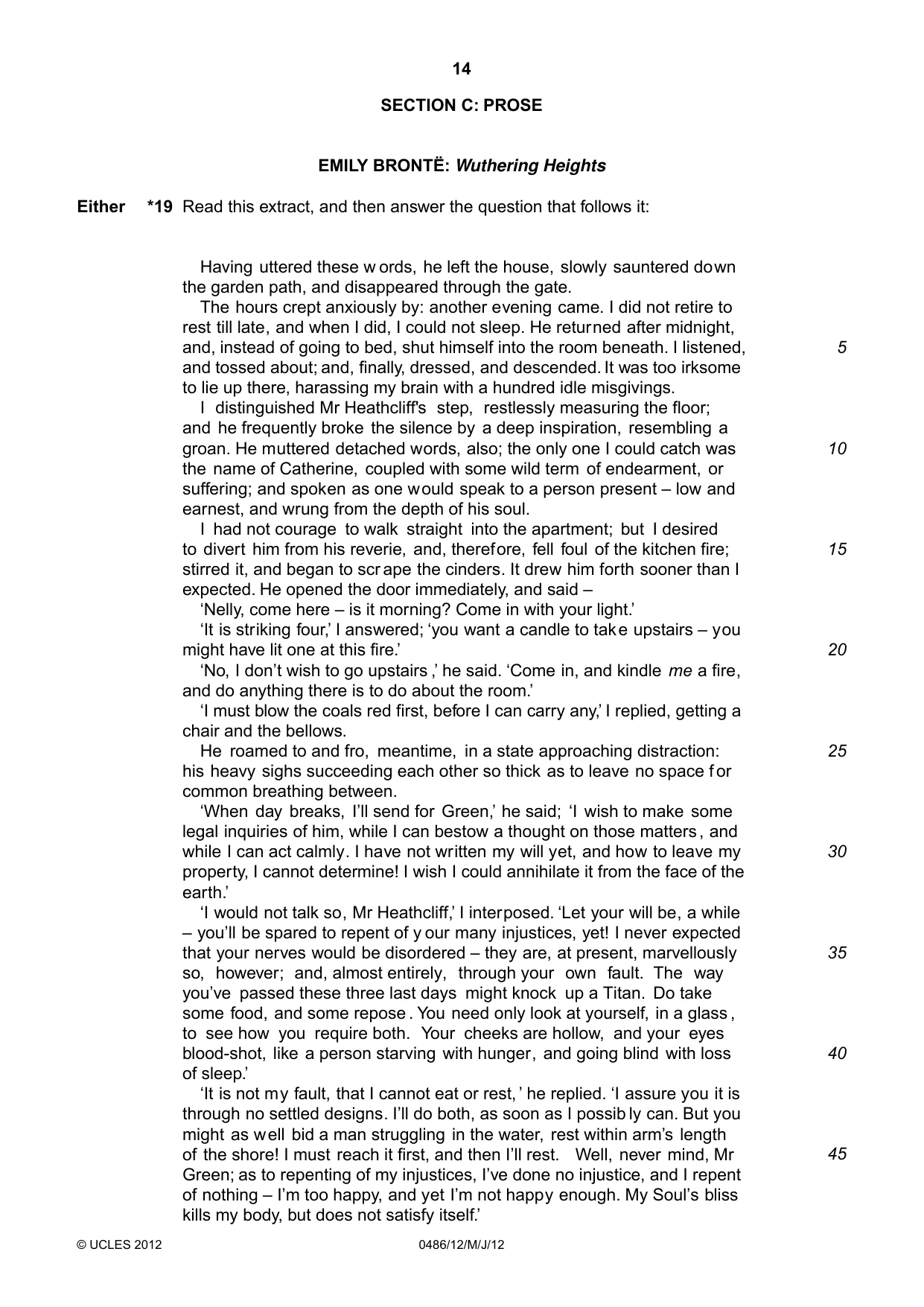
14 0486/12/M/J/12 © UCLES 2012 5 10 15 20 25 30 35 40 45 SECTION C: PROSE EMILY BRONTË: Wuthering Heights Either *19 Read this extract, and then answer the question that follows it: Having uttered these w ords, he left the house, slowly sauntered down the garden path, and disappeared through the gate. The hours crept anxiously by: another evening came. I did not retire to rest till late, and when I did, I could not sleep. He returned after midnight, and, instead of going to bed, shut himself into the room beneath. I listened, and tossed about; and, finally, dressed, and descended. It was too irksome to lie up there, harassing my brain with a hundred idle misgivings. I distinguished Mr Heathcliff's step, restlessly measuring the floor; and he frequently broke the silence by a deep inspiration, resembling a groan. He muttered detached words, also; the only one I could catch was the name of Catherine, coupled with some wild term of endearment, or suffering; and spoken as one would speak to a person present – low and earnest, and wrung from the depth of his soul. I had not courage to walk straight into the apartment; but I desired to divert him from his reverie, and, therefore, fell foul of the kitchen fire; stirred it, and began to scr ape the cinders. It drew him forth sooner than I expected. He opened the door immediately, and said – ‘Nelly, come here – is it morning? Come in with your light.’ ‘It is striking four,’ I answered; ‘you want a candle to take upstairs – you might have lit one at this fire.’ ‘No, I don’t wish to go upstairs ,’ he said. ‘Come in, and kindle me a fire, and do anything there is to do about the room.’ ‘I must blow the coals red first, before I can carry any,’ I replied, getting a chair and the bellows. He roamed to and fro, meantime, in a state approaching distraction: his heavy sighs succeeding each other so thick as to leave no space for common breathing between. ‘When day breaks, I’ll send for Green,’ he said; ‘I wish to make some legal inquiries of him, while I can bestow a thought on those matters, and while I can act calmly. I have not written my will yet, and how to leave my property, I cannot determine! I wish I could annihilate it from the face of the earth.’ ‘I would not talk so, Mr Heathcliff,’ I interposed. ‘Let your will be, a while – you’ll be spared to repent of y our many injustices, yet! I never expected that your nerves would be disordered – they are, at present, marvellously so, however; and, almost entirely, through your own fault. The way you’ve passed these three last days might knock up a Titan. Do take some food, and some repose . You need only look at yourself, in a glass , to see how you require both. Your cheeks are hollow, and your eyes blood-shot, like a person starving with hunger, and going blind with loss of sleep.’ ‘It is not my fault, that I cannot eat or rest,’ he replied. ‘I assure you it is through no settled designs. I’ll do both, as soon as I possib ly can. But you might as well bid a man struggling in the water, rest within arm’s length of the shore! I must reach it first, and then I’ll rest. Well, never mind, Mr Green; as to repenting of my injustices, I’ve done no injustice, and I repent of nothing – I’m too happy, and yet I’m not happy enough. My Soul’s bliss kills my body, but does not satisfy itself.’
Question paper, page 15
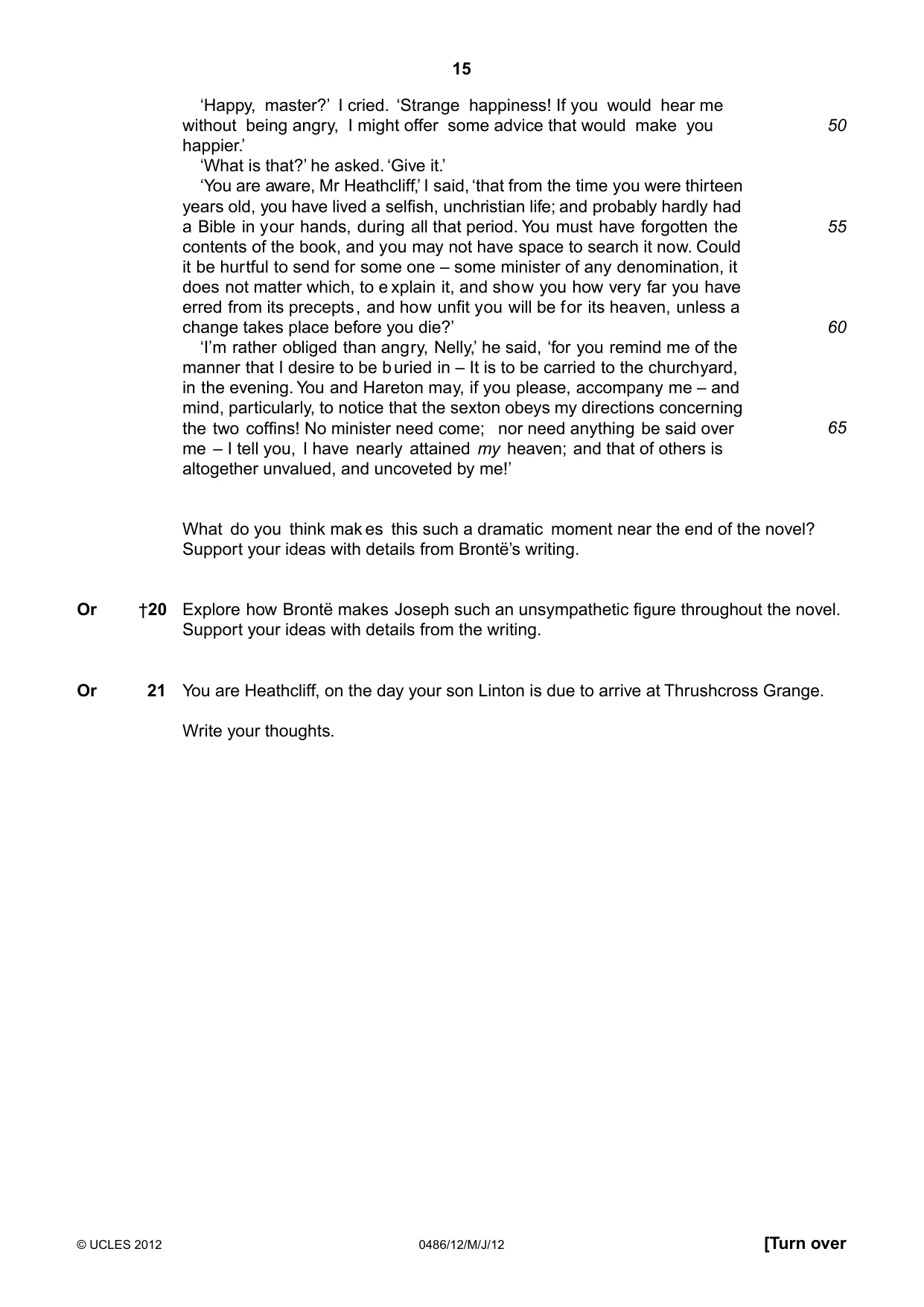
15 0486/12/M/J/12 © UCLES 2012 [Turn over 50 55 60 65 ‘Happy, master?’ I cried. ‘Strange happiness! If you would hear me without being angry, I might offer some advice that would make you happier.’ ‘What is that?’ he asked. ‘Give it.’ ‘You are aware, Mr Heathcliff,’ I said, ‘that from the time you were thirteen years old, you have lived a selfish, unchristian life; and probably hardly had a Bible in your hands, during all that period. You must have forgotten the contents of the book, and you may not have space to search it now. Could it be hurtful to send for some one – some minister of any denomination, it does not matter which, to e xplain it, and show you how very far you have erred from its precepts, and how unfit you will be for its heaven, unless a change takes place before you die?’ ‘I’m rather obliged than angry, Nelly,’ he said, ‘for you remind me of the manner that I desire to be buried in – It is to be carried to the churchyard, in the evening. You and Hareton may, if you please, accompany me – and mind, particularly, to notice that the sexton obeys my directions concerning the two coffins! No minister need come; nor need anything be said over me – I tell you, I have nearly attained my heaven; and that of others is altogether unvalued, and uncoveted by me!’ What do you think mak es this such a dramatic moment near the end of the novel? Support your ideas with details from Brontë’s writing. Or †20 Explore how Brontë makes Joseph such an unsympathetic figure throughout the novel. Support your ideas with details from the writing. Or 21 You are Heathcliff, on the day your son Linton is due to arrive at Thrushcross Grange. Write your thoughts.
Question paper, page 16
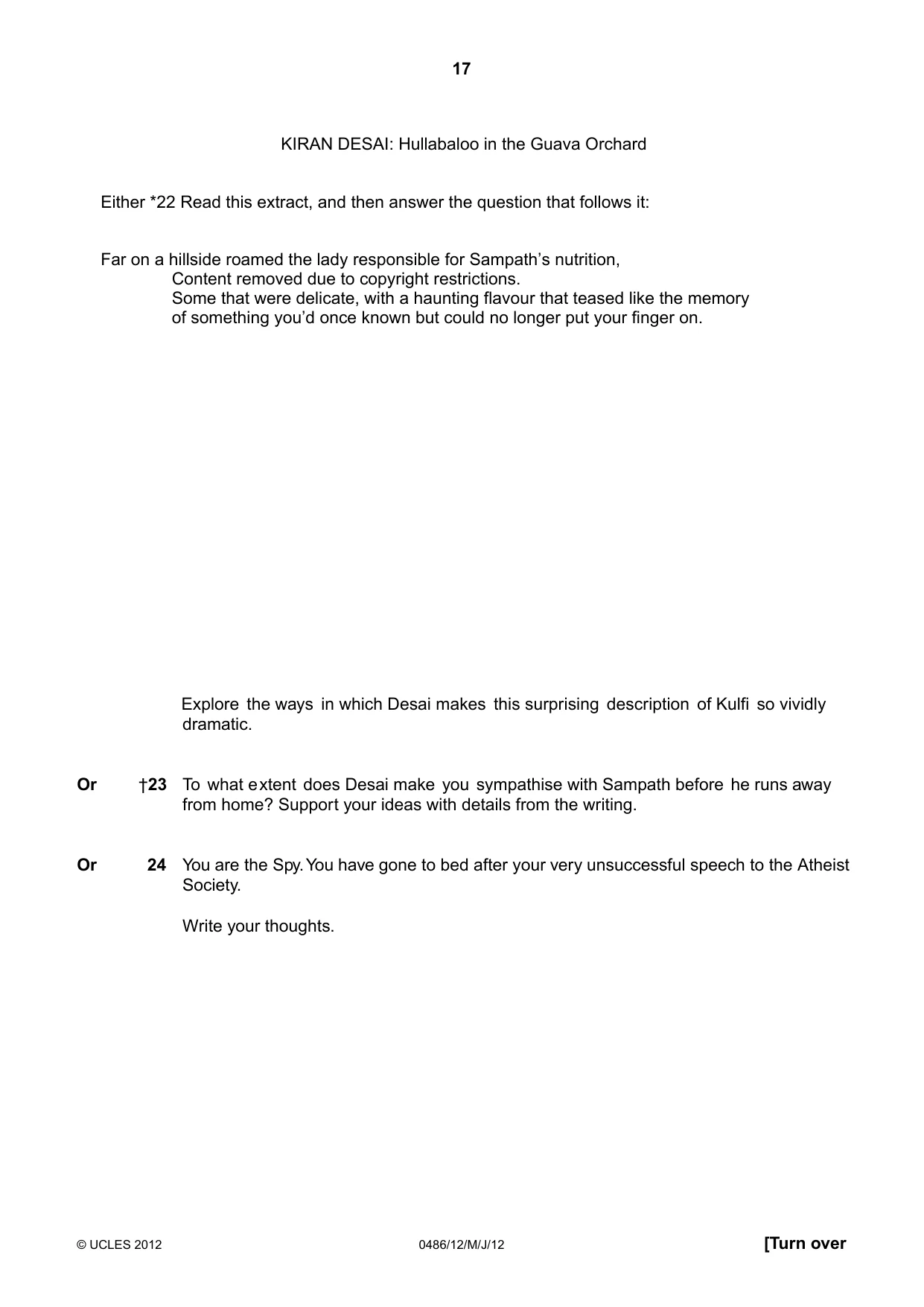
17 0486/12/M/J/12 © UCLES 2012 [Turn over KIRAN DESAI: Hullabaloo in the Guava Orchard Either *22 Read this extract, and then answer the question that follows it: Far on a hillside roamed the lady responsible for Sampath’s nutrition, Content removed due to copyright restrictions. Some that were delicate, with a haunting flavour that teased like the memory of something you’d once known but could no longer put your finger on. 22 Explore the ways in which Desai makes this surprising description of Kulfi so vividly dramatic. Or †23 To what extent does Desai make you sympathise with Sampath before he runs away from home? Support your ideas with details from the writing. Or 24 You are the Spy. You have gone to bed after your very unsuccessful speech to the Atheist Society. Write your thoughts.
Question paper, page 17
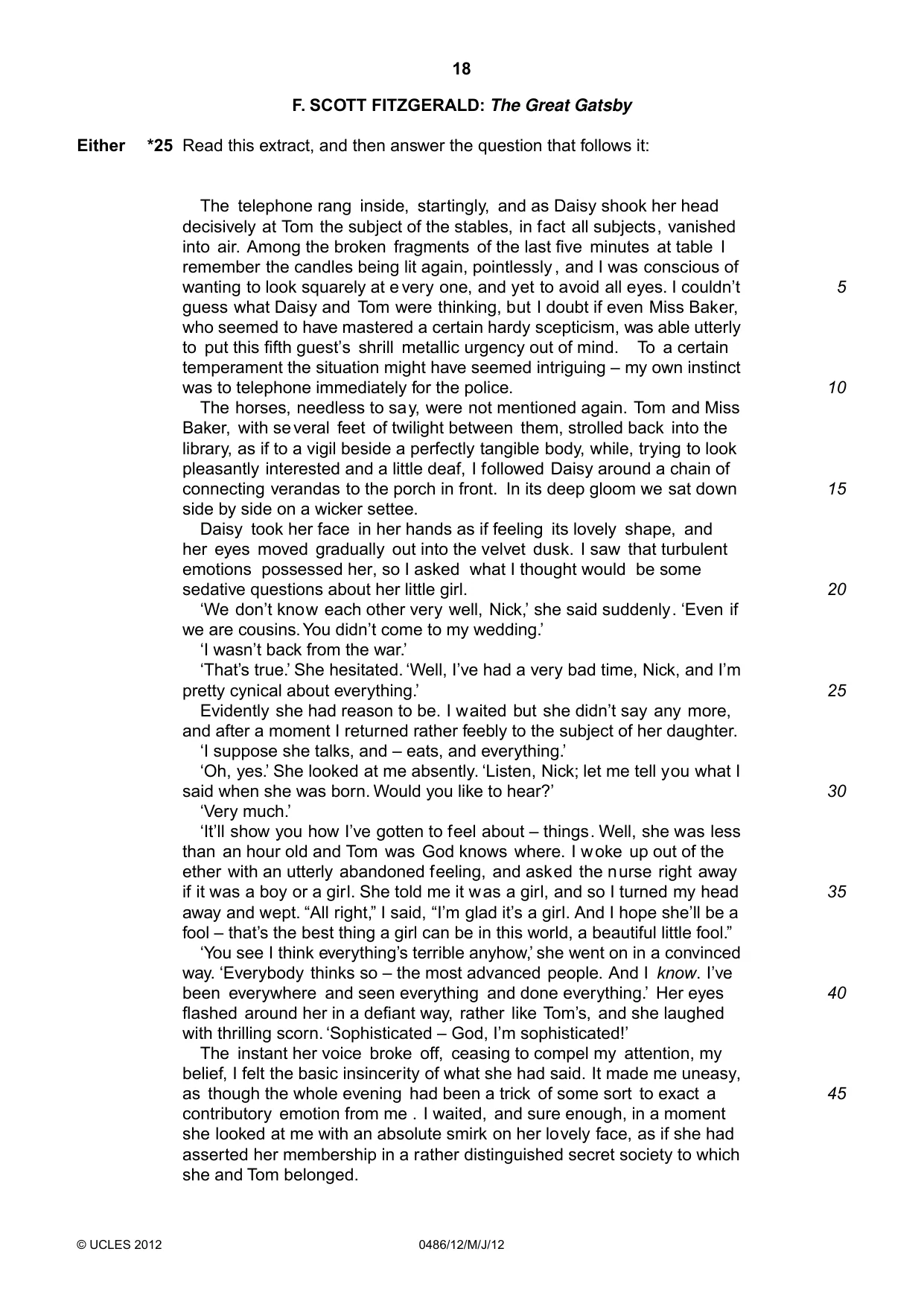
18 0486/12/M/J/12 © UCLES 2012 5 10 15 20 25 30 35 40 45 F. SCOTT FITZGERALD: The Great Gatsby Either *25 Read this extract, and then answer the question that follows it: The telephone rang inside, startingly, and as Daisy shook her head decisively at Tom the subject of the stables, in fact all subjects, vanished into air. Among the broken fragments of the last five minutes at table I remember the candles being lit again, pointlessly , and I was conscious of wanting to look squarely at every one, and yet to avoid all eyes. I couldn’t guess what Daisy and Tom were thinking, but I doubt if even Miss Baker, who seemed to have mastered a certain hardy scepticism, was able utterly to put this fifth guest’s shrill metallic urgency out of mind. To a certain temperament the situation might have seemed intriguing – my own instinct was to telephone immediately for the police. The horses, needless to say, were not mentioned again. Tom and Miss Baker, with several feet of twilight between them, strolled back into the library, as if to a vigil beside a perfectly tangible body, while, trying to look pleasantly interested and a little deaf, I followed Daisy around a chain of connecting verandas to the porch in front. In its deep gloom we sat down side by side on a wicker settee. Daisy took her face in her hands as if feeling its lovely shape, and her eyes moved gradually out into the velvet dusk. I saw that turbulent emotions possessed her, so I asked what I thought would be some sedative questions about her little girl. ‘We don’t know each other very well, Nick,’ she said suddenly. ‘Even if we are cousins. You didn’t come to my wedding.’ ‘I wasn’t back from the war.’ ‘That’s true.’ She hesitated. ‘Well, I’ve had a very bad time, Nick, and I’m pretty cynical about everything.’ Evidently she had reason to be. I waited but she didn’t say any more, and after a moment I returned rather feebly to the subject of her daughter. ‘I suppose she talks, and – eats, and everything.’ ‘Oh, yes.’ She looked at me absently. ‘Listen, Nick; let me tell you what I said when she was born. Would you like to hear?’ ‘Very much.’ ‘It’ll show you how I’ve gotten to feel about – things. Well, she was less than an hour old and Tom was God knows where. I woke up out of the ether with an utterly abandoned feeling, and asked the nurse right away if it was a boy or a girl. She told me it was a girl, and so I turned my head away and wept. “All right,” I said, “I’m glad it’s a girl. And I hope she’ll be a fool – that’s the best thing a girl can be in this world, a beautiful little fool.” ‘You see I think everything’s terrible anyhow,’ she went on in a convinced way. ‘Everybody thinks so – the most advanced people. And I know. I’ve been everywhere and seen everything and done everything.’ Her eyes flashed around her in a defiant way, rather like Tom’s, and she laughed with thrilling scorn. ‘Sophisticated – God, I’m sophisticated!’ The instant her voice broke off, ceasing to compel my attention, my belief, I felt the basic insincerity of what she had said. It made me uneasy, as though the whole evening had been a trick of some sort to exact a contributory emotion from me . I waited, and sure enough, in a moment she looked at me with an absolute smirk on her lovely face, as if she had asserted her membership in a rather distinguished secret society to which she and Tom belonged.
Question paper, page 18
19 0486/12/M/J/12 © UCLES 2012 [Turn over What does Fitzgerald make you feel about Daisy at this moment in the novel? Support your answer with details from the writing. Or †26 Does Fitzgerald lead you to think that Jay Gatsby deserves his fate? Support your answer by close reference to the novel. Or 27 You are Tom Buchanan towards the end of the novel. You and Daisy have just left without leaving an address. Write your thoughts.
Question paper, page 19
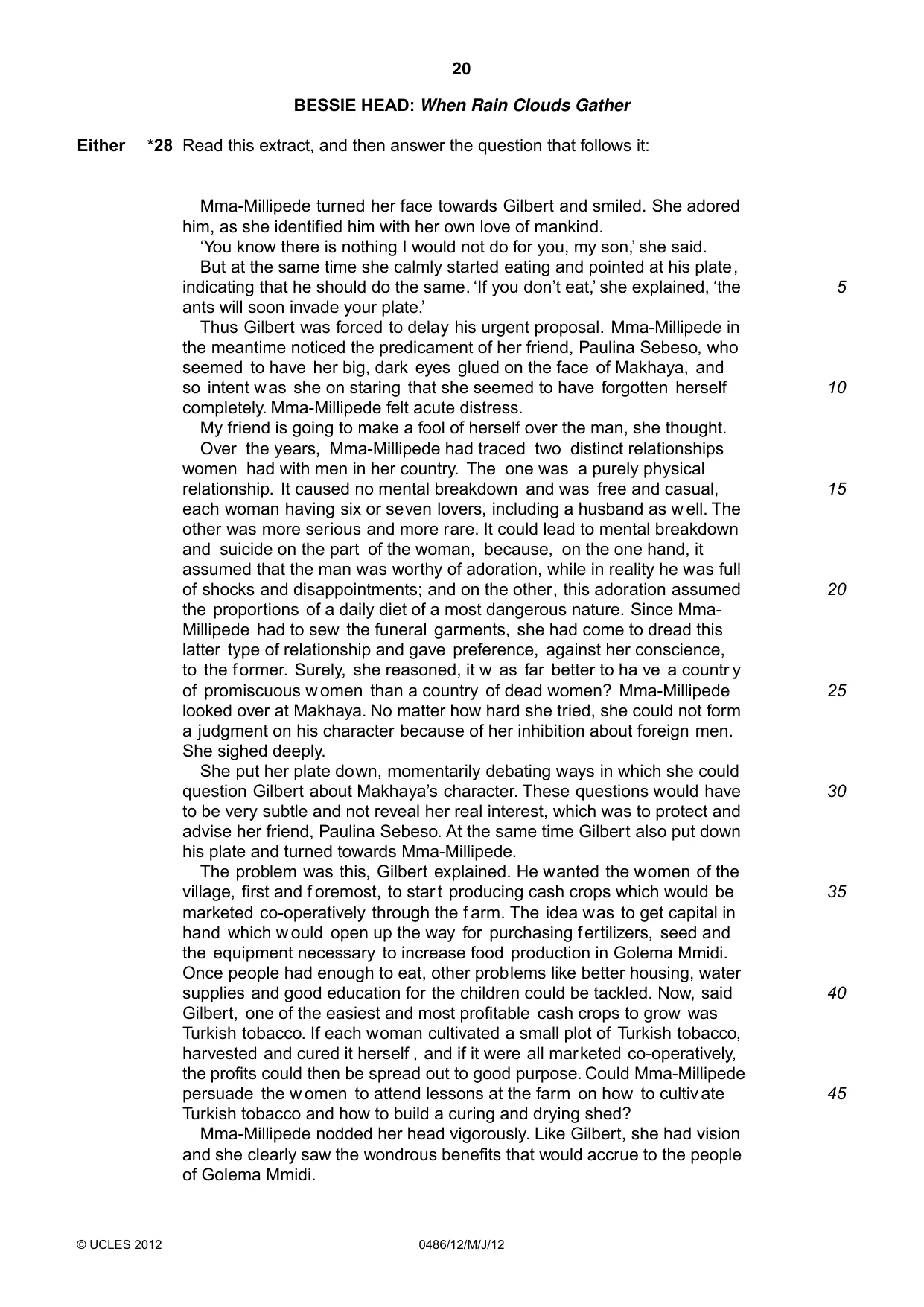
20 0486/12/M/J/12 © UCLES 2012 5 10 15 20 25 30 35 40 45 BESSIE HEAD: When Rain Clouds Gather Either *28 Read this extract, and then answer the question that follows it: Mma-Millipede turned her face towards Gilbert and smiled. She adored him, as she identified him with her own love of mankind. ‘You know there is nothing I would not do for you, my son,’ she said. But at the same time she calmly started eating and pointed at his plate, indicating that he should do the same. ‘If you don’t eat,’ she explained, ‘the ants will soon invade your plate.’ Thus Gilbert was forced to delay his urgent proposal. Mma-Millipede in the meantime noticed the predicament of her friend, Paulina Sebeso, who seemed to have her big, dark eyes glued on the face of Makhaya, and so intent was she on staring that she seemed to have forgotten herself completely. Mma-Millipede felt acute distress. My friend is going to make a fool of herself over the man, she thought. Over the years, Mma-Millipede had traced two distinct relationships women had with men in her country. The one was a purely physical relationship. It caused no mental breakdown and was free and casual, each woman having six or seven lovers, including a husband as well. The other was more serious and more rare. It could lead to mental breakdown and suicide on the part of the woman, because, on the one hand, it assumed that the man was worthy of adoration, while in reality he was full of shocks and disappointments; and on the other, this adoration assumed the proportions of a daily diet of a most dangerous nature. Since Mma- Millipede had to sew the funeral garments, she had come to dread this latter type of relationship and gave preference, against her conscience, to the former. Surely, she reasoned, it w as far better to ha ve a countr y of promiscuous women than a country of dead women? Mma-Millipede looked over at Makhaya. No matter how hard she tried, she could not form a judgment on his character because of her inhibition about foreign men. She sighed deeply. She put her plate down, momentarily debating ways in which she could question Gilbert about Makhaya’s character. These questions would have to be very subtle and not reveal her real interest, which was to protect and advise her friend, Paulina Sebeso. At the same time Gilbert also put down his plate and turned towards Mma-Millipede. The problem was this, Gilbert explained. He wanted the women of the village, first and f oremost, to start producing cash crops which would be marketed co-operatively through the f arm. The idea was to get capital in hand which would open up the way for purchasing fertilizers, seed and the equipment necessary to increase food production in Golema Mmidi. Once people had enough to eat, other problems like better housing, water supplies and good education for the children could be tackled. Now, said Gilbert, one of the easiest and most profitable cash crops to grow was Turkish tobacco. If each woman cultivated a small plot of Turkish tobacco, harvested and cured it herself , and if it were all marketed co-operatively, the profits could then be spread out to good purpose. Could Mma-Millipede persuade the w omen to attend lessons at the farm on how to cultivate Turkish tobacco and how to build a curing and drying shed? Mma-Millipede nodded her head vigorously. Like Gilbert, she had vision and she clearly saw the wondrous benefits that would accrue to the people of Golema Mmidi.
Question paper, page 20
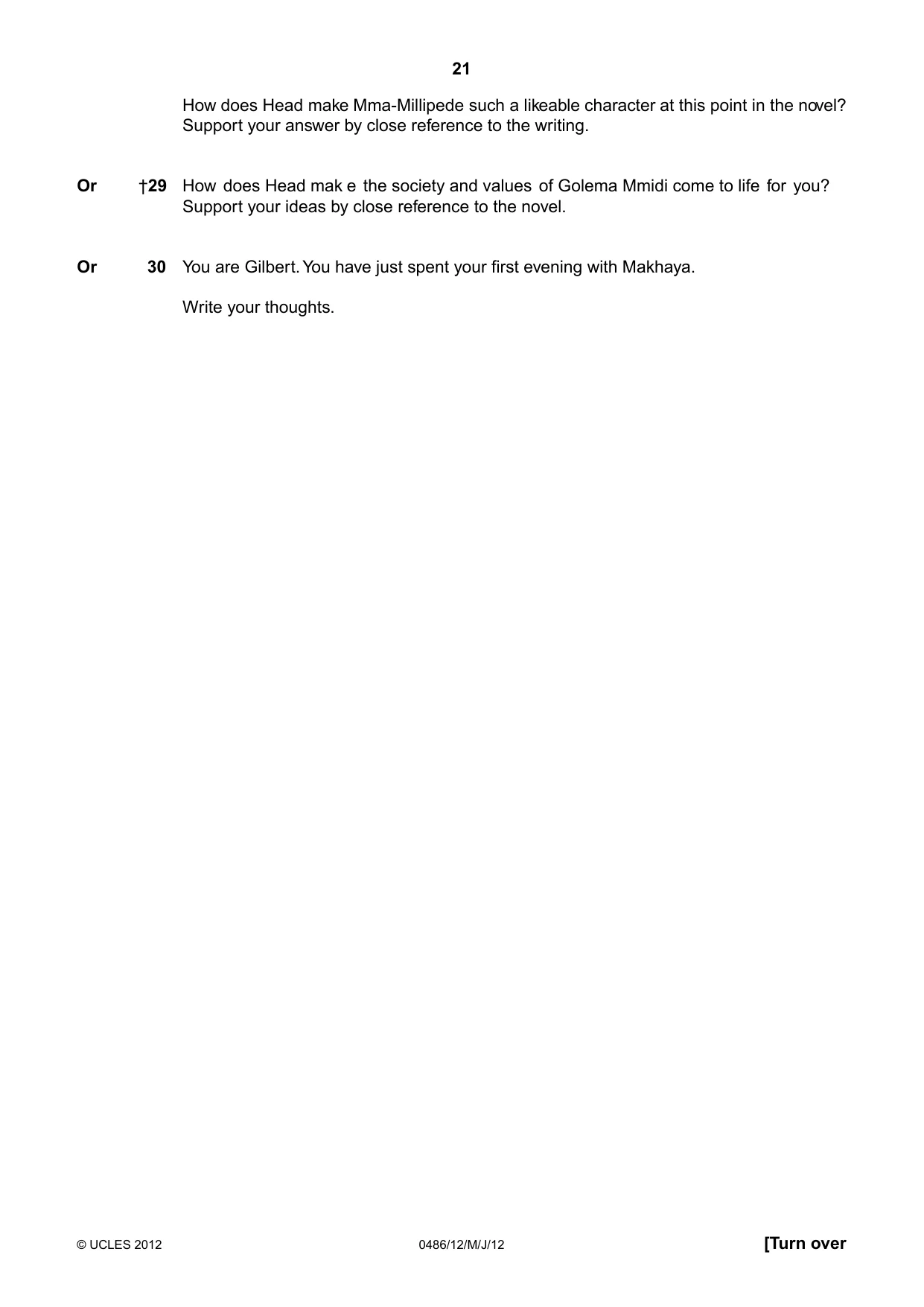
21 0486/12/M/J/12 © UCLES 2012 [Turn over How does Head make Mma-Millipede such a likeable character at this point in the novel? Support your answer by close reference to the writing. Or †29 How does Head mak e the society and values of Golema Mmidi come to life for you? Support your ideas by close reference to the novel. Or 30 You are Gilbert. You have just spent your first evening with Makhaya. Write your thoughts.
Question paper, page 21
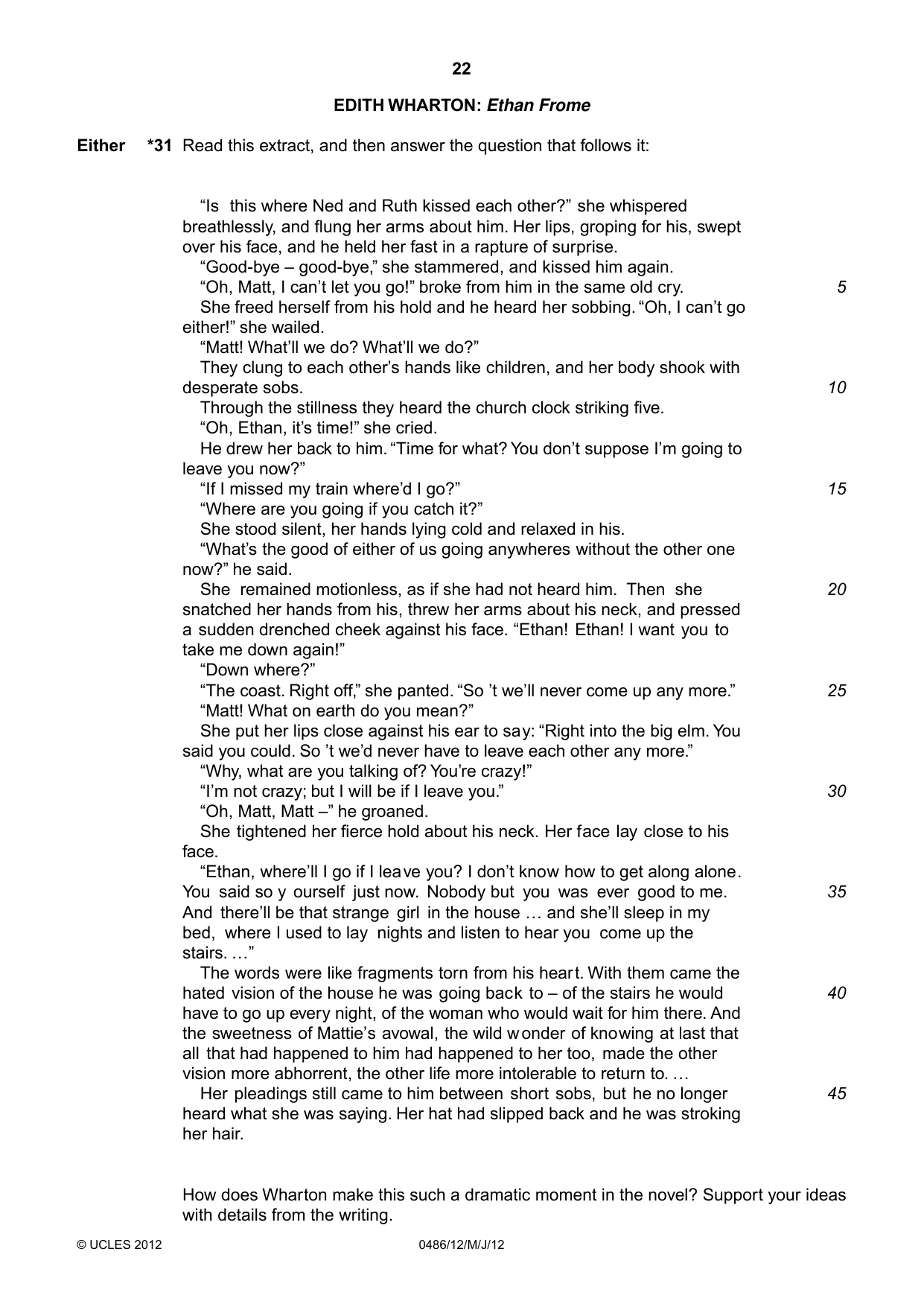
22 0486/12/M/J/12 © UCLES 2012 5 10 15 20 25 30 35 40 45 EDITH WHARTON: Ethan Frome Either *31 Read this extract, and then answer the question that follows it: “Is this where Ned and Ruth kissed each other?” she whispered breathlessly, and flung her arms about him. Her lips, groping for his, swept over his face, and he held her fast in a rapture of surprise. “Good-bye – good-bye,” she stammered, and kissed him again. “Oh, Matt, I can’t let you go!” broke from him in the same old cry. She freed herself from his hold and he heard her sobbing. “Oh, I can’t go either!” she wailed. “Matt! What’ll we do? What’ll we do?” They clung to each other’s hands like children, and her body shook with desperate sobs. Through the stillness they heard the church clock striking five. “Oh, Ethan, it’s time!” she cried. He drew her back to him. “Time for what? You don’t suppose I’m going to leave you now?” “If I missed my train where’d I go?” “Where are you going if you catch it?” She stood silent, her hands lying cold and relaxed in his. “What’s the good of either of us going anywheres without the other one now?” he said. She remained motionless, as if she had not heard him. Then she snatched her hands from his, threw her arms about his neck, and pressed a sudden drenched cheek against his face. “Ethan! Ethan! I want you to take me down again!” “Down where?” “The coast. Right off,” she panted. “So ’t we’ll never come up any more.” “Matt! What on earth do you mean?” She put her lips close against his ear to say: “Right into the big elm. You said you could. So ’t we’d never have to leave each other any more.” “Why, what are you talking of? You’re crazy!” “I’m not crazy; but I will be if I leave you.” “Oh, Matt, Matt –” he groaned. She tightened her fierce hold about his neck. Her face lay close to his face. “Ethan, where’ll I go if I leave you? I don’t know how to get along alone. You said so y ourself just now. Nobody but you was ever good to me. And there’ll be that strange girl in the house … and she’ll sleep in my bed, where I used to lay nights and listen to hear you come up the stairs. …” The words were like fragments torn from his heart. With them came the hated vision of the house he was going back to – of the stairs he would have to go up every night, of the woman who would wait for him there. And the sweetness of Mattie’s avowal, the wild wonder of knowing at last that all that had happened to him had happened to her too, made the other vision more abhorrent, the other life more intolerable to return to. … Her pleadings still came to him between short sobs, but he no longer heard what she was saying. Her hat had slipped back and he was stroking her hair. How does Wharton make this such a dramatic moment in the novel? Support your ideas with details from the writing.
Question paper, page 22
23 0486/12/M/J/12 © UCLES 2012 [Turn over Or †32 To what extent do you think Wharton suggests that Ethan is himself responsible for being a failure? Support your ideas with details from the writing. Or 33 You are Zeena, at the moment when Ethan steps into the kitchen bringing a visitor (the narrator). Write your thoughts.
Question paper, page 23
24 0486/12/M/J/12 © UCLES 2012 Either *34 Read this extract from There Will Come Soft Rains, and then answer the question that follows it: At ten o'clock the house began to die. Content removed due to copyright restrictions. `Today is August 5, 2026, today is August 5, 2026, today is …' How does Bradbury make this such a powerful ending to the story?
Question paper, page 24
25 0486/12/M/J/12 © UCLES 2012 34 How does Bradbury make this such a powerful ending to the story? Or †35 Explore in detail the ways in which the writer memorably portrays suffering in either The Yellow Wall Paper (by Charlotte Perkins Gilman) or The Lemon Orchard (by Alex La Guma). Or 36 You are Mother in On Her Knees (by Tim Winton). You have just read the note from your employer. Write your thoughts.
Question paper, page 25
28 0486/12/M/J/12 © UCLES 2012 Copyright Acknowledgements: Question 1 Death of a Salesman; © 1949, Arthur Miller; Published by Heinemann; Reproduced by permission of The Wylie Agency. All rights reserved. Question 16 © Edna St Vincent Millay; Sonnet 29, in, Songs of Ourselves; Foundation Books; 2005. Question 22 © Kiran Desai; Hullabaloo in the Guava Orchard; Faber & Faber Ltd; 1998. Question 28 © Bessie Head; When Rainclouds Gather; Heinemann; 1969. Question 34 © Ray Bradbury; There Will Come Soft Rains, in, Stories of Ourselves; Foundation Books; 2008; Reprinted by permission of Don Congdon Associates, Inc. © 1950 by Crowell Collier Company, renewed 1977 by Ray Bradbury. Permission to reproduce items where third-par ty owned material protected b y copyright is included has been sought and cleared w here possible. Every reasonable effort has been made b y the publisher (UCLES) to trace copyright holders, but if any items requiring clearance have unwittingly been included, the publisher will be pleased to make amends at the earliest possible opportunity. University of Cambridge International Examinations is par t of the Cambr idge Assessment Group. Cambridge Assessment is the br and name of Univ ersity of Cambridge Local Examinations Syndicate (UCLES), which is itself a department of the University of Cambridge. BLANK PAGE
Mark scheme, page 1
UNIVERSITY OF CAMBRIDGE INTERNATIONAL EXAMINATIONS International General Certificate of Secondary Education MARK SCHEME for the May/June 2012 question paper for the guidance of teachers 0486 LITERATURE (ENGLISH) 0486/12 Paper 1 (Set Texts: Open Books), maximum raw mark 75 This mark scheme is published as an aid to teachers and candidates, to indicate the requirements of the examination. It shows the basis on which Examiners were instructed to award marks. It does not indicate the details of the discussions that took place at an Examiners’ meeting before marking began, which would have considered the acceptability of alternative answers. Mark schemes must be read in conjunction with the question papers and the report on the examination. • Cambridge will not enter into discussions or correspondence in connection with these mark schemes. Cambridge is publishing the mark schemes for the May/June 2012 question papers for most IGCSE, GCE Advanced Level and Advanced Subsidiary Level syllabuses and some Ordinary Level syllabuses. www.XtremePapers.com
Mark scheme, page 2
Page 2 Mark Scheme: Teachers’ version Syllabus Paper IGCSE – May/June 2012 0486 12 © University of Cambridge International Examinations 2012 All questions on this paper are marked out of 25. The assessment objectives for the paper are: AO1 show detailed knowledge of the content of literary texts AO2 understand the meanings of literary texts and their context, and explore texts beyond surface meaning to show deeper awareness of ideas and attitudes AO3 recognise and appreciate ways in which writers use language, structure, and form to create and shape meanings and effects AO4 communicate a sensitive and informed personal response The General Descriptors cover marks from 0 to 25, and apply to the marking of each question. They guide examiners to an understanding of the qualities normally expected of, or typical of, work in a band. They are a means of general guidance, and must not be interpreted as hurdle statements. For the purposes of standardisation of marking, they are to be used in conjunction with photostats of candidates’ work produced in the examination and discussed during the examiners’ coordination meeting.
Mark scheme, page 3
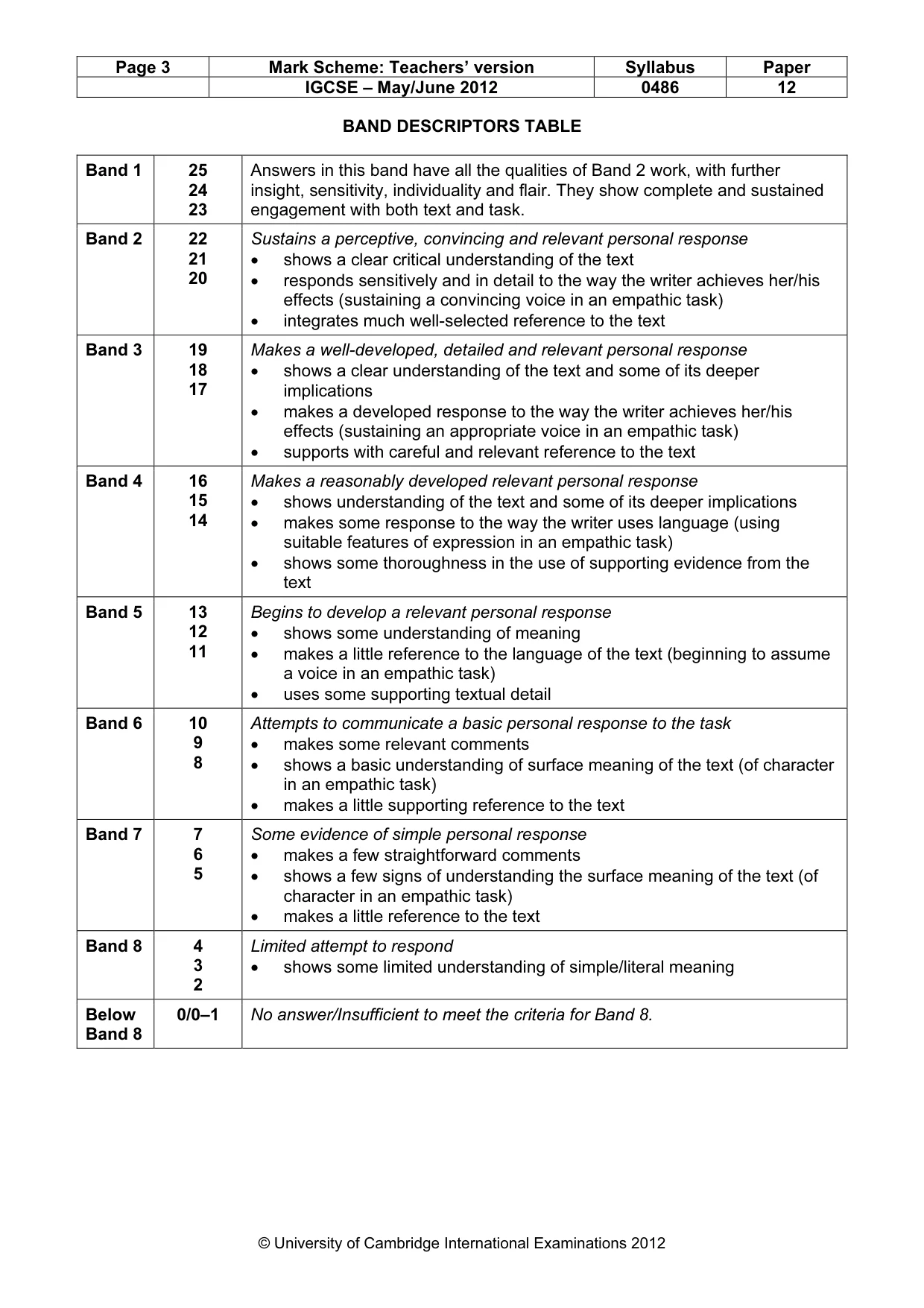
Page 3 Mark Scheme: Teachers’ version Syllabus Paper IGCSE – May/June 2012 0486 12 © University of Cambridge International Examinations 2012 BAND DESCRIPTORS TABLE Band 1 25 24 23 Answers in this band have all the qualities of Band 2 work, with further insight, sensitivity, individuality and flair. They show complete and sustained engagement with both text and task. Band 2 22 21 20 Sustains a perceptive, convincing and relevant personal response • shows a clear critical understanding of the text • responds sensitively and in detail to the way the writer achieves her/his effects (sustaining a convincing voice in an empathic task) • integrates much well-selected reference to the text Band 3 19 18 17 Makes a well-developed, detailed and relevant personal response • shows a clear understanding of the text and some of its deeper implications • makes a developed response to the way the writer achieves her/his effects (sustaining an appropriate voice in an empathic task) • supports with careful and relevant reference to the text Band 4 16 15 14 Makes a reasonably developed relevant personal response • shows understanding of the text and some of its deeper implications • makes some response to the way the writer uses language (using suitable features of expression in an empathic task) • shows some thoroughness in the use of supporting evidence from the text Band 5 13 12 11 Begins to develop a relevant personal response • shows some understanding of meaning • makes a little reference to the language of the text (beginning to assume a voice in an empathic task) • uses some supporting textual detail Band 6 10 9 8 Attempts to communicate a basic personal response to the task • makes some relevant comments • shows a basic understanding of surface meaning of the text (of character in an empathic task) • makes a little supporting reference to the text Band 7 7 6 5 Some evidence of simple personal response • makes a few straightforward comments • shows a few signs of understanding the surface meaning of the text (of character in an empathic task) • makes a little reference to the text Band 8 4 3 2 Limited attempt to respond • shows some limited understanding of simple/literal meaning Below Band 8 0/0–1 No answer/Insufficient to meet the criteria for Band 8.
What you needed in this session
Cambridge’s own grade thresholds for 2012 May/June, Paper 1 · Variant 2. A higher threshold means an easier paper — the bar moves with how the cohort did.