Cambridge IGCSE English - First Language (BES) 0524 — 2019 May/June Paper 2 · Variant 3
0524/23/M/J/19 · 50 marks · ≈56 min
The question paper and its mark scheme, free to read here and free to download. This is Cambridge’s own paper, exactly as it was sat.
Question paper12 pages
Mark scheme14 pages
Answers below. Sit the paper first if you are practising.
Paper as text
Question paper, page 1
This document consists of 12 printed pages and 1 Reading Booklet Insert. DC (ST) 181371 © UCLES 2019 [Turn over Cambridge Assessment International Education Cambridge International General Certificate of Secondary Education * 4 8 7 4 9 1 5 7 7 0 * FIRST LANGUAGE ENGLISH (US) 0524/23 Paper 2 Reading Passages (Extended) May/June 2019 2 hours Candidates answer on the Question Paper. Additional Materials: Reading Booklet Insert READ THESE INSTRUCTIONS FIRST Write your center number, candidate number and name in the spaces provided. Write in dark blue or black pen. Do not use staples, paper clips, glue or white-out. DO NOT WRITE IN ANY BARCODES. Answer all questions in the space provided. If additional space is required, you should use the lined pages at the end of the booklet. The question number(s) must be clearly shown. Dictionaries are not permitted. The Reading Booklet Insert contains the reading passages for use with all questions on this Question Paper. The Reading Booklet Insert is not assessed by the Examiner. The number of marks is given in brackets [ ] at the end of each question or part question.
Question paper, page 2
2 0524/23/M/J/19 © UCLES 2019 Read carefully Passage A, Thirst, in the Reading Booklet Insert and then answer Questions 1 and 2 on this Question Paper. Question 1 You are a journalist writing for the local weekly newspaper reporting on recent events and reactions to them. Two days after the incident at Aljafar’s property, it is announced that the blockade has been lifted and water rationing is no longer required. Meanwhile, Aljafar and his wife have complained to the authorities. Write the newspaper report. In your newspaper report, you should: • describe conditions during the blockade and the effect on the population of the island and its economy • outline how the incident at the Aljafars’ came about – what happened and why • explain the nature of the Aljafars’ complaints and how far they are justified. Base your newspaper report on what you have read in Passage A, but be careful to use your own words. Address each of the three bullet points. Begin your newspaper report, ‘Recent events …’ Write about 250 to 350 words. Up to 15 marks are available for the content of your answer, and up to 5 marks for the quality of your writing. … … … … … … … … … … … … … …
Question paper, page 3
3 0524/23/M/J/19 © UCLES 2019 [Turn over … … … … … … … … … … … … … … … … … … … … … … … … … … … …
Question paper, page 4
4 0524/23/M/J/19 © UCLES 2019 … … … … … … … … … … … … … … … … … … … … … … … … … … … [Total: 20]
Question paper, page 5
5 0524/23/M/J/19 © UCLES 2019 [Turn over [Turn to page 6 for Question 2]
Question paper, page 6
6 0524/23/M/J/19 © UCLES 2019 Question 2 Re-read the descriptions of: (a) the city and people in paragraph 12, beginning ‘Days later, …’ (b) Aljafar, the cellar and its contents in paragraph 30, beginning ‘We heard him …’ Select four powerful words or phrases from each paragraph. Your choices should include imagery. Explain how each word or phrase selected is used effectively in the context. Write about 200 to 300 words. Up to 10 marks are available for the content of your answer. … … … … … … … … … … … … … … … … … … … …
Question paper, page 7
7 0524/23/M/J/19 © UCLES 2019 [Turn over … … … … … … … … … … … … … … … … … … … … … … … … … … … [Total: 10]
Question paper, page 8
8 0524/23/M/J/19 © UCLES 2019 Read carefully Passage B, Bottled water, in the Reading Booklet Insert and then answer Question 3 on this Question Paper. Question 3 Why has drinking bottled water become so popular and what problems does the consumption of bottled water cause, according to Passage B? You must use continuous writing (not note form) and use your own words as far as possible. Your summary should not be more than 250 words. Up to 15 marks are available for the content of your answer, and up to 5 marks for the quality of your writing. … … … … … … … … … … … … … … … … … … … …
Question paper, page 9
9 0524/23/M/J/19 © UCLES 2019 … … … … … … … … … … … … … [Total: 20]
Question paper, page 10
10 0524/23/M/J/19 © UCLES 2019 Additional Page If you use the following lined page to complete the answer(s) to any question(s), the question number(s) must be clearly shown. … … … … … … … … … … … … … … … … … … … … … … … … … …
Question paper, page 11
11 0524/23/M/J/19 © UCLES 2019 Additional Page If you use the following lined page to complete the answer(s) to any question(s), the question number(s) must be clearly shown. … … … … … … … … … … … … … … … … … … … … … … … … … …
Question paper, page 12
12 0524/23/M/J/19 © UCLES 2019 Permission to reproduce items where third-party owned material protected by copyright is included has been sought and cleared where possible. Every reasonable effort has been made by the publisher (UCLES) to trace copyright holders, but if any items requiring clearance have unwittingly been included, the publisher will be pleased to make amends at the earliest possible opportunity. To avoid the issue of disclosure of answer-related information to candidates, all copyright acknowledgements are reproduced online in the Cambridge Assessment International Education Copyright Acknowledgements Booklet. This is produced for each series of examinations and is freely available to download at www.cambridgeinternational.org after the live examination series. Cambridge Assessment International Education is part of the Cambridge Assessment Group. Cambridge Assessment is the brand name of the University of Cambridge Local Examinations Syndicate (UCLES), which itself is a department of the University of Cambridge. Additional Page If you use the following lined page to complete the answer(s) to any question(s), the question number(s) must be clearly shown. … … … … … … … … … … … … … … … … … … … … … …
Mark scheme, page 1
This document consists of 14 printed pages. © UCLES 2019 [Turn over Cambridge Assessment International Education Cambridge International General Certificate of Secondary Education FIRST LANGUAGE ENGLISH (US) 0524/23 Paper 2 Reading Passages (Extended) May/June 2019 MARK SCHEME Maximum Mark: 50 Published This mark scheme is published as an aid to teachers and candidates, to indicate the requirements of the examination. It shows the basis on which Examiners were instructed to award marks. It does not indicate the details of the discussions that took place at an Examiners’ meeting before marking began, which would have considered the acceptability of alternative answers. Mark schemes should be read in conjunction with the question paper and the Principal Examiner Report for Teachers. Cambridge International will not enter into discussions about these mark schemes. Cambridge International is publishing the mark schemes for the May/June 2019 series for most Cambridge IGCSE™, Cambridge International A and AS Level and Cambridge Pre-U components, and some Cambridge O Level components.
Mark scheme, page 2
0524/23 Cambridge IGCSE – Mark Scheme PUBLISHED May/June 2019 © UCLES 2019 Page 2 of 14 Generic Marking Principles These general marking principles must be applied by all examiners when marking candidate answers. They should be applied alongside the specific content of the mark scheme or generic level descriptors for a question. Each question paper and mark scheme will also comply with these marking principles. GENERIC MARKING PRINCIPLE 1: Marks must be awarded in line with: • the specific content of the mark scheme or the generic level descriptors for the question • the specific skills defined in the mark scheme or in the generic level descriptors for the question • the standard of response required by a candidate as exemplified by the standardisation scripts. GENERIC MARKING PRINCIPLE 2: Marks awarded are always whole marks (not half marks, or other fractions). GENERIC MARKING PRINCIPLE 3: Marks must be awarded positively: • marks are awarded for correct/valid answers, as defined in the mark scheme. However, credit is given for valid answers which go beyond the scope of the syllabus and mark scheme, referring to your Team Leader as appropriate • marks are awarded when candidates clearly demonstrate what they know and can do • marks are not deducted for errors • marks are not deducted for omissions • answers should only be judged on the quality of spelling, punctuation and grammar when these features are specifically assessed by the question as indicated by the mark scheme. The meaning, however, should be unambiguous. GENERIC MARKING PRINCIPLE 4: Rules must be applied consistently e.g. in situations where candidates have not followed instructions or in the application of generic level descriptors. GENERIC MARKING PRINCIPLE 5: Marks should be awarded using the full range of marks defined in the mark scheme for the question (however; the use of the full mark range may be limited according to the quality of the candidate responses seen). GENERIC MARKING PRINCIPLE 6: Marks awarded are based solely on the requirements as defined in the mark scheme. Marks should not be awarded with grade thresholds or grade descriptors in mind.
Mark scheme, page 3
0524/23 Cambridge IGCSE – Mark Scheme PUBLISHED May/June 2019 © UCLES 2019 Page 3 of 14 Note: All Examiners are instructed that alternative correct answers and unexpected approaches in candidates’ scripts must be given marks that fairly reflect the relevant knowledge and skills demonstrated. Nonetheless, the content must be clearly related to and derived from the passage. Question 1 This question tests Reading Objectives R1 to R3 (15 marks): R1 demonstrate understanding of explicit meanings R2 demonstrate understanding of implicit meanings and attitudes R3 analyse, evaluate and develop facts, ideas and opinions and writing assessment objectives W1 to W4 (5 marks): W1 articulate experience and express what is thought, felt and imagined W2 organise facts, ideas and opinions W3 use a range of appropriate vocabulary W4 use register appropriate to audience and context.
Mark scheme, page 4
0524/23 Cambridge IGCSE – Mark Scheme PUBLISHED May/June 2019 © UCLES 2019 Page 4 of 14 Question Answer Marks 1 You are a journalist writing for the local weekly newspaper reporting on recent events and reactions to them. Two days after the incident at Aljafar’s property, it is announced that the blockade has been lifted and water rationing is no longer required. Meanwhile, Aljafar and his wife have complained to the authorities. Write the newspaper report. In your newspaper report, you should: • describe conditions during the blockade and the effect on the population of the island and its economy • outline how the incident at the Aljafars’ came about – what happened and why • explain the nature of the Aljafars’ complaints and how far they are justified. Base your newspaper report on what you have read in Passage A, but be careful to use your own words. Address each of the three bullet points. Begin your newspaper report, ‘Recent events «’ Write about 250 to 350 words. Up to 15 marks are available for the content of your answer, and up to 5 marks for the quality of your writing. 20 Use the Marking Criteria for Question 1 (Table A, Reading and Table B Writing) Notes on task Candidates should identify key ideas from the passage (see below) and develop them relevantly, supporting what they write with details from the passage and judging the appropriate register for the genre, which is a talk to a group of new trainee guides. Look for a clear and balanced response which covers the three areas of the question, is well sequenced, and is in the candidate’s own words. Annotate A1 for references to conditions during the blockade and the effect on the population of the island and its economy. Annotate A2 for references to how the incident at the Aljafars’ came about – what happened and why. Annotate A3 for references to the nature of the Aljafars’ complaints and how far they are justified.
Mark scheme, page 5
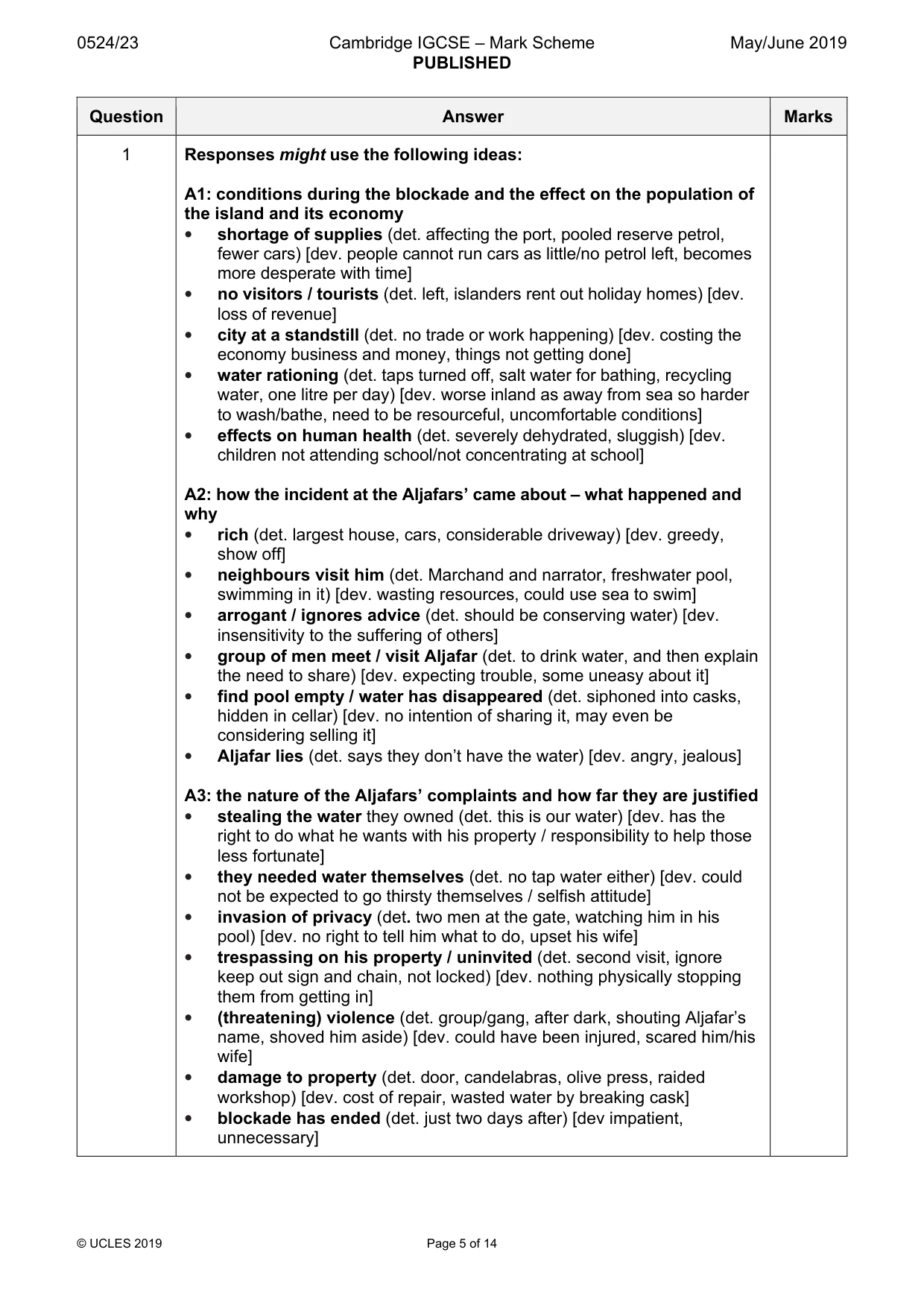
0524/23 Cambridge IGCSE – Mark Scheme PUBLISHED May/June 2019 © UCLES 2019 Page 5 of 14 Question Answer Marks 1 Responses might use the following ideas: A1: conditions during the blockade and the effect on the population of the island and its economy • shortage of supplies (det. affecting the port, pooled reserve petrol, fewer cars) [dev. people cannot run cars as little/no petrol left, becomes more desperate with time] • no visitors / tourists (det. left, islanders rent out holiday homes) [dev. loss of revenue] • city at a standstill (det. no trade or work happening) [dev. costing the economy business and money, things not getting done] • water rationing (det. taps turned off, salt water for bathing, recycling water, one litre per day) [dev. worse inland as away from sea so harder to wash/bathe, need to be resourceful, uncomfortable conditions] • effects on human health (det. severely dehydrated, sluggish) [dev. children not attending school/not concentrating at school] A2: how the incident at the Aljafars’ came about – what happened and why • rich (det. largest house, cars, considerable driveway) [dev. greedy, show off] • neighbours visit him (det. Marchand and narrator, freshwater pool, swimming in it) [dev. wasting resources, could use sea to swim] • arrogant / ignores advice (det. should be conserving water) [dev. insensitivity to the suffering of others] • group of men meet / visit Aljafar (det. to drink water, and then explain the need to share) [dev. expecting trouble, some uneasy about it] • find pool empty / water has disappeared (det. siphoned into casks, hidden in cellar) [dev. no intention of sharing it, may even be considering selling it] • Aljafar lies (det. says they don’t have the water) [dev. angry, jealous] A3: the nature of the Aljafars’ complaints and how far they are justified • stealing the water they owned (det. this is our water) [dev. has the right to do what he wants with his property / responsibility to help those less fortunate] • they needed water themselves (det. no tap water either) [dev. could not be expected to go thirsty themselves / selfish attitude] • invasion of privacy (det. two men at the gate, watching him in his pool) [dev. no right to tell him what to do, upset his wife] • trespassing on his property / uninvited (det. second visit, ignore keep out sign and chain, not locked) [dev. nothing physically stopping them from getting in] • (threatening) violence (det. group/gang, after dark, shouting Aljafar’s name, shoved him aside) [dev. could have been injured, scared him/his wife] • damage to property (det. door, candelabras, olive press, raided workshop) [dev. cost of repair, wasted water by breaking cask] • blockade has ended (det. just two days after) [dev impatient, unnecessary]
Mark scheme, page 6
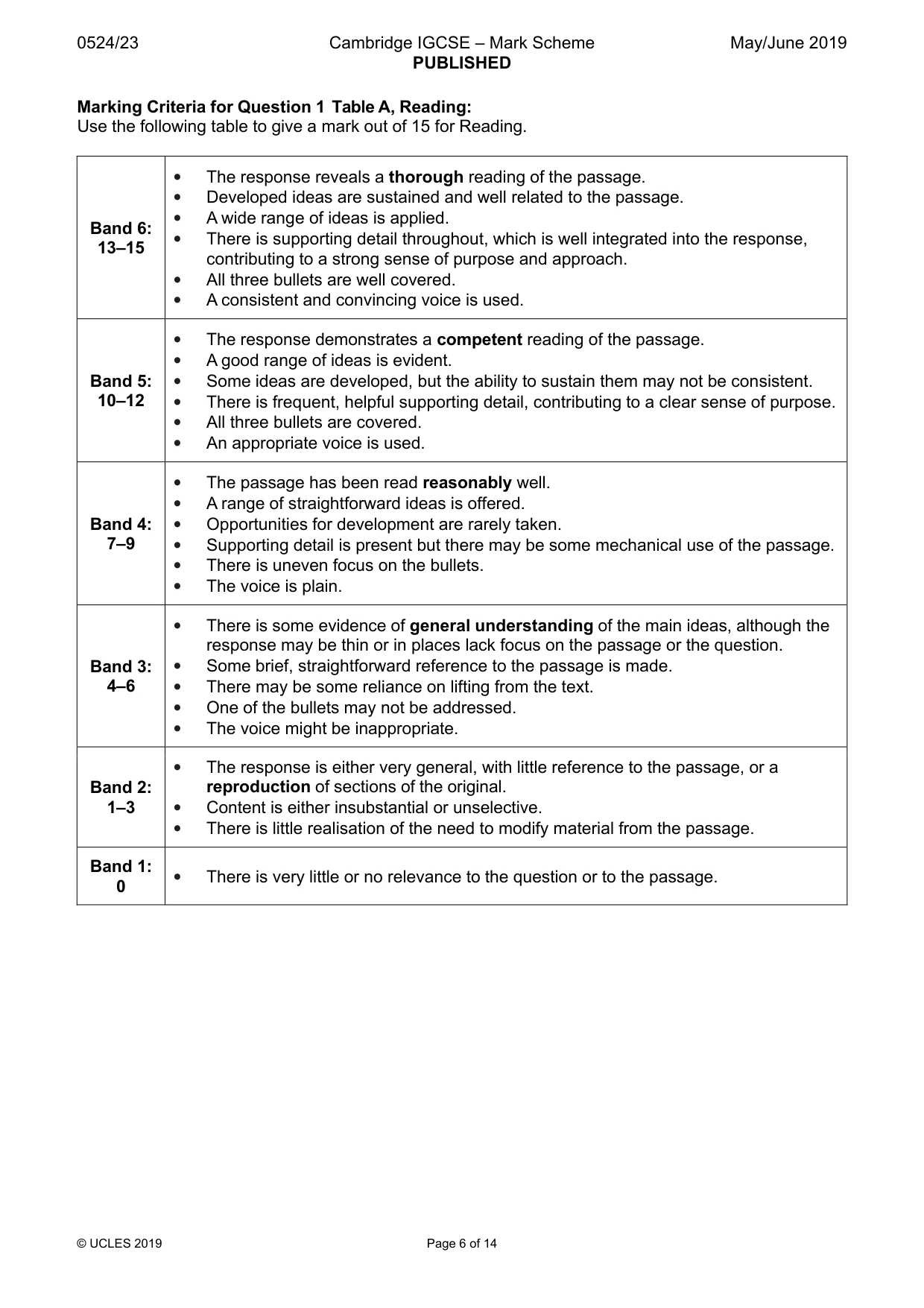
0524/23 Cambridge IGCSE – Mark Scheme PUBLISHED May/June 2019 © UCLES 2019 Page 6 of 14 Marking Criteria for Question 1 Table A, Reading: Use the following table to give a mark out of 15 for Reading. Band 6: 13–15 • The response reveals a thorough reading of the passage. • Developed ideas are sustained and well related to the passage. • A wide range of ideas is applied. • There is supporting detail throughout, which is well integrated into the response, contributing to a strong sense of purpose and approach. • All three bullets are well covered. • A consistent and convincing voice is used. Band 5: 10–12 • The response demonstrates a competent reading of the passage. • A good range of ideas is evident. • Some ideas are developed, but the ability to sustain them may not be consistent. • There is frequent, helpful supporting detail, contributing to a clear sense of purpose. • All three bullets are covered. • An appropriate voice is used. Band 4: 7–9 • The passage has been read reasonably well. • A range of straightforward ideas is offered. • Opportunities for development are rarely taken. • Supporting detail is present but there may be some mechanical use of the passage. • There is uneven focus on the bullets. • The voice is plain. Band 3: 4–6 • There is some evidence of general understanding of the main ideas, although the response may be thin or in places lack focus on the passage or the question. • Some brief, straightforward reference to the passage is made. • There may be some reliance on lifting from the text. • One of the bullets may not be addressed. • The voice might be inappropriate. Band 2: 1–3 • The response is either very general, with little reference to the passage, or a reproduction of sections of the original. • Content is either insubstantial or unselective. • There is little realisation of the need to modify material from the passage. Band 1: 0 • There is very little or no relevance to the question or to the passage.
Mark scheme, page 7
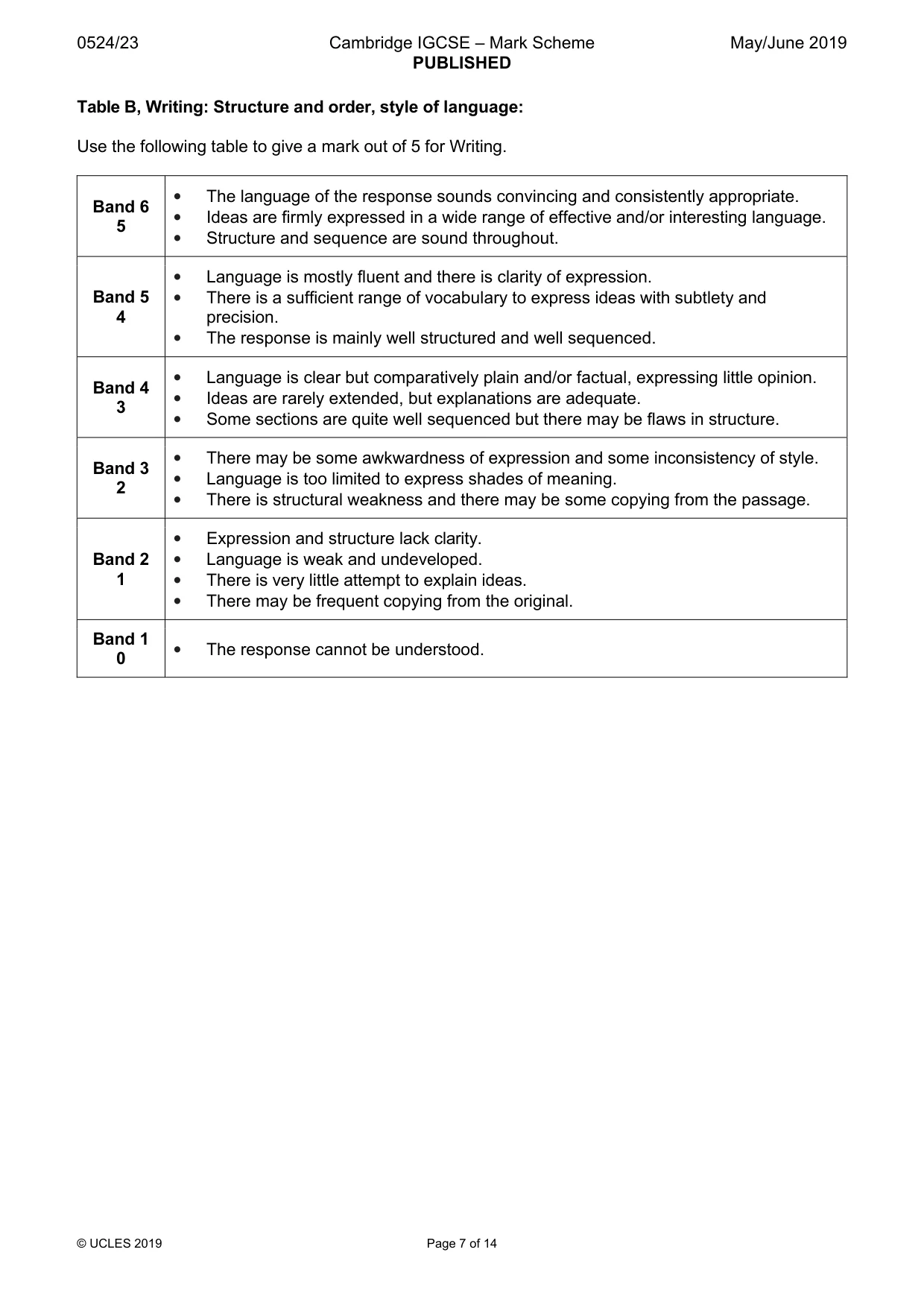
0524/23 Cambridge IGCSE – Mark Scheme PUBLISHED May/June 2019 © UCLES 2019 Page 7 of 14 Table B, Writing: Structure and order, style of language: Use the following table to give a mark out of 5 for Writing. Band 6 5 • The language of the response sounds convincing and consistently appropriate. • Ideas are firmly expressed in a wide range of effective and/or interesting language. • Structure and sequence are sound throughout. Band 5 4 • Language is mostly fluent and there is clarity of expression. • There is a sufficient range of vocabulary to express ideas with subtlety and precision. • The response is mainly well structured and well sequenced. Band 4 3 • Language is clear but comparatively plain and/or factual, expressing little opinion. • Ideas are rarely extended, but explanations are adequate. • Some sections are quite well sequenced but there may be flaws in structure. Band 3 2 • There may be some awkwardness of expression and some inconsistency of style. • Language is too limited to express shades of meaning. • There is structural weakness and there may be some copying from the passage. Band 2 1 • Expression and structure lack clarity. • Language is weak and undeveloped. • There is very little attempt to explain ideas. • There may be frequent copying from the original. Band 1 0 • The response cannot be understood.
Mark scheme, page 8
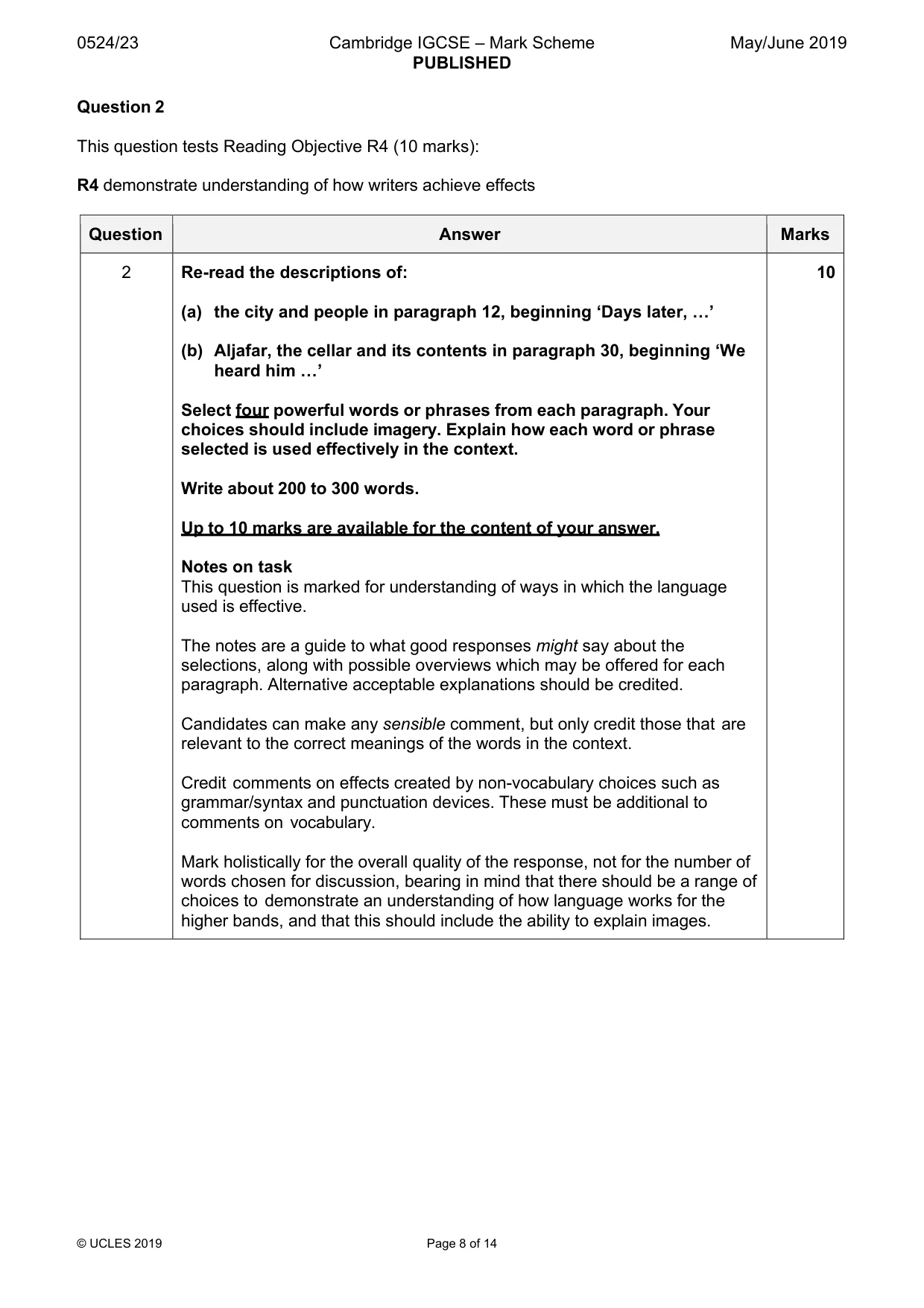
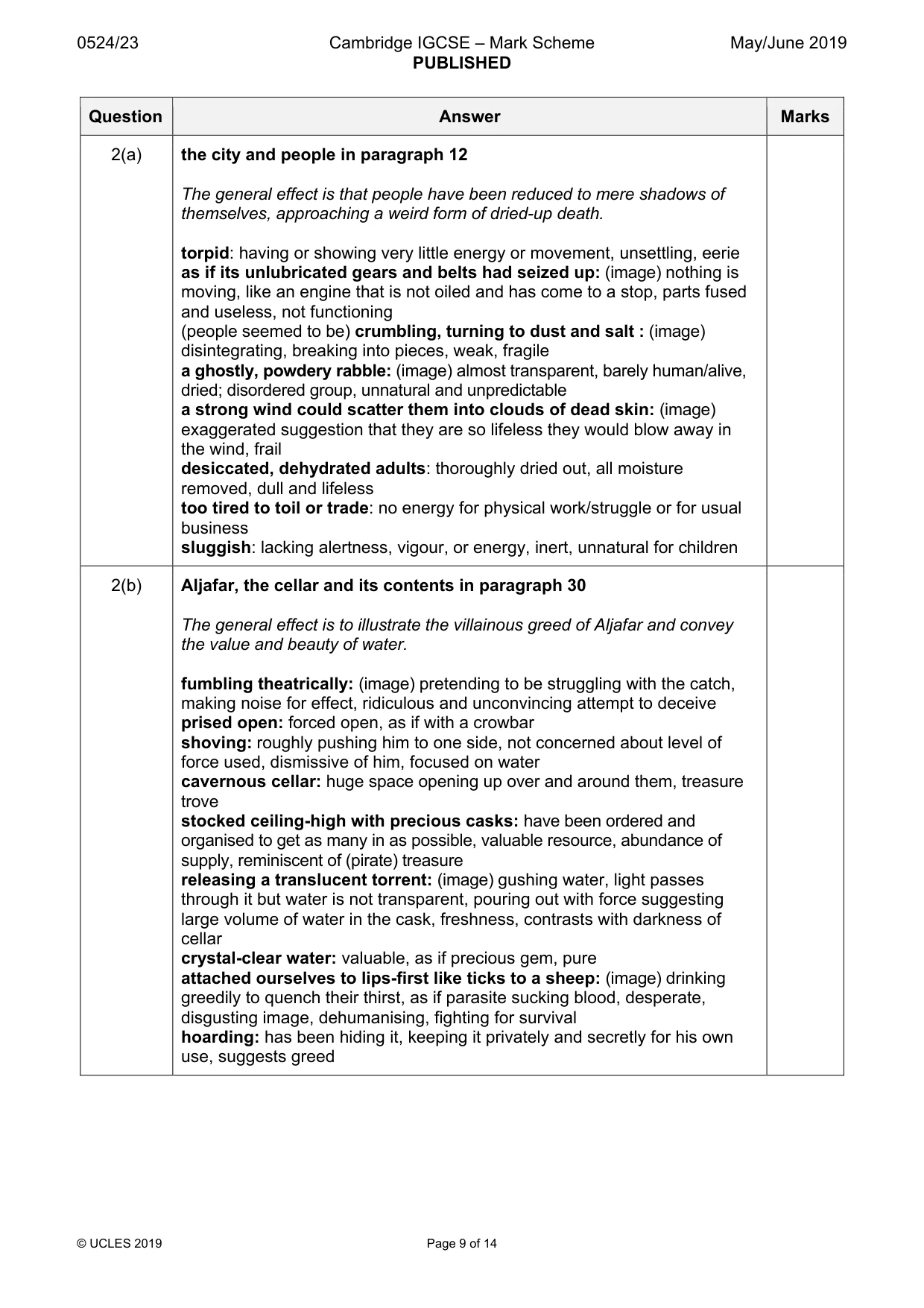
0524/23 Cambridge IGCSE – Mark Scheme PUBLISHED May/June 2019 © UCLES 2019 Page 8 of 14 Question 2 This question tests Reading Objective R4 (10 marks): R4 demonstrate understanding of how writers achieve effects Question Answer Marks 2 Re-read the descriptions of: (a) the city and people in paragraph 12, beginning ‘Days later, «’ (b) Aljafar, the cellar and its contents in paragraph 30, beginning ‘We heard him «’ Select four powerful words or phrases from each paragraph. Your choices should include imagery. Explain how each word or phrase selected is used effectively in the context. Write about 200 to 300 words. Up to 10 marks are available for the content of your answer. Notes on task This question is marked for understanding of ways in which the language used is effective. The notes are a guide to what good responses might say about the selections, along with possible overviews which may be offered for each paragraph. Alternative acceptable explanations should be credited. Candidates can make any sensible comment, but only credit those that are relevant to the correct meanings of the words in the context. Credit comments on effects created by non-vocabulary choices such as grammar/syntax and punctuation devices. These must be additional to comments on vocabulary. Mark holistically for the overall quality of the response, not for the number of words chosen for discussion, bearing in mind that there should be a range of choices to demonstrate an understanding of how language works for the higher bands, and that this should include the ability to explain images. 10
Mark scheme, page 9
0524/23 Cambridge IGCSE – Mark Scheme PUBLISHED May/June 2019 © UCLES 2019 Page 9 of 14 Question Answer Marks 2(a) the city and people in paragraph 12 The general effect is that people have been reduced to mere shadows of themselves, approaching a weird form of dried-up death. torpid: having or showing very little energy or movement, unsettling, eerie as if its unlubricated gears and belts had seized up: (image) nothing is moving, like an engine that is not oiled and has come to a stop, parts fused and useless, not functioning (people seemed to be) crumbling, turning to dust and salt : (image) disintegrating, breaking into pieces, weak, fragile a ghostly, powdery rabble: (image) almost transparent, barely human/alive, dried; disordered group, unnatural and unpredictable a strong wind could scatter them into clouds of dead skin: (image) exaggerated suggestion that they are so lifeless they would blow away in the wind, frail desiccated, dehydrated adults: thoroughly dried out, all moisture removed, dull and lifeless too tired to toil or trade: no energy for physical work/struggle or for usual business sluggish: lacking alertness, vigour, or energy, inert, unnatural for children 2(b) Aljafar, the cellar and its contents in paragraph 30 The general effect is to illustrate the villainous greed of Aljafar and convey the value and beauty of water. fumbling theatrically: (image) pretending to be struggling with the catch, making noise for effect, ridiculous and unconvincing attempt to deceive prised open: forced open, as if with a crowbar shoving: roughly pushing him to one side, not concerned about level of force used, dismissive of him, focused on water cavernous cellar: huge space opening up over and around them, treasure trove stocked ceiling-high with precious casks: have been ordered and organised to get as many in as possible, valuable resource, abundance of supply, reminiscent of (pirate) treasure releasing a translucent torrent: (image) gushing water, light passes through it but water is not transparent, pouring out with force suggesting large volume of water in the cask, freshness, contrasts with darkness of cellar crystal-clear water: valuable, as if precious gem, pure attached ourselves to lips-first like ticks to a sheep: (image) drinking greedily to quench their thirst, as if parasite sucking blood, desperate, disgusting image, dehumanising, fighting for survival hoarding: has been hiding it, keeping it privately and secretly for his own use, suggests greed
Mark scheme, page 10
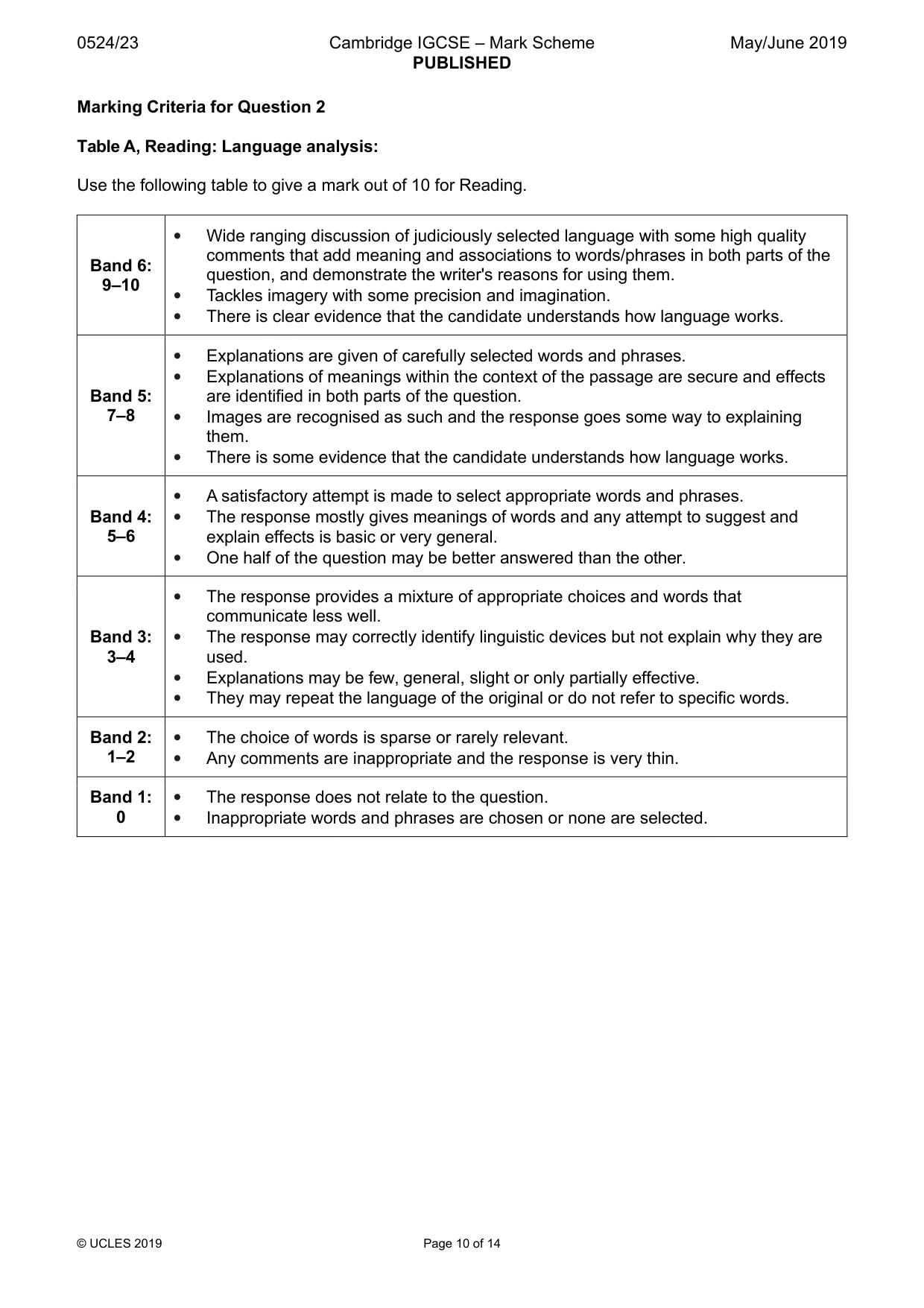
0524/23 Cambridge IGCSE – Mark Scheme PUBLISHED May/June 2019 © UCLES 2019 Page 10 of 14 Marking Criteria for Question 2 Table A, Reading: Language analysis: Use the following table to give a mark out of 10 for Reading. Band 6: 9–10 • Wide ranging discussion of judiciously selected language with some high quality comments that add meaning and associations to words/phrases in both parts of the question, and demonstrate the writer's reasons for using them. • Tackles imagery with some precision and imagination. • There is clear evidence that the candidate understands how language works. Band 5: 7–8 • Explanations are given of carefully selected words and phrases. • Explanations of meanings within the context of the passage are secure and effects are identified in both parts of the question. • Images are recognised as such and the response goes some way to explaining them. • There is some evidence that the candidate understands how language works. Band 4: 5–6 • A satisfactory attempt is made to select appropriate words and phrases. • The response mostly gives meanings of words and any attempt to suggest and explain effects is basic or very general. • One half of the question may be better answered than the other. Band 3: 3–4 • The response provides a mixture of appropriate choices and words that communicate less well. • The response may correctly identify linguistic devices but not explain why they are used. • Explanations may be few, general, slight or only partially effective. • They may repeat the language of the original or do not refer to specific words. Band 2: 1–2 • The choice of words is sparse or rarely relevant. • Any comments are inappropriate and the response is very thin. Band 1: 0 • The response does not relate to the question. • Inappropriate words and phrases are chosen or none are selected.
Mark scheme, page 11
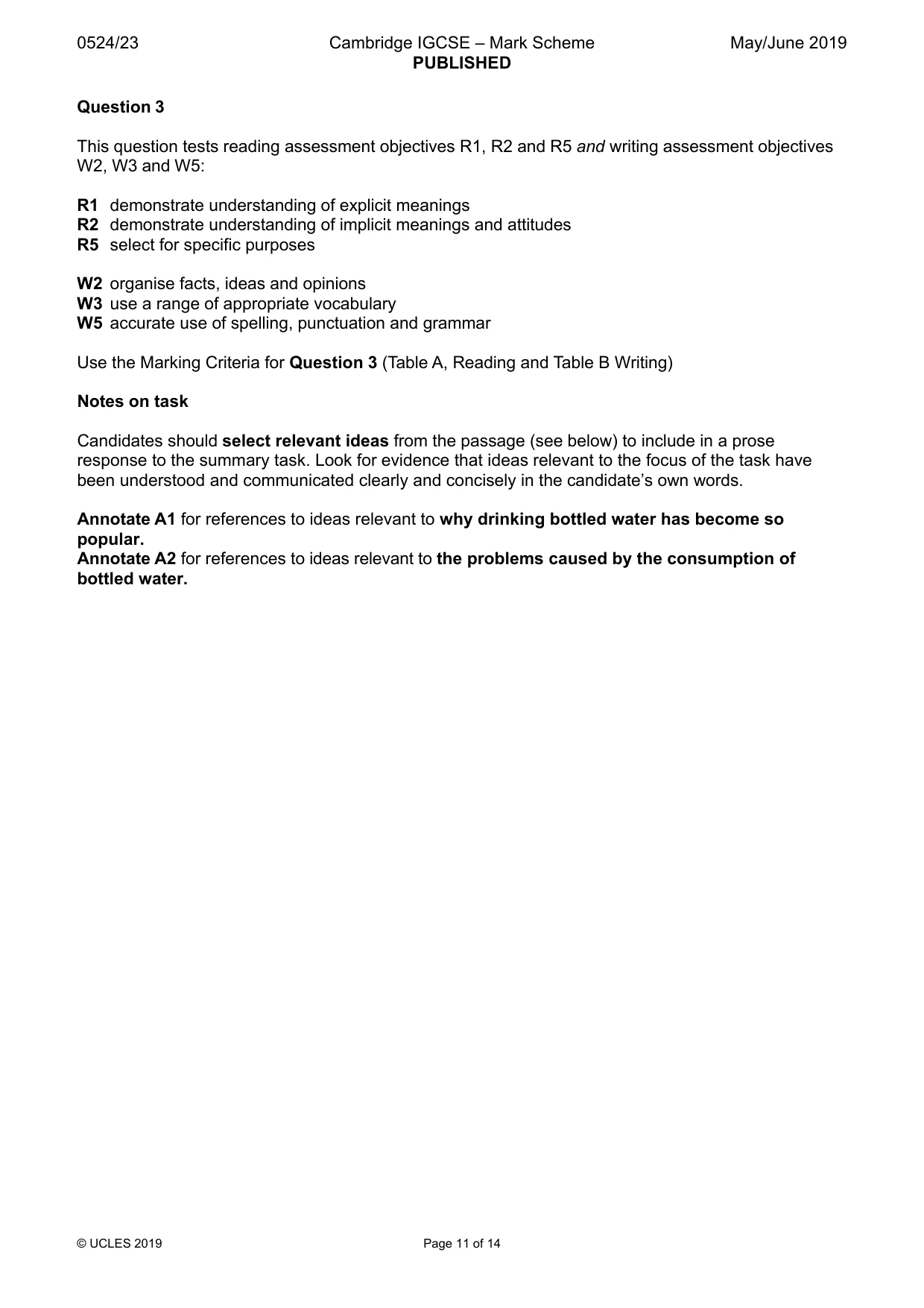
0524/23 Cambridge IGCSE – Mark Scheme PUBLISHED May/June 2019 © UCLES 2019 Page 11 of 14 Question 3 This question tests reading assessment objectives R1, R2 and R5 and writing assessment objectives W2, W3 and W5: R1 demonstrate understanding of explicit meanings R2 demonstrate understanding of implicit meanings and attitudes R5 select for specific purposes W2 organise facts, ideas and opinions W3 use a range of appropriate vocabulary W5 accurate use of spelling, punctuation and grammar Use the Marking Criteria for Question 3 (Table A, Reading and Table B Writing) Notes on task Candidates should select relevant ideas from the passage (see below) to include in a prose response to the summary task. Look for evidence that ideas relevant to the focus of the task have been understood and communicated clearly and concisely in the candidate’s own words. Annotate A1 for references to ideas relevant to why drinking bottled water has become so popular. Annotate A2 for references to ideas relevant to the problems caused by the consumption of bottled water.
Mark scheme, page 12
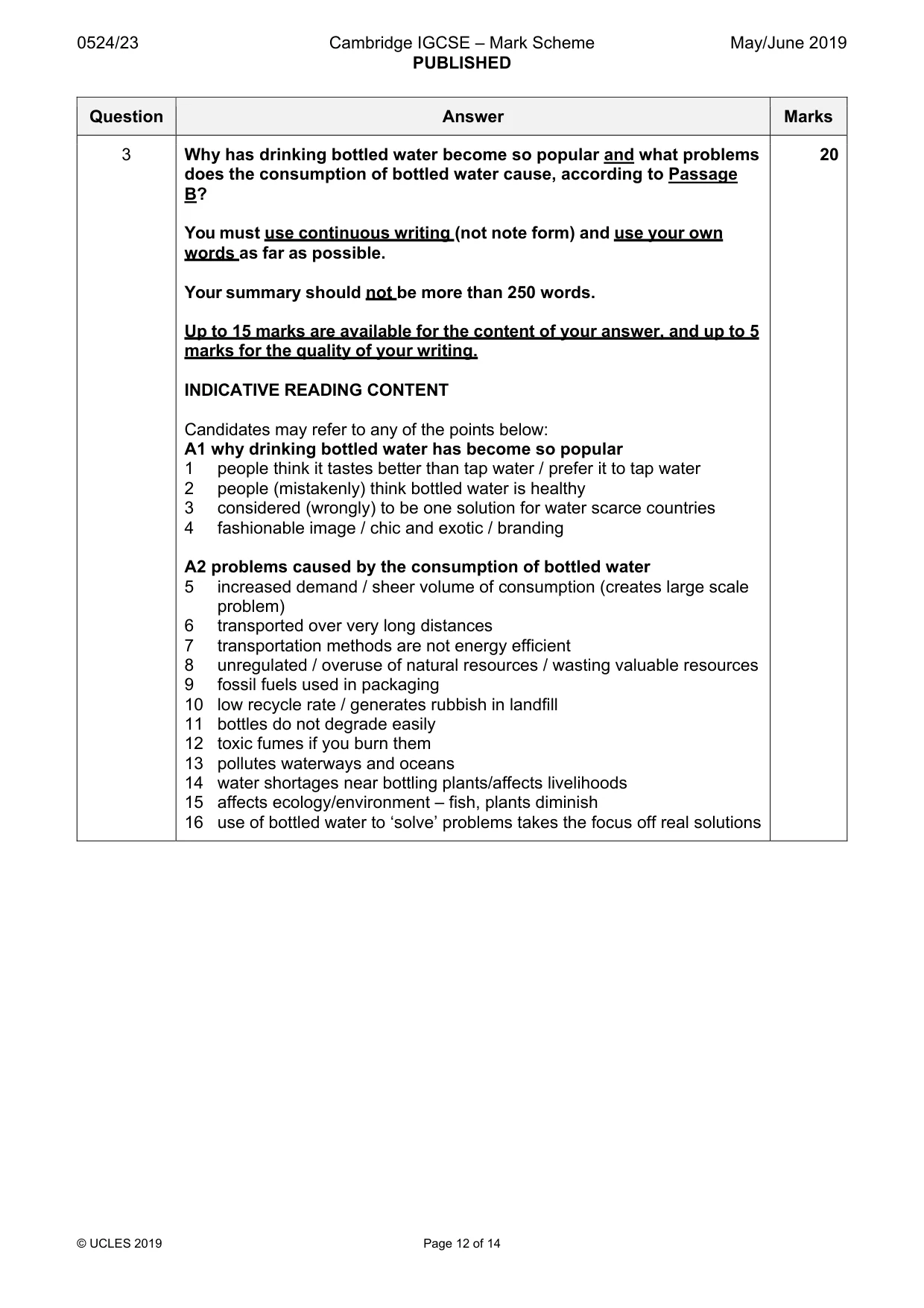
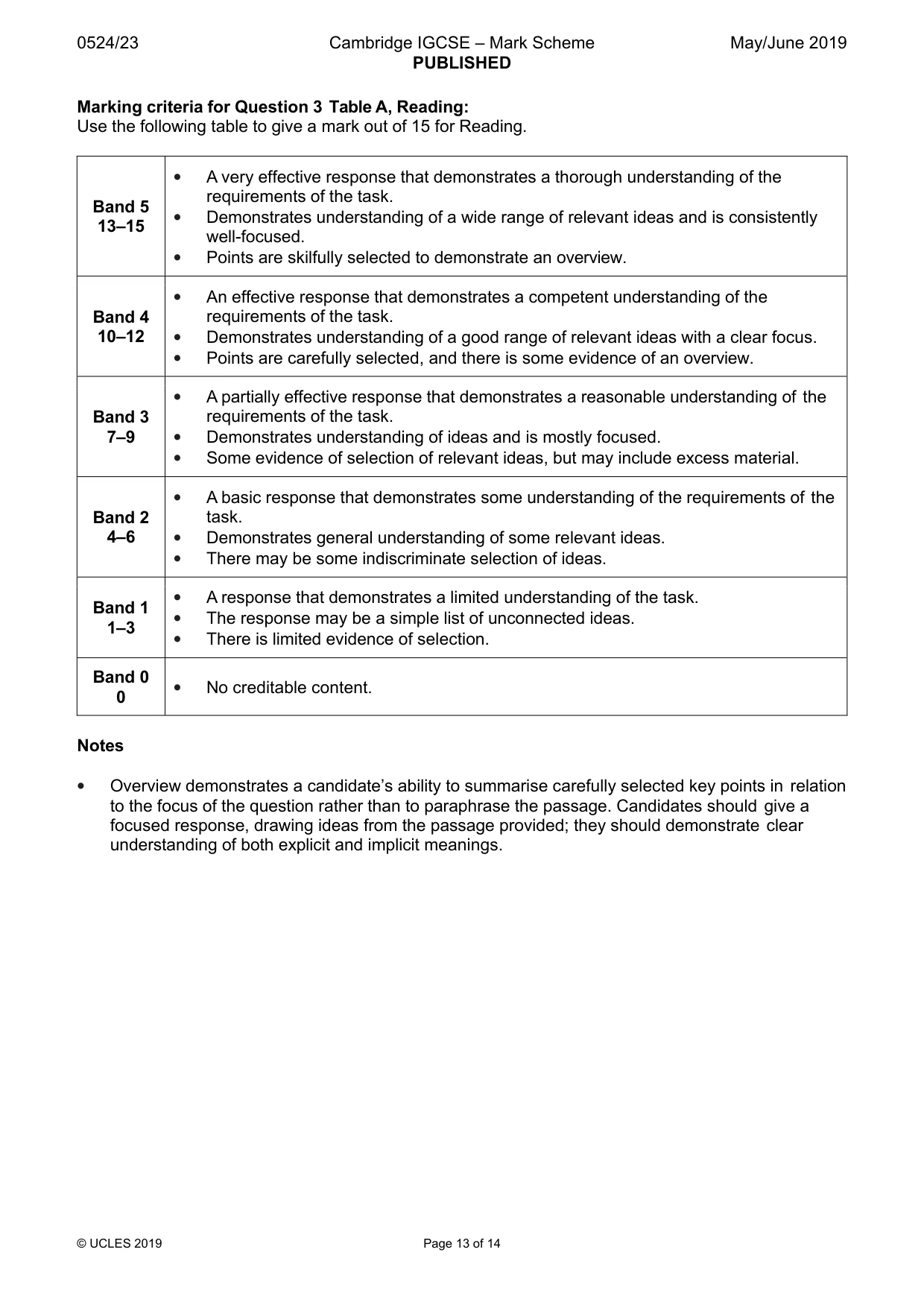
0524/23 Cambridge IGCSE – Mark Scheme PUBLISHED May/June 2019 © UCLES 2019 Page 12 of 14 Question Answer Marks 3 Why has drinking bottled water become so popular and what problems does the consumption of bottled water cause, according to Passage B? You must use continuous writing (not note form) and use your own words as far as possible. Your summary should not be more than 250 words. Up to 15 marks are available for the content of your answer, and up to 5 marks for the quality of your writing. INDICATIVE READING CONTENT Candidates may refer to any of the points below: A1 why drinking bottled water has become so popular 1 people think it tastes better than tap water / prefer it to tap water 2 people (mistakenly) think bottled water is healthy 3 considered (wrongly) to be one solution for water scarce countries 4 fashionable image / chic and exotic / branding A2 problems caused by the consumption of bottled water 5 increased demand / sheer volume of consumption (creates large scale problem) 6 transported over very long distances 7 transportation methods are not energy efficient 8 unregulated / overuse of natural resources / wasting valuable resources 9 fossil fuels used in packaging 10 low recycle rate / generates rubbish in landfill 11 bottles do not degrade easily 12 toxic fumes if you burn them 13 pollutes waterways and oceans 14 water shortages near bottling plants/affects livelihoods 15 affects ecology/environment – fish, plants diminish 16 use of bottled water to ‘solve’ problems takes the focus off real solutions 20
Mark scheme, page 13
0524/23 Cambridge IGCSE – Mark Scheme PUBLISHED May/June 2019 © UCLES 2019 Page 13 of 14 Marking criteria for Question 3 Table A, Reading: Use the following table to give a mark out of 15 for Reading. Band 5 13–15 • A very effective response that demonstrates a thorough understanding of the requirements of the task. • Demonstrates understanding of a wide range of relevant ideas and is consistently well-focused. • Points are skilfully selected to demonstrate an overview. Band 4 10–12 • An effective response that demonstrates a competent understanding of the requirements of the task. • Demonstrates understanding of a good range of relevant ideas with a clear focus. • Points are carefully selected, and there is some evidence of an overview. Band 3 7–9 • A partially effective response that demonstrates a reasonable understanding of the requirements of the task. • Demonstrates understanding of ideas and is mostly focused. • Some evidence of selection of relevant ideas, but may include excess material. Band 2 4–6 • A basic response that demonstrates some understanding of the requirements of the task. • Demonstrates general understanding of some relevant ideas. • There may be some indiscriminate selection of ideas. Band 1 1–3 • A response that demonstrates a limited understanding of the task. • The response may be a simple list of unconnected ideas. • There is limited evidence of selection. Band 0 0 • No creditable content. Notes • Overview demonstrates a candidate’s ability to summarise carefully selected key points in relation to the focus of the question rather than to paraphrase the passage. Candidates should give a focused response, drawing ideas from the passage provided; they should demonstrate clear understanding of both explicit and implicit meanings.
Mark scheme, page 14
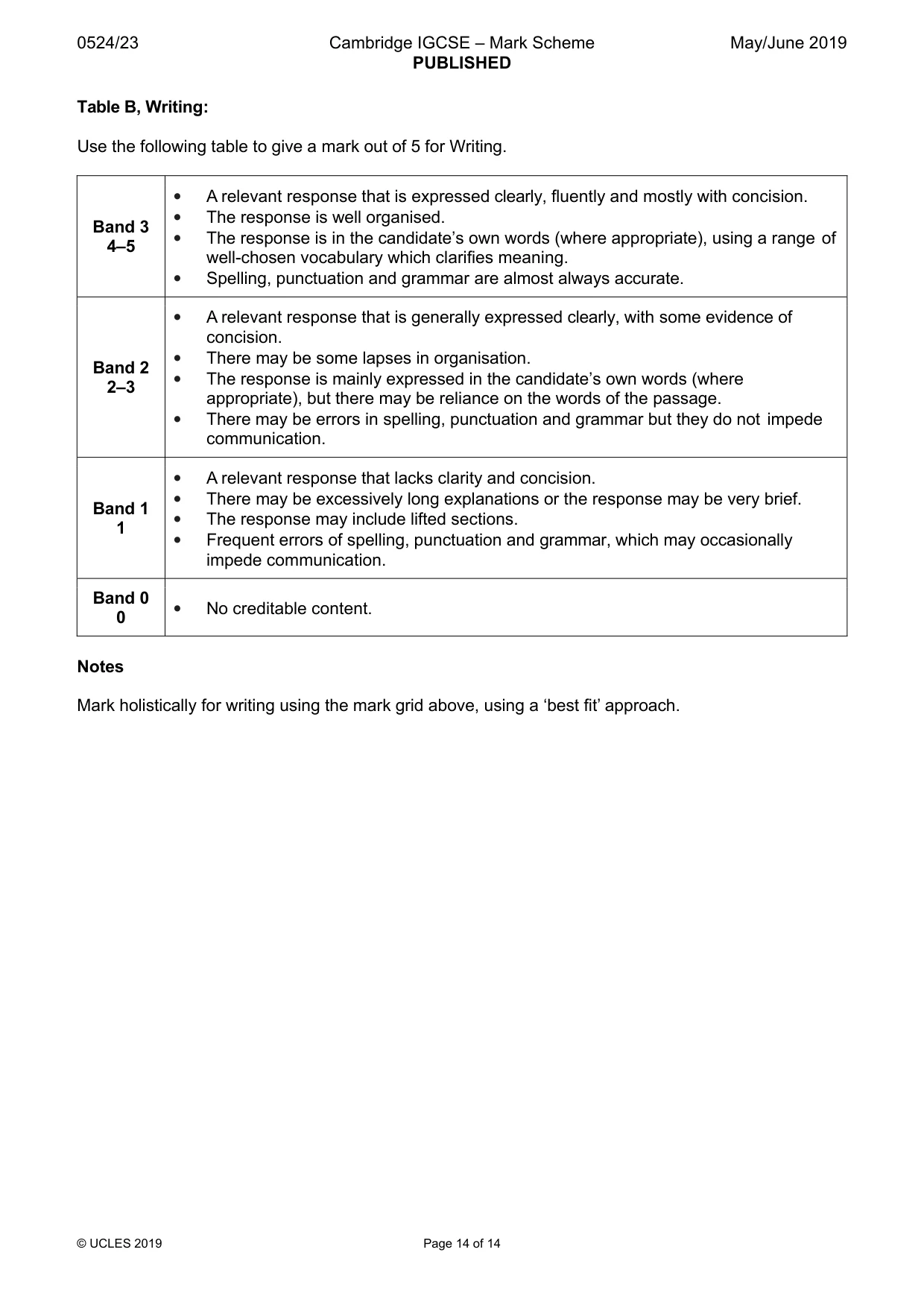
0524/23 Cambridge IGCSE – Mark Scheme PUBLISHED May/June 2019 © UCLES 2019 Page 14 of 14 Table B, Writing: Use the following table to give a mark out of 5 for Writing. Band 3 4–5 • A relevant response that is expressed clearly, fluently and mostly with concision. • The response is well organised. • The response is in the candidate’s own words (where appropriate), using a range of well-chosen vocabulary which clarifies meaning. • Spelling, punctuation and grammar are almost always accurate. Band 2 2–3 • A relevant response that is generally expressed clearly, with some evidence of concision. • There may be some lapses in organisation. • The response is mainly expressed in the candidate’s own words (where appropriate), but there may be reliance on the words of the passage. • There may be errors in spelling, punctuation and grammar but they do not impede communication. Band 1 1 • A relevant response that lacks clarity and concision. • There may be excessively long explanations or the response may be very brief. • The response may include lifted sections. • Frequent errors of spelling, punctuation and grammar, which may occasionally impede communication. Band 0 0 • No creditable content. Notes Mark holistically for writing using the mark grid above, using a ‘best fit’ approach.
What you needed in this session
Cambridge’s own grade thresholds for 2019 May/June, Paper 2 · Variant 3. A higher threshold means an easier paper — the bar moves with how the cohort did.