Cambridge IGCSE English - First Language (BES) 0524 — 2017 May/June Paper 2 · Variant 3
0524/23/M/J/17 · 50 marks · ≈56 min
The question paper and its mark scheme, free to read here and free to download. This is Cambridge’s own paper, exactly as it was sat.
Question paper12 pages
Mark scheme11 pages
Answers below. Sit the paper first if you are practising.
Paper as text
Question paper, page 1
This document consists of 12 printed pages and 1 Reading Booklet Insert. DC (SR) 146383 © UCLES 2017 [Turn over Cambridge International Examinations Cambridge International General Certificate of Secondary Education * 7 9 2 1 0 5 2 8 3 6 * FIRST LANGUAGE ENGLISH (US) 0524/23 Paper 2 Reading Passages (Extended) May/June 2017 2 hours Candidates answer on the Question Paper. No Additional Materials are required. READ THESE INSTRUCTIONS FIRST Write your Center number, candidate number, and name in the spaces provided. Write in dark blue or black pen. Do not use staples, paper clips, glue, or correction fluid. DO NOT WRITE IN ANY BARCODES. Answer all questions in the space provided. If additional space is required, you should use the lined pages at the end of this booklet. The question number(s) must be clearly shown. Dictionaries are not permitted. The Reading Booklet Insert contains the reading passages for use with all questions on the Question Paper. The Insert is not assessed by the Examiner. The number of points is given in brackets [ ] at the end of each question or part question.
Question paper, page 2
2 0524/23/M/J/17 © UCLES 2017 Read carefully Passage A, After-Hours Vet, in the Reading Booklet Insert and then answer Questions 1 and 2 on this Question Paper. Question 1 At the end of his first month at the new clinic, Marc decides to write a letter to his parents explaining his career move and persuading them it was a good idea. Write Marc’s letter to his parents. In your letter you should: • explain what it was like working at your previous job and why you felt you needed to leave • answer the concerns you know your parents will have about you, your decision, and your ability to run your own business • outline how things have been going so far and your plans for the new clinic in the future. Base your letter on what you read in Passage A, but be careful to use your own words. Address each of the three bullet points. Begin your letter, “Dear Mom and Dad, I know you are not going to like this . . .”. Write about 250 to 350 words. Up to 15 points are available for the content of your answer, and up to 5 points for the quality of your writing. … … … … … … … … … … … … … …
Question paper, page 3
3 0524/23/M/J/17 © UCLES 2017 [Turn over … … … … … … … … … … … … … … … … … … … … … … … … … … … …
Question paper, page 4
4 0524/23/M/J/17 © UCLES 2017 … … … … … … … … … … … … … … … … … … … … … … … … … … … [Total: 20]
Question paper, page 5
5 0524/23/M/J/17 © UCLES 2017 [Turn over [Turn over for Question 2]
Question paper, page 6
6 0524/23/M/J/17 © UCLES 2017 Question 2 Re-read the descriptions of: (a) waking up on the morning of the resignation in paragraph 1, beginning “Unusually, the day I resigned . . .” (b) the partners and their reactions to Marc in paragraph 6, beginning “The partners were sitting . . .”. Select four powerful words or phrases from each paragraph. Your choices should include imagery. Explain how each word or phrase is used effectively in the context. Write about 200 to 300 words. Up to 10 points are available for the content of your answer. … … … … … … … … … … … … … … … … … … … …
Question paper, page 7
7 0524/23/M/J/17 © UCLES 2017 [Turn over … … … … … … … … … … … … … … … … … … … … … … … … … … … [Total: 10]
Question paper, page 8
8 0524/23/M/J/17 © UCLES 2017 Read carefully Passage B, Young Vets, in the Reading Booklet Insert and then answer Question 3(a) and (b) on this Question Paper. Question 3 Answer the questions in the order listed. (a) Notes According to Passage B, what challenges and difficulties might a young person wanting to qualify as a vet face, both in terms of training and the job itself? Write your answer using short notes. Write one point per line. You do not need to use your own words. Up to 15 points are available for the content of your answer. The challenges and difficulties that a young person wanting to qualify as a vet might face, both in terms of training and the job itself: 1. … 2. … 3. … 4. … 5. … 6. … 7. … 8. … 9. … 10. … 11. … 12. … 13. … 14. … 15. … [Total: 15]
Question paper, page 9
9 0524/23/M/J/17 © UCLES 2017 [Turn over (b) Summary Now use your notes to write a summary of the challenges and difficulties a young person wanting to qualify as a vet might face, both in terms of training and the job itself, according to Passage B. You must use continuous writing (not note form) and use your own words as far as possible. Your summary should include all 15 of your points in Question 3(a) and must be 200 to 250 words. Up to 5 points are available for the quality of your writing. … … … … … … … … … … … … … … … … … … … … …
Question paper, page 10
10 0524/23/M/J/17 © UCLES 2017 … … … … … … … … … … … [Total: 5]
Question paper, page 11
11 0524/23/M/J/17 © UCLES 2017 Additional Page If you use the following lined page to complete the answer(s) to any question(s), the question number(s) must be clearly shown. … … … … … … … … … … … … … … … … … … … … … … … … … …
Question paper, page 12
12 0524/23/M/J/17 © UCLES 2017 Permission to reproduce items where third-party owned material protected by copyright is included has been sought and cleared where possible. Every reasonable effort has been made by the publisher (UCLES) to trace copyright holders, but if any items requiring clearance have unwittingly been included, the publisher will be pleased to make amends at the earliest possible opportunity. To avoid the issue of disclosure of answer-related information to candidates, all copyright acknowledgements are reproduced online in the Cambridge International Examinations Copyright Acknowledgements Booklet. This is produced for each series of examinations and is freely available to download at www.cie.org.uk after the live examination series. Cambridge International Examinations is part of the Cambridge Assessment Group. Cambridge Assessment is the brand name of University of Cambridge Local Examinations Syndicate (UCLES), which is itself a department of the University of Cambridge. Additional Page If you use the following lined page to complete the answer(s) to any question(s), the question number(s) must be clearly shown. … … … … … … … … … … … … … … … … … … … … … …
Mark scheme, page 1
® IGCSE is a registered trademark. This document consists of 11 printed pages. © UCLES 2017 [Turn over Cambridge International Examinations Cambridge International General Certificate of Secondary Education FIRST LANGUAGE ENGLISH (US) 0524/23 Paper 2 Reading Passages (Extended) May/June 2017 MARK SCHEME Maximum Mark: 50 Published This mark scheme is published as an aid to teachers and candidates, to indicate the requirements of the examination. It shows the basis on which Examiners were instructed to award marks. It does not indicate the details of the discussions that took place at an Examiners’ meeting before marking began, which would have considered the acceptability of alternative answers. Mark schemes should be read in conjunction with the question paper and the Principal Examiner Report for Teachers. Cambridge will not enter into discussions about these mark schemes. Cambridge is publishing the mark schemes for the May/June 2017 series for most Cambridge IGCSE®, Cambridge International A and AS Level and Cambridge Pre-U components, and some Cambridge O Level components.
Mark scheme, page 2
0524/23 Cambridge IGCSE – Mark Scheme PUBLISHED May/June 2017 © UCLES 2017 Page 2 of 11 Note: All Examiners are instructed that alternative correct answers and unexpected approaches in candidates’ scripts must be given marks that fairly reflect the relevant knowledge and skills demonstrated. Question Answer Marks 1 This question tests reading assessment objectives R1 to R3 (15 marks) R1 demonstrate understanding of explicit meanings R2 demonstrate understanding of implicit meanings and attitudes R3 analyse, evaluate and develop facts, ideas and opinions and writing assessment objectives W1 to W4 (5 marks) W1 articulate experience and express what is thought, felt and imagined W2 sequence facts, ideas and opinions W3 use a range of appropriate vocabulary W4 use register appropriate to audience and context At the end of his first month at the new surgery, Marc decides to write a letter to his parents explaining his career move and persuading them it was a good idea. Write Marc’s letter to his parents. In your letter you should: • explain what it was like working at your previous job and why you felt you needed to leave • answer the concerns you know your parents will have about you, your decision and your ability to run your own business • outline how things have been going so far and your plans for the new surgery in the future. Base your letter on what you have read in Passage A, but be careful to use your own words. Address each of the three bullet points. Begin your letter, ‘Dear Mum and Dad, I know you are not going to like this...’. Write about 250 to 350 words. Up to 15 marks are available for the content of your answer, and up to 5 marks for the quality of your writing. 20
Mark scheme, page 3
0524/23 Cambridge IGCSE – Mark Scheme PUBLISHED May/June 2017 © UCLES 2017 Page 3 of 11 Question Answer Marks General notes Candidates should select ideas from the passage (see page 6) and develop them relevantly, supporting what they write with details from the passage. Look for an appropriate register for the genre, and a clear and balanced response which covers the three areas of the question, is well sequenced, and is in the candidate’s own words. Annotate A1 for references to his previous job and the reasons Marc needed to leave Annotate A2 for references to the concerns Marc knows his parents will have Annotate A3 for references to how things have been going so far and his plans for the new surgery in the future. Responses might use the following ideas: A1: explain what it was like working at your previous job and why you needed to leave • missing potential/lack of opportunity/ambition (det. 150 000 population) [dev. promotion not likely] • refused to listen/reject his ideas (det. unwilling to review business model) [dev. not forward-thinking, old-fashioned] • dress code (det. objections to flip flops, piercings) [dev. irrelevant to ability to do job] • communication/meetings (det. anonymous note re mugs, agenda going over diary) [dev. inefficient use of time, petty criticisms/cowardly manner in which they were communicated] • nothing in common with partners (det. he was well-travelled, employers were not) [dev. boring, alien to him, does not understand them and vice versa] • age difference/colleagues older than him (det. grey (hair/beards)) [dev. patronising attitude] A2: answer the concerns you know your parents will have about you, your decision and your ability to run your own business • time management/punctuality (det. not usually on time/early) [dev. can there be time is and when motivated] • dream(s)/dreamer/unrealistic plans (det. idealised vision of the world) [dev. aware may not work out as he thinks it will] • presentation/attire (det. mother knitted jumper) [dev. less important to clients at night – turning up on motorbikes/for emergencies not going to worry about his rucksack/flip flops] • has matured/too immature (det. parent-child disagreements) [dev. working together, roles clear] • no one will want to work with him (det. Ruth the nurse) [dev. working together, roles clear] • knows nothing about business (det. worked in practices with out-of- hours before) [dev. range of experience now and has done his homework, better at managing finances]
Mark scheme, page 4
0524/23 Cambridge IGCSE – Mark Scheme PUBLISHED May/June 2017 © UCLES 2017 Page 4 of 11 Question Answer Marks • feel a new sense of purpose/does not stick at things (det. 8 jobs in 5 years since university) [dev. may be better working for himself than someone else, opportunity to build something here] A3: outline how things have been going so far and your plans for the new surgery in the future • busier and busier/number of clients increasing (det. first quiet night, word now spreading) [dev. feedback must be good] • home visits (det. first one booked on second night) [dev. evidence there is a need] • staff (det. nurse) [dev. may be able to attract vets from other practices, need to employ other staff in future] • different tasks (det. answering telephone, dispensing advice, diagnosing problems, conduct emergency surgeries) [dev. varied, hands on satisfying] • equipment (det. kettle, telephone, filing cabinet) [dev. basic now but improve facilities etc.] • expand business (det. stay local to begin with, then practices up to 40 km radius) [dev. roll plan out further afield/expand beyond 40 km radius] • unexpected challenges/creatures det. caged bird, biker client) [dev. never know what will turn up and have to deal with it, not boring or predictable now]
Mark scheme, page 5
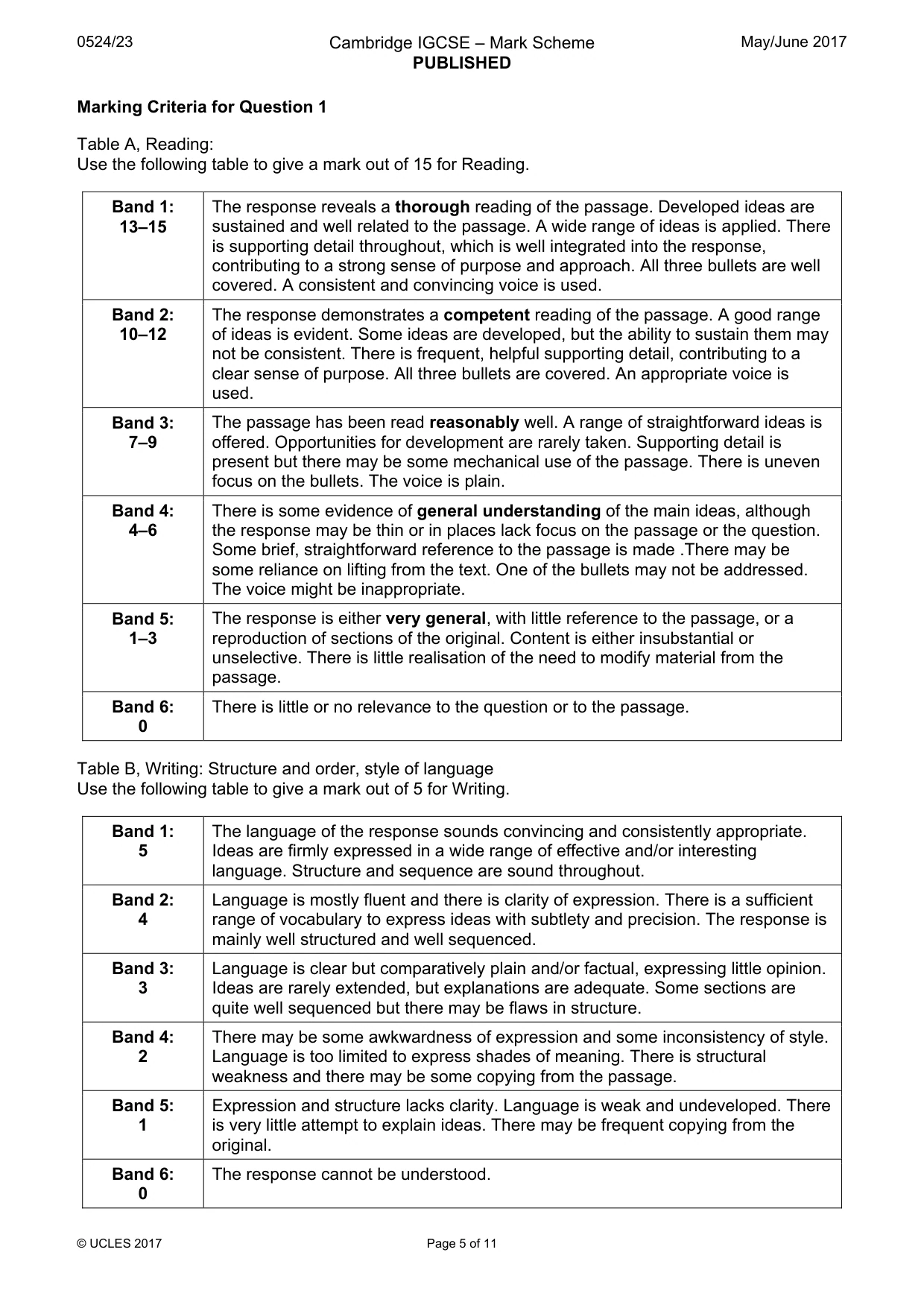
0524/23 Cambridge IGCSE – Mark Scheme PUBLISHED May/June 2017 © UCLES 2017 Page 5 of 11 Marking Criteria for Question 1 Table A, Reading: Use the following table to give a mark out of 15 for Reading. Band 1: 13–15 The response reveals a thorough reading of the passage. Developed ideas are sustained and well related to the passage. A wide range of ideas is applied. There is supporting detail throughout, which is well integrated into the response, contributing to a strong sense of purpose and approach. All three bullets are well covered. A consistent and convincing voice is used. Band 2: 10–12 The response demonstrates a competent reading of the passage. A good range of ideas is evident. Some ideas are developed, but the ability to sustain them may not be consistent. There is frequent, helpful supporting detail, contributing to a clear sense of purpose. All three bullets are covered. An appropriate voice is used. Band 3: 7–9 The passage has been read reasonably well. A range of straightforward ideas is offered. Opportunities for development are rarely taken. Supporting detail is present but there may be some mechanical use of the passage. There is uneven focus on the bullets. The voice is plain. Band 4: 4–6 There is some evidence of general understanding of the main ideas, although the response may be thin or in places lack focus on the passage or the question. Some brief, straightforward reference to the passage is made .There may be some reliance on lifting from the text. One of the bullets may not be addressed. The voice might be inappropriate. Band 5: 1–3 The response is either very general, with little reference to the passage, or a reproduction of sections of the original. Content is either insubstantial or unselective. There is little realisation of the need to modify material from the passage. Band 6: 0 There is little or no relevance to the question or to the passage. Table B, Writing: Structure and order, style of language Use the following table to give a mark out of 5 for Writing. Band 1: 5 The language of the response sounds convincing and consistently appropriate. Ideas are firmly expressed in a wide range of effective and/or interesting language. Structure and sequence are sound throughout. Band 2: 4 Language is mostly fluent and there is clarity of expression. There is a sufficient range of vocabulary to express ideas with subtlety and precision. The response is mainly well structured and well sequenced. Band 3: 3 Language is clear but comparatively plain and/or factual, expressing little opinion. Ideas are rarely extended, but explanations are adequate. Some sections are quite well sequenced but there may be flaws in structure. Band 4: 2 There may be some awkwardness of expression and some inconsistency of style. Language is too limited to express shades of meaning. There is structural weakness and there may be some copying from the passage. Band 5: 1 Expression and structure lacks clarity. Language is weak and undeveloped. There is very little attempt to explain ideas. There may be frequent copying from the original. Band 6: 0 The response cannot be understood.
Mark scheme, page 6
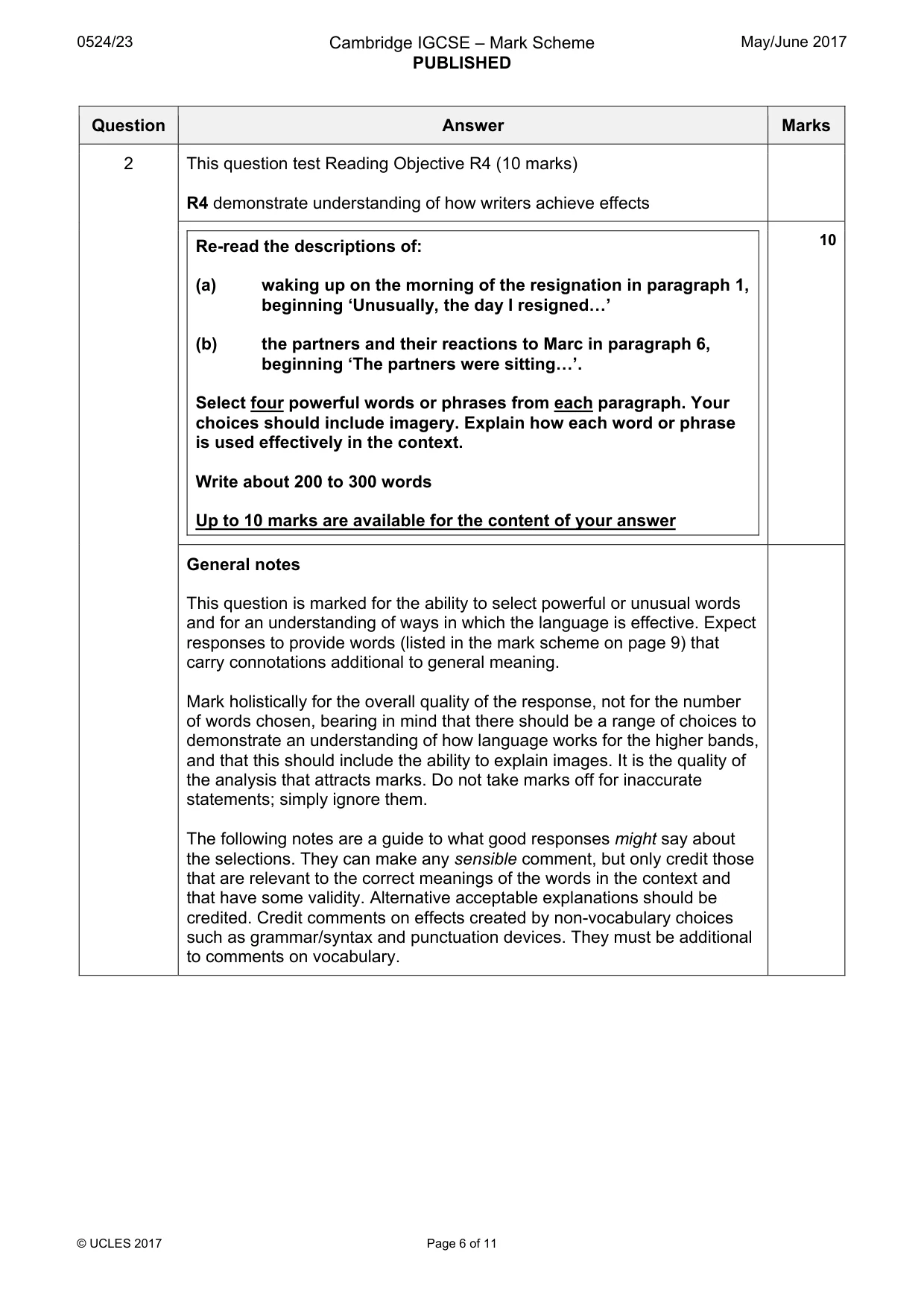
0524/23 Cambridge IGCSE – Mark Scheme PUBLISHED May/June 2017 © UCLES 2017 Page 6 of 11 Question Answer Marks 2 This question test Reading Objective R4 (10 marks) R4 demonstrate understanding of how writers achieve effects Re-read the descriptions of: (a) waking up on the morning of the resignation in paragraph 1, beginning ‘Unusually, the day I resigned«’ (b) the partners and their reactions to Marc in paragraph 6, beginning ‘The partners were sitting«’. Select four powerful words or phrases from each paragraph. Your choices should include imagery. Explain how each word or phrase is used effectively in the context. Write about 200 to 300 words Up to 10 marks are available for the content of your answer 10 General notes This question is marked for the ability to select powerful or unusual words and for an understanding of ways in which the language is effective. Expect responses to provide words (listed in the mark scheme on page 9) that carry connotations additional to general meaning. Mark holistically for the overall quality of the response, not for the number of words chosen, bearing in mind that there should be a range of choices to demonstrate an understanding of how language works for the higher bands, and that this should include the ability to explain images. It is the quality of the analysis that attracts marks. Do not take marks off for inaccurate statements; simply ignore them. The following notes are a guide to what good responses might say about the selections. They can make any sensible comment, but only credit those that are relevant to the correct meanings of the words in the context and that have some validity. Alternative acceptable explanations should be credited. Credit comments on effects created by non-vocabulary choices such as grammar/syntax and punctuation devices. They must be additional to comments on vocabulary.
Mark scheme, page 7
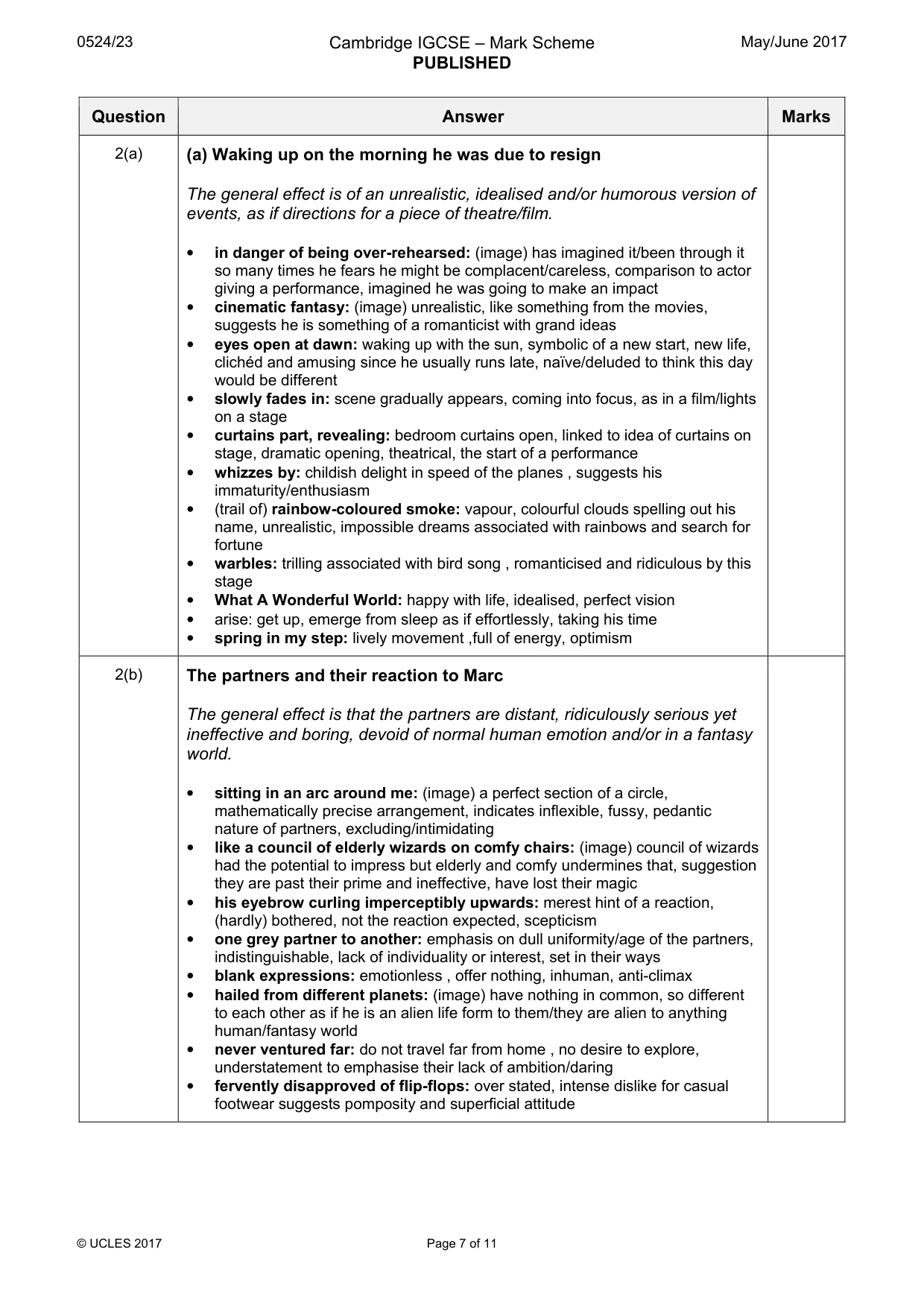
0524/23 Cambridge IGCSE – Mark Scheme PUBLISHED May/June 2017 © UCLES 2017 Page 7 of 11 Question Answer Marks 2(a) (a) Waking up on the morning he was due to resign The general effect is of an unrealistic, idealised and/or humorous version of events, as if directions for a piece of theatre/film. • in danger of being over-rehearsed: (image) has imagined it/been through it so many times he fears he might be complacent/careless, comparison to actor giving a performance, imagined he was going to make an impact • cinematic fantasy: (image) unrealistic, like something from the movies, suggests he is something of a romanticist with grand ideas • eyes open at dawn: waking up with the sun, symbolic of a new start, new life, clichéd and amusing since he usually runs late, naïve/deluded to think this day would be different • slowly fades in: scene gradually appears, coming into focus, as in a film/lights on a stage • curtains part, revealing: bedroom curtains open, linked to idea of curtains on stage, dramatic opening, theatrical, the start of a performance • whizzes by: childish delight in speed of the planes , suggests his immaturity/enthusiasm • (trail of) rainbow-coloured smoke: vapour, colourful clouds spelling out his name, unrealistic, impossible dreams associated with rainbows and search for fortune • warbles: trilling associated with bird song , romanticised and ridiculous by this stage • What A Wonderful World: happy with life, idealised, perfect vision • arise: get up, emerge from sleep as if effortlessly, taking his time • spring in my step: lively movement ,full of energy, optimism 2(b) The partners and their reaction to Marc The general effect is that the partners are distant, ridiculously serious yet ineffective and boring, devoid of normal human emotion and/or in a fantasy world. • sitting in an arc around me: (image) a perfect section of a circle, mathematically precise arrangement, indicates inflexible, fussy, pedantic nature of partners, excluding/intimidating • like a council of elderly wizards on comfy chairs: (image) council of wizards had the potential to impress but elderly and comfy undermines that, suggestion they are past their prime and ineffective, have lost their magic • his eyebrow curling imperceptibly upwards: merest hint of a reaction, (hardly) bothered, not the reaction expected, scepticism • one grey partner to another: emphasis on dull uniformity/age of the partners, indistinguishable, lack of individuality or interest, set in their ways • blank expressions: emotionless , offer nothing, inhuman, anti-climax • hailed from different planets: (image) have nothing in common, so different to each other as if he is an alien life form to them/they are alien to anything human/fantasy world • never ventured far: do not travel far from home , no desire to explore, understatement to emphasise their lack of ambition/daring • fervently disapproved of flip-flops: over stated, intense dislike for casual footwear suggests pomposity and superficial attitude
Mark scheme, page 8
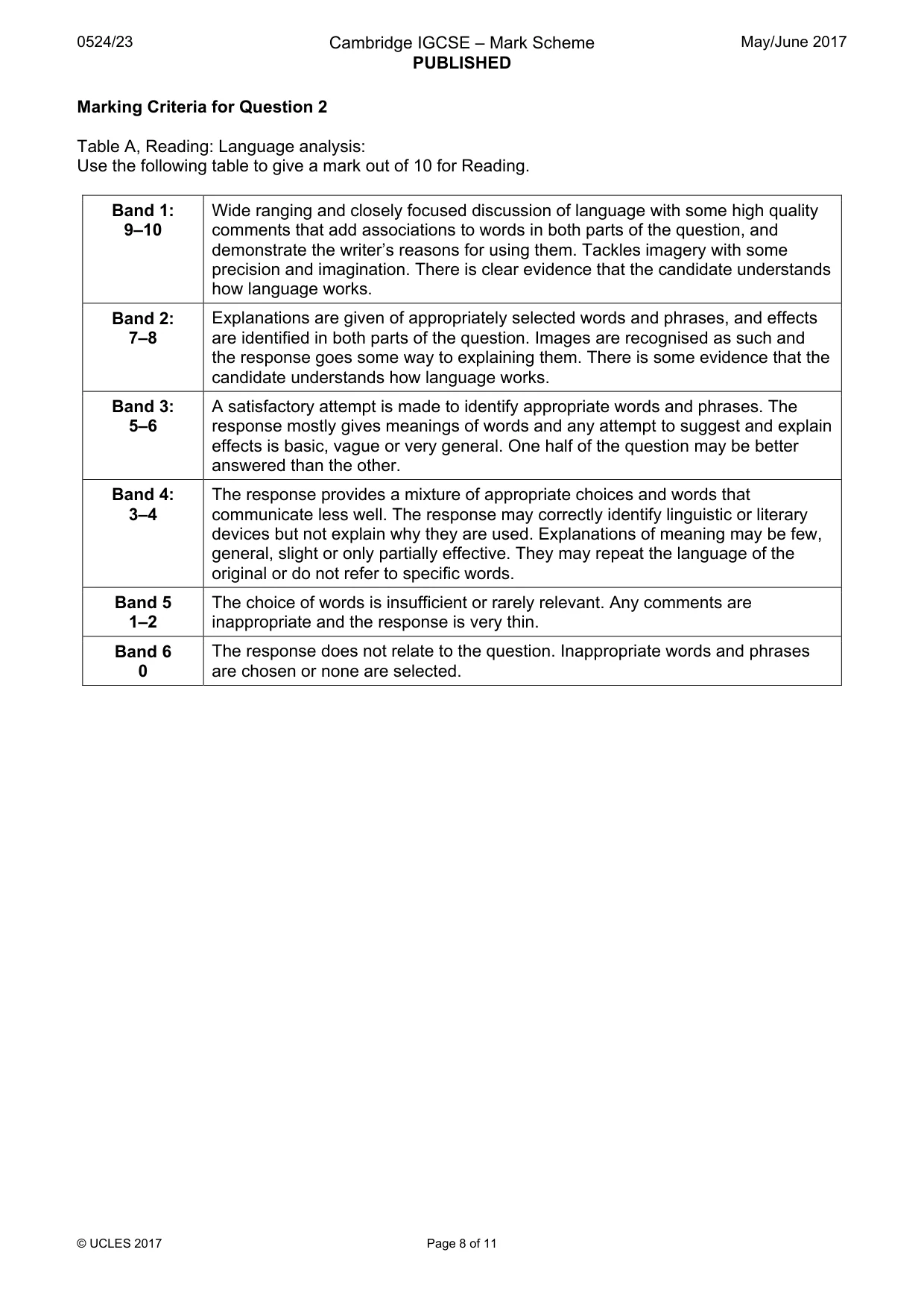
0524/23 Cambridge IGCSE – Mark Scheme PUBLISHED May/June 2017 © UCLES 2017 Page 8 of 11 Marking Criteria for Question 2 Table A, Reading: Language analysis: Use the following table to give a mark out of 10 for Reading. Band 1: 9–10 Wide ranging and closely focused discussion of language with some high quality comments that add associations to words in both parts of the question, and demonstrate the writer’s reasons for using them. Tackles imagery with some precision and imagination. There is clear evidence that the candidate understands how language works. Band 2: 7–8 Explanations are given of appropriately selected words and phrases, and effects are identified in both parts of the question. Images are recognised as such and the response goes some way to explaining them. There is some evidence that the candidate understands how language works. Band 3: 5–6 A satisfactory attempt is made to identify appropriate words and phrases. The response mostly gives meanings of words and any attempt to suggest and explain effects is basic, vague or very general. One half of the question may be better answered than the other. Band 4: 3–4 The response provides a mixture of appropriate choices and words that communicate less well. The response may correctly identify linguistic or literary devices but not explain why they are used. Explanations of meaning may be few, general, slight or only partially effective. They may repeat the language of the original or do not refer to specific words. Band 5 1–2 The choice of words is insufficient or rarely relevant. Any comments are inappropriate and the response is very thin. Band 6 0 The response does not relate to the question. Inappropriate words and phrases are chosen or none are selected.
Mark scheme, page 9
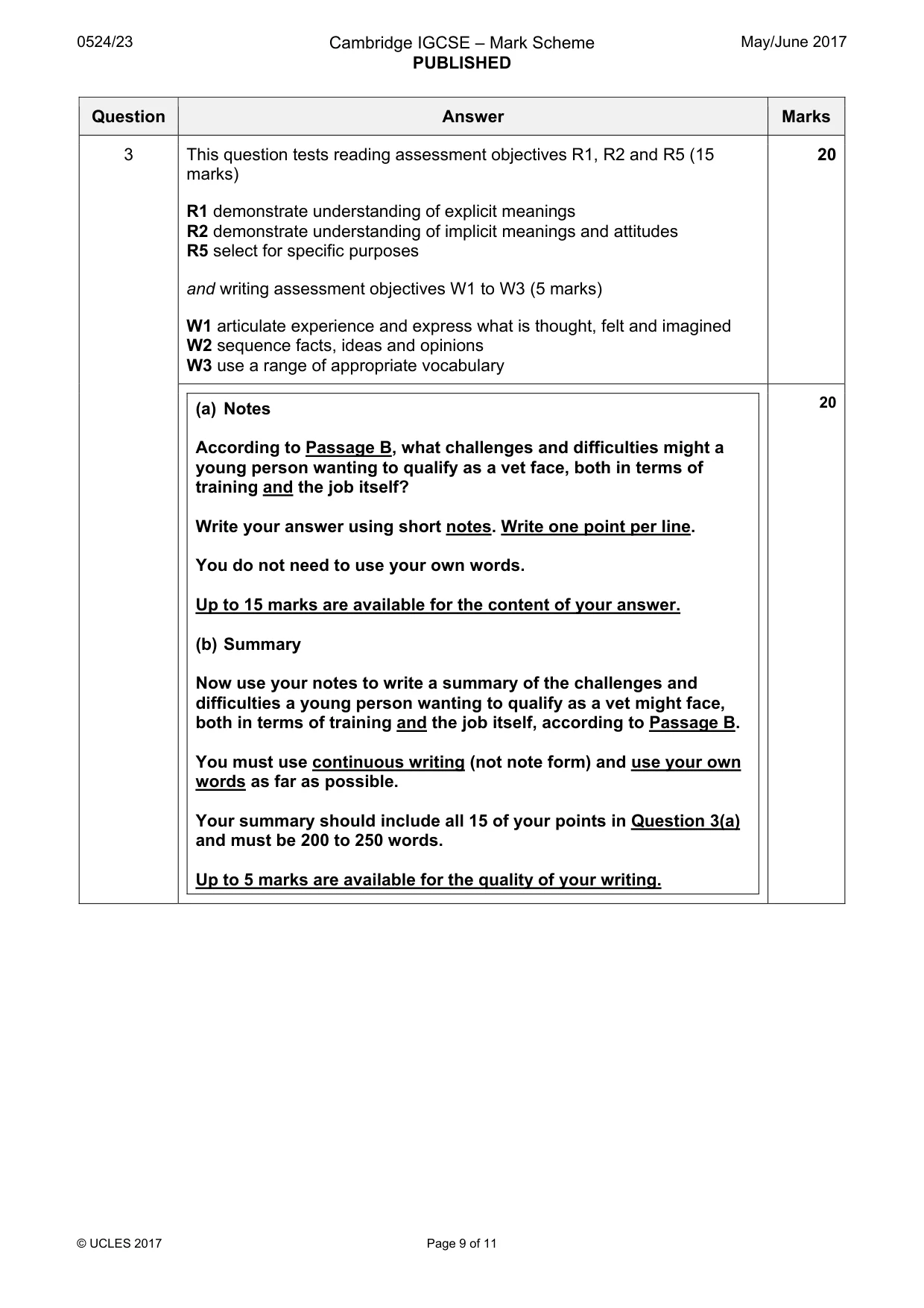
0524/23 Cambridge IGCSE – Mark Scheme PUBLISHED May/June 2017 © UCLES 2017 Page 9 of 11 Question Answer Marks 3 This question tests reading assessment objectives R1, R2 and R5 (15 marks) R1 demonstrate understanding of explicit meanings R2 demonstrate understanding of implicit meanings and attitudes R5 select for specific purposes and writing assessment objectives W1 to W3 (5 marks) W1 articulate experience and express what is thought, felt and imagined W2 sequence facts, ideas and opinions W3 use a range of appropriate vocabulary 20 (a) Notes According to Passage B, what challenges and difficulties might a young person wanting to qualify as a vet face, both in terms of training and the job itself? Write your answer using short notes. Write one point per line. You do not need to use your own words. Up to 15 marks are available for the content of your answer. (b) Summary Now use your notes to write a summary of the challenges and difficulties a young person wanting to qualify as a vet might face, both in terms of training and the job itself, according to Passage B. You must use continuous writing (not note form) and use your own words as far as possible. Your summary should include all 15 of your points in Question 3(a) and must be 200 to 250 words. Up to 5 marks are available for the quality of your writing. 20
Mark scheme, page 10
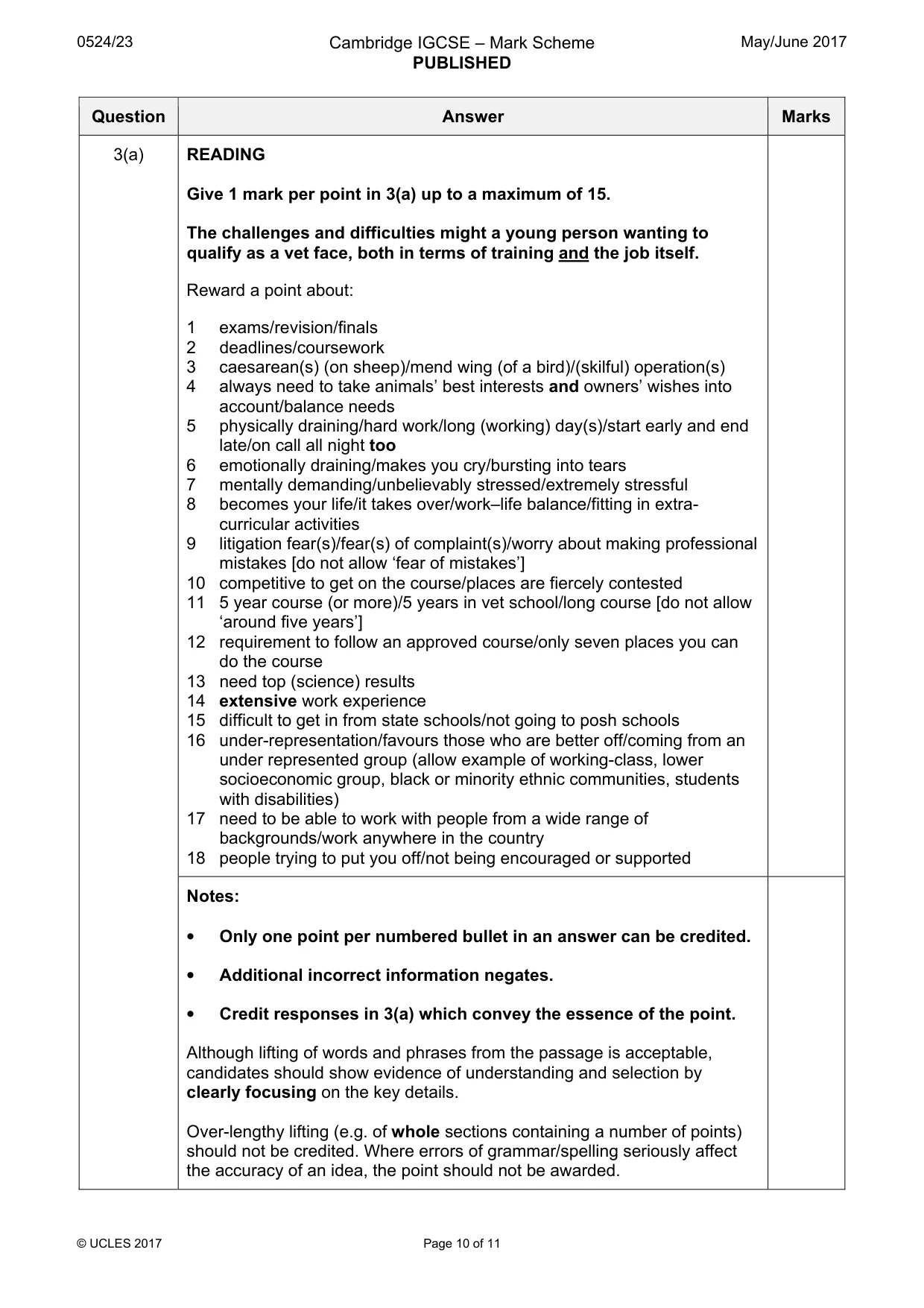
0524/23 Cambridge IGCSE – Mark Scheme PUBLISHED May/June 2017 © UCLES 2017 Page 10 of 11 Question Answer Marks 3(a) READING Give 1 mark per point in 3(a) up to a maximum of 15. The challenges and difficulties might a young person wanting to qualify as a vet face, both in terms of training and the job itself. Reward a point about: 1 exams/revision/finals 2 deadlines/coursework 3 caesarean(s) (on sheep)/mend wing (of a bird)/(skilful) operation(s) 4 always need to take animals’ best interests and owners’ wishes into account/balance needs 5 physically draining/hard work/long (working) day(s)/start early and end late/on call all night too 6 emotionally draining/makes you cry/bursting into tears 7 mentally demanding/unbelievably stressed/extremely stressful 8 becomes your life/it takes over/work–life balance/fitting in extra- curricular activities 9 litigation fear(s)/fear(s) of complaint(s)/worry about making professional mistakes [do not allow ‘fear of mistakes’] 10 competitive to get on the course/places are fiercely contested 11 5 year course (or more)/5 years in vet school/long course [do not allow ‘around five years’] 12 requirement to follow an approved course/only seven places you can do the course 13 need top (science) results 14 extensive work experience 15 difficult to get in from state schools/not going to posh schools 16 under-representation/favours those who are better off/coming from an under represented group (allow example of working-class, lower socioeconomic group, black or minority ethnic communities, students with disabilities) 17 need to be able to work with people from a wide range of backgrounds/work anywhere in the country 18 people trying to put you off/not being encouraged or supported Notes: • Only one point per numbered bullet in an answer can be credited. • Additional incorrect information negates. • Credit responses in 3(a) which convey the essence of the point. Although lifting of words and phrases from the passage is acceptable, candidates should show evidence of understanding and selection by clearly focusing on the key details. Over-lengthy lifting (e.g. of whole sections containing a number of points) should not be credited. Where errors of grammar/spelling seriously affect the accuracy of an idea, the point should not be awarded.
Mark scheme, page 11
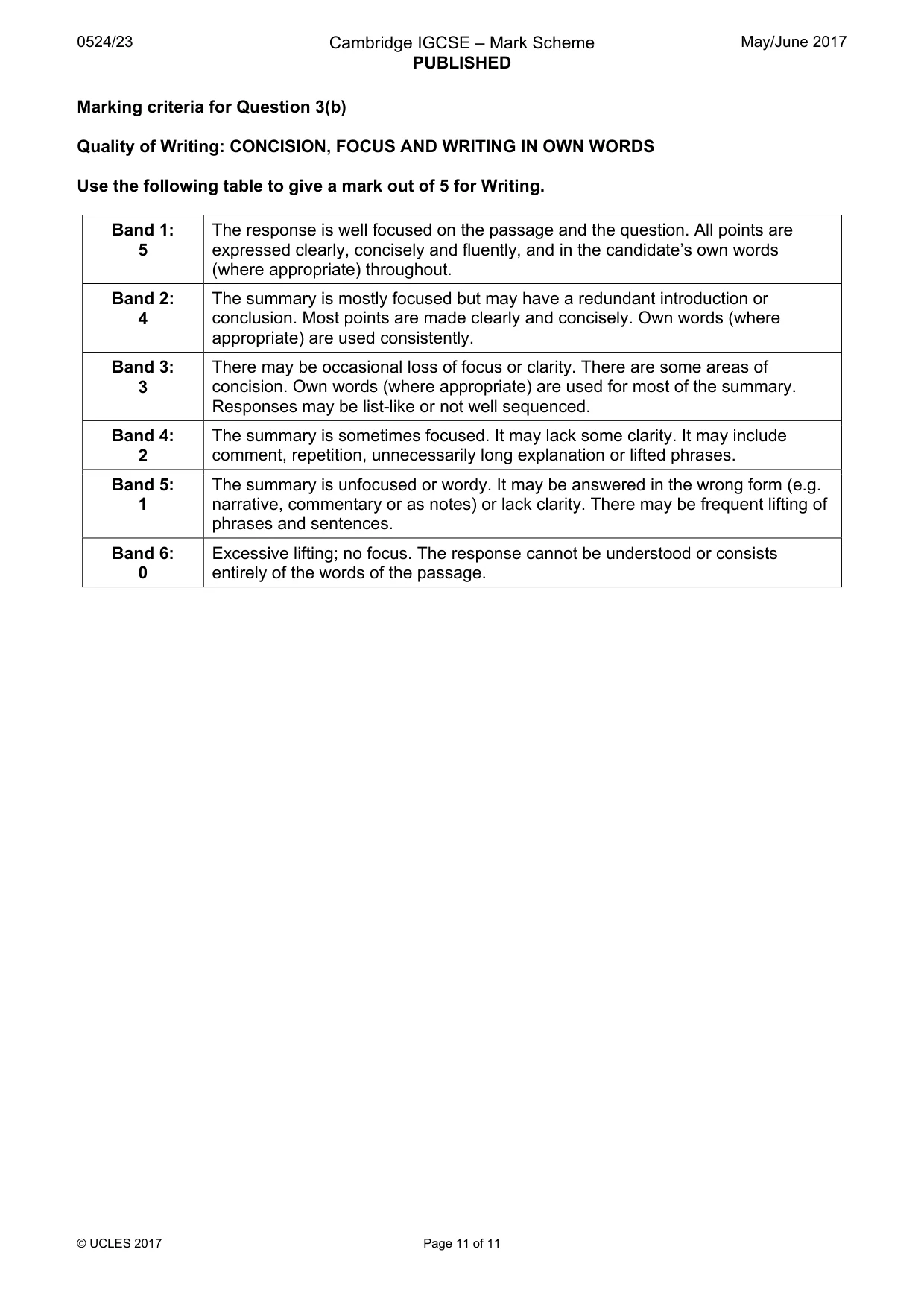
0524/23 Cambridge IGCSE – Mark Scheme PUBLISHED May/June 2017 © UCLES 2017 Page 11 of 11 Marking criteria for Question 3(b) Quality of Writing: CONCISION, FOCUS AND WRITING IN OWN WORDS Use the following table to give a mark out of 5 for Writing. Band 1: 5 The response is well focused on the passage and the question. All points are expressed clearly, concisely and fluently, and in the candidate’s own words (where appropriate) throughout. Band 2: 4 The summary is mostly focused but may have a redundant introduction or conclusion. Most points are made clearly and concisely. Own words (where appropriate) are used consistently. Band 3: 3 There may be occasional loss of focus or clarity. There are some areas of concision. Own words (where appropriate) are used for most of the summary. Responses may be list-like or not well sequenced. Band 4: 2 The summary is sometimes focused. It may lack some clarity. It may include comment, repetition, unnecessarily long explanation or lifted phrases. Band 5: 1 The summary is unfocused or wordy. It may be answered in the wrong form (e.g. narrative, commentary or as notes) or lack clarity. There may be frequent lifting of phrases and sentences. Band 6: 0 Excessive lifting; no focus. The response cannot be understood or consists entirely of the words of the passage.
What you needed in this session
Cambridge’s own grade thresholds for 2017 May/June, Paper 2 · Variant 3. A higher threshold means an easier paper — the bar moves with how the cohort did.