Cambridge IGCSE English - First Language (BES) 0524 — 2018 May/June Paper 2 · Variant 3
0524/23/M/J/18 · 50 marks · ≈56 min
The question paper and its mark scheme, free to read here and free to download. This is Cambridge’s own paper, exactly as it was sat.
Question paper12 pages
Mark scheme13 pages
Answers below. Sit the paper first if you are practising.
Paper as text
Question paper, page 1
This document consists of 12 printed pages and 1 Reading Booklet Insert. DC (KS) 160467 © UCLES 2018 [Turn over Cambridge International Examinations Cambridge International General Certificate of Secondary Education * 2 9 8 7 2 8 5 3 7 8 * FIRST LANGUAGE ENGLISH (US) 0524/23 Paper 2 Reading Passages (Extended) May/June 2018 2 hours Candidates answer on the Question Paper. No Additional Materials are required. READ THESE INSTRUCTIONS FIRST Write your Center number, candidate number, and name in the spaces provided. Write in dark blue or black pen. Do not use staples, paper clips, glue, or correction fluid. DO NOT WRITE IN ANY BARCODES. Answer all questions in the space provided. If additional space is required, you should use the lined pages at the end of this booklet. The question number(s) must be clearly shown. Dictionaries are not permitted. The Reading Booklet Insert contains the reading passages for use with all questions on the Question Paper. The Reading Booklet Insert is not assessed by the Examiner. The number of points is given in brackets [ ] at the end of each question or part question.
Question paper, page 2
2 0524/23/M/J/18 © UCLES 2018 Read carefully Passage A, A Small Fortune, in the Reading Booklet Insert and then answer Questions 1 and 2 on this Question Paper. Question 1 Imagine you are Safeena. Write your journal entry for the day after the argument with Nawaz. In your journal entry you should comment on: • how and why Harris came to be staying with you and how you felt about it initially • the effects Harris’s stay has had on your life and relationships • the different ways in which the situation might now be resolved for the benefit of everybody. Base your journal entry on what you read in Passage A, but be careful to use your own words. Address each of the three bullet points. Begin your journal entry, “Things surely cannot get much worse . . . ” Write about 250 to 350 words. Up to 15 points are available for the content of your answer, and up to 5 points for the quality of your writing. … … … … … … … … … … … … … … … …
Question paper, page 3
3 0524/23/M/J/18 © UCLES 2018 [Turn over … … … … … … … … … … … … … … … … … … … … … … … … … … … …
Question paper, page 4
4 0524/23/M/J/18 © UCLES 2018 … … … … … … … … … … … … … … … … … … … … … … … … … … … [Total: 20]
Question paper, page 5
5 0524/23/M/J/18 © UCLES 2018 [Turn over [Turn to page 6 for Question 2]
Question paper, page 6
6 0524/23/M/J/18 © UCLES 2018 Question 2 Re-read the descriptions of: (a) Harris’s behavior and the reaction to it in paragraph 13, beginning “Within days Harris . . . ” (b) Safeena’s attitude and Harris’s reaction to it in paragraph 14, beginning “He was forbidden by Safeena . . . ” Select four powerful words or phrases from each paragraph. Your choices should include imagery. Explain how each word or phrase is used effectively in the context. Write about 200 to 300 words. Up to 10 points are available for the content of your answer. … … … … … … … … … … … … … … … … … … … …
Question paper, page 7
7 0524/23/M/J/18 © UCLES 2018 [Turn over … … … … … … … … … … … … … … … … … … … … … … … … … … … [Total: 10]
Question paper, page 8
8 0524/23/M/J/18 © UCLES 2018 Read carefully Passage B, Loneliness, in the Reading Booklet Insert and then answer Question 3(a) and (b) on this Question Paper. Question 3 Answer the questions in the order listed. (a) Notes What are the causes of loneliness, according to Passage B? Write your answer using short notes. Write one point per line. You do not need to use your own words. Up to 15 points are available for the content of your answer. The causes of loneliness: • … • … • … • … • … • … • … • … • … • … • … • … • … • … • … [Total: 15]
Question paper, page 9
9 0524/23/M/J/18 © UCLES 2018 [Turn over (b) Summary Now use your notes to write a summary of the causes of loneliness, according to Passage B. You must use continuous writing (not note form) and use your own words as much as possible. Your summary should include all 15 of your points in Question 3(a) and must be 200 to 250 words. Up to 5 points are available for the quality of your writing. … … … … … … … … … … … … … … … … … … … … … …
Question paper, page 10
10 0524/23/M/J/18 © UCLES 2018 … … … … … … … … … … [Total: 5]
Question paper, page 11
11 0524/23/M/J/18 © UCLES 2018 Additional Page If you use the following lined page to complete the answer(s) to any question(s), the question number(s) must be clearly shown. … … … … … … … … … … … … … … … … … … … … … … … … … …
Question paper, page 12
12 0524/23/M/J/18 © UCLES 2018 Permission to reproduce items where third-party owned material protected by copyright is included has been sought and cleared where possible. Every reasonable effort has been made by the publisher (UCLES) to trace copyright holders, but if any items requiring clearance have unwittingly been included, the publisher will be pleased to make amends at the earliest possible opportunity. To avoid the issue of disclosure of answer-related information to candidates, all copyright acknowledgements are reproduced online in the Cambridge International Examinations Copyright Acknowledgements Booklet. This is produced for each series of examinations and is freely available to download at www.cie.org.uk after the live examination series. Cambridge International Examinations is part of the Cambridge Assessment Group. Cambridge Assessment is the brand name of University of Cambridge Local Examinations Syndicate (UCLES), which is itself a department of the University of Cambridge. Additional Page If you use the following lined page to complete the answer(s) to any question(s), the question number(s) must be clearly shown. … … … … … … … … … … … … … … … … … … … … … …
Mark scheme, page 1
IGCSE™ is a registered trademark. This document consists of 13 printed pages. © UCLES 2018 [Turn over Cambridge Assessment International Education Cambridge International General Certificate of Secondary Education FIRST LANGUAGE ENGLISH (US) 0524/23 Paper 2 Reading Passages (Extended) May/June 2018 MARK SCHEME Maximum Mark: 50 Published This mark scheme is published as an aid to teachers and candidates, to indicate the requirements of the examination. It shows the basis on which Examiners were instructed to award marks. It does not indicate the details of the discussions that took place at an Examiners’ meeting before marking began, which would have considered the acceptability of alternative answers. Mark schemes should be read in conjunction with the question paper and the Principal Examiner Report for Teachers. Cambridge International will not enter into discussions about these mark schemes. Cambridge International is publishing the mark schemes for the May/June 2018 series for most Cambridge IGCSE™, Cambridge International A and AS Level and Cambridge Pre-U components, and some Cambridge O Level components.
Mark scheme, page 2
0524/23 Cambridge IGCSE – Mark Scheme PUBLISHED May/June 2018 © UCLES 2018 Page 2 of 13 Generic Marking Principles These general marking principles must be applied by all examiners when marking candidate answers. They should be applied alongside the specific content of the mark scheme or generic level descriptors for a question. Each question paper and mark scheme will also comply with these marking principles. GENERIC MARKING PRINCIPLE 1: Marks must be awarded in line with: • the specific content of the mark scheme or the generic level descriptors for the question • the specific skills defined in the mark scheme or in the generic level descriptors for the question • the standard of response required by a candidate as exemplified by the standardisation scripts. GENERIC MARKING PRINCIPLE 2: Marks awarded are always whole marks (not half marks, or other fractions). GENERIC MARKING PRINCIPLE 3: Marks must be awarded positively: • marks are awarded for correct/valid answers, as defined in the mark scheme. However, credit is given for valid answers which go beyond the scope of the syllabus and mark scheme, referring to your Team Leader as appropriate • marks are awarded when candidates clearly demonstrate what they know and can do • marks are not deducted for errors • marks are not deducted for omissions • answers should only be judged on the quality of spelling, punctuation and grammar when these features are specifically assessed by the question as indicated by the mark scheme. The meaning, however, should be unambiguous. GENERIC MARKING PRINCIPLE 4: Rules must be applied consistently e.g. in situations where candidates have not followed instructions or in the application of generic level descriptors. GENERIC MARKING PRINCIPLE 5: Marks should be awarded using the full range of marks defined in the mark scheme for the question (however; the use of the full mark range may be limited according to the quality of the candidate responses seen). GENERIC MARKING PRINCIPLE 6: Marks awarded are based solely on the requirements as defined in the mark scheme. Marks should not be awarded with grade thresholds or grade descriptors in mind.
Mark scheme, page 3
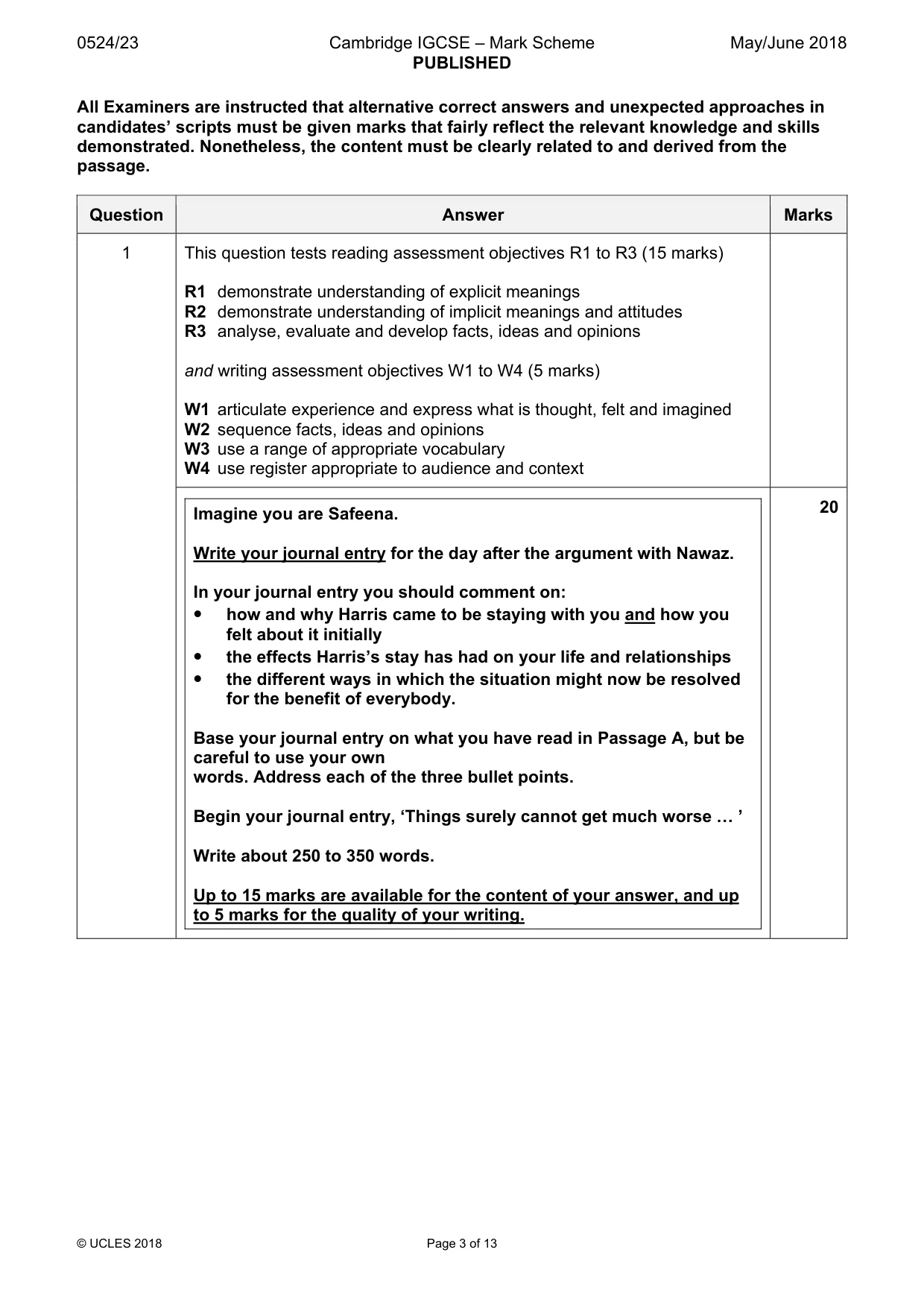
0524/23 Cambridge IGCSE – Mark Scheme PUBLISHED May/June 2018 © UCLES 2018 Page 3 of 13 All Examiners are instructed that alternative correct answers and unexpected approaches in candidates’ scripts must be given marks that fairly reflect the relevant knowledge and skills demonstrated. Nonetheless, the content must be clearly related to and derived from the passage. Question Answer Marks 1 This question tests reading assessment objectives R1 to R3 (15 marks) R1 demonstrate understanding of explicit meanings R2 demonstrate understanding of implicit meanings and attitudes R3 analyse, evaluate and develop facts, ideas and opinions and writing assessment objectives W1 to W4 (5 marks) W1 articulate experience and express what is thought, felt and imagined W2 sequence facts, ideas and opinions W3 use a range of appropriate vocabulary W4 use register appropriate to audience and context Imagine you are Safeena. Write your journal entry for the day after the argument with Nawaz. In your journal entry you should comment on: • how and why Harris came to be staying with you and how you felt about it initially • the effects Harris’s stay has had on your life and relationships • the different ways in which the situation might now be resolved for the benefit of everybody. Base your journal entry on what you have read in Passage A, but be careful to use your own words. Address each of the three bullet points. Begin your journal entry, ‘Things surely cannot get much worse « ’ Write about 250 to 350 words. Up to 15 marks are available for the content of your answer, and up to 5 marks for the quality of your writing. 20
Mark scheme, page 4
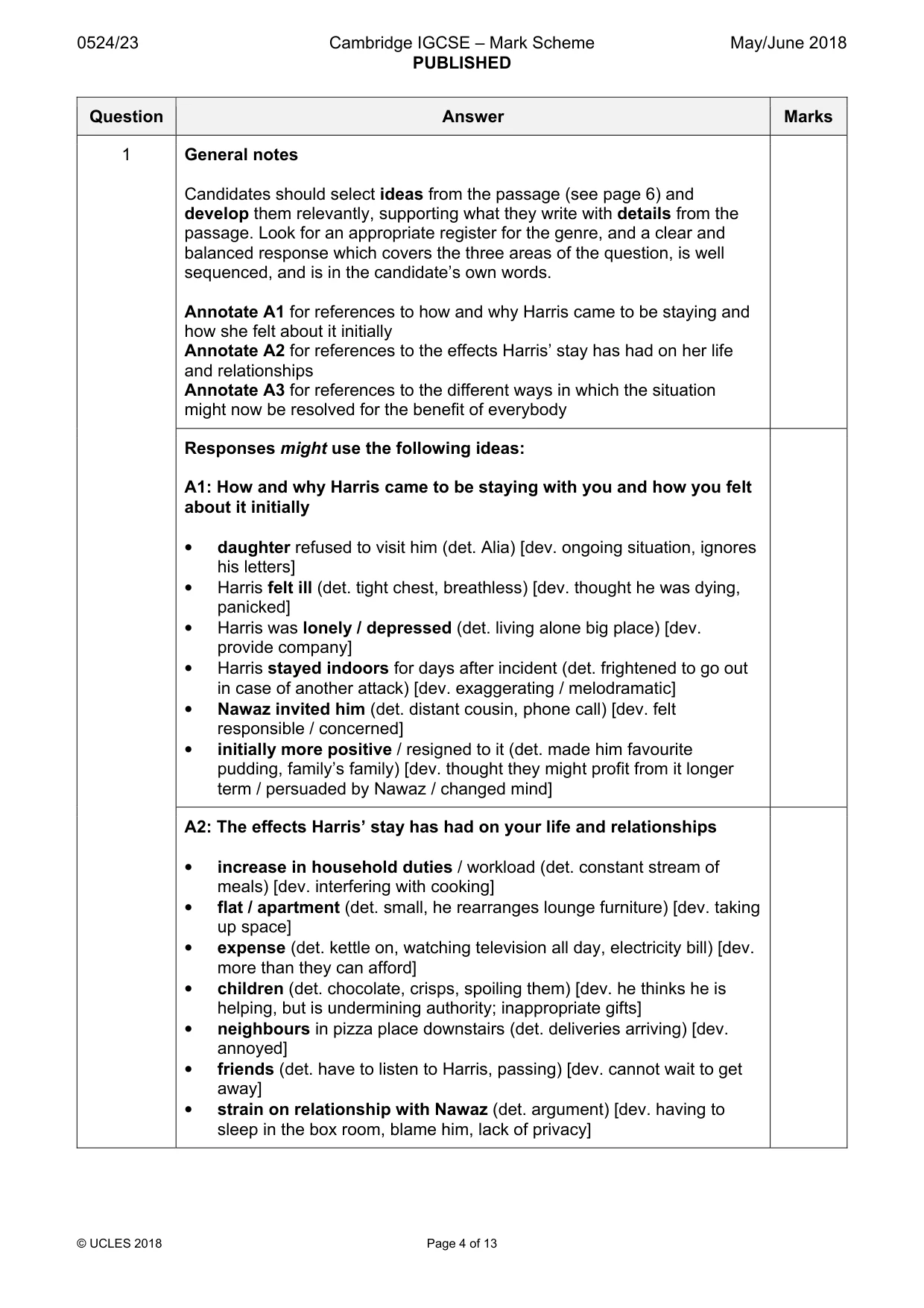
0524/23 Cambridge IGCSE – Mark Scheme PUBLISHED May/June 2018 © UCLES 2018 Page 4 of 13 Question Answer Marks 1 General notes Candidates should select ideas from the passage (see page 6) and develop them relevantly, supporting what they write with details from the passage. Look for an appropriate register for the genre, and a clear and balanced response which covers the three areas of the question, is well sequenced, and is in the candidate’s own words. Annotate A1 for references to how and why Harris came to be staying and how she felt about it initially Annotate A2 for references to the effects Harris’ stay has had on her life and relationships Annotate A3 for references to the different ways in which the situation might now be resolved for the benefit of everybody Responses might use the following ideas: A1: How and why Harris came to be staying with you and how you felt about it initially • daughter refused to visit him (det. Alia) [dev. ongoing situation, ignores his letters] • Harris felt ill (det. tight chest, breathless) [dev. thought he was dying, panicked] • Harris was lonely / depressed (det. living alone big place) [dev. provide company] • Harris stayed indoors for days after incident (det. frightened to go out in case of another attack) [dev. exaggerating / melodramatic] • Nawaz invited him (det. distant cousin, phone call) [dev. felt responsible / concerned] • initially more positive / resigned to it (det. made him favourite pudding, family’s family) [dev. thought they might profit from it longer term / persuaded by Nawaz / changed mind] A2: The effects Harris’ stay has had on your life and relationships • increase in household duties / workload (det. constant stream of meals) [dev. interfering with cooking] • flat / apartment (det. small, he rearranges lounge furniture) [dev. taking up space] • expense (det. kettle on, watching television all day, electricity bill) [dev. more than they can afford] • children (det. chocolate, crisps, spoiling them) [dev. he thinks he is helping, but is undermining authority; inappropriate gifts] • neighbours in pizza place downstairs (det. deliveries arriving) [dev. annoyed] • friends (det. have to listen to Harris, passing) [dev. cannot wait to get away] • strain on relationship with Nawaz (det. argument) [dev. having to sleep in the box room, blame him, lack of privacy]
Mark scheme, page 5
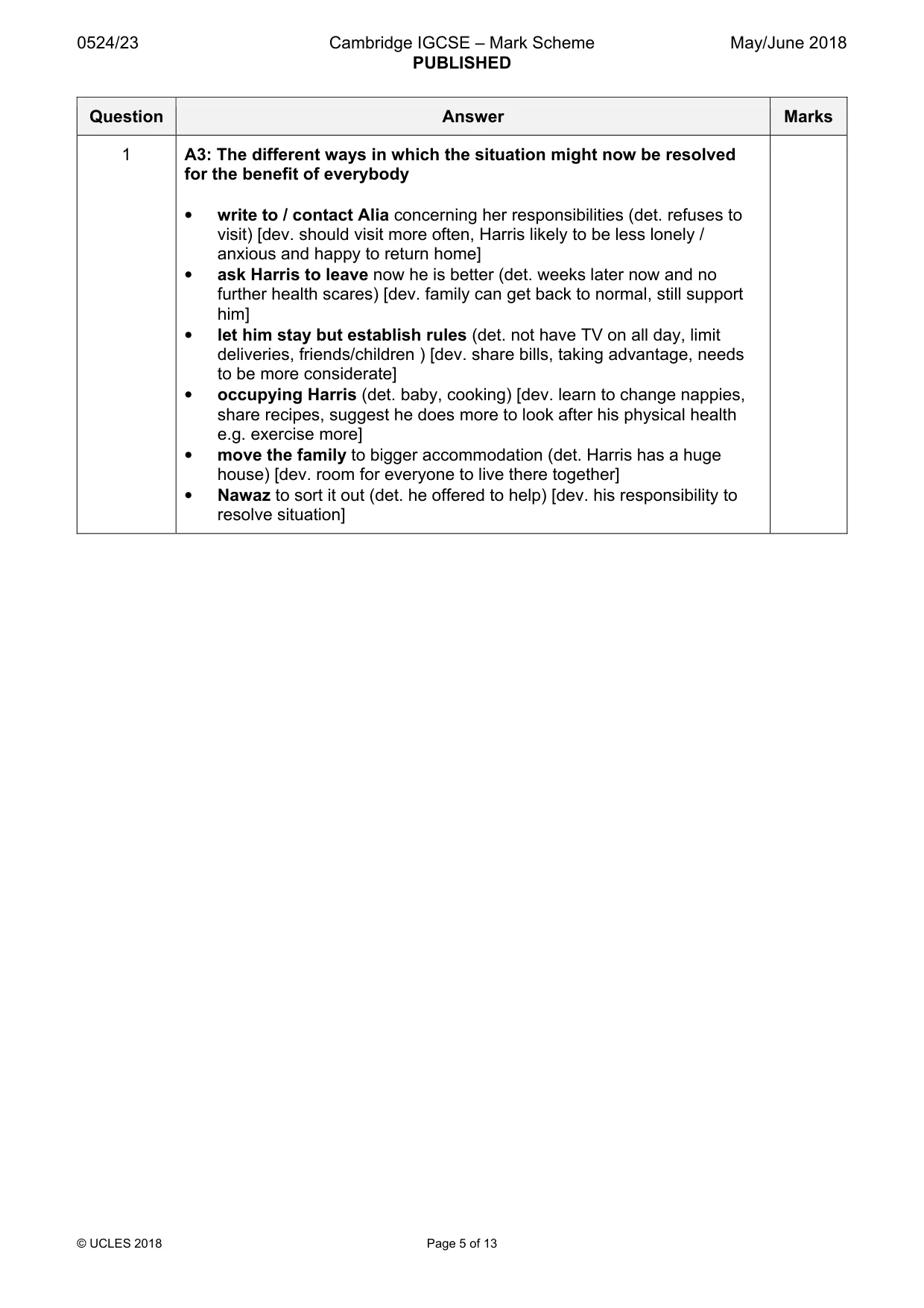
0524/23 Cambridge IGCSE – Mark Scheme PUBLISHED May/June 2018 © UCLES 2018 Page 5 of 13 Question Answer Marks 1 A3: The different ways in which the situation might now be resolved for the benefit of everybody • write to / contact Alia concerning her responsibilities (det. refuses to visit) [dev. should visit more often, Harris likely to be less lonely / anxious and happy to return home] • ask Harris to leave now he is better (det. weeks later now and no further health scares) [dev. family can get back to normal, still support him] • let him stay but establish rules (det. not have TV on all day, limit deliveries, friends/children ) [dev. share bills, taking advantage, needs to be more considerate] • occupying Harris (det. baby, cooking) [dev. learn to change nappies, share recipes, suggest he does more to look after his physical health e.g. exercise more] • move the family to bigger accommodation (det. Harris has a huge house) [dev. room for everyone to live there together] • Nawaz to sort it out (det. he offered to help) [dev. his responsibility to resolve situation]
Mark scheme, page 6
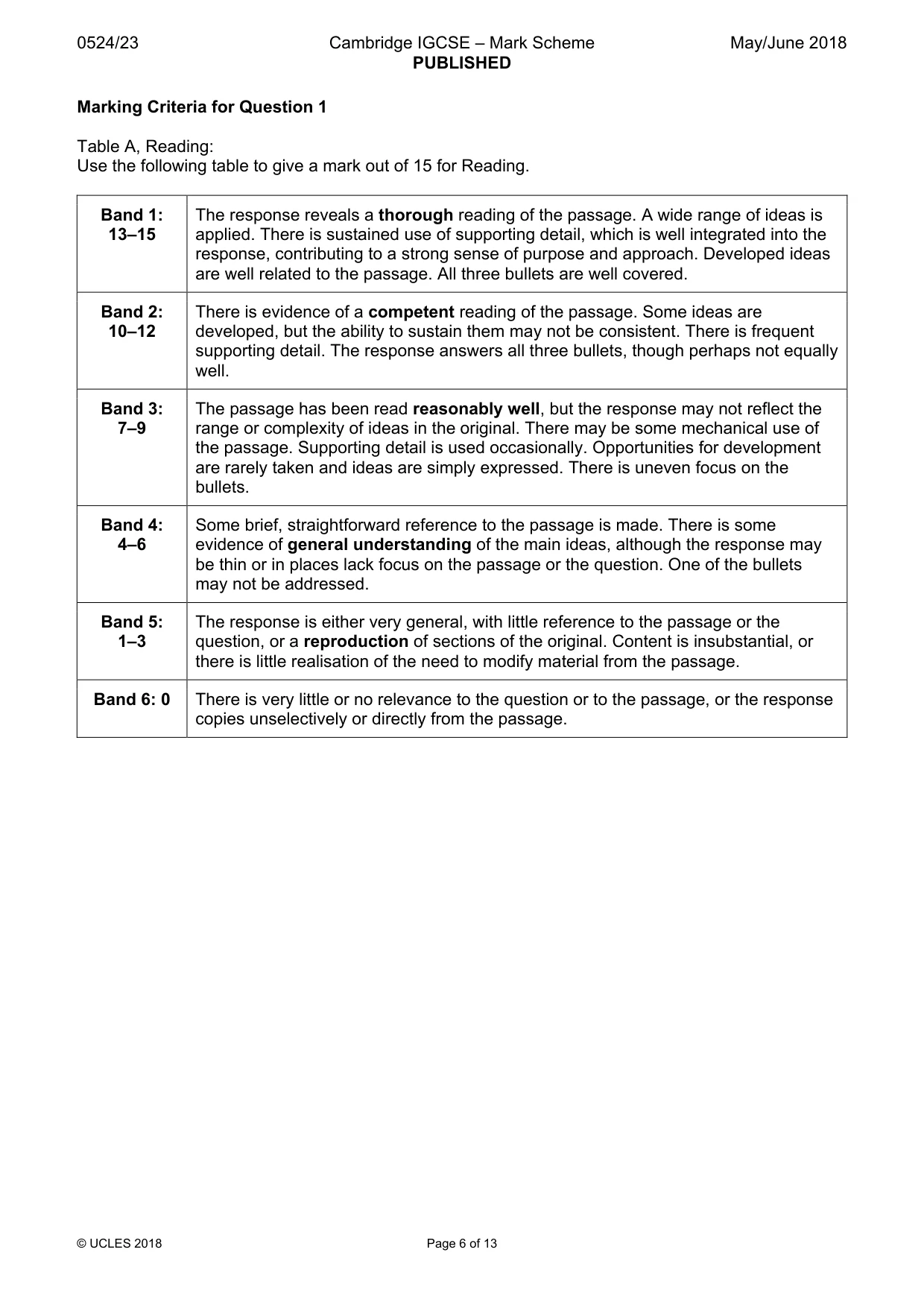
0524/23 Cambridge IGCSE – Mark Scheme PUBLISHED May/June 2018 © UCLES 2018 Page 6 of 13 Marking Criteria for Question 1 Table A, Reading: Use the following table to give a mark out of 15 for Reading. Band 1: 13–15 The response reveals a thorough reading of the passage. A wide range of ideas is applied. There is sustained use of supporting detail, which is well integrated into the response, contributing to a strong sense of purpose and approach. Developed ideas are well related to the passage. All three bullets are well covered. Band 2: 10–12 There is evidence of a competent reading of the passage. Some ideas are developed, but the ability to sustain them may not be consistent. There is frequent supporting detail. The response answers all three bullets, though perhaps not equally well. Band 3: 7–9 The passage has been read reasonably well, but the response may not reflect the range or complexity of ideas in the original. There may be some mechanical use of the passage. Supporting detail is used occasionally. Opportunities for development are rarely taken and ideas are simply expressed. There is uneven focus on the bullets. Band 4: 4–6 Some brief, straightforward reference to the passage is made. There is some evidence of general understanding of the main ideas, although the response may be thin or in places lack focus on the passage or the question. One of the bullets may not be addressed. Band 5: 1–3 The response is either very general, with little reference to the passage or the question, or a reproduction of sections of the original. Content is insubstantial, or there is little realisation of the need to modify material from the passage. Band 6: 0 There is very little or no relevance to the question or to the passage, or the response copies unselectively or directly from the passage.
Mark scheme, page 7
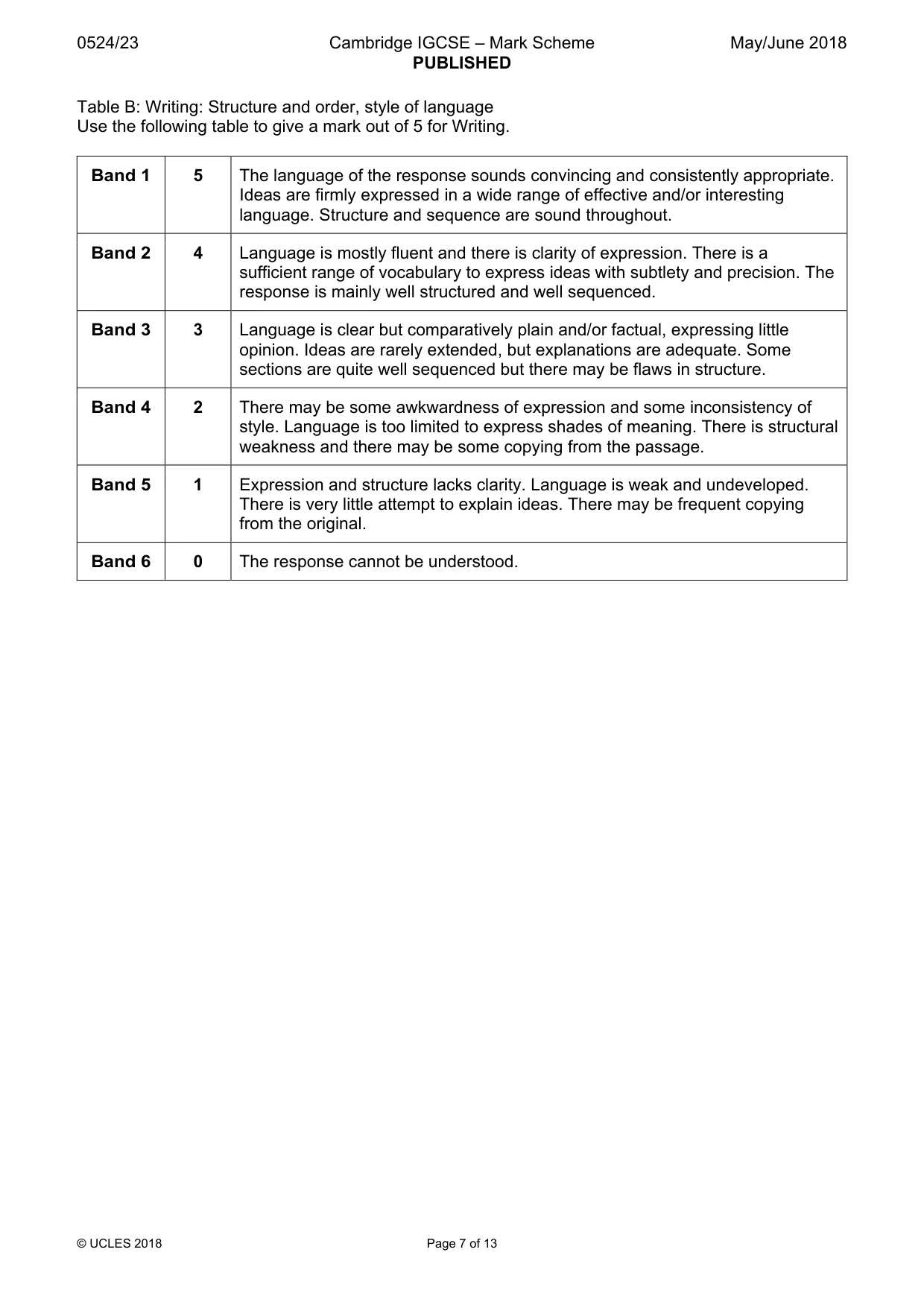
0524/23 Cambridge IGCSE – Mark Scheme PUBLISHED May/June 2018 © UCLES 2018 Page 7 of 13 Table B: Writing: Structure and order, style of language Use the following table to give a mark out of 5 for Writing. Band 1 5 The language of the response sounds convincing and consistently appropriate. Ideas are firmly expressed in a wide range of effective and/or interesting language. Structure and sequence are sound throughout. Band 2 4 Language is mostly fluent and there is clarity of expression. There is a sufficient range of vocabulary to express ideas with subtlety and precision. The response is mainly well structured and well sequenced. Band 3 3 Language is clear but comparatively plain and/or factual, expressing little opinion. Ideas are rarely extended, but explanations are adequate. Some sections are quite well sequenced but there may be flaws in structure. Band 4 2 There may be some awkwardness of expression and some inconsistency of style. Language is too limited to express shades of meaning. There is structural weakness and there may be some copying from the passage. Band 5 1 Expression and structure lacks clarity. Language is weak and undeveloped. There is very little attempt to explain ideas. There may be frequent copying from the original. Band 6 0 The response cannot be understood.
Mark scheme, page 8
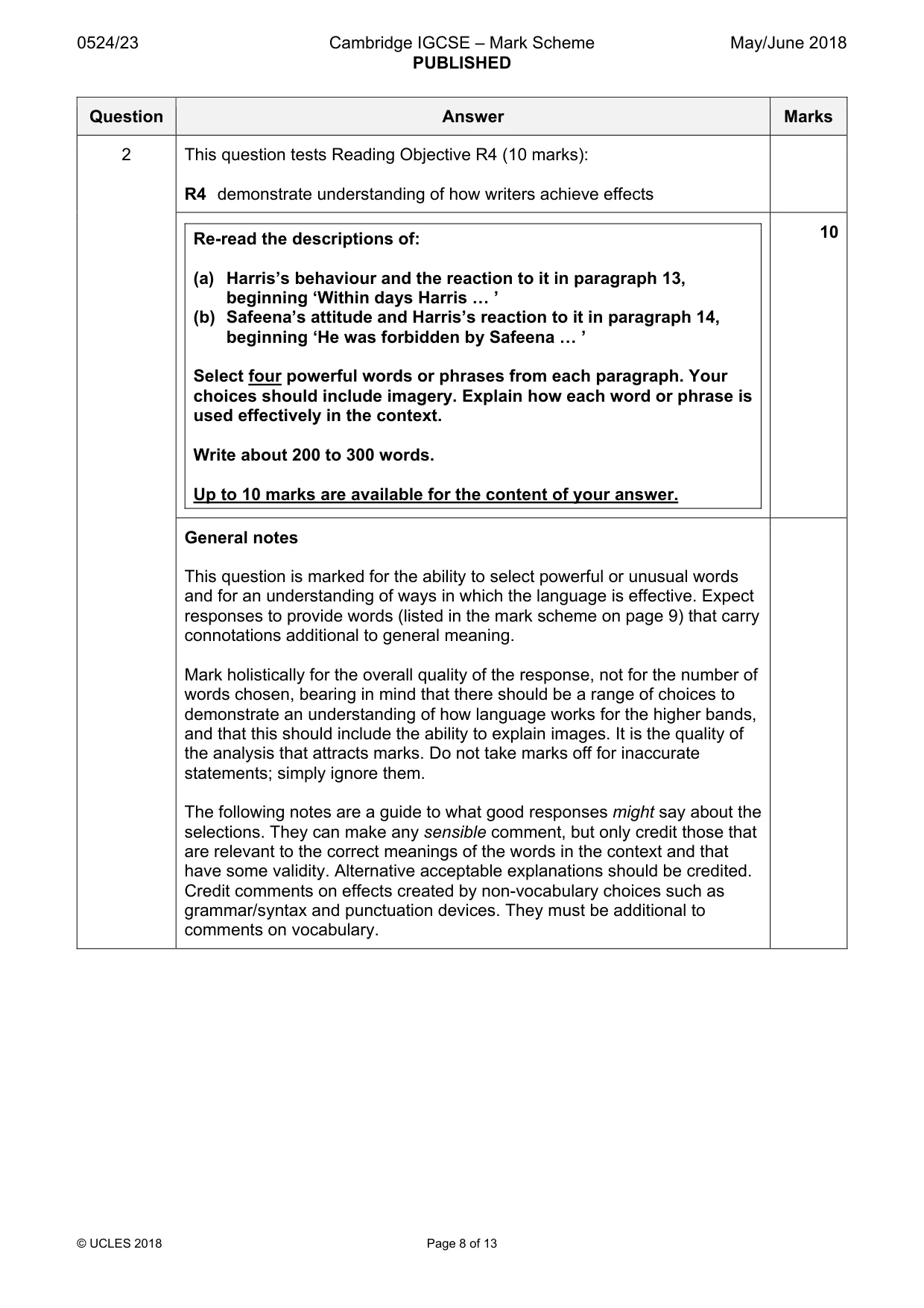
0524/23 Cambridge IGCSE – Mark Scheme PUBLISHED May/June 2018 © UCLES 2018 Page 8 of 13 Question Answer Marks 2 This question tests Reading Objective R4 (10 marks): R4 demonstrate understanding of how writers achieve effects Re-read the descriptions of: (a) Harris’s behaviour and the reaction to it in paragraph 13, beginning ‘Within days Harris « ’ (b) Safeena’s attitude and Harris’s reaction to it in paragraph 14, beginning ‘He was forbidden by Safeena « ’ Select four powerful words or phrases from each paragraph. Your choices should include imagery. Explain how each word or phrase is used effectively in the context. Write about 200 to 300 words. Up to 10 marks are available for the content of your answer. 10 General notes This question is marked for the ability to select powerful or unusual words and for an understanding of ways in which the language is effective. Expect responses to provide words (listed in the mark scheme on page 9) that carry connotations additional to general meaning. Mark holistically for the overall quality of the response, not for the number of words chosen, bearing in mind that there should be a range of choices to demonstrate an understanding of how language works for the higher bands, and that this should include the ability to explain images. It is the quality of the analysis that attracts marks. Do not take marks off for inaccurate statements; simply ignore them. The following notes are a guide to what good responses might say about the selections. They can make any sensible comment, but only credit those that are relevant to the correct meanings of the words in the context and that have some validity. Alternative acceptable explanations should be credited. Credit comments on effects created by non-vocabulary choices such as grammar/syntax and punctuation devices. They must be additional to comments on vocabulary.
Mark scheme, page 9
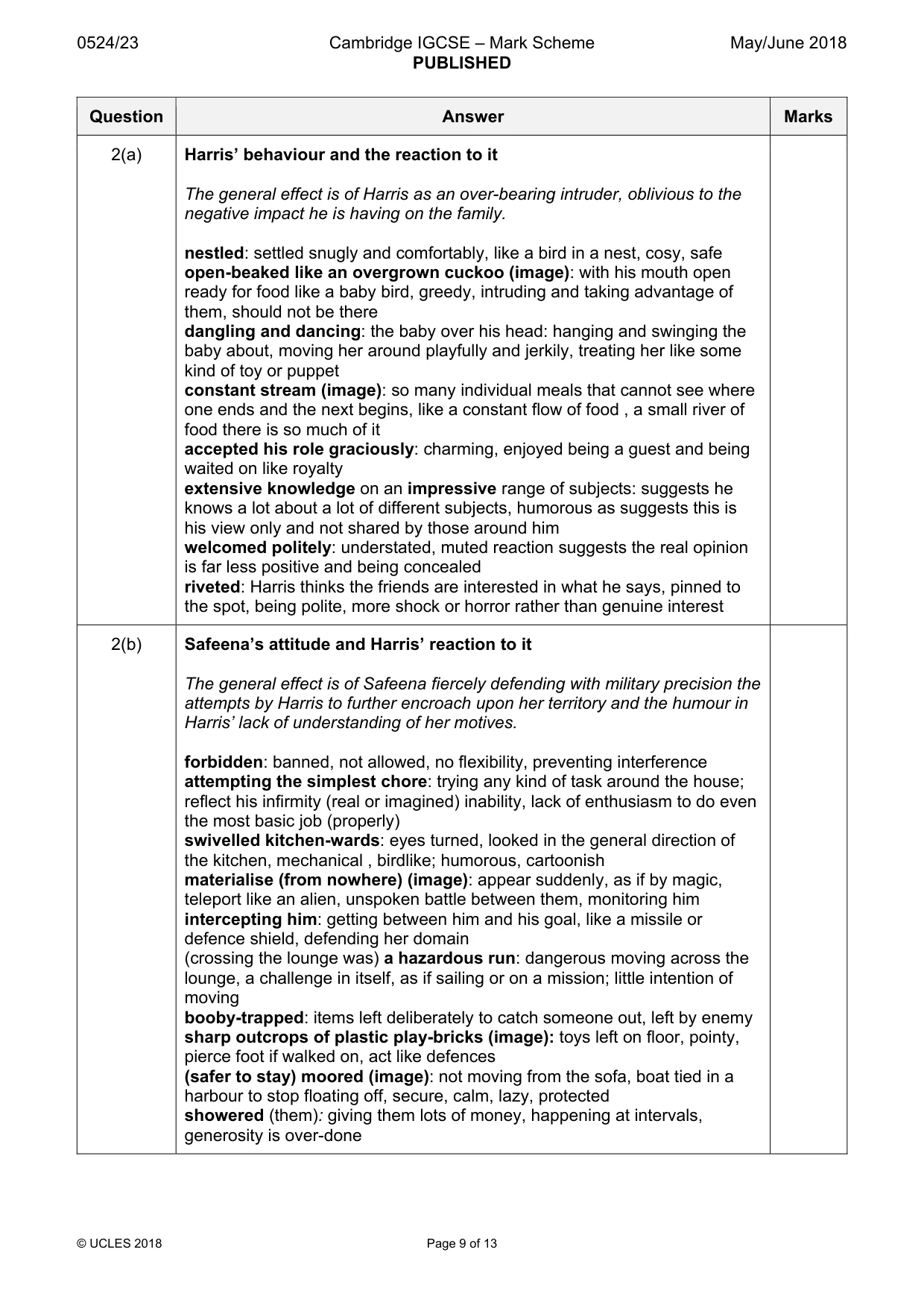
0524/23 Cambridge IGCSE – Mark Scheme PUBLISHED May/June 2018 © UCLES 2018 Page 9 of 13 Question Answer Marks 2(a) Harris’ behaviour and the reaction to it The general effect is of Harris as an over-bearing intruder, oblivious to the negative impact he is having on the family. nestled: settled snugly and comfortably, like a bird in a nest, cosy, safe open-beaked like an overgrown cuckoo (image): with his mouth open ready for food like a baby bird, greedy, intruding and taking advantage of them, should not be there dangling and dancing: the baby over his head: hanging and swinging the baby about, moving her around playfully and jerkily, treating her like some kind of toy or puppet constant stream (image): so many individual meals that cannot see where one ends and the next begins, like a constant flow of food , a small river of food there is so much of it accepted his role graciously: charming, enjoyed being a guest and being waited on like royalty extensive knowledge on an impressive range of subjects: suggests he knows a lot about a lot of different subjects, humorous as suggests this is his view only and not shared by those around him welcomed politely: understated, muted reaction suggests the real opinion is far less positive and being concealed riveted: Harris thinks the friends are interested in what he says, pinned to the spot, being polite, more shock or horror rather than genuine interest 2(b) Safeena’s attitude and Harris’ reaction to it The general effect is of Safeena fiercely defending with military precision the attempts by Harris to further encroach upon her territory and the humour in Harris’ lack of understanding of her motives. forbidden: banned, not allowed, no flexibility, preventing interference attempting the simplest chore: trying any kind of task around the house; reflect his infirmity (real or imagined) inability, lack of enthusiasm to do even the most basic job (properly) swivelled kitchen-wards: eyes turned, looked in the general direction of the kitchen, mechanical , birdlike; humorous, cartoonish materialise (from nowhere) (image): appear suddenly, as if by magic, teleport like an alien, unspoken battle between them, monitoring him intercepting him: getting between him and his goal, like a missile or defence shield, defending her domain (crossing the lounge was) a hazardous run: dangerous moving across the lounge, a challenge in itself, as if sailing or on a mission; little intention of moving booby-trapped: items left deliberately to catch someone out, left by enemy sharp outcrops of plastic play-bricks (image): toys left on floor, pointy, pierce foot if walked on, act like defences (safer to stay) moored (image): not moving from the sofa, boat tied in a harbour to stop floating off, secure, calm, lazy, protected showered (them): giving them lots of money, happening at intervals, generosity is over-done
Mark scheme, page 10
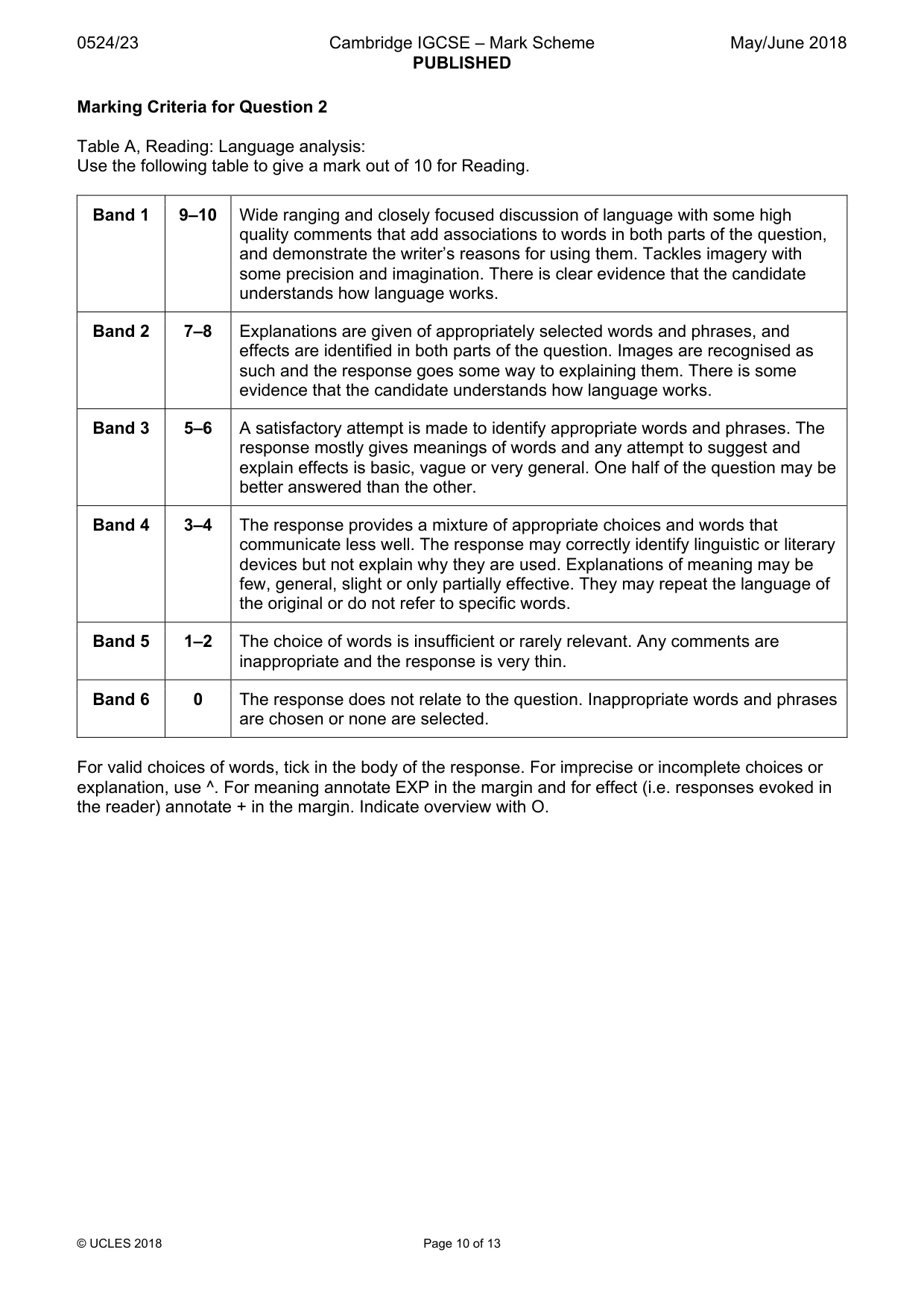
0524/23 Cambridge IGCSE – Mark Scheme PUBLISHED May/June 2018 © UCLES 2018 Page 10 of 13 Marking Criteria for Question 2 Table A, Reading: Language analysis: Use the following table to give a mark out of 10 for Reading. Band 1 9–10 Wide ranging and closely focused discussion of language with some high quality comments that add associations to words in both parts of the question, and demonstrate the writer’s reasons for using them. Tackles imagery with some precision and imagination. There is clear evidence that the candidate understands how language works. Band 2 7–8 Explanations are given of appropriately selected words and phrases, and effects are identified in both parts of the question. Images are recognised as such and the response goes some way to explaining them. There is some evidence that the candidate understands how language works. Band 3 5–6 A satisfactory attempt is made to identify appropriate words and phrases. The response mostly gives meanings of words and any attempt to suggest and explain effects is basic, vague or very general. One half of the question may be better answered than the other. Band 4 3–4 The response provides a mixture of appropriate choices and words that communicate less well. The response may correctly identify linguistic or literary devices but not explain why they are used. Explanations of meaning may be few, general, slight or only partially effective. They may repeat the language of the original or do not refer to specific words. Band 5 1–2 The choice of words is insufficient or rarely relevant. Any comments are inappropriate and the response is very thin. Band 6 0 The response does not relate to the question. Inappropriate words and phrases are chosen or none are selected. For valid choices of words, tick in the body of the response. For imprecise or incomplete choices or explanation, use ^. For meaning annotate EXP in the margin and for effect (i.e. responses evoked in the reader) annotate + in the margin. Indicate overview with O.
Mark scheme, page 11
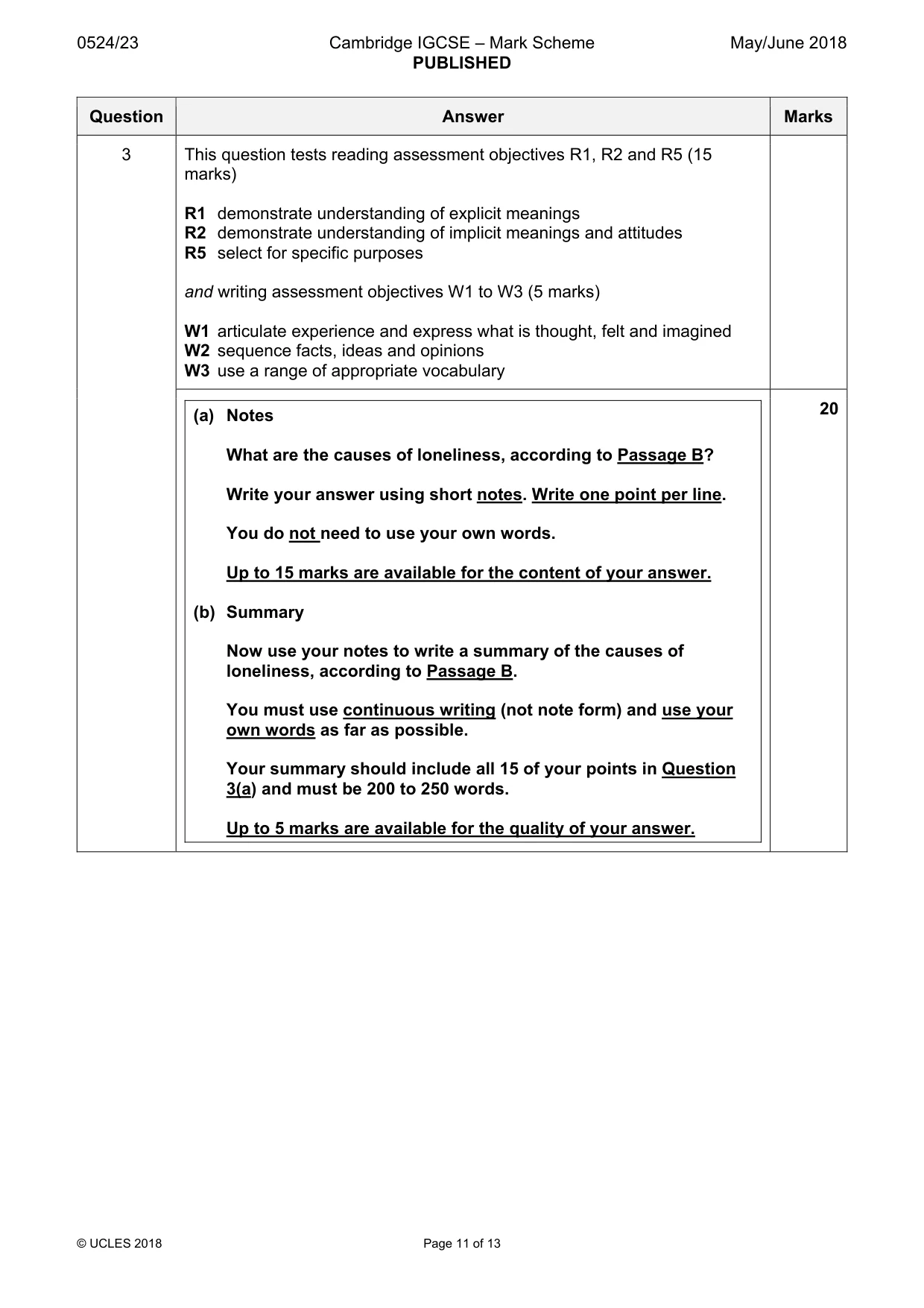
0524/23 Cambridge IGCSE – Mark Scheme PUBLISHED May/June 2018 © UCLES 2018 Page 11 of 13 Question Answer Marks 3 This question tests reading assessment objectives R1, R2 and R5 (15 marks) R1 demonstrate understanding of explicit meanings R2 demonstrate understanding of implicit meanings and attitudes R5 select for specific purposes and writing assessment objectives W1 to W3 (5 marks) W1 articulate experience and express what is thought, felt and imagined W2 sequence facts, ideas and opinions W3 use a range of appropriate vocabulary (a) Notes What are the causes of loneliness, according to Passage B? Write your answer using short notes. Write one point per line. You do not need to use your own words. Up to 15 marks are available for the content of your answer. (b) Summary Now use your notes to write a summary of the causes of loneliness, according to Passage B. You must use continuous writing (not note form) and use your own words as far as possible. Your summary should include all 15 of your points in Question 3(a) and must be 200 to 250 words. Up to 5 marks are available for the quality of your answer. 20
Mark scheme, page 12
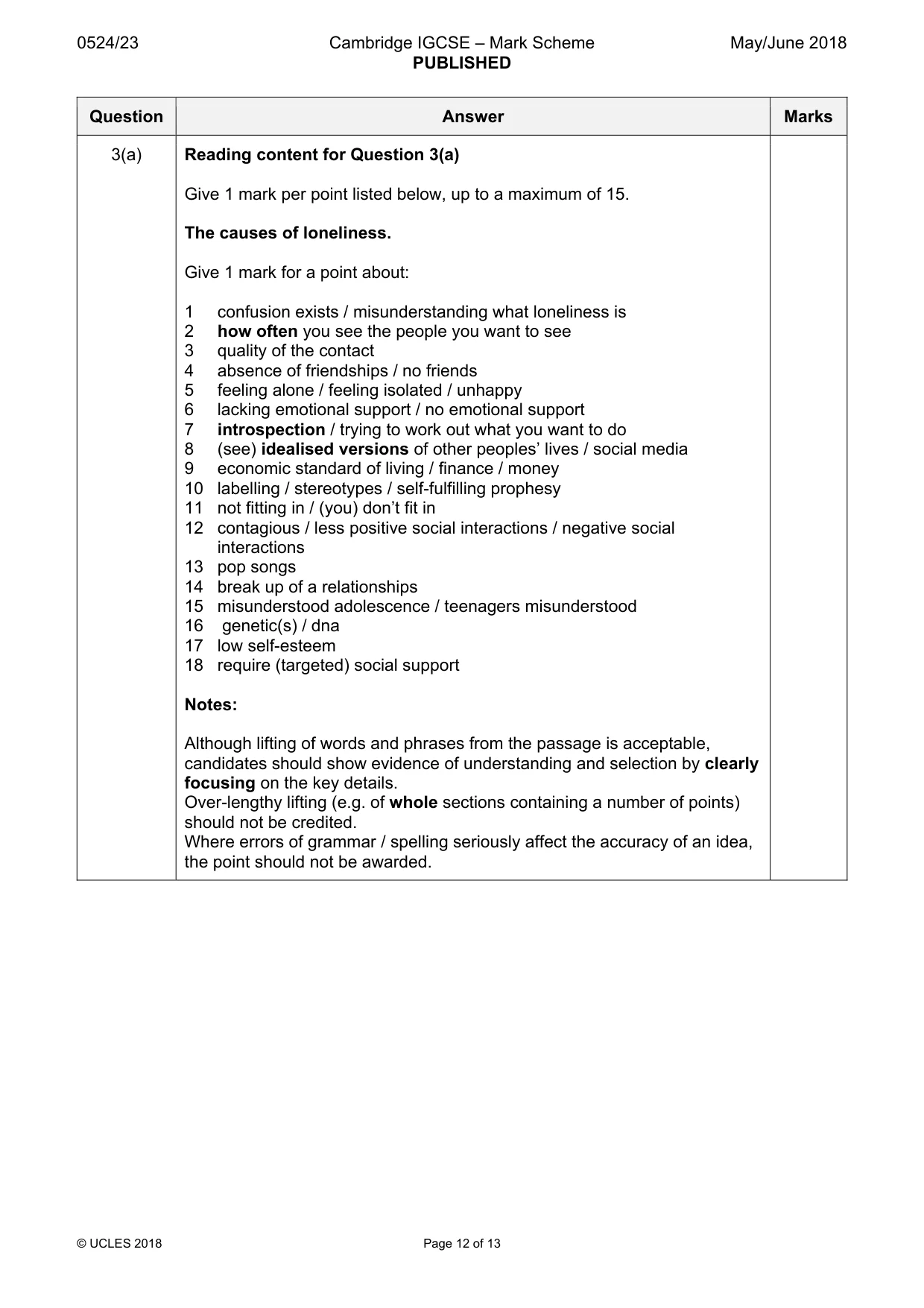
0524/23 Cambridge IGCSE – Mark Scheme PUBLISHED May/June 2018 © UCLES 2018 Page 12 of 13 Question Answer Marks 3(a) Reading content for Question 3(a) Give 1 mark per point listed below, up to a maximum of 15. The causes of loneliness. Give 1 mark for a point about: 1 confusion exists / misunderstanding what loneliness is 2 how often you see the people you want to see 3 quality of the contact 4 absence of friendships / no friends 5 feeling alone / feeling isolated / unhappy 6 lacking emotional support / no emotional support 7 introspection / trying to work out what you want to do 8 (see) idealised versions of other peoples’ lives / social media 9 economic standard of living / finance / money 10 labelling / stereotypes / self-fulfilling prophesy 11 not fitting in / (you) don’t fit in 12 contagious / less positive social interactions / negative social interactions 13 pop songs 14 break up of a relationships 15 misunderstood adolescence / teenagers misunderstood 16 genetic(s) / dna 17 low self-esteem 18 require (targeted) social support Notes: Although lifting of words and phrases from the passage is acceptable, candidates should show evidence of understanding and selection by clearly focusing on the key details. Over-lengthy lifting (e.g. of whole sections containing a number of points) should not be credited. Where errors of grammar / spelling seriously affect the accuracy of an idea, the point should not be awarded.
Mark scheme, page 13
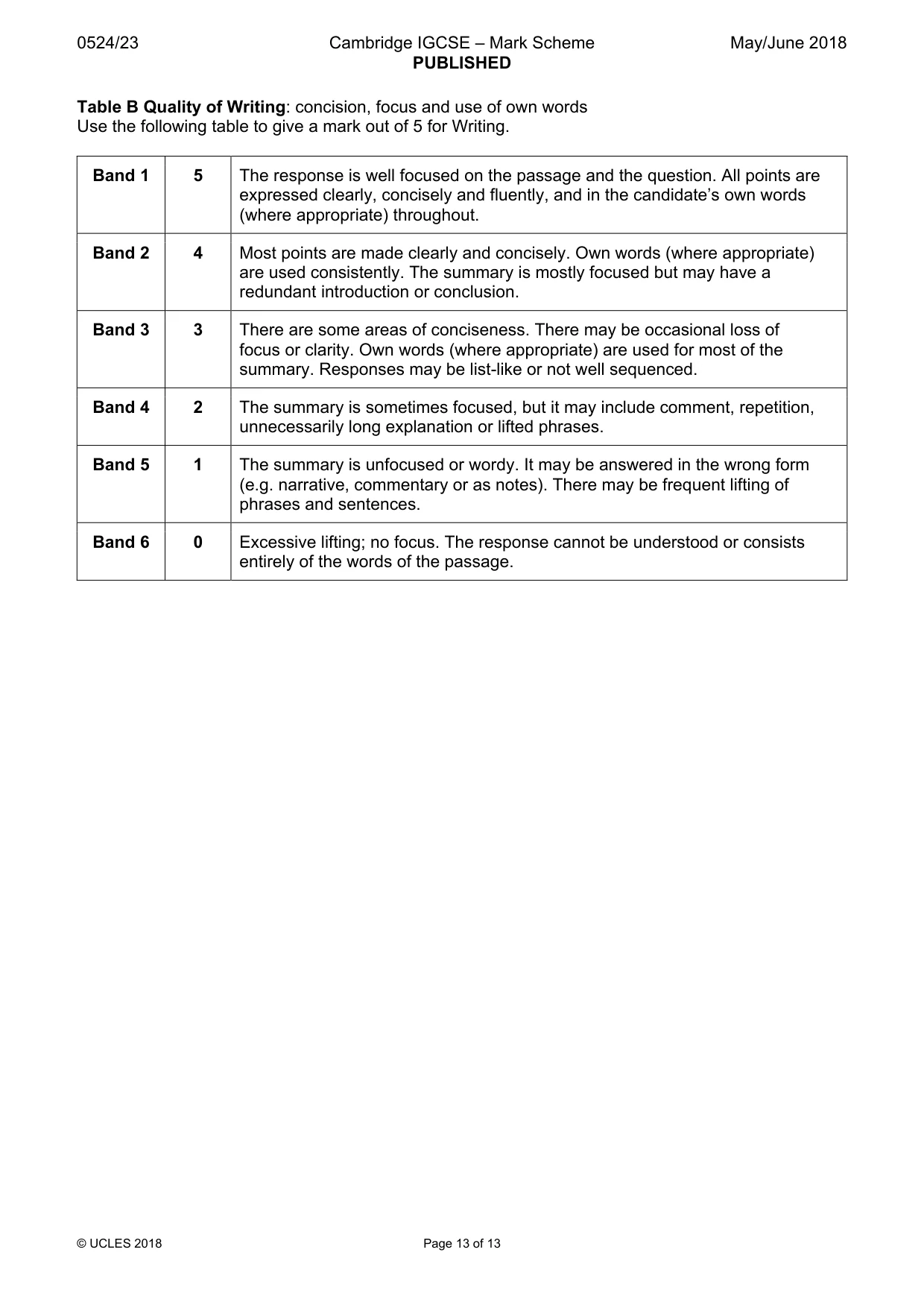
0524/23 Cambridge IGCSE – Mark Scheme PUBLISHED May/June 2018 © UCLES 2018 Page 13 of 13 Table B Quality of Writing: concision, focus and use of own words Use the following table to give a mark out of 5 for Writing. Band 1 5 The response is well focused on the passage and the question. All points are expressed clearly, concisely and fluently, and in the candidate’s own words (where appropriate) throughout. Band 2 4 Most points are made clearly and concisely. Own words (where appropriate) are used consistently. The summary is mostly focused but may have a redundant introduction or conclusion. Band 3 3 There are some areas of conciseness. There may be occasional loss of focus or clarity. Own words (where appropriate) are used for most of the summary. Responses may be list-like or not well sequenced. Band 4 2 The summary is sometimes focused, but it may include comment, repetition, unnecessarily long explanation or lifted phrases. Band 5 1 The summary is unfocused or wordy. It may be answered in the wrong form (e.g. narrative, commentary or as notes). There may be frequent lifting of phrases and sentences. Band 6 0 Excessive lifting; no focus. The response cannot be understood or consists entirely of the words of the passage.
What you needed in this session
Cambridge’s own grade thresholds for 2018 May/June, Paper 2 · Variant 3. A higher threshold means an easier paper — the bar moves with how the cohort did.