Cambridge IGCSE English - First Language (9-1) (UK only) 0627 — 2019 Oct/Nov Paper 1 · Variant 1
0627/11/O/N/19 · 80 marks · ≈90 min
The question paper and its mark scheme, free to read here and free to download. This is Cambridge’s own paper, exactly as it was sat.
Question paper12 pages
Mark scheme17 pages
Answers below. Sit the paper first if you are practising.
Paper as text
Question paper, page 1
This document consists of 12 printed pages and 1 Insert. DC (LT) 164161/2 © UCLES 2019 [Turn over Cambridge Assessment International Education Cambridge International General Certificate of Secondary Education (9–1) * 2 1 3 8 8 5 2 1 4 8 * FIRST LANGUAGE ENGLISH 0627/01 Paper 1 Reading Passages October/November 2019 2 hours 10 minutes Candidates answer on the Question Paper. No Additional Materials are required. READ THESE INSTRUCTIONS FIRST Write your centre number, candidate number and name in the spaces at the top of this page. Write in dark blue or black pen. Do not use staples, paper clips, glue or correction fluid. DO NOT WRITE IN ANY BARCODES. Answer all questions in the space provided. If additional space is required, you should use the lined pages at the end of this booklet. The question number(s) must be clearly shown. Dictionaries are not permitted. The Insert contains the reading passages for use with all the questions on the Question Paper. This Insert is not assessed by the Examiner. The number of marks is given in brackets [ ] at the end of each question or part question. This syllabus is regulated for use in England as a Cambridge International Level 1/Level 2 (9–1) Certificate.
Question paper, page 2
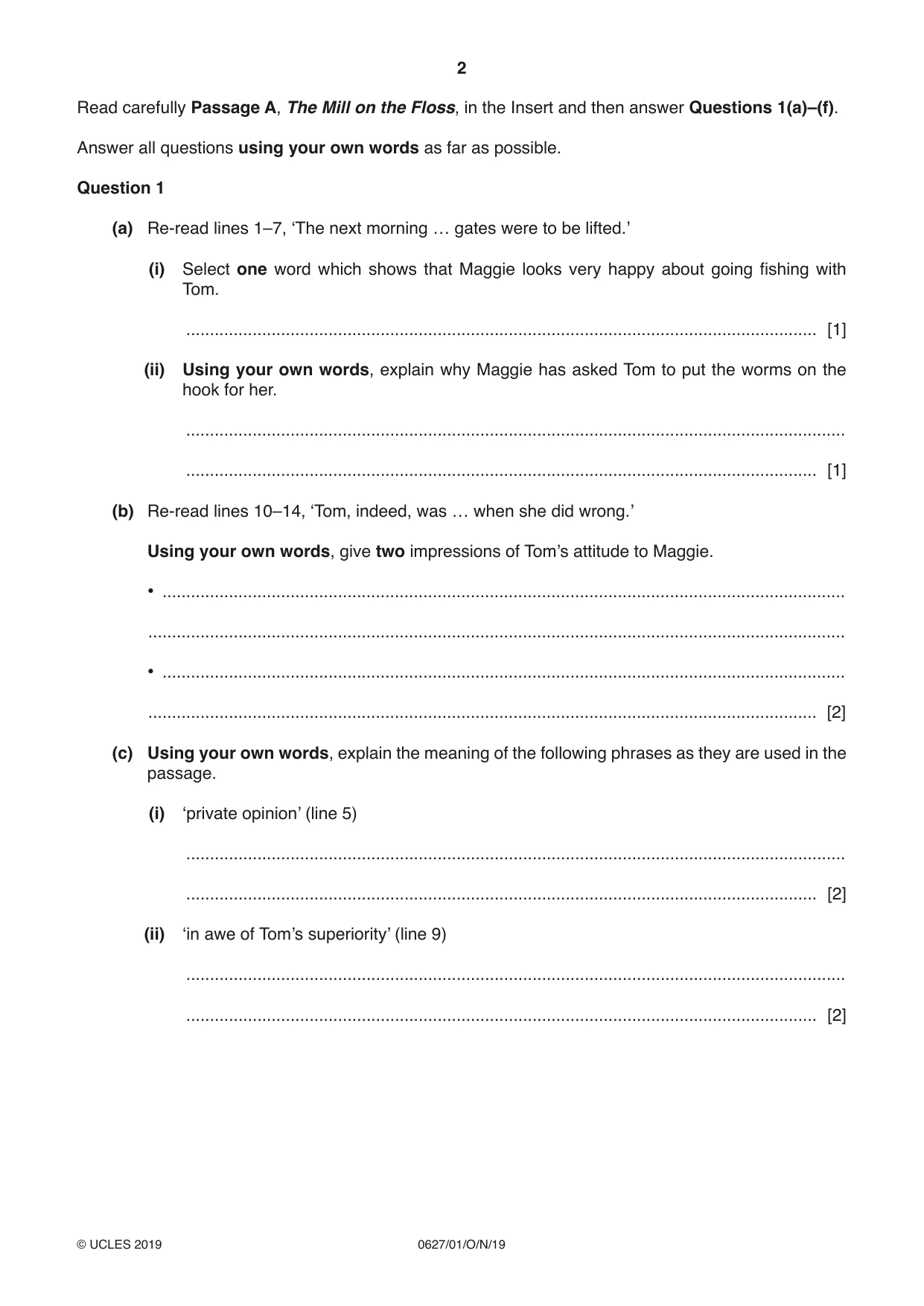
2 0627/01/O/N/19 © UCLES 2019 Read carefully Passage A, The Mill on the Floss, in the Insert and then answer Questions 1(a)–(f). Answer all questions using your own words as far as possible. Question 1 (a) Re-read lines 1–7, ‘The next morning … gates were to be lifted.’ (i) Select one word which shows that Maggie looks very happy about going fishing with Tom. … [1] (ii) Using your own words, explain why Maggie has asked Tom to put the worms on the hook for her. … … [1] (b) Re-read lines 10–14, ‘Tom, indeed, was … when she did wrong.’ Using your own words, give two impressions of Tom’s attitude to Maggie. • … … • … … [2] (c) Using your own words, explain the meaning of the following phrases as they are used in the passage. (i) ‘private opinion’ (line 5) … … [2] (ii) ‘in awe of Tom’s superiority’ (line 9) … … [2]
Question paper, page 3
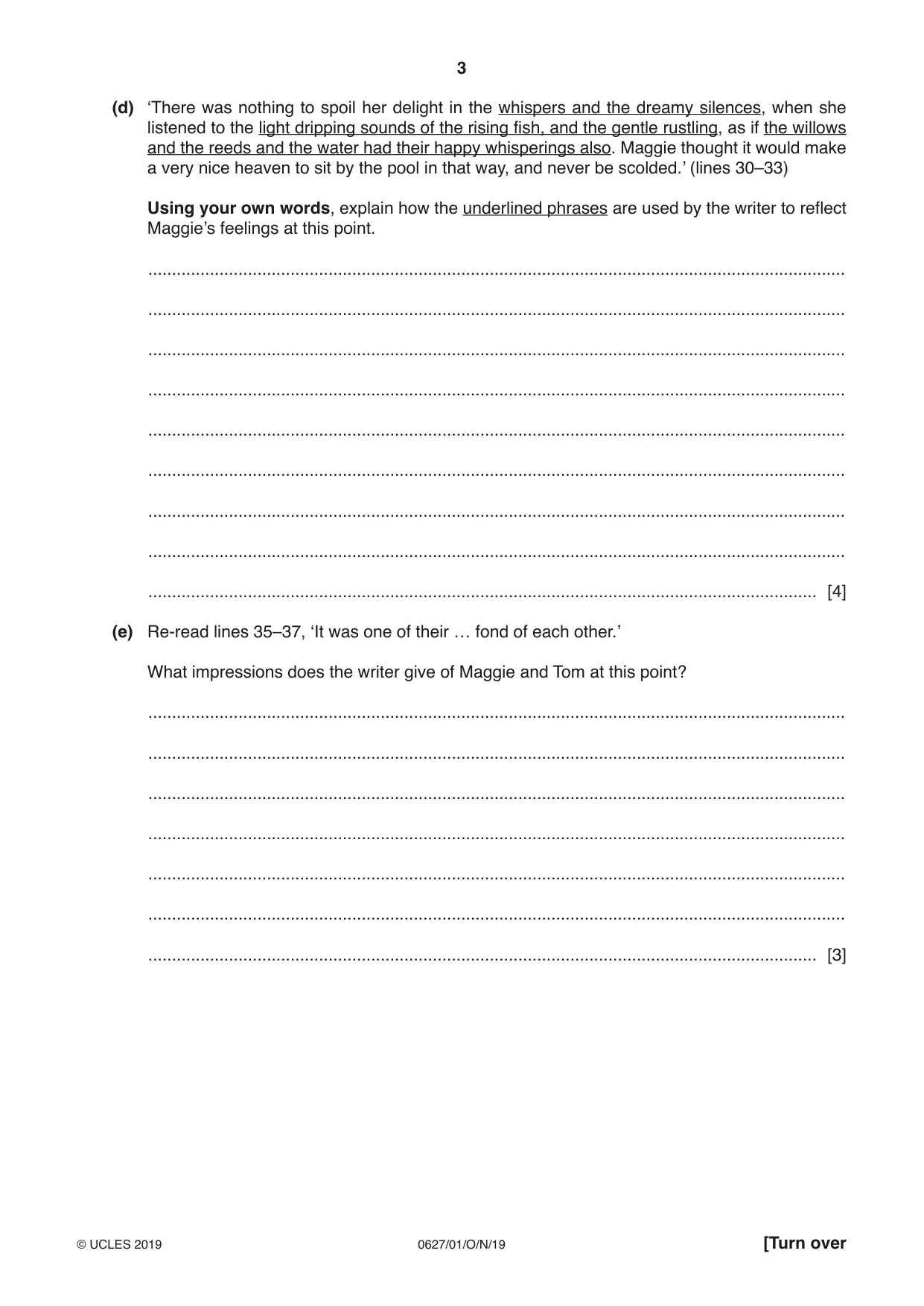
3 0627/01/O/N/19 © UCLES 2019 [Turn over (d) ‘There was nothing to spoil her delight in the whispers and the dreamy silences, when she listened to the light dripping sounds of the rising fish, and the gentle rustling, as if the willows and the reeds and the water had their happy whisperings also. Maggie thought it would make a very nice heaven to sit by the pool in that way, and never be scolded.’ (lines 30–33) Using your own words, explain how the underlined phrases are used by the writer to reflect Maggie’s feelings at this point. … … … … … … … … … [4] (e) Re-read lines 35–37, ‘It was one of their … fond of each other.’ What impressions does the writer give of Maggie and Tom at this point? … … … … … … … [3]
Question paper, page 4
4 0627/01/O/N/19 © UCLES 2019 (f) Re-read lines 15–30, ‘They were on their way … was pleased with her.’ Explain how the writer uses language and techniques to describe: • the Round Pool • Maggie’s experience of fishing and Tom’s reaction. In your answer you should select powerful words and phrases and explain how the writer has created effects by using this language. You should write about 200 to 300 words. There are up to 15 marks available for the content of your answer. … … … … … … … … … … … … … … … … … … … … …
Question paper, page 5
5 0627/01/O/N/19 © UCLES 2019 [Turn over … … … … … … … … … … … … … … … … … … … … … … … … … … … … [15]
Question paper, page 6
6 0627/01/O/N/19 © UCLES 2019 Read carefully Passage B, Ending the gender divide, in the Insert and then answer Question 2. Question 2: Summary Task A new toy megastore is opening in your local area later this year and a new manager has just been appointed. Using the ideas from the passage, write a letter to the manager outlining your concerns about the impact that toys can have on children and their future career choices. Give your advice on how the manager should organise the store to ensure that children are encouraged to pursue their interests. You should write no more than 250 words. There are up to 15 marks available for the quality of your writing, and up to 10 marks available for the content of your answer. … … … … … … … … … … … … … … … … … … … …
Question paper, page 7
7 0627/01/O/N/19 © UCLES 2019 [Turn over … … … … … … … … … … … … … … … … … … … … … … … … … … … … [25]
Question paper, page 8
8 0627/01/O/N/19 © UCLES 2019 Read carefully Passage B, Ending the gender divide, and Passage C, The fun of it, in the Insert and then answer Questions 3(a), 3(b) and 3(c). Passage B Ending the gender divide Question 3(a) Re-read paragraph 1, ‘Walk into any … stuck in the last century.’ (i) Using your own words, explain why the writer describes toys as ‘children’s learning tools’. … … [1] (ii) Give two different language features from this paragraph which make this an effective opening to the article. For each feature give an example from the paragraph. • … … … • … … … [2] Passage C The fun of it Question 3(b) Re-read paragraph 2, ‘Looking back now … and I got together.’ Using your own words, give two aspects of Amelia Earhart’s character that show she was unusual for a girl at this time. • … … • … … [2]
Question paper, page 9
9 0627/01/O/N/19 © UCLES 2019 [Turn over Question 3(c) Compare and contrast how the writers of Passage B, Ending the gender divide, and Passage C, The fun of it, convey their views and ideas about treating boys and girls differently. In your response you should compare and contrast: • the views and ideas each writer presents to the reader • the evidence that the writers use to support their views and ideas • the language, structure and techniques used by the writers and why they are effective. Remember to support your answer with details from the passages. You should write about 300 to 350 words. There are up to 20 marks available for the content of your answer. … … … … … … … … … … … … … … … … … … … …
Question paper, page 10
10 0627/01/O/N/19 © UCLES 2019 … … … … … … … … … … … … … … … … … … … … … … … … … … … …
Question paper, page 11
11 0627/01/O/N/19 © UCLES 2019 … … … … … … … … … … … … … … … … … … … … … … … … … … … … [20]
Question paper, page 12
12 0627/01/O/N/19 © UCLES 2019 Permission to reproduce items where third-party owned material protected by copyright is included has been sought and cleared where possible. Every reasonable effort has been made by the publisher (UCLES) to trace copyright holders, but if any items requiring clearance have unwittingly been included, the publisher will be pleased to make amends at the earliest possible opportunity. To avoid the issue of disclosure of answer-related information to candidates, all copyright acknowledgements are reproduced online in the Cambridge Assessment International Education Copyright Acknowledgements Booklet. This is produced for each series of examinations and is freely available to download at www.cambridgeinternational.org after the live examination series. Cambridge Assessment International Education is part of the Cambridge Assessment Group. Cambridge Assessment is the brand name of the University of Cambridge Local Examinations Syndicate (UCLES), which itself is a department of the University of Cambridge. Additional Page If you use the following lined page to complete the answer(s) to any question(s), the question number(s) must be clearly shown. … … … … … … … … … … … … … … … … … … … … … …
Mark scheme, page 1
This syllabus is regulated for use in England as a Cambridge International Level 1/Level 2 (9–1) Certificate. This document consists of 17 printed pages. © UCLES 2019 [Turn over Cambridge Assessment International Education Cambridge International General Certificate of Secondary Education (9–1) FIRST LANGUAGE ENGLISH (9–1) 0627/01 Paper 1 Reading Passages October/November 2019 MARK SCHEME Maximum Mark: 80 Published This mark scheme is published as an aid to teachers and candidates, to indicate the requirements of the examination. It shows the basis on which Examiners were instructed to award marks. It does not indicate the details of the discussions that took place at an Examiners’ meeting before marking began, which would have considered the acceptability of alternative answers. Mark schemes should be read in conjunction with the question paper and the Principal Examiner Report for Teachers. Cambridge International will not enter into discussions about these mark schemes. Cambridge International is publishing the mark schemes for the October/November 2019 series for most Cambridge IGCSE™, Cambridge International A and AS Level components and some Cambridge O Level components.
Mark scheme, page 2
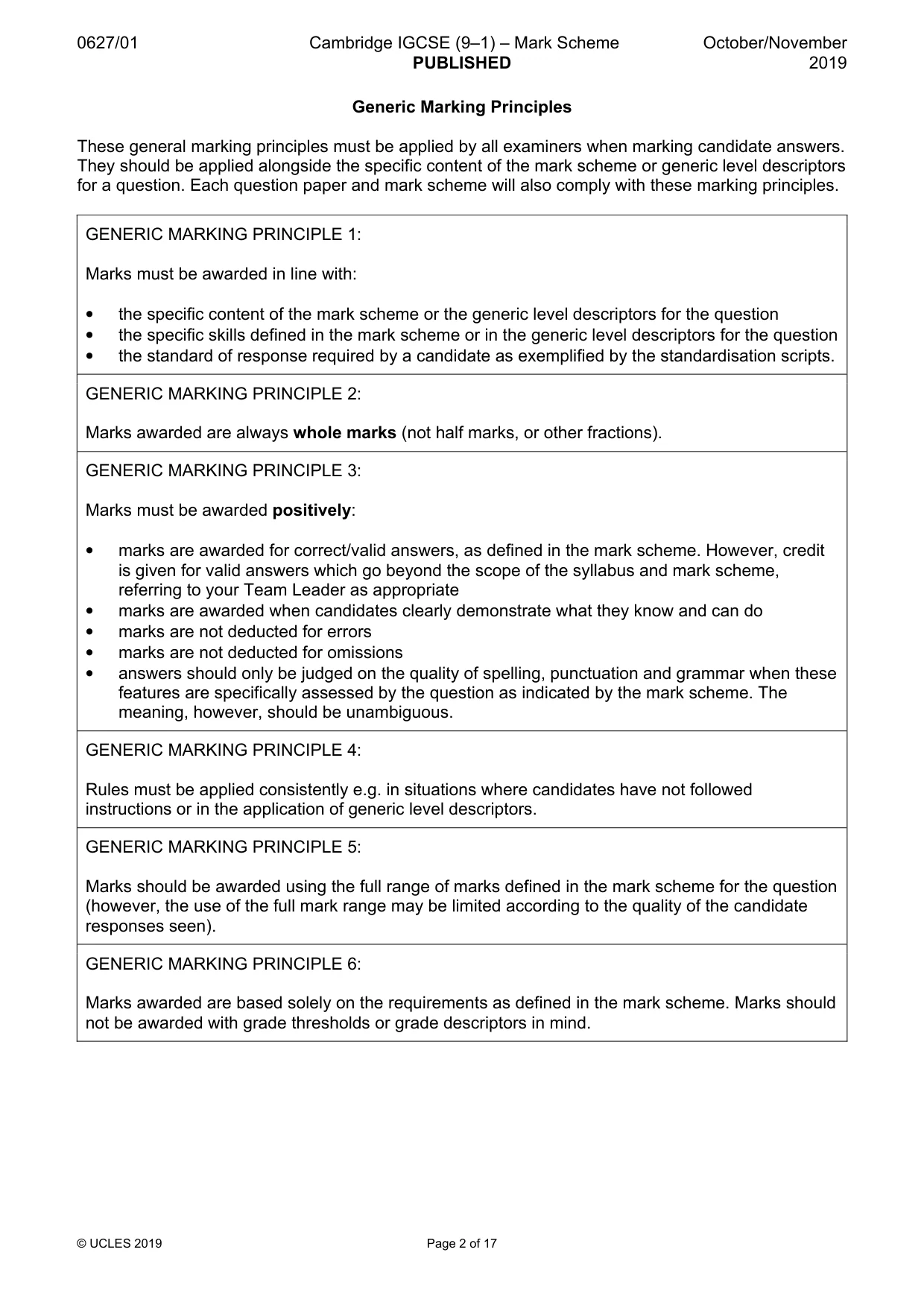
0627/01 Cambridge IGCSE (9–1) – Mark Scheme PUBLISHED October/November 2019 © UCLES 2019 Page 2 of 17 Generic Marking Principles These general marking principles must be applied by all examiners when marking candidate answers. They should be applied alongside the specific content of the mark scheme or generic level descriptors for a question. Each question paper and mark scheme will also comply with these marking principles. GENERIC MARKING PRINCIPLE 1: Marks must be awarded in line with: • the specific content of the mark scheme or the generic level descriptors for the question • the specific skills defined in the mark scheme or in the generic level descriptors for the question • the standard of response required by a candidate as exemplified by the standardisation scripts. GENERIC MARKING PRINCIPLE 2: Marks awarded are always whole marks (not half marks, or other fractions). GENERIC MARKING PRINCIPLE 3: Marks must be awarded positively: • marks are awarded for correct/valid answers, as defined in the mark scheme. However, credit is given for valid answers which go beyond the scope of the syllabus and mark scheme, referring to your Team Leader as appropriate • marks are awarded when candidates clearly demonstrate what they know and can do • marks are not deducted for errors • marks are not deducted for omissions • answers should only be judged on the quality of spelling, punctuation and grammar when these features are specifically assessed by the question as indicated by the mark scheme. The meaning, however, should be unambiguous. GENERIC MARKING PRINCIPLE 4: Rules must be applied consistently e.g. in situations where candidates have not followed instructions or in the application of generic level descriptors. GENERIC MARKING PRINCIPLE 5: Marks should be awarded using the full range of marks defined in the mark scheme for the question (however, the use of the full mark range may be limited according to the quality of the candidate responses seen). GENERIC MARKING PRINCIPLE 6: Marks awarded are based solely on the requirements as defined in the mark scheme. Marks should not be awarded with grade thresholds or grade descriptors in mind.
Mark scheme, page 3
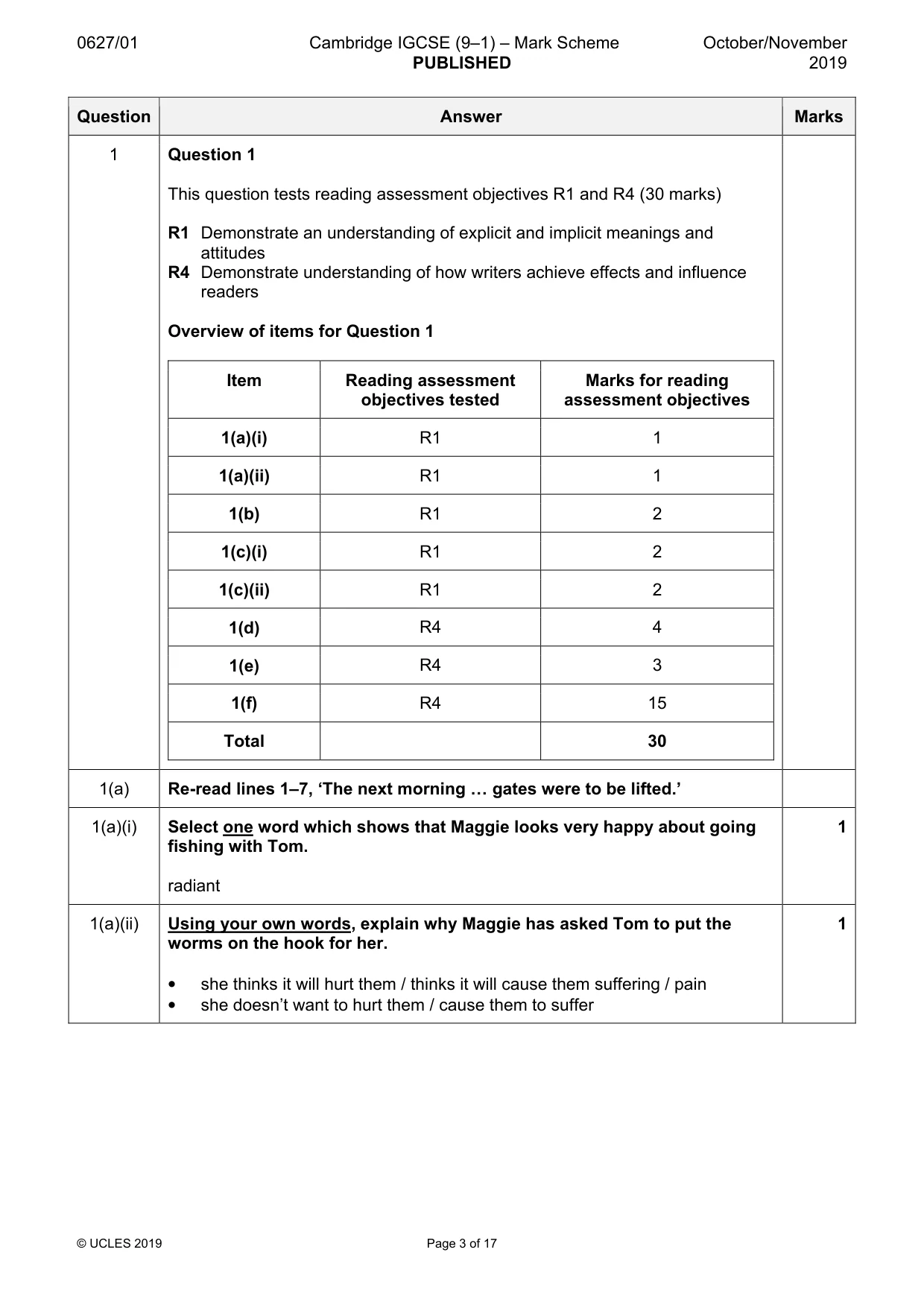
0627/01 Cambridge IGCSE (9–1) – Mark Scheme PUBLISHED October/November 2019 © UCLES 2019 Page 3 of 17 Question Answer Marks 1 Question 1 This question tests reading assessment objectives R1 and R4 (30 marks) R1 Demonstrate an understanding of explicit and implicit meanings and attitudes R4 Demonstrate understanding of how writers achieve effects and influence readers Overview of items for Question 1 Item Reading assessment objectives tested Marks for reading assessment objectives 1(a)(i) R1 1 1(a)(ii) R1 1 1(b) R1 2 1(c)(i) R1 2 1(c)(ii) R1 2 1(d) R4 4 1(e) R4 3 1(f) R4 15 Total 30 1(a) Re-read lines 1–7, ‘The next morning « gates were to be lifted.’ 1(a)(i) Select one word which shows that Maggie looks very happy about going fishing with Tom. radiant 1 1(a)(ii) Using your own words, explain why Maggie has asked Tom to put the worms on the hook for her. • she thinks it will hurt them / thinks it will cause them suffering / pain • she doesn’t want to hurt them / cause them to suffer 1
Mark scheme, page 4
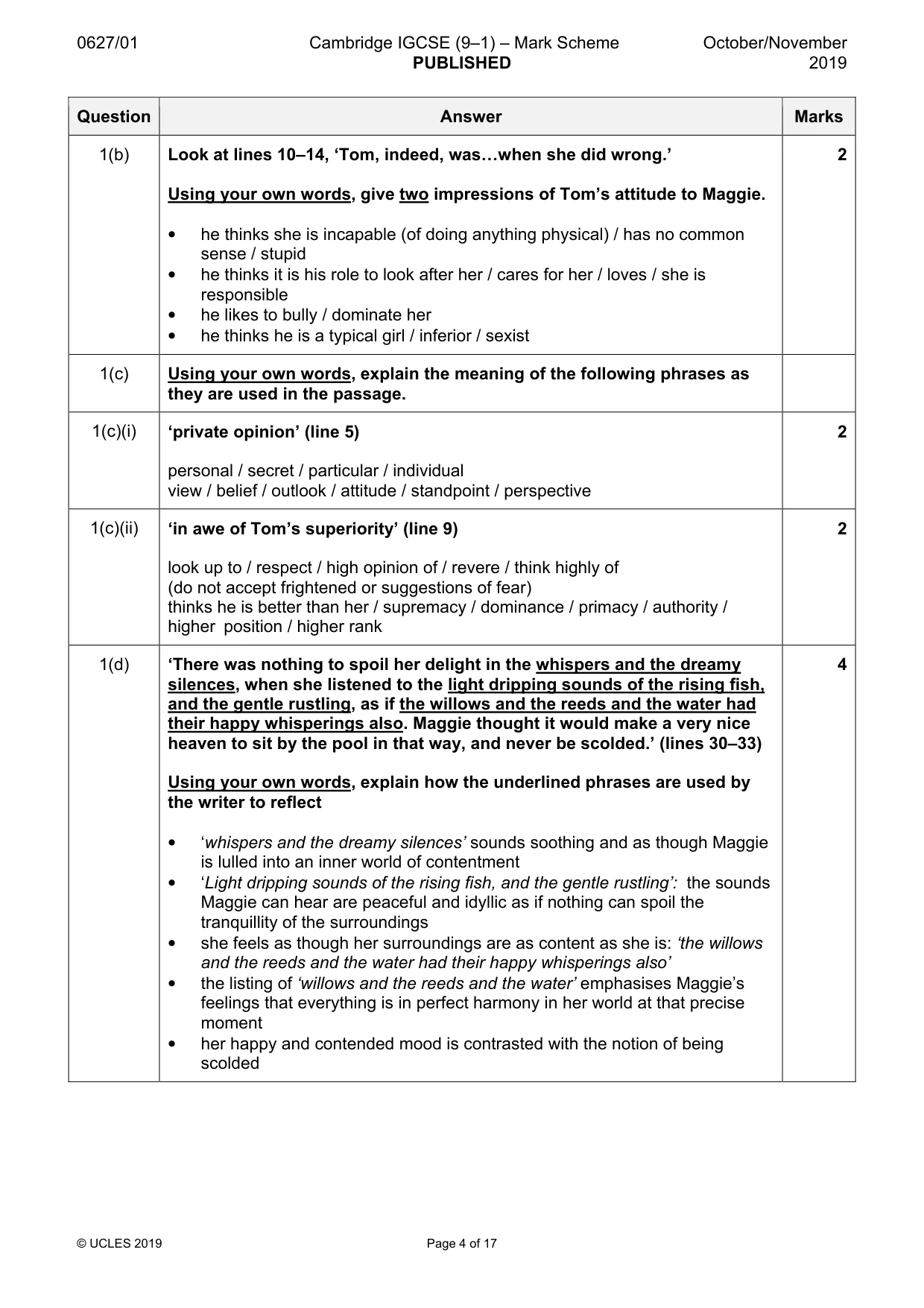
0627/01 Cambridge IGCSE (9–1) – Mark Scheme PUBLISHED October/November 2019 © UCLES 2019 Page 4 of 17 Question Answer Marks 1(b) Look at lines 10–14, ‘Tom, indeed, was«when she did wrong.’ Using your own words, give two impressions of Tom’s attitude to Maggie. • he thinks she is incapable (of doing anything physical) / has no common sense / stupid • he thinks it is his role to look after her / cares for her / loves / she is responsible • he likes to bully / dominate her • he thinks he is a typical girl / inferior / sexist 2 1(c) Using your own words, explain the meaning of the following phrases as they are used in the passage. 1(c)(i) ‘private opinion’ (line 5) personal / secret / particular / individual view / belief / outlook / attitude / standpoint / perspective 2 1(c)(ii) ‘in awe of Tom’s superiority’ (line 9) look up to / respect / high opinion of / revere / think highly of (do not accept frightened or suggestions of fear) thinks he is better than her / supremacy / dominance / primacy / authority / higher position / higher rank 2 1(d) ‘There was nothing to spoil her delight in the whispers and the dreamy silences, when she listened to the light dripping sounds of the rising fish, and the gentle rustling, as if the willows and the reeds and the water had their happy whisperings also. Maggie thought it would make a very nice heaven to sit by the pool in that way, and never be scolded.’ (lines 30–33) Using your own words, explain how the underlined phrases are used by the writer to reflect • ‘whispers and the dreamy silences’ sounds soothing and as though Maggie is lulled into an inner world of contentment • ‘Light dripping sounds of the rising fish, and the gentle rustling’: the sounds Maggie can hear are peaceful and idyllic as if nothing can spoil the tranquillity of the surroundings • she feels as though her surroundings are as content as she is: ‘the willows and the reeds and the water had their happy whisperings also’ • the listing of ‘willows and the reeds and the water’ emphasises Maggie’s feelings that everything is in perfect harmony in her world at that precise moment • her happy and contended mood is contrasted with the notion of being scolded 4
Mark scheme, page 5
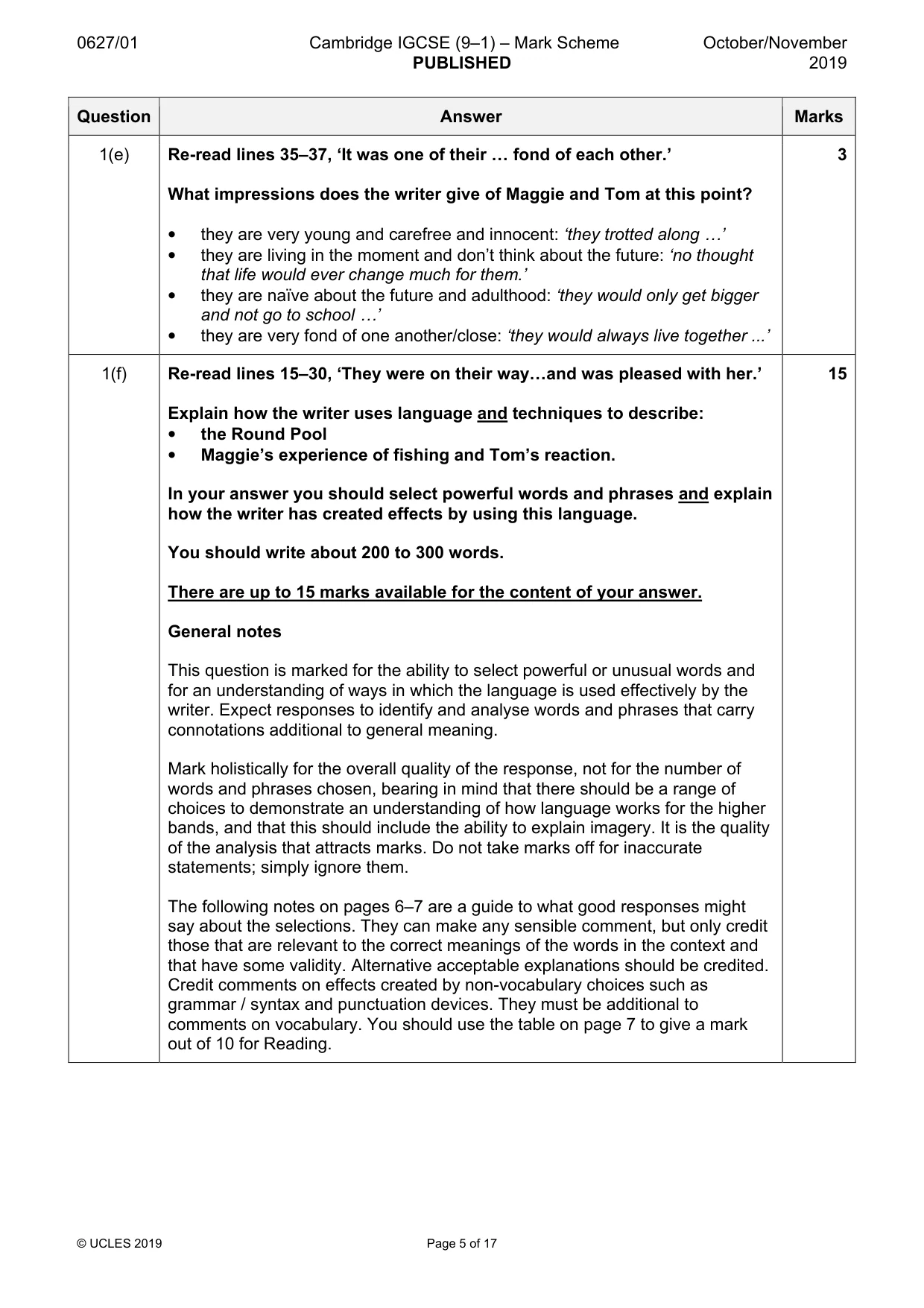
0627/01 Cambridge IGCSE (9–1) – Mark Scheme PUBLISHED October/November 2019 © UCLES 2019 Page 5 of 17 Question Answer Marks 1(e) Re-read lines 35–37, ‘It was one of their « fond of each other.’ What impressions does the writer give of Maggie and Tom at this point? • they are very young and carefree and innocent: ‘they trotted along «’ • they are living in the moment and don’t think about the future: ‘no thought that life would ever change much for them.’ • they are naïve about the future and adulthood: ‘they would only get bigger and not go to school «’ • they are very fond of one another/close: ‘they would always live together ...’ 3 1(f) Re-read lines 15–30, ‘They were on their way«and was pleased with her.’ Explain how the writer uses language and techniques to describe: • the Round Pool • Maggie’s experience of fishing and Tom’s reaction. In your answer you should select powerful words and phrases and explain how the writer has created effects by using this language. You should write about 200 to 300 words. There are up to 15 marks available for the content of your answer. General notes This question is marked for the ability to select powerful or unusual words and for an understanding of ways in which the language is used effectively by the writer. Expect responses to identify and analyse words and phrases that carry connotations additional to general meaning. Mark holistically for the overall quality of the response, not for the number of words and phrases chosen, bearing in mind that there should be a range of choices to demonstrate an understanding of how language works for the higher bands, and that this should include the ability to explain imagery. It is the quality of the analysis that attracts marks. Do not take marks off for inaccurate statements; simply ignore them. The following notes on pages 6–7 are a guide to what good responses might say about the selections. They can make any sensible comment, but only credit those that are relevant to the correct meanings of the words in the context and that have some validity. Alternative acceptable explanations should be credited. Credit comments on effects created by non-vocabulary choices such as grammar / syntax and punctuation devices. They must be additional to comments on vocabulary. You should use the table on page 7 to give a mark out of 10 for Reading. 15
Mark scheme, page 6
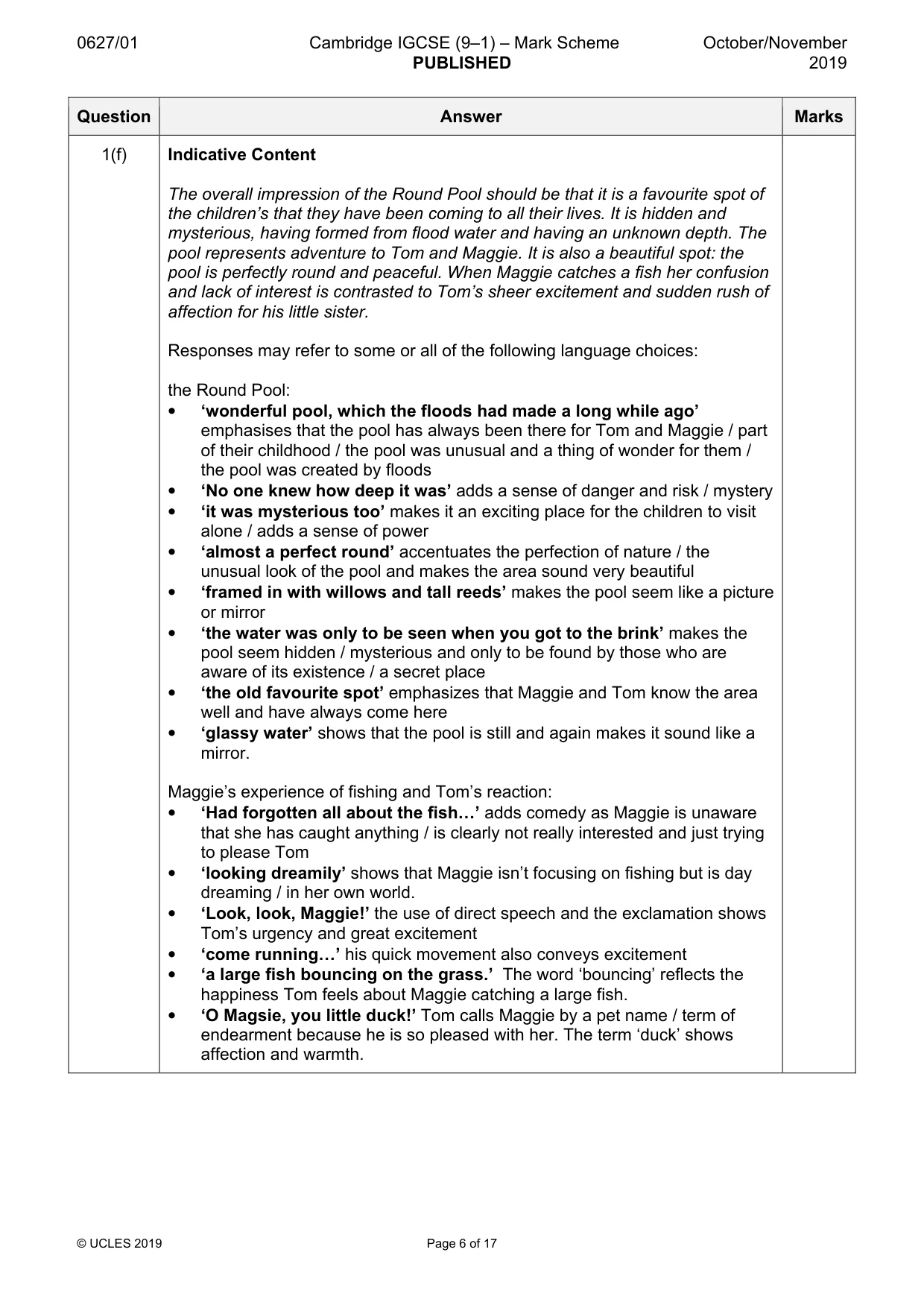
0627/01 Cambridge IGCSE (9–1) – Mark Scheme PUBLISHED October/November 2019 © UCLES 2019 Page 6 of 17 Question Answer Marks 1(f) Indicative Content The overall impression of the Round Pool should be that it is a favourite spot of the children’s that they have been coming to all their lives. It is hidden and mysterious, having formed from flood water and having an unknown depth. The pool represents adventure to Tom and Maggie. It is also a beautiful spot: the pool is perfectly round and peaceful. When Maggie catches a fish her confusion and lack of interest is contrasted to Tom’s sheer excitement and sudden rush of affection for his little sister. Responses may refer to some or all of the following language choices: the Round Pool: • ‘wonderful pool, which the floods had made a long while ago’ emphasises that the pool has always been there for Tom and Maggie / part of their childhood / the pool was unusual and a thing of wonder for them / the pool was created by floods • ‘No one knew how deep it was’ adds a sense of danger and risk / mystery • ‘it was mysterious too’ makes it an exciting place for the children to visit alone / adds a sense of power • ‘almost a perfect round’ accentuates the perfection of nature / the unusual look of the pool and makes the area sound very beautiful • ‘framed in with willows and tall reeds’ makes the pool seem like a picture or mirror • ‘the water was only to be seen when you got to the brink’ makes the pool seem hidden / mysterious and only to be found by those who are aware of its existence / a secret place • ‘the old favourite spot’ emphasizes that Maggie and Tom know the area well and have always come here • ‘glassy water’ shows that the pool is still and again makes it sound like a mirror. Maggie’s experience of fishing and Tom’s reaction: • ‘Had forgotten all about the fish«’ adds comedy as Maggie is unaware that she has caught anything / is clearly not really interested and just trying to please Tom • ‘looking dreamily’ shows that Maggie isn’t focusing on fishing but is day dreaming / in her own world. • ‘Look, look, Maggie!’ the use of direct speech and the exclamation shows Tom’s urgency and great excitement • ‘come running«’ his quick movement also conveys excitement • ‘a large fish bouncing on the grass.’ The word ‘bouncing’ reflects the happiness Tom feels about Maggie catching a large fish. • ‘O Magsie, you little duck!’ Tom calls Maggie by a pet name / term of endearment because he is so pleased with her. The term ‘duck’ shows affection and warmth.
Mark scheme, page 7
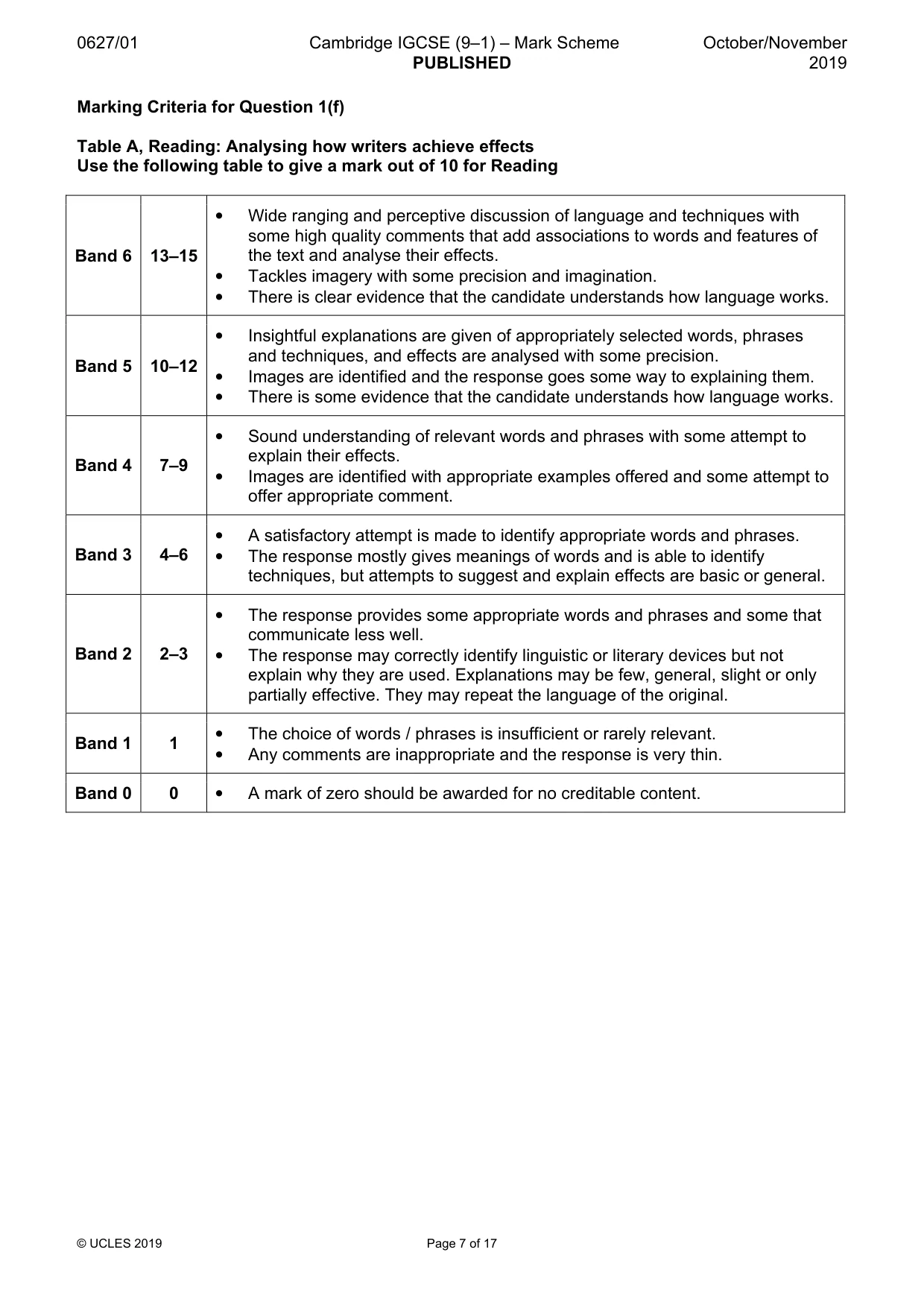
0627/01 Cambridge IGCSE (9–1) – Mark Scheme PUBLISHED October/November 2019 © UCLES 2019 Page 7 of 17 Marking Criteria for Question 1(f) Table A, Reading: Analysing how writers achieve effects Use the following table to give a mark out of 10 for Reading Band 6 13–15 • Wide ranging and perceptive discussion of language and techniques with some high quality comments that add associations to words and features of the text and analyse their effects. • Tackles imagery with some precision and imagination. • There is clear evidence that the candidate understands how language works. Band 5 10–12 • Insightful explanations are given of appropriately selected words, phrases and techniques, and effects are analysed with some precision. • Images are identified and the response goes some way to explaining them. • There is some evidence that the candidate understands how language works. Band 4 7–9 • Sound understanding of relevant words and phrases with some attempt to explain their effects. • Images are identified with appropriate examples offered and some attempt to offer appropriate comment. Band 3 4–6 • A satisfactory attempt is made to identify appropriate words and phrases. • The response mostly gives meanings of words and is able to identify techniques, but attempts to suggest and explain effects are basic or general. Band 2 2–3 • The response provides some appropriate words and phrases and some that communicate less well. • The response may correctly identify linguistic or literary devices but not explain why they are used. Explanations may be few, general, slight or only partially effective. They may repeat the language of the original. Band 1 1 • The choice of words / phrases is insufficient or rarely relevant. • Any comments are inappropriate and the response is very thin. Band 0 0 • A mark of zero should be awarded for no creditable content.
Mark scheme, page 8
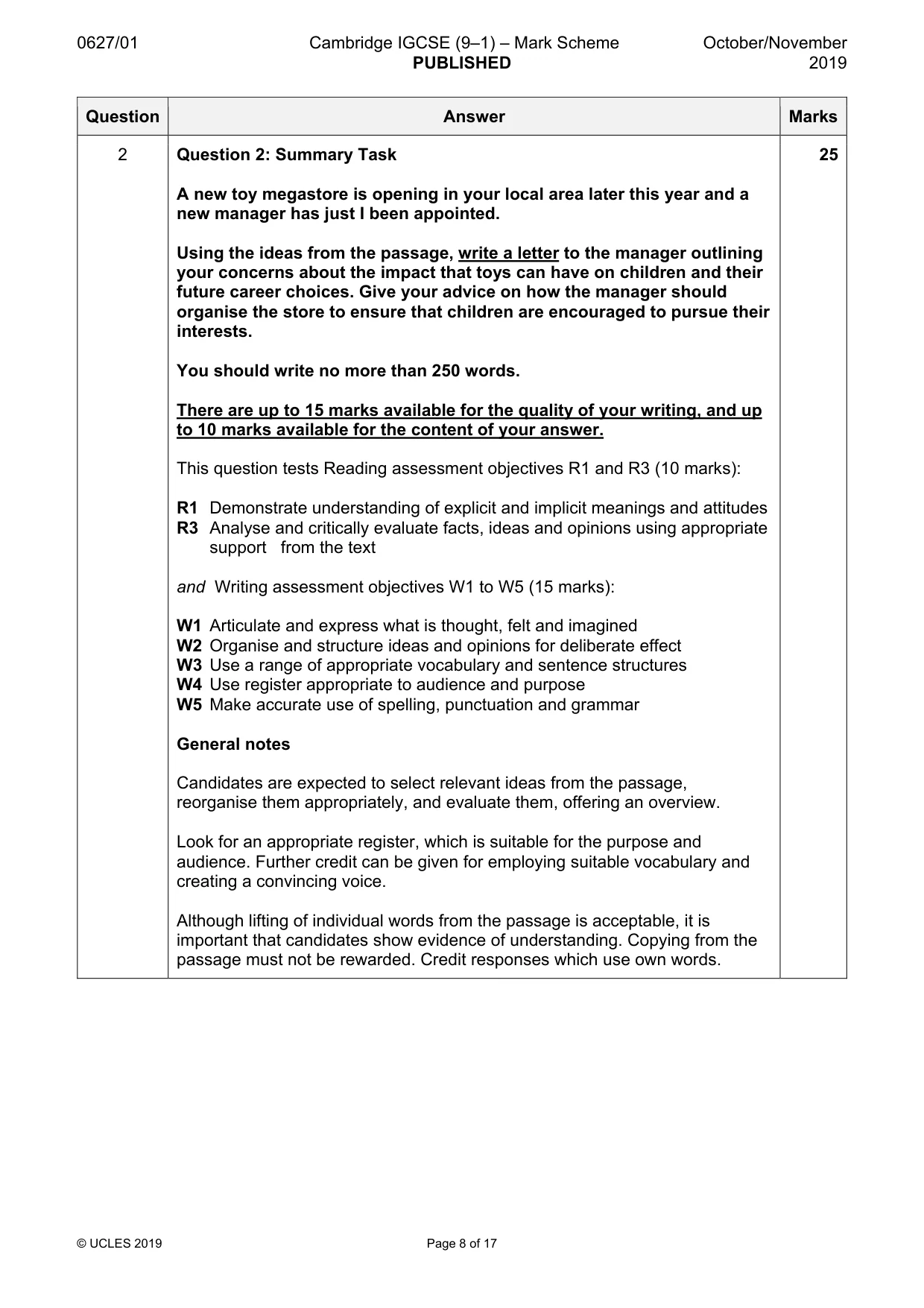
0627/01 Cambridge IGCSE (9–1) – Mark Scheme PUBLISHED October/November 2019 © UCLES 2019 Page 8 of 17 Question Answer Marks 2 Question 2: Summary Task A new toy megastore is opening in your local area later this year and a new manager has just I been appointed. Using the ideas from the passage, write a letter to the manager outlining your concerns about the impact that toys can have on children and their future career choices. Give your advice on how the manager should organise the store to ensure that children are encouraged to pursue their interests. You should write no more than 250 words. There are up to 15 marks available for the quality of your writing, and up to 10 marks available for the content of your answer. This question tests Reading assessment objectives R1 and R3 (10 marks): R1 Demonstrate understanding of explicit and implicit meanings and attitudes R3 Analyse and critically evaluate facts, ideas and opinions using appropriate support from the text and Writing assessment objectives W1 to W5 (15 marks): W1 Articulate and express what is thought, felt and imagined W2 Organise and structure ideas and opinions for deliberate effect W3 Use a range of appropriate vocabulary and sentence structures W4 Use register appropriate to audience and purpose W5 Make accurate use of spelling, punctuation and grammar General notes Candidates are expected to select relevant ideas from the passage, reorganise them appropriately, and evaluate them, offering an overview. Look for an appropriate register, which is suitable for the purpose and audience. Further credit can be given for employing suitable vocabulary and creating a convincing voice. Although lifting of individual words from the passage is acceptable, it is important that candidates show evidence of understanding. Copying from the passage must not be rewarded. Credit responses which use own words. 25
Mark scheme, page 9
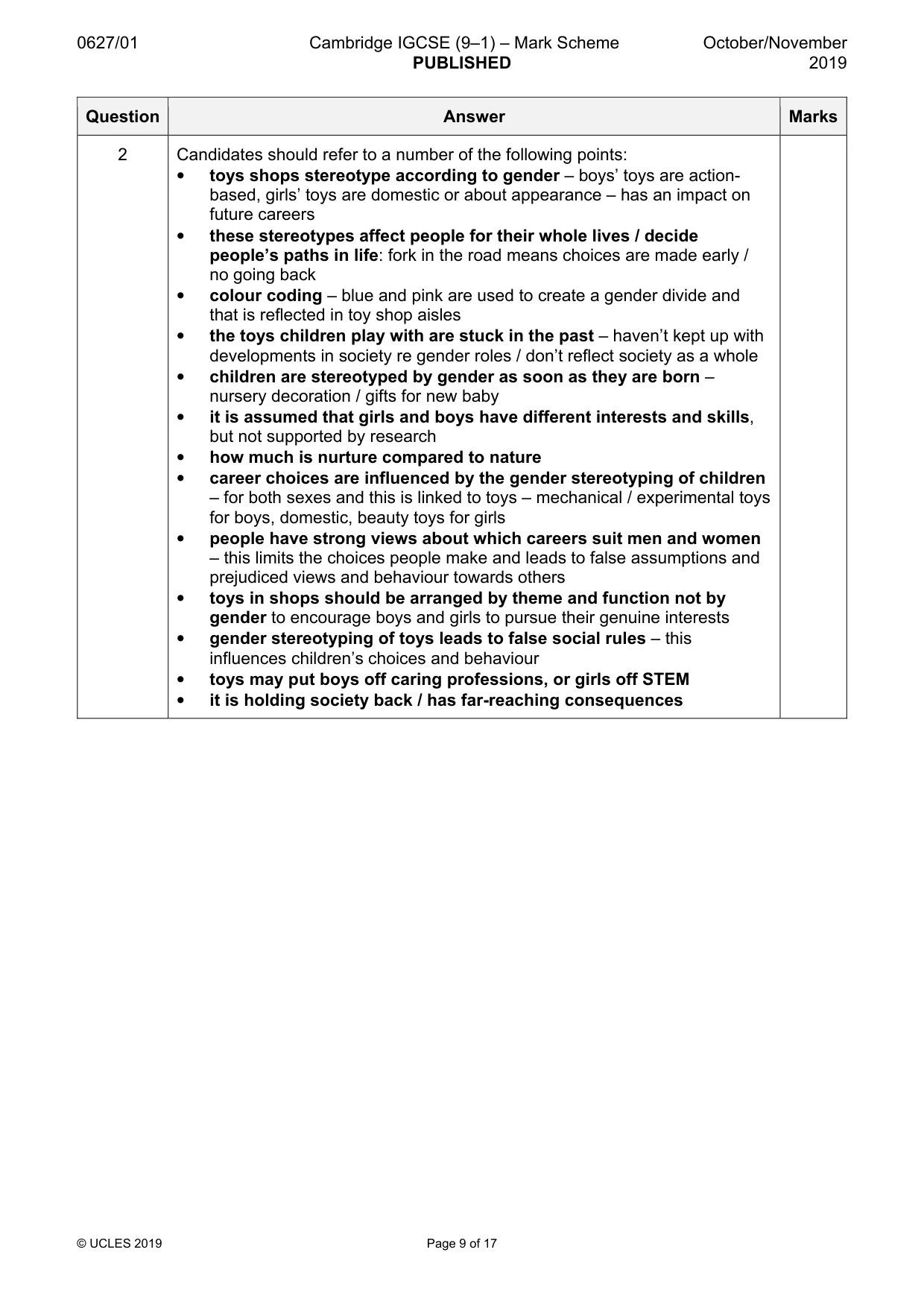
0627/01 Cambridge IGCSE (9–1) – Mark Scheme PUBLISHED October/November 2019 © UCLES 2019 Page 9 of 17 Question Answer Marks 2 Candidates should refer to a number of the following points: • toys shops stereotype according to gender – boys’ toys are action- based, girls’ toys are domestic or about appearance – has an impact on future careers • these stereotypes affect people for their whole lives / decide people’s paths in life: fork in the road means choices are made early / no going back • colour coding – blue and pink are used to create a gender divide and that is reflected in toy shop aisles • the toys children play with are stuck in the past – haven’t kept up with developments in society re gender roles / don’t reflect society as a whole • children are stereotyped by gender as soon as they are born – nursery decoration / gifts for new baby • it is assumed that girls and boys have different interests and skills, but not supported by research • how much is nurture compared to nature • career choices are influenced by the gender stereotyping of children – for both sexes and this is linked to toys – mechanical / experimental toys for boys, domestic, beauty toys for girls • people have strong views about which careers suit men and women – this limits the choices people make and leads to false assumptions and prejudiced views and behaviour towards others • toys in shops should be arranged by theme and function not by gender to encourage boys and girls to pursue their genuine interests • gender stereotyping of toys leads to false social rules – this influences children’s choices and behaviour • toys may put boys off caring professions, or girls off STEM • it is holding society back / has far-reaching consequences
Mark scheme, page 10
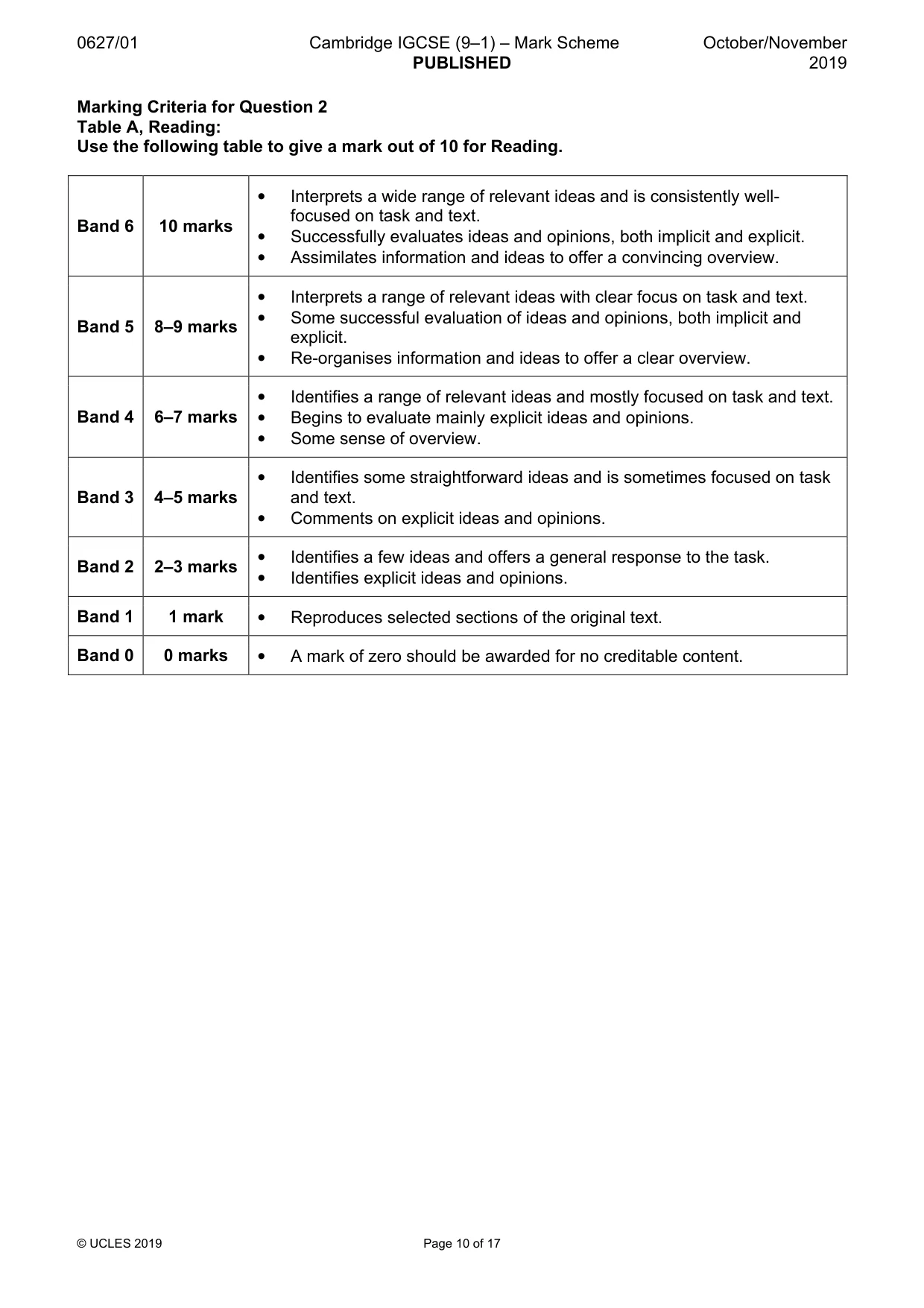
0627/01 Cambridge IGCSE (9–1) – Mark Scheme PUBLISHED October/November 2019 © UCLES 2019 Page 10 of 17 Marking Criteria for Question 2 Table A, Reading: Use the following table to give a mark out of 10 for Reading. Band 6 10 marks • Interprets a wide range of relevant ideas and is consistently well- focused on task and text. • Successfully evaluates ideas and opinions, both implicit and explicit. • Assimilates information and ideas to offer a convincing overview. Band 5 8–9 marks • Interprets a range of relevant ideas with clear focus on task and text. • Some successful evaluation of ideas and opinions, both implicit and explicit. • Re-organises information and ideas to offer a clear overview. Band 4 6–7 marks • Identifies a range of relevant ideas and mostly focused on task and text. • Begins to evaluate mainly explicit ideas and opinions. • Some sense of overview. Band 3 4–5 marks • Identifies some straightforward ideas and is sometimes focused on task and text. • Comments on explicit ideas and opinions. Band 2 2–3 marks • Identifies a few ideas and offers a general response to the task. • Identifies explicit ideas and opinions. Band 1 1 mark • Reproduces selected sections of the original text. Band 0 0 marks • A mark of zero should be awarded for no creditable content.
Mark scheme, page 11
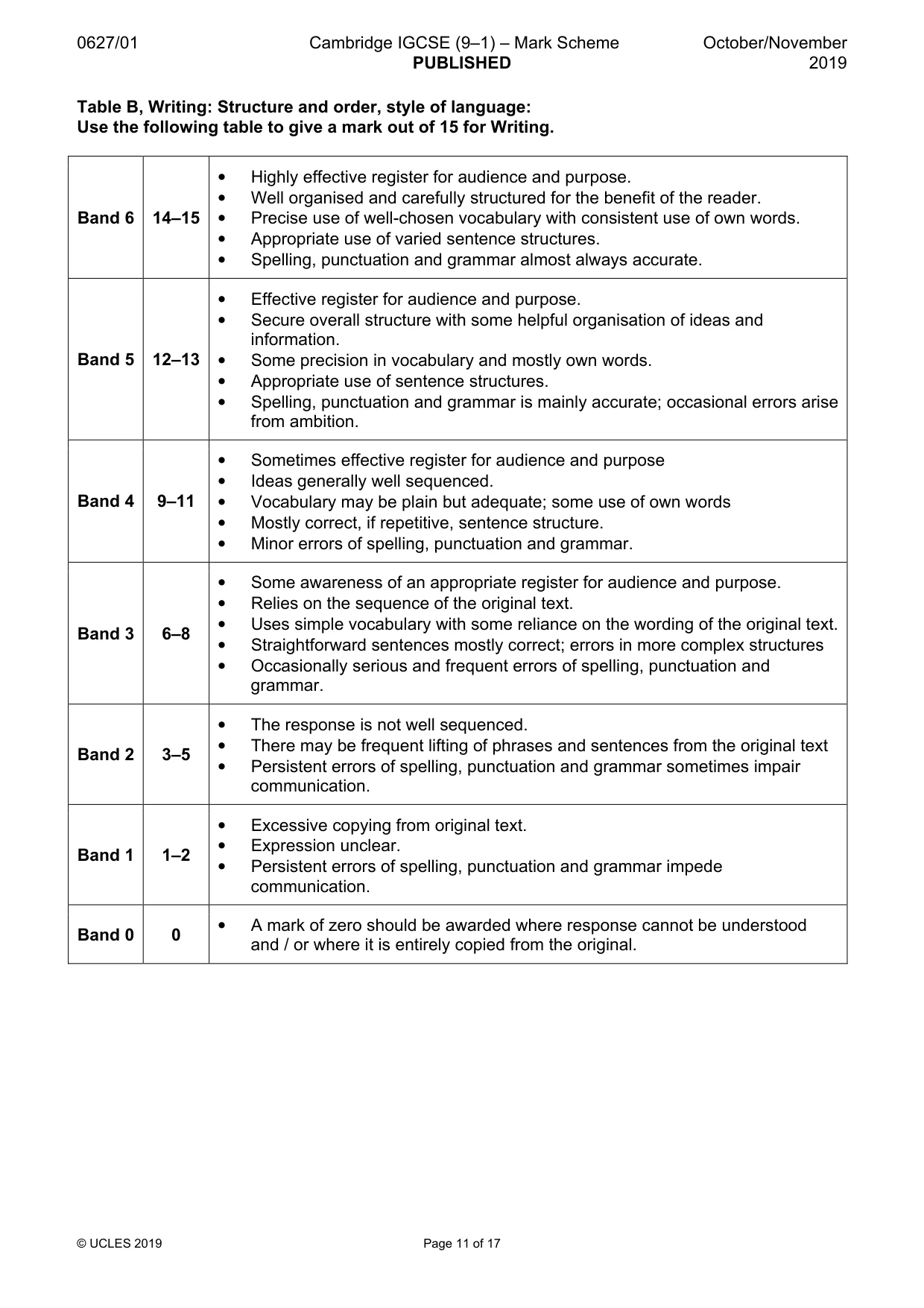
0627/01 Cambridge IGCSE (9–1) – Mark Scheme PUBLISHED October/November 2019 © UCLES 2019 Page 11 of 17 Table B, Writing: Structure and order, style of language: Use the following table to give a mark out of 15 for Writing. Band 6 14–15 • Highly effective register for audience and purpose. • Well organised and carefully structured for the benefit of the reader. • Precise use of well-chosen vocabulary with consistent use of own words. • Appropriate use of varied sentence structures. • Spelling, punctuation and grammar almost always accurate. Band 5 12–13 • Effective register for audience and purpose. • Secure overall structure with some helpful organisation of ideas and information. • Some precision in vocabulary and mostly own words. • Appropriate use of sentence structures. • Spelling, punctuation and grammar is mainly accurate; occasional errors arise from ambition. Band 4 9–11 • Sometimes effective register for audience and purpose • Ideas generally well sequenced. • Vocabulary may be plain but adequate; some use of own words • Mostly correct, if repetitive, sentence structure. • Minor errors of spelling, punctuation and grammar. Band 3 6–8 • Some awareness of an appropriate register for audience and purpose. • Relies on the sequence of the original text. • Uses simple vocabulary with some reliance on the wording of the original text. • Straightforward sentences mostly correct; errors in more complex structures • Occasionally serious and frequent errors of spelling, punctuation and grammar. Band 2 3–5 • The response is not well sequenced. • There may be frequent lifting of phrases and sentences from the original text • Persistent errors of spelling, punctuation and grammar sometimes impair communication. Band 1 1–2 • Excessive copying from original text. • Expression unclear. • Persistent errors of spelling, punctuation and grammar impede communication. Band 0 0 • A mark of zero should be awarded where response cannot be understood and / or where it is entirely copied from the original.
Mark scheme, page 12
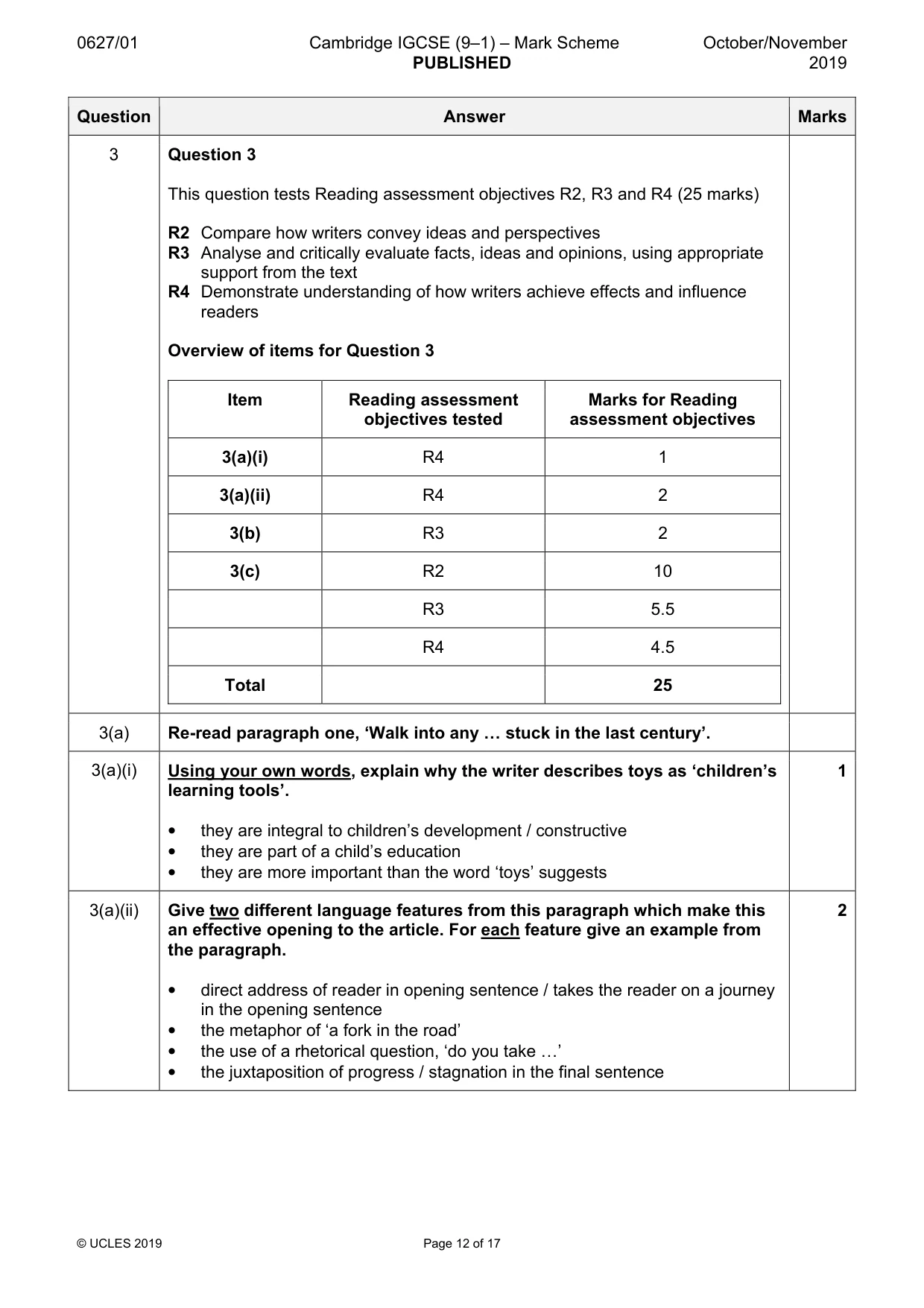
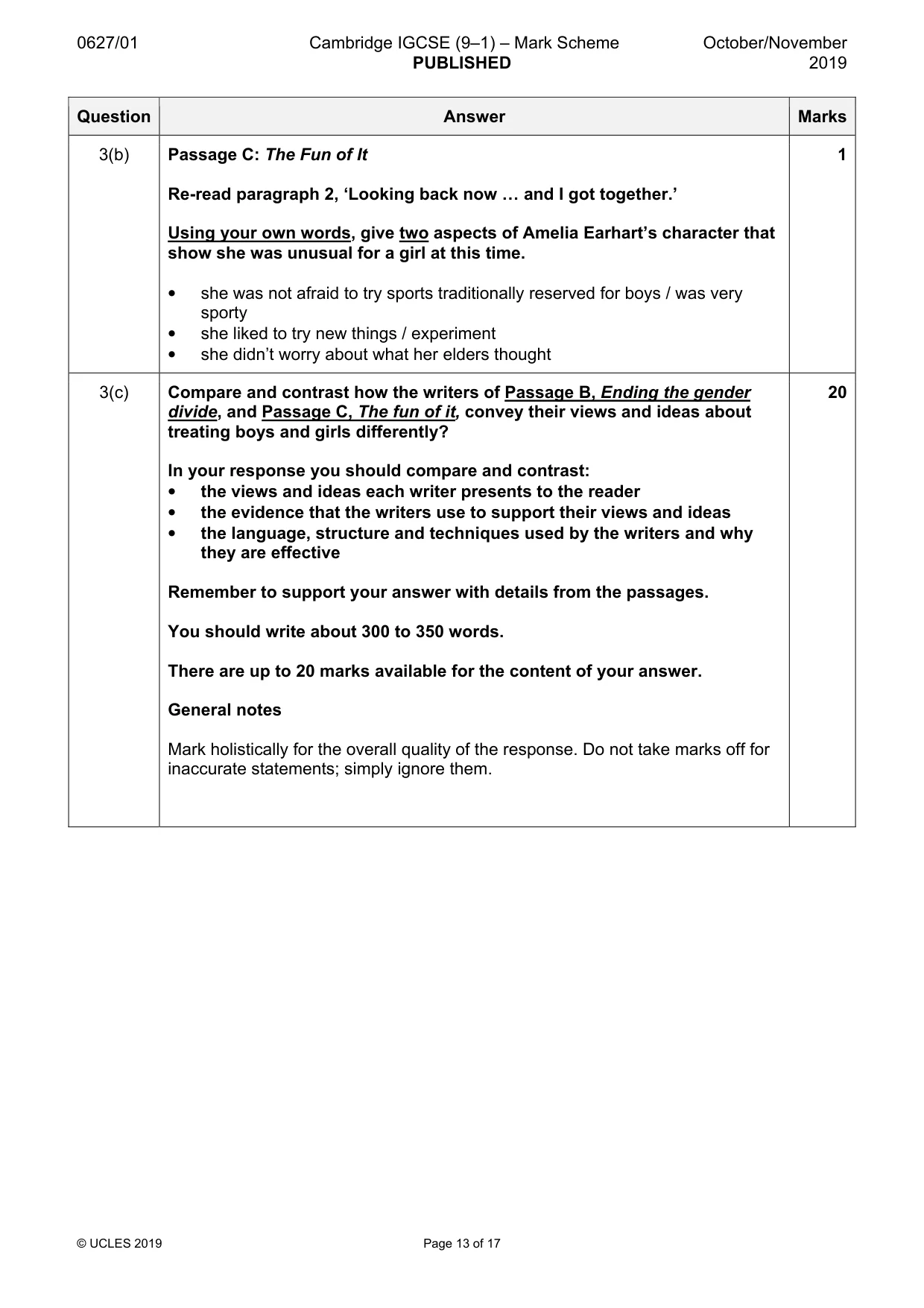
0627/01 Cambridge IGCSE (9–1) – Mark Scheme PUBLISHED October/November 2019 © UCLES 2019 Page 12 of 17 Question Answer Marks 3 Question 3 This question tests Reading assessment objectives R2, R3 and R4 (25 marks) R2 Compare how writers convey ideas and perspectives R3 Analyse and critically evaluate facts, ideas and opinions, using appropriate support from the text R4 Demonstrate understanding of how writers achieve effects and influence readers Overview of items for Question 3 Item Reading assessment objectives tested Marks for Reading assessment objectives 3(a)(i) R4 1 3(a)(ii) R4 2 3(b) R3 2 3(c) R2 10 R3 5.5 R4 4.5 Total 25 3(a) Re-read paragraph one, ‘Walk into any « stuck in the last century’. 3(a)(i) Using your own words, explain why the writer describes toys as ‘children’s learning tools’. • they are integral to children’s development / constructive • they are part of a child’s education • they are more important than the word ‘toys’ suggests 1 3(a)(ii) Give two different language features from this paragraph which make this an effective opening to the article. For each feature give an example from the paragraph. • direct address of reader in opening sentence / takes the reader on a journey in the opening sentence • the metaphor of ‘a fork in the road’ • the use of a rhetorical question, ‘do you take «’ • the juxtaposition of progress / stagnation in the final sentence 2
Mark scheme, page 13
0627/01 Cambridge IGCSE (9–1) – Mark Scheme PUBLISHED October/November 2019 © UCLES 2019 Page 13 of 17 Question Answer Marks 3(b) Passage C: The Fun of It Re-read paragraph 2, ‘Looking back now « and I got together.’ Using your own words, give two aspects of Amelia Earhart’s character that show she was unusual for a girl at this time. • she was not afraid to try sports traditionally reserved for boys / was very sporty • she liked to try new things / experiment • she didn’t worry about what her elders thought 1 3(c) Compare and contrast how the writers of Passage B, Ending the gender divide, and Passage C, The fun of it, convey their views and ideas about treating boys and girls differently? In your response you should compare and contrast: • the views and ideas each writer presents to the reader • the evidence that the writers use to support their views and ideas • the language, structure and techniques used by the writers and why they are effective Remember to support your answer with details from the passages. You should write about 300 to 350 words. There are up to 20 marks available for the content of your answer. General notes Mark holistically for the overall quality of the response. Do not take marks off for inaccurate statements; simply ignore them. 20
Mark scheme, page 14
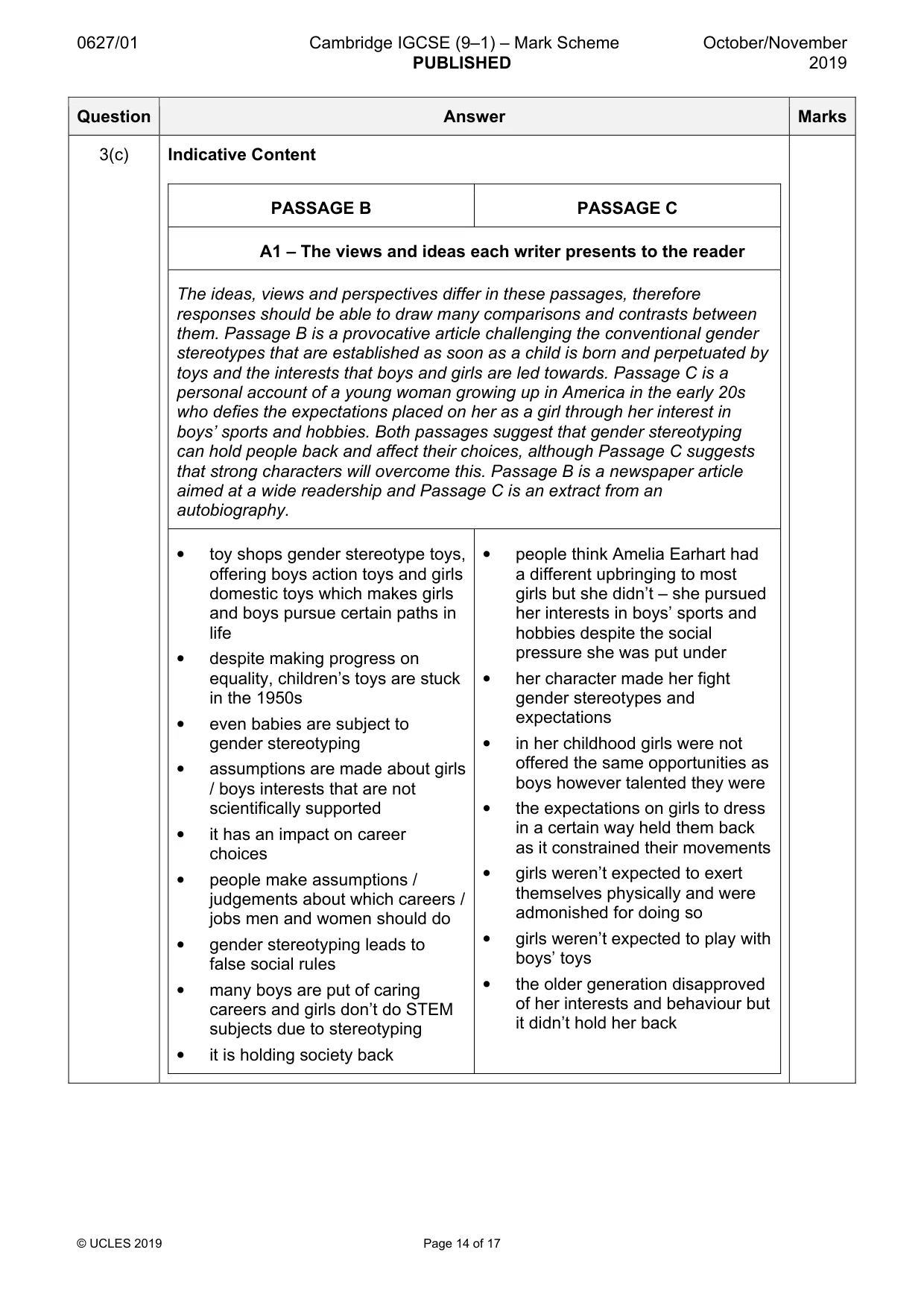
0627/01 Cambridge IGCSE (9–1) – Mark Scheme PUBLISHED October/November 2019 © UCLES 2019 Page 14 of 17 Question Answer Marks 3(c) Indicative Content PASSAGE B PASSAGE C A1 – The views and ideas each writer presents to the reader The ideas, views and perspectives differ in these passages, therefore responses should be able to draw many comparisons and contrasts between them. Passage B is a provocative article challenging the conventional gender stereotypes that are established as soon as a child is born and perpetuated by toys and the interests that boys and girls are led towards. Passage C is a personal account of a young woman growing up in America in the early 20s who defies the expectations placed on her as a girl through her interest in boys’ sports and hobbies. Both passages suggest that gender stereotyping can hold people back and affect their choices, although Passage C suggests that strong characters will overcome this. Passage B is a newspaper article aimed at a wide readership and Passage C is an extract from an autobiography. • toy shops gender stereotype toys, offering boys action toys and girls domestic toys which makes girls and boys pursue certain paths in life • despite making progress on equality, children’s toys are stuck in the 1950s • even babies are subject to gender stereotyping • assumptions are made about girls / boys interests that are not scientifically supported • it has an impact on career choices • people make assumptions / judgements about which careers / jobs men and women should do • gender stereotyping leads to false social rules • many boys are put of caring careers and girls don’t do STEM subjects due to stereotyping • it is holding society back • people think Amelia Earhart had a different upbringing to most girls but she didn’t – she pursued her interests in boys’ sports and hobbies despite the social pressure she was put under • her character made her fight gender stereotypes and expectations • in her childhood girls were not offered the same opportunities as boys however talented they were • the expectations on girls to dress in a certain way held them back as it constrained their movements • girls weren’t expected to exert themselves physically and were admonished for doing so • girls weren’t expected to play with boys’ toys • the older generation disapproved of her interests and behaviour but it didn’t hold her back
Mark scheme, page 15
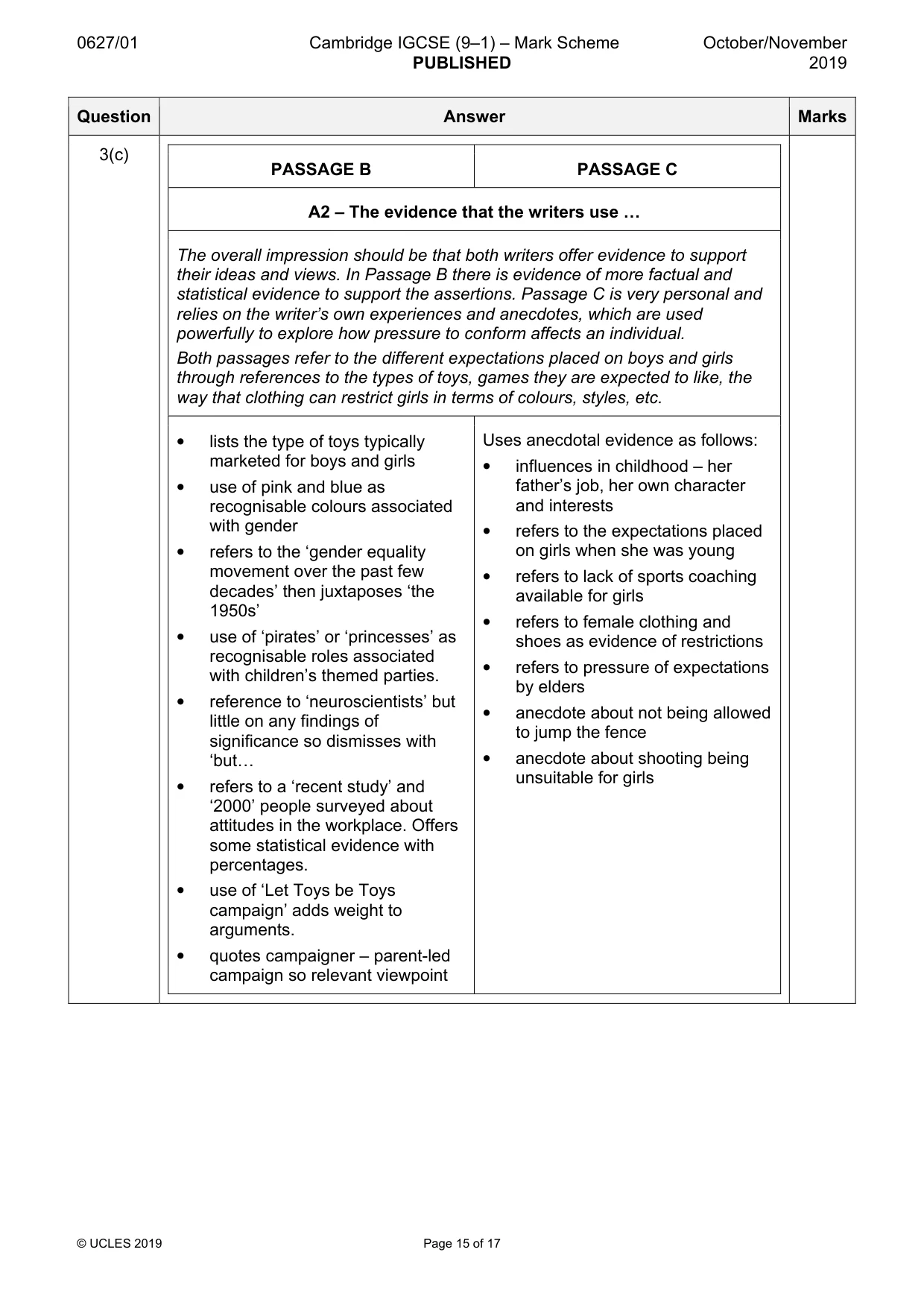
0627/01 Cambridge IGCSE (9–1) – Mark Scheme PUBLISHED October/November 2019 © UCLES 2019 Page 15 of 17 Question Answer Marks 3(c) PASSAGE B PASSAGE C A2 – The evidence that the writers use « The overall impression should be that both writers offer evidence to support their ideas and views. In Passage B there is evidence of more factual and statistical evidence to support the assertions. Passage C is very personal and relies on the writer’s own experiences and anecdotes, which are used powerfully to explore how pressure to conform affects an individual. Both passages refer to the different expectations placed on boys and girls through references to the types of toys, games they are expected to like, the way that clothing can restrict girls in terms of colours, styles, etc. • lists the type of toys typically marketed for boys and girls • use of pink and blue as recognisable colours associated with gender • refers to the ‘gender equality movement over the past few decades’ then juxtaposes ‘the 1950s’ • use of ‘pirates’ or ‘princesses’ as recognisable roles associated with children’s themed parties. • reference to ‘neuroscientists’ but little on any findings of significance so dismisses with ‘but« • refers to a ‘recent study’ and ‘2000’ people surveyed about attitudes in the workplace. Offers some statistical evidence with percentages. • use of ‘Let Toys be Toys campaign’ adds weight to arguments. • quotes campaigner – parent-led campaign so relevant viewpoint Uses anecdotal evidence as follows: • influences in childhood – her father’s job, her own character and interests • refers to the expectations placed on girls when she was young • refers to lack of sports coaching available for girls • refers to female clothing and shoes as evidence of restrictions • refers to pressure of expectations by elders • anecdote about not being allowed to jump the fence • anecdote about shooting being unsuitable for girls
Mark scheme, page 16
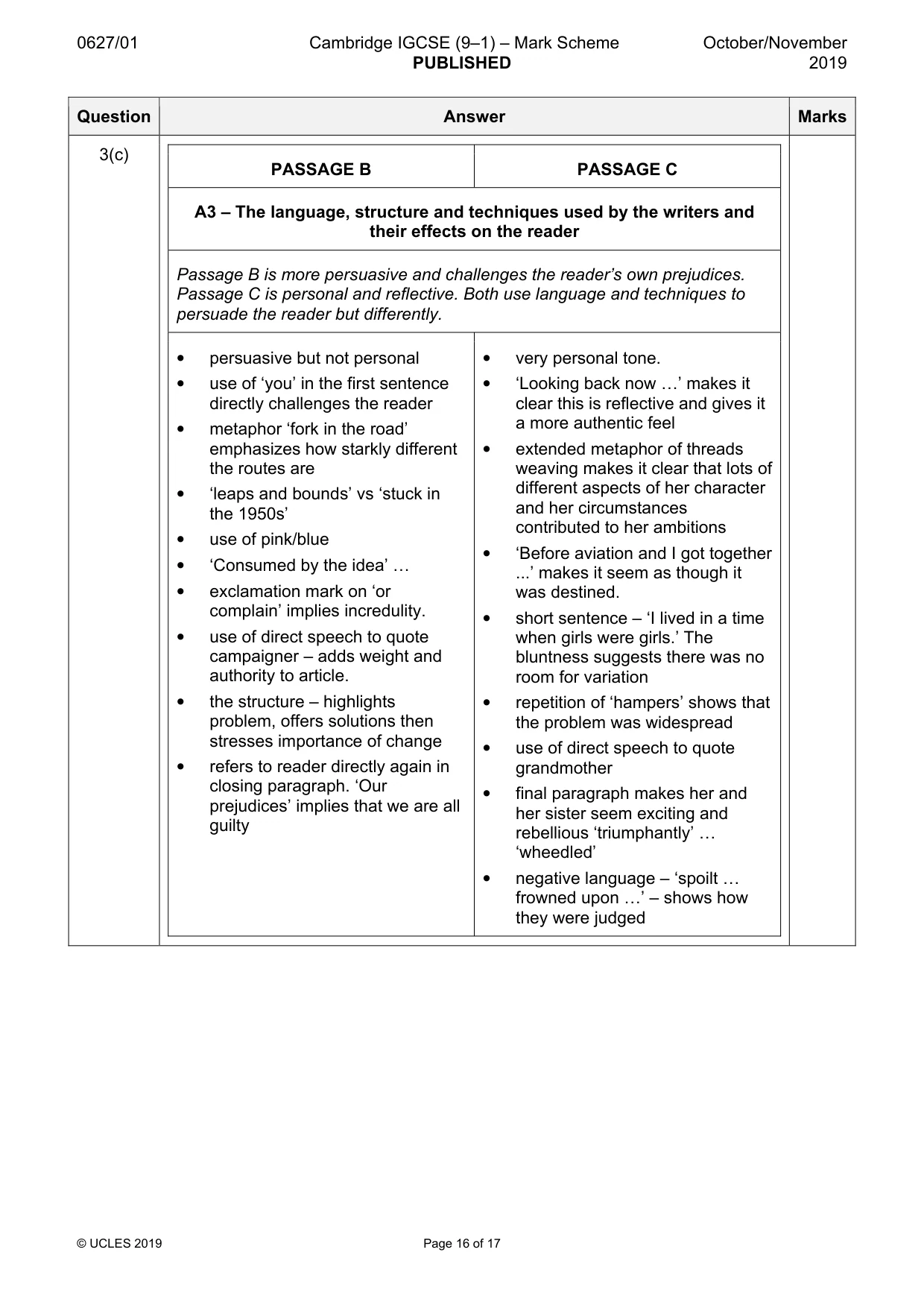
0627/01 Cambridge IGCSE (9–1) – Mark Scheme PUBLISHED October/November 2019 © UCLES 2019 Page 16 of 17 Question Answer Marks 3(c) PASSAGE B PASSAGE C A3 – The language, structure and techniques used by the writers and their effects on the reader Passage B is more persuasive and challenges the reader’s own prejudices. Passage C is personal and reflective. Both use language and techniques to persuade the reader but differently. • persuasive but not personal • use of ‘you’ in the first sentence directly challenges the reader • metaphor ‘fork in the road’ emphasizes how starkly different the routes are • ‘leaps and bounds’ vs ‘stuck in the 1950s’ • use of pink/blue • ‘Consumed by the idea’ « • exclamation mark on ‘or complain’ implies incredulity. • use of direct speech to quote campaigner – adds weight and authority to article. • the structure – highlights problem, offers solutions then stresses importance of change • refers to reader directly again in closing paragraph. ‘Our prejudices’ implies that we are all guilty • very personal tone. • ‘Looking back now «’ makes it clear this is reflective and gives it a more authentic feel • extended metaphor of threads weaving makes it clear that lots of different aspects of her character and her circumstances contributed to her ambitions • ‘Before aviation and I got together ...’ makes it seem as though it was destined. • short sentence – ‘I lived in a time when girls were girls.’ The bluntness suggests there was no room for variation • repetition of ‘hampers’ shows that the problem was widespread • use of direct speech to quote grandmother • final paragraph makes her and her sister seem exciting and rebellious ‘triumphantly’ « ‘wheedled’ • negative language – ‘spoilt « frowned upon «’ – shows how they were judged
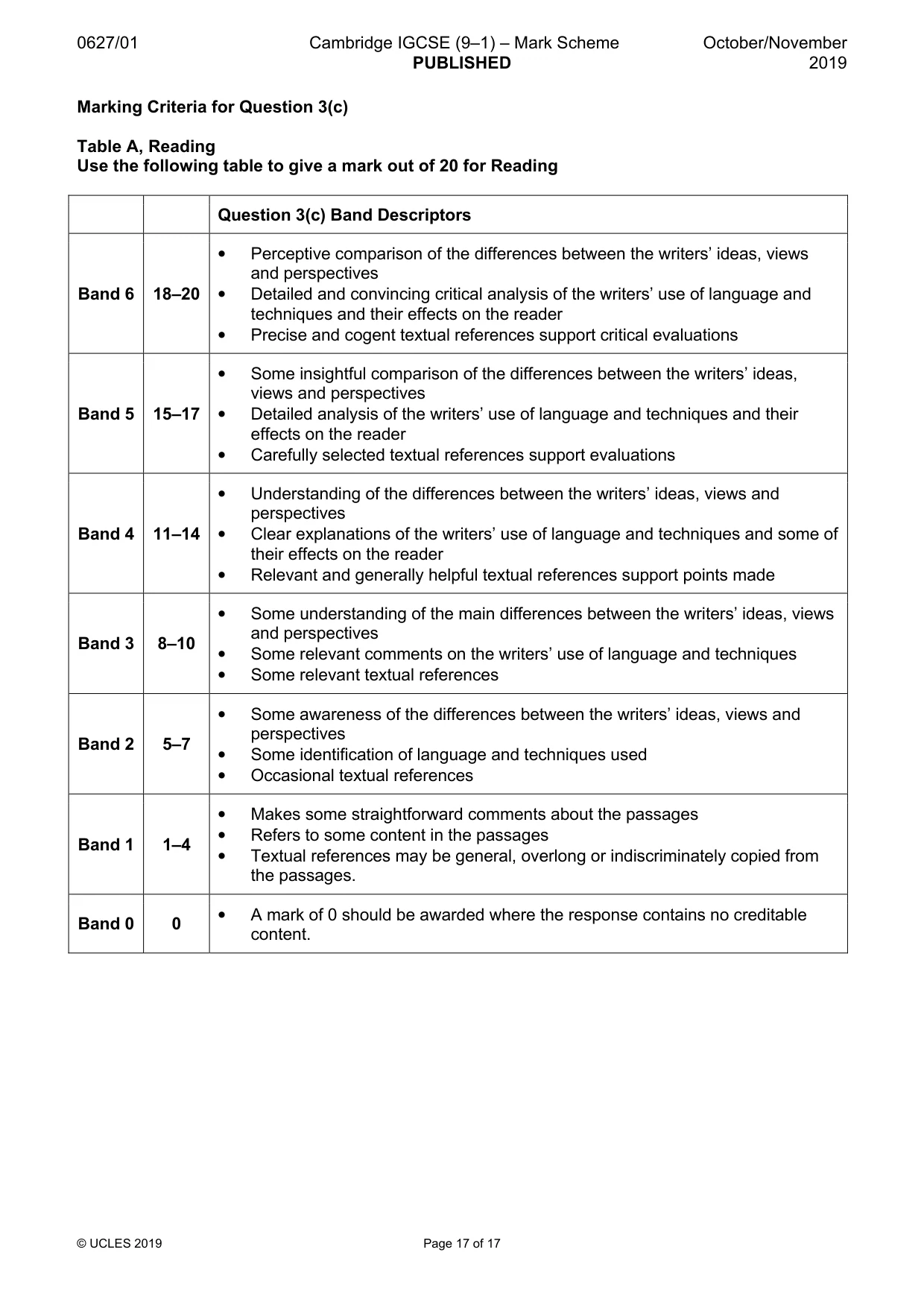
Mark scheme, page 17
0627/01 Cambridge IGCSE (9–1) – Mark Scheme PUBLISHED October/November 2019 © UCLES 2019 Page 17 of 17 Marking Criteria for Question 3(c) Table A, Reading Use the following table to give a mark out of 20 for Reading Question 3(c) Band Descriptors Band 6 18–20 • Perceptive comparison of the differences between the writers’ ideas, views and perspectives • Detailed and convincing critical analysis of the writers’ use of language and techniques and their effects on the reader • Precise and cogent textual references support critical evaluations Band 5 15–17 • Some insightful comparison of the differences between the writers’ ideas, views and perspectives • Detailed analysis of the writers’ use of language and techniques and their effects on the reader • Carefully selected textual references support evaluations Band 4 11–14 • Understanding of the differences between the writers’ ideas, views and perspectives • Clear explanations of the writers’ use of language and techniques and some of their effects on the reader • Relevant and generally helpful textual references support points made Band 3 8–10 • Some understanding of the main differences between the writers’ ideas, views and perspectives • Some relevant comments on the writers’ use of language and techniques • Some relevant textual references Band 2 5–7 • Some awareness of the differences between the writers’ ideas, views and perspectives • Some identification of language and techniques used • Occasional textual references Band 1 1–4 • Makes some straightforward comments about the passages • Refers to some content in the passages • Textual references may be general, overlong or indiscriminately copied from the passages. Band 0 0 • A mark of 0 should be awarded where the response contains no creditable content.
What you needed in this session
Cambridge’s own grade thresholds for 2019 Oct/Nov, Paper 1 · Variant 1. A higher threshold means an easier paper — the bar moves with how the cohort did.