Cambridge IGCSE English - First Language (9-1) (UK only) 0627 — 2017 Oct/Nov Paper 1 · Variant 1
0627/11/O/N/17 · 80 marks · ≈90 min
The question paper and its mark scheme, free to read here and free to download. This is Cambridge’s own paper, exactly as it was sat.
Question paper12 pages
Mark scheme18 pages
Answers below. Sit the paper first if you are practising.
Paper as text
Question paper, page 1
This document consists of 12 printed pages and 1 Insert. DC (RCL (KM)) 136494/5 © UCLES 2017 [Turn over Cambridge International Examinations Cambridge International General Certificate of Secondary Education (9–1) * 3 7 6 4 8 3 7 9 6 2 * FIRST LANGUAGE ENGLISH 0627/01 Paper 1 Reading Passages October/November 2017 2 hours 10 minutes Candidates answer on the Question Paper. No Additional Materials are required. READ THESE INSTRUCTIONS FIRST Write your Centre number, candidate number and name in the spaces at the top of this page. Write in dark blue or black pen. Do not use staples, paper clips, glue or correction fluid. DO NOT WRITE IN ANY BARCODES. Answer all questions in the space provided. If additional space is required, you should use the lined pages at the end of this booklet. The question number(s) must be clearly shown. Dictionaries are not permitted. The Insert contains the reading passages for use with all the questions on the Question Paper. This Insert is not assessed by the Examiner. The number of marks is given in brackets [ ] at the end of each question or part question. This syllabus is regulated in England as a Cambridge International Level 1/Level 2 (9–1) Certificate.
Question paper, page 2
2 0627/01/O/N/17 © UCLES 2017 Read carefully Passage A, The Mayor of Casterbridge, in the Reading Booklet Insert and then answer Questions 1(a)–(f). Answer all questions using your own words as far as possible. Question 1 (a) Re-read paragraph 1, ‘The morning was … placed there for exhibition.’. (i) Using your own words, explain what was unusual about the weather. … … [1] (ii) Using your own words, explain why Lucetta and Elizabeth looked out of the window. … … [1] (b) Using your own words, explain what impression of the machine you get from paragraph 2, ‘It was the new-fashioned … Charing Cross Railway Station.’. … … … … [2] (c) Using your own words, explain the meaning of the following phrases as they are used in the passage. (i) ‘agricultural implement’ (line 7) … … … … [2] (ii) ‘magnified enormously’ (line 12) … … … … [2]
Question paper, page 3
3 0627/01/O/N/17 © UCLES 2017 [Turn over (d) Re-read lines 19–22, ‘Elizabeth left the window, went to the back of the room, and stood as if absorbed in the panelling of the wall. She hardly knew she had done this until Lucetta, animated by the sight of Farfrae, spoke out: “Let us go and look at the instrument, whatever it is.” ’ Using your own words, explain how the writer uses language to show how Elizabeth and Lucetta respond to Donald Farfrae. Support each point with a word or short phrase from the text above. (i) Elizabeth: … … … … … … [2] (ii) Lucetta: … … … … … … … [2] (e) Re-read lines 32–38, ‘ ‘‘Stupid? O no!” … added apologetically.’. What impression does the writer give of Donald Farfrae at this point? … … … … … … … [3]
Question paper, page 4
4 0627/01/O/N/17 © UCLES 2017 (f) Re-read paragraph 3, ‘The farmers crowded … agricultural piano,” she said’ and paragraph 7, ‘They examined it … hummed song went on.’. Explain how the writer uses language to show: • what the machine looks like • how people respond to it. In your answer you should select powerful words and phrases and explain how the writer has created effects by using this language. You should write about 200–300 words. Up to 15 marks are available for the content of your answer. … … … … … … … … … … … … … … … … … … … … …
Question paper, page 5
5 0627/01/O/N/17 © UCLES 2017 [Turn over … … … … … … … … … … … … … … … … … … … … … … … … … … … … [15]
Question paper, page 6
6 0627/01/O/N/17 © UCLES 2017 SECTION 2 Read carefully Passage B, Aviation is fast approaching the post-pilot era, in the Reading Booklet Insert and then answer Question 2. Question 2: Summary Task Write the words of a speech for your class raising awareness of the dangers of unmanned aircraft. Base your argument on the views expressed in Passage B. You are advised to write no more than 250 words. Up to 15 marks are available for the quality of your writing, and up to 10 marks are available for the content of your answer. … … … … … … … … … … … … … … … … … … … … …
Question paper, page 7
7 0627/01/O/N/17 © UCLES 2017 [Turn over … … … … … … … … … … … … … … … … … … … … … … … … … … … … [25]
Question paper, page 8
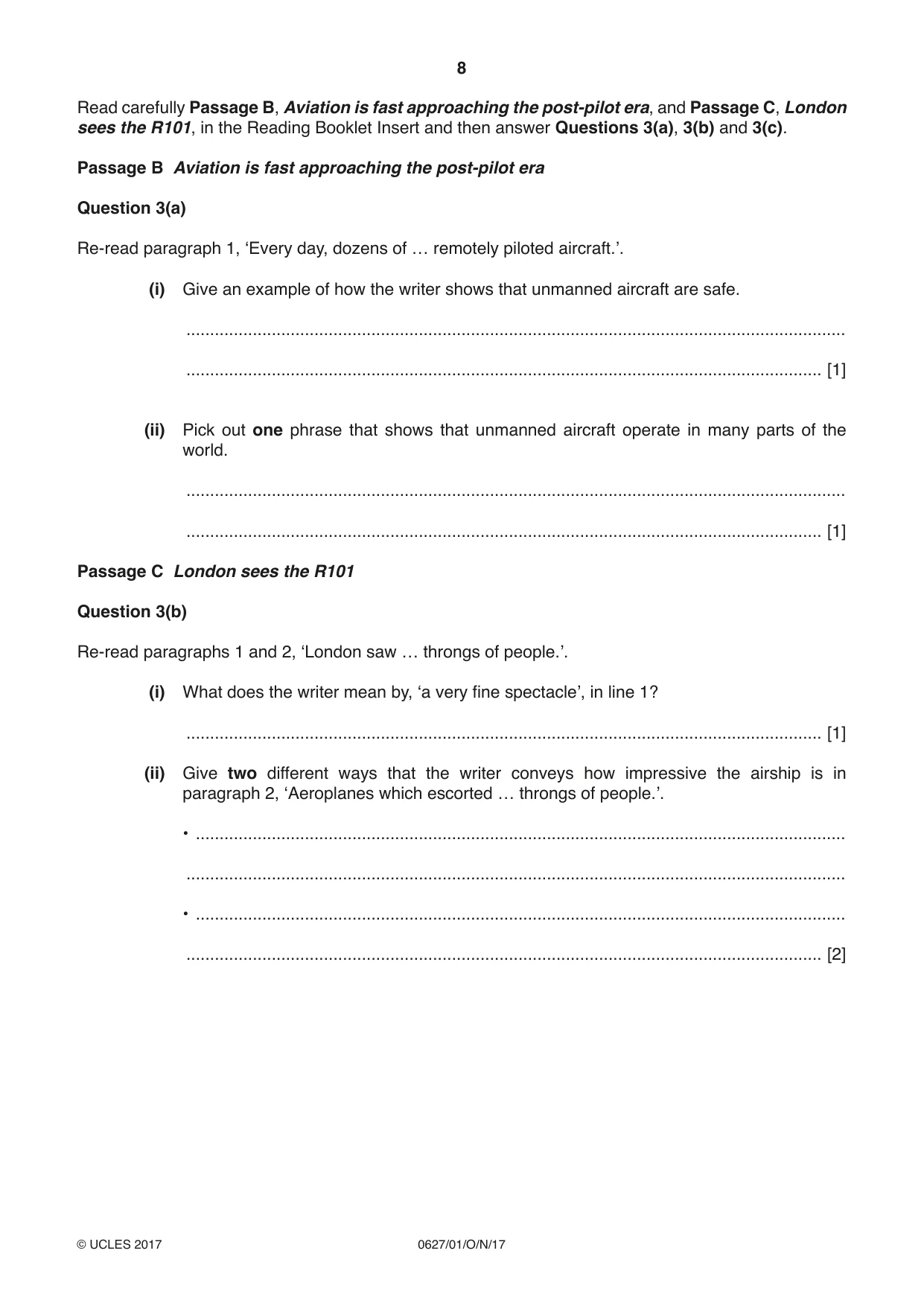
8 0627/01/O/N/17 © UCLES 2017 Read carefully Passage B, Aviation is fast approaching the post-pilot era, and Passage C, London sees the R101, in the Reading Booklet Insert and then answer Questions 3(a), 3(b) and 3(c). Passage B Aviation is fast approaching the post-pilot era Question 3(a) Re-read paragraph 1, ‘Every day, dozens of … remotely piloted aircraft.’. (i) Give an example of how the writer shows that unmanned aircraft are safe. … … [1] (ii) Pick out one phrase that shows that unmanned aircraft operate in many parts of the world. … … [1] Passage C London sees the R101 Question 3(b) Re-read paragraphs 1 and 2, ‘London saw … throngs of people.’. (i) What does the writer mean by, ‘a very fine spectacle’, in line 1? … [1] (ii) Give two different ways that the writer conveys how impressive the airship is in paragraph 2, ‘Aeroplanes which escorted … throngs of people.’. • … … • … … [2]
Question paper, page 9
9 0627/01/O/N/17 © UCLES 2017 [Turn over Question 3(c) Compare and contrast how the writers of Passage B, Aviation is fast approaching the post-pilot era, and Passage C, London sees the R101, convey their views and ideas about developments in transport. In your response you should compare and contrast: • the views and ideas each writer presents to the reader • the evidence that the writers use to support their ideas and views and how reliable it is • the language, structure and techniques used by the writers and why they are effective. Remember to support your answer with details from the passages. You should write about 300–350 words. Up to 20 marks are available for the content of your answer. … … … … … … … … … … … … … … … … … … …
Question paper, page 10
10 0627/01/O/N/17 © UCLES 2017 … … … … … … … … … … … … … … … … … … … … … … … … … … … …
Question paper, page 11
11 0627/01/O/N/17 © UCLES 2017 … … … … … … … … … … … … … … … … … … … … … … … … … … … … [20]
Question paper, page 12
12 0627/01/O/N/17 © UCLES 2017 Permission to reproduce items where third-party owned material protected by copyright is included has been sought and cleared where possible. Every reasonable effort has been made by the publisher (UCLES) to trace copyright holders, but if any items requiring clearance have unwittingly been included, the publisher will be pleased to make amends at the earliest possible opportunity. To avoid the issue of disclosure of answer-related information to candidates, all copyright acknowledgements are reproduced online in the Cambridge International Examinations Copyright Acknowledgements Booklet. This is produced for each series of examinations and is freely available to download at www.cie.org.uk after the live examination series. Cambridge International Examinations is part of the Cambridge Assessment Group. Cambridge Assessment is the brand name of University of Cambridge Local Examinations Syndicate (UCLES), which is itself a department of the University of Cambridge. Additional Page If you use the following lined page to complete the answer(s) to any question(s), the question number(s) must be clearly shown. … … … … … … … … … … … … … … … … … … … … … …
Mark scheme, page 1
® IGCSE is a registered trademark. This syllabus is regulated for use in England as a Cambridge International Level 1/Level 2 (9–1) Certificate. This document consists of 18 printed pages. © UCLES 2017 [Turn over Cambridge Assessment International Education Cambridge International General Certificate of Secondary Education (9–1) FIRST LANGUAGE ENGLISH (9–1) 0627/01 Paper 1 Reading Passages October/November 2017 MARK SCHEME Maximum Mark: 80 Published This mark scheme is published as an aid to teachers and candidates, to indicate the requirements of the examination. It shows the basis on which Examiners were instructed to award marks. It does not indicate the details of the discussions that took place at an Examiners’ meeting before marking began, which would have considered the acceptability of alternative answers. Mark schemes should be read in conjunction with the question paper and the Principal Examiner Report for Teachers. Cambridge International will not enter into discussions about these mark schemes. Cambridge International is publishing the mark schemes for the October/November 2017 series for most Cambridge IGCSE®, Cambridge International A and AS Level components and some Cambridge O Level components.
Mark scheme, page 2
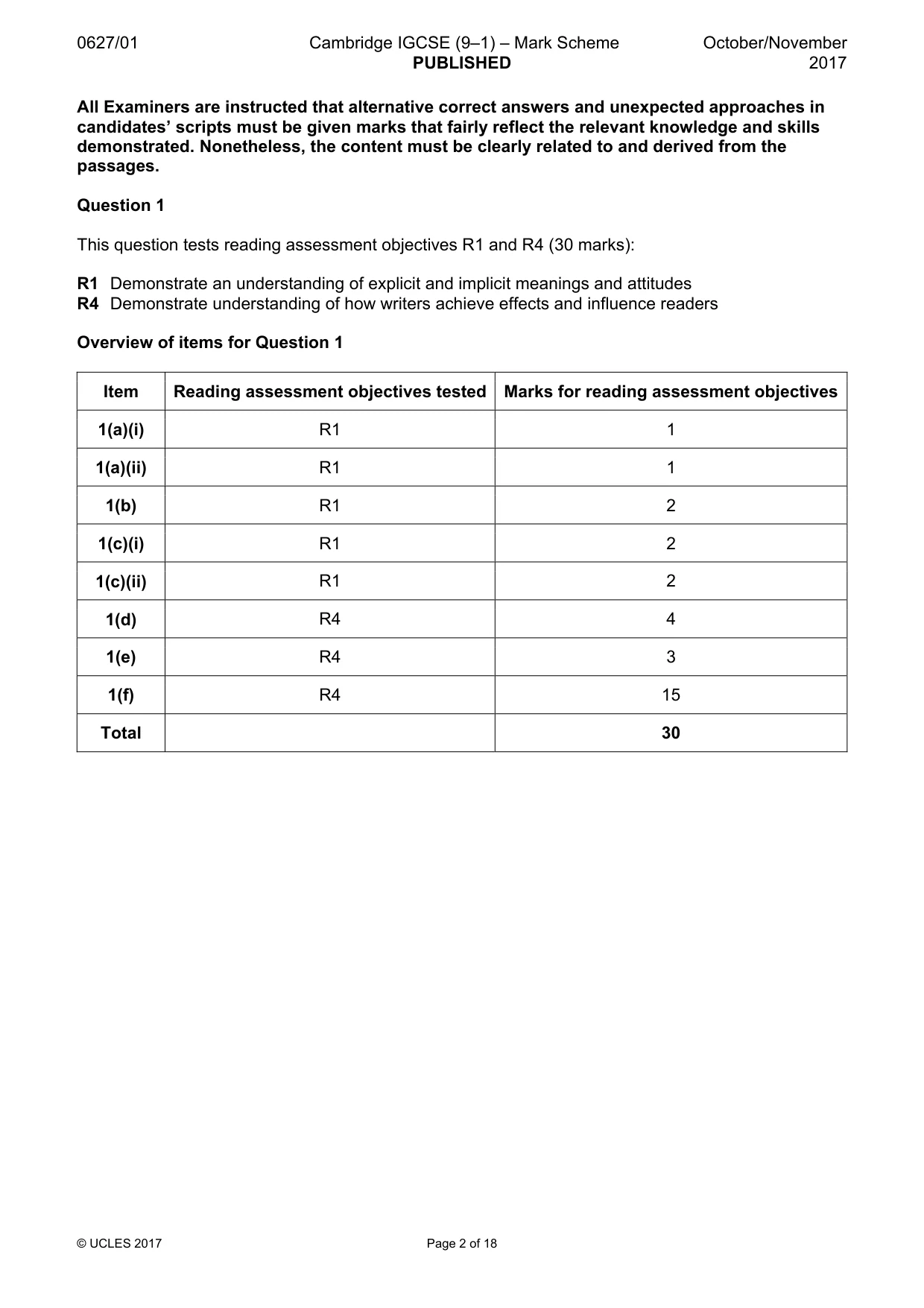
0627/01 Cambridge IGCSE (9–1) – Mark Scheme PUBLISHED October/November 2017 © UCLES 2017 Page 2 of 18 All Examiners are instructed that alternative correct answers and unexpected approaches in candidates’ scripts must be given marks that fairly reflect the relevant knowledge and skills demonstrated. Nonetheless, the content must be clearly related to and derived from the passages. Question 1 This question tests reading assessment objectives R1 and R4 (30 marks): R1 Demonstrate an understanding of explicit and implicit meanings and attitudes R4 Demonstrate understanding of how writers achieve effects and influence readers Overview of items for Question 1 Item Reading assessment objectives tested Marks for reading assessment objectives 1(a)(i) R1 1 1(a)(ii) R1 1 1(b) R1 2 1(c)(i) R1 2 1(c)(ii) R1 2 1(d) R4 4 1(e) R4 3 1(f) R4 15 Total 30
Mark scheme, page 3
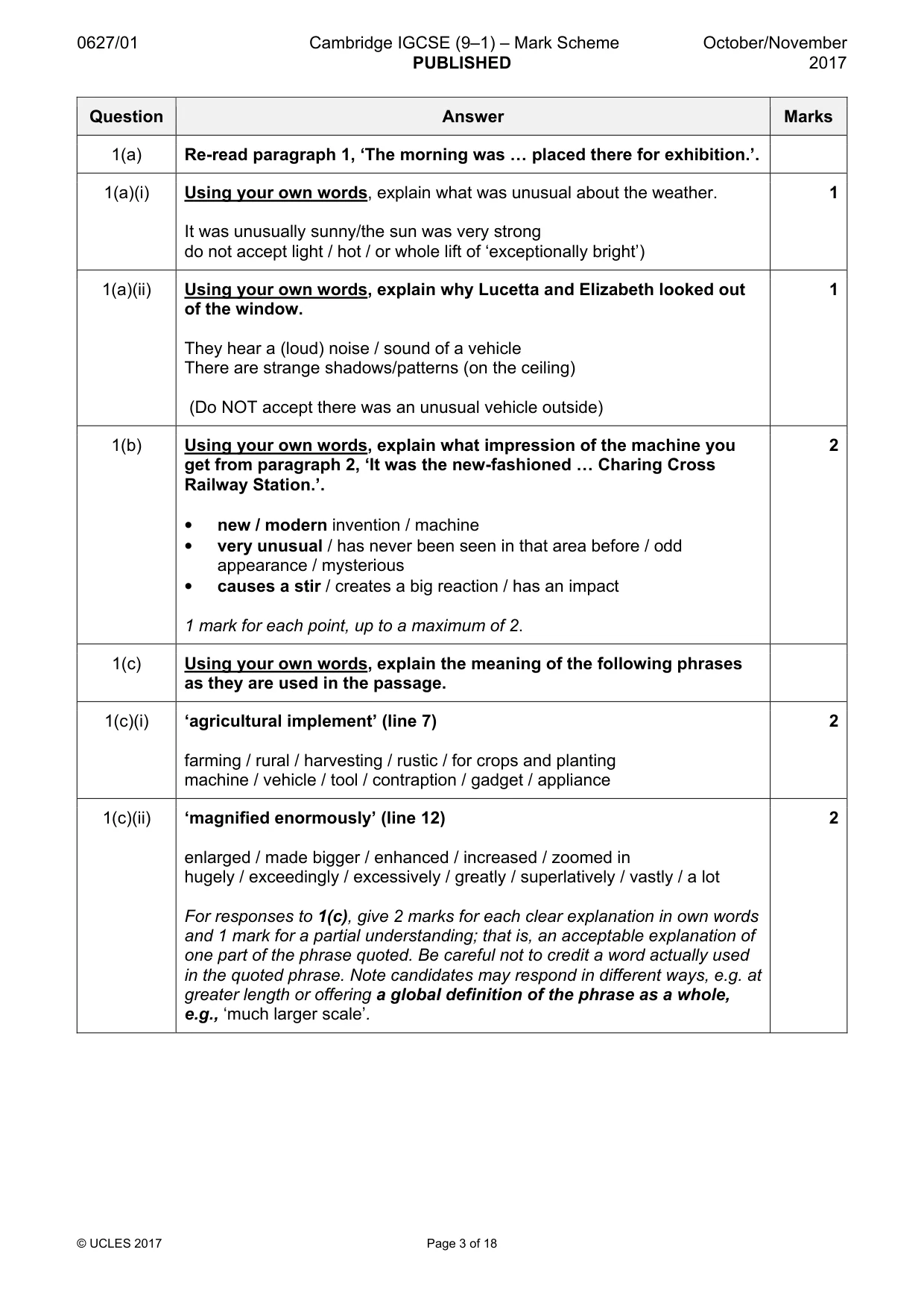
0627/01 Cambridge IGCSE (9–1) – Mark Scheme PUBLISHED October/November 2017 © UCLES 2017 Page 3 of 18 Question Answer Marks 1(a) Re-read paragraph 1, ‘The morning was « placed there for exhibition.’. 1(a)(i) Using your own words, explain what was unusual about the weather. It was unusually sunny/the sun was very strong do not accept light / hot / or whole lift of ‘exceptionally bright’) 1 1(a)(ii) Using your own words, explain why Lucetta and Elizabeth looked out of the window. They hear a (loud) noise / sound of a vehicle There are strange shadows/patterns (on the ceiling) (Do NOT accept there was an unusual vehicle outside) 1 1(b) Using your own words, explain what impression of the machine you get from paragraph 2, ‘It was the new-fashioned « Charing Cross Railway Station.’. • new / modern invention / machine • very unusual / has never been seen in that area before / odd appearance / mysterious • causes a stir / creates a big reaction / has an impact 1 mark for each point, up to a maximum of 2. 2 1(c) Using your own words, explain the meaning of the following phrases as they are used in the passage. 1(c)(i) ‘agricultural implement’ (line 7) farming / rural / harvesting / rustic / for crops and planting machine / vehicle / tool / contraption / gadget / appliance 2 1(c)(ii) ‘magnified enormously’ (line 12) enlarged / made bigger / enhanced / increased / zoomed in hugely / exceedingly / excessively / greatly / superlatively / vastly / a lot For responses to 1(c), give 2 marks for each clear explanation in own words and 1 mark for a partial understanding; that is, an acceptable explanation of one part of the phrase quoted. Be careful not to credit a word actually used in the quoted phrase. Note candidates may respond in different ways, e.g. at greater length or offering a global definition of the phrase as a whole, e.g., ‘much larger scale’. 2
Mark scheme, page 4
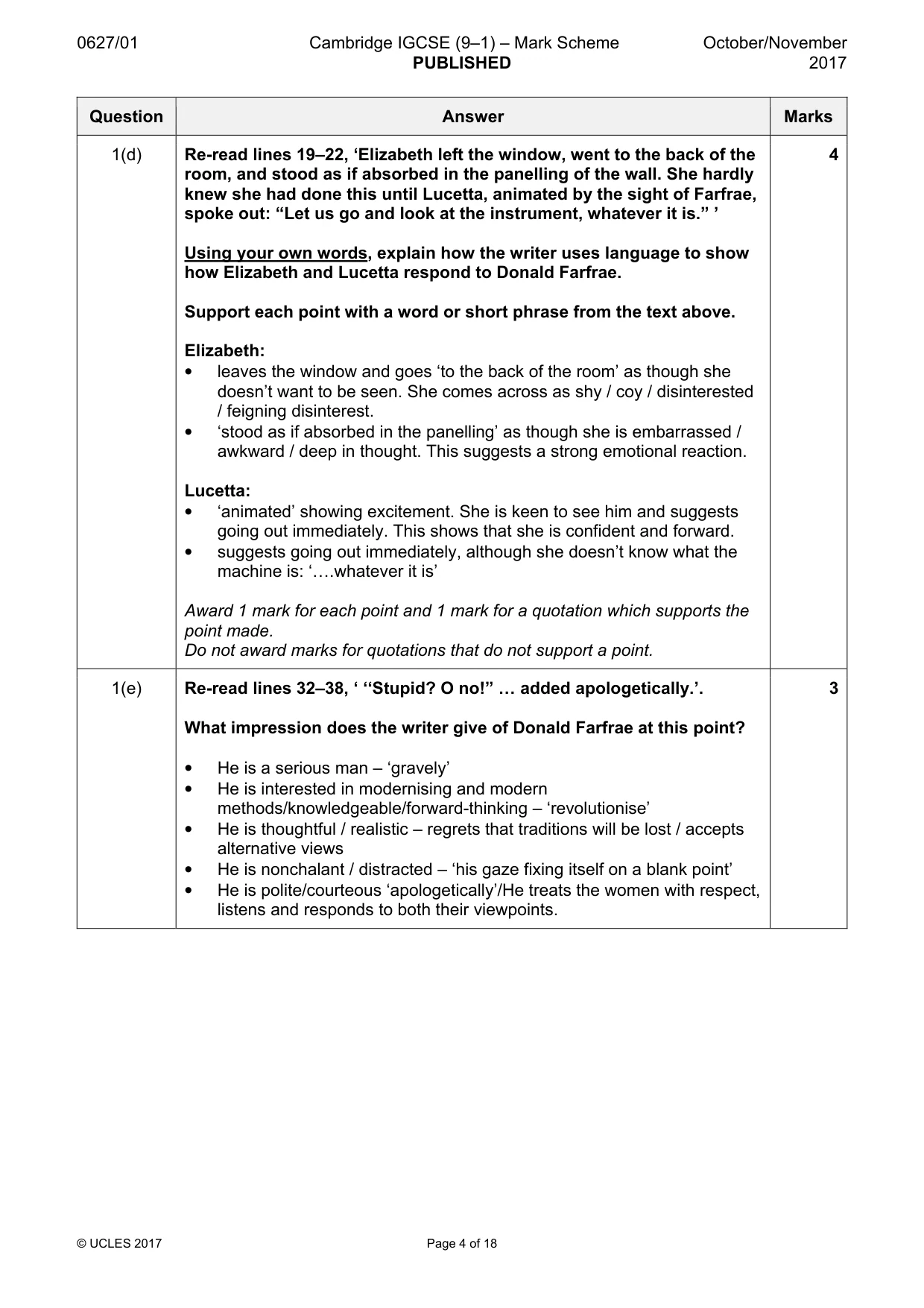
0627/01 Cambridge IGCSE (9–1) – Mark Scheme PUBLISHED October/November 2017 © UCLES 2017 Page 4 of 18 Question Answer Marks 1(d) Re-read lines 19–22, ‘Elizabeth left the window, went to the back of the room, and stood as if absorbed in the panelling of the wall. She hardly knew she had done this until Lucetta, animated by the sight of Farfrae, spoke out: “Let us go and look at the instrument, whatever it is.” ’ Using your own words, explain how the writer uses language to show how Elizabeth and Lucetta respond to Donald Farfrae. Support each point with a word or short phrase from the text above. Elizabeth: • leaves the window and goes ‘to the back of the room’ as though she doesn’t want to be seen. She comes across as shy / coy / disinterested / feigning disinterest. • ‘stood as if absorbed in the panelling’ as though she is embarrassed / awkward / deep in thought. This suggests a strong emotional reaction. Lucetta: • ‘animated’ showing excitement. She is keen to see him and suggests going out immediately. This shows that she is confident and forward. • suggests going out immediately, although she doesn’t know what the machine is: ‘«.whatever it is’ Award 1 mark for each point and 1 mark for a quotation which supports the point made. Do not award marks for quotations that do not support a point. 4 1(e) Re-read lines 32–38, ‘ ‘‘Stupid? O no!” « added apologetically.’. What impression does the writer give of Donald Farfrae at this point? • He is a serious man – ‘gravely’ • He is interested in modernising and modern methods/knowledgeable/forward-thinking – ‘revolutionise’ • He is thoughtful / realistic – regrets that traditions will be lost / accepts alternative views • He is nonchalant / distracted – ‘his gaze fixing itself on a blank point’ • He is polite/courteous ‘apologetically’/He treats the women with respect, listens and responds to both their viewpoints. 3
Mark scheme, page 5
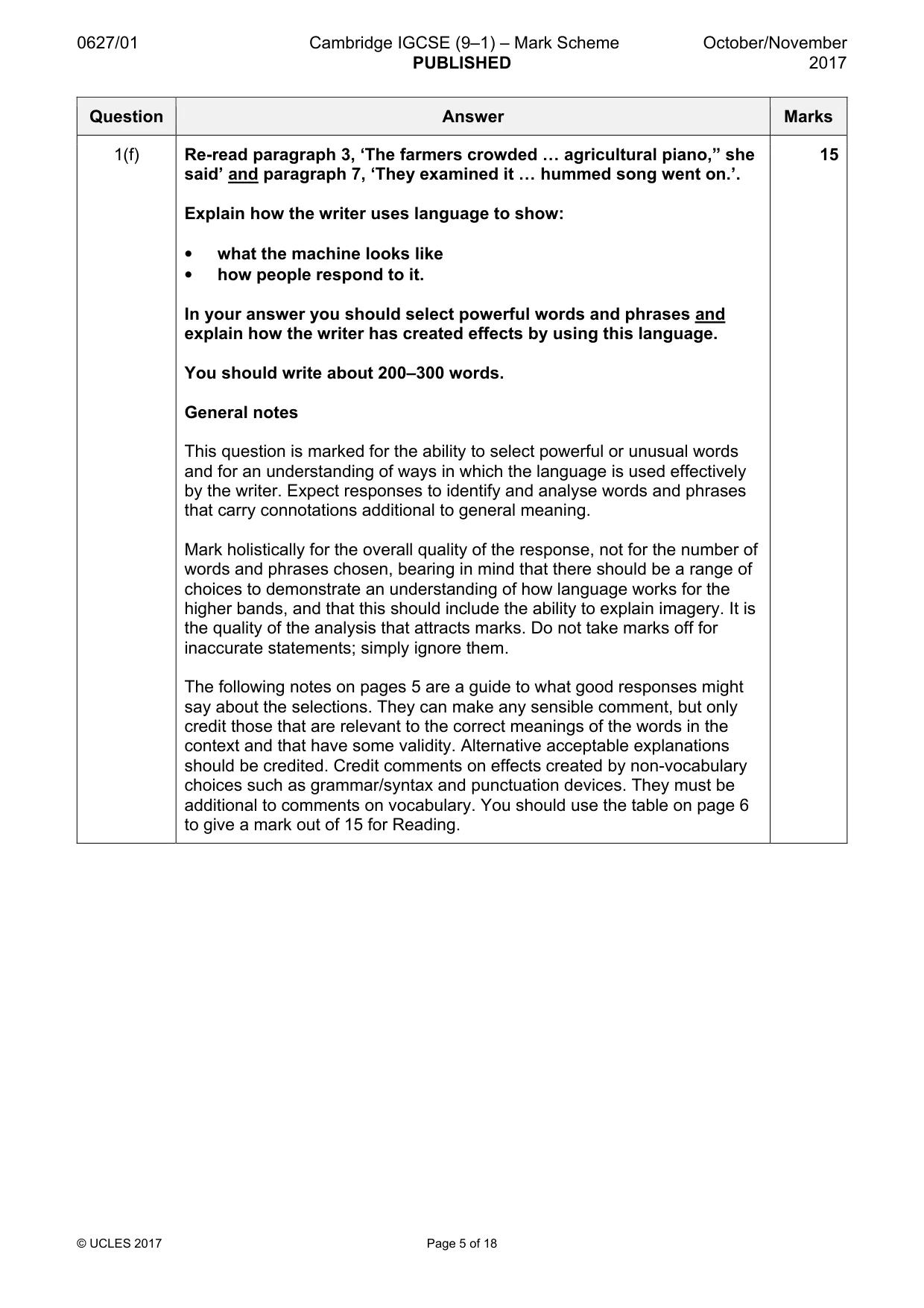
0627/01 Cambridge IGCSE (9–1) – Mark Scheme PUBLISHED October/November 2017 © UCLES 2017 Page 5 of 18 Question Answer Marks 1(f) Re-read paragraph 3, ‘The farmers crowded « agricultural piano,” she said’ and paragraph 7, ‘They examined it « hummed song went on.’. Explain how the writer uses language to show: • what the machine looks like • how people respond to it. In your answer you should select powerful words and phrases and explain how the writer has created effects by using this language. You should write about 200–300 words. General notes This question is marked for the ability to select powerful or unusual words and for an understanding of ways in which the language is used effectively by the writer. Expect responses to identify and analyse words and phrases that carry connotations additional to general meaning. Mark holistically for the overall quality of the response, not for the number of words and phrases chosen, bearing in mind that there should be a range of choices to demonstrate an understanding of how language works for the higher bands, and that this should include the ability to explain imagery. It is the quality of the analysis that attracts marks. Do not take marks off for inaccurate statements; simply ignore them. The following notes on pages 5 are a guide to what good responses might say about the selections. They can make any sensible comment, but only credit those that are relevant to the correct meanings of the words in the context and that have some validity. Alternative acceptable explanations should be credited. Credit comments on effects created by non-vocabulary choices such as grammar/syntax and punctuation devices. They must be additional to comments on vocabulary. You should use the table on page 6 to give a mark out of 15 for Reading. 15
Mark scheme, page 6
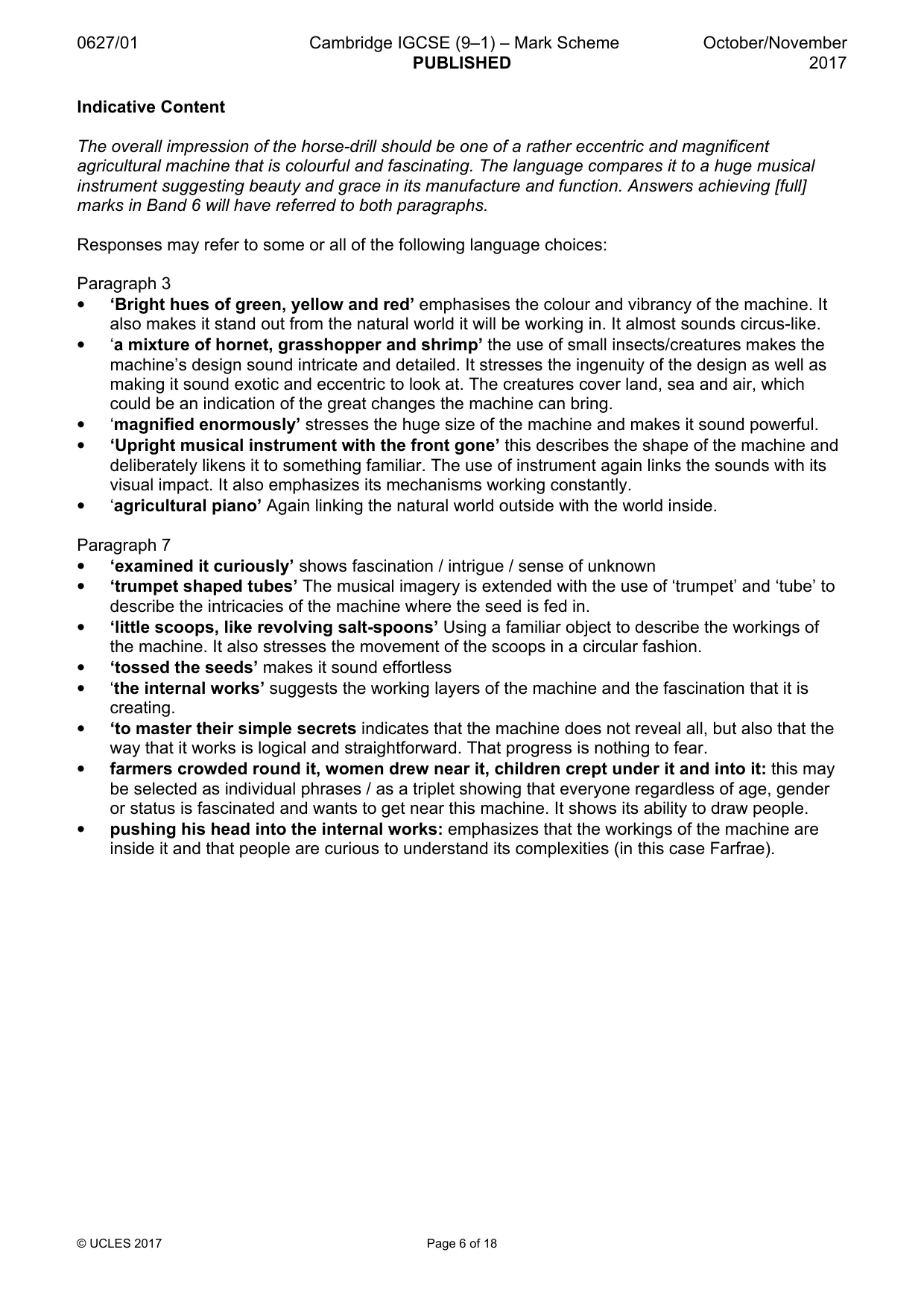
0627/01 Cambridge IGCSE (9–1) – Mark Scheme PUBLISHED October/November 2017 © UCLES 2017 Page 6 of 18 Indicative Content The overall impression of the horse-drill should be one of a rather eccentric and magnificent agricultural machine that is colourful and fascinating. The language compares it to a huge musical instrument suggesting beauty and grace in its manufacture and function. Answers achieving [full] marks in Band 6 will have referred to both paragraphs. Responses may refer to some or all of the following language choices: Paragraph 3 • ‘Bright hues of green, yellow and red’ emphasises the colour and vibrancy of the machine. It also makes it stand out from the natural world it will be working in. It almost sounds circus-like. • ‘a mixture of hornet, grasshopper and shrimp’ the use of small insects/creatures makes the machine’s design sound intricate and detailed. It stresses the ingenuity of the design as well as making it sound exotic and eccentric to look at. The creatures cover land, sea and air, which could be an indication of the great changes the machine can bring. • ‘magnified enormously’ stresses the huge size of the machine and makes it sound powerful. • ‘Upright musical instrument with the front gone’ this describes the shape of the machine and deliberately likens it to something familiar. The use of instrument again links the sounds with its visual impact. It also emphasizes its mechanisms working constantly. • ‘agricultural piano’ Again linking the natural world outside with the world inside. Paragraph 7 • ‘examined it curiously’ shows fascination / intrigue / sense of unknown • ‘trumpet shaped tubes’ The musical imagery is extended with the use of ‘trumpet’ and ‘tube’ to describe the intricacies of the machine where the seed is fed in. • ‘little scoops, like revolving salt-spoons’ Using a familiar object to describe the workings of the machine. It also stresses the movement of the scoops in a circular fashion. • ‘tossed the seeds’ makes it sound effortless • ‘the internal works’ suggests the working layers of the machine and the fascination that it is creating. • ‘to master their simple secrets indicates that the machine does not reveal all, but also that the way that it works is logical and straightforward. That progress is nothing to fear. • farmers crowded round it, women drew near it, children crept under it and into it: this may be selected as individual phrases / as a triplet showing that everyone regardless of age, gender or status is fascinated and wants to get near this machine. It shows its ability to draw people. • pushing his head into the internal works: emphasizes that the workings of the machine are inside it and that people are curious to understand its complexities (in this case Farfrae).
Mark scheme, page 7
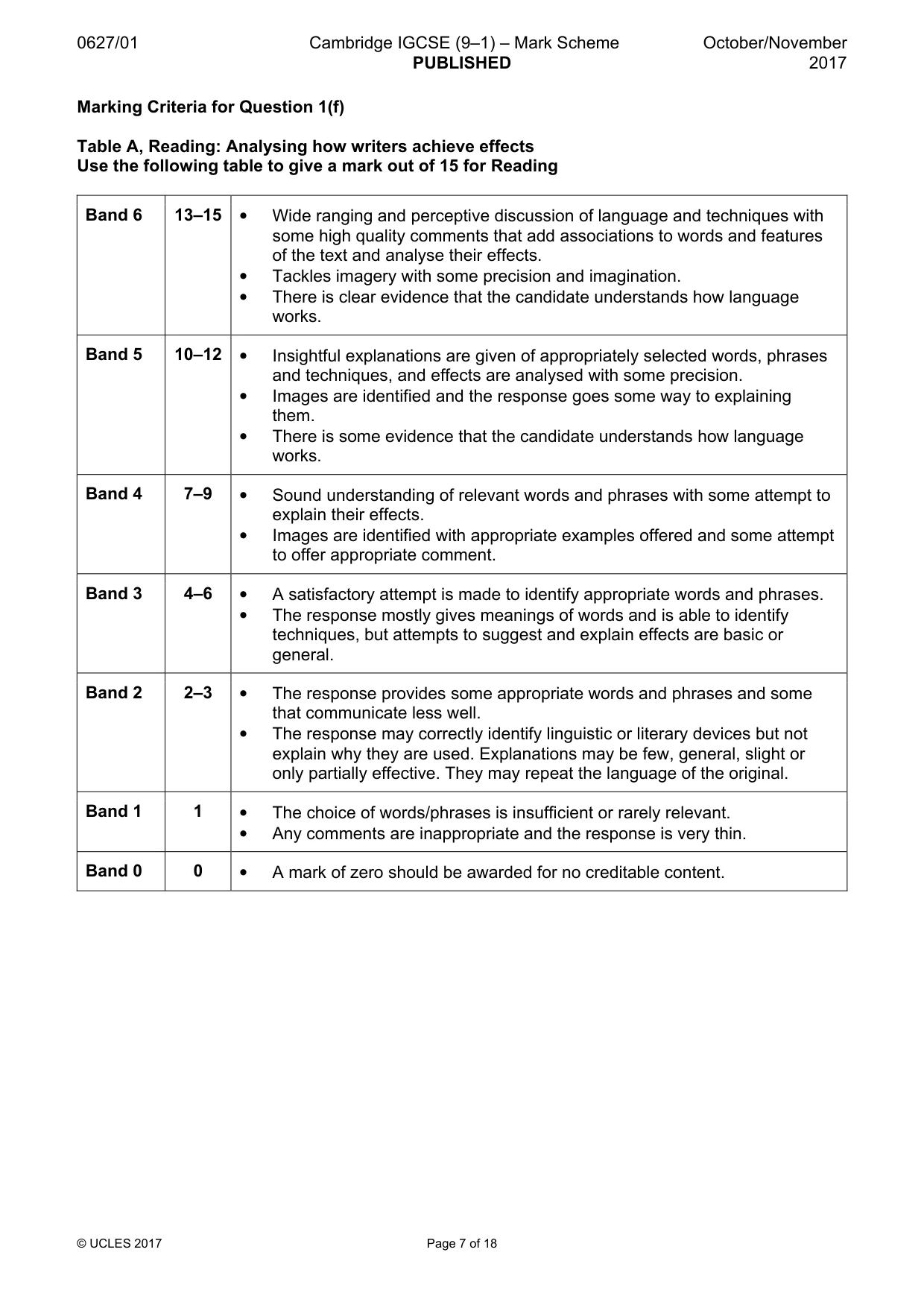
0627/01 Cambridge IGCSE (9–1) – Mark Scheme PUBLISHED October/November 2017 © UCLES 2017 Page 7 of 18 Marking Criteria for Question 1(f) Table A, Reading: Analysing how writers achieve effects Use the following table to give a mark out of 15 for Reading Band 6 13–15 • Wide ranging and perceptive discussion of language and techniques with some high quality comments that add associations to words and features of the text and analyse their effects. • Tackles imagery with some precision and imagination. • There is clear evidence that the candidate understands how language works. Band 5 10–12 • Insightful explanations are given of appropriately selected words, phrases and techniques, and effects are analysed with some precision. • Images are identified and the response goes some way to explaining them. • There is some evidence that the candidate understands how language works. Band 4 7–9 • Sound understanding of relevant words and phrases with some attempt to explain their effects. • Images are identified with appropriate examples offered and some attempt to offer appropriate comment. Band 3 4–6 • A satisfactory attempt is made to identify appropriate words and phrases. • The response mostly gives meanings of words and is able to identify techniques, but attempts to suggest and explain effects are basic or general. Band 2 2–3 • The response provides some appropriate words and phrases and some that communicate less well. • The response may correctly identify linguistic or literary devices but not explain why they are used. Explanations may be few, general, slight or only partially effective. They may repeat the language of the original. Band 1 1 • The choice of words/phrases is insufficient or rarely relevant. • Any comments are inappropriate and the response is very thin. Band 0 0 • A mark of zero should be awarded for no creditable content.
Mark scheme, page 8
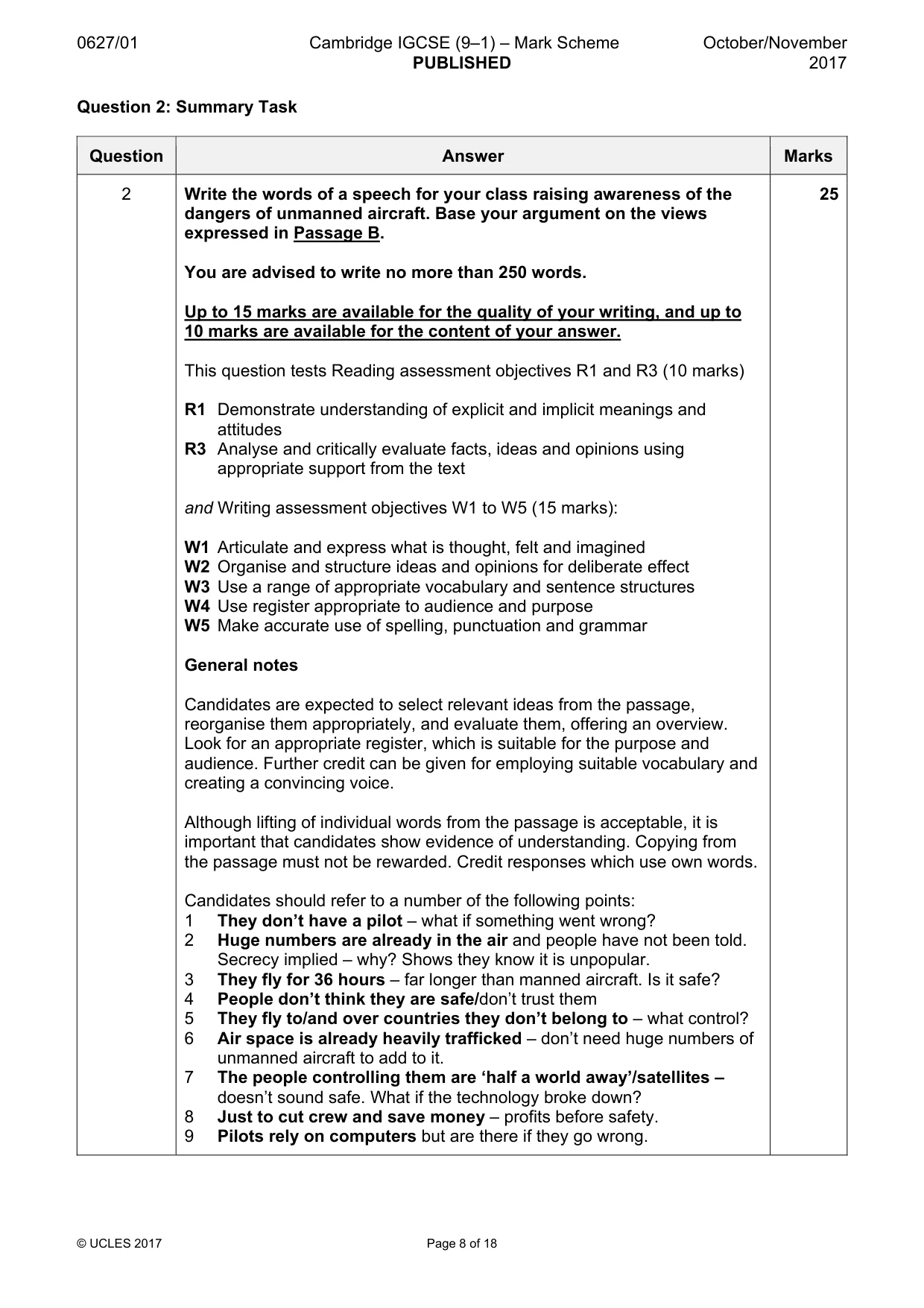
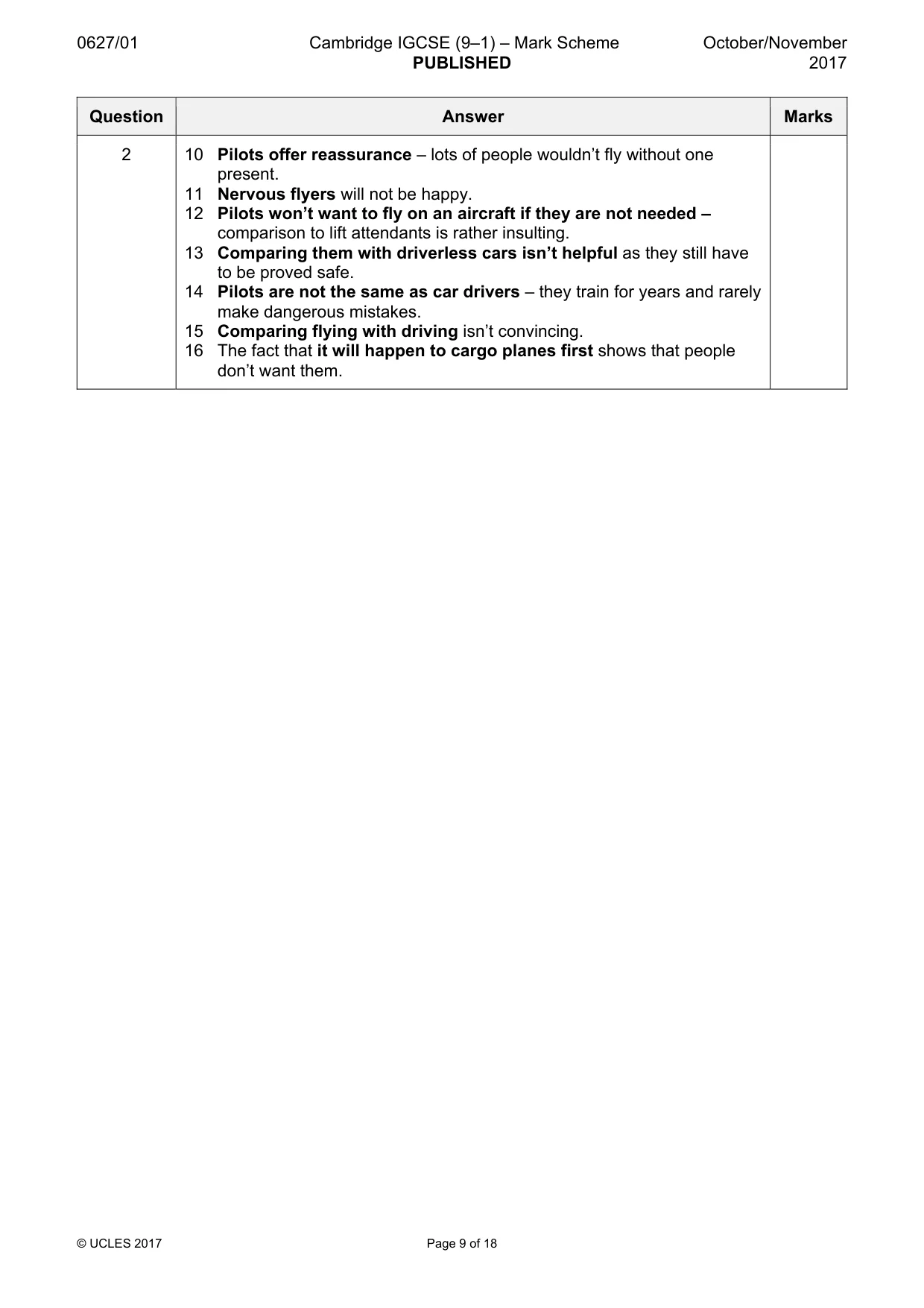
0627/01 Cambridge IGCSE (9–1) – Mark Scheme PUBLISHED October/November 2017 © UCLES 2017 Page 8 of 18 Question 2: Summary Task Question Answer Marks 2 Write the words of a speech for your class raising awareness of the dangers of unmanned aircraft. Base your argument on the views expressed in Passage B. You are advised to write no more than 250 words. Up to 15 marks are available for the quality of your writing, and up to 10 marks are available for the content of your answer. This question tests Reading assessment objectives R1 and R3 (10 marks) R1 Demonstrate understanding of explicit and implicit meanings and attitudes R3 Analyse and critically evaluate facts, ideas and opinions using appropriate support from the text and Writing assessment objectives W1 to W5 (15 marks): W1 Articulate and express what is thought, felt and imagined W2 Organise and structure ideas and opinions for deliberate effect W3 Use a range of appropriate vocabulary and sentence structures W4 Use register appropriate to audience and purpose W5 Make accurate use of spelling, punctuation and grammar General notes Candidates are expected to select relevant ideas from the passage, reorganise them appropriately, and evaluate them, offering an overview. Look for an appropriate register, which is suitable for the purpose and audience. Further credit can be given for employing suitable vocabulary and creating a convincing voice. Although lifting of individual words from the passage is acceptable, it is important that candidates show evidence of understanding. Copying from the passage must not be rewarded. Credit responses which use own words. Candidates should refer to a number of the following points: 1 They don’t have a pilot – what if something went wrong? 2 Huge numbers are already in the air and people have not been told. Secrecy implied – why? Shows they know it is unpopular. 3 They fly for 36 hours – far longer than manned aircraft. Is it safe? 4 People don’t think they are safe/don’t trust them 5 They fly to/and over countries they don’t belong to – what control? 6 Air space is already heavily trafficked – don’t need huge numbers of unmanned aircraft to add to it. 7 The people controlling them are ‘half a world away’/satellites – doesn’t sound safe. What if the technology broke down? 8 Just to cut crew and save money – profits before safety. 9 Pilots rely on computers but are there if they go wrong. 25
Mark scheme, page 9
0627/01 Cambridge IGCSE (9–1) – Mark Scheme PUBLISHED October/November 2017 © UCLES 2017 Page 9 of 18 Question Answer Marks 2 10 Pilots offer reassurance – lots of people wouldn’t fly without one present. 11 Nervous flyers will not be happy. 12 Pilots won’t want to fly on an aircraft if they are not needed – comparison to lift attendants is rather insulting. 13 Comparing them with driverless cars isn’t helpful as they still have to be proved safe. 14 Pilots are not the same as car drivers – they train for years and rarely make dangerous mistakes. 15 Comparing flying with driving isn’t convincing. 16 The fact that it will happen to cargo planes first shows that people don’t want them.
Mark scheme, page 10
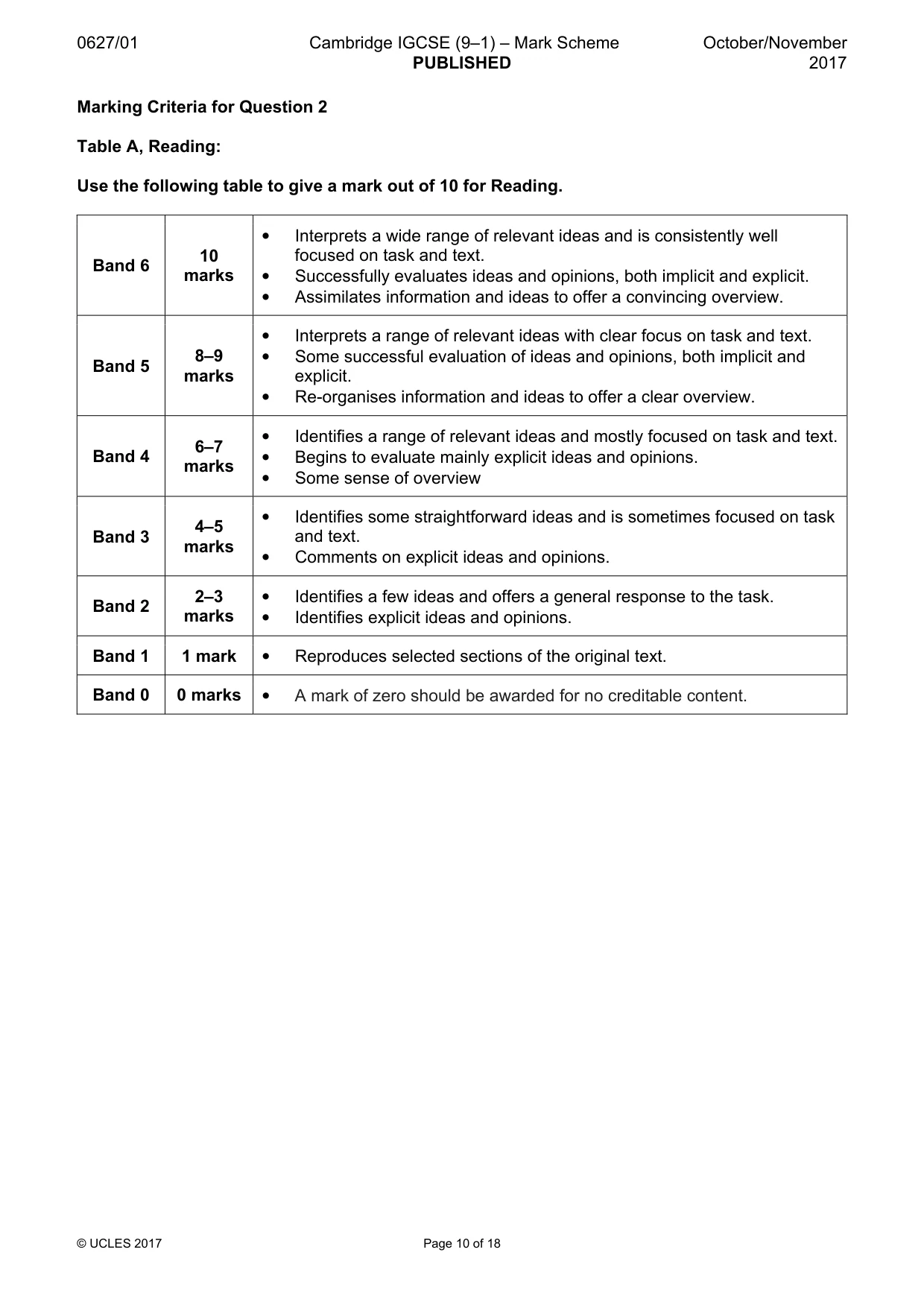
0627/01 Cambridge IGCSE (9–1) – Mark Scheme PUBLISHED October/November 2017 © UCLES 2017 Page 10 of 18 Marking Criteria for Question 2 Table A, Reading: Use the following table to give a mark out of 10 for Reading. Band 6 10 marks • Interprets a wide range of relevant ideas and is consistently well focused on task and text. • Successfully evaluates ideas and opinions, both implicit and explicit. • Assimilates information and ideas to offer a convincing overview. Band 5 8–9 marks • Interprets a range of relevant ideas with clear focus on task and text. • Some successful evaluation of ideas and opinions, both implicit and explicit. • Re-organises information and ideas to offer a clear overview. Band 4 6–7 marks • Identifies a range of relevant ideas and mostly focused on task and text. • Begins to evaluate mainly explicit ideas and opinions. • Some sense of overview Band 3 4–5 marks • Identifies some straightforward ideas and is sometimes focused on task and text. • Comments on explicit ideas and opinions. Band 2 2–3 marks • Identifies a few ideas and offers a general response to the task. • Identifies explicit ideas and opinions. Band 1 1 mark • Reproduces selected sections of the original text. Band 0 0 marks • A mark of zero should be awarded for no creditable content.
Mark scheme, page 11
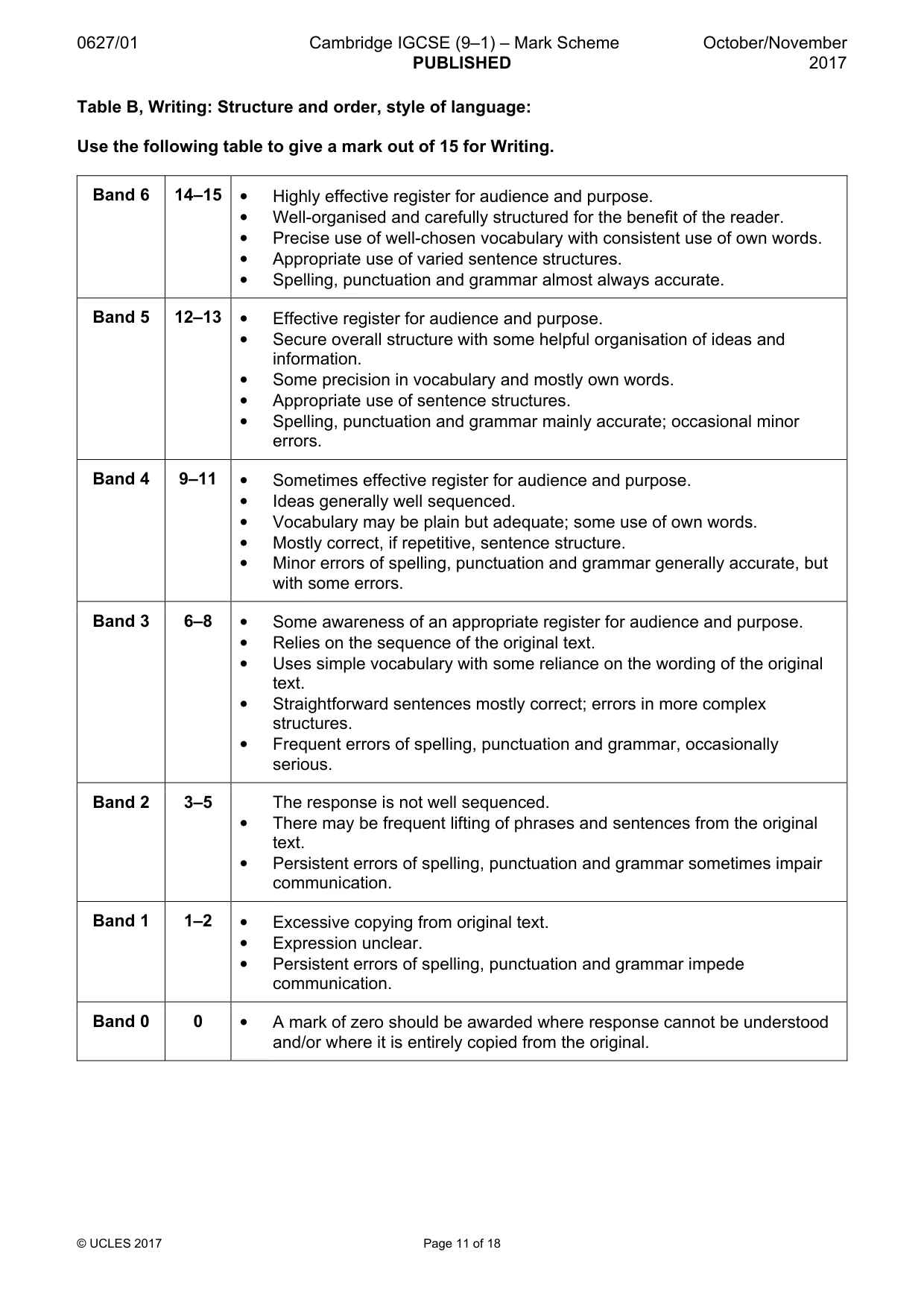
0627/01 Cambridge IGCSE (9–1) – Mark Scheme PUBLISHED October/November 2017 © UCLES 2017 Page 11 of 18 Table B, Writing: Structure and order, style of language: Use the following table to give a mark out of 15 for Writing. Band 6 14–15 • Highly effective register for audience and purpose. • Well-organised and carefully structured for the benefit of the reader. • Precise use of well-chosen vocabulary with consistent use of own words. • Appropriate use of varied sentence structures. • Spelling, punctuation and grammar almost always accurate. Band 5 12–13 • Effective register for audience and purpose. • Secure overall structure with some helpful organisation of ideas and information. • Some precision in vocabulary and mostly own words. • Appropriate use of sentence structures. • Spelling, punctuation and grammar mainly accurate; occasional minor errors. Band 4 9–11 • Sometimes effective register for audience and purpose. • Ideas generally well sequenced. • Vocabulary may be plain but adequate; some use of own words. • Mostly correct, if repetitive, sentence structure. • Minor errors of spelling, punctuation and grammar generally accurate, but with some errors. Band 3 6–8 • Some awareness of an appropriate register for audience and purpose. • Relies on the sequence of the original text. • Uses simple vocabulary with some reliance on the wording of the original text. • Straightforward sentences mostly correct; errors in more complex structures. • Frequent errors of spelling, punctuation and grammar, occasionally serious. Band 2 3–5 The response is not well sequenced. • There may be frequent lifting of phrases and sentences from the original text. • Persistent errors of spelling, punctuation and grammar sometimes impair communication. Band 1 1–2 • Excessive copying from original text. • Expression unclear. • Persistent errors of spelling, punctuation and grammar impede communication. Band 0 0 • A mark of zero should be awarded where response cannot be understood and/or where it is entirely copied from the original.
Mark scheme, page 12
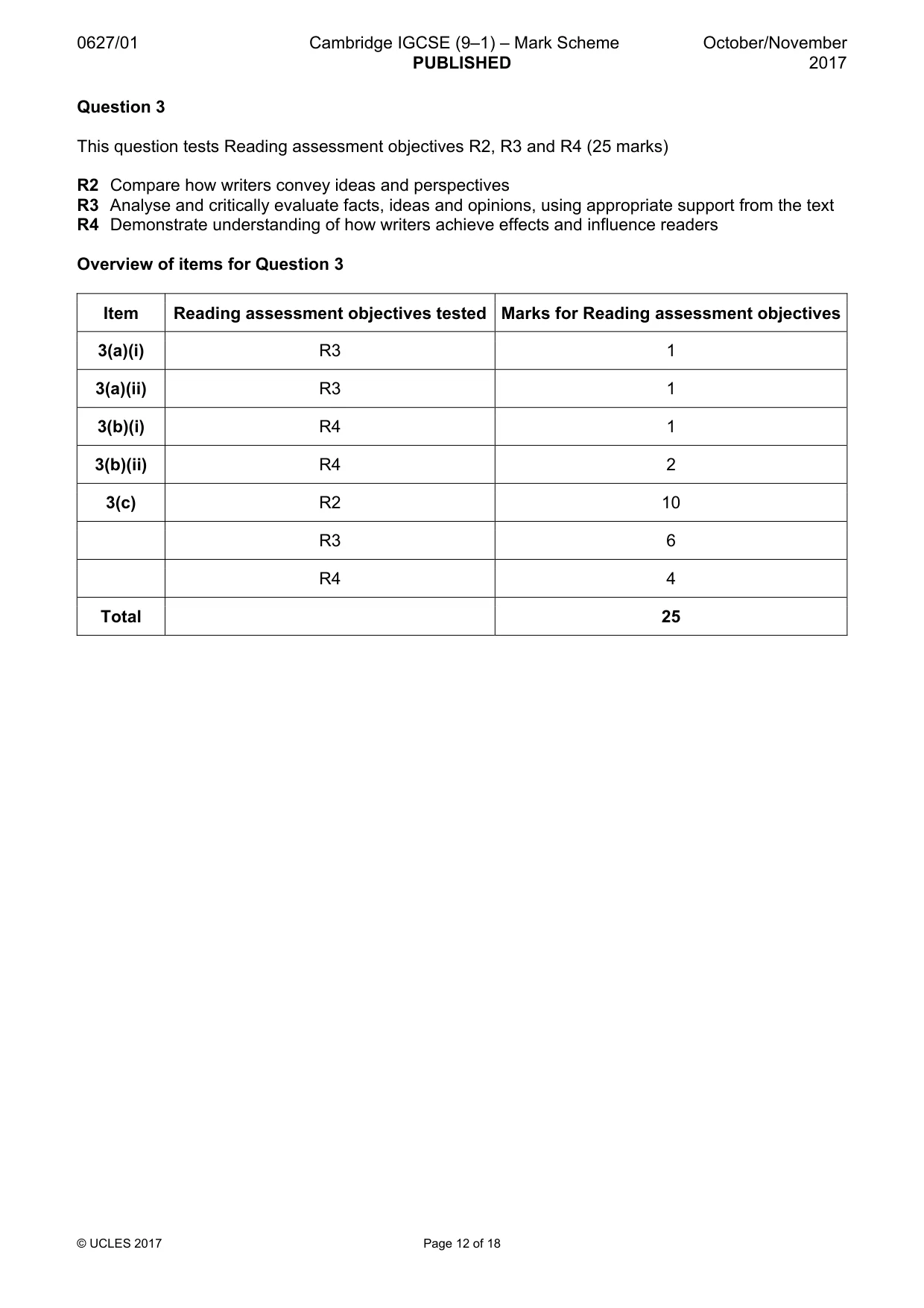
0627/01 Cambridge IGCSE (9–1) – Mark Scheme PUBLISHED October/November 2017 © UCLES 2017 Page 12 of 18 Question 3 This question tests Reading assessment objectives R2, R3 and R4 (25 marks) R2 Compare how writers convey ideas and perspectives R3 Analyse and critically evaluate facts, ideas and opinions, using appropriate support from the text R4 Demonstrate understanding of how writers achieve effects and influence readers Overview of items for Question 3 Item Reading assessment objectives tested Marks for Reading assessment objectives 3(a)(i) R3 1 3(a)(ii) R3 1 3(b)(i) R4 1 3(b)(ii) R4 2 3(c) R2 10 R3 6 R4 4 Total 25
Mark scheme, page 13
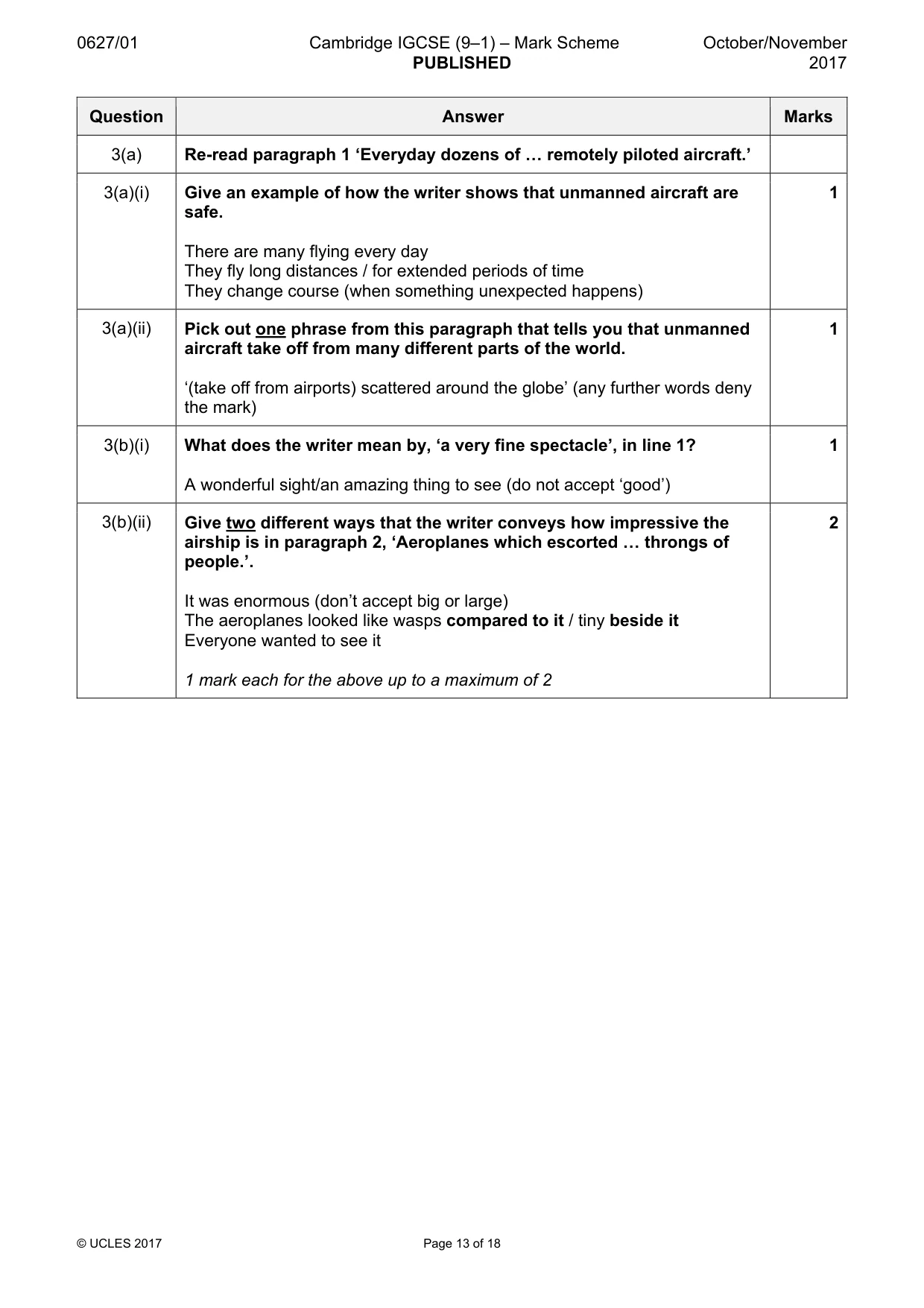
0627/01 Cambridge IGCSE (9–1) – Mark Scheme PUBLISHED October/November 2017 © UCLES 2017 Page 13 of 18 Question Answer Marks 3(a) Re-read paragraph 1 ‘Everyday dozens of « remotely piloted aircraft.’ 3(a)(i) Give an example of how the writer shows that unmanned aircraft are safe. There are many flying every day They fly long distances / for extended periods of time They change course (when something unexpected happens) 1 3(a)(ii) Pick out one phrase from this paragraph that tells you that unmanned aircraft take off from many different parts of the world. ‘(take off from airports) scattered around the globe’ (any further words deny the mark) 1 3(b)(i) What does the writer mean by, ‘a very fine spectacle’, in line 1? A wonderful sight/an amazing thing to see (do not accept ‘good’) 1 3(b)(ii) Give two different ways that the writer conveys how impressive the airship is in paragraph 2, ‘Aeroplanes which escorted « throngs of people.’. It was enormous (don’t accept big or large) The aeroplanes looked like wasps compared to it / tiny beside it Everyone wanted to see it 1 mark each for the above up to a maximum of 2 2
Mark scheme, page 14
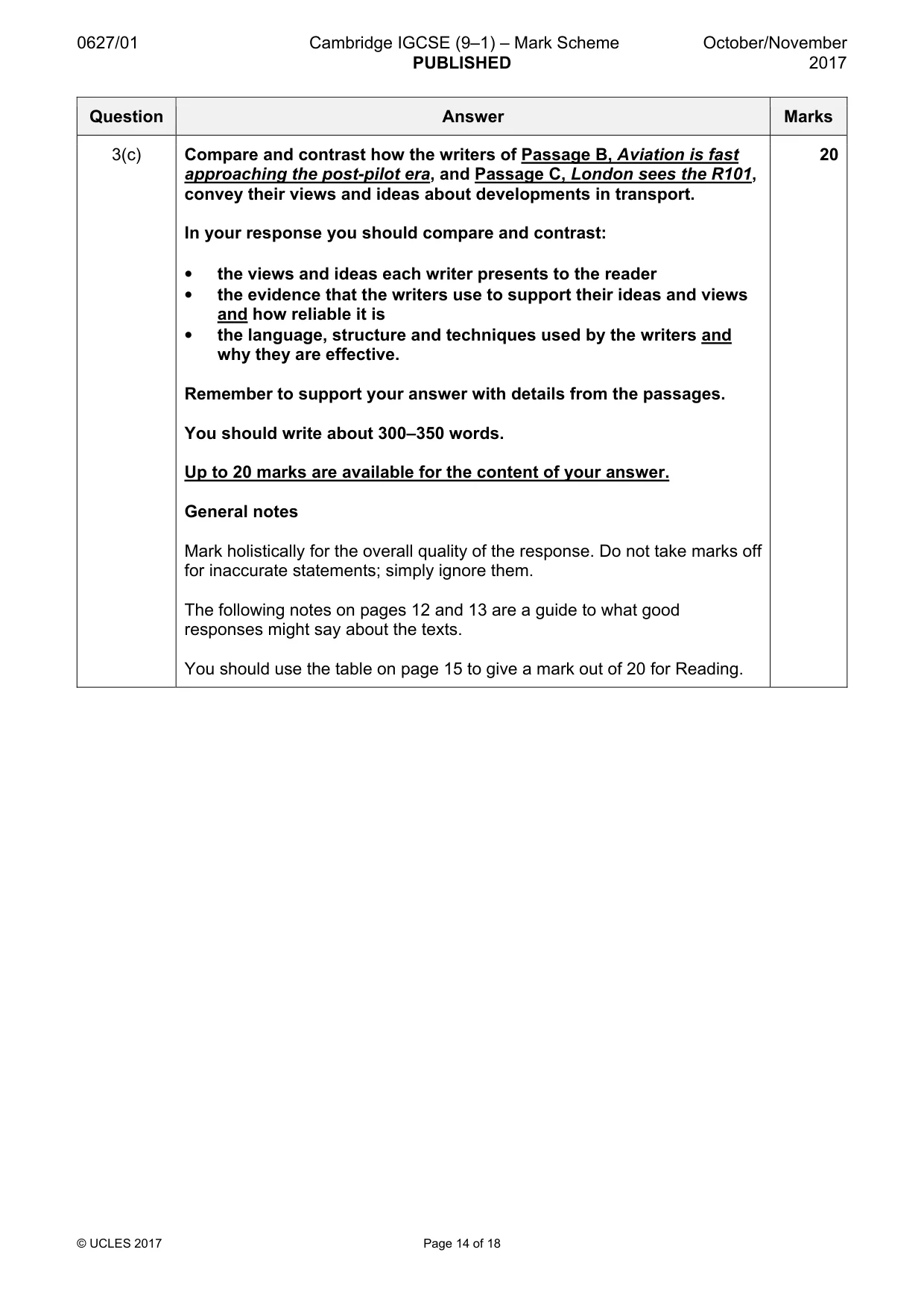
0627/01 Cambridge IGCSE (9–1) – Mark Scheme PUBLISHED October/November 2017 © UCLES 2017 Page 14 of 18 Question Answer Marks 3(c) Compare and contrast how the writers of Passage B, Aviation is fast approaching the post-pilot era, and Passage C, London sees the R101, convey their views and ideas about developments in transport. In your response you should compare and contrast: • the views and ideas each writer presents to the reader • the evidence that the writers use to support their ideas and views and how reliable it is • the language, structure and techniques used by the writers and why they are effective. Remember to support your answer with details from the passages. You should write about 300–350 words. Up to 20 marks are available for the content of your answer. General notes Mark holistically for the overall quality of the response. Do not take marks off for inaccurate statements; simply ignore them. The following notes on pages 12 and 13 are a guide to what good responses might say about the texts. You should use the table on page 15 to give a mark out of 20 for Reading. 20
Mark scheme, page 15
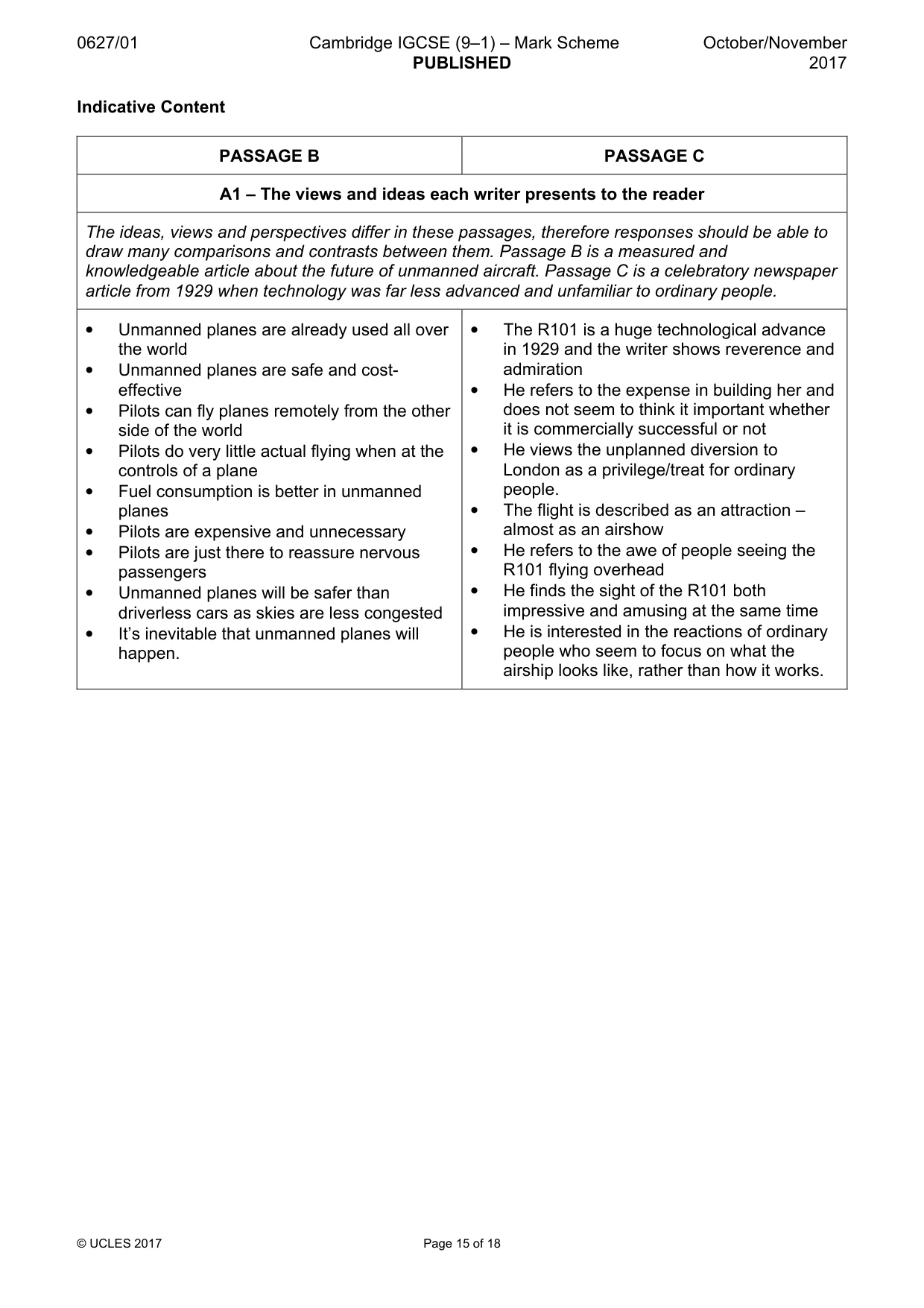
0627/01 Cambridge IGCSE (9–1) – Mark Scheme PUBLISHED October/November 2017 © UCLES 2017 Page 15 of 18 Indicative Content PASSAGE B PASSAGE C A1 – The views and ideas each writer presents to the reader The ideas, views and perspectives differ in these passages, therefore responses should be able to draw many comparisons and contrasts between them. Passage B is a measured and knowledgeable article about the future of unmanned aircraft. Passage C is a celebratory newspaper article from 1929 when technology was far less advanced and unfamiliar to ordinary people. • Unmanned planes are already used all over the world • Unmanned planes are safe and cost- effective • Pilots can fly planes remotely from the other side of the world • Pilots do very little actual flying when at the controls of a plane • Fuel consumption is better in unmanned planes • Pilots are expensive and unnecessary • Pilots are just there to reassure nervous passengers • Unmanned planes will be safer than driverless cars as skies are less congested • It’s inevitable that unmanned planes will happen. • The R101 is a huge technological advance in 1929 and the writer shows reverence and admiration • He refers to the expense in building her and does not seem to think it important whether it is commercially successful or not • He views the unplanned diversion to London as a privilege/treat for ordinary people. • The flight is described as an attraction – almost as an airshow • He refers to the awe of people seeing the R101 flying overhead • He finds the sight of the R101 both impressive and amusing at the same time • He is interested in the reactions of ordinary people who seem to focus on what the airship looks like, rather than how it works.
Mark scheme, page 16
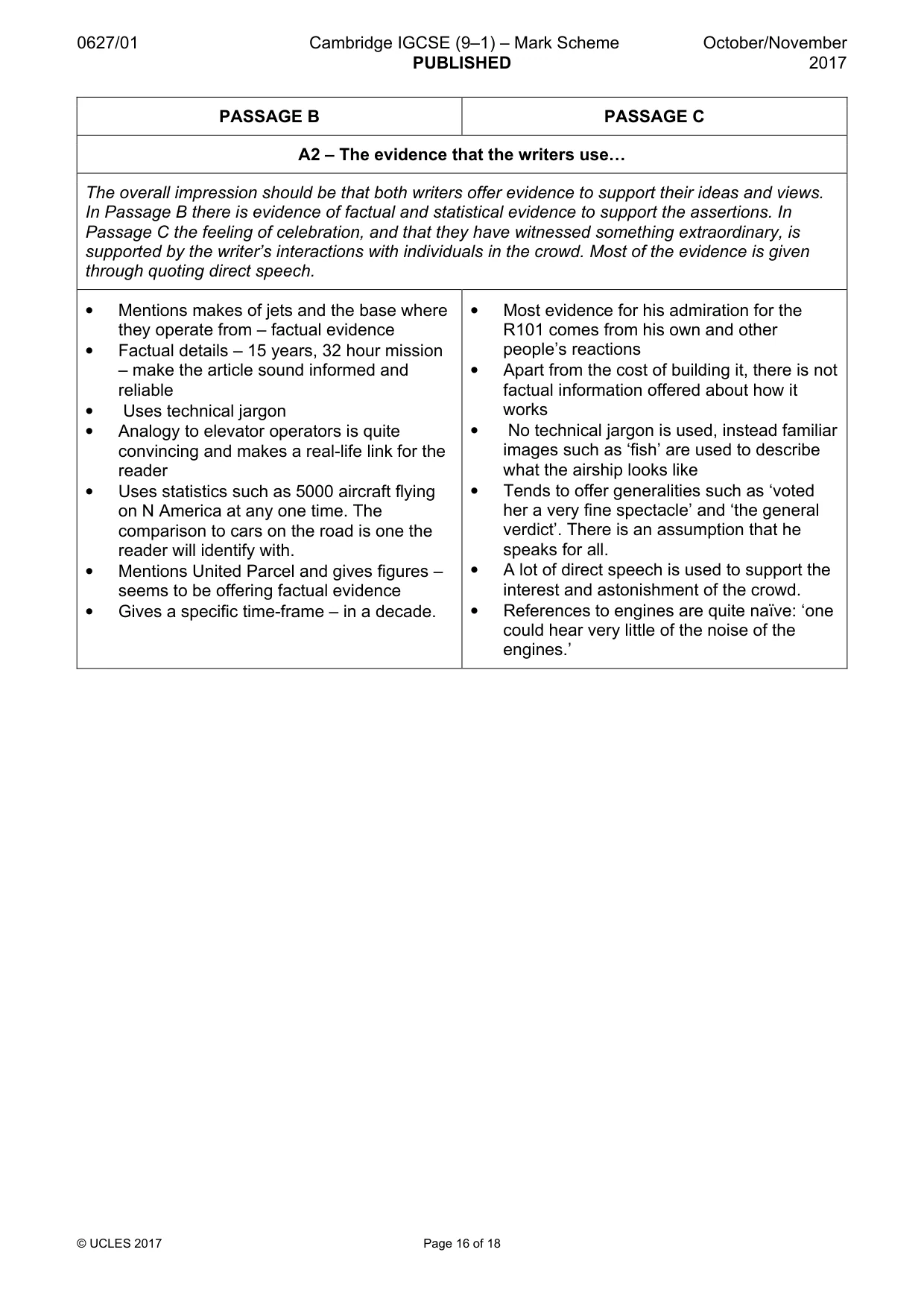
0627/01 Cambridge IGCSE (9–1) – Mark Scheme PUBLISHED October/November 2017 © UCLES 2017 Page 16 of 18 PASSAGE B PASSAGE C A2 – The evidence that the writers use« The overall impression should be that both writers offer evidence to support their ideas and views. In Passage B there is evidence of factual and statistical evidence to support the assertions. In Passage C the feeling of celebration, and that they have witnessed something extraordinary, is supported by the writer’s interactions with individuals in the crowd. Most of the evidence is given through quoting direct speech. • Mentions makes of jets and the base where they operate from – factual evidence • Factual details – 15 years, 32 hour mission – make the article sound informed and reliable • Uses technical jargon • Analogy to elevator operators is quite convincing and makes a real-life link for the reader • Uses statistics such as 5000 aircraft flying on N America at any one time. The comparison to cars on the road is one the reader will identify with. • Mentions United Parcel and gives figures – seems to be offering factual evidence • Gives a specific time-frame – in a decade. • Most evidence for his admiration for the R101 comes from his own and other people’s reactions • Apart from the cost of building it, there is not factual information offered about how it works • No technical jargon is used, instead familiar images such as ‘fish’ are used to describe what the airship looks like • Tends to offer generalities such as ‘voted her a very fine spectacle’ and ‘the general verdict’. There is an assumption that he speaks for all. • A lot of direct speech is used to support the interest and astonishment of the crowd. • References to engines are quite naïve: ‘one could hear very little of the noise of the engines.’
Mark scheme, page 17
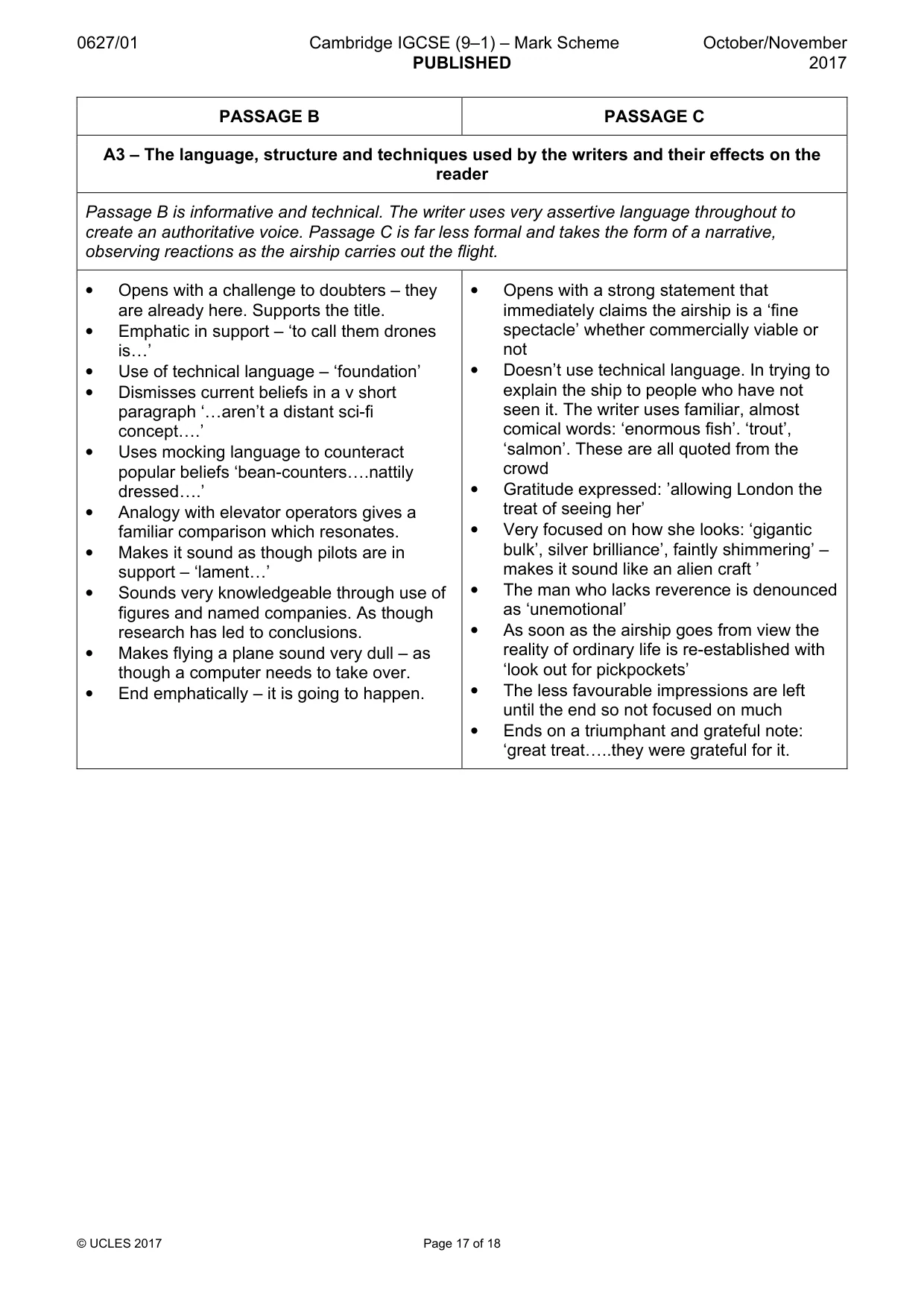
0627/01 Cambridge IGCSE (9–1) – Mark Scheme PUBLISHED October/November 2017 © UCLES 2017 Page 17 of 18 PASSAGE B PASSAGE C A3 – The language, structure and techniques used by the writers and their effects on the reader Passage B is informative and technical. The writer uses very assertive language throughout to create an authoritative voice. Passage C is far less formal and takes the form of a narrative, observing reactions as the airship carries out the flight. • Opens with a challenge to doubters – they are already here. Supports the title. • Emphatic in support – ‘to call them drones is«’ • Use of technical language – ‘foundation’ • Dismisses current beliefs in a v short paragraph ‘«aren’t a distant sci-fi concept«.’ • Uses mocking language to counteract popular beliefs ‘bean-counters«.nattily dressed«.’ • Analogy with elevator operators gives a familiar comparison which resonates. • Makes it sound as though pilots are in support – ‘lament«’ • Sounds very knowledgeable through use of figures and named companies. As though research has led to conclusions. • Makes flying a plane sound very dull – as though a computer needs to take over. • End emphatically – it is going to happen. • Opens with a strong statement that immediately claims the airship is a ‘fine spectacle’ whether commercially viable or not • Doesn’t use technical language. In trying to explain the ship to people who have not seen it. The writer uses familiar, almost comical words: ‘enormous fish’. ‘trout’, ‘salmon’. These are all quoted from the crowd • Gratitude expressed: ’allowing London the treat of seeing her’ • Very focused on how she looks: ‘gigantic bulk’, silver brilliance’, faintly shimmering’ – makes it sound like an alien craft ’ • The man who lacks reverence is denounced as ‘unemotional’ • As soon as the airship goes from view the reality of ordinary life is re-established with ‘look out for pickpockets’ • The less favourable impressions are left until the end so not focused on much • Ends on a triumphant and grateful note: ‘great treat«..they were grateful for it.
Mark scheme, page 18
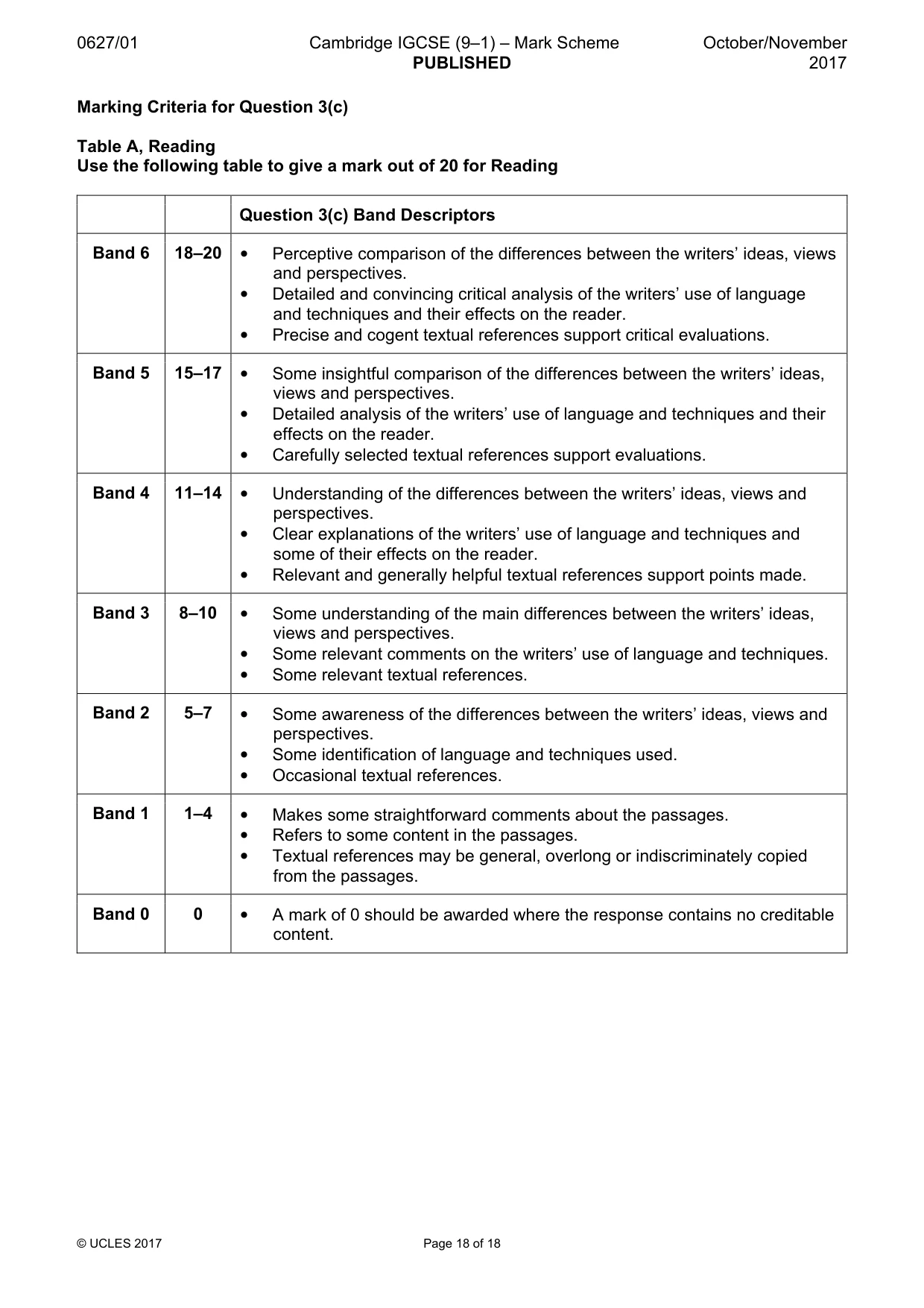
0627/01 Cambridge IGCSE (9–1) – Mark Scheme PUBLISHED October/November 2017 © UCLES 2017 Page 18 of 18 Marking Criteria for Question 3(c) Table A, Reading Use the following table to give a mark out of 20 for Reading Question 3(c) Band Descriptors Band 6 18–20 • Perceptive comparison of the differences between the writers’ ideas, views and perspectives. • Detailed and convincing critical analysis of the writers’ use of language and techniques and their effects on the reader. • Precise and cogent textual references support critical evaluations. Band 5 15–17 • Some insightful comparison of the differences between the writers’ ideas, views and perspectives. • Detailed analysis of the writers’ use of language and techniques and their effects on the reader. • Carefully selected textual references support evaluations. Band 4 11–14 • Understanding of the differences between the writers’ ideas, views and perspectives. • Clear explanations of the writers’ use of language and techniques and some of their effects on the reader. • Relevant and generally helpful textual references support points made. Band 3 8–10 • Some understanding of the main differences between the writers’ ideas, views and perspectives. • Some relevant comments on the writers’ use of language and techniques. • Some relevant textual references. Band 2 5–7 • Some awareness of the differences between the writers’ ideas, views and perspectives. • Some identification of language and techniques used. • Occasional textual references. Band 1 1–4 • Makes some straightforward comments about the passages. • Refers to some content in the passages. • Textual references may be general, overlong or indiscriminately copied from the passages. Band 0 0 • A mark of 0 should be awarded where the response contains no creditable content.
What you needed in this session
Cambridge’s own grade thresholds for 2017 Oct/Nov, Paper 1 · Variant 1. A higher threshold means an easier paper — the bar moves with how the cohort did.