Cambridge IGCSE English - First Language (9-1) (UK only) 0627 — 2019 May/June Paper 1 · Variant 1
0627/11/M/J/19 · 80 marks · ≈90 min
The question paper and its mark scheme, free to read here and free to download. This is Cambridge’s own paper, exactly as it was sat.
Question paper16 pages


Mark scheme19 pages
Answers below. Sit the paper first if you are practising.
Paper as text
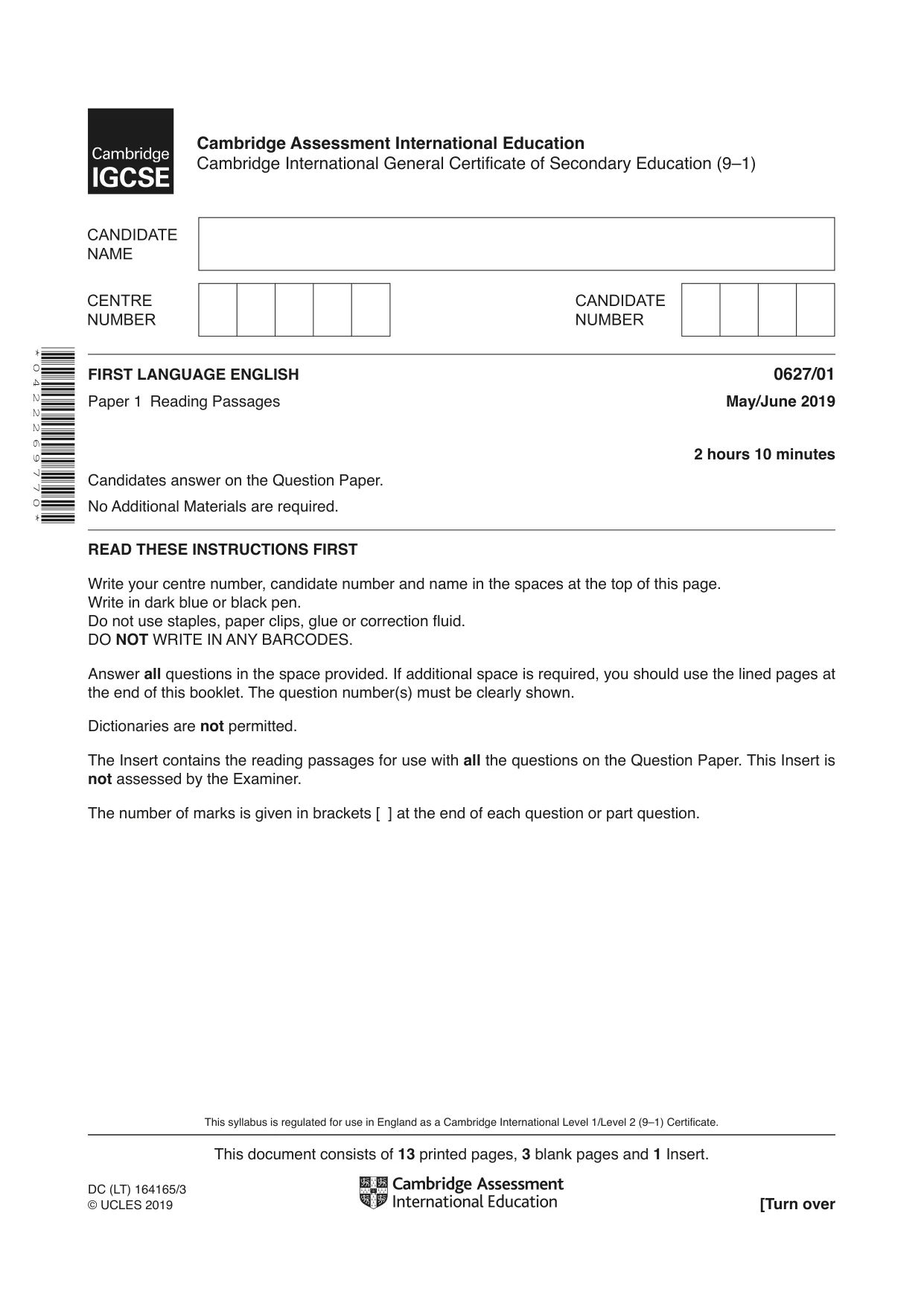
Question paper, page 1
This document consists of 13 printed pages, 3 blank pages and 1 Insert. DC (LT) 164165/3 © UCLES 2019 [Turn over Cambridge Assessment International Education Cambridge International General Certificate of Secondary Education (9–1) * 0 4 2 2 2 6 9 7 7 0 * FIRST LANGUAGE ENGLISH 0627/01 Paper 1 Reading Passages May/June 2019 2 hours 10 minutes Candidates answer on the Question Paper. No Additional Materials are required. READ THESE INSTRUCTIONS FIRST Write your centre number, candidate number and name in the spaces at the top of this page. Write in dark blue or black pen. Do not use staples, paper clips, glue or correction fluid. DO NOT WRITE IN ANY BARCODES. Answer all questions in the space provided. If additional space is required, you should use the lined pages at the end of this booklet. The question number(s) must be clearly shown. Dictionaries are not permitted. The Insert contains the reading passages for use with all the questions on the Question Paper. This Insert is not assessed by the Examiner. The number of marks is given in brackets [ ] at the end of each question or part question. This syllabus is regulated for use in England as a Cambridge International Level 1/Level 2 (9–1) Certificate.
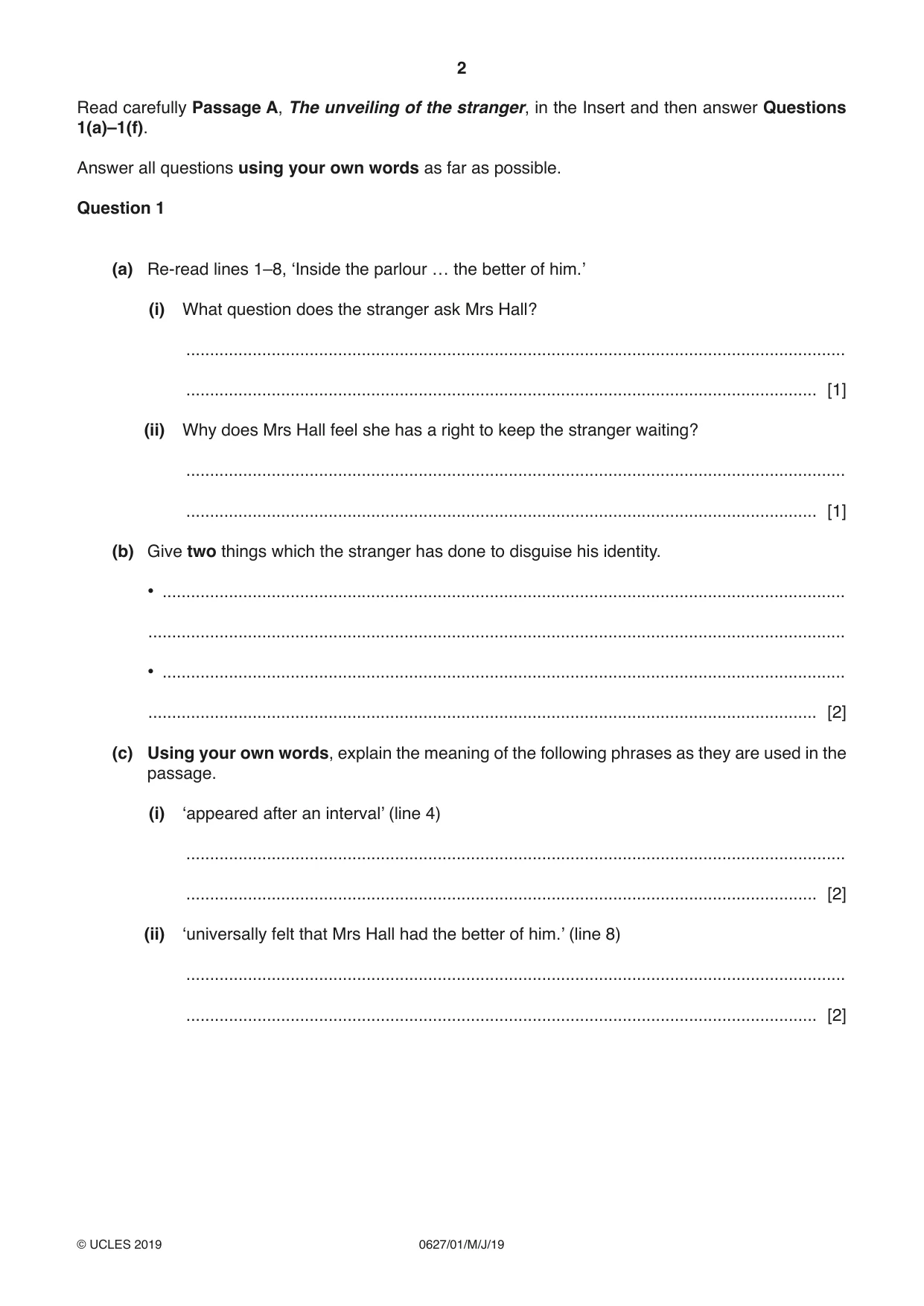
Question paper, page 2
2 0627/01/M/J/19 © UCLES 2019 Read carefully Passage A, The unveiling of the stranger, in the Insert and then answer Questions 1(a)–1(f). Answer all questions using your own words as far as possible. Question 1 (a) Re-read lines 1–8, ‘Inside the parlour … the better of him.’ (i) What question does the stranger ask Mrs Hall? … … [1] (ii) Why does Mrs Hall feel she has a right to keep the stranger waiting? … … [1] (b) Give two things which the stranger has done to disguise his identity. • … … • … … [2] (c) Using your own words, explain the meaning of the following phrases as they are used in the passage. (i) ‘appeared after an interval’ (line 4) … … [2] (ii) ‘universally felt that Mrs Hall had the better of him.’ (line 8) … … [2]
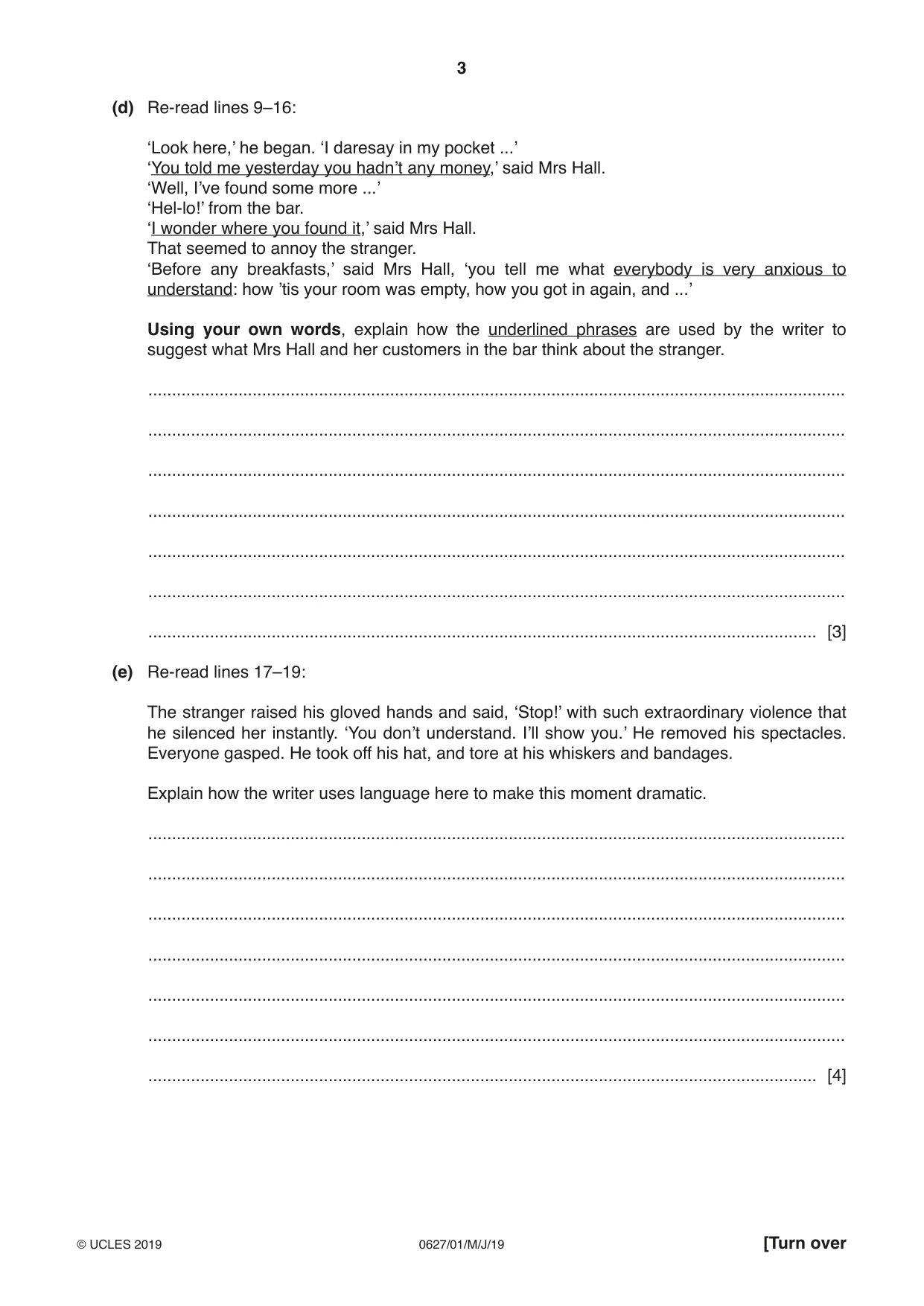
Question paper, page 3
3 0627/01/M/J/19 © UCLES 2019 [Turn over (d) Re-read lines 9–16: ‘Look here,’ he began. ‘I daresay in my pocket ...’ ‘You told me yesterday you hadn’t any money,’ said Mrs Hall. ‘Well, I’ve found some more ...’ ‘Hel-lo!’ from the bar. ‘I wonder where you found it,’ said Mrs Hall. That seemed to annoy the stranger. ‘Before any breakfasts,’ said Mrs Hall, ‘you tell me what everybody is very anxious to understand: how ’tis your room was empty, how you got in again, and ...’ Using your own words, explain how the underlined phrases are used by the writer to suggest what Mrs Hall and her customers in the bar think about the stranger. … … … … … … … [3] (e) Re-read lines 17–19: The stranger raised his gloved hands and said, ‘Stop!’ with such extraordinary violence that he silenced her instantly. ‘You don’t understand. I’ll show you.’ He removed his spectacles. Everyone gasped. He took off his hat, and tore at his whiskers and bandages. Explain how the writer uses language here to make this moment dramatic. … … … … … … … [4]
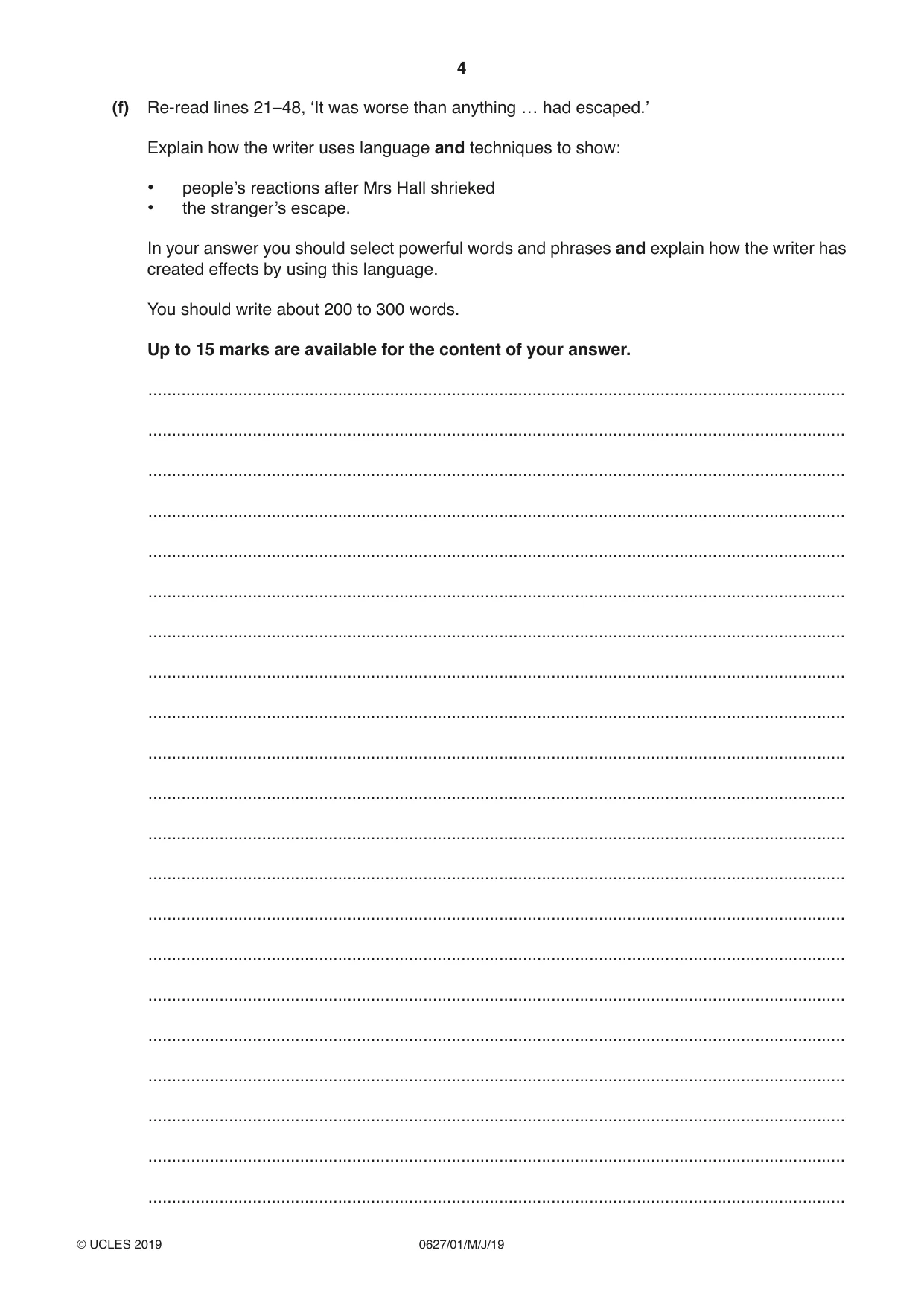
Question paper, page 4
4 0627/01/M/J/19 © UCLES 2019 (f) Re-read lines 21–48, ‘It was worse than anything … had escaped.’ Explain how the writer uses language and techniques to show: • people’s reactions after Mrs Hall shrieked • the stranger’s escape. In your answer you should select powerful words and phrases and explain how the writer has created effects by using this language. You should write about 200 to 300 words. Up to 15 marks are available for the content of your answer. … … … … … … … … … … … … … … … … … … … … …
Question paper, page 5
5 0627/01/M/J/19 © UCLES 2019 [Turn over … … … … … … … … … … … … … … … … … … … … … … … … … … … … [15]
Question paper, page 6
6 0627/01/M/J/19 © UCLES 2019 Read carefully Passage B, The world needs invisible people: why fame-seekers and attention- cravers have it all wrong, in the Insert and then answer Question 2. Question 2: Summary Task Imagine that you are a headteacher giving a short speech to students who are about to leave school. You want to show them how they can be successful and fulfilled in their chosen careers and in their lives without seeking attention. Write the words of your speech summarising your advice. You should use your own words as far as possible and ideas from the passage. You should write no more than 250 words. There are up to 15 marks available for the quality of your writing, and 10 marks available for the content of your answer. … … … … … … … … … … … … … … … … … … …
Question paper, page 7
7 0627/01/M/J/19 © UCLES 2019 [Turn over … … … … … … … … … … … … … … … … … … … … … … … … … … … [25]
Question paper, page 8
8 0627/01/M/J/19 © UCLES 2019 Read carefully Passage B, The world needs invisible people: why fame-seekers and attention- cravers have it all wrong, and Passage C, Our invisible poor, in the Insert and then answer Questions 3(a), 3(b) and 3(c). Passage B The world needs invisible people: why fame-seekers and attention-cravers have it all wrong Question 3(a) Re-read paragraphs 1 and 2, ‘Everyone wants … behind the scenes.’ (i) What does the writer think of reality TV contestants? … … [1] (ii) Give one phrase which shows that the people the writer calls ‘Invisibles’ should be valued. … [1] Passage C Our invisible poor Question 3(b) Re-read paragraphs 1 and 2, ‘In the last year we seem … as it is now lived.’ (i) What does the writer mean by the phrase ‘we seem to have awakened, rubbing our eyes’? … … [1] (ii) From paragraphs 1 and 2 give two different language features which make this an effective opening to the article. For each feature give an example from these paragraphs. • … … • … … [2]
Question paper, page 9
9 0627/01/M/J/19 © UCLES 2019 [Turn over Question 3(c) Compare and contrast how the writers of Passage B, The world needs invisible people: why fame-seekers and attention-cravers have it all wrong, and Passage C, Our invisible poor, convey their views and ideas about different people in society. In your response you should compare and contrast: • the views and ideas which each writer presents to the reader • the evidence that the writers use to support their views and ideas • the language, structure and techniques used by the writers and why they are effective. Remember to support your answer with details from the passages. You should write about 300 to 350 words. There are up to 20 marks available for the content of your answer. … … … … … … … … … … … … … … … … … … …
Question paper, page 10
10 0627/01/M/J/19 © UCLES 2019 … … … … … … … … … … … … … … … … … … … … … … … … … … … …
Question paper, page 11
11 0627/01/M/J/19 © UCLES 2019 … … … … … … … … … … … … … … … … … … … … … … … … … … … [20]
Question paper, page 12
12 0627/01/M/J/19 © UCLES 2019 Additional Page If you use the following lined page to complete the answer(s) to any question(s), the question number(s) must be clearly shown. … … … … … … … … … … … … … … … … … … … … … … … … … …
Question paper, page 13
13 0627/01/M/J/19 © UCLES 2019 Additional Page If you use the following lined page to complete the answer(s) to any question(s), the question number(s) must be clearly shown. … … … … … … … … … … … … … … … … … … … … … … … … … …
Question paper, page 14
14 0627/01/M/J/19 © UCLES 2019 BLANK PAGE
Question paper, page 15
15 0627/01/M/J/19 © UCLES 2019 BLANK PAGE
Question paper, page 16
16 0627/01/M/J/19 © UCLES 2019 Permission to reproduce items where third-party owned material protected by copyright is included has been sought and cleared where possible. Every reasonable effort has been made by the publisher (UCLES) to trace copyright holders, but if any items requiring clearance have unwittingly been included, the publisher will be pleased to make amends at the earliest possible opportunity. To avoid the issue of disclosure of answer-related information to candidates, all copyright acknowledgements are reproduced online in the Cambridge Assessment International Education Copyright Acknowledgements Booklet. This is produced for each series of examinations and is freely available to download at www.cambridgeinternational.org after the live examination series. Cambridge Assessment International Education is part of the Cambridge Assessment Group. Cambridge Assessment is the brand name of the University of Cambridge Local Examinations Syndicate (UCLES), which itself is a department of the University of Cambridge. BLANK PAGE
Mark scheme, page 1
This syllabus is regulated for use in England as a Cambridge International Level 1/Level 2 (9–1) Certificate. This document consists of 19 printed pages. © UCLES 2019 [Turn over Cambridge Assessment International Education Cambridge International General Certificate of Secondary Education (9–1) FIRST LANGUAGE ENGLISH (9–1) 0627/01 Paper 1 Reading Passages May/June 2019 MARK SCHEME Maximum Mark: 80 Published This mark scheme is published as an aid to teachers and candidates, to indicate the requirements of the examination. It shows the basis on which Examiners were instructed to award marks. It does not indicate the details of the discussions that took place at an Examiners’ meeting before marking began, which would have considered the acceptability of alternative answers. Mark schemes should be read in conjunction with the question paper and the Principal Examiner Report for Teachers. Cambridge International will not enter into discussions about these mark schemes. Cambridge International is publishing the mark schemes for the May/June 2019 series for most Cambridge IGCSE™, Cambridge International A and AS Level and Cambridge Pre-U components, and some Cambridge O Level components.
Mark scheme, page 2
0627/01 Cambridge IGCSE (9–1) – Mark Scheme PUBLISHED May/June 2019 © UCLES 2019 Page 2 of 19 Generic Marking Principles These general marking principles must be applied by all examiners when marking candidate answers. They should be applied alongside the specific content of the mark scheme or generic level descriptors for a question. Each question paper and mark scheme will also comply with these marking principles. GENERIC MARKING PRINCIPLE 1: Marks must be awarded in line with: • the specific content of the mark scheme or the generic level descriptors for the question • the specific skills defined in the mark scheme or in the generic level descriptors for the question • the standard of response required by a candidate as exemplified by the standardisation scripts. GENERIC MARKING PRINCIPLE 2: Marks awarded are always whole marks (not half marks, or other fractions). GENERIC MARKING PRINCIPLE 3: Marks must be awarded positively: • marks are awarded for correct/valid answers, as defined in the mark scheme. However, credit is given for valid answers which go beyond the scope of the syllabus and mark scheme, referring to your Team Leader as appropriate • marks are awarded when candidates clearly demonstrate what they know and can do • marks are not deducted for errors • marks are not deducted for omissions • answers should only be judged on the quality of spelling, punctuation and grammar when these features are specifically assessed by the question as indicated by the mark scheme. The meaning, however, should be unambiguous. GENERIC MARKING PRINCIPLE 4: Rules must be applied consistently e.g. in situations where candidates have not followed instructions or in the application of generic level descriptors. GENERIC MARKING PRINCIPLE 5: Marks should be awarded using the full range of marks defined in the mark scheme for the question (however; the use of the full mark range may be limited according to the quality of the candidate responses seen). GENERIC MARKING PRINCIPLE 6: Marks awarded are based solely on the requirements as defined in the mark scheme. Marks should not be awarded with grade thresholds or grade descriptors in mind.
Mark scheme, page 3
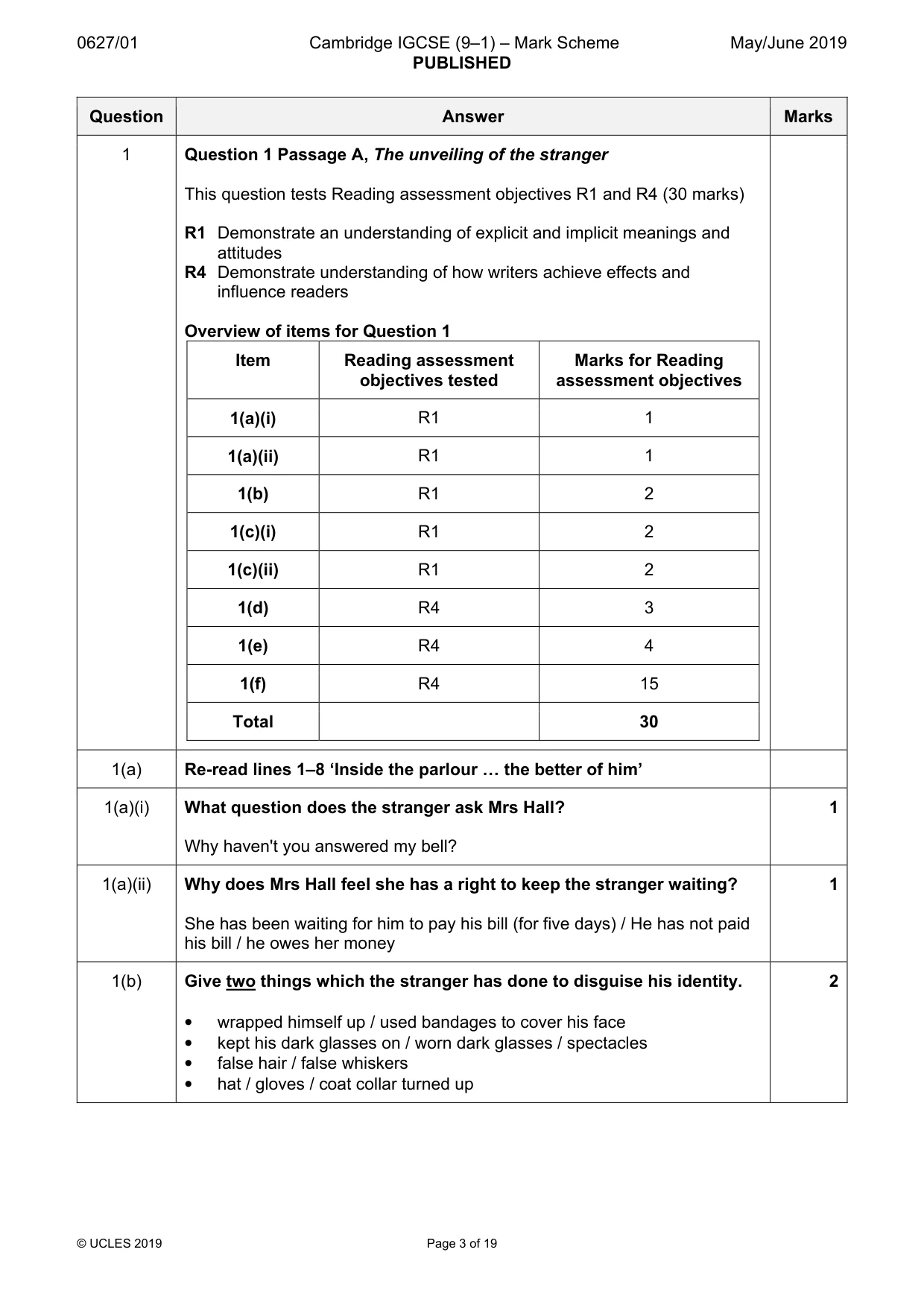
0627/01 Cambridge IGCSE (9–1) – Mark Scheme PUBLISHED May/June 2019 © UCLES 2019 Page 3 of 19 Question Answer Marks 1 Question 1 Passage A, The unveiling of the stranger This question tests Reading assessment objectives R1 and R4 (30 marks) R1 Demonstrate an understanding of explicit and implicit meanings and attitudes R4 Demonstrate understanding of how writers achieve effects and influence readers Overview of items for Question 1 Item Reading assessment objectives tested Marks for Reading assessment objectives 1(a)(i) R1 1 1(a)(ii) R1 1 1(b) R1 2 1(c)(i) R1 2 1(c)(ii) R1 2 1(d) R4 3 1(e) R4 4 1(f) R4 15 Total 30 1(a) Re-read lines 1–8 ‘Inside the parlour « the better of him’ 1(a)(i) What question does the stranger ask Mrs Hall? Why haven't you answered my bell? 1 1(a)(ii) Why does Mrs Hall feel she has a right to keep the stranger waiting? She has been waiting for him to pay his bill (for five days) / He has not paid his bill / he owes her money 1 1(b) Give two things which the stranger has done to disguise his identity. • wrapped himself up / used bandages to cover his face • kept his dark glasses on / worn dark glasses / spectacles • false hair / false whiskers • hat / gloves / coat collar turned up 2
Mark scheme, page 4
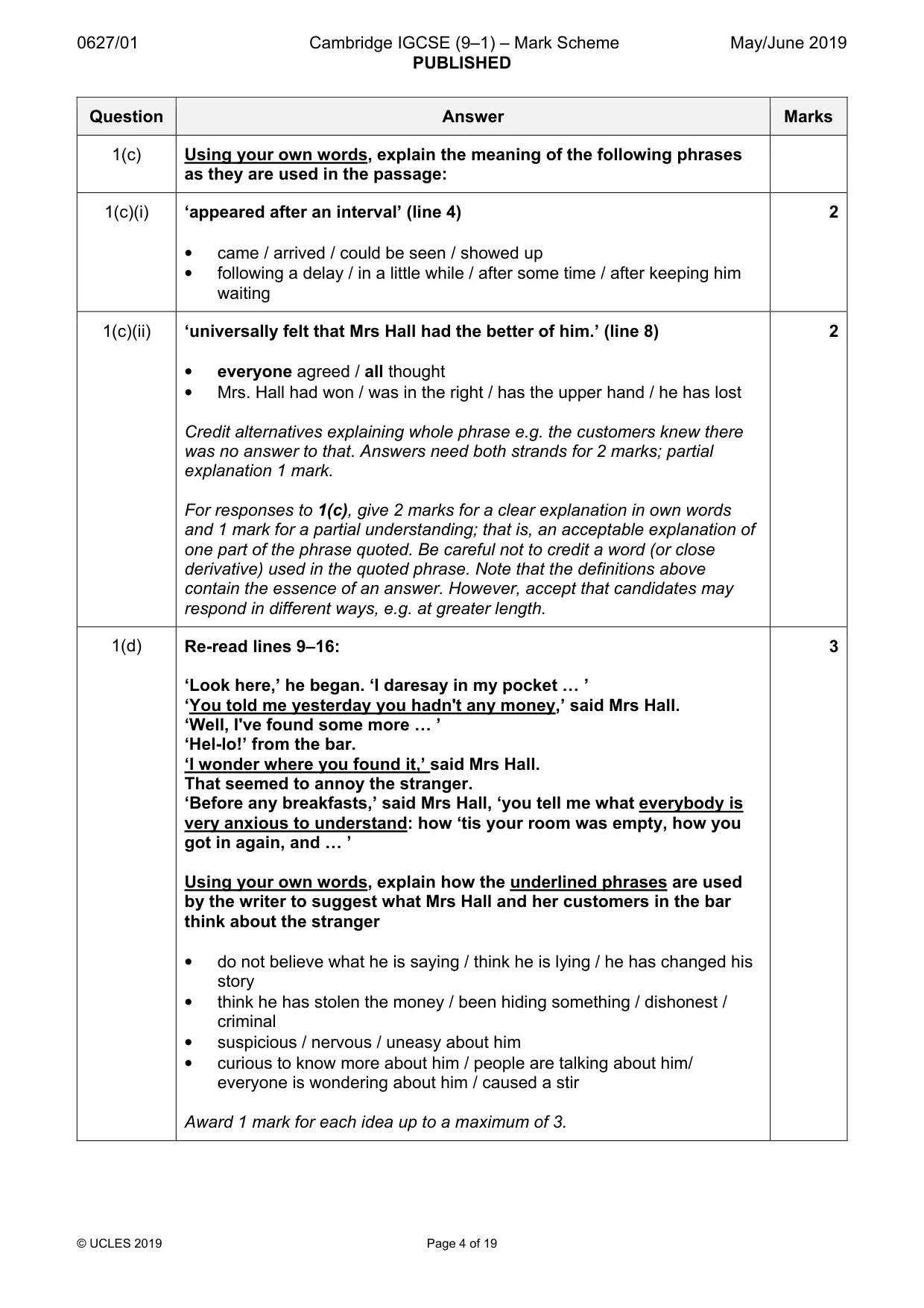
0627/01 Cambridge IGCSE (9–1) – Mark Scheme PUBLISHED May/June 2019 © UCLES 2019 Page 4 of 19 Question Answer Marks 1(c) Using your own words, explain the meaning of the following phrases as they are used in the passage: 1(c)(i) ‘appeared after an interval’ (line 4) • came / arrived / could be seen / showed up • following a delay / in a little while / after some time / after keeping him waiting 2 1(c)(ii) ‘universally felt that Mrs Hall had the better of him.’ (line 8) • everyone agreed / all thought • Mrs. Hall had won / was in the right / has the upper hand / he has lost Credit alternatives explaining whole phrase e.g. the customers knew there was no answer to that. Answers need both strands for 2 marks; partial explanation 1 mark. For responses to 1(c), give 2 marks for a clear explanation in own words and 1 mark for a partial understanding; that is, an acceptable explanation of one part of the phrase quoted. Be careful not to credit a word (or close derivative) used in the quoted phrase. Note that the definitions above contain the essence of an answer. However, accept that candidates may respond in different ways, e.g. at greater length. 2 1(d) Re-read lines 9–16: ‘Look here,’ he began. ‘I daresay in my pocket « ’ ‘You told me yesterday you hadn't any money,’ said Mrs Hall. ‘Well, I've found some more « ’ ‘Hel-lo!’ from the bar. ‘I wonder where you found it,’ said Mrs Hall. That seemed to annoy the stranger. ‘Before any breakfasts,’ said Mrs Hall, ‘you tell me what everybody is very anxious to understand: how ‘tis your room was empty, how you got in again, and « ’ Using your own words, explain how the underlined phrases are used by the writer to suggest what Mrs Hall and her customers in the bar think about the stranger • do not believe what he is saying / think he is lying / he has changed his story • think he has stolen the money / been hiding something / dishonest / criminal • suspicious / nervous / uneasy about him • curious to know more about him / people are talking about him/ everyone is wondering about him / caused a stir Award 1 mark for each idea up to a maximum of 3. 3
Mark scheme, page 5
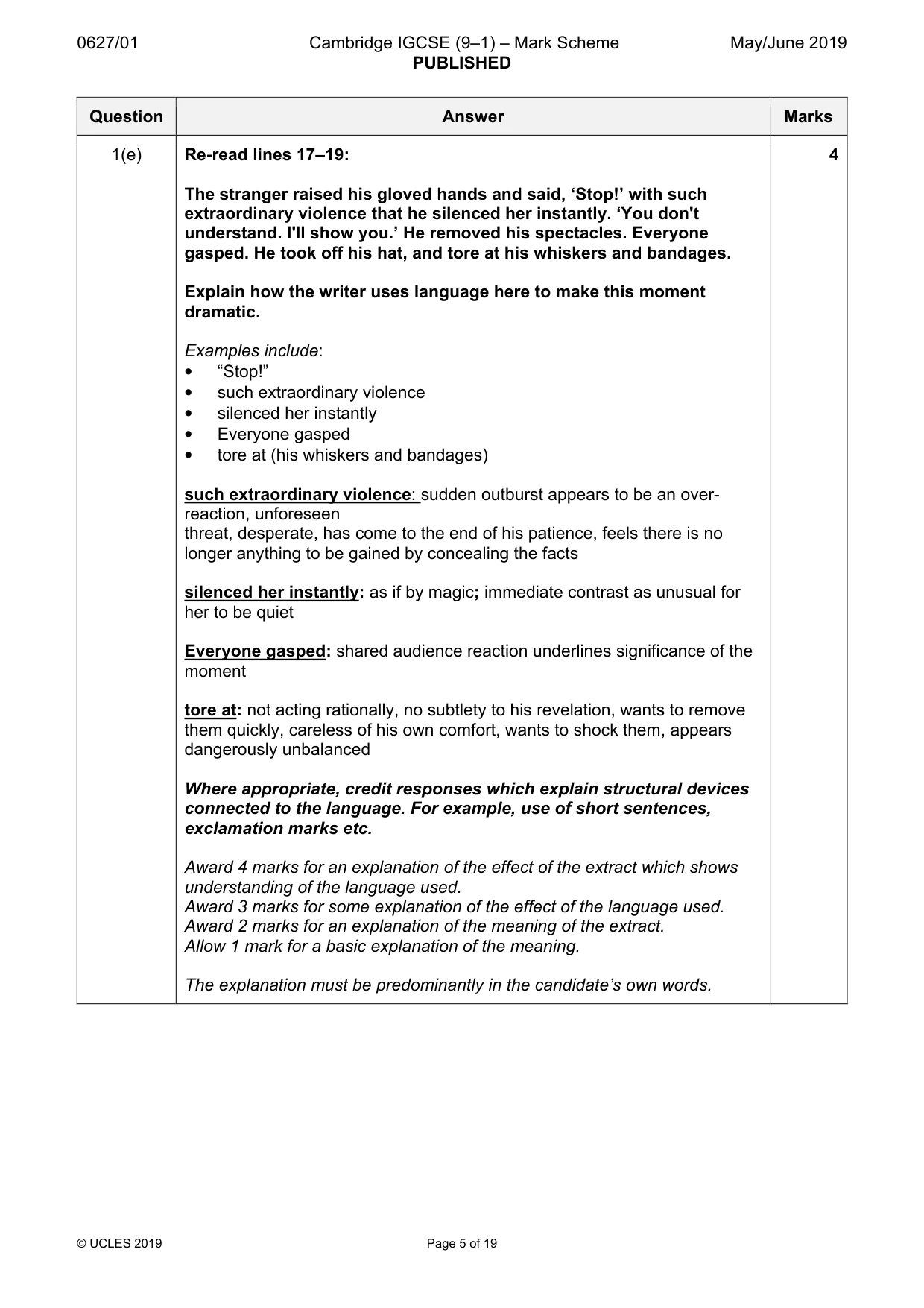
0627/01 Cambridge IGCSE (9–1) – Mark Scheme PUBLISHED May/June 2019 © UCLES 2019 Page 5 of 19 Question Answer Marks 1(e) Re-read lines 17–19: The stranger raised his gloved hands and said, ‘Stop!’ with such extraordinary violence that he silenced her instantly. ‘You don't understand. I'll show you.’ He removed his spectacles. Everyone gasped. He took off his hat, and tore at his whiskers and bandages. Explain how the writer uses language here to make this moment dramatic. Examples include: • “Stop!” • such extraordinary violence • silenced her instantly • Everyone gasped • tore at (his whiskers and bandages) such extraordinary violence: sudden outburst appears to be an over- reaction, unforeseen threat, desperate, has come to the end of his patience, feels there is no longer anything to be gained by concealing the facts silenced her instantly: as if by magic; immediate contrast as unusual for her to be quiet Everyone gasped: shared audience reaction underlines significance of the moment tore at: not acting rationally, no subtlety to his revelation, wants to remove them quickly, careless of his own comfort, wants to shock them, appears dangerously unbalanced Where appropriate, credit responses which explain structural devices connected to the language. For example, use of short sentences, exclamation marks etc. Award 4 marks for an explanation of the effect of the extract which shows understanding of the language used. Award 3 marks for some explanation of the effect of the language used. Award 2 marks for an explanation of the meaning of the extract. Allow 1 mark for a basic explanation of the meaning. The explanation must be predominantly in the candidate’s own words. 4
Mark scheme, page 6
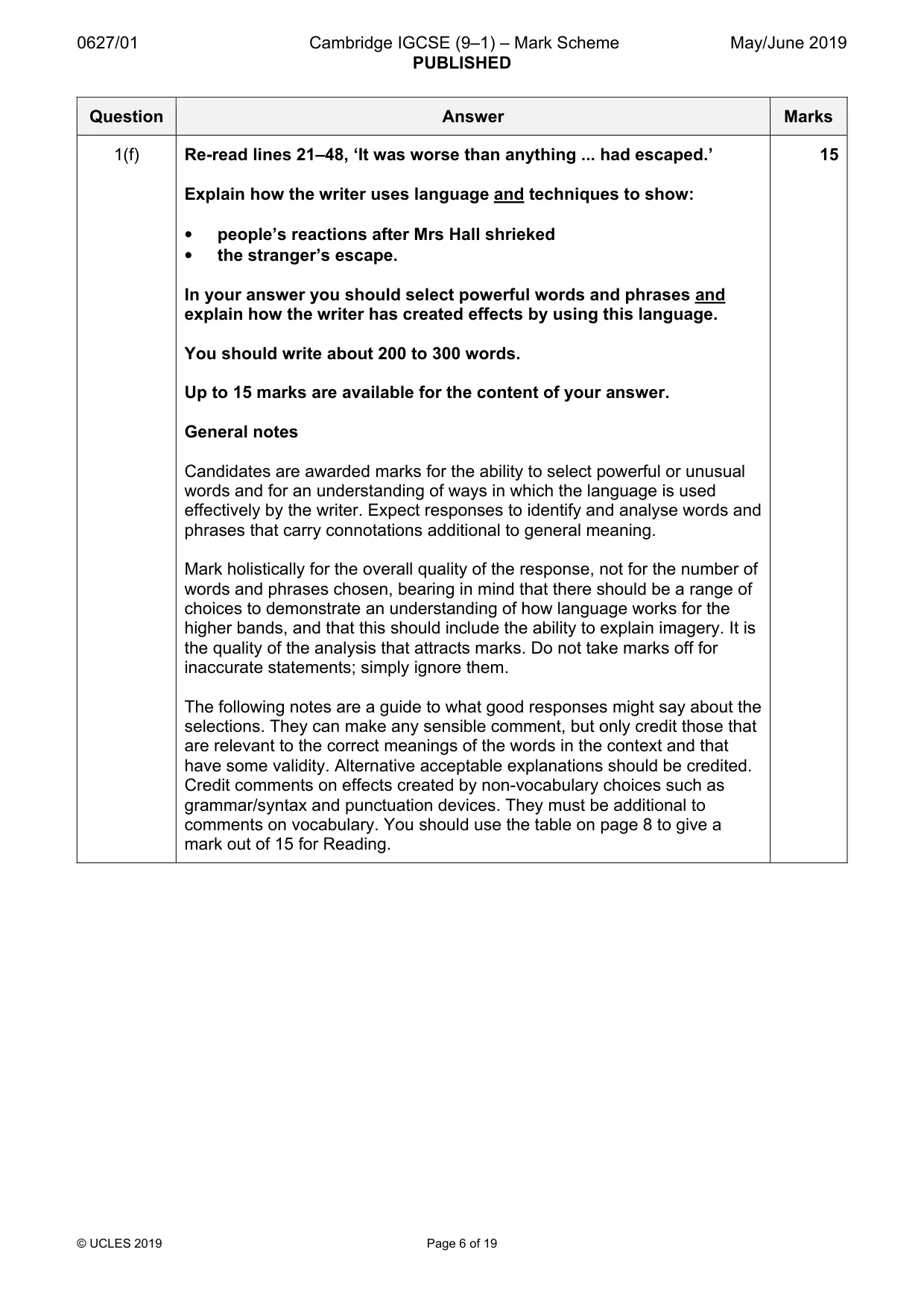
0627/01 Cambridge IGCSE (9–1) – Mark Scheme PUBLISHED May/June 2019 © UCLES 2019 Page 6 of 19 Question Answer Marks 1(f) Re-read lines 21–48, ‘It was worse than anything ... had escaped.’ Explain how the writer uses language and techniques to show: • people’s reactions after Mrs Hall shrieked • the stranger’s escape. In your answer you should select powerful words and phrases and explain how the writer has created effects by using this language. You should write about 200 to 300 words. Up to 15 marks are available for the content of your answer. General notes Candidates are awarded marks for the ability to select powerful or unusual words and for an understanding of ways in which the language is used effectively by the writer. Expect responses to identify and analyse words and phrases that carry connotations additional to general meaning. Mark holistically for the overall quality of the response, not for the number of words and phrases chosen, bearing in mind that there should be a range of choices to demonstrate an understanding of how language works for the higher bands, and that this should include the ability to explain imagery. It is the quality of the analysis that attracts marks. Do not take marks off for inaccurate statements; simply ignore them. The following notes are a guide to what good responses might say about the selections. They can make any sensible comment, but only credit those that are relevant to the correct meanings of the words in the context and that have some validity. Alternative acceptable explanations should be credited. Credit comments on effects created by non-vocabulary choices such as grammar/syntax and punctuation devices. They must be additional to comments on vocabulary. You should use the table on page 8 to give a mark out of 15 for Reading. 15
Mark scheme, page 7
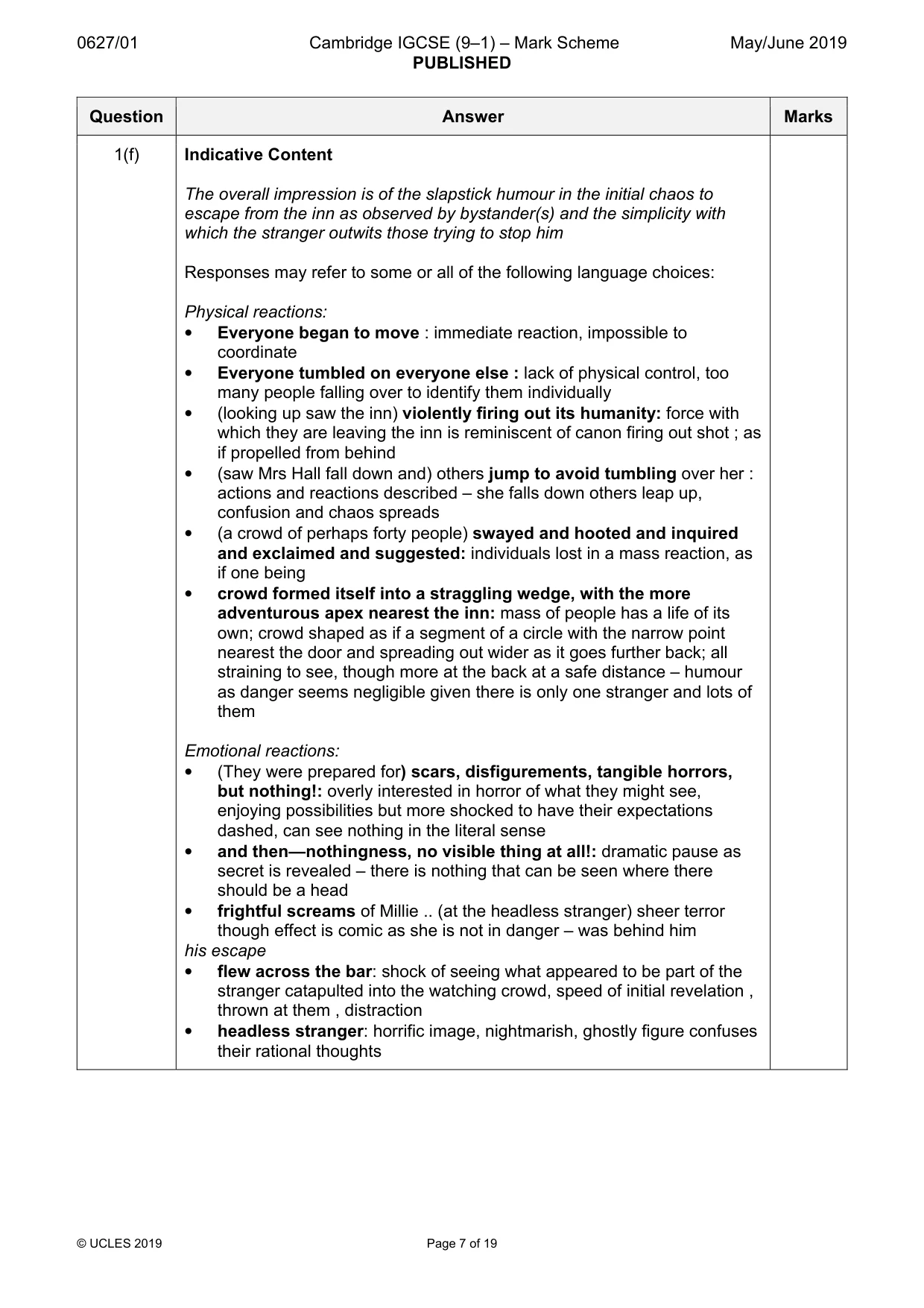
0627/01 Cambridge IGCSE (9–1) – Mark Scheme PUBLISHED May/June 2019 © UCLES 2019 Page 7 of 19 Question Answer Marks 1(f) Indicative Content The overall impression is of the slapstick humour in the initial chaos to escape from the inn as observed by bystander(s) and the simplicity with which the stranger outwits those trying to stop him Responses may refer to some or all of the following language choices: Physical reactions: • Everyone began to move : immediate reaction, impossible to coordinate • Everyone tumbled on everyone else : lack of physical control, too many people falling over to identify them individually • (looking up saw the inn) violently firing out its humanity: force with which they are leaving the inn is reminiscent of canon firing out shot ; as if propelled from behind • (saw Mrs Hall fall down and) others jump to avoid tumbling over her : actions and reactions described – she falls down others leap up, confusion and chaos spreads • (a crowd of perhaps forty people) swayed and hooted and inquired and exclaimed and suggested: individuals lost in a mass reaction, as if one being • crowd formed itself into a straggling wedge, with the more adventurous apex nearest the inn: mass of people has a life of its own; crowd shaped as if a segment of a circle with the narrow point nearest the door and spreading out wider as it goes further back; all straining to see, though more at the back at a safe distance – humour as danger seems negligible given there is only one stranger and lots of them Emotional reactions: • (They were prepared for) scars, disfigurements, tangible horrors, but nothing!: overly interested in horror of what they might see, enjoying possibilities but more shocked to have their expectations dashed, can see nothing in the literal sense • and then—nothingness, no visible thing at all!: dramatic pause as secret is revealed – there is nothing that can be seen where there should be a head • frightful screams of Millie .. (at the headless stranger) sheer terror though effect is comic as she is not in danger – was behind him his escape • flew across the bar: shock of seeing what appeared to be part of the stranger catapulted into the watching crowd, speed of initial revelation , thrown at them , distraction • headless stranger: horrific image, nightmarish, ghostly figure confuses their rational thoughts
Mark scheme, page 8
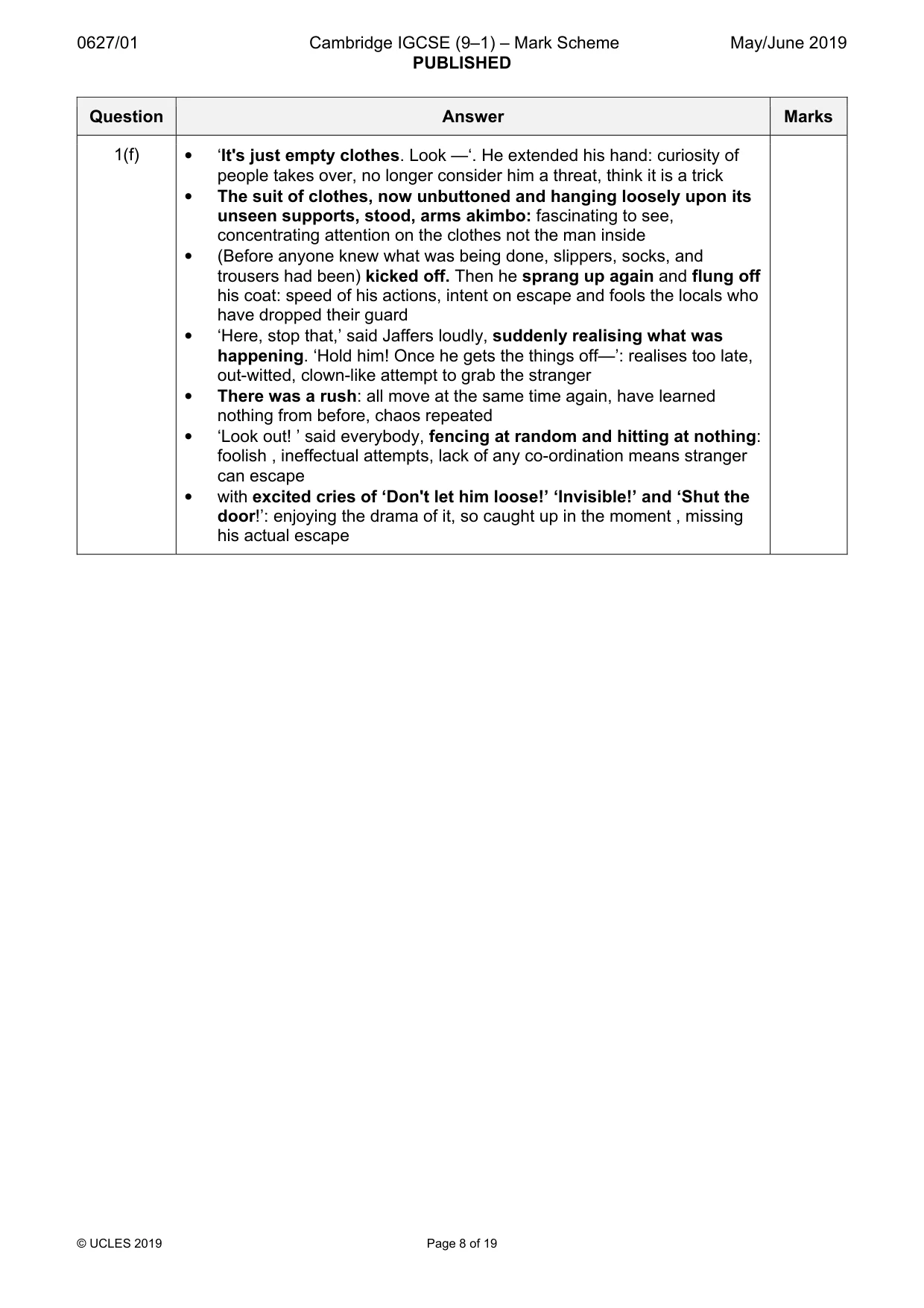
0627/01 Cambridge IGCSE (9–1) – Mark Scheme PUBLISHED May/June 2019 © UCLES 2019 Page 8 of 19 Question Answer Marks 1(f) • ‘It's just empty clothes. Look —‘. He extended his hand: curiosity of people takes over, no longer consider him a threat, think it is a trick • The suit of clothes, now unbuttoned and hanging loosely upon its unseen supports, stood, arms akimbo: fascinating to see, concentrating attention on the clothes not the man inside • (Before anyone knew what was being done, slippers, socks, and trousers had been) kicked off. Then he sprang up again and flung off his coat: speed of his actions, intent on escape and fools the locals who have dropped their guard • ‘Here, stop that,’ said Jaffers loudly, suddenly realising what was happening. ‘Hold him! Once he gets the things off—’: realises too late, out-witted, clown-like attempt to grab the stranger • There was a rush: all move at the same time again, have learned nothing from before, chaos repeated • ‘Look out! ’ said everybody, fencing at random and hitting at nothing: foolish , ineffectual attempts, lack of any co-ordination means stranger can escape • with excited cries of ‘Don't let him loose!’ ‘Invisible!’ and ‘Shut the door!’: enjoying the drama of it, so caught up in the moment , missing his actual escape
Mark scheme, page 9
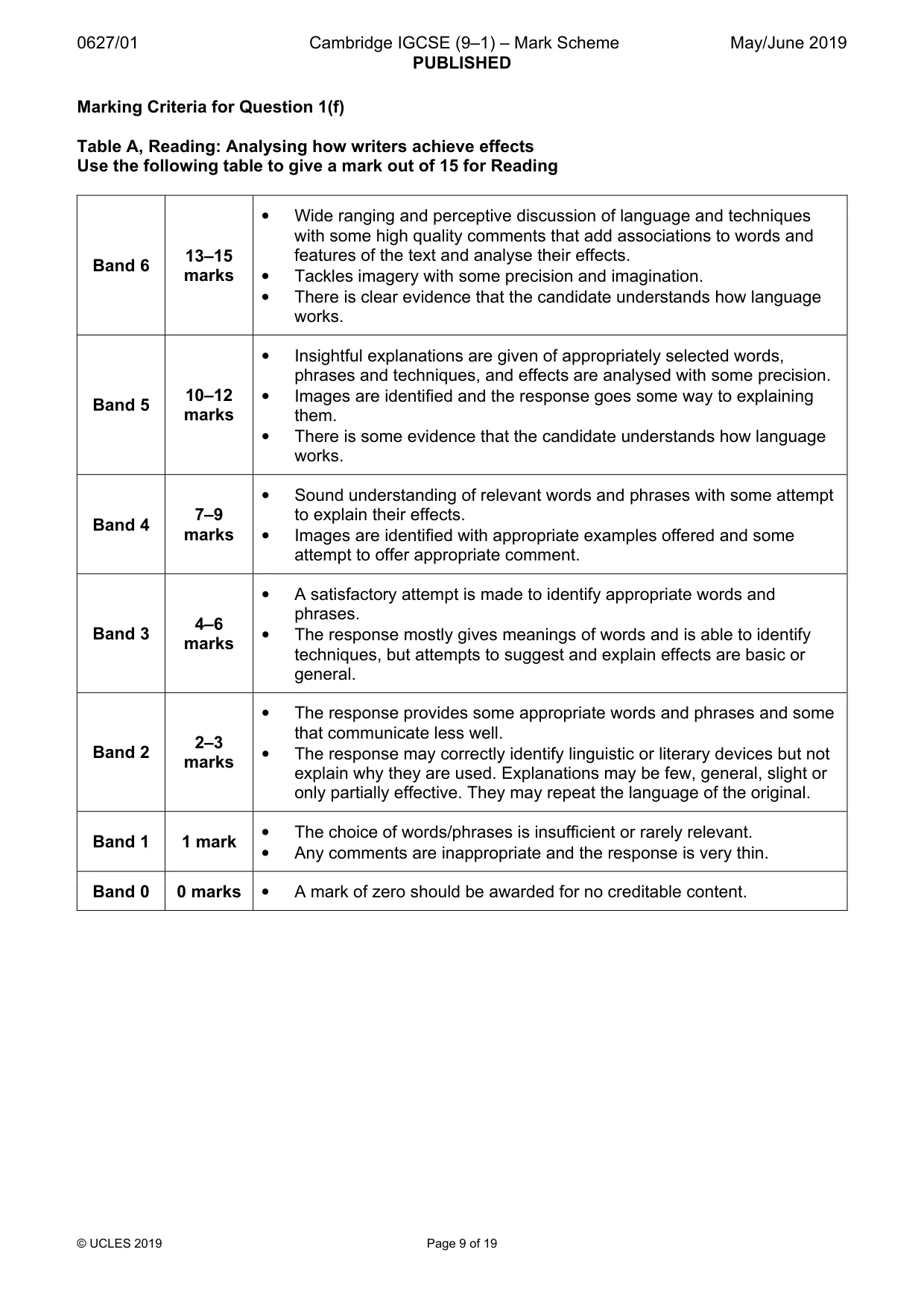
0627/01 Cambridge IGCSE (9–1) – Mark Scheme PUBLISHED May/June 2019 © UCLES 2019 Page 9 of 19 Marking Criteria for Question 1(f) Table A, Reading: Analysing how writers achieve effects Use the following table to give a mark out of 15 for Reading Band 6 13–15 marks • Wide ranging and perceptive discussion of language and techniques with some high quality comments that add associations to words and features of the text and analyse their effects. • Tackles imagery with some precision and imagination. • There is clear evidence that the candidate understands how language works. Band 5 10–12 marks • Insightful explanations are given of appropriately selected words, phrases and techniques, and effects are analysed with some precision. • Images are identified and the response goes some way to explaining them. • There is some evidence that the candidate understands how language works. Band 4 7–9 marks • Sound understanding of relevant words and phrases with some attempt to explain their effects. • Images are identified with appropriate examples offered and some attempt to offer appropriate comment. Band 3 4–6 marks • A satisfactory attempt is made to identify appropriate words and phrases. • The response mostly gives meanings of words and is able to identify techniques, but attempts to suggest and explain effects are basic or general. Band 2 2–3 marks • The response provides some appropriate words and phrases and some that communicate less well. • The response may correctly identify linguistic or literary devices but not explain why they are used. Explanations may be few, general, slight or only partially effective. They may repeat the language of the original. Band 1 1 mark • The choice of words/phrases is insufficient or rarely relevant. • Any comments are inappropriate and the response is very thin. Band 0 0 marks • A mark of zero should be awarded for no creditable content.
Mark scheme, page 10
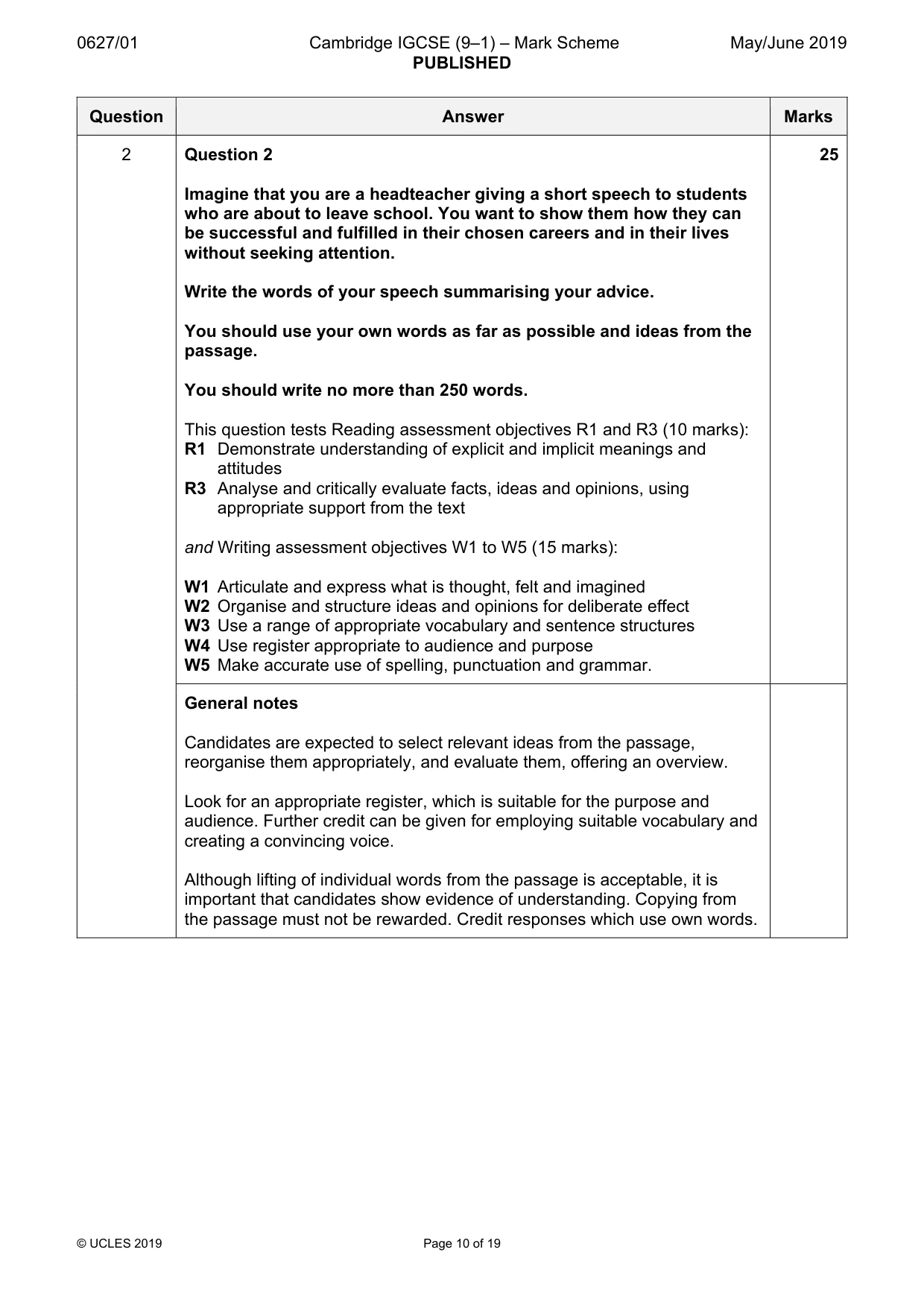
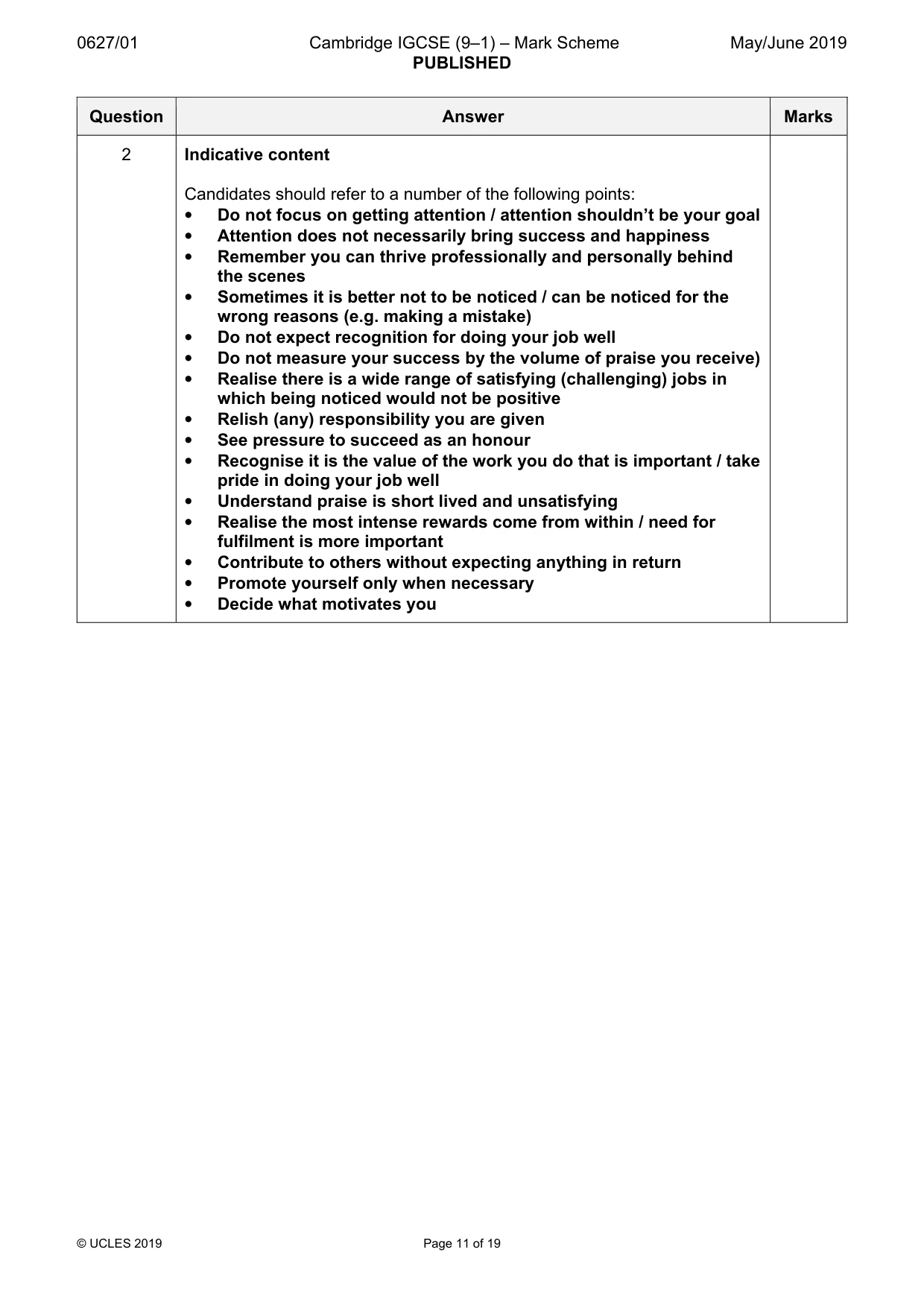
0627/01 Cambridge IGCSE (9–1) – Mark Scheme PUBLISHED May/June 2019 © UCLES 2019 Page 10 of 19 Question Answer Marks 2 Question 2 Imagine that you are a headteacher giving a short speech to students who are about to leave school. You want to show them how they can be successful and fulfilled in their chosen careers and in their lives without seeking attention. Write the words of your speech summarising your advice. You should use your own words as far as possible and ideas from the passage. You should write no more than 250 words. This question tests Reading assessment objectives R1 and R3 (10 marks): R1 Demonstrate understanding of explicit and implicit meanings and attitudes R3 Analyse and critically evaluate facts, ideas and opinions, using appropriate support from the text and Writing assessment objectives W1 to W5 (15 marks): W1 Articulate and express what is thought, felt and imagined W2 Organise and structure ideas and opinions for deliberate effect W3 Use a range of appropriate vocabulary and sentence structures W4 Use register appropriate to audience and purpose W5 Make accurate use of spelling, punctuation and grammar. 25 General notes Candidates are expected to select relevant ideas from the passage, reorganise them appropriately, and evaluate them, offering an overview. Look for an appropriate register, which is suitable for the purpose and audience. Further credit can be given for employing suitable vocabulary and creating a convincing voice. Although lifting of individual words from the passage is acceptable, it is important that candidates show evidence of understanding. Copying from the passage must not be rewarded. Credit responses which use own words.
Mark scheme, page 11
0627/01 Cambridge IGCSE (9–1) – Mark Scheme PUBLISHED May/June 2019 © UCLES 2019 Page 11 of 19 Question Answer Marks 2 Indicative content Candidates should refer to a number of the following points: • Do not focus on getting attention / attention shouldn’t be your goal • Attention does not necessarily bring success and happiness • Remember you can thrive professionally and personally behind the scenes • Sometimes it is better not to be noticed / can be noticed for the wrong reasons (e.g. making a mistake) • Do not expect recognition for doing your job well • Do not measure your success by the volume of praise you receive) • Realise there is a wide range of satisfying (challenging) jobs in which being noticed would not be positive • Relish (any) responsibility you are given • See pressure to succeed as an honour • Recognise it is the value of the work you do that is important / take pride in doing your job well • Understand praise is short lived and unsatisfying • Realise the most intense rewards come from within / need for fulfilment is more important • Contribute to others without expecting anything in return • Promote yourself only when necessary • Decide what motivates you
Mark scheme, page 12
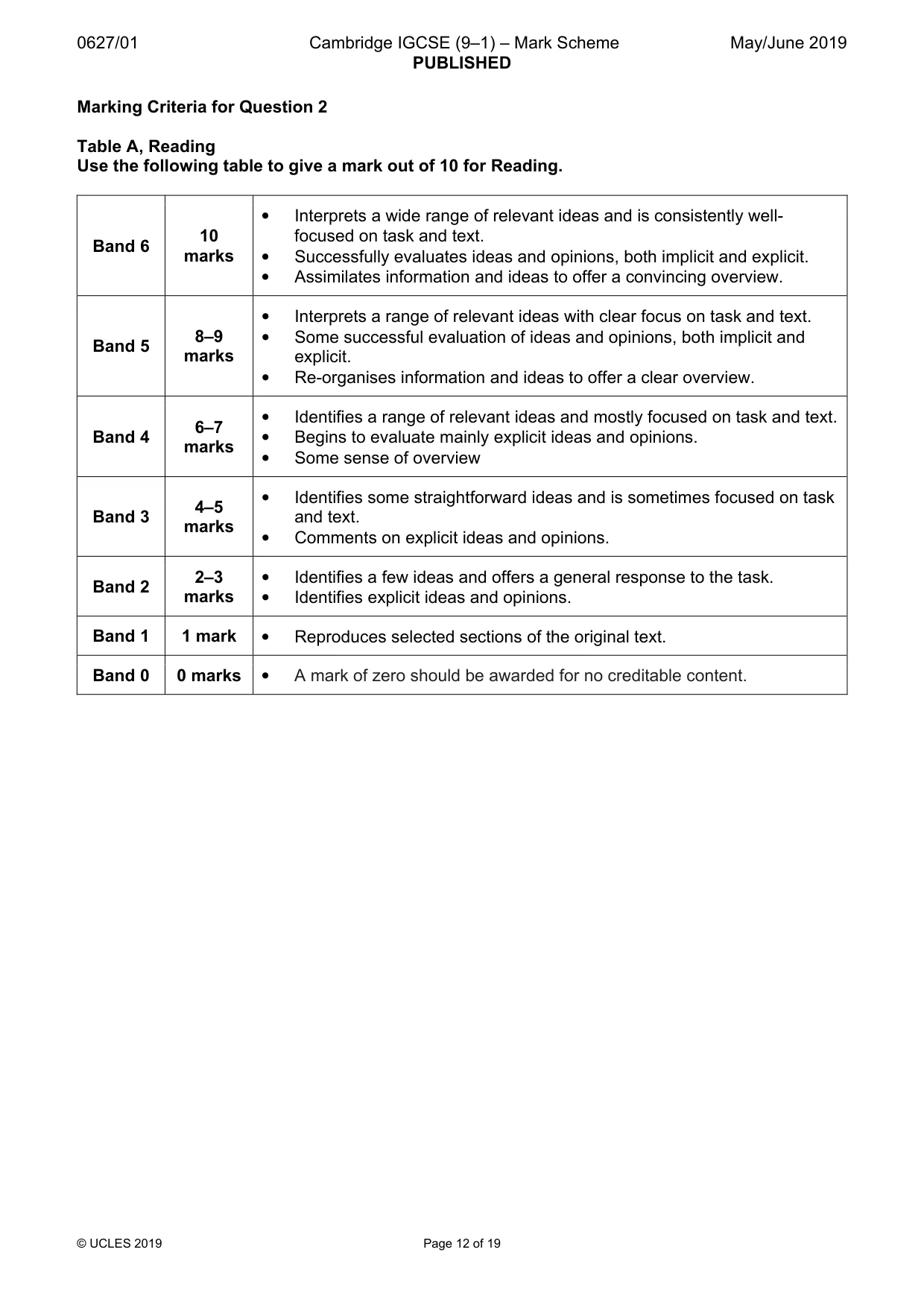
0627/01 Cambridge IGCSE (9–1) – Mark Scheme PUBLISHED May/June 2019 © UCLES 2019 Page 12 of 19 Marking Criteria for Question 2 Table A, Reading Use the following table to give a mark out of 10 for Reading. Band 6 10 marks • Interprets a wide range of relevant ideas and is consistently well- focused on task and text. • Successfully evaluates ideas and opinions, both implicit and explicit. • Assimilates information and ideas to offer a convincing overview. Band 5 8–9 marks • Interprets a range of relevant ideas with clear focus on task and text. • Some successful evaluation of ideas and opinions, both implicit and explicit. • Re-organises information and ideas to offer a clear overview. Band 4 6–7 marks • Identifies a range of relevant ideas and mostly focused on task and text. • Begins to evaluate mainly explicit ideas and opinions. • Some sense of overview Band 3 4–5 marks • Identifies some straightforward ideas and is sometimes focused on task and text. • Comments on explicit ideas and opinions. Band 2 2–3 marks • Identifies a few ideas and offers a general response to the task. • Identifies explicit ideas and opinions. Band 1 1 mark • Reproduces selected sections of the original text. Band 0 0 marks • A mark of zero should be awarded for no creditable content.
Mark scheme, page 13
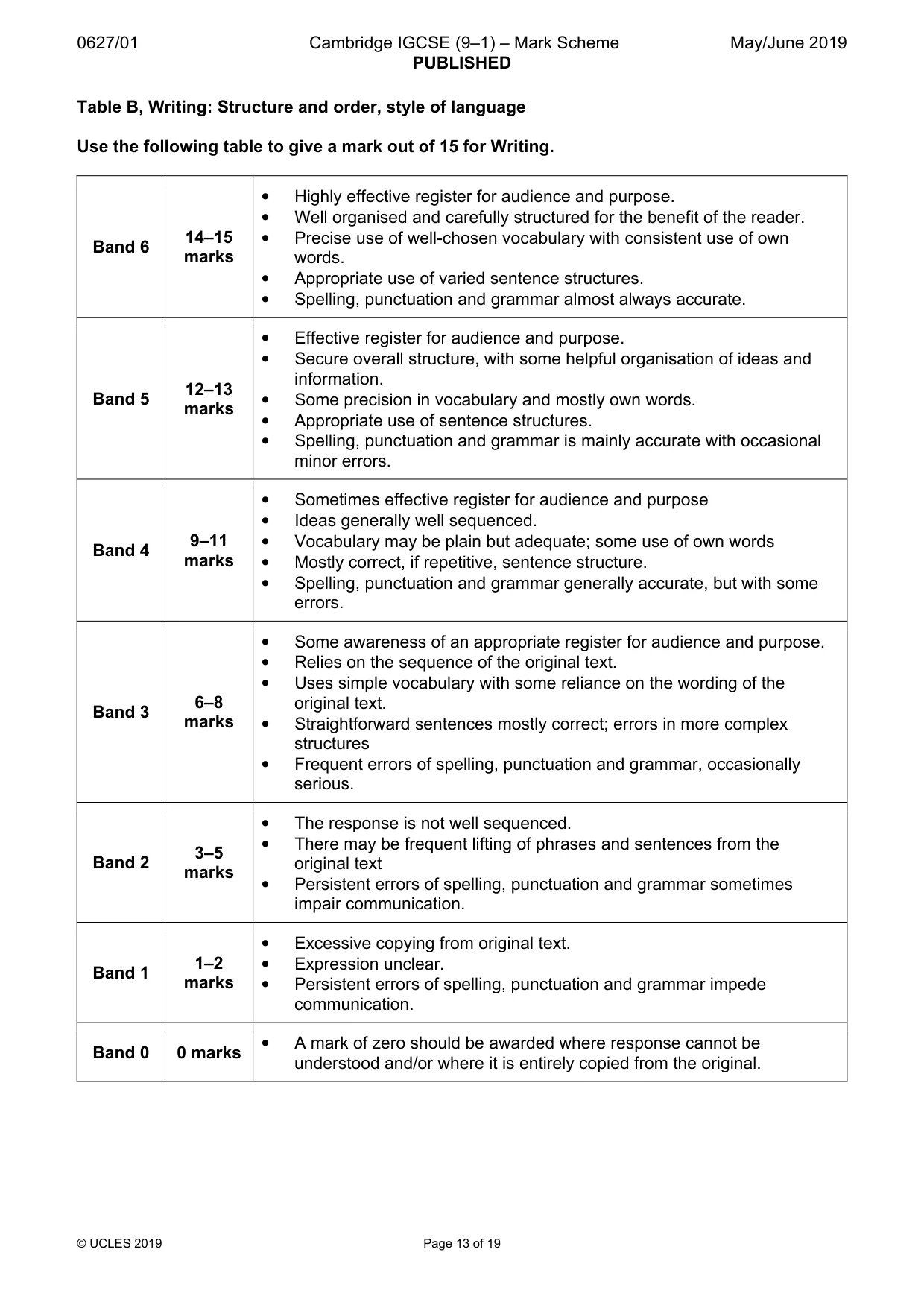
0627/01 Cambridge IGCSE (9–1) – Mark Scheme PUBLISHED May/June 2019 © UCLES 2019 Page 13 of 19 Table B, Writing: Structure and order, style of language Use the following table to give a mark out of 15 for Writing. Band 6 14–15 marks • Highly effective register for audience and purpose. • Well organised and carefully structured for the benefit of the reader. • Precise use of well-chosen vocabulary with consistent use of own words. • Appropriate use of varied sentence structures. • Spelling, punctuation and grammar almost always accurate. Band 5 12–13 marks • Effective register for audience and purpose. • Secure overall structure, with some helpful organisation of ideas and information. • Some precision in vocabulary and mostly own words. • Appropriate use of sentence structures. • Spelling, punctuation and grammar is mainly accurate with occasional minor errors. Band 4 9–11 marks • Sometimes effective register for audience and purpose • Ideas generally well sequenced. • Vocabulary may be plain but adequate; some use of own words • Mostly correct, if repetitive, sentence structure. • Spelling, punctuation and grammar generally accurate, but with some errors. Band 3 6–8 marks • Some awareness of an appropriate register for audience and purpose. • Relies on the sequence of the original text. • Uses simple vocabulary with some reliance on the wording of the original text. • Straightforward sentences mostly correct; errors in more complex structures • Frequent errors of spelling, punctuation and grammar, occasionally serious. Band 2 3–5 marks • The response is not well sequenced. • There may be frequent lifting of phrases and sentences from the original text • Persistent errors of spelling, punctuation and grammar sometimes impair communication. Band 1 1–2 marks • Excessive copying from original text. • Expression unclear. • Persistent errors of spelling, punctuation and grammar impede communication. Band 0 0 marks • A mark of zero should be awarded where response cannot be understood and/or where it is entirely copied from the original.
Mark scheme, page 14
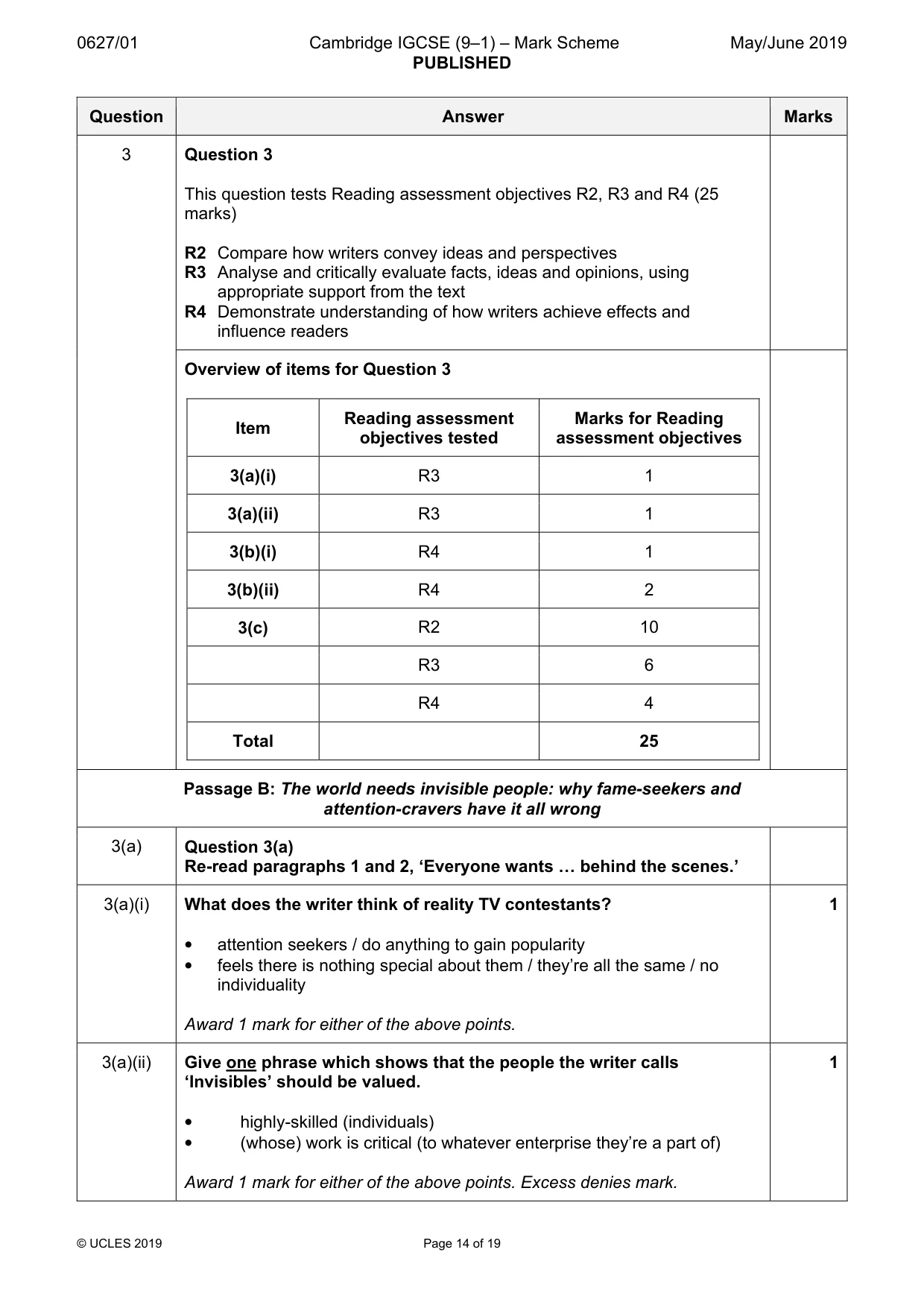
0627/01 Cambridge IGCSE (9–1) – Mark Scheme PUBLISHED May/June 2019 © UCLES 2019 Page 14 of 19 Question Answer Marks 3 Question 3 This question tests Reading assessment objectives R2, R3 and R4 (25 marks) R2 Compare how writers convey ideas and perspectives R3 Analyse and critically evaluate facts, ideas and opinions, using appropriate support from the text R4 Demonstrate understanding of how writers achieve effects and influence readers Overview of items for Question 3 Item Reading assessment objectives tested Marks for Reading assessment objectives 3(a)(i) R3 1 3(a)(ii) R3 1 3(b)(i) R4 1 3(b)(ii) R4 2 3(c) R2 10 R3 6 R4 4 Total 25 Passage B: The world needs invisible people: why fame-seekers and attention-cravers have it all wrong 3(a) Question 3(a) Re-read paragraphs 1 and 2, ‘Everyone wants « behind the scenes.’ 3(a)(i) What does the writer think of reality TV contestants? • attention seekers / do anything to gain popularity • feels there is nothing special about them / they’re all the same / no individuality Award 1 mark for either of the above points. 1 3(a)(ii) Give one phrase which shows that the people the writer calls ‘Invisibles’ should be valued. • highly-skilled (individuals) • (whose) work is critical (to whatever enterprise they’re a part of) Award 1 mark for either of the above points. Excess denies mark. 1
Mark scheme, page 15
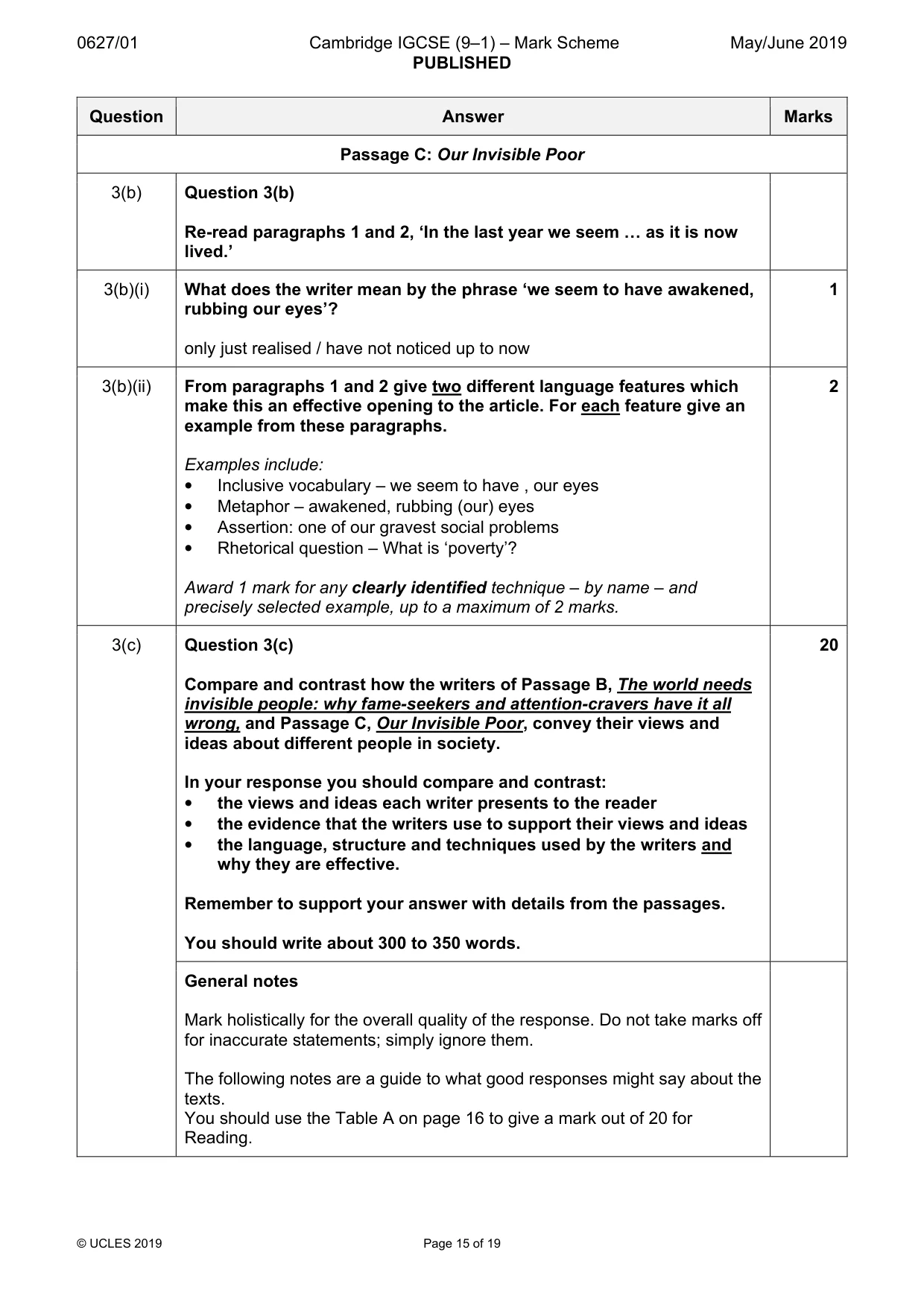
0627/01 Cambridge IGCSE (9–1) – Mark Scheme PUBLISHED May/June 2019 © UCLES 2019 Page 15 of 19 Question Answer Marks Passage C: Our Invisible Poor 3(b) Question 3(b) Re-read paragraphs 1 and 2, ‘In the last year we seem « as it is now lived.’ 3(b)(i) What does the writer mean by the phrase ‘we seem to have awakened, rubbing our eyes’? only just realised / have not noticed up to now 1 3(b)(ii) From paragraphs 1 and 2 give two different language features which make this an effective opening to the article. For each feature give an example from these paragraphs. Examples include: • Inclusive vocabulary – we seem to have , our eyes • Metaphor – awakened, rubbing (our) eyes • Assertion: one of our gravest social problems • Rhetorical question – What is ‘poverty’? Award 1 mark for any clearly identified technique – by name – and precisely selected example, up to a maximum of 2 marks. 2 3(c) Question 3(c) Compare and contrast how the writers of Passage B, The world needs invisible people: why fame-seekers and attention-cravers have it all wrong, and Passage C, Our Invisible Poor, convey their views and ideas about different people in society. In your response you should compare and contrast: • the views and ideas each writer presents to the reader • the evidence that the writers use to support their views and ideas • the language, structure and techniques used by the writers and why they are effective. Remember to support your answer with details from the passages. You should write about 300 to 350 words. 20 General notes Mark holistically for the overall quality of the response. Do not take marks off for inaccurate statements; simply ignore them. The following notes are a guide to what good responses might say about the texts. You should use the Table A on page 16 to give a mark out of 20 for Reading.
Mark scheme, page 16
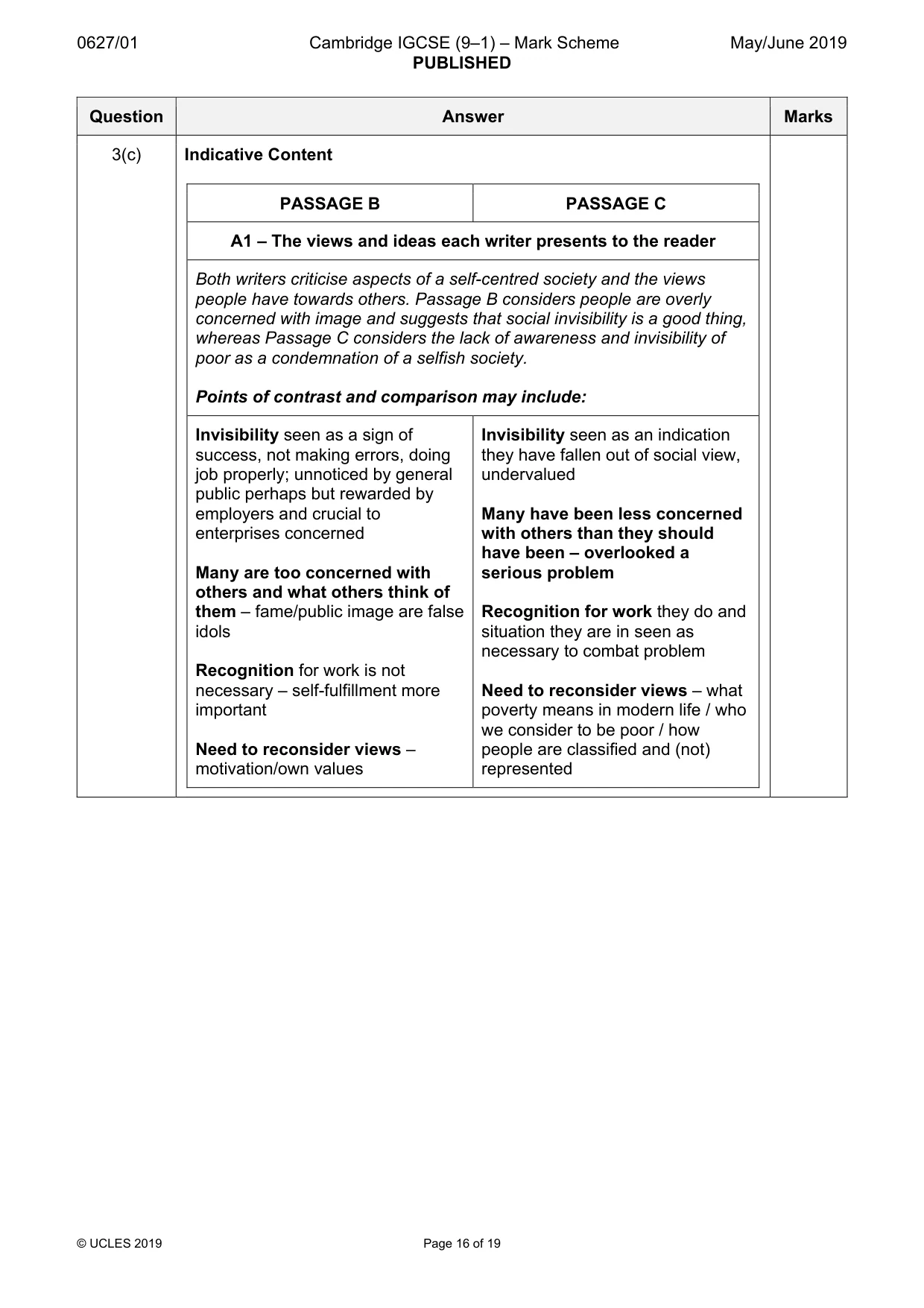
0627/01 Cambridge IGCSE (9–1) – Mark Scheme PUBLISHED May/June 2019 © UCLES 2019 Page 16 of 19 Question Answer Marks 3(c) Indicative Content PASSAGE B PASSAGE C A1 – The views and ideas each writer presents to the reader Both writers criticise aspects of a self-centred society and the views people have towards others. Passage B considers people are overly concerned with image and suggests that social invisibility is a good thing, whereas Passage C considers the lack of awareness and invisibility of poor as a condemnation of a selfish society. Points of contrast and comparison may include: Invisibility seen as a sign of success, not making errors, doing job properly; unnoticed by general public perhaps but rewarded by employers and crucial to enterprises concerned Many are too concerned with others and what others think of them – fame/public image are false idols Recognition for work is not necessary – self-fulfillment more important Need to reconsider views – motivation/own values Invisibility seen as an indication they have fallen out of social view, undervalued Many have been less concerned with others than they should have been – overlooked a serious problem Recognition for work they do and situation they are in seen as necessary to combat problem Need to reconsider views – what poverty means in modern life / who we consider to be poor / how people are classified and (not) represented
Mark scheme, page 17
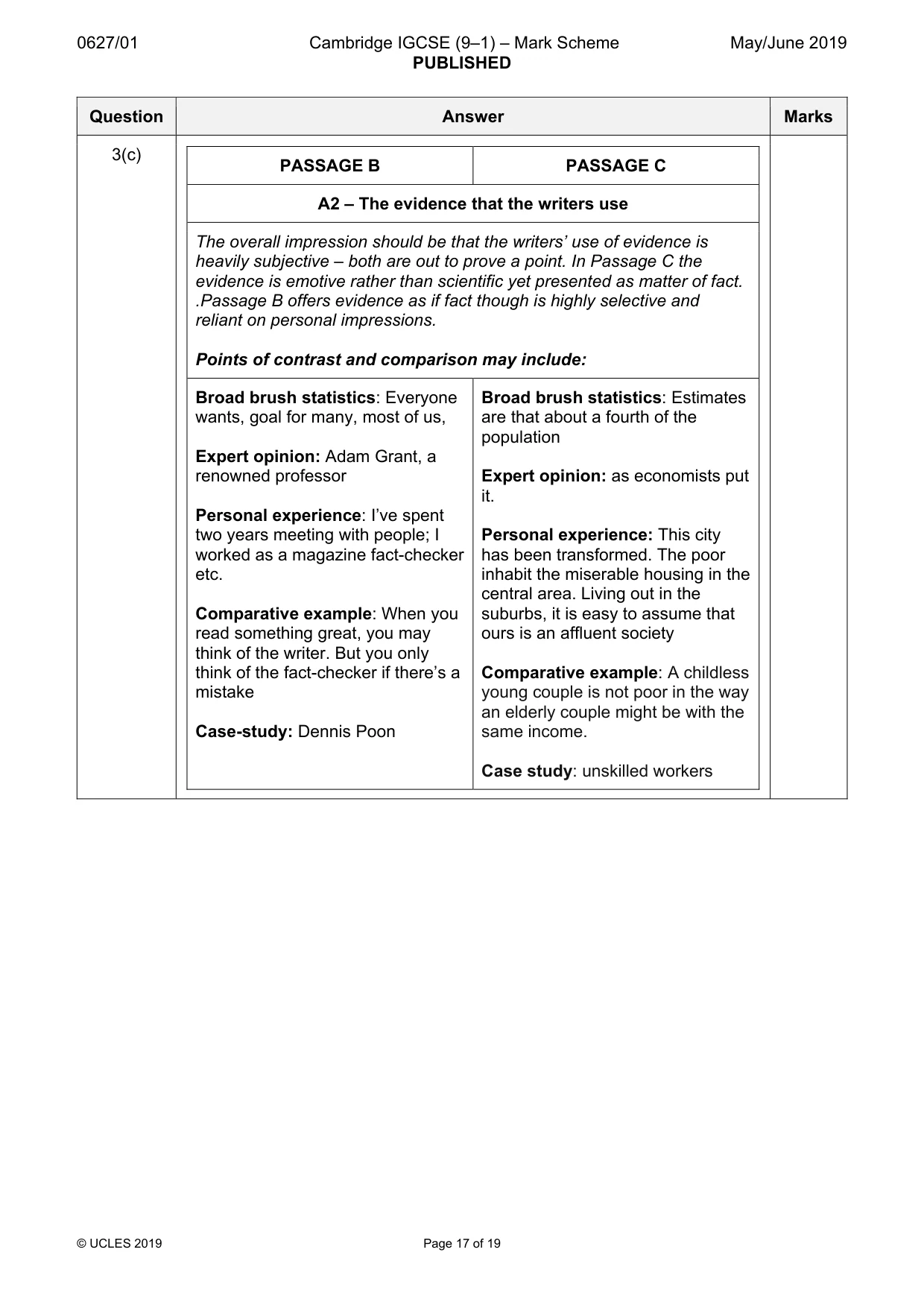
0627/01 Cambridge IGCSE (9–1) – Mark Scheme PUBLISHED May/June 2019 © UCLES 2019 Page 17 of 19 Question Answer Marks 3(c) PASSAGE B PASSAGE C A2 – The evidence that the writers use The overall impression should be that the writers’ use of evidence is heavily subjective – both are out to prove a point. In Passage C the evidence is emotive rather than scientific yet presented as matter of fact. .Passage B offers evidence as if fact though is highly selective and reliant on personal impressions. Points of contrast and comparison may include: Broad brush statistics: Everyone wants, goal for many, most of us, Expert opinion: Adam Grant, a renowned professor Personal experience: I’ve spent two years meeting with people; I worked as a magazine fact-checker etc. Comparative example: When you read something great, you may think of the writer. But you only think of the fact-checker if there’s a mistake Case-study: Dennis Poon Broad brush statistics: Estimates are that about a fourth of the population Expert opinion: as economists put it. Personal experience: This city has been transformed. The poor inhabit the miserable housing in the central area. Living out in the suburbs, it is easy to assume that ours is an affluent society Comparative example: A childless young couple is not poor in the way an elderly couple might be with the same income. Case study: unskilled workers
Mark scheme, page 18
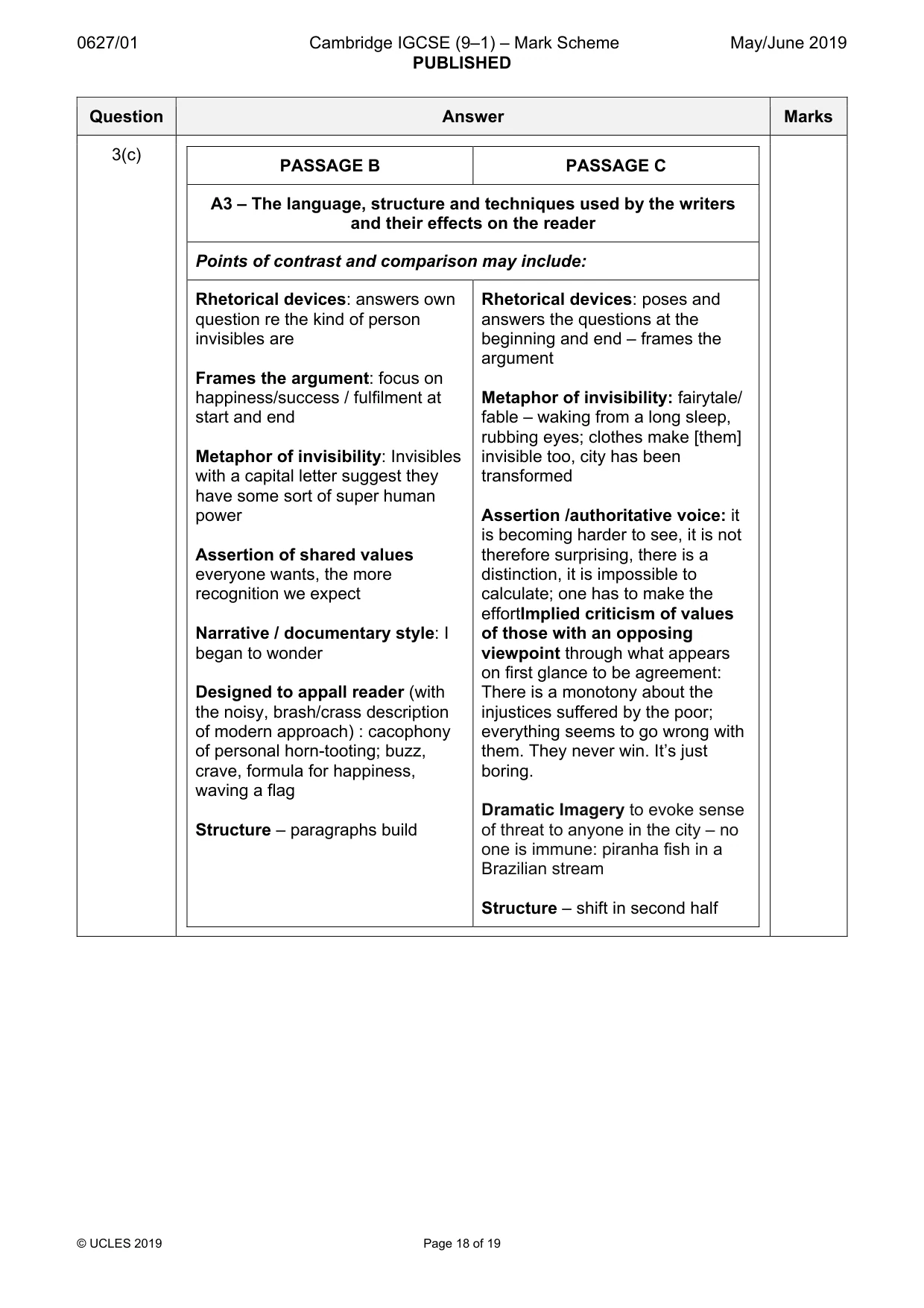
0627/01 Cambridge IGCSE (9–1) – Mark Scheme PUBLISHED May/June 2019 © UCLES 2019 Page 18 of 19 Question Answer Marks 3(c) PASSAGE B PASSAGE C A3 – The language, structure and techniques used by the writers and their effects on the reader Points of contrast and comparison may include: Rhetorical devices: answers own question re the kind of person invisibles are Frames the argument: focus on happiness/success / fulfilment at start and end Metaphor of invisibility: Invisibles with a capital letter suggest they have some sort of super human power Assertion of shared values everyone wants, the more recognition we expect Narrative / documentary style: I began to wonder Designed to appall reader (with the noisy, brash/crass description of modern approach) : cacophony of personal horn-tooting; buzz, crave, formula for happiness, waving a flag Structure – paragraphs build Rhetorical devices: poses and answers the questions at the beginning and end – frames the argument Metaphor of invisibility: fairytale/ fable – waking from a long sleep, rubbing eyes; clothes make [them] invisible too, city has been transformed Assertion /authoritative voice: it is becoming harder to see, it is not therefore surprising, there is a distinction, it is impossible to calculate; one has to make the effortImplied criticism of values of those with an opposing viewpoint through what appears on first glance to be agreement: There is a monotony about the injustices suffered by the poor; everything seems to go wrong with them. They never win. It’s just boring. Dramatic Imagery to evoke sense of threat to anyone in the city – no one is immune: piranha fish in a Brazilian stream Structure – shift in second half
Mark scheme, page 19
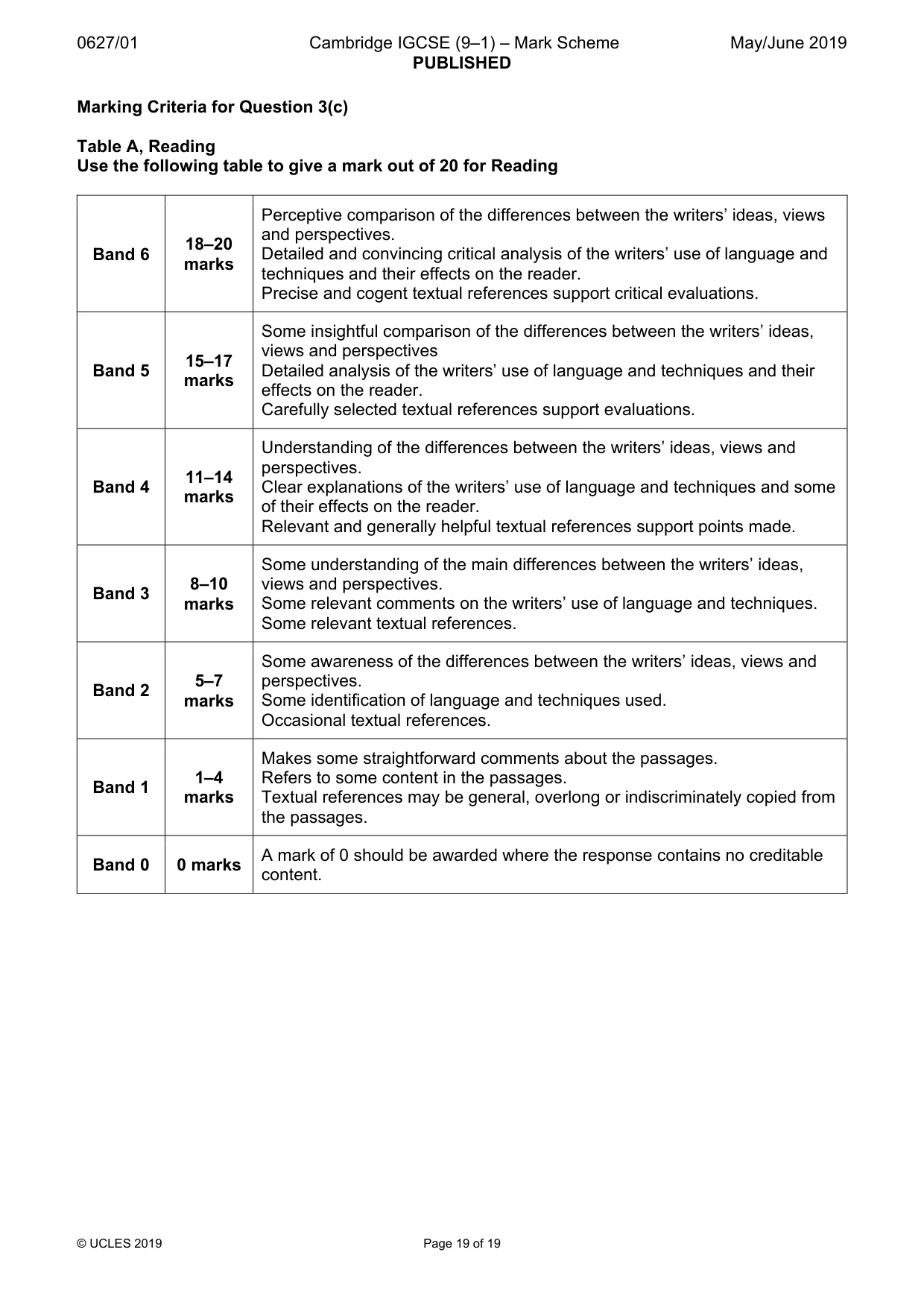
0627/01 Cambridge IGCSE (9–1) – Mark Scheme PUBLISHED May/June 2019 © UCLES 2019 Page 19 of 19 Marking Criteria for Question 3(c) Table A, Reading Use the following table to give a mark out of 20 for Reading Band 6 18–20 marks Perceptive comparison of the differences between the writers’ ideas, views and perspectives. Detailed and convincing critical analysis of the writers’ use of language and techniques and their effects on the reader. Precise and cogent textual references support critical evaluations. Band 5 15–17 marks Some insightful comparison of the differences between the writers’ ideas, views and perspectives Detailed analysis of the writers’ use of language and techniques and their effects on the reader. Carefully selected textual references support evaluations. Band 4 11–14 marks Understanding of the differences between the writers’ ideas, views and perspectives. Clear explanations of the writers’ use of language and techniques and some of their effects on the reader. Relevant and generally helpful textual references support points made. Band 3 8–10 marks Some understanding of the main differences between the writers’ ideas, views and perspectives. Some relevant comments on the writers’ use of language and techniques. Some relevant textual references. Band 2 5–7 marks Some awareness of the differences between the writers’ ideas, views and perspectives. Some identification of language and techniques used. Occasional textual references. Band 1 1–4 marks Makes some straightforward comments about the passages. Refers to some content in the passages. Textual references may be general, overlong or indiscriminately copied from the passages. Band 0 0 marks A mark of 0 should be awarded where the response contains no creditable content.
What you needed in this session
Cambridge’s own grade thresholds for 2019 May/June, Paper 1 · Variant 1. A higher threshold means an easier paper — the bar moves with how the cohort did.