Cambridge IGCSE English - First Language 0500 — 2016 May/June Paper 2 · Variant 3
0500/23/M/J/16 · 50 marks · ≈56 min
The question paper and its mark scheme, free to read here and free to download. This is Cambridge’s own paper, exactly as it was sat.
Question paper12 pages
Mark scheme10 pages
Answers below. Sit the paper first if you are practising.
Paper as text
Question paper, page 1
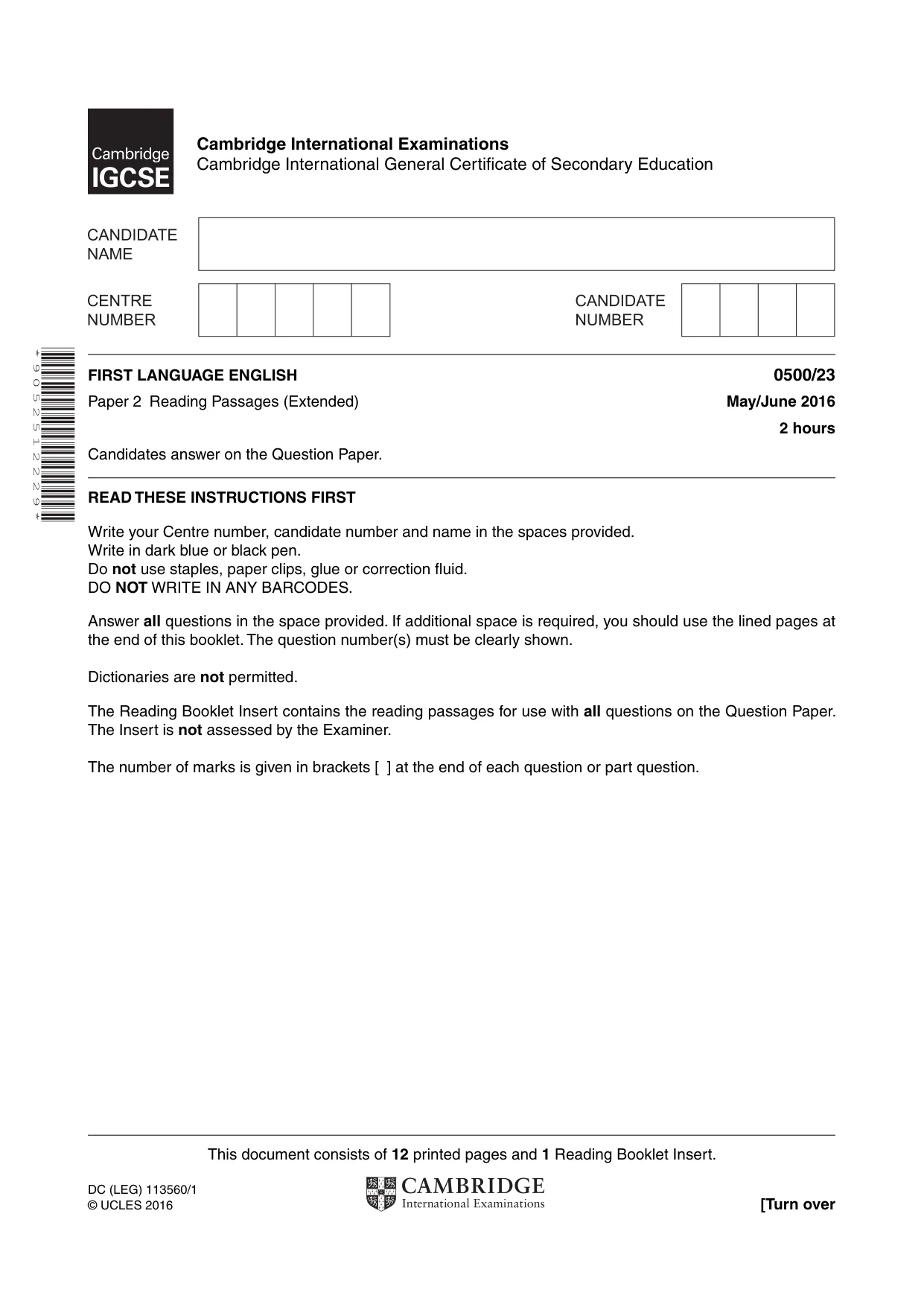
This document consists of 12 printed pages and 1 Reading Booklet Insert. DC (LEG) 113560/1 © UCLES 2016 [Turn over Cambridge International Examinations Cambridge International General Certificate of Secondary Education * 9 0 5 2 5 1 2 2 2 9 * FIRST LANGUAGE ENGLISH 0500/23 Paper 2 Reading Passages (Extended) May/June 2016 2 hours Candidates answer on the Question Paper. READ THESE INSTRUCTIONS FIRST Write your Centre number, candidate number and name in the spaces provided. Write in dark blue or black pen. Do not use staples, paper clips, glue or correction fluid. DO NOT WRITE IN ANY BARCODES. Answer all questions in the space provided. If additional space is required, you should use the lined pages at the end of this booklet. The question number(s) must be clearly shown. Dictionaries are not permitted. The Reading Booklet Insert contains the reading passages for use with all questions on the Question Paper. The Insert is not assessed by the Examiner. The number of marks is given in brackets [ ] at the end of each question or part question.
Question paper, page 2
2 0500/23/M/J/16 © UCLES 2016 Read carefully Passage A, At the restaurant, in the Reading Booklet Insert and then answer Questions 1 and 2 on this Question Paper. Question 1 You are a local journalist who was in the restaurant that evening and saw everything that happened. The next day you decide to write an article for the local newspaper. Write the newspaper article. In your newspaper article you should: • report what you observed in the restaurant and how the incident was resolved • explain the complaints of tourists and how far you think they are justified • suggest how locals feel about tourists and how both sides could work to rebuild mutual respect. Base your newspaper article on what you have read in Passage A, but be careful to use your own words. Address each of the three bullet points. Begin your article with the headline, ‘Our city – a playground for tourists?’ Write about 250 to 350 words. Up to 15 marks are available for the content of your answer, and up to 5 marks for the quality of your writing. … … … … … … … … … … … … … … …
Question paper, page 3
3 0500/23/M/J/16 © UCLES 2016 [Turn over … … … … … … … … … … … … … … … … … … … … … … … … … … … …
Question paper, page 4
4 0500/23/M/J/16 © UCLES 2016 … … … … … … … … … … … … … … … … … … … … … … … … … … … [Total: 20]
Question paper, page 5
5 0500/23/M/J/16 © UCLES 2016 [Turn over [Turn over for Question 2]
Question paper, page 6
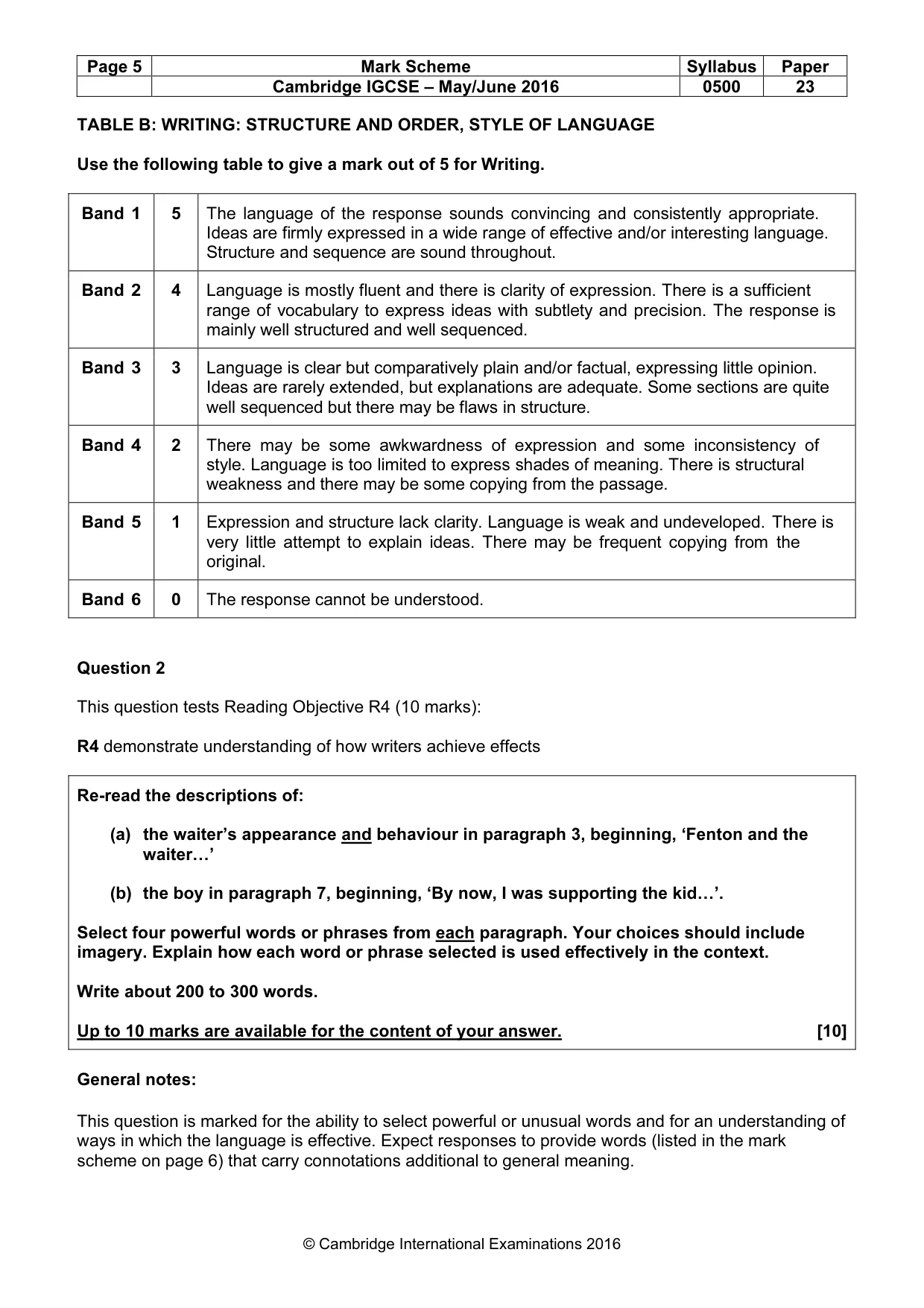
6 0500/23/M/J/16 © UCLES 2016 Question 2 Re-read the descriptions of: (a) the waiter’s appearance and behaviour in paragraph 3, beginning, ‘Fenton and the waiter…’ (b) the boy in paragraph 7, beginning, ‘By now, I was supporting the kid…’. Select four powerful words or phrases from each paragraph. Your choices should include imagery. Explain how each word or phrase selected is used effectively in the context. Write about 200 to 300 words. Up to 10 marks are available for the content of your answer. … … … … … … … … … … … … … … … … … … … … …
Question paper, page 7
7 0500/23/M/J/16 © UCLES 2016 [Turn over … … … … … … … … … … … … … … … … … … … … … … … … … … … [Total: 10]
Question paper, page 8
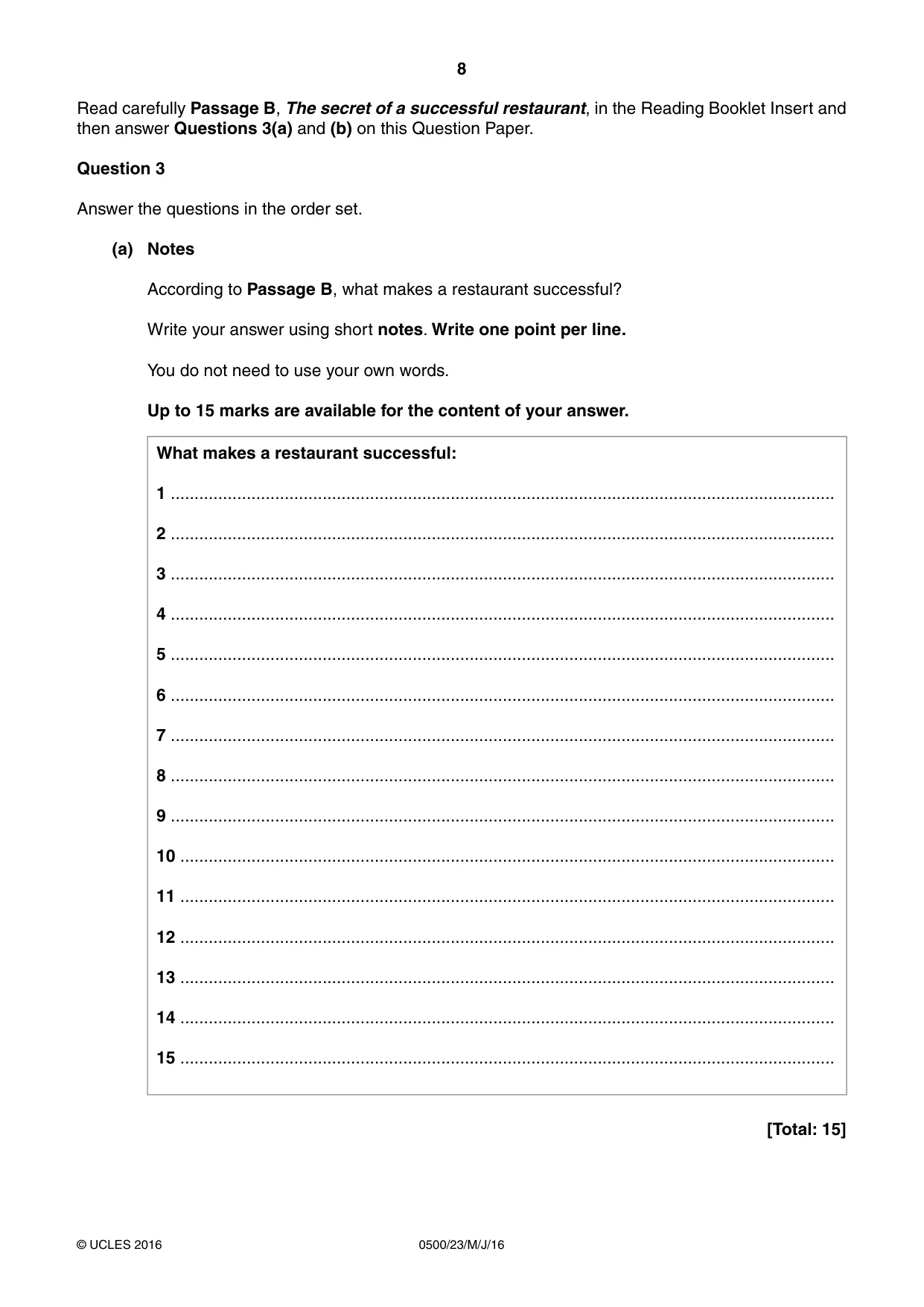
8 0500/23/M/J/16 © UCLES 2016 Read carefully Passage B, The secret of a successful restaurant, in the Reading Booklet Insert and then answer Questions 3(a) and (b) on this Question Paper. Question 3 Answer the questions in the order set. (a) Notes According to Passage B, what makes a restaurant successful? Write your answer using short notes. Write one point per line. You do not need to use your own words. Up to 15 marks are available for the content of your answer. What makes a restaurant successful: 1 … 2 … 3 … 4 … 5 … 6 … 7 … 8 … 9 … 10 … 11 … 12 … 13 … 14 … 15 … [Total: 15]
Question paper, page 9
9 0500/23/M/J/16 © UCLES 2016 [Turn over (b) Summary Now use your notes from Question 3(a) to write a summary of what makes a restaurant successful, according to Passage B. You must use continuous writing (not note form) and use your own words as far as possible. Your summary should include all 15 of your points in Question 3(a) and must be 200 to 250 words. Up to 5 marks are available for the quality of your writing. … … … … … … … … … … … … … … … … … … … … … …
Question paper, page 10
10 0500/23/M/J/16 © UCLES 2016 … … … … … … … … … … [Total: 5]
Question paper, page 11
11 0500/23/M/J/16 © UCLES 2016 Additional Page If you use the following lined page to complete the answer(s) to any question(s), the question number(s) must be clearly shown. … … … … … … … … … … … … … … … … … … … … … … … … … …
Question paper, page 12
12 0500/23/M/J/16 © UCLES 2016 Permission to reproduce items where third-party owned material protected by copyright is included has been sought and cleared where possible. Every reasonable effort has been made by the publisher (UCLES) to trace copyright holders, but if any items requiring clearance have unwittingly been included, the publisher will be pleased to make amends at the earliest possible opportunity. To avoid the issue of disclosure of answer-related information to candidates, all copyright acknowledgements are reproduced online in the Cambridge International Examinations Copyright Acknowledgements Booklet. This is produced for each series of examinations and is freely available to download at www.cie.org.uk after the live examination series. Cambridge International Examinations is part of the Cambridge Assessment Group. Cambridge Assessment is the brand name of University of Cambridge Local Examinations Syndicate (UCLES), which is itself a department of the University of Cambridge. Additional Page If you use the following lined page to complete the answer(s) to any question(s), the question number(s) must be clearly shown. … … … … … … … … … … … … … … … … … … … … … …
Mark scheme, page 1
® IGCSE is the registered trademark of Cambridge International Examinations. This document consists of 10 printed pages. © UCLES 2016 [Turn over] Cambridge International Examinations Cambridge International General Certificate of Secondary Education FIRST LANGUAGE ENGLISH 0500/23 Paper 2 Reading Passages (Extended) May/June 2016 MARK SCHEME Maximum Mark: 50 Published This mark scheme is published as an aid to teachers and candidates, to indicate the requirements of the examination. It shows the basis on which Examiners were instructed to award marks. It does not indicate the details of the discussions that took place at an Examiners’ meeting before marking began, which would have considered the acceptability of alternative answers. Mark schemes should be read in conjunction with the question paper and the Principal Examiner Report for Teachers. Cambridge will not enter into discussions about these mark schemes. Cambridge is publishing the mark schemes for the May/June 2016 series for most Cambridge IGCSE®, Cambridge International A and AS Level components and some Cambridge O Level components.
Mark scheme, page 2
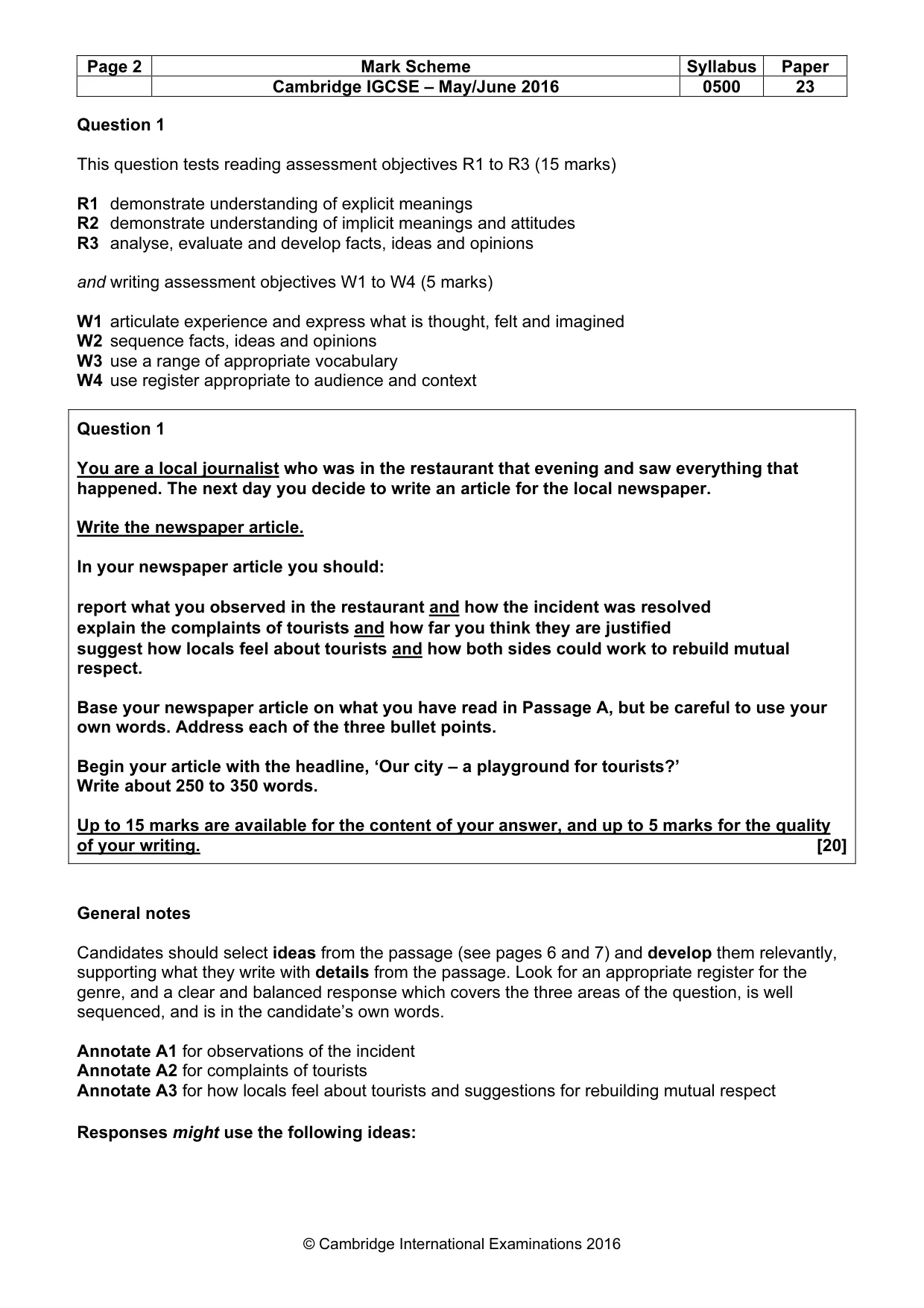
Page 2 Mark Scheme Syllabus Paper Cambridge IGCSE – May/June 2016 0500 23 © Cambridge International Examinations 2016 Question 1 This question tests reading assessment objectives R1 to R3 (15 marks) R1 demonstrate understanding of explicit meanings R2 demonstrate understanding of implicit meanings and attitudes R3 analyse, evaluate and develop facts, ideas and opinions and writing assessment objectives W1 to W4 (5 marks) W1 articulate experience and express what is thought, felt and imagined W2 sequence facts, ideas and opinions W3 use a range of appropriate vocabulary W4 use register appropriate to audience and context Question 1 You are a local journalist who was in the restaurant that evening and saw everything that happened. The next day you decide to write an article for the local newspaper. Write the newspaper article. In your newspaper article you should: report what you observed in the restaurant and how the incident was resolved explain the complaints of tourists and how far you think they are justified suggest how locals feel about tourists and how both sides could work to rebuild mutual respect. Base your newspaper article on what you have read in Passage A, but be careful to use your own words. Address each of the three bullet points. Begin your article with the headline, ‘Our city – a playground for tourists?’ Write about 250 to 350 words. Up to 15 marks are available for the content of your answer, and up to 5 marks for the quality of your writing. [20] General notes Candidates should select ideas from the passage (see pages 6 and 7) and develop them relevantly, supporting what they write with details from the passage. Look for an appropriate register for the genre, and a clear and balanced response which covers the three areas of the question, is well sequenced, and is in the candidate’s own words. Annotate A1 for observations of the incident Annotate A2 for complaints of tourists Annotate A3 for how locals feel about tourists and suggestions for rebuilding mutual respect Responses might use the following ideas:
Mark scheme, page 3
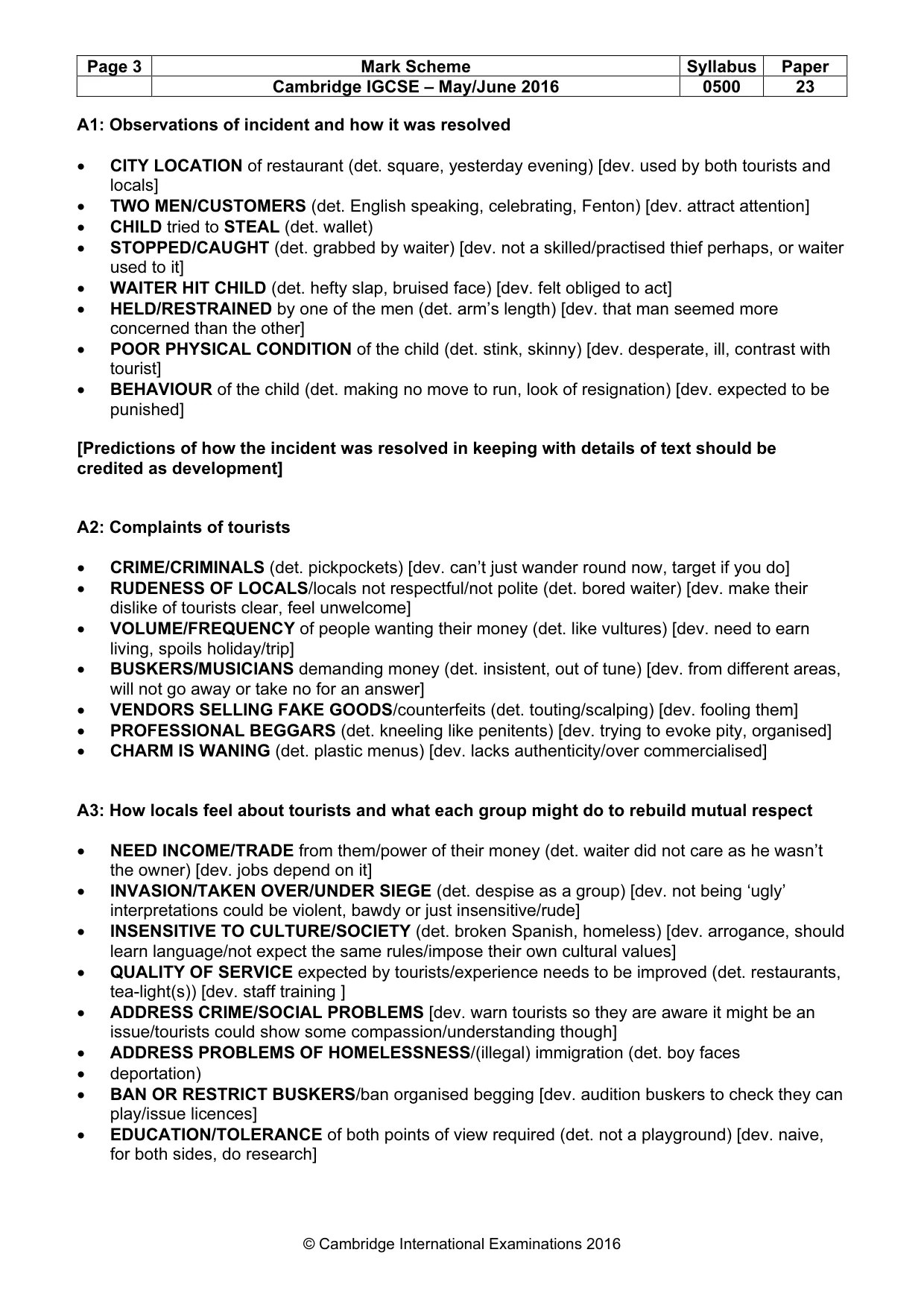
Page 3 Mark Scheme Syllabus Paper Cambridge IGCSE – May/June 2016 0500 23 © Cambridge International Examinations 2016 A1: Observations of incident and how it was resolved • CITY LOCATION of restaurant (det. square, yesterday evening) [dev. used by both tourists and locals] • TWO MEN/CUSTOMERS (det. English speaking, celebrating, Fenton) [dev. attract attention] • CHILD tried to STEAL (det. wallet) • STOPPED/CAUGHT (det. grabbed by waiter) [dev. not a skilled/practised thief perhaps, or waiter used to it] • WAITER HIT CHILD (det. hefty slap, bruised face) [dev. felt obliged to act] • HELD/RESTRAINED by one of the men (det. arm’s length) [dev. that man seemed more concerned than the other] • POOR PHYSICAL CONDITION of the child (det. stink, skinny) [dev. desperate, ill, contrast with tourist] • BEHAVIOUR of the child (det. making no move to run, look of resignation) [dev. expected to be punished] [Predictions of how the incident was resolved in keeping with details of text should be credited as development] A2: Complaints of tourists • CRIME/CRIMINALS (det. pickpockets) [dev. can’t just wander round now, target if you do] • RUDENESS OF LOCALS/locals not respectful/not polite (det. bored waiter) [dev. make their dislike of tourists clear, feel unwelcome] • VOLUME/FREQUENCY of people wanting their money (det. like vultures) [dev. need to earn living, spoils holiday/trip] • BUSKERS/MUSICIANS demanding money (det. insistent, out of tune) [dev. from different areas, will not go away or take no for an answer] • VENDORS SELLING FAKE GOODS/counterfeits (det. touting/scalping) [dev. fooling them] • PROFESSIONAL BEGGARS (det. kneeling like penitents) [dev. trying to evoke pity, organised] • CHARM IS WANING (det. plastic menus) [dev. lacks authenticity/over commercialised] A3: How locals feel about tourists and what each group might do to rebuild mutual respect • NEED INCOME/TRADE from them/power of their money (det. waiter did not care as he wasn’t the owner) [dev. jobs depend on it] • INVASION/TAKEN OVER/UNDER SIEGE (det. despise as a group) [dev. not being ‘ugly’ interpretations could be violent, bawdy or just insensitive/rude] • INSENSITIVE TO CULTURE/SOCIETY (det. broken Spanish, homeless) [dev. arrogance, should learn language/not expect the same rules/impose their own cultural values] • QUALITY OF SERVICE expected by tourists/experience needs to be improved (det. restaurants, tea-light(s)) [dev. staff training ] • ADDRESS CRIME/SOCIAL PROBLEMS [dev. warn tourists so they are aware it might be an issue/tourists could show some compassion/understanding though] • ADDRESS PROBLEMS OF HOMELESSNESS/(illegal) immigration (det. boy faces • deportation) • BAN OR RESTRICT BUSKERS/ban organised begging [dev. audition buskers to check they can play/issue licences] • EDUCATION/TOLERANCE of both points of view required (det. not a playground) [dev. naive, for both sides, do research]
Mark scheme, page 4
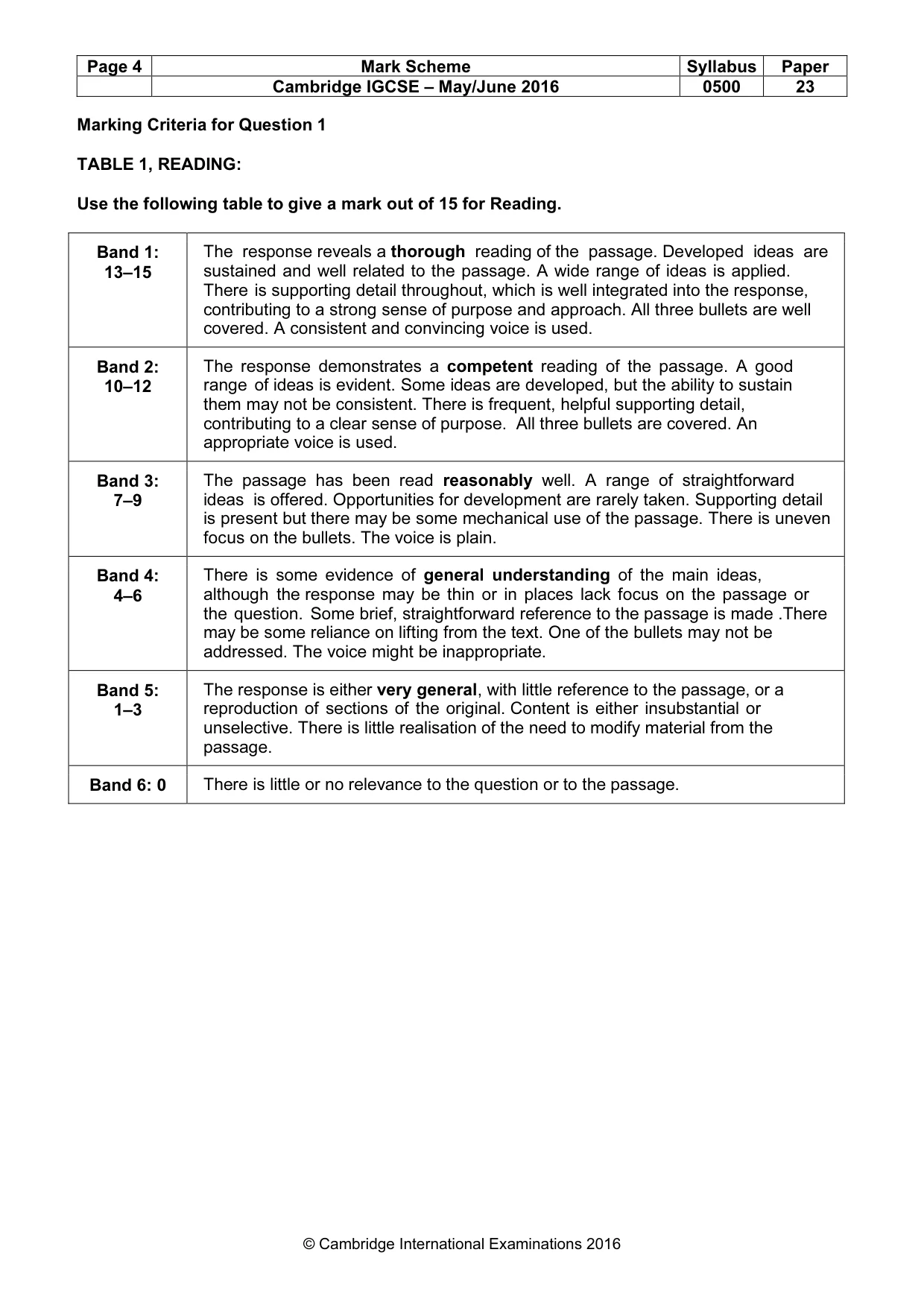
Page 4 Mark Scheme Syllabus Paper Cambridge IGCSE – May/June 2016 0500 23 © Cambridge International Examinations 2016 Marking Criteria for Question 1 TABLE 1, READING: Use the following table to give a mark out of 15 for Reading. Band 1: 13–15 The response reveals a thorough reading of the passage. Developed ideas are sustained and well related to the passage. A wide range of ideas is applied. There is supporting detail throughout, which is well integrated into the response, contributing to a strong sense of purpose and approach. All three bullets are well covered. A consistent and convincing voice is used. Band 2: 10–12 The response demonstrates a competent reading of the passage. A good range of ideas is evident. Some ideas are developed, but the ability to sustain them may not be consistent. There is frequent, helpful supporting detail, contributing to a clear sense of purpose. All three bullets are covered. An appropriate voice is used. Band 3: 7–9 The passage has been read reasonably well. A range of straightforward ideas is offered. Opportunities for development are rarely taken. Supporting detail is present but there may be some mechanical use of the passage. There is uneven focus on the bullets. The voice is plain. Band 4: 4–6 There is some evidence of general understanding of the main ideas, although the response may be thin or in places lack focus on the passage or the question. Some brief, straightforward reference to the passage is made .There may be some reliance on lifting from the text. One of the bullets may not be addressed. The voice might be inappropriate. Band 5: 1–3 The response is either very general, with little reference to the passage, or a reproduction of sections of the original. Content is either insubstantial or unselective. There is little realisation of the need to modify material from the passage. Band 6: 0 There is little or no relevance to the question or to the passage.
Mark scheme, page 5
Page 5 Mark Scheme Syllabus Paper Cambridge IGCSE – May/June 2016 0500 23 © Cambridge International Examinations 2016 TABLE B: WRITING: STRUCTURE AND ORDER, STYLE OF LANGUAGE Use the following table to give a mark out of 5 for Writing. Band 1 5 The language of the response sounds convincing and consistently appropriate. Ideas are firmly expressed in a wide range of effective and/or interesting language. Structure and sequence are sound throughout. Band 2 4 Language is mostly fluent and there is clarity of expression. There is a sufficient range of vocabulary to express ideas with subtlety and precision. The response is mainly well structured and well sequenced. Band 3 3 Language is clear but comparatively plain and/or factual, expressing little opinion. Ideas are rarely extended, but explanations are adequate. Some sections are quite well sequenced but there may be flaws in structure. Band 4 2 There may be some awkwardness of expression and some inconsistency of style. Language is too limited to express shades of meaning. There is structural weakness and there may be some copying from the passage. Band 5 1 Expression and structure lack clarity. Language is weak and undeveloped. There is very little attempt to explain ideas. There may be frequent copying from the original. Band 6 0 The response cannot be understood. Question 2 This question tests Reading Objective R4 (10 marks): R4 demonstrate understanding of how writers achieve effects Re-read the descriptions of: (a) the waiter’s appearance and behaviour in paragraph 3, beginning, ‘Fenton and the waiter…’ (b) the boy in paragraph 7, beginning, ‘By now, I was supporting the kid…’. Select four powerful words or phrases from each paragraph. Your choices should include imagery. Explain how each word or phrase selected is used effectively in the context. Write about 200 to 300 words. Up to 10 marks are available for the content of your answer. [10] General notes: This question is marked for the ability to select powerful or unusual words and for an understanding of ways in which the language is effective. Expect responses to provide words (listed in the mark scheme on page 6) that carry connotations additional to general meaning.
Mark scheme, page 6
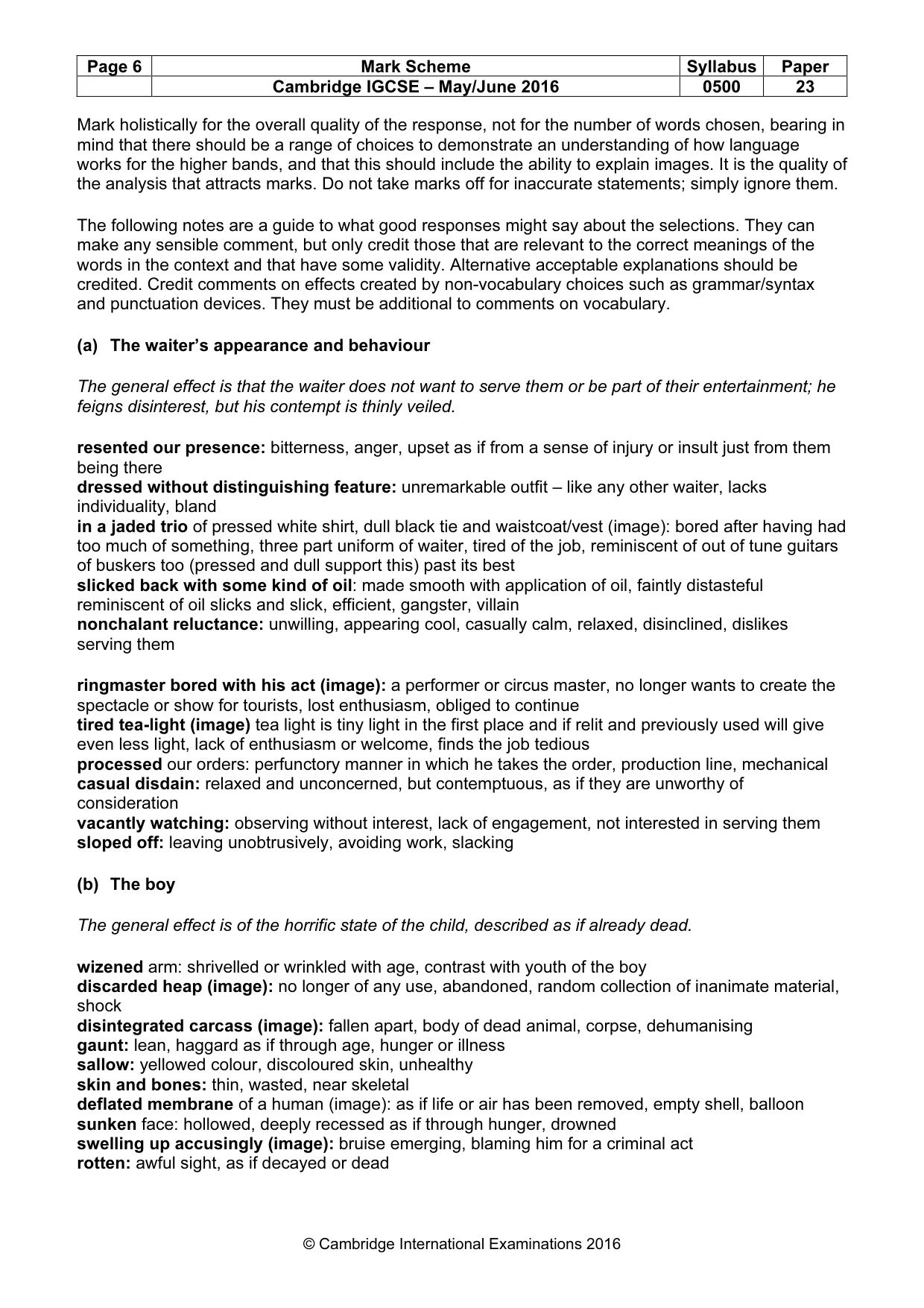
Page 6 Mark Scheme Syllabus Paper Cambridge IGCSE – May/June 2016 0500 23 © Cambridge International Examinations 2016 Mark holistically for the overall quality of the response, not for the number of words chosen, bearing in mind that there should be a range of choices to demonstrate an understanding of how language works for the higher bands, and that this should include the ability to explain images. It is the quality of the analysis that attracts marks. Do not take marks off for inaccurate statements; simply ignore them. The following notes are a guide to what good responses might say about the selections. They can make any sensible comment, but only credit those that are relevant to the correct meanings of the words in the context and that have some validity. Alternative acceptable explanations should be credited. Credit comments on effects created by non-vocabulary choices such as grammar/syntax and punctuation devices. They must be additional to comments on vocabulary. (a) The waiter’s appearance and behaviour The general effect is that the waiter does not want to serve them or be part of their entertainment; he feigns disinterest, but his contempt is thinly veiled. resented our presence: bitterness, anger, upset as if from a sense of injury or insult just from them being there dressed without distinguishing feature: unremarkable outfit – like any other waiter, lacks individuality, bland in a jaded trio of pressed white shirt, dull black tie and waistcoat/vest (image): bored after having had too much of something, three part uniform of waiter, tired of the job, reminiscent of out of tune guitars of buskers too (pressed and dull support this) past its best slicked back with some kind of oil: made smooth with application of oil, faintly distasteful reminiscent of oil slicks and slick, efficient, gangster, villain nonchalant reluctance: unwilling, appearing cool, casually calm, relaxed, disinclined, dislikes serving them ringmaster bored with his act (image): a performer or circus master, no longer wants to create the spectacle or show for tourists, lost enthusiasm, obliged to continue tired tea-light (image) tea light is tiny light in the first place and if relit and previously used will give even less light, lack of enthusiasm or welcome, finds the job tedious processed our orders: perfunctory manner in which he takes the order, production line, mechanical casual disdain: relaxed and unconcerned, but contemptuous, as if they are unworthy of consideration vacantly watching: observing without interest, lack of engagement, not interested in serving them sloped off: leaving unobtrusively, avoiding work, slacking (b) The boy The general effect is of the horrific state of the child, described as if already dead. wizened arm: shrivelled or wrinkled with age, contrast with youth of the boy discarded heap (image): no longer of any use, abandoned, random collection of inanimate material, shock disintegrated carcass (image): fallen apart, body of dead animal, corpse, dehumanising gaunt: lean, haggard as if through age, hunger or illness sallow: yellowed colour, discoloured skin, unhealthy skin and bones: thin, wasted, near skeletal deflated membrane of a human (image): as if life or air has been removed, empty shell, balloon sunken face: hollowed, deeply recessed as if through hunger, drowned swelling up accusingly (image): bruise emerging, blaming him for a criminal act rotten: awful sight, as if decayed or dead
Mark scheme, page 7
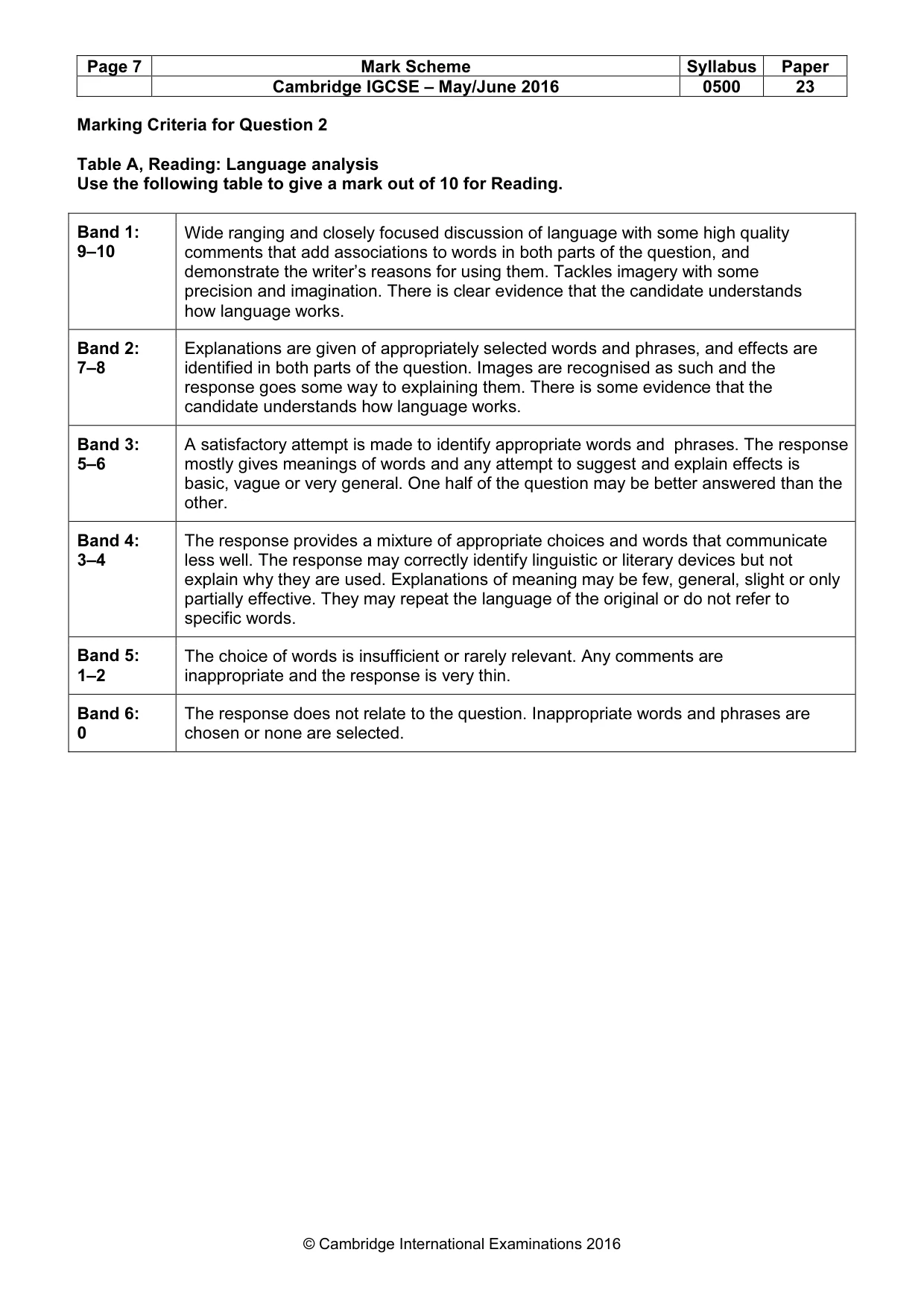
Page 7 Mark Scheme Syllabus Paper Cambridge IGCSE – May/June 2016 0500 23 © Cambridge International Examinations 2016 Marking Criteria for Question 2 Table A, Reading: Language analysis Use the following table to give a mark out of 10 for Reading. Band 1: 9–10 Wide ranging and closely focused discussion of language with some high quality comments that add associations to words in both parts of the question, and demonstrate the writer’s reasons for using them. Tackles imagery with some precision and imagination. There is clear evidence that the candidate understands how language works. Band 2: 7–8 Explanations are given of appropriately selected words and phrases, and effects are identified in both parts of the question. Images are recognised as such and the response goes some way to explaining them. There is some evidence that the candidate understands how language works. Band 3: 5–6 A satisfactory attempt is made to identify appropriate words and phrases. The response mostly gives meanings of words and any attempt to suggest and explain effects is basic, vague or very general. One half of the question may be better answered than the other. Band 4: 3–4 The response provides a mixture of appropriate choices and words that communicate less well. The response may correctly identify linguistic or literary devices but not explain why they are used. Explanations of meaning may be few, general, slight or only partially effective. They may repeat the language of the original or do not refer to specific words. Band 5: 1–2 The choice of words is insufficient or rarely relevant. Any comments are inappropriate and the response is very thin. Band 6: 0 The response does not relate to the question. Inappropriate words and phrases are chosen or none are selected.
Mark scheme, page 8
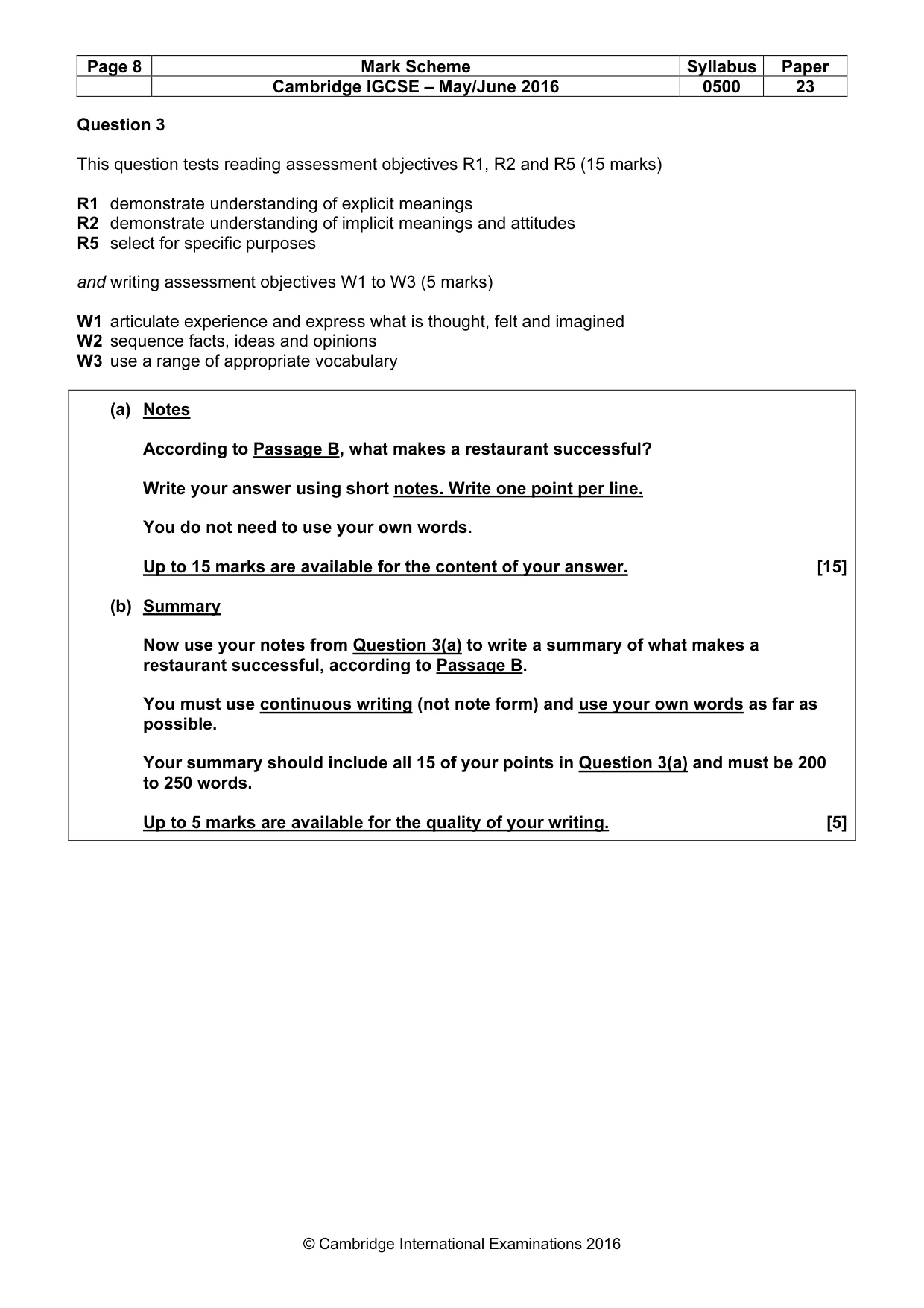
Page 8 Mark Scheme Syllabus Paper Cambridge IGCSE – May/June 2016 0500 23 © Cambridge International Examinations 2016 Question 3 This question tests reading assessment objectives R1, R2 and R5 (15 marks) R1 demonstrate understanding of explicit meanings R2 demonstrate understanding of implicit meanings and attitudes R5 select for specific purposes and writing assessment objectives W1 to W3 (5 marks) W1 articulate experience and express what is thought, felt and imagined W2 sequence facts, ideas and opinions W3 use a range of appropriate vocabulary (a) Notes According to Passage B, what makes a restaurant successful? Write your answer using short notes. Write one point per line. You do not need to use your own words. Up to 15 marks are available for the content of your answer. [15] (b) Summary Now use your notes from Question 3(a) to write a summary of what makes a restaurant successful, according to Passage B. You must use continuous writing (not note form) and use your own words as far as possible. Your summary should include all 15 of your points in Question 3(a) and must be 200 to 250 words. Up to 5 marks are available for the quality of your writing. [5]
Mark scheme, page 9
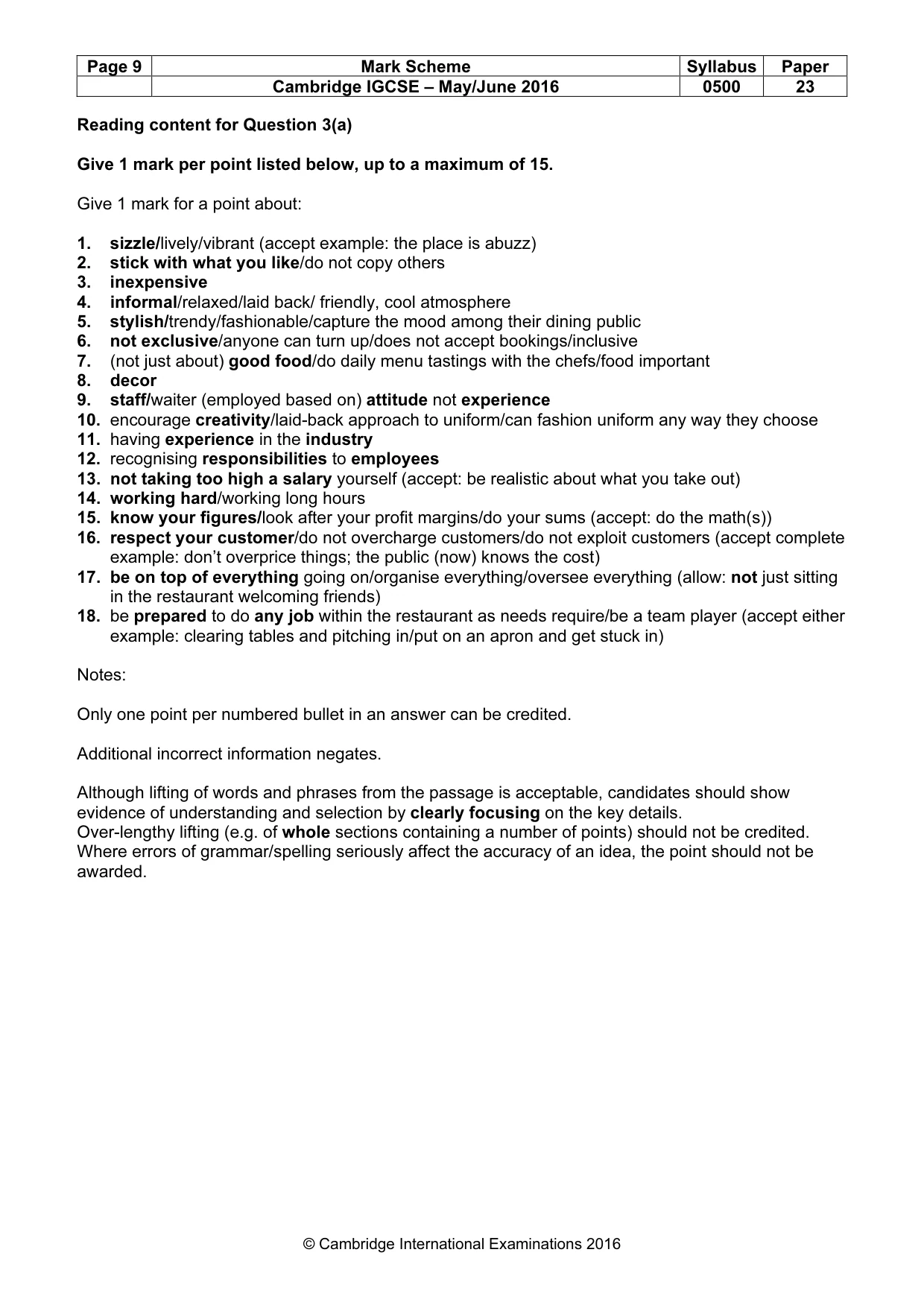
Page 9 Mark Scheme Syllabus Paper Cambridge IGCSE – May/June 2016 0500 23 © Cambridge International Examinations 2016 Reading content for Question 3(a) Give 1 mark per point listed below, up to a maximum of 15. Give 1 mark for a point about: 1. sizzle/lively/vibrant (accept example: the place is abuzz) 2. stick with what you like/do not copy others 3. inexpensive 4. informal/relaxed/laid back/ friendly, cool atmosphere 5. stylish/trendy/fashionable/capture the mood among their dining public 6. not exclusive/anyone can turn up/does not accept bookings/inclusive 7. (not just about) good food/do daily menu tastings with the chefs/food important 8. decor 9. staff/waiter (employed based on) attitude not experience 10. encourage creativity/laid-back approach to uniform/can fashion uniform any way they choose 11. having experience in the industry 12. recognising responsibilities to employees 13. not taking too high a salary yourself (accept: be realistic about what you take out) 14. working hard/working long hours 15. know your figures/look after your profit margins/do your sums (accept: do the math(s)) 16. respect your customer/do not overcharge customers/do not exploit customers (accept complete example: don’t overprice things; the public (now) knows the cost) 17. be on top of everything going on/organise everything/oversee everything (allow: not just sitting in the restaurant welcoming friends) 18. be prepared to do any job within the restaurant as needs require/be a team player (accept either example: clearing tables and pitching in/put on an apron and get stuck in) Notes: Only one point per numbered bullet in an answer can be credited. Additional incorrect information negates. Although lifting of words and phrases from the passage is acceptable, candidates should show evidence of understanding and selection by clearly focusing on the key details. Over-lengthy lifting (e.g. of whole sections containing a number of points) should not be credited. Where errors of grammar/spelling seriously affect the accuracy of an idea, the point should not be awarded.
Mark scheme, page 10
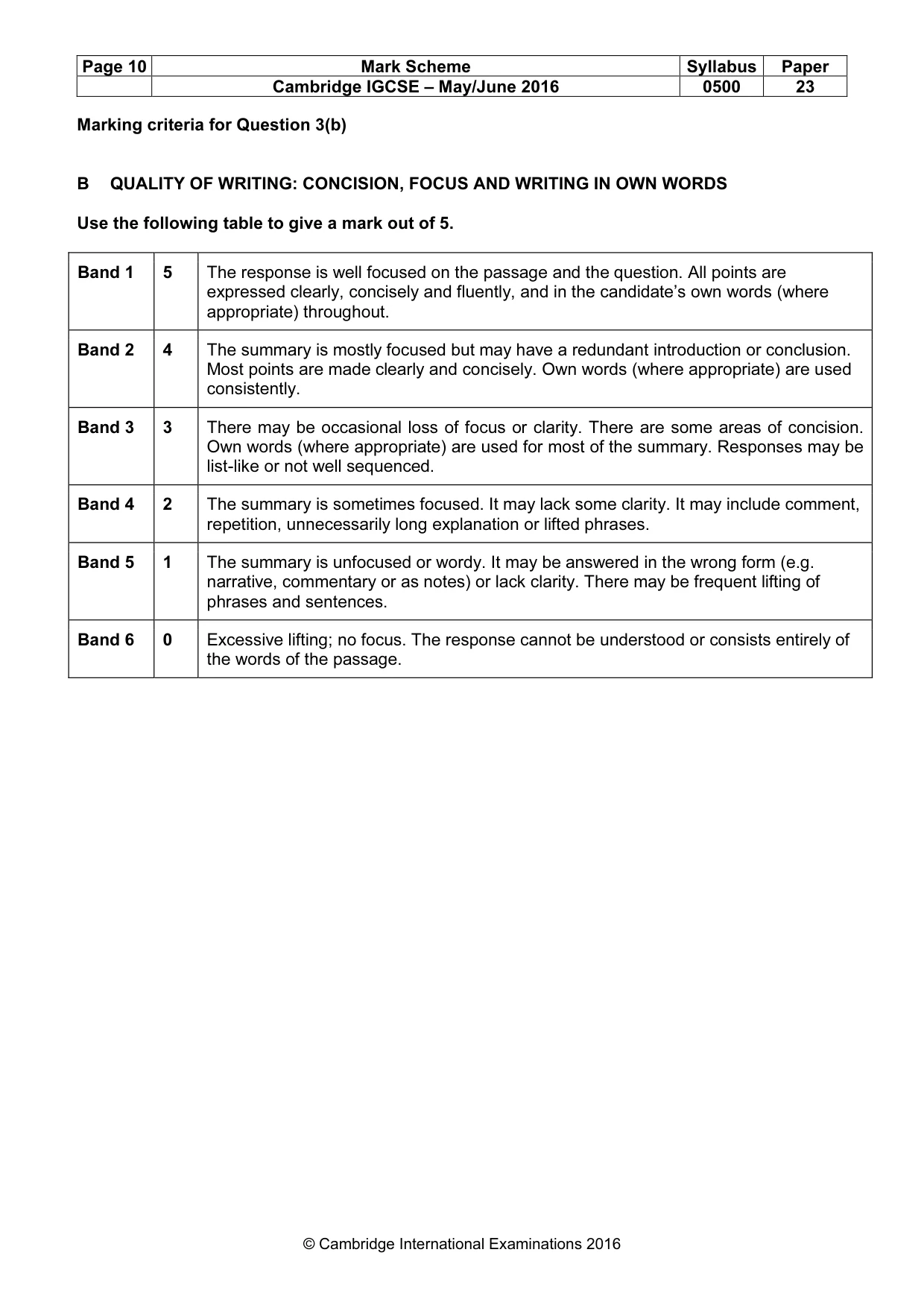
Page 10 Mark Scheme Syllabus Paper Cambridge IGCSE – May/June 2016 0500 23 © Cambridge International Examinations 2016 Marking criteria for Question 3(b) B QUALITY OF WRITING: CONCISION, FOCUS AND WRITING IN OWN WORDS Use the following table to give a mark out of 5. Band 1 5 The response is well focused on the passage and the question. All points are expressed clearly, concisely and fluently, and in the candidate’s own words (where appropriate) throughout. Band 2 4 The summary is mostly focused but may have a redundant introduction or conclusion. Most points are made clearly and concisely. Own words (where appropriate) are used consistently. Band 3 3 There may be occasional loss of focus or clarity. There are some areas of concision. Own words (where appropriate) are used for most of the summary. Responses may be list-like or not well sequenced. Band 4 2 The summary is sometimes focused. It may lack some clarity. It may include comment, repetition, unnecessarily long explanation or lifted phrases. Band 5 1 The summary is unfocused or wordy. It may be answered in the wrong form (e.g. narrative, commentary or as notes) or lack clarity. There may be frequent lifting of phrases and sentences. Band 6 0 Excessive lifting; no focus. The response cannot be understood or consists entirely of the words of the passage.
What you needed in this session
Cambridge’s own grade thresholds for 2016 May/June, Paper 2 · Variant 3. A higher threshold means an easier paper — the bar moves with how the cohort did.