Cambridge IGCSE English - First Language 0500 — 2016 May/June Paper 2 · Variant 2
0500/22/M/J/16 · 50 marks · ≈56 min
The question paper and its mark scheme, free to read here and free to download. This is Cambridge’s own paper, exactly as it was sat.
Question paper12 pages
Mark scheme10 pages
Answers below. Sit the paper first if you are practising.
Paper as text
Question paper, page 1
This document consists of 12 printed pages and 1 Reading Booklet Insert. DC (RW) 113557/1 © UCLES 2016 [Turn over Cambridge International Examinations Cambridge International General Certificate of Secondary Education * 7 1 6 4 0 6 7 0 0 1 * FIRST LANGUAGE ENGLISH 0500/22 Paper 2 Reading Passages (Extended) May/June 2016 2 hours Candidates answer on the Question Paper. READ THESE INSTRUCTIONS FIRST Write your Centre number, candidate number and name in the spaces provided. Write in dark blue or black pen. Do not use staples, paper clips, glue or correction fluid. DO NOT WRITE IN ANY BARCODES. Answer all questions in the space provided. If additional space is required, you should use the lined pages at the end of this booklet. The question number(s) must be clearly shown. Dictionaries are not permitted. The Reading Booklet Insert contains the reading passages for use with all questions on the Question Paper. The Insert is not assessed by the Examiner. The number of marks is given in brackets [ ] at the end of each question or part question.
Question paper, page 2
2 0500/22/M/J/16 © UCLES 2016 Read carefully Passage A, Miss Salmon, in the Reading Booklet Insert and then answer Questions 1 and 2 on this Question Paper. Question 1 You are Miss Salmon. On the evening of the false alarm you write a letter to a friend. Write the letter. In your letter you should: • comment on the events of the day, what exactly happened and how you feel now • explain why you behaved as you did • suggest your possible courses of action now and what their consequences might be. Base your letter on what you have read in Passage A, but be careful to use your own words. Address each of the three bullet points. Begin your letter, ‘Dear friend, Something happened today that I need to tell someone about…’ Write about 250 to 350 words. Up to 15 marks are available for the content of your answer, and up to 5 marks for the quality of your writing. … … … … … … … … … … … … … … …
Question paper, page 3
3 0500/22/M/J/16 © UCLES 2016 [Turn over … … … … … … … … … … … … … … … … … … … … … … … … … … … …
Question paper, page 4
4 0500/22/M/J/16 © UCLES 2016 … … … … … … … … … … … … … … … … … … … … … … … … … … … [Total: 20]
Question paper, page 5
5 0500/22/M/J/16 © UCLES 2016 [Turn over [Turn over for Question 2]
Question paper, page 6
6 0500/22/M/J/16 © UCLES 2016 Question 2 Re-read the descriptions of: (a) the atmosphere and the Headmaster’s speech in paragraph 4, beginning, ‘A lull in the storm …’ (b) the school and the students in paragraph 5, beginning, ‘Miss Salmon thought it unlikely …’. Select four powerful words or phrases from each paragraph. Your choices should include imagery. Explain how each word or phrase selected is used effectively in the context. Write about 200 to 300 words. Up to 10 marks are available for the content of your answer. … … … … … … … … … … … … … … … … … … … … …
Question paper, page 7
7 0500/22/M/J/16 © UCLES 2016 [Turn over … … … … … … … … … … … … … … … … … … … … … … … … … … … [Total: 10]
Question paper, page 8
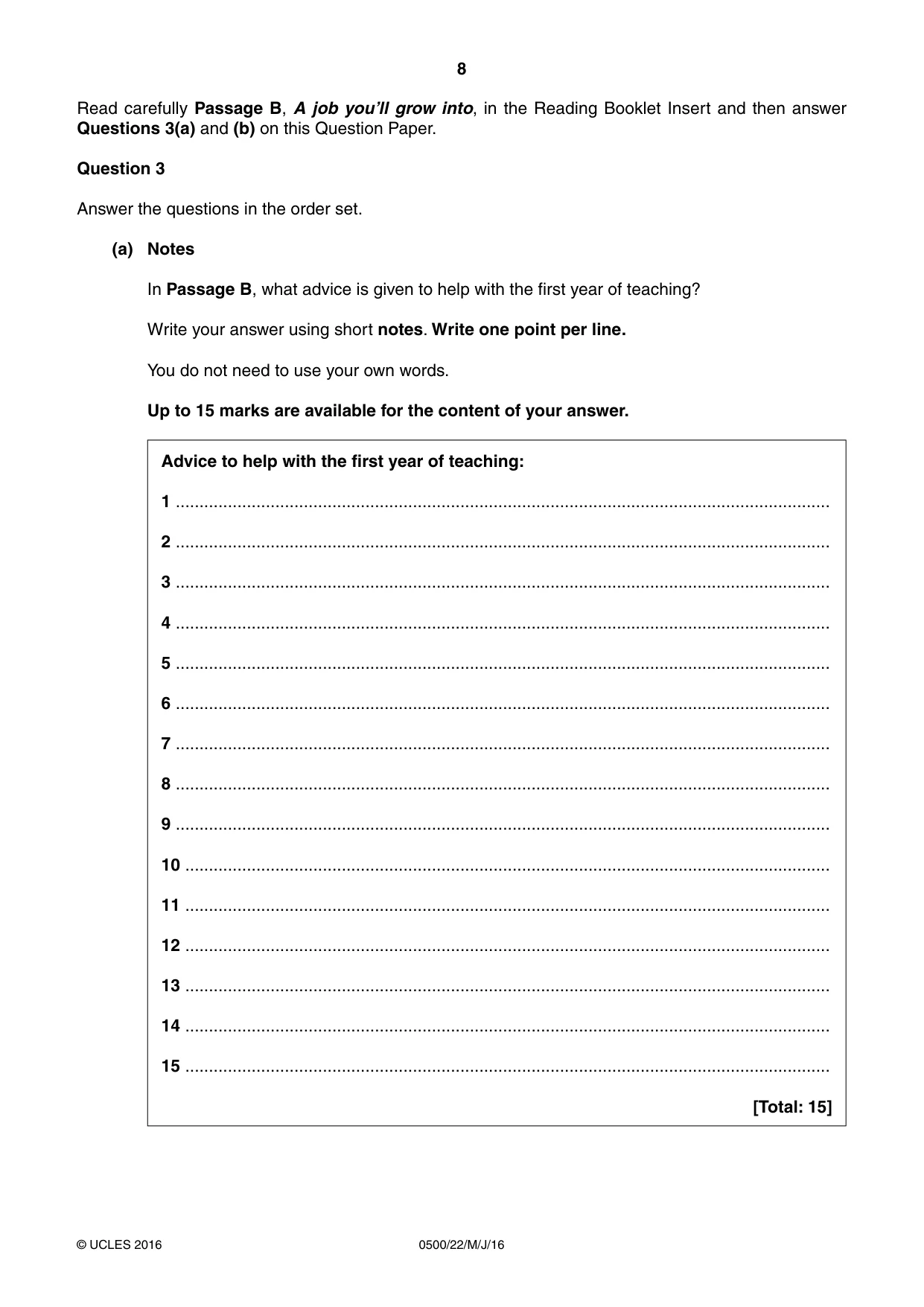
8 0500/22/M/J/16 © UCLES 2016 Read carefully Passage B, A job you’ll grow into, in the Reading Booklet Insert and then answer Questions 3(a) and (b) on this Question Paper. Question 3 Answer the questions in the order set. (a) Notes In Passage B, what advice is given to help with the first year of teaching? Write your answer using short notes. Write one point per line. You do not need to use your own words. Up to 15 marks are available for the content of your answer. Advice to help with the first year of teaching: 1 … 2 … 3 … 4 … 5 … 6 … 7 … 8 … 9 … 10 … 11 … 12 … 13 … 14 … 15 … [Total: 15]
Question paper, page 9
9 0500/22/M/J/16 © UCLES 2016 [Turn over (b) Summary Now use your notes from Question 3(a) to write a summary of the advice given in Passage B to help with the first year of teaching. You must use continuous writing (not note form) and use your own words as far as possible. Your summary should include all 15 of your points in Question 3(a) and must be 200 to 250 words. Up to 5 marks are available for the quality of your writing. … … … … … … … … … … … … … … … … … … … … … …
Question paper, page 10
10 0500/22/M/J/16 © UCLES 2016 … … … … … … … … … … … [Total: 5]
Question paper, page 11
11 0500/22/M/J/16 © UCLES 2016 ADDITIONAL PAGE If you use the following lined page to complete the answer(s) to any question(s), the question number(s) must be clearly shown. … … … … … … … … … … … … … … … … … … … … … … … … … …
Question paper, page 12
12 0500/22/M/J/16 © UCLES 2016 Permission to reproduce items where third-party owned material protected by copyright is included has been sought and cleared where possible. Every reasonable effort has been made by the publisher (UCLES) to trace copyright holders, but if any items requiring clearance have unwittingly been included, the publisher will be pleased to make amends at the earliest possible opportunity. To avoid the issue of disclosure of answer-related information to candidates, all copyright acknowledgements are reproduced online in the Cambridge International Examinations Copyright Acknowledgements Booklet. This is produced for each series of examinations and is freely available to download at www.cie.org.uk after the live examination series. Cambridge International Examinations is part of the Cambridge Assessment Group. Cambridge Assessment is the brand name of University of Cambridge Local Examinations Syndicate (UCLES), which is itself a department of the University of Cambridge. ADDITIONAL PAGE If you use the following lined page to complete the answer(s) to any question(s), the question number(s) must be clearly shown. … … … … … … … … … … … … … … … … … … … … …
Mark scheme, page 1
® IGCSE is the registered trademark of Cambridge International Examinations. This document consists of 10 printed pages. © UCLES 2016 [Turn over Cambridge International Examinations Cambridge International General Certificate of Secondary Education FIRST LANGUAGE ENGLISH 0500/22 Paper 2 Reading Passages – Extended May/June 2016 MARK SCHEME Maximum Mark: 50 Published This mark scheme is published as an aid to teachers and candidates, to indicate the requirements of the examination. It shows the basis on which Examiners were instructed to award marks. It does not indicate the details of the discussions that took place at an Examiners’ meeting before marking began, which would have considered the acceptability of alternative answers. Mark schemes should be read in conjunction with the question paper and the Principal Examiner Report for Teachers. Cambridge will not enter into discussions about these mark schemes. Cambridge is publishing the mark schemes for the May/June 2016 series for most Cambridge IGCSE®, Cambridge International A and AS Level components and some Cambridge O Level components.
Mark scheme, page 2
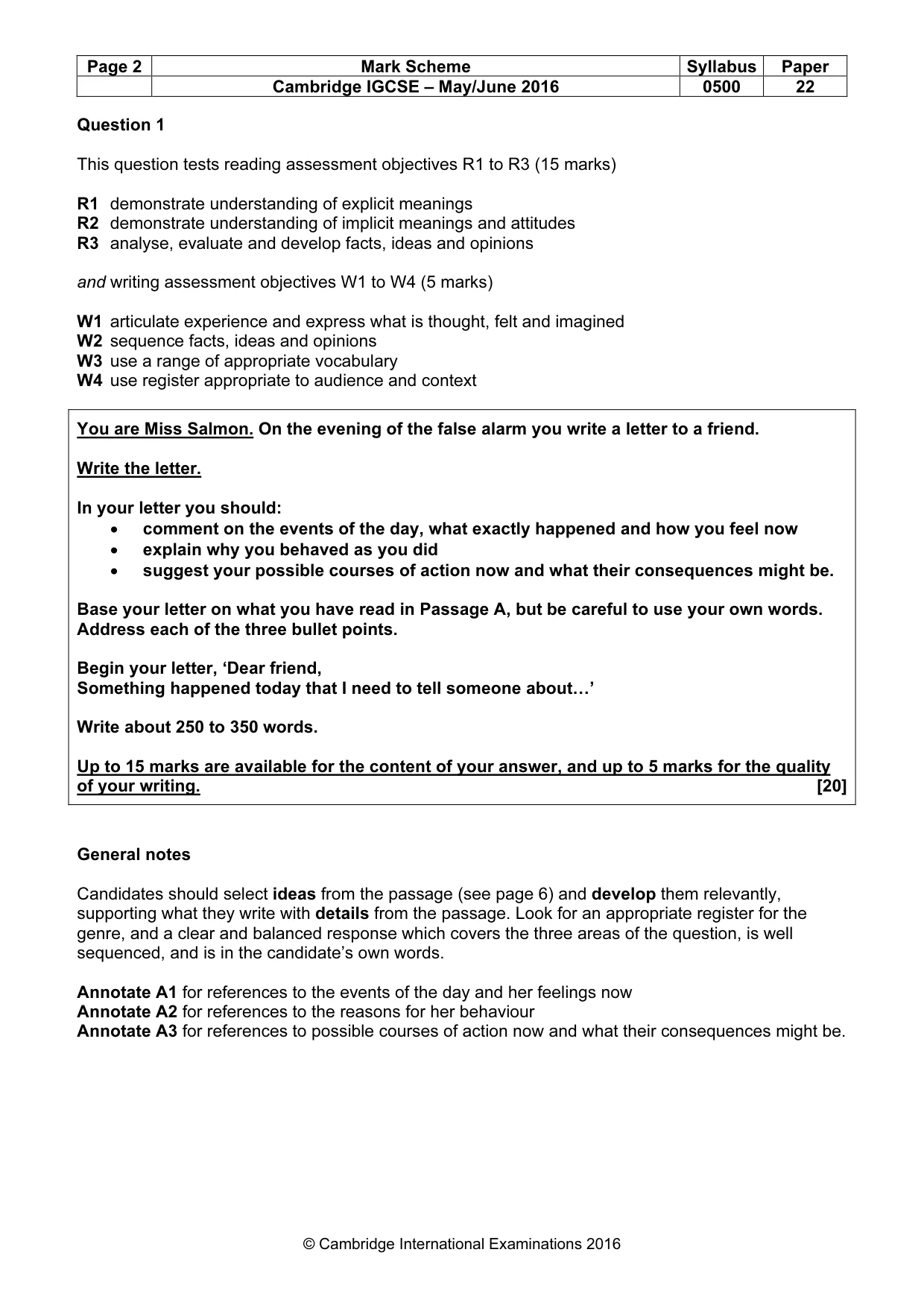
Page 2 Mark Scheme Syllabus Paper Cambridge IGCSE – May/June 2016 0500 22 © Cambridge International Examinations 2016 Question 1 This question tests reading assessment objectives R1 to R3 (15 marks) R1 demonstrate understanding of explicit meanings R2 demonstrate understanding of implicit meanings and attitudes R3 analyse, evaluate and develop facts, ideas and opinions and writing assessment objectives W1 to W4 (5 marks) W1 articulate experience and express what is thought, felt and imagined W2 sequence facts, ideas and opinions W3 use a range of appropriate vocabulary W4 use register appropriate to audience and context You are Miss Salmon. On the evening of the false alarm you write a letter to a friend. Write the letter. In your letter you should: • comment on the events of the day, what exactly happened and how you feel now • explain why you behaved as you did • suggest your possible courses of action now and what their consequences might be. Base your letter on what you have read in Passage A, but be careful to use your own words. Address each of the three bullet points. Begin your letter, ‘Dear friend, Something happened today that I need to tell someone about…’ Write about 250 to 350 words. Up to 15 marks are available for the content of your answer, and up to 5 marks for the quality of your writing. [20] General notes Candidates should select ideas from the passage (see page 6) and develop them relevantly, supporting what they write with details from the passage. Look for an appropriate register for the genre, and a clear and balanced response which covers the three areas of the question, is well sequenced, and is in the candidate’s own words. Annotate A1 for references to the events of the day and her feelings now Annotate A2 for references to the reasons for her behaviour Annotate A3 for references to possible courses of action now and what their consequences might be.
Mark scheme, page 3
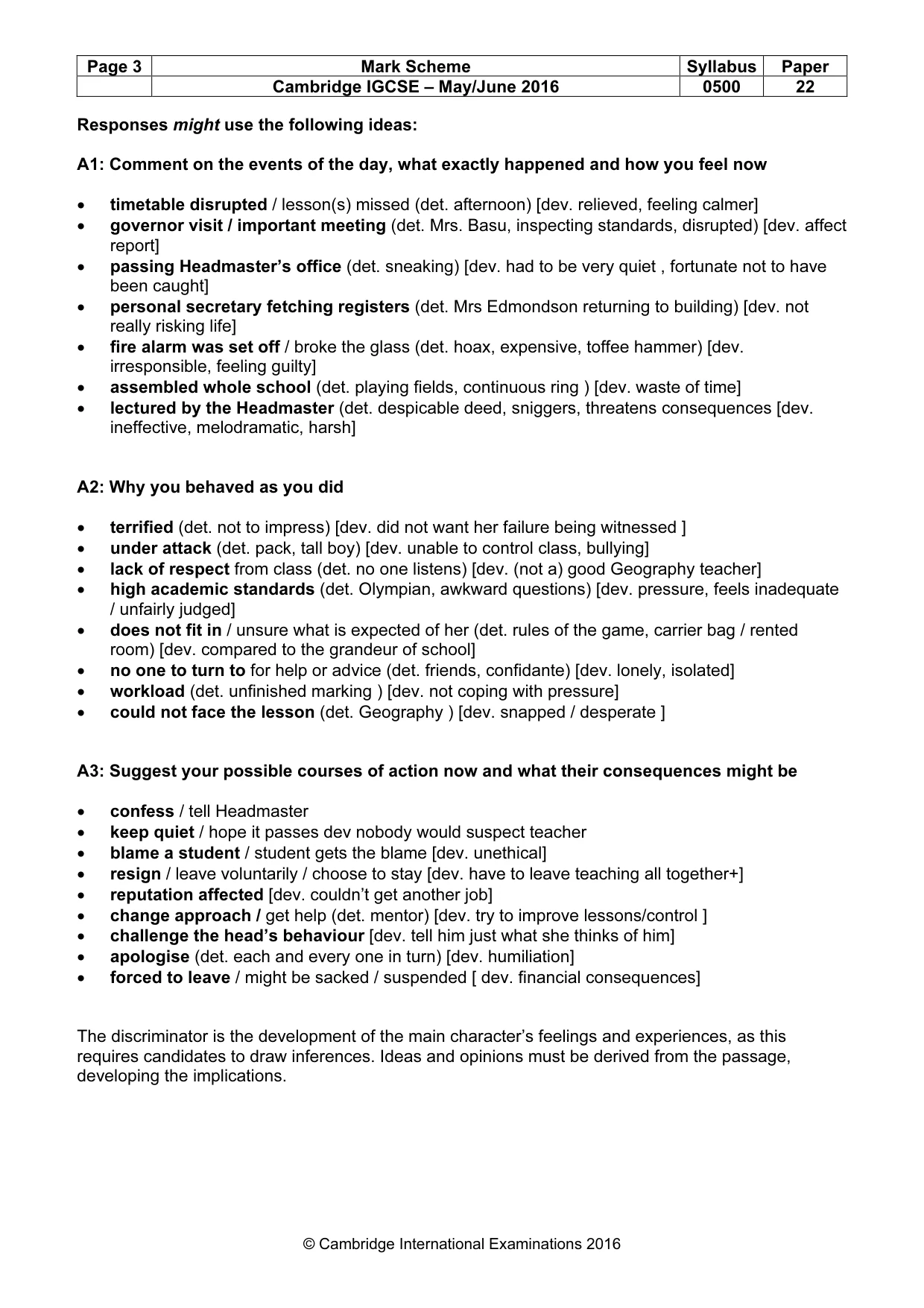
Page 3 Mark Scheme Syllabus Paper Cambridge IGCSE – May/June 2016 0500 22 © Cambridge International Examinations 2016 Responses might use the following ideas: A1: Comment on the events of the day, what exactly happened and how you feel now • timetable disrupted / lesson(s) missed (det. afternoon) [dev. relieved, feeling calmer] • governor visit / important meeting (det. Mrs. Basu, inspecting standards, disrupted) [dev. affect report] • passing Headmaster’s office (det. sneaking) [dev. had to be very quiet , fortunate not to have been caught] • personal secretary fetching registers (det. Mrs Edmondson returning to building) [dev. not really risking life] • fire alarm was set off / broke the glass (det. hoax, expensive, toffee hammer) [dev. irresponsible, feeling guilty] • assembled whole school (det. playing fields, continuous ring ) [dev. waste of time] • lectured by the Headmaster (det. despicable deed, sniggers, threatens consequences [dev. ineffective, melodramatic, harsh] A2: Why you behaved as you did • terrified (det. not to impress) [dev. did not want her failure being witnessed ] • under attack (det. pack, tall boy) [dev. unable to control class, bullying] • lack of respect from class (det. no one listens) [dev. (not a) good Geography teacher] • high academic standards (det. Olympian, awkward questions) [dev. pressure, feels inadequate / unfairly judged] • does not fit in / unsure what is expected of her (det. rules of the game, carrier bag / rented room) [dev. compared to the grandeur of school] • no one to turn to for help or advice (det. friends, confidante) [dev. lonely, isolated] • workload (det. unfinished marking ) [dev. not coping with pressure] • could not face the lesson (det. Geography ) [dev. snapped / desperate ] A3: Suggest your possible courses of action now and what their consequences might be • confess / tell Headmaster • keep quiet / hope it passes dev nobody would suspect teacher • blame a student / student gets the blame [dev. unethical] • resign / leave voluntarily / choose to stay [dev. have to leave teaching all together+] • reputation affected [dev. couldn’t get another job] • change approach / get help (det. mentor) [dev. try to improve lessons/control ] • challenge the head’s behaviour [dev. tell him just what she thinks of him] • apologise (det. each and every one in turn) [dev. humiliation] • forced to leave / might be sacked / suspended [ dev. financial consequences] The discriminator is the development of the main character’s feelings and experiences, as this requires candidates to draw inferences. Ideas and opinions must be derived from the passage, developing the implications.
Mark scheme, page 4
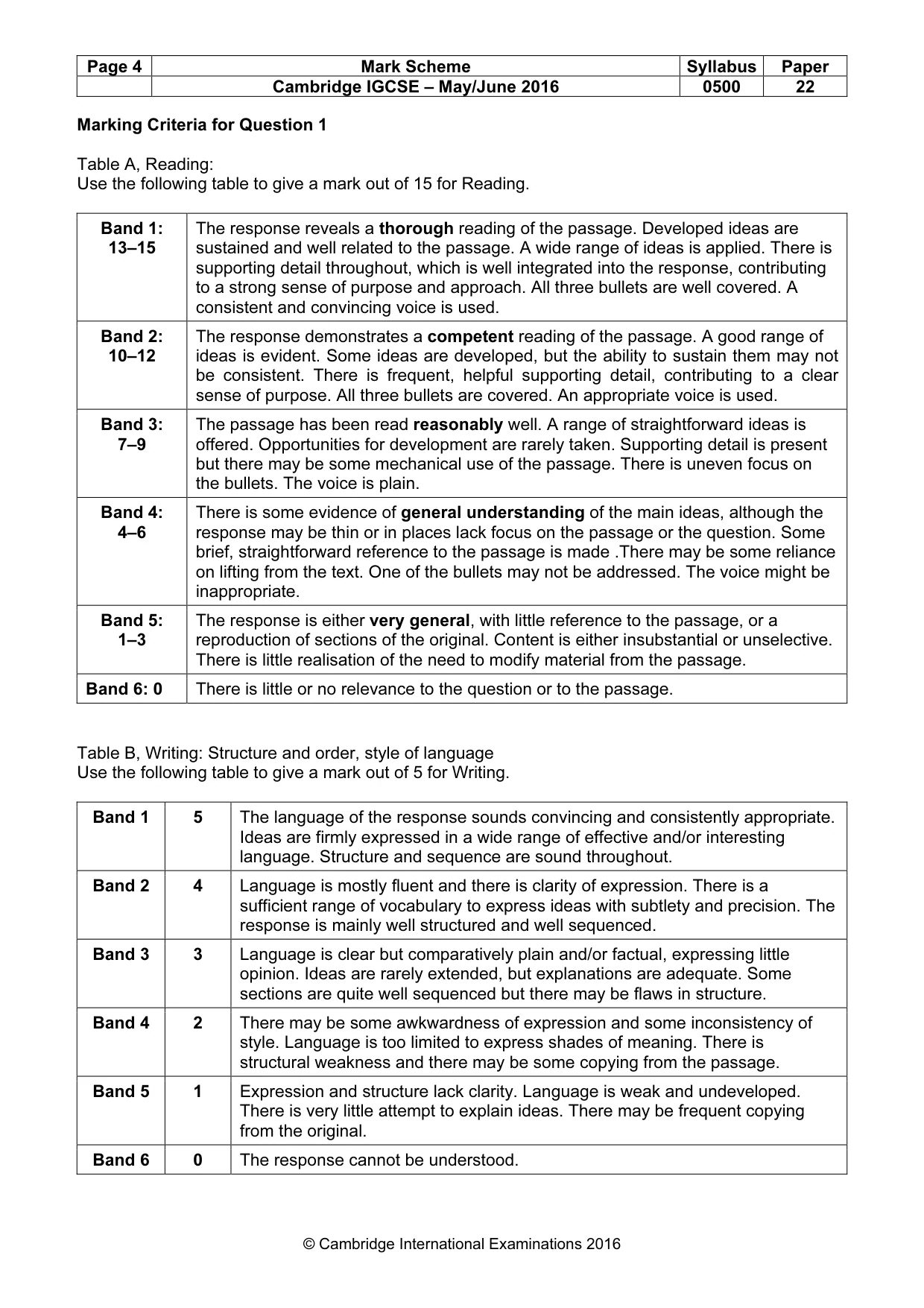
Page 4 Mark Scheme Syllabus Paper Cambridge IGCSE – May/June 2016 0500 22 © Cambridge International Examinations 2016 Marking Criteria for Question 1 Table A, Reading: Use the following table to give a mark out of 15 for Reading. Band 1: 13–15 The response reveals a thorough reading of the passage. Developed ideas are sustained and well related to the passage. A wide range of ideas is applied. There is supporting detail throughout, which is well integrated into the response, contributing to a strong sense of purpose and approach. All three bullets are well covered. A consistent and convincing voice is used. Band 2: 10–12 The response demonstrates a competent reading of the passage. A good range of ideas is evident. Some ideas are developed, but the ability to sustain them may not be consistent. There is frequent, helpful supporting detail, contributing to a clear sense of purpose. All three bullets are covered. An appropriate voice is used. Band 3: 7–9 The passage has been read reasonably well. A range of straightforward ideas is offered. Opportunities for development are rarely taken. Supporting detail is present but there may be some mechanical use of the passage. There is uneven focus on the bullets. The voice is plain. Band 4: 4–6 There is some evidence of general understanding of the main ideas, although the response may be thin or in places lack focus on the passage or the question. Some brief, straightforward reference to the passage is made .There may be some reliance on lifting from the text. One of the bullets may not be addressed. The voice might be inappropriate. Band 5: 1–3 The response is either very general, with little reference to the passage, or a reproduction of sections of the original. Content is either insubstantial or unselective. There is little realisation of the need to modify material from the passage. Band 6: 0 There is little or no relevance to the question or to the passage. Table B, Writing: Structure and order, style of language Use the following table to give a mark out of 5 for Writing. Band 1 5 The language of the response sounds convincing and consistently appropriate. Ideas are firmly expressed in a wide range of effective and/or interesting language. Structure and sequence are sound throughout. Band 2 4 Language is mostly fluent and there is clarity of expression. There is a sufficient range of vocabulary to express ideas with subtlety and precision. The response is mainly well structured and well sequenced. Band 3 3 Language is clear but comparatively plain and/or factual, expressing little opinion. Ideas are rarely extended, but explanations are adequate. Some sections are quite well sequenced but there may be flaws in structure. Band 4 2 There may be some awkwardness of expression and some inconsistency of style. Language is too limited to express shades of meaning. There is structural weakness and there may be some copying from the passage. Band 5 1 Expression and structure lack clarity. Language is weak and undeveloped. There is very little attempt to explain ideas. There may be frequent copying from the original. Band 6 0 The response cannot be understood.
Mark scheme, page 5
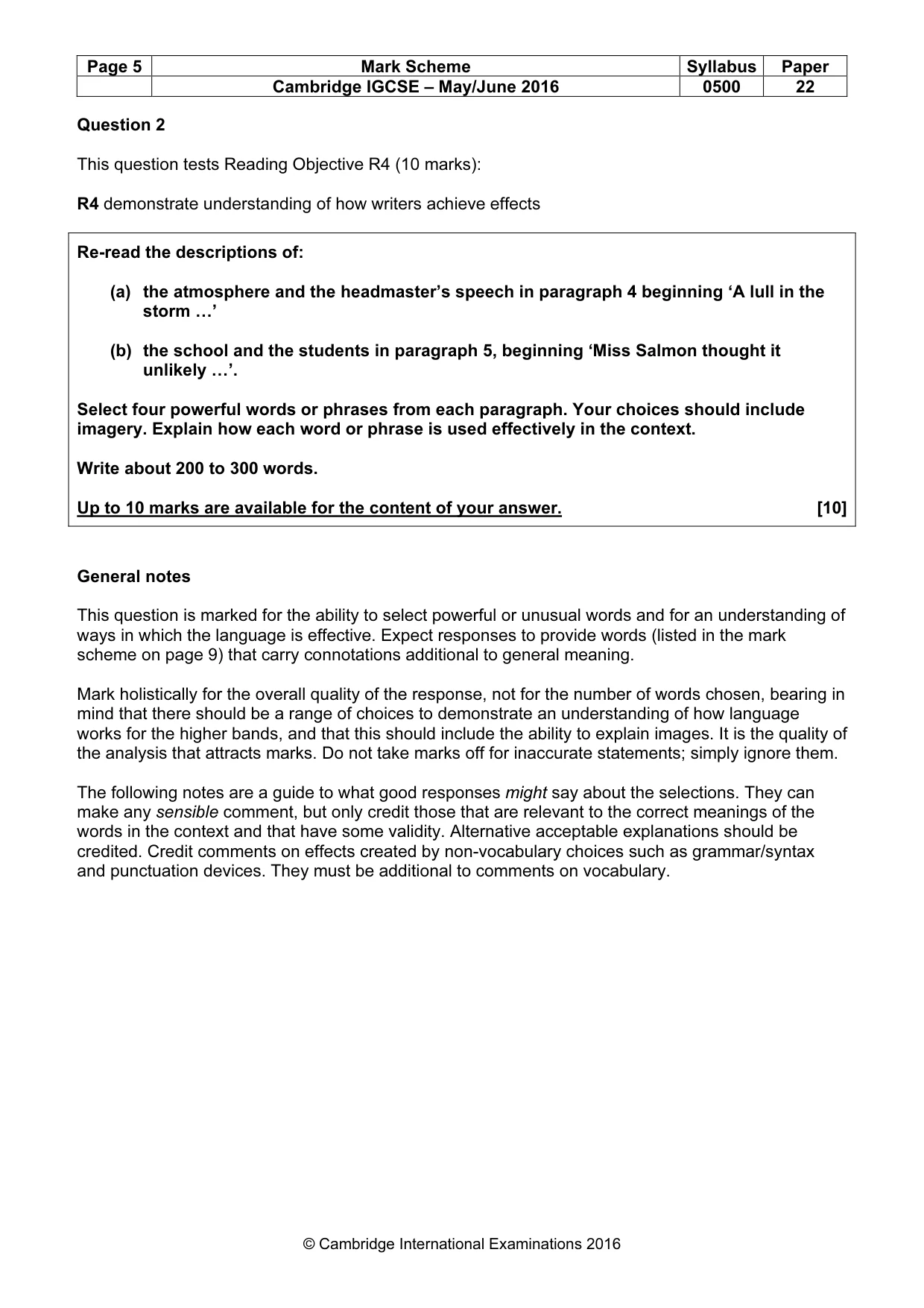
Page 5 Mark Scheme Syllabus Paper Cambridge IGCSE – May/June 2016 0500 22 © Cambridge International Examinations 2016 Question 2 This question tests Reading Objective R4 (10 marks): R4 demonstrate understanding of how writers achieve effects Re-read the descriptions of: (a) the atmosphere and the headmaster’s speech in paragraph 4 beginning ‘A lull in the storm …’ (b) the school and the students in paragraph 5, beginning ‘Miss Salmon thought it unlikely …’. Select four powerful words or phrases from each paragraph. Your choices should include imagery. Explain how each word or phrase is used effectively in the context. Write about 200 to 300 words. Up to 10 marks are available for the content of your answer. [10] General notes This question is marked for the ability to select powerful or unusual words and for an understanding of ways in which the language is effective. Expect responses to provide words (listed in the mark scheme on page 9) that carry connotations additional to general meaning. Mark holistically for the overall quality of the response, not for the number of words chosen, bearing in mind that there should be a range of choices to demonstrate an understanding of how language works for the higher bands, and that this should include the ability to explain images. It is the quality of the analysis that attracts marks. Do not take marks off for inaccurate statements; simply ignore them. The following notes are a guide to what good responses might say about the selections. They can make any sensible comment, but only credit those that are relevant to the correct meanings of the words in the context and that have some validity. Alternative acceptable explanations should be credited. Credit comments on effects created by non-vocabulary choices such as grammar/syntax and punctuation devices. They must be additional to comments on vocabulary.
Mark scheme, page 6
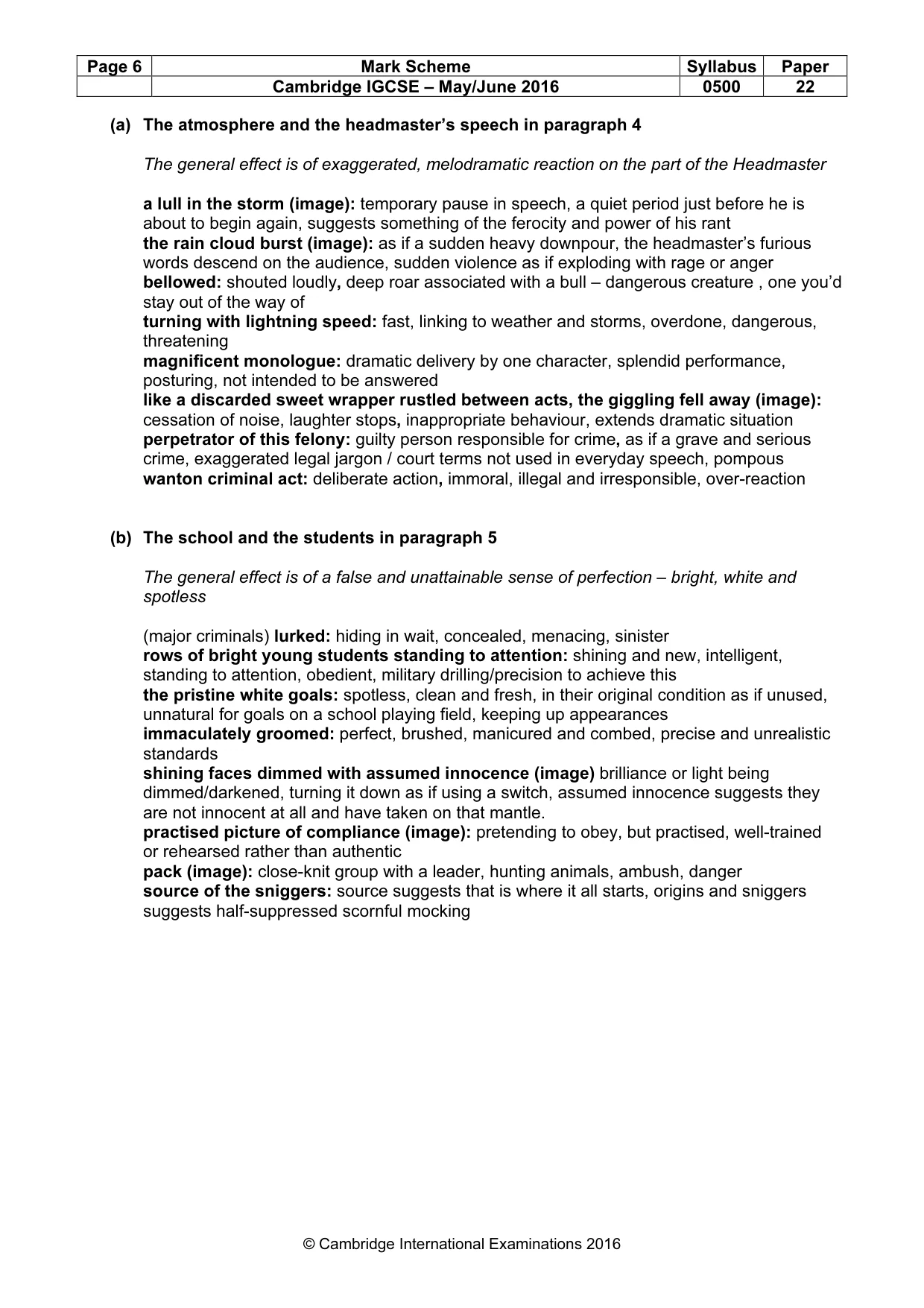
Page 6 Mark Scheme Syllabus Paper Cambridge IGCSE – May/June 2016 0500 22 © Cambridge International Examinations 2016 (a) The atmosphere and the headmaster’s speech in paragraph 4 The general effect is of exaggerated, melodramatic reaction on the part of the Headmaster a lull in the storm (image): temporary pause in speech, a quiet period just before he is about to begin again, suggests something of the ferocity and power of his rant the rain cloud burst (image): as if a sudden heavy downpour, the headmaster’s furious words descend on the audience, sudden violence as if exploding with rage or anger bellowed: shouted loudly, deep roar associated with a bull – dangerous creature , one you’d stay out of the way of turning with lightning speed: fast, linking to weather and storms, overdone, dangerous, threatening magnificent monologue: dramatic delivery by one character, splendid performance, posturing, not intended to be answered like a discarded sweet wrapper rustled between acts, the giggling fell away (image): cessation of noise, laughter stops, inappropriate behaviour, extends dramatic situation perpetrator of this felony: guilty person responsible for crime, as if a grave and serious crime, exaggerated legal jargon / court terms not used in everyday speech, pompous wanton criminal act: deliberate action, immoral, illegal and irresponsible, over-reaction (b) The school and the students in paragraph 5 The general effect is of a false and unattainable sense of perfection – bright, white and spotless (major criminals) lurked: hiding in wait, concealed, menacing, sinister rows of bright young students standing to attention: shining and new, intelligent, standing to attention, obedient, military drilling/precision to achieve this the pristine white goals: spotless, clean and fresh, in their original condition as if unused, unnatural for goals on a school playing field, keeping up appearances immaculately groomed: perfect, brushed, manicured and combed, precise and unrealistic standards shining faces dimmed with assumed innocence (image) brilliance or light being dimmed/darkened, turning it down as if using a switch, assumed innocence suggests they are not innocent at all and have taken on that mantle. practised picture of compliance (image): pretending to obey, but practised, well-trained or rehearsed rather than authentic pack (image): close-knit group with a leader, hunting animals, ambush, danger source of the sniggers: source suggests that is where it all starts, origins and sniggers suggests half-suppressed scornful mocking
Mark scheme, page 7
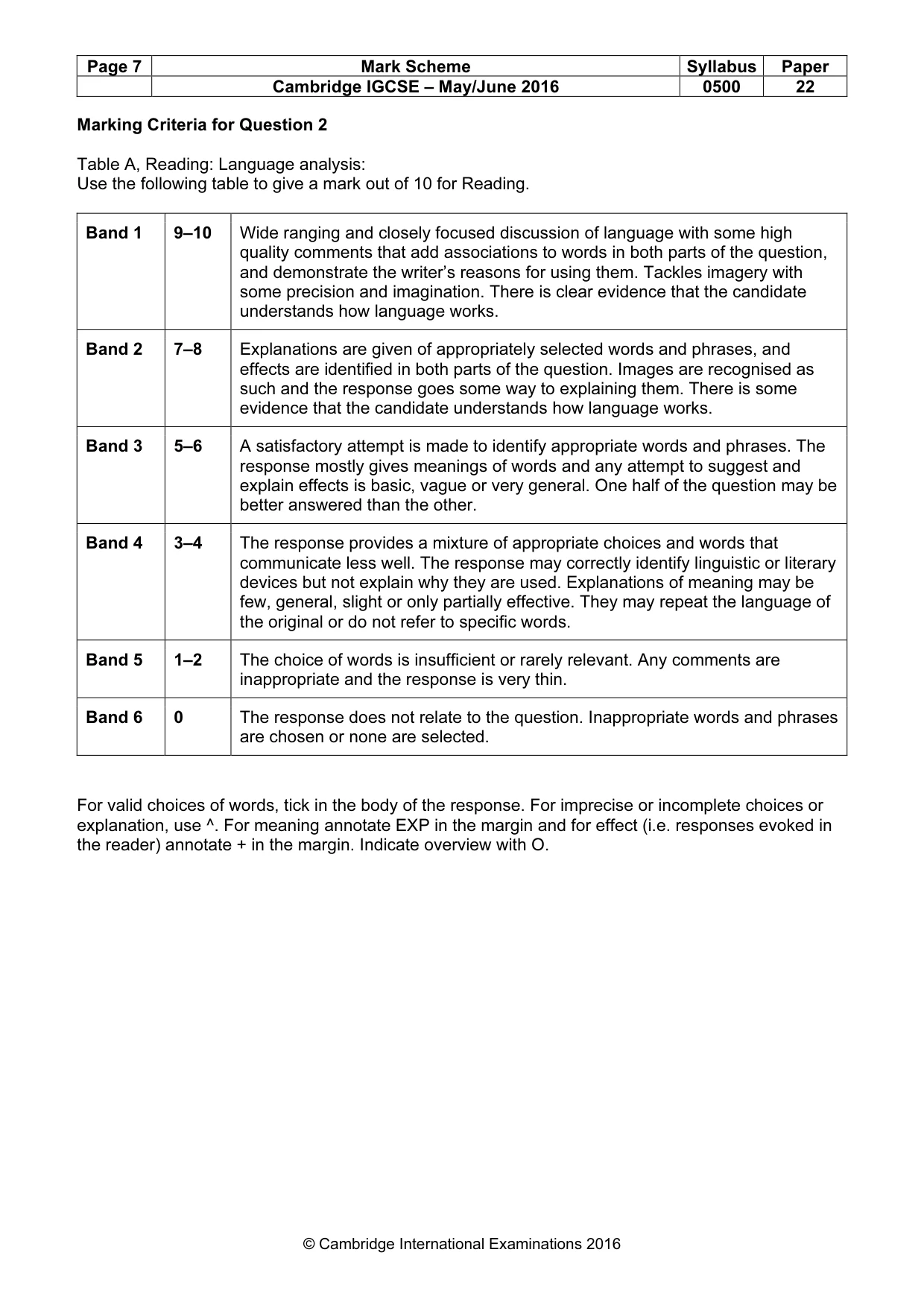
Page 7 Mark Scheme Syllabus Paper Cambridge IGCSE – May/June 2016 0500 22 © Cambridge International Examinations 2016 Marking Criteria for Question 2 Table A, Reading: Language analysis: Use the following table to give a mark out of 10 for Reading. Band 1 9–10 Wide ranging and closely focused discussion of language with some high quality comments that add associations to words in both parts of the question, and demonstrate the writer’s reasons for using them. Tackles imagery with some precision and imagination. There is clear evidence that the candidate understands how language works. Band 2 7–8 Explanations are given of appropriately selected words and phrases, and effects are identified in both parts of the question. Images are recognised as such and the response goes some way to explaining them. There is some evidence that the candidate understands how language works. Band 3 5–6 A satisfactory attempt is made to identify appropriate words and phrases. The response mostly gives meanings of words and any attempt to suggest and explain effects is basic, vague or very general. One half of the question may be better answered than the other. Band 4 3–4 The response provides a mixture of appropriate choices and words that communicate less well. The response may correctly identify linguistic or literary devices but not explain why they are used. Explanations of meaning may be few, general, slight or only partially effective. They may repeat the language of the original or do not refer to specific words. Band 5 1–2 The choice of words is insufficient or rarely relevant. Any comments are inappropriate and the response is very thin. Band 6 0 The response does not relate to the question. Inappropriate words and phrases are chosen or none are selected. For valid choices of words, tick in the body of the response. For imprecise or incomplete choices or explanation, use ^. For meaning annotate EXP in the margin and for effect (i.e. responses evoked in the reader) annotate + in the margin. Indicate overview with O.
Mark scheme, page 8
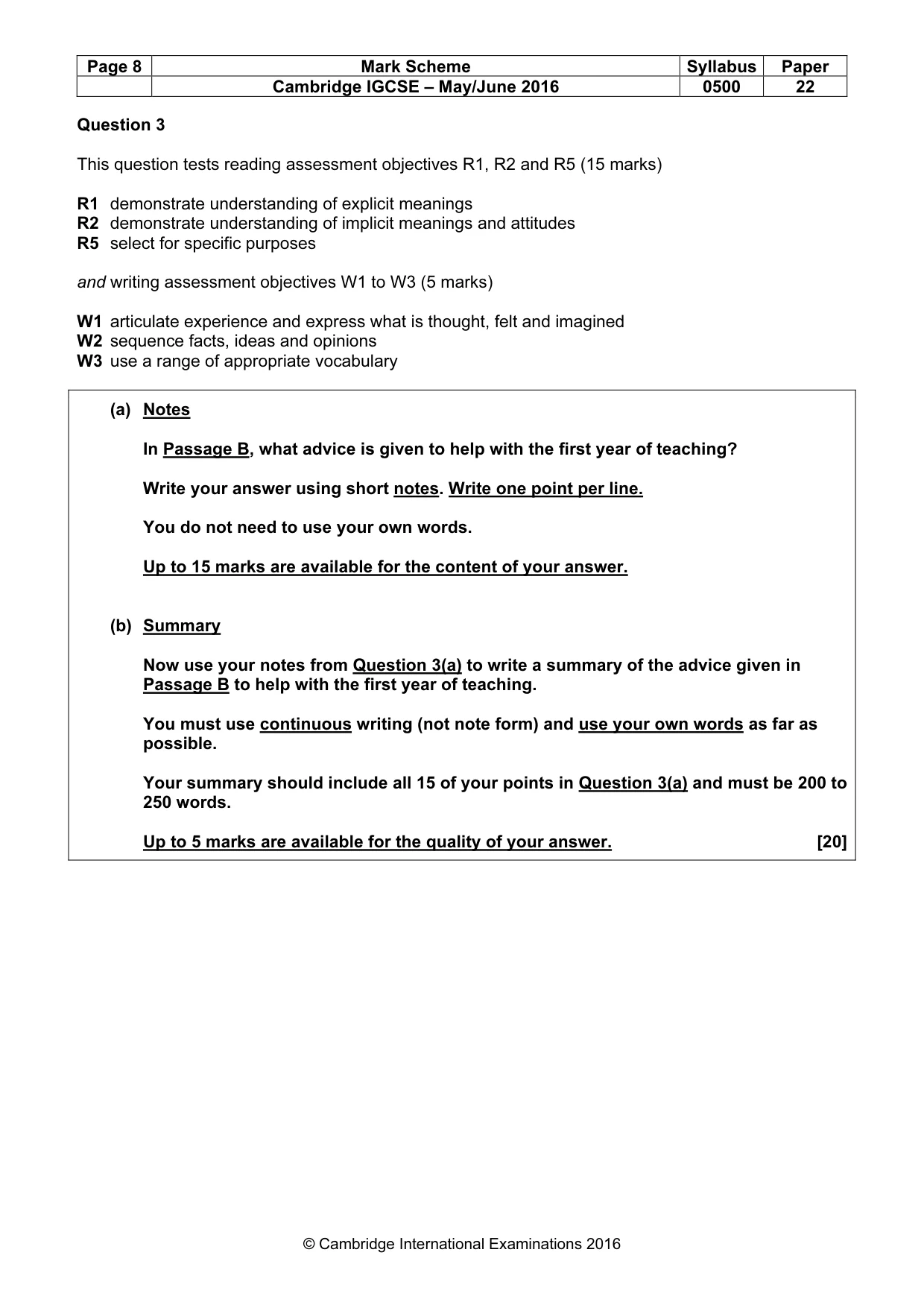
Page 8 Mark Scheme Syllabus Paper Cambridge IGCSE – May/June 2016 0500 22 © Cambridge International Examinations 2016 Question 3 This question tests reading assessment objectives R1, R2 and R5 (15 marks) R1 demonstrate understanding of explicit meanings R2 demonstrate understanding of implicit meanings and attitudes R5 select for specific purposes and writing assessment objectives W1 to W3 (5 marks) W1 articulate experience and express what is thought, felt and imagined W2 sequence facts, ideas and opinions W3 use a range of appropriate vocabulary (a) Notes In Passage B, what advice is given to help with the first year of teaching? Write your answer using short notes. Write one point per line. You do not need to use your own words. Up to 15 marks are available for the content of your answer. (b) Summary Now use your notes from Question 3(a) to write a summary of the advice given in Passage B to help with the first year of teaching. You must use continuous writing (not note form) and use your own words as far as possible. Your summary should include all 15 of your points in Question 3(a) and must be 200 to 250 words. Up to 5 marks are available for the quality of your answer. [20]
Mark scheme, page 9
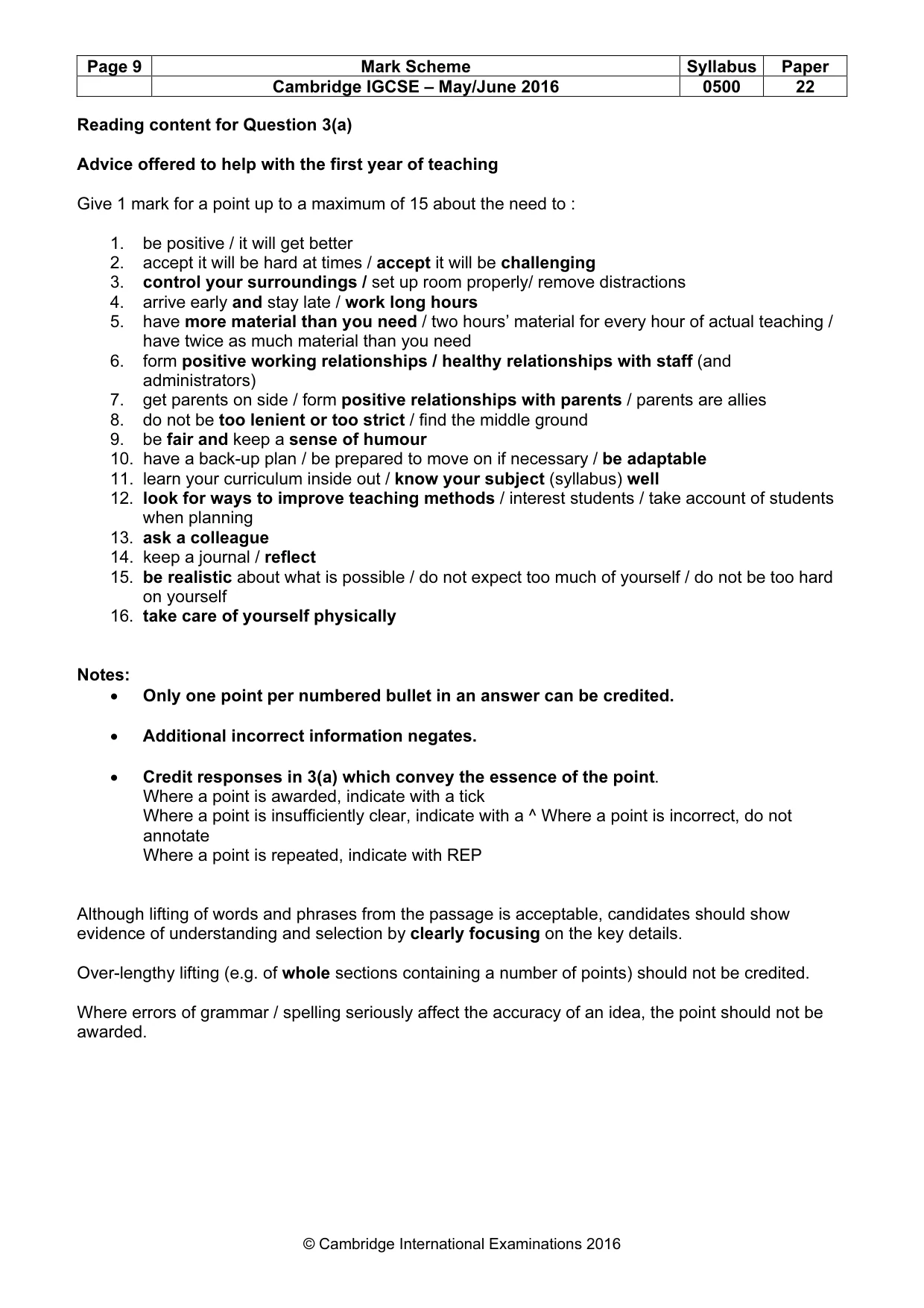
Page 9 Mark Scheme Syllabus Paper Cambridge IGCSE – May/June 2016 0500 22 © Cambridge International Examinations 2016 Reading content for Question 3(a) Advice offered to help with the first year of teaching Give 1 mark for a point up to a maximum of 15 about the need to : 1. be positive / it will get better 2. accept it will be hard at times / accept it will be challenging 3. control your surroundings / set up room properly/ remove distractions 4. arrive early and stay late / work long hours 5. have more material than you need / two hours’ material for every hour of actual teaching / have twice as much material than you need 6. form positive working relationships / healthy relationships with staff (and administrators) 7. get parents on side / form positive relationships with parents / parents are allies 8. do not be too lenient or too strict / find the middle ground 9. be fair and keep a sense of humour 10. have a back-up plan / be prepared to move on if necessary / be adaptable 11. learn your curriculum inside out / know your subject (syllabus) well 12. look for ways to improve teaching methods / interest students / take account of students when planning 13. ask a colleague 14. keep a journal / reflect 15. be realistic about what is possible / do not expect too much of yourself / do not be too hard on yourself 16. take care of yourself physically Notes: • Only one point per numbered bullet in an answer can be credited. • Additional incorrect information negates. • Credit responses in 3(a) which convey the essence of the point. Where a point is awarded, indicate with a tick Where a point is insufficiently clear, indicate with a ^ Where a point is incorrect, do not annotate Where a point is repeated, indicate with REP Although lifting of words and phrases from the passage is acceptable, candidates should show evidence of understanding and selection by clearly focusing on the key details. Over-lengthy lifting (e.g. of whole sections containing a number of points) should not be credited. Where errors of grammar / spelling seriously affect the accuracy of an idea, the point should not be awarded.
Mark scheme, page 10
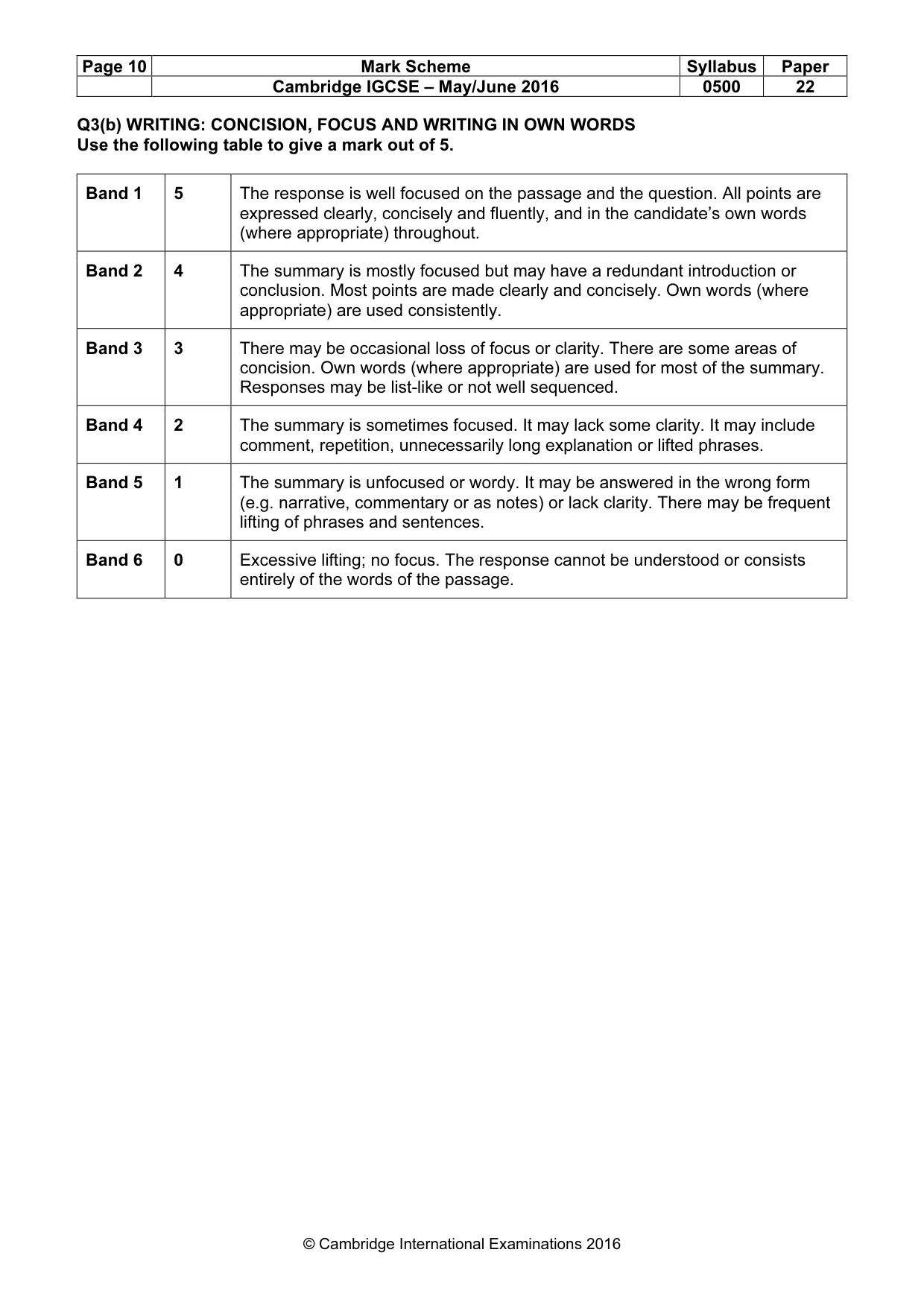
Page 10 Mark Scheme Syllabus Paper Cambridge IGCSE – May/June 2016 0500 22 © Cambridge International Examinations 2016 Q3(b) WRITING: CONCISION, FOCUS AND WRITING IN OWN WORDS Use the following table to give a mark out of 5. Band 1 5 The response is well focused on the passage and the question. All points are expressed clearly, concisely and fluently, and in the candidate’s own words (where appropriate) throughout. Band 2 4 The summary is mostly focused but may have a redundant introduction or conclusion. Most points are made clearly and concisely. Own words (where appropriate) are used consistently. Band 3 3 There may be occasional loss of focus or clarity. There are some areas of concision. Own words (where appropriate) are used for most of the summary. Responses may be list-like or not well sequenced. Band 4 2 The summary is sometimes focused. It may lack some clarity. It may include comment, repetition, unnecessarily long explanation or lifted phrases. Band 5 1 The summary is unfocused or wordy. It may be answered in the wrong form (e.g. narrative, commentary or as notes) or lack clarity. There may be frequent lifting of phrases and sentences. Band 6 0 Excessive lifting; no focus. The response cannot be understood or consists entirely of the words of the passage.
What you needed in this session
Cambridge’s own grade thresholds for 2016 May/June, Paper 2 · Variant 2. A higher threshold means an easier paper — the bar moves with how the cohort did.