Cambridge IGCSE English - First Language 0500 — 2016 May/June Paper 2 · Variant 1
0500/21/M/J/16 · 50 marks · ≈56 min
The question paper and its mark scheme, free to read here and free to download. This is Cambridge’s own paper, exactly as it was sat.
Question paper12 pages
Mark scheme12 pages
Answers below. Sit the paper first if you are practising.
Paper as text
Question paper, page 1
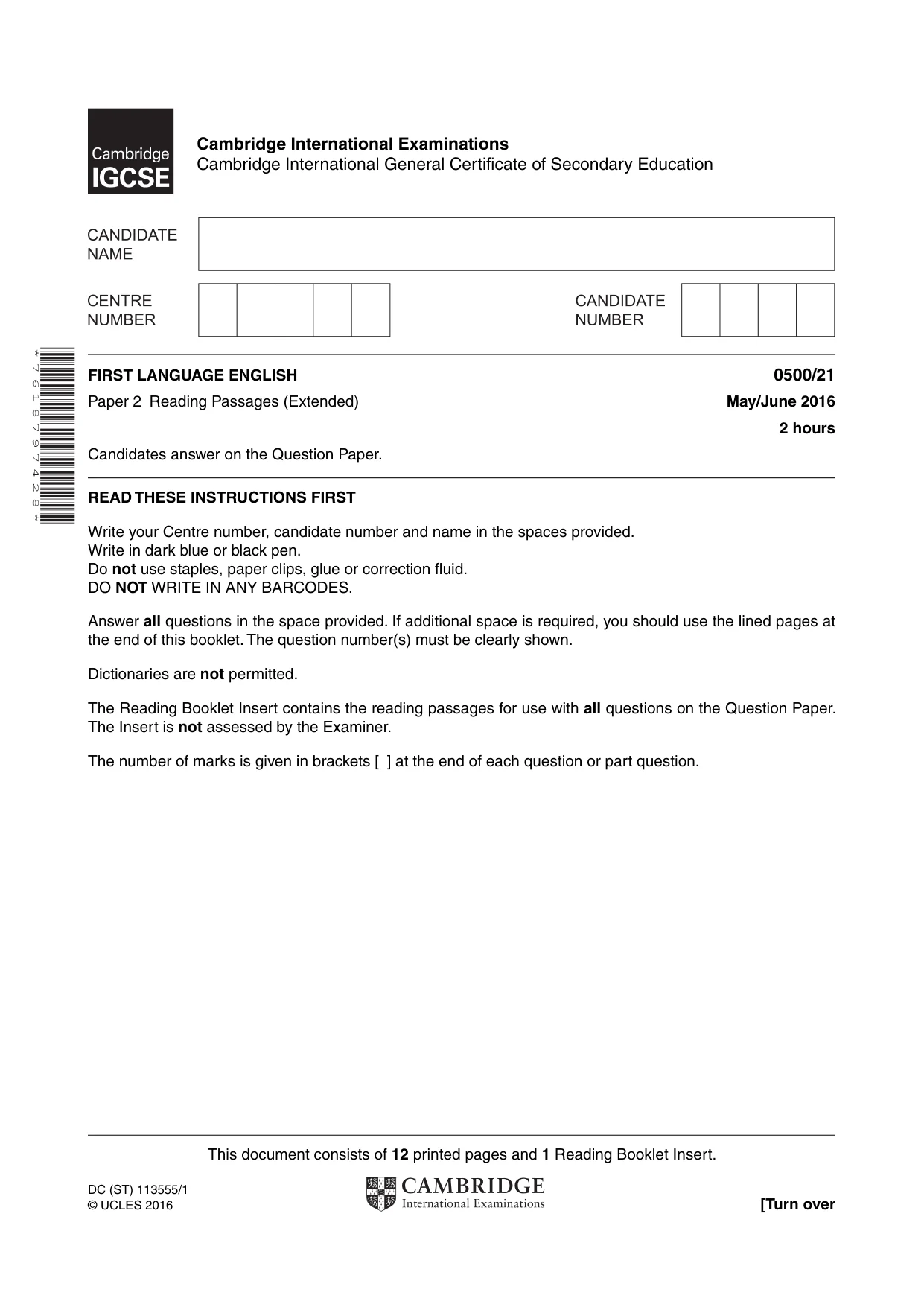
This document consists of 12 printed pages and 1 Reading Booklet Insert. DC (ST) 113555/1 © UCLES 2016 [Turn over Cambridge International Examinations Cambridge International General Certificate of Secondary Education * 7 6 1 8 7 9 7 4 2 8 * FIRST LANGUAGE ENGLISH 0500/21 Paper 2 Reading Passages (Extended) May/June 2016 2 hours Candidates answer on the Question Paper. READ THESE INSTRUCTIONS FIRST Write your Centre number, candidate number and name in the spaces provided. Write in dark blue or black pen. Do not use staples, paper clips, glue or correction fluid. DO NOT WRITE IN ANY BARCODES. Answer all questions in the space provided. If additional space is required, you should use the lined pages at the end of this booklet. The question number(s) must be clearly shown. Dictionaries are not permitted. The Reading Booklet Insert contains the reading passages for use with all questions on the Question Paper. The Insert is not assessed by the Examiner. The number of marks is given in brackets [ ] at the end of each question or part question.
Question paper, page 2
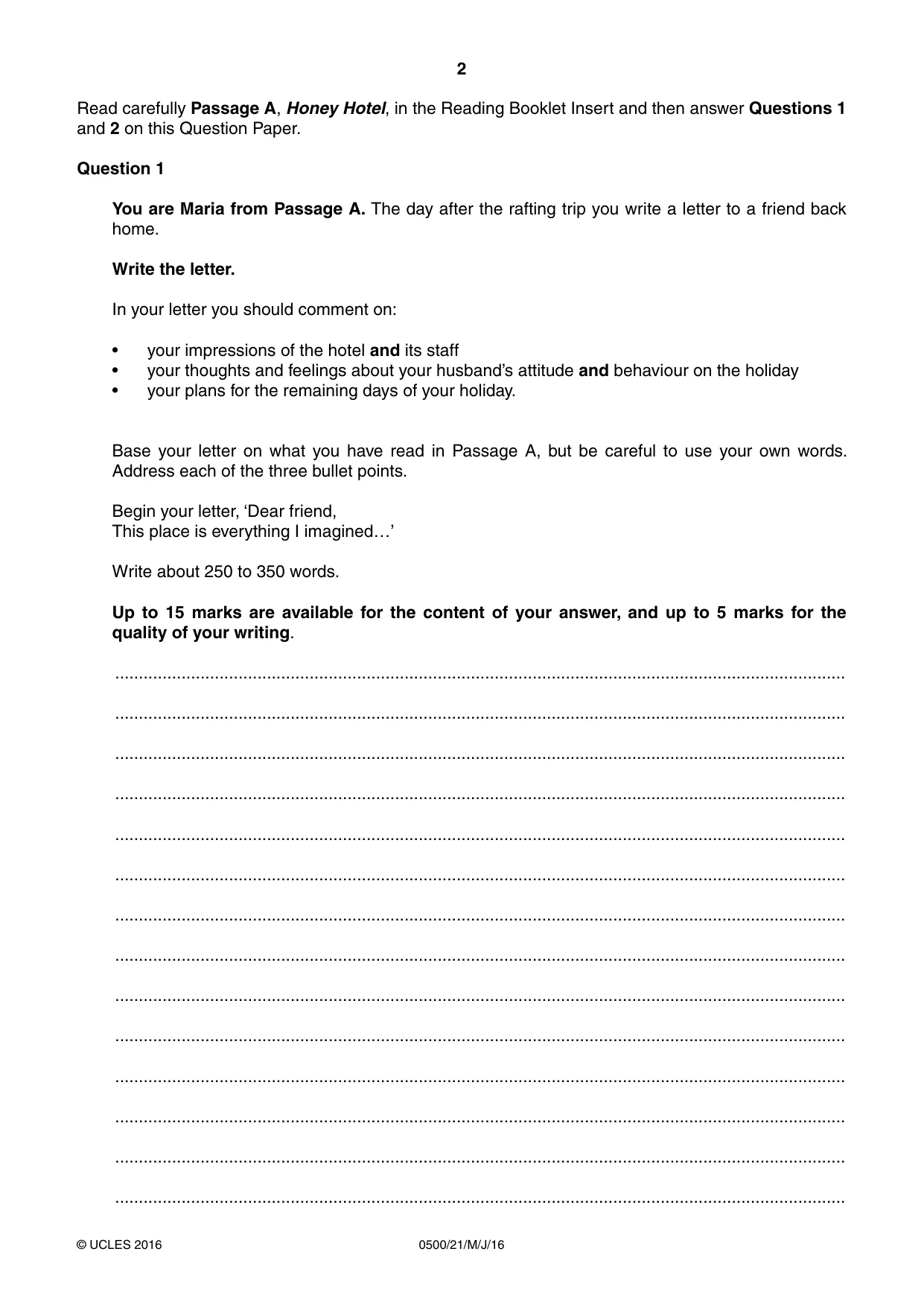
2 0500/21/M/J/16 © UCLES 2016 Read carefully Passage A, Honey Hotel, in the Reading Booklet Insert and then answer Questions 1 and 2 on this Question Paper. Question 1 You are Maria from Passage A. The day after the rafting trip you write a letter to a friend back home. Write the letter. In your letter you should comment on: • your impressions of the hotel and its staff • your thoughts and feelings about your husband’s attitude and behaviour on the holiday • your plans for the remaining days of your holiday. Base your letter on what you have read in Passage A, but be careful to use your own words. Address each of the three bullet points. Begin your letter, ‘Dear friend, This place is everything I imagined…’ Write about 250 to 350 words. Up to 15 marks are available for the content of your answer, and up to 5 marks for the quality of your writing. … … … … … … … … … … … … … …
Question paper, page 3
3 0500/21/M/J/16 © UCLES 2016 [Turn over … … … … … … … … … … … … … … … … … … … … … … … … … … … …
Question paper, page 4
4 0500/21/M/J/16 © UCLES 2016 … … … … … … … … … … … … … … … … … … … … … … … … … … … [Total: 20]
Question paper, page 5
5 0500/21/M/J/16 © UCLES 2016 [Turn over [Turn over for Question 2]
Question paper, page 6
6 0500/21/M/J/16 © UCLES 2016 Question 2 Re-read the descriptions of: (a) the winning entry in paragraph 4, beginning ‘He agreed…’ (b) Al and Mr Head’s visits to the market in paragraph 6, beginning ‘On the second morning…’. Select four powerful words or phrases from each paragraph. Your choices should include imagery. Explain how each word or phrase selected is used effectively in the context. Write about 200 to 300 words. Up to 10 marks are available for the content of your answer. … … … … … … … … … … … … … … … … … … … … …
Question paper, page 7
7 0500/21/M/J/16 © UCLES 2016 [Turn over … … … … … … … … … … … … … … … … … … … … … … … … … … … [Total: 10]
Question paper, page 8
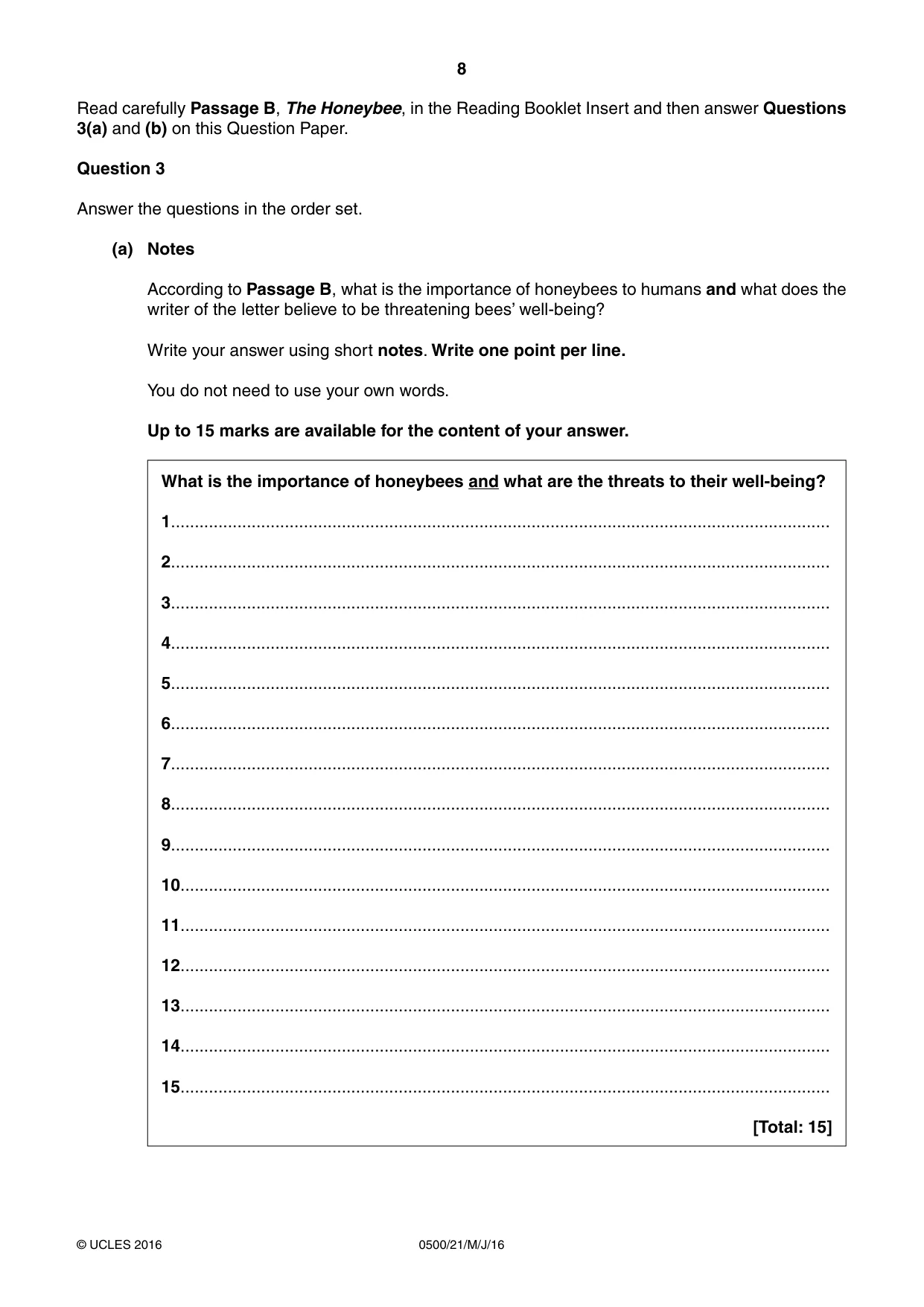
8 0500/21/M/J/16 © UCLES 2016 Read carefully Passage B, The Honeybee, in the Reading Booklet Insert and then answer Questions 3(a) and (b) on this Question Paper. Question 3 Answer the questions in the order set. (a) Notes According to Passage B, what is the importance of honeybees to humans and what does the writer of the letter believe to be threatening bees’ well-being? Write your answer using short notes. Write one point per line. You do not need to use your own words. Up to 15 marks are available for the content of your answer. What is the importance of honeybees and what are the threats to their well-being? 1… 2… 3… 4… 5… 6… 7… 8… 9… 10… 11… 12… 13… 14… 15… [Total: 15]
Question paper, page 9
9 0500/21/M/J/16 © UCLES 2016 [Turn over (b) Summary Now use your notes from Question 3(a) to write a summary of the importance of honeybees to humans and what is threatening bees’ well-being, according to Passage B. You must use continuous writing (not note form) and use your own words as far as possible. Your summary should include all 15 of your points in Question 3(a) and must be 200 to 250 words. Up to 5 marks are available for the quality of your writing. … … … … … … … … … … … … … … … … … … … … … …
Question paper, page 10
10 0500/21/M/J/16 © UCLES 2016 … … … … … … … … … … … [Total: 5]
Question paper, page 11
11 0500/21/M/J/16 © UCLES 2016 ADDITIONAL PAGE If you use the following lined page to complete the answer(s) to any question(s), the question number(s) must be clearly shown. … … … … … … … … … … … … … … … … … … … … … … … … … …
Question paper, page 12
12 0500/21/M/J/16 © UCLES 2016 Permission to reproduce items where third-party owned material protected by copyright is included has been sought and cleared where possible. Every reasonable effort has been made by the publisher (UCLES) to trace copyright holders, but if any items requiring clearance have unwittingly been included, the publisher will be pleased to make amends at the earliest possible opportunity. To avoid the issue of disclosure of answer-related information to candidates, all copyright acknowledgements are reproduced online in the Cambridge International Examinations Copyright Acknowledgements Booklet. This is produced for each series of examinations and is freely available to download at www.cie.org.uk after the live examination series. Cambridge International Examinations is part of the Cambridge Assessment Group. Cambridge Assessment is the brand name of University of Cambridge Local Examinations Syndicate (UCLES), which is itself a department of the University of Cambridge. ADDITIONAL PAGE If you use the following lined page to complete the answer(s) to any question(s), the question number(s) must be clearly shown. … … … … … … … … … … … … … … … … … … … … …
Mark scheme, page 1
® IGCSE is the registered trademark of Cambridge International Examinations. This document consists of 12 printed pages. © UCLES 2016 [Turn over Cambridge International Examinations Cambridge International General Certificate of Secondary Education FIRST LANGUAGE ENGLISH 0500/21 Paper 2 Reading Passages – Extended May/June 2016 MARK SCHEME Maximum Mark: 50 Published This mark scheme is published as an aid to teachers and candidates, to indicate the requirements of the examination. It shows the basis on which Examiners were instructed to award marks. It does not indicate the details of the discussions that took place at an Examiners’ meeting before marking began, which would have considered the acceptability of alternative answers. Mark schemes should be read in conjunction with the question paper and the Principal Examiner Report for Teachers. Cambridge will not enter into discussions about these mark schemes. Cambridge is publishing the mark schemes for the May/June 2016 series for most Cambridge IGCSE®, Cambridge International A and AS Level components and some Cambridge O Level components.
Mark scheme, page 2
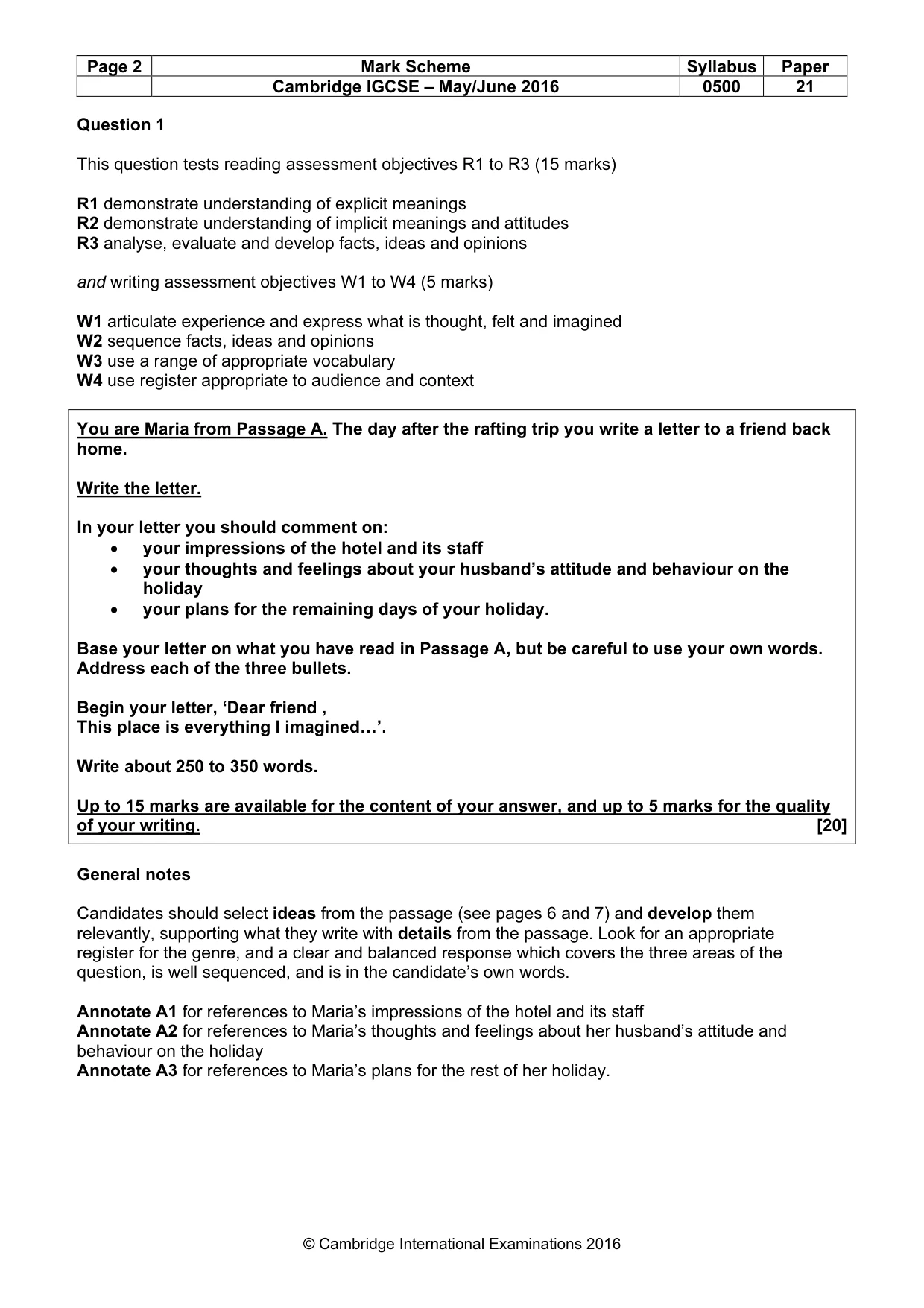
Page 2 Mark Scheme Syllabus Paper Cambridge IGCSE – May/June 2016 0500 21 © Cambridge International Examinations 2016 Question 1 This question tests reading assessment objectives R1 to R3 (15 marks) R1 demonstrate understanding of explicit meanings R2 demonstrate understanding of implicit meanings and attitudes R3 analyse, evaluate and develop facts, ideas and opinions and writing assessment objectives W1 to W4 (5 marks) W1 articulate experience and express what is thought, felt and imagined W2 sequence facts, ideas and opinions W3 use a range of appropriate vocabulary W4 use register appropriate to audience and context You are Maria from Passage A. The day after the rafting trip you write a letter to a friend back home. Write the letter. In your letter you should comment on: • your impressions of the hotel and its staff • your thoughts and feelings about your husband’s attitude and behaviour on the holiday • your plans for the remaining days of your holiday. Base your letter on what you have read in Passage A, but be careful to use your own words. Address each of the three bullets. Begin your letter, ‘Dear friend , This place is everything I imagined…’. Write about 250 to 350 words. Up to 15 marks are available for the content of your answer, and up to 5 marks for the quality of your writing. [20] General notes Candidates should select ideas from the passage (see pages 6 and 7) and develop them relevantly, supporting what they write with details from the passage. Look for an appropriate register for the genre, and a clear and balanced response which covers the three areas of the question, is well sequenced, and is in the candidate’s own words. Annotate A1 for references to Maria’s impressions of the hotel and its staff Annotate A2 for references to Maria’s thoughts and feelings about her husband’s attitude and behaviour on the holiday Annotate A3 for references to Maria’s plans for the rest of her holiday.
Mark scheme, page 3
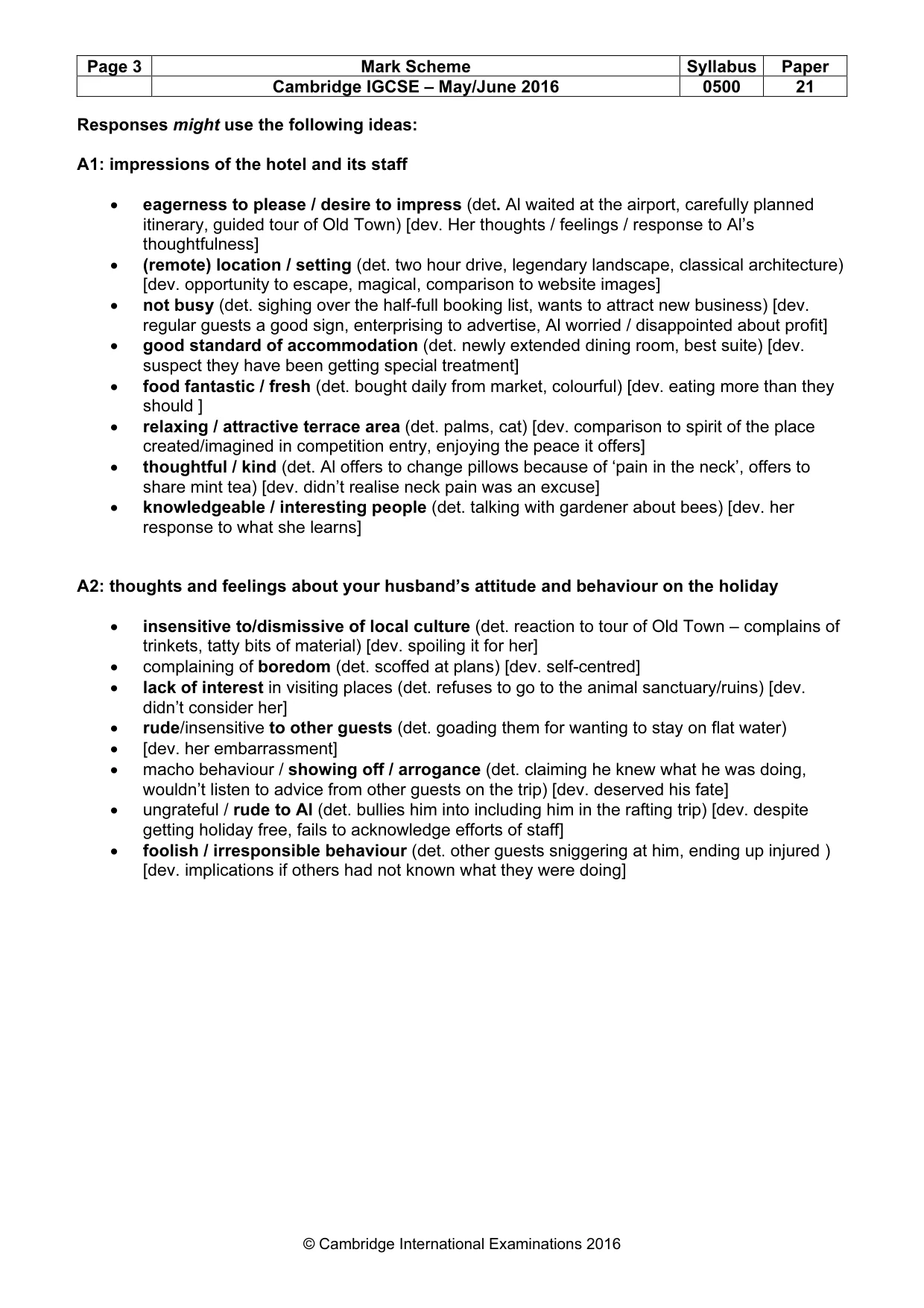
Page 3 Mark Scheme Syllabus Paper Cambridge IGCSE – May/June 2016 0500 21 © Cambridge International Examinations 2016 Responses might use the following ideas: A1: impressions of the hotel and its staff • eagerness to please / desire to impress (det. Al waited at the airport, carefully planned itinerary, guided tour of Old Town) [dev. Her thoughts / feelings / response to Al’s thoughtfulness] • (remote) location / setting (det. two hour drive, legendary landscape, classical architecture) [dev. opportunity to escape, magical, comparison to website images] • not busy (det. sighing over the half-full booking list, wants to attract new business) [dev. regular guests a good sign, enterprising to advertise, Al worried / disappointed about profit] • good standard of accommodation (det. newly extended dining room, best suite) [dev. suspect they have been getting special treatment] • food fantastic / fresh (det. bought daily from market, colourful) [dev. eating more than they should ] • relaxing / attractive terrace area (det. palms, cat) [dev. comparison to spirit of the place created/imagined in competition entry, enjoying the peace it offers] • thoughtful / kind (det. Al offers to change pillows because of ‘pain in the neck’, offers to share mint tea) [dev. didn’t realise neck pain was an excuse] • knowledgeable / interesting people (det. talking with gardener about bees) [dev. her response to what she learns] A2: thoughts and feelings about your husband’s attitude and behaviour on the holiday • insensitive to/dismissive of local culture (det. reaction to tour of Old Town – complains of trinkets, tatty bits of material) [dev. spoiling it for her] • complaining of boredom (det. scoffed at plans) [dev. self-centred] • lack of interest in visiting places (det. refuses to go to the animal sanctuary/ruins) [dev. didn’t consider her] • rude/insensitive to other guests (det. goading them for wanting to stay on flat water) • [dev. her embarrassment] • macho behaviour / showing off / arrogance (det. claiming he knew what he was doing, wouldn’t listen to advice from other guests on the trip) [dev. deserved his fate] • ungrateful / rude to Al (det. bullies him into including him in the rafting trip) [dev. despite getting holiday free, fails to acknowledge efforts of staff] • foolish / irresponsible behaviour (det. other guests sniggering at him, ending up injured ) [dev. implications if others had not known what they were doing]
Mark scheme, page 4
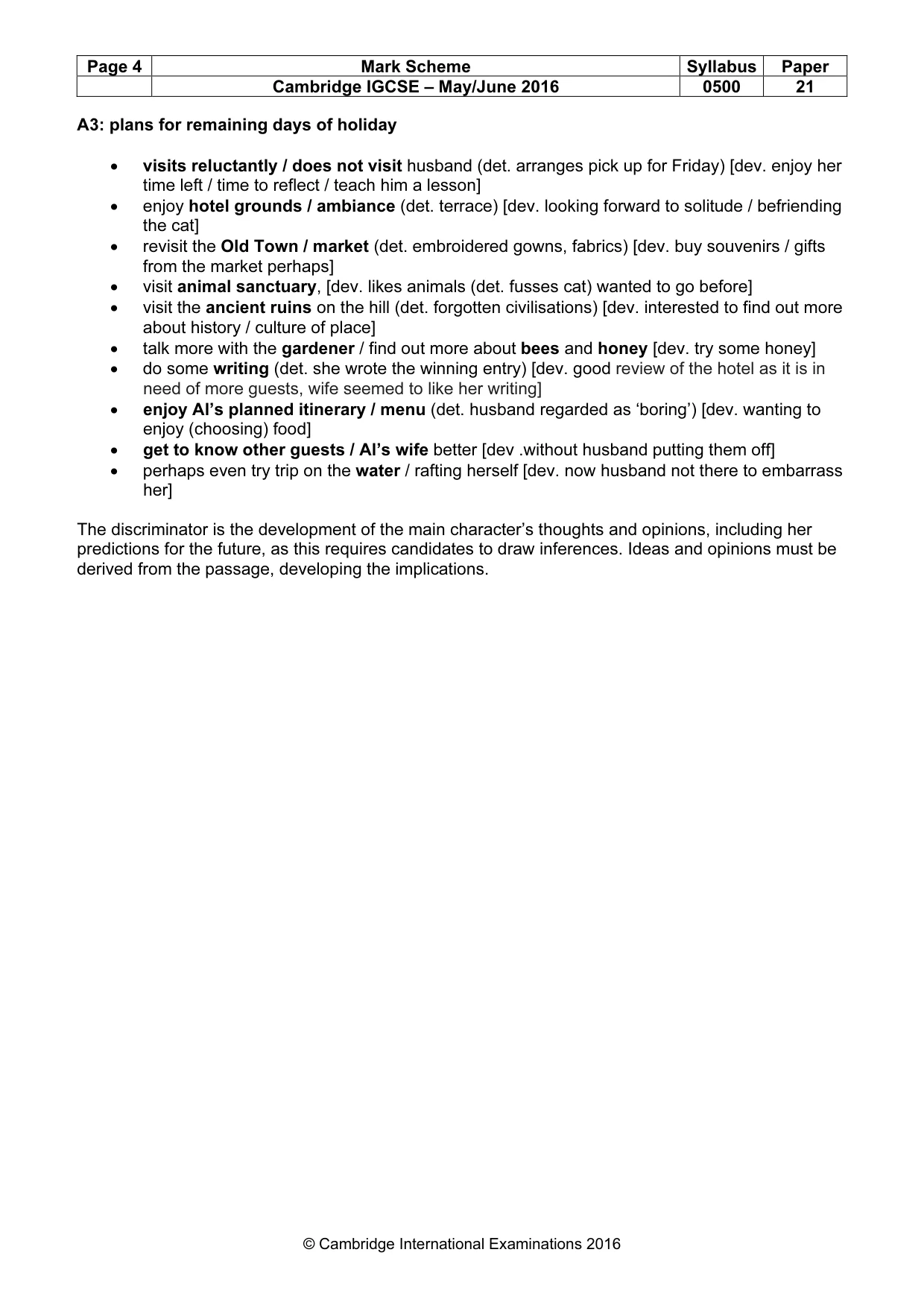
Page 4 Mark Scheme Syllabus Paper Cambridge IGCSE – May/June 2016 0500 21 © Cambridge International Examinations 2016 A3: plans for remaining days of holiday • visits reluctantly / does not visit husband (det. arranges pick up for Friday) [dev. enjoy her time left / time to reflect / teach him a lesson] • enjoy hotel grounds / ambiance (det. terrace) [dev. looking forward to solitude / befriending the cat] • revisit the Old Town / market (det. embroidered gowns, fabrics) [dev. buy souvenirs / gifts from the market perhaps] • visit animal sanctuary, [dev. likes animals (det. fusses cat) wanted to go before] • visit the ancient ruins on the hill (det. forgotten civilisations) [dev. interested to find out more about history / culture of place] • talk more with the gardener / find out more about bees and honey [dev. try some honey] • do some writing (det. she wrote the winning entry) [dev. good review of the hotel as it is in need of more guests, wife seemed to like her writing] • enjoy Al’s planned itinerary / menu (det. husband regarded as ‘boring’) [dev. wanting to enjoy (choosing) food] • get to know other guests / Al’s wife better [dev .without husband putting them off] • perhaps even try trip on the water / rafting herself [dev. now husband not there to embarrass her] The discriminator is the development of the main character’s thoughts and opinions, including her predictions for the future, as this requires candidates to draw inferences. Ideas and opinions must be derived from the passage, developing the implications.
Mark scheme, page 5
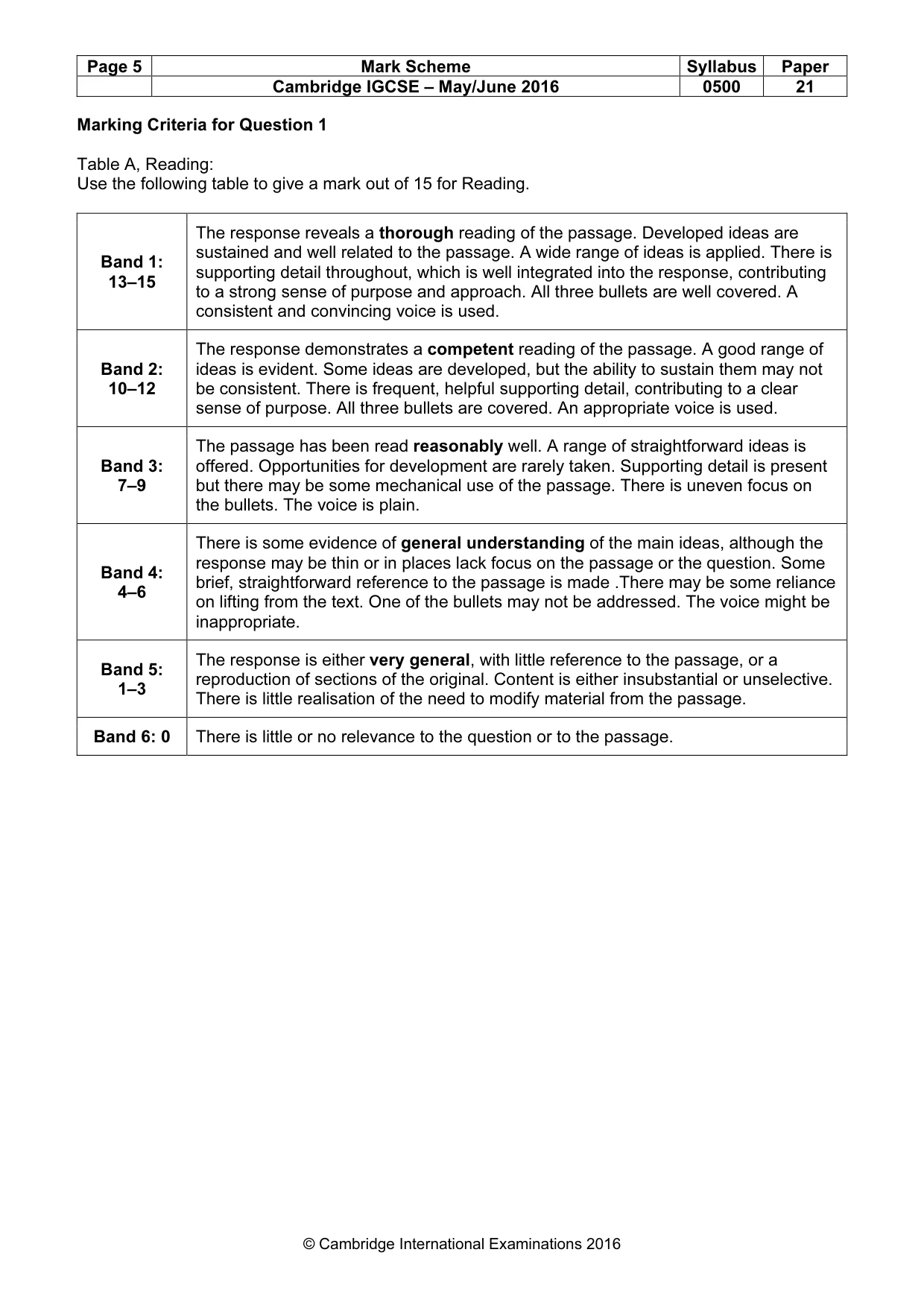
Page 5 Mark Scheme Syllabus Paper Cambridge IGCSE – May/June 2016 0500 21 © Cambridge International Examinations 2016 Marking Criteria for Question 1 Table A, Reading: Use the following table to give a mark out of 15 for Reading. Band 1: 13–15 The response reveals a thorough reading of the passage. Developed ideas are sustained and well related to the passage. A wide range of ideas is applied. There is supporting detail throughout, which is well integrated into the response, contributing to a strong sense of purpose and approach. All three bullets are well covered. A consistent and convincing voice is used. Band 2: 10–12 The response demonstrates a competent reading of the passage. A good range of ideas is evident. Some ideas are developed, but the ability to sustain them may not be consistent. There is frequent, helpful supporting detail, contributing to a clear sense of purpose. All three bullets are covered. An appropriate voice is used. Band 3: 7–9 The passage has been read reasonably well. A range of straightforward ideas is offered. Opportunities for development are rarely taken. Supporting detail is present but there may be some mechanical use of the passage. There is uneven focus on the bullets. The voice is plain. Band 4: 4–6 There is some evidence of general understanding of the main ideas, although the response may be thin or in places lack focus on the passage or the question. Some brief, straightforward reference to the passage is made .There may be some reliance on lifting from the text. One of the bullets may not be addressed. The voice might be inappropriate. Band 5: 1–3 The response is either very general, with little reference to the passage, or a reproduction of sections of the original. Content is either insubstantial or unselective. There is little realisation of the need to modify material from the passage. Band 6: 0 There is little or no relevance to the question or to the passage.
Mark scheme, page 6
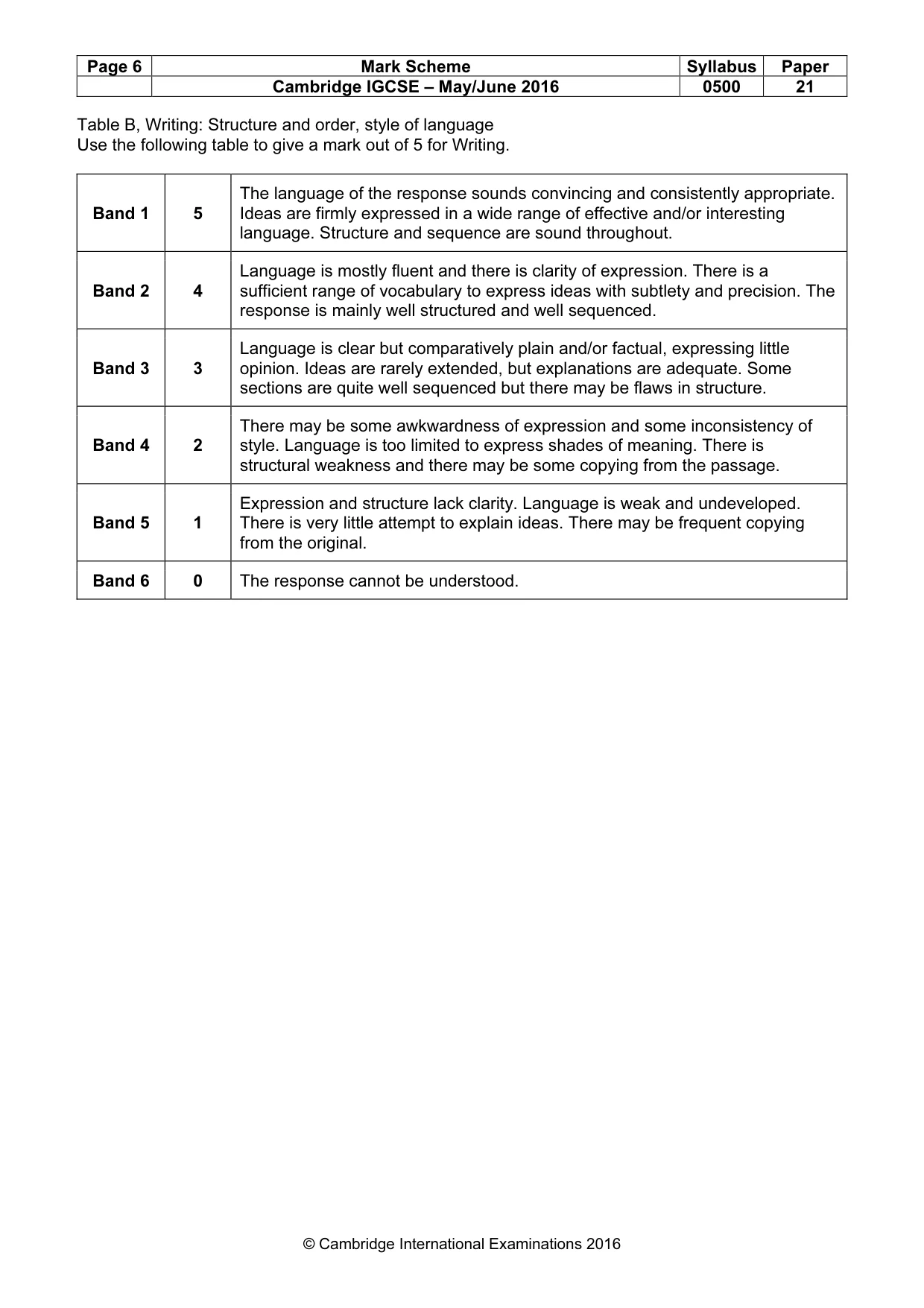
Page 6 Mark Scheme Syllabus Paper Cambridge IGCSE – May/June 2016 0500 21 © Cambridge International Examinations 2016 Table B, Writing: Structure and order, style of language Use the following table to give a mark out of 5 for Writing. Band 1 5 The language of the response sounds convincing and consistently appropriate. Ideas are firmly expressed in a wide range of effective and/or interesting language. Structure and sequence are sound throughout. Band 2 4 Language is mostly fluent and there is clarity of expression. There is a sufficient range of vocabulary to express ideas with subtlety and precision. The response is mainly well structured and well sequenced. Band 3 3 Language is clear but comparatively plain and/or factual, expressing little opinion. Ideas are rarely extended, but explanations are adequate. Some sections are quite well sequenced but there may be flaws in structure. Band 4 2 There may be some awkwardness of expression and some inconsistency of style. Language is too limited to express shades of meaning. There is structural weakness and there may be some copying from the passage. Band 5 1 Expression and structure lack clarity. Language is weak and undeveloped. There is very little attempt to explain ideas. There may be frequent copying from the original. Band 6 0 The response cannot be understood.
Mark scheme, page 7
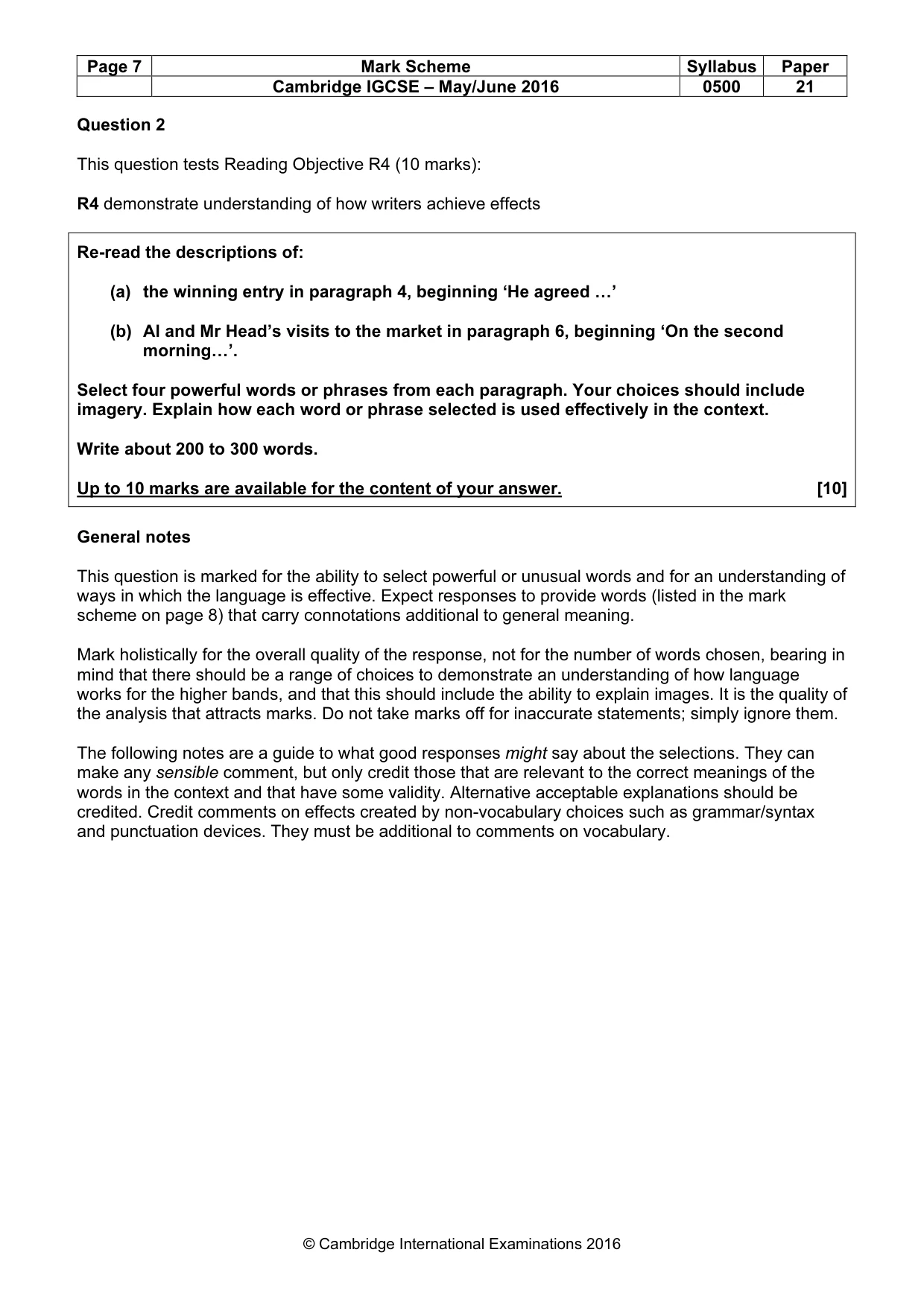
Page 7 Mark Scheme Syllabus Paper Cambridge IGCSE – May/June 2016 0500 21 © Cambridge International Examinations 2016 Question 2 This question tests Reading Objective R4 (10 marks): R4 demonstrate understanding of how writers achieve effects Re-read the descriptions of: (a) the winning entry in paragraph 4, beginning ‘He agreed …’ (b) Al and Mr Head’s visits to the market in paragraph 6, beginning ‘On the second morning…’. Select four powerful words or phrases from each paragraph. Your choices should include imagery. Explain how each word or phrase selected is used effectively in the context. Write about 200 to 300 words. Up to 10 marks are available for the content of your answer. [10] General notes This question is marked for the ability to select powerful or unusual words and for an understanding of ways in which the language is effective. Expect responses to provide words (listed in the mark scheme on page 8) that carry connotations additional to general meaning. Mark holistically for the overall quality of the response, not for the number of words chosen, bearing in mind that there should be a range of choices to demonstrate an understanding of how language works for the higher bands, and that this should include the ability to explain images. It is the quality of the analysis that attracts marks. Do not take marks off for inaccurate statements; simply ignore them. The following notes are a guide to what good responses might say about the selections. They can make any sensible comment, but only credit those that are relevant to the correct meanings of the words in the context and that have some validity. Alternative acceptable explanations should be credited. Credit comments on effects created by non-vocabulary choices such as grammar/syntax and punctuation devices. They must be additional to comments on vocabulary.
Mark scheme, page 8
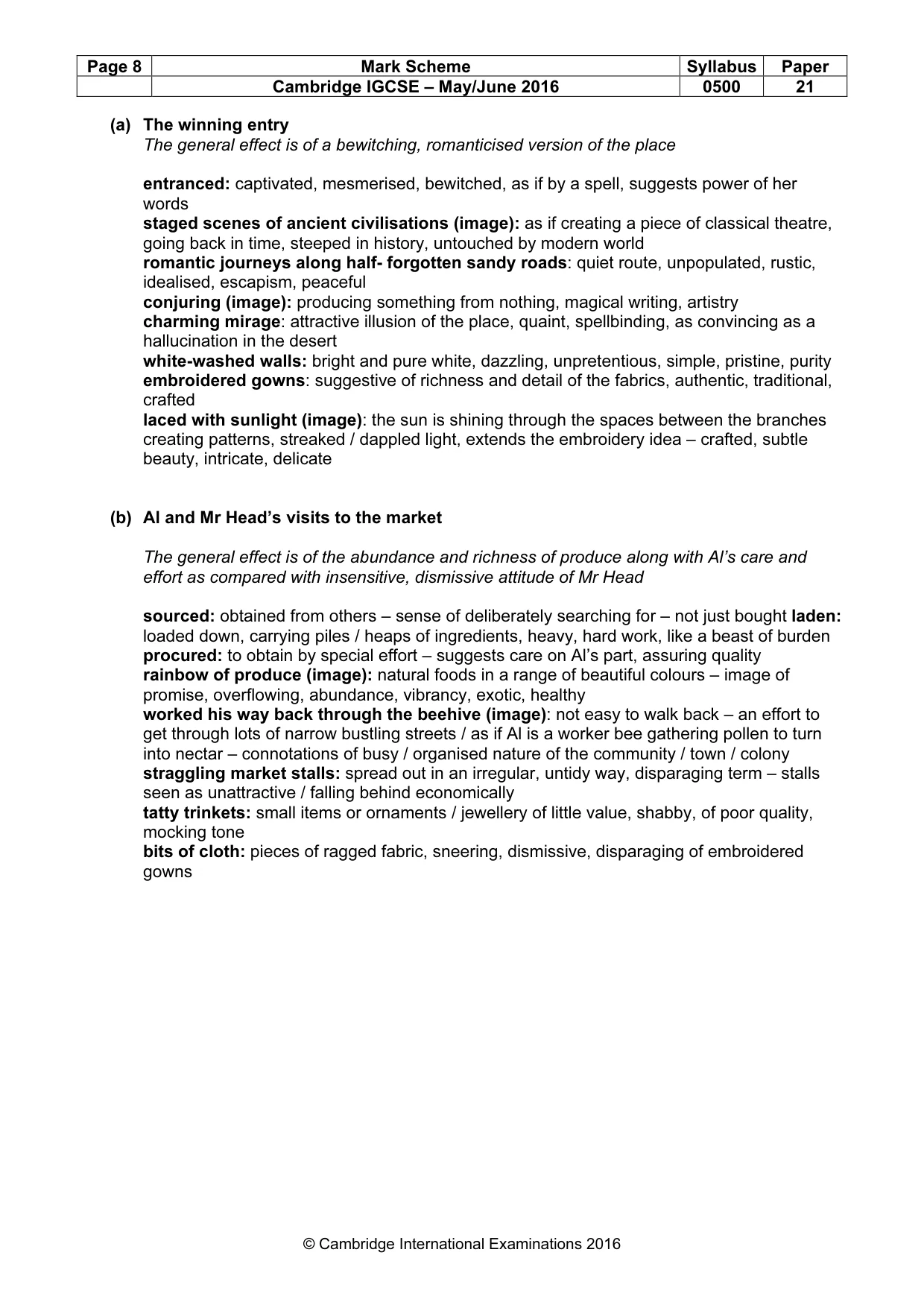
Page 8 Mark Scheme Syllabus Paper Cambridge IGCSE – May/June 2016 0500 21 © Cambridge International Examinations 2016 (a) The winning entry The general effect is of a bewitching, romanticised version of the place entranced: captivated, mesmerised, bewitched, as if by a spell, suggests power of her words staged scenes of ancient civilisations (image): as if creating a piece of classical theatre, going back in time, steeped in history, untouched by modern world romantic journeys along half- forgotten sandy roads: quiet route, unpopulated, rustic, idealised, escapism, peaceful conjuring (image): producing something from nothing, magical writing, artistry charming mirage: attractive illusion of the place, quaint, spellbinding, as convincing as a hallucination in the desert white-washed walls: bright and pure white, dazzling, unpretentious, simple, pristine, purity embroidered gowns: suggestive of richness and detail of the fabrics, authentic, traditional, crafted laced with sunlight (image): the sun is shining through the spaces between the branches creating patterns, streaked / dappled light, extends the embroidery idea – crafted, subtle beauty, intricate, delicate (b) Al and Mr Head’s visits to the market The general effect is of the abundance and richness of produce along with Al’s care and effort as compared with insensitive, dismissive attitude of Mr Head sourced: obtained from others – sense of deliberately searching for – not just bought laden: loaded down, carrying piles / heaps of ingredients, heavy, hard work, like a beast of burden procured: to obtain by special effort – suggests care on Al’s part, assuring quality rainbow of produce (image): natural foods in a range of beautiful colours – image of promise, overflowing, abundance, vibrancy, exotic, healthy worked his way back through the beehive (image): not easy to walk back – an effort to get through lots of narrow bustling streets / as if Al is a worker bee gathering pollen to turn into nectar – connotations of busy / organised nature of the community / town / colony straggling market stalls: spread out in an irregular, untidy way, disparaging term – stalls seen as unattractive / falling behind economically tatty trinkets: small items or ornaments / jewellery of little value, shabby, of poor quality, mocking tone bits of cloth: pieces of ragged fabric, sneering, dismissive, disparaging of embroidered gowns
Mark scheme, page 9
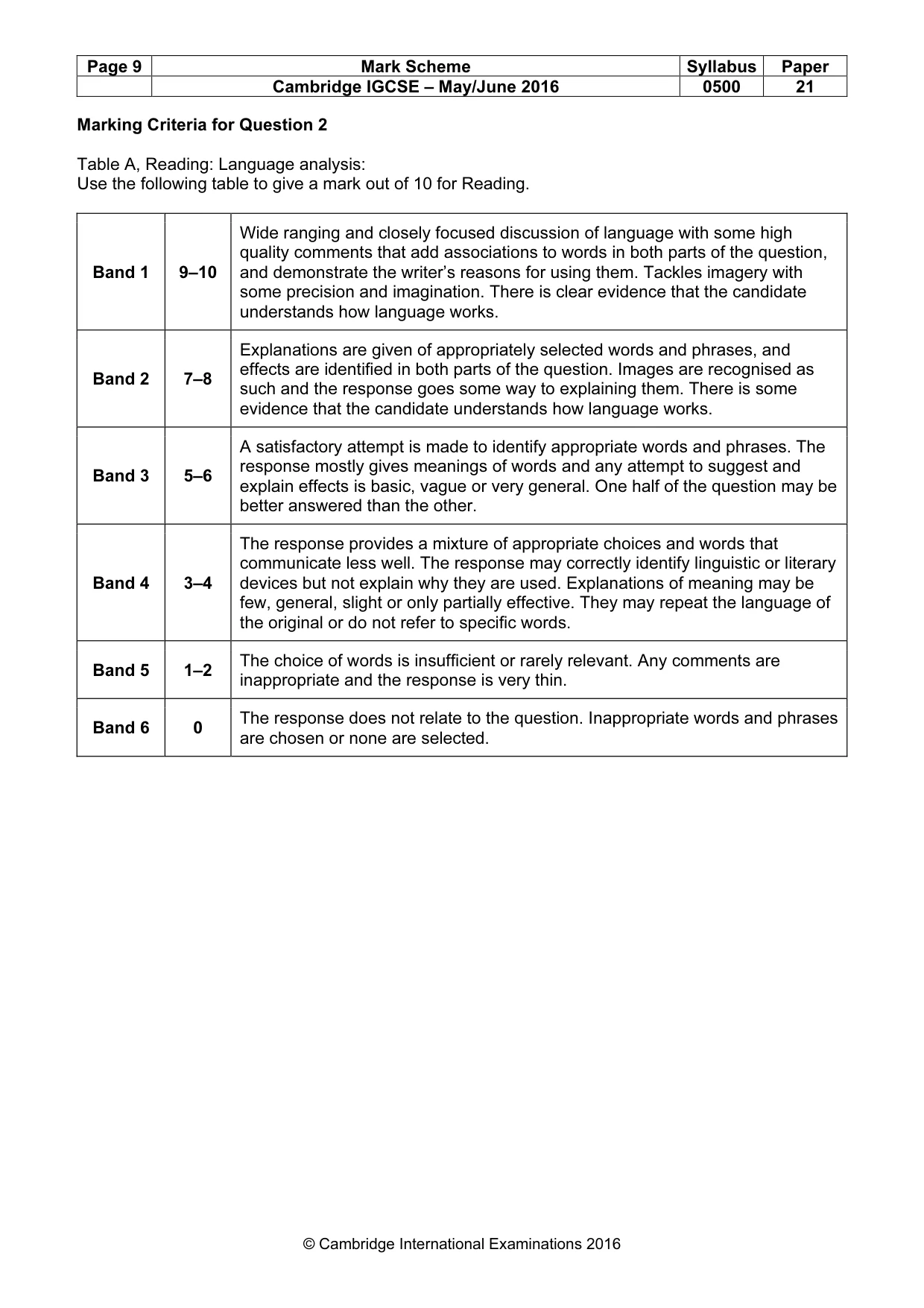
Page 9 Mark Scheme Syllabus Paper Cambridge IGCSE – May/June 2016 0500 21 © Cambridge International Examinations 2016 Marking Criteria for Question 2 Table A, Reading: Language analysis: Use the following table to give a mark out of 10 for Reading. Band 1 9–10 Wide ranging and closely focused discussion of language with some high quality comments that add associations to words in both parts of the question, and demonstrate the writer’s reasons for using them. Tackles imagery with some precision and imagination. There is clear evidence that the candidate understands how language works. Band 2 7–8 Explanations are given of appropriately selected words and phrases, and effects are identified in both parts of the question. Images are recognised as such and the response goes some way to explaining them. There is some evidence that the candidate understands how language works. Band 3 5–6 A satisfactory attempt is made to identify appropriate words and phrases. The response mostly gives meanings of words and any attempt to suggest and explain effects is basic, vague or very general. One half of the question may be better answered than the other. Band 4 3–4 The response provides a mixture of appropriate choices and words that communicate less well. The response may correctly identify linguistic or literary devices but not explain why they are used. Explanations of meaning may be few, general, slight or only partially effective. They may repeat the language of the original or do not refer to specific words. Band 5 1–2 The choice of words is insufficient or rarely relevant. Any comments are inappropriate and the response is very thin. Band 6 0 The response does not relate to the question. Inappropriate words and phrases are chosen or none are selected.
Mark scheme, page 10
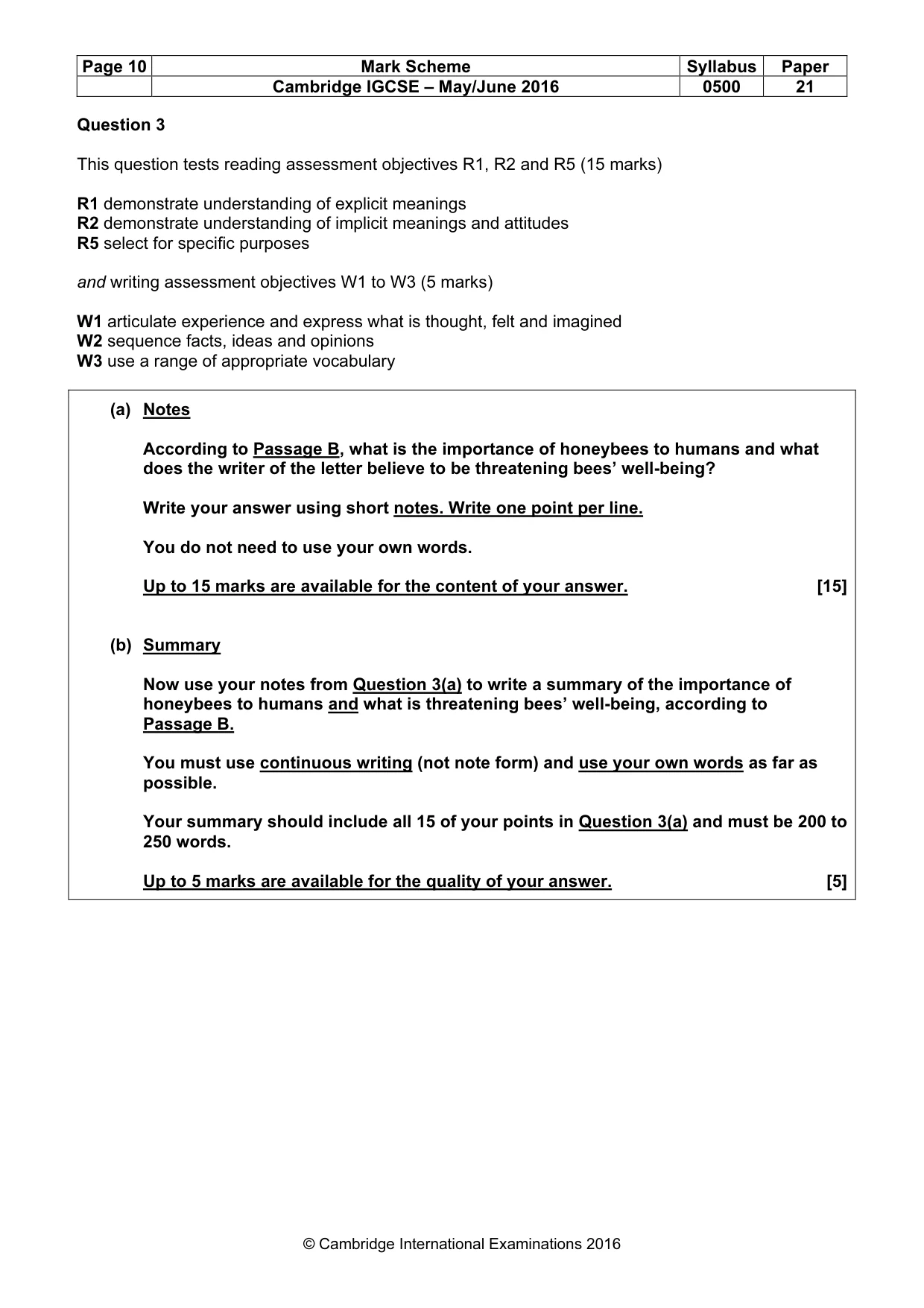
Page 10 Mark Scheme Syllabus Paper Cambridge IGCSE – May/June 2016 0500 21 © Cambridge International Examinations 2016 Question 3 This question tests reading assessment objectives R1, R2 and R5 (15 marks) R1 demonstrate understanding of explicit meanings R2 demonstrate understanding of implicit meanings and attitudes R5 select for specific purposes and writing assessment objectives W1 to W3 (5 marks) W1 articulate experience and express what is thought, felt and imagined W2 sequence facts, ideas and opinions W3 use a range of appropriate vocabulary (a) Notes According to Passage B, what is the importance of honeybees to humans and what does the writer of the letter believe to be threatening bees’ well-being? Write your answer using short notes. Write one point per line. You do not need to use your own words. Up to 15 marks are available for the content of your answer. [15] (b) Summary Now use your notes from Question 3(a) to write a summary of the importance of honeybees to humans and what is threatening bees’ well-being, according to Passage B. You must use continuous writing (not note form) and use your own words as far as possible. Your summary should include all 15 of your points in Question 3(a) and must be 200 to 250 words. Up to 5 marks are available for the quality of your answer. [5]
Mark scheme, page 11
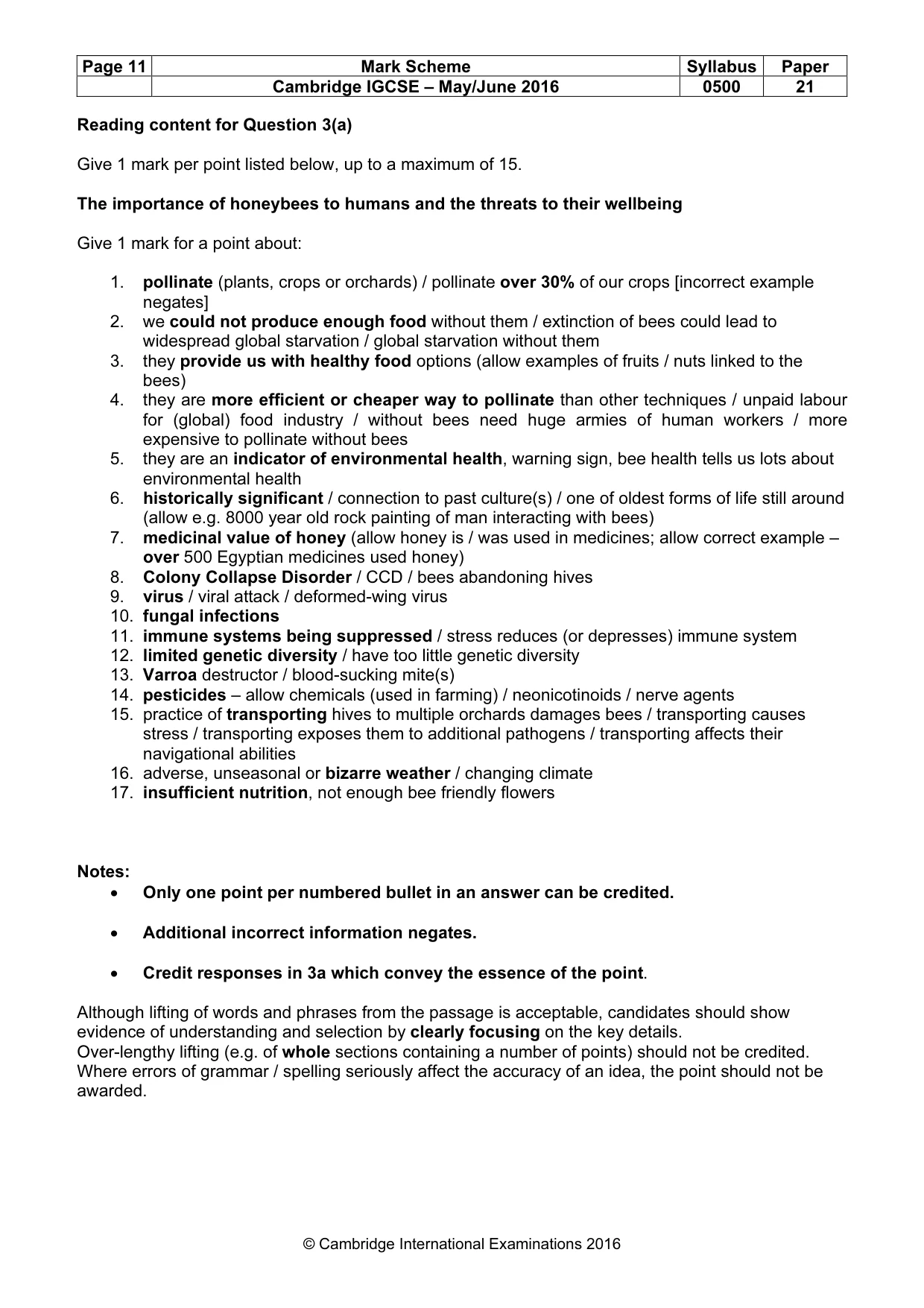
Page 11 Mark Scheme Syllabus Paper Cambridge IGCSE – May/June 2016 0500 21 © Cambridge International Examinations 2016 Reading content for Question 3(a) Give 1 mark per point listed below, up to a maximum of 15. The importance of honeybees to humans and the threats to their wellbeing Give 1 mark for a point about: 1. pollinate (plants, crops or orchards) / pollinate over 30% of our crops [incorrect example negates] 2. we could not produce enough food without them / extinction of bees could lead to widespread global starvation / global starvation without them 3. they provide us with healthy food options (allow examples of fruits / nuts linked to the bees) 4. they are more efficient or cheaper way to pollinate than other techniques / unpaid labour for (global) food industry / without bees need huge armies of human workers / more expensive to pollinate without bees 5. they are an indicator of environmental health, warning sign, bee health tells us lots about environmental health 6. historically significant / connection to past culture(s) / one of oldest forms of life still around (allow e.g. 8000 year old rock painting of man interacting with bees) 7. medicinal value of honey (allow honey is / was used in medicines; allow correct example – over 500 Egyptian medicines used honey) 8. Colony Collapse Disorder / CCD / bees abandoning hives 9. virus / viral attack / deformed-wing virus 10. fungal infections 11. immune systems being suppressed / stress reduces (or depresses) immune system 12. limited genetic diversity / have too little genetic diversity 13. Varroa destructor / blood-sucking mite(s) 14. pesticides – allow chemicals (used in farming) / neonicotinoids / nerve agents 15. practice of transporting hives to multiple orchards damages bees / transporting causes stress / transporting exposes them to additional pathogens / transporting affects their navigational abilities 16. adverse, unseasonal or bizarre weather / changing climate 17. insufficient nutrition, not enough bee friendly flowers Notes: • Only one point per numbered bullet in an answer can be credited. • Additional incorrect information negates. • Credit responses in 3a which convey the essence of the point. Although lifting of words and phrases from the passage is acceptable, candidates should show evidence of understanding and selection by clearly focusing on the key details. Over-lengthy lifting (e.g. of whole sections containing a number of points) should not be credited. Where errors of grammar / spelling seriously affect the accuracy of an idea, the point should not be awarded.
Mark scheme, page 12
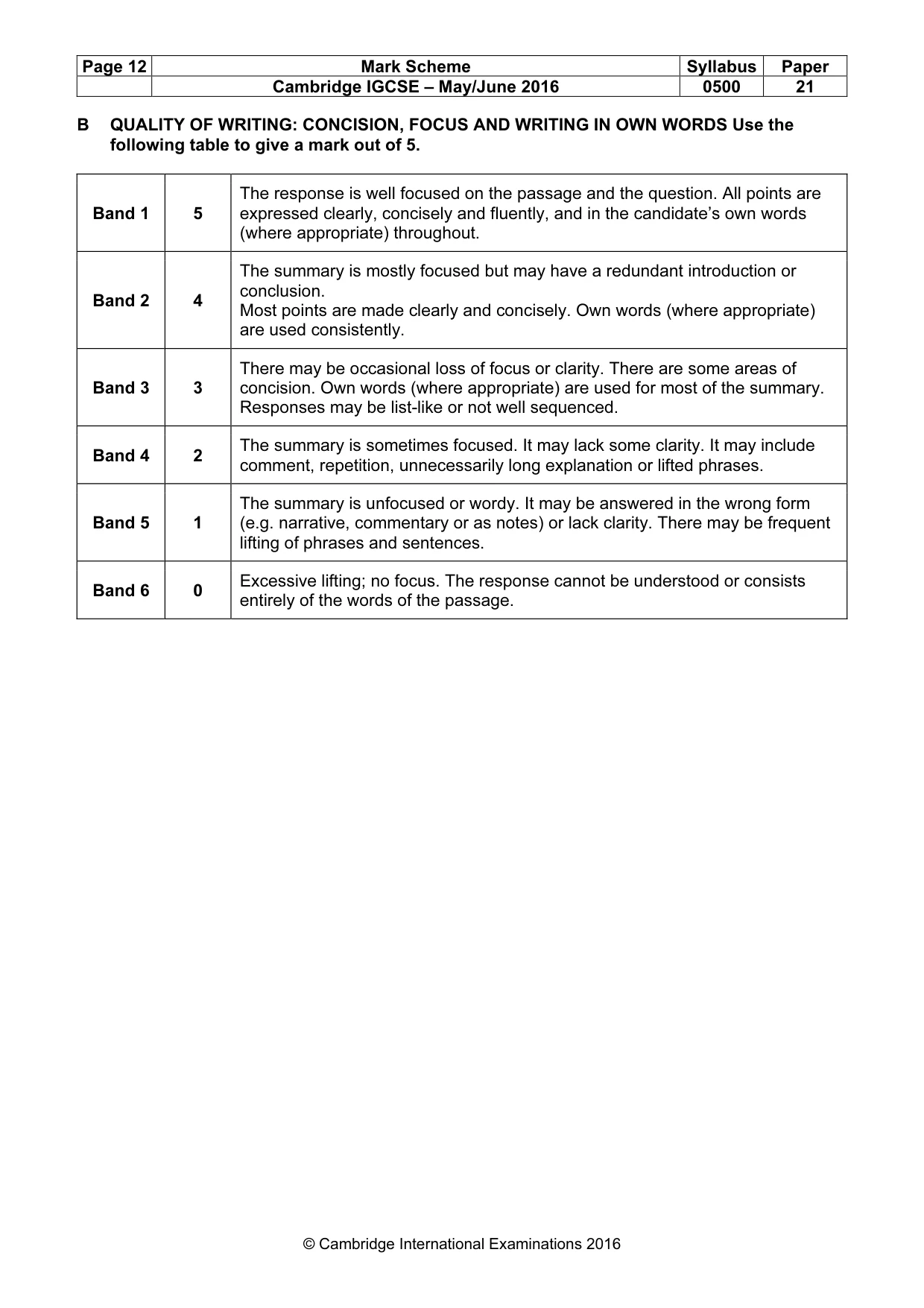
Page 12 Mark Scheme Syllabus Paper Cambridge IGCSE – May/June 2016 0500 21 © Cambridge International Examinations 2016 B QUALITY OF WRITING: CONCISION, FOCUS AND WRITING IN OWN WORDS Use the following table to give a mark out of 5. Band 1 5 The response is well focused on the passage and the question. All points are expressed clearly, concisely and fluently, and in the candidate’s own words (where appropriate) throughout. Band 2 4 The summary is mostly focused but may have a redundant introduction or conclusion. Most points are made clearly and concisely. Own words (where appropriate) are used consistently. Band 3 3 There may be occasional loss of focus or clarity. There are some areas of concision. Own words (where appropriate) are used for most of the summary. Responses may be list-like or not well sequenced. Band 4 2 The summary is sometimes focused. It may lack some clarity. It may include comment, repetition, unnecessarily long explanation or lifted phrases. Band 5 1 The summary is unfocused or wordy. It may be answered in the wrong form (e.g. narrative, commentary or as notes) or lack clarity. There may be frequent lifting of phrases and sentences. Band 6 0 Excessive lifting; no focus. The response cannot be understood or consists entirely of the words of the passage.
What you needed in this session
Cambridge’s own grade thresholds for 2016 May/June, Paper 2 · Variant 1. A higher threshold means an easier paper — the bar moves with how the cohort did.