Cambridge IGCSE English - First Language 0500 — 2011 Oct/Nov Paper 2 · Variant 3
0500/23/O/N/11 · 50 marks · ≈56 min
The question paper and its mark scheme, free to read here and free to download. This is Cambridge’s own paper, exactly as it was sat.
Question paper8 pages


Mark scheme9 pages
Answers below. Sit the paper first if you are practising.
Paper as text
Question paper, page 1
This document consists of 5 printed pages and 3 blank pages. DC (SM) 35729/4 © UCLES 2011 [Turn over UNIVERSITY OF CAMBRIDGE INTERNATIONAL EXAMINATIONS International General Certificate of Secondary Education * 7 6 9 3 7 1 3 6 1 3 * FIRST LANGUAGE ENGLISH 0500/23 Paper 2 Reading Passages (Extended) October/November 2011 2 hours Additional Materials: Answer Booklet/Paper READ THESE INSTRUCTIONS FIRST If you have been given an Answer Booklet, follow the instructions on the front cover of the Booklet. Write your Centre number, candidate number and name on all the work you hand in. Write in dark blue or black pen. Do not use staples, paper clips, highlighters, glue or correction fluid. Answer all questions. Dictionaries are not permitted. At the end of the examination, fasten all your work securely together. The number of marks is given in brackets [ ] at the end of each question or part question. www.XtremePapers.com
Question paper, page 2
2 0500/23/O/N/11 © UCLES 2011 Part 1 Read Passage A carefully, and then answer Questions 1 and 2. Passage A This passage describes the finding of a wild child in northern India. The Wolf-Boy Narsingh Bahadur Singh is a tall, gentle-mannered man in his fifties, wearing hand-woven, spotlessly white cloth, a brightly coloured turban, and a striped towel draped across his shoulders. He owns six acres of land, planted with corn, dal and rice, is considered rich, and enjoys the respect of his community. He has a history of adopting stray children: besides his own two sons, he has rescued and brought up four boys found abandoned in the wild. * * * It was the dry season when Narsingh Singh decided to cycle to see his cousin, who lives in a village on the far side of Musafirkhana forest, about 20 miles from Sultanpur. He had got to about half way and it was approaching mid-morning, and a sweltering temperature, when he came to the area of thick bush in the middle of the forest. The track sliced through thickets of stately bamboo and passed by statuesque thorn trees which seemed to have been carved and placed there to pose, their spiky fingers pointing against the blinding blue background of empty sky, with alert, flamboyantly-beaked hornbills perched on their pinnacles to boom a warning. In the scrub behind one of these he heard some squealing, so he got off his bicycle, crept up stealthily, and saw a boy playing with four or five wolf cubs. He was absolutely certain that they were wolves. The first things he noticed about the boy were his darkened skin, fingernails grown into claws, a tangle of knotted hair, and unusually pointed teeth. Then he saw the callouses on his palms, elbows and knees, and the scars on the side of his head which the mother wolf would have made when she picked him up and carried him as a baby. The boy ran rapidly on all fours, yet couldn’t keep up with the cubs as they made for cover. The mother wolf was not in sight. Narsingh Singh caught the boy – and was bitten badly on the arm as a result – but he managed to truss him up in his towel, lash him to the bicycle with rope, and ride back home with him. At first Shamdeo, as he was named, cowered from people and would only play with dogs. He made growling noises if Narsingh Singh’s children approached him, and cuffed them if they came within range of his hands. He could only stand with difficulty at first, and tottered unsteadily when he tried to walk. He was always wary when entering a room, keeping to the wall and peering to see what lurked in the shadows. He hated the sun and used to curl up in dark places. Sometimes he would make a circle with his thumb and index finger and point to the sky, as if indicating a full moon. After sunset he grew restless and had to be tied up to stop him following the jackals which howled like vampires round the village at night. If anyone cut themselves, he could smell the scent of blood and would scamper towards it. He caught chickens and ate them alive, including the entrails. When he had evolved a sign language of his own, he would cross his thumbs and flap his hands: this meant ‘chicken’ or ‘food’. Narsingh Singh, a vegetarian, weaned him off meat and forced rice, dal and chappatis down his throat, but these made the boy sick. He took to eating earth, his chest swelled up, and the family began to fear for his life, but after a few weeks he got used to the new diet. Eventually, he started doing simple carrying jobs, like taking straw to the cows. At this point, Narsingh Singh decided that the boy needed to socialise with other young children and not spend all his time with animals. He arranged to take Shamdeo to stay for a while in a children’s home in Sultanpur, to see if he could learn to behave like other children.
Question paper, page 3
3 0500/23/O/N/11 © UCLES 2011 [Turn over 1 Imagine that you are Narsingh Singh. You are being interviewed for the Sultanpur weekly newspaper by a reporter who has heard of the arrival of Shamdeo at the children’s home. The reporter asks the following questions: • What were your thoughts and feelings when you found the boy? • Why are you so sure that he was brought up by wolves? • How do you think he will develop? Write the words of the interview, beginning with the first question. Base your interview on what you have read in Passage A. Be careful to use your own words. Write between 1½ and 2 sides, allowing for the size of your handwriting. Up to 15 marks are available for the content of your answer, and up to 5 marks for the quality of your writing. [Total: 20] 2 Re-read the descriptions of: (a) the area and its wildlife in paragraph 2, beginning ‘It was the dry season…’; (b) Shamdeo’s behaviour while he was living with Narsingh Singh in paragraph 4, beginning ‘At first Shamdeo…’. Select words and phrases from these descriptions, and explain how the writer has created effects by using this language. [Total: 10] [Turn over for Part 2]
Question paper, page 4
4 0500/23/O/N/11 © UCLES 2011 Part 2 Read Passage B carefully and re-read Passage A. Then answer Question 3, which is based on both passages. Passage B This passage describes the phenomenon of children who are brought up by wild animals. Living Wild Throughout history feral children have been regarded with fascination and have played an important part in the mythology of nations; according to legend, the twins Romulus and Remus, raised by a she- wolf, were responsible for the founding of Rome nearly 3,000 years ago. It is not just wolves which have adopted and brought up human children as their own: there are numerous documented cases of dogs, bears and monkeys which have done the same. Even sheep and cows have been known to give shelter to human infants. Perhaps the most famous wolf-raised child is the fictional Mowgli, invented by the English author Rudyard Kipling who spent some of his life in India. It is fitting that the best-known feral child should come from India, for it is there, to this day, that the largest number of such children have been found. Kipling established the typical behaviour of ‘wolf-children’, which has been repeatedly confirmed in real-life examples. They are immediately recognisable because of their nakedness and dirtiness, as well as by their long matted hair, and teeth which are sharper and more pointed than normal human teeth. Another trait which ‘wild’ children have in common is that they run on all fours like animals, and have hardened, calloused hands and knees as a result. Also, like wild animals, they are most active at night and sleep during the day. Furthermore, they emit animal sounds and like to play with animals rather than humans, towards whom they are aggressive, sometimes even biting them. Because they have no immunity to human infections, they tend to have short lives. Perhaps the most archetypal of the Indian wolf-children stories is that of Kamala and Amala, found in India in 1920. Supposedly either taken or found as babies by a female wolf, they were brought into the wolf’s litter and raised as cubs until they were found when aged about three and five. Although over the years they were socialised to a degree, they always preferred the company of animals, and they never learnt enough human speech to communicate effectively. Traian Caldarar from Romania was four years old when he was ‘lost’ under circumstances which are not clear. He was not found until three years later in 2002, when a shepherd came across him sleeping in a cardboard box in the mountains. He had been eating the carcasses of dead sheep, and police speculated that he must have been looked after by one of the wild dogs which live in packs in the mountains, because there was no other way he could have survived for so long. When found, he was wild-eyed and walked with a chimpanzee-like gait. He was very agile and police had difficulty capturing him. Like all wild animals, he hated confinement and sought open spaces. When shown a bed, he chose to sleep on the floor under it. This behaviour raised the question of how far such children should be forced to conform to human social conventions when they would rather continue to live contentedly as animals.
Question paper, page 5
5 0500/23/O/N/11 © UCLES 2011 3 Summarise: (a) the typical behaviour of feral children, as described in Passage B; (b) the physical characteristics of the wolf-boy, as described in Passage A. Use your own words as far as possible. You should write about 1 side in total, allowing for the size of your handwriting. Up to 15 marks are available for the content of your answer, and up to 5 marks for the quality of your writing. [Total: 20]
Question paper, page 6
6 0500/23/O/N/11 © UCLES 2011 BLANK PAGE
Question paper, page 7
7 0500/23/O/N/11 © UCLES 2011 BLANK PAGE
Question paper, page 8
8 0500/23/O/N/11 © UCLES 2011 BLANK PAGE Copyright Acknowledgements: Questions 1, 2 and 3 Passage A © adapted: Bruce Chatwin, The Wolf-Boy, Sunday Times Magazine; 30 July 1978. Permission to reproduce items where third-party owned material protected by copyright is included has been sought and cleared where possible. Every reasonable effort has been made by the publisher (UCLES) to trace copyright holders, but if any items requiring clearance have unwittingly been included, the publisher will be pleased to make amends at the earliest possible opportunity. University of Cambridge International Examinations is part of the Cambridge Assessment Group. Cambridge Assessment is the brand name of University of Cambridge Local Examinations Syndicate (UCLES), which is itself a department of the University of Cambridge.
Mark scheme, page 1
UNIVERSITY OF CAMBRIDGE INTERNATIONAL EXAMINATIONS International General Certificate of Secondary Education MARK SCHEME for the October/November 2011 question paper for the guidance of teachers 0500 FIRST LANGUAGE ENGLISH 0500/23 Paper 2 (Reading Passage – Extended), maximum raw mark 50 This mark scheme is published as an aid to teachers and candidates, to indicate the requirements of the examination. It shows the basis on which Examiners were instructed to award marks. It does not indicate the details of the discussions that took place at an Examiners’ meeting before marking began, which would have considered the acceptability of alternative answers. Mark schemes must be read in conjunction with the question papers and the report on the examination. • Cambridge will not enter into discussions or correspondence in connection with these mark schemes. Cambridge is publishing the mark schemes for the October/November 2011 question papers for most IGCSE, GCE Advanced Level and Advanced Subsidiary Level syllabuses and some Ordinary Level syllabuses. www.XtremePapers.com
Mark scheme, page 2
Page 2 Mark Scheme: Teachers’ version Syllabus Paper IGCSE – October/November 2011 0500 23 © University of Cambridge International Examinations 2011 Note: All Examiners are instructed that alternative correct answers and unexpected approaches in candidates’ scripts must be given marks that fairly reflect the relevant knowledge and skills demonstrated. Nonetheless, the content must be clearly related to and derived from the passage. Question 1 This question tests Reading Objectives R1–R3 (15 marks): • understand and collate explicit meanings • understand, explain and collate implicit meanings and attitudes • select, analyse and evaluate what is relevant to specific purposes. AND Writing Objectives W1–W5 (5 marks): • articulate experience and express what is thought, felt and imagined • order and present facts, ideas and opinions • understand and use a range of appropriate vocabulary • use language and register appropriate to audience and context • make accurate and effective use of paragraphs, grammatical structures, sentences, punctuation and spelling. Imagine that you are Narsingh Singh. You are being interviewed for the Sultanpur weekly newspaper by a reporter who has heard of the arrival of Shamdeo at the children’s home. The reporter asks the following questions: • What were your thoughts and feelings when you found the boy? • Why are you so sure that he was brought up by wolves? • How do you think he will develop? Write the words of the interview, beginning with the first question. Base your interview on what you have read in Passage A. Be careful to use your own words. Write between 1½ and 2 sides, allowing for the size of your handwriting. Up to 15 marks are available for the content of your answer, and up to 5 marks for the quality of your writing. [20] General notes on likely content Candidates should select ideas from the passage and develop these, supporting what they write with details from the passage. For quality of marking look for a clear response, well structured and in the candidate’s own words. C is the discriminator, as it requires predictive inference based on current behaviour and the progress Shamdeo has made.
Mark scheme, page 3
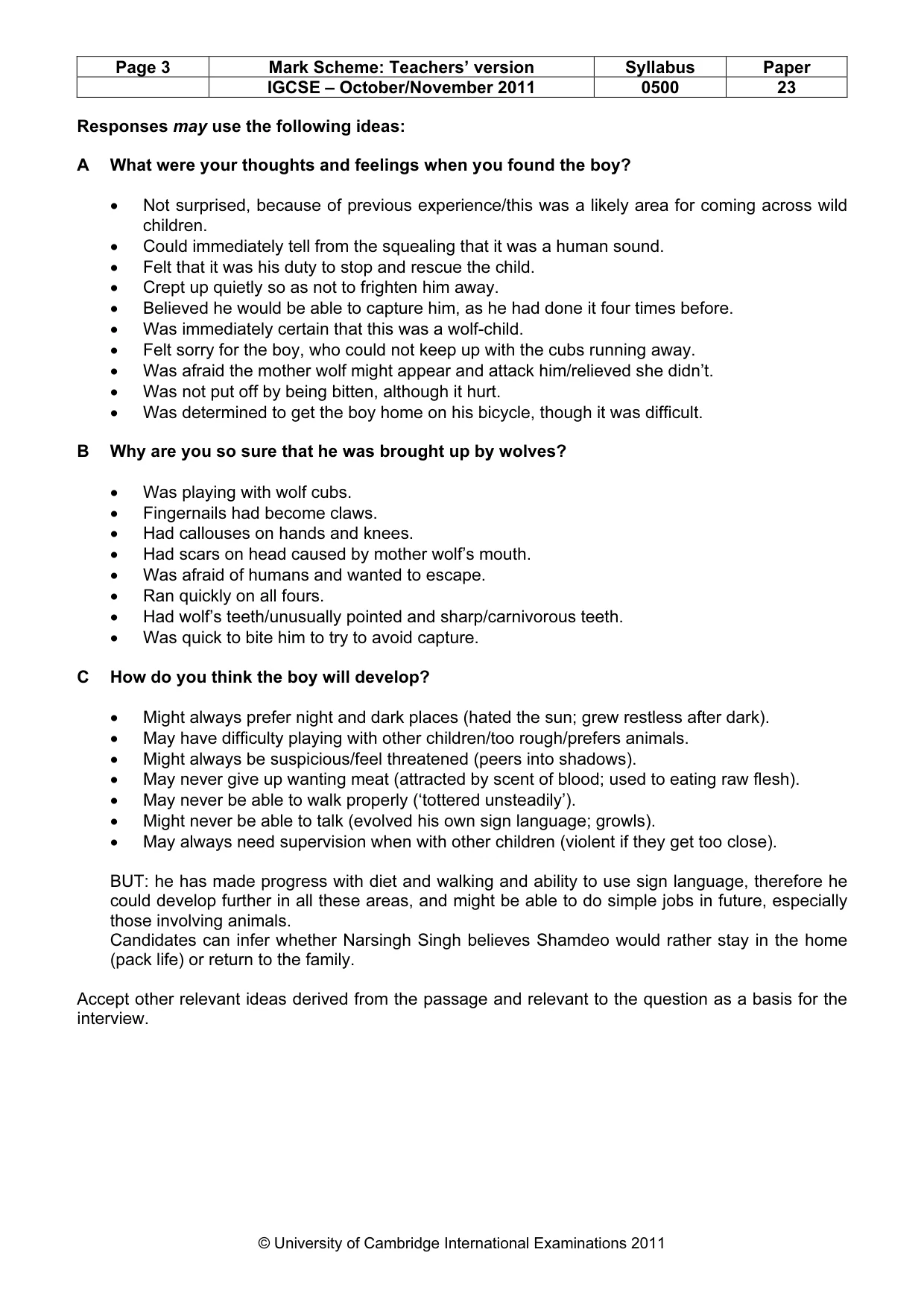
Page 3 Mark Scheme: Teachers’ version Syllabus Paper IGCSE – October/November 2011 0500 23 © University of Cambridge International Examinations 2011 Responses may use the following ideas: A What were your thoughts and feelings when you found the boy? • Not surprised, because of previous experience/this was a likely area for coming across wild children. • Could immediately tell from the squealing that it was a human sound. • Felt that it was his duty to stop and rescue the child. • Crept up quietly so as not to frighten him away. • Believed he would be able to capture him, as he had done it four times before. • Was immediately certain that this was a wolf-child. • Felt sorry for the boy, who could not keep up with the cubs running away. • Was afraid the mother wolf might appear and attack him/relieved she didn’t. • Was not put off by being bitten, although it hurt. • Was determined to get the boy home on his bicycle, though it was difficult. B Why are you so sure that he was brought up by wolves? • Was playing with wolf cubs. • Fingernails had become claws. • Had callouses on hands and knees. • Had scars on head caused by mother wolf’s mouth. • Was afraid of humans and wanted to escape. • Ran quickly on all fours. • Had wolf’s teeth/unusually pointed and sharp/carnivorous teeth. • Was quick to bite him to try to avoid capture. C How do you think the boy will develop? • Might always prefer night and dark places (hated the sun; grew restless after dark). • May have difficulty playing with other children/too rough/prefers animals. • Might always be suspicious/feel threatened (peers into shadows). • May never give up wanting meat (attracted by scent of blood; used to eating raw flesh). • May never be able to walk properly (‘tottered unsteadily’). • Might never be able to talk (evolved his own sign language; growls). • May always need supervision when with other children (violent if they get too close). BUT: he has made progress with diet and walking and ability to use sign language, therefore he could develop further in all these areas, and might be able to do simple jobs in future, especially those involving animals. Candidates can infer whether Narsingh Singh believes Shamdeo would rather stay in the home (pack life) or return to the family. Accept other relevant ideas derived from the passage and relevant to the question as a basis for the interview.
Mark scheme, page 4
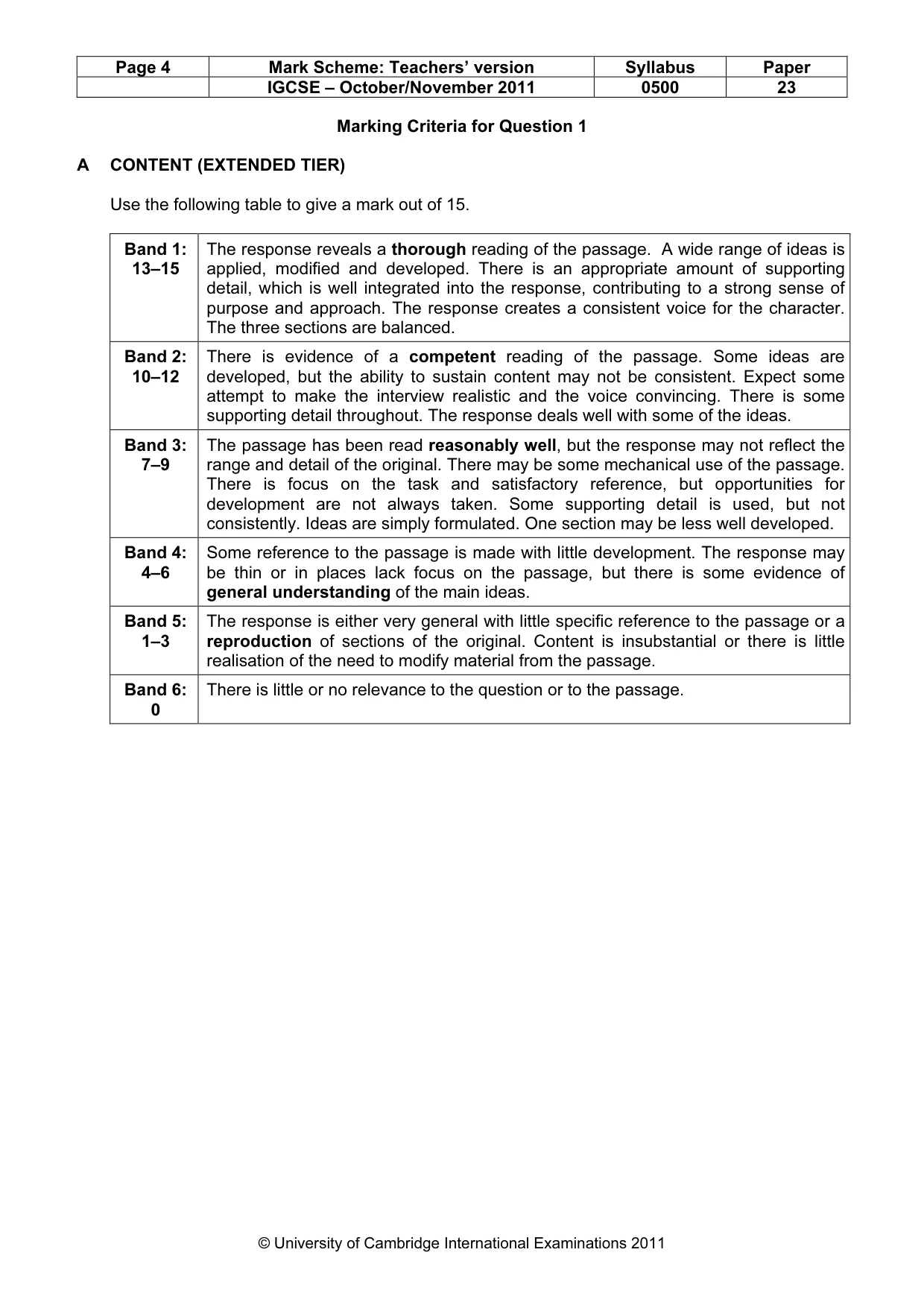
Page 4 Mark Scheme: Teachers’ version Syllabus Paper IGCSE – October/November 2011 0500 23 © University of Cambridge International Examinations 2011 Marking Criteria for Question 1 A CONTENT (EXTENDED TIER) Use the following table to give a mark out of 15. Band 1: 13–15 The response reveals a thorough reading of the passage. A wide range of ideas is applied, modified and developed. There is an appropriate amount of supporting detail, which is well integrated into the response, contributing to a strong sense of purpose and approach. The response creates a consistent voice for the character. The three sections are balanced. Band 2: 10–12 There is evidence of a competent reading of the passage. Some ideas are developed, but the ability to sustain content may not be consistent. Expect some attempt to make the interview realistic and the voice convincing. There is some supporting detail throughout. The response deals well with some of the ideas. Band 3: 7–9 The passage has been read reasonably well, but the response may not reflect the range and detail of the original. There may be some mechanical use of the passage. There is focus on the task and satisfactory reference, but opportunities for development are not always taken. Some supporting detail is used, but not consistently. Ideas are simply formulated. One section may be less well developed. Band 4: 4–6 Some reference to the passage is made with little development. The response may be thin or in places lack focus on the passage, but there is some evidence of general understanding of the main ideas. Band 5: 1–3 The response is either very general with little specific reference to the passage or a reproduction of sections of the original. Content is insubstantial or there is little realisation of the need to modify material from the passage. Band 6: 0 There is little or no relevance to the question or to the passage.
Mark scheme, page 5
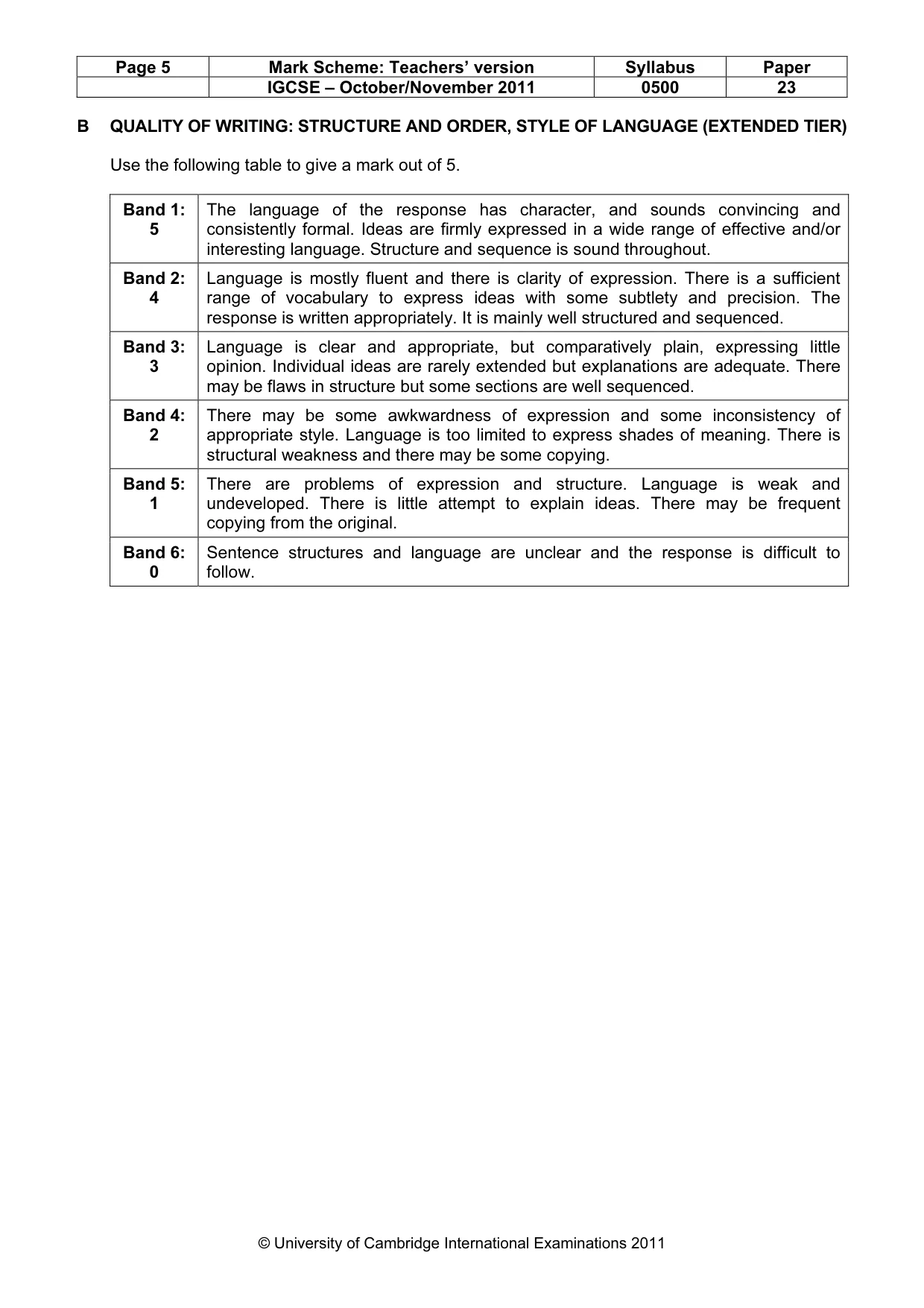
Page 5 Mark Scheme: Teachers’ version Syllabus Paper IGCSE – October/November 2011 0500 23 © University of Cambridge International Examinations 2011 B QUALITY OF WRITING: STRUCTURE AND ORDER, STYLE OF LANGUAGE (EXTENDED TIER) Use the following table to give a mark out of 5. Band 1: 5 The language of the response has character, and sounds convincing and consistently formal. Ideas are firmly expressed in a wide range of effective and/or interesting language. Structure and sequence is sound throughout. Band 2: 4 Language is mostly fluent and there is clarity of expression. There is a sufficient range of vocabulary to express ideas with some subtlety and precision. The response is written appropriately. It is mainly well structured and sequenced. Band 3: 3 Language is clear and appropriate, but comparatively plain, expressing little opinion. Individual ideas are rarely extended but explanations are adequate. There may be flaws in structure but some sections are well sequenced. Band 4: 2 There may be some awkwardness of expression and some inconsistency of appropriate style. Language is too limited to express shades of meaning. There is structural weakness and there may be some copying. Band 5: 1 There are problems of expression and structure. Language is weak and undeveloped. There is little attempt to explain ideas. There may be frequent copying from the original. Band 6: 0 Sentence structures and language are unclear and the response is difficult to follow.
Mark scheme, page 6
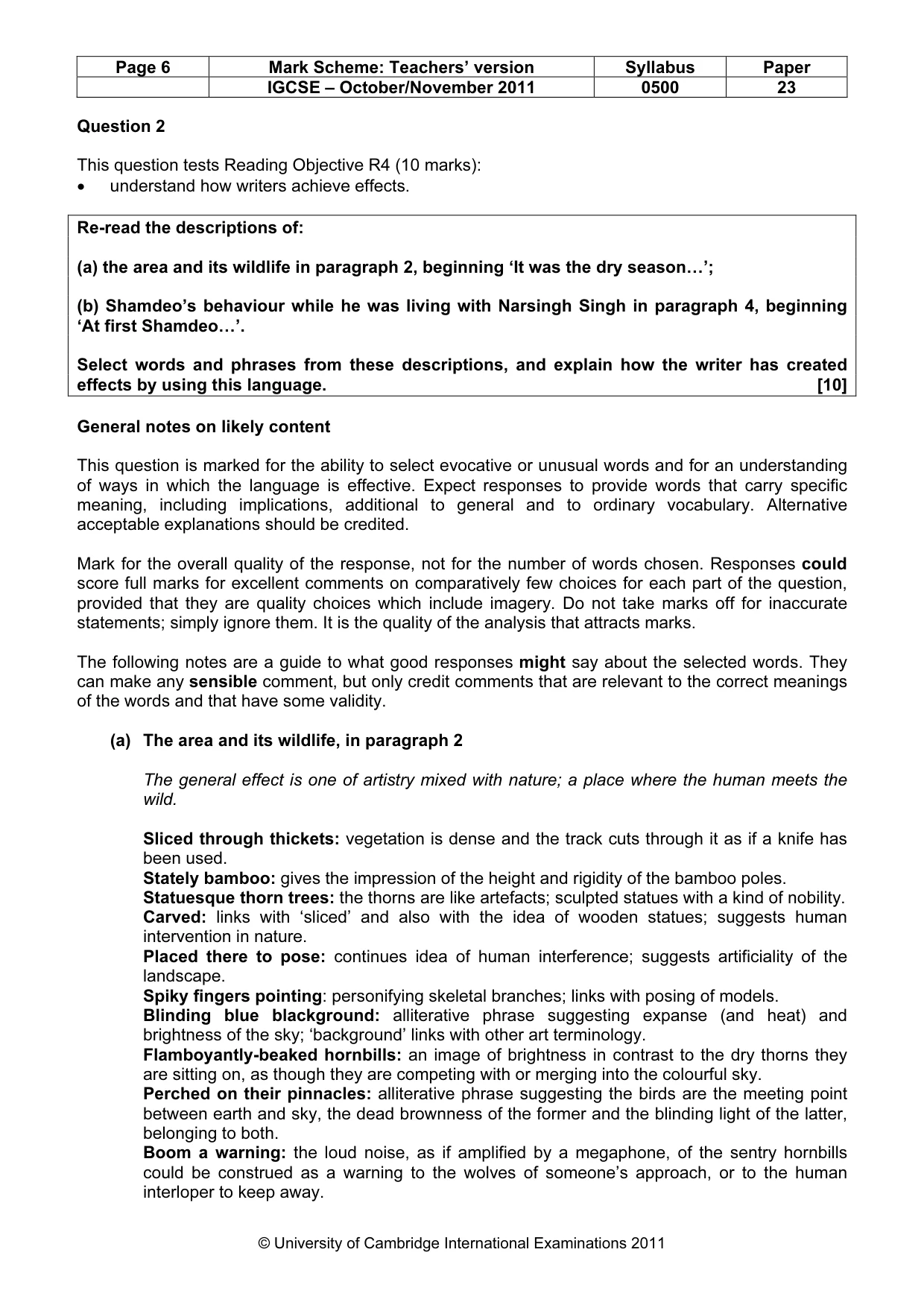
Page 6 Mark Scheme: Teachers’ version Syllabus Paper IGCSE – October/November 2011 0500 23 © University of Cambridge International Examinations 2011 Question 2 This question tests Reading Objective R4 (10 marks): • understand how writers achieve effects. Re-read the descriptions of: (a) the area and its wildlife in paragraph 2, beginning ‘It was the dry season…’; (b) Shamdeo’s behaviour while he was living with Narsingh Singh in paragraph 4, beginning ‘At first Shamdeo…’. Select words and phrases from these descriptions, and explain how the writer has created effects by using this language. [10] General notes on likely content This question is marked for the ability to select evocative or unusual words and for an understanding of ways in which the language is effective. Expect responses to provide words that carry specific meaning, including implications, additional to general and to ordinary vocabulary. Alternative acceptable explanations should be credited. Mark for the overall quality of the response, not for the number of words chosen. Responses could score full marks for excellent comments on comparatively few choices for each part of the question, provided that they are quality choices which include imagery. Do not take marks off for inaccurate statements; simply ignore them. It is the quality of the analysis that attracts marks. The following notes are a guide to what good responses might say about the selected words. They can make any sensible comment, but only credit comments that are relevant to the correct meanings of the words and that have some validity. (a) The area and its wildlife, in paragraph 2 The general effect is one of artistry mixed with nature; a place where the human meets the wild. Sliced through thickets: vegetation is dense and the track cuts through it as if a knife has been used. Stately bamboo: gives the impression of the height and rigidity of the bamboo poles. Statuesque thorn trees: the thorns are like artefacts; sculpted statues with a kind of nobility. Carved: links with ‘sliced’ and also with the idea of wooden statues; suggests human intervention in nature. Placed there to pose: continues idea of human interference; suggests artificiality of the landscape. Spiky fingers pointing: personifying skeletal branches; links with posing of models. Blinding blue blackground: alliterative phrase suggesting expanse (and heat) and brightness of the sky; ‘background’ links with other art terminology. Flamboyantly-beaked hornbills: an image of brightness in contrast to the dry thorns they are sitting on, as though they are competing with or merging into the colourful sky. Perched on their pinnacles: alliterative phrase suggesting the birds are the meeting point between earth and sky, the dead brownness of the former and the blinding light of the latter, belonging to both. Boom a warning: the loud noise, as if amplified by a megaphone, of the sentry hornbills could be construed as a warning to the wolves of someone’s approach, or to the human interloper to keep away.
Mark scheme, page 7
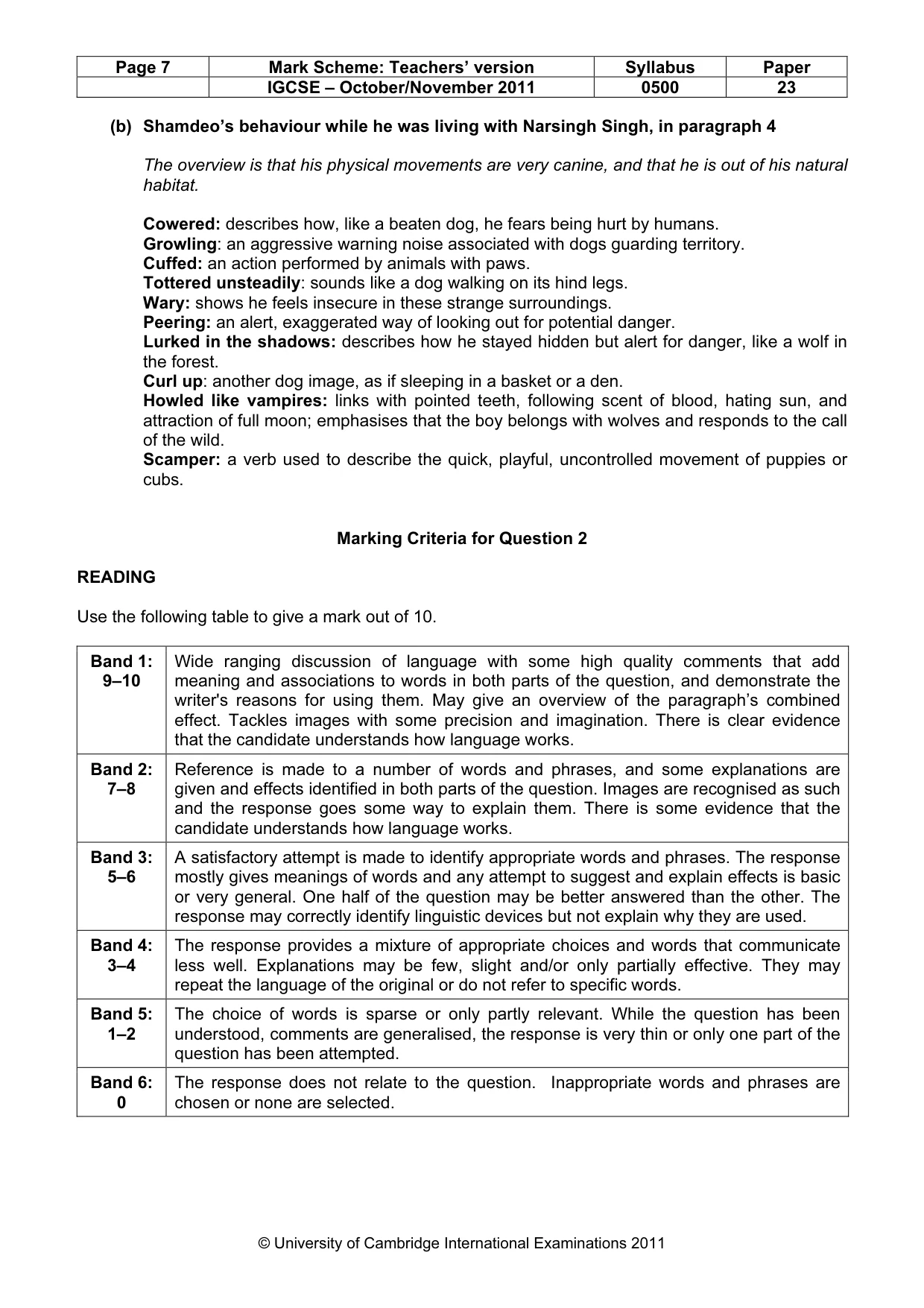
Page 7 Mark Scheme: Teachers’ version Syllabus Paper IGCSE – October/November 2011 0500 23 © University of Cambridge International Examinations 2011 (b) Shamdeo’s behaviour while he was living with Narsingh Singh, in paragraph 4 The overview is that his physical movements are very canine, and that he is out of his natural habitat. Cowered: describes how, like a beaten dog, he fears being hurt by humans. Growling: an aggressive warning noise associated with dogs guarding territory. Cuffed: an action performed by animals with paws. Tottered unsteadily: sounds like a dog walking on its hind legs. Wary: shows he feels insecure in these strange surroundings. Peering: an alert, exaggerated way of looking out for potential danger. Lurked in the shadows: describes how he stayed hidden but alert for danger, like a wolf in the forest. Curl up: another dog image, as if sleeping in a basket or a den. Howled like vampires: links with pointed teeth, following scent of blood, hating sun, and attraction of full moon; emphasises that the boy belongs with wolves and responds to the call of the wild. Scamper: a verb used to describe the quick, playful, uncontrolled movement of puppies or cubs. Marking Criteria for Question 2 READING Use the following table to give a mark out of 10. Band 1: 9–10 Wide ranging discussion of language with some high quality comments that add meaning and associations to words in both parts of the question, and demonstrate the writer's reasons for using them. May give an overview of the paragraph’s combined effect. Tackles images with some precision and imagination. There is clear evidence that the candidate understands how language works. Band 2: 7–8 Reference is made to a number of words and phrases, and some explanations are given and effects identified in both parts of the question. Images are recognised as such and the response goes some way to explain them. There is some evidence that the candidate understands how language works. Band 3: 5–6 A satisfactory attempt is made to identify appropriate words and phrases. The response mostly gives meanings of words and any attempt to suggest and explain effects is basic or very general. One half of the question may be better answered than the other. The response may correctly identify linguistic devices but not explain why they are used. Band 4: 3–4 The response provides a mixture of appropriate choices and words that communicate less well. Explanations may be few, slight and/or only partially effective. They may repeat the language of the original or do not refer to specific words. Band 5: 1–2 The choice of words is sparse or only partly relevant. While the question has been understood, comments are generalised, the response is very thin or only one part of the question has been attempted. Band 6: 0 The response does not relate to the question. Inappropriate words and phrases are chosen or none are selected.
Mark scheme, page 8
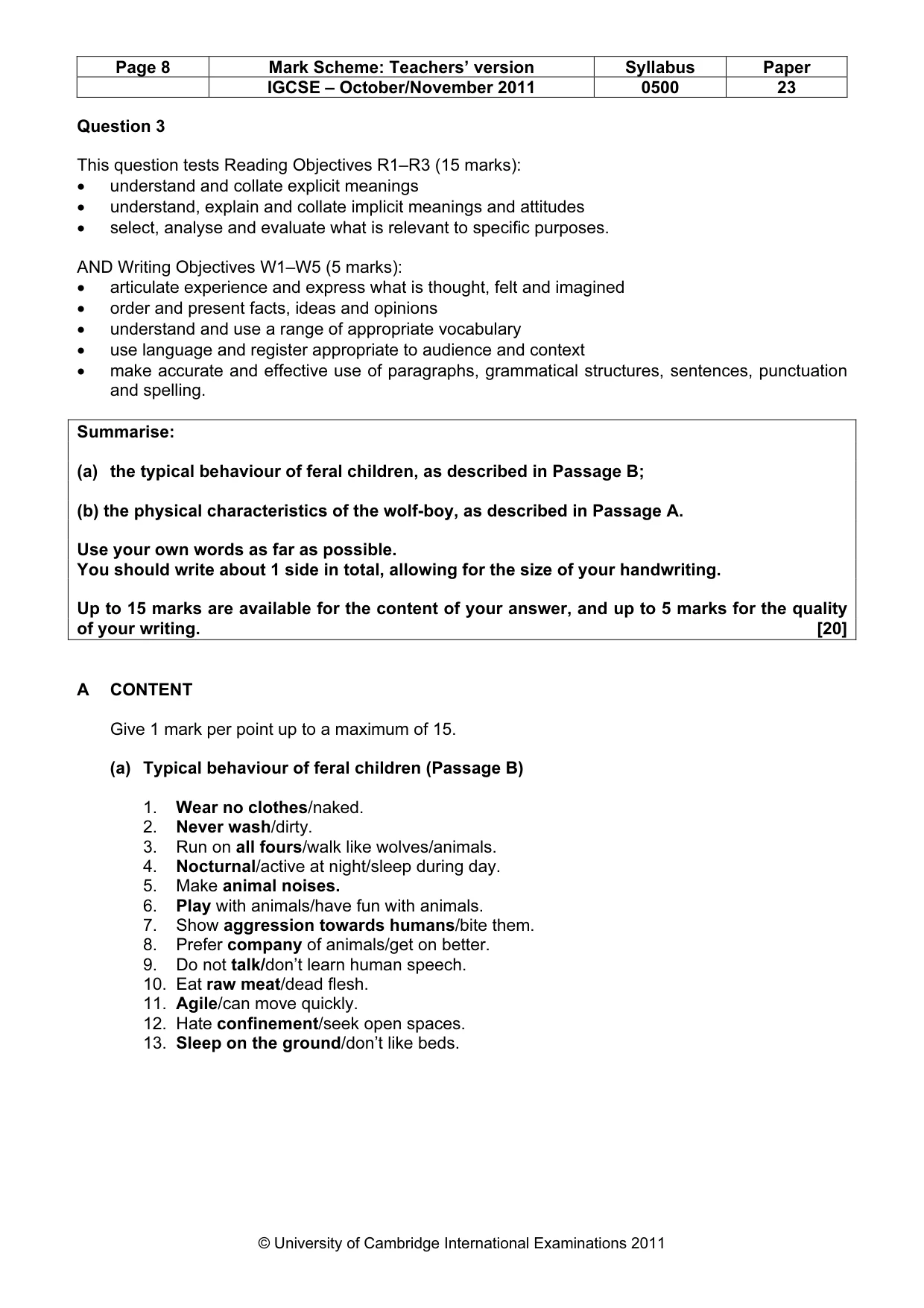
Page 8 Mark Scheme: Teachers’ version Syllabus Paper IGCSE – October/November 2011 0500 23 © University of Cambridge International Examinations 2011 Question 3 This question tests Reading Objectives R1–R3 (15 marks): • understand and collate explicit meanings • understand, explain and collate implicit meanings and attitudes • select, analyse and evaluate what is relevant to specific purposes. AND Writing Objectives W1–W5 (5 marks): • articulate experience and express what is thought, felt and imagined • order and present facts, ideas and opinions • understand and use a range of appropriate vocabulary • use language and register appropriate to audience and context • make accurate and effective use of paragraphs, grammatical structures, sentences, punctuation and spelling. Summarise: (a) the typical behaviour of feral children, as described in Passage B; (b) the physical characteristics of the wolf-boy, as described in Passage A. Use your own words as far as possible. You should write about 1 side in total, allowing for the size of your handwriting. Up to 15 marks are available for the content of your answer, and up to 5 marks for the quality of your writing. [20] A CONTENT Give 1 mark per point up to a maximum of 15. (a) Typical behaviour of feral children (Passage B) 1. Wear no clothes/naked. 2. Never wash/dirty. 3. Run on all fours/walk like wolves/animals. 4. Nocturnal/active at night/sleep during day. 5. Make animal noises. 6. Play with animals/have fun with animals. 7. Show aggression towards humans/bite them. 8. Prefer company of animals/get on better. 9. Do not talk/don’t learn human speech. 10. Eat raw meat/dead flesh. 11. Agile/can move quickly. 12. Hate confinement/seek open spaces. 13. Sleep on the ground/don’t like beds.
Mark scheme, page 9
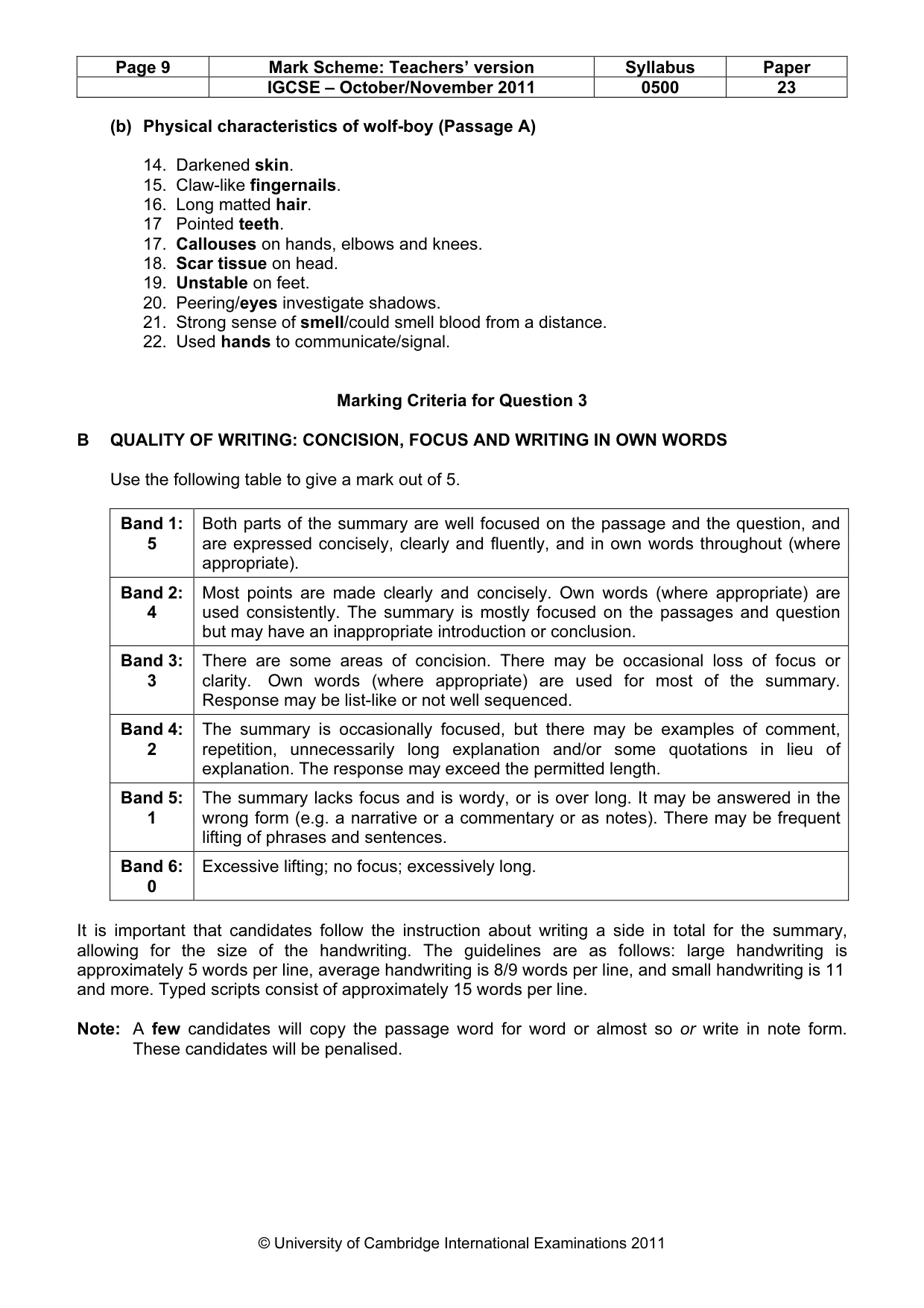
Page 9 Mark Scheme: Teachers’ version Syllabus Paper IGCSE – October/November 2011 0500 23 © University of Cambridge International Examinations 2011 (b) Physical characteristics of wolf-boy (Passage A) 14. Darkened skin. 15. Claw-like fingernails. 16. Long matted hair. 17 Pointed teeth. 17. Callouses on hands, elbows and knees. 18. Scar tissue on head. 19. Unstable on feet. 20. Peering/eyes investigate shadows. 21. Strong sense of smell/could smell blood from a distance. 22. Used hands to communicate/signal. Marking Criteria for Question 3 B QUALITY OF WRITING: CONCISION, FOCUS AND WRITING IN OWN WORDS Use the following table to give a mark out of 5. Band 1: 5 Both parts of the summary are well focused on the passage and the question, and are expressed concisely, clearly and fluently, and in own words throughout (where appropriate). Band 2: 4 Most points are made clearly and concisely. Own words (where appropriate) are used consistently. The summary is mostly focused on the passages and question but may have an inappropriate introduction or conclusion. Band 3: 3 There are some areas of concision. There may be occasional loss of focus or clarity. Own words (where appropriate) are used for most of the summary. Response may be list-like or not well sequenced. Band 4: 2 The summary is occasionally focused, but there may be examples of comment, repetition, unnecessarily long explanation and/or some quotations in lieu of explanation. The response may exceed the permitted length. Band 5: 1 The summary lacks focus and is wordy, or is over long. It may be answered in the wrong form (e.g. a narrative or a commentary or as notes). There may be frequent lifting of phrases and sentences. Band 6: 0 Excessive lifting; no focus; excessively long. It is important that candidates follow the instruction about writing a side in total for the summary, allowing for the size of the handwriting. The guidelines are as follows: large handwriting is approximately 5 words per line, average handwriting is 8/9 words per line, and small handwriting is 11 and more. Typed scripts consist of approximately 15 words per line. Note: A few candidates will copy the passage word for word or almost so or write in note form. These candidates will be penalised.
What you needed in this session
Cambridge’s own grade thresholds for 2011 Oct/Nov, Paper 2 · Variant 3. A higher threshold means an easier paper — the bar moves with how the cohort did.