Cambridge IGCSE English - First Language 0500 — 2011 Oct/Nov Paper 2 · Variant 1
0500/21/O/N/11 · 50 marks · ≈56 min
The question paper and its mark scheme, free to read here and free to download. This is Cambridge’s own paper, exactly as it was sat.
Question paper8 pages


Mark scheme12 pages
Answers below. Sit the paper first if you are practising.
Paper as text
Question paper, page 1
This document consists of 5 printed pages and 3 blank pages. DC (NF) 35738/4 © UCLES 2011 [Turn over UNIVERSITY OF CAMBRIDGE INTERNATIONAL EXAMINATIONS International General Certificate of Secondary Education * 8 4 2 0 1 6 4 5 8 0 * FIRST LANGUAGE ENGLISH 0500/21 Paper 2 Reading Passages (Extended) October/November 2011 2 hours Additional Materials: Answer Booklet/Paper READ THESE INSTRUCTIONS FIRST If you have been given an Answer Booklet, follow the instructions on the front cover of the Booklet. Write your Centre number, candidate number and name on all the work you hand in. Write in dark blue or black pen. Do not use staples, paper clips, highlighters, glue or correction fluid. Answer all questions. Dictionaries are not permitted. At the end of the examination, fasten all your work securely together. The number of marks is given in brackets [ ] at the end of each question or part question. www.XtremePapers.com
Question paper, page 2
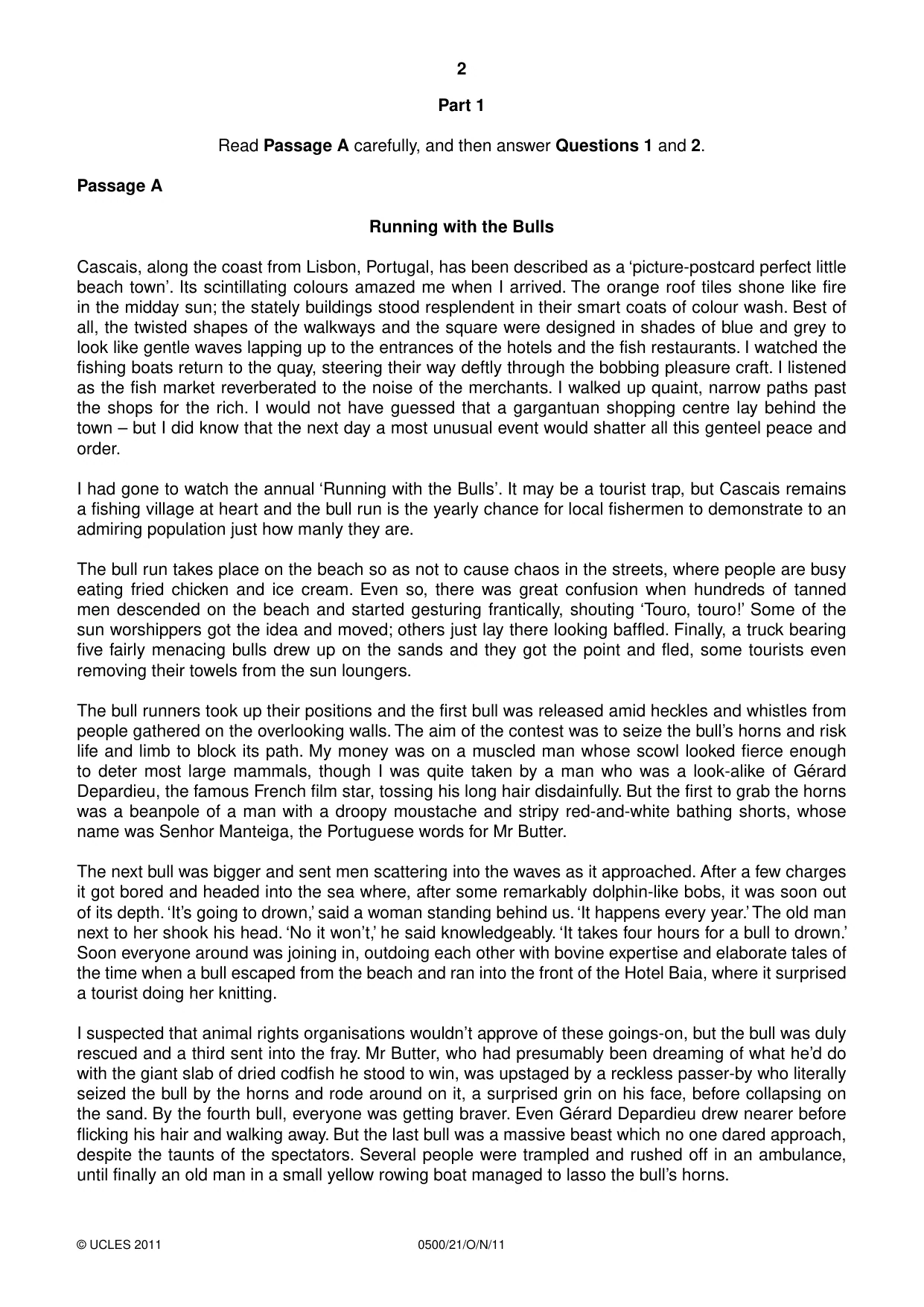
2 0500/21/O/N/11 © UCLES 2011 Part 1 Read Passage A carefully, and then answer Questions 1 and 2. Passage A Running with the Bulls Cascais, along the coast from Lisbon, Portugal, has been described as a ‘picture-postcard perfect little beach town’. Its scintillating colours amazed me when I arrived. The orange roof tiles shone like fire in the midday sun; the stately buildings stood resplendent in their smart coats of colour wash. Best of all, the twisted shapes of the walkways and the square were designed in shades of blue and grey to look like gentle waves lapping up to the entrances of the hotels and the fish restaurants. I watched the fishing boats return to the quay, steering their way deftly through the bobbing pleasure craft. I listened as the fish market reverberated to the noise of the merchants. I walked up quaint, narrow paths past the shops for the rich. I would not have guessed that a gargantuan shopping centre lay behind the town – but I did know that the next day a most unusual event would shatter all this genteel peace and order. I had gone to watch the annual ‘Running with the Bulls’. It may be a tourist trap, but Cascais remains a fishing village at heart and the bull run is the yearly chance for local fishermen to demonstrate to an admiring population just how manly they are. The bull run takes place on the beach so as not to cause chaos in the streets, where people are busy eating fried chicken and ice cream. Even so, there was great confusion when hundreds of tanned men descended on the beach and started gesturing frantically, shouting ‘Touro, touro!’ Some of the sun worshippers got the idea and moved; others just lay there looking baffled. Finally, a truck bearing five fairly menacing bulls drew up on the sands and they got the point and fled, some tourists even removing their towels from the sun loungers. The bull runners took up their positions and the first bull was released amid heckles and whistles from people gathered on the overlooking walls. The aim of the contest was to seize the bull’s horns and risk life and limb to block its path. My money was on a muscled man whose scowl looked fierce enough to deter most large mammals, though I was quite taken by a man who was a look-alike of Gérard Depardieu, the famous French film star, tossing his long hair disdainfully. But the first to grab the horns was a beanpole of a man with a droopy moustache and stripy red-and-white bathing shorts, whose name was Senhor Manteiga, the Portuguese words for Mr Butter. The next bull was bigger and sent men scattering into the waves as it approached. After a few charges it got bored and headed into the sea where, after some remarkably dolphin-like bobs, it was soon out of its depth. ‘It’s going to drown,’ said a woman standing behind us. ‘It happens every year.’ The old man next to her shook his head. ‘No it won’t,’ he said knowledgeably. ‘It takes four hours for a bull to drown.’ Soon everyone around was joining in, outdoing each other with bovine expertise and elaborate tales of the time when a bull escaped from the beach and ran into the front of the Hotel Baia, where it surprised a tourist doing her knitting. I suspected that animal rights organisations wouldn’t approve of these goings-on, but the bull was duly rescued and a third sent into the fray. Mr Butter, who had presumably been dreaming of what he’d do with the giant slab of dried codfish he stood to win, was upstaged by a reckless passer-by who literally seized the bull by the horns and rode around on it, a surprised grin on his face, before collapsing on the sand. By the fourth bull, everyone was getting braver. Even Gérard Depardieu drew nearer before flicking his hair and walking away. But the last bull was a massive beast which no one dared approach, despite the taunts of the spectators. Several people were trampled and rushed off in an ambulance, until finally an old man in a small yellow rowing boat managed to lasso the bull’s horns.
Question paper, page 3
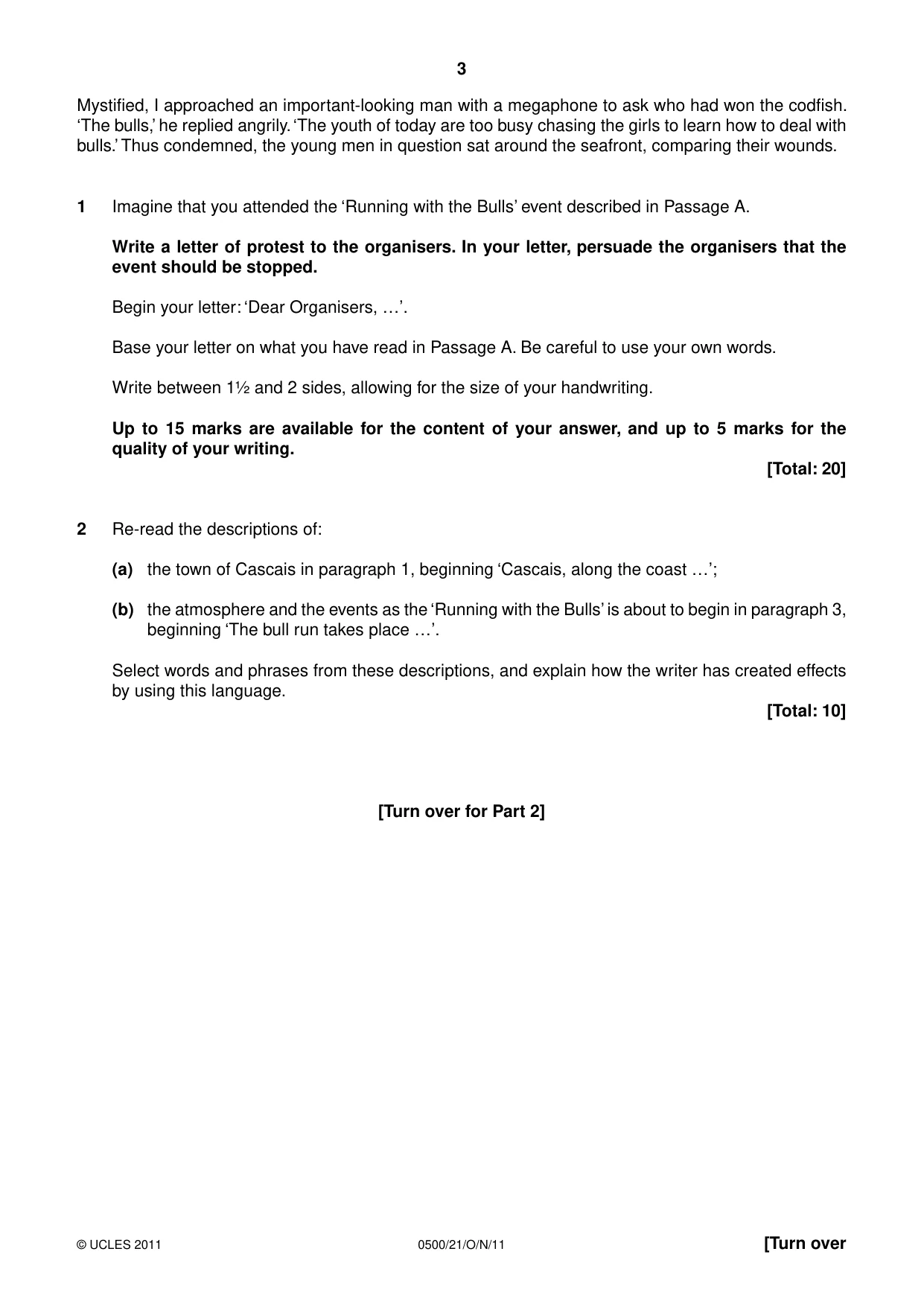
3 0500/21/O/N/11 © UCLES 2011 [Turn over Mystified, I approached an important-looking man with a megaphone to ask who had won the codfish. ‘The bulls,’ he replied angrily. ‘The youth of today are too busy chasing the girls to learn how to deal with bulls.’ Thus condemned, the young men in question sat around the seafront, comparing their wounds. 1 Imagine that you attended the ‘Running with the Bulls’ event described in Passage A. Write a letter of protest to the organisers. In your letter, persuade the organisers that the event should be stopped. Begin your letter: ‘Dear Organisers, …’. Base your letter on what you have read in Passage A. Be careful to use your own words. Write between 1½ and 2 sides, allowing for the size of your handwriting. Up to 15 marks are available for the content of your answer, and up to 5 marks for the quality of your writing. [Total: 20] 2 Re-read the descriptions of: (a) the town of Cascais in paragraph 1, beginning ‘Cascais, along the coast …’; (b) the atmosphere and the events as the ‘Running with the Bulls’ is about to begin in paragraph 3, beginning ‘The bull run takes place …’. Select words and phrases from these descriptions, and explain how the writer has created effects by using this language. [Total: 10] [Turn over for Part 2]
Question paper, page 4
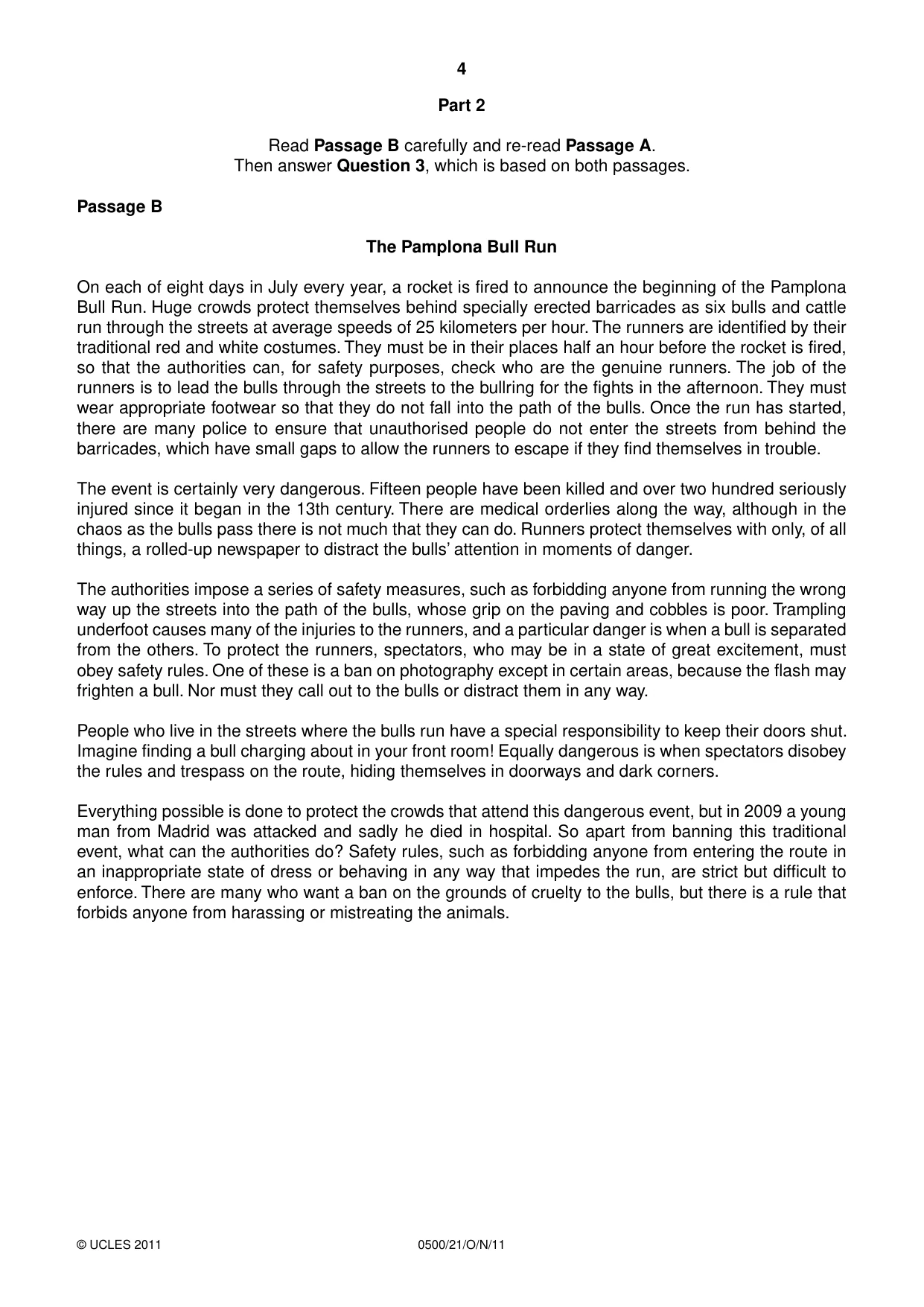
4 0500/21/O/N/11 © UCLES 2011 Part 2 Read Passage B carefully and re-read Passage A. Then answer Question 3, which is based on both passages. Passage B The Pamplona Bull Run On each of eight days in July every year, a rocket is fired to announce the beginning of the Pamplona Bull Run. Huge crowds protect themselves behind specially erected barricades as six bulls and cattle run through the streets at average speeds of 25 kilometers per hour. The runners are identified by their traditional red and white costumes. They must be in their places half an hour before the rocket is fired, so that the authorities can, for safety purposes, check who are the genuine runners. The job of the runners is to lead the bulls through the streets to the bullring for the fights in the afternoon. They must wear appropriate footwear so that they do not fall into the path of the bulls. Once the run has started, there are many police to ensure that unauthorised people do not enter the streets from behind the barricades, which have small gaps to allow the runners to escape if they find themselves in trouble. The event is certainly very dangerous. Fifteen people have been killed and over two hundred seriously injured since it began in the 13th century. There are medical orderlies along the way, although in the chaos as the bulls pass there is not much that they can do. Runners protect themselves with only, of all things, a rolled-up newspaper to distract the bulls’ attention in moments of danger. The authorities impose a series of safety measures, such as forbidding anyone from running the wrong way up the streets into the path of the bulls, whose grip on the paving and cobbles is poor. Trampling underfoot causes many of the injuries to the runners, and a particular danger is when a bull is separated from the others. To protect the runners, spectators, who may be in a state of great excitement, must obey safety rules. One of these is a ban on photography except in certain areas, because the flash may frighten a bull. Nor must they call out to the bulls or distract them in any way. People who live in the streets where the bulls run have a special responsibility to keep their doors shut. Imagine finding a bull charging about in your front room! Equally dangerous is when spectators disobey the rules and trespass on the route, hiding themselves in doorways and dark corners. Everything possible is done to protect the crowds that attend this dangerous event, but in 2009 a young man from Madrid was attacked and sadly he died in hospital. So apart from banning this traditional event, what can the authorities do? Safety rules, such as forbidding anyone from entering the route in an inappropriate state of dress or behaving in any way that impedes the run, are strict but difficult to enforce. There are many who want a ban on the grounds of cruelty to the bulls, but there is a rule that forbids anyone from harassing or mistreating the animals.
Question paper, page 5
5 0500/21/O/N/11 © UCLES 2011 3 Summarise: (a) how safety and order are promoted at the Pamplona Bull Run, as described in Passage B; (b) the reasons why the local people of Cascais enjoy the ‘Running with the Bulls’, as described in Passage A. Use your own words as far as possible. You should write about 1 side in total, allowing for the size of your handwriting. Up to 15 marks are available for the content of your answer, and up to 5 marks for the quality of your writing. [Total: 20]
Question paper, page 6
6 0500/21/O/N/11 © UCLES 2011 BLANK PAGE
Question paper, page 7
7 0500/21/O/N/11 © UCLES 2011 BLANK PAGE
Question paper, page 8
8 0500/21/O/N/11 © UCLES 2011 BLANK PAGE Copyright Acknowledgements: Questions 1, 2 & 3 © Christina Lamb; Small Wars Permitting; Harper Collins; 2008. Permission to reproduce items where third-party owned material protected by copyright is included has been sought and cleared where possible. Every reasonable effort has been made by the publisher (UCLES) to trace copyright holders, but if any items requiring clearance have unwittingly been included, the publisher will be pleased to make amends at the earliest possible opportunity. University of Cambridge International Examinations is part of the Cambridge Assessment Group. Cambridge Assessment is the brand name of University of Cambridge Local Examinations Syndicate (UCLES), which is itself a department of the University of Cambridge.
Mark scheme, page 1
UNIVERSITY OF CAMBRIDGE INTERNATIONAL EXAMINATIONS International General Certificate of Secondary Education MARK SCHEME for the October/November 2011 question paper for the guidance of teachers 0500 FIRST LANGUAGE ENGLISH 0500/21 Paper 2 (Reading Passage – Extended), maximum raw mark 50 This mark scheme is published as an aid to teachers and candidates, to indicate the requirements of the examination. It shows the basis on which Examiners were instructed to award marks. It does not indicate the details of the discussions that took place at an Examiners’ meeting before marking began, which would have considered the acceptability of alternative answers. Mark schemes must be read in conjunction with the question papers and the report on the examination. • Cambridge will not enter into discussions or correspondence in connection with these mark schemes. Cambridge is publishing the mark schemes for the October/November 2011 question papers for most IGCSE, GCE Advanced Level and Advanced Subsidiary Level syllabuses and some Ordinary Level syllabuses. www.XtremePapers.com
Mark scheme, page 2
Page 2 Mark Scheme: Teachers’ version Syllabus Paper IGCSE – October/November 2011 0500 21 © University of Cambridge International Examinations 2011 Note: All Examiners are instructed that alternative correct answers and unexpected approaches in candidates’ scripts must be given marks that fairly reflect the relevant knowledge and skills demonstrated. Nonetheless, the content must be clearly related to and derived from the passage. Question 1 This question tests Reading Objectives R1–R3 (15 marks): • understand and collate explicit meanings • understand, explain and collate implicit meanings and attitudes • select, analyse and evaluate what is relevant to specific purposes. AND Writing Objectives W1–W5 (5 marks): • articulate experience and express what is thought, felt and imagined • order and present facts, ideas and opinions • understand and use a range of appropriate vocabulary • use language and register appropriate to audience and context • make accurate and effective use of paragraphs, grammatical structures, sentences, punctuation and spelling. Imagine that you attended the ‘Running with the Bulls’ event described in Passage A. Write a letter of protest to the organisers. In your letter, persuade the organisers that the event should be stopped. Begin your letter ‘Dear Organisers…’. Base your letter on what you have read in passage A. Be careful to use your own words. Write between 1½ and 2 sides, allowing for the size of your handwriting. Up to 15 marks are available for the content of your answer, and up to 5 marks for the quality of your writing. [20] General notes on likely content Candidates should select ideas from the passage and develop these, supporting what they write with details from the passage. Good answers will develop arguments with persuasion, often sustained and strong. Details from the passage will be adapted to suit those arguments. Basic answers will tend to be a statement of a few arguments with little effective development, and with details presented as narrative. Look for full answers, providing a range of effective arguments and making wide and varied use of the passage. For quality of writing, look for a clear, persuasive style and a sound structure for the letter as a whole. Credit sequences of sentences within an argument. Credit introductions that set the tone (though introductions may slightly contribute to the reading mark as well). Credit the way that arguments are ordered (e.g. those concerning the bulls in one place, those concerning people in another.)
Mark scheme, page 3
Page 3 Mark Scheme: Teachers’ version Syllabus Paper IGCSE – October/November 2011 0500 21 © University of Cambridge International Examinations 2011 Responses may include the following ideas: Consider that the lack of organisation/publicity has the following negative effects: A Effects on people • Range of injuries sustained from minor to hospitalisation. • Anybody can get involved – no experience/preparation – dangerous. • Participants are laughing stock. • Only males take part in the activity – designed for fishermen to show off how manly they are. • No-one won the prize so pointless. • Only people who had any success were the man who foolishly seized the bull by the horns and an old man with a lasso in a rowing boat! • Annoying/distressing for tourists who want to sit on beach/enjoy time in public areas of hotels. B Impact on the bulls • Traumatised by transportation to beach. • Traumatised by noise and general hubbub. • Escape seaward can lead to long time to drown. • Lassoing of horns/degrading to bulls. C Effects on the town • Off-putting to type of tourists this ‘genteel’ resort attracts. • Causes chaos (general point). • Cost of damage (individuals), e.g. to hotels when bulls run amok/replace damaged sunbeds/farmers loss due to drowned bulls. • Cost (municipal) of cleaning up the beach afterwards. • Impact on medical infrastructure. • Some reference to the future of the town if event allowed to continue. Credit the use of detail about the efforts of the contestants. Accept other relevant ideas derived from the passage and relevant to the question as a basis for the letter.
Mark scheme, page 4
Page 4 Mark Scheme: Teachers’ version Syllabus Paper IGCSE – October/November 2011 0500 21 © University of Cambridge International Examinations 2011 Marking Criteria for Question 1 A CONTENT (EXTENDED TIER) Use the following table to give a mark out of 15. Band 1: 13–15 The answer reveals a thorough reading of the passage. A wide range of well- developed and convincing arguments is applied to the question. There is an appropriate amount of supporting detail, which is well adapted and integrated into the letter, contributing to a consistently strong sense of purpose and approach. An ability to establish facts from the humorous façade of the article adds to the overall effect. Band 2: 10–12 There is evidence of a competent reading of the passage. The letter explains some of the arguments well and expresses some feelings. Some ideas are developed, but the ability to sustain content may not be consistent. All parts of the letter may not be equally effective. There is some supporting detail throughout. Band 3: 7–9 The passage has been read reasonably well, but the response may not reflect the range and detail of the original. There may be evidence of a mechanical use of the passage. There is focus on the task and satisfactory reference, but opportunities for development are not always taken. Some supporting detail is used, but not consistently. Band 4: 4–6 Some reference to the passage is made with little development. The response may be thin or in places lack focus on the passage or the question, but there is some evidence of general understanding of the main ideas. Band 5: 1–3 The response is either very general with little specific reference to the passage or a reproduction of sections of the original. Content is insubstantial or there is little realisation of the need to modify material from the passage. Band 6: 0 There is little or no relevance to the question or to the passage.
Mark scheme, page 5
Page 5 Mark Scheme: Teachers’ version Syllabus Paper IGCSE – October/November 2011 0500 21 © University of Cambridge International Examinations 2011 B QUALITY OF WRITING: STRUCTURE AND ORDER, STYLE OF LANGUAGE (EXTENDED TIER) Use the following table to give a mark out of 5. Band 1: 5 The language of the letter is persuasive, expresses feeling and is consistently appropriate. There is a clear sense of audience. Arguments are firmly expressed in a wide range of effective and/or interesting language. Structure and sequence is sound throughout. Band 2: 4 Language is mostly fluent and there is clarity of expression. There is some sense of audience. There is a sufficient range of vocabulary to express some arguments persuasively and to develop them with some clarity. The response is mainly well structured and well sequenced. Band 3: 3 Language is clear and appropriate, but comparatively plain, even when expressing feelings. The sense of audience is slight, though the style is generally consistent. Individual ideas are rarely extended, but explanations are adequate. There may be flaws in structure but some sections are well sequenced. Band 4: 2 There may be some awkwardness of expression and some inconsistency of appropriate style. The sense of audience is weak. Language is too limited to express shades of meaning. There is structural weakness and there may be some copying. Band 5: 1 There are problems of expression and structure. Language is weak and undeveloped. The letter may not start well and the purpose for writing may not be clear. There is little attempt to explain thoughts and emotions. There may be frequent copying from the original. Band 6: 0 Sentence structures and language are unclear and the response is difficult to follow.
Mark scheme, page 6
Page 6 Mark Scheme: Teachers’ version Syllabus Paper IGCSE – October/November 2011 0500 21 © University of Cambridge International Examinations 2011 Question 2 This question tests Reading Objective R4 (10 marks): • understand how writers achieve effects. Re-read the descriptions of: (a) the town of Cascais in paragraph 1, beginning ‘Cascais, along the coast…’; (b) the atmosphere and the events as the ‘Running with the Bulls’ is about to begin in paragraph 3, beginning ‘The bull run takes place…’. Select words and phrases from these descriptions, and explain how the writer has created effects by using this language. [10] General notes on likely content This question is marked for the ability to select evocative or unusual words and for an understanding of ways in which the language is effective. Expect responses to provide words that carry specific meaning, including implications, additional to general and to ordinary vocabulary. Alternative acceptable explanations should be credited. Mark for the overall quality of the response, not for the number of words chosen. Responses could score full marks for excellent comments on comparatively few choices for each part of the question, provided that they are quality choices which include imagery. Do not take marks off for inaccurate statements; simply ignore them. It is the quality of the analysis that attracts marks. The following notes are a guide to what good responses might say about the selected words. They can make any sensible comment, but only credit comments that are relevant to the correct meanings of the words and that have some validity.
Mark scheme, page 7
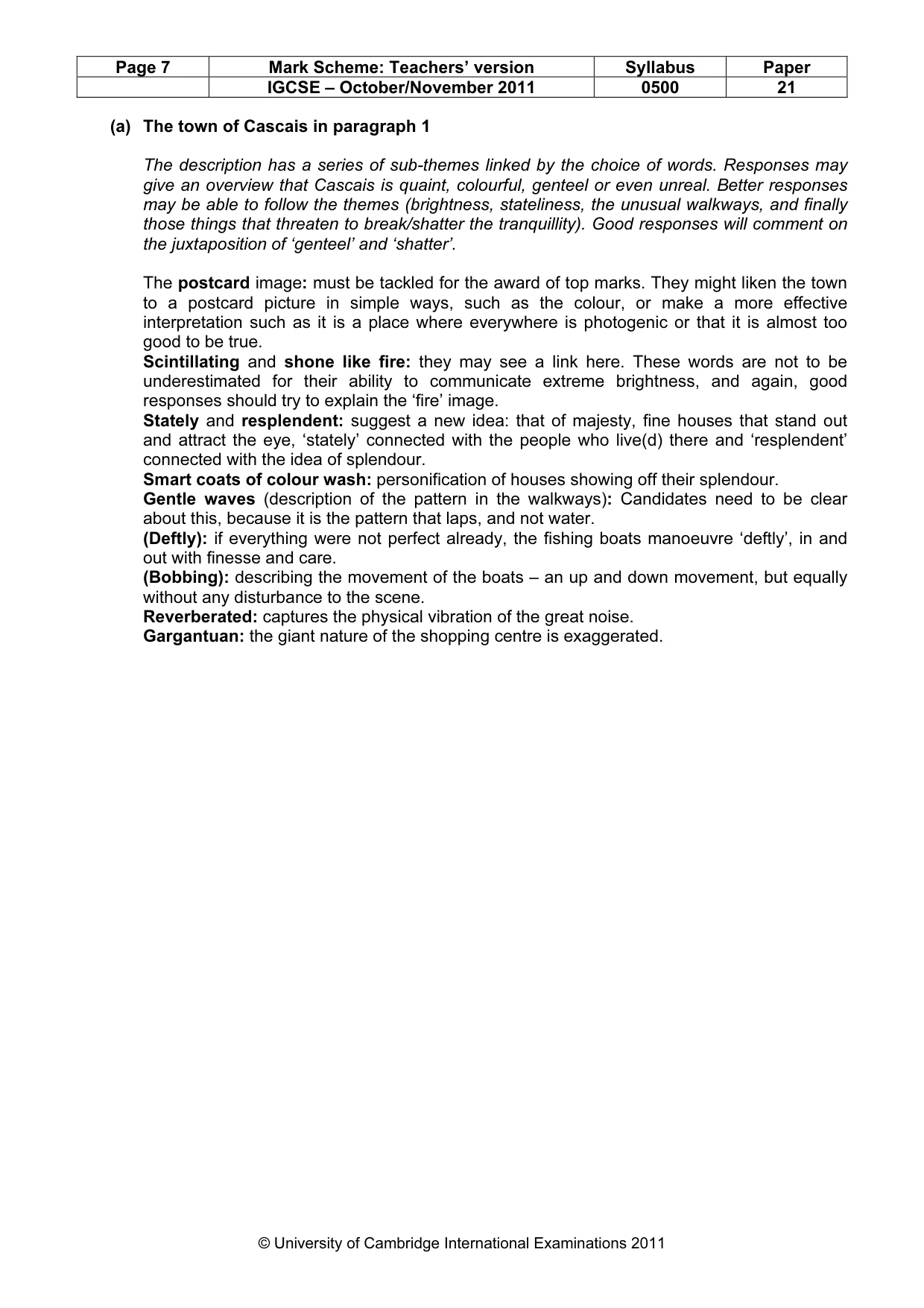
Page 7 Mark Scheme: Teachers’ version Syllabus Paper IGCSE – October/November 2011 0500 21 © University of Cambridge International Examinations 2011 (a) The town of Cascais in paragraph 1 The description has a series of sub-themes linked by the choice of words. Responses may give an overview that Cascais is quaint, colourful, genteel or even unreal. Better responses may be able to follow the themes (brightness, stateliness, the unusual walkways, and finally those things that threaten to break/shatter the tranquillity). Good responses will comment on the juxtaposition of ‘genteel’ and ‘shatter’. The postcard image: must be tackled for the award of top marks. They might liken the town to a postcard picture in simple ways, such as the colour, or make a more effective interpretation such as it is a place where everywhere is photogenic or that it is almost too good to be true. Scintillating and shone like fire: they may see a link here. These words are not to be underestimated for their ability to communicate extreme brightness, and again, good responses should try to explain the ‘fire’ image. Stately and resplendent: suggest a new idea: that of majesty, fine houses that stand out and attract the eye, ‘stately’ connected with the people who live(d) there and ‘resplendent’ connected with the idea of splendour. Smart coats of colour wash: personification of houses showing off their splendour. Gentle waves (description of the pattern in the walkways): Candidates need to be clear about this, because it is the pattern that laps, and not water. (Deftly): if everything were not perfect already, the fishing boats manoeuvre ‘deftly’, in and out with finesse and care. (Bobbing): describing the movement of the boats – an up and down movement, but equally without any disturbance to the scene. Reverberated: captures the physical vibration of the great noise. Gargantuan: the giant nature of the shopping centre is exaggerated.
Mark scheme, page 8
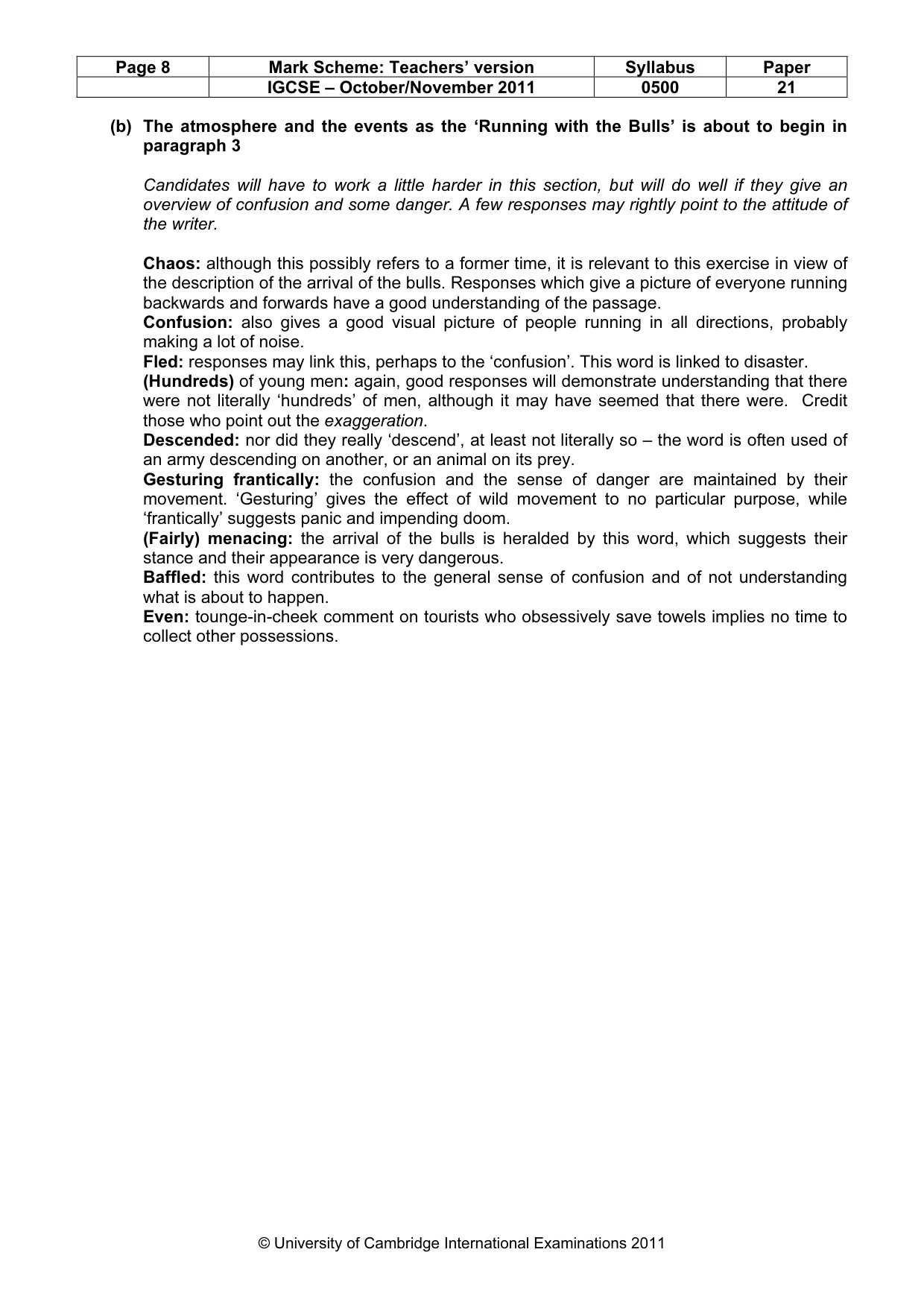
Page 8 Mark Scheme: Teachers’ version Syllabus Paper IGCSE – October/November 2011 0500 21 © University of Cambridge International Examinations 2011 (b) The atmosphere and the events as the ‘Running with the Bulls’ is about to begin in paragraph 3 Candidates will have to work a little harder in this section, but will do well if they give an overview of confusion and some danger. A few responses may rightly point to the attitude of the writer. Chaos: although this possibly refers to a former time, it is relevant to this exercise in view of the description of the arrival of the bulls. Responses which give a picture of everyone running backwards and forwards have a good understanding of the passage. Confusion: also gives a good visual picture of people running in all directions, probably making a lot of noise. Fled: responses may link this, perhaps to the ‘confusion’. This word is linked to disaster. (Hundreds) of young men: again, good responses will demonstrate understanding that there were not literally ‘hundreds’ of men, although it may have seemed that there were. Credit those who point out the exaggeration. Descended: nor did they really ‘descend’, at least not literally so – the word is often used of an army descending on another, or an animal on its prey. Gesturing frantically: the confusion and the sense of danger are maintained by their movement. ‘Gesturing’ gives the effect of wild movement to no particular purpose, while ‘frantically’ suggests panic and impending doom. (Fairly) menacing: the arrival of the bulls is heralded by this word, which suggests their stance and their appearance is very dangerous. Baffled: this word contributes to the general sense of confusion and of not understanding what is about to happen. Even: tounge-in-cheek comment on tourists who obsessively save towels implies no time to collect other possessions.
Mark scheme, page 9
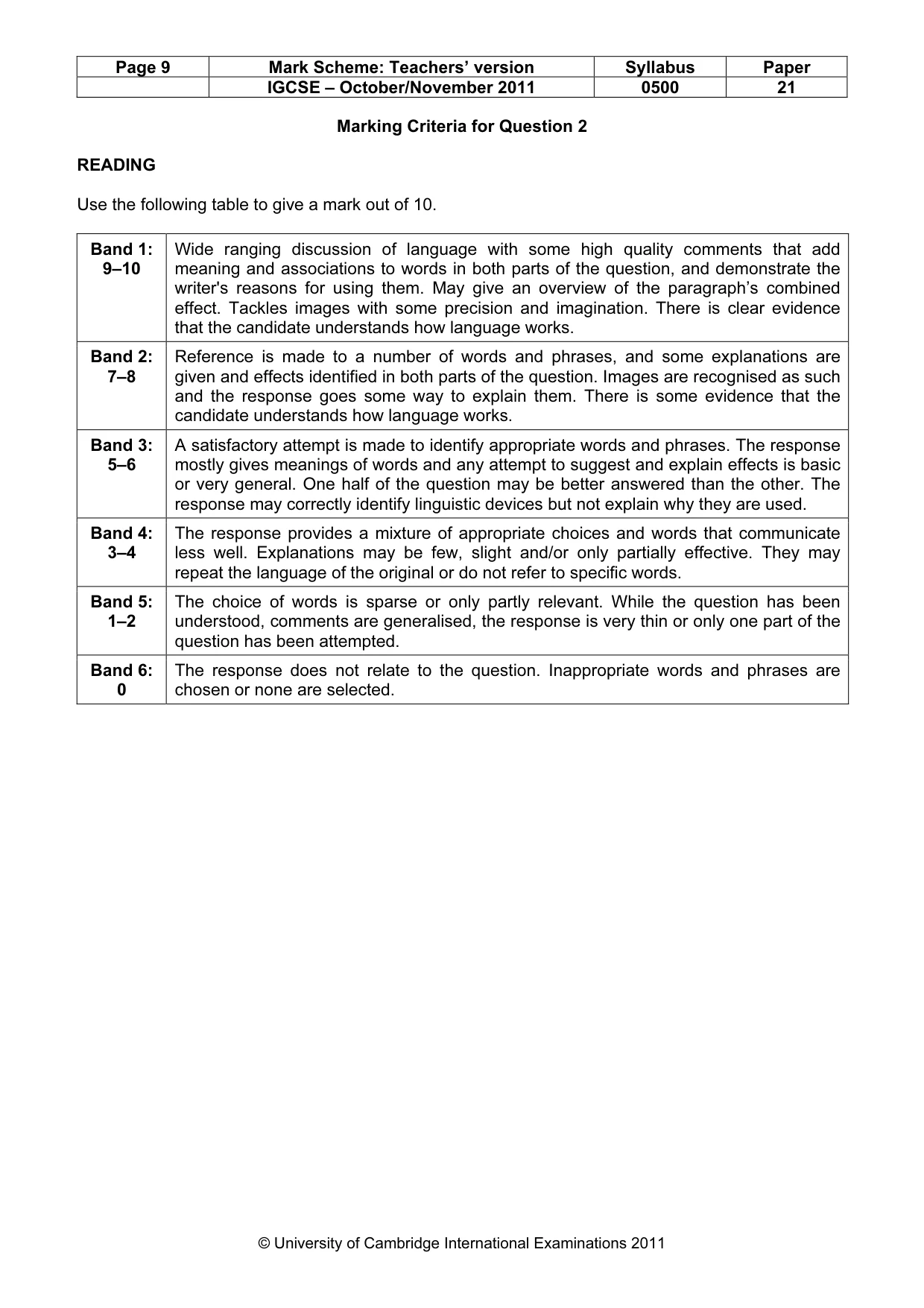
Page 9 Mark Scheme: Teachers’ version Syllabus Paper IGCSE – October/November 2011 0500 21 © University of Cambridge International Examinations 2011 Marking Criteria for Question 2 READING Use the following table to give a mark out of 10. Band 1: 9–10 Wide ranging discussion of language with some high quality comments that add meaning and associations to words in both parts of the question, and demonstrate the writer's reasons for using them. May give an overview of the paragraph’s combined effect. Tackles images with some precision and imagination. There is clear evidence that the candidate understands how language works. Band 2: 7–8 Reference is made to a number of words and phrases, and some explanations are given and effects identified in both parts of the question. Images are recognised as such and the response goes some way to explain them. There is some evidence that the candidate understands how language works. Band 3: 5–6 A satisfactory attempt is made to identify appropriate words and phrases. The response mostly gives meanings of words and any attempt to suggest and explain effects is basic or very general. One half of the question may be better answered than the other. The response may correctly identify linguistic devices but not explain why they are used. Band 4: 3–4 The response provides a mixture of appropriate choices and words that communicate less well. Explanations may be few, slight and/or only partially effective. They may repeat the language of the original or do not refer to specific words. Band 5: 1–2 The choice of words is sparse or only partly relevant. While the question has been understood, comments are generalised, the response is very thin or only one part of the question has been attempted. Band 6: 0 The response does not relate to the question. Inappropriate words and phrases are chosen or none are selected.
Mark scheme, page 10
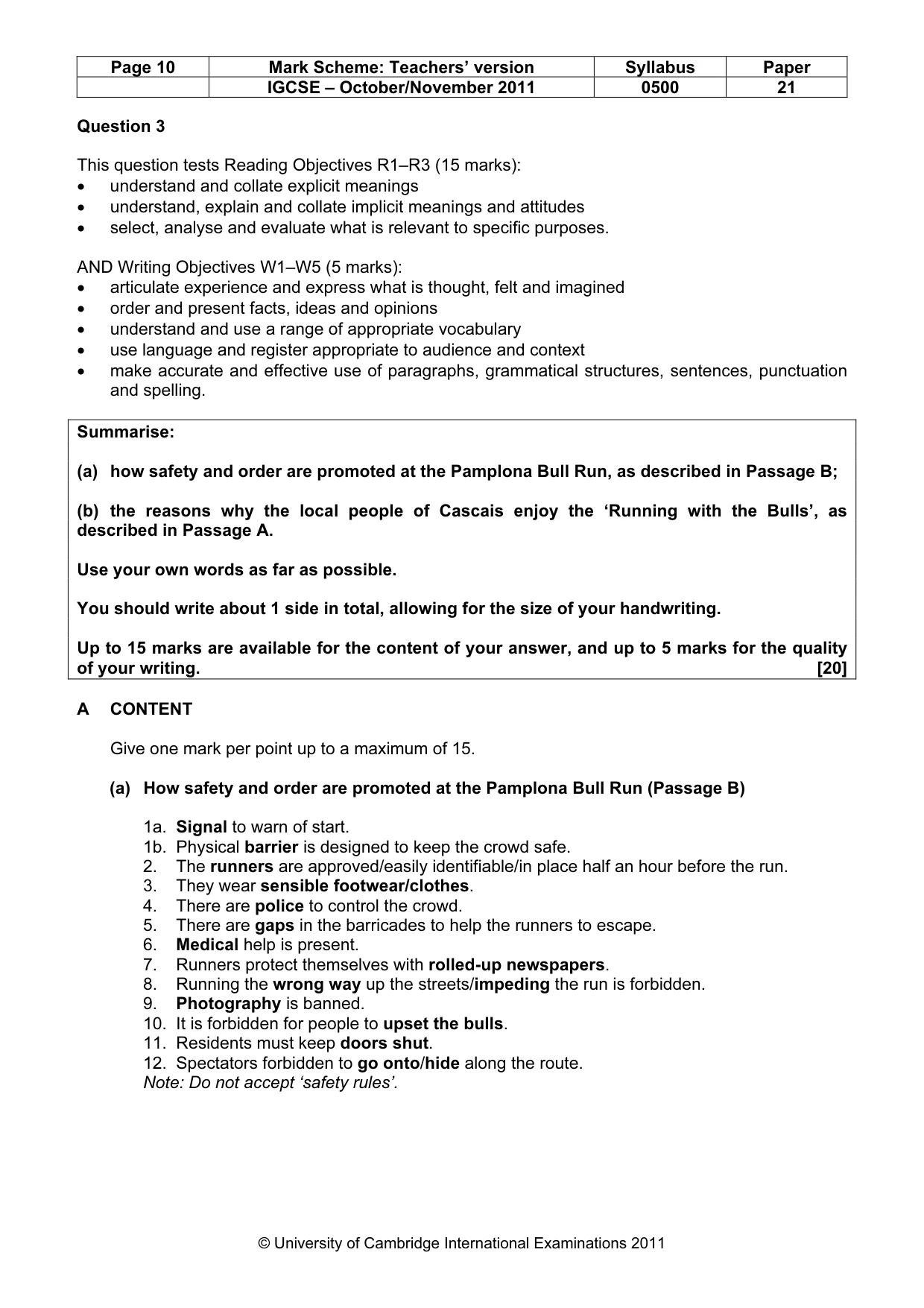
Page 10 Mark Scheme: Teachers’ version Syllabus Paper IGCSE – October/November 2011 0500 21 © University of Cambridge International Examinations 2011 Question 3 This question tests Reading Objectives R1–R3 (15 marks): • understand and collate explicit meanings • understand, explain and collate implicit meanings and attitudes • select, analyse and evaluate what is relevant to specific purposes. AND Writing Objectives W1–W5 (5 marks): • articulate experience and express what is thought, felt and imagined • order and present facts, ideas and opinions • understand and use a range of appropriate vocabulary • use language and register appropriate to audience and context • make accurate and effective use of paragraphs, grammatical structures, sentences, punctuation and spelling. Summarise: (a) how safety and order are promoted at the Pamplona Bull Run, as described in Passage B; (b) the reasons why the local people of Cascais enjoy the ‘Running with the Bulls’, as described in Passage A. Use your own words as far as possible. You should write about 1 side in total, allowing for the size of your handwriting. Up to 15 marks are available for the content of your answer, and up to 5 marks for the quality of your writing. [20] A CONTENT Give one mark per point up to a maximum of 15. (a) How safety and order are promoted at the Pamplona Bull Run (Passage B) 1a. Signal to warn of start. 1b. Physical barrier is designed to keep the crowd safe. 2. The runners are approved/easily identifiable/in place half an hour before the run. 3. They wear sensible footwear/clothes. 4. There are police to control the crowd. 5. There are gaps in the barricades to help the runners to escape. 6. Medical help is present. 7. Runners protect themselves with rolled-up newspapers. 8. Running the wrong way up the streets/impeding the run is forbidden. 9. Photography is banned. 10. It is forbidden for people to upset the bulls. 11. Residents must keep doors shut. 12. Spectators forbidden to go onto/hide along the route. Note: Do not accept ‘safety rules’.
Mark scheme, page 11
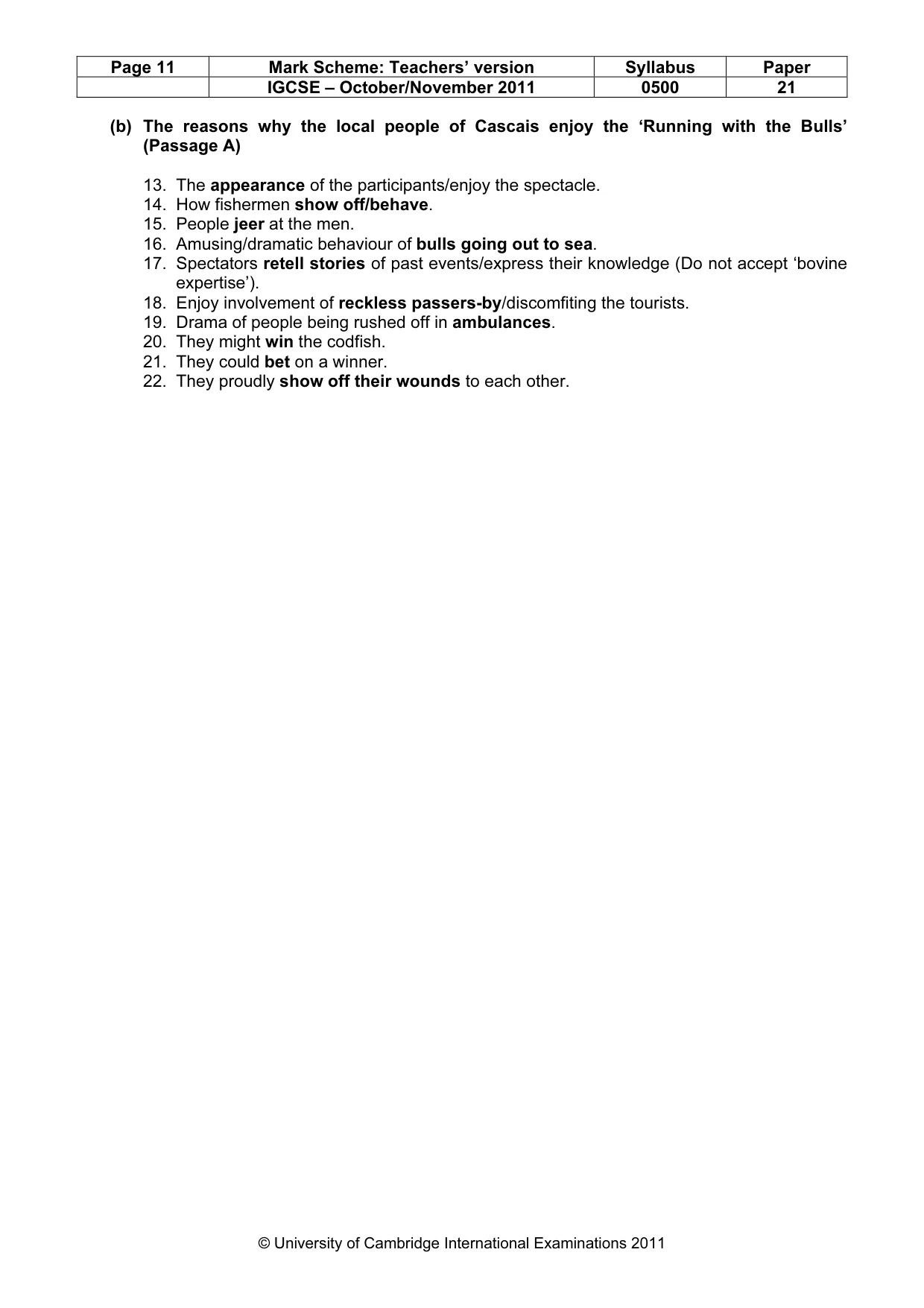
Page 11 Mark Scheme: Teachers’ version Syllabus Paper IGCSE – October/November 2011 0500 21 © University of Cambridge International Examinations 2011 (b) The reasons why the local people of Cascais enjoy the ‘Running with the Bulls’ (Passage A) 13. The appearance of the participants/enjoy the spectacle. 14. How fishermen show off/behave. 15. People jeer at the men. 16. Amusing/dramatic behaviour of bulls going out to sea. 17. Spectators retell stories of past events/express their knowledge (Do not accept ‘bovine expertise’). 18. Enjoy involvement of reckless passers-by/discomfiting the tourists. 19. Drama of people being rushed off in ambulances. 20. They might win the codfish. 21. They could bet on a winner. 22. They proudly show off their wounds to each other.
Mark scheme, page 12
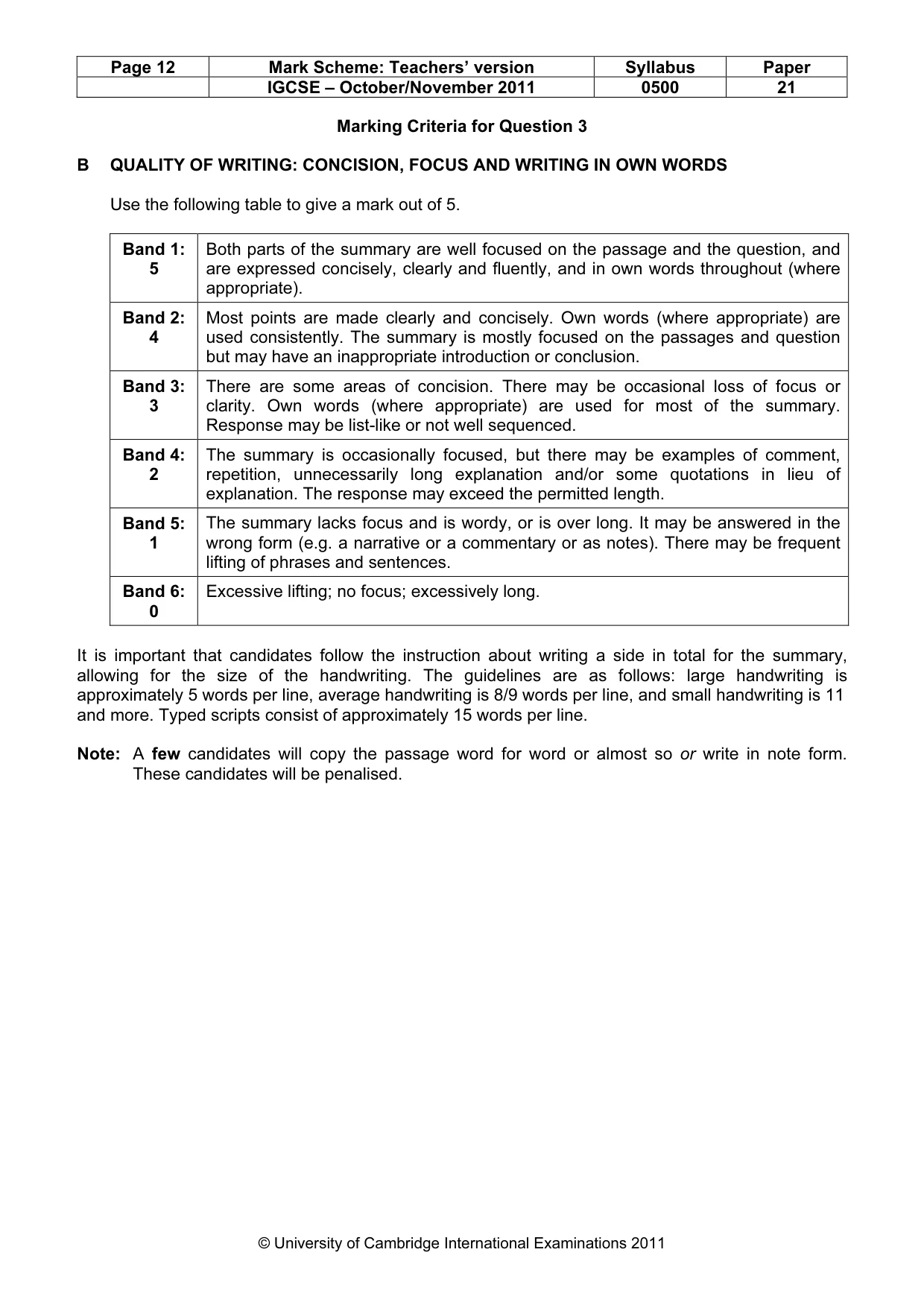
Page 12 Mark Scheme: Teachers’ version Syllabus Paper IGCSE – October/November 2011 0500 21 © University of Cambridge International Examinations 2011 Marking Criteria for Question 3 B QUALITY OF WRITING: CONCISION, FOCUS AND WRITING IN OWN WORDS Use the following table to give a mark out of 5. Band 1: 5 Both parts of the summary are well focused on the passage and the question, and are expressed concisely, clearly and fluently, and in own words throughout (where appropriate). Band 2: 4 Most points are made clearly and concisely. Own words (where appropriate) are used consistently. The summary is mostly focused on the passages and question but may have an inappropriate introduction or conclusion. Band 3: 3 There are some areas of concision. There may be occasional loss of focus or clarity. Own words (where appropriate) are used for most of the summary. Response may be list-like or not well sequenced. Band 4: 2 The summary is occasionally focused, but there may be examples of comment, repetition, unnecessarily long explanation and/or some quotations in lieu of explanation. The response may exceed the permitted length. Band 5: 1 The summary lacks focus and is wordy, or is over long. It may be answered in the wrong form (e.g. a narrative or a commentary or as notes). There may be frequent lifting of phrases and sentences. Band 6: 0 Excessive lifting; no focus; excessively long. It is important that candidates follow the instruction about writing a side in total for the summary, allowing for the size of the handwriting. The guidelines are as follows: large handwriting is approximately 5 words per line, average handwriting is 8/9 words per line, and small handwriting is 11 and more. Typed scripts consist of approximately 15 words per line. Note: A few candidates will copy the passage word for word or almost so or write in note form. These candidates will be penalised.
What you needed in this session
Cambridge’s own grade thresholds for 2011 Oct/Nov, Paper 2 · Variant 1. A higher threshold means an easier paper — the bar moves with how the cohort did.