Cambridge IGCSE English - First Language 0500 — 2011 Oct/Nov Paper 2 · Variant 2
0500/22/O/N/11 · 50 marks · ≈56 min
The question paper and its mark scheme, free to read here and free to download. This is Cambridge’s own paper, exactly as it was sat.
Question paper8 pages
Mark scheme9 pages
Answers below. Sit the paper first if you are practising.
Paper as text
Question paper, page 1
This document consists of 5 printed pages and 3 blank pages. DC (NH) 43987/3 © UCLES 2011 [Turn over UNIVERSITY OF CAMBRIDGE INTERNATIONAL EXAMINATIONS International General Certificate of Secondary Education * 6 1 2 9 3 6 9 5 7 9 * FIRST LANGUAGE ENGLISH 0500/22 Paper 2 Reading Passages (Extended) October/November 2011 2 hours Additional Materials: Answer Booklet/Paper READ THESE INSTRUCTIONS FIRST If you have been given an Answer Booklet, follow the instructions on the front cover of the Booklet. Write your Centre number, candidate number and name on all the work you hand in. Write in dark blue or black pen. Do not use staples, paper clips, highlighters, glue or correction fluid. Answer all questions. Dictionaries are not permitted. At the end of the examination, fasten all your work securely together. The number of marks is given in brackets [ ] at the end of each question or part question.
Question paper, page 2
2 0500/22/O/N/11 © UCLES 2011 Part 1 Read Passage A carefully, and then answer Questions 1 and 2. Passage A In this extract Redmond O’Hanlon describes a journey into the jungle by canoe. James, a poet, has been eventually persuaded to accompany Redmond. Into the heart of Borneo At midday we climbed into our dugout canoe and set off up-river towards the interior. After about ten miles the fields gave way to well-established secondary forest, and then the primeval jungle began. The river seemed to close in on us: the 60-metre-high trees crowded down the slopes of the hills, almost to the water’s edge, an apparently endless chaos of different species of tree, every kind of green, even under the uniform glare of a tropical sun. Parasitic growths sprouted everywhere, ferns fanned out from every angle in the branches, creepers as thick as legs gripped each other and tangled down to the surface of the water, their tips twining down in the current like river-weed. The river itself began to twist and turn too, the banks behind us appearing to merge together into one vast and impenetrable thicket, shutting us in from behind. At the same time, the trees ahead stepped aside a meagre pace or two to let the river swirl down ahead. The outboard motor set on a wooden frame at the stern of the canoe pushed us past foaming little tributaries, islets, shingle banks strewn with huge rounded boulders, half hidden coves scooped round by whirlpools. Here the river was clear, deep green from the reflection of the trees. We really were voyaging upriver! I thought it was an optical illusion, but the canoe was actually climbing up a volume of water great enough to sustain an almost constant angle of ascent, even on the stretches of water between the jagged steps of the rapids. We stopped by a pile of driftwood to hide a drum of petrol to be retrieved a few days later on the return journey. A monitor lizard, reared up on its front legs, watched us for a moment with its dinosauric eyes and then scuttled away between the broken branches. A Brahminy kite, flying low enough for us to hear the rush of air through the primary feathers of its wings, circled overhead watching us, its flecked- brown belly white in the sun. Then the bird soared away, mewing its shrill call. Further up, the rapids became more frequent and more turbulent and, at each one, heavy waves of water would crash over and into the boat. James, sitting opposite me on the boards in the centre of the canoe and facing upstream, was reading his way through the poems of the 18th century writer Swift, a straw boater on his bald head, his white shirt buttoned at the neck and at the wrists. ‘Some of these poems are pretty feeble,’ James would mutter, displeased. ‘Quite so, but – er – James?’ ‘Yes?’ ‘Rapid 583/2, Green Heave, strength six-out-of-ten, is approaching.’ With a second or two to spare, James would shut his book, mark his place with a twig, slip it neatly under the edge of the tarpaulin, sit on it, shut his eyes, get drenched, open his eyes, squeeze the water from his beard with his right hand, retrieve his book and carry on reading. Every 450 metres or so, a lesser fish-eagle would regard us with its yellow eye, flying off only as we drew almost level, flapping gently just ahead of the canoe to the limit of its territory.
Question paper, page 3
3 0500/22/O/N/11 © UCLES 2011 [Turn over James, his huge head laid back on the hump of our kit under the tarpaulin, was having one of his five- minute snoozes. The vein on his right temple was throbbing, a sure sign that his brain was awash with extra dissolved oxygen, and that some piece of programming, vital to the production of a future poem, was in progress. ‘James!’ An eye opened. ‘What is it?’ ‘Just this – if you do see a log floating upriver, let me know.’ ‘Crocodiles?’ ‘Well, not the one that attacks you. Not up here. But an old book I read said we might see the freshwater species. The four-and-a-half-metre one with the one-and-a-half-metre snout and all those teeth.’ ‘Really, Redmond,’ said James, raising himself on an elbow and looking about, ‘you’re absurd!’ 1 Imagine that you are James. Write an entry in your journal, intended to be read by members of your family when you get home. In your journal entry you should: • explain how you feel in this environment • comment on your relationship with Redmond • express your thoughts about the next few days of this adventure. Base your journal on what you have read in Passage A. Be careful to use your own words. Begin your journal entry: ‘Sometimes, I wonder what I’m doing here…’. Write between 1½ and 2 sides, allowing for the size of your handwriting. Up to 15 marks are available for the content of your answer, and up to 5 marks for the quality of your writing. [Total: 20] 2 Re-read the descriptions of: (a) the trees and the undergrowth in paragraph 2, beginning ‘The river seemed …’; (b) the monitor lizard and the Brahminy kite in paragraph 4, beginning ‘We stopped by …’. Select words and phrases from these descriptions, and explain how the writer has created effects by using this language. [Total: 10]
Question paper, page 4
4 0500/22/O/N/11 © UCLES 2011 Part 2 Read Passage B carefully and re-read Passage A. Then answer Question 3, which is based on both passages. Passage B In this passage the writer explains why animal life in the rainforest is not what one might expect. Animals of the Amazon forest When I tried to think of all the animals I wanted to see, those old travellers’ tales kept flooding into my thoughts, the tales of weird and dangerous creatures everywhere in the forest. But reality is not like this. In the forests, most animals are small. The problem of moving through trees when danger threatens has prevented any really large animals surviving for long within the forest proper, particularly anywhere far from water. Most animals are highly camouflaged, which creates a problem of its own: how does each recognise its mate? Moving around in daytime would make the camouflage useless, so most animals stay motionless during the day and only move about at dusk. Then it is more difficult to be seen, but they can be heard. That is why the forest is hushed by day but noisy with recognition signals by night. On my first afternoon I walked through the Amazon forest, along an overgrown trail which would eventually return to the river. I reached a fork in the path and, as the way to the right seemed to move towards higher forest, I followed it. It was not far from a stream, and knowing that there was more likelihood of seeing animals a bit larger than insects the closer to the water I got, I trod carefully and stared intently into the dark middle distance. My intentness was rewarded. Something about 50 centimetres long darted out from the right and raced ahead of me into the dark forest. It was a rodent, a paca, unmistakable with its brown flanks spotted with white. I must have walked close to its daytime hide-out and frightened the creature. Pacas are right to be fearful, for their meat is very tasty and they are hunted by Indians for food. I looked around me and saw hundreds of trees, a few of the many millions in the forest. I had seen just one paca. That, I thought, would be that, for the rest of the walk. The chances of seeing anything larger were exceedingly slim. The reason for this lies in the extraordinary adaptations that all creatures have been forced to evolve to survive in this waterlogged forest. What would be simple ground beetles in other parts of the world here have comb-toothed claws to cling to tree leaves, since heavy rain and flooding demand a means of escape upwards into the trees. In the Amazon, birds whose Old World relations spent a long time on the ground are adapted to perching and have long, curved claws to ensure a solid grip on the branches. Frogs, which in other lands hatch out as tadpoles in ponds, find no such still waters here and instead lay their eggs in the bromeliad flowers. Here there is the only fully aquatic marsupial in the world, the water opossum, with webbed feet for swimming (the female’s pouch somehow protects her young as she swims). Then there are the monkeys, which seem more at home in the trees than monkeys anywhere else – indeed many never come down to the ground at all. They are different from Old World monkeys and some have developed an amazingly useful fifth limb, a prehensile tail. On the underside is a patch of sensitive skin, like the palm of the hand, which turns these animals into super-acrobats of the trees.
Question paper, page 5
5 0500/22/O/N/11 © UCLES 2011 3 Summarise: (a) the problems that animals have in living in the Amazon rainforest and the ways in which they adapt themselves, according to Passage B; (b) the description of the river in Passage A. Use you own words as far as possible. You should write about 1 side in total, allowing for the size of your handwriting. Up to 15 marks are available for the content of your answer, and up to 5 marks for the quality of your writing. [Total: 20]
Question paper, page 6
6 0500/22/O/N/11 © UCLES 2011 BLANK PAGE
Question paper, page 7
7 0500/22/O/N/11 © UCLES 2011 BLANK PAGE
Question paper, page 8
8 0500/22/O/N/11 © UCLES 2011 BLANK PAGE Copyright Acknowledgements: Questions 1, 2 & 3 © Adapted: Redmond O’Hanlon; Into the heart of Borneo; Penguin Books Ltd; 1984/5. Question 3 © Adapted: Tom Sterling; The Amazon – The World’s Wild Places; Time-Life Books; 1973. Permission to reproduce items where third-party owned material protected by copyright is included has been sought and cleared where possible. Every reasonable effort has been made by the publisher (UCLES) to trace copyright holders, but if any items requiring clearance have unwittingly been included, the publisher will be pleased to make amends at the earliest possible opportunity. University of Cambridge International Examinations is part of the Cambridge Assessment Group. Cambridge Assessment is the brand name of University of Cambridge Local Examinations Syndicate (UCLES), which is itself a department of the University of Cambridge.
Mark scheme, page 1
UNIVERSITY OF CAMBRIDGE INTERNATIONAL EXAMINATIONS International General Certificate of Secondary Education MARK SCHEME for the October/November 2011 question paper for the guidance of teachers 0500 FIRST LANGUAGE ENGLISH 0500/22 Paper 2 (Reading Passage – Extended), maximum raw mark 50 This mark scheme is published as an aid to teachers and candidates, to indicate the requirements of the examination. It shows the basis on which Examiners were instructed to award marks. It does not indicate the details of the discussions that took place at an Examiners’ meeting before marking began, which would have considered the acceptability of alternative answers. Mark schemes must be read in conjunction with the question papers and the report on the examination. • Cambridge will not enter into discussions or correspondence in connection with these mark schemes. Cambridge is publishing the mark schemes for the October/November 2011 question papers for most IGCSE, GCE Advanced Level and Advanced Subsidiary Level syllabuses and some Ordinary Level syllabuses. www.XtremePapers.com
Mark scheme, page 2
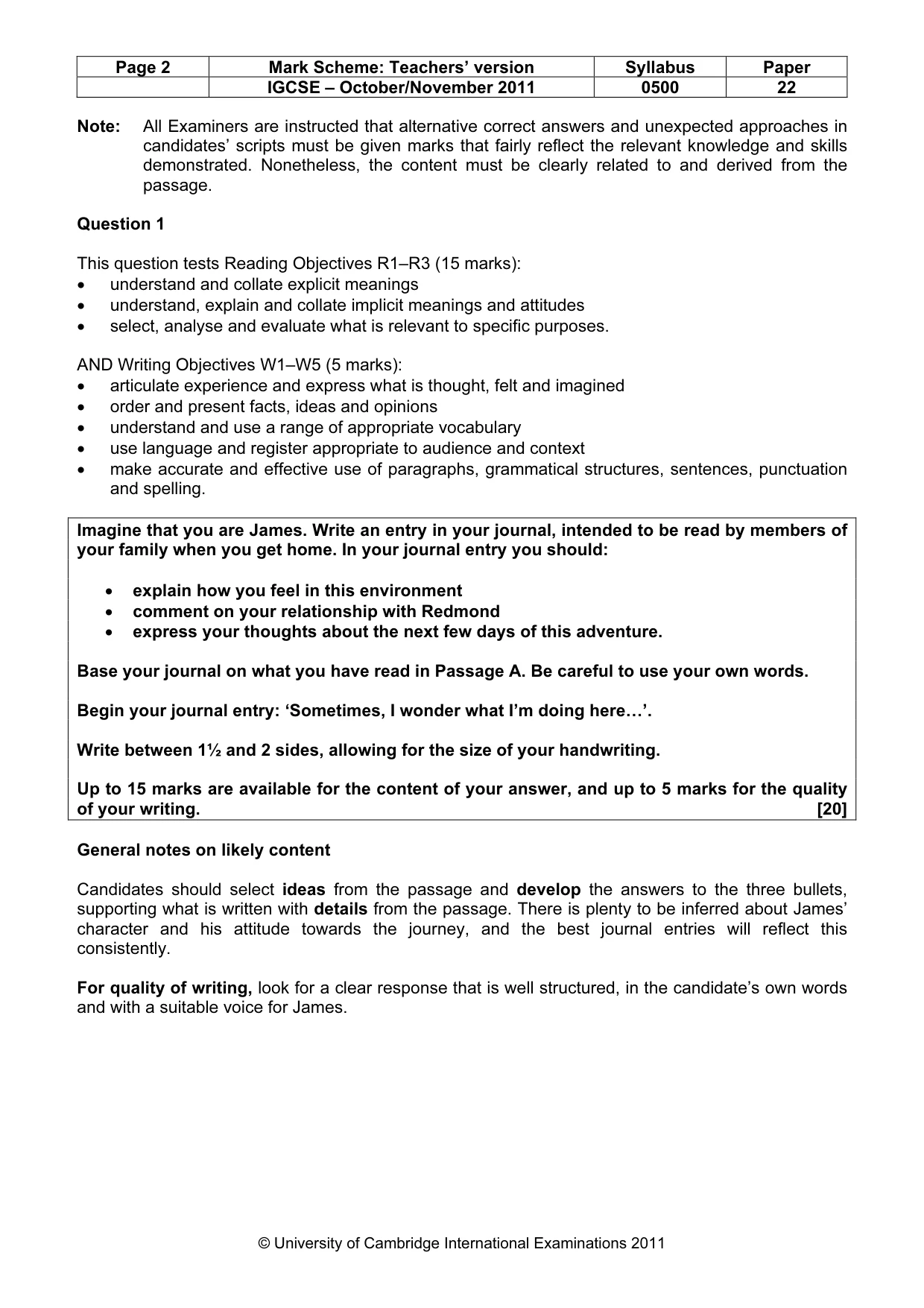
Page 2 Mark Scheme: Teachers’ version Syllabus Paper IGCSE – October/November 2011 0500 22 © University of Cambridge International Examinations 2011 Note: All Examiners are instructed that alternative correct answers and unexpected approaches in candidates’ scripts must be given marks that fairly reflect the relevant knowledge and skills demonstrated. Nonetheless, the content must be clearly related to and derived from the passage. Question 1 This question tests Reading Objectives R1–R3 (15 marks): • understand and collate explicit meanings • understand, explain and collate implicit meanings and attitudes • select, analyse and evaluate what is relevant to specific purposes. AND Writing Objectives W1–W5 (5 marks): • articulate experience and express what is thought, felt and imagined • order and present facts, ideas and opinions • understand and use a range of appropriate vocabulary • use language and register appropriate to audience and context • make accurate and effective use of paragraphs, grammatical structures, sentences, punctuation and spelling. Imagine that you are James. Write an entry in your journal, intended to be read by members of your family when you get home. In your journal entry you should: • explain how you feel in this environment • comment on your relationship with Redmond • express your thoughts about the next few days of this adventure. Base your journal on what you have read in Passage A. Be careful to use your own words. Begin your journal entry: ‘Sometimes, I wonder what I’m doing here…’. Write between 1½ and 2 sides, allowing for the size of your handwriting. Up to 15 marks are available for the content of your answer, and up to 5 marks for the quality of your writing. [20] General notes on likely content Candidates should select ideas from the passage and develop the answers to the three bullets, supporting what is written with details from the passage. There is plenty to be inferred about James’ character and his attitude towards the journey, and the best journal entries will reflect this consistently. For quality of writing, look for a clear response that is well structured, in the candidate’s own words and with a suitable voice for James.
Mark scheme, page 3
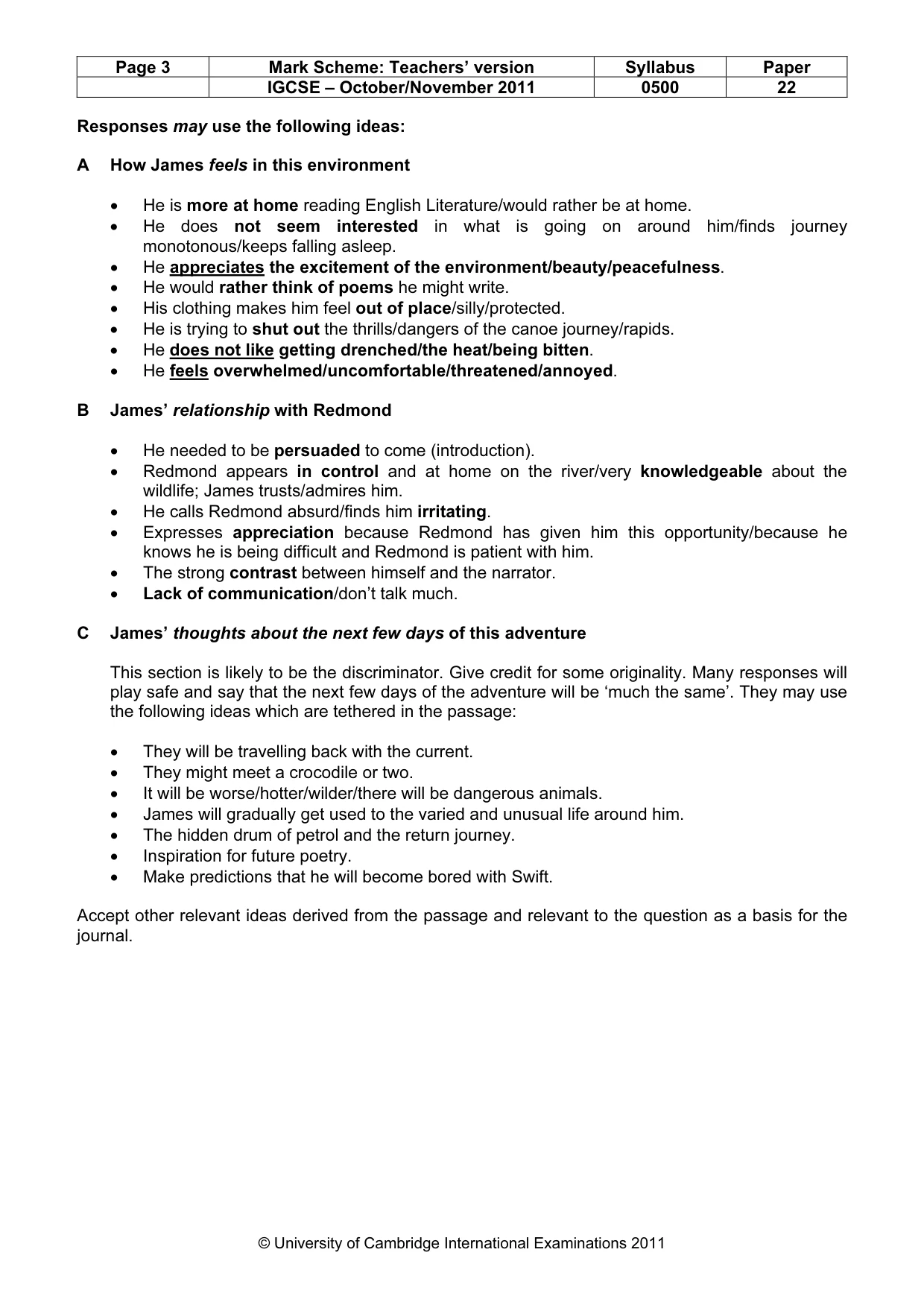
Page 3 Mark Scheme: Teachers’ version Syllabus Paper IGCSE – October/November 2011 0500 22 © University of Cambridge International Examinations 2011 Responses may use the following ideas: A How James feels in this environment • He is more at home reading English Literature/would rather be at home. • He does not seem interested in what is going on around him/finds journey monotonous/keeps falling asleep. • He appreciates the excitement of the environment/beauty/peacefulness. • He would rather think of poems he might write. • His clothing makes him feel out of place/silly/protected. • He is trying to shut out the thrills/dangers of the canoe journey/rapids. • He does not like getting drenched/the heat/being bitten. • He feels overwhelmed/uncomfortable/threatened/annoyed. B James’ relationship with Redmond • He needed to be persuaded to come (introduction). • Redmond appears in control and at home on the river/very knowledgeable about the wildlife; James trusts/admires him. • He calls Redmond absurd/finds him irritating. • Expresses appreciation because Redmond has given him this opportunity/because he knows he is being difficult and Redmond is patient with him. • The strong contrast between himself and the narrator. • Lack of communication/don’t talk much. C James’ thoughts about the next few days of this adventure This section is likely to be the discriminator. Give credit for some originality. Many responses will play safe and say that the next few days of the adventure will be ‘much the same’. They may use the following ideas which are tethered in the passage: • They will be travelling back with the current. • They might meet a crocodile or two. • It will be worse/hotter/wilder/there will be dangerous animals. • James will gradually get used to the varied and unusual life around him. • The hidden drum of petrol and the return journey. • Inspiration for future poetry. • Make predictions that he will become bored with Swift. Accept other relevant ideas derived from the passage and relevant to the question as a basis for the journal.
Mark scheme, page 4
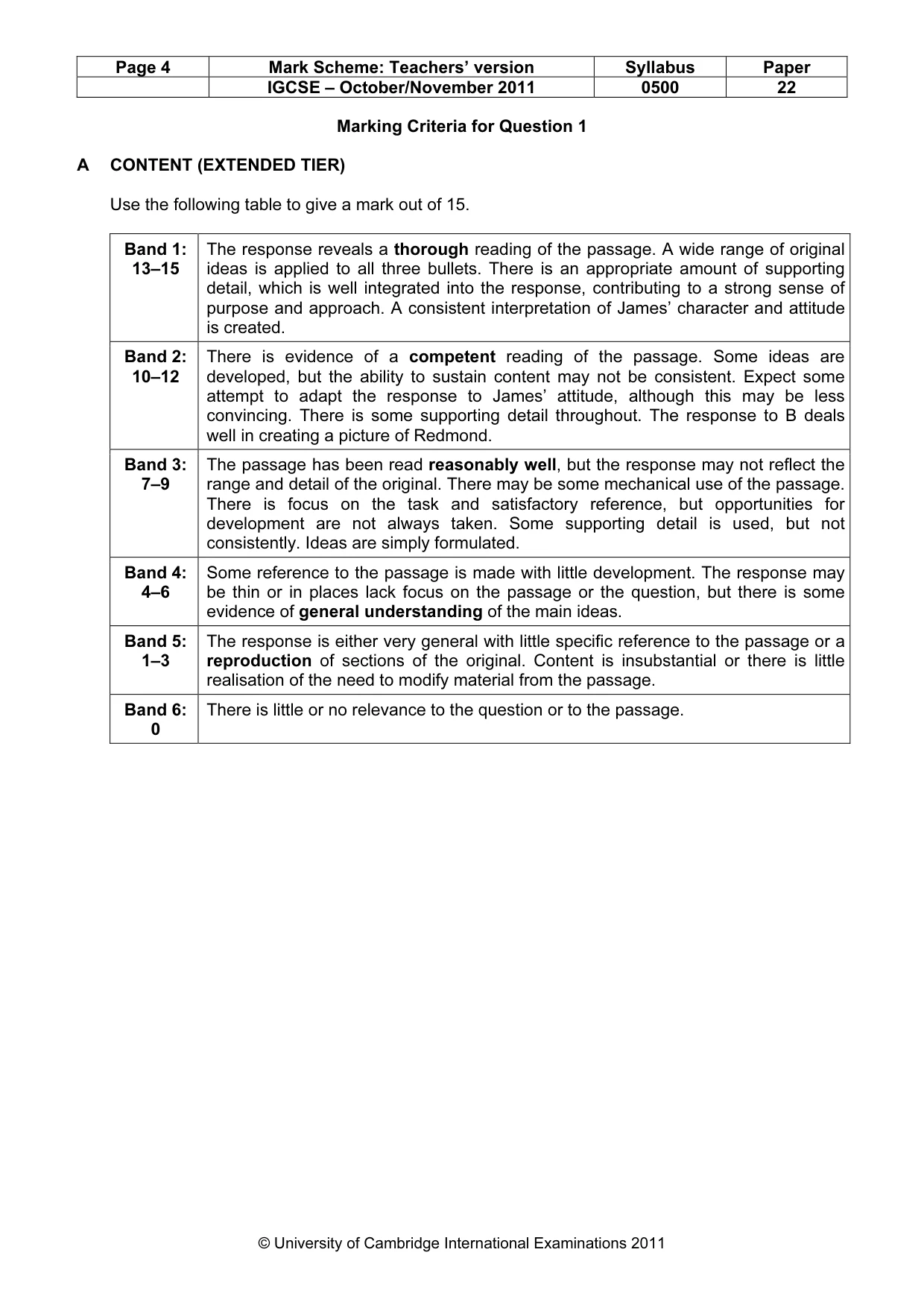
Page 4 Mark Scheme: Teachers’ version Syllabus Paper IGCSE – October/November 2011 0500 22 © University of Cambridge International Examinations 2011 Marking Criteria for Question 1 A CONTENT (EXTENDED TIER) Use the following table to give a mark out of 15. Band 1: 13–15 The response reveals a thorough reading of the passage. A wide range of original ideas is applied to all three bullets. There is an appropriate amount of supporting detail, which is well integrated into the response, contributing to a strong sense of purpose and approach. A consistent interpretation of James’ character and attitude is created. Band 2: 10–12 There is evidence of a competent reading of the passage. Some ideas are developed, but the ability to sustain content may not be consistent. Expect some attempt to adapt the response to James’ attitude, although this may be less convincing. There is some supporting detail throughout. The response to B deals well in creating a picture of Redmond. Band 3: 7–9 The passage has been read reasonably well, but the response may not reflect the range and detail of the original. There may be some mechanical use of the passage. There is focus on the task and satisfactory reference, but opportunities for development are not always taken. Some supporting detail is used, but not consistently. Ideas are simply formulated. Band 4: 4–6 Some reference to the passage is made with little development. The response may be thin or in places lack focus on the passage or the question, but there is some evidence of general understanding of the main ideas. Band 5: 1–3 The response is either very general with little specific reference to the passage or a reproduction of sections of the original. Content is insubstantial or there is little realisation of the need to modify material from the passage. Band 6: 0 There is little or no relevance to the question or to the passage.
Mark scheme, page 5
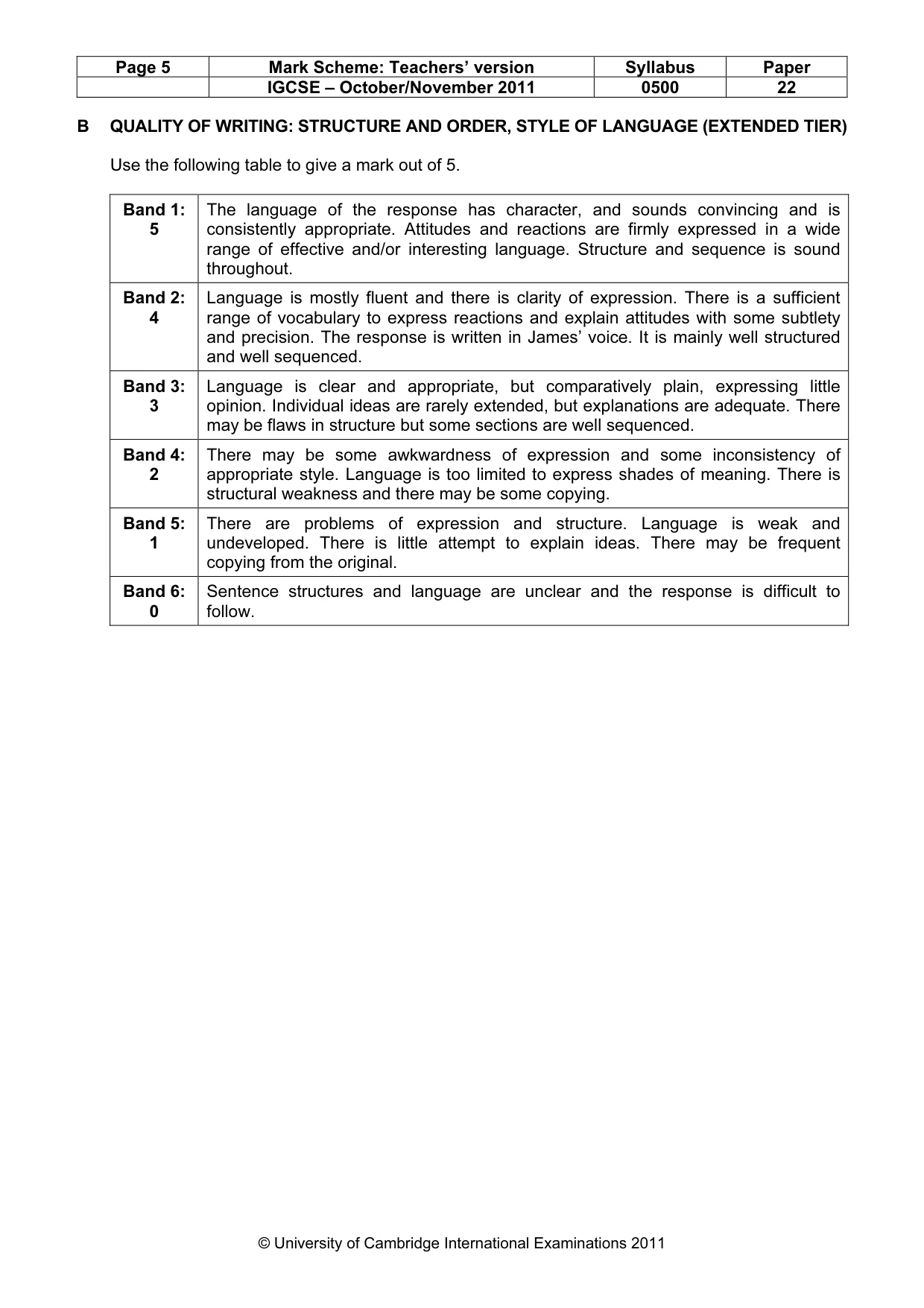
Page 5 Mark Scheme: Teachers’ version Syllabus Paper IGCSE – October/November 2011 0500 22 © University of Cambridge International Examinations 2011 B QUALITY OF WRITING: STRUCTURE AND ORDER, STYLE OF LANGUAGE (EXTENDED TIER) Use the following table to give a mark out of 5. Band 1: 5 The language of the response has character, and sounds convincing and is consistently appropriate. Attitudes and reactions are firmly expressed in a wide range of effective and/or interesting language. Structure and sequence is sound throughout. Band 2: 4 Language is mostly fluent and there is clarity of expression. There is a sufficient range of vocabulary to express reactions and explain attitudes with some subtlety and precision. The response is written in James’ voice. It is mainly well structured and well sequenced. Band 3: 3 Language is clear and appropriate, but comparatively plain, expressing little opinion. Individual ideas are rarely extended, but explanations are adequate. There may be flaws in structure but some sections are well sequenced. Band 4: 2 There may be some awkwardness of expression and some inconsistency of appropriate style. Language is too limited to express shades of meaning. There is structural weakness and there may be some copying. Band 5: 1 There are problems of expression and structure. Language is weak and undeveloped. There is little attempt to explain ideas. There may be frequent copying from the original. Band 6: 0 Sentence structures and language are unclear and the response is difficult to follow.
Mark scheme, page 6
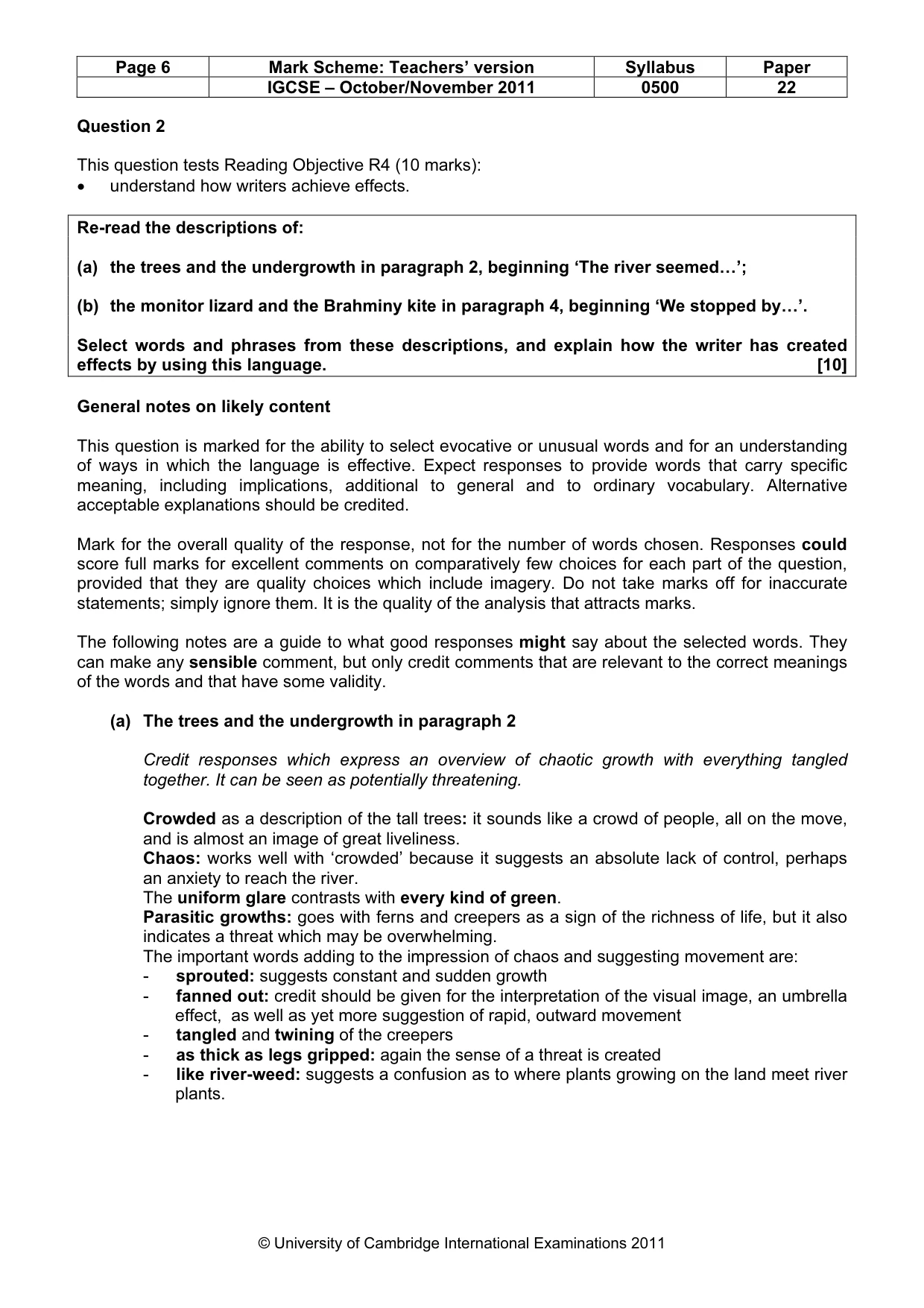
Page 6 Mark Scheme: Teachers’ version Syllabus Paper IGCSE – October/November 2011 0500 22 © University of Cambridge International Examinations 2011 Question 2 This question tests Reading Objective R4 (10 marks): • understand how writers achieve effects. Re-read the descriptions of: (a) the trees and the undergrowth in paragraph 2, beginning ‘The river seemed…’; (b) the monitor lizard and the Brahminy kite in paragraph 4, beginning ‘We stopped by…’. Select words and phrases from these descriptions, and explain how the writer has created effects by using this language. [10] General notes on likely content This question is marked for the ability to select evocative or unusual words and for an understanding of ways in which the language is effective. Expect responses to provide words that carry specific meaning, including implications, additional to general and to ordinary vocabulary. Alternative acceptable explanations should be credited. Mark for the overall quality of the response, not for the number of words chosen. Responses could score full marks for excellent comments on comparatively few choices for each part of the question, provided that they are quality choices which include imagery. Do not take marks off for inaccurate statements; simply ignore them. It is the quality of the analysis that attracts marks. The following notes are a guide to what good responses might say about the selected words. They can make any sensible comment, but only credit comments that are relevant to the correct meanings of the words and that have some validity. (a) The trees and the undergrowth in paragraph 2 Credit responses which express an overview of chaotic growth with everything tangled together. It can be seen as potentially threatening. Crowded as a description of the tall trees: it sounds like a crowd of people, all on the move, and is almost an image of great liveliness. Chaos: works well with ‘crowded’ because it suggests an absolute lack of control, perhaps an anxiety to reach the river. The uniform glare contrasts with every kind of green. Parasitic growths: goes with ferns and creepers as a sign of the richness of life, but it also indicates a threat which may be overwhelming. The important words adding to the impression of chaos and suggesting movement are: - sprouted: suggests constant and sudden growth - fanned out: credit should be given for the interpretation of the visual image, an umbrella effect, as well as yet more suggestion of rapid, outward movement - tangled and twining of the creepers - as thick as legs gripped: again the sense of a threat is created - like river-weed: suggests a confusion as to where plants growing on the land meet river plants.
Mark scheme, page 7
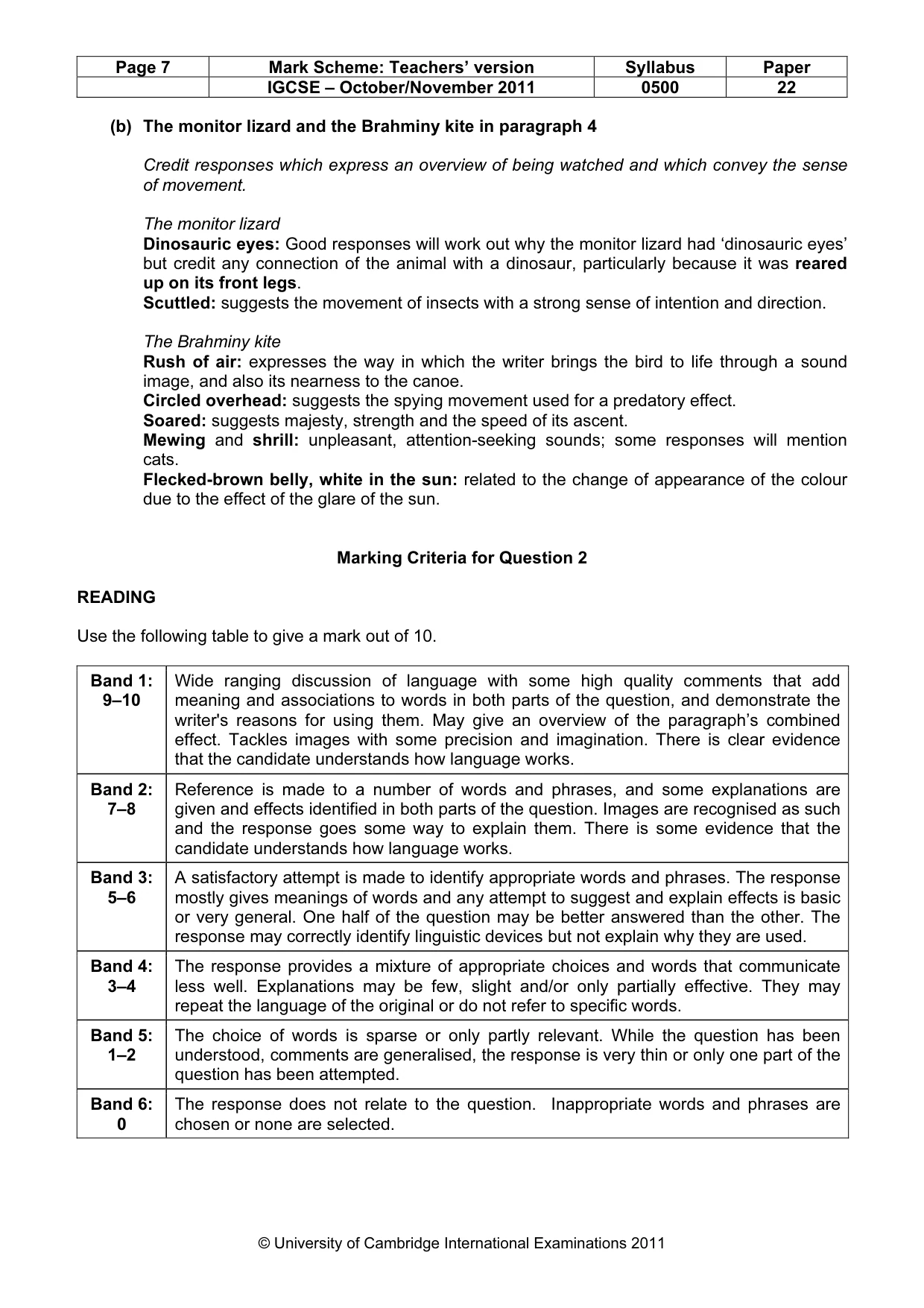
Page 7 Mark Scheme: Teachers’ version Syllabus Paper IGCSE – October/November 2011 0500 22 © University of Cambridge International Examinations 2011 (b) The monitor lizard and the Brahminy kite in paragraph 4 Credit responses which express an overview of being watched and which convey the sense of movement. The monitor lizard Dinosauric eyes: Good responses will work out why the monitor lizard had ‘dinosauric eyes’ but credit any connection of the animal with a dinosaur, particularly because it was reared up on its front legs. Scuttled: suggests the movement of insects with a strong sense of intention and direction. The Brahminy kite Rush of air: expresses the way in which the writer brings the bird to life through a sound image, and also its nearness to the canoe. Circled overhead: suggests the spying movement used for a predatory effect. Soared: suggests majesty, strength and the speed of its ascent. Mewing and shrill: unpleasant, attention-seeking sounds; some responses will mention cats. Flecked-brown belly, white in the sun: related to the change of appearance of the colour due to the effect of the glare of the sun. Marking Criteria for Question 2 READING Use the following table to give a mark out of 10. Band 1: 9–10 Wide ranging discussion of language with some high quality comments that add meaning and associations to words in both parts of the question, and demonstrate the writer's reasons for using them. May give an overview of the paragraph’s combined effect. Tackles images with some precision and imagination. There is clear evidence that the candidate understands how language works. Band 2: 7–8 Reference is made to a number of words and phrases, and some explanations are given and effects identified in both parts of the question. Images are recognised as such and the response goes some way to explain them. There is some evidence that the candidate understands how language works. Band 3: 5–6 A satisfactory attempt is made to identify appropriate words and phrases. The response mostly gives meanings of words and any attempt to suggest and explain effects is basic or very general. One half of the question may be better answered than the other. The response may correctly identify linguistic devices but not explain why they are used. Band 4: 3–4 The response provides a mixture of appropriate choices and words that communicate less well. Explanations may be few, slight and/or only partially effective. They may repeat the language of the original or do not refer to specific words. Band 5: 1–2 The choice of words is sparse or only partly relevant. While the question has been understood, comments are generalised, the response is very thin or only one part of the question has been attempted. Band 6: 0 The response does not relate to the question. Inappropriate words and phrases are chosen or none are selected.
Mark scheme, page 8
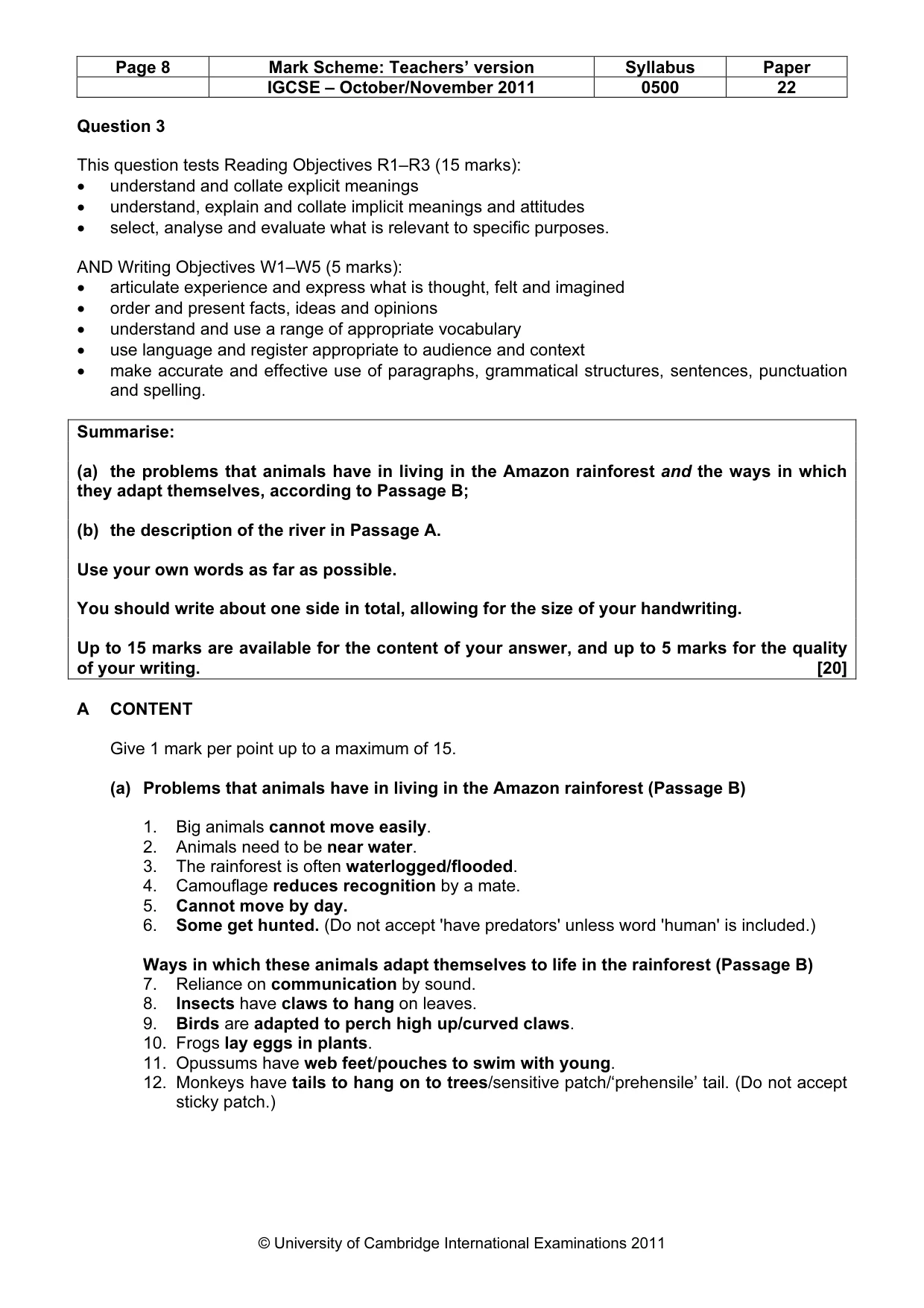
Page 8 Mark Scheme: Teachers’ version Syllabus Paper IGCSE – October/November 2011 0500 22 © University of Cambridge International Examinations 2011 Question 3 This question tests Reading Objectives R1–R3 (15 marks): • understand and collate explicit meanings • understand, explain and collate implicit meanings and attitudes • select, analyse and evaluate what is relevant to specific purposes. AND Writing Objectives W1–W5 (5 marks): • articulate experience and express what is thought, felt and imagined • order and present facts, ideas and opinions • understand and use a range of appropriate vocabulary • use language and register appropriate to audience and context • make accurate and effective use of paragraphs, grammatical structures, sentences, punctuation and spelling. Summarise: (a) the problems that animals have in living in the Amazon rainforest and the ways in which they adapt themselves, according to Passage B; (b) the description of the river in Passage A. Use your own words as far as possible. You should write about one side in total, allowing for the size of your handwriting. Up to 15 marks are available for the content of your answer, and up to 5 marks for the quality of your writing. [20] A CONTENT Give 1 mark per point up to a maximum of 15. (a) Problems that animals have in living in the Amazon rainforest (Passage B) 1. Big animals cannot move easily. 2. Animals need to be near water. 3. The rainforest is often waterlogged/flooded. 4. Camouflage reduces recognition by a mate. 5. Cannot move by day. 6. Some get hunted. (Do not accept 'have predators' unless word 'human' is included.) Ways in which these animals adapt themselves to life in the rainforest (Passage B) 7. Reliance on communication by sound. 8. Insects have claws to hang on leaves. 9. Birds are adapted to perch high up/curved claws. 10. Frogs lay eggs in plants. 11. Opussums have web feet/pouches to swim with young. 12. Monkeys have tails to hang on to trees/sensitive patch/‘prehensile’ tail. (Do not accept sticky patch.)
Mark scheme, page 9
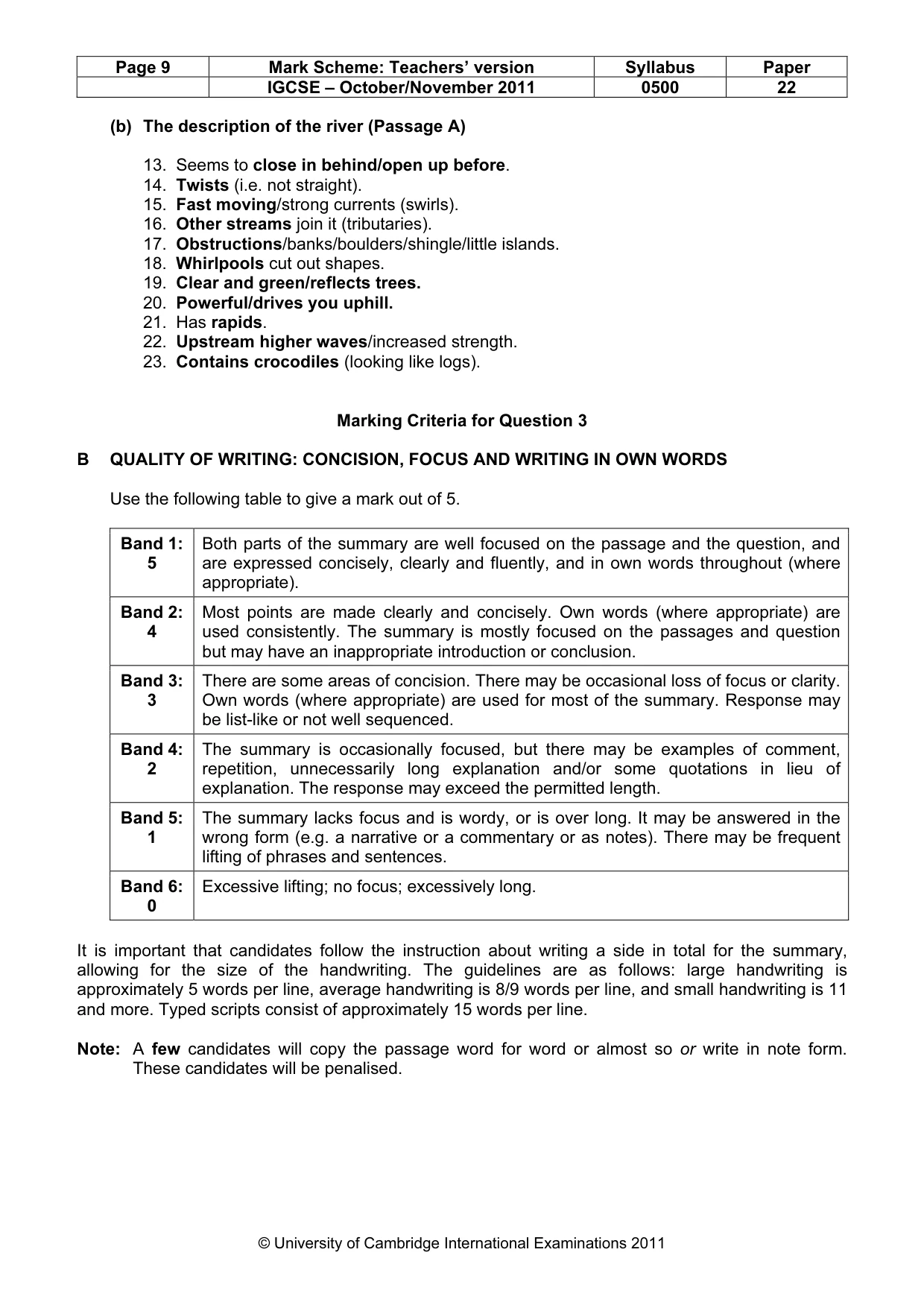
Page 9 Mark Scheme: Teachers’ version Syllabus Paper IGCSE – October/November 2011 0500 22 © University of Cambridge International Examinations 2011 (b) The description of the river (Passage A) 13. Seems to close in behind/open up before. 14. Twists (i.e. not straight). 15. Fast moving/strong currents (swirls). 16. Other streams join it (tributaries). 17. Obstructions/banks/boulders/shingle/little islands. 18. Whirlpools cut out shapes. 19. Clear and green/reflects trees. 20. Powerful/drives you uphill. 21. Has rapids. 22. Upstream higher waves/increased strength. 23. Contains crocodiles (looking like logs). Marking Criteria for Question 3 B QUALITY OF WRITING: CONCISION, FOCUS AND WRITING IN OWN WORDS Use the following table to give a mark out of 5. Band 1: 5 Both parts of the summary are well focused on the passage and the question, and are expressed concisely, clearly and fluently, and in own words throughout (where appropriate). Band 2: 4 Most points are made clearly and concisely. Own words (where appropriate) are used consistently. The summary is mostly focused on the passages and question but may have an inappropriate introduction or conclusion. Band 3: 3 There are some areas of concision. There may be occasional loss of focus or clarity. Own words (where appropriate) are used for most of the summary. Response may be list-like or not well sequenced. Band 4: 2 The summary is occasionally focused, but there may be examples of comment, repetition, unnecessarily long explanation and/or some quotations in lieu of explanation. The response may exceed the permitted length. Band 5: 1 The summary lacks focus and is wordy, or is over long. It may be answered in the wrong form (e.g. a narrative or a commentary or as notes). There may be frequent lifting of phrases and sentences. Band 6: 0 Excessive lifting; no focus; excessively long. It is important that candidates follow the instruction about writing a side in total for the summary, allowing for the size of the handwriting. The guidelines are as follows: large handwriting is approximately 5 words per line, average handwriting is 8/9 words per line, and small handwriting is 11 and more. Typed scripts consist of approximately 15 words per line. Note: A few candidates will copy the passage word for word or almost so or write in note form. These candidates will be penalised.
What you needed in this session
Cambridge’s own grade thresholds for 2011 Oct/Nov, Paper 2 · Variant 2. A higher threshold means an easier paper — the bar moves with how the cohort did.