Cambridge IGCSE English - First Language 0500 — 2011 May/June Paper 2 · Variant 3
0500/23/M/J/11 · 50 marks · ≈56 min
The question paper and its mark scheme, free to read here and free to download. This is Cambridge’s own paper, exactly as it was sat.
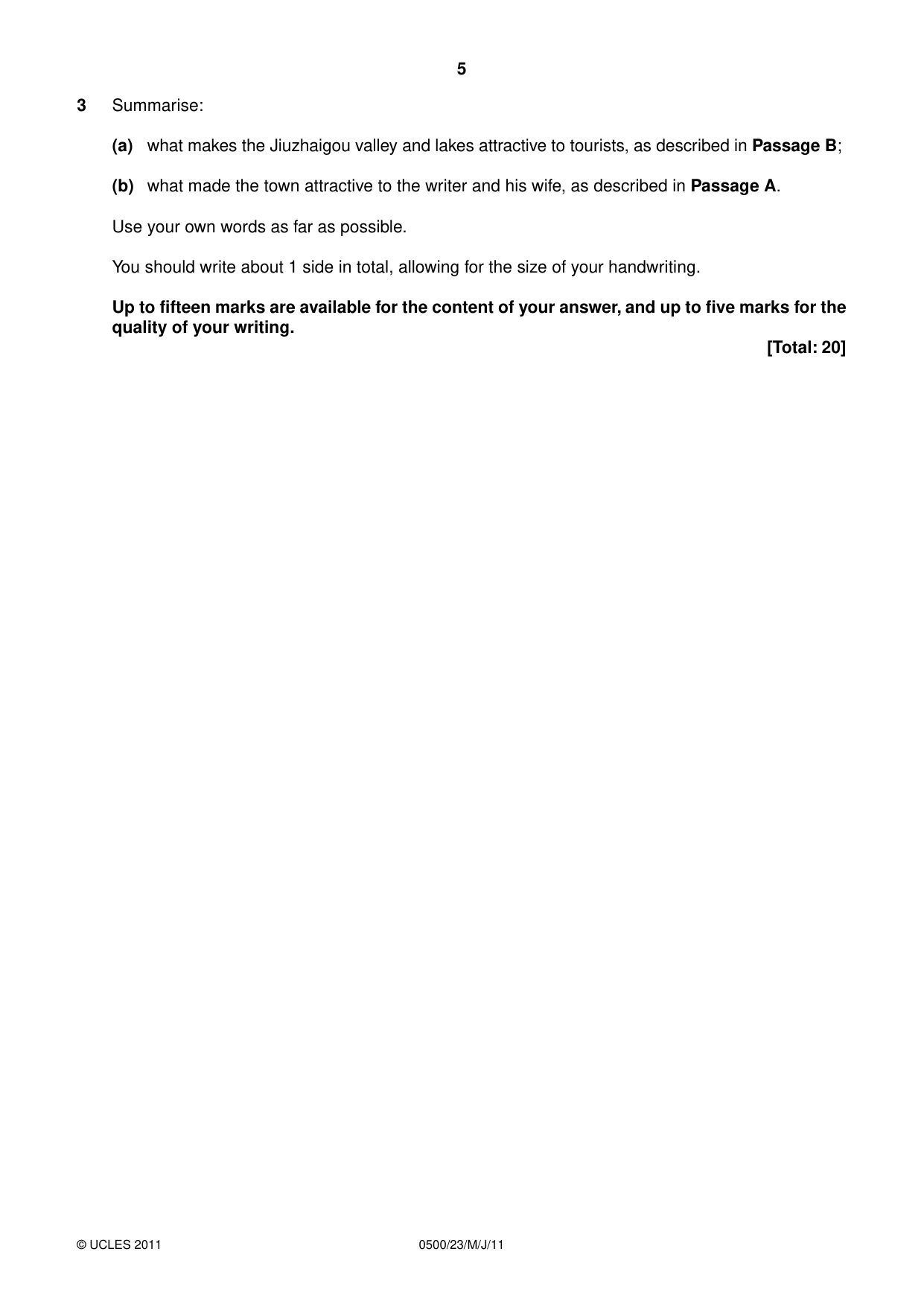
Question paper8 pages


Mark scheme8 pages
Answers below. Sit the paper first if you are practising.
Paper as text
Question paper, page 1
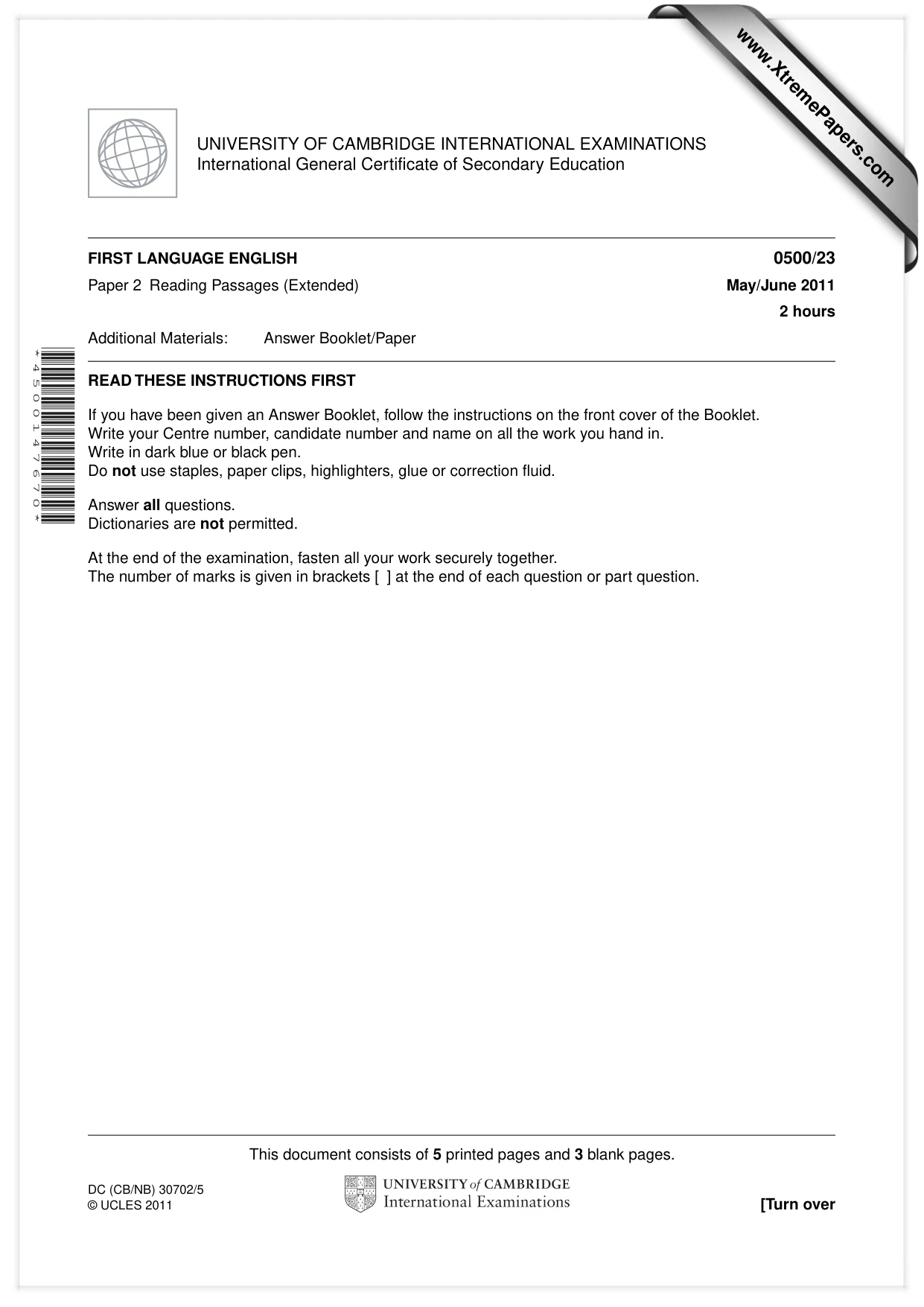
This document consists of 5 printed pages and 3 blank pages. DC (CB/NB) 30702/5 © UCLES 2011 [Turn over UNIVERSITY OF CAMBRIDGE INTERNATIONAL EXAMINATIONS International General Certificate of Secondary Education * 4 5 0 0 1 4 7 6 7 0 * FIRST LANGUAGE ENGLISH 0500/23 Paper 2 Reading Passages (Extended) May/June 2011 2 hours Additional Materials: Answer Booklet/Paper READ THESE INSTRUCTIONS FIRST If you have been given an Answer Booklet, follow the instructions on the front cover of the Booklet. Write your Centre number, candidate number and name on all the work you hand in. Write in dark blue or black pen. Do not use staples, paper clips, highlighters, glue or correction fluid. Answer all questions. Dictionaries are not permitted. At the end of the examination, fasten all your work securely together. The number of marks is given in brackets [ ] at the end of each question or part question. www.XtremePapers.com
Question paper, page 2
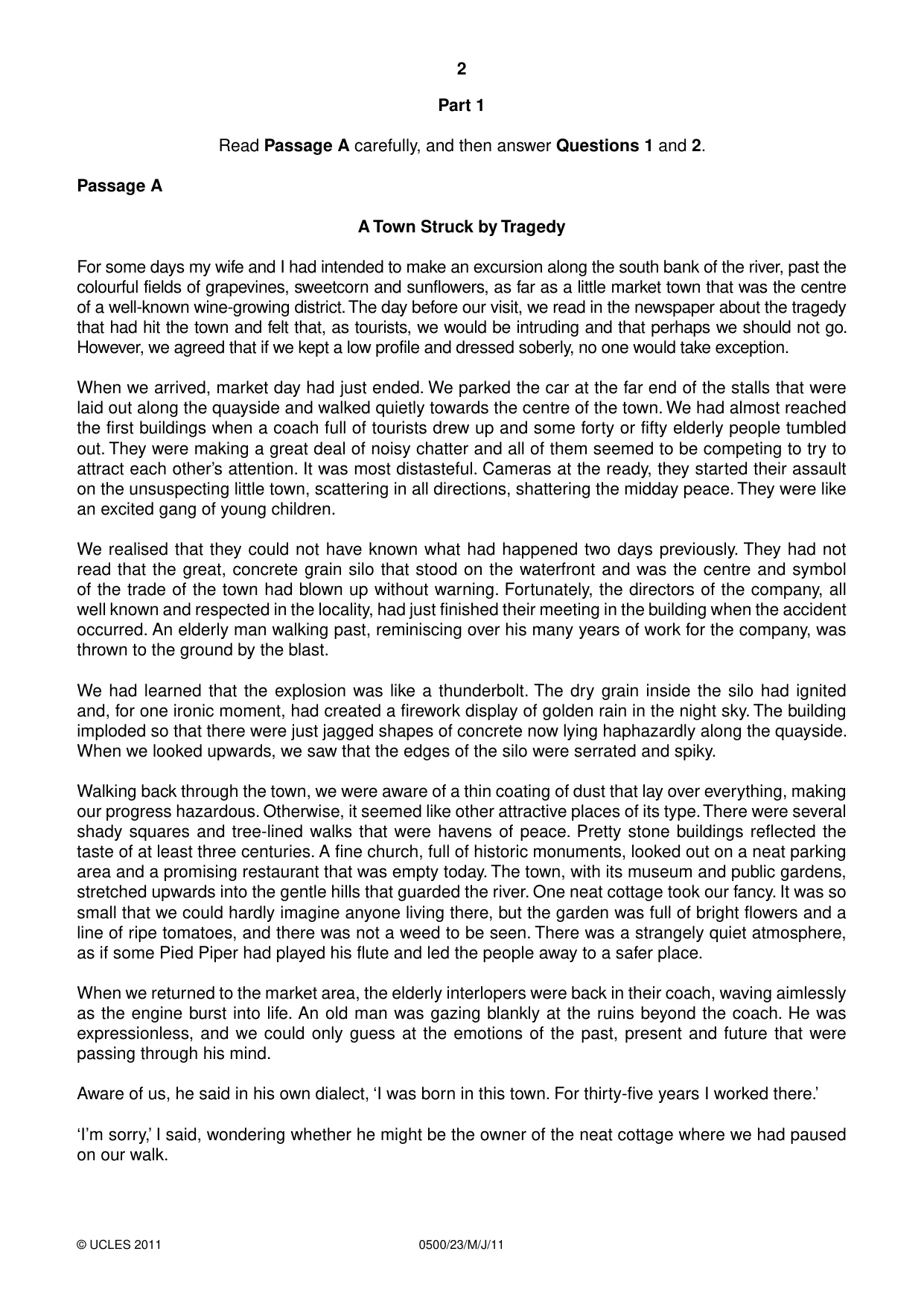
2 0500/23/M/J/11 © UCLES 2011 Part 1 Read Passage A carefully, and then answer Questions 1 and 2. Passage A A Town Struck by Tragedy For some days my wife and I had intended to make an excursion along the south bank of the river, past the colourful fields of grapevines, sweetcorn and sunflowers, as far as a little market town that was the centre of a well-known wine-growing district. The day before our visit, we read in the newspaper about the tragedy that had hit the town and felt that, as tourists, we would be intruding and that perhaps we should not go. However, we agreed that if we kept a low profile and dressed soberly, no one would take exception. When we arrived, market day had just ended. We parked the car at the far end of the stalls that were laid out along the quayside and walked quietly towards the centre of the town. We had almost reached the first buildings when a coach full of tourists drew up and some forty or fifty elderly people tumbled out. They were making a great deal of noisy chatter and all of them seemed to be competing to try to attract each other’s attention. It was most distasteful. Cameras at the ready, they started their assault on the unsuspecting little town, scattering in all directions, shattering the midday peace. They were like an excited gang of young children. We realised that they could not have known what had happened two days previously. They had not read that the great, concrete grain silo that stood on the waterfront and was the centre and symbol of the trade of the town had blown up without warning. Fortunately, the directors of the company, all well known and respected in the locality, had just finished their meeting in the building when the accident occurred. An elderly man walking past, reminiscing over his many years of work for the company, was thrown to the ground by the blast. We had learned that the explosion was like a thunderbolt. The dry grain inside the silo had ignited and, for one ironic moment, had created a firework display of golden rain in the night sky. The building imploded so that there were just jagged shapes of concrete now lying haphazardly along the quayside. When we looked upwards, we saw that the edges of the silo were serrated and spiky. Walking back through the town, we were aware of a thin coating of dust that lay over everything, making our progress hazardous. Otherwise, it seemed like other attractive places of its type. There were several shady squares and tree-lined walks that were havens of peace. Pretty stone buildings reflected the taste of at least three centuries. A fine church, full of historic monuments, looked out on a neat parking area and a promising restaurant that was empty today. The town, with its museum and public gardens, stretched upwards into the gentle hills that guarded the river. One neat cottage took our fancy. It was so small that we could hardly imagine anyone living there, but the garden was full of bright flowers and a line of ripe tomatoes, and there was not a weed to be seen. There was a strangely quiet atmosphere, as if some Pied Piper had played his flute and led the people away to a safer place. When we returned to the market area, the elderly interlopers were back in their coach, waving aimlessly as the engine burst into life. An old man was gazing blankly at the ruins beyond the coach. He was expressionless, and we could only guess at the emotions of the past, present and future that were passing through his mind. Aware of us, he said in his own dialect, ‘I was born in this town. For thirty-five years I worked there.’ ‘I’m sorry,’ I said, wondering whether he might be the owner of the neat cottage where we had paused on our walk.
Question paper, page 3
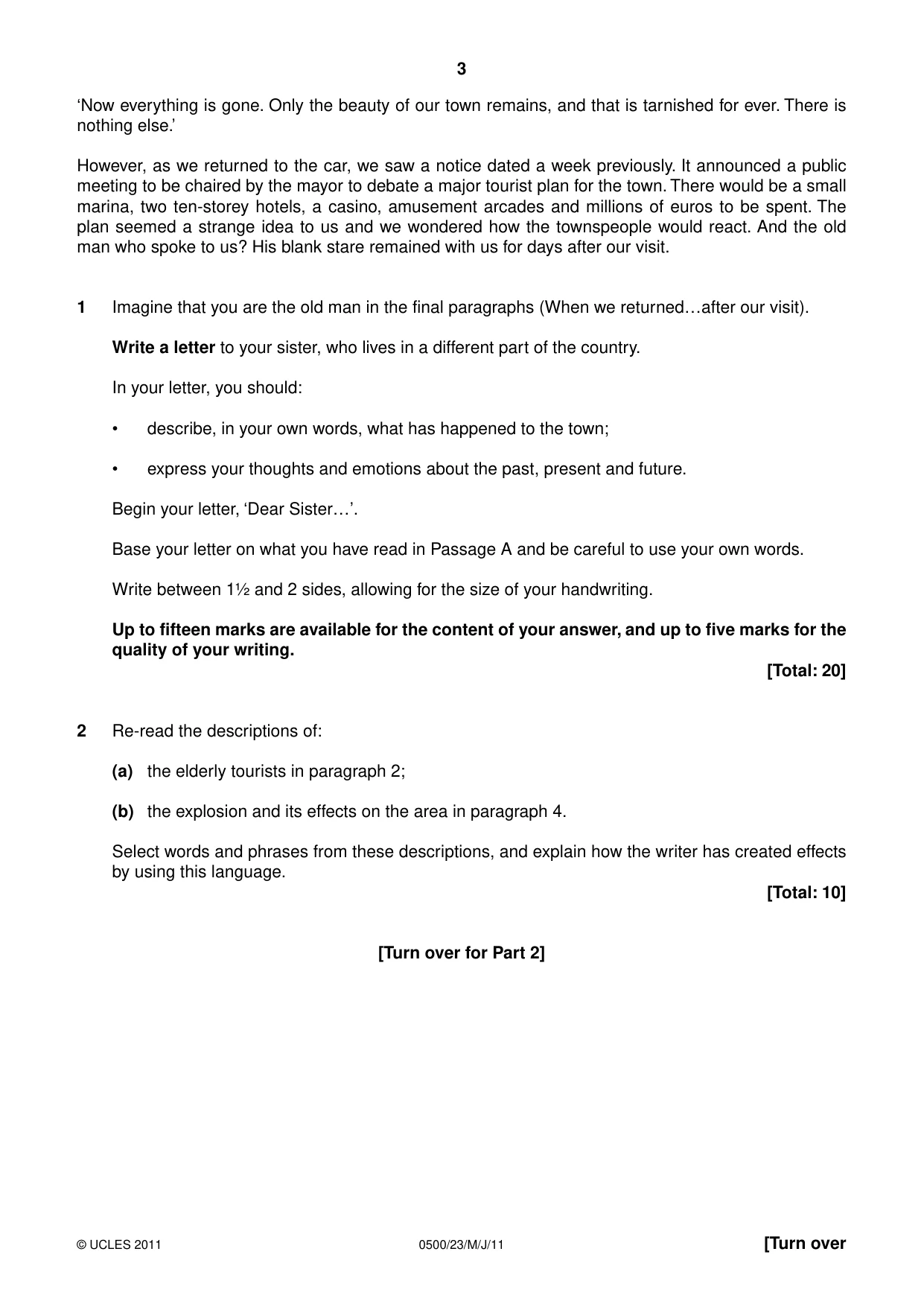
3 0500/23/M/J/11 © UCLES 2011 [Turn over ‘Now everything is gone. Only the beauty of our town remains, and that is tarnished for ever. There is nothing else.’ However, as we returned to the car, we saw a notice dated a week previously. It announced a public meeting to be chaired by the mayor to debate a major tourist plan for the town. There would be a small marina, two ten-storey hotels, a casino, amusement arcades and millions of euros to be spent. The plan seemed a strange idea to us and we wondered how the townspeople would react. And the old man who spoke to us? His blank stare remained with us for days after our visit. 1 Imagine that you are the old man in the final paragraphs (When we returned…after our visit). Write a letter to your sister, who lives in a different part of the country. In your letter, you should: • describe, in your own words, what has happened to the town; • express your thoughts and emotions about the past, present and future. Begin your letter, ‘Dear Sister…’. Base your letter on what you have read in Passage A and be careful to use your own words. Write between 1½ and 2 sides, allowing for the size of your handwriting. Up to fifteen marks are available for the content of your answer, and up to five marks for the quality of your writing. [Total: 20] 2 Re-read the descriptions of: (a) the elderly tourists in paragraph 2; (b) the explosion and its effects on the area in paragraph 4. Select words and phrases from these descriptions, and explain how the writer has created effects by using this language. [Total: 10] [Turn over for Part 2]
Question paper, page 4
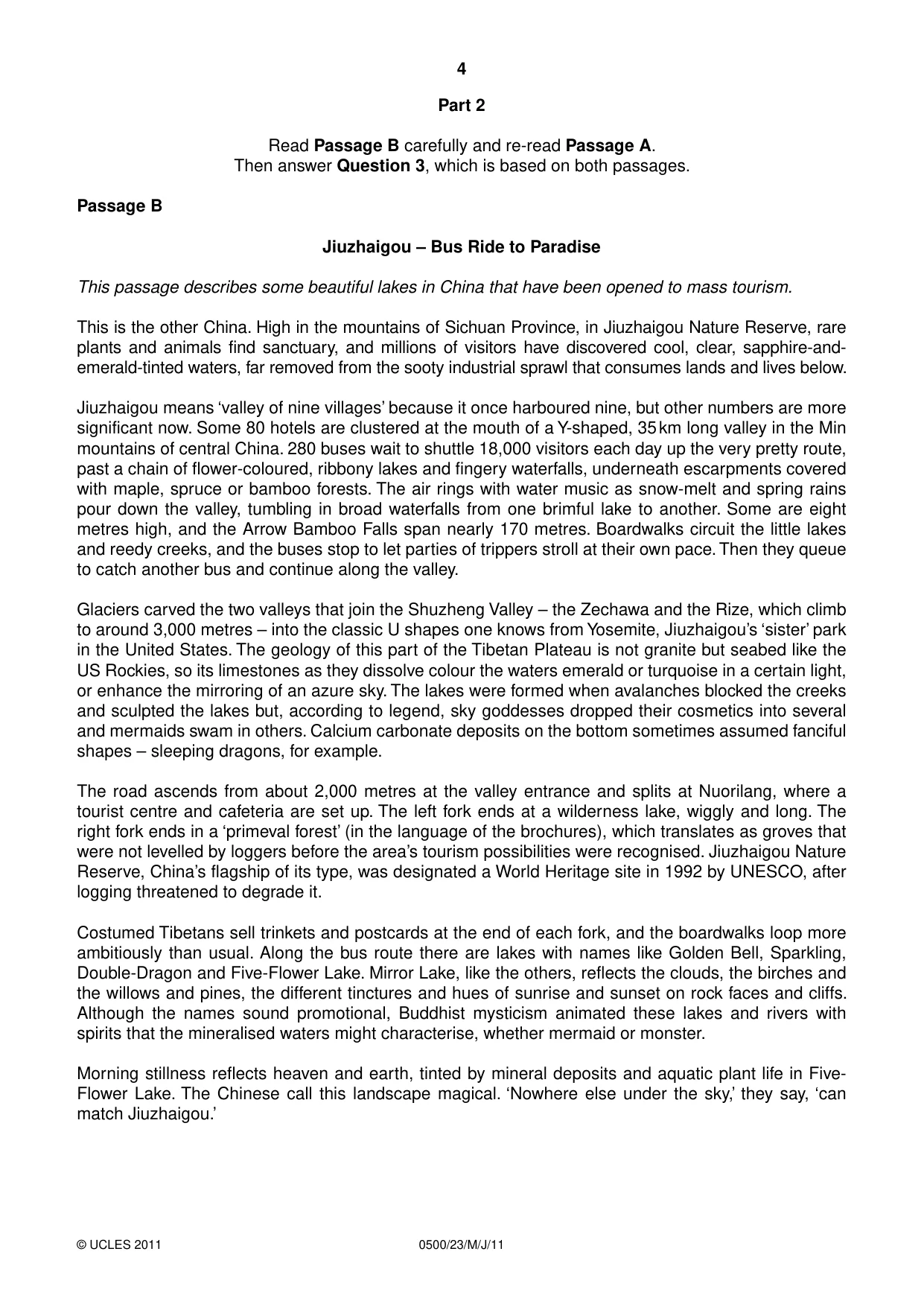
4 0500/23/M/J/11 © UCLES 2011 Part 2 Read Passage B carefully and re-read Passage A. Then answer Question 3, which is based on both passages. Passage B Jiuzhaigou – Bus Ride to Paradise This passage describes some beautiful lakes in China that have been opened to mass tourism. This is the other China. High in the mountains of Sichuan Province, in Jiuzhaigou Nature Reserve, rare plants and animals find sanctuary, and millions of visitors have discovered cool, clear, sapphire-and- emerald-tinted waters, far removed from the sooty industrial sprawl that consumes lands and lives below. Jiuzhaigou means ‘valley of nine villages’ because it once harboured nine, but other numbers are more significant now. Some 80 hotels are clustered at the mouth of a Y-shaped, 35 km long valley in the Min mountains of central China. 280 buses wait to shuttle 18,000 visitors each day up the very pretty route, past a chain of flower-coloured, ribbony lakes and fingery waterfalls, underneath escarpments covered with maple, spruce or bamboo forests. The air rings with water music as snow-melt and spring rains pour down the valley, tumbling in broad waterfalls from one brimful lake to another. Some are eight metres high, and the Arrow Bamboo Falls span nearly 170 metres. Boardwalks circuit the little lakes and reedy creeks, and the buses stop to let parties of trippers stroll at their own pace. Then they queue to catch another bus and continue along the valley. Glaciers carved the two valleys that join the Shuzheng Valley – the Zechawa and the Rize, which climb to around 3,000 metres – into the classic U shapes one knows from Yosemite, Jiuzhaigou’s ‘sister’ park in the United States. The geology of this part of the Tibetan Plateau is not granite but seabed like the US Rockies, so its limestones as they dissolve colour the waters emerald or turquoise in a certain light, or enhance the mirroring of an azure sky. The lakes were formed when avalanches blocked the creeks and sculpted the lakes but, according to legend, sky goddesses dropped their cosmetics into several and mermaids swam in others. Calcium carbonate deposits on the bottom sometimes assumed fanciful shapes – sleeping dragons, for example. The road ascends from about 2,000 metres at the valley entrance and splits at Nuorilang, where a tourist centre and cafeteria are set up. The left fork ends at a wilderness lake, wiggly and long. The right fork ends in a ‘primeval forest’ (in the language of the brochures), which translates as groves that were not levelled by loggers before the area’s tourism possibilities were recognised. Jiuzhaigou Nature Reserve, China’s flagship of its type, was designated a World Heritage site in 1992 by UNESCO, after logging threatened to degrade it. Costumed Tibetans sell trinkets and postcards at the end of each fork, and the boardwalks loop more ambitiously than usual. Along the bus route there are lakes with names like Golden Bell, Sparkling, Double-Dragon and Five-Flower Lake. Mirror Lake, like the others, reflects the clouds, the birches and the willows and pines, the different tinctures and hues of sunrise and sunset on rock faces and cliffs. Although the names sound promotional, Buddhist mysticism animated these lakes and rivers with spirits that the mineralised waters might characterise, whether mermaid or monster. Morning stillness reflects heaven and earth, tinted by mineral deposits and aquatic plant life in Five- Flower Lake. The Chinese call this landscape magical. ‘Nowhere else under the sky,’ they say, ‘can match Jiuzhaigou.’
Question paper, page 5
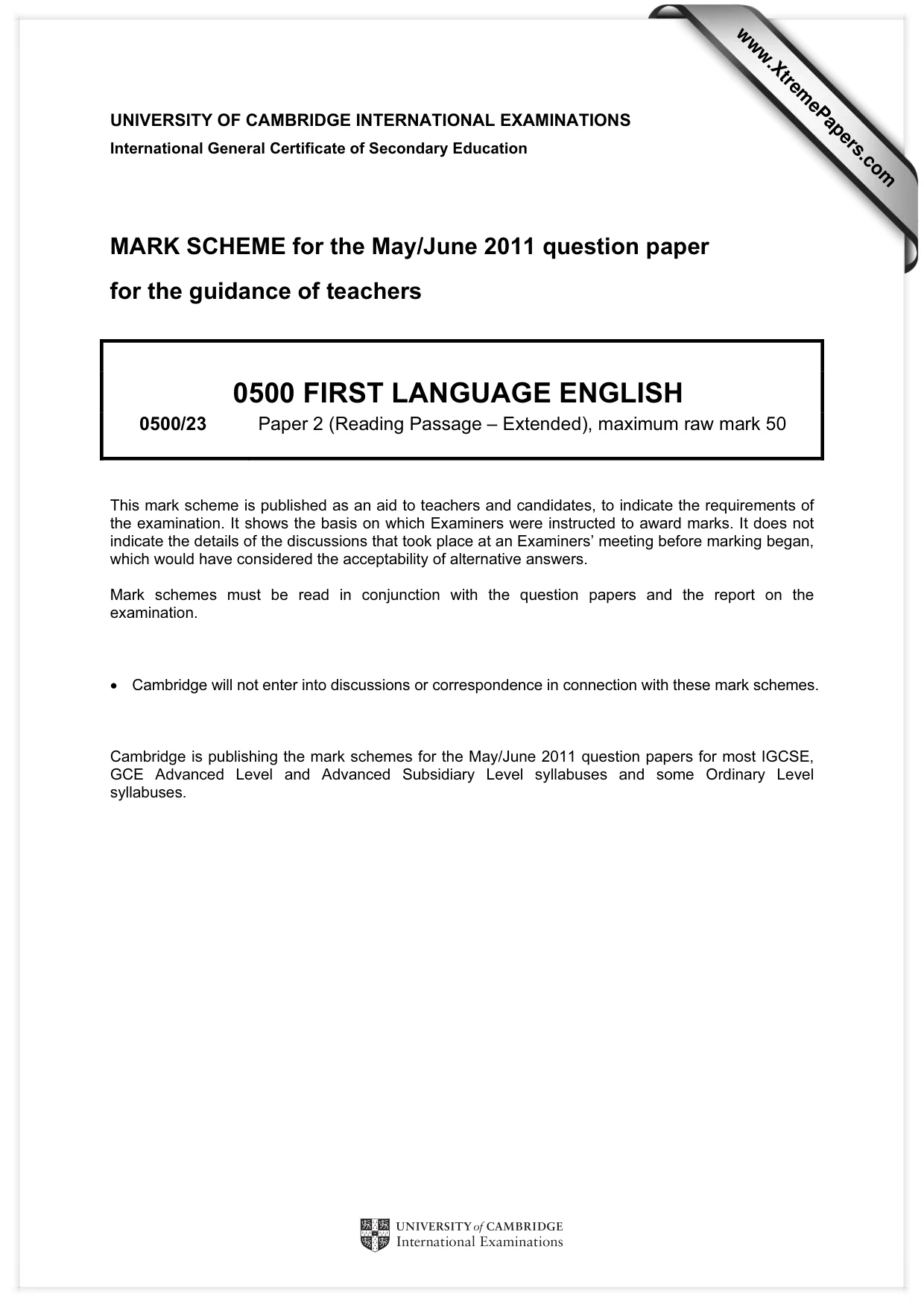
5 0500/23/M/J/11 © UCLES 2011 3 Summarise: (a) what makes the Jiuzhaigou valley and lakes attractive to tourists, as described in Passage B; (b) what made the town attractive to the writer and his wife, as described in Passage A. Use your own words as far as possible. You should write about 1 side in total, allowing for the size of your handwriting. Up to fifteen marks are available for the content of your answer, and up to five marks for the quality of your writing. [Total: 20]
Question paper, page 6
6 0500/23/M/J/11 © UCLES 2011 BLANK PAGE
Question paper, page 7
7 0500/23/M/J/11 © UCLES 2011 BLANK PAGE
Question paper, page 8
8 0500/23/M/J/11 © UCLES 2011 BLANK PAGE Copyright Acknowledgements: Passage B © Edward Hoagland; (amended) China’s Mystic Waters, Visitors are enthralled by the Jiuzhaigou reserve ; National Geographic Magazine; March 2009. Permission to reproduce items where third-party owned material protected by copyright is included has been sought and cleared where possible. Every reasonable effort has been made by the publisher (UCLES) to trace copyright holders, but if any items requiring clearance have unwittingly been included, the publisher will be pleased to make amends at the earliest possible opportunity. University of Cambridge International Examinations is part of the Cambridge Assessment Group. Cambridge Assessment is the brand name of University of Cambridge Local Examinations Syndicate (UCLES), which is itself a department of the University of Cambridge.
Mark scheme, page 1
UNIVERSITY OF CAMBRIDGE INTERNATIONAL EXAMINATIONS International General Certificate of Secondary Education MARK SCHEME for the May/June 2011 question paper for the guidance of teachers 0500 FIRST LANGUAGE ENGLISH 0500/23 Paper 2 (Reading Passage – Extended), maximum raw mark 50 This mark scheme is published as an aid to teachers and candidates, to indicate the requirements of the examination. It shows the basis on which Examiners were instructed to award marks. It does not indicate the details of the discussions that took place at an Examiners’ meeting before marking began, which would have considered the acceptability of alternative answers. Mark schemes must be read in conjunction with the question papers and the report on the examination. • Cambridge will not enter into discussions or correspondence in connection with these mark schemes. Cambridge is publishing the mark schemes for the May/June 2011 question papers for most IGCSE, GCE Advanced Level and Advanced Subsidiary Level syllabuses and some Ordinary Level syllabuses. www.XtremePapers.com
Mark scheme, page 2
Page 2 Mark Scheme: Teachers’ version Syllabus Paper IGCSE – May/June 2011 0500 23 © University of Cambridge International Examinations 2011 Note: All Examiners are instructed that alternative correct answers and unexpected approaches in candidates’ scripts must be given marks that fairly reflect the relevant knowledge and skills demonstrated. Question 1 This question tests Reading Objectives R1–R3 (15 marks): • understand and collate explicit meanings • understand, explain and collate implicit meanings and attitudes • select, analyse and evaluate what is relevant to specific purposes AND Writing Objectives W1–W5 (5 marks): • articulate experience and express what is thought, felt and imagined • order and present facts, ideas and opinions • understand and use a range of appropriate vocabulary • use language and register appropriate to audience and context • make accurate and effective use of paragraphs, grammatical structures, sentences, punctuation and spelling. Imagine that you are the old man described in the final paragraphs (When we returned…after our visit). Write a letter to your sister, who lives in a different part of the country. In your letter, you should: • describe, in your own words, what has happened to the town; • express your thoughts and emotions about the past, present and future. Begin your letter, ‘Dear Sister…’. Base your letter on what you have read in Passage A and be careful to use your own words. Write between 1½ and 2 sides, allowing for the size of your handwriting. Up to fifteen marks are available for the content of your answer, and up to five marks for the quality of your writing. [20] General notes on likely content: Good answers will characterise the old man in terms of, for example, shock, weariness, sadness, nostalgia and will make different thoughts and emotions clear. Basic answers will tend to lack distinction, repeating information from the text and not effectively matching it to the likely feelings of the old man. Look for the fullest answers making a wide and varied use of the passage. The content must clearly be related to and derived from the passage. Note that candidates may reasonably assume that the two old men mentioned in the passage are the same. Look for a clear response, not in any particular format, but well structured and in the candidate’s own words.
Mark scheme, page 3
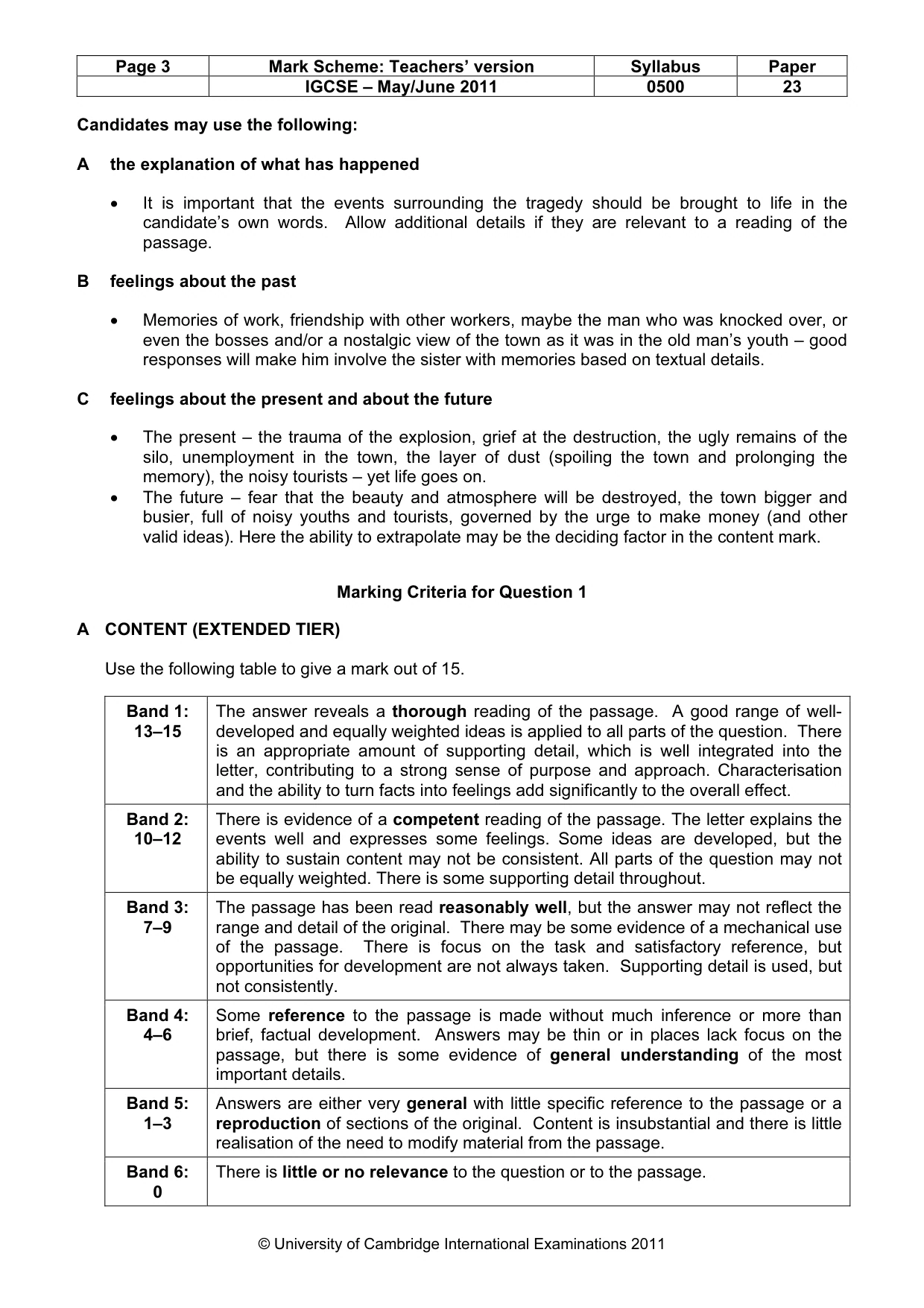
Page 3 Mark Scheme: Teachers’ version Syllabus Paper IGCSE – May/June 2011 0500 23 © University of Cambridge International Examinations 2011 Candidates may use the following: A the explanation of what has happened • It is important that the events surrounding the tragedy should be brought to life in the candidate’s own words. Allow additional details if they are relevant to a reading of the passage. B feelings about the past • Memories of work, friendship with other workers, maybe the man who was knocked over, or even the bosses and/or a nostalgic view of the town as it was in the old man’s youth – good responses will make him involve the sister with memories based on textual details. C feelings about the present and about the future • The present – the trauma of the explosion, grief at the destruction, the ugly remains of the silo, unemployment in the town, the layer of dust (spoiling the town and prolonging the memory), the noisy tourists – yet life goes on. • The future – fear that the beauty and atmosphere will be destroyed, the town bigger and busier, full of noisy youths and tourists, governed by the urge to make money (and other valid ideas). Here the ability to extrapolate may be the deciding factor in the content mark. Marking Criteria for Question 1 A CONTENT (EXTENDED TIER) Use the following table to give a mark out of 15. Band 1: 13–15 The answer reveals a thorough reading of the passage. A good range of well- developed and equally weighted ideas is applied to all parts of the question. There is an appropriate amount of supporting detail, which is well integrated into the letter, contributing to a strong sense of purpose and approach. Characterisation and the ability to turn facts into feelings add significantly to the overall effect. Band 2: 10–12 There is evidence of a competent reading of the passage. The letter explains the events well and expresses some feelings. Some ideas are developed, but the ability to sustain content may not be consistent. All parts of the question may not be equally weighted. There is some supporting detail throughout. Band 3: 7–9 The passage has been read reasonably well, but the answer may not reflect the range and detail of the original. There may be some evidence of a mechanical use of the passage. There is focus on the task and satisfactory reference, but opportunities for development are not always taken. Supporting detail is used, but not consistently. Band 4: 4–6 Some reference to the passage is made without much inference or more than brief, factual development. Answers may be thin or in places lack focus on the passage, but there is some evidence of general understanding of the most important details. Band 5: 1–3 Answers are either very general with little specific reference to the passage or a reproduction of sections of the original. Content is insubstantial and there is little realisation of the need to modify material from the passage. Band 6: 0 There is little or no relevance to the question or to the passage.
Mark scheme, page 4
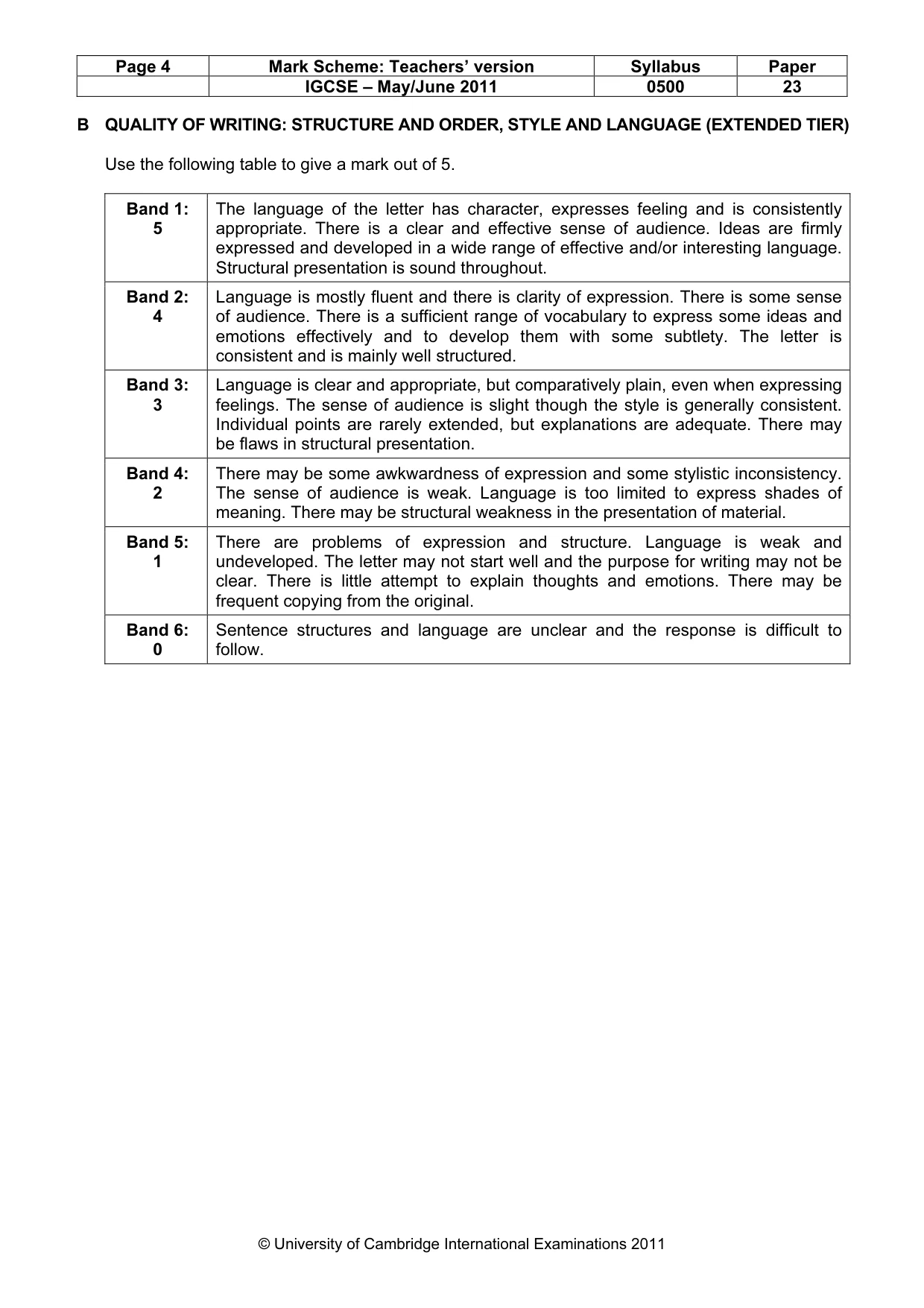
Page 4 Mark Scheme: Teachers’ version Syllabus Paper IGCSE – May/June 2011 0500 23 © University of Cambridge International Examinations 2011 B QUALITY OF WRITING: STRUCTURE AND ORDER, STYLE AND LANGUAGE (EXTENDED TIER) Use the following table to give a mark out of 5. Band 1: 5 The language of the letter has character, expresses feeling and is consistently appropriate. There is a clear and effective sense of audience. Ideas are firmly expressed and developed in a wide range of effective and/or interesting language. Structural presentation is sound throughout. Band 2: 4 Language is mostly fluent and there is clarity of expression. There is some sense of audience. There is a sufficient range of vocabulary to express some ideas and emotions effectively and to develop them with some subtlety. The letter is consistent and is mainly well structured. Band 3: 3 Language is clear and appropriate, but comparatively plain, even when expressing feelings. The sense of audience is slight though the style is generally consistent. Individual points are rarely extended, but explanations are adequate. There may be flaws in structural presentation. Band 4: 2 There may be some awkwardness of expression and some stylistic inconsistency. The sense of audience is weak. Language is too limited to express shades of meaning. There may be structural weakness in the presentation of material. Band 5: 1 There are problems of expression and structure. Language is weak and undeveloped. The letter may not start well and the purpose for writing may not be clear. There is little attempt to explain thoughts and emotions. There may be frequent copying from the original. Band 6: 0 Sentence structures and language are unclear and the response is difficult to follow.
Mark scheme, page 5
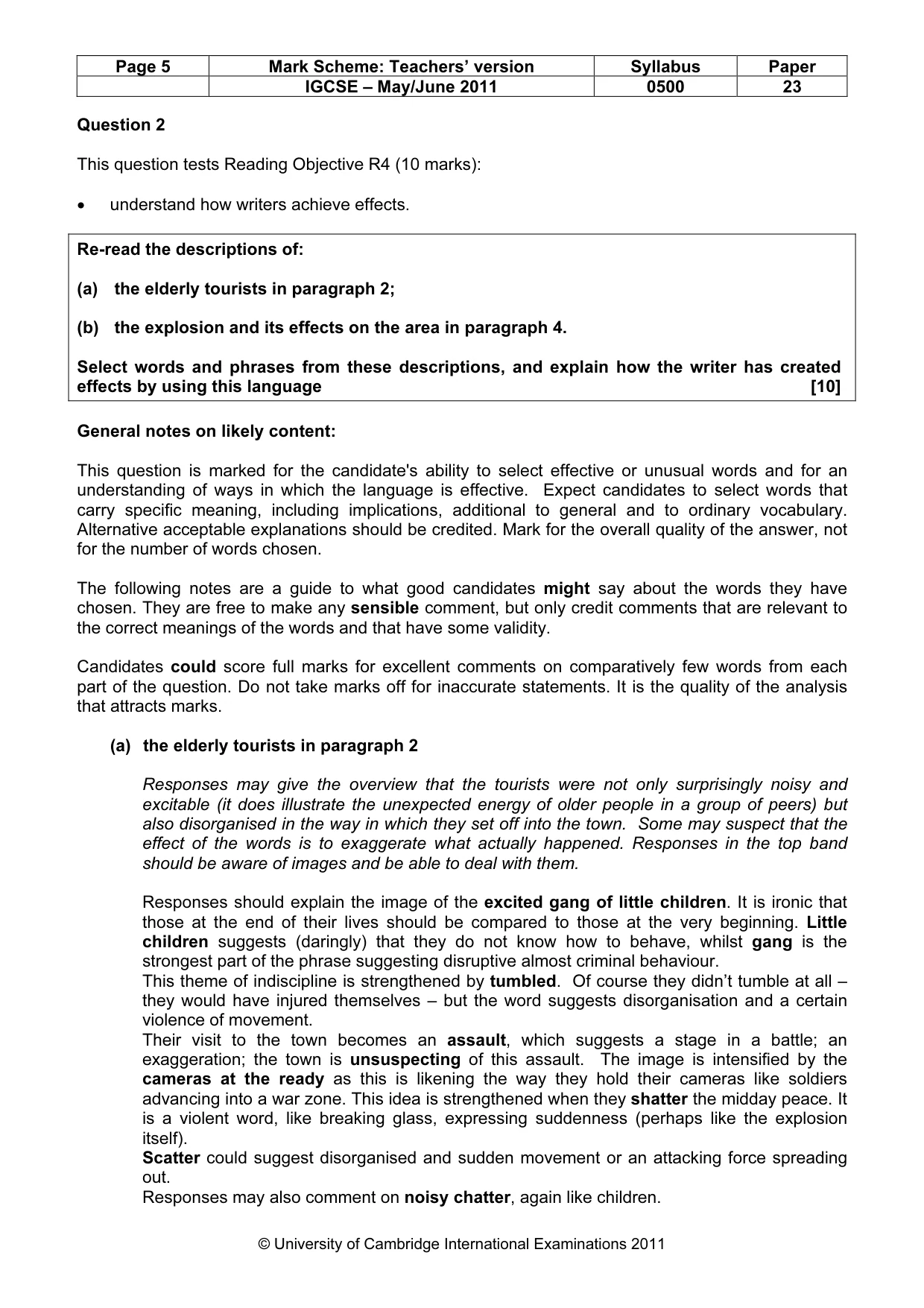
Page 5 Mark Scheme: Teachers’ version Syllabus Paper IGCSE – May/June 2011 0500 23 © University of Cambridge International Examinations 2011 Question 2 This question tests Reading Objective R4 (10 marks): • understand how writers achieve effects. Re-read the descriptions of: (a) the elderly tourists in paragraph 2; (b) the explosion and its effects on the area in paragraph 4. Select words and phrases from these descriptions, and explain how the writer has created effects by using this language [10] General notes on likely content: This question is marked for the candidate's ability to select effective or unusual words and for an understanding of ways in which the language is effective. Expect candidates to select words that carry specific meaning, including implications, additional to general and to ordinary vocabulary. Alternative acceptable explanations should be credited. Mark for the overall quality of the answer, not for the number of words chosen. The following notes are a guide to what good candidates might say about the words they have chosen. They are free to make any sensible comment, but only credit comments that are relevant to the correct meanings of the words and that have some validity. Candidates could score full marks for excellent comments on comparatively few words from each part of the question. Do not take marks off for inaccurate statements. It is the quality of the analysis that attracts marks. (a) the elderly tourists in paragraph 2 Responses may give the overview that the tourists were not only surprisingly noisy and excitable (it does illustrate the unexpected energy of older people in a group of peers) but also disorganised in the way in which they set off into the town. Some may suspect that the effect of the words is to exaggerate what actually happened. Responses in the top band should be aware of images and be able to deal with them. Responses should explain the image of the excited gang of little children. It is ironic that those at the end of their lives should be compared to those at the very beginning. Little children suggests (daringly) that they do not know how to behave, whilst gang is the strongest part of the phrase suggesting disruptive almost criminal behaviour. This theme of indiscipline is strengthened by tumbled. Of course they didn’t tumble at all – they would have injured themselves – but the word suggests disorganisation and a certain violence of movement. Their visit to the town becomes an assault, which suggests a stage in a battle; an exaggeration; the town is unsuspecting of this assault. The image is intensified by the cameras at the ready as this is likening the way they hold their cameras like soldiers advancing into a war zone. This idea is strengthened when they shatter the midday peace. It is a violent word, like breaking glass, expressing suddenness (perhaps like the explosion itself). Scatter could suggest disorganised and sudden movement or an attacking force spreading out. Responses may also comment on noisy chatter, again like children.
Mark scheme, page 6
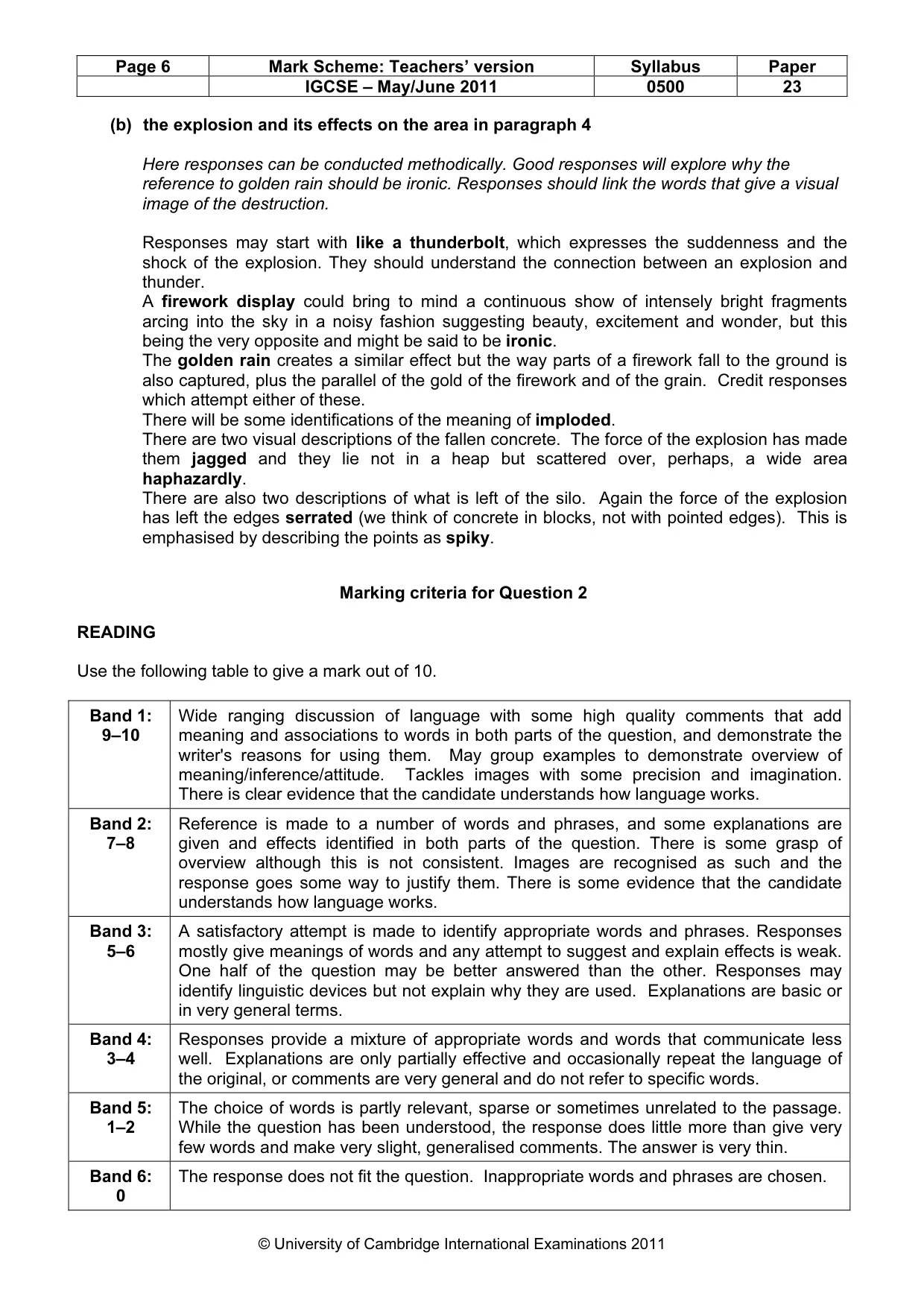
Page 6 Mark Scheme: Teachers’ version Syllabus Paper IGCSE – May/June 2011 0500 23 © University of Cambridge International Examinations 2011 (b) the explosion and its effects on the area in paragraph 4 Here responses can be conducted methodically. Good responses will explore why the reference to golden rain should be ironic. Responses should link the words that give a visual image of the destruction. Responses may start with like a thunderbolt, which expresses the suddenness and the shock of the explosion. They should understand the connection between an explosion and thunder. A firework display could bring to mind a continuous show of intensely bright fragments arcing into the sky in a noisy fashion suggesting beauty, excitement and wonder, but this being the very opposite and might be said to be ironic. The golden rain creates a similar effect but the way parts of a firework fall to the ground is also captured, plus the parallel of the gold of the firework and of the grain. Credit responses which attempt either of these. There will be some identifications of the meaning of imploded. There are two visual descriptions of the fallen concrete. The force of the explosion has made them jagged and they lie not in a heap but scattered over, perhaps, a wide area haphazardly. There are also two descriptions of what is left of the silo. Again the force of the explosion has left the edges serrated (we think of concrete in blocks, not with pointed edges). This is emphasised by describing the points as spiky. Marking criteria for Question 2 READING Use the following table to give a mark out of 10. Band 1: 9–10 Wide ranging discussion of language with some high quality comments that add meaning and associations to words in both parts of the question, and demonstrate the writer's reasons for using them. May group examples to demonstrate overview of meaning/inference/attitude. Tackles images with some precision and imagination. There is clear evidence that the candidate understands how language works. Band 2: 7–8 Reference is made to a number of words and phrases, and some explanations are given and effects identified in both parts of the question. There is some grasp of overview although this is not consistent. Images are recognised as such and the response goes some way to justify them. There is some evidence that the candidate understands how language works. Band 3: 5–6 A satisfactory attempt is made to identify appropriate words and phrases. Responses mostly give meanings of words and any attempt to suggest and explain effects is weak. One half of the question may be better answered than the other. Responses may identify linguistic devices but not explain why they are used. Explanations are basic or in very general terms. Band 4: 3–4 Responses provide a mixture of appropriate words and words that communicate less well. Explanations are only partially effective and occasionally repeat the language of the original, or comments are very general and do not refer to specific words. Band 5: 1–2 The choice of words is partly relevant, sparse or sometimes unrelated to the passage. While the question has been understood, the response does little more than give very few words and make very slight, generalised comments. The answer is very thin. Band 6: 0 The response does not fit the question. Inappropriate words and phrases are chosen.
Mark scheme, page 7
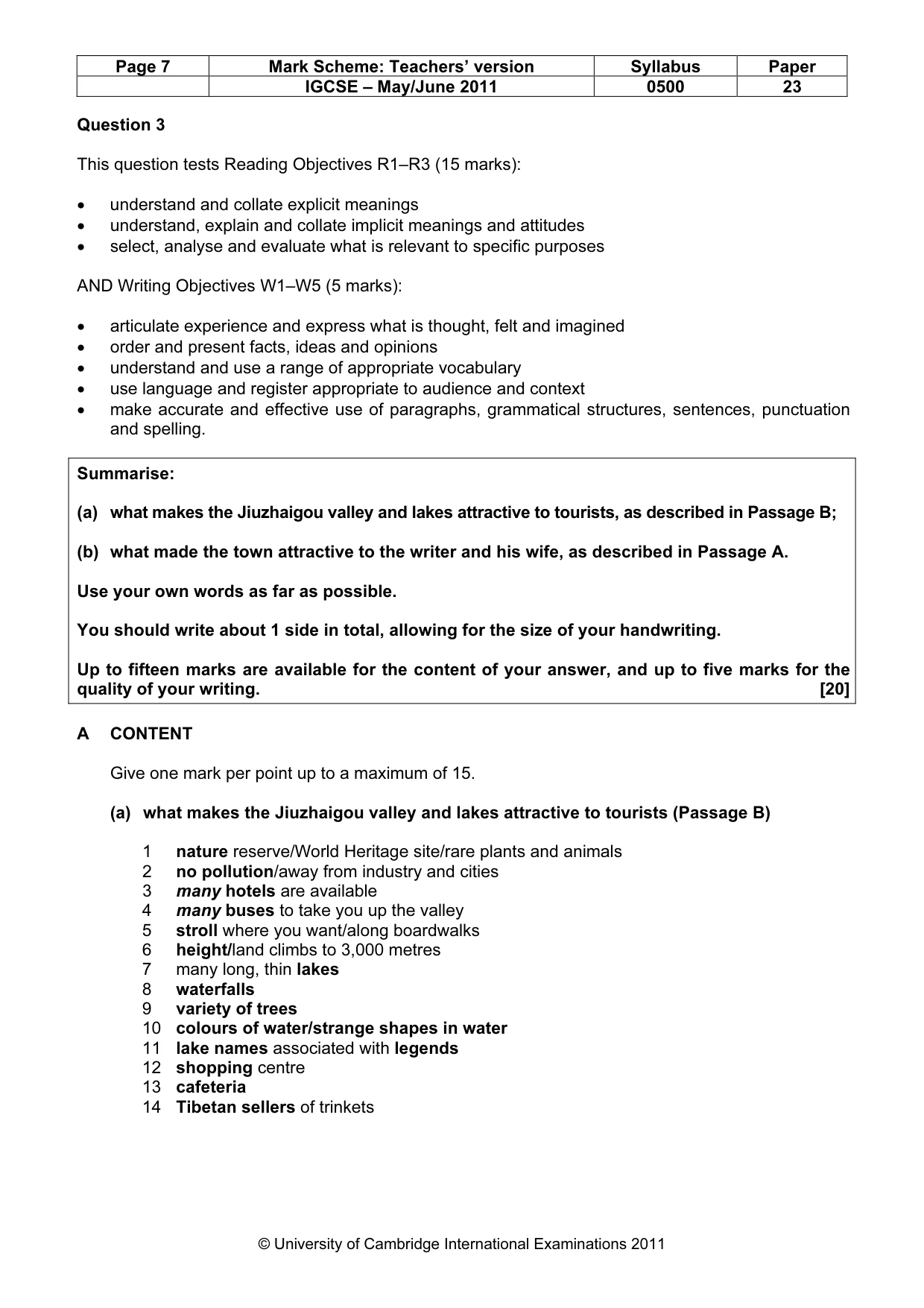
Page 7 Mark Scheme: Teachers’ version Syllabus Paper IGCSE – May/June 2011 0500 23 © University of Cambridge International Examinations 2011 Question 3 This question tests Reading Objectives R1–R3 (15 marks): • understand and collate explicit meanings • understand, explain and collate implicit meanings and attitudes • select, analyse and evaluate what is relevant to specific purposes AND Writing Objectives W1–W5 (5 marks): • articulate experience and express what is thought, felt and imagined • order and present facts, ideas and opinions • understand and use a range of appropriate vocabulary • use language and register appropriate to audience and context • make accurate and effective use of paragraphs, grammatical structures, sentences, punctuation and spelling. Summarise: (a) what makes the Jiuzhaigou valley and lakes attractive to tourists, as described in Passage B; (b) what made the town attractive to the writer and his wife, as described in Passage A. Use your own words as far as possible. You should write about 1 side in total, allowing for the size of your handwriting. Up to fifteen marks are available for the content of your answer, and up to five marks for the quality of your writing. [20] A CONTENT Give one mark per point up to a maximum of 15. (a) what makes the Jiuzhaigou valley and lakes attractive to tourists (Passage B) 1 nature reserve/World Heritage site/rare plants and animals 2 no pollution/away from industry and cities 3 many hotels are available 4 many buses to take you up the valley 5 stroll where you want/along boardwalks 6 height/land climbs to 3,000 metres 7 many long, thin lakes 8 waterfalls 9 variety of trees 10 colours of water/strange shapes in water 11 lake names associated with legends 12 shopping centre 13 cafeteria 14 Tibetan sellers of trinkets
Mark scheme, page 8
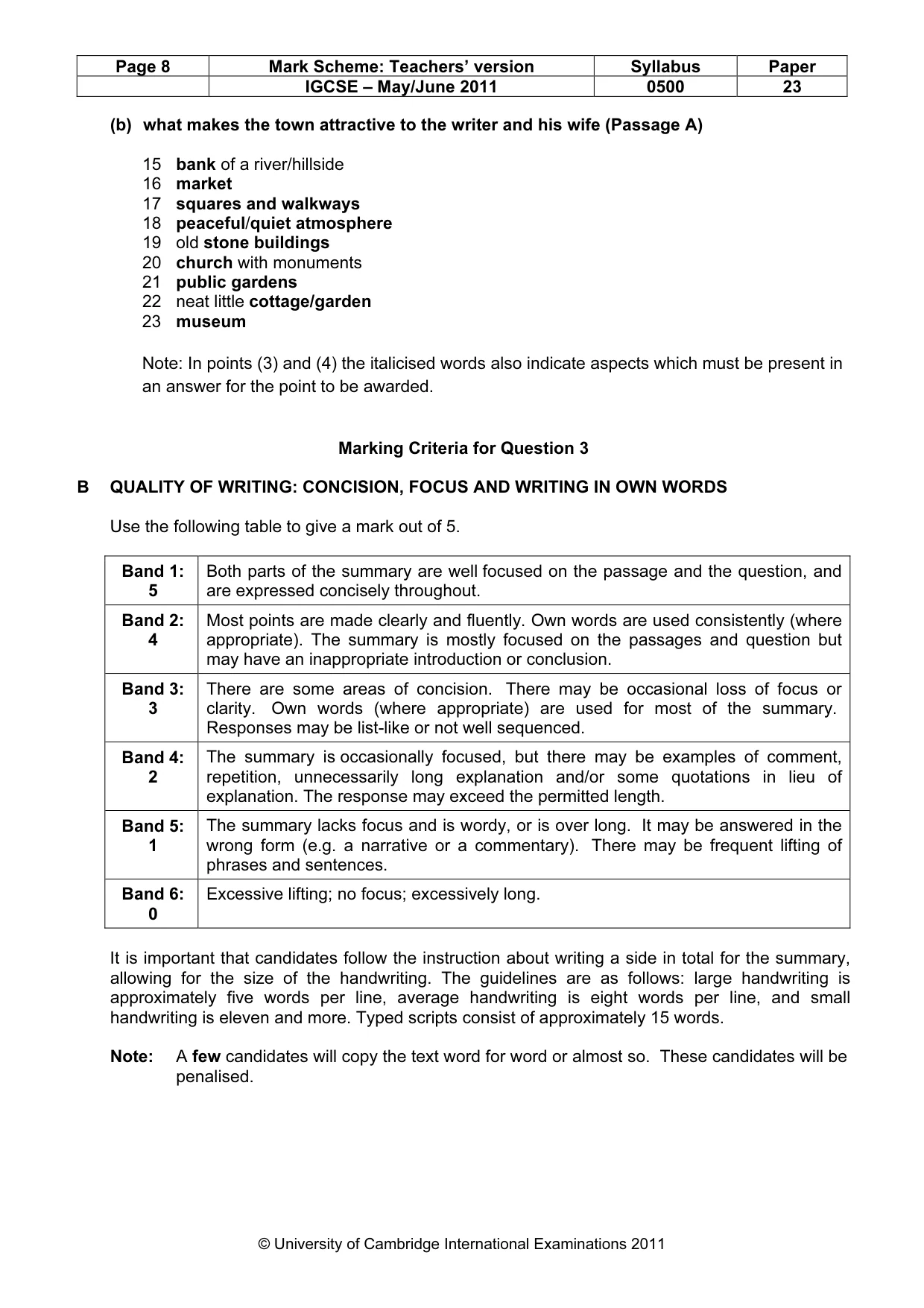
Page 8 Mark Scheme: Teachers’ version Syllabus Paper IGCSE – May/June 2011 0500 23 © University of Cambridge International Examinations 2011 (b) what makes the town attractive to the writer and his wife (Passage A) 15 bank of a river/hillside 16 market 17 squares and walkways 18 peaceful/quiet atmosphere 19 old stone buildings 20 church with monuments 21 public gardens 22 neat little cottage/garden 23 museum Note: In points (3) and (4) the italicised words also indicate aspects which must be present in an answer for the point to be awarded. Marking Criteria for Question 3 B QUALITY OF WRITING: CONCISION, FOCUS AND WRITING IN OWN WORDS Use the following table to give a mark out of 5. Band 1: 5 Both parts of the summary are well focused on the passage and the question, and are expressed concisely throughout. Band 2: 4 Most points are made clearly and fluently. Own words are used consistently (where appropriate). The summary is mostly focused on the passages and question but may have an inappropriate introduction or conclusion. Band 3: 3 There are some areas of concision. There may be occasional loss of focus or clarity. Own words (where appropriate) are used for most of the summary. Responses may be list-like or not well sequenced. Band 4: 2 The summary is occasionally focused, but there may be examples of comment, repetition, unnecessarily long explanation and/or some quotations in lieu of explanation. The response may exceed the permitted length. Band 5: 1 The summary lacks focus and is wordy, or is over long. It may be answered in the wrong form (e.g. a narrative or a commentary). There may be frequent lifting of phrases and sentences. Band 6: 0 Excessive lifting; no focus; excessively long. It is important that candidates follow the instruction about writing a side in total for the summary, allowing for the size of the handwriting. The guidelines are as follows: large handwriting is approximately five words per line, average handwriting is eight words per line, and small handwriting is eleven and more. Typed scripts consist of approximately 15 words. Note: A few candidates will copy the text word for word or almost so. These candidates will be penalised.
What you needed in this session
Cambridge’s own grade thresholds for 2011 May/June, Paper 2 · Variant 3. A higher threshold means an easier paper — the bar moves with how the cohort did.