Cambridge IGCSE English - First Language 0500 — 2011 May/June Paper 2 · Variant 2
0500/22/M/J/11 · 50 marks · ≈56 min
The question paper and its mark scheme, free to read here and free to download. This is Cambridge’s own paper, exactly as it was sat.
Question paper8 pages


Mark scheme8 pages
Answers below. Sit the paper first if you are practising.
Paper as text
Question paper, page 1
This document consists of 5 printed pages and 3 blank pages. DC (CB (NB)) 35205/5 © UCLES 2011 [Turn over UNIVERSITY OF CAMBRIDGE INTERNATIONAL EXAMINATIONS International General Certificate of Secondary Education * 1 8 1 7 2 9 8 6 7 2 * FIRST LANGUAGE ENGLISH 0500/22 Paper 2 Reading Passages (Extended) May/June 2011 2 hours Additional Materials: Answer Booklet/Paper READ THESE INSTRUCTIONS FIRST If you have been given an Answer Booklet, follow the instructions on the front cover of the Booklet. Write your Centre number, candidate number and name on all the work you hand in. Write in dark blue or black pen. Do not use staples, paper clips, highlighters, glue or correction fluid. Answer all questions. Dictionaries are not permitted. At the end of the examination, fasten all your work securely together. The number of marks is given in brackets [ ] at the end of each question or part question. www.XtremePapers.com
Question paper, page 2
2 0500/22/M/J/11 © UCLES 2011 Part 1 Read Passage A carefully, and then answer Questions 1 and 2. Passage A The Beast of Bodmin Moor I was lost. It was easy to lose one’s way on the moor, especially on a November afternoon when the light was thickening and the landscape stretched the same unvariegated grey in all directions. I drove along a narrow, empty road, looking for a road sign or any building which might contain an inhabitant to give me directions. A fleeting, shadowy movement by the roadside reminded me of the tales of the Beast of Bodmin Moor which had fascinated me as a local child. It was allegedly a vicious predator which carried out sheep killings on a grand scale. An investigation by the Ministry of Agriculture in 1995 had found ‘no verifiable evidence’ of foreign big cats in the area (although admitting that this did not prove that they were not present), and had concluded that the sheep could have been attacked by native wild animals. About four years later, an attempt to locate the beast from the air, using night vision goggles, had also failed. The Bodmin Natural History Museum determined that a skull found in the area was of a leopard, but it turned out to belong to an animal which had died outside Britain, and was probably part of a leopard-skin rug which had been dropped into the river as a hoax. However, the sightings and attacks had continued, and the local farmers were still convinced that the injuries to their livestock proved it was a type of cat, and that its appearance was not consistent with it being a pony, wild boar or large dog. In 1997, officials from a nearby zoo identified pawprints left in mud on the moor as the tracks of a puma. A year later, a 20-second video was released which seemed to show big cats roaming nearby. As I rounded the next bend, I saw a startlingly large, black feline cross the road with an unhurried, sinuous, fluid movement. Its thick, sinewy shoulders suggested massive strength and speed, like that of engine pistons. As it passed, it turned to stare at me and its great, yellow, black-slitted orbs were caught in the headlights. I noticed its pricked, tufted ears and its short, coarse, raven-black coat before it turned, raising and waving its curved snake of a tail as if making a victory salute. The spectral vision dissolved into the bushes, leaving me with a thumping heart and the feeling that I had witnessed a supernatural manifestation. A little further along I took a turning with a handwritten sign pointing to ‘Gables Farm’. I had to leave the car and cross a rickety, rotting footbridge over a rushing stream. Another battered sign, nailed to a tree, bore the ominous words, ambiguously addressed: ‘Wild Big Cats – Keep Out’. A shiny, weather-beaten man with tremendous whiskers and a crusty hat the colour of an over-cooked pie appeared at the farm gate, carrying a rifle. When I explained I was lost and had just had an unnerving experience, he took me into his kitchen and sat me down at a stained oak table while he made me tea and talked about the beast. ‘You always know when it’s about. Rabbits and foxes disappear and birds stop singing. If the ministry people knew anything about country life they’d know it couldn’t be a dog. If it’s a dog there’s noise, and wool and mess everywhere. But a cat goes in to the kill quickly, eats its fill, and slinks off.’ He told me that the beast owed him a thousand pounds for dead livestock, and that other farmers had sold their flocks after losing so many sheep. His neighbour had captured the beast on video, along with the tell- tale signs of four long scratch marks on the mauled sheep. She had also found hairs which she’d sent off for analysis, but had received no result. He continued: ‘The only reason to suppress the result would be to avoid panic. Another neighbour got hold of a recording of a puma mating call, and we recognised the scream we hear at night. Everyone round here believes in the beast, even though we’re sceptical about most things and haven’t got time to waste concocting fantasies. We don’t want the beast shot, but we do want it acknowledged and kept under control so it doesn’t continue to destroy our livelihoods.’
Question paper, page 3
3 0500/22/M/J/11 © UCLES 2011 [Turn over 1 Imagine you work for the Ministry of Agriculture. You have been sent to conduct a second investigation as to whether there is large foreign cat activity on Bodmin Moor. Write a formal report on your findings. In your report, you should comment on: • what local people believe about the presence of a beast; • the lack of conclusive proof and the alternative theories; • your recommendations with reasons. Base your answer on what you have read in Passage A and be careful to use your own words. Begin the report as follows: Since the inconclusive investigation by the Ministry of Agriculture in 1995, reported sightings of ‘big cats’ have continued. Write between 1½ and 2 sides, allowing for the size of your handwriting. Up to fifteen marks are available for the content of your answer, and up to five marks for the quality of your writing. [Total: 20] 2 Re-read the descriptions of: (a) the appearance of the beast in paragraph 4; (b) the appearance of the farmer and his farm in paragraph 5. Select words and phrases from these descriptions, and explain how the writer has created effects by using this language. [Total: 10] [Turn over for Part 2]
Question paper, page 4
4 0500/22/M/J/11 © UCLES 2011 Part 2 Read Passage B carefully and re-read Passage A. Then answer Question 3, which is based on both passages. Passage B Unicorns and Yetis This passage describes the history of two creatures generally believed to be mythical. The historical existence of the unicorn is an idea which is easy to accept. Its resemblance to actual animals, such as horses and antelopes, gives its reality an almost common-sense appeal, and the creature still exerts a powerful attraction in numerous popular cultures. The first written reports of the unicorn were found in works of ancient Greek history from 2,400 years ago, while eastern cultures record details of one-horned animals during the era of Genghis Khan. Thorough research into contemporary wildlife reveals the possibility of genuine sightings of creatures with the characteristics of a unicorn. To the present day, sightings of unicorns are being reported from Mount Kilimanjaro in Kenya. In 1987, Robert Vavra took an expedition there to find the mythical beast and he published his diary, complete with photographs, claiming that with the help of Masai warriors he had tracked it down. The other mythical creature which has exercised the imagination for many years is the yeti. For fifty years the snowy wastes of the Himalayas have beckoned intrepid explorers in search of the mysterious animal also known as ‘the abominable snowman’. Occasional sightings of large hairy creatures walking on two legs across the snows or in the forested valleys of Nepal and Tibet have kept the legend alive. Photographic evidence of the creature’s existence has proved elusive, however. The most famous picture is that taken by Sir Edmund Hillary in 1951 of a large, wide footprint said by some to be that of a yeti. Since that time a number of yeti ‘relics’ have turned up. In 1960, western visitors to a Nepalese monastery were astonished to find monks using a ‘yeti scalp’ in some of their rituals. Analysis of the red hairs, however, showed that they had originated from a mountain goat. A different monastery presented a severed hand, obviously from a primate, as evidence that some kind of ape man was still wandering the mountain fortresses of the Himalayas. The hand could, of course, have come from anywhere – and it vanished in 1991. Finally, there have been rumours, started by travellers, of huge mummified bodies of yeti preserved in even more remote monasteries. These turned out to be fakes, or were no longer where they were supposed to be. However, belief in the existence of the ‘wild man of the snows’ is still real enough among the locals. What could account for this? A popular theory among zoologists is that the idea of the yeti is based upon handed-down memories of apes, possibly orang-utans, which may have lived in the mountain forests of this region in the distant past. Some argue that a few of these apes still survive in small numbers, just occasionally spotted crossing a snowfield from one valley to another. Reinhold Messner, one of the world’s foremost mountaineers, believes that the legend is based upon a real but little-known animal that inhabited the forests of eastern Tibet. This was the area the Sherpas once lived in before migrating to present-day Nepal, so they may have taken with them their traditional stories. Messner decided to investigate the yeti for himself, so in 1986 he retraced the Sherpas’ migratory route in eastern Tibet. In his book he describes a terrifying night hiking through the forest, haunted by the strange whistling cries of a creature he was later to see. Several times a tall biped with long arms ran across his path. Eventually the creature stood in front of him, raising itself to full height before running off on all fours at incredible speed into the woods. When Messner reached a settlement, he was told by the villagers that he had seen a ‘chemo’, a Tibetan name for a yeti. This encounter took place in the heart of the area from which the Sherpas had brought their yeti stories, so the large, hairy, ape-like man may just be a Tibetan bear, transformed by Sherpa legend into something more.
Question paper, page 5
5 0500/22/M/J/11 © UCLES 2011 3 Summarise: (a) the reasons for not believing in the existence of unicorns and yetis, according to Passage B; (b) the actual evidence for the existence of the beast of Bodmin Moor, according to Passage A. Use your own words as far as possible. You should write about 1 side in total, allowing for the size of your handwriting. Up to fifteen marks are available for the content of your answer, and up to five marks for the quality of your writing. [Total: 20]
Question paper, page 6
6 0500/22/M/J/11 © UCLES 2011 BLANK PAGE
Question paper, page 7
7 0500/22/M/J/11 © UCLES 2011 BLANK PAGE
Question paper, page 8
8 0500/22/M/J/11 © UCLES 2011 BLANK PAGE Permission to reproduce items where third-party owned material protected by copyright is included has been sought and cleared where possible. Every reasonable effort has been made by the publisher (UCLES) to trace copyright holders, but if any items requiring clearance have unwittingly been included, the publisher will be pleased to make amends at the earliest possible opportunity. University of Cambridge International Examinations is part of the Cambridge Assessment Group. Cambridge Assessment is the brand name of University of Cambridge Local Examinations Syndicate (UCLES), which is itself a department of the University of Cambridge.
Mark scheme, page 1
UNIVERSITY OF CAMBRIDGE INTERNATIONAL EXAMINATIONS International General Certificate of Secondary Education MARK SCHEME for the May/June 2011 question paper for the guidance of teachers 0500 FIRST LANGUAGE ENGLISH 0500/22 Paper 2 (Reading Passage – Extended), maximum raw mark 50 This mark scheme is published as an aid to teachers and candidates, to indicate the requirements of the examination. It shows the basis on which Examiners were instructed to award marks. It does not indicate the details of the discussions that took place at an Examiners’ meeting before marking began, which would have considered the acceptability of alternative answers. Mark schemes must be read in conjunction with the question papers and the report on the examination. • Cambridge will not enter into discussions or correspondence in connection with these mark schemes. Cambridge is publishing the mark schemes for the May/June 2011 question papers for most IGCSE, GCE Advanced Level and Advanced Subsidiary Level syllabuses and some Ordinary Level syllabuses.
Mark scheme, page 2
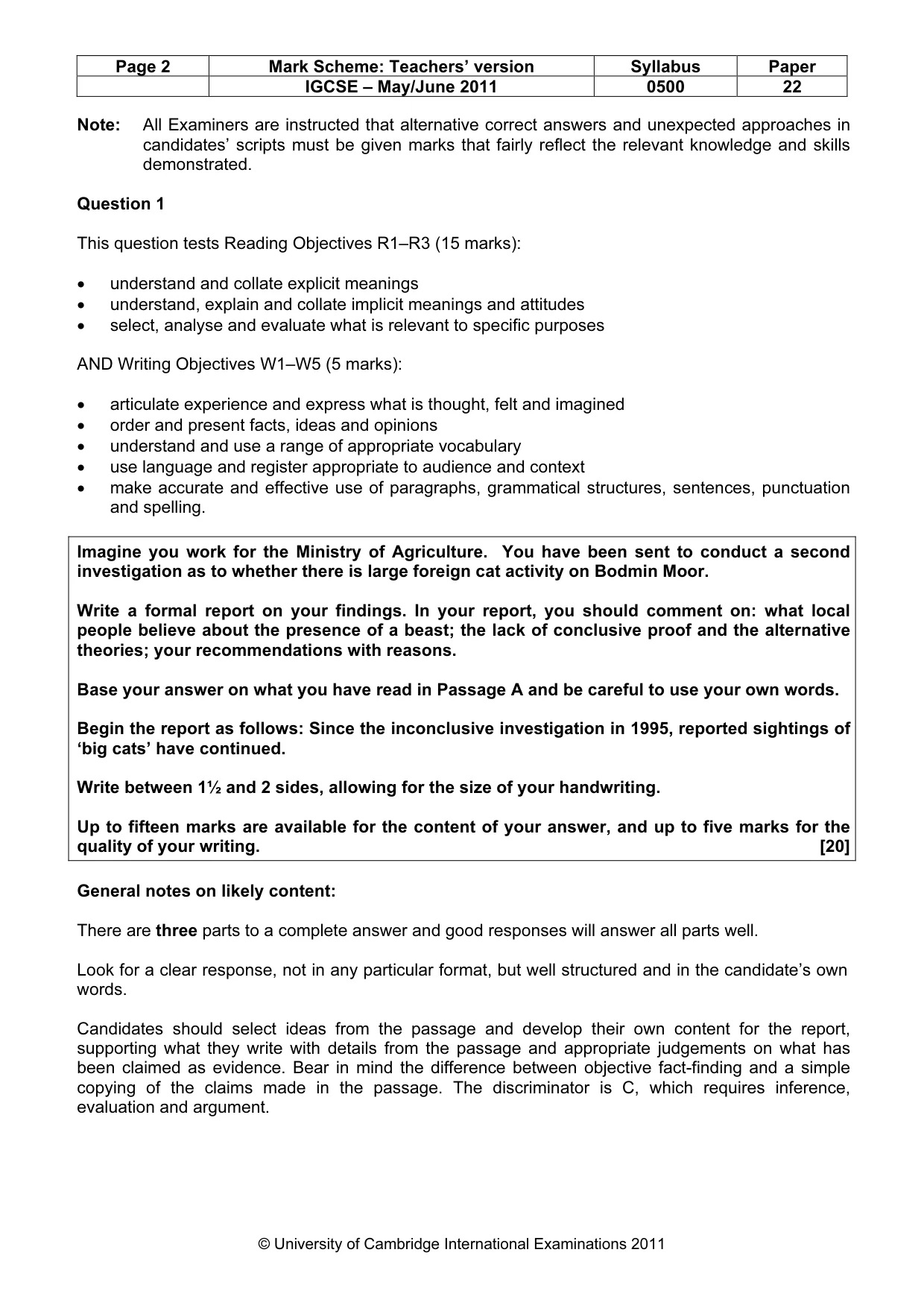
Page 2 Mark Scheme: Teachers’ version Syllabus Paper IGCSE – May/June 2011 0500 22 © University of Cambridge International Examinations 2011 Note: All Examiners are instructed that alternative correct answers and unexpected approaches in candidates’ scripts must be given marks that fairly reflect the relevant knowledge and skills demonstrated. Question 1 This question tests Reading Objectives R1–R3 (15 marks): • understand and collate explicit meanings • understand, explain and collate implicit meanings and attitudes • select, analyse and evaluate what is relevant to specific purposes AND Writing Objectives W1–W5 (5 marks): • articulate experience and express what is thought, felt and imagined • order and present facts, ideas and opinions • understand and use a range of appropriate vocabulary • use language and register appropriate to audience and context • make accurate and effective use of paragraphs, grammatical structures, sentences, punctuation and spelling. Imagine you work for the Ministry of Agriculture. You have been sent to conduct a second investigation as to whether there is large foreign cat activity on Bodmin Moor. Write a formal report on your findings. In your report, you should comment on: what local people believe about the presence of a beast; the lack of conclusive proof and the alternative theories; your recommendations with reasons. Base your answer on what you have read in Passage A and be careful to use your own words. Begin the report as follows: Since the inconclusive investigation in 1995, reported sightings of ‘big cats’ have continued. Write between 1½ and 2 sides, allowing for the size of your handwriting. Up to fifteen marks are available for the content of your answer, and up to five marks for the quality of your writing. [20] General notes on likely content: There are three parts to a complete answer and good responses will answer all parts well. Look for a clear response, not in any particular format, but well structured and in the candidate’s own words. Candidates should select ideas from the passage and develop their own content for the report, supporting what they write with details from the passage and appropriate judgements on what has been claimed as evidence. Bear in mind the difference between objective fact-finding and a simple copying of the claims made in the passage. The discriminator is C, which requires inference, evaluation and argument.
Mark scheme, page 3
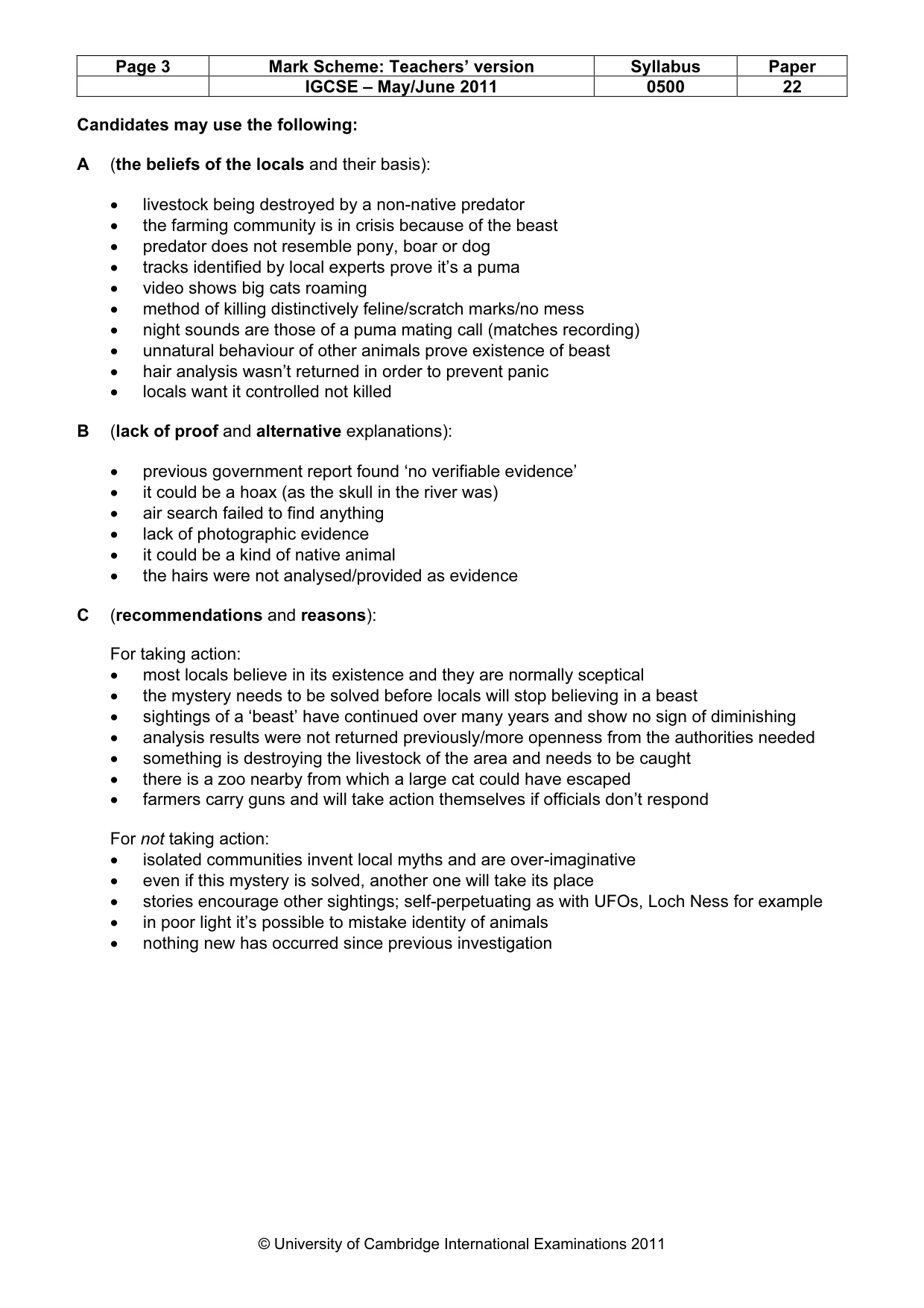
Page 3 Mark Scheme: Teachers’ version Syllabus Paper IGCSE – May/June 2011 0500 22 © University of Cambridge International Examinations 2011 Candidates may use the following: A (the beliefs of the locals and their basis): • livestock being destroyed by a non-native predator • the farming community is in crisis because of the beast • predator does not resemble pony, boar or dog • tracks identified by local experts prove it’s a puma • video shows big cats roaming • method of killing distinctively feline/scratch marks/no mess • night sounds are those of a puma mating call (matches recording) • unnatural behaviour of other animals prove existence of beast • hair analysis wasn’t returned in order to prevent panic • locals want it controlled not killed B (lack of proof and alternative explanations): • previous government report found ‘no verifiable evidence’ • it could be a hoax (as the skull in the river was) • air search failed to find anything • lack of photographic evidence • it could be a kind of native animal • the hairs were not analysed/provided as evidence C (recommendations and reasons): For taking action: • most locals believe in its existence and they are normally sceptical • the mystery needs to be solved before locals will stop believing in a beast • sightings of a ‘beast’ have continued over many years and show no sign of diminishing • analysis results were not returned previously/more openness from the authorities needed • something is destroying the livestock of the area and needs to be caught • there is a zoo nearby from which a large cat could have escaped • farmers carry guns and will take action themselves if officials don’t respond For not taking action: • isolated communities invent local myths and are over-imaginative • even if this mystery is solved, another one will take its place • stories encourage other sightings; self-perpetuating as with UFOs, Loch Ness for example • in poor light it’s possible to mistake identity of animals • nothing new has occurred since previous investigation
Mark scheme, page 4
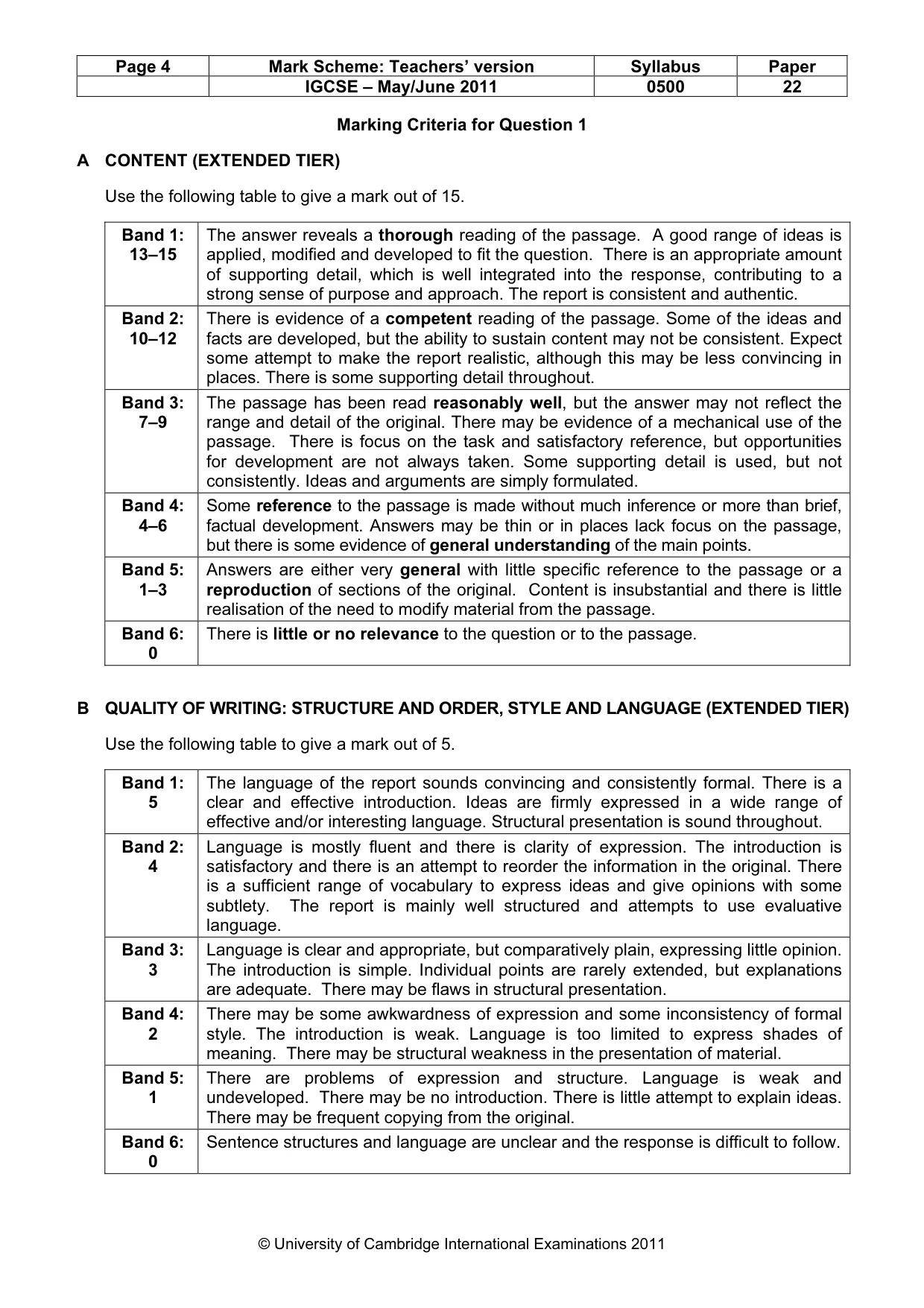
Page 4 Mark Scheme: Teachers’ version Syllabus Paper IGCSE – May/June 2011 0500 22 © University of Cambridge International Examinations 2011 Marking Criteria for Question 1 A CONTENT (EXTENDED TIER) Use the following table to give a mark out of 15. Band 1: 13–15 The answer reveals a thorough reading of the passage. A good range of ideas is applied, modified and developed to fit the question. There is an appropriate amount of supporting detail, which is well integrated into the response, contributing to a strong sense of purpose and approach. The report is consistent and authentic. Band 2: 10–12 There is evidence of a competent reading of the passage. Some of the ideas and facts are developed, but the ability to sustain content may not be consistent. Expect some attempt to make the report realistic, although this may be less convincing in places. There is some supporting detail throughout. Band 3: 7–9 The passage has been read reasonably well, but the answer may not reflect the range and detail of the original. There may be evidence of a mechanical use of the passage. There is focus on the task and satisfactory reference, but opportunities for development are not always taken. Some supporting detail is used, but not consistently. Ideas and arguments are simply formulated. Band 4: 4–6 Some reference to the passage is made without much inference or more than brief, factual development. Answers may be thin or in places lack focus on the passage, but there is some evidence of general understanding of the main points. Band 5: 1–3 Answers are either very general with little specific reference to the passage or a reproduction of sections of the original. Content is insubstantial and there is little realisation of the need to modify material from the passage. Band 6: 0 There is little or no relevance to the question or to the passage. B QUALITY OF WRITING: STRUCTURE AND ORDER, STYLE AND LANGUAGE (EXTENDED TIER) Use the following table to give a mark out of 5. Band 1: 5 The language of the report sounds convincing and consistently formal. There is a clear and effective introduction. Ideas are firmly expressed in a wide range of effective and/or interesting language. Structural presentation is sound throughout. Band 2: 4 Language is mostly fluent and there is clarity of expression. The introduction is satisfactory and there is an attempt to reorder the information in the original. There is a sufficient range of vocabulary to express ideas and give opinions with some subtlety. The report is mainly well structured and attempts to use evaluative language. Band 3: 3 Language is clear and appropriate, but comparatively plain, expressing little opinion. The introduction is simple. Individual points are rarely extended, but explanations are adequate. There may be flaws in structural presentation. Band 4: 2 There may be some awkwardness of expression and some inconsistency of formal style. The introduction is weak. Language is too limited to express shades of meaning. There may be structural weakness in the presentation of material. Band 5: 1 There are problems of expression and structure. Language is weak and undeveloped. There may be no introduction. There is little attempt to explain ideas. There may be frequent copying from the original. Band 6: 0 Sentence structures and language are unclear and the response is difficult to follow.
Mark scheme, page 5
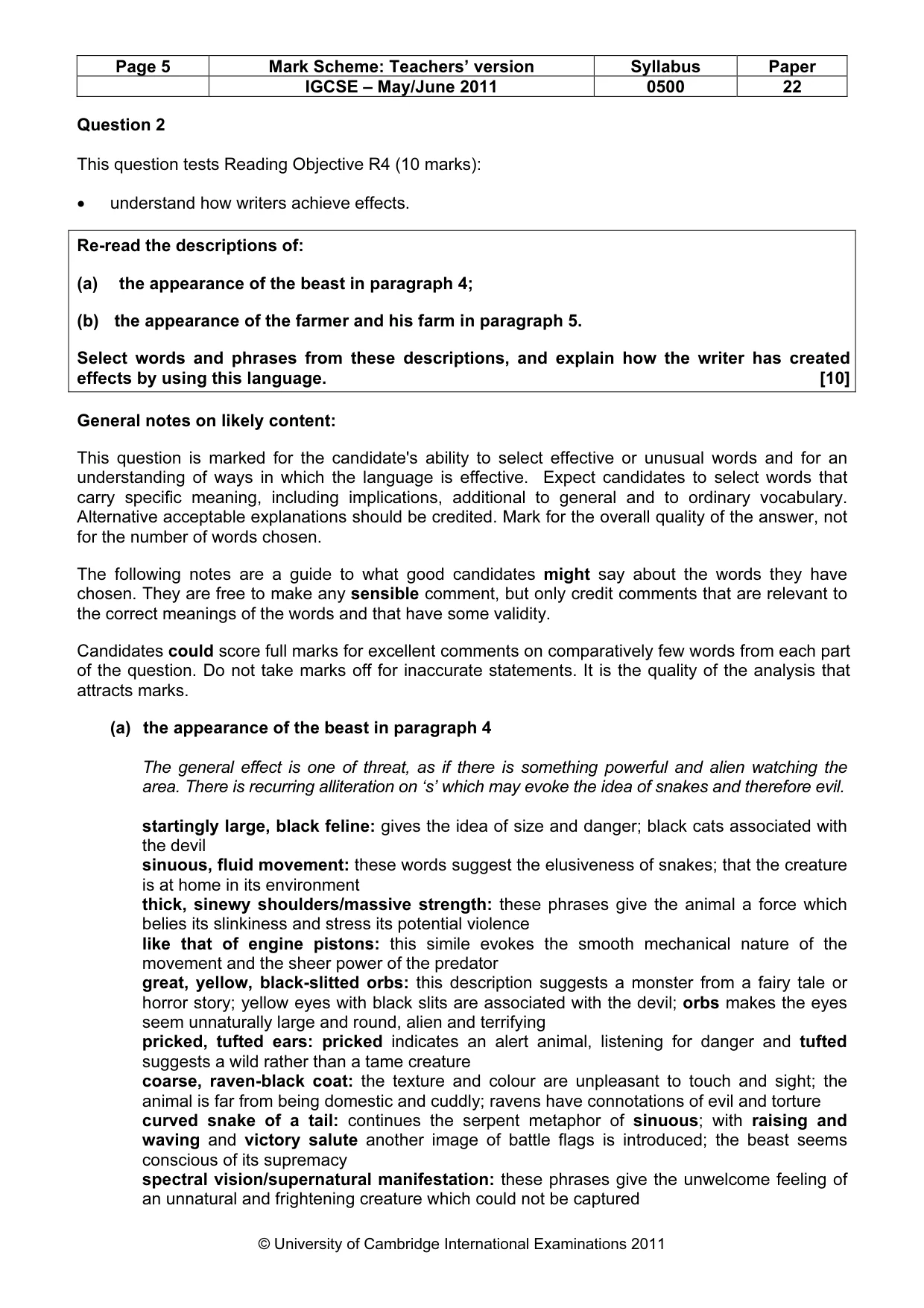
Page 5 Mark Scheme: Teachers’ version Syllabus Paper IGCSE – May/June 2011 0500 22 © University of Cambridge International Examinations 2011 Question 2 This question tests Reading Objective R4 (10 marks): • understand how writers achieve effects. Re-read the descriptions of: (a) the appearance of the beast in paragraph 4; (b) the appearance of the farmer and his farm in paragraph 5. Select words and phrases from these descriptions, and explain how the writer has created effects by using this language. [10] General notes on likely content: This question is marked for the candidate's ability to select effective or unusual words and for an understanding of ways in which the language is effective. Expect candidates to select words that carry specific meaning, including implications, additional to general and to ordinary vocabulary. Alternative acceptable explanations should be credited. Mark for the overall quality of the answer, not for the number of words chosen. The following notes are a guide to what good candidates might say about the words they have chosen. They are free to make any sensible comment, but only credit comments that are relevant to the correct meanings of the words and that have some validity. Candidates could score full marks for excellent comments on comparatively few words from each part of the question. Do not take marks off for inaccurate statements. It is the quality of the analysis that attracts marks. (a) the appearance of the beast in paragraph 4 The general effect is one of threat, as if there is something powerful and alien watching the area. There is recurring alliteration on ‘s’ which may evoke the idea of snakes and therefore evil. startingly large, black feline: gives the idea of size and danger; black cats associated with the devil sinuous, fluid movement: these words suggest the elusiveness of snakes; that the creature is at home in its environment thick, sinewy shoulders/massive strength: these phrases give the animal a force which belies its slinkiness and stress its potential violence like that of engine pistons: this simile evokes the smooth mechanical nature of the movement and the sheer power of the predator great, yellow, black-slitted orbs: this description suggests a monster from a fairy tale or horror story; yellow eyes with black slits are associated with the devil; orbs makes the eyes seem unnaturally large and round, alien and terrifying pricked, tufted ears: pricked indicates an alert animal, listening for danger and tufted suggests a wild rather than a tame creature coarse, raven-black coat: the texture and colour are unpleasant to touch and sight; the animal is far from being domestic and cuddly; ravens have connotations of evil and torture curved snake of a tail: continues the serpent metaphor of sinuous; with raising and waving and victory salute another image of battle flags is introduced; the beast seems conscious of its supremacy spectral vision/supernatural manifestation: these phrases give the unwelcome feeling of an unnatural and frightening creature which could not be captured
Mark scheme, page 6
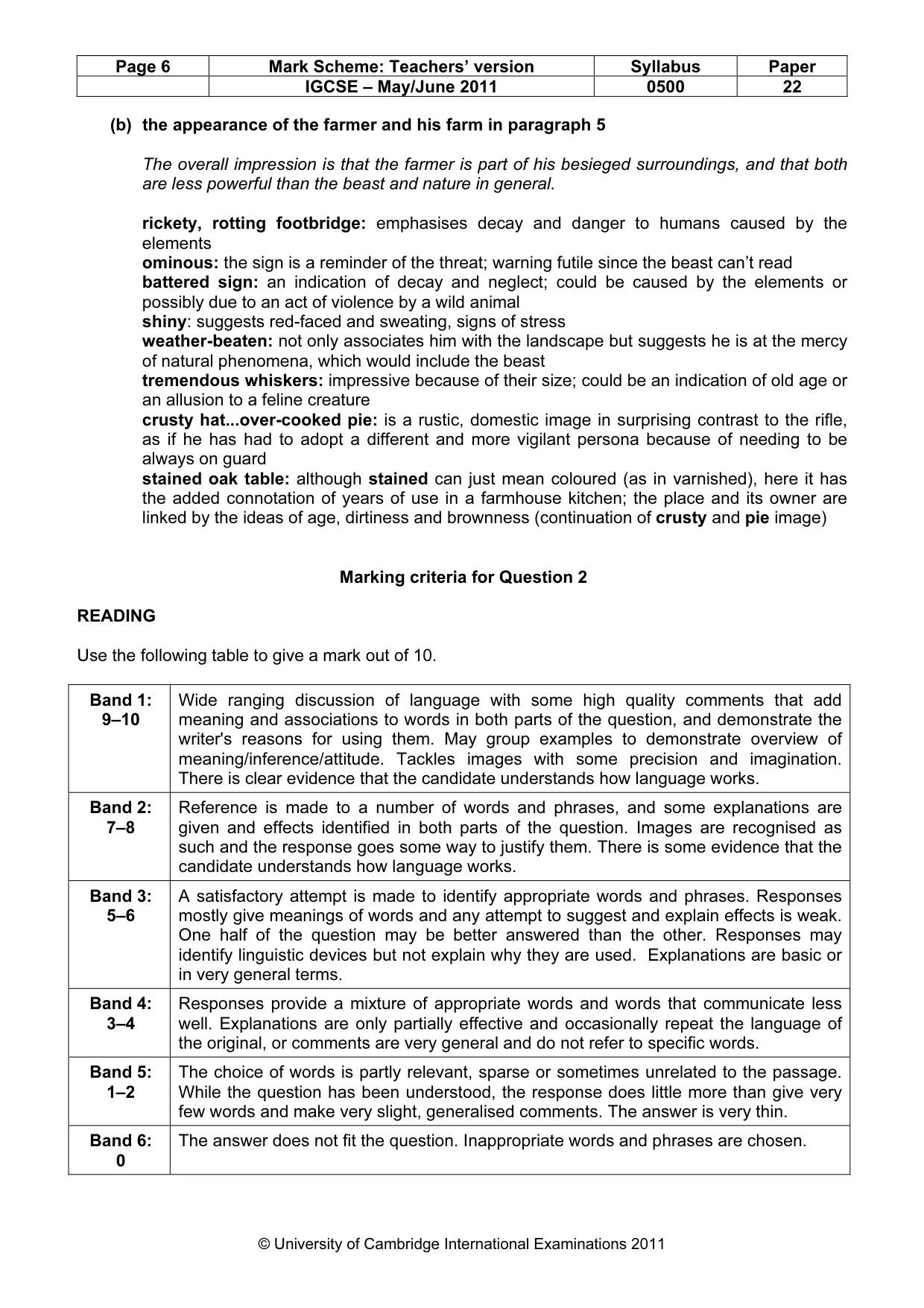
Page 6 Mark Scheme: Teachers’ version Syllabus Paper IGCSE – May/June 2011 0500 22 © University of Cambridge International Examinations 2011 (b) the appearance of the farmer and his farm in paragraph 5 The overall impression is that the farmer is part of his besieged surroundings, and that both are less powerful than the beast and nature in general. rickety, rotting footbridge: emphasises decay and danger to humans caused by the elements ominous: the sign is a reminder of the threat; warning futile since the beast can’t read battered sign: an indication of decay and neglect; could be caused by the elements or possibly due to an act of violence by a wild animal shiny: suggests red-faced and sweating, signs of stress weather-beaten: not only associates him with the landscape but suggests he is at the mercy of natural phenomena, which would include the beast tremendous whiskers: impressive because of their size; could be an indication of old age or an allusion to a feline creature crusty hat...over-cooked pie: is a rustic, domestic image in surprising contrast to the rifle, as if he has had to adopt a different and more vigilant persona because of needing to be always on guard stained oak table: although stained can just mean coloured (as in varnished), here it has the added connotation of years of use in a farmhouse kitchen; the place and its owner are linked by the ideas of age, dirtiness and brownness (continuation of crusty and pie image) Marking criteria for Question 2 READING Use the following table to give a mark out of 10. Band 1: 9–10 Wide ranging discussion of language with some high quality comments that add meaning and associations to words in both parts of the question, and demonstrate the writer's reasons for using them. May group examples to demonstrate overview of meaning/inference/attitude. Tackles images with some precision and imagination. There is clear evidence that the candidate understands how language works. Band 2: 7–8 Reference is made to a number of words and phrases, and some explanations are given and effects identified in both parts of the question. Images are recognised as such and the response goes some way to justify them. There is some evidence that the candidate understands how language works. Band 3: 5–6 A satisfactory attempt is made to identify appropriate words and phrases. Responses mostly give meanings of words and any attempt to suggest and explain effects is weak. One half of the question may be better answered than the other. Responses may identify linguistic devices but not explain why they are used. Explanations are basic or in very general terms. Band 4: 3–4 Responses provide a mixture of appropriate words and words that communicate less well. Explanations are only partially effective and occasionally repeat the language of the original, or comments are very general and do not refer to specific words. Band 5: 1–2 The choice of words is partly relevant, sparse or sometimes unrelated to the passage. While the question has been understood, the response does little more than give very few words and make very slight, generalised comments. The answer is very thin. Band 6: 0 The answer does not fit the question. Inappropriate words and phrases are chosen.
Mark scheme, page 7
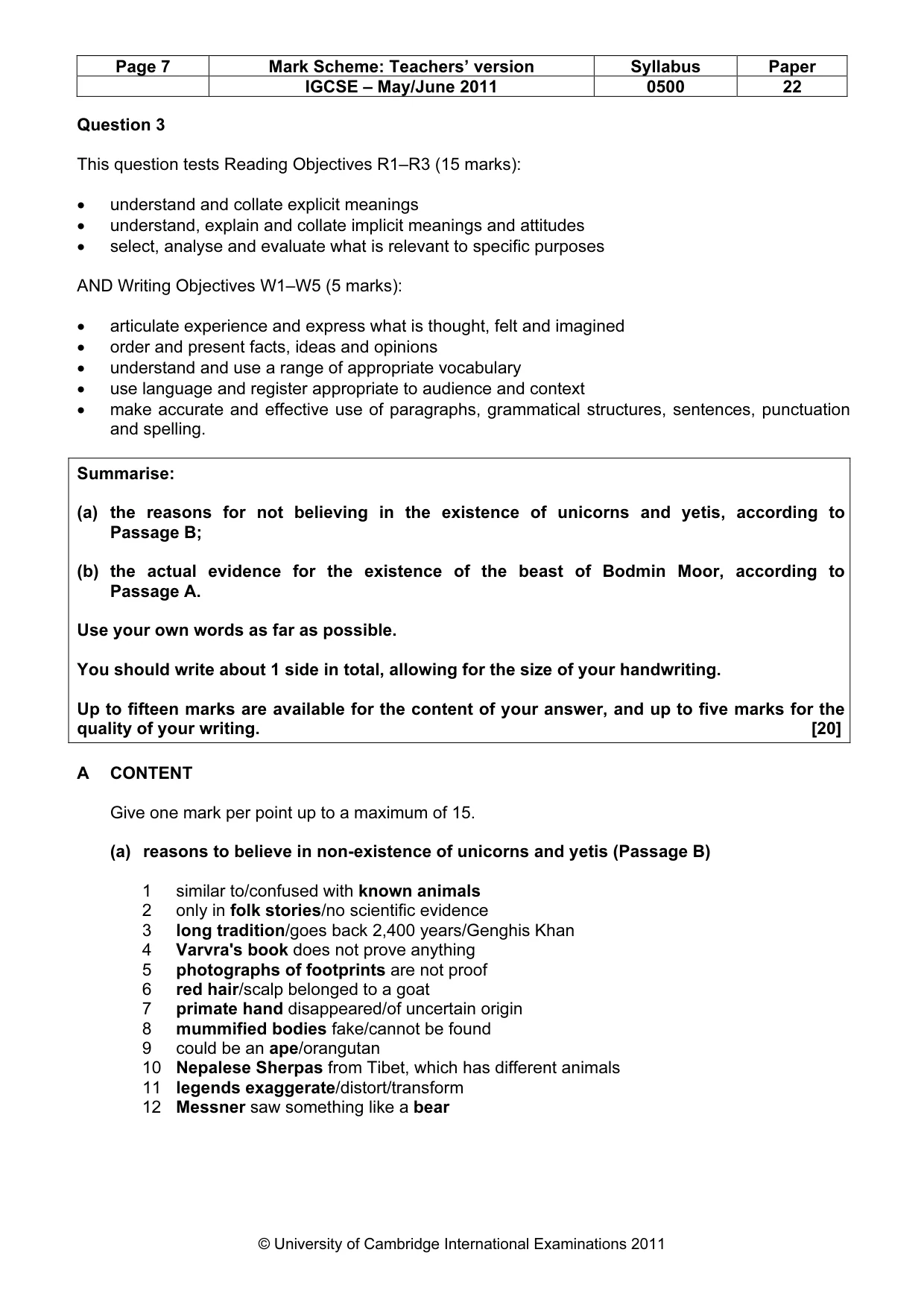
Page 7 Mark Scheme: Teachers’ version Syllabus Paper IGCSE – May/June 2011 0500 22 © University of Cambridge International Examinations 2011 Question 3 This question tests Reading Objectives R1–R3 (15 marks): • understand and collate explicit meanings • understand, explain and collate implicit meanings and attitudes • select, analyse and evaluate what is relevant to specific purposes AND Writing Objectives W1–W5 (5 marks): • articulate experience and express what is thought, felt and imagined • order and present facts, ideas and opinions • understand and use a range of appropriate vocabulary • use language and register appropriate to audience and context • make accurate and effective use of paragraphs, grammatical structures, sentences, punctuation and spelling. Summarise: (a) the reasons for not believing in the existence of unicorns and yetis, according to Passage B; (b) the actual evidence for the existence of the beast of Bodmin Moor, according to Passage A. Use your own words as far as possible. You should write about 1 side in total, allowing for the size of your handwriting. Up to fifteen marks are available for the content of your answer, and up to five marks for the quality of your writing. [20] A CONTENT Give one mark per point up to a maximum of 15. (a) reasons to believe in non-existence of unicorns and yetis (Passage B) 1 similar to/confused with known animals 2 only in folk stories/no scientific evidence 3 long tradition/goes back 2,400 years/Genghis Khan 4 Varvra's book does not prove anything 5 photographs of footprints are not proof 6 red hair/scalp belonged to a goat 7 primate hand disappeared/of uncertain origin 8 mummified bodies fake/cannot be found 9 could be an ape/orangutan 10 Nepalese Sherpas from Tibet, which has different animals 11 legends exaggerate/distort/transform 12 Messner saw something like a bear
Mark scheme, page 8
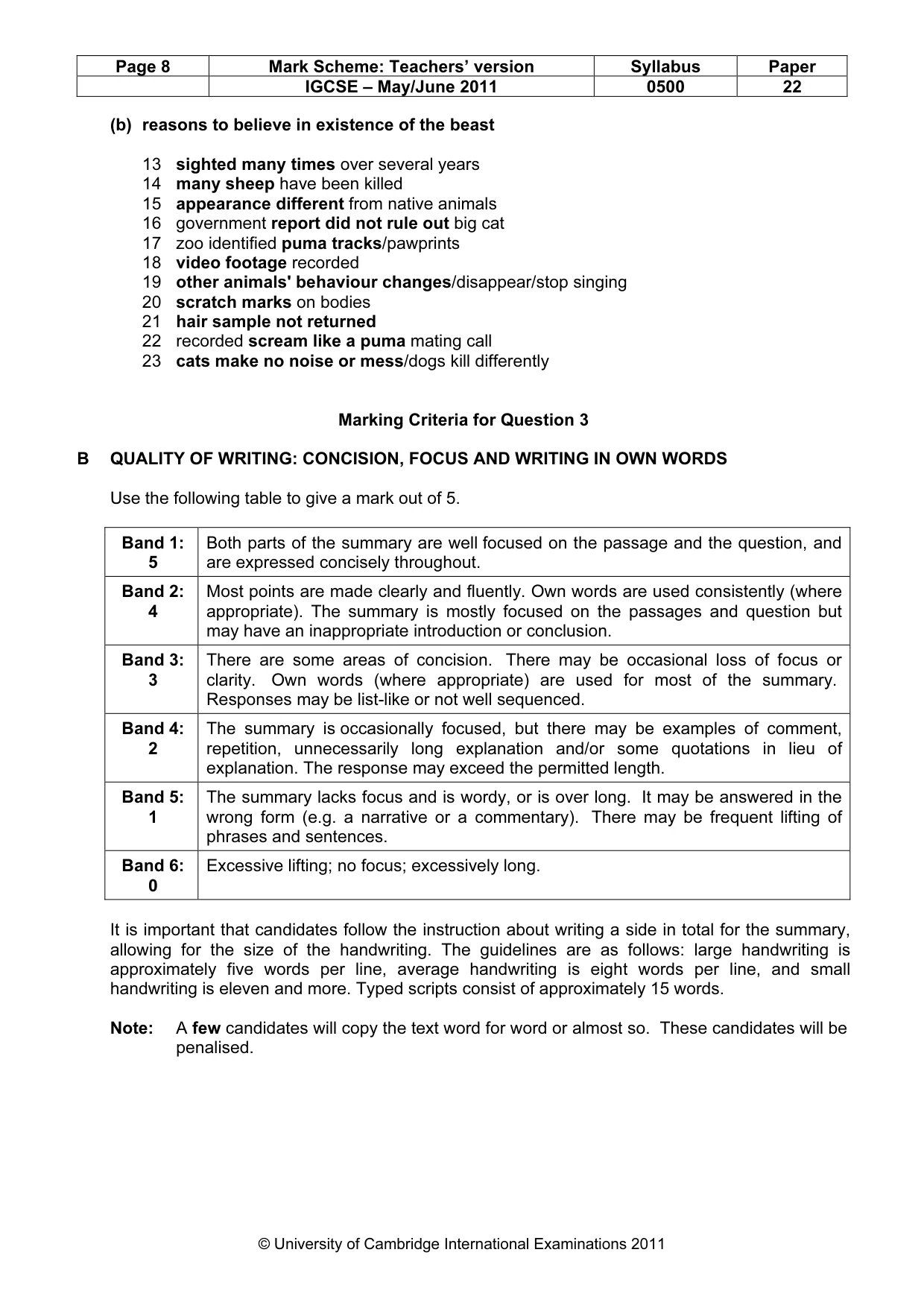
Page 8 Mark Scheme: Teachers’ version Syllabus Paper IGCSE – May/June 2011 0500 22 © University of Cambridge International Examinations 2011 (b) reasons to believe in existence of the beast 13 sighted many times over several years 14 many sheep have been killed 15 appearance different from native animals 16 government report did not rule out big cat 17 zoo identified puma tracks/pawprints 18 video footage recorded 19 other animals' behaviour changes/disappear/stop singing 20 scratch marks on bodies 21 hair sample not returned 22 recorded scream like a puma mating call 23 cats make no noise or mess/dogs kill differently Marking Criteria for Question 3 B QUALITY OF WRITING: CONCISION, FOCUS AND WRITING IN OWN WORDS Use the following table to give a mark out of 5. Band 1: 5 Both parts of the summary are well focused on the passage and the question, and are expressed concisely throughout. Band 2: 4 Most points are made clearly and fluently. Own words are used consistently (where appropriate). The summary is mostly focused on the passages and question but may have an inappropriate introduction or conclusion. Band 3: 3 There are some areas of concision. There may be occasional loss of focus or clarity. Own words (where appropriate) are used for most of the summary. Responses may be list-like or not well sequenced. Band 4: 2 The summary is occasionally focused, but there may be examples of comment, repetition, unnecessarily long explanation and/or some quotations in lieu of explanation. The response may exceed the permitted length. Band 5: 1 The summary lacks focus and is wordy, or is over long. It may be answered in the wrong form (e.g. a narrative or a commentary). There may be frequent lifting of phrases and sentences. Band 6: 0 Excessive lifting; no focus; excessively long. It is important that candidates follow the instruction about writing a side in total for the summary, allowing for the size of the handwriting. The guidelines are as follows: large handwriting is approximately five words per line, average handwriting is eight words per line, and small handwriting is eleven and more. Typed scripts consist of approximately 15 words. Note: A few candidates will copy the text word for word or almost so. These candidates will be penalised.
What you needed in this session
Cambridge’s own grade thresholds for 2011 May/June, Paper 2 · Variant 2. A higher threshold means an easier paper — the bar moves with how the cohort did.