Cambridge IGCSE English - First Language 0500 — 2011 May/June Paper 2 · Variant 1
0500/21/M/J/11 · 50 marks · ≈56 min
The question paper and its mark scheme, free to read here and free to download. This is Cambridge’s own paper, exactly as it was sat.
Question paper8 pages


Mark scheme8 pages
Answers below. Sit the paper first if you are practising.
Paper as text
Question paper, page 1
This document consists of 5 printed pages and 3 blank pages. DC (CB (NB)) 30700/4 © UCLES 2011 [Turn over UNIVERSITY OF CAMBRIDGE INTERNATIONAL EXAMINATIONS International General Certificate of Secondary Education * 0 6 3 5 8 3 3 2 7 7 * FIRST LANGUAGE ENGLISH 0500/21 Paper 2 Reading Passages (Extended) May/June 2011 2 hours Additional Materials: Answer Booklet/Paper READ THESE INSTRUCTIONS FIRST If you have been given an Answer Booklet, follow the instructions on the front cover of the Booklet. Write your Centre number, candidate number and name on all the work you hand in. Write in dark blue or black pen. Do not use staples, paper clips, highlighters, glue or correction fluid. Answer all questions. Dictionaries are not permitted. At the end of the examination, fasten all your work securely together. The number of marks is given in brackets [ ] at the end of each question or part question. www.XtremePapers.com
Question paper, page 2
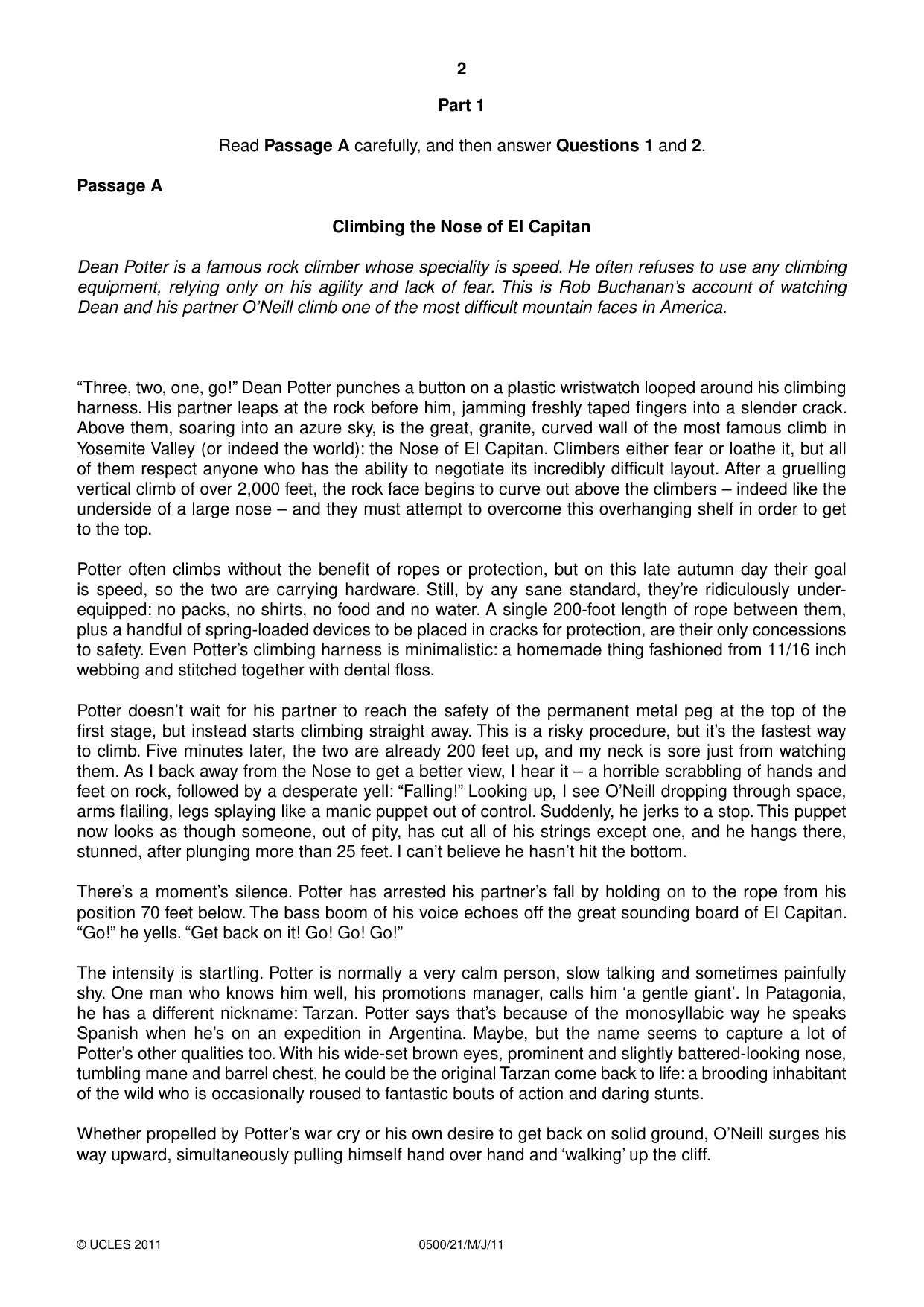
2 0500/21/M/J/11 © UCLES 2011 Part 1 Read Passage A carefully, and then answer Questions 1 and 2. Passage A Climbing the Nose of El Capitan Dean Potter is a famous rock climber whose speciality is speed. He often refuses to use any climbing equipment, relying only on his agility and lack of fear. This is Rob Buchanan’s account of watching Dean and his partner O’Neill climb one of the most difficult mountain faces in America. “Three, two, one, go!” Dean Potter punches a button on a plastic wristwatch looped around his climbing harness. His partner leaps at the rock before him, jamming freshly taped fingers into a slender crack. Above them, soaring into an azure sky, is the great, granite, curved wall of the most famous climb in Yosemite Valley (or indeed the world): the Nose of El Capitan. Climbers either fear or loathe it, but all of them respect anyone who has the ability to negotiate its incredibly difficult layout. After a gruelling vertical climb of over 2,000 feet, the rock face begins to curve out above the climbers – indeed like the underside of a large nose – and they must attempt to overcome this overhanging shelf in order to get to the top. Potter often climbs without the benefit of ropes or protection, but on this late autumn day their goal is speed, so the two are carrying hardware. Still, by any sane standard, they’re ridiculously under- equipped: no packs, no shirts, no food and no water. A single 200-foot length of rope between them, plus a handful of spring-loaded devices to be placed in cracks for protection, are their only concessions to safety. Even Potter’s climbing harness is minimalistic: a homemade thing fashioned from 11/16 inch webbing and stitched together with dental floss. Potter doesn’t wait for his partner to reach the safety of the permanent metal peg at the top of the first stage, but instead starts climbing straight away. This is a risky procedure, but it’s the fastest way to climb. Five minutes later, the two are already 200 feet up, and my neck is sore just from watching them. As I back away from the Nose to get a better view, I hear it – a horrible scrabbling of hands and feet on rock, followed by a desperate yell: “Falling!” Looking up, I see O’Neill dropping through space, arms flailing, legs splaying like a manic puppet out of control. Suddenly, he jerks to a stop. This puppet now looks as though someone, out of pity, has cut all of his strings except one, and he hangs there, stunned, after plunging more than 25 feet. I can’t believe he hasn’t hit the bottom. There’s a moment’s silence. Potter has arrested his partner’s fall by holding on to the rope from his position 70 feet below. The bass boom of his voice echoes off the great sounding board of El Capitan. “Go!” he yells. “Get back on it! Go! Go! Go!” The intensity is startling. Potter is normally a very calm person, slow talking and sometimes painfully shy. One man who knows him well, his promotions manager, calls him ‘a gentle giant’. In Patagonia, he has a different nickname: Tarzan. Potter says that’s because of the monosyllabic way he speaks Spanish when he’s on an expedition in Argentina. Maybe, but the name seems to capture a lot of Potter’s other qualities too. With his wide-set brown eyes, prominent and slightly battered-looking nose, tumbling mane and barrel chest, he could be the original Tarzan come back to life: a brooding inhabitant of the wild who is occasionally roused to fantastic bouts of action and daring stunts. Whether propelled by Potter’s war cry or his own desire to get back on solid ground, O’Neill surges his way upward, simultaneously pulling himself hand over hand and ‘walking’ up the cliff.
Question paper, page 3
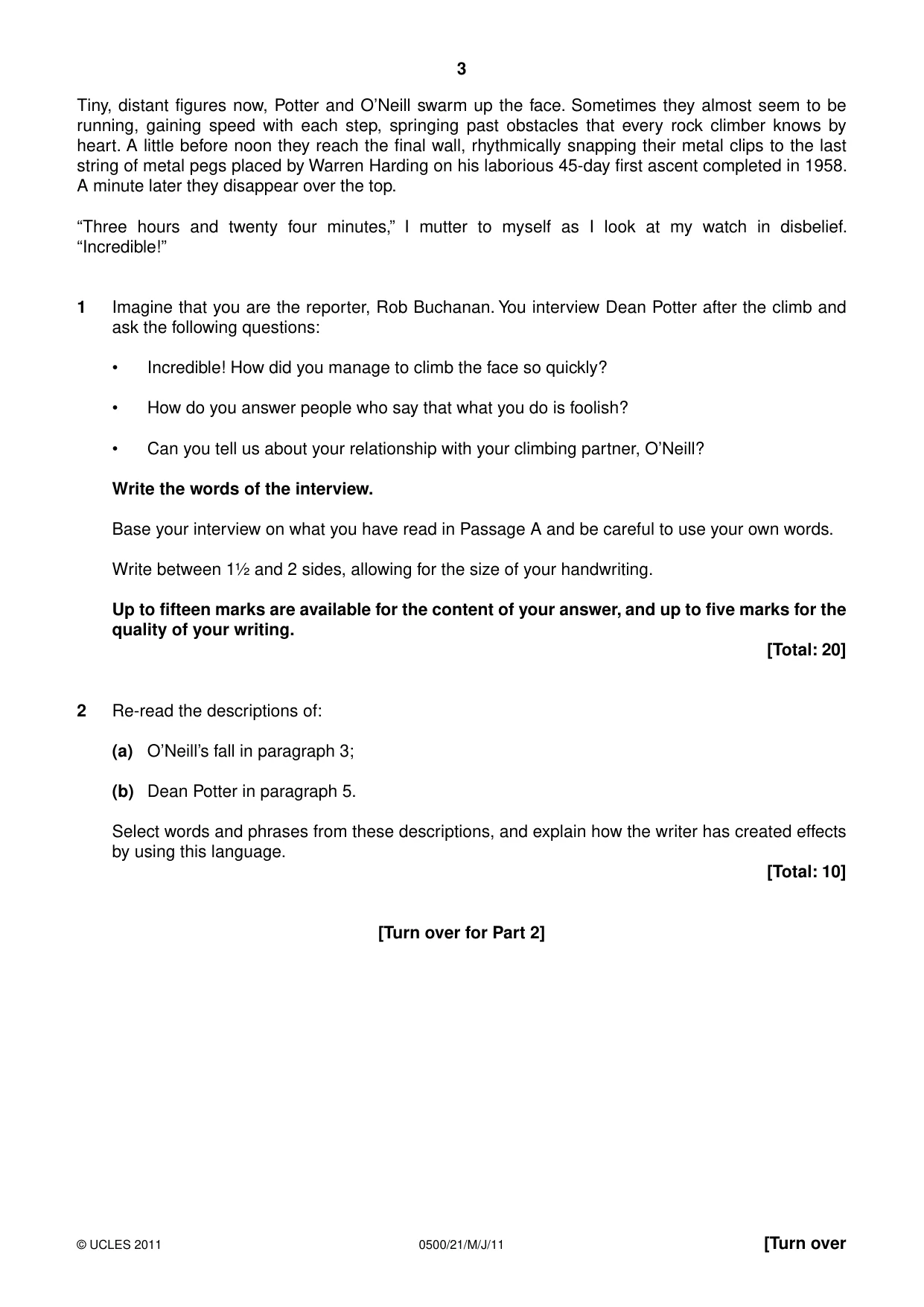
3 0500/21/M/J/11 © UCLES 2011 [Turn over Tiny, distant figures now, Potter and O’Neill swarm up the face. Sometimes they almost seem to be running, gaining speed with each step, springing past obstacles that every rock climber knows by heart. A little before noon they reach the final wall, rhythmically snapping their metal clips to the last string of metal pegs placed by Warren Harding on his laborious 45-day first ascent completed in 1958. A minute later they disappear over the top. “Three hours and twenty four minutes,” I mutter to myself as I look at my watch in disbelief. “Incredible!” 1 Imagine that you are the reporter, Rob Buchanan. You interview Dean Potter after the climb and ask the following questions: • Incredible! How did you manage to climb the face so quickly? • How do you answer people who say that what you do is foolish? • Can you tell us about your relationship with your climbing partner, O’Neill? Write the words of the interview. Base your interview on what you have read in Passage A and be careful to use your own words. Write between 1½ and 2 sides, allowing for the size of your handwriting. Up to fifteen marks are available for the content of your answer, and up to five marks for the quality of your writing. [Total: 20] 2 Re-read the descriptions of: (a) O’Neill’s fall in paragraph 3; (b) Dean Potter in paragraph 5. Select words and phrases from these descriptions, and explain how the writer has created effects by using this language. [Total: 10] [Turn over for Part 2]
Question paper, page 4
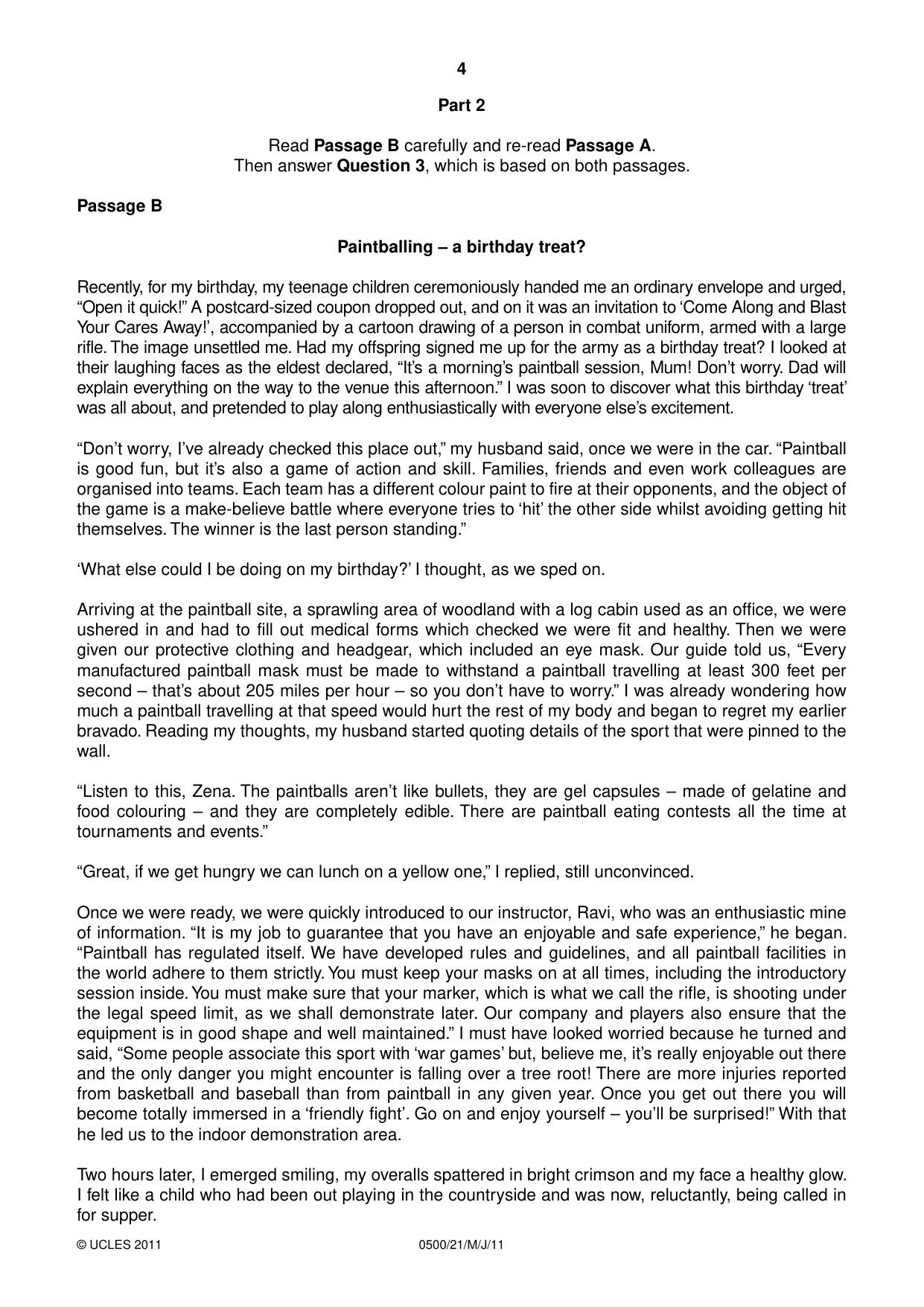
4 0500/21/M/J/11 © UCLES 2011 Part 2 Read Passage B carefully and re-read Passage A. Then answer Question 3, which is based on both passages. Passage B Paintballing – a birthday treat? Recently, for my birthday, my teenage children ceremoniously handed me an ordinary envelope and urged, “Open it quick!” A postcard-sized coupon dropped out, and on it was an invitation to ‘Come Along and Blast Your Cares Away!’, accompanied by a cartoon drawing of a person in combat uniform, armed with a large rifle. The image unsettled me. Had my offspring signed me up for the army as a birthday treat? I looked at their laughing faces as the eldest declared, “It’s a morning’s paintball session, Mum! Don’t worry. Dad will explain everything on the way to the venue this afternoon.” I was soon to discover what this birthday ‘treat’ was all about, and pretended to play along enthusiastically with everyone else’s excitement. “Don’t worry, I’ve already checked this place out,” my husband said, once we were in the car. “Paintball is good fun, but it’s also a game of action and skill. Families, friends and even work colleagues are organised into teams. Each team has a different colour paint to fire at their opponents, and the object of the game is a make-believe battle where everyone tries to ‘hit’ the other side whilst avoiding getting hit themselves. The winner is the last person standing.” ‘What else could I be doing on my birthday?’ I thought, as we sped on. Arriving at the paintball site, a sprawling area of woodland with a log cabin used as an office, we were ushered in and had to fill out medical forms which checked we were fit and healthy. Then we were given our protective clothing and headgear, which included an eye mask. Our guide told us, “Every manufactured paintball mask must be made to withstand a paintball travelling at least 300 feet per second – that’s about 205 miles per hour – so you don’t have to worry.” I was already wondering how much a paintball travelling at that speed would hurt the rest of my body and began to regret my earlier bravado. Reading my thoughts, my husband started quoting details of the sport that were pinned to the wall. “Listen to this, Zena. The paintballs aren’t like bullets, they are gel capsules – made of gelatine and food colouring – and they are completely edible. There are paintball eating contests all the time at tournaments and events.” “Great, if we get hungry we can lunch on a yellow one,” I replied, still unconvinced. Once we were ready, we were quickly introduced to our instructor, Ravi, who was an enthusiastic mine of information. “It is my job to guarantee that you have an enjoyable and safe experience,” he began. “Paintball has regulated itself. We have developed rules and guidelines, and all paintball facilities in the world adhere to them strictly. You must keep your masks on at all times, including the introductory session inside. You must make sure that your marker, which is what we call the rifle, is shooting under the legal speed limit, as we shall demonstrate later. Our company and players also ensure that the equipment is in good shape and well maintained.” I must have looked worried because he turned and said, “Some people associate this sport with ‘war games’ but, believe me, it’s really enjoyable out there and the only danger you might encounter is falling over a tree root! There are more injuries reported from basketball and baseball than from paintball in any given year. Once you get out there you will become totally immersed in a ‘friendly fight’. Go on and enjoy yourself – you’ll be surprised!” With that he led us to the indoor demonstration area. Two hours later, I emerged smiling, my overalls spattered in bright crimson and my face a healthy glow. I felt like a child who had been out playing in the countryside and was now, reluctantly, being called in for supper.
Question paper, page 5
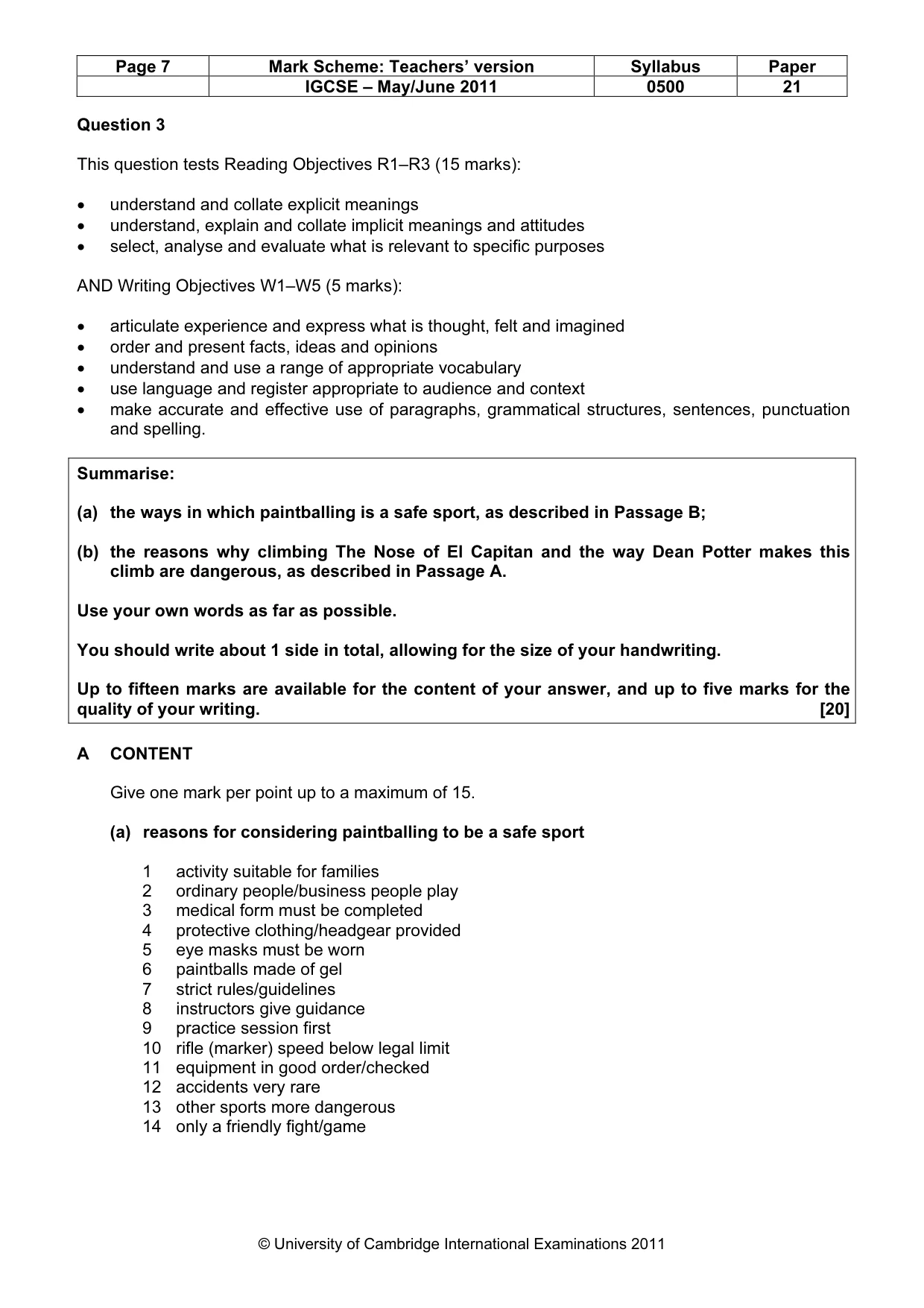
5 0500/21/M/J/11 © UCLES 2011 3 Summarise: (a) the ways in which paintballing is a safe sport, as described in Passage B; (b) the reasons why climbing the Nose of El Capitan and the way Dean Potter makes this climb are dangerous, as described in Passage A. Use your own words as far as possible. You should write about 1 side in total, allowing for the size of your handwriting. Up to fifteen marks are available for the content of your answer, and up to five marks for the quality of your writing. [Total: 20]
Question paper, page 6
6 0500/21/M/J/11 © UCLES 2011 BLANK PAGE
Question paper, page 7
7 0500/21/M/J/11 © UCLES 2011 BLANK PAGE
Question paper, page 8
8 0500/21/M/J/11 © UCLES 2011 Copyright Acknowledgements: Question 1 © adapted http://www.outside.away.com/features/200212/200212; 1/10/2009. Permission to reproduce items where third-party owned material protected by copyright is included has been sought and cleared where possible. Every reasonable effort has been made by the publisher (UCLES) to trace copyright holders, but if any items requiring clearance have unwittingly been included, the publisher will be pleased to make amends at the earliest possible opportunity. University of Cambridge International Examinations is part of the Cambridge Assessment Group. Cambridge Assessment is the brand name of University of Cambridge Local Examinations Syndicate (UCLES), which is itself a department of the University of Cambridge. BLANK PAGE
Mark scheme, page 1
UNIVERSITY OF CAMBRIDGE INTERNATIONAL EXAMINATIONS International General Certificate of Secondary Education MARK SCHEME for the May/June 2011 question paper for the guidance of teachers 0500 FIRST LANGUAGE ENGLISH 0500/21 Paper 2 (Reading Passage – Extended), maximum raw mark 50 This mark scheme is published as an aid to teachers and candidates, to indicate the requirements of the examination. It shows the basis on which Examiners were instructed to award marks. It does not indicate the details of the discussions that took place at an Examiners’ meeting before marking began, which would have considered the acceptability of alternative answers. Mark schemes must be read in conjunction with the question papers and the report on the examination. • Cambridge will not enter into discussions or correspondence in connection with these mark schemes. Cambridge is publishing the mark schemes for the May/June 2011 question papers for most IGCSE, GCE Advanced Level and Advanced Subsidiary Level syllabuses and some Ordinary Level syllabuses. www.XtremePapers.com
Mark scheme, page 2
Page 2 Mark Scheme: Teachers’ version Syllabus Paper IGCSE – May/June 2011 0500 21 © University of Cambridge International Examinations 2011 Note: All Examiners are instructed that alternative correct answers and unexpected approaches in candidates’ scripts must be given marks that fairly reflect the relevant knowledge and skills demonstrated. Question 1 This question tests Reading Objectives R1–R3 (15 marks): • understand and collate explicit meanings • understand, explain and collate implicit meanings and attitudes • select, analyse and evaluate what is relevant to specific purposes AND Writing Objectives W1–W5 (5 marks): • articulate experience and express what is thought, felt and imagined • order and present facts, ideas and opinions • understand and use a range of appropriate vocabulary • use language and register appropriate to audience and context • make accurate and effective use of paragraphs, grammatical structures, sentences, punctuation and spelling. Imagine that you are the reporter, Rob Buchanan. You interview Dean Potter after the climb and ask the following questions: • Incredible! How did you manage to climb the face so quickly? • How do you answer people who say that what you do is foolish? • Can you tell us about your relationship with your climbing partner, O’Neill? Write the words of the interview. Base your interview on what you have read in Passage A and be careful to use your own words. Write between 1½ and 2 sides, allowing for the size of your handwriting. Up to fifteen marks are available for the content of your answer, and up to five marks for the quality of your writing. [20] General notes on likely content: There are three parts to a complete answer and good responses will answer all parts well. The details of the climb are specific, but it is how the interview is constructed that is important. If the responses merely list then this will be self-penalising for the Reading and the Writing mark. Some responses will include additional leading questions. Better responses will give Potter a convincing voice that rings true from their reading of the passage.
Mark scheme, page 3
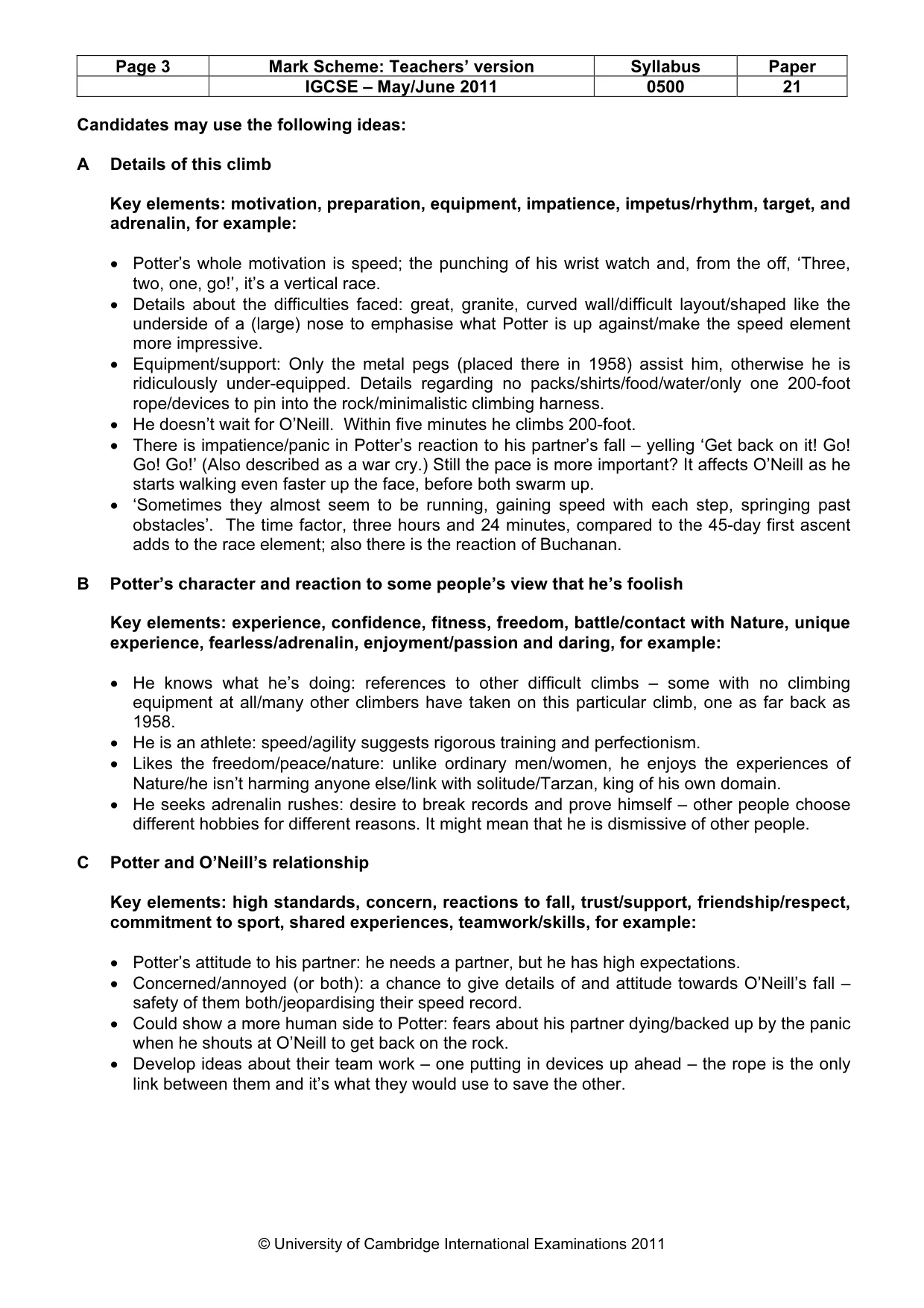
Page 3 Mark Scheme: Teachers’ version Syllabus Paper IGCSE – May/June 2011 0500 21 © University of Cambridge International Examinations 2011 Candidates may use the following ideas: A Details of this climb Key elements: motivation, preparation, equipment, impatience, impetus/rhythm, target, and adrenalin, for example: • Potter’s whole motivation is speed; the punching of his wrist watch and, from the off, ‘Three, two, one, go!’, it’s a vertical race. • Details about the difficulties faced: great, granite, curved wall/difficult layout/shaped like the underside of a (large) nose to emphasise what Potter is up against/make the speed element more impressive. • Equipment/support: Only the metal pegs (placed there in 1958) assist him, otherwise he is ridiculously under-equipped. Details regarding no packs/shirts/food/water/only one 200-foot rope/devices to pin into the rock/minimalistic climbing harness. • He doesn’t wait for O’Neill. Within five minutes he climbs 200-foot. • There is impatience/panic in Potter’s reaction to his partner’s fall – yelling ‘Get back on it! Go! Go! Go!’ (Also described as a war cry.) Still the pace is more important? It affects O’Neill as he starts walking even faster up the face, before both swarm up. • ‘Sometimes they almost seem to be running, gaining speed with each step, springing past obstacles’. The time factor, three hours and 24 minutes, compared to the 45-day first ascent adds to the race element; also there is the reaction of Buchanan. B Potter’s character and reaction to some people’s view that he’s foolish Key elements: experience, confidence, fitness, freedom, battle/contact with Nature, unique experience, fearless/adrenalin, enjoyment/passion and daring, for example: • He knows what he’s doing: references to other difficult climbs – some with no climbing equipment at all/many other climbers have taken on this particular climb, one as far back as 1958. • He is an athlete: speed/agility suggests rigorous training and perfectionism. • Likes the freedom/peace/nature: unlike ordinary men/women, he enjoys the experiences of Nature/he isn’t harming anyone else/link with solitude/Tarzan, king of his own domain. • He seeks adrenalin rushes: desire to break records and prove himself – other people choose different hobbies for different reasons. It might mean that he is dismissive of other people. C Potter and O’Neill’s relationship Key elements: high standards, concern, reactions to fall, trust/support, friendship/respect, commitment to sport, shared experiences, teamwork/skills, for example: • Potter’s attitude to his partner: he needs a partner, but he has high expectations. • Concerned/annoyed (or both): a chance to give details of and attitude towards O’Neill’s fall – safety of them both/jeopardising their speed record. • Could show a more human side to Potter: fears about his partner dying/backed up by the panic when he shouts at O’Neill to get back on the rock. • Develop ideas about their team work – one putting in devices up ahead – the rope is the only link between them and it’s what they would use to save the other.
Mark scheme, page 4
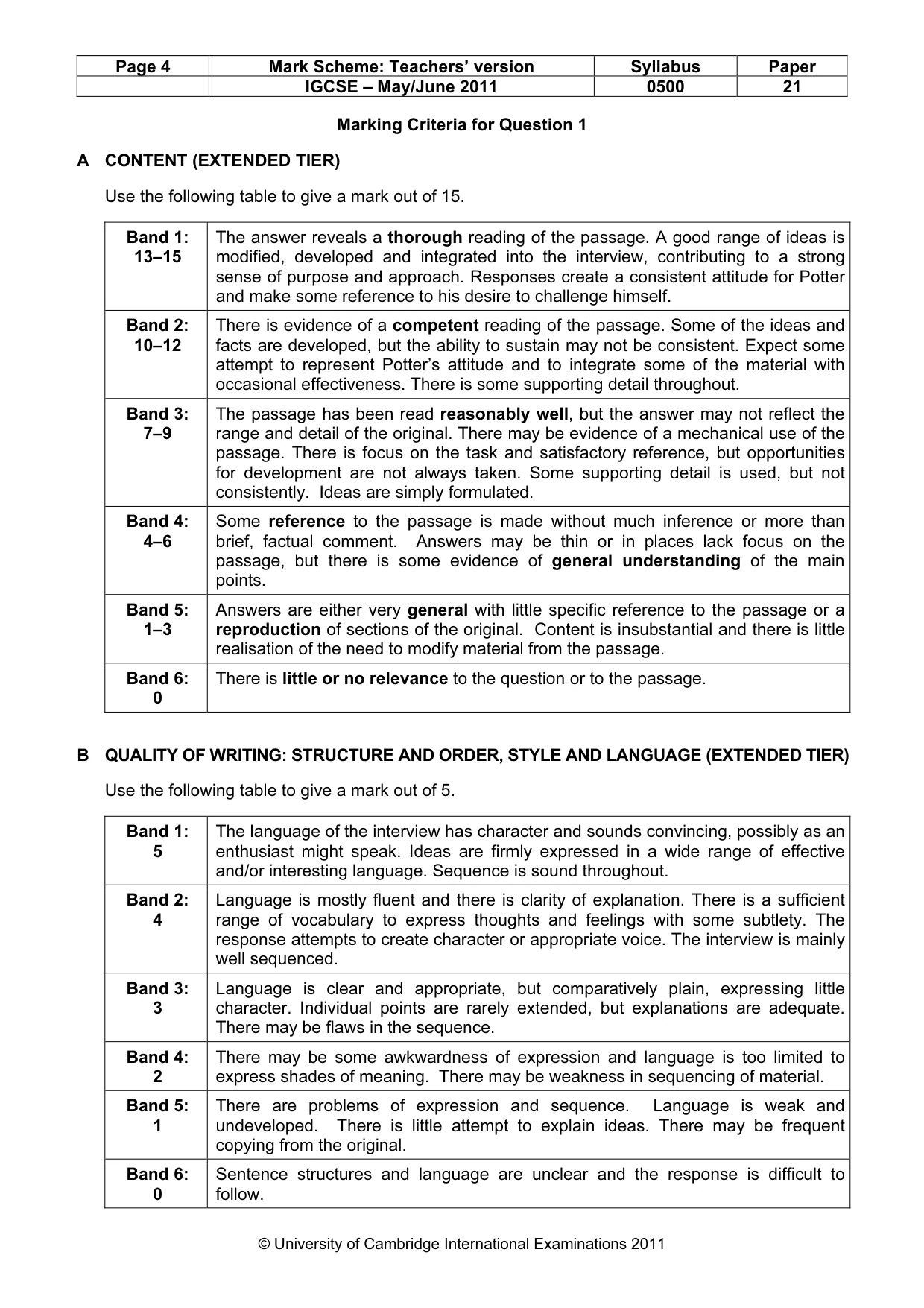
Page 4 Mark Scheme: Teachers’ version Syllabus Paper IGCSE – May/June 2011 0500 21 © University of Cambridge International Examinations 2011 Marking Criteria for Question 1 A CONTENT (EXTENDED TIER) Use the following table to give a mark out of 15. Band 1: 13–15 The answer reveals a thorough reading of the passage. A good range of ideas is modified, developed and integrated into the interview, contributing to a strong sense of purpose and approach. Responses create a consistent attitude for Potter and make some reference to his desire to challenge himself. Band 2: 10–12 There is evidence of a competent reading of the passage. Some of the ideas and facts are developed, but the ability to sustain may not be consistent. Expect some attempt to represent Potter’s attitude and to integrate some of the material with occasional effectiveness. There is some supporting detail throughout. Band 3: 7–9 The passage has been read reasonably well, but the answer may not reflect the range and detail of the original. There may be evidence of a mechanical use of the passage. There is focus on the task and satisfactory reference, but opportunities for development are not always taken. Some supporting detail is used, but not consistently. Ideas are simply formulated. Band 4: 4–6 Some reference to the passage is made without much inference or more than brief, factual comment. Answers may be thin or in places lack focus on the passage, but there is some evidence of general understanding of the main points. Band 5: 1–3 Answers are either very general with little specific reference to the passage or a reproduction of sections of the original. Content is insubstantial and there is little realisation of the need to modify material from the passage. Band 6: 0 There is little or no relevance to the question or to the passage. B QUALITY OF WRITING: STRUCTURE AND ORDER, STYLE AND LANGUAGE (EXTENDED TIER) Use the following table to give a mark out of 5. Band 1: 5 The language of the interview has character and sounds convincing, possibly as an enthusiast might speak. Ideas are firmly expressed in a wide range of effective and/or interesting language. Sequence is sound throughout. Band 2: 4 Language is mostly fluent and there is clarity of explanation. There is a sufficient range of vocabulary to express thoughts and feelings with some subtlety. The response attempts to create character or appropriate voice. The interview is mainly well sequenced. Band 3: 3 Language is clear and appropriate, but comparatively plain, expressing little character. Individual points are rarely extended, but explanations are adequate. There may be flaws in the sequence. Band 4: 2 There may be some awkwardness of expression and language is too limited to express shades of meaning. There may be weakness in sequencing of material. Band 5: 1 There are problems of expression and sequence. Language is weak and undeveloped. There is little attempt to explain ideas. There may be frequent copying from the original. Band 6: 0 Sentence structures and language are unclear and the response is difficult to follow.
Mark scheme, page 5
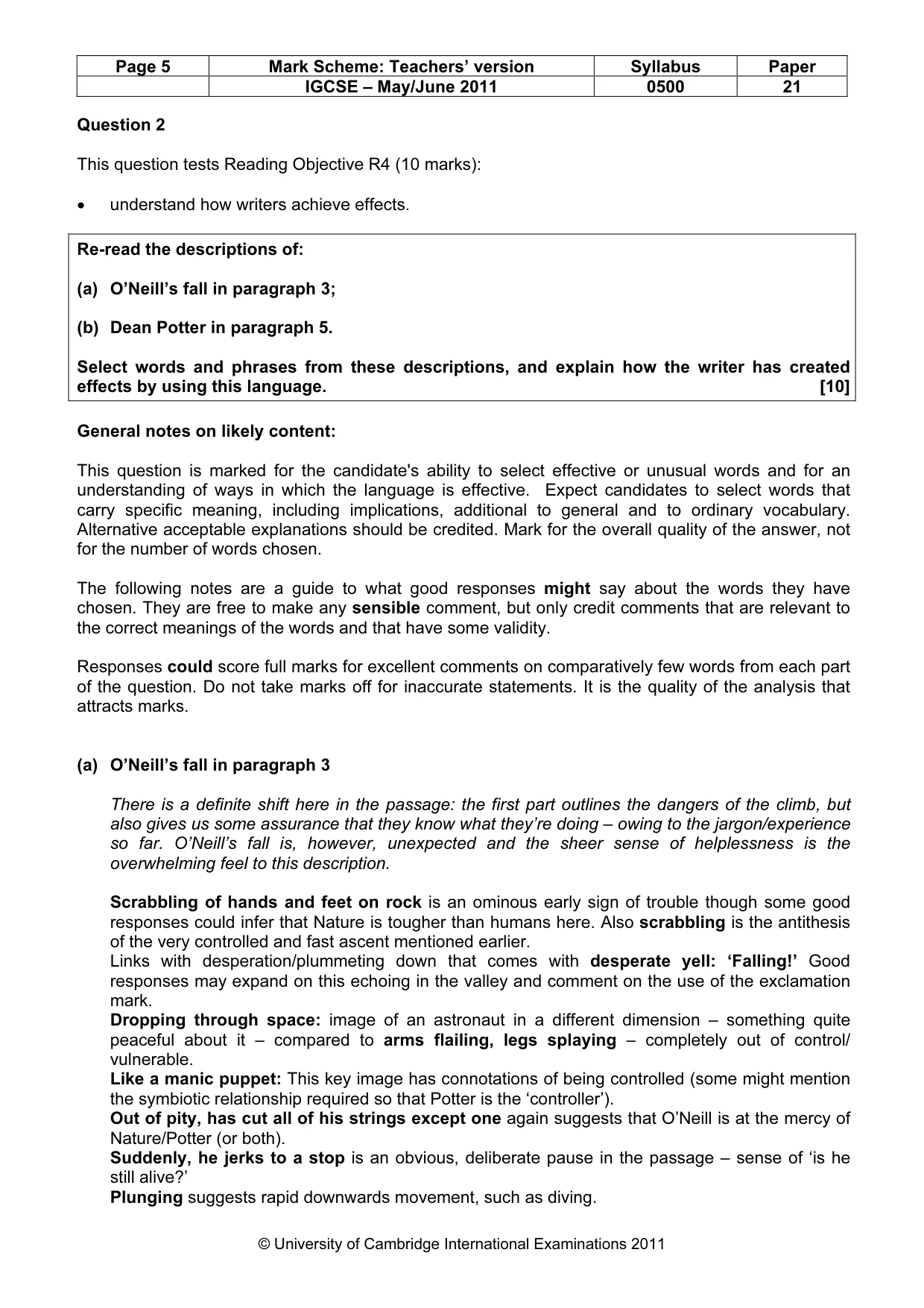
Page 5 Mark Scheme: Teachers’ version Syllabus Paper IGCSE – May/June 2011 0500 21 © University of Cambridge International Examinations 2011 Question 2 This question tests Reading Objective R4 (10 marks): • understand how writers achieve effects. Re-read the descriptions of: (a) O’Neill’s fall in paragraph 3; (b) Dean Potter in paragraph 5. Select words and phrases from these descriptions, and explain how the writer has created effects by using this language. [10] General notes on likely content: This question is marked for the candidate's ability to select effective or unusual words and for an understanding of ways in which the language is effective. Expect candidates to select words that carry specific meaning, including implications, additional to general and to ordinary vocabulary. Alternative acceptable explanations should be credited. Mark for the overall quality of the answer, not for the number of words chosen. The following notes are a guide to what good responses might say about the words they have chosen. They are free to make any sensible comment, but only credit comments that are relevant to the correct meanings of the words and that have some validity. Responses could score full marks for excellent comments on comparatively few words from each part of the question. Do not take marks off for inaccurate statements. It is the quality of the analysis that attracts marks. (a) O’Neill’s fall in paragraph 3 There is a definite shift here in the passage: the first part outlines the dangers of the climb, but also gives us some assurance that they know what they’re doing – owing to the jargon/experience so far. O’Neill’s fall is, however, unexpected and the sheer sense of helplessness is the overwhelming feel to this description. Scrabbling of hands and feet on rock is an ominous early sign of trouble though some good responses could infer that Nature is tougher than humans here. Also scrabbling is the antithesis of the very controlled and fast ascent mentioned earlier. Links with desperation/plummeting down that comes with desperate yell: ‘Falling!’ Good responses may expand on this echoing in the valley and comment on the use of the exclamation mark. Dropping through space: image of an astronaut in a different dimension – something quite peaceful about it – compared to arms flailing, legs splaying – completely out of control/ vulnerable. Like a manic puppet: This key image has connotations of being controlled (some might mention the symbiotic relationship required so that Potter is the ‘controller’). Out of pity, has cut all of his strings except one again suggests that O’Neill is at the mercy of Nature/Potter (or both). Suddenly, he jerks to a stop is an obvious, deliberate pause in the passage – sense of ‘is he still alive?’ Plunging suggests rapid downwards movement, such as diving.
Mark scheme, page 6
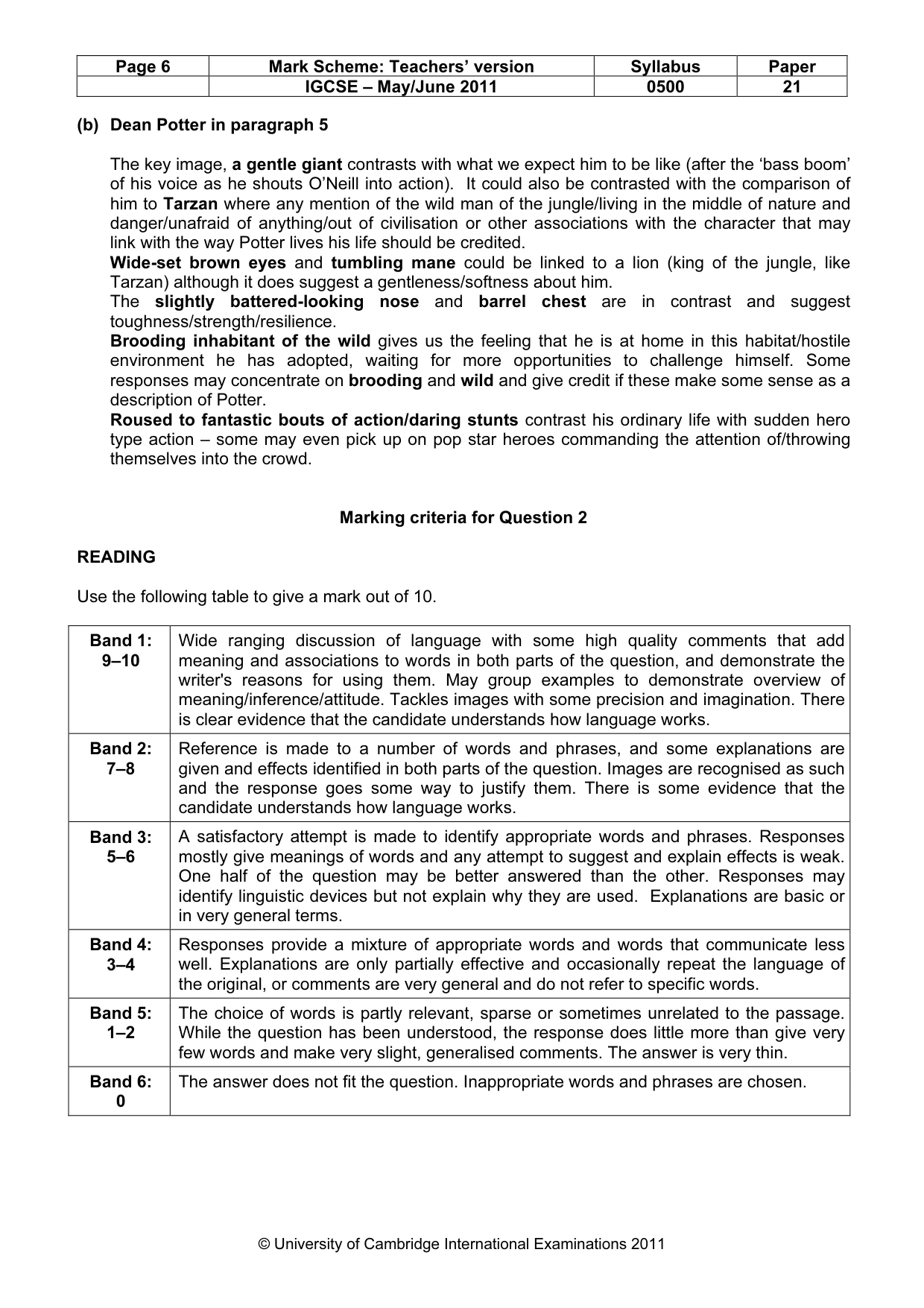
Page 6 Mark Scheme: Teachers’ version Syllabus Paper IGCSE – May/June 2011 0500 21 © University of Cambridge International Examinations 2011 (b) Dean Potter in paragraph 5 The key image, a gentle giant contrasts with what we expect him to be like (after the ‘bass boom’ of his voice as he shouts O’Neill into action). It could also be contrasted with the comparison of him to Tarzan where any mention of the wild man of the jungle/living in the middle of nature and danger/unafraid of anything/out of civilisation or other associations with the character that may link with the way Potter lives his life should be credited. Wide-set brown eyes and tumbling mane could be linked to a lion (king of the jungle, like Tarzan) although it does suggest a gentleness/softness about him. The slightly battered-looking nose and barrel chest are in contrast and suggest toughness/strength/resilience. Brooding inhabitant of the wild gives us the feeling that he is at home in this habitat/hostile environment he has adopted, waiting for more opportunities to challenge himself. Some responses may concentrate on brooding and wild and give credit if these make some sense as a description of Potter. Roused to fantastic bouts of action/daring stunts contrast his ordinary life with sudden hero type action – some may even pick up on pop star heroes commanding the attention of/throwing themselves into the crowd. Marking criteria for Question 2 READING Use the following table to give a mark out of 10. Band 1: 9–10 Wide ranging discussion of language with some high quality comments that add meaning and associations to words in both parts of the question, and demonstrate the writer's reasons for using them. May group examples to demonstrate overview of meaning/inference/attitude. Tackles images with some precision and imagination. There is clear evidence that the candidate understands how language works. Band 2: 7–8 Reference is made to a number of words and phrases, and some explanations are given and effects identified in both parts of the question. Images are recognised as such and the response goes some way to justify them. There is some evidence that the candidate understands how language works. Band 3: 5–6 A satisfactory attempt is made to identify appropriate words and phrases. Responses mostly give meanings of words and any attempt to suggest and explain effects is weak. One half of the question may be better answered than the other. Responses may identify linguistic devices but not explain why they are used. Explanations are basic or in very general terms. Band 4: 3–4 Responses provide a mixture of appropriate words and words that communicate less well. Explanations are only partially effective and occasionally repeat the language of the original, or comments are very general and do not refer to specific words. Band 5: 1–2 The choice of words is partly relevant, sparse or sometimes unrelated to the passage. While the question has been understood, the response does little more than give very few words and make very slight, generalised comments. The answer is very thin. Band 6: 0 The answer does not fit the question. Inappropriate words and phrases are chosen.
Mark scheme, page 7
Page 7 Mark Scheme: Teachers’ version Syllabus Paper IGCSE – May/June 2011 0500 21 © University of Cambridge International Examinations 2011 Question 3 This question tests Reading Objectives R1–R3 (15 marks): • understand and collate explicit meanings • understand, explain and collate implicit meanings and attitudes • select, analyse and evaluate what is relevant to specific purposes AND Writing Objectives W1–W5 (5 marks): • articulate experience and express what is thought, felt and imagined • order and present facts, ideas and opinions • understand and use a range of appropriate vocabulary • use language and register appropriate to audience and context • make accurate and effective use of paragraphs, grammatical structures, sentences, punctuation and spelling. Summarise: (a) the ways in which paintballing is a safe sport, as described in Passage B; (b) the reasons why climbing The Nose of El Capitan and the way Dean Potter makes this climb are dangerous, as described in Passage A. Use your own words as far as possible. You should write about 1 side in total, allowing for the size of your handwriting. Up to fifteen marks are available for the content of your answer, and up to five marks for the quality of your writing. [20] A CONTENT Give one mark per point up to a maximum of 15. (a) reasons for considering paintballing to be a safe sport 1 activity suitable for families 2 ordinary people/business people play 3 medical form must be completed 4 protective clothing/headgear provided 5 eye masks must be worn 6 paintballs made of gel 7 strict rules/guidelines 8 instructors give guidance 9 practice session first 10 rifle (marker) speed below legal limit 11 equipment in good order/checked 12 accidents very rare 13 other sports more dangerous 14 only a friendly fight/game
Mark scheme, page 8
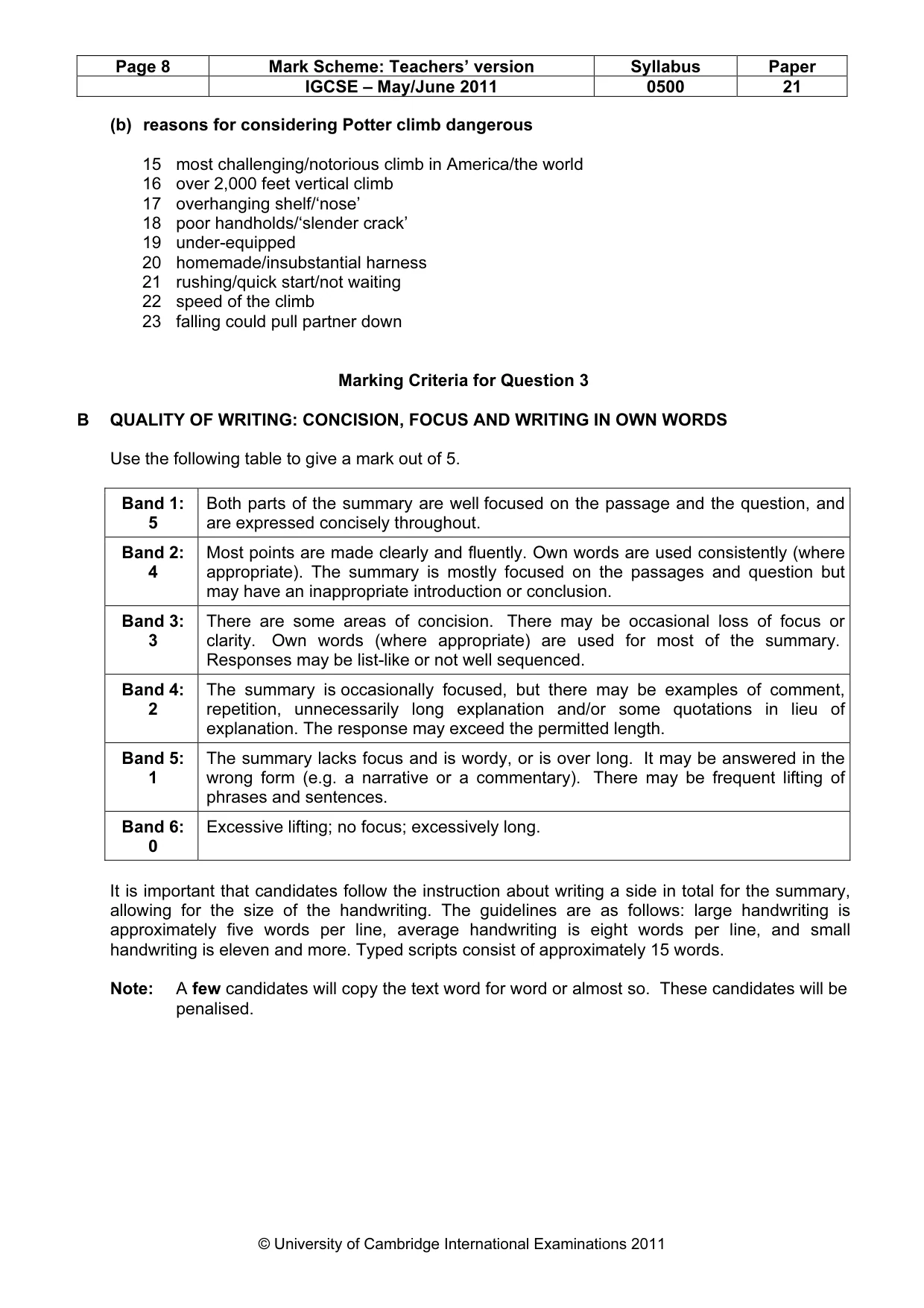
Page 8 Mark Scheme: Teachers’ version Syllabus Paper IGCSE – May/June 2011 0500 21 © University of Cambridge International Examinations 2011 (b) reasons for considering Potter climb dangerous 15 most challenging/notorious climb in America/the world 16 over 2,000 feet vertical climb 17 overhanging shelf/‘nose’ 18 poor handholds/‘slender crack’ 19 under-equipped 20 homemade/insubstantial harness 21 rushing/quick start/not waiting 22 speed of the climb 23 falling could pull partner down Marking Criteria for Question 3 B QUALITY OF WRITING: CONCISION, FOCUS AND WRITING IN OWN WORDS Use the following table to give a mark out of 5. Band 1: 5 Both parts of the summary are well focused on the passage and the question, and are expressed concisely throughout. Band 2: 4 Most points are made clearly and fluently. Own words are used consistently (where appropriate). The summary is mostly focused on the passages and question but may have an inappropriate introduction or conclusion. Band 3: 3 There are some areas of concision. There may be occasional loss of focus or clarity. Own words (where appropriate) are used for most of the summary. Responses may be list-like or not well sequenced. Band 4: 2 The summary is occasionally focused, but there may be examples of comment, repetition, unnecessarily long explanation and/or some quotations in lieu of explanation. The response may exceed the permitted length. Band 5: 1 The summary lacks focus and is wordy, or is over long. It may be answered in the wrong form (e.g. a narrative or a commentary). There may be frequent lifting of phrases and sentences. Band 6: 0 Excessive lifting; no focus; excessively long. It is important that candidates follow the instruction about writing a side in total for the summary, allowing for the size of the handwriting. The guidelines are as follows: large handwriting is approximately five words per line, average handwriting is eight words per line, and small handwriting is eleven and more. Typed scripts consist of approximately 15 words. Note: A few candidates will copy the text word for word or almost so. These candidates will be penalised.
What you needed in this session
Cambridge’s own grade thresholds for 2011 May/June, Paper 2 · Variant 1. A higher threshold means an easier paper — the bar moves with how the cohort did.