Cambridge IGCSE English - First Language 0500 — 2010 Oct/Nov Paper 2 · Variant 3
0500/23/O/N/10 · 50 marks · ≈56 min
The question paper and its mark scheme, free to read here and free to download. This is Cambridge’s own paper, exactly as it was sat.
Question paper8 pages
Mark scheme11 pages
Answers below. Sit the paper first if you are practising.
Paper as text
Question paper, page 1
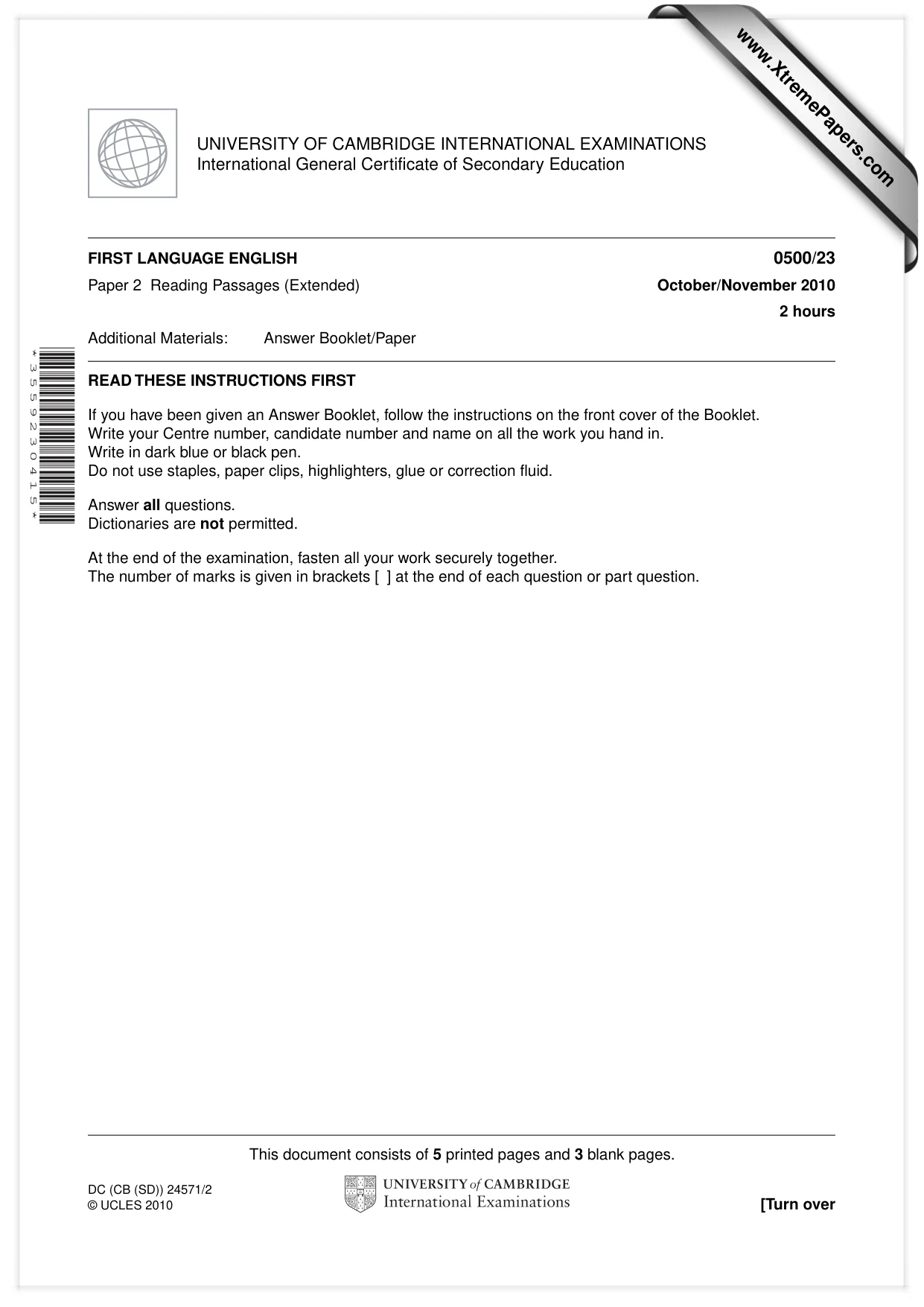
This document consists of 5 printed pages and 3 blank pages. DC (CB (SD)) 24571/2 © UCLES 2010 [Turn over UNIVERSITY OF CAMBRIDGE INTERNATIONAL EXAMINATIONS International General Certificate of Secondary Education * 3 5 5 9 2 3 0 4 1 5 * FIRST LANGUAGE ENGLISH 0500/23 Paper 2 Reading Passages (Extended) October/November 2010 2 hours Additional Materials: Answer Booklet/Paper READ THESE INSTRUCTIONS FIRST If you have been given an Answer Booklet, follow the instructions on the front cover of the Booklet. Write your Centre number, candidate number and name on all the work you hand in. Write in dark blue or black pen. Do not use staples, paper clips, highlighters, glue or correction fluid. Answer all questions. Dictionaries are not permitted. At the end of the examination, fasten all your work securely together. The number of marks is given in brackets [ ] at the end of each question or part question. www.XtremePapers.com
Question paper, page 2
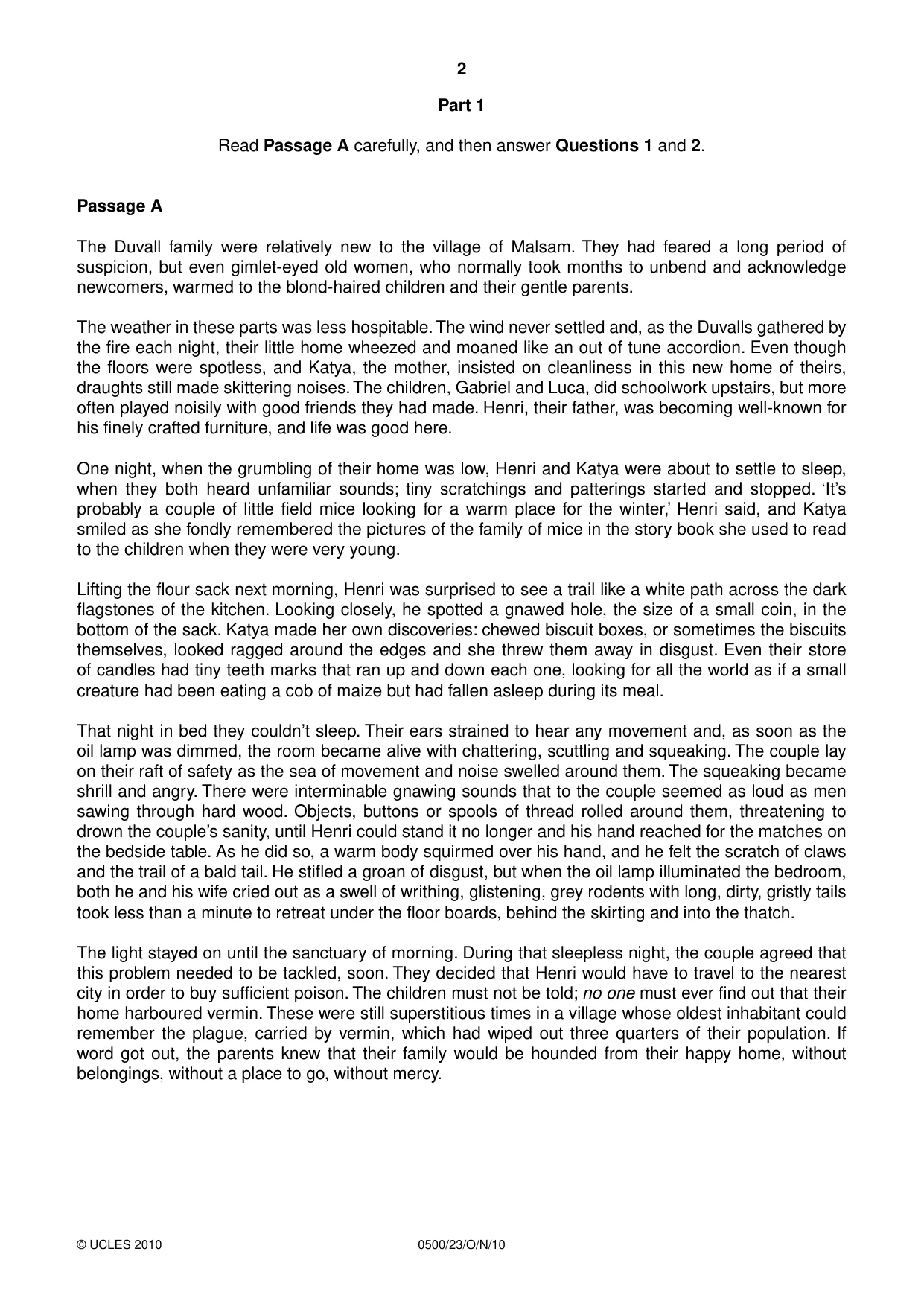
2 0500/23/O/N/10 © UCLES 2010 Part 1 Read Passage A carefully, and then answer Questions 1 and 2. Passage A The Duvall family were relatively new to the village of Malsam. They had feared a long period of suspicion, but even gimlet-eyed old women, who normally took months to unbend and acknowledge newcomers, warmed to the blond-haired children and their gentle parents. The weather in these parts was less hospitable. The wind never settled and, as the Duvalls gathered by the fire each night, their little home wheezed and moaned like an out of tune accordion. Even though the floors were spotless, and Katya, the mother, insisted on cleanliness in this new home of theirs, draughts still made skittering noises. The children, Gabriel and Luca, did schoolwork upstairs, but more often played noisily with good friends they had made. Henri, their father, was becoming well-known for his finely crafted furniture, and life was good here. One night, when the grumbling of their home was low, Henri and Katya were about to settle to sleep, when they both heard unfamiliar sounds; tiny scratchings and patterings started and stopped. ‘It’s probably a couple of little field mice looking for a warm place for the winter,’ Henri said, and Katya smiled as she fondly remembered the pictures of the family of mice in the story book she used to read to the children when they were very young. Lifting the flour sack next morning, Henri was surprised to see a trail like a white path across the dark flagstones of the kitchen. Looking closely, he spotted a gnawed hole, the size of a small coin, in the bottom of the sack. Katya made her own discoveries: chewed biscuit boxes, or sometimes the biscuits themselves, looked ragged around the edges and she threw them away in disgust. Even their store of candles had tiny teeth marks that ran up and down each one, looking for all the world as if a small creature had been eating a cob of maize but had fallen asleep during its meal. That night in bed they couldn’t sleep. Their ears strained to hear any movement and, as soon as the oil lamp was dimmed, the room became alive with chattering, scuttling and squeaking. The couple lay on their raft of safety as the sea of movement and noise swelled around them. The squeaking became shrill and angry. There were interminable gnawing sounds that to the couple seemed as loud as men sawing through hard wood. Objects, buttons or spools of thread rolled around them, threatening to drown the couple’s sanity, until Henri could stand it no longer and his hand reached for the matches on the bedside table. As he did so, a warm body squirmed over his hand, and he felt the scratch of claws and the trail of a bald tail. He stifled a groan of disgust, but when the oil lamp illuminated the bedroom, both he and his wife cried out as a swell of writhing, glistening, grey rodents with long, dirty, gristly tails took less than a minute to retreat under the floor boards, behind the skirting and into the thatch. The light stayed on until the sanctuary of morning. During that sleepless night, the couple agreed that this problem needed to be tackled, soon. They decided that Henri would have to travel to the nearest city in order to buy sufficient poison. The children must not be told; no one must ever find out that their home harboured vermin. These were still superstitious times in a village whose oldest inhabitant could remember the plague, carried by vermin, which had wiped out three quarters of their population. If word got out, the parents knew that their family would be hounded from their happy home, without belongings, without a place to go, without mercy.
Question paper, page 3
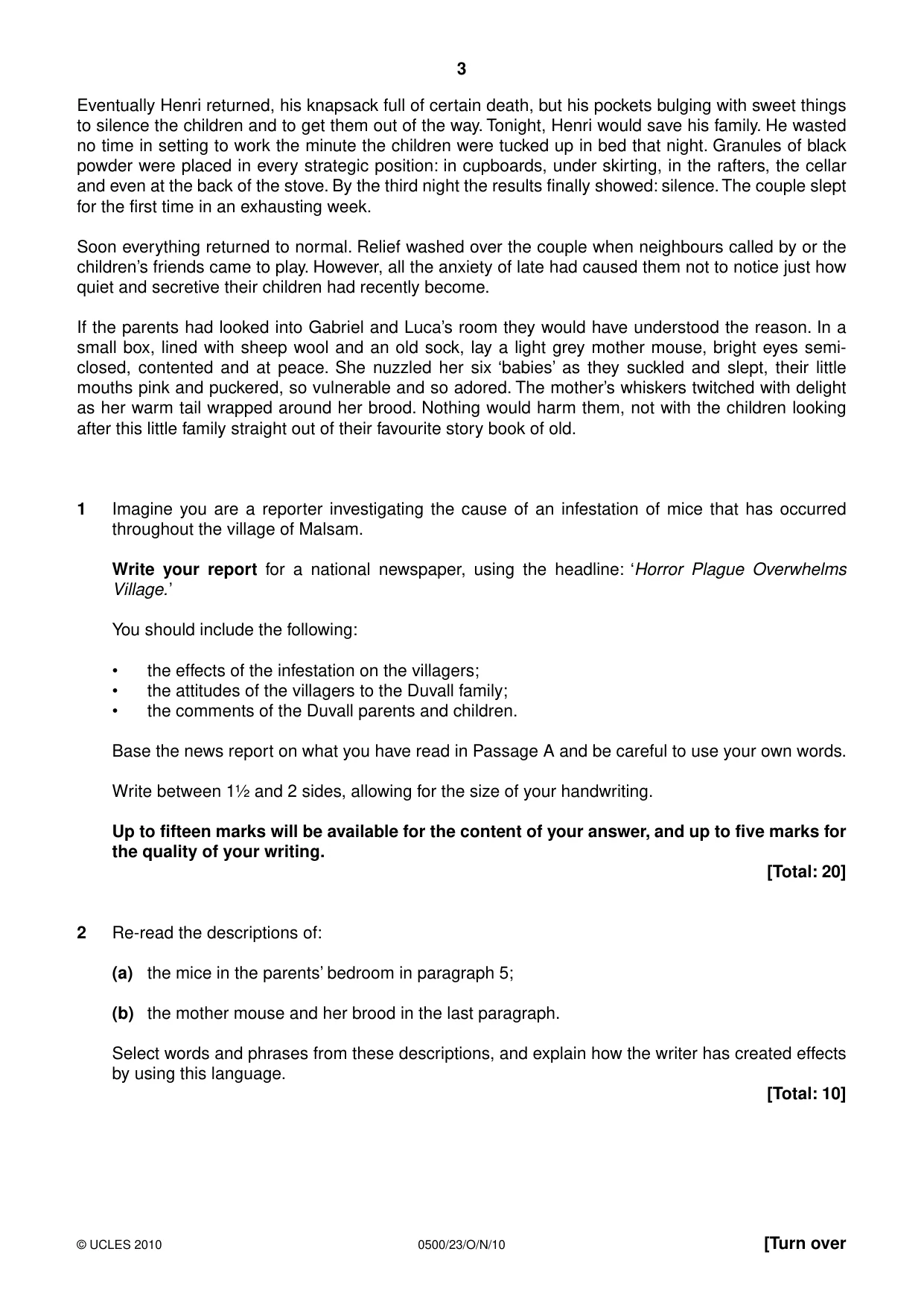
3 0500/23/O/N/10 © UCLES 2010 [Turn over Eventually Henri returned, his knapsack full of certain death, but his pockets bulging with sweet things to silence the children and to get them out of the way. Tonight, Henri would save his family. He wasted no time in setting to work the minute the children were tucked up in bed that night. Granules of black powder were placed in every strategic position: in cupboards, under skirting, in the rafters, the cellar and even at the back of the stove. By the third night the results finally showed: silence. The couple slept for the first time in an exhausting week. Soon everything returned to normal. Relief washed over the couple when neighbours called by or the children’s friends came to play. However, all the anxiety of late had caused them not to notice just how quiet and secretive their children had recently become. If the parents had looked into Gabriel and Luca’s room they would have understood the reason. In a small box, lined with sheep wool and an old sock, lay a light grey mother mouse, bright eyes semi- closed, contented and at peace. She nuzzled her six ‘babies’ as they suckled and slept, their little mouths pink and puckered, so vulnerable and so adored. The mother’s whiskers twitched with delight as her warm tail wrapped around her brood. Nothing would harm them, not with the children looking after this little family straight out of their favourite story book of old. 1 Imagine you are a reporter investigating the cause of an infestation of mice that has occurred throughout the village of Malsam. Write your report for a national newspaper, using the headline: ‘Horror Plague Overwhelms Village. ’ You should include the following: • the effects of the infestation on the villagers; • the attitudes of the villagers to the Duvall family; • the comments of the Duvall parents and children. Base the news report on what you have read in Passage A and be careful to use your own words. Write between 1½ and 2 sides, allowing for the size of your handwriting. Up to fifteen marks will be available for the content of your answer, and up to five marks for the quality of your writing. [Total: 20] 2 Re-read the descriptions of: (a) the mice in the parents’ bedroom in paragraph 5; (b) the mother mouse and her brood in the last paragraph. Select words and phrases from these descriptions, and explain how the writer has created effects by using this language. [Total: 10]
Question paper, page 4
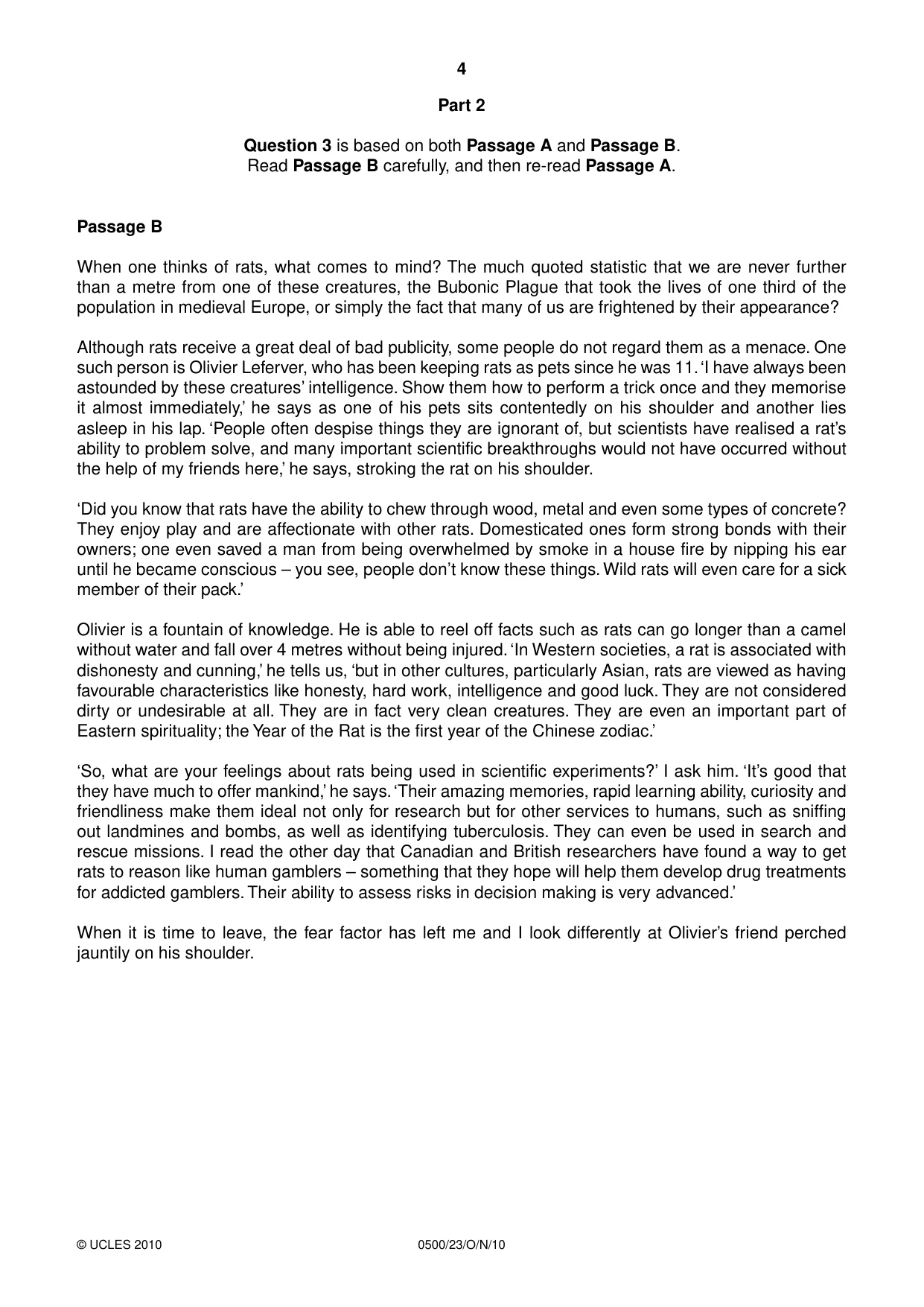
4 0500/23/O/N/10 © UCLES 2010 Part 2 Question 3 is based on both Passage A and Passage B. Read Passage B carefully, and then re-read Passage A. Passage B When one thinks of rats, what comes to mind? The much quoted statistic that we are never further than a metre from one of these creatures, the Bubonic Plague that took the lives of one third of the population in medieval Europe, or simply the fact that many of us are frightened by their appearance? Although rats receive a great deal of bad publicity, some people do not regard them as a menace. One such person is Olivier Leferver, who has been keeping rats as pets since he was 11. ‘I have always been astounded by these creatures’ intelligence. Show them how to perform a trick once and they memorise it almost immediately,’ he says as one of his pets sits contentedly on his shoulder and another lies asleep in his lap. ‘People often despise things they are ignorant of, but scientists have realised a rat’s ability to problem solve, and many important scientific breakthroughs would not have occurred without the help of my friends here,’ he says, stroking the rat on his shoulder. ‘Did you know that rats have the ability to chew through wood, metal and even some types of concrete? They enjoy play and are affectionate with other rats. Domesticated ones form strong bonds with their owners; one even saved a man from being overwhelmed by smoke in a house fire by nipping his ear until he became conscious – you see, people don’t know these things. Wild rats will even care for a sick member of their pack.’ Olivier is a fountain of knowledge. He is able to reel off facts such as rats can go longer than a camel without water and fall over 4 metres without being injured. ‘In Western societies, a rat is associated with dishonesty and cunning,’ he tells us, ‘but in other cultures, particularly Asian, rats are viewed as having favourable characteristics like honesty, hard work, intelligence and good luck. They are not considered dirty or undesirable at all. They are in fact very clean creatures. They are even an important part of Eastern spirituality; the Year of the Rat is the first year of the Chinese zodiac.’ ‘So, what are your feelings about rats being used in scientific experiments?’ I ask him. ‘It’s good that they have much to offer mankind,’ he says. ‘Their amazing memories, rapid learning ability, curiosity and friendliness make them ideal not only for research but for other services to humans, such as sniffing out landmines and bombs, as well as identifying tuberculosis. They can even be used in search and rescue missions. I read the other day that Canadian and British researchers have found a way to get rats to reason like human gamblers – something that they hope will help them develop drug treatments for addicted gamblers. Their ability to assess risks in decision making is very advanced.’ When it is time to leave, the fear factor has left me and I look differently at Olivier’s friend perched jauntily on his shoulder.
Question paper, page 5
5 0500/23/O/N/10 © UCLES 2010 3 Summarise: (a) the positive aspects of rats as described in Passage B; (b) the negative aspects of mice as described in Passage A. Use your own words as far as possible. You should write about 1 side in total, allowing for the size of your handwriting. Up to fifteen marks will be available for the content of your answer, and up to five marks for the quality of your writing. [Total: 20]
Question paper, page 6
6 0500/23/O/N/10 © UCLES 2010 BLANK PAGE
Question paper, page 7
7 0500/23/O/N/10 © UCLES 2010 BLANK PAGE
Question paper, page 8
8 0500/23/O/N/10 © UCLES 2010 Permission to reproduce items where third-party owned material protected by copyright is included has been sought and cleared where possible. Every reasonable effort has been made by the publisher (UCLES) to trace copyright holders, but if any items requiring clearance have unwittingly been included, the publisher will be pleased to make amends at the earliest possible opportunity. University of Cambridge International Examinations is part of the Cambridge Assessment Group. Cambridge Assessment is the brand name of University of Cambridge Local Examinations Syndicate (UCLES), which is itself a department of the University of Cambridge. BLANK PAGE
Mark scheme, page 1
UNIVERSITY OF CAMBRIDGE INTERNATIONAL EXAMINATIONS International General Certificate of Secondary Education MARK SCHEME for the October/November 2010 question paper for the guidance of teachers 0500 FIRST LANGUAGE ENGLISH 0500/23 Paper 2 (Reading Passages – Extended), maximum raw mark 50 This mark scheme is published as an aid to teachers and candidates, to indicate the requirements of the examination. It shows the basis on which Examiners were instructed to award marks. It does not indicate the details of the discussions that took place at an Examiners’ meeting before marking began, which would have considered the acceptability of alternative answers. Mark schemes must be read in conjunction with the question papers and the report on the examination. • CIE will not enter into discussions or correspondence in connection with these mark schemes. CIE is publishing the mark schemes for the October/November 2010 question papers for most IGCSE, GCE Advanced Level and Advanced Subsidiary Level syllabuses and some Ordinary Level syllabuses. www.XtremePapers.com
Mark scheme, page 2
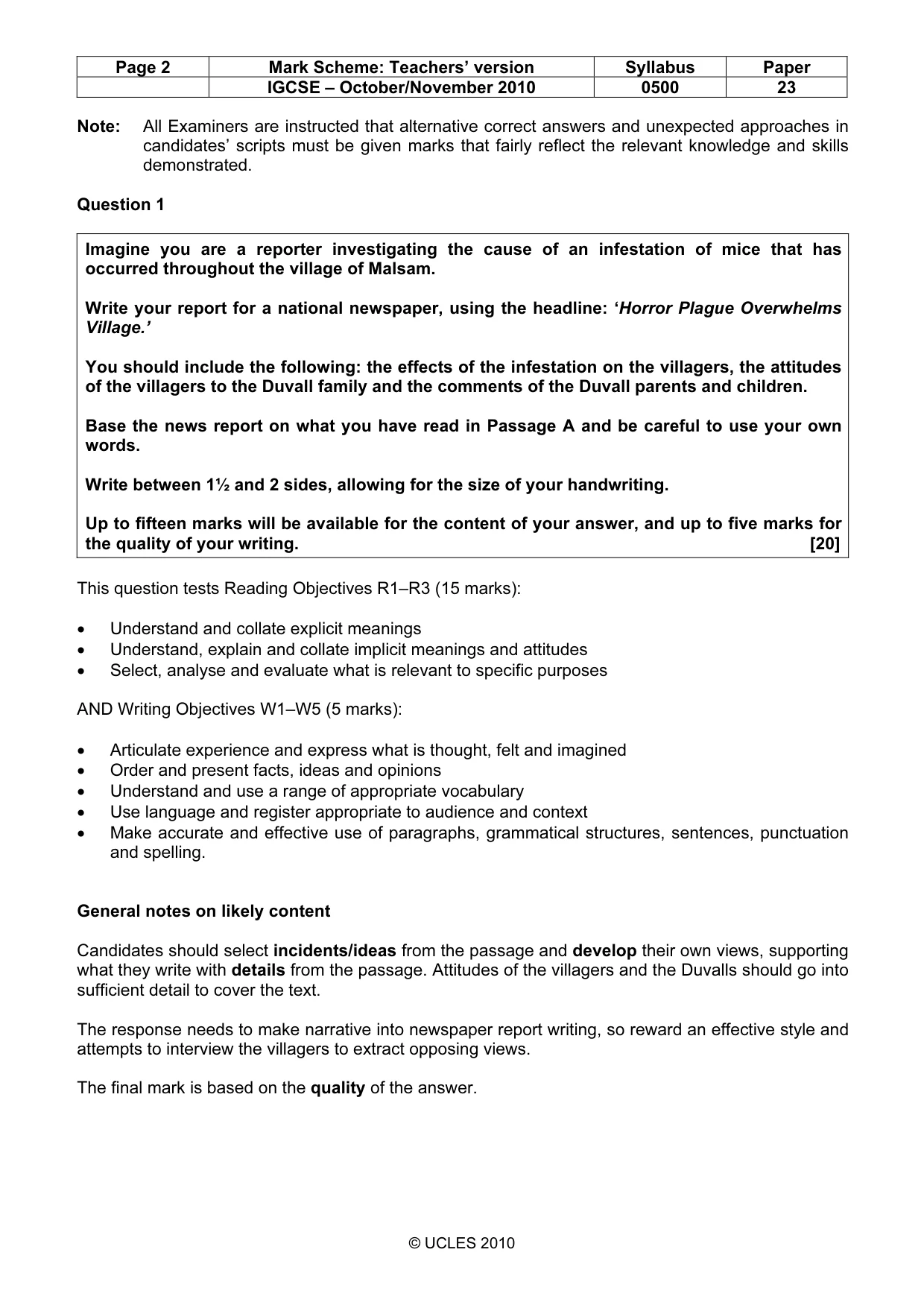
Page 2 Mark Scheme: Teachers’ version Syllabus Paper IGCSE – October/November 2010 0500 23 © UCLES 2010 Note: All Examiners are instructed that alternative correct answers and unexpected approaches in candidates’ scripts must be given marks that fairly reflect the relevant knowledge and skills demonstrated. Question 1 Imagine you are a reporter investigating the cause of an infestation of mice that has occurred throughout the village of Malsam. Write your report for a national newspaper, using the headline: ‘Horror Plague Overwhelms Village.’ You should include the following: the effects of the infestation on the villagers, the attitudes of the villagers to the Duvall family and the comments of the Duvall parents and children. Base the news report on what you have read in Passage A and be careful to use your own words. Write between 1½ and 2 sides, allowing for the size of your handwriting. Up to fifteen marks will be available for the content of your answer, and up to five marks for the quality of your writing. [20] This question tests Reading Objectives R1–R3 (15 marks): • Understand and collate explicit meanings • Understand, explain and collate implicit meanings and attitudes • Select, analyse and evaluate what is relevant to specific purposes AND Writing Objectives W1–W5 (5 marks): • Articulate experience and express what is thought, felt and imagined • Order and present facts, ideas and opinions • Understand and use a range of appropriate vocabulary • Use language and register appropriate to audience and context • Make accurate and effective use of paragraphs, grammatical structures, sentences, punctuation and spelling. General notes on likely content Candidates should select incidents/ideas from the passage and develop their own views, supporting what they write with details from the passage. Attitudes of the villagers and the Duvalls should go into sufficient detail to cover the text. The response needs to make narrative into newspaper report writing, so reward an effective style and attempts to interview the villagers to extract opposing views. The final mark is based on the quality of the answer.
Mark scheme, page 3
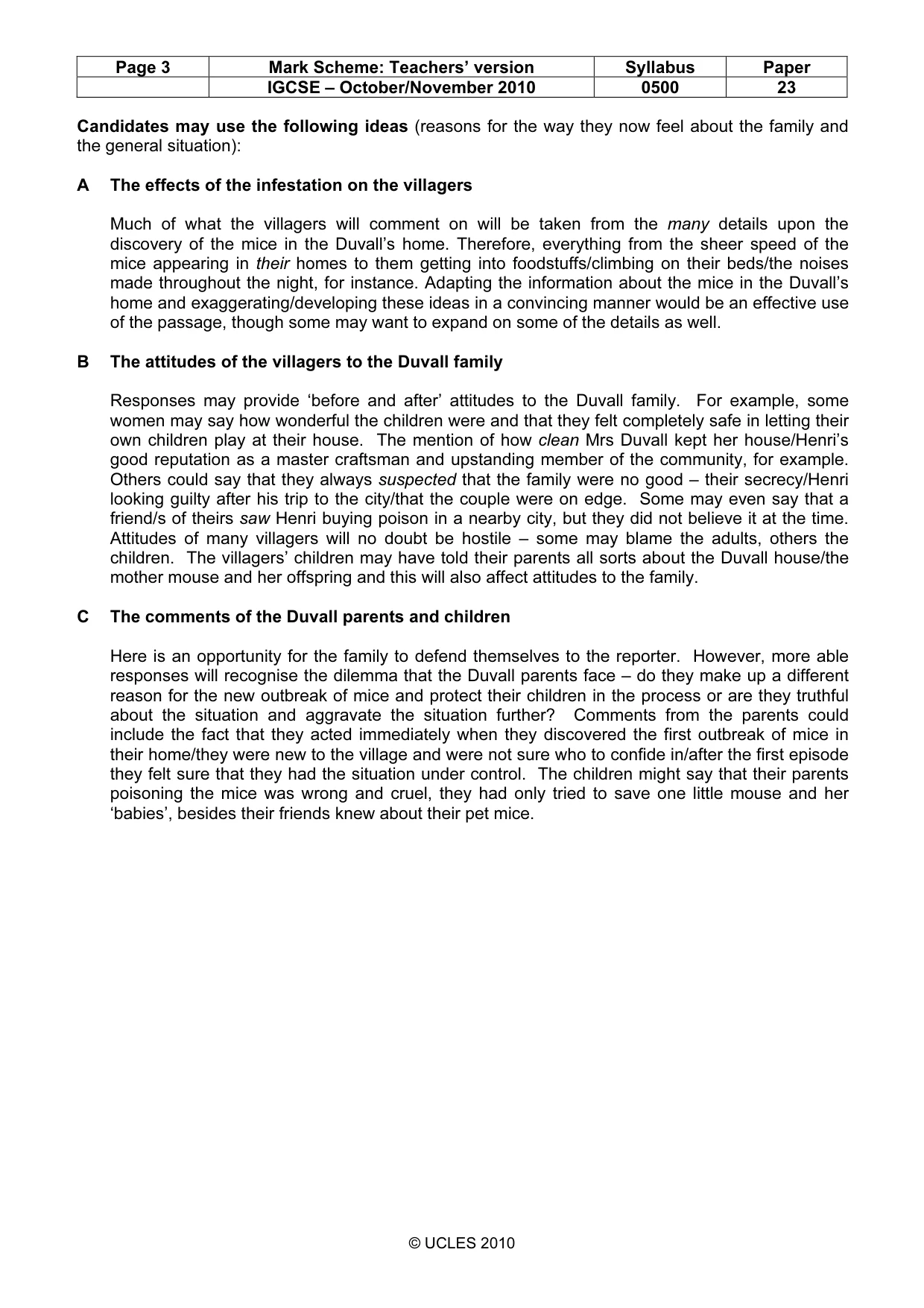
Page 3 Mark Scheme: Teachers’ version Syllabus Paper IGCSE – October/November 2010 0500 23 © UCLES 2010 Candidates may use the following ideas (reasons for the way they now feel about the family and the general situation): A The effects of the infestation on the villagers Much of what the villagers will comment on will be taken from the many details upon the discovery of the mice in the Duvall’s home. Therefore, everything from the sheer speed of the mice appearing in their homes to them getting into foodstuffs/climbing on their beds/the noises made throughout the night, for instance. Adapting the information about the mice in the Duvall’s home and exaggerating/developing these ideas in a convincing manner would be an effective use of the passage, though some may want to expand on some of the details as well. B The attitudes of the villagers to the Duvall family Responses may provide ‘before and after’ attitudes to the Duvall family. For example, some women may say how wonderful the children were and that they felt completely safe in letting their own children play at their house. The mention of how clean Mrs Duvall kept her house/Henri’s good reputation as a master craftsman and upstanding member of the community, for example. Others could say that they always suspected that the family were no good – their secrecy/Henri looking guilty after his trip to the city/that the couple were on edge. Some may even say that a friend/s of theirs saw Henri buying poison in a nearby city, but they did not believe it at the time. Attitudes of many villagers will no doubt be hostile – some may blame the adults, others the children. The villagers’ children may have told their parents all sorts about the Duvall house/the mother mouse and her offspring and this will also affect attitudes to the family. C The comments of the Duvall parents and children Here is an opportunity for the family to defend themselves to the reporter. However, more able responses will recognise the dilemma that the Duvall parents face – do they make up a different reason for the new outbreak of mice and protect their children in the process or are they truthful about the situation and aggravate the situation further? Comments from the parents could include the fact that they acted immediately when they discovered the first outbreak of mice in their home/they were new to the village and were not sure who to confide in/after the first episode they felt sure that they had the situation under control. The children might say that their parents poisoning the mice was wrong and cruel, they had only tried to save one little mouse and her ‘babies’, besides their friends knew about their pet mice.
Mark scheme, page 4
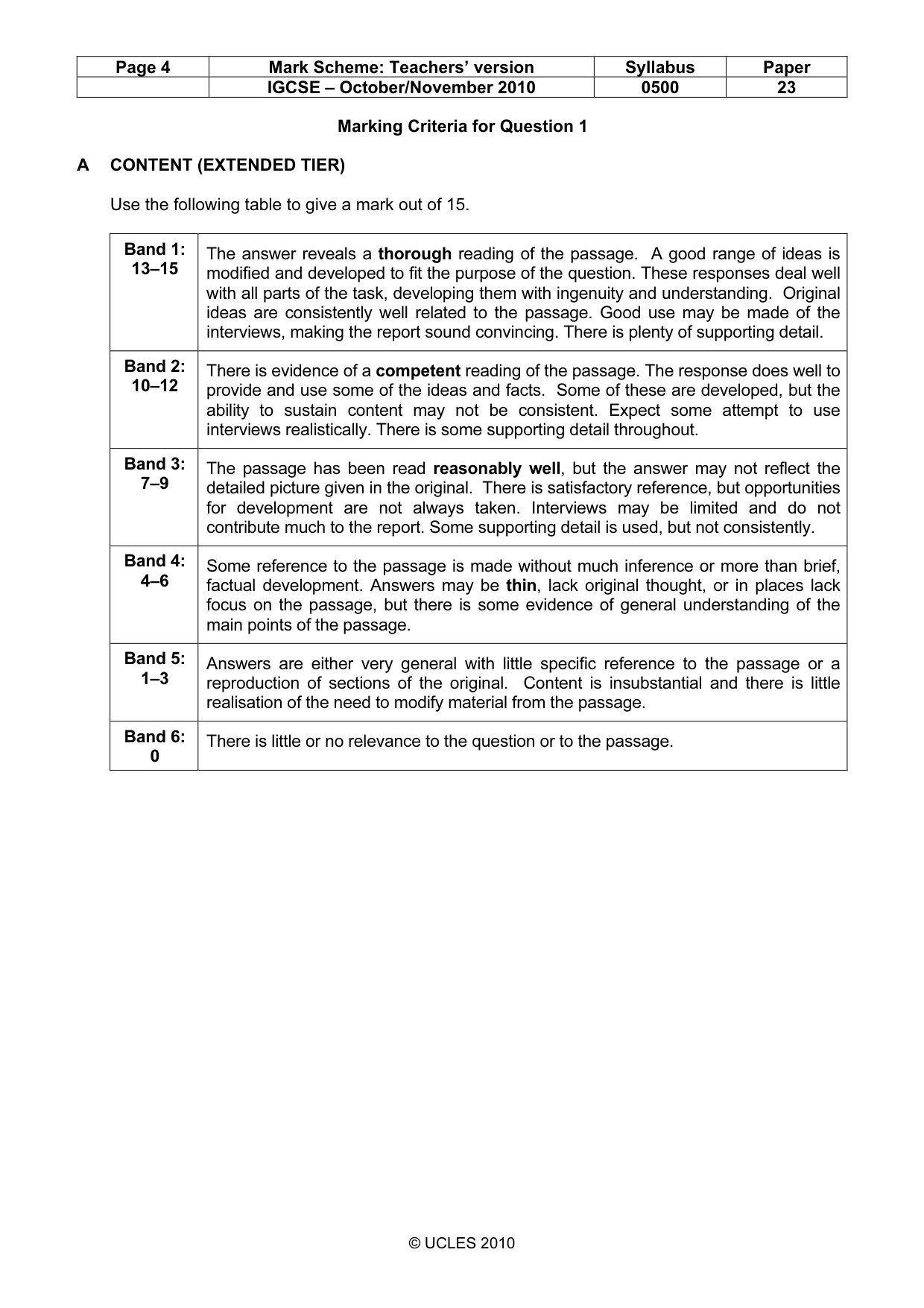
Page 4 Mark Scheme: Teachers’ version Syllabus Paper IGCSE – October/November 2010 0500 23 © UCLES 2010 Marking Criteria for Question 1 A CONTENT (EXTENDED TIER) Use the following table to give a mark out of 15. Band 1: 13–15 The answer reveals a thorough reading of the passage. A good range of ideas is modified and developed to fit the purpose of the question. These responses deal well with all parts of the task, developing them with ingenuity and understanding. Original ideas are consistently well related to the passage. Good use may be made of the interviews, making the report sound convincing. There is plenty of supporting detail. Band 2: 10–12 There is evidence of a competent reading of the passage. The response does well to provide and use some of the ideas and facts. Some of these are developed, but the ability to sustain content may not be consistent. Expect some attempt to use interviews realistically. There is some supporting detail throughout. Band 3: 7–9 The passage has been read reasonably well, but the answer may not reflect the detailed picture given in the original. There is satisfactory reference, but opportunities for development are not always taken. Interviews may be limited and do not contribute much to the report. Some supporting detail is used, but not consistently. Band 4: 4–6 Some reference to the passage is made without much inference or more than brief, factual development. Answers may be thin, lack original thought, or in places lack focus on the passage, but there is some evidence of general understanding of the main points of the passage. Band 5: 1–3 Answers are either very general with little specific reference to the passage or a reproduction of sections of the original. Content is insubstantial and there is little realisation of the need to modify material from the passage. Band 6: 0 There is little or no relevance to the question or to the passage.
Mark scheme, page 5
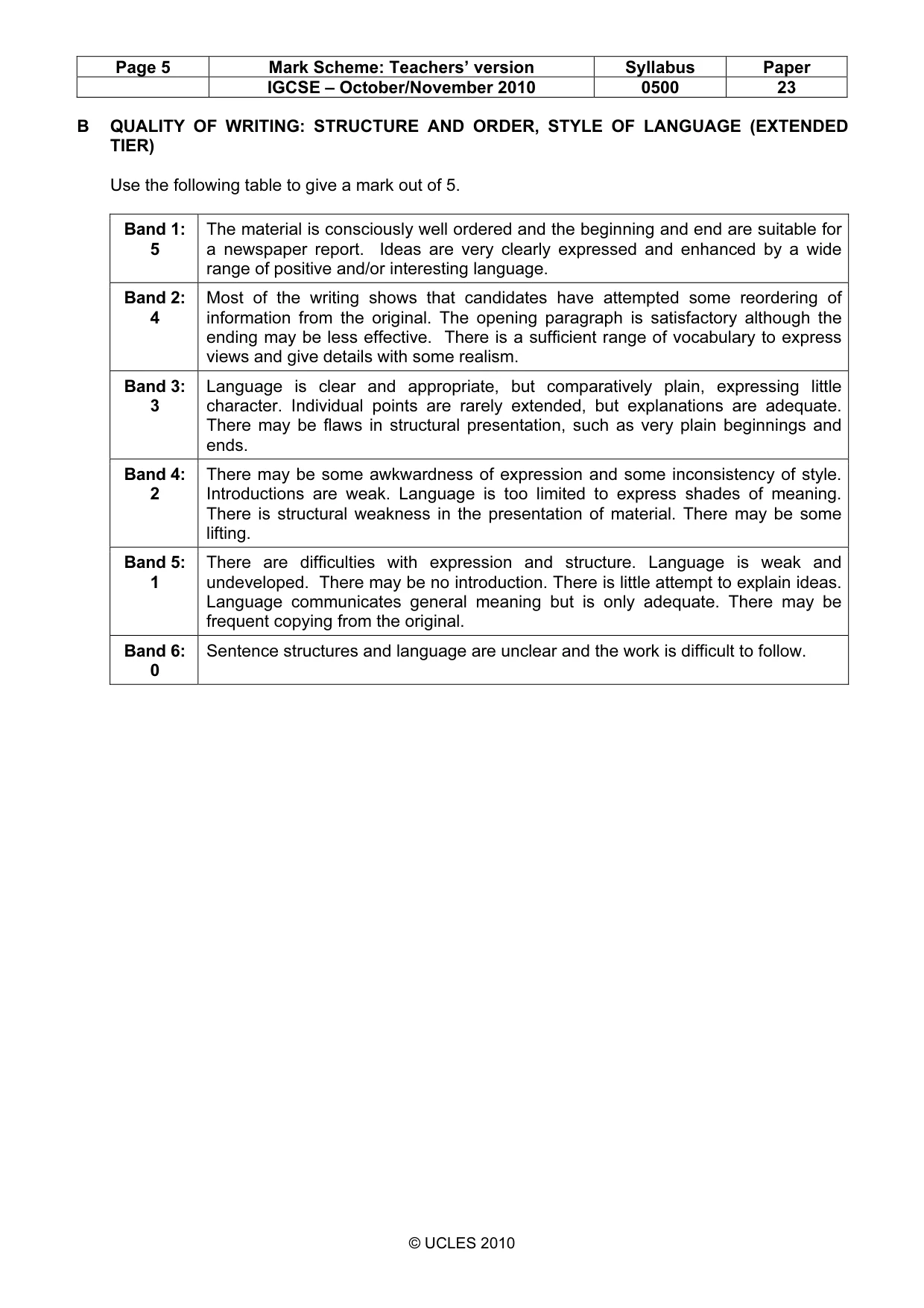
Page 5 Mark Scheme: Teachers’ version Syllabus Paper IGCSE – October/November 2010 0500 23 © UCLES 2010 B QUALITY OF WRITING: STRUCTURE AND ORDER, STYLE OF LANGUAGE (EXTENDED TIER) Use the following table to give a mark out of 5. Band 1: 5 The material is consciously well ordered and the beginning and end are suitable for a newspaper report. Ideas are very clearly expressed and enhanced by a wide range of positive and/or interesting language. Band 2: 4 Most of the writing shows that candidates have attempted some reordering of information from the original. The opening paragraph is satisfactory although the ending may be less effective. There is a sufficient range of vocabulary to express views and give details with some realism. Band 3: 3 Language is clear and appropriate, but comparatively plain, expressing little character. Individual points are rarely extended, but explanations are adequate. There may be flaws in structural presentation, such as very plain beginnings and ends. Band 4: 2 There may be some awkwardness of expression and some inconsistency of style. Introductions are weak. Language is too limited to express shades of meaning. There is structural weakness in the presentation of material. There may be some lifting. Band 5: 1 There are difficulties with expression and structure. Language is weak and undeveloped. There may be no introduction. There is little attempt to explain ideas. Language communicates general meaning but is only adequate. There may be frequent copying from the original. Band 6: 0 Sentence structures and language are unclear and the work is difficult to follow.
Mark scheme, page 6
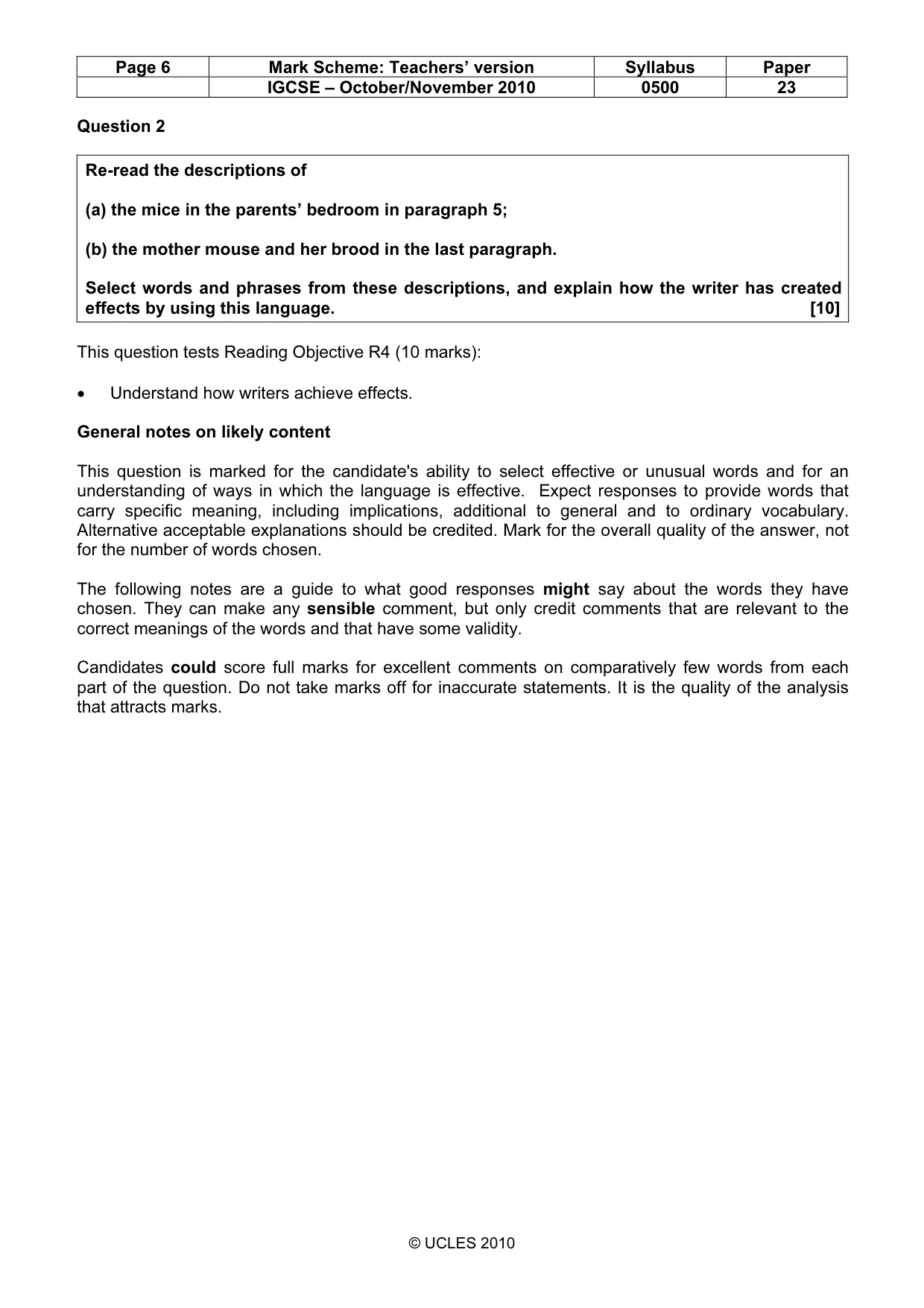
Page 6 Mark Scheme: Teachers’ version Syllabus Paper IGCSE – October/November 2010 0500 23 © UCLES 2010 Question 2 Re-read the descriptions of (a) the mice in the parents’ bedroom in paragraph 5; (b) the mother mouse and her brood in the last paragraph. Select words and phrases from these descriptions, and explain how the writer has created effects by using this language. [10] This question tests Reading Objective R4 (10 marks): • Understand how writers achieve effects. General notes on likely content This question is marked for the candidate's ability to select effective or unusual words and for an understanding of ways in which the language is effective. Expect responses to provide words that carry specific meaning, including implications, additional to general and to ordinary vocabulary. Alternative acceptable explanations should be credited. Mark for the overall quality of the answer, not for the number of words chosen. The following notes are a guide to what good responses might say about the words they have chosen. They can make any sensible comment, but only credit comments that are relevant to the correct meanings of the words and that have some validity. Candidates could score full marks for excellent comments on comparatively few words from each part of the question. Do not take marks off for inaccurate statements. It is the quality of the analysis that attracts marks.
Mark scheme, page 7
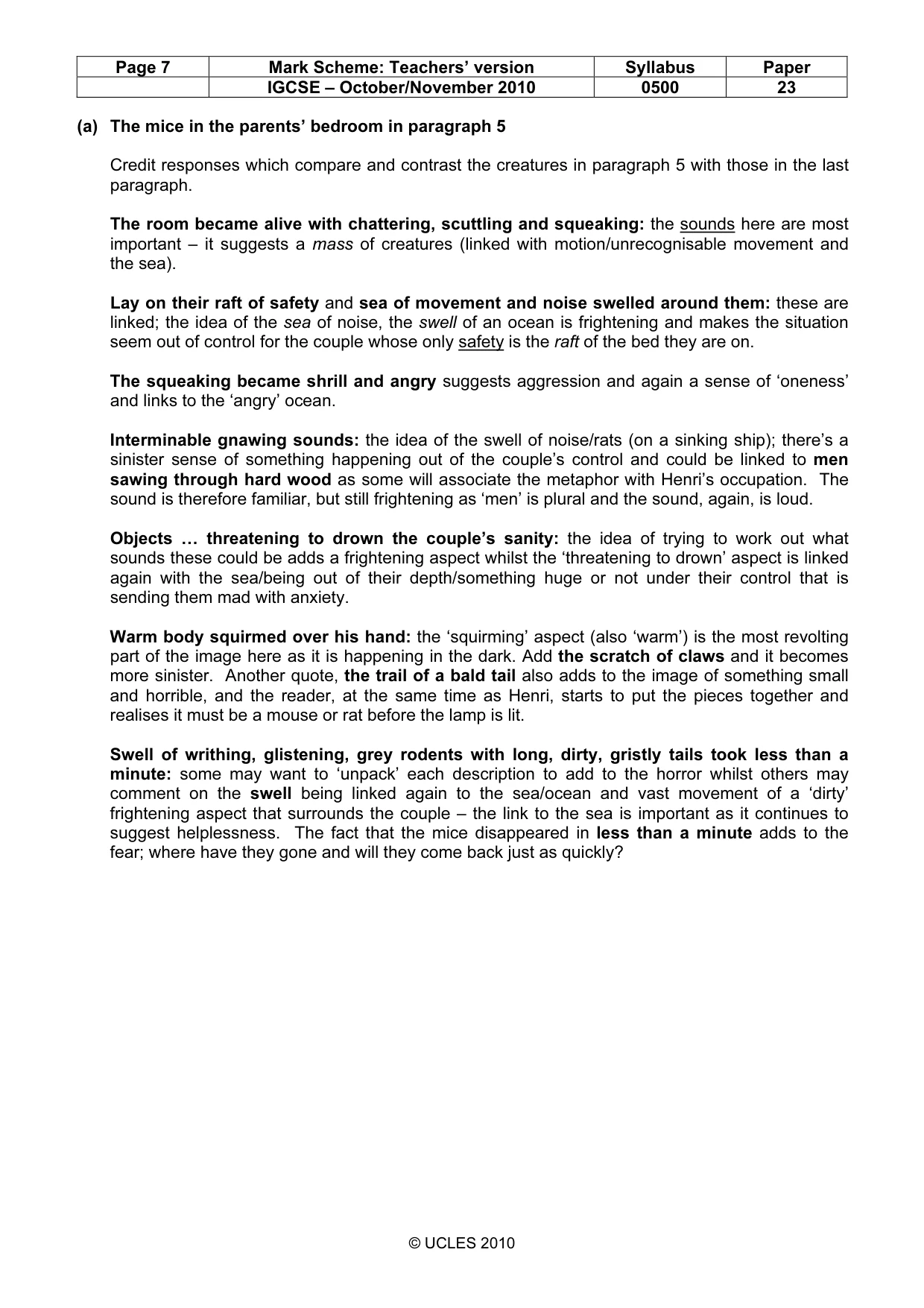
Page 7 Mark Scheme: Teachers’ version Syllabus Paper IGCSE – October/November 2010 0500 23 © UCLES 2010 (a) The mice in the parents’ bedroom in paragraph 5 Credit responses which compare and contrast the creatures in paragraph 5 with those in the last paragraph. The room became alive with chattering, scuttling and squeaking: the sounds here are most important – it suggests a mass of creatures (linked with motion/unrecognisable movement and the sea). Lay on their raft of safety and sea of movement and noise swelled around them: these are linked; the idea of the sea of noise, the swell of an ocean is frightening and makes the situation seem out of control for the couple whose only safety is the raft of the bed they are on. The squeaking became shrill and angry suggests aggression and again a sense of ‘oneness’ and links to the ‘angry’ ocean. Interminable gnawing sounds: the idea of the swell of noise/rats (on a sinking ship); there’s a sinister sense of something happening out of the couple’s control and could be linked to men sawing through hard wood as some will associate the metaphor with Henri’s occupation. The sound is therefore familiar, but still frightening as ‘men’ is plural and the sound, again, is loud. Objects … threatening to drown the couple’s sanity: the idea of trying to work out what sounds these could be adds a frightening aspect whilst the ‘threatening to drown’ aspect is linked again with the sea/being out of their depth/something huge or not under their control that is sending them mad with anxiety. Warm body squirmed over his hand: the ‘squirming’ aspect (also ‘warm’) is the most revolting part of the image here as it is happening in the dark. Add the scratch of claws and it becomes more sinister. Another quote, the trail of a bald tail also adds to the image of something small and horrible, and the reader, at the same time as Henri, starts to put the pieces together and realises it must be a mouse or rat before the lamp is lit. Swell of writhing, glistening, grey rodents with long, dirty, gristly tails took less than a minute: some may want to ‘unpack’ each description to add to the horror whilst others may comment on the swell being linked again to the sea/ocean and vast movement of a ‘dirty’ frightening aspect that surrounds the couple – the link to the sea is important as it continues to suggest helplessness. The fact that the mice disappeared in less than a minute adds to the fear; where have they gone and will they come back just as quickly?
Mark scheme, page 8
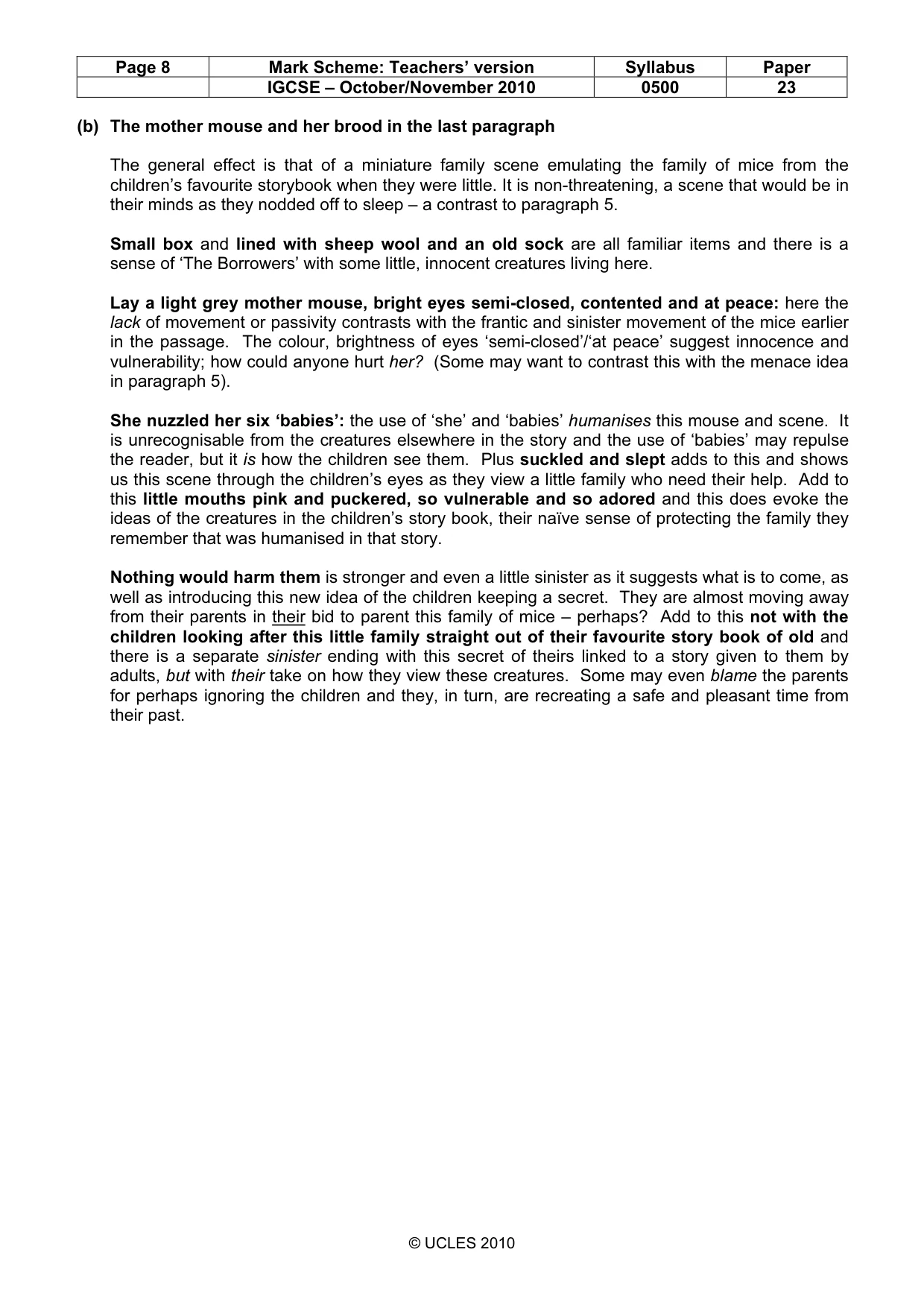
Page 8 Mark Scheme: Teachers’ version Syllabus Paper IGCSE – October/November 2010 0500 23 © UCLES 2010 (b) The mother mouse and her brood in the last paragraph The general effect is that of a miniature family scene emulating the family of mice from the children’s favourite storybook when they were little. It is non-threatening, a scene that would be in their minds as they nodded off to sleep – a contrast to paragraph 5. Small box and lined with sheep wool and an old sock are all familiar items and there is a sense of ‘The Borrowers’ with some little, innocent creatures living here. Lay a light grey mother mouse, bright eyes semi-closed, contented and at peace: here the lack of movement or passivity contrasts with the frantic and sinister movement of the mice earlier in the passage. The colour, brightness of eyes ‘semi-closed’/‘at peace’ suggest innocence and vulnerability; how could anyone hurt her? (Some may want to contrast this with the menace idea in paragraph 5). She nuzzled her six ‘babies’: the use of ‘she’ and ‘babies’ humanises this mouse and scene. It is unrecognisable from the creatures elsewhere in the story and the use of ‘babies’ may repulse the reader, but it is how the children see them. Plus suckled and slept adds to this and shows us this scene through the children’s eyes as they view a little family who need their help. Add to this little mouths pink and puckered, so vulnerable and so adored and this does evoke the ideas of the creatures in the children’s story book, their naïve sense of protecting the family they remember that was humanised in that story. Nothing would harm them is stronger and even a little sinister as it suggests what is to come, as well as introducing this new idea of the children keeping a secret. They are almost moving away from their parents in their bid to parent this family of mice – perhaps? Add to this not with the children looking after this little family straight out of their favourite story book of old and there is a separate sinister ending with this secret of theirs linked to a story given to them by adults, but with their take on how they view these creatures. Some may even blame the parents for perhaps ignoring the children and they, in turn, are recreating a safe and pleasant time from their past.
Mark scheme, page 9
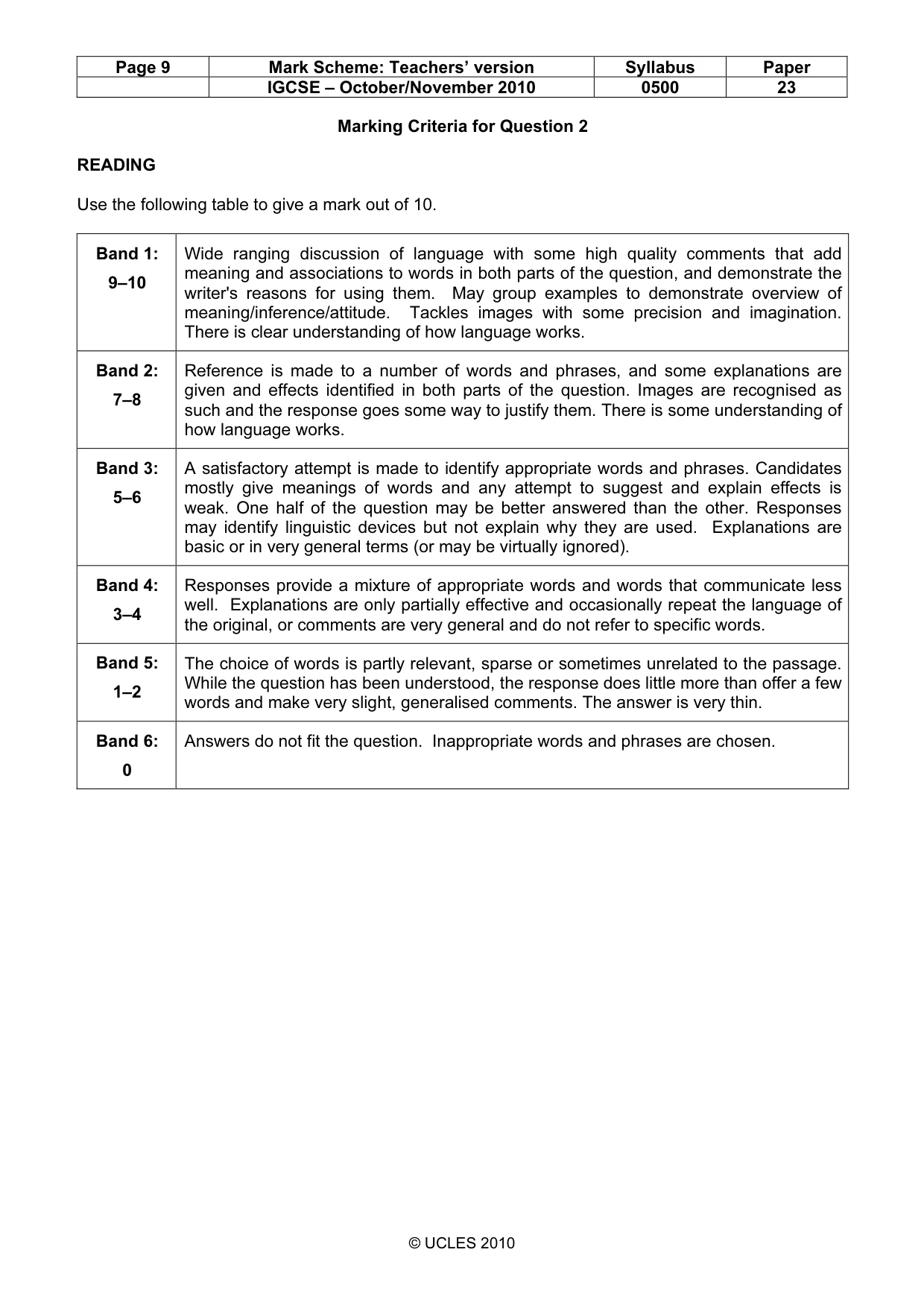
Page 9 Mark Scheme: Teachers’ version Syllabus Paper IGCSE – October/November 2010 0500 23 © UCLES 2010 Marking Criteria for Question 2 READING Use the following table to give a mark out of 10. Band 1: 9–10 Wide ranging discussion of language with some high quality comments that add meaning and associations to words in both parts of the question, and demonstrate the writer's reasons for using them. May group examples to demonstrate overview of meaning/inference/attitude. Tackles images with some precision and imagination. There is clear understanding of how language works. Band 2: 7–8 Reference is made to a number of words and phrases, and some explanations are given and effects identified in both parts of the question. Images are recognised as such and the response goes some way to justify them. There is some understanding of how language works. Band 3: 5–6 A satisfactory attempt is made to identify appropriate words and phrases. Candidates mostly give meanings of words and any attempt to suggest and explain effects is weak. One half of the question may be better answered than the other. Responses may identify linguistic devices but not explain why they are used. Explanations are basic or in very general terms (or may be virtually ignored). Band 4: 3–4 Responses provide a mixture of appropriate words and words that communicate less well. Explanations are only partially effective and occasionally repeat the language of the original, or comments are very general and do not refer to specific words. Band 5: 1–2 The choice of words is partly relevant, sparse or sometimes unrelated to the passage. While the question has been understood, the response does little more than offer a few words and make very slight, generalised comments. The answer is very thin. Band 6: 0 Answers do not fit the question. Inappropriate words and phrases are chosen.
Mark scheme, page 10
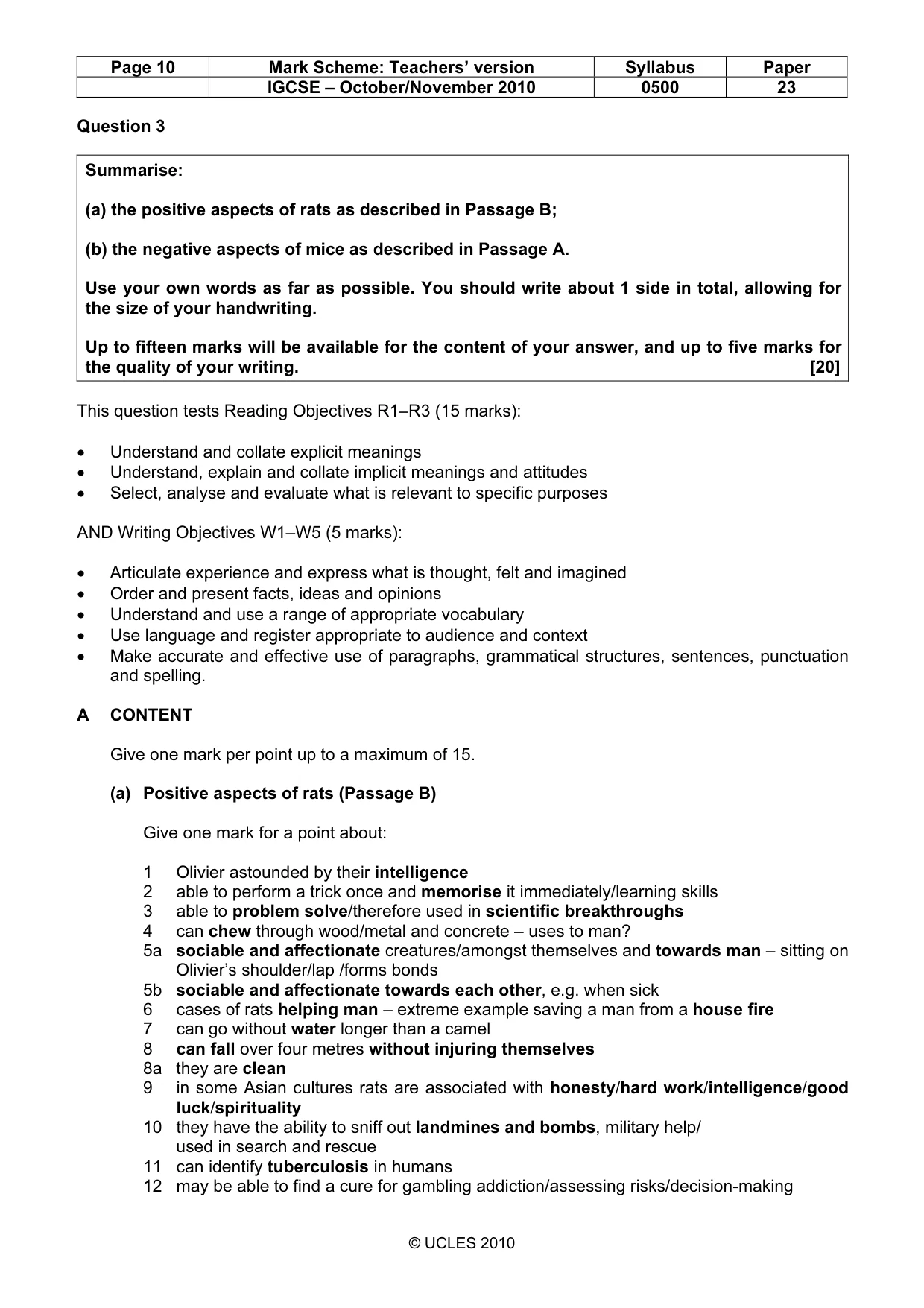
Page 10 Mark Scheme: Teachers’ version Syllabus Paper IGCSE – October/November 2010 0500 23 © UCLES 2010 Question 3 Summarise: (a) the positive aspects of rats as described in Passage B; (b) the negative aspects of mice as described in Passage A. Use your own words as far as possible. You should write about 1 side in total, allowing for the size of your handwriting. Up to fifteen marks will be available for the content of your answer, and up to five marks for the quality of your writing. [20] This question tests Reading Objectives R1–R3 (15 marks): • Understand and collate explicit meanings • Understand, explain and collate implicit meanings and attitudes • Select, analyse and evaluate what is relevant to specific purposes AND Writing Objectives W1–W5 (5 marks): • Articulate experience and express what is thought, felt and imagined • Order and present facts, ideas and opinions • Understand and use a range of appropriate vocabulary • Use language and register appropriate to audience and context • Make accurate and effective use of paragraphs, grammatical structures, sentences, punctuation and spelling. A CONTENT Give one mark per point up to a maximum of 15. (a) Positive aspects of rats (Passage B) Give one mark for a point about: 1 Olivier astounded by their intelligence 2 able to perform a trick once and memorise it immediately/learning skills 3 able to problem solve/therefore used in scientific breakthroughs 4 can chew through wood/metal and concrete – uses to man? 5a sociable and affectionate creatures/amongst themselves and towards man – sitting on Olivier’s shoulder/lap /forms bonds 5b sociable and affectionate towards each other, e.g. when sick 6 cases of rats helping man – extreme example saving a man from a house fire 7 can go without water longer than a camel 8 can fall over four metres without injuring themselves 8a they are clean 9 in some Asian cultures rats are associated with honesty/hard work/intelligence/good luck/spirituality 10 they have the ability to sniff out landmines and bombs, military help/ used in search and rescue 11 can identify tuberculosis in humans 12 may be able to find a cure for gambling addiction/assessing risks/decision-making
Mark scheme, page 11
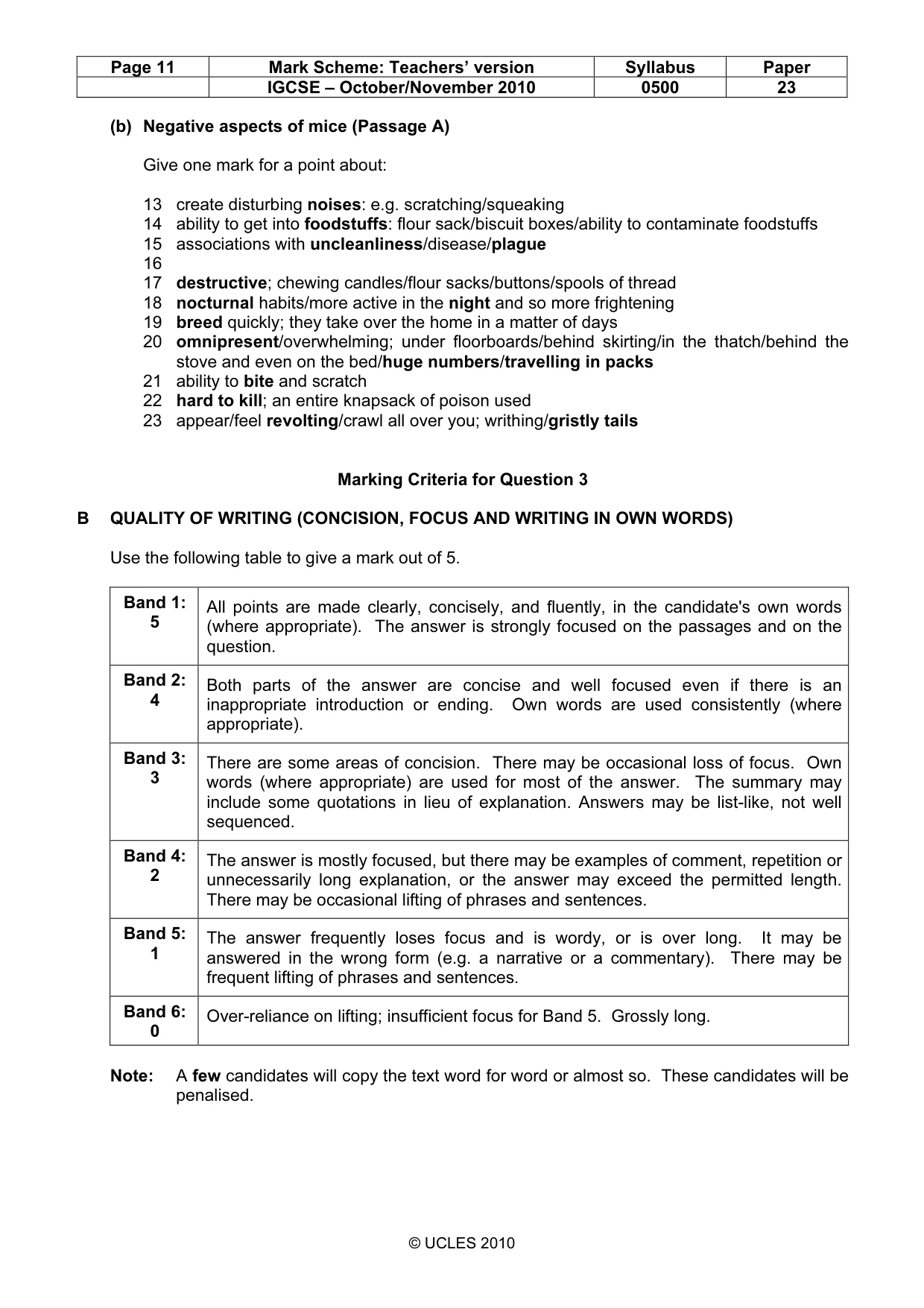
Page 11 Mark Scheme: Teachers’ version Syllabus Paper IGCSE – October/November 2010 0500 23 © UCLES 2010 (b) Negative aspects of mice (Passage A) Give one mark for a point about: 13 create disturbing noises: e.g. scratching/squeaking 14 ability to get into foodstuffs: flour sack/biscuit boxes/ability to contaminate foodstuffs 15 associations with uncleanliness/disease/plague 16 17 destructive; chewing candles/flour sacks/buttons/spools of thread 18 nocturnal habits/more active in the night and so more frightening 19 breed quickly; they take over the home in a matter of days 20 omnipresent/overwhelming; under floorboards/behind skirting/in the thatch/behind the stove and even on the bed/huge numbers/travelling in packs 21 ability to bite and scratch 22 hard to kill; an entire knapsack of poison used 23 appear/feel revolting/crawl all over you; writhing/gristly tails Marking Criteria for Question 3 B QUALITY OF WRITING (CONCISION, FOCUS AND WRITING IN OWN WORDS) Use the following table to give a mark out of 5. Band 1: 5 All points are made clearly, concisely, and fluently, in the candidate's own words (where appropriate). The answer is strongly focused on the passages and on the question. Band 2: 4 Both parts of the answer are concise and well focused even if there is an inappropriate introduction or ending. Own words are used consistently (where appropriate). Band 3: 3 There are some areas of concision. There may be occasional loss of focus. Own words (where appropriate) are used for most of the answer. The summary may include some quotations in lieu of explanation. Answers may be list-like, not well sequenced. Band 4: 2 The answer is mostly focused, but there may be examples of comment, repetition or unnecessarily long explanation, or the answer may exceed the permitted length. There may be occasional lifting of phrases and sentences. Band 5: 1 The answer frequently loses focus and is wordy, or is over long. It may be answered in the wrong form (e.g. a narrative or a commentary). There may be frequent lifting of phrases and sentences. Band 6: 0 Over-reliance on lifting; insufficient focus for Band 5. Grossly long. Note: A few candidates will copy the text word for word or almost so. These candidates will be penalised.
What you needed in this session
Cambridge’s own grade thresholds for 2010 Oct/Nov, Paper 2 · Variant 3. A higher threshold means an easier paper — the bar moves with how the cohort did.