Cambridge IGCSE English - First Language 0500 — 2010 Oct/Nov Paper 2 · Variant 2
0500/22/O/N/10 · 50 marks · ≈56 min
The question paper and its mark scheme, free to read here and free to download. This is Cambridge’s own paper, exactly as it was sat.
Question paper8 pages
Mark scheme9 pages
Answers below. Sit the paper first if you are practising.
Paper as text
Question paper, page 1
This document consists of 5 printed pages and 3 blank pages. DC (AC) 23346/3 © UCLES 2010 [Turn over UNIVERSITY OF CAMBRIDGE INTERNATIONAL EXAMINATIONS International General Certificate of Secondary Education * 0 7 5 0 7 6 0 0 7 8 * FIRST LANGUAGE ENGLISH 0500/22 Paper 2 Reading Passages (Extended) October/November 2010 2 hours Additional Materials: Answer Booklet/Paper READ THESE INSTRUCTIONS FIRST If you have been given an Answer Booklet, follow the instructions on the front cover of the Booklet. Write your Centre number, candidate number and name on all the work you hand in. Write in dark blue or black pen. Do not use staples, paper clips, highlighters, glue or correction fluid. Answer all questions. Dictionaries are not permitted. At the end of the examination, fasten all your work securely together. The number of marks is given in brackets [ ] at the end of each question or part question. www.XtremePapers.com
Question paper, page 2
2 0500/22/O/N/10 © UCLES 2010 Part 1 Read Passage A carefully, and then answer Questions 1 and 2. Passage A A Visit to Rataia In this story, the writer travels on foot to a small seaside town that is untouched by civilisation. The moment I arrived in Rataia, I knew I could transform this place into a world-class tourist resort. It was a ramshackle, run-down town with a handful of shops selling essential commodities. The biggest of these boasted the imposing title, ‘Emporium’. There was an apology for a hotel, where I was to stay in a cramped little room with a window too high for me to enjoy the sea view. The town square, with its sad, droopy trees, had an atmosphere of yesterday. In one corner, hiding behind a riot of bushes, stood a tiny church, sadly in need of restoration. So what had made me see the potential of Rataia? The day before, when I had reached the top of the hill behind the town, I was stunned by the natural beauty that lay below. There was the bay with its magnificent stretch of golden sand and the sea glistening in the sun, reflecting the brightness like a sheet of glass. On either side, the mountains fused into a purple haze. Silence was omnipresent, broken only by bursts of magical birdsong around me. I descended to the tiny, forgotten town. I stood transfixed. Even here the sand was really pure and the water in the rock pools translucent. I gazed at myriads of fish with their dazzling colours darting, cruising or just lazing between the crevices. As I sat alone, in the one shabby café on the front, my imagination took over. The bay was extensive enough to accommodate thousands of visitors in comparative comfort. Once electricity was brought from the neighbouring towns, there could be five or six hotels, a casino or two, a truly modern water- park. New, superior housing for the well-to-do would spread into the foothills behind the bay. Such was my entrepreneurial spirit! Finance was of course a major consideration, but just think of the money that my fashionable visitors would bring to my investment! In my mind’s eye, handsome people wandered along the spacious promenades, the women vying with each other to display the most charmingly casual or the finest formal clothes. Men would stroll in their smart designer items, or sport full evening dress for their visit to the Grand Theatre or the All Stars Concert Hall. Children would laugh happily as they caught sight of a special park just for them. And perhaps a very special theme park! The name ‘Everest’ crossed my mind. The café owner approached, rubbing his hands on his faded apron. He sat down at the next table. ‘Not much of a place, is it?’ he asked. ‘We’re cut off from civilisation; there are no jobs here – you’re the first customer I’ve had this morning.’ ‘Ah,’ I answered, ‘but the climate … what a perfect temperature! What sunsets!’ ‘I suppose so,’ said the café owner, looking over the bay. ‘Though it’s always like this. The only change is every week or so when we have a thunderstorm or a tornado, and then everyone gets wet or blown away.’ ‘But,’ I blurted out enthusiastically, ‘I know a way to bring thousands of rich people here. Just think of that guy who takes you to the islands in his boat. He could buy a bigger boat and make his fortune.’
Question paper, page 3
3 0500/22/O/N/10 © UCLES 2010 [Turn over The owner looked at me hard and long. ‘Now,’ he said, ‘we had someone like you a year back. Wanted to make the place some sort of paradise. He gave up quickly enough. You’ll never interest the people here. They prefer it the way it is. They may be poor and have no television or internet, but they like the simple life. You build a new road over the hills or tempt walkers with a chair-lift up the mountains and you don’t know what you’ll let loose. Just ask anyone here. Those islands you mentioned are real nature reserves – birds and animals few of us have ever seen. What would you do with our fish? Put them in some huge aquarium?’ He got up, wiping his hands on his apron. ‘I’m sure you’re a good man, but I wouldn’t even think of it if I were you.’ 1 Imagine a meeting between the writer and the town mayor to discuss the writer’s ideas for Rataia. Write the conversation that would take place. Include the views of both speakers on how the changes would affect: • the town; • the lives of the inhabitants; • the natural environment. Base the conversation on what you have read in Passage A and be careful to use your own words. Begin the conversation as follows: Mayor: I hear you’ve got some grand plans for our town. Write between 1½ and 2 sides, allowing for the size of your handwriting. Up to fifteen marks will be available for the content of your answer, and up to five marks for the quality of your writing. [Total: 20] 2 Re-read the descriptions of: (a) the town in paragraph 2; (b) what the writer experienced from the top of the hill in paragraph 3. Select words and phrases from these descriptions, and explain how the writer has created effects by using this language. [Total: 10] [Turn over for Part 2]
Question paper, page 4
4 0500/22/O/N/10 © UCLES 2010 Part 2 Question 3 is based on both Passage A and Passage B. Read Passage B carefully, and then re-read Passage A. Passage B A Winter Journey In this extract, the writer and four other travellers embark on a hard journey, taking a short cut across a lake where people do not normally go. We depart on the third of March, accompanied through the gate and down the road to the lakeside by an escort of children and dogs. After we pass the irrigation wall and branch off from the river road, taking the track to the right used by no one but hunters and fowlers, our escort begins to dwindle. The sun has risen but gives off no warmth. The wind beats at us across the lake, bringing tears to our eyes. In single file we wind away from the walled town. For the first three days we plod south and then eastward. To our right stretches a plain of wind-eroded clay terraces, merging into banks and red dust clouds and then into the yellow, hazy sky. To our left is flat marshland, belts of reeds, and the lake on which the central ice sheet has not melted. The wind blowing over the ice freezes our breath, so that rather than ride, we often walk for long stretches sheltered by our horses. Two of the packhorses are loaded with firewood, but this must be conserved for the desert. Once, half- buried in drift sand, we come upon a spreading, mound-like tamarisk bush which we hack to pieces for fuel; for the rest we have to be contented with bundles of dry reeds. In these early days of the journey we eat well. We have brought salted meat, flour, beans, dried fruit, and there are wildfowl to shoot. But we have to be sparing with water. The marsh water here in the shallow southern area is too salty to be drinkable. One of the men has to wade into the water to fill the skins, or to break off lumps of ice. Yet even the melted ice is so bitter and salty that it can only be drunk with strong red tea, and that causes stomach problems. After long marches my bones ache and by nightfall I am so tired that I have no appetite. I trudge on till I cannot put one foot in front of the other; then I clamber into the saddle and wave one of the men forward to take over the task of picking out the faint track. The wind never lets up. It howls at us across the ice, veiling the sky in a cloud of red dust. From the dust there is no hiding: it penetrates our clothing, cakes our skin, sifts into our baggage. We eat with coated tongues. Dust rather than air becomes the medium through which we live. On the fourth day we begin the crossing of the ancient lake bed that stretches another forty miles beyond the marshes. The terrain is more desolate than anything we have yet seen. Nothing grows on this salty lake floor which, in places, buckles and pushes up jagged crystalline hexagons half a metre wide. There are dangers too: crossing an unusually smooth patch, the front horse suddenly plunges through the crust and sinks chest-deep in foul green slime. The man who leads it stands a moment dumbstruck on thin air before he too splashes in. We struggle to haul them out, the salt crust splintering under the hooves of the flailing horse, the hole widening, a salty stench everywhere.
Question paper, page 5
5 0500/22/O/N/10 © UCLES 2010 After this we push our horses even harder, in a hurry to be off the dead lake. We bow our heads and drive into the sand, picking a way over the jagged salt shards, avoiding the treacherous, smooth ground. When darkness falls we batter the tent pegs into the rock-hard salt; we burn our firewood at an extravagant rate and like sailors pray for land. On the fifth day we leave the lake floor behind and pass through smooth salt, which soon gives way to sand and stone. Everyone is heartened, even the horses, which have had nothing but a few handfuls of linseed and a bucketful of brackish water. Their condition is visibly deteriorating. 3 Summarise: (a) the discomforts and dangers caused by the inhospitable place described in Passage B; (b) the disappointing aspects of the town noticed by the writer of Passage A. Use your own words as far as possible. You should write about 1 side in total, allowing for the size of your handwriting. Up to fifteen marks will be available for the content of your answer, and up to five marks for the quality of your writing. [Total: 20]
Question paper, page 6
6 0500/22/O/N/10 © UCLES 2010 BLANK PAGE
Question paper, page 7
7 0500/22/O/N/10 © UCLES 2010 BLANK PAGE
Question paper, page 8
8 0500/22/O/N/10 © UCLES 2010 Copyright Acknowledgements: Question 3 © J M Coetzee; Worst Journeys; Pan Books Ltd / David Higham Associates; 1992. Permission to reproduce items where third-party owned material protected by copyright is included has been sought and cleared where possible. Every reasonable effort has been made by the publisher (UCLES) to trace copyright holders, but if any items requiring clearance have unwittingly been included, the publisher will be pleased to make amends at the earliest possible opportunity. University of Cambridge International Examinations is part of the Cambridge Assessment Group. Cambridge Assessment is the brand name of University of Cambridge Local Examinations Syndicate (UCLES), which is itself a department of the University of Cambridge. BLANK PAGE
Mark scheme, page 1
UNIVERSITY OF CAMBRIDGE INTERNATIONAL EXAMINATIONS International General Certificate of Secondary Education MARK SCHEME for the October/November 2010 question paper for the guidance of teachers 0500 FIRST LANGUAGE ENGLISH 0500/22 Paper 2 (Reading Passages – Extended), maximum raw mark 50 This mark scheme is published as an aid to teachers and candidates, to indicate the requirements of the examination. It shows the basis on which Examiners were instructed to award marks. It does not indicate the details of the discussions that took place at an Examiners’ meeting before marking began, which would have considered the acceptability of alternative answers. Mark schemes must be read in conjunction with the question papers and the report on the examination. • CIE will not enter into discussions or correspondence in connection with these mark schemes. CIE is publishing the mark schemes for the October/November 2010 question papers for most IGCSE, GCE Advanced Level and Advanced Subsidiary Level syllabuses and some Ordinary Level syllabuses. www.XtremePapers.com
Mark scheme, page 2
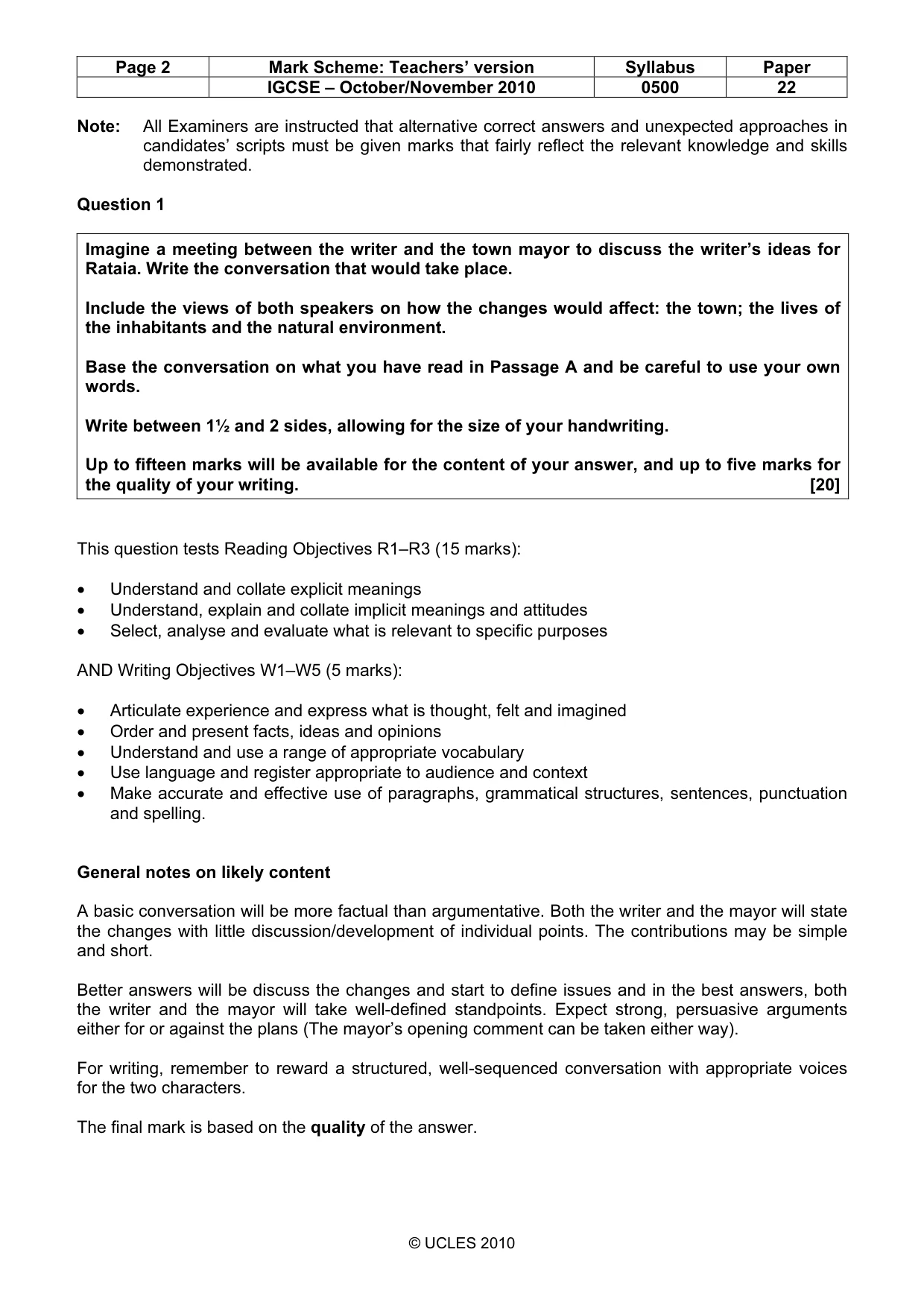
Page 2 Mark Scheme: Teachers’ version Syllabus Paper IGCSE – October/November 2010 0500 22 © UCLES 2010 Note: All Examiners are instructed that alternative correct answers and unexpected approaches in candidates’ scripts must be given marks that fairly reflect the relevant knowledge and skills demonstrated. Question 1 Imagine a meeting between the writer and the town mayor to discuss the writer’s ideas for Rataia. Write the conversation that would take place. Include the views of both speakers on how the changes would affect: the town; the lives of the inhabitants and the natural environment. Base the conversation on what you have read in Passage A and be careful to use your own words. Write between 1½ and 2 sides, allowing for the size of your handwriting. Up to fifteen marks will be available for the content of your answer, and up to five marks for the quality of your writing. [20] This question tests Reading Objectives R1–R3 (15 marks): • Understand and collate explicit meanings • Understand, explain and collate implicit meanings and attitudes • Select, analyse and evaluate what is relevant to specific purposes AND Writing Objectives W1–W5 (5 marks): • Articulate experience and express what is thought, felt and imagined • Order and present facts, ideas and opinions • Understand and use a range of appropriate vocabulary • Use language and register appropriate to audience and context • Make accurate and effective use of paragraphs, grammatical structures, sentences, punctuation and spelling. General notes on likely content A basic conversation will be more factual than argumentative. Both the writer and the mayor will state the changes with little discussion/development of individual points. The contributions may be simple and short. Better answers will be discuss the changes and start to define issues and in the best answers, both the writer and the mayor will take well-defined standpoints. Expect strong, persuasive arguments either for or against the plans (The mayor’s opening comment can be taken either way). For writing, remember to reward a structured, well-sequenced conversation with appropriate voices for the two characters. The final mark is based on the quality of the answer.
Mark scheme, page 3
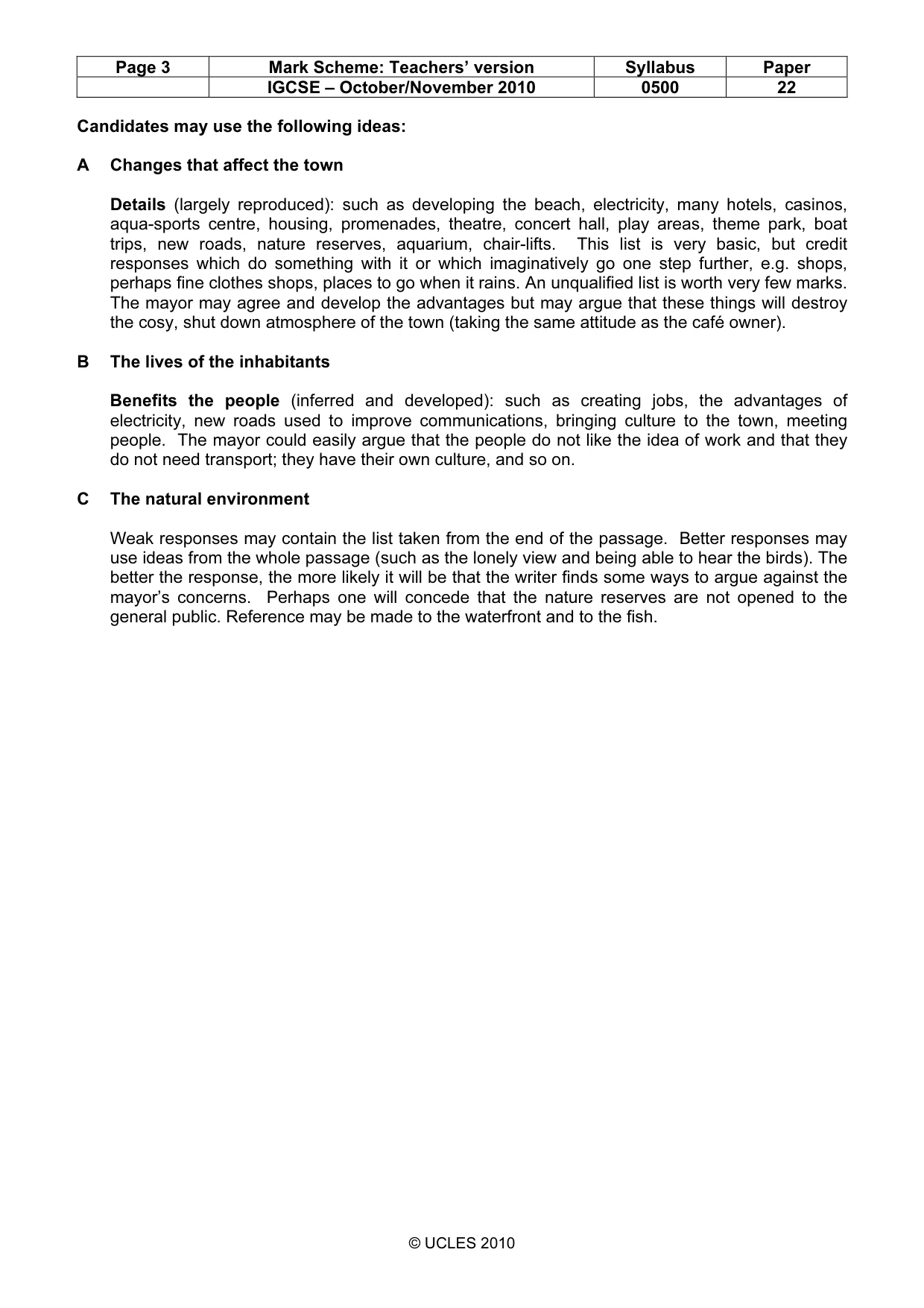
Page 3 Mark Scheme: Teachers’ version Syllabus Paper IGCSE – October/November 2010 0500 22 © UCLES 2010 Candidates may use the following ideas: A Changes that affect the town Details (largely reproduced): such as developing the beach, electricity, many hotels, casinos, aqua-sports centre, housing, promenades, theatre, concert hall, play areas, theme park, boat trips, new roads, nature reserves, aquarium, chair-lifts. This list is very basic, but credit responses which do something with it or which imaginatively go one step further, e.g. shops, perhaps fine clothes shops, places to go when it rains. An unqualified list is worth very few marks. The mayor may agree and develop the advantages but may argue that these things will destroy the cosy, shut down atmosphere of the town (taking the same attitude as the café owner). B The lives of the inhabitants Benefits the people (inferred and developed): such as creating jobs, the advantages of electricity, new roads used to improve communications, bringing culture to the town, meeting people. The mayor could easily argue that the people do not like the idea of work and that they do not need transport; they have their own culture, and so on. C The natural environment Weak responses may contain the list taken from the end of the passage. Better responses may use ideas from the whole passage (such as the lonely view and being able to hear the birds). The better the response, the more likely it will be that the writer finds some ways to argue against the mayor’s concerns. Perhaps one will concede that the nature reserves are not opened to the general public. Reference may be made to the waterfront and to the fish.
Mark scheme, page 4
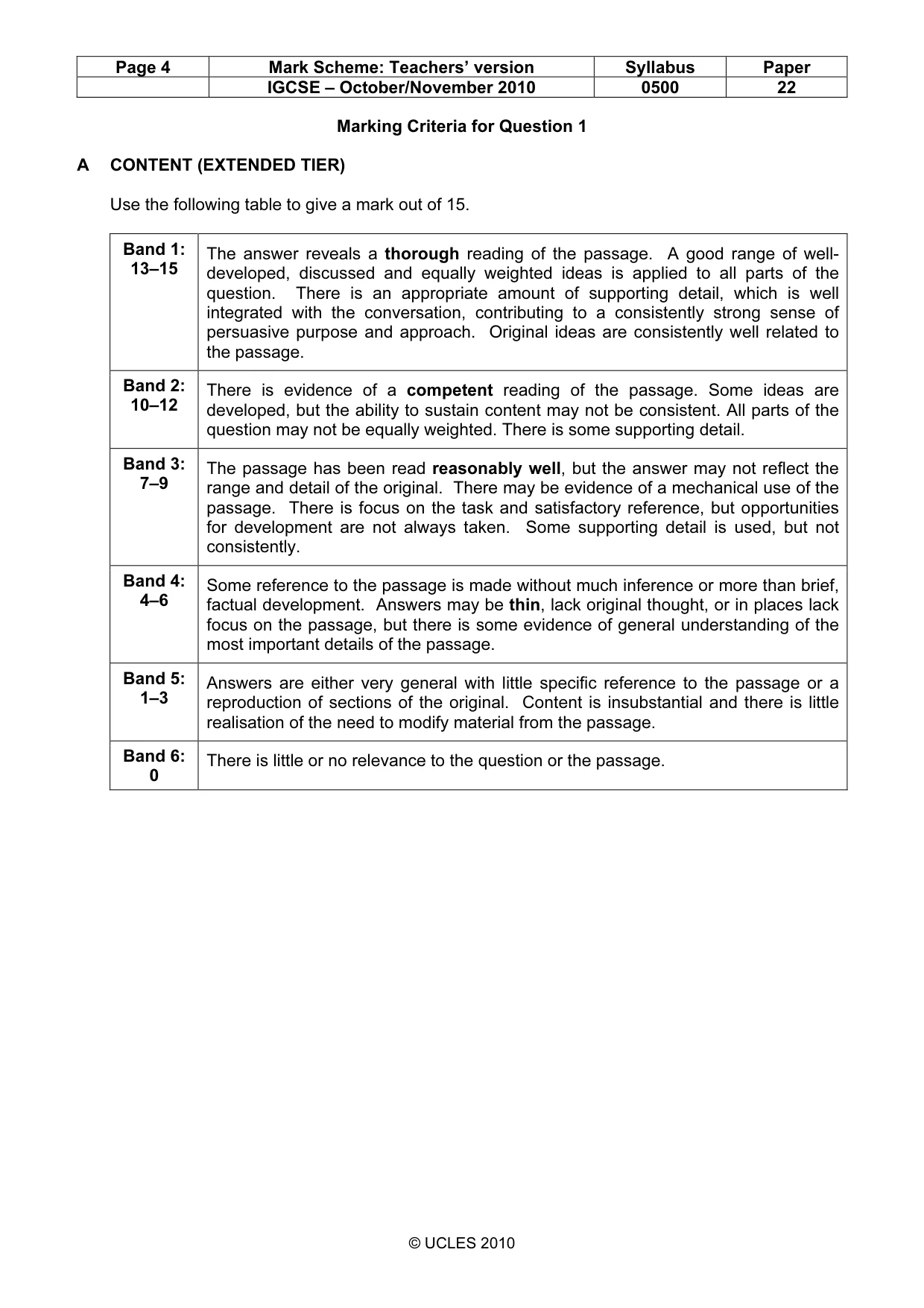
Page 4 Mark Scheme: Teachers’ version Syllabus Paper IGCSE – October/November 2010 0500 22 © UCLES 2010 Marking Criteria for Question 1 A CONTENT (EXTENDED TIER) Use the following table to give a mark out of 15. Band 1: 13–15 The answer reveals a thorough reading of the passage. A good range of well- developed, discussed and equally weighted ideas is applied to all parts of the question. There is an appropriate amount of supporting detail, which is well integrated with the conversation, contributing to a consistently strong sense of persuasive purpose and approach. Original ideas are consistently well related to the passage. Band 2: 10–12 There is evidence of a competent reading of the passage. Some ideas are developed, but the ability to sustain content may not be consistent. All parts of the question may not be equally weighted. There is some supporting detail. Band 3: 7–9 The passage has been read reasonably well, but the answer may not reflect the range and detail of the original. There may be evidence of a mechanical use of the passage. There is focus on the task and satisfactory reference, but opportunities for development are not always taken. Some supporting detail is used, but not consistently. Band 4: 4–6 Some reference to the passage is made without much inference or more than brief, factual development. Answers may be thin, lack original thought, or in places lack focus on the passage, but there is some evidence of general understanding of the most important details of the passage. Band 5: 1–3 Answers are either very general with little specific reference to the passage or a reproduction of sections of the original. Content is insubstantial and there is little realisation of the need to modify material from the passage. Band 6: 0 There is little or no relevance to the question or the passage.
Mark scheme, page 5
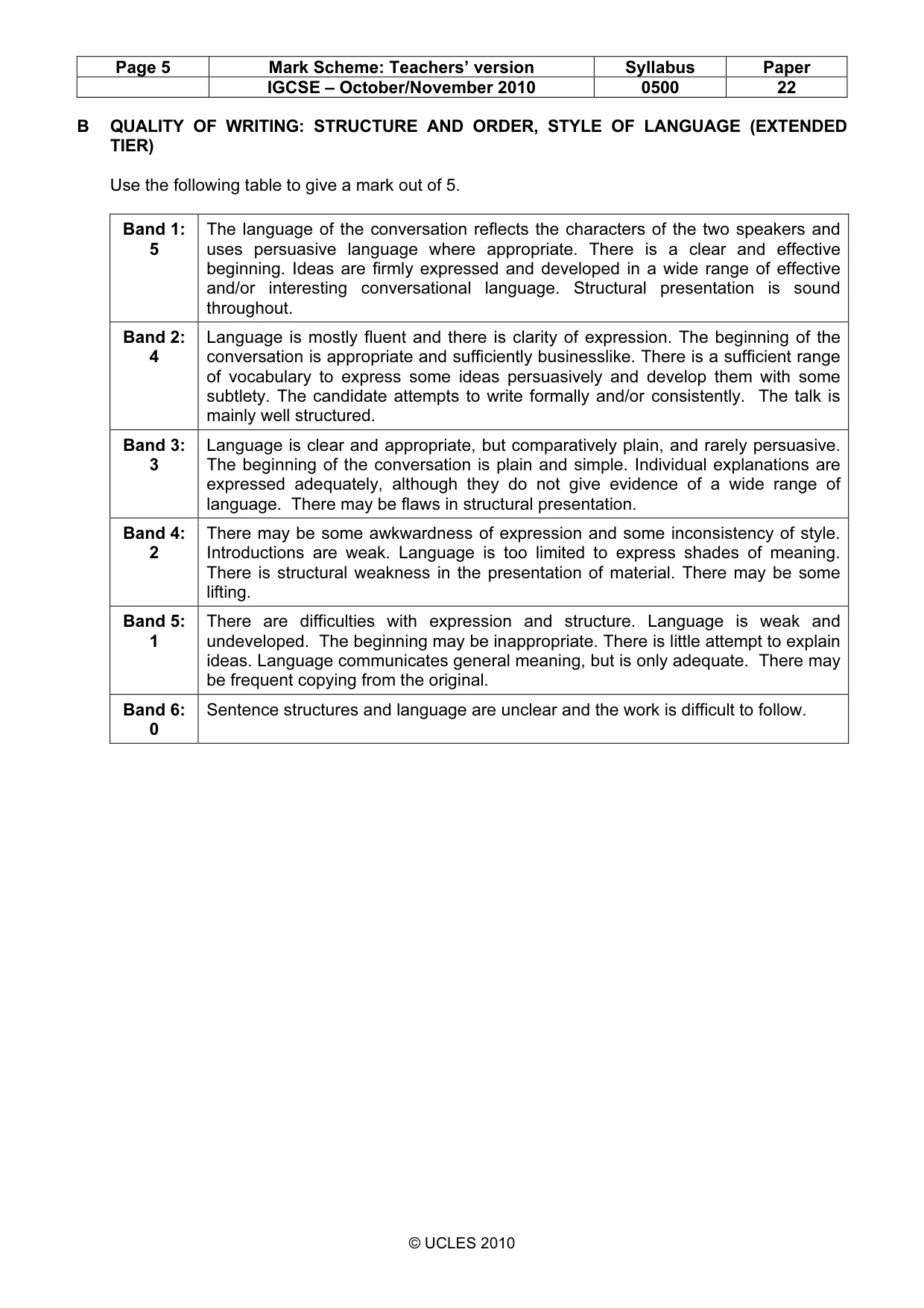
Page 5 Mark Scheme: Teachers’ version Syllabus Paper IGCSE – October/November 2010 0500 22 © UCLES 2010 B QUALITY OF WRITING: STRUCTURE AND ORDER, STYLE OF LANGUAGE (EXTENDED TIER) Use the following table to give a mark out of 5. Band 1: 5 The language of the conversation reflects the characters of the two speakers and uses persuasive language where appropriate. There is a clear and effective beginning. Ideas are firmly expressed and developed in a wide range of effective and/or interesting conversational language. Structural presentation is sound throughout. Band 2: 4 Language is mostly fluent and there is clarity of expression. The beginning of the conversation is appropriate and sufficiently businesslike. There is a sufficient range of vocabulary to express some ideas persuasively and develop them with some subtlety. The candidate attempts to write formally and/or consistently. The talk is mainly well structured. Band 3: 3 Language is clear and appropriate, but comparatively plain, and rarely persuasive. The beginning of the conversation is plain and simple. Individual explanations are expressed adequately, although they do not give evidence of a wide range of language. There may be flaws in structural presentation. Band 4: 2 There may be some awkwardness of expression and some inconsistency of style. Introductions are weak. Language is too limited to express shades of meaning. There is structural weakness in the presentation of material. There may be some lifting. Band 5: 1 There are difficulties with expression and structure. Language is weak and undeveloped. The beginning may be inappropriate. There is little attempt to explain ideas. Language communicates general meaning, but is only adequate. There may be frequent copying from the original. Band 6: 0 Sentence structures and language are unclear and the work is difficult to follow.
Mark scheme, page 6
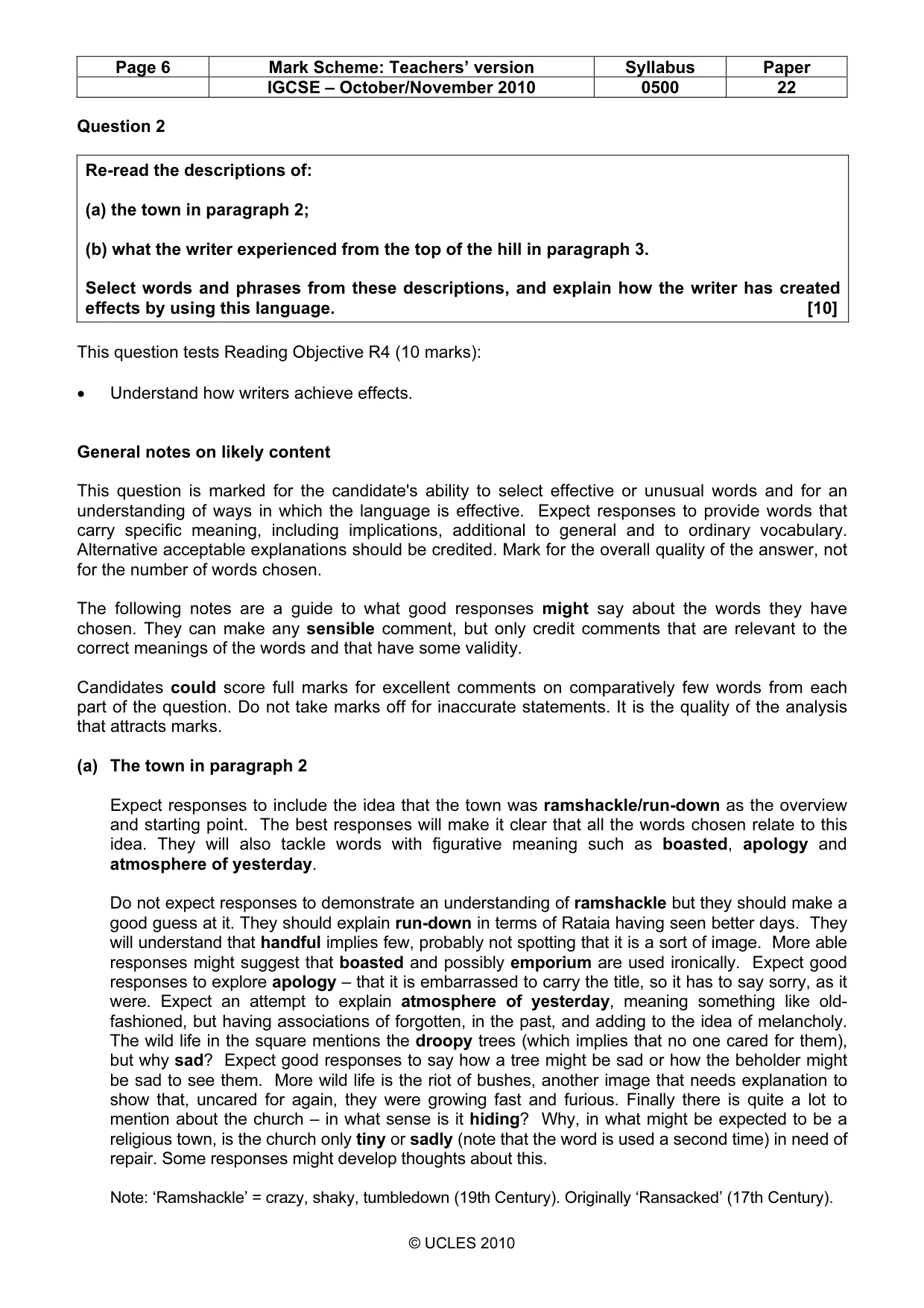
Page 6 Mark Scheme: Teachers’ version Syllabus Paper IGCSE – October/November 2010 0500 22 © UCLES 2010 Question 2 Re-read the descriptions of: (a) the town in paragraph 2; (b) what the writer experienced from the top of the hill in paragraph 3. Select words and phrases from these descriptions, and explain how the writer has created effects by using this language. [10] This question tests Reading Objective R4 (10 marks): • Understand how writers achieve effects. General notes on likely content This question is marked for the candidate's ability to select effective or unusual words and for an understanding of ways in which the language is effective. Expect responses to provide words that carry specific meaning, including implications, additional to general and to ordinary vocabulary. Alternative acceptable explanations should be credited. Mark for the overall quality of the answer, not for the number of words chosen. The following notes are a guide to what good responses might say about the words they have chosen. They can make any sensible comment, but only credit comments that are relevant to the correct meanings of the words and that have some validity. Candidates could score full marks for excellent comments on comparatively few words from each part of the question. Do not take marks off for inaccurate statements. It is the quality of the analysis that attracts marks. (a) The town in paragraph 2 Expect responses to include the idea that the town was ramshackle/run-down as the overview and starting point. The best responses will make it clear that all the words chosen relate to this idea. They will also tackle words with figurative meaning such as boasted, apology and atmosphere of yesterday. Do not expect responses to demonstrate an understanding of ramshackle but they should make a good guess at it. They should explain run-down in terms of Rataia having seen better days. They will understand that handful implies few, probably not spotting that it is a sort of image. More able responses might suggest that boasted and possibly emporium are used ironically. Expect good responses to explore apology – that it is embarrassed to carry the title, so it has to say sorry, as it were. Expect an attempt to explain atmosphere of yesterday, meaning something like old- fashioned, but having associations of forgotten, in the past, and adding to the idea of melancholy. The wild life in the square mentions the droopy trees (which implies that no one cared for them), but why sad? Expect good responses to say how a tree might be sad or how the beholder might be sad to see them. More wild life is the riot of bushes, another image that needs explanation to show that, uncared for again, they were growing fast and furious. Finally there is quite a lot to mention about the church – in what sense is it hiding? Why, in what might be expected to be a religious town, is the church only tiny or sadly (note that the word is used a second time) in need of repair. Some responses might develop thoughts about this. Note: ‘Ramshackle’ = crazy, shaky, tumbledown (19th Century). Originally ‘Ransacked’ (17th Century).
Mark scheme, page 7
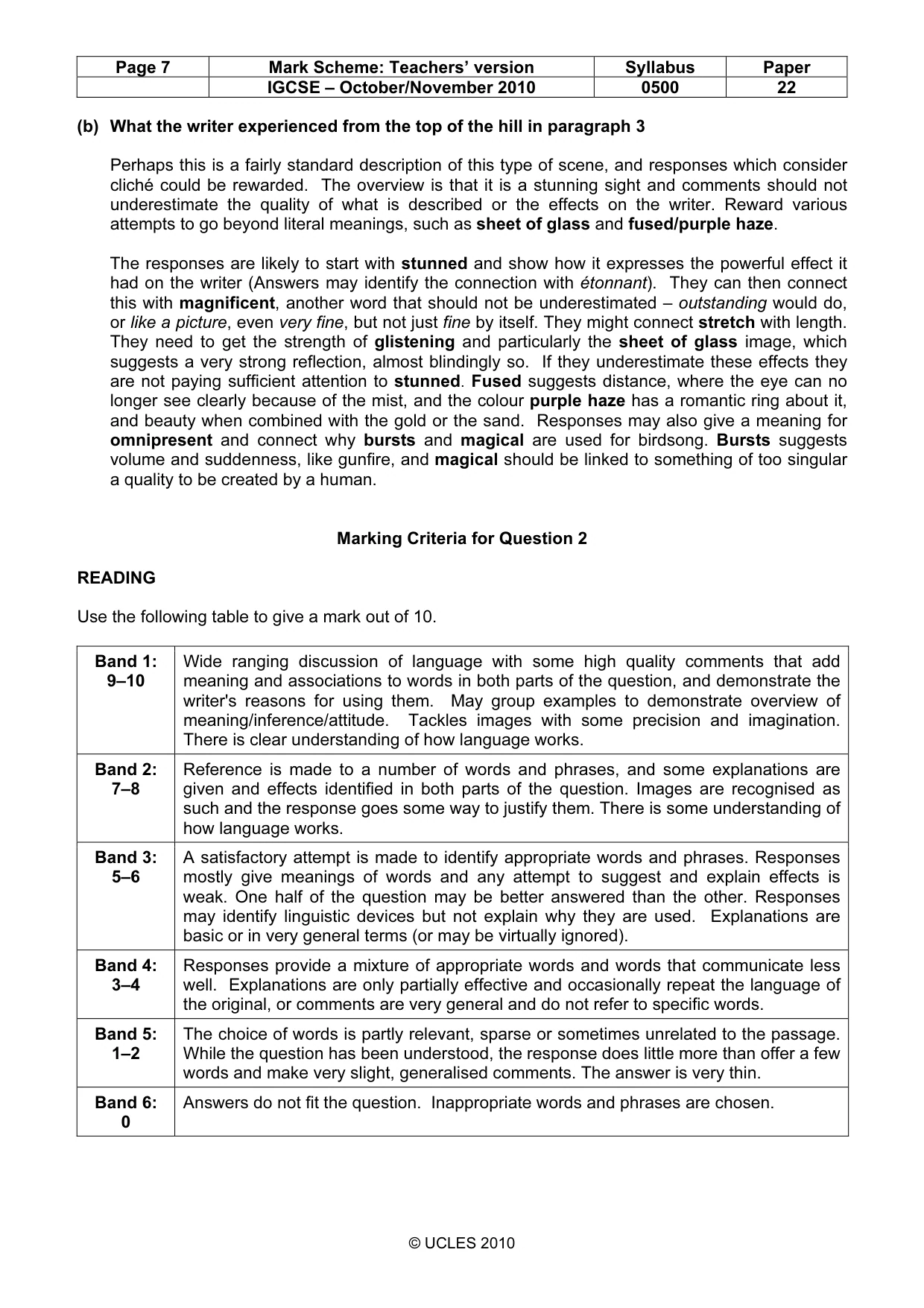
Page 7 Mark Scheme: Teachers’ version Syllabus Paper IGCSE – October/November 2010 0500 22 © UCLES 2010 (b) What the writer experienced from the top of the hill in paragraph 3 Perhaps this is a fairly standard description of this type of scene, and responses which consider cliché could be rewarded. The overview is that it is a stunning sight and comments should not underestimate the quality of what is described or the effects on the writer. Reward various attempts to go beyond literal meanings, such as sheet of glass and fused/purple haze. The responses are likely to start with stunned and show how it expresses the powerful effect it had on the writer (Answers may identify the connection with étonnant). They can then connect this with magnificent, another word that should not be underestimated – outstanding would do, or like a picture, even very fine, but not just fine by itself. They might connect stretch with length. They need to get the strength of glistening and particularly the sheet of glass image, which suggests a very strong reflection, almost blindingly so. If they underestimate these effects they are not paying sufficient attention to stunned. Fused suggests distance, where the eye can no longer see clearly because of the mist, and the colour purple haze has a romantic ring about it, and beauty when combined with the gold or the sand. Responses may also give a meaning for omnipresent and connect why bursts and magical are used for birdsong. Bursts suggests volume and suddenness, like gunfire, and magical should be linked to something of too singular a quality to be created by a human. Marking Criteria for Question 2 READING Use the following table to give a mark out of 10. Band 1: 9–10 Wide ranging discussion of language with some high quality comments that add meaning and associations to words in both parts of the question, and demonstrate the writer's reasons for using them. May group examples to demonstrate overview of meaning/inference/attitude. Tackles images with some precision and imagination. There is clear understanding of how language works. Band 2: 7–8 Reference is made to a number of words and phrases, and some explanations are given and effects identified in both parts of the question. Images are recognised as such and the response goes some way to justify them. There is some understanding of how language works. Band 3: 5–6 A satisfactory attempt is made to identify appropriate words and phrases. Responses mostly give meanings of words and any attempt to suggest and explain effects is weak. One half of the question may be better answered than the other. Responses may identify linguistic devices but not explain why they are used. Explanations are basic or in very general terms (or may be virtually ignored). Band 4: 3–4 Responses provide a mixture of appropriate words and words that communicate less well. Explanations are only partially effective and occasionally repeat the language of the original, or comments are very general and do not refer to specific words. Band 5: 1–2 The choice of words is partly relevant, sparse or sometimes unrelated to the passage. While the question has been understood, the response does little more than offer a few words and make very slight, generalised comments. The answer is very thin. Band 6: 0 Answers do not fit the question. Inappropriate words and phrases are chosen.
Mark scheme, page 8
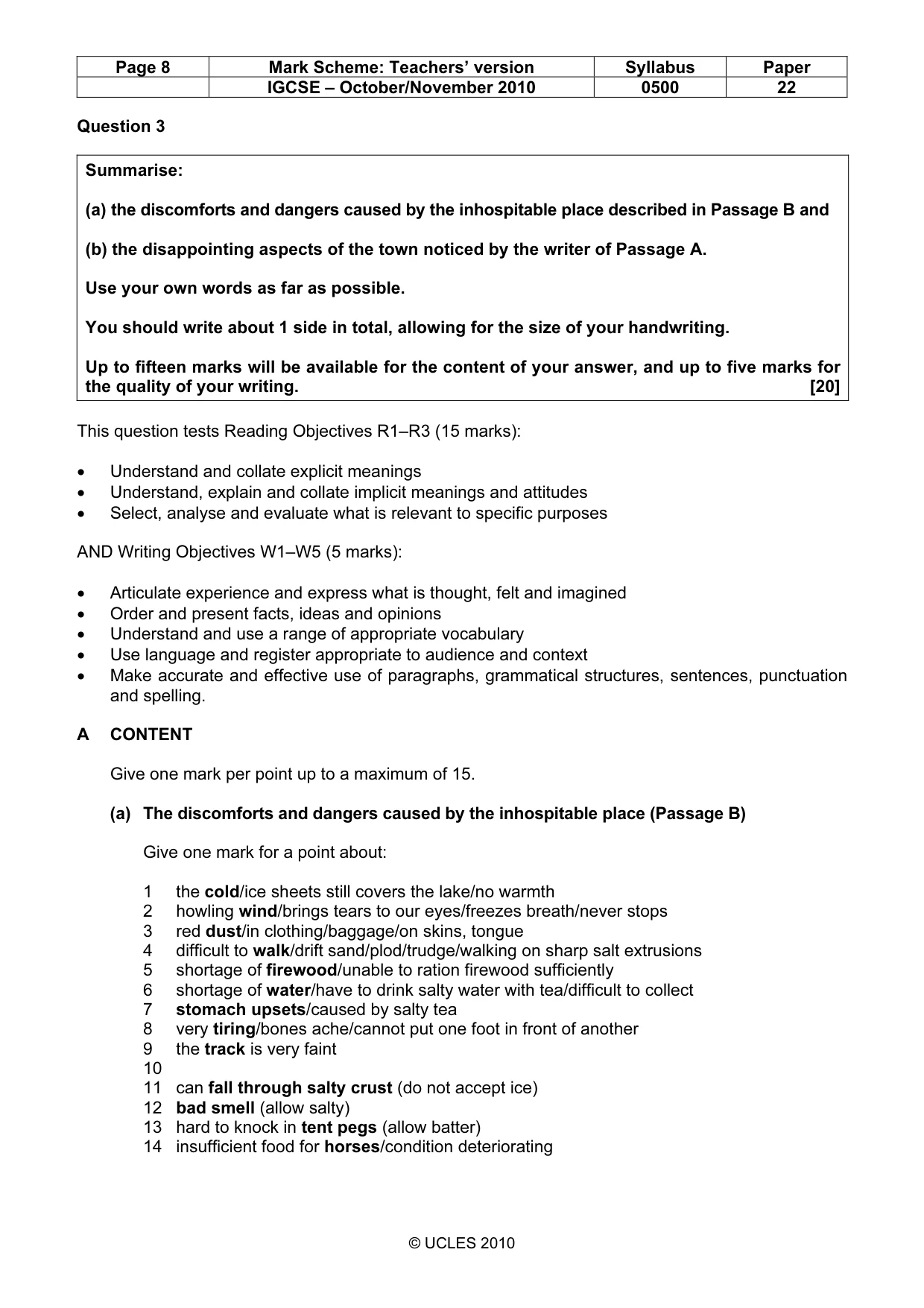
Page 8 Mark Scheme: Teachers’ version Syllabus Paper IGCSE – October/November 2010 0500 22 © UCLES 2010 Question 3 Summarise: (a) the discomforts and dangers caused by the inhospitable place described in Passage B and (b) the disappointing aspects of the town noticed by the writer of Passage A. Use your own words as far as possible. You should write about 1 side in total, allowing for the size of your handwriting. Up to fifteen marks will be available for the content of your answer, and up to five marks for the quality of your writing. [20] This question tests Reading Objectives R1–R3 (15 marks): • Understand and collate explicit meanings • Understand, explain and collate implicit meanings and attitudes • Select, analyse and evaluate what is relevant to specific purposes AND Writing Objectives W1–W5 (5 marks): • Articulate experience and express what is thought, felt and imagined • Order and present facts, ideas and opinions • Understand and use a range of appropriate vocabulary • Use language and register appropriate to audience and context • Make accurate and effective use of paragraphs, grammatical structures, sentences, punctuation and spelling. A CONTENT Give one mark per point up to a maximum of 15. (a) The discomforts and dangers caused by the inhospitable place (Passage B) Give one mark for a point about: 1 the cold/ice sheets still covers the lake/no warmth 2 howling wind/brings tears to our eyes/freezes breath/never stops 3 red dust/in clothing/baggage/on skins, tongue 4 difficult to walk/drift sand/plod/trudge/walking on sharp salt extrusions 5 shortage of firewood/unable to ration firewood sufficiently 6 shortage of water/have to drink salty water with tea/difficult to collect 7 stomach upsets/caused by salty tea 8 very tiring/bones ache/cannot put one foot in front of another 9 the track is very faint 10 11 can fall through salty crust (do not accept ice) 12 bad smell (allow salty) 13 hard to knock in tent pegs (allow batter) 14 insufficient food for horses/condition deteriorating
Mark scheme, page 9
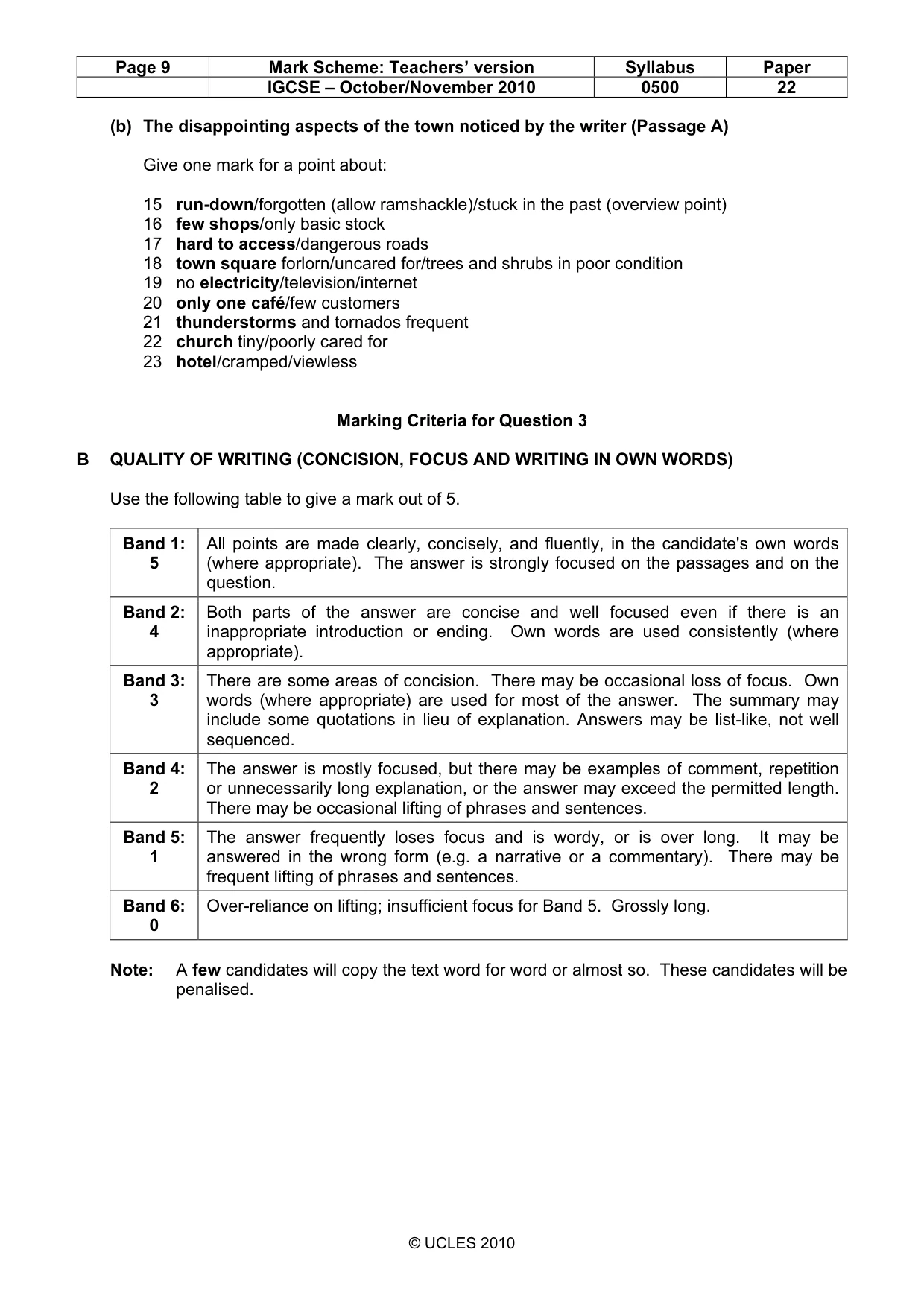
Page 9 Mark Scheme: Teachers’ version Syllabus Paper IGCSE – October/November 2010 0500 22 © UCLES 2010 (b) The disappointing aspects of the town noticed by the writer (Passage A) Give one mark for a point about: 15 run-down/forgotten (allow ramshackle)/stuck in the past (overview point) 16 few shops/only basic stock 17 hard to access/dangerous roads 18 town square forlorn/uncared for/trees and shrubs in poor condition 19 no electricity/television/internet 20 only one café/few customers 21 thunderstorms and tornados frequent 22 church tiny/poorly cared for 23 hotel/cramped/viewless Marking Criteria for Question 3 B QUALITY OF WRITING (CONCISION, FOCUS AND WRITING IN OWN WORDS) Use the following table to give a mark out of 5. Band 1: 5 All points are made clearly, concisely, and fluently, in the candidate's own words (where appropriate). The answer is strongly focused on the passages and on the question. Band 2: 4 Both parts of the answer are concise and well focused even if there is an inappropriate introduction or ending. Own words are used consistently (where appropriate). Band 3: 3 There are some areas of concision. There may be occasional loss of focus. Own words (where appropriate) are used for most of the answer. The summary may include some quotations in lieu of explanation. Answers may be list-like, not well sequenced. Band 4: 2 The answer is mostly focused, but there may be examples of comment, repetition or unnecessarily long explanation, or the answer may exceed the permitted length. There may be occasional lifting of phrases and sentences. Band 5: 1 The answer frequently loses focus and is wordy, or is over long. It may be answered in the wrong form (e.g. a narrative or a commentary). There may be frequent lifting of phrases and sentences. Band 6: 0 Over-reliance on lifting; insufficient focus for Band 5. Grossly long. Note: A few candidates will copy the text word for word or almost so. These candidates will be penalised.
What you needed in this session
Cambridge’s own grade thresholds for 2010 Oct/Nov, Paper 2 · Variant 2. A higher threshold means an easier paper — the bar moves with how the cohort did.